POOL BILLIARDS:
THE RULES OF PLAY
GENERAL RULES
The following General Rules apply to all the
games covered by these rules except when
contradicted by specific game rules. In addition,
the Regulations of Pool Billiards cover aspects of
the game not directly related to the game rules,
such as equipment specifications and
organization of events.
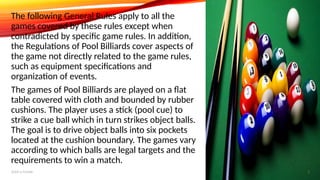
The games of Pool Billiards are played on a flat
table covered with cloth and bounded by rubber
cushions. The player uses a stick (pool cue) to
strike a cue ball which in turn strikes object balls.
The goal is to drive object balls into six pockets
located at the cushion boundary. The games vary
according to which balls are legal targets and the
requirements to win a match.
Add a footer 3
It is the player's responsibility to be
aware of all rules, regulations and
schedules applying to competition.
While tournament officials will make
every reasonable effort to have such
information readily available to all
players as appropriate, the ultimate
responsibility rests with the player.
Player’s Responsibility
Add a footer 4
The lag is the first shot of the match and
determines order of play. The player who wins
the lag chooses who will shoot first.
The referee will place a ball on each side of the
table behind the head string and near the head
string. The players will shoot at about the same
time to make each ball contact the foot cushion
with the goal of returning the ball closer to the
head cushion than the opponent.
Lagging to Determine Order of Play
Add a footer 5
• crosses the long string;
• contacts the foot cushion other than once;
• is pocketed or driven off the table;
• touches the side cushion; or
• the ball rests within the corner pocket
and past the nose of the head cushion.
In addition, a lag will be bad if any non-
object-ball foul occurs other than 6.9 Balls
Still Moving.
A lag shot is bad and cannot win if the shooter’s
ball:
Add a footer 6
• a player’s ball is struck after the
other ball has touched the foot
cushion;
• the referee cannot determine
which ball has stopped closer to
the head cushion; or
• both lags are bad.
The players will lag again if:
Add a footer 7
The equipment must meet existing WPA equipment
specifications. In general, players are not permitted to
introduce novel equipment into the game. The
following uses, among others, are considered normal.
If the player is uncertain about a particular use of
equipment, he should discuss it with the tournament
management prior to the start of play. The equipment
must be used only for the purpose or in the manner
that the equipment was intended. (See 6.17
Unsportsmanlike Conduct.)
Player’s Use of Equipment
Add a footer 8
• Cue Stick – The player is permitted to switch between cue
sticks during the match, such as break, jump and normal cues.
He may use either a built-in extender or an add-on extender to
increase the length of the stick.
• Chalk – The player may apply chalk to his tip to prevent
miscues, and may use his own chalk, provided its color is
compatible with the cloth.
• Mechanical Bridges – The player may use up to two
mechanical bridges to support the cue stick during the shot.
The configuration of the bridges is up to the player. He may
use his own bridge if it is similar to standard bridges.
• Gloves – The player may use gloves to improve the grip and/or
bridge hand function.
• Powder – A player is allowed to use powder in a reasonable
amount as determined by the referee.
Add a footer 9
Balls are spotted (returned to play on the table) by placing
them on the long string (long axis of the table) as close as
possible to the foot spot and between the foot spot and
the foot rail, without moving any interfering ball. If the
spotted ball cannot be placed on the foot spot, it should
be placed in contact (if possible) with the corresponding
interfering ball. However, when the cue ball is next to the
spotted ball, the spotted ball should not be placed in
contact with the cue ball; a small separation must be
maintained. If all of the long string below the foot spot is
blocked by other balls, the ball is spotted above the foot
spot, and as close as possible to the foot spot.
Spotting Balls
Add a footer 10
When the cue ball is in hand, the shooter may place the
cue ball anywhere on the playing surface (see 8.1 Parts of
the Table) and may continue to move the cue ball until he
executes a shot. (See definition 8.2 Shot.) Players may use
any part of the cue stick to move the cue ball, including
the tip, but not with a forward stroke motion. In some
games and for most break shots, placement of the cue
ball may be restricted to the area behind the head string
depending on the rules of the game, and then 6.10 Bad
Cue Ball Placement and 6.11 Bad Play from Behind the
Head String may apply.
Cue Ball in Hand
Add a footer 11
When the shooter has the cue ball in hand
behind the head string and all the legal object
balls are behind the head string, he may request
the legal object ball nearest the head string to
be spotted. If two or more balls are equal
distance from the head string, the shooter may
designate which of the equidistant balls is to be
spotted. An object ball that rests exactly on the
head string is playable.
Add a footer 12
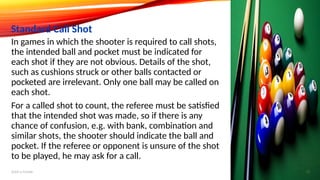
In games in which the shooter is required to call shots,
the intended ball and pocket must be indicated for
each shot if they are not obvious. Details of the shot,
such as cushions struck or other balls contacted or
pocketed are irrelevant. Only one ball may be called on
each shot.
For a called shot to count, the referee must be satisfied
that the intended shot was made, so if there is any
chance of confusion, e.g. with bank, combination and
similar shots, the shooter should indicate the ball and
pocket. If the referee or opponent is unsure of the shot
to be played, he may ask for a call.
Standard Call Shot
Add a footer 13
In call shot games, the shooter may
choose to call “safety” instead of a ball
and pocket, and then play passes to the
opponent at the end of the shot.
Whether balls are being spotted after
safeties depends on the rules of the
particular game.
Add a footer 14
A ball may settle slightly after it appears to have
stopped, possibly due to slight imperfections in the ball
or the table. Unless this causes a ball to fall into a
pocket, it is considered a normal hazard of play, and the
ball will not be moved back. If a ball falls into a pocket
as the result of such settling, it is restored as closely as
possible to its original position. If a settling ball falls into
a pocket during or just prior to a shot, and this has an
effect on the shot, the referee will restore the position
and the shot will be replayed. The shooter is not
penalized for shooting while a ball is settling. See also
8.3 Ball Pocketed.
Balls Settling
Add a footer 15
When necessary for balls to be restored or
cleaned, the referee will restore disturbed
balls to their original positions to the best of
his ability. The players must accept the
referee’s judgment as to placement.
Restoring a Position
Add a footer 16
When outside interference occurs during a shot
that has an effect on the outcome of that shot, the
referee will restore the balls to the positions they
had before the shot, and the shot will be replayed.
If the interference had no effect on the shot, the
referee will restore the disturbed balls and play will
continue. If the balls cannot be restored to their
original positions, the situation is handled like a
stalemate.
Outside Interference
Add a footer 17
When outside interference occurs during a
shot that has an effect on the outcome of that
shot, the referee will restore the balls to the
positions they had before the shot, and the
shot will be replayed. If the interference had no
effect on the shot, the referee will restore the
disturbed balls and play will continue. If the
balls cannot be restored to their original
positions, the situation is handled like a
stalemate.
Outside Interference
Add a footer 18
If a player feels that the referee has made an
error in judgment, he may ask the referee to
reconsider his call or lack of call, but the
referee’s decision on judgment calls is final.
However, if the player feels that the referee is
not applying the rules correctly, he may ask for
ruling by the designated appeals authority. The
referee will suspend play while this appeal is in
process. (See also part (d) of 6.17
Unsportsmanlike Conduct.) Fouls must be
called promptly. (See 6. Fouls.)
Prompting Calls
and Protesting Rulings
Add a footer 19
If a player concedes, he loses the
match. For example, if a player
unscrews his jointed playing cue stick
while the opponent is at the table and
during the opponent’s decisive rack of
a match, it will be considered a
concession of the match.
Concession
Add a footer 20
If the referee observes that no progress is
being made towards a conclusion, he will
announce his decision, and each player will
have three more turns at the table. Then, if the
referee determines that there is still no
progress, he will declare a stalemate. If both
players agree, they may accept the stalemate
without taking their three additional turns. The
procedure for a stalemate is specified under
the rules for each game.
Stalemate
Add a footer 21
THANK YOU.
elyuke
13

GENERAL-RULES.pptx123456789123456781234567

  • 1.
  • 2.
  • 3.
    The following GeneralRules apply to all the games covered by these rules except when contradicted by specific game rules. In addition, the Regulations of Pool Billiards cover aspects of the game not directly related to the game rules, such as equipment specifications and organization of events. The games of Pool Billiards are played on a flat table covered with cloth and bounded by rubber cushions. The player uses a stick (pool cue) to strike a cue ball which in turn strikes object balls. The goal is to drive object balls into six pockets located at the cushion boundary. The games vary according to which balls are legal targets and the requirements to win a match. Add a footer 3
  • 4.
    It is theplayer's responsibility to be aware of all rules, regulations and schedules applying to competition. While tournament officials will make every reasonable effort to have such information readily available to all players as appropriate, the ultimate responsibility rests with the player. Player’s Responsibility Add a footer 4
  • 5.
    The lag isthe first shot of the match and determines order of play. The player who wins the lag chooses who will shoot first. The referee will place a ball on each side of the table behind the head string and near the head string. The players will shoot at about the same time to make each ball contact the foot cushion with the goal of returning the ball closer to the head cushion than the opponent. Lagging to Determine Order of Play Add a footer 5
  • 6.
    • crosses thelong string; • contacts the foot cushion other than once; • is pocketed or driven off the table; • touches the side cushion; or • the ball rests within the corner pocket and past the nose of the head cushion. In addition, a lag will be bad if any non- object-ball foul occurs other than 6.9 Balls Still Moving. A lag shot is bad and cannot win if the shooter’s ball: Add a footer 6
  • 7.
    • a player’sball is struck after the other ball has touched the foot cushion; • the referee cannot determine which ball has stopped closer to the head cushion; or • both lags are bad. The players will lag again if: Add a footer 7
  • 8.
    The equipment mustmeet existing WPA equipment specifications. In general, players are not permitted to introduce novel equipment into the game. The following uses, among others, are considered normal. If the player is uncertain about a particular use of equipment, he should discuss it with the tournament management prior to the start of play. The equipment must be used only for the purpose or in the manner that the equipment was intended. (See 6.17 Unsportsmanlike Conduct.) Player’s Use of Equipment Add a footer 8
  • 9.
    • Cue Stick– The player is permitted to switch between cue sticks during the match, such as break, jump and normal cues. He may use either a built-in extender or an add-on extender to increase the length of the stick. • Chalk – The player may apply chalk to his tip to prevent miscues, and may use his own chalk, provided its color is compatible with the cloth. • Mechanical Bridges – The player may use up to two mechanical bridges to support the cue stick during the shot. The configuration of the bridges is up to the player. He may use his own bridge if it is similar to standard bridges. • Gloves – The player may use gloves to improve the grip and/or bridge hand function. • Powder – A player is allowed to use powder in a reasonable amount as determined by the referee. Add a footer 9
  • 10.
    Balls are spotted(returned to play on the table) by placing them on the long string (long axis of the table) as close as possible to the foot spot and between the foot spot and the foot rail, without moving any interfering ball. If the spotted ball cannot be placed on the foot spot, it should be placed in contact (if possible) with the corresponding interfering ball. However, when the cue ball is next to the spotted ball, the spotted ball should not be placed in contact with the cue ball; a small separation must be maintained. If all of the long string below the foot spot is blocked by other balls, the ball is spotted above the foot spot, and as close as possible to the foot spot. Spotting Balls Add a footer 10
  • 11.
    When the cueball is in hand, the shooter may place the cue ball anywhere on the playing surface (see 8.1 Parts of the Table) and may continue to move the cue ball until he executes a shot. (See definition 8.2 Shot.) Players may use any part of the cue stick to move the cue ball, including the tip, but not with a forward stroke motion. In some games and for most break shots, placement of the cue ball may be restricted to the area behind the head string depending on the rules of the game, and then 6.10 Bad Cue Ball Placement and 6.11 Bad Play from Behind the Head String may apply. Cue Ball in Hand Add a footer 11
  • 12.
    When the shooterhas the cue ball in hand behind the head string and all the legal object balls are behind the head string, he may request the legal object ball nearest the head string to be spotted. If two or more balls are equal distance from the head string, the shooter may designate which of the equidistant balls is to be spotted. An object ball that rests exactly on the head string is playable. Add a footer 12
  • 13.
    In games inwhich the shooter is required to call shots, the intended ball and pocket must be indicated for each shot if they are not obvious. Details of the shot, such as cushions struck or other balls contacted or pocketed are irrelevant. Only one ball may be called on each shot. For a called shot to count, the referee must be satisfied that the intended shot was made, so if there is any chance of confusion, e.g. with bank, combination and similar shots, the shooter should indicate the ball and pocket. If the referee or opponent is unsure of the shot to be played, he may ask for a call. Standard Call Shot Add a footer 13
  • 14.
    In call shotgames, the shooter may choose to call “safety” instead of a ball and pocket, and then play passes to the opponent at the end of the shot. Whether balls are being spotted after safeties depends on the rules of the particular game. Add a footer 14
  • 15.
    A ball maysettle slightly after it appears to have stopped, possibly due to slight imperfections in the ball or the table. Unless this causes a ball to fall into a pocket, it is considered a normal hazard of play, and the ball will not be moved back. If a ball falls into a pocket as the result of such settling, it is restored as closely as possible to its original position. If a settling ball falls into a pocket during or just prior to a shot, and this has an effect on the shot, the referee will restore the position and the shot will be replayed. The shooter is not penalized for shooting while a ball is settling. See also 8.3 Ball Pocketed. Balls Settling Add a footer 15
  • 16.
    When necessary forballs to be restored or cleaned, the referee will restore disturbed balls to their original positions to the best of his ability. The players must accept the referee’s judgment as to placement. Restoring a Position Add a footer 16
  • 17.
    When outside interferenceoccurs during a shot that has an effect on the outcome of that shot, the referee will restore the balls to the positions they had before the shot, and the shot will be replayed. If the interference had no effect on the shot, the referee will restore the disturbed balls and play will continue. If the balls cannot be restored to their original positions, the situation is handled like a stalemate. Outside Interference Add a footer 17
  • 18.
    When outside interferenceoccurs during a shot that has an effect on the outcome of that shot, the referee will restore the balls to the positions they had before the shot, and the shot will be replayed. If the interference had no effect on the shot, the referee will restore the disturbed balls and play will continue. If the balls cannot be restored to their original positions, the situation is handled like a stalemate. Outside Interference Add a footer 18
  • 19.
    If a playerfeels that the referee has made an error in judgment, he may ask the referee to reconsider his call or lack of call, but the referee’s decision on judgment calls is final. However, if the player feels that the referee is not applying the rules correctly, he may ask for ruling by the designated appeals authority. The referee will suspend play while this appeal is in process. (See also part (d) of 6.17 Unsportsmanlike Conduct.) Fouls must be called promptly. (See 6. Fouls.) Prompting Calls and Protesting Rulings Add a footer 19
  • 20.
    If a playerconcedes, he loses the match. For example, if a player unscrews his jointed playing cue stick while the opponent is at the table and during the opponent’s decisive rack of a match, it will be considered a concession of the match. Concession Add a footer 20
  • 21.
    If the refereeobserves that no progress is being made towards a conclusion, he will announce his decision, and each player will have three more turns at the table. Then, if the referee determines that there is still no progress, he will declare a stalemate. If both players agree, they may accept the stalemate without taking their three additional turns. The procedure for a stalemate is specified under the rules for each game. Stalemate Add a footer 21
  • 22.