Lesson Plan pro forma
Class: 9AS (ii)
Set ability (around level 5/6
in the old NC levels)
indicate levels of attainment
Date:
4/3/2016
Time: 08:40 –
09:45
No. of pupils:
23
Unit /SoW: An Inspector Calls – Context on
Social and Historical events
Key Learning Goals:
ref. to exam board criteria/NC as appropriate
… in pupil-friendly format:
LO: To understand the social and
historical context of the play
Expected Learning Outcomes:
all pupils? some pupils? a few pupils?
All pupils will be able to understand the
main events that surrounded Priestley’s
pointof view, and why he decided to write
the play. Students will do this by assessing
their prior knowledge aboutpower and
politics.
Opportunities for Assessment:
Formative & summative
 APK – using their knowledge aboutpower,the differenttypes of power that can be
demonstrated and the idea of capitalism and socialism
 Teacher questioning – teacher will question Ss throughoutthe lesson, asking them to
think independently aboutcognitively challenging questions
 Matching activity – students will have to match their information with other students. This
demonstrates teamwork,as well as students working together to deduce the meaning.
 Prediction – getting students to think aboutwhat they can deduce from the title of the
book,as well as the visual image.This will allow them to think aboutthe book beforehand
 Class discussion – collaborative ideas when speaking abouthistorical events
 Paragraph – why did Priestley write An Inspector Calls in 1945,and setit in 1912?
 Plenary – what do you think was the mostimportanthistorical event that affected
Priestley?
Cognitive challenges:
Desirable difficulties for all abilities; how will students progress?
Why did Priestleyset An Inspector Calls in 1912, and write it in 1945? –
Students will write a paragraph discussing why these dates are extremely
important, and have a discussion before they answer the question. We will
look at the ideas of power and politics during that time, and the politics
that are seen in the play.
EBT strategies:
e.g. APK, reciprocal teaching, collaborative learning, advance & visual organisers,
similarities and differences, goals, repetition and practice, meta-cognition, feedback,
cognitive challenge, subject knowledge, summaries and note-taking
 Collaborative learning – students will work together to match the
event/year/description of the historical events
 APK – students will be constantly using their previous knowledge
about power and politics, and think about how it links with
historical context
 Visual organiser – Students will use visual organisers for their
prediction task
Key Terminology:
 An Inspector Calls
 Socialism
 Capitalism
 Historical context
 J.B. Priestley
Resources:
 Information sheets (x21)
Homework and practice:
N/A
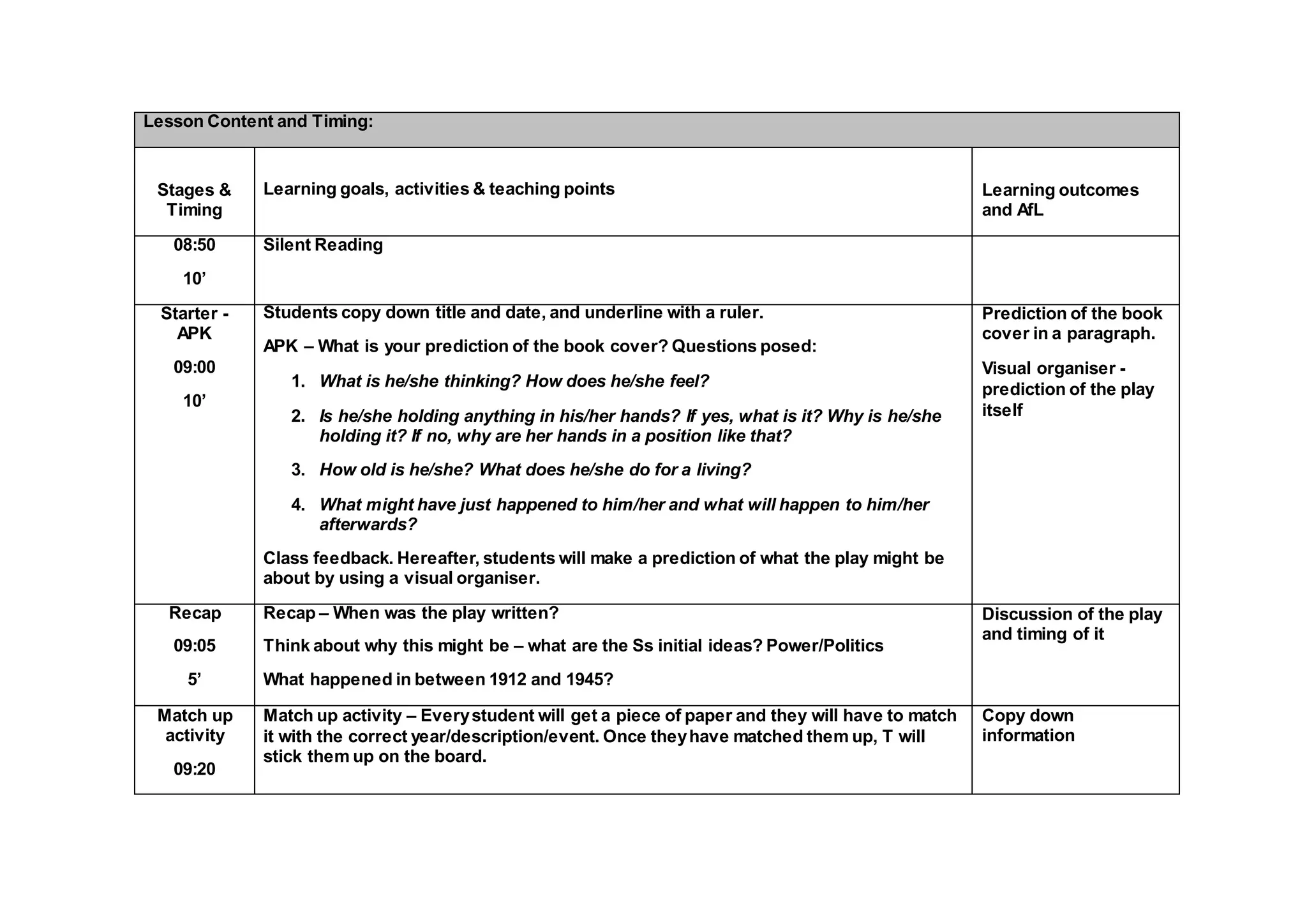
Lesson Content and Timing:
Stages &
Timing
Learning goals, activities & teaching points Learning outcomes
and AfL
08:50
10’
Silent Reading
Starter -
APK
09:00
10’
Students copy down title and date, and underline with a ruler.
APK – What is your prediction of the book cover? Questions posed:
1. What is he/she thinking? How does he/she feel?
2. Is he/she holding anything in his/her hands? If yes, what is it? Why is he/she
holding it? If no, why are her hands in a position like that?
3. How old is he/she? What does he/she do for a living?
4. What might have just happened to him/her and what will happen to him/her
afterwards?
Class feedback. Hereafter, students will make a prediction of what the play might be
about by using a visual organiser.
Prediction of the book
cover in a paragraph.
Visual organiser -
prediction of the play
itself
Recap
09:05
5’
Recap – When was the play written?
Think about why this might be – what are the Ss initial ideas? Power/Politics
What happened in between 1912 and 1945?
Discussion of the play
and timing of it
Match up
activity
09:20
Match up activity – Everystudent will get a piece of paper and they will have to match
it with the correct year/description/event. Once theyhave matched them up, T will
stick them up on the board.
Copy down
information
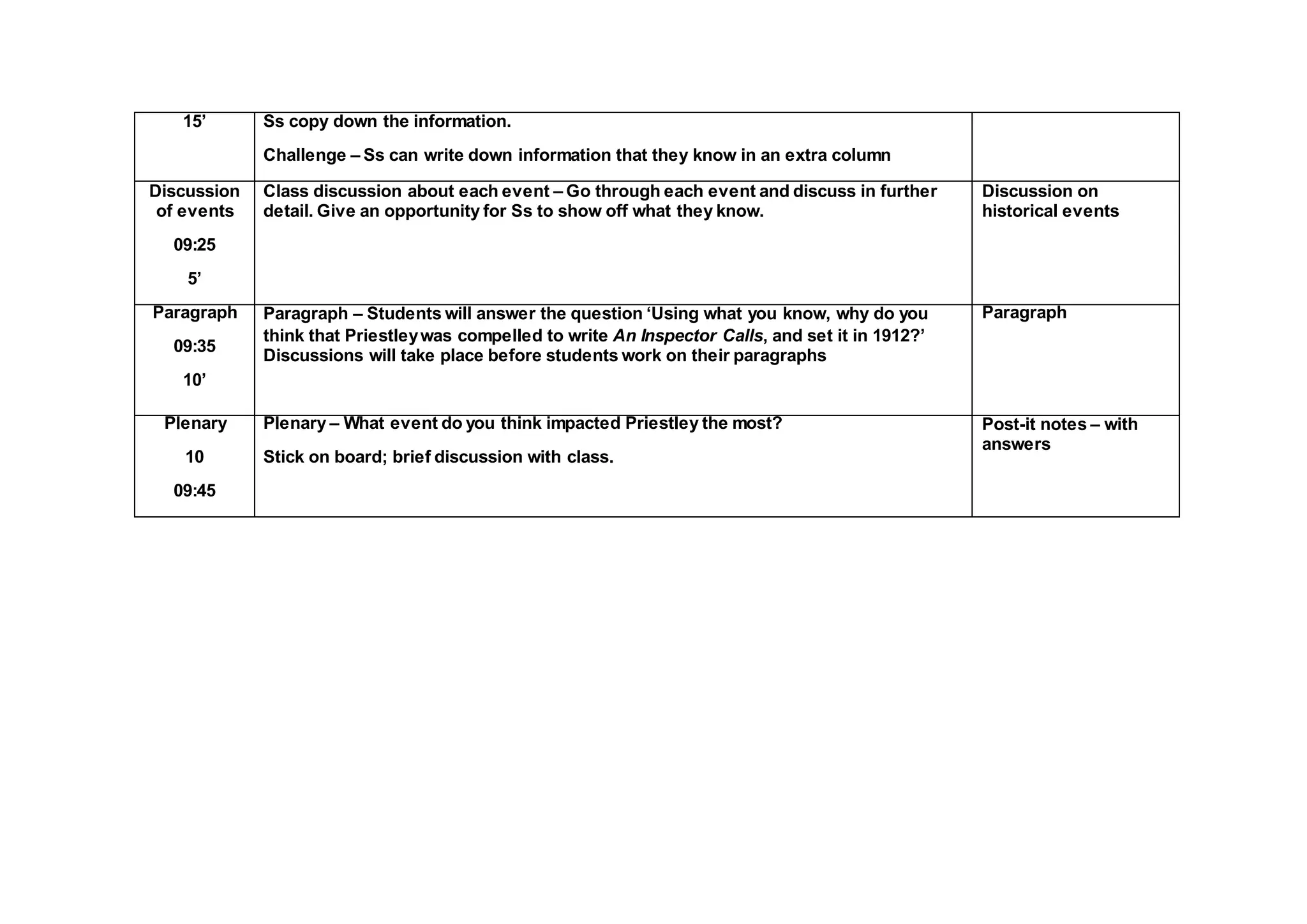
15’ Ss copy down the information.
Challenge – Ss can write down information that they know in an extra column
Discussion
of events
09:25
5’
Class discussion about each event – Go through each event and discuss in further
detail. Give an opportunity for Ss to show off what they know.
Discussion on
historical events
Paragraph
09:35
10’
Paragraph – Students will answer the question ‘Using what you know, why do you
think that Priestleywas compelled to write An Inspector Calls, and set it in 1912?’
Discussions will take place before students work on their paragraphs
Paragraph
Plenary
10
09:45
Plenary – What event do you think impacted Priestley the most?
Stick on board; brief discussion with class.
Post-it notes – with
answers

9AS L3 SH Lesson plan

  • 1.
    Lesson Plan proforma Class: 9AS (ii) Set ability (around level 5/6 in the old NC levels) indicate levels of attainment Date: 4/3/2016 Time: 08:40 – 09:45 No. of pupils: 23 Unit /SoW: An Inspector Calls – Context on Social and Historical events Key Learning Goals: ref. to exam board criteria/NC as appropriate … in pupil-friendly format: LO: To understand the social and historical context of the play Expected Learning Outcomes: all pupils? some pupils? a few pupils? All pupils will be able to understand the main events that surrounded Priestley’s pointof view, and why he decided to write the play. Students will do this by assessing their prior knowledge aboutpower and politics. Opportunities for Assessment: Formative & summative  APK – using their knowledge aboutpower,the differenttypes of power that can be demonstrated and the idea of capitalism and socialism  Teacher questioning – teacher will question Ss throughoutthe lesson, asking them to think independently aboutcognitively challenging questions  Matching activity – students will have to match their information with other students. This demonstrates teamwork,as well as students working together to deduce the meaning.  Prediction – getting students to think aboutwhat they can deduce from the title of the book,as well as the visual image.This will allow them to think aboutthe book beforehand  Class discussion – collaborative ideas when speaking abouthistorical events  Paragraph – why did Priestley write An Inspector Calls in 1945,and setit in 1912?  Plenary – what do you think was the mostimportanthistorical event that affected Priestley? Cognitive challenges: Desirable difficulties for all abilities; how will students progress? Why did Priestleyset An Inspector Calls in 1912, and write it in 1945? – Students will write a paragraph discussing why these dates are extremely important, and have a discussion before they answer the question. We will look at the ideas of power and politics during that time, and the politics that are seen in the play. EBT strategies: e.g. APK, reciprocal teaching, collaborative learning, advance & visual organisers, similarities and differences, goals, repetition and practice, meta-cognition, feedback, cognitive challenge, subject knowledge, summaries and note-taking  Collaborative learning – students will work together to match the event/year/description of the historical events  APK – students will be constantly using their previous knowledge about power and politics, and think about how it links with historical context
  • 2.
     Visual organiser– Students will use visual organisers for their prediction task Key Terminology:  An Inspector Calls  Socialism  Capitalism  Historical context  J.B. Priestley Resources:  Information sheets (x21) Homework and practice: N/A
  • 3.
    Lesson Content andTiming: Stages & Timing Learning goals, activities & teaching points Learning outcomes and AfL 08:50 10’ Silent Reading Starter - APK 09:00 10’ Students copy down title and date, and underline with a ruler. APK – What is your prediction of the book cover? Questions posed: 1. What is he/she thinking? How does he/she feel? 2. Is he/she holding anything in his/her hands? If yes, what is it? Why is he/she holding it? If no, why are her hands in a position like that? 3. How old is he/she? What does he/she do for a living? 4. What might have just happened to him/her and what will happen to him/her afterwards? Class feedback. Hereafter, students will make a prediction of what the play might be about by using a visual organiser. Prediction of the book cover in a paragraph. Visual organiser - prediction of the play itself Recap 09:05 5’ Recap – When was the play written? Think about why this might be – what are the Ss initial ideas? Power/Politics What happened in between 1912 and 1945? Discussion of the play and timing of it Match up activity 09:20 Match up activity – Everystudent will get a piece of paper and they will have to match it with the correct year/description/event. Once theyhave matched them up, T will stick them up on the board. Copy down information
  • 4.
    15’ Ss copydown the information. Challenge – Ss can write down information that they know in an extra column Discussion of events 09:25 5’ Class discussion about each event – Go through each event and discuss in further detail. Give an opportunity for Ss to show off what they know. Discussion on historical events Paragraph 09:35 10’ Paragraph – Students will answer the question ‘Using what you know, why do you think that Priestleywas compelled to write An Inspector Calls, and set it in 1912?’ Discussions will take place before students work on their paragraphs Paragraph Plenary 10 09:45 Plenary – What event do you think impacted Priestley the most? Stick on board; brief discussion with class. Post-it notes – with answers