AS Business Studies 9707
1AS: Business and its environment
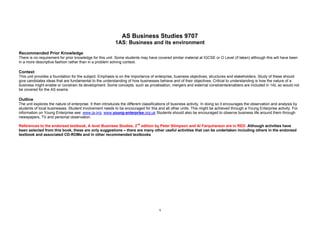
Recommended Prior Knowledge
There is no requirement for prior knowledge for this unit. Some students may have covered similar material at IGCSE or O Level (if taken) although this will have been
in a more descriptive fashion rather than in a problem solving context.
Context
This unit provides a foundation for the subject. Emphasis is on the importance of enterprise, business objectives, structures and stakeholders. Study of these should
give candidates ideas that are fundamental to the understanding of how businesses behave and of their objectives. Critical to understanding is how the nature of a
business might enable or constrain its development. Some concepts, such as privatisation, mergers and external constraints/enablers are included in 1AL so would not
be covered for the AS exams.
Outline
The unit explores the nature of enterprise. It then introduces the different classifications of business activity. In doing so it encourages the observation and analysis by
students of local businesses. Student involvement needs to be encouraged for this and all other units. This might be achieved through a Young Enterprise activity. For
information on Young Enterprise see: www.ja.org, www.young-enterprise.org.uk Students should also be encouraged to observe business life around them through
newspapers, TV and personal observation.
References to the endorsed textbook, A level Business Studies, 2 edition by Peter Stimpson and Al Farquharson are in RED. Although activities have
been selected from this book, these are only suggestions – there are many other useful activities that can be undertaken including others in the endorsed
textbook and associated CD-ROMs and in other recommended textbooks
nd
1
AO Learning outcomes Suggested Teaching activities Learning resources
1AS.1 Enterprise
• The nature of business activity
• The role of the entrepreneur
• Social enterprise
REINFORCEMENT
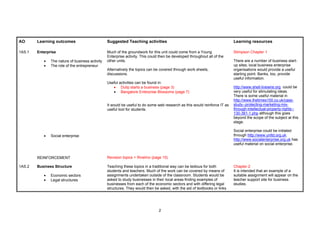
Much of the groundwork for this unit could come from a Young
Enterprise activity. This could then be developed throughout all of the
other units.
Alternatively the topics can be covered through work sheets,
discussions.
Useful activities can be found in:
• Dulip starts a business (page 3)
• Bangalore Enterprise Blossoms (page 7)
It would be useful to do some web research as this would reinforce IT as
useful tool for students.
Revision topics + Rivelino (page 15)
Stimpson Chapter 1
There are a number of business start-
up sites, local business enterprise
organisations would provide a useful
starting point. Banks, too, provide
useful information.
http://www.shell-livewire.org could be
very useful for stimulating ideas.
There is some useful material in
http://www.thetimes100.co.uk/case-
study--protecting-marketing-mix-
through-intellectual-property-rights--
130-361-1.php although this goes
beyond the scope of the subject at this
stage.
Social enterprise could be initiated
through http://www.unltd.org.uk.
http://www.socialenterprise.org.uk has
useful material on social enterprise.
1AS.2 Business Structure
• Economic sectors
• Legal structures
Teaching these topics in a traditional way can be tedious for both
students and teachers. Much of the work can be covered by means of
assignments undertaken outside of the classroom. Students would be
asked to study businesses in their local areas finding examples of
businesses from each of the economic sectors and with differing legal
structures. They would then be asked, with the aid of textbooks or links
Chapter 2
It is intended that an example of a
suitable assignment will appear on the
teacher support site for business
studies.
2
AO Learning outcomes Suggested Teaching activities Learning resources
1AS.3
REINFORCEMENT
Size of Business
• Measurements of business
size
• Significance of small
businesses
• Internal growth
to suitable web sites, to explain why legal structures might have been
chosen and what was involved in the process. It would provide a good
opportunity for assessing students’ written work. The concept of limited
liability is very important and should be developed not only from the
owners’ perspective but also from other stakeholders’ perspectives such
as customers, creditors and employees. Time should be spent on
exploring the consequences of changing legal structure – the history of
Virgin might be useful for this.
Useful activities include:
• Dulip’s business is a success (page 17)
• Harry goes it alone (page 28)
Revision topics
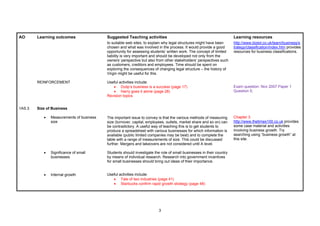
The important issue to convey is that the various methods of measuring
size (turnover, capital, employees, outlets, market share and so on) can
be contradictory. A useful way of teaching this is to get students to
produce a spreadsheet with various businesses for which information is
available (public limited companies may be best) and to complete the
table with a range of measurements of size. This could be discussed
further. Mergers and takeovers are not considered until A level.
Students should investigate the role of small businesses in their country
by means of individual research. Research into government incentives
for small businesses should bring out ideas of their importance.
Useful activities include:
• Tale of two industries (page 41)
• Starbucks confirm rapid growth strategy (page 48)
http://www.bized.co.uk/learn/business/s
trategy/classification/index.htm provides
resources for business classifications.
Exam question: Nov 2007 Paper 1
Question 5;
Chapter 3
http://www.thetimes100.co.uk provides
some case material and activities
involving business growth. Try
searching using “business growth” at
this site.
3
AO Learning outcomes Suggested Teaching activities Learning resources
1AS.4
REINFORCEMENT
Business Objectives
• Business objectives in the
private and public sectors
• Objectives and Business
Decisions
Revision topics + Small restaurant business expands rapidly (page 53)
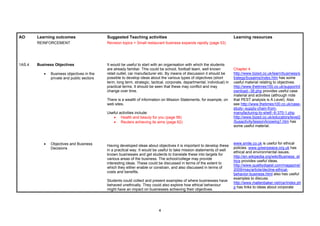
It would be useful to start with an organisation with which the students
are already familiar. This could be school, football team, well known
retail outlet, car manufacturer etc. By means of discussion it should be
possible to develop ideas about the various types of objectives (short
term, long term, strategic, tactical, corporate, departmental, individual) in
practical terms. It should be seen that these may conflict and may
change over time.
There is a wealth of information on Mission Statements, for example, on
web sites.
Useful activities include:
• Health and beauty for you (page 56)
• Reuters achieving its aims (page 62)
Having developed ideas about objectives it is important to develop these
in a practical way. It would be useful to take mission statements of well
known businesses and get students to translate these into targets for
various areas of the business. The school/college may provide
interesting ideas. These could be discussed in terms of the extent to
which they either enable or constrain, and also discussed in terms of
costs and benefits.
Students could collect and present examples of where businesses have
behaved unethically. They could also explore how ethical behaviour
might have an impact on businesses achieving their objectives.
Chapter 4
http://www.bized.co.uk/learn/business/s
trategy/busaims/index.htm has some
useful material relating to objectives.
http://www.thetimes100.co.uk/support/d
ownload--38.php provides useful case
material and activities (although note
that PEST analysis is A Level). Also
see http://www.thetimes100.co.uk/case-
study--supply-chain-from-
manufacturing-to-shelf--6-370-1.php.
http://www.bized.co.uk/educators/level2
/busactivity/lesson/knowing1.htm has
some useful material.
www.smile.co.uk is useful for ethical
policies. www.greenpeace.org.uk has
ethical and environmental issues.
http://en.wikipedia.org/wiki/Business_et
hics provides useful ideas.
http://www.qualitydigest.com/magazine/
2009/may/article/decline-ethical-
behavior-business.html also has useful
examples to discuss.
http://www.mallenbaker.net/csr/index.ph
p has links to ideas about corporate
4
AO Learning outcomes Suggested Teaching activities Learning resources
1AS.5
REINFORCEMENT
Stakeholders in Business
REINFORCEMENT
Revision topics + Is STS plc successful? + Siam Cement Group (page
67)
Peugeot’s road ahead laid out (page 69)
Virgin Atlantic and British Airways to refund passengers (page 70)
The concept of stakeholders can be developed through a business
simulation. Students are presented with a controversial proposal, for
example, the building of a major new factory in a local area. Students
are divided into various stakeholder groups, each with their own
identifiable objectives and briefing notes (owners, managers,
employees, the community, the state). They are then required to discuss
whether it is a good idea or not for the development to go ahead.
Useful activities include:
• Tato Nano divides opinion (page 71)
• Fury at Bangladesh mine scheme (page 75)
• Community-based development projects (page 78)
Revision topics + Virgin’s green idea loses its pulling power (page 81)
responsibility. www.traidcraft.co.uk is a
UK based organisation that has an
ethical influence in several continents.
Exam question Nov 2008 Paper 3 Q 7,
June 2006 Paper 2 Q 1(c), June 2008
Paper 3 Q 5 (b) Nov 2007 Paper 1 Q
5(a), Nov 2008 Paper 2 Q 2(d)
Chapter 5
http://www.bized.co.uk/educators/level2
/busactivity/lesson/knowing1.htm has
useful material. As does
http://www.bized.co.uk/educators/16-
19/business/external/presentation/ethic
s_map.htm .
Exam question: June 2006 Paper 3 Q 7
(although this was set at AL)
5

9707 y10 sw_1_as

  • 1.
    AS Business Studies9707 1AS: Business and its environment Recommended Prior Knowledge There is no requirement for prior knowledge for this unit. Some students may have covered similar material at IGCSE or O Level (if taken) although this will have been in a more descriptive fashion rather than in a problem solving context. Context This unit provides a foundation for the subject. Emphasis is on the importance of enterprise, business objectives, structures and stakeholders. Study of these should give candidates ideas that are fundamental to the understanding of how businesses behave and of their objectives. Critical to understanding is how the nature of a business might enable or constrain its development. Some concepts, such as privatisation, mergers and external constraints/enablers are included in 1AL so would not be covered for the AS exams. Outline The unit explores the nature of enterprise. It then introduces the different classifications of business activity. In doing so it encourages the observation and analysis by students of local businesses. Student involvement needs to be encouraged for this and all other units. This might be achieved through a Young Enterprise activity. For information on Young Enterprise see: www.ja.org, www.young-enterprise.org.uk Students should also be encouraged to observe business life around them through newspapers, TV and personal observation. References to the endorsed textbook, A level Business Studies, 2 edition by Peter Stimpson and Al Farquharson are in RED. Although activities have been selected from this book, these are only suggestions – there are many other useful activities that can be undertaken including others in the endorsed textbook and associated CD-ROMs and in other recommended textbooks nd 1
  • 2.
    AO Learning outcomesSuggested Teaching activities Learning resources 1AS.1 Enterprise • The nature of business activity • The role of the entrepreneur • Social enterprise REINFORCEMENT Much of the groundwork for this unit could come from a Young Enterprise activity. This could then be developed throughout all of the other units. Alternatively the topics can be covered through work sheets, discussions. Useful activities can be found in: • Dulip starts a business (page 3) • Bangalore Enterprise Blossoms (page 7) It would be useful to do some web research as this would reinforce IT as useful tool for students. Revision topics + Rivelino (page 15) Stimpson Chapter 1 There are a number of business start- up sites, local business enterprise organisations would provide a useful starting point. Banks, too, provide useful information. http://www.shell-livewire.org could be very useful for stimulating ideas. There is some useful material in http://www.thetimes100.co.uk/case- study--protecting-marketing-mix- through-intellectual-property-rights-- 130-361-1.php although this goes beyond the scope of the subject at this stage. Social enterprise could be initiated through http://www.unltd.org.uk. http://www.socialenterprise.org.uk has useful material on social enterprise. 1AS.2 Business Structure • Economic sectors • Legal structures Teaching these topics in a traditional way can be tedious for both students and teachers. Much of the work can be covered by means of assignments undertaken outside of the classroom. Students would be asked to study businesses in their local areas finding examples of businesses from each of the economic sectors and with differing legal structures. They would then be asked, with the aid of textbooks or links Chapter 2 It is intended that an example of a suitable assignment will appear on the teacher support site for business studies. 2
  • 3.
    AO Learning outcomesSuggested Teaching activities Learning resources 1AS.3 REINFORCEMENT Size of Business • Measurements of business size • Significance of small businesses • Internal growth to suitable web sites, to explain why legal structures might have been chosen and what was involved in the process. It would provide a good opportunity for assessing students’ written work. The concept of limited liability is very important and should be developed not only from the owners’ perspective but also from other stakeholders’ perspectives such as customers, creditors and employees. Time should be spent on exploring the consequences of changing legal structure – the history of Virgin might be useful for this. Useful activities include: • Dulip’s business is a success (page 17) • Harry goes it alone (page 28) Revision topics The important issue to convey is that the various methods of measuring size (turnover, capital, employees, outlets, market share and so on) can be contradictory. A useful way of teaching this is to get students to produce a spreadsheet with various businesses for which information is available (public limited companies may be best) and to complete the table with a range of measurements of size. This could be discussed further. Mergers and takeovers are not considered until A level. Students should investigate the role of small businesses in their country by means of individual research. Research into government incentives for small businesses should bring out ideas of their importance. Useful activities include: • Tale of two industries (page 41) • Starbucks confirm rapid growth strategy (page 48) http://www.bized.co.uk/learn/business/s trategy/classification/index.htm provides resources for business classifications. Exam question: Nov 2007 Paper 1 Question 5; Chapter 3 http://www.thetimes100.co.uk provides some case material and activities involving business growth. Try searching using “business growth” at this site. 3
  • 4.
    AO Learning outcomesSuggested Teaching activities Learning resources 1AS.4 REINFORCEMENT Business Objectives • Business objectives in the private and public sectors • Objectives and Business Decisions Revision topics + Small restaurant business expands rapidly (page 53) It would be useful to start with an organisation with which the students are already familiar. This could be school, football team, well known retail outlet, car manufacturer etc. By means of discussion it should be possible to develop ideas about the various types of objectives (short term, long term, strategic, tactical, corporate, departmental, individual) in practical terms. It should be seen that these may conflict and may change over time. There is a wealth of information on Mission Statements, for example, on web sites. Useful activities include: • Health and beauty for you (page 56) • Reuters achieving its aims (page 62) Having developed ideas about objectives it is important to develop these in a practical way. It would be useful to take mission statements of well known businesses and get students to translate these into targets for various areas of the business. The school/college may provide interesting ideas. These could be discussed in terms of the extent to which they either enable or constrain, and also discussed in terms of costs and benefits. Students could collect and present examples of where businesses have behaved unethically. They could also explore how ethical behaviour might have an impact on businesses achieving their objectives. Chapter 4 http://www.bized.co.uk/learn/business/s trategy/busaims/index.htm has some useful material relating to objectives. http://www.thetimes100.co.uk/support/d ownload--38.php provides useful case material and activities (although note that PEST analysis is A Level). Also see http://www.thetimes100.co.uk/case- study--supply-chain-from- manufacturing-to-shelf--6-370-1.php. http://www.bized.co.uk/educators/level2 /busactivity/lesson/knowing1.htm has some useful material. www.smile.co.uk is useful for ethical policies. www.greenpeace.org.uk has ethical and environmental issues. http://en.wikipedia.org/wiki/Business_et hics provides useful ideas. http://www.qualitydigest.com/magazine/ 2009/may/article/decline-ethical- behavior-business.html also has useful examples to discuss. http://www.mallenbaker.net/csr/index.ph p has links to ideas about corporate 4
  • 5.
    AO Learning outcomesSuggested Teaching activities Learning resources 1AS.5 REINFORCEMENT Stakeholders in Business REINFORCEMENT Revision topics + Is STS plc successful? + Siam Cement Group (page 67) Peugeot’s road ahead laid out (page 69) Virgin Atlantic and British Airways to refund passengers (page 70) The concept of stakeholders can be developed through a business simulation. Students are presented with a controversial proposal, for example, the building of a major new factory in a local area. Students are divided into various stakeholder groups, each with their own identifiable objectives and briefing notes (owners, managers, employees, the community, the state). They are then required to discuss whether it is a good idea or not for the development to go ahead. Useful activities include: • Tato Nano divides opinion (page 71) • Fury at Bangladesh mine scheme (page 75) • Community-based development projects (page 78) Revision topics + Virgin’s green idea loses its pulling power (page 81) responsibility. www.traidcraft.co.uk is a UK based organisation that has an ethical influence in several continents. Exam question Nov 2008 Paper 3 Q 7, June 2006 Paper 2 Q 1(c), June 2008 Paper 3 Q 5 (b) Nov 2007 Paper 1 Q 5(a), Nov 2008 Paper 2 Q 2(d) Chapter 5 http://www.bized.co.uk/educators/level2 /busactivity/lesson/knowing1.htm has useful material. As does http://www.bized.co.uk/educators/16- 19/business/external/presentation/ethic s_map.htm . Exam question: June 2006 Paper 3 Q 7 (although this was set at AL) 5