LEARNING INTENTIONS
• Describe the key events which shaped the Scottish Civil
War, and ultimately ended it
• Describe events after the Civil War which let Bruce take
control of Scotland, and led up to the Battle of Bannockburn
It can be argued that Scotland’s Civil War started the
moment that Robert the Bruce stabbed John Comyn. From
then the nation was divided between supporters of each man.
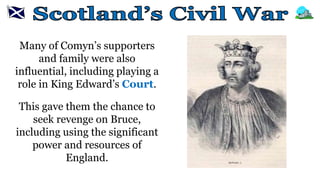
Many of Comyn’s supporters
and family were also
influential, including playing a
role in King Edward’s Court.
This gave them the chance to
seek revenge on Bruce,
including using the significant
power and resources of
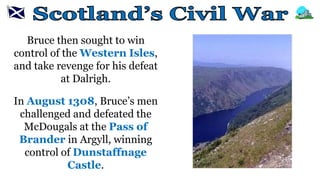
England.
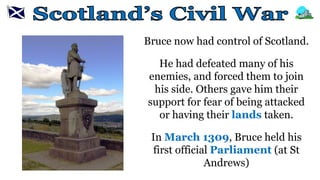
Bruce’s defeats at Methven
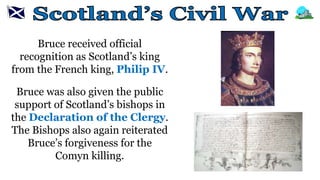
(June 1306) and Dalrigh
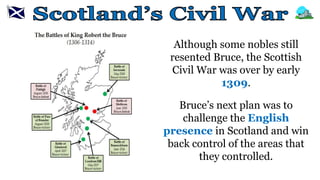
(August 1306) were not simply
down to the strength of
England’s army.
In both cases Scots made up a
large part of the opposition
forces. The attack at Dalrigh
was led by John MacDougal
of Argyll (Comyn’s cousin)
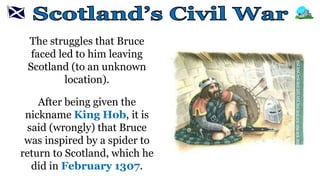
The struggles that Bruce
faced led to him leaving
Scotland (to an unknown
location).
After being given the
nickname King Hob, it is
said (wrongly) that Bruce
was inspired by a spider to
return to Scotland, which he
did in February 1307.
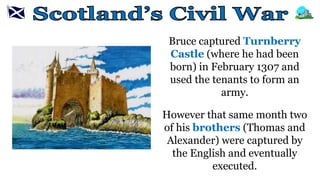
Bruce captured Turnberry
Castle (where he had been
born) in February 1307 and
used the tenants to form an
army.
However that same month two
of his brothers (Thomas and
Alexander) were captured by
the English and eventually
executed.
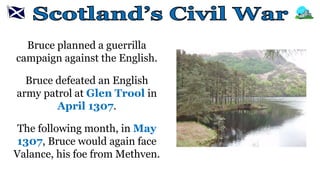
Bruce planned a guerrilla
campaign against the English.
Bruce defeated an English
army patrol at Glen Trool in
April 1307.
The following month, in May
1307, Bruce would again face
Valance, his foe from Methven.
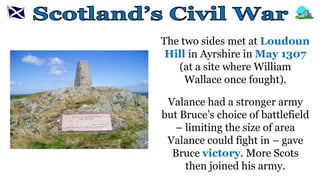
The two sides met at Loudoun
Hill in Ayrshire in May 1307
(at a site where William
Wallace once fought).
Valance had a stronger army
but Bruce’s choice of battlefield
– limiting the size of area
Valance could fight in – gave
Bruce victory. More Scots
then joined his army.
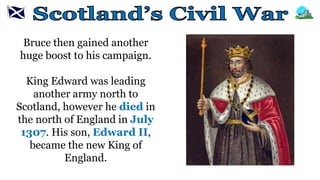
Bruce then gained another
huge boost to his campaign.
King Edward was leading
another army north to
Scotland, however he died in
the north of England in July
1307. His son, Edward II,
became the new King of
England.
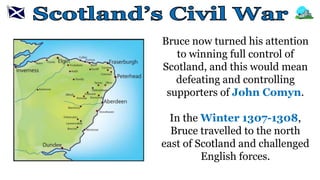
Bruce now turned his attention
to winning full control of
Scotland, and this would mean
defeating and controlling
supporters of John Comyn.
In the Winter 1307-1308,
Bruce travelled to the north
east of Scotland and challenged
English forces.
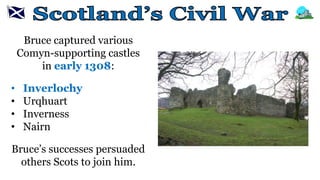
Bruce captured various
Comyn-supporting castles
in early 1308:
• Inverlochy
• Urqhuart
• Inverness
• Nairn
Bruce’s successes persuaded
others Scots to join him.
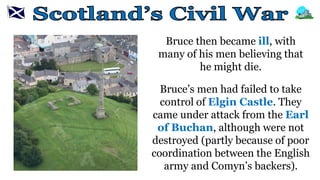
Bruce then became ill, with
many of his men believing that
he might die.
Bruce’s men had failed to take
control of Elgin Castle. They
came under attack from the Earl
of Buchan, although were not
destroyed (partly because of poor
coordination between the English
army and Comyn’s backers).
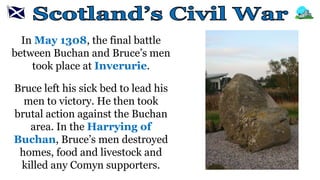
In May 1308, the final battle
between Buchan and Bruce’s men
took place at Inverurie.
Bruce left his sick bed to lead his
men to victory. He then took
brutal action against the Buchan
area. In the Harrying of
Buchan, Bruce’s men destroyed
homes, food and livestock and
killed any Comyn supporters.
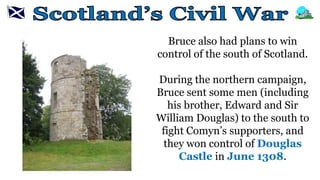
Bruce also had plans to win
control of the south of Scotland.
During the northern campaign,
Bruce sent some men (including
his brother, Edward and Sir
William Douglas) to the south to
fight Comyn’s supporters, and
they won control of Douglas
Castle in June 1308.
Bruce then sought to win
control of the Western Isles,
and take revenge for his defeat
at Dalrigh.
In August 1308, Bruce’s men
challenged and defeated the
McDougals at the Pass of
Brander in Argyll, winning
control of Dunstaffnage
Castle.
Bruce now had control of Scotland.
He had defeated many of his
enemies, and forced them to join
his side. Others gave him their
support for fear of being attacked
or having their lands taken.
In March 1309, Bruce held his
first official Parliament (at St
Andrews)
Bruce received official
recognition as Scotland’s king
from the French king, Philip IV.
Bruce was also given the public
support of Scotland’s bishops in
the Declaration of the Clergy.
The Bishops also again reiterated
Bruce’s forgiveness for the
Comyn killing.
Although some nobles still
resented Bruce, the Scottish
Civil War was over by early
1309.
Bruce’s next plan was to
challenge the English
presence in Scotland and win
back control of the areas that
they controlled.
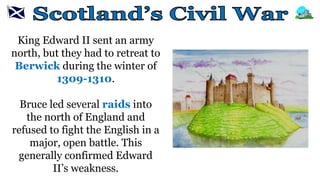
King Edward II sent an army
north, but they had to retreat to
Berwick during the winter of
1309-1310.
Bruce led several raids into
the north of England and
refused to fight the English in a
major, open battle. This
generally confirmed Edward
II’s weakness.
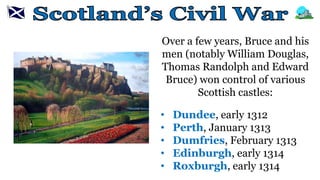
Over a few years, Bruce and his
men (notably William Douglas,
Thomas Randolph and Edward
Bruce) won control of various
Scottish castles:
• Dundee, early 1312
• Perth, January 1313
• Dumfries, February 1313
• Edinburgh, early 1314
• Roxburgh, early 1314
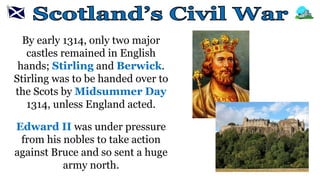
By early 1314, only two major
castles remained in English
hands; Stirling and Berwick.
Stirling was to be handed over to
the Scots by Midsummer Day
1314, unless England acted.
Edward II was under pressure
from his nobles to take action
against Bruce and so sent a huge
army north.

Scottish Wars of Independence - scotland's civil war

  • 2.
    LEARNING INTENTIONS • Describethe key events which shaped the Scottish Civil War, and ultimately ended it • Describe events after the Civil War which let Bruce take control of Scotland, and led up to the Battle of Bannockburn
  • 3.
    It can beargued that Scotland’s Civil War started the moment that Robert the Bruce stabbed John Comyn. From then the nation was divided between supporters of each man.
  • 4.
    Many of Comyn’ssupporters and family were also influential, including playing a role in King Edward’s Court. This gave them the chance to seek revenge on Bruce, including using the significant power and resources of England.
  • 5.
    Bruce’s defeats atMethven (June 1306) and Dalrigh (August 1306) were not simply down to the strength of England’s army. In both cases Scots made up a large part of the opposition forces. The attack at Dalrigh was led by John MacDougal of Argyll (Comyn’s cousin)
  • 6.
    The struggles thatBruce faced led to him leaving Scotland (to an unknown location). After being given the nickname King Hob, it is said (wrongly) that Bruce was inspired by a spider to return to Scotland, which he did in February 1307.
  • 7.
    Bruce captured Turnberry Castle(where he had been born) in February 1307 and used the tenants to form an army. However that same month two of his brothers (Thomas and Alexander) were captured by the English and eventually executed.
  • 8.
    Bruce planned aguerrilla campaign against the English. Bruce defeated an English army patrol at Glen Trool in April 1307. The following month, in May 1307, Bruce would again face Valance, his foe from Methven.
  • 9.
    The two sidesmet at Loudoun Hill in Ayrshire in May 1307 (at a site where William Wallace once fought). Valance had a stronger army but Bruce’s choice of battlefield – limiting the size of area Valance could fight in – gave Bruce victory. More Scots then joined his army.
  • 10.
    Bruce then gainedanother huge boost to his campaign. King Edward was leading another army north to Scotland, however he died in the north of England in July 1307. His son, Edward II, became the new King of England.
  • 11.
    Bruce now turnedhis attention to winning full control of Scotland, and this would mean defeating and controlling supporters of John Comyn. In the Winter 1307-1308, Bruce travelled to the north east of Scotland and challenged English forces.
  • 12.
    Bruce captured various Comyn-supportingcastles in early 1308: • Inverlochy • Urqhuart • Inverness • Nairn Bruce’s successes persuaded others Scots to join him.
  • 13.
    Bruce then becameill, with many of his men believing that he might die. Bruce’s men had failed to take control of Elgin Castle. They came under attack from the Earl of Buchan, although were not destroyed (partly because of poor coordination between the English army and Comyn’s backers).
  • 14.
    In May 1308,the final battle between Buchan and Bruce’s men took place at Inverurie. Bruce left his sick bed to lead his men to victory. He then took brutal action against the Buchan area. In the Harrying of Buchan, Bruce’s men destroyed homes, food and livestock and killed any Comyn supporters.
  • 15.
    Bruce also hadplans to win control of the south of Scotland. During the northern campaign, Bruce sent some men (including his brother, Edward and Sir William Douglas) to the south to fight Comyn’s supporters, and they won control of Douglas Castle in June 1308.
  • 16.
    Bruce then soughtto win control of the Western Isles, and take revenge for his defeat at Dalrigh. In August 1308, Bruce’s men challenged and defeated the McDougals at the Pass of Brander in Argyll, winning control of Dunstaffnage Castle.
  • 17.
    Bruce now hadcontrol of Scotland. He had defeated many of his enemies, and forced them to join his side. Others gave him their support for fear of being attacked or having their lands taken. In March 1309, Bruce held his first official Parliament (at St Andrews)
  • 18.
    Bruce received official recognitionas Scotland’s king from the French king, Philip IV. Bruce was also given the public support of Scotland’s bishops in the Declaration of the Clergy. The Bishops also again reiterated Bruce’s forgiveness for the Comyn killing.
  • 19.
    Although some noblesstill resented Bruce, the Scottish Civil War was over by early 1309. Bruce’s next plan was to challenge the English presence in Scotland and win back control of the areas that they controlled.
  • 20.
    King Edward IIsent an army north, but they had to retreat to Berwick during the winter of 1309-1310. Bruce led several raids into the north of England and refused to fight the English in a major, open battle. This generally confirmed Edward II’s weakness.
  • 21.
    Over a fewyears, Bruce and his men (notably William Douglas, Thomas Randolph and Edward Bruce) won control of various Scottish castles: • Dundee, early 1312 • Perth, January 1313 • Dumfries, February 1313 • Edinburgh, early 1314 • Roxburgh, early 1314
  • 22.
    By early 1314,only two major castles remained in English hands; Stirling and Berwick. Stirling was to be handed over to the Scots by Midsummer Day 1314, unless England acted. Edward II was under pressure from his nobles to take action against Bruce and so sent a huge army north.