PULP & PERIAPICAL DISEASES
Dr NONITHA S
CONTENTS
• INTRODUCTION
• ETIOLOGY OF PULP DISEASE
• CLASSIFICATION OF PULP DISEASE
• REVERSIBLE PULPITIS
• ACUTE PULPITIS & CHRONIC PULPITIS
• CHRONIC HYPERPLASTIC PULPITIS
• GANGRENOUS NECROSIS OF PULP
• DISEASES OF PERIAPICAL TISSUE
• ACUTE APICAL PERIODONTITIS
• CHRONIC APICAL PERIODONTITIS
• PERIAPICAL ABSCESS
• OSTEOMYELITIS
INTRODUCTION
PULP
• Dental pulp is a delicate connective tissue consisting of
-Tiny blood vessels
- Lymphatics
- Myelinated and
- Unmyelinated nerves
- Undifferentiated connective tissue cells
• provides the tooth’s nutrients.
• Pulpitis is the inflammation of dental pulp tissue
ETIOLOGY OF PULP DISEASE
• Physical: - Mechanical
- Thermal
- Electrical
• Chemical
• Bacterial
1. PHYSICAL
A. Mechanical
1) Trauma- a) Accidental b) Iatrogenic dental
procedures
2) Pathologic wear
3) Crack through the body of the tooth
4) Barometric changes
B. Thermal
1) Heat during cavity preparation
2) Exothermic heat during setting of cement
3) Conduction of heat and cold through deep
restoration with out a protective base
4) Frictional heat during the polishing of
restoration c)
C. Electrical - Galvanic shock
2. CHEMICAL :
A) Phosphoric acid, acrylic monomer
B) Erosion
3. BACTERIAL
A) Toxins associated with caries
B) Direct invasion of pulp from caries or trauma
C) Anachoresis: Transportation of microbes
through the blood or lymph to an area of
inflammation without pulp exposure.
CLASSIFICATION OF PULP DISEASE
PULPITIS: inflammation of the dental pulp,
which can be acute or chronic.
1) Acute
• Reversible
• Irreversible
2) Chronic
• Chronic hyperplastic pulpitis
• internal Resorption
3) Pulp degeneration
calcification
4) Necrosis
AERODONTALGIA
• Toothache occurring at low atmospheric
pressure experienced either during flight or
during a test run in a decompression chamber
• Observed in higher altitudes over 5000 feet
• Tooth with chronic pulpitis can be
symptomless at ground level, but it may cause
pain at high altitudes because of reduced
pressure
• Treatment: Lining the cavity with a varnish or
a base of zinc phosphate cement with a sub
base of ZOE cement in deep cavities
ACUTE REVERSIBLE PULPITIS
(PULP HYPEREMIA)
• Mild to moderate inflammatory condition of the pulp caused
by noxious stimuli in which the pulp is capable of returning to
the un-inflammed state following removal of the stimuli.
Etiology:
• Trauma
• Thermal changes in large metallic fillings
• Excessive dehydration of the cavity
• Galvanism
• Dental caries
Clinical features
• Pain: mild to moderate
• The etiological factor is obvious
Histopathological features
• – Pulp hyperemia (dilation of blood vessels)
• – Exudation
• – Inflammatory cell infiltration (neutrophils)
• – Reactions usually remain localized adjacent to
the cause
Treatment: remove the cause
Dilatation of blood vessels
Dentin
Inflammatory cell infiltrate
ACUTE IRREVERSIBLE PULPITIS
Etiology
• Acute dental caries
• Pulp exposure
• Severe irritation
Clinical features
• Pain: severe, spontaneous and continuous
• Little response to simple analgesics
• Pain increases when patient lies down
Histopathological features:
• Inflammation involves the whole dental pulp
• Vascular dilatation and edema
• Inflammatory (granular cells) infiltration
• Odontoblasts near to the cause are destroyed
• Formation of a minute pulp abscess
• In a few days pulp undergoes liquefaction and
necrosis
Treatment: RCT
Extraction of tooth
Dental pulp exhibiting acute
inflammatory infiltrate consisting
predominantly of polymorphonuclear
leukocytes.
CHRONIC PULPITIS
Etiology
• previous acute pulpitis
• Chronic dental caries
Clinical features
• Pain: absent or mild to moderate, dull ache
and intermittent.
• Reaction to thermal changes is reduced
compared to acute pulpitis
Histopathological features:
• Mononuclear cell inflammatory infiltration-
lymphocytes, plasma cells
• Evidence of fibroblastic activity
• Minute abscess- if exist it is localized by
granulation tissue
Treatment: RCT
Extraction of tooth
The dental pulp exhibits an area of fibrosis and chronic
inflammation peripheral to the zone of abscess formation.
CHRONIC HYPERPLASTIC PULPITIS PULP
POLYP
• Characterized by the development of granulation
tissue, covered at times with epithelium and resulting
from long standing low grade irritation
Etiology:
• Opened cavity
• Starts as chronic or acute
• Wide apical foramen (children)
Clinical features:
• Red pinkish soft nodule protruding into the
cavity
• most commonly in children and young adults
• Relatively insensitive to manipulation
• Most common in deciduous molars & first
permanent molars
• Lesion bleeds profusely upon provocation.
• Due to increased blood supply, tissue
resistance & reactivity in young persons leads
to unusual proliferation of pulp.
• Different from gingival polyp (adjacent gingival
tissue may proliferate into carious lesion &
superficially resemble hyperplastic pulpitis.)
Histopathological features:
• The polyp surface is covered with stratified squamous
epithelium.
• Epithelium may be derived from gingiva or from freshly
desquamated epithelial cell of mucosa or tongue.
• The polyp consists of granulation tissues
• It contains delicate connective tissue, fibers and blood
vessels
• Mononuclear inflammatory cell infiltration
Treatment:
• Rct or extraction of the teeth
Hyperplastic tissue - basically
granulation tissue, consisting
delicate CT fibers & young blood
capillaries with Inflammatory
infiltrates – lymphocytes, plasma
cells & PMNLs.
REVERSIBLE PULPITIS
• Mild – moderate
inflammatory condition.
• Nature of pain is mild &
diffuse.
• Brief duration & can be
produce cold stimuli that
elicits the pain mostly, hot,
sweet or sour food may also
initiate the pain.
• Once stimulus is removed,
pain is usually subsides.
• Tooth responds to electric
pulp tester at lower currents.
• Reversible pulpitis if allowed
to progress can led to
irreversible pulpitis.
IRREVERSIBLE PULPITIS
• Sharp, severe, radiating pain
of long duration & varying.
• Pain continues even after
the stimulus is removed.
• Pain may exacerbate with
bending over or lying down.
• It may progress to more
severe pain that is gnawing
or throbbing.
• Increased by stimulus, like
heat & at times relieved by
cold although the cold may
intensify the pain.
• When infection extends into
PDL - apical periodontitis.
DISEASES OF
PERIAPICAL TISSUES
DISEASES OF
PERIAPICAL TISSUES
• Apical periodontitis
– Acute
– Chronic (periapical granuloma)
• Periapical abscess
• Periapical cyst
• Osteomyelitus
APICAL PERIODONTITIS
• Inflammation of PDL around apical portion of root.
• Types: 1.Acute Apical Periodontitis
2.Chronic Apical Periodontitis
• Etiology:
 spread of infection following pulp necrosis,
 occlusal trauma,
 Bitting suddenly on high objects
 Inadvertent endodontic procedures
 Pushing the infected material into apical portion
 Chemical irritation from root canal medicaments
ACUTE APICAL PERIODONTITIS
CLINICAL FEATURES:
• Tooth is tender on percussion & pain can be
• severe making closure of the teeth
difficult.Thermal changes does not induce pain.
• Slight extrusion of tooth from socket.
• Cause tenderness on mastication due to
inflammatory edema collected in PDL.
• Due to external pressure, forcing of edema
fluid against already sensitized nerve endings
results in severe pain.
RADIOGRAPHIC FEATURES:
• Appear normal except for widening of PDL
space.
HISTOLOGIC FEATURES:
• PDL shows signs of inflammation -vascular dilation with
infiltration of PMNs
• Inflammation is transient, if caused by acute trauma.
• If irritant not removed, progress into surrounding bone
resorption.
• Abscess formation may occur if it is associated with bacterial
infection - Acute periapical abscess / Alveolar abscess.
TREATMENT & PROGNOSIS:
• Selective grinding if inflammation is due to occlusal trauma
• RCT
• Extraction & endodontic treatment be done to drain
exudate.
CHRONIC APICAL PERIODONTITIS
(PERIAPICAL GRANULOMA)
• Most common sequelae of pulpitis or apical periodontitis.
• If acute (exudative) left untreated turns to chronic
(proliferative).
• Periapical granuloma is localized mass of chronic
granulation tissue formed in response to infection.
• But term is not accurate since it doesn’t shows true
granulomatous inflammation microscopically.
• Presence of lateral or accessory root canals opening on
the lateral surface of the root give rise to lateral
granuloma
ETIOLOGY:
• Death of the pulp
• Irritation of the periapical tissue that
stimulates a productive cellular response
CLINICAL FEATURES:
• Tooth involved is non vital / slightly tender on
percussion.
• Percussion may produce dull sound instead metallic
due to granulation tissue at apex.
• Mild pain on chewing solid food.
• Tooth may be slightly elongated in socket.
• Sensitivity - due to hyperemia, edema &
inflammation of PDL.
• In many cases, asymptomatic.
• No perforation of bone & oral mucosa forming
fistulous tract unless undergoes acute exacerbation.
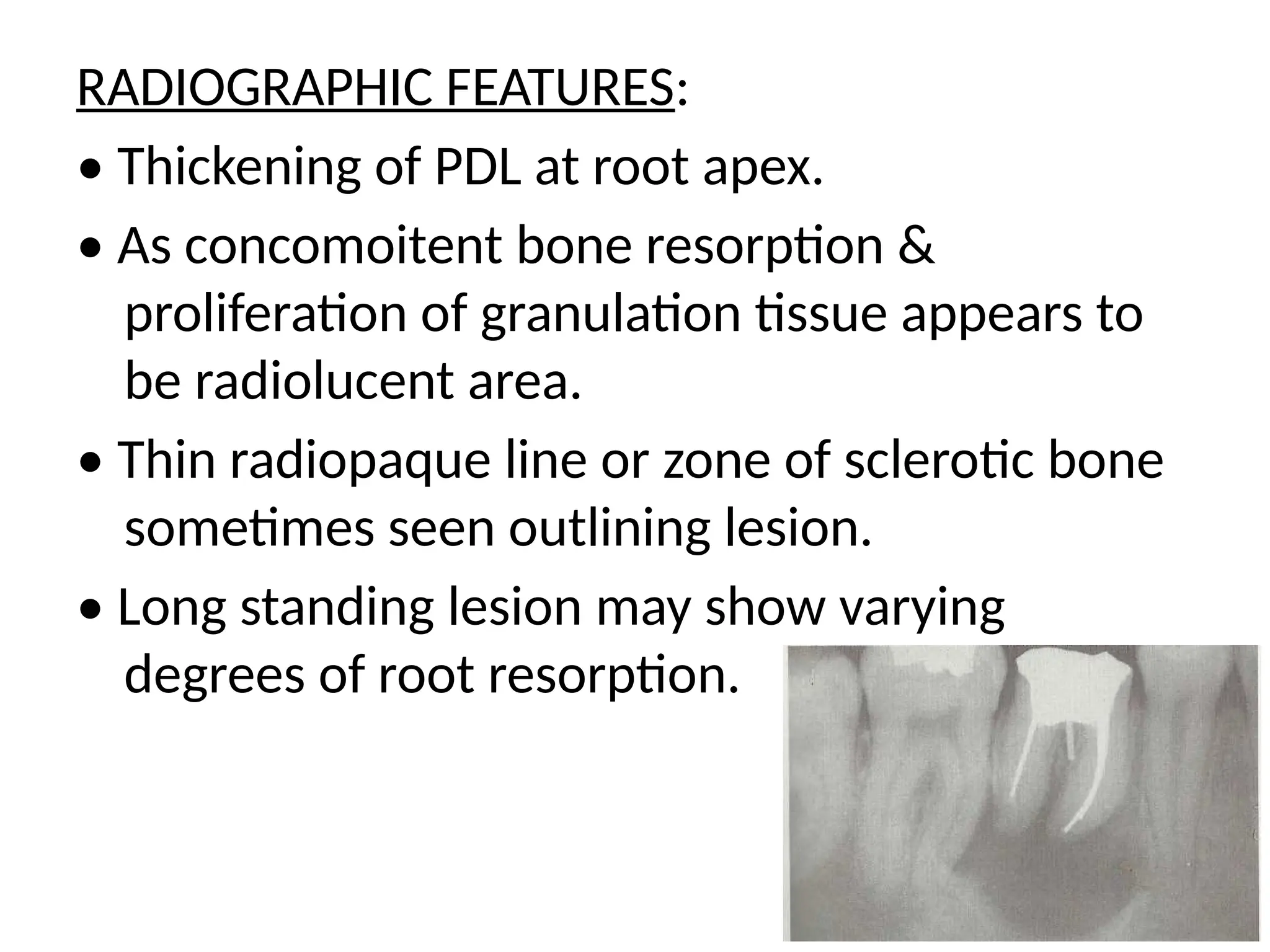
RADIOGRAPHIC FEATURES:
• Thickening of PDL at root apex.
• As concomoitent bone resorption &
proliferation of granulation tissue appears to
be radiolucent area.
• Thin radiopaque line or zone of sclerotic bone
sometimes seen outlining lesion.
• Long standing lesion may show varying
degrees of root resorption.
HISTOLOGIC FEATURES:
• Granulation tissue mass consists proliferating fibroblasts,
endothelial cells & numerous immature blood capillaries
with bone resorption.
• Capillaries lined with swollen endothelial cells.
• Its is relatively homogenous lesion composed of
macrophages, lymphocytes & plasma cells.
• Plasma cells containing Russels body are found
extracellularly.
• Collection of cholesterol clefts, with multinuclear gaint
cells.
• Epithelial rests of Malassez may proliferate in response
to chronic inflammation & may undergo cystification.
1
2
4
3
TREATMENT:
• Extraction & RCT with / without apicoetomy.
• If untreated → apical periodontal cyst
formation.
RESIDUAL CYST
• Type of inflammatory odontogenic cyst in edentulous alveolar
ridge.
• Occur due to extraction of tooth, leaving periapical pathology
untreated or incomplete removal of periapical granuloma /cyst.
RADIOGRAPHIC FEATURES:
• Round /ovoid radiolucency in alveolar ridge.
• Lumen may show radiopacity - dystrophic calcification
TREATMENT & PROGNOSIS:
• Cyst should curetted & lining should be subjected to
histopathological examination.
PERIAPICAL ABSCESS
(DENTO-ALVEOLAR ABSCESS, ALVEOLAR ABSCESS)
• Developed from acute periodontitis /
periapical granuloma.
• Acute exacerbation of chronic lesion leads to
Phoenix Abscess
ETIOLOGY:
• traumatic injury
• pulp necrosis
• irritation of periapical
CLINICAL FEATURES:
• Common findings of inflammation- heat, redness,
swelling and pain.
• Tenderness of tooth, which relives after pressure
application.
• Extremely painful -tooth extrudes from socket.
• Systemic manifestations like lymphadenitis & fever may
present when confined to periapical region.
• Rapid extension to adjacent bone marrow spaces
produces acute osteomyelitis or dentoalveolar abscess.
• Chronic abscess generally presents no features, since it
is mild, well circumscribed area of suppuration which
spread from local area.
RADIOGRAPHIC FEATURES:
• Slight thickening of PDL space.
• Radiolucent area at apex of root.
HISTOLOGIC FEATURES:
• Area of suppuration composed of PMN
leukocytes, lymphocytes, cellular debris,
necrotic materials & bacterial colonies.
• Dilation of blood vessels in PDL & bone
marrow space.
• Marrow space show inflammatory infiltrates.
• Tissue around area show suppuration
containing serous exudate.
TREATMENT:
• Drainage of abscess by opening pulp chamber
or extraction.
• Root canal treatment.
• If untreated, causes osteomyelitis, cellulitis &
bacteremia & formation of fistulous tract
opening to oral mucosa.
PHOENIX ABSCESS
ACUTE EXACERBATION OF A CHRONIC LESION
• An acute inflammatory reaction superimposed on an
existing chronic lesion such as a cyst or granuloma
ETIOLOGY:
• Periradicular disease
• Bacteria released from root canals during
instrumentation may trigger acute response.
• (Most commonly associated with the initiation of
RCT)
• History of trauma
Clinical features:
• Common findings of inflammation- heat,
redness, swelling and pain.
• At onset, tooth is tender to touch.
• As inflammation progresses tooth may be
elevated in its socket and may become sensitive.
• Mucosa over the radicular area appears red and
swollen.
Radiographically,
• well defined periradicular lesion may be present.
Histopathologically,
• shows areas of liquefaction necrosis with
disintegrated polymorphonuclear leukocytes
& cellular debris surrounded by macrophages,
lymphocytes, plasma cells in periradicular
tissues.
TREATMENT:
• Drainage and debriment
• Root Canal Treatment
OSTEOMYELITIS
• The word “osteomyelitis” originates from the
ancient Greek words osteon (bone) and
muelinos (marrow) and literally means
infection of medullary portion of the bone.
• Inflammation process of the entire bone
including the cortex and the periosteum.
Predisposing factors
1. Local factors (decreased vascularity/ vitality of bone)
Trauma
Radiotherapy
Pagets disease
Osteoporosis
Major vessel disease
2. Systemic factors (impaired host defence)
Immune deficiency
chronic alcoholism
Diabetes mellitus
Malnutrition
Extremes of age
PATHOGENESIS
Microorganisms may infect bone through one or more
of three basic methods:
1. Hematogenous spread
2. Direct inoculation of microorganisms into bone
3. Contiguous focus of infection
CLASSIFICATION
Based on the duration - 2 major groups
1. Acute
2. Chronic
Suppurative osteomyelitis
3. Acute suppurative osteomyelitis
4. Chronic suppurative osteomyelitis
Non suppurative osteomyelitis
5. Chronic focal sclerosing osteomyelitis
6. Chronic diffuse sclerosing osteomyelitis
7. Garres chronic scelrosing osteomyelitis (proliferative
periostitis)
ACUTE SUPPURATIVE OSTEOMYELITIS
• Serious sequela of periapical infection that often results
in diffuse spread of infection throughout the medullary
spaces, with subsequent necrosis of variable amount of
bone.
Etiology:
• Poly microbial -Staphylococcus aureus, S. albus,
Porphyromonas, Prevotella, Bacteriodes
• Most common cause : Dental infection
• Other causes : Infection due to fracture of jaw, gun
shot, or hematogenous spread
PATHOLOGY
Acute inflammation of marrow tissues
Spread of exudate along the marrow spaces
Thrombosis of vessels due to compression
Necrosis of bone
Necrotic tissues, dead and dying cell, pus from bacteria → fill the
marrow space
Involves cortical bone → Lifting of periosteum causing further necrosis
Finally ,Osteoclastic activity >>>
Sequestrum
Clinical features:
• Maxilla : localized ; Mandible : Diffuse and
widespread
• Severe pain
• Trismus
• Paraesthesia of lips in case of mandibular
involvement
• Elevation of temperature
• Regional lymphadenopathy
• Loosening of teeth and exudation of pus from gingiva
• No swelling and redness till periostitis develops
Radiographic features:
• No Radiographic evidence until the disease
has developed for atleast one to two weeks
• Trabeculae becomes fuzzy and indistinct
Ill-defined area of radiolucency
of the right body of the mandible
Moth eaten appearance
HISTOLOGIC FEATURES:
• Necrotic bone- loss of osteocytes from their lacunae,
• peripheral resorption and bacterial colonization.
• Medullary space→ filled with inflammatory exudates
• The inflammatory cells are chiefly PMNs but may
show
• occasional lymphocytes and plasma cells
• Osteoblasts bordering the bony trabeculae are
destroyed
• Trabeculae may lose their viability and begin to
undergo slow resorption
Nonvital bone exhibits loss of the osteocytes from the lacunae.
Peripheral resorption and surrounding inflammatory response also can be
seen
Treatment and prognosis
1. Debridement ,
2. Drainage and
3. Drugs [Anti-microbial]
• Sequestrum >> If small, exfoliates through
mucosa
• >> If large, surgical removal
• Untreated cases may proceed to development
of periostitis , soft tissue abscess or cellulitis
COMPLICATIONS:
Rare but include:
• Pathological fracture Extensive bone
destruction.
• Chronic osteomyelitis Inadequate
treatment.
• Cellulitis Spread of virulent bacteria.
• Septicemia Immuno-compromised patient
CHRONIC OSTEOMYELITIS
• Chronic suppurative
• Chronic diffuse sclerosing
• Chronic focal sclerosing
CHRONIC SUPPURATIVE OSTEOMYELITIS
• Inadequately treated acute osteomyelitis
• Rarely- complication of irradiation
• Acute exacerbations of chronic stage may occur
• Fistulous tract may form which open to surface
CLINICAL FEATURES:
•  Swelling
•  Pain
•  Sinus formation
•  Purulent discharge
•  Sequestrum formation
•  Tooth loss
•  Pathologic fracture
RADIOLOGICAL FEATURE:
•  Patchy, ragged & ill defined radiolucency.
•  Often contains radiopaque sequestra.
• HISTOPATHOLOGY:
• Inflammed connective tissue filling inter-
trabecular areas of bone.
• Scattered sequestra.
• Pockets of abscess.
Chronically inflamed and
reactive fibrousconnective tissue
filling the intertrabecular spaces.
Treatment:
• Difficulty to manage medically
• Surgical intervention is mandatory
• Antibiotics are same as in acute condition but
are given through IV in high doses
CHRONIC FOCAL SCLEROSING OSTEOMYELITIS
( CONDENSING OSTEITIS)
• Unusual reaction of bone to infection
• Bony reaction to low grade peri-apical
infection or unusually strong host defensive
response In some instances- tissue reacts to
the infection by proliferation rather than
destruction.
CLINICAL FEATURES:
• Commonly affects young adults and children
• Mandibular molar is affected commonly
• Large carious lesions
• Symptoms : mild pain due to infected pulp
RADIOGRAPHIC FEATURES:
• Pathognomic ,well circumscribed radiopaque
mass of sclerotic bone surrounding and
extending below the apex of one or both roots
• PDL space widening.
HISTOPATHOLOGIC FEATURES:
• Dense bony trabeculae with little interstitial
marrow tissue.
• Many reversal and resting lines giving
pagetoid appearance.
• If interstitial soft tissue is present , it is
generally fibrotic and infiltrated with small
amount of lymphocytes.
• lacunae appears empty.
TREATMENT:
• Root canal treatment
• Extraction
CHRONIC DIFFUSE SCLEROSING
OSTEOMYELITIS
• It is the clinical entity characterized by a
nonsuppurative, inflammatory process
associated with recurrent swelling, trismus
and pain.
• Proliferative reaction of bone to a low grade
infection.
• Portal of entry is diffuse periodontal disease.
Clinical features:
• it may occur at any age group , no gender
predominance.
• Common in edentulous mandible.
• Insidious in nature, no clinical indications of its
presence.
• Acute exacerbation can result in : vague pain ,
unpleasant taste , mild suppuration , many
times drainage through fistulous tract
Radiographic features:
• Cotton wool appearance.
• Indistinct borders because of its diffuse nature.
• Mimic Paget's disease or fibro osseous
proliferation.
HISTOLOGIC FEATURES:
• Dense , irregular trabeculae of bone bordered
by active layer of Osteoblasts ; focal
Osteoclastic area may be present
• Mosaic pattern appearance- indicative of
repeated periods of resorption followed by
repair
• Interstitial soft tissue is fibrotic
• Proliferating fibroblasts and occasional small
capillaries as well as small focal collection of
lymphocytes and plasma cells
Irregular trabeculae of bone bordered by active layer of Osteoblasts.
Proliferating fibroblasts and occasional small capillaries as well as small focal
collection of lymphocytes and plasma cells
Treatment and prognosis:
• Lesion is too extensive to be removed
surgically.
• Sclerotic bone is hypovascular and resistant to
antibiotics.
• Extraction of tooth as a last option utilizing a
surgical approach with removal of liberal
amounts of bone to facilitate extraction and
increase bleeding.
• Antibiotic administration during acute
exacerbation may help.
SAPHO syndrome
• It was first described by Chamot et al. in 1987.
• Rare and of unknown etiology.
• In 1994, Kahn et al. (1994) reported three diagnostic
criteria for SAPHO syndrome:
• 1. Multifocal osteomyelitis with or without skin
manifestations.
• 2. Sterile acute or chronic joint inflammation associated
with pustules or psoriasis on the palms and soles, acne, or
hidradenitis.
• 3. Sterile osteitis in the presence of one of the skin
manifestations.
CHRONIC OSTEOMYELITIS WITH PROLIFERATIVE PERIOSTITIS
GARRE’S OSTEOMYELITIS
• Garre’s chronic nonsuppurative sclerosing osteitis
• periostitis ossificans
• Garre’s osteomyelitis was first described by Carl
Gaffe in 1893 as
"a focal gross thickening of periosteum with peripheral
reactive bone formation resulting from infection”.
• Non -suppurating type of osteomyelitis, with a
reactive periosteal thickening due to a low-grade
irritation or infection.
Clinical features:
• Common : Children and young adults; Mandible
-especially in bicuspids and molars.
• Hard swelling over the jaw, producing facial
asymmetry with little or no pain.
• May develop only due to dental infection but
also from soft tissue infection or cellulitis.
RADIOGRAPHIC FEATURE:
• IOPA → reveals an carious tooth opposite the
hard bony mass.
• Occlusal radiograph →focal overgrowth of
bone on the outer surface of the cortex ,which
may be described as duplication of the cortical
layer of bone .
HISTOPATHOLOGIC FEATURES:
• Subperiosteal mass is composed of much reactive
new bone and osteoid tissue , with Osteoblasts
bordering trabeculae.
• Trabeculae is perpendicular to cortex and parallel to
each other.
• Connective tissue is fibrous and shows sprinkling of
lymphocytes and plasma cells.
TREATMENT:
• Extraction or endodontic treatment of the
teeth.
• No surgical intervention except biopsy to
confirm diagnosis.
• After extraction the jaws undergo remodeling
and facial symmetry is restored.
• Neoperiostitis or new periosteum formation
may occur in certain conditions.
CONCLUSION
• Establishment of proper diagnosis is of utmost
importance to carry out the effective clinical
procedure for the benefit of patient .
• Review after the treatment is also to be given
importance.
• It is essential that we understand the progressive
nature of the periapical disease process as well
as how and why the various stages occur so they
can be diagnosed and managed appropriately.
REFERENCES
• R Rajendran, B Sivapathasundaram. Shafers textbook of oral
pathology 6th edn.
• Neville ,Damm, Allen, Bouquot. oral and maxillofacial pathology
2nd edn.
• Shear M, Cysts of the Oral and maxillofacial Regions, 4th
Edn.
• Stephane Schwartz, Garre’s osteomyelitis: a case report, The
American Academy of Pedodontics/Vol. 3, No. 3.
• Marc M. Baltensperger, Osteomyelitis of the Jaws.
9.PULP & PERIAPICAL DISEASES.ppt -a presentationtx

9.PULP & PERIAPICAL DISEASES.ppt -a presentationtx

  • 1.
    PULP & PERIAPICALDISEASES Dr NONITHA S
  • 2.
    CONTENTS • INTRODUCTION • ETIOLOGYOF PULP DISEASE • CLASSIFICATION OF PULP DISEASE • REVERSIBLE PULPITIS • ACUTE PULPITIS & CHRONIC PULPITIS • CHRONIC HYPERPLASTIC PULPITIS • GANGRENOUS NECROSIS OF PULP • DISEASES OF PERIAPICAL TISSUE • ACUTE APICAL PERIODONTITIS • CHRONIC APICAL PERIODONTITIS • PERIAPICAL ABSCESS • OSTEOMYELITIS
  • 3.
    INTRODUCTION PULP • Dental pulpis a delicate connective tissue consisting of -Tiny blood vessels - Lymphatics - Myelinated and - Unmyelinated nerves - Undifferentiated connective tissue cells • provides the tooth’s nutrients. • Pulpitis is the inflammation of dental pulp tissue
  • 4.
    ETIOLOGY OF PULPDISEASE • Physical: - Mechanical - Thermal - Electrical • Chemical • Bacterial
  • 5.
    1. PHYSICAL A. Mechanical 1)Trauma- a) Accidental b) Iatrogenic dental procedures 2) Pathologic wear 3) Crack through the body of the tooth 4) Barometric changes
  • 6.
    B. Thermal 1) Heatduring cavity preparation 2) Exothermic heat during setting of cement 3) Conduction of heat and cold through deep restoration with out a protective base 4) Frictional heat during the polishing of restoration c) C. Electrical - Galvanic shock
  • 7.
    2. CHEMICAL : A)Phosphoric acid, acrylic monomer B) Erosion 3. BACTERIAL A) Toxins associated with caries B) Direct invasion of pulp from caries or trauma C) Anachoresis: Transportation of microbes through the blood or lymph to an area of inflammation without pulp exposure.
  • 8.
    CLASSIFICATION OF PULPDISEASE PULPITIS: inflammation of the dental pulp, which can be acute or chronic. 1) Acute • Reversible • Irreversible 2) Chronic • Chronic hyperplastic pulpitis • internal Resorption
  • 9.
  • 10.
    AERODONTALGIA • Toothache occurringat low atmospheric pressure experienced either during flight or during a test run in a decompression chamber • Observed in higher altitudes over 5000 feet • Tooth with chronic pulpitis can be symptomless at ground level, but it may cause pain at high altitudes because of reduced pressure • Treatment: Lining the cavity with a varnish or a base of zinc phosphate cement with a sub base of ZOE cement in deep cavities
  • 11.
    ACUTE REVERSIBLE PULPITIS (PULPHYPEREMIA) • Mild to moderate inflammatory condition of the pulp caused by noxious stimuli in which the pulp is capable of returning to the un-inflammed state following removal of the stimuli. Etiology: • Trauma • Thermal changes in large metallic fillings • Excessive dehydration of the cavity • Galvanism • Dental caries
  • 12.
    Clinical features • Pain:mild to moderate • The etiological factor is obvious Histopathological features • – Pulp hyperemia (dilation of blood vessels) • – Exudation • – Inflammatory cell infiltration (neutrophils) • – Reactions usually remain localized adjacent to the cause Treatment: remove the cause
  • 13.
    Dilatation of bloodvessels Dentin Inflammatory cell infiltrate
  • 14.
    ACUTE IRREVERSIBLE PULPITIS Etiology •Acute dental caries • Pulp exposure • Severe irritation Clinical features • Pain: severe, spontaneous and continuous • Little response to simple analgesics • Pain increases when patient lies down
  • 15.
    Histopathological features: • Inflammationinvolves the whole dental pulp • Vascular dilatation and edema • Inflammatory (granular cells) infiltration • Odontoblasts near to the cause are destroyed • Formation of a minute pulp abscess • In a few days pulp undergoes liquefaction and necrosis Treatment: RCT Extraction of tooth
  • 16.
    Dental pulp exhibitingacute inflammatory infiltrate consisting predominantly of polymorphonuclear leukocytes.
  • 17.
    CHRONIC PULPITIS Etiology • previousacute pulpitis • Chronic dental caries Clinical features • Pain: absent or mild to moderate, dull ache and intermittent. • Reaction to thermal changes is reduced compared to acute pulpitis
  • 18.
    Histopathological features: • Mononuclearcell inflammatory infiltration- lymphocytes, plasma cells • Evidence of fibroblastic activity • Minute abscess- if exist it is localized by granulation tissue Treatment: RCT Extraction of tooth
  • 19.
    The dental pulpexhibits an area of fibrosis and chronic inflammation peripheral to the zone of abscess formation.
  • 20.
    CHRONIC HYPERPLASTIC PULPITISPULP POLYP • Characterized by the development of granulation tissue, covered at times with epithelium and resulting from long standing low grade irritation Etiology: • Opened cavity • Starts as chronic or acute • Wide apical foramen (children)
  • 21.
    Clinical features: • Redpinkish soft nodule protruding into the cavity • most commonly in children and young adults • Relatively insensitive to manipulation • Most common in deciduous molars & first permanent molars • Lesion bleeds profusely upon provocation.
  • 22.
    • Due toincreased blood supply, tissue resistance & reactivity in young persons leads to unusual proliferation of pulp. • Different from gingival polyp (adjacent gingival tissue may proliferate into carious lesion & superficially resemble hyperplastic pulpitis.)
  • 23.
    Histopathological features: • Thepolyp surface is covered with stratified squamous epithelium. • Epithelium may be derived from gingiva or from freshly desquamated epithelial cell of mucosa or tongue. • The polyp consists of granulation tissues • It contains delicate connective tissue, fibers and blood vessels • Mononuclear inflammatory cell infiltration Treatment: • Rct or extraction of the teeth
  • 24.
    Hyperplastic tissue -basically granulation tissue, consisting delicate CT fibers & young blood capillaries with Inflammatory infiltrates – lymphocytes, plasma cells & PMNLs.
  • 26.
    REVERSIBLE PULPITIS • Mild– moderate inflammatory condition. • Nature of pain is mild & diffuse. • Brief duration & can be produce cold stimuli that elicits the pain mostly, hot, sweet or sour food may also initiate the pain. • Once stimulus is removed, pain is usually subsides. • Tooth responds to electric pulp tester at lower currents. • Reversible pulpitis if allowed to progress can led to irreversible pulpitis. IRREVERSIBLE PULPITIS • Sharp, severe, radiating pain of long duration & varying. • Pain continues even after the stimulus is removed. • Pain may exacerbate with bending over or lying down. • It may progress to more severe pain that is gnawing or throbbing. • Increased by stimulus, like heat & at times relieved by cold although the cold may intensify the pain. • When infection extends into PDL - apical periodontitis.
  • 27.
  • 29.
    DISEASES OF PERIAPICAL TISSUES •Apical periodontitis – Acute – Chronic (periapical granuloma) • Periapical abscess • Periapical cyst • Osteomyelitus
  • 30.
    APICAL PERIODONTITIS • Inflammationof PDL around apical portion of root. • Types: 1.Acute Apical Periodontitis 2.Chronic Apical Periodontitis • Etiology:  spread of infection following pulp necrosis,  occlusal trauma,  Bitting suddenly on high objects  Inadvertent endodontic procedures  Pushing the infected material into apical portion  Chemical irritation from root canal medicaments
  • 31.
    ACUTE APICAL PERIODONTITIS CLINICALFEATURES: • Tooth is tender on percussion & pain can be • severe making closure of the teeth difficult.Thermal changes does not induce pain. • Slight extrusion of tooth from socket. • Cause tenderness on mastication due to inflammatory edema collected in PDL. • Due to external pressure, forcing of edema fluid against already sensitized nerve endings results in severe pain.
  • 32.
    RADIOGRAPHIC FEATURES: • Appearnormal except for widening of PDL space.
  • 33.
    HISTOLOGIC FEATURES: • PDLshows signs of inflammation -vascular dilation with infiltration of PMNs • Inflammation is transient, if caused by acute trauma. • If irritant not removed, progress into surrounding bone resorption. • Abscess formation may occur if it is associated with bacterial infection - Acute periapical abscess / Alveolar abscess. TREATMENT & PROGNOSIS: • Selective grinding if inflammation is due to occlusal trauma • RCT • Extraction & endodontic treatment be done to drain exudate.
  • 34.
    CHRONIC APICAL PERIODONTITIS (PERIAPICALGRANULOMA) • Most common sequelae of pulpitis or apical periodontitis. • If acute (exudative) left untreated turns to chronic (proliferative). • Periapical granuloma is localized mass of chronic granulation tissue formed in response to infection. • But term is not accurate since it doesn’t shows true granulomatous inflammation microscopically. • Presence of lateral or accessory root canals opening on the lateral surface of the root give rise to lateral granuloma
  • 35.
    ETIOLOGY: • Death ofthe pulp • Irritation of the periapical tissue that stimulates a productive cellular response
  • 36.
    CLINICAL FEATURES: • Toothinvolved is non vital / slightly tender on percussion. • Percussion may produce dull sound instead metallic due to granulation tissue at apex. • Mild pain on chewing solid food. • Tooth may be slightly elongated in socket. • Sensitivity - due to hyperemia, edema & inflammation of PDL. • In many cases, asymptomatic. • No perforation of bone & oral mucosa forming fistulous tract unless undergoes acute exacerbation.
  • 37.
    RADIOGRAPHIC FEATURES: • Thickeningof PDL at root apex. • As concomoitent bone resorption & proliferation of granulation tissue appears to be radiolucent area. • Thin radiopaque line or zone of sclerotic bone sometimes seen outlining lesion. • Long standing lesion may show varying degrees of root resorption.
  • 38.
    HISTOLOGIC FEATURES: • Granulationtissue mass consists proliferating fibroblasts, endothelial cells & numerous immature blood capillaries with bone resorption. • Capillaries lined with swollen endothelial cells. • Its is relatively homogenous lesion composed of macrophages, lymphocytes & plasma cells. • Plasma cells containing Russels body are found extracellularly. • Collection of cholesterol clefts, with multinuclear gaint cells. • Epithelial rests of Malassez may proliferate in response to chronic inflammation & may undergo cystification.
  • 40.
  • 41.
    TREATMENT: • Extraction &RCT with / without apicoetomy. • If untreated → apical periodontal cyst formation.
  • 42.
    RESIDUAL CYST • Typeof inflammatory odontogenic cyst in edentulous alveolar ridge. • Occur due to extraction of tooth, leaving periapical pathology untreated or incomplete removal of periapical granuloma /cyst. RADIOGRAPHIC FEATURES: • Round /ovoid radiolucency in alveolar ridge. • Lumen may show radiopacity - dystrophic calcification TREATMENT & PROGNOSIS: • Cyst should curetted & lining should be subjected to histopathological examination.
  • 43.
    PERIAPICAL ABSCESS (DENTO-ALVEOLAR ABSCESS,ALVEOLAR ABSCESS) • Developed from acute periodontitis / periapical granuloma. • Acute exacerbation of chronic lesion leads to Phoenix Abscess ETIOLOGY: • traumatic injury • pulp necrosis • irritation of periapical
  • 44.
    CLINICAL FEATURES: • Commonfindings of inflammation- heat, redness, swelling and pain. • Tenderness of tooth, which relives after pressure application. • Extremely painful -tooth extrudes from socket. • Systemic manifestations like lymphadenitis & fever may present when confined to periapical region. • Rapid extension to adjacent bone marrow spaces produces acute osteomyelitis or dentoalveolar abscess. • Chronic abscess generally presents no features, since it is mild, well circumscribed area of suppuration which spread from local area.
  • 45.
    RADIOGRAPHIC FEATURES: • Slightthickening of PDL space. • Radiolucent area at apex of root.
  • 46.
    HISTOLOGIC FEATURES: • Areaof suppuration composed of PMN leukocytes, lymphocytes, cellular debris, necrotic materials & bacterial colonies. • Dilation of blood vessels in PDL & bone marrow space. • Marrow space show inflammatory infiltrates. • Tissue around area show suppuration containing serous exudate.
  • 48.
    TREATMENT: • Drainage ofabscess by opening pulp chamber or extraction. • Root canal treatment. • If untreated, causes osteomyelitis, cellulitis & bacteremia & formation of fistulous tract opening to oral mucosa.
  • 49.
    PHOENIX ABSCESS ACUTE EXACERBATIONOF A CHRONIC LESION • An acute inflammatory reaction superimposed on an existing chronic lesion such as a cyst or granuloma ETIOLOGY: • Periradicular disease • Bacteria released from root canals during instrumentation may trigger acute response. • (Most commonly associated with the initiation of RCT) • History of trauma
  • 50.
    Clinical features: • Commonfindings of inflammation- heat, redness, swelling and pain. • At onset, tooth is tender to touch. • As inflammation progresses tooth may be elevated in its socket and may become sensitive. • Mucosa over the radicular area appears red and swollen. Radiographically, • well defined periradicular lesion may be present.
  • 51.
    Histopathologically, • shows areasof liquefaction necrosis with disintegrated polymorphonuclear leukocytes & cellular debris surrounded by macrophages, lymphocytes, plasma cells in periradicular tissues. TREATMENT: • Drainage and debriment • Root Canal Treatment
  • 52.
    OSTEOMYELITIS • The word“osteomyelitis” originates from the ancient Greek words osteon (bone) and muelinos (marrow) and literally means infection of medullary portion of the bone. • Inflammation process of the entire bone including the cortex and the periosteum.
  • 53.
    Predisposing factors 1. Localfactors (decreased vascularity/ vitality of bone) Trauma Radiotherapy Pagets disease Osteoporosis Major vessel disease 2. Systemic factors (impaired host defence) Immune deficiency chronic alcoholism Diabetes mellitus Malnutrition Extremes of age
  • 54.
    PATHOGENESIS Microorganisms may infectbone through one or more of three basic methods: 1. Hematogenous spread 2. Direct inoculation of microorganisms into bone 3. Contiguous focus of infection
  • 55.
    CLASSIFICATION Based on theduration - 2 major groups 1. Acute 2. Chronic Suppurative osteomyelitis 3. Acute suppurative osteomyelitis 4. Chronic suppurative osteomyelitis Non suppurative osteomyelitis 5. Chronic focal sclerosing osteomyelitis 6. Chronic diffuse sclerosing osteomyelitis 7. Garres chronic scelrosing osteomyelitis (proliferative periostitis)
  • 56.
    ACUTE SUPPURATIVE OSTEOMYELITIS •Serious sequela of periapical infection that often results in diffuse spread of infection throughout the medullary spaces, with subsequent necrosis of variable amount of bone. Etiology: • Poly microbial -Staphylococcus aureus, S. albus, Porphyromonas, Prevotella, Bacteriodes • Most common cause : Dental infection • Other causes : Infection due to fracture of jaw, gun shot, or hematogenous spread
  • 57.
    PATHOLOGY Acute inflammation ofmarrow tissues Spread of exudate along the marrow spaces Thrombosis of vessels due to compression Necrosis of bone Necrotic tissues, dead and dying cell, pus from bacteria → fill the marrow space Involves cortical bone → Lifting of periosteum causing further necrosis Finally ,Osteoclastic activity >>> Sequestrum
  • 58.
    Clinical features: • Maxilla: localized ; Mandible : Diffuse and widespread • Severe pain • Trismus • Paraesthesia of lips in case of mandibular involvement • Elevation of temperature • Regional lymphadenopathy • Loosening of teeth and exudation of pus from gingiva • No swelling and redness till periostitis develops
  • 59.
    Radiographic features: • NoRadiographic evidence until the disease has developed for atleast one to two weeks • Trabeculae becomes fuzzy and indistinct Ill-defined area of radiolucency of the right body of the mandible Moth eaten appearance
  • 60.
    HISTOLOGIC FEATURES: • Necroticbone- loss of osteocytes from their lacunae, • peripheral resorption and bacterial colonization. • Medullary space→ filled with inflammatory exudates • The inflammatory cells are chiefly PMNs but may show • occasional lymphocytes and plasma cells • Osteoblasts bordering the bony trabeculae are destroyed • Trabeculae may lose their viability and begin to undergo slow resorption
  • 61.
    Nonvital bone exhibitsloss of the osteocytes from the lacunae. Peripheral resorption and surrounding inflammatory response also can be seen
  • 62.
    Treatment and prognosis 1.Debridement , 2. Drainage and 3. Drugs [Anti-microbial] • Sequestrum >> If small, exfoliates through mucosa • >> If large, surgical removal • Untreated cases may proceed to development of periostitis , soft tissue abscess or cellulitis
  • 63.
    COMPLICATIONS: Rare but include: •Pathological fracture Extensive bone destruction. • Chronic osteomyelitis Inadequate treatment. • Cellulitis Spread of virulent bacteria. • Septicemia Immuno-compromised patient
  • 64.
    CHRONIC OSTEOMYELITIS • Chronicsuppurative • Chronic diffuse sclerosing • Chronic focal sclerosing
  • 65.
    CHRONIC SUPPURATIVE OSTEOMYELITIS •Inadequately treated acute osteomyelitis • Rarely- complication of irradiation • Acute exacerbations of chronic stage may occur • Fistulous tract may form which open to surface
  • 66.
    CLINICAL FEATURES: • Swelling •  Pain •  Sinus formation •  Purulent discharge •  Sequestrum formation •  Tooth loss •  Pathologic fracture
  • 67.
    RADIOLOGICAL FEATURE: • Patchy, ragged & ill defined radiolucency. •  Often contains radiopaque sequestra.
  • 68.
    • HISTOPATHOLOGY: • Inflammedconnective tissue filling inter- trabecular areas of bone. • Scattered sequestra. • Pockets of abscess. Chronically inflamed and reactive fibrousconnective tissue filling the intertrabecular spaces.
  • 69.
    Treatment: • Difficulty tomanage medically • Surgical intervention is mandatory • Antibiotics are same as in acute condition but are given through IV in high doses
  • 70.
    CHRONIC FOCAL SCLEROSINGOSTEOMYELITIS ( CONDENSING OSTEITIS) • Unusual reaction of bone to infection • Bony reaction to low grade peri-apical infection or unusually strong host defensive response In some instances- tissue reacts to the infection by proliferation rather than destruction.
  • 71.
    CLINICAL FEATURES: • Commonlyaffects young adults and children • Mandibular molar is affected commonly • Large carious lesions • Symptoms : mild pain due to infected pulp
  • 72.
    RADIOGRAPHIC FEATURES: • Pathognomic,well circumscribed radiopaque mass of sclerotic bone surrounding and extending below the apex of one or both roots • PDL space widening.
  • 73.
    HISTOPATHOLOGIC FEATURES: • Densebony trabeculae with little interstitial marrow tissue. • Many reversal and resting lines giving pagetoid appearance. • If interstitial soft tissue is present , it is generally fibrotic and infiltrated with small amount of lymphocytes. • lacunae appears empty.
  • 74.
    TREATMENT: • Root canaltreatment • Extraction
  • 75.
    CHRONIC DIFFUSE SCLEROSING OSTEOMYELITIS •It is the clinical entity characterized by a nonsuppurative, inflammatory process associated with recurrent swelling, trismus and pain. • Proliferative reaction of bone to a low grade infection. • Portal of entry is diffuse periodontal disease.
  • 76.
    Clinical features: • itmay occur at any age group , no gender predominance. • Common in edentulous mandible. • Insidious in nature, no clinical indications of its presence. • Acute exacerbation can result in : vague pain , unpleasant taste , mild suppuration , many times drainage through fistulous tract
  • 77.
    Radiographic features: • Cottonwool appearance. • Indistinct borders because of its diffuse nature. • Mimic Paget's disease or fibro osseous proliferation.
  • 78.
    HISTOLOGIC FEATURES: • Dense, irregular trabeculae of bone bordered by active layer of Osteoblasts ; focal Osteoclastic area may be present • Mosaic pattern appearance- indicative of repeated periods of resorption followed by repair • Interstitial soft tissue is fibrotic • Proliferating fibroblasts and occasional small capillaries as well as small focal collection of lymphocytes and plasma cells
  • 79.
    Irregular trabeculae ofbone bordered by active layer of Osteoblasts. Proliferating fibroblasts and occasional small capillaries as well as small focal collection of lymphocytes and plasma cells
  • 80.
    Treatment and prognosis: •Lesion is too extensive to be removed surgically. • Sclerotic bone is hypovascular and resistant to antibiotics. • Extraction of tooth as a last option utilizing a surgical approach with removal of liberal amounts of bone to facilitate extraction and increase bleeding. • Antibiotic administration during acute exacerbation may help.
  • 81.
    SAPHO syndrome • Itwas first described by Chamot et al. in 1987. • Rare and of unknown etiology. • In 1994, Kahn et al. (1994) reported three diagnostic criteria for SAPHO syndrome: • 1. Multifocal osteomyelitis with or without skin manifestations. • 2. Sterile acute or chronic joint inflammation associated with pustules or psoriasis on the palms and soles, acne, or hidradenitis. • 3. Sterile osteitis in the presence of one of the skin manifestations.
  • 82.
    CHRONIC OSTEOMYELITIS WITHPROLIFERATIVE PERIOSTITIS GARRE’S OSTEOMYELITIS • Garre’s chronic nonsuppurative sclerosing osteitis • periostitis ossificans • Garre’s osteomyelitis was first described by Carl Gaffe in 1893 as "a focal gross thickening of periosteum with peripheral reactive bone formation resulting from infection”. • Non -suppurating type of osteomyelitis, with a reactive periosteal thickening due to a low-grade irritation or infection.
  • 83.
    Clinical features: • Common: Children and young adults; Mandible -especially in bicuspids and molars. • Hard swelling over the jaw, producing facial asymmetry with little or no pain. • May develop only due to dental infection but also from soft tissue infection or cellulitis.
  • 84.
    RADIOGRAPHIC FEATURE: • IOPA→ reveals an carious tooth opposite the hard bony mass. • Occlusal radiograph →focal overgrowth of bone on the outer surface of the cortex ,which may be described as duplication of the cortical layer of bone .
  • 85.
    HISTOPATHOLOGIC FEATURES: • Subperiostealmass is composed of much reactive new bone and osteoid tissue , with Osteoblasts bordering trabeculae. • Trabeculae is perpendicular to cortex and parallel to each other. • Connective tissue is fibrous and shows sprinkling of lymphocytes and plasma cells.
  • 86.
    TREATMENT: • Extraction orendodontic treatment of the teeth. • No surgical intervention except biopsy to confirm diagnosis. • After extraction the jaws undergo remodeling and facial symmetry is restored. • Neoperiostitis or new periosteum formation may occur in certain conditions.
  • 87.
    CONCLUSION • Establishment ofproper diagnosis is of utmost importance to carry out the effective clinical procedure for the benefit of patient . • Review after the treatment is also to be given importance. • It is essential that we understand the progressive nature of the periapical disease process as well as how and why the various stages occur so they can be diagnosed and managed appropriately.
  • 88.
    REFERENCES • R Rajendran,B Sivapathasundaram. Shafers textbook of oral pathology 6th edn. • Neville ,Damm, Allen, Bouquot. oral and maxillofacial pathology 2nd edn. • Shear M, Cysts of the Oral and maxillofacial Regions, 4th Edn. • Stephane Schwartz, Garre’s osteomyelitis: a case report, The American Academy of Pedodontics/Vol. 3, No. 3. • Marc M. Baltensperger, Osteomyelitis of the Jaws.