Written Communication
Writing Memos
Session 8
Objectives of the Session
 Differentiate b/w a letter and a memo
 Know the structure and parts of a memo
 understand the purpose and structure of
different types of memos
 draft memos for various purposes with
standard format and language.
 critically evaluate memos
What is memo?
 A memo is a short, to the point
communication.
 It is used for conveying your thoughts,
reactions or opinion on something.
 A memo can call people to action or
broadcast a bit of timely news.
situations:
 Policies (changes and new)
 Instructions
 Procedures
 Announcements
Why memos?
 Memos are one of the most widely used
means of internal written communication in
an organization when the message is too
complicated for a simple email or when
confidentiality is important.
 You can use memos for a variety of
purposes. Let's take a quick look at some of
the more common types of memos.
Types of memos
Directive Memos
 You may write a memo to give a directive.
 A memo that provides instructions or
directions on how to proceed given a certain
circumstance.
 For example, you may compose a directive
on how employees should get medical
expenses.
Status Memos
 It is sometimes called a progress report ,
which simply explains the status or progress
of a particular assignment or project to a
supervisor.
 A status memo will include the progress to
date and what's left to be done.
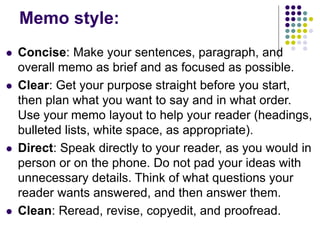
Memo style:
 Concise: Make your sentences, paragraph, and
overall memo as brief and as focused as possible.
 Clear: Get your purpose straight before you start,
then plan what you want to say and in what order.
Use your memo layout to help your reader (headings,
bulleted lists, white space, as appropriate).
 Direct: Speak directly to your reader, as you would in
person or on the phone. Do not pad your ideas with
unnecessary details. Think of what questions your
reader wants answered, and then answer them.
 Clean: Reread, revise, copyedit, and proofread.
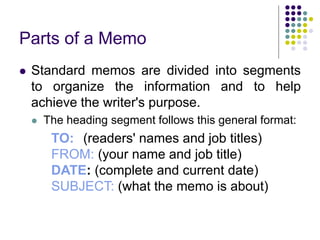
Parts of a Memo
 Standard memos are divided into segments
to organize the information and to help
achieve the writer's purpose.
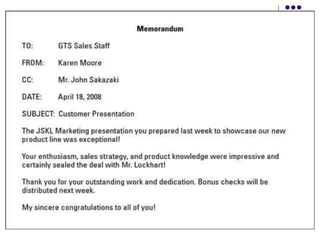
 The heading segment follows this general format:
TO: (readers' names and job titles)
FROM: (your name and job title)
DATE: (complete and current date)
SUBJECT: (what the memo is about)
Parts of a Memo
 Opening Segment
 Summary Segment
 Discussion Segment
 Closing Segment
Task - 1
 Read the material included in your manual to
understand the parts of a memo and how to
write a memo using this information.
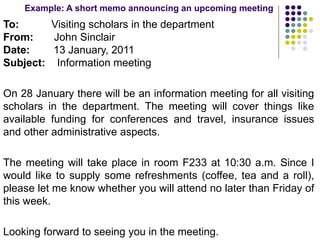
Example: A short memo announcing an upcoming meeting
To: Visiting scholars in the department
From: John Sinclair
Date: 13 January, 2011
Subject: Information meeting
On 28 January there will be an information meeting for all visiting
scholars in the department. The meeting will cover things like
available funding for conferences and travel, insurance issues
and other administrative aspects.
The meeting will take place in room F233 at 10:30 a.m. Since I
would like to supply some refreshments (coffee, tea and a roll),
please let me know whether you will attend no later than Friday of
this week.
Looking forward to seeing you in the meeting.
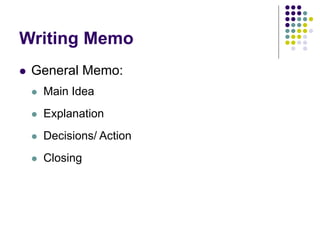
Writing Memo
 General Memo:
 Main Idea
 Explanation
 Decisions/ Action
 Closing
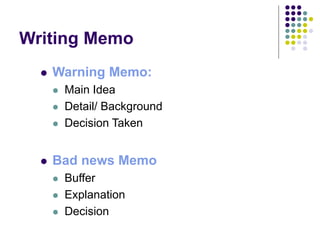
Writing Memo
 Warning Memo:
 Main Idea
 Detail/ Background
 Decision Taken
 Bad news Memo
 Buffer
 Explanation
 Decision
Task-2
 Write down a memo warning all your
subordinates for late coming to office.
 Draft a memo informing all the members of
your staff about the change in office timings.
The new time is 9 to 6.
Group Task
 Analyse the drafted memos and improve in
the light of the comments and observations
Study links
 https://www.thoughtco.com/memorandum-
memo-term-1691377
 https://courses.lumenlearning.com/technicalw
riting/chapter/memos/
 https://web.uvic.ca/~sdoyle/E302/Notes/Mem
o%20Writing%20tips.html

9 Official Common Memos presentation .ppt

  • 1.
  • 2.
    Objectives of theSession  Differentiate b/w a letter and a memo  Know the structure and parts of a memo  understand the purpose and structure of different types of memos  draft memos for various purposes with standard format and language.  critically evaluate memos
  • 3.
    What is memo? A memo is a short, to the point communication.  It is used for conveying your thoughts, reactions or opinion on something.  A memo can call people to action or broadcast a bit of timely news.
  • 4.
    situations:  Policies (changesand new)  Instructions  Procedures  Announcements
  • 5.
    Why memos?  Memosare one of the most widely used means of internal written communication in an organization when the message is too complicated for a simple email or when confidentiality is important.  You can use memos for a variety of purposes. Let's take a quick look at some of the more common types of memos.
  • 6.
    Types of memos DirectiveMemos  You may write a memo to give a directive.  A memo that provides instructions or directions on how to proceed given a certain circumstance.  For example, you may compose a directive on how employees should get medical expenses.
  • 7.
    Status Memos  Itis sometimes called a progress report , which simply explains the status or progress of a particular assignment or project to a supervisor.  A status memo will include the progress to date and what's left to be done.
  • 8.
    Memo style:  Concise:Make your sentences, paragraph, and overall memo as brief and as focused as possible.  Clear: Get your purpose straight before you start, then plan what you want to say and in what order. Use your memo layout to help your reader (headings, bulleted lists, white space, as appropriate).  Direct: Speak directly to your reader, as you would in person or on the phone. Do not pad your ideas with unnecessary details. Think of what questions your reader wants answered, and then answer them.  Clean: Reread, revise, copyedit, and proofread.
  • 9.
    Parts of aMemo  Standard memos are divided into segments to organize the information and to help achieve the writer's purpose.  The heading segment follows this general format: TO: (readers' names and job titles) FROM: (your name and job title) DATE: (complete and current date) SUBJECT: (what the memo is about)
  • 10.
    Parts of aMemo  Opening Segment  Summary Segment  Discussion Segment  Closing Segment
  • 11.
    Task - 1 Read the material included in your manual to understand the parts of a memo and how to write a memo using this information.
  • 13.
    Example: A shortmemo announcing an upcoming meeting To: Visiting scholars in the department From: John Sinclair Date: 13 January, 2011 Subject: Information meeting On 28 January there will be an information meeting for all visiting scholars in the department. The meeting will cover things like available funding for conferences and travel, insurance issues and other administrative aspects. The meeting will take place in room F233 at 10:30 a.m. Since I would like to supply some refreshments (coffee, tea and a roll), please let me know whether you will attend no later than Friday of this week. Looking forward to seeing you in the meeting.
  • 14.
    Writing Memo  GeneralMemo:  Main Idea  Explanation  Decisions/ Action  Closing
  • 15.
    Writing Memo  WarningMemo:  Main Idea  Detail/ Background  Decision Taken  Bad news Memo  Buffer  Explanation  Decision
  • 16.
    Task-2  Write downa memo warning all your subordinates for late coming to office.  Draft a memo informing all the members of your staff about the change in office timings. The new time is 9 to 6.
  • 17.
    Group Task  Analysethe drafted memos and improve in the light of the comments and observations
  • 18.
    Study links  https://www.thoughtco.com/memorandum- memo-term-1691377 https://courses.lumenlearning.com/technicalw riting/chapter/memos/  https://web.uvic.ca/~sdoyle/E302/Notes/Mem o%20Writing%20tips.html