HIV/AIDS
HIV continues to be a major global public
health issue, having claimed 40.1 million lives
so far.
In 2021, 650 000 people died from HIV-related
causes and 1.5 million people acquired HIV.
There is no cure for HIV infection.
About 50% of HIV-infected persons worldwide a
are unaware of their infection
Since the original description in 1981 of an unusual
cluster of cases of Pneumocystis
carinii pneumonia and Kaposi sarcoma in
previously healthy MSM, substantial advances in
our understanding of the (AIDS) have been
achieved.
Evidence that a retrovirus was associated with AIDS
in 1984 and the development of a diagnostic
serologic test for (HIV) in 1985 have served as the
basis for developing improvements in diagnosis.
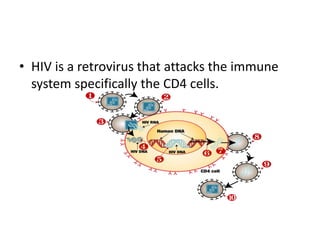
• HIV is a retrovirus that attacks the immune
system specifically the CD4 cells.
HIV Transmission
• Blood
• Semen
• Vaginal Secretions
• Breast milk
• Comes into contact with:
– mucous membranes,
damaged tissue, or is
injected into the body
• Through:
– Sexual activity
– Contaminated needles
– IV drug use
• Occupational exposure
• transfusions
HIV stages
• Viral transmission
• Acute HIV infection ( acute seroconversion
syndrome)
• Chronic HIV infection, which can be further
subdivided into the following stages:
Chronic infection, without AIDS
AIDS, characterized by a CD4 cell count <200
cells/microL or the presence of any AIDS-defining
conditions.
• Advanced HIV infection, characterized by a CD4
cell count <50 cells/microL
• Some, but not all, patients develop within 2 to 4
weeks (range, 1 to 6 weeks) the acute retroviral
syndrome, which may present as a flulike illness,
sometimes with a maculopapular rash.
• The patient then remains asymptomatic for months
to years but is fully capable of spreading the virus to
others.
• The CD4 count gradually declines, and because
CD4+ T lymphocytes are crucial to cell-mediated
immunity, severe complications or death usually
results after months to years (median, 2 to 3 years;
range 1 to >15 years).
• AIDS is defined by a CD4 count less than
200/mm3 or by certain opportunistic infections or
tumors that seldom occur in immunocompetent
persons.
Diagnosis of HIV Infection
• In the past, serologic diagnosis depended on an ELISA test
followed by a confirmatory Western blot test.
• Newer fourth-generation HIV enzyme immunoassay (EIA)
tests detect both HIV antibodies and the HIV p24 antigen, on
average 6 to 7 days after infection.
• Rapid screening tests are inexpensive, quick, and easy to
perform (<20 minutes’ turnaround time), require no
instrumentation.
• Testing for HIV is strongly recommended when patients
between the ages of 13 and 64 years present with any of the
following:
 STDs;
 constitutional symptoms such as fever, night sweats, anorexia,
and weight loss;
 thrush (oropharyngeal candidiasis);
 herpes zoster in persons younger than 50 years of age;
 asymptomatic generalized lymphadenopathy; and
 oral hairy leukoplakia (white spike-like lesions on the lateral
edges of the tongue, which represent crystals of EBV).
• HIV-infected persons are more likely to have severe or
prolonged aphthous stomatitis and any of several skin
conditions, including seborrheic dermatitis, psoriasis,
molluscum contagiosum, recurrent herpes simplex, and
folliculitis.
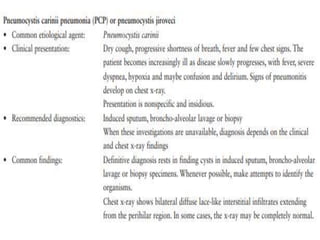
• P. jiroveci pneumonia, the opportunistic infection that in June
1981 brought what is now called HIV/AIDS to world
attention, remains a common presentation in persons who have
not sought HIV testing or, if tested, were lost to follow-up.
• Other AIDS-defining infections include cryptococcosis, CNS
toxoplasmosis (usually with multiple ring-enhancing mass
lesions on CT or MRI), CMV retinitis, and disseminated M.
avium complex disease, for which a single AFB blood culture
has a 90% to 95% sensitivity.
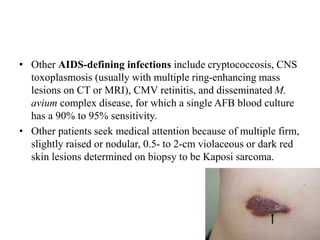
• Other patients seek medical attention because of multiple firm,
slightly raised or nodular, 0.5- to 2-cm violaceous or dark red
skin lesions determined on biopsy to be Kaposi sarcoma.
Initial Management of HIV Disease
• Prompt education
All new patients should have the following tests:
• CD4 count
• quantitative HIV RNA (viral load),
• HIV genotype test (to screen for drug resistance)
• CBC, serum creatinine
• urinalysis
• tuberculin skin test
• anti-Toxoplasma IgG serology
• hepatitis B screening
• hepatitis C virus antibody
• serology for syphilis (RPR)
• screening for gonorrhea and chlamydia infection
• chest radiography.
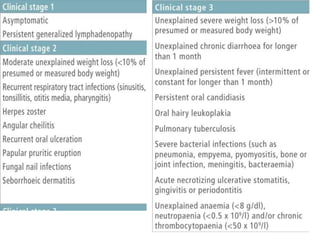
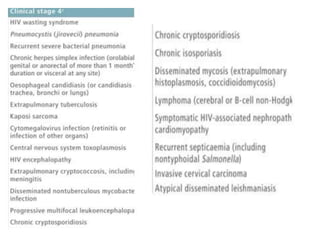
WHO Clinical Staging System
• This staging system has been proven reliable for
predicting morbidity and mortality in infected
adults.
• Clinical markers believed to fall into four stages of
prognostic significance form the basis of the WHO
Clinical Staging System.
ART
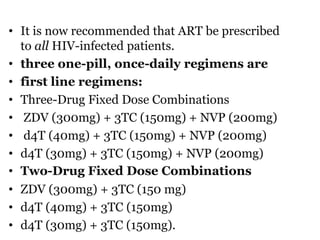
• It is now recommended that ART be prescribed
to all HIV-infected patients.
• three one-pill, once-daily regimens are
• first line regimens:
• Three-Drug Fixed Dose Combinations
• ZDV (300mg) + 3TC (150mg) + NVP (200mg)
• d4T (40mg) + 3TC (150mg) + NVP (200mg)
• d4T (30mg) + 3TC (150mg) + NVP (200mg)
• Two-Drug Fixed Dose Combinations
• ZDV (300mg) + 3TC (150 mg)
• d4T (40mg) + 3TC (150mg)
• d4T (30mg) + 3TC (150mg).
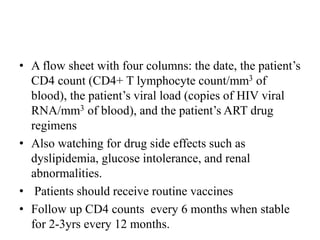
• A flow sheet with four columns: the date, the patient’s
CD4 count (CD4+ T lymphocyte count/mm3 of
blood), the patient’s viral load (copies of HIV viral
RNA/mm3 of blood), and the patient’s ART drug
regimens
• Also watching for drug side effects such as
dyslipidemia, glucose intolerance, and renal
abnormalities.
• Patients should receive routine vaccines
• Follow up CD4 counts every 6 months when stable
for 2-3yrs every 12 months.
• The viral load should be monitored more frequently after
initiation or change in ART (preferably within 2 to 4 weeks
and no longer than 8 weeks, with repeat testing every 4 to 8
weeks until the viral load becomes undetectable) .
Pregnancy and HIV
• All HIV-infected women of childbearing age should
be asked about their desires regarding pregnancy
upon initiation of care and regularly thereafter.
• Pregnant women should receive ART, irrespective of
their immunologic or virologic status, to prevent
infection of the fetus .
• Infants exposed to HIV in utero should receive
antiretroviral postexposure prophylaxis and undergo
HIV diagnostic testing at 10 to 21 days of life, 1 to 2
months of age, and 4 to 6 months of age .
Postexposure Prophylaxis
• Postexposure prophylaxis (PEP) should be considered for
health care workers and others who may have been exposed to
HIV-infected blood during work or line of duty and also for
those who may have been exposed by sexual assault.
• PEP should be given as soon as possible; PEP is unlikely to
work if initiated more than 72 hours after exposure.
Preexposure Prophylaxis
• In June 2012, based on studies in heterosexual and
homosexual persons, the FDA approved the use of tenofovir
plus emtricitabine (TDF–FTC) for the prevention of HIV
transmission among sexually active individuals at high risk for
HIV transmission
Case
A 47 year-old woman presented with chief complaint
of fever to 103 F, non-productive cough and dyspnea
which has progressed over one week. She was tested
HIV-positive 5 years ago at which time her CD4
lymphocyte count was 583.
Zidovudine was started, but she stopped taking it
after one month and did not return to her doctor for
follow-up. She has anorexia and lost 70 pounds over
the last 3 months.
She used heroin and cocaine intravenously for a six
month period 6 years ago.
She does not smoke or drink, has no past STD's and
is not sexually active. She has no known drug
Physical Examination
• She was pale, diaphoretic and in acute respiratory
distress. T 37.4C, P 96/'min, R 30/min, BP 110/70.
• Oral thrush was present.
• Examination of the lungs disclosed poor
inspiratory effort and bibasilar crackles 2/3 of the
way up the posterior lung field.
• She had a tachycardia but no murmurs.
• Her abdomen was nontender, and there was no
enlargement of the liver or spleen.
• Pelvic exam was normal except for vaginal
candidiasis. Neurologic examination was normal.
• Laboratory Evaluations:
• Hgb: 10.8 g/dl
WBC: 7,500/mm3
NEUTR: 43, Lymphs: 41, Monos: 9, Eos: 6
Platelets 248k/mm3
CD4: =235/mm3
HIV RNA level: 234,000 copies/ml
• DX
• TX
9. HIV AIDS.pptx
9. HIV AIDS.pptx

9. HIV AIDS.pptx

  • 1.
  • 2.
    HIV continues tobe a major global public health issue, having claimed 40.1 million lives so far. In 2021, 650 000 people died from HIV-related causes and 1.5 million people acquired HIV. There is no cure for HIV infection. About 50% of HIV-infected persons worldwide a are unaware of their infection
  • 3.
    Since the originaldescription in 1981 of an unusual cluster of cases of Pneumocystis carinii pneumonia and Kaposi sarcoma in previously healthy MSM, substantial advances in our understanding of the (AIDS) have been achieved. Evidence that a retrovirus was associated with AIDS in 1984 and the development of a diagnostic serologic test for (HIV) in 1985 have served as the basis for developing improvements in diagnosis.
  • 4.
    • HIV isa retrovirus that attacks the immune system specifically the CD4 cells.
  • 5.
    HIV Transmission • Blood •Semen • Vaginal Secretions • Breast milk • Comes into contact with: – mucous membranes, damaged tissue, or is injected into the body • Through: – Sexual activity – Contaminated needles – IV drug use • Occupational exposure • transfusions
  • 6.
    HIV stages • Viraltransmission • Acute HIV infection ( acute seroconversion syndrome) • Chronic HIV infection, which can be further subdivided into the following stages: Chronic infection, without AIDS AIDS, characterized by a CD4 cell count <200 cells/microL or the presence of any AIDS-defining conditions. • Advanced HIV infection, characterized by a CD4 cell count <50 cells/microL
  • 7.
    • Some, butnot all, patients develop within 2 to 4 weeks (range, 1 to 6 weeks) the acute retroviral syndrome, which may present as a flulike illness, sometimes with a maculopapular rash. • The patient then remains asymptomatic for months to years but is fully capable of spreading the virus to others.
  • 8.
    • The CD4count gradually declines, and because CD4+ T lymphocytes are crucial to cell-mediated immunity, severe complications or death usually results after months to years (median, 2 to 3 years; range 1 to >15 years). • AIDS is defined by a CD4 count less than 200/mm3 or by certain opportunistic infections or tumors that seldom occur in immunocompetent persons.
  • 10.
    Diagnosis of HIVInfection • In the past, serologic diagnosis depended on an ELISA test followed by a confirmatory Western blot test. • Newer fourth-generation HIV enzyme immunoassay (EIA) tests detect both HIV antibodies and the HIV p24 antigen, on average 6 to 7 days after infection. • Rapid screening tests are inexpensive, quick, and easy to perform (<20 minutes’ turnaround time), require no instrumentation.
  • 11.
    • Testing forHIV is strongly recommended when patients between the ages of 13 and 64 years present with any of the following:  STDs;  constitutional symptoms such as fever, night sweats, anorexia, and weight loss;  thrush (oropharyngeal candidiasis);  herpes zoster in persons younger than 50 years of age;  asymptomatic generalized lymphadenopathy; and  oral hairy leukoplakia (white spike-like lesions on the lateral edges of the tongue, which represent crystals of EBV).
  • 12.
    • HIV-infected personsare more likely to have severe or prolonged aphthous stomatitis and any of several skin conditions, including seborrheic dermatitis, psoriasis, molluscum contagiosum, recurrent herpes simplex, and folliculitis. • P. jiroveci pneumonia, the opportunistic infection that in June 1981 brought what is now called HIV/AIDS to world attention, remains a common presentation in persons who have not sought HIV testing or, if tested, were lost to follow-up.
  • 13.
    • Other AIDS-defininginfections include cryptococcosis, CNS toxoplasmosis (usually with multiple ring-enhancing mass lesions on CT or MRI), CMV retinitis, and disseminated M. avium complex disease, for which a single AFB blood culture has a 90% to 95% sensitivity. • Other patients seek medical attention because of multiple firm, slightly raised or nodular, 0.5- to 2-cm violaceous or dark red skin lesions determined on biopsy to be Kaposi sarcoma.
  • 14.
    Initial Management ofHIV Disease • Prompt education All new patients should have the following tests: • CD4 count • quantitative HIV RNA (viral load), • HIV genotype test (to screen for drug resistance) • CBC, serum creatinine • urinalysis • tuberculin skin test • anti-Toxoplasma IgG serology
  • 15.
    • hepatitis Bscreening • hepatitis C virus antibody • serology for syphilis (RPR) • screening for gonorrhea and chlamydia infection • chest radiography.
  • 16.
    WHO Clinical StagingSystem • This staging system has been proven reliable for predicting morbidity and mortality in infected adults. • Clinical markers believed to fall into four stages of prognostic significance form the basis of the WHO Clinical Staging System.
  • 19.
  • 20.
    • It isnow recommended that ART be prescribed to all HIV-infected patients. • three one-pill, once-daily regimens are • first line regimens: • Three-Drug Fixed Dose Combinations • ZDV (300mg) + 3TC (150mg) + NVP (200mg) • d4T (40mg) + 3TC (150mg) + NVP (200mg) • d4T (30mg) + 3TC (150mg) + NVP (200mg) • Two-Drug Fixed Dose Combinations • ZDV (300mg) + 3TC (150 mg) • d4T (40mg) + 3TC (150mg) • d4T (30mg) + 3TC (150mg).
  • 21.
    • A flowsheet with four columns: the date, the patient’s CD4 count (CD4+ T lymphocyte count/mm3 of blood), the patient’s viral load (copies of HIV viral RNA/mm3 of blood), and the patient’s ART drug regimens • Also watching for drug side effects such as dyslipidemia, glucose intolerance, and renal abnormalities. • Patients should receive routine vaccines • Follow up CD4 counts every 6 months when stable for 2-3yrs every 12 months.
  • 22.
    • The viralload should be monitored more frequently after initiation or change in ART (preferably within 2 to 4 weeks and no longer than 8 weeks, with repeat testing every 4 to 8 weeks until the viral load becomes undetectable) .
  • 23.
    Pregnancy and HIV •All HIV-infected women of childbearing age should be asked about their desires regarding pregnancy upon initiation of care and regularly thereafter. • Pregnant women should receive ART, irrespective of their immunologic or virologic status, to prevent infection of the fetus . • Infants exposed to HIV in utero should receive antiretroviral postexposure prophylaxis and undergo HIV diagnostic testing at 10 to 21 days of life, 1 to 2 months of age, and 4 to 6 months of age .
  • 25.
    Postexposure Prophylaxis • Postexposureprophylaxis (PEP) should be considered for health care workers and others who may have been exposed to HIV-infected blood during work or line of duty and also for those who may have been exposed by sexual assault. • PEP should be given as soon as possible; PEP is unlikely to work if initiated more than 72 hours after exposure.
  • 26.
    Preexposure Prophylaxis • InJune 2012, based on studies in heterosexual and homosexual persons, the FDA approved the use of tenofovir plus emtricitabine (TDF–FTC) for the prevention of HIV transmission among sexually active individuals at high risk for HIV transmission
  • 27.
    Case A 47 year-oldwoman presented with chief complaint of fever to 103 F, non-productive cough and dyspnea which has progressed over one week. She was tested HIV-positive 5 years ago at which time her CD4 lymphocyte count was 583. Zidovudine was started, but she stopped taking it after one month and did not return to her doctor for follow-up. She has anorexia and lost 70 pounds over the last 3 months. She used heroin and cocaine intravenously for a six month period 6 years ago. She does not smoke or drink, has no past STD's and is not sexually active. She has no known drug
  • 28.
    Physical Examination • Shewas pale, diaphoretic and in acute respiratory distress. T 37.4C, P 96/'min, R 30/min, BP 110/70. • Oral thrush was present. • Examination of the lungs disclosed poor inspiratory effort and bibasilar crackles 2/3 of the way up the posterior lung field. • She had a tachycardia but no murmurs. • Her abdomen was nontender, and there was no enlargement of the liver or spleen. • Pelvic exam was normal except for vaginal candidiasis. Neurologic examination was normal.
  • 29.
    • Laboratory Evaluations: •Hgb: 10.8 g/dl WBC: 7,500/mm3 NEUTR: 43, Lymphs: 41, Monos: 9, Eos: 6 Platelets 248k/mm3 CD4: =235/mm3 HIV RNA level: 234,000 copies/ml
  • 30.

Editor's Notes

  • #6 HIV is transmitted when blood, semen, vaginal secretions, or breast milk comes into contact with a mucous membrane, damaged tissue, or is injected into the body. Methods of transmission include vaginal, anal, or oral sex, or contaminated needles commonly through IV drug use. Centers for Disease Control and Prevention. (2010, March 25). HIV transmission. Retrieved from http://www.cdc.gov/hiv/resources/qa/transmission.htm