Download to read offline
![G.U. Journal of Science
22(1): 21-32 (2009)
www.gujs.org
♠
Corresponding author, e-mail: rrshetty2@rediffmail.com
Experimental Studies on Turning of Discontinuously
Reinforced Aluminium Composites under Dry, Oil
Water Emulsion and Steam Lubricated Conditions Using
TAGUCHI’s Technique
Raviraj Shetty 1♠
, R. Pai1
, S.S.Rao 2
1
Manipal Institute of Technology, Department of Mechanical and Manufacturing Engineering, Karnataka, India
2
National Institute of Technology, Department of Mechanical Engineering, Karnataka, India
Received: 31.10.2007 Revised: 09.07.2008 Accepted: 0.3.12.2008
ABSTRACT
This paper reports on the experimental investigations carried out under dry, oil water emulsion and steam
lubricated conditions in turning of DRACs. The measured results were then collected and analyzed with the
help of the commercial software package MINITAB15. The experiments were planned on orthogonal arrays,
made with prefixed cutting parameters and different lubricated conditions. An analysis of variance (ANOVA)
was carried out to check the validity of the proposed parameters and also their percentage contributions. The
results of the tests show that with proper selection of the range of cutting parameters, it is possible to obtain
better performance under steam lubricated condition.
Key Words: DRACs, Cutting force, Cutting temperature, Design of experiments, ANOVA, Hystrix cristata.
1. INTRODUCTION
Discontinuously reinforced Aluminium composites
(DRACs) is one of the important composites among the
metal matrix composites, which have SiC particles in an
aluminium matrix; this is harder than tungsten carbide
(WC), which pose many problems in machining. When
DRACs are being chosen for high volume and machine-
intensive components, it is crucial that the
machinability of the materials be understood. The
machinability of DRACs has been investigated actively
worldwide since the 1980s, and most researchers have
found that polycrystalline diamond (PCD) or cubic
boron nitride tools can be used to machine DRACs
effectively. Driven by the high cost of these tools, it is
still desirable to optimize the cutting conditions, such as
the effect of cutting fluid, since there has been no
comprehensive study undertaken in this area.
A Discontinuously Reinforced Aluminium Composites
(DRACs) can be described as a material which is made
up of a continuous metallic phase (the matrix) into
which a second phase (or phases) has been artificially
introduced. Early DRACs had their application
confined to military and aerospace applications, their
extensive usage was hindered due to their high
production costs, limited production methods, and
restricted product forms [1].
Machining of Discontinuously reinforced Aluminium
composites (DRACs) presents a significant challenge to
the industry since a number of reinforcement materials
are significantly harder than the commonly used high
speed steel (HSS) tools and carbide tools [2]. The
reinforcement phase causes rapid abrasive tool wear;
thus the widespread usage of DRACs is considerably
impeded by their poor machinability and high
machining costs. Based on the available literature on
DRACs it is clear that the morphology, distribution and
volume fraction of the reinforcement phase, as well as
the matrix properties are all factors that affect the
overall cutting process [2-3], but as yet relatively few
published reports are related to the optimization of the
cutting process.](https://image.slidesharecdn.com/85-225-1-sm-130822123720-phpapp01/85/85-225-1-sm-1-320.jpg)
![G.U. Journal of Science
22(1): 21-32 (2009)
www.gujs.org
♠
Corresponding author, e-mail: rrshetty2@rediffmail.com
Experimental Studies on Turning of Discontinuously
Reinforced Aluminium Composites under Dry, Oil
Water Emulsion and Steam Lubricated Conditions Using
TAGUCHI’s Technique
Raviraj Shetty 1♠
, R. Pai1
, S.S.Rao 2
1
Manipal Institute of Technology, Department of Mechanical and Manufacturing Engineering, Karnataka, India
2
National Institute of Technology, Department of Mechanical Engineering, Karnataka, India
Received: 31.10.2007 Revised: 09.07.2008 Accepted: 0.3.12.2008
ABSTRACT
This paper reports on the experimental investigations carried out under dry, oil water emulsion and steam
lubricated conditions in turning of DRACs. The measured results were then collected and analyzed with the
help of the commercial software package MINITAB15. The experiments were planned on orthogonal arrays,
made with prefixed cutting parameters and different lubricated conditions. An analysis of variance (ANOVA)
was carried out to check the validity of the proposed parameters and also their percentage contributions. The
results of the tests show that with proper selection of the range of cutting parameters, it is possible to obtain
better performance under steam lubricated condition.
Key Words: DRACs, Cutting force, Cutting temperature, Design of experiments, ANOVA, Hystrix cristata.
1. INTRODUCTION
Discontinuously reinforced Aluminium composites
(DRACs) is one of the important composites among the
metal matrix composites, which have SiC particles in an
aluminium matrix; this is harder than tungsten carbide
(WC), which pose many problems in machining. When
DRACs are being chosen for high volume and machine-
intensive components, it is crucial that the
machinability of the materials be understood. The
machinability of DRACs has been investigated actively
worldwide since the 1980s, and most researchers have
found that polycrystalline diamond (PCD) or cubic
boron nitride tools can be used to machine DRACs
effectively. Driven by the high cost of these tools, it is
still desirable to optimize the cutting conditions, such as
the effect of cutting fluid, since there has been no
comprehensive study undertaken in this area.
A Discontinuously Reinforced Aluminium Composites
(DRACs) can be described as a material which is made
up of a continuous metallic phase (the matrix) into
which a second phase (or phases) has been artificially
introduced. Early DRACs had their application
confined to military and aerospace applications, their
extensive usage was hindered due to their high
production costs, limited production methods, and
restricted product forms [1].
Machining of Discontinuously reinforced Aluminium
composites (DRACs) presents a significant challenge to
the industry since a number of reinforcement materials
are significantly harder than the commonly used high
speed steel (HSS) tools and carbide tools [2]. The
reinforcement phase causes rapid abrasive tool wear;
thus the widespread usage of DRACs is considerably
impeded by their poor machinability and high
machining costs. Based on the available literature on
DRACs it is clear that the morphology, distribution and
volume fraction of the reinforcement phase, as well as
the matrix properties are all factors that affect the
overall cutting process [2-3], but as yet relatively few
published reports are related to the optimization of the
cutting process.](https://image.slidesharecdn.com/85-225-1-sm-130822123720-phpapp01/75/85-225-1-sm-1-2048.jpg)
![22 G.U. J. Sci., 22(1):21-32 (2009)/ Raviraj Shetty ♠
, R. Pai, S.S.Rao
The positive effect of the use of cutting fluids in metal
cutting was first reported in 1894 by F.Taylor, who
noticed that by applying large amounts of water in the
cutting area, the cutting speed could be increased up to
33% without reducing tool life. Since then, cutting
fluids have been developed resulting in an extensive
range of products covering most workpiece materials
and operations.
As research shows, the application of gases as cutting
fluids has been used since 1930s. [4,5] reported the
experimental results of carbon dioxide gas application
in machining. It was noticed that application of carbon
dioxide gas as coolants and lubricants reduced the
cutting force and obtained a higher tool life. [6–10] also
deeply studied application of oxygen gas as cutting
fluids in cutting process . [10] observed these results
were promising that the application of oxygen gas was
an effective agent to reduce contact length of tool–chip .
However, In the 1990s, [11-13] used water vapor as
coolants and lubricants in turning and milling operation.
The results showed water vapor lubrication in
comparison with liquid one ensures more uniform
cooling and the application of vaporous lubrication
allows increasing the carbide cutting tools lifetime
about 2–2.5 times in turning and 2–4 times in milling
carbon and stainless steels. In 2007 [14] used
pressurized steam jet approach in turning of
discontinuously reinforced aluminium composites. The
result showed the steam pressure as the dominant
parameter for surface roughness followed by feed. [15]
also carried out experimental investigations under dry,
oil water emulsion and steam lubricated conditions
using orthogonal array in turning of DRACs, he
concluded that the tool wear and surface roughness
were found to be lesser for steam cutting, where as
these two parameters showed much variation during oil
water emulsion and dry cutting. [16] used a pressurized
steam jet approach to tool wear minimization in cutting
of metal matrix composites by full factorial design of
experiments, he concluded that the effect of the
pressured steam jet plays a significant role on the tool
wear followed by tool inserts and depth of cut. Further,
fluid jet assisted machining as a highly effective method
for cutting of conventional materials has been well
explored [17–30], in which fluids, such as air, water or
steam, mainly act as transportation carriers carrying the
heat away from the cutting region, and the efficiency of
such a cooling method largely depends on the jet
pressure. Therefore, it is necessary to understand the
relationship among the various controllable parameters
and to identify the important parameters that influence
the quality of turning. Moreover, it is necessary to
optimize [31-33] the cutting parameters to obtain an
extended tool life and better productivity, which are
influenced by cutting force and cutting temperature.
Design of experiment [DOE] is a statistical-based
approach to analyze the influence of known process
variables over unknown process variables. The current
article investigates the influence of cutting parameters
and lubricating conditions on cutting force and cutting
temperature in turning of DRACs with Cubic boron
nitride inserts (CBN) KB-90 grade.
2. METHODOLOGY
2.1 Material
Al–SiC MMC workpiece specimens popularly known
as DRACs having aluminum alloy 6061 as the matrix
and containing 15 vol. % of silicon carbide particles of
mean diameter 25 m in the form of cylindrical bars of
length 120mm and diameter 40mm manufactured in
Vikram Sarbhai Space Centre (VSSC) Trivandrum by
stir casting process with pouring temperature 700-
710°C, stirring rate 195 rpm, extrusion at 457°C,
extrusion ratio 30:1, direct extrusion speed 6.1m/min to
produce Ø40mm cylindrical bars. The specimen were
solution treated for 2h at a temperature of 540oC in a
muffle furnace, temperatures were accurate to within
±2oC and quench delays in all cases were within 20s.
after solutionising, the samples were water quenched to
room temperature, and subsequently aged for six
different times to obtain samples with different Brinell
hardness number (BHN), out of which one samples
were selected, one with 94 BHN obtained at peakage
condition i.e 2h at 220oC respectively. Sample selected
were kept in a refrigerator right after the heat
treatments. Figure 1 shows the microstructure of
DRACs.
Figure 1. A microstructure of an DRACs (6061 Al/ 15%
SiC 25p).
2.2 Machining Test
The chemical composition of the specimen is given in
Table 1. Turning, as a machining process was selected.
The experimental study was carried out in PSG A141
lathe (2.2 KW) with different cutting speeds, feeds and
a constant depth of cut. The selected cutting tool was
cubic boron nitride insert KB-90 (ISO code), for
machining of DRACs. The ISO code of cutting tool
inserts and tool holder are shown in Table 2. The level
of variables used in the experiment is given in Table 3.
The schematic representation of cutting force
measurement is shown in Figure 2 and was measured
by using IEICOS Digital tool dynamometer
respectively. The measurement of cutting temperature
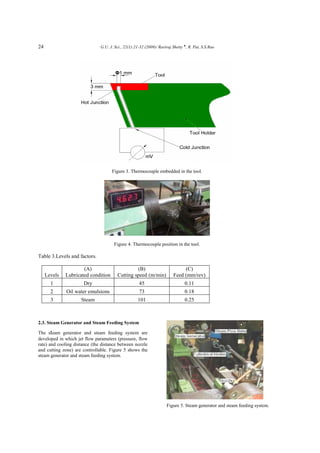
was carried out by thermocouple embedded in tool as
shown in Figure 3. For the thermocouple, a groove was
cut in the tool by using electrical discharge machining
(EDM). The groove was made in the rake face 1.70 mm](https://image.slidesharecdn.com/85-225-1-sm-130822123720-phpapp01/85/85-225-1-sm-2-320.jpg)
![G.U. J. Sci., 22(1):21-32 (2009)/ Raviraj Shetty ♠
, R. Pai, S.S.Rao 23
from the cutting edge and the thermocouple wire was
placed in the groove near the cutting edge Figure 4
shows the photograph of tool embedded with
thermocouple. This was chosen due to the combination
of getting good results in a shorter interval than other
method, and because of its ease in implementation after
it has been calibrated, and also due to its low cost [34,
35].
Table 1. Nominal chemical composition of base metal (6061 Al alloy).
Figure 2. The schematic representation of cutting force (Fz) measurement.
Table 2. Details of cutting tool and tooling system used for experimentation.
Tool holder Specification STGCR 2020 K-16
CTGPR 1212 F 11
Tool geometry Specification Approach angle:910
Tool nose radius:0.4 mm
Rake angle: 00
Clearance angle: 70
Tool insert CBN (KB-90)
Specification
TPGN160304-LS
TPGN 110304-LS
Element Cu Mg Si Cr Al
Weight. percentage 0.25 1.0 0.6 0.25 Balance](https://image.slidesharecdn.com/85-225-1-sm-130822123720-phpapp01/85/85-225-1-sm-3-320.jpg)
![G.U. J. Sci., 22(1):21-32 (2009)/ Raviraj Shetty ♠
, R. Pai, S.S.Rao 25
3. TAGUCHI’S METHOD
Taguchi techniques have been used widely in
engineering design [36, 37]. The main trust of the
Taguchi techniques is the use of parameter design,
which is an engineering method for product or process
design that focuses on determining the parameter
(factor) settings producing the best levels of a quality
characteristic (performance measure) with minimum
variation. Taguchi designs provide a powerful and
efficient method for designing processes that operate
consistently and optimally over a variety of conditions.
To determine the best design requires the use of a
strategically designed experiment which exposes the
process to various levels of design parameters.
Experimental design methods were developed in the
early years of 20th century and have been extensively
studied by statisticians since then, but they were not
easy to use by practitioners [37]. Taguchi’s approach to
design of experiments is easy to adopt and apply for
users with limited knowledge of statistics, hence it has
gained a wide popularity in the engineering and
scientific community. There have been plenty of recent
applications of Taguchi techniques to materials
processing for process optimization. Some of the
previous works are listed in [38–43]. In particular, it is
recommended for analyzing metal cutting problems for
finding the optimal combination of parameters [43].
3.1. Design of Experiments
The orthogonal array for two factors at three levels was
used for the elaboration of the plan of experiments the
array L27 was selected, which has 27 rows
corresponding to the number of tests (26 degrees of
freedom) with 13 columns at three levels. The factors
and the interactions are assigned to the columns.
The first column was assigned to the lubrication
condition (A), the second column to cutting speed (B),
the fifth column to the feed (C) and remaining were
assigned to interactions. The outputs to be studied were
the cutting temperature and the cutting force. Further,
an analysis of variance (ANOVA) was carried out
separately for each response.
4. RESULTS AND DISCUSSION
4.1. Cutting Force in Turning of DRACs
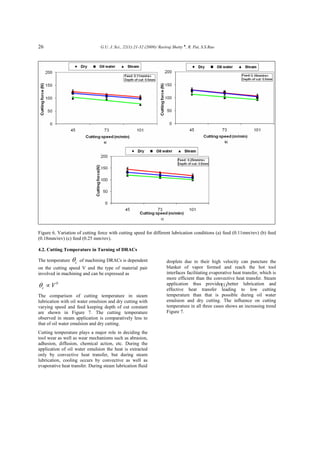
Figure 6 shows the comparison of cutting force (Fz) in
steam application with dry and oil water emulsion. It is
observed that the cutting force decreases with increase
in cutting speed [44] further cutting force was lower in
steam application, compared to dry and oil water
emulsion. In steam application, the cutting fluid is
supplied at high pressure and high velocity, which
penetrates in to the tool chip interface causing reduction
in frictional contribution to the cutting force, these
minute capillaries exist at the tool chip interface and as
the chip moves up it contacts mainly at the top of the
asperities, these points of contact zones creating
capillaries between the chip and the tool. These
capillaries draw in steam, which chemically react to
produce a thin solid film of low shear strength, which
keeps the chip and the tool apart, it causes reduction in
friction. During steam as cutting fluid, the cutting fluid
is fragmented into tiny globules and the size of which is
inversely proportional to the pressure of injection. The
velocity varies as a function of the square root of the
injection pressure. This high velocity facilitates better
penetration of the steam to the underside of the chip
facilitating its passage to the tool chip interface
resulting in the reduction of friction. Such a condition is
not possible in oil water emulsion, where no such
fragmentation is taking place and the kinetic energy of
the fluid jet is in no way comparable to that during
steam injection.
From the Figure 6 it can be observed that, cutting force
decreases with an increase in cutting speed. Under
smaller cutting speed, the tool cutting edge will impact
on the reinforcement particles, the impacted particles
will then either be dislodged from the matrix, without
harming the tool, or be embedded into the matrix,
ploughing on the tool flank, resulting in a higher order
cutting force. As the cutting speed increases, the tool
would cut better without ploughing, resulting in a drop
in cutting force.](https://image.slidesharecdn.com/85-225-1-sm-130822123720-phpapp01/85/85-225-1-sm-5-320.jpg)
![G.U. J. Sci., 22(1):21-32 (2009)/ Raviraj Shetty ♠
, R. Pai, S.S.Rao 31
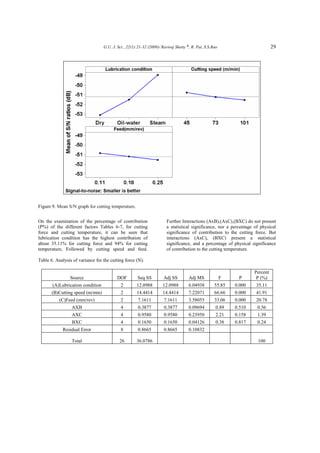
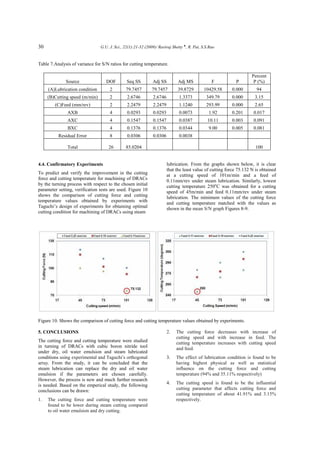
5. Optimum machining condition from mean S/N
graph and from experimental results for cutting force is
selection of steam lubrication, 101m/min cutting speed
and 0.11mm/rev feed. Similarly for cutting temperature,
selection of steam lubrication, 45m/min cutting speed
and 0.11mm/rev feed would be ideal for machining of
DRACs.
6. The results of the study show that with a
proper selection of machining parameters, it is possible
to obtain a performance better in steam lubrication
condition in turning of DRACs.
REFERENCES
[1] Evans, A., Marchi, C.S., Mortenson, A., “Journal
of Metal Matrix Composites in Industry an
Introduction and a Survey”, Kluwer, Boston,
(2003).
[2] Ramrattan, S., Sitkins, F., Nallakatala, M.,
"Optimization of the Casting and Machining
Processes for Metal Matrix Composites",
Proceedings of the Canadian Society for
Mechanical Engineers Symposium, McMaster
University, (1996).
[3] Monaghan, J.M., "The Use of Quick Stop Test to
Study the Chip Formation of a SiC/Al Metal
Matrix Composite and its Matrix Alloy", Journal
of Processing of Advanced Materials, 4: 170- 179
(1994).
[4] Cakir, O., Kiyak, M., Altan, E., “Comparisons of
gases applications to wet and dry cuttings in
turning”, Journal of Material Processing
Technology, 153–154: 35–41 (2004).
[5] Hollis, W.S., “The applications and effect of
controlled atmospheres in machining of metals”,
Int. J. Machine Tool Design Res., 1:59–78
(1961).
[6] Johansson, U., Lindstom, B., “Tool wear by chatter
caused by oxygen pumping”, Annals of the CIRP,
19: 317–321 (1971).
[7] Williams, J.A., Tabor, D., “The role of lubricants
in machining”, Wear, 43:275–292 (1977).
[8] Williams, J.A., “The action of lubricants in metal
machining”, Journal of Mechanical Engineering
Science, 19:.202–212 (1977).
[9] Altan, E., Kiyak, M., Cakir, O., “The effect of
oxygen gas application into cutting zone on
machining”, Proceedings of Sixth Biennial
Conference on Engineering system Design and
Analysis (ESDA2002), Istanbul, 1–5 (2002)
[10] Rowe, G.W., Smart, E.F., “The importance of
oxygen in dry cutting machining of metal on
lathe”, Br. Journal of Applied Physics, 14: 924–
926 (1963).
[11] Podgorkov, V.V., et al., Patent of USSR #1549721
MCI B23Q, Method of cutting in application, (in
Russia), (1992).
[12] Godlevski, V.A., et al., “Water steam lubrication
during machining”, Tribologia, 162 (6):11 (1998).
[13] Liu, J.Y., Han, R.D., Sun, Y.F., “Research on
experiments and action mechanism with water
vapor as coolant and lubricant in green cutting”,
International Journal of Machine Tools
Manufacture ,45:687–694 (2005).
[14] Shetty, R., Pai, R.B., Kamath, V., Rao, S.S.,
“Study of Surface roughness minimization in
turning of DRACs using surface roughness
methodology and Taguchi under pressured steam
jet approach”, ARPN Journal of Engineering and
Applied Sciences, 3(1):59-67 (2008).
[15] Shetty, R., Pai, R.B., Rao, S.S., “Tribological
studies on discontinuously reinforced aluminium
composites based on the orthogonal arrays”,
ARPN Journal of Engineering and Applied
Sciences, 3(1): 94-92 (2008).
[16] Anjaiah, D., Shetty, R., Pai, R.B., Kini, M.V., Rao,
S.S., “A pressured steam jet approach to tool wear
minimization in cutting of metal matrix
composites”, Materials Science Forum, 561-565:
643-646 (2007).
[17] Li, X.P., Seah, W.K.H., “Tool wear acceleration in
relation to work piece reinforcement percentage in
cutting metal matrix composites”, Wear, 247:161–
171 (2001).
[18] Li, X.P., “Study of the jet-flow rate of cooling in
machining”, Part 1.Theoretical analysis, Material
Processing Technology, 62:149–156 (1996).
[19] Li, X.P., “Study of the jet-flow rate of cooling in
machining” Part 2.Simulation study, Material
Processing Technology, 62:157– 165 (1996).
[20] Kaminski, J., Alvelid, B., “Temperature reduction
in the cutting zone in water-jet assisted turning”,
Material Processing Technology, 106:.68–73
(2000).
[21] Hung, N.P., Yeo, H.B.E., “On Effect of cutting
fluid on the Machinability of metal matrix
composites”, Journal of Materials Processing
Technology, 67:157 -161 (1997).
[22] Weinert, K., “A consideration of tool wear
mechanism when machining metal matrix
composites (MMC)”, Ann. CIRP, 42: 95-98
(1993).
[23] Wang, Z.Y., Rajurkar, K.P., “Optimal Wear of
CBN tool in turning of silicon nitride with](https://image.slidesharecdn.com/85-225-1-sm-130822123720-phpapp01/85/85-225-1-sm-11-320.jpg)
![32 G.U. J. Sci., 22(1):21-32 (2009)/ Raviraj Shetty ♠
, R. Pai, S.S.Rao
cryogenic cooling”, Machine Tools and
Manufacturing, 37(3): 319-326 (1997).
[24] Mazurkiewicz, M., Kubala, Z., Chow, J., “Metal
machining with high pressure water-jet cooling
assistance—a new possibility”, Engineering
Industries, 111: 7–12 (1989).
[25] Shetty, R., Pai, R.B., Rao, S.S., Shenoy, B.S.,
“Study of tool wear in turning 15% SiCp
reinforced 6061 aluminium metal matrix
composite with steam as coolant”, Proceedings of
International conference on Advanced Material
processing and characterization,(APMC 2006),
Chennai, India,(2006).
[26] Shetty, R., Pai, R.B., Rao, S.S., Barboza, A.B.V.,
“Tribological studies on PCBN tool in turning
metal matrix composites with Steam as coolant”,
Proceedings of International Tribological
conference (AUSTRIB 2006), Brisbane, Australia
(2006).
[27] Shetty, R., Pai, R.B., Rao, S.S., “Kumar D.,Chip
and built-up edge formation in turning age
hardened AA6061/15 vol. % SiCp composites with
steam as coolant” , Proceedings of Second
International conference on recent advances in
composite materials, (ICRAM 2007), New Delhi,
India (2007).
[28] Shetty, R., Pai, R.B., Rao, S.S., Nayak
Rajesh.,”Tribological studies of steam penetration
in different directions in turning of metal matrix
composites using steam as coolant”, Proceedings
of International conference on Industrial
tribology, (ICIT-2006) held at Bangalore, India
(2006).
[29] Shetty, R., Pai, R.B., Rao, S.S., Vasudev, M.,
“Influence of lubrication condition on surface
roughness in turning of metal matrix composites”;
Proceedings of Sixth International Conference
on composite science and technology, (ICCST/6)
Durban , South Africa (2007).
[30] Sales, W.F., Guimara, G., Machado, A.R., Ezugwu
E.O., “Cooling ability of cutting fluids and
measurement of the chip-tool interface
temperatures”, Industrial Lubrication and
Tribology, 54(2): 57–68 (2002).
[31] Singh, H., Kumar, P., “Tool wear optimization in
turning operation by Taguchi method”, Indian
Journal of Engineering Material Science, 11: 19–
24 (2004).
[32] Singh, H., Kumar, P., “Optimizing cutting force
for turned parts using Taguchi’s parameter design
approach”, Indian Journal of Engineering
Material Science, 12: 97–103 (2005).
[33] Paulo Davim, J., “A note on the determination of
optimal cutting conditions for surface finish
obtained in turning using design of experiments”,
Journal of Material Processing Technology, 116:
305–308 (2001).
[34] O’Sullivan, D., Cotterell, M., “Temperature
measurement in single point turning”, Journal of
Materials Processing Technology, 118 (1–3):
301–308 (2001).
[35] Dewes, R.C., Ng, E., Chua, K.S., “Newton P.G.,
Aspinwall, D.K, Temperature measurement when
high speed machining hardened mould/die steel”,
Journal of Materials Processing Technology, 92–
93:.93–301 (1999).
[36] Ross, P.J., “Taguchi techniques for quality
engineering: loss function, orthogonal experiments,
parameter and tolerance design”, 2nd ed., New
York, NY: McGraw-Hill, (1996).
[37] Phadke, M.S., “Quality engineering using robust
design”, Englewood Cliffs, NJ: Prentice-Hall,
(1989).
[38] Yang, W.H., Tarng, Y.S., “Design optimization of
cutting parameters for turning operations based on
the Taguchi method”, Journal of Material
Processing Technology, 84: 122–129 (1998).
[39] Su, Y.L., Yao, S.H., Wei, C.S., Kao, W.H., Wu,
C.T., “Design and performance analysis of TiCN-
coated cemented carbide milling cutters”, Journal
of Material Processing Technology, 87: 82–89
(1999).
[40] Nian, C.Y., Yang, W.H., Tarng, Y.S.,
“Optimization of turning operations with multiple
performance characteristics”, Journal of Material
Processing Technology, 95:.90–96 (1999).
[41] Lin, T.R., “Experimental design and performance
analysis of TiNcoated carbide tool in face milling
stainless steel”, Journal of Material Processing
Technology, 127:.1–7 (2002).
[42] Davim, J.P., “Design optimization of cutting
parameters for turning metal matrix composites
based on the orthogonal arrays”, Journal of
Material Processing Technology, 132: 340–344
(2003).
[43] Ghani, J.A., Choudhury, I.A, Hassan, H.H.,
“Application of Taguchi method in the
optimization of end milling operations”, Journal
of Material Processing Technology, 145: 84–
92(2004).
[44] Varadarajan, A.S., Philip, P.K., “Ramamoorthy B.,
Investigations on hard turning with minimal
cutting fluid application (HTMF) and its
comparison with dry and wet turning”,
International Journal of Machine Tools &
Manufacture, 42: 193–200 (2002).](https://image.slidesharecdn.com/85-225-1-sm-130822123720-phpapp01/85/85-225-1-sm-12-320.jpg)

This document reports on an experimental study of turning discontinuously reinforced aluminum composites (DRACs) under different lubricated conditions. The experiments used a Taguchi design of experiments approach to evaluate cutting forces and temperatures at various cutting speeds, feeds, and depth of cuts under dry, oil-water emulsion, and steam lubricated conditions. Analysis of variance (ANOVA) was performed to determine the influence of parameters and their percentage contributions. The results showed that steam lubrication produced better performance than dry or emulsion cutting in terms of tool life and surface roughness.


