Parker Solar Probe By: Malcolm Aranda
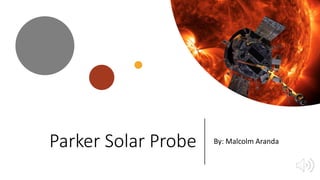
• The Parker Solar Probe (PSP)
spacecraft launched August 12,
2018 on a Delta IV Heavy rocket
from Cape Canaveral.
• Study the sun through direct
measurements in the corona
• The corona is the Sun’s outer
atmosphere
• Closest any spacecraft has been
to the Sun
Parker Solar Probe Mission
Studying The
Sun Is Important
• The Sun provides light and
energy for all living things
on earth
• Solar activity interacts with
Earth’s magnetic fields
• Solar weather has affect on
electronics in space and on
earth
• Observation from systems in
space provide more
accurate data
Parker Solar Probe Spacecraft
• Built by Johns Hopkins University
Applied Physics Laboratory
• Most noticeable feature is the
solar shield
• Controlled by autonomous
operation
• Reaction wheels adjust the
orientation
Solar Probe
Instruments
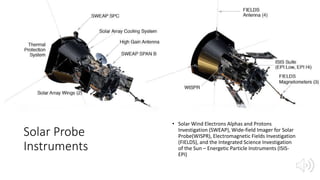
• Solar Wind Electrons Alphas and Protons
Investigation (SWEAP), Wide-field Imager for Solar
Probe(WISPR), Electromagnetic Fields Investigation
(FIELDS), and the Integrated Science Investigation
of the Sun – Energetic Particle Instruments (ISIS-
EPI)
Solar Probe Instruments (Cont.)
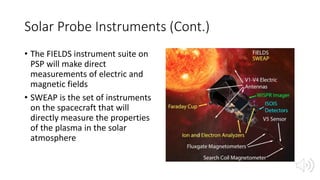
• The FIELDS instrument suite on
PSP will make direct
measurements of electric and
magnetic fields
• SWEAP is the set of instruments
on the spacecraft that will
directly measure the properties
of the plasma in the solar
atmosphere
Solar Probe Instruments (Cont.)
• WISPR, a telescope that will
make 3-D images of the sun's
corona, or atmosphere
• ISIS-EPI consists of two
instruments that will monitor
electrons, protons and ions that
are accelerated to high energies
in the sun's atmosphere.
Launch Vehicle
• United Launch Alliance Delta 4-
Heavy rocket accompanied by a
Star 48 upper stage motor
• Picked due to the high velocity
needed to counteract Earth’s
momentum
Spacecraft
Route
• Due to the impossibility
of a direct flight to the
Sun a planetary gravity
assist was needed
• Mission guidelines ruled
out an assist from Jupiter
• Using a gravity assist with
Venus allows for 24
separate exposure events
Current Status
• On Nov. 16, Parker Solar
Probe reported that all
systems are operating
well in the first detailed
performance and health
update sent to Earth by
the spacecraft since its
first solar encounter.
References

8.4 Aranda, Malcolm

  • 1.
    Parker Solar ProbeBy: Malcolm Aranda
  • 2.
    • The ParkerSolar Probe (PSP) spacecraft launched August 12, 2018 on a Delta IV Heavy rocket from Cape Canaveral. • Study the sun through direct measurements in the corona • The corona is the Sun’s outer atmosphere • Closest any spacecraft has been to the Sun Parker Solar Probe Mission
  • 3.
    Studying The Sun IsImportant • The Sun provides light and energy for all living things on earth • Solar activity interacts with Earth’s magnetic fields • Solar weather has affect on electronics in space and on earth • Observation from systems in space provide more accurate data
  • 4.
    Parker Solar ProbeSpacecraft • Built by Johns Hopkins University Applied Physics Laboratory • Most noticeable feature is the solar shield • Controlled by autonomous operation • Reaction wheels adjust the orientation
  • 5.
    Solar Probe Instruments • SolarWind Electrons Alphas and Protons Investigation (SWEAP), Wide-field Imager for Solar Probe(WISPR), Electromagnetic Fields Investigation (FIELDS), and the Integrated Science Investigation of the Sun – Energetic Particle Instruments (ISIS- EPI)
  • 6.
    Solar Probe Instruments(Cont.) • The FIELDS instrument suite on PSP will make direct measurements of electric and magnetic fields • SWEAP is the set of instruments on the spacecraft that will directly measure the properties of the plasma in the solar atmosphere
  • 7.
    Solar Probe Instruments(Cont.) • WISPR, a telescope that will make 3-D images of the sun's corona, or atmosphere • ISIS-EPI consists of two instruments that will monitor electrons, protons and ions that are accelerated to high energies in the sun's atmosphere.
  • 8.
    Launch Vehicle • UnitedLaunch Alliance Delta 4- Heavy rocket accompanied by a Star 48 upper stage motor • Picked due to the high velocity needed to counteract Earth’s momentum
  • 9.
    Spacecraft Route • Due tothe impossibility of a direct flight to the Sun a planetary gravity assist was needed • Mission guidelines ruled out an assist from Jupiter • Using a gravity assist with Venus allows for 24 separate exposure events
  • 10.
    Current Status • OnNov. 16, Parker Solar Probe reported that all systems are operating well in the first detailed performance and health update sent to Earth by the spacecraft since its first solar encounter.
  • 11.

Editor's Notes

  • #2 (NASA, 2018)
  • #3 (NASA, 2017)
  • #4 (Doran, n.d.)
  • #5 (Koga, 2018)
  • #6 (The Bruce Murray Space Image Library, n.d.)
  • #7 FIELDS will make direct measurements of electric and magnetic fields, radio emissions, and shock waves that course through the sun's atmospheric plasma. SWEAP uses two instruments - the Solar Probe Cup (SPC) and the Solar Probe Analyzers (SPAN) - to gather the measurements of the coronal and solar wind plasma (Berkely Space Sciences Labratory, 2018) (HARVARD-SMITHSONIAN CENTER FOR ASTROPHYSICS, n.d.)
  • #8 The experiment actually will see the solar wind and provide 3-D images of clouds and shocks as they approach and pass the spacecraft. NASA/Johns Hopkins APL/Ed Whitman
  • #9 (United Launch Alliance, n.d.)
  • #10 (Planetary.org, n.d.)
  • #11 (NASA, 2018)