Section 2 837: Preparation for Testing
Section 2 Topics Electronic Data Interchange and Standards What is the 837? Software requirements Implementation Guides Establish relationship with payer
Section 2   837: Preparation for Testing  Electronic Data Interchange and Standards What is the 837? Software requirements Implementation Guides Establish relationship with payer
What Is EDI? Electronic Data Interchange Computer-to-computer exchange of business data between trading partners In EDI, information is organized according to specified format set by both parties For the most part, all information contained in EDI transaction set is same as information on conventionally printed document
Benefits of EDI EDI reduces costs, improves accuracy, and increases productivity Lessens time and costs associated with receiving, processing, and storing documents Eliminates inefficiencies Streamlines tasks
EDI Health Care Claims Standards Developed and maintained by Accredited Standards Committee (ASC) X12 ASC X12 chartered in 1979 by American National Standards Institute (ANSI) to develop uniform standards for inter-industry electronic exchange of business transactions
EDI Health Care Claims Standards (cont’d) ACS X12 Insurance Subcommittee (X12N) developed Implementation Guides originally published in May 2000 Implementation Guides adopted by DHHS Secretary for use under HIPAA In October 2002, additional guidance was developed  Addenda to X12N Implementation Guides were adopted for use under HIPAA
Section 2   837: Preparation for Testing  Electronic Data Interchange and Standards What is the 837? Software requirements Implementation Guides Establish relationship with payer
What Is the 837? 837 format replaces current electronic export modes in RPMS 3P Full name: Health Claims & Equivalent Encounter Information Definition of 837 from 837 Implementation Guide: “ A standardized format designed to expedite the goal of achieving a totally electronic data interchange health encounter/claims processing and payment environment.”
What Is the 837? (cont’d) Current HIPAA compliant version ANSII Standard X12N 837 Version 4010 with Addenda (004010X096A1)
Types of 837 Electronic Claims 837 – Institutional  Called 837I; replaces UB-92 837 – Professional  Called 837P; replaces HCFA-1500 837 – Dental  Called 837D; replaces ADA forms
Types of 837 Electronic Claims (cont’d) 837 – Coordination of Benefits Called 837 – COB Used for sending claims to secondary payers Coordination of benefits also called cross-over Process of determining respective responsibilities of two or more health plans that have some financial responsibility for a medical claim
Section 2   837: Preparation for Testing  Electronic Data Interchange and Standards What is the 837? Software requirements Implementation Guides Establish relationship with payer
Software Requirements: Install RPMS Patches  GIS v3.01, p2 & p5 (Optional)   3 rd  Party Billing, v2.5, p6   Tested and certified by many different payers AUT Patch v98.1, p13   For more information and most current releases, contact ITSC Help Desk http://www.ihs.gov/GeneralWeb/HelpCenter/Helpdesk/index.cfm
Section 2   837: Preparation for Testing  Electronic Data Interchange and Standards What is the 837? Software requirements Implementation Guides Establish relationship with payer
Implementation Guides Main support tool for interpreting  electronic transactions like the 837 ACS X12 Insurance Subcommittee (X12N) developed Implementation Guides for standards for health care electronic transactions X12N HIPAA Implementation Guides and Addenda should be your primary reference documents
Don’t Cut Corners Implementation Guides and Addenda are critical tools You need to have hard copies of them Each Guide is about 800 pages long so print Guides and Addenda double-sided Get them and keep them where you use them
Washington Publishing Company Publishes X12N Implementation Guides and Addenda adopted for use under HIPAA Free to download: All Implementation Guides (May 2000) All corresponding Addenda (October 2002) Can purchase: Book or CD Version that integrates Addenda into Implementation Guide
Washington Publishing Company (cont’d)  www.wpc-edi.com  Click on Products/Publications/PDF Download (Free) Or call 1-800-972-4334 Three 837 Implementation Guides and Addenda 837: HIPAA Claim: Dental 837: HIPAA Claim: Institutional 837: HIPAA Claim: Professional
Understanding 837 Implementation Guides (IGs) Implementation Guide contains key terms  Testing coordination staff must understand terms  Software developers may use terms  To assist sites  To work with payers
List of Key Basic Terms Data element Data segment Control segment Delimiter Loop  Transaction set Header and Trailer
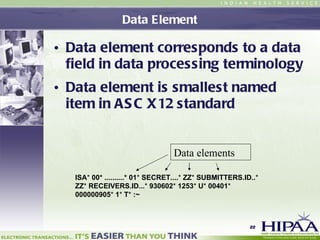
Data Element Data element corresponds to a data field in data processing terminology Data element is smallest named item in ASC X12 standard ISA *  00*   ..........*   01 *  SECRET.... *  ZZ *  SUBMITTERS.ID.. *  ZZ *   RECEIVERS.ID... *  930602 *  1253 *  U *  00401 *  000000905 *  1 *  T *  :~ Data elements

Types of Data Elements Mandatory data element Data is required to be populated or entire batch will not pass initial submission Situational data element Dependant upon facility Can be populated if data element applies
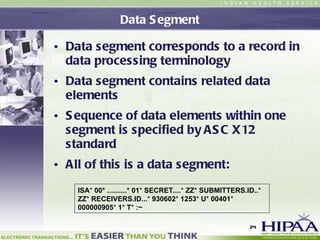
Data Segment Data segment corresponds to a record in data processing terminology Data segment contains related data elements Sequence of data elements within one segment is specified by ASC X12 standard All of this is a data segment: ISA *  00*   ..........*   01 *  SECRET.... *  ZZ *  SUBMITTERS.ID.. *  ZZ *   RECEIVERS.ID... *  930602 *  1253 *  U *  00401 *  000000905 *  1 *  T *  :~
Control Segment  Control segment has the same structure as data segment Uses To transfer control information (e.g., start, stop) rather than application information To group data elements
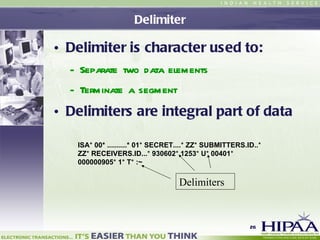
Delimiter Delimiter is character used to: Separate two data elements Terminate a segment Delimiters are integral part of data ISA *  00*   ..........*   01 *  SECRET.... *  ZZ *  SUBMITTERS.ID.. *  ZZ *   RECEIVERS.ID... *  930602 *  1253 *  U *  00401 *  000000905 *  1 *  T *  :~ Delimiters
Loop Loop is group of related data segments Loops are specified by each Implementation Guide Importance of loops Some segments repeat Example: address line Loop identifies which address it is Example: Billing Office, subscriber, payer
Transaction Set Transaction set contains data segments Transaction set is a grouping of data records For instance, a group of benefit enrollments sent from sponsor to payer is considered a transaction set Sequence of data segments within one transaction set is specified by ASC X12 standard
Headers and Trailers Header is the  start  segment for transaction set or functional group or interchange Trailer is the  end  segment for transaction set or functional group or interchange For example, a transaction set has: A transaction set  header  control segment One or more data segments A transaction set  trailer  control segment
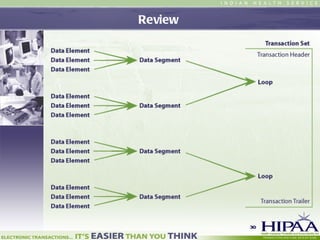
Review
Section 2   837: Preparation for Testing  Electronic Data Interchange and Standards What is the 837? Software requirements Implementation Guides Establish relationship with payer
Get to Know Health Plans and Payers Open communication channels Identify person you will be working with Establish relationship with that person Determine that health plan/payer is ready for HIPAA compliance If so, determine what their expectations are of your facility
Gather Important Information on Testing Process How will claims be submitted?  By website or messaging? Is there a minimum number of claims to be included in each batch?  How will site receive confirmation reports that batch has been accepted by payer?  In what format will Error Reports be provided?  What is process for correcting and resubmitting batch files?  What information will payer need from site to ensure resubmitted batch is not a duplicate batch?
Gather Other Important Information Will software be certified or will payer require each site to test individually?  Will payer allow parallel testing or will they require a “hard switch”? Will payer continue to support software or systems provided by payer to conduct transactions? Does payer have a Companion Guide that must be reviewed by facility and OIT?  Does payer have a Trading Partner Agreement that must be submitted?  Is there an EDI (Electronic Data Interchange) form that must be submitted?
Companion Guide Payer’s operating guide to electronic transactions Specifies how HIPAA compliance testing and certification are to be accomplished Transmission methods Volume Timelines
Companion Guide (cont’d) Specifies payer’s coding and transaction requirements that are not specifically determined by HIPAA Payer may not require data elements for all fields Payer may include data elements that are specific to payer , e.g.,  local codes
Get Your Companion Guide Don’t Start Testing Without It!
TPA and BAA Agreements that formalize relationships with entities or persons with whom you will be doing HIPPA compliance testing and production Trading Partner Agreement (TPA) is established with external entity or payer (e.g., Trailblazers) with whom you will be doing business Business Associate Agreement  (BAA) is established with person or organization that performs function or activity on behalf of covered entity but is not part of entity’s workforce (e.g.,  need an example ).
Benefits of a TPA  Assures you are a priority to do HIPAA testing May provide access to payer’s online systems Means you get paid at higher rate because you are a contract provider
Contents of a TPA What does payer cover?  Which procedures are billable or not? Who is covered, who is not? Is preauthorization required?  For what?
TPA Tips Agreement requires signatures Allow enough time to get all the signatures Don’t complete this agreement until you are ready to begin testing Payer will stipulate effective date and you must begin testing within six months of that date To complete the TPA, you must obtain trading partner ID number from payer
Lessons Learned Obtain and install required software patches Obtain all 837 Implementation Guides and Addenda Contact health plan/payer Obtain and review Companion Guide Complete and submit Trading Partner Agreement

837 preparation for testing

  • 1.
    Section 2 837:Preparation for Testing
  • 2.
    Section 2 TopicsElectronic Data Interchange and Standards What is the 837? Software requirements Implementation Guides Establish relationship with payer
  • 3.
    Section 2 837: Preparation for Testing Electronic Data Interchange and Standards What is the 837? Software requirements Implementation Guides Establish relationship with payer
  • 4.
    What Is EDI?Electronic Data Interchange Computer-to-computer exchange of business data between trading partners In EDI, information is organized according to specified format set by both parties For the most part, all information contained in EDI transaction set is same as information on conventionally printed document
  • 5.
    Benefits of EDIEDI reduces costs, improves accuracy, and increases productivity Lessens time and costs associated with receiving, processing, and storing documents Eliminates inefficiencies Streamlines tasks
  • 6.
    EDI Health CareClaims Standards Developed and maintained by Accredited Standards Committee (ASC) X12 ASC X12 chartered in 1979 by American National Standards Institute (ANSI) to develop uniform standards for inter-industry electronic exchange of business transactions
  • 7.
    EDI Health CareClaims Standards (cont’d) ACS X12 Insurance Subcommittee (X12N) developed Implementation Guides originally published in May 2000 Implementation Guides adopted by DHHS Secretary for use under HIPAA In October 2002, additional guidance was developed Addenda to X12N Implementation Guides were adopted for use under HIPAA
  • 8.
    Section 2 837: Preparation for Testing Electronic Data Interchange and Standards What is the 837? Software requirements Implementation Guides Establish relationship with payer
  • 9.
    What Is the837? 837 format replaces current electronic export modes in RPMS 3P Full name: Health Claims & Equivalent Encounter Information Definition of 837 from 837 Implementation Guide: “ A standardized format designed to expedite the goal of achieving a totally electronic data interchange health encounter/claims processing and payment environment.”
  • 10.
    What Is the837? (cont’d) Current HIPAA compliant version ANSII Standard X12N 837 Version 4010 with Addenda (004010X096A1)
  • 11.
    Types of 837Electronic Claims 837 – Institutional Called 837I; replaces UB-92 837 – Professional Called 837P; replaces HCFA-1500 837 – Dental Called 837D; replaces ADA forms
  • 12.
    Types of 837Electronic Claims (cont’d) 837 – Coordination of Benefits Called 837 – COB Used for sending claims to secondary payers Coordination of benefits also called cross-over Process of determining respective responsibilities of two or more health plans that have some financial responsibility for a medical claim
  • 13.
    Section 2 837: Preparation for Testing Electronic Data Interchange and Standards What is the 837? Software requirements Implementation Guides Establish relationship with payer
  • 14.
    Software Requirements: InstallRPMS Patches GIS v3.01, p2 & p5 (Optional) 3 rd Party Billing, v2.5, p6 Tested and certified by many different payers AUT Patch v98.1, p13 For more information and most current releases, contact ITSC Help Desk http://www.ihs.gov/GeneralWeb/HelpCenter/Helpdesk/index.cfm
  • 15.
    Section 2 837: Preparation for Testing Electronic Data Interchange and Standards What is the 837? Software requirements Implementation Guides Establish relationship with payer
  • 16.
    Implementation Guides Mainsupport tool for interpreting electronic transactions like the 837 ACS X12 Insurance Subcommittee (X12N) developed Implementation Guides for standards for health care electronic transactions X12N HIPAA Implementation Guides and Addenda should be your primary reference documents
  • 17.
    Don’t Cut CornersImplementation Guides and Addenda are critical tools You need to have hard copies of them Each Guide is about 800 pages long so print Guides and Addenda double-sided Get them and keep them where you use them
  • 18.
    Washington Publishing CompanyPublishes X12N Implementation Guides and Addenda adopted for use under HIPAA Free to download: All Implementation Guides (May 2000) All corresponding Addenda (October 2002) Can purchase: Book or CD Version that integrates Addenda into Implementation Guide
  • 19.
    Washington Publishing Company(cont’d) www.wpc-edi.com Click on Products/Publications/PDF Download (Free) Or call 1-800-972-4334 Three 837 Implementation Guides and Addenda 837: HIPAA Claim: Dental 837: HIPAA Claim: Institutional 837: HIPAA Claim: Professional
  • 20.
    Understanding 837 ImplementationGuides (IGs) Implementation Guide contains key terms Testing coordination staff must understand terms Software developers may use terms To assist sites To work with payers
  • 21.
    List of KeyBasic Terms Data element Data segment Control segment Delimiter Loop Transaction set Header and Trailer
  • 22.
    Data Element Dataelement corresponds to a data field in data processing terminology Data element is smallest named item in ASC X12 standard ISA * 00* ..........* 01 * SECRET.... * ZZ * SUBMITTERS.ID.. * ZZ * RECEIVERS.ID... * 930602 * 1253 * U * 00401 * 000000905 * 1 * T * :~ Data elements
  • 23.
    Types of DataElements Mandatory data element Data is required to be populated or entire batch will not pass initial submission Situational data element Dependant upon facility Can be populated if data element applies
  • 24.
    Data Segment Datasegment corresponds to a record in data processing terminology Data segment contains related data elements Sequence of data elements within one segment is specified by ASC X12 standard All of this is a data segment: ISA * 00* ..........* 01 * SECRET.... * ZZ * SUBMITTERS.ID.. * ZZ * RECEIVERS.ID... * 930602 * 1253 * U * 00401 * 000000905 * 1 * T * :~
  • 25.
    Control Segment Control segment has the same structure as data segment Uses To transfer control information (e.g., start, stop) rather than application information To group data elements
  • 26.
    Delimiter Delimiter ischaracter used to: Separate two data elements Terminate a segment Delimiters are integral part of data ISA * 00* ..........* 01 * SECRET.... * ZZ * SUBMITTERS.ID.. * ZZ * RECEIVERS.ID... * 930602 * 1253 * U * 00401 * 000000905 * 1 * T * :~ Delimiters
  • 27.
    Loop Loop isgroup of related data segments Loops are specified by each Implementation Guide Importance of loops Some segments repeat Example: address line Loop identifies which address it is Example: Billing Office, subscriber, payer
  • 28.
    Transaction Set Transactionset contains data segments Transaction set is a grouping of data records For instance, a group of benefit enrollments sent from sponsor to payer is considered a transaction set Sequence of data segments within one transaction set is specified by ASC X12 standard
  • 29.
    Headers and TrailersHeader is the start segment for transaction set or functional group or interchange Trailer is the end segment for transaction set or functional group or interchange For example, a transaction set has: A transaction set header control segment One or more data segments A transaction set trailer control segment
  • 30.
  • 31.
    Section 2 837: Preparation for Testing Electronic Data Interchange and Standards What is the 837? Software requirements Implementation Guides Establish relationship with payer
  • 32.
    Get to KnowHealth Plans and Payers Open communication channels Identify person you will be working with Establish relationship with that person Determine that health plan/payer is ready for HIPAA compliance If so, determine what their expectations are of your facility
  • 33.
    Gather Important Informationon Testing Process How will claims be submitted? By website or messaging? Is there a minimum number of claims to be included in each batch? How will site receive confirmation reports that batch has been accepted by payer? In what format will Error Reports be provided? What is process for correcting and resubmitting batch files? What information will payer need from site to ensure resubmitted batch is not a duplicate batch?
  • 34.
    Gather Other ImportantInformation Will software be certified or will payer require each site to test individually? Will payer allow parallel testing or will they require a “hard switch”? Will payer continue to support software or systems provided by payer to conduct transactions? Does payer have a Companion Guide that must be reviewed by facility and OIT? Does payer have a Trading Partner Agreement that must be submitted? Is there an EDI (Electronic Data Interchange) form that must be submitted?
  • 35.
    Companion Guide Payer’soperating guide to electronic transactions Specifies how HIPAA compliance testing and certification are to be accomplished Transmission methods Volume Timelines
  • 36.
    Companion Guide (cont’d)Specifies payer’s coding and transaction requirements that are not specifically determined by HIPAA Payer may not require data elements for all fields Payer may include data elements that are specific to payer , e.g., local codes
  • 37.
    Get Your CompanionGuide Don’t Start Testing Without It!
  • 38.
    TPA and BAAAgreements that formalize relationships with entities or persons with whom you will be doing HIPPA compliance testing and production Trading Partner Agreement (TPA) is established with external entity or payer (e.g., Trailblazers) with whom you will be doing business Business Associate Agreement (BAA) is established with person or organization that performs function or activity on behalf of covered entity but is not part of entity’s workforce (e.g., need an example ).
  • 39.
    Benefits of aTPA Assures you are a priority to do HIPAA testing May provide access to payer’s online systems Means you get paid at higher rate because you are a contract provider
  • 40.
    Contents of aTPA What does payer cover? Which procedures are billable or not? Who is covered, who is not? Is preauthorization required? For what?
  • 41.
    TPA Tips Agreementrequires signatures Allow enough time to get all the signatures Don’t complete this agreement until you are ready to begin testing Payer will stipulate effective date and you must begin testing within six months of that date To complete the TPA, you must obtain trading partner ID number from payer
  • 42.
    Lessons Learned Obtainand install required software patches Obtain all 837 Implementation Guides and Addenda Contact health plan/payer Obtain and review Companion Guide Complete and submit Trading Partner Agreement