An Introduction
to Indicators
UNAIDS
Monitoring
and
Evaluation
Fundamentals
An Introduction
to Indicators
UNAIDS
Monitoring
and
Evaluation
Fundamentals
UNAIDS | 05
FORWARD
Dear Colleagues,
I would like to welcome you to the UNAIDS Monitoring and Evaluation Fun-
damentals series. As the response to the global HIV epidemic continues
to evolve, monitoring and evaluation (M&E) has become more important
than ever. Determining what programs do or do not work; implementing
programs with proven cost-effectiveness; monitoring progress towards
achieving targets; and ensuring accountability are objectives which are
especially important now in the HIV response, as well as in other health
and development areas. Thus, it is increasingly important that M&E is
better understood, communicated in simplified language, and conducted
in a coordinated and sustainable manner that generates information that
can be easily used. Further, it is essential that M&E addresses the needs
of and involves all key stakeholders right from the start and that results
are made publicly available and utilized strategically in policy-making,
planning, and program improvement.
This series provides a common sense introduction to a range of
M&E issues. It covers the fundamentals and their practical applica-
tions and includes techniques and tools for managing M&E of the HIV
epidemic and response. Although the series uses HIV as its focus, the
M&E fundamentals are also relevant to other areas of public health and
development. As such, these books may also be useful in strengthening
national M&E systems designed to track progress in other health and
development goals, such as those outlined in the United Nations Mil-
lennium Development Goals (MDGs).
I hope you find this series useful and welcome your feedback and
suggestions on this and future topics for the series.
With my best regards,
Deborah Rugg, PhD
Chief, UNAIDS Monitoring and Evaluation Division
Acknowledgements
David Hales was the primary author of this book. He received invalu-
able input from Greet Peersman (Tulane University, New Orleans), De-
borah Rugg (UNAIDS, Geneva) and Eva Kiwango (UNAIDS, Geneva).
The author is grateful to the members of the Technical Working
Group on Indicator Development and Revision (UNAIDS Monitoring
and Evaluation Reference Group) for their work on the development
of the Indicator Standards & Tools.
The following reviewers provided excellent comments during the
drafting of this book: Boaz Cheluget (National AIDS Control Council,
Kenya), Patricia Rivera Scott (UNAIDS, Guatemala) and Matthew
Warner-Smith (UNAIDS, Geneva).
UNAIDS | 07
Contents
Getting Started	 10
The Fundamentals	 13
What is an indicator? 15
Why are indicators useful? 18
What are the essential components of an indicator? 20
What makes a good indicator? 26
What are the different types of indicator? 27
What is the indicator pyramid? 28
When should an indicator be used? 34
How to select indicators 34
Indicators in various sectors 39
Other options for collecting useful information 42
Targets 46
Tools and Techniques	 47
Indicator standards 48
Data collection for indicators 53
Data analysis 60
SUMMARY 63
Questions to consider	 68
Quick quiz 71
Glossary	 75
Learning more about indicators	 83
08 | UNAIDS
REFERENCES 87
Appendix 91
UNAIDS | 09
Abbreviations
AIDS acquired immunodeficiency syndrome
ANC antenatal care
ART antiretroviral therapy
ARV antiretroviral
HIV human immunodeficiency virus
IDU injecting drug user
M&E monitoring and evaluation
MCH maternal and child health
MDG Millennium Development Goals
MERG Monitoring and Evaluation Reference Group
NGO non-governmental organisation
TB tuberculosis
TWG technical working group
UNAIDS Joint United Nations Programme on HIV/AIDS
UNGASS United Nations General Assembly Special Session,
Declaration of Commitment on HIV/AIDS
UNICEF United Nations Children’s Fund
WHO World Health Organization
10 | UNAIDS
Getting Started
Why this topic?
Indicators are an essential component of any effective M&E (moni-
toring and evaluation) system. For example, at the national level,
indicators provide technical experts and decision-makers with the
data required to effectively manage a country’s response to the
AIDS epidemic. At the global level, harmonized indicator sets (i.e.
UNGASS and the UNGASS Addendum: Additional Recommended
Indicators) provide international agencies and organizations with
much-needed strategic information, which influences their planning
and allocation of resources.
M&E professionals have access to a wide range of tools. Indicators
are one of the more valuable and versatile, but if indicators are not
used carefully they can consume extensive resources and generate
data with little or no value.
The key challenge with indicators is to ensure their quality and
integrity. Indicators should generate data that are needed and useful.
They should be technically sound. They should be understandable,
practical and feasible. In addition, they should have a proven record
of performance.
UNAIDS | 11
What’s in this book?
This book is a common-sense introduction to indicators. It is designed
to provide the basic information required to understand the com-
ponents and the use of indicators in the monitoring and evaluation
of the AIDS epidemic and response.
The Fundamentals section of the book focuses on essential
background information that anyone working with indicators should
know. What are indicators? Why are they useful? When should they
be used? How should they be used?
The Tools and Techniques section includes practical information
on the actual use of indicators in monitoring the AIDS epidemic:
critical topics, including indicator standards, data collection and
data analysis.
THE FUNDAMENTALS
“Rarely do you need to design new indicators. Resist the temptation. If you
think it will be a better indicator than any other existing indicator, ask why
no one else has used it before.”
David Pencheon
14 | UNAIDS
Indicators provide critical information on performance, achievement
and accountability, which is the cornerstone of effective monitoring
and evaluation. In addition, the data from indicators provide the
strategic insights that are essential for the effective management of
the AIDS epidemic and response. It is impossible to underestimate
the value of indicators in continuing to improve knowledge about
the epidemic and the effectiveness of the response. To be valuable
indicators, indicators need to be of high quality and able to collect
the right data in the right place at the right time.
What is an indicator?
Fundamentally, an indicator provides a sign or a signal that some-
thing exists or is true. It is used to show the presence or state of a
situation or condition. In the context of monitoring and evaluation,
an indicator is a quantitative metric that provides information to
monitor performance, measure achievement and determine account-
ability. It is important to note that a quantitative metric can be used
to provide data on the quality of an activity, project or programme.
UNAIDS | 15
Quantitative metric – Data can measured on a numerical scale
Sample indicator: Percentage of health facilities that offer antiret-
roviral therapy
Sample indicator (quality): Percentage of counselling and testing
service providers accredited to offer these services
Performance – The effective or efficient operation of an activity,
project or programprogramme
Sample indicator: Percentage of condom delivery sites that reached
their coverage targets
Achievement – The successful accomplishments of an activity,
project or programme
Sample indicator: Percentage of HIV-positive pregnant women who
received antiretroviral drugs
Accountability – Responsibility for the performance and/or
achievements of an activity, project or programme
Sample indicator: Percentage of clinics complying with national
guidelines for sexually transmitted infections
A good indicator should be clear and concise. It should focus on a
single issue that provides relevant information on a situation; par-
ticularly information that provides the strategic insight required for
effective planning and sound decision-making.
Good indicators are also defined by the feasibility of collecting
meaningful and credible data for them. In addition, good indica-
tors should actually – and accurately – measure what they claim to
measure. If it is not feasible to collect data for an indicator, or the
16 | UNAIDS
data that can be collected are not meaningful, the indicator will
have little or no utility.
Among the dozens of factors at play in data collection for in-
dicators, there are at least three that should always be addressed
because of their impact on the credibility of the data: (1) validity, (2)
reliability and (3) bias.
Validity: The extent to which a measurement or test accurately
measures what is intended to be measured.
Reliability: The consistency of the data when collected repeatedly
using the same procedures and under the same conditions.
Bias: Any effect during the collection or interpretation of information
that leads to a systematic error in one direction.
If there is any question or concern about any of these three fac-
tors, the wise decision is to identify an alternative source of data.
Ultimately, any indicator is only as valuable as the quality of the data
it uses and it is crucial that the data are valid, reliable and not biased.
An important but often-overlooked fact about indicators is that
they merely indicate. They do not capture or convey the many dimen-
sions of a given situation and/or activity. They are directional: They
provide basic information on the past, present and possible future
course of an activity, programme and/or behaviour. They are also
very context-specific: Higher values or lower values can be either
good or bad, depending on the situation. (The desired direction of
UNAIDS | 17
the indicator – i.e. an increase or decrease – is usually determined
when the indicator is selected and before data collection begins.)
Indicators are not designed to replace more detailed investigations
of specific issues, nor should they be used to do so. Consequently,
information generated by indicators should always be interpreted
within the broader context of the situation and supplemented where
necessary by special studies, other evaluation activities and other
types of data. Examples of other options include focus group dis-
cussions, knowledge, attitude and practices (KAP) surveys and rapid
appraisals. (Go to page 40 for more information on other options
for collecting useful information.)
Indicators are an essential part of effective monitoring and evalu-
ation. They can provide vital information on performance, achieve-
ment and accountability. However, indicators are only one part of a
comprehensive M&E system. They are only one method for collecting
and analysing data and it is imperative that they be used when and
where they provide meaningful information and insight.
18 | UNAIDS
Why are indicators useful?
Very simply, indicators are standardized measures that allow for
comparisons over time, over different geographic areas and/or across
programmes. The ability to compare temporally and spatially dif-
ferentiates indicators from raw data, as does the ability to aggregate
data for higher-level interpretation and application.
Monitoring of AIDS indicators at national and global levels is
analogous to monitoring the basic health of an individual. In the
medical profession, a patient’s vital signs – pulse, body temperature,
breathing rate and blood pressure – are used to measure the body’s
basic health. These simple measures are widely considered to play
a critical role in detecting and monitoring medical problems. When
any of the vital signs fall outside of accepted norms, doctors and
patients have an early warning that something is potentially wrong
with the patient’s health. This alert triggers further diagnostic tests
and an in-depth evaluation to better understand the situation.
Indicators play a similar role
in the AIDS epidemic and re-
sponse. They provide strategic
information that is essential in
detecting changes in the epi-
demic, monitoring the response
to the epidemic and assessing
the overall effectiveness of the
response. In general, national
and global-level indicators are
not designed to measure the ef-
fectiveness of specific activities
or to support the day-to-day management and implementation of
activities. These indicators are useful precisely because they provide
Prevention experts often say
that knowledge is the neces-
sary but insufficient first step
in protecting oneself against
HIV. Similarly, indicators are
the necessary but insufficient
first step in understand-
ing and protecting a nation
against the disease.
UNAIDS | 19
a snapshot of the ‘vital signs’ of the epidemic and response, not the
many details required for management and implementation.
Like the vital signs in medicine, which can be used anywhere in
the world, certain vital signs of the AIDS epidemic (e.g. incidence
among young people) and response (e.g. policies, resources, pro-
gramme access and coverage) can also be used globally. However,
other vital signs may vary by region, by country, by population, by
age, by sex, etc. Consequently, if indicators are going to be useful,
it is important to have a proven set that can be used to monitor the
appropriate vital signs for the situation and to regularly check them
to see if there has been any change.
It is important to note the very different role that indicators play
at the project level. At this level, indicators track specific perform-
ance in order to monitor the implementation and effectiveness of
different activities. For field staff, managing without this data is like
managing blindfolded. In many respects, project-level indicators
have more in common with the key performance indicators used
in business (see page 38 for more information on the use of key
performance indicators in the private sector).
20 | UNAIDS
What are the essential components of
an indicator?
The Indicator Standards & Tools,1
which were developed by the
Monitoring and Evaluation Reference Group (MERG), identify a set
of essential components for an indicator. These components are the
metadata – i.e., data about the data – that determine the underlying
viability of an indicator. The following series of questions is used in
the Indicator Standards & Tools to confirm that the essential com-
ponents are included in an indicator.
• Does the indicator have a clearly stated title and definition?
• Does the indicator have a clearly stated purpose and rationale?
Is the method of measurement for the indicator clearly defined,
including the description of the numerator, denominator and
calculation, where applicable?
• Are the data collection methodology and data collection tools for
the indicator data clearly stated?
• Is the data collection frequency clearly defined?
• Is any relevant data disaggregation clearly defined?
• Are there guidelines to interpret and use data from this indicator?
• What are the strengths and weaknesses of the indicator and the
challenges in its use?
• Are relevant sources of additional information on the indicator
cited?
In addition, indicators should always have a proven track record
– i.e. demonstrated performance in field-testing or operational use –
before they are broadly deployed. It is impossible to underestimate
the value of a proven track record; most importantly, it prevents
1 For more information on the Indicator Standards & Tools, see page 13.
UNAIDS | 21
countries from allocating resources on indicators that cannot or will
not provide useful data.
Indicator components
When new indicators are being developed, they must be fully defined.
No indicator should be deployed without a full definition. In other
words, the essential components of the indicator must be clear and
concrete. To ensure meaningful responses to the questions in the
Indicator Standards & Tools listed above, it is critical to understand
the terms used to define the components of an indicator.
Title. A brief heading that captures the focus of the indicator.
Definition. A clear and concise description of the indicator.
Purpose. The reason that the indicator exists; i.e. what it is for.
Rationale. The underlying principle(s) that justify the development
and deployment of the indicator; i.e. why the indicator is needed
and useful.
Method of measurement. The logical and specific sequence of
operations used to measure the indicator; e.g. data collection tools,
sampling frame and quality assurance.
Numerator. The top number of a common fraction, which indi-
cates the number of parts from the whole that are included in the
calculation.
Denominator. The bottom number of a common fraction, which
indicates the number of parts in the whole.
22 | UNAIDS
Calculation. The specific steps in the process to determine the
indicator value.
Data collection method. The general approaches (e.g. surveys,
records, models, estimates) used to collect data.
Data collection tools. The specific tools (e.g. AIDS Indicator Surveys
(AIS), Demographic and Health Surveys (DHS), Service Provision
Assessments (SPA), patient registers, antenatal clinic surveillance)
used to collect data.
Data collection frequency. The intervals at which data are collected;
e.g. quarterly, annually, bi-annually. It is important that frequency is
consistent with the data collection methodology. (The frequency of
data collection should not be confused with the frequency of report-
ing, which is commonly associated with external organizations and
agencies, particularly funding partners.)
Data disaggregation. The relevant subgroups that collected data
can be separated into in order to more precisely understand and
analyse the findings. Common subgroups include sex, age and risk
population.
Guidelines to interpret and use data. Recommendations on how
best to evaluate and apply the findings; e.g. outlining what it means if
the indicator shows an increase or a decrease in a particular measure.
Strengths and weaknesses. A brief summary of what the indicator
does well and not so well.
Challenges. Potential obstacles or problems that may have an impact
on the use of an indicator or on the accuracy/validity of its findings.
UNAIDS | 23
Relevant sources of additional information. References to infor-
mation/materials that relate to the indicator, including background
information on the development of the indicator, comparisons with
previous versions of the indicator and lessons learned from the use
of the indicator or similar indicators in various settings.
Example of a well- and fully-defined indicator.
TITLE: Provision of Antiretroviral Therapy (ART) at Health Facilities
DEFINITION: Percentage of health facilities that offer ART (i.e.
prescribe and/or provide clinical follow-up). Health facilities include
public and private facilities, health centres and clinics (including TB
centres), as well as health facilities that are run by faith-based or
nongovernmental organizations.
PURPOSE: This indicator measures the capacity of health facilities
to provide ART.
RATIONALE: Antiretroviral therapy is a cornerstone of effective HIV
treatment, and measuring the percentage of health facilities that
offer ART provides valuable information about ART availability. One
strategy to scale up ART services is to make ART available in more
health facilities. This may be achieved by decentralizing ART services
from tertiary facilities (e.g. hospitals) to primary or secondary-level
health facilities.
24 | UNAIDS
METHOD OF MEASUREMENT
• Numerator: Number of health facilities that offer ART (i.e. prescribe
and/or provide clinical follow-up).
• Denominator: Total number of health facilities, excluding special-
ized facilities where ART services are/will never be relevant.
• Calculation: Number of health facilities that offer ART divided by
total number of health facilities minus those where ART services
are/will never be relevant x 100.
The numerator is calculated by summing of the number of facilities
reporting availability of ART services. Information on the availability
of specific services is usually kept at the national or subnational
level. National AIDS Programmes should have a record of all health
facilities offering ART services. A health facility census or survey can
also provide this information, along with more in-depth informa-
tion on available services, provided the information is collected
from a representative sample of health facilities in the country. In
a facility survey (e.g. Service Provision Assessment, Service Avail-
ability Mapping), the most knowledgeable person responsible for
client services is interviewed using the AIDS Outpatient Depart-
ment (OPD) module. Responses to a series of questions establish
whether providers in that facility provide ART services directly (i.e.
prescribe ART and/or provide clinical follow-up for ART patients)
or refer patients to other health facilities for these services. In ad-
dition, facility records documenting the current status of service
provision should be consulted. One potential limitation to facility
surveys or censuses is that they are usually only conducted once
every few years. Countries should regularly update their programme
records on health facilities offering ART services, and supplement
these data with those obtained through a health facility survey or
census every few years.
UNAIDS | 25
• The denominator is calculated by summing the total number of
health facilities included in the sample. Information for construction
of the denominator may come from programme records, facility
listings, and/or national strategy or planning documents.
DATA COLLECTION METHOD: Programme records; health facility
survey/census.
MEASUREMENT TOOLS: For health facility surveys or censuses,
tools such as the Service Provision Assessment (SPA) or the Service
Availability Mapping (SAM) can be used.
DATA COLLECTION FREQUENCY: Annual for programme records;
every two to three years for facility survey/census.
DATA DISAGGREGATION: Public and private sector facilities
INTERPRETATION: This indicator provides valuable information
about the availability of ART services in health facilities, but it does
not capture information about the quality of services provided.
Antiretroviral therapy itself is complex, and it should be delivered
as part of a package of care interventions, including the provision
of cotrimoxazole prophylaxis, the management of opportunistic
infections and comorbidities, nutritional support and palliative care.
Simple monitoring of ART availability does not ensure that all ART-
related services are adequately provided to those who need them.
Nevertheless, it is important to know what percentage of health
facilities provide ART services in order to plan for service expansion
as needed to meet universal access targets.
26 | UNAIDS
What makes a good indicator?
In 2000, the New Economics Foundation identified the AIMS criteria
for indicators, which continues to be a useful guide in deciding if an
indicator is a good indicator:
Action focused. Indicators should lead to action. If stakeholders
cannot imagine what to do with the data from an indicator, then it
probably isn’t a good indicator.
Important. Stakeholders should agree that the indicator and the
data it will generate make a relevant and significant contribution to
determining how to effectively respond to the epidemic.
Measurable. Not only must the data collection methodology be
defined, it must also be feasible to collect the data.
Simple. Although he was not talking about indicators, Albert Einstein
said it best when he said, “Everything should be made as simple
as possible, but not simpler”. On a parallel note, there are very few
indicators – if any – that are perfect. Rather than pursue the perfect
indicator, it is much better to identify good, simple indicators that
provide data that can be put to use.
UNAIDS | 27
What are the different types of indicators?
Indicators can be categorized in a number of different ways, de-
pending on why they are being categorized. However, there are two
general approaches to defining types of indicators that are particu-
larly useful in monitoring the response to HIV. The first is based on
thematic similarities among indicators; the second is based on the
relative role and/or effect that an indicator has in/on the response
to the epidemic.
The most important point about the types of indicators is how
crucial it is to use a range of different types in a given set in order to
get a balanced perspective. Only using one or two types of indica-
tors will result in a much narrower point of view, which may provide
an inaccurate picture of the situation. For example, the UNGASS
set of indicators uses many different types of indicators, including
behavioural outcome, disease impact, infrastructure, policy and
programme/service delivery, to provide a strategic overview of the
global epidemic and response.
28 | UNAIDS
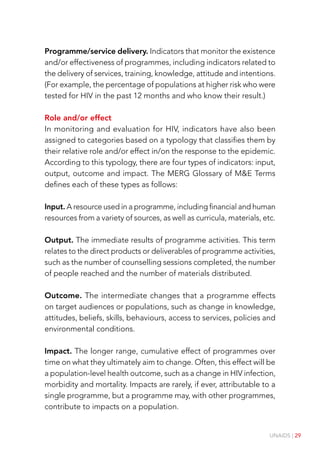
Thematic similarities
The typology in the UNAIDS Indicator Registry2
classifies indicators
by thematic similarities. The Registry identifies five types of indica-
tors: behavioural outcome, disease impact, infrastructure, policy and
programme/service delivery.
Behavioural outcome. Indicators that monitor the effectiveness of
initiatives designed to have an impact on AIDS-related behaviours.
(For example, the percentage of women and men aged 15 to 49 who
had more than one partner in the past 12 months reporting the use
of a condom at their last sexual intercourse.)
Disease impact. Indicators that monitor the disease as well as the
disease’s social and economic consequences, including its effects on
individuals, families, communities and governments. (For example,
the percentage of populations at higher risk who are HIV infected.)
Infrastructure. Indicators that monitor the contributions of core or-
ganizations/institutions, service sites and services needed to support
an effective AIDS response, including national AIDS committees,
hospitals, clinics, laboratories, schools, training centres and commodi-
ties. (For example, the percentage of health facilities that offer ART.)
Policy. Indicators that monitor the existence and/or effectiveness of
government policies on HIV and/or funding support for those poli-
cies. (For example, the National Composite Policy Index or NCPI.)
2 The Indicator Registry maintained by UNAIDS is a central repository of AIDS indicators. It is designed
to improve: (1) access to information on the full range of indicators; (2) management of indicators,
including the development of new indicators; (3) the harmonization of similar indicators; and (4)
the selection of appropriate indicators to monitor a country’s epidemic and response. The Indicator
Registry can be found at the following web address: www.indicatorregistry.org.
UNAIDS | 29
Programme/service delivery. Indicators that monitor the existence
and/or effectiveness of programmes, including indicators related to
the delivery of services, training, knowledge, attitude and intentions.
(For example, the percentage of populations at higher risk who were
tested for HIV in the past 12 months and who know their result.)
Role and/or effect
In monitoring and evaluation for HIV, indicators have also been
assigned to categories based on a typology that classifies them by
their relative role and/or effect in/on the response to the epidemic.
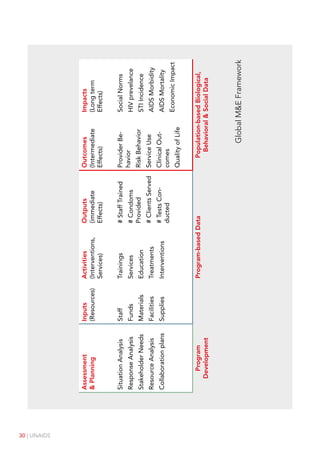
According to this typology, there are four types of indicators: input,
output, outcome and impact. The MERG Glossary of M&E Terms
defines each of these types as follows:
Input. A resource used in a programme, including financial and human
resources from a variety of sources, as well as curricula, materials, etc.
Output. The immediate results of programme activities. This term
relates to the direct products or deliverables of programme activities,
such as the number of counselling sessions completed, the number
of people reached and the number of materials distributed.
Outcome. The intermediate changes that a programme effects
on target audiences or populations, such as change in knowledge,
attitudes, beliefs, skills, behaviours, access to services, policies and
environmental conditions.
Impact. The longer range, cumulative effect of programmes over
time on what they ultimately aim to change. Often, this effect will be
a population-level health outcome, such as a change in HIV infection,
morbidity and mortality. Impacts are rarely, if ever, attributable to a
single programme, but a programme may, with other programmes,
contribute to impacts on a population.
30 | UNAIDS
Assessment
&
Planning
Inputs
(Resources)
Activities
(Interventions,
Services)
Outputs
(immediate
Effects)
Outcomes
(Intermediate
Effects)
Impacts
(Long
term
Effects)
Situation
Analysis
Response
Analysis
Stakeholder
Needs
Resource
Analysis
Collaboration
plans
Staff
Funds
Materials
Facilities
Supplies
Trainings
Services
Education
Treatments
Interventions
#
Staff
Trained
#
Condoms
Provided
#
Clients
Served
#
Tests
Con-
ducted
Provider
Be-
havior
Risk
Behavior
Service
Use
Clinical
Out-
comes
Quality
of
Life
Social
Norms
HIV
prevelance
STI
Incidence
AIDS
Morbidity
AIDS
Mortality
Economic
Impact
Program
Development
Program-based
Data
Population-based
Biological,
Behavioral
&
Social
Data
Global
M&E
Framework
UNAIDS | 31
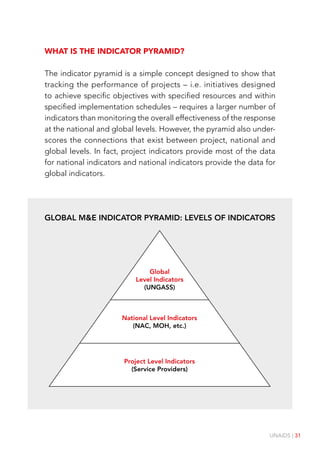
What is the indicator pyramid?
The indicator pyramid is a simple concept designed to show that
tracking the performance of projects – i.e. initiatives designed
to achieve specific objectives with specified resources and within
specified implementation schedules – requires a larger number of
indicators than monitoring the overall effectiveness of the response
at the national and global levels. However, the pyramid also under-
scores the connections that exist between project, national and
global levels. In fact, project indicators provide most of the data
for national indicators and national indicators provide the data for
global indicators.
Global
Level Indicators
(UNGASS)
National Level Indicators
(NAC, MOH, etc.)
Project Level Indicators
(Service Providers)
Global M&E Indicator Pyramid: Levels of Indicators
32 | UNAIDS
Project-level indicators
The base is critical because it is the foundation of the pyramid. Since
projects – and the activities that are part of them – are the founda-
tion of the response to HIV, it is crucial to track their performance.
This link to performance is important because most indicators at
this level should be very focused on the particular intent and ac-
complishments of the project. For example, a project working with
street-based sex workers would want to track the distribution of
condoms through small vendors in the local area. They would also
track other variables such as the number of contacts with sex workers
by outreach workers, the number of hours spent by outreach workers
in outreach activities and the number of condoms distributed and/
or sold to small vendors.
Taken together, project-level indicators should provide sufficient
data to evaluate the performance of a given project. Most project-
level indicators will only be applicable to the project, but data from
a subset of them can often be aggregated for higher-order use at
the subnational, regional or national levels.
National-level indicators
In the pyramid, the designation of national-level indicators also
includes subnational indicators; for example, provincial, state and/
or municipal. While there are variations between national and sub-
national levels, they are outweighed by the similarities and it makes
sense to group them under the national heading.
Indicators at the national and subnational levels aggregate data
from the project level to provide an overview of a country’s response.
Building on the example under project-level indicators, a country
will need to consolidate information on condom distribution from
all sources and track the distribution of male and female condoms
at the national level.
UNAIDS | 33
Similar to project-level indicators, there are national-level indicators
that are not useful and/or applicable at the global level. However,
this does not diminish their value in monitoring and evaluation at
the national level.
Global-level indicators
Global-level indicators provide a strategic perspective on the global
response. Essentially, the aggregation of data from national-level
indicators in use in multiple countries provides the data for the
global-level indicators. Returning again to the example on condoms,
national-level data on condom distribution and condom use from
multiple countries would provide invaluable information on the reach
of these types of initiatives. However, it is important to understand
that the data collected for global-level indicators depend not only
on national-level indicators but also on project-level indicators. While
only a small percentage of project-level data are useful at the global
level, there are streams of data that are useful at the global, national
and project levels in the indicator pyramid.
The aggregated data associated with global-level indicators
can provide much-needed feedback on the performance of the
indicators themselves. Also, insights from global data and trends
can be applied to national and project-level indicators to improve
performance at those levels.
34 | UNAIDS
When should an indicator be used?
Indicators are an excellent way to collect useful data, but they are
not the only way to collect data. Consequently, it is important to
consider the issues in the following checklist when deciding to use
an indicator. In an ideal scenario, there should be a positive response
to each of the issues in the checklist before an indicator is deployed.
Checklist
When it is useful to have a standard measure that can be compared
over time and/or place.
When an indicator has demonstrated technical merit. Experts
working in the specific technical area consider this indicator to be
technically sound. The indicator measures something of significance
and importance. It is a clear and focused measure. It should be suf-
ficiently sensitive to detect small changes in performance. It actually
measures what it intends to measure and, if measured by different
observers, it produces the same results. In addition, data for the
indicator can be collected and quantified in a meaningful way.
When an indicator is fully defined. A fundamental way to ensure
the quality of the data collected by an indicator is to use a high-
quality indicator. One hallmark of a high-quality indicator is a
full and clear definition that makes sense to M&E professionals.
(See page 18 for additional information on the components of an
indicator.)
UNAIDS | 35
When it is feasible to collect and analyse data for an indicator. The
systems and mechanisms needed to collect, interpret and use
indicator data are functioning. In addition, the financial and human
resources are available to allow an indicator to be measured and
that the benefits of measuring the indicator are worth the costs.
When an indicator has a proven track record. It has been suc-
cessfully field-tested or used operationally and its value has been
demonstrated.
When data for an indicator will be collected over time. Indicators
are most useful when they capture trend data. Consequently, it is
important to collect data at regular intervals (e.g. biannual, annual)
over an extended period.
When it can be a useful part of a carefully selected set. Since in-
dicators merely indicate, it is useful to include multiple indicators
in a well-defined set, particularly at the national, subnational and
project levels. Carefully selected sets provide balanced informa-
tion on the epidemic and response that can be used by decision-
makers.
36 | UNAIDS
How to select indicators
Indicators should be selected carefully and systematically. It is impor-
tant to consider the context or the environment in which they will be
deployed. It is equally important to take into account any existing
or applicable indicator frameworks that are relevant to the context.
In addition, all potential indicators should be evaluated using the
international indicator standards to ensure that they can and will
provide useful data. They should be drawn from harmonized and/
or widely used indicator sets that have a successful track record.
Proven indicators and indicator sets are available through the UNAIDS
Indicator Registry: www.indicatorregistry.org
Context. When selecting indicators, it is essential to understand
the context in which they will be used in order to select the most
appropriate ones. Specifically, a country must have a good grasp of
its epidemic and response when selecting indicators. For example,
if a country has a concentrated epidemic among a population at
higher risk, such as injecting drug users, M&E professionals need to
understand the dynamics of the epidemic, including the behaviours
that drive it and the activities that are effective in addressing it,
before identifying indicators to monitor the epidemic and response.
Indicator frameworks. Most countries – as well as most projects – have
developed indicator frameworks. In general, these frameworks cor-
relate key objectives, project activities and/or workplans and results
with specific indicators and the methods for collecting data for those
indicators. Many of these frameworks use the structure of the ‘logic
model’ or ‘logical framework’ (i.e. logframe), which has been widely
used at the project level in development work.
In effect, the aggregated list of individual indicators in a framework
constitutes an indicator set, whether the framework is for a specific
UNAIDS | 37
project (e.g. a prevention project with only prevention indicators)
or a national framework that includes a range of different indicators
relevant to the country’s epidemic and response.
The linkage between the indicator framework and the indicator set
also means there is a parallel link between the framework and the
M&E plan. Consequently, it is important to think about the M&E plan
when developing the indicator framework. It is equally important to
consider how harmonized indicators such as those in the UNGASS
and Additional Recommended sets can be used in the development
of the indicator framework for a national AIDS programme.
• Indicator standards. The Indicator Standards & Tools developed
by the MERG are an invaluable resource for selecting appropri-
ate indicators and building suitable indicator sets. See page XX
in Tools and Techniques for an overview of these standards and
tools. Additional information is available on the UNAIDS website
(www.unaids.org).
In tandem with a solid understanding of the context of an epi-
demic and response, the Indicator Standards & Tools is a straight-
forward guide that can be used to determine the applicability of
individual indicators and indicator sets. A good indicator should
meet the following five standards:
1. The indicator is needed and useful.
2. It has technical merit.
3. It is fully defined.
4. It is feasible to measure the indicator.
5. It has been field-tested or used operationally.
In addition, there is a sixth standard for indicator sets: Any set should
be coherent and balanced.
38 | UNAIDS
• Indicator sets. Examples of harmonized indicator sets that have
been widely used and accepted in national and global monitoring
and evaluation are the UNGASS and Additional Recommended
sets. Other sets that may be applicable include those developed
by various agencies and initiatives such as the Global Fund and
PEPFAR (President’s Emergency Plan for AIDS Relief).
• Indicator Registry. As an online repository of AIDS indicators,
the Indicator Registry (www.indicatorregistry.org) is an excellent

resource for M&E professionals who are selecting indicators and
building indicator sets. The Indicator Registry prioritizes indicators
that meet MERG standards and it provides complete metadata
on key indicators, which makes it easier for M&E professionals to
understand and use them.
UNAIDS | 39
Indicators in various sectors
Indicators are used in a wide range of sectors and settings to track
performance. Their adaptability makes them equally useful for moni-
toring global trends as well as for targeted initiatives.
Millennium Development Goals. In September 2000, world lead-
ers met at the United Nations Headquarters in New York to adopt
the Millennium Declaration. The Declaration identified a shared
vision for the future: a world with less poverty, hunger and disease,
greater survival prospects for mothers and their infants, better
educated children, equal opportunities for women and a healthier
environment; a world in which developed and developing countries
worked in partnership for the betterment of all. The Declaration
also identified a set of eight Millennium Development Goals. These
eight goals, which are supported by 60 indicators, are: (1) eradicate

extreme poverty and hunger; (2) achieve universal primary educa-
tion; (3) promote gender equality and empower women; (4) reduce
child mortality; (5) improve maternal health; (6) combat HIV/AIDS,
malaria and other diseases; (7) ensure environmental sustainability;
and (8) develop a global partnership for development.
HIV. The most widely known – and widely used – set of indicators
for HIV are the UNGASS indicators. The purpose of these indica-
tors is to measure progress toward implementing the Declaration
of Commitment on HIV/AIDS that was adopted by 189 UN Member
States in 2001. UNAIDS strongly recommends that the UNGASS
indicators be used as the basis for national HIV M&E systems. Under
the terms of the Declaration of Commitment on HIV/AIDS, Member
States committed to reporting on UNGASS indicators once every
two years. The indicators in the UNGASS set fall into five categories:
40 | UNAIDS
National Commitment and Action; National Programme; Knowledge
and Behaviour; Impact; and Global Commitment and Action. (See
Appendix A for the full list of UNGASS indicators plus the 15 Ad-
ditional Recommended indicators, which were added in mid-2008
to supplement the UNGASS set.)
Business. The use of indicators is widespread in the business com-
munity. This type of indicator is typically known as a key performance
indicator (KPI). In general, KPIs are financial and non-financial metrics
designed to measure if an organization is meeting its objectives,
including marketing, sales, customer satisfaction, production ef-
ficiency and profitability. A business should have relatively few KPIs;
they must be specific and measurable; and they should be focused
on the activities most closely linked to the success of the enterprise.
In addition, KPIs should be designed to measure performance and
achievement over the longer term. Consequently, the definition of
the individual KPIs and how they are measured should be consist-
ent over time. In many businesses, Key Performance Indicators are
closely linked to Critical Success Factors, which define an organiza-
tion’s strategic objectives.
Economics. The financial community in the United States tracks a
set of 10 leading economic indicators that tend to move in advance
of the overall economy. These indicators include: (1) the average
manufacturing-worker work week (from the employment report);
(2) initial jobless claims; (3) manufacturers’ new orders for consumer
goods and materials (from the factory orders report); (4) vendor
performance (from the Purchasing Managers’ Index report); (5)
manufacturers’ new orders for non-defence capital goods (from the
factory orders report); (6) building permits (from the housing starts
report); (7) the level of the S&P 500; (8) the inflation-adjusted measure
UNAIDS | 41
of the M2 money supply; (9) the interest-rate spread between the 10-
year Treasury note and the Fed funds rate; and (10) the expectations
portion of the University of Michigan’s Consumer Sentiment Index.
Environment. According to the Australia State of the Environment
2006, an independent report to the Australian Government Minister
for the Environment and Heritage, environmental indicators are the
physical, chemical, biological or socioeconomic measures that best
represent the key elements of a complex ecosystem or environmental
issue. Indicators can organize environmental information both spa-
tially and over time. An example is ‘surface water used for irrigation’.
Sustainable development. In 2002, three UK-based nongovernmental
organizations (Birdlife International, New Economics Foundation and
Oxfam) developed a set of indicators to measure national sustainable
development at the global level. The intention was to construct a
“focused set of robust global indicators [to] encourage and help track
progress towards sustainable development – and highlight failure if
progress is not made”. The 10 indicators are: (1) global emissions of
carbon dioxide (CO2); (2) land and sea area protected under national
or international law or agreement; (3) area of forest in the world; (4)
an index measuring the threat of extinction of wild birds; (5) access
to adequate water and sanitation; (6) ratio of girls to boys in primary
and secondary education; (7) infant mortality (deaths per 1000 births);
(8) people living on less than US$ 1 per day; (9) economic losses from
‘unnatural disasters’; and (10) fossil fuels and the global economy.
42 | UNAIDS
Other options for collecting useful information
Indicators are a very effective way to collect and analyse data, particu-
larly the trend data that are so valuable in monitoring the long-term
response to the AIDS epidemic. However, indicators are not always
the best methodology for collecting information for evaluation. For
example, they can be very resource-intensive, requiring more time,
money and staff to implement than alternatives. Also, they are not
well-suited for collecting information in highly complex environments,
where multiple factors (e.g. political, economic, social and cultural)
and multiple populations are involved; in these situations, indicators
are unlikely to answer key questions about why a programme is or
is not working and what might work better.
There are a number of good alternatives to indicators that can
provide the high-quality data that is essential to understanding the
AIDS epidemic, planning the response and evaluating the effective-
ness of the response. Many of these alternatives rely on participatory
methods that use more extensive interactions with target populations
to generate qualitative data.
The following list of alternatives to indicators is clearly not a
complete list of the options. This alphabetical list highlights only
a few of the dozens of approaches that can be used to collect and
analyse data on the epidemic and response.
Beneficiary assessment. Beneficiary assessment is a qualitative
approach designed to tap the knowledge of people who are the
identified beneficiaries of a particular policy, programme and/or
project. It relies heavily on giving these people a safe and supportive
forum for voicing their opinions on the effectiveness of the policy/
programme/projects in question. The approach uses focus group
discussions, semistructured interviews and direct observation to col-
UNAIDS | 43
lect input from participants. It can be an effective tool for improving
activities while they are still being implemented.
Focus group discussions. Focus group discussions are a struc-
tured approach to collecting qualitative data from a small group of
people drawn from a specific target population. The participants
are questioned by a trained facilitator, who encourages a frank
and open-ended discussion of their attitudes and opinions. The
facilitator also encourages participants to interact and respond to
other members of the group to generate additional insights. Focus
groups are generally time limited and participants do not have an
opportunity to follow-up on the discussion.
Key informant interviews. Key informant interviews can be an ef-
ficient and effective way to collect information about a given situation
and/or topic. However, it is crucial to identify the right people as key
informants. They should have an above-average knowledge of the
situation or topic, their knowledge should be based on first-hand
experience and they must be able to articulate their understanding
and impressions of the situation or topic. The best interviews with key
informants are usually conducted face to face and one on one with
the interviewer. The interviews can be conducted formally – e.g. using
a structured questionnaire – or informally. In general, key informant
interviews are a versatile approach; for example, they can be used to
identify new issues or to confirm findings from another data source.
Knowledge, Attitude and Practices (KAP) survey. As the name implies,
a KAP survey collects information about knowledge, attitudes and
practices in specific cultural settings by asking a structured set of
questions. It is similar to a household survey; however, a KAP survey
can be implemented on a much smaller scale and in more targeted
ways. KAP survey methods produce quantitative information from
a large number of randomly selected individuals. KAP surveys can
44 | UNAIDS
be particularly useful for collecting baseline data and for evaluating
specific activities or packages of activities. (It is important to note
that indicators can be measured by KAP surveys; however, they are
not an intrinsic or required component of this type of survey.)
Rapid assessment. Rapid assessment is an approach used to quickly
and cost-effectively collect practical information on a situation. There
are many different techniques used in rapid assessments; however,
most of them rely on three basic steps: (1) preparatory work (e.g.
selecting members of the assessment team and reviewing the avail-
able data); (2) field work (e.g. short, intensive site visits with a focus on
semi-structured interviews with key informants, focus group discus-
sions and direct observation); and (3) findings (e.g. team discussions,
analysis and write-up). During a rapid assessment, team members
use a basic form of data triangulation to compare information drawn
from different sources and collected using different methods.
Special study. A special study can be designed to collect quantita-
tive and/or qualitative data on a wide range of issues related to the
AIDS epidemic and response. The goal of a special study tends to
be to collect information on a specific behaviour, situation and/or
population. Special studies use a wide range of methodologies,
including interviews, observation, surveillance, surveys, experimental
design, quasi-experimental design, case studies and literature reviews.
Regardless of the methodology, for the findings of a special study
to be credible, it is essential that the study is well designed and ef-
fectively implemented and that the data are competently analysed.
The credibility of special studies is also enhanced by an open and
transparent approach to design, implementation and analysis.
UNAIDS | 45
Note: The World Bank Participation Sourcebook includes an appendix
that is a useful reference for participatory approaches that can be
used as alternatives to indicators: Appendix 1 (Methods & Tools).
Find the appendix at: www.worldbank.org/wbi/sourcebook/sba1.htm.
46 | UNAIDS
Targets
Indicators are used to measure achievement. In other words, they
measure the actual results from an activity, project or programme.
Targets are the quantitative goal or objective for an activity, project
or programme. In other words, they are the expected results. Es-
sentially, indicators are used to determine if targets are being met.
In monitoring and evaluation of HIV, a good national target takes
into account the quantitative goal (e.g. 80% of populations at higher
risk reached with HIV prevention programmes) as well as the time
frame to reach that goal (e.g. three years). While there is no standard
formula for setting targets, there are a number of factors to consider
when determining them:
• Baseline data. What is the situation at the outset of the activity,
project or programme?
• Historical trends. What pattern of change has occurred over time?
Is the same pattern likely to continue?
• Stakeholders’ expectations. What do key stakeholders (e.g.
government officials and programme implementers) believe can/
should/must be accomplished?
• Expert opinions and research findings. What do the experts
think about targets? What has previous research indicated that is
relevant to target setting?
• Performance of similar activities, projects or programmes.
How have similar efforts performed at other times and/or in other
settings? With other implementing agencies and/or partners?
Tools and techniques
48 | UNAIDS
Indicator standards
Under the auspices of the MERG a set of Indicator Standards &
Tools has been has developed. The standards are designed to be
broadly applicable in different settings with different indicators. The
tools are designed to assess indicators and determine their quality
and utility. Taken together, the standards and tools make it easier
to deploy practical indicators that provide valuable information on
changes in the epidemic and on the effectiveness of the response.
The information on the Indicator Standards & Tools in this book
is intended as an introduction to these resources. For complete
information on how to use these resources to select indicators and/
or develop new indicators, refer to the Indicator Standards & Tools:
Operational Guidance, available for downloading at [website address
to be added when available].
Indicator Standards
A good indicator should meet the following five standards:
1. The indicator is needed and useful.
2. The indicator has technical merit.
3. The indicator is fully defined.
4. It is feasible to measure the indicator.
5. The indicator has been field-tested or used operationally.
In addition, where indicators are presented as part of a set, this set
should meet a sixth standard: The overall set is coherent and balanced.
UNAIDS | 49
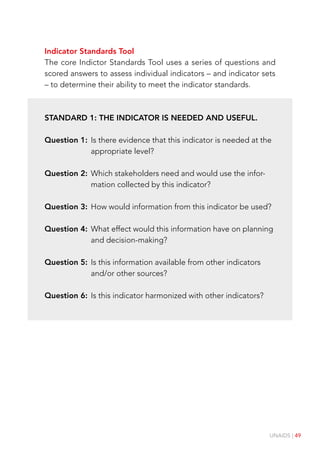
Indicator Standards Tool
The core Indictor Standards Tool uses a series of questions and
scored answers to assess individual indicators – and indicator sets
– to determine their ability to meet the indicator standards.
Standard 1: The indicator is needed and useful.
Question 1:	
Is there evidence that this indicator is needed at the
appropriate level?
Question 2:	
Which stakeholders need and would use the infor-
mation collected by this indicator?
Question 3:	
How would information from this indicator be used?
Question 4:	
What effect would this information have on planning
and decision-making?
Question 5:	
Is this information available from other indicators
and/or other sources?
Question 6:	
Is this indicator harmonized with other indicators?
50 | UNAIDS
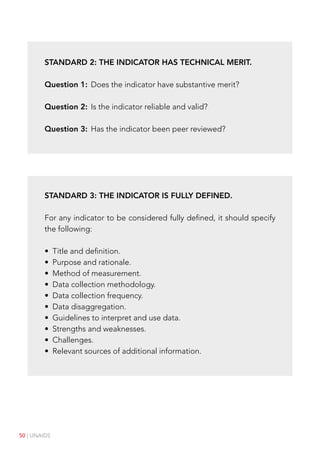
Standard 2: The indicator has technical merit.
Question 1: Does the indicator have substantive merit?
Question 2: Is the indicator reliable and valid?
Question 3: Has the indicator been peer reviewed?
Standard 3: The indicator is fully defined.
For any indicator to be considered fully defined, it should specify
the following:
• Title and definition.
• Purpose and rationale.
• Method of measurement.
• Data collection methodology.
• Data collection frequency.
• Data disaggregation.
• Guidelines to interpret and use data.
• Strengths and weaknesses.
• Challenges.
• Relevant sources of additional information.
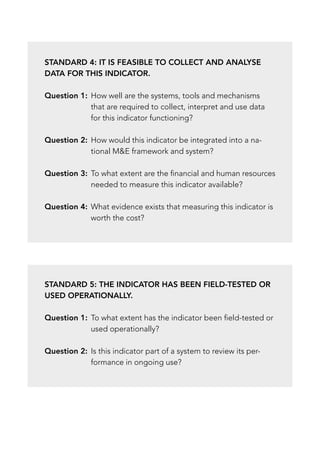
Standard 4: It is feasible to collect and analyse
data for this indicator.
Question 1:	
How well are the systems, tools and mechanisms
that are required to collect, interpret and use data
for this indicator functioning?
Question 2:	
How would this indicator be integrated into a na-
tional ME framework and system?
Question 3:	
To what extent are the financial and human resources
needed to measure this indicator available?
Question 4:	
What evidence exists that measuring this indicator is
worth the cost?
Standard 5: The indicator has been field-tested or
used operationally.
Question 1:	
To what extent has the indicator been field-tested or
used operationally?
Question 2:	
Is this indicator part of a system to review its per-
formance in ongoing use?
52 | UNAIDS
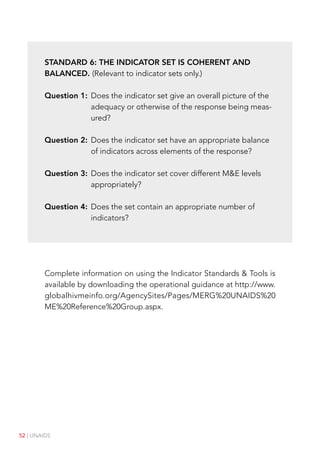
Standard 6: The indicator set is coherent and
balanced. (Relevant to indicator sets only.)
Question 1:	
Does the indicator set give an overall picture of the
adequacy or otherwise of the response being meas-
ured?
Question 2:	
Does the indicator set have an appropriate balance
of indicators across elements of the response?
Question 3:	
Does the indicator set cover different ME levels
appropriately?
Question 4:	
Does the set contain an appropriate number of
indicators?
Complete information on using the Indicator Standards  Tools is
available by downloading the operational guidance at http://www.
globalhivmeinfo.org/AgencySites/Pages/MERG%20UNAIDS%20
ME%20Reference%20Group.aspx.
UNAIDS | 53
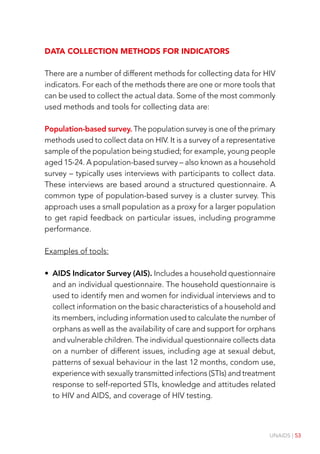
Data collection methods for indicators
There are a number of different methods for collecting data for HIV
indicators. For each of the methods there are one or more tools that
can be used to collect the actual data. Some of the most commonly
used methods and tools for collecting data are:
Population-based survey. The population survey is one of the primary
methods used to collect data on HIV. It is a survey of a representative
sample of the population being studied; for example, young people
aged 15-24. A population-based survey – also known as a household
survey – typically uses interviews with participants to collect data.
These interviews are based around a structured questionnaire. A
common type of population-based survey is a cluster survey. This
approach uses a small population as a proxy for a larger population
to get rapid feedback on particular issues, including programme
performance.
Examples of tools:
• AIDS Indicator Survey (AIS). Includes a household questionnaire
and an individual questionnaire. The household questionnaire is
used to identify men and women for individual interviews and to
collect information on the basic characteristics of a household and
its members, including information used to calculate the number of
orphans as well as the availability of care and support for orphans
and vulnerable children. The individual questionnaire collects data
on a number of different issues, including age at sexual debut,
patterns of sexual behaviour in the last 12 months, condom use,
experience with sexually transmitted infections (STIs) and treatment
response to self-reported STIs, knowledge and attitudes related
to HIV and AIDS, and coverage of HIV testing.
54 | UNAIDS
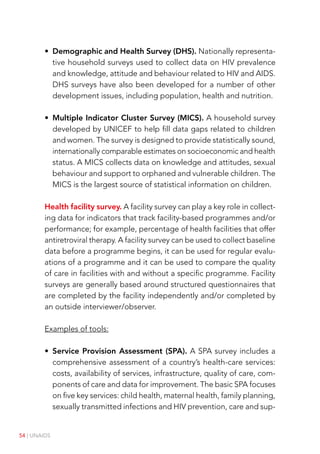
• Demographic and Health Survey (DHS). Nationally representa-
tive household surveys used to collect data on HIV prevalence
and knowledge, attitude and behaviour related to HIV and AIDS.
DHS surveys have also been developed for a number of other
development issues, including population, health and nutrition.
• Multiple Indicator Cluster Survey (MICS). A household survey
developed by UNICEF to help fill data gaps related to children
and women. The survey is designed to provide statistically sound,
internationally comparable estimates on socioeconomic and health
status. A MICS collects data on knowledge and attitudes, sexual
behaviour and support to orphaned and vulnerable children. The
MICS is the largest source of statistical information on children.
Health facility survey. A facility survey can play a key role in collect-
ing data for indicators that track facility-based programmes and/or
performance; for example, percentage of health facilities that offer
antiretroviral therapy. A facility survey can be used to collect baseline
data before a programme begins, it can be used for regular evalu-
ations of a programme and it can be used to compare the quality
of care in facilities with and without a specific programme. Facility
surveys are generally based around structured questionnaires that
are completed by the facility independently and/or completed by
an outside interviewer/observer.
Examples of tools:
• Service Provision Assessment (SPA). A SPA survey includes a
comprehensive assessment of a country’s health-care services:
costs, availability of services, infrastructure, quality of care, com-
ponents of care and data for improvement. The basic SPA focuses
on five key services: child health, maternal health, family planning,
sexually transmitted infections and HIV prevention, care and sup-
UNAIDS | 55
port. A targeted SPA for HIV has a sharper focus on the delivery of
preventive care and support services. For additional information,
see www.measuredhs.com/aboutsurveys/spa.cfm.
• Service Availability Mapping (SAM). Service Availability Mapping
is an integrated tool designed to collect data on health infrastruc-
ture, human resources and available health services. SAM has two
core components: (1) questionnaires at the district and facility
level and (2) the WHO HealthMapper application. The district
questionnaire focuses on the availability of services and service
providers by district, estimated coverage of specific programmes by
district and availability of services by facility. The facility question-
naire focuses on general characteristics, including infrastructure,
general-purpose equipment, injection and sterilization equip-
ment, human resources, trained staff, drugs and commodities,
laboratory tests and information on programmes available in the
facility. According to WHO, HealthMapper is designed to: “give
the public health user a ready-made standardized digital database
containing information considered essential by public health users
including boundary maps, environmental factors (such as lakes,
rivers, elevation) and vital information on basic population and
basic health, school and water infrastructures; provide the public
health user with a simple data management interface into which
the user can easily enter and update public health indicators in a
standard geographic format; and provide the public health user with
user-friendly icon-driven functions to automatically create maps,
tables and charts of their data.” For additional information, see
http://www.who.int/healthinfo/systems/samintro/en/index.html.
Behavioural surveillance. As a methodology, behavioural surveil-
lance is closely related to population-based surveys. However, be-
havioural surveillance surveys (BSS) tend to focus on subpopulations
and behaviours that have the greatest potential to contribute to the
56 | UNAIDS
spread of HIV. These subpopulations include injecting drug users,
sex workers and men who have sex with men. In general, behavioural
surveillance surveys rely on repeated surveys of these subpopulations.
This intensive method – repeated surveys of populations at higher
risk – generates statistically significant data on trends from relatively
small sample populations, which makes it more cost-effective than a
basic population-based survey, which requires a larger sample. (It is
important to reiterate that repeated surveys are valuable for their trend
data. A data point from a single survey is an unreliable measure, due
to limitations with the representativeness of the sample population.)
Sentinel surveillance. Sentinel surveillance measures HIV prevalence
among selected populations – i.e. sentinel groups – at regular intervals
in order to track trends in HIV infection over time, by group and by
location. This type of serological surveillance provides essential data
on the epidemic. Historically, pregnant women attending antenatal
clinics have been a key sentinel group for tracking HIV prevalence
in the general population. Other useful sentinel groups for tracking
the critical aspects of the epidemic include blood donors, uniformed
personnel (military and police), TB patients and populations at higher
risk, such as injecting drug users, sex workers and men who have
sex with men.
Examples of tools:
• Estimation and Projection Package (EPP). This package is used to
estimate and project adult HIV prevalence from surveillance data.
While EPP can be used in all countries with sufficient surveillance
data, it is specifically recommended for countries with generalized
epidemics. The input to EPP in countries with generalized epidem-
ics is surveillance data from various sites and years showing HIV
prevalence among pregnant women, as well as data from national
UNAIDS | 57
population-based surveys. EPP is used to fit a simple epidemic
model to data from urban and rural sites.
• Workbook Method. This is a spreadsheet used to estimate and
project adult HIV prevalence from surveillance data in countries
with low-level or concentrated epidemics. Estimates are based
on prevalence in populations at low risk and at high risk due to
their behaviour. The tool can also be used to estimate the size of
populations with high-risk behaviours.
• Spectrum. Spectrum is a policy modelling system, which includes
modules for HIV, AIDS and reproductive health issues. The core
of Spectrum is a demographic projection model called DemProj,
which projects the population by age and sex. The HIV and AIDS
projections are added to the demographic projections using a
module called the AIDS Impact Model. The national prevalence
projections produced by EPP or the Workbook Method can be
imported into SPECTRUM to calculate the number of people
infected, the number of new infections, AIDS cases, AIDS-related
deaths, the number of people needing treatment and the number
of orphans.
For additional information on EPP, the Workbook Method and
Spectrum, see www.unaids.org/en/KnowledgeCentre/HIVData/
Epidemiology/epi_software2007.asp.
Population estimates. The UN Population Division is a resource for
population estimates relevant to HIV indicators. For example, the
numerator for an indicator on pregnant women – the percentage
of pregnant women who were tested for HIV and who know their
results – relies on estimates of the total number of pregnant women.
In addition, the central statistics office in a given country can also
be a resource for necessary population estimates. For additional
58 | UNAIDS
information on the UN Population Division, see www.un.org/esa/
population/unpop.htm.
Programme/facility records. The various types of records kept by
programmes and facilities are an invaluable source of data for HIV
indicators. These records include: HIV case reporting forms; antenatal
care (ANC) registers; labour and delivery registers; maternal and child
health (MCH) registers; HIV-exposed infant follow-up registers; HIV
testing and counselling registers; and pre-ART registers. In addition,
individual patient records can also provide useful data. However,
it is important to note that confidentiality is always an issue when
using patient records.3
There are also specific records related to TB
patients and care that also provide relevant data, including routine
and summary recording and reporting forms and registers recom-
mended by WHO.
Health management information systems (HMIS). The use of
integrated health management information systems continues to
increase at country, provincial, district and facility levels. Where HMIS
is available, it can be an excellent source of data on a wide range of
issues, from the health budget per capita, to the number of physicians
per 10 000 population, to the number of deaths from AIDS-related
illnesses. However, since these systems tend to be customized for
specific settings, it is essential to understand the breadth and depth
of the data before using them as a resource.
Logistics management information system (LMIS). As more and
more patients receive antiretroviral drugs, there is a growing emphasis
on supply chain management to ensure that the necessary drugs
are always available when and where they are needed. There are a
3 Additional information on confidentiality and security of HIV information is available on the UNAIDS
website (see www.unaids.org/en/KnowledgeCentre/HIVData/Confidentiality/default.asp).
UNAIDS | 59
number of different tools related to logistics management informa-
tion systems, including assessments, guidelines, handbooks and
software. For additional information, see www.who.int/hiv/amds/
lmis/en/index.html.
Other methods/tools. Indicator data can also be collected through
several other methods and/or tools, including: coverage surveys,
which determine the number/percentage of people or households
that have received a particular service compared with those who
need it; key informant interviews; school surveys; laboratory network
records; inventory logs and the National Composite Policy Index
(NCPI), which is part of the UNGASS indicator set.
A note about validation: No matter which method or methods are
used to collect data for indicators, it is worthwhile to take additional
steps to validate the data. Essentially, validation is a process used to
confirm the accuracy and reliability of the data. The process typically
relies on information from an alternative source; this source will vary
depending on the data being validated. For example, data from
behavioural surveillance could be used to validate data collected
by a household survey.
60 | UNAIDS
Data analysis
The thorough analysis of data collected for indicators is a fundamental
component of indicator use. The analysis should address several key
factors, including the context, data collection methodologies, data
sources, comparison across different sources and/or data sets, any
variation between different data sets and linkages between different
aspects of the epidemic and response.
Understanding the context is critical to an accurate analysis of
data. A lack of knowledge about the circumstances surrounding a
particular situation and/or setting could easily lead to a misleading
analysis of the data. The closer the data analysis is to the point of
data collection, the more likely it is that the context of the data will
be taken into consideration. For example, it is likely that individuals
doing data analysis will understand the broader context of the situ-
ation in a given country, province, etc. This understanding should
never be taken for granted and it is always important to verify that
the context is being considered during the data analysis.
Different data collection methodologies can generate different
findings. For example, a national population-based survey (e.g.
DHS or AIS) tends to provide very good information on the general
population. However, it does not necessarily provide the same qual-
ity of information about marginalized populations such as injecting
drug users or sex workers. Consequently, the data analysis process
– as well as the data validation process – is an important aspect/
component of the data collection methodology.
There is a corresponding issue with data sources: Different data
sources can influence conclusions during data analysis. For example,
the quality of patient or facility records can vary widely, depending
UNAIDS | 61
on the capacity of institutions and their protocols for collecting,
managing and retaining the information.
Although not all sources may provide the same quality or quantity
of data, there is significant value in the ability to do comparisons across
the different sources. There is a similar value in doing comparisons
across different data sets; for example, data collected using differ-
ent methodologies or target populations. The challenge for data
analysts is to identify valid comparisons that enhance the overall
understanding of the situation addressed by a specific indicator or
set of indicators. For measures to be comparable, they must match
temporally (relating to the measurement of time) and spatially (relat-
ing to the geographic location).
Inevitably, there will be differences over time in outputs from an
activity, project or programme. This difference or variation tends to
be due either to a common cause or a special cause. Common cause
variation is the normal or inevitable variation – often referred to as
‘noise’ – which has limited impact on the validity of the data. Special
cause variation is due to a specific cause that should be able to be
reduced or eliminated to minimize the variation. It is likely that data
analysts will find variation in the data, particularly if there are multiple
data sources. It is also crucial to understand the variation and the
cause, when drawing any conclusions from the data.4
During data analysis it is important to look closely at the linkages
between policy, programme implementation, behaviour change and
HIV prevalence. To effectively review these linkages, analysts should
use data triangulation methods to pull together the widest range
of data available, including quantitative and qualitative information
4 At the global level, multilateral agencies and international organizations, including donors, meet
regularly to reconcile data collected from various sources in order to minimize the impact of variation.
62 | UNAIDS
from both the public and private sectors. Data triangulation reduces
the likelihood of an over-reliance on data of any one type or from
any one source, which is important because one type or source of
data is unlikely to provide the perspective or insights required to
fully understand the linkages and to identify any existing or emerg-
ing trends.
SUMMARY
64 | UNAIDS
Notes
UNAIDS | 65
Do
you
have
anything
to
add?
Good indicators provide good information – i.e. accurate information,
useful information, critical information – on performance, achievement
and accountability. More precisely, good indicators are quantitative
metrics that provide information to monitor performance, measure
achievement and determine accountability. They provide basic
information on the past, present and possible future course of an
activity, programme and/or behaviour.
Questions to consider
68 | UNAIDS
Notes
UNAIDS | 69
?
• In general, is it better to use an existing indicator or
create a new one?
• Is there a resource for finding indicators that are in use
around the world?
• Why is it important for indicators to be fully defined?
• What makes a good indicator?
• Are indicators the only option for collecting useful data
for managing the response to the epidemic?
• What is the best way to determine the quality of an
indicator?
• What are the sources of data that can be used for an
indicator?
Quick quiz
72 | UNAIDS
True or false:

Indicators are standardized measures that allow for compari-
sons over time and different geographic areas.

Indicators are not useful for comparisons across programmes.

Indicators are useful because they provide a snapshot of the
‘vital signs’ of the epidemic and response.

Indicators are useful because they provide specific details
required for management and implementation.

Indicators need to be fully defined to be useful in the field.
UNAIDS | 73
Match the type of indicator with the correct definition:
Impact
Input
Outcome
Output
The immediate results of programme activities.
This term relates to the direct products or deliverables of programme
activities, such as the number of counselling sessions completed, the
number of people reached and the number of materials distributed.
The intermediate changes that a programme
effects on target audiences or populations, such as change in knowl-
edge, attitudes, beliefs, skills, behaviours, access to services, policies
and environmental conditions.
A resource used in a programme, including
financial and human resources from a variety of sources, as well as
curricula, materials, etc.
The longer range, cumulative effect of pro-
grammes over time on what they ultimately aim to change. Often,
this effect will be a population-level health outcome, such as a change
in HIV infection, morbidity and mortality. Impacts are rarely, if ever,
attributable to a single programme, but a programme may, with other
programmes, contribute to impacts on a population.
74 | UNAIDS
When should an indicator be used?
Check all that apply:
When an indicator has technical merit.
When an indicator is fully defined.
When an indicator is first developed.
When data are not readily available

When it is useful to have a standard measure that can be
compared over time.
When a single data point is needed
GLOSSARY
76 | UNAIDS
Activity. Actions taken or work performed through which inputs
such as funds, technical assistance and other types of resources are
mobilized to produce specific outputs.
AIDS Indicator Survey (AIS). Population-based survey designed
to collect detailed information on specific issues relevant to HIV
and AIDS. For additional information, see www.measuredhs.com/
aboutsurveys/ais.cfm.
Bias. Any effect during the collection or interpretation of informa-
tion that leads to a systematic error in one direction; for example,
observer bias in the interpretation of replies to survey questions.
Data. Specific quantitative and qualitative information or facts that
are collected and analysed.
Data triangulation. The analysis and use of data from three or more
sources obtained by different methods. Findings can be corroborated
and the weakness or bias of any of the methods or data sources can
be compensated for by the strengths of another, thereby increasing
the validity and reliability of the result.
Demographic and Health Surveys (DHS). Population-based survey
designed to collect provide data for a wide range of monitoring and
impact indicators related to a range of different issues, including child
health, family planning, gender/domestic violence, maternal health,
nutrition and women’s empowerment. For additional information,
see www.measuredhs.com/aboutsurveys/dhs/start.cfm.
Denominator. The bottom number of a common fraction; it indicates
the number of parts in the whole.
UNAIDS | 77
Estimate. An approximate calculation based on the best available
data. For example, estimates are often used to determine the ap-
proximate size of a particular population.
Experimental design. A research design that randomly assigns
participants to experimental and control groups. Participants in the
experimental group are subjected to independent variables that are
manipulated to gauge their response. The control group is used for
comparison purposes.
Evaluation. The rigorous, scientifically-based collection and analysis
of information about program/intervention activities, characteristics,
and outcomes that determine the merit or worth of the program/
intervention. Evaluation studies provide credible information for use
in improving programs/interventions, identifying lessons learned,
and informing decisions about future resource allocation.
Facility survey. A survey of a representative sample of facilities
that generally aims to assess the readiness of all elements required
to provide services and other aspects of quality of care (e.g. basic
infrastructure, drugs, equipment, test kits, client registers, trained
staff). The units of observation are facilities of various types and levels
in the same health system. The content of the survey may vary but
typically includes a facility inventory and, sometimes, health worker
interviews, client exit interviews and client–provider observations.
Indicator. A quantitative or qualitative variable that provides a valid
and reliable way to measure achievement, assess performance or
reflect changes connected to an activity, project or programme.
78 | UNAIDS
Indicator framework. A matrix that correlates key objectives, pro-
grammes and results areas with specific indicators and the methods
for collecting data for those indicators. The collection of individual
indicators in the framework constitutes an indicator set.
Indicator Registry. The Indicator Registry maintained by UNAIDS
is a central repository of AIDS indicators. It is designed to improve:
(1) access to information on the full range of indicators; (2) man-
agement of indicators, including development of new indicators;
(3) harmonization of similar indicators; and (4) the selection of ap-
propriate indicators to monitor a country’s epidemic and response.
The Indicator Registry can be found at www.indicatorregistry.org.
Indicator set. A useful collection or grouping of related indicators.
The nature of the relationship between indicators in a set can vary;
for example, there can be indicators grouped by their utility in global,
national, subnational, thematic and/or project settings.
Logical framework (Logframe). Management tool used in the
design of a programme or project. It correlates key strategic ele-
ments, including objectives, inputs, outputs, outcomes and impact,
with indicators as well as the assumptions and risks that may effect
the implementation of the programme or project. Logframes are
useful for the planning, execution and evaluation of programmes
and projects.
MERG. The Monitoring and Evaluation Reference Group is the inter-
national body on monitoring and evaluation for the HIV epidemic. A
wide range of constituencies is represented on the MERG, including
national governments, multilateral agencies, bilateral donors, NGOs
and technical agencies/experts. The MERG is chaired by a senior ME
professional from UNAIDS. Much of the work of the MERG is done
by technical working groups that focus on particular issues/initiatives.
UNAIDS | 79
Metadata. Data about data. For example, in a library the metadata
on a particular book could include the name of the author, a descrip-
tion of the contents, the publication date and the physical location
of the book in the library. In the Indicator Registry, the metadata on
a particular indicator includes the purpose, rationale, numerator,
denominator, calculation, data collection methodology and data
disaggregation.
Metric. A standard of measurement. For example, indicators use
a quantitative or qualitative metric to measure the impact of pro-
grammes, projects and activities.
Monitoring. Routine tracking and reporting of priority information
about a programme and its intended outputs and outcomes.
Multiple Indicator Cluster Survey (MICS). Population-based sur-
vey developed by UNICEF to collect data on children and women.
In addition to data related to HIV, a MICS collects data on child
development, child health, child mortality, child protection, educa-
tion, environment, nutrition and reproductive health. For additional
information, see www.unicef.org/statistics/index_24302.html.
NCPI. The National Composite Policy Index (NCPI) is an integral part
of the list of core UNGASS indicators. It is a detailed questionnaire
designed to assess progress in the development and implementation
of national AIDS policies and strategies.
Numerator. The top number of a common fraction, which indi-
cates the number of parts from the whole that are included in the
calculation.
80 | UNAIDS
Programme. An overarching national or subnational response to a
disease. A programme generally includes a set of activities marshalled
to attain specific global, regional, country or subnational objectives;
involves multiple activities that may cut across sectors, themes and/
or geographic areas.
Project. An activity or set of activities designed to achieve specific
objectives with specified resources and within specified implementa-
tion schedules, often within the framework of a broader programme.
Qualitative data. Data collected using qualitative methods, such as
interviews, focus groups, observation and key informant interviews.
Qualitative data can provide an understanding of social situations
and interaction, as well as people’s values, perceptions, motivations
and reactions. Qualitative data are generally expressed in narrative
form, pictures or objects; i.e., not numerically.
Quality assurance. Planned and systematic processes for assess-
ing and improving the merit or worth of a programme/project or its
compliance with given standards.
Quantitative data. Data collected using quantitative methods, such
as surveys. Quantitative data are measured on a numerical scale, can
be analysed using statistical methods and can be displayed using
tables, charts, histograms and graphs. The aim of a quantitative study
is to classify features, count them and construct statistical models in
an attempt to explain what is observed.
Quasi-experimental design. A variation on experimental design.
The key difference is that participants are not randomly assigned to
experimental and control groups. Quasi-experimental designs are
used when the random selection of participants is impossible and/or
impractical. They tend to be easier to set up than true experimental
UNAIDS | 81
designs because it takes less effort to study and compare participants
or groups of participants who are already naturally organized than
to have to randomly assign them to groups.
Reliability. Consistency or dependability of data collected through
the repeated use, under the same conditions, of a scientific instru-
ment or a data collection procedure.
Representativeness. The ability of a sample (i.e. a selected subset
of a population) to accurately represent or typify a larger population.
Sample. A selected subset of a population. A sample may be random
or non-random and it may be representative or non-representative.
Typically, a sample is selected as a proxy for the target population
for a given experiment/activitiy.
Sampling frame. A list of the entire population eligible to be included
within the specific parameters of a research study (e.g. individuals,
households and/or institutions). A sample is then drawn from that list.
Surveillance. The ongoing, systematic collection, analysis, interpreta-
tion and dissemination of data regarding a health-related event for
use in public health action to reduce morbidity and mortality and to
improve health. Surveillance data can help predict future trends and
target needed prevention and treatment programmes.
Trend. The general direction in which tracking data tend to move,
either upwards or downwards. Surveillance, for example, involves
observing the trend of HIV infection rates to help identify any in-
creases or declines.
Validity. The extent to which a measurement or test accurately
measures what is intended to be measured.
82 | UNAIDS
Validation. A process used to confirm the accuracy and reliability of
data that has been collected. The process typically relies on informa-
tion from an alternative source.
Variation. Difference in the output of a process or inputs to a process
over time. There are two primary types of variation: common cause
and special cause. Common cause variation is the normal and/or
inevitable variation that is inherent in any process. Special cause vari-
ation results from a known or ‘assignable’ cause, which theoretically
should be able to be reduced or eliminated to minimize variation.
Learning more about
indicators
UNAIDS | 85
European Commission, DG Health and Consumer Protection.
Developing EC health indicators and data collection. Available at:
ec.europa.eu/health/ph_information/indicators/indic_data_en.htm.
Global HIV monitoring and evaluation information:
www.globalhivmeinfo.org.
Healthy People: www.healthypeople.gov/default.htm.
KPI Portal: www.kpi-portal.com.
NYCStat: www.nyc.gov/html/ops/nycstat/html/home/home.shtml.
Sustainable Measures: www.sustainablemeasures.com
World Bank. Performance Monitoring Indicators: A Handbook for
Task Managers.
Available at: www.worldbank.org/html/opr/pmi/maintxt.html.
World Health Organization. Core Health Indicators.
Available at: www.who.int/whosis/database/core/core_select.cfm.
REFERENCES
88 | UNAIDS
U.S. Department of Health and Human Services, Agency for Health-
care Research and Quality. Available at: http://www.ahrq.gov/.
Family Health International. Behavioral Surveillance Surveys: BSS
Guidelines for Repeated Behavioral Surveys in Populations at Risk
of HIV. Family Health International, 2000.
UNAIDS. Core Indicators for National AIDS Programmes: Guidance
and Specifications for Additional Recommended Indicators. Ad-
dendum to UNGASS: Monitoring the Declaration of Commitment
on HIV/AIDS. Geneva, UNAIDS, 2007.
Global AIDS Program. Monitoring and Evaluation Capacity Building
for Program Improvement Field Guide, Version 1. Centers for Disease
Control and Prevention, Atlanta, 2003.
UNAIDS. Glossary of ME Terms. Geneva, UNAIDS, 2008.
MandE NEWS. Available at: www.mande.co.uk.
Practical Assessment, Research and Evaluation.
Available at: http://pareonline.net.
Nevin S, Gleason GR. Rapid Assessment Procedures, Qualitative
Methodologies for Planning and Evaluation of Health Related Pro-
grammes. Boston, International Nutrition Foundation for Developing
Countries, 1992.
United Nations Development Programme. Results-oriented Monitor-
ing and Evalaution: A Handbook for Programme Managers. United
Nations Development Programme, New York, 1997.
The Manager’s Electronic Resource Center. Management Sciences
for Health, 1999.
UNAIDS | 89
World Bank. The World Bank Participation Sourcebook.
Available at: www.worldbank.org/wbi/sourcebook/sbhome.htm.
UK Evaluation Society.
Available at: http://www.evaluation.org.uk/index.htm.
United Nations Population Fund. The Programme Managers Plan-
ning, Monitoring and Evaluation Toolkit. United Nations Population
Fund. Available at: http://www.unfpa.org/monitoring/toolkit.htm.
UNAIDS. UNGASS. Monitoring the Declaration of Commitment
on HIV/AIDS. Guidelines on Construction of Core Indicators. 2008
Reporting. Geneva, UNAIDS, 2007.
USAID. Performance Monitoring and Evaluation TIPS, Centre for
Development Information and Evaluation. TIPS Number 6, 1996:
Selecting Performance Indicators.
Available at: http://www.usaid.gov/pubs/usaid_eval/pdf_docs/
pnaby226.pdf.
World Health Organization, Department of Child and Adolescent
Health and Development and Department of HIV/AIDS. Rapid As-
sessment and Response Technical Guide, Version 1.0. Geneva, World
Health Organization, 2003.
Appendix
List of UNGASS (2009) and Additional Recommended Indicators
92 | UNAIDS
International agencies and donors have endorsed these 40 core
national indicators: 25 UNGASS and 15 Additional Recommended
indicators. They have committed to increasing support to countries
to ensure the regular collection of high-quality data. In addition,
agencies have committed to move towards harmonizing their agency-
specific reporting requirements with this core set of national-level
indicators. Agencies requesting additional data will be expected
to provide additional resources (human and/or financial) to support
additional data collection efforts.
UNGASS indicators
The purpose of the UNGASS indicators is to measure progress toward
implementing the Declaration of Commitment on HIV/AIDS that
was adopted by 189 UN Member States in 2001. This Declaration
represented a renewed commitment to achieving the Millennium
Development Goal of halting and beginning to reverse the HIV
epidemic by 2015. UNAIDS strongly recommends that the UNGASS
indicators are used as the basis for national HIV ME systems. Under
the terms of the Declaration of Commitment on HIV/AIDS, Member
States committed to reporting on UNGASS indicators once every
two years (2003, 2005, 2007), with the final report due in 2010.
For 2010 reporting, the international community has agreed on
25 UNGASS indicators. This list includes minor changes from the
UNGASS indicators used for the previous round of reporting. This
continuity is designed to build on the trend data collected over the
previous rounds.
UNGASS #1: Domestic and international AIDS spending by catego-
ries and financing sources.
UNGASS #2: National Composite Policy Index (areas covered:
prevention, treatment, care and support, human rights, civil society
UNAIDS | 93
involvement, gender, workplace programmes, stigma and discrimi-
nation and monitoring and evaluation).
UNGASS #3: Percentage of donated blood units screened for HIV
in a quality quality-assured manner.
UNGASS #4: Percentage of adults and children with advanced HIV
infection receiving antiretroviral therapy.
UNGASS #5: Percentage of HIV-positive pregnant women who
receive antiretroviral medicines to reduce the risk of mother-to-child
transmission.
UNGASS #6: Percentage of estimated HIV-positive incident TB cases
that received treatment for TB and HIV.
UNGASS #7: Percentage of women and men aged 15–49 who
received an HIV test in the last 12 months and who know the results.
UNGASS #8: Percentage of most-at-risk populations that have
received an HIV test in the last 12 months and who know the results.
UNGASS #9: Percentage of most-at-risk populations reached with
HIV prevention programs.
UNGASS #10: Percentage of orphans and vulnerable children whose
households received free basic external support in caring for the child.
UNGASS #11: Percentage of schools that provided life skills-based
HIV education within the last academic year.
UNGASS #12: Current school attendance among orphans and
among non-orphans aged 10–14.
94 | UNAIDS
UNGASS #13: Percentage of young women and men aged 15–24
who both correctly identify ways of preventing the sexual transmission
of HIV and who reject major misconceptions about HIV transmission.
UNGASS #14: Percentage of most-at-risk populations who both
correctly identify ways of preventing the sexual transmission of HIV
and who reject major misconceptions about HIV transmission.
UNGASS #15: Percentage of young women and men who have had
sexual intercourse before the age of 15.
UNGASS #16: Percentage of adults aged 15–49 who have had
sexual intercourse with more than one partner in the last 12 months.
UNGASS #17: Percentage of adults aged 15–49 who had more than
one sexual partner in the past 12 months who report the use of a
condom during their last intercourse.
UNGASS #18: Percentage of female and male sex workers reporting
the use of a condom with their most recent client.
UNGASS #19: Percentage of men reporting the use of a condom
the last time they had anal sex with a male partner.
UNGASS #20: Percentage of injecting drug users who reported
using sterile injecting equipment the last time they injected.
UNGASS #21: Percentage of injecting drug users who report the
use of a condom at last sexual intercourse.
UNGASS #22: Percentage of young women and men aged 15–24
who are HIV infected.
UNAIDS | 95
UNGASS #23: Percentage of most-at-risk populations who are HIV
infected.
UNGASS #24: Percentage of adults and children with HIV known to
be on treatment 12 months after initiation of antiretroviral therapy.
UNGASS #25: Percentage of infants born to HIV-infected mothers
who are infected.
Additional Recommended indicators
The purpose of the Additional Recommended indicators is to provide
key information about national HIV responses that is not captured
by the 25 UNGASS indicators. There are no requirements for global
reporting on the Additional Recommended indicators unless they
are part of specific donor reporting requirements.
Where they fit the needs of a country, national AIDS programmes
are encouraged to use the set of core national indicators to ensure
standardization of information over time and across countries.
Additional Recommended #1: Percentage of health facilities with
post-exposure prophylaxis available [disaggregated by exposure
(occupational, non-occupational) and sector (public, private)].
Additional Recommended #2: Percentage of health facilities that
offer ART (i.e. prescribe and/or provide clinical follow-up) [disag-
gregated by sector (public, private)].
Additional Recommended #3: Percentage of health facilities dis-
pensing ARV that experienced a stock-out of at least one required
ARV in the last 12 months [disaggregated by sector (public, private)].
96 | UNAIDS
Additional Recommended #4: Percentage of health facilities pro-
viding ART using CD4 monitoring in line with national guidelines or
policies, either on site or through referral [disaggregated by sector
(public, private)].
Additional Recommended #5: Percentage of sexually active young
women and men aged 15-24 who received an HIV test in the last 12
months and who know their results [disaggregated by sex (female,
male) and age (15-19, 20-24)].
Additional Recommended #6: Percentage of TB patients who had
an HIV test result recorded in the TB register [disaggegrated by sex
(female, male), age (0-4, 5-14, 15 and above), and HIV status (HIV
positive, HIV negative)].
Additional Recommended #7: Percentage of pregnant women
who were tested for HIV and who know their results [disaggregated
by service type (Antenatal Care, Labour  Delivery, Postpartum)].
Additional Recommended #8: Percentage of infants born to HIV-
infected women who received an HIV test within12 months [disag-
gregated by type/timing of testing (virological testing within 2
months, virological testing between 2 and 12 months or antibody
testing between 9 and 12 months)].
Additional Recommended #9: Percentage of infants born to HIV-
infected women who are started on cotrimoxazole prophylaxis within
two months of birth.
Additional Recommended #10: Total number of male and female
condoms available for distribution nationwide during the last 12
months per person aged 15-49 [disaggregated by condom type
(male, female)].
UNAIDS | 97
Additional Recommended #11: Percentage of young women and
men aged 15-24 who report they could get condoms on their own
[disaggregated by sex (female, male), age (15-19, 20-24)].
Additional Recommended #12: Percentage of never married young
women and men aged 15-24 who have never had sex [disaggregated
by sex (female, male) and age (15-19, 20-24)].
Additional Recommended #13: Percentage of men aged 15-49
reporting sex with a sex worker in the last 12 months who used a
condom during last paid sexual intercourse [disaggregated by age
(15-19, 20-24, 25-49), and population group (migrant workers, military,
truck drivers, other)].
Additional Recommended #14: Percentage of women and men
aged 15-49 expressing accepting attitudes towards people living
with HIV [disaggregated by sex (female, male), age (15-19, 20-24,
25-49), and education level (none, primary, secondary or higher)].
Additional Recommended #15: Percentage of children under the
age of 18 who are orphans [disaggregated by sex (female, male), age
(5, 5-9, 10-14, 15-17), and type of orphan (maternal, paternal, double)]
98 | UNAIDS
Notes
UNAIDS | 99
Publications in this series
Basic Terminology and Frameworks
for Monitoring and Evaluation
(2010)
An Introduction to Indicators
(2010)
A National Evaluation Agenda for HIV
(2010)
An Introduction to Triangulation
(2010)
UNAIDS 20, AVENUE APPIA, CH-1211 GENEVA 27, SWITZERLAND
Tel.: (+41) 22 791 36 66, Fax: (+41) 22 791 48 35
e-mail: distribution@unaids.org, www.unaids.org
About the Monitoring and Evaluation Fundamentals Series
With the advent of the global financial crisis affecting most countries around the world,
monitoring and evaluation (ME) has become more important than ever before. Determining
what programs do or do not work; implementing programs with proven cost-effectiveness;
monitoring progress towards achieving targets; and ensuring accountability are objec-
tives which are especially important now in the HIV response, as well as in other health
and development areas. Thus, it is increasingly important that ME is better understood,
communicated in simplified language, and conducted in a coordinated and sustainable
manner that generates information that can be easily used. Further, it is essential that
ME addresses the needs of and involves all key stakeholders right from the start and that
results are made publicly available and utilized strategically in policy-making, planning,
and program improvement.
This series provides a common sense introduction to a range of ME issues. It covers the
fundamentals and their practical applications and includes techniques and tools for man-
aging ME of the HIV epidemic and response. Although the series uses HIV as its focus,
the ME fundamentals are also relevant to other areas of public health and development.
As such, these books may also be useful in strengthening national ME systems designed
to track progress in other health and development goals, such as those outlined in the
United Nations Millennium Development Goals (MDG).

8_2-Intro-to-IndicatorsFMEF.pdf

  • 1.
  • 3.
  • 5.
    UNAIDS | 05 FORWARD DearColleagues, I would like to welcome you to the UNAIDS Monitoring and Evaluation Fun- damentals series. As the response to the global HIV epidemic continues to evolve, monitoring and evaluation (M&E) has become more important than ever. Determining what programs do or do not work; implementing programs with proven cost-effectiveness; monitoring progress towards achieving targets; and ensuring accountability are objectives which are especially important now in the HIV response, as well as in other health and development areas. Thus, it is increasingly important that M&E is better understood, communicated in simplified language, and conducted in a coordinated and sustainable manner that generates information that can be easily used. Further, it is essential that M&E addresses the needs of and involves all key stakeholders right from the start and that results are made publicly available and utilized strategically in policy-making, planning, and program improvement. This series provides a common sense introduction to a range of M&E issues. It covers the fundamentals and their practical applica- tions and includes techniques and tools for managing M&E of the HIV epidemic and response. Although the series uses HIV as its focus, the M&E fundamentals are also relevant to other areas of public health and development. As such, these books may also be useful in strengthening national M&E systems designed to track progress in other health and development goals, such as those outlined in the United Nations Mil- lennium Development Goals (MDGs). I hope you find this series useful and welcome your feedback and suggestions on this and future topics for the series. With my best regards, Deborah Rugg, PhD Chief, UNAIDS Monitoring and Evaluation Division
  • 6.
    Acknowledgements David Hales wasthe primary author of this book. He received invalu- able input from Greet Peersman (Tulane University, New Orleans), De- borah Rugg (UNAIDS, Geneva) and Eva Kiwango (UNAIDS, Geneva). The author is grateful to the members of the Technical Working Group on Indicator Development and Revision (UNAIDS Monitoring and Evaluation Reference Group) for their work on the development of the Indicator Standards & Tools. The following reviewers provided excellent comments during the drafting of this book: Boaz Cheluget (National AIDS Control Council, Kenya), Patricia Rivera Scott (UNAIDS, Guatemala) and Matthew Warner-Smith (UNAIDS, Geneva).
  • 7.
    UNAIDS | 07 Contents GettingStarted 10 The Fundamentals 13 What is an indicator? 15 Why are indicators useful? 18 What are the essential components of an indicator? 20 What makes a good indicator? 26 What are the different types of indicator? 27 What is the indicator pyramid? 28 When should an indicator be used? 34 How to select indicators 34 Indicators in various sectors 39 Other options for collecting useful information 42 Targets 46 Tools and Techniques 47 Indicator standards 48 Data collection for indicators 53 Data analysis 60 SUMMARY 63 Questions to consider 68 Quick quiz 71 Glossary 75 Learning more about indicators 83
  • 8.
    08 | UNAIDS REFERENCES87 Appendix 91
  • 9.
    UNAIDS | 09 Abbreviations AIDSacquired immunodeficiency syndrome ANC antenatal care ART antiretroviral therapy ARV antiretroviral HIV human immunodeficiency virus IDU injecting drug user M&E monitoring and evaluation MCH maternal and child health MDG Millennium Development Goals MERG Monitoring and Evaluation Reference Group NGO non-governmental organisation TB tuberculosis TWG technical working group UNAIDS Joint United Nations Programme on HIV/AIDS UNGASS United Nations General Assembly Special Session, Declaration of Commitment on HIV/AIDS UNICEF United Nations Children’s Fund WHO World Health Organization
  • 10.
    10 | UNAIDS GettingStarted Why this topic? Indicators are an essential component of any effective M&E (moni- toring and evaluation) system. For example, at the national level, indicators provide technical experts and decision-makers with the data required to effectively manage a country’s response to the AIDS epidemic. At the global level, harmonized indicator sets (i.e. UNGASS and the UNGASS Addendum: Additional Recommended Indicators) provide international agencies and organizations with much-needed strategic information, which influences their planning and allocation of resources. M&E professionals have access to a wide range of tools. Indicators are one of the more valuable and versatile, but if indicators are not used carefully they can consume extensive resources and generate data with little or no value. The key challenge with indicators is to ensure their quality and integrity. Indicators should generate data that are needed and useful. They should be technically sound. They should be understandable, practical and feasible. In addition, they should have a proven record of performance.
  • 11.
    UNAIDS | 11 What’sin this book? This book is a common-sense introduction to indicators. It is designed to provide the basic information required to understand the com- ponents and the use of indicators in the monitoring and evaluation of the AIDS epidemic and response. The Fundamentals section of the book focuses on essential background information that anyone working with indicators should know. What are indicators? Why are they useful? When should they be used? How should they be used? The Tools and Techniques section includes practical information on the actual use of indicators in monitoring the AIDS epidemic: critical topics, including indicator standards, data collection and data analysis.
  • 13.
    THE FUNDAMENTALS “Rarely doyou need to design new indicators. Resist the temptation. If you think it will be a better indicator than any other existing indicator, ask why no one else has used it before.” David Pencheon
  • 14.
    14 | UNAIDS Indicatorsprovide critical information on performance, achievement and accountability, which is the cornerstone of effective monitoring and evaluation. In addition, the data from indicators provide the strategic insights that are essential for the effective management of the AIDS epidemic and response. It is impossible to underestimate the value of indicators in continuing to improve knowledge about the epidemic and the effectiveness of the response. To be valuable indicators, indicators need to be of high quality and able to collect the right data in the right place at the right time. What is an indicator? Fundamentally, an indicator provides a sign or a signal that some- thing exists or is true. It is used to show the presence or state of a situation or condition. In the context of monitoring and evaluation, an indicator is a quantitative metric that provides information to monitor performance, measure achievement and determine account- ability. It is important to note that a quantitative metric can be used to provide data on the quality of an activity, project or programme.
  • 15.
    UNAIDS | 15 Quantitativemetric – Data can measured on a numerical scale Sample indicator: Percentage of health facilities that offer antiret- roviral therapy Sample indicator (quality): Percentage of counselling and testing service providers accredited to offer these services Performance – The effective or efficient operation of an activity, project or programprogramme Sample indicator: Percentage of condom delivery sites that reached their coverage targets Achievement – The successful accomplishments of an activity, project or programme Sample indicator: Percentage of HIV-positive pregnant women who received antiretroviral drugs Accountability – Responsibility for the performance and/or achievements of an activity, project or programme Sample indicator: Percentage of clinics complying with national guidelines for sexually transmitted infections A good indicator should be clear and concise. It should focus on a single issue that provides relevant information on a situation; par- ticularly information that provides the strategic insight required for effective planning and sound decision-making. Good indicators are also defined by the feasibility of collecting meaningful and credible data for them. In addition, good indica- tors should actually – and accurately – measure what they claim to measure. If it is not feasible to collect data for an indicator, or the
  • 16.
    16 | UNAIDS datathat can be collected are not meaningful, the indicator will have little or no utility. Among the dozens of factors at play in data collection for in- dicators, there are at least three that should always be addressed because of their impact on the credibility of the data: (1) validity, (2) reliability and (3) bias. Validity: The extent to which a measurement or test accurately measures what is intended to be measured. Reliability: The consistency of the data when collected repeatedly using the same procedures and under the same conditions. Bias: Any effect during the collection or interpretation of information that leads to a systematic error in one direction. If there is any question or concern about any of these three fac- tors, the wise decision is to identify an alternative source of data. Ultimately, any indicator is only as valuable as the quality of the data it uses and it is crucial that the data are valid, reliable and not biased. An important but often-overlooked fact about indicators is that they merely indicate. They do not capture or convey the many dimen- sions of a given situation and/or activity. They are directional: They provide basic information on the past, present and possible future course of an activity, programme and/or behaviour. They are also very context-specific: Higher values or lower values can be either good or bad, depending on the situation. (The desired direction of
  • 17.
    UNAIDS | 17 theindicator – i.e. an increase or decrease – is usually determined when the indicator is selected and before data collection begins.) Indicators are not designed to replace more detailed investigations of specific issues, nor should they be used to do so. Consequently, information generated by indicators should always be interpreted within the broader context of the situation and supplemented where necessary by special studies, other evaluation activities and other types of data. Examples of other options include focus group dis- cussions, knowledge, attitude and practices (KAP) surveys and rapid appraisals. (Go to page 40 for more information on other options for collecting useful information.) Indicators are an essential part of effective monitoring and evalu- ation. They can provide vital information on performance, achieve- ment and accountability. However, indicators are only one part of a comprehensive M&E system. They are only one method for collecting and analysing data and it is imperative that they be used when and where they provide meaningful information and insight.
  • 18.
    18 | UNAIDS Whyare indicators useful? Very simply, indicators are standardized measures that allow for comparisons over time, over different geographic areas and/or across programmes. The ability to compare temporally and spatially dif- ferentiates indicators from raw data, as does the ability to aggregate data for higher-level interpretation and application. Monitoring of AIDS indicators at national and global levels is analogous to monitoring the basic health of an individual. In the medical profession, a patient’s vital signs – pulse, body temperature, breathing rate and blood pressure – are used to measure the body’s basic health. These simple measures are widely considered to play a critical role in detecting and monitoring medical problems. When any of the vital signs fall outside of accepted norms, doctors and patients have an early warning that something is potentially wrong with the patient’s health. This alert triggers further diagnostic tests and an in-depth evaluation to better understand the situation. Indicators play a similar role in the AIDS epidemic and re- sponse. They provide strategic information that is essential in detecting changes in the epi- demic, monitoring the response to the epidemic and assessing the overall effectiveness of the response. In general, national and global-level indicators are not designed to measure the ef- fectiveness of specific activities or to support the day-to-day management and implementation of activities. These indicators are useful precisely because they provide Prevention experts often say that knowledge is the neces- sary but insufficient first step in protecting oneself against HIV. Similarly, indicators are the necessary but insufficient first step in understand- ing and protecting a nation against the disease.
  • 19.
    UNAIDS | 19 asnapshot of the ‘vital signs’ of the epidemic and response, not the many details required for management and implementation. Like the vital signs in medicine, which can be used anywhere in the world, certain vital signs of the AIDS epidemic (e.g. incidence among young people) and response (e.g. policies, resources, pro- gramme access and coverage) can also be used globally. However, other vital signs may vary by region, by country, by population, by age, by sex, etc. Consequently, if indicators are going to be useful, it is important to have a proven set that can be used to monitor the appropriate vital signs for the situation and to regularly check them to see if there has been any change. It is important to note the very different role that indicators play at the project level. At this level, indicators track specific perform- ance in order to monitor the implementation and effectiveness of different activities. For field staff, managing without this data is like managing blindfolded. In many respects, project-level indicators have more in common with the key performance indicators used in business (see page 38 for more information on the use of key performance indicators in the private sector).
  • 20.
    20 | UNAIDS Whatare the essential components of an indicator? The Indicator Standards & Tools,1 which were developed by the Monitoring and Evaluation Reference Group (MERG), identify a set of essential components for an indicator. These components are the metadata – i.e., data about the data – that determine the underlying viability of an indicator. The following series of questions is used in the Indicator Standards & Tools to confirm that the essential com- ponents are included in an indicator. • Does the indicator have a clearly stated title and definition? • Does the indicator have a clearly stated purpose and rationale? Is the method of measurement for the indicator clearly defined, including the description of the numerator, denominator and calculation, where applicable? • Are the data collection methodology and data collection tools for the indicator data clearly stated? • Is the data collection frequency clearly defined? • Is any relevant data disaggregation clearly defined? • Are there guidelines to interpret and use data from this indicator? • What are the strengths and weaknesses of the indicator and the challenges in its use? • Are relevant sources of additional information on the indicator cited? In addition, indicators should always have a proven track record – i.e. demonstrated performance in field-testing or operational use – before they are broadly deployed. It is impossible to underestimate the value of a proven track record; most importantly, it prevents 1 For more information on the Indicator Standards & Tools, see page 13.
  • 21.
    UNAIDS | 21 countriesfrom allocating resources on indicators that cannot or will not provide useful data. Indicator components When new indicators are being developed, they must be fully defined. No indicator should be deployed without a full definition. In other words, the essential components of the indicator must be clear and concrete. To ensure meaningful responses to the questions in the Indicator Standards & Tools listed above, it is critical to understand the terms used to define the components of an indicator. Title. A brief heading that captures the focus of the indicator. Definition. A clear and concise description of the indicator. Purpose. The reason that the indicator exists; i.e. what it is for. Rationale. The underlying principle(s) that justify the development and deployment of the indicator; i.e. why the indicator is needed and useful. Method of measurement. The logical and specific sequence of operations used to measure the indicator; e.g. data collection tools, sampling frame and quality assurance. Numerator. The top number of a common fraction, which indi- cates the number of parts from the whole that are included in the calculation. Denominator. The bottom number of a common fraction, which indicates the number of parts in the whole.
  • 22.
    22 | UNAIDS Calculation.The specific steps in the process to determine the indicator value. Data collection method. The general approaches (e.g. surveys, records, models, estimates) used to collect data. Data collection tools. The specific tools (e.g. AIDS Indicator Surveys (AIS), Demographic and Health Surveys (DHS), Service Provision Assessments (SPA), patient registers, antenatal clinic surveillance) used to collect data. Data collection frequency. The intervals at which data are collected; e.g. quarterly, annually, bi-annually. It is important that frequency is consistent with the data collection methodology. (The frequency of data collection should not be confused with the frequency of report- ing, which is commonly associated with external organizations and agencies, particularly funding partners.) Data disaggregation. The relevant subgroups that collected data can be separated into in order to more precisely understand and analyse the findings. Common subgroups include sex, age and risk population. Guidelines to interpret and use data. Recommendations on how best to evaluate and apply the findings; e.g. outlining what it means if the indicator shows an increase or a decrease in a particular measure. Strengths and weaknesses. A brief summary of what the indicator does well and not so well. Challenges. Potential obstacles or problems that may have an impact on the use of an indicator or on the accuracy/validity of its findings.
  • 23.
    UNAIDS | 23 Relevantsources of additional information. References to infor- mation/materials that relate to the indicator, including background information on the development of the indicator, comparisons with previous versions of the indicator and lessons learned from the use of the indicator or similar indicators in various settings. Example of a well- and fully-defined indicator. TITLE: Provision of Antiretroviral Therapy (ART) at Health Facilities DEFINITION: Percentage of health facilities that offer ART (i.e. prescribe and/or provide clinical follow-up). Health facilities include public and private facilities, health centres and clinics (including TB centres), as well as health facilities that are run by faith-based or nongovernmental organizations. PURPOSE: This indicator measures the capacity of health facilities to provide ART. RATIONALE: Antiretroviral therapy is a cornerstone of effective HIV treatment, and measuring the percentage of health facilities that offer ART provides valuable information about ART availability. One strategy to scale up ART services is to make ART available in more health facilities. This may be achieved by decentralizing ART services from tertiary facilities (e.g. hospitals) to primary or secondary-level health facilities.
  • 24.
    24 | UNAIDS METHODOF MEASUREMENT • Numerator: Number of health facilities that offer ART (i.e. prescribe and/or provide clinical follow-up). • Denominator: Total number of health facilities, excluding special- ized facilities where ART services are/will never be relevant. • Calculation: Number of health facilities that offer ART divided by total number of health facilities minus those where ART services are/will never be relevant x 100. The numerator is calculated by summing of the number of facilities reporting availability of ART services. Information on the availability of specific services is usually kept at the national or subnational level. National AIDS Programmes should have a record of all health facilities offering ART services. A health facility census or survey can also provide this information, along with more in-depth informa- tion on available services, provided the information is collected from a representative sample of health facilities in the country. In a facility survey (e.g. Service Provision Assessment, Service Avail- ability Mapping), the most knowledgeable person responsible for client services is interviewed using the AIDS Outpatient Depart- ment (OPD) module. Responses to a series of questions establish whether providers in that facility provide ART services directly (i.e. prescribe ART and/or provide clinical follow-up for ART patients) or refer patients to other health facilities for these services. In ad- dition, facility records documenting the current status of service provision should be consulted. One potential limitation to facility surveys or censuses is that they are usually only conducted once every few years. Countries should regularly update their programme records on health facilities offering ART services, and supplement these data with those obtained through a health facility survey or census every few years.
  • 25.
    UNAIDS | 25 •The denominator is calculated by summing the total number of health facilities included in the sample. Information for construction of the denominator may come from programme records, facility listings, and/or national strategy or planning documents. DATA COLLECTION METHOD: Programme records; health facility survey/census. MEASUREMENT TOOLS: For health facility surveys or censuses, tools such as the Service Provision Assessment (SPA) or the Service Availability Mapping (SAM) can be used. DATA COLLECTION FREQUENCY: Annual for programme records; every two to three years for facility survey/census. DATA DISAGGREGATION: Public and private sector facilities INTERPRETATION: This indicator provides valuable information about the availability of ART services in health facilities, but it does not capture information about the quality of services provided. Antiretroviral therapy itself is complex, and it should be delivered as part of a package of care interventions, including the provision of cotrimoxazole prophylaxis, the management of opportunistic infections and comorbidities, nutritional support and palliative care. Simple monitoring of ART availability does not ensure that all ART- related services are adequately provided to those who need them. Nevertheless, it is important to know what percentage of health facilities provide ART services in order to plan for service expansion as needed to meet universal access targets.
  • 26.
    26 | UNAIDS Whatmakes a good indicator? In 2000, the New Economics Foundation identified the AIMS criteria for indicators, which continues to be a useful guide in deciding if an indicator is a good indicator: Action focused. Indicators should lead to action. If stakeholders cannot imagine what to do with the data from an indicator, then it probably isn’t a good indicator. Important. Stakeholders should agree that the indicator and the data it will generate make a relevant and significant contribution to determining how to effectively respond to the epidemic. Measurable. Not only must the data collection methodology be defined, it must also be feasible to collect the data. Simple. Although he was not talking about indicators, Albert Einstein said it best when he said, “Everything should be made as simple as possible, but not simpler”. On a parallel note, there are very few indicators – if any – that are perfect. Rather than pursue the perfect indicator, it is much better to identify good, simple indicators that provide data that can be put to use.
  • 27.
    UNAIDS | 27 Whatare the different types of indicators? Indicators can be categorized in a number of different ways, de- pending on why they are being categorized. However, there are two general approaches to defining types of indicators that are particu- larly useful in monitoring the response to HIV. The first is based on thematic similarities among indicators; the second is based on the relative role and/or effect that an indicator has in/on the response to the epidemic. The most important point about the types of indicators is how crucial it is to use a range of different types in a given set in order to get a balanced perspective. Only using one or two types of indica- tors will result in a much narrower point of view, which may provide an inaccurate picture of the situation. For example, the UNGASS set of indicators uses many different types of indicators, including behavioural outcome, disease impact, infrastructure, policy and programme/service delivery, to provide a strategic overview of the global epidemic and response.
  • 28.
    28 | UNAIDS Thematicsimilarities The typology in the UNAIDS Indicator Registry2 classifies indicators by thematic similarities. The Registry identifies five types of indica- tors: behavioural outcome, disease impact, infrastructure, policy and programme/service delivery. Behavioural outcome. Indicators that monitor the effectiveness of initiatives designed to have an impact on AIDS-related behaviours. (For example, the percentage of women and men aged 15 to 49 who had more than one partner in the past 12 months reporting the use of a condom at their last sexual intercourse.) Disease impact. Indicators that monitor the disease as well as the disease’s social and economic consequences, including its effects on individuals, families, communities and governments. (For example, the percentage of populations at higher risk who are HIV infected.) Infrastructure. Indicators that monitor the contributions of core or- ganizations/institutions, service sites and services needed to support an effective AIDS response, including national AIDS committees, hospitals, clinics, laboratories, schools, training centres and commodi- ties. (For example, the percentage of health facilities that offer ART.) Policy. Indicators that monitor the existence and/or effectiveness of government policies on HIV and/or funding support for those poli- cies. (For example, the National Composite Policy Index or NCPI.) 2 The Indicator Registry maintained by UNAIDS is a central repository of AIDS indicators. It is designed to improve: (1) access to information on the full range of indicators; (2) management of indicators, including the development of new indicators; (3) the harmonization of similar indicators; and (4) the selection of appropriate indicators to monitor a country’s epidemic and response. The Indicator Registry can be found at the following web address: www.indicatorregistry.org.
  • 29.
    UNAIDS | 29 Programme/servicedelivery. Indicators that monitor the existence and/or effectiveness of programmes, including indicators related to the delivery of services, training, knowledge, attitude and intentions. (For example, the percentage of populations at higher risk who were tested for HIV in the past 12 months and who know their result.) Role and/or effect In monitoring and evaluation for HIV, indicators have also been assigned to categories based on a typology that classifies them by their relative role and/or effect in/on the response to the epidemic. According to this typology, there are four types of indicators: input, output, outcome and impact. The MERG Glossary of M&E Terms defines each of these types as follows: Input. A resource used in a programme, including financial and human resources from a variety of sources, as well as curricula, materials, etc. Output. The immediate results of programme activities. This term relates to the direct products or deliverables of programme activities, such as the number of counselling sessions completed, the number of people reached and the number of materials distributed. Outcome. The intermediate changes that a programme effects on target audiences or populations, such as change in knowledge, attitudes, beliefs, skills, behaviours, access to services, policies and environmental conditions. Impact. The longer range, cumulative effect of programmes over time on what they ultimately aim to change. Often, this effect will be a population-level health outcome, such as a change in HIV infection, morbidity and mortality. Impacts are rarely, if ever, attributable to a single programme, but a programme may, with other programmes, contribute to impacts on a population.
  • 30.
  • 31.
    UNAIDS | 31 Whatis the indicator pyramid? The indicator pyramid is a simple concept designed to show that tracking the performance of projects – i.e. initiatives designed to achieve specific objectives with specified resources and within specified implementation schedules – requires a larger number of indicators than monitoring the overall effectiveness of the response at the national and global levels. However, the pyramid also under- scores the connections that exist between project, national and global levels. In fact, project indicators provide most of the data for national indicators and national indicators provide the data for global indicators. Global Level Indicators (UNGASS) National Level Indicators (NAC, MOH, etc.) Project Level Indicators (Service Providers) Global M&E Indicator Pyramid: Levels of Indicators
  • 32.
    32 | UNAIDS Project-levelindicators The base is critical because it is the foundation of the pyramid. Since projects – and the activities that are part of them – are the founda- tion of the response to HIV, it is crucial to track their performance. This link to performance is important because most indicators at this level should be very focused on the particular intent and ac- complishments of the project. For example, a project working with street-based sex workers would want to track the distribution of condoms through small vendors in the local area. They would also track other variables such as the number of contacts with sex workers by outreach workers, the number of hours spent by outreach workers in outreach activities and the number of condoms distributed and/ or sold to small vendors. Taken together, project-level indicators should provide sufficient data to evaluate the performance of a given project. Most project- level indicators will only be applicable to the project, but data from a subset of them can often be aggregated for higher-order use at the subnational, regional or national levels. National-level indicators In the pyramid, the designation of national-level indicators also includes subnational indicators; for example, provincial, state and/ or municipal. While there are variations between national and sub- national levels, they are outweighed by the similarities and it makes sense to group them under the national heading. Indicators at the national and subnational levels aggregate data from the project level to provide an overview of a country’s response. Building on the example under project-level indicators, a country will need to consolidate information on condom distribution from all sources and track the distribution of male and female condoms at the national level.
  • 33.
    UNAIDS | 33 Similarto project-level indicators, there are national-level indicators that are not useful and/or applicable at the global level. However, this does not diminish their value in monitoring and evaluation at the national level. Global-level indicators Global-level indicators provide a strategic perspective on the global response. Essentially, the aggregation of data from national-level indicators in use in multiple countries provides the data for the global-level indicators. Returning again to the example on condoms, national-level data on condom distribution and condom use from multiple countries would provide invaluable information on the reach of these types of initiatives. However, it is important to understand that the data collected for global-level indicators depend not only on national-level indicators but also on project-level indicators. While only a small percentage of project-level data are useful at the global level, there are streams of data that are useful at the global, national and project levels in the indicator pyramid. The aggregated data associated with global-level indicators can provide much-needed feedback on the performance of the indicators themselves. Also, insights from global data and trends can be applied to national and project-level indicators to improve performance at those levels.
  • 34.
    34 | UNAIDS Whenshould an indicator be used? Indicators are an excellent way to collect useful data, but they are not the only way to collect data. Consequently, it is important to consider the issues in the following checklist when deciding to use an indicator. In an ideal scenario, there should be a positive response to each of the issues in the checklist before an indicator is deployed. Checklist When it is useful to have a standard measure that can be compared over time and/or place. When an indicator has demonstrated technical merit. Experts working in the specific technical area consider this indicator to be technically sound. The indicator measures something of significance and importance. It is a clear and focused measure. It should be suf- ficiently sensitive to detect small changes in performance. It actually measures what it intends to measure and, if measured by different observers, it produces the same results. In addition, data for the indicator can be collected and quantified in a meaningful way. When an indicator is fully defined. A fundamental way to ensure the quality of the data collected by an indicator is to use a high- quality indicator. One hallmark of a high-quality indicator is a full and clear definition that makes sense to M&E professionals. (See page 18 for additional information on the components of an indicator.)
  • 35.
    UNAIDS | 35 Whenit is feasible to collect and analyse data for an indicator. The systems and mechanisms needed to collect, interpret and use indicator data are functioning. In addition, the financial and human resources are available to allow an indicator to be measured and that the benefits of measuring the indicator are worth the costs. When an indicator has a proven track record. It has been suc- cessfully field-tested or used operationally and its value has been demonstrated. When data for an indicator will be collected over time. Indicators are most useful when they capture trend data. Consequently, it is important to collect data at regular intervals (e.g. biannual, annual) over an extended period. When it can be a useful part of a carefully selected set. Since in- dicators merely indicate, it is useful to include multiple indicators in a well-defined set, particularly at the national, subnational and project levels. Carefully selected sets provide balanced informa- tion on the epidemic and response that can be used by decision- makers.
  • 36.
    36 | UNAIDS Howto select indicators Indicators should be selected carefully and systematically. It is impor- tant to consider the context or the environment in which they will be deployed. It is equally important to take into account any existing or applicable indicator frameworks that are relevant to the context. In addition, all potential indicators should be evaluated using the international indicator standards to ensure that they can and will provide useful data. They should be drawn from harmonized and/ or widely used indicator sets that have a successful track record. Proven indicators and indicator sets are available through the UNAIDS Indicator Registry: www.indicatorregistry.org Context. When selecting indicators, it is essential to understand the context in which they will be used in order to select the most appropriate ones. Specifically, a country must have a good grasp of its epidemic and response when selecting indicators. For example, if a country has a concentrated epidemic among a population at higher risk, such as injecting drug users, M&E professionals need to understand the dynamics of the epidemic, including the behaviours that drive it and the activities that are effective in addressing it, before identifying indicators to monitor the epidemic and response. Indicator frameworks. Most countries – as well as most projects – have developed indicator frameworks. In general, these frameworks cor- relate key objectives, project activities and/or workplans and results with specific indicators and the methods for collecting data for those indicators. Many of these frameworks use the structure of the ‘logic model’ or ‘logical framework’ (i.e. logframe), which has been widely used at the project level in development work. In effect, the aggregated list of individual indicators in a framework constitutes an indicator set, whether the framework is for a specific
  • 37.
    UNAIDS | 37 project(e.g. a prevention project with only prevention indicators) or a national framework that includes a range of different indicators relevant to the country’s epidemic and response. The linkage between the indicator framework and the indicator set also means there is a parallel link between the framework and the M&E plan. Consequently, it is important to think about the M&E plan when developing the indicator framework. It is equally important to consider how harmonized indicators such as those in the UNGASS and Additional Recommended sets can be used in the development of the indicator framework for a national AIDS programme. • Indicator standards. The Indicator Standards & Tools developed by the MERG are an invaluable resource for selecting appropri- ate indicators and building suitable indicator sets. See page XX in Tools and Techniques for an overview of these standards and tools. Additional information is available on the UNAIDS website (www.unaids.org). In tandem with a solid understanding of the context of an epi- demic and response, the Indicator Standards & Tools is a straight- forward guide that can be used to determine the applicability of individual indicators and indicator sets. A good indicator should meet the following five standards: 1. The indicator is needed and useful. 2. It has technical merit. 3. It is fully defined. 4. It is feasible to measure the indicator. 5. It has been field-tested or used operationally. In addition, there is a sixth standard for indicator sets: Any set should be coherent and balanced.
  • 38.
    38 | UNAIDS •Indicator sets. Examples of harmonized indicator sets that have been widely used and accepted in national and global monitoring and evaluation are the UNGASS and Additional Recommended sets. Other sets that may be applicable include those developed by various agencies and initiatives such as the Global Fund and PEPFAR (President’s Emergency Plan for AIDS Relief). • Indicator Registry. As an online repository of AIDS indicators, the Indicator Registry (www.indicatorregistry.org) is an excellent resource for M&E professionals who are selecting indicators and building indicator sets. The Indicator Registry prioritizes indicators that meet MERG standards and it provides complete metadata on key indicators, which makes it easier for M&E professionals to understand and use them.
  • 39.
    UNAIDS | 39 Indicatorsin various sectors Indicators are used in a wide range of sectors and settings to track performance. Their adaptability makes them equally useful for moni- toring global trends as well as for targeted initiatives. Millennium Development Goals. In September 2000, world lead- ers met at the United Nations Headquarters in New York to adopt the Millennium Declaration. The Declaration identified a shared vision for the future: a world with less poverty, hunger and disease, greater survival prospects for mothers and their infants, better educated children, equal opportunities for women and a healthier environment; a world in which developed and developing countries worked in partnership for the betterment of all. The Declaration also identified a set of eight Millennium Development Goals. These eight goals, which are supported by 60 indicators, are: (1) eradicate extreme poverty and hunger; (2) achieve universal primary educa- tion; (3) promote gender equality and empower women; (4) reduce child mortality; (5) improve maternal health; (6) combat HIV/AIDS, malaria and other diseases; (7) ensure environmental sustainability; and (8) develop a global partnership for development. HIV. The most widely known – and widely used – set of indicators for HIV are the UNGASS indicators. The purpose of these indica- tors is to measure progress toward implementing the Declaration of Commitment on HIV/AIDS that was adopted by 189 UN Member States in 2001. UNAIDS strongly recommends that the UNGASS indicators be used as the basis for national HIV M&E systems. Under the terms of the Declaration of Commitment on HIV/AIDS, Member States committed to reporting on UNGASS indicators once every two years. The indicators in the UNGASS set fall into five categories:
  • 40.
    40 | UNAIDS NationalCommitment and Action; National Programme; Knowledge and Behaviour; Impact; and Global Commitment and Action. (See Appendix A for the full list of UNGASS indicators plus the 15 Ad- ditional Recommended indicators, which were added in mid-2008 to supplement the UNGASS set.) Business. The use of indicators is widespread in the business com- munity. This type of indicator is typically known as a key performance indicator (KPI). In general, KPIs are financial and non-financial metrics designed to measure if an organization is meeting its objectives, including marketing, sales, customer satisfaction, production ef- ficiency and profitability. A business should have relatively few KPIs; they must be specific and measurable; and they should be focused on the activities most closely linked to the success of the enterprise. In addition, KPIs should be designed to measure performance and achievement over the longer term. Consequently, the definition of the individual KPIs and how they are measured should be consist- ent over time. In many businesses, Key Performance Indicators are closely linked to Critical Success Factors, which define an organiza- tion’s strategic objectives. Economics. The financial community in the United States tracks a set of 10 leading economic indicators that tend to move in advance of the overall economy. These indicators include: (1) the average manufacturing-worker work week (from the employment report); (2) initial jobless claims; (3) manufacturers’ new orders for consumer goods and materials (from the factory orders report); (4) vendor performance (from the Purchasing Managers’ Index report); (5) manufacturers’ new orders for non-defence capital goods (from the factory orders report); (6) building permits (from the housing starts report); (7) the level of the S&P 500; (8) the inflation-adjusted measure
  • 41.
    UNAIDS | 41 ofthe M2 money supply; (9) the interest-rate spread between the 10- year Treasury note and the Fed funds rate; and (10) the expectations portion of the University of Michigan’s Consumer Sentiment Index. Environment. According to the Australia State of the Environment 2006, an independent report to the Australian Government Minister for the Environment and Heritage, environmental indicators are the physical, chemical, biological or socioeconomic measures that best represent the key elements of a complex ecosystem or environmental issue. Indicators can organize environmental information both spa- tially and over time. An example is ‘surface water used for irrigation’. Sustainable development. In 2002, three UK-based nongovernmental organizations (Birdlife International, New Economics Foundation and Oxfam) developed a set of indicators to measure national sustainable development at the global level. The intention was to construct a “focused set of robust global indicators [to] encourage and help track progress towards sustainable development – and highlight failure if progress is not made”. The 10 indicators are: (1) global emissions of carbon dioxide (CO2); (2) land and sea area protected under national or international law or agreement; (3) area of forest in the world; (4) an index measuring the threat of extinction of wild birds; (5) access to adequate water and sanitation; (6) ratio of girls to boys in primary and secondary education; (7) infant mortality (deaths per 1000 births); (8) people living on less than US$ 1 per day; (9) economic losses from ‘unnatural disasters’; and (10) fossil fuels and the global economy.
  • 42.
    42 | UNAIDS Otheroptions for collecting useful information Indicators are a very effective way to collect and analyse data, particu- larly the trend data that are so valuable in monitoring the long-term response to the AIDS epidemic. However, indicators are not always the best methodology for collecting information for evaluation. For example, they can be very resource-intensive, requiring more time, money and staff to implement than alternatives. Also, they are not well-suited for collecting information in highly complex environments, where multiple factors (e.g. political, economic, social and cultural) and multiple populations are involved; in these situations, indicators are unlikely to answer key questions about why a programme is or is not working and what might work better. There are a number of good alternatives to indicators that can provide the high-quality data that is essential to understanding the AIDS epidemic, planning the response and evaluating the effective- ness of the response. Many of these alternatives rely on participatory methods that use more extensive interactions with target populations to generate qualitative data. The following list of alternatives to indicators is clearly not a complete list of the options. This alphabetical list highlights only a few of the dozens of approaches that can be used to collect and analyse data on the epidemic and response. Beneficiary assessment. Beneficiary assessment is a qualitative approach designed to tap the knowledge of people who are the identified beneficiaries of a particular policy, programme and/or project. It relies heavily on giving these people a safe and supportive forum for voicing their opinions on the effectiveness of the policy/ programme/projects in question. The approach uses focus group discussions, semistructured interviews and direct observation to col-
  • 43.
    UNAIDS | 43 lectinput from participants. It can be an effective tool for improving activities while they are still being implemented. Focus group discussions. Focus group discussions are a struc- tured approach to collecting qualitative data from a small group of people drawn from a specific target population. The participants are questioned by a trained facilitator, who encourages a frank and open-ended discussion of their attitudes and opinions. The facilitator also encourages participants to interact and respond to other members of the group to generate additional insights. Focus groups are generally time limited and participants do not have an opportunity to follow-up on the discussion. Key informant interviews. Key informant interviews can be an ef- ficient and effective way to collect information about a given situation and/or topic. However, it is crucial to identify the right people as key informants. They should have an above-average knowledge of the situation or topic, their knowledge should be based on first-hand experience and they must be able to articulate their understanding and impressions of the situation or topic. The best interviews with key informants are usually conducted face to face and one on one with the interviewer. The interviews can be conducted formally – e.g. using a structured questionnaire – or informally. In general, key informant interviews are a versatile approach; for example, they can be used to identify new issues or to confirm findings from another data source. Knowledge, Attitude and Practices (KAP) survey. As the name implies, a KAP survey collects information about knowledge, attitudes and practices in specific cultural settings by asking a structured set of questions. It is similar to a household survey; however, a KAP survey can be implemented on a much smaller scale and in more targeted ways. KAP survey methods produce quantitative information from a large number of randomly selected individuals. KAP surveys can
  • 44.
    44 | UNAIDS beparticularly useful for collecting baseline data and for evaluating specific activities or packages of activities. (It is important to note that indicators can be measured by KAP surveys; however, they are not an intrinsic or required component of this type of survey.) Rapid assessment. Rapid assessment is an approach used to quickly and cost-effectively collect practical information on a situation. There are many different techniques used in rapid assessments; however, most of them rely on three basic steps: (1) preparatory work (e.g. selecting members of the assessment team and reviewing the avail- able data); (2) field work (e.g. short, intensive site visits with a focus on semi-structured interviews with key informants, focus group discus- sions and direct observation); and (3) findings (e.g. team discussions, analysis and write-up). During a rapid assessment, team members use a basic form of data triangulation to compare information drawn from different sources and collected using different methods. Special study. A special study can be designed to collect quantita- tive and/or qualitative data on a wide range of issues related to the AIDS epidemic and response. The goal of a special study tends to be to collect information on a specific behaviour, situation and/or population. Special studies use a wide range of methodologies, including interviews, observation, surveillance, surveys, experimental design, quasi-experimental design, case studies and literature reviews. Regardless of the methodology, for the findings of a special study to be credible, it is essential that the study is well designed and ef- fectively implemented and that the data are competently analysed. The credibility of special studies is also enhanced by an open and transparent approach to design, implementation and analysis.
  • 45.
    UNAIDS | 45 Note:The World Bank Participation Sourcebook includes an appendix that is a useful reference for participatory approaches that can be used as alternatives to indicators: Appendix 1 (Methods & Tools). Find the appendix at: www.worldbank.org/wbi/sourcebook/sba1.htm.
  • 46.
    46 | UNAIDS Targets Indicatorsare used to measure achievement. In other words, they measure the actual results from an activity, project or programme. Targets are the quantitative goal or objective for an activity, project or programme. In other words, they are the expected results. Es- sentially, indicators are used to determine if targets are being met. In monitoring and evaluation of HIV, a good national target takes into account the quantitative goal (e.g. 80% of populations at higher risk reached with HIV prevention programmes) as well as the time frame to reach that goal (e.g. three years). While there is no standard formula for setting targets, there are a number of factors to consider when determining them: • Baseline data. What is the situation at the outset of the activity, project or programme? • Historical trends. What pattern of change has occurred over time? Is the same pattern likely to continue? • Stakeholders’ expectations. What do key stakeholders (e.g. government officials and programme implementers) believe can/ should/must be accomplished? • Expert opinions and research findings. What do the experts think about targets? What has previous research indicated that is relevant to target setting? • Performance of similar activities, projects or programmes. How have similar efforts performed at other times and/or in other settings? With other implementing agencies and/or partners?
  • 47.
  • 48.
    48 | UNAIDS Indicatorstandards Under the auspices of the MERG a set of Indicator Standards & Tools has been has developed. The standards are designed to be broadly applicable in different settings with different indicators. The tools are designed to assess indicators and determine their quality and utility. Taken together, the standards and tools make it easier to deploy practical indicators that provide valuable information on changes in the epidemic and on the effectiveness of the response. The information on the Indicator Standards & Tools in this book is intended as an introduction to these resources. For complete information on how to use these resources to select indicators and/ or develop new indicators, refer to the Indicator Standards & Tools: Operational Guidance, available for downloading at [website address to be added when available]. Indicator Standards A good indicator should meet the following five standards: 1. The indicator is needed and useful. 2. The indicator has technical merit. 3. The indicator is fully defined. 4. It is feasible to measure the indicator. 5. The indicator has been field-tested or used operationally. In addition, where indicators are presented as part of a set, this set should meet a sixth standard: The overall set is coherent and balanced.
  • 49.
    UNAIDS | 49 IndicatorStandards Tool The core Indictor Standards Tool uses a series of questions and scored answers to assess individual indicators – and indicator sets – to determine their ability to meet the indicator standards. Standard 1: The indicator is needed and useful. Question 1: Is there evidence that this indicator is needed at the appropriate level? Question 2: Which stakeholders need and would use the infor- mation collected by this indicator? Question 3: How would information from this indicator be used? Question 4: What effect would this information have on planning and decision-making? Question 5: Is this information available from other indicators and/or other sources? Question 6: Is this indicator harmonized with other indicators?
  • 50.
    50 | UNAIDS Standard2: The indicator has technical merit. Question 1: Does the indicator have substantive merit? Question 2: Is the indicator reliable and valid? Question 3: Has the indicator been peer reviewed? Standard 3: The indicator is fully defined. For any indicator to be considered fully defined, it should specify the following: • Title and definition. • Purpose and rationale. • Method of measurement. • Data collection methodology. • Data collection frequency. • Data disaggregation. • Guidelines to interpret and use data. • Strengths and weaknesses. • Challenges. • Relevant sources of additional information.
  • 51.
    Standard 4: Itis feasible to collect and analyse data for this indicator. Question 1: How well are the systems, tools and mechanisms that are required to collect, interpret and use data for this indicator functioning? Question 2: How would this indicator be integrated into a na- tional ME framework and system? Question 3: To what extent are the financial and human resources needed to measure this indicator available? Question 4: What evidence exists that measuring this indicator is worth the cost? Standard 5: The indicator has been field-tested or used operationally. Question 1: To what extent has the indicator been field-tested or used operationally? Question 2: Is this indicator part of a system to review its per- formance in ongoing use?
  • 52.
    52 | UNAIDS Standard6: The indicator set is coherent and balanced. (Relevant to indicator sets only.) Question 1: Does the indicator set give an overall picture of the adequacy or otherwise of the response being meas- ured? Question 2: Does the indicator set have an appropriate balance of indicators across elements of the response? Question 3: Does the indicator set cover different ME levels appropriately? Question 4: Does the set contain an appropriate number of indicators? Complete information on using the Indicator Standards Tools is available by downloading the operational guidance at http://www. globalhivmeinfo.org/AgencySites/Pages/MERG%20UNAIDS%20 ME%20Reference%20Group.aspx.
  • 53.
    UNAIDS | 53 Datacollection methods for indicators There are a number of different methods for collecting data for HIV indicators. For each of the methods there are one or more tools that can be used to collect the actual data. Some of the most commonly used methods and tools for collecting data are: Population-based survey. The population survey is one of the primary methods used to collect data on HIV. It is a survey of a representative sample of the population being studied; for example, young people aged 15-24. A population-based survey – also known as a household survey – typically uses interviews with participants to collect data. These interviews are based around a structured questionnaire. A common type of population-based survey is a cluster survey. This approach uses a small population as a proxy for a larger population to get rapid feedback on particular issues, including programme performance. Examples of tools: • AIDS Indicator Survey (AIS). Includes a household questionnaire and an individual questionnaire. The household questionnaire is used to identify men and women for individual interviews and to collect information on the basic characteristics of a household and its members, including information used to calculate the number of orphans as well as the availability of care and support for orphans and vulnerable children. The individual questionnaire collects data on a number of different issues, including age at sexual debut, patterns of sexual behaviour in the last 12 months, condom use, experience with sexually transmitted infections (STIs) and treatment response to self-reported STIs, knowledge and attitudes related to HIV and AIDS, and coverage of HIV testing.
  • 54.
    54 | UNAIDS •Demographic and Health Survey (DHS). Nationally representa- tive household surveys used to collect data on HIV prevalence and knowledge, attitude and behaviour related to HIV and AIDS. DHS surveys have also been developed for a number of other development issues, including population, health and nutrition. • Multiple Indicator Cluster Survey (MICS). A household survey developed by UNICEF to help fill data gaps related to children and women. The survey is designed to provide statistically sound, internationally comparable estimates on socioeconomic and health status. A MICS collects data on knowledge and attitudes, sexual behaviour and support to orphaned and vulnerable children. The MICS is the largest source of statistical information on children. Health facility survey. A facility survey can play a key role in collect- ing data for indicators that track facility-based programmes and/or performance; for example, percentage of health facilities that offer antiretroviral therapy. A facility survey can be used to collect baseline data before a programme begins, it can be used for regular evalu- ations of a programme and it can be used to compare the quality of care in facilities with and without a specific programme. Facility surveys are generally based around structured questionnaires that are completed by the facility independently and/or completed by an outside interviewer/observer. Examples of tools: • Service Provision Assessment (SPA). A SPA survey includes a comprehensive assessment of a country’s health-care services: costs, availability of services, infrastructure, quality of care, com- ponents of care and data for improvement. The basic SPA focuses on five key services: child health, maternal health, family planning, sexually transmitted infections and HIV prevention, care and sup-
  • 55.
    UNAIDS | 55 port.A targeted SPA for HIV has a sharper focus on the delivery of preventive care and support services. For additional information, see www.measuredhs.com/aboutsurveys/spa.cfm. • Service Availability Mapping (SAM). Service Availability Mapping is an integrated tool designed to collect data on health infrastruc- ture, human resources and available health services. SAM has two core components: (1) questionnaires at the district and facility level and (2) the WHO HealthMapper application. The district questionnaire focuses on the availability of services and service providers by district, estimated coverage of specific programmes by district and availability of services by facility. The facility question- naire focuses on general characteristics, including infrastructure, general-purpose equipment, injection and sterilization equip- ment, human resources, trained staff, drugs and commodities, laboratory tests and information on programmes available in the facility. According to WHO, HealthMapper is designed to: “give the public health user a ready-made standardized digital database containing information considered essential by public health users including boundary maps, environmental factors (such as lakes, rivers, elevation) and vital information on basic population and basic health, school and water infrastructures; provide the public health user with a simple data management interface into which the user can easily enter and update public health indicators in a standard geographic format; and provide the public health user with user-friendly icon-driven functions to automatically create maps, tables and charts of their data.” For additional information, see http://www.who.int/healthinfo/systems/samintro/en/index.html. Behavioural surveillance. As a methodology, behavioural surveil- lance is closely related to population-based surveys. However, be- havioural surveillance surveys (BSS) tend to focus on subpopulations and behaviours that have the greatest potential to contribute to the
  • 56.
    56 | UNAIDS spreadof HIV. These subpopulations include injecting drug users, sex workers and men who have sex with men. In general, behavioural surveillance surveys rely on repeated surveys of these subpopulations. This intensive method – repeated surveys of populations at higher risk – generates statistically significant data on trends from relatively small sample populations, which makes it more cost-effective than a basic population-based survey, which requires a larger sample. (It is important to reiterate that repeated surveys are valuable for their trend data. A data point from a single survey is an unreliable measure, due to limitations with the representativeness of the sample population.) Sentinel surveillance. Sentinel surveillance measures HIV prevalence among selected populations – i.e. sentinel groups – at regular intervals in order to track trends in HIV infection over time, by group and by location. This type of serological surveillance provides essential data on the epidemic. Historically, pregnant women attending antenatal clinics have been a key sentinel group for tracking HIV prevalence in the general population. Other useful sentinel groups for tracking the critical aspects of the epidemic include blood donors, uniformed personnel (military and police), TB patients and populations at higher risk, such as injecting drug users, sex workers and men who have sex with men. Examples of tools: • Estimation and Projection Package (EPP). This package is used to estimate and project adult HIV prevalence from surveillance data. While EPP can be used in all countries with sufficient surveillance data, it is specifically recommended for countries with generalized epidemics. The input to EPP in countries with generalized epidem- ics is surveillance data from various sites and years showing HIV prevalence among pregnant women, as well as data from national
  • 57.
    UNAIDS | 57 population-basedsurveys. EPP is used to fit a simple epidemic model to data from urban and rural sites. • Workbook Method. This is a spreadsheet used to estimate and project adult HIV prevalence from surveillance data in countries with low-level or concentrated epidemics. Estimates are based on prevalence in populations at low risk and at high risk due to their behaviour. The tool can also be used to estimate the size of populations with high-risk behaviours. • Spectrum. Spectrum is a policy modelling system, which includes modules for HIV, AIDS and reproductive health issues. The core of Spectrum is a demographic projection model called DemProj, which projects the population by age and sex. The HIV and AIDS projections are added to the demographic projections using a module called the AIDS Impact Model. The national prevalence projections produced by EPP or the Workbook Method can be imported into SPECTRUM to calculate the number of people infected, the number of new infections, AIDS cases, AIDS-related deaths, the number of people needing treatment and the number of orphans. For additional information on EPP, the Workbook Method and Spectrum, see www.unaids.org/en/KnowledgeCentre/HIVData/ Epidemiology/epi_software2007.asp. Population estimates. The UN Population Division is a resource for population estimates relevant to HIV indicators. For example, the numerator for an indicator on pregnant women – the percentage of pregnant women who were tested for HIV and who know their results – relies on estimates of the total number of pregnant women. In addition, the central statistics office in a given country can also be a resource for necessary population estimates. For additional
  • 58.
    58 | UNAIDS informationon the UN Population Division, see www.un.org/esa/ population/unpop.htm. Programme/facility records. The various types of records kept by programmes and facilities are an invaluable source of data for HIV indicators. These records include: HIV case reporting forms; antenatal care (ANC) registers; labour and delivery registers; maternal and child health (MCH) registers; HIV-exposed infant follow-up registers; HIV testing and counselling registers; and pre-ART registers. In addition, individual patient records can also provide useful data. However, it is important to note that confidentiality is always an issue when using patient records.3 There are also specific records related to TB patients and care that also provide relevant data, including routine and summary recording and reporting forms and registers recom- mended by WHO. Health management information systems (HMIS). The use of integrated health management information systems continues to increase at country, provincial, district and facility levels. Where HMIS is available, it can be an excellent source of data on a wide range of issues, from the health budget per capita, to the number of physicians per 10 000 population, to the number of deaths from AIDS-related illnesses. However, since these systems tend to be customized for specific settings, it is essential to understand the breadth and depth of the data before using them as a resource. Logistics management information system (LMIS). As more and more patients receive antiretroviral drugs, there is a growing emphasis on supply chain management to ensure that the necessary drugs are always available when and where they are needed. There are a 3 Additional information on confidentiality and security of HIV information is available on the UNAIDS website (see www.unaids.org/en/KnowledgeCentre/HIVData/Confidentiality/default.asp).
  • 59.
    UNAIDS | 59 numberof different tools related to logistics management informa- tion systems, including assessments, guidelines, handbooks and software. For additional information, see www.who.int/hiv/amds/ lmis/en/index.html. Other methods/tools. Indicator data can also be collected through several other methods and/or tools, including: coverage surveys, which determine the number/percentage of people or households that have received a particular service compared with those who need it; key informant interviews; school surveys; laboratory network records; inventory logs and the National Composite Policy Index (NCPI), which is part of the UNGASS indicator set. A note about validation: No matter which method or methods are used to collect data for indicators, it is worthwhile to take additional steps to validate the data. Essentially, validation is a process used to confirm the accuracy and reliability of the data. The process typically relies on information from an alternative source; this source will vary depending on the data being validated. For example, data from behavioural surveillance could be used to validate data collected by a household survey.
  • 60.
    60 | UNAIDS Dataanalysis The thorough analysis of data collected for indicators is a fundamental component of indicator use. The analysis should address several key factors, including the context, data collection methodologies, data sources, comparison across different sources and/or data sets, any variation between different data sets and linkages between different aspects of the epidemic and response. Understanding the context is critical to an accurate analysis of data. A lack of knowledge about the circumstances surrounding a particular situation and/or setting could easily lead to a misleading analysis of the data. The closer the data analysis is to the point of data collection, the more likely it is that the context of the data will be taken into consideration. For example, it is likely that individuals doing data analysis will understand the broader context of the situ- ation in a given country, province, etc. This understanding should never be taken for granted and it is always important to verify that the context is being considered during the data analysis. Different data collection methodologies can generate different findings. For example, a national population-based survey (e.g. DHS or AIS) tends to provide very good information on the general population. However, it does not necessarily provide the same qual- ity of information about marginalized populations such as injecting drug users or sex workers. Consequently, the data analysis process – as well as the data validation process – is an important aspect/ component of the data collection methodology. There is a corresponding issue with data sources: Different data sources can influence conclusions during data analysis. For example, the quality of patient or facility records can vary widely, depending
  • 61.
    UNAIDS | 61 onthe capacity of institutions and their protocols for collecting, managing and retaining the information. Although not all sources may provide the same quality or quantity of data, there is significant value in the ability to do comparisons across the different sources. There is a similar value in doing comparisons across different data sets; for example, data collected using differ- ent methodologies or target populations. The challenge for data analysts is to identify valid comparisons that enhance the overall understanding of the situation addressed by a specific indicator or set of indicators. For measures to be comparable, they must match temporally (relating to the measurement of time) and spatially (relat- ing to the geographic location). Inevitably, there will be differences over time in outputs from an activity, project or programme. This difference or variation tends to be due either to a common cause or a special cause. Common cause variation is the normal or inevitable variation – often referred to as ‘noise’ – which has limited impact on the validity of the data. Special cause variation is due to a specific cause that should be able to be reduced or eliminated to minimize the variation. It is likely that data analysts will find variation in the data, particularly if there are multiple data sources. It is also crucial to understand the variation and the cause, when drawing any conclusions from the data.4 During data analysis it is important to look closely at the linkages between policy, programme implementation, behaviour change and HIV prevalence. To effectively review these linkages, analysts should use data triangulation methods to pull together the widest range of data available, including quantitative and qualitative information 4 At the global level, multilateral agencies and international organizations, including donors, meet regularly to reconcile data collected from various sources in order to minimize the impact of variation.
  • 62.
    62 | UNAIDS fromboth the public and private sectors. Data triangulation reduces the likelihood of an over-reliance on data of any one type or from any one source, which is important because one type or source of data is unlikely to provide the perspective or insights required to fully understand the linkages and to identify any existing or emerg- ing trends.
  • 63.
  • 64.
  • 65.
    UNAIDS | 65 Do you have anything to add? Goodindicators provide good information – i.e. accurate information, useful information, critical information – on performance, achievement and accountability. More precisely, good indicators are quantitative metrics that provide information to monitor performance, measure achievement and determine accountability. They provide basic information on the past, present and possible future course of an activity, programme and/or behaviour.
  • 67.
  • 68.
  • 69.
    UNAIDS | 69 ? •In general, is it better to use an existing indicator or create a new one? • Is there a resource for finding indicators that are in use around the world? • Why is it important for indicators to be fully defined? • What makes a good indicator? • Are indicators the only option for collecting useful data for managing the response to the epidemic? • What is the best way to determine the quality of an indicator? • What are the sources of data that can be used for an indicator?
  • 71.
  • 72.
    72 | UNAIDS Trueor false: Indicators are standardized measures that allow for compari- sons over time and different geographic areas. Indicators are not useful for comparisons across programmes. Indicators are useful because they provide a snapshot of the ‘vital signs’ of the epidemic and response. Indicators are useful because they provide specific details required for management and implementation. Indicators need to be fully defined to be useful in the field.
  • 73.
    UNAIDS | 73 Matchthe type of indicator with the correct definition: Impact Input Outcome Output The immediate results of programme activities. This term relates to the direct products or deliverables of programme activities, such as the number of counselling sessions completed, the number of people reached and the number of materials distributed. The intermediate changes that a programme effects on target audiences or populations, such as change in knowl- edge, attitudes, beliefs, skills, behaviours, access to services, policies and environmental conditions. A resource used in a programme, including financial and human resources from a variety of sources, as well as curricula, materials, etc. The longer range, cumulative effect of pro- grammes over time on what they ultimately aim to change. Often, this effect will be a population-level health outcome, such as a change in HIV infection, morbidity and mortality. Impacts are rarely, if ever, attributable to a single programme, but a programme may, with other programmes, contribute to impacts on a population.
  • 74.
    74 | UNAIDS Whenshould an indicator be used? Check all that apply: When an indicator has technical merit. When an indicator is fully defined. When an indicator is first developed. When data are not readily available When it is useful to have a standard measure that can be compared over time. When a single data point is needed
  • 75.
  • 76.
    76 | UNAIDS Activity.Actions taken or work performed through which inputs such as funds, technical assistance and other types of resources are mobilized to produce specific outputs. AIDS Indicator Survey (AIS). Population-based survey designed to collect detailed information on specific issues relevant to HIV and AIDS. For additional information, see www.measuredhs.com/ aboutsurveys/ais.cfm. Bias. Any effect during the collection or interpretation of informa- tion that leads to a systematic error in one direction; for example, observer bias in the interpretation of replies to survey questions. Data. Specific quantitative and qualitative information or facts that are collected and analysed. Data triangulation. The analysis and use of data from three or more sources obtained by different methods. Findings can be corroborated and the weakness or bias of any of the methods or data sources can be compensated for by the strengths of another, thereby increasing the validity and reliability of the result. Demographic and Health Surveys (DHS). Population-based survey designed to collect provide data for a wide range of monitoring and impact indicators related to a range of different issues, including child health, family planning, gender/domestic violence, maternal health, nutrition and women’s empowerment. For additional information, see www.measuredhs.com/aboutsurveys/dhs/start.cfm. Denominator. The bottom number of a common fraction; it indicates the number of parts in the whole.
  • 77.
    UNAIDS | 77 Estimate.An approximate calculation based on the best available data. For example, estimates are often used to determine the ap- proximate size of a particular population. Experimental design. A research design that randomly assigns participants to experimental and control groups. Participants in the experimental group are subjected to independent variables that are manipulated to gauge their response. The control group is used for comparison purposes. Evaluation. The rigorous, scientifically-based collection and analysis of information about program/intervention activities, characteristics, and outcomes that determine the merit or worth of the program/ intervention. Evaluation studies provide credible information for use in improving programs/interventions, identifying lessons learned, and informing decisions about future resource allocation. Facility survey. A survey of a representative sample of facilities that generally aims to assess the readiness of all elements required to provide services and other aspects of quality of care (e.g. basic infrastructure, drugs, equipment, test kits, client registers, trained staff). The units of observation are facilities of various types and levels in the same health system. The content of the survey may vary but typically includes a facility inventory and, sometimes, health worker interviews, client exit interviews and client–provider observations. Indicator. A quantitative or qualitative variable that provides a valid and reliable way to measure achievement, assess performance or reflect changes connected to an activity, project or programme.
  • 78.
    78 | UNAIDS Indicatorframework. A matrix that correlates key objectives, pro- grammes and results areas with specific indicators and the methods for collecting data for those indicators. The collection of individual indicators in the framework constitutes an indicator set. Indicator Registry. The Indicator Registry maintained by UNAIDS is a central repository of AIDS indicators. It is designed to improve: (1) access to information on the full range of indicators; (2) man- agement of indicators, including development of new indicators; (3) harmonization of similar indicators; and (4) the selection of ap- propriate indicators to monitor a country’s epidemic and response. The Indicator Registry can be found at www.indicatorregistry.org. Indicator set. A useful collection or grouping of related indicators. The nature of the relationship between indicators in a set can vary; for example, there can be indicators grouped by their utility in global, national, subnational, thematic and/or project settings. Logical framework (Logframe). Management tool used in the design of a programme or project. It correlates key strategic ele- ments, including objectives, inputs, outputs, outcomes and impact, with indicators as well as the assumptions and risks that may effect the implementation of the programme or project. Logframes are useful for the planning, execution and evaluation of programmes and projects. MERG. The Monitoring and Evaluation Reference Group is the inter- national body on monitoring and evaluation for the HIV epidemic. A wide range of constituencies is represented on the MERG, including national governments, multilateral agencies, bilateral donors, NGOs and technical agencies/experts. The MERG is chaired by a senior ME professional from UNAIDS. Much of the work of the MERG is done by technical working groups that focus on particular issues/initiatives.
  • 79.
    UNAIDS | 79 Metadata.Data about data. For example, in a library the metadata on a particular book could include the name of the author, a descrip- tion of the contents, the publication date and the physical location of the book in the library. In the Indicator Registry, the metadata on a particular indicator includes the purpose, rationale, numerator, denominator, calculation, data collection methodology and data disaggregation. Metric. A standard of measurement. For example, indicators use a quantitative or qualitative metric to measure the impact of pro- grammes, projects and activities. Monitoring. Routine tracking and reporting of priority information about a programme and its intended outputs and outcomes. Multiple Indicator Cluster Survey (MICS). Population-based sur- vey developed by UNICEF to collect data on children and women. In addition to data related to HIV, a MICS collects data on child development, child health, child mortality, child protection, educa- tion, environment, nutrition and reproductive health. For additional information, see www.unicef.org/statistics/index_24302.html. NCPI. The National Composite Policy Index (NCPI) is an integral part of the list of core UNGASS indicators. It is a detailed questionnaire designed to assess progress in the development and implementation of national AIDS policies and strategies. Numerator. The top number of a common fraction, which indi- cates the number of parts from the whole that are included in the calculation.
  • 80.
    80 | UNAIDS Programme.An overarching national or subnational response to a disease. A programme generally includes a set of activities marshalled to attain specific global, regional, country or subnational objectives; involves multiple activities that may cut across sectors, themes and/ or geographic areas. Project. An activity or set of activities designed to achieve specific objectives with specified resources and within specified implementa- tion schedules, often within the framework of a broader programme. Qualitative data. Data collected using qualitative methods, such as interviews, focus groups, observation and key informant interviews. Qualitative data can provide an understanding of social situations and interaction, as well as people’s values, perceptions, motivations and reactions. Qualitative data are generally expressed in narrative form, pictures or objects; i.e., not numerically. Quality assurance. Planned and systematic processes for assess- ing and improving the merit or worth of a programme/project or its compliance with given standards. Quantitative data. Data collected using quantitative methods, such as surveys. Quantitative data are measured on a numerical scale, can be analysed using statistical methods and can be displayed using tables, charts, histograms and graphs. The aim of a quantitative study is to classify features, count them and construct statistical models in an attempt to explain what is observed. Quasi-experimental design. A variation on experimental design. The key difference is that participants are not randomly assigned to experimental and control groups. Quasi-experimental designs are used when the random selection of participants is impossible and/or impractical. They tend to be easier to set up than true experimental
  • 81.
    UNAIDS | 81 designsbecause it takes less effort to study and compare participants or groups of participants who are already naturally organized than to have to randomly assign them to groups. Reliability. Consistency or dependability of data collected through the repeated use, under the same conditions, of a scientific instru- ment or a data collection procedure. Representativeness. The ability of a sample (i.e. a selected subset of a population) to accurately represent or typify a larger population. Sample. A selected subset of a population. A sample may be random or non-random and it may be representative or non-representative. Typically, a sample is selected as a proxy for the target population for a given experiment/activitiy. Sampling frame. A list of the entire population eligible to be included within the specific parameters of a research study (e.g. individuals, households and/or institutions). A sample is then drawn from that list. Surveillance. The ongoing, systematic collection, analysis, interpreta- tion and dissemination of data regarding a health-related event for use in public health action to reduce morbidity and mortality and to improve health. Surveillance data can help predict future trends and target needed prevention and treatment programmes. Trend. The general direction in which tracking data tend to move, either upwards or downwards. Surveillance, for example, involves observing the trend of HIV infection rates to help identify any in- creases or declines. Validity. The extent to which a measurement or test accurately measures what is intended to be measured.
  • 82.
    82 | UNAIDS Validation.A process used to confirm the accuracy and reliability of data that has been collected. The process typically relies on informa- tion from an alternative source. Variation. Difference in the output of a process or inputs to a process over time. There are two primary types of variation: common cause and special cause. Common cause variation is the normal and/or inevitable variation that is inherent in any process. Special cause vari- ation results from a known or ‘assignable’ cause, which theoretically should be able to be reduced or eliminated to minimize variation.
  • 83.
  • 85.
    UNAIDS | 85 EuropeanCommission, DG Health and Consumer Protection. Developing EC health indicators and data collection. Available at: ec.europa.eu/health/ph_information/indicators/indic_data_en.htm. Global HIV monitoring and evaluation information: www.globalhivmeinfo.org. Healthy People: www.healthypeople.gov/default.htm. KPI Portal: www.kpi-portal.com. NYCStat: www.nyc.gov/html/ops/nycstat/html/home/home.shtml. Sustainable Measures: www.sustainablemeasures.com World Bank. Performance Monitoring Indicators: A Handbook for Task Managers. Available at: www.worldbank.org/html/opr/pmi/maintxt.html. World Health Organization. Core Health Indicators. Available at: www.who.int/whosis/database/core/core_select.cfm.
  • 87.
  • 88.
    88 | UNAIDS U.S.Department of Health and Human Services, Agency for Health- care Research and Quality. Available at: http://www.ahrq.gov/. Family Health International. Behavioral Surveillance Surveys: BSS Guidelines for Repeated Behavioral Surveys in Populations at Risk of HIV. Family Health International, 2000. UNAIDS. Core Indicators for National AIDS Programmes: Guidance and Specifications for Additional Recommended Indicators. Ad- dendum to UNGASS: Monitoring the Declaration of Commitment on HIV/AIDS. Geneva, UNAIDS, 2007. Global AIDS Program. Monitoring and Evaluation Capacity Building for Program Improvement Field Guide, Version 1. Centers for Disease Control and Prevention, Atlanta, 2003. UNAIDS. Glossary of ME Terms. Geneva, UNAIDS, 2008. MandE NEWS. Available at: www.mande.co.uk. Practical Assessment, Research and Evaluation. Available at: http://pareonline.net. Nevin S, Gleason GR. Rapid Assessment Procedures, Qualitative Methodologies for Planning and Evaluation of Health Related Pro- grammes. Boston, International Nutrition Foundation for Developing Countries, 1992. United Nations Development Programme. Results-oriented Monitor- ing and Evalaution: A Handbook for Programme Managers. United Nations Development Programme, New York, 1997. The Manager’s Electronic Resource Center. Management Sciences for Health, 1999.
  • 89.
    UNAIDS | 89 WorldBank. The World Bank Participation Sourcebook. Available at: www.worldbank.org/wbi/sourcebook/sbhome.htm. UK Evaluation Society. Available at: http://www.evaluation.org.uk/index.htm. United Nations Population Fund. The Programme Managers Plan- ning, Monitoring and Evaluation Toolkit. United Nations Population Fund. Available at: http://www.unfpa.org/monitoring/toolkit.htm. UNAIDS. UNGASS. Monitoring the Declaration of Commitment on HIV/AIDS. Guidelines on Construction of Core Indicators. 2008 Reporting. Geneva, UNAIDS, 2007. USAID. Performance Monitoring and Evaluation TIPS, Centre for Development Information and Evaluation. TIPS Number 6, 1996: Selecting Performance Indicators. Available at: http://www.usaid.gov/pubs/usaid_eval/pdf_docs/ pnaby226.pdf. World Health Organization, Department of Child and Adolescent Health and Development and Department of HIV/AIDS. Rapid As- sessment and Response Technical Guide, Version 1.0. Geneva, World Health Organization, 2003.
  • 91.
    Appendix List of UNGASS(2009) and Additional Recommended Indicators
  • 92.
    92 | UNAIDS Internationalagencies and donors have endorsed these 40 core national indicators: 25 UNGASS and 15 Additional Recommended indicators. They have committed to increasing support to countries to ensure the regular collection of high-quality data. In addition, agencies have committed to move towards harmonizing their agency- specific reporting requirements with this core set of national-level indicators. Agencies requesting additional data will be expected to provide additional resources (human and/or financial) to support additional data collection efforts. UNGASS indicators The purpose of the UNGASS indicators is to measure progress toward implementing the Declaration of Commitment on HIV/AIDS that was adopted by 189 UN Member States in 2001. This Declaration represented a renewed commitment to achieving the Millennium Development Goal of halting and beginning to reverse the HIV epidemic by 2015. UNAIDS strongly recommends that the UNGASS indicators are used as the basis for national HIV ME systems. Under the terms of the Declaration of Commitment on HIV/AIDS, Member States committed to reporting on UNGASS indicators once every two years (2003, 2005, 2007), with the final report due in 2010. For 2010 reporting, the international community has agreed on 25 UNGASS indicators. This list includes minor changes from the UNGASS indicators used for the previous round of reporting. This continuity is designed to build on the trend data collected over the previous rounds. UNGASS #1: Domestic and international AIDS spending by catego- ries and financing sources. UNGASS #2: National Composite Policy Index (areas covered: prevention, treatment, care and support, human rights, civil society
  • 93.
    UNAIDS | 93 involvement,gender, workplace programmes, stigma and discrimi- nation and monitoring and evaluation). UNGASS #3: Percentage of donated blood units screened for HIV in a quality quality-assured manner. UNGASS #4: Percentage of adults and children with advanced HIV infection receiving antiretroviral therapy. UNGASS #5: Percentage of HIV-positive pregnant women who receive antiretroviral medicines to reduce the risk of mother-to-child transmission. UNGASS #6: Percentage of estimated HIV-positive incident TB cases that received treatment for TB and HIV. UNGASS #7: Percentage of women and men aged 15–49 who received an HIV test in the last 12 months and who know the results. UNGASS #8: Percentage of most-at-risk populations that have received an HIV test in the last 12 months and who know the results. UNGASS #9: Percentage of most-at-risk populations reached with HIV prevention programs. UNGASS #10: Percentage of orphans and vulnerable children whose households received free basic external support in caring for the child. UNGASS #11: Percentage of schools that provided life skills-based HIV education within the last academic year. UNGASS #12: Current school attendance among orphans and among non-orphans aged 10–14.
  • 94.
    94 | UNAIDS UNGASS#13: Percentage of young women and men aged 15–24 who both correctly identify ways of preventing the sexual transmission of HIV and who reject major misconceptions about HIV transmission. UNGASS #14: Percentage of most-at-risk populations who both correctly identify ways of preventing the sexual transmission of HIV and who reject major misconceptions about HIV transmission. UNGASS #15: Percentage of young women and men who have had sexual intercourse before the age of 15. UNGASS #16: Percentage of adults aged 15–49 who have had sexual intercourse with more than one partner in the last 12 months. UNGASS #17: Percentage of adults aged 15–49 who had more than one sexual partner in the past 12 months who report the use of a condom during their last intercourse. UNGASS #18: Percentage of female and male sex workers reporting the use of a condom with their most recent client. UNGASS #19: Percentage of men reporting the use of a condom the last time they had anal sex with a male partner. UNGASS #20: Percentage of injecting drug users who reported using sterile injecting equipment the last time they injected. UNGASS #21: Percentage of injecting drug users who report the use of a condom at last sexual intercourse. UNGASS #22: Percentage of young women and men aged 15–24 who are HIV infected.
  • 95.
    UNAIDS | 95 UNGASS#23: Percentage of most-at-risk populations who are HIV infected. UNGASS #24: Percentage of adults and children with HIV known to be on treatment 12 months after initiation of antiretroviral therapy. UNGASS #25: Percentage of infants born to HIV-infected mothers who are infected. Additional Recommended indicators The purpose of the Additional Recommended indicators is to provide key information about national HIV responses that is not captured by the 25 UNGASS indicators. There are no requirements for global reporting on the Additional Recommended indicators unless they are part of specific donor reporting requirements. Where they fit the needs of a country, national AIDS programmes are encouraged to use the set of core national indicators to ensure standardization of information over time and across countries. Additional Recommended #1: Percentage of health facilities with post-exposure prophylaxis available [disaggregated by exposure (occupational, non-occupational) and sector (public, private)]. Additional Recommended #2: Percentage of health facilities that offer ART (i.e. prescribe and/or provide clinical follow-up) [disag- gregated by sector (public, private)]. Additional Recommended #3: Percentage of health facilities dis- pensing ARV that experienced a stock-out of at least one required ARV in the last 12 months [disaggregated by sector (public, private)].
  • 96.
    96 | UNAIDS AdditionalRecommended #4: Percentage of health facilities pro- viding ART using CD4 monitoring in line with national guidelines or policies, either on site or through referral [disaggregated by sector (public, private)]. Additional Recommended #5: Percentage of sexually active young women and men aged 15-24 who received an HIV test in the last 12 months and who know their results [disaggregated by sex (female, male) and age (15-19, 20-24)]. Additional Recommended #6: Percentage of TB patients who had an HIV test result recorded in the TB register [disaggegrated by sex (female, male), age (0-4, 5-14, 15 and above), and HIV status (HIV positive, HIV negative)]. Additional Recommended #7: Percentage of pregnant women who were tested for HIV and who know their results [disaggregated by service type (Antenatal Care, Labour Delivery, Postpartum)]. Additional Recommended #8: Percentage of infants born to HIV- infected women who received an HIV test within12 months [disag- gregated by type/timing of testing (virological testing within 2 months, virological testing between 2 and 12 months or antibody testing between 9 and 12 months)]. Additional Recommended #9: Percentage of infants born to HIV- infected women who are started on cotrimoxazole prophylaxis within two months of birth. Additional Recommended #10: Total number of male and female condoms available for distribution nationwide during the last 12 months per person aged 15-49 [disaggregated by condom type (male, female)].
  • 97.
    UNAIDS | 97 AdditionalRecommended #11: Percentage of young women and men aged 15-24 who report they could get condoms on their own [disaggregated by sex (female, male), age (15-19, 20-24)]. Additional Recommended #12: Percentage of never married young women and men aged 15-24 who have never had sex [disaggregated by sex (female, male) and age (15-19, 20-24)]. Additional Recommended #13: Percentage of men aged 15-49 reporting sex with a sex worker in the last 12 months who used a condom during last paid sexual intercourse [disaggregated by age (15-19, 20-24, 25-49), and population group (migrant workers, military, truck drivers, other)]. Additional Recommended #14: Percentage of women and men aged 15-49 expressing accepting attitudes towards people living with HIV [disaggregated by sex (female, male), age (15-19, 20-24, 25-49), and education level (none, primary, secondary or higher)]. Additional Recommended #15: Percentage of children under the age of 18 who are orphans [disaggregated by sex (female, male), age (5, 5-9, 10-14, 15-17), and type of orphan (maternal, paternal, double)]
  • 98.
  • 99.
    UNAIDS | 99 Publicationsin this series Basic Terminology and Frameworks for Monitoring and Evaluation (2010) An Introduction to Indicators (2010) A National Evaluation Agenda for HIV (2010) An Introduction to Triangulation (2010)
  • 100.
    UNAIDS 20, AVENUEAPPIA, CH-1211 GENEVA 27, SWITZERLAND Tel.: (+41) 22 791 36 66, Fax: (+41) 22 791 48 35 e-mail: distribution@unaids.org, www.unaids.org About the Monitoring and Evaluation Fundamentals Series With the advent of the global financial crisis affecting most countries around the world, monitoring and evaluation (ME) has become more important than ever before. Determining what programs do or do not work; implementing programs with proven cost-effectiveness; monitoring progress towards achieving targets; and ensuring accountability are objec- tives which are especially important now in the HIV response, as well as in other health and development areas. Thus, it is increasingly important that ME is better understood, communicated in simplified language, and conducted in a coordinated and sustainable manner that generates information that can be easily used. Further, it is essential that ME addresses the needs of and involves all key stakeholders right from the start and that results are made publicly available and utilized strategically in policy-making, planning, and program improvement. This series provides a common sense introduction to a range of ME issues. It covers the fundamentals and their practical applications and includes techniques and tools for man- aging ME of the HIV epidemic and response. Although the series uses HIV as its focus, the ME fundamentals are also relevant to other areas of public health and development. As such, these books may also be useful in strengthening national ME systems designed to track progress in other health and development goals, such as those outlined in the United Nations Millennium Development Goals (MDG).