8086 − Interrupts
Interrupt is the method of creating a temporary halt during program execution and allows
peripheral devices to access the microprocessor. The microprocessor responds to that interrupt
with an ISR (Interrupt Service Routine), which is a short program to instruct the microprocessor
on how to handle the interrupt.
Interrupt Instructions
These instructions are used to call the interrupt during program execution.
• INT: Used to interrupt the program during execution and calling service specified.
• INTO: Used to interrupt the program during execution if OF=1
• IRET: Used to return from interrupt service to the main program
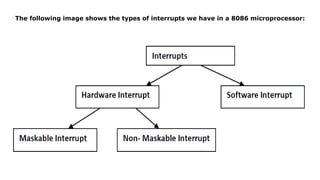
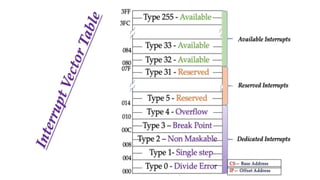
The following image shows the types of interrupts we have in a 8086 microprocessor:
INT- Interrupt instruction with type number
It is 2-byte instruction. First byte provides the op-code and the second byte
provides the interrupt type number. There are 256 interrupt types under this
group.
Its execution includes the following steps:
• Flag register value is pushed on to the stack.
• CS value of the return address and IP value of the return address are
pushed on to the stack.
• IP is loaded from the contents of the word location ‘type number’ x 4
• CS is loaded from the contents of the next word location.
The starting address for type0 interrupt is 000000H, for type1 interrupt is 00004H similarly
for type2 is 00008H and ……so on. The first five pointers are dedicated interrupt pointers.
i.e.:
• TYPE 0 interrupt represents division by zero situation.
• TYPE 1 interrupt represents single-step execution during the debugging of a program.
• TYPE 2 interrupt represents non-maskable NMI interrupt.
• TYPE 3 interrupt represents break-point interrupt.
• TYPE 4 interrupt represents overflow interrupt.
The interrupts from Type 5 to Type 31 are reserved for other advanced microprocessors, and
interrupts from 32 to Type 255 are available for hardware and software interrupts.
INT 3-Break Point Interrupt Instruction
It is a 1-byte instruction having op-code is CCH. These instructions are
inserted into the program so that when the processor reaches there,
then it stops the normal execution of program and follows the break-
point procedure.
Its execution includes the following steps:
• Flag register value is pushed on to the stack.
• CS value of the return address and IP value of the return address are
pushed on to the stack.
• IP is loaded from the contents of the word location 3x4 = 0000CH
• CS is loaded from the contents of the next word location.
• Interrupt Flag and Trap Flag are reset to 0
Hardware Interrupts
Hardware interrupt is caused by any peripheral device by sending a signal
through a specified pin to the microprocessor.
The 8086 has two hardware interrupt pins, i.e. NMI and INTR. NMI is a non-
maskable interrupt and INTR is a maskable interrupt having lower priority.
One more interrupt pin associated is INTA called interrupt acknowledge.
NMI
It is a single non-maskable interrupt pin (NMI) having higher priority than
the maskable interrupt request pin (INTR)and it is of type 2 interrupt.
When this interrupt is activated, these actions take place:
• Completes the current instruction that is in progress.
• Pushes the Flag register values on to the stack.
• Pushes the CS (code segment) value and IP (instruction pointer) value of
the return address on to the stack.
• IP is loaded from the contents of the word location 00008H.
• CS is loaded from the contents of the next word location 0000AH.
• Interrupt flag and trap flag are reset to 0.
INTR
 The INTR is a maskable interrupt because the microprocessor will be
interrupted only if interrupts are enabled using set interrupt flag instruction. It
should not be enabled using clear interrupt Flag instruction.
 The INTR interrupt is activated by an I/O port. If the interrupt is enabled and
NMI is disabled, then the microprocessor first completes the current execution
and sends ‘0’ on INTA pin twice.
 The first ‘0’ means INTA informs the external device to get ready and during
the second ‘0’ the microprocessor receives the 8 bit, say X, from the
programmable interrupt controller.
These actions are taken by the microprocessor:
 First completes the current instruction.
 Activates INTA output and receives the interrupt type, say X.
 Flag register value, CS value of the return address and IP value of the
return address are pushed on to the stack.
 IP value is loaded from the contents of word location X x 4
 CS is loaded from the contents of the next word location.
 Interrupt flag and trap flag is reset to 0
Software Interrupts
Some instructions are inserted at the desired position into the program to create
interrupts. These interrupt instructions can be used to test the working of various
interrupt handlers. It includes:
INTO - Interrupt on overflow instruction
It is a 1-byte instruction and their mnemonic INTO. The op-code for this instruction
is CEH. As the name suggests it is a conditional interrupt instruction, i.e. it is
active only when the overflow flag is set to 1 and branches to the interrupt
handler whose interrupt type number is 4. If the overflow flag is reset then, the
execution continues to the next instruction.
Its execution includes the following steps:
• Flag register values are pushed on to the stack.
• CS value of the return address and IP value of the return address are pushed on
to the stack.
• IP is loaded from the contents of word location 4x4 = 00010H
• CS is loaded from the contents of the next word location.
• Interrupt flag and Trap flag are reset to 0

8086 Microprocessor Interrupts - UG Final Sem.pptx

  • 1.
    8086 − Interrupts Interruptis the method of creating a temporary halt during program execution and allows peripheral devices to access the microprocessor. The microprocessor responds to that interrupt with an ISR (Interrupt Service Routine), which is a short program to instruct the microprocessor on how to handle the interrupt.
  • 2.
    Interrupt Instructions These instructionsare used to call the interrupt during program execution. • INT: Used to interrupt the program during execution and calling service specified. • INTO: Used to interrupt the program during execution if OF=1 • IRET: Used to return from interrupt service to the main program
  • 3.
    The following imageshows the types of interrupts we have in a 8086 microprocessor:
  • 4.
    INT- Interrupt instructionwith type number It is 2-byte instruction. First byte provides the op-code and the second byte provides the interrupt type number. There are 256 interrupt types under this group. Its execution includes the following steps: • Flag register value is pushed on to the stack. • CS value of the return address and IP value of the return address are pushed on to the stack. • IP is loaded from the contents of the word location ‘type number’ x 4 • CS is loaded from the contents of the next word location.
  • 5.
    The starting addressfor type0 interrupt is 000000H, for type1 interrupt is 00004H similarly for type2 is 00008H and ……so on. The first five pointers are dedicated interrupt pointers. i.e.: • TYPE 0 interrupt represents division by zero situation. • TYPE 1 interrupt represents single-step execution during the debugging of a program. • TYPE 2 interrupt represents non-maskable NMI interrupt. • TYPE 3 interrupt represents break-point interrupt. • TYPE 4 interrupt represents overflow interrupt. The interrupts from Type 5 to Type 31 are reserved for other advanced microprocessors, and interrupts from 32 to Type 255 are available for hardware and software interrupts.
  • 6.
    INT 3-Break PointInterrupt Instruction It is a 1-byte instruction having op-code is CCH. These instructions are inserted into the program so that when the processor reaches there, then it stops the normal execution of program and follows the break- point procedure. Its execution includes the following steps: • Flag register value is pushed on to the stack. • CS value of the return address and IP value of the return address are pushed on to the stack. • IP is loaded from the contents of the word location 3x4 = 0000CH • CS is loaded from the contents of the next word location. • Interrupt Flag and Trap Flag are reset to 0
  • 7.
    Hardware Interrupts Hardware interruptis caused by any peripheral device by sending a signal through a specified pin to the microprocessor. The 8086 has two hardware interrupt pins, i.e. NMI and INTR. NMI is a non- maskable interrupt and INTR is a maskable interrupt having lower priority. One more interrupt pin associated is INTA called interrupt acknowledge. NMI It is a single non-maskable interrupt pin (NMI) having higher priority than the maskable interrupt request pin (INTR)and it is of type 2 interrupt. When this interrupt is activated, these actions take place: • Completes the current instruction that is in progress. • Pushes the Flag register values on to the stack. • Pushes the CS (code segment) value and IP (instruction pointer) value of the return address on to the stack. • IP is loaded from the contents of the word location 00008H. • CS is loaded from the contents of the next word location 0000AH. • Interrupt flag and trap flag are reset to 0.
  • 8.
    INTR  The INTRis a maskable interrupt because the microprocessor will be interrupted only if interrupts are enabled using set interrupt flag instruction. It should not be enabled using clear interrupt Flag instruction.  The INTR interrupt is activated by an I/O port. If the interrupt is enabled and NMI is disabled, then the microprocessor first completes the current execution and sends ‘0’ on INTA pin twice.  The first ‘0’ means INTA informs the external device to get ready and during the second ‘0’ the microprocessor receives the 8 bit, say X, from the programmable interrupt controller.
  • 9.
    These actions aretaken by the microprocessor:  First completes the current instruction.  Activates INTA output and receives the interrupt type, say X.  Flag register value, CS value of the return address and IP value of the return address are pushed on to the stack.  IP value is loaded from the contents of word location X x 4  CS is loaded from the contents of the next word location.  Interrupt flag and trap flag is reset to 0
  • 11.
    Software Interrupts Some instructionsare inserted at the desired position into the program to create interrupts. These interrupt instructions can be used to test the working of various interrupt handlers. It includes: INTO - Interrupt on overflow instruction It is a 1-byte instruction and their mnemonic INTO. The op-code for this instruction is CEH. As the name suggests it is a conditional interrupt instruction, i.e. it is active only when the overflow flag is set to 1 and branches to the interrupt handler whose interrupt type number is 4. If the overflow flag is reset then, the execution continues to the next instruction. Its execution includes the following steps: • Flag register values are pushed on to the stack. • CS value of the return address and IP value of the return address are pushed on to the stack. • IP is loaded from the contents of word location 4x4 = 00010H • CS is loaded from the contents of the next word location. • Interrupt flag and Trap flag are reset to 0