1944-3994/1944-3986 © 2017 Desalination Publications. All rights reserved.
Desalination and Water Treatment
www.deswater.com
doi: 10.5004/dwt.2017.20583
80 (2017) 27–40
June
* Corresponding author.
Optimization on performance of single-slope solar still linked solar
pond via Taguchi method
S. Joe Patrick Gnanaraj, S. Ramachandran*
Department of Mechanical Engineering, Sathyabama University, Chennai, Tamilnadu, India,
emails: aishram2006@gmail.com (S. Ramachandran), gnanaraj.134@gmail.com (S.J.P. Gnanaraj)
Received 5 September 2016; Accepted 6 February 2017
a b s t r ac t
The efficiency of the solar still is below optimum. To increase the efficiency and to reach the
optimum performance many modifications and improvements in the solar stills were attempted.
In this research work, a mini solar pond was linked with the solar still. Further with the help of
mirrors, solar radiations were reflected into the solar pond and solar still. Four parameters that
were influencing the performance of the solar still and their levels were identified. They were:
parameter I – sodium chloride concentration level (1.5, 2.5 and 3.5 kg), parameter II – mini solar
pond zone (lower converting zone (LCZ), middle converting zone and upper converting zone),
parameter III – angle of the reflecting mirror at the bottom of the still (–15°, 0° and 15°) and param-
eter IV – angle of the mirror fitted in the pond (90°, 113° and 135°). Taguchi method was used to
select the best performing levels. S/N ratios and mean performance of the different levels indicated
that level 3 of parameter I, level 1 of parameter II, level 2 of parameter III and level 3 of parameter
IV were the best performing levels. The regression analysis also confirmed that the above levels of
the four parameters had positive regression coefficient. So optimum distillate yield can be obtained
when the sodium chloride concentration level was 3.5 kg, the solar still was linked with LCZ of the
pond, the reflecting angle at the bottom of the still was kept at 0° and the mirror at the pond at 135°.
Combining the above selected levels of the four parameters, the experiment was conducted, and the
distillate output obtained was 3.26 L/d. It was 95.54% higher than the yield of the conventional still.
The theoretical values were compared with the experimental results, and there was good agreement
between the two.
Keywords: Desalination; Reflecting mirror; Solar pond; Solar still; Taguchi method
1. Introduction
The scarcity for potable drinking water has increased
worldwide due to the huge increase in industries and pop-
ulation. Desalination is a process to convert saline water into
drinking water. One of the methods of performing desalina-
tion is by using solar stills.
The performance of solar still mainly depends on the
intensity of solar radiation. Internal modifications are made
in the solar still to absorb more heat energy from solar
radiation. To enhance the performance of solar still, heat
energy can be supplied from some external source also.
The unutilized heat energy emitted by the industries in the
atmosphere can be channelized for this purpose. But their
availability is limited and location specific. On the other
hand, solar pond can be fabricated at any place and the heat
energy stored in the pond can be used to enhance the distil-
lation in the solar still. Further with the help of mirrors, solar
rays can be focused into the pond and still to improve their
performance.
The distillate yield of a solar still is influenced by ambi-
ent temperature, insulation, velocity of the wind, dust and
cloud ambient condition, basin water depth, concentration of
salt in the water, inlet temperature of water, water and glass
temperature difference, water free surface area, absorber flat
S.J.P. Gnanaraj, S. Ramachandran / Desalination and Water Treatment 80 (2017) 27–4028
area and glass angle. The solar intensity, velocity of wind,
ambient temperature dust and cloud ambient condition are
metrological parameters, and they cannot be controlled. The
other factors can be varied to optimize the performance of
the still.
The parameters we choose to optimize the performance
of the still will perform differently at different levels. The
success of solar distillation depends on the selection of the
best performing level in each parameter. Taguchi method
helps to identify the best performing levels of the parameters
we choose to optimize the performance of the still.
The objective of this study was to optimize the perfor-
mance of the solar pond linked solar still assisted by mirrors
at the top of the pond and at the bottom of the still. With
the help of Taguchi method the best performing levels of
the parameters that influence the performance of the still
were identified. By combining the best performing levels,
the experiment was conducted, and the experimental results
were compared with the theoretical values.
The factorial experimentation is very useful in research
work. It is based on strong and sound statistical foundation.
But this technique becomes unmanageable in the industrial
contexts. With increase in the number of factors and the lev-
els, the number of experiment would be large. To solve this
issue, statisticians have developed factorial replicate designs
(fractional factorial designs). But this requires good statistical
knowledge on the part of experimenter, and it is subject to
some constrains that limit the applicability.
Dr. Genichi Taguchi, a Japanese scientist contributed sig-
nificantly to the field of quality engineering. According to
him the product design should be such that the performance
is insensitive to uncontrollable (noise) factors. The orthog-
onal arrays (OAs) are suggested by Taguchi for designing
the experiments. The main advantage of these designs lies
in their simplicity and easy adaptability to complex experi-
ments involving number of factors with numbers of levels.
The desired information can be obtained with minimum
number of trails.
El-Sebaii et al. [1] integrated a single-slope single-basin
solar still with a shallow solar pond, and the productiv-
ity was increased by 52.36%. Appadurai and Velmurugan
[2] integrated a fin type solar pond with a fin type solar
still, and the distillate output was increased by 50%.
Malaiyappan and Elumalai [3] used a semipermeable
membrane, and a solar pond to enhance the productivity
of a single-slope single-basin solar still. Velmurugan and
Srithar [4] concluded that the average distillate productiv-
ity of a mini solar pond integrated solar still with sponge
was 57.8% more than the productivity of ordinary still. It
was found that the optimum value of salt concentration in
mini solar pond is 80 g/kg. Velmurugan et al. [5] evaporated
industrial effluent with the help of a fin type single-basin
solar still and a stepped solar still and integrated mini solar
pond with these stills. When mini solar pond, pebbles,
sponges and fins were used in stepped solar still, maxi-
mum productivity was achieved. Velmurugan and Srithar
[6] concluded that mini solar pond increased the produc-
tivity of a solar still by around 59%. Tamini [7] modified
the solar still with internal and external reflecting mirrors,
and the efficiency was increased by 20%–30%. Al-Hayek
and Badran [8] compared single-slope solar still, fitted with
reflecting mirror and double slope solar still without any
modifications. The single-slope still with modification was
20% more efficient. El-Swify and Metias [9] fabricated two
solar stills of the same dimensions – one was conventional
type which produced an efficiency of 22%, the second one
was modified by adding reflecting mirror which resulted in
an efficiency of 83%. Prakash and Velmurugan [10] modi-
fied the solar still by fitting two reflecting mirrors. The effi-
ciency was 29.2% with reflectors alone, the efficiency was
38.68% with combination of reflectors and gravel, and the
efficiency was 41.6% with combination of reflectors and
pebbles. Tanaka [11] used internal and external reflectors
in basin type solar still, and productivity was increased by
70%–100% on winter days. Omara et al. [12] used internal
and external mirror in a stepped still, and the performance
of the modified stepped solar still was compared with the
conventional still. The performance of the modified stepped
still increased approximately by 125%. Abdallah et al. [13]
modified the conventional solar still by installing reflecting
mirrors on all internal sides. The flat basin was replaced
by a stepwise basin, and the performance was enhanced
up to 180%. Omara et al. [14] fixed mirrors in the vertical
side of the steps of a stepped solar still, and the productiv-
ity of the modified stepped solar still was higher than the
conventional still approximately by 75%. Tanaka [15] found
that the productivity of the solar still could be enhanced
throughout the year by changing the angle of the external
reflectors. Gupta and Singh [16] used Taguchi and ANOVA
method to investigate the effect of process parameters on
productivity. Water temperature and salt concentration
were significant parameters influencing the productivity.
Singh and Francis [17] used Taguchi technique to find out
the effect of temperature and inclination angle on the per-
formance of the solar still. Both inclination angle and water
temperature were found to be significant factors. Verma et
al. [18] employed Taguchi method to establish the optimal
set of parameters for passive slope solar still. The experi-
ment concluded that water temperature and glass tempera-
ture were important for optimizing the production. Refalo
et al. [19] integrated the solar chimney and condenser with
the solar still, and the distillate output was increased from
4.7 to 5.11 L/m2
d. Tanaka [20] concluded that the daily
amount of distillate produced by a tilted wick solar still
could be increased by using a flat plate bottom reflector.
Alaudeen et al. [21] tested a single-slope solar still of glass
basin with different heat storage materials in it. The per-
centage increase in output when corrugated sheet was used
as basin material was nearly 34% higher than the conven-
tional still. Maiti et al. [22] fitted a stepped solar still with
north south reflectors in V-trough assembly and achieved
twofold increase in distilled water production from concen-
trated seawater. Boodhan and Haraksingh [23] fabricated
a cascade type solar still and studied the effect of different
glass cover thickness and different solar still orientations
on productivity. A 4.76-mm thick glass cover facing south
produced the highest yield. Arjunan et al. [24] attempted
to increase the productivity of a solar still by increasing
temperature difference between water and glass. They used
sponge liners at the inner wall surface. The optimum thick-
ness of the sponge liner was 5 mm, and the yield was 35.2%
higher than the conventional still.
29S.J.P. Gnanaraj, S. Ramachandran / Desalination and Water Treatment 80 (2017) 27–40
2. Experimental setup
For conducting the experiment, a single-slope solar
still was fabricated. The dimension of the solar still was
0.9 m × 0.7 m × 0.4 m, and it was fabricated using galvanized
iron. The solar still was placed inside the wooden box, and
gap between the solar still and wooden box was filled by
heat resistant materials. The top of the solar still was cov-
ered by 4 mm thick glass, and it was placed at an angle of
11°. Proper arrangements were also made for collecting
distilled water.
Adjacenttothesolarstill,aminisolarpondwasconstructed.
Upper dimension of the solar pond was 45 cm × 45 cm. The
lower dimension of the pond was 30 cm × 30 cm. The height
was 150 cm. Sodium chloride mixed water was poured into
the solar pond. Arrangements were made for connecting the
solar still with mini solar pond at three different levels. For
this purpose copper heat pipe was used. It was linked at 25 cm
(lower converting zone [LCZ]), 75 cm (middle converting zone
[MCZ]) and 125 (upper converting zone [UCZ]). Sodium chlo-
ride concentration in the water was varied, and the experiment
was conducted at 1.5, 2.5 and 3.5 kg levels. A reflecting mirror
was placed below the solar still to focus solar radiation into
the basin. The angle of the mirror was adjusted at three levels:
–15°, 0°and 15°. Another reflecting mirror was fitted at the top
of the solar pond. The angle of the mirror was adjusted at three
levels: 90°, 113° and 135°. The experimental setups used in the
experiment are given in Figs. 1–5.
The experiment was conducted at Villianur, Pondicherry,
India (11.9310° N, 79.7852° E). At 8.00 a.m. 6 L of water was
poured into the solar still. As per the OA, the experiments
were conducted. The distilled water collected was measured
at 6.00 p.m., and it was recorded for further analysis.
3. Theoretical analysis
Daily efficiency of the solar still and the temperature of
pond at various zones are calculated theoretically.
3.1. Energy balance equations for single-basin solar still
The energy balance equations for the basin plate, water
mass and glass cover of the single-basin solar still can be
written as follows.
3.1.1. For basin plate
The solar energy received by the basin plate (Ab
×ABb
× Hs
)
is equal to the summation of the energy gained by the basin
plate m c
T
b pb
b
× ×












d
dt
, side losses (Qloss
) and energy lost by con-
vective heat transfer between the basin and water (Qc,b–w
) [4,5].
A AB H m c
dT
Q Qb b s b pb
b
c b w
× ×( ) = × ×





 + + −
dt loss ,
(1)
Fig. 1. Schematic diagram of the experimental setup.
(a)
(b)
Fig. 2. (a) Solar still and (b) mini solar pond.
Fig. 3. Integration of solar still and solar pond at UCZ.
S.J.P. Gnanaraj, S. Ramachandran / Desalination and Water Treatment 80 (2017) 27–4030
3.1.2. For water mass
The summation of the solar energy received by the
water in the basin (Aw
× ABw
× Hs
), convective (Qc,b–w
), radi-
ative (Qr,b–w
) heat transfer between basin and water is equal
to the summation of energy lost by convective heat trans-
fer between water and glass (Qc,w–g
), radiative heat transfer
between water and glass (Qr,w–g
), evaporative heat transfer
(Qe,w–g
) between water and glass and energy gained by the
saline water ( m c
dT
w pw
w
× ×






dt
) [4,5].
A H Q Q
m c
T
dt
Q Q=
w w s c b w r b w
w pw
w
c w g r w g
× ×( )+ +
× ×





 + +
− −
− −
AB
d
, ,
, ,
++ −
Qe w g,
(2)
3.1.3. For glass cover
The summation of solar energy gained by the glass
cover from sun (Ag
× ABg
× Hs
), convective (Qc,w–g
), evapora-
tive (Qe,w–g
) and radiative (Qr,w–g
) heat transfer from water to
glass is equal to the summation of energy lost by radiative
heat transfer between glass and sky (Qr,g–sky
), convective heat
transfer between glass and sky (Qc,g–sky
), evaporative heat
transfer between glass and sky (Qe,g–sky
) and energy gained by
glass m c
T
tg pg
g
× ×
















d
d
[4,5].
( ) , , ,
,
A H Q Q Q
m c
T
t
Q=
g g s c w g e w g r w g
g pg
g
c g
× × + + +
× ×








+
− − −
AB
d
d −− − −
+ +sky sky sky
Q Qr g e g, ,
(3)
3.2. Calculation of absorption values (AB)
The absorption value for glass cover can be written as:
ABg
= −α ρg g
(1 ) 
(4)
The absorption value for water mass can be written as:
AB ABw w g g
= −α ρ( )1− 
(5)
The absorption value for basin plate can be written as:
AB AB ABb g wg g
= α ρ( )1− − −  (6)
Initially the water temperature, basin temperature and
upper, lower glass temperature are taken as ambient tem-
perature. The change in water temperature (dtw
), basin tem-
perature (dtb
) and glass temperature (dtg
) are noted.
For next time, the parameters are redefined as:
T = T + Tw w w
d (7)
T = T Tg g g
+ d (8)
T = T Tb b b
+ d 
(9)
These values are substituted in Eqs. (1)–(3). By using the
MATLAB program, the corresponding equations are solved.
The transient energy gained by the single-basin solar
still = the energy rise from direct heating of sun + the energy
received from pond.
3.3. Calculation of productivity
m
Q T T
he
e w g w g
fg
=
× −−,
( )
(10)
The total day production of single-basin solar still is
given by:
M me e
= ∑8
18
3.4. Daily efficiency
The daily efficiency of the single-basin still is expressed as:
η
∆ ∑
=
× ×
×
M h
A T H
e fg
b s
100 (11)
The different parameters used in the above equations
(Eqs. (1)–(11)) are calculated using the formulas given in
Fig. 4. Integration of solar still and solar pond at MCZ.
Fig. 5. Integration of solar still and solar pond at LCZ.
31S.J.P. Gnanaraj, S. Ramachandran / Desalination and Water Treatment 80 (2017) 27–40
Appendix 1. Also the various thermophysical values used for
calculation purpose are shown in Table 1.
4. Design of experiment
Four variables (parameters) that were influencing the
performance of the solar still were selected. Further three
levels of the parameters were identified. The four parameters
and three levels that were taken up for study in the experi-
ment are given in Table 2.
For the present study, we have chosen four parameters
only. Besides these four parameters, there are many other
parameters too that play a crucial role in the process of opti-
mization. But, we vary only the selected four parameters and
keep all other parameters constant.
5. Results and discussion
To determine the best performing levels of the four
parameters at three levels L27
34
OA was selected. Six liters
of water was poured into the solar still. The experiment was
conducted as per the OA selected. The distillate yield of the
experiments was observed and recorded. The OA and results
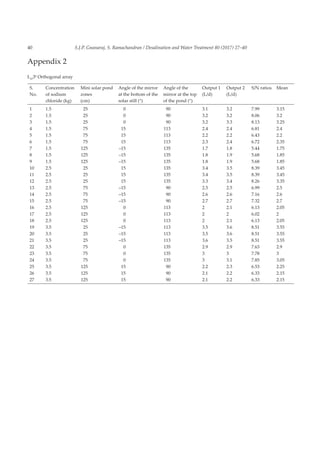
are given in Appendix 2.
5.1. S/N ratios
S/N ratio was calculated for the result of the experiment.
Our objective was to maximize the performance of the solar
still. So, larger the best method was used. For the calculation
of S/N ratio the following formula was used:
S N i
n
/ = −





=∑10
1 1
0 2
log
n y
where Y is the value of output and n is the number of outputs
(n = 2).
S/N ratios for different levels of parameters are given in
Table 3. S/N ratios reveal the contribution of parameters at
different levels to the performances of solar still. The follow-
ing levels of the selected parameters are recommended and
they are shown in Table 4.
If we combine level 3 of parameter I, level 1 of parameter
II, level 2 of parameter III and level 3 of parameter IV, the
performance is optimum. Among the four parameters, the
parameter II (solar pond zone) was considered to be the most
significant contributor to the performance of the solar still.
The next important significant contributor was parameter I
(concentration of sodium chloride). Parameter III (angle of
the mirror at the bottom of the still) was the third contributor.
The fourth contributor was parameter IV (angle of the mirror
at the top of the pond).
5.2. Mean performance of parameters
Mean performance of parameters at different levels is
given in Table 5.
Level 1 of parameter II (mini solar pond zones) was the
significant contributor. The next significant contributor was
level 3 of parameter I (concentration of sodium chloride).
Level 2 of parameter III (angle of the mirror at the bottom of
the still) and level 3 of parameter IV (angle of the mirror at
the top of the pond) occupied the fourth and third place. The
best performing levels of parameters and their mean perfor-
mance levels are given in Table 6.
The mean values for level 3 of parameter I, level 1 of
parameter II, level 2 of parameter III and level 3 of parameter
IV are the highest. So a combination of these levels yields the
best performance.
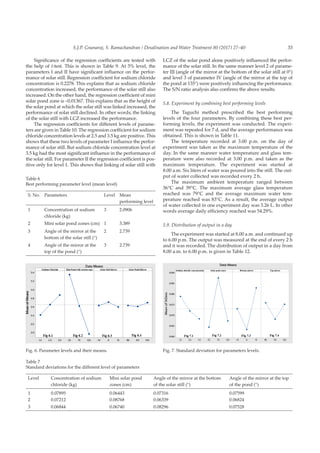
5.3. Graphical representation of mean effect
The mean effect of the four parameters is depicted in
Fig. 6.
Fig. 6.1 explains that as the sodium chloride concen-
tration increased, the performance was also increased. In
Fig. 6.2, it is explained that the performance of the solar still
Table 1
Parameters used for theoretical study
S. No. Various parameter used Values
1 Mass of basin (mb
) 9 kg
2 Mass of water (mw
) 6 kg
3 Mass of glass (mg
) 7 kg
4 Area of water (Aw
) 0.63 m2
5 Area of basin (Ab
) 0.63 m2
6 Area of glass (Ag
) 0.96 m2
7 Absorptivity of basin (αb
) 0.97
8 Absorptivity of water (αw
) 0.04
9 Absorptivity of glass (αg
) 0.047
10 Reflectivity of the glass (ρg
) 0.09
11 Specific heat of basin (Cpb
) 471 J/kg °C
12 Specific heat of glass (Cpg
) 799 J/kg °C
13 Heat loss coefficient from basin to
ambient (Ub
)
14 W/m2
K
14 Convective heat transfer between
basin and water
131 W/m2
K
15 Convective heat transfer between glass
and water
96 W/m2
K
Table 2
Parameters and their levels
S. No. Parameters Level 1 Level 2 Level 3
1 Concentration of sodium
chloride (kg)
1.5 2.5 3.5
2 Mini solar pond zones
(cm)
25
(LCZ)
75
(MCZ)
125
(UCZ)
3 Angle of the mirror at the
bottom of the solar still (°)
–15° 0° 15°
4 Angle of the mirror at the
top of the pond (°)
90° 113° 135°
S.J.P. Gnanaraj, S. Ramachandran / Desalination and Water Treatment 80 (2017) 27–4032
was the best when it was linked with LCZ. Fig. 6.3 shows that
as the angle of mirror at the bottom of the still increased from
–15° to 0°the performance also improved. Further increase in
the angle decreased the performance. Fig. 6.4 explains that
when the mirror was placed at 135° above the solar pond, the
performance was high.
5.4. Variation in the performance
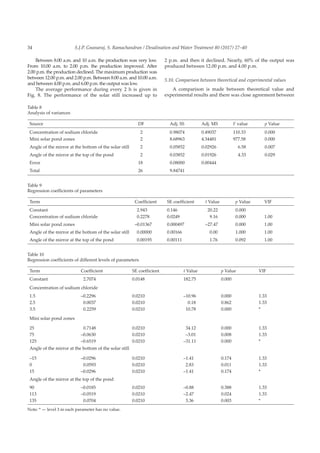
The standard deviation (SD) explains the consistency in
the performance of the parameters. The SDs of the perfor-
mance of the parameters are given in Table 7.
The SDs for level 3 of parameter I, level 1 of parameter
II, level 2 of parameter III and level 2 of parameter IV are
the lowest. The SD for the best performing levels of the four
parameters are low. This explains the consistency in the per-
formance of the best performing levels. The same phenome-
non is explained in Fig. 7.
5.5. Analysis using ANOVA
The experimental results were also analyzed using
ANOVA technique. They are given in Table 8.
H0
is the selected four parameters that have no significant
influence in the performance of solar still.
The calculated F values are compared with the p value.
This shows that the two parameters (concentration of sodium
chloride and solar pond zones) significantly contributed to
the performance of the solar still. The S/N ratio analysis also
confirms this result. The other two parameters, i.e., angle of
the mirror at the bottom of the still and angle of the mirror
at the top of the pond are the third and fourth significant
contributors.
5.6. Regression analysis
Regression analysis explains the nature of relationship
between independent variables (X) and dependent variable
(Y). In this experiment, the concentration of sodium chloride
(X1
), mini solar pond zones (X2
), angle of the mirror at the
bottom of the solar still (X3
) and angle of the mirror at the
top of the pond (X4
) were taken as independent variables and
performance of the solar still (Y) was taken as the dependent
variable. The following regression equation explains the
mathematical relationship between the variables.
5.7. Regression equation
Y = 2.943 + 0.2278X1
– 0.01367X2
+ 0.00000X3
+ 0.00195X4
where X1
is the concentration of sodium chloride, X2
is the mini
solar pond zones, X3
is the angle of the mirror at the bottom of the
solar still and X4
is the angle of the mirror at the top of the pond.
Table 3
S/N ratios for the different level of parameters
S. No. Concentration of sodium
chloride (kg)
Mini solar pond zones
(cm)
Angle of the mirror at the
bottom of the solar still (°)
Angle of the mirror at the top
of the pond (°)
1 7.514 10.589 8.152 8.385
2 8.370 8.350 8.581 8.146
3 9.086 6.031 8.238 8.440
Delta 1.572 4.558 0.429 0.295
Rank 2 1 4 3
Table 4
Best performing parameter level
S. No. Parameters Best performing level
1 Concentration of sodium chloride (kg) 3 – (3.5 kg)
2 Mini solar pond zones (cm) 1 – (25 cm)
3 Angle of the mirror at the bottom of the solar still (°) 2 – (0°)
4 Angle of the mirror at the top of the pond (°) 3 – (135°)
Table 5
Means for the different level of parameters
Level Concentration of sodium
chloride (kg)
Mini solar pond
zones (cm)
Angle of the mirror at the
bottom of the solar still (°)
Angle of the mirror at the top
of the pond (°)
1 2.444 3.389 2.656 2.661
2 2.683 2.633 2.739 2.633
3 2.906 2.011 2.639 2.739
Delta 0.461 1.378 0.100 0.106
Rank 2 1 4 3
33S.J.P. Gnanaraj, S. Ramachandran / Desalination and Water Treatment 80 (2017) 27–40
Significance of the regression coefficients are tested with
the help of t-test. This is shown in Table 9. At 5% level, the
parameters I and II have significant influence on the perfor-
mance of solar still. Regression coefficient for sodium chloride
concentration is 0.2278. This explains that as sodium chloride
concentration increased, the performance of the solar still also
increased. On the other hand, the regression coefficient of mini
solar pond zone is –0.01367. This explains that as the height of
the solar pond at which the solar still was linked increased, the
performance of solar still declined. In other words, the linking
of the solar still with LCZ increased the performance.
The regression coefficients for different levels of parame-
ters are given in Table 10. The regression coefficient for sodium
chloride concentration levels at 2.5 and 3.5 kg are positive. This
shows that these two levels of parameter I influence the perfor-
mance of solar still. But sodium chloride concentration level at
3.5 kg had the most significant influence in the performance of
the solar still. For parameter II the regression coefficient is pos-
itive only for level 1. This shows that linking of solar still with
LCZ of the solar pond alone positively influenced the perfor-
mance of the solar still. In the same manner level 2 of parame-
ter III (angle of the mirror at the bottom of the solar still at 0°)
and level 3 of parameter IV (angle of the mirror at the top of
the pond at 135°) were positively influencing the performance.
The S/N ratio analysis also confirms the above results.
5.8. Experiment by combining best performing levels
The Taguchi method prescribed the best performing
levels of the four parameters. By combining these best per-
forming levels, the experiment was conducted. The experi-
ment was repeated for 7 d, and the average performance was
obtained. This is shown in Table 11.
The temperature recorded at 3.00 p.m. on the day of
experiment was taken as the maximum temperature of the
day. In the same manner water temperature and glass tem-
perature were also recorded at 3.00 p.m. and taken as the
maximum temperature. The experiment was started at
8.00 a.m. Six liters of water was poured into the still. The out-
put of water collected was recorded every 2 h.
The maximum ambient temperature ranged between
36°C and 39°C. The maximum average glass temperature
reached was 79°C and the average maximum water tem-
perature reached was 83°C. As a result, the average output
of water collected in one experiment day was 3.26 L. In other
words average daily efficiency reached was 54.29%.
5.9. Distribution of output in a day
The experiment was started at 8.00 a.m. and continued up
to 6.00 p.m. The output was measured at the end of every 2 h
and it was recorded. The distribution of output in a day from
8.00 a.m. to 6.00 p.m. is given in Table 12.
Fig. 6. Parameter levels and their means.
Table 7
Standard deviations for the different level of parameters
Level Concentration of sodium
chloride (kg)
Mini solar pond
zones (cm)
Angle of the mirror at the bottom
of the solar still (°)
Angle of the mirror at the top
of the pond (°)
1 0.07895 0.06443 0.07316 0.07599
2 0.07212 0.08768 0.06339 0.06824
3 0.06844 0.06740 0.08296 0.07528
Fig. 7. Standard deviation for parameters levels.
Table 6
Best performing parameter level (mean level)
S. No. Parameters Level Mean
performing level
1 Concentration of sodium
chloride (kg)
3 2.0906
2 Mini solar pond zones (cm) 1 3.389
3 Angle of the mirror at the
bottom of the solar still (°)
2 2.739
4 Angle of the mirror at the
top of the pond (°)
3 2.739
S.J.P. Gnanaraj, S. Ramachandran / Desalination and Water Treatment 80 (2017) 27–4034
Between 8.00 a.m. and 10 a.m. the production was very low.
From 10.00 a.m. to 2.00 p.m. the production improved. After
2.00 p.m. the production declined. The maximum production was
between 12.00 p.m. and 2.00 p.m. Between 8.00 a.m. and 10.00 a.m.
and between 4.00 p.m. and 6.00 p.m. the output was low.
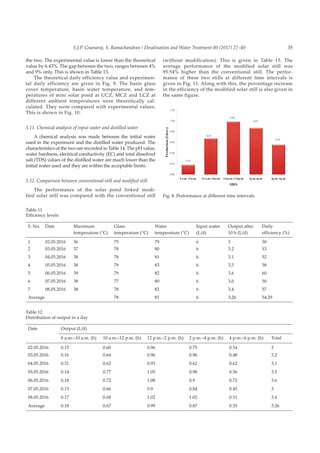
The average performance during every 2 h is given in
Fig. 8. The performance of the solar still increased up to
2 p.m. and then it declined. Nearly, 60% of the output was
produced between 12.00 p.m. and 4.00 p.m.
5.10. Comparison between theoretical and experimental values
A comparison is made between theoretical value and
experimental results and there was close agreement between
Table 8
Analysis of variances
Source DF Adj. SS Adj. MS F value p Value
Concentration of sodium chloride 2 0.98074 0.49037 110.33 0.000
Mini solar pond zones 2 8.68963 4.34481 977.58 0.000
Angle of the mirror at the bottom of the solar still 2 0.05852 0.02926 6.58 0.007
Angle of the mirror at the top of the pond 2 0.03852 0.01926 4.33 0.029
Error 18 0.08000 0.00444
Total 26 9.84741
Table 9
Regression coefficients of parameters
Term Coefficient SE coefficient t Value p Value VIF
Constant 2.943 0.146 20.22 0.000
Concentration of sodium chloride 0.2278 0.0249 9.16 0.000 1.00
Mini solar pond zones –0.01367 0.000497 –27.47 0.000 1.00
Angle of the mirror at the bottom of the solar still 0.00000 0.00166 0.00 1.000 1.00
Angle of the mirror at the top of the pond 0.00195 0.00111 1.76 0.092 1.00
Table 10
Regression coefficients of different levels of parameters
Term Coefficient SE coefficient t Value p Value VIF
Constant 2.7074 0.0148 182.75 0.000
Concentration of sodium chloride
1.5 –0.2296 0.0210 –10.96 0.000 1.33
2.5 0.0037 0.0210 0.18 0.862 1.33
3.5 0.2259 0.0210 10.78 0.000 *
Mini solar pond zones
25 0.7148 0.0210 34.12 0.000 1.33
75 –0.0630 0.0210 –3.01 0.008 1.33
125 –0.6519 0.0210 –31.11 0.000 *
Angle of the mirror at the bottom of the solar still
–15 –0.0296 0.0210 –1.41 0.174 1.33
0 0.0593 0.0210 2.83 0.011 1.33
15 –0.0296 0.0210 –1.41 0.174 *
Angle of the mirror at the top of the pond
90 –0.0185 0.0210 –0.88 0.388 1.33
113 –0.0519 0.0210 –2.47 0.024 1.33
135 0.0704 0.0210 3.36 0.003 *
Note: * — level 3 in each parameter has no value.
35S.J.P. Gnanaraj, S. Ramachandran / Desalination and Water Treatment 80 (2017) 27–40
the two. The experimental value is lower than the theoretical
value by 6.43%. The gap between the two, ranges between 4%
and 9% only. This is shown in Table 13.
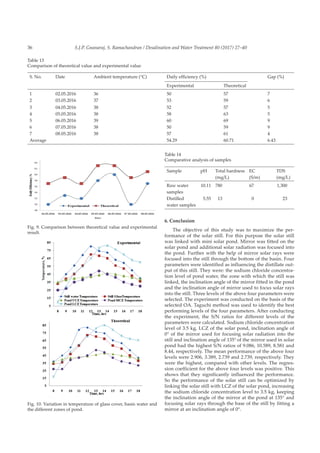
The theoretical daily efficiency value and experimen-
tal daily efficiency are given in Fig. 9. The basin glass
cover temperature, basin water temperature, and tem-
peratures of mini solar pond at UCZ, MCZ and LCZ at
different ambient temperatures were theoretically cal-
culated. They were compared with experimental values.
This is shown in Fig. 10.
5.11. Chemical analysis of input water and distilled water
A chemical analysis was made between the initial water
used in the experiment and the distilled water produced. The
characteristics of the two are recorded in Table 14. The pH value,
water hardness, electrical conductivity (EC) and total dissolved
salt (TDS) values of the distilled water are much lower than the
initial water used and they are within the acceptable limits.
5.12. Comparison between conventional still and modified still
The performance of the solar pond linked modi-
fied solar still was compared with the conventional still
(without modification). This is given in Table 15. The
average performance of the modified solar still was
95.54% higher than the conventional still. The perfor-
mance of these two stills at different time intervals is
given in Fig. 11. Along with this, the percentage increase
in the efficiency of the modified solar still is also given in
the same figure.
Table 11
Efficiency levels
S. No. Date Maximum
temperature (°C)
Glass
temperature (°C)
Water
temperature (°C)
Input water
(L/d)
Output after
10 h (L/d)
Daily
efficiency (%)
1 02.05.2016 36 75 79 6 3 50
2 03.05.2016 37 78 80 6 3.2 53
3 04.05.2016 38 78 81 6 3.1 52
4 05.05.2016 38 79 83 6 3.5 58
5 06.05.2016 39 79 82 6 3.6 60
6 07.05.2016 38 77 80 6 3.0 50
7 08.05.2016 38 78 82 6 3.4 57
Average 78 81 6 3.26 54.29
Table 12
Distribution of output in a day
Date Output (L/d)
8 a.m.–10 a.m. (h) 10 a.m.–12 p.m. (h) 12 p.m.–2 p.m. (h) 2 p.m.–4 p.m. (h) 4 p.m.–6 p.m. (h) Total
02.05.2016 0.15 0.60 0.96 0.75 0.54 3
03.05.2016 0.16 0.64 0.96 0.96 0.48 3.2
04.05.2016 0.31 0.62 0.93 0.62 0.62 3.1
05.05.2016 0.14 0.77 1.05 0.98 0.56 3.5
06.05.2016 0.18 0.72 1.08 0.9 0.72 3.6
07.05.2016 0.15 0.66 0.9 0.84 0.45 3
08.05.2016 0.17 0.68 1.02 1.02 0.51 3.4
Average 0.18 0.67 0.99 0.87 0.55 3.26
Fig. 8. Performance at different time intervals.
S.J.P. Gnanaraj, S. Ramachandran / Desalination and Water Treatment 80 (2017) 27–4036
6. Conclusion
The objective of this study was to maximize the per-
formance of the solar still. For this purpose the solar still
was linked with mini solar pond. Mirror was fitted on the
solar pond and additional solar radiation was focused into
the pond. Further with the help of mirror solar rays were
focused into the still through the bottom of the basin. Four
parameters were identified as influencing the distillate out-
put of this still. They were: the sodium chloride concentra-
tion level of pond water, the zone with which the still was
linked, the inclination angle of the mirror fitted in the pond
and the inclination angle of mirror used to focus solar rays
into the still. Three levels of the above four parameters were
selected. The experiment was conducted on the basis of the
selected OA. Taguchi method was used to identify the best
performing levels of the four parameters. After conducting
the experiment, the S/N ratios for different levels of the
parameters were calculated. Sodium chloride concentration
level of 3.5 kg, LCZ of the solar pond, inclination angle of
0° of the mirror used for focusing solar radiation into the
still and inclination angle of 135° of the mirror used in solar
pond had the highest S/N ratios of 9.086, 10.589, 8.581 and
8.44, respectively. The mean performance of the above four
levels were 2.906, 3.389, 2.739 and 2.739, respectively. They
were the highest, compared with other levels. The regres-
sion coefficient for the above four levels was positive. This
shows that they significantly influenced the performance.
So the performance of the solar still can be optimized by
linking the solar still with LCZ of the solar pond, increasing
the sodium chloride concentration level to 3.5 kg, keeping
the inclination angle of the mirror at the pond at 135° and
focusing solar rays through the base of the still by fitting a
mirror at an inclination angle of 0°.
Table 13
Comparison of theoretical value and experimental value
S. No. Date Ambient temperature (°C) Daily efficiency (%) Gap (%)
Experimental Theoretical
1 02.05.2016 36 50 57 7
2 03.05.2016 37 53 59 6
3 04.05.2016 38 52 57 5
4 05.05.2016 38 58 63 5
5 06.05.2016 39 60 69 9
6 07.05.2016 38 50 59 9
7 08.05.2016 38 57 61 4
Average 54.29 60.71 6.43
Table 14
Comparative analysis of samples
Sample pH Total hardness
(mg/L)
EC
(S/m)
TDS
(mg/L)
Raw water
samples
10.11 780 67 1,300
Distilled
water samples
5.55 13 0 23
Fig. 10. Variation in temperature of glass cover, basin water and
the different zones of pond.
Fig. 9. Comparison between theoretical value and experimental
result.
37S.J.P. Gnanaraj, S. Ramachandran / Desalination and Water Treatment 80 (2017) 27–40
By combining the best performing levels of the above
four parameters, the experiment was conducted using the
solar pond linked still. As a result the distillate output col-
lected in one experiment day was 3.26 L. The daily efficiency
achieved was 54.29%. Compared with the conventional still,
the performance was higher by 95.54%. The distillate output
was recorded for every 2 h. The distillate yield was low from
8 a.m. to 10 a.m. The maximum production was obtained
between 12 p.m. and 2 p.m. Nearly, 60% of the yield was pro-
duced between 12 p.m. and 4 p.m.
To conclude, Taguchi method is best suited to select the
best performing levels of parameters that influence distillate
output. This will enable us to attain the optimum perfor-
mance level.
Symbols
A	 —	 Area, m2
AB	 —	Absorption (with indices for different surfaces)
cp
	 —	 Specific heat capacity, J/kg °C
H	 —	 Solar intensity, W/m2
m	 —	 Mass, kg
h	 —	 Heat transfer coefficient, W/m °C
P	 —	 Partial pressure, N/m
Q	 —	 Heat transfer rate, W
T	 —	 Temperature, °C
Ub
	 —	Heat loss coefficient from basin to ambient, W/m2
°C
hfg
	 —	 Latent heat of water, J/kg K
V	 —	 Wind velocity, m/s
dT	 —	 Temperature difference, °C
dt	 —	 Differential time, s
UCZ	—	 Upper converting zone
MCZ	—	 Middle converting zone
LCZ	 —	 lower converting zone
S/N	 —	 Signal-to-noise ratio
SD	 —	 Standard deviation
Me
	 —	 Daily condensate
Kw	
—	 Thermal conductivity, W/m K
L	 —	 Length of pond, m
h(z)	 —	Solar radiation penetrating depth z in the pond
Greek
α	 —	 Absorptivity
σ	 —	Stefan–Boltzmann constant (5.6697 × 10⁻⁸
W/m2
K4
)
Δ	 —	 Difference
ε	 —	 Emissivity
ƞ	 —	 Daily productivity
Subscripts
a	 —	 Ambient air
b	 —	Basin
c	 —	Convection
e	 —	Evaporation
g	 —	Glass
loss	 —	 Side loss
r	 —	Radiation
w	 —	Water
ANOVA	—	 Analysis of variance
DF	 —	 Degrees of Freedom
SS	 —	 Sum of Squares
MS	 —	 Mean square
SE	 —	 Standard Error
VIF	 —	 Variance Inflation Factor
References
[1]	 A.A. El-Sebaii, M.R.I. Ramadan, S. Aboul-Enein, N. Salem,
Thermal performance of a single-basin solar still integrated
with a shallow solar pond, Energy Convers. Manage., 49 (2008)
2839–2848.
Fig. 11. Comparison of daily yield and productivity rise.
Table 15
Comparison between conventional and modified still
S. No. Date Ambient temperature (°C) Conventional still yield (kg) Still with pond yield (kg) Daily efficiency rise (%)
1 02.05.16 36 1.5 3 100.00
2 03.05.16 37 1.7 3.2 88.24
3 04.05.16 38 1.7 3.1 82.35
4 05.05.16 38 1.8 3.5 94.44
5 06.05.16 39 1.9 3.6 89.47
6 07.05.16 38 1.4 3 114.29
7 08.05.16 38 1.7 3.4 100.00
Average 1.9 3.26 95.54
S.J.P. Gnanaraj, S. Ramachandran / Desalination and Water Treatment 80 (2017) 27–4038
[2]	 M. Appadurai, V. Velmurugan, Performance analysis of fin type
solar still integrated with fin type mini solar pond, Sustain.
Energy Technol. Assess., 9 (2015) 30–36.
[3]	 P. Malaiyappan, N. Elumalai,Asymmetrical solar still coupled with
the mini solar pond: performance evaluation on clear, partially
cloudy and cloudy days, Appl. Mech. Mater., 787 (2015) 22–26.
[4]	 V. Velmurugan, K. Srithar, Solar stills integrated with a
mini solar pond — analytical simulation and experimental
validation, Desalination, 216 (2007) 232–241.
[5]	 V. Velmurugan, J. Mandlin, B. Stalin, K. Srithar, Augmentation
of saline streams in solar stills integrating with a mini solar
pond, Desalination, 249 (2009) 143–149.
[6]	 V. Velmurugan, K. Srithar, Prospects and scopes of solar pond:
a detailed review, Renew. Sustain. Energy Rev., 12 (2008)
2253–2263.
[7]	 A. Tamini, Performance of a solar still with reflectors and black
dye, Sol. Wind Technol., 4 (1987) 443–446.
[8]	 I. Al-Hayek, O.O. Badran, The effect of using different designs of
solar stills on water distillation, Desalination, 169 (2004) 121–127.
[9]	 M.E. El-Swify, M.Z. Metias, Performance of double exposure
solar still, Renew. Energy, 26 (2002) 531–547.
[10]	 P. Prakash, V. Velmurugan, Experimental analysis of a solar still
with reflectors and sensible heat storage mediums, Appl. Mech.
Mater., 787 (2015) 107–111.
[11]	 H. Tanaka, Experimental study of a basin type solar still with
internal and external reflectors in winter, Desalination, 249
(2009) 130–134.
[12]	 Z.M. Omara, A.E. Kabeel, M.M. Younes, Enhancing the stepped
solar still performance using internal and external reflectors,
Energy Convers. Manage., 78 (2014) 876–881.
[13]	S. Abdallah, O. Badran, M.M. Abu-Khader, Performance
evaluation of a modified design of single slope solar still,
Desalination, 219 (2008) 222–230.
[14]	 Z.M. Omara, A.E. Kabeel, M.M. Younes, Enhancing the stepped
solar still performance using internal reflectors, Desalination,
314 (2013) 67–72.
[15]	H. Tanaka, Monthly optimum inclination of glass cover and
external reflector of a basin type solar still with internal and
external reflectors, Sol. Energy, 84 (2010) 1959–1966.
[16]	P. Gupta, N. Singh, Investigation of the effect of process
parameters on the productivity of single slope solar still:
a Taguchi approach, Int. J. Curr. Eng. Technol., 4 (2015)
320–322.
[17]	N. Singh, V. Francis, Investigating the effect of water
temperature and inclination angle on the performance of single
slope solar still: a Taguchi approach, Int. J. Eng. Res. Appl., 3
(2013) 404–407.
[18]	V.K. Verma, I.S. Rout, A.K. Rai, A. Gaikwad, Optimization
of parameters affecting the performance of passive solar
distillation system by using Taguchi method, IOSR J. Mech.
Civil Eng., 7 (2013) 37–42.
[19]	 P. Refalo, R. Ghirlando, S. Abela, The use of a solar chimney and
condensers to enhance the productivity of a solar still, Desal.
Wat. Treat., 8 (2015) 1–14.
[20]	 H. Tanaka, Optimum inclination of still and bottom reflector for
tilted wick solar still with flat plate bottom reflector, Desal. Wat.
Treat., 51 (2013) 6482–6489.
[21]	A. Alaudeen, S.A. Abu Thahir, K. Vasanth, M.I.A. Tom, K.
Srithar, Experimental and theoretical analysis of solar still with
glass basin, Desal. Wat. Treat., 54 (2015) 1489–1498.
[22]	 S. Maiti, C. Bhatt, P. Patel, P.K. Ghosh, Practical and sustainable
household seawater desalination using an improved solar still,
Desal. Wat. Treat., 57 (2016) 3358–3371.
[23]	 M.K. Boodhan, I. Haraksingh, An investigation into the effect
on the productivity of cascade-type solar distillation systems
with varying cover thicknesses and still orientations under
tropical Caribbean climatic conditions, Desal. Wat. Treat., 55
(2015) 3295–3302.
[24]	 T.V. Arjunan, H.S. Aybar, N. Nedunchezhian, Effect of sponge
liner on the internal heat transfer coefficients in a simple solar
still, Desal. Wat. Treat., 29 (2011) 271–284.
39S.J.P. Gnanaraj, S. Ramachandran / Desalination and Water Treatment 80 (2017) 27–40
Appendix 1
The following equations are used for the theoretical
calculation. They are referred from references [4,5].
For single-basin still:
Q h A T Tc b w c b w b b w, ,
( )− −
= × × −
Q U A T Tb b bloss sky
= × × −( )
Q h A T Tc w g c w g w w g, ,
( )− −
= × × −
h T T
P P T
P
c w g w g
w g w
w
,
/
.
( )( )
.
−
= − +
− +
× −








0 884
273
0 2665 103
1 3
Q h A T Tr w g r w g w w g, ,
( )− −
= × × −
h
T T
T Tr w g eff
w g
w g
,
.
. ( . )
( )−
= × ×
+( ) − +
−






ε σ 0 999
273 12 273 12
4 4

Q h A T Te w g e w g w w g, ,
( )− −
= × × −
h
M h p
M c p p p p
he w g
w fg t
a pa t w t g
c w g, ,
( )( )− −
=
× ×
× − −
1
Q A T Tr g g g g,
( . ) ( . )−
= × × + − +


sky sky
ε 273 12 273 124 4
Q h A T Tc g c g g g, ,
( )− −
= × × −sky sky sky
h Vc g,
.−
= +sky
2 9 3
∈
∈ ∈
= + −








−
eff
ug
1 1
1
1
lg
T Tasky
= − 6
T
A h z H
K T
L
m c A k
L
s s
w a
p p p w
LCZ
mcz
mcz
dt
=
+












+






( )









T
A h z H
K T
L
m c A k
L
s s
w a
p p p w
MCZ
ucz
ucz
dt
=
+












+






( )









T
A h z H
K T
L
m c A k
L
s S
w a
p p p w
UCZ
upper
upper
dt
=
+














+

( )















T
h h T AB H h T
hw
c g c g w b w s c g a
c g w
=
+ − −− − −
−
( ) ( ) ( ), , ,
,
sky sky
T
H h T h T
h hg
g S c g w w c w b w
c w b c g w
=
+ +
+
− −
− −
( ) ( ( )
( )
), ,
, ,
AB
P T Tw w
= − +7235 431 45 10 76 2
. .
h Tfg W
= −( . . )2503 4 2 398 1000
S.J.P. Gnanaraj, S. Ramachandran / Desalination and Water Treatment 80 (2017) 27–4040
Appendix 2
L27
34
Orthogonal array
S.
No.
Concentration
of sodium
chloride (kg)
Mini solar pond
zones
(cm)
Angle of the mirror
at the bottom of the
solar still (°)
Angle of the
mirror at the top
of the pond (°)
Output 1
(L/d)
Output 2
(L/d)
S/N ratios Mean
1 1.5 25 0 90 3.1 3.2 7.99 3.15
2 1.5 25 0 90 3.2 3.2 8.06 3.2
3 1.5 25 0 90 3.2 3.3 8.13 3.25
4 1.5 75 15 113 2.4 2.4 6.81 2.4
5 1.5 75 15 113 2.2 2.2 6.43 2.2
6 1.5 75 15 113 2.3 2.4 6.72 2.35
7 1.5 125 –15 135 1.7 1.8 5.44 1.75
8 1.5 125 –15 135 1.8 1.9 5.68 1.85
9 1.5 125 –15 135 1.8 1.9 5.68 1.85
10 2.5 25 15 135 3.4 3.5 8.39 3.45
11 2.5 25 15 135 3.4 3.5 8.39 3.45
12 2.5 25 15 135 3.3 3.4 8.26 3.35
13 2.5 75 –15 90 2.5 2.5 6.99 2.5
14 2.5 75 –15 90 2.6 2.6 7.16 2.6
15 2.5 75 –15 90 2.7 2.7 7.32 2.7
16 2.5 125 0 113 2 2.1 6.13 2.05
17 2.5 125 0 113 2 2 6.02 2
18 2.5 125 0 113 2 2.1 6.13 2.05
19 3.5 25 –15 113 3.5 3.6 8.51 3.55
20 3.5 25 –15 113 3.5 3.6 8.51 3.55
21 3.5 25 –15 113 3.6 3.5 8.51 3.55
22 3.5 75 0 135 2.9 2.9 7.63 2.9
23 3.5 75 0 135 3 3 7.78 3
24 3.5 75 0 135 3 3.1 7.85 3.05
25 3.5 125 15 90 2.2 2.3 6.53 2.25
26 3.5 125 15 90 2.1 2.2 6.33 2.15
27 3.5 125 15 90 2.1 2.2 6.33 2.15

80 2017 27

  • 1.
    1944-3994/1944-3986 © 2017Desalination Publications. All rights reserved. Desalination and Water Treatment www.deswater.com doi: 10.5004/dwt.2017.20583 80 (2017) 27–40 June * Corresponding author. Optimization on performance of single-slope solar still linked solar pond via Taguchi method S. Joe Patrick Gnanaraj, S. Ramachandran* Department of Mechanical Engineering, Sathyabama University, Chennai, Tamilnadu, India, emails: aishram2006@gmail.com (S. Ramachandran), gnanaraj.134@gmail.com (S.J.P. Gnanaraj) Received 5 September 2016; Accepted 6 February 2017 a b s t r ac t The efficiency of the solar still is below optimum. To increase the efficiency and to reach the optimum performance many modifications and improvements in the solar stills were attempted. In this research work, a mini solar pond was linked with the solar still. Further with the help of mirrors, solar radiations were reflected into the solar pond and solar still. Four parameters that were influencing the performance of the solar still and their levels were identified. They were: parameter I – sodium chloride concentration level (1.5, 2.5 and 3.5 kg), parameter II – mini solar pond zone (lower converting zone (LCZ), middle converting zone and upper converting zone), parameter III – angle of the reflecting mirror at the bottom of the still (–15°, 0° and 15°) and param- eter IV – angle of the mirror fitted in the pond (90°, 113° and 135°). Taguchi method was used to select the best performing levels. S/N ratios and mean performance of the different levels indicated that level 3 of parameter I, level 1 of parameter II, level 2 of parameter III and level 3 of parameter IV were the best performing levels. The regression analysis also confirmed that the above levels of the four parameters had positive regression coefficient. So optimum distillate yield can be obtained when the sodium chloride concentration level was 3.5 kg, the solar still was linked with LCZ of the pond, the reflecting angle at the bottom of the still was kept at 0° and the mirror at the pond at 135°. Combining the above selected levels of the four parameters, the experiment was conducted, and the distillate output obtained was 3.26 L/d. It was 95.54% higher than the yield of the conventional still. The theoretical values were compared with the experimental results, and there was good agreement between the two. Keywords: Desalination; Reflecting mirror; Solar pond; Solar still; Taguchi method 1. Introduction The scarcity for potable drinking water has increased worldwide due to the huge increase in industries and pop- ulation. Desalination is a process to convert saline water into drinking water. One of the methods of performing desalina- tion is by using solar stills. The performance of solar still mainly depends on the intensity of solar radiation. Internal modifications are made in the solar still to absorb more heat energy from solar radiation. To enhance the performance of solar still, heat energy can be supplied from some external source also. The unutilized heat energy emitted by the industries in the atmosphere can be channelized for this purpose. But their availability is limited and location specific. On the other hand, solar pond can be fabricated at any place and the heat energy stored in the pond can be used to enhance the distil- lation in the solar still. Further with the help of mirrors, solar rays can be focused into the pond and still to improve their performance. The distillate yield of a solar still is influenced by ambi- ent temperature, insulation, velocity of the wind, dust and cloud ambient condition, basin water depth, concentration of salt in the water, inlet temperature of water, water and glass temperature difference, water free surface area, absorber flat
  • 2.
    S.J.P. Gnanaraj, S.Ramachandran / Desalination and Water Treatment 80 (2017) 27–4028 area and glass angle. The solar intensity, velocity of wind, ambient temperature dust and cloud ambient condition are metrological parameters, and they cannot be controlled. The other factors can be varied to optimize the performance of the still. The parameters we choose to optimize the performance of the still will perform differently at different levels. The success of solar distillation depends on the selection of the best performing level in each parameter. Taguchi method helps to identify the best performing levels of the parameters we choose to optimize the performance of the still. The objective of this study was to optimize the perfor- mance of the solar pond linked solar still assisted by mirrors at the top of the pond and at the bottom of the still. With the help of Taguchi method the best performing levels of the parameters that influence the performance of the still were identified. By combining the best performing levels, the experiment was conducted, and the experimental results were compared with the theoretical values. The factorial experimentation is very useful in research work. It is based on strong and sound statistical foundation. But this technique becomes unmanageable in the industrial contexts. With increase in the number of factors and the lev- els, the number of experiment would be large. To solve this issue, statisticians have developed factorial replicate designs (fractional factorial designs). But this requires good statistical knowledge on the part of experimenter, and it is subject to some constrains that limit the applicability. Dr. Genichi Taguchi, a Japanese scientist contributed sig- nificantly to the field of quality engineering. According to him the product design should be such that the performance is insensitive to uncontrollable (noise) factors. The orthog- onal arrays (OAs) are suggested by Taguchi for designing the experiments. The main advantage of these designs lies in their simplicity and easy adaptability to complex experi- ments involving number of factors with numbers of levels. The desired information can be obtained with minimum number of trails. El-Sebaii et al. [1] integrated a single-slope single-basin solar still with a shallow solar pond, and the productiv- ity was increased by 52.36%. Appadurai and Velmurugan [2] integrated a fin type solar pond with a fin type solar still, and the distillate output was increased by 50%. Malaiyappan and Elumalai [3] used a semipermeable membrane, and a solar pond to enhance the productivity of a single-slope single-basin solar still. Velmurugan and Srithar [4] concluded that the average distillate productiv- ity of a mini solar pond integrated solar still with sponge was 57.8% more than the productivity of ordinary still. It was found that the optimum value of salt concentration in mini solar pond is 80 g/kg. Velmurugan et al. [5] evaporated industrial effluent with the help of a fin type single-basin solar still and a stepped solar still and integrated mini solar pond with these stills. When mini solar pond, pebbles, sponges and fins were used in stepped solar still, maxi- mum productivity was achieved. Velmurugan and Srithar [6] concluded that mini solar pond increased the produc- tivity of a solar still by around 59%. Tamini [7] modified the solar still with internal and external reflecting mirrors, and the efficiency was increased by 20%–30%. Al-Hayek and Badran [8] compared single-slope solar still, fitted with reflecting mirror and double slope solar still without any modifications. The single-slope still with modification was 20% more efficient. El-Swify and Metias [9] fabricated two solar stills of the same dimensions – one was conventional type which produced an efficiency of 22%, the second one was modified by adding reflecting mirror which resulted in an efficiency of 83%. Prakash and Velmurugan [10] modi- fied the solar still by fitting two reflecting mirrors. The effi- ciency was 29.2% with reflectors alone, the efficiency was 38.68% with combination of reflectors and gravel, and the efficiency was 41.6% with combination of reflectors and pebbles. Tanaka [11] used internal and external reflectors in basin type solar still, and productivity was increased by 70%–100% on winter days. Omara et al. [12] used internal and external mirror in a stepped still, and the performance of the modified stepped solar still was compared with the conventional still. The performance of the modified stepped still increased approximately by 125%. Abdallah et al. [13] modified the conventional solar still by installing reflecting mirrors on all internal sides. The flat basin was replaced by a stepwise basin, and the performance was enhanced up to 180%. Omara et al. [14] fixed mirrors in the vertical side of the steps of a stepped solar still, and the productiv- ity of the modified stepped solar still was higher than the conventional still approximately by 75%. Tanaka [15] found that the productivity of the solar still could be enhanced throughout the year by changing the angle of the external reflectors. Gupta and Singh [16] used Taguchi and ANOVA method to investigate the effect of process parameters on productivity. Water temperature and salt concentration were significant parameters influencing the productivity. Singh and Francis [17] used Taguchi technique to find out the effect of temperature and inclination angle on the per- formance of the solar still. Both inclination angle and water temperature were found to be significant factors. Verma et al. [18] employed Taguchi method to establish the optimal set of parameters for passive slope solar still. The experi- ment concluded that water temperature and glass tempera- ture were important for optimizing the production. Refalo et al. [19] integrated the solar chimney and condenser with the solar still, and the distillate output was increased from 4.7 to 5.11 L/m2 d. Tanaka [20] concluded that the daily amount of distillate produced by a tilted wick solar still could be increased by using a flat plate bottom reflector. Alaudeen et al. [21] tested a single-slope solar still of glass basin with different heat storage materials in it. The per- centage increase in output when corrugated sheet was used as basin material was nearly 34% higher than the conven- tional still. Maiti et al. [22] fitted a stepped solar still with north south reflectors in V-trough assembly and achieved twofold increase in distilled water production from concen- trated seawater. Boodhan and Haraksingh [23] fabricated a cascade type solar still and studied the effect of different glass cover thickness and different solar still orientations on productivity. A 4.76-mm thick glass cover facing south produced the highest yield. Arjunan et al. [24] attempted to increase the productivity of a solar still by increasing temperature difference between water and glass. They used sponge liners at the inner wall surface. The optimum thick- ness of the sponge liner was 5 mm, and the yield was 35.2% higher than the conventional still.
  • 3.
    29S.J.P. Gnanaraj, S.Ramachandran / Desalination and Water Treatment 80 (2017) 27–40 2. Experimental setup For conducting the experiment, a single-slope solar still was fabricated. The dimension of the solar still was 0.9 m × 0.7 m × 0.4 m, and it was fabricated using galvanized iron. The solar still was placed inside the wooden box, and gap between the solar still and wooden box was filled by heat resistant materials. The top of the solar still was cov- ered by 4 mm thick glass, and it was placed at an angle of 11°. Proper arrangements were also made for collecting distilled water. Adjacenttothesolarstill,aminisolarpondwasconstructed. Upper dimension of the solar pond was 45 cm × 45 cm. The lower dimension of the pond was 30 cm × 30 cm. The height was 150 cm. Sodium chloride mixed water was poured into the solar pond. Arrangements were made for connecting the solar still with mini solar pond at three different levels. For this purpose copper heat pipe was used. It was linked at 25 cm (lower converting zone [LCZ]), 75 cm (middle converting zone [MCZ]) and 125 (upper converting zone [UCZ]). Sodium chlo- ride concentration in the water was varied, and the experiment was conducted at 1.5, 2.5 and 3.5 kg levels. A reflecting mirror was placed below the solar still to focus solar radiation into the basin. The angle of the mirror was adjusted at three levels: –15°, 0°and 15°. Another reflecting mirror was fitted at the top of the solar pond. The angle of the mirror was adjusted at three levels: 90°, 113° and 135°. The experimental setups used in the experiment are given in Figs. 1–5. The experiment was conducted at Villianur, Pondicherry, India (11.9310° N, 79.7852° E). At 8.00 a.m. 6 L of water was poured into the solar still. As per the OA, the experiments were conducted. The distilled water collected was measured at 6.00 p.m., and it was recorded for further analysis. 3. Theoretical analysis Daily efficiency of the solar still and the temperature of pond at various zones are calculated theoretically. 3.1. Energy balance equations for single-basin solar still The energy balance equations for the basin plate, water mass and glass cover of the single-basin solar still can be written as follows. 3.1.1. For basin plate The solar energy received by the basin plate (Ab ×ABb × Hs ) is equal to the summation of the energy gained by the basin plate m c T b pb b × ×             d dt , side losses (Qloss ) and energy lost by con- vective heat transfer between the basin and water (Qc,b–w ) [4,5]. A AB H m c dT Q Qb b s b pb b c b w × ×( ) = × ×       + + − dt loss , (1) Fig. 1. Schematic diagram of the experimental setup. (a) (b) Fig. 2. (a) Solar still and (b) mini solar pond. Fig. 3. Integration of solar still and solar pond at UCZ.
  • 4.
    S.J.P. Gnanaraj, S.Ramachandran / Desalination and Water Treatment 80 (2017) 27–4030 3.1.2. For water mass The summation of the solar energy received by the water in the basin (Aw × ABw × Hs ), convective (Qc,b–w ), radi- ative (Qr,b–w ) heat transfer between basin and water is equal to the summation of energy lost by convective heat trans- fer between water and glass (Qc,w–g ), radiative heat transfer between water and glass (Qr,w–g ), evaporative heat transfer (Qe,w–g ) between water and glass and energy gained by the saline water ( m c dT w pw w × ×       dt ) [4,5]. A H Q Q m c T dt Q Q= w w s c b w r b w w pw w c w g r w g × ×( )+ + × ×       + + − − − − AB d , , , , ++ − Qe w g, (2) 3.1.3. For glass cover The summation of solar energy gained by the glass cover from sun (Ag × ABg × Hs ), convective (Qc,w–g ), evapora- tive (Qe,w–g ) and radiative (Qr,w–g ) heat transfer from water to glass is equal to the summation of energy lost by radiative heat transfer between glass and sky (Qr,g–sky ), convective heat transfer between glass and sky (Qc,g–sky ), evaporative heat transfer between glass and sky (Qe,g–sky ) and energy gained by glass m c T tg pg g × ×                 d d [4,5]. ( ) , , , , A H Q Q Q m c T t Q= g g s c w g e w g r w g g pg g c g × × + + + × ×         + − − − AB d d −− − − + +sky sky sky Q Qr g e g, , (3) 3.2. Calculation of absorption values (AB) The absorption value for glass cover can be written as: ABg = −α ρg g (1 ) (4) The absorption value for water mass can be written as: AB ABw w g g = −α ρ( )1− (5) The absorption value for basin plate can be written as: AB AB ABb g wg g = α ρ( )1− − − (6) Initially the water temperature, basin temperature and upper, lower glass temperature are taken as ambient tem- perature. The change in water temperature (dtw ), basin tem- perature (dtb ) and glass temperature (dtg ) are noted. For next time, the parameters are redefined as: T = T + Tw w w d (7) T = T Tg g g + d (8) T = T Tb b b + d (9) These values are substituted in Eqs. (1)–(3). By using the MATLAB program, the corresponding equations are solved. The transient energy gained by the single-basin solar still = the energy rise from direct heating of sun + the energy received from pond. 3.3. Calculation of productivity m Q T T he e w g w g fg = × −−, ( ) (10) The total day production of single-basin solar still is given by: M me e = ∑8 18 3.4. Daily efficiency The daily efficiency of the single-basin still is expressed as: η ∆ ∑ = × × × M h A T H e fg b s 100 (11) The different parameters used in the above equations (Eqs. (1)–(11)) are calculated using the formulas given in Fig. 4. Integration of solar still and solar pond at MCZ. Fig. 5. Integration of solar still and solar pond at LCZ.
  • 5.
    31S.J.P. Gnanaraj, S.Ramachandran / Desalination and Water Treatment 80 (2017) 27–40 Appendix 1. Also the various thermophysical values used for calculation purpose are shown in Table 1. 4. Design of experiment Four variables (parameters) that were influencing the performance of the solar still were selected. Further three levels of the parameters were identified. The four parameters and three levels that were taken up for study in the experi- ment are given in Table 2. For the present study, we have chosen four parameters only. Besides these four parameters, there are many other parameters too that play a crucial role in the process of opti- mization. But, we vary only the selected four parameters and keep all other parameters constant. 5. Results and discussion To determine the best performing levels of the four parameters at three levels L27 34 OA was selected. Six liters of water was poured into the solar still. The experiment was conducted as per the OA selected. The distillate yield of the experiments was observed and recorded. The OA and results are given in Appendix 2. 5.1. S/N ratios S/N ratio was calculated for the result of the experiment. Our objective was to maximize the performance of the solar still. So, larger the best method was used. For the calculation of S/N ratio the following formula was used: S N i n / = −      =∑10 1 1 0 2 log n y where Y is the value of output and n is the number of outputs (n = 2). S/N ratios for different levels of parameters are given in Table 3. S/N ratios reveal the contribution of parameters at different levels to the performances of solar still. The follow- ing levels of the selected parameters are recommended and they are shown in Table 4. If we combine level 3 of parameter I, level 1 of parameter II, level 2 of parameter III and level 3 of parameter IV, the performance is optimum. Among the four parameters, the parameter II (solar pond zone) was considered to be the most significant contributor to the performance of the solar still. The next important significant contributor was parameter I (concentration of sodium chloride). Parameter III (angle of the mirror at the bottom of the still) was the third contributor. The fourth contributor was parameter IV (angle of the mirror at the top of the pond). 5.2. Mean performance of parameters Mean performance of parameters at different levels is given in Table 5. Level 1 of parameter II (mini solar pond zones) was the significant contributor. The next significant contributor was level 3 of parameter I (concentration of sodium chloride). Level 2 of parameter III (angle of the mirror at the bottom of the still) and level 3 of parameter IV (angle of the mirror at the top of the pond) occupied the fourth and third place. The best performing levels of parameters and their mean perfor- mance levels are given in Table 6. The mean values for level 3 of parameter I, level 1 of parameter II, level 2 of parameter III and level 3 of parameter IV are the highest. So a combination of these levels yields the best performance. 5.3. Graphical representation of mean effect The mean effect of the four parameters is depicted in Fig. 6. Fig. 6.1 explains that as the sodium chloride concen- tration increased, the performance was also increased. In Fig. 6.2, it is explained that the performance of the solar still Table 1 Parameters used for theoretical study S. No. Various parameter used Values 1 Mass of basin (mb ) 9 kg 2 Mass of water (mw ) 6 kg 3 Mass of glass (mg ) 7 kg 4 Area of water (Aw ) 0.63 m2 5 Area of basin (Ab ) 0.63 m2 6 Area of glass (Ag ) 0.96 m2 7 Absorptivity of basin (αb ) 0.97 8 Absorptivity of water (αw ) 0.04 9 Absorptivity of glass (αg ) 0.047 10 Reflectivity of the glass (ρg ) 0.09 11 Specific heat of basin (Cpb ) 471 J/kg °C 12 Specific heat of glass (Cpg ) 799 J/kg °C 13 Heat loss coefficient from basin to ambient (Ub ) 14 W/m2 K 14 Convective heat transfer between basin and water 131 W/m2 K 15 Convective heat transfer between glass and water 96 W/m2 K Table 2 Parameters and their levels S. No. Parameters Level 1 Level 2 Level 3 1 Concentration of sodium chloride (kg) 1.5 2.5 3.5 2 Mini solar pond zones (cm) 25 (LCZ) 75 (MCZ) 125 (UCZ) 3 Angle of the mirror at the bottom of the solar still (°) –15° 0° 15° 4 Angle of the mirror at the top of the pond (°) 90° 113° 135°
  • 6.
    S.J.P. Gnanaraj, S.Ramachandran / Desalination and Water Treatment 80 (2017) 27–4032 was the best when it was linked with LCZ. Fig. 6.3 shows that as the angle of mirror at the bottom of the still increased from –15° to 0°the performance also improved. Further increase in the angle decreased the performance. Fig. 6.4 explains that when the mirror was placed at 135° above the solar pond, the performance was high. 5.4. Variation in the performance The standard deviation (SD) explains the consistency in the performance of the parameters. The SDs of the perfor- mance of the parameters are given in Table 7. The SDs for level 3 of parameter I, level 1 of parameter II, level 2 of parameter III and level 2 of parameter IV are the lowest. The SD for the best performing levels of the four parameters are low. This explains the consistency in the per- formance of the best performing levels. The same phenome- non is explained in Fig. 7. 5.5. Analysis using ANOVA The experimental results were also analyzed using ANOVA technique. They are given in Table 8. H0 is the selected four parameters that have no significant influence in the performance of solar still. The calculated F values are compared with the p value. This shows that the two parameters (concentration of sodium chloride and solar pond zones) significantly contributed to the performance of the solar still. The S/N ratio analysis also confirms this result. The other two parameters, i.e., angle of the mirror at the bottom of the still and angle of the mirror at the top of the pond are the third and fourth significant contributors. 5.6. Regression analysis Regression analysis explains the nature of relationship between independent variables (X) and dependent variable (Y). In this experiment, the concentration of sodium chloride (X1 ), mini solar pond zones (X2 ), angle of the mirror at the bottom of the solar still (X3 ) and angle of the mirror at the top of the pond (X4 ) were taken as independent variables and performance of the solar still (Y) was taken as the dependent variable. The following regression equation explains the mathematical relationship between the variables. 5.7. Regression equation Y = 2.943 + 0.2278X1 – 0.01367X2 + 0.00000X3 + 0.00195X4 where X1 is the concentration of sodium chloride, X2 is the mini solar pond zones, X3 is the angle of the mirror at the bottom of the solar still and X4 is the angle of the mirror at the top of the pond. Table 3 S/N ratios for the different level of parameters S. No. Concentration of sodium chloride (kg) Mini solar pond zones (cm) Angle of the mirror at the bottom of the solar still (°) Angle of the mirror at the top of the pond (°) 1 7.514 10.589 8.152 8.385 2 8.370 8.350 8.581 8.146 3 9.086 6.031 8.238 8.440 Delta 1.572 4.558 0.429 0.295 Rank 2 1 4 3 Table 4 Best performing parameter level S. No. Parameters Best performing level 1 Concentration of sodium chloride (kg) 3 – (3.5 kg) 2 Mini solar pond zones (cm) 1 – (25 cm) 3 Angle of the mirror at the bottom of the solar still (°) 2 – (0°) 4 Angle of the mirror at the top of the pond (°) 3 – (135°) Table 5 Means for the different level of parameters Level Concentration of sodium chloride (kg) Mini solar pond zones (cm) Angle of the mirror at the bottom of the solar still (°) Angle of the mirror at the top of the pond (°) 1 2.444 3.389 2.656 2.661 2 2.683 2.633 2.739 2.633 3 2.906 2.011 2.639 2.739 Delta 0.461 1.378 0.100 0.106 Rank 2 1 4 3
  • 7.
    33S.J.P. Gnanaraj, S.Ramachandran / Desalination and Water Treatment 80 (2017) 27–40 Significance of the regression coefficients are tested with the help of t-test. This is shown in Table 9. At 5% level, the parameters I and II have significant influence on the perfor- mance of solar still. Regression coefficient for sodium chloride concentration is 0.2278. This explains that as sodium chloride concentration increased, the performance of the solar still also increased. On the other hand, the regression coefficient of mini solar pond zone is –0.01367. This explains that as the height of the solar pond at which the solar still was linked increased, the performance of solar still declined. In other words, the linking of the solar still with LCZ increased the performance. The regression coefficients for different levels of parame- ters are given in Table 10. The regression coefficient for sodium chloride concentration levels at 2.5 and 3.5 kg are positive. This shows that these two levels of parameter I influence the perfor- mance of solar still. But sodium chloride concentration level at 3.5 kg had the most significant influence in the performance of the solar still. For parameter II the regression coefficient is pos- itive only for level 1. This shows that linking of solar still with LCZ of the solar pond alone positively influenced the perfor- mance of the solar still. In the same manner level 2 of parame- ter III (angle of the mirror at the bottom of the solar still at 0°) and level 3 of parameter IV (angle of the mirror at the top of the pond at 135°) were positively influencing the performance. The S/N ratio analysis also confirms the above results. 5.8. Experiment by combining best performing levels The Taguchi method prescribed the best performing levels of the four parameters. By combining these best per- forming levels, the experiment was conducted. The experi- ment was repeated for 7 d, and the average performance was obtained. This is shown in Table 11. The temperature recorded at 3.00 p.m. on the day of experiment was taken as the maximum temperature of the day. In the same manner water temperature and glass tem- perature were also recorded at 3.00 p.m. and taken as the maximum temperature. The experiment was started at 8.00 a.m. Six liters of water was poured into the still. The out- put of water collected was recorded every 2 h. The maximum ambient temperature ranged between 36°C and 39°C. The maximum average glass temperature reached was 79°C and the average maximum water tem- perature reached was 83°C. As a result, the average output of water collected in one experiment day was 3.26 L. In other words average daily efficiency reached was 54.29%. 5.9. Distribution of output in a day The experiment was started at 8.00 a.m. and continued up to 6.00 p.m. The output was measured at the end of every 2 h and it was recorded. The distribution of output in a day from 8.00 a.m. to 6.00 p.m. is given in Table 12. Fig. 6. Parameter levels and their means. Table 7 Standard deviations for the different level of parameters Level Concentration of sodium chloride (kg) Mini solar pond zones (cm) Angle of the mirror at the bottom of the solar still (°) Angle of the mirror at the top of the pond (°) 1 0.07895 0.06443 0.07316 0.07599 2 0.07212 0.08768 0.06339 0.06824 3 0.06844 0.06740 0.08296 0.07528 Fig. 7. Standard deviation for parameters levels. Table 6 Best performing parameter level (mean level) S. No. Parameters Level Mean performing level 1 Concentration of sodium chloride (kg) 3 2.0906 2 Mini solar pond zones (cm) 1 3.389 3 Angle of the mirror at the bottom of the solar still (°) 2 2.739 4 Angle of the mirror at the top of the pond (°) 3 2.739
  • 8.
    S.J.P. Gnanaraj, S.Ramachandran / Desalination and Water Treatment 80 (2017) 27–4034 Between 8.00 a.m. and 10 a.m. the production was very low. From 10.00 a.m. to 2.00 p.m. the production improved. After 2.00 p.m. the production declined. The maximum production was between 12.00 p.m. and 2.00 p.m. Between 8.00 a.m. and 10.00 a.m. and between 4.00 p.m. and 6.00 p.m. the output was low. The average performance during every 2 h is given in Fig. 8. The performance of the solar still increased up to 2 p.m. and then it declined. Nearly, 60% of the output was produced between 12.00 p.m. and 4.00 p.m. 5.10. Comparison between theoretical and experimental values A comparison is made between theoretical value and experimental results and there was close agreement between Table 8 Analysis of variances Source DF Adj. SS Adj. MS F value p Value Concentration of sodium chloride 2 0.98074 0.49037 110.33 0.000 Mini solar pond zones 2 8.68963 4.34481 977.58 0.000 Angle of the mirror at the bottom of the solar still 2 0.05852 0.02926 6.58 0.007 Angle of the mirror at the top of the pond 2 0.03852 0.01926 4.33 0.029 Error 18 0.08000 0.00444 Total 26 9.84741 Table 9 Regression coefficients of parameters Term Coefficient SE coefficient t Value p Value VIF Constant 2.943 0.146 20.22 0.000 Concentration of sodium chloride 0.2278 0.0249 9.16 0.000 1.00 Mini solar pond zones –0.01367 0.000497 –27.47 0.000 1.00 Angle of the mirror at the bottom of the solar still 0.00000 0.00166 0.00 1.000 1.00 Angle of the mirror at the top of the pond 0.00195 0.00111 1.76 0.092 1.00 Table 10 Regression coefficients of different levels of parameters Term Coefficient SE coefficient t Value p Value VIF Constant 2.7074 0.0148 182.75 0.000 Concentration of sodium chloride 1.5 –0.2296 0.0210 –10.96 0.000 1.33 2.5 0.0037 0.0210 0.18 0.862 1.33 3.5 0.2259 0.0210 10.78 0.000 * Mini solar pond zones 25 0.7148 0.0210 34.12 0.000 1.33 75 –0.0630 0.0210 –3.01 0.008 1.33 125 –0.6519 0.0210 –31.11 0.000 * Angle of the mirror at the bottom of the solar still –15 –0.0296 0.0210 –1.41 0.174 1.33 0 0.0593 0.0210 2.83 0.011 1.33 15 –0.0296 0.0210 –1.41 0.174 * Angle of the mirror at the top of the pond 90 –0.0185 0.0210 –0.88 0.388 1.33 113 –0.0519 0.0210 –2.47 0.024 1.33 135 0.0704 0.0210 3.36 0.003 * Note: * — level 3 in each parameter has no value.
  • 9.
    35S.J.P. Gnanaraj, S.Ramachandran / Desalination and Water Treatment 80 (2017) 27–40 the two. The experimental value is lower than the theoretical value by 6.43%. The gap between the two, ranges between 4% and 9% only. This is shown in Table 13. The theoretical daily efficiency value and experimen- tal daily efficiency are given in Fig. 9. The basin glass cover temperature, basin water temperature, and tem- peratures of mini solar pond at UCZ, MCZ and LCZ at different ambient temperatures were theoretically cal- culated. They were compared with experimental values. This is shown in Fig. 10. 5.11. Chemical analysis of input water and distilled water A chemical analysis was made between the initial water used in the experiment and the distilled water produced. The characteristics of the two are recorded in Table 14. The pH value, water hardness, electrical conductivity (EC) and total dissolved salt (TDS) values of the distilled water are much lower than the initial water used and they are within the acceptable limits. 5.12. Comparison between conventional still and modified still The performance of the solar pond linked modi- fied solar still was compared with the conventional still (without modification). This is given in Table 15. The average performance of the modified solar still was 95.54% higher than the conventional still. The perfor- mance of these two stills at different time intervals is given in Fig. 11. Along with this, the percentage increase in the efficiency of the modified solar still is also given in the same figure. Table 11 Efficiency levels S. No. Date Maximum temperature (°C) Glass temperature (°C) Water temperature (°C) Input water (L/d) Output after 10 h (L/d) Daily efficiency (%) 1 02.05.2016 36 75 79 6 3 50 2 03.05.2016 37 78 80 6 3.2 53 3 04.05.2016 38 78 81 6 3.1 52 4 05.05.2016 38 79 83 6 3.5 58 5 06.05.2016 39 79 82 6 3.6 60 6 07.05.2016 38 77 80 6 3.0 50 7 08.05.2016 38 78 82 6 3.4 57 Average 78 81 6 3.26 54.29 Table 12 Distribution of output in a day Date Output (L/d) 8 a.m.–10 a.m. (h) 10 a.m.–12 p.m. (h) 12 p.m.–2 p.m. (h) 2 p.m.–4 p.m. (h) 4 p.m.–6 p.m. (h) Total 02.05.2016 0.15 0.60 0.96 0.75 0.54 3 03.05.2016 0.16 0.64 0.96 0.96 0.48 3.2 04.05.2016 0.31 0.62 0.93 0.62 0.62 3.1 05.05.2016 0.14 0.77 1.05 0.98 0.56 3.5 06.05.2016 0.18 0.72 1.08 0.9 0.72 3.6 07.05.2016 0.15 0.66 0.9 0.84 0.45 3 08.05.2016 0.17 0.68 1.02 1.02 0.51 3.4 Average 0.18 0.67 0.99 0.87 0.55 3.26 Fig. 8. Performance at different time intervals.
  • 10.
    S.J.P. Gnanaraj, S.Ramachandran / Desalination and Water Treatment 80 (2017) 27–4036 6. Conclusion The objective of this study was to maximize the per- formance of the solar still. For this purpose the solar still was linked with mini solar pond. Mirror was fitted on the solar pond and additional solar radiation was focused into the pond. Further with the help of mirror solar rays were focused into the still through the bottom of the basin. Four parameters were identified as influencing the distillate out- put of this still. They were: the sodium chloride concentra- tion level of pond water, the zone with which the still was linked, the inclination angle of the mirror fitted in the pond and the inclination angle of mirror used to focus solar rays into the still. Three levels of the above four parameters were selected. The experiment was conducted on the basis of the selected OA. Taguchi method was used to identify the best performing levels of the four parameters. After conducting the experiment, the S/N ratios for different levels of the parameters were calculated. Sodium chloride concentration level of 3.5 kg, LCZ of the solar pond, inclination angle of 0° of the mirror used for focusing solar radiation into the still and inclination angle of 135° of the mirror used in solar pond had the highest S/N ratios of 9.086, 10.589, 8.581 and 8.44, respectively. The mean performance of the above four levels were 2.906, 3.389, 2.739 and 2.739, respectively. They were the highest, compared with other levels. The regres- sion coefficient for the above four levels was positive. This shows that they significantly influenced the performance. So the performance of the solar still can be optimized by linking the solar still with LCZ of the solar pond, increasing the sodium chloride concentration level to 3.5 kg, keeping the inclination angle of the mirror at the pond at 135° and focusing solar rays through the base of the still by fitting a mirror at an inclination angle of 0°. Table 13 Comparison of theoretical value and experimental value S. No. Date Ambient temperature (°C) Daily efficiency (%) Gap (%) Experimental Theoretical 1 02.05.2016 36 50 57 7 2 03.05.2016 37 53 59 6 3 04.05.2016 38 52 57 5 4 05.05.2016 38 58 63 5 5 06.05.2016 39 60 69 9 6 07.05.2016 38 50 59 9 7 08.05.2016 38 57 61 4 Average 54.29 60.71 6.43 Table 14 Comparative analysis of samples Sample pH Total hardness (mg/L) EC (S/m) TDS (mg/L) Raw water samples 10.11 780 67 1,300 Distilled water samples 5.55 13 0 23 Fig. 10. Variation in temperature of glass cover, basin water and the different zones of pond. Fig. 9. Comparison between theoretical value and experimental result.
  • 11.
    37S.J.P. Gnanaraj, S.Ramachandran / Desalination and Water Treatment 80 (2017) 27–40 By combining the best performing levels of the above four parameters, the experiment was conducted using the solar pond linked still. As a result the distillate output col- lected in one experiment day was 3.26 L. The daily efficiency achieved was 54.29%. Compared with the conventional still, the performance was higher by 95.54%. The distillate output was recorded for every 2 h. The distillate yield was low from 8 a.m. to 10 a.m. The maximum production was obtained between 12 p.m. and 2 p.m. Nearly, 60% of the yield was pro- duced between 12 p.m. and 4 p.m. To conclude, Taguchi method is best suited to select the best performing levels of parameters that influence distillate output. This will enable us to attain the optimum perfor- mance level. Symbols A — Area, m2 AB — Absorption (with indices for different surfaces) cp — Specific heat capacity, J/kg °C H — Solar intensity, W/m2 m — Mass, kg h — Heat transfer coefficient, W/m °C P — Partial pressure, N/m Q — Heat transfer rate, W T — Temperature, °C Ub — Heat loss coefficient from basin to ambient, W/m2 °C hfg — Latent heat of water, J/kg K V — Wind velocity, m/s dT — Temperature difference, °C dt — Differential time, s UCZ — Upper converting zone MCZ — Middle converting zone LCZ — lower converting zone S/N — Signal-to-noise ratio SD — Standard deviation Me — Daily condensate Kw — Thermal conductivity, W/m K L — Length of pond, m h(z) — Solar radiation penetrating depth z in the pond Greek α — Absorptivity σ — Stefan–Boltzmann constant (5.6697 × 10⁻⁸ W/m2 K4 ) Δ — Difference ε — Emissivity ƞ — Daily productivity Subscripts a — Ambient air b — Basin c — Convection e — Evaporation g — Glass loss — Side loss r — Radiation w — Water ANOVA — Analysis of variance DF — Degrees of Freedom SS — Sum of Squares MS — Mean square SE — Standard Error VIF — Variance Inflation Factor References [1] A.A. El-Sebaii, M.R.I. Ramadan, S. Aboul-Enein, N. Salem, Thermal performance of a single-basin solar still integrated with a shallow solar pond, Energy Convers. Manage., 49 (2008) 2839–2848. Fig. 11. Comparison of daily yield and productivity rise. Table 15 Comparison between conventional and modified still S. No. Date Ambient temperature (°C) Conventional still yield (kg) Still with pond yield (kg) Daily efficiency rise (%) 1 02.05.16 36 1.5 3 100.00 2 03.05.16 37 1.7 3.2 88.24 3 04.05.16 38 1.7 3.1 82.35 4 05.05.16 38 1.8 3.5 94.44 5 06.05.16 39 1.9 3.6 89.47 6 07.05.16 38 1.4 3 114.29 7 08.05.16 38 1.7 3.4 100.00 Average 1.9 3.26 95.54
  • 12.
    S.J.P. Gnanaraj, S.Ramachandran / Desalination and Water Treatment 80 (2017) 27–4038 [2] M. Appadurai, V. Velmurugan, Performance analysis of fin type solar still integrated with fin type mini solar pond, Sustain. Energy Technol. Assess., 9 (2015) 30–36. [3] P. Malaiyappan, N. Elumalai,Asymmetrical solar still coupled with the mini solar pond: performance evaluation on clear, partially cloudy and cloudy days, Appl. Mech. Mater., 787 (2015) 22–26. [4] V. Velmurugan, K. Srithar, Solar stills integrated with a mini solar pond — analytical simulation and experimental validation, Desalination, 216 (2007) 232–241. [5] V. Velmurugan, J. Mandlin, B. Stalin, K. Srithar, Augmentation of saline streams in solar stills integrating with a mini solar pond, Desalination, 249 (2009) 143–149. [6] V. Velmurugan, K. Srithar, Prospects and scopes of solar pond: a detailed review, Renew. Sustain. Energy Rev., 12 (2008) 2253–2263. [7] A. Tamini, Performance of a solar still with reflectors and black dye, Sol. Wind Technol., 4 (1987) 443–446. [8] I. Al-Hayek, O.O. Badran, The effect of using different designs of solar stills on water distillation, Desalination, 169 (2004) 121–127. [9] M.E. El-Swify, M.Z. Metias, Performance of double exposure solar still, Renew. Energy, 26 (2002) 531–547. [10] P. Prakash, V. Velmurugan, Experimental analysis of a solar still with reflectors and sensible heat storage mediums, Appl. Mech. Mater., 787 (2015) 107–111. [11] H. Tanaka, Experimental study of a basin type solar still with internal and external reflectors in winter, Desalination, 249 (2009) 130–134. [12] Z.M. Omara, A.E. Kabeel, M.M. Younes, Enhancing the stepped solar still performance using internal and external reflectors, Energy Convers. Manage., 78 (2014) 876–881. [13] S. Abdallah, O. Badran, M.M. Abu-Khader, Performance evaluation of a modified design of single slope solar still, Desalination, 219 (2008) 222–230. [14] Z.M. Omara, A.E. Kabeel, M.M. Younes, Enhancing the stepped solar still performance using internal reflectors, Desalination, 314 (2013) 67–72. [15] H. Tanaka, Monthly optimum inclination of glass cover and external reflector of a basin type solar still with internal and external reflectors, Sol. Energy, 84 (2010) 1959–1966. [16] P. Gupta, N. Singh, Investigation of the effect of process parameters on the productivity of single slope solar still: a Taguchi approach, Int. J. Curr. Eng. Technol., 4 (2015) 320–322. [17] N. Singh, V. Francis, Investigating the effect of water temperature and inclination angle on the performance of single slope solar still: a Taguchi approach, Int. J. Eng. Res. Appl., 3 (2013) 404–407. [18] V.K. Verma, I.S. Rout, A.K. Rai, A. Gaikwad, Optimization of parameters affecting the performance of passive solar distillation system by using Taguchi method, IOSR J. Mech. Civil Eng., 7 (2013) 37–42. [19] P. Refalo, R. Ghirlando, S. Abela, The use of a solar chimney and condensers to enhance the productivity of a solar still, Desal. Wat. Treat., 8 (2015) 1–14. [20] H. Tanaka, Optimum inclination of still and bottom reflector for tilted wick solar still with flat plate bottom reflector, Desal. Wat. Treat., 51 (2013) 6482–6489. [21] A. Alaudeen, S.A. Abu Thahir, K. Vasanth, M.I.A. Tom, K. Srithar, Experimental and theoretical analysis of solar still with glass basin, Desal. Wat. Treat., 54 (2015) 1489–1498. [22] S. Maiti, C. Bhatt, P. Patel, P.K. Ghosh, Practical and sustainable household seawater desalination using an improved solar still, Desal. Wat. Treat., 57 (2016) 3358–3371. [23] M.K. Boodhan, I. Haraksingh, An investigation into the effect on the productivity of cascade-type solar distillation systems with varying cover thicknesses and still orientations under tropical Caribbean climatic conditions, Desal. Wat. Treat., 55 (2015) 3295–3302. [24] T.V. Arjunan, H.S. Aybar, N. Nedunchezhian, Effect of sponge liner on the internal heat transfer coefficients in a simple solar still, Desal. Wat. Treat., 29 (2011) 271–284.
  • 13.
    39S.J.P. Gnanaraj, S.Ramachandran / Desalination and Water Treatment 80 (2017) 27–40 Appendix 1 The following equations are used for the theoretical calculation. They are referred from references [4,5]. For single-basin still: Q h A T Tc b w c b w b b w, , ( )− − = × × − Q U A T Tb b bloss sky = × × −( ) Q h A T Tc w g c w g w w g, , ( )− − = × × − h T T P P T P c w g w g w g w w , / . ( )( ) . − = − + − + × −         0 884 273 0 2665 103 1 3 Q h A T Tr w g r w g w w g, , ( )− − = × × − h T T T Tr w g eff w g w g , . . ( . ) ( )− = × × +( ) − + −       ε σ 0 999 273 12 273 12 4 4  Q h A T Te w g e w g w w g, , ( )− − = × × − h M h p M c p p p p he w g w fg t a pa t w t g c w g, , ( )( )− − = × × × − − 1 Q A T Tr g g g g, ( . ) ( . )− = × × + − +   sky sky ε 273 12 273 124 4 Q h A T Tc g c g g g, , ( )− − = × × −sky sky sky h Vc g, .− = +sky 2 9 3 ∈ ∈ ∈ = + −         − eff ug 1 1 1 1 lg T Tasky = − 6 T A h z H K T L m c A k L s s w a p p p w LCZ mcz mcz dt = +             +       ( )          T A h z H K T L m c A k L s s w a p p p w MCZ ucz ucz dt = +             +       ( )          T A h z H K T L m c A k L s S w a p p p w UCZ upper upper dt = +               +  ( )                T h h T AB H h T hw c g c g w b w s c g a c g w = + − −− − − − ( ) ( ) ( ), , , , sky sky T H h T h T h hg g S c g w w c w b w c w b c g w = + + + − − − − ( ) ( ( ) ( ) ), , , , AB P T Tw w = − +7235 431 45 10 76 2 . . h Tfg W = −( . . )2503 4 2 398 1000
  • 14.
    S.J.P. Gnanaraj, S.Ramachandran / Desalination and Water Treatment 80 (2017) 27–4040 Appendix 2 L27 34 Orthogonal array S. No. Concentration of sodium chloride (kg) Mini solar pond zones (cm) Angle of the mirror at the bottom of the solar still (°) Angle of the mirror at the top of the pond (°) Output 1 (L/d) Output 2 (L/d) S/N ratios Mean 1 1.5 25 0 90 3.1 3.2 7.99 3.15 2 1.5 25 0 90 3.2 3.2 8.06 3.2 3 1.5 25 0 90 3.2 3.3 8.13 3.25 4 1.5 75 15 113 2.4 2.4 6.81 2.4 5 1.5 75 15 113 2.2 2.2 6.43 2.2 6 1.5 75 15 113 2.3 2.4 6.72 2.35 7 1.5 125 –15 135 1.7 1.8 5.44 1.75 8 1.5 125 –15 135 1.8 1.9 5.68 1.85 9 1.5 125 –15 135 1.8 1.9 5.68 1.85 10 2.5 25 15 135 3.4 3.5 8.39 3.45 11 2.5 25 15 135 3.4 3.5 8.39 3.45 12 2.5 25 15 135 3.3 3.4 8.26 3.35 13 2.5 75 –15 90 2.5 2.5 6.99 2.5 14 2.5 75 –15 90 2.6 2.6 7.16 2.6 15 2.5 75 –15 90 2.7 2.7 7.32 2.7 16 2.5 125 0 113 2 2.1 6.13 2.05 17 2.5 125 0 113 2 2 6.02 2 18 2.5 125 0 113 2 2.1 6.13 2.05 19 3.5 25 –15 113 3.5 3.6 8.51 3.55 20 3.5 25 –15 113 3.5 3.6 8.51 3.55 21 3.5 25 –15 113 3.6 3.5 8.51 3.55 22 3.5 75 0 135 2.9 2.9 7.63 2.9 23 3.5 75 0 135 3 3 7.78 3 24 3.5 75 0 135 3 3.1 7.85 3.05 25 3.5 125 15 90 2.2 2.3 6.53 2.25 26 3.5 125 15 90 2.1 2.2 6.33 2.15 27 3.5 125 15 90 2.1 2.2 6.33 2.15