BASIC PRINCIPLES OF
MOLECULARBIOLOGY
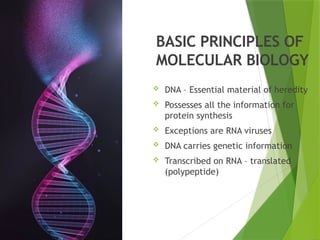
DNA – Essential material of heredity
Possesses all the information for
protein synthesis
Exceptions are RNA viruses
DNA carries genetic information
Transcribed on RNA – translated
(polypeptide)
3.
STRUCTURE
OF DNA
Doublehelix
Backbone deoxyribose and
phosphate residues
Purines: Adenine (A) and
guanine (G)
Pyrimidines: Thymine (T) and
cytosine (C)
Hydrogen bond- between
strands
Bacteria grouped based on GC
content
4.
STRUCTURE OF DNA
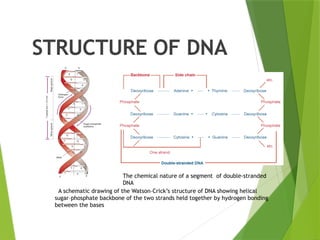
Aschematic drawing of the Watson–Crick’s structure of DNA showing helical
sugar–phosphate backbone of the two strands held together by hydrogen bonding
between the bases
The chemical nature of a segment of double-stranded
DNA
5.
STRUCTURE
OF RNA
Similar toDNA except
• Contains ribose sugar instead of
deoxyribose
• Uracil instead of thymidine
DNA acts as template for RNA
synthesis
Types of RNA
• Messenger RNA (mRNA)
• Ribosomal RNA (rRNA)
• Transfer RNA (tRNA)
6.
TERMS RELATED
TO GENETICS
Gene:A segment of DNA carrying specific
codons for the synthesis of a particular
polypeptide
Genome: Sum of an organism’s genetic
material
Extrachromosomal Genetic Elements
• In addition to chromosomal DNA
• Not essential for the normal life and
functioning of the host bacterium
• Confer drug resistance and
toxigenicity on the bacteria
• Gives survival advantage
7.
EXTRACHROMOSOMAL GENETIC
ELEMENTS
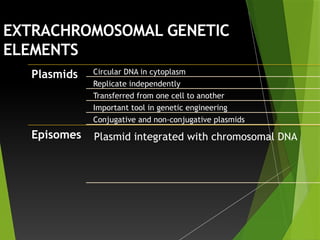
Plasmids CircularDNA in cytoplasm
Replicate independently
Transferred from one cell to another
Important tool in genetic engineering
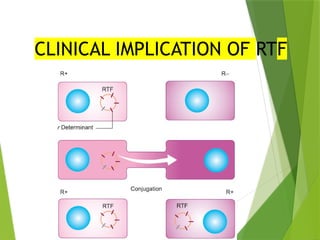
Conjugative and non-conjugative plasmids
Episomes Plasmid integrated with chromosomal DNA
8.
Transposable genetic
elements
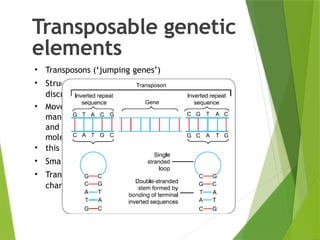
• Transposons(‘jumping genes’)
• Structurally and genetically
discrete DNA segments
• Move around in a ‘cut-and-paste’
manner between chromosomal
and extrachromosomal DNA
molecules within cells.
• this mode of genetic transfer: transposition
• Small transposons: ‘Insertion sequences’ or IS
• Transposon insertion acquisition of new
characteristics
9.
PHENOTYPE
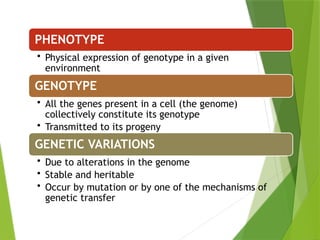
• Physical expressionof genotype in a given
environment
GENOTYPE
• All the genes present in a cell (the genome)
collectively constitute its genotype
• Transmitted to its progeny
GENETIC VARIATIONS
• Due to alterations in the genome
• Stable and heritable
• Occur by mutation or by one of the mechanisms of
genetic transfer
10.
MUTATIONS
Heritable changesin DNA
Alteration in nucleotide sequence
Substitution of a nucleotide
Deletion of a nucleotide
Addition of nucleotides
Two types
o Spontaneous
o Induced mutation by mutagens – UV rays
BACTERIAL
RECOMBINATION
A piece ofDNA (containing specific genes) is
created artificially from two or more sources
Types of recombination
• Homologous: Between similar DNA
molecules
• Non-homologous: Between non-similar
pieces of DNA
• Site-specific: Between short sequences
present in dissimilar molecules
• Replicative recombination: Generates a
new copy of a segment of the DNA
13.
NUCLEIC ACID
PROBES
• DNAprobes
• Hybridise with DNA or
RNA
• Radioactively labelled
• Used to diagnose
infectious diseases
• High degree of
specificity
• Detects minute quantity
• Detect microbes
impossible to culture
14.
BLOTTING
TECHNIQU
ES
• Southern blotting
-Identifying DNA fragment
- DNA-DNA hybridisation
- Detects genetic disorders and
cancers
• Northern blotting
- Identifies RNA
- Detects mRNA in a sample for gene
expression
15.
• Western blotting:
-Identify proteins (antigens)
- Detect HIV antibodies
• Eastern blotting:
- Analyse protein post-translational
modification (PTM)
- Used to detect carbohydrate epitope
16.
DNA AMPLIFICATION
TECHNIQUE
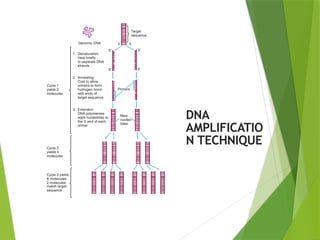
Polymerase chainreaction
• Amplification of specific DNA
sequence
• Diagnosis of infectious diseases
• Genetic of neoplastic diseases
• Forensic investigations
• Used in phylogenetic evolution
Reverse transcriptase PCR — RNA viruses
Real-time PCR (Quantitative) — Viral load
Nested PCR — Two primers used
Multiplex PCR — More than one primers
used
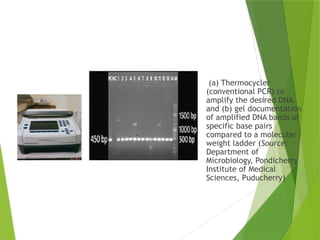
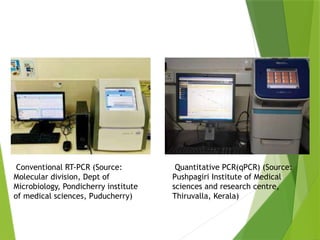
(a) Thermocycler
(conventional PCR)to
amplify the desired DNA
and (b) gel documentation
of amplified DNA bands of
specific base pairs
compared to a molecular
weight ladder (Source:
Department of
Microbiology, Pondicherry
Institute of Medical
Sciences, Puducherry)
19.
DNA AMPLIFICATION TECHNIQUE
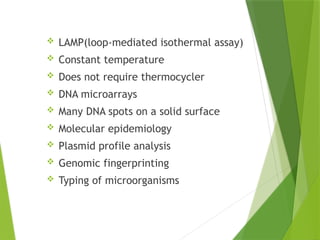
ConventionalRT-PCR (Source:
Molecular division, Dept of
Microbiology, Pondicherry institute
of medical sciences, Puducherry)
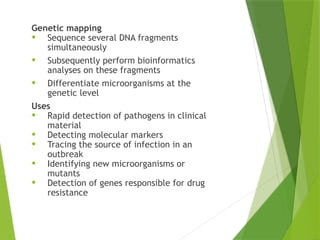
Quantitative PCR(qPCR) (Source:
Pushpagiri Institute of Medical
sciences and research centre,
Thiruvalla, Kerala)
20.
NON-
AMPLIFICATIO
N TEST
LAMP(loop-mediatedisothermal assay)
Constant temperature
Does not require thermocycler
DNA microarrays
Many DNA spots on a solid surface
Molecular epidemiology
Plasmid profile analysis
Genomic fingerprinting
Typing of microorganisms
21.
NON-
AMPLIFICATION
TEST
Genetic mapping
• Sequenceseveral DNA fragments
simultaneously
• Subsequently perform bioinformatics
analyses on these fragments
• Differentiate microorganisms at the
genetic level
Uses
• Rapid detection of pathogens in clinical
material
• Detecting molecular markers
• Tracing the source of infection in an
outbreak
• Identifying new microorganisms or
mutants
• Detection of genes responsible for drug
resistance
22.
NON-
AMPLIFICATIO
N TEST
Sequence-based assays
Many DNA sequenced in parallel
Analysed by bioinformatics
Advantages
Highly sensitive and specific
Relatively rapid compared to culture
Can detect several characteristics of
the microorganism, e.g., antibiotic
resistance and virulence
Can be used for epidemiological
purposes
23.
APPLICATION
OF GENETIC
ENGINEERING
IN
MICROBIOLO
GY
Recombinant DNA(rDNA ) Technology
Involves cloning
Specific gene product obtained in large
amounts
Desired proteins obtained in pure form
Cloned human insulin and growth hormone
Safer vaccines: Hepatitis B vaccine and
rabies vaccine production
Test kits in diagnosis of infectious diseases