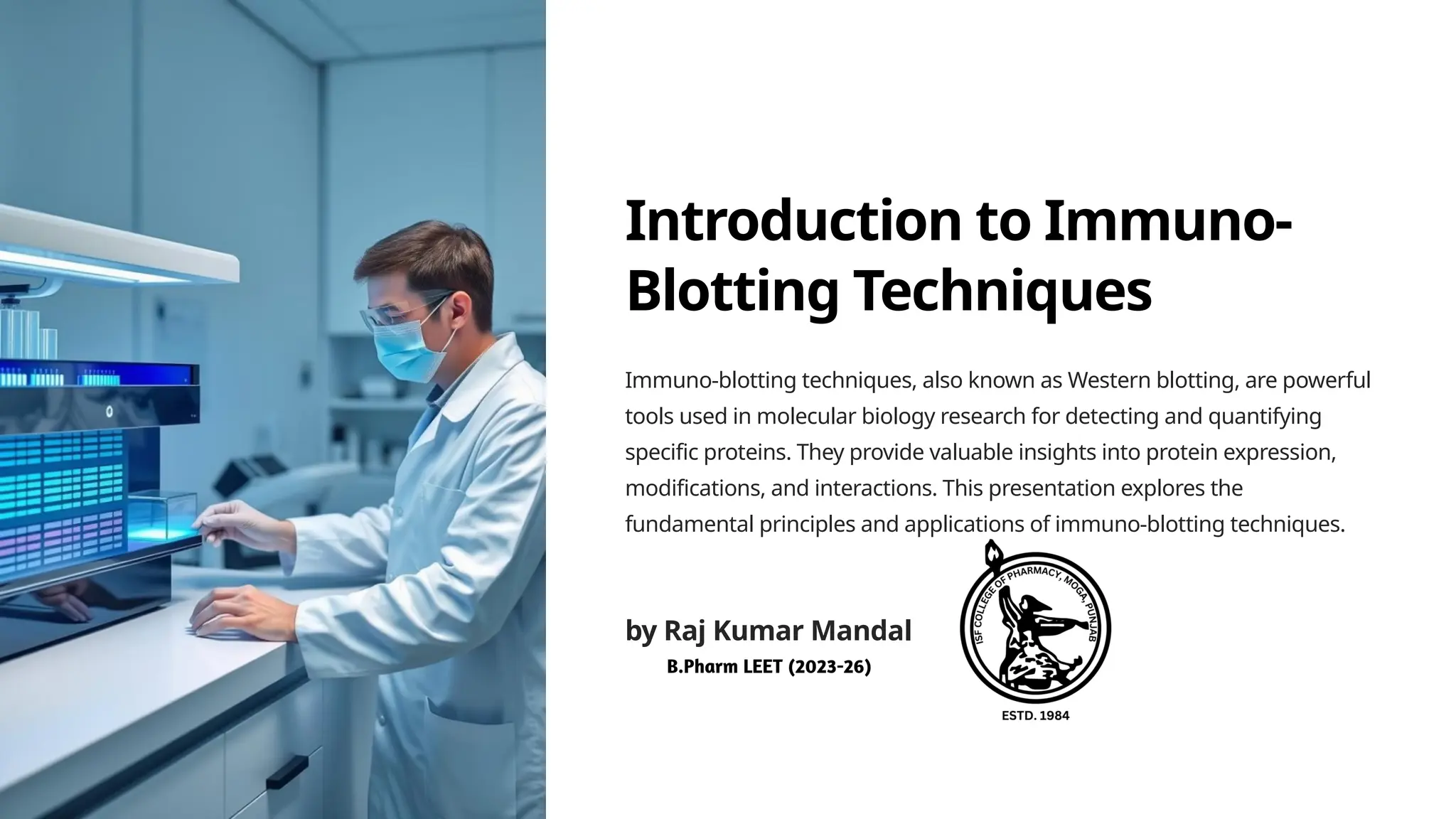
Introduction to Immuno-
Blotting Techniques
Immuno-blotting techniques, also known as Western blotting, are powerful
tools used in molecular biology research for detecting and quantifying
specific proteins. They provide valuable insights into protein expression,
modifications, and interactions. This presentation explores the
fundamental principles and applications of immuno-blotting techniques.
by Raj Kumar Mandal
ELISA
Enzyme-Linked Immunosorbent Assay (ELISA)
ELISA is a versatile immuno-assay used to detect and quantify
specific proteins in biological samples. It relies on the principle
of antigen-antibody binding. The ELISA method involves
coating a solid surface with an antigen, followed by the
addition of a specific antibody. The antibody is labeled with an
enzyme, which produces a detectable signal when a substrate
is added.
Applications
ELISA finds widespread application in various fields, including
diagnostic testing for infectious diseases, hormone levels, and
drug screening. It's also valuable in food safety, environmental
monitoring, and research.
Southern Blotting
1
DNA Transfer
Southern blotting is a technique used to detect specific DNA sequences in a sample. It begins by digesting DNA with
restriction enzymes, generating fragments of various sizes. The digested DNA is then separated by size using gel
electrophoresis.
2
Membrane Transfer
After separation, the DNA fragments are transferred from the gel onto a membrane. This
membrane is then probed with a labeled probe that binds to a specific sequence of interest.
The labeled probe allows the detection of the targeted DNA sequence.
3
Applications
Southern blotting is widely used in genetic mapping, gene cloning,
and diagnostic testing for genetic disorders. It helps identify
specific DNA sequences, providing valuable insights into genetic
variation and mutations.
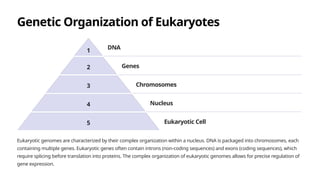
Genetic Organization of Eukaryotes
1
DNA
2 Genes
3 Chromosomes
4 Nucleus
5 Eukaryotic Cell
Eukaryotic genomes are characterized by their complex organization within a nucleus. DNA is packaged into chromosomes, each
containing multiple genes. Eukaryotic genes often contain introns (non-coding sequences) and exons (coding sequences), which
require splicing before translation into proteins. The complex organization of eukaryotic genomes allows for precise regulation of
gene expression.
Genetic Organization of Prokaryotes
DNA
Prokaryotic genomes are typically
organized as a single, circular
chromosome. This chromosome is
much smaller and less complex than
eukaryotic chromosomes. Prokaryotic
DNA is not enclosed within a nucleus
and is directly associated with the
cytoplasm. The compact nature of
prokaryotic DNA allows for efficient
replication and gene expression.
Genes
Prokaryotic genes are typically
organized into operons, which are
groups of genes that are transcribed
together. Operons allow for the
coordinated regulation of gene
expression in response to
environmental changes.
Cell
The simplicity of prokaryotic genetic
organization makes them ideal model
organisms for studying fundamental
biological processes. Their rapid
growth rate and ease of genetic
manipulation have contributed
significantly to our understanding of
DNA replication, transcription, and
translation.
Microbial Genetics: Transformation,
Transduction, and Conjugation
Transformation
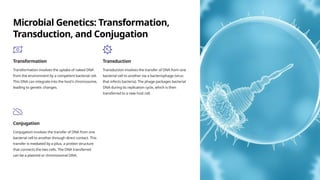
Transformation involves the uptake of naked DNA
from the environment by a competent bacterial cell.
This DNA can integrate into the host's chromosome,
leading to genetic changes.
Transduction
Transduction involves the transfer of DNA from one
bacterial cell to another via a bacteriophage (virus
that infects bacteria). The phage packages bacterial
DNA during its replication cycle, which is then
transferred to a new host cell.
Conjugation
Conjugation involves the transfer of DNA from one
bacterial cell to another through direct contact. This
transfer is mediated by a pilus, a protein structure
that connects the two cells. The DNA transferred
can be a plasmid or chromosomal DNA.
Microbial Genetics: Plasmids and Transposons
1
Plasmids
Plasmids are extrachromosomal DNA molecules that can
replicate independently of the host chromosome. They often
carry genes that confer advantageous traits, such as antibiotic
resistance.
2
Transposons
Transposons are "jumping genes" that can move from one
location to another in the genome. They can disrupt gene
function or introduce new genetic elements, playing a role in
genetic diversity.
Both plasmids and transposons are important tools for genetic manipulation. Plasmids can be used as vectors to introduce new
genes into bacteria, while transposons can be used to disrupt gene function or to create genetic diversity.
Microbial Biotransformation
1 Microbial
Biotransformation
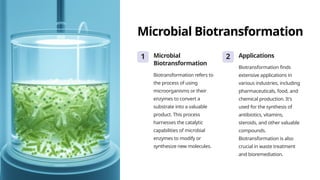
Biotransformation refers to
the process of using
microorganisms or their
enzymes to convert a
substrate into a valuable
product. This process
harnesses the catalytic
capabilities of microbial
enzymes to modify or
synthesize new molecules.
2 Applications
Biotransformation finds
extensive applications in
various industries, including
pharmaceuticals, food, and
chemical production. It's
used for the synthesis of
antibiotics, vitamins,
steroids, and other valuable
compounds.
Biotransformation is also
crucial in waste treatment
and bioremediation.
Types of Mutations and Mutants
Point Mutations
Point mutations are single base
changes in DNA. They can be silent,
missense, or nonsense mutations.
Silent mutations do not affect the
amino acid sequence, while
missense mutations change the
amino acid sequence. Nonsense
mutations introduce a premature
stop codon.
Insertions and Deletions
Insertions and deletions involve the
addition or removal of one or more
nucleotides from the DNA sequence.
These mutations can shift the
reading frame, causing a frameshift
mutation. They can also lead to
premature stop codons or altered
protein function.
Chromosomal
Rearrangements
Chromosomal rearrangements are
large-scale mutations that involve
changes in chromosome structure,
such as deletions, duplications,
inversions, or translocations. These
mutations can have significant
consequences for gene function and
can lead to genetic disorders.
Understanding different types of mutations and their effects is crucial for studying genetic diseases, developing new therapies,
and understanding the evolution of life.
Future Prospects of Immuno-Blotting Techniques
Immuno-blotting techniques continue to evolve with the development of new antibodies, fluorescent labels, and automation
technologies. Future advancements are expected in high-throughput screening, multiplex analysis, and the use of immuno-
blotting in personalized medicine, enabling more precise and sensitive detection of biomarkers and drug targets. The potential
applications of immuno-blotting techniques in disease diagnosis, drug development, and basic research are vast and continue to
drive innovation in the field.
Introduction to Immuno Blotting Techniques on Slideshare by Raj Kumar Mandal

Introduction to Immuno Blotting Techniques on Slideshare by Raj Kumar Mandal

  • 1.
    Introduction to Immuno- BlottingTechniques Immuno-blotting techniques, also known as Western blotting, are powerful tools used in molecular biology research for detecting and quantifying specific proteins. They provide valuable insights into protein expression, modifications, and interactions. This presentation explores the fundamental principles and applications of immuno-blotting techniques. by Raj Kumar Mandal
  • 2.
    ELISA Enzyme-Linked Immunosorbent Assay(ELISA) ELISA is a versatile immuno-assay used to detect and quantify specific proteins in biological samples. It relies on the principle of antigen-antibody binding. The ELISA method involves coating a solid surface with an antigen, followed by the addition of a specific antibody. The antibody is labeled with an enzyme, which produces a detectable signal when a substrate is added. Applications ELISA finds widespread application in various fields, including diagnostic testing for infectious diseases, hormone levels, and drug screening. It's also valuable in food safety, environmental monitoring, and research.
  • 3.
    Southern Blotting 1 DNA Transfer Southernblotting is a technique used to detect specific DNA sequences in a sample. It begins by digesting DNA with restriction enzymes, generating fragments of various sizes. The digested DNA is then separated by size using gel electrophoresis. 2 Membrane Transfer After separation, the DNA fragments are transferred from the gel onto a membrane. This membrane is then probed with a labeled probe that binds to a specific sequence of interest. The labeled probe allows the detection of the targeted DNA sequence. 3 Applications Southern blotting is widely used in genetic mapping, gene cloning, and diagnostic testing for genetic disorders. It helps identify specific DNA sequences, providing valuable insights into genetic variation and mutations.
  • 4.
    Genetic Organization ofEukaryotes 1 DNA 2 Genes 3 Chromosomes 4 Nucleus 5 Eukaryotic Cell Eukaryotic genomes are characterized by their complex organization within a nucleus. DNA is packaged into chromosomes, each containing multiple genes. Eukaryotic genes often contain introns (non-coding sequences) and exons (coding sequences), which require splicing before translation into proteins. The complex organization of eukaryotic genomes allows for precise regulation of gene expression.
  • 5.
    Genetic Organization ofProkaryotes DNA Prokaryotic genomes are typically organized as a single, circular chromosome. This chromosome is much smaller and less complex than eukaryotic chromosomes. Prokaryotic DNA is not enclosed within a nucleus and is directly associated with the cytoplasm. The compact nature of prokaryotic DNA allows for efficient replication and gene expression. Genes Prokaryotic genes are typically organized into operons, which are groups of genes that are transcribed together. Operons allow for the coordinated regulation of gene expression in response to environmental changes. Cell The simplicity of prokaryotic genetic organization makes them ideal model organisms for studying fundamental biological processes. Their rapid growth rate and ease of genetic manipulation have contributed significantly to our understanding of DNA replication, transcription, and translation.
  • 6.
    Microbial Genetics: Transformation, Transduction,and Conjugation Transformation Transformation involves the uptake of naked DNA from the environment by a competent bacterial cell. This DNA can integrate into the host's chromosome, leading to genetic changes. Transduction Transduction involves the transfer of DNA from one bacterial cell to another via a bacteriophage (virus that infects bacteria). The phage packages bacterial DNA during its replication cycle, which is then transferred to a new host cell. Conjugation Conjugation involves the transfer of DNA from one bacterial cell to another through direct contact. This transfer is mediated by a pilus, a protein structure that connects the two cells. The DNA transferred can be a plasmid or chromosomal DNA.
  • 7.
    Microbial Genetics: Plasmidsand Transposons 1 Plasmids Plasmids are extrachromosomal DNA molecules that can replicate independently of the host chromosome. They often carry genes that confer advantageous traits, such as antibiotic resistance. 2 Transposons Transposons are "jumping genes" that can move from one location to another in the genome. They can disrupt gene function or introduce new genetic elements, playing a role in genetic diversity. Both plasmids and transposons are important tools for genetic manipulation. Plasmids can be used as vectors to introduce new genes into bacteria, while transposons can be used to disrupt gene function or to create genetic diversity.
  • 8.
    Microbial Biotransformation 1 Microbial Biotransformation Biotransformationrefers to the process of using microorganisms or their enzymes to convert a substrate into a valuable product. This process harnesses the catalytic capabilities of microbial enzymes to modify or synthesize new molecules. 2 Applications Biotransformation finds extensive applications in various industries, including pharmaceuticals, food, and chemical production. It's used for the synthesis of antibiotics, vitamins, steroids, and other valuable compounds. Biotransformation is also crucial in waste treatment and bioremediation.
  • 9.
    Types of Mutationsand Mutants Point Mutations Point mutations are single base changes in DNA. They can be silent, missense, or nonsense mutations. Silent mutations do not affect the amino acid sequence, while missense mutations change the amino acid sequence. Nonsense mutations introduce a premature stop codon. Insertions and Deletions Insertions and deletions involve the addition or removal of one or more nucleotides from the DNA sequence. These mutations can shift the reading frame, causing a frameshift mutation. They can also lead to premature stop codons or altered protein function. Chromosomal Rearrangements Chromosomal rearrangements are large-scale mutations that involve changes in chromosome structure, such as deletions, duplications, inversions, or translocations. These mutations can have significant consequences for gene function and can lead to genetic disorders. Understanding different types of mutations and their effects is crucial for studying genetic diseases, developing new therapies, and understanding the evolution of life.
  • 10.
    Future Prospects ofImmuno-Blotting Techniques Immuno-blotting techniques continue to evolve with the development of new antibodies, fluorescent labels, and automation technologies. Future advancements are expected in high-throughput screening, multiplex analysis, and the use of immuno- blotting in personalized medicine, enabling more precise and sensitive detection of biomarkers and drug targets. The potential applications of immuno-blotting techniques in disease diagnosis, drug development, and basic research are vast and continue to drive innovation in the field.