CONSUMERS AS STAKEHOLDERS
•Commonplace argument that businesses are
best served by treating their customers well
• So why continued ethical abuses of consumers
and poor reputation of marketing and sales
professions?
• Examples of organizations accused of
treating customers in a questionable
manner:
– Multinational drug companies
– Fast food and soft drink companies
– Banks and credit card companies
– Mobile phone companies
– Technology companies
– Schools
3.
CONSUMERS AS STAKEHOLDERS
Consumerrights can be seen as:
• inalienable entitlements to fair treatment when
entering into exchanges with sellers. They rest
upon the assumption that consumer dignity
should be respected, and that sellers have a
duty to treat consumers as ends in themselves,
and not only as means to the end of the seller.
– Debate over what constitutes fair treatment
– In the past, consumer rights based on caveat emptor
• But Caveat emptor eroded by changing expectations
& consumer laws
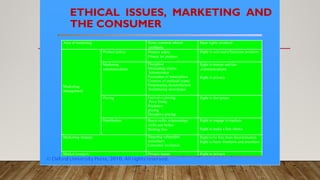
ETHICAL ISSUES, MARKETINGAND
THE CONSUMER
Area of marketing Some common ethical
problems
Main rights involved
Marketing
management
Product policy Product safety
Fitness for purpose
Right to safe and efficacious products
Marketing
communications
Deception
Misleading claims
Intrusiveness
Promotion of materialism
Creation of artificial wants
Perpetuating dissatisfaction
Reinforcing stereotypes
Right to honest and fair
communications
Right to privacy
Pricing Excessive pricing
Price fixing
Predatory
pricing
Deceptive pricing
Right to fair prices
Distribution Buyer-seller relationships
Gifts and bribes
Slotting fees
Right to engage in markets
Right to make a free choice
Marketing strategy Targeting vulnerable
consumers
Consumer exclusion
Right to be free from discrimination
Right to basic freedoms and amenities
Market research Privacy issues Right to privacy
6.
ETHICAL ISSUES INMARKETING
MANAGEMENT –
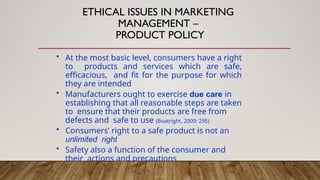
PRODUCT POLICY
• At the most basic level, consumers have a right
to products and services which are safe,
efficacious, and fit for the purpose for which
they are intended
• Manufacturers ought to exercise due care in
establishing that all reasonable steps are taken
to ensure that their products are free from
defects and safe to use (Boatright, 2009: 295)
• Consumers’ right to a safe product is not an
unlimited right
• Safety also a function of the consumer and
their actions and precautions
7.
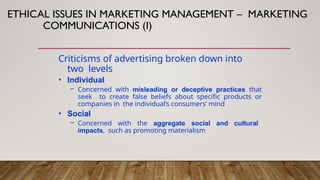
ETHICAL ISSUES INMARKETING MANAGEMENT – MARKETING
COMMUNICATIONS (I)
Criticisms of advertising broken down into
two levels
• Individual
– Concerned with misleading or deceptive practices that
seek to create false beliefs about specific products or
companies in the individual’s consumers’ mind
• Social
– Concerned with the aggregate social and cultural
impacts, such as promoting materialism
8.
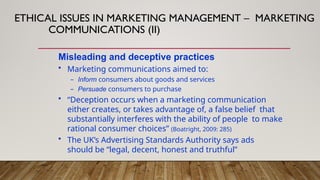
Misleading and deceptivepractices
• Marketing communications aimed to:
– Inform consumers about goods and services
– Persuade consumers to purchase
• “Deception occurs when a marketing communication
either creates, or takes advantage of, a false belief that
substantially interferes with the ability of people to make
rational consumer choices” (Boatright, 2009: 285)
• The UK’s Advertising Standards Authority says ads
should be “legal, decent, honest and truthful”
ETHICAL ISSUES IN MARKETING MANAGEMENT – MARKETING
COMMUNICATIONS (II)
9.
Social and culturalimpact on society
• Objections that marketing communications:
– Are intrusive and unavoidable
– Create artificial wants
– Reinforce consumerism and materialism
– Create insecurity and perpetual dissatisfaction
– Perpetuate social stereotypes
• Such criticisms have been common for at least
the last 30 years
ETHICAL ISSUES IN MARKETING MANAGEMENT – MARKETING
COMMUNICATIONS (III)
10.
• Pricing issuesare central to the notion of a fair
exchange between the two parties, and the right
to a fair price - key rights of consumers as
stakeholders
• 4 types of pricing practices where ethical
problems may arise:
– Excessive pricing
– Price fixing
– Predatory pricing
– Deceptive pricing
ETHICAL ISSUES IN MARKETING
MANAGEMENT –
PRICING
11.
• Concerned withrelations between
manufacturers and firms, and firms
and market
• Primary concern is product supply
chain
– Example: retailers demanding ‘slotting fees’
from manufacturers in order to stock their
products
• Dealt with in detail next chapter
ETHICAL ISSUES IN MARKETING
MANAGEMENT –
DISTRIBUTION
12.
• Criticisms whenthere is a perceived violation of
the consumers right to be treated fairly (duty of
care):
– Targeting vulnerable consumers
– Consumers may be vulnerable because;
• Lack sufficient education or information
• Easily confused or manipulated due to old age
and senility
• Are in exceptional physical or emotional need
• Lack the necessary income
• Too young
– Perceived harmfulness of the product
• Examples: cigarettes and alcohol
• Here, the focus shifts from rights/duties to
consequences
ETHICAL ISSUES IN MARKETING STRATEGY – VULNERABLE
CUSTOMERS
ETHICAL ISSUES INMARKET RESEARCH
• Main issue is possible threats posed to
the consumer’s right to privacy
• Recent areas of concern:
– Personal information available online
• Example: Phorm’s advertising targeting service,
which British Telecom trialled without consent
– Use of genetic testing results by
insurance companies
• Predict likelihood of an individual’s genetic
predisposition to certain conditions and illnesses
• ‘genetic discrimination’?
Issues Around MarketingIn a Global
Marketplace
• Different standards of consumer protection
– Consumer protection varies widely in terms of government
regulation and company standards
– Example of tobacco
• Exporting consumerism and cultural homogenization
– Global brands’ huge success has led to increasing concerns over
standardization and uniformity
– Considerable debate around role of advertising in promoting
consumerism in emerging and transitional economies
17.
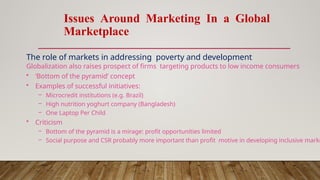
Issues Around MarketingIn a Global
Marketplace
The role of markets in addressing poverty and development
Globalization also raises prospect of firms targeting products to low income consumers
• ‘Bottom of the pyramid’ concept
• Examples of successful initiatives:
– Microcredit institutions (e.g. Brazil)
– High nutrition yoghurt company (Bangladesh)
– One Laptop Per Child
• Criticism
– Bottom of the pyramid is a mirage: profit opportunities limited
– Social purpose and CSR probably more important than profit motive in developing inclusive marke
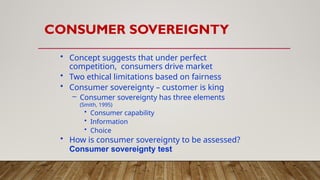
CONSUMER SOVEREIGNTY
• Conceptsuggests that under perfect
competition, consumers drive market
• Two ethical limitations based on fairness
• Consumer sovereignty – customer is king
– Consumer sovereignty has three elements
(Smith, 1995)
• Consumer capability
• Information
• Choice
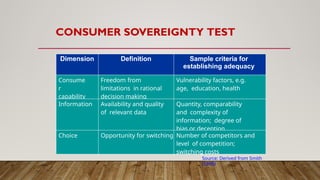
• How is consumer sovereignty to be assessed?
Consumer sovereignty test
20.
CONSUMER SOVEREIGNTY TEST
DimensionDefinition Sample criteria for
establishing adequacy
Consume
r
capability
Freedom from
limitations in rational
decision making
Vulnerability factors, e.g.
age, education, health
Information Availability and quality
of relevant data
Quantity, comparability
and complexity of
information; degree of
bias or deception
Choice Opportunity for switching Number of competitors and
level of competition;
switching costs
Source: Derived from Smith
(1995)
21.
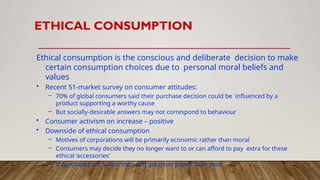
ETHICAL CONSUMPTION
Ethical consumptionis the conscious and deliberate decision to make
certain consumption choices due to personal moral beliefs and
values
• Recent 51-market survey on consumer attitudes:
– 70% of global consumers said their purchase decision could be influenced by a
product supporting a worthy cause
– But socially-desirable answers may not correspond to behaviour
• Consumer activism on increase – positive
• Downside of ethical consumption
– Motives of corporations will be primarily economic rather than moral
– Consumers may decide they no longer want to or can afford to pay extra for these
ethical ‘accessories’
– If purchases are ‘votes’ then rich get more power than poor
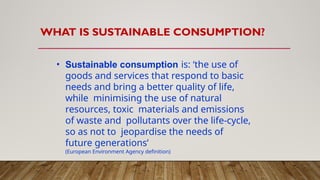
WHAT IS SUSTAINABLECONSUMPTION?
• Sustainable consumption is: ‘the use of
goods and services that respond to basic
needs and bring a better quality of life,
while minimising the use of natural
resources, toxic materials and emissions
of waste and pollutants over the life-cycle,
so as not to jeopardise the needs of
future generations’
(European Environment Agency definition)
24.
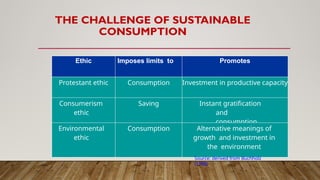
THE CHALLENGE OFSUSTAINABLE
CONSUMPTION
Ethic Imposes limits to Promotes
Protestant ethic Consumption Investment in productive capacity
Consumerism
ethic
Saving Instant gratification
and
consumption
Environmental
ethic
Consumption Alternative meanings of
growth and investment in
the environment
Source: derived from Buchholz
(1998)
25.
STEPS TOWARDS SUSTAINABLE
CONSUMPTION
•Producing environmentally responsible products
– e.g. Eco-labels are important
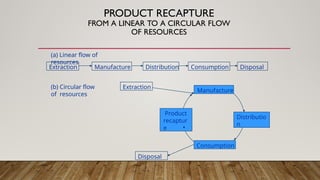
• Product recapture
– See Figure, next slide
• Service replacements for products
– Selling (e.g.) mobility rather than cars, or leasing photocopiers
• Product sharing
– Examples: car-sharing, washing-machine-pooling
• Reducing demand
– Example of China’s ban on free plastic bags
– Implementing the polluter pays principle to create financial incentive for
lower consumption
26.
PRODUCT RECAPTURE
FROM ALINEAR TO A CIRCULAR FLOW
OF RESOURCES
Extraction Manufacture Distribution Disposal
Consumption
(a) Linear flow of
resources
Extraction
Manufacture
Product
recaptur
e
Distributio
n
Disposal
Consumption
(b) Circular flow
of resources


![Lecture 4 - The Marketing Environment, Ethics & CSR (1) [Autosaved].pptx](https://cdn.slidesharecdn.com/ss_thumbnails/lecture4-themarketingenvironmentethicscsr1autosaved-230428083033-8892c277-thumbnail.jpg?width=640&height=640&fit=bounds)


