CHAPTER-7
PUZZLES
A puzzle normally makes us feel like……
Puzzle
are
problems
intentionally
designed to stimulate the brain into devising
solution. The candidate is required to analyze
the given information, convert it in to a
suitable form and answer the question asked.
The extent to which puzzles have become a
part of daily life can be gauged from the
popularity of crosswords, jigsaw puzzles and
Sudoku.
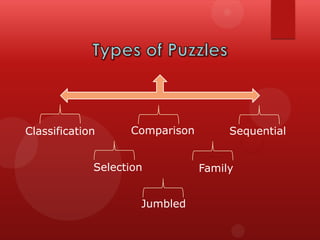
Classification

Comparison

Selection
Jumbled

Sequential
Family
This type of puzzle consists of
question
in
which
certain
items
belonging to different groups, qualities
are given along with clues.
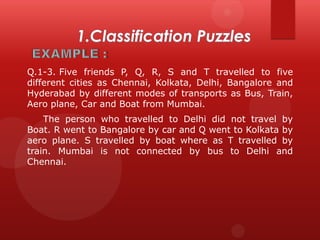
Q.1-3. Five friends P, Q, R, S and T travelled to five
different cities as Chennai, Kolkata, Delhi, Bangalore and
Hyderabad by different modes of transports as Bus, Train,
Aero plane, Car and Boat from Mumbai.
The person who travelled to Delhi did not travel by
Boat. R went to Bangalore by car and Q went to Kolkata by
aero plane. S travelled by boat where as T travelled by
train. Mumbai is not connected by bus to Delhi and
Chennai.
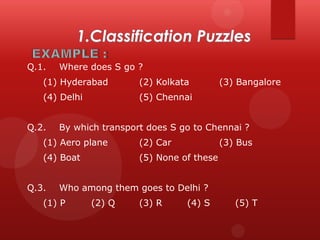
Q.1.

Where does S go ?

(1) Hyderabad

(2) Kolkata

(4) Delhi

(5) Chennai

Q.2.

(3) Bangalore

By which transport does S go to Chennai ?

(1) Aero plane

(2) Car

(4) Boat

(5) None of these

Q.3.

(3) Bus

Who among them goes to Delhi ?

(1) P

(2) Q

(3) R

(4) S

(5) T
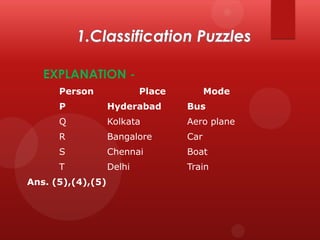
EXPLANATION Person

Place

Mode

P

Hyderabad

Bus

Q

Kolkata

Aero plane

R

Bangalore

Car

S

Chennai

Boat

T

Delhi

Train

Ans. (5),(4),(5)
In such type of questions information
is given regarding the comparison
amongst person or things.
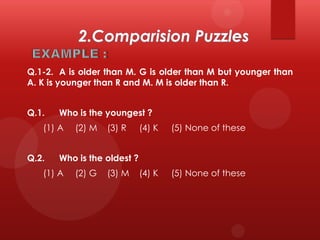
Q.1-2. A is older than M. G is older than M but younger than
A. K is younger than R and M. M is older than R.
Q.1.

Who is the youngest ?

(1) A
Q.2.

(2) M

(3) R

(4) K

(5) None of these

(4) K

(5) None of these

Who is the oldest ?

(1) A

(2) G

(3) M
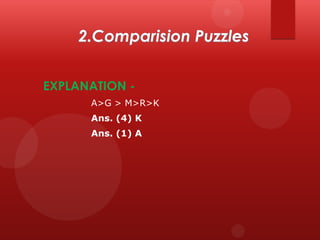
EXPLANATION A>G > M>R>K
Ans. (4) K
Ans. (1) A
In this type of question some
information is given regarding the
order of occurrence of certain events.
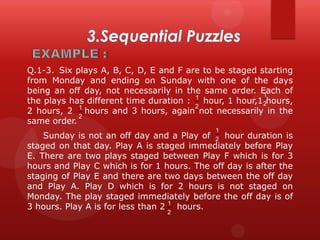
Q.1-3. Six plays A, B, C, D, E and F are to be staged starting
from Monday and ending on Sunday with one of the days
being an off day, not necessarily in the same order. Each of
1
1
the plays has different time duration :
hour, 1 hour,1 2hours,
2
1
2 hours, 2 hours and 3 hours, again not necessarily in the
2
same order.
1

Sunday is not an off day and a Play of 2 hour duration is
staged on that day. Play A is staged immediately before Play
E. There are two plays staged between Play F which is for 3
hours and Play C which is for 1 hours. The off day is after the
staging of Play E and there are two days between the off day
and Play A. Play D which is for 2 hours is not staged on
Monday. The play staged immediately before the off day is of
3 hours. Play A is for less than 2 1 hours.
2
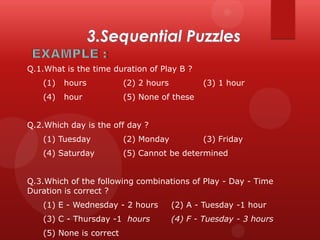
Q.1.What is the time duration of Play B ?
(1)

hours

(2) 2 hours

(3) 1 hour

(4)

hour

(5) None of these

Q.2.Which day is the off day ?
(1) Tuesday

(2) Monday

(3) Friday

(4) Saturday

(5) Cannot be determined

Q.3.Which of the following combinations of Play - Day - Time
Duration is correct ?
(1) E - Wednesday - 2 hours

(2) A - Tuesday -1 hour

(3) C - Thursday -1 hours

(4) F - Tuesday - 3 hours

(5) None is correct
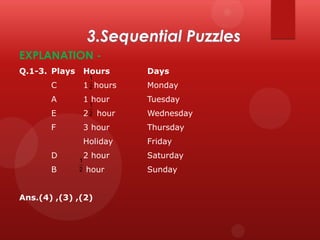
EXPLANATION Q.1-3. Plays

Hours

C

1
1 2 hours

A

1 hour

Days
Monday

Tuesday

E

1
22

F

3 hour

Thursday

Holiday

Friday

2 hour

Saturday

D
B

1
2

hour

hour

Ans.(4) ,(3) ,(2)

Wednesday

Sunday
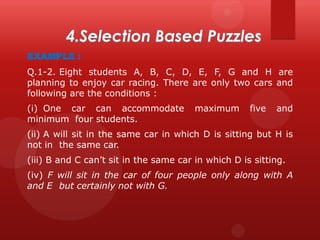
In such type of questions a few
essential criteria for selection of group of
items are given.
EXAMPLE :
Q.1-2. Eight students A, B, C, D, E, F, G and H are
planning to enjoy car racing. There are only two cars and
following are the conditions :
(i) One car can accommodate
minimum four students.

maximum

five

and

(ii) A will sit in the same car in which D is sitting but H is
not in the same car.
(iii) B and C can’t sit in the same car in which D is sitting.
(iv) F will sit in the car of four people only along with A
and E but certainly not with G.
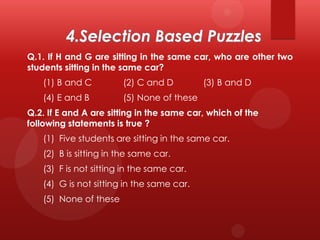
Q.1. If H and G are sitting in the same car, who are other two
students sitting in the same car?

(1) B and C

(2) C and D

(4) E and B

(3) B and D

(5) None of these

Q.2. If E and A are sitting in the same car, which of the
following statements is true ?

(1) Five students are sitting in the same car.
(2) B is sitting in the same car.
(3) F is not sitting in the same car.
(4) G is not sitting in the same car.
(5) None of these
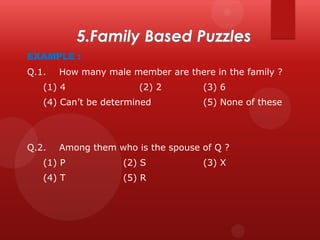
In these type of questions given
information are based on family relation.
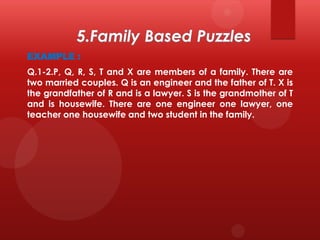
EXAMPLE :
Q.1-2.P, Q, R, S, T and X are members of a family. There are
two married couples. Q is an engineer and the father of T. X is
the grandfather of R and is a lawyer. S is the grandmother of T
and is housewife. There are one engineer one lawyer, one
teacher one housewife and two student in the family.
EXAMPLE :
Q.1.

How many male member are there in the family ?

(1) 4

(2) 2

(4) Can’t be determined

Q.2.

(3) 6
(5) None of these

Among them who is the spouse of Q ?

(1) P

(2) S

(4) T

(5) R

(3) X
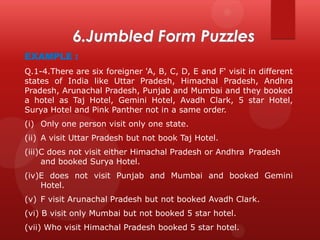
In this type of questions related
information are written in jumbled way.
EXAMPLE :
Q.1-4.There are six foreigner 'A, B, C, D, E and F' visit in different
states of India like Uttar Pradesh, Himachal Pradesh, Andhra
Pradesh, Arunachal Pradesh, Punjab and Mumbai and they booked
a hotel as Taj Hotel, Gemini Hotel, Avadh Clark, 5 star Hotel,
Surya Hotel and Pink Panther not in a same order.
(i) Only one person visit only one state.

(ii) A visit Uttar Pradesh but not book Taj Hotel.
(iii)C does not visit either Himachal Pradesh or Andhra Pradesh
and booked Surya Hotel.
(iv)E does not visit Punjab and Mumbai and booked Gemini
Hotel.
(v) F visit Arunachal Pradesh but not booked Avadh Clark.
(vi) B visit only Mumbai but not booked 5 star hotel.
(vii) Who visit Himachal Pradesh booked 5 star hotel.
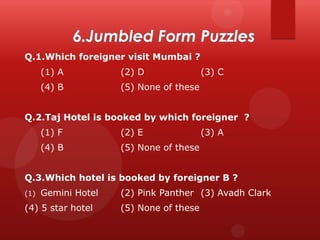
Q.1.Which foreigner visit Mumbai ?
(1) A

(2) D

(4) B

(3) C

(5) None of these

Q.2.Taj Hotel is booked by which foreigner ?
(1) F

(2) E

(4) B

(3) A

(5) None of these

Q.3.Which hotel is booked by foreigner B ?
(1)

Gemini Hotel

(4) 5 star hotel

(2) Pink Panther (3) Avadh Clark
(5) None of these
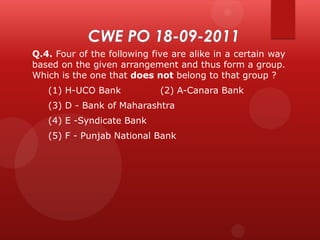
Q.4.In which of the following pair is definitely True ?
(1) Avadh Clark - A - Mumbai
(2) Avadh Clark- B- Mumbai
(3) Pink Panther - E- Uttar Pradesh
(4) Surya Hotel- F- Himachal Pradesh
(5) None of these
Ø First of all everyone should categorize
the type of puzzle.

Ø Then related information should be
arranged into a sequential form.
Ø At the last the complete information
should be related with given facts.
Q.1-7. Study the following information to answer the
given questions:
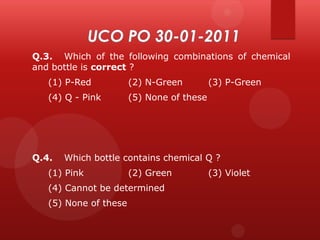
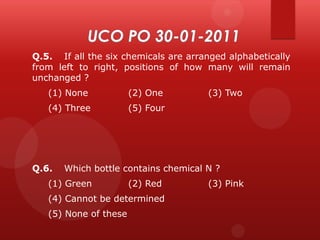
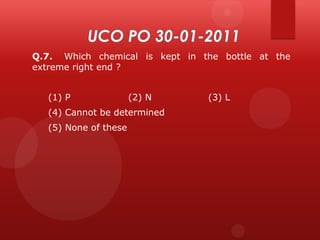
Six chemicals L, M, N, O, P and Q are kept in bottles
of different colours viz. green, red, blue, white, pink and
violet, not necessarily in the same order. These bottles
are arranged from left to right, again not necessarily in
the same order.
Chemical M is kept in white bottle. Chemical L is not
kept in green bottle and is kept to the immediate left of
the violet bottle. Chemical O is kept in the blue bottle
and is kept exactly between the bottles containing
chemicals L and M. The red bottle is at the extreme left
end. The bottle containing chemical Q is not kept at
either of the ends. The green bottle is kept at the
extreme right end. Chemical P is not kept near the white
bottle.
Q.1. Four of the following five are alike in a certain way
based on their positions in the above arrangement and
so form a group. Which is the one that does not belong
to the group ?

(1) LM

(2) LP

(4) LQ

(5) NO

Q.2.

(3) QO

Which bottle contains chemical L ?

(1) Pink

(2) Blue

(4) Cannot be determined

(5) None of these

(3) Red
Q.3. Which of the following combinations of chemical
and bottle is correct ?
(1) P-Red

(2) N-Green

(4) Q - Pink

(5) None of these

Q.4.

(3) P-Green

Which bottle contains chemical Q ?

(1) Pink

(2) Green

(4) Cannot be determined
(5) None of these

(3) Violet
Q.5. If all the six chemicals are arranged alphabetically
from left to right, positions of how many will remain
unchanged ?
(1) None

(2) One

(4) Three

(5) Four

Q.6.

(3) Two

Which bottle contains chemical N ?

(1) Green

(2) Red

(4) Cannot be determined

(5) None of these

(3) Pink
Q.7. Which chemical is kept in the bottle at the
extreme right end ?
(1) P

(2) N

(4) Cannot be determined
(5) None of these

(3) L
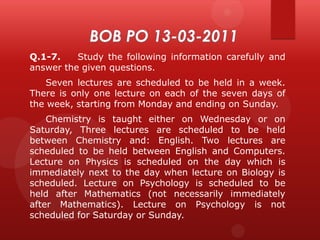
Q.1-7.
Study the following information carefully and
answer the given questions.

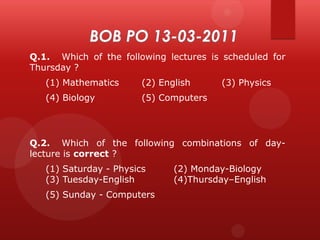
Seven lectures are scheduled to be held in a week.
There is only one lecture on each of the seven days of
the week, starting from Monday and ending on Sunday.
Chemistry is taught either on Wednesday or on
Saturday, Three lectures are scheduled to be held
between Chemistry and: English. Two lectures are
scheduled to be held between English and Computers.
Lecture on Physics is scheduled on the day which is
immediately next to the day when lecture on Biology is
scheduled. Lecture on Psychology is scheduled to be
held after Mathematics (not necessarily immediately
after Mathematics). Lecture on Psychology is not
scheduled for Saturday or Sunday.
Q.1. Which of the following lectures is scheduled for
Thursday ?

(1) Mathematics

(2) English

(4) Biology

(3) Physics

(5) Computers

Q.2. Which of the following combinations of daylecture is correct ?
(1) Saturday - Physics
(3) Tuesday-English
(5) Sunday - Computers

(2) Monday-Biology
(4)Thursday–English
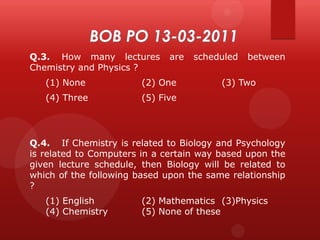
Q.3. How many lectures
Chemistry and Physics ?

are

(1) None

(2) One

(4) Three

scheduled

between

(3) Two

(5) Five

Q.4. If Chemistry is related to Biology and Psychology
is related to Computers in a certain way based upon the
given lecture schedule, then Biology will be related to
which of the following based upon the same relationship
?
(1) English
(4) Chemistry

(2) Mathematics (3)Physics
(5) None of these
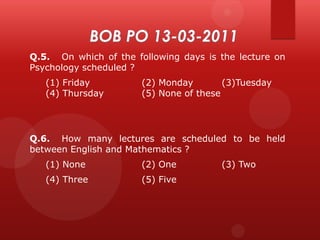
Q.5. On which of the following days is the lecture on
Psychology scheduled ?

(1) Friday
(4) Thursday

(2) Monday
(3)Tuesday
(5) None of these

Q.6. How many lectures are scheduled to be held
between English and Mathematics ?
(1) None

(2) One

(4) Three

(5) Five

(3) Two
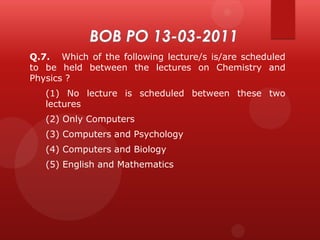
Q.7. Which of the following lecture/s is/are scheduled
to be held between the lectures on Chemistry and
Physics ?
(1) No lecture is scheduled between these two
lectures
(2) Only Computers

(3) Computers and Psychology
(4) Computers and Biology
(5) English and Mathematics
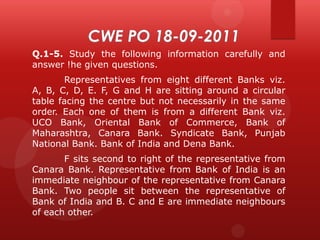
Q.1-5. Study the following information carefully and
answer !he given questions.
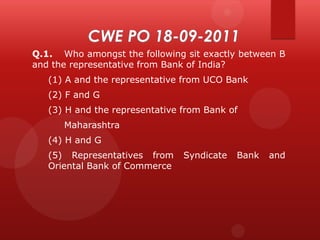
Representatives from eight different Banks viz.
A, B, C, D, E. F, G and H are sitting around a circular
table facing the centre but not necessarily in the same
order. Each one of them is from a different Bank viz.
UCO Bank, Oriental Bank of Commerce, Bank of
Maharashtra, Canara Bank. Syndicate Bank, Punjab
National Bank. Bank of India and Dena Bank.
F sits second to right of the representative from
Canara Bank. Representative from Bank of India is an
immediate neighbour of the representative from Canara
Bank. Two people sit between the representative of
Bank of India and B. C and E are immediate neighbours
of each other.
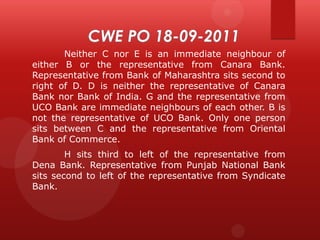
Neither C nor E is an immediate neighbour of
either B or the representative from Canara Bank.
Representative from Bank of Maharashtra sits second to
right of D. D is neither the representative of Canara
Bank nor Bank of India. G and the representative from
UCO Bank are immediate neighbours of each other. B is
not the representative of UCO Bank. Only one person
sits between C and the representative from Oriental
Bank of Commerce.
H sits third to left of the representative from
Dena Bank. Representative from Punjab National Bank
sits second to left of the representative from Syndicate
Bank.
Q.1. Who amongst the following sit exactly between B
and the representative from Bank of India?
(1) A and the representative from UCO Bank
(2) F and G
(3) H and the representative from Bank of
Maharashtra
(4) H and G
(5) Representatives from
Oriental Bank of Commerce

Syndicate

Bank

and
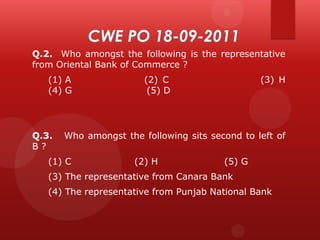
Q.2. Who amongst the following is the representative
from Oriental Bank of Commerce ?
(1) A
(4) G

Q.3.
B?

(2) C
(5) D

(3) H

Who amongst the following sits second to left of

(1) C

(2) H

(5) G

(3) The representative from Canara Bank
(4) The representative from Punjab National Bank
Q.4. Four of the following five are alike in a certain way
based on the given arrangement and thus form a group.
Which is the one that does not belong to that group ?
(1) H-UCO Bank

(2) A-Canara Bank

(3) D - Bank of Maharashtra
(4) E -Syndicate Bank
(5) F - Punjab National Bank
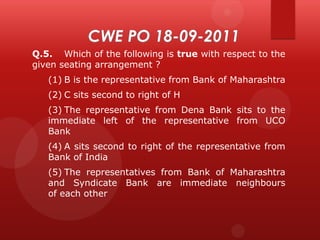
Q.5. Which of the following is true with respect to the
given seating arrangement ?
(1) B is the representative from Bank of Maharashtra
(2) C sits second to right of H
(3) The representative from Dena Bank sits to the
immediate left of the representative from UCO
Bank
(4) A sits second to right of the representative from
Bank of India

(5) The representatives from Bank of Maharashtra
and Syndicate Bank are immediate neighbours
of each other
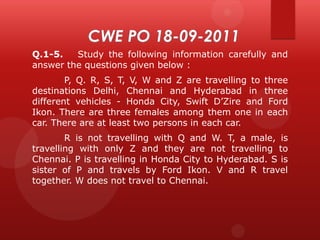
Q.1-5.
Study the following information carefully and
answer the questions given below :
P, Q. R, S, T, V, W and Z are travelling to three
destinations Delhi, Chennai and Hyderabad in three
different vehicles - Honda City, Swift D’Zire and Ford
Ikon. There are three females among them one in each
car. There are at least two persons in each car.
R is not travelling with Q and W. T, a male, is
travelling with only Z and they are not travelling to
Chennai. P is travelling in Honda City to Hyderabad. S is
sister of P and travels by Ford Ikon. V and R travel
together. W does not travel to Chennai.
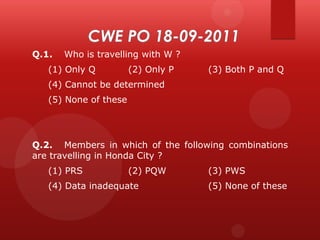
Q.1.

Who is travelling with W ?

(1) Only Q

(2) Only P

(3) Both P and Q

(4) Cannot be determined
(5) None of these

Q.2. Members in which of the following combinations
are travelling in Honda City ?
(1) PRS

(2) PQW

(4) Data inadequate

(3) PWS
(5) None of these
Q.3.

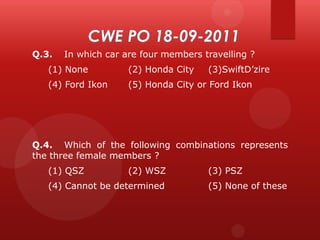
In which car are four members travelling ?

(1) None

(2) Honda City

(3)SwiftD’zire

(4) Ford Ikon

(5) Honda City or Ford Ikon

Q.4. Which of the following combinations represents
the three female members ?
(1) QSZ

(2) WSZ

(4) Cannot be determined

(3) PSZ
(5) None of these
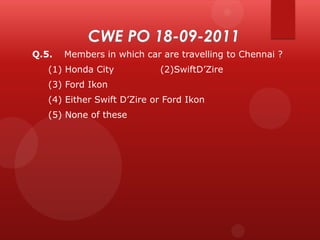
Q.5.

Members in which car are travelling to Chennai ?

(1) Honda City

(2)SwiftD’Zire

(3) Ford Ikon
(4) Either Swift D’Zire or Ford Ikon
(5) None of these
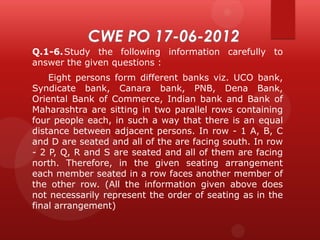
Q.1-6. Study the following information carefully to
answer the given questions :
Eight persons form different banks viz. UCO bank,
Syndicate bank, Canara bank, PNB, Dena Bank,
Oriental Bank of Commerce, Indian bank and Bank of
Maharashtra are sitting in two parallel rows containing
four people each, in such a way that there is an equal
distance between adjacent persons. In row - 1 A, B, C
and D are seated and all of the are facing south. In row
- 2 P, Q, R and S are seated and all of them are facing
north. Therefore, in the given seating arrangement
each member seated in a row faces another member of
the other row. (All the information given above does
not necessarily represent the order of seating as in the
final arrangement)
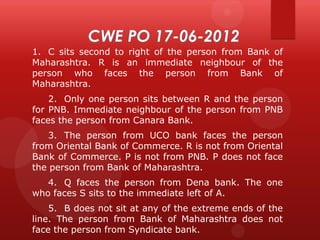
1. C sits second to right of the person from Bank of
Maharashtra. R is an immediate neighbour of the
person who faces the person from Bank of
Maharashtra.
2. Only one person sits between R and the person
for PNB. Immediate neighbour of the person from PNB
faces the person from Canara Bank.
3. The person from UCO bank faces the person
from Oriental Bank of Commerce. R is not from Oriental
Bank of Commerce. P is not from PNB. P does not face
the person from Bank of Maharashtra.
4. Q faces the person from Dena bank. The one
who faces S sits to the immediate left of A.
5. B does not sit at any of the extreme ends of the
line. The person from Bank of Maharashtra does not
face the person from Syndicate bank.
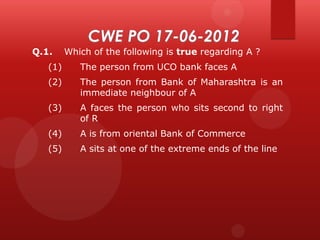
Q.1.

Which of the following is true regarding A ?

(1)

The person from UCO bank faces A

(2)

The person from Bank of Maharashtra is an
immediate neighbour of A

(3)

A faces the person who sits second to right
of R

(4)

A is from oriental Bank of Commerce

(5)

A sits at one of the extreme ends of the line
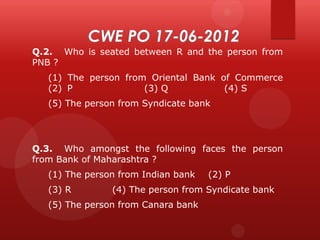
Q.2. Who is seated between R and the person from
PNB ?
(1) The person from Oriental Bank of Commerce
(2) P
(3) Q
(4) S
(5) The person from Syndicate bank

Q.3. Who amongst the following faces the person
from Bank of Maharashtra ?
(1) The person from Indian bank
(3) R

(2) P

(4) The person from Syndicate bank

(5) The person from Canara bank
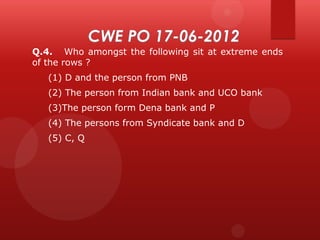
Q.4. Who amongst the following sit at extreme ends
of the rows ?
(1) D and the person from PNB
(2) The person from Indian bank and UCO bank

(3)The person form Dena bank and P
(4) The persons from Syndicate bank and D
(5) C, Q
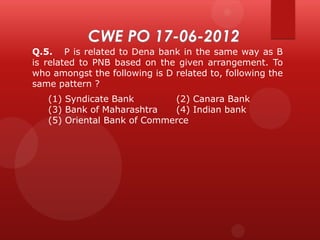
Q.5. P is related to Dena bank in the same way as B
is related to PNB based on the given arrangement. To
who amongst the following is D related to, following the
same pattern ?
(1) Syndicate Bank
(2) Canara Bank
(3) Bank of Maharashtra
(4) Indian bank
(5) Oriental Bank of Commerce
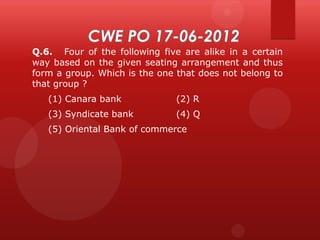
Q.6. Four of the following five are alike in a certain
way based on the given seating arrangement and thus
form a group. Which is the one that does not belong to
that group ?
(1) Canara bank

(2) R

(3) Syndicate bank

(4) Q

(5) Oriental Bank of commerce
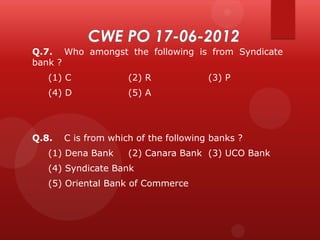
Q.7. Who amongst the following is from Syndicate
bank ?
(1) C

(2) R

(4) D

(5) A

Q.8.

(3) P

C is from which of the following banks ?

(1) Dena Bank

(2) Canara Bank (3) UCO Bank

(4) Syndicate Bank
(5) Oriental Bank of Commerce
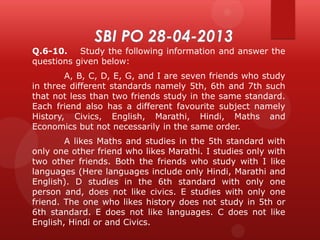
Q.6-10.
Study the following information and answer the
questions given below:

A, B, C, D, E, G, and I are seven friends who study
in three different standards namely 5th, 6th and 7th such
that not less than two friends study in the same standard.
Each friend also has a different favourite subject namely
History, Civics, English, Marathi, Hindi, Maths and
Economics but not necessarily in the same order.
A likes Maths and studies in the 5th standard with
only one other friend who likes Marathi. I studies only with
two other friends. Both the friends who study with I like
languages (Here languages include only Hindi, Marathi and
English). D studies in the 6th standard with only one
person and, does not like civics. E studies with only one
friend. The one who likes history does not study in 5th or
6th standard. E does not like languages. C does not like
English, Hindi or and Civics.
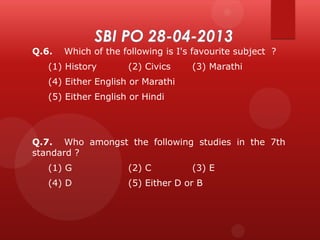
Q.6.
Which of the following is I's favourite subject ?

(1) History

(2) Civics

(3) Marathi

(4) Either English or Marathi
(5) Either English or Hindi

Q.7. Who amongst the following studies in the 7th
standard ?
(1) G

(2) C

(3) E

(4) D

(5) Either D or B
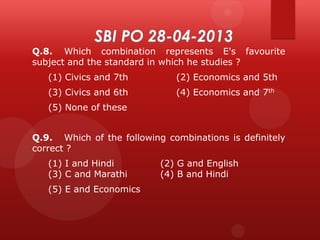
Q.8. Which combination represents E's favourite
subject and the standard in which he studies ?

(1) Civics and 7th

(2) Economics and 5th

(3) Civics and 6th

(4) Economics and 7th

(5) None of these
Q.9. Which of the following combinations is definitely
correct ?
(1) I and Hindi
(3) C and Marathi
(5) E and Economics

(2) G and English
(4) B and Hindi
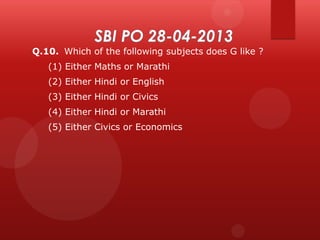
Q.10. Which of the following subjects does G like ?
(1) Either Maths or Marathi
(2) Either Hindi or English
(3) Either Hindi or Civics
(4) Either Hindi or Marathi

(5) Either Civics or Economics
7puzzles

7puzzles

  • 1.
  • 2.
    A puzzle normallymakes us feel like……
  • 3.
    Puzzle are problems intentionally designed to stimulatethe brain into devising solution. The candidate is required to analyze the given information, convert it in to a suitable form and answer the question asked. The extent to which puzzles have become a part of daily life can be gauged from the popularity of crosswords, jigsaw puzzles and Sudoku.
  • 4.
  • 5.
    This type ofpuzzle consists of question in which certain items belonging to different groups, qualities are given along with clues.
  • 6.
    Q.1-3. Five friendsP, Q, R, S and T travelled to five different cities as Chennai, Kolkata, Delhi, Bangalore and Hyderabad by different modes of transports as Bus, Train, Aero plane, Car and Boat from Mumbai. The person who travelled to Delhi did not travel by Boat. R went to Bangalore by car and Q went to Kolkata by aero plane. S travelled by boat where as T travelled by train. Mumbai is not connected by bus to Delhi and Chennai.
  • 7.
    Q.1. Where does Sgo ? (1) Hyderabad (2) Kolkata (4) Delhi (5) Chennai Q.2. (3) Bangalore By which transport does S go to Chennai ? (1) Aero plane (2) Car (4) Boat (5) None of these Q.3. (3) Bus Who among them goes to Delhi ? (1) P (2) Q (3) R (4) S (5) T
  • 8.
  • 9.
    In such typeof questions information is given regarding the comparison amongst person or things.
  • 10.
    Q.1-2. A isolder than M. G is older than M but younger than A. K is younger than R and M. M is older than R. Q.1. Who is the youngest ? (1) A Q.2. (2) M (3) R (4) K (5) None of these (4) K (5) None of these Who is the oldest ? (1) A (2) G (3) M
  • 11.
    EXPLANATION A>G >M>R>K Ans. (4) K Ans. (1) A
  • 12.
    In this typeof question some information is given regarding the order of occurrence of certain events.
  • 13.
    Q.1-3. Six playsA, B, C, D, E and F are to be staged starting from Monday and ending on Sunday with one of the days being an off day, not necessarily in the same order. Each of 1 1 the plays has different time duration : hour, 1 hour,1 2hours, 2 1 2 hours, 2 hours and 3 hours, again not necessarily in the 2 same order. 1 Sunday is not an off day and a Play of 2 hour duration is staged on that day. Play A is staged immediately before Play E. There are two plays staged between Play F which is for 3 hours and Play C which is for 1 hours. The off day is after the staging of Play E and there are two days between the off day and Play A. Play D which is for 2 hours is not staged on Monday. The play staged immediately before the off day is of 3 hours. Play A is for less than 2 1 hours. 2
  • 14.
    Q.1.What is thetime duration of Play B ? (1) hours (2) 2 hours (3) 1 hour (4) hour (5) None of these Q.2.Which day is the off day ? (1) Tuesday (2) Monday (3) Friday (4) Saturday (5) Cannot be determined Q.3.Which of the following combinations of Play - Day - Time Duration is correct ? (1) E - Wednesday - 2 hours (2) A - Tuesday -1 hour (3) C - Thursday -1 hours (4) F - Tuesday - 3 hours (5) None is correct
  • 15.
    EXPLANATION Q.1-3. Plays Hours C 1 12 hours A 1 hour Days Monday Tuesday E 1 22 F 3 hour Thursday Holiday Friday 2 hour Saturday D B 1 2 hour hour Ans.(4) ,(3) ,(2) Wednesday Sunday
  • 16.
    In such typeof questions a few essential criteria for selection of group of items are given.
  • 17.
    EXAMPLE : Q.1-2. Eightstudents A, B, C, D, E, F, G and H are planning to enjoy car racing. There are only two cars and following are the conditions : (i) One car can accommodate minimum four students. maximum five and (ii) A will sit in the same car in which D is sitting but H is not in the same car. (iii) B and C can’t sit in the same car in which D is sitting. (iv) F will sit in the car of four people only along with A and E but certainly not with G.
  • 18.
    Q.1. If Hand G are sitting in the same car, who are other two students sitting in the same car? (1) B and C (2) C and D (4) E and B (3) B and D (5) None of these Q.2. If E and A are sitting in the same car, which of the following statements is true ? (1) Five students are sitting in the same car. (2) B is sitting in the same car. (3) F is not sitting in the same car. (4) G is not sitting in the same car. (5) None of these
  • 19.
    In these typeof questions given information are based on family relation.
  • 20.
    EXAMPLE : Q.1-2.P, Q,R, S, T and X are members of a family. There are two married couples. Q is an engineer and the father of T. X is the grandfather of R and is a lawyer. S is the grandmother of T and is housewife. There are one engineer one lawyer, one teacher one housewife and two student in the family.
  • 21.
    EXAMPLE : Q.1. How manymale member are there in the family ? (1) 4 (2) 2 (4) Can’t be determined Q.2. (3) 6 (5) None of these Among them who is the spouse of Q ? (1) P (2) S (4) T (5) R (3) X
  • 22.
    In this typeof questions related information are written in jumbled way.
  • 23.
    EXAMPLE : Q.1-4.There aresix foreigner 'A, B, C, D, E and F' visit in different states of India like Uttar Pradesh, Himachal Pradesh, Andhra Pradesh, Arunachal Pradesh, Punjab and Mumbai and they booked a hotel as Taj Hotel, Gemini Hotel, Avadh Clark, 5 star Hotel, Surya Hotel and Pink Panther not in a same order. (i) Only one person visit only one state. (ii) A visit Uttar Pradesh but not book Taj Hotel. (iii)C does not visit either Himachal Pradesh or Andhra Pradesh and booked Surya Hotel. (iv)E does not visit Punjab and Mumbai and booked Gemini Hotel. (v) F visit Arunachal Pradesh but not booked Avadh Clark. (vi) B visit only Mumbai but not booked 5 star hotel. (vii) Who visit Himachal Pradesh booked 5 star hotel.
  • 24.
    Q.1.Which foreigner visitMumbai ? (1) A (2) D (4) B (3) C (5) None of these Q.2.Taj Hotel is booked by which foreigner ? (1) F (2) E (4) B (3) A (5) None of these Q.3.Which hotel is booked by foreigner B ? (1) Gemini Hotel (4) 5 star hotel (2) Pink Panther (3) Avadh Clark (5) None of these
  • 25.
    Q.4.In which ofthe following pair is definitely True ? (1) Avadh Clark - A - Mumbai (2) Avadh Clark- B- Mumbai (3) Pink Panther - E- Uttar Pradesh (4) Surya Hotel- F- Himachal Pradesh (5) None of these
  • 26.
    Ø First ofall everyone should categorize the type of puzzle. Ø Then related information should be arranged into a sequential form. Ø At the last the complete information should be related with given facts.
  • 27.
    Q.1-7. Study thefollowing information to answer the given questions: Six chemicals L, M, N, O, P and Q are kept in bottles of different colours viz. green, red, blue, white, pink and violet, not necessarily in the same order. These bottles are arranged from left to right, again not necessarily in the same order. Chemical M is kept in white bottle. Chemical L is not kept in green bottle and is kept to the immediate left of the violet bottle. Chemical O is kept in the blue bottle and is kept exactly between the bottles containing chemicals L and M. The red bottle is at the extreme left end. The bottle containing chemical Q is not kept at either of the ends. The green bottle is kept at the extreme right end. Chemical P is not kept near the white bottle.
  • 28.
    Q.1. Four ofthe following five are alike in a certain way based on their positions in the above arrangement and so form a group. Which is the one that does not belong to the group ? (1) LM (2) LP (4) LQ (5) NO Q.2. (3) QO Which bottle contains chemical L ? (1) Pink (2) Blue (4) Cannot be determined (5) None of these (3) Red
  • 29.
    Q.3. Which ofthe following combinations of chemical and bottle is correct ? (1) P-Red (2) N-Green (4) Q - Pink (5) None of these Q.4. (3) P-Green Which bottle contains chemical Q ? (1) Pink (2) Green (4) Cannot be determined (5) None of these (3) Violet
  • 30.
    Q.5. If allthe six chemicals are arranged alphabetically from left to right, positions of how many will remain unchanged ? (1) None (2) One (4) Three (5) Four Q.6. (3) Two Which bottle contains chemical N ? (1) Green (2) Red (4) Cannot be determined (5) None of these (3) Pink
  • 31.
    Q.7. Which chemicalis kept in the bottle at the extreme right end ? (1) P (2) N (4) Cannot be determined (5) None of these (3) L
  • 32.
    Q.1-7. Study the followinginformation carefully and answer the given questions. Seven lectures are scheduled to be held in a week. There is only one lecture on each of the seven days of the week, starting from Monday and ending on Sunday. Chemistry is taught either on Wednesday or on Saturday, Three lectures are scheduled to be held between Chemistry and: English. Two lectures are scheduled to be held between English and Computers. Lecture on Physics is scheduled on the day which is immediately next to the day when lecture on Biology is scheduled. Lecture on Psychology is scheduled to be held after Mathematics (not necessarily immediately after Mathematics). Lecture on Psychology is not scheduled for Saturday or Sunday.
  • 33.
    Q.1. Which ofthe following lectures is scheduled for Thursday ? (1) Mathematics (2) English (4) Biology (3) Physics (5) Computers Q.2. Which of the following combinations of daylecture is correct ? (1) Saturday - Physics (3) Tuesday-English (5) Sunday - Computers (2) Monday-Biology (4)Thursday–English
  • 34.
    Q.3. How manylectures Chemistry and Physics ? are (1) None (2) One (4) Three scheduled between (3) Two (5) Five Q.4. If Chemistry is related to Biology and Psychology is related to Computers in a certain way based upon the given lecture schedule, then Biology will be related to which of the following based upon the same relationship ? (1) English (4) Chemistry (2) Mathematics (3)Physics (5) None of these
  • 35.
    Q.5. On whichof the following days is the lecture on Psychology scheduled ? (1) Friday (4) Thursday (2) Monday (3)Tuesday (5) None of these Q.6. How many lectures are scheduled to be held between English and Mathematics ? (1) None (2) One (4) Three (5) Five (3) Two
  • 36.
    Q.7. Which ofthe following lecture/s is/are scheduled to be held between the lectures on Chemistry and Physics ? (1) No lecture is scheduled between these two lectures (2) Only Computers (3) Computers and Psychology (4) Computers and Biology (5) English and Mathematics
  • 37.
    Q.1-5. Study thefollowing information carefully and answer !he given questions. Representatives from eight different Banks viz. A, B, C, D, E. F, G and H are sitting around a circular table facing the centre but not necessarily in the same order. Each one of them is from a different Bank viz. UCO Bank, Oriental Bank of Commerce, Bank of Maharashtra, Canara Bank. Syndicate Bank, Punjab National Bank. Bank of India and Dena Bank. F sits second to right of the representative from Canara Bank. Representative from Bank of India is an immediate neighbour of the representative from Canara Bank. Two people sit between the representative of Bank of India and B. C and E are immediate neighbours of each other.
  • 38.
    Neither C norE is an immediate neighbour of either B or the representative from Canara Bank. Representative from Bank of Maharashtra sits second to right of D. D is neither the representative of Canara Bank nor Bank of India. G and the representative from UCO Bank are immediate neighbours of each other. B is not the representative of UCO Bank. Only one person sits between C and the representative from Oriental Bank of Commerce. H sits third to left of the representative from Dena Bank. Representative from Punjab National Bank sits second to left of the representative from Syndicate Bank.
  • 39.
    Q.1. Who amongstthe following sit exactly between B and the representative from Bank of India? (1) A and the representative from UCO Bank (2) F and G (3) H and the representative from Bank of Maharashtra (4) H and G (5) Representatives from Oriental Bank of Commerce Syndicate Bank and
  • 40.
    Q.2. Who amongstthe following is the representative from Oriental Bank of Commerce ? (1) A (4) G Q.3. B? (2) C (5) D (3) H Who amongst the following sits second to left of (1) C (2) H (5) G (3) The representative from Canara Bank (4) The representative from Punjab National Bank
  • 41.
    Q.4. Four ofthe following five are alike in a certain way based on the given arrangement and thus form a group. Which is the one that does not belong to that group ? (1) H-UCO Bank (2) A-Canara Bank (3) D - Bank of Maharashtra (4) E -Syndicate Bank (5) F - Punjab National Bank
  • 42.
    Q.5. Which ofthe following is true with respect to the given seating arrangement ? (1) B is the representative from Bank of Maharashtra (2) C sits second to right of H (3) The representative from Dena Bank sits to the immediate left of the representative from UCO Bank (4) A sits second to right of the representative from Bank of India (5) The representatives from Bank of Maharashtra and Syndicate Bank are immediate neighbours of each other
  • 43.
    Q.1-5. Study the followinginformation carefully and answer the questions given below : P, Q. R, S, T, V, W and Z are travelling to three destinations Delhi, Chennai and Hyderabad in three different vehicles - Honda City, Swift D’Zire and Ford Ikon. There are three females among them one in each car. There are at least two persons in each car. R is not travelling with Q and W. T, a male, is travelling with only Z and they are not travelling to Chennai. P is travelling in Honda City to Hyderabad. S is sister of P and travels by Ford Ikon. V and R travel together. W does not travel to Chennai.
  • 44.
    Q.1. Who is travellingwith W ? (1) Only Q (2) Only P (3) Both P and Q (4) Cannot be determined (5) None of these Q.2. Members in which of the following combinations are travelling in Honda City ? (1) PRS (2) PQW (4) Data inadequate (3) PWS (5) None of these
  • 45.
    Q.3. In which carare four members travelling ? (1) None (2) Honda City (3)SwiftD’zire (4) Ford Ikon (5) Honda City or Ford Ikon Q.4. Which of the following combinations represents the three female members ? (1) QSZ (2) WSZ (4) Cannot be determined (3) PSZ (5) None of these
  • 46.
    Q.5. Members in whichcar are travelling to Chennai ? (1) Honda City (2)SwiftD’Zire (3) Ford Ikon (4) Either Swift D’Zire or Ford Ikon (5) None of these
  • 47.
    Q.1-6. Study thefollowing information carefully to answer the given questions : Eight persons form different banks viz. UCO bank, Syndicate bank, Canara bank, PNB, Dena Bank, Oriental Bank of Commerce, Indian bank and Bank of Maharashtra are sitting in two parallel rows containing four people each, in such a way that there is an equal distance between adjacent persons. In row - 1 A, B, C and D are seated and all of the are facing south. In row - 2 P, Q, R and S are seated and all of them are facing north. Therefore, in the given seating arrangement each member seated in a row faces another member of the other row. (All the information given above does not necessarily represent the order of seating as in the final arrangement)
  • 48.
    1. C sitssecond to right of the person from Bank of Maharashtra. R is an immediate neighbour of the person who faces the person from Bank of Maharashtra. 2. Only one person sits between R and the person for PNB. Immediate neighbour of the person from PNB faces the person from Canara Bank. 3. The person from UCO bank faces the person from Oriental Bank of Commerce. R is not from Oriental Bank of Commerce. P is not from PNB. P does not face the person from Bank of Maharashtra. 4. Q faces the person from Dena bank. The one who faces S sits to the immediate left of A. 5. B does not sit at any of the extreme ends of the line. The person from Bank of Maharashtra does not face the person from Syndicate bank.
  • 49.
    Q.1. Which of thefollowing is true regarding A ? (1) The person from UCO bank faces A (2) The person from Bank of Maharashtra is an immediate neighbour of A (3) A faces the person who sits second to right of R (4) A is from oriental Bank of Commerce (5) A sits at one of the extreme ends of the line
  • 50.
    Q.2. Who isseated between R and the person from PNB ? (1) The person from Oriental Bank of Commerce (2) P (3) Q (4) S (5) The person from Syndicate bank Q.3. Who amongst the following faces the person from Bank of Maharashtra ? (1) The person from Indian bank (3) R (2) P (4) The person from Syndicate bank (5) The person from Canara bank
  • 51.
    Q.4. Who amongstthe following sit at extreme ends of the rows ? (1) D and the person from PNB (2) The person from Indian bank and UCO bank (3)The person form Dena bank and P (4) The persons from Syndicate bank and D (5) C, Q
  • 52.
    Q.5. P isrelated to Dena bank in the same way as B is related to PNB based on the given arrangement. To who amongst the following is D related to, following the same pattern ? (1) Syndicate Bank (2) Canara Bank (3) Bank of Maharashtra (4) Indian bank (5) Oriental Bank of Commerce
  • 53.
    Q.6. Four ofthe following five are alike in a certain way based on the given seating arrangement and thus form a group. Which is the one that does not belong to that group ? (1) Canara bank (2) R (3) Syndicate bank (4) Q (5) Oriental Bank of commerce
  • 54.
    Q.7. Who amongstthe following is from Syndicate bank ? (1) C (2) R (4) D (5) A Q.8. (3) P C is from which of the following banks ? (1) Dena Bank (2) Canara Bank (3) UCO Bank (4) Syndicate Bank (5) Oriental Bank of Commerce
  • 55.
    Q.6-10. Study the followinginformation and answer the questions given below: A, B, C, D, E, G, and I are seven friends who study in three different standards namely 5th, 6th and 7th such that not less than two friends study in the same standard. Each friend also has a different favourite subject namely History, Civics, English, Marathi, Hindi, Maths and Economics but not necessarily in the same order. A likes Maths and studies in the 5th standard with only one other friend who likes Marathi. I studies only with two other friends. Both the friends who study with I like languages (Here languages include only Hindi, Marathi and English). D studies in the 6th standard with only one person and, does not like civics. E studies with only one friend. The one who likes history does not study in 5th or 6th standard. E does not like languages. C does not like English, Hindi or and Civics.
  • 56.
    Q.6. Which of thefollowing is I's favourite subject ? (1) History (2) Civics (3) Marathi (4) Either English or Marathi (5) Either English or Hindi Q.7. Who amongst the following studies in the 7th standard ? (1) G (2) C (3) E (4) D (5) Either D or B
  • 57.
    Q.8. Which combinationrepresents E's favourite subject and the standard in which he studies ? (1) Civics and 7th (2) Economics and 5th (3) Civics and 6th (4) Economics and 7th (5) None of these Q.9. Which of the following combinations is definitely correct ? (1) I and Hindi (3) C and Marathi (5) E and Economics (2) G and English (4) B and Hindi
  • 58.
    Q.10. Which ofthe following subjects does G like ? (1) Either Maths or Marathi (2) Either Hindi or English (3) Either Hindi or Civics (4) Either Hindi or Marathi (5) Either Civics or Economics