CRIM PRO FINAL 5/31/2010 2:09:08 PM
1311
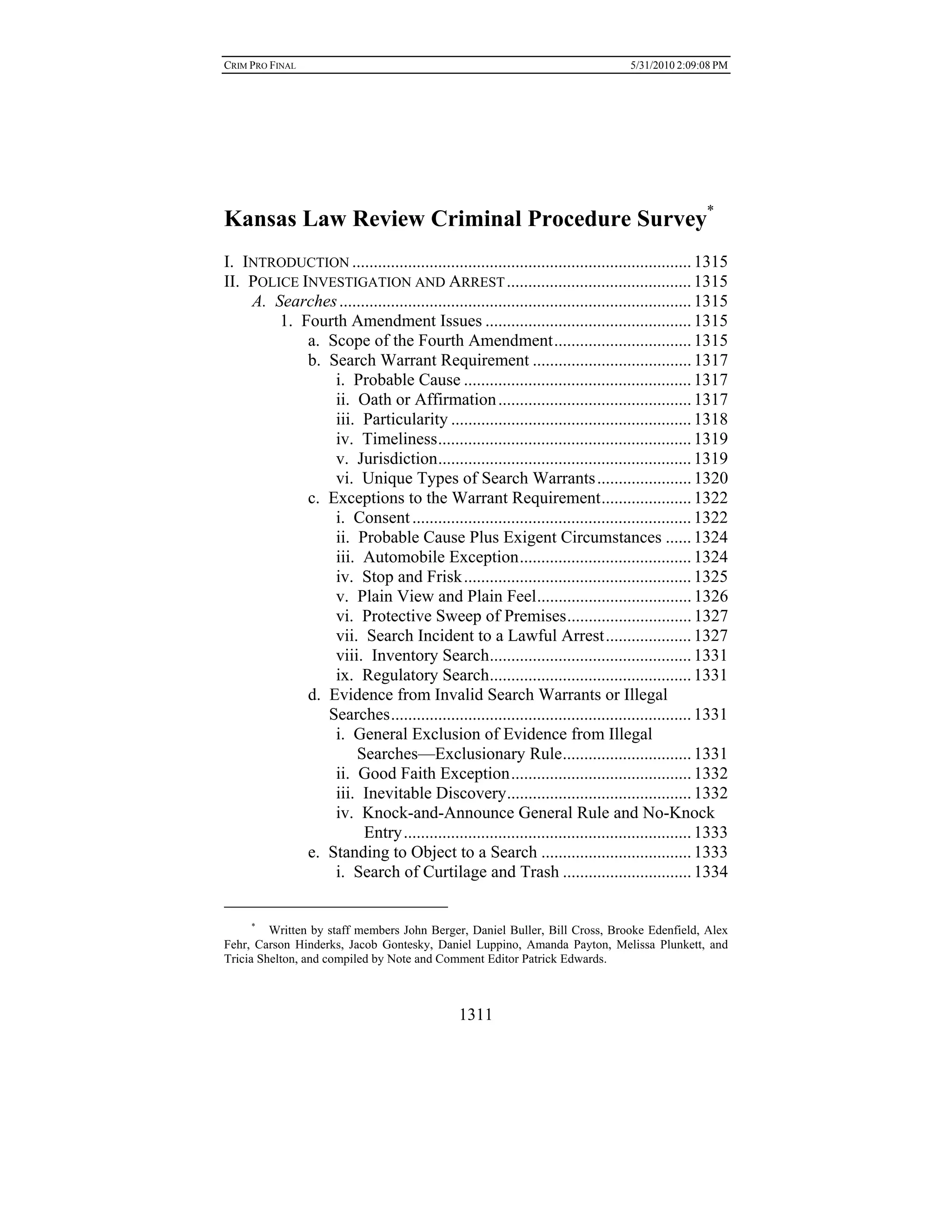
Kansas Law Review Criminal Procedure Survey*
I. INTRODUCTION ...............................................................................1315
II. POLICE INVESTIGATION AND ARREST...........................................1315
A. Searches..................................................................................1315
1. Fourth Amendment Issues ................................................1315
a. Scope of the Fourth Amendment................................1315
b. Search Warrant Requirement .....................................1317
i. Probable Cause .....................................................1317
ii. Oath or Affirmation.............................................1317
iii. Particularity ........................................................1318
iv. Timeliness...........................................................1319
v. Jurisdiction...........................................................1319
vi. Unique Types of Search Warrants......................1320
c. Exceptions to the Warrant Requirement.....................1322
i. Consent.................................................................1322
ii. Probable Cause Plus Exigent Circumstances ......1324
iii. Automobile Exception........................................1324
iv. Stop and Frisk.....................................................1325
v. Plain View and Plain Feel....................................1326
vi. Protective Sweep of Premises.............................1327
vii. Search Incident to a Lawful Arrest....................1327
viii. Inventory Search...............................................1331
ix. Regulatory Search...............................................1331
d. Evidence from Invalid Search Warrants or Illegal
Searches......................................................................1331
i. General Exclusion of Evidence from Illegal
Searches—Exclusionary Rule..............................1331
ii. Good Faith Exception..........................................1332
iii. Inevitable Discovery...........................................1332
iv. Knock-and-Announce General Rule and No-Knock
Entry...................................................................1333
e. Standing to Object to a Search ...................................1333
i. Search of Curtilage and Trash ..............................1334
*
Written by staff members John Berger, Daniel Buller, Bill Cross, Brooke Edenfield, Alex
Fehr, Carson Hinderks, Jacob Gontesky, Daniel Luppino, Amanda Payton, Melissa Plunkett, and
Tricia Shelton, and compiled by Note and Comment Editor Patrick Edwards.
0.6.0_CRIM PRO FINAL 5/31/2010 2:09:08 PM
1312 KANSAS LAW REVIEW [Vol. 58
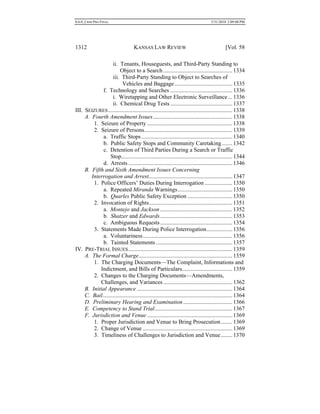
ii. Tenants, Houseguests, and Third-Party Standing to
Object to a Search................................................1334
iii. Third-Party Standing to Object to Searches of
Vehicles and Baggage........................................1335
f. Technology and Searches ...........................................1336
i. Wiretapping and Other Electronic Surveillance ...1336
ii. Chemical Drug Tests ...........................................1337
III. SEIZURES......................................................................................1338
A. Fourth Amendment Issues.......................................................1338
1. Seizure of Property ...........................................................1338
2. Seizure of Persons.............................................................1339
a. Traffic Stops...............................................................1340
b. Public Safety Stops and Community Caretaking .......1342
c. Detention of Third Parties During a Search or Traffic
Stop.............................................................................1344
d. Arrests ........................................................................1346
B. Fifth and Sixth Amendment Issues Concerning
Interrogation and Arrest..........................................................1347
1. Police Officers’ Duties During Interrogation ...................1350
a. Repeated Miranda Warnings......................................1350
b. Quarles Public Safety Exception ...............................1350
2. Invocation of Rights..........................................................1351
a. Montejo and Jackson ..................................................1352
b. Shatzer and Edwards..................................................1353
c. Ambiguous Requests..................................................1354
3. Statements Made During Police Interrogation..................1356
a. Voluntariness..............................................................1356
b. Tainted Statements .....................................................1357
IV. PRE-TRIAL ISSUES........................................................................1359
A. The Formal Charge.................................................................1359
1. The Charging Documents—The Complaint, Informations and
Indictment, and Bills of Particulars...................................1359
2. Changes to the Charging Documents—Amendments,
Challenges, and Variances................................................1362
B. Initial Appearance ..................................................................1364
C. Bail..........................................................................................1364
D. Preliminary Hearing and Examination..................................1366
E. Competency to Stand Trial......................................................1367
F. Jurisdiction and Venue ...........................................................1369
1. Proper Jurisdiction and Venue to Bring Prosecution........1369
2. Change of Venue ..............................................................1369
3. Timeliness of Challenges to Jurisdiction and Venue........1370
0.6.0_CRIM PRO FINAL 5/31/2010 2:09:08 PM
2010] CRIMINAL PROCEDURE SURVEY 1313
G. Statute of Limitations..............................................................1370
H. Joinder and Severance ...........................................................1371
I. Plea Agreements ......................................................................1372
1. Types of Pleas and Their Repercussions ..........................1373
2. Plea Agreements ...............................................................1374
J. Arraignment.............................................................................1374
K. Discovery................................................................................1376
L. Pretrial Conference and Pretrial Motions..............................1378
V. TRIAL.............................................................................................1379
A. Fifth Amendment Issues..........................................................1379
1. Right to Remain Silent—Self-Incrimination
and Immunity....................................................................1379
2. Double Jeopardy and Multiplicity ....................................1381
3. Due Process—Pre-Accusation Delay ...............................1386
B. Sixth Amendment Issues..........................................................1387
1. Speedy Trial......................................................................1387
2. Trial by Jury......................................................................1388
a. Impartial Jury..............................................................1388
b. Waiver........................................................................1389
c. Jury Selection and Peremptory Challenges ................1390
d. Juror Misconduct........................................................1391
3. Right to Confront Witnesses.............................................1391
4. Right to Testify and Present a Defense.............................1393
5. Right to Counsel ...............................................................1393
a. Invocation of the Right to Counsel.............................1393
b. Personal Choice of Counsel .......................................1394
c. Waiver of the Right to Counsel..................................1395
d. Effective Assistance of Counsel.................................1396
C. Evidentiary Issues...................................................................1397
1. Prior Actions by the Defendant: Evidence of Other Crimes or
Civil Wrongs.....................................................................1397
a. Pre-Amendment Problems: State v. Gunby and
State v. Dayhuff ..........................................................1398
b. State v. Prine ..............................................................1399
c. Sexually Violent Predator Commitment
Proceedings ................................................................1400
d. Evidence of Gang Membership..................................1400
2. Use of the Defendant’s Post-Arrest Silence to
Impeach.............................................................................1400
3. Plea Agreements as Evidence...........................................1402
4. Evidence from Third Parties.............................................1403
a. Eyewitness Identification ...........................................1404
0.6.0_CRIM PRO FINAL 5/31/2010 2:09:08 PM
1314 KANSAS LAW REVIEW [Vol. 58
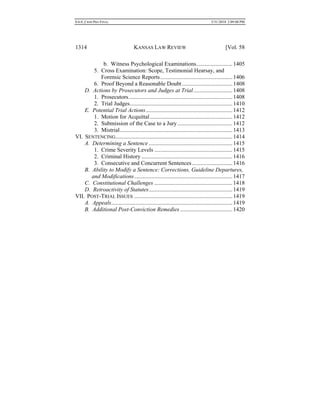
b. Witness Psychological Examinations.........................1405
5. Cross Examination: Scope, Testimonial Hearsay, and
Forensic Science Reports..................................................1406
6. Proof Beyond a Reasonable Doubt...................................1408
D. Actions by Prosecutors and Judges at Trial...........................1408
1. Prosecutors........................................................................1408
2. Trial Judges.......................................................................1410
E. Potential Trial Actions............................................................1412
1. Motion for Acquittal.........................................................1412
2. Submission of the Case to a Jury......................................1412
3. Mistrial..............................................................................1413
VI. SENTENCING.................................................................................1414
A. Determining a Sentence..........................................................1415
1. Crime Severity Levels ......................................................1415
2. Criminal History ...............................................................1416
3. Consecutive and Concurrent Sentences............................1416
B. Ability to Modify a Sentence: Corrections, Guideline Departures,
and Modifications....................................................................1417
C. Constitutional Challenges ......................................................1418
D. Retroactivity of Statutes..........................................................1419
VII. POST-TRIAL ISSUES ....................................................................1419
A. Appeals....................................................................................1419
B. Additional Post-Conviction Remedies ....................................1420
0.6.0_CRIM PRO FINAL 5/31/2010 2:09:08 PM
2010] CRIMINAL PROCEDURE SURVEY 1315
I. INTRODUCTION
This Survey provides an overview of criminal procedure in Kansas.
It addresses recent changes in case law based on United States Supreme
Court and Kansas precedents. It also analyzes developments in Kansas
and federal statutes. Additionally, the Survey provides commentary
detailing the potential implications of these changes and the soundness of
the reasoning used by the court or legislature.
II. POLICE INVESTIGATION AND ARREST
A. Searches
1. Fourth Amendment Issues
The Fourth Amendment states:
The right of the people to be secure in their persons, houses, papers,
and effects, against unreasonable searches and seizures, shall not be
violated, and no Warrants shall issue, but upon probable cause,
supported by Oath or affirmation, and particularly describing the place
to be searched, and the persons or things to be seized.1
Section 15 of the Kansas Constitution’s Bill of Rights uses similar
language.2
Under both the Fourth Amendment and Section 15, a
warrantless search is presumably an “unreasonable” search.3
Therefore,
in order for a search to be “reasonable,” it must be performed pursuant to
a warrant supported by probable cause.4
However, as discussed later,
several exceptions have been carved out that allow warrantless searches
under the Fourth Amendment.
a. Scope of the Fourth Amendment
The limitations of the Fourth Amendment apply only to searches
performed as “government action.”5
A private person who is not acting
with the participation or knowledge of the government is not subject to
1. U.S. CONST. amend. IV.
2. KAN. CONST. Bill of Rights § 15.
3. State v. Medlock, No. 100,947, 2009 WL 3837640, at *5 (Kan. Ct. App. Nov. 13, 2009).
4. Id.
5. E.g., State v. Brittingham, 218 P.3d 441, 444 (Kan. Ct. App. 2009).
0.6.0_CRIM PRO FINAL 5/31/2010 2:09:08 PM
1316 KANSAS LAW REVIEW [Vol. 58
the Fourth Amendment’s warrant requirements.6
However, if the
government “coerces, dominates, or directs” a private person’s behavior,
then the Fourth Amendment may be implicated.7
The determination of
whether the Fourth Amendment applies to a private, non-government
actor is made on a case-by-case basis by examining the particular facts
and circumstances of that case.8
The fact that the person performing the search happens to be a
government employee is insufficient to invoke the Fourth Amendment if
the search does not “further[] the government’s objectives as they relate
to the duties of the government employee.”9
In State v. Brittingham, a
public-housing authority employee was directed by his supervisor to
conduct a routine maintenance call on apartments previously affected by
a sewage backup to confirm there were no further issues.10
Upon arrival
at the defendant’s apartment, the employee found two unconscious
bodies and saw illegal drugs in plain view.11
The trial court ruled that the
government employee’s entry of the apartment, even though done
pursuant to housing authority policy and under the direction of her
government supervisor,12
was not government action within the meaning
of the Fourth Amendment.13
The appellate court affirmed, agreeing that
the employee did not enter the apartment with the intent to find drugs,
but rather with the intent to investigate a sewage issue.14
This case’s result seems questionable. The rule that private actors
are not subject to the limitations of the Fourth Amendment is well
established. However, it is arguable whether the housing-authority
employee was in fact a private actor. She entered the apartment during
her work hours as a government employee, at the direction of her
government-employed boss, and pursuant to government policy. Her
lack of intent to discover drugs should not be the deciding factor.
Regardless of intent, she was “furthering the government’s objectives”15
by performing her duties as a government employee. However, no
Kansas Supreme Court appeal is pending at this time.
6. Id.
7. Id.
8. Id.
9. Id. (quoting State v. Smith, 763 P.2d 632, 637 (Kan. 1988)).
10. Id.
11. Id.
12. Id. (“After receiving no response, [the employee], pursuant to housing authority policy,
entered the apartment with her passkey . . . .”).
13. Id. at 445.
14. Id. at 446.
15. Id. at 444.
0.6.0_CRIM PRO FINAL 5/31/2010 2:09:08 PM
2010] CRIMINAL PROCEDURE SURVEY 1317
b. Search Warrant Requirement
Generally, for a search to be constitutional, a search warrant must be
issued by a judge, and such warrant must meet the requirements set forth
in the Fourth Amendment, as discussed below.16
i. Probable Cause
The Fourth Amendment requires that search warrants be based upon
probable cause. Probable cause exists when the government agent can
demonstrate a reasonable belief that a certain crime has been committed
and that a specific person committed that crime.17
Therefore, when
determining whether to issue a search warrant, the magistrate judge
“considers the totality of the circumstances presented and makes a
practical, common-sense decision whether a crime has been or is being
committed and whether there is a fair probability that contraband or
evidence of a crime will be found in a particular place.”18
Probable cause cannot be demonstrated by “[b]ald conclusions, mere
affirmations of belief, or suspicions.”19
However, a government actor’s
affidavit may be based on hearsay if it can also provide enough
information for the magistrate judge to make a determination of probable
cause based on the government official’s own personal knowledge.20
ii. Oath or Affirmation
The Fourth Amendment requires that the government agent’s
application for a search warrant be made under oath or affirmation.21
Kansas courts uniformly recognize that “[a] search warrant may only be
issued upon statements of a person under oath.”22
16. State v. Medlock, No. 100,947, 2009 WL 3837640, at *5 (Kan. Ct. App. Nov. 13, 2009).
17. State v. Fulton, No. 100,061, 2009 WL 3737310, at *2 (Kan. Ct. App. Nov. 6, 2009).
18. State v. Hicks, 147 P.3d 1076, 1087 (Kan. 2006).
19. Id.
20. Id.
21. U.S. CONST. amend. IV.
22. State v. Martin, No. 98,435, 2009 WL 4471699, at *1 (Kan. Ct. App. Oct. 3, 2008).
0.6.0_CRIM PRO FINAL 5/31/2010 2:09:08 PM
1318 KANSAS LAW REVIEW [Vol. 58
iii. Particularity
The Fourth Amendment also requires that the search warrant
describe the place to be searched with particularity.23
In United States v.
Leon,24
the United States Supreme Court recognized that in some cases,
failure to particularize the place to be searched can result in the warrant
being so facially deficient that an executing officer cannot reasonably
presume it to be valid.25
In this situation, evidence may be suppressed if
the court agrees that the particularity requirement of the search warrant
was severely lacking.26
Courts frequently struggle in applying analog rules to a digital world,
and search warrants are no exception. The Tenth Circuit recognized that
applying the Fourth Amendment’s particularity requirement to searches
of computers is challenging, and therefore adopted a “somewhat
forgiving stance” in analyzing such challenges.27
In computer search
situations, the particularity requirement forces government agents to “be
clear as to what it is they are seeking on the computer and conduct the
search in a way that avoids searching files of types not identified in the
warrant.”28
The computer search may only be as “extensive as
reasonably required to locate the items described in the search
warrant.”29
In United States v. Potts, the defendant argued that the search
warrant authorizing a search of his computer for child pornography was
overly broad and thus did not meet the particularity requirement.30
The
search warrant allowed officers to open and skim the first few pages of
files on Potts’s computer to determine their precise contents.31
The court
admitted that this language was very broad,32
but also noted that the
warrant forced the executing officer to “limit his/her search [] to the
criminal charges under investigation.”33
The court held that even if the
warrant did not meet the Fourth Amendment’s particularity requirement,
23. U.S. CONST. amend. IV; see United States v. Potts, 586 F.3d 823, 831 (10th Cir. 2009).
24. 468 U.S. 897 (1984).
25. Id. at 923.
26. Id.
27. Potts, 586 F.3d at 833 (quoting United States v. Grimmett, 439 F.3d 1263, 1269 (Kan.
2006)).
28. Id. (quoting United States v. Walser, 275 F.3d 981, 986 (10th Cir. 2001)).
29. Id. (quoting Grimmett, 439 F.3d at 1270).
30. Id. at 831.
31. Id. at 827.
32. Id. at 834.
33. Id.
0.6.0_CRIM PRO FINAL 5/31/2010 2:09:08 PM
2010] CRIMINAL PROCEDURE SURVEY 1319
it was sufficiently restrictive such that a reasonable officer could read the
warrant as limited to only those computer files relating to child
pornography.34
Consequently, the Leon exception was not met and the
evidence found on Potts’s computer was not suppressed.35
iv. Timeliness
The Fourth Amendment also requires that the information contained
in an affidavit for a search warrant be timely.36
A judge may not issue a
search warrant if the underlying affidavit is “based upon information that
has grown stale, i.e., information that no longer supports an affidavit’s
underlying assertion that the item sought will be found in the area or
location to be searched.”37
Timeliness is not determined solely by the
calendar.38
When the circumstances as a whole suggest that the criminal
activity is ongoing, the passage of time is not as important.39
Circumstances to be examined in making a determination of timeliness
are “the nature of the criminal activity, the length of the activity, and the
nature of the property to be seized.”40
Examined together, these factors
will help the court arrive at a conclusion as to whether the information is
timely enough to establish sufficient probable cause for issuance of a
search warrant.
v. Jurisdiction
The Fourth Amendment also requires that the search warrant be
obtained from a magistrate judge in the relevant jurisdiction—the
jurisdiction in which the search is to take place.41
The jurisdiction of
Kansas law-enforcement officers is generally limited to the city or
county which employs them, unless in fresh pursuit of a suspect or when
34. Id. at 835.
35. Id.
36. See United States v. Iiland, 254 F.3d 1264, 1268 (10th Cir. 2001) (affirming trial court’s
timeliness determination).
37. State v. Bottom, 190 P.3d 283, 289 (Kan. Ct. App. 2008) (quoting United States v. Cantu,
405 F.3d 1173, 1177 (10th Cir. 2005)).
38. Id.
39. Id.
40. Id. (citing Cantu, 405 F.3d at 1177).
41. See United States v. Green, 178 F.3d 1099, 1106 (10th Cir. 1999) (stating that “[t]he Fourth
Amendment is satisfied where, as here, officers obtained a warrant, grounded in probable cause and
phrased with sufficient particularity, from a magistrate of the relevant jurisdiction authorizing them
to search a particular location”).
0.6.0_CRIM PRO FINAL 5/31/2010 2:09:08 PM
1320 KANSAS LAW REVIEW [Vol. 58
assistance has been requested by law-enforcement officers of another
jurisdiction.42
In United States v. Green, a search warrant was issued by a
magistrate of the relevant jurisdiction.43
However, it was executed by
law-enforcement officers acting outside of their jurisdiction.44
Nonetheless, the Tenth Circuit determined there was no Fourth
Amendment violation.45
Therefore, the relevant jurisdiction is arguably
that of the issuing magistrate, not the jurisdiction of the executing
officers.46
However, the above rule may only be applicable to searches
conducted pursuant to warrants. In dicta to Green, the Tenth Circuit left
open the question of whether a warrantless search conducted by a law-
enforcement officer outside of his jurisdiction is a Fourth Amendment
violation.47
The court cited Ross v. Neff, which held that a warrantless
arrest outside of the arresting officer’s jurisdiction violated the Fourth
Amendment,48
and noted that “a warrantless arrest is vastly different
from a warranted search,”49
but declined to address the question of
whether Ross applied to warrantless searches.
vi. Unique Types of Search Warrants
One unique type of search warrant is an anticipatory search warrant.
Anticipatory search warrants differ from standard warrants because when
an anticipatory warrant is issued, it is not supported by probable cause to
believe that contraband is currently present in the area proposed to be
searched.50
However, anticipatory warrants must still be supported by
probable cause.51
The affidavit for the warrant must include enough
information to allow a magistrate judge to determine that probable cause
exists to believe that the items to be seized, although not presently at the
search location, will be there when the warrant is executed.52
42. KAN. STAT. ANN. § 22-2401a (2007).
43. 178 F.3d 1099, 1106 (10th Cir. 1999).
44. Id. at 1105.
45. Id. at 1106.
46. See id.
47. See id. (refusing to rule on warrantless grounds because the officers had in fact obtained a
warrant).
48. 905 F.2d 1349, 1354 (10th Cir. 1990).
49. Green, 178 F.3d at 1106.
50. United States v. Rowland, 145 F.3d 1194, 1201 (10th Cir. 1998).
51. Id.
52. Id.
0.6.0_CRIM PRO FINAL 5/31/2010 2:09:08 PM
2010] CRIMINAL PROCEDURE SURVEY 1321
The anticipatory warrant is issued based upon expected triggering
events, such as a drug delivery or purchase.53
In order for the
anticipatory warrant to be executed, the triggering events must occur.54
If they do not occur, the warrant is invalid and the search cannot be
performed.55
Another unique search warrant is a no-knock warrant. The Fourth
Amendment reasonableness requirement requires law-enforcement
officers to “knock and announce” upon arrival at the premises to be
searched.56
The officers must identify themselves and state their
intention to search.57
There is no bright-line rule to determine how long
officers must wait after knocking and announcing before forcibly
entering.58
Courts instead look to whether the officer acted reasonably in
the circumstances, because the knock-and-announce requirement stems
from the reasonableness requirement.59
However, in some cases, a special “no-knock” warrant can be issued.
Officers can apply for a no-knock warrant when they have a reasonable
suspicion that knocking and announcing would be dangerous, futile, or
allow for the destruction of evidence.60
For example, in United States v.
Timley, a Kansas district judge issued a no-knock warrant when the
police officer’s application for the warrant stated that the defendant had
an extensive criminal history (including murder convictions) and a
history of evading arrest, destroying and hiding evidence, and use or
possession of weapons.61
These circumstances were sufficient to
convince the judge that knocking and announcing could be dangerous or
result in destruction of evidence.62
53. Id.
54. Id.
55. Id.
56. United States v. Harwell, 426 F. Supp. 2d 1189, 1199 (10th Cir. 2006) (citing Wilson v.
Arkansas, 514 U.S. 927, 934 (1995)).
57. United States v. Banks, 540 U.S. 31, 36 (2003).
58. Id.
59. Harwell, 426 F. Supp. 2d at 1199–1200.
60. Id. at 1199 n.5.
61. 338 F. App’x 782, 785 (10th Cir. 2009).
62. See id. at 785–86.
0.6.0_CRIM PRO FINAL 5/31/2010 2:09:08 PM
1322 KANSAS LAW REVIEW [Vol. 58
c. Exceptions to the Warrant Requirement
i. Consent
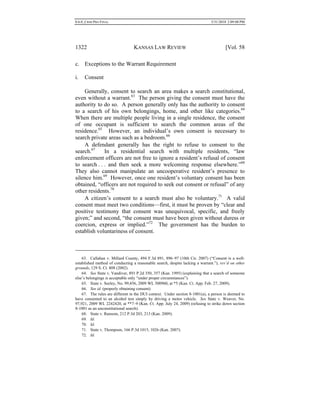
Generally, consent to search an area makes a search constitutional,
even without a warrant.63
The person giving the consent must have the
authority to do so. A person generally only has the authority to consent
to a search of his own belongings, home, and other like categories.64
When there are multiple people living in a single residence, the consent
of one occupant is sufficient to search the common areas of the
residence.65
However, an individual’s own consent is necessary to
search private areas such as a bedroom.66
A defendant generally has the right to refuse to consent to the
search.67
In a residential search with multiple residents, “law
enforcement officers are not free to ignore a resident’s refusal of consent
to search . . . and then seek a more welcoming response elsewhere.”68
They also cannot manipulate an uncooperative resident’s presence to
silence him.69
However, once one resident’s voluntary consent has been
obtained, “officers are not required to seek out consent or refusal” of any
other residents.70
A citizen’s consent to a search must also be voluntary.71
A valid
consent must meet two conditions—first, it must be proven by “clear and
positive testimony that consent was unequivocal, specific, and freely
given;” and second, “the consent must have been given without duress or
coercion, express or implied.”72
The government has the burden to
establish voluntariness of consent.
63. Callahan v. Millard County, 494 F.3d 891, 896–97 (10th Cir. 2007) (“Consent is a well-
established method of conducting a reasonable search, despite lacking a warrant.”), rev’d on other
grounds, 129 S. Ct. 808 (2002).
64. See State v. Vandiver, 891 P.2d 350, 357 (Kan. 1995) (explaining that a search of someone
else’s belongings is acceptable only “under proper circumstances”).
65. State v. Seeley, No. 99,456, 2009 WL 500960, at *5 (Kan. Ct. App. Feb. 27, 2009).
66. See id. (properly obtaining consent).
67. The rules are different in the DUI context. Under section 8-1001(a), a person is deemed to
have consented to an alcohol test simply by driving a motor vehicle. See State v. Weaver, No.
97,921, 2009 WL 2242420, at **7–9 (Kan. Ct. App. July 24, 2009) (refusing to strike down section
8-1001 as an unconstitutional search).
68. State v. Ransom, 212 P.3d 203, 213 (Kan. 2009).
69. Id.
70. Id.
71. State v. Thompson, 166 P.3d 1015, 1026 (Kan. 2007).
72. Id.
0.6.0_CRIM PRO FINAL 5/31/2010 2:09:08 PM
2010] CRIMINAL PROCEDURE SURVEY 1323
When examining if consent to search was given voluntarily, the court
will examine several factors, including the defendant’s mental condition
and capacity.73
If the defendant is found to be mentally incapable of
consenting to the search, the search can be found invalid because of lack
of voluntariness.74
Even though consent to search must be voluntary, it may be
implied.75
For example, although nonverbal, a nod of the head can be
construed as consent to a search.76
Furthermore, when there are multiple
occupants in a dwelling, one occupant gives consent to search, and the
other occupants are present and do not object, their consent can be
implied.77
Also, as a condition of his parole agreement, a parolee may be
required to consent to warrantless searches at any time.78
Such
agreements remain effective even if the parolee is arrested and in police
custody when the search takes place.79
Even after consent to search has been given, the scope of this consent
may become an issue. Consent can be limited when given or while the
search is already underway.80
However, limitations on the scope of
consent must be made known.81
A defendant’s failure to object to the
search techniques being used by the law enforcement officers is
considered an indication that the search is within the scope of consent.82
In addition to limiting consent, a person may also withdraw his
consent.83
For example, in United States v. Chavira,84
a trooper spent
twenty minutes searching the defendant’s car with consent when the
73. United States v. McKinney, 470 F. Supp. 2d 1226, 1233 (D. Kan. 2007). Other factors
include “physical mistreatment, use of violence, threats, promises, inducements, deception, trickery,
an aggressive tone,” physical condition and capacity, “the number of officers present, and the
display of police weapons.” Id.
74. See id.
75. See State v. Kimberlin, 977 P.2d 276, 278 (Kan. Ct. App. 1999) (inviting one officer inside
implied an invitation to backup officers).
76. See State v. Seeley, No. 99,451, 2009 WL 500960, at *4 (Kan. Ct. App. Feb. 27, 2009)
(stating that “a nod of the head can be unequiviocal and specific”).
77. See id.
78. See United States v. Cordova, 340 F. App’x 427, 429 (10th Cir. 2009).
79. Id. at 432.
80. See United States v. Bugarin, No. 09-40064-01-RDR, 2009 WL 4158191, at *4 (D. Kan.
Nov. 23, 2009).
81. Id. (stating that because defendant never objected to the extent of the search, the officers’
actions were deemed to be within the scope of the search).
82. Id.
83. See United States v. Chavira, No. 05-40010-01-JAR, 2005 WL 1213670, at *6 (D. Kan.
May 18, 2005).
84. Id.
0.6.0_CRIM PRO FINAL 5/31/2010 2:09:08 PM
1324 KANSAS LAW REVIEW [Vol. 58
defendant was allowed to withdraw his consent.85
However, the trooper
was still within his rights to hold Chavira for an hour while a drug dog
was transported to continue the search.86
ii. Probable Cause Plus Exigent Circumstances
The combination of probable cause plus exigent circumstances
provides another exception to the warrant requirement.87
Automobile
searches are a common application of this doctrine, as “the mobility of
the vehicle provides the exigent circumstances, so only probable cause
needs to be shown to stop and search a moving vehicle.”88
Emergency is another well-recognized type of exigent circumstance.
To use the Emergency Aid Doctrine as basis for warrantless entry, “the
police must have reasonable grounds to believe that there is an
emergency at hand and an immediate need for assistance for the
protection of life or property.”89
Furthermore, there must be a reasonable
basis to associate the emergency with the area to be searched.90
“Hot pursuit” is a third type of exigent circumstance. The Fourth
Amendment does not prohibit law-enforcement officers from entering a
home without a warrant when officers are in hot pursuit of a suspect who
has fled from a public area into a house, even if the suspect does not own
or reside in the house.91
iii. Automobile Exception
Police officers have probable cause to search a vehicle if “a fair
probability exists that the vehicle contains contraband or evidence” of
illegal activity.92
If such probable cause exists, officers may lawfully
search any area of the vehicle which may contain evidence of the
suspected illegal activity “without first obtaining a search warrant.”93
Known as the “automobile exception,” this rule permits police to search
85. Id.
86. Id. at **6–7 (holding that after the twenty minute search, the trooper established at least
reasonable suspicion, if not probable cause, that the defendant was transporting drugs).
87. State v. Sanchez-Loredo, 220 P.3d 374, 378 (Kan. Ct. App. 2009) (citing State v.
Fitzgerald, 192 P.3d 171, 173 (Kan. 2008)).
88. Id.
89. State v. Peterman, 216 P.3d 710, 713 (Kan. Ct. App. 2009).
90. Id.
91. State v. Thomas, 124 P.3d 48, 57 (Kan. 2005).
92. United States v. Triska, 574 F. Supp. 2d 1208, 1215–16 (D. Kan. 2008).
93. Id. at 1216.
0.6.0_CRIM PRO FINAL 5/31/2010 2:09:08 PM
2010] CRIMINAL PROCEDURE SURVEY 1325
every part of the vehicle which could conceivably contain the contraband
or evidence that is the object of the search “to the same extent as a
magistrate could legitimately authorize by warrant.”94
Dog sniffs of the exterior of a vehicle parked in a public location by
a drug detection canine do not constitute a Fourth Amendment search.95
Because such activity does not constitute a search, officers need not have
probable cause or any additional suspicion to conduct a dog sniff during
an investigative detention.96
An alert by a properly-certified drug-
sniffing dog constitutes probable cause and, in turn, justifies a
warrantless search of the vehicle and its contents.97
The scope of the
search is not limited to the precise region of the car to which the dog
alerted.98
Such an alert “‘creates general probable cause to search a
vehicle; it does not implicate the precision of a surgeon working with
scalpel in hand.’”99
iv. Stop and Frisk
Kansas law permits officers to conduct a safety pat-down, known as
a Terry stop, if an officer has reasonable suspicion that such a search is
required to protect the officer’s safety.100
“The officer must have prior
knowledge of facts, observe conduct of the detained person, or receive
responses from the detained person that, in light of the officer’s
experience, would give rise to reasonable suspicion that such a search is
necessary.”101
The scope of the pat-down is generally limited to the
94. Id. (citing United States v. Ross, 456 U.S. 798, 825 (1982)).
95. United States v. Roberts, 572 F. Supp. 2d 1240, 1249 (D. Kan. 2008) (citing United States
v. Engles, 481 F.3d 1243, 1245–46 (10th Cir. 2007)).
96. Id. (citing United States v. Ramirez, 479 F.3d 1229, 1245 (10th Cir. 2007)).
97. Id. (citing United States v. Rosborough, 366 F.3d 1145, 1152 (10th Cir. 2004)). However,
a defendant may “rebut the finding of probable cause by showing that the particular drug dog is
unreliable.” Triska, 574 F. Supp. 2d at 1217 (citing United States v. Ludwig, 10 F.3d 1523, 1528
(10th Cir. 1993)). “[D]og alert may not provide probable cause if dog has poor accuracy record.”
Id. (summarizing the holding from Ludwig). “The Tenth Circuit has held that a 70 to 80 per cent
reliability rate satisfies the liberal standard for probable cause . . . .” Id. (citing United States v.
Kennedy, 131 F.3d 1371, 1378 (10th Cir. 1997)).
98. United States v. Parada, 577 F.3d 1275, 1282–83 (10th Cir. 2009). When a dog alerted
only to the driver’s side door region of a vehicle, probable cause to search the vehicle was not
limited to the driver’s door. Id.
99. Id. at 1283 (quoting Rosborough, 366 F.3d at 1153). This rule is consistent with the
Supreme Court’s ruling in Ross that when probable cause exists, “it justifies the search of every part
of the vehicle and its contents that may conceal the object of the search.” Id. at 1283 (quoting
United States v. Ross, 456 U.S. 798, 825 (1982)).
100. State v. Johnson, 217 P.3d 42, 47 (Kan. Ct. App. 2009) (citing Terry v. Ohio, 392 U.S. 1
(1968); KAN. STAT. ANN. § 22-2402(2) (Supp. 2009)).
101. Id. (citing State v. Davis, 11 P.3d 1177, 1182 (Kan. Ct. App. 2000); Terry, 392 U.S. at 20–
0.6.0_CRIM PRO FINAL 5/31/2010 2:09:08 PM
1326 KANSAS LAW REVIEW [Vol. 58
“person’s outer clothing without placing the officer’s hands inside any
pockets or under the outer surface of any garment, unless or until a
weapon is found.”102
Officers may conduct such Terry stops not only of
the person, but also “the area within the immediate control of the person
from which the person might gain access to a weapon, or contraband,
such as the passenger compartment of an automobile.”103
However, there
are limits to what objects within that area may be searched. An officer’s
seizure of a cigarette package from a purse that was within reach of the
defendant, for instance, was not considered reasonable when the officer
had no sufficient safety concerns under Terry to justify such a search of
that particular object.104
v. Plain View and Plain Feel
Officers may seize evidence they encounter in plain view without a
warrant.105
Federal courts in Kansas require that four elements be
present to justify a seizure under the plain view doctrine: “‘(1) the item is
indeed in plain view; (2) the police officer is lawfully located in a place
from which the item can plainly be seen; (3) the officer has a lawful right
of access to the item itself; and (4) it is immediately apparent that the
seized item is incriminating on its face.’”106
Alternatively, the Kansas
Court of Appeals requires that under the plain view doctrine, “‘a law
enforcement official can seize evidence of a crime if (1) the initial
intrusion which afforded authorities the plain view is lawful; (2) the
discovery of the evidence is inadvertent; and (3) the incriminating
character of the article is immediately apparent to searching
authorities.’”107
29). “The officer need not be absolutely certain that the individual is armed; the issue is whether a
reasonably prudent man in the circumstances would be warranted in the belief that his safety or that
of others was in danger.” Terry, 392 U.S. at 27. Additionally, the officer need not obtain the
defendant’s consent prior to the safety pat-down as it “is not the same as a search of the suspect,
which requires either probable cause to search or consent.” State v. Golston, 203 P.3d 10, 18 (Kan.
Ct. App. 2009).
102. Golston, 203 P.3d at 18 (citing Terry, 392 U.S. at 30).
103. Johnson, 217 P.3d at 47 (citing Michigan v. Long, 463 U.S. 1032, 1045–51 (1983)).
104. Id. at 47–48. As such, the search was unconstitutional in light of the Supreme Court’s
recent restriction on searches incident to arrest, as expressed in United States v. Gant, discussed infra
Part II.A.1.c.vii. (discussing the permissible scope of a warrantless search incident to an arrest).
105. State v. Ulrey, 208 P.3d 317, 323 (Kan. Ct. App. 2009) (citing State v. Horn, 91 P.3d 517,
526 (Kan. 2004)).
106. United States v. Troxel, 547 F. Supp. 2d 1190, 1197 (D. Kan. 2008) (quoting United States
v. Corral, 970 F.2d 719, 723 (10th Cir. 1992)).
107. Ulrey, 208 P.3d at 323 (quoting State v. Canaan, 964 P.2d 681, 689 (Kan. 1998)).
0.6.0_CRIM PRO FINAL 5/31/2010 2:09:08 PM
2010] CRIMINAL PROCEDURE SURVEY 1327
vi. Protective Sweep of Premises
“‘A protective sweep is a quick, limited search of premises incident
to an arrest and conducted to protect the safety of officers or others.’”108
For such a sweep to be constitutional, the officer must have a
“‘reasonable belief based on specific and articulable facts which, taken
together with the rational inferences from those facts, reasonably
warrant[s] the officer in believing, that the area swept harbored an
individual posing a danger to the officer or others.’”109
In the vehicle
context, if the “officer has reasonable belief based on specific and
articulable facts that the suspect is dangerous and may gain immediate
control of weapons,” a protective search of a vehicle’s passenger
compartment is constitutional when it is limited to areas where a weapon
may be found.110
vii. Search Incident to a Lawful Arrest
The United States Supreme Court substantially curtailed the
permissible scope of an automobile search incident to a lawful arrest in
2009.111
Officers arrested Rodney Gant due to an outstanding warrant
for driving with a suspended license, then handcuffed him, and placed
him in the back of a patrol car.112
After his arrest, officers searched his
car, discovering cocaine in the pocket of a jacket on the car’s back
seat.113
Gant was charged with multiple drug offenses.114
At trial, Gant
moved to suppress the narcotics evidence, arguing the warrantless search
violated his Fourth Amendment rights.115
Even though officers lacked
probable cause to search the car, the court found the search permissible
as a search incident to an arrest, because officers had lawfully arrested
Gant for driving with a suspended license.116
Gant was convicted and
sentenced to three years in prison.117
108. United States v. Freeman, 479 F.3d 743, 750 (10th Cir. 2007) (quoting Maryland v. Buie,
494 U.S. 325, 327 (1990)) (internal quotation marks omitted).
109. Id. (quoting Buie, 494 U.S. at 327).
110. State v. Preston, 207 P.3d 1081, 1087 (Kan. Ct. App. 2009) (citing Michigan v. Long, 463
U.S. 1032, 1050 (1983)).
111. Arizona v. Gant, 129 S. Ct. 1710, 1723–24 (2009).
112. Id. at 1715.
113. Id.
114. Id.
115. Id.
116. Id.
117. Id.
0.6.0_CRIM PRO FINAL 5/31/2010 2:09:08 PM
1328 KANSAS LAW REVIEW [Vol. 58
On appeal, the Arizona Supreme Court held that a search incident to
a lawful arrest is only “justified by interests in officer safety and
evidence preservation.”118
When the “arrestee is handcuffed, secured in
the back of a patrol car, and under the supervision of an officer . . . a
warrantless search of the arrestee’s car cannot be justified as necessary to
protect the officers at the scene or prevent the destruction of
evidence.”119
As such, the Arizona Supreme Court held the search was
unreasonable and the evidence should be suppressed.120
The United States Supreme Court granted certiorari, acknowledging
existing questions stemming from its previous decision in Belton and its
“fidelity to Fourth Amendment principles.”121
The Court expressed
concern that the Belton holding had been widely understood “to allow a
vehicle search incident to the arrest of a recent occupant even if there is
no possibility the arrestee could gain access to the vehicle at the time of
the search.”122
This broad reading would “untether the rule from the
justifications” outlined in Chimel: officer safety and evidence
preservation.123
As such, the Supreme Court rejected the broad
interpretation of Belton permitting such a search and held “that the
Chimel rationale authorizes police to search a vehicle incident to a recent
occupant’s arrest only when the arrestee is unsecured and within
reaching distance of the passenger compartment at the time of the
search.”124
Additionally, the Court held that “circumstances unique to
the vehicle context justify a search incident to a lawful arrest when it is
‘reasonable to believe evidence relevant to the crime of arrest might be
found in the vehicle.’”125
These exceptions “ensure that officers may
search a vehicle when genuine safety or evidentiary concerns
encountered during the arrest of a vehicle’s recent occupant justify a
search.”126
The Court concluded that police may search a vehicle
118. Id. at 1715–16.
119. Id. at 1716.
120. Id.
121. Id. In Belton, the Supreme Court held that “when an officer lawfully arrests the occupant of
an automobile, he may, as a contemporaneous incident of that arrest, search the passenger
compartment of the automobile and any containers therein.” Id. at 1717 (quoting New York v.
Belton, 453 U.S. 454, 460 (1981)).
122. Id. at 1718.
123. Id. at 1719.
124. Id. Furthermore, “[c]onstruing Belton broadly to allow vehicle searches incident to any
arrest would serve no purpose except to provide a police entitlement, and it is anathema to the Fourth
Amendment to permit a warrantless search on that basis.” Id. at 1721.
125. Id. at 1719 (quoting Thornton v. United States, 541 U.S. 615, 632 (2004) (Scalia, J.,
concurring in the judgment)).
126. Id. at 1721.
0.6.0_CRIM PRO FINAL 5/31/2010 2:09:08 PM
2010] CRIMINAL PROCEDURE SURVEY 1329
incident to a lawful arrest “only if the arrestee is within reaching distance
of the passenger compartment at the time of the search or it is reasonable
to believe the vehicle contains evidence of the offense of arrest.”127
In response to Gant, the Kansas Supreme Court held unconstitutional
a Kansas statute that permitted officers to search, incident to an arrest, a
person for evidence of any crime, not just the crime of the arrest.128
Randy Henning was arrested for an outstanding warrant by an officer
who observed him exit a convenience store and enter a waiting
vehicle.129
The officer requested Henning step out of the vehicle,
confirmed his identity, and placed him in handcuffs.130
The officer
searched the vehicle while Henning stood handcuffed about five to seven
feet away.131
The officer discovered drug paraphernalia in the car’s
closed center console.132
In a suppression hearing, the officer testified
that he searched the car because the recent changes to the Kansas statute
allowed him to search for “fruits of a crime” in any car out of which he
made an arrest.133
The officer was referring to a recent change in section
22-2501(c) of the Kansas Statutes by the 2006 Kansas Legislature.134
Prior to 2006, the statute permitted officers to “ . . . ‘search the person
arrested and the area within his immediate presence for the purpose
of . . . discovering the fruits, instrumentalities, or evidence of the crime.’
(Emphasis added).”135
In 2006, the statute was revised to widen the
scope to permit a search for the purpose of “‘[d]iscovering the fruits,
instrumentalities, or evidence of a crime.’ (Emphasis added).”136
At the
time the officer searched the vehicle, “he had no expectation that he
would find evidence of any particular crime committed by any particular
person.”137
The officer clearly acted within the scope of the new
statutory language (“evidence of a crime”) in a manner that would have
violated the prior narrower statute (“evidence of the crime”), as there
could be no evidence of the crime for which Henning was arrested (the
127. Id. at 1723. Absent these justifications, a search of the vehicle “will be unreasonable unless
police obtain a warrant or show that another exception to the warrant requirement applies.” Id. at
1723–24.
128. State v. Henning, 209 P.3d 711, 720 (Kan. 2009).
129. Id. at 714.
130. Id.
131. Id.
132. Id.
133. Id. (emphasis added).
134. Id.
135. Id. (quoting KAN. STAT. ANN. § 22-2501 prior to the 2006 revision).
136. Id. (quoting KAN. STAT. ANN. § 22-2501(c) (2006)).
137. Id.
0.6.0_CRIM PRO FINAL 5/31/2010 2:09:08 PM
1330 KANSAS LAW REVIEW [Vol. 58
outstanding warrant).138
The trial court found the search
unconstitutional, but the Court of Appeals reversed.139
The Kansas Supreme Court then granted the petition for review.140
The court addressed the significance of the legislature’s change from
“the” to “a” in the statute, and whether the current statute was
constitutional.141
The court noted that it previously addressed the
validity of the earlier narrower version of the statute in State v.
Anderson.142
The Anderson Court concluded that section 22-2501(c)
permitted an officer to search a vehicle incident to an occupant’s arrest
“for the purpose of uncovering evidence to support only the crime of
arrest.”143
The Anderson Court held that the then-current statutory
language allowed for the search “of a space, including a vehicle, incident
to an occupant’s . . . arrest, even if the search was not focused on
uncovering evidence only of the crime of arrest.”144
Here, as in Gant, the
defendant was not within reaching distance of a weapon, nor could the
officer reasonably believe evidence of the crime of arrest was present in
the vehicle.145
Considering the Gant decision, the Kansas Supreme Court
was “compelled to strike down the current version of K.S.A. 22-2501(c)
as facially unconstitutional under the Fourth Amendment and Section 15
of the Kansas Constitution Bill of Rights.”146
On January 25, 2010, the
Kansas Senate passed a bill amending the language of section 22-2501(c)
to revert to the narrower language of the pre-2006 version of the
statute.147
138. Id.
139. Id.
140. Id.
141. Id.
142. Id. at 715.
143. Id. at 716. The Supreme Court stated the legislative history of the 2006 change to section
22-2501 indicated that the change was instigated at least in part to “undercut” the court’s holding in
Anderson. Id. at 718.
144. Id. at 718. After reciting the historical context in which the Supreme Court decided Gant,
the Kansas Supreme Court stated that the Gant Court had arrived at the same basic conclusion as the
Kansas Supreme Court had in Anderson. Id. at 720. “To have a valid search incident to arrest, when
there is no purpose to protect law enforcement present, the search must seek evidence to support the
crime of arrest, not some other crime, be it actual, suspected, or imagined.” Id.
145. Id. at 720. The State’s only claim that a search of the car was proper was that it fell within
the recently-widened scope permitted by section 22-2501(c). Id.
146. Id.
147. S.B. 435, 83rd Leg., Reg. Sess. (Kan. 2010) (amending KAN. STAT. ANN. § 22-2501(c)
from “[d]iscovering the fruits, instrumentalities, or evidence of a crime” to “[d]iscovering the fruits,
instrumentalities, or evidence of the crime” (emphasis added)).
0.6.0_CRIM PRO FINAL 5/31/2010 2:09:08 PM
2010] CRIMINAL PROCEDURE SURVEY 1331
viii.Inventory Search
Another exception to the warrant requirement is the inventory search
of a lawfully impounded vehicle.148
An inventory search of the vehicle
must be preceded by a legal impoundment that stems from authority
granted to the police by statute or ordinance or if the state has
“reasonable grounds” for the impoundment.149
Such a search may extend
to all personal property in the vehicle, “‘including the glove box and
trunk, when the same may be accomplished without damage to the
vehicle.’”150
ix. Regulatory Search
Warrantless administrative searches of commercial vehicles do not
necessarily violate the Fourth Amendment. The reasonable expectation
of privacy that an owner of commercial property may enjoy is markedly
less than that of a private property owner.151
As such, the privacy
interest in commercial property may be “‘adequately protected by
regulatory schemes authorizing warrantless inspections.’”152
d. Evidence from Invalid Search Warrants or Illegal Searches
i. General Exclusion of Evidence from Illegal Searches—Exclusionary
Rule
When officers exceed the scope of a warrant, the Exclusionary Rule
requires that “‘the improperly seized evidence, not all of the evidence,
148. State v. Branstetter, 199 P.3d 1272, 1274 (Kan. Ct. App. 2009) (citing South Dakota v.
Opperman, 428 U.S. 364, 372 (1976); State v. Shelton, 93 P.3d 1200, 1205 (Kan. 2004)).
149. Id. at 1274–75 (citing State v. Teeter, 819 P.2d 651, 653 (Kan. 1991)). Three purposes are
served by inventory searches: “‘the protection of the owner’s property while it remains in police
custody, the protection of the police against claims or disputes over lost or stolen property, and the
protection of the police from potential danger.’” Id. at 1274 (citing Opperman, 428 U.S. at 372;
Shelton, 93 P.3d at 1205).
150. Id. at 1274–75 (quoting State v. Fortune, 689 P.2d 1196, 1203 (Kan. 1984)). However,
such an inventory search cannot simply serve as “‘a ruse for a general rummaging in order to
discover incriminating evidence.’” Id. at 1277.
151. New York v. Burger, 482 U.S. 691, 700 (1987).
152. For instance, officers can stop and inspect commercial vehicles including cars, trucks,
buses, and the like to ensure compliance with state law. See KAN. STAT. ANN. § 74-2108 (2009).
The Kansas Supreme Court has held that the statute does not limit when officers may make such a
stop. “K.S.A. 74-2108(b) is entirely reasonable in not limiting when an officer may stop a
commercial vehicle.” State v. Crum, 19 P.3d 172, 177 (Kan. 2001). For an inspection to effectively
serve as a credible deterrent, commercial inspections must be unannounced and frequent. Id.
0.6.0_CRIM PRO FINAL 5/31/2010 2:09:08 PM
1332 KANSAS LAW REVIEW [Vol. 58
must be suppressed . . . .’”153
In the majority of cases, the court does not
require that all items seized be suppressed because only some of those
seized were outside the scope of the warrant.154
“‘This is particularly
true when the non-specified items are not admitted into evidence against
the defendant.’”155
ii. Good Faith Exception
When an officer acts in good faith to obtain a search warrant from a
neutral, detached magistrate and the officer’s search is within the scope
of that warrant, the evidence seized may be admissible even if it is later
found that probable cause was lacking.156
Known as the good faith
exception to the exclusionary rule, it is founded on the principle that
because officers were acting under the belief their actions were lawful,
there is no illegal activity for the court to deter.157
Courts must determine
whether the underlying documents in support of the warrant request “are
‘devoid of factual support.’”158
If the affidavit used to support the
warrant request was “not so lacking in indicia of probable cause that the
executing officers should have known the search was illegal despite the
issuing judge’s authorization,” then the good faith exception applies and
the evidence is not suppressed under the exclusionary rule.159
iii. Inevitable Discovery
The inevitable discovery doctrine permits admission of evidence that
could have otherwise been obtained through means independent of any
constitutional violation.160
For such evidence to be admissible, “the
prosecution must establish by a preponderance of the evidence that the
unlawfully obtained evidence ultimately or inevitably would have been
discovered by lawful means.”161
The Kansas Supreme Court recently
153. United States v. Roberts, 572 F. Supp. 2d 1240, 1252 (D. Kan. 2008) (quoting United States
v. Hargus, 128 F.3d 1358, 1363 (10th Cir. 1997)).
154. Id. (quoting Hargus, 128 F.3d at 1363).
155. Id. However, when officers display “flagrant disregard” for the terms of a search warrant,
the court may apply the “unusual remedy of blanket suppression” of all evidence collected, even that
outlined by the warrant. Id. (citing United States v. Medlin, 842 F.2d 1194, 1199 (10th Cir. 1988)).
156. Id. at 1251–52.
157. Id. at 1252 (citing United States v. Nolan, 199 F.3d 1180, 1184 (10th Cir. 1999)).
158. Id. (citing United States v. Danhauer, 229 F.3d 1002, 1006 (10th Cir. 2000)).
159. Id. (citing United States v. Leon, 468 U.S. 897, 922 n.23 (1984)).
160. State v. Canaan, 964 P.2d 681, 690 (Kan. 1998).
161. Id. (citing Nix v. Williams, 467 U.S. 431, 445–46 (1984)). The prosecution is also not
required to establish the absence of bad faith in obtaining the evidence for it to be admissible under
0.6.0_CRIM PRO FINAL 5/31/2010 2:09:08 PM
2010] CRIMINAL PROCEDURE SURVEY 1333
ruled that when a defendant driver was stopped for a traffic violation and
refused to consent to a search, the unconstitutional search that followed
was not cured when the third-party owner arrived later and consented to
a search after it was completed.162
The court found that when a search
was unconstitutional at its inception but was followed by valid consent,
the inevitability doctrine does not excuse the warrantless search.163
“The
warrantless search that bore usable fruit had already been conducted
when . . . consent was sought; it was simply too late for the consent alone
to absolve [the officer] of his responsibility to comply with the Fourth
Amendment.”164
iv. Knock-and-Announce General Rule and No-Knock Entry
As discussed earlier, the Fourth Amendment requires that law-
enforcement officers knock and announce their presence and provide
residents a chance to open the door before making entry.165
However,
officers need not knock and announce when there exists a threat of
physical violence, reason to believe evidence may be destroyed if
advance notice is given, or if giving notice would be futile.166
To satisfy
one of these exceptions, officers must have reasonable suspicion to
believe “one of these grounds for failing to knock and announce
exists.”167
e. Standing to Object to a Search
The Tenth Circuit adheres to a simple two-step approach to
determine whether a defendant has standing to claim a violation of his
Fourth Amendment rights. The court must determine “‘whether the
defendant manifested a subjective expectation of privacy in the area
searched and whether society is prepared to recognize that expectation as
objectively reasonable.’”168
The court has developed specific rules for
this exception. Id.
162. State v. Fitzgerald, 192 P.3d 171, 176–77 (Kan. 2008).
163. Id. at 177.
164. Id. The court held that even if they assumed the consent was voluntary and valid, they
would not hold, based on the facts presented, that consent itself was also inevitable. Id.
165. Hudson v. Michigan, 547 U.S. 586, 589 (2006).
166. Id. at 589–90.
167. Id. at 590 (citing Richards v. Wisconsin, 520 U.S. 385, 394 (1997)).
168. United States v. Parada, 577 F.3d 1275, 1280 (10th Cir. 2009) (quoting United States v.
Allen, 235 F.3d 482, 489 (10th Cir. 2000)).
0.6.0_CRIM PRO FINAL 5/31/2010 2:09:08 PM
1334 KANSAS LAW REVIEW [Vol. 58
searches involving tenants, houseguests, third parties, vehicles, luggage,
and other situations that require special attention.
i. Search of Curtilage and Trash
The act of law-enforcement officers retrieving someone’s trash and
looking through it for potential evidence has become an accepted method
of criminal investigation.169
The United States Supreme Court has
upheld the constitutionality of such trash pulls from garbage bags left
sitting at the curb outside the home’s curtilage for city trash collection.170
Curtilage is defined by the United States Supreme Court as the “‘area
immediately surrounding a dwelling house’ . . . [in which] ‘intimate
activity associated with the sanctity of a man’s home and the privacies of
life’ are conducted.”171
The Kansas Supreme Court stated that if the
garbage is located within the curtilage, the court must determine if the
person who deposited the trash has “‘manifested a subjective expectation
of privacy in the trash container and whether that expectation of privacy
in the garbage is objectively reasonable.’”172
A rural homeowner who
deposited trash in a dumpster on his property over a quarter-mile from
the nearest public road was within the curtilage and that owner
manifested an objectively reasonable subjective expectation of privacy,
even when it was deposited for a third-party refuse service to retrieve.173
ii. Tenants, Houseguests, and Third-Party Standing to Object to a
Search
While law-enforcement officers are not free to ignore the refusal of
consent from one resident of a dwelling and seek out a “more welcoming
response elsewhere,” officers are “not required to seek out consent or
refusal of another resident once one resident’s voluntary consent has
169. State v. Hoffman, 196 P.3d 939, 940 (Kan. Ct. App. 2009).
170. Id. (citing California v. Greenwood, 486 U.S. 35, 40–41 (1988)). The Court stated it does
not believe the public would accept a claim of a reasonable expectation of privacy in such refuse left
at the curb where it can be rummaged through by animals, scavengers, or other passers-by. Id.
171. United States v. Redding, 540 F. Supp. 2d 1184, 1186 (D. Kan. 2008) (quoting United
States v. Dunn, 480 U.S. 294, 300 (1987)). In determining whether an area is within the curtilage,
the court examines “the proximity of the area to the home, inclusion of the area within an enclosure
surrounding the home, the nature and uses of the area, and steps taken to protect the area from
observation by a passerby.” Id. (citing United States v. Long, 176 F.3d 1304, 1308 (10th Cir.
1999)).
172. Hoffman, 196 P.3d at 941 (quoting State v. Fisher, 154 P.3d 455, 471 (Kan. 2007)).
173. Id. at 942.
0.6.0_CRIM PRO FINAL 5/31/2010 2:09:08 PM
2010] CRIMINAL PROCEDURE SURVEY 1335
been obtained.”174
As such, the consent of one resident, absent any
objection by another resident prior to the search, makes such a search
valid.175
In the case involving a third-party owner and the defendant
resident of a home, the court found such an owner had actual authority to
consent to a search of any common areas, including those rented by the
defendant tenant, as long as such areas were not within the exclusive
control of the tenant.176
Regarding infrequent guests, a motion to
suppress evidence collected during a search of a residence “may be made
only by a person aggrieved by the unlawful search and seizure.”177
When a person does not have a possessory interest in the residence and is
only an “infrequent social guest,” he does not have a reasonable
expectation of privacy and thus lacks standing to object to a search of the
residence.178
iii. Third-Party Standing to Object to Searches of Vehicles and Baggage
Absent a possessory interest in a vehicle, passengers generally lack
standing to challenge the search of a vehicle.179
The Tenth Circuit held
that the following criteria are important, but not determinative: “‘(1)
whether the defendant asserted ownership over the items seized from the
vehicle; (2) whether the defendant testified to his expectation of privacy
at the suppression hearing; and (3) whether the defendant presented any
testimony at the suppression hearing that he had a legitimate possessory
interest in the vehicle.’”180
However, in 2007, the United States Supreme
Court held that “a passenger is seized in the same manner as the driver
174. State v. Ransom, 212 P.3d 203, 213 (Kan. 2009).
175. Id. Such consent may be gained by anyone with actual authority to grant such consent.
Such actual authority “rests on a ‘mutual use of the property by persons generally having joint access
or control for most purposes’ [such that others have] ‘assumed the risk that [another] might permit
the common area to be searched.’” United States v. Thompson, 524 F.3d 1126, 1132 (10th Cir.
2008) (quoting United States v. Matlock, 415 U.S. 164, 171 n.7 (1974)).
176. Thompson, 524 F.3d at 1133.
177. United States v. Ridley, 639 F. Supp. 2d 1235, 1238 (D. Kan. 2009).
178. Id.
179. United States v. Worthon, 520 F.3d 1173, 1178 (10th Cir. 2008) (quoting United States v.
Eylicio-Montoya, 70 F.3d 1158, 1162 (10th Cir. 1995)).
180. United States v. Parada, 577 F.3d 1275, 1280 (10th Cir. 2009) (quoting United States v.
Allen, 235 F.3d 482, 489 (10th Cir. 2000)). For instance, the Kansas Supreme Court has held that a
driver who has physical possession of the vehicle and the consent of the owner to operate the vehicle
has a “sufficient interest as possessor to justify a reasonable expectation of privacy and to assert his
or her constitutional rights against unreasonable search and seizure.” State v. Preston, 207 P.3d
1081, 1086 (2009) (citing State v. Boster, 539 P.2d 294, 297 (1975)). But see Worthon, 520 F.3d at
1179 (quoting United States v. Jones, 44 F.3d 860, 871 (10th Cir. 1995) (stating that in the context
of a rental car, “a defendant in sole possession and control of a car rented by a third party has no
standing to challenge a search or seizure of the car”)).
0.6.0_CRIM PRO FINAL 5/31/2010 2:09:08 PM
1336 KANSAS LAW REVIEW [Vol. 58
during a traffic stop and therefore has standing to challenge the
constitutionality of the stop.”181
If a search is unconstitutional vis-à-vis
the driver, the passenger has the same standing as the driver to contest
the validity of a search.182
Even if a defendant lacks standing to object to a search of a vehicle,
he may still have standing to object to a search of personal belongings
within the vehicle.183
However, in the case of unlocked duffle bags in
the open compartment of a van, both the unauthorized driver of the van
and a passenger of another car that was accompanying the van were not
considered to have standing to object to a search of the duffel bags.184
f. Technology and Searches
i. Wiretapping and Other Electronic Surveillance
The Tenth Circuit determined that “[t]he Federal Wiretap Act
‘generally forbids the intentional interception of wire
communications . . . when done without court-ordered authorization.’”185
Authorization to conduct wiretap surveillance must be preceded by other
less invasive investigative procedures that either have been employed but
failed to succeed or are too dangerous to employ.186
If information is
collected without the requisite authorization, “‘no part of the contents of
such communication and no evidence derived therefrom may be received
in evidence in any trial.’”187
However, the consent provision of the
181. State v. Gilbert, No. 100,150, 2009 WL 2902575, at *5 (Kan. Ct. App. Sept. 4, 2009)
(citing Brendlin v. California, 551 U.S. 249, 257 (2007)).
182. Id. While a passenger can challenge the initial detention and search of his person,
“Brendlin is unclear concerning the degree to which the passenger can challenge a search of the
vehicle.” State v. Ulrey, 208 P.3d 317, 323 (Kan. Ct. App. 2009) (citing United States v. Cortez-
Galaviz, 495 F.3d 1203, 1206 (10th Cir. 2007)).
183. Worthon, 520 F.3d at 1182 (citing United States v. Edwards, 242 F.3d 928, 936–37 (10th
Cir. 2001)).
184. Id.
185. United States v. Faulkner, 439 F.3d 1221, 1223 (10th Cir. 2006) (citing United States v.
Workman, 80 F.3d 688, 692 (2d Cir. 1996)).
186. United States v. Cline, 349 F.3d 1276, 1280 (2003) (citing 18 U.S.C. § 2518(1)(c)). The
traditional “other less invasive procedures” include (1) traditional visual and audio surveillance;
“‘(2) questioning and interrogation of witnesses . . . ; (3) use of search warrants; and (4) infiltration
of conspiratorial groups by undercover agents or informants.’” Id. (quoting United States v.
VanMeter, 278 F.3d 1156, 1163–64 (10th Cir. 2002)).
187. Faulkner, 439 F.3d at 1223 (quoting 18 U.S.C. § 2515). However, only an aggrieved party
with standing to contest such evidence is permitted to move to suppress it. Id. (quoting 18 U.S.C. §
2518(10)(a)). To confer standing, a party seeking to suppress such unlawfully intercepted evidence
must demonstrate that “(1) he was a party to the communication, (2) the wiretap efforts were
directed at him, or (3) the interception took place on his premises.” Id. (citing United States v.
0.6.0_CRIM PRO FINAL 5/31/2010 2:09:08 PM
2010] CRIMINAL PROCEDURE SURVEY 1337
Federal Wiretap Act provides that such wire communications may be
intercepted by law enforcement when “one of the parties to the
communication has given prior consent” to the interception.188
Kansas
courts hold that “‘evidence derived from a telephone conversation which
was obtained by any means authorized by [the Federal Wiretap Act] is
admissible in any criminal proceeding in Kansas.’”189
ii. Chemical Drug Tests
Kansas courts hold that “[d]rawing of a blood sample from a
criminal suspect” implicates the constitutional protections against
unreasonable searches of the Fourth and Fourteenth Amendments.190
However, a warrantless search is not unreasonable if it falls within one of
the judicially recognized exceptions to the warrant requirement:
A warrantless blood draw from a DUI suspect [is permitted] so long as
the blood draw meets three requirements: (1) there are exigent
circumstances . . . ; (2) the officer has probable cause to believe the
suspect has been driving under the influence . . . ; and (3) reasonable
procedures are used to extract the blood.191
Kansas courts also do not recognize a constitutional right to refuse a
blood alcohol test when one is stopped for suspicion of driving under the
influence of alcohol.192
Because there is no right to refuse testing, “there
can be no constitutional bar to the admission of testing evidence.”193
Further, the admissibility of a refusal to submit to blood or breath testing
is not a Fifth Amendment violation.194
Apple, 915 F.2d 899, 905 (4th Cir. 1990)).
188. Id. at 1224 (quoting 18 U.S.C. § 2511(2)(d)).
189. State v. Andrews, 176 P.3d 245, 248 (Kan. Ct. App. 2008) (quoting State v. Irving, 644
P.2d 389, 395 (Kan. 1982)).
190. State v. Davis, 207 P.3d 281, 285 (Kan. Ct. App. 2009) (citing State v. Murry, 21 P.3d 528,
531 (Kan. 2001)).
191. Id. (citing Murry, 21 P.3d at 531). Factors that the court may use to consider the
reasonableness of the procedures “include the qualifications of the person drawing the blood, the
environment in which the blood was drawn, and the manner in which the blood was drawn.” Id. at
286. Further, “the Kansas implied consent statute provides the blood draw of a DUI suspect may be
performed only by persons with certain qualifications.” Id. (citing KAN. STAT. ANN. § 8-1001(c)
(Supp. 2008)).
192. State v. Bussart-Savaloja, 198 P.3d 163, 171–72 (Kan. Ct. App. 2008).
193. Id.
194. Id. at 171. The statute at issue provides, “The person’s refusal shall be admissible in
evidence against the person at any trial on a charge arising out of the alleged operation or attempted
operation of a vehicle while under the influence of alcohol or drugs, or both.” KAN. STAT. ANN. § 8-
1001(n) (2009).
0.6.0_CRIM PRO FINAL 5/31/2010 2:09:08 PM
1338 KANSAS LAW REVIEW [Vol. 58
III. SEIZURES
A. Fourth Amendment Issues
The United States Constitution guarantees the “right of the people to
be secure in their persons, houses, papers, and effects, against
unreasonable . . . seizures.”195
This guarantee is echoed in the Kansas
Constitution’s Bill of Rights,196
and the Kansas Supreme Court stated
that the “wording and scope of the two sections are identical for all
practical purposes. If conduct is prohibited by one it is prohibited by the
other.”197
However, these guarantees do not offer a limitless proscription
against government seizures of persons and property.198
“The touchstone
of the Fourth Amendment is reasonableness. Thus, the Fourth
Amendment does not protect against all . . . seizures, but only those that
are unreasonable.”199
“The essence of the Fourth Amendment prohibition against
unreasonable . . . seizures is to safeguard the privacy and security of
individuals against arbitrary invasions by governmental officials by
imposing a standard of reasonableness upon the exercise of those
officials’ discretion.”200
The degree of intrusion into an individual’s
privacy must therefore be weighed against the public interest.201
A three-
factor test is used to balance these competing concerns.202
The court will
weigh the “gravity of the public concerns served by the seizure, the
degree to which the seizure advances the public interest, and the severity
of the interference with individual liberty.”203
1. Seizure of Property
“A ‘seizure’ of property occurs when there is some meaningful
interference with an individual’s possessory interests in that property.”204
In the context of seizures by police officers, a seizure occurs “when a
195. U.S. CONST. amend. IV.
196. KAN. CONST. Bill of Rights § 15.
197. State v. Johnson, 856 P.2d 134, 138 (Kan. 1993).
198. State v. Bennett, 200 P.3d 455, 459 (Kan. 2009).
199. Id.
200. City of Salina v. Ragnoni, 213 P.3d 441, 445 (Kan. Ct. App. 2009) (citing Delaware v.
Prouse, 440 U.S. 648, 653–54 (1979)).
201. Id. (citing Brown v. Texas, 443 U.S. 47, 50–51 (1979)).
202. Id. (citing Brown, 443 U.S. at 50–51).
203. Id. (citing Brown, 443 U.S. at 50–51).
204. United States v. Jacobsen, 466 U.S. 109, 113 (1984).
0.6.0_CRIM PRO FINAL 5/31/2010 2:09:08 PM
2010] CRIMINAL PROCEDURE SURVEY 1339
police officer exercises control over the property by removing it from an
individual’s possession or when an officer informs an individual that he
is going to take his property.”205
However, a seizure does not occur
when the interference is not a meaningful one.206
For example, there is
no seizure when “baggage is temporarily removed from one public area
to another without causing any delay in travel plans.”207
Nor is there a
seizure when a mailed package is seized in-transit so long as the
“detention of the package for investigative purposes did not delay the
likelihood or probability of its timely delivery.”208
In the mail context, the test for a reasonable seizure is whether the
government official possesses reasonable suspicion to believe that a
package contains contraband.209
If so, the official “may detain that
package for a reasonable length of time while investigating.”210
The
constitutionality of the government official’s suspicion is “intensely fact
specific,”211
though the United Postal Service does maintain a “narcotics
package profile” to assist with the determination.212
Characteristics of
the profile are:
(1) the size and shape of the package; (2) whether the package is taped
to close all openings; (3) handwritten or printed labels; (4) an unusual
return name and address; (5) unusual odors coming from the package;
(6) a fictitious return address; and (7) the package’s destination. In
addition, postal inspectors pay special attention to the package’s city of
origin and to the recipient’s name.213
2. Seizure of Persons
A person is seized when “there is the application of physical force or
if there is a show of authority which, in view of all the circumstances
surrounding the incident, would communicate to a reasonable person that
he or she is not free to leave and the person submits to the show of
205. United States v. Wood, 6 F. Supp. 2d 1213, 1224 (D. Kan. 1998) (citations omitted).
206. Id.
207. Id. (citing United States v. Harvey, 961 F.2d 1361, 1363–64 (8th Cir. 1992)).
208. Id. at 1224–25.
209. See id.
210. State v. Duhon, 109 P.3d 1282, 1287 (Kan. Ct. App. 2005) (citing United States v. Dennis,
115 F.3d 524, 531 (7th Cir. 1997)).
211. Id. (citing United States v. Terroqies, 319 F.3d 1051, 1056 (8th Cir. 2003)).
212. Id.
213. Id.
0.6.0_CRIM PRO FINAL 5/31/2010 2:09:08 PM
1340 KANSAS LAW REVIEW [Vol. 58
authority.”214
Because encounters between police and citizens can give
rise to unconstitutional seizure concerns, four types of police-citizen
encounters have been delineated. The first type is a “voluntary
encounter, which is not considered a seizure under the Fourth
Amendment.”215
The second type is an investigatory detention, or Terry
stop, “in which an officer may detain any person in a public place if the
officer reasonably suspects that the person is committing, has committed,
or is about to commit a crime.”216
During a Terry stop, “the officer is
allowed to frisk the person seized for weapons if necessary for the
officer’s personal safety.”217
The third type of encounter is a “public
safety stop in which an officer may approach a person to check on his or
her welfare when the officer can articulate specific facts indicating a
concern for the public’s safety.”218
The fourth type is arrest.219
When a
person is seized by a police officer without being placed under arrest, the
encounter turns into an investigatory detention.220
a. Traffic Stops
A traffic stop qualifies as an investigatory detention.221
A police
officer conducts a constitutional traffic stop so long as he has a
“reasonable and articulable suspicion, based on fact, that the person
stopped has committed, is committing, or is about to commit a crime.”222
A traffic violation, for example, provides an “objectively valid reason to
effectuate a traffic stop, i.e., articulable facts sufficient to constitute
reasonable suspicion.”223
The officer is then permitted to do whatever is
necessary to “carry out the purpose of the traffic stop.”224
This includes
requesting documentation from the driver, performing a computer check
214. State v. Morris, 72 P.3d 570, 576–77 (Kan. 2003) (citing California v. Hodari D., 499 U.S.
621, 624, 628, 629 (1991)).
215. State v. Hill, 130 P.3d 1, 6 (Kan. 2006) (citing Nickelson v. Kan. Dep’t of Revenue, 102
P.3d 490, 493 (Kan. Ct. App. 2004)).
216. Id.; KAN. STAT. ANN. § 22-2402(1) (2008).
217. Hill, 130 P.3d at 6; KAN. STAT. ANN § 22-2402(2) (2008).
218. Hill, 130 P.3d at 6 (citing State v. Vistuba, 840 P.2d 511, 514 (Kan. 1992)).
219. Id.
220. Id. at 7 (citing State v. Boone, 556 P.2d 864, 870 (Kan. 1976)).
221. See State v. Thompson, 166 P.3d 1015, 1024 (Kan. 2007) (discussing investigatory traffic
stops).
222. Id. (quoting State v. DeMarco, 952 P.2d 1276, 1282 (Kan. 1998)).
223. State v. Morlock, 218 P.3d 801, 806 (Kan. 2009) (summarizing State v. Moore, 154 P.3d 1,
6 (Kan. 2007)).
224. State v. Murphy, 219 P.3d 1223, 1226 (Kan. Ct. App. 2009).
0.6.0_CRIM PRO FINAL 5/31/2010 2:09:08 PM
2010] CRIMINAL PROCEDURE SURVEY 1341
against that information, and issuing a citation.225
If, while completing
these tasks, the officer obtains information that raises a “reasonable and
articulable suspicion of illegal activity,” he may extend the detention
appropriately—otherwise the detainee “must be allowed to leave without
further delay.”226
For a constitutional seizure, an officer must be able to “point to
specific, articulable facts to support reasonable suspicion for both the
stop and the frisk.”227
For example, a search will be found
unconstitutional, despite an officer’s justified concern in the safety of
himself and others if the officer fails to “determine [that the] initial
detention was justified by reasonable suspicion that [the detainee] was
engaged in criminal activity.”228
In State v. Dean, while performing a
consensual search of a residence, an officer “informed [a suspect] that he
was going to pat him down” after noticing the suspect appeared
nervous.229
The officer subsequently found a crack pipe and some
cocaine, and the individual was charged with possession.230
The
defendant alleged, and the Court of Appeals agreed, that suppression of
the evidence was proper because he was unlawfully seized when the
officer had no articulable suspicion that the defendant was engaged in
illegal activity at the time he performed the pat down.231
Notwithstanding a lack of “reasonable and articulable” suspicion of
illegal activity, an officer may extend a traffic stop encounter if the stop
“ceases to be a detention and becomes consensual.”232
This occurs when
the driver voluntarily consents to additional questioning.233
In State v.
Murphy, a police officer pulled over a motorist for driving nine miles
over the posted speed limit.234
The officer asked the motorist to exit the
vehicle and then issued him a warning ticket.235
The officer told the
motorist he was free to leave and waited until he began walking back to
his car before asking whether he had any illegal contraband in the
vehicle.236
The motorist denied having any illegal contraband and
225. Id.
226. Id.
227. State v. Dean, 214 P.3d 1190, 1194 (Kan. Ct. App. 2009) (citing Arizona v. Johnson, 129 S.
Ct. 781, 787 (2009)).
228. Id.
229. Id. at 1193.
230. Id.
231. Id.
232. State v. Murphy, 219 P.3d 1223, 1226 (Kan. Ct. App. 2009).
233. Id. (citing State v. Thompson, 166 P.3d 1015, 1024 (Kan. 2007)).
234. Id.
235. Id.
236. Id.
0.6.0_CRIM PRO FINAL 5/31/2010 2:09:08 PM
1342 KANSAS LAW REVIEW [Vol. 58
consented to the officer’s request to search the vehicle.237
The officer
found drugs and paraphernalia in the vehicle.238
At trial, the defendant
moved to suppress the evidence on grounds that the traffic stop detention
never “evolved into a consensual encounter.”239
In affirming the district court’s denial of the motion to suppress, the
court in Murphy, using the general analysis set forth in State v.
Thompson,240
held that the “factors supporting a voluntary encounter
[were] strong enough to outweigh the factors supporting an illegal
seizure.”241
In support of the encounter being voluntary, the court
considered that the officer “returned the defendant’s documents, told the
defendant he was free to go, and physically disengaged the defendant;
there was only one officer present; there was no display of a weapon or
physical touching by the officer; and the encounter occurred in a public
place.”242
In support of the encounter being an illegal seizure, the court
considered that the officer “did not ask the defendant [for] permission to
ask further questions before asking about the illegal contraband and
[that] the officer’s emergency lights remained on throughout the
encounter.”243
Courts are reluctant to draw bright-line rules regarding when a traffic
stop evolves from an involuntary detention to a consensual encounter.
The Murphy court acknowledged as much when it noted that
it would be improper to apply a rule that [the officer’s] failure to ask
permission to ask additional questions, and the defendant’s failure to
explicitly grant such permission, automatically made the ensuing
encounter an illegal seizure. Instead, the officer’s failure to ask
permission should be considered another factor in the totality of the
circumstances test.244
b. Public Safety Stops and Community Caretaking
The Tenth Circuit recognizes that “[e]ncounters are initiated by the
police for a wide variety of purposes, some of which are wholly
237. Id.
238. Id.
239. Id.
240. 166 P.3d 1015 (Kan. 2007).
241. Murphy, 219 P.3d at 1228.
242. Id.
243. Id.
244. Id.
0.6.0_CRIM PRO FINAL 5/31/2010 2:09:08 PM
2010] CRIMINAL PROCEDURE SURVEY 1343
unrelated to the desire to prosecute crime.”245
Moreover, the police
functions related to minimizing disorder are “equal in their importance to
the police function in identifying and punishing wrongdoers.”246
These
“community caretaking functions” are “totally divorced from the
detection, investigation, or acquisition of evidence relating to the
violation of a criminal statute.”247
However, “[u]nless a public safety
stop is based upon specific and articulable facts, the concept could
‘emasculate the constitutional protection afforded’ by the Fourth
Amendment.”248
“For this reason, courts must employ careful scrutiny in
applying the public safety rationale.”249
Under the community caretaking concept, “a police officer may stop
a vehicle to ensure the safety of the occupant without a reasonable
suspicion of criminal activity.”250
The Ragnoni Court described some
scenarios that often surround a police officer performing his community
caretaking role in the context of traffic stops.251
Frequently, “these stops
are made after the officer has actually observed something to indicate a
potential public safety risk.”252
For example, an officer may stop a
vehicle: (1) “out of concern that the driver might be falling asleep;” (2)
out of “concern after seeing a vehicle’s ‘bouncy’ rear tire and open hatch
cover over [a] fuel tank;” (3) after seeing “a vehicle turn into a ‘farm
plug’ with no buildings, outbuildings, businesses, or residences in the
area and turn off its lights;” or (4) out of concern that a vehicle may have
broken down—however, this concern should be set aside if the car is
moved and parked in a lot.253
Public safety stops may also be properly
based on anonymous tips rather than on an officer’s direct observation.254
It is unnecessary “for the officer to observe an emergency or to
perceive an immediate need for assistance in order to justify [a
community caretaking stop].”255
Additionally, it is irrelevant “whether
the peril might have been addressed more promptly by authorities.”256
In
245. United States v. King, 990 F.2d 1552, 1560 (10th Cir. 1993) (quoting Terry v. Ohio, 392
U.S. 1, 13 (1968)).
246. Id. (quoting I ABA STANDARDS FOR CRIMINAL JUSTICE, § 1-1.1(c) at 18 (2d ed. 1986)).
247. Cady v. Dombrowski, 413 U.S. 433, 441 (1973).
248. City of Salina v. Ragnoni, 213 P.3d 441, 444 (Kan. Ct. App. 2009) (quoting State v. Ludes,
11 P.3d 72, 77 (Kan. Ct. App. 2000)).
249. Id. (citing State v. Schuff, 202 P.3d 743, 746 (Kan. Ct. App. 2009)).
250. Id.
251. Id. at 444–45.
252. Id. at 444.
253. Id. at 444–45.
254. Id. at 445.
255. Id.
256. Id.
0.6.0_CRIM PRO FINAL 5/31/2010 2:09:08 PM
1344 KANSAS LAW REVIEW [Vol. 58
Ragnoni, the Kansas Court of Appeals held that an officer made a lawful
public safety stop based on information in a “hot sheet” that “indicated a
genuine concern regarding Ragnoni’s danger to himself or others,
and . . . was coded by the department to consider Ragnoni a ‘suicidal
subject.’”257
The information was entered into the “hot sheet” pursuant
to a report by Ragnoni’s wife after Ragnoni called her and asked her to
tell his children goodbye for him.258
An officer later observed Ragnoni
driving and stopped him as he exited the vehicle after parking it in his
driveway.259
The court reasoned that the information in the “hot sheet”
provided sufficiently articulable and reliable facts to justify the officer in
making contact with Ragnoni, confirming his identity, and giving him
“the opportunity to address the suicidal allegation.”260
The Ragnoni
Court held that the “public concerns regarding safety and the need to
contact and/or observe an alleged suicidal person are indeed grave and
may often save the life of the subject and others.”261
The public safety doctrine will not justify a police officer’s
warrantless entry into a residence absent an objectively reasonable basis
that the entry is necessary to “save lives or property.”262
In State v.
Peterman, an officer entered a residence without a warrant after learning
that there was an individual in the house who was angry.263
The Kansas
Court of Appeals held that the officer did not believe anyone to be in
danger, and there was no indication of any weapons present, so this
seizure was found to be unconstitutional.264
c. Detention of Third Parties During a Search or Traffic Stop
In a traffic stop, the “passenger is seized, just as the driver is, ‘from
the moment [an automobile stopped by the police comes] to a halt on the
side of the road.’ A passenger therefore has standing to challenge a
stop’s constitutionality.”265
This is true because “a traffic stop of a car
communicates to a reasonable passenger that he or she is not free to
257. Id.
258. Id. at 443.
259. Id.
260. Id. at 445.
261. Id.
262. State v. Peterman, 216 P.3d 710, 713–14 (Kan. Ct. App. 2009).
263. Id. at 712.
264. Id.
265. Arizona v. Johnson, 129 S. Ct. 781, 787 (2009) (brackets in original) (citing Brendlin v.
California, 551 U.S. 249, 256–59, 263 (2007)).
0.6.0_CRIM PRO FINAL 5/31/2010 2:09:08 PM
2010] CRIMINAL PROCEDURE SURVEY 1345
terminate the encounter with the police and move about at will.”266
When an officer pulls over a vehicle for a traffic violation, “[t]he
temporary seizure of driver and passengers ordinarily continues, and
remains reasonable, for the duration of the stop.”267
Furthermore, “[a]n
officer’s inquiries into matters unrelated to the justification for the traffic
stop do not convert the encounter into something other than a lawful
seizure, so long as the inquiries do not measurably extend the stop’s
duration.”268
However, “[i]f no information raising a reasonable and
articulable suspicion of illegal activity is found during the time period
necessary to perform the computer check and other tasks incident to a
traffic stop, the motorist must be allowed to leave without further
delay.”269
Relying on Arizona v. Johnson, in late 2009, the Kansas Supreme
Court overturned a decision in which the Kansas Court of Appeals held it
unlawful for a police officer to ask a passenger “how long he had been in
Phoenix, why he went there, and why after flying there he was instead
driving back.”270
The intermediate court held the questions to be
unlawful because they were not “‘reasonably related in scope to the
traffic infraction which justified the stop in the first place.’”271
The
Kansas Supreme Court concluded that because the officer questioned the
passenger while the passenger was searching for a rental agreement, the
questions were constitutional, as they did not measurably extend the
duration of the stop.272
Furthermore, the court reasoned that it was not
unconstitutional for the officer to take the passenger’s identification for
warrant-check purposes based on the fact that drug smugglers often fly to
a location and then rent a car to drive back.273
An officer is not required to disregard information which may lead him
or her to suspect independent criminal activity during a traffic stop.
When “the responses of the detainee and the circumstances give rise to
suspicions unrelated to the traffic offense, an officer may broaden his
inquiry and satisfy those suspicions.”274
266. Id. at 788 (citing Brendlin, 551 U.S. at 257).
267. Id.
268. Id.
269. State v. Smith, 184 P.3d 890, 897 (Kan. 2008) (citations omitted).
270. State v. Morlock, 218 P.3d 801, 808 (Kan. 2009).
271. Id. (quoting State v. Morlock, 190 P.3d 1002, 1012 (Kan. Ct. App. 2008), rev’d, 218 P.3d
801 (Kan. 2009)).
272. Id. at 810.
273. Id. at 811.
274. Id. (quoting United States v. Barahona, 990 F.2d 412, 416 (8th Cir. 1993)).
0.6.0_CRIM PRO FINAL 5/31/2010 2:09:08 PM
1346 KANSAS LAW REVIEW [Vol. 58
It was important to the court in Morlock that the officer responded
appropriately to “increasing amounts of suspicion during the stop [that]
warranted his continued investigation which resulted in an increase in
detention length.”275
The court concluded that the officer “diligently
pursue[d] his investigation to quickly address his suspicions, especially
when . . . the entire stop took only [twelve] minutes.”276
d. Arrests
Pursuant to sections 22-2202(4) and 22-2405(1) of the Kansas
Statutes, a “person is considered to be under arrest when he or she is
physically restrained or when he or she submits to the officer’s custody
for the purpose of answering for the commission of a crime.”277
Using
an arrest warrant is one way an officer may lawfully make an arrest.278
Absent a warrant, a police officer may also lawfully make an arrest when
the officer has probable cause to believe the person is committing or has
committed a felony, or when exigent circumstances exist.279
The Kansas
Supreme Court defined probable cause as
the reasonable belief that a specific crime has been or is being
committed and that the defendant committed the crime. Probable cause
to arrest exists when the facts and circumstances within the arresting
officer’s knowledge are sufficient to assure a person of reasonable
caution that an offense has been or is being committed and the person
being arrested is or was involved in a crime. The officer’s knowledge
must be based on reasonably trustworthy information. To determine
whether probable cause exists, an appellate court considers the totality
of the circumstances, including all of the information in the officer’s
possession, fair inferences drawn therefrom, and any other relevant
facts, even if they may not be admissible at trial.280
Put another way, probable cause is “that quantum of evidence that
would lead a reasonably prudent police officer to believe that guilt is
more than a mere possibility.”281
275. Id. at 813.
276. Id.
277. State v. Hill, 130 P.3d 1, 7 (Kan. 2006) (citing KAN. STAT. ANN. §§ 22-2202(4), -2405(7)
(2008)).
278. KAN. STAT. ANN. § 22-2401(a) (2008).
279. Id. at (c)–(d).
280. Hill, 130 P.3d at 9 (citation omitted).
281. Campbell v. Kan. Dep’t of Revenue, 962 P.2d 1150, 1151 (Kan. Ct. App. 1998).
0.6.0_CRIM PRO FINAL 5/31/2010 2:09:08 PM
2010] CRIMINAL PROCEDURE SURVEY 1347
Physical restraint of an individual, even by handcuffs, is alone
insufficient to qualify as an arrest.282
Instead, whether a detention
constitutes an arrest may depend on why the police officer handcuffed
the individual in the first place.283
If the underlying purpose behind the
officer physically restraining the defendant by handcuffs is to ensure the
safety of the officer and others, then section 22-2202’s requirement that
the restraint be aimed at forcing the individual “to answer for the
commission of a crime” is not met.284
This is precisely what happened in
State v. Anderson.285
In Anderson, a police officer was patrolling a high-
crime area when he observed Anderson running and “an older man
running behind him.”286
When Anderson saw the officer, he immediately
stopped for questioning, but when the officer exited his vehicle,
Anderson fled.287
The officer caught Anderson and handcuffed him, at
which point the officer searched Anderson and found a crack pipe and
some cocaine.288
At trial, Anderson claimed that he was arrested when
he was ordered to the ground and handcuffed; the State contended that
Anderson was not arrested until after the crack pipe and drugs were
located.289
The Kansas Court of Appeals held that because the incident
occurred in a high-crime area, it was reasonable for the officer to
handcuff Anderson to effectuate the safety of himself and others.290
As
such, the officer’s purpose in handcuffing Anderson was not to take him
into custody “in order that the person may be forthcoming to answer for
the commission of a crime.”291
B. Fifth and Sixth Amendment Issues Concerning Interrogation and
Arrest
The Fifth Amendment provides: “No person shall . . . be compelled
in any criminal case to be a witness against himself, nor be deprived of
life, liberty, or property, without due process of law . . . .”292
The Sixth
Amendment provides: “In all criminal prosecutions, the accused shall . . .
282. Hill, 130 P.3d at 7.
283. See State v. Anderson, No. 99,779, 2009 WL 1591399, at *5 (Kan. Ct. App. Jun. 5, 2009).
284. Id.
285. Id.
286. Id. at *1.
287. Id.
288. Id.
289. Id. at *3.
290. Id. at *5.
291. KAN. STAT. ANN. § 22-2202(4) (2008).
292. U.S. CONST. amend. V.
0.6.0_CRIM PRO FINAL 5/31/2010 2:09:08 PM
1348 KANSAS LAW REVIEW [Vol. 58
have the Assistance of Counsel for his defense.”293
The United States
Supreme Court imposed prophylactic rules to safeguard these rights
through Miranda warnings.294
Miranda warnings involve informing the
defendant that he has a right to remain silent, that anything he says may
be used against him, and that he has the right to the presence of an
attorney, either retained or appointed.295
Miranda warnings are required in order for police to interrogate a
person whose freedom has been restricted so as to render him “in
custody.”296
A “custodial interrogation” is “questioning initiated by law
enforcement officers after a person has been taken into custody or
deprived of his or her freedom of action in any significant way.”297
To
determine whether custodial interrogation occurred, the Kansas Supreme
Court uses a two-pronged test.298
First, the court analyzes the
circumstances of an interrogation.299
Next, the court judges “whether the
totality of those circumstances would have led a reasonable person to
believe he or she was not at liberty to terminate the interrogation.”300
Essentially, if a reasonable person would not believe he could terminate
the interrogation, then custodial interrogation has occurred. Factors to
consider in this analysis include place and time, duration, number of
officers, conduct, physical restraint or its functional equivalent, status as
suspect or witness, how the person being questioned arrived at the place
of interrogation, and the interrogation’s ultimate result.301
However,
each set of facts must be assessed on a case-by-case basis.302
The Kansas Supreme Court recently dealt with the issue of when a
person is rendered “in custody.” In State v. Schultz, an apartment
resident granted permission for officers to come inside.303
Standing just
inside the door, the officers smelled marijuana and observed a small
amount of marijuana on a coffee table, which Schultz admitted to
smoking for personal use.304
The officers persuaded Schultz to consent
to a search by explaining that they would be as unintrusive as possible
293. U.S. CONST. amend. VI.
294. Miranda v. Arizona, 384 U.S. 436 (1966).
295. Id. at 444.
296. Oregon v. Mathiason, 429 U.S. 492, 495 (1977); State v. Schultz, 212 P.3d 150, 155 (Kan.
2009).
297. Miranda, 384 U.S. at 444.
298. Schultz, 212 P.3d at 155.
299. Id.
300. Id.
301. Id.
302. Id.
303. Id. at 152.
304. Id. at 152–53.
0.6.0_CRIM PRO FINAL 5/31/2010 2:09:08 PM
2010] CRIMINAL PROCEDURE SURVEY 1349
and that if he refused, they would apply for a search warrant based on the
evidence they already observed.305
During the search, the officers found
two large packages of marijuana as well as a scale, leading officers to
believe that this was more than merely personal-use marijuana.306
The
officers then instructed Schultz to sit down at a table.307
At some point,
Schultz’s girlfriend asked the officers if she could leave and was
informed that she could not.308
Subsequently upon the officers’ request,
Schultz read and signed a written consent-to-search form.309
The search
uncovered a large duffel bag filled with bricks of marijuana and several
firearms.310
Schultz was then arrested and given his Miranda warnings
upon arriving at the police station.311
The Kansas Supreme Court held that Schultz was subjected to
custodial interrogation despite the fact that it occurred in his
apartment.312
The court ran through the list of custodial interrogation
factors, noting specifically that Schultz was kept in constant observation,
his girlfriend was prevented from leaving, and the interrogation
ultimately resulted in his arrest.313
The court observed that Schultz was
treated as a felony suspect instead of a mere witness as soon as the large
packages of marijuana with a scale were discovered.314
The district
judge determined that custody occurred at this point,315
but the Kansas
Supreme Court implied that “custody” occurred even earlier. Schultz
was likely in custody as soon as the officers entered and smelled
marijuana based on the reasonable person standard, and the court further
noted that the officers acknowledged that Schultz would not have been
free to leave after that point.316
305. Id. at 153.
306. Id.
307. Id.
308. Id.
309. Id.
310. Id.
311. Id.
312. Id. at 155.
313. Id.
314. Id.
315. Id. at 154.
316. Id. at 155.
0.6.0_CRIM PRO FINAL 5/31/2010 2:09:08 PM
1350 KANSAS LAW REVIEW [Vol. 58
1. Police Officers’ Duties During Interrogation
a. Repeated Miranda Warnings
Whether officers must re-Mirandize a suspect after he already
waived his rights is determined by the totality of the circumstances.317
One important factor in this analysis is the amount of time between the
waiver and the statements at issue.318
Generally, once Miranda warnings
are given, they need not be repeated before each subsequent interview.319
In State v. Ransom, the Kansas Supreme Court held that re-Mirandizing
was unnecessary when an interrogation was interrupted by breaks of
twenty-five minutes and then forty-five minutes.320
b. Quarles Public Safety Exception
The New York v. Quarles321
exception to the Miranda rule provides
that an officer may engage in custodial interrogation of a suspect without
Miranda warnings if there is “an objectively reasonable need to protect
the police or the public from any immediate danger associated with a
weapon.”322
In United States v. DeJear, police approached a suspicious
vehicle and found three men inside.323
One of the men, DeJear, appeared
very nervous and started “stuffing” both of his hands into the back part
of the front seat of the car.324
The officers asked DeJear to show them
his hands, then drew their guns and yelled the command again.325
Finally, on the third command, DeJear put his hands up.326
When
officers asked what DeJear was “stuffing,” he replied “some weed.”327
A
search of the car revealed bags of marijuana as well as a gun.328
317. State v. Ransom, 207 P.3d 208, 217 (Kan. 2009) (citing State v. Cofield, 203 P.3d 1261,
1264 (Kan. 2009)).
318. Id. (citing State v. Nguyen, 133 P.3d 1259, 1274 (Kan. 2006)).
319. Id. at 218 (citing State v. Boyle, 486 P.2d 849, 855–56 (Kan. 1971)).
320. Id.
321. 467 U.S. 649 (1984).
322. United States v. DeJear, 552 F.3d 1196, 1199 (10th Cir. 2009) (quoting Quarles, 467 U.S.
at 659 n.8).
323. Id. at 1198.
324. Id.
325. Id.
326. Id.
327. Id.
328. Id.
0.6.0_CRIM PRO FINAL 5/31/2010 2:09:08 PM
2010] CRIMINAL PROCEDURE SURVEY 1351
The Tenth Circuit rejected DeJear’s argument that Quarles did not
apply because all the passengers had their hands raised in the air.329
The
court instead emphasized the potential dangers presented by the fact that
DeJear twice refused to comply and easily could have had a weapon in
his unseen hands.330
Thus, the custodial interrogation without Miranda
warnings was justified in this case.331
The Tenth Circuit went on to
adopt a general standard for determining when Quarles applies.332
Borrowing from the Sixth Circuit, the court adopted a two-pronged
test.333
The officer must have a reason to believe, first, that “the
defendant might have (or recently have had) a weapon,” and second, that
“someone other than police might gain access to that weapon and inflict
harm with it.”334
2. Invocation of Rights
After officers give the Miranda warnings, the interrogation must
cease if the suspect indicates either that he wishes to remain silent or that
he wants an attorney.335
If the right to counsel is invoked, then the
interrogation may resume once an attorney is present.336
Edwards v.
Arizona imposed an additional prophylactic rule when the accused
invokes his right to counsel, holding that the accused cannot waive his
right to counsel at the interrogation unless the accused himself initiates
the communication with the police.337
The authorities may not initiate
further interrogation with someone who invoked this right to counsel
until an attorney is present.338
Minnick v. Mississippi added yet another
layer to this prophylactic protection, holding that “when counsel is
requested, interrogation must cease, and officials may not reinitiate
interrogation without counsel present, whether or not the accused has
consulted with his attorney.”339
329. Id. at 1202.
330. Id.
331. Id.
332. Id. at 1201.
333. Id.
334. Id. (quoting United States v. Williams, 483 F.3d 425, 428 (6th Cir. 2007)).
335. Miranda v. Arizona, 384 U.S. 436, 473–74 (1966).
336. Id. at 474.
337. 451 U.S. 477, 484–85 (1981).
338. Id.
339. 498 U.S. 146, 153 (1990).
0.6.0_CRIM PRO FINAL 5/31/2010 2:09:08 PM
1352 KANSAS LAW REVIEW [Vol. 58
a. Montejo and Jackson
The United States Supreme Court reconsidered an additional
prophylactic rule in Montejo v. Louisiana.340
In Michigan v. Jackson, the
Court held that police may not initiate interrogation with a criminal
defendant if he requested counsel at an arraignment or similar
proceeding.341
However, in Montejo, the Court overruled Jackson and its
“fourth story of prophylaxis.”342
When Montejo was arrested, he waived
his Miranda rights, underwent interrogation, and ultimately confessed to
the murder in question.343
Montejo then attended a state-law required
preliminary hearing where the court ordered an attorney to be appointed
to represent Montejo.344
After the hearing, Montejo again waived his
Miranda rights at the request of the detectives and helped them attempt
to locate the murder weapon.345
During this trip, Montejo wrote an
inculpatory letter of apology.346
Montejo did not meet his attorney until
afterwards.347
In Montejo, the Court questioned the practical application of
Michigan v. Jackson. Justice Scalia, writing for the majority,
emphasized that Jackson was policy-driven, and that Jackson’s policy
was already furthered by the collection of Miranda cases.348
Arguably,
“invocation” of the right to counsel under Jackson does not occur when
the court automatically appoints counsel to the passive defendant.349
However, this would render Jackson ineffective in states like Kansas,
where counsel is automatically appointed to indigent defendants.350
So,
the Court overruled Jackson entirely, and instead relied on the Miranda,
Edwards, and Minnick levels of prophylaxis.351
Montejo is an abrupt departure from twenty-four years of precedent
under Jackson. Indeed, the appellant Montejo did not even make the
appropriate arguments to succeed in a Jackson-less legal landscape.352
340. 129 S. Ct. 2079 (2009).
341. 475 U.S. 625, 636 (1986).
342. Montejo, 129 S. Ct. at 2092.
343. Id. at 2082.
344. Id.
345. Id.
346. Id.
347. Id.
348. Id. at 2090.
349. Id. at 2083.
350. Id. See also KAN. STAT. ANN. § 22-4503(c) (2007).
351. Montejo, 129 S. Ct. at 2090.
352. Id. at 2091–92.
0.6.0_CRIM PRO FINAL 5/31/2010 2:09:08 PM
2010] CRIMINAL PROCEDURE SURVEY 1353
The five-to-four split amongst the Court indicates that this was a
contentious decision.353
Jackson’s longevity suggests that Justice Scalia
may have exaggerated the rule’s practical problems. Although Jackson’s
policy interests may be served by the other prophylactic rules, the Court
should have attempted to fine-tune Jackson instead of simply dumping it
and risking exposure to even a small category of defendants.
b. Shatzer and Edwards
The United States Supreme Court further modified these
prophylactic rules in Maryland v. Shatzer.354
Investigating sexual abuse
allegations, a detective sought to interrogate Shatzer, who was serving a
prison sentence for an unrelated offense.355
However, upon being read
his Miranda rights, Shatzer refused to answer without an attorney, and
the detective ended the interview, releasing Shatzer back into the general
prison population.356
Two and a half years later, new information was
obtained and a detective once again sought to interrogate Shatzer in
prison.357
This time, however, Shatzer signed a written waiver of his
Miranda rights and eventually admitted several incriminating facts about
the crime.358
During these confessions, Shatzer never requested an
attorney or referenced his refusal from two and a half years earlier.359
After a particularly emotional admission in a subsequent interrogation,
Shatzer finally asked for an attorney and the interrogation ended.360
The Court considered the issue of “whether a break in custody ends
the presumption of involuntariness established in Edwards v. Arizona.”361
Justice Scalia wrote for the unanimous Court, which held that police may
reinterrogate a suspect who requested counsel if there has been a break in
custody longer than fourteen days.362
The Court reasoned that fourteen
days is enough time to “shake off any residual coercive effects of . . .
prior custody.”363
The Court further held that being released back into
353. Justices Stevens, Souter, Ginsburg, and Breyer dissented. Id. at 2094. Justices Alito and
Kennedy wrote a concurring opinion. Id. at 2092.
354. 130 S. Ct. 1213 (2010).
355. Id. at 1217.
356. Id.
357. Id. at 1217–18.
358. Id. at 1218
359. Id.
360. Id.
361. Id. at 1217.
362. Id. at 1222–23.
363. Id. at 1223.
0.6.0_CRIM PRO FINAL 5/31/2010 2:09:08 PM
1354 KANSAS LAW REVIEW [Vol. 58
prison constitutes a break in custody, because “lawful imprisonment
imposed upon conviction of a crime does not create the coercive
pressures identified in Miranda.”364
Thus, Shatzer’s statements are not
suppressible under Edwards because two and a half years in jail far
exceeds the fourteen-day requirement, and is considered a break in
custody.365
The Court’s decision as applied to Shatzer’s set of facts is a just and
reasonable resolution. Despite Miranda’s and Edwards’ protections, an
interrogation occurring two and a half years after a request for an
attorney, and in which the suspect is again given the full Miranda
warnings does not reek of unconstitutionality. The precise fourteen-day
requirement, however, is a wholly arbitrary length of time. Justice
Stevens argues against the fourteen-day rule in his concurrence, asserting
that it is “insufficiently sensitive” to the Edwards rationale.366
While
fourteen days may normally be enough time to substantially reduce
coercion, the Court’s standard should be more sensitive to other
contextual factors. It is possible that repeated interrogations––even after
two weeks––could still violate the fundamental spirit of the Edwards
decision. Instead, fourteen days should serve as the minimum amount of
time set aside after a break in custody, with discretion given to the courts
to determine if involuntariness is still present in the reinterrogation.
Clearly, though, a pattern has emerged. Montejo and Shatzer both
indicate that the Court is rethinking many of the Miranda-based
prophylactic rules.
c. Ambiguous Requests
Invoking the Miranda right to counsel requires “some statement that
can reasonably be construed to be an expression of a desire for the
assistance of an attorney in dealing with custodial interrogation by the
police.”367
When such a statement is ambiguous, the police are
permitted––but not required––to clarify the statement.368
In State v.
Gant, as the suspect was arrested, he called out several things to two
women, including that he loved them and that they should call a
364. Id. at 1224.
365. Id. at 1227.
366. Id. at 1229 (Stevens, J., concurring).
367. State v. Gant, 201 P.3d 673, 677 (Kan. 2009) (quoting McNeil v. Wisconsin, 501 U.S. 171,
178 (1991)).
368. Id. (citing State v. Gonzalez, 145 P.3d 18, 41 (2006)).
0.6.0_CRIM PRO FINAL 5/31/2010 2:09:08 PM
2010] CRIMINAL PROCEDURE SURVEY 1355
lawyer.369
Despite this, Gant explicitly waived his Miranda rights before
he was interrogated at the police station, and did not tell the officers that
he wanted a lawyer.370
The court found that this was clearly insufficient
to invoke the Miranda right to counsel.371
To whatever extent this was a
request for counsel, it was not a request for counsel during interrogation,
as no interrogation had yet occurred.372
Further, the statement was not
directed at police, because Gant “was presumably not telling the police
that he loved them.”373
State v. Appleby clarified the unambiguous request rule in Kansas by
explicitly recognizing that “[t]he timing as well as the content and
context of a reference to counsel may help determine whether there has
been an unambiguous assertion of the right to have the assistance of an
attorney in dealing with a custodial interrogation by law-enforcement
officers.”374
In Appleby, the arrested suspect asked during the routine
book-in process “if he was going to have the opportunity to talk to an
attorney,” to which the officer responded “absolutely.”375
Police had not
yet read Appleby his Miranda rights.376
The officer testified that he
interpreted this as a question about procedure and not as an invocation of
the right to counsel.377
The court agreed with the officer, stating that, at
that moment, interrogation was “not imminent or impending.”378
This is
consistent with the fact that Appleby later explicitly waived his right to
counsel when interrogation was imminent.379
Thus, Appleby’s
ambiguous question did not invoke his right to counsel.380
369. Id. at 676.
370. Id. at 677.
371. Id. at 677–78.
372. Id.
373. Id. at 677.
374. 221 P.3d 525, 548 (Kan. 2009).
375. Id. at 538.
376. Id.
377. Id.
378. Id. at 548.
379. Id.
380. Id.
0.6.0_CRIM PRO FINAL 5/31/2010 2:09:08 PM
1356 KANSAS LAW REVIEW [Vol. 58
3. Statements Made During Police Interrogation
a. Voluntariness
The Kansas Supreme Court recently stated:
The voluntariness of a confession is determined under the totality of the
circumstances. The State has the burden of proving that a confession is
admissible, and it must prove admissibility by a preponderance of the
evidence. The essential inquiry is whether the statement is a product of
the defendant’s free and independent will.381
Several factors weigh on the voluntariness of a statement, including
mental condition, manner and duration of interrogation, ability to
communicate with the outside world, age, intellect, background, fairness
of the officers, and proficiency with the English language.382
The voluntariness issue comes up frequently in Kansas courts. In
State v. Johnson, the court held that a suspect’s statements were
voluntary despite the presence of mental deficiencies.383
Johnson had an
IQ of eighty, but the court believed that he understood his rights and
made his statements voluntarily.384
Mental condition is just one of many
factors, and is not conclusive on its own.385
Further, there must be
coercion or exploitation of the mental deficiency in order for a
confession to become involuntary due to the mental deficiency.386
Similarly, the defendant’s argument of “subtle deception” in State v.
McMullen failed to convince the court that the statement was
involuntary.387
McMullen arrived at the police station believing he
would be questioned about a robbery when the officer actually sought to
question him about indecent liberties with a child.388
Such deception by
police officers “does not impact the analysis” so long as the officers
follow proper procedures for a custodial interrogation.389
381. State v. Cofield, 203 P.3d 1261, 1264 (Kan. 2009) (citing State v. Johnson, 190 P.3d 207,
216–17 (2008)).
382. Id. (citing Johnson, 190 P.3d at 216–17).
383. 190 P.3d at 218.
384. Id. at 212, 217–18.
385. Id. at 217.
386. Id. at 218 (citing Colorado v. Connelly, 479 U.S. 157, 164–65 (1986)).
387. 221 P.3d 92, 96 (Kan. 2009).
388. Id. at 94.
389. Id. at 96.
0.6.0_CRIM PRO FINAL 5/31/2010 2:09:08 PM
2010] CRIMINAL PROCEDURE SURVEY 1357
In some circumstances, an explicit promise of leniency can coerce a
confession, rendering it involuntary.390
In Kansas, a promise sufficient to
render a confession involuntary must “concern action to be taken by a
public official . . . likely to cause the accused to make a false statement to
obtain the benefit of the promise . . . made by a person whom the accused
reasonably believes to have the power or authority to execute it.”391
In
State v. Sharp, the defendant argued that her confession was exchanged
for such a promise.392
Sharp alleged that two promises were made: a
promise that she would not go to jail and a promise to help her and her
children find a place to live.393
The court was not persuaded by the first
alleged promise because Sharp later inculpated herself in the crime.394
The court was also not persuaded by the second promise because the
court viewed it as only a “collateral benefit.”395
The general rule is that
“‘[a] confession induced by a promise of a collateral benefit, with no
assurance of benefit to accused with respect to the crime under inquiry,
is generally considered voluntary and admissible.’”396
Thus, neither
purported promise was enough to make the confession involuntary.397
b. Tainted Statements
A coerced confession in violation of the Fifth Amendment may
never be introduced at trial, either in the government’s case-in-chief or
for impeachment purposes.398
However, violations of the prophylactic
rules such as Miranda are subject to a balancing test to determine
whether the resulting statements should be excluded.399
Massiah v.
United States provides a similar prophylactic rule based on the Sixth
Amendment right to counsel which protects against deliberate elicitation
of statements by law enforcement.400
In Kansas v. Ventris, the United
States Supreme Court addressed the question “whether a defendant’s
incriminating statement to a jailhouse informant, concededly elicited in
390. See State v. Sharp, 210 P.3d 590, 597–98 (Kan. 2009) (citations omitted).
391. Id. at 598–99 (citations omitted). See also KAN. STAT. ANN. § 60-460(f)(2)(B) (2009).
392. Sharp, 210 P.3d at 597.
393. Id. at 606.
394. Id. at 605.
395. Id.
396. Id. (quoting State v. Holloman, 731 P.2d 294, 300 (Kan. 1987)).
397. Id. at 606.
398. See Kansas v. Ventris, 129 S. Ct. 1841, 1845 (2009) (citing New Jersey v. Portash, 440
U.S. 450, 458–59 (1979)).
399. Id.
400. 377 U.S. 201, 206 (1964).
0.6.0_CRIM PRO FINAL 5/31/2010 2:09:08 PM
1358 KANSAS LAW REVIEW [Vol. 58
violation of Sixth Amendment strictures, is admissible at trial to impeach
the defendant’s conflicting statement.”401
Police arrested Ventris for
murder and put an informant in his cell.402
Ventris made statements to
the informant incriminating himself in the murder.403
At trial, Ventris
denied culpability and blamed the murder entirely on his partner.404
The
government then sought to call the informant to impeach Ventris’s prior
contradictory statement.405
The government admitted that the statement
violated Ventris’s Sixth Amendment rights under Massiah, but sought to
introduce it for the limited purpose of impeachment.406
The Court held that the incriminating statement in violation of
Massiah was admissible to impeach the defendant.407
The Court
reasoned that the violation occurs at the time of interrogation rather than
when the statement is used against him at trial.408
The Court then
conducted a balancing test, finding that the interests favoring exclusion
of the statement are far outweighed by the need to prevent perjury and to
ensure integrity of the trial process.409
Thus, the statement was only
tainted insofar as it could not be used in the case-in-chief at trial.
The Ventris decision may have a profound impact on law
enforcement’s strategy in gathering evidence against defendants. Even
though statements obtained through a jailhouse informant may be
inadmissible in the case-in-chief, impeachment evidence is still an
extremely valuable commodity for the government to have in its arsenal.
This holding gives police a substantial incentive to elicit Massiah-
violating statements for possible impeachment use at trial. This could
lead to more jailhouse informants being employed by officers, which
may lead to more convictions.
401. Ventris, 129 S. Ct. at 1844.
402. Id.
403. Id.
404. Id.
405. Id.
406. Id.
407. Id. at 1847.
408. Id. at 1846.
409. Id. at 1846–47.
0.6.0_CRIM PRO FINAL 5/31/2010 2:09:08 PM
2010] CRIMINAL PROCEDURE SURVEY 1359
IV. PRE-TRIAL ISSUES
A. The Formal Charge
The Fifth Amendment of the United States Constitution provides that
“[n]o person shall be held to answer for a capital, or otherwise infamous
crime, unless on a presentment or indictment of a Grand Jury . . . ; nor be
deprived of life, liberty, or property, without due process of law . . . .”410
The Sixth Amendment of the United States Constitution states that “[i]n
all criminal prosecutions, the accused shall enjoy the right to a speedy
and public trial . . . and to be informed of the nature and cause of the
accusation . . . and to have the Assistance of Counsel for his defence.”411
Similarly, Section 10 of the Bill of Rights to the Kansas Constitution
states that “[i]n all prosecutions, the accused shall be allowed . . . to
demand the nature and cause of the accusation against him.”412
1. The Charging Documents—The Complaint, Informations and
Indictment, and Bills of Particulars
The complaint is a written statement containing a concise rendition
of the important facts constituting the crime being charged.413
The
complaint must be signed by someone with knowledge of the facts and
must allege the specific legal violations the defendant is accused of
committing.414
An error in the complaint results in dismissal only if it
prejudices the defendant,415
meaning technical defects or even missing
information will not result in reversal of the complaint so long as the
defendant can properly prepare a defense with the mistakes or missing
information.416
However, a complaint is “fatally defective” if it fails to
assert an essential element of the crime being charged.417
Another way to assert a formal charge against a defendant is through
an indictment by grand jury or information.418
The defendant cannot be
charged with a crime other than that put forth in the information unless
410. U.S. CONST. amend. V.
411. U.S. CONST. amend. VI.
412. KAN. CONST. Bill of Rights § 10.
413. See KAN. STAT. ANN. § 22-3201(b) (2008).
414. See id.
415. See id.
416. State v. Edwards, 179 P.3d 472, 478 (Kan. Ct. App. 2008) (citation omitted).
417. State v. Gonzales, 212 P.3d 215, 226 (Kan. 2009) (citing State v. Moody, 144 P.3d 612,
616 (Kan. 2006)).
418. See KAN. STAT. ANN. § 22-3201(b) (2008).
0.6.0_CRIM PRO FINAL 5/31/2010 2:09:08 PM
1360 KANSAS LAW REVIEW [Vol. 58
the crime is a lesser-included offense of the crime charged.419
An
information or indictment is sufficient so long as the defendant can
determine what he is accused of and prepare a defense.420
An indictment
must be signed by the presiding officer of the grand jury.421
An
information “must be signed by the county attorney, the attorney general
or any legally appointed assistant or deputy of either.”422
In State v. Gracey, the defendant argued that the district court lacked
jurisdiction over him because the information prepared by the prosecutor
failed to state his age.423
Gracey was sentenced under section 21-4643 of
the Kansas Statutes for indecent liberties with a minor, which required
him to be eighteen or older.424
The court found that the lack of a specific
age on the document was not fatal to the document and upheld Gracey’s
conviction.425
The court reasoned that the caption on the document that
signified Gracey’s date of birth was sufficient.426
Also, the court pointed
out that Gracey never argued that the lack of a specific age negatively
interfered with his ability to defend against the charges—a requirement
to dismiss the complaint.427
The court determined that Gracey had
sufficient information to know about the crime charged and its penalty.428
The court in Gracey explained the test for evaluating the sufficiency
of a charging document when its sufficiency is challenged for the first
time on appeal.429
The defendant must show that the alleged defect
either: (1) prejudiced the defendant’s preparation of a defense; (2)
impaired the defendant’s ability to plead the conviction in any
subsequent prosecution; or (3) limited the defendant’s substantial rights
to a fair trial.430
The decision in Gracey was reasonable. Gracey did not have any
viable argument that the lack of a specific age on the charging document
hindered his defense, ability to plead, or limited his rights in any way. It
is important that the defendant truly understands the nature of the
419. See State v. Hall, 793 P.2d 737, 756 (Kan. 1990), overruled on other grounds by Ferguson
v. State, 78 P.3d 40 (Kan. 2003).
420. See id.
421. KAN. STAT. ANN. § 22-3201(b) (2008).
422. Id.
423. State v. Gracey, 200 P.3d 1275, 1278 (Kan. 2009); see also State v. Gonzales, 212 P.3d
215, 218−28 (Kan. 2009).
424. Gracey, 200 P.3d at 1278.
425. Id. at 1280.
426. Id.
427. Id.
428. Id. at 1281.
429. Id.
430. Id.
0.6.0_CRIM PRO FINAL 5/31/2010 2:09:08 PM
2010] CRIMINAL PROCEDURE SURVEY 1361
offenses against him, but it is also necessary to consider the timeliness of
the legal proceeding. If the court advocated a stricter standard requiring
more specific information in the charging document, many complaints
might fail on their initial attempt, leading to protracted litigation and
more court involvement. As long as the defendant can discern the legal
contentions from the charging document, no other information should be
necessary to plead and defend adequately.
If the complaint, information, or indictment charges a crime but
lacks enough detail about the particulars of the crime for the defendant to
properly prepare a defense, the court may require the prosecuting
attorney to draft a bill of particulars for the defendant.431
This is done on
written motion from the defendant. 432
The state’s evidence at trial must
be limited to the particulars in this document.433
If a defendant does not
move for a bill of particulars, the right is waived.434
In United States v. Doe,435
the Tenth Circuit was asked to solve a
dispute centering around whether the word “person” within 18 U.S.C. §
1153(a), the law used to charge the Native American defendants with
arson, was defined with enough clarity for the defendants to properly be
charged and prepare a defense.436
Under § 1153, there are three uses of
the word “person”: (1) “‘commits against the person or property of
another’”referencing the physical body of a living individual; (2) “of
another Indian or other person”referring to an entity that either has a
physical body or that can own property; and (3) “all other persons
committing any of the above offenses”suggesting a living individual
capable of committing the listed offenses.437
The State of Colorado did
not explain its interpretation of the word “person” in its information
document.438
The case went to trial and, after the close of the State’s
case-in-chief, the defendants argued that the State’s lack of a clear
definition for the word “person” was prejudicial because it essentially
allowed the government to change its theory on who the arson victim
was after the information document was given to the defendants.439
431. KAN. STAT. ANN. § 22-3201(f) (2008).
432. Id.
433. Id.
434. Phillips v. United States, 406 F.2d 599, 602 (10th Cir. 1969).
435. 572 F.3d 1162 (10th Cir. 2009).
436. Id. at 1165.
437. Id. at 1167.
438. Id.
439. Id. at 1176.
0.6.0_CRIM PRO FINAL 5/31/2010 2:09:08 PM
1362 KANSAS LAW REVIEW [Vol. 58
The Tenth Circuit reasoned that the proper avenue for challenging
this lack of clarity was through a bill of particulars.440
This motion was
needed if the defendants were unsure of the specificities of a theory or
wanted to preempt prejudicial surprise.441
The court found the
defendants waived their right to a bill of particulars by waiting until after
the close of the State’s case-in-chief.442
The court reasoned that if the
defendants were unsure of how the word “person” was used, they had
ample time to get the particulars of the charge and, although not entitled
to all of the State’s evidence, were entitled to the State’s theory of arson
had they properly asked for it.443
The ruling in United States v. Doe is logical. The prosecution should
not have the burden of disclosing all the information necessary for the
defendant to prepare a defense beyond what crime is charged and the
factual basis for the charge. The defendant should be allowed to inquire
further and find out the necessary information to prepare his defense, but
it should not be the prosecution’s responsibility to provide every detail
the defendant will need. In a case where different theories are possible,
the defendant should file a timely motion for a bill of particulars to
ensure he can prepare the best defense possible against the charges by
having the most comprehensive information. The defense should also
make a conscious effort to retrieve all the possible information before the
start of the trial so as to not prolong the litigation. The motion for a bill
of particulars should come before the trial begins and the prosecution
should not be expected to answer it close to the trial date.
2. Changes to the Charging Documents—Amendments, Challenges,
and Variances
Section 22-3201(e) of the Kansas Statutes provides that a court “may
permit a complaint or information to be amended at any time before
verdict or finding if no additional or different crime is charged and if
substantial rights of the defendant are not prejudiced.”444
The Kansas
Supreme Court held that even charging a different crime by amending
440. Id. (citing Sullivan v. United States, 411 F.2d 556, 558 (10th Cir. 1969) (“If the accused
desired more definite information for the proper preparation of a defense and to avoid prejudicial
surprise, the remedy was by motion for a bill of particulars . . . .”)).
441. Id.
442. Id.
443. Id.
444. KAN. STAT. ANN. § 22-3201(e) (2008).
0.6.0_CRIM PRO FINAL 5/31/2010 2:09:08 PM
2010] CRIMINAL PROCEDURE SURVEY 1363
the complaint before trial is permissible so long as the “rights of the
defendant are not prejudiced.”445
In State v. Beckford, the Kansas Court of Appeals decided whether
the substantial rights of the defendant were prejudiced by allowing the
State to amend its complaint three days before the trial began.446
The
State amended its complaint to allege an aiding and abetting theory in
addition to its charge of aggravated robbery.447
The defendant argued
that the promulgation of this theory showed that the State lacked
adequate evidence that he committed the aggravated robbery, which
resulted in his lack of preparation of a sufficient and comprehensive alibi
defense.448
The court rejected the defendant’s arguments and found his rights
were not substantially prejudiced by the State adding the aiding and
abetting theory to its complaint.449
The court reasoned that the trial judge
could instruct the jury on the aiding and abetting theory even if it was not
in the complaint, as was not the case here, so long as the jury could
decide this charge based on the totality of the evidence presented
throughout the trial.450
The court also explained that Kansas case law
previously held that a person who aids or abets in a crime can be charged
and tried in the same manner as the principal, so his defense would not
change.451
The court’s decision in State v. Beckford is in the best interest of
efficient litigation. Parties are collecting facts and evidence leading up to
trial, so theories may change. It is important to allow those changes so
the case for each side is as strong as possible. However, it is also
important to consider the rights of the defendant. If the rights of the
defendant are in jeopardy, the amendments should not be allowed, as it
would be incredibly prejudicial and impossible for the defendant to
prepare a defense if amended immediately before trial.
445. State v. Bischoff, 131 P.3d 531, 538 (Kan. 2006).
446. State v. Beckford, No. 100,077, 2009 WL 401003, at *4 (Kan. Ct. App. Feb. 13, 2009).
447. Id.
448. Id.
449. Id.
450. Id. (citing State v. Pennington, 869 P.2d 624, 630 (Kan. 1994)).
451. Id. (citing State v. Smolin, 557 P.2d 1241, 1245 (Kan. 1976)); see KAN. STAT. ANN. § 21-
3205(1) (2008) (“A person is criminally responsible for a crime committed by another if such person
intentionally aids, abets, advises, hires, counsels or procures the other to commit the crime.”).
0.6.0_CRIM PRO FINAL 5/31/2010 2:09:08 PM
1364 KANSAS LAW REVIEW [Vol. 58
B. Initial Appearance
The Sixth Amendment to the United States Constitution guarantees
that “in all criminal prosecutions, the accused shall enjoy the right to a
speedy and public trial . . . and to have the Assistance of Counsel for his
defence.”452
Section 22-2901 of the Kansas Statutes provides that after
an arrest, the accused must be taken before a magistrate of the court that
issued the arrest warrant “without unnecessary delay.”453
If the arrest
was based on probable cause with no warrant, the accused must be taken
to the nearest available magistrate judge.454
The purpose of section 22-
2901 is to “safeguard individual rights without hampering effective and
intelligent law enforcement.”455
The statute is also thought to prevent
unlawful police pressure over the accused before he is informed of his
constitutional rights.456
Whether the accused was unnecessarily delayed
in being brought before a magistrate judge is determined by the specific
facts and circumstances of each case.457
Unnecessary or unreasonable
delay by itself is not a violation of due process unless it prejudices the
accused individual’s right to a fair trial.458
C. Bail
The Bill of Rights to the Kansas Constitution guarantees that “[a]ll
persons shall be bailable by sufficient sureties except for capital offenses,
where proof is evident or the presumption great. Excessive bail shall not
be required, nor excessive fines imposed, nor cruel or unusual
punishment inflicted.”459
Bail ensures that the accused is present at
future hearings and appearances.460
The amount of bail is left to the
discretion of the magistrate judge,461
but the amount is generally
452. U.S. CONST. amend. VI.
453. KAN. STAT. ANN. § 22-2901(1) (2008).
454. Id.
455. State v. Crouch, 641 P.2d 394, 396 (Kan. 1982).
456. See id. at 397 (“It has also been stated that the purpose of the rule is to abolish unlawful
detention that provides an opportunity for improper pressure by the police before the arrestee has
been informed of his rights.”).
457. Id.
458. State v. Goodseal, 553 P.2d 279, 290−91 (Kan. 1976), overruled on other grounds by State
v. Underwood, 615 P.2d 153 (Kan. 1980).
459. KAN. CONST. Bill of Rights § 9.
460. See State v. Way, 461 P.2d 820, 825 (Kan. 1969) (“The purpose of bail is to insure the
presence of the prisoner at a future hearing.”).
461. Id.
0.6.0_CRIM PRO FINAL 5/31/2010 2:09:08 PM
2010] CRIMINAL PROCEDURE SURVEY 1365
proportional to the crime being charged as well as the accused person’s
criminal history.462
Under section 22-2807 of the Kansas Statutes, the accused forfeits
the bond only if he fails to appear.463
Bond forfeiture can ultimately be
set aside if justice so requires.464
However, if the forfeiture is found to be
valid, a default judgment is entered against the defendant and execution
on that judgment ensues.465
The bond can be revoked and the defendant
taken into custody if the defendant violates any other proscribed
condition of the bond.466
If a defendant cannot post the required amount of bond, it does not
necessarily mean he must be incarcerated. The accused may get a surety
bond, whereby an agreement is created between the accused and the
surety guarantor, who also creates an agreement with the state.467
The
surety guarantor loans the money for the accused person’s bail and is
responsible for keeping track of the accused person’s whereabouts and
ensuring he is present at his scheduled court appearances.468
However, if
the defendant materially alters the agreement with the surety without
notice or permission, the surety is discharged from the agreement.469
A
material alteration is defined as “a change that a careful and prudent
person would regard as substantially increasing the risk of loss.”470
In State v. Jones, the Kansas Court of Appeals held that section 22-
2807(1) left no room for judicial discretion in whether a bond was
forfeited.471
Rather, the only time a bond could be considered “forfeited”
is when the accused failed to appear.472
If the accused appears, the
district court has discretion to revoke a bond only if a condition to the
bond is violated.473
462. See State v. Robertson, 455 P.2d 570, 572 (Kan. 1969).
463. KAN. STAT. ANN. § 22-2807(2) (2008).
464. Id. § (3).
465. Id.
466. Id. § (2).
467. See State v. Sedam, 122 P.3d 829, 831 (Kan. Ct. App. 2005) (A surety bond, or appearance
bond, is a “contract between the principal and the surety on the one hand and the State on the
other.”).
468. Id.
469. First Nat’l Bank of Anthony v. Dunning, 855 P.2d 493, 496 (Kan. Ct. App. 1993).
470. Id.
471. State v. Jones, 173 P.3d 1179, 1181 (2008).
472. Id.
473. Id.
0.6.0_CRIM PRO FINAL 5/31/2010 2:09:08 PM
1366 KANSAS LAW REVIEW [Vol. 58
D. Preliminary Hearing and Examination
Section 22-2902 of the Kansas Statutes requires that any person
accused of a felony has a right to a preliminary hearing where he
personally appears in front of a magistrate judge unless the charge was
created by a grand jury indictment.474
The preliminary hearing must be
scheduled within ten days after the defendant’s arrest or first appearance,
whichever is earlier.475
A continuance for the preliminary hearing is
possible only if good cause is shown.476
The defendant does not enter a plea at the preliminary hearing.477
Rather, he is given the opportunity to cross-examine any witness over the
age of thirteen and to introduce evidence on his behalf.478
If the evidence
supports a finding that a felony was committed and there is probable
cause that the defendant committed said felony, the magistrate judge will
order the defendant to be bound by the jurisdiction of the district court.479
In order to establish probable cause, there “must be evidence sufficient to
cause a person of ordinary prudence and caution to conscientiously
entertain a reasonable belief of the defendant’s guilt.”480
Probable cause
is a lower standard of proof than proof beyond a reasonable doubt, which
is the standard of proof at trial.481
If there is no probable cause that the
defendant committed the felony, the defendant is free to leave.482
A
defendant also can choose to waive the preliminary hearing, which
automatically binds him under the jurisdiction of the district judge.483
Section 22-2902a addresses the use of forensic reports at preliminary
hearings.484
This provision allows for forensic evidenceincluding
laboratory reports and DNA testing resultsto be introduced at the
preliminary hearing via reports and documentation rather than requiring
the preparer of the document to testify.485
This provision gives the same
474. KAN. STAT. ANN. § 22-2902(1)−(2) (2008).
475. Id. § (2).
476. Id.
477. Id. § (3).
478. Id.
479. Id.
480. State v. Hernandez, 193 P.3d 915, 917 (Kan. Ct. App. 2008).
481. See State v. Huser, 959 P.2d 900, 910–11 (Kan. 1998) (“While the judge at a preliminary
hearing must determine that there is some evidence to support a finding that a felony has been
committed and the person charged committed it, the evidence need not prove guilt beyond a
reasonable doubt, only probable cause.”).
482. KAN. STAT. ANN. § 22-2902(3) (2008).
483. Id. § (4).
484. KAN. STAT. ANN. § 22-2902a (2008).
485. Id.
0.6.0_CRIM PRO FINAL 5/31/2010 2:09:08 PM
2010] CRIMINAL PROCEDURE SURVEY 1367
evidentiary weight to the reports as it would if the preparer actually
testified in person at the hearing.486
In State v. Leshay, the Supreme Court of Kansas addressed whether
section 22-2902a violated the Confrontation Clause of the Sixth
Amendment to the United States Constitution.487
A laboratory report
prepared by the Kansas Bureau of Investigation showed that residue on a
scale in Leshay’s home was cocaine.488
The report was admitted as
evidence at the preliminary hearing.489
Leshay argued that this
submission of the laboratory report without requiring the technician who
prepared it to testify violated his Sixth Amendment right to confront his
accusers. Using this theory, Leshay challenged the constitutionality of
section 22-2902a.490
The court ultimately found that the Constitution
does not require the State to enact procedures allowing for full
constitutional rights at the preliminary hearing.491
The court reasoned
that judicial precedent established that the Sixth Amendment right to
confrontation is essentially a trial right, not a right guaranteed at a
preliminary hearing.492
The decision in Leshay seemed, in large part, to be based off the
legislative reasoning for enacting section 22-2902a.493
The court
reasoned that the provision was enacted to encourage more effective use
of forensic examiners’ time, which was eradicated by the necessity to
attend preliminary hearings.494
This decision appears to be correct and
constitutionally sound. If the defendant questions any report or forensic
evidence presented at the preliminary hearing, he can pursue avenues
within the discovery process or at the trial itself to answer questions or
present allegations that the evidence is improper or flawed.
E. Competency to Stand Trial
Section 22-3301 of the Kansas Statutes governs when an accused can
be determined incompetent to stand trial. Under section 22-3301, an
accused will be found incompetent to stand trial when a mental illness or
defect renders him unable to: (1) understand the nature and purpose of
486. Id.
487. 213 P.3d 1071, 1073 (Kan. 2009).
488. Id.
489. Id.
490. Id.
491. Id. at 1076.
492. Id. at 1075.
493. Id. at 1074.
494. Id.
0.6.0_CRIM PRO FINAL 5/31/2010 2:09:08 PM
1368 KANSAS LAW REVIEW [Vol. 58
the proceedings against him; or (2) to make or assist in making a
defense.495
Section 22-3302 of the Kansas Statutes explains the procedure for a
proceeding to determine the competency of the defendant. At any time
after the accused is charged with a crime but before sentencing, the
defendant, defendant’s counsel, or the prosecution can request an inquiry
into whether the defendant is competent to stand trial.496
If the judge,
based on personal knowledge or a motion from a party, determines there
needs to be an inquiry into the accused individual’s competency, the
proceedings must be suspended and a competency hearing held.497
The
defendant must be present at this proceeding.498
The court has options in
determining the competency of the defendant, including submitting the
accused to a psychological or psychiatric evaluation or to an institution
for a determination.499
If the accused is found to be competent, the trial
continues.500
If the accused is found to be incompetent, the parties proceed under
section 22-3303 of the Kansas Statutes. A defendant accused of a felony
who is found incompetent to stand trial is committed to a state security
hospital and, within ninety days of the commitment, the chief medical
officer of the institution must communicate with the court about the
likelihood of the accused being competent to stand trial at a later date.501
If there is a possibility the accused can stand trial at a later date, the
accused stays in the state security institution for a period of six months
from the original date of commitment or until he becomes competent,
whichever occurs first.502
If the possibility of standing trial does not
exist, the accused begins the process of being submitted to involuntary
commitment.503
Any accused person that serves time at a public
institution under the provisions of section 22-3303 is credited for the
time of commitment if he is later sentenced.504
495. KAN. STAT. ANN. § 22-3301(1)(a)−(b) (2008).
496. Id. § 22-3302(1) (2008).
497. Id.
498. Id. § (7).
499. Id. § (3).
500. Id. § (4).
501. Id. § 22-3303(1) (2008).
502. Id.
503. Id.
504. Id. § (4).
0.6.0_CRIM PRO FINAL 5/31/2010 2:09:08 PM
2010] CRIMINAL PROCEDURE SURVEY 1369
F. Jurisdiction and Venue
1. Proper Jurisdiction and Venue to Bring Prosecution
Beyond proving the elements of a crime, the prosecution must also
prove jurisdiction and venue in every criminal prosecution.505
The
United States Constitution guarantees that a trial “shall be by Jury; and
such Trial shall be held in the State where the said Crimes shall have
been committed.”506
The Sixth Amendment also requires trial by a “jury
of the State and district wherein the crime shall have been committed.”507
These guarantees are also included in both constitutional and statutory
law in Kansas.508
The Bill of Rights of the Kansas Constitution provides
that a criminal defendant is entitled to “a speedy public trial by an
impartial jury of the county or district in which the offense is alleged to
have been committed.”509
Because Kansas selects jurors from within
each county for trial, a defendant’s trial must occur in the county where
the crime took place.510
This requirement is codified in section 22-2602
of the Kansas Statutes, which states, “the prosecution shall be in the
county where the crime was committed.”511
Kansas provides some
statutory exceptions to the general venue rule when the exact location of
the crime is difficult to determine.512
These exceptions “are based on the
commonsense notion that a criminal should not escape punishment
because the crime’s exact location was concealed.”513
2. Change of Venue
If the proper venue would cause prejudice to a defendant such that he
could not receive a fair trial as guaranteed by the Sixth Amendment, the
defendant may move for change of venue.514
Courts consider a variety of
factors when determining whether a defendant’s right to a fair trial would
505. State v. Rivera, 219 P.3d 1231, 1235 (Kan. Ct. App. 2009).
506. U.S. CONST. art. III, § 2, cl. 3; see United States v. Hamilton, 587 F.3d 1199, 1206 (10th
Cir. 2009) (stating that proper venue must be proved in every criminal case).
507. U.S. CONST. amend. VI.
508. KAN. CONST. Bill of Rights § 10; KAN. STAT. ANN. § 22-2602 (2008).
509. KAN. CONST. Bill of Rights § 10.
510. Rivera, 219 P.3d at 1235.
511. KAN. STAT. ANN. § 22-2602 (2008).
512. Rivera, 219 P.3d at 1235 (citing KAN. STAT. ANN. §§ 22-2603, -2604).
513. Id.
514. Gardner v. Galetka, 568 F.3d 862, 888 (10th Cir. 2009); State v. Krider, 202 P.3d 722, 727
(Kan. Ct. App. 2009).
0.6.0_CRIM PRO FINAL 5/31/2010 2:09:08 PM
1370 KANSAS LAW REVIEW [Vol. 58
be jeopardized by the current venue.515
These factors include the degree
of publicity circulated throughout the community, whether another venue
would have similar publicity, and the length of time between the
publicity and the time of trial.516
Courts also consider the selection of the
jury, the size of the area for the jury pool, the jurors’ familiarity with the
publicity, and the defendant’s challenges to the jury selection.517
Additionally, courts consider whether the publicity was connected to a
release of information by government officials.518
The defendant has the
burden to show that prejudice in the community exists as a demonstrated
reality and not just as a matter of speculation.519
3. Timeliness of Challenges to Jurisdiction and Venue
Subject matter jurisdiction may be raised at any time and cannot be
waived or estopped.520
The issue may be raised for the first time on
appeal or on any court’s own motion.521
Venue is a matter of jurisdiction
and as such can also be raised at any time.522
G. Statute of Limitations
A statute of limitations limits a person’s exposure to criminal
prosecution for a certain period of time after a crime is committed.523
Limitations protect individuals from being required to defend charges
where the evidence may become “obscured by the passage of time.”524
The Kansas Supreme Court repeatedly noted that “[s]tatutes of
limitations are favored in the law.”525
As such, a statute of limitations
should be construed liberally in favor of criminal defendants and any
exceptions to a statute of limitations should be construed narrowly.526
515. Krider, 202 P.3d at 727.
516. Id. (citing State v. Higgenbotham, 23 P.3d 874, 881 (Kan. 2001)).
517. Id.
518. Id.
519. Id.
520. Adcock v. State, No. 101,672, 2009 WL 3428740, at *2 (Kan. Ct. App. Oct. 23, 2009).
521. Id.
522. Id.
523. Toussie v. United States, 397 U.S. 112, 114 (1970).
524. Id. at 114–15.
525. State v. Belt, 179 P.3d 443, 451 (Kan. 2008) (citing State v. Palmer, 810 P.2d 734, 737
(Kan. 1991); State v. Bentley, 721 P.2d 227, 228 (Kan. 1986); State v. Mills, 707 P.2d 1079, 1081
(Kan. 1985)).
526. Id. (citing Palmer, 810 P.2d at 737; Bentley, 721 P.2d at 228–29; Mills, 707 P.2d at 1081).
0.6.0_CRIM PRO FINAL 5/31/2010 2:09:08 PM
2010] CRIMINAL PROCEDURE SURVEY 1371
Kansas offers different time limitations depending on the nature of
the crime.527
A limitation begins to run when the crime has occurred—
the point when every element of the offense is committed.528
A
prosecution must be commenced within the time allowed for that crime
under section 21-3106 of the Kansas Statutes.529
“A prosecution is
commenced when a complaint or information is filed, or an indictment
returned, and a warrant thereon is delivered to the sheriff or other officer
for execution.”530
If the warrant is executed without unreasonable delay,
the prosecution is considered commenced.531
Tolling of the limitations is allowed in some circumstances.532
For
example, if the accused is absent from or concealed within the state, the
limitation will be tolled.533
Additionally, if the crime is concealed by
positive acts of the accused, calculated to prevent discovery of the crime
itself, the time limitation will be tolled.534
H. Joinder and Severance
Kansas allows for statutory consolidation of multiple charges against
a defendant in the same complaint.535
Whether the charges are
misdemeanors or felonies, they may be consolidated if the charges “are
of the same or similar character or are based on the same act or
transaction or on two or more acts or transactions connected together or
constituting parts of a common scheme or plan.”536
A court may also
order that separate complaints, indictments, or informations against a
defendant be tried together if they could have been joined together.537
As
long as there is a factually supported basis for consolidation, the district
court has discretion whether to consolidate the charges.538
Similarly, Kansas allows joint trials of two or more defendants:
“Two or more defendants may be charged in the same complaint,
527. See KAN. STAT. ANN. § 21-3106 (2007).
528. Id. § (6).
529. Id. § 21-3106.
530. Id. § (7).
531. Id.
532. See id. § (5).
533. Id.
534. Id.; State v. Belt, 179 P.3d 443, 449 (Kan. 2008) (citing State v. Palmer, 810 P.2d 734, 737
(Kan. 1991); State v. Watson, 67 P.2d 515, 517 (Kan. 1937)).
535. See KAN. STAT. ANN. § 22-3202(1) (2007).
536. Id.
537. § 22-3203.
538. State v. Coburn, 176 P.3d 203, 211 (Kan. Ct. App. 2008).
0.6.0_CRIM PRO FINAL 5/31/2010 2:09:08 PM
1372 KANSAS LAW REVIEW [Vol. 58
information or indictment if they are alleged to have participated in the
same act or transaction or in the same series of acts or transactions
constituting the crime or crimes.”539
However, the defendants may move
for separate trials.540
The decision whether to grant separate trials is also
within the district court’s discretion, but “severance should occur when a
defendant has established that there would be actual prejudice if a joint
trial occurred.”541
When determining whether separate trials are
appropriate, the courts consider several factors:
(1) The defendants have antagonistic defenses; (2) important evidence
in favor of one of the defendants which would be admissible on a
separate trial would not be allowed in a joint trial; (3) evidence
incompetent as to one defendant and introducible against another would
have a prejudicial effect against the former with the jury; (4) the
confession by one defendant, if introduced and proved, could
foreseeably operate to prejudice the jury against the other; and (5) one
defendant who could give evidence for the other defendant would
become a competent and compellable witness at the separate trials of
the other defendants.542
If none of the above factors match the facts in the case, the district court
will try the defendants jointly.543
I. Plea Agreements
When a criminal defendant enters a guilty plea, that defendant
“waives certain fundamental constitutional rights, including the privilege
against compulsory self-incrimination, the right to trial by jury, and the
right to confront one’s accusers.”544
As a result of the waiver of these
rights, the guilty plea must constitute an intentional relinquishment or
abandonment to be valid under the Due Process Clause.545
539. § 22-3202(3).
540. § 22-3204.
541. State v. Reid, 186 P.3d 713, 730 (Kan. 2008) (citing State v. White, 67 P.3d 138, 147 (Kan.
2003)).
542. Harris v. State, 204 P.3d 557, 561 (Kan. 2009) (citing State v. Winston, 135 P.3d 1072,
1084 (Kan. 2006)).
543. See id.
544. State v. Moses, 127 P.3d 330, 335 (Kan. 2006) (citing Boykin v. Alabama, 395 U.S. 238,
243 (1969)).
545. Id. (citing Boykin, 395 U.S. at 243 n.5).
0.6.0_CRIM PRO FINAL 5/31/2010 2:09:08 PM
2010] CRIMINAL PROCEDURE SURVEY 1373
1. Types of Pleas and Their Repercussions
Kansas ensures compliance with due process under section 22-3210
of the Kansas Statutes.546
Before a court accepts a plea of guilty or nolo
contendere, the defendant must enter the plea in open court.547
In felony
cases, the court must also inform the defendant of the consequences of
the plea—including the waiver of constitutional rights and the possible
sentences—and determine “that the plea [was] made voluntarily with
understanding of the nature of the charge and the consequences of the
plea.”548
The court must also be satisfied that a factual basis supports the
plea of guilty.549
In Kansas, a defendant may enter a plea of guilty, nolo contendere,
or an Alford plea.550
A guilty plea is an admission of truth for each
element of the offense.551
When entering a plea of nolo contendere or an
Alford plea, however, the “defendant does not admit the facts upon
which his or her guilt for the crime would be based.”552
In State v. Case,
the Kansas Supreme Court examined the sentencing implications
resulting from the difference between a guilty plea and a nolo contendere
or Alford plea.553
The court stated that while a guilty plea admits all facts
offered in support of the plea, and those admissions may be used for a
sentencing enhancement, the same is not true for a nolo contendere or
Alford plea.554
The court held that if the defendant stipulates to the
factual basis for the offense charged with the nolo contendere or Alford
plea, the defendant does not admit the truth of those facts.555
As such,
the nolo contendere or Alford plea cannot establish the factual basis for
an element of an offense used to enhance the sentence.556
This decision could have repercussions for prosecutors and
defendants. While this decision is fair to the defendant who specifically
chooses to use a nolo contendere or Alford plea to avoid admitting the
facts of the offense charged, it could increase the burden on prosecutors
546. KAN. STAT. ANN. § 22-3210 (2009); Moses, 127 P.3d at 335.
547. KAN. STAT. ANN. § 22-3210(a)(1) (2009).
548. Id. § 22-3210; see Moses, 127 P.3d at 335 (citing State v. Anziana, 840 P.2d 550, 551 (Kan.
Ct. App. 1992); State v. Moore, 825 P.2d 537, 541 (Kan. Ct. App. 1992)).
549. KAN. STAT. ANN. § 22-3210(a)(4) (2009).
550. See State v. Case, 213 P.3d 429, 431–32 (Kan. 2009).
551. KAN. STAT. ANN. § 22-3209(1) (2009).
552. Case, 213 P.3d at 432.
553. Id. at 432–35.
554. Id. at 433.
555. Id. at 432.
556. Id. at 436–37.
0.6.0_CRIM PRO FINAL 5/31/2010 2:09:08 PM
1374 KANSAS LAW REVIEW [Vol. 58
seeking a sentencing enhancement. The prosecutor must still prove the
specific elements of the offense during sentencing for a sentencing
enhancement. Essentially, the burden of proof on the prosecutor
continues from the guilt determination phase of the trial into the
sentencing phase of the trial. This may discourage prosecutors seeking a
sentencing enhancement from entering plea negotiations with a
defendant who only wishes to enter a nolo contendere or Alford plea.
Thus, the decision in Case, while fair for the individual defendant who
wishes to avoid admitting the elements of the offense, may work to the
disadvantage of some prosecutors and defendants.
2. Plea Agreements
A plea agreement reached between a prosecuting attorney and a
defendant represents “a promise that must be fulfilled by both parties.”557
Inherent in all plea agreements is the expectation that each party will
honor the terms of the agreement.558
If the state breaches the plea
agreement, the court must decide whether to fulfill the promise or allow
the defendant the opportunity to withdraw the plea.559
Additionally, a
defendant who enters a guilty plea must seek approval from the court to
withdraw the plea.560
After sentencing, the court will only allow a
defendant to withdraw a guilty plea to correct manifest injustice.561
Before sentencing, a defendant may withdraw a plea for good cause.562
To determine whether good cause exists, a court considers three factors:
(1) whether the defendant received competent representation by counsel;
(2) whether “‘the defendant was misled, coerced, mistreated, or unfairly
taken advantage of;’” and (3) whether “‘the plea was fairly and
understandingly made.’”563
J. Arraignment
The arraignment in a criminal proceeding is “the formal act of
calling the defendant before a court having jurisdiction to impose
557. State v. Woodward, 202 P.3d 15, 18 (Kan. 2009) (citing Santobello v. New York, 404 U.S.
257, 262 (1971)).
558. Id. (citing State v. Boley, 113 P.3d 248, 252 (Kan. 2005)).
559. Id.
560. See KAN. STAT. ANN. § 22-3210(d) (2007).
561. Id.
562. Id.
563. State v. White, 211 P.3d 805, 809 (Kan. 2009) (quoting State v. Schow, 197 P.3d 825, 834
(Kan. 2008)).
0.6.0_CRIM PRO FINAL 5/31/2010 2:09:08 PM
2010] CRIMINAL PROCEDURE SURVEY 1375
sentence for the offense charged.”564
During the arraignment, the
defendant is read the complaint, information, or indictment, and asked to
plead guilty, not guilty, or otherwise plead as permitted by law.565
In
Kansas, different rules for arraignment apply depending on whether a
defendant is charged with a felony or a misdemeanor.566
Although it is
well settled that a magistrate judge can hear an arraignment for a
misdemeanor, the Kansas Supreme Court recently decided whether a
magistrate judge has jurisdiction to hear an arraignment for a felony.567
In State v. Valladarez, Aaron Valladarez was arraigned before a
district magistrate judge on two felony charges.568
On appeal, Valladarez
argued that the arraignment was improper because the magistrate judge
had no jurisdiction to conduct a felony arraignment.569
Valladarez relied
on section 22-2202(3) of the Kansas Statutes, which defines an
arraignment as calling the defendant “‘before a court having jurisdiction
to impose sentence for the offense charged,’” and section 20-302b(a),
which states that a magistrate judge has no jurisdiction to impose a
sentence for a felony.570
The court acknowledged that by reading these two statutes alone, a
magistrate judge has no jurisdiction to hear felony arraignments.571
However, the court noted the 1999 amendment to section 20-302b(a) that
explicitly allows a magistrate judge to hear a felony arraignment if the
arraignment had been assigned by the chief judge of the district.572
Because the statutes were in conflict, the court looked to legislative
history to determine the legislative intent.573
Statements made by the
legislature during the 1999 amendments showed that the legislature
intended to expand the jurisdiction of the magistrate judge and promote
judicial efficiency.574
As a result, the court held that a magistrate judge
has “jurisdiction to conduct a felony arraignment if the chief judge of the
judicial district has assigned the district magistrate judge to do so.”575
564. KAN. STAT. ANN. § 22-2202(3) (2008).
565. State v. Valladarez, 206 P.3d 879, 887 (Kan. 2009) (quoting State v. Smith, 799 P.2d 497,
500 (Kan. 1990)); see also KAN. STAT. ANN. §§ 22-2202(3) (2008), -3205(a) (2009) (defining an
arraignment).
566. See KAN. STAT. ANN. § 22-3205(a) (2009).
567. See Valladarez, 206 P.3d at 886.
568. Id. at 882–83.
569. Id. at 883–84.
570. Id. at 884 (citing KAN. STAT. ANN. §§ 22-2202(3), 20-302b(a) (2009)).
571. See id.
572. Id. at 885 (citing KAN. STAT. ANN. § 20-302b(a) (2009)).
573. Id.
574. Id. at 885–86.
575. Id. at 886.
0.6.0_CRIM PRO FINAL 5/31/2010 2:09:08 PM
1376 KANSAS LAW REVIEW [Vol. 58
Additionally, the court found that legislative history showed no intent to
limit the arraignment procedure once a magistrate judge had
jurisdiction.576
As such, the court held that a magistrate judge with
jurisdiction to hear an arraignment could also accept a guilty or no
contest plea and still afford the defendant all due process required to
ensure the defendant entered the plea knowingly and voluntarily.577
The court in Valladarez reached the most logical conclusion.
Allowing magistrates jurisdiction to hear arraignments comports with the
explicit language of the 1999 amendment to section 20-302b(a). The
Kansas Legislature would not enact a law that explicitly gives
magistrates the authority to entertain felony arraignments in certain
circumstances only for that law to become useless because it conflicts
with previous law. Instead, section 20-302b(a) seems to carve out an
exception to the general rule that magistrates do not have jurisdiction to
hear felony arraignments. The exception creates judicial efficiency but
still limits when a magistrate can entertain an arraignment by allowing a
chief judge to decide whether to assign the arraignment to a magistrate.
The court also logically concluded that the magistrate with proper
jurisdiction to hear an arraignment should have authority to conduct the
full arraignment, including accepting a guilty plea. An opposite
determination would be contrary to the recognized legislative intent of
fostering judicial efficiency. Judicial efficiency would not be well
served if a separate proceeding were required to complete part of the
arraignment when a defendant entered a plea other than not guilty.
Because the 1999 amendment did not create such a limitation, it is
logical to conclude that the legislature did not intend such a limitation.
K. Discovery
In criminal prosecutions, discovery favors “disclosure as fully and
completely as is reasonably possible under the circumstances” of the
case.578
Upon request, prosecuting attorneys shall permit a defendant to
inspect evidence, such as written or recorded statements made by the
defendant, results of reports of physical or mental examinations,
recorded testimony of the defendant before a grand jury, or memoranda
of any oral confession.579
The prosecutor shall also permit inspection
upon request of any physical evidence that is material to the case as long
576. Id. at 887–88.
577. Id. at 888.
578. State v. Kessler, 73 P.3d 761, 769 (Kan. 2003).
579. KAN. STAT. ANN. § 22-3212(a) (2007).
0.6.0_CRIM PRO FINAL 5/31/2010 2:09:08 PM
2010] CRIMINAL PROCEDURE SURVEY 1377
as it does not place an unreasonable burden on the prosecution.580
The
defendant has the burden to show that the evidence is material and the
request is reasonable.581
The prosecutor has no affirmative duty to disclose inculpatory
evidence.582
Prosecutors, however, have an affirmative duty to disclose
any exculpatory evidence.583
If a prosecutor withholds evidence that is
favorable to the defendant and material to guilt or punishment, the
prosecutor violates the defendant’s due process rights regardless of
whether the prosecutor is acting in good or bad faith.584
Kansas follows Brady v. Maryland, which outlined when due process
is violated by prosecutors’ failure to disclose evidence.585
Kansas
developed three scenarios to determine when Brady applies.586
First, due
process is violated “where there is a deliberate bad faith suppression for
the purpose of obstructing the defense or intentional failure to disclose
evidence which has high probative value and which could not have
escaped the prosecutor’s attention.”587
Second, a violation occurs “where
there is a deliberate refusal to honor a request for evidence where the
evidence is material to guilt or punishment, irrespective of the
prosecutor’s good or bad faith in refusing the request.”588
Third, “where
suppression was not deliberate and no request for evidence was made,
but where hindsight discloses that it was so material that the defense
could have put the evidence to significant use,” a violation of due
process also occurs.589
These three scenarios create a sliding scale in
which the required showing of materiality increases as the level of intent
by the prosecution decreases.590
580. Id. § (b).
581. Kessler, 73 P.3d at 769.
582. State v. Krider, 202 P.3d 722, 730 (Kan. Ct. App. 2009).
583. Id.
584. State v. Adams, 124 P.3d 19, 26 (Kan. 2005); accord United States v. Williams, 576 F.3d
1149, 1163 (10th Cir. 2009).
585. See Brady v. Maryland, 373 U.S. 83, 86–88 (1963).
586. Adams, 124 P.3d at 26.
587. State v. Kelly, 531 P.2d 60, 63 (Kan. 1975).
588. Id.
589. Id.
590. Adams, 124 P.3d at 26.
0.6.0_CRIM PRO FINAL 5/31/2010 2:09:08 PM
1378 KANSAS LAW REVIEW [Vol. 58
L. Pretrial Conference and Pretrial Motions
In a criminal proceeding, the court may order a pretrial conference
“to consider such matters as will promote a fair and expeditious trial.”591
A court’s authority to entertain a motion in limine comes from the
statutory authority for a pretrial conference under section 22-3217 of the
Kansas Statutes.592
Motions in limine “assure a fair and impartial trial to
all parties by excluding from trial inadmissible evidence, prejudicial
statements, and improper questions.”593
If a court finds that the evidence
will be inadmissible at trial and that the mere offer of the evidence at trial
would likely prejudice the jury, the court grants the motion in limine.594
If the court grants the motion in limine to exclude evidence, the opposing
party must make a proffer of the excluded evidence to preserve the issue
for appeal.595
Alternatively, if the court allows the evidence, the party
seeking exclusion must object during trial to preserve the issue for
appeal.596
A defendant may move to suppress evidence obtained in an unlawful
search or seizure.597
The defendant shall move to suppress before trial by
stating in writing the facts showing why the search or seizure was
unlawful.598
The state then has the burden to prove that the search or
seizure was lawful.599
If the defendant fails to present a written motion
setting out facts showing that the search or seizure was illegal, the state is
not required to show the legality of the search or seizure.600
The court
may allow a motion to suppress at trial in its discretion or if the
opportunity to move for suppression did not exist before trial.601
591. KAN. STAT. ANN. § 22-3217 (2007).
592. State v. Bloom, 44 P.3d 305, 314 (Kan. 2002) (citing State v. Quick, 597 P.2d 1108, 1112
(Kan. 1979), overruled on other grounds, 772 P.2d 747 (Kan. 1989)).
593. State v. Krider, 202 P.3d 722, 728 (Kan. Ct. App. 2009).
594. Id.
595. Id.
596. State v. Johnson, 255 Kan. 252, 253 (1994).
597. KAN. STAT. ANN. § 22-3216(l) (2007).
598. Id. § (2).
599. Id.
600. State v. Frischenmeyer, No. 101,025, 2010 WL 481266, at *3 (Kan. Ct. App. Feb. 5, 2010).
601. KAN. STAT. ANN. § 22-3216(3) (2007).
0.6.0_CRIM PRO FINAL 5/31/2010 2:09:08 PM
2010] CRIMINAL PROCEDURE SURVEY 1379
V. TRIAL
A. Fifth Amendment Issues
1. Right to Remain Silent—Self-Incrimination and Immunity
The Fifth Amendment to the United States Constitution provides, in
part, “[n]o person shall . . . be compelled in any criminal case to be a
witness against himself . . . .”602
The United States Supreme Court in
Miranda v. Arizona found that the right against self-incrimination applies
when a person is subjected to custodial interrogation.603
The Court
defines “custodial interrogation” as “questioning initiated by law
enforcement officers after a person has been taken into custody or
otherwise deprived of his freedom of action in a significant way.”604
A
suspect is deemed in custody if, under similar circumstances, a
reasonable person would not believe he was free to leave voluntarily.605
Because of the “compulsion inherent in custodial surroundings,”606
a
warning regarding the suspect’s right to remain silent—before custodial
interrogation commences—is required for admission of any statement
made by that suspect.607
The warning must inform the suspect not only
of his right to remain silent, but also that “anything said can and will be
used against the individual in court.”608
The protection against self-incrimination applies only to compelled
testimony or evidence that is testimonial and communicative. 609
Therefore, evidence such as a suspect’s drug test results and DNA are
not protected from compelled admission.610
Further, the compelled
testimony must be incriminating to invoke the privilege.611
In Kansas,
testimony is incriminating if it provides “a reasonable inference of such a
violation of the laws of this state as to subject the person to liability to
punishment . . . .”612
602. U.S. CONST. amend. V.
603. Miranda v. Arizona, 384 U.S. 436, 478–79 (1966).
604. Id. at 444.
605. State v. Schultz, 212 P.3d 150, 155 (Kan. 2009).
606. Yarborough v. Alvarado, 541 U.S. 652, 661 (quoting Miranda, 384 U.S. at 458).
607. Miranda, 384 U.S. at 469.
608. Id.
609. Schmerber v. California, 384 U.S. 757, 761 (1966).
610. See State v. Appleby, 221 P.3d 525, 552 (Kan. 2009).
611. Schmerber, 384 U.S. at 761.
612. KAN. STAT. ANN. § 60-424 (2009).
0.6.0_CRIM PRO FINAL 5/31/2010 2:09:08 PM
1380 KANSAS LAW REVIEW [Vol. 58
The right to remain silent is also incorporated in section 10 of the
Kansas Constitution’s Bill of Rights, which states that “[n]o person shall
be a witness against himself . . . .”613
This protection mirrors that given
defendants by the Fifth Amendment.614
Kansas also provides a statutory
right to remain silent and a privilege against self-incrimination. Section
60-423(a) of the Kansas Statutes grants a criminal defendant the
unqualified right to refuse to testify.615
However, this right is limited
only to refusing to provide testimony.616
A criminal defendant cannot
refuse an order to be present in court for identification or to perform any
other requested act in front of the trier of fact.617
The use of an immunity agreement allows the state to compel
witness testimony while still protecting a witness’s right against self-
incrimination.618
Such agreements constitute a contractual waiver by the
witness of his right to remain silent in return for specified protection
from prosecution stemming from his testimony.619
As a result, the
witness is barred from asserting his Fifth Amendment right to remain
silent on the basis that his testimony may be self-incriminating.620
In
Kansas, the county attorney, district attorney, or the attorney general may
grant a witness either transactional or use immunity.621
Transactional
immunity allows a witness to testify in return for not being prosecuted
for a specified crime or “any other transactions arising out of the same
incident.”622
In contrast, if granted use immunity, the witness may be
prosecuted for any crime, but the testimony offered—and any resulting
evidence—may not be used in any subsequent prosecution.623
The
protection offered under both transactional and use immunity shields a
witness from both state and federal prosecutions.624
Use immunity imposes an affirmative duty on the state in a later
prosecution to “prove that the evidence it plans to use is derived from ‘a
legitimate source wholly independent of the compelled testimony.’”625
613. KAN. CONST. Bill of Rights §10.
614. See U.S. CONST. amend. V.
615. KAN. STAT. ANN. § 60-423(a) (2009).
616. Id. § (c).
617. Id.
618. § 22-3415.
619. See id.
620. Id. § (c).
621. Id. § (b).
622. Id. § (b)(1).
623. Id. § (b)(2).
624. In re Birdsong, 532 P.2d 1301, 1303 (Kan. 1975).
625. State v. Hughes, 191 P.3d 268, 282 (Kan. 2009) (quoting Kastigar v. United States, 406
U.S. 441, 460 (1972)).
0.6.0_CRIM PRO FINAL 5/31/2010 2:09:08 PM
2010] CRIMINAL PROCEDURE SURVEY 1381
In State v. Hughes, criminal defendant Hughes was convicted of
murder.626
On appeal, Hughes argued that the State violated his Fifth
Amendment right against self-incrimination by using his immunized
testimony from an earlier prosecution of a co-felon.627
While the State
did not seek to admit his testimony directly, Hughes claimed the State
failed to establish an independent source—separate from his testimony—
for each piece of evidence against him.628
The Kansas Supreme Court
held that the requirement for an independent source for all evidence may
require “a trial within a trial—or a trial before, during, or after the trial—
if such a proceeding is necessary for the court to determine whether the
government has in any fashion used compelled testimony to indict or
convict a defendant.”629
By requiring that evidence offered at a subsequent trial of a witness
granted use immunity be derived from an independent source, the court
strengthened the protection against self-incrimination offered by the Fifth
Amendment. In order to both protect a witness’s Fifth Amendment
rights, and to encourage potential witnesses to accept immunity
agreements, such witnesses must be assured that any testimony
compelled will not be directly used against them later. While the burden
to prove each piece of evidence’s independence may potentially delay a
proceeding, the process is necessary to ensure witnesses’ and criminal
defendants’ Fifth Amendment rights against self-incrimination.
2. Double Jeopardy and Multiplicity
The Fifth Amendment prevents a defendant from being “subject for
the same offense to be twice put in jeopardy.”630
Section 21-3108 of the
Kansas Statutes also provides criminal defendants protection from being
subject to double jeopardy.631
A defendant is in jeopardy when a jury is
empanelled or sworn in.632
In the case of a bench trial, jeopardy does not
attach until the prosecution’s first witness is sworn.633
The protection
against double jeopardy prevents (1) a defendant from being retried for
the same offense after an acquittal, (2) a defendant being retried for the
626. Id. at 273.
627. Id. at 282.
628. Id.
629. Id.
630. U.S. CONST. amend. V.
631. KAN. STAT. ANN. § 21-3108 (2009).
632. State v. Griffin, 787 P.2d 701, 703 (Kan. 1990).
633. Id.
0.6.0_CRIM PRO FINAL 5/31/2010 2:09:08 PM
1382 KANSAS LAW REVIEW [Vol. 58
same offense after a conviction, and (3) a defendant receiving multiple
punishments for the same offense.634
The protection against double jeopardy does not apply if an appellate
court determines that a conviction was not supported with adequate
evidence.635
Further, following a mistrial, double jeopardy protection is
not available when the declaration was based on a “manifest
necessity.”636
Conduct such as improper comments made by defense
counsel that bias the jury may provide a court manifest necessity to
declare a mistrial.637
Manifest necessity requires a balancing of a
defendant’s right not to be placed in jeopardy twice against the interests
and needs of the public in obtaining a final decision in a second trial.638
Preventing a defendant from receiving multiple punishments for the
same offense is the most difficult double jeopardy protection for courts
to apply. This right is referred to as “multiplicity” and the difficulty
arises in determining whether multiple charges against the defendant
really constitute the “same offense.”639
To determine if offenses are
really the “same offense,” the United States Supreme Court, in
Blockburger v. United States, held that a defendant may be charged for
violation of two statutory provisions for the same act or conduct when
“each provision requires proof of a fact which the other does not.”640
This “strict elements” test provides double jeopardy protection to a
defendant from multiplicitous charges from the same act only when each
offense charged requires proof of the same facts.641
The Kansas Supreme Court further expanded and explained
multiplicity in State v. Schoonover.642
In Schoonover, the court
explained that determining if charges are multiplicitous is a two-part
inquiry. The first step is to determine whether the prosecution is for the
same conduct.643
When conduct for which charges are brought arises out
of “the same act or transaction,” then the charges are for the same
conduct.644
Factors that may indicate convictions arise from the same
conduct include:
634. State v. Yeoman, 951 P.2d 964, 965 (Kan. Ct. App. 1997).
635. Tibbs v. Florida, 457 U.S. 31, 42 (1982).
636. State v. Graham, 83 P.3d 143, 151 (Kan. 2004).
637. State v. Gonzales, 973 P.2d 208, 212 (Kan. Ct. App. 1999).
638. Id. (citing State v. Bates, 597 P.2d 646, 652 (Kan. 1979)).
639. See State v. Patten, 122 P.3d 350, 352 (Kan. 2005).
640. 284 U.S. 299, 304 (1932).
641. Patten, 122 P.3d at 353.
642. 133 P.3d 48 (Kan. 2006).
643. Id. at 60.
644. Id.
0.6.0_CRIM PRO FINAL 5/31/2010 2:09:08 PM
2010] CRIMINAL PROCEDURE SURVEY 1383
(1) whether the acts occur at or near the same time; (2) whether the acts
occur at the same location; (3) whether there is a causal relationship
between the acts, in particular whether there was an intervening event;
and (4) whether there is a fresh impulse motivating some of the
conduct.645
Once it is determined that the charges spring from the same conduct, the
next step is to determine—by statutory definition—whether the charges
are for multiple offenses. The test turns on whether the defendant is
charged with violations of multiple statutes or multiple violations of the
same statute.646
When a defendant is charged with violations of multiple statutes—
referred to as a “multiple description” case—Kansas courts apply the
Blockburger “strict elements” test.647
This test requires a decision on
“‘whether each provision [charged] requires proof of a fact that the other
does not.’”648
The Schoonover Court clarified that this analysis does not
depend on the actual facts of a case, but rather the elements of the
specific statutes under which the defendant is charged.649
If each offense
charged contains an element not included in the other, then the charges
are not multiplicitous and no double jeopardy protection applies.650
Only
when two or more offenses share all elements do they constitute the same
offense.651
This inquiry requires an examination of the legislative intent
underlying each offense.652
If Congress clearly intended to authorize
punishment under the two statutes, then multiple charges for unitary
conduct are allowed.653
In State v. Appleby, the Kansas Supreme Court applied the strict
elements test to determine that convictions for capital murder and
attempted rape were multiplicitous.654
At trial, Appleby was convicted of
attempted rape under sections 21-3301 and 21-3502 of the Kansas
Statutes.655
He was also convicted of capital murder under section 21-
3439(a)(4),656
which requires that a murder be committed during the
645. Id. at 79.
646. Id.
647. Id. at 62.
648. Id. (quoting Blockburger v. United States, 284 U.S. 299, 304 (1932)).
649. Id.
650. Id. (quoting United States v. Dixon, 509 U.S. 688, 696 (1993)).
651. Id.
652. Id. at 63.
653. Id.
654. 221 P.3d 525, 538 (Kan. 2009).
655. Id. at 533.
656. Id.
0.6.0_CRIM PRO FINAL 5/31/2010 2:09:08 PM
1384 KANSAS LAW REVIEW [Vol. 58
commission of a rape or attempted rape.657
On appeal, Appleby argued
that because the State had to prove attempted rape in order to gain a
conviction for capital murder, both convictions were multiplicitous and
could not be upheld.658
The court, in determining the legislature’s intended punishment in
the capital murder statute, relied on their previous decision in Trotter v.
State concerning another subsection of the same provision.659
There, it
held that the plain language of the statute did not allow a defendant to be
convicted of capital murder—the primary offense—and the lesser
included crime.660
Proving all elements of the lesser included offense
was required to elevate the murder to a capital crime.661
Applying this
analysis to the facts in Appleby, the court concluded that because “all of
the elements of attempted rape were identical to some of the elements of
the capital murder,” the convictions were multiplicitous.662
As a result,
the court vacated Appleby’s attempted rape conviction.663
The result in Appleby affords criminal defendants with ample
protection of their Fifth Amendment right against double jeopardy, while
still allowing the state to punish especially offensive conduct. In cases
such as Appleby, a defendant would essentially be convicted twice for the
same crime if a lesser offense led to an individual conviction and the
elevation of another. Finding these convictions multiplicitous protects
defendants from being placed in double jeopardy. The state, however,
may still use the lesser offense to elevate the primary offense, allowing it
to seek increased punishment for exceptionally heinous crimes. This
elevated punishment serves the state’s interest in deterring and
penalizing conduct while complying with defendants’ Fifth Amendment
rights.
Multiplicity issues also arise when a defendant is charged with
multiple violations of a single statute. These cases, referred to as “unit of
prosecution” cases, rely on the “statutory definition of the crime [to]
determin[e] the minimum scope of the conduct proscribed by the
statute.”664
In unit of prosecution cases, a defendant can only be
657. KAN. STAT. ANN. § 21-3439(a)(4) (2007) (specifically including violations of § 21-3301
and § 21-3502 as necessary for a charge of capital murder).
658. Appleby, 221 P.3d at 534.
659. Id. at 535 (citing Trotter v. State, 200 P.3d 1236 (Kan. 2009)).
660. Id.
661. Id.
662. Id. at 536.
663. Id. at 538.
664. State v. Schoonover, 133 P.3d 48, 64 (Kan. 2006).
0.6.0_CRIM PRO FINAL 5/31/2010 2:09:08 PM
2010] CRIMINAL PROCEDURE SURVEY 1385
convicted once for the minimum unit of prosecution.665
Determining the
minimum unit of prosecution requires an examination of legislative
intent.666
The statute must be examined to determine the minimum
intended punishment—whether Congress intended one punishment or
multiple punishments for multiple violations.667
The rule of lenity
applies in unit of prosecution cases, and as such, any ambiguity in the
statute is resolved in favor of the defendant.668
In State v. Thompson, the unit of prosecution test was used to declare
two convictions for possession of a chemical with intent to manufacture
methamphetamine multiplicitous.669
The defendant, Thompson, was
charged and convicted of two violations of section 65-7006(a) of the
Kansas Statutes670
for possession of pseudoephedrine and lithium metal
respectively.671
Both substances are specifically listed in the statute and
both convictions require an intent to manufacture methamphetamine.672
On appeal, the convictions were deemed multiplicitous and the State
petitioned for review.673
The State claimed that the legislature intended
to allow multiple convictions by specifically listing the items.674
In affirming that the convictions were multiplicitous, the court first
determined that the possession of both ingredients constituted unitary
conduct.675
Both substances were found in the same location, at the same
time, and it appeared that Thompson intended to use both in the same
batch of methamphetamine.676
The court then determined that the
statute’s plain language did not indicate the intended unit of
prosecution.677
As a result, the rule of lenity required any statutory
ambiguity be interpreted in favor of the defendant.678
The court found
that the statute was intended to punish an individual who possessed a
listed ingredient only when intending to manufacture
methamphetamine.679
It was the “combination of these elements that
665. Id. at 64–65.
666. Id. at 65.
667. Id.
668. Id.
669. 200 P.3d 22, 27, 32 (Kan. 2009).
670. Id. at 27.
671. Id.
672. Id.
673. Id.
674. Id.
675. Id. at 28–29.
676. Id.
677. Id. at 30.
678. Id.
679. Id. at 32.
0.6.0_CRIM PRO FINAL 5/31/2010 2:09:08 PM
1386 KANSAS LAW REVIEW [Vol. 58
form[ed] the crime, and a unitary intent to manufacture forms the unit of
prosecution.”680
As a result, the court affirmed that both convictions
were multiplicitous because possession of both ingredients, together,
represented a unitary intent to manufacture a controlled substance.681
The Thompson Court’s analysis focused heavily on statutory
interpretation in applying the unit of prosecution test. Problems with
such interpretation may arise when a defendant is charged with multiple
violations of one statute, and that statute does not contain clear
authorizing language or a clearly defined unit of prosecution. In such
cases, prosecutors, defendants, and judges are left only to relevant case
law—if then existing—and their own interpretation. Until judicially
clarified, uncertainty regarding undecided multiple charges will remain.
3. Due Process—Pre-Accusation Delay
Criminal defendants are protected against unreasonable delay in
filing formal charges by the Due Process Clause of the Fifth
Amendment.682
Pre-accusation delays may hinder a defendant’s ability
to properly present a defense. If the time between the crime, arrest, and
indictment is unreasonably long, important evidence could be lost,
witnesses’ memories may fade, or the same witnesses may become
unavailable.683
In State v. Royal, the seminal case concerning pre-
accusation delay, the Kansas Supreme Court set forth the test for
determining if a defendant’s due process rights have been violated: “(1)
Has the delay prejudiced the accused in his ability to defend himself, and
(2) was the delay a tactical device to gain advantage over him?”684
Intentional or avoidable delay is not enough for a dismissal.685
Instead,
the delay must have been used to harass or disadvantage the defendant.686
Proper protection of a defendant’s Fifth Amendment right to due process
requires that the government commence prosecution as soon as
reasonable.687
In Kansas, a prosecution is not commenced until a warrant
is properly served on the defendant.688
If the warrant is served within the
680. Id.
681. Id.
682. U.S. CONST. amend. V.
683. State v. Royal, 535 P.2d 413, 417 (Kan. 1975) (citing United States v. Marion, 404 U.S.
307, 324, 325, 326 (1971)).
684. Id.
685. Id.
686. Id.
687. See State v. McDowell, 111 P.3d 193, 196 (Kan. Ct. App. 2005).
688. Id.
0.6.0_CRIM PRO FINAL 5/31/2010 2:09:08 PM
2010] CRIMINAL PROCEDURE SURVEY 1387
applicable statute of limitations, an unreasonable delay in service does
not bar prosecution.689
B. Sixth Amendment Issues
1. Speedy Trial
Criminal defendants are guaranteed their constitutional right to a
speedy trial by the Sixth Amendment, which states that “[i]n all criminal
prosecutions, the accused shall enjoy the right to a speedy and public
trial.”690
The United States Supreme Court, in Barker v. Wingo, set out a
four-factor rubric to evaluate whether a defendant’s right to a speedy trial
was violated.691
The factors include: (1) the length of the delay, (2) the
reason for the delay, (3) the defendant’s assertion of his right to a speedy
trial, and (4) any prejudice caused by the delay.692
These factors are not
determinative and courts must evaluate speedy trial claims in light of
specific facts and any possible prejudice against the defendant.693
The Kansas Supreme Court adopted this four-factor test to guide
lower courts in evaluating constitutional speedy-trial violations.694
Kansas criminal defendants are further protected against unreasonable
trial delays by statute. Section 22-3402 of the Kansas Statutes imposes
specific deadlines—depending on whether a defendant is in custody—for
the state to bring a case to trial.695
The statutory clock may be tolled by
request, approval, or conduct of the defendant.696
If the state does not
meet its burden to bring a defendant to trial within the specified time,
then the charges are dismissed with prejudice.697
Recently, in State v. Vaughn, the court considered whether a judge’s
illness alone tolls the statutory time limits set forth in section 22-3402.698
The court concluded that, by itself, a continuance due to a judge’s illness
is not enough to extend the statutory clock.699
However, if the defendant
689. Id.
690. U.S. CONST. amend. VI.
691. 407 U.S. 514, 530 (1972).
692. Id.
693. Id.
694. State v. Rivera, 83 P.3d 169, 173 (Kan. 2004) (citing Wingo, 407 U.S. at 530).
695. See KAN. STAT. ANN. § 22-3402(1)–(2) (2007) (state has ninety days to bring defendant in
jail to trial and 180 days if defendant is subject to an appearance bond).
696. Id. § (3).
697. See id. § (1)–(2).
698. See 200 P.3d 446, 454 (Kan. 2009).
699. Id.
0.6.0_CRIM PRO FINAL 5/31/2010 2:09:08 PM
1388 KANSAS LAW REVIEW [Vol. 58
acquiesced to the continuance, then that would be enough to toll the time
limit.700
This acquiescence cannot be merely by passive acceptance, but
instead must amount to an actual agreement by the defendant.701
2. Trial by Jury
The Sixth Amendment right to a jury trial in felony cases is
considered one of the most fundamental rights in Kansas and in the
United States generally.702
In addition to the constitutional right, Kansas
mandates by statute that all felonies be tried before a jury unless the
parties and court agree to waive the right and submit the matter to a
bench trial.703
a. Impartial Jury
Several safeguards are in place to ensure that a jury is “competent,
fair, impartial and unprejudiced,”704
including the ability to conduct voir
dire of potential jurors705
and a statutory ability to challenge a juror for
cause if the court determines there is doubt that the juror can act
impartially and without prejudice to the rights of any party.706
In 2009,
the Kansas Court of Appeals decided whether limiting voir dire
questioning of potential jurors as to their attitudes on police credibility
violates the right to an impartial jury.707
In State v. Madkins, defense counsel asked potential jurors a few
questions related to police officers and briefly left the subject before
asking whether any of the potential jurors believe that a police officer
might not tell the truth.708
The judge interrupted and told counsel not to
ask any more questions related to police officer honesty.709
On appeal,
the court formulated a three-part test for whether this exact type of
limitation violates the right to an impartial jury: (1) the extent to which
700. Id.
701. Id. at 451.
702. State v. Bowers, 216 P.3d 715, 717 (Kan. Ct. App. 2009) (citing State v. Larraco, 93 P.3d
725 (2004)).
703. KAN. STAT. ANN. § 22-3403(1) (2007).
704. State v. Madkins, 219 P.3d 831, 837 (Kan. Ct. App. 2009) (quoting Westboro Baptist
Church, Inc. v. Patton, 93 P.3d 718, 724 (Kan. Ct. App. 2004)).
705. Id.
706. KAN. STAT. ANN. § 22-3410(2)(i) (2007).
707. Madkins, 219 P.3d at 839.
708. Id. at 834.
709. Id.
0.6.0_CRIM PRO FINAL 5/31/2010 2:09:08 PM
2010] CRIMINAL PROCEDURE SURVEY 1389
police officer credibility is at issue in the case; (2) whether the prohibited
inquiry is cumulative; and (3) whether police officer testimony would be
corroborated by other, nonpolice witnesses.710
Using this test, the court
determined that the right was not violated in this case because counsel
already asked questions related to attitudes about police officers, making
the prohibited questions cumulative.711
This test should function as an
effective, straightforward guideline for determining whether to limit
these types of voir dire questions.
b. Waiver
Waiver of the right to a jury trial must be knowing and voluntary.712
In order for the waiver to be effective, the defendant must be advised by
the court of this right and must waive it either in writing or in open court
on the record.713
An attorney may not waive a defendant’s right to jury
trial for him, as it is an inherently personal right.714
The Kansas Court of Appeals recently determined whether the
requirement that the court must advise the defendant of his right to a jury
trial is satisfied when the advice and the waiver are given at different
hearings held months apart.715
In State v. Pasley, the defendant was
advised of his right to a jury trial at a plea hearing, and the defendant
waived his right during the stipulation of facts at trial two months
later.716
On appeal, the court held that the district court has no further
duty to advise the defendant of his right to a jury trial after it did so at his
plea hearing.717
This ruling establishes that the procedural requirements
of waiver are met as long as the court advised the defendant of his right
to a jury trial, regardless of whether such advisement occurred
immediately before the defendant waived the right. While Pasley is an
unpublished table case and may not be binding, its reasoning would
likely be persuasive in a similar situation.
710. Id. at 839–40.
711. Id. at 841.
712. State v. Bowers, 216 P.3d 715, 717 (Kan. Ct. App. 2009).
713. Id.
714. Id.
715. State v. Pasley, No. 99,518, 2008 WL 5135092, at *2 (Kan. Ct. App. Dec. 5, 2008).
716. Id.
717. Id.
0.6.0_CRIM PRO FINAL 5/31/2010 2:09:08 PM
1390 KANSAS LAW REVIEW [Vol. 58
c. Jury Selection and Peremptory Challenges
Kansas statute requires both parties in a criminal case to conduct an
examination of potential jurors, and allows the court to conduct
additional examinations.718
Parties may challenge any prospective juror
for cause, and these challenges are tried by the court.719
The nine
grounds for a for-cause challenge are also spelled out by statute.720
Further, each party is allowed a certain number of peremptory challenges
based on the type of crime being charged.721
In 2009, the United States Supreme Court issued a significant
opinion regarding peremptory challenges in Rivera v. Illinois.722
In the
state trial court, the defense in a murder case attempted to use a
peremptory challenge to remove a potential juror who worked at a
hospital where she treated victims of gunshot wounds on a regular
basis.723
The judge questioned this challenge because, out of the four
peremptory challenges made by the defense, this was the third against a
woman and the second against an African American.724
Peremptory
challenges that are discriminatory on the basis of race or sex violate the
Constitution per Batson v. Kentucky.725
The judge disallowed the
challenge and the juror was seated on the jury at trial, where the
defendant was convicted.726
The Illinois Supreme Court later determined that there was no
Batson violation and the peremptory challenge should have been
allowed, but that court upheld the defendant’s conviction because the
seating of this particular juror did not prejudice the defendant.727
On
appeal, the United States Supreme Court addressed whether this
erroneous denial violated due process and required an automatic reversal
of the conviction.728
Ultimately, the Court concluded that because
peremptory challenges in state court trials are granted by the states rather
than the Constitution, “the mistaken denial of a state-provided
peremptory challenge does not, without more, violate the Federal
718. KAN. STAT. ANN. § 22-3408(3) (2007).
719. Id. § 22-3410(1).
720. Id. § (2)(a)–(i).
721. Id. § 22-3412(a).
722. 129 S. Ct. 1446 (2009).
723. Id. at 1451.
724. Id.
725. 476 U.S. 79 (1986).
726. Rivera, 129 S. Ct. at 1451.
727. Id. at 1452.
728. Id. at 1450.
0.6.0_CRIM PRO FINAL 5/31/2010 2:09:08 PM
2010] CRIMINAL PROCEDURE SURVEY 1391
Constitution.”729
The decision as to whether this type of error requires
automatic reversal is therefore left to the states.730
d. Juror Misconduct
In order to establish a case of juror misconduct in Kansas, the
defendant must prove that the jury’s actions constituted misconduct and
this misconduct substantially prejudiced his right to a fair trial.731
Kansas
statute allows a juror to testify as to these issues, but the juror cannot
provide testimony regarding the juror’s mental processes.732
In 2008, the Kansas Court of Appeals addressed an interesting juror
misconduct question in State v. Johnson.733
In this case, a juror came
forward after the defendant’s DUI conviction with evidence that another
juror (who apparently knew the defendant) stated during deliberations
that “this was not Randy’s [first] time and he was about due for the
charge.”734
The court first determined that a juror was permitted to
testify about this type of evidence, so long as he did not testify about his
own mental impressions of the other juror’s statement.735
The court,
however, determined that this statement was not sufficient to find that the
defendant’s right to a fair trial had been prejudiced.736
The statement
was vague, did not make reference to any personal knowledge of prior
bad acts, and constituted a “mere opinion.”737
This ruling indicates that
Kansas courts view the level of prejudice necessary to grant a new trial
for juror misconduct as high. Certainly, more is required than the
appearance that one of the jurors made vague statements as to personal
knowledge of some character flaw of the defendant.
3. Right to Confront Witnesses
Chief among the rights included within the Sixth Amendment’s
Confrontation Clause is the right of the accused to cross-examine
witnesses, as this is “the principal means by which the believability of a
729. Id. at 1454.
730. Id. at 1456.
731. State v. Johnson, 198 P.3d 769, 774 (Kan. Ct. App. 2008).
732. KAN. STAT. ANN. § 60-444(a) (2005).
733. 198 P.3d 769 (Kan. Ct. App. 2008).
734. Id. at 774.
735. Id. at 775.
736. Id. at 777.
737. Id. at 776–77.
0.6.0_CRIM PRO FINAL 5/31/2010 2:09:08 PM
1392 KANSAS LAW REVIEW [Vol. 58
witness and the truth of his testimony are tested.”738
A trial court,
however, may exercise discretion in limiting the scope of some subjects
that such cross-examination may address.739
Recently, the Tenth Circuit
in United States v. Robinson addressed just how much discretion the
court may exercise without unconstitutionally limiting the right of the
accused to confront the witnesses against him.740
In Robinson, the “star witness” for the prosecution was a confidential
informant who testified that the defendant sold him a gun that the
defendant possessed illegally.741
This informant, however, suffered from
several mental illnesses and drug problems, even experiencing auditory
hallucinations.742
The district court disallowed the defense from
accessing the informant’s medical records or cross-examining on the
issues of the witness’s mental health and prescription drug use.743
The
Tenth Circuit concluded that the limitation on cross-examination violated
the Confrontation Clause because this witness was central to the
government’s case and the issues in question were of such importance to
the credibility of his testimony that it “would have ‘provided some
significant help to the jury.’”744
The court noted that these inquiries were
not attempts to “unfairly malign a witness” by introducing issues of
mental health, and they were related to problems currently affecting the
witness’s abilities to perceive.745
Thus, the case appears to draw a line as
to when cross-examination of a witness’s mental health and drug history
may be limited: if the witness is a key part of the prosecution’s case, and
his mental health and drug history are current issues that affect his ability
to perceive, such a limitation is unconstitutional.
In the 2009 case of State v. Laturner, the Kansas Supreme Court
determined whether a “notice-and-demand statute” placed an
unconstitutional burden on a defendant by automatically waiving his
right to confront a certain type of witness if an objection is not made
within a specified time.746
The statute in question applied to the
introduction of an analyst’s report into evidence without the analyst
being present to testify.747
It required the party offering the report to give
738. See, e.g., Davis v. Alaska, 415 U.S. 308, 316 (1974).
739. United States v. Robinson, 583 F.3d 1265, 1274 (10th Cir. 2009).
740. Id. at 1267.
741. Id.
742. Id.
743. Id.
744. Id. at 1274 (quoting United States v. Moore, 923 F.2d 910, 913 (1st Cir. 1991)).
745. Id.
746. 218 P.3d 23, 29 (Kan. 2009).
747. KAN. STAT. ANN. § 22-3437(3) (Supp. 2008).
0.6.0_CRIM PRO FINAL 5/31/2010 2:09:08 PM
2010] CRIMINAL PROCEDURE SURVEY 1393
notice of its intent to introduce this evidence at least twenty days prior to
its introduction, at which point the opposing party has ten days to object
to its admission.748
The court held that such a notice-and-demand statute
is valid in its simplest form, and does not constitute an unconstitutional
waiver of the right to confront a witness.749
The Kansas statute,
however, went beyond the simplest form by also requiring that the
objection be “sufficient to convince the court that the conclusions in the
certificate will be contested at the trial or hearing.”750
The court
concluded that this extra requirement “imposes too heavy a burden on a
defendant’s rights” and deemed that section of the statute
unconstitutional.751
Accordingly an automatic waiver of the right to
confront due to lapse of a specified time is acceptable, but this automatic
waiver cannot be conditioned on a factual showing prior to trial.
4. Right to Testify and Present a Defense
In Kansas, the exclusion of any evidence that is an integral part of
the defendant’s case violates the defendant’s right to a fair trial, but “the
right to call and examine witnesses is not absolute and at times must bow
to other legitimate interests in the criminal trial process.”752
Specifically,
the right is subject to limitations established by rules of evidence and
case law interpreting those rules.753
5. Right to Counsel
a. Invocation of the Right to Counsel
By Kansas statute, the Sixth Amendment right to counsel at trial
attaches automatically when a defendant appears before any court
without counsel.754
At that point, it is the duty of the court to inform the
defendant of his right to counsel and that counsel will be appointed if he
cannot afford it.755
If the defendant is found to be indigent, the court
must then appoint an attorney from the panel for indigent defense
748. Id.
749. Laturner, 218 P.3d at 32.
750. Id.
751. Id. at 38.
752. State v. Bloom, No. 97,883, 2009 WL 743049, at *9 (Kan. Ct. App. Mar. 13, 2009).
753. State v. Baker, 135 P.3d 1098, 1108 (Kan. 2006).
754. KAN. STAT. ANN. § 22-4503(b) (2007).
755. Id.
0.6.0_CRIM PRO FINAL 5/31/2010 2:09:08 PM
1394 KANSAS LAW REVIEW [Vol. 58
services.756
Therefore, invoking the right to counsel at trial is not
necessary, as it is the obligation of the court to invoke it for the
defendant absent a waiver.
b. Personal Choice of Counsel
Under the same statute, the court must give the defendant the
opportunity to employ counsel of his own choosing if the defendant
states he is able to do so.757
Although the opportunity for a defendant to
obtain counsel of his own choice is necessary, “this right cannot be
manipulated to impede the efficient administration of justice.”758
Therefore, when a defendant asks for a continuance to appoint counsel of
his choosing, the court looks at five factors: (1) whether a continuance
would inconvenience witnesses, the court, counsel, or the parties; (2)
whether other continuances have been granted; (3) whether legitimate
reasons exist for the delay; (4) whether the delay is the fault of the
defendant; and (5) whether denial of a continuance would prejudice the
defendant.759
Once counsel has been appointed for an indigent defendant, the
defendant is entitled to substitute counsel only if he can establish
“justifiable dissatisfaction” with the appointed counsel.760
This is
established only with evidence “of conflict of interest, an irreconcilable
conflict, or a breakdown in communication.”761
In State v. Smith, the
defendant’s appointed attorney attempted to withdraw and have new
counsel appointed because of a claimed irreconcilable conflict; a
surveillance tape convinced him his client was guilty, so he refused to
put on exonerating evidence that the defendant wanted introduced.762
The trial court denied this request based on the reasoning that any
alternative counsel would face the same conflict.763
On appeal, this was
found to be an abuse of discretion by the trial court and the defendant’s
conviction was reversed and remanded.764
Though the evidence
convinced the attorney of his client’s guilt, the trial court erred in
756. Id. § (c).
757. Id. § (b).
758. State v. Anthony, 898 P.2d 1109, 1119–20 (Kan. 1995).
759. Id. at 1120.
760. State v. Smith, 212 P.3d 232, 234 (Kan. Ct. App. 2009).
761. Id.
762. Id. at 234–35.
763. Id. at 235.
764. Id. at 238.
0.6.0_CRIM PRO FINAL 5/31/2010 2:09:08 PM
2010] CRIMINAL PROCEDURE SURVEY 1395
assuming that any other attorney would be similarly convinced.765
Consequently, if an irreconcilable conflict exists, the court must allow an
appointment of new counsel even if there is a high probability that the
new counsel will have the same conflict.
The defendant’s constitutional right to counsel still exists after
conviction and sentencing if there is a probation-revocation hearing.766
The constitutional right to be represented at this hearing includes all the
other rights that normally accompany the right to counsel, including the
right to effective representation free from conflicts of interest.767
c. Waiver of the Right to Counsel
A defendant has a Sixth Amendment right to self-representation, but
because this right conflicts with the defendant’s Sixth Amendment right
to counsel, the defendant may proceed pro se only after a knowing,
intelligent, and voluntary waiver of his right to counsel.768
The standard
to determine if the defendant is competent to waive his right to counsel
and represent himself is whether he is able to understand the
proceedings—generally the same standard for determining if a defendant
is competent to stand trial.769
In the 2009 case United States v.
DeShazer, the Tenth Circuit was asked to raise this standard to require a
higher level of competence for a defendant to represent himself,
particularly when his only viable defense is one of insanity.770
The court
declined to do so.771
In the 2009 case of United States v. Miles, the Tenth Circuit
addressed an equivocal invocation of the right to self-representation.772
Here, the defendant proceeded pro se, until the verdict was delivered,
where it was to be determined if he needed to be taken into custody.773
At this point, the defendant allowed his standby counsel to take over his
representation.774
When the defendant later attempted to file a pro se
motion for a new trial, the motion was stricken and the defendant told
765. Id. at 236.
766. State v. Galaviz, No. 101,084, 2009 WL 5206238, at *2 (Kan. Ct. App. Dec. 31, 2009).
767. Id.
768. United States v. DeShazer, 554 F.3d 1281, 1287–88 (10th Cir. 2009).
769. Id.
770. Id.
771. Id. at 1290.
772. 572 F.3d 832, 836 (10th Cir. 2009).
773. Id. at 833–34.
774. Id.
0.6.0_CRIM PRO FINAL 5/31/2010 2:09:08 PM
1396 KANSAS LAW REVIEW [Vol. 58
that all pleadings must be submitted by his counsel.775
At the sentencing
hearing, the defendant once again invoked his right to proceed pro se and
began doing so.776
The defendant appealed on the grounds that the court
erred in preventing him from representing himself during the period
between dismissal of the jury and the sentencing hearing.777
The Tenth
Circuit determined that no error occurred because the trial judge
reasonably inferred that the defendant invoked his right to counsel after
the jury was dismissed and his attempted filing of a pro se motion did not
suffice to unequivocally invoke his right to self-representation.778
d. Effective Assistance of Counsel
The Sixth Amendment right to counsel is a right not just to have
counsel present, but to have effective assistance of counsel.779
For a
defendant to claim that his counsel at trial was ineffective, the defendant
must establish that counsel’s performance was deficient, and that this
deficiency was “sufficiently serious to prejudice the defense and deprive
the defendant of a fair trial.”780
Regarding the determination of counsel’s
deficiency, there is “a strong presumption that counsel’s conduct falls
within the wide range of reasonable professional assistance.”781
However, “[m]ere invocation of the word ‘strategy’ does not insulate the
performance of a criminal defendant’s lawyer from constitutional
criticism.”782
Included within the right to effective counsel is the right to counsel
free from conflicts of interest.783
Even if a conflict exists, however, the
defendant must show that the conflict affected the adequacy of his
attorney’s representation.784
For instance, in Boldridge v. State, the
defendant claimed ineffective assistance of counsel in her murder trial
because her appointed counsel previously served as a pro tempore judge,
during which time he was involved in some portions of her case,
including signing subpoenas to obtain telephone records that resulted in
775. Id. at 834.
776. Id. at 834–36.
777. Id. at 836.
778. Id. at 837.
779. State v. Gonzales, 212 P.3d 215, 220 (Kan. 2009).
780. Id.
781. Id. at 220–21 (quoting Bledsoe v. State, 150 P.3d 868, 878 (Kan. 2007)).
782. Wilkins v. State, 190 P.3d 957, 968 (Kan. 2008).
783. Boldridge v. State, 215 P.3d 585, 591 (Kan. 2009).
784. Id.
0.6.0_CRIM PRO FINAL 5/31/2010 2:09:08 PM
2010] CRIMINAL PROCEDURE SURVEY 1397
the murder charge.785
Though the court found this to be a clear conflict
of interest,786
it also determined that the conflict did not affect the
attorney’s ability to effectively represent the defendant.787
In general, the
same test applies for determining whether appellate counsel provided
ineffective assistance.788
On an appeal of a factual finding of a trial court related to ineffective
assistance of counsel, the appellate court determines whether those
factual findings are supported by substantial competent evidence and are
sufficient to support the court’s conclusions of law.789
These conclusions
of law are reviewed de novo.790
C. Evidentiary Issues
1. Prior Actions by the Defendant: Evidence of Other Crimes or Civil
Wrongs
Traditionally, all relevant evidence is generally admissible unless
otherwise prohibited by law.791
Since 1963,792
section 60-455 of the
Kansas Statutes specifically prohibited the admission of evidence of
prior bad acts to show a defendant’s disposition to commit a crime or a
civil wrong.793
The rule excepts evidence “when relevant to prove some
other material fact including motive, opportunity, intent, preparation,
plan, knowledge, identity or absence of mistake or accident.”794
In 2009,
the Kansas legislature substantially amended portions of section 60-455;
the statute now allows the admission of evidence
to show the modus operandi or general method used by a defendant to
perpetrate similar but totally unrelated crimes when the method of
committing the prior acts is so similar to that utilized in the current case
785. Id.
786. Id. at 593.
787. Id. at 595.
788. See Gardner v. Galetka, 568 F.3d 862, 884–85 (10th Cir. 2009) (applying the deficiency
and prejudice test to a case involving an ineffective assistance of counsel claim for appellate
counsel).
789. State v. White, 211 P.3d 805, 809 (Kan. 2009).
790. Id.
791. State v. Gunby, 144 P.3d 647, 654 (Kan. 2006).
792. Id. at 655.
793. KAN. STAT. ANN. § 60-455 (Supp. 2009).
794. Id.
0.6.0_CRIM PRO FINAL 5/31/2010 2:09:08 PM
1398 KANSAS LAW REVIEW [Vol. 58
before the court that it is reasonable to conclude that the same
individual committed both acts.795
Such evidence must be disclosed to the defendant prior to its admission
at trial.796
Notably, the statute provides additional exceptions relating to sexual
offenses.797
When a defendant faces charges under articles 34, 35, or 36
of chapter 21 of the Kansas Statutes, “evidence of the defendant’s
commission of another act or offense of sexual misconduct is admissible,
and may be considered for its bearing on any matter to which it is
relevant and probative.”798
A review of pre-amendment jurisprudence
outlines the problems that sparked the legislative change in the statutory
language, especially with regard to sexual offenses.
a. Pre-Amendment Problems: State v. Gunby and State v. Dayhuff
Perhaps the amended version of section 60-455 of the Kansas
Statutes will solve the problem recognized in State v. Gunby, in which
the Kansas Supreme Court expressed unease regarding two
developments that arose after the statute’s initial enactment.799
First,
courts regarded the exceptions to prior crimes evidence as exclusive
rather than exemplary.800
Second, when judges failed to give a limiting
instruction regarding the prior crimes evidence, “reversal became an
automatic and absolute remedy.”801
These developments prompted
courts to admit evidence of prior crimes independent of section 60-455
using “avoidance techniques,”802
which the Gunby Court feared posed a
threat to defendants’ rights to a fair trial.803
Gunby held that “the list of material facts in [section] 60-455 is
exemplary rather than exclusive,” and that while judges must provide a
limiting instruction when prior crimes evidence is admitted, failure to do
so may constitute only harmless error.804
But the next year, in State v.
Dayhuff, the Kansas Court of Appeals appeared to disregard Gunby when
795. Id. § (c).
796. Id. § (e).
797. See id. § (d).
798. Id.
799. See 144 P.3d 647, 657 (Kan. 2006).
800. Id. (citing State v. Wright, 398 P.2d 339, 340 (Kan. 1965)).
801. Id. at 657–58 (citing State v. Rambo, 495 P.2d 101, 103 (Kan. 1972)).
802. Id. at 658.
803. Id. at 655.
804. Id. at 659–60.
0.6.0_CRIM PRO FINAL 5/31/2010 2:09:08 PM
2010] CRIMINAL PROCEDURE SURVEY 1399
it ruled that prior crimes evidence is admissible only if “relevant to prove
one of the facts specified in the statute,” once again interpreting section
60-455’s mandates to be exclusive.805
Kansas courts may find Gunby
easier to apply under the amended section 60-455 because it greatly
expands the scope of admissible prior acts.
b. State v. Prine
The legislature amended section 60-455 of the Kansas Statutes
shortly after the Kansas Supreme Court decided State v. Prine.806
Prine
applied the former version of this statute in a child abuse case.807
The
Kansas Court of Appeals found that the trial court properly allowed
testimony of other children who also claimed to have been abused by the
defendant and other evidence relating to previous child abuse.808
The
Kansas Supreme Court reversed this decision, holding that the error was
not harmless.809
The court reasoned that the evidence was inadmissible
to demonstrate intent or absence of mistake or accident because these
facts were not at issue.810
Furthermore, because the prior acts were not
so “strikingly similar [to the crime alleged] . . . as to be a signature,” the
evidence was not admissible to show a plan.811
The court’s opinion
emphasized that the ruling was a result of merely applying the law as it
stood and invited the legislature to amend section 60-455.812
The
threshold for admitting evidence of prior sexual offenses is now much
lower under the amended statute, as any evidence “may be considered for
its bearing on any matter to which it is relevant and probative.”813
Thus,
evidence like that at issue in Prine will likely be admissible under the
new rule.
805. State v. Dayhuff, 158 P.3d 330, 337 (Kan. Ct. App. 2007) (quoting State v. Overton, 112
P.3d 244, 249 (Kan. 2005)); see also State v. Boggs, 197 P.3d 441, 455 (Kan. 2008) (“Our decision
in Gunby specifically bars the admission of any evidence of other crimes or civil wrongs
independent of [section] 60-455 or some other statutory basis.”).
806. 200 P.3d 1 (Kan. 2009).
807. Id. at 7–8.
808. Id. at 4–7.
809. Id. at 15.
810. Id. at 10–11.
811. Id. at 15.
812. Id. at 16.
813. KAN. STAT. ANN. § 60-455(d) (Supp. 2009).
0.6.0_CRIM PRO FINAL 5/31/2010 2:09:08 PM
1400 KANSAS LAW REVIEW [Vol. 58
c. Sexually Violent Predator Commitment Proceedings
The Kansas Supreme Court ruled on the admissibility of prior
nonsexual crimes and civil wrongs in civil commitment proceedings of
sexually violent predators with In re Miller.814
While the court
recognized that Gunby commands all prior bad acts to be analyzed under
section 60-455, it pointed to previous case law holding that section 60-
455 is inapplicable in sexual offender commitment proceedings.815
Noting the “unique nature” of civil commitment proceedings under the
Sexually Violent Predator Act, the court distinguished Miller from
Gunby.816
Under the Act, prior crimes are not admitted to show that a
defendant committed another crime in the past, as is the case with
evidence admitted pursuant to section 60-455.817
In other words, the
purpose of admitting evidence under the Act is not to “use one historical
act to prove another historical act”; rather, the evidence guides the court
in deciding whether the respondent will be a threat to the well-being of
others in the future.818
d. Evidence of Gang Membership
Membership in a gang is not a crime or civil wrong under section 60-
455 of the Kansas Statutes,819
so evidence of gang membership may be
admitted if relevant.820
Therefore, if such evidence is admitted and the
judge fails to provide a limiting instruction without objection, gang
evidence may be admissible to show motive, bias, or credibility.821
2. Use of the Defendant’s Post-Arrest Silence to Impeach
In Miranda v. Arizona, the United States Supreme Court recognized
that a suspect’s privilege against self-incrimination during custodial
814. 210 P.3d 625, 628 (Kan. 2009).
815. Id. at 631 (citing In re Care & Treatment of Hay, 953 P.2d 666, 670 (Kan. 1998); In re
Crane, 7 P.3d 285, 293 (2000), vacated on other grounds, 534 U.S. 407 (2002)).
816. Id. at 631–32 (citing KAN. STAT. ANN. § 59-29a01 (2008)).
817. Id.
818. Id.
819. State v. Winston, 135 P.3d 1072, 1076 (Kan. 2006); State v. Lowe, 80 P.3d 1156, 1160
(Kan. 2003) (citing State v. Bailey, 834 P.2d 342, 350 (Kan. 1992)); see KAN. STAT. ANN. § 60-455
(2009).
820. State v. Tran, 847 P.2d 680, 686 (Kan. 1993).
821. See, e.g., State v. Conway, 159 P.3d 917, 927 (Kan. 2007); State v. Gholston, 35 P.3d 868,
880 (Kan. 2001); State v. Roberts, 931 P.2d 683, 687 (Kan. 1997).
0.6.0_CRIM PRO FINAL 5/31/2010 2:09:08 PM
2010] CRIMINAL PROCEDURE SURVEY 1401
interrogation and the related right to silence is protected by the Fifth
Amendment of the United States Constitution.822
Under the Fifth
Amendment,823
section 10 of the Kansas Constitution Bill of Rights,824
and section 60-425 of the Kansas Statutes,825
Kansas prosecutors
generally may not impeach the credibility of a witness by presenting
evidence of the defendant’s post-Miranda silence “directly or
indirectly.”826
The Kansas Court of Appeals applied this principle in State v. Pruitt
to determine that a prosecutor improperly impeached a defendant’s
credibility.827
Immediately after a police officer testified that Pruitt was
read his Miranda rights, the prosecutor asked, “Did you ask him what
had taken place that night?” to which the officer responded, “[a]t that
time he told me he didn’t want to answer any questions.”828
Defense
counsel objected829
and the court found that the improper question was
not a harmless error, even after the judge admonished the jury to
disregard the defendant’s post-Miranda silence.830
The court reasoned
that the prosecutor seemed to intend to prejudice the jury in a case where
credibility of the defendant was at issue, and that based on the
circumstances, “[the] testimony was very prejudicial.”831
In State v. Madkins, the Kansas Court of Appeals addressed a
defendant’s claim of prosecutorial misconduct when the State repeatedly
referred to the defendant’s lack of evidence to refute the State’s claims in
a drug case.832
The defendant alleged that the prosecutor (1) indirectly
referred to his failure to testify; and (2) the references suggested to the
jury that the defendant had the burden of proving his innocence.833
The
prosecutor mentioned a lack of evidence twice, at which time the judge
822. 384 U.S. 436, 478–79 (1966).
823. U.S. CONST. amend. V (“No person shall . . . be compelled in any criminal case to be a
witness against himself . . . .”).
824. KAN. CONST. Bill of Rights § 10 (“No person shall be a witness against himself . . . .”).
825. KAN. STAT. ANN. § 60-425 (2005) (“[E]very natural person has a privilege, which he or she
may claim, to refuse to disclose in an action or to a public official of this state or the United States or
any other state or any governmental agency or division thereof any matter that will incriminate such
person.”).
826. State v. Madkins, 219 P.3d 831, 835 (Kan. Ct. App. 2009); see also State v. Cosby, 169
P.3d 1128, 1139 (Kan. 2007) (citing Doyle v. Ohio, 426 U.S. 610, 618 (1976)); State v. Nott, 669
P.2d 660, 666 (Kan. 1983).
827. 211 P.3d 166, 172 (Kan. Ct. App. 2009).
828. Id. at 171.
829. Id.
830. Id. at 173.
831. Id. at 172.
832. 219 P.3d 831, 834–35 (Kan. Ct. App. 2009).
833. Id. at 834.
0.6.0_CRIM PRO FINAL 5/31/2010 2:09:08 PM
1402 KANSAS LAW REVIEW [Vol. 58
intervened to note that criminal defendants do not carry the burden of
proof and that the jury should disregard any such inferences made by the
prosecutor.834
The prosecutor then referred to the lack of evidence four
more times.835
The court conducted a two-step analysis in examining the
defendant’s claim of prosecutorial misconduct.836
First, it addressed
whether the comments were improper.837
Second, it discussed whether
the comments unfairly prejudiced the defendant.838
While the court
found that the prosecutor’s conduct was at the very least flagrant, there
was overwhelming evidence against the defendant.839
The court then
conducted a statutory and constitutional harmless-error analysis.840
Because the defendant’s post-Miranda silence was at issue, the court
applied “the more stringent constitutional harmless error test.”841
Citing
State v. Warledo,842
the court “examine[d] the comments in the context
of the trial record as a whole,” finding “beyond reasonable doubt” that
the jury would not have reached a different conclusion in the absence of
the prosecutor’s misconduct.843
Thus, the court found the six indirect
references to the defendant’s silence to be harmless error under the
circumstances of the case.844
3. Plea Agreements as Evidence
Evidence of plea agreements or statements made during plea
negotiations are generally inadmissible under the Federal Rules of
Evidence.845
Statements made by another party during a change of plea
hearing are also inadmissible, according to the Tenth Circuit in United
States v. Lopez-Medina, because such statements constitute hearsay.846
834. Id. at 834–35.
835. Id. at 835.
836. Id. at 834.
837. Id. at 835–36.
838. Id. at 836–37.
839. Id. at 836.
840. Id. at 836–37.
841. Id. at 836.
842. 190 P.3d 937, 952 (Kan. 2008) (“When a defendant claims that a prosecutor committed
reversible misconduct, the prejudicial nature of alleged errors is analyzed in the context of the trial
record as a whole.” (citation omitted)).
843. Madkins, 219 P.3d at 836.
844. Id.
845. FED. R. EVID. 410.
846. No. 08-4055, 2010 WL 569944, at *13 (10th Cir. Feb. 19, 2010).
0.6.0_CRIM PRO FINAL 5/31/2010 2:09:08 PM
2010] CRIMINAL PROCEDURE SURVEY 1403
Two brothers, Lopez-Medina and Lopez-Ahumado, were charged
with possession of methamphetamine with the intent to distribute.847
At
Lopez-Ahumado’s change of plea hearing, he pled guilty to knowingly
aiding and abetting Lopez-Medina “in jointly possessing, with intent to
distribute . . . methamphetamine . . . .”848
Lopez-Medina went to trial,849
where he argued that the guilty party, Lopez-Ahumado, had already been
convicted.850
The government argued that if Lopez-Medina could admit
evidence of Lopez-Ahumado’s plea, the State should be allowed to
counter with evidence that the factual basis of the plea stipulated to was
aiding and abetting Lopez-Medina in the possession of
methamphetamine.851
The trial court allowed the government to admit
testimony of the factual basis of the plea,852
and on appeal, Lopez-
Medina argued that this violated his right to confrontation because his
brother’s statements at the change of plea hearing were testimonial.853
The appellate court agreed with Lopez-Medina, concluding that the
factual basis of the plea was inadmissible “unless Lopez-Ahumado was
unavailable and Lopez-Medina had a prior opportunity for cross-
examination,” which was not the case.854
4. Evidence from Third Parties
The Kansas Supreme Court held in State v. Marsh that generally,
third-party evidence comports with section 60-407(f) of the Kansas
Statutes, which states that “all relevant evidence is admissible” unless
otherwise prohibited.855
The Marsh Court explained, “[W]hile evidence
of the motive of a third party to commit the crime, standing alone, is not
relevant, such evidence may be relevant if there is other evidence
connecting the third party to the crime.”856
The Kansas Supreme Court clarified the third-party evidence rule in
State v. Krider,857
where it interpreted Marsh as mandating a “totality of
the facts and circumstances” test, with evidence of motive as “a
847. Id. at *2.
848. Id.
849. Id.
850. Id. at *3.
851. Id.
852. Id. at *5.
853. Id. at *13.
854. Id.
855. 102 P.3d 445, 455 (Kan. 2004); KAN. STAT. ANN. § 60-407(f) (2008).
856. Marsh, 102 P.3d at 456.
857. 202 P.3d 722 (Kan. 2009).
0.6.0_CRIM PRO FINAL 5/31/2010 2:09:08 PM
1404 KANSAS LAW REVIEW [Vol. 58
component of this totality that may be relevant if there is other evidence
connecting the third party to the crime.”858
The court examined the
totality of the circumstances when the defendant in a murder case
pointed to the possible motive of the victim’s husband, Cook, who would
benefit from insurance money. Additionally, the defendant argued that
Cook had an opportunity to plant the evidence at the scene of the crime
because he worked as a first-aid officer at the defendant’s place of
employment.859
The court found that the district court did not err in
finding the evidence inadmissible under Kansas’ third-party evidence
rule, as it was “nothing more than mere speculation and conjecture and
[did] not connect the third party to the crime.”860
Therefore, a
defendant’s demonstration of a third party’s possible motive and a
connection to the scene of the crime did not adequately demonstrate a
connection to the crime itself.
a. Eyewitness Identification
The reliability of eyewitness identification is an issue for the jury,
and expert witnesses may not attack the credibility or reliability of such
testimony.861
It is within the province of the jury to evaluate the
truthfulness of testimony,862
and furthermore, one witness may not give
an opinion regarding the accuracy of another witness’s testimony.863
In LaPointe v. State, the Kansas Court of Appeals considered an
ineffective assistance of counsel claim by a defendant in a robbery
case.864
LaPointe’s attorney failed to object to the State’s line of
questioning when a detective testified as to the reliability of two
eyewitnesses who identified different men as the robber in a photo
lineup.865
The detective stated he was confident in the identification of
one witness who linked the defendant to the crime because she was not
under stress when she saw the robber.866
He then noted four factors
supporting the unreliability of the other witness, who identified someone
other than the defendant: (1) the witness spent “a very long time” looking
at the photos; (2) the witness remarked that “the individual’s face in the
858. Id. at 729 (citing State v. Adams, 124 P.3d 19, 28 (Kan. 2005)).
859. Id.
860. Id.
861. LaPointe v. State, 214 P.3d 684, 695 (Kan. Ct. App. 2009).
862. Id. (citing State v. Elnicki, 105 P.3d 1222, 1227 (Kan. 2005) (citation omitted)).
863. Id. at 694 (citing State v. Giles, 4 P.3d 630, 635 (Kan. Ct. App. 2000)).
864. Id. at 687–88.
865. Id. at 694.
866. Id.
0.6.0_CRIM PRO FINAL 5/31/2010 2:09:08 PM
2010] CRIMINAL PROCEDURE SURVEY 1405
photograph was fatter than that of the robber”; (3) the witness was under
stress at the time of the robbery; and (4) the witness saw the robber with
a bandana covering part of his face.867
While the court noted that the detective’s official position would
give his testimony “more credit than other witnesses,”868
it emphasized
that the testimony would be inadmissible whether it came from an expert
witness or a lay witness.869
Because the identity of the robber was the
primary issue at trial and defense counsel failed to object to the improper
line of questioning, the court remanded the case for an evidentiary
hearing on the defendant’s ineffective assistance of counsel claim.870
b. Witness Psychological Examinations
To decide whether a defendant may compel the psychological
examination of a victim, Kansas courts consider first whether there is
evidence to corroborate the victim’s accusations, then examine several
factors:
(1) whether the victim demonstrates mental instability; (2) whether the
victim demonstrates a lack of veracity; (3) whether similar charges by
the victim against others are proven to be false; (4) whether the
defendant’s motion for a psychological evaluation of the victim
appeared to be a fishing expedition; (5) whether anything unusual
results following the questioning of the victims understanding of telling
the truth; and (6) whether there are any other reasons why the victim
should be evaluated.871
Ultimately, the decision to order a complaining witness to undergo a
psychiatric examination is under the discretion of the trial court.872
Kansas case law similarly recognizes judicial discretion to order or
deny a psychological examination of a non-complaining witness.873
In
State v. Cook, the Kansas Supreme Court upheld the trial court’s decision
not to order a psychological examination of the State’s key witness when
867. Id. at 695.
868. Id. at 696.
869. Id. at 694–95.
870. Id. at 696.
871. State v. Price, 61 P.3d 676, 681–82 (Kan. 2003); see also, e.g., Overton v. State, No.
99,007, 2009 WL 743175, at *9 (Kan. Ct. App. Mar. 13, 2009) (citation omitted); State v. Frost, No.
98,433, 2009 WL 2371007, at *10 (Kan. Ct. App. July 31, 2009) (citation omitted); State v. Sprung,
No. 99,704, 2009 WL 1591397, at *8–9 (Kan. Ct. App. June 5, 2009) (citations omitted).
872. State v. Cook, 135 P.3d 1147, 1161 (Kan. 2006) (citing Price, 61 P.3d at 679).
873. See id. at 1161–63.
0.6.0_CRIM PRO FINAL 5/31/2010 2:09:08 PM
1406 KANSAS LAW REVIEW [Vol. 58
it determined that the defendant did not offer compelling reasons to
require the examination.874
5. Cross Examination: Scope, Testimonial Hearsay, and Forensic
Science Reports
The Sixth Amendment of the United States Constitution provides
that persons accused of crimes “shall enjoy the right . . . to be confronted
with the witnesses against him.”875
Similarly, section 10 of the Kansas
Constitution Bill of Rights guarantees criminal defendants the right “to
meet the witness face to face.”876
According to the United States
Supreme Court, “[t]he main and essential purpose of confrontation is to
secure for the opponent the opportunity of cross-examination.”877
The
scope of a particular cross examination falls generally under the
discretion of the trial court.878
This discretion is limited in that courts
may not prohibit the elicitation of all “critically relevant” testimony on a
specific aspect of the defendant’s theory of the case.879
In Crawford v. Washington, the United States Supreme Court
concluded that the admission of testimonial hearsay statements violates
the Confrontation Clause, which “applies to ‘witnesses’ against the
accused––in other words, to those who ‘bear testimony.’”880
The Court
defined a testimonial statement as “‘[a] solemn declaration or affirmation
made for the purpose of establishing or proving some fact.’”881
Testimonial statements of absent witnesses are admissible only when two
elements are met: (1) “the declarant is unavailable”; and (2) “the
defendant has had a prior opportunity to cross-examine” the declarant.882
On June 25, 2009, the United States Supreme Court determined in
Melendez-Diaz v. Massachusetts that forensic science reports are
testimonial under Crawford.883
Melendez-Diaz was convicted of a drug
crime after the court admitted into evidence a laboratory certificate
stating that the substance he allegedly possessed contained cocaine.884
874. Id. at 1163.
875. U.S. CONST. amend. VI.
876. KAN. CONST. Bill of Rights § 10.
877. Davis v. Alaska, 415 U.S. 308, 315–16 (1974) (citation omitted).
878. Manley v. Rings, 564 P.2d 482, 485 (Kan. 1977).
879. State v. Atkinson, 80 P.3d 1143, 1150 (Kan. 2003).
880. 541 U.S. 36, 51 (2004).
881. Id.
882. Id. at 58.
883. 129 S. Ct. 2527, 2532 (2009).
884. Id. at 2531.
0.6.0_CRIM PRO FINAL 5/31/2010 2:09:08 PM
2010] CRIMINAL PROCEDURE SURVEY 1407
The Kansas Supreme Court applied Melendez-Diaz in State v.
Laturner.885
At issue were portions of section 22-3437(3) of the Kansas
Statutes which require that notice be given to parties against whom
forensic evidence will be admitted, and only allow parties to object
“within [ten] days upon receiving the adversary’s notice of intent to
proffer the certificate.”886
If parties fail to object within this time period,
they automatically waive the right to object to the admission of the
evidence.887
Laturner objected to the admission of forensic evidence
upon receiving notice, but the district court denied his objections and
convicted him of possession of drug paraphernalia and
methamphetamine.888
Laturner appealed, and the Kansas Supreme Court
found the statute unconstitutional insofar as it is applied in a case
implicating the Confrontation Clause because it places too great of a
burden upon the defendant.889
The entire statute was not deemed
unconstitutional because section 22-3438 provides for the severance of
invalid provisions.890
Though Kansas found its burden-shifting statute unconstitutional
under Melendez-Diaz, the United States Supreme Court recently held that
Virginia’s similar notice-and-demand statute comports with Melendez-
Diaz in Briscoe v. Virginia.891
This decision may prompt the Kansas
Supreme Court to re-examine the constitutionality of section 22-3437. In
State v. Leshay, the Kansas Supreme Court upheld the validity of section
2902(a) of the Kansas Statutes, which allows for the admissibility of
forensic reports prepared by the Kansas Bureau of Investigation in a
preliminary hearing. 892
In Leshay, the court found that “the
Confrontation Clause does not apply to laboratory reports admitted at a
preliminary examination,”893
because “‘[t]here is no constitutional right
885. 218 P.3d 23, 25 (Kan. 2009).
886. KAN. STAT. ANN. § 22-3437(3) (2009).
887. Id.
888. Laturner, 218 P.3d at 25.
889. Id. at 39–40.
890. Id. at 39 (quoting KAN. STAT. ANN. § 22-3438 (2009) (“If any provision of this act or the
application thereof to any person or circumstances is held invalid, the invalidity does not affect other
provisions or applications of this act which can be given effect without the invalid provision or
application. To this end the provisions of this act are severable.”)).
891. 130 S. Ct. 1316 (2010); see also VA. CODE ANN. § 19.2–187.1 (West Supp. 2009) (“Such
objection [of defendant to the admission into evidence of a certificate of analysis] shall be filed with
the court hearing the matter, with a copy to the attorney for the Commonwealth, no more than 14
days after the certificate and notice were filed with the clerk by the attorney for the Commonwealth
or the objection shall be deemed waived.”).
892. State v. Leshay, 213 P.3d 1071, 1076 (Kan. 2009).
893. Id.
0.6.0_CRIM PRO FINAL 5/31/2010 2:09:08 PM
1408 KANSAS LAW REVIEW [Vol. 58
to allow the accused to confront witnesses against him at the preliminary
hearing.’”894
6. Proof Beyond a Reasonable Doubt
In a criminal case, the prosecution has the burden to prove every
element of an offense beyond a reasonable doubt.895
On appeal, when
the sufficiency of evidence in a criminal case is challenged, the court
“reviews all the evidence in the light most favorable to the prosecution to
determine whether the court is convinced that a rational factfinder could
have found the defendant guilty beyond a reasonable doubt.”896
The
Tenth Circuit requires substantial evidence to meet this burden, but that
evidence need not overcome every other reasonable hypothesis.897
In
some cases, circumstantial evidence alone is sufficient to prove elements
beyond a reasonable doubt.898
If the prosecution relies completely on
circumstantial evidence, the “evidence must be sufficient to convince a
rational factfinder that the defendant [is] guilty beyond a reasonable
doubt.”899
D. Actions by Prosecutors and Judges at Trial
1. Prosecutors
Within constitutional limits, the government has discretion to decide
which charges to bring in a particular case as long as the prosecutor
believes the charges can be proven beyond a reasonable doubt.900
There
are two requirements for a defense of discriminatory prosecution: first, a
defendant must show that other similarly situated people are generally
not prosecuted for similar conduct, and second, he must show that he has
been intentionally targeted for prosecution based on arbitrary criteria.901
For example, in State v. Gant, the prosecution charged the defendant
with felony murder, but a codefendant was offered and accepted a
894. Id. at 1074–75 (citing State v. Sherry, 667 P.2d 367, 375–76 (Kan. 1983) (citation
omitted)).
895. See State v. Crum, 184 P.3d 222, 230 (Kan. 2008).
896. State v. Trautloff, 217 P.3d 15, 21 (Kan. 2009); see also United States v. Phillips, 583 F.3d
1261, 1264 (10th Cir. 2009); State v. Ulate, 219 P.3d 841, 856 (Kan. Ct. App. 2009).
897. Phillips, 583 F.3d at 1264.
898. State v. Belt, No. 98,875, 2008 WL 4471921, at *3 (Kan. Ct. App. Oct. 3, 2008).
899. Id.
900. United States v. Bradshaw, 580 F.3d 1129, 1135–36 (10th Cir. 2009).
901. State v. Gant, 201 P.3d 673, 679–80 (Kan. 2009).
0.6.0_CRIM PRO FINAL 5/31/2010 2:09:08 PM
2010] CRIMINAL PROCEDURE SURVEY 1409
reduced plea.902
The court held that this did not constitute discriminatory
prosecution because the defendant did not present any evidence of
discrimination concerning the plea agreements, and “[a]n allegation of
discriminatory prosecution grounded only on speculation and lacking
evidence in the record supporting the claim fails to meet a defendant’s
burden to show prejudicial error.”903
This case provides a good example
of the distinction between selective prosecution, which the state is free to
practice, and discriminatory prosecution, which it is not.
The Due Process Clause requires prosecutors to “comport with
prevailing notions of fundamental fairness . . . [which] requires that
criminal defendants be afforded a meaningful opportunity to present a
complete defense.”904
In Kansas, courts employ a two-step analysis for
claims of prosecutorial misconduct:
First, the court must determine whether the prosecutor’s statements
were outside the wide latitude for language and manner a prosecutor is
allowed when discussing the evidence; second, it must determine
whether the comments constitute plain error, that is, whether the
statements were so gross and flagrant as to prejudice the jury against
the accused and deny him or her a fair trial. 905
Allegations of prosecutorial misconduct often result from statements
made by prosecutors.906
For example, in State v. Morningstar, the
prosecutor made several allegations in the closing argument, including
the accusation that the defendant left the victim alone in a bathtub.907
The defendant did not contemporaneously object, but argued on appeal
that this statement amounted to misconduct because the prosecutor stated
902. Id. at 679.
903. Id. at 680 (citing State v. Costovero, 874 P.2d 1173, 1182 (Kan. 1994); State v. Bailey, 834
P.2d 1353, 1355 (Kan. 1992)).
904. United States v. Montgomery, No. 03-20127-KHV, 2009 WL 3809809, at *15 (D. Kan.
Nov. 13, 2009).
905. State v. Scott, 183 P.3d 801, 821 (Kan. 2008) (citing State v. Tosh, 91 P.3d 1204, 1208
(Kan. 2004)).
906. See, e.g., State v. McReynolds, 202 P.3d 658, 663–64, 668 (Kan. 2009) (holding that a
prosecutor’s statement during voir dire that “any person accused, whether they’re guilty or not” had
a right to a jury trial was not out-of-bounds because, even though such a statement could undermine
the presumption of innocence, the statement as a whole clearly shifted the burden of proof to the
prosecution); State v. Richmond, 212 P.3d 165, 181 (Kan. 2009) (concluding that a closing argument
asking if a witness could make up his story was not impermissible); State v. Bejarano, 202 P.3d 39,
44 (Kan. Ct. App. 2009) (explaining that a prosecutor is not allowed to personally interject his belief
of a child victim’s veracity, but is allowed to explain consistencies in testimony as long as the
ultimate decision is left up to the jury); State v. Mendoza, 207 P.3d 1072, 1079–80 (Kan. Ct. App.
2009) (allowing a prosecutor to use the phrase “sudden passion” in the definition of voluntary
manslaughter).
907. State v. Morningstar, 213 P.3d 1045, 1051–52 (Kan. 2009).
0.6.0_CRIM PRO FINAL 5/31/2010 2:09:08 PM
1410 KANSAS LAW REVIEW [Vol. 58
facts not in evidence.908
The court held that an immediate objection was
not required,909
but the defendant’s argument failed under the two-part
test because “the statements at issue did not exceed the wide latitude
given prosecutors during closing arguments and the statements were not
plain error.”910
The closing statement summarized evidence that the
defendant violently injured the victim’s genitals and did not take the
victim to a hospital,911
so it is likely that the additional minor accusation
would not be unduly prejudicial.
By contrast, in State v. Decker, the prosecutor claimed in his closing
argument that the defendant was no longer presumed innocent, then
stated that the “[c]ase is in. Evidence is in.”912
The court concluded that
a rational juror could infer that the presumption of innocence no longer
applies after the evidentiary portion of the trial is complete, and
therefore, “the prosecutor exceeded the limits of approved rhetoric.”913
Another example of unfair practices by the government is entrapment by
estoppel. This claim arises when the prosecutor “affirmatively misleads
a party as to the state of the law and that party proceeds to act on the
misrepresentation . . . .”914
2. Trial Judges
A district judge is called on to exercise judgment and “render a
decision based upon what is fair in the circumstances and guided by the
rules and principles of law.”915
The Tenth Circuit reasoned that it is
possible for two judges to look at an identical record and come to
opposite conclusions, and for the appellate court to affirm both.916
A judge does not have to give a requested instruction, but the
appellate court will reverse a conviction if prejudice results from a
judge’s refusal to do so.917
For example, the District of Kansas
concluded that “failure to instruct on venue, when requested, is reversible
908. Id. at 1051.
909. Id.
910. Id.
911. Id.
912. State v. Decker, 202 P.3d 669, 675–76 (Kan. 2009).
913. Id. at 676.
914. United States v. Lovern, 590 F.3d 1095, 1104 (10th Cir. 2009).
915. United States v. Hutchinson, 573 F.3d 1011, 1024 (10th Cir. 2009) (quoting Shook v. Bd.
of County Comm’rs, 543 F.3d. 597, 603 (10th Cir. 2008)).
916. Id. at 1030 (quoting United States v. Williams, 81 F.3d 1434, 1437 (7th Cir. 1996)).
917. United States v. Turner, 553 F.3d 1337, 1347 (10th Cir. 2009) (stating “[w]e reverse only if
prejudice results from a court’s refusal to give a requested instruction”).
0.6.0_CRIM PRO FINAL 5/31/2010 2:09:08 PM
2010] CRIMINAL PROCEDURE SURVEY 1411
error unless it is beyond a reasonable doubt that the jury’s verdict on the
charged offense necessarily incorporates a finding of proper venue.”918
In contrast, admissibility of evidence is reviewed under the abuse of
discretion standard.919
For example, the admission of photographs in a
homicide case is within a trial court’s discretion.920
The determination of
whether the trial court abused its discretion is based on whether the
evidence was relevant and whether the prejudicial nature of the evidence
outweighs its probative value.921
For evidence of other crimes or civil
wrongs, “the court must determine whether the [evidence] ‘has a
legitimate and effective bearing on the decision of the case.’”922
A judge
has discretion over his cases, and that discretion is abused “when no
reasonable person would take the view adopted by the district judge.”923
A district court’s discretion is limited when a constitutional or statutory
right is involved.924
Under such circumstances, the district judge is under
a greater need to articulate his reasons for any discretionary decisions.925
To determine whether a judge must recuse himself in a criminal case,
the appellate court asks whether “sufficient factual grounds exist to cause
a reasonable, objective person, knowing all relevant facts, to question the
judge’s impartiality.”926
In re Rafter Seven Ranches L.P. held that a
bankruptcy judge’s adverse rulings did not merit recusal because the
actions did not “display ‘deep-seated and unequivocal antagonism that
would render fair judgment impossible.’”927
In another case, the Tenth
Circuit held that adverse rulings alone did not form appropriate grounds
for disqualification.928
An Allen-type instruction, also called a hammer instruction or a
deadlocked jury instruction, is sometimes given to the jury after they
918. United States v. Wesley, 649 F. Supp. 2d 1232, 1236 (D. Kan. 2009) (quoting United States
v. Miller, 111 F.3d 747, 751 (10th Cir. 1997)).
919. See State v. Wells, 221 P.3d 561, 568 (Kan. 2009).
920. State v. Warledo, 190 P.3d 937, 945 (Kan. 2008) (citing State v. Bryant, 179 P.3d 1122
(Kan. 2008)).
921. Wells, 221 P.3d at 567–68; Warledo, 190 P.3d at 945.
922. State v. Hollingsworth, 221 P.3d 1122, 1128 (Kan. 2009) (quoting State v. Garcia, 169 P.3d
1069, 1079 (Kan. 2007)).
923. State v. Robison, 222 P.3d 500, 504 (Kan. 2010) (quoting State v. Ortega-Codelan, 194
P.3d 1195, 1201 (Kan. 2008)).
924. State v. Gant, 201 P.3d 673, 678 (Kan. 2009).
925. Id.
926. United States v. Erickson, 561 F.3d 1150, 1169 (10th Cir. 2009) (quoting United States v.
Pearson, 203 F.3d 1243, 1277 (10th Cir. 2000)).
927. In Re Rafter Seven Ranches L.P., 414 B.R. 722, 740 (B.A.P. 10th Cir. 2009) (quoting
Liteky v. United States, 510 U.S. 540, 556 (1994)).
928. Lipari v. U.S. Bancorp NA, 345 Fed. App’x 315, 317 (10th Cir. 2009).
0.6.0_CRIM PRO FINAL 5/31/2010 2:09:08 PM
1412 KANSAS LAW REVIEW [Vol. 58
announce a deadlock.929
The Kansas Court of Appeals explained that
this approach is not recommended and may lead to prejudicial error.930
In State v. Ellmaker, the district court issued an Allen-type instruction
before its deliberation, telling the jury that “another trial would be a
burden on both sides.”931
The defendant challenged the instruction,
arguing that “this language is misleading and inaccurate because another
trial is not a burden to either party.”932
On appeal, the court concluded
that this instruction was in error because it was given before
deliberations.933
However, it was not clearly erroneous and did not merit
a reversal because the same verdict would have been rendered even if the
challenged statement was excluded.934
E. Potential Trial Actions
1. Motion for Acquittal
If the defendant moves for a judgment of acquittal, the district judge
reviews the record “to determine whether, viewing the evidence in the
light most favorable to the government, a reasonable jury could have
found the defendant guilty of the crime beyond a reasonable doubt.”935
Judgments of acquittal resolve some or all of the factual elements of the
case, and the law protects defendants from double jeopardy by
preventing the prosecution from appealing these judgments.936
2. Submission of the Case to a Jury
Under Kansas law, when a jury trial is requested, the jury decides all
issues of fact unless the parties or their attorneys file motions for a bench
trial, or if the court decides by motion or on its own “that a right of trial
929. See Duncan v. West Wichita Family Physicians, P.A., 221 P.3d 630, 634 (Kan. Ct. App.
2010) (analyzing whether the district court erred in giving an Allen-type instruction after the jury
suggested its dead lock).
930. Id. at 634–35.
931. State v. Ellmaker, 221 P.3d 1105, 1115 (Kan. 2009). See also State v. Jallow, No. 100,089,
2009 WL 4931240, at *1 (Kan. Ct. App. Dec. 11, 2009) (holding that a jury instruction given to the
jury before its deliberation including the words “another trial would be a burden on both sides” was
an error).
932. Ellmaker, 221 P.3d at 1115.
933. Id. at 1115–16.
934. Id.
935. United States v. Riley, 292 Fed. App’x 717, 724 (10th Cir. 2008) (quoting United States v.
Harris, 369 F.3d 1157, 1163 (10th Cir. 2004)).
936. City of Wichita v. Bannon, 209 P.3d 207, 211 (Kan. Ct. App. 2009).
0.6.0_CRIM PRO FINAL 5/31/2010 2:09:08 PM
2010] CRIMINAL PROCEDURE SURVEY 1413
by jury of some or all of those issues does not exist under the constitution
or statutes.”937
A motion for judgment as a matter of law, or a motion for a directed
verdict, may be granted when the evidence—taken in the light most
favorable to the nonmoving party—leaves no basis for a verdict in favor
of that party.938
The motion can be made at any time before the case is
submitted to the jury, and must state why the moving party is entitled to
judgment as a matter of law.939
A motion for judgment notwithstanding
the verdict is similar to the motion for judgment as a matter of law. In
fact, the test for determining the two motions is the same.940
In order for
a party to obtain a judgment notwithstanding the verdict, he must make a
timely motion for judgment as a matter of law.941
However, both of
these motions should be made sparingly and cautiously.942
3. Mistrial
The trial court has discretion to terminate a trial for several different
reasons, including physical impossibility of completion, legal defects,
prejudicial conduct, hung juries, false statements of jurors on voir dire, or
a pending determination of the defendant’s competency.943
A motion for
mistrial is judged on an abuse-of-discretion standard.944
This means that
a defendant must show substantial prejudice in order to win an appeal
against a district court’s denial of a motion for mistrial.945
As a result,
defendants face great difficulties in obtaining successful results in these
appeals.
In State v. Dixon, an expert witness changed her testimony, causing
the defendant to move for a mistrial.946
The district court denied the
defendant’s motion, and the Kansas Supreme Court upheld the denial
because the discrepancy was relatively minor and reconcilable.947
In
937. KAN. STAT. ANN. § 60-239 (2005).
938. Lewis v. R & K Ranch, L.L.C., 204 P.3d 642, 645 (Kan. Ct. App. 2009); see also KAN.
STAT. ANN. § 60-250 (2005).
939. KAN. STAT. ANN. § 60-250(a)(2) (2005).
940. Brown v. United Methodist Homes for the Aged, 815 P.2d 72, 76 (Kan. 1991).
941. Roitz v. Brooks, 619 P.2d 1169, 1170 (Kan. Ct. App. 1980).
942. See Fisher v. Sears, Roebuck & Co., 485 P.2d 1309, 1311 (Kan. 1971) (stating that “[s]uch
motions should be sparingly and cautiously granted”).
943. KAN. STAT. ANN. § 22-3434(1)(a)–(f) (2007).
944. State v. Ulate, 219 P.3d 841, 853 (Kan. Ct. App. 2009).
945. State v. Ransom, 207 P.3d 208, 222 (Kan. 2009).
946. State v. Dixon, 209 P.3d 675, 683 (Kan. 2009).
947. Id. at 684.
0.6.0_CRIM PRO FINAL 5/31/2010 2:09:08 PM
1414 KANSAS LAW REVIEW [Vol. 58
another case, a defendant moved for a mistrial because a detective made
reference to “gang officers,” after the State agreed it would not offer any
gang evidence at trial.948
The court found that the judge did not abuse his
discretion because the statements “did not create an unduly prejudicial
impression that [the defendant] was involved in a gang or gang activity,”
and the judge emphatically admonished the jury to dispel any weak
association.949
Even if the judges in the two previous cases granted the
defendants’ motions for mistrial, the appellate court likely still would not
find an abuse of discretion.
VI. SENTENCING
“A ‘sentence’ is ‘the punishment imposed on a criminal
wrongdoer.’”950
It does not include non-punitive expenses, such as court
costs, docket and booking fees, criminal fees, or indigency application
fees.951
Sentencing occurs “when the defendant appears in open court
and the judge orally states the terms of the sentence.”952
Any fact, other than a prior conviction, that increases a sentence
beyond the prescribed statutory maximum must be submitted to a jury
and proven beyond a reasonable doubt.953
The defendant is otherwise
deprived of his constitutional right to a jury trial.954
Kansas appellate
courts have shown great deference to trial courts on sentencing issues.955
948. Ransom, 207 P.3d at 215.
949. Id. at 222.
950. State v. Phillips, 210 P.3d 93, 98 (Kan. 2009) (citing BLACK’S LAW DICTIONARY 1393 (8th
ed. 2004)).
951. Id. at 98–101 (ruling that they were “costs” rather than part of judgment or sentence).
952. Abasolo v. State, 160 P.3d 471, 475 (Kan. 2007) (quoting State v. Moses, 607 P.2d 477,
480 (Kan. 1980)).
953. Apprendi v. New Jersey, 530 U.S. 466, 490 (2000).
954. Id.
955. See, e.g., State v. Appleby, 221 P.3d 525, 555 (Kan. 2009) (noting that a trial court that
imposed a sentence of life imprisonment without the possibility of parole for fifty years for capital
murder did not abuse its discretion in weighing the aggravating and mitigating circumstances); State
v. Ballard, 218 P.3d 432, 437 (Kan. 2009) (noting that a trial court’s denial of defendant’s request
for a downward dispositional departure to probation was not on abuse of discretion in prosecution
for aggravated indecent liberties with a child); State v. Thomas, 199 P.3d 1265, 1269 (Kan. 2009)
(noting that trial court’s denial of downward durational or dispositional departure sentence on
conviction by no contest plea to two counts of aggravated indecent liberties with a child under the
age of fourteen was not an abuse of discretion).
0.6.0_CRIM PRO FINAL 5/31/2010 2:09:08 PM
2010] CRIMINAL PROCEDURE SURVEY 1415
A. Determining a Sentence
Kansas employs a two-dimensional sentencing grid based on crime
severity and criminal history.956
Plugging the relevant numbers into the
grid produces a range of sentences; the trial court may deliver any
sentence within that range.957
Such a sentence is not subject to appeal.958
Separate grids exist for drug and non-drug crimes.959
Certain homicide
or sexual felonies are “off-grid” offenses and require a sentence of life
imprisonment.960
The “identical offense doctrine” used by Kansas courts
requires that, “when two crimes have identical elements but are classified
differently for purposes of imposing a penalty,” the defendant convicted
of either crime should receive the lesser sentence.961
1. Crime Severity Levels
A crime’s severity is ranked from one to ten, with one assigned to
the most severe crimes.962
Off-grid offenses like premeditated first-
degree murder carry a penalty of life imprisonment.963
Typically, the
defendant must serve twenty-five years before becoming eligible for
parole.964
A sentencing court may extend the mandatory sentence to
forty or fifty years if it finds sufficient aggravating circumstances that
outweigh the mitigating factors.965
Weighing “aggravating and
mitigating circumstances is not a numbers game. ‘One aggravating
circumstance can be so compelling as to outweigh several mitigating
circumstances,’ and vice versa.”966
Prisoners serving “Hard 40” or “Hard 50” sentences are not eligible
for probation or any modification of this sentence.967
Additionally, they
956. KAN. STAT. ANN. § 21-4704(c) (2009).
957. See id. § (e) (“The sentencing judge shall select the center of the range in the usual case and
reserve the upper and lower limits for aggravating and mitigating factors insufficient to warrant a
departure.”).
958. Id. § (o).
959. See KAN. STAT. ANN. § 21-4705 (2007).
960. KAN. STAT. ANN. § 21-4706(c)–(d) (2007).
961. State v. Cooper, 179 P.3d 439, 441 (Kan. 2008) (citing State v. Nunn, 768 P.2d 268, 284
(Kan. 1989)).
962. KAN. STAT. ANN. § 21-4707 (2009).
963. § 22-3717(b).
964. Id.
965. § 21-4635(b).
966. State v. Appleby, 221 P.3d 525, 557 (Kan. 2009) (citing State v. Englehardt, 119, P.3d
1148, 1170 (Kan. 2005)).
967. See KAN. STAT. ANN. § 21-4635 (2009).
0.6.0_CRIM PRO FINAL 5/31/2010 2:09:08 PM
1416 KANSAS LAW REVIEW [Vol. 58
are ineligible for good-time credits.968
The Kansas Supreme Court
repeatedly upheld the constitutionality of Hard 40 and 50 sentences.969
2. Criminal History
Section 21-4709 of the Kansas Statutes assigns a criminal history
score based on prior convictions.970
The prosecution must prove prior
convictions by a preponderance of the evidence.971
These prior
convictions may inflate a sentence in two ways: by increasing the
defendant’s criminal history score or as an aggravating circumstance.972
The Kansas Court of Appeals recently held that juvenile adjudications
may be considered in determining a criminal history score, even though
these types of prior convictions are not proven beyond a reasonable
doubt.973
Courts may also consider prior convictions despite the
presence of a diversion agreement.974
3. Consecutive and Concurrent Sentences
Defendants regularly plead guilty in exchange for the prosecution’s
recommendation that they serve concurrent sentences.975
A defense
attorney must be diligent, however, as he is required to advise the
defendant if current law precludes the trial court from making the
sentences concurrent.976
In the absence of a statutory provision expressly
requiring concurrent or consecutive sentences, appellate courts are
reluctant to question a trial judge’s sentence.977
In State v. McMullen, the
defendant was convicted of two violations of Jessica’s Law.978
Sentenced to concurrent life sentences, McMullen argued that the
mandatory minimum sentences (in this case, twenty-five years each)
968. See id.
969. E.g., State v. Albright, 153 P.3d 497 (Kan. 2007); Appleby, 221 P.3d at 558; State v.
Conley, 11 P.3d 1147, 1157–60 (Kan. 2000); State v. Wilkerson, 91 P.3d 1181, 1190–91 (Kan.
2004). See also infra Part VI.C.
970. KAN. STAT. ANN. § 21-4709 (2009).
971. § 21-4711(d).
972. See § 21-4704(d).
973. State v. Dale, 220 P.3d 1102, 1105 (Kan Ct. App. 2009) (citing State v. Hitt, 42 P.3d 732,
740 (Kan. 2002)).
974. State v. Shelinbarger, 108 P.3d 445, 448 (Kan. Ct. App. 2005).
975. See, e.g., Johnson v. State, 221 P.3d 1147, 1149 (Kan. Ct. App. 2009).
976. Wilkinson v. State, 195 P.3d 278, 281–82 (Kan. Ct. App. 2008).
977. E.g., State v. McMullen, 221 P.3d 92, 98 (Kan. 2009).
978. Id. Jessica’s Law is KAN. STAT. ANN. § 21-4643 (2009).
0.6.0_CRIM PRO FINAL 5/31/2010 2:09:08 PM
2010] CRIMINAL PROCEDURE SURVEY 1417
should run concurrently.979
“Of course, the statute says no such thing.
To the contrary, in multiple conviction cases the sentencing judge has the
discretion to run the individual sentences either concurrently or
consecutively.”980
The Kansas Supreme Court upheld the sentence even
though a second-time offender would receive a lesser penalty for a single
offense—a single, Hard 40 sentence.981
The decision reflects the amount
of deference appellate courts extend to trial courts on sentencing issues.
B. Ability to Modify a Sentence: Corrections, Guideline Departures,
and Modifications
A trial court may not change its own sentence retroactively.982
This
rule bars the court even if it purports to reserve the right to modify the
sentence.983
An appellate court may review sentences in excess of the
presumptive sentence if it finds the evidence does not support the trial
court’s findings of fact and reasons for departure from the presumptive
sentence.984
However, an appellate court may not review a sentence
within the presumptive guidelines.985
It likewise may not review a
sentence, approved on the record by the trial court, that results from an
agreement between the defendant and the prosecution.986
Kansas courts do not have jurisdiction to increase legally imposed
sentences.987
A court may correct any illegal sentence at any time.988
A
sentence is illegal if: (1) it is imposed by a court without jurisdiction, (2)
it does not conform to the relevant statute, or (3) it is ambiguous.989
However, a district court may grant both dispositional and durational
departures from recommended sentences.990
The Kansas Supreme Court
held in State v. Ballard that trial judges have broad discretion in findings
of fact that may justify a departure.991
Ballard’s sentence was upheld
because “reasonable minds could agree with [the] sentencing court’s
979. McMullen, 221 P.3d at 98.
980. Id.
981. Id.
982. State v. Miller, 926 P.2d 652, 660 (Kan. 1996).
983. State v. Trostle, 201 P.3d 724, 727–28 (Kan. Ct. App. 2009).
984. KAN. STAT. ANN. § 21–4721(d) (2009).
985. Id. § (c).
986. Id.
987. See generally § 22-3504.
988. Id.
989. Trotter v. State, 200 P.3d 1236, 1246 (Kan. 2009) (quoting State v. Edwards, 135 P.3d
1251, 1254 (Kan. 2006)).
990. State v. Ballard, 218 P.3d 432, 437–38 (Kan. 2009).
991. Id. at 437.
0.6.0_CRIM PRO FINAL 5/31/2010 2:09:08 PM
1418 KANSAS LAW REVIEW [Vol. 58
determination.”992
Lastly, a defendant’s financial resources are not taken
into account when he petitions for a fine lower than the statutory
minimum.993
This serves the interests of justice (i.e., perpetrators of the
same offense are assessed equal penalties) and prevents time-consuming
investigation into a defendant’s personal life.
C. Constitutional Challenges
Appellate courts have unlimited review powers over constitutional
questions, including sentence challenges on Section 9 “cruel and
unusual” grounds.994
Courts apply the three-pronged Freeman test for
determining whether a sentence violates the Kansas Constitution.995
The
three factors to be weighed are: (1) the nature of the offense and the
defendant’s character, with particular attention paid to danger presented
to society; (2) the comparison with past sentences in the same
jurisdiction for more serious crimes; and (3) the comparison of penalties
in other jurisdictions for the same offense.996
A recent Kansas Supreme Court decision upheld the constitutionality
of Hard 50 sentences even when the sentence was based on aggravating
factors not alleged in the State’s complaint.997
The defendant contended
that Apprendi v. New Jersey and section 22-3201(c) of the Kansas
Statutes998
required the trial court to confine its sentencing analysis to
facts alleged by the State.999
The court concluded that the statutory
limitation does not apply when the trial court does not extend the
maximum sentence, i.e., life imprisonment.1000
In this case, the trial court
only increased the mandatory minimum sentence, and thus the Kansas
Supreme Court held that it did not violate Apprendi.1001
992. Id.
993. State v. Raschke, 219 P.3d 481, 489–90 (Kan. 2009).
994. State v. Gracey, 200 P.3d 1275, 1280 (Kan. 2009). Cruel and unusual punishment is
forbidden by KAN. CONST. Bill of Rights § 9.
995. State v. Freeman, 574 P.2d 950, 956 (Kan. 1978).
996. Id.
997. State v. Ellmaker, 221 P.3d 1105, 1121 (Kan. 2009).
998. Id. at 1119–21; Section 22-3201(c) requires that a complaint “allege facts sufficient to
constitute a crime or specific crime subcategory in the crime seriousness scale.” KAN. STAT. ANN. §
22-3201(c) (2009).
999. Ellmaker, 221 P.3d at 1120–21.
1000. Id. at 1121.
1001. Id.
0.6.0_CRIM PRO FINAL 5/31/2010 2:09:08 PM
2010] CRIMINAL PROCEDURE SURVEY 1419
D. Retroactivity of Statutes
A convict’s sentence is subject to the statutes in place at the moment
the sentence is handed down.1002
Absent a specific provision to the
contrary, new sentencing statutes do not apply retroactively.1003
For
example, an inmate sentenced prior to the enactment of the Kansas
Sentencing Guidelines Act was bound by the previous statute’s rules on
parole and good time credits.1004
VII. POST-TRIAL ISSUES
A. Appeals
Grounds for appeal, if not raised at trial, may lead to reversal only if
the appellate court finds “clear error.”1005
An error is clear if a “real
possibility” exists that the jury would have returned a different verdict
without the error.1006
“When the sufficiency of the evidence is
challenged . . . the standard of review is whether, after review of all the
evidence, viewed in the light most favorable to the prosecution, the
appellate court is convinced that a rational factfinder could have found
the defendant guilty beyond a reasonable doubt.”1007
A court may grant a
judgment of acquittal if the evidence is “insufficient to sustain a
conviction.”1008
This operates the same, in practice, as an attack on the
sufficiency of the evidence.1009
Multiple trial errors, while not reversible individually, may be
reversible when considered together in the totality of the
circumstances.1010
Appellant convicts often raise this issue but rarely
succeed.1011
Rather than appeal, a defendant might also motion for a new trial. A
district court may grant a new trial if it serves “the interests of
1002. State v. Davis, 200 P.3d 443, 444–46 (Kan. 2009).
1003. See, e.g., KAN. STAT. ANN. § 21-4704(a) (2009) (indicating the statute applies “in felony
cases for crimes committed on or after July 1, 1993”).
1004. Davis, 200 P.3d at 444–46.
1005. State v. Simmons, 148 P.3d 525, 536 (Kan. 2006).
1006. Id. at 532. Compare this to the more permissive language in the following sentence in the
text.
1007. State v. Gutierrez, 172 P.3d 18, 22 (Kan. 2007).
1008. KAN. STAT. ANN. § 22-3419 (2009).
1009. State v. Torrance, 922 P.2d 1109, 1115 (Kan. Ct. App. 1996).
1010. State v. Ackward, 128 P.3d 382, 400 (Kan. 2006).
1011. See, e.g., id.; State v. Fewell, 184 P.3d 903, 918–19 (Kan. 2008).
0.6.0_CRIM PRO FINAL 5/31/2010 2:09:08 PM
1420 KANSAS LAW REVIEW [Vol. 58
justice.”1012
These motions are typically considered when new evidence
comes to light during trial.1013
The court will not grant a new trial if
reasonable diligence would have uncovered the evidence sooner.1014
Appellate courts are required to show no deference to a lower court’s
ruling on a motion for new trial.1015
B. Additional Post-Conviction Remedies
A prisoner must move to vacate or modify a sentence within one
year of the final order from his direct appeal.1016
The court is required to
entertain the first such motion from a prisoner, but not any subsequent
motions.1017
Possible grounds for a motion to vacate or modify a
sentence are: (1) lack of jurisdiction, (2) the sentence “was not
authorized by law or is otherwise open to collateral attack,” or (3) serious
infringement on the prisoner’s constitutional rights.1018
A prisoner claiming the right to be released may file a state Habeas
Corpus petition.1019
The scope of Habeas review is much narrower than
direct appeal.1020
“Mere trial errors are to be corrected by direct appeal,
but trial errors affecting constitutional rights may be raised even though
the error could have been raised on appeal, provided there were
exceptional circumstances excusing the failure to appeal.”1021
A prisoner
must file a section 60-1507 petition “within one year of: (i) [t]he final
order of the last appellate court in this state to exercise jurisdiction on a
direct appeal . . . or (ii) the denial of a petition for writ of certiorari to the
United States Supreme Court . . . .”1022
In Baker v. State, the Kansas Court of Appeals held that the one-year
time limit starts to run when the prisoner’s opportunity for direct appeal
expires.1023
The Court of Appeals reversed the trial court, which
dismissed Baker’s section 60-1507 petition as untimely because it was
1012. KAN. STAT. ANN. § 22-3501 (2009).
1013. See, e.g., State v. Krider, 202 P.3d 722, 733 (Kan. Ct. App. 2009).
1014. Wenrich v. Employers Mut. Ins. Co., 132 P.3d 970, 977 (Kan. Ct. App. 2006).
1015. Trotter v. State, 200 P.3d 1236, 1251 (Kan. 2009).
1016. KAN. STAT. ANN. § 60-1507(f) (2009).
1017. Id. § (c).
1018. Bellamy v. State, 172 P.3d 10, 15 (Kan. 2007) (citing KAN. STAT. ANN. § 60-1507(b)
(2007)).
1019. KAN. STAT. ANN. § 60-1507(d) (2009).
1020. See KAN. SUP. CT. R. 183(c).
1021. Id.
1022. KAN. STAT. ANN. § 60-1507(f) (2009).
1023. 219 P.3d 827, 828 (Kan. Ct. App. 2009).
0.6.0_CRIM PRO FINAL 5/31/2010 2:09:08 PM
2010] CRIMINAL PROCEDURE SURVEY 1421
filed more than a year after the Kansas Supreme Court’s ruling on his
case.1024
However, Baker filed the petition less than a year after the trial
court’s resentencing (pursuant to the Kansas Supreme Court’s order), so
the petition was held to be valid.1025
The Court of Appeals reasoned that
Baker could have appealed his new sentence.1026
The section 60-1507(f)
clock begins to run1027
only after the prisoner exhausts such
opportunities, i.e. ten days passed since his resentencing.1028
Motions for state Habeas relief filed without an attorney’s assistance
are construed liberally.1029
Presumably, the rationale behind this rule is
to give non-lawyers more latitude than lawyers in drafting such motions.
If the appellate court denied motions for post-conviction relief, a
state prisoner exhausted all other state remedies, and he alleges
violations of federal law, he may apply for federal Habeas Corpus
relief.1030
A prisoner’s reasonable confusion about state post-conviction
procedures may constitute “good cause” to file a federal petition without
exhausting all state remedies.1031
Prisoners seeking state post-conviction
remedies should file a protective petition in federal court to ensure that
the one-year clock does not expire while pursuing state remedies.1032
As technology improved, Kansas codified an additional post-
conviction remedy. A prisoner convicted of rape or first-degree murder
may petition the sentencing court for DNA testing.1033
The court must
order such testing if it determines “that testing may produce
noncumulative, exculpatory evidence relevant to the claim” that the
petitioner was incorrectly convicted or sentenced.1034
If the new test
results favor the petitioner, the court may resentence or discharge the
petitioner, vacate the judgment against him, or order a new trial.1035
If
the results are inconclusive, the court may grant those same remedies if
1024. Id. at 829.
1025. Id. at 830.
1026. Id.
1027. KAN. STAT. ANN. § 22-3608 (2009).
1028. Baker, 219 P.3d at 829–30.
1029. Bruner v. State, 88 P.3d 214, 217 (Kan. 2004). For example, although a prisoner did not
directly ask to withdraw his plea, the court may construe it as such if it was the prisoner’s intent.
Wilkinson v. State, 195 P.3d 278, 281 (Kan. 2008).
1030. 28 U.S.C. § 2254(a)–(b) (2009). The statute, like its Kansas counterpart, is subject to a
one-year time limit. 28 U.S.C. § 2244(d) (2009).
1031. Pace v. DiGuglielmo, 544 U.S. 408, 416 (2005).
1032. Id.
1033. KAN. STAT. ANN. § 21-2512(a) (2009).
1034. Id. § (c).
1035. Id. § (f).
0.6.0_CRIM PRO FINAL 5/31/2010 2:09:08 PM
1422 KANSAS LAW REVIEW [Vol. 58
the petitioner shows a “substantial question of innocence.”1036
Such a
motion cannot be denied solely because the convict pleaded guilty.1037
There has been little Kansas case law dictating what post-conviction
DNA testing, if any, is available to defendants convicted of crimes not
mentioned in section 21-2512.1038
However, defense counsel have raised
two noted equal-protection challenges to the statute—one successful, one
not.
In State v. Salas, the court declined to extend section 21-2512 to
allow petitions for post-conviction DNA testing from second-degree
murder convicts.1039
Because the statute applies only to convicts of first-
degree murder and rape, the trial court denied Salas’ petition for post-
conviction DNA testing.1040
Salas challenged the statute’s
constitutionality on equal-protection grounds, relying primarily on a
successful challenge five years earlier in State v. Denney.1041
In Denney, the Kansas Supreme Court allowed post-conviction DNA
testing for an aggravated sodomy convict because the crime was so
similar to rape.1042
Denney was convicted for “penetrating his victims’
anuses with his male sex organ,” while the Kansas rape statute applies
only to vaginal penetration.1043
The court held that the elements of
Denney’s crime were “arguably indistinguishable” from rape.1044
The
statute, insofar as it treated rape convicts and aggravated sodomy
convicts differently, was therefore unconstitutional.1045
The court
extended section 21-2512 to aggravated sodomy convicts.1046
That argument failed in Salas. The Kansas Supreme Court found
that first-degree murder’s premeditation requirement sufficiently
distinguished it from second-degree murder, and Salas’ equal-protection
argument therefore failed.1047
One cannot quarrel with the Denney decision, as it would be absurd
to create any sort of legal distinction between vaginal and anal rape.
Salas is a fair interpretation of section 21-2512, but the statute has the
1036. Id.
1037. State v. Smith, 119 P.3d 679, 683 (Kan. 2005).
1038. LaPointe v. State, 214 P.3d 684, 705 (Kan. Ct. App. 2009).
1039. 210 P.3d 635, 637 (Kan. 2009).
1040. Id.
1041. Id. at 637, 639.
1042. State v. Denney, 101 P.3d 1257, 1265–66 (Kan. 2004).
1043. Id. at 1265.
1044. Id.
1045. Id. at 1266.
1046. Id. at 1269.
1047. State v. Salas, 210 P.3d 635, 639–40 (Kan. 2009).
0.6.0_CRIM PRO FINAL 5/31/2010 2:09:08 PM
2010] CRIMINAL PROCEDURE SURVEY 1423
apparent flaw of rewarding prisoners who have committed more serious
crimes with an additional post-conviction remedy. Presumably, the
purpose of narrowing the statute is to limit the risk of duplicative cases to
situations where the defendant’s entire life is at stake—i.e., he could be
sentenced to death or life imprisonment. Salas suggests that, even if a
prisoner is sentenced to life for another crime (e.g., for second-degree
murder plus aggravating factors), his petition for post-conviction DNA
testing would be denied summarily. If such a case presents itself before
a Kansas court, it should distinguish Salas and allow testing.

7_Crim_Pro_Final

  • 1.
    CRIM PRO FINAL5/31/2010 2:09:08 PM 1311 Kansas Law Review Criminal Procedure Survey* I. INTRODUCTION ...............................................................................1315 II. POLICE INVESTIGATION AND ARREST...........................................1315 A. Searches..................................................................................1315 1. Fourth Amendment Issues ................................................1315 a. Scope of the Fourth Amendment................................1315 b. Search Warrant Requirement .....................................1317 i. Probable Cause .....................................................1317 ii. Oath or Affirmation.............................................1317 iii. Particularity ........................................................1318 iv. Timeliness...........................................................1319 v. Jurisdiction...........................................................1319 vi. Unique Types of Search Warrants......................1320 c. Exceptions to the Warrant Requirement.....................1322 i. Consent.................................................................1322 ii. Probable Cause Plus Exigent Circumstances ......1324 iii. Automobile Exception........................................1324 iv. Stop and Frisk.....................................................1325 v. Plain View and Plain Feel....................................1326 vi. Protective Sweep of Premises.............................1327 vii. Search Incident to a Lawful Arrest....................1327 viii. Inventory Search...............................................1331 ix. Regulatory Search...............................................1331 d. Evidence from Invalid Search Warrants or Illegal Searches......................................................................1331 i. General Exclusion of Evidence from Illegal Searches—Exclusionary Rule..............................1331 ii. Good Faith Exception..........................................1332 iii. Inevitable Discovery...........................................1332 iv. Knock-and-Announce General Rule and No-Knock Entry...................................................................1333 e. Standing to Object to a Search ...................................1333 i. Search of Curtilage and Trash ..............................1334 * Written by staff members John Berger, Daniel Buller, Bill Cross, Brooke Edenfield, Alex Fehr, Carson Hinderks, Jacob Gontesky, Daniel Luppino, Amanda Payton, Melissa Plunkett, and Tricia Shelton, and compiled by Note and Comment Editor Patrick Edwards.
  • 2.
    0.6.0_CRIM PRO FINAL5/31/2010 2:09:08 PM 1312 KANSAS LAW REVIEW [Vol. 58 ii. Tenants, Houseguests, and Third-Party Standing to Object to a Search................................................1334 iii. Third-Party Standing to Object to Searches of Vehicles and Baggage........................................1335 f. Technology and Searches ...........................................1336 i. Wiretapping and Other Electronic Surveillance ...1336 ii. Chemical Drug Tests ...........................................1337 III. SEIZURES......................................................................................1338 A. Fourth Amendment Issues.......................................................1338 1. Seizure of Property ...........................................................1338 2. Seizure of Persons.............................................................1339 a. Traffic Stops...............................................................1340 b. Public Safety Stops and Community Caretaking .......1342 c. Detention of Third Parties During a Search or Traffic Stop.............................................................................1344 d. Arrests ........................................................................1346 B. Fifth and Sixth Amendment Issues Concerning Interrogation and Arrest..........................................................1347 1. Police Officers’ Duties During Interrogation ...................1350 a. Repeated Miranda Warnings......................................1350 b. Quarles Public Safety Exception ...............................1350 2. Invocation of Rights..........................................................1351 a. Montejo and Jackson ..................................................1352 b. Shatzer and Edwards..................................................1353 c. Ambiguous Requests..................................................1354 3. Statements Made During Police Interrogation..................1356 a. Voluntariness..............................................................1356 b. Tainted Statements .....................................................1357 IV. PRE-TRIAL ISSUES........................................................................1359 A. The Formal Charge.................................................................1359 1. The Charging Documents—The Complaint, Informations and Indictment, and Bills of Particulars...................................1359 2. Changes to the Charging Documents—Amendments, Challenges, and Variances................................................1362 B. Initial Appearance ..................................................................1364 C. Bail..........................................................................................1364 D. Preliminary Hearing and Examination..................................1366 E. Competency to Stand Trial......................................................1367 F. Jurisdiction and Venue ...........................................................1369 1. Proper Jurisdiction and Venue to Bring Prosecution........1369 2. Change of Venue ..............................................................1369 3. Timeliness of Challenges to Jurisdiction and Venue........1370
  • 3.
    0.6.0_CRIM PRO FINAL5/31/2010 2:09:08 PM 2010] CRIMINAL PROCEDURE SURVEY 1313 G. Statute of Limitations..............................................................1370 H. Joinder and Severance ...........................................................1371 I. Plea Agreements ......................................................................1372 1. Types of Pleas and Their Repercussions ..........................1373 2. Plea Agreements ...............................................................1374 J. Arraignment.............................................................................1374 K. Discovery................................................................................1376 L. Pretrial Conference and Pretrial Motions..............................1378 V. TRIAL.............................................................................................1379 A. Fifth Amendment Issues..........................................................1379 1. Right to Remain Silent—Self-Incrimination and Immunity....................................................................1379 2. Double Jeopardy and Multiplicity ....................................1381 3. Due Process—Pre-Accusation Delay ...............................1386 B. Sixth Amendment Issues..........................................................1387 1. Speedy Trial......................................................................1387 2. Trial by Jury......................................................................1388 a. Impartial Jury..............................................................1388 b. Waiver........................................................................1389 c. Jury Selection and Peremptory Challenges ................1390 d. Juror Misconduct........................................................1391 3. Right to Confront Witnesses.............................................1391 4. Right to Testify and Present a Defense.............................1393 5. Right to Counsel ...............................................................1393 a. Invocation of the Right to Counsel.............................1393 b. Personal Choice of Counsel .......................................1394 c. Waiver of the Right to Counsel..................................1395 d. Effective Assistance of Counsel.................................1396 C. Evidentiary Issues...................................................................1397 1. Prior Actions by the Defendant: Evidence of Other Crimes or Civil Wrongs.....................................................................1397 a. Pre-Amendment Problems: State v. Gunby and State v. Dayhuff ..........................................................1398 b. State v. Prine ..............................................................1399 c. Sexually Violent Predator Commitment Proceedings ................................................................1400 d. Evidence of Gang Membership..................................1400 2. Use of the Defendant’s Post-Arrest Silence to Impeach.............................................................................1400 3. Plea Agreements as Evidence...........................................1402 4. Evidence from Third Parties.............................................1403 a. Eyewitness Identification ...........................................1404
  • 4.
    0.6.0_CRIM PRO FINAL5/31/2010 2:09:08 PM 1314 KANSAS LAW REVIEW [Vol. 58 b. Witness Psychological Examinations.........................1405 5. Cross Examination: Scope, Testimonial Hearsay, and Forensic Science Reports..................................................1406 6. Proof Beyond a Reasonable Doubt...................................1408 D. Actions by Prosecutors and Judges at Trial...........................1408 1. Prosecutors........................................................................1408 2. Trial Judges.......................................................................1410 E. Potential Trial Actions............................................................1412 1. Motion for Acquittal.........................................................1412 2. Submission of the Case to a Jury......................................1412 3. Mistrial..............................................................................1413 VI. SENTENCING.................................................................................1414 A. Determining a Sentence..........................................................1415 1. Crime Severity Levels ......................................................1415 2. Criminal History ...............................................................1416 3. Consecutive and Concurrent Sentences............................1416 B. Ability to Modify a Sentence: Corrections, Guideline Departures, and Modifications....................................................................1417 C. Constitutional Challenges ......................................................1418 D. Retroactivity of Statutes..........................................................1419 VII. POST-TRIAL ISSUES ....................................................................1419 A. Appeals....................................................................................1419 B. Additional Post-Conviction Remedies ....................................1420
  • 5.
    0.6.0_CRIM PRO FINAL5/31/2010 2:09:08 PM 2010] CRIMINAL PROCEDURE SURVEY 1315 I. INTRODUCTION This Survey provides an overview of criminal procedure in Kansas. It addresses recent changes in case law based on United States Supreme Court and Kansas precedents. It also analyzes developments in Kansas and federal statutes. Additionally, the Survey provides commentary detailing the potential implications of these changes and the soundness of the reasoning used by the court or legislature. II. POLICE INVESTIGATION AND ARREST A. Searches 1. Fourth Amendment Issues The Fourth Amendment states: The right of the people to be secure in their persons, houses, papers, and effects, against unreasonable searches and seizures, shall not be violated, and no Warrants shall issue, but upon probable cause, supported by Oath or affirmation, and particularly describing the place to be searched, and the persons or things to be seized.1 Section 15 of the Kansas Constitution’s Bill of Rights uses similar language.2 Under both the Fourth Amendment and Section 15, a warrantless search is presumably an “unreasonable” search.3 Therefore, in order for a search to be “reasonable,” it must be performed pursuant to a warrant supported by probable cause.4 However, as discussed later, several exceptions have been carved out that allow warrantless searches under the Fourth Amendment. a. Scope of the Fourth Amendment The limitations of the Fourth Amendment apply only to searches performed as “government action.”5 A private person who is not acting with the participation or knowledge of the government is not subject to 1. U.S. CONST. amend. IV. 2. KAN. CONST. Bill of Rights § 15. 3. State v. Medlock, No. 100,947, 2009 WL 3837640, at *5 (Kan. Ct. App. Nov. 13, 2009). 4. Id. 5. E.g., State v. Brittingham, 218 P.3d 441, 444 (Kan. Ct. App. 2009).
  • 6.
    0.6.0_CRIM PRO FINAL5/31/2010 2:09:08 PM 1316 KANSAS LAW REVIEW [Vol. 58 the Fourth Amendment’s warrant requirements.6 However, if the government “coerces, dominates, or directs” a private person’s behavior, then the Fourth Amendment may be implicated.7 The determination of whether the Fourth Amendment applies to a private, non-government actor is made on a case-by-case basis by examining the particular facts and circumstances of that case.8 The fact that the person performing the search happens to be a government employee is insufficient to invoke the Fourth Amendment if the search does not “further[] the government’s objectives as they relate to the duties of the government employee.”9 In State v. Brittingham, a public-housing authority employee was directed by his supervisor to conduct a routine maintenance call on apartments previously affected by a sewage backup to confirm there were no further issues.10 Upon arrival at the defendant’s apartment, the employee found two unconscious bodies and saw illegal drugs in plain view.11 The trial court ruled that the government employee’s entry of the apartment, even though done pursuant to housing authority policy and under the direction of her government supervisor,12 was not government action within the meaning of the Fourth Amendment.13 The appellate court affirmed, agreeing that the employee did not enter the apartment with the intent to find drugs, but rather with the intent to investigate a sewage issue.14 This case’s result seems questionable. The rule that private actors are not subject to the limitations of the Fourth Amendment is well established. However, it is arguable whether the housing-authority employee was in fact a private actor. She entered the apartment during her work hours as a government employee, at the direction of her government-employed boss, and pursuant to government policy. Her lack of intent to discover drugs should not be the deciding factor. Regardless of intent, she was “furthering the government’s objectives”15 by performing her duties as a government employee. However, no Kansas Supreme Court appeal is pending at this time. 6. Id. 7. Id. 8. Id. 9. Id. (quoting State v. Smith, 763 P.2d 632, 637 (Kan. 1988)). 10. Id. 11. Id. 12. Id. (“After receiving no response, [the employee], pursuant to housing authority policy, entered the apartment with her passkey . . . .”). 13. Id. at 445. 14. Id. at 446. 15. Id. at 444.
  • 7.
    0.6.0_CRIM PRO FINAL5/31/2010 2:09:08 PM 2010] CRIMINAL PROCEDURE SURVEY 1317 b. Search Warrant Requirement Generally, for a search to be constitutional, a search warrant must be issued by a judge, and such warrant must meet the requirements set forth in the Fourth Amendment, as discussed below.16 i. Probable Cause The Fourth Amendment requires that search warrants be based upon probable cause. Probable cause exists when the government agent can demonstrate a reasonable belief that a certain crime has been committed and that a specific person committed that crime.17 Therefore, when determining whether to issue a search warrant, the magistrate judge “considers the totality of the circumstances presented and makes a practical, common-sense decision whether a crime has been or is being committed and whether there is a fair probability that contraband or evidence of a crime will be found in a particular place.”18 Probable cause cannot be demonstrated by “[b]ald conclusions, mere affirmations of belief, or suspicions.”19 However, a government actor’s affidavit may be based on hearsay if it can also provide enough information for the magistrate judge to make a determination of probable cause based on the government official’s own personal knowledge.20 ii. Oath or Affirmation The Fourth Amendment requires that the government agent’s application for a search warrant be made under oath or affirmation.21 Kansas courts uniformly recognize that “[a] search warrant may only be issued upon statements of a person under oath.”22 16. State v. Medlock, No. 100,947, 2009 WL 3837640, at *5 (Kan. Ct. App. Nov. 13, 2009). 17. State v. Fulton, No. 100,061, 2009 WL 3737310, at *2 (Kan. Ct. App. Nov. 6, 2009). 18. State v. Hicks, 147 P.3d 1076, 1087 (Kan. 2006). 19. Id. 20. Id. 21. U.S. CONST. amend. IV. 22. State v. Martin, No. 98,435, 2009 WL 4471699, at *1 (Kan. Ct. App. Oct. 3, 2008).
  • 8.
    0.6.0_CRIM PRO FINAL5/31/2010 2:09:08 PM 1318 KANSAS LAW REVIEW [Vol. 58 iii. Particularity The Fourth Amendment also requires that the search warrant describe the place to be searched with particularity.23 In United States v. Leon,24 the United States Supreme Court recognized that in some cases, failure to particularize the place to be searched can result in the warrant being so facially deficient that an executing officer cannot reasonably presume it to be valid.25 In this situation, evidence may be suppressed if the court agrees that the particularity requirement of the search warrant was severely lacking.26 Courts frequently struggle in applying analog rules to a digital world, and search warrants are no exception. The Tenth Circuit recognized that applying the Fourth Amendment’s particularity requirement to searches of computers is challenging, and therefore adopted a “somewhat forgiving stance” in analyzing such challenges.27 In computer search situations, the particularity requirement forces government agents to “be clear as to what it is they are seeking on the computer and conduct the search in a way that avoids searching files of types not identified in the warrant.”28 The computer search may only be as “extensive as reasonably required to locate the items described in the search warrant.”29 In United States v. Potts, the defendant argued that the search warrant authorizing a search of his computer for child pornography was overly broad and thus did not meet the particularity requirement.30 The search warrant allowed officers to open and skim the first few pages of files on Potts’s computer to determine their precise contents.31 The court admitted that this language was very broad,32 but also noted that the warrant forced the executing officer to “limit his/her search [] to the criminal charges under investigation.”33 The court held that even if the warrant did not meet the Fourth Amendment’s particularity requirement, 23. U.S. CONST. amend. IV; see United States v. Potts, 586 F.3d 823, 831 (10th Cir. 2009). 24. 468 U.S. 897 (1984). 25. Id. at 923. 26. Id. 27. Potts, 586 F.3d at 833 (quoting United States v. Grimmett, 439 F.3d 1263, 1269 (Kan. 2006)). 28. Id. (quoting United States v. Walser, 275 F.3d 981, 986 (10th Cir. 2001)). 29. Id. (quoting Grimmett, 439 F.3d at 1270). 30. Id. at 831. 31. Id. at 827. 32. Id. at 834. 33. Id.
  • 9.
    0.6.0_CRIM PRO FINAL5/31/2010 2:09:08 PM 2010] CRIMINAL PROCEDURE SURVEY 1319 it was sufficiently restrictive such that a reasonable officer could read the warrant as limited to only those computer files relating to child pornography.34 Consequently, the Leon exception was not met and the evidence found on Potts’s computer was not suppressed.35 iv. Timeliness The Fourth Amendment also requires that the information contained in an affidavit for a search warrant be timely.36 A judge may not issue a search warrant if the underlying affidavit is “based upon information that has grown stale, i.e., information that no longer supports an affidavit’s underlying assertion that the item sought will be found in the area or location to be searched.”37 Timeliness is not determined solely by the calendar.38 When the circumstances as a whole suggest that the criminal activity is ongoing, the passage of time is not as important.39 Circumstances to be examined in making a determination of timeliness are “the nature of the criminal activity, the length of the activity, and the nature of the property to be seized.”40 Examined together, these factors will help the court arrive at a conclusion as to whether the information is timely enough to establish sufficient probable cause for issuance of a search warrant. v. Jurisdiction The Fourth Amendment also requires that the search warrant be obtained from a magistrate judge in the relevant jurisdiction—the jurisdiction in which the search is to take place.41 The jurisdiction of Kansas law-enforcement officers is generally limited to the city or county which employs them, unless in fresh pursuit of a suspect or when 34. Id. at 835. 35. Id. 36. See United States v. Iiland, 254 F.3d 1264, 1268 (10th Cir. 2001) (affirming trial court’s timeliness determination). 37. State v. Bottom, 190 P.3d 283, 289 (Kan. Ct. App. 2008) (quoting United States v. Cantu, 405 F.3d 1173, 1177 (10th Cir. 2005)). 38. Id. 39. Id. 40. Id. (citing Cantu, 405 F.3d at 1177). 41. See United States v. Green, 178 F.3d 1099, 1106 (10th Cir. 1999) (stating that “[t]he Fourth Amendment is satisfied where, as here, officers obtained a warrant, grounded in probable cause and phrased with sufficient particularity, from a magistrate of the relevant jurisdiction authorizing them to search a particular location”).
  • 10.
    0.6.0_CRIM PRO FINAL5/31/2010 2:09:08 PM 1320 KANSAS LAW REVIEW [Vol. 58 assistance has been requested by law-enforcement officers of another jurisdiction.42 In United States v. Green, a search warrant was issued by a magistrate of the relevant jurisdiction.43 However, it was executed by law-enforcement officers acting outside of their jurisdiction.44 Nonetheless, the Tenth Circuit determined there was no Fourth Amendment violation.45 Therefore, the relevant jurisdiction is arguably that of the issuing magistrate, not the jurisdiction of the executing officers.46 However, the above rule may only be applicable to searches conducted pursuant to warrants. In dicta to Green, the Tenth Circuit left open the question of whether a warrantless search conducted by a law- enforcement officer outside of his jurisdiction is a Fourth Amendment violation.47 The court cited Ross v. Neff, which held that a warrantless arrest outside of the arresting officer’s jurisdiction violated the Fourth Amendment,48 and noted that “a warrantless arrest is vastly different from a warranted search,”49 but declined to address the question of whether Ross applied to warrantless searches. vi. Unique Types of Search Warrants One unique type of search warrant is an anticipatory search warrant. Anticipatory search warrants differ from standard warrants because when an anticipatory warrant is issued, it is not supported by probable cause to believe that contraband is currently present in the area proposed to be searched.50 However, anticipatory warrants must still be supported by probable cause.51 The affidavit for the warrant must include enough information to allow a magistrate judge to determine that probable cause exists to believe that the items to be seized, although not presently at the search location, will be there when the warrant is executed.52 42. KAN. STAT. ANN. § 22-2401a (2007). 43. 178 F.3d 1099, 1106 (10th Cir. 1999). 44. Id. at 1105. 45. Id. at 1106. 46. See id. 47. See id. (refusing to rule on warrantless grounds because the officers had in fact obtained a warrant). 48. 905 F.2d 1349, 1354 (10th Cir. 1990). 49. Green, 178 F.3d at 1106. 50. United States v. Rowland, 145 F.3d 1194, 1201 (10th Cir. 1998). 51. Id. 52. Id.
  • 11.
    0.6.0_CRIM PRO FINAL5/31/2010 2:09:08 PM 2010] CRIMINAL PROCEDURE SURVEY 1321 The anticipatory warrant is issued based upon expected triggering events, such as a drug delivery or purchase.53 In order for the anticipatory warrant to be executed, the triggering events must occur.54 If they do not occur, the warrant is invalid and the search cannot be performed.55 Another unique search warrant is a no-knock warrant. The Fourth Amendment reasonableness requirement requires law-enforcement officers to “knock and announce” upon arrival at the premises to be searched.56 The officers must identify themselves and state their intention to search.57 There is no bright-line rule to determine how long officers must wait after knocking and announcing before forcibly entering.58 Courts instead look to whether the officer acted reasonably in the circumstances, because the knock-and-announce requirement stems from the reasonableness requirement.59 However, in some cases, a special “no-knock” warrant can be issued. Officers can apply for a no-knock warrant when they have a reasonable suspicion that knocking and announcing would be dangerous, futile, or allow for the destruction of evidence.60 For example, in United States v. Timley, a Kansas district judge issued a no-knock warrant when the police officer’s application for the warrant stated that the defendant had an extensive criminal history (including murder convictions) and a history of evading arrest, destroying and hiding evidence, and use or possession of weapons.61 These circumstances were sufficient to convince the judge that knocking and announcing could be dangerous or result in destruction of evidence.62 53. Id. 54. Id. 55. Id. 56. United States v. Harwell, 426 F. Supp. 2d 1189, 1199 (10th Cir. 2006) (citing Wilson v. Arkansas, 514 U.S. 927, 934 (1995)). 57. United States v. Banks, 540 U.S. 31, 36 (2003). 58. Id. 59. Harwell, 426 F. Supp. 2d at 1199–1200. 60. Id. at 1199 n.5. 61. 338 F. App’x 782, 785 (10th Cir. 2009). 62. See id. at 785–86.
  • 12.
    0.6.0_CRIM PRO FINAL5/31/2010 2:09:08 PM 1322 KANSAS LAW REVIEW [Vol. 58 c. Exceptions to the Warrant Requirement i. Consent Generally, consent to search an area makes a search constitutional, even without a warrant.63 The person giving the consent must have the authority to do so. A person generally only has the authority to consent to a search of his own belongings, home, and other like categories.64 When there are multiple people living in a single residence, the consent of one occupant is sufficient to search the common areas of the residence.65 However, an individual’s own consent is necessary to search private areas such as a bedroom.66 A defendant generally has the right to refuse to consent to the search.67 In a residential search with multiple residents, “law enforcement officers are not free to ignore a resident’s refusal of consent to search . . . and then seek a more welcoming response elsewhere.”68 They also cannot manipulate an uncooperative resident’s presence to silence him.69 However, once one resident’s voluntary consent has been obtained, “officers are not required to seek out consent or refusal” of any other residents.70 A citizen’s consent to a search must also be voluntary.71 A valid consent must meet two conditions—first, it must be proven by “clear and positive testimony that consent was unequivocal, specific, and freely given;” and second, “the consent must have been given without duress or coercion, express or implied.”72 The government has the burden to establish voluntariness of consent. 63. Callahan v. Millard County, 494 F.3d 891, 896–97 (10th Cir. 2007) (“Consent is a well- established method of conducting a reasonable search, despite lacking a warrant.”), rev’d on other grounds, 129 S. Ct. 808 (2002). 64. See State v. Vandiver, 891 P.2d 350, 357 (Kan. 1995) (explaining that a search of someone else’s belongings is acceptable only “under proper circumstances”). 65. State v. Seeley, No. 99,456, 2009 WL 500960, at *5 (Kan. Ct. App. Feb. 27, 2009). 66. See id. (properly obtaining consent). 67. The rules are different in the DUI context. Under section 8-1001(a), a person is deemed to have consented to an alcohol test simply by driving a motor vehicle. See State v. Weaver, No. 97,921, 2009 WL 2242420, at **7–9 (Kan. Ct. App. July 24, 2009) (refusing to strike down section 8-1001 as an unconstitutional search). 68. State v. Ransom, 212 P.3d 203, 213 (Kan. 2009). 69. Id. 70. Id. 71. State v. Thompson, 166 P.3d 1015, 1026 (Kan. 2007). 72. Id.
  • 13.
    0.6.0_CRIM PRO FINAL5/31/2010 2:09:08 PM 2010] CRIMINAL PROCEDURE SURVEY 1323 When examining if consent to search was given voluntarily, the court will examine several factors, including the defendant’s mental condition and capacity.73 If the defendant is found to be mentally incapable of consenting to the search, the search can be found invalid because of lack of voluntariness.74 Even though consent to search must be voluntary, it may be implied.75 For example, although nonverbal, a nod of the head can be construed as consent to a search.76 Furthermore, when there are multiple occupants in a dwelling, one occupant gives consent to search, and the other occupants are present and do not object, their consent can be implied.77 Also, as a condition of his parole agreement, a parolee may be required to consent to warrantless searches at any time.78 Such agreements remain effective even if the parolee is arrested and in police custody when the search takes place.79 Even after consent to search has been given, the scope of this consent may become an issue. Consent can be limited when given or while the search is already underway.80 However, limitations on the scope of consent must be made known.81 A defendant’s failure to object to the search techniques being used by the law enforcement officers is considered an indication that the search is within the scope of consent.82 In addition to limiting consent, a person may also withdraw his consent.83 For example, in United States v. Chavira,84 a trooper spent twenty minutes searching the defendant’s car with consent when the 73. United States v. McKinney, 470 F. Supp. 2d 1226, 1233 (D. Kan. 2007). Other factors include “physical mistreatment, use of violence, threats, promises, inducements, deception, trickery, an aggressive tone,” physical condition and capacity, “the number of officers present, and the display of police weapons.” Id. 74. See id. 75. See State v. Kimberlin, 977 P.2d 276, 278 (Kan. Ct. App. 1999) (inviting one officer inside implied an invitation to backup officers). 76. See State v. Seeley, No. 99,451, 2009 WL 500960, at *4 (Kan. Ct. App. Feb. 27, 2009) (stating that “a nod of the head can be unequiviocal and specific”). 77. See id. 78. See United States v. Cordova, 340 F. App’x 427, 429 (10th Cir. 2009). 79. Id. at 432. 80. See United States v. Bugarin, No. 09-40064-01-RDR, 2009 WL 4158191, at *4 (D. Kan. Nov. 23, 2009). 81. Id. (stating that because defendant never objected to the extent of the search, the officers’ actions were deemed to be within the scope of the search). 82. Id. 83. See United States v. Chavira, No. 05-40010-01-JAR, 2005 WL 1213670, at *6 (D. Kan. May 18, 2005). 84. Id.
  • 14.
    0.6.0_CRIM PRO FINAL5/31/2010 2:09:08 PM 1324 KANSAS LAW REVIEW [Vol. 58 defendant was allowed to withdraw his consent.85 However, the trooper was still within his rights to hold Chavira for an hour while a drug dog was transported to continue the search.86 ii. Probable Cause Plus Exigent Circumstances The combination of probable cause plus exigent circumstances provides another exception to the warrant requirement.87 Automobile searches are a common application of this doctrine, as “the mobility of the vehicle provides the exigent circumstances, so only probable cause needs to be shown to stop and search a moving vehicle.”88 Emergency is another well-recognized type of exigent circumstance. To use the Emergency Aid Doctrine as basis for warrantless entry, “the police must have reasonable grounds to believe that there is an emergency at hand and an immediate need for assistance for the protection of life or property.”89 Furthermore, there must be a reasonable basis to associate the emergency with the area to be searched.90 “Hot pursuit” is a third type of exigent circumstance. The Fourth Amendment does not prohibit law-enforcement officers from entering a home without a warrant when officers are in hot pursuit of a suspect who has fled from a public area into a house, even if the suspect does not own or reside in the house.91 iii. Automobile Exception Police officers have probable cause to search a vehicle if “a fair probability exists that the vehicle contains contraband or evidence” of illegal activity.92 If such probable cause exists, officers may lawfully search any area of the vehicle which may contain evidence of the suspected illegal activity “without first obtaining a search warrant.”93 Known as the “automobile exception,” this rule permits police to search 85. Id. 86. Id. at **6–7 (holding that after the twenty minute search, the trooper established at least reasonable suspicion, if not probable cause, that the defendant was transporting drugs). 87. State v. Sanchez-Loredo, 220 P.3d 374, 378 (Kan. Ct. App. 2009) (citing State v. Fitzgerald, 192 P.3d 171, 173 (Kan. 2008)). 88. Id. 89. State v. Peterman, 216 P.3d 710, 713 (Kan. Ct. App. 2009). 90. Id. 91. State v. Thomas, 124 P.3d 48, 57 (Kan. 2005). 92. United States v. Triska, 574 F. Supp. 2d 1208, 1215–16 (D. Kan. 2008). 93. Id. at 1216.
  • 15.
    0.6.0_CRIM PRO FINAL5/31/2010 2:09:08 PM 2010] CRIMINAL PROCEDURE SURVEY 1325 every part of the vehicle which could conceivably contain the contraband or evidence that is the object of the search “to the same extent as a magistrate could legitimately authorize by warrant.”94 Dog sniffs of the exterior of a vehicle parked in a public location by a drug detection canine do not constitute a Fourth Amendment search.95 Because such activity does not constitute a search, officers need not have probable cause or any additional suspicion to conduct a dog sniff during an investigative detention.96 An alert by a properly-certified drug- sniffing dog constitutes probable cause and, in turn, justifies a warrantless search of the vehicle and its contents.97 The scope of the search is not limited to the precise region of the car to which the dog alerted.98 Such an alert “‘creates general probable cause to search a vehicle; it does not implicate the precision of a surgeon working with scalpel in hand.’”99 iv. Stop and Frisk Kansas law permits officers to conduct a safety pat-down, known as a Terry stop, if an officer has reasonable suspicion that such a search is required to protect the officer’s safety.100 “The officer must have prior knowledge of facts, observe conduct of the detained person, or receive responses from the detained person that, in light of the officer’s experience, would give rise to reasonable suspicion that such a search is necessary.”101 The scope of the pat-down is generally limited to the 94. Id. (citing United States v. Ross, 456 U.S. 798, 825 (1982)). 95. United States v. Roberts, 572 F. Supp. 2d 1240, 1249 (D. Kan. 2008) (citing United States v. Engles, 481 F.3d 1243, 1245–46 (10th Cir. 2007)). 96. Id. (citing United States v. Ramirez, 479 F.3d 1229, 1245 (10th Cir. 2007)). 97. Id. (citing United States v. Rosborough, 366 F.3d 1145, 1152 (10th Cir. 2004)). However, a defendant may “rebut the finding of probable cause by showing that the particular drug dog is unreliable.” Triska, 574 F. Supp. 2d at 1217 (citing United States v. Ludwig, 10 F.3d 1523, 1528 (10th Cir. 1993)). “[D]og alert may not provide probable cause if dog has poor accuracy record.” Id. (summarizing the holding from Ludwig). “The Tenth Circuit has held that a 70 to 80 per cent reliability rate satisfies the liberal standard for probable cause . . . .” Id. (citing United States v. Kennedy, 131 F.3d 1371, 1378 (10th Cir. 1997)). 98. United States v. Parada, 577 F.3d 1275, 1282–83 (10th Cir. 2009). When a dog alerted only to the driver’s side door region of a vehicle, probable cause to search the vehicle was not limited to the driver’s door. Id. 99. Id. at 1283 (quoting Rosborough, 366 F.3d at 1153). This rule is consistent with the Supreme Court’s ruling in Ross that when probable cause exists, “it justifies the search of every part of the vehicle and its contents that may conceal the object of the search.” Id. at 1283 (quoting United States v. Ross, 456 U.S. 798, 825 (1982)). 100. State v. Johnson, 217 P.3d 42, 47 (Kan. Ct. App. 2009) (citing Terry v. Ohio, 392 U.S. 1 (1968); KAN. STAT. ANN. § 22-2402(2) (Supp. 2009)). 101. Id. (citing State v. Davis, 11 P.3d 1177, 1182 (Kan. Ct. App. 2000); Terry, 392 U.S. at 20–
  • 16.
    0.6.0_CRIM PRO FINAL5/31/2010 2:09:08 PM 1326 KANSAS LAW REVIEW [Vol. 58 “person’s outer clothing without placing the officer’s hands inside any pockets or under the outer surface of any garment, unless or until a weapon is found.”102 Officers may conduct such Terry stops not only of the person, but also “the area within the immediate control of the person from which the person might gain access to a weapon, or contraband, such as the passenger compartment of an automobile.”103 However, there are limits to what objects within that area may be searched. An officer’s seizure of a cigarette package from a purse that was within reach of the defendant, for instance, was not considered reasonable when the officer had no sufficient safety concerns under Terry to justify such a search of that particular object.104 v. Plain View and Plain Feel Officers may seize evidence they encounter in plain view without a warrant.105 Federal courts in Kansas require that four elements be present to justify a seizure under the plain view doctrine: “‘(1) the item is indeed in plain view; (2) the police officer is lawfully located in a place from which the item can plainly be seen; (3) the officer has a lawful right of access to the item itself; and (4) it is immediately apparent that the seized item is incriminating on its face.’”106 Alternatively, the Kansas Court of Appeals requires that under the plain view doctrine, “‘a law enforcement official can seize evidence of a crime if (1) the initial intrusion which afforded authorities the plain view is lawful; (2) the discovery of the evidence is inadvertent; and (3) the incriminating character of the article is immediately apparent to searching authorities.’”107 29). “The officer need not be absolutely certain that the individual is armed; the issue is whether a reasonably prudent man in the circumstances would be warranted in the belief that his safety or that of others was in danger.” Terry, 392 U.S. at 27. Additionally, the officer need not obtain the defendant’s consent prior to the safety pat-down as it “is not the same as a search of the suspect, which requires either probable cause to search or consent.” State v. Golston, 203 P.3d 10, 18 (Kan. Ct. App. 2009). 102. Golston, 203 P.3d at 18 (citing Terry, 392 U.S. at 30). 103. Johnson, 217 P.3d at 47 (citing Michigan v. Long, 463 U.S. 1032, 1045–51 (1983)). 104. Id. at 47–48. As such, the search was unconstitutional in light of the Supreme Court’s recent restriction on searches incident to arrest, as expressed in United States v. Gant, discussed infra Part II.A.1.c.vii. (discussing the permissible scope of a warrantless search incident to an arrest). 105. State v. Ulrey, 208 P.3d 317, 323 (Kan. Ct. App. 2009) (citing State v. Horn, 91 P.3d 517, 526 (Kan. 2004)). 106. United States v. Troxel, 547 F. Supp. 2d 1190, 1197 (D. Kan. 2008) (quoting United States v. Corral, 970 F.2d 719, 723 (10th Cir. 1992)). 107. Ulrey, 208 P.3d at 323 (quoting State v. Canaan, 964 P.2d 681, 689 (Kan. 1998)).
  • 17.
    0.6.0_CRIM PRO FINAL5/31/2010 2:09:08 PM 2010] CRIMINAL PROCEDURE SURVEY 1327 vi. Protective Sweep of Premises “‘A protective sweep is a quick, limited search of premises incident to an arrest and conducted to protect the safety of officers or others.’”108 For such a sweep to be constitutional, the officer must have a “‘reasonable belief based on specific and articulable facts which, taken together with the rational inferences from those facts, reasonably warrant[s] the officer in believing, that the area swept harbored an individual posing a danger to the officer or others.’”109 In the vehicle context, if the “officer has reasonable belief based on specific and articulable facts that the suspect is dangerous and may gain immediate control of weapons,” a protective search of a vehicle’s passenger compartment is constitutional when it is limited to areas where a weapon may be found.110 vii. Search Incident to a Lawful Arrest The United States Supreme Court substantially curtailed the permissible scope of an automobile search incident to a lawful arrest in 2009.111 Officers arrested Rodney Gant due to an outstanding warrant for driving with a suspended license, then handcuffed him, and placed him in the back of a patrol car.112 After his arrest, officers searched his car, discovering cocaine in the pocket of a jacket on the car’s back seat.113 Gant was charged with multiple drug offenses.114 At trial, Gant moved to suppress the narcotics evidence, arguing the warrantless search violated his Fourth Amendment rights.115 Even though officers lacked probable cause to search the car, the court found the search permissible as a search incident to an arrest, because officers had lawfully arrested Gant for driving with a suspended license.116 Gant was convicted and sentenced to three years in prison.117 108. United States v. Freeman, 479 F.3d 743, 750 (10th Cir. 2007) (quoting Maryland v. Buie, 494 U.S. 325, 327 (1990)) (internal quotation marks omitted). 109. Id. (quoting Buie, 494 U.S. at 327). 110. State v. Preston, 207 P.3d 1081, 1087 (Kan. Ct. App. 2009) (citing Michigan v. Long, 463 U.S. 1032, 1050 (1983)). 111. Arizona v. Gant, 129 S. Ct. 1710, 1723–24 (2009). 112. Id. at 1715. 113. Id. 114. Id. 115. Id. 116. Id. 117. Id.
  • 18.
    0.6.0_CRIM PRO FINAL5/31/2010 2:09:08 PM 1328 KANSAS LAW REVIEW [Vol. 58 On appeal, the Arizona Supreme Court held that a search incident to a lawful arrest is only “justified by interests in officer safety and evidence preservation.”118 When the “arrestee is handcuffed, secured in the back of a patrol car, and under the supervision of an officer . . . a warrantless search of the arrestee’s car cannot be justified as necessary to protect the officers at the scene or prevent the destruction of evidence.”119 As such, the Arizona Supreme Court held the search was unreasonable and the evidence should be suppressed.120 The United States Supreme Court granted certiorari, acknowledging existing questions stemming from its previous decision in Belton and its “fidelity to Fourth Amendment principles.”121 The Court expressed concern that the Belton holding had been widely understood “to allow a vehicle search incident to the arrest of a recent occupant even if there is no possibility the arrestee could gain access to the vehicle at the time of the search.”122 This broad reading would “untether the rule from the justifications” outlined in Chimel: officer safety and evidence preservation.123 As such, the Supreme Court rejected the broad interpretation of Belton permitting such a search and held “that the Chimel rationale authorizes police to search a vehicle incident to a recent occupant’s arrest only when the arrestee is unsecured and within reaching distance of the passenger compartment at the time of the search.”124 Additionally, the Court held that “circumstances unique to the vehicle context justify a search incident to a lawful arrest when it is ‘reasonable to believe evidence relevant to the crime of arrest might be found in the vehicle.’”125 These exceptions “ensure that officers may search a vehicle when genuine safety or evidentiary concerns encountered during the arrest of a vehicle’s recent occupant justify a search.”126 The Court concluded that police may search a vehicle 118. Id. at 1715–16. 119. Id. at 1716. 120. Id. 121. Id. In Belton, the Supreme Court held that “when an officer lawfully arrests the occupant of an automobile, he may, as a contemporaneous incident of that arrest, search the passenger compartment of the automobile and any containers therein.” Id. at 1717 (quoting New York v. Belton, 453 U.S. 454, 460 (1981)). 122. Id. at 1718. 123. Id. at 1719. 124. Id. Furthermore, “[c]onstruing Belton broadly to allow vehicle searches incident to any arrest would serve no purpose except to provide a police entitlement, and it is anathema to the Fourth Amendment to permit a warrantless search on that basis.” Id. at 1721. 125. Id. at 1719 (quoting Thornton v. United States, 541 U.S. 615, 632 (2004) (Scalia, J., concurring in the judgment)). 126. Id. at 1721.
  • 19.
    0.6.0_CRIM PRO FINAL5/31/2010 2:09:08 PM 2010] CRIMINAL PROCEDURE SURVEY 1329 incident to a lawful arrest “only if the arrestee is within reaching distance of the passenger compartment at the time of the search or it is reasonable to believe the vehicle contains evidence of the offense of arrest.”127 In response to Gant, the Kansas Supreme Court held unconstitutional a Kansas statute that permitted officers to search, incident to an arrest, a person for evidence of any crime, not just the crime of the arrest.128 Randy Henning was arrested for an outstanding warrant by an officer who observed him exit a convenience store and enter a waiting vehicle.129 The officer requested Henning step out of the vehicle, confirmed his identity, and placed him in handcuffs.130 The officer searched the vehicle while Henning stood handcuffed about five to seven feet away.131 The officer discovered drug paraphernalia in the car’s closed center console.132 In a suppression hearing, the officer testified that he searched the car because the recent changes to the Kansas statute allowed him to search for “fruits of a crime” in any car out of which he made an arrest.133 The officer was referring to a recent change in section 22-2501(c) of the Kansas Statutes by the 2006 Kansas Legislature.134 Prior to 2006, the statute permitted officers to “ . . . ‘search the person arrested and the area within his immediate presence for the purpose of . . . discovering the fruits, instrumentalities, or evidence of the crime.’ (Emphasis added).”135 In 2006, the statute was revised to widen the scope to permit a search for the purpose of “‘[d]iscovering the fruits, instrumentalities, or evidence of a crime.’ (Emphasis added).”136 At the time the officer searched the vehicle, “he had no expectation that he would find evidence of any particular crime committed by any particular person.”137 The officer clearly acted within the scope of the new statutory language (“evidence of a crime”) in a manner that would have violated the prior narrower statute (“evidence of the crime”), as there could be no evidence of the crime for which Henning was arrested (the 127. Id. at 1723. Absent these justifications, a search of the vehicle “will be unreasonable unless police obtain a warrant or show that another exception to the warrant requirement applies.” Id. at 1723–24. 128. State v. Henning, 209 P.3d 711, 720 (Kan. 2009). 129. Id. at 714. 130. Id. 131. Id. 132. Id. 133. Id. (emphasis added). 134. Id. 135. Id. (quoting KAN. STAT. ANN. § 22-2501 prior to the 2006 revision). 136. Id. (quoting KAN. STAT. ANN. § 22-2501(c) (2006)). 137. Id.
  • 20.
    0.6.0_CRIM PRO FINAL5/31/2010 2:09:08 PM 1330 KANSAS LAW REVIEW [Vol. 58 outstanding warrant).138 The trial court found the search unconstitutional, but the Court of Appeals reversed.139 The Kansas Supreme Court then granted the petition for review.140 The court addressed the significance of the legislature’s change from “the” to “a” in the statute, and whether the current statute was constitutional.141 The court noted that it previously addressed the validity of the earlier narrower version of the statute in State v. Anderson.142 The Anderson Court concluded that section 22-2501(c) permitted an officer to search a vehicle incident to an occupant’s arrest “for the purpose of uncovering evidence to support only the crime of arrest.”143 The Anderson Court held that the then-current statutory language allowed for the search “of a space, including a vehicle, incident to an occupant’s . . . arrest, even if the search was not focused on uncovering evidence only of the crime of arrest.”144 Here, as in Gant, the defendant was not within reaching distance of a weapon, nor could the officer reasonably believe evidence of the crime of arrest was present in the vehicle.145 Considering the Gant decision, the Kansas Supreme Court was “compelled to strike down the current version of K.S.A. 22-2501(c) as facially unconstitutional under the Fourth Amendment and Section 15 of the Kansas Constitution Bill of Rights.”146 On January 25, 2010, the Kansas Senate passed a bill amending the language of section 22-2501(c) to revert to the narrower language of the pre-2006 version of the statute.147 138. Id. 139. Id. 140. Id. 141. Id. 142. Id. at 715. 143. Id. at 716. The Supreme Court stated the legislative history of the 2006 change to section 22-2501 indicated that the change was instigated at least in part to “undercut” the court’s holding in Anderson. Id. at 718. 144. Id. at 718. After reciting the historical context in which the Supreme Court decided Gant, the Kansas Supreme Court stated that the Gant Court had arrived at the same basic conclusion as the Kansas Supreme Court had in Anderson. Id. at 720. “To have a valid search incident to arrest, when there is no purpose to protect law enforcement present, the search must seek evidence to support the crime of arrest, not some other crime, be it actual, suspected, or imagined.” Id. 145. Id. at 720. The State’s only claim that a search of the car was proper was that it fell within the recently-widened scope permitted by section 22-2501(c). Id. 146. Id. 147. S.B. 435, 83rd Leg., Reg. Sess. (Kan. 2010) (amending KAN. STAT. ANN. § 22-2501(c) from “[d]iscovering the fruits, instrumentalities, or evidence of a crime” to “[d]iscovering the fruits, instrumentalities, or evidence of the crime” (emphasis added)).
  • 21.
    0.6.0_CRIM PRO FINAL5/31/2010 2:09:08 PM 2010] CRIMINAL PROCEDURE SURVEY 1331 viii.Inventory Search Another exception to the warrant requirement is the inventory search of a lawfully impounded vehicle.148 An inventory search of the vehicle must be preceded by a legal impoundment that stems from authority granted to the police by statute or ordinance or if the state has “reasonable grounds” for the impoundment.149 Such a search may extend to all personal property in the vehicle, “‘including the glove box and trunk, when the same may be accomplished without damage to the vehicle.’”150 ix. Regulatory Search Warrantless administrative searches of commercial vehicles do not necessarily violate the Fourth Amendment. The reasonable expectation of privacy that an owner of commercial property may enjoy is markedly less than that of a private property owner.151 As such, the privacy interest in commercial property may be “‘adequately protected by regulatory schemes authorizing warrantless inspections.’”152 d. Evidence from Invalid Search Warrants or Illegal Searches i. General Exclusion of Evidence from Illegal Searches—Exclusionary Rule When officers exceed the scope of a warrant, the Exclusionary Rule requires that “‘the improperly seized evidence, not all of the evidence, 148. State v. Branstetter, 199 P.3d 1272, 1274 (Kan. Ct. App. 2009) (citing South Dakota v. Opperman, 428 U.S. 364, 372 (1976); State v. Shelton, 93 P.3d 1200, 1205 (Kan. 2004)). 149. Id. at 1274–75 (citing State v. Teeter, 819 P.2d 651, 653 (Kan. 1991)). Three purposes are served by inventory searches: “‘the protection of the owner’s property while it remains in police custody, the protection of the police against claims or disputes over lost or stolen property, and the protection of the police from potential danger.’” Id. at 1274 (citing Opperman, 428 U.S. at 372; Shelton, 93 P.3d at 1205). 150. Id. at 1274–75 (quoting State v. Fortune, 689 P.2d 1196, 1203 (Kan. 1984)). However, such an inventory search cannot simply serve as “‘a ruse for a general rummaging in order to discover incriminating evidence.’” Id. at 1277. 151. New York v. Burger, 482 U.S. 691, 700 (1987). 152. For instance, officers can stop and inspect commercial vehicles including cars, trucks, buses, and the like to ensure compliance with state law. See KAN. STAT. ANN. § 74-2108 (2009). The Kansas Supreme Court has held that the statute does not limit when officers may make such a stop. “K.S.A. 74-2108(b) is entirely reasonable in not limiting when an officer may stop a commercial vehicle.” State v. Crum, 19 P.3d 172, 177 (Kan. 2001). For an inspection to effectively serve as a credible deterrent, commercial inspections must be unannounced and frequent. Id.
  • 22.
    0.6.0_CRIM PRO FINAL5/31/2010 2:09:08 PM 1332 KANSAS LAW REVIEW [Vol. 58 must be suppressed . . . .’”153 In the majority of cases, the court does not require that all items seized be suppressed because only some of those seized were outside the scope of the warrant.154 “‘This is particularly true when the non-specified items are not admitted into evidence against the defendant.’”155 ii. Good Faith Exception When an officer acts in good faith to obtain a search warrant from a neutral, detached magistrate and the officer’s search is within the scope of that warrant, the evidence seized may be admissible even if it is later found that probable cause was lacking.156 Known as the good faith exception to the exclusionary rule, it is founded on the principle that because officers were acting under the belief their actions were lawful, there is no illegal activity for the court to deter.157 Courts must determine whether the underlying documents in support of the warrant request “are ‘devoid of factual support.’”158 If the affidavit used to support the warrant request was “not so lacking in indicia of probable cause that the executing officers should have known the search was illegal despite the issuing judge’s authorization,” then the good faith exception applies and the evidence is not suppressed under the exclusionary rule.159 iii. Inevitable Discovery The inevitable discovery doctrine permits admission of evidence that could have otherwise been obtained through means independent of any constitutional violation.160 For such evidence to be admissible, “the prosecution must establish by a preponderance of the evidence that the unlawfully obtained evidence ultimately or inevitably would have been discovered by lawful means.”161 The Kansas Supreme Court recently 153. United States v. Roberts, 572 F. Supp. 2d 1240, 1252 (D. Kan. 2008) (quoting United States v. Hargus, 128 F.3d 1358, 1363 (10th Cir. 1997)). 154. Id. (quoting Hargus, 128 F.3d at 1363). 155. Id. However, when officers display “flagrant disregard” for the terms of a search warrant, the court may apply the “unusual remedy of blanket suppression” of all evidence collected, even that outlined by the warrant. Id. (citing United States v. Medlin, 842 F.2d 1194, 1199 (10th Cir. 1988)). 156. Id. at 1251–52. 157. Id. at 1252 (citing United States v. Nolan, 199 F.3d 1180, 1184 (10th Cir. 1999)). 158. Id. (citing United States v. Danhauer, 229 F.3d 1002, 1006 (10th Cir. 2000)). 159. Id. (citing United States v. Leon, 468 U.S. 897, 922 n.23 (1984)). 160. State v. Canaan, 964 P.2d 681, 690 (Kan. 1998). 161. Id. (citing Nix v. Williams, 467 U.S. 431, 445–46 (1984)). The prosecution is also not required to establish the absence of bad faith in obtaining the evidence for it to be admissible under
  • 23.
    0.6.0_CRIM PRO FINAL5/31/2010 2:09:08 PM 2010] CRIMINAL PROCEDURE SURVEY 1333 ruled that when a defendant driver was stopped for a traffic violation and refused to consent to a search, the unconstitutional search that followed was not cured when the third-party owner arrived later and consented to a search after it was completed.162 The court found that when a search was unconstitutional at its inception but was followed by valid consent, the inevitability doctrine does not excuse the warrantless search.163 “The warrantless search that bore usable fruit had already been conducted when . . . consent was sought; it was simply too late for the consent alone to absolve [the officer] of his responsibility to comply with the Fourth Amendment.”164 iv. Knock-and-Announce General Rule and No-Knock Entry As discussed earlier, the Fourth Amendment requires that law- enforcement officers knock and announce their presence and provide residents a chance to open the door before making entry.165 However, officers need not knock and announce when there exists a threat of physical violence, reason to believe evidence may be destroyed if advance notice is given, or if giving notice would be futile.166 To satisfy one of these exceptions, officers must have reasonable suspicion to believe “one of these grounds for failing to knock and announce exists.”167 e. Standing to Object to a Search The Tenth Circuit adheres to a simple two-step approach to determine whether a defendant has standing to claim a violation of his Fourth Amendment rights. The court must determine “‘whether the defendant manifested a subjective expectation of privacy in the area searched and whether society is prepared to recognize that expectation as objectively reasonable.’”168 The court has developed specific rules for this exception. Id. 162. State v. Fitzgerald, 192 P.3d 171, 176–77 (Kan. 2008). 163. Id. at 177. 164. Id. The court held that even if they assumed the consent was voluntary and valid, they would not hold, based on the facts presented, that consent itself was also inevitable. Id. 165. Hudson v. Michigan, 547 U.S. 586, 589 (2006). 166. Id. at 589–90. 167. Id. at 590 (citing Richards v. Wisconsin, 520 U.S. 385, 394 (1997)). 168. United States v. Parada, 577 F.3d 1275, 1280 (10th Cir. 2009) (quoting United States v. Allen, 235 F.3d 482, 489 (10th Cir. 2000)).
  • 24.
    0.6.0_CRIM PRO FINAL5/31/2010 2:09:08 PM 1334 KANSAS LAW REVIEW [Vol. 58 searches involving tenants, houseguests, third parties, vehicles, luggage, and other situations that require special attention. i. Search of Curtilage and Trash The act of law-enforcement officers retrieving someone’s trash and looking through it for potential evidence has become an accepted method of criminal investigation.169 The United States Supreme Court has upheld the constitutionality of such trash pulls from garbage bags left sitting at the curb outside the home’s curtilage for city trash collection.170 Curtilage is defined by the United States Supreme Court as the “‘area immediately surrounding a dwelling house’ . . . [in which] ‘intimate activity associated with the sanctity of a man’s home and the privacies of life’ are conducted.”171 The Kansas Supreme Court stated that if the garbage is located within the curtilage, the court must determine if the person who deposited the trash has “‘manifested a subjective expectation of privacy in the trash container and whether that expectation of privacy in the garbage is objectively reasonable.’”172 A rural homeowner who deposited trash in a dumpster on his property over a quarter-mile from the nearest public road was within the curtilage and that owner manifested an objectively reasonable subjective expectation of privacy, even when it was deposited for a third-party refuse service to retrieve.173 ii. Tenants, Houseguests, and Third-Party Standing to Object to a Search While law-enforcement officers are not free to ignore the refusal of consent from one resident of a dwelling and seek out a “more welcoming response elsewhere,” officers are “not required to seek out consent or refusal of another resident once one resident’s voluntary consent has 169. State v. Hoffman, 196 P.3d 939, 940 (Kan. Ct. App. 2009). 170. Id. (citing California v. Greenwood, 486 U.S. 35, 40–41 (1988)). The Court stated it does not believe the public would accept a claim of a reasonable expectation of privacy in such refuse left at the curb where it can be rummaged through by animals, scavengers, or other passers-by. Id. 171. United States v. Redding, 540 F. Supp. 2d 1184, 1186 (D. Kan. 2008) (quoting United States v. Dunn, 480 U.S. 294, 300 (1987)). In determining whether an area is within the curtilage, the court examines “the proximity of the area to the home, inclusion of the area within an enclosure surrounding the home, the nature and uses of the area, and steps taken to protect the area from observation by a passerby.” Id. (citing United States v. Long, 176 F.3d 1304, 1308 (10th Cir. 1999)). 172. Hoffman, 196 P.3d at 941 (quoting State v. Fisher, 154 P.3d 455, 471 (Kan. 2007)). 173. Id. at 942.
  • 25.
    0.6.0_CRIM PRO FINAL5/31/2010 2:09:08 PM 2010] CRIMINAL PROCEDURE SURVEY 1335 been obtained.”174 As such, the consent of one resident, absent any objection by another resident prior to the search, makes such a search valid.175 In the case involving a third-party owner and the defendant resident of a home, the court found such an owner had actual authority to consent to a search of any common areas, including those rented by the defendant tenant, as long as such areas were not within the exclusive control of the tenant.176 Regarding infrequent guests, a motion to suppress evidence collected during a search of a residence “may be made only by a person aggrieved by the unlawful search and seizure.”177 When a person does not have a possessory interest in the residence and is only an “infrequent social guest,” he does not have a reasonable expectation of privacy and thus lacks standing to object to a search of the residence.178 iii. Third-Party Standing to Object to Searches of Vehicles and Baggage Absent a possessory interest in a vehicle, passengers generally lack standing to challenge the search of a vehicle.179 The Tenth Circuit held that the following criteria are important, but not determinative: “‘(1) whether the defendant asserted ownership over the items seized from the vehicle; (2) whether the defendant testified to his expectation of privacy at the suppression hearing; and (3) whether the defendant presented any testimony at the suppression hearing that he had a legitimate possessory interest in the vehicle.’”180 However, in 2007, the United States Supreme Court held that “a passenger is seized in the same manner as the driver 174. State v. Ransom, 212 P.3d 203, 213 (Kan. 2009). 175. Id. Such consent may be gained by anyone with actual authority to grant such consent. Such actual authority “rests on a ‘mutual use of the property by persons generally having joint access or control for most purposes’ [such that others have] ‘assumed the risk that [another] might permit the common area to be searched.’” United States v. Thompson, 524 F.3d 1126, 1132 (10th Cir. 2008) (quoting United States v. Matlock, 415 U.S. 164, 171 n.7 (1974)). 176. Thompson, 524 F.3d at 1133. 177. United States v. Ridley, 639 F. Supp. 2d 1235, 1238 (D. Kan. 2009). 178. Id. 179. United States v. Worthon, 520 F.3d 1173, 1178 (10th Cir. 2008) (quoting United States v. Eylicio-Montoya, 70 F.3d 1158, 1162 (10th Cir. 1995)). 180. United States v. Parada, 577 F.3d 1275, 1280 (10th Cir. 2009) (quoting United States v. Allen, 235 F.3d 482, 489 (10th Cir. 2000)). For instance, the Kansas Supreme Court has held that a driver who has physical possession of the vehicle and the consent of the owner to operate the vehicle has a “sufficient interest as possessor to justify a reasonable expectation of privacy and to assert his or her constitutional rights against unreasonable search and seizure.” State v. Preston, 207 P.3d 1081, 1086 (2009) (citing State v. Boster, 539 P.2d 294, 297 (1975)). But see Worthon, 520 F.3d at 1179 (quoting United States v. Jones, 44 F.3d 860, 871 (10th Cir. 1995) (stating that in the context of a rental car, “a defendant in sole possession and control of a car rented by a third party has no standing to challenge a search or seizure of the car”)).
  • 26.
    0.6.0_CRIM PRO FINAL5/31/2010 2:09:08 PM 1336 KANSAS LAW REVIEW [Vol. 58 during a traffic stop and therefore has standing to challenge the constitutionality of the stop.”181 If a search is unconstitutional vis-à-vis the driver, the passenger has the same standing as the driver to contest the validity of a search.182 Even if a defendant lacks standing to object to a search of a vehicle, he may still have standing to object to a search of personal belongings within the vehicle.183 However, in the case of unlocked duffle bags in the open compartment of a van, both the unauthorized driver of the van and a passenger of another car that was accompanying the van were not considered to have standing to object to a search of the duffel bags.184 f. Technology and Searches i. Wiretapping and Other Electronic Surveillance The Tenth Circuit determined that “[t]he Federal Wiretap Act ‘generally forbids the intentional interception of wire communications . . . when done without court-ordered authorization.’”185 Authorization to conduct wiretap surveillance must be preceded by other less invasive investigative procedures that either have been employed but failed to succeed or are too dangerous to employ.186 If information is collected without the requisite authorization, “‘no part of the contents of such communication and no evidence derived therefrom may be received in evidence in any trial.’”187 However, the consent provision of the 181. State v. Gilbert, No. 100,150, 2009 WL 2902575, at *5 (Kan. Ct. App. Sept. 4, 2009) (citing Brendlin v. California, 551 U.S. 249, 257 (2007)). 182. Id. While a passenger can challenge the initial detention and search of his person, “Brendlin is unclear concerning the degree to which the passenger can challenge a search of the vehicle.” State v. Ulrey, 208 P.3d 317, 323 (Kan. Ct. App. 2009) (citing United States v. Cortez- Galaviz, 495 F.3d 1203, 1206 (10th Cir. 2007)). 183. Worthon, 520 F.3d at 1182 (citing United States v. Edwards, 242 F.3d 928, 936–37 (10th Cir. 2001)). 184. Id. 185. United States v. Faulkner, 439 F.3d 1221, 1223 (10th Cir. 2006) (citing United States v. Workman, 80 F.3d 688, 692 (2d Cir. 1996)). 186. United States v. Cline, 349 F.3d 1276, 1280 (2003) (citing 18 U.S.C. § 2518(1)(c)). The traditional “other less invasive procedures” include (1) traditional visual and audio surveillance; “‘(2) questioning and interrogation of witnesses . . . ; (3) use of search warrants; and (4) infiltration of conspiratorial groups by undercover agents or informants.’” Id. (quoting United States v. VanMeter, 278 F.3d 1156, 1163–64 (10th Cir. 2002)). 187. Faulkner, 439 F.3d at 1223 (quoting 18 U.S.C. § 2515). However, only an aggrieved party with standing to contest such evidence is permitted to move to suppress it. Id. (quoting 18 U.S.C. § 2518(10)(a)). To confer standing, a party seeking to suppress such unlawfully intercepted evidence must demonstrate that “(1) he was a party to the communication, (2) the wiretap efforts were directed at him, or (3) the interception took place on his premises.” Id. (citing United States v.
  • 27.
    0.6.0_CRIM PRO FINAL5/31/2010 2:09:08 PM 2010] CRIMINAL PROCEDURE SURVEY 1337 Federal Wiretap Act provides that such wire communications may be intercepted by law enforcement when “one of the parties to the communication has given prior consent” to the interception.188 Kansas courts hold that “‘evidence derived from a telephone conversation which was obtained by any means authorized by [the Federal Wiretap Act] is admissible in any criminal proceeding in Kansas.’”189 ii. Chemical Drug Tests Kansas courts hold that “[d]rawing of a blood sample from a criminal suspect” implicates the constitutional protections against unreasonable searches of the Fourth and Fourteenth Amendments.190 However, a warrantless search is not unreasonable if it falls within one of the judicially recognized exceptions to the warrant requirement: A warrantless blood draw from a DUI suspect [is permitted] so long as the blood draw meets three requirements: (1) there are exigent circumstances . . . ; (2) the officer has probable cause to believe the suspect has been driving under the influence . . . ; and (3) reasonable procedures are used to extract the blood.191 Kansas courts also do not recognize a constitutional right to refuse a blood alcohol test when one is stopped for suspicion of driving under the influence of alcohol.192 Because there is no right to refuse testing, “there can be no constitutional bar to the admission of testing evidence.”193 Further, the admissibility of a refusal to submit to blood or breath testing is not a Fifth Amendment violation.194 Apple, 915 F.2d 899, 905 (4th Cir. 1990)). 188. Id. at 1224 (quoting 18 U.S.C. § 2511(2)(d)). 189. State v. Andrews, 176 P.3d 245, 248 (Kan. Ct. App. 2008) (quoting State v. Irving, 644 P.2d 389, 395 (Kan. 1982)). 190. State v. Davis, 207 P.3d 281, 285 (Kan. Ct. App. 2009) (citing State v. Murry, 21 P.3d 528, 531 (Kan. 2001)). 191. Id. (citing Murry, 21 P.3d at 531). Factors that the court may use to consider the reasonableness of the procedures “include the qualifications of the person drawing the blood, the environment in which the blood was drawn, and the manner in which the blood was drawn.” Id. at 286. Further, “the Kansas implied consent statute provides the blood draw of a DUI suspect may be performed only by persons with certain qualifications.” Id. (citing KAN. STAT. ANN. § 8-1001(c) (Supp. 2008)). 192. State v. Bussart-Savaloja, 198 P.3d 163, 171–72 (Kan. Ct. App. 2008). 193. Id. 194. Id. at 171. The statute at issue provides, “The person’s refusal shall be admissible in evidence against the person at any trial on a charge arising out of the alleged operation or attempted operation of a vehicle while under the influence of alcohol or drugs, or both.” KAN. STAT. ANN. § 8- 1001(n) (2009).
  • 28.
    0.6.0_CRIM PRO FINAL5/31/2010 2:09:08 PM 1338 KANSAS LAW REVIEW [Vol. 58 III. SEIZURES A. Fourth Amendment Issues The United States Constitution guarantees the “right of the people to be secure in their persons, houses, papers, and effects, against unreasonable . . . seizures.”195 This guarantee is echoed in the Kansas Constitution’s Bill of Rights,196 and the Kansas Supreme Court stated that the “wording and scope of the two sections are identical for all practical purposes. If conduct is prohibited by one it is prohibited by the other.”197 However, these guarantees do not offer a limitless proscription against government seizures of persons and property.198 “The touchstone of the Fourth Amendment is reasonableness. Thus, the Fourth Amendment does not protect against all . . . seizures, but only those that are unreasonable.”199 “The essence of the Fourth Amendment prohibition against unreasonable . . . seizures is to safeguard the privacy and security of individuals against arbitrary invasions by governmental officials by imposing a standard of reasonableness upon the exercise of those officials’ discretion.”200 The degree of intrusion into an individual’s privacy must therefore be weighed against the public interest.201 A three- factor test is used to balance these competing concerns.202 The court will weigh the “gravity of the public concerns served by the seizure, the degree to which the seizure advances the public interest, and the severity of the interference with individual liberty.”203 1. Seizure of Property “A ‘seizure’ of property occurs when there is some meaningful interference with an individual’s possessory interests in that property.”204 In the context of seizures by police officers, a seizure occurs “when a 195. U.S. CONST. amend. IV. 196. KAN. CONST. Bill of Rights § 15. 197. State v. Johnson, 856 P.2d 134, 138 (Kan. 1993). 198. State v. Bennett, 200 P.3d 455, 459 (Kan. 2009). 199. Id. 200. City of Salina v. Ragnoni, 213 P.3d 441, 445 (Kan. Ct. App. 2009) (citing Delaware v. Prouse, 440 U.S. 648, 653–54 (1979)). 201. Id. (citing Brown v. Texas, 443 U.S. 47, 50–51 (1979)). 202. Id. (citing Brown, 443 U.S. at 50–51). 203. Id. (citing Brown, 443 U.S. at 50–51). 204. United States v. Jacobsen, 466 U.S. 109, 113 (1984).
  • 29.
    0.6.0_CRIM PRO FINAL5/31/2010 2:09:08 PM 2010] CRIMINAL PROCEDURE SURVEY 1339 police officer exercises control over the property by removing it from an individual’s possession or when an officer informs an individual that he is going to take his property.”205 However, a seizure does not occur when the interference is not a meaningful one.206 For example, there is no seizure when “baggage is temporarily removed from one public area to another without causing any delay in travel plans.”207 Nor is there a seizure when a mailed package is seized in-transit so long as the “detention of the package for investigative purposes did not delay the likelihood or probability of its timely delivery.”208 In the mail context, the test for a reasonable seizure is whether the government official possesses reasonable suspicion to believe that a package contains contraband.209 If so, the official “may detain that package for a reasonable length of time while investigating.”210 The constitutionality of the government official’s suspicion is “intensely fact specific,”211 though the United Postal Service does maintain a “narcotics package profile” to assist with the determination.212 Characteristics of the profile are: (1) the size and shape of the package; (2) whether the package is taped to close all openings; (3) handwritten or printed labels; (4) an unusual return name and address; (5) unusual odors coming from the package; (6) a fictitious return address; and (7) the package’s destination. In addition, postal inspectors pay special attention to the package’s city of origin and to the recipient’s name.213 2. Seizure of Persons A person is seized when “there is the application of physical force or if there is a show of authority which, in view of all the circumstances surrounding the incident, would communicate to a reasonable person that he or she is not free to leave and the person submits to the show of 205. United States v. Wood, 6 F. Supp. 2d 1213, 1224 (D. Kan. 1998) (citations omitted). 206. Id. 207. Id. (citing United States v. Harvey, 961 F.2d 1361, 1363–64 (8th Cir. 1992)). 208. Id. at 1224–25. 209. See id. 210. State v. Duhon, 109 P.3d 1282, 1287 (Kan. Ct. App. 2005) (citing United States v. Dennis, 115 F.3d 524, 531 (7th Cir. 1997)). 211. Id. (citing United States v. Terroqies, 319 F.3d 1051, 1056 (8th Cir. 2003)). 212. Id. 213. Id.
  • 30.
    0.6.0_CRIM PRO FINAL5/31/2010 2:09:08 PM 1340 KANSAS LAW REVIEW [Vol. 58 authority.”214 Because encounters between police and citizens can give rise to unconstitutional seizure concerns, four types of police-citizen encounters have been delineated. The first type is a “voluntary encounter, which is not considered a seizure under the Fourth Amendment.”215 The second type is an investigatory detention, or Terry stop, “in which an officer may detain any person in a public place if the officer reasonably suspects that the person is committing, has committed, or is about to commit a crime.”216 During a Terry stop, “the officer is allowed to frisk the person seized for weapons if necessary for the officer’s personal safety.”217 The third type of encounter is a “public safety stop in which an officer may approach a person to check on his or her welfare when the officer can articulate specific facts indicating a concern for the public’s safety.”218 The fourth type is arrest.219 When a person is seized by a police officer without being placed under arrest, the encounter turns into an investigatory detention.220 a. Traffic Stops A traffic stop qualifies as an investigatory detention.221 A police officer conducts a constitutional traffic stop so long as he has a “reasonable and articulable suspicion, based on fact, that the person stopped has committed, is committing, or is about to commit a crime.”222 A traffic violation, for example, provides an “objectively valid reason to effectuate a traffic stop, i.e., articulable facts sufficient to constitute reasonable suspicion.”223 The officer is then permitted to do whatever is necessary to “carry out the purpose of the traffic stop.”224 This includes requesting documentation from the driver, performing a computer check 214. State v. Morris, 72 P.3d 570, 576–77 (Kan. 2003) (citing California v. Hodari D., 499 U.S. 621, 624, 628, 629 (1991)). 215. State v. Hill, 130 P.3d 1, 6 (Kan. 2006) (citing Nickelson v. Kan. Dep’t of Revenue, 102 P.3d 490, 493 (Kan. Ct. App. 2004)). 216. Id.; KAN. STAT. ANN. § 22-2402(1) (2008). 217. Hill, 130 P.3d at 6; KAN. STAT. ANN § 22-2402(2) (2008). 218. Hill, 130 P.3d at 6 (citing State v. Vistuba, 840 P.2d 511, 514 (Kan. 1992)). 219. Id. 220. Id. at 7 (citing State v. Boone, 556 P.2d 864, 870 (Kan. 1976)). 221. See State v. Thompson, 166 P.3d 1015, 1024 (Kan. 2007) (discussing investigatory traffic stops). 222. Id. (quoting State v. DeMarco, 952 P.2d 1276, 1282 (Kan. 1998)). 223. State v. Morlock, 218 P.3d 801, 806 (Kan. 2009) (summarizing State v. Moore, 154 P.3d 1, 6 (Kan. 2007)). 224. State v. Murphy, 219 P.3d 1223, 1226 (Kan. Ct. App. 2009).
  • 31.
    0.6.0_CRIM PRO FINAL5/31/2010 2:09:08 PM 2010] CRIMINAL PROCEDURE SURVEY 1341 against that information, and issuing a citation.225 If, while completing these tasks, the officer obtains information that raises a “reasonable and articulable suspicion of illegal activity,” he may extend the detention appropriately—otherwise the detainee “must be allowed to leave without further delay.”226 For a constitutional seizure, an officer must be able to “point to specific, articulable facts to support reasonable suspicion for both the stop and the frisk.”227 For example, a search will be found unconstitutional, despite an officer’s justified concern in the safety of himself and others if the officer fails to “determine [that the] initial detention was justified by reasonable suspicion that [the detainee] was engaged in criminal activity.”228 In State v. Dean, while performing a consensual search of a residence, an officer “informed [a suspect] that he was going to pat him down” after noticing the suspect appeared nervous.229 The officer subsequently found a crack pipe and some cocaine, and the individual was charged with possession.230 The defendant alleged, and the Court of Appeals agreed, that suppression of the evidence was proper because he was unlawfully seized when the officer had no articulable suspicion that the defendant was engaged in illegal activity at the time he performed the pat down.231 Notwithstanding a lack of “reasonable and articulable” suspicion of illegal activity, an officer may extend a traffic stop encounter if the stop “ceases to be a detention and becomes consensual.”232 This occurs when the driver voluntarily consents to additional questioning.233 In State v. Murphy, a police officer pulled over a motorist for driving nine miles over the posted speed limit.234 The officer asked the motorist to exit the vehicle and then issued him a warning ticket.235 The officer told the motorist he was free to leave and waited until he began walking back to his car before asking whether he had any illegal contraband in the vehicle.236 The motorist denied having any illegal contraband and 225. Id. 226. Id. 227. State v. Dean, 214 P.3d 1190, 1194 (Kan. Ct. App. 2009) (citing Arizona v. Johnson, 129 S. Ct. 781, 787 (2009)). 228. Id. 229. Id. at 1193. 230. Id. 231. Id. 232. State v. Murphy, 219 P.3d 1223, 1226 (Kan. Ct. App. 2009). 233. Id. (citing State v. Thompson, 166 P.3d 1015, 1024 (Kan. 2007)). 234. Id. 235. Id. 236. Id.
  • 32.
    0.6.0_CRIM PRO FINAL5/31/2010 2:09:08 PM 1342 KANSAS LAW REVIEW [Vol. 58 consented to the officer’s request to search the vehicle.237 The officer found drugs and paraphernalia in the vehicle.238 At trial, the defendant moved to suppress the evidence on grounds that the traffic stop detention never “evolved into a consensual encounter.”239 In affirming the district court’s denial of the motion to suppress, the court in Murphy, using the general analysis set forth in State v. Thompson,240 held that the “factors supporting a voluntary encounter [were] strong enough to outweigh the factors supporting an illegal seizure.”241 In support of the encounter being voluntary, the court considered that the officer “returned the defendant’s documents, told the defendant he was free to go, and physically disengaged the defendant; there was only one officer present; there was no display of a weapon or physical touching by the officer; and the encounter occurred in a public place.”242 In support of the encounter being an illegal seizure, the court considered that the officer “did not ask the defendant [for] permission to ask further questions before asking about the illegal contraband and [that] the officer’s emergency lights remained on throughout the encounter.”243 Courts are reluctant to draw bright-line rules regarding when a traffic stop evolves from an involuntary detention to a consensual encounter. The Murphy court acknowledged as much when it noted that it would be improper to apply a rule that [the officer’s] failure to ask permission to ask additional questions, and the defendant’s failure to explicitly grant such permission, automatically made the ensuing encounter an illegal seizure. Instead, the officer’s failure to ask permission should be considered another factor in the totality of the circumstances test.244 b. Public Safety Stops and Community Caretaking The Tenth Circuit recognizes that “[e]ncounters are initiated by the police for a wide variety of purposes, some of which are wholly 237. Id. 238. Id. 239. Id. 240. 166 P.3d 1015 (Kan. 2007). 241. Murphy, 219 P.3d at 1228. 242. Id. 243. Id. 244. Id.
  • 33.
    0.6.0_CRIM PRO FINAL5/31/2010 2:09:08 PM 2010] CRIMINAL PROCEDURE SURVEY 1343 unrelated to the desire to prosecute crime.”245 Moreover, the police functions related to minimizing disorder are “equal in their importance to the police function in identifying and punishing wrongdoers.”246 These “community caretaking functions” are “totally divorced from the detection, investigation, or acquisition of evidence relating to the violation of a criminal statute.”247 However, “[u]nless a public safety stop is based upon specific and articulable facts, the concept could ‘emasculate the constitutional protection afforded’ by the Fourth Amendment.”248 “For this reason, courts must employ careful scrutiny in applying the public safety rationale.”249 Under the community caretaking concept, “a police officer may stop a vehicle to ensure the safety of the occupant without a reasonable suspicion of criminal activity.”250 The Ragnoni Court described some scenarios that often surround a police officer performing his community caretaking role in the context of traffic stops.251 Frequently, “these stops are made after the officer has actually observed something to indicate a potential public safety risk.”252 For example, an officer may stop a vehicle: (1) “out of concern that the driver might be falling asleep;” (2) out of “concern after seeing a vehicle’s ‘bouncy’ rear tire and open hatch cover over [a] fuel tank;” (3) after seeing “a vehicle turn into a ‘farm plug’ with no buildings, outbuildings, businesses, or residences in the area and turn off its lights;” or (4) out of concern that a vehicle may have broken down—however, this concern should be set aside if the car is moved and parked in a lot.253 Public safety stops may also be properly based on anonymous tips rather than on an officer’s direct observation.254 It is unnecessary “for the officer to observe an emergency or to perceive an immediate need for assistance in order to justify [a community caretaking stop].”255 Additionally, it is irrelevant “whether the peril might have been addressed more promptly by authorities.”256 In 245. United States v. King, 990 F.2d 1552, 1560 (10th Cir. 1993) (quoting Terry v. Ohio, 392 U.S. 1, 13 (1968)). 246. Id. (quoting I ABA STANDARDS FOR CRIMINAL JUSTICE, § 1-1.1(c) at 18 (2d ed. 1986)). 247. Cady v. Dombrowski, 413 U.S. 433, 441 (1973). 248. City of Salina v. Ragnoni, 213 P.3d 441, 444 (Kan. Ct. App. 2009) (quoting State v. Ludes, 11 P.3d 72, 77 (Kan. Ct. App. 2000)). 249. Id. (citing State v. Schuff, 202 P.3d 743, 746 (Kan. Ct. App. 2009)). 250. Id. 251. Id. at 444–45. 252. Id. at 444. 253. Id. at 444–45. 254. Id. at 445. 255. Id. 256. Id.
  • 34.
    0.6.0_CRIM PRO FINAL5/31/2010 2:09:08 PM 1344 KANSAS LAW REVIEW [Vol. 58 Ragnoni, the Kansas Court of Appeals held that an officer made a lawful public safety stop based on information in a “hot sheet” that “indicated a genuine concern regarding Ragnoni’s danger to himself or others, and . . . was coded by the department to consider Ragnoni a ‘suicidal subject.’”257 The information was entered into the “hot sheet” pursuant to a report by Ragnoni’s wife after Ragnoni called her and asked her to tell his children goodbye for him.258 An officer later observed Ragnoni driving and stopped him as he exited the vehicle after parking it in his driveway.259 The court reasoned that the information in the “hot sheet” provided sufficiently articulable and reliable facts to justify the officer in making contact with Ragnoni, confirming his identity, and giving him “the opportunity to address the suicidal allegation.”260 The Ragnoni Court held that the “public concerns regarding safety and the need to contact and/or observe an alleged suicidal person are indeed grave and may often save the life of the subject and others.”261 The public safety doctrine will not justify a police officer’s warrantless entry into a residence absent an objectively reasonable basis that the entry is necessary to “save lives or property.”262 In State v. Peterman, an officer entered a residence without a warrant after learning that there was an individual in the house who was angry.263 The Kansas Court of Appeals held that the officer did not believe anyone to be in danger, and there was no indication of any weapons present, so this seizure was found to be unconstitutional.264 c. Detention of Third Parties During a Search or Traffic Stop In a traffic stop, the “passenger is seized, just as the driver is, ‘from the moment [an automobile stopped by the police comes] to a halt on the side of the road.’ A passenger therefore has standing to challenge a stop’s constitutionality.”265 This is true because “a traffic stop of a car communicates to a reasonable passenger that he or she is not free to 257. Id. 258. Id. at 443. 259. Id. 260. Id. at 445. 261. Id. 262. State v. Peterman, 216 P.3d 710, 713–14 (Kan. Ct. App. 2009). 263. Id. at 712. 264. Id. 265. Arizona v. Johnson, 129 S. Ct. 781, 787 (2009) (brackets in original) (citing Brendlin v. California, 551 U.S. 249, 256–59, 263 (2007)).
  • 35.
    0.6.0_CRIM PRO FINAL5/31/2010 2:09:08 PM 2010] CRIMINAL PROCEDURE SURVEY 1345 terminate the encounter with the police and move about at will.”266 When an officer pulls over a vehicle for a traffic violation, “[t]he temporary seizure of driver and passengers ordinarily continues, and remains reasonable, for the duration of the stop.”267 Furthermore, “[a]n officer’s inquiries into matters unrelated to the justification for the traffic stop do not convert the encounter into something other than a lawful seizure, so long as the inquiries do not measurably extend the stop’s duration.”268 However, “[i]f no information raising a reasonable and articulable suspicion of illegal activity is found during the time period necessary to perform the computer check and other tasks incident to a traffic stop, the motorist must be allowed to leave without further delay.”269 Relying on Arizona v. Johnson, in late 2009, the Kansas Supreme Court overturned a decision in which the Kansas Court of Appeals held it unlawful for a police officer to ask a passenger “how long he had been in Phoenix, why he went there, and why after flying there he was instead driving back.”270 The intermediate court held the questions to be unlawful because they were not “‘reasonably related in scope to the traffic infraction which justified the stop in the first place.’”271 The Kansas Supreme Court concluded that because the officer questioned the passenger while the passenger was searching for a rental agreement, the questions were constitutional, as they did not measurably extend the duration of the stop.272 Furthermore, the court reasoned that it was not unconstitutional for the officer to take the passenger’s identification for warrant-check purposes based on the fact that drug smugglers often fly to a location and then rent a car to drive back.273 An officer is not required to disregard information which may lead him or her to suspect independent criminal activity during a traffic stop. When “the responses of the detainee and the circumstances give rise to suspicions unrelated to the traffic offense, an officer may broaden his inquiry and satisfy those suspicions.”274 266. Id. at 788 (citing Brendlin, 551 U.S. at 257). 267. Id. 268. Id. 269. State v. Smith, 184 P.3d 890, 897 (Kan. 2008) (citations omitted). 270. State v. Morlock, 218 P.3d 801, 808 (Kan. 2009). 271. Id. (quoting State v. Morlock, 190 P.3d 1002, 1012 (Kan. Ct. App. 2008), rev’d, 218 P.3d 801 (Kan. 2009)). 272. Id. at 810. 273. Id. at 811. 274. Id. (quoting United States v. Barahona, 990 F.2d 412, 416 (8th Cir. 1993)).
  • 36.
    0.6.0_CRIM PRO FINAL5/31/2010 2:09:08 PM 1346 KANSAS LAW REVIEW [Vol. 58 It was important to the court in Morlock that the officer responded appropriately to “increasing amounts of suspicion during the stop [that] warranted his continued investigation which resulted in an increase in detention length.”275 The court concluded that the officer “diligently pursue[d] his investigation to quickly address his suspicions, especially when . . . the entire stop took only [twelve] minutes.”276 d. Arrests Pursuant to sections 22-2202(4) and 22-2405(1) of the Kansas Statutes, a “person is considered to be under arrest when he or she is physically restrained or when he or she submits to the officer’s custody for the purpose of answering for the commission of a crime.”277 Using an arrest warrant is one way an officer may lawfully make an arrest.278 Absent a warrant, a police officer may also lawfully make an arrest when the officer has probable cause to believe the person is committing or has committed a felony, or when exigent circumstances exist.279 The Kansas Supreme Court defined probable cause as the reasonable belief that a specific crime has been or is being committed and that the defendant committed the crime. Probable cause to arrest exists when the facts and circumstances within the arresting officer’s knowledge are sufficient to assure a person of reasonable caution that an offense has been or is being committed and the person being arrested is or was involved in a crime. The officer’s knowledge must be based on reasonably trustworthy information. To determine whether probable cause exists, an appellate court considers the totality of the circumstances, including all of the information in the officer’s possession, fair inferences drawn therefrom, and any other relevant facts, even if they may not be admissible at trial.280 Put another way, probable cause is “that quantum of evidence that would lead a reasonably prudent police officer to believe that guilt is more than a mere possibility.”281 275. Id. at 813. 276. Id. 277. State v. Hill, 130 P.3d 1, 7 (Kan. 2006) (citing KAN. STAT. ANN. §§ 22-2202(4), -2405(7) (2008)). 278. KAN. STAT. ANN. § 22-2401(a) (2008). 279. Id. at (c)–(d). 280. Hill, 130 P.3d at 9 (citation omitted). 281. Campbell v. Kan. Dep’t of Revenue, 962 P.2d 1150, 1151 (Kan. Ct. App. 1998).
  • 37.
    0.6.0_CRIM PRO FINAL5/31/2010 2:09:08 PM 2010] CRIMINAL PROCEDURE SURVEY 1347 Physical restraint of an individual, even by handcuffs, is alone insufficient to qualify as an arrest.282 Instead, whether a detention constitutes an arrest may depend on why the police officer handcuffed the individual in the first place.283 If the underlying purpose behind the officer physically restraining the defendant by handcuffs is to ensure the safety of the officer and others, then section 22-2202’s requirement that the restraint be aimed at forcing the individual “to answer for the commission of a crime” is not met.284 This is precisely what happened in State v. Anderson.285 In Anderson, a police officer was patrolling a high- crime area when he observed Anderson running and “an older man running behind him.”286 When Anderson saw the officer, he immediately stopped for questioning, but when the officer exited his vehicle, Anderson fled.287 The officer caught Anderson and handcuffed him, at which point the officer searched Anderson and found a crack pipe and some cocaine.288 At trial, Anderson claimed that he was arrested when he was ordered to the ground and handcuffed; the State contended that Anderson was not arrested until after the crack pipe and drugs were located.289 The Kansas Court of Appeals held that because the incident occurred in a high-crime area, it was reasonable for the officer to handcuff Anderson to effectuate the safety of himself and others.290 As such, the officer’s purpose in handcuffing Anderson was not to take him into custody “in order that the person may be forthcoming to answer for the commission of a crime.”291 B. Fifth and Sixth Amendment Issues Concerning Interrogation and Arrest The Fifth Amendment provides: “No person shall . . . be compelled in any criminal case to be a witness against himself, nor be deprived of life, liberty, or property, without due process of law . . . .”292 The Sixth Amendment provides: “In all criminal prosecutions, the accused shall . . . 282. Hill, 130 P.3d at 7. 283. See State v. Anderson, No. 99,779, 2009 WL 1591399, at *5 (Kan. Ct. App. Jun. 5, 2009). 284. Id. 285. Id. 286. Id. at *1. 287. Id. 288. Id. 289. Id. at *3. 290. Id. at *5. 291. KAN. STAT. ANN. § 22-2202(4) (2008). 292. U.S. CONST. amend. V.
  • 38.
    0.6.0_CRIM PRO FINAL5/31/2010 2:09:08 PM 1348 KANSAS LAW REVIEW [Vol. 58 have the Assistance of Counsel for his defense.”293 The United States Supreme Court imposed prophylactic rules to safeguard these rights through Miranda warnings.294 Miranda warnings involve informing the defendant that he has a right to remain silent, that anything he says may be used against him, and that he has the right to the presence of an attorney, either retained or appointed.295 Miranda warnings are required in order for police to interrogate a person whose freedom has been restricted so as to render him “in custody.”296 A “custodial interrogation” is “questioning initiated by law enforcement officers after a person has been taken into custody or deprived of his or her freedom of action in any significant way.”297 To determine whether custodial interrogation occurred, the Kansas Supreme Court uses a two-pronged test.298 First, the court analyzes the circumstances of an interrogation.299 Next, the court judges “whether the totality of those circumstances would have led a reasonable person to believe he or she was not at liberty to terminate the interrogation.”300 Essentially, if a reasonable person would not believe he could terminate the interrogation, then custodial interrogation has occurred. Factors to consider in this analysis include place and time, duration, number of officers, conduct, physical restraint or its functional equivalent, status as suspect or witness, how the person being questioned arrived at the place of interrogation, and the interrogation’s ultimate result.301 However, each set of facts must be assessed on a case-by-case basis.302 The Kansas Supreme Court recently dealt with the issue of when a person is rendered “in custody.” In State v. Schultz, an apartment resident granted permission for officers to come inside.303 Standing just inside the door, the officers smelled marijuana and observed a small amount of marijuana on a coffee table, which Schultz admitted to smoking for personal use.304 The officers persuaded Schultz to consent to a search by explaining that they would be as unintrusive as possible 293. U.S. CONST. amend. VI. 294. Miranda v. Arizona, 384 U.S. 436 (1966). 295. Id. at 444. 296. Oregon v. Mathiason, 429 U.S. 492, 495 (1977); State v. Schultz, 212 P.3d 150, 155 (Kan. 2009). 297. Miranda, 384 U.S. at 444. 298. Schultz, 212 P.3d at 155. 299. Id. 300. Id. 301. Id. 302. Id. 303. Id. at 152. 304. Id. at 152–53.
  • 39.
    0.6.0_CRIM PRO FINAL5/31/2010 2:09:08 PM 2010] CRIMINAL PROCEDURE SURVEY 1349 and that if he refused, they would apply for a search warrant based on the evidence they already observed.305 During the search, the officers found two large packages of marijuana as well as a scale, leading officers to believe that this was more than merely personal-use marijuana.306 The officers then instructed Schultz to sit down at a table.307 At some point, Schultz’s girlfriend asked the officers if she could leave and was informed that she could not.308 Subsequently upon the officers’ request, Schultz read and signed a written consent-to-search form.309 The search uncovered a large duffel bag filled with bricks of marijuana and several firearms.310 Schultz was then arrested and given his Miranda warnings upon arriving at the police station.311 The Kansas Supreme Court held that Schultz was subjected to custodial interrogation despite the fact that it occurred in his apartment.312 The court ran through the list of custodial interrogation factors, noting specifically that Schultz was kept in constant observation, his girlfriend was prevented from leaving, and the interrogation ultimately resulted in his arrest.313 The court observed that Schultz was treated as a felony suspect instead of a mere witness as soon as the large packages of marijuana with a scale were discovered.314 The district judge determined that custody occurred at this point,315 but the Kansas Supreme Court implied that “custody” occurred even earlier. Schultz was likely in custody as soon as the officers entered and smelled marijuana based on the reasonable person standard, and the court further noted that the officers acknowledged that Schultz would not have been free to leave after that point.316 305. Id. at 153. 306. Id. 307. Id. 308. Id. 309. Id. 310. Id. 311. Id. 312. Id. at 155. 313. Id. 314. Id. 315. Id. at 154. 316. Id. at 155.
  • 40.
    0.6.0_CRIM PRO FINAL5/31/2010 2:09:08 PM 1350 KANSAS LAW REVIEW [Vol. 58 1. Police Officers’ Duties During Interrogation a. Repeated Miranda Warnings Whether officers must re-Mirandize a suspect after he already waived his rights is determined by the totality of the circumstances.317 One important factor in this analysis is the amount of time between the waiver and the statements at issue.318 Generally, once Miranda warnings are given, they need not be repeated before each subsequent interview.319 In State v. Ransom, the Kansas Supreme Court held that re-Mirandizing was unnecessary when an interrogation was interrupted by breaks of twenty-five minutes and then forty-five minutes.320 b. Quarles Public Safety Exception The New York v. Quarles321 exception to the Miranda rule provides that an officer may engage in custodial interrogation of a suspect without Miranda warnings if there is “an objectively reasonable need to protect the police or the public from any immediate danger associated with a weapon.”322 In United States v. DeJear, police approached a suspicious vehicle and found three men inside.323 One of the men, DeJear, appeared very nervous and started “stuffing” both of his hands into the back part of the front seat of the car.324 The officers asked DeJear to show them his hands, then drew their guns and yelled the command again.325 Finally, on the third command, DeJear put his hands up.326 When officers asked what DeJear was “stuffing,” he replied “some weed.”327 A search of the car revealed bags of marijuana as well as a gun.328 317. State v. Ransom, 207 P.3d 208, 217 (Kan. 2009) (citing State v. Cofield, 203 P.3d 1261, 1264 (Kan. 2009)). 318. Id. (citing State v. Nguyen, 133 P.3d 1259, 1274 (Kan. 2006)). 319. Id. at 218 (citing State v. Boyle, 486 P.2d 849, 855–56 (Kan. 1971)). 320. Id. 321. 467 U.S. 649 (1984). 322. United States v. DeJear, 552 F.3d 1196, 1199 (10th Cir. 2009) (quoting Quarles, 467 U.S. at 659 n.8). 323. Id. at 1198. 324. Id. 325. Id. 326. Id. 327. Id. 328. Id.
  • 41.
    0.6.0_CRIM PRO FINAL5/31/2010 2:09:08 PM 2010] CRIMINAL PROCEDURE SURVEY 1351 The Tenth Circuit rejected DeJear’s argument that Quarles did not apply because all the passengers had their hands raised in the air.329 The court instead emphasized the potential dangers presented by the fact that DeJear twice refused to comply and easily could have had a weapon in his unseen hands.330 Thus, the custodial interrogation without Miranda warnings was justified in this case.331 The Tenth Circuit went on to adopt a general standard for determining when Quarles applies.332 Borrowing from the Sixth Circuit, the court adopted a two-pronged test.333 The officer must have a reason to believe, first, that “the defendant might have (or recently have had) a weapon,” and second, that “someone other than police might gain access to that weapon and inflict harm with it.”334 2. Invocation of Rights After officers give the Miranda warnings, the interrogation must cease if the suspect indicates either that he wishes to remain silent or that he wants an attorney.335 If the right to counsel is invoked, then the interrogation may resume once an attorney is present.336 Edwards v. Arizona imposed an additional prophylactic rule when the accused invokes his right to counsel, holding that the accused cannot waive his right to counsel at the interrogation unless the accused himself initiates the communication with the police.337 The authorities may not initiate further interrogation with someone who invoked this right to counsel until an attorney is present.338 Minnick v. Mississippi added yet another layer to this prophylactic protection, holding that “when counsel is requested, interrogation must cease, and officials may not reinitiate interrogation without counsel present, whether or not the accused has consulted with his attorney.”339 329. Id. at 1202. 330. Id. 331. Id. 332. Id. at 1201. 333. Id. 334. Id. (quoting United States v. Williams, 483 F.3d 425, 428 (6th Cir. 2007)). 335. Miranda v. Arizona, 384 U.S. 436, 473–74 (1966). 336. Id. at 474. 337. 451 U.S. 477, 484–85 (1981). 338. Id. 339. 498 U.S. 146, 153 (1990).
  • 42.
    0.6.0_CRIM PRO FINAL5/31/2010 2:09:08 PM 1352 KANSAS LAW REVIEW [Vol. 58 a. Montejo and Jackson The United States Supreme Court reconsidered an additional prophylactic rule in Montejo v. Louisiana.340 In Michigan v. Jackson, the Court held that police may not initiate interrogation with a criminal defendant if he requested counsel at an arraignment or similar proceeding.341 However, in Montejo, the Court overruled Jackson and its “fourth story of prophylaxis.”342 When Montejo was arrested, he waived his Miranda rights, underwent interrogation, and ultimately confessed to the murder in question.343 Montejo then attended a state-law required preliminary hearing where the court ordered an attorney to be appointed to represent Montejo.344 After the hearing, Montejo again waived his Miranda rights at the request of the detectives and helped them attempt to locate the murder weapon.345 During this trip, Montejo wrote an inculpatory letter of apology.346 Montejo did not meet his attorney until afterwards.347 In Montejo, the Court questioned the practical application of Michigan v. Jackson. Justice Scalia, writing for the majority, emphasized that Jackson was policy-driven, and that Jackson’s policy was already furthered by the collection of Miranda cases.348 Arguably, “invocation” of the right to counsel under Jackson does not occur when the court automatically appoints counsel to the passive defendant.349 However, this would render Jackson ineffective in states like Kansas, where counsel is automatically appointed to indigent defendants.350 So, the Court overruled Jackson entirely, and instead relied on the Miranda, Edwards, and Minnick levels of prophylaxis.351 Montejo is an abrupt departure from twenty-four years of precedent under Jackson. Indeed, the appellant Montejo did not even make the appropriate arguments to succeed in a Jackson-less legal landscape.352 340. 129 S. Ct. 2079 (2009). 341. 475 U.S. 625, 636 (1986). 342. Montejo, 129 S. Ct. at 2092. 343. Id. at 2082. 344. Id. 345. Id. 346. Id. 347. Id. 348. Id. at 2090. 349. Id. at 2083. 350. Id. See also KAN. STAT. ANN. § 22-4503(c) (2007). 351. Montejo, 129 S. Ct. at 2090. 352. Id. at 2091–92.
  • 43.
    0.6.0_CRIM PRO FINAL5/31/2010 2:09:08 PM 2010] CRIMINAL PROCEDURE SURVEY 1353 The five-to-four split amongst the Court indicates that this was a contentious decision.353 Jackson’s longevity suggests that Justice Scalia may have exaggerated the rule’s practical problems. Although Jackson’s policy interests may be served by the other prophylactic rules, the Court should have attempted to fine-tune Jackson instead of simply dumping it and risking exposure to even a small category of defendants. b. Shatzer and Edwards The United States Supreme Court further modified these prophylactic rules in Maryland v. Shatzer.354 Investigating sexual abuse allegations, a detective sought to interrogate Shatzer, who was serving a prison sentence for an unrelated offense.355 However, upon being read his Miranda rights, Shatzer refused to answer without an attorney, and the detective ended the interview, releasing Shatzer back into the general prison population.356 Two and a half years later, new information was obtained and a detective once again sought to interrogate Shatzer in prison.357 This time, however, Shatzer signed a written waiver of his Miranda rights and eventually admitted several incriminating facts about the crime.358 During these confessions, Shatzer never requested an attorney or referenced his refusal from two and a half years earlier.359 After a particularly emotional admission in a subsequent interrogation, Shatzer finally asked for an attorney and the interrogation ended.360 The Court considered the issue of “whether a break in custody ends the presumption of involuntariness established in Edwards v. Arizona.”361 Justice Scalia wrote for the unanimous Court, which held that police may reinterrogate a suspect who requested counsel if there has been a break in custody longer than fourteen days.362 The Court reasoned that fourteen days is enough time to “shake off any residual coercive effects of . . . prior custody.”363 The Court further held that being released back into 353. Justices Stevens, Souter, Ginsburg, and Breyer dissented. Id. at 2094. Justices Alito and Kennedy wrote a concurring opinion. Id. at 2092. 354. 130 S. Ct. 1213 (2010). 355. Id. at 1217. 356. Id. 357. Id. at 1217–18. 358. Id. at 1218 359. Id. 360. Id. 361. Id. at 1217. 362. Id. at 1222–23. 363. Id. at 1223.
  • 44.
    0.6.0_CRIM PRO FINAL5/31/2010 2:09:08 PM 1354 KANSAS LAW REVIEW [Vol. 58 prison constitutes a break in custody, because “lawful imprisonment imposed upon conviction of a crime does not create the coercive pressures identified in Miranda.”364 Thus, Shatzer’s statements are not suppressible under Edwards because two and a half years in jail far exceeds the fourteen-day requirement, and is considered a break in custody.365 The Court’s decision as applied to Shatzer’s set of facts is a just and reasonable resolution. Despite Miranda’s and Edwards’ protections, an interrogation occurring two and a half years after a request for an attorney, and in which the suspect is again given the full Miranda warnings does not reek of unconstitutionality. The precise fourteen-day requirement, however, is a wholly arbitrary length of time. Justice Stevens argues against the fourteen-day rule in his concurrence, asserting that it is “insufficiently sensitive” to the Edwards rationale.366 While fourteen days may normally be enough time to substantially reduce coercion, the Court’s standard should be more sensitive to other contextual factors. It is possible that repeated interrogations––even after two weeks––could still violate the fundamental spirit of the Edwards decision. Instead, fourteen days should serve as the minimum amount of time set aside after a break in custody, with discretion given to the courts to determine if involuntariness is still present in the reinterrogation. Clearly, though, a pattern has emerged. Montejo and Shatzer both indicate that the Court is rethinking many of the Miranda-based prophylactic rules. c. Ambiguous Requests Invoking the Miranda right to counsel requires “some statement that can reasonably be construed to be an expression of a desire for the assistance of an attorney in dealing with custodial interrogation by the police.”367 When such a statement is ambiguous, the police are permitted––but not required––to clarify the statement.368 In State v. Gant, as the suspect was arrested, he called out several things to two women, including that he loved them and that they should call a 364. Id. at 1224. 365. Id. at 1227. 366. Id. at 1229 (Stevens, J., concurring). 367. State v. Gant, 201 P.3d 673, 677 (Kan. 2009) (quoting McNeil v. Wisconsin, 501 U.S. 171, 178 (1991)). 368. Id. (citing State v. Gonzalez, 145 P.3d 18, 41 (2006)).
  • 45.
    0.6.0_CRIM PRO FINAL5/31/2010 2:09:08 PM 2010] CRIMINAL PROCEDURE SURVEY 1355 lawyer.369 Despite this, Gant explicitly waived his Miranda rights before he was interrogated at the police station, and did not tell the officers that he wanted a lawyer.370 The court found that this was clearly insufficient to invoke the Miranda right to counsel.371 To whatever extent this was a request for counsel, it was not a request for counsel during interrogation, as no interrogation had yet occurred.372 Further, the statement was not directed at police, because Gant “was presumably not telling the police that he loved them.”373 State v. Appleby clarified the unambiguous request rule in Kansas by explicitly recognizing that “[t]he timing as well as the content and context of a reference to counsel may help determine whether there has been an unambiguous assertion of the right to have the assistance of an attorney in dealing with a custodial interrogation by law-enforcement officers.”374 In Appleby, the arrested suspect asked during the routine book-in process “if he was going to have the opportunity to talk to an attorney,” to which the officer responded “absolutely.”375 Police had not yet read Appleby his Miranda rights.376 The officer testified that he interpreted this as a question about procedure and not as an invocation of the right to counsel.377 The court agreed with the officer, stating that, at that moment, interrogation was “not imminent or impending.”378 This is consistent with the fact that Appleby later explicitly waived his right to counsel when interrogation was imminent.379 Thus, Appleby’s ambiguous question did not invoke his right to counsel.380 369. Id. at 676. 370. Id. at 677. 371. Id. at 677–78. 372. Id. 373. Id. at 677. 374. 221 P.3d 525, 548 (Kan. 2009). 375. Id. at 538. 376. Id. 377. Id. 378. Id. at 548. 379. Id. 380. Id.
  • 46.
    0.6.0_CRIM PRO FINAL5/31/2010 2:09:08 PM 1356 KANSAS LAW REVIEW [Vol. 58 3. Statements Made During Police Interrogation a. Voluntariness The Kansas Supreme Court recently stated: The voluntariness of a confession is determined under the totality of the circumstances. The State has the burden of proving that a confession is admissible, and it must prove admissibility by a preponderance of the evidence. The essential inquiry is whether the statement is a product of the defendant’s free and independent will.381 Several factors weigh on the voluntariness of a statement, including mental condition, manner and duration of interrogation, ability to communicate with the outside world, age, intellect, background, fairness of the officers, and proficiency with the English language.382 The voluntariness issue comes up frequently in Kansas courts. In State v. Johnson, the court held that a suspect’s statements were voluntary despite the presence of mental deficiencies.383 Johnson had an IQ of eighty, but the court believed that he understood his rights and made his statements voluntarily.384 Mental condition is just one of many factors, and is not conclusive on its own.385 Further, there must be coercion or exploitation of the mental deficiency in order for a confession to become involuntary due to the mental deficiency.386 Similarly, the defendant’s argument of “subtle deception” in State v. McMullen failed to convince the court that the statement was involuntary.387 McMullen arrived at the police station believing he would be questioned about a robbery when the officer actually sought to question him about indecent liberties with a child.388 Such deception by police officers “does not impact the analysis” so long as the officers follow proper procedures for a custodial interrogation.389 381. State v. Cofield, 203 P.3d 1261, 1264 (Kan. 2009) (citing State v. Johnson, 190 P.3d 207, 216–17 (2008)). 382. Id. (citing Johnson, 190 P.3d at 216–17). 383. 190 P.3d at 218. 384. Id. at 212, 217–18. 385. Id. at 217. 386. Id. at 218 (citing Colorado v. Connelly, 479 U.S. 157, 164–65 (1986)). 387. 221 P.3d 92, 96 (Kan. 2009). 388. Id. at 94. 389. Id. at 96.
  • 47.
    0.6.0_CRIM PRO FINAL5/31/2010 2:09:08 PM 2010] CRIMINAL PROCEDURE SURVEY 1357 In some circumstances, an explicit promise of leniency can coerce a confession, rendering it involuntary.390 In Kansas, a promise sufficient to render a confession involuntary must “concern action to be taken by a public official . . . likely to cause the accused to make a false statement to obtain the benefit of the promise . . . made by a person whom the accused reasonably believes to have the power or authority to execute it.”391 In State v. Sharp, the defendant argued that her confession was exchanged for such a promise.392 Sharp alleged that two promises were made: a promise that she would not go to jail and a promise to help her and her children find a place to live.393 The court was not persuaded by the first alleged promise because Sharp later inculpated herself in the crime.394 The court was also not persuaded by the second promise because the court viewed it as only a “collateral benefit.”395 The general rule is that “‘[a] confession induced by a promise of a collateral benefit, with no assurance of benefit to accused with respect to the crime under inquiry, is generally considered voluntary and admissible.’”396 Thus, neither purported promise was enough to make the confession involuntary.397 b. Tainted Statements A coerced confession in violation of the Fifth Amendment may never be introduced at trial, either in the government’s case-in-chief or for impeachment purposes.398 However, violations of the prophylactic rules such as Miranda are subject to a balancing test to determine whether the resulting statements should be excluded.399 Massiah v. United States provides a similar prophylactic rule based on the Sixth Amendment right to counsel which protects against deliberate elicitation of statements by law enforcement.400 In Kansas v. Ventris, the United States Supreme Court addressed the question “whether a defendant’s incriminating statement to a jailhouse informant, concededly elicited in 390. See State v. Sharp, 210 P.3d 590, 597–98 (Kan. 2009) (citations omitted). 391. Id. at 598–99 (citations omitted). See also KAN. STAT. ANN. § 60-460(f)(2)(B) (2009). 392. Sharp, 210 P.3d at 597. 393. Id. at 606. 394. Id. at 605. 395. Id. 396. Id. (quoting State v. Holloman, 731 P.2d 294, 300 (Kan. 1987)). 397. Id. at 606. 398. See Kansas v. Ventris, 129 S. Ct. 1841, 1845 (2009) (citing New Jersey v. Portash, 440 U.S. 450, 458–59 (1979)). 399. Id. 400. 377 U.S. 201, 206 (1964).
  • 48.
    0.6.0_CRIM PRO FINAL5/31/2010 2:09:08 PM 1358 KANSAS LAW REVIEW [Vol. 58 violation of Sixth Amendment strictures, is admissible at trial to impeach the defendant’s conflicting statement.”401 Police arrested Ventris for murder and put an informant in his cell.402 Ventris made statements to the informant incriminating himself in the murder.403 At trial, Ventris denied culpability and blamed the murder entirely on his partner.404 The government then sought to call the informant to impeach Ventris’s prior contradictory statement.405 The government admitted that the statement violated Ventris’s Sixth Amendment rights under Massiah, but sought to introduce it for the limited purpose of impeachment.406 The Court held that the incriminating statement in violation of Massiah was admissible to impeach the defendant.407 The Court reasoned that the violation occurs at the time of interrogation rather than when the statement is used against him at trial.408 The Court then conducted a balancing test, finding that the interests favoring exclusion of the statement are far outweighed by the need to prevent perjury and to ensure integrity of the trial process.409 Thus, the statement was only tainted insofar as it could not be used in the case-in-chief at trial. The Ventris decision may have a profound impact on law enforcement’s strategy in gathering evidence against defendants. Even though statements obtained through a jailhouse informant may be inadmissible in the case-in-chief, impeachment evidence is still an extremely valuable commodity for the government to have in its arsenal. This holding gives police a substantial incentive to elicit Massiah- violating statements for possible impeachment use at trial. This could lead to more jailhouse informants being employed by officers, which may lead to more convictions. 401. Ventris, 129 S. Ct. at 1844. 402. Id. 403. Id. 404. Id. 405. Id. 406. Id. 407. Id. at 1847. 408. Id. at 1846. 409. Id. at 1846–47.
  • 49.
    0.6.0_CRIM PRO FINAL5/31/2010 2:09:08 PM 2010] CRIMINAL PROCEDURE SURVEY 1359 IV. PRE-TRIAL ISSUES A. The Formal Charge The Fifth Amendment of the United States Constitution provides that “[n]o person shall be held to answer for a capital, or otherwise infamous crime, unless on a presentment or indictment of a Grand Jury . . . ; nor be deprived of life, liberty, or property, without due process of law . . . .”410 The Sixth Amendment of the United States Constitution states that “[i]n all criminal prosecutions, the accused shall enjoy the right to a speedy and public trial . . . and to be informed of the nature and cause of the accusation . . . and to have the Assistance of Counsel for his defence.”411 Similarly, Section 10 of the Bill of Rights to the Kansas Constitution states that “[i]n all prosecutions, the accused shall be allowed . . . to demand the nature and cause of the accusation against him.”412 1. The Charging Documents—The Complaint, Informations and Indictment, and Bills of Particulars The complaint is a written statement containing a concise rendition of the important facts constituting the crime being charged.413 The complaint must be signed by someone with knowledge of the facts and must allege the specific legal violations the defendant is accused of committing.414 An error in the complaint results in dismissal only if it prejudices the defendant,415 meaning technical defects or even missing information will not result in reversal of the complaint so long as the defendant can properly prepare a defense with the mistakes or missing information.416 However, a complaint is “fatally defective” if it fails to assert an essential element of the crime being charged.417 Another way to assert a formal charge against a defendant is through an indictment by grand jury or information.418 The defendant cannot be charged with a crime other than that put forth in the information unless 410. U.S. CONST. amend. V. 411. U.S. CONST. amend. VI. 412. KAN. CONST. Bill of Rights § 10. 413. See KAN. STAT. ANN. § 22-3201(b) (2008). 414. See id. 415. See id. 416. State v. Edwards, 179 P.3d 472, 478 (Kan. Ct. App. 2008) (citation omitted). 417. State v. Gonzales, 212 P.3d 215, 226 (Kan. 2009) (citing State v. Moody, 144 P.3d 612, 616 (Kan. 2006)). 418. See KAN. STAT. ANN. § 22-3201(b) (2008).
  • 50.
    0.6.0_CRIM PRO FINAL5/31/2010 2:09:08 PM 1360 KANSAS LAW REVIEW [Vol. 58 the crime is a lesser-included offense of the crime charged.419 An information or indictment is sufficient so long as the defendant can determine what he is accused of and prepare a defense.420 An indictment must be signed by the presiding officer of the grand jury.421 An information “must be signed by the county attorney, the attorney general or any legally appointed assistant or deputy of either.”422 In State v. Gracey, the defendant argued that the district court lacked jurisdiction over him because the information prepared by the prosecutor failed to state his age.423 Gracey was sentenced under section 21-4643 of the Kansas Statutes for indecent liberties with a minor, which required him to be eighteen or older.424 The court found that the lack of a specific age on the document was not fatal to the document and upheld Gracey’s conviction.425 The court reasoned that the caption on the document that signified Gracey’s date of birth was sufficient.426 Also, the court pointed out that Gracey never argued that the lack of a specific age negatively interfered with his ability to defend against the charges—a requirement to dismiss the complaint.427 The court determined that Gracey had sufficient information to know about the crime charged and its penalty.428 The court in Gracey explained the test for evaluating the sufficiency of a charging document when its sufficiency is challenged for the first time on appeal.429 The defendant must show that the alleged defect either: (1) prejudiced the defendant’s preparation of a defense; (2) impaired the defendant’s ability to plead the conviction in any subsequent prosecution; or (3) limited the defendant’s substantial rights to a fair trial.430 The decision in Gracey was reasonable. Gracey did not have any viable argument that the lack of a specific age on the charging document hindered his defense, ability to plead, or limited his rights in any way. It is important that the defendant truly understands the nature of the 419. See State v. Hall, 793 P.2d 737, 756 (Kan. 1990), overruled on other grounds by Ferguson v. State, 78 P.3d 40 (Kan. 2003). 420. See id. 421. KAN. STAT. ANN. § 22-3201(b) (2008). 422. Id. 423. State v. Gracey, 200 P.3d 1275, 1278 (Kan. 2009); see also State v. Gonzales, 212 P.3d 215, 218−28 (Kan. 2009). 424. Gracey, 200 P.3d at 1278. 425. Id. at 1280. 426. Id. 427. Id. 428. Id. at 1281. 429. Id. 430. Id.
  • 51.
    0.6.0_CRIM PRO FINAL5/31/2010 2:09:08 PM 2010] CRIMINAL PROCEDURE SURVEY 1361 offenses against him, but it is also necessary to consider the timeliness of the legal proceeding. If the court advocated a stricter standard requiring more specific information in the charging document, many complaints might fail on their initial attempt, leading to protracted litigation and more court involvement. As long as the defendant can discern the legal contentions from the charging document, no other information should be necessary to plead and defend adequately. If the complaint, information, or indictment charges a crime but lacks enough detail about the particulars of the crime for the defendant to properly prepare a defense, the court may require the prosecuting attorney to draft a bill of particulars for the defendant.431 This is done on written motion from the defendant. 432 The state’s evidence at trial must be limited to the particulars in this document.433 If a defendant does not move for a bill of particulars, the right is waived.434 In United States v. Doe,435 the Tenth Circuit was asked to solve a dispute centering around whether the word “person” within 18 U.S.C. § 1153(a), the law used to charge the Native American defendants with arson, was defined with enough clarity for the defendants to properly be charged and prepare a defense.436 Under § 1153, there are three uses of the word “person”: (1) “‘commits against the person or property of another’”referencing the physical body of a living individual; (2) “of another Indian or other person”referring to an entity that either has a physical body or that can own property; and (3) “all other persons committing any of the above offenses”suggesting a living individual capable of committing the listed offenses.437 The State of Colorado did not explain its interpretation of the word “person” in its information document.438 The case went to trial and, after the close of the State’s case-in-chief, the defendants argued that the State’s lack of a clear definition for the word “person” was prejudicial because it essentially allowed the government to change its theory on who the arson victim was after the information document was given to the defendants.439 431. KAN. STAT. ANN. § 22-3201(f) (2008). 432. Id. 433. Id. 434. Phillips v. United States, 406 F.2d 599, 602 (10th Cir. 1969). 435. 572 F.3d 1162 (10th Cir. 2009). 436. Id. at 1165. 437. Id. at 1167. 438. Id. 439. Id. at 1176.
  • 52.
    0.6.0_CRIM PRO FINAL5/31/2010 2:09:08 PM 1362 KANSAS LAW REVIEW [Vol. 58 The Tenth Circuit reasoned that the proper avenue for challenging this lack of clarity was through a bill of particulars.440 This motion was needed if the defendants were unsure of the specificities of a theory or wanted to preempt prejudicial surprise.441 The court found the defendants waived their right to a bill of particulars by waiting until after the close of the State’s case-in-chief.442 The court reasoned that if the defendants were unsure of how the word “person” was used, they had ample time to get the particulars of the charge and, although not entitled to all of the State’s evidence, were entitled to the State’s theory of arson had they properly asked for it.443 The ruling in United States v. Doe is logical. The prosecution should not have the burden of disclosing all the information necessary for the defendant to prepare a defense beyond what crime is charged and the factual basis for the charge. The defendant should be allowed to inquire further and find out the necessary information to prepare his defense, but it should not be the prosecution’s responsibility to provide every detail the defendant will need. In a case where different theories are possible, the defendant should file a timely motion for a bill of particulars to ensure he can prepare the best defense possible against the charges by having the most comprehensive information. The defense should also make a conscious effort to retrieve all the possible information before the start of the trial so as to not prolong the litigation. The motion for a bill of particulars should come before the trial begins and the prosecution should not be expected to answer it close to the trial date. 2. Changes to the Charging Documents—Amendments, Challenges, and Variances Section 22-3201(e) of the Kansas Statutes provides that a court “may permit a complaint or information to be amended at any time before verdict or finding if no additional or different crime is charged and if substantial rights of the defendant are not prejudiced.”444 The Kansas Supreme Court held that even charging a different crime by amending 440. Id. (citing Sullivan v. United States, 411 F.2d 556, 558 (10th Cir. 1969) (“If the accused desired more definite information for the proper preparation of a defense and to avoid prejudicial surprise, the remedy was by motion for a bill of particulars . . . .”)). 441. Id. 442. Id. 443. Id. 444. KAN. STAT. ANN. § 22-3201(e) (2008).
  • 53.
    0.6.0_CRIM PRO FINAL5/31/2010 2:09:08 PM 2010] CRIMINAL PROCEDURE SURVEY 1363 the complaint before trial is permissible so long as the “rights of the defendant are not prejudiced.”445 In State v. Beckford, the Kansas Court of Appeals decided whether the substantial rights of the defendant were prejudiced by allowing the State to amend its complaint three days before the trial began.446 The State amended its complaint to allege an aiding and abetting theory in addition to its charge of aggravated robbery.447 The defendant argued that the promulgation of this theory showed that the State lacked adequate evidence that he committed the aggravated robbery, which resulted in his lack of preparation of a sufficient and comprehensive alibi defense.448 The court rejected the defendant’s arguments and found his rights were not substantially prejudiced by the State adding the aiding and abetting theory to its complaint.449 The court reasoned that the trial judge could instruct the jury on the aiding and abetting theory even if it was not in the complaint, as was not the case here, so long as the jury could decide this charge based on the totality of the evidence presented throughout the trial.450 The court also explained that Kansas case law previously held that a person who aids or abets in a crime can be charged and tried in the same manner as the principal, so his defense would not change.451 The court’s decision in State v. Beckford is in the best interest of efficient litigation. Parties are collecting facts and evidence leading up to trial, so theories may change. It is important to allow those changes so the case for each side is as strong as possible. However, it is also important to consider the rights of the defendant. If the rights of the defendant are in jeopardy, the amendments should not be allowed, as it would be incredibly prejudicial and impossible for the defendant to prepare a defense if amended immediately before trial. 445. State v. Bischoff, 131 P.3d 531, 538 (Kan. 2006). 446. State v. Beckford, No. 100,077, 2009 WL 401003, at *4 (Kan. Ct. App. Feb. 13, 2009). 447. Id. 448. Id. 449. Id. 450. Id. (citing State v. Pennington, 869 P.2d 624, 630 (Kan. 1994)). 451. Id. (citing State v. Smolin, 557 P.2d 1241, 1245 (Kan. 1976)); see KAN. STAT. ANN. § 21- 3205(1) (2008) (“A person is criminally responsible for a crime committed by another if such person intentionally aids, abets, advises, hires, counsels or procures the other to commit the crime.”).
  • 54.
    0.6.0_CRIM PRO FINAL5/31/2010 2:09:08 PM 1364 KANSAS LAW REVIEW [Vol. 58 B. Initial Appearance The Sixth Amendment to the United States Constitution guarantees that “in all criminal prosecutions, the accused shall enjoy the right to a speedy and public trial . . . and to have the Assistance of Counsel for his defence.”452 Section 22-2901 of the Kansas Statutes provides that after an arrest, the accused must be taken before a magistrate of the court that issued the arrest warrant “without unnecessary delay.”453 If the arrest was based on probable cause with no warrant, the accused must be taken to the nearest available magistrate judge.454 The purpose of section 22- 2901 is to “safeguard individual rights without hampering effective and intelligent law enforcement.”455 The statute is also thought to prevent unlawful police pressure over the accused before he is informed of his constitutional rights.456 Whether the accused was unnecessarily delayed in being brought before a magistrate judge is determined by the specific facts and circumstances of each case.457 Unnecessary or unreasonable delay by itself is not a violation of due process unless it prejudices the accused individual’s right to a fair trial.458 C. Bail The Bill of Rights to the Kansas Constitution guarantees that “[a]ll persons shall be bailable by sufficient sureties except for capital offenses, where proof is evident or the presumption great. Excessive bail shall not be required, nor excessive fines imposed, nor cruel or unusual punishment inflicted.”459 Bail ensures that the accused is present at future hearings and appearances.460 The amount of bail is left to the discretion of the magistrate judge,461 but the amount is generally 452. U.S. CONST. amend. VI. 453. KAN. STAT. ANN. § 22-2901(1) (2008). 454. Id. 455. State v. Crouch, 641 P.2d 394, 396 (Kan. 1982). 456. See id. at 397 (“It has also been stated that the purpose of the rule is to abolish unlawful detention that provides an opportunity for improper pressure by the police before the arrestee has been informed of his rights.”). 457. Id. 458. State v. Goodseal, 553 P.2d 279, 290−91 (Kan. 1976), overruled on other grounds by State v. Underwood, 615 P.2d 153 (Kan. 1980). 459. KAN. CONST. Bill of Rights § 9. 460. See State v. Way, 461 P.2d 820, 825 (Kan. 1969) (“The purpose of bail is to insure the presence of the prisoner at a future hearing.”). 461. Id.
  • 55.
    0.6.0_CRIM PRO FINAL5/31/2010 2:09:08 PM 2010] CRIMINAL PROCEDURE SURVEY 1365 proportional to the crime being charged as well as the accused person’s criminal history.462 Under section 22-2807 of the Kansas Statutes, the accused forfeits the bond only if he fails to appear.463 Bond forfeiture can ultimately be set aside if justice so requires.464 However, if the forfeiture is found to be valid, a default judgment is entered against the defendant and execution on that judgment ensues.465 The bond can be revoked and the defendant taken into custody if the defendant violates any other proscribed condition of the bond.466 If a defendant cannot post the required amount of bond, it does not necessarily mean he must be incarcerated. The accused may get a surety bond, whereby an agreement is created between the accused and the surety guarantor, who also creates an agreement with the state.467 The surety guarantor loans the money for the accused person’s bail and is responsible for keeping track of the accused person’s whereabouts and ensuring he is present at his scheduled court appearances.468 However, if the defendant materially alters the agreement with the surety without notice or permission, the surety is discharged from the agreement.469 A material alteration is defined as “a change that a careful and prudent person would regard as substantially increasing the risk of loss.”470 In State v. Jones, the Kansas Court of Appeals held that section 22- 2807(1) left no room for judicial discretion in whether a bond was forfeited.471 Rather, the only time a bond could be considered “forfeited” is when the accused failed to appear.472 If the accused appears, the district court has discretion to revoke a bond only if a condition to the bond is violated.473 462. See State v. Robertson, 455 P.2d 570, 572 (Kan. 1969). 463. KAN. STAT. ANN. § 22-2807(2) (2008). 464. Id. § (3). 465. Id. 466. Id. § (2). 467. See State v. Sedam, 122 P.3d 829, 831 (Kan. Ct. App. 2005) (A surety bond, or appearance bond, is a “contract between the principal and the surety on the one hand and the State on the other.”). 468. Id. 469. First Nat’l Bank of Anthony v. Dunning, 855 P.2d 493, 496 (Kan. Ct. App. 1993). 470. Id. 471. State v. Jones, 173 P.3d 1179, 1181 (2008). 472. Id. 473. Id.
  • 56.
    0.6.0_CRIM PRO FINAL5/31/2010 2:09:08 PM 1366 KANSAS LAW REVIEW [Vol. 58 D. Preliminary Hearing and Examination Section 22-2902 of the Kansas Statutes requires that any person accused of a felony has a right to a preliminary hearing where he personally appears in front of a magistrate judge unless the charge was created by a grand jury indictment.474 The preliminary hearing must be scheduled within ten days after the defendant’s arrest or first appearance, whichever is earlier.475 A continuance for the preliminary hearing is possible only if good cause is shown.476 The defendant does not enter a plea at the preliminary hearing.477 Rather, he is given the opportunity to cross-examine any witness over the age of thirteen and to introduce evidence on his behalf.478 If the evidence supports a finding that a felony was committed and there is probable cause that the defendant committed said felony, the magistrate judge will order the defendant to be bound by the jurisdiction of the district court.479 In order to establish probable cause, there “must be evidence sufficient to cause a person of ordinary prudence and caution to conscientiously entertain a reasonable belief of the defendant’s guilt.”480 Probable cause is a lower standard of proof than proof beyond a reasonable doubt, which is the standard of proof at trial.481 If there is no probable cause that the defendant committed the felony, the defendant is free to leave.482 A defendant also can choose to waive the preliminary hearing, which automatically binds him under the jurisdiction of the district judge.483 Section 22-2902a addresses the use of forensic reports at preliminary hearings.484 This provision allows for forensic evidenceincluding laboratory reports and DNA testing resultsto be introduced at the preliminary hearing via reports and documentation rather than requiring the preparer of the document to testify.485 This provision gives the same 474. KAN. STAT. ANN. § 22-2902(1)−(2) (2008). 475. Id. § (2). 476. Id. 477. Id. § (3). 478. Id. 479. Id. 480. State v. Hernandez, 193 P.3d 915, 917 (Kan. Ct. App. 2008). 481. See State v. Huser, 959 P.2d 900, 910–11 (Kan. 1998) (“While the judge at a preliminary hearing must determine that there is some evidence to support a finding that a felony has been committed and the person charged committed it, the evidence need not prove guilt beyond a reasonable doubt, only probable cause.”). 482. KAN. STAT. ANN. § 22-2902(3) (2008). 483. Id. § (4). 484. KAN. STAT. ANN. § 22-2902a (2008). 485. Id.
  • 57.
    0.6.0_CRIM PRO FINAL5/31/2010 2:09:08 PM 2010] CRIMINAL PROCEDURE SURVEY 1367 evidentiary weight to the reports as it would if the preparer actually testified in person at the hearing.486 In State v. Leshay, the Supreme Court of Kansas addressed whether section 22-2902a violated the Confrontation Clause of the Sixth Amendment to the United States Constitution.487 A laboratory report prepared by the Kansas Bureau of Investigation showed that residue on a scale in Leshay’s home was cocaine.488 The report was admitted as evidence at the preliminary hearing.489 Leshay argued that this submission of the laboratory report without requiring the technician who prepared it to testify violated his Sixth Amendment right to confront his accusers. Using this theory, Leshay challenged the constitutionality of section 22-2902a.490 The court ultimately found that the Constitution does not require the State to enact procedures allowing for full constitutional rights at the preliminary hearing.491 The court reasoned that judicial precedent established that the Sixth Amendment right to confrontation is essentially a trial right, not a right guaranteed at a preliminary hearing.492 The decision in Leshay seemed, in large part, to be based off the legislative reasoning for enacting section 22-2902a.493 The court reasoned that the provision was enacted to encourage more effective use of forensic examiners’ time, which was eradicated by the necessity to attend preliminary hearings.494 This decision appears to be correct and constitutionally sound. If the defendant questions any report or forensic evidence presented at the preliminary hearing, he can pursue avenues within the discovery process or at the trial itself to answer questions or present allegations that the evidence is improper or flawed. E. Competency to Stand Trial Section 22-3301 of the Kansas Statutes governs when an accused can be determined incompetent to stand trial. Under section 22-3301, an accused will be found incompetent to stand trial when a mental illness or defect renders him unable to: (1) understand the nature and purpose of 486. Id. 487. 213 P.3d 1071, 1073 (Kan. 2009). 488. Id. 489. Id. 490. Id. 491. Id. at 1076. 492. Id. at 1075. 493. Id. at 1074. 494. Id.
  • 58.
    0.6.0_CRIM PRO FINAL5/31/2010 2:09:08 PM 1368 KANSAS LAW REVIEW [Vol. 58 the proceedings against him; or (2) to make or assist in making a defense.495 Section 22-3302 of the Kansas Statutes explains the procedure for a proceeding to determine the competency of the defendant. At any time after the accused is charged with a crime but before sentencing, the defendant, defendant’s counsel, or the prosecution can request an inquiry into whether the defendant is competent to stand trial.496 If the judge, based on personal knowledge or a motion from a party, determines there needs to be an inquiry into the accused individual’s competency, the proceedings must be suspended and a competency hearing held.497 The defendant must be present at this proceeding.498 The court has options in determining the competency of the defendant, including submitting the accused to a psychological or psychiatric evaluation or to an institution for a determination.499 If the accused is found to be competent, the trial continues.500 If the accused is found to be incompetent, the parties proceed under section 22-3303 of the Kansas Statutes. A defendant accused of a felony who is found incompetent to stand trial is committed to a state security hospital and, within ninety days of the commitment, the chief medical officer of the institution must communicate with the court about the likelihood of the accused being competent to stand trial at a later date.501 If there is a possibility the accused can stand trial at a later date, the accused stays in the state security institution for a period of six months from the original date of commitment or until he becomes competent, whichever occurs first.502 If the possibility of standing trial does not exist, the accused begins the process of being submitted to involuntary commitment.503 Any accused person that serves time at a public institution under the provisions of section 22-3303 is credited for the time of commitment if he is later sentenced.504 495. KAN. STAT. ANN. § 22-3301(1)(a)−(b) (2008). 496. Id. § 22-3302(1) (2008). 497. Id. 498. Id. § (7). 499. Id. § (3). 500. Id. § (4). 501. Id. § 22-3303(1) (2008). 502. Id. 503. Id. 504. Id. § (4).
  • 59.
    0.6.0_CRIM PRO FINAL5/31/2010 2:09:08 PM 2010] CRIMINAL PROCEDURE SURVEY 1369 F. Jurisdiction and Venue 1. Proper Jurisdiction and Venue to Bring Prosecution Beyond proving the elements of a crime, the prosecution must also prove jurisdiction and venue in every criminal prosecution.505 The United States Constitution guarantees that a trial “shall be by Jury; and such Trial shall be held in the State where the said Crimes shall have been committed.”506 The Sixth Amendment also requires trial by a “jury of the State and district wherein the crime shall have been committed.”507 These guarantees are also included in both constitutional and statutory law in Kansas.508 The Bill of Rights of the Kansas Constitution provides that a criminal defendant is entitled to “a speedy public trial by an impartial jury of the county or district in which the offense is alleged to have been committed.”509 Because Kansas selects jurors from within each county for trial, a defendant’s trial must occur in the county where the crime took place.510 This requirement is codified in section 22-2602 of the Kansas Statutes, which states, “the prosecution shall be in the county where the crime was committed.”511 Kansas provides some statutory exceptions to the general venue rule when the exact location of the crime is difficult to determine.512 These exceptions “are based on the commonsense notion that a criminal should not escape punishment because the crime’s exact location was concealed.”513 2. Change of Venue If the proper venue would cause prejudice to a defendant such that he could not receive a fair trial as guaranteed by the Sixth Amendment, the defendant may move for change of venue.514 Courts consider a variety of factors when determining whether a defendant’s right to a fair trial would 505. State v. Rivera, 219 P.3d 1231, 1235 (Kan. Ct. App. 2009). 506. U.S. CONST. art. III, § 2, cl. 3; see United States v. Hamilton, 587 F.3d 1199, 1206 (10th Cir. 2009) (stating that proper venue must be proved in every criminal case). 507. U.S. CONST. amend. VI. 508. KAN. CONST. Bill of Rights § 10; KAN. STAT. ANN. § 22-2602 (2008). 509. KAN. CONST. Bill of Rights § 10. 510. Rivera, 219 P.3d at 1235. 511. KAN. STAT. ANN. § 22-2602 (2008). 512. Rivera, 219 P.3d at 1235 (citing KAN. STAT. ANN. §§ 22-2603, -2604). 513. Id. 514. Gardner v. Galetka, 568 F.3d 862, 888 (10th Cir. 2009); State v. Krider, 202 P.3d 722, 727 (Kan. Ct. App. 2009).
  • 60.
    0.6.0_CRIM PRO FINAL5/31/2010 2:09:08 PM 1370 KANSAS LAW REVIEW [Vol. 58 be jeopardized by the current venue.515 These factors include the degree of publicity circulated throughout the community, whether another venue would have similar publicity, and the length of time between the publicity and the time of trial.516 Courts also consider the selection of the jury, the size of the area for the jury pool, the jurors’ familiarity with the publicity, and the defendant’s challenges to the jury selection.517 Additionally, courts consider whether the publicity was connected to a release of information by government officials.518 The defendant has the burden to show that prejudice in the community exists as a demonstrated reality and not just as a matter of speculation.519 3. Timeliness of Challenges to Jurisdiction and Venue Subject matter jurisdiction may be raised at any time and cannot be waived or estopped.520 The issue may be raised for the first time on appeal or on any court’s own motion.521 Venue is a matter of jurisdiction and as such can also be raised at any time.522 G. Statute of Limitations A statute of limitations limits a person’s exposure to criminal prosecution for a certain period of time after a crime is committed.523 Limitations protect individuals from being required to defend charges where the evidence may become “obscured by the passage of time.”524 The Kansas Supreme Court repeatedly noted that “[s]tatutes of limitations are favored in the law.”525 As such, a statute of limitations should be construed liberally in favor of criminal defendants and any exceptions to a statute of limitations should be construed narrowly.526 515. Krider, 202 P.3d at 727. 516. Id. (citing State v. Higgenbotham, 23 P.3d 874, 881 (Kan. 2001)). 517. Id. 518. Id. 519. Id. 520. Adcock v. State, No. 101,672, 2009 WL 3428740, at *2 (Kan. Ct. App. Oct. 23, 2009). 521. Id. 522. Id. 523. Toussie v. United States, 397 U.S. 112, 114 (1970). 524. Id. at 114–15. 525. State v. Belt, 179 P.3d 443, 451 (Kan. 2008) (citing State v. Palmer, 810 P.2d 734, 737 (Kan. 1991); State v. Bentley, 721 P.2d 227, 228 (Kan. 1986); State v. Mills, 707 P.2d 1079, 1081 (Kan. 1985)). 526. Id. (citing Palmer, 810 P.2d at 737; Bentley, 721 P.2d at 228–29; Mills, 707 P.2d at 1081).
  • 61.
    0.6.0_CRIM PRO FINAL5/31/2010 2:09:08 PM 2010] CRIMINAL PROCEDURE SURVEY 1371 Kansas offers different time limitations depending on the nature of the crime.527 A limitation begins to run when the crime has occurred— the point when every element of the offense is committed.528 A prosecution must be commenced within the time allowed for that crime under section 21-3106 of the Kansas Statutes.529 “A prosecution is commenced when a complaint or information is filed, or an indictment returned, and a warrant thereon is delivered to the sheriff or other officer for execution.”530 If the warrant is executed without unreasonable delay, the prosecution is considered commenced.531 Tolling of the limitations is allowed in some circumstances.532 For example, if the accused is absent from or concealed within the state, the limitation will be tolled.533 Additionally, if the crime is concealed by positive acts of the accused, calculated to prevent discovery of the crime itself, the time limitation will be tolled.534 H. Joinder and Severance Kansas allows for statutory consolidation of multiple charges against a defendant in the same complaint.535 Whether the charges are misdemeanors or felonies, they may be consolidated if the charges “are of the same or similar character or are based on the same act or transaction or on two or more acts or transactions connected together or constituting parts of a common scheme or plan.”536 A court may also order that separate complaints, indictments, or informations against a defendant be tried together if they could have been joined together.537 As long as there is a factually supported basis for consolidation, the district court has discretion whether to consolidate the charges.538 Similarly, Kansas allows joint trials of two or more defendants: “Two or more defendants may be charged in the same complaint, 527. See KAN. STAT. ANN. § 21-3106 (2007). 528. Id. § (6). 529. Id. § 21-3106. 530. Id. § (7). 531. Id. 532. See id. § (5). 533. Id. 534. Id.; State v. Belt, 179 P.3d 443, 449 (Kan. 2008) (citing State v. Palmer, 810 P.2d 734, 737 (Kan. 1991); State v. Watson, 67 P.2d 515, 517 (Kan. 1937)). 535. See KAN. STAT. ANN. § 22-3202(1) (2007). 536. Id. 537. § 22-3203. 538. State v. Coburn, 176 P.3d 203, 211 (Kan. Ct. App. 2008).
  • 62.
    0.6.0_CRIM PRO FINAL5/31/2010 2:09:08 PM 1372 KANSAS LAW REVIEW [Vol. 58 information or indictment if they are alleged to have participated in the same act or transaction or in the same series of acts or transactions constituting the crime or crimes.”539 However, the defendants may move for separate trials.540 The decision whether to grant separate trials is also within the district court’s discretion, but “severance should occur when a defendant has established that there would be actual prejudice if a joint trial occurred.”541 When determining whether separate trials are appropriate, the courts consider several factors: (1) The defendants have antagonistic defenses; (2) important evidence in favor of one of the defendants which would be admissible on a separate trial would not be allowed in a joint trial; (3) evidence incompetent as to one defendant and introducible against another would have a prejudicial effect against the former with the jury; (4) the confession by one defendant, if introduced and proved, could foreseeably operate to prejudice the jury against the other; and (5) one defendant who could give evidence for the other defendant would become a competent and compellable witness at the separate trials of the other defendants.542 If none of the above factors match the facts in the case, the district court will try the defendants jointly.543 I. Plea Agreements When a criminal defendant enters a guilty plea, that defendant “waives certain fundamental constitutional rights, including the privilege against compulsory self-incrimination, the right to trial by jury, and the right to confront one’s accusers.”544 As a result of the waiver of these rights, the guilty plea must constitute an intentional relinquishment or abandonment to be valid under the Due Process Clause.545 539. § 22-3202(3). 540. § 22-3204. 541. State v. Reid, 186 P.3d 713, 730 (Kan. 2008) (citing State v. White, 67 P.3d 138, 147 (Kan. 2003)). 542. Harris v. State, 204 P.3d 557, 561 (Kan. 2009) (citing State v. Winston, 135 P.3d 1072, 1084 (Kan. 2006)). 543. See id. 544. State v. Moses, 127 P.3d 330, 335 (Kan. 2006) (citing Boykin v. Alabama, 395 U.S. 238, 243 (1969)). 545. Id. (citing Boykin, 395 U.S. at 243 n.5).
  • 63.
    0.6.0_CRIM PRO FINAL5/31/2010 2:09:08 PM 2010] CRIMINAL PROCEDURE SURVEY 1373 1. Types of Pleas and Their Repercussions Kansas ensures compliance with due process under section 22-3210 of the Kansas Statutes.546 Before a court accepts a plea of guilty or nolo contendere, the defendant must enter the plea in open court.547 In felony cases, the court must also inform the defendant of the consequences of the plea—including the waiver of constitutional rights and the possible sentences—and determine “that the plea [was] made voluntarily with understanding of the nature of the charge and the consequences of the plea.”548 The court must also be satisfied that a factual basis supports the plea of guilty.549 In Kansas, a defendant may enter a plea of guilty, nolo contendere, or an Alford plea.550 A guilty plea is an admission of truth for each element of the offense.551 When entering a plea of nolo contendere or an Alford plea, however, the “defendant does not admit the facts upon which his or her guilt for the crime would be based.”552 In State v. Case, the Kansas Supreme Court examined the sentencing implications resulting from the difference between a guilty plea and a nolo contendere or Alford plea.553 The court stated that while a guilty plea admits all facts offered in support of the plea, and those admissions may be used for a sentencing enhancement, the same is not true for a nolo contendere or Alford plea.554 The court held that if the defendant stipulates to the factual basis for the offense charged with the nolo contendere or Alford plea, the defendant does not admit the truth of those facts.555 As such, the nolo contendere or Alford plea cannot establish the factual basis for an element of an offense used to enhance the sentence.556 This decision could have repercussions for prosecutors and defendants. While this decision is fair to the defendant who specifically chooses to use a nolo contendere or Alford plea to avoid admitting the facts of the offense charged, it could increase the burden on prosecutors 546. KAN. STAT. ANN. § 22-3210 (2009); Moses, 127 P.3d at 335. 547. KAN. STAT. ANN. § 22-3210(a)(1) (2009). 548. Id. § 22-3210; see Moses, 127 P.3d at 335 (citing State v. Anziana, 840 P.2d 550, 551 (Kan. Ct. App. 1992); State v. Moore, 825 P.2d 537, 541 (Kan. Ct. App. 1992)). 549. KAN. STAT. ANN. § 22-3210(a)(4) (2009). 550. See State v. Case, 213 P.3d 429, 431–32 (Kan. 2009). 551. KAN. STAT. ANN. § 22-3209(1) (2009). 552. Case, 213 P.3d at 432. 553. Id. at 432–35. 554. Id. at 433. 555. Id. at 432. 556. Id. at 436–37.
  • 64.
    0.6.0_CRIM PRO FINAL5/31/2010 2:09:08 PM 1374 KANSAS LAW REVIEW [Vol. 58 seeking a sentencing enhancement. The prosecutor must still prove the specific elements of the offense during sentencing for a sentencing enhancement. Essentially, the burden of proof on the prosecutor continues from the guilt determination phase of the trial into the sentencing phase of the trial. This may discourage prosecutors seeking a sentencing enhancement from entering plea negotiations with a defendant who only wishes to enter a nolo contendere or Alford plea. Thus, the decision in Case, while fair for the individual defendant who wishes to avoid admitting the elements of the offense, may work to the disadvantage of some prosecutors and defendants. 2. Plea Agreements A plea agreement reached between a prosecuting attorney and a defendant represents “a promise that must be fulfilled by both parties.”557 Inherent in all plea agreements is the expectation that each party will honor the terms of the agreement.558 If the state breaches the plea agreement, the court must decide whether to fulfill the promise or allow the defendant the opportunity to withdraw the plea.559 Additionally, a defendant who enters a guilty plea must seek approval from the court to withdraw the plea.560 After sentencing, the court will only allow a defendant to withdraw a guilty plea to correct manifest injustice.561 Before sentencing, a defendant may withdraw a plea for good cause.562 To determine whether good cause exists, a court considers three factors: (1) whether the defendant received competent representation by counsel; (2) whether “‘the defendant was misled, coerced, mistreated, or unfairly taken advantage of;’” and (3) whether “‘the plea was fairly and understandingly made.’”563 J. Arraignment The arraignment in a criminal proceeding is “the formal act of calling the defendant before a court having jurisdiction to impose 557. State v. Woodward, 202 P.3d 15, 18 (Kan. 2009) (citing Santobello v. New York, 404 U.S. 257, 262 (1971)). 558. Id. (citing State v. Boley, 113 P.3d 248, 252 (Kan. 2005)). 559. Id. 560. See KAN. STAT. ANN. § 22-3210(d) (2007). 561. Id. 562. Id. 563. State v. White, 211 P.3d 805, 809 (Kan. 2009) (quoting State v. Schow, 197 P.3d 825, 834 (Kan. 2008)).
  • 65.
    0.6.0_CRIM PRO FINAL5/31/2010 2:09:08 PM 2010] CRIMINAL PROCEDURE SURVEY 1375 sentence for the offense charged.”564 During the arraignment, the defendant is read the complaint, information, or indictment, and asked to plead guilty, not guilty, or otherwise plead as permitted by law.565 In Kansas, different rules for arraignment apply depending on whether a defendant is charged with a felony or a misdemeanor.566 Although it is well settled that a magistrate judge can hear an arraignment for a misdemeanor, the Kansas Supreme Court recently decided whether a magistrate judge has jurisdiction to hear an arraignment for a felony.567 In State v. Valladarez, Aaron Valladarez was arraigned before a district magistrate judge on two felony charges.568 On appeal, Valladarez argued that the arraignment was improper because the magistrate judge had no jurisdiction to conduct a felony arraignment.569 Valladarez relied on section 22-2202(3) of the Kansas Statutes, which defines an arraignment as calling the defendant “‘before a court having jurisdiction to impose sentence for the offense charged,’” and section 20-302b(a), which states that a magistrate judge has no jurisdiction to impose a sentence for a felony.570 The court acknowledged that by reading these two statutes alone, a magistrate judge has no jurisdiction to hear felony arraignments.571 However, the court noted the 1999 amendment to section 20-302b(a) that explicitly allows a magistrate judge to hear a felony arraignment if the arraignment had been assigned by the chief judge of the district.572 Because the statutes were in conflict, the court looked to legislative history to determine the legislative intent.573 Statements made by the legislature during the 1999 amendments showed that the legislature intended to expand the jurisdiction of the magistrate judge and promote judicial efficiency.574 As a result, the court held that a magistrate judge has “jurisdiction to conduct a felony arraignment if the chief judge of the judicial district has assigned the district magistrate judge to do so.”575 564. KAN. STAT. ANN. § 22-2202(3) (2008). 565. State v. Valladarez, 206 P.3d 879, 887 (Kan. 2009) (quoting State v. Smith, 799 P.2d 497, 500 (Kan. 1990)); see also KAN. STAT. ANN. §§ 22-2202(3) (2008), -3205(a) (2009) (defining an arraignment). 566. See KAN. STAT. ANN. § 22-3205(a) (2009). 567. See Valladarez, 206 P.3d at 886. 568. Id. at 882–83. 569. Id. at 883–84. 570. Id. at 884 (citing KAN. STAT. ANN. §§ 22-2202(3), 20-302b(a) (2009)). 571. See id. 572. Id. at 885 (citing KAN. STAT. ANN. § 20-302b(a) (2009)). 573. Id. 574. Id. at 885–86. 575. Id. at 886.
  • 66.
    0.6.0_CRIM PRO FINAL5/31/2010 2:09:08 PM 1376 KANSAS LAW REVIEW [Vol. 58 Additionally, the court found that legislative history showed no intent to limit the arraignment procedure once a magistrate judge had jurisdiction.576 As such, the court held that a magistrate judge with jurisdiction to hear an arraignment could also accept a guilty or no contest plea and still afford the defendant all due process required to ensure the defendant entered the plea knowingly and voluntarily.577 The court in Valladarez reached the most logical conclusion. Allowing magistrates jurisdiction to hear arraignments comports with the explicit language of the 1999 amendment to section 20-302b(a). The Kansas Legislature would not enact a law that explicitly gives magistrates the authority to entertain felony arraignments in certain circumstances only for that law to become useless because it conflicts with previous law. Instead, section 20-302b(a) seems to carve out an exception to the general rule that magistrates do not have jurisdiction to hear felony arraignments. The exception creates judicial efficiency but still limits when a magistrate can entertain an arraignment by allowing a chief judge to decide whether to assign the arraignment to a magistrate. The court also logically concluded that the magistrate with proper jurisdiction to hear an arraignment should have authority to conduct the full arraignment, including accepting a guilty plea. An opposite determination would be contrary to the recognized legislative intent of fostering judicial efficiency. Judicial efficiency would not be well served if a separate proceeding were required to complete part of the arraignment when a defendant entered a plea other than not guilty. Because the 1999 amendment did not create such a limitation, it is logical to conclude that the legislature did not intend such a limitation. K. Discovery In criminal prosecutions, discovery favors “disclosure as fully and completely as is reasonably possible under the circumstances” of the case.578 Upon request, prosecuting attorneys shall permit a defendant to inspect evidence, such as written or recorded statements made by the defendant, results of reports of physical or mental examinations, recorded testimony of the defendant before a grand jury, or memoranda of any oral confession.579 The prosecutor shall also permit inspection upon request of any physical evidence that is material to the case as long 576. Id. at 887–88. 577. Id. at 888. 578. State v. Kessler, 73 P.3d 761, 769 (Kan. 2003). 579. KAN. STAT. ANN. § 22-3212(a) (2007).
  • 67.
    0.6.0_CRIM PRO FINAL5/31/2010 2:09:08 PM 2010] CRIMINAL PROCEDURE SURVEY 1377 as it does not place an unreasonable burden on the prosecution.580 The defendant has the burden to show that the evidence is material and the request is reasonable.581 The prosecutor has no affirmative duty to disclose inculpatory evidence.582 Prosecutors, however, have an affirmative duty to disclose any exculpatory evidence.583 If a prosecutor withholds evidence that is favorable to the defendant and material to guilt or punishment, the prosecutor violates the defendant’s due process rights regardless of whether the prosecutor is acting in good or bad faith.584 Kansas follows Brady v. Maryland, which outlined when due process is violated by prosecutors’ failure to disclose evidence.585 Kansas developed three scenarios to determine when Brady applies.586 First, due process is violated “where there is a deliberate bad faith suppression for the purpose of obstructing the defense or intentional failure to disclose evidence which has high probative value and which could not have escaped the prosecutor’s attention.”587 Second, a violation occurs “where there is a deliberate refusal to honor a request for evidence where the evidence is material to guilt or punishment, irrespective of the prosecutor’s good or bad faith in refusing the request.”588 Third, “where suppression was not deliberate and no request for evidence was made, but where hindsight discloses that it was so material that the defense could have put the evidence to significant use,” a violation of due process also occurs.589 These three scenarios create a sliding scale in which the required showing of materiality increases as the level of intent by the prosecution decreases.590 580. Id. § (b). 581. Kessler, 73 P.3d at 769. 582. State v. Krider, 202 P.3d 722, 730 (Kan. Ct. App. 2009). 583. Id. 584. State v. Adams, 124 P.3d 19, 26 (Kan. 2005); accord United States v. Williams, 576 F.3d 1149, 1163 (10th Cir. 2009). 585. See Brady v. Maryland, 373 U.S. 83, 86–88 (1963). 586. Adams, 124 P.3d at 26. 587. State v. Kelly, 531 P.2d 60, 63 (Kan. 1975). 588. Id. 589. Id. 590. Adams, 124 P.3d at 26.
  • 68.
    0.6.0_CRIM PRO FINAL5/31/2010 2:09:08 PM 1378 KANSAS LAW REVIEW [Vol. 58 L. Pretrial Conference and Pretrial Motions In a criminal proceeding, the court may order a pretrial conference “to consider such matters as will promote a fair and expeditious trial.”591 A court’s authority to entertain a motion in limine comes from the statutory authority for a pretrial conference under section 22-3217 of the Kansas Statutes.592 Motions in limine “assure a fair and impartial trial to all parties by excluding from trial inadmissible evidence, prejudicial statements, and improper questions.”593 If a court finds that the evidence will be inadmissible at trial and that the mere offer of the evidence at trial would likely prejudice the jury, the court grants the motion in limine.594 If the court grants the motion in limine to exclude evidence, the opposing party must make a proffer of the excluded evidence to preserve the issue for appeal.595 Alternatively, if the court allows the evidence, the party seeking exclusion must object during trial to preserve the issue for appeal.596 A defendant may move to suppress evidence obtained in an unlawful search or seizure.597 The defendant shall move to suppress before trial by stating in writing the facts showing why the search or seizure was unlawful.598 The state then has the burden to prove that the search or seizure was lawful.599 If the defendant fails to present a written motion setting out facts showing that the search or seizure was illegal, the state is not required to show the legality of the search or seizure.600 The court may allow a motion to suppress at trial in its discretion or if the opportunity to move for suppression did not exist before trial.601 591. KAN. STAT. ANN. § 22-3217 (2007). 592. State v. Bloom, 44 P.3d 305, 314 (Kan. 2002) (citing State v. Quick, 597 P.2d 1108, 1112 (Kan. 1979), overruled on other grounds, 772 P.2d 747 (Kan. 1989)). 593. State v. Krider, 202 P.3d 722, 728 (Kan. Ct. App. 2009). 594. Id. 595. Id. 596. State v. Johnson, 255 Kan. 252, 253 (1994). 597. KAN. STAT. ANN. § 22-3216(l) (2007). 598. Id. § (2). 599. Id. 600. State v. Frischenmeyer, No. 101,025, 2010 WL 481266, at *3 (Kan. Ct. App. Feb. 5, 2010). 601. KAN. STAT. ANN. § 22-3216(3) (2007).
  • 69.
    0.6.0_CRIM PRO FINAL5/31/2010 2:09:08 PM 2010] CRIMINAL PROCEDURE SURVEY 1379 V. TRIAL A. Fifth Amendment Issues 1. Right to Remain Silent—Self-Incrimination and Immunity The Fifth Amendment to the United States Constitution provides, in part, “[n]o person shall . . . be compelled in any criminal case to be a witness against himself . . . .”602 The United States Supreme Court in Miranda v. Arizona found that the right against self-incrimination applies when a person is subjected to custodial interrogation.603 The Court defines “custodial interrogation” as “questioning initiated by law enforcement officers after a person has been taken into custody or otherwise deprived of his freedom of action in a significant way.”604 A suspect is deemed in custody if, under similar circumstances, a reasonable person would not believe he was free to leave voluntarily.605 Because of the “compulsion inherent in custodial surroundings,”606 a warning regarding the suspect’s right to remain silent—before custodial interrogation commences—is required for admission of any statement made by that suspect.607 The warning must inform the suspect not only of his right to remain silent, but also that “anything said can and will be used against the individual in court.”608 The protection against self-incrimination applies only to compelled testimony or evidence that is testimonial and communicative. 609 Therefore, evidence such as a suspect’s drug test results and DNA are not protected from compelled admission.610 Further, the compelled testimony must be incriminating to invoke the privilege.611 In Kansas, testimony is incriminating if it provides “a reasonable inference of such a violation of the laws of this state as to subject the person to liability to punishment . . . .”612 602. U.S. CONST. amend. V. 603. Miranda v. Arizona, 384 U.S. 436, 478–79 (1966). 604. Id. at 444. 605. State v. Schultz, 212 P.3d 150, 155 (Kan. 2009). 606. Yarborough v. Alvarado, 541 U.S. 652, 661 (quoting Miranda, 384 U.S. at 458). 607. Miranda, 384 U.S. at 469. 608. Id. 609. Schmerber v. California, 384 U.S. 757, 761 (1966). 610. See State v. Appleby, 221 P.3d 525, 552 (Kan. 2009). 611. Schmerber, 384 U.S. at 761. 612. KAN. STAT. ANN. § 60-424 (2009).
  • 70.
    0.6.0_CRIM PRO FINAL5/31/2010 2:09:08 PM 1380 KANSAS LAW REVIEW [Vol. 58 The right to remain silent is also incorporated in section 10 of the Kansas Constitution’s Bill of Rights, which states that “[n]o person shall be a witness against himself . . . .”613 This protection mirrors that given defendants by the Fifth Amendment.614 Kansas also provides a statutory right to remain silent and a privilege against self-incrimination. Section 60-423(a) of the Kansas Statutes grants a criminal defendant the unqualified right to refuse to testify.615 However, this right is limited only to refusing to provide testimony.616 A criminal defendant cannot refuse an order to be present in court for identification or to perform any other requested act in front of the trier of fact.617 The use of an immunity agreement allows the state to compel witness testimony while still protecting a witness’s right against self- incrimination.618 Such agreements constitute a contractual waiver by the witness of his right to remain silent in return for specified protection from prosecution stemming from his testimony.619 As a result, the witness is barred from asserting his Fifth Amendment right to remain silent on the basis that his testimony may be self-incriminating.620 In Kansas, the county attorney, district attorney, or the attorney general may grant a witness either transactional or use immunity.621 Transactional immunity allows a witness to testify in return for not being prosecuted for a specified crime or “any other transactions arising out of the same incident.”622 In contrast, if granted use immunity, the witness may be prosecuted for any crime, but the testimony offered—and any resulting evidence—may not be used in any subsequent prosecution.623 The protection offered under both transactional and use immunity shields a witness from both state and federal prosecutions.624 Use immunity imposes an affirmative duty on the state in a later prosecution to “prove that the evidence it plans to use is derived from ‘a legitimate source wholly independent of the compelled testimony.’”625 613. KAN. CONST. Bill of Rights §10. 614. See U.S. CONST. amend. V. 615. KAN. STAT. ANN. § 60-423(a) (2009). 616. Id. § (c). 617. Id. 618. § 22-3415. 619. See id. 620. Id. § (c). 621. Id. § (b). 622. Id. § (b)(1). 623. Id. § (b)(2). 624. In re Birdsong, 532 P.2d 1301, 1303 (Kan. 1975). 625. State v. Hughes, 191 P.3d 268, 282 (Kan. 2009) (quoting Kastigar v. United States, 406 U.S. 441, 460 (1972)).
  • 71.
    0.6.0_CRIM PRO FINAL5/31/2010 2:09:08 PM 2010] CRIMINAL PROCEDURE SURVEY 1381 In State v. Hughes, criminal defendant Hughes was convicted of murder.626 On appeal, Hughes argued that the State violated his Fifth Amendment right against self-incrimination by using his immunized testimony from an earlier prosecution of a co-felon.627 While the State did not seek to admit his testimony directly, Hughes claimed the State failed to establish an independent source—separate from his testimony— for each piece of evidence against him.628 The Kansas Supreme Court held that the requirement for an independent source for all evidence may require “a trial within a trial—or a trial before, during, or after the trial— if such a proceeding is necessary for the court to determine whether the government has in any fashion used compelled testimony to indict or convict a defendant.”629 By requiring that evidence offered at a subsequent trial of a witness granted use immunity be derived from an independent source, the court strengthened the protection against self-incrimination offered by the Fifth Amendment. In order to both protect a witness’s Fifth Amendment rights, and to encourage potential witnesses to accept immunity agreements, such witnesses must be assured that any testimony compelled will not be directly used against them later. While the burden to prove each piece of evidence’s independence may potentially delay a proceeding, the process is necessary to ensure witnesses’ and criminal defendants’ Fifth Amendment rights against self-incrimination. 2. Double Jeopardy and Multiplicity The Fifth Amendment prevents a defendant from being “subject for the same offense to be twice put in jeopardy.”630 Section 21-3108 of the Kansas Statutes also provides criminal defendants protection from being subject to double jeopardy.631 A defendant is in jeopardy when a jury is empanelled or sworn in.632 In the case of a bench trial, jeopardy does not attach until the prosecution’s first witness is sworn.633 The protection against double jeopardy prevents (1) a defendant from being retried for the same offense after an acquittal, (2) a defendant being retried for the 626. Id. at 273. 627. Id. at 282. 628. Id. 629. Id. 630. U.S. CONST. amend. V. 631. KAN. STAT. ANN. § 21-3108 (2009). 632. State v. Griffin, 787 P.2d 701, 703 (Kan. 1990). 633. Id.
  • 72.
    0.6.0_CRIM PRO FINAL5/31/2010 2:09:08 PM 1382 KANSAS LAW REVIEW [Vol. 58 same offense after a conviction, and (3) a defendant receiving multiple punishments for the same offense.634 The protection against double jeopardy does not apply if an appellate court determines that a conviction was not supported with adequate evidence.635 Further, following a mistrial, double jeopardy protection is not available when the declaration was based on a “manifest necessity.”636 Conduct such as improper comments made by defense counsel that bias the jury may provide a court manifest necessity to declare a mistrial.637 Manifest necessity requires a balancing of a defendant’s right not to be placed in jeopardy twice against the interests and needs of the public in obtaining a final decision in a second trial.638 Preventing a defendant from receiving multiple punishments for the same offense is the most difficult double jeopardy protection for courts to apply. This right is referred to as “multiplicity” and the difficulty arises in determining whether multiple charges against the defendant really constitute the “same offense.”639 To determine if offenses are really the “same offense,” the United States Supreme Court, in Blockburger v. United States, held that a defendant may be charged for violation of two statutory provisions for the same act or conduct when “each provision requires proof of a fact which the other does not.”640 This “strict elements” test provides double jeopardy protection to a defendant from multiplicitous charges from the same act only when each offense charged requires proof of the same facts.641 The Kansas Supreme Court further expanded and explained multiplicity in State v. Schoonover.642 In Schoonover, the court explained that determining if charges are multiplicitous is a two-part inquiry. The first step is to determine whether the prosecution is for the same conduct.643 When conduct for which charges are brought arises out of “the same act or transaction,” then the charges are for the same conduct.644 Factors that may indicate convictions arise from the same conduct include: 634. State v. Yeoman, 951 P.2d 964, 965 (Kan. Ct. App. 1997). 635. Tibbs v. Florida, 457 U.S. 31, 42 (1982). 636. State v. Graham, 83 P.3d 143, 151 (Kan. 2004). 637. State v. Gonzales, 973 P.2d 208, 212 (Kan. Ct. App. 1999). 638. Id. (citing State v. Bates, 597 P.2d 646, 652 (Kan. 1979)). 639. See State v. Patten, 122 P.3d 350, 352 (Kan. 2005). 640. 284 U.S. 299, 304 (1932). 641. Patten, 122 P.3d at 353. 642. 133 P.3d 48 (Kan. 2006). 643. Id. at 60. 644. Id.
  • 73.
    0.6.0_CRIM PRO FINAL5/31/2010 2:09:08 PM 2010] CRIMINAL PROCEDURE SURVEY 1383 (1) whether the acts occur at or near the same time; (2) whether the acts occur at the same location; (3) whether there is a causal relationship between the acts, in particular whether there was an intervening event; and (4) whether there is a fresh impulse motivating some of the conduct.645 Once it is determined that the charges spring from the same conduct, the next step is to determine—by statutory definition—whether the charges are for multiple offenses. The test turns on whether the defendant is charged with violations of multiple statutes or multiple violations of the same statute.646 When a defendant is charged with violations of multiple statutes— referred to as a “multiple description” case—Kansas courts apply the Blockburger “strict elements” test.647 This test requires a decision on “‘whether each provision [charged] requires proof of a fact that the other does not.’”648 The Schoonover Court clarified that this analysis does not depend on the actual facts of a case, but rather the elements of the specific statutes under which the defendant is charged.649 If each offense charged contains an element not included in the other, then the charges are not multiplicitous and no double jeopardy protection applies.650 Only when two or more offenses share all elements do they constitute the same offense.651 This inquiry requires an examination of the legislative intent underlying each offense.652 If Congress clearly intended to authorize punishment under the two statutes, then multiple charges for unitary conduct are allowed.653 In State v. Appleby, the Kansas Supreme Court applied the strict elements test to determine that convictions for capital murder and attempted rape were multiplicitous.654 At trial, Appleby was convicted of attempted rape under sections 21-3301 and 21-3502 of the Kansas Statutes.655 He was also convicted of capital murder under section 21- 3439(a)(4),656 which requires that a murder be committed during the 645. Id. at 79. 646. Id. 647. Id. at 62. 648. Id. (quoting Blockburger v. United States, 284 U.S. 299, 304 (1932)). 649. Id. 650. Id. (quoting United States v. Dixon, 509 U.S. 688, 696 (1993)). 651. Id. 652. Id. at 63. 653. Id. 654. 221 P.3d 525, 538 (Kan. 2009). 655. Id. at 533. 656. Id.
  • 74.
    0.6.0_CRIM PRO FINAL5/31/2010 2:09:08 PM 1384 KANSAS LAW REVIEW [Vol. 58 commission of a rape or attempted rape.657 On appeal, Appleby argued that because the State had to prove attempted rape in order to gain a conviction for capital murder, both convictions were multiplicitous and could not be upheld.658 The court, in determining the legislature’s intended punishment in the capital murder statute, relied on their previous decision in Trotter v. State concerning another subsection of the same provision.659 There, it held that the plain language of the statute did not allow a defendant to be convicted of capital murder—the primary offense—and the lesser included crime.660 Proving all elements of the lesser included offense was required to elevate the murder to a capital crime.661 Applying this analysis to the facts in Appleby, the court concluded that because “all of the elements of attempted rape were identical to some of the elements of the capital murder,” the convictions were multiplicitous.662 As a result, the court vacated Appleby’s attempted rape conviction.663 The result in Appleby affords criminal defendants with ample protection of their Fifth Amendment right against double jeopardy, while still allowing the state to punish especially offensive conduct. In cases such as Appleby, a defendant would essentially be convicted twice for the same crime if a lesser offense led to an individual conviction and the elevation of another. Finding these convictions multiplicitous protects defendants from being placed in double jeopardy. The state, however, may still use the lesser offense to elevate the primary offense, allowing it to seek increased punishment for exceptionally heinous crimes. This elevated punishment serves the state’s interest in deterring and penalizing conduct while complying with defendants’ Fifth Amendment rights. Multiplicity issues also arise when a defendant is charged with multiple violations of a single statute. These cases, referred to as “unit of prosecution” cases, rely on the “statutory definition of the crime [to] determin[e] the minimum scope of the conduct proscribed by the statute.”664 In unit of prosecution cases, a defendant can only be 657. KAN. STAT. ANN. § 21-3439(a)(4) (2007) (specifically including violations of § 21-3301 and § 21-3502 as necessary for a charge of capital murder). 658. Appleby, 221 P.3d at 534. 659. Id. at 535 (citing Trotter v. State, 200 P.3d 1236 (Kan. 2009)). 660. Id. 661. Id. 662. Id. at 536. 663. Id. at 538. 664. State v. Schoonover, 133 P.3d 48, 64 (Kan. 2006).
  • 75.
    0.6.0_CRIM PRO FINAL5/31/2010 2:09:08 PM 2010] CRIMINAL PROCEDURE SURVEY 1385 convicted once for the minimum unit of prosecution.665 Determining the minimum unit of prosecution requires an examination of legislative intent.666 The statute must be examined to determine the minimum intended punishment—whether Congress intended one punishment or multiple punishments for multiple violations.667 The rule of lenity applies in unit of prosecution cases, and as such, any ambiguity in the statute is resolved in favor of the defendant.668 In State v. Thompson, the unit of prosecution test was used to declare two convictions for possession of a chemical with intent to manufacture methamphetamine multiplicitous.669 The defendant, Thompson, was charged and convicted of two violations of section 65-7006(a) of the Kansas Statutes670 for possession of pseudoephedrine and lithium metal respectively.671 Both substances are specifically listed in the statute and both convictions require an intent to manufacture methamphetamine.672 On appeal, the convictions were deemed multiplicitous and the State petitioned for review.673 The State claimed that the legislature intended to allow multiple convictions by specifically listing the items.674 In affirming that the convictions were multiplicitous, the court first determined that the possession of both ingredients constituted unitary conduct.675 Both substances were found in the same location, at the same time, and it appeared that Thompson intended to use both in the same batch of methamphetamine.676 The court then determined that the statute’s plain language did not indicate the intended unit of prosecution.677 As a result, the rule of lenity required any statutory ambiguity be interpreted in favor of the defendant.678 The court found that the statute was intended to punish an individual who possessed a listed ingredient only when intending to manufacture methamphetamine.679 It was the “combination of these elements that 665. Id. at 64–65. 666. Id. at 65. 667. Id. 668. Id. 669. 200 P.3d 22, 27, 32 (Kan. 2009). 670. Id. at 27. 671. Id. 672. Id. 673. Id. 674. Id. 675. Id. at 28–29. 676. Id. 677. Id. at 30. 678. Id. 679. Id. at 32.
  • 76.
    0.6.0_CRIM PRO FINAL5/31/2010 2:09:08 PM 1386 KANSAS LAW REVIEW [Vol. 58 form[ed] the crime, and a unitary intent to manufacture forms the unit of prosecution.”680 As a result, the court affirmed that both convictions were multiplicitous because possession of both ingredients, together, represented a unitary intent to manufacture a controlled substance.681 The Thompson Court’s analysis focused heavily on statutory interpretation in applying the unit of prosecution test. Problems with such interpretation may arise when a defendant is charged with multiple violations of one statute, and that statute does not contain clear authorizing language or a clearly defined unit of prosecution. In such cases, prosecutors, defendants, and judges are left only to relevant case law—if then existing—and their own interpretation. Until judicially clarified, uncertainty regarding undecided multiple charges will remain. 3. Due Process—Pre-Accusation Delay Criminal defendants are protected against unreasonable delay in filing formal charges by the Due Process Clause of the Fifth Amendment.682 Pre-accusation delays may hinder a defendant’s ability to properly present a defense. If the time between the crime, arrest, and indictment is unreasonably long, important evidence could be lost, witnesses’ memories may fade, or the same witnesses may become unavailable.683 In State v. Royal, the seminal case concerning pre- accusation delay, the Kansas Supreme Court set forth the test for determining if a defendant’s due process rights have been violated: “(1) Has the delay prejudiced the accused in his ability to defend himself, and (2) was the delay a tactical device to gain advantage over him?”684 Intentional or avoidable delay is not enough for a dismissal.685 Instead, the delay must have been used to harass or disadvantage the defendant.686 Proper protection of a defendant’s Fifth Amendment right to due process requires that the government commence prosecution as soon as reasonable.687 In Kansas, a prosecution is not commenced until a warrant is properly served on the defendant.688 If the warrant is served within the 680. Id. 681. Id. 682. U.S. CONST. amend. V. 683. State v. Royal, 535 P.2d 413, 417 (Kan. 1975) (citing United States v. Marion, 404 U.S. 307, 324, 325, 326 (1971)). 684. Id. 685. Id. 686. Id. 687. See State v. McDowell, 111 P.3d 193, 196 (Kan. Ct. App. 2005). 688. Id.
  • 77.
    0.6.0_CRIM PRO FINAL5/31/2010 2:09:08 PM 2010] CRIMINAL PROCEDURE SURVEY 1387 applicable statute of limitations, an unreasonable delay in service does not bar prosecution.689 B. Sixth Amendment Issues 1. Speedy Trial Criminal defendants are guaranteed their constitutional right to a speedy trial by the Sixth Amendment, which states that “[i]n all criminal prosecutions, the accused shall enjoy the right to a speedy and public trial.”690 The United States Supreme Court, in Barker v. Wingo, set out a four-factor rubric to evaluate whether a defendant’s right to a speedy trial was violated.691 The factors include: (1) the length of the delay, (2) the reason for the delay, (3) the defendant’s assertion of his right to a speedy trial, and (4) any prejudice caused by the delay.692 These factors are not determinative and courts must evaluate speedy trial claims in light of specific facts and any possible prejudice against the defendant.693 The Kansas Supreme Court adopted this four-factor test to guide lower courts in evaluating constitutional speedy-trial violations.694 Kansas criminal defendants are further protected against unreasonable trial delays by statute. Section 22-3402 of the Kansas Statutes imposes specific deadlines—depending on whether a defendant is in custody—for the state to bring a case to trial.695 The statutory clock may be tolled by request, approval, or conduct of the defendant.696 If the state does not meet its burden to bring a defendant to trial within the specified time, then the charges are dismissed with prejudice.697 Recently, in State v. Vaughn, the court considered whether a judge’s illness alone tolls the statutory time limits set forth in section 22-3402.698 The court concluded that, by itself, a continuance due to a judge’s illness is not enough to extend the statutory clock.699 However, if the defendant 689. Id. 690. U.S. CONST. amend. VI. 691. 407 U.S. 514, 530 (1972). 692. Id. 693. Id. 694. State v. Rivera, 83 P.3d 169, 173 (Kan. 2004) (citing Wingo, 407 U.S. at 530). 695. See KAN. STAT. ANN. § 22-3402(1)–(2) (2007) (state has ninety days to bring defendant in jail to trial and 180 days if defendant is subject to an appearance bond). 696. Id. § (3). 697. See id. § (1)–(2). 698. See 200 P.3d 446, 454 (Kan. 2009). 699. Id.
  • 78.
    0.6.0_CRIM PRO FINAL5/31/2010 2:09:08 PM 1388 KANSAS LAW REVIEW [Vol. 58 acquiesced to the continuance, then that would be enough to toll the time limit.700 This acquiescence cannot be merely by passive acceptance, but instead must amount to an actual agreement by the defendant.701 2. Trial by Jury The Sixth Amendment right to a jury trial in felony cases is considered one of the most fundamental rights in Kansas and in the United States generally.702 In addition to the constitutional right, Kansas mandates by statute that all felonies be tried before a jury unless the parties and court agree to waive the right and submit the matter to a bench trial.703 a. Impartial Jury Several safeguards are in place to ensure that a jury is “competent, fair, impartial and unprejudiced,”704 including the ability to conduct voir dire of potential jurors705 and a statutory ability to challenge a juror for cause if the court determines there is doubt that the juror can act impartially and without prejudice to the rights of any party.706 In 2009, the Kansas Court of Appeals decided whether limiting voir dire questioning of potential jurors as to their attitudes on police credibility violates the right to an impartial jury.707 In State v. Madkins, defense counsel asked potential jurors a few questions related to police officers and briefly left the subject before asking whether any of the potential jurors believe that a police officer might not tell the truth.708 The judge interrupted and told counsel not to ask any more questions related to police officer honesty.709 On appeal, the court formulated a three-part test for whether this exact type of limitation violates the right to an impartial jury: (1) the extent to which 700. Id. 701. Id. at 451. 702. State v. Bowers, 216 P.3d 715, 717 (Kan. Ct. App. 2009) (citing State v. Larraco, 93 P.3d 725 (2004)). 703. KAN. STAT. ANN. § 22-3403(1) (2007). 704. State v. Madkins, 219 P.3d 831, 837 (Kan. Ct. App. 2009) (quoting Westboro Baptist Church, Inc. v. Patton, 93 P.3d 718, 724 (Kan. Ct. App. 2004)). 705. Id. 706. KAN. STAT. ANN. § 22-3410(2)(i) (2007). 707. Madkins, 219 P.3d at 839. 708. Id. at 834. 709. Id.
  • 79.
    0.6.0_CRIM PRO FINAL5/31/2010 2:09:08 PM 2010] CRIMINAL PROCEDURE SURVEY 1389 police officer credibility is at issue in the case; (2) whether the prohibited inquiry is cumulative; and (3) whether police officer testimony would be corroborated by other, nonpolice witnesses.710 Using this test, the court determined that the right was not violated in this case because counsel already asked questions related to attitudes about police officers, making the prohibited questions cumulative.711 This test should function as an effective, straightforward guideline for determining whether to limit these types of voir dire questions. b. Waiver Waiver of the right to a jury trial must be knowing and voluntary.712 In order for the waiver to be effective, the defendant must be advised by the court of this right and must waive it either in writing or in open court on the record.713 An attorney may not waive a defendant’s right to jury trial for him, as it is an inherently personal right.714 The Kansas Court of Appeals recently determined whether the requirement that the court must advise the defendant of his right to a jury trial is satisfied when the advice and the waiver are given at different hearings held months apart.715 In State v. Pasley, the defendant was advised of his right to a jury trial at a plea hearing, and the defendant waived his right during the stipulation of facts at trial two months later.716 On appeal, the court held that the district court has no further duty to advise the defendant of his right to a jury trial after it did so at his plea hearing.717 This ruling establishes that the procedural requirements of waiver are met as long as the court advised the defendant of his right to a jury trial, regardless of whether such advisement occurred immediately before the defendant waived the right. While Pasley is an unpublished table case and may not be binding, its reasoning would likely be persuasive in a similar situation. 710. Id. at 839–40. 711. Id. at 841. 712. State v. Bowers, 216 P.3d 715, 717 (Kan. Ct. App. 2009). 713. Id. 714. Id. 715. State v. Pasley, No. 99,518, 2008 WL 5135092, at *2 (Kan. Ct. App. Dec. 5, 2008). 716. Id. 717. Id.
  • 80.
    0.6.0_CRIM PRO FINAL5/31/2010 2:09:08 PM 1390 KANSAS LAW REVIEW [Vol. 58 c. Jury Selection and Peremptory Challenges Kansas statute requires both parties in a criminal case to conduct an examination of potential jurors, and allows the court to conduct additional examinations.718 Parties may challenge any prospective juror for cause, and these challenges are tried by the court.719 The nine grounds for a for-cause challenge are also spelled out by statute.720 Further, each party is allowed a certain number of peremptory challenges based on the type of crime being charged.721 In 2009, the United States Supreme Court issued a significant opinion regarding peremptory challenges in Rivera v. Illinois.722 In the state trial court, the defense in a murder case attempted to use a peremptory challenge to remove a potential juror who worked at a hospital where she treated victims of gunshot wounds on a regular basis.723 The judge questioned this challenge because, out of the four peremptory challenges made by the defense, this was the third against a woman and the second against an African American.724 Peremptory challenges that are discriminatory on the basis of race or sex violate the Constitution per Batson v. Kentucky.725 The judge disallowed the challenge and the juror was seated on the jury at trial, where the defendant was convicted.726 The Illinois Supreme Court later determined that there was no Batson violation and the peremptory challenge should have been allowed, but that court upheld the defendant’s conviction because the seating of this particular juror did not prejudice the defendant.727 On appeal, the United States Supreme Court addressed whether this erroneous denial violated due process and required an automatic reversal of the conviction.728 Ultimately, the Court concluded that because peremptory challenges in state court trials are granted by the states rather than the Constitution, “the mistaken denial of a state-provided peremptory challenge does not, without more, violate the Federal 718. KAN. STAT. ANN. § 22-3408(3) (2007). 719. Id. § 22-3410(1). 720. Id. § (2)(a)–(i). 721. Id. § 22-3412(a). 722. 129 S. Ct. 1446 (2009). 723. Id. at 1451. 724. Id. 725. 476 U.S. 79 (1986). 726. Rivera, 129 S. Ct. at 1451. 727. Id. at 1452. 728. Id. at 1450.
  • 81.
    0.6.0_CRIM PRO FINAL5/31/2010 2:09:08 PM 2010] CRIMINAL PROCEDURE SURVEY 1391 Constitution.”729 The decision as to whether this type of error requires automatic reversal is therefore left to the states.730 d. Juror Misconduct In order to establish a case of juror misconduct in Kansas, the defendant must prove that the jury’s actions constituted misconduct and this misconduct substantially prejudiced his right to a fair trial.731 Kansas statute allows a juror to testify as to these issues, but the juror cannot provide testimony regarding the juror’s mental processes.732 In 2008, the Kansas Court of Appeals addressed an interesting juror misconduct question in State v. Johnson.733 In this case, a juror came forward after the defendant’s DUI conviction with evidence that another juror (who apparently knew the defendant) stated during deliberations that “this was not Randy’s [first] time and he was about due for the charge.”734 The court first determined that a juror was permitted to testify about this type of evidence, so long as he did not testify about his own mental impressions of the other juror’s statement.735 The court, however, determined that this statement was not sufficient to find that the defendant’s right to a fair trial had been prejudiced.736 The statement was vague, did not make reference to any personal knowledge of prior bad acts, and constituted a “mere opinion.”737 This ruling indicates that Kansas courts view the level of prejudice necessary to grant a new trial for juror misconduct as high. Certainly, more is required than the appearance that one of the jurors made vague statements as to personal knowledge of some character flaw of the defendant. 3. Right to Confront Witnesses Chief among the rights included within the Sixth Amendment’s Confrontation Clause is the right of the accused to cross-examine witnesses, as this is “the principal means by which the believability of a 729. Id. at 1454. 730. Id. at 1456. 731. State v. Johnson, 198 P.3d 769, 774 (Kan. Ct. App. 2008). 732. KAN. STAT. ANN. § 60-444(a) (2005). 733. 198 P.3d 769 (Kan. Ct. App. 2008). 734. Id. at 774. 735. Id. at 775. 736. Id. at 777. 737. Id. at 776–77.
  • 82.
    0.6.0_CRIM PRO FINAL5/31/2010 2:09:08 PM 1392 KANSAS LAW REVIEW [Vol. 58 witness and the truth of his testimony are tested.”738 A trial court, however, may exercise discretion in limiting the scope of some subjects that such cross-examination may address.739 Recently, the Tenth Circuit in United States v. Robinson addressed just how much discretion the court may exercise without unconstitutionally limiting the right of the accused to confront the witnesses against him.740 In Robinson, the “star witness” for the prosecution was a confidential informant who testified that the defendant sold him a gun that the defendant possessed illegally.741 This informant, however, suffered from several mental illnesses and drug problems, even experiencing auditory hallucinations.742 The district court disallowed the defense from accessing the informant’s medical records or cross-examining on the issues of the witness’s mental health and prescription drug use.743 The Tenth Circuit concluded that the limitation on cross-examination violated the Confrontation Clause because this witness was central to the government’s case and the issues in question were of such importance to the credibility of his testimony that it “would have ‘provided some significant help to the jury.’”744 The court noted that these inquiries were not attempts to “unfairly malign a witness” by introducing issues of mental health, and they were related to problems currently affecting the witness’s abilities to perceive.745 Thus, the case appears to draw a line as to when cross-examination of a witness’s mental health and drug history may be limited: if the witness is a key part of the prosecution’s case, and his mental health and drug history are current issues that affect his ability to perceive, such a limitation is unconstitutional. In the 2009 case of State v. Laturner, the Kansas Supreme Court determined whether a “notice-and-demand statute” placed an unconstitutional burden on a defendant by automatically waiving his right to confront a certain type of witness if an objection is not made within a specified time.746 The statute in question applied to the introduction of an analyst’s report into evidence without the analyst being present to testify.747 It required the party offering the report to give 738. See, e.g., Davis v. Alaska, 415 U.S. 308, 316 (1974). 739. United States v. Robinson, 583 F.3d 1265, 1274 (10th Cir. 2009). 740. Id. at 1267. 741. Id. 742. Id. 743. Id. 744. Id. at 1274 (quoting United States v. Moore, 923 F.2d 910, 913 (1st Cir. 1991)). 745. Id. 746. 218 P.3d 23, 29 (Kan. 2009). 747. KAN. STAT. ANN. § 22-3437(3) (Supp. 2008).
  • 83.
    0.6.0_CRIM PRO FINAL5/31/2010 2:09:08 PM 2010] CRIMINAL PROCEDURE SURVEY 1393 notice of its intent to introduce this evidence at least twenty days prior to its introduction, at which point the opposing party has ten days to object to its admission.748 The court held that such a notice-and-demand statute is valid in its simplest form, and does not constitute an unconstitutional waiver of the right to confront a witness.749 The Kansas statute, however, went beyond the simplest form by also requiring that the objection be “sufficient to convince the court that the conclusions in the certificate will be contested at the trial or hearing.”750 The court concluded that this extra requirement “imposes too heavy a burden on a defendant’s rights” and deemed that section of the statute unconstitutional.751 Accordingly an automatic waiver of the right to confront due to lapse of a specified time is acceptable, but this automatic waiver cannot be conditioned on a factual showing prior to trial. 4. Right to Testify and Present a Defense In Kansas, the exclusion of any evidence that is an integral part of the defendant’s case violates the defendant’s right to a fair trial, but “the right to call and examine witnesses is not absolute and at times must bow to other legitimate interests in the criminal trial process.”752 Specifically, the right is subject to limitations established by rules of evidence and case law interpreting those rules.753 5. Right to Counsel a. Invocation of the Right to Counsel By Kansas statute, the Sixth Amendment right to counsel at trial attaches automatically when a defendant appears before any court without counsel.754 At that point, it is the duty of the court to inform the defendant of his right to counsel and that counsel will be appointed if he cannot afford it.755 If the defendant is found to be indigent, the court must then appoint an attorney from the panel for indigent defense 748. Id. 749. Laturner, 218 P.3d at 32. 750. Id. 751. Id. at 38. 752. State v. Bloom, No. 97,883, 2009 WL 743049, at *9 (Kan. Ct. App. Mar. 13, 2009). 753. State v. Baker, 135 P.3d 1098, 1108 (Kan. 2006). 754. KAN. STAT. ANN. § 22-4503(b) (2007). 755. Id.
  • 84.
    0.6.0_CRIM PRO FINAL5/31/2010 2:09:08 PM 1394 KANSAS LAW REVIEW [Vol. 58 services.756 Therefore, invoking the right to counsel at trial is not necessary, as it is the obligation of the court to invoke it for the defendant absent a waiver. b. Personal Choice of Counsel Under the same statute, the court must give the defendant the opportunity to employ counsel of his own choosing if the defendant states he is able to do so.757 Although the opportunity for a defendant to obtain counsel of his own choice is necessary, “this right cannot be manipulated to impede the efficient administration of justice.”758 Therefore, when a defendant asks for a continuance to appoint counsel of his choosing, the court looks at five factors: (1) whether a continuance would inconvenience witnesses, the court, counsel, or the parties; (2) whether other continuances have been granted; (3) whether legitimate reasons exist for the delay; (4) whether the delay is the fault of the defendant; and (5) whether denial of a continuance would prejudice the defendant.759 Once counsel has been appointed for an indigent defendant, the defendant is entitled to substitute counsel only if he can establish “justifiable dissatisfaction” with the appointed counsel.760 This is established only with evidence “of conflict of interest, an irreconcilable conflict, or a breakdown in communication.”761 In State v. Smith, the defendant’s appointed attorney attempted to withdraw and have new counsel appointed because of a claimed irreconcilable conflict; a surveillance tape convinced him his client was guilty, so he refused to put on exonerating evidence that the defendant wanted introduced.762 The trial court denied this request based on the reasoning that any alternative counsel would face the same conflict.763 On appeal, this was found to be an abuse of discretion by the trial court and the defendant’s conviction was reversed and remanded.764 Though the evidence convinced the attorney of his client’s guilt, the trial court erred in 756. Id. § (c). 757. Id. § (b). 758. State v. Anthony, 898 P.2d 1109, 1119–20 (Kan. 1995). 759. Id. at 1120. 760. State v. Smith, 212 P.3d 232, 234 (Kan. Ct. App. 2009). 761. Id. 762. Id. at 234–35. 763. Id. at 235. 764. Id. at 238.
  • 85.
    0.6.0_CRIM PRO FINAL5/31/2010 2:09:08 PM 2010] CRIMINAL PROCEDURE SURVEY 1395 assuming that any other attorney would be similarly convinced.765 Consequently, if an irreconcilable conflict exists, the court must allow an appointment of new counsel even if there is a high probability that the new counsel will have the same conflict. The defendant’s constitutional right to counsel still exists after conviction and sentencing if there is a probation-revocation hearing.766 The constitutional right to be represented at this hearing includes all the other rights that normally accompany the right to counsel, including the right to effective representation free from conflicts of interest.767 c. Waiver of the Right to Counsel A defendant has a Sixth Amendment right to self-representation, but because this right conflicts with the defendant’s Sixth Amendment right to counsel, the defendant may proceed pro se only after a knowing, intelligent, and voluntary waiver of his right to counsel.768 The standard to determine if the defendant is competent to waive his right to counsel and represent himself is whether he is able to understand the proceedings—generally the same standard for determining if a defendant is competent to stand trial.769 In the 2009 case United States v. DeShazer, the Tenth Circuit was asked to raise this standard to require a higher level of competence for a defendant to represent himself, particularly when his only viable defense is one of insanity.770 The court declined to do so.771 In the 2009 case of United States v. Miles, the Tenth Circuit addressed an equivocal invocation of the right to self-representation.772 Here, the defendant proceeded pro se, until the verdict was delivered, where it was to be determined if he needed to be taken into custody.773 At this point, the defendant allowed his standby counsel to take over his representation.774 When the defendant later attempted to file a pro se motion for a new trial, the motion was stricken and the defendant told 765. Id. at 236. 766. State v. Galaviz, No. 101,084, 2009 WL 5206238, at *2 (Kan. Ct. App. Dec. 31, 2009). 767. Id. 768. United States v. DeShazer, 554 F.3d 1281, 1287–88 (10th Cir. 2009). 769. Id. 770. Id. 771. Id. at 1290. 772. 572 F.3d 832, 836 (10th Cir. 2009). 773. Id. at 833–34. 774. Id.
  • 86.
    0.6.0_CRIM PRO FINAL5/31/2010 2:09:08 PM 1396 KANSAS LAW REVIEW [Vol. 58 that all pleadings must be submitted by his counsel.775 At the sentencing hearing, the defendant once again invoked his right to proceed pro se and began doing so.776 The defendant appealed on the grounds that the court erred in preventing him from representing himself during the period between dismissal of the jury and the sentencing hearing.777 The Tenth Circuit determined that no error occurred because the trial judge reasonably inferred that the defendant invoked his right to counsel after the jury was dismissed and his attempted filing of a pro se motion did not suffice to unequivocally invoke his right to self-representation.778 d. Effective Assistance of Counsel The Sixth Amendment right to counsel is a right not just to have counsel present, but to have effective assistance of counsel.779 For a defendant to claim that his counsel at trial was ineffective, the defendant must establish that counsel’s performance was deficient, and that this deficiency was “sufficiently serious to prejudice the defense and deprive the defendant of a fair trial.”780 Regarding the determination of counsel’s deficiency, there is “a strong presumption that counsel’s conduct falls within the wide range of reasonable professional assistance.”781 However, “[m]ere invocation of the word ‘strategy’ does not insulate the performance of a criminal defendant’s lawyer from constitutional criticism.”782 Included within the right to effective counsel is the right to counsel free from conflicts of interest.783 Even if a conflict exists, however, the defendant must show that the conflict affected the adequacy of his attorney’s representation.784 For instance, in Boldridge v. State, the defendant claimed ineffective assistance of counsel in her murder trial because her appointed counsel previously served as a pro tempore judge, during which time he was involved in some portions of her case, including signing subpoenas to obtain telephone records that resulted in 775. Id. at 834. 776. Id. at 834–36. 777. Id. at 836. 778. Id. at 837. 779. State v. Gonzales, 212 P.3d 215, 220 (Kan. 2009). 780. Id. 781. Id. at 220–21 (quoting Bledsoe v. State, 150 P.3d 868, 878 (Kan. 2007)). 782. Wilkins v. State, 190 P.3d 957, 968 (Kan. 2008). 783. Boldridge v. State, 215 P.3d 585, 591 (Kan. 2009). 784. Id.
  • 87.
    0.6.0_CRIM PRO FINAL5/31/2010 2:09:08 PM 2010] CRIMINAL PROCEDURE SURVEY 1397 the murder charge.785 Though the court found this to be a clear conflict of interest,786 it also determined that the conflict did not affect the attorney’s ability to effectively represent the defendant.787 In general, the same test applies for determining whether appellate counsel provided ineffective assistance.788 On an appeal of a factual finding of a trial court related to ineffective assistance of counsel, the appellate court determines whether those factual findings are supported by substantial competent evidence and are sufficient to support the court’s conclusions of law.789 These conclusions of law are reviewed de novo.790 C. Evidentiary Issues 1. Prior Actions by the Defendant: Evidence of Other Crimes or Civil Wrongs Traditionally, all relevant evidence is generally admissible unless otherwise prohibited by law.791 Since 1963,792 section 60-455 of the Kansas Statutes specifically prohibited the admission of evidence of prior bad acts to show a defendant’s disposition to commit a crime or a civil wrong.793 The rule excepts evidence “when relevant to prove some other material fact including motive, opportunity, intent, preparation, plan, knowledge, identity or absence of mistake or accident.”794 In 2009, the Kansas legislature substantially amended portions of section 60-455; the statute now allows the admission of evidence to show the modus operandi or general method used by a defendant to perpetrate similar but totally unrelated crimes when the method of committing the prior acts is so similar to that utilized in the current case 785. Id. 786. Id. at 593. 787. Id. at 595. 788. See Gardner v. Galetka, 568 F.3d 862, 884–85 (10th Cir. 2009) (applying the deficiency and prejudice test to a case involving an ineffective assistance of counsel claim for appellate counsel). 789. State v. White, 211 P.3d 805, 809 (Kan. 2009). 790. Id. 791. State v. Gunby, 144 P.3d 647, 654 (Kan. 2006). 792. Id. at 655. 793. KAN. STAT. ANN. § 60-455 (Supp. 2009). 794. Id.
  • 88.
    0.6.0_CRIM PRO FINAL5/31/2010 2:09:08 PM 1398 KANSAS LAW REVIEW [Vol. 58 before the court that it is reasonable to conclude that the same individual committed both acts.795 Such evidence must be disclosed to the defendant prior to its admission at trial.796 Notably, the statute provides additional exceptions relating to sexual offenses.797 When a defendant faces charges under articles 34, 35, or 36 of chapter 21 of the Kansas Statutes, “evidence of the defendant’s commission of another act or offense of sexual misconduct is admissible, and may be considered for its bearing on any matter to which it is relevant and probative.”798 A review of pre-amendment jurisprudence outlines the problems that sparked the legislative change in the statutory language, especially with regard to sexual offenses. a. Pre-Amendment Problems: State v. Gunby and State v. Dayhuff Perhaps the amended version of section 60-455 of the Kansas Statutes will solve the problem recognized in State v. Gunby, in which the Kansas Supreme Court expressed unease regarding two developments that arose after the statute’s initial enactment.799 First, courts regarded the exceptions to prior crimes evidence as exclusive rather than exemplary.800 Second, when judges failed to give a limiting instruction regarding the prior crimes evidence, “reversal became an automatic and absolute remedy.”801 These developments prompted courts to admit evidence of prior crimes independent of section 60-455 using “avoidance techniques,”802 which the Gunby Court feared posed a threat to defendants’ rights to a fair trial.803 Gunby held that “the list of material facts in [section] 60-455 is exemplary rather than exclusive,” and that while judges must provide a limiting instruction when prior crimes evidence is admitted, failure to do so may constitute only harmless error.804 But the next year, in State v. Dayhuff, the Kansas Court of Appeals appeared to disregard Gunby when 795. Id. § (c). 796. Id. § (e). 797. See id. § (d). 798. Id. 799. See 144 P.3d 647, 657 (Kan. 2006). 800. Id. (citing State v. Wright, 398 P.2d 339, 340 (Kan. 1965)). 801. Id. at 657–58 (citing State v. Rambo, 495 P.2d 101, 103 (Kan. 1972)). 802. Id. at 658. 803. Id. at 655. 804. Id. at 659–60.
  • 89.
    0.6.0_CRIM PRO FINAL5/31/2010 2:09:08 PM 2010] CRIMINAL PROCEDURE SURVEY 1399 it ruled that prior crimes evidence is admissible only if “relevant to prove one of the facts specified in the statute,” once again interpreting section 60-455’s mandates to be exclusive.805 Kansas courts may find Gunby easier to apply under the amended section 60-455 because it greatly expands the scope of admissible prior acts. b. State v. Prine The legislature amended section 60-455 of the Kansas Statutes shortly after the Kansas Supreme Court decided State v. Prine.806 Prine applied the former version of this statute in a child abuse case.807 The Kansas Court of Appeals found that the trial court properly allowed testimony of other children who also claimed to have been abused by the defendant and other evidence relating to previous child abuse.808 The Kansas Supreme Court reversed this decision, holding that the error was not harmless.809 The court reasoned that the evidence was inadmissible to demonstrate intent or absence of mistake or accident because these facts were not at issue.810 Furthermore, because the prior acts were not so “strikingly similar [to the crime alleged] . . . as to be a signature,” the evidence was not admissible to show a plan.811 The court’s opinion emphasized that the ruling was a result of merely applying the law as it stood and invited the legislature to amend section 60-455.812 The threshold for admitting evidence of prior sexual offenses is now much lower under the amended statute, as any evidence “may be considered for its bearing on any matter to which it is relevant and probative.”813 Thus, evidence like that at issue in Prine will likely be admissible under the new rule. 805. State v. Dayhuff, 158 P.3d 330, 337 (Kan. Ct. App. 2007) (quoting State v. Overton, 112 P.3d 244, 249 (Kan. 2005)); see also State v. Boggs, 197 P.3d 441, 455 (Kan. 2008) (“Our decision in Gunby specifically bars the admission of any evidence of other crimes or civil wrongs independent of [section] 60-455 or some other statutory basis.”). 806. 200 P.3d 1 (Kan. 2009). 807. Id. at 7–8. 808. Id. at 4–7. 809. Id. at 15. 810. Id. at 10–11. 811. Id. at 15. 812. Id. at 16. 813. KAN. STAT. ANN. § 60-455(d) (Supp. 2009).
  • 90.
    0.6.0_CRIM PRO FINAL5/31/2010 2:09:08 PM 1400 KANSAS LAW REVIEW [Vol. 58 c. Sexually Violent Predator Commitment Proceedings The Kansas Supreme Court ruled on the admissibility of prior nonsexual crimes and civil wrongs in civil commitment proceedings of sexually violent predators with In re Miller.814 While the court recognized that Gunby commands all prior bad acts to be analyzed under section 60-455, it pointed to previous case law holding that section 60- 455 is inapplicable in sexual offender commitment proceedings.815 Noting the “unique nature” of civil commitment proceedings under the Sexually Violent Predator Act, the court distinguished Miller from Gunby.816 Under the Act, prior crimes are not admitted to show that a defendant committed another crime in the past, as is the case with evidence admitted pursuant to section 60-455.817 In other words, the purpose of admitting evidence under the Act is not to “use one historical act to prove another historical act”; rather, the evidence guides the court in deciding whether the respondent will be a threat to the well-being of others in the future.818 d. Evidence of Gang Membership Membership in a gang is not a crime or civil wrong under section 60- 455 of the Kansas Statutes,819 so evidence of gang membership may be admitted if relevant.820 Therefore, if such evidence is admitted and the judge fails to provide a limiting instruction without objection, gang evidence may be admissible to show motive, bias, or credibility.821 2. Use of the Defendant’s Post-Arrest Silence to Impeach In Miranda v. Arizona, the United States Supreme Court recognized that a suspect’s privilege against self-incrimination during custodial 814. 210 P.3d 625, 628 (Kan. 2009). 815. Id. at 631 (citing In re Care & Treatment of Hay, 953 P.2d 666, 670 (Kan. 1998); In re Crane, 7 P.3d 285, 293 (2000), vacated on other grounds, 534 U.S. 407 (2002)). 816. Id. at 631–32 (citing KAN. STAT. ANN. § 59-29a01 (2008)). 817. Id. 818. Id. 819. State v. Winston, 135 P.3d 1072, 1076 (Kan. 2006); State v. Lowe, 80 P.3d 1156, 1160 (Kan. 2003) (citing State v. Bailey, 834 P.2d 342, 350 (Kan. 1992)); see KAN. STAT. ANN. § 60-455 (2009). 820. State v. Tran, 847 P.2d 680, 686 (Kan. 1993). 821. See, e.g., State v. Conway, 159 P.3d 917, 927 (Kan. 2007); State v. Gholston, 35 P.3d 868, 880 (Kan. 2001); State v. Roberts, 931 P.2d 683, 687 (Kan. 1997).
  • 91.
    0.6.0_CRIM PRO FINAL5/31/2010 2:09:08 PM 2010] CRIMINAL PROCEDURE SURVEY 1401 interrogation and the related right to silence is protected by the Fifth Amendment of the United States Constitution.822 Under the Fifth Amendment,823 section 10 of the Kansas Constitution Bill of Rights,824 and section 60-425 of the Kansas Statutes,825 Kansas prosecutors generally may not impeach the credibility of a witness by presenting evidence of the defendant’s post-Miranda silence “directly or indirectly.”826 The Kansas Court of Appeals applied this principle in State v. Pruitt to determine that a prosecutor improperly impeached a defendant’s credibility.827 Immediately after a police officer testified that Pruitt was read his Miranda rights, the prosecutor asked, “Did you ask him what had taken place that night?” to which the officer responded, “[a]t that time he told me he didn’t want to answer any questions.”828 Defense counsel objected829 and the court found that the improper question was not a harmless error, even after the judge admonished the jury to disregard the defendant’s post-Miranda silence.830 The court reasoned that the prosecutor seemed to intend to prejudice the jury in a case where credibility of the defendant was at issue, and that based on the circumstances, “[the] testimony was very prejudicial.”831 In State v. Madkins, the Kansas Court of Appeals addressed a defendant’s claim of prosecutorial misconduct when the State repeatedly referred to the defendant’s lack of evidence to refute the State’s claims in a drug case.832 The defendant alleged that the prosecutor (1) indirectly referred to his failure to testify; and (2) the references suggested to the jury that the defendant had the burden of proving his innocence.833 The prosecutor mentioned a lack of evidence twice, at which time the judge 822. 384 U.S. 436, 478–79 (1966). 823. U.S. CONST. amend. V (“No person shall . . . be compelled in any criminal case to be a witness against himself . . . .”). 824. KAN. CONST. Bill of Rights § 10 (“No person shall be a witness against himself . . . .”). 825. KAN. STAT. ANN. § 60-425 (2005) (“[E]very natural person has a privilege, which he or she may claim, to refuse to disclose in an action or to a public official of this state or the United States or any other state or any governmental agency or division thereof any matter that will incriminate such person.”). 826. State v. Madkins, 219 P.3d 831, 835 (Kan. Ct. App. 2009); see also State v. Cosby, 169 P.3d 1128, 1139 (Kan. 2007) (citing Doyle v. Ohio, 426 U.S. 610, 618 (1976)); State v. Nott, 669 P.2d 660, 666 (Kan. 1983). 827. 211 P.3d 166, 172 (Kan. Ct. App. 2009). 828. Id. at 171. 829. Id. 830. Id. at 173. 831. Id. at 172. 832. 219 P.3d 831, 834–35 (Kan. Ct. App. 2009). 833. Id. at 834.
  • 92.
    0.6.0_CRIM PRO FINAL5/31/2010 2:09:08 PM 1402 KANSAS LAW REVIEW [Vol. 58 intervened to note that criminal defendants do not carry the burden of proof and that the jury should disregard any such inferences made by the prosecutor.834 The prosecutor then referred to the lack of evidence four more times.835 The court conducted a two-step analysis in examining the defendant’s claim of prosecutorial misconduct.836 First, it addressed whether the comments were improper.837 Second, it discussed whether the comments unfairly prejudiced the defendant.838 While the court found that the prosecutor’s conduct was at the very least flagrant, there was overwhelming evidence against the defendant.839 The court then conducted a statutory and constitutional harmless-error analysis.840 Because the defendant’s post-Miranda silence was at issue, the court applied “the more stringent constitutional harmless error test.”841 Citing State v. Warledo,842 the court “examine[d] the comments in the context of the trial record as a whole,” finding “beyond reasonable doubt” that the jury would not have reached a different conclusion in the absence of the prosecutor’s misconduct.843 Thus, the court found the six indirect references to the defendant’s silence to be harmless error under the circumstances of the case.844 3. Plea Agreements as Evidence Evidence of plea agreements or statements made during plea negotiations are generally inadmissible under the Federal Rules of Evidence.845 Statements made by another party during a change of plea hearing are also inadmissible, according to the Tenth Circuit in United States v. Lopez-Medina, because such statements constitute hearsay.846 834. Id. at 834–35. 835. Id. at 835. 836. Id. at 834. 837. Id. at 835–36. 838. Id. at 836–37. 839. Id. at 836. 840. Id. at 836–37. 841. Id. at 836. 842. 190 P.3d 937, 952 (Kan. 2008) (“When a defendant claims that a prosecutor committed reversible misconduct, the prejudicial nature of alleged errors is analyzed in the context of the trial record as a whole.” (citation omitted)). 843. Madkins, 219 P.3d at 836. 844. Id. 845. FED. R. EVID. 410. 846. No. 08-4055, 2010 WL 569944, at *13 (10th Cir. Feb. 19, 2010).
  • 93.
    0.6.0_CRIM PRO FINAL5/31/2010 2:09:08 PM 2010] CRIMINAL PROCEDURE SURVEY 1403 Two brothers, Lopez-Medina and Lopez-Ahumado, were charged with possession of methamphetamine with the intent to distribute.847 At Lopez-Ahumado’s change of plea hearing, he pled guilty to knowingly aiding and abetting Lopez-Medina “in jointly possessing, with intent to distribute . . . methamphetamine . . . .”848 Lopez-Medina went to trial,849 where he argued that the guilty party, Lopez-Ahumado, had already been convicted.850 The government argued that if Lopez-Medina could admit evidence of Lopez-Ahumado’s plea, the State should be allowed to counter with evidence that the factual basis of the plea stipulated to was aiding and abetting Lopez-Medina in the possession of methamphetamine.851 The trial court allowed the government to admit testimony of the factual basis of the plea,852 and on appeal, Lopez- Medina argued that this violated his right to confrontation because his brother’s statements at the change of plea hearing were testimonial.853 The appellate court agreed with Lopez-Medina, concluding that the factual basis of the plea was inadmissible “unless Lopez-Ahumado was unavailable and Lopez-Medina had a prior opportunity for cross- examination,” which was not the case.854 4. Evidence from Third Parties The Kansas Supreme Court held in State v. Marsh that generally, third-party evidence comports with section 60-407(f) of the Kansas Statutes, which states that “all relevant evidence is admissible” unless otherwise prohibited.855 The Marsh Court explained, “[W]hile evidence of the motive of a third party to commit the crime, standing alone, is not relevant, such evidence may be relevant if there is other evidence connecting the third party to the crime.”856 The Kansas Supreme Court clarified the third-party evidence rule in State v. Krider,857 where it interpreted Marsh as mandating a “totality of the facts and circumstances” test, with evidence of motive as “a 847. Id. at *2. 848. Id. 849. Id. 850. Id. at *3. 851. Id. 852. Id. at *5. 853. Id. at *13. 854. Id. 855. 102 P.3d 445, 455 (Kan. 2004); KAN. STAT. ANN. § 60-407(f) (2008). 856. Marsh, 102 P.3d at 456. 857. 202 P.3d 722 (Kan. 2009).
  • 94.
    0.6.0_CRIM PRO FINAL5/31/2010 2:09:08 PM 1404 KANSAS LAW REVIEW [Vol. 58 component of this totality that may be relevant if there is other evidence connecting the third party to the crime.”858 The court examined the totality of the circumstances when the defendant in a murder case pointed to the possible motive of the victim’s husband, Cook, who would benefit from insurance money. Additionally, the defendant argued that Cook had an opportunity to plant the evidence at the scene of the crime because he worked as a first-aid officer at the defendant’s place of employment.859 The court found that the district court did not err in finding the evidence inadmissible under Kansas’ third-party evidence rule, as it was “nothing more than mere speculation and conjecture and [did] not connect the third party to the crime.”860 Therefore, a defendant’s demonstration of a third party’s possible motive and a connection to the scene of the crime did not adequately demonstrate a connection to the crime itself. a. Eyewitness Identification The reliability of eyewitness identification is an issue for the jury, and expert witnesses may not attack the credibility or reliability of such testimony.861 It is within the province of the jury to evaluate the truthfulness of testimony,862 and furthermore, one witness may not give an opinion regarding the accuracy of another witness’s testimony.863 In LaPointe v. State, the Kansas Court of Appeals considered an ineffective assistance of counsel claim by a defendant in a robbery case.864 LaPointe’s attorney failed to object to the State’s line of questioning when a detective testified as to the reliability of two eyewitnesses who identified different men as the robber in a photo lineup.865 The detective stated he was confident in the identification of one witness who linked the defendant to the crime because she was not under stress when she saw the robber.866 He then noted four factors supporting the unreliability of the other witness, who identified someone other than the defendant: (1) the witness spent “a very long time” looking at the photos; (2) the witness remarked that “the individual’s face in the 858. Id. at 729 (citing State v. Adams, 124 P.3d 19, 28 (Kan. 2005)). 859. Id. 860. Id. 861. LaPointe v. State, 214 P.3d 684, 695 (Kan. Ct. App. 2009). 862. Id. (citing State v. Elnicki, 105 P.3d 1222, 1227 (Kan. 2005) (citation omitted)). 863. Id. at 694 (citing State v. Giles, 4 P.3d 630, 635 (Kan. Ct. App. 2000)). 864. Id. at 687–88. 865. Id. at 694. 866. Id.
  • 95.
    0.6.0_CRIM PRO FINAL5/31/2010 2:09:08 PM 2010] CRIMINAL PROCEDURE SURVEY 1405 photograph was fatter than that of the robber”; (3) the witness was under stress at the time of the robbery; and (4) the witness saw the robber with a bandana covering part of his face.867 While the court noted that the detective’s official position would give his testimony “more credit than other witnesses,”868 it emphasized that the testimony would be inadmissible whether it came from an expert witness or a lay witness.869 Because the identity of the robber was the primary issue at trial and defense counsel failed to object to the improper line of questioning, the court remanded the case for an evidentiary hearing on the defendant’s ineffective assistance of counsel claim.870 b. Witness Psychological Examinations To decide whether a defendant may compel the psychological examination of a victim, Kansas courts consider first whether there is evidence to corroborate the victim’s accusations, then examine several factors: (1) whether the victim demonstrates mental instability; (2) whether the victim demonstrates a lack of veracity; (3) whether similar charges by the victim against others are proven to be false; (4) whether the defendant’s motion for a psychological evaluation of the victim appeared to be a fishing expedition; (5) whether anything unusual results following the questioning of the victims understanding of telling the truth; and (6) whether there are any other reasons why the victim should be evaluated.871 Ultimately, the decision to order a complaining witness to undergo a psychiatric examination is under the discretion of the trial court.872 Kansas case law similarly recognizes judicial discretion to order or deny a psychological examination of a non-complaining witness.873 In State v. Cook, the Kansas Supreme Court upheld the trial court’s decision not to order a psychological examination of the State’s key witness when 867. Id. at 695. 868. Id. at 696. 869. Id. at 694–95. 870. Id. at 696. 871. State v. Price, 61 P.3d 676, 681–82 (Kan. 2003); see also, e.g., Overton v. State, No. 99,007, 2009 WL 743175, at *9 (Kan. Ct. App. Mar. 13, 2009) (citation omitted); State v. Frost, No. 98,433, 2009 WL 2371007, at *10 (Kan. Ct. App. July 31, 2009) (citation omitted); State v. Sprung, No. 99,704, 2009 WL 1591397, at *8–9 (Kan. Ct. App. June 5, 2009) (citations omitted). 872. State v. Cook, 135 P.3d 1147, 1161 (Kan. 2006) (citing Price, 61 P.3d at 679). 873. See id. at 1161–63.
  • 96.
    0.6.0_CRIM PRO FINAL5/31/2010 2:09:08 PM 1406 KANSAS LAW REVIEW [Vol. 58 it determined that the defendant did not offer compelling reasons to require the examination.874 5. Cross Examination: Scope, Testimonial Hearsay, and Forensic Science Reports The Sixth Amendment of the United States Constitution provides that persons accused of crimes “shall enjoy the right . . . to be confronted with the witnesses against him.”875 Similarly, section 10 of the Kansas Constitution Bill of Rights guarantees criminal defendants the right “to meet the witness face to face.”876 According to the United States Supreme Court, “[t]he main and essential purpose of confrontation is to secure for the opponent the opportunity of cross-examination.”877 The scope of a particular cross examination falls generally under the discretion of the trial court.878 This discretion is limited in that courts may not prohibit the elicitation of all “critically relevant” testimony on a specific aspect of the defendant’s theory of the case.879 In Crawford v. Washington, the United States Supreme Court concluded that the admission of testimonial hearsay statements violates the Confrontation Clause, which “applies to ‘witnesses’ against the accused––in other words, to those who ‘bear testimony.’”880 The Court defined a testimonial statement as “‘[a] solemn declaration or affirmation made for the purpose of establishing or proving some fact.’”881 Testimonial statements of absent witnesses are admissible only when two elements are met: (1) “the declarant is unavailable”; and (2) “the defendant has had a prior opportunity to cross-examine” the declarant.882 On June 25, 2009, the United States Supreme Court determined in Melendez-Diaz v. Massachusetts that forensic science reports are testimonial under Crawford.883 Melendez-Diaz was convicted of a drug crime after the court admitted into evidence a laboratory certificate stating that the substance he allegedly possessed contained cocaine.884 874. Id. at 1163. 875. U.S. CONST. amend. VI. 876. KAN. CONST. Bill of Rights § 10. 877. Davis v. Alaska, 415 U.S. 308, 315–16 (1974) (citation omitted). 878. Manley v. Rings, 564 P.2d 482, 485 (Kan. 1977). 879. State v. Atkinson, 80 P.3d 1143, 1150 (Kan. 2003). 880. 541 U.S. 36, 51 (2004). 881. Id. 882. Id. at 58. 883. 129 S. Ct. 2527, 2532 (2009). 884. Id. at 2531.
  • 97.
    0.6.0_CRIM PRO FINAL5/31/2010 2:09:08 PM 2010] CRIMINAL PROCEDURE SURVEY 1407 The Kansas Supreme Court applied Melendez-Diaz in State v. Laturner.885 At issue were portions of section 22-3437(3) of the Kansas Statutes which require that notice be given to parties against whom forensic evidence will be admitted, and only allow parties to object “within [ten] days upon receiving the adversary’s notice of intent to proffer the certificate.”886 If parties fail to object within this time period, they automatically waive the right to object to the admission of the evidence.887 Laturner objected to the admission of forensic evidence upon receiving notice, but the district court denied his objections and convicted him of possession of drug paraphernalia and methamphetamine.888 Laturner appealed, and the Kansas Supreme Court found the statute unconstitutional insofar as it is applied in a case implicating the Confrontation Clause because it places too great of a burden upon the defendant.889 The entire statute was not deemed unconstitutional because section 22-3438 provides for the severance of invalid provisions.890 Though Kansas found its burden-shifting statute unconstitutional under Melendez-Diaz, the United States Supreme Court recently held that Virginia’s similar notice-and-demand statute comports with Melendez- Diaz in Briscoe v. Virginia.891 This decision may prompt the Kansas Supreme Court to re-examine the constitutionality of section 22-3437. In State v. Leshay, the Kansas Supreme Court upheld the validity of section 2902(a) of the Kansas Statutes, which allows for the admissibility of forensic reports prepared by the Kansas Bureau of Investigation in a preliminary hearing. 892 In Leshay, the court found that “the Confrontation Clause does not apply to laboratory reports admitted at a preliminary examination,”893 because “‘[t]here is no constitutional right 885. 218 P.3d 23, 25 (Kan. 2009). 886. KAN. STAT. ANN. § 22-3437(3) (2009). 887. Id. 888. Laturner, 218 P.3d at 25. 889. Id. at 39–40. 890. Id. at 39 (quoting KAN. STAT. ANN. § 22-3438 (2009) (“If any provision of this act or the application thereof to any person or circumstances is held invalid, the invalidity does not affect other provisions or applications of this act which can be given effect without the invalid provision or application. To this end the provisions of this act are severable.”)). 891. 130 S. Ct. 1316 (2010); see also VA. CODE ANN. § 19.2–187.1 (West Supp. 2009) (“Such objection [of defendant to the admission into evidence of a certificate of analysis] shall be filed with the court hearing the matter, with a copy to the attorney for the Commonwealth, no more than 14 days after the certificate and notice were filed with the clerk by the attorney for the Commonwealth or the objection shall be deemed waived.”). 892. State v. Leshay, 213 P.3d 1071, 1076 (Kan. 2009). 893. Id.
  • 98.
    0.6.0_CRIM PRO FINAL5/31/2010 2:09:08 PM 1408 KANSAS LAW REVIEW [Vol. 58 to allow the accused to confront witnesses against him at the preliminary hearing.’”894 6. Proof Beyond a Reasonable Doubt In a criminal case, the prosecution has the burden to prove every element of an offense beyond a reasonable doubt.895 On appeal, when the sufficiency of evidence in a criminal case is challenged, the court “reviews all the evidence in the light most favorable to the prosecution to determine whether the court is convinced that a rational factfinder could have found the defendant guilty beyond a reasonable doubt.”896 The Tenth Circuit requires substantial evidence to meet this burden, but that evidence need not overcome every other reasonable hypothesis.897 In some cases, circumstantial evidence alone is sufficient to prove elements beyond a reasonable doubt.898 If the prosecution relies completely on circumstantial evidence, the “evidence must be sufficient to convince a rational factfinder that the defendant [is] guilty beyond a reasonable doubt.”899 D. Actions by Prosecutors and Judges at Trial 1. Prosecutors Within constitutional limits, the government has discretion to decide which charges to bring in a particular case as long as the prosecutor believes the charges can be proven beyond a reasonable doubt.900 There are two requirements for a defense of discriminatory prosecution: first, a defendant must show that other similarly situated people are generally not prosecuted for similar conduct, and second, he must show that he has been intentionally targeted for prosecution based on arbitrary criteria.901 For example, in State v. Gant, the prosecution charged the defendant with felony murder, but a codefendant was offered and accepted a 894. Id. at 1074–75 (citing State v. Sherry, 667 P.2d 367, 375–76 (Kan. 1983) (citation omitted)). 895. See State v. Crum, 184 P.3d 222, 230 (Kan. 2008). 896. State v. Trautloff, 217 P.3d 15, 21 (Kan. 2009); see also United States v. Phillips, 583 F.3d 1261, 1264 (10th Cir. 2009); State v. Ulate, 219 P.3d 841, 856 (Kan. Ct. App. 2009). 897. Phillips, 583 F.3d at 1264. 898. State v. Belt, No. 98,875, 2008 WL 4471921, at *3 (Kan. Ct. App. Oct. 3, 2008). 899. Id. 900. United States v. Bradshaw, 580 F.3d 1129, 1135–36 (10th Cir. 2009). 901. State v. Gant, 201 P.3d 673, 679–80 (Kan. 2009).
  • 99.
    0.6.0_CRIM PRO FINAL5/31/2010 2:09:08 PM 2010] CRIMINAL PROCEDURE SURVEY 1409 reduced plea.902 The court held that this did not constitute discriminatory prosecution because the defendant did not present any evidence of discrimination concerning the plea agreements, and “[a]n allegation of discriminatory prosecution grounded only on speculation and lacking evidence in the record supporting the claim fails to meet a defendant’s burden to show prejudicial error.”903 This case provides a good example of the distinction between selective prosecution, which the state is free to practice, and discriminatory prosecution, which it is not. The Due Process Clause requires prosecutors to “comport with prevailing notions of fundamental fairness . . . [which] requires that criminal defendants be afforded a meaningful opportunity to present a complete defense.”904 In Kansas, courts employ a two-step analysis for claims of prosecutorial misconduct: First, the court must determine whether the prosecutor’s statements were outside the wide latitude for language and manner a prosecutor is allowed when discussing the evidence; second, it must determine whether the comments constitute plain error, that is, whether the statements were so gross and flagrant as to prejudice the jury against the accused and deny him or her a fair trial. 905 Allegations of prosecutorial misconduct often result from statements made by prosecutors.906 For example, in State v. Morningstar, the prosecutor made several allegations in the closing argument, including the accusation that the defendant left the victim alone in a bathtub.907 The defendant did not contemporaneously object, but argued on appeal that this statement amounted to misconduct because the prosecutor stated 902. Id. at 679. 903. Id. at 680 (citing State v. Costovero, 874 P.2d 1173, 1182 (Kan. 1994); State v. Bailey, 834 P.2d 1353, 1355 (Kan. 1992)). 904. United States v. Montgomery, No. 03-20127-KHV, 2009 WL 3809809, at *15 (D. Kan. Nov. 13, 2009). 905. State v. Scott, 183 P.3d 801, 821 (Kan. 2008) (citing State v. Tosh, 91 P.3d 1204, 1208 (Kan. 2004)). 906. See, e.g., State v. McReynolds, 202 P.3d 658, 663–64, 668 (Kan. 2009) (holding that a prosecutor’s statement during voir dire that “any person accused, whether they’re guilty or not” had a right to a jury trial was not out-of-bounds because, even though such a statement could undermine the presumption of innocence, the statement as a whole clearly shifted the burden of proof to the prosecution); State v. Richmond, 212 P.3d 165, 181 (Kan. 2009) (concluding that a closing argument asking if a witness could make up his story was not impermissible); State v. Bejarano, 202 P.3d 39, 44 (Kan. Ct. App. 2009) (explaining that a prosecutor is not allowed to personally interject his belief of a child victim’s veracity, but is allowed to explain consistencies in testimony as long as the ultimate decision is left up to the jury); State v. Mendoza, 207 P.3d 1072, 1079–80 (Kan. Ct. App. 2009) (allowing a prosecutor to use the phrase “sudden passion” in the definition of voluntary manslaughter). 907. State v. Morningstar, 213 P.3d 1045, 1051–52 (Kan. 2009).
  • 100.
    0.6.0_CRIM PRO FINAL5/31/2010 2:09:08 PM 1410 KANSAS LAW REVIEW [Vol. 58 facts not in evidence.908 The court held that an immediate objection was not required,909 but the defendant’s argument failed under the two-part test because “the statements at issue did not exceed the wide latitude given prosecutors during closing arguments and the statements were not plain error.”910 The closing statement summarized evidence that the defendant violently injured the victim’s genitals and did not take the victim to a hospital,911 so it is likely that the additional minor accusation would not be unduly prejudicial. By contrast, in State v. Decker, the prosecutor claimed in his closing argument that the defendant was no longer presumed innocent, then stated that the “[c]ase is in. Evidence is in.”912 The court concluded that a rational juror could infer that the presumption of innocence no longer applies after the evidentiary portion of the trial is complete, and therefore, “the prosecutor exceeded the limits of approved rhetoric.”913 Another example of unfair practices by the government is entrapment by estoppel. This claim arises when the prosecutor “affirmatively misleads a party as to the state of the law and that party proceeds to act on the misrepresentation . . . .”914 2. Trial Judges A district judge is called on to exercise judgment and “render a decision based upon what is fair in the circumstances and guided by the rules and principles of law.”915 The Tenth Circuit reasoned that it is possible for two judges to look at an identical record and come to opposite conclusions, and for the appellate court to affirm both.916 A judge does not have to give a requested instruction, but the appellate court will reverse a conviction if prejudice results from a judge’s refusal to do so.917 For example, the District of Kansas concluded that “failure to instruct on venue, when requested, is reversible 908. Id. at 1051. 909. Id. 910. Id. 911. Id. 912. State v. Decker, 202 P.3d 669, 675–76 (Kan. 2009). 913. Id. at 676. 914. United States v. Lovern, 590 F.3d 1095, 1104 (10th Cir. 2009). 915. United States v. Hutchinson, 573 F.3d 1011, 1024 (10th Cir. 2009) (quoting Shook v. Bd. of County Comm’rs, 543 F.3d. 597, 603 (10th Cir. 2008)). 916. Id. at 1030 (quoting United States v. Williams, 81 F.3d 1434, 1437 (7th Cir. 1996)). 917. United States v. Turner, 553 F.3d 1337, 1347 (10th Cir. 2009) (stating “[w]e reverse only if prejudice results from a court’s refusal to give a requested instruction”).
  • 101.
    0.6.0_CRIM PRO FINAL5/31/2010 2:09:08 PM 2010] CRIMINAL PROCEDURE SURVEY 1411 error unless it is beyond a reasonable doubt that the jury’s verdict on the charged offense necessarily incorporates a finding of proper venue.”918 In contrast, admissibility of evidence is reviewed under the abuse of discretion standard.919 For example, the admission of photographs in a homicide case is within a trial court’s discretion.920 The determination of whether the trial court abused its discretion is based on whether the evidence was relevant and whether the prejudicial nature of the evidence outweighs its probative value.921 For evidence of other crimes or civil wrongs, “the court must determine whether the [evidence] ‘has a legitimate and effective bearing on the decision of the case.’”922 A judge has discretion over his cases, and that discretion is abused “when no reasonable person would take the view adopted by the district judge.”923 A district court’s discretion is limited when a constitutional or statutory right is involved.924 Under such circumstances, the district judge is under a greater need to articulate his reasons for any discretionary decisions.925 To determine whether a judge must recuse himself in a criminal case, the appellate court asks whether “sufficient factual grounds exist to cause a reasonable, objective person, knowing all relevant facts, to question the judge’s impartiality.”926 In re Rafter Seven Ranches L.P. held that a bankruptcy judge’s adverse rulings did not merit recusal because the actions did not “display ‘deep-seated and unequivocal antagonism that would render fair judgment impossible.’”927 In another case, the Tenth Circuit held that adverse rulings alone did not form appropriate grounds for disqualification.928 An Allen-type instruction, also called a hammer instruction or a deadlocked jury instruction, is sometimes given to the jury after they 918. United States v. Wesley, 649 F. Supp. 2d 1232, 1236 (D. Kan. 2009) (quoting United States v. Miller, 111 F.3d 747, 751 (10th Cir. 1997)). 919. See State v. Wells, 221 P.3d 561, 568 (Kan. 2009). 920. State v. Warledo, 190 P.3d 937, 945 (Kan. 2008) (citing State v. Bryant, 179 P.3d 1122 (Kan. 2008)). 921. Wells, 221 P.3d at 567–68; Warledo, 190 P.3d at 945. 922. State v. Hollingsworth, 221 P.3d 1122, 1128 (Kan. 2009) (quoting State v. Garcia, 169 P.3d 1069, 1079 (Kan. 2007)). 923. State v. Robison, 222 P.3d 500, 504 (Kan. 2010) (quoting State v. Ortega-Codelan, 194 P.3d 1195, 1201 (Kan. 2008)). 924. State v. Gant, 201 P.3d 673, 678 (Kan. 2009). 925. Id. 926. United States v. Erickson, 561 F.3d 1150, 1169 (10th Cir. 2009) (quoting United States v. Pearson, 203 F.3d 1243, 1277 (10th Cir. 2000)). 927. In Re Rafter Seven Ranches L.P., 414 B.R. 722, 740 (B.A.P. 10th Cir. 2009) (quoting Liteky v. United States, 510 U.S. 540, 556 (1994)). 928. Lipari v. U.S. Bancorp NA, 345 Fed. App’x 315, 317 (10th Cir. 2009).
  • 102.
    0.6.0_CRIM PRO FINAL5/31/2010 2:09:08 PM 1412 KANSAS LAW REVIEW [Vol. 58 announce a deadlock.929 The Kansas Court of Appeals explained that this approach is not recommended and may lead to prejudicial error.930 In State v. Ellmaker, the district court issued an Allen-type instruction before its deliberation, telling the jury that “another trial would be a burden on both sides.”931 The defendant challenged the instruction, arguing that “this language is misleading and inaccurate because another trial is not a burden to either party.”932 On appeal, the court concluded that this instruction was in error because it was given before deliberations.933 However, it was not clearly erroneous and did not merit a reversal because the same verdict would have been rendered even if the challenged statement was excluded.934 E. Potential Trial Actions 1. Motion for Acquittal If the defendant moves for a judgment of acquittal, the district judge reviews the record “to determine whether, viewing the evidence in the light most favorable to the government, a reasonable jury could have found the defendant guilty of the crime beyond a reasonable doubt.”935 Judgments of acquittal resolve some or all of the factual elements of the case, and the law protects defendants from double jeopardy by preventing the prosecution from appealing these judgments.936 2. Submission of the Case to a Jury Under Kansas law, when a jury trial is requested, the jury decides all issues of fact unless the parties or their attorneys file motions for a bench trial, or if the court decides by motion or on its own “that a right of trial 929. See Duncan v. West Wichita Family Physicians, P.A., 221 P.3d 630, 634 (Kan. Ct. App. 2010) (analyzing whether the district court erred in giving an Allen-type instruction after the jury suggested its dead lock). 930. Id. at 634–35. 931. State v. Ellmaker, 221 P.3d 1105, 1115 (Kan. 2009). See also State v. Jallow, No. 100,089, 2009 WL 4931240, at *1 (Kan. Ct. App. Dec. 11, 2009) (holding that a jury instruction given to the jury before its deliberation including the words “another trial would be a burden on both sides” was an error). 932. Ellmaker, 221 P.3d at 1115. 933. Id. at 1115–16. 934. Id. 935. United States v. Riley, 292 Fed. App’x 717, 724 (10th Cir. 2008) (quoting United States v. Harris, 369 F.3d 1157, 1163 (10th Cir. 2004)). 936. City of Wichita v. Bannon, 209 P.3d 207, 211 (Kan. Ct. App. 2009).
  • 103.
    0.6.0_CRIM PRO FINAL5/31/2010 2:09:08 PM 2010] CRIMINAL PROCEDURE SURVEY 1413 by jury of some or all of those issues does not exist under the constitution or statutes.”937 A motion for judgment as a matter of law, or a motion for a directed verdict, may be granted when the evidence—taken in the light most favorable to the nonmoving party—leaves no basis for a verdict in favor of that party.938 The motion can be made at any time before the case is submitted to the jury, and must state why the moving party is entitled to judgment as a matter of law.939 A motion for judgment notwithstanding the verdict is similar to the motion for judgment as a matter of law. In fact, the test for determining the two motions is the same.940 In order for a party to obtain a judgment notwithstanding the verdict, he must make a timely motion for judgment as a matter of law.941 However, both of these motions should be made sparingly and cautiously.942 3. Mistrial The trial court has discretion to terminate a trial for several different reasons, including physical impossibility of completion, legal defects, prejudicial conduct, hung juries, false statements of jurors on voir dire, or a pending determination of the defendant’s competency.943 A motion for mistrial is judged on an abuse-of-discretion standard.944 This means that a defendant must show substantial prejudice in order to win an appeal against a district court’s denial of a motion for mistrial.945 As a result, defendants face great difficulties in obtaining successful results in these appeals. In State v. Dixon, an expert witness changed her testimony, causing the defendant to move for a mistrial.946 The district court denied the defendant’s motion, and the Kansas Supreme Court upheld the denial because the discrepancy was relatively minor and reconcilable.947 In 937. KAN. STAT. ANN. § 60-239 (2005). 938. Lewis v. R & K Ranch, L.L.C., 204 P.3d 642, 645 (Kan. Ct. App. 2009); see also KAN. STAT. ANN. § 60-250 (2005). 939. KAN. STAT. ANN. § 60-250(a)(2) (2005). 940. Brown v. United Methodist Homes for the Aged, 815 P.2d 72, 76 (Kan. 1991). 941. Roitz v. Brooks, 619 P.2d 1169, 1170 (Kan. Ct. App. 1980). 942. See Fisher v. Sears, Roebuck & Co., 485 P.2d 1309, 1311 (Kan. 1971) (stating that “[s]uch motions should be sparingly and cautiously granted”). 943. KAN. STAT. ANN. § 22-3434(1)(a)–(f) (2007). 944. State v. Ulate, 219 P.3d 841, 853 (Kan. Ct. App. 2009). 945. State v. Ransom, 207 P.3d 208, 222 (Kan. 2009). 946. State v. Dixon, 209 P.3d 675, 683 (Kan. 2009). 947. Id. at 684.
  • 104.
    0.6.0_CRIM PRO FINAL5/31/2010 2:09:08 PM 1414 KANSAS LAW REVIEW [Vol. 58 another case, a defendant moved for a mistrial because a detective made reference to “gang officers,” after the State agreed it would not offer any gang evidence at trial.948 The court found that the judge did not abuse his discretion because the statements “did not create an unduly prejudicial impression that [the defendant] was involved in a gang or gang activity,” and the judge emphatically admonished the jury to dispel any weak association.949 Even if the judges in the two previous cases granted the defendants’ motions for mistrial, the appellate court likely still would not find an abuse of discretion. VI. SENTENCING “A ‘sentence’ is ‘the punishment imposed on a criminal wrongdoer.’”950 It does not include non-punitive expenses, such as court costs, docket and booking fees, criminal fees, or indigency application fees.951 Sentencing occurs “when the defendant appears in open court and the judge orally states the terms of the sentence.”952 Any fact, other than a prior conviction, that increases a sentence beyond the prescribed statutory maximum must be submitted to a jury and proven beyond a reasonable doubt.953 The defendant is otherwise deprived of his constitutional right to a jury trial.954 Kansas appellate courts have shown great deference to trial courts on sentencing issues.955 948. Ransom, 207 P.3d at 215. 949. Id. at 222. 950. State v. Phillips, 210 P.3d 93, 98 (Kan. 2009) (citing BLACK’S LAW DICTIONARY 1393 (8th ed. 2004)). 951. Id. at 98–101 (ruling that they were “costs” rather than part of judgment or sentence). 952. Abasolo v. State, 160 P.3d 471, 475 (Kan. 2007) (quoting State v. Moses, 607 P.2d 477, 480 (Kan. 1980)). 953. Apprendi v. New Jersey, 530 U.S. 466, 490 (2000). 954. Id. 955. See, e.g., State v. Appleby, 221 P.3d 525, 555 (Kan. 2009) (noting that a trial court that imposed a sentence of life imprisonment without the possibility of parole for fifty years for capital murder did not abuse its discretion in weighing the aggravating and mitigating circumstances); State v. Ballard, 218 P.3d 432, 437 (Kan. 2009) (noting that a trial court’s denial of defendant’s request for a downward dispositional departure to probation was not on abuse of discretion in prosecution for aggravated indecent liberties with a child); State v. Thomas, 199 P.3d 1265, 1269 (Kan. 2009) (noting that trial court’s denial of downward durational or dispositional departure sentence on conviction by no contest plea to two counts of aggravated indecent liberties with a child under the age of fourteen was not an abuse of discretion).
  • 105.
    0.6.0_CRIM PRO FINAL5/31/2010 2:09:08 PM 2010] CRIMINAL PROCEDURE SURVEY 1415 A. Determining a Sentence Kansas employs a two-dimensional sentencing grid based on crime severity and criminal history.956 Plugging the relevant numbers into the grid produces a range of sentences; the trial court may deliver any sentence within that range.957 Such a sentence is not subject to appeal.958 Separate grids exist for drug and non-drug crimes.959 Certain homicide or sexual felonies are “off-grid” offenses and require a sentence of life imprisonment.960 The “identical offense doctrine” used by Kansas courts requires that, “when two crimes have identical elements but are classified differently for purposes of imposing a penalty,” the defendant convicted of either crime should receive the lesser sentence.961 1. Crime Severity Levels A crime’s severity is ranked from one to ten, with one assigned to the most severe crimes.962 Off-grid offenses like premeditated first- degree murder carry a penalty of life imprisonment.963 Typically, the defendant must serve twenty-five years before becoming eligible for parole.964 A sentencing court may extend the mandatory sentence to forty or fifty years if it finds sufficient aggravating circumstances that outweigh the mitigating factors.965 Weighing “aggravating and mitigating circumstances is not a numbers game. ‘One aggravating circumstance can be so compelling as to outweigh several mitigating circumstances,’ and vice versa.”966 Prisoners serving “Hard 40” or “Hard 50” sentences are not eligible for probation or any modification of this sentence.967 Additionally, they 956. KAN. STAT. ANN. § 21-4704(c) (2009). 957. See id. § (e) (“The sentencing judge shall select the center of the range in the usual case and reserve the upper and lower limits for aggravating and mitigating factors insufficient to warrant a departure.”). 958. Id. § (o). 959. See KAN. STAT. ANN. § 21-4705 (2007). 960. KAN. STAT. ANN. § 21-4706(c)–(d) (2007). 961. State v. Cooper, 179 P.3d 439, 441 (Kan. 2008) (citing State v. Nunn, 768 P.2d 268, 284 (Kan. 1989)). 962. KAN. STAT. ANN. § 21-4707 (2009). 963. § 22-3717(b). 964. Id. 965. § 21-4635(b). 966. State v. Appleby, 221 P.3d 525, 557 (Kan. 2009) (citing State v. Englehardt, 119, P.3d 1148, 1170 (Kan. 2005)). 967. See KAN. STAT. ANN. § 21-4635 (2009).
  • 106.
    0.6.0_CRIM PRO FINAL5/31/2010 2:09:08 PM 1416 KANSAS LAW REVIEW [Vol. 58 are ineligible for good-time credits.968 The Kansas Supreme Court repeatedly upheld the constitutionality of Hard 40 and 50 sentences.969 2. Criminal History Section 21-4709 of the Kansas Statutes assigns a criminal history score based on prior convictions.970 The prosecution must prove prior convictions by a preponderance of the evidence.971 These prior convictions may inflate a sentence in two ways: by increasing the defendant’s criminal history score or as an aggravating circumstance.972 The Kansas Court of Appeals recently held that juvenile adjudications may be considered in determining a criminal history score, even though these types of prior convictions are not proven beyond a reasonable doubt.973 Courts may also consider prior convictions despite the presence of a diversion agreement.974 3. Consecutive and Concurrent Sentences Defendants regularly plead guilty in exchange for the prosecution’s recommendation that they serve concurrent sentences.975 A defense attorney must be diligent, however, as he is required to advise the defendant if current law precludes the trial court from making the sentences concurrent.976 In the absence of a statutory provision expressly requiring concurrent or consecutive sentences, appellate courts are reluctant to question a trial judge’s sentence.977 In State v. McMullen, the defendant was convicted of two violations of Jessica’s Law.978 Sentenced to concurrent life sentences, McMullen argued that the mandatory minimum sentences (in this case, twenty-five years each) 968. See id. 969. E.g., State v. Albright, 153 P.3d 497 (Kan. 2007); Appleby, 221 P.3d at 558; State v. Conley, 11 P.3d 1147, 1157–60 (Kan. 2000); State v. Wilkerson, 91 P.3d 1181, 1190–91 (Kan. 2004). See also infra Part VI.C. 970. KAN. STAT. ANN. § 21-4709 (2009). 971. § 21-4711(d). 972. See § 21-4704(d). 973. State v. Dale, 220 P.3d 1102, 1105 (Kan Ct. App. 2009) (citing State v. Hitt, 42 P.3d 732, 740 (Kan. 2002)). 974. State v. Shelinbarger, 108 P.3d 445, 448 (Kan. Ct. App. 2005). 975. See, e.g., Johnson v. State, 221 P.3d 1147, 1149 (Kan. Ct. App. 2009). 976. Wilkinson v. State, 195 P.3d 278, 281–82 (Kan. Ct. App. 2008). 977. E.g., State v. McMullen, 221 P.3d 92, 98 (Kan. 2009). 978. Id. Jessica’s Law is KAN. STAT. ANN. § 21-4643 (2009).
  • 107.
    0.6.0_CRIM PRO FINAL5/31/2010 2:09:08 PM 2010] CRIMINAL PROCEDURE SURVEY 1417 should run concurrently.979 “Of course, the statute says no such thing. To the contrary, in multiple conviction cases the sentencing judge has the discretion to run the individual sentences either concurrently or consecutively.”980 The Kansas Supreme Court upheld the sentence even though a second-time offender would receive a lesser penalty for a single offense—a single, Hard 40 sentence.981 The decision reflects the amount of deference appellate courts extend to trial courts on sentencing issues. B. Ability to Modify a Sentence: Corrections, Guideline Departures, and Modifications A trial court may not change its own sentence retroactively.982 This rule bars the court even if it purports to reserve the right to modify the sentence.983 An appellate court may review sentences in excess of the presumptive sentence if it finds the evidence does not support the trial court’s findings of fact and reasons for departure from the presumptive sentence.984 However, an appellate court may not review a sentence within the presumptive guidelines.985 It likewise may not review a sentence, approved on the record by the trial court, that results from an agreement between the defendant and the prosecution.986 Kansas courts do not have jurisdiction to increase legally imposed sentences.987 A court may correct any illegal sentence at any time.988 A sentence is illegal if: (1) it is imposed by a court without jurisdiction, (2) it does not conform to the relevant statute, or (3) it is ambiguous.989 However, a district court may grant both dispositional and durational departures from recommended sentences.990 The Kansas Supreme Court held in State v. Ballard that trial judges have broad discretion in findings of fact that may justify a departure.991 Ballard’s sentence was upheld because “reasonable minds could agree with [the] sentencing court’s 979. McMullen, 221 P.3d at 98. 980. Id. 981. Id. 982. State v. Miller, 926 P.2d 652, 660 (Kan. 1996). 983. State v. Trostle, 201 P.3d 724, 727–28 (Kan. Ct. App. 2009). 984. KAN. STAT. ANN. § 21–4721(d) (2009). 985. Id. § (c). 986. Id. 987. See generally § 22-3504. 988. Id. 989. Trotter v. State, 200 P.3d 1236, 1246 (Kan. 2009) (quoting State v. Edwards, 135 P.3d 1251, 1254 (Kan. 2006)). 990. State v. Ballard, 218 P.3d 432, 437–38 (Kan. 2009). 991. Id. at 437.
  • 108.
    0.6.0_CRIM PRO FINAL5/31/2010 2:09:08 PM 1418 KANSAS LAW REVIEW [Vol. 58 determination.”992 Lastly, a defendant’s financial resources are not taken into account when he petitions for a fine lower than the statutory minimum.993 This serves the interests of justice (i.e., perpetrators of the same offense are assessed equal penalties) and prevents time-consuming investigation into a defendant’s personal life. C. Constitutional Challenges Appellate courts have unlimited review powers over constitutional questions, including sentence challenges on Section 9 “cruel and unusual” grounds.994 Courts apply the three-pronged Freeman test for determining whether a sentence violates the Kansas Constitution.995 The three factors to be weighed are: (1) the nature of the offense and the defendant’s character, with particular attention paid to danger presented to society; (2) the comparison with past sentences in the same jurisdiction for more serious crimes; and (3) the comparison of penalties in other jurisdictions for the same offense.996 A recent Kansas Supreme Court decision upheld the constitutionality of Hard 50 sentences even when the sentence was based on aggravating factors not alleged in the State’s complaint.997 The defendant contended that Apprendi v. New Jersey and section 22-3201(c) of the Kansas Statutes998 required the trial court to confine its sentencing analysis to facts alleged by the State.999 The court concluded that the statutory limitation does not apply when the trial court does not extend the maximum sentence, i.e., life imprisonment.1000 In this case, the trial court only increased the mandatory minimum sentence, and thus the Kansas Supreme Court held that it did not violate Apprendi.1001 992. Id. 993. State v. Raschke, 219 P.3d 481, 489–90 (Kan. 2009). 994. State v. Gracey, 200 P.3d 1275, 1280 (Kan. 2009). Cruel and unusual punishment is forbidden by KAN. CONST. Bill of Rights § 9. 995. State v. Freeman, 574 P.2d 950, 956 (Kan. 1978). 996. Id. 997. State v. Ellmaker, 221 P.3d 1105, 1121 (Kan. 2009). 998. Id. at 1119–21; Section 22-3201(c) requires that a complaint “allege facts sufficient to constitute a crime or specific crime subcategory in the crime seriousness scale.” KAN. STAT. ANN. § 22-3201(c) (2009). 999. Ellmaker, 221 P.3d at 1120–21. 1000. Id. at 1121. 1001. Id.
  • 109.
    0.6.0_CRIM PRO FINAL5/31/2010 2:09:08 PM 2010] CRIMINAL PROCEDURE SURVEY 1419 D. Retroactivity of Statutes A convict’s sentence is subject to the statutes in place at the moment the sentence is handed down.1002 Absent a specific provision to the contrary, new sentencing statutes do not apply retroactively.1003 For example, an inmate sentenced prior to the enactment of the Kansas Sentencing Guidelines Act was bound by the previous statute’s rules on parole and good time credits.1004 VII. POST-TRIAL ISSUES A. Appeals Grounds for appeal, if not raised at trial, may lead to reversal only if the appellate court finds “clear error.”1005 An error is clear if a “real possibility” exists that the jury would have returned a different verdict without the error.1006 “When the sufficiency of the evidence is challenged . . . the standard of review is whether, after review of all the evidence, viewed in the light most favorable to the prosecution, the appellate court is convinced that a rational factfinder could have found the defendant guilty beyond a reasonable doubt.”1007 A court may grant a judgment of acquittal if the evidence is “insufficient to sustain a conviction.”1008 This operates the same, in practice, as an attack on the sufficiency of the evidence.1009 Multiple trial errors, while not reversible individually, may be reversible when considered together in the totality of the circumstances.1010 Appellant convicts often raise this issue but rarely succeed.1011 Rather than appeal, a defendant might also motion for a new trial. A district court may grant a new trial if it serves “the interests of 1002. State v. Davis, 200 P.3d 443, 444–46 (Kan. 2009). 1003. See, e.g., KAN. STAT. ANN. § 21-4704(a) (2009) (indicating the statute applies “in felony cases for crimes committed on or after July 1, 1993”). 1004. Davis, 200 P.3d at 444–46. 1005. State v. Simmons, 148 P.3d 525, 536 (Kan. 2006). 1006. Id. at 532. Compare this to the more permissive language in the following sentence in the text. 1007. State v. Gutierrez, 172 P.3d 18, 22 (Kan. 2007). 1008. KAN. STAT. ANN. § 22-3419 (2009). 1009. State v. Torrance, 922 P.2d 1109, 1115 (Kan. Ct. App. 1996). 1010. State v. Ackward, 128 P.3d 382, 400 (Kan. 2006). 1011. See, e.g., id.; State v. Fewell, 184 P.3d 903, 918–19 (Kan. 2008).
  • 110.
    0.6.0_CRIM PRO FINAL5/31/2010 2:09:08 PM 1420 KANSAS LAW REVIEW [Vol. 58 justice.”1012 These motions are typically considered when new evidence comes to light during trial.1013 The court will not grant a new trial if reasonable diligence would have uncovered the evidence sooner.1014 Appellate courts are required to show no deference to a lower court’s ruling on a motion for new trial.1015 B. Additional Post-Conviction Remedies A prisoner must move to vacate or modify a sentence within one year of the final order from his direct appeal.1016 The court is required to entertain the first such motion from a prisoner, but not any subsequent motions.1017 Possible grounds for a motion to vacate or modify a sentence are: (1) lack of jurisdiction, (2) the sentence “was not authorized by law or is otherwise open to collateral attack,” or (3) serious infringement on the prisoner’s constitutional rights.1018 A prisoner claiming the right to be released may file a state Habeas Corpus petition.1019 The scope of Habeas review is much narrower than direct appeal.1020 “Mere trial errors are to be corrected by direct appeal, but trial errors affecting constitutional rights may be raised even though the error could have been raised on appeal, provided there were exceptional circumstances excusing the failure to appeal.”1021 A prisoner must file a section 60-1507 petition “within one year of: (i) [t]he final order of the last appellate court in this state to exercise jurisdiction on a direct appeal . . . or (ii) the denial of a petition for writ of certiorari to the United States Supreme Court . . . .”1022 In Baker v. State, the Kansas Court of Appeals held that the one-year time limit starts to run when the prisoner’s opportunity for direct appeal expires.1023 The Court of Appeals reversed the trial court, which dismissed Baker’s section 60-1507 petition as untimely because it was 1012. KAN. STAT. ANN. § 22-3501 (2009). 1013. See, e.g., State v. Krider, 202 P.3d 722, 733 (Kan. Ct. App. 2009). 1014. Wenrich v. Employers Mut. Ins. Co., 132 P.3d 970, 977 (Kan. Ct. App. 2006). 1015. Trotter v. State, 200 P.3d 1236, 1251 (Kan. 2009). 1016. KAN. STAT. ANN. § 60-1507(f) (2009). 1017. Id. § (c). 1018. Bellamy v. State, 172 P.3d 10, 15 (Kan. 2007) (citing KAN. STAT. ANN. § 60-1507(b) (2007)). 1019. KAN. STAT. ANN. § 60-1507(d) (2009). 1020. See KAN. SUP. CT. R. 183(c). 1021. Id. 1022. KAN. STAT. ANN. § 60-1507(f) (2009). 1023. 219 P.3d 827, 828 (Kan. Ct. App. 2009).
  • 111.
    0.6.0_CRIM PRO FINAL5/31/2010 2:09:08 PM 2010] CRIMINAL PROCEDURE SURVEY 1421 filed more than a year after the Kansas Supreme Court’s ruling on his case.1024 However, Baker filed the petition less than a year after the trial court’s resentencing (pursuant to the Kansas Supreme Court’s order), so the petition was held to be valid.1025 The Court of Appeals reasoned that Baker could have appealed his new sentence.1026 The section 60-1507(f) clock begins to run1027 only after the prisoner exhausts such opportunities, i.e. ten days passed since his resentencing.1028 Motions for state Habeas relief filed without an attorney’s assistance are construed liberally.1029 Presumably, the rationale behind this rule is to give non-lawyers more latitude than lawyers in drafting such motions. If the appellate court denied motions for post-conviction relief, a state prisoner exhausted all other state remedies, and he alleges violations of federal law, he may apply for federal Habeas Corpus relief.1030 A prisoner’s reasonable confusion about state post-conviction procedures may constitute “good cause” to file a federal petition without exhausting all state remedies.1031 Prisoners seeking state post-conviction remedies should file a protective petition in federal court to ensure that the one-year clock does not expire while pursuing state remedies.1032 As technology improved, Kansas codified an additional post- conviction remedy. A prisoner convicted of rape or first-degree murder may petition the sentencing court for DNA testing.1033 The court must order such testing if it determines “that testing may produce noncumulative, exculpatory evidence relevant to the claim” that the petitioner was incorrectly convicted or sentenced.1034 If the new test results favor the petitioner, the court may resentence or discharge the petitioner, vacate the judgment against him, or order a new trial.1035 If the results are inconclusive, the court may grant those same remedies if 1024. Id. at 829. 1025. Id. at 830. 1026. Id. 1027. KAN. STAT. ANN. § 22-3608 (2009). 1028. Baker, 219 P.3d at 829–30. 1029. Bruner v. State, 88 P.3d 214, 217 (Kan. 2004). For example, although a prisoner did not directly ask to withdraw his plea, the court may construe it as such if it was the prisoner’s intent. Wilkinson v. State, 195 P.3d 278, 281 (Kan. 2008). 1030. 28 U.S.C. § 2254(a)–(b) (2009). The statute, like its Kansas counterpart, is subject to a one-year time limit. 28 U.S.C. § 2244(d) (2009). 1031. Pace v. DiGuglielmo, 544 U.S. 408, 416 (2005). 1032. Id. 1033. KAN. STAT. ANN. § 21-2512(a) (2009). 1034. Id. § (c). 1035. Id. § (f).
  • 112.
    0.6.0_CRIM PRO FINAL5/31/2010 2:09:08 PM 1422 KANSAS LAW REVIEW [Vol. 58 the petitioner shows a “substantial question of innocence.”1036 Such a motion cannot be denied solely because the convict pleaded guilty.1037 There has been little Kansas case law dictating what post-conviction DNA testing, if any, is available to defendants convicted of crimes not mentioned in section 21-2512.1038 However, defense counsel have raised two noted equal-protection challenges to the statute—one successful, one not. In State v. Salas, the court declined to extend section 21-2512 to allow petitions for post-conviction DNA testing from second-degree murder convicts.1039 Because the statute applies only to convicts of first- degree murder and rape, the trial court denied Salas’ petition for post- conviction DNA testing.1040 Salas challenged the statute’s constitutionality on equal-protection grounds, relying primarily on a successful challenge five years earlier in State v. Denney.1041 In Denney, the Kansas Supreme Court allowed post-conviction DNA testing for an aggravated sodomy convict because the crime was so similar to rape.1042 Denney was convicted for “penetrating his victims’ anuses with his male sex organ,” while the Kansas rape statute applies only to vaginal penetration.1043 The court held that the elements of Denney’s crime were “arguably indistinguishable” from rape.1044 The statute, insofar as it treated rape convicts and aggravated sodomy convicts differently, was therefore unconstitutional.1045 The court extended section 21-2512 to aggravated sodomy convicts.1046 That argument failed in Salas. The Kansas Supreme Court found that first-degree murder’s premeditation requirement sufficiently distinguished it from second-degree murder, and Salas’ equal-protection argument therefore failed.1047 One cannot quarrel with the Denney decision, as it would be absurd to create any sort of legal distinction between vaginal and anal rape. Salas is a fair interpretation of section 21-2512, but the statute has the 1036. Id. 1037. State v. Smith, 119 P.3d 679, 683 (Kan. 2005). 1038. LaPointe v. State, 214 P.3d 684, 705 (Kan. Ct. App. 2009). 1039. 210 P.3d 635, 637 (Kan. 2009). 1040. Id. 1041. Id. at 637, 639. 1042. State v. Denney, 101 P.3d 1257, 1265–66 (Kan. 2004). 1043. Id. at 1265. 1044. Id. 1045. Id. at 1266. 1046. Id. at 1269. 1047. State v. Salas, 210 P.3d 635, 639–40 (Kan. 2009).
  • 113.
    0.6.0_CRIM PRO FINAL5/31/2010 2:09:08 PM 2010] CRIMINAL PROCEDURE SURVEY 1423 apparent flaw of rewarding prisoners who have committed more serious crimes with an additional post-conviction remedy. Presumably, the purpose of narrowing the statute is to limit the risk of duplicative cases to situations where the defendant’s entire life is at stake—i.e., he could be sentenced to death or life imprisonment. Salas suggests that, even if a prisoner is sentenced to life for another crime (e.g., for second-degree murder plus aggravating factors), his petition for post-conviction DNA testing would be denied summarily. If such a case presents itself before a Kansas court, it should distinguish Salas and allow testing.