7C Online Marketing
Framework
Claire Matthews
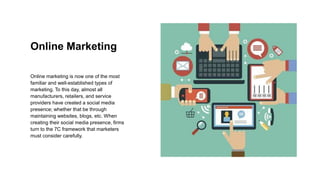
Online Marketing
Online marketing is now one of the most
familiar and well-established types of
marketing. To this day, almost all
manufacturers, retailers, and service
providers have created a social media
presence; whether that be through
maintaining websites, blogs, etc. When
creating their social media presence, firms
turn to the 7C framework that marketers
must consider carefully.
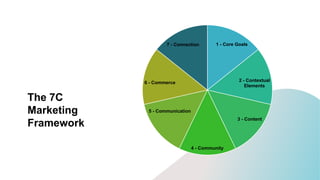
The 7C
Marketing
Framework
1 - Core Goals
2 - Contextual
Elements
3 - Content
4 - Community
5 - Communication
6 - Commerce
7 - Connection
Core Goals
Any marketing strategy starts by
being based off its goals. Online
marketing uses websites to try and
engage their users to spend time
viewing and interacting with its
content. Using appealing and
engaging content helps educate
consumers about the product.
Contextual
Elements
Design and navigation play a big part
in online marketing. Certain design
elements attract different target
markets. Given the target market,
marketers use different colors and
fonts to encourage purchases.
Content
Information within a website’s text,
graphics, videos, and audio is critical
to being successful. The home
page’s purpose must be clear so
that visitors do not quickly exit.
Content does not always have to
consist of the firm’s products or
services but should align with the
target market’s interest.
Community
Firms use their websites and blogs to create a sense
of community through interactions. Corporate blogs
can be created by companies themselves to educate
and excite consumers, but do not have control over
the consumers’ posts. Companies can also send
professional bloggers free products to review, where
consumers seem to trust those reviews until noticed
they are being compensated for positive reviews.
Crowdsourcing is another way to build a community
where users submit ideas for a new product or service
and can vote on other submissions.
Communication
Websites provide ways to
communicate online through live chats,
instant messages, telephone, or e-mail.
These communication vehicles
determine how effectively firms can
interact with, educate, and engage site
visitors. Blogs also create a platform
for two-way communications.
Commerce
When it comes to purchasing products,
various digital marketing tools can be used
based on personal preferences. Although
desktop usage is greater, some consumers
prefer to have a mobile app available to
download on their phones. Consumers are
considered loyal customers when they use
multiple channels, in which they start by
searching online but then visit a physical
store for their actual purchase.
Connection
Call-to-action buttons are used to keep
consumers engaged and encourage
them to delve deeper into a website.
These buttons include “Buy Now”,
“Learn More”, and “Show Your
Support”. This connection gears the
consumers to interact and engage with
firms continuously in a positive manner.
Citation
Grewal, Dhruv and Michael Levy. Marketing.
3rd ed., McGraw Hill LLC, 2022.
2/20/2023
Sample Footer Text 11

7C Online Marketing Framework

  • 1.
  • 2.
    Online Marketing Online marketingis now one of the most familiar and well-established types of marketing. To this day, almost all manufacturers, retailers, and service providers have created a social media presence; whether that be through maintaining websites, blogs, etc. When creating their social media presence, firms turn to the 7C framework that marketers must consider carefully.
  • 3.
    The 7C Marketing Framework 1 -Core Goals 2 - Contextual Elements 3 - Content 4 - Community 5 - Communication 6 - Commerce 7 - Connection
  • 4.
    Core Goals Any marketingstrategy starts by being based off its goals. Online marketing uses websites to try and engage their users to spend time viewing and interacting with its content. Using appealing and engaging content helps educate consumers about the product.
  • 5.
    Contextual Elements Design and navigationplay a big part in online marketing. Certain design elements attract different target markets. Given the target market, marketers use different colors and fonts to encourage purchases.
  • 6.
    Content Information within awebsite’s text, graphics, videos, and audio is critical to being successful. The home page’s purpose must be clear so that visitors do not quickly exit. Content does not always have to consist of the firm’s products or services but should align with the target market’s interest.
  • 7.
    Community Firms use theirwebsites and blogs to create a sense of community through interactions. Corporate blogs can be created by companies themselves to educate and excite consumers, but do not have control over the consumers’ posts. Companies can also send professional bloggers free products to review, where consumers seem to trust those reviews until noticed they are being compensated for positive reviews. Crowdsourcing is another way to build a community where users submit ideas for a new product or service and can vote on other submissions.
  • 8.
    Communication Websites provide waysto communicate online through live chats, instant messages, telephone, or e-mail. These communication vehicles determine how effectively firms can interact with, educate, and engage site visitors. Blogs also create a platform for two-way communications.
  • 9.
    Commerce When it comesto purchasing products, various digital marketing tools can be used based on personal preferences. Although desktop usage is greater, some consumers prefer to have a mobile app available to download on their phones. Consumers are considered loyal customers when they use multiple channels, in which they start by searching online but then visit a physical store for their actual purchase.
  • 10.
    Connection Call-to-action buttons areused to keep consumers engaged and encourage them to delve deeper into a website. These buttons include “Buy Now”, “Learn More”, and “Show Your Support”. This connection gears the consumers to interact and engage with firms continuously in a positive manner.
  • 11.
    Citation Grewal, Dhruv andMichael Levy. Marketing. 3rd ed., McGraw Hill LLC, 2022. 2/20/2023 Sample Footer Text 11