Byline	article	by	Michael	Lamb	(posted	on	Modern	Health	Talk1
)	
We	all	sleep	and	we	all	dream.	Some	nights	it	is	easier	to	fall	asleep.	Other	nights	it’s	a	battle.	
After	having	some	trouble	with	sleeping	these	past	couple	of	weeks.	I	decided	to	do	some	research.	Since	a	lot	
of	people	wear	sweat	shorts	to	bed	I	thought,	why	not	share	this	information	with	you?	Hoping	that	you	will	
find	it	as	useful	as	I	have.	After	doing	all	of	my	research	I	came	up	with	70	tips	to	improve	sleep,	help	you	fall	
asleep	quicker,	and	stay	asleep	longer.	Hopefully	this	info	will	have	you	sleeping	like	a	champ.	
If	you	don’t	have	any	trouble	sleeping,	then	by	all	means	don’t	change	a	thing.	Just	share	these	sleep	
improvement	tips	with	others.	
Sleep	Basics	
What	makes	us	sleep	at	night?	The	sleep-wake	cycle	consists	of	8	hours	of	nocturnal	sleep	and	16	hours	of	
daytime	wakefulness	in	humans.	This	is	controlled	by	two	things:	sleep	homeostasis	and	circadian	rhythms.	
(SleepFoundation.org2
)	
Homeostasis	is	the	process	by	which	the	body	maintains	a	“steady	state”	of	internal	conditions.	It	affects	
sleep	by	slowly	accumulating	our	need	for	sleep	from	the	moment	we	wake	up	until	we	go	to	bed.	Basically	
makes	us	sleepier	the	longer	we	are	awake	throughout	the	day.	
The	circadian	rhythms	are	the	cyclical	changes	like	fluctuations	in	body	temperature,	hormone	levels	and	
sleep	that	occur	over	a	24-hour	period	driven	by	the	brain’s	biological	clock.	This	rhythm	is	affected	by	light	
and	darkness.	Basically	this	keeps	us	awake	while	the	sun	is	out,	but	prompts	us	to	sleep	once	it	becomes	
dark.	
These	two	things	make	us	tired	and	want	to	sleep	every	night.	Now	there	are	activities	you	can	do,	that	I	list	in	
this	post	and	that	will	help	you	manage	your	homeostasis	and	circadian	rhythms	so	that	sleep	is	in	your	
control.	
																																																								
1
	http://www.mhealthtalk.com/70-tips-to-improve-sleep/			(Modern	Health	Talk	is	the	official	blog	of	Intelligent	Sleep.)	
2
	http://sleepfoundation.org/sites/default/files/SleepWakeCycle.pdf
There	are	six	different	aspects	of	your	day	that	can	be	tweaked	for	a	better	night	sleep.	
1. Bedroom	Environment	
2. Daily	Habits	
3. What	You	Eat	
4. Nightly	Habits	
5. In	Bed	Techniques	
6. Sleep	Apps	
Want	to	learn	more?	Below	I	go	into	full	detail	with	steps	you	can	take	to	have	a	better	night	sleep	and	fall	
asleep	faster.	
1.	Bedroom	Environment	
The	bedroom	is	your	sleeping	sanctuary.		
Have	an	inviting	atmosphere	that	encourages	relaxation	and	sleep.	
1. Keep	your	room	cool:	Your	body	temperature	drops	as	your	sleep.	Make	your	room	cooler.	And	jump-start	
you	body’s	cooling	process.	Thus	making	falling	asleep	easier.	Studies3
	show	the	ideal	temperature	is	
between	60-67	degrees.	
2. Remove	all	electronics:	Get	in	the	habit	of	associating	your	bedroom	with	sleep	and	not	watching	TV,	
playing	video	games,	checking	social	media,	or	reading.	These	devices,	including	your	phone,	can	engage	
you	in	non-restful	activities;	making	it	more	difficult	to	fall	asleep.	Also	according	to	this	research4
,	
participants,	who	removed	electronic	devices	from	their	bedroom,	received	an	extra	hour	of	sleep	every	
night.	That	can	make	the	difference	between	being	tired	all	day	and	awake	and	productive.	
																																																								
3
	http://sleepfoundation.org/bedroom/touch.php		
4
	http://sleepfoundation.org/ask-the-expert/electronics-the-bedroom
3. Dark	room	please:	Any	sort	of	light	can	disrupt	melatonin	levels	and	circadian	rhythms.	Make	sure	you	
room	is	as	dark	as	possible.	Install	heavy	window	shades,	wear	a	sleeping	mask,	and	face	
away	glowing	electronics.	[Blue	light	is	the	worst,	and	if	you	use	an	alarm	clock	avoid	
ones	with	a	blue	face,	or	turn	the	face	away	from	you.	See	How	Light	effects	Melatonin	
and	Sleep5
.]	
4. Eliminate	noise:	According	to	The	National	Sleep	Foundation6
,	your	brain	registers	and	
processes	sounds	while	your	sleeping.	Noise	can	jolt	you	from	deep	sleep,	causing	you	to	wake	up,	shift,	
move,	or	change	stages	of	sleep.	Use	earplugs,	noise	cancelers,	or	simple	white	noise	to	block	out	
unwanted	sounds.	
5. White	noise:	A	constant	ambient	sound	can	reduce	the	difference	between	background	and	loud	sounds	
(dog	bark,	door	slamming,	etc.).	White	noise	will	aid	you	in	falling	asleep	and	staying	asleep.	I	use	a	fan.	
But	anything	that	makes	a	constant	sound	can	do	the	trick	(humidifier,	soundtracks,	heaters).	You	can	find	
ambient	soundtracks	on	Spotify,	Pandora,	and	the	Apple	iTunes	store.	
6. Aromatherapy:	Research7
	has	found	that	relaxing	scents	like	lavender	and	vanilla	have	been	effective	in	
aiding	sleep.	Also,	using	aromatherapy	every	night	puts	your	body	and	mind	in	a	sleep	routine.	A	sleep	
routine,	as	described	in	more	detail	below,	may	be	the	best	way	to	fall	asleep	quickly.	
7. Paint	your	room:	A	study8
	done	by	Travelodge,	found	that	people	sleep	best	in	rooms	painted	blue,	
yellow,	green,	silver,	or	orange.	Paint	your	room	your	favorite	“sleep	color”.	
8. Clean	your	room:	A	bedroom	overflowing	with	clutter	creates	added	stress	and	worry.	This	affects	your	
ability	to	relax	and	fall	asleep.	Clean	your	room	up!	Get	rid	of	unused	clothes	and	keep	it	clean	and	
organized.	
9. Sleep	and	intimacy:	Your	bedroom’s	only	two	purposes	should	be	sleep	and	sex.	This	will	condition	the	
mind	to	associate	your	bedroom	with	sleep.	And	by	following	this	advice,	will	help	you	remove	all	added	
mental	stimulants.	
10. Use	an	alarm	clock:	A	lot	of	people	use	their	phones	as	an	alarm	clock.	The	bright	blue	light	from	the	
phone	screen	mimics	the	sun;	slowing	the	release	of	melatonin,	which	can	keep	you	awake.	Also,	when	
your	phone	is	close	to	your	bed	you	are	able	to	check	messages	and	email.	Thus	delaying	the	sleeping	
process	even	more.	Turn	your	phone	off	and	use	a	real	alarm	clock.	
11. Mattress:	Make	sure	your	mattress	is	right	for	you.	Most	mattresses	last	9	to	10	years.	Check	for	sagging	
spots	and	check	your	comfort	and	sleep	quality.	“If	you	wake	up	tired	or	stiff,	or	if	you	find	hotel	beds	
extra	cozy,	it	could	be	a	clue	that	it’s	time	for	a	change,”	says	the	National	Sleep	Foundation9
.	[Critical	
things	to	check	for	include	proper	spinal	alignment	and	pressure	relief,	but	also	consider	that	foam	
mattresses	off-gas	and	deteriorate,	and	that	memory	foam	tends	to	sleep	hot,	according	to	the	folks	at	
intelliBED10
.]	
12. Pillows:	Pillows	should	support	your	neck	and	head.	Doctors11
	recommend	replacing	them	every	2	years.	
Check	for	lumps	and	sags.	If	you	are	waking	up	with	a	stiff	neck	most	likely	you	are	in	need	of	a	new	pillow.	
[Ask	for	a	"neck	pillow."]	
																																																								
5
	http://www.mhealthtalk.com/how-light-from-electronics-affects-sleep/		
6
	http://sleepfoundation.org/bedroom/hear.php		
7
	http://www.webmd.com/sleep-disorders/video/aromatherapy-sleep		
8
	http://www.dailymail.co.uk/news/article-2325476/Want-good-nights-sleep-Find-colours-use-bedroom-avoid-decent-kip.html		
9
	http://sleepfoundation.org/bedroom/touch.php		
10
	https://www.youtube.com/playlist?list=PLC241toPKgyg0BDhxESFRUnAqZ8LeFHPO		
11
	http://sleepfoundation.org/bedroom/touch.php
13. Clean	bed:	Wash	your	sheets,	pillows,	and	mattresses.	A	study12
	by	the	National	Sleep	Foundation	found	
that	75%	of	participants	were	more	excited	to	climb	into	a	bed	with	clean	sheets.	Making	yourself	excited	
about	sleeping	is	a	guaranteed	way	to	fall	asleep	quicker.	
14. Make	your	bed:	It	make	seem	like	a	chore,	but	making	your	bed	every	morning	can	help	you	fall	asleep	
faster.	A	poll13
	found	that,	“People	who	reported	making	their	bed	in	the	morning	were	19	percent	more	
likely	to	get	a	good	night’s	sleep	every	night.”	Feeling	good	about	where	you	sleep	can	only	help	the	
sleeping	process.	
2.	Daily	Habits	
Your	daily	habits,	big	and	small,	affect	your	sleep	every	night.		
Taking	small	steps	throughout	the	day	can	have	a	big	impact	on	your	sleep	quality.	
15. Exercise:	Exercising	daily	will	help	you	sleep	better	at	night,	because	exercise	helps	reduce	anxiety,	stress,	
arousal,	and	depression.	These	emotions	negatively	affect	sleep.	Also,	according	to	a	Horne	and	Staff	
study14
,	“Exercise	triggers	an	increase	in	body	temperature,	and	the	post-exercise	drop	in	temperature	
may	promote	falling	asleep.”	A	cool	body	temperature	will	cut	the	time	it	takes	to	fall	asleep.	NOTE:	Don’t	
exercise	within	3	hours	of	going	to	bed.	Since	exercising	raises	your	body	temperature,	you	may	not	be	
able	to	fall	asleep	until	your	body	cools	off.	[EDITOR:	I	often	hear	people	say	to	avoid	exercise	before	sleep,	
but	I	think	that	really	depends	on	the	type	of	exercise.	After	all,	sex	is	a	form	of	exercise.	It	seems	logical	
that	what	you	should	really	avoid	is	sports	and	exercise	that	stimulates	the	mind.]	
16. Limit	caffeine:	We	all	know	caffeine	is	a	stimulant.	Caffeine	can	also	block	sleep-inducing	chemicals	and	
increase	adrenaline	production.	The	National	Sleep	Foundation	recommends	that	you	stop	drinking	
caffeinated	drinks	by	2	pm,	because	caffeine	can	take	up	to	6	hours	to	clear	your	body	system.	
	 	
																																																								
12
	http://sleepfoundation.org/bedroom/smell.php		
13
	http://sleepfoundation.org/bedroom/touch.php		
14
	http://sleepfoundation.org/ask-the-expert/how-does-exercise-help-those-chronic-insomniax
17. Get	more	sun:	Get	at	least	30	minutes	of	sun	every	morning	
between	6	and	8:30	a.m.	According	to	this	report15
,	early	morning	
sunlight	helps	“…regulate	your	biological	clock	and	keep	it	on	
track.”	“Research	has	shown	that	people	who	are	deprived	of	light	
for	long	periods	of	time	experience	dramatic	changes	in	their	
sleep,	temperature	and	hormone	cycles.”	So	open	those	blinds	
when	you	wake	up	and	get	out	of	the	office	during	lunch.	Enjoy	
what	the	sun	has	to	offer.	
18. Limit	naps:	Try	not	to	nap.	Sleeping	during	the	day	can	throw	off	
your	circadian	clock,	making	it	difficult	to	sleep	at	night.	But	if	you	are	exhausted	and	really	need	to	nap,	
limit	it	to	20	minutes	and	not	a	second	longer.	
3.	What	You	Eat	
Diet	and	certain	foods	can	help	promote	sleep	in	your	body.	There	
are	four	main	minerals	that	help	aid	in	sleeping.	Tryptophan,	
Magnesium,	Calcium,	and	B6.	It	is	possible	to	take	these	minerals	
as	supplements.	However,	like	all	vitamins	and	supplements,	it	is	
always	better	to	get	them	by	eating	a	specific	diet.	
19. Tryptophan:	Tryptophan	is	an	amino	acid	that	helps	your	body	
produce	melatonin.	Melatonin	is	a	natural	hormone	made	by	
you	pineal	glad.	When	the	sun	goes	down	this	hormone16
	is	
released	into	your	blood	stream.	This	is	why	you	feel	less	alert	
and	tired	at	night.	
• Meats	(Chicken,	Turkey,	Venison,	Mutton,	Liver)	
• Fish	(Halibut,	Cod,	Tuna,	Mackerel,	Lobster,	Shrimp)	
• Milk	Products	(Yogurt,	Soymilk,	Milk,	Cottage	Cheese)	
• Cheese	(Cheddar,	Tofu,	Gruyere)	
• Fruits	(Apples,	Bananas,	Avocados,	Pineapple,	Peaches)	
• Vegetables	(Spinach,	Broccoli,	Onions,	Tomatoes,	Cabbage,	Mushrooms)	
• Nuts	(Walnuts,	Peanuts,	Cashews,	Pistachios,	Chestnuts,	Almonds)	
• Seeds	(Flax	Seed,	Sesame,	Pumpkin,	Sunflower)	
• Legumes	(Mung	Beans,	Soybeans,	Kidney,	Lima,	Chickpeas)	
• Grains	(Wheat,	Brown	Rice,	Red	Rice,	Barley	Corn,	Oats)	
• Whole	Grain	Crackers	
20. Magnesium:	The	Journal	of	Orthomolecular	Medicine17
	found	that	magnesium	plays	an	important	role	in	
relaxing.	This	natural	sedative	helps	with	hydration,	controlling	adrenaline,	muscle	relaxation,	and	energy	
production.	If	your	body’s	magnesium	levels	are	too	low	it	makes	it	harder	to	stay	asleep.	
• Dark	Leafy	Greens.	(Spinach,	Kale,	Swiss	Chard)	
• Nuts	and	Seeds.	(Almonds,	Sunflower,	Brazil	Nuts,	Cashews,	Pine	Nuts)	
• Fish	(Salmon,	Halibut,	Tuna,	Mackerel)	
• Legumes	(Edamame,	Black	Beans,	Kidney	Beans,	Chickpeas,	Lentils	White	Beans)	
• Whole-grain	(Brown	Rice,	Quinoa,	Bulgur,	Buckwheat,	Barley,	Oats)	
																																																								
15
	http://health.howstuffworks.com/mental-health/sleep/basics/how-to-fall-asleep2.htm		
16
	http://sleepfoundation.org/sleep-topics/melatonin-and-sleep		
17
	http://orthomolecular.org/library/jom/1988/pdf/1988-v03n04-p197.pdf
• Avocados	
• Banana	
• Low-Fat	Dairy	(Yogurt,	Goat	Cheese,	Mozzarella)	
• Dried	Fruits	(Figs,	Dates,	Apricots)	
21. Calcium:	Calcium	is	normally	associated	with	strong	bones	and	teeth.	But	there	is	a	small	percentage	of	
calcium	that	helps	your	brain	use	tryptophan	to	aid	in	the	manufacturing	of	melatonin.	It	also	helps	
regulate	blood	pressure,	muscle	contraction	and	expansion,	and	can	help	prevent	insomnia,	obesity	
osteoporosis,	and	stroke.	
• Dark	Leafy	Greens	(Curly	Kale,	Dandelion	Greens,	Turnip	Greens,	Arugula)	
• Low	Fat	Cheese	(Parmesan,	Mozzarella,	Cottage	Cheese)	
• Low	Fat	Milk	Products	(Yogurt,	Milk)	
• Chinese	Cabbage	(Bok	Choy,	Pak	Choi)	
• Fortified	Soy	Products	(Soy	Milk,	Tofu,	Soybean)	
• Okra	
• Broccoli	
• Green	Snap	Peas	
• Almonds	
• Canned	Fish	(Sardines	Anchovies,	Salmon,	Herring,	Shrimp)	
22. Vitamin	B6:	Research18
	found	that	vitamin	B6	converts	a	small	amount	of	your	body’s	tryptophan	into	
serotonin,	“…a	neurotransmitter	that	helps	regulate	sleep	patterns.”	With	an	inadequate	amount	of	
vitamin	B6,	your	body’s	serotonin	levels	may	be	lowered	leading	to	disturbed	sleep	and	insomnia.	
• Seeds	(Sunflower,	Pistachios,	Flaxseeds,	Pumpkin,	Squash	Seeds)	
• Fish	(Tuna,	Salmon,	Halibut,	Swordfish,	Herring)	
• Meat	(Turkey,	Chicken,	Pork	Tenderloin,	Pork	Chops,	Sirloin	Steak,	Rib	Eye)	
• Dried	Fruits	(Prunes,	Apricots,	Rasins)	
• Bananas	
• Avocados	
• Spinach	
• Fortified	Cereals	
• Chickpeas	
• Raw	Garlic	
																																																								
18
	http://www.livestrong.com/article/481527-vitamin-b6-insomnia/
The	Top	Sleep	Performers	
	
Food	 Magnesium	 Tryptophan	 Vitamin	B6	 Calcium	
Avacados	 YES	 YES	 YES	 NO	
Bananas	 YES	 YES	 YES	 NO	
Chickpeas	 YES	 YES	 YES	 NO	
Spinach	 YES	 YES	 YES	 YES	
Yogurt	 YES	 YES	 NO	 YES	
Tuna	&	Halibut	 YES	 YES	 YES	 NO	
Pistachios	 NO	 YES	 YES	 NO	
Best	for	last	
	
23. Melatonin:	As	we	know	melatonin	helps	regulate	our	circadian	rhythm	which	helps	bring	on	sleep.	What	
better	way	to	naturally	get	melatonin	than	from	foods	you	can	buy	at	your	groceries	store.	
• Fruits	and	Vegetables	(Tart	Cherries,	Corn,	Asparagus,	Tomatoes)	
• Grains	(Rice,	Barley	Grains,	Rolled	Oats)	
• Ginger	Root	
• Seeds	and	Nuts	(Walnuts,	Flaxseeds,	Mustard	Seeds)
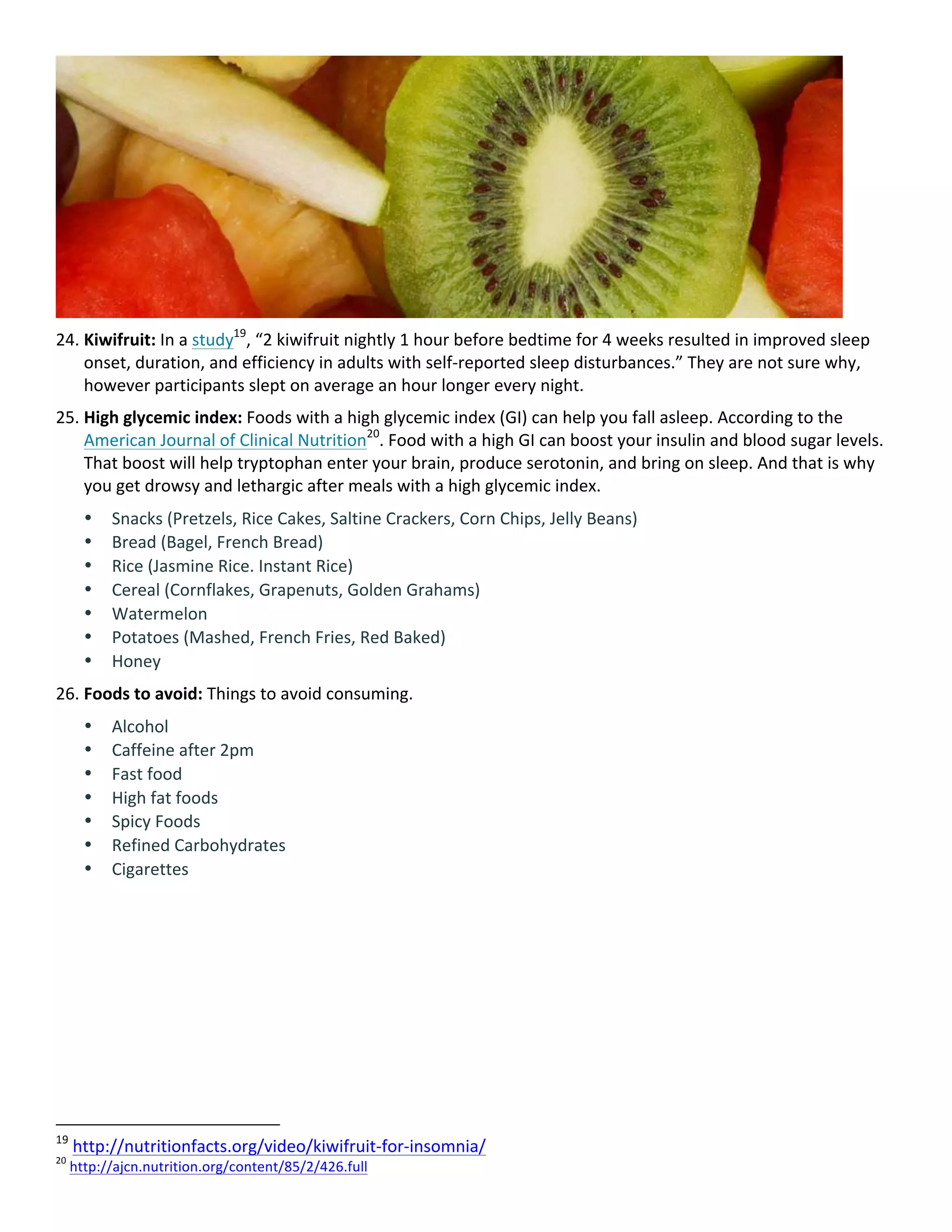
24. Kiwifruit:	In	a	study19
,	“2	kiwifruit	nightly	1	hour	before	bedtime	for	4	weeks	resulted	in	improved	sleep	
onset,	duration,	and	efficiency	in	adults	with	self-reported	sleep	disturbances.”	They	are	not	sure	why,	
however	participants	slept	on	average	an	hour	longer	every	night.	
25. High	glycemic	index:	Foods	with	a	high	glycemic	index	(GI)	can	help	you	fall	asleep.	According	to	the	
American	Journal	of	Clinical	Nutrition20
.	Food	with	a	high	GI	can	boost	your	insulin	and	blood	sugar	levels.	
That	boost	will	help	tryptophan	enter	your	brain,	produce	serotonin,	and	bring	on	sleep.	And	that	is	why	
you	get	drowsy	and	lethargic	after	meals	with	a	high	glycemic	index.	
• Snacks	(Pretzels,	Rice	Cakes,	Saltine	Crackers,	Corn	Chips,	Jelly	Beans)	
• Bread	(Bagel,	French	Bread)	
• Rice	(Jasmine	Rice.	Instant	Rice)	
• Cereal	(Cornflakes,	Grapenuts,	Golden	Grahams)	
• Watermelon	
• Potatoes	(Mashed,	French	Fries,	Red	Baked)	
• Honey	
26. Foods	to	avoid:	Things	to	avoid	consuming.	
• Alcohol	
• Caffeine	after	2pm	
• Fast	food	
• High	fat	foods	
• Spicy	Foods	
• Refined	Carbohydrates	
• Cigarettes	
																																																								
19
	http://nutritionfacts.org/video/kiwifruit-for-insomnia/		
20
	http://ajcn.nutrition.org/content/85/2/426.full
Drink	Up	
Night	time	beverages	are	another	excellent	source	of	sleep	minerals.		
Not	to	mention	comforting.	Drink	your	favorite	and	reap	the	benefits.	
27. Beverages:	Minerals	in	drinks	can	help	you	sleep.	More	importantly	drinks	fit	right	into	a	bedtime	routine.	
Drinking	a	warm	glass	of	milk	every	night	before	bed	will	condition	your	body	and	mind	to	associate	warm	
milk	with	sleeping.	Therefore	you	will	feel	sleepy	not	only	from	the	calcium	and	tryptophan	in	warm	milk,	
but	also	from	the	nightly	routine.	NOTE:	Make	sure	not	to	drink	too	close	to	bed	time.	You	don’t	want	to	
interrupt	your	sleep	running	to	the	bathroom.	
• Warm	Milk	
• Almond	Milk	
• Chamomile	Tea	
• Passionfruit	Tea	
• Tart	Cherry	Juice	(The	best	source21
	of	natural	melatonin)	
• Peppermint	Tea	
• Chia	Seed	Drink	
• Valerian	Tea	
																																																								
21
	http://www.immunehealthscience.com/foods-with-melatonin.html
4.	Nightly	Habits	
Falling	asleep	is	all	about	putting	your	body	in	a	routine.		
There	are	many	activities	you	can	do	to	help	prep	your	mind		
and	body	for	bed.	Whatever	you	decide	make	sure	to	stick	with	it.	
28. Same	time,	same	place:	According	to	Martin,	owner	of	insomnialand.com22
,	go	to	bed	and	wake	up	at	the	
same	time	everyday.	Even	on	weekends!	This	will	develop	a	routine	for	your	sleep	cycle.	Conditioning	your	
body	and	mind	for	sleep	makes	falling	asleep	quicker	and	easier.	
29. Read:	Read	a	boring	or	dry	book.	We	all	have	been	up	at	night	reading	a	textbook	for	class	and	have	fallen	
asleep.	Apply	that	same	success	to	everyday	sleep.	Don’t	read	books	on	a	kindle	or	tablet.	The	blueish	back	
light	will	mess	with	your	melatonin	production.	Another	hint:	don’t	read	books	that	are	too	mentally	
stimulating,	like	self-help	books	or	murder	mysteries.	
30. Write:	Writing	in	a	journal	will	help	you	let	out	your	emotions	and	frustrations.	Getting	negative	emotions	
and	frustrations	out	of	your	system	will	help	your	mind	relax.	
31. Warm	bath:	A	warm	bath	for	20	or	30	minutes	will	raise	your	body	temperature	a	degree	or	two.	Joyce	
Walsleben	PhD23
,	from	New	York	School	of	Medicine	states,	“If	you	raise	your	(body)	temperature	a	
degree	or	two	with	a	bath,	the	steeper	drop	at	bedtime	is	more	likely	to	put	you	in	a	deep	sleep,”	Just	
make	sure	you	finish	your	hot	bath	within	2	hours	of	going	to	bed.	If	you	jump	into	bed	right	after	a	warm	
bath	you	will	have	a	hard	time	falling	asleep	until	your	body	temperature	cools	down.	
32. Cold	bath:	On	the	other	hand,	Tim	Ferris24
,	takes	a	cold	bath	1	hour	before	sleeping.	This	jump	starts	the	
body’s	cool	down	process	which	allows	him	to	fall	asleep	quicker.	“It’s	like	getting	hit	with	an	elephant	
tranquilizer.”	
33. Limit	electronics:	Laying	in	bed	on	your	tablet	or	phone	may	seem	like	a	relaxing	activity,	but	it	is	
negatively	effecting	your	sleep.	Kevin	Philips25
	suggests	that,	“the	[blueish]	light	emitting	from	the	devices	
actually	tricks	your	brain	into	staying	awake	because	it	associates	the	light	with	daytime,	delaying	the	
release	of	melatonin,	and	thus	delaying	sleep.”	Stop	looking	at	your	electronic	devices	at	least	45	minutes	
before	going	to	bed	and	don’t	take	them	into	the	bedroom.	
																																																								
22
	http://www.insomnialand.com/		
23
	http://www.health.com/health/gallery/0,,20462696_2,00.html		
24
	http://fourhourworkweek.com/2008/01/27/relax-like-a-pro-5-steps-to-hacking-your-sleep/		
25
	http://www.alaskasleep.com/
34. Drink	a	warm	beverage:	The	best	drinks,	like	stated	in	the	food	section,	are	warm	milk,	chamomile	tea,	
almond	milk,	and	peppermint	tea.	Add	a	spoonful	of	honey	to	help	the	tryptophan	enter	your	brain.	
35. Pray:	Praying	before	bed	is	a	good	way	to	clear	your	thoughts	and	relieve	stress.	It	has	the	same	calming	
effects	as	writing	in	a	journal.	Praying	every	night	is	another	sleep	routine	habit.	
36. Stretching:	5	minutes	of	stretching	before	bed	is	a	good	way	to	lengthen	and	relax	muscles	prior	to	
sleeping.	Muscle	tension	can	keep	you	awake	and	in	pain.	Remember	to	keep	the	stretching	simple.	If	it	is	
too	demanding	it	may	raise	your	heart	rate,	which	will	in	turn	raise	your	body	temperature,	thus	making	it	
hard	to	sleep.	Here26
	are	some	good	night-time	stretching	exercises..	
37. Meditation:	Meditation	can	help	free	your	mind	of	stress	&	worries,	allowing	your	brain	to	quiet	down	and	
relax.	Sri	Ravi	Shankar27
	states,	“When	practiced	regularly,	meditation	can	enhance	the	quality	of	sleep.”	
38. Lay	out	your	clothes:	Laying	out	your	clothes	prior	to	bed	can	be	a	part	of	your	bedtime	routine,	getting	
the	body	and	mind	ready	for	sleep,	just	like	combing	your	hair	or	brushing	your	teeth.	
39. Mantra:	A	mantra	can	help	ease	your	mind	by	cutting	out	internal	chatter.	The	repeated	words	or	sounds	
can	clear	negative	thoughts	and	keep	you	in	the	present.	A	mantra	can	be	like	singing	along	to	your	
favorite	song.	“If	you	get	really	into	your	song,	so	that	you’re	100%	focused	on	it,	you	cannot	be	distracted	
by	thoughts	of	what’s	for	dinner	tonight,	or	how	to	pay	the	gas	bill!	The	same	can	be	true	with	a	mantra,”	
The	Sleep	Guru28
.	
40. Do	all	unpleasant	tasks	early:	Thinking	about	bills,	doing	the	dishes,	or	mowing	the	lawn	close	to	bed	time	
is	not	an	easy	way	to	fall	asleep.	Make	sure	to	get	all	unpleasant	tasks	done	early.	Give	yourself	time	to	
calm	down	and	relax.	
41. Don’t	drink	alcohol:	Drinking	alcohol	may	help	you	fall	asleep	initially,	but	it	has	a	big	impact	on	deep	
sleep.	Irshaad	Ebrahim29
,	director	of	London	Sleep	Center,	said	“The	effect	of	consolidating	sleep	in	the	
first	half	of	the	night	is	offset	by	having	more	disrupted	sleep	in	the	second	half	of	the	night.”		Also,	
drinking	can	cut	your	REM	sleep	stage.	This	is	the	deepest	sleep	stage	where	you	dream,	where	memories	
are	stored,	and	where	learning	occurs.	If	you	are	going	to	drink,	give	your	body	the	time	to	process	the	
alcohol	before	you	go	to	bed.	According	to	drinkaware.com30
,	it	takes	roughly	1	hour	to	process	one	unit	
of	alcohol.	
42. Don’t	drink	liquids	within	an	hour	of	bed:	The	last	thing	you	want	is	to	interrupt	your	precious	deep	sleep	
by	needing	to	use	the	restroom.	
43. Small	snacks:	It	is	never	good	to	go	to	bed	hungry.	Eating	a	small	snack	of	low-glycemic	index	food	will	
help	you	feel	more	rested	in	the	morning.	Don’t	stuff	yourself	either	because	if	you	have	a	full	stomach	
your	body	will	be	working	on	digesting	it	and	not	relaxing.	
44. Orange	sunglasses:	Blue	light	effects	our	production	of	melatonin.	The	main	source	of	blue	light	is	
electronics.	Orange	sunglasses	help	mask	the	blue	light	at	nighttime,	keeping	your	circadian	rhythm	and	
melatonin	production	normal.	[Some	of	the	new	energy-saving	light	bulbs	based	on	compact-fluorescent	or	
LED	technologies	also	emit	blue	light.	Select	bulbs	with	a	warm	color-temperature.]	
45. Seeds	of	Vaccaria:	Auricular	therapy	is	a	traditional	Chinese	medicine	that	involves	pressing	key	points	on	
the	outer	ear.	This	woman31
	says	seeds	of	vaccaria	mixed	with	auricular	therapy	helped	her	with	insomnia.	
																																																								
26
	http://www.fitnessmagazine.com/workout/express/10-minute/stretches-to-help-you-sleep/		
27
	http://www.artofliving.org/us-en/meditation/meditation-for-you/meditation-sleep		
28
	http://www.thesleepguru.co.uk/power-mantra/		
29
	http://healthland.time.com/2013/02/08/sleeping-it-off-how-alcohol-affects-sleep-quality/		
30
	https://www.drinkaware.co.uk/check-the-facts/health-effects-of-alcohol/effects-on-the-body/alcohol-and-sleep/		
31
	http://www.nytimes.com/2008/02/21/fashion/21SKINtwo.html
5.	In	Bed	Techniques	
Laying	in	bed	awake	is	no	fun.	To	fall	asleep	as	quickly	and	soundly		
as	possible	you	need	to	decrease	interruption	and	keep	your	mind		
focused	on	something	other	than	not	falling	asleep.	
46. “7-11”	breathing:	This	breathing	technique	requires	you	to	breathe	in	for	7	seconds	then	breath	out	for	11	
seconds.	Lay	in	your	favorite	sleeping	position	and	repeat	until	you	fall	asleep.	Because	you	will	
consistently	need	to	count	and	focus	on	your	breathing,	your	mind,	muscles,	and	body	will	all	relax.	Also	
your	heart	rate	will	begin	to	slow,	helping	you	doze	off.	
47. Squeeze	and	relax:	Progressive	muscle	relaxation	is	the	process	of	tensing	
then	relaxing	all	the	muscle	groups	in	your	body.	Phil	Gehrman,	clinical	
director	of	Penn	Medicine’s	Behavioral	Sleep	Medicine	Program,	suggests	
that	progressive	muscle	relaxation	helps	you	sleep	in	two	ways.	It	relaxes	
your	muscles	and	body	to	help	restlessness.	And	calms	your	mind.	
48. Don’t	peek:	If	you	are	having	difficulties	falling	asleep,	don’t	peek	at	the	clock.	It	will	only	increase	anxiety	
thus	making	it	even	harder	to	sleep.	
49. Comfortable	clothes:	Wear	loose-fitting	clothes	that	will	keep	you	either	cool	or	warm	.	Cotton	works	best	
to	keep	you	cool	and	reduce	sweating.	Yes,	even	try	a	pair	sweat	shorts.	They	may	help	you	sleep	quickly.	
50. Sleep	naked:	An	Australian	study	shows	that	body	temperature	has	a	direct	connection	with	sleeping	and	
remaining	asleep.	Sleeping	naked	is	all	about	keeping	your	body	temperature	cool.	If	you	are	covering	up	
with	heavy	pajamas	and	blankets	it	may	be	affecting	your	sleep.	
51. Socks:	In	winter	sometimes	cold	feet	can	keep	you	awake.	Put	on	a	pair	of	socks	to	warm	them	up.	The	
layer	of	sock	can	help	improve	circulation	in	your	extremities	according	to	Phyllis	Zee,	MD,	PhD32
	
52. No	pets:	According	to	new	research33
	30%	of	pet	owners	who	sleep	with	their	fluffy	companion	report	
waking	up	at	least	once	a	night.	In	addition	63%	had	poor	sleep	quality.	This	is	a	tough	one,	but	if	you	are	
looking	to	sleep	better,	maybe	try	to	have	your	pet	sleep	in	another	room.	
	
																																																								
32
	http://www.health.com/health/gallery/0,,20462696_7,00.html		
33
	http://www.huffingtonpost.com/2014/06/05/pets-sleep-sharing-bed_n_5439851.html
53. Allow	your	feet	freedom:	Feeling	restricted	is	no	fun	if	you	wake	up	from	a	nightmare.	Give	your	feet	the	
freedom	to	move	around	and	kick	if	need	be.	It	may	keep	you	sleeping	when	you	are	running	in	your	
dreams.	
54. Sleep	on	left	side:	Sleeping	on	your	left	side	is	recommended	by	the	experts.	It	gives	you	the	least	likely	
chance	of	getting	interrupted	while	sleeping.	Also	sleeping	on	your	left	side	can	improve	heart	circulation,	
and	helps	with	heartburn	and	acid	reflux.	
55. Get	out	of	bed:	If	you	can’t	fall	asleep	after	30	minutes	go	into	another	room	and	do	an	activity	from	
“Night	time	habits”	to	try	to	relax.	Whatever	you	choose	don’t	stress	that	you	can’t	fall	asleep.	That	will	
only	make	it	harder.	Acknowledge	that	the	issue	is	there	than	move	forward,	focusing	on	calming	your	
mind	and	body.	
56. Mental	exercise:	There	are	a	ton	of	mental	exercises	that	can	help	you	sleep.	And	a	lot	of	them	are	better	
than	counting	sheep.	Check	out	Sleeping	Tricks34
.	You	will	find	many	fun	ways	to	distract	your	mind	and	
fall	asleep.	
57. Visualize:	Research35
	found	that	sleep	related	words	like	cozy,	rest,	calm,	and	relax	had	a	positive	
influence	on	the	participants	sleep.	47%	slept	longer	and	achieved	a	deeper	state	of	sleep.	So	visualize	a	
peaceful	and	comfortable	place.	Such	as	a	past	vacation	or	pleasant	experience.	
58. Be	thankful:	In	a	British	study36
,	participants	who	were	most	thankful	slept	longer	than	less	appreciative	
participants.	The	quality	of	their	sleep	was	also	better.	Take	a	few	minutes	each	night	to	recognize	the	
things	that	you	are	thankful	for.	
59. Primitive	sleep	positions:	This	study37
	suggests	sleeping	like	our	close	relatives	the	primates	can	help	ease	
back	and	joint	pain.	Maybe	a	different	sleeping	style	is	what	is	
keeping	you	from	the	perfect	night	sleep.	
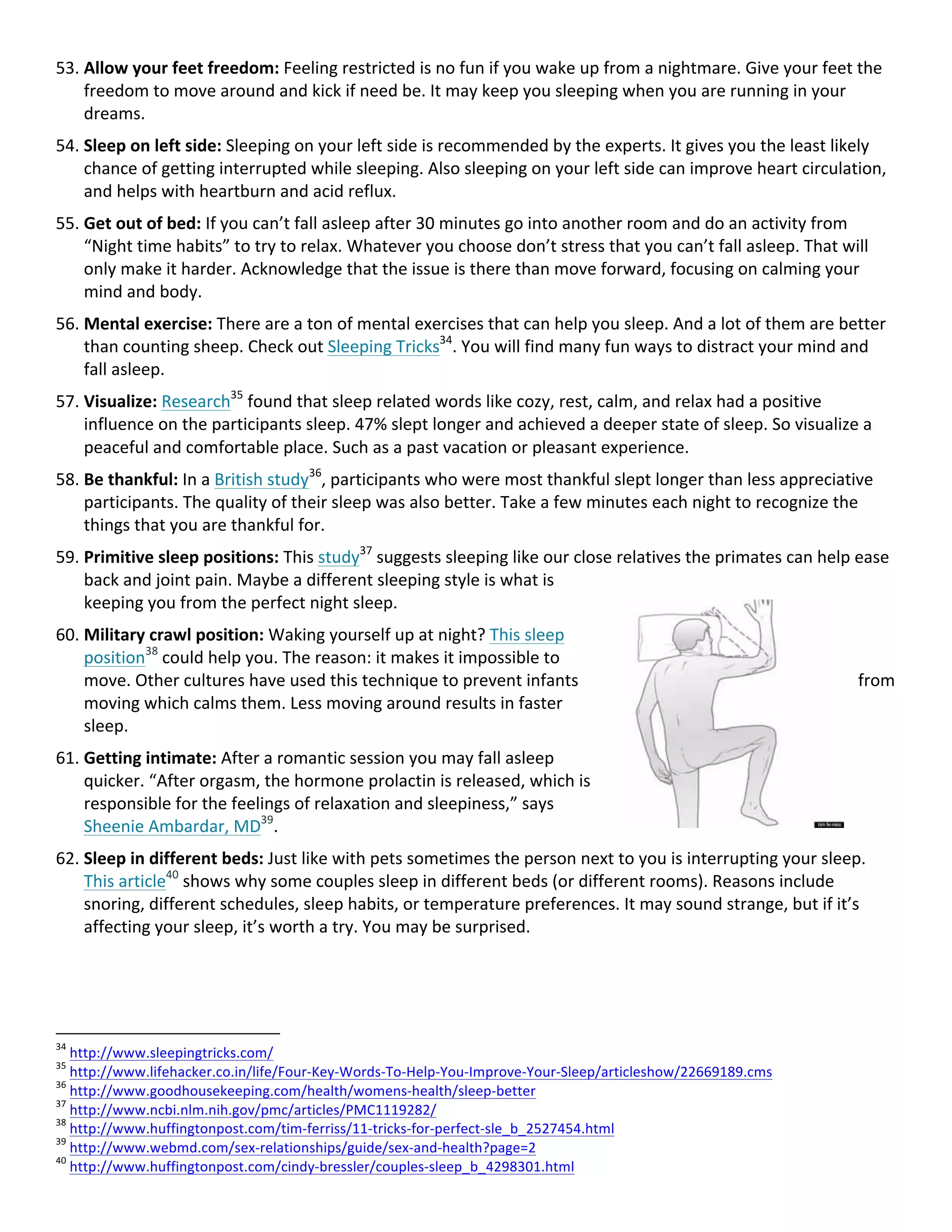
60. Military	crawl	position:	Waking	yourself	up	at	night?	This	sleep	
position38
	could	help	you.	The	reason:	it	makes	it	impossible	to	
move.	Other	cultures	have	used	this	technique	to	prevent	infants	 from	
moving	which	calms	them.	Less	moving	around	results	in	faster	
sleep.	
61. Getting	intimate:	After	a	romantic	session	you	may	fall	asleep	
quicker.	“After	orgasm,	the	hormone	prolactin	is	released,	which	is	
responsible	for	the	feelings	of	relaxation	and	sleepiness,”	says	
Sheenie	Ambardar,	MD39
.	
62. Sleep	in	different	beds:	Just	like	with	pets	sometimes	the	person	next	to	you	is	interrupting	your	sleep.	
This	article40
	shows	why	some	couples	sleep	in	different	beds	(or	different	rooms).	Reasons	include	
snoring,	different	schedules,	sleep	habits,	or	temperature	preferences.	It	may	sound	strange,	but	if	it’s	
affecting	your	sleep,	it’s	worth	a	try.	You	may	be	surprised.	
	 	
																																																								
34
	http://www.sleepingtricks.com/		
35
	http://www.lifehacker.co.in/life/Four-Key-Words-To-Help-You-Improve-Your-Sleep/articleshow/22669189.cms		
36
	http://www.goodhousekeeping.com/health/womens-health/sleep-better		
37
	http://www.ncbi.nlm.nih.gov/pmc/articles/PMC1119282/		
38
	http://www.huffingtonpost.com/tim-ferriss/11-tricks-for-perfect-sle_b_2527454.html		
39
	http://www.webmd.com/sex-relationships/guide/sex-and-health?page=2		
40
	http://www.huffingtonpost.com/cindy-bressler/couples-sleep_b_4298301.html
6.	Apps	
	
With	the	advancement	technology,	there	are	now	phone	apps	that	can	help	you	sleep.		
Even	though	I	said	not	to	take	electronics	into	the	bed	room,		
if	you	are	using	them	to	help	you	sleep	then	I	am	all	for	it.	
63. Sleep	Cycle	(iOS	&	Android	–	$0.99):	Sleep	Cycle41
	is	all	about	getting	feedback	on	your	sleeping	habits.	
Using	a	smart	phone	accelerometer	it	will	analyze	and	graph	your	quality	of	sleep.	Also	it	wakes	you	in	a	
30-minute	window.	This	is	so	you	will	be	woken	during	your	lightest	sleep	in	that	period,	so	you	can	feel	
more	rested	and	refreshed	when	you	wake	up.	
64. SleepBot	(iOS	&	Android	–	Free):	SleepBot42
	is	a	free	sleep	tracking	app	for	both	Android	and	iOS.	Just	like	
Sleep	Cycle	it	will	track	your	sleep	and	analyze	the	quality	of	sleep.	It	also	has	the	ability	to	record	sounds.	
Any	sound	above	a	certain	threshold	will	be	recorded.	So	if	you	talk	or	snore	in	your	sleep	you	will	know.	
SleepBot	also	has	a	resource	section	to	help	you	learn	about	smart	sleeping	habits.	
65. Sleep	as	Android	(Android	–	Free,	Pay	for	total	access):	Originally	Sleep	As	Android43
	was	an	app	to	wake	
you	at	the	ideal	time	in	the	morning,	when	you’re	sleeping	the	lightest.	Now	this	free	app	for	the	Android	
tracks	your	sleep	habits.	It	will	record	sounds	at	night	and	possibly	help	diagnose	sleep	illnesses.	This	app	
will	also	remind	you	if	you	are	running	on	a	sleep	deficit	and	will	tell	you	to	get	back	on	a	regular	sleeping	
schedule.	There	are	multiple	alarms	to	help	wake	you,	from	soothing	sounds	to	puzzles.	To	access	all	the	
features	you	will	have	to	pay	a	small	fee.	
66. Pzizz	(iOS	–	Free):	Pzizz44
	is	an	iPhone	app	that	will	help	you	fall	asleep	and	relax	by	combining	music,	
sounds	effects,	words,	and	beats.	You	are	able	to	set	the	music	length	from	10	minutes	to	10	hours.	This	
app	generates	a	unique	sleeping	sound	track	from	its	library	of	sounds.	There	are	over	10	billion	possible	
combinations	to	help	you	drift	into	sleep	land.	
																																																								
41
	http://www.sleepcycle.com/		
42
	https://mysleepbot.com/		
43
	https://play.google.com/store/apps/details?id=com.urbandroid.sleep&hl=en		
44
	http://pzizz.com/
67. Relax	and	Sleep	(Android	–	Free):	Relax	and	Sleep45
	is	an	ambient	sound	app	for	Android	devices.	It	has	a	
list	of	35+	ambient	sounds	including	thunder,	lightning,	ocean,	sea,	rain,	and	white	noise.	You	are	able	to	
combine	and	change	independent	track	volumes	to	create	your	own	unique	sound	track.	
68. f.lux	(iOS,	Windows,	Mac,	Linux	–	Free):	Blue	light	emitted	from	your	electronics	can	delay	the	release	of	
melatonin	thus	delaying	sleep.	F.lux46
	is	a	piece	of	software	that	is	available	for	Windows,	Mac,	iPhone,	or	
iPad.	It	makes	the	color	of	the	device’s	display	adapt	to	the	time	of	day.	When	it	is	light	out,	the	color	is	
normal.	But	during	night,	the	color	is	changed	to	a	shade	of	peach.	This	makes	looking	at	the	screen	easier	
on	the	eyes	and	limits	blue	light	because	of	its	effect	on	sleep.	
69. Twilight	(Android	–	Free):	Twilight47
	does	the	same	thing	as	f.lux	but	is	built	for	Android	devices.	Now	
every	device	you	own	can	limit	blue	light.	All	you	need	is	a	pair	of	orange	sunglasses	for	the	TV	and	you	are	
set.	
70. SleepQ	(iOS	–	$1.99):	SleepQ48
	is	a	smartphone	app	that	provides	at-home	pre-bed	sleep	training.	It’s	an	
active	way	to	learn	how	to	fall	asleep	quicker	and	be	confident	about	sleep.	Using	short	repeated	sleep	
trials,	SleepQ	guides	you	from	one	trial	to	another	to	improve	sleep	confidence.	
Final	Words	
I	know	there	are	tons	of	techniques	for	falling	asleep.	Let	me	know	if	I	missed	some	good	ones.	I	would	gladly	
add	them	into	the	list.	
I	hope	this	post	was	as	helpful	to	you	as	it	was	for	me	to	research	it.	Thanks	for	reading!	
On	another	note	I	am	not	a	sleep	professional.	Just	a	guy	who	likes	to	sleep,	being	comfortable,	and	happy.	
If	you	continue	to	have	problems	falling	asleep	or	remaining	asleep	go	see	a	sleep	doctor.	Everyone	is	different	
and	sometimes	one	thing	that	works	for	you	will	not	work	for	another	person.	
If	you	want	more	information	on	living	comfortably	follow	me	on	Twitter	and	Google+	
Stay	Comfortable.	Stay	Awesome.	
ADDITIONAL	SOURCES:	
• SleepEducation.com	
• SleepStarved.org	
• SleepDisordersPlace.com	
EDITOR	COMMENT:		
Modern	Health	Talk	already	has	published	over	five	dozen	articles49
	on	sleep	and	stress.	This	list	will	expand	in	
the	future	because	of	the	strong	relationship	with	health,	safety,	and	performance	(at	school,	work	and	in	
sports).	This	relationship	is	also	why	I’m	working	with	Dr.	Bruce	Wayne	Meleski	at	IntelligentSleep50
	to	open	a	
line	of	sleep	wellness	&	brain	fitness	centers,	starting	here	in	Austin.	Our	goal	in	that	is	to	help	the	many	
people	who	don’t	sleep	well,	and	because	the	CDC	says	there	are	about	100	million	of	them,	including	a	third	
of	all	working	adults.	This	agency	describes	insufficient	sleep	as	“a	public	health	epidemic.”	
																																																								
45
	https://play.google.com/store/apps/details?id=com.mizusoft.relaxandsleep&hl=en		
46
	https://justgetflux.com/		
47
	https://play.google.com/store/apps/details?id=com.urbandroid.lux&hl=en		
48
	http://www.sleeponq.com/		
49
	http://www.mhealthtalk.com/tag/sleep/		
50
	http://www.intelligentsleep.com/

70 tips to improve sleep