7 Psychology Theories in UX
to Provide Better User
Experience
https://fibonalabs.com/
UX Design Psychology is about knowing the user behaviour in different
circumstances and interaction with products which varies for different
scenarios. How Psychology and UX Design are connected? I am going to
unveil the answers in this blog.
I’ll share my thoughts on the following two disciplines; first, the relationship
between Psychology and UX Design; second, how their abilities and work
intersect at various times during the Design process.
How Do We Define Psychology?
Psychology is a discipline that studies human behaviour and mental models,
with a focus on understanding how diverse environments or societal pressures
impact people to act/behave in different ways.
Relation Between Psychology and UX Design
Let me paint a picture of these two vocations and the skills they share.
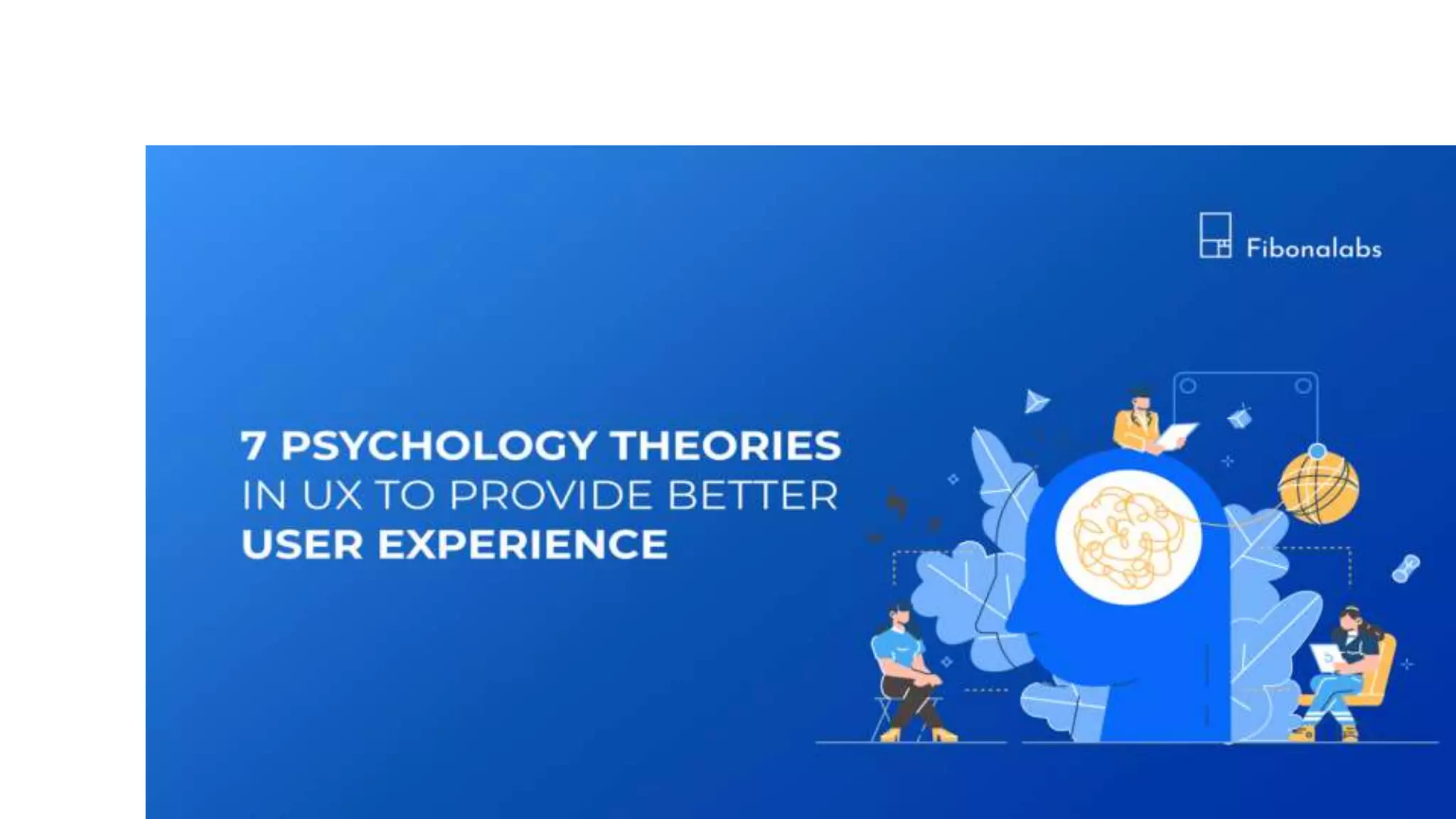
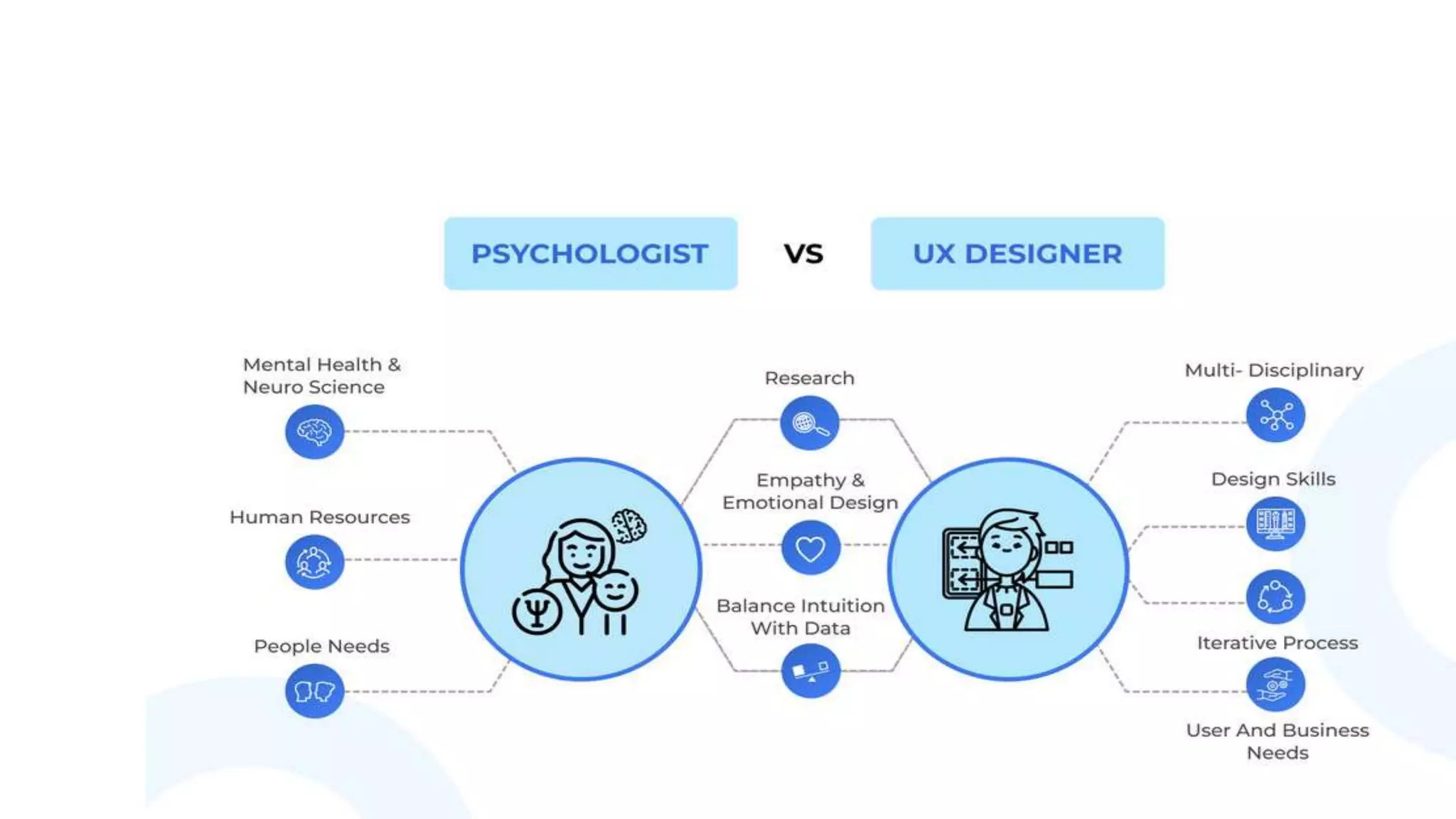
I'm not going to claim that the image at the top explains everything about these
two occupations, but it will give you an idea. They both have the same ability.
They have three things in common:
1. Research
2. Empathy and Emotional Design
3. Balance intuition with data.
These three points are moving around the human centre.
This is the connection I saw, and it piqued my curiosity to know the relationship
between Design and Psychology. I'm particularly interested in observing human
behaviour and comprehending the environment and societal pressures that
influence it.
Through both Psychology and UX Design practices, you learn how the user will
engage with your product in various conditions and how your product must
respond to all of these circumstances.
"A designer who doesn’t understand human psychologies is going
to be no more successful than an architect who doesn’t understand
Human Psychology Theories to Create Impactful UX Design
If you understand the relationship between Psychology and UX Design, you'll
be a better UX designer. I'd want you to go through some of the human
psychology theories that influence users' decision-making and how we might
make decisions that are based on psychological concepts. We can develop
precise responses and activities from our target audience by knowing how
different psychological phenomenon impact human behaviour.
● Von Restorff effect: Von Restorff's effect is a phenomenon that occurs
when a person is exposed to isolation. The isolation effect suggests that
Let me throw some light on it. The memories of the human mind always
categorize data based on the shape, size, colour, smell, or sound of the
substance. So, whenever we see something unique, it gets stuck in our
minds.
This is the principle about how the human mind grabs data. But how is it
relevant to the UX Design and Design process?
Let me explain more from the designer's perspective with an example.
Example: You must have seen the prime video subscription offers. They
highlight one offer out of the three or four that is best for you. And that one card
always stands out from the others. Or they do that by changing the colour of it
or maybe the size.
Let's say that I show you five shoes where the colour of the three shoes is
black and one is grey and the 5th one is red. Which one would draw your
attention first? Perhaps the red one. Because red is from a different colour
family that’s why your memory holds more information about that red shoe.
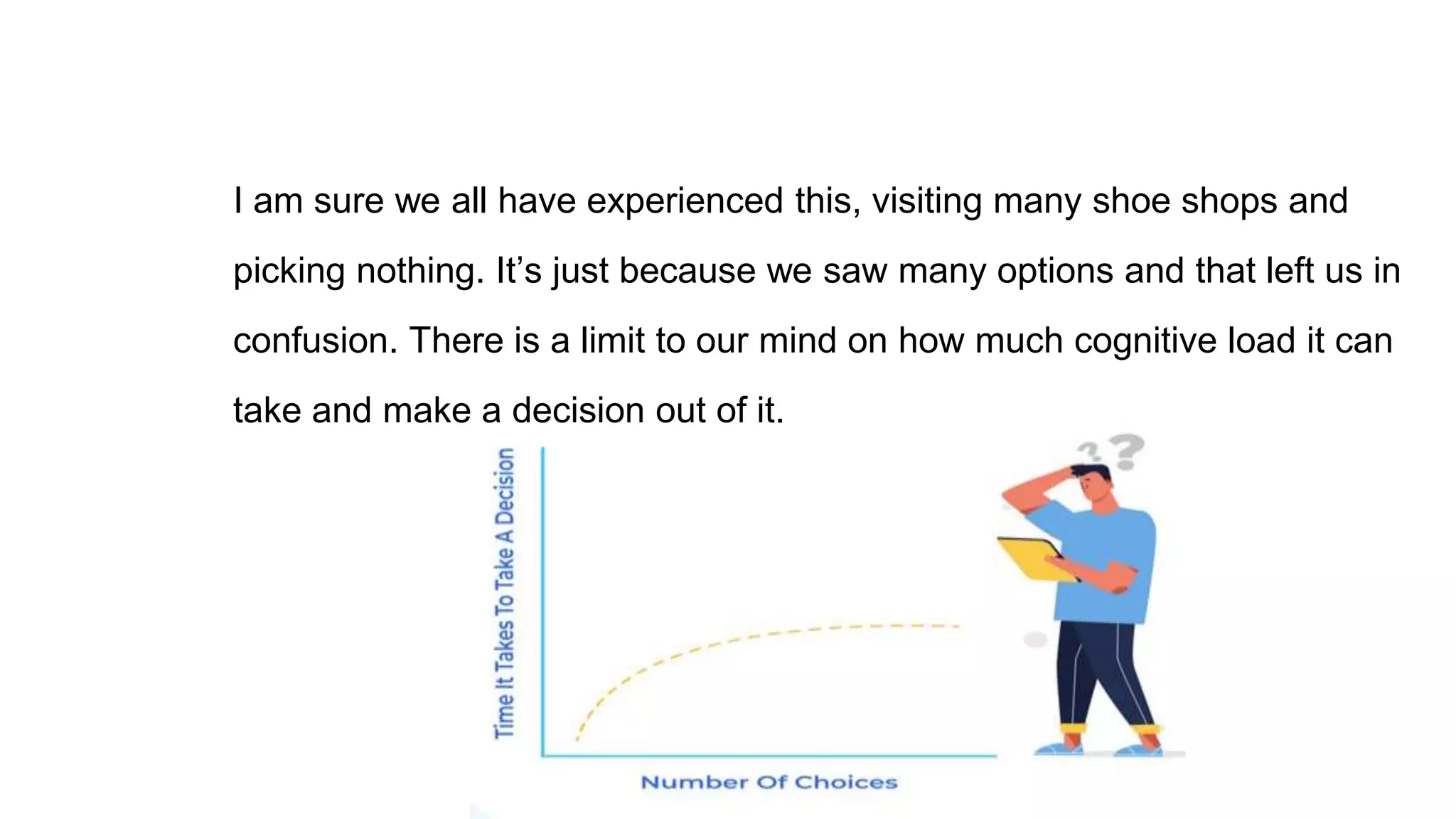
● Hick’s Law: The second and one of the most important psychologies is
Hick’s law. This law states, that the time taken to make decision increases
with the number and complexity of choices.
Just like the other day, I had spent countless minutes on my food delivery
app before getting down to a choice but by then the food went out of stock.
The amount of time I spent can clearly be attributed to the number of
restaurants, and items on the menu.
If you wanted to buy a product or a subscription for any product, the more
option you will see the longer time it will take for you to make any decision.
I am sure we all have experienced this, visiting many shoe shops and
picking nothing. It’s just because we saw many options and that left us in
confusion. There is a limit to our mind on how much cognitive load it can
take and make a decision out of it.
The graph on the top is the representation of Hick’s Law. The more time
you take in decision making the greater number of options pop up.
As per Hick’s rule, we as UX designers always keep these theories in mind
whenever we are creating any product/service. Designers need to analyze
the Design to ensure they give users the fewest number of options to
complete any job or objective.
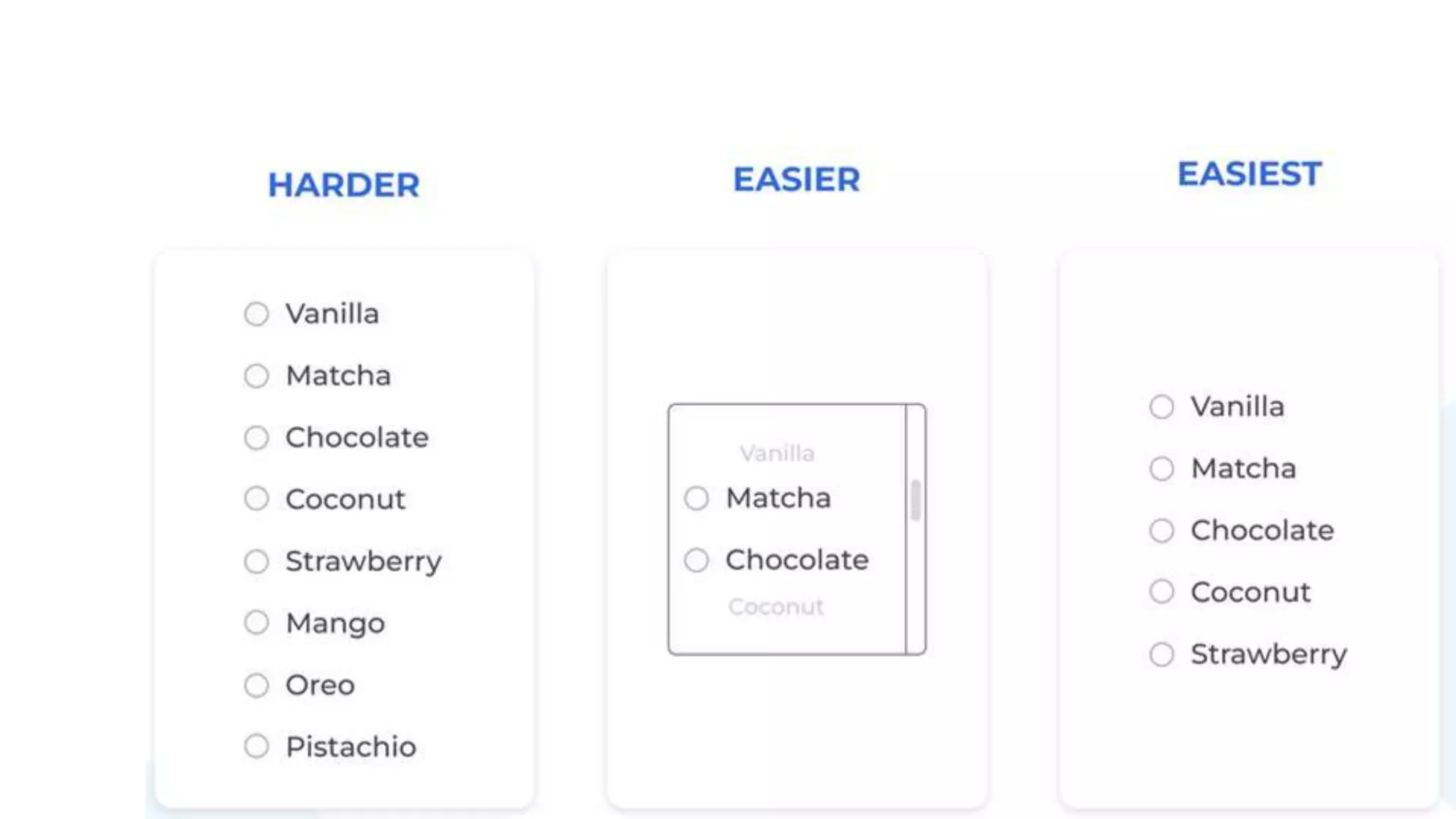
The below example is an excellent way to show the effect of this rule when
you create any UI form and ask users to choose anyone from it. This
makes the process of choosing much easier.
But don’t get confused. I am not saying that if the business is required to
give fifty options you just have to put five. You need to give fewer options
at one glance or in one section.
● The Principle of Least Effort: The principle of least effort is one of the
important Psychology principles. It says that users are always likely to
choose an easier way to complete any job or action. Users are less likely
to use any product that has difficult functionality.
So, whenever a UX designer creates any flow for completing any job or
action, they should keep this law in mind and keep things simpler. This will
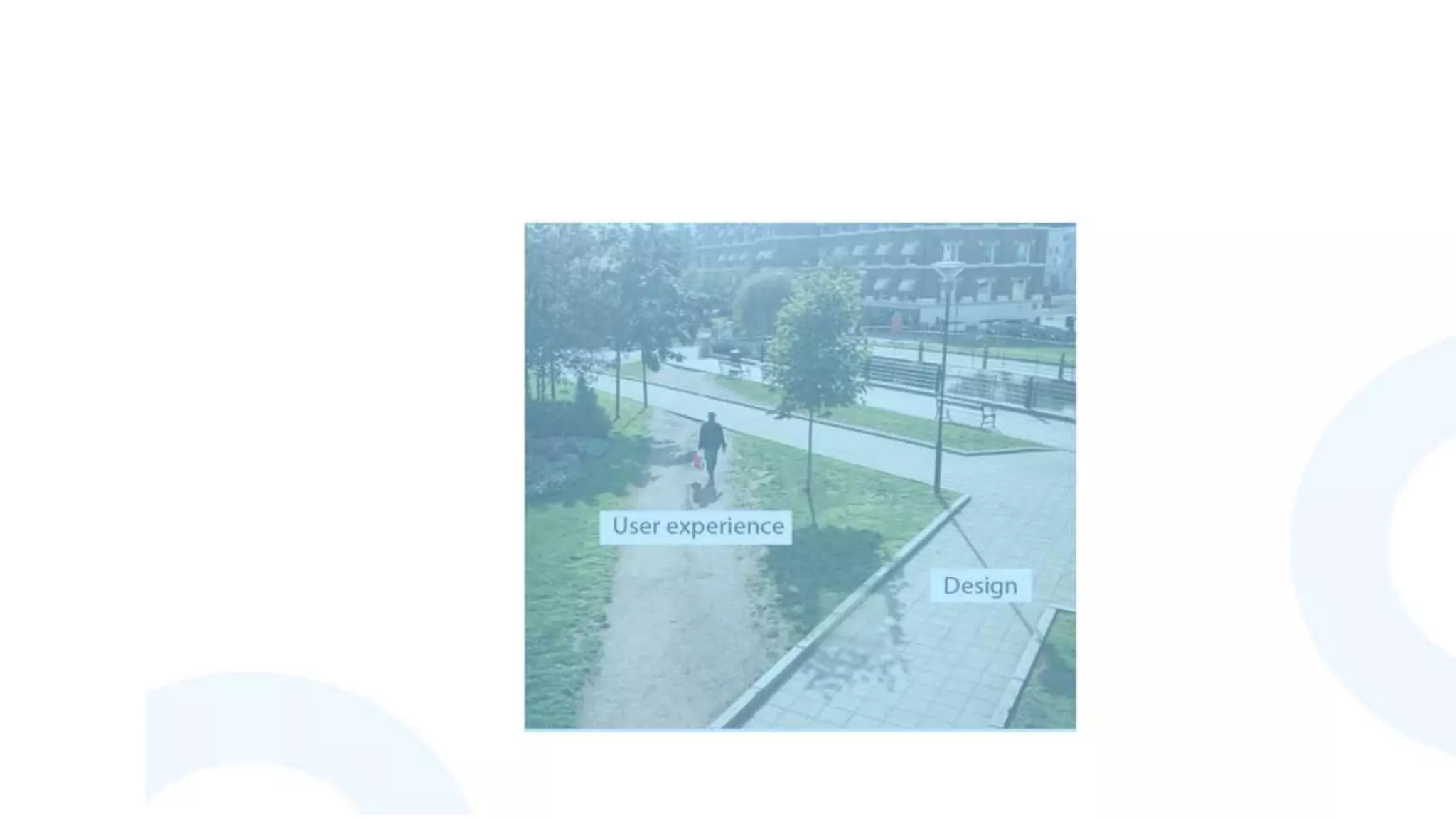
In the above image, you can see how users want to complete their tasks.
I won’t say this is the perfect example of what this law means. But it gives
us the idea that designers don’t need to make a complex flow if the same
task can be achieved in simpler steps.
Note: It’s a never-ending cycle of creating more iterations and trying to find
a better or simple way to complete the same task.
● The Serial Positioning Effect: This principle of Psychology is more about
the conscious intellectual activity of the human mind. Or we can say it talks
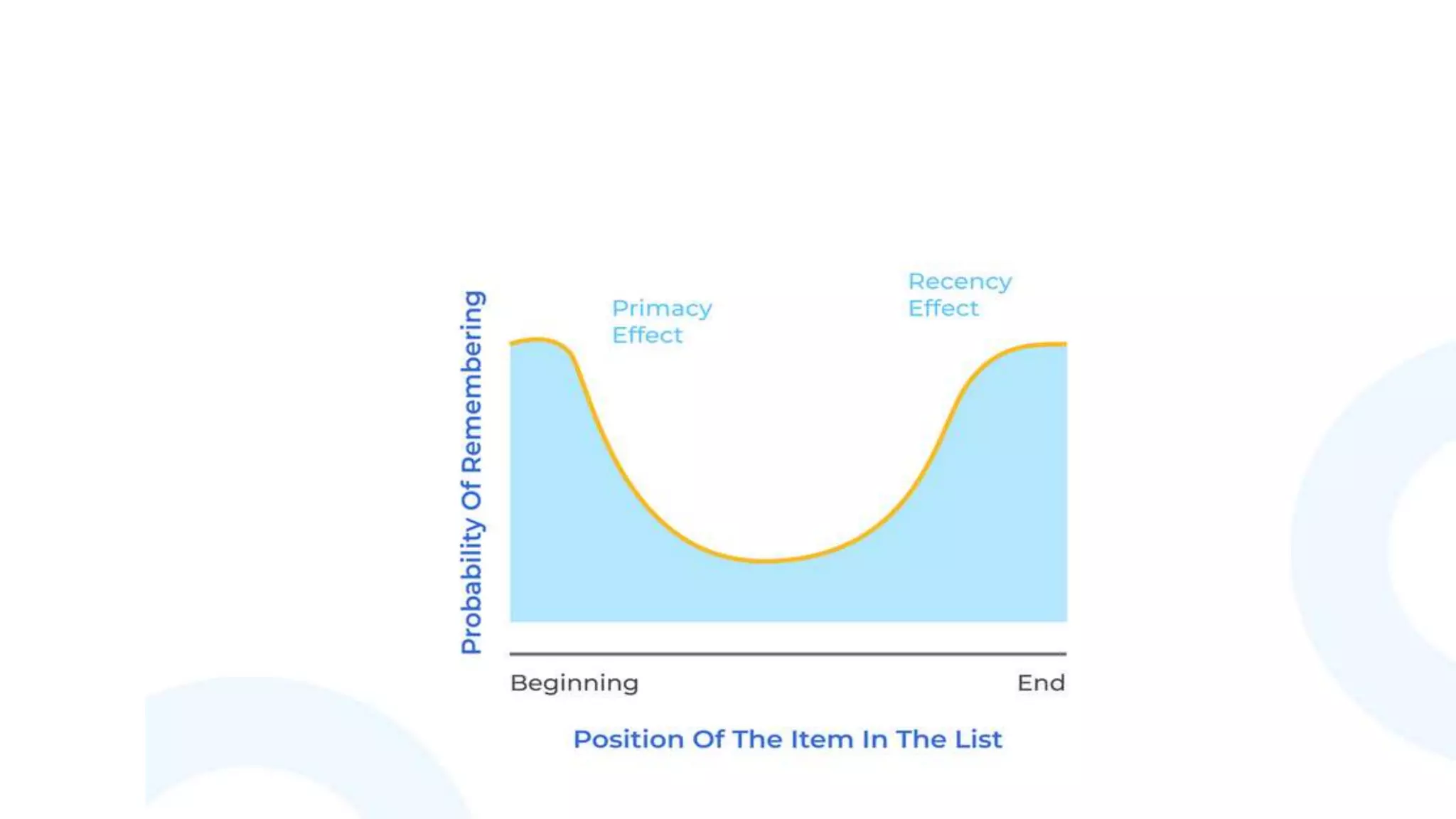
According to this theory, the human mind is more likely to recall the first or
last piece of information.
Suppose, I show you a list of product names, and after some time I ask
you those product names, then the probability of recalling the first or last
information is higher than that of the middle ones.
The below picture is a representation of the same principle of how
individuals recall information. The primacy effect is cognitive bias, which
explains, that an individual's mind has a tendency to recall the information
that is represented in the first place.
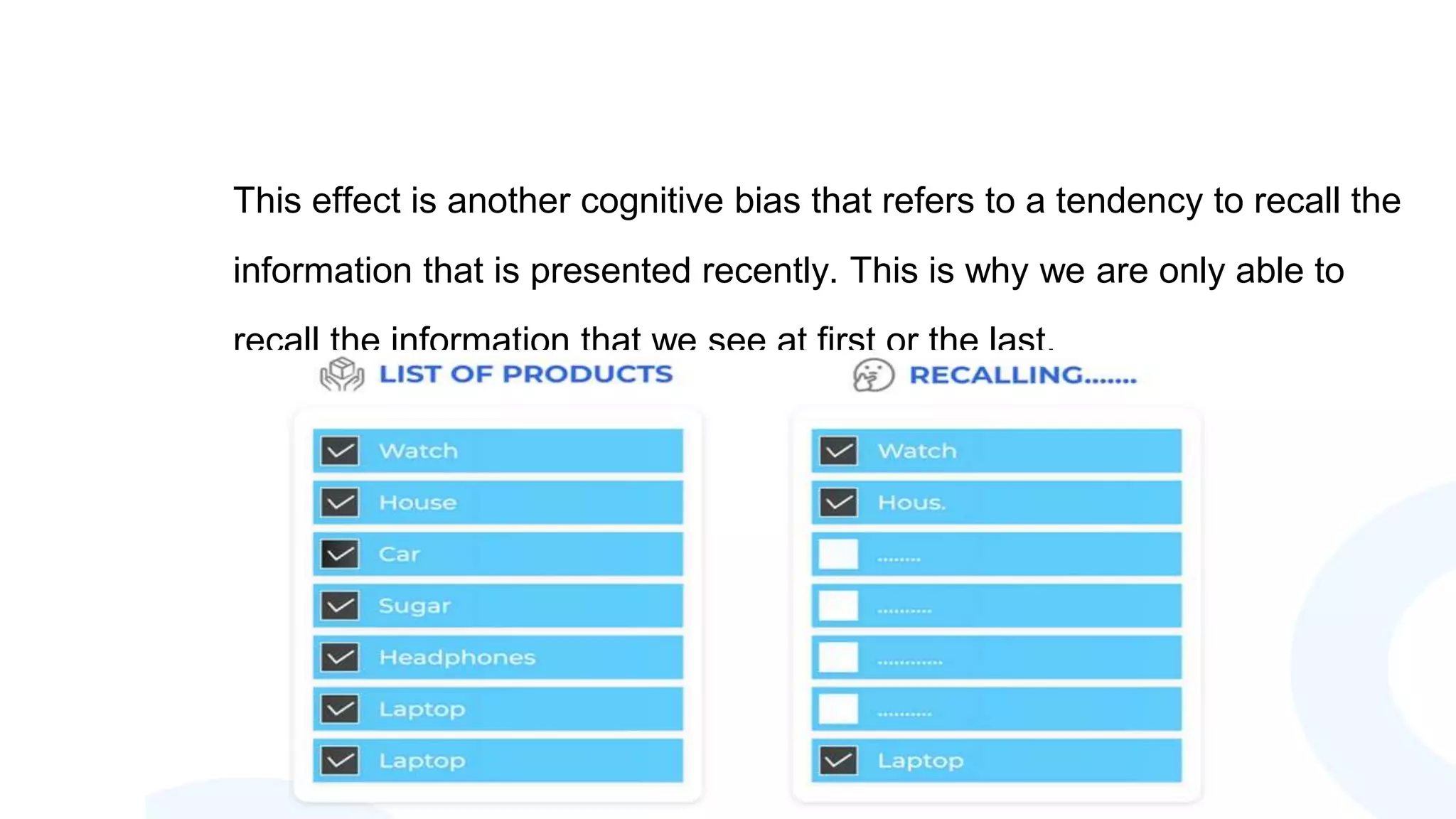
This effect is another cognitive bias that refers to a tendency to recall the
information that is presented recently. This is why we are only able to
recall the information that we see at first or the last.
● The Principle of Perpetual Habit: The principle of perpetual habit says that
your user wants to rely on a familiar routine or habit of completing any job
or objective. To be precise, designers should always be considerate of the
flow or the new function that they are providing to the users.
Let me ask you a question. Where do you see the footer or header in a
word document? Of course, the answer would be, the footer is seen at the
bottom and a header on the top of the screen, right? But why is it so?
The answer is, that we are in habit of this kind of framework if we see any
new framework, we need to guide our mind to take those actions very
precisely. And it takes some time for our minds to understand the flow and
get accustomed to the change.
I am sure we all have experienced playing a video game with customized
controls on our laptops and whenever we play the same game with
different controls, we face problems. Because we are so much in the habit
of the same control that our finger goes subconsciously on the same place.
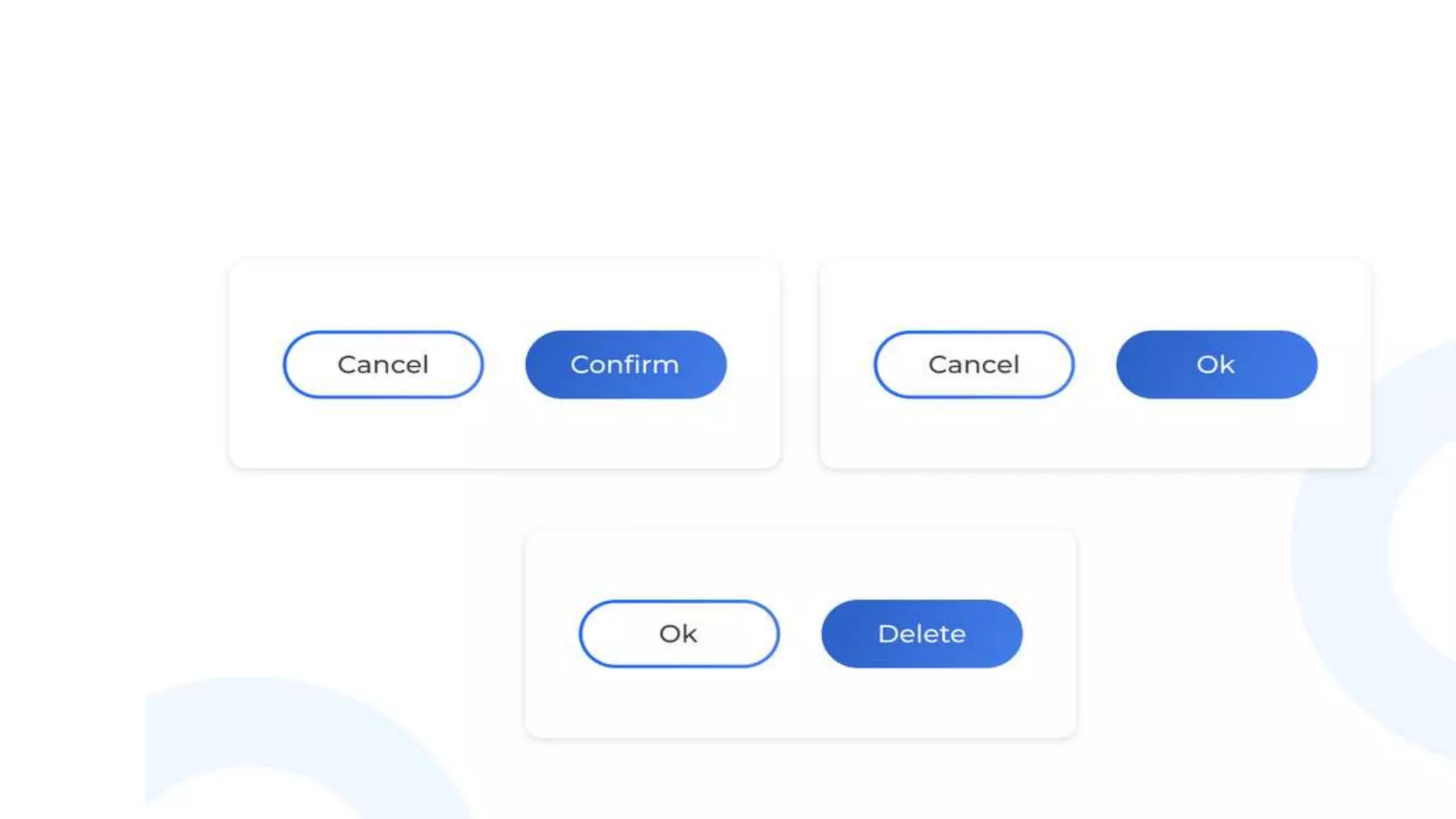
So, let me show you one example of the same interaction on the CTA.
As a result, if we've been accustomed to executing a specific action or
reaction based on a memorized pattern, we'll repeat the action or reaction
if the pattern appears again.
That is the same thing happing in the top example, out of three pairs of
TAS two of them have positive responses highlighted in bold colour but in
the third one, the negative response is highlighted. So, it is very likely that
we will click the Delete CTA subconsciously.
● The Principle of Emotional Contagion: The principle of emotional
contagion refers to the emotional transfer from one to another, it says that
individuals will copy or sympathize with the emotion or behaviours of
others.
For example, if you see someone crying then you may become sad or you
may start crying. If you see someone laughing you may laugh or smile.
Because emotion is contagious. So, this law says that a designer can
transfer emotion with layout, picture, and illustration and they can make
their audience feel what they wanted them to feel.
Let me give you a nice example of this.
Duolingo is a language learning application where you can learn a different
language, and this application uses language birds, whichever emotion
they want you to feel they do that by making their bird sobbing crying,
laughing. These all emotions come when you do mistakes or missed a
lesson or completed a lesson.
● The Principle of the Aesthetic-Usability Effect: The last one is the
principle of aesthetic-usability effect, this law of Psychology says that we
as human beings like beautiful things. Most of the time we appreciate
aesthetically pleasing things, but sometimes we ignore the function/use
case of it.
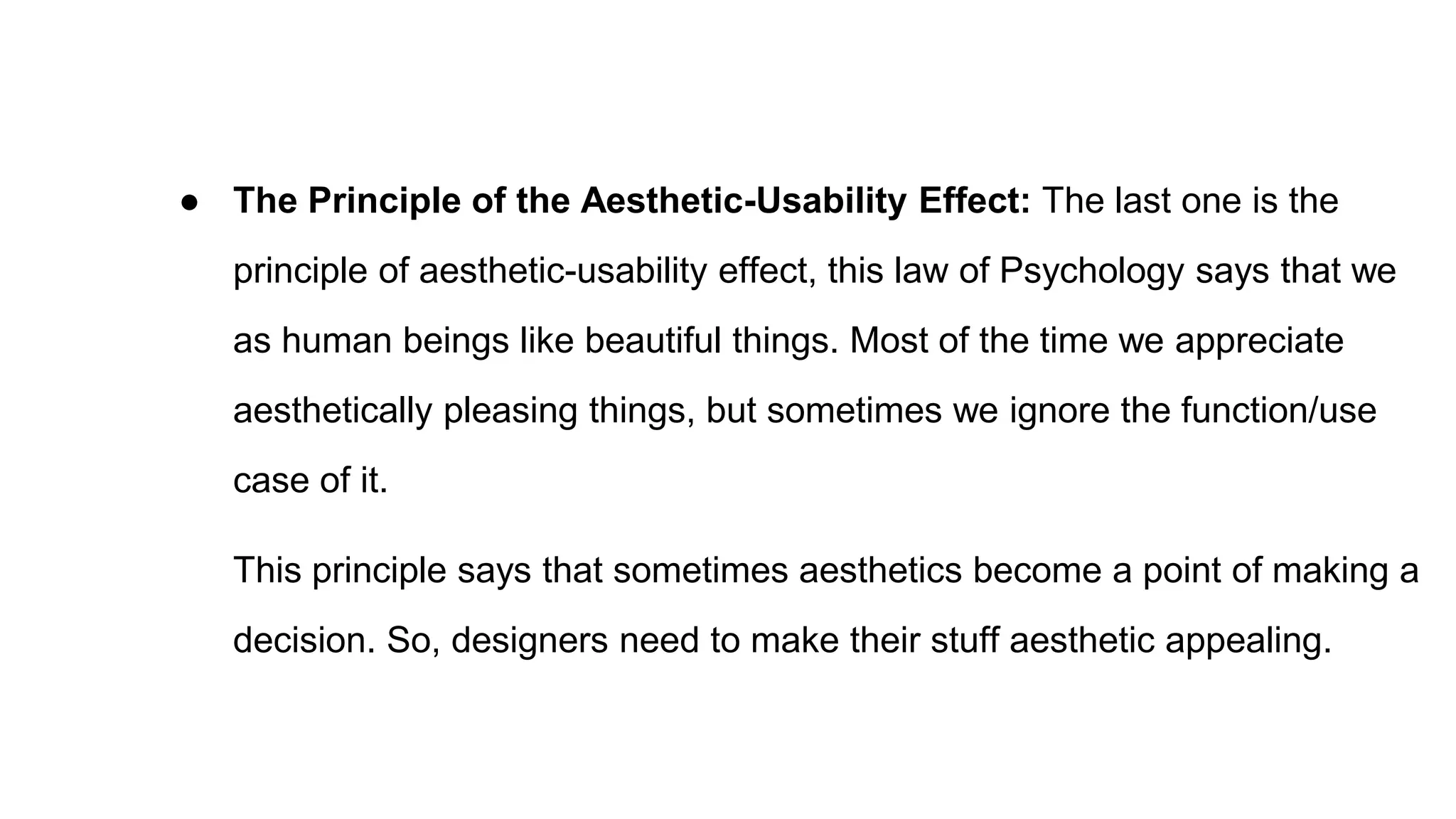
This principle says that sometimes aesthetics become a point of making a
decision. So, designers need to make their stuff aesthetic appealing.
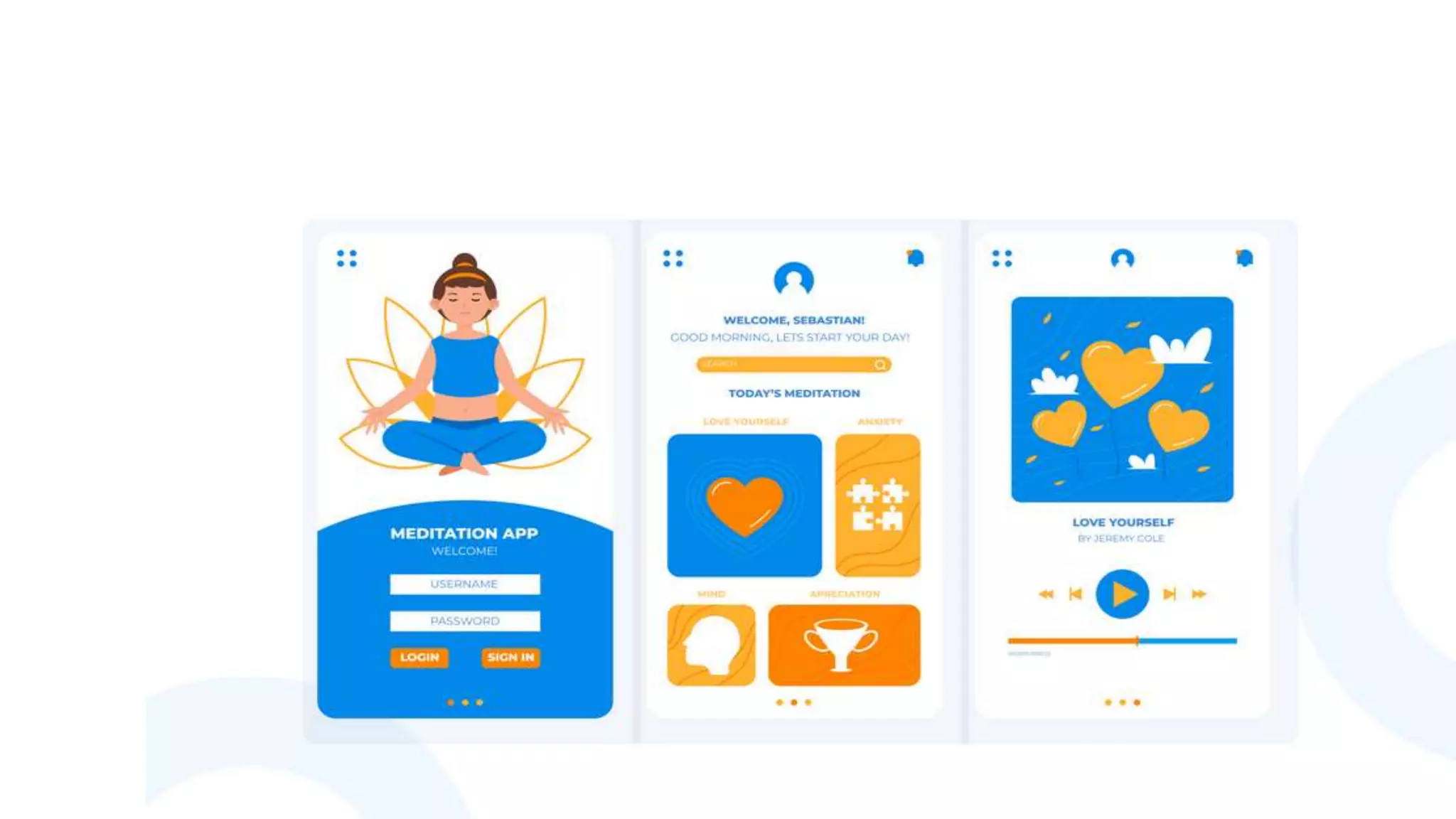
Any mediation school can use the software shown above. If all three
applications have the same features and functions and you ask your users
to choose one, they will pick the most attractive one. This is due to the
aesthetic usability concept. People are usually drawn to attractive things.
Conclusion
In my opinion, having knowledge of human psychology for a designer is very
crucial in order to design a better experience for the use of a product or service.
These laws of human Psychology collectively act as a guide that helps us
predict human behaviour in different circumstances or social scenarios. It’s not
only limited to the interaction with the product but also it always gives us
instruction about the cognitive load or selection bias in the scenario where the
user is going to interact with the product.
THANK YOU

7 Psychology Theories in UX to Provide Better User Experience

  • 1.
    7 Psychology Theoriesin UX to Provide Better User Experience https://fibonalabs.com/
  • 3.
    UX Design Psychologyis about knowing the user behaviour in different circumstances and interaction with products which varies for different scenarios. How Psychology and UX Design are connected? I am going to unveil the answers in this blog. I’ll share my thoughts on the following two disciplines; first, the relationship between Psychology and UX Design; second, how their abilities and work intersect at various times during the Design process.
  • 4.
    How Do WeDefine Psychology? Psychology is a discipline that studies human behaviour and mental models, with a focus on understanding how diverse environments or societal pressures impact people to act/behave in different ways. Relation Between Psychology and UX Design Let me paint a picture of these two vocations and the skills they share.
  • 6.
    I'm not goingto claim that the image at the top explains everything about these two occupations, but it will give you an idea. They both have the same ability. They have three things in common: 1. Research 2. Empathy and Emotional Design 3. Balance intuition with data. These three points are moving around the human centre.
  • 7.
    This is theconnection I saw, and it piqued my curiosity to know the relationship between Design and Psychology. I'm particularly interested in observing human behaviour and comprehending the environment and societal pressures that influence it. Through both Psychology and UX Design practices, you learn how the user will engage with your product in various conditions and how your product must respond to all of these circumstances. "A designer who doesn’t understand human psychologies is going to be no more successful than an architect who doesn’t understand
  • 8.
    Human Psychology Theoriesto Create Impactful UX Design If you understand the relationship between Psychology and UX Design, you'll be a better UX designer. I'd want you to go through some of the human psychology theories that influence users' decision-making and how we might make decisions that are based on psychological concepts. We can develop precise responses and activities from our target audience by knowing how different psychological phenomenon impact human behaviour. ● Von Restorff effect: Von Restorff's effect is a phenomenon that occurs when a person is exposed to isolation. The isolation effect suggests that
  • 9.
    Let me throwsome light on it. The memories of the human mind always categorize data based on the shape, size, colour, smell, or sound of the substance. So, whenever we see something unique, it gets stuck in our minds. This is the principle about how the human mind grabs data. But how is it relevant to the UX Design and Design process? Let me explain more from the designer's perspective with an example.
  • 10.
    Example: You musthave seen the prime video subscription offers. They highlight one offer out of the three or four that is best for you. And that one card always stands out from the others. Or they do that by changing the colour of it or maybe the size. Let's say that I show you five shoes where the colour of the three shoes is black and one is grey and the 5th one is red. Which one would draw your attention first? Perhaps the red one. Because red is from a different colour family that’s why your memory holds more information about that red shoe.
  • 12.
    ● Hick’s Law:The second and one of the most important psychologies is Hick’s law. This law states, that the time taken to make decision increases with the number and complexity of choices. Just like the other day, I had spent countless minutes on my food delivery app before getting down to a choice but by then the food went out of stock. The amount of time I spent can clearly be attributed to the number of restaurants, and items on the menu. If you wanted to buy a product or a subscription for any product, the more option you will see the longer time it will take for you to make any decision.
  • 13.
    I am surewe all have experienced this, visiting many shoe shops and picking nothing. It’s just because we saw many options and that left us in confusion. There is a limit to our mind on how much cognitive load it can take and make a decision out of it.
  • 14.
    The graph onthe top is the representation of Hick’s Law. The more time you take in decision making the greater number of options pop up. As per Hick’s rule, we as UX designers always keep these theories in mind whenever we are creating any product/service. Designers need to analyze the Design to ensure they give users the fewest number of options to complete any job or objective. The below example is an excellent way to show the effect of this rule when you create any UI form and ask users to choose anyone from it. This makes the process of choosing much easier.
  • 16.
    But don’t getconfused. I am not saying that if the business is required to give fifty options you just have to put five. You need to give fewer options at one glance or in one section. ● The Principle of Least Effort: The principle of least effort is one of the important Psychology principles. It says that users are always likely to choose an easier way to complete any job or action. Users are less likely to use any product that has difficult functionality. So, whenever a UX designer creates any flow for completing any job or action, they should keep this law in mind and keep things simpler. This will
  • 18.
    In the aboveimage, you can see how users want to complete their tasks. I won’t say this is the perfect example of what this law means. But it gives us the idea that designers don’t need to make a complex flow if the same task can be achieved in simpler steps. Note: It’s a never-ending cycle of creating more iterations and trying to find a better or simple way to complete the same task. ● The Serial Positioning Effect: This principle of Psychology is more about the conscious intellectual activity of the human mind. Or we can say it talks
  • 19.
    According to thistheory, the human mind is more likely to recall the first or last piece of information. Suppose, I show you a list of product names, and after some time I ask you those product names, then the probability of recalling the first or last information is higher than that of the middle ones. The below picture is a representation of the same principle of how individuals recall information. The primacy effect is cognitive bias, which explains, that an individual's mind has a tendency to recall the information that is represented in the first place.
  • 21.
    This effect isanother cognitive bias that refers to a tendency to recall the information that is presented recently. This is why we are only able to recall the information that we see at first or the last.
  • 22.
    ● The Principleof Perpetual Habit: The principle of perpetual habit says that your user wants to rely on a familiar routine or habit of completing any job or objective. To be precise, designers should always be considerate of the flow or the new function that they are providing to the users. Let me ask you a question. Where do you see the footer or header in a word document? Of course, the answer would be, the footer is seen at the bottom and a header on the top of the screen, right? But why is it so?
  • 23.
    The answer is,that we are in habit of this kind of framework if we see any new framework, we need to guide our mind to take those actions very precisely. And it takes some time for our minds to understand the flow and get accustomed to the change. I am sure we all have experienced playing a video game with customized controls on our laptops and whenever we play the same game with different controls, we face problems. Because we are so much in the habit of the same control that our finger goes subconsciously on the same place. So, let me show you one example of the same interaction on the CTA.
  • 25.
    As a result,if we've been accustomed to executing a specific action or reaction based on a memorized pattern, we'll repeat the action or reaction if the pattern appears again. That is the same thing happing in the top example, out of three pairs of TAS two of them have positive responses highlighted in bold colour but in the third one, the negative response is highlighted. So, it is very likely that we will click the Delete CTA subconsciously.
  • 26.
    ● The Principleof Emotional Contagion: The principle of emotional contagion refers to the emotional transfer from one to another, it says that individuals will copy or sympathize with the emotion or behaviours of others. For example, if you see someone crying then you may become sad or you may start crying. If you see someone laughing you may laugh or smile. Because emotion is contagious. So, this law says that a designer can transfer emotion with layout, picture, and illustration and they can make their audience feel what they wanted them to feel.
  • 27.
    Let me giveyou a nice example of this. Duolingo is a language learning application where you can learn a different language, and this application uses language birds, whichever emotion they want you to feel they do that by making their bird sobbing crying, laughing. These all emotions come when you do mistakes or missed a lesson or completed a lesson.
  • 29.
    ● The Principleof the Aesthetic-Usability Effect: The last one is the principle of aesthetic-usability effect, this law of Psychology says that we as human beings like beautiful things. Most of the time we appreciate aesthetically pleasing things, but sometimes we ignore the function/use case of it. This principle says that sometimes aesthetics become a point of making a decision. So, designers need to make their stuff aesthetic appealing.
  • 31.
    Any mediation schoolcan use the software shown above. If all three applications have the same features and functions and you ask your users to choose one, they will pick the most attractive one. This is due to the aesthetic usability concept. People are usually drawn to attractive things. Conclusion In my opinion, having knowledge of human psychology for a designer is very crucial in order to design a better experience for the use of a product or service.
  • 32.
    These laws ofhuman Psychology collectively act as a guide that helps us predict human behaviour in different circumstances or social scenarios. It’s not only limited to the interaction with the product but also it always gives us instruction about the cognitive load or selection bias in the scenario where the user is going to interact with the product.
  • 33.