GBS AND ROLE OF
IVIG
Clinical Evidence
Outline
 GBS – overview
 Brief history
 What ?
 Types of GBS
 Etiology and pathogenesis
 Diagnosis and treatment
 IVIg
 What and how it works ?
 IVIg in GBS
 Current Clinical review of articles
 Recommendations
Overview
GBS
Source:
• Van den Berg, B. et al. Guillain–Barré syndrome: pathogenesis, diagnosis, treatment and prognosis; Nat.
Rev. Neurol. advance online publication 15 July 2014
• http://www.uptodate.com/contents/treatment-and-prognosis-of-guillain-barre-syndrome-in-
adults?source=search_result&search=Guillian+barre&selectedTitle=3~150
• Guillain Barre syndrome. Medscape reference 2014
Brushing
the
History
 In 1859, Landry published a report on 10
patients with an ascending paralysis.
 Subsequently, in 1916, 3 French physicians
Guillain, Barré and Strohl
 Described 2 French soldiers
 With motor weakness, areflexia, cerebrospinal
fluid (CSF) Albuminocytologic dissociation, and
diminished deep tendon reflexes
 The identified syndrome was later named
Guillain-Barré syndrome.
 Historically, GBS was a single disorder;
however, current practice acknowledges
several variant forms.
GBS – What ?
 Guillain-Barré syndrome is an acute
inflammatory demyelinating polyneuropathy
characterized by
 Progressive symmetrical muscle weakness
 & Hyporeflexia / Areflexia
 With the marked decline in the incidence of
polio, Guillain-Barré syndrome is now the most
common cause of acute flaccid paralysis in
healthy people
GBS – How much common ?
 Rare disease
 Incidence of 0.81–1.89
(median 1.11) per 100,000
person–years
 Less frequent in children
than adults
 Men > Women (Ratio 3:2)
 Incidence increases by
20% for every 10 years
increase in age
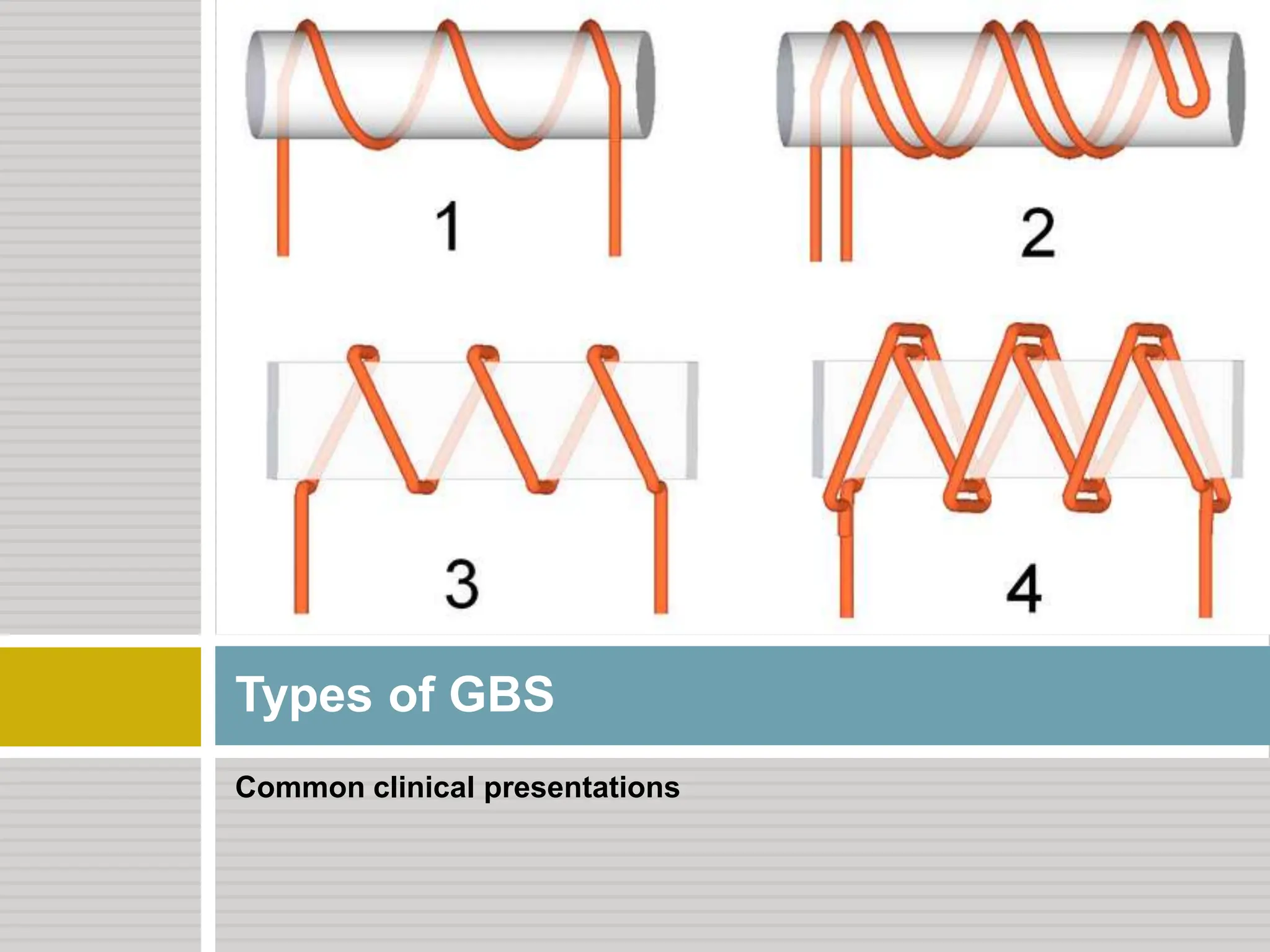
Common clinical presentations
Types of GBS
GBS – Common Types
 Heterogeneous syndrome with several variant
forms
 The major forms are :
 Acute inflammatory demyelinating
polyradiculoneuropathy (AIDP)
 Miller Fisher syndrome (MFS)
 Acute motor axonal neuropathy (AMAN)
 Acute sensorimotor axonal neuropathy (AMSAN)
Various types – at glance
GBS subtypes Main clinical
Features
NCS findings Antibodies *
Acute inflammatory
demyelinating
polyneuropathy
(AIDP)
Sensorimotor GBS,
often combined with
cranial nerve deficits
and frequent
autonomic dysfunction
Demyelinating
polyneuropathy
Various‡
Acute motor axonal
neuropathy
(AMAN)
Pure motor GBS;
cranial nerves rarely
affected
Axonal
polyneuropathy,
sensory action
potential normal
GM1a, GM1b
GD1a
GalNAc-GD1a
Acute motor sensory
axonal neuropathy
(AMSAN)
Resembles severe
AMAN, but sensory
fibers are affected,
leading to sensory
deficits
Axonal
polyneuropathy,
sensory action
potential reduced or
absent
GM1, GD1a
Miller Fisher
syndrome
Ataxia,
ophthalmoplegia,
Normal in most
patients; discrete
GQ1b, GT1a
GBS – How it presents ?
 Highly variable
 May present with mild difficulty in walking to
complete paralysis of facial, respiratory or bulbar
muscles
 15-30% patients require Mechanical
Ventilation
 20 % are having severe autonomic dysfunction
 Considering this, around half of the patients
require ICU monitoring
Common etiology and proposed pathogenetic mechanism
WHY & HOW ?
GBS – Why it occurs ?
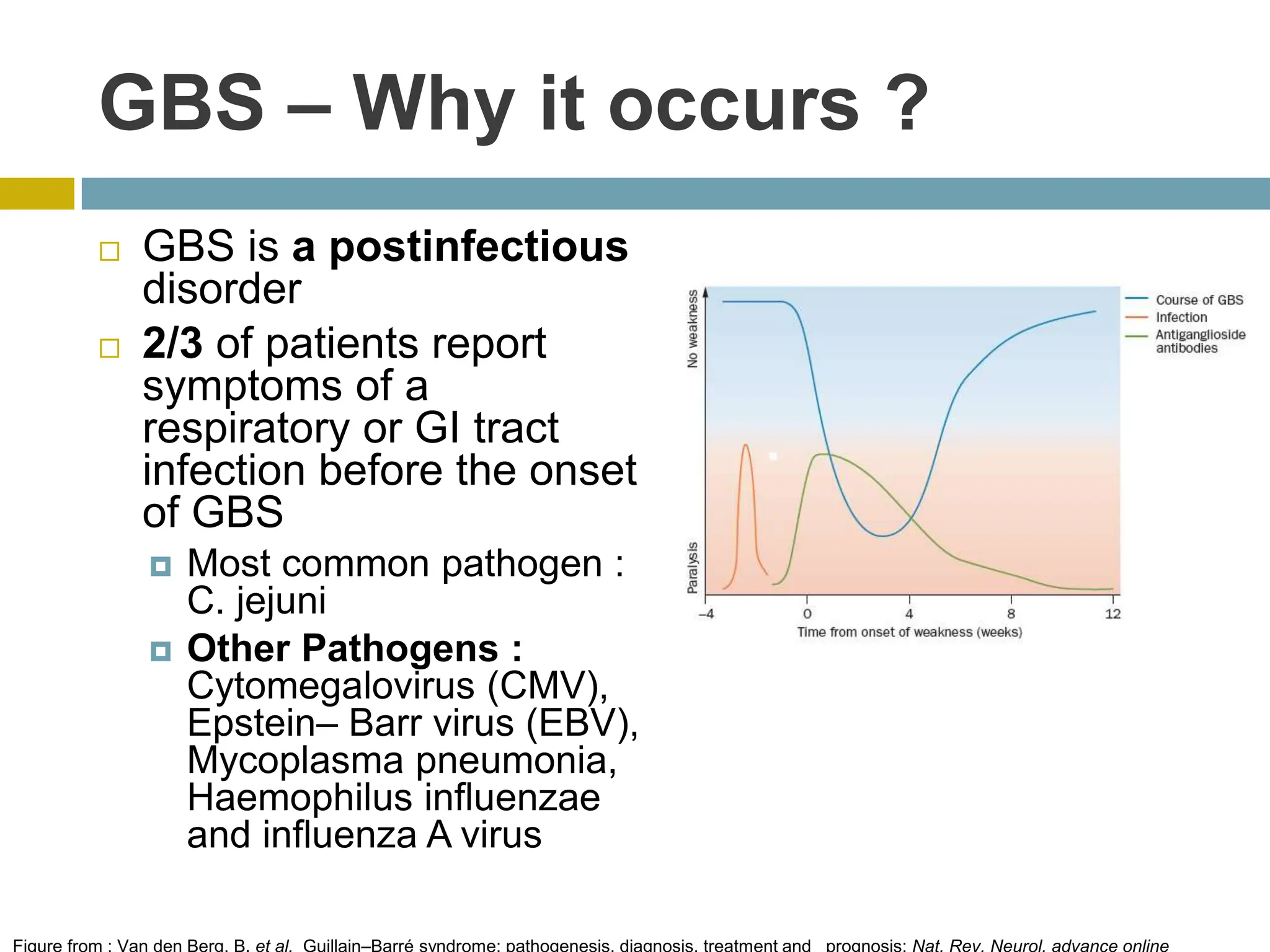
 GBS is a postinfectious
disorder
 2/3 of patients report
symptoms of a
respiratory or GI tract
infection before the onset
of GBS
 Most common pathogen :
C. jejuni
 Other Pathogens :
Cytomegalovirus (CMV),
Epstein– Barr virus (EBV),
Mycoplasma pneumonia,
Haemophilus influenzae
and influenza A virus
Proposed
Pathogenesis
Molecular mimicry of pathogen-borne antigens, leading to generation of cross-
reactive antibodies that also target gangliosides
DIAGNOSIS AND TREATMENT
How to Diagnose ?
 Clinical Features
 CSF finding:
 Albuminocytologic Dissociation
 CSF protein increases
 Normal CSF WBC count
 Electrophysiological findings – Nerve
conductions studies to differentiate from
demyelinating from axonal subtypes
Treatment
 Combating
Respiratory failure
 Cardiovascular
Management
 Bowel & Bladder
care
 Pain control
 Rehabilitation
 Plasmapheresis/Pla
sma Exchange (PE)
 Intravenous
immune globulin
(IVIg)
 Glucocorticoids
(History)
 Interferon beta (only
few cases)
Supportive Care
Disease Modifying
Agents
How it works in GBS ?
IVIg (Intravenous Immunoglobulin)
IVIg is
therapeutic
preparations
of pooled
polyspecific
IgG obtained
from the
plasma of a
large
number of
healthy
individuals
(>>1000
donors)
 Pleotropic immunomodulatory effects
 Don’t know exactly which effect is responsible
for its therapeutic efficacy in GBS
 Possible Mechanism for therapeutic
effects:
 May inhibit Fc-mediated activation of immune
cells
 binding of antiganglioside antibodies to their
neural targets or local complement activation
 Commonly used dose in GBS:
 0.4 gm / kg / day
 For 5 days
 Side effects:
 Aseptic meningitis, rash, acute renal failure
(mostly related to sucrose containing products),
and (rarely) hyperviscosity leading to stroke. IgA
deficiency can lead to anaphylaxis
Current Clinical Review
IVIg ( Intravenous Immunoglobulin)
Cochrane Review – 2014
Objectives :
1. To examine the efficacy of
intravenous Immunoglobulin
(IVIg) in Guillain-Barré
syndrome (GBS)
2. To determine the most
efficacious dose of IVIg
3. To compare the efficacy of
IVIg and plasma exchange
(PE)
4. To compare the efficacy of
IVIg added to PE with PE
alone
Selection of studies
Selection Criteria:
 Randomized and quasi-
randomized trials of IVIg
(Adults & children with
GBS of all degrees of
severity) compared
 With no treatment
 Placebo treatment
 PE or other
immunomodulatory
treatments
 Also included trials in
which IVIg was added to
another treatment
Searched :
 The Cochrane
Neuromuscular Disease
Group Specialized
Register (2 December
2013)
 CENTRAL (2013, Issue 12
in The Cochrane Library)
 MEDLINE (January 1966
to November 2013)
 & EMBASE (January 1980
to November 2013).
Total 12 trials were found
eligible for this
Key Findings
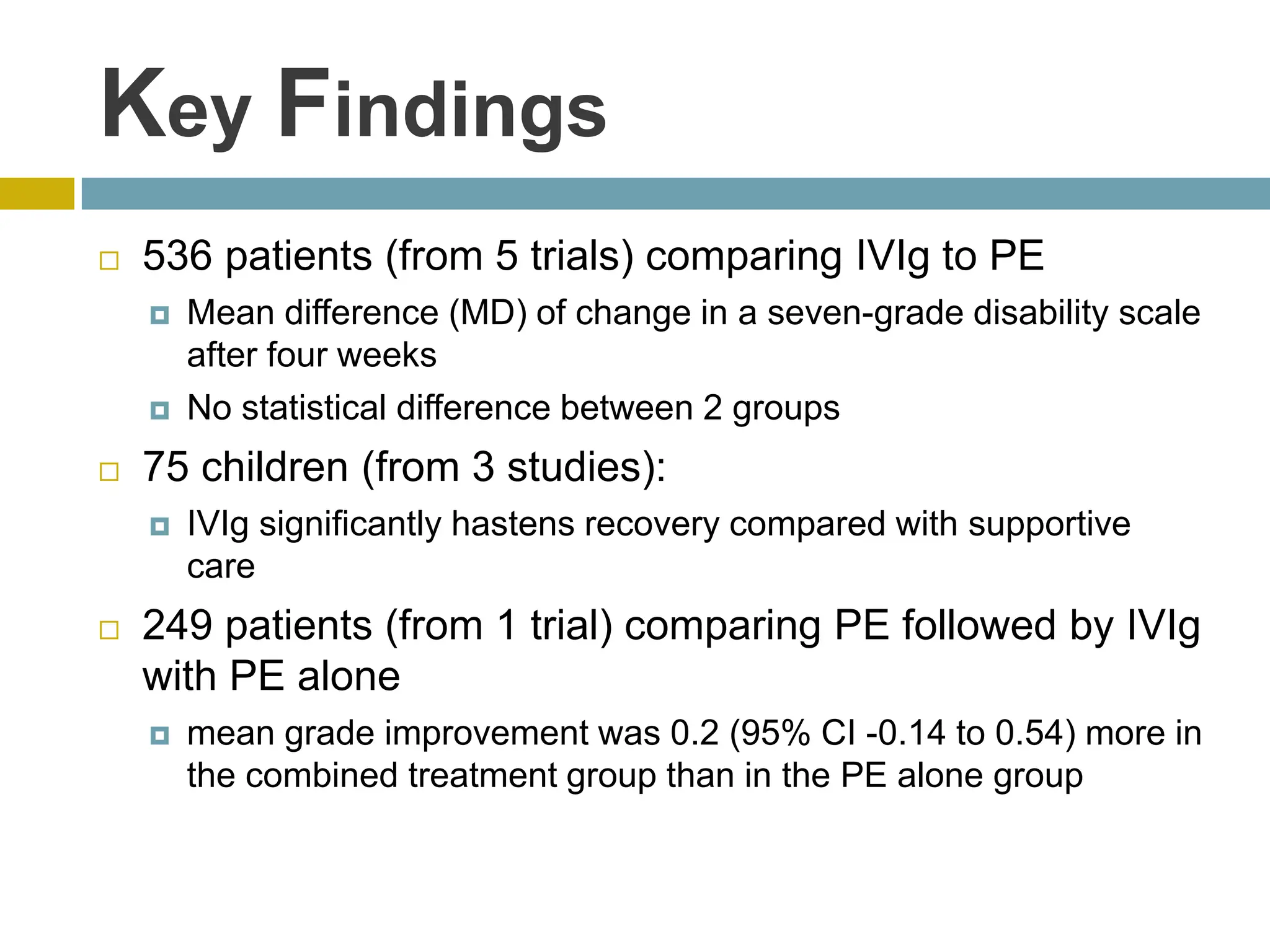
 536 patients (from 5 trials) comparing IVIg to PE
 Mean difference (MD) of change in a seven-grade disability scale
after four weeks
 No statistical difference between 2 groups
 75 children (from 3 studies):
 IVIg significantly hastens recovery compared with supportive
care
 249 patients (from 1 trial) comparing PE followed by IVIg
with PE alone
 mean grade improvement was 0.2 (95% CI -0.14 to 0.54) more in
the combined treatment group than in the PE alone group
Author’s conclusion
 IVIg and PE produced a similar amount of
improvement
 People were more likely to finish a course of
IVIg compared to PE
 IVIg started within two weeks from onset
hastens recovery as much as PE
Recommendations
What Guidelines say ?
AAN Guideline
 Treatment with plasma exchange (PE)
or intravenous immunoglobulin (IVIg)
hastens recovery from GBS
 PE and IVIg are equally effective in
patients with advance GBS
symptoms
 PE may carry a greater risk of side
effects and is more difficult to
administer
 Combining the two treatments is not
recommended
 Steroid treatment is not beneficial
Endorses the view of AAN related to
IVIg use in GBS
http://www.aanem.org/Education/Patient-Resources/Disorders/Guillain-Barre-
NHS – UK
 Two main treatments can be
used to reduce the severity of
Guillain-Barré syndrome They are:
 Intravenous immunoglobulin
 Plasma exchange (plasmapheresis)
 Both treatments are equally
effective.
 Intravenous immunoglobulin is
slightly safer and easier to give
than plasma exchange.
http://www.nhs.uk/Conditions/Guillain-Barre-syndrome/Pages/Treatment.asp
Keep on strengthening Nerves……..

7. GBS , Gullian Barre Syndrome and Role of IVIg.pptx

  • 1.
    GBS AND ROLEOF IVIG Clinical Evidence
  • 2.
    Outline  GBS –overview  Brief history  What ?  Types of GBS  Etiology and pathogenesis  Diagnosis and treatment  IVIg  What and how it works ?  IVIg in GBS  Current Clinical review of articles  Recommendations
  • 3.
    Overview GBS Source: • Van denBerg, B. et al. Guillain–Barré syndrome: pathogenesis, diagnosis, treatment and prognosis; Nat. Rev. Neurol. advance online publication 15 July 2014 • http://www.uptodate.com/contents/treatment-and-prognosis-of-guillain-barre-syndrome-in- adults?source=search_result&search=Guillian+barre&selectedTitle=3~150 • Guillain Barre syndrome. Medscape reference 2014
  • 4.
    Brushing the History  In 1859,Landry published a report on 10 patients with an ascending paralysis.  Subsequently, in 1916, 3 French physicians Guillain, Barré and Strohl  Described 2 French soldiers  With motor weakness, areflexia, cerebrospinal fluid (CSF) Albuminocytologic dissociation, and diminished deep tendon reflexes  The identified syndrome was later named Guillain-Barré syndrome.  Historically, GBS was a single disorder; however, current practice acknowledges several variant forms.
  • 5.
    GBS – What?  Guillain-Barré syndrome is an acute inflammatory demyelinating polyneuropathy characterized by  Progressive symmetrical muscle weakness  & Hyporeflexia / Areflexia  With the marked decline in the incidence of polio, Guillain-Barré syndrome is now the most common cause of acute flaccid paralysis in healthy people
  • 6.
    GBS – Howmuch common ?  Rare disease  Incidence of 0.81–1.89 (median 1.11) per 100,000 person–years  Less frequent in children than adults  Men > Women (Ratio 3:2)  Incidence increases by 20% for every 10 years increase in age
  • 7.
  • 8.
    GBS – CommonTypes  Heterogeneous syndrome with several variant forms  The major forms are :  Acute inflammatory demyelinating polyradiculoneuropathy (AIDP)  Miller Fisher syndrome (MFS)  Acute motor axonal neuropathy (AMAN)  Acute sensorimotor axonal neuropathy (AMSAN)
  • 9.
    Various types –at glance GBS subtypes Main clinical Features NCS findings Antibodies * Acute inflammatory demyelinating polyneuropathy (AIDP) Sensorimotor GBS, often combined with cranial nerve deficits and frequent autonomic dysfunction Demyelinating polyneuropathy Various‡ Acute motor axonal neuropathy (AMAN) Pure motor GBS; cranial nerves rarely affected Axonal polyneuropathy, sensory action potential normal GM1a, GM1b GD1a GalNAc-GD1a Acute motor sensory axonal neuropathy (AMSAN) Resembles severe AMAN, but sensory fibers are affected, leading to sensory deficits Axonal polyneuropathy, sensory action potential reduced or absent GM1, GD1a Miller Fisher syndrome Ataxia, ophthalmoplegia, Normal in most patients; discrete GQ1b, GT1a
  • 10.
    GBS – Howit presents ?  Highly variable  May present with mild difficulty in walking to complete paralysis of facial, respiratory or bulbar muscles  15-30% patients require Mechanical Ventilation  20 % are having severe autonomic dysfunction  Considering this, around half of the patients require ICU monitoring
  • 11.
    Common etiology andproposed pathogenetic mechanism WHY & HOW ?
  • 12.
    GBS – Whyit occurs ?  GBS is a postinfectious disorder  2/3 of patients report symptoms of a respiratory or GI tract infection before the onset of GBS  Most common pathogen : C. jejuni  Other Pathogens : Cytomegalovirus (CMV), Epstein– Barr virus (EBV), Mycoplasma pneumonia, Haemophilus influenzae and influenza A virus
  • 13.
    Proposed Pathogenesis Molecular mimicry ofpathogen-borne antigens, leading to generation of cross- reactive antibodies that also target gangliosides
  • 14.
  • 15.
    How to Diagnose?  Clinical Features  CSF finding:  Albuminocytologic Dissociation  CSF protein increases  Normal CSF WBC count  Electrophysiological findings – Nerve conductions studies to differentiate from demyelinating from axonal subtypes
  • 16.
    Treatment  Combating Respiratory failure Cardiovascular Management  Bowel & Bladder care  Pain control  Rehabilitation  Plasmapheresis/Pla sma Exchange (PE)  Intravenous immune globulin (IVIg)  Glucocorticoids (History)  Interferon beta (only few cases) Supportive Care Disease Modifying Agents
  • 17.
    How it worksin GBS ? IVIg (Intravenous Immunoglobulin)
  • 18.
    IVIg is therapeutic preparations of pooled polyspecific IgGobtained from the plasma of a large number of healthy individuals (>>1000 donors)
  • 19.
     Pleotropic immunomodulatoryeffects  Don’t know exactly which effect is responsible for its therapeutic efficacy in GBS  Possible Mechanism for therapeutic effects:  May inhibit Fc-mediated activation of immune cells  binding of antiganglioside antibodies to their neural targets or local complement activation
  • 20.
     Commonly useddose in GBS:  0.4 gm / kg / day  For 5 days  Side effects:  Aseptic meningitis, rash, acute renal failure (mostly related to sucrose containing products), and (rarely) hyperviscosity leading to stroke. IgA deficiency can lead to anaphylaxis
  • 21.
    Current Clinical Review IVIg( Intravenous Immunoglobulin)
  • 22.
    Cochrane Review –2014 Objectives : 1. To examine the efficacy of intravenous Immunoglobulin (IVIg) in Guillain-Barré syndrome (GBS) 2. To determine the most efficacious dose of IVIg 3. To compare the efficacy of IVIg and plasma exchange (PE) 4. To compare the efficacy of IVIg added to PE with PE alone
  • 23.
    Selection of studies SelectionCriteria:  Randomized and quasi- randomized trials of IVIg (Adults & children with GBS of all degrees of severity) compared  With no treatment  Placebo treatment  PE or other immunomodulatory treatments  Also included trials in which IVIg was added to another treatment Searched :  The Cochrane Neuromuscular Disease Group Specialized Register (2 December 2013)  CENTRAL (2013, Issue 12 in The Cochrane Library)  MEDLINE (January 1966 to November 2013)  & EMBASE (January 1980 to November 2013). Total 12 trials were found eligible for this
  • 24.
    Key Findings  536patients (from 5 trials) comparing IVIg to PE  Mean difference (MD) of change in a seven-grade disability scale after four weeks  No statistical difference between 2 groups  75 children (from 3 studies):  IVIg significantly hastens recovery compared with supportive care  249 patients (from 1 trial) comparing PE followed by IVIg with PE alone  mean grade improvement was 0.2 (95% CI -0.14 to 0.54) more in the combined treatment group than in the PE alone group
  • 25.
    Author’s conclusion  IVIgand PE produced a similar amount of improvement  People were more likely to finish a course of IVIg compared to PE  IVIg started within two weeks from onset hastens recovery as much as PE
  • 26.
  • 27.
    AAN Guideline  Treatmentwith plasma exchange (PE) or intravenous immunoglobulin (IVIg) hastens recovery from GBS  PE and IVIg are equally effective in patients with advance GBS symptoms  PE may carry a greater risk of side effects and is more difficult to administer  Combining the two treatments is not recommended  Steroid treatment is not beneficial
  • 28.
    Endorses the viewof AAN related to IVIg use in GBS http://www.aanem.org/Education/Patient-Resources/Disorders/Guillain-Barre-
  • 29.
    NHS – UK Two main treatments can be used to reduce the severity of Guillain-Barré syndrome They are:  Intravenous immunoglobulin  Plasma exchange (plasmapheresis)  Both treatments are equally effective.  Intravenous immunoglobulin is slightly safer and easier to give than plasma exchange. http://www.nhs.uk/Conditions/Guillain-Barre-syndrome/Pages/Treatment.asp
  • 30.
    Keep on strengtheningNerves……..

Editor's Notes

  • #10 *Antibodies are predominantly IgG, but IgM and IgA antibodies have also been demonstrated. ‡Association with GBS and role in its pathogenesis unknown. Abbreviations: GBS, Guillain–Barré syndrome; NCS, nerve conduction study.
  • #14 Molecular mimicry, antiganglioside antibodies and, likely, complement activation are involved in the pathogenesis of GBS Patients with AMAN frequently have serum antibodies against GM1a, GM1b, GD1a and GalNAc-GD1a gangliosides.3,7,37,45–47 Patients with MFS or MFS–GBS overlap syndrome frequently have antibodies against GD1b, GD3, GT1a and GQ1b gangliosides, which are related to ataxia and ophthalmoplegia 20% of patients with AIDP related to cytomegalovirus infection had anti-GM2 antibodies with uncomplicated cytomegalovirus infections The development of GBS after a C. jejuni infection may also depend on patient-related factors that influence the susceptibility to produce crossreactive, carbohydrate-targeted antibodies
  • #24 They also Checked the bibliographies in reports of the randomized trials and contacted the authors and other experts in the field to identify additional published or unpublished data