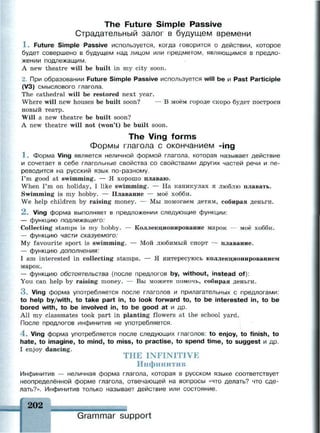
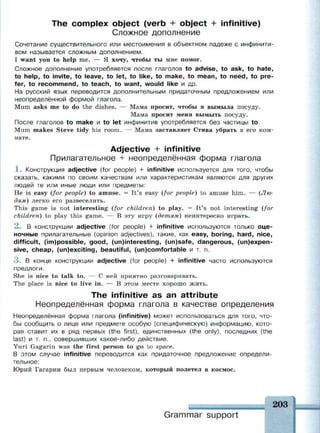
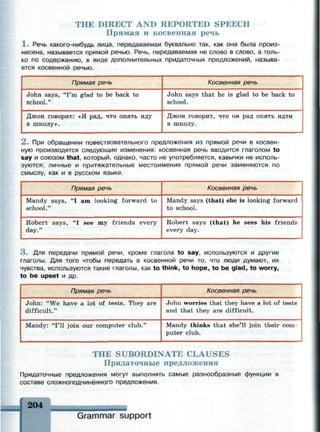
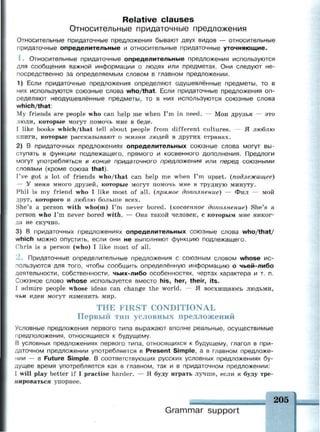
'£
Российская академия наук
Российская академия образования
Издательство «Просвещение»
Академический школьный учебник
Student's
Book
PROSVESHCHENIYE
P U B L I S H E R S
Условные обозначения и сокращения
Щ — говорение
И — слушание
|Ц — чтение
Ei — письменное задание
г
.^ — домашнее задание
Ц — задание повышенной трудности
Д — дополнительное задание
^ — дополнительная информация в сети Интернет
the Old World* — см. лингвострановедческий справочник (LCG)
LCG — Linguistic and Cultural Guide
AB — Activity Book
R — Reader
Российская академия наук
Российская академия образования
Издательство «Просвещение»
Академический школьный учебник
ГЛИНСКИЙ
язык
7 класс
Учебник
для общеобразовательных
учреждений
Рекомендовано
Министерством образования и науки
Российской федерации
11-е издание, переработанное
Москва
«ПРОСВЕЩЕНИЕ»
2011
УДК 373.167.1:811.111
ББК 81.2Англ-922
А64
Серия «Академический школьный учебник» основана в 2005 году.
На учебник получены положительные заключения
Российской академии наук (№ 10106-5215/15 от 31.10.2007 г.)
и Российской академии образования (№ 01-487/5/7д от 24.10.2007 г.).
Проект «Российская академия наук, Российская академия образования,
издательство «Просвещение» — российской школе»
Р у к о в о д и т е л и п р о е к т а :
вице-президент РАН акад. В.В.Козлов, президент РАО акад.
Н.Д. Никандров, управляющий директор издательства «Просвещение»
чл.-корр. РАО А.М.Кондаков
Н а у ч н ы е р е д а к т о р ы с е р и и :
акад. РАО, д-р пед. наук А.А. Кузнецов, акад. РАО,
д-р пед. наук М.В.Рыжаков, д-р экон. наук С.В.Сидоренко
Научный консультант авторского коллектива акад. РАО, д-р пси-
хол. наук И. А. Зимняя
Авторы:
В. П. Кузовлев, Н. М. Лапа, Э. Ш. Перегудова, И. П. Костина,
О. В. Дуванова, Ю. Н. Кобец
Научный руководитель авторского коллектива проф. Е. И. Пассов
Английский язык. 7 класс : учеб. для общеобразоват. учреждений /
А64 [В. П. Кузовлев, Н. М. Лапа, Э. Ш. Перегудова и др.] ; Рос. акад. на­
ук, Рос. акад. образования, изд-во «Просвещение». — 11-е изд., пере-
раб. — М. : Просвещение, 2011. — 252 с. : ил. — (Академический
школьный учебник). — ISBN 978-5-09-019529-4.
ISBN 978-5-09-019529-4
УДК 373.167.1:811.111
ББК 81.2Англ-922
Издательство «Просвещение», 2010
Художественное оформление.
Издательство «Просвещение», 2010
Все права защищены
W®(UJ
Сгкзда^
@tf s@to®@D
йШ
Lesson
low did you spend
1« И Щ Mandy, John and Robert are talking about their summer holidays.
Where did the children spend their holidays? (listening for specific information)
A. Mandy wrote to her friend about her summer holidays.
1) What were her impressions?
Dear Helen,
l had a great time on holiday, in July my family and I were near Snowdon.* we were
walking up the mountain from morning till lunch, it was not easy, but it was exciting!
last week we went sightseeing to York.* we went to an old castle. They say there are
ghosts in the castle but we didn't see any. My friend had been there
before, and she hadn't seen them either, in August the weather was
fine. I went sunbathing and swam a lot! I took many fantastic photos.
I'll send you some.
I am looking forward to1
seeing you again,2
Mandy
2) In the letter, find the verbs in the past tense forms and name them.
I Qf'QfY)rf)Qf for revision
Describing past actions
 / • • • •
On Sunday we went to an old castle.
We were swimming for 2 hours.
My friend had visited this museum before.
Past Simple
Past Progressive
Past Perfect
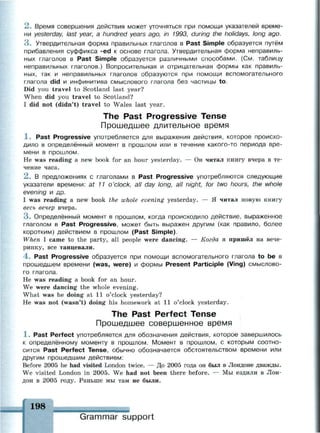
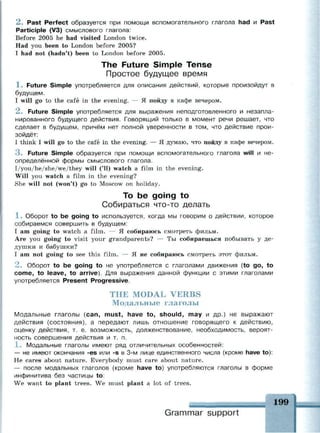
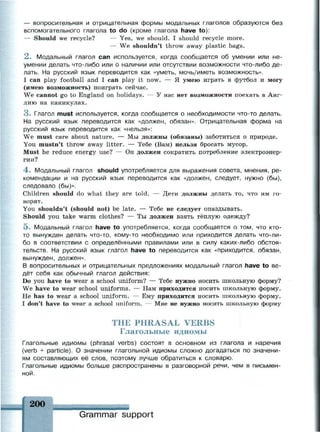
GS (Grammar Support) p. 197—198
1
to look forward to + N/Ving — с нетерпением ожидать чего-л.
2
again [э'деп] — снова, опять
б
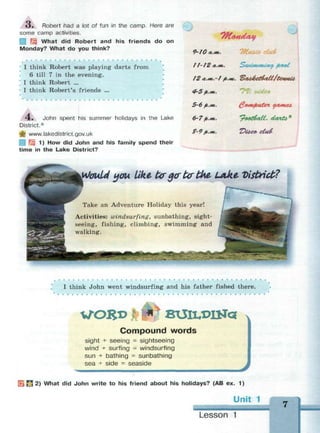
3 . Robert had a lot of fun in the camp. Here are
some camp activities.
| What did Robert and his friends do on
Monday? What do you think?
I think Robert was playing darts from
6 till 7 in the evening.
I think Robert ...
I think Robert's friends ...
4 . John spent his summer holidays in the Lake
District.*
ф www.lakedistrict.gov.uk
; 1) How did John and his family spend their
time in the Lake District?
9-10 л.ж.
t f- J2 *.*». SwwwUtty fuMit
4-5>.«*.
5-6 fi..m. @wifiuten уатеь
6-7>.<». 'pootfall, cUwtb*
Z-9£.»*. T>ioc& c£u&
Would you Like brg<rtortint-лке. Vistrict?
Take an Adventure Holiday this year!
Activities: windsurfing, sunbathing, sight­
seeing, fishing, climbing, swimming and
walking.
I think John went windsurfing and his father fished there.
VTORD BUlLDlNa
Compound words
sight + seeing = sightseeing
wind + surfing = windsurfing
sun + bathing = sunbathing
sea + side « seaside
j 2) What did John write to his friend about his holidays? (AB ex. 1)
Unit
Lesson 1
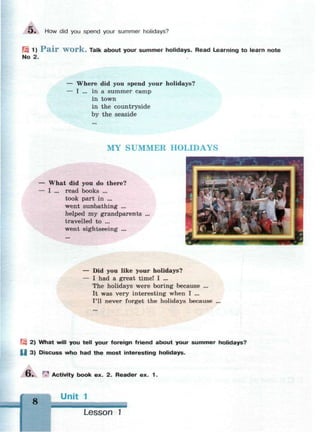
Э . How did you spend your summer holidays?
Щ 1) P a i r W O r k . Talk about your summer holidays. Read Learning to learn note
No 2.
— Where did you spend your holidays?
— I ... in a summer camp
in town
in the countryside
by the seaside
MY SUMMER HOLIDAYS
— What did you do there?
— I ... read books ...
took part in ...
went sunbathing ...
helped my grandparents
travelled to ...
went sightseeing ...
— Did you like your holidays?
— I had a great time! I ...
The holidays were boring because ...
It was very interesting when I ...
I'll never forget the holidays because ...
Щ 2) What will you tell your foreign friend about your summer holidays?
| | 3) Discuss who had the most interesting holidays.
O . r
^ Activity book ex. 2. Reader ex. 1 .
8
Lesson
Ьа ск к о о clio о I '$
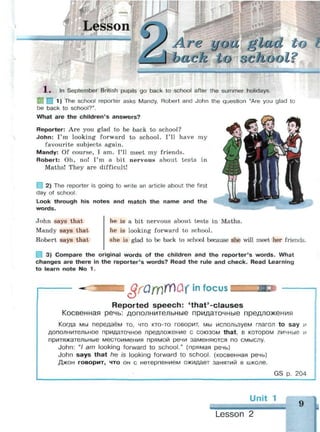
1 . In September British pupils go back to school after the summer holidays.
Ц 1) The school reporter asks Mandy, Robert and John the question "Are you glad to
be back to school?".
What are the children's answers?
Reporter: Are you glad to be back to school?
John: I'm looking forward to school. I'll have my
favourite subjects again.
Mandy: Of course, I am. I'll meet my friends.
Robert: Oh, no! I'm a bit nervous about tests in
Maths! They are difficult!
2) The reporter is going to write an article about the first
day of school.
Look through his notes and match the name and the
words.
John says that
Mandy says that
Robert says that
he is a bit nervous about tests in Maths.
he is looking forward to school.
she is glad to be back to school because she will meet her friends.
3) Compare the original words of the children and the reporter's words. What
changes are there in the reporter's words? Read the rule and check. Read Learning
to learn note No 1.
QfQfY)YTlQ{ in focus
Reported speech: 'that'-clauses
Косвенная речь: дополнительные придаточные предложения
Когда мы передаём то, что кто-то говорит, мы используем глагол to say и
дополнительное придаточное предложение с союзом that, в котором личные и
притяжательные местоимения прямой речи заменяются по смыслу.
John: "/ am looking forward to school." (прямая речь)
John says that he is looking forward to school, (косвенная речь)
Джон говорит, что он с нетерпением ожидает занятий в школе.
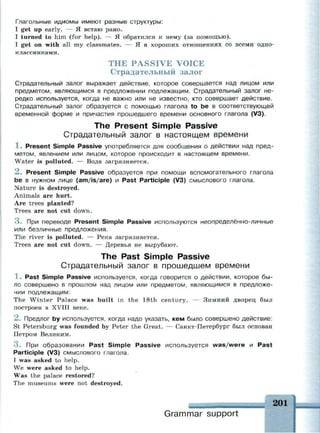
GS р. 204
Lesson
9
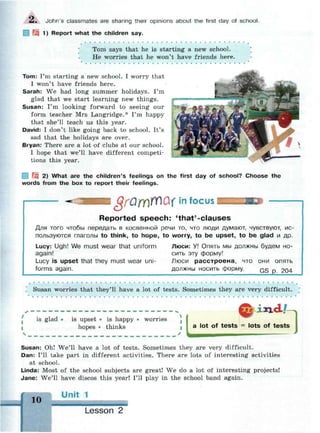
Л . John's classmates are sharing their opinions about the first day of school.
1) Report what the children say.
• • • • •
Tom says that he is starting a new school.
He worries that he won't have friends here.
Tom: I'm starting a new school. I worry that
I won't have friends here.
Sarah: We had long summer holidays. I'm
glad that we start learning new things.
Susan: I'm looking forward to seeing our
form teacher Mrs Langridge.* I'm happy
that she'll teach us this year.
David: I don't like going back to school. It's
sad that the holidays are over.
Bryan: There are a lot of clubs at our school.
I hope that we'll have different competi­
tions this year.
| 2) What are the children's feelings on the first day of school? Choose the
words from the box to report their feelings.
grQmWQi in focus
Reported speech: 'that'-clauses
Для того чтобы передать в косвенной речи то, что люди думают, чувствуют, ис­
пользуются глаголы to think, to hope, to worry, to be upset, to be glad и др.
Lucy: Ugh! We must wear that uniform Люси: У! Опять мы должны будем но-
again! сить эту форму!
Lucy is upset that they must wear uni- Люси расстроена, что они опять
forms again. должны носить форму. Q § p 204
Susan worries that they'll have a lot of tests. Sometimes they are very difficult.
lots of tests
is glad is upset • is happy • worries
hopes • thinks
4
i a lot of
Susan: Oh! We'll have a lot of tests. Sometimes they are very difficult.
Dan: I'll take part in different activities. There are lots of interesting activities
at school.
Linda: Most of the school subjects are great! We do a lot of interesting projects!
Jane: We'll have discos this year! I'll play in the school band again.
10
Robert: I have no friends here. I'm a new pupil at this school.
Jenny: This year is going to be hard. We'll have a lot of tests in different sub­
jects.
Chris: The holidays are over. And I have to get up early again.
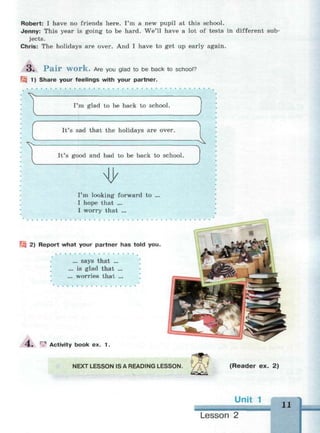
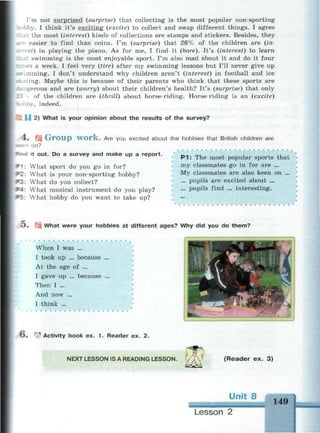
3 . P a i r W O r k . Are you glad to be back to school?
Щ 1) Share your feelings with your partner.
I'm glad to be back to school.
It's sad that the holidays are over.
It's good and bad to be back to school.
V
I'm looking forward to
I hope that ...
I worry that ...
Щ 2) Report what your partner has told you.
.. says that ...
is glad that ...
worries that ...
4 . ^ Activity book ex. 1.
NEXT LESSON IS A READING LESSON. (Reader ex. 2)
it 1 11
Lesson 2
Lesson « j
"D.1
.! ' ' I J
^
W"ha~tJ
ts your
1 . V o c a b u l a r y . John and Mandy go to Hazel Grove High School.* They are in
Year 7.
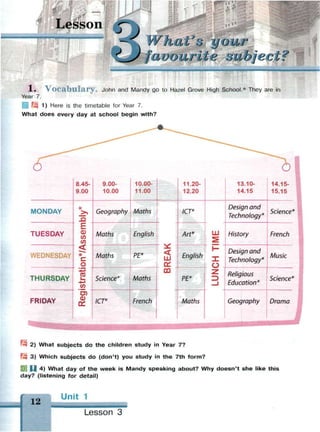
1 P5j 1) Here is the timetable for Year 7.
What does every day at school begin with?
MONDAY
TUESDAY
WEDNESDAY
THURSDAY
FRIDAY
8.45-
9.00
*
>>
E
0)
CO
CO
<
с
о
CO
О)
9.00-
10.00
Geography
Maths
Maths
Science*
ICT*
10.00-
11.00
Maths
English
PE*
Maths
French
<
Ш
OH
00
11.20-
12.20
ICT*
Art*
English
PE*
Maths
Ш
r -
O -
—1
13.10-
14.15
Design and
Technology*
History
Design and
Technology*
Religious
Education*
Geography
14.15-
15.15
Science*
French
Music
Science*
Drama
3 2) What subjects do the children study in Year 7?
Щ 3) Which subjects do (don't) you study in the 7th form?
| Ц 4) What day of the week is Mandy speaking about? Why doesn't she like this
day? (listening for detail)
12
Unit 1
Lesson 3
2 . И V o c a b u l a r y . John is speaking about his timetable and subjects.
Ш 1) What does John like? What doesn't he like? Why? Use the word box to learn
the meaning of the highlighted words.
Our school day starts with registration. Every morning we also
have assembly. I'm not sure that we should have assembly every day.
I think that assembly is a waste of time and I can do without it.
My favourite subjects are Biology, Chemistry and Physics. At
these lessons we discover new things. It's very interesting. I like
Maths, too. Our teacher Mr Kernel is very kind and he helps us
when we have problems. I always look forward to his lessons. But I
don't like French. I hate learning words and poems by heart.
г ^—. ' —1
~ i ..•••••ИМ
l i z •_ :.™:r::"':::"'-:.::™::::^
К **. A fa * M
— 1 -'-''
a waste of time — бесполезная трата
времени
to do without — обходиться без чего-л.
to discover — узнавать, открывать
by heart [ha:t] — наизусть
Words to
guess
Biology [bai'olacfei] — ?
Chemistry ['kemistn] — ?
Physics ['fiziks] — ?
J
 2) What will you tell John about your timetable and subjects? Use John's story
for help.
] Щ 3) Report what Mandy and Robert say about their timetable. Compare your
timetable with the timetable at Hazel Grove High School, (listening for detail)
Mandy: We have registration at 8.45 a.m. every day.
You: Mandy says that they have registration at 8.45 a.m. every day. But we
don't have registration at my school.
Un
Lesson 3
13
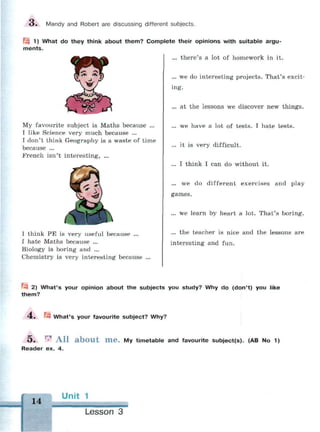
О . Mandy and Robert are discussing different subjects.
| 1) What do they think about them? Complete their opinions with suitable argu­
ments.
... there's a lot of homework in it.
... we do interesting projects. That's excit­
ing.
... at the lessons we discover new things.
... we have a lot of tests. I hate tests.
... it is very difficult.
... I think I can do without it.
... we do different exercises and play
games.
... we learn by heart a lot. That's boring.
... the teacher is nice and the lessons are
interesting and fun.
My favourite subject is Maths because ...
I like Science very much because ...
I don't think Geography is a waste of time
because ...
French isn't interesting, ...
I think PE is very useful because ...
I hate Maths because ...
Biology is boring and ...
Chemistry is very interesting because
^ 2) What's your opinion about the subjects you study? Why do (don't) you like
them?
4. ft What's your favourite subject? Why?
5 . r l
A l l a b o u t H i e . My timetable and favourite subject(s). (AB No 1)
Reader ex. 4.
14
Unit 1
Lesson 3
Lesson
I loue о с
Z DO LI О Li ?
1 . Children have different feelings about school.
И5 1) What do you think of when you talk about school? Write three things you like
and don't like about school.
2) Listen to three children speaking about school. Do they speak about the things
you have written about school? (listening for specific information)
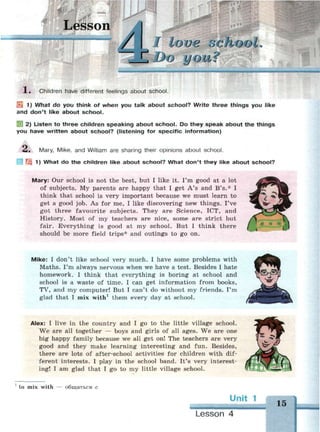
Л. Mary, Mike, and William are sharing their opinions about school.
'i 1) What do the children like about school? What don't they like about school?
Mary: Our school is not the best, but I like it. I'm good at a lot
of subjects. My parents are happy that I get A's and B's.* I
think that school is very important because we must learn to
get a good job. As for me, I like discovering new things. I've
got three favourite subjects. They are Science, ICT, and
History. Most of my teachers are nice, some are strict but
fair. Everything is good at my school. But I think there
should be more field trips* and outings to go on.
Mike: I don't like school very much. I have some problems with
Maths. I'm always nervous when we have a test. Besides I hate
homework. I think that everything is boring at school and
school is a waste of time. I can get information from books,
TV, and my computer! But I can't do without my friends. I'm
glad that I mix with1
them every day at school.
Alex: I live in the country and I go to the little village school.
We are all together — boys and girls of all ages. We are one
big happy family because we all get on! The teachers are very
good and they make learning interesting and fun. Besides,
there are lots of after-school activities for children with dif­
ferent interests. I play in the school band. It's very interest­
ing! I am glad that I go to my little village school.
1
to mix with — общаться с
Unit 1
Lesson 4
15
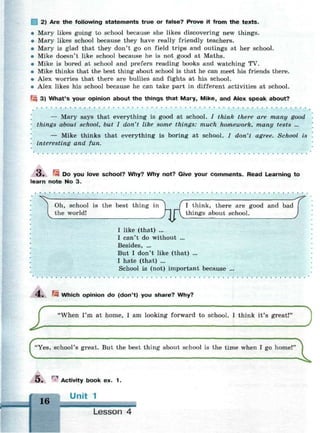
2) Are the following statements true or false? Prove it from the texts.
• Mary likes going to school because she likes discovering new things.
• Mary likes school because they have really friendly teachers.
• Mary is glad that they don't go on field trips and outings at her school.
• Mike doesn't like school because he is not good at Maths.
• Mike is bored at school and prefers reading books and watching TV.
• Mike thinks that the best thing about school is that he can meet his friends there.
• Alex worries that there are bullies and fights at his school.
• Alex likes his school because he can take part in different activities at school.
Щ 3) What's your opinion about the things that Mary, Mike, and Alex speak about?
• • • •
— Mary says that everything is good at school. / think there are many good
things about school, but I don't like some things: much homework, many tests ...
— Mike thinks that everything is boring at school. / don't agree. School is
interesting and fun.
3. Щ Do you love school? Why? Why not? Give your c o m m e n t s . Read Learning to
learn note No 3.
^
Oh, school is the best thing in ( I think, there are good and bad
the world! y l |~ things about school.
I like (that) ...
I can't do without ...
Besides, ...
But I don't like (that) ...
I hate (that) ...
School is (not) important because
4 . ^4 Which opinion do (don't) you share? Why?
I 'When I'm at home, I am looking forward to school. I think it's great!'
)
(.,. - ^ „..,. M ,t. ь... - . . . M ••tb. „ .h m • , ^
O . Activity book ex. 1 .
Unit 1
Lesson 4
Lesson
" Г "
У 1 / У Уt do во iIs V
in ean?
l. On exchange programmes, children from different countries often talk about school.
6.J3.
| What are the children talking about? What countries are they from? What do
you think? (listening for the main idea)
Л. Phil and Mary are talking about school life.
1) Use the word box and find in the dialogues how they:
• say they don't understand something;
• ask about meaning.
— What are your marks at school?
— I get fours and fives.
— Fours and fives? What do they mean? Are you a good pupil?
— Yes, I am. 4 means good and 5 means excellent.1
— Oh, well done! But in my culture they mean В and A.
• • •
— What form are you in?
— I'm in the third form.
— Really? How old are you?
— Thirteen.
— I'm thirteen, too. But I'm in the seventh form. Sorry, I don't
quite understand.
— Well, at most English schools forms start only at the second­
ary school, at the age of eleven.
V-
* &
SKI ea 2) What are some other ways of saying you don't understand
and asking about meaning?
SAYING YOU D O N ' T U N D E R S T A N D
I'm sorry, but I have a question. Извини(те), у меня вопрос.
Sorry, I don't quite understand. Извини(те), мне не совсем понятно.
I didn't (quite) get you. Я не (совсем) понял вас.
A S K I N G A B O U T M E A N I N G
What do you mean? Что вы имеете в виду?
What do you mean by A's? Что вы имеете в виду, говоря "A's"?
Can you explain what you mean by assembly, please? Объясните, пожа­
луйста, что вы имеете в виду, говоря "assembly".
1
excellent ['eksabnt] — отлично
Unit
Lesson 5
N3 3) Replace the highlighted expressions in the dialogues with those that fit
from the word box. Act out the dialogues.
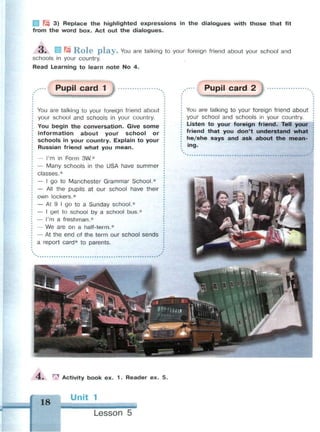
O . w R o l e p l a y . You are talking to your foreign friend about your school and
schools in your country.
Read Learning to learn note No 4.
Pupil card 1 Pupil card 2
You are talking to your foreign friend about
your school and schools in your country.
You begin the conversation. Give some
information about your school or
schools in your country. Explain to your
Russian friend what you mean.
— I'm in Form 3W.*
— Many schools in the USA have summer
classes.*
— I go to Manchester Grammar School.*
— All the pupils at our school have their
own lockers.*
— At 9 I go to a Sunday school.*
— I get to school by a school bus.*
— I'm a freshman.*
— We are on a half-term.*
— At the end of the term our school sends
a report card* to parents.
You are talking to your foreign friend about
your school and schools in your country.
Listen to your foreign friend. Tell your
friend that you don't understand what
he/she says and ask about the mean­
ing.
4 . | Activity book ex. 1 . Reader ex. 5.
18
Unit 1
• М М М
Lesson 5
Lesson What is a
progressive school
Most schools in Britain are traditional, but there are1. Ш Jigsaw
progressive schools, too.
Read Learning to learn note No 5.
1) I n h o m e g r o u p s . Read one of the texts (A, B, or C) and do the task.
A | | SS Summerhill is a famous progressive school.
Read the text and write out the facts that show how different Summerhill is from
traditional schools.
......,......
Summerhill is a boarding school1
in Suffolk, England. A. S. Neill* opened this
school in 1921. There are only eighty pupils, aged from five to eighteen. The
children have classes usually according to2
their age, sometimes according to their
interests. Every week the pupils and the teachers have a meeting3
where they
make and change their rules. There is a timetable — but for the teachers. The
pupils can go to the lessons or play, or spend their time in the art room. Children
from other countries can study at Summerhill. Parents pay for the teaching. It
costs about £6,000 a year.
Summerhill is a progressive boarding school.
First, ...
Second, ...
Besides ...
More than that ...
* •
1
a boarding ['bordirj] school — школа-интернат
2
according to O'ksdin ta] — в соответствии с
a meeting - собрание
Ur
Lesson 6
В f 1 EL All schools have rules for pupils.
Read some school rules. Write how pupils must behave at school.
School rules
Wear a school uniform.
Be ready for class every day.
Be polite.
Take care of school things and stuff.
Keep your classroom clean and tidy.
Don't bring dangerous things to school.
Don't leave a lesson without permission.
Don't use mobiles during the school day.
Be friendly to classmates.
Don't run in school corridors.
Don't bully other pupils in any way.
Come to school on time.
Respect others and be courteous.
Don't bring chewing gum1
to school.
*
Rules are very important at school.
Pupils must follow general school rules.2
They ...
They also must follow safety rules. They ...
All pupils should behave well towards3
each other and adults. They ...
1
chewing ['tfuiirj] gum — жевательная резинка
2
general rules — общие правила
3
towards [t3'wo:dz] — по отношению к
С i В 111 y o u r C u l t u r e . The Utchitelskaya Gazeta published an article about one
of the best boarding schools.1
Read the pupil's opinion about the boarding school and render it. Use the following
phrases. Read Learning to learn note No 6.
WO£l> виил>ша
Suffixes
10th form n + -er = 10th-former n
know v + -ledge = knowledge ['nolicfe] n
20
Unit 1
Lesson 6
«Наша школа-интернат — большая дружная семья, и поэтому в пятницу
мне не хочется расставаться с друзьями. Вы видели, чтобы десятиклассники
дружили с первоклассниками? А здесь дружат! А мальчишки и девчонки
прекрасно ладят между собой. У нас шеетиразовое питание, уютные спальни,
у каждого класса есть свой классный руководитель. Мы можем заниматься в
разных кружках: театральном, музыкальном, компьютерном; можно попла­
вать в бассейне или поиграть на площадке в футбол. Здесь почти каждый день
дискотеки. Мы получаем здесь хорошие знания, и мы счастливы».
. like a big family ...
. in the playground ...
meals 6 times a day .
... tenth-formers ...
. get good knowledge
go to different clubs
... get on with ...
to part with my friends
... almost every day ...
... a form teacher ...
... are friends with ...
... are happy ...
1
a boarding ['boidin] school — школа-интернат
Щ 2) I n e x p e r t g r o u p s . Compare your answers for the task and come to an
agreement. Get ready to retell the text.
Щ 3) I n h o m e g r O U p S . Retell the text you've read to your group mates. Get
ready to answer the questions.
• What classes do the pupils of Summerhill School go to?
Who makes rules at Summerhill School?
Must the pupils of Summerhill School go to all the les­
sons?
Are rules important at all schools?
What rules should pupils follow at school?
How do the pupils of the boarding school behave
towards each other?
* What activities can the pupils of the boarding school
do?
Why are the pupils of the boarding school happy?
2 . Щ I n t h e w h o l e C l a s s . What makes a school progressive?
Discuss your ideas about a progressive school.
o . f
"* ф www.summerhillschool.co.uk
H NEXT LESSON IS A CONSOLIDATION LESSON. (AB p. 10)
21
Lesson 6
Lesson
Project
l. Choose a project you want to do. Read Learning to learn note No 7
Project
T  M y school
Make a list of headings under which you will describe your
school.
Write about the best things at your school and the things you
want to have (to change).
Illustrate your ideas with pictures, photos, and drawings.
Write captions for them.
Project 2") My dream schoo/
• Make a list of headings under which you will describe your
dream school.
• Write about the things you want to have at your dream school.
• Illustrate your ideas with pictures, photos, and drawings.
Write captions for them. Use humour, fantasy and
imagination.
Project My ideal schoo/ o a y ^C
• Make a list of headings under which you will describe your
ideal school day.
• Write about the things you want to have and do on this day.
• Illustrate your ideas with pictures, photos, and drawings.
Write captions for them. Use humour, fantasy and
imagination.
2л. Щ Present your project and answer your classmates' questions to explain
your ideas and choice.
>• Щ Discuss your projects and decide which project is the best.
22
Unit 1
Lesson 7
Lesson
щт
Test
ourself
О
LISTENING COMPREHENSION (AB-I)
— — — — — — — — — — — • — — — »
READING COMPREHENSION (AB-II)
3 ^m USF OF ENGLISH (VOCABULARY/GRAMMAR) (AB-III)
О1 SPEAKING
Role play. You and your foreign friend are talking about your schools.
Pupil card 1
You and your foreign friend are talking
about your schools. You go to a secondary
school in London. You are in Year 7.
You begin the conversation.
Ask your Russian friend about his/her
school and favourite subjects.
Remember to ask about:
* the form he/she is in;
* the subjects he/she studies;
* his/her marks in different subjects;
* his/her favourite subjects;
* why he/she likes them.
Answer your friend's questions.
Pupil card 2
You and your foreign friend are talking
about your schools.
Listen to your foreign friend. Answer
his/her questions. Ask your friend
about:
• his/her school;
• the subjects he/she studies;
• the rules at his/her school.
Unit 1
Lesson 8
23
Z . O r a l r e p o r t . A group of foreign pupils has come on a visit to your school.
What will you tell them about your school and your school life?
Remember to say:
• what your school is like;
• what after-school activities there are at your school;
• what activities you take part in.
You have to talk for one minute. The teacher will listen to you until you have fin-
ished. Then he/she will ask you some questions.
WRITING (AB-IV)
CULTURAL AWARENESS (AB-V)
NEW WORDS AND WORD COMBINATIONS FROM
UNIT 1
Lesson 1
again*
to look forward to*
sightseeing (to go~)
sunbathing (to go~)
Reading lesson
chess*
drama*
a field trip*
an outing*
Lesson 3
assembly
Biology
by heart
Chemistry
to do without
Physics
a waste (of time)
registration
a timetable*
to discover
Lesson 4
to mix with*
Lesson 5
excellent*
to understand
to mean
quite
Lesson 6
according to*
a boarding school*
knowledge*
a meeting*
Reader
to float*
a highlight*
to miss*
a raft*
Answer the questions.
1) Which words do we use to name people's activities on holidays?
2) Which words do we use to name school subjects?
3) Which words do we use to name pupils' activities at school?
4) Which words can you guess?
5) How many new words and word combinations from Unit 1 do you know?
SI Щ > SE1 F-ASSFSRMFNT (AB-VI]
Read Learning to learn note No 8.
24
Unit 1
Lesson 8
WkM*(mBwm
Lesson
t are your
?
»'•"""•" ""' Ц. MM
1 . In Britain, there are children who have achieved great results in different activities.
553 Ш 1) V o c a b u l a r y . What are George, Jonathan, Jodie and Emilia the best
at? Use the word box to learn the meaning of the highlighted words.
I tried hard and won the BBC* Young Musician of the Year competition.
I think I have musical abilities. I want to be a famous pianist. (George, 13)
I trained properly and set a new national record for the long jump. I think
I've achieved much, but my ambition is to win the Olympics,* to be a top sports­
man and a professional. (Jonathan, 14)
I go in for horse-riding and my greatest achievement was when I was in the
British team at the TREC* European Championships. Our team won the bronze
medal. My ambition is to win a gold medal, but
I have to work hard to get what I want. (Jodie, 15)
I won the Young Cartoonist of the Year Award.
I've always enjoyed drawing and I have ability in
drawing. I think it's necessary to practise hard to
be really good at something. (Emilia, 12)
ixx<U
Abbreviations
B B C [,bi: bi:'si:] but T R E C [trek]
to try — стараться
hard — упорно
an ability (in) — способность (в)
properly — правильно, как следует
to set a record (for) — установить ре­
корд (в)
to achieve [a'tfrv] — достигать, доби­
ваться
an achievement — достижение
an ambition [гет'Ы/эп] — стремление,
цель
top (sportsman) — 1) лучший 2) выс­
ший
a professional [prs'fejhsl] — профес­
сионал
to go in for phrv — заниматься, увле­
каться
championships ['tfgempisnfips] — ( ) Q
чемпионат
gold — золотой
an award [a'woxl] — награда
necessary ['nesasn] — необходимый
Words to guess
bronze a — ?
medal n — ?
professional n — ?
cartoon n — 1) мультфильм 2) юмо­
ристический рисунок
cartoonist n — художник-юморист
У
26
Unit 2
Lesson 1
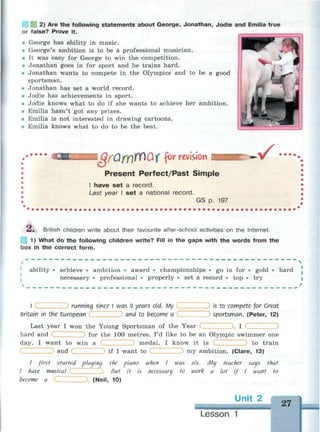
2) Are the following statements about George, Jonathan, Jodie and Emilia true
or false? Prove it.
• George has ability in music.
• George's ambition is to be a professional musician.
• It was easy for George to win the competition.
• Jonathan goes in for sport and he trains hard.
• Jonathan wants to compete in the Olympics and to be a good
sportsman.
• Jonathan has set a world record.
• Jodie has achievements in sport.
• Jodie knows what to do if she wants to achieve her ambition.
• Emilia hasn't got any prizes.
• Emilia is not interested in drawing cartoons.
• Emilia knows what to do to be the best.
I QfQff)1fY)QX for revision
Present Perfect/Past Simple
I have set a record.
Last year I set a national record.
GS p. 197
£. British children write about their favourite after-school activities on the Internet.
1) What do the following children write? Fill in the gaps with the words from the
box in the correct form.
t ч
ability • achieve • ambition • award • championships • go in for • gold • hard
necessary • professional • properly • set a record • top • try
N /
I running since I was 9 years old. My Is to compete for Great
Britain in the European and to become a sportsman. (Peter, 12)
Last year I won the Young Sportsman of the Year (._ . I
hard and ) for the 100 metres. I'd like to be an Olympic swimmer one
day. I want to win a medal. I know it is to train
and if I want to my ambition. (Clare, 13)
/ first started plauina the piano when I was six. Mu teacher saus that
I have musical . But it is necessary to work a lot if I want to
become a ). (Neil, 10)
Unit 2
27
Lesson 1
& 2) I n y o u r C u l t u r e . What are the achievements of some Russian children?
(AB ex. 1)
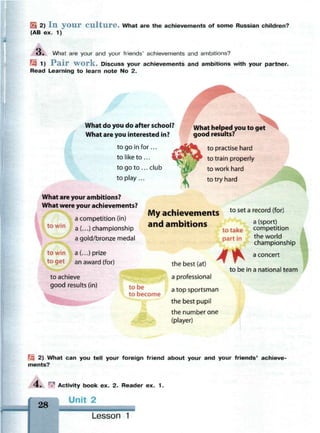
O . What are your and your friends' achievements and ambitions?
r-3 1) 1 a i r w o r k . Discuss your achievements and ambitions with your partner.
Read Learning to learn note No 2.
What do you do after school?
What are you interested in?
What helped you to get
good results?
to go in for...
to like to ...
to go to ... club
to play...
1<$В*
^ j. Al
II to practise hard
9 to train properly
to work hard
to try hard
What are your ambitions?
What were your achievements?
to win
to win
to get
a competition (in)
a (...) championship
a gold/bronze medal
a (...) prize
an award (for)
My achievements
and ambitions
to set a record (for)
to achieve
good results (in) to be
to become
the best (at)
a professional
a top sportsman
the best pupil
the number one
(player)
to take
part in
4Ь
a (sport)
competition
the world
championship
a concert
to be in a national team
| 2) What can you tell your foreign friend about your and your friends' achieve­
ments?
• ^ Activity book ex. 2. Reader ex. 1.
Unit 2
28
Lesson 1
•
4
Lesson
{ м м и н и м ш а н м
Wf§at can you do
well?
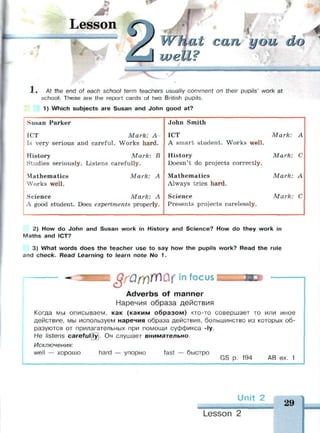
1 , At the end of each school term teachers usually comment on their pupils' work at
school. These are the report cards of two British pupils.
1) Which subjects are Susan and John good at?
Susan Parker
ICT Mark: A-
Is very serious and careful. Works hard.
History Mark: В
Studies seriously. Listens carefully.
Mathematics Mark: A
Works well.
Science Mark: A
A good student. Does experiments properly.
John Smith
ICT
A smart student. Works well.
History
Doesn't do projects correctly.
Mathematics
Always tries hard.
Science
Presents projects carelessly.
Mark: A
Mark: С
Mark: A
Mark: С
2) How do John and Susan work in History and Science? How do they work in
Maths and ICT?
3) What words does the teacher use to say how the pupils work? Read the rule
and check. Read Learning to learn note No 1.
ЯГ0ГУ)ТП&1in f o c u s
Adverbs of manner
Наречия образа действия
Когда мы описываем, как (каким образом) кто-то совершает то или иное
действие, мы используем наречия образа действия, большинство из которых об­
разуются от прилагательных при помощи суффикса -ly.
Не listens careful fly). Он слушает внимательно.
Исключения:
well — хорошо hard — упорно fast — быстро
GS р. 194 АВ ex. 1
29
Lesson 2
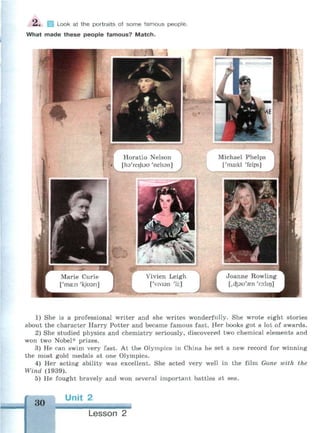
2. Look at the portraits of some famous people.
What made these people famous? Match.
1) She is a professional writer and she writes wonderfully. She wrote eight stories
about the character Harry Potter and became famous fast. Her books got a lot of awards.
2) She studied physics and chemistry seriously, discovered two chemical elements and
won two Nobel* prizes.
3) He can swim very fast. At the Olympics in China he set a new record for winning
the most gold medals at one Olympics.
4) Her acting ability was excellent. She acted very well in the film Gone with the
Wind (1939).
5) He fought bravely and won several important battles at sea.
30
Unit 2
Lesson 2
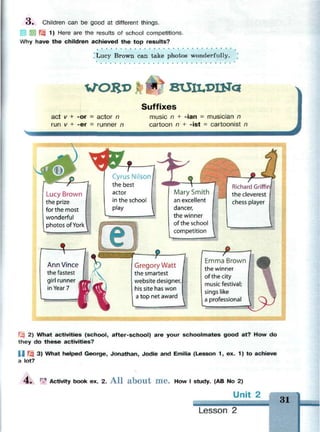
3 , Children can be good at different things.
!
J Щ 1) Here are the results of school competitions.
Why have the children achieved the top results?
Lucy Brown can take photos wonderfully.
W*0£l> втД1Д>Ша
act v + -or = actor n
run v + -er = runner n
Suffixes
music n + -ian = musician n
cartoon n + -ist = cartoonist n
Lucy Brown
the prize
for the most
wonderful
photos of York
1-
Ann Vince
the fastest
girl runner
in Year 7
fCyrus Nilson
the best
actor
in the school
play
lary Smith
an excellent
dancer,
the winner
of the school
competition 
Gregory Watt
the smartest
website designer,
his site has won
a top net award
Richard Griffin
the cleverest
chess player
Emma Brown
the winner
of the city
music festival;
sings like
a professional
Щ 2) What activities (school, after-school) are your schoolmates good at? How do
they do these activities?
| | Щ 3) What helped George, Jonathan, Jodie and Emilia (Lesson 1, ex. 1) to achieve
a lot?
4 . Ф Activity book ex. 2. A l l a b o u t m e . How I study. (AB No 2)
Unit 2
MMMM
1
31
Lesson 2
Lesson 3
I 4L
• ^ Who fan do
' ™ it better?
l.
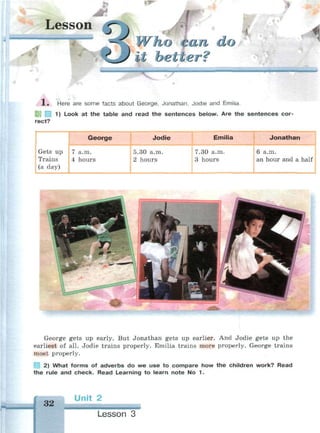
Here are some facts about George, Jonathan, Jodie and Emilia.
1) Look at the table and read the sentences below. Are the sentences cor-
rect?
George Jodie Emilia
Gets up j 7 a.m.
Trains ;4 hours
(a day)
5.30 a.m.
2 hours
7.30 a.m.
3 hours
Jonathan
6 a.m.
an hour and a half
George gets up early. But Jonathan gets up earlier. And Jodie gets up the
earliest of all. Jodie trains properly. Emilia trains more properly. George trains
most properly.
2) What forms of adverbs do we use to compare how the children work? Read
the rule and check. Read Learning to learn note No 1.
32
Unit 2
Lesson 3
$ГСЩ)№&Х in focus
Comparative and superlative adverbs
Наречия в сравнительной и превосходной степени
Когда мы сравниваем, как выполняются те или иные действия, мы используем
наречия в сравнительной и превосходной степени. Сравнительная степень од­
носложных наречий образуется при помощи суффикса -ег, многосложных наре­
чий — при помощи наречия more.
Превосходная степень односложных наречий образуется при помощи суффикса
-est, многосложных наречий — при помощи наречия most.
fast
быстро
neatly
аккуратно
faster
быстрее
more neatly
аккуратнее
Исключения: well — better — (the) best
(the) fastest
быстрее всех
(the) most neatly
аккуратнее всех
badly — worse — (the) worst
GS p. 195
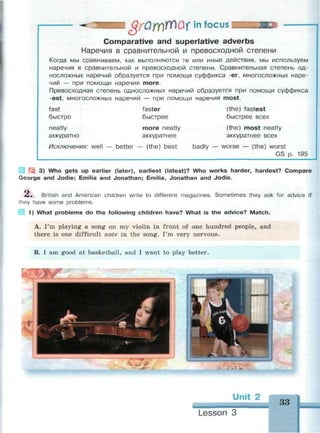
''::; 3) Who gets up earlier (later), earliest (latest)? Who works harder, hardest? Compare
George and Jodie; Emilia and Jonathan; Emilia, Jonathan and Jodie.
2L. British and American children write to different magazines. Sometimes they ask for advice if
they have some problems.
1) What problems do the following children have? What is the advice? Match.
A. I'm playing a song on my violin in front of one hundred people, and
there is one difficult note in the song. I'm very nervous.
B. I am good at basketball, and I want to play better.
Unit 2
33
Lesson 3
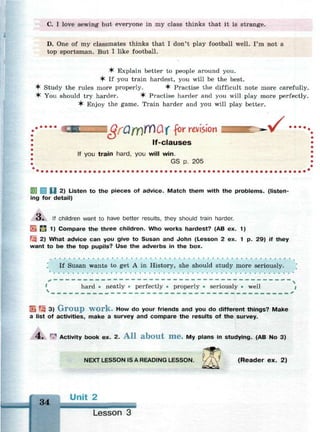
С. I love sewing but everyone in my class thinks that it is strange.
D. One of my classmates thinks that I don't play football well. I'm not a
top sportsman. But I like football.
^r Explain better to people around you.
^ If you train hardest, you will be the best.
^ Study the rules more properly. ^ Practise the difficult note more carefully.
^ You should try harder. ^ Practise harder and you will play more perfectly.
^ Enjoy the game. Train harder and you will play better.
i ^ O / T i n ^ O f for revision
lf-clauses
If you train hard, you will win.
GS p. 205
. - /
U 2) Listen to the pieces of advice. Match them with the problems, (listen­
ing for detail)
o . If children want to have better results, they should train harder.
• Я 1) Compare the three children. Who works hardest? (AB ex. 1)
 2) What advice can you give to Susan and John (Lesson 2 ex. 1 p. 29) if they
want to be the top pupils? Use the adverbs in the box.
. * •
If Susan wants to get A in History, she should study more seriously.
* 
hard • neatly • perfectly • properly • seriously • well |
i — — — _ _ _ — — — — — — _ — _ _ _ _ . . . . _ _ . . . . _ _ . . _ _ - . _ — • . « . - . — _ — •
ч
El E? 3) G r o u p w o r k . How do your friends and you do different things? Make
a list of activities, make a survey and compare the results of the survey.
4 . r
? Activity book ex. 2. A l l a b o u t m e . My plans in studying. (AB No 3)
NEXT LESSON IS A READING LESSON. i V (Reader ex. 2)
чл Unit 2
Lesson 3
•
Lesson
Arf you
С a jack-of-all-trad'О О i
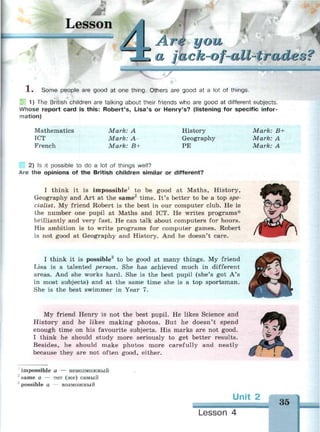
1 . Some people are good at one thing. Others are good at a lot of things.
1) The British children are talking about their friends who are good at different subjects.
Whose report card is this: Robert's, Lisa's or Henry's? (listening for specific infor­
mation)
Mathematics
ICT
French
Mark: A
Mark: A-
Mark: B+
History
Geography
PE
Mark: B+
Mark: A
Mark: A
2) Is it possible to do a lot of things well?
Are the opinions of the British children similar or different?
I think it is impossible1
to be good at Maths, History,
Geography and Art at the same2
time. It's better to be a top spe­
cialist. My friend Robert is the best in our computer club. He is
the number one pupil at Maths and ICT. He writes programs*
brilliantly and very fast. He can talk about computers for hours.
His ambition is to write programs for computer games. Robert
is not good at Geography and History. And he doesn't care.
I think it is possible3
to be good at many things. My friend
Lisa is a talented person. She has achieved much in different
areas. And she works hard. She is the best pupil (she's got A's
in most subjects) and at the same time she is a top sportsman.
She is the best swimmer in Year 7.
My friend Henry is not the best pupil. He likes Science and
History and he likes making photos. But he doesn't spend
enough time on his favourite subjects. His marks are not good.
I think he should study more seriously to get better results.
Besides, he should make photos more carefully and neatly
because they are not often good, either.
1
impossible a — невозможный
same a — тот (же) самый
!
possible a — возможный
Unit 2
35
Lesson 4
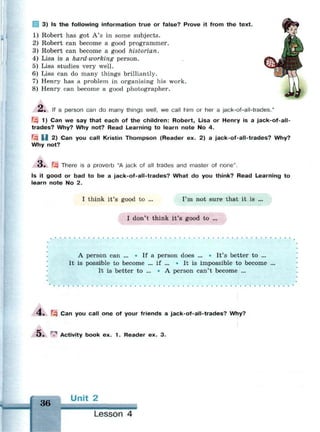
3) Is the following information true or false? Prove it from the text.
1) Robert has got A's in some subjects.
2) Robert can become a good programmer.
3) Robert can become a good historian.
4) Lisa is a hard-working person.
5) Lisa studies very well.
6) Lisa can do many things brilliantly.
7) Henry has a problem in organising his work.
8) Henry can become a good photographer.
A. If a person can do many things well, we call him or her a jack-of-all-trades.*
fzi 1) Can we say that each of the children: Robert, Lisa or Henry is a jack-of-all-
trades? Why? Why not? Read Learning to learn note No 4.
Щ U 2) Can you call Kristin Thompson (Reader ex. 2) a jack-of-all-trades? Why?
Why not?
«3. F-3 There is a proverb "A jack of all trades and master of none".
Is it good or bad to be a jack-of-all-trades? What do you think? Read Learning to
learn note No 2.
I think it's good to ... I'm not sure that it is ...
I don't think it's good to ...
•
A person can ... * If a person does ... * It's better to ...
It is possible to become ... if ... • It is impossible to become ...
It is better to ... • A person can't become ...
4. Щ Can you call one of your friends a jack-of-all-trades? Why?
О . гл
Activity book ex. 1 . Reader ex. 3.
36 U n i t 2
Lesson 4
I
Lesson
Do you know
how ...?
—
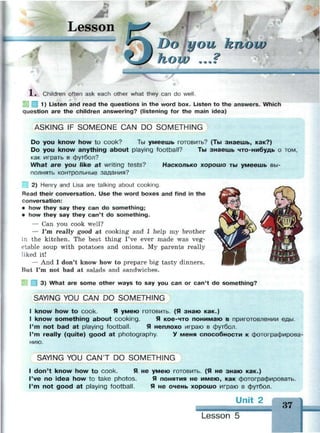
J.» Children often ask each other what they can do well.
| 1) Listen and read the questions in the word box. Listen to the answers. Which
question are the children answering? (listening for the main idea)
ASKING IF SOMEONE CAN DO SOMETHING
Do you know how to cook? Ты умеешь готовить? (Ты знаешь, как?)
Do you know anything about playing football? Ты знаешь что-нибудь о том,
как играть в футбол?
What are you like at writing tests? Насколько хорошо ты умеешь вы­
полнять контрольные задания?
2) Henry and Lisa are talking about cooking.
Read their conversation. Use the word boxes and find in the
conversation:
• how they say they can do something;
• how they say they can't do something.
— Can you cook well?
— I'm really good at cooking and I help my brother
in the kitchen. The best thing I've ever made was veg­
etable soup with potatoes and onions. My parents really
liked it!
— And I don't know how to prepare big tasty dinners.
But I'm not bad at salads and sandwiches.
3) What are some other ways to say you can or can't do something?
SAYING YOU CAN DO SOMETHING
I know how to cook. Я умею готовить. (Я знаю как.)
I know something about cooking. Я кое-что понимаю в приготовлении еды.
I'm not bad at playing football. Я неплохо играю в футбол.
I'm really (quite) good at photography. У меня способности к фотографирова­
нию.
SAYING YOU CAN'T DO SOMETHING
I don't know how to cook. Я не умею готовить. (Я не знаю как.)
I've no idea how to take photos. Я понятия не имею, как фотографировать.
I'm not good at playing football. Я не очень хорошо играю в футбол.
Unit 2
37
Lesson 5
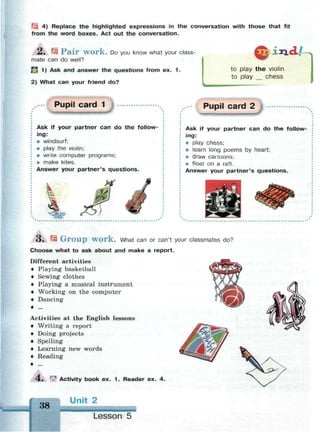
I 4) Replace the highlighted expressions in the conversation with those that fit
from the word boxes. Act out the conversation.
2. fz Pair work. Do you know what your class­
mate can do well?
" 1) Ask and answer the questions from ex. 1 .
2) What can your friend do?
i*i<lA
to play t h e violin
to play __ chess
Pupil card 1
Ask if your partner can do the follow­
ing:
• windsurf;
• play the violin;
• write computer programs;
• make kites.
Answer your partner's questions.
Pupil card 2
Ask if your partner can do the follow­
ing:
• play chess;
• learn long poems by heart;
• draw cartoons;
• float on a raft.
Answer your partner's questions.
3 . r-Ч G r o u p w o r k . What can or can't your classmates do?
Choose what to ask about and make a report.
Different activities
• Playing basketball
• Sewing clothes
• Playing a musical instrument
• Working on the computer
• Dancing
• ...
Activities at the English lessons
• Writing a report
• Doing projects
• Spelling
• Learning new words
• Reading
4 . ^ Activity book ex. 1 . Reader ex. 4.
38
Unit 2
Lesson 5
Lesson Wwfibt do урм кпогш
(tut The Duke of
linburgh's Award
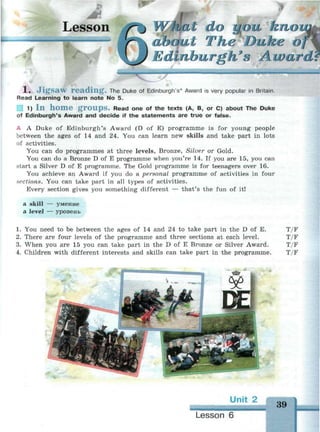
1 . J i g s a w r e a d i n g . The Duke of Edinburgh's* Award is very popular in Britain.
Read Learning to learn note No 5.
1 1) I n h o m e g r o u p s . Read one of the texts (A, B, or C) about The Duke
of Edinburgh's Award and decide if the statements are true or false.
A A Duke of Edinburgh's Award (D of E) programme is for young people
between the ages of 14 and 24. You can learn new skills and take part in lots
of activities.
You can do programmes at three levels, Bronze, Silver or Gold.
You can do a Bronze D of E programme when you're 14. If you are 15, you can
start a Silver D of E programme. The Gold programme is for teenagers over 16.
You achieve an Award if you do a personal programme of activities in four
sections. You can take part in all types of activities.
Every section gives you something different — that's the fun of it!
a skill -
a level -
- умение
- уровень
1. You need to be between the ages of 14 and 24 to take part in the D of E. T/F
2. There are four levels of the programme and three sections at each level. T/F
3. When you are 15 you can take part in the D of E Bronze or Silver Award. T/F
4. Children with different interests and skills can take part in the programme. T/F
Unit 2
39
Lesson 6
В You can achieve a Bronze, Silver or Gold Duke of
Edinburgh's Award (or level) if you do a programme
of activities in four sections.
These sections are:
Volunteering/Service: You can help people, your
community or care for animals. Find out who
needs help!
Physical: You can play for a local sports club, go to
dance classes, run or do yoga. You can choose
what to do.
Skills: Have you ever wanted to do something differ­
ent? Painting, driving, music or making kites?
You can learn to do something new.
Expedition: Plan and take part in an expedition. You
can choose how you want to travel — by bike, on
a raft, or on a horse or llamal
For each section you can choose from over
50 activities.
a skill — умение
a level — уровень
service — помощь
an expedition — ?
volunteering — добровольная помощь
ч>
ллл.
by bike
on a raft
1. Each level of The Duke of Edinburgh's Award has four sections.
2. You can choose playing football, running or long jump for the Skills section.
3. There is something new for everyone in each section.
4. There are more than 50 activities in each section.
С The Duke of Edinburgh's Award (D of E) is a part of the International Award
Association. The Duke of Edinburgh's Award was the first one. It started in the
UK in 1956.
Now there are programmes in 126 countries. The names of the Award may be
different, but the idea is the same. The Award is not an organisation, but a pro­
gramme. Young people help their community,* get life skills, and most of all,
they have fun!
The Award in the Russian Federation began in the Republic of Karelia. It
became a part of the International Award Association in 2006.
a part — часть
a skill — умение
international [jinta'naefnal]
an association [3,s9usi'eijh]
T/F
T/F
T/F
T/F
1. The Duke of Edinburgh's Award has achieved much for 126 years.
2. The Awards in many countries are alike, but the names are different.
3. The Award in Russia is also a part of the International Award Association.
40
Unit 2
Lesson 6
T/F
T/F
T/F
^ Ш 2) I n e x p e r t g r o u p s . Compare your answers to the true/false state­
ments. Correct the false statements. Come to an agreement. Get ready to retell the
text you've read. Use the statements as an outline.
Щ E 3) I n h o m e g r o u p s . Retell your group mates what you've read, while
listening to your group mates, fill in the outline.
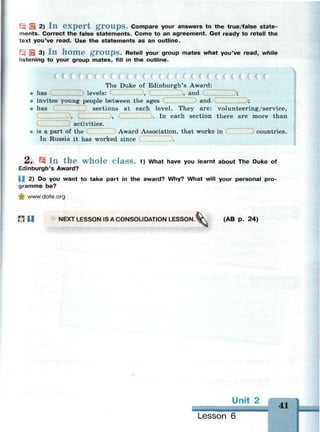
The Duke of Edinburgh's Award:
• has levels: Э, ( , and Э;
» invites young people between the ages and
• has sections at each level. They are: volunteering/service,
D» ' , . I n each section there are more than
activities.
* is a part of the Award Association, that works in countries.
In Russia it has worked since Э.
2 . 15 I n t h e w h o l e C l a s s . 1) What have you learnt about The Duke of
Edinburgh's Award?
 2) Do you want to take part in the award? Why? What will your personal pro­
gramme be?
•Ц www.dofe.org
П П NEXT LESSON IS A CONSOLIDATION LESSON. W  (AB p. 24)
Unit 2 АЛ
41
Lesson 6
Lesson
Protect
lesson
-
—
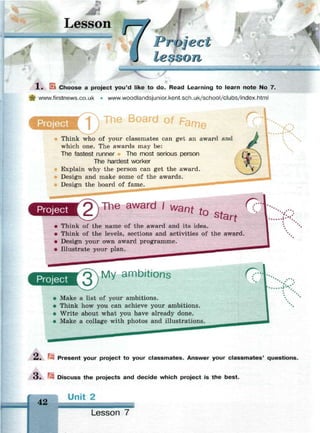
X . Ek Choose a project you'd like to do. Read Learning to learn note No 7.
| www.firstnews.co.uk • www.woodlandsjunior.kent.sch.uk/school/clubs/index.html
Project J
The Board of p
Think who of your classmates can get an award and
which one. The awards may be:
The fastest runner The most serious person
The hardest worker
Explain why the person can get the award.
Design and make some of the awards.
Design the board of fame.
Project The award /
W a n t
^ s t a
С?"
rt
• Think of the name of the award and its idea.
• Think of the levels, sections and activities of the award.
• Design your own award programme.
• Illustrate your plan.
:.':.,:
*. .*
Project My ambitions (7-
• Make a list of your ambitions.
• Think how you can achieve your ambitions.
• Write about what you have already done.
• Make a collage with photos and illustrations.
2. r* Present your project to your classmates. Answer your classmates' questions.
3. i* Discuss the projects and decide which project is the best.
42
Unit 2
Lesson 7
Lesson
О...
CJ jourself
$i LISTENING COMPREHENSION (AB-I)
© READING COMPREHENSION (AB-II)
О
о
USE OF ENGLISH (GRAMMAR/VOCABULARY) (AB-III)
SPEAKING
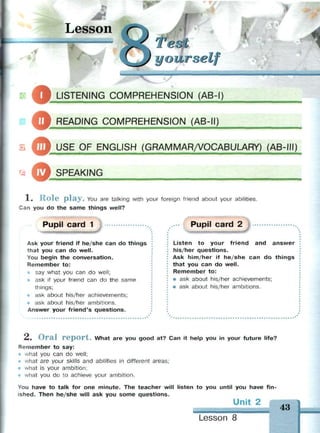
1. Role play. You are talking with your foreign friend about your abilities.
Can you do the same things well?
Pupil card 1
Ask your friend if he/she can do things
that you can do well.
You begin the conversation.
Remember to:
* say what you can do well;
• ask if your friend can do the same
things;
ask about his/her achievements;
ask about his/her ambitions.
Answer your friend's questions.
Pupil card 2
Listen to your friend and answer
his/her questions.
Ask him/her if he/she can do things
that you can do well.
Remember to:
• ask about his/her achievements;
• ask about his/her ambitions.
A. O r a l r e p o r t . What are you good at? Can it help you in your future life?
Remember to say:
• what you can do well;
• what are your skills and abilities in different areas;
• what is your ambition;
• what you do to achieve your ambition.
You have to talk for one minute. The teacher will listen to you until you have fin­
ished. Then he/she will ask you some questions.
Unit 2
Lesson 8
43
оWRITING (AB-IV)
Б Qj_CULTURAL AWARENESS (AB-V)
Г5 ^ ™ NEW WORDS AND WORD COMBINATIONS FROM
UNIT 2
Lesson 1
an ability
to achieve
an achievement
an ambition
an award
bronze
a championship
to go in for
gold
hard
necessary
a professional
properly
to set (a record)
top (sportsman)
to try
Lesson 2
an experiment*
Reading lesson
to be over*
to come up*
to get around to'
to go out*
to look up*
a schedule*
a tournament*
Lesson 4
impossible*
a person
possible*
same* (at the same time)
Lesson 6
a level
a part
silver
a skill
Lesson 7
a board of fame*
Reader
an argument*
a wing*
Answer the questions.
•
1) Which words will you use to describe achievements?
2) The meanings of which words is it possible to guess?
3) Which words have suffixes/prefixes?
4) Which words have more than one meaning?
5) How many new words and word combinations from Unit 2 do you know?
SELF-ASSESSMENT (AB-VI)
Read Learning to learn note No 8.
44
Unit 2
Lesson 8
j££h'
Lesson _ *>
much do
charity?
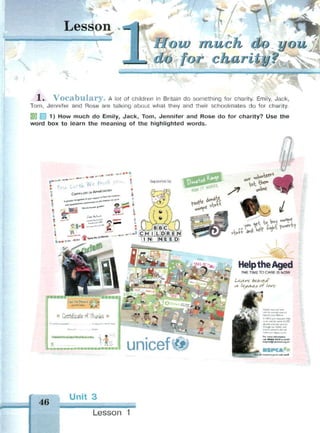
1« V o c a b u l a r y . A lot of children in Britain do something for charity. Emily, Jack,
Tom, Jennifer and Rose are talking about what they and their schoolmates do for charity.
1) How much do Emily, Jack, Tom, Jennifer and Rose do for charity? Use the
word box to learn the meaning of the highlighted words.
*******
orV*
Help the Aged
THE TIME TO CARE IS NOW
fi-Щ Lea.** bzto/jJ*
л 1е?лсл of love
unicetli
un your юм* tnO
v for tnm& елелЛ
beyond your Ииич*
inNSWyourbeque*-**»
tn to «refer «me 40 000
лЬ-лс*! шк) to*t «гмПчК
rhrog|h our thefter jnd
тчке w htM у vount
for mim МвгтШи
oil 8***0ll*or«tu«
bay«фпрс—«чц m
46
Unit 3
• M M I I I
Lesson 1
WORD BXJlLXH&c*
Suffixes
donate v + -tion = donation n
At my school we do a lot of projects for charity. Every class chooses a char-
ity organisation, and then during the year the pupils collect money for the char-
ity. We raise money for different charity organisations: Children in Need,* Save
the Children,* Help the Aged.* (Emily, 13)
A lot of schools in my hometown are involved in collecting money for char-
ity. In our school there is a charity box. If you want to donate some money on
charity, you put the money into the box. Our parents also make donations.
(Jack, 13)
My schoolmates and I like to contribute to charity. All pupils in my class
want to make their contribution. We have a lot of fundraising ideas. We
organise charity fairs and competitions, charity runs, sweet and cakes sales, tal-
ent shows. Then we donate the raised money to different charities. (Tom, 13)
Last year, our class collected clothes and sent them to the UNICEF.* The
clothes went to those in need. This year our class helps the RSPCA.* We vol-
unteer at the local zoo garden. We feed the animals, clean the cages, organise
excursions for kids and do other volunteer work. (Jennifer, 14)
I joined a group of volunteers. We support a girl in India. We provide the
girl with clothes and raised some money for her needs. I'm happy that we can
make a difference to the needy child. (Rose, 13)
iaadJU,
Abbreviations
UNICEF nu:nisef]
but RSPCA [,a:r es pi: si: 'ei]
Unit 3
47
Lesson 1
charity ['tfaereti] — благотворитель­
ность
a charity (organisation Loxjsnai'zeijh]) —
благотворительная организация
to be involved [m'volvd] (in sth) — быть
занятым, вовлечённым (во что-л.)
to donate [dsu'neit] (to, on) — переда­
вать в дар; жертвовать
a donation [dau'neifn] — передача в
дар; пожертвование; to make dona­
tions делать пожертвования
to contribute [ksn'tnbjuit] (to) — делать
вклад; жертвовать
a contribution [,kDntri'bju:Jh] — вклад;
пожертвование; to make a (one's)
contribution сделать вклад, внести
свою лепту
a sale — распродажа
to volunteer [.vnbn'tis] —
добровольно помогать
a volunteer [,vDbn'ti9] —
добровольный помощник
to support [ss'poit] — оказывать под­
держку; помогать
to provide [prs'vaid] (sb with sth) —
обеспечивать (кого-л. чём-л.)
to make a difference ['difrens] — делать
что-л. значительное, важное
Words to guess
fundraising [/
fnd,reizin] n — ?
need v - нуждаться; need n —
needs n pi — ?; needy a — ?
2) What have you learnt about Emily, Jack, Tom, Jennifer and Rose's contribu­
tion to charity? Decide if the following statements are true. Prove from the chil­
dren's stories.
1) Emily says that in her school pupils do a lot of charity projects.
2) Emily's school raises money for different charities.
3) Jack's schoolmates and parents donate money to charity.
4) Tom's school organises a lot of charity events.
5) Not all Tom's classmates want to take part in charity fundraising.
6) Tom's school usually spends the raised money on school needs.
7) Jennifer and her classmates support needy people in poor countries.
8) Jennifer volunteers at the zoo.
9) Rose and her friends support a poor boy in India.
10) Rose is glad that she helps the needy child.
48
Unit 3
Lesson 1
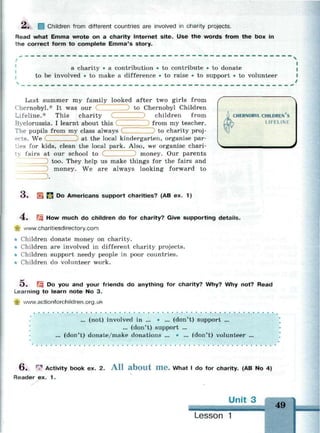
2. Children from different countries are involved in charity projects.
Read what Emma wrote on a charity Internet site. Use the words from the box in
the correct form to complete Emma's story.
a charity • a contribution • to contribute • to donate
to be involved • to make a difference • to raise • to support • to volunteer
Lifeline.* This charity
Byelorussia. I learnt about this
Last summer my family looked after two girls from
Chernobyl.* It was our to Chernobyl Children
children from
from my teacher.
The pupils from my class always to charity proj­
ects. We ... at the local kindergarten, organise par­
ties for kids, clean the local park. Also, we organise chari-
ty fairs at our school to money. Our parents
) too. They help us make things for the fairs and
money. We are always looking forward to
.
CHERNOBYL CHILDREN S
Ц LIFELINE
<J* Ц f j Do Americans support charities? (AB ex. 1)
4 . Щ How much do children do for charity? Give supporting details.
-$? www.charitiesdirectory.com
• Children donate money on charity.
• Children are involved in different charity projects.
• Children support needy people in poor countries.
• Children do volunteer work.
О . Щ Do you and your friends do anything for charity? Why? Why not? Read
Learning to learn note No 3.
*jg www.actionforchildren.org.uk
... (not) involved in ... • ... (don't) support ...
... (don't) support ...
... (don't) donate/make donations ... • ... (don't) volunteer ...
•
6 . • Activity book ex. 2. A l l a b o u t m e . What I do for charity. (AB No 4)
Reader ex. 1 .
Unit 3
49
Lesson 1
к
Lesson
у cute these da
mw,v
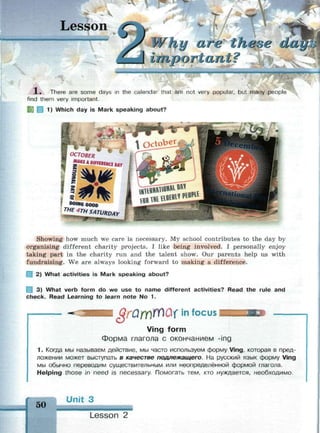
1 . There are some days in the calendar that are not very popular, but many people
find them very important.
1) Which day is Mark speaking about?
Showing how much we care is necessary. My school contributes to the day by
organising different charity projects. I like being involved. I personally enjoy
taking part in the charity run and the talent show. Our parents help us with
fundraising. We are always looking forward to making a difference.
Щ 2) What activities is Mark speaking about?
3) What verb form do we use to name different activities? Read the rule and
check. Read Learning to learn note No 1.
§rQrri№&i in focus
Ving form
Форма глагола с окончанием -ing
1. Когда мы называем действие, мы часто используем форму Ving, которая в пред­
ложении может выступать в качестве подлежащего. На русский язык форму Ving
мы обычно переводим существительным или неопределённой формой глагола.
Helping those in need is necessary. Помогать тем, кто нуждается, необходимо.
50
Ur it 3
Lesson 2
2. Мы также используем форму Ving в качестве дополнения после глаголов:
ш без предлогов
I enjov taking part in the charity fair. Я с удовольствием участвую в благотвори­
тельной ярмарке.
• с предлогами
You can help bv raising money. Вы можете помочь, собирая деньги, (by означа­
ет как? каким образом?)
GS р. 202
Л. I Щ Here are some ideas how to contribute to "Make a Difference" Day.
What do you think about the activities?
— Organising a charity fair is a good idea.
— I personally enjoy taking part in a charity run.
. . .
to organise a charity fair
to take part in a charity run
to be involved in fundraising
to donate money on charity
to support those in need
to provide poor people with money, food or clothes
to volunteer at the nearest nursing home1
to clean the local park
to pick up litter in the school playground
to plant trees and flowers
to make a poster about different charity projects
... is a good idea.
... is very important.
... is not fun, but necessary.
... is a good contribution.
I enjoy ...
I'm interested in ...
I look forward to ...
I can help by ...
I always take part in ...
I'm good at ...
I don't mind2
...
O . ES» П What do you know about "Make a Difference" Day? (AB ex. 1)
4 . fjg The surveys show that children all over the world enjoy volunteering.
How do the children volunteer? Finish up what the children say. Use the preposi­
tions from the box where necessary. Translate the statements.
by • in • for • on • to • with • without
1
a nursing home — лечебница, дом престарелых
2
to mind [maind] — возражать
Unit 3
••
Lesson 2
51
We want to make our hometown better ...
We are always looking forward ...
My friends contribute ...
We have many ideas ...
We help ...
We spend the raising money ...
I help the local charity club ...
I can't do ...
I'm never bored ...
I like to be involved ...
I want to invite all children to take part ...
... organising different charity projects.
... doing different charity projects.
... donating money to different charities.
... raising money for charity.
... supporting the needy people.
... cleaning the school playground.
... planting trees and flowers.
... picking up litter.
... doing different charity projects.
... getting money for the work.
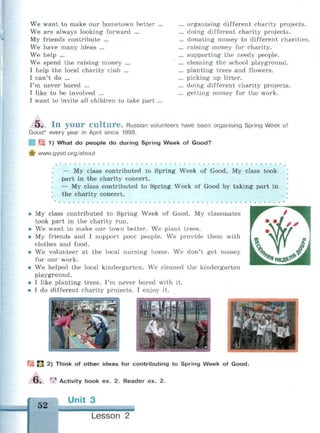
O . I n . y o u r C u l t u r e . Russian volunteers have been organising Spring Week of
Good* every year in April since 1998.
3 1^1) What do people do during Spring Week of Good?
ф www.gysd.org/about
— My class contributed to Spring Week of Good. My class took
part in the charity concert.
— My class contributed to Spring Week of Good by taking part in *
the charity concert.
• My class contributed to Spring Week of Good. My classmates
took part in the charity run.
• We want to make our town better. We plant trees.
• My friends and I support poor people. We provide them with
clothes and food.
• We volunteer at the local nursing home. We don't get money
for our work.
• We helped the local kindergarten. We cleaned the kindergarten
playground.
• I like planting trees. I'm never bored with it.
• I do different charity projects. I enjoy it.
^ S J 2 ) Think of other ideas for contributing to Spring Week of Good.
D . 'V Activity book ex. 2. Reader ex. 2.
52
Unit 3
Lesson 2
" Ч ~
Lesson
и в — — — ш е и ш и и т миHI» и»1
What would той
like me to d
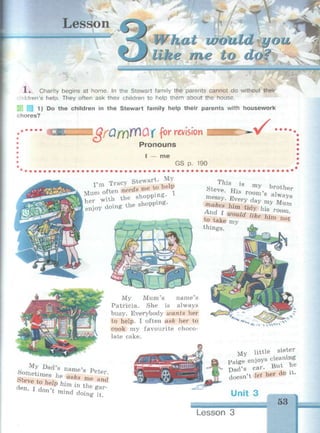
1 . Charity begins at home. In the Stewart family the parents cannot do without their
;hildren's help. They often ask their children to help them about the house.
® 1) Do the children in the Stewart family help their parents with housework
chores?
I QfQfYJIpnClX f°r
revision V-
Pronouns
— me
GS p. 190
r m Tracy Stewart. МУ
M u m often need, me to help
her with the Bhoppine-
e£„y doing the shoppmg-
SteriS
HiS my brot
«er
""*' K I TMum
And r y hls r
°°m
thing's.
Q-
My Mum's name's
Patricia. She is always
busy. Everybody wants her
to help. I often ask her to
cook my favourite choco-
late cake.
4». i VTNN>4 N
My Dad's name's PP+0
Sometimes he ask, «, '
s t
eve to hplnt- m e a n d
1 d o n t
mind doing- it.
M y little sister
Paige enjoys cleaning
Dai's car But he
doesn't let her do it.
Unit 3
53
Lesson 3
I 2) What do the Stewarts ask each other to do?
3) What grammar structures do people use when we want other people to do
something? Read the rule and check. Read Learning to learn note No 1.
.QrQmWQXln focus
Complex object (verb + object + (to) infinitive)
Сложное дополнение
Когда мы нуждаемся в помощи (need), хотим (want, would ('d) like), просим
(ask), разрешаем (let) или заставляем (make) кого-либо что-то сделать, мы ис­
пользуем после этих глаголов сложное дополнение. Сложное дополнение состо­
ит из местоимения в объектном падеже или существительного и неопределён­
ной формы глагола. На русский язык сложное дополнение мы переводим при­
даточным дополнительным предложением или неопределённой формой глагола.
Mum wants me to help her with dinner. Мама хочет, чтобы я помогла ей пригото­
вить обед.
Mum asks Tracy to help her with dinner. Мама ПРОСИТ Трейси помочь ей приго­
товить обед.
После глаголов make и let мы не используем частицу to.
Mum always makes us tidy our room. Мама всегда заставляет нас наводить по­
рядок в нашей комнате.
GS р. 203
2. Parents often need their children to help around the house.
1) What do the parents want Tracy and Steve to do about the house? What do you
think?
The parents need ... • The parents would like ... • The parents make ...
The parents want ... * The parents ask ... • The parents let ...
do the shopping
do the dishes i*id£
go shopping
but do the shopping
babysit1
with Paige
tidy the house
pick up leaves in the garden
walk the dog
clean Dad's car
cooking
Ей EL 2) Listen to Steve and Tracy talking about their chores around the house and
check your guess. Put the letter T (Tracy) or S (Steve) or both next to their chores.
1
to babysit ['beibisit] (with sb) = to look after
Unit 3
54
Lesson 3
з. т The Stewarts volunteer every Saturday at the local charity club. They write notes
to remember the things they need to do.
What do the club members would like the Stewarts to do this Saturday?
Sdt., 25
Peter organise fundralslna
Pat a cake for the charity fair
Tracy sweet and cakes sale, shopping for Mrs Preddy
Steve charity run, car cleaning for Mr Brian
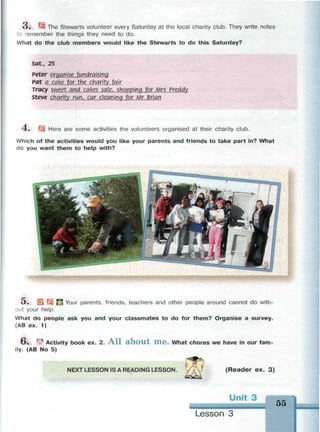
4 , f q Here are some activities the volunteers organised at their charity club.
Which of the activities would you like your parents and friends to take part in? What
do you want them to help with?
О» Н LJ Your parents, friends, teachers and other people around cannot do with­
out your help.
What do people ask you and your classmates to do for them? Organise a survey.
(AB ex. 1)
6 . Ф Activity book ex. 2. A l l a b o u t H i e . What chores we have in our fam­
ily. (AB No 5)
NEXT LESSON IS A READING LESSON. ( R e a d e r ex. 3)
55
Lesson 3
Lesson
at make
other people?
1 !• ^ 4
X . A lot of British children help people in need.
S3 1) Do Hilary, Stephen and Allison help people around? (listening for the main
idea)
2) Who do Hilary, Stephen and Allison help?
I QfufflfOuX for revision -v •••••
Articles
She helps the elderly people at the local nursing home.
but Helping elderly people is necessary.
GS p. 188
My Mum volunteers for Help the Aged* on Saturdays. She
looks after the elderly people at the local nursing home.
Sometimes my Mum asks me to help her. I help by getting the
patients the things they need or by reading books to them. It's
great when I walk in the room and they smile! Supporting eld­
erly people is also helping yourself. You learn about people's
feelings and needs, and become a more caring person. We'll be
old some day and will need people to care for us. Showing sym­
pathy1
to other people is really good. I enjoy doing something
that helps others. I don't get money. But I feel good when I
know that I make a difference. (Hilary Preddy, 12)
I QfQfy)№Cif for revision
Pronouns
I don't donate any money.
I donated some money on charity.
%X • • • •
GS p. 191
1
to show sympathy ['simpaGt] (to sb) — проявлять сочувствие
Unit 3
56
Lesson 4
I'm sure supporting charities is necessary. I think about mak­
ing donations to charity when I see a money box. But usually I
don't donate any money. My family doesn't have much money.
I know that my friends also can't make big donations. But I
never say "no" when our school needs volunteers to clean the
school playground or take part in a charity run. I believe a small
contribution also can help. (Stephen Kent, 14)
I personally1
don't really do any volunteer work. But I help my
parents around the house. They often need me to do some chores.
My Mum never gives me money when I help her around the house.
She says that I should do it to help, not for the money! And I
agree with my Mum. Of course, some chores like tidying the house
and doing the dishes aren't fun, but necessary. Actually,2
I don't
think I make a difference. I know I've helped my parents. And I
feel good. When you do something useful, you don't have money
in your hands, you have money in your heart. (Allison Fung, 12)
| 3) What have you learnt about Hilary, Stephen and Allison? Answer the ques­
tions. Prove from the text.
How does Hilary help her Mum at the nursing home?
What makes Hilary volunteer at the nursing home?
Do Stephen and his friends make donations to charities? Why?
What does Stephen do for charity?
Does Allison's Mum pay her for helping around the house? Why?
Does Allison enjoy doing chores around the house? Why?
4) Which of the children can you say the following about? Prove this from the text.
* ... shows sympathy to elderly people. • ... enjoys being involved in charity projects.
• ... worries about people around. • ... makes a difference.
1МЩ 5) What do the children mean by saying the following?
— Supporting elderly people is also helping yourself.
— When you do something useful, you don't have money in your hands, you
have money in your heart.
2. m Can children make a difference in your opinion?
I personally think that ... • I believe that ..., because
That's why I think ...
Do you help other people? How? What makes you help?
r
«^ Activity book ex. 1.1), 2).
1
personally — лично
2
Actually, ... ['aektfuali] — Честно говоря, ...
Unit 3
57
Lesson 4
Lesson V
ha~t a o'reni idea!
•ямиммммню
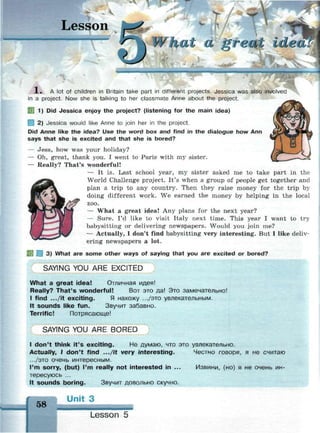
X , A lot of children in Britain take part in different projects. Jessica was also involved
in a project. Now she is talking to her classmate Anne about the project.
SB 1) Did Jessica enjoy the project? (listening for the main idea)
2) Jessica would like Anne to join her in the project.
Did Anne like the idea? Use the word box and find in the dialogue how Ann
says that she is excited and that she is bored?
— Jess, how was your holiday?
— Oh, great, thank you. I went to Paris with my sister.
— Really? That's wonderful!
— It is. Last school year, my sister asked me to take part in the
World Challenge project. It's when a group of people get together and
plan a trip to any country. Then they raise money for the trip by
doing different work. We earned the money by helping in the local
zoo.
— What a great idea! Any plans for the next year?
— Sure. I'd like to visit Italy next time. This year I want to try
babysitting or delivering newspapers. Would you join me?
— Actually, I don't find babysitting very interesting. But I like deliv­
ering newspapers a lot.
3) What are some other ways of saying that you are excited or bored?
SAYING YOU ARE EXCITED
What a great idea! Отличная идея!
Really? That's wonderful! Вот это да! Это замечательно!
I find .../it exciting. Я нахожу .../это увлекательным.
It sounds like fun. Звучит забавно.
Terrific! Потрясающе!
SAYING YOU ARE BORED
I don't think it's exciting. He думаю, что это увлекательно.
Actually, I don't find .../it very interesting. Честно говоря, я не считаю
.../это очень интересным.
I'm sorry, (but) I'm really not interested in ... Извини, (но) я не очень ин­
тересуюсь ...
It sounds boring. Звучит довольно скучно.
58
Unit 3
Lesson 5
Щ 4) Replace the highlighted expressions in the dialogue with those that fit.
Act out the dialogues you have got.
^ « ^3 ВЙ Your foreign friend tells you about different projects.
What would you say in the following situations?
• We're having a charity fair next Saturday.
• I need you to help me with a poster about the charity fair.
• Let's take part in the charity run.
• Our class is volunteering by picking up litter in the park today. I'd like you
to join us.
• I've got two tickets for a charity concert. I would like you to go with me.
3. Щ P a i r W O r k . Discuss with your partner the charity projects.
Pupil 1: Name the charity project.
Pupil 2: Express your attitude towards the charity project.
1) Our class helps by cleaning the local park.
2) Nick, Dave and Alex are performing at the charity party.
3) Julie is sewing toys for children at the local hospital.
4) The girls are raising money by selling sweets at the charity fair.
5) We are volunteering at the local nursing home.
:• | Activity book ex. 1. Reader ex. 4.
Unit 3 • : - . ; ^
59
Lesson 5
Lesson
1. Jigsaw reading. Children have different fundraising ideas.
What did the children organise to support charities? Read Learning to learn note No 5.
§ 1) I n h o m e g r O U p S . a) Read one of the articles (A, B, or C) below and
do the task b).
A When I read the article about poor1
children in Africa
I wanted to help by raising" money. I discussed the idea
with my classmates. We decided to raise money by walk­
ing around our local park in pyjamas! We called the proj­
ect Sleepwalking. We went to the park one Saturday. We
had a box for collecting money. We walked around the park
in our pyjamas. We raised 150 pounds by people putting
some coins in our box. All my classmates were involved.
Everybody wanted to help the needy children in poor coun­
tries. The charity walk was a great fun! We donated the
money to UNICEF* and we got a thank-you letter.
В My friend Frank and I got the Childnet Award* for
the best site on the Internet. It was Frank's idea to design
a website. We wanted to use the Internet for involving
other children in volunteering. We used the website to
present the photos and the video about those in need. We
asked children from other schools to contribute to chari­
ty. We also organised a charity week at our school to
raise some money for poor1
children. My schoolmates col­
lected books and my Dad organised a charity run for the
project. We donated the books and 200 pounds to
Children in Need.* I feel really terrific, because I know
I've done something good.
С At school last term we had a non-uniform day. We
wanted to raise money for Save the Children.* Pupils
paid money for not wearing their uniform. We went to
school in our home clothes. I enjoyed being in my home
clothes for the day. Also, we had a charity fair. I per­
sonally helped by organising sweet and cakes sale. We
baked all the cakes ourselves. Our volleyball team had a
game. Our teachers played against2
pupils. We paid to
60
Unit 3
Lesson 6
watch the game. I was supporting the pupils, but the teachers won. It was ter­
rific! We raised 300 pounds. I feel good that I've helped one poor1
child in the
world.
poor [риэ] — бедный
2
against [s'genst] — против
SL b) What have you learnt about these children's fundraising ideas? Answer the
questions?
• What charity organisation did the children support?
• Why did the children decide to contribute to the charity?
• What did the children do to raise money for the charity?
• Who was involved in the fundraising project?
• How much money did the children raise?
fq gf, 2) I n e x p e r t g r o u p s . Compare your answers for the task with your
group mates. Come to an agreement. Fill in the table below with the information
you have read. Get ready to retell your group mates the story you have read.
^ S& 3) I n h o m e g r o u p s . Retell your group mates the story you have read.
Use the answers to the questions (ex. 1)b) as an outline. While listening to your
group mates fill in the table.
What charity did
the children sup­
port?
What were the
children's
fundraising ideas?
Who was involved
in the fundraising?
What makes the
children organise
fundraising?
2 . Щ I n t h e w h o l e c l a S S . What do the British children do to raise money
for charity?
О . Щ Ц Would you like to join any of the children's projects? Do you have any
fundraising ideas? Share your ideas with your classmates.
ф www.bygpub.com/books/tg2rw/volunteer.htm
4 . r
^ Reader ex. 5.
i.i a NEXT LESSON IS A CONSOLIDATION LESSON. (AB p. 3 9 )
Unit 3
Lesson 6
M M
61
Lesson
т
_ /
qject
1 . . 5 Choose a project you would like to do. Read Learning to learn note No 7.
Project Helping hands
Make a list of people who need your help.
Make a list of charity projects.
Think of activities you will do to help those in need.
Make a poster to illustrate your project.
V. ,
Project
Charity fair r?
Decide what charity organisation you would like to support.
Collect information about this charity organisation.
Think of interesting fundraising ideas (sweet and cakes sale,
talent show, etc.).
Write an announcement about the charity fair.
A charity organisation / ^
' w
ouid n
• Decide what charity organisation you would like to
start.
• Think of a name for your charity organisation.
• Plan charity activities you want your classmates to be involved in.
• Make a poster about your charity organisation.
4keto
л
2i, Щ Present your project and answer your classmates' questions to explain
your ideas.
О . Щ Discuss all the projects and decide which project is the best.
62
Unit 3
Lesson 7
Lesson
st
yourself
ш
a
щ
0
Ф
О
LISTENING COMPREHENSION (AB-I)
READING COMPREHENSION (AB-II)
USE OF ENGLISH (GRAMMAR/VOCABULARY) (AB-III)
SPEAKING
X . R o l e p l a y . You and your foreign friend are talking about how you help peo­
ple around.
Pupil card 1
You and your foreign friend are talking
about how you help people around.
You begin the conversation.
Remember to:
• ask your friend about who he/she helps;
• ask your friend about what he/she does
to help people around;
• ask your friend to express his/her atti­
tude towards volunteering;
• answer your friend's questions.
Pupil card 2
You and your foreign friend are talking
about how you help people around.
Answer your friend's questions.
Remember to:
• give examples of what you do to help
people around;
• say about the projects you are involved
in;
• express your attitude towards volunteer­
ing;
• ask your friend about what he/she does
to help people around.
m
63
Lesson 8
2 . O r a l r e p o r t . You are telling your foreign friend about charity in Russia.
Do Russian people support charity?
Remember to:
• say what you think about charity;
• give an example of charity organisations in Russia;
• say how Russian people contribute to charity;
• say what you (your family, friends) do for charity;
• explain why you (your family, friends) support (do not support) charity.
You have to talk for one minute. The teacher will listen until you have finished. Then
he/she will ask you some questions.
E
ОWRITING (AB-IV)
Si ^ f r CAII Tl IRAL AWARENESS (AB-V)
^ ™ NEW WORDS AND WORD COMBINATIONS FROM
UNIT 3
Lesson 1
charity
a charity (organisation)
to be involved in
a contribution (to make ~)
to contribute
a donation (to make ~)
to donate
fundraising
to make a difference
need
needy
to provide
to support
a volunteer
Answer t h e questions.
to volunteer
Lesson 2
to mind
a nursing home
Lesson 3
to babysit
Reading lesson
c r i m e *
deaf*
fur*
to kill*
right*
to shout*
(to make) a speech'
Lesson 4
actually
personally
to show sympathy
Lesson 5
to sound
terrific
Lesson 6
against*
poor
Reader
to honour*
to name after*
to set up*
1) Which words do we use to tell about charity organisations in our country?
2) Which words do we use to talk about volunteer work?
3) Which words do we use to describe our attitude towards charity?
4) How many new words and word combinations from Unit 3 do you know?
rtft SELF-ASSESSMENT (AB-VI)
Read Learning to learn note No 8.
64
Unit 3
Lesson 8
1 j _
Lesson _
лге you
j eco-friendly? 1 Ч Ч 1 . Ч . 1 1 . •*••
1 . V o c a b u l a r y . The British girl Mia is speaking about her eco-school.
1) What do pupils at eco-school do? Use the word box to learn the meaning
of the highlighted words.
My school is an eco-school.* This means that we
try to look after the environment, because our Earth
is a wonderful world and we don't want to destroy it.
Becoming eco-friendly is not difficult. Everyone can
do something to protect nature.
We do a lot of things. We always put our litter
in a bin because litter pollutes and spoils the envi­
ronment. We reuse and recycle newspapers, cans,
plastic and glass bottles instead of throwing them
out. Recycling saves new materials and saves energy.
We help wildlife by being more environmentally
friendly. We do not disturb animals. We've built a nature garden near the school
with a wildlife pond, bird boxes, homes for mice. Besides, our pupils walk or
cycle to school. We think that this helps to reduce air pollution. Air pollution
causes climate change and some animals may disappear. Some chemicals can also
contribute to climate change and damage the natural environment that's why we
do not use them.
environment [m'vairanmant] — окру­
жающая среда, природа
Earth (the Earth) [з:9] — Земля
to destroy [di'stroi] — разрушать,
уничтожать
eco-friendly ['i:k9U,frendli] = en,viron'men-
tally 'friendly — не приносящий
вреда природе
to protect [prs'tekt] — защищать, охра­
нять
nature ['neitjb] — природа
a bin — контейнер для мусора
to pollute [p37
lu:t] — загрязнять (де­
лать непригодным для использо­
вания)
to spoil (spoilt) — портить
(вид, качество), делать
менее привлекательным
to recycle [дг/saikl] — воз­
вращать в оборот, перерабатывать
glass [gla:s] — стеклянный
instead of [in'sted sv] — вместо
to save — беречь, экономить
wildlife ['waildlaif] — живая природа (жи­
вотные, птицы, рыбы в естествен­
ном состоянии)
66
Unit 4
Lesson 1
to disturb [di'st3:b] — причинять беспо­
койство, мешать
a pond — пруд
to reduce [n'dju:s] — уменьшать, сокра­
щать
air [еэ] — воздух
pollution [рэ'1и:/зп] — загрязнение
(окружающей среды)
to cause [ko:z] — быть/являться при­
чиной, вызывать
to disappear [,diS9'pi9] — исчезать
to damage ['da^mio^] — повреждать,
причинять вред
Words
to guess
use v — использовать
reuse v — ?
use [ju:s] n — ?
natural ['naetfrel] a — ?
environmental [in,vair9n'mentl] a — ?
У
2) Is Mia eco-friendly? What does she personally do? What do you think?
^ 3) Mia's friends do a lot to help nature.
Do you do anything?
Z. [ Here are some pieces of advice for you if you want to be eco-friendly.
is it difficult to follow these pieces of advice? Match the two parts.
?.-cycle old clothes. Take them to
ity shops.
Reuse plastic shopping bags. Do
not throw them away.
Don't leave glass and plastic bot-
s in the woods (= small forest).
Do not use chemicals if possible.
Support a wildlife organisation.
Walk to school instead of going
re by car.
Reduce energy use.
Ф PETE
faiu
Producing electricity also causes climate change.
Pollution from cars damages people's health.
Some of them destroy ozone. Besides, they can
cause health problems.
Glass and plastic can be bad for wildlife.
Plastic bags spoil nature and destroy the planet.
Environmental groups organise different proj­
ects to protect nature.
Other people may reuse them.
r revision
Countable and uncountable nouns
a pond GS p. 188
] nature AB ex. 1
.v •••••
Unit 4
67
Lesson 1
О . | British and American children remember the three Rs*: reduce, reuse, recycle.
What do they reduce? reuse? recycle? Why? (AB ex. 2)
4 . Alt* is a funny American cartoon character.
] 1) Are his pieces of advice funny? Fill in the gaps with the words from the box
in the correct form.
^ . _ _ _ . . _ _ _ _ _ . . _ _ i — . . . _ _ _ . . — — — _ — — — — _ — — _ _ _ — . . - i _ — i _ _ . . . . _ . .
bin • damage • destroy • disturb • environment • glass • instead of • pollute
protect • recycle • reduce • reuse • spoil • throw • wildlife
, because garbage
• nature. Take care of the
• Always put garbage in a garbage
the countryside,
newspapers, and plastic bottles, and metal
cans. Recycling helps to pollution.
• Don't throw away things if you can them.
• Don't water. Don't garbage into the pond.
С
С
• Never draw or paint on trees. It will
• Plant flowers picking them.
• Don't I animals. Don't
Z).new places for
BE
litter
them,
their homes. Create
AE
garbage
| ^3 2) What does Alf want you to do or not to do?
Alf wants us to protect nature.
O . People in the UK are recycling three times more litter than they were 10 years ago.
U 1) What do they recycle? (listening for specific information/taking notes)
Fiji 2) What do you, your family reduce, reuse and recycle? Why?
O . f.^ Are you, your relatives and your friends eco-friendly? What do you do to
take care of the Earth?
• • • •
In our family we care about the environment. J
f Actually, I really don't do enough to protect nature. J
•
7 . r
? A l l a b o u t m e . My family is eco-friendly. (AB No 6) Reader ex. 1 .
68
Unit 4
Lesson 1
esson Are Itier e any
соЫепьо in
и our no пьес own
1 . There are a lot of environmental groups in Great Britain: Friends of the Earth,*
Greenpeace* and others. Here is one of their posters.
| 1) What are they worrying about?
Oar planet is in danger]
Forests are cut down.
Water is polluted.
Air pollution is not reduced.
Join us and clean the Earth.
Everyone can make a difference!
2) What structures do we use to talk about what happens? Read the rule and
check. Read Learning to learn note No 1.
YQmWui in focus
Present Simple Passive
Страдательный залог в настоящем времени
Когда мы сообщаем о действии, которое происходит с предметом, явлением, че­
ловеком в настоящем времени (и не называем, кто совершил это действие), мы
используем сказуемое в страдательном залоге, которое состоит из глагола to
be в форме am/is/are и причастия прошедшего времени (V3).
Forests are cut down.
При переводе страдательного залога используются:
неопределённо-личные предложения Леса вырубают,
или безличные предложения Леса вырубаются.
GS р. 201
Unit 4
69
^
Lesson 2
£ . People try to protect nature, but sometimes people's activities damage the environ-
ment.
Jzi 1) Which activities are good for the Earth and which ones damage nature?
i
С
I don't think it is good when ...
I think it is good that ...
Rivers are polluted.
Rainforests* are cut down.
New trees are planted.
Energy is saved.
Water is wasted.
The countryside is spoilt.
Ozone levels are studied.
Ozone is destroyed.
Air pollution is reduced.
Animals are disturbed.
Towns are built instead of forests.
 Щ 2) What is the ideal picture of the world?
Rivers
Air
Forests
Animals
Wildlife
Litter
Pollution from cars
Water pollution
is
are
not destroyed
disturbed
protected
polluted
spoilt
put into water
reduced
recycled
O . England and Wales are becoming better places to live according to a report from the
Environment Agency, but much more needs doing.
Щ 1) P a i r W O r k . What is the ecological situation in the UK like? What do you
think? Ask and answer questions using the table above.
•
— Are rivers polluted in the UK?
* — I think they are. / I hope they are not!
Q 1^3 U 2) Listen to the report about the ecological situation in England and Wales.
Were your suppositions correct? (listening for specific information)
70
Unit 4
Lesson 2
4 . 1 Щ What happens when people do not care for the environment?
Combine the two sentences into one and make necessary changes.
When / If litter is left in the forest, the animals are hurt.
People leave litter in the forest. »• It hurts the animals.
Factories and cars pollute the air. >- It causes climate change.
People throw away plastic bottles. • It damages the environment.
A lot of people don't recycle paper. • People cut down more trees to make paper.
Some children break trees. • It disturbs birds.
People throw litter into the river. • It pollutes the water.
People leave glass bottles in the forest. — • It hurts animals.
O . Some children think it is possible to save the environment by recycling.
^ 1) Is recycling paper important or a waste of time? Put the verbs in the cor­
rect form (Present Simple Passive or Active).
Many children think that recycling paper is a waste of time. But it isn't cor­
rect. It is a fact that less energy (need) to make new paper from recycled paper
and. less materials (use). When a lot of people (recycle) their paper, a lot of trees
[save) and the forest and its wildlife (protect). Because when forests (cut), fewer
Animals have homes. Every year an area of rainforest the size of Wales (cut
down) and a lot of animals (disappear). Besides, it is necessary to understand
:hat when the rainforest (destroy), it (cause) global warming.
It's good when children (teach) about the environment from a young age. Then
:hey (understand) that everyone can make a difference to their community, their
:own and the world.
iGfQmffl&X for revision
A little and a few
a little energy
a few trees GS p. 191
• / • •
- U 2) What happens when people do not recycle paper?
О . Щ What is the ecological situation in your region like?
7 . ^ Activity book ex. 1.
NEXT LESSON IS A READING LESSON. i / A J (Reader ex. 2)
71
Lesson 2
Lesson
ho ohould be in.
C-i/ l/LI/I fi, «> 'J I lyj'y^
1 . 58 | n
Britain, there are a lot of children who help the Earth.
1) Nikki, Jackie and Ben are talking about their attitude to helping nature.
Which of these children are in the pictures? (listening for specific information)
| 2) Which of the children think it is necessary to help the Earth? What do they
personally do?
My relatives live in Louisiana, the USA. They are
wildlife specialists. They care for otters: there are a
lot of them in Louisiana. They prepare the otters for
life in the wild. Some otters are sold to zoos. But
most of the animals go to states where otters have
disappeared. When I visit my relatives I help them
to care for otters. I love otters. I feed them, I clean
their cages. My uncle says that he is happy that the
otters are coming back. I am also very happy. I think
it is necessary to help wild animals. Now I know
I want to work for a wildlife park. (Nikki)
72
Unit 4
^тшшшшшттл
Lesson 3
I am sure we can help to save the Earth. We
must remember the three Rs. I save the plastic
bags from the grocery shop and reuse them.
I save plastic food containers. They make good
water toys. Before I buy something, I think:
"Can I recycle it? If I have to throw it away,
will it damage the environment?"
I've just joined the RSPB* Wildlife Explore
Club. I've asked my mum to help me to make a
protecting area for birds and other wild animals.
We have planted trees and have made a pond.
You can also help to save the environment by remembering to do simple things.
For example, a lot of electricity is saved by turning off the TV and lights when
you leave a room. I think small changes can make a difference to the environ­
ment. (Jackie)
WfQfY)WQX for revision
Modal verbs
Can I recycle it?
They should do something.
We must save the Earth.
v^ ••••
GS p. 199
The problem of the environment is much talked about on
TV, the radio, and in the newspapers. But my friends and
I don't really talk about it. At our school we don't have any
environmental programmes. Where I live there aren't any spe­
cial bins. And no one recycles anything.
I know there are special environmental organisations:
Greenpeace, the World Wildlife Fund* and Friends of the
Earth. These groups are specially organised to help nature.
I think they should be in charge of1
the Earth. (Ben)
доеотедсг
1
to be in charge of — быть ответственным за
Unit 4
73
Lesson 3
3) Who is in charge of the planet? What do Nikki, Jackie and Ben think about
it? Prove it from their stories.
Nikki
Jackie
Ben
thinks that children
adults
wildlife
specialists
environmental
organisations
can
must
should
help wildlife.
be in charge of the planet.
keep the planet healthy.
save the Earth.
make the planet a better place.
change the world for the better.
A.  Who should be in charge of the Earth?
What can the people do to help the planet? Why do
you think so? Read Learning to learn note No 3.
Environmental groups and organisa­
tions can do a lot.
Wildlife specialists can help the envi­
ronment.
Taking care of the planet is everybody's
business.
О . Щ Are you in charge of the planet? How do you
help the Earth?
4 . Щ U Earth Day is celebrated on April 22.
What is this day for?
5. *? Activity book ex. 1 . Reader ex. 3.
• • •
22 APRIL
EARTH DAY
JOIN US
AND CLEANДНЕ EARTH
MAKE THE WORLD
A BETTER PLACE.
TAKING CARE
OF THE EARTH
IS EVERYBODY'S
BUSINESS.
74
Unit 4
Lesson 3
esson
Are IJ OIL WOITI
about па/сиге?
X . At the environmental club Matthew and Lisa are reporting on the ecological situa-
тсл in their hometown.
1) What environmental problems are Matthew and Lisa talking about? (listening
*or specific information)
2) What are Matthew's and Lisa's attitudes to ecological problems? Use the word
эох and find how they say they are worried.
- I'm very worried when people throw away litter.
nk of all the litter around. Soon there won't be any
re places free of it. People should do something
•-out litter, before it's too late!
— I find the situation in our countryside worrying.
ar my house, there is a pond. It is polluted. Paint
:-; ntainers, plastic bags, and sweets packets are thrown
_n the pond. All this destroys the pond's wildlife. I'm
people should think about nature and recycle their
r instead of throwing it away.
3) What are some other ways to say you are worried?
SAYING YOU ARE WORRIED
I'm worried about water pollution. Меня волнует загрязнение воды.
II find this problem (very) worrying. Эта проблема меня очень беспокоит.
m (very) concerned about air pollution. Я беспокоюсь о загрязнении воздуха.
I'm (very) concerned that forests are destroyed. Я (очень) обеспокоен/озабо­
чен тем, что леса вырубают(ся).
: 4) Replace the highlighted expressions in the conversation with those that fit from the
*»ord box. Act out the conversation.
—. Both adults and children are worried about environmental problems.
1) What problems are the British worried about most of all? Are you worried about
r e s e problems or not? (listening for specific information)
• • • • •
The British are worried that ...
I am also concerned about ... / I don't find this problem worrying.
Unit 4
75
Lesson 4
Щ 2) R o l e p l a y . You and your foreign friend are discussing some environmental prob­
lems.
Read Learning to learn note No 9.
Pupil card 1
You are discussing some environmental
problems.
Choose an environmental problem:
air pollution • animals disappearing
Say you are very concerned about this
problem. Say what people should do to
make the situation better.
Listen to your partner.
Say that you are also worried about the
problem.
Pupil card 2
You are discussing some environmental
problems.
Listen to your partner.
Say that you are also worried about the
problem.
Choose an environmental problem:
water pollution • cutting down forests
Say you are very concerned about this
problem. Say what people should do to
make the situation better.
Щ 3) What is the biggest environmental problem in your hometown? Are you con­
cerned about it? What do people do to change the world for the better? What does
your school do?
O . | Activity book ex. 1 . Reader ex. 4.
76
Unit 4
Lesson 4
Lesson
national park?
1 . J i g s a w r e a d i n g . A lot of people like visiting national parks.
Read Learning to learn note No 5.
1) I n h o m e g r o u p s . Read one of the texts (A, B, or C) about national
parks. Which questions can you find information about? Answer these questions.
• What are national parks for?
• How many national parks are there in Britain and in the USA?
• What are some of these parks? When did they appear?
• What can people enjoy there?
- America was the first country to start up "National Parks", beginning with
Yellowstone* in 1872. Now this and other parks together cover1
a large area of
country. Long before 1872, William Wordsworth,- the great English poet,
• anted his native Lake District to become a special place. But only in 1951 did
first national park in England and Wales appear.2
It was the Lake District
onal Park.
Now there are thirteen national parks in England and Wales. They cover more
i one tenth of the land area. 90 million visitors come to national parks every
The first aim3
of national parks is to protect the countryside; the second aim
о let people enjoy the countryside, enjoy trees, flowers, animals and birds.
1
to cover -
~ to appear
an aim —
- покрывать; охватывать
— появляться
цель
The Brecon Beacons, Wales
•> сThe Peak District, England
Unit 4
77
Lesson 5
В The USA is a larger country than Britain. There are more than sixty nation­
al parks in the USA. The Great Smoky Mountains,* the Grand Canyon* and
Yellowstone Park* are the most popular of them. The Everglades, in Florida, is
one of the most interesting places. Most of its territory is covered1
with grass.
Open water is sometimes found, and there are a lot of islands with tropical
plants. If you visit the Everglades, you can see a lot of alligators. Be careful,
they are dangerous! They are protected, because the Everglades is a national park.
Naturalists and tourists come to see water birds, bobcats,* bears and alligators.
to cover покрывать; охватывать
f The Grand Canyon, USA ]
J B i О О ff)f(Q( for revision
Articles with geographical names
the Everglades, Florida
v •••
GS p. 189
С The Lake District is the largest national park in
Britain. It is popular with walkers, cyclists, and people
who go boating. It is one of the most beautiful and
attractive places in the country. It has Windermere
['wmdamis], the longest lake in England, and Scafell Pike
[,sko:fel 'paik], the highest mountain in England.
In 1810 William Wordsworth* described the beauty
of the Lake District in his poems. The works of
Wordsworth* and other romantic poets attracted visi­
tors to the lakes. And now the Lake District is one of
the most popular tourist places in Britain. Here you can
enjoy fishing in the rivers and lakes, boating on the quiet waters or walking and
cycling along the shores of the lakes. There's something for everyone!
f
78
Unit 4
Lesson 5
wo#r> втлиэша
attractive a — привлекательный; attract v — ?
beautiful a — красивый; beauty n — ?
Г? g i 2) I n e x p e r t g r O U p S . Compare your answers to the questions. Come
to an agreement. Get ready to retell your text.
^ EL 3) I n h o m e g r O U p S . Tell your group mates what you've read. While lis­
tening to your group mates, fill in the gaps in the article about national parks.
The first
~~). It was
park appeared in the USA in
In Britain the first
. Now there are
.
ational park appeared in
more than parks in the USA and
ks in England and Wales. The aim of the national
parks is to protect , and let people
ints, , and birds. One of the most interest­
ing parks in the USA is the Everglades in 3«
ter birds, are protected in the Everglades.
The Lake District is the national park in
Britain. It is one of the most places in
Britain. It has the С lake and the
mtain in England.
£. Щ In the whole class. What have you learnt about the national parks in the
USA and Britain?
| www.us-national-parks.net • www.nationalparks.gov.uk • www.wildrussia.org/html/tour.htm
о . ^ Activity book ex. 1 . Reader ex. 5.
П11 NEXT LESSON IS A CONSOLIDATION LESSON. (AB p. 5 3 )
Unit 4
79
Lesson 5
Lesson
•
Project lex3cm
1 . SJk Choose a project you'd like to do. Read Learning to learn note No 7.
ф www.rspb.org.uk/youth • www.direct.gov.uk/en/environmentandgreenerliving/index.htm
www.bbc.co.uk/breathingplaces/things_to_go
Name main eco-problems of your hometown.
Write about what people do to save nature in your home­
town. (Use the results of the survey.) _
Illustrate your project. — • т " ^ ^ " ^ " ^
*SSS5SSSSSS*S
I want our school tn к С?"
eco-school u
°e an
• Describe all environmental activities at your school.
• Think about some other possible activities to help the Earth
and describe them.
• Illustrate your ideas.
Project 'оЧ One person's trash /s _
v_£/ person's treasure1
' n
°#ter
r?
• Think about possible (maybe unusual) ways of reusing/re-
cycling different things.
• Explain why it is necessary to do this.
• Illustrate your ideas.
V. .
i . ' » .
2. 3 Present your project to your classmates. Answer your classmates' questions.
3 . 5 Discuss the projects and decide which project is the best.
1
One person's trash is another person's treasure. — Что для одного — мусор, для
другого — сокровище.
Lesson
Test
иour о elf
LISTENING COMPREHENSION (AB-I)
= ф RFADING COMPREHENSION (AB-II)
— — i — _ _ _
| USE OF ENGLISH (GRAMMAR/VOCABULARY) (AB-III)
Ь ф SPFAKING
1 . R o l e p l a y . You and your foreign friend are discussing ecological problems in
"erent regions.
Pupil card 1
v
ou and your friend are discussing ecolog-
cal problems in different regions.
You begin the conversation.
Remember to:
i ask your friend about ecological prob­
lems in any region;
• show your attitude to these problems;
• answer your friend's questions.
Pupil card 2
You and your friend are discussing ecolog­
ical problems in different regions.
Listen to your friend and answer
his/her questions.
Remember to:
• show your attitude to the problem(s);
• describe what people do to protect
nature.
Ask your friend about ecological prob­
lems in any region.
Unit 4
81
Lesson 7
Л, O r a l r e p o r t . Small changes can make a big difference to the protection of
the environment.
Do you agree? Give examples to support your answer.
You have to talk for one minute. The teacher will listen to you until you have fin­
ished. Then he/she will ask you some questions.
БЕ
ОWRITING (AB-IV)
В ^ У CULTURAL AWARENESS (AB-V)
NEW WORDS AND WORD COMBINATIONS FROM
UNIT 4
Lesson 1
air
a bin
to cause
to damage
to destroy
to disappear
to disturb
(the) Earth
eco-friendly
environment
glass
instead of
nature
to pollute
pollution
a pond
to protect
to recycle
to reduce
to reuse
to save
to spoil
wildlife
Reading lesson
a baby*
common*
however*
more than that*
an otter*
a result (as a -)*
Lesson 3
charge (in ~ of)
Lesson 4
concerned (to be ~)
Lesson 5
an aim
to appear
to cover*
a reserve (a nature ~)
Reader
close*
far*
greenhouse effect*
so (or -)*
through*
a weed*
wilderness*
Answer the questions.
1) Which words do we use to describe ecological problems?
2) Which words do we use to describe how to solve ecological problems?
3) Which words have suffixes/prefixes?
4) How many new words and word combinations from Unit 4 do you know?
ш SELF-ASSESSMENT (AB-VI)
Read Learning to learn note No 8.
82
Unit 4
Lesson 7
Lesson _
What
J frlend:j
our
1 . People cannot do without friends. Friends are different. They look different and have
different personalities.
6 1 1 1) V o c a b u l a r y . Amy, Ben, Harry, Ken and Kelly are speaking about their
friends.
What are their friends like? Use the word box to learn the meaning of the highlight-
ed words.
"My best friend is Ashley. Sometimes we
fall out with her over little things but we
make up quickly." (Amy)
"Nick is one of my best friends. I always turn to him
for help or advice and he is always there for me. Once
we fell out with him and started to call each other
names, but in an hour we were best friends again."
(Ben)
"My best friend Kris is my neighbour and we often
get together. I like talking to him about different things.
He does not always agree with everything I say, but he's
loyal and I can always rely on him." (Harry)
"I made friends with Jack and Jason three years
ago. They are my true friends. I hope our friendship
will last forever and they will never betray me."
(Ken)
84
Unit 5
Lesson 1
"My friendship with Hazel started with e-mailing and chat­
ting on the Internet. Then we met and now Hazel is one of my
best friends. She can keep secrets and has a good sense of
humour. And she never forgets about my birthday!" (Kelly)
to fall (fell; fallen) out (with sb over
sth) phr — ссориться (с кем-л. из-за
чего-л.)
to make (made; made) up phr — (по)ми-
риться
quickly ['kwikli] — быстро
to turn to (sb for sth) — обращаться
(к кому-л. за чем-л.)
to be there (for sb) idm — быть гото­
вым прийти на помощь (кому-л.)
a neighbour ['neiba] — сосед, соседка
to get together phr — встречаться, со­
бираться вместе
to rely (on sb) — полагаться, надеять­
ся (на кого-л.)
to make (made; made) friends (with sb)
idm — подружиться (с кем-л.)
true [tru:] — верный, пре­
данный
to last — продолжаться,
длиться
forever [far'eva] — навсегда, навеки
to betray [bi'trei] — предавать
a sense of humour ['гуи:тэ] — чувство
юмора
Words to guess
to keep v — хранить
a secret n — ?
can keep a secret — ?
2) What have you earnt about Amy, Ben, Harry, Ken, Kelly, and their friends?
Decide if the following statements about them are true, false or unstated.
Amy and Ashley often fall out with each other.
Amy and Ashley make up quickly.
When Ben is upset his friend Nick is always there for him.
Kris and Harry often get together because they are neighbours.
Kris can rely on Harry because Harry is a true friend.
Ken thinks that his friendship with Jack and Jason will last forever.
Ken is sure that his friends will never betray him.
Kelly made friends with Hazel three years ago.
Kelly can keep secrets and has a sense of humour.
BE
neighbour
humour
AE
neighbor
humor
—. Here are the questions Amy, Ben, Harry, Ken and Kelly would like to ask you.
1) Complete the questions and then listen to check.
— Do you often get ... with your friend?
— Have you ever fallen ... with your best friend?
— Do you make ... quickly?
Unit 5
85
Lesson 1
Can you rely ... your friends?
Can your best friend ... secrets?
Do you believe that your friendship will ... forever?
Can you turn ... your friend ... help when you are upset?
Do you ... friends with your neighbours?
Have you ever ... your friend(s)?
Do you think that your friend will always be ... for you?
Does your friend have ... humour?
I QfQfY)YY)Qf for revision • / •
Phrasal verbs
to get together
to fall out with sb
to make up
GS p. 200—201
Щ 2) P a i r w o r k . What are your friends like? Choose and ask your partner five
of the questions above. Answer your partner's questions.
— Do you often get together with your friend?
3
T
/ Г
I — No, we don't. And do YOU often get together with your friend?
D— Yes, we do. We are neighbours. We often get together and have fun.
3 . H E What are your friends like? (AB ex. 1)
л
4 . Ted and Tracy are talking about their friends.
| 1) Who are their friends? Is it important for Ted and Tracy where their friends
live? (listening for detail)
ijj 2) Who are you best friends with? Is it important for you where your friends live?
My best friend ... Also, ...
He/She ... Sometimes ...
We ... I (don't) think that ... because ...
>• T" Activity book ex. 2.
Unit 5
86
Lesson 1
Lesson
What makers
good frien
'У
1 . People have different opinions on friends and friendship.
1) Here is a poem by Mark Santos, a teenager.
HIQW does Mark characterize friends and friendship?
For me a friend is a person who cares,
For me a friend is a person who shares,
A person who is honest and fair,
A friend is someone who is always there.
Friendship is a feeling1
that lasts forever.
And a true friend betrays you never.
2) What grammar structures are used in the poem to describe a true friend and
iendship? Read the rule and check. Read Learning to learn note No 1.
QrOfY)YTiQ(ln f o c u s
Relative clauses with who/that/which
Придаточные определительные с союзными словами
(который/которая/которое/которые)
в качестве подлежащих
В придаточных определительных предложениях союзные слова who/that/which
могут выполнять роль подлежащего.
Если мы описываем человека, мы используем придаточные определительные
предложения с союзными словами who или that. Если мы описываем предмет,
мы используем придаточные определительные предложения с союзными слова­
ми which или that. Например:
My friend is а person who is always there for me.
Мой друг — человек, КОТОРЫЙ всегда готов прийти мне на помощь.
Friendship is а feeling which/that can last forever.
Дружба — это чувство, которое может длиться вечно.
GS р. 205
3) Do you agree with how Mark describes a true friend and friendship?
a feeling ['fi:lin] — чувство
Un
Lesson 2
87
2l. 1 Your classmates and you can also have your own opinions on friends and friendship.
What do you think about friends and friendship?
Friendship is a feeling
A true friend is a person
Friends are people
who
which
that
(is/are) honest/fair/...
can keep secrets.
can rely on one another.
(is/are) always there for you.
(can/cannot) last forever.
make up quickly.
never fall out over little things.
often get together and have fun.
turn to one another for help.
will never betray (you).
make(s) you happy.
teenage
илес
о . Pete Payne is the character in the book The Diary of a Teenage Health Freak.* Here are
some notes from his diary.
| 1) Who does Pete write about in his diary? What are his notes about?
This diary writer's Name — Pete Payne. 14 years old.
Nickname — "Know It All Pete."
Hobbies — watching TV, worrying about myself, teasing my younger
sister.
Personality1
— shy, unattractive to girls, afraid of life, bad at sport;
doing my homework before watching TV.
• My older sister. Name — Sally.
Personality — bossy, and will do anything for money (she wants to buy a
motorbike).
• My younger sister. Name — Susie Jane.
Personality — worries what her friends will think of her family, enjoys shopping.
• My best friend. Name — Sam Sproggs.
Personality — crazy about bicycles, attractive to girls, tries to be original but
isn't, gets more pocket money than me.
• Pet — cat (Sally's). Name — Bovril. Age — 14 months and losing all her hair.
• My house. Three bedrooms and a shoebox for Susie.
• My room. Books everywhere.
Щ 2) Can you say the following about Pete Payne? What can you add?
The diary's writer is a boy who has a nickname "Know It All Pete". He lives in the
room which looks like a library: books are everywhere.
| ^ 3) Describe the other people and things in Pete's diary.
SL Щ H 4) Write down a few notes about your family and friends. Exchange these
notes with your classmates. Tell the class about what you've learnt from the notes.
4 . r
^ Activity book ex. 1 . Reader ex. 1 .
1
a personality [,p3:s9'n<el9ti] — личность, индивидуальность
Unit 5
88
Lesson 2
Lesson jT  Do you have any
— probLerniJurith your
^У frlenclo?
1 . In Great Britain, there are a lot of newspapers and magazines to which teenagers
write letters about their problems.
1) What problems do Brendan and Jessica write about?
11 . • • 4 I I 11
My Mum does not let my sister
and me use the Internet. She
thinks that the Internet is a thing
that we can do without. But we
can't! What should we do?
Brendan
I go to a great school. But I've
just started a new class, and I
haven't got a friend who I could
play with. What would you
advise? Jessica
2) What do Brendan and Jessica write about the problems that are worrying
• e m ?
3) What grammar structures do they use to describe the thing and the person
n a t are worrying them? Read the rule and check.
in focus
Relative clauses with who/that/which
Придаточные определительные предложения
с союзными словами (который/которая/которое/которые)
в качестве дополнения
В придаточных определительных предложениях союзные слова who/that/which
с предлогами и без предлогов могут использоваться в качестве дополнения:
I've got a friend who I am never bored with.
У меня есть друг, с которым мне никогда не скучно.
I have some secrets which I cannot share with mv friends.
У меня есть секреты, которыми я не могу поделиться со своими друзьями.
Союзные слова who/that/which, используемые в придаточном предложении в
качестве дополнения, можно опустить:
My friend is a person who I can always relv on. или
My friend is a person I can always rely on. GS p. 205
Unit 5
89
Lesson 3
Л, What do you think about
I've got a brother/a sister
My classmates are people
I've got some friends
My parents are people
I've got some problems
I like reading books
Our neighbours are people
I've got a pet
The Internet is a thing
Sometimes I get marks
people and things around you?
would like to make friends with.
can/can't rely on.
do not want to talk about.
who we fall out over with my parents.
which I can/can't share my secrets with.
that can/can't turn to for help.
am/are (never/always) bored with.
make(s) my/our parents feel upset.
(don't) like to get together with.
can learn something new from.
3* Щ Laura and Phil are a sister and a brother.
Are Laura and Phil friends? What do they say about each other?
ixicL/-^
a new thing
a wrong number
something new
anything wrong
Laura says that her brother Phil is a person who she is never bored with.
Phil says that his sister Laura is a person who he can always rely on.
I can learn a lot of new things from him.
I can always rely on Laura.
I'm never bored with Phil.
I can't do without my sister.
I like getting together with my brother.
I get on well with Laura.
I always turn to him for help.
I try not to fall out with Laura.
I am always there for my brother.
I can share all my secrets with her.
4 . U SI Щ G r o u p w o r k . Game "Letters to the editor".
Q. | Activity book ex. 1. Reader ex. 2.
Unit 5
90
Lesson 3
Lesson
г
Г /
low типу friends
паи в у got?
1 According to the survey you can make 360 friends during your life - but only 6 of
—em will be your true friends.
1) Ted, Joy and Ellen are speaking about their friends.
Do all of them think that "the more friends the better"1
? (listening for the main idea)
2) How many friends have Ted, Joy and Ellen got?
Ted: Most of my friends are my classmates. They are
nice people who I'm never bored with. We are true
friends. I can rely on them and I am always there
for my friends. Let's take Jack. He's honest and he
can keep secrets. It's very important in a friend, I
think. Phil has a wonderful sense of humour and we
often have fun together. Jessica is the smartest girl
in our class! I can always turn to her for help if I've got a problem. With
Mike we go to sports class and I help him to play football better. We often
get together. Sometimes we fall out over silly things but we make up quickly.
l QfQfY)YY)Qf for revision
most/most of
•
most of my friends
most of them
most of all
most friends
GS p. 191 — 192
Joy: My only2
friend's name is Linda. She is my neigh­
bour and we spend a lot of time together. I tell her
all about myself. Sometimes we fall out with her over
little things but in a day or two we are good friends
again. There are a lot of things that we both like -
music, shopping, reading books about animals ... But
most of all we like playing with our pets! I find it
really important that you have one person in your life
that you can be absolutely yourself with. I feel that
I can always turn to her if I am upset. A lot of friends
take a lot of time. We are two and we are happy.
ле more friends the better
a — единственный
чем больше друзей, тем лучше
Unit 5
91
Lesson 4
LWe both like music. We are both happy
1
Ellen: I haven't got a brother or a sister. My best friend
Nancy lives in another city now and there is no one of
my age I could make friends with. I haven't got a dog
or a cat, either. Of course, I mix with my classmates
at school. But classmates and true friends are not one
and the same thing. With a friend you can share all
your problems and secrets. It's important to have any-
one who you can turn to for help or advice. I'm sure
that people cannot do without friends.
3) What have you learnt about Ted, Joy, Ellen and their friends?
I GfufY)FfiQX f°r
revision
have & have got
I have/have got a friend.
We have fun together.
GS p. 196
.^f • • ••
• What does Ted like his friends for?
• What do Ted and his friends like doing together?
• Do Ted and his friends ever fall out?
• Is Joy happy with her only friend Linda?
• How do Joy and Linda spend their time together?
• What does Joy like about Linda most of all?
• Why hasn't Ellen got any friends in the city she lives in now?
• Has Ellen got any friends among her classmates?
• What does she think about having a true friend?
£• I What do Ted, Joy and Ellen think about the importance of having
friends? Do you agree with their opinions or not? Why?
Unit 5
Lesson 4
о . Can friends make you happy? How many friends can make you happy?
= ead Learning to learn note No 2.
.
I think ... • I'm sure that ... • I hope ...
First of all ... • It's important that ... • In fact ...
Besides, ... - The more ... the better ... • What is more ...
-4. Which of the following statements do you agree/disagree with? Why?
v, «I are a waste of time, у
Friends at school are
A J o t
of friend a r e
a waste of t i m e
People cannot do without friends.
5 . 1 Activity book ex. 1. A l l a b o u t m e . My best friend. (AB No 7)
NEXT LESSON IS A READING LESSON.
Unit 5
— — — •
Lesson 4
Lesson
Could ше be pen
frl finds With you?
1 . Nowadays a lot of children from different countries go on exchange trips to Great
Britain. On his exchange tour, Oleg from Russia made friends with Mike.
1 1) What does Oleg suggest1
to Mike on his last day in Britain? (listening for
specific information)
2) What do Oleg and Mike want to swap2
e-mail address­
es for? Use the word box to find out how people can make
suggestions and say that they are ready to do something.
Oleg: I say, Mike, we've got on well with you for a month.
Why don't we swap e-mail addresses and become pen
friends?
Mike: Why not? I thought about it as well.
Oleg: We might e-mail each other and share our opinions
about films, books, and school — anything!
Mike: Sure.
Oleg: And how about coming to Russia sometime?
Mike: I'd be happy to come. Thanks.
J
SUGGESTING
How about coming to Russia one day? Как насчёт того, чтобы приехать когда-
нибудь в Россию?
You could correct my letters. Ты мог бы исправлять ошибки в моих письмах.
We might (as well) call each other. Мы могли бы (также) звонить друг другу.
Why don't we call Andrew? Почему бы нам не позвонить Эндрю?
SAYING YOU ARE READY TO DO SOMETHING
I'd be happy to do it. Я бы с удовольствием (сделал(а) это).
No problem. Нет проблем. (Согласен. Согласна.)
OK./Sure. Конечно.
Why not? Почему бы и нет?
1
to suggest [sa'cfeest] — предлагать
2
to swap (also to swop) — менять, обменивать(ся)
Unit 5
94
Lesson 5
3) What are some other ways of expressing suggestion and saying that you are
-cady to do something?
4) Replace the highlighted expressions in the dialogue by those that fit from
t*«e word box. Act out the dialogues.
2 . Щ What will you say to your foreign friends' suggestions? (listening for
detail)
3 . Щ R o l e p l a y . In his letters, Kevin, a character in the story Some Friend!, makes
, suggestions to Dodie who he wanted to make friends with.
What conversation could take place between Dodie and Kevin? Read Learning to
earn note No 9.
Pupil card 1
You are Kevin.
You make the following suggestions to
Dodie:
• to come to your house and look at the
oond with all the frogs.
> to show Dodie your tree fort.
» to share your sandwich with Dodie.
Pupil card 2
You are Dodie.
You are ready to accept Kevin's sug­
gestions:
• to come to Kevin's house and look at
the pond but you are afraid of frogs.
• to see Kevin's tree fort.
• to take Kevin's sandwich because you
forgot your lunch at home.
-4. ^ Activity book ex. 1 .
Unit 5
- • : -
Lesson 5
95
Lesson ("J Why do children
from different сои
tries make friends?
» ""f.«
1. Jigsaw reading. Children from different countries communicate in different
ways to better understand one another.
Read Learning to learn note No 5.
^ www.bbc.co.uk/worldclass/twinning.shtml • www.iss.edu
g 1) I n h o m e g r o u p s . Read one of the texts (A, B, or C) and answer the
questions.
A Lizzie from Great Britain goes to a school which is twinned with another school in West Africa.
a) What does Lizzie write about her pen friend in another country?
My school is twinned1
with an international school in West Africa. We are
swapping work projects with African children. We want to learn the things that
African children learn and what life in Africa is like. I have got a great pen
friend at this school. Her name is Shannen. We communicate2
by e-mail. I've
learnt a lot of interesting things from Shannen: about the festivals her family
celebrates, about their traditions and everyday life. Her language, religion3
and
lifestyle4
are absolutely different but we understand each other very well. It is
really important to have a friend in another country. It helps to learn more about
other cultures and traditions.
1
to be twinned — зд. иметь дружеские связи
2
to communicate [ka'mjuinikeit] — общаться
3
a religion [n'licfcan]
4
a lifestyle
религия
образ жизни
| b) Get ready to talk about Lizzie and her pen friend to your expert group mates.
What is it like to have a pen friend in another country?
Lizzie goes to school which
They ... because ...
Lizzie has got ...
They ...
Lizzie has learnt ...
She thinks it's important because
* c) In the text find three reasons why it is important to have pen friends in
other countries.
96
Unit 5
Lesson 6
E Here is Harriet's report about the children who Harriet goes to an international school with.
a) Does Harriet like going to an international school? Why?
There are 30 children in our class and 10 of them are from different coun­
tries. It's really interesting to have so many people from all around the world
in one school. Everyone has different religions,1
lifestyles,2
families and stories
to tell. We are all different but we all get on well. We communicate3
every day
and I have learnt a lot about their religions. I have also learnt about their cul­
tures from festivals and performances which are organised at our school. I advise
an international school to everyone. They make you understand how big the
world is and how many people live on the planet we call home. They help you
to understand that we are all different and at the same time we are much alike.
a religion [n'lickan] — религия
~ a lifestyle — образ жизни
to communicate [ka'mjuimkeit] — общаться
j b) Get ready to talk about international schools to your expert group mates. What
s it like to go to an international school?
Harriet goes to ..
There are ... and
Everyone has ...
They ...
Harriet has learnt ...
International schools
i c) In the text find three reasons why it is important to go to an international
school.
Here is the story of Carrie Ann who with other young people from different countries
: : K part in a cross-cultural' project.
a) What was the cross-cultural project like?
I've taken part in a cross-cultural project. I spent a week in the Lake
District.* I was happy to communicate2
with 24 young people from different
countries. There was a great choice of activities which we could take part in —
from rock climbing to jumping in an ice-cold lake at seven in the morning!
This project helped us to know each other better and understand more about
each others' religions3
and lifestyles.4
By sharing different experiences we have
learnt a lot about each other's cultures. I think it is better than reading a book
in a classroom.
We have swapped e-mail addresses and telephone numbers. I believe that we
have not only learnt a lot of different things but we have made great friends.
cross-cultural — межкультурный
to communicate [ks'mjuinikeit] — общаться
a religion [n'lic&sn] — религия
a lifestyle — образ жизни
Unit
97
Lesson 6
f*L b) Get ready to talk to your expert group mates about Carry Ann's cross-cultur­
al experience. What did she get out from the experiences?
Carrie Ann has taken part in ...
There were ...
She was happy to ...
This project helped ...
Carrie Ann and her new friends
They have not only ... but ...
Jk c) In the text find three reasons why it is important to take part in cross-cul­
tural projects.
Гз S 2) In expert groups.
• Compare your answers for tasks a), b) and c). Come to an agreement about
these points.
• Get ready to retell in detail the story you've read.
• List the reasons why it is important to communicate with people from different
countries.
J£g ЙЯ 3) In home groups.
• Retell the stories you have prepared to your teammates.
• List the reasons why it is important to make friends with people from different
countries.
• While listening to your classmates check if they gave the following reasons:
— to learn more about other countries and other people;
— to learn how to get on with people of different cultures;
— to understand that people from other cultures are different but much alike;
— to better understand different cultures, religions and lifestyles;
— to understand that the planet is our home and that we must get on with one
another.
2 . E Ш Щ I n t h e w h o l e C l a s s . What can help children from different coun­
tries to better understand one another and to get on with one another? Complete the
story below.
98
Children go to schools which are twinned with
) with one another,
who they
.
They swap
They make with by e-mail.
Unit 5
Lesson 6
They learn a lot of interesting things about (
) schools.
3, С and
Children go to С
Every day they
and lifestyles.
Children take part in С
They communicate with one another
?es.
with children who have different (
) projects.
,
different stories and experi-
They also take part in different _ ) .
Any cross-cultural communication helps children from different countries:
to know what life is like in different countries;
to learn С ):
to understand how
:o understand that
) and how
J and С
;
.
•j
Lit »*. "••-
f ч^Ч
•••1Ш1
4
41
j
u NEXT LESSON IS A CONSOLIDATION LESSON. (AB p. 69)
Lesson 6
99
Lesson
<J
oje
l В о оО
>х*«»«гда$х*>*&«й№^
EL Choose a project you'd like to do. Read Learning to learn note No 7.
www.cyberparent.com/friendship
An ideal friend
Project 1 <?kУ
Draw a portrait of an ideal friend.
Make the necessary captions.
Get ready to explain and give examples.
v. .
My classmates am ^ С? 
• Draw your classmates' portraits who you are friends with.
• Make the necessary captions.
• Write about five things that show that you are friends.
• Illustrate your ideas with photos and drawings.
v.
Project ^  M y foreign friend (?•
Write about your foreign (pen) friend.
Write about five things that show that you are friends.
Get ready to describe your friend's personality.
Give reasons why it is important to have foreign (pen) friends.
Illustrate your ideas with photos and drawings.
Ж
2 . Гз Present your project and answer your classmates' questions to explain
your choice and ideas.
О . Щ Discuss your projects and decide which project is the best.
Unit 5
100
Lesson 7
-
Lesson
оTei
yourueif i?
aLISTENING COMPREHENSION (AB-I)
Ш ^ J RFADING COMPREHENSION (AB-II)
О
О
•з USE OF ENGLISH (GRAMMAR/VOCABULARY) (AB-III)
SPEAKING
1 . R o l e p l a y . You are talking to your foreign friend. Не/She asks you about some
Her friend(s) you've got.
"hat conversation could take place between your friend and you?
Pupil card 1
*3u are talking to your foreign friend.
You begin the conversation.
Remember to:
» ask who he/she makes friends with;
• ask about his/her friend's personality;
• ask what they do together;
• ask what he/she likes his/her friend for;
• answer your friend's questions.
Pupil card 2
•фштч
Your friend asks you questions about some
other friends you've got.
Answer your friend's questions and:
• give examples of your friendship;
• say how long your friendship lasts;
• explain why you are friends;
• ask your partner questions about
his/her friend(s).
Un
Lesson 8
101
й.
2. Oral report. There is a very nice tradition among American and British kids.
They swap friendship bracelets. This tradition comes from Indians — Native Americans.
When kids swap friendship bracelets they show how much they like their friends.
Who do you want to make friendship bracelets for? Why?
You have to talk for two minutes. The teacher will listen to you until you have fin­
ished. Then he/she will ask you some questions.
ОWRITING (AB-IV)
S
^У сл
"T1
'RAL AWARENESS (AB-V)
m ^ ™ NEW WORDS AND WORD COMBINATIONS FROM
UNIT 5
Lesson 1
to be there (for sb)
to betray
to fall out (with sb over sth)
forever
to get together
(can) keep a secret
to last
to make friends (with sb)
to make up
a neighbour
quickly
to rely (on sb)
a sense of humour
true
to turn to (sb for sth)
Lesson 2
a feeling
a personality*
Lesson 4
absolutely
only (an ~ friend)
Lesson 5
a pen friend
to suggest*
to swap
Lesson 6
to be twinned (with)
to communicate
cross-cultural
a lifestyle
a religion
Reading lesson
to challenge*
to forgive*
mean* (a ~ person)
a purpose (on ~*)
to smell*
Reader
almost*
to belong*
confident*
even*
just* (adv)
quite* (adv)
so* {adv)
still* (adv)
though* (adv)
too'" (~ small)
Answer the questions.
1) How many new words and word combinations from Unit 5 do you know?
2) Which words do we use to talk about friends?
3) Which words do you use to talk about things a true friend must do?
4) Which words do we use to talk about an international friendship?
ь SELF-ASSESSMENT (AB-VI)
Read Learning to learn note No 8.
102
Ur it 5
Lesson 8
гтщ acm
с г&рг%6еШ ион
_, COLLWCri„ J ^ ^У _• ^ -I S -V -I - •
••••мммчрвмнкшнмммммимрм^'.
X , V o c a b u l a r y . In the UK, there is a special website where visitors can vote for
the icons that best represent the country.
1) What icons of the UK have Ted and his parents voted for? Use the word
box to learn the meaning of the highlighted words.
We have voted for the London Tube and the Tube map! The Tube is the first
true underground railway system in the world. It was opened in 1863 and now
it is the largest one. The Tube has 274 stations and 270 million people use it
every year. The Tube map is an absolutely new type of map. It does not show
true distances, it only shows how to get from one place to another. The map,
which Harry Beck created in 1931, is recognized as a model map. It has been
around for many years and millions of people use it every day.
I QfUfY)№Q( f>r mWion
The numerals
150 million people
millions of people
GS p. 193
. ^ Г • • • •
104
Unit 6
Lesson
I have voted for the British Library, the national
ibrary of the UK and one of the world's greatest
libraries. It is packed with millions of books, magazines,
newspapers, maps and other items. The Library has a
copy of every publication which is produced in the UK.
The collection includes more than 150 million items in
foreign languages and some very significant things:
Leonardo da Vinci's* notebook and the Beatles* manu­
scripts! The Library is a true icon of the UK!
• • •
My choice is Sherlock Holmes,* the most famous detective in the world! Sherlock
Holmes is part of our culture. He represents all that is great in this country. To
-iany, Sherlock Holmes is the most typical example of an English character. Every
ly Sherlock Holmes' fans from all over the world visit his museum at 221b, Baker
Street in London.
2) Have Ted and his parents made their choice because of the following reasons?
Use the texts to prove that:
• the London Tube is the oldest underground railway system in the world.
• the London Tube is the largest one in the world.
• the London Tube map is an absolutely new type of map.
• the British Library is one of the greatest libraries in the world.
• Sherlock Holmes is one of the most famous detectives in the world.
^.QrOjfYiWQf fw revision • / •
The degrees of comparison of adjectives
large famous
larger more famous
the largest the most famous GS p. 192—193
to vote (for) — голосовать (за)
a tube — туннель, метрополитен
an underground railway — подземная
железная дорога
to recognize — признавать
as — как, в качестве
to be around idm — существовать
to pack (with sth) — заполнять (чём-л.)
an item — предмет (из списка)
a publication [,pAbli'keijh] — произведе­
ние, издание
to include — включать, содержать
significant [sig'nifikant] — значительный
a manuscript ['masnjusknpt] — руко­
пись, партитура
an icon f'aiksn] — символ
to represent — представ­
лять (собою)
a character — 1. характер,
нрав 2. герой, персонаж
Words to guess
a type n — ?
a distance n — ?
a copy n — ?
to collect — коллекционировать;
a collection n — ?
a detective n —?
a fan n — ?
Unit 6
105
Lesson 1
2 . I n y o u r C u l t u r e . Imagine you have to vote for icons of Russia.
1) Do you think that the Moscow Underground best represents Russia? Why?
Fill in the gaps with the words in the correct form from the box.
a distance • to be around • To many • to represent • to vote
to recognize • a railway • a system • an underground
С
I think we can for the Moscow Underground. The Moscow Metro
as the most beautiful underground system in the world.
The Metro opened in 1935 and now it is the second largest underground railway
in the world. The Moscow С has 177 stations and 7 million
people travel on the Metro every day. The Moscow Metro map is like the London
Tube map: it does not show true
place to another. The Moscow Metro
become part of our culture and history.
, it only shows how to get from one
for more than 70 years and has
"1y the Moscow Metro
all that is great and beautiful in Russia.
3 E l 2) Do you think that the Russian State Library can be the icon of Russia? Will
you vote for it? Use the Fact file and make up a story.
<D
О
Ш
IX.
The Russian State Library
• the second largest in the world
• 1862
» 43 million items in 247 languages
of the world
• significant manuscript books
• 5,000 readers every day
can best represent ...
is recognized as ...
has been around since
packed with ...
includes ...
visit ...
g
106
Unit 6
Lesson 1
3) Will you vote for the popular Russian actor Vasili
Livanov? Why? Listen to the story, take notes and then complete
the text, (listening for detail/taking notes) Read Learning to learn
~ote No 4.
Since the 1890s, there have been ...
Hundreds of actors ...
Vasili Livanov was ...
In ... Elisabeth II,* Queen of the UK, awarded ... the Order
of the British Empire* for ...
To many, Sherlock Holmes is ... and ...
O . | Make up a story about an item or a person that can best represent Russia.
I'd like to vote for ...
To many, ...
... is/are recognized as ...
... has /have been around for ...
... part of ...
... represents ...
drOfYJffluf for revision
Present Perfect: since/for
The Library has b e e n around since 1862.
The Library has b e e n around for more than 140 years.
• ..
GS p. 197
4. Ф Activity book ex. 1 .
NEXT LESSON IS A READING LESSON.
Unit 6
107
Lesson 1
rg'yvpe en Ов о
1« Visitors to the website "Icons of England" do not always agree with one another's
choice.
1) What do Olivia and Matt think of the London Tube, the Tube map and
Wimbledon?
) Internet Browser
File Edit View Go Bookmarks Tools Help
^ 0 ( x )
О X  http://
I agree that the London Tube map can be the
icon of England. The map is easy to use, indeed.1
But I don't think that the London Tube can best
represent England. The Tube is not always safe
to travel on!
I agree w i t h those who h a v e voted for
Wimbledon.* The Wimbledon tennis tournament
is t h e only one t h a t is played on g r a s s .
Wimbledon is exciting to watch and that is why
tickets are always very difficult to get.
2) What grammar structures do Olivia and Matt use to express what they think
of the London Tube, the Tube map and Wimbledon? Read the rule and check. Read
Learning to learn note No 1.
§rQtr№u< in focus
Adjective + infinitive
Прилагательное + неопределённая форма глагола
Если мы оцениваем человека или предмет, мы используем конструкцию adjec­
tive + infinitive с оценочными прилагательными: easy / boring / hard / nice / dif­
ficult / possible / good / interesting / safe / dangerous / expensive / cheap / excit­
ing / beautiful / comfortable и т. п. Например:
This game is interesting {for children) to play.
В эту игру (детям) интересно играть. GS р. 203
1
indeed
108
— действительно
Unit 6
Lesson 2
ГОЯ*>
Prefixes
im + possible = impossible
in + expensive = inexpensive
un + easy = uneasy
un + interesting = uninteresting
un + safe = unsafe
un + exciting = unexciting
un + comfortable = uncomfortable
L-. Visitors to the website "Icons of England" do not only vote for other people's
znoice but they can make their own choice.
What items do some British people vote for? What is special about these items?
Match the two parts and the pictures on p. 110.
^- www.icons.org.ru
I My choice is fish and chips.*
» Cottage gardens are recognized as part
f our culture.
3) I love the British weather!
I'd like to include Madame Tussaud's
•fuseum.*
i i I vote for Alice's Adventures
Vonderland* by Lewis Carroll.*
in
6) I vote for the Oxford English
Dictionary!
') A traditional cup of tea!
a) It is a typically English dish. I think
that fish and chips is necessary for every
visitor to the UK to try!
b) The book is a significant part of British
culture. It is very exciting for both chil­
dren and adults to read.
c) They are not easy to look after but they
are absolutely marvellous!
d) It is very interesting to talk about
because it is always changing!
e) British everyday life is impossible to
imagine1
without afternoon tea.
f) It has been around for more than 200
years. The collection of life-size figures of
famous people is exciting to look at,
indeed.
g) It is made up of 20 books and includes
5,000,000 English words! The Dictionary
is necessary for every English language
lover to have and use.
to imagine [I'mascfcin] — представлять, воображать
Unit 6
Lesson 2
109
О . Here are the top six British items that have achieved global status.
1 1) Why are these items popular all over the world? Describe each item.
The Beatles music is very nice to listen to.
And the words are easy for English language learners to understand.
1) The Beatles*
music
2) Harrods* depart­
ment store
3) English football*
4) The Harry Potter
books
5) Cadbury* choco­
late
6) Cheddar cheese*
necessary for every
tourist to London to
visit.
easy to buy both in
the UK and in other
countries.
interesting to read.
exciting to watch.
nice to eat with hot
tea.
very nice to listen to.
1
like — такой (такая/такие), как
110
Urit 6
Lesson 2
a) And the words are easy for English
language learners to understand.
b) You can learn a lot of exciting
things from them.
c) It is one of the most popular cheeses
in the UK and it has been copied in
many countries.
d) But the shopping is very expensive
there.
e) Football matches are more exciting
to watch at the stadiums like1
the
Millennium Stadium* in Wales.
f) The most popular Cadbury chocolate
is Cadbury Dairy Milk.
2) Are any of the top British items popular in your country? Why?
4 . ijj British children are sharing their opinions on some famous Russian items.
Agree or disagree with their opinions and give reasons or examples, (listening for
detail)
lQfQfY)rf)UX for revision
Articles
Russian folk tales
the folk tales of Russia
GS p. 188
V
— I think that it's interesting to read Russian folk tales.
Г
— Oh, yes. Russian folk tales are very interesting to read,
indeed. I personally, like folk tales about animals most of all.
4
Э . ' Activity book ex. 1, 2. Reader ex. 3.
Lesson 2
нис numei
make a e
1 . There are different reasons why Britons have voted for one item as the icon of
England and have not voted for another one.
1) What items do Linda, Paul and Mike express their opinions on? (listening for
specific information)
2) Do Linda, Paul and Mike agree with the choice some British people have made?
Paul: I'm sure that the British have only voted for the items
that they like most of all. They have chosen fish and chips.
Terrific! The dish is very tasty and has been around for many
years. The dish is not very healthy to eat every day but we
do! As to Wimbledon, I'm all for it. The Wimbledon tourna­
ment is one of the highlights people enjoy every summer.
Let's take the Harry Potter books. They are very exciting to
read, indeed. To many, Harry Potter is something they can't
do without. I think that people's choice is a matter1
of taste
and nothing else.
Mike: I think that people vote for this or that thing not because
they personally like it or not. I'm sure that people vote for
traditional items that have been around for many years. They
vote for the things that are recognized as part of our culture
and our history, for the most significant or most typical
items. They vote for what is great in the country, for what
best represents Britain. The items people have voted for are
easily recognized as the British ones all over the world. And
it does not matter2
what country they come from.
• • • •
I QfOfY)irf)Q( for revision
Substitution: one/ones
v •••••
The London Tube is the largest one.
The items are easily recognized as the British ones.
GS p. 192
1
a matter n — дело
2
to matter v — иметь значение
112
Unit 6
Lesson 3
Linda: I don't think that the British have always made a prop­
er choice. To many, fish and chips is the icon of England
which they can't live without. But I personally have not voted
for it. Why? Because the "chip" is not British. It is Belgian.
Many people have voted for tea. But tea is not British, either.
It came from India! Most British people are crazy about foot­
ball and they have voted for it. OK, football is British. But I
don't like football. Why should I vote for it?
3) Which of the children (Paul, Linda, or Mike)
expressed the following ideas? Prove it from the sto-
es.
People vote for the items that:
they like best of all.
• most people like and can't do without.
• do not come from other countries.
• are not enjoyed by everyone.
• are traditional and typical of the country.
• best represent the country they live in.
^ « EL Щ 't is not easy for people to choose an icon
could best represent their country.
-at makes people make a choice? Read Learning to learn note No 3.
I think, ... • Let's take ..., for example.
Besides, ... ° To many, ... * I'm sure that ...
I agree that ... • It's (not) good when ...
It's a matter of ... * It does not matter ... • It's important ...
* ) • И Щ Which of the following items will you vote for as the icon(s) of Russia?
Sirve reasons.
.vww.justrussia.ru
4. ГЛ Activity book ex. 1 . Reader ex. 4.
Unit 6
113
Lesson 3
about Ilia oli'bii
и оib Hue in?
•ожшашшившщ
1 . There's a lot for a Russian tourist to see in London. Julia has just begun discov­
ering London. Robert, who lives in London, is her guide for today.
B9 1) Which of the pieces of street furniture are Robert and Julia talking about? (lis­
tening for specific information)
Routemaster* (a double-decker) J
| 2) What do Julia and Robert say to approve of each other's suggestions? Use
the word box to find out how people say that they approve.
Robert: What would you like to see first, Julia?
Julia: Everything. But right now I'd like to look around here.
Robert: I'm all for it! There are lots of interesting things to look
at. Why don't we have a look at a pillar box, for example?
Julia: Yes, it seems just fine.
Robert: The first pillar boxes appeared in 1853. This pillar box
appeared when Queen Victoria* was on the throne. The let­
ters VR on the box mean Victoria Regina. It's Latin for
Queen Victoria. If you want to send a letter, there are over
100,000 pillar boxes for you.
Julia: That's very good!
Robert: What shall we see next? ...
114
Unit 6
Lesson 4
3) What are some other ways to say that you approve?
SAYING THAT YOU APPROVE КАК СКАЗАТЬ, ЧТО ВЫ ОДОБРЯЕТЕ ЧТО-ЛИБО
It s e e m s just fine. Кажется, это как раз то, что надо.
«Yes), t h a t ' s very g o o d ! (Да), очень хорошо!
I'm all for it! Я целиком за!
It's just w h a t I w a n t e d . Это как раз то, что я хотел (а).
4) Replace the expressions in the conversation with those that fit from the
«word box. Act out the conversation.
— . 5Я I What will you say to approve of your foreign friends' suggestions? (lis-
TEfiing for detail)
o . I l l y o u r C u l t u r e . You are discussing with your foreign friend which famous
3&:es in Russia to see first.
; 1) R o l e p l a y . Imagine you are in Moscow. You are talking to your foreign friend.
Mead Learning to learn note No 9.
Pupil card 1
magine you are in Moscow. You start
trie conversation. Suggest seeing the
Ostankino Television Tower* first.
Remember to:
/e some interesting information about it;
• sten to your foreign friend's sugges-
I Dns;
• say that you approve;
• explain why.
Pupil card 2
Imagine you are in Moscow. Listen to
your Russian friend's suggestions.
Remember to:
• say that you approve;
• explain why;
• suggest travelling on the Moscow
Metro first;
• explain your choice.
Unit 6
115
Lesson 4
I J f q 2) R o l e p l a y . Imagine you and your foreign friend are in St Petersburg.
Discuss one of the items below. Read Learning to learn note No 4.
The Sphinx*
СThe Rostral Columns
D
4 . ^ Activity book ex. 1.
116
Unit 6
• м н и м а i
Lesson 4
esson
г оlid of
'•ГУ2
1 . J i g s a w r e a d i n g . The UK consists of Great Britain (England, Scotland,
.ales) and Northern Ireland. Each country has its own items that make them great.
ir www.welshicons.org.uk • www.visitscotland.com •
- n wikipedia.org/wiki/Culture_of_Northern_lreland
Read Learning to learn note No 5.
1) I n h o m e g r o u p s . Read what Robert, Andrew and Hannah say about Wales,
Scotland and Northern Ireland and answer the questions. Read Learning to learn
-note No 4.
i Why is the teenager proud of his/her country?
• What are the best things about the country?
• What is the capital of the country famous for?
• What does the teenager love about his/her
country most of all?
to be proud of — гордиться
beautiful a — красивый;
a beauty n — ?
I am proud of being Welsh. We have our own history, language, and cul-
. I've got a Welsh flag on my wall and jeans with the Welsh dragons on.
~ e best thing about Wales is its natural beauty. Mid-Wales, the green capital
::' Wales, has the famous Snowdonia National Park.* Ten million people visit and
*r.joy it every year. In Mid-Wales there are more sheep than people! Cardiff, the
• ipital of Wales, is famous for a few things but the most significant item is the
Millennium Stadium,* the largest football ground in the UK. And it's fun when
e are rugby and football matches and concerts. But most of all I love it when
all get together at festivals of music, singing, and poetry like the Royal
itional Eisteddfod* of Wales. (Robert)
117_ _ _
Lesson 5
В I am Scottish and I am proud of it. Scotland is a country of natural beau­
ty. It is famous for its Highlands,* pretty lakes and green forests. In Scotland
there are some of Europe's most beautiful beaches! Edinburgh, the capital of
Scotland, is a great city where you can see the most significant items of Scotland
like the National Gallery of Scotland* and the Royal Botanic Garden.* One of
the best things that really make my country great is the Wallace monument,*
which is packed with exciting items about Sir William Wallace, the national hero
of Scotland. I personally love the Edinburgh Festival Fringe* with its amazing
performances and where we all feel like one big happy family! (Andrew)
I GfQfYlW&f for revision .V ••••
Articles
the National Gallery the Wallace monument
GS p. 190
I am Irish and I am proud of my country. I love its natural beauty, the lan­
guage, which is cool and sounds really nice, and the people that are very nice,
too. My country is famous for its beautiful legends including the story of the
Giant's Causeway.* The Giant's Causeway is one of the greatest natural sights
in the world which is fun for everyone to explore. I live in Belfast, an amazing
city and the capital of Northern Ireland. For me, the most beautiful attraction
in Belfast is Belfast Botanic Gardens* with its opera performances and concerts.
But the thing that is recognized as Irish all over the world is St Patrick's Day*!
I love it when we celebrate this day by organising parades, eating Irish food and
wearing green-coloured clothes. (Hannah)
118
Unit 6
Lesson 5
f5 S 2) I n e x p e r t g r o u p s , a) Compare your answers for the task and come
•л an agreement.
I Fill in the chart with the information you've learnt from your story.
—^—. Countries
Items *—'*—-*-^^
— the most famous and significant items
— the best examples of natural beauty
— the most popular festivals/holidays
— the capitals and their famous items
Scotland Wales Northern
Ireland
:i Get ready to retell the story you've read.
f3 И S 3) I n h o m e g r o u p s . Retell the stories you have prepared to your
: jup mates. Use the questions as an outline. While listening to your group mates
complete the chart.
2 . SB I n t h e w h o l e C l a s s . Discuss what kinds of items make the UK a
great country.
П11 NEXT LESSON IS A CONSOLIDATION LESSON. (AB p. 82)
Unit 6
Lesson 5
119
1 . Щ Choose a project you'd like to do. Read Learning to learn note No 7.
щ en.wikipedia.org/wiki/Material_cultureJn_Russian • www.russianculture.ru/./defengl.asp •
www.narodnayamarka.ru
Project 1 Icons of
/
Choose the best items of Russia.
Find some information about each item.
Make illustrations and captions.
яиииии^
The best items /in
• Choose the best items in your hometown.
• Find some information about each item.
• Make illustrations and captions.
my
"^2,
Project Be Russian Ьи
У *иш
r?
Make a list of the best products of Russia.
Find some information about each product.
Make illustrations and comments.
s
iar>
Л. Щ Present your project and answer your classmates' questions to explain
your choice and ideas.
з. щ Discuss your projects and decide which project is the best.
120
Unit 6
Lesson 6
a u i i n i t H
1'eot
uourae'Lf
LISTENING COMPREHENSION (AB-I)
О READING COMPREHENSION (AB-II)
Ш р USE OF ENGLISH (GRAMMAR/VOCABULARY) (AB-III)
© SPEAKING
1» OEL R o l e p l a y . You and your friend are discussing which item in your home-
лп is more interesting for your foreign friend to see first.
Pupil card 1
• эй and your friend are discussing which
:em in your hometown is more interesting
for your foreign friend to see first.
You begin the conversation.
Remember to:
i suggest seeing one of the best items in
your hometown;
• give some interesting information
about it;
listen to your foreign friend's suggestions
and say that you approve.
Pupil card 2
You and your friend are discussing which
item in your hometown is more interesting
for your foreign friend to see first.
Listen to your friend's suggestion.
Remember to:
• say that you approve;
• suggest seeing something else;
• give some interesting information
about it.
Unit 6 121
Lesson 7
2. Oral report. Talk about 3 items which, in your opinion, best represent
Russia.
You have to talk for one minute. The teacher will listen to you until you have fin­
ished. Then he/she will ask you some questions.
ш
в
о.
о.
WRITING (AB-IV)
"—
CULTURAL AWARENESS (AB-V)
NEW WORDS AND WORD COMBINATIONS FROM
UNIT 6
Lesson 1
as
to be around
a character
a collection
a copy
a detective
a distance
a fan
an icon
to include
an item
a manuscript
to pack (with)
a publication
to recognize
to represent
significant
(the) tube (on the tube/by
tube)
a type
an underground railway
to vote (for)
Reading lesson
a figure*
life-size*
wax*
waxwork*
Lesson 2
to imagine*
indeed
like (conj)
Lesson 3
a matter*
to matter*
Lesson 4
to approve*
to be all for (sb)
to seem
Lesson 5
beauty
to be proud (of)
Reader
a bar* (a ~ of chocolate)
(a) fashion*
a hill*
an illumination*
intelligent*
to reach*
a sheet*
splendid*
thanks to*
thick*
a tower*
a viewing platform*
to weigh*
weight*
Answer the questions.
1) Which words do you use to talk about a library/an underground railway sys­
tem/a literary character?
2) Which words do we use to talk about a significant item?
3) Which words are easy to guess?
4) Which words have more than one meaning?
5) How many new words and word combinations from Unit 6 do you know?
йр SELF-ASSESSMENT (AB-VI)ЯШЯШШШШШШЯШШ
Read Learning to learn note No 8.
Unit 6
122
Lesson 7
Lesson
_
Who are г/<ш
»proud of?
•• •.-••.-.• .
1 * v o c a b u l a r y . Children from Britain are doing a project about the people they
are proud of.
1) Who have the children chosen for the project? Use the word box to learn
the meaning of the highlighted words.
_|? www.projectbritain.com • www.wordiq.com/definition/100_Greatest_Britons
Charles Babbage was a great engineer and inventor; he invented a calculating
machine in the nineteenth century. In the twentieth century, specialists used his
ideas to build the first electronic computer.
Nicholas Patrick was born in Britain and became an engineer. Now he is an
American astronaut and he spent 12 days on the International Space Station.
For me he is an example to follow.
Isaac Newton* was a great scientist and contributed much to developing life
sciences.*
N. Patrick I. Newton H. Nelson
For me, Admiral Nelson* is the greatest national hero and a real wartime
leader. He won the important battle at Trafalgar. He is commemorated for his
heroic actions and his courage.
Sir Stewart Duke-Elder was a famous eye doctor; he treated very serious eye
diseases and helped people in trouble. I want to be a famous eye doctor, too.
124
Jnit 7
mm»
Lesson 1
The noun as an attribute
an eye doctor a heart disease
 f • • m
a space station
GS p. 188
an inventor [in'venta] — изобретатель
to invent [m'vent] — изобретать,
делать открытие
a machine [ma'Jni] — машина;
механизм
a century ['sentfan] — столетие, век
space [speis] — космос, космическое
пространство
an example to follow — пример для
подражания
a scientist ['saisntist] — учёный
to develop [di'velap] — развивать;
совершенствовать
a hero ['гпэгэи] — герой
a leader [МЫэ] — руководитель, глава,
лидер
to commemorate [кэ'тетэ-
reit] — ЧТИТЬ память
heroic [пэ'гэшк] — героичес­
кий
an action ['aekfn] — дейст­
вие, поступок
courage ['клпф] — мужество
to treat [tri:t] — лечить
a disease [di'zi:z] — болезнь
trouble [ЧглЫ] — неприятности, горе,
беда
Words to guess
an astronaut ['eestrsnoit] — ?
a cosmonaut ['kozmanoit] — ?
2) Why have the children included these people into the project?
2. I n your culture. Here are the people that children from Russia have cho­
sen for their project.
| Щ 1) Why have they chosen them? Match the two parts.
t:::::z:z в Oft) ft) Q( for revision v •••••
Articles
to be a scientist to become queen
GS p. 189 AB ex. 1
Unit 7
125
Lesson 1
1) Petr Kapitsa* (1894—1984) was a great
Russian scientist.
2) Valentina Tereshkova (1937—) is the
first woman cosmonaut.
3) Igor Sikorsky* (1889—1972) was a
famous engineer and inventor.
4) Alexander Bakulev (1890—1967) was a
great surgeon.
5) Alexander Suvorov (1729—1800) was a
great military leader.
6) Alexander Matrosov was a wartime hero
who became famous for his courage.
a) He treated people who had serious hear-
,
diseases.
b) He was famous for his works
Physics.
c) His heroic action saved many soldiers.
d) He was a hero of the 18th century. K-
is commemorated for many battles that i-
won.
e) He developed a helicopter, the fir-
practical flying machine in the 1930s.
f) She went to space in 1963.
V. Tereshkova P. Kapitsa One of Sikorsky's helicopters
1 2) Here is the page from Sveta's project.
Do you agree with her choice? Fill in the gaps with the words from the box in the
correct form.
• »
I action • century • commemorate • courage • Hero
invent • inventor • scientist • treat • trouble »
I admire Vladimir Shukhov.* He is often called the number one Russian engi­
neer. And he is a famous Russian , architect and . He
many useful things. He built bridges, factories, special towers, ships,
railways and railway stations. Vladimir Shukhov invented the first pipeline1
in
Russia in the nineteenth
tre of Moscow.
! He is in the statue in the cen-
a pipeline ['paiplam] — нефтепровод
126
Unit 7
Lesson 1
I respect Leonid Roshal.* He is the most famous children's doctor in Russia.
children inHe helped many children in
angerous places. For his
. Doctor Roshal
and for his
he European of the Year in 2005, the Doctor of Peace1
and a National
he got many awards:
: Russia. In 1996 he became the Doctor of the World. For me, Doctor Roshal
.5 an example to follow.
One of Shukhov's towers V. Shukhov L. Roshal
3) Who do you admire?
... is/was ...
... lives/lived in ...
... is/was famous for ...
... is commemorated for
о . ^ Activity book ex. 2. Reader ex. 3.
ace [pi:s] — мир
Unit 7
127
Lesson 1
Lesson
Г 1 . Г • Г
Who
о do
1 . There are people who are known as the first, the last or the only ones to do some­
thing.
1) What made these people known?
Leif Eriksson* was the first European to land1
in North America in the
eleventh century.
Alfred the Great* was the only English king to have the epithet "the Great"
in his name.
Owain Glyndwr* was the last Welshman to have the title of Prince of Wales.*
Leif Eriksson King Alfred Owain Glyndwr
I 2) What structures are used to describe the people who were the first, the last or the
only ones to do something? Read the rule and check. Read Learning to learn note No 1.
&rQm№&x|n focus
Infinitive as an attribute
Неопределённая форма глагола в качестве определения
Когда мы сообщаем, что кто-либо стал первым, последним, единственным,
совершив какое-либо действие и т. д., мы используем неопределённую форму
глагола в функции определения после the first, the last, the only.
1
to land — высаживаться (на берег)
128
Unit 7
Lesson 2
На русский язык такая конструкция переводится с помощью придаточного
определительного предложения:
Leif Eriksson was the first European to land in North America in the eleventh
century.
Лиф Эриксон был первым европейцем, который высадился в Северной
Америке в одиннадцатом веке.
GS р. 203
| 3) Do you know what these people did? Match, listen to check and translate.
1 i Richard Burbage was the first English
tor
_ i Elizabeth I was the last
:» Captain James Cook was the first
European
41 Sir Robert Falcon Scott* was the second
European
: i John Logie Baird was the first inventor
~ i Elizabeth Garrett Anderson was the
first
Harrison Schmitt was the only scientist
a) to come to the South Pole in 1912.
b) English woman doctor to treat people.
c) to show television in 1926.
d) to visit the Moon.
e) Tudor* monarch* to rule1
England.
f) to play the role of Hamlet.*
g) to visit Australia.
Articles
the South Pole — Южный Полюс
the Moon [mu:n] — Луна
GS p. 190
R. Burbage J. L. Baird E. G. Anderson
to rule — править
Unit 7
129
I n y o u r C u l t u r e . Here are the names of some famous Russians.
Why are they famous? Complete the sentences according to
the pattern.
• He is the only Russian actor to get a British Order.
0) Vasili Livanov got a British Order for the role of Sherlo •
Holmes. He is the only Russian actor ...
1) Yuri Gagarin* went to space in 1961. He was the first per-
2) Alexei Leonov walked in space in 1965. He was the first cos
monaut ...
3) Anfisa Reztsova became the Olympic champion in two winte-
kinds of sports. She is the only Russian sportsman ...
4) Ivan Pavlov got a Nobel Prize* in medicine. He was the firs:
Russian scientist ...
5) Boris Pasternak got a Nobel Prize in 1958. He was the second
Russian writer ...
6) Svetlana Savitskaya, the second woman cosmonaut, walked ii
space in 1984. She was the first woman cosmonaut ...
Yu. Gagarin
I. Pavlov
3 , ^ D I n y o u r C u l t u r e . What can you tell your foreign friends about
people who are famous for this or that achievement?
4. w Activity book ex. 1. Reader ex. 1.
130
ini
Lesson 2
1 . ^ Children admire different kinds of people.
3 1) What kinds of people do David and Jane like?
•wid: I like people whose actions are brave . For example Robin Hood,* he was a real
fro.
•tane: Neil Armstrong* is a brave astronaut whose courage is an example . He was the
•st man to walk on the Moon in 1969.
ixicL/-^
What kind/type of person ...? —
Какой ...?
What kinds/types of people ...? —
Какие ...?
N. Armstrong
2) What structures did the children use to describe the people they like? Read
; rule and check. Read Learning to learn note No 1.
in focus IIIIIIIIIIIMIi
Relative clauses with whose
Придаточные определительные с союзным словом whose
Когда мы описываем то, что связано с человеком, предметом, мы используем
придаточное определительное предложение с союзным словом whose:
I like people whose ideas can change the world for the better.
Мне нравятся люди, чьи идеи могут изменить мир к лучшему.
Unit 7
131
Lesson 3
1 ГЗ 3) Here are some other examples.
What are these people known for? Match the two parts and make up one sentence.
Amelia Earhart was an American pilot whose ambition was to fly
around the world.
1) Amelia Earhart was an American pilot.
2) Steven Spielberg is an American film
maker.
3) Mary Shelley is a British writer.
4) Kate Winslet is a British actress.
5) Charles Darwin was a famous scientist.
6) Paul McCartney is a popular singer and
musician.
7) Charles Dickens* is a great British writer.
8) The Wright brothers were famous
American inventors.
a) His songs are loved very much.
b) Her role in Titanic made her popular
c) Their plane was the first one to fly.
d) His works changed the life sciences.r
e) Her novel Frankenstein* is known i
over the world.
f) His films are exciting to watch.
g) Her ambition was to fly around tl
world.
h) His books are read all over the work
*-• Ш Why do we call some people good specialists? (AB ex. 1)
Щ I n y o u r C u l t u r e . What can you tell your foreign friends about
famous Russian people? Use who or whose.
1) My hero is Pavel Nakhimov (1802—1855). He was a Russian
admiral С won many sea battles.
2) I admire Nikolai Pirogov (1810—1881). He was a famous
doctor saved many people after many battles.
3) I like listening to the old songs of the Time Machine
(Mashyna Vremeni). It is a popular Russian rock group
1 songs
с music attracts many people and
are nice to listen to.
4) I admire the works of Vladimir Vysotsky (1938—1980). He
was a poet ( wrote many popular songs. And he
was an actor roles in theatre performances and
films made him famous.
5) I admire the pictures of Vasili Surikov (1848—1916). He is
a well-known Russian painter pictures show the
life in old Russia.
6) I like the plays of Alexander Ostrovsky (1823—1886). He
was a popular dramatist wrote many wonderful plays.
7) Dmitry Mendeleev (1834—1907) was a great Russian scientist
Periodic Table* was a revolution in chemistry.
P. Nakhimov
4 . ! Щ О What kinds of people do you admire? Use the LCG.
5 . ^ Reader ex. 2.
1 . Ray, Leonard and Liz are talking about the people who they think are their heroes.
Г3 1) Who are they? (listening for specific information)
Щ 2) Are Ray's, Leonard's and Liz's heroes famous people or not?
Hi, I am Ray. My Dad is not a famous person or a
national hero. But he is my hero! He is always fun. I
can play-fight1
him and he doesn't mind. He isn't a per­
son who won a championship or walked on the Moon or
saved people in trouble but he is kind and clever and he
is never bored to be with. My best days are the days
that I spend with my father. He knows a lot about space
exploration and the achievements of scientists. I like his
stories about space expeditions and astronauts.
Sometimes my friends join us to listen to his stories and
I am proud of my Dad.
I am Leonard. My hero is Mel Gibson. He is a wonderful actor. He is an actor
whose characters are brave! I think Mel is like his characters. Only brave people
are heroes. My favourite role which he played was William Wallace* in
Braveheart.* William Wallace lived in the thirteenth century and was a real leader
of the Scots. He was a soldier whose courage was an example for many and is still
remembered. I am proud that people like William Wallace lived in this country.
:.: play-fight — зд. бороться шутя
Unit 7
ml
Lesson 4
I am Liz. When we hear the word "hero" we think of brave people or wartime
military leaders. But MY hero is my big brother. He is smart and helpful. If I
have a bad day, he says everything is going to be all right. My brother is the
first to help me with my homework. When I had a sore throat he tried to enter­
tain me and treated me with honey, hot tea and lemon. He wants to be a doc­
tor and his ambition is to invent a new medicine.
Щ 3) Which of the children could express these ideas? Prove it from the text.
• Parents can be their children's heroes.
• Not only famous fathers are heroes.
• Children whose parents know much and can tell them interesting stories are
proud of their parents.
• Heroes are always people whose brave actions are examples for many.
• Big brothers can be examples to follow.
• Ordinary people can be our heroes.
• The word "hero" makes us think of famous people.
?:«.•; 4) Which ideas do you agree with and why?
Л, You have your own idea of a hero.
Щ 1) What kind of person can you call a hero? Read Learning to learn note No 3.
When I hear the word "hero" I think of ...
I don't know if I have ... • For me a hero is a person who/whose ...
My hero is ...
Real heroes are ... • Не/She (can) ...
Many people around him/her ...
Щ U 2) Who is your example to follow?
•
3 . r
? A l l a b o u t m e . My heroes in books and films. (AB No 10) Activity book
ex. 1. Reader ex. 2.
NEXT LESSON IS A READING LESSON. YAY (Reader ex. 3)
1 Q / i Unit 7
134 шн
Lesson 4
%J famous?
1 . Mohammad and Liz are answering the question "Is it good to be famous?".
r
; 1) Do the children have the same opinion? (listening for the main idea)
e children are discussing the problem.
•tee the word box and find in the dialogue how the children say:
* they agree;
ey partly agree.
•tohammad: I don't think it's great to be famous because famous people are not
• persons.
• к I know that many people think so but famous people are free to go anywhere
•:.d to do what they want,
•ciammad: Agreed, but very often photographers chase them around.
Ler How true. Once I saw a popular singer who was doing the shopping and pho-
:ographers made her leave the shop.
 3) What are some other ways of saying you agree or partly agree?
SAYING YOU AGREE
How true.
absolutely agree.
m with you there.
Верно.
Я совершенно согласен (согласна).
Я с тобой согласен (согласна).
SAYING YOU PARTLY AGREE
fs. maybe, but ...
-sreed, but ...
-es, but on the other hand ...
Да, может быть, но ...
Согласен (согласна), но ...
Да, но с другой стороны ...
4) Replace the highlighted expressions in the talk with those that fit from the
rd box. Act out the talk.
--. Щ 1) Read what some people say about being popular. Say if you agree
r partly agree. Support the ideas with the statements from the right column.
There are good moments in being pop­
lar.
- It's not good to have many fans.
- Neighbours of some actors and singers
re not happy.
— Some fans always chase famous actors
or singers around.
— In their letters to popular people some
fans ask for very expensive things for
themselves.
135
— There are bad things in being popular.
— All popular people are very busy.
— Young and unknown singers are free to
go anywhere.
— Some fans are not polite.
— People don't recognize1
young singer?
— People give gifts and flowers to pop 1.
lar actors, sportsmen or singers.
— They don't have time to enjoy then
selves.
— The fans of these actors and singers i
noisy2
and leave litter.
U Щ 2) Think of good and bad moments in the lives of popular actors, singers or sports
men and write your statements.
FJ3 3) P a i r w o r k . Come out with your statements. Agree or partly agree with
your group mates.
O . ^Activity book ex. 1.
1
to recognize ['rekagnaiz] — узнавать
2
noisy ['noizi] — шумный
136 I
Lesson 5
Lesswi
How to
famous?
,:. : .-.
1 . J i g s a w r e a d i n g . Famous people came to their fame in different ways.
r
ead Learning to learn note No 5.
1F5 1) I n h o m e g r o u p s . Read one of the texts (A, B, or C) and do the task.
Make up a story about the life of the famous person using the outline.
... was born and grew up1
...
... worked ...
... his/her ambition was ...
... was the person who/whose ...
He/She ...
... it helped him/her to achieve a lot and made him/her famous.
- Mark Twain was a talented writer and wrote some of the funniest stories in
:he world. His real name was Samuel Clemens. He was born in 1835 and grew
up in the little town of Hannibal, Missouri. When Sam was twelve his father
7
137
Lesson 6
%.
§№«ЯММЯМИМ1
died. The shock changed him and he became a different boy. He stopped his lit­
tle-boy games and thought about his mother's hard work and money problems.
He had to help his mother. Sam went to work in his brother Orion's printing
shop.2
At that time Sam began to write funny stories and took the name Mark
Twain. Mark Twain had to change many jobs. He worked hard and visited many
places in the USA. His experience and talent helped him to write his funny sto­
ries and people in America began to read and like what he wrote, and soon his
stories became popular all over the world.
1
to grow up ['дгэи Чр] — становиться взрослым
2
a printing ['pnntin] shop — печатная мастерская
В Henry Ford was a man whose ideas changed the world.
He was born in 1863 on a farm near Detroit, USA. But he didn't want to live
on the farm because he hated farming and he liked cars. When he was 16, he
went to Detroit to work in a workshop. He worked hard and learnt how to use
different machines. He began his experiments with machines and in 1896 he built
his first car.
In 1903, when H. Ford was 40, he started the Ford Motor Company. At that
time the car was expensive for ordinary people. Henry Ford decided to change
the situation. He was the first to use an assembly line2
and in 1908 the compa­
ny made a car that many people could buy. The assembly line was a revolution
in cars making.
1
to grow up ['дгэи Чр] — становиться взрослым
2
an assembly [Vsembli] line — сборочный конвейер
138 U n i t 7
м а и и и и и м и н в и м а м
Lesson 6
Evangeline Booth was born in London on Christmas Day in 1865 and since her
.dhood she wanted to be like her father, William Booth.* The Booth home was
: lace of good actions and wonderful ideas for helping others. William Booth
T.ed to give the poorest people food and to get jobs for them. He started the
^^.ration Army.*
Evangeline was only thirteen when she came to work in the Salvation Army.
•ople called her the "White Angel". She raised money for poor people, support-
*c needy people and brought them food. Many workers of the Salvation Army
s-:it to other countries and Evangeline came to the USA and made the Army a
r.rong organisation there. President Woodrow Wilson* gave her a medal for her
* rk. Then she came back to London and became the world leader of the
solvation Army.
to grow up ['дгэи 'лр] — становиться взрослым
| 3 2) I n e x p e r t g r o u p s . Compare your answers for the task. Come to an
agreement. Get ready to retell your classmates the text.
• Б 3) I n h o m e g r o u p s . Retell your group mates the text you have read.
erhile listening to your group mates, make up two more stories according to the
ratline.
2 . Щ I n t h e w h o l e C l a s s . Discuss what helped Mark Twain, Henry Ford
and Evangeline Booth to become famous.
O . r
:^ Reader ex. 4.
С Ц NEXT LESSON IS A CONSOLIDATION LESSON. W  (AB p. 99)
Lessfm шт
г oj e с
lesson
Sk Choose a project you'd like to do. Read Learning to learn note No 7.
Project ^ Л Great people of m y
Choose a person/persons you admire.
Collect some information about the person's life/persons' lives
and achievements.
Illustrate your information.
fwww.nameofrussia.ru ... . ^ M M t f " "
Project
2)pP
rde
o?f my re
*>" We are
• Choose a person/persons you are proud of.
• Collect some information about the person's life/persons' lives
and achievements.
• Illustrate your information.
Project
'QMy hero r?
• Describe your hero, say why he/she is an example to fol­
low for you.
• Illustrate your story.
А, Ш Present your project to your classmates and answer their questions.
O . Discuss the projects and decide which project is the best.
v. .
д.«:
140
Unit 7
Lesson 7
Lesson
О
Test
yourself
LISTENING COMPREHENSION (AB-I)
ф READING COMPREHENSION (AB-II)
'
tlfk USE OF ENGLISH (GRAMMAR/VOCABULARY) (AB-
© SPEAKING
— — — — — — — —
1 . H o l e p l a y . You are choosing a person for a project about famous people of your country.
Head Learning to learn note No 9.
Pupil card 1
* : J are choosing a person for a project
icout famous people of your country.
*ou begin the conversation.
Remember to:
• suggest a person for the project;
• give reasons for your choice.
- « t e n to your friend's suggestion and
:ome to an agreement.
Pupil card 2
You are choosing a person for a project
about famous people of your country.
Listen to your friend's suggestion.
Remember to:
• express your opinion saying you agree or
partly agree with your friend;
• suggest a person for the project;
• give reasons for your choice.
Come to an agreement.
2. Oral report. Express your opinion about becoming and being famous.
вг-iember to say:
fc-at to do to become famous;
.-at helps people to become famous;
Unit 7
141
Lesson 8
• about good and bad moments in being famous;
• about the examples that can illustrate your ideas.
You have to talk for one minute. The teacher will listen to you until you have finished. The-
he/she will ask you some questions.
Б ^ р WRITING (AB-IV)
в ф
— — •
CULTURAL AWARENESS (AB-V)
NEW WORDS AND WORD COMBINATIONS FROM
UNIT 7
Lesson 1
an action
an astronaut
a century
to commemorate
a cosmonaut
courage
to develop
a disease
a hero
to invent
an inventor
a leader
a machine
peace
a scientist
space
to treat
trouble
Lesson 2
moon*
Lesson 3
what kind of*
Lesson 5
absolutely
to be with
on the other hand
Lesson 6
to grow up*
sick*
Reader
an army*
dirty *
a duty*
empty*
to envy*
to make a launch*
a mission*
royal*
Answer the questions.
1) Which words can you guess?
2) Which words do you use to say what people are examples for you?
3) Which words do you use to say why you admire and respect your heroes?
4) How many new words from Unit 7 do you know?
s VIII SELF-ASSESSMENT (AB-VI)
mmmm
Read Learning to learn note No 8.
142
Ur it 7
Lesson 8
гш
©т d® ^®ia
Lesson
щи и mi и i Г i n *
What do you do
your free time?
i /
1 . V o c a b u l a r y . When school is over British children do different things. Tom,
Linda and Robert are sharing their opinions about their favourite activities.
3 1) What do they like doing in their free time? Use the word box to learn the
meaning of the highlighted words.
Tom: My favourite after-school activity is - playing sports!
I took up tennis when I was ten and now I go to a ten­
nis club twice a week. Besides, I'm mad about football.
I'm in the school football team and we play against other
schools every Tuesday. It's so thrilling to take part in
football competitions and to win them! I also want to try
something challenging, skateboarding for example. In the
evening I usually watch TV, play computer games or read.
I can't say that I read a lot, but I'm fond of funny sto­
ries.
Linda: Homework takes most of my free time on weekdays.
If I'm not doing my homework, I prefer listening to
music. For me there is nothing more enjoyable and
relaxing than listening to my favourite songs and join­
ing in singing. At weekends I usually hang out with my
friends in the park. Sometimes I go sightseeing with the
history club. It's an exciting change from school and
homework!
Robert: I am keen on collecting. I've got different collec­
tions. At primary school I collected car models, stickers
of pop stars and sportsmen. Now I'm collecting stamps
and coins from different countries. I don't understand
why some children start collecting something and very
soon give up this hobby. I think collecting is a fun and
interesting hobby. I get a lot out of it. I keep a diary and
write interesting facts about each item of my collection.
I often show my collections at our school club of collec­
tors.
144
Unit 8
Lesson
to take up phr — приступить, занять­
ся (чём-л.)
mad (about sth) — обожающий
(что-л.), помешанный (на чём-л.)
thrilling — захватывающий
challenging ['tjzelincfcin] — трудный, но
увлекательный
to be fond of — любить (кого-л.,
что-л.)
enjoyable [m'dpiabl] — приятный
relaxing [n'laeksin] — расслабляющий
to hang out (with sb) phr — постоян­
но бывать где-л. (с кем-л.)
a change (from sth) — пе­
ремена обстановки, раз­
нообразие
to be keen on — очень лю­
бить (что-л.), увлекаться
(чем-л.)
a sticker — наклейка, этикетка
a stamp — марка
to give up phr — отказаться, бросить
to get sth out of sth — получить поль­
зу (опыт, знания и т. д.) от чего-л.
2) Why do the children like doing these activities?
3) Which activities do you like doing in your free time? Which activities don't
*ou like? Why?
4) What's your opinion about what Tom, Linda and Robert do in their free time?
2.
I think listening to music is relaxing.
British children write about their favourite after-school activities on the Internet.
•*^at do they prefer doing after school? Fill in the gaps with the words from the
xcx. You can use some words more than once.
I change • enjoyable • fond • free • get
hanging out • keen • mad • relaxing • stamps • take • thrilling
In my
I am
I am
.time I enjoy listening to music. It's С
of bowling. It's ZZZZZZ3.
about climbing. I can't wait to go to the climbing club. It's
sport!
I am on field trips. They are a from school.
I'd like to up collecting . It's very interesting.
I go to the Guides* twice a week. I a lot out of this experience.
I'm not going, I'm С ) with my friends.
3 . S i I n y o u r C u l t u r e . How do Russian children spend their free time?
id ex. 1)
Unit 8
145
Lesson 1
4 . What are your and your friends' favourite after-school activities?
| 1) P a i r W o r k . Talk about your favourite after-school activities. Read Learning
to learn note No 2.
— Do• you like ... in your free time?
playing ...
hanging out with ...
listening to ...
doing voluntary work ...
going in for ...
going to a ... club
collecting ...
— Yes,
I'm keen on ...
I'm fond of ...
I'm mad about
I like/love ...
— Why do (don't) you like ...
— I get a lot out of ...
... takes a lot of time.
... is a change from ...
... is a waste of time.
- No,
I'm not keen on ...
I'm not fond of ...
I don't like ... at all.
I don't care about ...
It is/I find it ...
enjoyable
challenging
relaxing
exciting
thrilling
boring
rntt
^ *
— How often do you ...?
— I ...
every evening (weekend,
almost every day
i once a week
three times a week
• often
sometimes
- Where do you prefer to spend your free time?
- I ...
in the park at home
in the playground in the countryside
at the club
gfQf(V(Ci ( for revision
Adverbs of frequency
I often hang out in the park.
GS p. 195
| 2) What can you tell your foreign friend about your after-school activities?
Э . Activity book ex. 2. Reader ex. 1.
146
Unit 8
Lesson 1
Lesson
What's your hobby?
1 . Suzanne and Justin are talking about their hobbies.
1) What are Suzanne's and Justin's hobbies?
My friends say that writing letters is boring. I think it is a great
hobby and I'm never bored with it. I've got three pen friends and
I love hearing all their news. I'd like to have some more pen
friends!
Г
4
My friends collect different things - coins, stamps, stickers ... I
was excited when I took up collecting sports stickers. Now I've
got a lot of stickers. It's exciting to swap them.
2) What are the children's opinions about letter writing and collecting? How
me they feel about their hobbies?
3) What adjectives do the children use to describe different hobbies and their
feelings about them? Read the rule and check. Read Learning to learn note No 1.
grQrr№&iin focus
-ing and -ed adjectives
Прилагательные, оканчивающиеся на -ing и -ed
Когда мы описываем чувства, эмоции, которые вызывают какие-то предметы,
люди, занятия, мы используем прилагательные с окончанием -ing: boring, excit­
ing, thrilling, surprising, tiring и др.
Когда мы описываем чувства людей, их состояния, мы используем
прилагательные с окончанием -ed: bored, excited, thrilled, surprised, tired и др.
I am interested in chess. It's a very interesting game.
Мне интересно играть в шахматы. Это очень интересная игра.
GS р. 193
Unit 8
147
Lesson 2
2 . Ш
Many British schools organise different clubs
for children to do their favourite activities in the evening
or at holiday time.
What do different children say about one and the
same activity?
Why sit in front
of the television? J
.,
a*
It's boring!
Drama
Join our clubs!
Linda says that the drama club is in­
teresting.
Helen says that she is interested in per­
forming different roles at their school
parties.
Photography «pbtf^
anting <«t^
1 laying the guitar
Drawing &*&b.j/
Horse-riding
' Motosport ' ^ а д » / ^ / .
Climbing **vi%4^3*-
Linda: The drama club is interesting. T«*r %
Tom: I'm excited about horses.
Robert: I'm thrilled about motorsport.
Sue: I'm surprised that some people are bored with photography.
Alex: I feel relaxed when I play the guitar.
Steve: I took up climbing three months ago. And now I'm really excited about it.
Mark: It's thrilling to watch motor races and to take part in them.
Josh: Climbing is a thrilling and challenging kind of sport. I'd like to take it up.
Justin: Riding horses is very exciting and I'd like to take up a horse-riding club.
Helen: I'm interested in performing different roles at our school parties.
David: I think that playing a musical instrument is relaxing. I can play the gui­
tar for hours.
Judy: I don't think that photography is a boring hobby. I find it very interesting.
3. Here are the results of the hobby survey among British children.
1) What is Dan's opinion about the results of the survey? Use -ing or -ed adjec­
tives.
Most popular non-sporting hobby
Collecting 72% (per cent
Drama 66%
Drawing 60%
Most popular collections
Stamps 25%
Stickers 19%
Coins 15%
[ps'sen
Most popular musical instrument
Piano 26°/.
Guitar 25%
Violin 12%
t])
Most popular sporting hobby
Swimming 24%
Football 20%
Hockey 9%
Top hobbies you'd like to take up
Horse-riding 23%
Ice skating 15%
Fishing 14%
148
Unit 8
_...._.
Lesson 2
I'm not surprised (surprise) that collecting is the most popular non-sporting
bby. I think it's exciting (excite) to collect and swap different things. I agree
at the most (interest) kinds of collections are stamps and stickers. Besides, they
r easier to find than coins. I'm (surprise) that 26% of the children are (in-
st) in playing the piano. As for me, I find it (bore). It's (interest) to learn
at swimming is the most enjoyable sport. I'm also mad about it and do it four
mes a week. I feel very (tire) after my swimming lessons but I'll never give up
.mming. I don't understand why children aren't (interest) in football and ice
iting. Maybe this is because of their parents who think that these sports are
rigerous and are (worry) about their children's health? It's (surprise) that only
• of the children are (thrill) about horse-riding. Horse-riding is an (excite)
'.by, indeed.
U 2) What is your opinion about the results of the survey?
4. щ Group work. Are you excited about the hobbies that British children are
*een on?
=
n d it out. Do a survey and make up a report.
What sport do you go in for?
What is your non-sporting hobby?
What do you collect?
What musical instrument do you play?
What hobby do you want to take up?
P 1 : The most popular sports that
my classmates go in for are ...
My classmates are also keen on ...
... pupils are excited about ...
... pupils find ... interesting.
5. Щ What were your hobbies at different ages? Why did you do them?
When I was ...
I took up ... because ...
At the age of ...
I gave up ... because ...
Then I ...
And now ...
I think ...
O . | Activity book ex. 1 . Reader ex. 2.
NEXT LESSON IS A READING LESSON. ( R e a d e r ex. 3)
149
Lesson
Lesson at's the best
way not to waste
time?
и»
1 , Some British children enjoy relaxing in their free time, some others prefer something
that is challenging.
1) Do Anna, Tom and Ben prefer relaxing or doing anything else in their free
time? (listening for the main idea)
2) What are the most enjoyable activities for Anna, Tom and Ben in their free time?
Anna: I take lessons in Irish dancing. You might think that
it is boring, but for me, there's nothing more enjoyable
than dancing. It is really fun. I have a chance to travel to
Canada and the States* to compete. The only thing that
matters for me now is to win in the World Championship
of Irish dancing. I'm going there this month. I'm excited
about it. I think Irish dancing is a brilliant hobby and peo­
ple should try it before they say it's boring.
Tom: When I come home from school I do nothing but relax
because I'm very tired after a difficult day at school. I like
sitting in front of the TV with popcorn. I'm a bit of a coach
potato.* My favourite channel is MTV.* My Mum doesn't
like the way I spend time. She says that sitting in front of
the TV is a waste of time. I don't agree. We all work very
hard at school and it's fair to relax. More than that, I get
a lot out of TV. There is nothing I don't know about my
favourite groups. And it's fun to be a fan!
Ben: There's one thing that you should do after school, it is
going in for sport. Sport is not only enjoyable, but useful,
because it makes you healthy. I'm mad about climbing and
I spend every spare minute at the local climbing centre.* It's
a change from school. I took up climbing about 6 months ago
and I was thrilled about it. The great thing about climbing
is that you can become good at climbing quickly. It's chal­
lenging and it makes me feel really strong. Besides, I've
made lots of friends at the centre and I really enjoy it.
150
Unit 8
Lesson 3
3) Why do the children like spending their free time in this way? Prove or cor-
rect the following statements, using their stories.
• Anna takes up Irish dancing because she wants to win in the World
Championship.
Anna is excited about dancing because she has a chance to travel.
• Tom learns a lot from TV programmes.
« Tom's mother thinks that he needs to relax after school.
• Tom doesn't find watching TV boring.
• Climbing makes Ben feel strong.
Ben made many friends at the climbing centre.
• For Ben, climbing is interesting and enjoyable.
4) Do the children waste their free time or spend it in a good way? What do you
think? Explain your point of view.
2. What is free time for? What's your opinion? Read Learning to learn note No 3.
I think that free time is for
relaxing.
I don't think that free time
is only for relaxing.
The best way to spend free time is ... * Of course, it's important ...
But you should also ...
As for me, I ... • I find it ...
O . | What do you think about the way you spend your free time? Do you waste
or spend it in a good way? What do your parents think about it?
4 . ^ Activity book ex. 1 .
Unit 8
Lesson 3
M M H
151
Lesson J What about
watching a
С film?
y
оо d
1 . Linda and Susan are talking about their plans for the evening.
5Я 1) What will the girls do? (listening for specific information)
| 2) Linda suggests doing different things.
Use the box and find in the dialogue how Susan:
• refuses Linda's suggestion;
• accepts Linda's suggestion.
Linda: Susan, what are you going to do this evening? Jane
and I are going to the cinema. Will you join us?
Susan: I'd like to, but I'm performing at the drama club
today.
Linda: Really? What about going to a cafe on Friday
then?
Susan: That would be nice. I think I will take my sis­
ter, too.
I QfUffT(&i for revision
Describing future actions
.^f • • • •
What are you going to do this evening?
Jane and I are going to the cinema.
I will take my sister.
to be going to
Present Progressive
Future Simple
GS p. 197, 199
3) What are some other ways of accepting and refusing a suggestion?
ACCEPTING A SUGGESTION
I'd love to.
Certainly.
All right.
That would be nice.
Мне бы очень хотелось.
Конечно.
Хорошо. Согласен.
Прекрасно.
152
Unit 8
Lesson 4
REFUSING A SUGGESTION
Unfortunately, ...
I'd like t o , but ...
I'm afraid I c a n ' t .
К сожалению, ...
Я бы с удовольствием, но
Боюсь, что не смогу.
3 4) Replace the highlighted expressions in the dialogue with those that fit from
the box. Act out the dialogue.
2. BJ Щ Role play. Your foreign friend suggests doing some activities.
Accept or refuse his/her suggestions. If you refuse, explain why.
3. Щ Role play. You and your foreign friend are discussing plans for a Sunday
afternoon.
Pupil card 1
You and your foreign friend are discussing
plans for a Sunday afternoon.
You begin the conversation.
Suggest doing the following:
* go to a swimming pool;
• play tennis.
Listen to your friend and accept his/her
suggestion to play bowling. Explain why.
Pupil card 2
You and your foreign friend are discussing
plans for a Sunday afternoon.
Listen to your friend. Refuse his/her
suggestions. Explain why.
Suggest doing the following:
• go on a trip to the countryside;
• go to a sports centre and play bowling.
A P Ш fe G r o u p w o r k . Game "Sunday afternoon". (AB ex. 1
О . г<ч
Activity book ex. 2. Reader ex. 5.
Unit 8
Lesson 4
Lesson How do teens from
different coimtrieo
spend their free ume<
1. Jigsaw reading. Most schoolchildren from different countries have free time
every day.
Do children from Great Britain, America and Australia do similar activities after
school? Read Learning to learn note No 5.
1) I n h o m e g r o u p s . Read one of the texts (A, B, or C) and do the task.
I EL A How do children in Great Britain spend their free time? Answer the ques­
tions.
• What hobbies do children enjoy?
• What sports do children go in for?
• What do children do to earn money?
• What clubs/organisations are most children involved
into?
In Great Britain most children spend their free time at
home, watching TV or doing chores about the house. Or
they may listen to music or read. Many children have
hobbies. They are great collectors, they collect stamps, or
postcards, or stickers of favourite footballers or pop
stars. Young people hang out in streets and parks, visit
town centres and go window shopping.1
Many young peo­
ple use some of their spare time to earn2
money by work­
ing in shops at weekends, delivering newspapers, helping
in the yard or car washing for people in their communi­
ty. Children are also involved in different clubs and
organisations: they go to the Scouts,* Boys' and Girls'
Brigades.* Children enjoy playing and watching different
sports: football, rugby,* cricket,* swimming, horse-rid­
ing, tennis and many other games.
1
to go window shopping — рассматривать витрины
2
to earn [з:п] — зарабатывать
С! г
 В How do children in the USA spend their free time? Answer the questions.
• What hobbies do children enjoy?
• What sports do children go in for?
• What do children do to earn money?
• What clubs/organisations are most children involved into?
154
Unit 8
Lesson 5
Children in the USA have a lot of interests. Both boys
and girls play many of the same games. They swim,
play baseball and basketball, go boating and camping.1
Youth organisations like the Boy Scouts,* the Girl
Scouts* and the Boys' Clubs of America* involve chil­
dren in different activities. After school children take
part in activities of different clubs. They join photog­
raphy, music, art, stamp collecting, theatre and other
clubs. Often schools have bands, choirs and sports for
boys and girls. In farm areas children learn to work
together in 4-H* clubs. Many children have part-time
jobs after school hours. They earn2
money by delivering
newspapers or helping to take care of elderly people in
nursing homes. During the summer holidays children go
to camps where they have lots of activities and learn
different skills.
1
to go camping — ходить в поход
2
to earn [з:п] — зарабатывать
I В С H ° w
do children in Australia spend their free time? Answer the questions.
* What hobbies do children enjoy?
* What sports do children go in for?
« What do children do to earn money?
* What clubs/organisations are most children involved into?
In Australia sports are an important part of many chil­
dren's life, with cricket,* football (soccer) and swim­
ming being the most popular. Most children take part
in after-school sports during the year. Most girls choose
netball,* and boys often choose rugby* or cricket.
Children prefer to spend a lot of time chatting online
with their friends or hanging out at the beach. After
school many children also do different chores about the
house or they may earn1
money by working at the local
supermarket or fast-food restaurant. Thousands of
Australian children join the Scouts* and Girl Guides*
clubs where they learn different skills.
to earn [з:п] — зарабатывать
Unit 8
155
Lesson 5
gb 2) I n e x p e r t g r o u p s . Compare your answers for the task and come to an
agreement. Fill in the table with the information you have read. Get ready to retell
the text.
Sports
Hobbies
Jobs
Clubs/organisations
Other activities
Great Britain The USA Australia
Щ SL 3) I n h o m e g r o u p s . Retell the text you have read to your group mates.
Use the questions as an outline. While listening to your group mates fill in the table
with the information about the children's free-time activities.
2. Щ In the whole class. How different or similar are children's after-
school activities in Great Britain, America and Australia?
3 . ^ A l l a b o u t m e . What I like doing and what I don't like doing in my
free time. (AB No 11)
•ф scouts.org.uk • www.scouting.org • www.scouts.com.au
I I NEXT LESSON IS A CONSOLIDATION LESSON. (AB p. 111)
156
Unit 8
Lesson 5
Lesson
_ _ _ _ _
Project
lesson
X . [•_ Choose a project you'd like to do. Read Learning to learn note No 7.
Project -| r My ideal weekend (7- V. .
;•".
Design a timetable of your ideal weekend.
Write about things you'd like to do and places you'd like to
go to at the weekend.
Illustrate your ideas with pictures, photos and drawings.
Write captions for them. ^ • •
Project 2) 0 u r free time act
^ties/hi
• Write questions to find out your classmates' popular
free-time activities/hobbies.
• Do a survey.
• Put the results of the survey in writing, tables or graphs.
• Illustrate your ideas with pictures, photos and drawings.
Project 3 ) A h o b b
y (
'd
'«се to щ r?
up
Describe a hobby you'd like to take up. Explain
your choice.
Illustrate your ideas with pictures, drawings
and captions.
-_• l Present your project and answer your classmates' questions.
3. Discuss your projects and decide which project is the best.
Unit 8
Lesson 6
Lesson
Test
уоитхе v
m m и II i in •
И LISTENING COMPREHENSION (AB-I)
В ^ ^ RFADING COMPREHENSION (AB-II)
Б ^ Ш USF OF ENGLISH (GRAMMAR/VOCABULARY) (AB-III)
SPEAKING
1. Role play. You are at an international summer camp. You and your foreign
friend are discussing how to spend the evening together.
Pupil card 1
You and your foreign friend are discussing
how to spend the evening together.
You begin the conversation.
Suggest doing the following:
• play netball;
• take part in a drawing competition.
Listen to your friend and accept his/her
suggestion to take photos of the camp.
Explain why.
Pupil card 2
You and your foreign friend are discussing
how to spend the evening together.
Listen to your friend and refuse his/her
suggestions. Explain why.
Suggest doing the following:
• cycle;
• take photos of the camp.
158
Unit 8
Lesson 7
2 . O r a l r e p o r t . Look at the pictures. Which are your favourite hobbies/free-
time activities? Why? Which activities would you like to take up? Why?
You have to talk for one minute. The teacher will listen to you until you have fin­
ished. Then he/she will ask you some questions.
WRITING (AB-IV)
E ^ f r СЛII Tl IRAL AWARENESS (AB-V)
Unit 8 159
Lesson 7
^ ™ NEW WORDS AND WORD COMBINATIONS FROM
UNIT 8
Lesson 1
a change (from)
a sticker
to be fond of
to be keen on
to be mad about
enjoyable
relaxing
a stamp
thrilling
to take up
to hang out
challenging
to give up
to get sth out of sth
Lesson 2
per cent*
surprising/surprised
tiring/tired
Reading lesson
admission*
Lesson 4
unfortunately
certainly
Lesson 5
to earn
to go window shopping
to go camping
Reader
a candle*
to run out of*
to talk out of**
to turn on*
neither*
spooky*
Answer the questions.
1) Which words do we use to describe free-time activities?
2) Which words and expressions do we use to express one's likes?
3) Which words do we use to describe people's feelings?
4) Which words are formed with the help of suffixes?
5) How many new words and word combinations from Unit 8 do you know?
SELF-ASSESSMENT (AB-VI)
— •
Read Learning to learn note No 8.
160
Unit 8
•••!!•
Lesson 7
Lesson - i ал you Know
about the capital о
your country?- — . . .
1 . V o c a b u l a r y . Ron and Fanny are telling their relatives about the trip to London.
1 1) What places did Ron and Fanny like in London? Use the word box to learn
the meaning of the highlighted words.
^ www.projectbritain.com
Ron: London is an ancient city. The Romans* founded it many centuries ago.
They started it as a fortress. Later it became a town. In old times different
people damaged and destroyed it. But skilful Londoners restored their city
again and again.
Fanny: Westminster Abbey* is magnificent! But I don't know who designed that
beautiful building.
Ron: I liked St Paul's Cathedral.* It's the most important church of London. It
is really big!
Fanny: The East London mosque is one of the largest in the UK. I like it a lot!
It's beautiful!
162
Unit 9
ШШ
Lesson 1
Ron: The British Museum* and the National Gallery* house world masterpieces:
rare paintings, ancient sculptures, unique books and metal works of old mas­
ters.
Fanny: I admired the Monument. Christopher Wren, a famous British architect,
designed it to commemorate the Great Fire of London.*
ancient ['einfant] — древний
to found [faund] — основывать
as [sez] — как
a fortress ['fo:tr3s] — крепость
a gallery ['gaelsn] — галерея
later ['leita] — позже
to restore [n'sto:] — восстанавливать,
реставрировать
magnificent [iraeg'nifisant] — велико­
лепный, величественный
to design [di'zam] — проектировать
a building ['bildin] — здание, сооружение
^ ^ • • ^ • • • ш в н н а р а в ^ ^ н ^ ^ ^ в а н н ^ н ш ^ н н р н н н м ^ м н м н н ^ ^ Я Я ^ В к ^ Л
a cathedral [ka'Gkdral] — &Ох^
кафедральный собор
a church [tf3:t(] — церковь
a mosque [rrmsk] — мечеть
to house [haus] — вмещать(ся), поме­
щаться)
a masterpiece ['ma:st9pi:s] — шедевр
rare [геэ] — редкий
a painting ['pemtin] — картина
unique [ju'nv.k] — уникальный
a master ['ma:st9] — мастер
a monument ['monjumant] — памятник
2 2) What did you learn about London? Decide if the following sentences are
true, false or unstated according to the story.
1) The Romans founded London two centuries ago.
2) The Romans began London as a fortress.
3) Later London became a town.
4) Very good masters restored the city again and again.
5) The magnificent building of Westminster Abbey houses rare paintings and
unique books.
Christopher Wren designed Westminster Abbey.
St Paul's Cathedral is a big church.
There are a lot of masterpieces in the National Gallery and in the British
Museum.
The Great Fire of London is commemorated in the Monument.
Unit 9
6)
8)
9)
163
Lesson 1
A, I n y o u r C u l t u r e . Moscow, the capital of the Russian Federation, has a long
and interesting history.
1) Who contributed to building and decorating Moscow? What do you think? Match.
' I think/I know Prince Yuri Dolgoruky founded Moscow in the twelfth century.
Prince Yuri Dolgoruky*
Russian masters
The Russian architect Konstantin
Thon*
Andrei Chokhov, a skilful master,
Barma and Postnik
Pavel and Sergei Tretyakov*
The architect Nikolai Zhukov
2) Listen to check.
designed and built the Moscow Mosque in 1904.
designed and built St Basil's Cathedral.*
designed the Grand Kremlin Palace.*
founded Moscow in the twelfth century,
redecorated the Uspensky Cathedral in 1642—
1643.
designed and made the Tsar Bell.*
founded one of the best galleries of Russian
paintings.
В 3) What articles are used with the nouns that mean professions and buildings?
Look at the examples in ex. 2.1) and explain the rule.
Qf0fY)W0X f°r
revision
Articles
• /
the Russian architect Konstantin Thon
the Uspensky Cathedral
Andrei Chokhov, a skilful master
St Basil's Cathedral
GS p. 189—190 AB ex. 1
164
Unit 9
Lesson 1
3 . Ш I n y o u r C u l t u r e . 1) What can you tell your foreign friends about
Moscow? Use the words from the box.
buildings • masters • cathedrals • churches • design • fortress
founded • galleries • house • later • magnificent • masterpieces
paintings • rare • restored
The Tretyakov Gallery
С The Pushkin Museum
Yuri Dolgoruky*
Moscow a
Moscow in 1147. Russian Tsars made
to protect it. After wars and fires the Muscovites
it and built new homes for themselves. There were a lot of
and in old Moscow. Moscow Tsars asked Italian architects to
them. Italian and Russian architects created beautiful and
painters decorated them with wonderful frescos.* The building of the Uspensky
Cathedral is Dl
Today Moscow museums and ) have things: Russian and
Western European , ancient books and metal works of famous
. The famous Pushkin Museum* and the Tretyakov Gallery
world . Moscow is famous for its sights.
1J 2) Which sight in Moscow do you like best? Why?
4 . ^ Activity book ex. 2. Reader ex. 1.
165
Lesson 1
tat do you kno
about the history
of your hometown?
1 . Tourists from many countries like to visit the Tower of London.
| 1) Why do tourists visit the Tower of London?
The Tower of London is a popular tourist attrac­
tion. It was founded by William the Conqueror* in
the eleventh century and was used as a fortress and
a palace. Then it was made a prison.1
Later an
interesting museum was opened in the Tower of
London.
| 2) What did you learn about the history of the Tower of London? What structures
are used to tell about it? Read the rule and check. Read Learning to learn note No 1.
§rQYY)№(1 in focus
Past Simple Passive
Страдательный залог в прошедшем времени
1. Когда мы сообщаем, что произошло (было сделано) с предметом или чело­
веком, мы используем страдательный залог в прошедшем времени, который об­
разуется при помощи was/were + V3:
The Tower was founded in the 11th century. Тауэр был основан в XI веке.
Was the Tower founded in the 11th century?
When was the Tower founded?
The Tower was not (wasn't) founded in the 10th century, it was founded later.
2. Если нам необходимо сообщить, кем было совершено действие, мы исполь­
зуем предлог by:
The Tower was founded by William the Conqueror. Тауэр был основан Вильгель­
мом Завоевателем.
Who was the Tower founded by?
GS p. 201
1
a prison ['prizn] — тюрьма
166
Unit 9
Lesson 2
2 . Ш I n y o u r C u l t u r e . Here are some facts from the history of St Petersburg.
1) Put the facts in the chronological order.
1) The Peter and Paul Cathedral* was designed by Domenico Trezzini at the
beginning of the eighteenth century.
2) The Mikhailovsky Castle was built by Vasili Bazhenov* and Vincenzo Brenna
at the beginning of the nineteenth century.
3) St Isaac's Cathedral* was decorated by famous Russian painters in the mid­
dle of the nineteenth century.
4) The magnificent Kazan Cathedral was built in 1811.
5) St Petersburg was founded by Peter the Great* on May 27, 1703.
6) The Victory Monument was created in 1975.
7) The Dutch Church was housed in the beautiful building in Nevsky Prospect
in 1831 — 1837.
• • •
I ОгйюГПОХ for revision v •••••
Dates
We write: on May 27, 1703.
We read: on the twenty-seventh of May, nineteen о [эи] three.
or May the twenty-seventh, nineteen о three
GS p. 194
1 2) P a i r w o r k . Ask your teacher for additional information about the sights
of St Petersburg.
® Was the Victory Monument built in 1975?
• Who was the Kazan Cathedral designed by?
• When was the Peter and Paul Fortress started?
• M
Lesson 2
3 3) What would you tell tourists about the sights of St Petersburg?
The Winter Palace was built and designed by Bartolomeo Rastrelli.
The Winter Palace was built in 1754—1762.
1) Bartolomeo Rastrelli built and designed the Winter Palace.
2) They founded the Hermitage museum* in 1764.
3) Designers decorated the Summer Gardens* with wonderful sculptures in the
18th century.
4) Well-known architects designed and decorated the famous St Petersburg
bridges.*
5) Bartolomeo Rastrelli designed the Catherine Palace for Tsarina Elisabeth.*
6) They restored and redecorated the Peterhof* palaces after the Great Patriotic
War.
O . Belgorod, the capital of the Belgorod Region, is another Russian city with a long
and interesting history.
What is Veronika telling her foreign friends about Belgorod? Use the verbs in the
Present Simple and Past Simple Passive or Active.
I live in Belgorod and I like my city very much.
Belgorod (mean) "white city" because the region is rich
in1
limestone.2
My city is very old, it (start) in the thir­
teenth century. I know that Belgorod (destroy) by
Mongols and in 1596 the town (found) again as a
fortress to protect the borders3
of Russia.
Today Belgorod is a modern and beautiful city.
Belgorod is famous for its cathedrals, they (build) in
the eighteenth and nineteenth centuries. The
Preobrazhensky Cathedral is my favourite, it (design) by
the architect Evgeny Vasiliev. I like Selivanov's House, it
(build) in 1792. Now it (house) the Literature Museum.
There are funny metal sculptures in the streets. Ordinary people (commemo­
rate) in them. The sculptures (create) by masters from Belgorod and Kharkov.
I think that people who (visit) Belgorod 10 or 15 years ago will like it how the
city looks like today.
The Burning Bulge Diorama
4 . S A l l a b o u t m e . Facts about my hometown. (AB No 12)
О. гл
Activity book ex. 1 , 2 . Reader ex. 2 .
1
rich — богатый; to be rich in — ?
2
limestone paimstsun] — известняк
8
border ['boida] — граница
168
Unit 9
• * •
Lesson 2
Lesson
unit be built
m your с
X . Londoners often discuss the plans for building something new in their city.
1) What are they going to build in London in the future?
Europe's biggest mosque will be built in London in the near future.
The London medical centre will be designed by a famous architect.
A new underground railway will be built in the east of London in five years' time.
2) What changes will take place in London in the future? What structures are
used to tell about it? Read the rule and check. Read Learning to learn note No 1.
$Г0ГГ)№&1 in focus
Future Simple Passive
Страдательный залог в будущем времени
Когда мы сообщаем о том, что произойдёт (будет сделано) с предметом или че­
ловеком, мы используем страдательный залог в будущем времени, который об­
разуется при помощи will + be + V3:
A new theatre will be built in St Petersburg soon. В Санкт-Петербурге скоро бу­
дет построен новый театр.
Will a new theatre be built soon?
Where will a new theatre be built soon?
A new theatre will not (won't) be built soon.
GS p. 202
2 . I n y o u r C u l t u r e . There have been a lot of changes in Russia. And there
will be more changes in the future.
| 1) What are they in your opinion?
St Nicholas's Cathedral
One thousand new ships
The Painters' House
The monument to Minin and
Pozharsky*
Four new theatres
More underground stations and
railways
More and more cars
will be built
will be restored
will be produced
will be rebuilt
will be designed and built
will be restored
will be built
in Moscow,
in Kronstadt.*
near St Petersburg,
in Russia.
Unit 9
169
Lesson 3
fzi 2) P a i r W O r k . Compare your suppositions with your partner.
• Will St Nicholas's Cathedral be rebuilt?
« Where will four new theatres be built?
Щ 3) Ask your teacher to check your suppositions.
3. Dinara lives in Kazan.
j 1) What is Dinara saying about her hometown? Use the verbs in the Present,
Past, Future Simple Passive or Active.
My city is very old, it (found) in 1005. Kazan
(destroy) by wars and fires. After one of the fires
the icon1
Our Lady of Kazan (discover). Today it is
a famous icon and it (respect) by many Christians.
During the Great Patriotic War Kazan (become)
an important city where planes and tanks (produce).
Today Kazan is the capital of Tatarstan. In 2005
we (celebrate) its birthday, one millennium. The
Kazan Kremlin was the centre of the celebration. The
Kremlin (include) Muslim and Christian monuments.
The Qol Sharif mosque (rebuild) in 1996, it's one of
the largest mosques in Russia. The magnificent
Blagoveshchensky Cathedral (build) in the middle of
the sixteenth century.
I am sure that my city will be better and more beautiful. In a few years' time,
new underground railways and new roads2
(build). New wonderful buildings
(design) in the future. I hope that our people (create) new theatres, museums,
unique medical centres and big libraries.
Щ 2) What can you say about your hometown?
The Qol Sharif mosque
4 . " What does Oiga want to be done in her hometown? (AB ex. 1)
5 . Г
Л A l l a b o u t m e . My hometown's plans. (AB No 13)
1
an icon ['aikan] — икона
2
a road [raud] — дорога
170
Unit 9
ьйч»;5йвч«««;
Lesson 3
Lesson V !/!/ I/ 9££/J
/У>4У
/ y - f
of ike
1 . The Official New 7 Wonders' of the World* were chosen on the Internet in 2007.
| 1) Listen to Fred and Lisa and say which sights they chose, (listening for the
main idea)
1
a wonder ['wAnds] — чудо
Unit
171
Lesson 4
Щ 2) Do Lisa, Fred and Misha agree with the Internet choice?
Fred: For me it is hard to decide what sight to choose. I think I'd like to choose
Christ the Redeemer because it is magnificent. It is a wonderful and sym­
bolic sculpture. It is really interesting and I'd like to see it with my own
eyes. I also think that the Great Wall of China is really great! It is so1
large
that it can be seen from space. And it was built centuries ago! My choice is
two wonders out of the seven ones.
Lisa: All the sights are beautiful but most of them were created centuries ago!
The new "wonders of the world" include no modern buildings or towns! But
we can't do without them. Yes, the Taj Mahal is really beautiful! But I
admire the Sydney Opera House* building in Australia. I think we must
include it in the list2
of the New Wonders.
Misha: I like the idea of the New Seven Wonders of the World. It is a bridge
between the past and the future, between cultures and religions. But I am
upset that the Kremlin and Red Square3
are not included in the list of the
New Wonders. I am sure they deserve it! The Kremlin and Red Square are
symbols of Russia, one of the biggest countries in the world.
1 Щ 3) Which of these ideas could belong to Lisa, Fred or Misha?
1) Modern buildings must be included in the list of the New Wonders.
2) The Internet choice is the right choice.
3) It is difficult to decide what sights can be included in the New Seven Wonders.
4) The idea of the New Seven Wonders is very good.
5) Different cultures become closer5
in the New Wonders of the World.
6) It's good when people from different cultures make an important choice together.
Щ 4) Which opinion do you share? Why?
£. Maybe one day you will take part in the New Wonders of the World competition.
1 Щ 1) What constructions6
would you like to choose as new wonders of the world?
Why? Read Learning to learn note No 3.
For me it's hard to decide/choose ... • My choice is ...
I am sure that ... • But I am not sure that ...
We can't do without ... • I think it's quite right to ...
2) What constructions can be chosen as "wonders of your hometown"?
O . r
^ Activity book ex. 1 . Reader ex. 3.
1
so — так, настолько 4
to deserve [di'z3:v] — заслуживать, быть достойным
2
a list — список 5
closer ['kbusa] — ближе
8
a square [skwea] — площадь 6
a construction [ksn'strAkfn] — строение, здание
172
Lesson 4
Lesson
you go to the
i&iumoi
1 . Many foreign tourists visit the Russian Museum in St Petersburg.
Щ 1) Which picture are the guide and the tourist talking about? (listening for the
main idea)
2) The British tourist is interested in the painting but he doesn't understand all.
Use the word box and find in the dialogue how the tourist:
• asks the guide to say something again;
• shows he is listening.
— Here is the picture of the famous Russian painter Victor Vasnetsov Vitiaz at
the Crossroads.* The painter showed the world of Russian fairy tales in his works.
— How interesting!
— Yes, I think that this vitiaz comes from those old fairy tales.
— Sorry, what does "vitiaz" mean?
— Vitiaz is the Russian word for "knight".1
— Could you repeat the name of the painter, please?
— V-I-C-T-O-R V-A-S-N-E-T-S-O-V. Victor Vasnetsov.
a knight [nait] — рыцарь
Unit 9
173
1
Lesson 5
1 3) What are some other ways to ask someone to say something again and to
show you are listening?
ASKING SOMEONE
TO SAY SOMETHING AGAIN
1 am sorry, what did you say? Извини­
те, что вы сказали?
Pardon? Прошу прощения?
1 beg your pardon? Я прошу прощения?
Could you repeat ..., please? He могли
бы вы повторить ..., пожалуйста?
Really?
Indeed?
1 see.
SHOWING YOU ARE
LISTENING
Вот как!
Неужели!
Я понимаю.
How interesting! Как интересно!
3 4) Replace the highlighted expressions in the dialogue with those that fit from
the word box. Act out the dialogue you've got.
2. 5 ) ] g ^ Pair work. You are listening to the guide at the Tower of London.
Respond to the guide's remarks.
— There is a legend which says that the Tower was built by the Romans, not
by William the Conqueror.*
— The White Tower is the oldest part of the Tower of London. It was built
in 1078.
— The White Tower is a symbol of London and Britain.
— The Tower of London is famous for ghost stories.
— The Tower was a prison, most famous prisoners were kings, queens,
princes and princesses.
— Lady Jane Grey* was queen for nine days in 1553. She was the saddest
person in the history of the Tower.
3 . Щ R o l e p l a y . You are talking to your foreign friend.
Read Learning to learn note No 9.
Pupil card 1
Tell your foreign friend about your
hometown.
— My hometown has a long/not very long
history. It was founded in ...
— There are wonderful sights in my home­
town. They are ...
Listen to your friend and respond to
his/her remarks.
Pupil card 2 |
Tell your foreign friend about your
hometown.
— My hometown Glasgow is the largest
city in Scotland.
— Glasgow has always been famous for
building ships.
Listen to your friend and respond to
his/her remarks.
4 . ^ Activity book ex. 1 .
NEXT LESSON IS A READING LESSON. ( R e a d e r e x . 4 )
174
Unit 9
;•- -.•••• fess • а а ы а & а
Lesson 5
(~J Wfeatdo you know
xbout the Moscow
Kremlin?
1 , J i g s a w r e a d i n g . The Moscow Kremlin attracts many people from all over
the world. It has a long history and historical buildings and museums.
Read Learning to learn note No 5.
• H 1) I n h o m e g r o u p s . Read one of the texts (A, B, or C) and do the task.
A The Moscow Kremlin is very old. The Kremlin was found­
ed in the year Moscow began, it happened in 1147. It was
started as a fortress but later beautiful palaces were built in
the Kremlin and it became the home of the Russian Tsars. The
Kremlin was destroyed and restored many times. Moscow is
often called "belokamennaya" or "white-stone"'. It comes from
the times1
of Prince Dmitry Donskoy* in 1367—1368 when
white-stone walls and towers of the Kremlin were built. In
1485—1495 the Kremlin was rebuilt and it got its famous red
walls and towers. Today the Kremlin has 20 towers. The
Kremlin's symbol is the Spasskaya (Saviour's) Tower where the
most famous clock in Russia is.
Now the Kremlin is the place where the President of Russia
works. And it is the most popular tourist attraction.
1
times — времена
The Spasskaya Tower
Answer the questions.
• When was the Kremlin founded?
i How did the Kremlin look like in the fourteenth century?
When did the Kremlin get its famous red walls?
•• How many towers are there in the Kremlin?
What is the most famous Kremlin tower? What is it famous for?
В The Moscow Kremlin is famous for its cathedrals. The mag­
nificent Uspensky Cathedral is the most important church in
the Kremlin and the oldest one. All Russian monarchs* were
crowned1
there. The Uspensky Cathedral was designed by the
Italian architect Aristotle Fioravanti in the fifteenth century.
But its famous icons were painted in the seventeenth century:
one hundred and fifty painters were brought to Moscow from
different Russian towns and they decorated the Cathedral. It
was damaged by French soldiers in 1812 and later it was redec­
orated. The cathedral was closed in 1918 and reopened in 1990. The Uspensky Cathedral
Un
Lesson 6
175
The Blagoveshchensky Cathedral is another masterpiece of the Kremlin. It was
built by Pskov masters in 1484—1489. Many of its unique icons were painted by
the great Russian icon-painter Andrei Rublev.*
1
to crown [kraun] — короновать
Answer the questions.
• What cathedrals are there in the Kremlin?
• Who built them? When were they built?
• Who painted their icons?
• What happened to the cathedrals in different historical periods?
С There are wonderful museums in the Kremlin. The
Oruzheinaya Palata* is one of the oldest museums in the
Kremlin and in Russia. It was built by the architect Konstantin
Thon* from St Petersburg. The building was designed special­
ly for the museum. It houses one of the richest collections1
of
Russian, West European and Eastern arms, silver and gold
dishes, men's and women's clothes — masterpieces of different
periods in Russian history.
One of the most interesting things that can be seen in the
Oruzheinaya Palata is the Monomakh Cap.* It was used as the
Crown2
of the Russian Tsars.
In 1806 the Oruzheinaya Palata became a public museum
and today many tourists visit the famous exhibitions every
day.
1
to collect — коллекционировать; a collection [ka'lekfn] — ?
2
a crown [kraun] — корона
Answer the questions.
• What is the most famous Kremlin museum?
• Who designed the building of the museum?
• When did it become a public museum?
• What collections are housed in this Kremlin museum?
176 U n i t 9
Lesson 6
The Oruzheinaya Palata
Щ 2) I n e x p e r t g r o u p s . Compare your answers for the task. Come to an
agreement. Get ready to retell the text to your classmates. Use the answers to the
questions as an outline.
Щ & 3) I n h o m e g r o u p s . Retell the text you have read to your group mates.
While listening to your group mates complete the story about the Kremlin.
The Moscow Kremlin is so old! It was founded in . In the fifteenth
century the Kremlin got D.
The most famous ) in Russia is in the Kremlin Spasskaya Tower.
The Moscow Kremlin is famous for 1
The Uspensky Cathedral was designed by С Aristotle Fioravanti. The
Blagoveshchensky Cathedral was built by Pskov ( D.
The Oruzheinaya Palata is in the Kremlin in Russia. It has got
rich collections, they are of different periods in Russian history.
2 . Щ I n t h e w h o l e C l a s s . What can you tell your foreign friend about
the history and the sights of the Moscow Kremlin?
П U NEXT LESSON IS A CONSOLIDATION LESSON. W  (AB p. 125)
Unit 9
177
Lesson 6
Lesson
1 . л Choose a project you'd like to do. Read Learning to learn note No 7.
| www.tourism-review.com/seven-wonders-of-russia-news1179 • www.sightseeingmoscow.ru
www.saint-petersburg.com/sightseeing
The Seven r>
Choose the sights that may be the wonders of
your country.
Write some information about the sights.
Illustrate your story. ^ ^ ^ — ^ ^ ^
Y. .
Project 2 ) The sights o 1 m y h o m m Q
• Choose the sights.
• Write some information about each sight.
• Illustrate your story.
v.
Project ЗЛ М у hometown in th f ?
J ne
future "Think of what you want to be built in your hometown.
Write some information to explain your choice.
Illustrate your story.
2. Present your project to your classmates and answer their questions.
3.
178
Discuss the projects and decide which project is the best.
Unit 9
Lesson 7
Lesson
ммвмишмнам
Test
уоитз
га^ k LISTENING COMPREHENSION (AB-I)
m^ READING COMPREHENSION (AB-II)
ф USF OF ENGLISH (GRAMMAR/VOCABULARY) (AB-III)
ф SPFAKING
1 . R - O l e p l a y . You have come back home from Britain. In the English lesson you
are telling your classmate about the city you visited.
Read Learning to learn note No 9.
Pupil card 1
Tell your classmate about your trip to a
British city.
You begin the conversation.
Remember to:
# tell your classmate about the history of
the British city;
® tell your classmate about the sights of
the city;
* answer your classmate's questions.
Pupil card 2
Ask your friend about the trip to a
British city.
Listen to your friend.
Remember to:
• ask your friend about the history and the
sights of the city.
Л, O r a l r e p o r t . Your foreign friend wants to know more about your hometown.
Tell him/her about it.
Remember to speak:
about its history;
- about most interesting sights;
Unit 9 Щ
Lesson 8
179
* about the people who built and decorated your town;
• about the buildings that will be built.
You have to talk for one minute. The teacher will listen to you until you have fin­
ished. Then he/she will ask you some questions.
Б ^Ш WRITING (AB-IV)
CULTURAL AWARENESS (AB-V)
Ш ^ J NEW WORDS AND WORD COMBINATIONS FROM
UNIT 9
Lesson 1
as
a building
a cathedral
a church
to design
a fortress
to found
a gallery
to house
later
magnificent
a master
a masterpiece
a monument
a mosque
a painting
rare
to restore
unique
Lesson 2
a prison*
rich
Lesson 3
an icon*
a road
Lesson 4
a construction*
to deserve
so
a square
a wonder
Lesson 5
indeed
Lesson 6
times*
Reader
a chapel*
a crown*
a lighthouse*
a mystery*
a stone*
Answer the questions.
1) Which words can you guess?
2) Which words do you use to describe the sights of your hometown/your coun­
try?
3) Which words do you use to speak about your hometown or some other cities
in your country?
4) How many new words from Unit 9 do you know?
SELF-ASSESSMENT (AB-VI)
Read Learning to learn note No 8.
180
Unit 9
Lesson 8
Lesson
Моги do We ове
••-£•Li/ C" J I/ '-J I/ 11/ v i /
1. Here are some British children's opinions about Russia and its people.
1 1) Are these children's opinions about Russia different or alike? Choose the
correct word to complete what they say. Then listen to check.
1<3/-0Д)ГШГ for revision
They are serious pupils. They work seriously, (adverbs of manner)
He is a person who I admire, (relative clauses with
who/which/that/whose)
Travelling is really fun. I enjoy travelling. (Ving form)
v •••••
GS p. 194
GS p. 205
GS p. 202
There are some exchange students from Russia at
my school. They are very smart and friendly children
who / which like laughing and having fun. They are
good at learn / learning English. I think Russian chil­
dren are more interested in getting / to get good
marks at school than British children. They learn seri­
ous / seriously. In my opinion, Russian children study
hard / harder than British children. But British chil­
dren ask more questions and are involved in their les­
sons more active / actively than Russian children.
Though we are different we get on really good / well.
(Judy)
I have a Russian pen friend whose / who name is
Alexei. Swap / Swapping e-mails with him is a great fun.
It's fun having / have a friend who / which shares the
same interests with you. We both like the same music,
sport games and the same subjects at school. I've learnt a
lot of interesting things about Russia from Alexei. Having /
Have a pen pal in Russia makes you understand how many
things are there to learn / learning! (Josh)
182
Unit 10
Lesson 1
Last winter we visited my Mum's cousins who / which
live in Moscow. I had never been to Russia before and I
was looking forward to visit / visiting them. Our trip was
really exciting. I enjoyed to go / going sightseeing. We
admired the Kremlin and the Tretyakov Gallery in
Moscow. Moscow is one of the best cities where / that you
never get bored. The culture is thrilling and the people
are nice. (Julia)
l 2) What do these children say about Russia? Complete the table about Russia
using the information from the children's opinions. Consider the following items.
How do they see Russia?
>
What have you learnt about
Britain?
• free time
• school
• sights
• people
3) Which of the opinions about Russia do you agree with? Give your reasons.
2. What have you learnt about Britain and its people?
i 1) Look through the textbook and complete the table about Britain. Consider
the same items.
ЩП 2) Pair work. Compare your answers with your partner's. Discuss the
results.
О . Щ Do British children have anything in common with children from your coun­
try? Are you different or alike? What do you think?
4 . | Are British children and children from your country different or alike? Write
a composition (80—100 words).
Unit 10
183
Lesson 1
lo your Hometown
а Сapt cat of
Culture? шк-
1ш«т>г1»«щя——с MM>MVWMMa!HanMfMlMI
!N|l
f(c
(*
X . Every city is unique and has its special best items. Here is what some
about their cities on the Internet site.
1) What is special about these children's cities? Choose the correct words to
complete the children's stories about their cities. Listen to check.
Ж I QfQfY)VCiUX for revision
It is an interesting museum. I'm interested in science.
(-ing and -ed adjectives)
The museum is really interesting to visit, (adjective + infinitive)
I advise you to visit the museum, (complex object)
A lot of new houses are built in my city every year.
(Simple Passive)
^g •• •
GS p. 193
GS p. 203
GS p. 203
GS p. 201
I live in an exciting / excited city. The hot springs1
that make my city
unique was / were discovered three thousand years ago. That was the time
when my city founded / was founded. My city is one of the most fantastic
places to visit because it has an interesting / interested history, a lot of thea­
tres and museums, good sports and shopping centres. We have beautiful land­
marks, a lot of magnificent historical buildings, some big green parks and no
pollution. All these and the relaxing / relaxed atmosphere and nice people make
the city one of the biggest attractions for those who are interesting / in­
terested in British culture. (Jennifer, Bath)
184
Unit 10 1
hot springs — горячие источники
Lesson 2
My hometown is a pleasant place to live in! We have different exciting / excit­
ed things in the city for people of all ages to enjoy themselves. There are a lot
of sports centres, football stadiums, parks and the zoo. All these places are
thrilling to visit / to visit them. A lot of festivals, con­
certs and sports competitions is / are organised in my city.
Many people are concerning / concerned about the events
that happen / are happened in the city. We want our city
be / to be more beautiful and cleaner. All people in my
hometown are involved / involve in clean-up projects.
Every year the streets of the city decorate / are decorat­
ed with about two million flowers. My hometown is re­
cognized / recognizing as one of the most beautiful cities
in Russia. The city is getting better all the time. Many
new roads and beautiful houses will be built / build in the
very near future. Historical buildings, churches and cathe­
drals will restore / be restored. (Denis, Lipetsk)
Щ 2) Which of the above can be said about your hometown?
Щ 3) Are there anything the children want to improve in their hometowns?
£• Щ The Capital of Culture* programme was set up in 2005. Every year the European
Capital of Culture is chosen. A lot of people want their hometown to be chosen.
1) Which of the children's hometowns can be chosen as Capital of Culture in your
opinion? Give reasons.
2) What makes a city the Capital of Culture? What do you think?
A Capital of Culture is the place where ...
A Capital of Culture is the city which ...
О» Щ Next European Capital of Culture will be chosen soon.
1) Does your hometown deserve to be the next Capital of Culture? What do you
think? Use the table above to support your opinions.
•Ц www.uneecc.org/htmls/history1 .html
2) What would you do in your hometown to improve its chances of winning?
4 . f£? Д Are there any other cities that deserve to be the Capital of Culture
your opinion? Give reasons.
in
O . | What city deserves to be the Capital of Culture? Write a composition
(80—100 words).
185
Lesson 2
Lesson ^
' ) i
yrju worry woo
the ште probieini« « * № » « « : • : < *
X . The surveys show that children all over the world are concerned about the life around
them. Here are some children's worries.
И 1) Do these children worry about similar problems? Use the words given in
capitals to form new words to complete what the children say. Then listen to check.
I worry about the problems. I'd like
other people not to make the Earth a litter bin. The
in the world is getting worse every
day. A lot of paper is thrown in the parks, streets and
lots of other places. I want all people to be
I think that not only special
should be in charge. We also can make
Let's put our litter in the bins.our
Then our cities would be happy and clean places to
live. Our Earth needs Please don't let
it be destroyed. (Frank)
ENVIRONMENT
POLLUTE
ENVIRONMENT/FRIEND
ORGANISE
CONTRIBUTE
PROTECT
I find school worrying. I know that school is very
important because we must learn to get a good job.
And my school are not bad. But I ACHIEVE
always feel nervous about not having excellent marks.
I'm glad I have my parents and friends who are
and help me to look at the bright side SUPPORT
of school. (Betsy)
186
Unit 10
Lesson 3
I don't feel good about the people in poor coun- NEED
tries. I think that this problem should be taken more
I think all people should make their time and SERIOUS
money to support them. Learning to share is the DONATE
way to make our life happier. (Peter)
I am very happy with my life. I go to a good school, have lots
of great friends. But I think that we need more ACTIVE
for our free time. Not everyone wants to sit at home watching TV
all day. There should be more clubs to mix with your friends.
I think a lot of children would be interested in VOLUNTEER
(Lizzie)
$, 2) What are these children's worries? What do they suggest to improve the sit­
uation? Complete the table using the children's stories.
• ecology
• charity
# free time
• school
What is the problem? How to improve the situation?
ц 3) Which of these children's worries do you share?
2. Щ И Pair work. What problems do you worry about? Can you suggest
any ways to make your life better? Discuss it with your partner.
«3. ^ What problems do you worry about? Write a composition (80—100 words).
ПП NEXT LESSON IS A CONSOLIDATION LESSON. (AB p. 134)
187
Lesson 3
Grammar support
THE NOUN
Имя существительное
Именем существительным называется часть речи, которая обозначает предмет.
Countable and uncountable nouns
Исчисляемые и неисчисляемые существительные
Существительные бывают исчисляемыми и неисчисляемыми.
Исчисляемые существительные могут употребляться:
— как в единственном, так и во множественном числе: a bin — a lot of bins;
— с артиклем a/an: a bin, an idea
Неисчисляемые существительные употребляются только в единственном числе.
С ними не употребляется неопределённый артикль а/ап:
Litter pollutes the environment. Pollution is reduced.
Следующие существительные являются неисчисляемыми в английском языке в
отличие от русского языка:
advice (совет/советы) knowledge (знание/знания)
hair (волос/волосы) work (работа)
Noun + noun
Существительное в качестве определения
Существительное может использоваться в качестве определения перед другим
существительным:
a school uniform — школьная форма a war ship — военный корабль
THE ARTICLE
Артикль
В английском языке многие существительные употребляются с артиклями
a/an/the. Артикль ставится перед существительными.
1 . Артикль, как правило, не используется с существительными во множествен­
ном числе или неисчисляемыми существительными, значения которых являются
обобщёнными:
I like Russian folk tales. She studies Russian literature.
Однако, если существительные во множественном числе или неисчисляемые су­
ществительные конкретизируются каким-либо образом, с ними используется оп­
ределённый артикль the:
I like the folk tales of Russia. She studies the literature of Russia.
(В обоих примерах существительные конкретизируются с помощью фразы с of.)
2 . Артикль а/ап не употребляется перед исчисляемыми существительными в
единственном числе после слов a type of, a sort of, a kind of: a type of map,
a sort of map, a kind of map.
1 8 8 „j,^,^^.^^^,,.^,,.,^^^,,^
Grammar support
3 . Articles with geographical names (Артикли с географическими назва­
ниями).
1) Артикль не употребляется с названиями:
— континентов: South America;
— большинства стран: England, Russia;
— городов: New York;
— улиц и площадей: Baker Street, Red Square;
— парков: Yellowstone Park;
— отдельных горных вершин: Mount Everest;
— озёр, если в названии есть слово lake: Lake Union. Но: the Baikal.
2) Артикль the употребляется с названиями:
— стран, если в названии есть слова «союз», «федерация», «королевство»,
«штат»: the UK — the United Kingdom, the USA — the United States, the
Russian Federation:
— других географических названий, имеющих форму множественного числа: the
Netherlands — Нидерланды (страна), the Everglades — Эверглейдс {регион);
— горных цепей: the Alps;
— рек: the Volga;
— океанов, морей и заливов: the Atlantic Ocean, the Caspian Sea, the Gulf of
Mexico;
— полюсов Земли: the South Pole, the North Pole.
4 . Articles with professions (Артикли с существительными, обозначающими
профессию).
1) Определённый артикль the используется, если профессия человека пред­
шествует имени собственному:
The famous architect M. Kazakov designed beautiful buildings in Moscow.
2) Определённый артикль the используется, если должность/титул/звание явля­
ется частью составного именного сказуемого и указывает на то, что данный че­
ловек единственный, кто занимает данную должность, имеет данный титул или
звание: Charles is the Prince of Wales.
3) Определённый артикль the используется с прозвищами людей/монархов и с
порядковыми числительными в именах монархов:
Peter the Great — Пётр Великий
Leif the Lucky — Удачливый Лиф (или Счастливчик Лиф)
пишем: Peter I читаем: Peter the First
4) Неопределённый артикль a/an может использоваться, если профессия следу­
ет за именем собственным, т. е. выполняет в предложении функцию приложения:
М. Kazakov, a famous architect, designed beautiful buildings in Moscow.
5) Неопределённый артикль a/an используется, если профессия/титул/звание
является частью составного именного сказуемого и указывает на то, что данный
человек один из тех, кто имеет эту профессию/титул/звание:
V. Surikov is a famous Russian painter.
6) Артикль не используется, если существительное в дополнении или в состав­
ном именном сказуемом указывает на положение, которое человек имеет или
достиг:
In 1952 Elizabeth became queen. Elizabeth II is queen.
Grammar support
5. Articles with proper names (Артикли с именами собственными).
1) Артикль не используется:
— с названиями общественных зданий, мест отдыха и городских организаций,
имеющими в качестве определения имя собственное (имя человека или назва­
ние местности), а также с главными общественными зданиями или организаци­
ями города: Cambridge University, Buckingham Palace, London Zoo, Salisbury
Cathedral, Birmingham Airport, Manchester City Council.
Ho: the White House, the Royal Palace (white и royal не являются именами
собственными);
— с существительными, имеющими в качестве определения имя собственное в
притяжательном падеже: McDonald's, Harrods, Lloyds Bank, Pushkin's poems,
Nelson's Column, St Basil's Cathedral.
2) Определённый артикль the употребляется с названиями:
— театров, кинотеатров, музеев, памятников, концертных залов: the National
Theatre, the Taganka Theatre, the Odeon, the British Museum, the Albert Hall, the
Wallace Monument;
— мест, зданий с предлогом of: the Houses of Parliament, the Museum of Modern
Art, the Tower of London;
— фестивалей, конкурсов, соревнований, оркестров, имеющими в качестве опре­
деления имя собственное (имя человека или название местности): the Manchester
band, the Aldeburgh Festival, the Tchaikovsky Contest;
— соборов/церквей/храмов, если определением перед ними является существи­
тельное, обозначающее религиозный праздник: the Uspensky Cathedral = the
Assumption Cathedral — Успенский собор.
6 . Articles with unique things (Артикль с уникальными предметами/веща­
ми/объектами).
Определённый артикль the используется:
— с предметами/вещами/объектами, существующими в единственном экземпля­
ре: the Monomakh Cap — шапка Мономаха;
— с названиями планет и полюсов: the Sun, the Moon, the North Pole.
THE PRONOUN
Местоимение
Местоимение — это часть речи, которая употребляется вместо существительно­
го или прилагательного.
The personal pronouns: objective case
Личные местоимения в объектном падеже
Личные местоимения могут использоваться в именительном и объектном падежах.
Nominative
I
you
he
she
it
Objective
me
you
him
her
it
Nominative
we
you
they
Objective
us
you
them
190
Grammar support
Личные местоимения в объектном падеже выполняют в предложении функцию
прямого и косвенного дополнения.
My Mum asks me to wash the dishes. — Мама просит меня вымыть посуду.
We like animals and we like books about them. — Мы любим животных и кни­
ги о них.
The indefinite pronouns
Неопределённые местоимения
Some / Any
Местоимения some и any (некоторые, несколько, какие-нибудь) употребляются
с неисчисляемыми существительными и существительными во множественном
числе.
Some употребляется в утвердительных предложениях, any употребляется в от­
рицательных предложениях и в вопросах.
Some chores about the house are not interesting but necessary. — Некоторые
обязанности по дому неинтересны, но важны.
Do you have any chores about the house? — У тебя есть какие-нибудь обязан­
ности по дому?
(A) Few / (A) Little
Местоимение (a) few используется с исчисляемыми существительными во мно­
жественном числе; местоимение (a) little используется с неисчисляемыми суще­
ствительными.
I have a few friends. — У меня есть несколько друзей.
I have a little time. — У меня есть немного времени.
A few и a little (несколько, немного) обозначают наличие достаточного количе­
ства, т. е. имеют положительное значение.
Few и little (мало, немного) подчёркивают недостаточность количества, т. е.
имеют отрицательное значение.
I've got a little bread and we can do some sandwiches. — У меня есть немного
хлеба, и мы можем сделать несколько сандвичей.
I've got little bread and that's why I have to go to the baker's. — У меня ма­
ло хлеба, поэтому надо идти в магазин.
I've got a few books so I can give one to you. — У меня есть несколько книг,
поэтому я могу дать тебе одну.
I'm sorry but I can't give you a book. I have few. — К сожалению, я не могу
дать тебе книгу. У меня их мало.
Most / Most of
Местоимение most of (большинство) используется перед существительными с
артиклями, указательными, притяжательными местоимениями, а также перед
личными местоимениями в объектном падеже.
Most of the adults I know are my parents' friends.
Most of my friends are my classmates.
Most of us like getting together at Kevin's place.
Most of также используется перед географическими названиями, даже если они
употребляются без артикля и местоимения.
Most of Wales is protected.
Grammar support
191
Most (большинство) используется перед существительными без артикля, указа­
тельных и притяжательных местоимений.
Most people are nice and friendly.
One / O n e s (Слова-заместители существительных)
Слова-заместители one/ones употребляются для того, чтобы избежать повторе­
ния одного и того же исчисляемого существительного. Слово-заместитель one
употребляется вместо существительного в единственном числе, слово-замести­
тель ones вместо существительного во множественном числе:
This map is the best one. — Эта карта — лучшая (карта).
The sights that people have voted for are the best ones, I think. — Достопри­
мечательности, за которые люди проголосовали, лучшие, на мой взгляд.
Перед словами one/ones может быть использован артикль, если они употреб­
ляются с прилагательными:
— Which sights have you chosen? — The best ones, I think.
— Какие достопримечательности ты выбрал? — Самые лучшие, я думаю.
This shirt is big. Do you have a smaller one? — Эта рубашка большая. У вас
есть поменьше?
THE ADJECTIVE
Имя прилагательное
Имя прилагательное — это часть речи, которая обозначает признак предмета.
The degrees of comparison of adjectives
Степени сравнения прилагательных
1 . Имена прилагательные в английском языке имеют три степени сравнения:
положительную (the Positive), сравнительную (the Comparative) и превосходную
(the Superlative).
This library is big. — Эта библиотека большая.
This library is bigger than that one. — Эта библиотека больше, чем та.
This is the most popular museum in the world. — Это самый популярный му­
зей в мире.
2 . Степени сравнения образуются следующим образом.
Односложные прилагательные:
1) заканчивающиеся на -е
2) заканчивающиеся на гласную + со­
гласную буквы
3) все другие
Двусложные прилагательные:
1) заканчивающиеся на -у
2) некоторые другие
Adjective
wide
big
young
happy
clever
Comparative
wider
bigger
younger
happier
cleverer
Superlative
widest
biggest
youngest
happiest
cleverest
192
Grammar support
Продолжение
Многосложные прилагательные
Прилагательные, образующие степени
сравнения не по правилам
Adjective Comparative Superlative
aggressive
good
bad
far
more
aggressive
less
aggressive
better
worse
farther
most
aggressive
least
aggressive
best
worst
farthest
Перед сочетанием прилагательного в превосходной степени с существительным
употребляется определённый артикль the.
Adjectives ending in -ed and -ing
Прилагательные, оканчивающиеся на -ed и -ing
В английском языке есть много парных прилагательных, оканчивающихся на -ed
и -ing, например:
amused amusing bored boring
excited exciting frightened frightening
interested interesting relaxed relaxing
surprised surprising tired tiring
Прилагательные, оканчивающиеся на - e d , употребляются, когда описывают
чувства людей, их состояния. Прилагательные, оканчивающиеся на -ing, упо­
требляются, когда описывают предметы, вещи, занятия, людей, которые вызва­
ли те или иные чувства у людей.
The book interests me.
The book is interesting.
I'm interested in history books.
THE NUMERAL
Числительное
Именем числительным называется часть речи, которая обозначает количество
(количественные числительные) или порядок предметов при счёте (порядковые
числительные).
Количественные числительные hundred, thousand, million не имеют окончания
-s, если перед ними стоят числительные two, three, four и т. д., а также few и
several: two hundred, three thousand, four million.
Количественные числительные hundred, thousand, million могут переходить в
разряд существительных и принимать окончание -s. В этом случае за ними сле­
дует существительное с предлогом of:
hundreds of schools — сотни школ
thousands of books — тысячи книг
millions of people — миллионы людей
193
Grammar support
Dates
Даты
1 . В Британии наиболее распространённый способ написания дат следующий:
27 Мау(,) 1703; 27th May(,) 1703, т. е. запятая может ставиться или не ставить­
ся. Когда дата пишется в предложении, то запятая ставится обязательно:
Не was born on 23rd May, 1968.
2 . Даты читаются так:
27 Мау(,) 1703 = the twenty-seventh of May, nineteen о [зи] three или May the
twenty-seventh, nineteen о [эи] three
1900 = nineteen hundred 2009 = two thousand and nine
1380 = thirteen (hundred and) eighty the 1960s = the nineteen sixties
2000 = two thousand the 30s = the thirties
THE ADVERB
Наречие
Наречием называется часть речи, указывающая на признак действия или на раз­
личные обстоятельства, при которых протекает действие. Наречие относится к
глаголу и показывает, как, где, когда и т. п. совершается действие.
Adverbs of manner
Наречия образа действия
Наречия образа действия показывают, как (каким образом) кто-то совершает то
или иное действие.
She plays beautifully. — Она прекрасно играет.
Образование наречий от прилагательных
1 . Наречия могут образовываться от прилагательных при помощи суффикса -1у.
Не is serious. He studies seriously. — Он серьёзный (ученик). Он относится к
учёбе серьёзно.
При прибавлении суффикса -1у происходят следующие изменения:
slow + -ly —*• slowly
heavy + -ly —*- heavily
terrible + -ly —*- terribly
Исключения: good — well.
2 . Некоторые наречия не отличаются по форме от соответствующих прилага­
тельных.
Не is a fast runner. He runs fast. — Он быстрый бегун. Он бегает быстро.
3 . Некоторые наречия имеют две формы: одну, сходную с прилагательным, и
другую, образованную при помощи суффикса -1у. Эти две формы отличаются по
значению.
high/highly
You can jump high. — Ты можешь прыгать высоко.
The sportsmen are highly popular. — Спортсмены очень популярны.
hard/hardly
She works hard. — Она упорно работает.
She hardly knows him. — Она едва его знает.
194
_
Grammar support
late/lately
I get up late. — Я встаю поздно.
Have you seen him lately? — Ты видел его недавно?
The degrees of comparison of adverbs
Степени сравнения наречий
1 . Наречия в английском языке имеют три степени сравнения: положительную
(the Positive), сравнительную (the Comparative) и превосходную (the Superlative),
properly — more properly — most properly
тщательно — тщательнее — тщательнее всех
1) Для того чтобы сравнить, как выполняются те или иные действия, использу­
ются наречия в сравнительной степени.
You should work more properly. — Следует работать более тщательно.
2) Для того чтобы показать, что действие совершается наилучшим/наихудшим
образом, используются наречия в превосходной степени.
Не works (the) hardest. — Он работает упорнее всех.
2 . Степени сравнения наречий образуются следующим образом.
Односложные наречия
Многосложные наречия
Наречия, образующие степени
сравнения не по правилам
Positive
fast
carefully
well (хорошо)
badly (плохо)
far (далеко)
Comparative
faster
more carefully
less carefully
better
worse
farther
Superlative
fastest
most carefully
least carefully
best
worst
farthest
Adverbs of frequency
Наречия частотности
Наречия неопределённой частотности always, often, seldom, never, usually,
sometimes и наречия определённой частотности every day, every week, once
a week, twice a week, three times a month показывают, как часто происходят
какие-либо действия.
Position of adverbs of frequency
Место наречий частотности в предложении
. Наречия неопределённой частотности могут стоять в предложении:
а) после вспомогательного глагола и глагола to be:
I have never played the piano.
1 am seldom late for classes.
б) перед другими глаголами:
We usually hang out in the park.
Grammar support
195
в) в конце или в начале предложения (usually, often, sometimes):
Usually I hang out in the park.
I go there often.
г) в вопросительных предложениях наречия неопределённой частотности ставят­
ся после вспомогательного глагола и подлежащего:
Do you often play the piano?
2 . Наречия определённой частотности стоят в конце предложения:
I go to a drama club twice a week.
THE VERB
Глагол
Глаголом называется часть речи, которая обозначает действие или состояние
лица или предмета.
Have and have got
1 . Have и have got используются, чтобы сказать о том, что что-то у кого-то
есть. В настоящем времени в основном используется конструкция have got, а в
прошедшем и будущем времени используется глагол have.
I have a lot of friends. = I've got (have got) a lot of friends.
I don't have many friends at school. = I haven't got many friends at school.
Does he have a problem? = Has he got a problem?
I had a lot of friends when I was a child.
I didn't have many friends in my childhood.
Did you have many friends in your childhood? И т. д.
Л. Have + object (дополнение) используется для описания привычных или по­
вторяющихся действий. На русский язык такие сочетания переводятся с по­
мощью глагола, значение которого зависит от значения дополнения.
We have fun each time we get together. — М ы веселимся всякий раз, когда
собираемся вместе.
She has English on Wednesdays. — Она занимается английским языком по средам.
THE TENSES
Видо-временная система английского глагола
Видо-временные формы для выражения настоящего, прошедшего и будущего
времени делятся на следующие группы: Simple Tenses (простые видо-временные
формы), Progressive Tenses (длительные видо-временные формы), Perfect Tenses
(совершенные видо-временные формы) и Perfect Progressive Tenses (совершен­
ные длительные видо-временные формы).
The Present Progressive Tense
Настоящее длительное время
1 . Present Progressive употребляется для выражения действия, совершающе­
гося в момент речи:
I am reading a book now.
2 . Для обозначения момента речи употребляются следующие указатели времени:
now — сейчас, at this moment — в настоящий момент, at 5 o'clock — в 5 часов:
I am writing a new novel at the moment.
e ~ II - I I I I
Grammar support
196
3 . Present Progressive употребляется для описания будущих действий, когда
мы говорим о запланированных и подготовленных действиях. Вероятность вы­
полнения этих действий очень велика:
We are going to the concert tonight. — Вечером мы идём на концерт. (Мы
уже купили билеты и т. п.)
4 . Некоторые глаголы не употребляются во временах группы Progressive. К ним
относятся: to see, to hear, to know, to understand, to forget, to think (в зна­
чении «думать», «полагать»), to want, to love, to like, to hate, to admire (в зна­
чении «восхищаться»).
5. Present Progressive образуется при помощи вспомогательного глагола to be
в настоящем времени (am, is, are) и формы Present Participle (Ving) смысло­
вого глагола:
Не is watching TV now.
Is he watching TV now?
He is not (isn't) watching a film now.
The Present Perfect Tense
Настоящее совершенное время
1 . Present Perfect употребляется для описания прошедших действий, событий, ког­
да подчёркивается их важность в настоящем, а не время, когда они произошли:
I have seen this film. — Я видел этот фильм (то есть я могу рассказать те­
перь о нём).
I've learnt new English words. — Я выучил новые английские слова (неваж­
но, когда я выучил слова, важно, что я их знаю сейчас).
2 . Present Perfect употребляется для описания действий, которые начались в
прошлом и продолжаются в настоящем. Начало действия в прошлом обознача­
ется предлогом since (с), период продолжения действия обозначается предло­
гом for (в течение):
The museum has been around for more than 175 years. — Музей существует
(в течение) 175 лет.
The museum has been around since 1835. — Музей существует с 1835 года.
3 . Present Perfect не употребляется, если указывается, когда произошло
действие в прошлом (yesterday, last week, in 1990, three years ago, etc.). В этом
случае употребляется Past Simple.
I saw this film yesterday.
4. Present Perfect образуется с помощью has/have и Past Participle (V3)
смыслового глагола.
I/you/we/they have seen the film Braveheart.
He/she has seen the film Braveheart.
Have you seen this film?
She hasn't seen this film.
The Past Simple Tense
Простое прошедшее время
:
.. Past Simple употребляется для описания действий, событий, которые прои­
зошли в прошлом (важны действия и время их совершения):
I travelled to Britain last year. — Я ездил в Британию в прошлом году.
Grammar support
2 . Время совершения действия может уточняться при помощи указателей време­
ни yesterday, last year, a hundred years ago, in 1993, during the holidays, long ago.
3 . Утвердительная форма правильных глаголов в Past Simple образуется путём
прибавления суффикса -ed к основе глагола. Утвердительная форма неправиль­
ных глаголов в Past Simple образуется различными способами. (См. таблицу
неправильных глаголов.) Вопросительная и отрицательная формы как правиль­
ных, так и неправильных глаголов образуются при помощи вспомогательного
глагола did и инфинитива смыслового глагола без частицы to.
Did you travel to Scotland last year?
When did you travel to Scotland?
I did not (didn't) travel to Wales last year.
The Past Progressive Tense
Прошедшее длительное время
1 . Past Progressive употребляется для выражения действия, которое происхо­
дило в определённый момент в прошлом или в течение какого-то периода вре­
мени в прошлом.
Не was reading a new book for an hour yesterday. — Он читал книгу вчера в те­
чение часа.
2 . В предложениях с глаголами в Past Progressive употребляются следующие
указатели времени: at 11 o'clock, all day long, all night, for two hours, the whole
evening и др.
I was reading a new book the whole evening yesterday. — Я читал новую книгу
весь вечер вчера.
3 . Определённый момент в прошлом, когда происходило действие, выраженное
глаголом в Past Progressive, может быть выражен другим (как правило, более
коротким) действием в прошлом (Past Simple).
When I came to the party, all people were dancing. — Когда я пришёл на вече­
ринку, все танцевали.
4 . Past Progressive образуется при помощи вспомогательного глагола to be в
прошедшем времени (was, were) и формы Present Participle (Ving) смыслово­
го глагола.
Не was reading a book for an hour.
We were dancing the whole evening.
What was he doing at 11 o'clock yesterday?
He was not (wasn't) doing his homework at 11 o'clock yesterday.
The Past Perfect Tense
Прошедшее совершенное время
1 . Past Perfect употребляется для обозначения действия, которое завершилось
к определённому моменту в прошлом. Момент в прошлом, с которым соотно­
сится Past Perfect Tense, обычно обозначается обстоятельством времени или
другим прошедшим действием:
Before 2005 he had visited London twice. — До 2005 года он был в Лондоне дважды.
We visited London in 2005. We had not been there before. — Мы ездили в Лон­
дон в 2005 году. Раньше мы там не были.
198
Grammar support
2 . Past Perfect образуется при помощи вспомогательного глагола had и Past
Participle (V3) смыслового глагола:
Before 2005 he had visited London twice.
Had you been to London before 2005?
I had not (hadn't) been to London before 2005.
The Future Simple Tense
Простое будущее время
1 . Future Simple употребляется для описания действий, которые произойдут в
будущем.
I will go to the cafe in the evening. — Я пойду в кафе вечером.
2 . Future Simple употребляется для выражения неподготовленного и незапла­
нированного будущего действия. Говорящий только в момент речи решает, что
сделает в будущем, причём нет полной уверенности в том, что действие прои­
зойдёт:
I think I will go to the cafe in the evening. — Я думаю, что пойду в кафе вечером.
3 . Future Simple образуется при помощи вспомогательного глагола will и не­
определённой формы смыслового глагола.
I/you/he/she/we/they will ('11) watch a film in the evening.
Will you watch a film in the evening?
She will not (won't) go to Moscow on holiday.
To be going to
Собираться что-то делать
1 . Оборот to be going to используется, когда мы говорим о действии, которое
собираемся совершить в будущем:
I am going to watch a film. — Я собираюсь смотреть фильм.
Are you going to visit your grandparents? — Ты собираешься побывать у де­
душки и бабушки?
I am not going to see this film. — Я не собираюсь смотреть этот фильм.
2 . Оборот to be going to не употребляется с глаголами движения (to go, to
come, to leave, to arrive). Для выражения данной функции с этими глаголами
употребляется Present Progressive.
THE MODAL VERBS
Модальные глаголы
Модальные глаголы (can, must, have to, should, may и др.) не выражают
действия (состояния), а передают лишь отношение говорящего к действию,
оценку действия, т. е. возможность, долженствование, необходимость, вероят­
ность совершения действия и т. п.
1 . Модальные глаголы имеют ряд отличительных особенностей:
— не имеют окончания -es или -s в 3-м лице единственного числа (кроме have to):
Не cares about nature. Everybody must care about nature.
— после модальных глаголов (кроме have to) употребляются глаголы в форме
инфинитива без частицы to:
We want to plant trees. We must plant a lot of trees.
199
Grammar support
— вопросительная и отрицательная формы модальных глаголов образуются без
вспомогательного глагола to do (кроме глагола have to):
— Should we recycle? — Yes, we should. I should recycle more.
— We shouldn't throw away plastic bags.
2 . Модальный глагол can используется, когда сообщается об умении или не­
умении делать что-либо или о наличии или отсутствии возможности что-либо де­
лать. На русский язык переводится как «уметь, мочь/иметь возможность».
I can play football and I can play it now. — Я умею играть в футбол и могу
(имею возможность) поиграть сейчас.
We cannot go to England on holidays. — У нас нет возможности поехать в Анг­
лию на каникулах.
3 . Глагол must используется, когда сообщается о необходимости что-то делать.
На русский язык переводится как «должен, обязан». Отрицательная форма на
русский язык переводится как «нельзя»:
We must care about nature. — Мы должны (обязаны) заботиться о природе.
You mustn't throw away litter. — Тебе (Вам) нельзя бросать мусор.
Must he reduce energy use? — Он должен сократить потребление электроэнер­
гии?
4 . Модальный глагол should употребляется для выражения совета, мнения, ре­
комендации и на русский язык переводится как «должен, следует, нужно (бы),
следовало (бы)».
Children should do what they are told. — Дети должны делать то, что им го­
ворят.
You shouldn't (should not) be late. — Тебе не следует опаздывать.
Should you take warm clothes? — Ты должен взять тёплую одежду?
5. Модальный глагол have to употребляется, когда сообщается о том, что кто-
то вынужден делать что-то, кому-то необходимо или приходится делать что-ли­
бо в соответствии с определёнными правилами или в силу каких-либо обстоя­
тельств. На русский язык глагол have to переводится как «приходится, обязан,
вынужден, должен».
В вопросительных и отрицательных предложениях модальный глагол have to ве­
дёт себя как обычный глагол действия:
Do you have to wear a school uniform? — Тебе нужно носить школьную форму?
We have to wear school uniforms. — Нам приходится носить школьную форму.
Не has to wear a school uniform. — Ему приходится носить школьную форму.
I don't have to wear a school uniform. — Мне не нужно носить школьную форму
THE PHRASAL VERBS
Глагольные идиомы
Глагольные идиомы (phrasal verbs) состоят в основном из глагола и наречия
(verb + particle). О значении глагольной идиомы сложно догадаться по значени­
ям составляющих её слов, поэтому лучше обратиться к словарю.
Глагольные идиомы больше распространены в разговорной речи, чем в письмен­
ной.
200
жаяяинммнмкмвммммаиммм
Grammar support
Глагольные идиомы имеют разные структуры:
I get up early. — Я встаю рано.
I turned to him (for help). — Я обратился к нему (за помощью).
I get on with all my classmates. — Я в хороших отношениях со всеми одно­
классниками.
THE PASSIVE VOICE
Страдательный залог
Страдательный залог выражает действие, которое совершается над лицом или
предметом, являющимся в предложении подлежащим. Страдательный залог не­
редко используется, когда не важно или не известно, кто совершает действие.
Страдательный залог образуется с помощью глагола to be в соответствующей
временной форме и причастия прошедшего времени основного глагола (V3).
The Present Simple Passive
Страдательный залог в настоящем времени
1 . Present Simple Passive употребляется для сообщения о действии над пред­
метом, явлением или лицом, которое происходит в настоящем времени.
Water is polluted. — Вода загрязняется.
2 . Present Simple Passive образуется при помощи вспомогательного глагола
be в нужном лице (am/is/are) и Past Participle (V3) смыслового глагола.
Nature is destroyed.
Animals are hurt.
Are trees planted?
Trees are not cut down.
3 . При переводе Present Simple Passive используются неопределённо-личные
или безличные предложения.
The river is polluted. — Река загрязняется.
Trees are not cut down. — Деревья не вырубают.
The Past Simple Passive
Страдательный залог в прошедшем времени
1 . Past Simple Passive используется, когда говорится о действии, которое бы­
ло совершено в прошлом над лицом или предметом, являющимся в предложе­
нии подлежащим:
The Winter Palace was built in the 18th century. — Зимний дворец был
построен в XVIII веке.
2 . Предлог by используется, когда надо указать, кем было совершено действие:
St Petersburg was founded by Peter the Great. — Санкт-Петербург был основан
Петром Великим.
3 . При образовании Past Simple Passive используется was/were и Past
Participle (V3) смыслового глагола.
I was asked to help.
We were asked to help.
Was the palace restored?
The museums were not destroyed.
Grammar support
201
The Future Simple Passive
Страдательный залог в будущем времени
1 . Future Simple Passive используется, когда говорится о действии, которое
будет совершено в будущем над лицом или предметом, являющимся в предло­
жении подлежащим.
A new theatre will be built in my city soon.
2. При образовании Future Simple Passive используется will be и Past Participle
(V3) смыслового глагола.
The cathedral will be restored next year.
Where will new houses be built soon? — В моём городе скоро будет построен
новый театр.
Will a new theatre be built soon?
A new theatre will not (won't) be built soon.
The Ving forms
Формы глагола с окончанием -ing
1 . Форма Ving является неличной формой глагола, которая называет действие
и сочетает в себе глагольные свойства со свойствами других частей речи и пе­
реводится на русский язык по-разному.
I'm good at swimming. — Я хорошо плаваю.
When I'm on holiday, I like swimming. — На каникулах я люблю плавать.
Swimming is my hobby. — Плавание — моё хобби.
We help children by raising money. — Мы помогаем детям, собирая деньги.
2 . Ving форма выполняет в предложении следующие функции:
— функцию подлежащего:
Collecting stamps is my hobby. — Коллекционирование марок — моё хобби.
— функцию части сказуемого:
My favourite sport is swimming. — Мой любимый спорт — плавание.
— функцию дополнения:
I am interested in collecting stamps. — Я интересуюсь коллекционированием
марок.
— функцию обстоятельства (после предлогов by, without, instead of):
You can help by raising money. — Вы можете помочь, собирая деньги.
3 . Ving форма употребляется после глаголов и прилагательных с предлогами:
to help by/with, to take part in, to look forward to, to be interested in, to be
bored with, to be involved in, to be good at и др.
All my classmates took part in planting flowers at the school yard.
После предлогов инфинитив не употребляется.
4 . Ving форма употребляется после следующих глаголов: to enjoy, to finish, to
hate, to imagine, to mind, to miss, to practise, to spend time, to suggest и др.
I enjoy dancing.
THE INFINITIVE
Инфинитив
Инфинитив — неличная форма глагола, которая в русском языке соответствует
неопределённой форме глагола, отвечающей на вопросы «что делать? что сде­
лать?». Инфинитив только называет действие или состояние.
202
Grammar support
The complex object (verb + object + infinitive)
Сложное дополнение
Сочетание существительного или местоимения в объектном падеже с инфинити­
вом называется сложным дополнением.
I want you to help me. — Я хочу, чтобы ты мне помог.
Сложное дополнение употребляется после глаголов to advise, to ask, to hate,
to help, to invite, to leave, to let, to like, to make, to mean, to need, to pre­
fer, to recommend, to teach, to want, would like и др.
Ha русский язык переводится дополнительным придаточным предложением или
неопределённой формой глагола.
Mum asks me to do the dishes. — Мама просит, чтобы я вымыла посуду.
Мама просит меня вымыть посуду.
После глаголов to make и to let инфинитив употребляется без частицы to.
Mum makes Steve tidy his room. — Мама заставляет Стива убрать в его ком­
нате.
Adjective + infinitive
Прилагательное + неопределённая форма глагола
1 . Конструкция adjective (for people) + infinitive используется для того, чтобы
сказать, какими по своим качествам или характеристикам являются для других
людей те или иные люди или предметы:
Не is easy (for people) to amuse. = It's easy (for people) to amuse him. — (Лю­
дям) легко его развеселить.
This game is not interesting (for children) to play. = It's not interesting (for
children) to play this game. — В эту игру (детям) неинтересно играть.
2 . В конструкции adjective (for people) + infinitive используются только оце­
ночные прилагательные (opinion adjectives), такие, как easy, boring, hard, nice,
difficult, (im)possible, good, (un)interesting, (un)safe, dangerous, (inexpen­
sive, cheap, (un)exciting, beautiful, (un)comfortable и т. п.
3 . В конце конструкции adjective (for people) + infinitive часто используются
предлоги.
She is nice to talk to. — С ней приятно разговаривать.
The place is nice to live in. — В этом месте хорошо жить.
The infinitive as an attribute
Неопределённая форма глагола в качестве определения
Неопределённая форма глагола (infinitive) может использоваться для того, что­
бы сообщить о лице или предмете особую (специфическую) информацию, кото­
рая ставит их в ряд первых (the first), единственных (the only), последних (the
last) и т. п., совершивших какое-либо действие.
Yuri Gagarin was the first person to go to space.
В этом случае infinitive переводится как придаточное предложение определи­
тельное:
Юрий Гагарин был первым человеком, который полетел в космос.
203
Grammar support
THE DIRECT AND REPORTED SPEECH
Прямая и косвенная речь
1 . Речь какого-нибудь лица, передаваемая буквально так, как она была произ­
несена, называется прямой речью. Речь, передаваемая не слово в слово, а толь­
ко по содержанию, в виде дополнительных придаточных предложений, называ­
ется косвенной речью.
Прямая речь
John says, "I'm glad to be back to
school."
Джон говорит: «Я рад, что опять иду
в школу».
Косвенная речь
John says that he is glad to be back to
school.
Джон говорит, что он рад опять идти
в школу.
2 . При обращении повествовательного предложения из прямой речи в косвен­
ную производятся следующие изменения: косвенная речь вводится глаголом to
say и союзом that, который, однако, часто не употребляется, кавычки не исполь­
зуются; личные и притяжательные местоимения прямой речи заменяются по
смыслу, как и в русском языке.
Прямая речь
Mandy says, "I am looking forward to
school."
Robert says, "I see my friends every
day."
Косвенная речь
Mandy says (that) she is looking forward
to school.
Robert says (that) he sees his friends
every day.
3 . Для передачи прямой речи, кроме глагола to say, используются и другие
глаголы. Для того чтобы передать в косвенной речи то, что люди думают, их
чувства, используются такие глаголы, как to think, to hope, to be glad, to worry,
to be upset и др.
Прямая речь
John: "We have a lot of tests. They are
difficult."
Mandy: "I'll join our computer club."
Косвенная речь
John worries that they have a lot of tests
and that they are difficult.
Mandy thinks that she'll join their com­
puter club.
THE SUBORDINATE CLAUSES
Придаточные предложения
Придаточные предложения могут выполнять самые разнообразные функции в
составе сложноподчинённого предложения.
204
Grammar support
Relative clauses
Относительные придаточные предложения
Относительные придаточные предложения бывают двух видов — относительные
придаточные определительные и относительные придаточные уточняющие.
1 . Относительные придаточные определительные предложения используются
для сообщения важной информации о людях или предметах. Они следуют не­
посредственно за определяемым словом в главном предложении.
1) Если придаточные предложения определяют одушевлённые предметы, то в
них используются союзные слова who/that. Если придаточные предложения оп­
ределяют неодушевлённые предметы, то в них используются союзные слова
which/that:
My friends are people who can help me when I'm in need. — Мои друзья — это
люди, которые могут помочь мне в беде.
I like books which/that tell about people from different cultures. — Я люблю
книги, которые рассказывают о жизни людей в других странах.
2) В придаточных предложениях определительных союзные слова могут вы­
ступать в функции подлежащего, прямого и косвенного дополнения. Предлоги
могут употребляться в конце придаточного предложения или перед союзными
словами (кроме союза that).
I've got a lot of friends who/that can help me when I'm upset, (подлежащее)
— У меня много друзей, которые могут помочь мне в трудную минуту.
Phil is my friend who I like most of all. (прямое дополнение) — Фил — мой
друг, которого я люблю больше всех.
She's a person with who(m) I'm never bored, (косвенное дополнение) She's a
person who I'm never bored with. — Она такой человек, с которым мне никог­
да не скучно.
3) В придаточных предложениях определительных союзные слова who/that/
which можно опустить, если они не выполняют функцию подлежащего.
Chris is a person (who) I like most of all.
2 . Придаточные определительные предложения с союзным словом whose ис­
пользуются для того, чтобы сообщить определённую информацию о чьей-либо
деятельности, собственности, чьих-либо особенностях, чертах характера и т. п.
Союзное слово whose используется вместо his, her, their, its.
I admire people whose ideas can change the world. — Я восхищаюсь людьми,
чьи идеи могут изменить мир.
THE FIRST CONDITIONAL
Первый тип условных предложений
Условные предложения первого типа выражают вполне реальные, осуществимые
предположения, относящиеся к будущему.
В условных предложениях первого типа, относящихся к будущему, глагол в при­
даточном предложении употребляется в Present Simple, а в главном предложе­
нии — в Future Simple. В соответствующих русских условных предложениях бу­
дущее время употребляется как в главном, так и в придаточном предложении:
I will play better if I practise harder. — Я буду играть лучше, если я буду тре­
нироваться упорнее.
Grammar support
Linguistic and cultural guide
4-H [fo:r'eitf] — a club that teaches farming to boys and girls in country areas.
The four h's stand for head, heart, hands and health. The purpose of this
club is to improve the head, heart, hands and health of each of its members.
A and В ['ei and 'bi:] 5 и 4 — schools in England and America use their own marks:
letters or percentages. (A = 90—100% — отлично; В = 80—89% — хорошо;
С = 70—79 % — удовлетворительно; D = 60—69% — плохо; F = 0—59% —
очень плохо.)
Alf [£elf] Альф — a title character of an American television serial (appeared in
1986). Alf is an alien ['eilisn] (пришелец). His name is Gordon Shumway and
his nickname is ALF (Alien Life Form). He is from the planet Melmac, which
has green sky, pink grass and a purple sun. Alf has a huge appetite (he eats
everything, but likes to eat cats), he is troublesome (причиняет беспокойство)
and sarcastic but friendly, and he helps people around him.
Alfred the Great [.aslfrsd дэ 'greit] Альфред Великий (849—899) — king of
Wessex. Alfred fought against Danes (= people from Denmark) to win back
English land. He is usually considered to be the first king of England. Alfred
was a well-educated man who encouraged (поощрял) education, improved his
army and the law (закон) system.
Alice's Adventures in Wonderland [,aelisiz 9d,ventf9z in 'wAndalasnd] (or Alice in
Wonderland) «Приключения Алисы в Стране чудес» — a children's book
written by Lewis Carroll* in 1865. It tells the story of the dream adventure
of a young girl, Alice. She meets many strange creatures, including animals
that speak and characters from playing cards. She also changes size several
times as a result of eating or drinking something.
Armstrong, Neil ['a:mstron, 'ni:l] Нил Армстронг (1930—) — an American astro­
naut. As commander (командир) of the Apollo 11 («Аполлон-ll») spaceship
in 1969 he was the first person to step (ступил) onto the Moon.
Art [at] школьный предмет «Изобразительное искусство» — the subject that
gives some skills in painting, drawing and sculpture.
assembly [s'sembli] собрание — all schools must organise a short daily meeting
for the whole school to give important information and provide some form of
religious worship (богослужение).
Babayevskaya joint-stock company, the [bA'bAJevskaja ,cfpmtstDk 'клтрэш] Кондите­
рский концерн «Бабаевский» — one of the best companies that has been pro­
ducing chocolate and sweets in Russia since 1804. The company has a long
and wonderful history which is closely connected with the Abrikosoff and Sons
company. In 1922 it got the name "Babayevsky". Now a great choice of choco­
late bars and sweets includes 3,000 brand names.
bank holiday [,Ьазпк 'hntadei] официальный выходной день — an official public
holiday when all banks and post offices are closed, as well as most factories,
offices and shops.
Bazhenov [Ьэ'зепэг], Vasily Василий Иванович Баженов (1737 or 1738—1799) —
a famous Russian architect who worked mostly in Moscow. His most famous
building is Pashkov's House (дом Пашкова) — now the Russian State Library.
BBC [,bi:bi:'si:] (in full the British Broadcasting Corporation [,britiJ~,bro:dka:stin
,кэ:рэ'ге1[эп]) Би-Би-Си (Британская радиовещательная корпорация) — the
largest British radio and television broadcasting company.
206
Linguistic and
cultural guide
Beatles, the [bktlz] Битлз — a popular British music group who made their first
record (запись) in 1962 and became probably the most famous and successful
group ever. Their songs and their films were popular in the 1960s. The group
broke up in 1970, but they have remained famous as the most talented pop­
ular musicians of their time.
Belfast Botanic Gardens [,berfa:st ЬэДгешк 'ga:dnz] Ботанический парк Белфаста —
a public park in Belfast, the capital of Northern Ireland. The park occupies
110,000 m2
of south Belfast. The Gardens were opened in 1828 as the private
Royal Belfast Botanical Gardens. In 1895 it became a public park. The
Gardens' most famous item is the glasshouse called Palm House. In the
Gardens there are a great number of rare flowers, trees and other plants. In
the Gardens concerts and music festivals are held. The gardens are popular
with office workers, students and tourists.
bobcat ['bobkcet] рысь рыжая — a wild cat in North America.
Booth, William ['bir.d/wiljam] Вильям Бут (1829—1912) — the English founder
of the Salvation Army.* He was a preacher (священник) and started the move­
ment to bring Christianity (христианство) to poor people while giving them
food, clothes, etc.
Boys and Girls Clubs of America [,bmz эп дз:1г ,kLbz sv э'тепкэ] клубы для маль­
чиков и девочек — federation of more than 1000 organisations set up (1906)
in Boston. Most clubs consist of a neighbourhood building dedicated (предна­
значенный) to children and young people and staffed (укомплектованный) by
professionals and volunteers. The centres are open after school and at week­
ends to provide a safe place for free time activities such as sports and com­
puter classes.
Boys' Brigade, the ['boiz bn,geid] «Бригада мальчиков» — an organisation which
was set up in Britain in 1883 for boys to develop team spirit (дух) and respon­
sible behaviour.
Braveheart ['breivhat] «Храброе сердце» — a popular movie made by the famous
Australian actor Mel Gibson who played the main role of William Wallace.*
British Library, the (BL, the) [,bntif 'laibrsn] Британская библиотека — the
largest public library in Britain. The library has more than 10 million books
which occupy 320 km of shelf space. It has a copy of every book published in
the country. It has more than 6,000 different editions of Shakespeare's plays.
It can take up to two days to find a necessary book.
British Museum, the [,bntij" mju'zKsm] Британский музей — the national museum
of Britain, founded in 1753. It has one the world's best collections of art and
archeological treasures (сокровища).
Cadbury ['kcedban] «Кэдбери» — a British company which makes chocolate. The
company was created by George and Richard Cadbury. Cadbury is especially
famous for its Dairy Milk Chocolate. There exists a Cadbury World exhibition
which tells about the history of chocolate making and the role played by
Cadbury in this amazing story. This "factory in the garden" appeared in 1890.
Carroll Lewis ['казгэ1, 'km] (nickname of Charles Dodgson) Льюис Кэрролл
(1832—1898) — an English writer and lecturer in mathematics at Oxford
University, famous as the author of the classic children's stories Alice's
Adventures in Wonderland and Through the Looking-Glass. He also wrote non­
sense (funny) poems.
Linguistic and
cultural guide
207
Cathedral of Christ the Saviour, the [кэ,0Ыгэ1 sv ,kraist дэ 'seivjs] храм Христа
Спасителя — a cathedral in Moscow. The original (подлинное, первоначаль­
ное) building of the cathedral was started in 1839 and finished in 1883. It
was designed by Konstantin Thon* and devoted (посвящен) to the victory of
the Russian army over Napoleon's troops (войска) in the Patriotic War of
1812. The original building was destroyed in 1931. The new building was built
in 1995—1997.
Cheddar cheese [,tjed3 'tfi:z] сыр Чеддер — hard, pale yellow cheese, originating
in the English village of Cheddar, in Somerset, UK. Cheddar cheese has been
produced since 1170 and has been copied widely, both in the UK and in other
countries. Cheddar cheese is the most popular cheese in the UK.
Chernobyl (ЧГз:'пэиЬэ1] Чернобыль — a town in Ukraine where in 1986 an explo­
sion (взрыв) at nuclear power station (атомная станция) caused deaths, ill­
nesses and pollution.
Chernobyl Children Lifeline [^з:,пэиЬэ1 ,tfildr9n 'laiflam] Детская линия жизни
Чернобыля — a charity that brings children from the polluted areas to stay
with families in the UK.
Childnet Award [,tjaild'net 9'wo:d] Награда за лучший детский интернет-сайт —
each year, Childnet — a charity organisation based in London — recognizes
the most outstanding Web projects developed by and for children. Childnet
awards first-, second-, and third-place prizes in different categories: individ­
uals, schools, etc. Also, there are some there special awards.
Children in Need [,tfildr3n in 'ni:d] Фонд помощи нуждающимся детям — а
British charity organisation which raises money and helps children in Britain
and all over the world.
climbing centre ['klaimm senta] центр, где можно заниматься восхождением, ла­
заньем — there are a lot of indoor (находящиеся в помещении) climbing
centres in the UK. Most centres hire equipment (дают напрокат снаряжение).
community [ka'mjuiniti] община — a group of people living together. They have
the same interests, religion, nationality, etc.
couch potato ['kautf рэДепэи] лежебока, телеман — a lazy, do-nothing television
watcher.
cricket ['knkit] крикет — a very popular summer game which is played with a
ball, a bat and wickets (ворота) by two teams of eleven players.
da Vinci, Leonardo [da 'vmtfi, ,Н:э'na:dau] Леонардо да Винчи (1452—1519) — an
Italian artist, scientist and writer. One of the greatest painters of the
Renaissance.* He was also an engineer, mathematician, musician, naturalist
and philosopher, as well as an architect and sculptor. His most famous paint­
ings include the Mona Lisa and The Last Supper («Тайная вечеря»).
darts [darts] игра «метание стрелок» — a game in which darts are thrown at a
circular board.
Design and Technology [dizain and tek'nDlscfei] школьный предмет «Трудовое обу­
чение» — this brings together practical subjects like cooking, woodwork,
sewing and metalwork with the new technology used in those fields.
Dickens, Charles ['drkmz, 'tjaizj Чарлз Диккенс (1812—1870) — one of the great­
est English writers. He described life in Britain in the times of Queen Victoria
and showed how hard it was, especially for the poor and children. His most
famous novels are Oliver Twist, David Copperfield, A Tale of Two Cities,
A Christmas Carol and others.
Linguistic and
cultural guide
Dolgoruky [,(Мдэ'гик1], Prince Yuri князь Юрий Долгорукий — the founder of
Moscow (1147) and an important person in the transition (перемещение) of
political power (власти) from Kiev to Vladimir—Suzdal.
Donskoy [don'skoi], Dmitry Дмитрий Донской (1350—1389) — the Grand (Вели­
кий) Prince of Moscow since 1359 and of Vladimir since 1362. He led (воз­
главил) the Russian troops (войска) in the Battle of Kulikovo in 1380 where
he defeated (нанёс поражение) the Mongol-Tartars.
Doyle, Sir Arthur Conan [,кэипэп 'doil, S3: 'а:0з] сэр Артур Конан Дойль (1859—
1930) — the British writer who created the fictional detective Sherlock
Holmes.* Arthur Conan Doyle was a doctor, but after the success of his first
Holmes story in 1887 he began writing full-time.
Duke of Edinburgh, the [,dju:k av 'edmbsra] герцог Эдинбургский (1921—) — also
called Prince Philip. The husband (муж) of the British queen, Elizabeth II.
He is involved in many public organisations, for example the one that gives
the Duke of Edinburgh's Award.
eco-school ['i:k9u,sku:l] экошкола — a school that joins the Eco-Schools pro­
gramme. Eco-Schools is a global programme, that encourages pupils and teach­
ers to come up with fun, eco-friendly projects to help make their school a
more pleasant place to be and reduce its impact (влияние) on the environ­
ment. A school must form an eco-committee of interested pupils and a teacher
representative (представитель). The group meets regularly to discuss and
agree on environmental projects to help achieve the programme's Bronze,
Silver and Green Flag awards.
Edinburgh Festival Fringe, the [^edmbsra festival 'ичпаз] (The Fringe) Фестиваль
искусств в Эдинбурге — the world's largest arts festival. It was established
(был учреждён) in 1947. It takes place in Scotland's capital Edinburgh dur­
ing three weeks every August. The Fringe mostly attracts events (представ­
ления) from the performing arts, particularly theatre and comedy. Fringe
often shows experimental works. In addition to events included in the pro­
gramme, there is a street fair.
eisteddfod [ai'stedfad] айстедвод (состязание бардов) — an annual gathering in
Wales where competitions are held for poets and musicians. Eisteddfods are
important celebrations of Welsh language and culture, and date back to the
12th century.
Elizabeth [i'liZ3b30] Елизавета Петровна (1709—1761) — the Russian Empress
(императрица) in 1741 —1761. A daughter of Peter the Great.* During her
reign (царствования) the University of Moscow was founded in 1755. No one
person was executed (казнён) when she ruled Russia.
Elizabeth I, Queen [ХкгэЬэб бэ 'f3:st] королева Елизавета I (1533—1603) — the
queen of England and Ireland (1558—1603). Her reign (царствование) is con­
sidered one of the greatest periods of English history.
Elizabeth II, Queen [iJizabsG 5э 'seksnd] королева Елизавета II (1926—) — the
queen of Britain since 1952.
Eriksson, Leif ['erikssn/lkf] Лиф Эриксон — a Viking who is considered (счита­
ется) to be the first European to land (высадиться) in Northern America. It
happened in about the year 1000.
European Capital of Culture, the [Jusra'piisn 'kaspitl av 'kAltfa] Европейская куль­
турная столица — every year the European Union (EU) chooses a city which
deserves (заслуживает) to be the Centre of Culture. The first Capital of
209
шшшвшшшшшшвшшшшшшяшшшшшшшшявявшшш
Linguistic and
cultural guide
Culture was Cork in the Republic of Ireland in 2005, followed by Patras in
Greece in 2006, Luxemburg in 2007 and Liverpool in 2008. The EU has
designed the Capital of Culture programme to replace the City of Culture sta­
tus which began with Athens in 1985.
fancy-dress party [,famsi ,dres 'pa:ti] костюмированный вечер — a party which
people come to in unusual or amusing clothes (dressed as characters from
books, films, past or future periods of history, etc.).
field trip ['fi.ld trip] учебная экскурсия — a week away from home in a study
centre where pupils not only practice various skills in geography, biology and
history but also enjoy spending time with people of their own age, walking
and playing games.
fish and chips [,fif and 'tfips] рыба с картофелем во фритюре — a meal consist­
ing of fish fried in butter and eaten with fried potato chips. Fish and chips
is the British favourite takeaway dish since the late Victorian* era. The first
fish-and-chip shop opened in London in 1860.
football ['futbo:l] футбол — a sports/ball game originated in Britain and is known
officially as "association football" and sometimes as "soccer". It has been
played since the 12th century. The Football Association Cup (FA Cup) is com­
peted for in the Cup Final every year. This is the biggest day in the football
calendar. The football season lasts from August to May.
Form 3W [fo:m '6ri: 'dAblju:] ЗВ класс — the pupils of this form are in the third
year of secondary school and the first letter of their form teacher's name is W.
fresco ['fresksu] фреска — a painting on the wall and ceiling (потолке) made on
wet plaster (штукатурке), common for Russian churches.
freshman ['frefman] первокурсник (BE) — a student in the first year at college
or university.
Friends of the Earth [,frendz av di 'з:0] (FoE) «Друзья Земли» — an environmen­
tal group, founded in the UK in 1971. The aim of the group is to protect the
environment. It has branches in 30 countries.
Giant's Causeway, the [^cfeaisnt 'ko:zwei] Тропа великана — an assembly of
impressive basalt (базальтовые) columns located in Northern Ireland occupy­
ing an area of about 0.7 km2
. The tallest columns are about 12 metres. The
Giant's Causeway is recognized as the fourth greatest natural wonder (чудо)
in the UK and the most popular tourist attraction. According to a legend the
Irish warrior (воин) Finn McCool built the causeway to walk to Scotland to
fight his Scottish counterpart (противник) Benandonner.
Girls' Brigade, the ['g3.*lz bn,geid] бригада девочек — an organisation that spe­
cializes in working with churches to provide fun and inspiring local groups
(known as companies) where girls and young women can belong, achieve and
discover Jesus. GB companies are primarily for girls and young women, aged
4 to 18, and meet in safe and friendly environments.
grammar school ['дгазтэ ,sku:l] классическая школа — a school where pupils over
the age of 11 get academic education and prepare for higher education.
Grand Canyon, the [,gr£end 'kasnjan] Большой каньон — a very large, deep gorge
(ущелье) cut by the Colorado River in the US state of Arizona. The Canyon
is about 350 km long. It was made a national park in 1919. This is one of
the deepest gorges on the land.
Grand Kremlin Palace, the [,gra?nd ,kremJin 'psehs] Большой Кремлёвский дворец —
a palace in the Moscow Kremlin that was designed and built by Konstantin
Thon* in 1836—1849.
210
м а н и м а я м м м в и а а а н а в
Linguistic and
cultural guide
Great Fire of London, the [,greit ,faisr sv 'Undsn] Великий пожар в Лондоне —
a very serious fire that destroyed most of the City of London, including
St Paul's Cathedral, in 1666.
Great Smoky Mountains, the [,greit ,sm3uki 'mauntinz] Голубой хребет (часть Ап-
палачских гор) — a range of mountains (горная цепь) between the US states
of North Carolina and Tennessee.
Greenpeace ['gri:npi:s] «Гринпис» — an international environmental group, start­
ed in the 1960s in Canada. Its members work actively to protect the environ­
ment. It prevents companies from throwing chemicals into the sea and tries
to save whales and other sea animals.
Grey, Lady Jane ['grei, ,leidi 'cfeein] леди Джейн Грей (1537—1554) — Lady Jane
was queen for nine days but she was deposed (свергнута) and kept as a pris­
oner (узница) in the Tower of London, later she was executed (казнена).
Guides, the [gaidz] гайды (BE) — the Guides Association, which teaches girls
practical skills.
half-term [,ha:ft3:m] короткие каникулы — a short holiday from school, usual­
ly two or three days, in the middle of a term.
Hamlet ['haemlst] «Гамлет» — one of the most famous plays by William
Shakespeare about Hamlet, the Prince of Denmark.
Harrods ['haeredz] Хэрродз — the fashionable private department store in London,
founded by Charles Henry Harrod in 1834. It is one of the largest department
stores in the world with its 330 departments offering a wide range of prod­
ucts and services. The Harrods slogan is All Things for All People, Everywhere.
Hazel Grove High School [,heizl ,дгэш 'hai sku:l] Средняя школа в Ореховой ро­
ще — English schools have names not numbers. They are taken from the name
of the town, district, village or street in which the school is situated (распо­
ложена). Some schools are named after a well-known person.
Help the Aged [,help di 'eufeid] Фонд помощи престарелым людям — a British
charity organisation which collects money and helps old people.
Hermitage, the ['h3:mitKfc] Эрмитаж — (from the French word ermitage — мес­
то уединения) a museum in St Petersburg. It is the largest art museum in
Russia and the second largest art museum in the world after the Louvre
(Лувр) in Paris. It was founded as a private collection of Empress (императ­
рицы) Catherine II in 1764 and was opened to the public in 1852.
Highlands ['hailsndz] высокогорные районы Шотландии — the mountainous part
of Scotland famous for its mountains, lochs (lakes), and many islands. The
Highlands are regarded as typically "Scottish".
ICT (Information and Communication Technology) [,ai si: 'ti:] школьный предмет
«Информатика» — the science or practice of collecting, storing (хранение),
using and sending out information by means (с помощью) of computer sys­
tems. It is taught as a subject at many British schools.
jack-of-all-trades [,c&aek av 'y treidz] мастер на все руки — a person who can do
many different kinds of work. But who may not be very good at any of them.
(Jack of all trades and master of none. — За всё берётся и ничего не удаётся.)
Kapitsa [kA'pitss], Petr Пётр Леонидович Капица (1894—1984) — an outstand­
ing (выдающийся) Russian physicist and Nobel Prize winner (1978) who made
important discoveries in different areas.
Kronstadt [kron'Jta:t] Кронштадт — a town and a port on Kotlin Island near the
head of the Gulf of Finland (Финского залива), 20 miles west of
Linguistic and
cultural guide
St Petersburg. The town of Kronstadt was founded by Peter the Great in 1703
as a fortress that could protect St Petersburg from the sea.
Lake District, the ['leik ,distnkt] Озёрный край — an area of lakes and moun­
tains in the northwest of England.
life sciences ['laif ,sai3nsiz] естественные науки — a group of subjects studied at
university, and concerned with plants, animals and the human race.
locker [Чокэ] запирающийся шкафчик — in most British schools each pupil has
two lockers: a gym locker and a hall locker. The lockers are important and
will guarantee the safety of the pupils' things.
Madame Tussaud's (Museum) [,maed3m tu'so:dz] Музей (восковых фигур) мадам
Тюссо — the famous waxworks museum in London, opened by Marie Tussaud
(1760—1850). The museum contains wax figures of famous and infamous
characters in both history and modern life. There are several halls at Madam
Tussaud's which more than 2,500,000 tourists visit every year. It costs about
40,000 dollars to make a wax figure at Madam Tussaud's.
Millennium Stadium, the [mijemam 'steidiam] Стадион Тысячелетия — the
national stadium of Wales, located in Cardiff. Since its opening in June 1999
the Millennium Stadium has welcomed over 1.3 million visitors a year. The
Stadium is the home of the Wales national rugby union team and the Wales
national football team. It also hosts many music concerts and performances.
Minin, Kuzma ['mmm, kuz'ma] Кузьма Минин (? —1616) — see Pozharsky,
Dmitry,
monarch ['топэк] монарх — a ruler (правитель) of a state, such as a king,
queen, etc. who has a right to rule by birth (по рождению) and does not have
to be elected (не нужно было избирать).
Monomakh Cap, the ['топота:h ,kaep] шапка Мономаха — one of the symbols of
the Russian monarchy, it was the crown of Moscow Grand Princes and Tsars
from Dmitry Donskoy* to Peter the Great.* The oldest crowns can be seen in
the Oruzheinaya Palata in the Moscow Kremlin.
Moscow Underground, the [,mosk3u 'Andsgraund] Московская подземная желез­
ная дорога (метро) — the busiest underground system in the world. The first
Metro line went into service on May 15, 1935 between Sokolniki and Gorki
Park. It ran 11.6 kilometres. During the Second World War some of the Metro
stations were used as air-raid shelters (убежище). Each day the Moscow
Underground carries 9 million passengers. The longest line takes 58 minutes
and 30 seconds to travel 38 km.
Mrs Langridge [,misiz Чагпдпф] миссис Лэнгридж — pupils should address teach­
ers by title (Mrs, Mr, or Miss) and surname, for example Mrs Langridge,
Mr Kernel.
MTV [,em ti: 'vi:] музыкальный канал на телевидении — music television, an
American television company whose programmes are shown around the world.
It shows popular music and pictures of singers and groups performing
24 hours a day.
National Gallery of Scotland, the [,пае|пэ1 ,дэе1эп sv 'skotbnd] Национальная га­
лерея Шотландии — the gallery located in Edinburgh, the capital of
Scotland. The building designed by William Henry Playfair, was first opened
to the public in 1859. The Gallery includes collections of Scottish and
European art and the library. The Gallery also includes a lecture theatre, edu-
Linguistic and
cultural guide
cation area, shop, restaurant and an interactive, touch-screen Gallery.
National Gallery, the [,пае|пэ1 'gaelsri] Национальная галерея — an art gallery
in London, which contains the largest permanent (постоянная) collection of
western paintings in Britain, most of which were painted between 1200 and
1900. It was founded in 1824.
Neill [nil], A. S. Александр Нилл (1883—1973) — a British teacher who start­
ed a new school called Summerhill, where children can choose to study what
they like, and are not told what to do by their teachers.
Nelson, Horatio ['nelssn, hs'reifisu] Горацио Нельсон (1758—1805) — an English
admiral who lost his right arm, and the sight (зрение) in his right eye, dur­
ing the wars against France in the 1790s. He became a national hero after
winning several victories at sea, the most famous was the battle at Trafalgar*
in 1805.
netball ['netbo:l] нетбол — a game which is similar to basketball, played in
Britain, especially by girls.
Newton, Isaac ['njir.tn, 'aizsk] Исаак Ньютон (1642—1727) — a British physicist
and mathematician who is best known for discovering gravity (гравитации).
He made many other important scientific discoveries.
Nobel Prize, the [пэи,Ье1 'praiz] Нобелевская премия — one of the prizes given
in Sweden (в Швеции) each year to people for important work in physics,
chemistry, medicine, economics, literature and peace.
Official New 7 Wonders of the World, the [s'fijl ,njir. ,sevn 'wAndsz sv дз 'w3:ld]
Новые семь чудес света — a modern list of the 7 Wonders of the World that
includes: Chichen Itza (Чичен-Ица), a large pre-Columbian (доколумбовый)
archeological site in Mexico; Christ the Redeemer (статуя Христа Спасите­
ля), a statue of Jesus Christ in Rio de Janeiro, Brazil; the Colosseum or
Roman Coliseum (Колизей), an amphitheatre in Rome, Italy; the Great Wall
of China (Великая китайская стена); Machu Picchu (Мачу-Пикчу), a pre-
Columbian archeological site in Peru; Petra (Петра), an archeological site in
Jordan; the Taj Mahal (Тадж-Махал), a mausoleum in Agra, India.
Olympic Games, the [3,hmpik 'geimz] (also Olympics [s'limpiks]) Олимпийские
игры — a modern international sports event in which people from different
countries compete in different sport.
Order of the British Empire (OBE) [,эх!эгэудэ ^ntif'empais] Орден Британской
Империи — an honour given to someone as a title, to thank them or show
respect for the work they have done in various fields, including sport, enter­
tainment, politics, business, etc. The medal marking the title is given by the
Queen in a special ceremony.
Oruzheinaya Palata, the [,ш"и'зетл)л рэ'кгЛэ] (also the Armoury ['а:тэп]) Оружей­
ная палата — a museum in the Moscow Kremlin, one of the oldest museums
of Russia, its collections were started in the late 14th — early 15th centuries.
Ostankino Television Tower, the [DS,ta:nkirm ,tehvi3n Чаиэ] Останкинская телебаш­
ня — one of the tallest television and radio towers in the world. It is 549
meters tall. Ostankino was designed by Nikolai Nikitin and built in 1967. It
is named after the Ostankino district of Moscow in which it is located.
Owain Glyndwr [,owam glm'dur] Оуайн Глендур (с. 1354 or 1359 — с. 1416) —
a Welsh ruler (правитель) and the last native Welsh person to have the title
of the Prince of Wales. In 1400 he instigated (спровоцировал) the revolt (вос­
стание) against the rule of Henry IV of England. The revolt was unsuccess­
ful. His final years are a mystery.
i i4ini..ui.iMi HI nil ж in.ia
Linguistic and
cultural guide
РЕ (physical education) [,pi: 'i:] школьный предмет «Физкультура» — sport and
physical activity taught as a school subject.
Periodic Table, the [,pin'Ddik 'teibl] периодическая система элементов Менделе­
ева — a system of chemical elements made by the famous Russian chemist
D. I. Mendeleev on the base of the periodic law (закона) discovered by him in
1869.
Peter and Paul Fortress, the [,pi:t9r and ,po:l 'fo:tns] Петропавловская крепость —
a fortress in St Petersburg that was founded on May 16, 1703 by Peter the
Great. This day is also celebrated as the birthday of St Petersburg itself.
Peter the Great [,pi:t9 бэ 'greit] (also Peter I (the First) [,pi:ta дэ 'f3:st]) Пётр Ве­
ликий (также Пётр I) (1672—1725) — the Russian Tsar since 1682, the first
Russian Emperor (император) since 1721.
Peterhof ['piitshnf] Петергоф — one of St Petersburg's environs (окрестности), а
residence of the Russian monarchs* started in the 18th century, famous for
the Grand Palace by the architect Bartolomeo Rastrelli, its parks and foun­
tains (фонтаны).
pillar box ['pita bolts] (also the Royal Mail red pillar box) почтовая тумба — one
of the most familiar items of British street furniture introduced in 1853. It
was invented by the English writer Anthony Trollope, who worked for the
postal service for over 30 years. Pillar boxes always have the monogram of
the reigning monarch (монограмма правящего монарха). Pillar boxes have
different designs, but the cylindrical pillar boxes are the ones that are recog­
nized all over the world.
Pozharsky [p9'3a:rski], Dmitry Дмитрий Михайлович Пожарский (1578—1642) —
a Russian military (военный) leader, a prince. In 1613 D. Pozharsky and
Kuzma Minin (? —1616) organised the Russian resistance (сопротивление)
against the Polish invaders (захватчиков).
Prince of Wales, the [,pnns av 'weilz] принц Уэльский — the official title of the
heir (наследника) to the British throne, the title has been given to the heir
since the 13th century. Now the elder son of Queen Elizabeth II, Charles, has
the title.
Pushkin Museum of Fine Arts, the [,pufkm mju:'zi:9m] Музей изобразительных
искусств им. А. С. Пушкина — the largest museum of art in Moscow which
has one of the largest art collections in the world. It was founded by Ivan
Tsvetayev and Yuri Nechaev-Maltsev and opened in 1912.
rainforest ['rein^fonst] тропический лес — a tropical forest with tall trees grow­
ing thickly together. The word is usually used to talk about the rainforest of
South America with different animals and plants.
registration Lrec&i'streijn] регистрация присутствующих учеников — in schools,
the form teacher marks the register every morning before lessons, and often
before afternoon lessons too. The register is a book with a list of the pupils'
full names, addresses and dates of birth.
Religious Education [n,lKfe9s ^dju'keijh] школьный предмет «Религиозное обра­
зование» — the study of religion at school. In Britain all children receive
some religious education at school.
Renaissance (sing) [n'neissns] Ренессанс (эпоха Возрождения) — (period of the)
revival (возрождение) of art and literature in Europe in the 14th, 15th, and
16th centuries, based on classical forms. The Italian city of Florence is usu­
ally considered to be the place where the Renaissance started.
214
Linguistic and
cultural guide
report card [n'pat kcud] табель успеваемости — at the end of each term school
sends a report to parents. It has the pupil's marks in all the subjects and the
teacher's comments on the pupil's progress.
Robin Hood [, robin 'hud] Робин Гуд — a legendary English outlaw (разбойник)
who stole (воровал) from the rich to give to the poor. He and his band of
men lived in Sherwood Forest near Nottingham. His group of companions
included Little John, Friar Tuck, and Robin's girl Maid Marion. His main
enemy (враг) was the Sheriff of Nottingham, who was always trying to catch
and punish him. Robin Hood is usually shown holding a bow and arrow (лук
и стрела).
Romans, the ['гэитэпг] римляне — members of the ancient Roman Empire (им­
перия).
Roshal [гэ'/сгЛ], Leonid Леонид Михайлович Рошаль (1933—) — a famous chil­
dren's surgeon, a professor, the head of the Moscow Institute of Emergency
Children's Surgery and Traumatology (Московского НИИ неотложной дет­
ской хирургии и травматологии), which treats 60,000 children a year.
Rostral Columns, the [, rostral 'kobmz] Ростральные колонны — the two Rostral
columns are part of the Strelka ensemble on Vasilyevsky Island. The two brick
Columns, painted brown, are 30 metres high and they are situated in front
of the Exchange (здание Биржи) on the Strelka. The columns were designed
by Thomas de Thomon. They remind us of the ancient tradition of celebrat­
ing naval victories by creating triumphal columns. The five-metre tall figures
at the foot represent four Russian rivers — the Volga, the Dnieper,
the Volkhov and the Neva.
Routemaster ['ru:tma:st3] Рутмастер («Хозяин дорог») — тип двухэтажного ав­
тобуса — а type of double-decker buses (with two passenger decks (floors).
Routemaster buses first appeared in the 1950s. In their original form there
were no doors and there was a conductor. The last Routemaster bus was built
in 1968. Because of different reasons, in 2005 the last Routemaster buses
were taken out of service. Some double-deckers have been transformed into
bars, homes, mobile discos and restaurants. There are only few Routemasters
that link most famous landmarks of London.
Royal Botanic Garden Edinburgh, the (RBGE) [,киэ1 bd,taenik 'ga:dn 'edmbsrs]
Королевский ботанический сад Эдинбурга — both а scientific institution
and a tourist attraction located not far from the city centre. It was founded
in 1670 to grow medicinal plants. Today, it occupies four gardens each with
its own collection. The Royal Botanic Garden Edinburgh is the main garden
with its thousands of rare trees, flowers and other plants of botanical inter­
est. It is the second oldest botanic garden in Britain.
Royal National Eisteddfod* of Wales, the [,гою1 ,пае/пэ1 ai'stedfad av ,weilz] Вал­
лийский Королевский национальный фестиваль — the annual festival of
music, singing, prose and poetry contests, all in Welsh. The winner of the
poetry competition is ceremoniously crowned as the "bard" (a poet).
RSPB, the [,a:r es pi: 'bi:] (the Royal Society for the Protection of Birds) Коро­
левское общество защиты птиц — a voluntary organisation (charity) in
Britain founded in 1889 with the aim of protecting wild birds. The society
has over 200,000 members.
RSPCA, the [,a:r es pi: si: 'ei] (the Royal Society for the Prevention of Cruelty to
Animals) Королевское общество защиты животных — a British charity
т . 215
Linguistic and
cultural guide
organisation which protects animals. The society was founded in 1824 to stop
cruel treatment of animals. It campaigned throughout the 19th century for
government action and this resulted in the Protection of Animals Act, 1911.
RSPCA inspectors have the right to enter people's houses if they think there
is cruelty or if somebody has made a report to them. The charity depends
mainly on donations and has an income of 21 million pounds a year.
Rublev [ru:b'l3:v], Andrei Андрей Рублёв (about 1360—70 — about 1430) —
a famous Russian icon painter. He decorated many cathedrals and churches,
for example, the Blagoveshchensky Cathedral in the Moscow Kremlin.
rugby ['глдЫ] регби — an outdoor game that is played by two teams with an oval
ball that you kick or carry.
Salvation Army, the [sasl,veijh 'a:mi] Армия спасения — a Christian (христианс­
кая) organisation whose members wear military-style uniforms, and who work
to help the poor.
Save the Children (Fund), the [,seiv дэ 'tftldrsn (,fAnd)] Фонд помощи детям —
a large international charity organisation that takes care of children in poor
countries.
school bus ['skid DAS] ШКОЛЬНЫЙ автобус — a bus used to transport children to
and from school and school events.
science ['saisns] предметы цикла естественных наук — science department
includes Chemistry, Biology and Physics.
Scott, Captain Robert Falcon [skot, ,k£eptan 'robst 'foiksn] капитан Роберт Скотт
(1868—1912) — a British naval officer who led (возглавил) two expeditions
to the Antarctic to try to be the first person to reach the South Pole. He and
his group reached (достигли) the South Pole in 1912, shortly after the
Norwegian explorer Roald Amundsen, but they all died on the way back.
Scouts, the [skauts] скауты — an international organisation formed in Britain in
1908 by Lord Robert Baden-Powell. It organises outdoor activities for boys
such as camping, and aims to teach them practical skills, disciple and social
responsibility. Members wear uniforms and their motto is "Be prepared". The
Boy Scouts is an organisation for boys in the USA. It was formed in 1910
and was based on the British organisation. The US scouts have kept the tra­
ditional camps and skills and also learn about different careers. The main
groups are Cub Scouts (7 to 10), Boy Scouts (11 to 17) and Venturers (14 to
20). The Girl Scouts is an organisation for girls similar to the Boy Scouts of
America. It was set up in 1912. The main groups of Girl Scouts are Daisy
Girl Scouts (for ages 5 to 6), Brownie Girl Scouts (6 to 8), Junior Girl Scouts
(8 to 11), Cadette Girl Scouts (11 to 14) and Senior Girl Scouts (14 to 17).
Sherlock Holmes [,j3:bk 'haumz] Шерлок Холмс — a famous detective, a hero of
the books written by Sir Arthur Conan Doyle.* Using his intelligence and pow­
ers of observation (наблюдательность) and deduction, he solved (together with
his friend Doctor Watson) cases which the police could not solve. The Holmes
stories are still very popular and have been filmed many times.
Shukhov ['Juhsf], Vladimir Владимир Григорьевич Шухов (1853—1939) — an
outstanding (выдающийся) Russian engineer, inventor, architect and scien­
tist.
Sikorsky [si'koiski], Igor Игорь Иванович Сикорский (1889—1972) — an aviation
engineer and designer, was born in Kiev, the Russian Empire (now Ukraine)
and designed his first airplanes in Russia. In 1919 I. Sikorsky emigrated to
216
Linguistic and
cultural guide
the USA where he continued his work. In the USA he created his helicopters
(вертолёты) and in 1925 he founded the Sikorsky Aircraft Corporation, one
of today's leading helicopter manufacturers (производителей).
Snowdon ['snaudn] Сноудон — a mountain in Wales. It is the highest point in
England and Wales.
Snowdonia National Park [sn3u,d3uni9 ,nEeJh3l 'pa:k] (Snowdonia) национальный
парк Сноудония — a region in north Wales and a national park of 2,170 km2
in area. It was opened in 1951 as the third National Park in England and in
Wales. More than 26,000 people live within the Park. The Park attracts over
6 million visitors every year, which makes it the third most visited National
Park in England and Wales.
Sphinx, the [sfinks] Сфинкс — the stone statue in Egypt with a lion's body and
a man's or an animal's head. Two sphinxes were brought over from Thebes
(Тибет), the ancient capital of Upper Egypt to St Petersburg in 1832. The
sphinxes were put on pedestals in front of the Academy of Arts building.
Spring Week of Good [,spnn 'wi:k av 'gud] Весенняя неделя добра — a volunteer
week, which takes place every year in more than 150 countries as a part of the
Global Youth Service Day. The aim of it is supporting of youth volunteer service
and initiatives, providing a healthy way of living, showing the role of voluntee­
ring and charity activities. The first Spring Week of Good took place in 2002.
St Basil's Cathedral [snt ,ba;zlz кэ'6Ыгэ1] (also the Pokrovsky Cathedral) собор Ва­
силия Блаженного (также Покровский собор) — the cathedral on Red
Square in Moscow. It was built by the architects Barma and Postnik (or one
architect whose name was Postnik Barma) in 1555—1561. It was built in hon­
our (в честь) of the victory of the Russians over the Kazan khanate (Казанс­
ким ханством). The Cathedral is often taken as a symbol of Moscow.
St Isaac's Cathedral [snt ,aizaks кэ'0Ыгэ1] Исаакиевский собор — the cathedral in
St Petersburg that was built in honour (в честь) of St Isaac of Dalmatia (свя­
того Исаакия Далматского) because on St Isaac's Day Peter the Great* was
born (9 June). The cathedral was designed and built by the architect
A. Montferrand (Огюст Монферран) in 1818—1858.
St Patrick's Day [snt ,pa3tnks 'dei] День святого Патрика — the national holiday
of Ireland: it is a bank holiday* in Northern Ireland and a public holiday in
the Republic of Ireland. It is also widely celebrated in other countries but is
not an official holiday. St Patrick's Day celebrates (прославляет) Saint
Patrick, one of the patron saints (святые покровители) of Ireland and is gen­
erally celebrated on the 17th of March. On St Patrick's Day both Christians
and non-Christians wear something green like ribbons and shamrocks
(трилистник) because the colour green is traditionally associated with Ireland.
St Paul's Cathedral [snt ,po:lz ka'Gr.drsl] собор Святого Павла — the main cathe­
dral in London. It was designed by Christopher Wren in 1675—1710. It is
one of London's best known landmarks.
St Petersburg bridges [snt ,pi:t3zb3:g 'bncfoiz] мосты Санкт-Петербурга — there are
hundreds of bridges in St Petersburg. There are long and short bridges, wide
and narrow bridges, stone and wooden bridges, bridges across the broad Neva,
the canals, the River Fontanka and the River Moika. The bridges make a part
of St Petersburg which cannot be imagined without them. The first bridge
over the Neva was built in 1727 to connect the Admiralty and Vasilyevsky
Island. The longest bridge in St Petersburg is the Alexander Nevsky bridge.
Linguistic and
cultural guide
States, the [steits] Штаты (США) — an informal name for the United States of
America.
summer classes ['sAms ,kla:siz] уроки летом — lessons or lectures that are held
during the summer holidays.
Summer Garden, the [,здтэ 'ga:dn] Летний сад — the oldest garden in
St Petersburg, opened in 1704. It has an area of 11 hectares (гектар). The
planning was done by Peter the Great* who wanted to have a better garden
than the French king had in Versailles (Версаль). There you can find Marble
(мраморные) statues, a "Coffee House", a "Tea House", a bronze monument
to the great Russian fabulist (баснописец) Ivan Krylov and a lot of other
interesting things. The Summer Garden is one of the favourite attractions for
residents of St Petersburg and its tourists.
Sunday school ['sAndi skir.l] воскресная школа — classes that are giving religious
instruction to children, organised by churches on Sundays.
Sydney Opera House, the ['sidni 'пргэ haus] Сиднейский оперный театр — one of
the most famous performing arts centres in the world that is in Australia. It
is one of the great iconic buildings of the 20th century, an image of great
beauty that has become known throughout the world — a symbol for not only
a city, but for a whole country and continent.
telephone box ['tehfaun ,boks] телефонная будка — the red phone box which is
always associated with British national culture. The red phone box was
designed by the architect Giles Gilbert Scott in the 1920s. The red box had
different modifications until it achieved perfection (совершенная форма) in
1936. The red telephone box remains a visible symbol of England.
Thon [6on], Konstantin Константин Андреевич Тон (1794—1881) — a famous
Russian architect who designed and built beautiful buildings in St Petersburg
and Moscow. His major works are the Grand Kremlin Palace* and the
Cathedral of Christ the Saviour.*
three R's, the [,0ri: 'a:z] три буквы Р — the base of children's education. The
expression comes from the sound at the beginning of the words reading, writ­
ing, and (a)rithmetic. Also is used to talk about the base of protecting nature
(reuse, reduce and recycle).
Trafalgar [tra'fselgs] (also the Battle of Trafalgar) Трафальгар (Трафальгарская
битва) — a decisive (решающее) sea battle near Cape (мыс) Trafalgar (Spain)
against the French and Spanish, won by British ships under Admiral Nelson*
in 1805.
TREC [trek] ТРЕК — a unique equine ['ekwam] (конный) sport for all levels of
riders, involving a challenging mixture of orienteering and cross-country rid­
ing. Riders will find themselves in the following situations: riding through
the gates (ворота), over fallen logs (брёвна), across streams (ручьи) and under
low branches (ветви). The British Horse Society brought TREC to the UK from
France in 1998 and its popularity is growing fast. The discipline is known by
its French name, Technique de Randonnee Equestre de Competition (T.R.E.C.).
Tretyakov [tret]Vko:f], Pavel Павел Михайлович Третьяков (1832—1898) —
a Moscow merchant (купец) and industrialist (промышленник), he is famous
for founding one of the best galleries of Russian art, the Tretaykov Gallery.*
Tretyakov Gallery, the [tretJA'ko:f ,дге1эп] Третьяковская галерея — the art gallery
in Moscow and one of the greatest museums in the world. It has a large col­
lection of Russian art that was started by Pavel Tretyakov* as a private col-
218
Linguistic and
cultural guide
lection in 1856. Pavel Tretyakov gave his collection, and the collection of his
brother Sergei Tretyakov, to the city of Moscow in 1892. The main building
of the gallery was designed by V. Vasnetsov in 1902.
Tsar Bell, the [,za: 'bel] Царь-колокол — the bell in the Moscow Kremlin that
was made by the Russian cast master Ivan Motorin and his son Mikhail in
1735. This is the heaviest bell (222.6 tons) but it doesn't ring (не звонит).
Tudor ['tjuxto:] Тюдор — the English royal dynasty that ruled (правила) from
1485 to 1603.
UNICEF ['juinisef] (United Nations International Children's Fund) Международ­
ный детский фонд Организации Объединенных Наций — an organisation
that helps needy children all over the world.
USA, the [,ju: es 'ei] США — a country in North America, which is made up of
50 states. Capital: Washington, D.C.
Victoria, Queen [vik'tsns, 'kwi:n] королева Виктория (1819—1901) — the queen
of the UK in 1837—1901. She had the longest reign (время правления) in
British history. During her reign Great Britain became the world's most pow­
erful nation.
Vitiaz at the Crossroads [,vitJAZ 3t cb 'krosraudz] «Витязь на распутье» — a
painting by Victor Vasnetsov (1848—1926) created in 1882.
Wallace monument, the [,WD1IS 'monjumsnt] (the National Wallace monument) па­
мятник, посвященный национальному герою Шотландии Уильяму Уолле­
су — the monument commemorates Sir William Wallace,* the 13th-century
Scottish hero. The monument is a tall tower located near Sterling in Scotland.
It was completed in 1869. The tower stands on the Abbey Craig, a volcanic
crag (mountain), from which Wallace was watching the gatherings of the army
of English king Edward I before the Battle of Sterling Bridge. The monument
is open to the public. Visitors can climb the 246-step staircase to the viewing
gallery inside the monument.
Wallace, William ['WDIIS, 'wiljam] Уильям Уоллес (1270—1305) — a Scottish
national hero. He led (возглавил) Scottish resistance (сопротивление) to the
English invaders (захватчиков). Не was killed by the English.
Welsh dragon, the [,welj 'draegsn] валлийский дракон — the red dragon appears
on the national flag of Wales on a green and white field. The exact represen­
tation of the dragon is not standardised and many variants exist.
Westminster Abbey [,westminst3r 'азЫ] Вестминстерское аббатство — a church in
Westminster. The present building was started in 1245. Most British kings
and queens were crowned there, and many famous people are buried (похоро­
нены) there.
William the Conqueror [,wilj9m дэ 'копкэгэ] Вильгельм Завоеватель (1027—1087)
— the Duke of Normandy (герцог Нормандский) that became king of England
in 1066 and ruled (правил) England till his death (смерти) in 1087.
Wimbledon [Vimbdldsn] Уимблдон — the short name of the All England Club,
in the district of Wimbledon, southwest London. The biggest tournament in
the world, one of the four great world tennis championships and the only one
that is played on grass. It is held in the last week of June and the first week
of July at Wimbledon. Lots of people queue overnight (стоят в очереди всю
ночь) to get tickets for the Centre Court, the best tennis court. Wimbledon
also means summer fashions, strawberries and cream, garden parties and long
summer evenings.
Linguistic and
cultural guide
219
Wordsworth, William [y
W3:dzwg0, 'wiljam] Уильям Вордсворд (1770—1850) — one
of the greatest English poets. Wordsworth turned to nature for his inspira­
tion (вдохновение), in particular (в частности) to his native Lake District.
World Wide Fund for Nature, the [,w3:ld waid ,fAnd fa 'nertjb] WWF
[,dAblju: dAblju: 'ef] Всемирный фонд природы — formerly the World Wildlife
Fund. An international charity organisation founded in 1961 to raise fund for
conservation. The Project includes protection of particular species (видов жи­
вотных), for example, the tiger and giant panda.
World Wildlife Fund, the [,w3:ld ,waildlaif 'fAnd] Всемирный фонд дикой приро­
ды — former and US name of the World Wide Fund for Nature.
Yellowstone National Park [Jebustsun ,паз[пэ1 'pa:k] Йеллоустоунский националь­
ный парк — the largest US national park, founded in 1872, in the Rocky
Mountains (в Скалистых горах). The park contains more than 3,000 geysers
and hot springs (источников).
York [joik] Йорк — an ancient city in northern England. York was originally a
Roman (римский) city, and it is a popular place for tourists to visit because
of its old city wall and its large cathedral, York Minister.
220
Linguistic and
cultural guide
Vocabulary
СПИСОК СОКРАЩЕНИЙ
Английские
а — adjective — имя прилагательное
adv — adverb — наречие
АЕ — American English — американ­
ский английский
attr — attribute — определение
BE — British English — британский анг­
лийский
cj — conjunction — союз
emph — emphatic (pronoun) — усили­
тельное (местоимение)
idm — idiom — идиома, устойчивое вы­
ражение
indef — indefinite (pronoun) — неопреде­
лённое (местоимение)
int — interjection — междометие
inter — interrogative (pronoun) — вопро­
сительное местоимение
n — noun — имя существительное
neg — negative (pronoun) — отрицатель­
ное (местоимение)
пит — numeral — числительное
пит card — numeral cardinal — количе­
ственное числительное
пит ord — numeral ordinal — порядко­
вое числительное
phr — phrasal verb — фразовый глагол
pi — plural — множественное число
p. p. — past participle — причастие про­
шедшего времени, или причастие II
poss — possessive (pronoun) — притяжа­
тельное (местоимение)
predic — predicative — предикативное
употребление
prep — preposition — предлог
pron — pronoun — местоимение
refl — reflexive — употребляется с воз­
вратным местоимением
sing — singular — единственное число
v — verb — глагол
Русские
астр. — астрономия
безл. — безличный
грам. — грамматика
зд. — здесь
знач. — значение
зоол. — зоология
измен. — изменение
ист. — история
косе. — косвенный
миф. — мифология
мн. ч. — множественное число
муз. — музыка
нареч. — наречие
обыкн. — обыкновенно
прил. — имя прилагательное
разг. — разговорное слово, выражение
см. — смотри
собир. — собирательно
сокр. — сокращение, сокращённо
спорт. — физкультура и спорт
сравн. ст. — сравнительная степень
сущ. — имя существительное
театр. — театральный термин
тж. — также
тле. — телевидение
т к. — только
употр. — употребляется
физ. — физика
хим. — химия
Аа
abbey ['aebi] n аббатство
ability [s'bilati] n способность
about [a'baut] prep 1) около 2) о
above [Э'ЬЛУ] prep 1) над 2) выше
absolutely ['aebssluitli] adv 1) абсолютно
2) конечно, точно, именно
accept [sk'sept] v принимать
accident ['aeksident] n несчастный случай,
авария
according [s'koidio] adv: * to согласно,
в соответствии с
achieve [a'tjirv] v достигать, добиваться
achievement [s'tflivmant] n достижение
across [a'kros] prep через
act [sekt] v театр, играть
action ['aekfn] n действие
active ['eektiv] а активный, энергичный
activity [eek'tivsti] n 1) деятельность
2) мероприятие
I
„ ^ . . „ ^ ^ 221
Vocabulary
actor [y
aekt9] n актёр
actress ['aektres] n актриса
actually ['aektfroh] adv фактически, на са­
мом деле
ad [aed] n (сокр. от advertisement) разг.
объявление, реклама
add [aed] v прибавлять, присоединять
additional [a'difnsl] а дополнительный
address [a'dres] n адрес
admiral ['аеёт(э)гэ1] п адмирал
admire [sd'mais] v восхищать(ся)
adult ['aedAlt] n взрослый
adventure [sd'ventfe] n приключение
advice [ad'vais] n совет
advise [sd'vaiz] v советовать
afraid [s'freid] а испуганный; I'm ~
к сожалению
after ['а:иэ] prep после; Who is after you?
Кто за тобой гонится?
afternoon [,а:пэ'гш:п] п время после по­
лудня
again [э'деп] adv снова, опять
against [a'genst] prep против
age [eicfe] n 1) возраст 2) век
aged [eicfeid] а старый, престарелый
agency ['eicfc(3)nsi] n агентство
ago [э'дэи] adv тому назад
agree [э'дп:] v соглашаться
agreement [э'дгктэШ] n (взаимное) согла­
сие
aim [eim] n цель
air [еэ] п воздух, атмосфера
alike [a'laik] а одинаковый, похожий
all [D:1] 1. pron indef 1) все 2) вообще,
совсем 2. adv 1) ~ over повсюду
2) ~ over the world по всему миру
alligator ['aeligeita] л аллигатор
almost ['oilmaust] adv почти, едва не
along [э'1оп] adv дальше, вперёд; ~ this
наряду с этим
already [o.l'redi] adv уже
also ['o:lsau] adv тоже, также
aluminium [,ае1э'тт1эт] п алюминий
always ['o:lweiz] adv всегда
amazing [э'тешп] а удивительный
ambition [ает'Ы/эп] n стремление, цель
among [э'тлп] prep среди, между
amuse [a'mjuiz] v забавлять, развлекать
222
amusing [s'mjiKzin] а забавный, занима­
тельный
ancient ['einjbnt] а древний
angel ['ешо^(э)1] п ангел
animal ['аештэ1] n животное
announcement [s'naunsmsnt] n объявле­
ние, сообщение
another [э'плбэ] pron другой
answer ['a:ns9] 1. n ответ 2. v отвечать
any ['em] pron indef 1) кто-нибудь, что-
нибудь, сколько-нибудь 2) любой
anyone f'eniWAn] pron кто-нибудь
anything ['eniOin] pron indef что-нибудь
anywhere ['eniwea] adv везде, всюду
appear [э'рю] v появляться
approve [s'pru:v] v одобрять
April ['eiprel] n апрель
archaeological [,a:ki3'h)cfcikl] а археологи­
ческий
architect ['a:kitekt] n архитектор
area ['еэпэ] п 1) площадь 2) район, край
argue ['a:gju:] v спорить (with — с кем-л.;
about — о чём-л.)
argument ['a:gjum9nt] n 1) доказательство,
аргумент 2) ссора
arm [a:m] n 1) рука 2) pi оружие
armchair ['a:mtfe9] n кресло
army ['a:mi] n армия
around [9'raund] 1. adv кругом, вокруг;
to be ~ idm существовать (долгое вре­
мя) 2. prep вокруг, по
arrival [э'гаМ] п появление
art [a:t] n искусство
article [y
a:tikl] n статья
as [эг] adv как; as ... as ... так же ... как;
as well также; as to что касается
ask [a:sk] v спрашивать; to * for спраши­
вать о чём-л.
assembly [9'sembli] n сбор, собрание
association [9,s9usi'eifn] n общество,
объединение
astronaut ['aestr9n9:t] n астронавт
at [aet] prep 1) у, около (места)
2) в (определённый момент времени)
atmosphere [y
aetm9sfi9] n атмосфера
attitude ['aetitju:d] n отношение к чему-л.
attract [9'traekt] v привлекать
Vocabulary
attraction [эЧгжк/п] п 1) место, привлека­
тельное для туристов 2) аттракцион
attractive [s'trasktrv] а привлекательный
August ['D:gast] n август
autumn ['atam] n осень
award [a'vrad] 1. п награда 2. и награждать
away [s'wei] adv прочь
Bb
babysit ['beibisit] и сидеть с чужими деть­
ми (за плату)
back [Ьазк] 1. п спина 2. adv назад, об­
ратно
bad [basd] a (worse; worst) плохой
badly ['bcedli] adv (worse; worst) плохо
bag [Ьзед] п мешок; сумка
bake [beik] v печь(ся)
baker ['beiks] n булочник, пекарь
band [basnd] n оркестр
bar [ba:] n бар
baseball ['beisbD:l] n бейсбол
basketball ['ba:skitbo:l] n баскетбол
battle ['baetl] n битва
be [bi:] v (was, were; been) быть, нахо­
диться; to ~ back вернуться; to ~ there
(for sb) idm быть готовым прийти на
помощь (кому-л.)
beach [bi:tf] n берег, пляж
bear [Ьеэ] п медведь
beautiful ['bjurtsfl] а красивый, прекрасный
beauty ['bjuiti] n красота
became [bi'keim] v past от become
because [bi'koz] cj потому что, так как;
- of из-за
become [Ы'клт] v (became; become) де­
латься, становиться
bedroom ['bedru:m] n спальня
before [bi'fo:] 1. adv раньше, прежде
2. prep перед
begin [bi'gm] v (began; begun) начи­
наться)
beginning [bi'gmin] n начало
behave [bi'heiv] v поступать, вести себя
believe [bi'li:v] v 1) верить 2) думать
bell [bel] n колокол
belong [bi'lon] v принадлежать
below [bi'lau] 1. adv ниже, внизу 2. prep
ниже, под
besides [bi'saidz] adv кроме того
best [best] a (npeeocx. ст. от good) лучший
betray [bi'trei] v предавать
better ['beta] а (сравн. ст. от good) лучший
between [bi'twi:n] prep между
bicycle ['baisikl] n велосипед
big [big] а большой
bike [baik] n (сокр. разг. от bicycle) вело­
сипед
bin [bin] n мусорное ведро
Biology [bai'Dtadsi] n биология
bird [b3:d] n птица
birthday ['b3:9dei] n день рождения
bit [bit] n кусочек, частица; а ~ немного
board [bo:d] n 1) доска 2) борт (самолё­
та, корабля и т. п.)
board game ['bo:d geim] n настольная игра
boating ['bautin] n катание на лодке
book [buk] n книга
bore [bo:] v надоедать
bored [bo:d] а уставший
boring ['bo:nn] а скучный
born [Ьэ:п] р. р. от bear; to be ~ родиться
bossy ['bosi] а надменный
botanic [bs'taenik] а ботанический
both [Ьэи0] ргоп оба
bottle ['botl] n бутылка
bowling ['bsulin] игра в кегли, боулинг
box [boks] n коробка, ящик; a bird ~ до­
мик для птиц
boy [boi] n 1) мальчик 2) парень
bracelet ['breislit] n браслет
brave [breiv] а храбрый, смелый
break [breik] v (broke; broken) 1) разби­
вать, ломать 2) разрушать(ся)
bridge [brick] ^ 1 ) наводить мост 2) прео­
долевать препятствие
bright [brait] a 1) яркий 2) смышлёный
brilliant ['bnljsnt] а блестящий
bring [bnn] и (brought) приносить, до­
ставлять
Briton ['bntn] n англичанин, британец,
уроженец Великобритании
bronze [bronz] а бронзовый
brother [Ъглбз] п брат
build [bild] v (built) строить
building ['bildirj] n здание
built [bilt] past и р. р. от build
223
щяштяттштшшяшшшшшшнттштшшттшшштшт
Vocabulary
bully ['bull] n задира, хулиган
bus [DAS] n автобус
business ['biznss] n дело, коммерческая
деятельность
busy ['bizi] а занятой
but [bAt] conj но
buy [bai] v (bought) покупать
by [bai] adv 1) около 2) указывает на
автора a book by Tolstoy книга, на­
писанная Толстым 3) указывает на
средство передвижения by plane са­
молётом 4) указывает на характер
действия by chance случайно
Сс
cafe ['kasfei] n кафе
cage [keicfc] n клетка
cake [keik] л торт, пирожное
calculating ['kaslkjuleitin] а счётный, счи­
тающий
calendar ['kaelmda] n календарь
call [ko:l] v 1) звонить по телефону 2) на­
зывать; to ~ names ругать(ся)
camp [кжтр] 1. п лагерь 2. v распола­
гаться лагерем, ходить в поход
сап I [кзеп] и мочь, быть в состоянии, уметь
сап II [казп] п консервная банка
canteen [kseny
ti:n] n буфет, столовая
capital ['kcepitl] n столица
caption ['kaepjh] n заголовок
car [ka:] n автомобиль
саге [кеэ] 1. п забота, попечение; to take ~
of заботиться о 2. v 1) заботиться (for,
of, about) 2) to ~ for интересоваться;
3) беспокоиться, тревожиться
careful ['ke9f(s)l] a 1) заботливый 2) осто­
рожный 3) точный, аккуратный
careless ['keatas] а небрежный
carry ['казн] v 1) везти, перевозить 2) пе­
реносить
cartoon [ka:'tu:n] n 1. мультфильм 2. юмо­
ристический рисунок
cartoonist [kai'tuinist] n художник-юмо­
рист
castle ['ka:sl] n замок
cat [ka?t] n кошка
cathedral [кэ'0Ыгэ1] n собор
cause [ko:z] v быть/являться причиной,
вызывать
celebrate ['selibreit] v праздновать
celebration [,sel9'breif(9)n] n празднова­
ние, торжества
central ['sentral] а центральный
centre ['sents] n центр, середина
century ['sentfan] n век
certainly ['s3:tnli] adv конечно, несом­
ненно
challenging ['tfslmc&in] а трудный, но ув­
лекательный
champion ['tfisempisn] n чемпион
championship ['tjaempisnfip] n чемпионат
chance [tja:ns] n 1) случай 2) шанс
change [tfeincfe] 1. n изменение; а ~ from
перемена обстановки 2. v менять(ся),
изменять(ся)
channel ['tfaenl] n канал
character ['kaenkts] n 1) характер 2) пер­
сонаж, герой
characterize ['kaeraktaraiz] и характеризо­
вать
charge [tfacfc] n забота; to be in charge ~
of быть ответственным
charity ['tfseriti] n 1) благотворительность
2) благотворительная организация
chart [tfa:t] n таблица; схема
chase [tfeis] v преследовать (around)
chat [tfaet] v болтать
cheap [tfi:p] a дешёвый
check [tfek] v проверять
cheese [tji:z] n сыр
chemical ['kemikl] 1. n химикат 2. a хи­
мический
Chemistry ['kemistn] n химия
chess [tfes] n шахматы
child [tfaild] n (pi children) ребёнок, дитя
childhood ['tfaildhud] n детство
children f'tfildran] n дети
chocolate ['tfoklit] n шоколад
choice [tfois] n выбор
choir ['kwaia] n хор
choose [tju:z] v (chose; chosen) выбирать
choosy ['tfu:zi] a разг. разборчивый
chosen ['tf9uz(3)n] p. p. om choose
chore [tjb:] n домашние обязанности
chronological [,кгопэ'1ос-51к(э)1] а хроноло­
гический
church [t|3:tf] n церковь
224
Vocabulary
cinema ['simma] n кино
city ['siti] n большой город
classmate ['klcusmeit] n одноклассник
classroom ['kla.srom] n классная комната
clean [kli:n] 1. а чистый 2. v чистить,
убирать
cleaning ['kli:nin] n чистка, уборка,
очистка
clean-up ['kliirup] n уборка
climate ['klaimat] n климат
climb [klaim] v подниматься, карабкаться
clock [kick] n часы (стенные^ настоль­
ные, башенные)
close [kbus] а близкий
closed [klsuzd] а закрытый; замкнутый
clothes [kbudz] n одежда
club [kUb] n клуб
coach [kautfj n карета
coin [кэш] п монета
cold [kauld] а холодный
collage ['ко1а:з] п коллаж
collect [ks'lekt] v собирать
collection [ka'lekfn] n коллекция
collector [ks'lekts] n коллекционер
coloured ['Lvtad] а окрашенный, раскра­
шенный
column ['kotam] n 1) столбик 2) графа
come [клт] v (came; come) 1) приходить; to
~ back возвращаться 2) происходить
(from)
comfortable ['клтиэЫ] а удобный, ком­
фортабельный, уютный
commemorate [ka'memareit] v чтить па­
мять
comment ['koment] 1. n комментарий 2. v
комментировать что-л. (on, upon)
common ['котэп] а обычный, обыкновен­
ный
communicate [ka'mjuirukeit] v общаться
communication [ks'mjuinikeijh] n общение
community [ka'mjuiniti] n община
company ['клтрэш] п компания, общество
compare [кэт'реэ] v сравнивать (to)
compete [ksm'pkt] v участвовать в сорев­
новании
competition [/kDmp3'ti/(3)n] n соревнование
complain [ksm'plein] и жаловаться
complete [kom'pli:t] v заканчивать, завер­
шать
computer [кэш pju.ta] n компьютер
concerned [k3n's3:nd] а озабоченный
concert ['konsat] n концерт
confident ['ktmfidsnt] а уверенный в себе
consider [kan'sids] v принимать во внима­
ние
consist [kan'sist] v состоять (of — из)
construction [kan'strAkfn] n строение, зда­
ние
container [кэпЧешэ] п контейнер
contribute [ksn'tnbjiKt] v вносить вклад,
способствовать; делать пожертвования
contribution [,kDntri'bju:Jn] n вклад; по­
жертвование; to make a ~ сделать
вклад, внести свою лепту
conversation [,kDnv3'seiJn] n разговор, бе­
седа
cook [kuk] v готовить, варить
cooking ['kukin] n кулинария
cool [ku:l] а разг. классный
copy ['kopi] 1. п копия 2. и переписы­
вать, списывать; копировать
correct [ks'rekt] 1. а правильный, точный
2. и исправлять
corridor ['kondD.] n коридор
cosmonaut ['kozmsnort] n космонавт
cost [kost] 1. п цена, стоимость 2. v (cost)
стоить
cottage ['kDtid$] n коттедж, небольшой дом
could [kud] past от can
country ['kAntn] n 1) страна, край
2) деревня
countryside ['Lvntrisaid] n сельская мест­
ность
courage ['клпаз] п
мужество, смелость
course [kD:s]: of ~ конечно
courteous ['k3:ti9s] а вежливый
cousin ['клг(э)п] n двоюродный(-ая) брат
(сестра)
crazy ['kreizi] а сумасшедший, разг. поме­
шанный (на чём-л.)
create [kn'eit] v творить, создавать
cross-cultural [, kiDs'kAltflrsi] а межкуль­
турный
crown [kraun] 1. n корона 2. v короновать
culture ['клИ/э] п культура
cunning ['клшп] а хитрый
cup [клр] п 1) чашка 2) кубок
Vocabulary
curfew ['кз:1]и:] п воен. комендантский час
cut [kAt] v (cut) резать; to - down рубить
(деревья)
cycle ['saikl] v разг. ездить на велосипеде
cyclist ['saiklist] n велосипедист
Dd
dad [dsed] n nana
dairy ['dean] а молочный
damage ['daemicfe] v вредить, портить
dance [dans] 1. n танец 2. и танцевать
dancer ['da:ns3] n танцор, танцовщица
danger ['deincfea] n опасность
dangerous ['demcfcsras] a опасный
day [dei] n день, сутки; one ~ однажды
dear [dis] a дорогой
decide [di'said] v решать, принимать
решение
decorate ['dek(3)reit] и украшать
deer [dia] n (pi без измен.) олень
deliver [di'hva] v доставлять (почту, то­
вары)
department [di'pcr.tmsnt] n отдел; а ~ store
универмаг
describe [di'skraib] v описывать, изобра­
жать
deserve [di'z3:v] v заслуживать
design [di'zain] 1. n проект 2. v состав­
лять, проектировать
designer [di'zaina] n проектировщик,
конструктор
destroy [di'stroi] v уничтожать, разрушать
detective [di'tektiv] n сыщик, детектив
develop [di'velap] v развивать(ся), совер­
шенствовать
dialogue ['daislog] n диалог
diary ['daian] n дневник
dictionary ['dikjbnn] n словарь
die [dai] v умирать
difference ['difrans] n разница, различие
different ['difrant] a 1) другой 2) разный,
различный
difficult ['d/fikalt] а трудный, тяжёлый
dinner ['dino] n обед
dinosaur ['dainaso:] n динозавр
disagree [,dis9'gri:] v расходиться во мне­
ниях; не соглашаться
disappear Ldiss'pis] v исчезать, пропадать
226 ,
Vocabulary
disco ['diskau] n (сокр. от discotheque)
дискотека
discover [dis'kwd] v открывать, делать
открытие
discuss [di'skAs] v обсуждать
disease [di'zi:z] n болезнь
dish [dij] n 1) блюдо, тарелка, pi посуда
2) кушанье
distance ['dist(9)ns] n расстояние; дистан­
ция
disturb [dr'st3:b] v причинять беспокой­
ство, мешать
do [du:] v (did; done) делать
doctor ['dokta] n врач, доктор
dog [dog] n собака, пёс
doll [dol] n кукла
donate [dau'neit] v передавать в дар;
жертвовать
donation [d9u'neij(9)n] n передача в дар;
пожертвование; to make ~s делать по­
жертвования
double [Ч1лЫ] v удваивать(ся)
drama ['dra:m3] n драма
dramatist ['dramatist] n драматург
draw [dro:] v (drew; drawn) рисовать
drawing ['dro:in] n рисунок
dream [dri.m] n мечта
drink [drink] v (drank; drunk) пить, вы­
пить
drive [draiv] v (drove; driven) вести (авто­
мобиль); ехать (в автомобиле)
during ['djuann] prep в течение, в продол­
жение, во время
Dutch [dAtf] 1. п нидерландцы, голланд­
цы 2. а нидерландский; голландский
Ее
each [i:tf] pron каждый; - other друг
друга
early ['s:li] 1. а ранний 2. adv рано
earn [з:п] v зарабатывать
earth [з:0] п земля; земной шар
east [i:st] 1. п восток 2. а восточный
eastern ['irstsn] а восточный
easy ['i:zi] 1. а лёгкий, нетрудный 2. adv
легко
eat [i:t] и (ate; eaten) есть
eco-friendly ['i:kou,frendli] а не принося­
щий вреда природе
ecological [,ккэ'1оаз1к(э)1] а экологический
ecology [,i:'kDbd3i] n экология
editor ['edits] n редактор
education [,edju'keijh] n образование
effect [1'fekt] результат, следствие
either ['aids] adv
elderly ['eld(3)li] а пожилой
electricity [i,lek'tnsiti] n электричество
electronic [i,lek'tn)nik] а электронный
element ['elimsnt] n хим. элемент
else [els] 1. adv с 2. pron indef и pron
inter ещё, кроме
e-mail [,i:'meil] (= electronic mail) n
электронная почта
end [end] 1. n конец 2. v кончать(ся)
energy n ['епэф] n энергия
engineer [,епф'шэ] п инженер
enjoy [in'dpi] v получать удовольствие,
наслаждаться
enjoyable [m'dpisbl] а приятный, достав­
ляющий удовольствие
enough [т'плт] 1. а достаточный 2. adv
достаточно, довольно
entertain ^ents'tem] v развлекать
environment [m'vairsnmant] n окружаю­
щая среда, природа
environmental [ir^vairsn'mentl] а относя­
щийся к окружающей среде
epithet ['epiBet] n эпитет
especially [is'pejli] adv особенно, специ­
ально
evening ['i:vnin] n вечер, attr вечерний
event [l'vent] n случай, событие
ever ['eva] adv когда-либо
every ['evn] pron indef каждый
everybody ['evribodi] pron indef каждый
(человек)
everyone ['evnwAn] = everybody
everything ['evnGin] adv всё
everywhere ['evnwes] adv всюду, везде
ex- [eks] pref бывший, прежний, экс-
example [ig'za:mpl] n пример
excellent ['eksstant] а отличный
exchange [iks'tfeincfe] v 1) обменивать
2) менять(ся)
excite [ik'sait] v побуждать, призывать к
деятельности
excited [ik'saitid] а взволнованный
exciting [ik'saitin] а увлекательный, вол­
нующий
excursion [ik'sk3:Jh] n экскурсия
exercise ['eksssaiz] n упражнение
exhibition[,eksi'bij3n] n выставка
expedition [,ekspi'dif(3)n] n экспедиция
expensive [ik'spensiv] а дорогой, дорого­
стоящий
experience [ik'spisrisns] n опыт
experiment [ik'spenmsnt] n опыт, экспери­
мент
explain [ik'splem] v объяснять
exploration [,ekspl9'reijh] n исследование
explore [ik'spb:] v исследовать, изучать
express [ik'spres] v выражать
expression [ik'sprejh] n выражение
eye [ai] n глаз
Ff
fact [faskt] n факт, событие; in ~ факти­
чески, на самом деле
factory ['faektsn] n фабрика, завод
fair I [fea] n ярмарка
fair II [fea] а честный, справедливый
fairy [Теэп] а волшебный, сказочный
fairy tale ['fesnteil] n (волшебная) сказка
fall [fo:l] v (fell; fallen) падать, понижать­
ся; to ~ out (with sb over sth) ссорить­
ся (с кем-л. по какому-л. поводу)
false [foils] а ложный, неверный
fame [feim] n слава
family [ТазглэП] п семья
famous [Teimas] а знаменитый
fan [fa?n] n разг. болельщик, фанат
fantastic [fa3n'ta3stik] а фантастический
fantasy ['faentasi] n воображение, фанта­
зия
far [fa:] a (farther, further; farthest, fur­
thest) дальний, далёкий
farm [fa:m] n ферма
fast [fast] 1. а быстрый 2. adv быстро
favourite ['feivsnt] a (AE favorite) любимый
federation [/fed(3)'reij(3)n] n федерация
feed [fi:d] v (fed) кормить
feel [fi:l] v (felt) 1) чувствовать 2) пола­
гать, считать
feeling [Tr.Iin] n чувство
227
Vocabulary
festival ['festivl] n фестиваль, празднество
few [fju:] а немного, немногие, несколько
(тж. а ~)
field [fi:ld] n поле
fight [fait] 1. п драка, борьба 2. и (fought)
сражаться, бороться
figure ['идэ] п фигура (человека)
fill [fil] v заполнять(ся); to ~ in заполнять
film [film] n фильм
find [famd] v (found) 1) находить; to ~
out узнать, разузнать, выяснить
2) считать, полагать
fine [fain] а прекрасный, превосходный
finish ['finij] v кончать(ся), заканчи­
ваться)
fire [Таю] п пожар
first [f3:st] 1. пит ord первый; ~ ever са­
мый первый 2. adv сперва, сначала
fish [fij] 1. п (pi часто без измен.) рыба
fit [fit] 1. а здоровый, бодрый 2. и соот­
ветствовать; to ~ in подходить, соотве­
тствовать
flag [пжд] п знамя, флаг
float [flaut] v плавать; держаться на по­
верхности воды
floor [AD:] n этаж
flower ['flaua] n цветок
fly [flai] 1. п полёт 2. v (flew; flown) ле­
тать, пролетать
folk [fauk] n (ynomp. во мн. ч.) 1) люди
2) attr народный; а ~ tale народная
сказка
follow ['fobu] v следовать
following ['folauin] а следующий, после­
дующий
fond [fond] а любящий; to be ~ of sb, sth
любить кого-л., что-л.
food [fu:d] n пища, еда
football ['futbo:!] n футбол
footballer ['futbo:ta] n футболист
for [fo:] prep 1) для, ради 2) за 3) в тече­
ние, в продолжение
foreign ['form] а иностранный
forest ['forist] n лес
forever [fs'reva] adv навсегда, навеки
forget [fa'get] v (forgot; forgotten) забы­
вать
form [fD:m] 1. n 1) форма 2) класс (в шко­
ле) 2. v формировать
f
Vocabulary
fort [fo:t] n форт; a tree ~ домик на де­
реве
fortress ['foitras] n крепость
found [faund] v основывать
fox [foks] n лиса
free [fri:] а свободный
Friday ['fraidei] n пятница
freak [fri:k] n разг. помешанный (на чём-л.);
health ~ помешанный на своём здо­
ровье
French [frentj] а французский
friend [frend] n друг, приятель; to make
~s (with sb) idm подружиться
friendly ['frendh] а дружеский, друже­
любный
friendship [Trend/ip] n дружба
frog [frog] n лягушка
from [from] prep от, из, с
front [frAnt] n фасад, передняя сторона;
in ~ of перед, впереди
fun [fXn] n веселье
fundraising [fnd'reizin] n сбор денежных
средств (на благотворительные нуж­
ды)
funny [ТАГИ] а забавный, смешной
furniture ['f3:nitj9] n мебель, обстановка
Gg
gallery ['дгЫэп] п галерея
game [geim] n игра
gap [дагр] п промежуток, интервал
garbage ['ga:bicfe] n мусор
garden ['ga:dn] n сад; pi парк
general ['c&enarsl] n генерал
geography [ф'одгэп] п география
get [get] v (got) получать, приобретать;
to ~ up вставать; to ~ to добираться;
to ~ together phr собираться, встре­
чаться; to - on ладить; to ~ sth out of
sth получать (пользу, опыт и т. д.) от
чего-л.
ghost [gsust] n привидение, призрак
giant ['c^aisnt] n великан, гигант
gift [gift] n подарок
girl [дз:1] п 1) девочка 2) девушка
give [giv] v (gave; given) давать, отда­
вать; to - up оставить, отказаться
glad [glced] a 1) predic довольный 2) ра­
достный
glass [glci:s] я 1) стекло 2) стеклянная по­
суда 3) стакан
global ['gtaubal] a 1) мировой, всемирный
2) всеобщий
go [дэи] v (went; gone) идти, ходить;
to ~ in for заниматься, увлекаться
gold [gauld] а золотой
good [gud] а хороший; to be - at sth хо­
рошо уметь делать что-л.
grandparents ['gra2n(d),pe3r3nts] n pi ба­
бушка и дедушка
graph [gra:f] n график, диаграмма, схема
grass [gra:s] n трава
great [greit] a 1) большой 2) великий;
разг. восхитительный, великолепный
3) замечательный, выдающийся
green [gri:n] а зелёный
greenhouse ['giinhaus] 1. п оранжерея,
теплица 2. а парниковый
grey [grei] а серый
grocery ['gr9us(9)n] n бакалейный магазин
ground [graund] n 1) почва, земля
2) спортивная площадка
grow [дгэи] v (grew; grown) расти, произ­
растать; to ~ up становиться взрослым
guess [ges] v угадать, отгадать
guide [gaid] n 1) экскурсовод 2) путево­
дитель, справочник
gulf fgAlf] n морской залив
guitar [gi'ta:] n гитара
Hh
hair fhea] n волос, волосы
half [ha:f] n (pi halves) половина
hand [heend] n рука; on the one - ... on
the other ~ с одной стороны ... с дру­
гой стороны
hang [пазп] v (hung) to ~ out постоянно
бывать где-то
happen ['пазрэп] v случаться, происходить
happy ['hsepi] а счастливый
hard [ha:d] l. a трудный 2. adv усердно,
упорно
hard-working Lhad'waikin] а трудолюбивый
hate [heit] и ненавидеть
have [hasv] v (had) иметь, обладать
heading ['hedin] n заглавие, заголовок
health [helG] n здоровье
healthy ['helGi] a 1) здоровый, процвета­
ющий 2) полезный для здоровья
hear [his] v (heard) 1) слышать 2) слушать
heart [ha:t] n сердце; by ~ наизусть
helicopter ['hehknpta] n вертолёт
help [help] 1. n помощь 2. v помогать
helpful ['helpfl] а полезный, готовый
прийти на помощь
here [hia] adv здесь, тут
hero ['hisrau] n герой
heroic [пэ'гэшк] а героический
high [hai] а высокий
highlight ['hailait] n самое главное событие
himself [him'self] pron себя, себе, собой
(о 3-м лице ед. числе мужск. рода)
historian [hi'stoinan] n историк
historical [hi'stonkl] а исторический; ис­
торически установленный; относя­
щийся к истории
history ['histsri] n история
hobby ['hobi] n увлечение
hockey ['hokr] n спорт, хоккей
holiday ['hotadei] n 1) праздник 2) pi ка­
никулы
home [haum] n 1) дом; at ~ дома 2) до­
машний очаг, родные, семья; a nurs­
ing ~ лечебница
hometown ['hsumtaun] n город, в котором
живёшь
honest ['onist] a 1) честный 2) правдивый
honey ['плш] п мёд
hope [пэир] и надеяться
horse [ho:s] n лошадь, конь
horse-riding ['ho:sraidin] n верховая езда
hot [hot] а горячий
hour ['аиэ] п час
house [haus] n дом
housework ['hausw3:k] n домашняя работа
how [hau] adv inter как, каким образом
however [hau'eva] adv как бы ни
huge [hju:d3] а огромный
humour ['hjuima] n юмор
hundred ['hAndnd] пит сто
hungry ['плпдп] а голодный
hurt [h3:t] v (hurt) 1) причинить боль
2) обижать, делать больно
229
Vocabulary
Ii
ice [ais] n лёд
icon ['aikon] n 1) икона 2) символ
idea [ai'dia] n идея; мысль
ideal [ai'disl] 1. n идеал 2. а идеальный
if [if] cj если
illuminate [i'lu:mmeit] v 1) освещать
2) устраивать иллюминацию
illustrate ['ilsstreit] v иллюстрировать
imagination [ijmaecfei'neijh] n воображение
imagine [I'mascfein] и представлять себе;
воображать
important [im'pDitant] а важный, значи­
тельный
importance [im'po:t3ns] n важность, зна­
чительность
impossible [im'pnssbl] а невозможный
impression [im'prefn] n впечатление
impressive [im'presiv] а впечатляющий
improve [im'pru:v] v улучшать(ся)
in [in] prep в(о), на, у
include [in'klu:d] v 1) заключать, содер­
жать в себе 2) включать
indeed [m'di:d] adv в самом деле, действи­
тельно
information [jHuVmeiJh] n информация,
сообщение
instead [m'sted] prep: ~ of вместо
instrument ['mstramant] n инструмент,
орудие чего-л.
interest ['mtrsst] 1. n интерес 2. v интере­
совать, заинтересовывать
international [,int3'naejh3l] а международ­
ный
Internet ['intsnet] n Интернет
into [y
mt3] prep в(о), на
invent [m'vent] v изобретать
inventor [in'vents] n изобретатель
invite [m'vait] и приглашать
involve [in'vnlv] v 1) вовлекать 2) вклю­
чать себя в (in)
Irish ['ai(9)nf] 1. n 1) (the ~) pi собир. ир­
ландцы, ирландский народ 2) ирланд­
ский язык 2. а ирландский
island ['aitand] n остров
item ['aitam] n предмет (из списка)
job [cfenb] n работа, труд
join [dpin] v 1) соединять(ся), присоеди­
няться) 2) вступать
jump [с&лтр] v прыгать
just [c&st] adv точно, как раз
Кк
keen [ki:n] а сильно желающий, стремя­
щийся; to be * on увлекаться чем-л.
keep [ki:p] v (kept) 1) держать 2) оста­
ваться в каком-л. состоянии 3) вести
(дневник) 4) хранить
kind I [kamd] n сорт, разновидность; раз­
ряд; класс
kind II [kamd] а добрый
kindergarten f'kindsgatn] n детский сад
king [kin] n король
kitchen ['krtjin] n кухня
kite [kait] n воздушный змей
knight [nait] n рыцарь, витязь
know [пэи] v (knew; known) знать
knowledge ['nolicfe] n знания
Kremlin ['kremlin] n Кремль
L1
lake [leik] n озеро
land [lasnd] n земля
landmark ['landmark] n объект местности,
достопримечательность
language ['laengwicfe] n язык
large [Iaicfe] а большой
last [la:st] 1. а последний 2. v продол­
жаться, длиться
late [leit] l. a (later, latter; latest, last)
опоздавший; поздний 2. adv (later;
latest) поздно
later ['leita] adv позже
Latin ['lastrn] n латинский язык
laugh [la:f] 1. n смех 2. v смеяться
layer ['leia] n слой
leader [ЧЫэ] п руководитель, вождь, лидер
learn [1з:п] v (learned; learnt) учиться,
учить что-л.
leave [li:v] v (left) 1) покидать 2) остав­
лять
left [left] 1. а левый 2. adv налево, слева
legend ['lecfeand] n легенда
lemon ['lermn] n лимон
let [let] v (let) позволять, разрешать; ~ us
go идём(те)
letter ['lets] n 1) письмо 2) буква
level ['levl] n уровень, ступень
library ['laibrsn] n библиотека
life [laif] n (pi lives) жизнь
life-size ['laifsaiz] а в натуральную вели­
чину
lifestyle ['laifstail] n стиль жизни
light [lait] n свет
like I [laik] 1. n нечто подобное, похожее
2. adv так, подобно этому
like II [laik] v любить, нравиться
line [lam] n линия, черта
list [list] 1. n список 2. v составлять спи­
сок
listen ['lisn] v слушать
literary ['litreri] п литературный
literature ['litretfs] n литература
litter ['lits] n мусор
little ['litl] 1. a (less, lesser; least) малень­
кий, небольшой 2. adv немного, мало
live [liv] v жить
llama ['1а:тэ] п лама
local ['taukl] а местный
Londoner [Члпаэпэ] п лондонец
long [lt>n] 1. a 1) длинный 2) долгий,
продолжительный 2. adv 1) долго
2) давно; - ago давно
look [luk] 1. n взгляд; to have a ~ по­
смотреть на 2. v 1) смотреть, глядеть
2) выглядеть; to - after присматри­
вать за, заботиться о; ухаживать; to -
for искать; to ~ forward to с нетерпе­
нием ожидать; to ~ through просмат­
ривать
lose [lu:z] v терять
lot [lot] a 1) разг. большое количество,
множество; а ~ of много, множество;
lots of огромное количество кого-л.,
чего-л.
love [Uv] 1. п любовь 2. v любить
lover ['Uvs] n любитель
loyal ['1э1э1] а верный, преданный
lunch [Until n
обед (обычно в полдень в
середине рабочего дня), ленч
Mm
machine [ms'Jim] n машина
mad [тага1
] а помешанный на чём-л.,
увлечённый чем-л.
magazine (^таедэ'гт] п (периодический)
журнал
magnificent [masg'nifsssnt] а великолеп­
ный; величественный
mail [meil] n почта
main [mem] а главный, основной
make [meik] v (made) 1) делать, совер­
шать; to ~ (it) up 1) составлять, выду­
мывать 2) мириться; to ~ a difference
делать что-л. значительное, важное
2) заставлять
maker ['meika] n 1) творец, создатель
2) мастер 3) производитель, изготови­
тель
man [mam] n (pi men) 1) человек 2) муж­
чина
manuscript ['mamjusknpt] n рукопись
many ['mem] a (more; most) много
map [тгер] п карта (географическая)
mark [mcr.k] n отметка
marvellous ['maivbsj а изумительный,
удивительный
masterpiece ['ma:st9pi:s] n шедевр
match [mcetf] 1. n матч, соревнование
2. v подбирать (под пару), сравнивать
material [тэ'ШпэХ] п материал
mathematics [/m£e0i/
ma3tiks] n математика
maths [masGs] n (сокр. разг. от mathe­
matics) математика
matter ['masts] 1. n вопрос, дело 2. v
иметь значение
may [mei] v модальный глагол мочь,
иметь возможность
maybe ['meibi] adv может быть, возможно
meal [mi:l] n еда
mean [mi:n] v (meant) 1) значить, озна­
чать 2) намереваться, иметь в виду
meaning ['mi:nin] n значение; смысл
medal ['medl] n медаль
medical ['medikl] а медицинский
medicine ['medsn] n 1) медицина 2) ле­
карство
meet [mi:t] v (met) 1) встречать(ся)
2) удовлетворять, соответствовать (же­
ланиям, требованиям)
231
Vocabulary
melt [melt] v таять
member ['memos] n член, участник
messy ['mesi] a 1) грязный 2) беспорядоч­
ный
metal ['metl] n металл
metre ['mi:t3] n метр {мера)
metro ['metrsu] n {pi -os) метрополитен,
метро
mice [mais] pi от mouse
middle ['midl] а средний
might [mait] v past от may
military ['militan] а военный
milk [milk] n молоко
millennium [mi'leniam] n {pi тж. -nia)
1) тысячелетие 2) тысячелетняя го­
довщина
million ['miljan] пит card миллион
mind [maind] v 1) обращать внимание,
придавать значение 2) возражать
minute ['minit] n минута
miss [mis] v 1) пропустить 2) скучать (по
ком(у)-л.)
mix [miks] v 1) мешать, смешивать(ся)
2) общаться
mobile ['maubail] n разг. мобильный теле­
фон
model ['modi] l. n 1) модель 2) эталон,
образец 2. и моделировать, лепить
modern ['rrmdn] а современный
moment ['msuimnt] n момент
Monday ['imndei] n понедельник
money ['тлш] п {тк. sing) деньги
month [тлп0] п месяц
monument ['rrmnjumsnt] n памятник
moon [mu:n] n луна
more [mo:] 1. а 1) сравн. ст. от much и
many 2) больший, более многочислен­
ный 2. adv 1) сравн. ст. от much
2) больше
morning ['тэ:шп] п утро
mosque [mosk] n мечеть
most [maust] a 1) превосх. ст. от much
и many 2) наибольший
motor ['mauta] n двигатель, мотор
motorbike ['msutabaik] n мотоцикл
mountain ['mauntin] n гора
mouse [maus] n мышь
Mr ['mista] сокр. от mister
232 ш
Vocabulary
Mrs ['misiz] сокр. от mistress
much [mAtf] 1. a (more; most) 1) много
2) большой 2. adv очень
mum [ т л т ] п BE мама
Muscovite ['mAsksvait] n москвич, моск­
вичка
museum [mju'zi:3m] n музей
music [y
mju:zik] n музыка
musical ['mju:zikl] а музыкальный
musician [mju'zijh] n музыкант
Muslim ['muzlam] n мусульманин, му­
сульманка
must [mst] v модальный глагол, выра
жает долженствование, обязанность
myself [mai'self] pron refl себя, меня са­
мого, себе
Nn
name [neim] 1. п 1) имя 2) фамилия
3) название 2. v называть, давать имя
national ['naefnal] а национальный
native ['neitiv] a 1) родной; а - language
родной язык; а ~ speaker носитель
языка 2) местный
natural ['nsetfral] а природный
naturalist ['nastfrslist] n натуралист
nature ['neitfa] n природа
near [шэ] prep около, возле
neatly ['ni:th] adv чисто, аккуратно
necessary ['nesasn] а необходимый
need [ni:d] 1. п нужда; pi нужды 2. v нуж­
даться в чём-л.
needy ['ni:di] а нуждающийся, бедствую­
щий
neighbour ['neiba] n сосед, соседка
neither ['гшбэ] adv также не
nervous ['ri3:v3s] а беспокоящийся, взвол­
нованный
net [net] n Сеть {Internet)
never ['neva] adv никогда
new [nju:] а новый
news [nju:z] n новость, новости
newspaper ['nju.^peipa] n газета
next [nekst] 1. а следующий 2. adv затем,
потом
nice [nais] а приятный, хороший
nickname ['mkneim] n прозвище
night [nait] n ночь; вечер
noisy ['noizi] а шумный, шумливый
none [плп] pron neg 1) никто, ничто, ни
один 2) никакой
north [пэ:9] п север
note [nout] n 1) (обыкнов. pi) заметка, за­
пись 2) нота
notebook ['noutbuk] n записная книжка
nothing ['пл01п] 1. п ничто 2. adv ни­
сколько, совсем нет
novel ['rmvl] n роман
now [паи] adv теперь, сейчас
nowadays ['nauadeiz] adv в наше время;
теперь; в наши дни
number ['плтЬэ] п 1) число 2) номер
nursing [y
n3:sin] n уход {за больным и т. д.);
а ~ home лечебница, дом престарелых
Оо
object 1. п f'obcfeikt] предмет, вещь
2. v [ab'd^ekt] возражать, противоре­
чить
of [av] prep указывает на принадлеж­
ность; передаётся родительным паде­
жом
official [a'fijl] а официальный
often I'ofn] adv часто, много раз
old [auld] a (older, elder; oldest, eldest)
старый
Olympic [s'limpik] a олимпийский
on [on] prep на, в; о, об
once [wAns] 1. n один раз 2. adv однажды
onion [Чгуэп] п 1) лук репчатый 2) луко­
вица
only ['sunli] 1. а единственный 2. adv
только, единственно
open ['эирэп] 1. а открытый 2. v от­
крываться)
opera ['орэгэ] п опера
opinion [a'pmjsn] n мнение
or [о:] cj или
orchestra ['э:кштэ] п оркестр
order ['эх1э] п 1) порядок; последователь­
ность 2) орден
ordinary ['oidnsn] a обычный, обыкновен­
ный
organisation [,D:g9nai'zeiJn] n организация
organise ['aganaiz] v организовывать
original [a'rio^inal] a 1) оригинальный
2) подлинный 3) первоначальный
other [Чбэ] а другой, иной
otter ['ota] n зоол. выдра
ourselves [aua'selvz] pron refl себя, себе
out [aut] prep указывает на положение
вне другого предмета вне, за, из
outing ['autin] n загородная прогулка,
экскурсия
outline ['autlain] n схема, план, конспект
oven [4vn] n печь, духовой шкаф
over ['auvs] 1. adv указывает на оконча­
ние, прекращение действия; the les­
son is ~ урок окончен 2. prep за, в те­
чение; по, по всей поверхности
owl [aul] n сова
own [зип] а {после притяжательных
местоимений и существительных в
possessive case) свой, собственный
ozone ['эигэип] п хим. озон
Рр
pack [pask] v заполнять
packet ['paskit] п пакет
page [peid$] n страница
paint [pemt] 1. п краска 2. v 1) писать
красками 2) красить
painter f'peinta] n художник
painting ['peintin] n картина
pair [рез] п пара
palace ['pastes] n дворец
paper ['peips] /г 1) бумага 2) газета
parade [pa'reid] n парад
pardon ['pa:dn] v прощать, извинять;
- me извините меня
parent ['pesrsnt] n родитель
park [pa:k] n парк
part [pa:t] 1. п 1) часть 2) роль 3) учас­
тие; to take ~ in принимать участие в
чём-л. 2. v расставаться (with — с кем-л.)
partly ['pa:tli] adv частью, частично
partner ['pa:tna] n компаньон; партнёр
part-time [,pa:t'taim] n неполный рабочий
день
party [y
pa:ti] n званый вечер, вечеринка
past [pa:st] 1. п прошлое, прошедшее
2. а прошлый
patient ['peif(9)nt] n больной, пациент
patriotic [jpaetri'Dtik] а патриотический;
the Great ~ War Великая Отечествен­
ная война
pattern ['paetn] п образец, пример
pay [pei] v (paid) платить
peace [pi:s] n мир
peaceful ['pisfal] а мирный, спокойный
peak [pi:k] n пик, вершина
pen friend ['pen frend] n друг по переписке
penny ['peni] n (pi pence, pennies (об от­
дельных монетах) пенни, пенс
people ['pi:pl] n люди
per cent [pa'sent] n процент
perfectly ['p3:fiktli] adv совершенно, вполне
perform [рэТэ:т] v играть, исполнять
performance [ps'foimsns] n спектакль,
представление
period ['piarisd] n период, промежуток
времени, срок
permission [pa'mijn] n разрешение
person ['p3:sn] n личность, человек
personal ['p3:snal] а личный
personality [,p3:s9'na2l3ti] n 1) личность,
индивидуальность 2) (известная) лич­
ность, персона
personally ['p3:s3nli] adv лично
pet [pet] n любимое животное
photo ['fautau] n (pi -os [-эиг]) разг. фо­
тография; to take ~s фотографировать
photographer [fs'tngrsfa] n фотограф
photography [fs'tDgrafi] n фотографирование
physical ['fizikl] а относящийся к физике
physics ['fiziks] n физика
pianist ['pianist] n пианист
piano [pi'cenau] n (pi -os [pi'a^nauz]) фор­
тепьяно
pick [pik] v выбирать; to ~ up собирать
picture ['pikt/э] n картина, изображение
piece [pi:s] n кусок, часть
pilot ['paitat] n пилот, лётчик
pipe [paip] n 1) труба 2) дудка
place [pleis] n место; to take ~ случаться,
иметь место
plan [р1азп] 1. n план; проект 2. v состав­
лять план, планировать
plane [plem] n разг. самолёт
planet ['plaenit] n планета
plant [pla:nt] 1. п растение 2. v сажать,
сеять
plastic ['plsestik] а пластмассовый, сде­
ланный из пластика
play [plei] 1. п игра 2. v играть
Vocabulary
playground ['pleigraund] n площадка для
игр, спортивная площадка
pleasant ['plezant] а приятный
please [pli:z] v пожалуйста
pocket money ['pnkit ,тлш] n карманные
деньги
poem ['рэшт] п стихотворение
poet ['psuit] n поэт
poetry ['pauitn] п поэзия
point [point] n пункт, момент, вопрос;
~ of view точка зрения
polite [ps'lait] а вежливый
pollute [po'lir.t] v загрязнять (делать не­
пригодным для использования)
pollution [рэ'1и:/эп] п загрязнение (окру­
жающей среды)
pond [pond] n пруд
pool [pu:l] n спорт, (плавательный) бас­
сейн (тж. swimming ~)
poor [риэ] а бедный, неимущий
pop [pop] а разг. популярный
popular ['pnpjuta] а популярный
portrait ['po:tr3t] n портрет
possible ['pnsabl] а возможный, вероят­
ный
post [psust] v послать по почте
postcard f'psustkcr.d] n почтовая открыт­
ка, карточка
poster ['pausta] n плакат
potato [pa'teitau] n (pi -oes) картофель
pound [paund] n 1) фунт (единица веса =
453,6 г) 2) фунт стерлингов
practical [y
pra?ktikl] a 1) практический
2) фактический
practice ['praektis] n практика
practise ['prasktis] v тренироваться, зани­
маться чем-л.
prefer [рпТз:] и предпочитать (to prefer
sth/sb to sth/sb)
prepare [рп'реэ] v 1) готовить, подготав­
ливать 2) готовиться
present ['prezant] n настоящее
president ['prezidsnt] n президент
pretty ['pnti] а хорошенький, приятный
prince [pnns] n 1) принц 2) князь
princess [,pnn'ses] n 1) принцесса 2) кня­
гиня, княжна
prison ['pnzn] л тюрьма
prisoner ['pnzns] n узник
prize [praiz] n награда, приз
produce [pra'djir.s] v производить
product ['prodAkt] n продукт
profession [pre'fefn] n профессия
professional [pra'fcfnal] n профессионал
program(me) ['ргэидгазт] п программа
programmer ['ргэидгжтэ] п программист
progressive [prau'gresiv] а передовой,
прогрессивный
project ['pnxfcekt] n проект
proper ['ргорэ] а правильный, подходя­
щий
properly ['propali] adv должным образом;
как следует; правильно
prospect ['prospekt] n перспектива
protect [pra'tekt] v защищать
protection [pra'tekjh] n защита, охрана
proud [praud] а гордый; to be - of гор­
диться
proverb ['prov3:b] n пословица
provide [pra'vaid] v обеспечивать
public ['pAblik] а общественный
pudding f'pudin] n пудинг
publication [,pAbli'keiJh] n публикация
(книги, фотографии, статьи и т. д.)
publish ['pAbli/J v публиковать
pudding ['pudirj] n пудинг
put [put] v (put) класть, положить
pyjamas [рэ'фа:тэг] п пижама
Qq
queen [kwi:n] n королева
question ['kwestjbn] n вопрос
quickly ['kwikJi] adv быстро
quiet ['kwaist] а тихий
quite [kwait] adv вполне, совершенно
Rr
race [reis] n состязание в беге, гонка
radio ['reidiau] n радио
raft [ra:ft] n плот
railway ['reilwei] n железная дорога;
attr железнодорожный
rain [rem] 1. n дождь 2. v (в безличн.
оборотах) it ~s идёт дождь
raise [reiz] v собирать (деньги и т. д.)
ranger ['remaps] n лесничий
гаге [геэ] а редкий
reach [ri:tf] v достигать, доходить
read [ri:d] v (read [red]; read [red]) читать
ready ['redi] а готовый, приготовленный
real [пэ1] а действительный, настоящий
really ['nsli] adv действительно, в самом
деле
reason ['ri:zn] n причина
rebuild [,ri:'bild] v перестраивать
recognize ['reksgnaiz] v 1) узнавать
2) признавать
record ['reko:d] n рекорд
recycle [,ri:'saikl] v возвращать в оборот,
перерабатывать
recycling [,ri:'saiklirj] n 1) переработка от­
ходов (для повторного использова­
ния) 2) сбор вторичного сырья
red [red] а красный
reduce [n'dju:s] v уменьшать, сокращать
reflect [ri'flekt] v отражать, воспроизво­
дить, свидетельствовать (о чём-л.)
refuse [ri'fju:z] v отказывать
region ['п:азэп] п край, область
relative ['relstiv] n родственник
relax [n'lceks] v расслаблять(ся); делать
передышку
relaxing [n'laeksin] а расслабляющий
religion [n'hdpn] n религия
religious [n'lidps] а религиозный
rely [n'lai] v полагаться, доверять, быть
уверенным (on, upon)
remark [n'ma:k] n замечание; высказыва­
ние
remember [ri'membs] v помнить, вспоми­
нать
render ['rends] v переводить (на другой
язык)
repeat [n'pi:t] v 1) повторять 2) повто­
ряться
replace [n'pleis] v заменять
report [n'poit] v сообщать, передавать
что-л. сказанное другим лицом
reporter [n'poita] n репортёр, корреспон­
дент
represent [,repn'zent] v представлять
republic [n'pAblik] n республика
reserve [n'z3:v] n: a nature ~ заповедник
respect [n'spekt] v уважать
respond [n'spond] v отвечать, реагировать
responsible [n'sptmssbl] а ответственный
(to — перед, for — за)
Vocabulary
restaurant ['restaron] n ресторан
restore [n'sto:] v восстанавливать(ся), рес­
таврировать
result [n'zAlt] n результат
retell [,ri:'tel] v (retold) снова рассказы­
вать, пересказывать
reuse [,ri:'ju:z] v использовать снова
revolution [,геу(э)'1и:/(э)п] п революция
rich [ntf] а богатый
ride [raid] v (rode; ridden) ехать верхом
right [rait] 1. а верный, правильный
2. adv. - now в этот момент
river ['nvs] n река
road [raud] n дорога, путь, шоссе
roast beef [,r3ust'bi:f] n ростбиф
rock [rok] n скала
role [гэи1] п роль
romantic [rau'maentik] а романтический
room [ru:m] n комната
royal froisl] а королевский
rubbish ['глЫ/] n хлам, мусор
rule [ru:l] 1. n правило 2. v управлять
ruler ['rir.la] n линейка
run [глп] 1. n бег, пробег 2. v (ran; run)
бежать
runner ['глпэ] п бегун, участник состяза­
ния в беге
Ss
sad [sasd] а печальный, грустный
safe [seif] n безопасный, надёжный
safety ['seifti] n безопасность, сохран­
ность
salad f'sasbd] n салат
sale [seil] n продажа; распродажа
same [seim] pron демонстр. как прил.
тот (же) самый; одинаковый
sandwich ['ssnwids] n бутерброд, сандвич
Saturday ['sastadei] n суббота
save [seiv] v 1) спасать 2) экономить
saviour ['seivja] n спасатель
say [sei] v (said) говорить, сказать
scared [skesd] а испуганный; to be ~ of
бояться (чего-л.)
school [sku:l] n школа; primary - началь­
ная школа; secondary ~ средняя школа
science ['saisns] n наука
scientist ['saiantist] n учёный
236
scooter ['skim] n 1) детский самокат
2) AE скутер
Scot [skot] n шотландец
Scottish ['skotij] а шотландский
sculpture ['skAlptfs] n скульптура
sea [si:] n море
seaside ['si:said] n морской берег
secret ['si.krat] n тайна, секрет
section ['sekjn] n 1) часть 2) раздел
see [si:] v (saw; seen) видеть; смотреть
seem [si:m] и казаться
sell [sel] v (sold) продавать(ся)
send [send] v (sent) посылать, отправлять
sense [sens] n чувство
sensible ['senssbl] а разумный, здраво­
мыслящий
September [sep'temba] n сентябрь
serious ['sianas] а серьёзный
service [y
s3:vis] n служба
set [set] 1. n набор, комплект 2. v (set)
ставить, помещать; to ~ the table на­
крывать на стол
several ['sevrsl] а несколько
sew [sau] v (sewed [-d]; sewed, sewn) шить
sewing ['souirj] n шитьё
share [fes] v
1) делить(ся) 2) разделять
(мнение, вкусы и т. п.)
sheep [fi:p] n (pi без измен.) овца, баран
ship [fip] n корабль
shock [fok] n потрясение
shoebox ['Jkbnks] n коробка для обуви
shop [fop] 1. п магазин 2. v делать покуп­
ки (обыкн. to go ~ing)
shopping ['JbPir
J] n
посещение магазина с
целью покупки; to do one's ~ делать
покупки
shore jy.] n берег (моря, озера, океана,
но не реки); побережье
show Цэи] 1. п зрелище, шоу 2. v (showed
[-d]; showed, shown) 1) показывать 2) де­
монстрировать
shy [fai] а застенчивый, робкий
sick [sik] а преим. АЕ больной
side [said] n сторона
sight [sait] n 1) вид 2) pi достопримеча­
тельности
sightseeing ['sait,si:in] n осмотр достопри­
мечательностей; to go ~ осматривать
достопримечательности
Vocabulary
silly ['sill] а глупый
silver ['silvs] а серебряный
similar ['simals] а подобный (to)
since [sins] prep с, после
sing [sin] v (sang; sung) петь
singer ['sins] n певец, певица
sir [S3: {полная форма); S3 {редуцирован­
ная форма)] п сэр, господин
sister ['sists] п сестра
sit [sit] v (sat) сидеть
site [sait] n 1) место 2) сайт
situation [jSitfu'eifn] n ситуация
size [saiz] n размер
skate [skeit] v кататься на коньках
skateboarding ['skeitbo:din] n катание на
скейтборде
ski [ski:] v кататься на лыжах
skilful ['skilfl] а искусный, умелый
skill [skil] n мастерство, умение
skirt [sk3:t] n юбка
sky [skai] n небо
small [smo:l] а маленький
smart [sma:t] a 1) остроумный, находчи­
вый 2) красивый
smile [smail] n улыбка
so [sau] 1. adv 1) так, таким образом
2) итак 3) употр. для усиления: так,
настолько 2. conj чтобы, для того что­
бы (so (that)
soccer ['snka] n разг. футбол
sociable ['ssufabl] а общительный
soldier ['ssuk&s] n солдат
solve [snlv] v решать, разрешать {проблему)
some [SAm] pron 1) некоторый 2) некото­
рое количество
someone ['sAmwAn] pron indef кто-то, кто-
нибудь
something f'sAmGin] pron indef 1) кое-что,
нечто, что-нибудь, что-то 2) некоторое
количество, несколько
sometimes ['sAmtaimz] adv иногда
song [son] n песня
soon [su:n] adv скоро
sore [so:] а больной; воспалённый
sorry ['son] a predic огорчённый; to feel ~
for sb сочувствовать кому-л.
sound [saund] v звучать
soup [su:p] n суп
south [sau9] n юг
space [speis] n космос, космическое
пространство
Spanish ['spaenij] а испанский
spare [spea] а свободный
speak [spi:k] v (spoke; spoken) говорить,
разговаривать
special ['spejl] а специальный; особый
specialist ['spejlist] n специалист
specially ['spejli] adv 1) особенно, в осо­
бенности 2) специально
specific [spa'sifik] а особый, особенный
spend [spend] v (spent) 1) проводить
2) тратить, расходовать
spoil [spoil] v (spoilt; spoiled [-d]) портить
{вид, качество), делать менее привле­
кательным
spring [sprin] n весна
square [skwea] n площадь
stadium ['steidiam] n {pi -dia) стадион
stamp [stasmp] n (почтовая) марка
standard ['staendad] n стандарт, норма
star [sta:] n звезда
start [sta:t] v начинать
state [steit] я 1) государство 2) штат
statement f'steitmant] n утверждение
station ['steijh] n станция
statue ['staetju:] n статуя
status ['steitss] n статус, положение
sticker ['stika] n наклейка, этикетка
still [stil] adv 1) до сих пор, (всё) ещё
2) всё же, тем не менее, однако
stop [stop] v останавливать(ся)
store [sto:] n магазин, универмаг
story ['stOTi] n рассказ, повесть
strange [streinc&] а странный
stranger ['stremc^s] n чужестранец, незна­
комец
street [stri.t] n улица
strict [stnkt] а строгий, требовательный
strong [stron] a 1) сильный 2) здоровый
study ['stAdi] 1. п рабочий кабинет
2. v изучать
stuff [stAf] n вещи, имущество
subject f'sAbo^ekt] n предмет, дисциплина
suggest [sa'cfeest] v предлагать, советовать
suggestion [sa'c&estjbn] n совет, предложе­
ние
237 1
Vocabulary
suitable ['su:tabl] а подходящий, соответ­
ствующий
summer ['SAITIS] n лето
sunbathe ['sAnbeid] v принимать солнеч­
ные ванны
supermarket [y
su:p9,ma:kit] n супермаркет
support [sa'po:t] 1. n поддержка 2. v ока­
зывать поддержку; помогать
supposition [,SAp9'zij3n] n предположение
sure [[иэ] 1. а уверенный 2. adv AE ко­
нечно, непременно
surgeon ['s3:d$(9)n] n хирург
surname ['s3:neim] n фамилия
surprise [sa'praiz] v удивлять
surprising [sa'praizin] а удивительный
survey ['S3:vej] n обзор
swap [swop] v менять, обменивать; ме­
няться, обмениваться
sweep [swi:p] u (swept) мести, подметать
sweet [swi:t] 1. n леденец, конфета; сла­
дости 2. а 1) сладкий 2) милый
swept [swept] past и р. р. от sweep
swim [swim] v (swam; swum) плавать,
плыть
swimmer ['swims] n пловец
swimming ['swimin] n плавание
swop [swop] = swap
symbol ['simbl] n символ, эмблема
symbolic [sim'bolik] а символический
sympathy ['simpaGi] n сочувствие
system ['sistam] n система, устройство
Tt
table ['teibl] n 1) стол 2) таблица
take ['teik] v (took; taken) 1) брать 2) за­
нимать, отнимать (время, место); to ~
part in принимать участие; to ~ pho­
tos фотографировать; to - up браться
за что-л., заняться
tale ['teil] n сказка
talent ['taslant] n дарование, талант
talented ['taelsntid] а талантливый
talk [to:k] 1. п разговор 2. v разговари­
вать
tank [ta^nk] n танк
task [ta:sk] n задание
taste [teist] 1. п вкус (чувство) 2. v
(по) пробовать (на вкус)
tasty ['teisti] а вкусный
tea [ti:] n чай
teach ['ti:tf] v (taught) учить, обучать
teacher ['tirtfa] n учитель
team [ti:m] n спортивная команда
teammate [#
ti:mmeit] n игрок той же ко­
манды
tease [ti:z] v дразнить
technical ['teknikl] а технический
technology [tek'nolacfei] n технология
teen [ti:n] n юноша, девушка; подросток
teenager ['tiineicfea] n подросток
telephone ['telifsun] n телефон
television ['teliv^n] n телевидение
tell [tel] v (told) 1) рассказывать 2) гово­
рить 3) сказать
tennis ['tenis] n теннис
tent [tent] n палатка
term [t3:m] n семестр
terrific [ta'nfik] а разг. (с усил. знач.) не­
обычайный
territory ['terit(9)n] n территория
textbook ['tekstbuk] n учебник
textile ['tekstail] п (обыкн. pi) текс­
тильное изделие); ткань
than [базп (полная форма), дэп (редуциро­
ванная форма)] cj чем
thank [Oasnk] и благодарить; ~s to благо­
даря чему-л.
that [dast] pron demonstr 1) тот, та, то
2) который (-ая, -ые)
theatre ['Gists] n театр
themselves [dam'selvz] pron refl себя, себе
then [den] adv 1) тогда 2) потом, затем
there [без] adv 1) там 2) туда
these [di:z] pi от this
thing [Bin] n вещь
think [6ink] v (thought) думать
this [dis] pron demonstr (pi these) этот,
эта, это
those [dauz] pi от that
thousand ['Gauznd] пит card тысяча
thrill [Qnl] v сильно взволновать
thrilled [9nld] a 1) взволнованный 2) за­
интригованный
thrilling ['Gnlin] а волнующий, захваты­
вающий
throat [0гэШ] п горло
238 • • - г • i - ii
Vocabulary
throne [игэип] п трон; престол
through [6ru:] prep через, сквозь
throw [9гэи] v (threw; thrown) бросать,
кидать; to ~ out, to ~ away выбрасы­
вать
Thursday ['63:zdei] n четверг
ticket ['tikit] n билет
tidy ['taidi] v убирать(ся)
till [til] cj до тех пор; пока (не)
time [taim] n 1) время 2) раз
timetable ['taim,teibl] n расписание
{школьное и т. п.)
tire [Чаю] и утомлять(ся), уставать (от
чего-л.)
tired ['taisd] а усталый, утомлённый
tiring ['taisnrj] а утомительный
title ['taitl] n звание; титул
to [tu:] prep указывает на направление
к, в, на
today [ts'dei] adv сегодня
together [ta'geda] adv вместе; to get ~ со­
бираться)
tomorrow [ta'morsu] adv завтра
too [tu:] adv 1) слишком 2) также, тоже
toothpaste ['tu:9peist] n зубная паста
top [top] 1. n блузка, верх одежды
2. a 1) лучший 2) занимающий верх­
нее положение
tour [tua] n путешествие, поездка
tourist ['tuanst] n турист, путешествен­
ник
tournament ['гиэпэтэпг] n турнир
towards [t9'wo:dz] prep к, по направлению к
tower [Чаиэ] п башня
town [taun] n город; городок
toy [toi] n игрушка
tradition [trs'dijn] n традиция
traditional [trs'dijhal] а традиционный
train I [trem] n поезд
train II [trem] и тренироваться
transform [traens'foim] v превращать(ся),
изменять(ся)
translate [traens'leit] v переводить(ся)
(с одного языка на другой)
travel ['traevl] v путешествовать
treat [tri:t] v 1) обращаться, относиться
2) лечить
tree [tri:] n дерево
trip [trip] n путешествие; поездка
tropical ['tropikl] а тропический
trouble [ЧглЫ] п неприятности, горе, беда
true [tru:] а 1) верный, правильный
2) верный, преданный
trustworthy [4rAStw3:di] а надёжный
try [trai] v пробовать, пытаться; to ~ on
мерить
tsar [za:] n царь
tsarina [га:'п:пз] п царица
tube [tjir.b] v 1) туннель 2) метрополитен
(б Лондоне)
Tuesday ['tjir.zdei] n вторник
turn [t3:n] v 1) вращать(ся), вертеть(ся);
to ~ off выключать 2) поворачи­
ваться); to ~ to (sb for sth) обратить­
ся (к кому-л. за чем-л.)
turtle ['t3:tl] n черепаха
twice [twais] adv дважды
twin [twin] n близнец
type [taip] n 1) тип, типичный образец
2) модель, образец
typical ['tipikl] а типичный
Uu
unattractive [^na'trcektiv] а непривлека­
тельный
uncle [4nkl] n дядя
under [4nda] prep под
underground [4nd3graund] n метрополи­
тен
understand [.Anda'staend] v (understood)
понимать
unfortunately [An'fDitfanatli] adv к несчастью,
к сожалению
uniform ['jir.nifDim] n форменная одежда,
форма
unique [ju:'ni:k] а единственный в своём
роде; уникальный
universal [JuiniVjisl] a 1) всеобщий, все­
мирный 2) универсальный
university [,ju:ni'v3:s9ti] n университет
unknown [.лп'пэип] а неизвестный
unstated [An'steitid] а неупомянутый
until [an'tiJ] cj до тех пор; пока
unusual [лп^изиэ!] а 1) необыкновенный;
необычный 2) замечательный
unwelcome [An'welksm] а нежеланный,
нежелательный; непрошенный
, 239
Vocabulary
up [лр] adv указывает на нахождение
наверху
upset [Ap'set] а расстроенный
use 1. п [ju:s] использование 2. v [ju.z]
употреблять, использовать
useful ['ju:sfl] а полезный
usually ['jugush] а обыкновенный, обыч­
ный
Vv
van [Veen] n фургон; вагон
vegetable [Vec^tebl] n овощ
very ['ven] adv очень
victory ['viktsri] n победа
view [yju:] 1. n вид, пейзаж; a point of -
точка зрения 2. v осматривать
village ['vilicfe] n деревня
violin Lvaia'lin] n скрипка
visit ['vizit] v навещать, посещать
visitor [Vizita] n посетитель, гость
volleyball ['vniibo:!] n волейбол
volunteer [,vDlan'ti3] 1. n добровольный
помощник 2. и добровольно помогать
vote [vaut] v голосовать
Ww
wait [weit] v ждать (for)
walk [wD.k] v 1) ходить 2) идти пешком
3) гулять; to ~ a dog выводить гулять
собаку
wall [wo:I] n стена
want [wont] v хотеть
war [wo:] n война
warm [wo:m] 1. а тёплый 2. v греть(ся),
нагревать(ся)
wartime ['wortaim] n военное время
wash [wof] v мыть(ся)
waste [weist] 1. n излишняя трата 2. v те­
рять {время)', тратить впустую
watch [wDtQ v наблюдать, смотреть
water ['wate] п вода
wax [waeks] n воск
way [wei] n 1) путь; дорога 2) способ
wear [wea] v (wore; worn) носить {одежду)
weather ['weda] n погода
website ['websait] n веб-сайт
Wednesday ['wenzdei] n среда {день недели)
week [wi:k] n неделя
weekday ['wi.kdei] n будний день
weekend [,wi:k'end] n уик-энд, время от­
дыха с субботы до понедельника
weigh [wei] 1. п вес 2. v весить
well [wei] adv (better; best) хорошо; as -
вдобавок, также
well-known [,wei'n9un] а известный
Welsh [welj] n 1) валлиец {уроженец
Уэльса) 2) валлийский язык
Welshman ['weljrnan] n валлиец, уэльсец,
уроженец Уэльса
west [west] n запад
western ['westsn] а западный
what [wot] pron какой? что? сколько?
whatever [wot'eva] 1. а какой бы ни;
любой; какой бы то ни было, любой
2. conj всё что; что бы ни
when [wen] adv 1) когда? 2) conj когда
where [wes] adv 1) где? куда? 2) conj где,
откуда
which [witf] pron 1) который? какой?
кто? {подразумевается выбор) 2) ка­
ковой, который, что 3) conj который,
какой, что
while [wail] cj пока, в то время как
white [wait] а белый
white-stone ['wait,st3un] а белокаменный
who [hu:] pron I) кто? который? 2) кото­
рый, кто 3) conj который, кто
whole [haul] а целый, весь
whom [hu:m] косе. п. от who
whose [hir.z] pron poss чей, чья, чьё, чьи
why [wai] adv inter почему?
wild [waild] а дикий; in the ~ на воле
wilderness ['wildams] n дикая местность
wildlife ['waildlaif] n живая природа {лес,
поле, океан и их обитатели)
win [win] v (won) выиграть; победить
wind [wind] n ветер
window-shopping ['wmdsujbpin] n рас­
сматривание витрин
windsurfing ['wmds3:fin] n спорт, винд­
сёрфинг
winner ['wins] n победитель
winter ['winte] n зима
wish [wi[] 1. n желание, пожелание 2. t
желать
with [wid] prep указывает на связь с
чем-л. с
240 , _ ш и и ^ ^
Vocabulary
without [wid'aut] prep без; to do ~ sth об­
ходиться без чего-л.
wolf [wulf] n (pi wolves) волк
woman ['wuman] n (pi women ['wimin])
женщина
wonder ['wAnds] n чудо
wonderful ['wAndafl] а удивительный
wood [wud] n лес; древесина
woolen ['wulon] а шерстяной
word [w3:d] n слово
work [w3:k] 1. n работа 2. v работать
world [w3:ld] n мир
worry ['WAH] 1. n беспокойство, тревога
2. v беспокоить(ся)
worse [w3:s] а (сравн. ст. от bad) худший
worst [w3:st] 1. a (npeeocx. ст. от bad)
наихудший 2. adv (npeeocx. ст. от
badly) хуже всего
write [rait] v (wrote; written) писать
writer ['raita] n писатель
Yy
yard [ja:d] n двор
year [jisj n год
yoga ['jauga] n йога
young [JArj] а молодой, юный
yourself [p:'self] pron refl (pi yourselves)
себя; -ся, -сь; себе
youth [ju:9] n
молодёжь
Zz
zoo [zu:] n разг. зоопарк
241
Vocabulary
List of names
Personal names
Alex ['sleks]
Allison ['aehsan]
Andrew ['aendru:]
Anna ['азпэ]
Bovril ['bovral]
Brendan ['brendan]
Bryan ['braian]
Carrie Ann [,каеп 'эеп]
Chris [kns]
Cyrus ['sairas]
David ['deivid]
Dodie ['daudi]
Ellen ['elan]
Emilia [l'mib]
Fung- [fan]
George [cfescfc]
Gregory Watt
[,gregan 'wot]
Hannah ['hama]
Harriet ['hcenat]
Harry Potter [,hasn 'pots]
Hazel ['heizl]
Helen ['hebn]
Hilary ['hibn]
Jackie ['cfeaeki]
Jane [cfcem]
Jennifer ['c&enifa]
Jenny ['cfceni]
Jessica ['c&esiks]
Jodie ['cfeaudi]
John [фш]
Jonathan ['озопэвэп]
Josh [cfcoj]
Joy [c&ai]
Judy ['cfeuidi]
Julia ['cfeidia]
Julie ['cfeuili]
Juliet ['cfeuilist]
Justin ['d$AStm]
Kernel ['кз:пэ1]
Kevin ['kevin]
Kristin Thomson
[,knstm 'tomsan]
Laura ['b:ra]
Linda flinda]
Lisa f'li.za]
Lizzie ['lizi]
Lucy [Mu:si]
Mandy ['maendi]
Mark Santos [,ma:k
'samtos]
Matt [meet]
Matthew ['mae9ju:]
Mia ['mi:a]
Mike [maik]
Nancy ['naensi]
Neil [ni:l]
Nikki ['nrki]
Olivia [a'hvia]
Paige [peicfc]
Patricia [pa'tnfa]
Paul [po:I]
Pete Payne [,pi:t 'pern]
Phil [fil]
Preddy ['predi]
Robert ['robot]
Sam Sproggs [,sa2m
'sprogz]
Sarah ['seara]
Shannen ['Jaman]
Stephen ['sti:vn]
Steve [sti:v]
Stewart ['stjirat]
Sue [su:]
Susan ['su:zn]
Susie Jane [,su:zi 'cfeem]
Suzanne ['suzaen]
Tracy ['treisi]
William ['wiljam]
Anderson, Elizabeth Garrett ['aendasan,
I'lizabaG 'gaerat]
Babbage, Charles ['baebicfc, 'tfa:lz]
Baird, John Logie ['bead, 'cfeon 'bugi]
Beck, Harry ['bek, 'haen]
Booth, Evangeline ['bu:6, I'vasnaplim]
Brenna, Vincenzo ['Ьгепэ, vm'entsau]
Burbage, Richard ['b3:bicfe, 'ritfad]
Clemens, Samuel ['klemanz, 'saemjual]
Cook, James ['kuk, 'cfeeimz]
Darwin, Charles ['da:win, 'tfa:lz]
Duke-Elder, Stewart ['dju:k,elda, 'stjir.at]
Earhart, Amelia ['eaha.t, a'mi.ha]
Fioravanti, Aristotle [frora'va:nti, 'eenstotl]
Ford, Henry ['fo:d, 'henn]
Gibson, Mel ['gibsan, 'mel]
McCartney, Paul [ma'kcutni, 'pa:I]
Macfarlane, Aidan [mak'fa:lm, 'eidan]
McPherson, Ann [mak'f3:san, 'sen]
Nicholas ['nikabs]
Orion [э'гаш]
Patrick, Nicholas ['paetrik, 'nikabs]
Rastrelli, Bartolomeo [rai'streli,
ba:,tDb'mei3u]
Schmitt, Harrison ['Jmit, 'haensan]
Shelley, Mary [fell, 'mean]
Spielberg, Steven ['spilb3:g, 'sti:vn]
Trezzini, Domenico [tre'zim, dome'nikau]
Twain, Mark ['twem, 'ma:k]
Wilson, Woodrow ['wilsan, 'wudrau]
242
List of names
Winslet, Kate ['winslit, 'keit]
Wren, Christopher ['ren, 'knstsfa]
Wright brothers, the [,rait 'Ьглбэг]
Geographical names
Africa ['aefnks] Африка
America [э'тепкэ] Америка
Australia [o'streilia] Австралия
Bath [ba:G] г. Ват
Belarus [,beb'ru:s] Беларусь
Belfast [,berfa:st] г. Белфаст
Britain ['bntn] Великобритания
Byelorussia [ЬьЫэи'гф] Белоруссия
Canada ['кжпэсЬ] Канада
Cardiff ['kadif] г. Кардифф
China ['tfaina] Китай
Detroit f'ditroit] г. Детройт
Edinburgh ['edmbars] г. Эдинбург
England ['ingbnd] Англия
Europe ['juarap] Европа
Everglades, the ['evsgleidz] Эверглейдс
Florida ['florida] Флорида {штат США)
Hannibal, Missouri ['пазшЬэ!, mi'suan]
г. Ганнибал, штат Миссури
India ['mdia] Индия
London ['Undan] г. Лондон
Louisiana [1и:,т'гепэ] Луизиана {штат
США)
Manchester ['msentfista] г. Манчестер
Mid Wales [,mid 'weilz]
Moscow ['rrmsksu] г. Москва
North America [,no:6 э'тепкэ] Северная
Америка
Republic of Karelia, the
[n,pAblik3v ka'rv.ha] Республика Каре­
лия
Russia ['гл/э] Россия
South Pole, the [,sau6 'рэи1] Южный по­
люс
St Petersburg [ssnt 'pi:t9zb3:g] г. Санкт-Пе­
тербург
Suffolk ['sAfsk] Суффолк
UK, the [,ju: 'kei] Соединённое Королев­
ство
USA, the [Ju: es 'ei] США
Wales [weilz] Уэльс
West Africa [,west 'asfnka] Западная Аф­
рика
Others
Frankenstein ['frsnksnstam] Франкен­
штейн
Qol Sharif, the [,kol Jb'ri.-f] Кул-Шариф
{мечеть)
Titanic [tai'tasnrk] «Титаник»
The Diary of a Teenage Health Freak
«Дневник подростка, помешанного на
своём здоровье»
Some Friend! «Вот так друг!»
Baker Street ['beiks ,stri:t] Бейкер-стрит
{название улицы)
The Russian State Library Российская го­
сударственная библиотека
The Oxford English Dictionary Оксфорд­
ский словарь английского языка
Cadbury Dairy Milk [,ka3dbon ,de9n 'milk]
молочный шоколад «Кэдбери»
Belgian ['beldpn] бельгийский
Victoria Regina [vik'to-.пэ п'фатэ] лат.
королева Виктория
Latin [Чазпп] латинский
Welsh [welJl валлийский, уэльский
Scottish ['skotij] шотландский
_ _ _ _ _ _ _ 243
List of names
Irregular verbs
be [bi:]
bear [Ьеэ]
become [Ы'клт]
begin [bi'gin]
break [breik]
bring [bnr)]
build [bild]
buy [bai]
choose [tfu:z]
come [клт]
cost [kost]
cut [kAt]
do [du:]
draw [dro:]
drive [draiv]
eat [i.t]
fall [Ы]
feed [fi:d]
feel [fi:l]
fight [fait]
find [faind]
fly [flai]
forget [fa'get]
get [get]
give [giv]
go [дэи]
grow [дгэи]
hang [hasn]
have [haev]
hear [his]
hurt [h3:t]
keep [ki:p]
know [пзи]
lead [li:d]
learn [1з:п]
leave [li:v]
let [let]
lose [lu.z]
make [meik]
mean [mi:n]
meet [mi.t]
pay [pei]
put [put]
read [ri:d]
was/were [wnz/w3:]
bore [bo:]
became [bi'keim]
began [Ы'дазп]
broke [Ьгэик]
brought [bro:t]
built [biit]
bought [bo:t]
chose [tfsuz]
came [keim]
costfkost]
cut [kAt]
did [did]
drew [dru:]
drove [drauv]
ate [et]
fell [fel]
fed [fed]
felt [felt]
fought [fort]
found [faund]
flew [flu:]
forgot [fa'gnt]
got [got]
gave [geiv]
went [went]
grew [gru:]
hung [плп]
had [heed]
heard [h3:d]
hurt [h3:t]
kept [kept]
knew [nju:]
led [led]
learnt [brnt]
left [left]
let [let]
lost [lost]
made [meid]
meant [ment]
met [met]
paid [peid]
put [put]
read [red]
been [bi:n]
born(e) [bo:n]
become [Ы'клт]
begun [Ы'длп]
broken ['Ьгэикэп]
brought [bro:t]
built [biit]
bought [bo:t]
chosen ['tjauzn]
come [клт]
cost [kost]
cut [Ш]
done [dAn]
drawn [dro:n]
driven ['dnvn]
eaten ['i.tn]
fallen [Ъ:1эп]
fed [fed]
felt [felt]
fought [fo:t]
found [faund]
flown [flsun]
forgotten [fg'gotn]
got [got]
given ['givn]
gone [gnn]
grown [дгзип]
hung [hAn]
had [heed]
heard [h3:d]
hurt [h3:t]
kept [kept]
known [пэип]
led [led]
learnt [temt]
left [left]
let [let]
lost [lost]
made [meid]
meant [ment]
met [met]
paid [peid]
put [put]
read [red]
быть
рождать
становиться
начинать(ся)
ломать
приносить
строить
покупать
выбирать
приходить
стоить
резать, рубить
делать
рисовать
водить машину
есть
падать
кормить
чувствовать
драться, сражаться
находить
летать
забывать
получать
давать, отдавать
идти, ходить
расти
вешать
иметь
слушать, слышать
делать больно
держать
знать
вести
учиться
покидать, оставлять
позволять
терять
делать, совершать
значить, означать
встречать
платить
класть, положить
читать
244
Irregular verbs
rebuild [,ri:'bild]
say [sei]
see [si:]
sell [sel]
send [send]
set [set]
sew [sou]
show [fau]
sing [sin]
sit [sit]
speak [spi:k]
spend [spend]
spoil [spoil]
stand [stasnd]
swim [swim]
take [teik]
teach [ti:tf]
tell [tel]
think [9ink]
throw [вгэи]
understand
[,Ando'st£end]
wear [weo]
win [win]
write [rait]
rebuilt [,ri:'bilt]
said [sed]
saw [so:]
sold [sould]
sent [sent]
set [set]
sewed [soud]
showed [feud]
sang [szen]
sat [saet]
spoke [spouk]
spent [spent]
spoilt [spoilt]
stood [stud]
swam [swa3m]
took [tuk]
taught [to:t]
told [tould]
thought [9o:t]
threw [0ru:]
understood
[,Ando'stud]
wore [wo:]
won [WAH]
wrote [rout]
rebuilt [,ri:'bilt]
said [sed]
seen [si:n]
sold [sould]
sent [sent]
set [set]
sewed [ssud],
sewen [soun]
showed [foud]
SUng [SArj]
sat [sa3t]
spoken ['spoukon]
spent [spent]
spoilt [spoilt]
stood [stud]
swum [swAm]
taken ['teikon]
taught [to:t]
told [tould]
thought [9o:t]
thrown [вгэип]
understood
[,And2'stvd]
worn [wo:n]
WOn [WAn]
written ['ntn]
перестраивать
говорить, сказать
видеть, смотреть
продавать
посылать
ставить, помещать
шить
показывать
петь
сидеть
говорить
тратить
портить
стоять
плавать, плыть
брать
учить, обучать
рассказывать
думать
бросать, кидать
понимать
носить
выиграть, победить
писать
245
Irregular verbs
Learning to learn notes
Памятка 1
С грамматикой надо подружиться
Зачем? Ответ прост — без знания грамматики гораздо труднее научиться об­
щаться. Можно выучить много слов, но при этом не уметь правильно употреб­
лять их в речи. За грамотность речи главным образом отвечает грамматика.
В помощь для овладения грамматикой в Учебнике разработана рубрика
"Grammar in Focus". Но не спеши сразу обращаться к ней. Вот несколько по­
лезных советов:
1. Постарайся самостоятельно найти новое грамматическое явление в напи­
санном тексте, который составлен таким образом, чтобы ты сам мог ответить
на вопросы: в каких случаях (с какой целью) новое грамматическое явление
используется в речи и как оно образуется? в чём сходство и различие подоб­
ных явлений в английском и родном языке?
2. Только после этого сверь свои ответы с правилом в рубрике "Grammar in
Focus".
3. Если информация о новом грамматическом явлении является для тебя не­
достаточно полной, прочитай дополнительные сведения в грамматическом
справочнике.
4. Если и после этого что-то осталось непонятным, обязательно обратись за
помощью к учителю. Если ты не понял правило, тебе трудно будет выполнять
грамматические упражнения в классе и дома.
5. Знать и уметь — не одно и то же. Для того чтобы научиться грамотно ис­
пользовать новое грамматическое явления в речи, выполни упражнения в той
последовательности, в которой они расположены в Учебнике и Рабочей тетради.
Памятка 2
Learning to learn
Как работать с лексической таблицей
В процессе общения тебе часто бывает необходимо рассказать о своих планах,
намерениях, достижениях, высказать свою точку зрения и т. д.
Научиться высказываться по определённой теме можно с помощью лексичес­
ких таблиц.
Работать с ними нужно так:
• сначала прочитай внимательно название обсуждаемой проблемы, расположен­
ное в центре таблицы, и подумай, что ты можешь сказать по данной теме;
246
Learning to learn notes
• рассмотри, в какие смысловые блоки сгруппированы слова, и реши, в ка­
кой последовательности ты будешь использовать эти блоки для построения
собственного высказывания;
• начиная работать со смысловым блоком, обрати внимание на слова и их со­
четаемость:
— с какими глаголами употребляются имена существительные;
- какие предлоги следует употреблять после определённых глаголов;
— в каких структурах можно использовать данные слова.
С помощью лексических единиц, данных в блоках, ты сможешь не только
построить свое высказывание, но и ответить на вопросы собеседника (обычно
они даются вверху каждого блока).
Памятка 3
Learning to learn*
Как построить речевое высказывание
Для того чтобы правильно построить речевое высказывание, тебе необходимо:
1) понять цель высказывания;
2) познакомиться (прочитать) с речевым образцом (и понять логику высказы­
вания);
3) выбрать в тексте упражнения слова и словосочетания, подходящие для за­
полнения речевого образца:
• их можно взять в готовом виде из текста, если они согласуются с твоими
мыслями и чувствами;
• изменить те из них, которые не подходят по мысли, но согласуются с со­
держанием речевого образца;
• добавить то, что согласуется с твоими мыслями и содержанием образца;
4) подставить выбранные слова и словосочетания в речевой образец и, при не­
обходимости, записать полученное высказывание;
5) прочитать полученное высказывание и подумать, подходит ли оно для от­
вета на поставленный вопрос задания.
• м о ш п МНННЦМЯННЯИШ8МНН "Т7ТГ**П ИИЯЯВ ониоиввнюиввиояя
Памятка 4
ning to learrv
остроить высказывание с использованием информации
з лингвострановедческого справочника
Учебнике есть много заданий, в которых необходимо использовать инфор­
мацию о каком-либо факте культуры из лингвострановедческого справочника.
• Сначала составь (устно или письменно) высказывание без привлечения ин­
формации из лингвострановедческого справочника.
• Прочитай соответствующую статью о факте культуры в лингвострановедческом
справочнике и убедись в том, что тебе понятно её содержание и общий смысл.
• ~ ^ - ^ i
Learning to learn notes
247
• Найди в статье конкретную информацию, которую можно включить в основ­
ное высказывание, и определи ее место в этом высказывании.
• В случае необходимости выпиши ключевые слова и фразы и составь
краткое дополнение к основному высказыванию.
• Вставь полученное высказывание о факте культуры в основное высказыва­
ние, прочитай и убедись в том, что его общая логика и цель не нарушены.
-Learning to learn
ПамяТК
Как научиться рассказывать о прочитанном или услышанном
На этом уроке ты научишься рассказывать о том, что ты прочитал или услы­
шал от своих одноклассников, а также научишься высказывать своё мнение о
прочитанном и услышанном.
Работа будет проходить в разных группах и режимах.
В Home groups (первоначальных группах) вы:
• самостоятельно читаете один из предложенных на выбор в Учебнике текстов;
• выполняете задания к тексту, цель которых помочь вам выделить в тексте
самое главное и кратко передать содержание прочитанного.
В Expert groups (экспертных группах, в которые собираются те, кто читал
один и тот же текст) вы:
• представляете свой вариант выполненного самостоятельно задания;
• сравниваете все варианты и на их основе составляете тот вариант, с кото­
рым был бы согласен каждый член группы;
• готовите этот вариант для рассказа одноклассникам в Home groups.
В Ноте groups вы:
• по очереди сообщаете информацию, которую подготовили в Expert groups, и
убеждаетесь, что ваши рассказы правильно поняты всеми членами группы;
• поделившись своей информацией, внимательно слушаете рассказы других
членов группы и узнаёте дополнительные факты или сведения по обсуждае­
мой теме (проблеме, вопросу);
• помогаете друг другу (если необходимо) подготовить полный ответ по
даемой проблеме, вопросу.
При обсуждении проблемы (вопроса) всем классом вы:
• высказываете своё мнение, используя факты и примеры из своего
рассказов одноклассников. —i-f—
текста и
248
Learning to learn notes
Памятка 6
arrt
Перевод сделать не сложно!
Перевод действительно сделать не сложно, если не стремиться к дословному
переводу.
Самое главное при переводе с русского языка на английский — правильно по­
нять содержание текста на русском языке, а также полно и точно передать
это содержание средствами английского языка. При этом ты должен помнить,
что можно изменять структуру переводимого предложения в соответствии с
нормами английского языка, т. е. менять местами члены предложения, заме­
нять или даже опускать некоторые слова.
Советуем поступать так:
1. Внимательно прочитай переводимое предложение и выбери соответствую­
щий вид перевода:
• Если структуры русского и английского предложений совпадают, то такие
предложения можно перевести дословно:
Я видел его вчера. — I saw him yesterday.
• Есть большая группа предложений, которая требует изменения структуры
предложения в соответствии с нормами английского предложения:
Здесь почти каждый день дискотеки. — There are discos almost every day here.
2. При переводе длинных, сложных предложений лучше разбить их на не­
сколько простых предложений:
1 — I —
У нас шестиразовое питание, уютная спальня, у каждого класса есть свой
классный руководитель. — We have meals six times a day. We have cosy bed­
rooms. Each class has a form teacher.
Памятка 7
-Learning to learn-
Как подготовить проект
каждого цикла уроков тебе предлагается подготовить и представить
творческий проект. Вот несколько рекомендаций, которые помогут тебе как
можно лучше подготовиться к защите проекта.
1. Приступая к изучению нового цикла уроков, познакомься с темами пред­
лагаемых проектов.
2. Выбери из предлагаемых проектов тот, который соответствует твоим инте­
ресам. Ты также можешь предложить свой проект по теме.
3. Работать над проектом ты можешь индивидуально или в группе со своими
товарищами, которые выбрали этот же проект.
4. Если вы готовите проект в группе, старайтесь распределить задания так, что­
бы они соотносились с интересами и возможностями всех членов группы. Но
помните, что успех любого проекта зависит от дружной совместной работы.
5. Начни собирать материал для проектного урока заранее (с первого урока
работы над циклом).
249
Learning to learn notes
6. Особое внимание обрати на оформление и презентацию своего проекта. Для
этого следуй плану и рекомендациям, предложенным в Учебнике.
7. Продумай презентацию своего проекта, чтобы он был интересен твоим од­
ноклассникам. Постарайся сделать свой проект не только содержательным, но
и интересно оформленным. Все твои идеи будут заслуженно оценены одноклас­
сниками и учителем.
8. Подготовь своё выступление. Важно не только красиво оформить проект, но
и уметь интересно представить его на английском языке. Если необходимо,
сделай записи для своего выступления.
9. Помни, что основная цель выполнения проекта — не только по
личную отметку, но и удовольствие в процессе работы над ни
Памятка 8
-Learning to learn-
Учись оце!шивать себя
Уметь верно оценивать свои достижения важно в любом деле, а при овладе­
нии иностранным языком особенно. Только убедившись в том, что новый ма­
териал усвоен прочно, можно двигаться дальше.
Для развития умения оценивать себя в Рабочей тетради разработана странич­
ка "Self-Assessment" («Самооценка»).
Работать с ней необходимо следующим образом:
1) прочитай внимательно все позиции, по которым тебе предложено оценивать
себя, и постарайся поставить себе оценки объективно;
2) сравни свои оценки с оценками учителя, а также с результатами выполне­
ния контрольных заданий в разделе "Test Yourself";
3) если в оценках есть разница, постарайся объяснить себе причину расхож­
дений или обратись к учителю;
4) выясни, над чем тебе следует ещё поработать самостоятельно, какие допол­
нительные упражнения сделать.
250
Learning to learn notes
Памятка 9
Learning to learn-
Как вести диалог по ролям
Диалогическое высказывание предполагает участие двух партнёров. Чтобы
правильно вести диалог по ролям, тебе необходимо сделать следующее:
1) сначала ознакомься с общим заданием и убедись в том, что тебе понятны
ситуация общения и цель беседы;
2) ознакомься со своей ролью и ролью своего речевого партнёра (они описаны
на карточках для ведения диалога);
3) прочитай пункты плана, по которым тебе предстоит выстраивать свою часть
диалога;
4) определи, какой пункт плана требует развёрнутого высказывания (тебе
предстоит составить его самостоятельно) и какой пункт плана позволяет ис­
пользовать готовые фразы для передачи той или иной речевой функции (на­
пример, согласиться и т. п.);
5) составь требуемые реплики, а также вспомни и запиши речевые средства,
которые подходят для выражения заданной речевой функции;
6) постарайся вспомнить готовые фразы, которые помогут тебе начать и завер­
шить беседу, а также быстро отреагировать на реплики собеседника;
7) во время беседы внимательно слушай своего собеседника и старайся соот­
ветствующим образом реагировать на его/её реплики.
251
Learning to learn notes
Contents
U n i t 1. | Are you happy at school? 6
U n i t 2 . What are you good at? 25
, • - .,
I U n i t 3 . I Can people do without you? 45
U n i t 4 . Are you a friend of the planet? 65
U n i t 5. > Are you happy with your friends? 83
(tpti*
U n i t 6. What is best about your country? 103
• U n i t 7. Do you have an example to follow? 123
U n i t 8. How do you spend your free time? 143
U n i t 9 . What are the most famous sights of your country? 161
U n i t 1 0 . J Are we different or alike? 181
Grammar support 188
Languistic and cultural guide
Vocabulary
List of names
Irregular verbs
Learning to learn notes
206
221
242
244
246
252
Contents
Учебное издание
Серия «Академический школьный учебник»
Кузовлев Владимир Петрович, Лапа Наталья Михайловна
Перегудова Эльвира Шакировна, Костина Ирина Павловна
Дуванова Ольга Викторовна, Кобец Юлия Николаевна
Английский язык
7 класс
Учебник для общеобразовательных учреждений
Центр группы германских языков
Руководитель Центра В. В. Копылова
Зам. руководителя Н. И. Максименко
Редактор Е. Р. Михальчук
Художественный редактор Н. В. Дождёва
Художники Н. И. Колосова, М. М. Долганова, К. И. Парцевская
Компьютерная вёрстка и техническое редактирование О. С. Ивановой
Корректоры Н. М. Кочергина, И. Б. Окунева
Оператор Е. А. Абрамова
Налоговая льгота — Общероссийский классификатор продукции ОК 005-93—953000. Изд.
лиц. Серия ИД №05824 от 12.09.01. Подписано в печать 23.05.11. Формат 84X108Vi6-
Бумага офсетная. Гарнитура Школьная. Печать офсетная. Уч.-изд. л. 17,96. Доп. тираж
30 000 экз. Заказ № 28981 (K-sm).
Открытое акционерное общество «Издательство «Просвещение». 127521, Москва, 3-й про­
езд Марьиной рощи, 41.
Открытое акционерное общество «Смоленский полиграфический комбинат». 214020,
г. Смоленск, ул. Смольянинова, 1.
Student's
Book

7 ay k

  • 1.
    '£ Российская академия наук Российскаяакадемия образования Издательство «Просвещение» Академический школьный учебник Student's Book PROSVESHCHENIYE P U B L I S H E R S
  • 2.
    Условные обозначения исокращения Щ — говорение И — слушание |Ц — чтение Ei — письменное задание г .^ — домашнее задание Ц — задание повышенной трудности Д — дополнительное задание ^ — дополнительная информация в сети Интернет the Old World* — см. лингвострановедческий справочник (LCG) LCG — Linguistic and Cultural Guide AB — Activity Book R — Reader
  • 3.
    Российская академия наук Российскаяакадемия образования Издательство «Просвещение» Академический школьный учебник ГЛИНСКИЙ язык 7 класс Учебник для общеобразовательных учреждений Рекомендовано Министерством образования и науки Российской федерации 11-е издание, переработанное Москва «ПРОСВЕЩЕНИЕ» 2011
  • 4.
    УДК 373.167.1:811.111 ББК 81.2Англ-922 А64 Серия«Академический школьный учебник» основана в 2005 году. На учебник получены положительные заключения Российской академии наук (№ 10106-5215/15 от 31.10.2007 г.) и Российской академии образования (№ 01-487/5/7д от 24.10.2007 г.). Проект «Российская академия наук, Российская академия образования, издательство «Просвещение» — российской школе» Р у к о в о д и т е л и п р о е к т а : вице-президент РАН акад. В.В.Козлов, президент РАО акад. Н.Д. Никандров, управляющий директор издательства «Просвещение» чл.-корр. РАО А.М.Кондаков Н а у ч н ы е р е д а к т о р ы с е р и и : акад. РАО, д-р пед. наук А.А. Кузнецов, акад. РАО, д-р пед. наук М.В.Рыжаков, д-р экон. наук С.В.Сидоренко Научный консультант авторского коллектива акад. РАО, д-р пси- хол. наук И. А. Зимняя Авторы: В. П. Кузовлев, Н. М. Лапа, Э. Ш. Перегудова, И. П. Костина, О. В. Дуванова, Ю. Н. Кобец Научный руководитель авторского коллектива проф. Е. И. Пассов Английский язык. 7 класс : учеб. для общеобразоват. учреждений / А64 [В. П. Кузовлев, Н. М. Лапа, Э. Ш. Перегудова и др.] ; Рос. акад. на­ ук, Рос. акад. образования, изд-во «Просвещение». — 11-е изд., пере- раб. — М. : Просвещение, 2011. — 252 с. : ил. — (Академический школьный учебник). — ISBN 978-5-09-019529-4. ISBN 978-5-09-019529-4 УДК 373.167.1:811.111 ББК 81.2Англ-922 Издательство «Просвещение», 2010 Художественное оформление. Издательство «Просвещение», 2010 Все права защищены
  • 5.
  • 6.
    йШ Lesson low did youspend 1« И Щ Mandy, John and Robert are talking about their summer holidays. Where did the children spend their holidays? (listening for specific information) A. Mandy wrote to her friend about her summer holidays. 1) What were her impressions? Dear Helen, l had a great time on holiday, in July my family and I were near Snowdon.* we were walking up the mountain from morning till lunch, it was not easy, but it was exciting! last week we went sightseeing to York.* we went to an old castle. They say there are ghosts in the castle but we didn't see any. My friend had been there before, and she hadn't seen them either, in August the weather was fine. I went sunbathing and swam a lot! I took many fantastic photos. I'll send you some. I am looking forward to1 seeing you again,2 Mandy 2) In the letter, find the verbs in the past tense forms and name them. I Qf'QfY)rf)Qf for revision Describing past actions / • • • • On Sunday we went to an old castle. We were swimming for 2 hours. My friend had visited this museum before. Past Simple Past Progressive Past Perfect GS (Grammar Support) p. 197—198 1 to look forward to + N/Ving — с нетерпением ожидать чего-л. 2 again [э'деп] — снова, опять б
  • 7.
    3 . Roberthad a lot of fun in the camp. Here are some camp activities. | What did Robert and his friends do on Monday? What do you think? I think Robert was playing darts from 6 till 7 in the evening. I think Robert ... I think Robert's friends ... 4 . John spent his summer holidays in the Lake District.* ф www.lakedistrict.gov.uk ; 1) How did John and his family spend their time in the Lake District? 9-10 л.ж. t f- J2 *.*». SwwwUtty fuMit 4-5>.«*. 5-6 fi..m. @wifiuten уатеь 6-7>.<». 'pootfall, cUwtb* Z-9£.»*. T>ioc& c£u& Would you Like brg<rtortint-лке. Vistrict? Take an Adventure Holiday this year! Activities: windsurfing, sunbathing, sight­ seeing, fishing, climbing, swimming and walking. I think John went windsurfing and his father fished there. VTORD BUlLDlNa Compound words sight + seeing = sightseeing wind + surfing = windsurfing sun + bathing = sunbathing sea + side « seaside j 2) What did John write to his friend about his holidays? (AB ex. 1) Unit Lesson 1
  • 8.
    Э . Howdid you spend your summer holidays? Щ 1) P a i r W O r k . Talk about your summer holidays. Read Learning to learn note No 2. — Where did you spend your holidays? — I ... in a summer camp in town in the countryside by the seaside MY SUMMER HOLIDAYS — What did you do there? — I ... read books ... took part in ... went sunbathing ... helped my grandparents travelled to ... went sightseeing ... — Did you like your holidays? — I had a great time! I ... The holidays were boring because ... It was very interesting when I ... I'll never forget the holidays because ... Щ 2) What will you tell your foreign friend about your summer holidays? | | 3) Discuss who had the most interesting holidays. O . r ^ Activity book ex. 2. Reader ex. 1 . 8
  • 9.
    Lesson Ьа ск ко о clio о I '$ 1 . In September British pupils go back to school after the summer holidays. Ц 1) The school reporter asks Mandy, Robert and John the question "Are you glad to be back to school?". What are the children's answers? Reporter: Are you glad to be back to school? John: I'm looking forward to school. I'll have my favourite subjects again. Mandy: Of course, I am. I'll meet my friends. Robert: Oh, no! I'm a bit nervous about tests in Maths! They are difficult! 2) The reporter is going to write an article about the first day of school. Look through his notes and match the name and the words. John says that Mandy says that Robert says that he is a bit nervous about tests in Maths. he is looking forward to school. she is glad to be back to school because she will meet her friends. 3) Compare the original words of the children and the reporter's words. What changes are there in the reporter's words? Read the rule and check. Read Learning to learn note No 1. QfQfY)YTlQ{ in focus Reported speech: 'that'-clauses Косвенная речь: дополнительные придаточные предложения Когда мы передаём то, что кто-то говорит, мы используем глагол to say и дополнительное придаточное предложение с союзом that, в котором личные и притяжательные местоимения прямой речи заменяются по смыслу. John: "/ am looking forward to school." (прямая речь) John says that he is looking forward to school, (косвенная речь) Джон говорит, что он с нетерпением ожидает занятий в школе. GS р. 204 Lesson 9
  • 10.
    Л . John'sclassmates are sharing their opinions about the first day of school. 1) Report what the children say. • • • • • Tom says that he is starting a new school. He worries that he won't have friends here. Tom: I'm starting a new school. I worry that I won't have friends here. Sarah: We had long summer holidays. I'm glad that we start learning new things. Susan: I'm looking forward to seeing our form teacher Mrs Langridge.* I'm happy that she'll teach us this year. David: I don't like going back to school. It's sad that the holidays are over. Bryan: There are a lot of clubs at our school. I hope that we'll have different competi­ tions this year. | 2) What are the children's feelings on the first day of school? Choose the words from the box to report their feelings. grQmWQi in focus Reported speech: 'that'-clauses Для того чтобы передать в косвенной речи то, что люди думают, чувствуют, ис­ пользуются глаголы to think, to hope, to worry, to be upset, to be glad и др. Lucy: Ugh! We must wear that uniform Люси: У! Опять мы должны будем но- again! сить эту форму! Lucy is upset that they must wear uni- Люси расстроена, что они опять forms again. должны носить форму. Q § p 204 Susan worries that they'll have a lot of tests. Sometimes they are very difficult. lots of tests is glad is upset • is happy • worries hopes • thinks 4 i a lot of Susan: Oh! We'll have a lot of tests. Sometimes they are very difficult. Dan: I'll take part in different activities. There are lots of interesting activities at school. Linda: Most of the school subjects are great! We do a lot of interesting projects! Jane: We'll have discos this year! I'll play in the school band again. 10
  • 11.
    Robert: I haveno friends here. I'm a new pupil at this school. Jenny: This year is going to be hard. We'll have a lot of tests in different sub­ jects. Chris: The holidays are over. And I have to get up early again. 3 . P a i r W O r k . Are you glad to be back to school? Щ 1) Share your feelings with your partner. I'm glad to be back to school. It's sad that the holidays are over. It's good and bad to be back to school. V I'm looking forward to I hope that ... I worry that ... Щ 2) Report what your partner has told you. .. says that ... is glad that ... worries that ... 4 . ^ Activity book ex. 1. NEXT LESSON IS A READING LESSON. (Reader ex. 2) it 1 11 Lesson 2
  • 12.
    Lesson « j "D.1 .!' ' I J ^ W"ha~tJ ts your 1 . V o c a b u l a r y . John and Mandy go to Hazel Grove High School.* They are in Year 7. 1 P5j 1) Here is the timetable for Year 7. What does every day at school begin with? MONDAY TUESDAY WEDNESDAY THURSDAY FRIDAY 8.45- 9.00 * >> E 0) CO CO < с о CO О) 9.00- 10.00 Geography Maths Maths Science* ICT* 10.00- 11.00 Maths English PE* Maths French < Ш OH 00 11.20- 12.20 ICT* Art* English PE* Maths Ш r - O - —1 13.10- 14.15 Design and Technology* History Design and Technology* Religious Education* Geography 14.15- 15.15 Science* French Music Science* Drama 3 2) What subjects do the children study in Year 7? Щ 3) Which subjects do (don't) you study in the 7th form? | Ц 4) What day of the week is Mandy speaking about? Why doesn't she like this day? (listening for detail) 12 Unit 1 Lesson 3
  • 13.
    2 . ИV o c a b u l a r y . John is speaking about his timetable and subjects. Ш 1) What does John like? What doesn't he like? Why? Use the word box to learn the meaning of the highlighted words. Our school day starts with registration. Every morning we also have assembly. I'm not sure that we should have assembly every day. I think that assembly is a waste of time and I can do without it. My favourite subjects are Biology, Chemistry and Physics. At these lessons we discover new things. It's very interesting. I like Maths, too. Our teacher Mr Kernel is very kind and he helps us when we have problems. I always look forward to his lessons. But I don't like French. I hate learning words and poems by heart. г ^—. ' —1 ~ i ..•••••ИМ l i z •_ :.™:r::"':::"'-:.::™::::^ К **. A fa * M — 1 -'-'' a waste of time — бесполезная трата времени to do without — обходиться без чего-л. to discover — узнавать, открывать by heart [ha:t] — наизусть Words to guess Biology [bai'olacfei] — ? Chemistry ['kemistn] — ? Physics ['fiziks] — ? J 2) What will you tell John about your timetable and subjects? Use John's story for help. ] Щ 3) Report what Mandy and Robert say about their timetable. Compare your timetable with the timetable at Hazel Grove High School, (listening for detail) Mandy: We have registration at 8.45 a.m. every day. You: Mandy says that they have registration at 8.45 a.m. every day. But we don't have registration at my school. Un Lesson 3 13
  • 14.
    О . Mandyand Robert are discussing different subjects. | 1) What do they think about them? Complete their opinions with suitable argu­ ments. ... there's a lot of homework in it. ... we do interesting projects. That's excit­ ing. ... at the lessons we discover new things. ... we have a lot of tests. I hate tests. ... it is very difficult. ... I think I can do without it. ... we do different exercises and play games. ... we learn by heart a lot. That's boring. ... the teacher is nice and the lessons are interesting and fun. My favourite subject is Maths because ... I like Science very much because ... I don't think Geography is a waste of time because ... French isn't interesting, ... I think PE is very useful because ... I hate Maths because ... Biology is boring and ... Chemistry is very interesting because ^ 2) What's your opinion about the subjects you study? Why do (don't) you like them? 4. ft What's your favourite subject? Why? 5 . r l A l l a b o u t H i e . My timetable and favourite subject(s). (AB No 1) Reader ex. 4. 14 Unit 1 Lesson 3
  • 15.
    Lesson I loue ос Z DO LI О Li ? 1 . Children have different feelings about school. И5 1) What do you think of when you talk about school? Write three things you like and don't like about school. 2) Listen to three children speaking about school. Do they speak about the things you have written about school? (listening for specific information) Л. Mary, Mike, and William are sharing their opinions about school. 'i 1) What do the children like about school? What don't they like about school? Mary: Our school is not the best, but I like it. I'm good at a lot of subjects. My parents are happy that I get A's and B's.* I think that school is very important because we must learn to get a good job. As for me, I like discovering new things. I've got three favourite subjects. They are Science, ICT, and History. Most of my teachers are nice, some are strict but fair. Everything is good at my school. But I think there should be more field trips* and outings to go on. Mike: I don't like school very much. I have some problems with Maths. I'm always nervous when we have a test. Besides I hate homework. I think that everything is boring at school and school is a waste of time. I can get information from books, TV, and my computer! But I can't do without my friends. I'm glad that I mix with1 them every day at school. Alex: I live in the country and I go to the little village school. We are all together — boys and girls of all ages. We are one big happy family because we all get on! The teachers are very good and they make learning interesting and fun. Besides, there are lots of after-school activities for children with dif­ ferent interests. I play in the school band. It's very interest­ ing! I am glad that I go to my little village school. 1 to mix with — общаться с Unit 1 Lesson 4 15
  • 16.
    2) Are thefollowing statements true or false? Prove it from the texts. • Mary likes going to school because she likes discovering new things. • Mary likes school because they have really friendly teachers. • Mary is glad that they don't go on field trips and outings at her school. • Mike doesn't like school because he is not good at Maths. • Mike is bored at school and prefers reading books and watching TV. • Mike thinks that the best thing about school is that he can meet his friends there. • Alex worries that there are bullies and fights at his school. • Alex likes his school because he can take part in different activities at school. Щ 3) What's your opinion about the things that Mary, Mike, and Alex speak about? • • • • — Mary says that everything is good at school. / think there are many good things about school, but I don't like some things: much homework, many tests ... — Mike thinks that everything is boring at school. / don't agree. School is interesting and fun. 3. Щ Do you love school? Why? Why not? Give your c o m m e n t s . Read Learning to learn note No 3. ^ Oh, school is the best thing in ( I think, there are good and bad the world! y l |~ things about school. I like (that) ... I can't do without ... Besides, ... But I don't like (that) ... I hate (that) ... School is (not) important because 4 . ^4 Which opinion do (don't) you share? Why? I 'When I'm at home, I am looking forward to school. I think it's great!' ) (.,. - ^ „..,. M ,t. ь... - . . . M ••tb. „ .h m • , ^ O . Activity book ex. 1 . Unit 1 Lesson 4
  • 17.
    Lesson " Г " У1 / У Уt do во iIs V in ean? l. On exchange programmes, children from different countries often talk about school. 6.J3. | What are the children talking about? What countries are they from? What do you think? (listening for the main idea) Л. Phil and Mary are talking about school life. 1) Use the word box and find in the dialogues how they: • say they don't understand something; • ask about meaning. — What are your marks at school? — I get fours and fives. — Fours and fives? What do they mean? Are you a good pupil? — Yes, I am. 4 means good and 5 means excellent.1 — Oh, well done! But in my culture they mean В and A. • • • — What form are you in? — I'm in the third form. — Really? How old are you? — Thirteen. — I'm thirteen, too. But I'm in the seventh form. Sorry, I don't quite understand. — Well, at most English schools forms start only at the second­ ary school, at the age of eleven. V- * & SKI ea 2) What are some other ways of saying you don't understand and asking about meaning? SAYING YOU D O N ' T U N D E R S T A N D I'm sorry, but I have a question. Извини(те), у меня вопрос. Sorry, I don't quite understand. Извини(те), мне не совсем понятно. I didn't (quite) get you. Я не (совсем) понял вас. A S K I N G A B O U T M E A N I N G What do you mean? Что вы имеете в виду? What do you mean by A's? Что вы имеете в виду, говоря "A's"? Can you explain what you mean by assembly, please? Объясните, пожа­ луйста, что вы имеете в виду, говоря "assembly". 1 excellent ['eksabnt] — отлично Unit Lesson 5
  • 18.
    N3 3) Replacethe highlighted expressions in the dialogues with those that fit from the word box. Act out the dialogues. O . w R o l e p l a y . You are talking to your foreign friend about your school and schools in your country. Read Learning to learn note No 4. Pupil card 1 Pupil card 2 You are talking to your foreign friend about your school and schools in your country. You begin the conversation. Give some information about your school or schools in your country. Explain to your Russian friend what you mean. — I'm in Form 3W.* — Many schools in the USA have summer classes.* — I go to Manchester Grammar School.* — All the pupils at our school have their own lockers.* — At 9 I go to a Sunday school.* — I get to school by a school bus.* — I'm a freshman.* — We are on a half-term.* — At the end of the term our school sends a report card* to parents. You are talking to your foreign friend about your school and schools in your country. Listen to your foreign friend. Tell your friend that you don't understand what he/she says and ask about the mean­ ing. 4 . | Activity book ex. 1 . Reader ex. 5. 18 Unit 1 • М М М Lesson 5
  • 19.
    Lesson What isa progressive school Most schools in Britain are traditional, but there are1. Ш Jigsaw progressive schools, too. Read Learning to learn note No 5. 1) I n h o m e g r o u p s . Read one of the texts (A, B, or C) and do the task. A | | SS Summerhill is a famous progressive school. Read the text and write out the facts that show how different Summerhill is from traditional schools. ......,...... Summerhill is a boarding school1 in Suffolk, England. A. S. Neill* opened this school in 1921. There are only eighty pupils, aged from five to eighteen. The children have classes usually according to2 their age, sometimes according to their interests. Every week the pupils and the teachers have a meeting3 where they make and change their rules. There is a timetable — but for the teachers. The pupils can go to the lessons or play, or spend their time in the art room. Children from other countries can study at Summerhill. Parents pay for the teaching. It costs about £6,000 a year. Summerhill is a progressive boarding school. First, ... Second, ... Besides ... More than that ... * • 1 a boarding ['bordirj] school — школа-интернат 2 according to O'ksdin ta] — в соответствии с a meeting - собрание Ur Lesson 6
  • 20.
    В f 1EL All schools have rules for pupils. Read some school rules. Write how pupils must behave at school. School rules Wear a school uniform. Be ready for class every day. Be polite. Take care of school things and stuff. Keep your classroom clean and tidy. Don't bring dangerous things to school. Don't leave a lesson without permission. Don't use mobiles during the school day. Be friendly to classmates. Don't run in school corridors. Don't bully other pupils in any way. Come to school on time. Respect others and be courteous. Don't bring chewing gum1 to school. * Rules are very important at school. Pupils must follow general school rules.2 They ... They also must follow safety rules. They ... All pupils should behave well towards3 each other and adults. They ... 1 chewing ['tfuiirj] gum — жевательная резинка 2 general rules — общие правила 3 towards [t3'wo:dz] — по отношению к С i В 111 y o u r C u l t u r e . The Utchitelskaya Gazeta published an article about one of the best boarding schools.1 Read the pupil's opinion about the boarding school and render it. Use the following phrases. Read Learning to learn note No 6. WO£l> виил>ша Suffixes 10th form n + -er = 10th-former n know v + -ledge = knowledge ['nolicfe] n 20 Unit 1 Lesson 6
  • 21.
    «Наша школа-интернат —большая дружная семья, и поэтому в пятницу мне не хочется расставаться с друзьями. Вы видели, чтобы десятиклассники дружили с первоклассниками? А здесь дружат! А мальчишки и девчонки прекрасно ладят между собой. У нас шеетиразовое питание, уютные спальни, у каждого класса есть свой классный руководитель. Мы можем заниматься в разных кружках: театральном, музыкальном, компьютерном; можно попла­ вать в бассейне или поиграть на площадке в футбол. Здесь почти каждый день дискотеки. Мы получаем здесь хорошие знания, и мы счастливы». . like a big family ... . in the playground ... meals 6 times a day . ... tenth-formers ... . get good knowledge go to different clubs ... get on with ... to part with my friends ... almost every day ... ... a form teacher ... ... are friends with ... ... are happy ... 1 a boarding ['boidin] school — школа-интернат Щ 2) I n e x p e r t g r o u p s . Compare your answers for the task and come to an agreement. Get ready to retell the text. Щ 3) I n h o m e g r O U p S . Retell the text you've read to your group mates. Get ready to answer the questions. • What classes do the pupils of Summerhill School go to? Who makes rules at Summerhill School? Must the pupils of Summerhill School go to all the les­ sons? Are rules important at all schools? What rules should pupils follow at school? How do the pupils of the boarding school behave towards each other? * What activities can the pupils of the boarding school do? Why are the pupils of the boarding school happy? 2 . Щ I n t h e w h o l e C l a s s . What makes a school progressive? Discuss your ideas about a progressive school. o . f "* ф www.summerhillschool.co.uk H NEXT LESSON IS A CONSOLIDATION LESSON. (AB p. 10) 21 Lesson 6
  • 22.
    Lesson Project l. Choose aproject you want to do. Read Learning to learn note No 7 Project T M y school Make a list of headings under which you will describe your school. Write about the best things at your school and the things you want to have (to change). Illustrate your ideas with pictures, photos, and drawings. Write captions for them. Project 2") My dream schoo/ • Make a list of headings under which you will describe your dream school. • Write about the things you want to have at your dream school. • Illustrate your ideas with pictures, photos, and drawings. Write captions for them. Use humour, fantasy and imagination. Project My ideal schoo/ o a y ^C • Make a list of headings under which you will describe your ideal school day. • Write about the things you want to have and do on this day. • Illustrate your ideas with pictures, photos, and drawings. Write captions for them. Use humour, fantasy and imagination. 2л. Щ Present your project and answer your classmates' questions to explain your ideas and choice. >• Щ Discuss your projects and decide which project is the best. 22 Unit 1 Lesson 7
  • 23.
    Lesson щт Test ourself О LISTENING COMPREHENSION (AB-I) —— — — — — — — — — — • — — — » READING COMPREHENSION (AB-II) 3 ^m USF OF ENGLISH (VOCABULARY/GRAMMAR) (AB-III) О1 SPEAKING Role play. You and your foreign friend are talking about your schools. Pupil card 1 You and your foreign friend are talking about your schools. You go to a secondary school in London. You are in Year 7. You begin the conversation. Ask your Russian friend about his/her school and favourite subjects. Remember to ask about: * the form he/she is in; * the subjects he/she studies; * his/her marks in different subjects; * his/her favourite subjects; * why he/she likes them. Answer your friend's questions. Pupil card 2 You and your foreign friend are talking about your schools. Listen to your foreign friend. Answer his/her questions. Ask your friend about: • his/her school; • the subjects he/she studies; • the rules at his/her school. Unit 1 Lesson 8 23
  • 24.
    Z . Or a l r e p o r t . A group of foreign pupils has come on a visit to your school. What will you tell them about your school and your school life? Remember to say: • what your school is like; • what after-school activities there are at your school; • what activities you take part in. You have to talk for one minute. The teacher will listen to you until you have fin- ished. Then he/she will ask you some questions. WRITING (AB-IV) CULTURAL AWARENESS (AB-V) NEW WORDS AND WORD COMBINATIONS FROM UNIT 1 Lesson 1 again* to look forward to* sightseeing (to go~) sunbathing (to go~) Reading lesson chess* drama* a field trip* an outing* Lesson 3 assembly Biology by heart Chemistry to do without Physics a waste (of time) registration a timetable* to discover Lesson 4 to mix with* Lesson 5 excellent* to understand to mean quite Lesson 6 according to* a boarding school* knowledge* a meeting* Reader to float* a highlight* to miss* a raft* Answer the questions. 1) Which words do we use to name people's activities on holidays? 2) Which words do we use to name school subjects? 3) Which words do we use to name pupils' activities at school? 4) Which words can you guess? 5) How many new words and word combinations from Unit 1 do you know? SI Щ > SE1 F-ASSFSRMFNT (AB-VI] Read Learning to learn note No 8. 24 Unit 1 Lesson 8
  • 25.
  • 26.
    Lesson t are your ? »'•"""•"""' Ц. MM 1 . In Britain, there are children who have achieved great results in different activities. 553 Ш 1) V o c a b u l a r y . What are George, Jonathan, Jodie and Emilia the best at? Use the word box to learn the meaning of the highlighted words. I tried hard and won the BBC* Young Musician of the Year competition. I think I have musical abilities. I want to be a famous pianist. (George, 13) I trained properly and set a new national record for the long jump. I think I've achieved much, but my ambition is to win the Olympics,* to be a top sports­ man and a professional. (Jonathan, 14) I go in for horse-riding and my greatest achievement was when I was in the British team at the TREC* European Championships. Our team won the bronze medal. My ambition is to win a gold medal, but I have to work hard to get what I want. (Jodie, 15) I won the Young Cartoonist of the Year Award. I've always enjoyed drawing and I have ability in drawing. I think it's necessary to practise hard to be really good at something. (Emilia, 12) ixx<U Abbreviations B B C [,bi: bi:'si:] but T R E C [trek] to try — стараться hard — упорно an ability (in) — способность (в) properly — правильно, как следует to set a record (for) — установить ре­ корд (в) to achieve [a'tfrv] — достигать, доби­ ваться an achievement — достижение an ambition [гет'Ы/эп] — стремление, цель top (sportsman) — 1) лучший 2) выс­ ший a professional [prs'fejhsl] — профес­ сионал to go in for phrv — заниматься, увле­ каться championships ['tfgempisnfips] — ( ) Q чемпионат gold — золотой an award [a'woxl] — награда necessary ['nesasn] — необходимый Words to guess bronze a — ? medal n — ? professional n — ? cartoon n — 1) мультфильм 2) юмо­ ристический рисунок cartoonist n — художник-юморист У 26 Unit 2 Lesson 1
  • 27.
    2) Are thefollowing statements about George, Jonathan, Jodie and Emilia true or false? Prove it. • George has ability in music. • George's ambition is to be a professional musician. • It was easy for George to win the competition. • Jonathan goes in for sport and he trains hard. • Jonathan wants to compete in the Olympics and to be a good sportsman. • Jonathan has set a world record. • Jodie has achievements in sport. • Jodie knows what to do if she wants to achieve her ambition. • Emilia hasn't got any prizes. • Emilia is not interested in drawing cartoons. • Emilia knows what to do to be the best. I QfQff)1fY)QX for revision Present Perfect/Past Simple I have set a record. Last year I set a national record. GS p. 197 £. British children write about their favourite after-school activities on the Internet. 1) What do the following children write? Fill in the gaps with the words from the box in the correct form. t ч ability • achieve • ambition • award • championships • go in for • gold • hard necessary • professional • properly • set a record • top • try N / I running since I was 9 years old. My Is to compete for Great Britain in the European and to become a sportsman. (Peter, 12) Last year I won the Young Sportsman of the Year (._ . I hard and ) for the 100 metres. I'd like to be an Olympic swimmer one day. I want to win a medal. I know it is to train and if I want to my ambition. (Clare, 13) / first started plauina the piano when I was six. Mu teacher saus that I have musical . But it is necessary to work a lot if I want to become a ). (Neil, 10) Unit 2 27 Lesson 1
  • 28.
    & 2) In y o u r C u l t u r e . What are the achievements of some Russian children? (AB ex. 1) O . What are your and your friends' achievements and ambitions? r-3 1) 1 a i r w o r k . Discuss your achievements and ambitions with your partner. Read Learning to learn note No 2. What do you do after school? What are you interested in? What helped you to get good results? to go in for... to like to ... to go to ... club to play... 1<$В* ^ j. Al II to practise hard 9 to train properly to work hard to try hard What are your ambitions? What were your achievements? to win to win to get a competition (in) a (...) championship a gold/bronze medal a (...) prize an award (for) My achievements and ambitions to set a record (for) to achieve good results (in) to be to become the best (at) a professional a top sportsman the best pupil the number one (player) to take part in 4Ь a (sport) competition the world championship a concert to be in a national team | 2) What can you tell your foreign friend about your and your friends' achieve­ ments? • ^ Activity book ex. 2. Reader ex. 1. Unit 2 28 Lesson 1
  • 29.
    • 4 Lesson { м ми н и м ш а н м Wf§at can you do well? 1 , At the end of each school term teachers usually comment on their pupils' work at school. These are the report cards of two British pupils. 1) Which subjects are Susan and John good at? Susan Parker ICT Mark: A- Is very serious and careful. Works hard. History Mark: В Studies seriously. Listens carefully. Mathematics Mark: A Works well. Science Mark: A A good student. Does experiments properly. John Smith ICT A smart student. Works well. History Doesn't do projects correctly. Mathematics Always tries hard. Science Presents projects carelessly. Mark: A Mark: С Mark: A Mark: С 2) How do John and Susan work in History and Science? How do they work in Maths and ICT? 3) What words does the teacher use to say how the pupils work? Read the rule and check. Read Learning to learn note No 1. ЯГ0ГУ)ТП&1in f o c u s Adverbs of manner Наречия образа действия Когда мы описываем, как (каким образом) кто-то совершает то или иное действие, мы используем наречия образа действия, большинство из которых об­ разуются от прилагательных при помощи суффикса -ly. Не listens careful fly). Он слушает внимательно. Исключения: well — хорошо hard — упорно fast — быстро GS р. 194 АВ ex. 1 29 Lesson 2
  • 30.
    2. Look atthe portraits of some famous people. What made these people famous? Match. 1) She is a professional writer and she writes wonderfully. She wrote eight stories about the character Harry Potter and became famous fast. Her books got a lot of awards. 2) She studied physics and chemistry seriously, discovered two chemical elements and won two Nobel* prizes. 3) He can swim very fast. At the Olympics in China he set a new record for winning the most gold medals at one Olympics. 4) Her acting ability was excellent. She acted very well in the film Gone with the Wind (1939). 5) He fought bravely and won several important battles at sea. 30 Unit 2 Lesson 2
  • 31.
    3 , Childrencan be good at different things. ! J Щ 1) Here are the results of school competitions. Why have the children achieved the top results? Lucy Brown can take photos wonderfully. W*0£l> втД1Д>Ша act v + -or = actor n run v + -er = runner n Suffixes music n + -ian = musician n cartoon n + -ist = cartoonist n Lucy Brown the prize for the most wonderful photos of York 1- Ann Vince the fastest girl runner in Year 7 fCyrus Nilson the best actor in the school play lary Smith an excellent dancer, the winner of the school competition Gregory Watt the smartest website designer, his site has won a top net award Richard Griffin the cleverest chess player Emma Brown the winner of the city music festival; sings like a professional Щ 2) What activities (school, after-school) are your schoolmates good at? How do they do these activities? | | Щ 3) What helped George, Jonathan, Jodie and Emilia (Lesson 1, ex. 1) to achieve a lot? 4 . Ф Activity book ex. 2. A l l a b o u t m e . How I study. (AB No 2) Unit 2 MMMM 1 31 Lesson 2
  • 32.
    Lesson 3 I 4L •^ Who fan do ' ™ it better? l. Here are some facts about George, Jonathan, Jodie and Emilia. 1) Look at the table and read the sentences below. Are the sentences cor- rect? George Jodie Emilia Gets up j 7 a.m. Trains ;4 hours (a day) 5.30 a.m. 2 hours 7.30 a.m. 3 hours Jonathan 6 a.m. an hour and a half George gets up early. But Jonathan gets up earlier. And Jodie gets up the earliest of all. Jodie trains properly. Emilia trains more properly. George trains most properly. 2) What forms of adverbs do we use to compare how the children work? Read the rule and check. Read Learning to learn note No 1. 32 Unit 2 Lesson 3
  • 33.
    $ГСЩ)№&Х in focus Comparativeand superlative adverbs Наречия в сравнительной и превосходной степени Когда мы сравниваем, как выполняются те или иные действия, мы используем наречия в сравнительной и превосходной степени. Сравнительная степень од­ носложных наречий образуется при помощи суффикса -ег, многосложных наре­ чий — при помощи наречия more. Превосходная степень односложных наречий образуется при помощи суффикса -est, многосложных наречий — при помощи наречия most. fast быстро neatly аккуратно faster быстрее more neatly аккуратнее Исключения: well — better — (the) best (the) fastest быстрее всех (the) most neatly аккуратнее всех badly — worse — (the) worst GS p. 195 ''::; 3) Who gets up earlier (later), earliest (latest)? Who works harder, hardest? Compare George and Jodie; Emilia and Jonathan; Emilia, Jonathan and Jodie. 2L. British and American children write to different magazines. Sometimes they ask for advice if they have some problems. 1) What problems do the following children have? What is the advice? Match. A. I'm playing a song on my violin in front of one hundred people, and there is one difficult note in the song. I'm very nervous. B. I am good at basketball, and I want to play better. Unit 2 33 Lesson 3
  • 34.
    С. I lovesewing but everyone in my class thinks that it is strange. D. One of my classmates thinks that I don't play football well. I'm not a top sportsman. But I like football. ^r Explain better to people around you. ^ If you train hardest, you will be the best. ^ Study the rules more properly. ^ Practise the difficult note more carefully. ^ You should try harder. ^ Practise harder and you will play more perfectly. ^ Enjoy the game. Train harder and you will play better. i ^ O / T i n ^ O f for revision lf-clauses If you train hard, you will win. GS p. 205 . - / U 2) Listen to the pieces of advice. Match them with the problems, (listen­ ing for detail) o . If children want to have better results, they should train harder. • Я 1) Compare the three children. Who works hardest? (AB ex. 1) 2) What advice can you give to Susan and John (Lesson 2 ex. 1 p. 29) if they want to be the top pupils? Use the adverbs in the box. . * • If Susan wants to get A in History, she should study more seriously. * hard • neatly • perfectly • properly • seriously • well | i — — — _ _ _ — — — — — — _ — _ _ _ _ . . . . _ _ . . . . _ _ . . _ _ - . _ — • . « . - . — _ — • ч El E? 3) G r o u p w o r k . How do your friends and you do different things? Make a list of activities, make a survey and compare the results of the survey. 4 . r ? Activity book ex. 2. A l l a b o u t m e . My plans in studying. (AB No 3) NEXT LESSON IS A READING LESSON. i V (Reader ex. 2) чл Unit 2 Lesson 3
  • 35.
    • Lesson Arf you С ajack-of-all-trad'О О i 1 . Some people are good at one thing. Others are good at a lot of things. 1) The British children are talking about their friends who are good at different subjects. Whose report card is this: Robert's, Lisa's or Henry's? (listening for specific infor­ mation) Mathematics ICT French Mark: A Mark: A- Mark: B+ History Geography PE Mark: B+ Mark: A Mark: A 2) Is it possible to do a lot of things well? Are the opinions of the British children similar or different? I think it is impossible1 to be good at Maths, History, Geography and Art at the same2 time. It's better to be a top spe­ cialist. My friend Robert is the best in our computer club. He is the number one pupil at Maths and ICT. He writes programs* brilliantly and very fast. He can talk about computers for hours. His ambition is to write programs for computer games. Robert is not good at Geography and History. And he doesn't care. I think it is possible3 to be good at many things. My friend Lisa is a talented person. She has achieved much in different areas. And she works hard. She is the best pupil (she's got A's in most subjects) and at the same time she is a top sportsman. She is the best swimmer in Year 7. My friend Henry is not the best pupil. He likes Science and History and he likes making photos. But he doesn't spend enough time on his favourite subjects. His marks are not good. I think he should study more seriously to get better results. Besides, he should make photos more carefully and neatly because they are not often good, either. 1 impossible a — невозможный same a — тот (же) самый ! possible a — возможный Unit 2 35 Lesson 4
  • 36.
    3) Is thefollowing information true or false? Prove it from the text. 1) Robert has got A's in some subjects. 2) Robert can become a good programmer. 3) Robert can become a good historian. 4) Lisa is a hard-working person. 5) Lisa studies very well. 6) Lisa can do many things brilliantly. 7) Henry has a problem in organising his work. 8) Henry can become a good photographer. A. If a person can do many things well, we call him or her a jack-of-all-trades.* fzi 1) Can we say that each of the children: Robert, Lisa or Henry is a jack-of-all- trades? Why? Why not? Read Learning to learn note No 4. Щ U 2) Can you call Kristin Thompson (Reader ex. 2) a jack-of-all-trades? Why? Why not? «3. F-3 There is a proverb "A jack of all trades and master of none". Is it good or bad to be a jack-of-all-trades? What do you think? Read Learning to learn note No 2. I think it's good to ... I'm not sure that it is ... I don't think it's good to ... • A person can ... * If a person does ... * It's better to ... It is possible to become ... if ... • It is impossible to become ... It is better to ... • A person can't become ... 4. Щ Can you call one of your friends a jack-of-all-trades? Why? О . гл Activity book ex. 1 . Reader ex. 3. 36 U n i t 2 Lesson 4
  • 37.
    I Lesson Do you know how...? — J.» Children often ask each other what they can do well. | 1) Listen and read the questions in the word box. Listen to the answers. Which question are the children answering? (listening for the main idea) ASKING IF SOMEONE CAN DO SOMETHING Do you know how to cook? Ты умеешь готовить? (Ты знаешь, как?) Do you know anything about playing football? Ты знаешь что-нибудь о том, как играть в футбол? What are you like at writing tests? Насколько хорошо ты умеешь вы­ полнять контрольные задания? 2) Henry and Lisa are talking about cooking. Read their conversation. Use the word boxes and find in the conversation: • how they say they can do something; • how they say they can't do something. — Can you cook well? — I'm really good at cooking and I help my brother in the kitchen. The best thing I've ever made was veg­ etable soup with potatoes and onions. My parents really liked it! — And I don't know how to prepare big tasty dinners. But I'm not bad at salads and sandwiches. 3) What are some other ways to say you can or can't do something? SAYING YOU CAN DO SOMETHING I know how to cook. Я умею готовить. (Я знаю как.) I know something about cooking. Я кое-что понимаю в приготовлении еды. I'm not bad at playing football. Я неплохо играю в футбол. I'm really (quite) good at photography. У меня способности к фотографирова­ нию. SAYING YOU CAN'T DO SOMETHING I don't know how to cook. Я не умею готовить. (Я не знаю как.) I've no idea how to take photos. Я понятия не имею, как фотографировать. I'm not good at playing football. Я не очень хорошо играю в футбол. Unit 2 37 Lesson 5
  • 38.
    I 4) Replacethe highlighted expressions in the conversation with those that fit from the word boxes. Act out the conversation. 2. fz Pair work. Do you know what your class­ mate can do well? " 1) Ask and answer the questions from ex. 1 . 2) What can your friend do? i*i<lA to play t h e violin to play __ chess Pupil card 1 Ask if your partner can do the follow­ ing: • windsurf; • play the violin; • write computer programs; • make kites. Answer your partner's questions. Pupil card 2 Ask if your partner can do the follow­ ing: • play chess; • learn long poems by heart; • draw cartoons; • float on a raft. Answer your partner's questions. 3 . r-Ч G r o u p w o r k . What can or can't your classmates do? Choose what to ask about and make a report. Different activities • Playing basketball • Sewing clothes • Playing a musical instrument • Working on the computer • Dancing • ... Activities at the English lessons • Writing a report • Doing projects • Spelling • Learning new words • Reading 4 . ^ Activity book ex. 1 . Reader ex. 4. 38 Unit 2 Lesson 5
  • 39.
    Lesson Wwfibt doурм кпогш (tut The Duke of linburgh's Award 1 . J i g s a w r e a d i n g . The Duke of Edinburgh's* Award is very popular in Britain. Read Learning to learn note No 5. 1 1) I n h o m e g r o u p s . Read one of the texts (A, B, or C) about The Duke of Edinburgh's Award and decide if the statements are true or false. A A Duke of Edinburgh's Award (D of E) programme is for young people between the ages of 14 and 24. You can learn new skills and take part in lots of activities. You can do programmes at three levels, Bronze, Silver or Gold. You can do a Bronze D of E programme when you're 14. If you are 15, you can start a Silver D of E programme. The Gold programme is for teenagers over 16. You achieve an Award if you do a personal programme of activities in four sections. You can take part in all types of activities. Every section gives you something different — that's the fun of it! a skill - a level - - умение - уровень 1. You need to be between the ages of 14 and 24 to take part in the D of E. T/F 2. There are four levels of the programme and three sections at each level. T/F 3. When you are 15 you can take part in the D of E Bronze or Silver Award. T/F 4. Children with different interests and skills can take part in the programme. T/F Unit 2 39 Lesson 6
  • 40.
    В You canachieve a Bronze, Silver or Gold Duke of Edinburgh's Award (or level) if you do a programme of activities in four sections. These sections are: Volunteering/Service: You can help people, your community or care for animals. Find out who needs help! Physical: You can play for a local sports club, go to dance classes, run or do yoga. You can choose what to do. Skills: Have you ever wanted to do something differ­ ent? Painting, driving, music or making kites? You can learn to do something new. Expedition: Plan and take part in an expedition. You can choose how you want to travel — by bike, on a raft, or on a horse or llamal For each section you can choose from over 50 activities. a skill — умение a level — уровень service — помощь an expedition — ? volunteering — добровольная помощь ч> ллл. by bike on a raft 1. Each level of The Duke of Edinburgh's Award has four sections. 2. You can choose playing football, running or long jump for the Skills section. 3. There is something new for everyone in each section. 4. There are more than 50 activities in each section. С The Duke of Edinburgh's Award (D of E) is a part of the International Award Association. The Duke of Edinburgh's Award was the first one. It started in the UK in 1956. Now there are programmes in 126 countries. The names of the Award may be different, but the idea is the same. The Award is not an organisation, but a pro­ gramme. Young people help their community,* get life skills, and most of all, they have fun! The Award in the Russian Federation began in the Republic of Karelia. It became a part of the International Award Association in 2006. a part — часть a skill — умение international [jinta'naefnal] an association [3,s9usi'eijh] T/F T/F T/F T/F 1. The Duke of Edinburgh's Award has achieved much for 126 years. 2. The Awards in many countries are alike, but the names are different. 3. The Award in Russia is also a part of the International Award Association. 40 Unit 2 Lesson 6 T/F T/F T/F
  • 41.
    ^ Ш 2)I n e x p e r t g r o u p s . Compare your answers to the true/false state­ ments. Correct the false statements. Come to an agreement. Get ready to retell the text you've read. Use the statements as an outline. Щ E 3) I n h o m e g r o u p s . Retell your group mates what you've read, while listening to your group mates, fill in the outline. The Duke of Edinburgh's Award: • has levels: Э, ( , and Э; » invites young people between the ages and • has sections at each level. They are: volunteering/service, D» ' , . I n each section there are more than activities. * is a part of the Award Association, that works in countries. In Russia it has worked since Э. 2 . 15 I n t h e w h o l e C l a s s . 1) What have you learnt about The Duke of Edinburgh's Award? 2) Do you want to take part in the award? Why? What will your personal pro­ gramme be? •Ц www.dofe.org П П NEXT LESSON IS A CONSOLIDATION LESSON. W (AB p. 24) Unit 2 АЛ 41 Lesson 6
  • 42.
    Lesson Protect lesson - — X . EkChoose a project you'd like to do. Read Learning to learn note No 7. | www.firstnews.co.uk • www.woodlandsjunior.kent.sch.uk/school/clubs/index.html Project J The Board of p Think who of your classmates can get an award and which one. The awards may be: The fastest runner The most serious person The hardest worker Explain why the person can get the award. Design and make some of the awards. Design the board of fame. Project The award / W a n t ^ s t a С?" rt • Think of the name of the award and its idea. • Think of the levels, sections and activities of the award. • Design your own award programme. • Illustrate your plan. :.':.,: *. .* Project My ambitions (7- • Make a list of your ambitions. • Think how you can achieve your ambitions. • Write about what you have already done. • Make a collage with photos and illustrations. 2. r* Present your project to your classmates. Answer your classmates' questions. 3. i* Discuss the projects and decide which project is the best. 42 Unit 2 Lesson 7
  • 43.
    Lesson О... CJ jourself $i LISTENINGCOMPREHENSION (AB-I) © READING COMPREHENSION (AB-II) О о USE OF ENGLISH (GRAMMAR/VOCABULARY) (AB-III) SPEAKING 1. Role play. You are talking with your foreign friend about your abilities. Can you do the same things well? Pupil card 1 Ask your friend if he/she can do things that you can do well. You begin the conversation. Remember to: * say what you can do well; • ask if your friend can do the same things; ask about his/her achievements; ask about his/her ambitions. Answer your friend's questions. Pupil card 2 Listen to your friend and answer his/her questions. Ask him/her if he/she can do things that you can do well. Remember to: • ask about his/her achievements; • ask about his/her ambitions. A. O r a l r e p o r t . What are you good at? Can it help you in your future life? Remember to say: • what you can do well; • what are your skills and abilities in different areas; • what is your ambition; • what you do to achieve your ambition. You have to talk for one minute. The teacher will listen to you until you have fin­ ished. Then he/she will ask you some questions. Unit 2 Lesson 8 43
  • 44.
    оWRITING (AB-IV) Б Qj_CULTURALAWARENESS (AB-V) Г5 ^ ™ NEW WORDS AND WORD COMBINATIONS FROM UNIT 2 Lesson 1 an ability to achieve an achievement an ambition an award bronze a championship to go in for gold hard necessary a professional properly to set (a record) top (sportsman) to try Lesson 2 an experiment* Reading lesson to be over* to come up* to get around to' to go out* to look up* a schedule* a tournament* Lesson 4 impossible* a person possible* same* (at the same time) Lesson 6 a level a part silver a skill Lesson 7 a board of fame* Reader an argument* a wing* Answer the questions. • 1) Which words will you use to describe achievements? 2) The meanings of which words is it possible to guess? 3) Which words have suffixes/prefixes? 4) Which words have more than one meaning? 5) How many new words and word combinations from Unit 2 do you know? SELF-ASSESSMENT (AB-VI) Read Learning to learn note No 8. 44 Unit 2 Lesson 8
  • 45.
  • 46.
    Lesson _ *> muchdo charity? 1« V o c a b u l a r y . A lot of children in Britain do something for charity. Emily, Jack, Tom, Jennifer and Rose are talking about what they and their schoolmates do for charity. 1) How much do Emily, Jack, Tom, Jennifer and Rose do for charity? Use the word box to learn the meaning of the highlighted words. ******* orV* Help the Aged THE TIME TO CARE IS NOW fi-Щ Lea.** bzto/jJ* л 1е?лсл of love unicetli un your юм* tnO v for tnm& елелЛ beyond your Ииич* inNSWyourbeque*-**» tn to «refer «me 40 000 лЬ-лс*! шк) to*t «гмПчК rhrog|h our thefter jnd тчке w htM у vount for mim МвгтШи oil 8***0ll*or«tu« bay«фпрс—«чц m 46 Unit 3 • M M I I I Lesson 1
  • 47.
    WORD BXJlLXH&c* Suffixes donate v+ -tion = donation n At my school we do a lot of projects for charity. Every class chooses a char- ity organisation, and then during the year the pupils collect money for the char- ity. We raise money for different charity organisations: Children in Need,* Save the Children,* Help the Aged.* (Emily, 13) A lot of schools in my hometown are involved in collecting money for char- ity. In our school there is a charity box. If you want to donate some money on charity, you put the money into the box. Our parents also make donations. (Jack, 13) My schoolmates and I like to contribute to charity. All pupils in my class want to make their contribution. We have a lot of fundraising ideas. We organise charity fairs and competitions, charity runs, sweet and cakes sales, tal- ent shows. Then we donate the raised money to different charities. (Tom, 13) Last year, our class collected clothes and sent them to the UNICEF.* The clothes went to those in need. This year our class helps the RSPCA.* We vol- unteer at the local zoo garden. We feed the animals, clean the cages, organise excursions for kids and do other volunteer work. (Jennifer, 14) I joined a group of volunteers. We support a girl in India. We provide the girl with clothes and raised some money for her needs. I'm happy that we can make a difference to the needy child. (Rose, 13) iaadJU, Abbreviations UNICEF nu:nisef] but RSPCA [,a:r es pi: si: 'ei] Unit 3 47 Lesson 1
  • 48.
    charity ['tfaereti] —благотворитель­ ность a charity (organisation Loxjsnai'zeijh]) — благотворительная организация to be involved [m'volvd] (in sth) — быть занятым, вовлечённым (во что-л.) to donate [dsu'neit] (to, on) — переда­ вать в дар; жертвовать a donation [dau'neifn] — передача в дар; пожертвование; to make dona­ tions делать пожертвования to contribute [ksn'tnbjuit] (to) — делать вклад; жертвовать a contribution [,kDntri'bju:Jh] — вклад; пожертвование; to make a (one's) contribution сделать вклад, внести свою лепту a sale — распродажа to volunteer [.vnbn'tis] — добровольно помогать a volunteer [,vDbn'ti9] — добровольный помощник to support [ss'poit] — оказывать под­ держку; помогать to provide [prs'vaid] (sb with sth) — обеспечивать (кого-л. чём-л.) to make a difference ['difrens] — делать что-л. значительное, важное Words to guess fundraising [/ fnd,reizin] n — ? need v - нуждаться; need n — needs n pi — ?; needy a — ? 2) What have you learnt about Emily, Jack, Tom, Jennifer and Rose's contribu­ tion to charity? Decide if the following statements are true. Prove from the chil­ dren's stories. 1) Emily says that in her school pupils do a lot of charity projects. 2) Emily's school raises money for different charities. 3) Jack's schoolmates and parents donate money to charity. 4) Tom's school organises a lot of charity events. 5) Not all Tom's classmates want to take part in charity fundraising. 6) Tom's school usually spends the raised money on school needs. 7) Jennifer and her classmates support needy people in poor countries. 8) Jennifer volunteers at the zoo. 9) Rose and her friends support a poor boy in India. 10) Rose is glad that she helps the needy child. 48 Unit 3 Lesson 1
  • 49.
    2. Children fromdifferent countries are involved in charity projects. Read what Emma wrote on a charity Internet site. Use the words from the box in the correct form to complete Emma's story. a charity • a contribution • to contribute • to donate to be involved • to make a difference • to raise • to support • to volunteer Lifeline.* This charity Byelorussia. I learnt about this Last summer my family looked after two girls from Chernobyl.* It was our to Chernobyl Children children from from my teacher. The pupils from my class always to charity proj­ ects. We ... at the local kindergarten, organise par­ ties for kids, clean the local park. Also, we organise chari- ty fairs at our school to money. Our parents ) too. They help us make things for the fairs and money. We are always looking forward to . CHERNOBYL CHILDREN S Ц LIFELINE <J* Ц f j Do Americans support charities? (AB ex. 1) 4 . Щ How much do children do for charity? Give supporting details. -$? www.charitiesdirectory.com • Children donate money on charity. • Children are involved in different charity projects. • Children support needy people in poor countries. • Children do volunteer work. О . Щ Do you and your friends do anything for charity? Why? Why not? Read Learning to learn note No 3. *jg www.actionforchildren.org.uk ... (not) involved in ... • ... (don't) support ... ... (don't) support ... ... (don't) donate/make donations ... • ... (don't) volunteer ... • 6 . • Activity book ex. 2. A l l a b o u t m e . What I do for charity. (AB No 4) Reader ex. 1 . Unit 3 49 Lesson 1
  • 50.
    к Lesson у cute theseda mw,v 1 . There are some days in the calendar that are not very popular, but many people find them very important. 1) Which day is Mark speaking about? Showing how much we care is necessary. My school contributes to the day by organising different charity projects. I like being involved. I personally enjoy taking part in the charity run and the talent show. Our parents help us with fundraising. We are always looking forward to making a difference. Щ 2) What activities is Mark speaking about? 3) What verb form do we use to name different activities? Read the rule and check. Read Learning to learn note No 1. §rQrri№&i in focus Ving form Форма глагола с окончанием -ing 1. Когда мы называем действие, мы часто используем форму Ving, которая в пред­ ложении может выступать в качестве подлежащего. На русский язык форму Ving мы обычно переводим существительным или неопределённой формой глагола. Helping those in need is necessary. Помогать тем, кто нуждается, необходимо. 50 Ur it 3 Lesson 2
  • 51.
    2. Мы такжеиспользуем форму Ving в качестве дополнения после глаголов: ш без предлогов I enjov taking part in the charity fair. Я с удовольствием участвую в благотвори­ тельной ярмарке. • с предлогами You can help bv raising money. Вы можете помочь, собирая деньги, (by означа­ ет как? каким образом?) GS р. 202 Л. I Щ Here are some ideas how to contribute to "Make a Difference" Day. What do you think about the activities? — Organising a charity fair is a good idea. — I personally enjoy taking part in a charity run. . . . to organise a charity fair to take part in a charity run to be involved in fundraising to donate money on charity to support those in need to provide poor people with money, food or clothes to volunteer at the nearest nursing home1 to clean the local park to pick up litter in the school playground to plant trees and flowers to make a poster about different charity projects ... is a good idea. ... is very important. ... is not fun, but necessary. ... is a good contribution. I enjoy ... I'm interested in ... I look forward to ... I can help by ... I always take part in ... I'm good at ... I don't mind2 ... O . ES» П What do you know about "Make a Difference" Day? (AB ex. 1) 4 . fjg The surveys show that children all over the world enjoy volunteering. How do the children volunteer? Finish up what the children say. Use the preposi­ tions from the box where necessary. Translate the statements. by • in • for • on • to • with • without 1 a nursing home — лечебница, дом престарелых 2 to mind [maind] — возражать Unit 3 •• Lesson 2 51
  • 52.
    We want tomake our hometown better ... We are always looking forward ... My friends contribute ... We have many ideas ... We help ... We spend the raising money ... I help the local charity club ... I can't do ... I'm never bored ... I like to be involved ... I want to invite all children to take part ... ... organising different charity projects. ... doing different charity projects. ... donating money to different charities. ... raising money for charity. ... supporting the needy people. ... cleaning the school playground. ... planting trees and flowers. ... picking up litter. ... doing different charity projects. ... getting money for the work. O . I n . y o u r C u l t u r e . Russian volunteers have been organising Spring Week of Good* every year in April since 1998. 3 1^1) What do people do during Spring Week of Good? ф www.gysd.org/about — My class contributed to Spring Week of Good. My class took part in the charity concert. — My class contributed to Spring Week of Good by taking part in * the charity concert. • My class contributed to Spring Week of Good. My classmates took part in the charity run. • We want to make our town better. We plant trees. • My friends and I support poor people. We provide them with clothes and food. • We volunteer at the local nursing home. We don't get money for our work. • We helped the local kindergarten. We cleaned the kindergarten playground. • I like planting trees. I'm never bored with it. • I do different charity projects. I enjoy it. ^ S J 2 ) Think of other ideas for contributing to Spring Week of Good. D . 'V Activity book ex. 2. Reader ex. 2. 52 Unit 3 Lesson 2
  • 53.
    " Ч ~ Lesson ив — — — ш е и ш и и т миHI» и»1 What would той like me to d 1 . Charity begins at home. In the Stewart family the parents cannot do without their ;hildren's help. They often ask their children to help them about the house. ® 1) Do the children in the Stewart family help their parents with housework chores? I QfQfYJIpnClX f°r revision V- Pronouns — me GS p. 190 r m Tracy Stewart. МУ M u m often need, me to help her with the Bhoppine- e£„y doing the shoppmg- SteriS HiS my brot «er ""*' K I TMum And r y hls r °°m thing's. Q- My Mum's name's Patricia. She is always busy. Everybody wants her to help. I often ask her to cook my favourite choco- late cake. 4». i VTNN>4 N My Dad's name's PP+0 Sometimes he ask, «, ' s t eve to hplnt- m e a n d 1 d o n t mind doing- it. M y little sister Paige enjoys cleaning Dai's car But he doesn't let her do it. Unit 3 53 Lesson 3
  • 54.
    I 2) Whatdo the Stewarts ask each other to do? 3) What grammar structures do people use when we want other people to do something? Read the rule and check. Read Learning to learn note No 1. .QrQmWQXln focus Complex object (verb + object + (to) infinitive) Сложное дополнение Когда мы нуждаемся в помощи (need), хотим (want, would ('d) like), просим (ask), разрешаем (let) или заставляем (make) кого-либо что-то сделать, мы ис­ пользуем после этих глаголов сложное дополнение. Сложное дополнение состо­ ит из местоимения в объектном падеже или существительного и неопределён­ ной формы глагола. На русский язык сложное дополнение мы переводим при­ даточным дополнительным предложением или неопределённой формой глагола. Mum wants me to help her with dinner. Мама хочет, чтобы я помогла ей пригото­ вить обед. Mum asks Tracy to help her with dinner. Мама ПРОСИТ Трейси помочь ей приго­ товить обед. После глаголов make и let мы не используем частицу to. Mum always makes us tidy our room. Мама всегда заставляет нас наводить по­ рядок в нашей комнате. GS р. 203 2. Parents often need their children to help around the house. 1) What do the parents want Tracy and Steve to do about the house? What do you think? The parents need ... • The parents would like ... • The parents make ... The parents want ... * The parents ask ... • The parents let ... do the shopping do the dishes i*id£ go shopping but do the shopping babysit1 with Paige tidy the house pick up leaves in the garden walk the dog clean Dad's car cooking Ей EL 2) Listen to Steve and Tracy talking about their chores around the house and check your guess. Put the letter T (Tracy) or S (Steve) or both next to their chores. 1 to babysit ['beibisit] (with sb) = to look after Unit 3 54 Lesson 3
  • 55.
    з. т TheStewarts volunteer every Saturday at the local charity club. They write notes to remember the things they need to do. What do the club members would like the Stewarts to do this Saturday? Sdt., 25 Peter organise fundralslna Pat a cake for the charity fair Tracy sweet and cakes sale, shopping for Mrs Preddy Steve charity run, car cleaning for Mr Brian 4 , f q Here are some activities the volunteers organised at their charity club. Which of the activities would you like your parents and friends to take part in? What do you want them to help with? О» Н LJ Your parents, friends, teachers and other people around cannot do with­ out your help. What do people ask you and your classmates to do for them? Organise a survey. (AB ex. 1) 6 . Ф Activity book ex. 2. A l l a b o u t H i e . What chores we have in our fam­ ily. (AB No 5) NEXT LESSON IS A READING LESSON. ( R e a d e r ex. 3) 55 Lesson 3
  • 56.
    Lesson at make other people? 1!• ^ 4 X . A lot of British children help people in need. S3 1) Do Hilary, Stephen and Allison help people around? (listening for the main idea) 2) Who do Hilary, Stephen and Allison help? I QfufflfOuX for revision -v ••••• Articles She helps the elderly people at the local nursing home. but Helping elderly people is necessary. GS p. 188 My Mum volunteers for Help the Aged* on Saturdays. She looks after the elderly people at the local nursing home. Sometimes my Mum asks me to help her. I help by getting the patients the things they need or by reading books to them. It's great when I walk in the room and they smile! Supporting eld­ erly people is also helping yourself. You learn about people's feelings and needs, and become a more caring person. We'll be old some day and will need people to care for us. Showing sym­ pathy1 to other people is really good. I enjoy doing something that helps others. I don't get money. But I feel good when I know that I make a difference. (Hilary Preddy, 12) I QfQfy)№Cif for revision Pronouns I don't donate any money. I donated some money on charity. %X • • • • GS p. 191 1 to show sympathy ['simpaGt] (to sb) — проявлять сочувствие Unit 3 56 Lesson 4
  • 57.
    I'm sure supportingcharities is necessary. I think about mak­ ing donations to charity when I see a money box. But usually I don't donate any money. My family doesn't have much money. I know that my friends also can't make big donations. But I never say "no" when our school needs volunteers to clean the school playground or take part in a charity run. I believe a small contribution also can help. (Stephen Kent, 14) I personally1 don't really do any volunteer work. But I help my parents around the house. They often need me to do some chores. My Mum never gives me money when I help her around the house. She says that I should do it to help, not for the money! And I agree with my Mum. Of course, some chores like tidying the house and doing the dishes aren't fun, but necessary. Actually,2 I don't think I make a difference. I know I've helped my parents. And I feel good. When you do something useful, you don't have money in your hands, you have money in your heart. (Allison Fung, 12) | 3) What have you learnt about Hilary, Stephen and Allison? Answer the ques­ tions. Prove from the text. How does Hilary help her Mum at the nursing home? What makes Hilary volunteer at the nursing home? Do Stephen and his friends make donations to charities? Why? What does Stephen do for charity? Does Allison's Mum pay her for helping around the house? Why? Does Allison enjoy doing chores around the house? Why? 4) Which of the children can you say the following about? Prove this from the text. * ... shows sympathy to elderly people. • ... enjoys being involved in charity projects. • ... worries about people around. • ... makes a difference. 1МЩ 5) What do the children mean by saying the following? — Supporting elderly people is also helping yourself. — When you do something useful, you don't have money in your hands, you have money in your heart. 2. m Can children make a difference in your opinion? I personally think that ... • I believe that ..., because That's why I think ... Do you help other people? How? What makes you help? r «^ Activity book ex. 1.1), 2). 1 personally — лично 2 Actually, ... ['aektfuali] — Честно говоря, ... Unit 3 57 Lesson 4
  • 58.
    Lesson V ha~t ao'reni idea! •ямиммммню X , A lot of children in Britain take part in different projects. Jessica was also involved in a project. Now she is talking to her classmate Anne about the project. SB 1) Did Jessica enjoy the project? (listening for the main idea) 2) Jessica would like Anne to join her in the project. Did Anne like the idea? Use the word box and find in the dialogue how Ann says that she is excited and that she is bored? — Jess, how was your holiday? — Oh, great, thank you. I went to Paris with my sister. — Really? That's wonderful! — It is. Last school year, my sister asked me to take part in the World Challenge project. It's when a group of people get together and plan a trip to any country. Then they raise money for the trip by doing different work. We earned the money by helping in the local zoo. — What a great idea! Any plans for the next year? — Sure. I'd like to visit Italy next time. This year I want to try babysitting or delivering newspapers. Would you join me? — Actually, I don't find babysitting very interesting. But I like deliv­ ering newspapers a lot. 3) What are some other ways of saying that you are excited or bored? SAYING YOU ARE EXCITED What a great idea! Отличная идея! Really? That's wonderful! Вот это да! Это замечательно! I find .../it exciting. Я нахожу .../это увлекательным. It sounds like fun. Звучит забавно. Terrific! Потрясающе! SAYING YOU ARE BORED I don't think it's exciting. He думаю, что это увлекательно. Actually, I don't find .../it very interesting. Честно говоря, я не считаю .../это очень интересным. I'm sorry, (but) I'm really not interested in ... Извини, (но) я не очень ин­ тересуюсь ... It sounds boring. Звучит довольно скучно. 58 Unit 3 Lesson 5
  • 59.
    Щ 4) Replacethe highlighted expressions in the dialogue with those that fit. Act out the dialogues you have got. ^ « ^3 ВЙ Your foreign friend tells you about different projects. What would you say in the following situations? • We're having a charity fair next Saturday. • I need you to help me with a poster about the charity fair. • Let's take part in the charity run. • Our class is volunteering by picking up litter in the park today. I'd like you to join us. • I've got two tickets for a charity concert. I would like you to go with me. 3. Щ P a i r W O r k . Discuss with your partner the charity projects. Pupil 1: Name the charity project. Pupil 2: Express your attitude towards the charity project. 1) Our class helps by cleaning the local park. 2) Nick, Dave and Alex are performing at the charity party. 3) Julie is sewing toys for children at the local hospital. 4) The girls are raising money by selling sweets at the charity fair. 5) We are volunteering at the local nursing home. :• | Activity book ex. 1. Reader ex. 4. Unit 3 • : - . ; ^ 59 Lesson 5
  • 60.
    Lesson 1. Jigsaw reading.Children have different fundraising ideas. What did the children organise to support charities? Read Learning to learn note No 5. § 1) I n h o m e g r O U p S . a) Read one of the articles (A, B, or C) below and do the task b). A When I read the article about poor1 children in Africa I wanted to help by raising" money. I discussed the idea with my classmates. We decided to raise money by walk­ ing around our local park in pyjamas! We called the proj­ ect Sleepwalking. We went to the park one Saturday. We had a box for collecting money. We walked around the park in our pyjamas. We raised 150 pounds by people putting some coins in our box. All my classmates were involved. Everybody wanted to help the needy children in poor coun­ tries. The charity walk was a great fun! We donated the money to UNICEF* and we got a thank-you letter. В My friend Frank and I got the Childnet Award* for the best site on the Internet. It was Frank's idea to design a website. We wanted to use the Internet for involving other children in volunteering. We used the website to present the photos and the video about those in need. We asked children from other schools to contribute to chari­ ty. We also organised a charity week at our school to raise some money for poor1 children. My schoolmates col­ lected books and my Dad organised a charity run for the project. We donated the books and 200 pounds to Children in Need.* I feel really terrific, because I know I've done something good. С At school last term we had a non-uniform day. We wanted to raise money for Save the Children.* Pupils paid money for not wearing their uniform. We went to school in our home clothes. I enjoyed being in my home clothes for the day. Also, we had a charity fair. I per­ sonally helped by organising sweet and cakes sale. We baked all the cakes ourselves. Our volleyball team had a game. Our teachers played against2 pupils. We paid to 60 Unit 3 Lesson 6
  • 61.
    watch the game.I was supporting the pupils, but the teachers won. It was ter­ rific! We raised 300 pounds. I feel good that I've helped one poor1 child in the world. poor [риэ] — бедный 2 against [s'genst] — против SL b) What have you learnt about these children's fundraising ideas? Answer the questions? • What charity organisation did the children support? • Why did the children decide to contribute to the charity? • What did the children do to raise money for the charity? • Who was involved in the fundraising project? • How much money did the children raise? fq gf, 2) I n e x p e r t g r o u p s . Compare your answers for the task with your group mates. Come to an agreement. Fill in the table below with the information you have read. Get ready to retell your group mates the story you have read. ^ S& 3) I n h o m e g r o u p s . Retell your group mates the story you have read. Use the answers to the questions (ex. 1)b) as an outline. While listening to your group mates fill in the table. What charity did the children sup­ port? What were the children's fundraising ideas? Who was involved in the fundraising? What makes the children organise fundraising? 2 . Щ I n t h e w h o l e c l a S S . What do the British children do to raise money for charity? О . Щ Ц Would you like to join any of the children's projects? Do you have any fundraising ideas? Share your ideas with your classmates. ф www.bygpub.com/books/tg2rw/volunteer.htm 4 . r ^ Reader ex. 5. i.i a NEXT LESSON IS A CONSOLIDATION LESSON. (AB p. 3 9 ) Unit 3 Lesson 6 M M 61
  • 62.
    Lesson т _ / qject 1 .. 5 Choose a project you would like to do. Read Learning to learn note No 7. Project Helping hands Make a list of people who need your help. Make a list of charity projects. Think of activities you will do to help those in need. Make a poster to illustrate your project. V. , Project Charity fair r? Decide what charity organisation you would like to support. Collect information about this charity organisation. Think of interesting fundraising ideas (sweet and cakes sale, talent show, etc.). Write an announcement about the charity fair. A charity organisation / ^ ' w ouid n • Decide what charity organisation you would like to start. • Think of a name for your charity organisation. • Plan charity activities you want your classmates to be involved in. • Make a poster about your charity organisation. 4keto л 2i, Щ Present your project and answer your classmates' questions to explain your ideas. О . Щ Discuss all the projects and decide which project is the best. 62 Unit 3 Lesson 7
  • 63.
    Lesson st yourself ш a щ 0 Ф О LISTENING COMPREHENSION (AB-I) READINGCOMPREHENSION (AB-II) USE OF ENGLISH (GRAMMAR/VOCABULARY) (AB-III) SPEAKING X . R o l e p l a y . You and your foreign friend are talking about how you help peo­ ple around. Pupil card 1 You and your foreign friend are talking about how you help people around. You begin the conversation. Remember to: • ask your friend about who he/she helps; • ask your friend about what he/she does to help people around; • ask your friend to express his/her atti­ tude towards volunteering; • answer your friend's questions. Pupil card 2 You and your foreign friend are talking about how you help people around. Answer your friend's questions. Remember to: • give examples of what you do to help people around; • say about the projects you are involved in; • express your attitude towards volunteer­ ing; • ask your friend about what he/she does to help people around. m 63 Lesson 8
  • 64.
    2 . Or a l r e p o r t . You are telling your foreign friend about charity in Russia. Do Russian people support charity? Remember to: • say what you think about charity; • give an example of charity organisations in Russia; • say how Russian people contribute to charity; • say what you (your family, friends) do for charity; • explain why you (your family, friends) support (do not support) charity. You have to talk for one minute. The teacher will listen until you have finished. Then he/she will ask you some questions. E ОWRITING (AB-IV) Si ^ f r CAII Tl IRAL AWARENESS (AB-V) ^ ™ NEW WORDS AND WORD COMBINATIONS FROM UNIT 3 Lesson 1 charity a charity (organisation) to be involved in a contribution (to make ~) to contribute a donation (to make ~) to donate fundraising to make a difference need needy to provide to support a volunteer Answer t h e questions. to volunteer Lesson 2 to mind a nursing home Lesson 3 to babysit Reading lesson c r i m e * deaf* fur* to kill* right* to shout* (to make) a speech' Lesson 4 actually personally to show sympathy Lesson 5 to sound terrific Lesson 6 against* poor Reader to honour* to name after* to set up* 1) Which words do we use to tell about charity organisations in our country? 2) Which words do we use to talk about volunteer work? 3) Which words do we use to describe our attitude towards charity? 4) How many new words and word combinations from Unit 3 do you know? rtft SELF-ASSESSMENT (AB-VI) Read Learning to learn note No 8. 64 Unit 3 Lesson 8
  • 66.
    1 j _ Lesson_ лге you j eco-friendly? 1 Ч Ч 1 . Ч . 1 1 . •*•• 1 . V o c a b u l a r y . The British girl Mia is speaking about her eco-school. 1) What do pupils at eco-school do? Use the word box to learn the meaning of the highlighted words. My school is an eco-school.* This means that we try to look after the environment, because our Earth is a wonderful world and we don't want to destroy it. Becoming eco-friendly is not difficult. Everyone can do something to protect nature. We do a lot of things. We always put our litter in a bin because litter pollutes and spoils the envi­ ronment. We reuse and recycle newspapers, cans, plastic and glass bottles instead of throwing them out. Recycling saves new materials and saves energy. We help wildlife by being more environmentally friendly. We do not disturb animals. We've built a nature garden near the school with a wildlife pond, bird boxes, homes for mice. Besides, our pupils walk or cycle to school. We think that this helps to reduce air pollution. Air pollution causes climate change and some animals may disappear. Some chemicals can also contribute to climate change and damage the natural environment that's why we do not use them. environment [m'vairanmant] — окру­ жающая среда, природа Earth (the Earth) [з:9] — Земля to destroy [di'stroi] — разрушать, уничтожать eco-friendly ['i:k9U,frendli] = en,viron'men- tally 'friendly — не приносящий вреда природе to protect [prs'tekt] — защищать, охра­ нять nature ['neitjb] — природа a bin — контейнер для мусора to pollute [p37 lu:t] — загрязнять (де­ лать непригодным для использо­ вания) to spoil (spoilt) — портить (вид, качество), делать менее привлекательным to recycle [дг/saikl] — воз­ вращать в оборот, перерабатывать glass [gla:s] — стеклянный instead of [in'sted sv] — вместо to save — беречь, экономить wildlife ['waildlaif] — живая природа (жи­ вотные, птицы, рыбы в естествен­ ном состоянии) 66 Unit 4 Lesson 1
  • 67.
    to disturb [di'st3:b]— причинять беспо­ койство, мешать a pond — пруд to reduce [n'dju:s] — уменьшать, сокра­ щать air [еэ] — воздух pollution [рэ'1и:/зп] — загрязнение (окружающей среды) to cause [ko:z] — быть/являться при­ чиной, вызывать to disappear [,diS9'pi9] — исчезать to damage ['da^mio^] — повреждать, причинять вред Words to guess use v — использовать reuse v — ? use [ju:s] n — ? natural ['naetfrel] a — ? environmental [in,vair9n'mentl] a — ? У 2) Is Mia eco-friendly? What does she personally do? What do you think? ^ 3) Mia's friends do a lot to help nature. Do you do anything? Z. [ Here are some pieces of advice for you if you want to be eco-friendly. is it difficult to follow these pieces of advice? Match the two parts. ?.-cycle old clothes. Take them to ity shops. Reuse plastic shopping bags. Do not throw them away. Don't leave glass and plastic bot- s in the woods (= small forest). Do not use chemicals if possible. Support a wildlife organisation. Walk to school instead of going re by car. Reduce energy use. Ф PETE faiu Producing electricity also causes climate change. Pollution from cars damages people's health. Some of them destroy ozone. Besides, they can cause health problems. Glass and plastic can be bad for wildlife. Plastic bags spoil nature and destroy the planet. Environmental groups organise different proj­ ects to protect nature. Other people may reuse them. r revision Countable and uncountable nouns a pond GS p. 188 ] nature AB ex. 1 .v ••••• Unit 4 67 Lesson 1
  • 68.
    О . |British and American children remember the three Rs*: reduce, reuse, recycle. What do they reduce? reuse? recycle? Why? (AB ex. 2) 4 . Alt* is a funny American cartoon character. ] 1) Are his pieces of advice funny? Fill in the gaps with the words from the box in the correct form. ^ . _ _ _ . . _ _ _ _ _ . . _ _ i — . . . _ _ _ . . — — — _ — — — — _ — — _ _ _ — . . - i _ — i _ _ . . . . _ . . bin • damage • destroy • disturb • environment • glass • instead of • pollute protect • recycle • reduce • reuse • spoil • throw • wildlife , because garbage • nature. Take care of the • Always put garbage in a garbage the countryside, newspapers, and plastic bottles, and metal cans. Recycling helps to pollution. • Don't throw away things if you can them. • Don't water. Don't garbage into the pond. С С • Never draw or paint on trees. It will • Plant flowers picking them. • Don't I animals. Don't Z).new places for BE litter them, their homes. Create AE garbage | ^3 2) What does Alf want you to do or not to do? Alf wants us to protect nature. O . People in the UK are recycling three times more litter than they were 10 years ago. U 1) What do they recycle? (listening for specific information/taking notes) Fiji 2) What do you, your family reduce, reuse and recycle? Why? O . f.^ Are you, your relatives and your friends eco-friendly? What do you do to take care of the Earth? • • • • In our family we care about the environment. J f Actually, I really don't do enough to protect nature. J • 7 . r ? A l l a b o u t m e . My family is eco-friendly. (AB No 6) Reader ex. 1 . 68 Unit 4 Lesson 1
  • 69.
    esson Are Itiere any соЫепьо in и our no пьес own 1 . There are a lot of environmental groups in Great Britain: Friends of the Earth,* Greenpeace* and others. Here is one of their posters. | 1) What are they worrying about? Oar planet is in danger] Forests are cut down. Water is polluted. Air pollution is not reduced. Join us and clean the Earth. Everyone can make a difference! 2) What structures do we use to talk about what happens? Read the rule and check. Read Learning to learn note No 1. YQmWui in focus Present Simple Passive Страдательный залог в настоящем времени Когда мы сообщаем о действии, которое происходит с предметом, явлением, че­ ловеком в настоящем времени (и не называем, кто совершил это действие), мы используем сказуемое в страдательном залоге, которое состоит из глагола to be в форме am/is/are и причастия прошедшего времени (V3). Forests are cut down. При переводе страдательного залога используются: неопределённо-личные предложения Леса вырубают, или безличные предложения Леса вырубаются. GS р. 201 Unit 4 69 ^ Lesson 2
  • 70.
    £ . Peopletry to protect nature, but sometimes people's activities damage the environ- ment. Jzi 1) Which activities are good for the Earth and which ones damage nature? i С I don't think it is good when ... I think it is good that ... Rivers are polluted. Rainforests* are cut down. New trees are planted. Energy is saved. Water is wasted. The countryside is spoilt. Ozone levels are studied. Ozone is destroyed. Air pollution is reduced. Animals are disturbed. Towns are built instead of forests. Щ 2) What is the ideal picture of the world? Rivers Air Forests Animals Wildlife Litter Pollution from cars Water pollution is are not destroyed disturbed protected polluted spoilt put into water reduced recycled O . England and Wales are becoming better places to live according to a report from the Environment Agency, but much more needs doing. Щ 1) P a i r W O r k . What is the ecological situation in the UK like? What do you think? Ask and answer questions using the table above. • — Are rivers polluted in the UK? * — I think they are. / I hope they are not! Q 1^3 U 2) Listen to the report about the ecological situation in England and Wales. Were your suppositions correct? (listening for specific information) 70 Unit 4 Lesson 2
  • 71.
    4 . 1Щ What happens when people do not care for the environment? Combine the two sentences into one and make necessary changes. When / If litter is left in the forest, the animals are hurt. People leave litter in the forest. »• It hurts the animals. Factories and cars pollute the air. >- It causes climate change. People throw away plastic bottles. • It damages the environment. A lot of people don't recycle paper. • People cut down more trees to make paper. Some children break trees. • It disturbs birds. People throw litter into the river. • It pollutes the water. People leave glass bottles in the forest. — • It hurts animals. O . Some children think it is possible to save the environment by recycling. ^ 1) Is recycling paper important or a waste of time? Put the verbs in the cor­ rect form (Present Simple Passive or Active). Many children think that recycling paper is a waste of time. But it isn't cor­ rect. It is a fact that less energy (need) to make new paper from recycled paper and. less materials (use). When a lot of people (recycle) their paper, a lot of trees [save) and the forest and its wildlife (protect). Because when forests (cut), fewer Animals have homes. Every year an area of rainforest the size of Wales (cut down) and a lot of animals (disappear). Besides, it is necessary to understand :hat when the rainforest (destroy), it (cause) global warming. It's good when children (teach) about the environment from a young age. Then :hey (understand) that everyone can make a difference to their community, their :own and the world. iGfQmffl&X for revision A little and a few a little energy a few trees GS p. 191 • / • • - U 2) What happens when people do not recycle paper? О . Щ What is the ecological situation in your region like? 7 . ^ Activity book ex. 1. NEXT LESSON IS A READING LESSON. i / A J (Reader ex. 2) 71 Lesson 2
  • 72.
    Lesson ho ohould bein. C-i/ l/LI/I fi, «> 'J I lyj'y^ 1 . 58 | n Britain, there are a lot of children who help the Earth. 1) Nikki, Jackie and Ben are talking about their attitude to helping nature. Which of these children are in the pictures? (listening for specific information) | 2) Which of the children think it is necessary to help the Earth? What do they personally do? My relatives live in Louisiana, the USA. They are wildlife specialists. They care for otters: there are a lot of them in Louisiana. They prepare the otters for life in the wild. Some otters are sold to zoos. But most of the animals go to states where otters have disappeared. When I visit my relatives I help them to care for otters. I love otters. I feed them, I clean their cages. My uncle says that he is happy that the otters are coming back. I am also very happy. I think it is necessary to help wild animals. Now I know I want to work for a wildlife park. (Nikki) 72 Unit 4 ^тшшшшшттл Lesson 3
  • 73.
    I am surewe can help to save the Earth. We must remember the three Rs. I save the plastic bags from the grocery shop and reuse them. I save plastic food containers. They make good water toys. Before I buy something, I think: "Can I recycle it? If I have to throw it away, will it damage the environment?" I've just joined the RSPB* Wildlife Explore Club. I've asked my mum to help me to make a protecting area for birds and other wild animals. We have planted trees and have made a pond. You can also help to save the environment by remembering to do simple things. For example, a lot of electricity is saved by turning off the TV and lights when you leave a room. I think small changes can make a difference to the environ­ ment. (Jackie) WfQfY)WQX for revision Modal verbs Can I recycle it? They should do something. We must save the Earth. v^ •••• GS p. 199 The problem of the environment is much talked about on TV, the radio, and in the newspapers. But my friends and I don't really talk about it. At our school we don't have any environmental programmes. Where I live there aren't any spe­ cial bins. And no one recycles anything. I know there are special environmental organisations: Greenpeace, the World Wildlife Fund* and Friends of the Earth. These groups are specially organised to help nature. I think they should be in charge of1 the Earth. (Ben) доеотедсг 1 to be in charge of — быть ответственным за Unit 4 73 Lesson 3
  • 74.
    3) Who isin charge of the planet? What do Nikki, Jackie and Ben think about it? Prove it from their stories. Nikki Jackie Ben thinks that children adults wildlife specialists environmental organisations can must should help wildlife. be in charge of the planet. keep the planet healthy. save the Earth. make the planet a better place. change the world for the better. A. Who should be in charge of the Earth? What can the people do to help the planet? Why do you think so? Read Learning to learn note No 3. Environmental groups and organisa­ tions can do a lot. Wildlife specialists can help the envi­ ronment. Taking care of the planet is everybody's business. О . Щ Are you in charge of the planet? How do you help the Earth? 4 . Щ U Earth Day is celebrated on April 22. What is this day for? 5. *? Activity book ex. 1 . Reader ex. 3. • • • 22 APRIL EARTH DAY JOIN US AND CLEANДНЕ EARTH MAKE THE WORLD A BETTER PLACE. TAKING CARE OF THE EARTH IS EVERYBODY'S BUSINESS. 74 Unit 4 Lesson 3
  • 75.
    esson Are IJ OILWOITI about па/сиге? X . At the environmental club Matthew and Lisa are reporting on the ecological situa- тсл in their hometown. 1) What environmental problems are Matthew and Lisa talking about? (listening *or specific information) 2) What are Matthew's and Lisa's attitudes to ecological problems? Use the word эох and find how they say they are worried. - I'm very worried when people throw away litter. nk of all the litter around. Soon there won't be any re places free of it. People should do something •-out litter, before it's too late! — I find the situation in our countryside worrying. ar my house, there is a pond. It is polluted. Paint :-; ntainers, plastic bags, and sweets packets are thrown _n the pond. All this destroys the pond's wildlife. I'm people should think about nature and recycle their r instead of throwing it away. 3) What are some other ways to say you are worried? SAYING YOU ARE WORRIED I'm worried about water pollution. Меня волнует загрязнение воды. II find this problem (very) worrying. Эта проблема меня очень беспокоит. m (very) concerned about air pollution. Я беспокоюсь о загрязнении воздуха. I'm (very) concerned that forests are destroyed. Я (очень) обеспокоен/озабо­ чен тем, что леса вырубают(ся). : 4) Replace the highlighted expressions in the conversation with those that fit from the *»ord box. Act out the conversation. —. Both adults and children are worried about environmental problems. 1) What problems are the British worried about most of all? Are you worried about r e s e problems or not? (listening for specific information) • • • • • The British are worried that ... I am also concerned about ... / I don't find this problem worrying. Unit 4 75 Lesson 4
  • 76.
    Щ 2) Ro l e p l a y . You and your foreign friend are discussing some environmental prob­ lems. Read Learning to learn note No 9. Pupil card 1 You are discussing some environmental problems. Choose an environmental problem: air pollution • animals disappearing Say you are very concerned about this problem. Say what people should do to make the situation better. Listen to your partner. Say that you are also worried about the problem. Pupil card 2 You are discussing some environmental problems. Listen to your partner. Say that you are also worried about the problem. Choose an environmental problem: water pollution • cutting down forests Say you are very concerned about this problem. Say what people should do to make the situation better. Щ 3) What is the biggest environmental problem in your hometown? Are you con­ cerned about it? What do people do to change the world for the better? What does your school do? O . | Activity book ex. 1 . Reader ex. 4. 76 Unit 4 Lesson 4
  • 77.
    Lesson national park? 1 .J i g s a w r e a d i n g . A lot of people like visiting national parks. Read Learning to learn note No 5. 1) I n h o m e g r o u p s . Read one of the texts (A, B, or C) about national parks. Which questions can you find information about? Answer these questions. • What are national parks for? • How many national parks are there in Britain and in the USA? • What are some of these parks? When did they appear? • What can people enjoy there? - America was the first country to start up "National Parks", beginning with Yellowstone* in 1872. Now this and other parks together cover1 a large area of country. Long before 1872, William Wordsworth,- the great English poet, • anted his native Lake District to become a special place. But only in 1951 did first national park in England and Wales appear.2 It was the Lake District onal Park. Now there are thirteen national parks in England and Wales. They cover more i one tenth of the land area. 90 million visitors come to national parks every The first aim3 of national parks is to protect the countryside; the second aim о let people enjoy the countryside, enjoy trees, flowers, animals and birds. 1 to cover - ~ to appear an aim — - покрывать; охватывать — появляться цель The Brecon Beacons, Wales •> сThe Peak District, England Unit 4 77 Lesson 5
  • 78.
    В The USAis a larger country than Britain. There are more than sixty nation­ al parks in the USA. The Great Smoky Mountains,* the Grand Canyon* and Yellowstone Park* are the most popular of them. The Everglades, in Florida, is one of the most interesting places. Most of its territory is covered1 with grass. Open water is sometimes found, and there are a lot of islands with tropical plants. If you visit the Everglades, you can see a lot of alligators. Be careful, they are dangerous! They are protected, because the Everglades is a national park. Naturalists and tourists come to see water birds, bobcats,* bears and alligators. to cover покрывать; охватывать f The Grand Canyon, USA ] J B i О О ff)f(Q( for revision Articles with geographical names the Everglades, Florida v ••• GS p. 189 С The Lake District is the largest national park in Britain. It is popular with walkers, cyclists, and people who go boating. It is one of the most beautiful and attractive places in the country. It has Windermere ['wmdamis], the longest lake in England, and Scafell Pike [,sko:fel 'paik], the highest mountain in England. In 1810 William Wordsworth* described the beauty of the Lake District in his poems. The works of Wordsworth* and other romantic poets attracted visi­ tors to the lakes. And now the Lake District is one of the most popular tourist places in Britain. Here you can enjoy fishing in the rivers and lakes, boating on the quiet waters or walking and cycling along the shores of the lakes. There's something for everyone! f 78 Unit 4 Lesson 5
  • 79.
    wo#r> втлиэша attractive a— привлекательный; attract v — ? beautiful a — красивый; beauty n — ? Г? g i 2) I n e x p e r t g r O U p S . Compare your answers to the questions. Come to an agreement. Get ready to retell your text. ^ EL 3) I n h o m e g r O U p S . Tell your group mates what you've read. While lis­ tening to your group mates, fill in the gaps in the article about national parks. The first ~~). It was park appeared in the USA in In Britain the first . Now there are . ational park appeared in more than parks in the USA and ks in England and Wales. The aim of the national parks is to protect , and let people ints, , and birds. One of the most interest­ ing parks in the USA is the Everglades in 3« ter birds, are protected in the Everglades. The Lake District is the national park in Britain. It is one of the most places in Britain. It has the С lake and the mtain in England. £. Щ In the whole class. What have you learnt about the national parks in the USA and Britain? | www.us-national-parks.net • www.nationalparks.gov.uk • www.wildrussia.org/html/tour.htm о . ^ Activity book ex. 1 . Reader ex. 5. П11 NEXT LESSON IS A CONSOLIDATION LESSON. (AB p. 5 3 ) Unit 4 79 Lesson 5
  • 80.
    Lesson • Project lex3cm 1 .SJk Choose a project you'd like to do. Read Learning to learn note No 7. ф www.rspb.org.uk/youth • www.direct.gov.uk/en/environmentandgreenerliving/index.htm www.bbc.co.uk/breathingplaces/things_to_go Name main eco-problems of your hometown. Write about what people do to save nature in your home­ town. (Use the results of the survey.) _ Illustrate your project. — • т " ^ ^ " ^ " ^ *SSS5SSSSSS*S I want our school tn к С?" eco-school u °e an • Describe all environmental activities at your school. • Think about some other possible activities to help the Earth and describe them. • Illustrate your ideas. Project 'оЧ One person's trash /s _ v_£/ person's treasure1 ' n °#ter r? • Think about possible (maybe unusual) ways of reusing/re- cycling different things. • Explain why it is necessary to do this. • Illustrate your ideas. V. . i . ' » . 2. 3 Present your project to your classmates. Answer your classmates' questions. 3 . 5 Discuss the projects and decide which project is the best. 1 One person's trash is another person's treasure. — Что для одного — мусор, для другого — сокровище.
  • 81.
    Lesson Test иour о elf LISTENINGCOMPREHENSION (AB-I) = ф RFADING COMPREHENSION (AB-II) — — i — _ _ _ | USE OF ENGLISH (GRAMMAR/VOCABULARY) (AB-III) Ь ф SPFAKING 1 . R o l e p l a y . You and your foreign friend are discussing ecological problems in "erent regions. Pupil card 1 v ou and your friend are discussing ecolog- cal problems in different regions. You begin the conversation. Remember to: i ask your friend about ecological prob­ lems in any region; • show your attitude to these problems; • answer your friend's questions. Pupil card 2 You and your friend are discussing ecolog­ ical problems in different regions. Listen to your friend and answer his/her questions. Remember to: • show your attitude to the problem(s); • describe what people do to protect nature. Ask your friend about ecological prob­ lems in any region. Unit 4 81 Lesson 7
  • 82.
    Л, O ra l r e p o r t . Small changes can make a big difference to the protection of the environment. Do you agree? Give examples to support your answer. You have to talk for one minute. The teacher will listen to you until you have fin­ ished. Then he/she will ask you some questions. БЕ ОWRITING (AB-IV) В ^ У CULTURAL AWARENESS (AB-V) NEW WORDS AND WORD COMBINATIONS FROM UNIT 4 Lesson 1 air a bin to cause to damage to destroy to disappear to disturb (the) Earth eco-friendly environment glass instead of nature to pollute pollution a pond to protect to recycle to reduce to reuse to save to spoil wildlife Reading lesson a baby* common* however* more than that* an otter* a result (as a -)* Lesson 3 charge (in ~ of) Lesson 4 concerned (to be ~) Lesson 5 an aim to appear to cover* a reserve (a nature ~) Reader close* far* greenhouse effect* so (or -)* through* a weed* wilderness* Answer the questions. 1) Which words do we use to describe ecological problems? 2) Which words do we use to describe how to solve ecological problems? 3) Which words have suffixes/prefixes? 4) How many new words and word combinations from Unit 4 do you know? ш SELF-ASSESSMENT (AB-VI) Read Learning to learn note No 8. 82 Unit 4 Lesson 7
  • 84.
    Lesson _ What J frlend:j our 1. People cannot do without friends. Friends are different. They look different and have different personalities. 6 1 1 1) V o c a b u l a r y . Amy, Ben, Harry, Ken and Kelly are speaking about their friends. What are their friends like? Use the word box to learn the meaning of the highlight- ed words. "My best friend is Ashley. Sometimes we fall out with her over little things but we make up quickly." (Amy) "Nick is one of my best friends. I always turn to him for help or advice and he is always there for me. Once we fell out with him and started to call each other names, but in an hour we were best friends again." (Ben) "My best friend Kris is my neighbour and we often get together. I like talking to him about different things. He does not always agree with everything I say, but he's loyal and I can always rely on him." (Harry) "I made friends with Jack and Jason three years ago. They are my true friends. I hope our friendship will last forever and they will never betray me." (Ken) 84 Unit 5 Lesson 1
  • 85.
    "My friendship withHazel started with e-mailing and chat­ ting on the Internet. Then we met and now Hazel is one of my best friends. She can keep secrets and has a good sense of humour. And she never forgets about my birthday!" (Kelly) to fall (fell; fallen) out (with sb over sth) phr — ссориться (с кем-л. из-за чего-л.) to make (made; made) up phr — (по)ми- риться quickly ['kwikli] — быстро to turn to (sb for sth) — обращаться (к кому-л. за чем-л.) to be there (for sb) idm — быть гото­ вым прийти на помощь (кому-л.) a neighbour ['neiba] — сосед, соседка to get together phr — встречаться, со­ бираться вместе to rely (on sb) — полагаться, надеять­ ся (на кого-л.) to make (made; made) friends (with sb) idm — подружиться (с кем-л.) true [tru:] — верный, пре­ данный to last — продолжаться, длиться forever [far'eva] — навсегда, навеки to betray [bi'trei] — предавать a sense of humour ['гуи:тэ] — чувство юмора Words to guess to keep v — хранить a secret n — ? can keep a secret — ? 2) What have you earnt about Amy, Ben, Harry, Ken, Kelly, and their friends? Decide if the following statements about them are true, false or unstated. Amy and Ashley often fall out with each other. Amy and Ashley make up quickly. When Ben is upset his friend Nick is always there for him. Kris and Harry often get together because they are neighbours. Kris can rely on Harry because Harry is a true friend. Ken thinks that his friendship with Jack and Jason will last forever. Ken is sure that his friends will never betray him. Kelly made friends with Hazel three years ago. Kelly can keep secrets and has a sense of humour. BE neighbour humour AE neighbor humor —. Here are the questions Amy, Ben, Harry, Ken and Kelly would like to ask you. 1) Complete the questions and then listen to check. — Do you often get ... with your friend? — Have you ever fallen ... with your best friend? — Do you make ... quickly? Unit 5 85 Lesson 1
  • 86.
    Can you rely... your friends? Can your best friend ... secrets? Do you believe that your friendship will ... forever? Can you turn ... your friend ... help when you are upset? Do you ... friends with your neighbours? Have you ever ... your friend(s)? Do you think that your friend will always be ... for you? Does your friend have ... humour? I QfQfY)YY)Qf for revision • / • Phrasal verbs to get together to fall out with sb to make up GS p. 200—201 Щ 2) P a i r w o r k . What are your friends like? Choose and ask your partner five of the questions above. Answer your partner's questions. — Do you often get together with your friend? 3 T / Г I — No, we don't. And do YOU often get together with your friend? D— Yes, we do. We are neighbours. We often get together and have fun. 3 . H E What are your friends like? (AB ex. 1) л 4 . Ted and Tracy are talking about their friends. | 1) Who are their friends? Is it important for Ted and Tracy where their friends live? (listening for detail) ijj 2) Who are you best friends with? Is it important for you where your friends live? My best friend ... Also, ... He/She ... Sometimes ... We ... I (don't) think that ... because ... >• T" Activity book ex. 2. Unit 5 86 Lesson 1
  • 87.
    Lesson What makers good frien 'У 1. People have different opinions on friends and friendship. 1) Here is a poem by Mark Santos, a teenager. HIQW does Mark characterize friends and friendship? For me a friend is a person who cares, For me a friend is a person who shares, A person who is honest and fair, A friend is someone who is always there. Friendship is a feeling1 that lasts forever. And a true friend betrays you never. 2) What grammar structures are used in the poem to describe a true friend and iendship? Read the rule and check. Read Learning to learn note No 1. QrOfY)YTiQ(ln f o c u s Relative clauses with who/that/which Придаточные определительные с союзными словами (который/которая/которое/которые) в качестве подлежащих В придаточных определительных предложениях союзные слова who/that/which могут выполнять роль подлежащего. Если мы описываем человека, мы используем придаточные определительные предложения с союзными словами who или that. Если мы описываем предмет, мы используем придаточные определительные предложения с союзными слова­ ми which или that. Например: My friend is а person who is always there for me. Мой друг — человек, КОТОРЫЙ всегда готов прийти мне на помощь. Friendship is а feeling which/that can last forever. Дружба — это чувство, которое может длиться вечно. GS р. 205 3) Do you agree with how Mark describes a true friend and friendship? a feeling ['fi:lin] — чувство Un Lesson 2 87
  • 88.
    2l. 1 Yourclassmates and you can also have your own opinions on friends and friendship. What do you think about friends and friendship? Friendship is a feeling A true friend is a person Friends are people who which that (is/are) honest/fair/... can keep secrets. can rely on one another. (is/are) always there for you. (can/cannot) last forever. make up quickly. never fall out over little things. often get together and have fun. turn to one another for help. will never betray (you). make(s) you happy. teenage илес о . Pete Payne is the character in the book The Diary of a Teenage Health Freak.* Here are some notes from his diary. | 1) Who does Pete write about in his diary? What are his notes about? This diary writer's Name — Pete Payne. 14 years old. Nickname — "Know It All Pete." Hobbies — watching TV, worrying about myself, teasing my younger sister. Personality1 — shy, unattractive to girls, afraid of life, bad at sport; doing my homework before watching TV. • My older sister. Name — Sally. Personality — bossy, and will do anything for money (she wants to buy a motorbike). • My younger sister. Name — Susie Jane. Personality — worries what her friends will think of her family, enjoys shopping. • My best friend. Name — Sam Sproggs. Personality — crazy about bicycles, attractive to girls, tries to be original but isn't, gets more pocket money than me. • Pet — cat (Sally's). Name — Bovril. Age — 14 months and losing all her hair. • My house. Three bedrooms and a shoebox for Susie. • My room. Books everywhere. Щ 2) Can you say the following about Pete Payne? What can you add? The diary's writer is a boy who has a nickname "Know It All Pete". He lives in the room which looks like a library: books are everywhere. | ^ 3) Describe the other people and things in Pete's diary. SL Щ H 4) Write down a few notes about your family and friends. Exchange these notes with your classmates. Tell the class about what you've learnt from the notes. 4 . r ^ Activity book ex. 1 . Reader ex. 1 . 1 a personality [,p3:s9'n<el9ti] — личность, индивидуальность Unit 5 88 Lesson 2
  • 89.
    Lesson jT Do you have any — probLerniJurith your ^У frlenclo? 1 . In Great Britain, there are a lot of newspapers and magazines to which teenagers write letters about their problems. 1) What problems do Brendan and Jessica write about? 11 . • • 4 I I 11 My Mum does not let my sister and me use the Internet. She thinks that the Internet is a thing that we can do without. But we can't! What should we do? Brendan I go to a great school. But I've just started a new class, and I haven't got a friend who I could play with. What would you advise? Jessica 2) What do Brendan and Jessica write about the problems that are worrying • e m ? 3) What grammar structures do they use to describe the thing and the person n a t are worrying them? Read the rule and check. in focus Relative clauses with who/that/which Придаточные определительные предложения с союзными словами (который/которая/которое/которые) в качестве дополнения В придаточных определительных предложениях союзные слова who/that/which с предлогами и без предлогов могут использоваться в качестве дополнения: I've got a friend who I am never bored with. У меня есть друг, с которым мне никогда не скучно. I have some secrets which I cannot share with mv friends. У меня есть секреты, которыми я не могу поделиться со своими друзьями. Союзные слова who/that/which, используемые в придаточном предложении в качестве дополнения, можно опустить: My friend is a person who I can always relv on. или My friend is a person I can always rely on. GS p. 205 Unit 5 89 Lesson 3
  • 90.
    Л, What doyou think about I've got a brother/a sister My classmates are people I've got some friends My parents are people I've got some problems I like reading books Our neighbours are people I've got a pet The Internet is a thing Sometimes I get marks people and things around you? would like to make friends with. can/can't rely on. do not want to talk about. who we fall out over with my parents. which I can/can't share my secrets with. that can/can't turn to for help. am/are (never/always) bored with. make(s) my/our parents feel upset. (don't) like to get together with. can learn something new from. 3* Щ Laura and Phil are a sister and a brother. Are Laura and Phil friends? What do they say about each other? ixicL/-^ a new thing a wrong number something new anything wrong Laura says that her brother Phil is a person who she is never bored with. Phil says that his sister Laura is a person who he can always rely on. I can learn a lot of new things from him. I can always rely on Laura. I'm never bored with Phil. I can't do without my sister. I like getting together with my brother. I get on well with Laura. I always turn to him for help. I try not to fall out with Laura. I am always there for my brother. I can share all my secrets with her. 4 . U SI Щ G r o u p w o r k . Game "Letters to the editor". Q. | Activity book ex. 1. Reader ex. 2. Unit 5 90 Lesson 3
  • 91.
    Lesson г Г / low типуfriends паи в у got? 1 According to the survey you can make 360 friends during your life - but only 6 of —em will be your true friends. 1) Ted, Joy and Ellen are speaking about their friends. Do all of them think that "the more friends the better"1 ? (listening for the main idea) 2) How many friends have Ted, Joy and Ellen got? Ted: Most of my friends are my classmates. They are nice people who I'm never bored with. We are true friends. I can rely on them and I am always there for my friends. Let's take Jack. He's honest and he can keep secrets. It's very important in a friend, I think. Phil has a wonderful sense of humour and we often have fun together. Jessica is the smartest girl in our class! I can always turn to her for help if I've got a problem. With Mike we go to sports class and I help him to play football better. We often get together. Sometimes we fall out over silly things but we make up quickly. l QfQfY)YY)Qf for revision most/most of • most of my friends most of them most of all most friends GS p. 191 — 192 Joy: My only2 friend's name is Linda. She is my neigh­ bour and we spend a lot of time together. I tell her all about myself. Sometimes we fall out with her over little things but in a day or two we are good friends again. There are a lot of things that we both like - music, shopping, reading books about animals ... But most of all we like playing with our pets! I find it really important that you have one person in your life that you can be absolutely yourself with. I feel that I can always turn to her if I am upset. A lot of friends take a lot of time. We are two and we are happy. ле more friends the better a — единственный чем больше друзей, тем лучше Unit 5 91 Lesson 4
  • 92.
    LWe both likemusic. We are both happy 1 Ellen: I haven't got a brother or a sister. My best friend Nancy lives in another city now and there is no one of my age I could make friends with. I haven't got a dog or a cat, either. Of course, I mix with my classmates at school. But classmates and true friends are not one and the same thing. With a friend you can share all your problems and secrets. It's important to have any- one who you can turn to for help or advice. I'm sure that people cannot do without friends. 3) What have you learnt about Ted, Joy, Ellen and their friends? I GfufY)FfiQX f°r revision have & have got I have/have got a friend. We have fun together. GS p. 196 .^f • • •• • What does Ted like his friends for? • What do Ted and his friends like doing together? • Do Ted and his friends ever fall out? • Is Joy happy with her only friend Linda? • How do Joy and Linda spend their time together? • What does Joy like about Linda most of all? • Why hasn't Ellen got any friends in the city she lives in now? • Has Ellen got any friends among her classmates? • What does she think about having a true friend? £• I What do Ted, Joy and Ellen think about the importance of having friends? Do you agree with their opinions or not? Why? Unit 5 Lesson 4
  • 93.
    о . Canfriends make you happy? How many friends can make you happy? = ead Learning to learn note No 2. . I think ... • I'm sure that ... • I hope ... First of all ... • It's important that ... • In fact ... Besides, ... - The more ... the better ... • What is more ... -4. Which of the following statements do you agree/disagree with? Why? v, «I are a waste of time, у Friends at school are A J o t of friend a r e a waste of t i m e People cannot do without friends. 5 . 1 Activity book ex. 1. A l l a b o u t m e . My best friend. (AB No 7) NEXT LESSON IS A READING LESSON. Unit 5 — — — • Lesson 4
  • 94.
    Lesson Could ше bepen frl finds With you? 1 . Nowadays a lot of children from different countries go on exchange trips to Great Britain. On his exchange tour, Oleg from Russia made friends with Mike. 1 1) What does Oleg suggest1 to Mike on his last day in Britain? (listening for specific information) 2) What do Oleg and Mike want to swap2 e-mail address­ es for? Use the word box to find out how people can make suggestions and say that they are ready to do something. Oleg: I say, Mike, we've got on well with you for a month. Why don't we swap e-mail addresses and become pen friends? Mike: Why not? I thought about it as well. Oleg: We might e-mail each other and share our opinions about films, books, and school — anything! Mike: Sure. Oleg: And how about coming to Russia sometime? Mike: I'd be happy to come. Thanks. J SUGGESTING How about coming to Russia one day? Как насчёт того, чтобы приехать когда- нибудь в Россию? You could correct my letters. Ты мог бы исправлять ошибки в моих письмах. We might (as well) call each other. Мы могли бы (также) звонить друг другу. Why don't we call Andrew? Почему бы нам не позвонить Эндрю? SAYING YOU ARE READY TO DO SOMETHING I'd be happy to do it. Я бы с удовольствием (сделал(а) это). No problem. Нет проблем. (Согласен. Согласна.) OK./Sure. Конечно. Why not? Почему бы и нет? 1 to suggest [sa'cfeest] — предлагать 2 to swap (also to swop) — менять, обменивать(ся) Unit 5 94 Lesson 5
  • 95.
    3) What aresome other ways of expressing suggestion and saying that you are -cady to do something? 4) Replace the highlighted expressions in the dialogue by those that fit from t*«e word box. Act out the dialogues. 2 . Щ What will you say to your foreign friends' suggestions? (listening for detail) 3 . Щ R o l e p l a y . In his letters, Kevin, a character in the story Some Friend!, makes , suggestions to Dodie who he wanted to make friends with. What conversation could take place between Dodie and Kevin? Read Learning to earn note No 9. Pupil card 1 You are Kevin. You make the following suggestions to Dodie: • to come to your house and look at the oond with all the frogs. > to show Dodie your tree fort. » to share your sandwich with Dodie. Pupil card 2 You are Dodie. You are ready to accept Kevin's sug­ gestions: • to come to Kevin's house and look at the pond but you are afraid of frogs. • to see Kevin's tree fort. • to take Kevin's sandwich because you forgot your lunch at home. -4. ^ Activity book ex. 1 . Unit 5 - • : - Lesson 5 95
  • 96.
    Lesson ("J Whydo children from different сои tries make friends? » ""f.« 1. Jigsaw reading. Children from different countries communicate in different ways to better understand one another. Read Learning to learn note No 5. ^ www.bbc.co.uk/worldclass/twinning.shtml • www.iss.edu g 1) I n h o m e g r o u p s . Read one of the texts (A, B, or C) and answer the questions. A Lizzie from Great Britain goes to a school which is twinned with another school in West Africa. a) What does Lizzie write about her pen friend in another country? My school is twinned1 with an international school in West Africa. We are swapping work projects with African children. We want to learn the things that African children learn and what life in Africa is like. I have got a great pen friend at this school. Her name is Shannen. We communicate2 by e-mail. I've learnt a lot of interesting things from Shannen: about the festivals her family celebrates, about their traditions and everyday life. Her language, religion3 and lifestyle4 are absolutely different but we understand each other very well. It is really important to have a friend in another country. It helps to learn more about other cultures and traditions. 1 to be twinned — зд. иметь дружеские связи 2 to communicate [ka'mjuinikeit] — общаться 3 a religion [n'licfcan] 4 a lifestyle религия образ жизни | b) Get ready to talk about Lizzie and her pen friend to your expert group mates. What is it like to have a pen friend in another country? Lizzie goes to school which They ... because ... Lizzie has got ... They ... Lizzie has learnt ... She thinks it's important because * c) In the text find three reasons why it is important to have pen friends in other countries. 96 Unit 5 Lesson 6
  • 97.
    E Here isHarriet's report about the children who Harriet goes to an international school with. a) Does Harriet like going to an international school? Why? There are 30 children in our class and 10 of them are from different coun­ tries. It's really interesting to have so many people from all around the world in one school. Everyone has different religions,1 lifestyles,2 families and stories to tell. We are all different but we all get on well. We communicate3 every day and I have learnt a lot about their religions. I have also learnt about their cul­ tures from festivals and performances which are organised at our school. I advise an international school to everyone. They make you understand how big the world is and how many people live on the planet we call home. They help you to understand that we are all different and at the same time we are much alike. a religion [n'lickan] — религия ~ a lifestyle — образ жизни to communicate [ka'mjuimkeit] — общаться j b) Get ready to talk about international schools to your expert group mates. What s it like to go to an international school? Harriet goes to .. There are ... and Everyone has ... They ... Harriet has learnt ... International schools i c) In the text find three reasons why it is important to go to an international school. Here is the story of Carrie Ann who with other young people from different countries : : K part in a cross-cultural' project. a) What was the cross-cultural project like? I've taken part in a cross-cultural project. I spent a week in the Lake District.* I was happy to communicate2 with 24 young people from different countries. There was a great choice of activities which we could take part in — from rock climbing to jumping in an ice-cold lake at seven in the morning! This project helped us to know each other better and understand more about each others' religions3 and lifestyles.4 By sharing different experiences we have learnt a lot about each other's cultures. I think it is better than reading a book in a classroom. We have swapped e-mail addresses and telephone numbers. I believe that we have not only learnt a lot of different things but we have made great friends. cross-cultural — межкультурный to communicate [ks'mjuinikeit] — общаться a religion [n'lic&sn] — религия a lifestyle — образ жизни Unit 97 Lesson 6
  • 98.
    f*L b) Getready to talk to your expert group mates about Carry Ann's cross-cultur­ al experience. What did she get out from the experiences? Carrie Ann has taken part in ... There were ... She was happy to ... This project helped ... Carrie Ann and her new friends They have not only ... but ... Jk c) In the text find three reasons why it is important to take part in cross-cul­ tural projects. Гз S 2) In expert groups. • Compare your answers for tasks a), b) and c). Come to an agreement about these points. • Get ready to retell in detail the story you've read. • List the reasons why it is important to communicate with people from different countries. J£g ЙЯ 3) In home groups. • Retell the stories you have prepared to your teammates. • List the reasons why it is important to make friends with people from different countries. • While listening to your classmates check if they gave the following reasons: — to learn more about other countries and other people; — to learn how to get on with people of different cultures; — to understand that people from other cultures are different but much alike; — to better understand different cultures, religions and lifestyles; — to understand that the planet is our home and that we must get on with one another. 2 . E Ш Щ I n t h e w h o l e C l a s s . What can help children from different coun­ tries to better understand one another and to get on with one another? Complete the story below. 98 Children go to schools which are twinned with ) with one another, who they . They swap They make with by e-mail. Unit 5 Lesson 6
  • 99.
    They learn alot of interesting things about ( ) schools. 3, С and Children go to С Every day they and lifestyles. Children take part in С They communicate with one another ?es. with children who have different ( ) projects. , different stories and experi- They also take part in different _ ) . Any cross-cultural communication helps children from different countries: to know what life is like in different countries; to learn С ): to understand how :o understand that ) and how J and С ; . •j Lit »*. "••- f ч^Ч •••1Ш1 4 41 j u NEXT LESSON IS A CONSOLIDATION LESSON. (AB p. 69) Lesson 6 99
  • 100.
    Lesson <J oje l В ооО >х*«»«гда$х*>*&«й№^ EL Choose a project you'd like to do. Read Learning to learn note No 7. www.cyberparent.com/friendship An ideal friend Project 1 <?kУ Draw a portrait of an ideal friend. Make the necessary captions. Get ready to explain and give examples. v. . My classmates am ^ С? • Draw your classmates' portraits who you are friends with. • Make the necessary captions. • Write about five things that show that you are friends. • Illustrate your ideas with photos and drawings. v. Project ^ M y foreign friend (?• Write about your foreign (pen) friend. Write about five things that show that you are friends. Get ready to describe your friend's personality. Give reasons why it is important to have foreign (pen) friends. Illustrate your ideas with photos and drawings. Ж 2 . Гз Present your project and answer your classmates' questions to explain your choice and ideas. О . Щ Discuss your projects and decide which project is the best. Unit 5 100 Lesson 7 -
  • 101.
    Lesson оTei yourueif i? aLISTENING COMPREHENSION(AB-I) Ш ^ J RFADING COMPREHENSION (AB-II) О О •з USE OF ENGLISH (GRAMMAR/VOCABULARY) (AB-III) SPEAKING 1 . R o l e p l a y . You are talking to your foreign friend. Не/She asks you about some Her friend(s) you've got. "hat conversation could take place between your friend and you? Pupil card 1 *3u are talking to your foreign friend. You begin the conversation. Remember to: » ask who he/she makes friends with; • ask about his/her friend's personality; • ask what they do together; • ask what he/she likes his/her friend for; • answer your friend's questions. Pupil card 2 •фштч Your friend asks you questions about some other friends you've got. Answer your friend's questions and: • give examples of your friendship; • say how long your friendship lasts; • explain why you are friends; • ask your partner questions about his/her friend(s). Un Lesson 8 101
  • 102.
    й. 2. Oral report.There is a very nice tradition among American and British kids. They swap friendship bracelets. This tradition comes from Indians — Native Americans. When kids swap friendship bracelets they show how much they like their friends. Who do you want to make friendship bracelets for? Why? You have to talk for two minutes. The teacher will listen to you until you have fin­ ished. Then he/she will ask you some questions. ОWRITING (AB-IV) S ^У сл "T1 'RAL AWARENESS (AB-V) m ^ ™ NEW WORDS AND WORD COMBINATIONS FROM UNIT 5 Lesson 1 to be there (for sb) to betray to fall out (with sb over sth) forever to get together (can) keep a secret to last to make friends (with sb) to make up a neighbour quickly to rely (on sb) a sense of humour true to turn to (sb for sth) Lesson 2 a feeling a personality* Lesson 4 absolutely only (an ~ friend) Lesson 5 a pen friend to suggest* to swap Lesson 6 to be twinned (with) to communicate cross-cultural a lifestyle a religion Reading lesson to challenge* to forgive* mean* (a ~ person) a purpose (on ~*) to smell* Reader almost* to belong* confident* even* just* (adv) quite* (adv) so* {adv) still* (adv) though* (adv) too'" (~ small) Answer the questions. 1) How many new words and word combinations from Unit 5 do you know? 2) Which words do we use to talk about friends? 3) Which words do you use to talk about things a true friend must do? 4) Which words do we use to talk about an international friendship? ь SELF-ASSESSMENT (AB-VI) Read Learning to learn note No 8. 102 Ur it 5 Lesson 8
  • 104.
    гтщ acm с г&рг%6еШион _, COLLWCri„ J ^ ^У _• ^ -I S -V -I - • ••••мммчрвмнкшнмммммимрм^'. X , V o c a b u l a r y . In the UK, there is a special website where visitors can vote for the icons that best represent the country. 1) What icons of the UK have Ted and his parents voted for? Use the word box to learn the meaning of the highlighted words. We have voted for the London Tube and the Tube map! The Tube is the first true underground railway system in the world. It was opened in 1863 and now it is the largest one. The Tube has 274 stations and 270 million people use it every year. The Tube map is an absolutely new type of map. It does not show true distances, it only shows how to get from one place to another. The map, which Harry Beck created in 1931, is recognized as a model map. It has been around for many years and millions of people use it every day. I QfUfY)№Q( f>r mWion The numerals 150 million people millions of people GS p. 193 . ^ Г • • • • 104 Unit 6 Lesson
  • 105.
    I have votedfor the British Library, the national ibrary of the UK and one of the world's greatest libraries. It is packed with millions of books, magazines, newspapers, maps and other items. The Library has a copy of every publication which is produced in the UK. The collection includes more than 150 million items in foreign languages and some very significant things: Leonardo da Vinci's* notebook and the Beatles* manu­ scripts! The Library is a true icon of the UK! • • • My choice is Sherlock Holmes,* the most famous detective in the world! Sherlock Holmes is part of our culture. He represents all that is great in this country. To -iany, Sherlock Holmes is the most typical example of an English character. Every ly Sherlock Holmes' fans from all over the world visit his museum at 221b, Baker Street in London. 2) Have Ted and his parents made their choice because of the following reasons? Use the texts to prove that: • the London Tube is the oldest underground railway system in the world. • the London Tube is the largest one in the world. • the London Tube map is an absolutely new type of map. • the British Library is one of the greatest libraries in the world. • Sherlock Holmes is one of the most famous detectives in the world. ^.QrOjfYiWQf fw revision • / • The degrees of comparison of adjectives large famous larger more famous the largest the most famous GS p. 192—193 to vote (for) — голосовать (за) a tube — туннель, метрополитен an underground railway — подземная железная дорога to recognize — признавать as — как, в качестве to be around idm — существовать to pack (with sth) — заполнять (чём-л.) an item — предмет (из списка) a publication [,pAbli'keijh] — произведе­ ние, издание to include — включать, содержать significant [sig'nifikant] — значительный a manuscript ['masnjusknpt] — руко­ пись, партитура an icon f'aiksn] — символ to represent — представ­ лять (собою) a character — 1. характер, нрав 2. герой, персонаж Words to guess a type n — ? a distance n — ? a copy n — ? to collect — коллекционировать; a collection n — ? a detective n —? a fan n — ? Unit 6 105 Lesson 1
  • 106.
    2 . In y o u r C u l t u r e . Imagine you have to vote for icons of Russia. 1) Do you think that the Moscow Underground best represents Russia? Why? Fill in the gaps with the words in the correct form from the box. a distance • to be around • To many • to represent • to vote to recognize • a railway • a system • an underground С I think we can for the Moscow Underground. The Moscow Metro as the most beautiful underground system in the world. The Metro opened in 1935 and now it is the second largest underground railway in the world. The Moscow С has 177 stations and 7 million people travel on the Metro every day. The Moscow Metro map is like the London Tube map: it does not show true place to another. The Moscow Metro become part of our culture and history. , it only shows how to get from one for more than 70 years and has "1y the Moscow Metro all that is great and beautiful in Russia. 3 E l 2) Do you think that the Russian State Library can be the icon of Russia? Will you vote for it? Use the Fact file and make up a story. <D О Ш IX. The Russian State Library • the second largest in the world • 1862 » 43 million items in 247 languages of the world • significant manuscript books • 5,000 readers every day can best represent ... is recognized as ... has been around since packed with ... includes ... visit ... g 106 Unit 6 Lesson 1
  • 107.
    3) Will youvote for the popular Russian actor Vasili Livanov? Why? Listen to the story, take notes and then complete the text, (listening for detail/taking notes) Read Learning to learn ~ote No 4. Since the 1890s, there have been ... Hundreds of actors ... Vasili Livanov was ... In ... Elisabeth II,* Queen of the UK, awarded ... the Order of the British Empire* for ... To many, Sherlock Holmes is ... and ... O . | Make up a story about an item or a person that can best represent Russia. I'd like to vote for ... To many, ... ... is/are recognized as ... ... has /have been around for ... ... part of ... ... represents ... drOfYJffluf for revision Present Perfect: since/for The Library has b e e n around since 1862. The Library has b e e n around for more than 140 years. • .. GS p. 197 4. Ф Activity book ex. 1 . NEXT LESSON IS A READING LESSON. Unit 6 107 Lesson 1
  • 108.
    rg'yvpe en Ово 1« Visitors to the website "Icons of England" do not always agree with one another's choice. 1) What do Olivia and Matt think of the London Tube, the Tube map and Wimbledon? ) Internet Browser File Edit View Go Bookmarks Tools Help ^ 0 ( x ) О X http:// I agree that the London Tube map can be the icon of England. The map is easy to use, indeed.1 But I don't think that the London Tube can best represent England. The Tube is not always safe to travel on! I agree w i t h those who h a v e voted for Wimbledon.* The Wimbledon tennis tournament is t h e only one t h a t is played on g r a s s . Wimbledon is exciting to watch and that is why tickets are always very difficult to get. 2) What grammar structures do Olivia and Matt use to express what they think of the London Tube, the Tube map and Wimbledon? Read the rule and check. Read Learning to learn note No 1. §rQtr№u< in focus Adjective + infinitive Прилагательное + неопределённая форма глагола Если мы оцениваем человека или предмет, мы используем конструкцию adjec­ tive + infinitive с оценочными прилагательными: easy / boring / hard / nice / dif­ ficult / possible / good / interesting / safe / dangerous / expensive / cheap / excit­ ing / beautiful / comfortable и т. п. Например: This game is interesting {for children) to play. В эту игру (детям) интересно играть. GS р. 203 1 indeed 108 — действительно Unit 6 Lesson 2
  • 109.
    ГОЯ*> Prefixes im + possible= impossible in + expensive = inexpensive un + easy = uneasy un + interesting = uninteresting un + safe = unsafe un + exciting = unexciting un + comfortable = uncomfortable L-. Visitors to the website "Icons of England" do not only vote for other people's znoice but they can make their own choice. What items do some British people vote for? What is special about these items? Match the two parts and the pictures on p. 110. ^- www.icons.org.ru I My choice is fish and chips.* » Cottage gardens are recognized as part f our culture. 3) I love the British weather! I'd like to include Madame Tussaud's •fuseum.* i i I vote for Alice's Adventures Vonderland* by Lewis Carroll.* in 6) I vote for the Oxford English Dictionary! ') A traditional cup of tea! a) It is a typically English dish. I think that fish and chips is necessary for every visitor to the UK to try! b) The book is a significant part of British culture. It is very exciting for both chil­ dren and adults to read. c) They are not easy to look after but they are absolutely marvellous! d) It is very interesting to talk about because it is always changing! e) British everyday life is impossible to imagine1 without afternoon tea. f) It has been around for more than 200 years. The collection of life-size figures of famous people is exciting to look at, indeed. g) It is made up of 20 books and includes 5,000,000 English words! The Dictionary is necessary for every English language lover to have and use. to imagine [I'mascfcin] — представлять, воображать Unit 6 Lesson 2 109
  • 110.
    О . Hereare the top six British items that have achieved global status. 1 1) Why are these items popular all over the world? Describe each item. The Beatles music is very nice to listen to. And the words are easy for English language learners to understand. 1) The Beatles* music 2) Harrods* depart­ ment store 3) English football* 4) The Harry Potter books 5) Cadbury* choco­ late 6) Cheddar cheese* necessary for every tourist to London to visit. easy to buy both in the UK and in other countries. interesting to read. exciting to watch. nice to eat with hot tea. very nice to listen to. 1 like — такой (такая/такие), как 110 Urit 6 Lesson 2 a) And the words are easy for English language learners to understand. b) You can learn a lot of exciting things from them. c) It is one of the most popular cheeses in the UK and it has been copied in many countries. d) But the shopping is very expensive there. e) Football matches are more exciting to watch at the stadiums like1 the Millennium Stadium* in Wales. f) The most popular Cadbury chocolate is Cadbury Dairy Milk.
  • 111.
    2) Are anyof the top British items popular in your country? Why? 4 . ijj British children are sharing their opinions on some famous Russian items. Agree or disagree with their opinions and give reasons or examples, (listening for detail) lQfQfY)rf)UX for revision Articles Russian folk tales the folk tales of Russia GS p. 188 V — I think that it's interesting to read Russian folk tales. Г — Oh, yes. Russian folk tales are very interesting to read, indeed. I personally, like folk tales about animals most of all. 4 Э . ' Activity book ex. 1, 2. Reader ex. 3. Lesson 2
  • 112.
    нис numei make ae 1 . There are different reasons why Britons have voted for one item as the icon of England and have not voted for another one. 1) What items do Linda, Paul and Mike express their opinions on? (listening for specific information) 2) Do Linda, Paul and Mike agree with the choice some British people have made? Paul: I'm sure that the British have only voted for the items that they like most of all. They have chosen fish and chips. Terrific! The dish is very tasty and has been around for many years. The dish is not very healthy to eat every day but we do! As to Wimbledon, I'm all for it. The Wimbledon tourna­ ment is one of the highlights people enjoy every summer. Let's take the Harry Potter books. They are very exciting to read, indeed. To many, Harry Potter is something they can't do without. I think that people's choice is a matter1 of taste and nothing else. Mike: I think that people vote for this or that thing not because they personally like it or not. I'm sure that people vote for traditional items that have been around for many years. They vote for the things that are recognized as part of our culture and our history, for the most significant or most typical items. They vote for what is great in the country, for what best represents Britain. The items people have voted for are easily recognized as the British ones all over the world. And it does not matter2 what country they come from. • • • • I QfOfY)irf)Q( for revision Substitution: one/ones v ••••• The London Tube is the largest one. The items are easily recognized as the British ones. GS p. 192 1 a matter n — дело 2 to matter v — иметь значение 112 Unit 6 Lesson 3
  • 113.
    Linda: I don'tthink that the British have always made a prop­ er choice. To many, fish and chips is the icon of England which they can't live without. But I personally have not voted for it. Why? Because the "chip" is not British. It is Belgian. Many people have voted for tea. But tea is not British, either. It came from India! Most British people are crazy about foot­ ball and they have voted for it. OK, football is British. But I don't like football. Why should I vote for it? 3) Which of the children (Paul, Linda, or Mike) expressed the following ideas? Prove it from the sto- es. People vote for the items that: they like best of all. • most people like and can't do without. • do not come from other countries. • are not enjoyed by everyone. • are traditional and typical of the country. • best represent the country they live in. ^ « EL Щ 't is not easy for people to choose an icon could best represent their country. -at makes people make a choice? Read Learning to learn note No 3. I think, ... • Let's take ..., for example. Besides, ... ° To many, ... * I'm sure that ... I agree that ... • It's (not) good when ... It's a matter of ... * It does not matter ... • It's important ... * ) • И Щ Which of the following items will you vote for as the icon(s) of Russia? Sirve reasons. .vww.justrussia.ru 4. ГЛ Activity book ex. 1 . Reader ex. 4. Unit 6 113 Lesson 3
  • 114.
    about Ilia oli'bii иоib Hue in? •ожшашшившщ 1 . There's a lot for a Russian tourist to see in London. Julia has just begun discov­ ering London. Robert, who lives in London, is her guide for today. B9 1) Which of the pieces of street furniture are Robert and Julia talking about? (lis­ tening for specific information) Routemaster* (a double-decker) J | 2) What do Julia and Robert say to approve of each other's suggestions? Use the word box to find out how people say that they approve. Robert: What would you like to see first, Julia? Julia: Everything. But right now I'd like to look around here. Robert: I'm all for it! There are lots of interesting things to look at. Why don't we have a look at a pillar box, for example? Julia: Yes, it seems just fine. Robert: The first pillar boxes appeared in 1853. This pillar box appeared when Queen Victoria* was on the throne. The let­ ters VR on the box mean Victoria Regina. It's Latin for Queen Victoria. If you want to send a letter, there are over 100,000 pillar boxes for you. Julia: That's very good! Robert: What shall we see next? ... 114 Unit 6 Lesson 4
  • 115.
    3) What aresome other ways to say that you approve? SAYING THAT YOU APPROVE КАК СКАЗАТЬ, ЧТО ВЫ ОДОБРЯЕТЕ ЧТО-ЛИБО It s e e m s just fine. Кажется, это как раз то, что надо. «Yes), t h a t ' s very g o o d ! (Да), очень хорошо! I'm all for it! Я целиком за! It's just w h a t I w a n t e d . Это как раз то, что я хотел (а). 4) Replace the expressions in the conversation with those that fit from the «word box. Act out the conversation. — . 5Я I What will you say to approve of your foreign friends' suggestions? (lis- TEfiing for detail) o . I l l y o u r C u l t u r e . You are discussing with your foreign friend which famous 3&:es in Russia to see first. ; 1) R o l e p l a y . Imagine you are in Moscow. You are talking to your foreign friend. Mead Learning to learn note No 9. Pupil card 1 magine you are in Moscow. You start trie conversation. Suggest seeing the Ostankino Television Tower* first. Remember to: /e some interesting information about it; • sten to your foreign friend's sugges- I Dns; • say that you approve; • explain why. Pupil card 2 Imagine you are in Moscow. Listen to your Russian friend's suggestions. Remember to: • say that you approve; • explain why; • suggest travelling on the Moscow Metro first; • explain your choice. Unit 6 115 Lesson 4
  • 116.
    I J fq 2) R o l e p l a y . Imagine you and your foreign friend are in St Petersburg. Discuss one of the items below. Read Learning to learn note No 4. The Sphinx* СThe Rostral Columns D 4 . ^ Activity book ex. 1. 116 Unit 6 • м н и м а i Lesson 4
  • 117.
    esson г оlid of '•ГУ2 1. J i g s a w r e a d i n g . The UK consists of Great Britain (England, Scotland, .ales) and Northern Ireland. Each country has its own items that make them great. ir www.welshicons.org.uk • www.visitscotland.com • - n wikipedia.org/wiki/Culture_of_Northern_lreland Read Learning to learn note No 5. 1) I n h o m e g r o u p s . Read what Robert, Andrew and Hannah say about Wales, Scotland and Northern Ireland and answer the questions. Read Learning to learn -note No 4. i Why is the teenager proud of his/her country? • What are the best things about the country? • What is the capital of the country famous for? • What does the teenager love about his/her country most of all? to be proud of — гордиться beautiful a — красивый; a beauty n — ? I am proud of being Welsh. We have our own history, language, and cul- . I've got a Welsh flag on my wall and jeans with the Welsh dragons on. ~ e best thing about Wales is its natural beauty. Mid-Wales, the green capital ::' Wales, has the famous Snowdonia National Park.* Ten million people visit and *r.joy it every year. In Mid-Wales there are more sheep than people! Cardiff, the • ipital of Wales, is famous for a few things but the most significant item is the Millennium Stadium,* the largest football ground in the UK. And it's fun when e are rugby and football matches and concerts. But most of all I love it when all get together at festivals of music, singing, and poetry like the Royal itional Eisteddfod* of Wales. (Robert) 117_ _ _ Lesson 5
  • 118.
    В I amScottish and I am proud of it. Scotland is a country of natural beau­ ty. It is famous for its Highlands,* pretty lakes and green forests. In Scotland there are some of Europe's most beautiful beaches! Edinburgh, the capital of Scotland, is a great city where you can see the most significant items of Scotland like the National Gallery of Scotland* and the Royal Botanic Garden.* One of the best things that really make my country great is the Wallace monument,* which is packed with exciting items about Sir William Wallace, the national hero of Scotland. I personally love the Edinburgh Festival Fringe* with its amazing performances and where we all feel like one big happy family! (Andrew) I GfQfYlW&f for revision .V •••• Articles the National Gallery the Wallace monument GS p. 190 I am Irish and I am proud of my country. I love its natural beauty, the lan­ guage, which is cool and sounds really nice, and the people that are very nice, too. My country is famous for its beautiful legends including the story of the Giant's Causeway.* The Giant's Causeway is one of the greatest natural sights in the world which is fun for everyone to explore. I live in Belfast, an amazing city and the capital of Northern Ireland. For me, the most beautiful attraction in Belfast is Belfast Botanic Gardens* with its opera performances and concerts. But the thing that is recognized as Irish all over the world is St Patrick's Day*! I love it when we celebrate this day by organising parades, eating Irish food and wearing green-coloured clothes. (Hannah) 118 Unit 6 Lesson 5
  • 119.
    f5 S 2)I n e x p e r t g r o u p s , a) Compare your answers for the task and come •л an agreement. I Fill in the chart with the information you've learnt from your story. —^—. Countries Items *—'*—-*-^^ — the most famous and significant items — the best examples of natural beauty — the most popular festivals/holidays — the capitals and their famous items Scotland Wales Northern Ireland :i Get ready to retell the story you've read. f3 И S 3) I n h o m e g r o u p s . Retell the stories you have prepared to your : jup mates. Use the questions as an outline. While listening to your group mates complete the chart. 2 . SB I n t h e w h o l e C l a s s . Discuss what kinds of items make the UK a great country. П11 NEXT LESSON IS A CONSOLIDATION LESSON. (AB p. 82) Unit 6 Lesson 5 119
  • 120.
    1 . ЩChoose a project you'd like to do. Read Learning to learn note No 7. щ en.wikipedia.org/wiki/Material_cultureJn_Russian • www.russianculture.ru/./defengl.asp • www.narodnayamarka.ru Project 1 Icons of / Choose the best items of Russia. Find some information about each item. Make illustrations and captions. яиииии^ The best items /in • Choose the best items in your hometown. • Find some information about each item. • Make illustrations and captions. my "^2, Project Be Russian Ьи У *иш r? Make a list of the best products of Russia. Find some information about each product. Make illustrations and comments. s iar> Л. Щ Present your project and answer your classmates' questions to explain your choice and ideas. з. щ Discuss your projects and decide which project is the best. 120 Unit 6 Lesson 6
  • 121.
    a u ii n i t H 1'eot uourae'Lf LISTENING COMPREHENSION (AB-I) О READING COMPREHENSION (AB-II) Ш р USE OF ENGLISH (GRAMMAR/VOCABULARY) (AB-III) © SPEAKING 1» OEL R o l e p l a y . You and your friend are discussing which item in your home- лп is more interesting for your foreign friend to see first. Pupil card 1 • эй and your friend are discussing which :em in your hometown is more interesting for your foreign friend to see first. You begin the conversation. Remember to: i suggest seeing one of the best items in your hometown; • give some interesting information about it; listen to your foreign friend's suggestions and say that you approve. Pupil card 2 You and your friend are discussing which item in your hometown is more interesting for your foreign friend to see first. Listen to your friend's suggestion. Remember to: • say that you approve; • suggest seeing something else; • give some interesting information about it. Unit 6 121 Lesson 7
  • 122.
    2. Oral report.Talk about 3 items which, in your opinion, best represent Russia. You have to talk for one minute. The teacher will listen to you until you have fin­ ished. Then he/she will ask you some questions. ш в о. о. WRITING (AB-IV) "— CULTURAL AWARENESS (AB-V) NEW WORDS AND WORD COMBINATIONS FROM UNIT 6 Lesson 1 as to be around a character a collection a copy a detective a distance a fan an icon to include an item a manuscript to pack (with) a publication to recognize to represent significant (the) tube (on the tube/by tube) a type an underground railway to vote (for) Reading lesson a figure* life-size* wax* waxwork* Lesson 2 to imagine* indeed like (conj) Lesson 3 a matter* to matter* Lesson 4 to approve* to be all for (sb) to seem Lesson 5 beauty to be proud (of) Reader a bar* (a ~ of chocolate) (a) fashion* a hill* an illumination* intelligent* to reach* a sheet* splendid* thanks to* thick* a tower* a viewing platform* to weigh* weight* Answer the questions. 1) Which words do you use to talk about a library/an underground railway sys­ tem/a literary character? 2) Which words do we use to talk about a significant item? 3) Which words are easy to guess? 4) Which words have more than one meaning? 5) How many new words and word combinations from Unit 6 do you know? йр SELF-ASSESSMENT (AB-VI)ЯШЯШШШШШШЯШШ Read Learning to learn note No 8. Unit 6 122 Lesson 7
  • 124.
    Lesson _ Who are г/<ш »proudof? •• •.-••.-.• . 1 * v o c a b u l a r y . Children from Britain are doing a project about the people they are proud of. 1) Who have the children chosen for the project? Use the word box to learn the meaning of the highlighted words. _|? www.projectbritain.com • www.wordiq.com/definition/100_Greatest_Britons Charles Babbage was a great engineer and inventor; he invented a calculating machine in the nineteenth century. In the twentieth century, specialists used his ideas to build the first electronic computer. Nicholas Patrick was born in Britain and became an engineer. Now he is an American astronaut and he spent 12 days on the International Space Station. For me he is an example to follow. Isaac Newton* was a great scientist and contributed much to developing life sciences.* N. Patrick I. Newton H. Nelson For me, Admiral Nelson* is the greatest national hero and a real wartime leader. He won the important battle at Trafalgar. He is commemorated for his heroic actions and his courage. Sir Stewart Duke-Elder was a famous eye doctor; he treated very serious eye diseases and helped people in trouble. I want to be a famous eye doctor, too. 124 Jnit 7 mm» Lesson 1
  • 125.
    The noun asan attribute an eye doctor a heart disease f • • m a space station GS p. 188 an inventor [in'venta] — изобретатель to invent [m'vent] — изобретать, делать открытие a machine [ma'Jni] — машина; механизм a century ['sentfan] — столетие, век space [speis] — космос, космическое пространство an example to follow — пример для подражания a scientist ['saisntist] — учёный to develop [di'velap] — развивать; совершенствовать a hero ['гпэгэи] — герой a leader [МЫэ] — руководитель, глава, лидер to commemorate [кэ'тетэ- reit] — ЧТИТЬ память heroic [пэ'гэшк] — героичес­ кий an action ['aekfn] — дейст­ вие, поступок courage ['клпф] — мужество to treat [tri:t] — лечить a disease [di'zi:z] — болезнь trouble [ЧглЫ] — неприятности, горе, беда Words to guess an astronaut ['eestrsnoit] — ? a cosmonaut ['kozmanoit] — ? 2) Why have the children included these people into the project? 2. I n your culture. Here are the people that children from Russia have cho­ sen for their project. | Щ 1) Why have they chosen them? Match the two parts. t:::::z:z в Oft) ft) Q( for revision v ••••• Articles to be a scientist to become queen GS p. 189 AB ex. 1 Unit 7 125 Lesson 1
  • 126.
    1) Petr Kapitsa*(1894—1984) was a great Russian scientist. 2) Valentina Tereshkova (1937—) is the first woman cosmonaut. 3) Igor Sikorsky* (1889—1972) was a famous engineer and inventor. 4) Alexander Bakulev (1890—1967) was a great surgeon. 5) Alexander Suvorov (1729—1800) was a great military leader. 6) Alexander Matrosov was a wartime hero who became famous for his courage. a) He treated people who had serious hear- , diseases. b) He was famous for his works Physics. c) His heroic action saved many soldiers. d) He was a hero of the 18th century. K- is commemorated for many battles that i- won. e) He developed a helicopter, the fir- practical flying machine in the 1930s. f) She went to space in 1963. V. Tereshkova P. Kapitsa One of Sikorsky's helicopters 1 2) Here is the page from Sveta's project. Do you agree with her choice? Fill in the gaps with the words from the box in the correct form. • » I action • century • commemorate • courage • Hero invent • inventor • scientist • treat • trouble » I admire Vladimir Shukhov.* He is often called the number one Russian engi­ neer. And he is a famous Russian , architect and . He many useful things. He built bridges, factories, special towers, ships, railways and railway stations. Vladimir Shukhov invented the first pipeline1 in Russia in the nineteenth tre of Moscow. ! He is in the statue in the cen- a pipeline ['paiplam] — нефтепровод 126 Unit 7 Lesson 1
  • 127.
    I respect LeonidRoshal.* He is the most famous children's doctor in Russia. children inHe helped many children in angerous places. For his . Doctor Roshal and for his he European of the Year in 2005, the Doctor of Peace1 and a National he got many awards: : Russia. In 1996 he became the Doctor of the World. For me, Doctor Roshal .5 an example to follow. One of Shukhov's towers V. Shukhov L. Roshal 3) Who do you admire? ... is/was ... ... lives/lived in ... ... is/was famous for ... ... is commemorated for о . ^ Activity book ex. 2. Reader ex. 3. ace [pi:s] — мир Unit 7 127 Lesson 1
  • 128.
    Lesson Г 1 .Г • Г Who о do 1 . There are people who are known as the first, the last or the only ones to do some­ thing. 1) What made these people known? Leif Eriksson* was the first European to land1 in North America in the eleventh century. Alfred the Great* was the only English king to have the epithet "the Great" in his name. Owain Glyndwr* was the last Welshman to have the title of Prince of Wales.* Leif Eriksson King Alfred Owain Glyndwr I 2) What structures are used to describe the people who were the first, the last or the only ones to do something? Read the rule and check. Read Learning to learn note No 1. &rQm№&x|n focus Infinitive as an attribute Неопределённая форма глагола в качестве определения Когда мы сообщаем, что кто-либо стал первым, последним, единственным, совершив какое-либо действие и т. д., мы используем неопределённую форму глагола в функции определения после the first, the last, the only. 1 to land — высаживаться (на берег) 128 Unit 7 Lesson 2
  • 129.
    На русский языктакая конструкция переводится с помощью придаточного определительного предложения: Leif Eriksson was the first European to land in North America in the eleventh century. Лиф Эриксон был первым европейцем, который высадился в Северной Америке в одиннадцатом веке. GS р. 203 | 3) Do you know what these people did? Match, listen to check and translate. 1 i Richard Burbage was the first English tor _ i Elizabeth I was the last :» Captain James Cook was the first European 41 Sir Robert Falcon Scott* was the second European : i John Logie Baird was the first inventor ~ i Elizabeth Garrett Anderson was the first Harrison Schmitt was the only scientist a) to come to the South Pole in 1912. b) English woman doctor to treat people. c) to show television in 1926. d) to visit the Moon. e) Tudor* monarch* to rule1 England. f) to play the role of Hamlet.* g) to visit Australia. Articles the South Pole — Южный Полюс the Moon [mu:n] — Луна GS p. 190 R. Burbage J. L. Baird E. G. Anderson to rule — править Unit 7 129
  • 130.
    I n yo u r C u l t u r e . Here are the names of some famous Russians. Why are they famous? Complete the sentences according to the pattern. • He is the only Russian actor to get a British Order. 0) Vasili Livanov got a British Order for the role of Sherlo • Holmes. He is the only Russian actor ... 1) Yuri Gagarin* went to space in 1961. He was the first per- 2) Alexei Leonov walked in space in 1965. He was the first cos monaut ... 3) Anfisa Reztsova became the Olympic champion in two winte- kinds of sports. She is the only Russian sportsman ... 4) Ivan Pavlov got a Nobel Prize* in medicine. He was the firs: Russian scientist ... 5) Boris Pasternak got a Nobel Prize in 1958. He was the second Russian writer ... 6) Svetlana Savitskaya, the second woman cosmonaut, walked ii space in 1984. She was the first woman cosmonaut ... Yu. Gagarin I. Pavlov 3 , ^ D I n y o u r C u l t u r e . What can you tell your foreign friends about people who are famous for this or that achievement? 4. w Activity book ex. 1. Reader ex. 1. 130 ini Lesson 2
  • 131.
    1 . ^Children admire different kinds of people. 3 1) What kinds of people do David and Jane like? •wid: I like people whose actions are brave . For example Robin Hood,* he was a real fro. •tane: Neil Armstrong* is a brave astronaut whose courage is an example . He was the •st man to walk on the Moon in 1969. ixicL/-^ What kind/type of person ...? — Какой ...? What kinds/types of people ...? — Какие ...? N. Armstrong 2) What structures did the children use to describe the people they like? Read ; rule and check. Read Learning to learn note No 1. in focus IIIIIIIIIIIMIi Relative clauses with whose Придаточные определительные с союзным словом whose Когда мы описываем то, что связано с человеком, предметом, мы используем придаточное определительное предложение с союзным словом whose: I like people whose ideas can change the world for the better. Мне нравятся люди, чьи идеи могут изменить мир к лучшему. Unit 7 131 Lesson 3
  • 132.
    1 ГЗ 3)Here are some other examples. What are these people known for? Match the two parts and make up one sentence. Amelia Earhart was an American pilot whose ambition was to fly around the world. 1) Amelia Earhart was an American pilot. 2) Steven Spielberg is an American film maker. 3) Mary Shelley is a British writer. 4) Kate Winslet is a British actress. 5) Charles Darwin was a famous scientist. 6) Paul McCartney is a popular singer and musician. 7) Charles Dickens* is a great British writer. 8) The Wright brothers were famous American inventors. a) His songs are loved very much. b) Her role in Titanic made her popular c) Their plane was the first one to fly. d) His works changed the life sciences.r e) Her novel Frankenstein* is known i over the world. f) His films are exciting to watch. g) Her ambition was to fly around tl world. h) His books are read all over the work *-• Ш Why do we call some people good specialists? (AB ex. 1) Щ I n y o u r C u l t u r e . What can you tell your foreign friends about famous Russian people? Use who or whose. 1) My hero is Pavel Nakhimov (1802—1855). He was a Russian admiral С won many sea battles. 2) I admire Nikolai Pirogov (1810—1881). He was a famous doctor saved many people after many battles. 3) I like listening to the old songs of the Time Machine (Mashyna Vremeni). It is a popular Russian rock group 1 songs с music attracts many people and are nice to listen to. 4) I admire the works of Vladimir Vysotsky (1938—1980). He was a poet ( wrote many popular songs. And he was an actor roles in theatre performances and films made him famous. 5) I admire the pictures of Vasili Surikov (1848—1916). He is a well-known Russian painter pictures show the life in old Russia. 6) I like the plays of Alexander Ostrovsky (1823—1886). He was a popular dramatist wrote many wonderful plays. 7) Dmitry Mendeleev (1834—1907) was a great Russian scientist Periodic Table* was a revolution in chemistry. P. Nakhimov 4 . ! Щ О What kinds of people do you admire? Use the LCG. 5 . ^ Reader ex. 2.
  • 133.
    1 . Ray,Leonard and Liz are talking about the people who they think are their heroes. Г3 1) Who are they? (listening for specific information) Щ 2) Are Ray's, Leonard's and Liz's heroes famous people or not? Hi, I am Ray. My Dad is not a famous person or a national hero. But he is my hero! He is always fun. I can play-fight1 him and he doesn't mind. He isn't a per­ son who won a championship or walked on the Moon or saved people in trouble but he is kind and clever and he is never bored to be with. My best days are the days that I spend with my father. He knows a lot about space exploration and the achievements of scientists. I like his stories about space expeditions and astronauts. Sometimes my friends join us to listen to his stories and I am proud of my Dad. I am Leonard. My hero is Mel Gibson. He is a wonderful actor. He is an actor whose characters are brave! I think Mel is like his characters. Only brave people are heroes. My favourite role which he played was William Wallace* in Braveheart.* William Wallace lived in the thirteenth century and was a real leader of the Scots. He was a soldier whose courage was an example for many and is still remembered. I am proud that people like William Wallace lived in this country. :.: play-fight — зд. бороться шутя Unit 7 ml Lesson 4
  • 134.
    I am Liz.When we hear the word "hero" we think of brave people or wartime military leaders. But MY hero is my big brother. He is smart and helpful. If I have a bad day, he says everything is going to be all right. My brother is the first to help me with my homework. When I had a sore throat he tried to enter­ tain me and treated me with honey, hot tea and lemon. He wants to be a doc­ tor and his ambition is to invent a new medicine. Щ 3) Which of the children could express these ideas? Prove it from the text. • Parents can be their children's heroes. • Not only famous fathers are heroes. • Children whose parents know much and can tell them interesting stories are proud of their parents. • Heroes are always people whose brave actions are examples for many. • Big brothers can be examples to follow. • Ordinary people can be our heroes. • The word "hero" makes us think of famous people. ?:«.•; 4) Which ideas do you agree with and why? Л, You have your own idea of a hero. Щ 1) What kind of person can you call a hero? Read Learning to learn note No 3. When I hear the word "hero" I think of ... I don't know if I have ... • For me a hero is a person who/whose ... My hero is ... Real heroes are ... • Не/She (can) ... Many people around him/her ... Щ U 2) Who is your example to follow? • 3 . r ? A l l a b o u t m e . My heroes in books and films. (AB No 10) Activity book ex. 1. Reader ex. 2. NEXT LESSON IS A READING LESSON. YAY (Reader ex. 3) 1 Q / i Unit 7 134 шн Lesson 4
  • 135.
    %J famous? 1 .Mohammad and Liz are answering the question "Is it good to be famous?". r ; 1) Do the children have the same opinion? (listening for the main idea) e children are discussing the problem. •tee the word box and find in the dialogue how the children say: * they agree; ey partly agree. •tohammad: I don't think it's great to be famous because famous people are not • persons. • к I know that many people think so but famous people are free to go anywhere •:.d to do what they want, •ciammad: Agreed, but very often photographers chase them around. Ler How true. Once I saw a popular singer who was doing the shopping and pho- :ographers made her leave the shop. 3) What are some other ways of saying you agree or partly agree? SAYING YOU AGREE How true. absolutely agree. m with you there. Верно. Я совершенно согласен (согласна). Я с тобой согласен (согласна). SAYING YOU PARTLY AGREE fs. maybe, but ... -sreed, but ... -es, but on the other hand ... Да, может быть, но ... Согласен (согласна), но ... Да, но с другой стороны ... 4) Replace the highlighted expressions in the talk with those that fit from the rd box. Act out the talk. --. Щ 1) Read what some people say about being popular. Say if you agree r partly agree. Support the ideas with the statements from the right column. There are good moments in being pop­ lar. - It's not good to have many fans. - Neighbours of some actors and singers re not happy. — Some fans always chase famous actors or singers around. — In their letters to popular people some fans ask for very expensive things for themselves. 135
  • 136.
    — There arebad things in being popular. — All popular people are very busy. — Young and unknown singers are free to go anywhere. — Some fans are not polite. — People don't recognize1 young singer? — People give gifts and flowers to pop 1. lar actors, sportsmen or singers. — They don't have time to enjoy then selves. — The fans of these actors and singers i noisy2 and leave litter. U Щ 2) Think of good and bad moments in the lives of popular actors, singers or sports men and write your statements. FJ3 3) P a i r w o r k . Come out with your statements. Agree or partly agree with your group mates. O . ^Activity book ex. 1. 1 to recognize ['rekagnaiz] — узнавать 2 noisy ['noizi] — шумный 136 I Lesson 5
  • 137.
    Lesswi How to famous? ,:. :.-. 1 . J i g s a w r e a d i n g . Famous people came to their fame in different ways. r ead Learning to learn note No 5. 1F5 1) I n h o m e g r o u p s . Read one of the texts (A, B, or C) and do the task. Make up a story about the life of the famous person using the outline. ... was born and grew up1 ... ... worked ... ... his/her ambition was ... ... was the person who/whose ... He/She ... ... it helped him/her to achieve a lot and made him/her famous. - Mark Twain was a talented writer and wrote some of the funniest stories in :he world. His real name was Samuel Clemens. He was born in 1835 and grew up in the little town of Hannibal, Missouri. When Sam was twelve his father 7 137 Lesson 6 %. §№«ЯММЯМИМ1
  • 138.
    died. The shockchanged him and he became a different boy. He stopped his lit­ tle-boy games and thought about his mother's hard work and money problems. He had to help his mother. Sam went to work in his brother Orion's printing shop.2 At that time Sam began to write funny stories and took the name Mark Twain. Mark Twain had to change many jobs. He worked hard and visited many places in the USA. His experience and talent helped him to write his funny sto­ ries and people in America began to read and like what he wrote, and soon his stories became popular all over the world. 1 to grow up ['дгэи Чр] — становиться взрослым 2 a printing ['pnntin] shop — печатная мастерская В Henry Ford was a man whose ideas changed the world. He was born in 1863 on a farm near Detroit, USA. But he didn't want to live on the farm because he hated farming and he liked cars. When he was 16, he went to Detroit to work in a workshop. He worked hard and learnt how to use different machines. He began his experiments with machines and in 1896 he built his first car. In 1903, when H. Ford was 40, he started the Ford Motor Company. At that time the car was expensive for ordinary people. Henry Ford decided to change the situation. He was the first to use an assembly line2 and in 1908 the compa­ ny made a car that many people could buy. The assembly line was a revolution in cars making. 1 to grow up ['дгэи Чр] — становиться взрослым 2 an assembly [Vsembli] line — сборочный конвейер 138 U n i t 7 м а и и и и и м и н в и м а м Lesson 6
  • 139.
    Evangeline Booth wasborn in London on Christmas Day in 1865 and since her .dhood she wanted to be like her father, William Booth.* The Booth home was : lace of good actions and wonderful ideas for helping others. William Booth T.ed to give the poorest people food and to get jobs for them. He started the ^^.ration Army.* Evangeline was only thirteen when she came to work in the Salvation Army. •ople called her the "White Angel". She raised money for poor people, support- *c needy people and brought them food. Many workers of the Salvation Army s-:it to other countries and Evangeline came to the USA and made the Army a r.rong organisation there. President Woodrow Wilson* gave her a medal for her * rk. Then she came back to London and became the world leader of the solvation Army. to grow up ['дгэи 'лр] — становиться взрослым | 3 2) I n e x p e r t g r o u p s . Compare your answers for the task. Come to an agreement. Get ready to retell your classmates the text. • Б 3) I n h o m e g r o u p s . Retell your group mates the text you have read. erhile listening to your group mates, make up two more stories according to the ratline. 2 . Щ I n t h e w h o l e C l a s s . Discuss what helped Mark Twain, Henry Ford and Evangeline Booth to become famous. O . r :^ Reader ex. 4. С Ц NEXT LESSON IS A CONSOLIDATION LESSON. W (AB p. 99)
  • 140.
    Lessfm шт г oje с lesson Sk Choose a project you'd like to do. Read Learning to learn note No 7. Project ^ Л Great people of m y Choose a person/persons you admire. Collect some information about the person's life/persons' lives and achievements. Illustrate your information. fwww.nameofrussia.ru ... . ^ M M t f " " Project 2)pP rde o?f my re *>" We are • Choose a person/persons you are proud of. • Collect some information about the person's life/persons' lives and achievements. • Illustrate your information. Project 'QMy hero r? • Describe your hero, say why he/she is an example to fol­ low for you. • Illustrate your story. А, Ш Present your project to your classmates and answer their questions. O . Discuss the projects and decide which project is the best. v. . д.«: 140 Unit 7 Lesson 7
  • 141.
    Lesson О Test yourself LISTENING COMPREHENSION (AB-I) фREADING COMPREHENSION (AB-II) ' tlfk USE OF ENGLISH (GRAMMAR/VOCABULARY) (AB- © SPEAKING — — — — — — — — 1 . H o l e p l a y . You are choosing a person for a project about famous people of your country. Head Learning to learn note No 9. Pupil card 1 * : J are choosing a person for a project icout famous people of your country. *ou begin the conversation. Remember to: • suggest a person for the project; • give reasons for your choice. - « t e n to your friend's suggestion and :ome to an agreement. Pupil card 2 You are choosing a person for a project about famous people of your country. Listen to your friend's suggestion. Remember to: • express your opinion saying you agree or partly agree with your friend; • suggest a person for the project; • give reasons for your choice. Come to an agreement. 2. Oral report. Express your opinion about becoming and being famous. вг-iember to say: fc-at to do to become famous; .-at helps people to become famous; Unit 7 141 Lesson 8
  • 142.
    • about goodand bad moments in being famous; • about the examples that can illustrate your ideas. You have to talk for one minute. The teacher will listen to you until you have finished. The- he/she will ask you some questions. Б ^ р WRITING (AB-IV) в ф — — • CULTURAL AWARENESS (AB-V) NEW WORDS AND WORD COMBINATIONS FROM UNIT 7 Lesson 1 an action an astronaut a century to commemorate a cosmonaut courage to develop a disease a hero to invent an inventor a leader a machine peace a scientist space to treat trouble Lesson 2 moon* Lesson 3 what kind of* Lesson 5 absolutely to be with on the other hand Lesson 6 to grow up* sick* Reader an army* dirty * a duty* empty* to envy* to make a launch* a mission* royal* Answer the questions. 1) Which words can you guess? 2) Which words do you use to say what people are examples for you? 3) Which words do you use to say why you admire and respect your heroes? 4) How many new words from Unit 7 do you know? s VIII SELF-ASSESSMENT (AB-VI) mmmm Read Learning to learn note No 8. 142 Ur it 7 Lesson 8
  • 143.
  • 144.
    Lesson щи и miи i Г i n * What do you do your free time? i / 1 . V o c a b u l a r y . When school is over British children do different things. Tom, Linda and Robert are sharing their opinions about their favourite activities. 3 1) What do they like doing in their free time? Use the word box to learn the meaning of the highlighted words. Tom: My favourite after-school activity is - playing sports! I took up tennis when I was ten and now I go to a ten­ nis club twice a week. Besides, I'm mad about football. I'm in the school football team and we play against other schools every Tuesday. It's so thrilling to take part in football competitions and to win them! I also want to try something challenging, skateboarding for example. In the evening I usually watch TV, play computer games or read. I can't say that I read a lot, but I'm fond of funny sto­ ries. Linda: Homework takes most of my free time on weekdays. If I'm not doing my homework, I prefer listening to music. For me there is nothing more enjoyable and relaxing than listening to my favourite songs and join­ ing in singing. At weekends I usually hang out with my friends in the park. Sometimes I go sightseeing with the history club. It's an exciting change from school and homework! Robert: I am keen on collecting. I've got different collec­ tions. At primary school I collected car models, stickers of pop stars and sportsmen. Now I'm collecting stamps and coins from different countries. I don't understand why some children start collecting something and very soon give up this hobby. I think collecting is a fun and interesting hobby. I get a lot out of it. I keep a diary and write interesting facts about each item of my collection. I often show my collections at our school club of collec­ tors. 144 Unit 8 Lesson
  • 145.
    to take upphr — приступить, занять­ ся (чём-л.) mad (about sth) — обожающий (что-л.), помешанный (на чём-л.) thrilling — захватывающий challenging ['tjzelincfcin] — трудный, но увлекательный to be fond of — любить (кого-л., что-л.) enjoyable [m'dpiabl] — приятный relaxing [n'laeksin] — расслабляющий to hang out (with sb) phr — постоян­ но бывать где-л. (с кем-л.) a change (from sth) — пе­ ремена обстановки, раз­ нообразие to be keen on — очень лю­ бить (что-л.), увлекаться (чем-л.) a sticker — наклейка, этикетка a stamp — марка to give up phr — отказаться, бросить to get sth out of sth — получить поль­ зу (опыт, знания и т. д.) от чего-л. 2) Why do the children like doing these activities? 3) Which activities do you like doing in your free time? Which activities don't *ou like? Why? 4) What's your opinion about what Tom, Linda and Robert do in their free time? 2. I think listening to music is relaxing. British children write about their favourite after-school activities on the Internet. •*^at do they prefer doing after school? Fill in the gaps with the words from the xcx. You can use some words more than once. I change • enjoyable • fond • free • get hanging out • keen • mad • relaxing • stamps • take • thrilling In my I am I am .time I enjoy listening to music. It's С of bowling. It's ZZZZZZ3. about climbing. I can't wait to go to the climbing club. It's sport! I am on field trips. They are a from school. I'd like to up collecting . It's very interesting. I go to the Guides* twice a week. I a lot out of this experience. I'm not going, I'm С ) with my friends. 3 . S i I n y o u r C u l t u r e . How do Russian children spend their free time? id ex. 1) Unit 8 145 Lesson 1
  • 146.
    4 . Whatare your and your friends' favourite after-school activities? | 1) P a i r W o r k . Talk about your favourite after-school activities. Read Learning to learn note No 2. — Do• you like ... in your free time? playing ... hanging out with ... listening to ... doing voluntary work ... going in for ... going to a ... club collecting ... — Yes, I'm keen on ... I'm fond of ... I'm mad about I like/love ... — Why do (don't) you like ... — I get a lot out of ... ... takes a lot of time. ... is a change from ... ... is a waste of time. - No, I'm not keen on ... I'm not fond of ... I don't like ... at all. I don't care about ... It is/I find it ... enjoyable challenging relaxing exciting thrilling boring rntt ^ * — How often do you ...? — I ... every evening (weekend, almost every day i once a week three times a week • often sometimes - Where do you prefer to spend your free time? - I ... in the park at home in the playground in the countryside at the club gfQf(V(Ci ( for revision Adverbs of frequency I often hang out in the park. GS p. 195 | 2) What can you tell your foreign friend about your after-school activities? Э . Activity book ex. 2. Reader ex. 1. 146 Unit 8 Lesson 1
  • 147.
    Lesson What's your hobby? 1. Suzanne and Justin are talking about their hobbies. 1) What are Suzanne's and Justin's hobbies? My friends say that writing letters is boring. I think it is a great hobby and I'm never bored with it. I've got three pen friends and I love hearing all their news. I'd like to have some more pen friends! Г 4 My friends collect different things - coins, stamps, stickers ... I was excited when I took up collecting sports stickers. Now I've got a lot of stickers. It's exciting to swap them. 2) What are the children's opinions about letter writing and collecting? How me they feel about their hobbies? 3) What adjectives do the children use to describe different hobbies and their feelings about them? Read the rule and check. Read Learning to learn note No 1. grQrr№&iin focus -ing and -ed adjectives Прилагательные, оканчивающиеся на -ing и -ed Когда мы описываем чувства, эмоции, которые вызывают какие-то предметы, люди, занятия, мы используем прилагательные с окончанием -ing: boring, excit­ ing, thrilling, surprising, tiring и др. Когда мы описываем чувства людей, их состояния, мы используем прилагательные с окончанием -ed: bored, excited, thrilled, surprised, tired и др. I am interested in chess. It's a very interesting game. Мне интересно играть в шахматы. Это очень интересная игра. GS р. 193 Unit 8 147 Lesson 2
  • 148.
    2 . Ш ManyBritish schools organise different clubs for children to do their favourite activities in the evening or at holiday time. What do different children say about one and the same activity? Why sit in front of the television? J ., a* It's boring! Drama Join our clubs! Linda says that the drama club is in­ teresting. Helen says that she is interested in per­ forming different roles at their school parties. Photography «pbtf^ anting <«t^ 1 laying the guitar Drawing &*&b.j/ Horse-riding ' Motosport ' ^ а д » / ^ / . Climbing **vi%4^3*- Linda: The drama club is interesting. T«*r % Tom: I'm excited about horses. Robert: I'm thrilled about motorsport. Sue: I'm surprised that some people are bored with photography. Alex: I feel relaxed when I play the guitar. Steve: I took up climbing three months ago. And now I'm really excited about it. Mark: It's thrilling to watch motor races and to take part in them. Josh: Climbing is a thrilling and challenging kind of sport. I'd like to take it up. Justin: Riding horses is very exciting and I'd like to take up a horse-riding club. Helen: I'm interested in performing different roles at our school parties. David: I think that playing a musical instrument is relaxing. I can play the gui­ tar for hours. Judy: I don't think that photography is a boring hobby. I find it very interesting. 3. Here are the results of the hobby survey among British children. 1) What is Dan's opinion about the results of the survey? Use -ing or -ed adjec­ tives. Most popular non-sporting hobby Collecting 72% (per cent Drama 66% Drawing 60% Most popular collections Stamps 25% Stickers 19% Coins 15% [ps'sen Most popular musical instrument Piano 26°/. Guitar 25% Violin 12% t]) Most popular sporting hobby Swimming 24% Football 20% Hockey 9% Top hobbies you'd like to take up Horse-riding 23% Ice skating 15% Fishing 14% 148 Unit 8 _...._. Lesson 2
  • 149.
    I'm not surprised(surprise) that collecting is the most popular non-sporting bby. I think it's exciting (excite) to collect and swap different things. I agree at the most (interest) kinds of collections are stamps and stickers. Besides, they r easier to find than coins. I'm (surprise) that 26% of the children are (in- st) in playing the piano. As for me, I find it (bore). It's (interest) to learn at swimming is the most enjoyable sport. I'm also mad about it and do it four mes a week. I feel very (tire) after my swimming lessons but I'll never give up .mming. I don't understand why children aren't (interest) in football and ice iting. Maybe this is because of their parents who think that these sports are rigerous and are (worry) about their children's health? It's (surprise) that only • of the children are (thrill) about horse-riding. Horse-riding is an (excite) '.by, indeed. U 2) What is your opinion about the results of the survey? 4. щ Group work. Are you excited about the hobbies that British children are *een on? = n d it out. Do a survey and make up a report. What sport do you go in for? What is your non-sporting hobby? What do you collect? What musical instrument do you play? What hobby do you want to take up? P 1 : The most popular sports that my classmates go in for are ... My classmates are also keen on ... ... pupils are excited about ... ... pupils find ... interesting. 5. Щ What were your hobbies at different ages? Why did you do them? When I was ... I took up ... because ... At the age of ... I gave up ... because ... Then I ... And now ... I think ... O . | Activity book ex. 1 . Reader ex. 2. NEXT LESSON IS A READING LESSON. ( R e a d e r ex. 3) 149 Lesson
  • 150.
    Lesson at's thebest way not to waste time? и» 1 , Some British children enjoy relaxing in their free time, some others prefer something that is challenging. 1) Do Anna, Tom and Ben prefer relaxing or doing anything else in their free time? (listening for the main idea) 2) What are the most enjoyable activities for Anna, Tom and Ben in their free time? Anna: I take lessons in Irish dancing. You might think that it is boring, but for me, there's nothing more enjoyable than dancing. It is really fun. I have a chance to travel to Canada and the States* to compete. The only thing that matters for me now is to win in the World Championship of Irish dancing. I'm going there this month. I'm excited about it. I think Irish dancing is a brilliant hobby and peo­ ple should try it before they say it's boring. Tom: When I come home from school I do nothing but relax because I'm very tired after a difficult day at school. I like sitting in front of the TV with popcorn. I'm a bit of a coach potato.* My favourite channel is MTV.* My Mum doesn't like the way I spend time. She says that sitting in front of the TV is a waste of time. I don't agree. We all work very hard at school and it's fair to relax. More than that, I get a lot out of TV. There is nothing I don't know about my favourite groups. And it's fun to be a fan! Ben: There's one thing that you should do after school, it is going in for sport. Sport is not only enjoyable, but useful, because it makes you healthy. I'm mad about climbing and I spend every spare minute at the local climbing centre.* It's a change from school. I took up climbing about 6 months ago and I was thrilled about it. The great thing about climbing is that you can become good at climbing quickly. It's chal­ lenging and it makes me feel really strong. Besides, I've made lots of friends at the centre and I really enjoy it. 150 Unit 8 Lesson 3
  • 151.
    3) Why dothe children like spending their free time in this way? Prove or cor- rect the following statements, using their stories. • Anna takes up Irish dancing because she wants to win in the World Championship. Anna is excited about dancing because she has a chance to travel. • Tom learns a lot from TV programmes. « Tom's mother thinks that he needs to relax after school. • Tom doesn't find watching TV boring. • Climbing makes Ben feel strong. Ben made many friends at the climbing centre. • For Ben, climbing is interesting and enjoyable. 4) Do the children waste their free time or spend it in a good way? What do you think? Explain your point of view. 2. What is free time for? What's your opinion? Read Learning to learn note No 3. I think that free time is for relaxing. I don't think that free time is only for relaxing. The best way to spend free time is ... * Of course, it's important ... But you should also ... As for me, I ... • I find it ... O . | What do you think about the way you spend your free time? Do you waste or spend it in a good way? What do your parents think about it? 4 . ^ Activity book ex. 1 . Unit 8 Lesson 3 M M H 151
  • 152.
    Lesson J Whatabout watching a С film? y оо d 1 . Linda and Susan are talking about their plans for the evening. 5Я 1) What will the girls do? (listening for specific information) | 2) Linda suggests doing different things. Use the box and find in the dialogue how Susan: • refuses Linda's suggestion; • accepts Linda's suggestion. Linda: Susan, what are you going to do this evening? Jane and I are going to the cinema. Will you join us? Susan: I'd like to, but I'm performing at the drama club today. Linda: Really? What about going to a cafe on Friday then? Susan: That would be nice. I think I will take my sis­ ter, too. I QfUffT(&i for revision Describing future actions .^f • • • • What are you going to do this evening? Jane and I are going to the cinema. I will take my sister. to be going to Present Progressive Future Simple GS p. 197, 199 3) What are some other ways of accepting and refusing a suggestion? ACCEPTING A SUGGESTION I'd love to. Certainly. All right. That would be nice. Мне бы очень хотелось. Конечно. Хорошо. Согласен. Прекрасно. 152 Unit 8 Lesson 4
  • 153.
    REFUSING A SUGGESTION Unfortunately,... I'd like t o , but ... I'm afraid I c a n ' t . К сожалению, ... Я бы с удовольствием, но Боюсь, что не смогу. 3 4) Replace the highlighted expressions in the dialogue with those that fit from the box. Act out the dialogue. 2. BJ Щ Role play. Your foreign friend suggests doing some activities. Accept or refuse his/her suggestions. If you refuse, explain why. 3. Щ Role play. You and your foreign friend are discussing plans for a Sunday afternoon. Pupil card 1 You and your foreign friend are discussing plans for a Sunday afternoon. You begin the conversation. Suggest doing the following: * go to a swimming pool; • play tennis. Listen to your friend and accept his/her suggestion to play bowling. Explain why. Pupil card 2 You and your foreign friend are discussing plans for a Sunday afternoon. Listen to your friend. Refuse his/her suggestions. Explain why. Suggest doing the following: • go on a trip to the countryside; • go to a sports centre and play bowling. A P Ш fe G r o u p w o r k . Game "Sunday afternoon". (AB ex. 1 О . г<ч Activity book ex. 2. Reader ex. 5. Unit 8 Lesson 4
  • 154.
    Lesson How doteens from different coimtrieo spend their free ume< 1. Jigsaw reading. Most schoolchildren from different countries have free time every day. Do children from Great Britain, America and Australia do similar activities after school? Read Learning to learn note No 5. 1) I n h o m e g r o u p s . Read one of the texts (A, B, or C) and do the task. I EL A How do children in Great Britain spend their free time? Answer the ques­ tions. • What hobbies do children enjoy? • What sports do children go in for? • What do children do to earn money? • What clubs/organisations are most children involved into? In Great Britain most children spend their free time at home, watching TV or doing chores about the house. Or they may listen to music or read. Many children have hobbies. They are great collectors, they collect stamps, or postcards, or stickers of favourite footballers or pop stars. Young people hang out in streets and parks, visit town centres and go window shopping.1 Many young peo­ ple use some of their spare time to earn2 money by work­ ing in shops at weekends, delivering newspapers, helping in the yard or car washing for people in their communi­ ty. Children are also involved in different clubs and organisations: they go to the Scouts,* Boys' and Girls' Brigades.* Children enjoy playing and watching different sports: football, rugby,* cricket,* swimming, horse-rid­ ing, tennis and many other games. 1 to go window shopping — рассматривать витрины 2 to earn [з:п] — зарабатывать С! г В How do children in the USA spend their free time? Answer the questions. • What hobbies do children enjoy? • What sports do children go in for? • What do children do to earn money? • What clubs/organisations are most children involved into? 154 Unit 8 Lesson 5
  • 155.
    Children in theUSA have a lot of interests. Both boys and girls play many of the same games. They swim, play baseball and basketball, go boating and camping.1 Youth organisations like the Boy Scouts,* the Girl Scouts* and the Boys' Clubs of America* involve chil­ dren in different activities. After school children take part in activities of different clubs. They join photog­ raphy, music, art, stamp collecting, theatre and other clubs. Often schools have bands, choirs and sports for boys and girls. In farm areas children learn to work together in 4-H* clubs. Many children have part-time jobs after school hours. They earn2 money by delivering newspapers or helping to take care of elderly people in nursing homes. During the summer holidays children go to camps where they have lots of activities and learn different skills. 1 to go camping — ходить в поход 2 to earn [з:п] — зарабатывать I В С H ° w do children in Australia spend their free time? Answer the questions. * What hobbies do children enjoy? * What sports do children go in for? « What do children do to earn money? * What clubs/organisations are most children involved into? In Australia sports are an important part of many chil­ dren's life, with cricket,* football (soccer) and swim­ ming being the most popular. Most children take part in after-school sports during the year. Most girls choose netball,* and boys often choose rugby* or cricket. Children prefer to spend a lot of time chatting online with their friends or hanging out at the beach. After school many children also do different chores about the house or they may earn1 money by working at the local supermarket or fast-food restaurant. Thousands of Australian children join the Scouts* and Girl Guides* clubs where they learn different skills. to earn [з:п] — зарабатывать Unit 8 155 Lesson 5
  • 156.
    gb 2) In e x p e r t g r o u p s . Compare your answers for the task and come to an agreement. Fill in the table with the information you have read. Get ready to retell the text. Sports Hobbies Jobs Clubs/organisations Other activities Great Britain The USA Australia Щ SL 3) I n h o m e g r o u p s . Retell the text you have read to your group mates. Use the questions as an outline. While listening to your group mates fill in the table with the information about the children's free-time activities. 2. Щ In the whole class. How different or similar are children's after- school activities in Great Britain, America and Australia? 3 . ^ A l l a b o u t m e . What I like doing and what I don't like doing in my free time. (AB No 11) •ф scouts.org.uk • www.scouting.org • www.scouts.com.au I I NEXT LESSON IS A CONSOLIDATION LESSON. (AB p. 111) 156 Unit 8 Lesson 5
  • 157.
    Lesson _ _ __ _ Project lesson X . [•_ Choose a project you'd like to do. Read Learning to learn note No 7. Project -| r My ideal weekend (7- V. . ;•". Design a timetable of your ideal weekend. Write about things you'd like to do and places you'd like to go to at the weekend. Illustrate your ideas with pictures, photos and drawings. Write captions for them. ^ • • Project 2) 0 u r free time act ^ties/hi • Write questions to find out your classmates' popular free-time activities/hobbies. • Do a survey. • Put the results of the survey in writing, tables or graphs. • Illustrate your ideas with pictures, photos and drawings. Project 3 ) A h o b b y ( 'd '«се to щ r? up Describe a hobby you'd like to take up. Explain your choice. Illustrate your ideas with pictures, drawings and captions. -_• l Present your project and answer your classmates' questions. 3. Discuss your projects and decide which project is the best. Unit 8 Lesson 6
  • 158.
    Lesson Test уоитхе v m mи II i in • И LISTENING COMPREHENSION (AB-I) В ^ ^ RFADING COMPREHENSION (AB-II) Б ^ Ш USF OF ENGLISH (GRAMMAR/VOCABULARY) (AB-III) SPEAKING 1. Role play. You are at an international summer camp. You and your foreign friend are discussing how to spend the evening together. Pupil card 1 You and your foreign friend are discussing how to spend the evening together. You begin the conversation. Suggest doing the following: • play netball; • take part in a drawing competition. Listen to your friend and accept his/her suggestion to take photos of the camp. Explain why. Pupil card 2 You and your foreign friend are discussing how to spend the evening together. Listen to your friend and refuse his/her suggestions. Explain why. Suggest doing the following: • cycle; • take photos of the camp. 158 Unit 8 Lesson 7
  • 159.
    2 . Or a l r e p o r t . Look at the pictures. Which are your favourite hobbies/free- time activities? Why? Which activities would you like to take up? Why? You have to talk for one minute. The teacher will listen to you until you have fin­ ished. Then he/she will ask you some questions. WRITING (AB-IV) E ^ f r СЛII Tl IRAL AWARENESS (AB-V) Unit 8 159 Lesson 7
  • 160.
    ^ ™ NEWWORDS AND WORD COMBINATIONS FROM UNIT 8 Lesson 1 a change (from) a sticker to be fond of to be keen on to be mad about enjoyable relaxing a stamp thrilling to take up to hang out challenging to give up to get sth out of sth Lesson 2 per cent* surprising/surprised tiring/tired Reading lesson admission* Lesson 4 unfortunately certainly Lesson 5 to earn to go window shopping to go camping Reader a candle* to run out of* to talk out of** to turn on* neither* spooky* Answer the questions. 1) Which words do we use to describe free-time activities? 2) Which words and expressions do we use to express one's likes? 3) Which words do we use to describe people's feelings? 4) Which words are formed with the help of suffixes? 5) How many new words and word combinations from Unit 8 do you know? SELF-ASSESSMENT (AB-VI) — • Read Learning to learn note No 8. 160 Unit 8 •••!!• Lesson 7
  • 162.
    Lesson - iал you Know about the capital о your country?- — . . . 1 . V o c a b u l a r y . Ron and Fanny are telling their relatives about the trip to London. 1 1) What places did Ron and Fanny like in London? Use the word box to learn the meaning of the highlighted words. ^ www.projectbritain.com Ron: London is an ancient city. The Romans* founded it many centuries ago. They started it as a fortress. Later it became a town. In old times different people damaged and destroyed it. But skilful Londoners restored their city again and again. Fanny: Westminster Abbey* is magnificent! But I don't know who designed that beautiful building. Ron: I liked St Paul's Cathedral.* It's the most important church of London. It is really big! Fanny: The East London mosque is one of the largest in the UK. I like it a lot! It's beautiful! 162 Unit 9 ШШ Lesson 1
  • 163.
    Ron: The BritishMuseum* and the National Gallery* house world masterpieces: rare paintings, ancient sculptures, unique books and metal works of old mas­ ters. Fanny: I admired the Monument. Christopher Wren, a famous British architect, designed it to commemorate the Great Fire of London.* ancient ['einfant] — древний to found [faund] — основывать as [sez] — как a fortress ['fo:tr3s] — крепость a gallery ['gaelsn] — галерея later ['leita] — позже to restore [n'sto:] — восстанавливать, реставрировать magnificent [iraeg'nifisant] — велико­ лепный, величественный to design [di'zam] — проектировать a building ['bildin] — здание, сооружение ^ ^ • • ^ • • • ш в н н а р а в ^ ^ н ^ ^ ^ в а н н ^ н ш ^ н н р н н н м ^ м н м н н ^ ^ Я Я ^ В к ^ Л a cathedral [ka'Gkdral] — &Ох^ кафедральный собор a church [tf3:t(] — церковь a mosque [rrmsk] — мечеть to house [haus] — вмещать(ся), поме­ щаться) a masterpiece ['ma:st9pi:s] — шедевр rare [геэ] — редкий a painting ['pemtin] — картина unique [ju'nv.k] — уникальный a master ['ma:st9] — мастер a monument ['monjumant] — памятник 2 2) What did you learn about London? Decide if the following sentences are true, false or unstated according to the story. 1) The Romans founded London two centuries ago. 2) The Romans began London as a fortress. 3) Later London became a town. 4) Very good masters restored the city again and again. 5) The magnificent building of Westminster Abbey houses rare paintings and unique books. Christopher Wren designed Westminster Abbey. St Paul's Cathedral is a big church. There are a lot of masterpieces in the National Gallery and in the British Museum. The Great Fire of London is commemorated in the Monument. Unit 9 6) 8) 9) 163 Lesson 1
  • 164.
    A, I ny o u r C u l t u r e . Moscow, the capital of the Russian Federation, has a long and interesting history. 1) Who contributed to building and decorating Moscow? What do you think? Match. ' I think/I know Prince Yuri Dolgoruky founded Moscow in the twelfth century. Prince Yuri Dolgoruky* Russian masters The Russian architect Konstantin Thon* Andrei Chokhov, a skilful master, Barma and Postnik Pavel and Sergei Tretyakov* The architect Nikolai Zhukov 2) Listen to check. designed and built the Moscow Mosque in 1904. designed and built St Basil's Cathedral.* designed the Grand Kremlin Palace.* founded Moscow in the twelfth century, redecorated the Uspensky Cathedral in 1642— 1643. designed and made the Tsar Bell.* founded one of the best galleries of Russian paintings. В 3) What articles are used with the nouns that mean professions and buildings? Look at the examples in ex. 2.1) and explain the rule. Qf0fY)W0X f°r revision Articles • / the Russian architect Konstantin Thon the Uspensky Cathedral Andrei Chokhov, a skilful master St Basil's Cathedral GS p. 189—190 AB ex. 1 164 Unit 9 Lesson 1
  • 165.
    3 . ШI n y o u r C u l t u r e . 1) What can you tell your foreign friends about Moscow? Use the words from the box. buildings • masters • cathedrals • churches • design • fortress founded • galleries • house • later • magnificent • masterpieces paintings • rare • restored The Tretyakov Gallery С The Pushkin Museum Yuri Dolgoruky* Moscow a Moscow in 1147. Russian Tsars made to protect it. After wars and fires the Muscovites it and built new homes for themselves. There were a lot of and in old Moscow. Moscow Tsars asked Italian architects to them. Italian and Russian architects created beautiful and painters decorated them with wonderful frescos.* The building of the Uspensky Cathedral is Dl Today Moscow museums and ) have things: Russian and Western European , ancient books and metal works of famous . The famous Pushkin Museum* and the Tretyakov Gallery world . Moscow is famous for its sights. 1J 2) Which sight in Moscow do you like best? Why? 4 . ^ Activity book ex. 2. Reader ex. 1. 165 Lesson 1
  • 166.
    tat do youkno about the history of your hometown? 1 . Tourists from many countries like to visit the Tower of London. | 1) Why do tourists visit the Tower of London? The Tower of London is a popular tourist attrac­ tion. It was founded by William the Conqueror* in the eleventh century and was used as a fortress and a palace. Then it was made a prison.1 Later an interesting museum was opened in the Tower of London. | 2) What did you learn about the history of the Tower of London? What structures are used to tell about it? Read the rule and check. Read Learning to learn note No 1. §rQYY)№(1 in focus Past Simple Passive Страдательный залог в прошедшем времени 1. Когда мы сообщаем, что произошло (было сделано) с предметом или чело­ веком, мы используем страдательный залог в прошедшем времени, который об­ разуется при помощи was/were + V3: The Tower was founded in the 11th century. Тауэр был основан в XI веке. Was the Tower founded in the 11th century? When was the Tower founded? The Tower was not (wasn't) founded in the 10th century, it was founded later. 2. Если нам необходимо сообщить, кем было совершено действие, мы исполь­ зуем предлог by: The Tower was founded by William the Conqueror. Тауэр был основан Вильгель­ мом Завоевателем. Who was the Tower founded by? GS p. 201 1 a prison ['prizn] — тюрьма 166 Unit 9 Lesson 2
  • 167.
    2 . ШI n y o u r C u l t u r e . Here are some facts from the history of St Petersburg. 1) Put the facts in the chronological order. 1) The Peter and Paul Cathedral* was designed by Domenico Trezzini at the beginning of the eighteenth century. 2) The Mikhailovsky Castle was built by Vasili Bazhenov* and Vincenzo Brenna at the beginning of the nineteenth century. 3) St Isaac's Cathedral* was decorated by famous Russian painters in the mid­ dle of the nineteenth century. 4) The magnificent Kazan Cathedral was built in 1811. 5) St Petersburg was founded by Peter the Great* on May 27, 1703. 6) The Victory Monument was created in 1975. 7) The Dutch Church was housed in the beautiful building in Nevsky Prospect in 1831 — 1837. • • • I ОгйюГПОХ for revision v ••••• Dates We write: on May 27, 1703. We read: on the twenty-seventh of May, nineteen о [эи] three. or May the twenty-seventh, nineteen о three GS p. 194 1 2) P a i r w o r k . Ask your teacher for additional information about the sights of St Petersburg. ® Was the Victory Monument built in 1975? • Who was the Kazan Cathedral designed by? • When was the Peter and Paul Fortress started? • M Lesson 2
  • 168.
    3 3) Whatwould you tell tourists about the sights of St Petersburg? The Winter Palace was built and designed by Bartolomeo Rastrelli. The Winter Palace was built in 1754—1762. 1) Bartolomeo Rastrelli built and designed the Winter Palace. 2) They founded the Hermitage museum* in 1764. 3) Designers decorated the Summer Gardens* with wonderful sculptures in the 18th century. 4) Well-known architects designed and decorated the famous St Petersburg bridges.* 5) Bartolomeo Rastrelli designed the Catherine Palace for Tsarina Elisabeth.* 6) They restored and redecorated the Peterhof* palaces after the Great Patriotic War. O . Belgorod, the capital of the Belgorod Region, is another Russian city with a long and interesting history. What is Veronika telling her foreign friends about Belgorod? Use the verbs in the Present Simple and Past Simple Passive or Active. I live in Belgorod and I like my city very much. Belgorod (mean) "white city" because the region is rich in1 limestone.2 My city is very old, it (start) in the thir­ teenth century. I know that Belgorod (destroy) by Mongols and in 1596 the town (found) again as a fortress to protect the borders3 of Russia. Today Belgorod is a modern and beautiful city. Belgorod is famous for its cathedrals, they (build) in the eighteenth and nineteenth centuries. The Preobrazhensky Cathedral is my favourite, it (design) by the architect Evgeny Vasiliev. I like Selivanov's House, it (build) in 1792. Now it (house) the Literature Museum. There are funny metal sculptures in the streets. Ordinary people (commemo­ rate) in them. The sculptures (create) by masters from Belgorod and Kharkov. I think that people who (visit) Belgorod 10 or 15 years ago will like it how the city looks like today. The Burning Bulge Diorama 4 . S A l l a b o u t m e . Facts about my hometown. (AB No 12) О. гл Activity book ex. 1 , 2 . Reader ex. 2 . 1 rich — богатый; to be rich in — ? 2 limestone paimstsun] — известняк 8 border ['boida] — граница 168 Unit 9 • * • Lesson 2
  • 169.
    Lesson unit be built myour с X . Londoners often discuss the plans for building something new in their city. 1) What are they going to build in London in the future? Europe's biggest mosque will be built in London in the near future. The London medical centre will be designed by a famous architect. A new underground railway will be built in the east of London in five years' time. 2) What changes will take place in London in the future? What structures are used to tell about it? Read the rule and check. Read Learning to learn note No 1. $Г0ГГ)№&1 in focus Future Simple Passive Страдательный залог в будущем времени Когда мы сообщаем о том, что произойдёт (будет сделано) с предметом или че­ ловеком, мы используем страдательный залог в будущем времени, который об­ разуется при помощи will + be + V3: A new theatre will be built in St Petersburg soon. В Санкт-Петербурге скоро бу­ дет построен новый театр. Will a new theatre be built soon? Where will a new theatre be built soon? A new theatre will not (won't) be built soon. GS p. 202 2 . I n y o u r C u l t u r e . There have been a lot of changes in Russia. And there will be more changes in the future. | 1) What are they in your opinion? St Nicholas's Cathedral One thousand new ships The Painters' House The monument to Minin and Pozharsky* Four new theatres More underground stations and railways More and more cars will be built will be restored will be produced will be rebuilt will be designed and built will be restored will be built in Moscow, in Kronstadt.* near St Petersburg, in Russia. Unit 9 169 Lesson 3
  • 170.
    fzi 2) Pa i r W O r k . Compare your suppositions with your partner. • Will St Nicholas's Cathedral be rebuilt? « Where will four new theatres be built? Щ 3) Ask your teacher to check your suppositions. 3. Dinara lives in Kazan. j 1) What is Dinara saying about her hometown? Use the verbs in the Present, Past, Future Simple Passive or Active. My city is very old, it (found) in 1005. Kazan (destroy) by wars and fires. After one of the fires the icon1 Our Lady of Kazan (discover). Today it is a famous icon and it (respect) by many Christians. During the Great Patriotic War Kazan (become) an important city where planes and tanks (produce). Today Kazan is the capital of Tatarstan. In 2005 we (celebrate) its birthday, one millennium. The Kazan Kremlin was the centre of the celebration. The Kremlin (include) Muslim and Christian monuments. The Qol Sharif mosque (rebuild) in 1996, it's one of the largest mosques in Russia. The magnificent Blagoveshchensky Cathedral (build) in the middle of the sixteenth century. I am sure that my city will be better and more beautiful. In a few years' time, new underground railways and new roads2 (build). New wonderful buildings (design) in the future. I hope that our people (create) new theatres, museums, unique medical centres and big libraries. Щ 2) What can you say about your hometown? The Qol Sharif mosque 4 . " What does Oiga want to be done in her hometown? (AB ex. 1) 5 . Г Л A l l a b o u t m e . My hometown's plans. (AB No 13) 1 an icon ['aikan] — икона 2 a road [raud] — дорога 170 Unit 9 ьйч»;5йвч«««; Lesson 3
  • 171.
    Lesson V !/!/I/ 9££/J /У>4У / y - f of ike 1 . The Official New 7 Wonders' of the World* were chosen on the Internet in 2007. | 1) Listen to Fred and Lisa and say which sights they chose, (listening for the main idea) 1 a wonder ['wAnds] — чудо Unit 171 Lesson 4
  • 172.
    Щ 2) DoLisa, Fred and Misha agree with the Internet choice? Fred: For me it is hard to decide what sight to choose. I think I'd like to choose Christ the Redeemer because it is magnificent. It is a wonderful and sym­ bolic sculpture. It is really interesting and I'd like to see it with my own eyes. I also think that the Great Wall of China is really great! It is so1 large that it can be seen from space. And it was built centuries ago! My choice is two wonders out of the seven ones. Lisa: All the sights are beautiful but most of them were created centuries ago! The new "wonders of the world" include no modern buildings or towns! But we can't do without them. Yes, the Taj Mahal is really beautiful! But I admire the Sydney Opera House* building in Australia. I think we must include it in the list2 of the New Wonders. Misha: I like the idea of the New Seven Wonders of the World. It is a bridge between the past and the future, between cultures and religions. But I am upset that the Kremlin and Red Square3 are not included in the list of the New Wonders. I am sure they deserve it! The Kremlin and Red Square are symbols of Russia, one of the biggest countries in the world. 1 Щ 3) Which of these ideas could belong to Lisa, Fred or Misha? 1) Modern buildings must be included in the list of the New Wonders. 2) The Internet choice is the right choice. 3) It is difficult to decide what sights can be included in the New Seven Wonders. 4) The idea of the New Seven Wonders is very good. 5) Different cultures become closer5 in the New Wonders of the World. 6) It's good when people from different cultures make an important choice together. Щ 4) Which opinion do you share? Why? £. Maybe one day you will take part in the New Wonders of the World competition. 1 Щ 1) What constructions6 would you like to choose as new wonders of the world? Why? Read Learning to learn note No 3. For me it's hard to decide/choose ... • My choice is ... I am sure that ... • But I am not sure that ... We can't do without ... • I think it's quite right to ... 2) What constructions can be chosen as "wonders of your hometown"? O . r ^ Activity book ex. 1 . Reader ex. 3. 1 so — так, настолько 4 to deserve [di'z3:v] — заслуживать, быть достойным 2 a list — список 5 closer ['kbusa] — ближе 8 a square [skwea] — площадь 6 a construction [ksn'strAkfn] — строение, здание 172 Lesson 4
  • 173.
    Lesson you go tothe i&iumoi 1 . Many foreign tourists visit the Russian Museum in St Petersburg. Щ 1) Which picture are the guide and the tourist talking about? (listening for the main idea) 2) The British tourist is interested in the painting but he doesn't understand all. Use the word box and find in the dialogue how the tourist: • asks the guide to say something again; • shows he is listening. — Here is the picture of the famous Russian painter Victor Vasnetsov Vitiaz at the Crossroads.* The painter showed the world of Russian fairy tales in his works. — How interesting! — Yes, I think that this vitiaz comes from those old fairy tales. — Sorry, what does "vitiaz" mean? — Vitiaz is the Russian word for "knight".1 — Could you repeat the name of the painter, please? — V-I-C-T-O-R V-A-S-N-E-T-S-O-V. Victor Vasnetsov. a knight [nait] — рыцарь Unit 9 173 1 Lesson 5
  • 174.
    1 3) Whatare some other ways to ask someone to say something again and to show you are listening? ASKING SOMEONE TO SAY SOMETHING AGAIN 1 am sorry, what did you say? Извини­ те, что вы сказали? Pardon? Прошу прощения? 1 beg your pardon? Я прошу прощения? Could you repeat ..., please? He могли бы вы повторить ..., пожалуйста? Really? Indeed? 1 see. SHOWING YOU ARE LISTENING Вот как! Неужели! Я понимаю. How interesting! Как интересно! 3 4) Replace the highlighted expressions in the dialogue with those that fit from the word box. Act out the dialogue you've got. 2. 5 ) ] g ^ Pair work. You are listening to the guide at the Tower of London. Respond to the guide's remarks. — There is a legend which says that the Tower was built by the Romans, not by William the Conqueror.* — The White Tower is the oldest part of the Tower of London. It was built in 1078. — The White Tower is a symbol of London and Britain. — The Tower of London is famous for ghost stories. — The Tower was a prison, most famous prisoners were kings, queens, princes and princesses. — Lady Jane Grey* was queen for nine days in 1553. She was the saddest person in the history of the Tower. 3 . Щ R o l e p l a y . You are talking to your foreign friend. Read Learning to learn note No 9. Pupil card 1 Tell your foreign friend about your hometown. — My hometown has a long/not very long history. It was founded in ... — There are wonderful sights in my home­ town. They are ... Listen to your friend and respond to his/her remarks. Pupil card 2 | Tell your foreign friend about your hometown. — My hometown Glasgow is the largest city in Scotland. — Glasgow has always been famous for building ships. Listen to your friend and respond to his/her remarks. 4 . ^ Activity book ex. 1 . NEXT LESSON IS A READING LESSON. ( R e a d e r e x . 4 ) 174 Unit 9 ;•- -.•••• fess • а а ы а & а Lesson 5
  • 175.
    (~J Wfeatdo youknow xbout the Moscow Kremlin? 1 , J i g s a w r e a d i n g . The Moscow Kremlin attracts many people from all over the world. It has a long history and historical buildings and museums. Read Learning to learn note No 5. • H 1) I n h o m e g r o u p s . Read one of the texts (A, B, or C) and do the task. A The Moscow Kremlin is very old. The Kremlin was found­ ed in the year Moscow began, it happened in 1147. It was started as a fortress but later beautiful palaces were built in the Kremlin and it became the home of the Russian Tsars. The Kremlin was destroyed and restored many times. Moscow is often called "belokamennaya" or "white-stone"'. It comes from the times1 of Prince Dmitry Donskoy* in 1367—1368 when white-stone walls and towers of the Kremlin were built. In 1485—1495 the Kremlin was rebuilt and it got its famous red walls and towers. Today the Kremlin has 20 towers. The Kremlin's symbol is the Spasskaya (Saviour's) Tower where the most famous clock in Russia is. Now the Kremlin is the place where the President of Russia works. And it is the most popular tourist attraction. 1 times — времена The Spasskaya Tower Answer the questions. • When was the Kremlin founded? i How did the Kremlin look like in the fourteenth century? When did the Kremlin get its famous red walls? •• How many towers are there in the Kremlin? What is the most famous Kremlin tower? What is it famous for? В The Moscow Kremlin is famous for its cathedrals. The mag­ nificent Uspensky Cathedral is the most important church in the Kremlin and the oldest one. All Russian monarchs* were crowned1 there. The Uspensky Cathedral was designed by the Italian architect Aristotle Fioravanti in the fifteenth century. But its famous icons were painted in the seventeenth century: one hundred and fifty painters were brought to Moscow from different Russian towns and they decorated the Cathedral. It was damaged by French soldiers in 1812 and later it was redec­ orated. The cathedral was closed in 1918 and reopened in 1990. The Uspensky Cathedral Un Lesson 6 175
  • 176.
    The Blagoveshchensky Cathedralis another masterpiece of the Kremlin. It was built by Pskov masters in 1484—1489. Many of its unique icons were painted by the great Russian icon-painter Andrei Rublev.* 1 to crown [kraun] — короновать Answer the questions. • What cathedrals are there in the Kremlin? • Who built them? When were they built? • Who painted their icons? • What happened to the cathedrals in different historical periods? С There are wonderful museums in the Kremlin. The Oruzheinaya Palata* is one of the oldest museums in the Kremlin and in Russia. It was built by the architect Konstantin Thon* from St Petersburg. The building was designed special­ ly for the museum. It houses one of the richest collections1 of Russian, West European and Eastern arms, silver and gold dishes, men's and women's clothes — masterpieces of different periods in Russian history. One of the most interesting things that can be seen in the Oruzheinaya Palata is the Monomakh Cap.* It was used as the Crown2 of the Russian Tsars. In 1806 the Oruzheinaya Palata became a public museum and today many tourists visit the famous exhibitions every day. 1 to collect — коллекционировать; a collection [ka'lekfn] — ? 2 a crown [kraun] — корона Answer the questions. • What is the most famous Kremlin museum? • Who designed the building of the museum? • When did it become a public museum? • What collections are housed in this Kremlin museum? 176 U n i t 9 Lesson 6 The Oruzheinaya Palata
  • 177.
    Щ 2) In e x p e r t g r o u p s . Compare your answers for the task. Come to an agreement. Get ready to retell the text to your classmates. Use the answers to the questions as an outline. Щ & 3) I n h o m e g r o u p s . Retell the text you have read to your group mates. While listening to your group mates complete the story about the Kremlin. The Moscow Kremlin is so old! It was founded in . In the fifteenth century the Kremlin got D. The most famous ) in Russia is in the Kremlin Spasskaya Tower. The Moscow Kremlin is famous for 1 The Uspensky Cathedral was designed by С Aristotle Fioravanti. The Blagoveshchensky Cathedral was built by Pskov ( D. The Oruzheinaya Palata is in the Kremlin in Russia. It has got rich collections, they are of different periods in Russian history. 2 . Щ I n t h e w h o l e C l a s s . What can you tell your foreign friend about the history and the sights of the Moscow Kremlin? П U NEXT LESSON IS A CONSOLIDATION LESSON. W (AB p. 125) Unit 9 177 Lesson 6
  • 178.
    Lesson 1 . лChoose a project you'd like to do. Read Learning to learn note No 7. | www.tourism-review.com/seven-wonders-of-russia-news1179 • www.sightseeingmoscow.ru www.saint-petersburg.com/sightseeing The Seven r> Choose the sights that may be the wonders of your country. Write some information about the sights. Illustrate your story. ^ ^ ^ — ^ ^ ^ Y. . Project 2 ) The sights o 1 m y h o m m Q • Choose the sights. • Write some information about each sight. • Illustrate your story. v. Project ЗЛ М у hometown in th f ? J ne future "Think of what you want to be built in your hometown. Write some information to explain your choice. Illustrate your story. 2. Present your project to your classmates and answer their questions. 3. 178 Discuss the projects and decide which project is the best. Unit 9 Lesson 7
  • 179.
    Lesson ммвмишмнам Test уоитз га^ k LISTENINGCOMPREHENSION (AB-I) m^ READING COMPREHENSION (AB-II) ф USF OF ENGLISH (GRAMMAR/VOCABULARY) (AB-III) ф SPFAKING 1 . R - O l e p l a y . You have come back home from Britain. In the English lesson you are telling your classmate about the city you visited. Read Learning to learn note No 9. Pupil card 1 Tell your classmate about your trip to a British city. You begin the conversation. Remember to: # tell your classmate about the history of the British city; ® tell your classmate about the sights of the city; * answer your classmate's questions. Pupil card 2 Ask your friend about the trip to a British city. Listen to your friend. Remember to: • ask your friend about the history and the sights of the city. Л, O r a l r e p o r t . Your foreign friend wants to know more about your hometown. Tell him/her about it. Remember to speak: about its history; - about most interesting sights; Unit 9 Щ Lesson 8 179
  • 180.
    * about thepeople who built and decorated your town; • about the buildings that will be built. You have to talk for one minute. The teacher will listen to you until you have fin­ ished. Then he/she will ask you some questions. Б ^Ш WRITING (AB-IV) CULTURAL AWARENESS (AB-V) Ш ^ J NEW WORDS AND WORD COMBINATIONS FROM UNIT 9 Lesson 1 as a building a cathedral a church to design a fortress to found a gallery to house later magnificent a master a masterpiece a monument a mosque a painting rare to restore unique Lesson 2 a prison* rich Lesson 3 an icon* a road Lesson 4 a construction* to deserve so a square a wonder Lesson 5 indeed Lesson 6 times* Reader a chapel* a crown* a lighthouse* a mystery* a stone* Answer the questions. 1) Which words can you guess? 2) Which words do you use to describe the sights of your hometown/your coun­ try? 3) Which words do you use to speak about your hometown or some other cities in your country? 4) How many new words from Unit 9 do you know? SELF-ASSESSMENT (AB-VI) Read Learning to learn note No 8. 180 Unit 9 Lesson 8
  • 182.
    Lesson Моги do Weове ••-£•Li/ C" J I/ '-J I/ 11/ v i / 1. Here are some British children's opinions about Russia and its people. 1 1) Are these children's opinions about Russia different or alike? Choose the correct word to complete what they say. Then listen to check. 1<3/-0Д)ГШГ for revision They are serious pupils. They work seriously, (adverbs of manner) He is a person who I admire, (relative clauses with who/which/that/whose) Travelling is really fun. I enjoy travelling. (Ving form) v ••••• GS p. 194 GS p. 205 GS p. 202 There are some exchange students from Russia at my school. They are very smart and friendly children who / which like laughing and having fun. They are good at learn / learning English. I think Russian chil­ dren are more interested in getting / to get good marks at school than British children. They learn seri­ ous / seriously. In my opinion, Russian children study hard / harder than British children. But British chil­ dren ask more questions and are involved in their les­ sons more active / actively than Russian children. Though we are different we get on really good / well. (Judy) I have a Russian pen friend whose / who name is Alexei. Swap / Swapping e-mails with him is a great fun. It's fun having / have a friend who / which shares the same interests with you. We both like the same music, sport games and the same subjects at school. I've learnt a lot of interesting things about Russia from Alexei. Having / Have a pen pal in Russia makes you understand how many things are there to learn / learning! (Josh) 182 Unit 10 Lesson 1
  • 183.
    Last winter wevisited my Mum's cousins who / which live in Moscow. I had never been to Russia before and I was looking forward to visit / visiting them. Our trip was really exciting. I enjoyed to go / going sightseeing. We admired the Kremlin and the Tretyakov Gallery in Moscow. Moscow is one of the best cities where / that you never get bored. The culture is thrilling and the people are nice. (Julia) l 2) What do these children say about Russia? Complete the table about Russia using the information from the children's opinions. Consider the following items. How do they see Russia? > What have you learnt about Britain? • free time • school • sights • people 3) Which of the opinions about Russia do you agree with? Give your reasons. 2. What have you learnt about Britain and its people? i 1) Look through the textbook and complete the table about Britain. Consider the same items. ЩП 2) Pair work. Compare your answers with your partner's. Discuss the results. О . Щ Do British children have anything in common with children from your coun­ try? Are you different or alike? What do you think? 4 . | Are British children and children from your country different or alike? Write a composition (80—100 words). Unit 10 183 Lesson 1
  • 184.
    lo your Hometown аСapt cat of Culture? шк- 1ш«т>г1»«щя——с MM>MVWMMa!HanMfMlMI !N|l f(c (* X . Every city is unique and has its special best items. Here is what some about their cities on the Internet site. 1) What is special about these children's cities? Choose the correct words to complete the children's stories about their cities. Listen to check. Ж I QfQfY)VCiUX for revision It is an interesting museum. I'm interested in science. (-ing and -ed adjectives) The museum is really interesting to visit, (adjective + infinitive) I advise you to visit the museum, (complex object) A lot of new houses are built in my city every year. (Simple Passive) ^g •• • GS p. 193 GS p. 203 GS p. 203 GS p. 201 I live in an exciting / excited city. The hot springs1 that make my city unique was / were discovered three thousand years ago. That was the time when my city founded / was founded. My city is one of the most fantastic places to visit because it has an interesting / interested history, a lot of thea­ tres and museums, good sports and shopping centres. We have beautiful land­ marks, a lot of magnificent historical buildings, some big green parks and no pollution. All these and the relaxing / relaxed atmosphere and nice people make the city one of the biggest attractions for those who are interesting / in­ terested in British culture. (Jennifer, Bath) 184 Unit 10 1 hot springs — горячие источники Lesson 2
  • 185.
    My hometown isa pleasant place to live in! We have different exciting / excit­ ed things in the city for people of all ages to enjoy themselves. There are a lot of sports centres, football stadiums, parks and the zoo. All these places are thrilling to visit / to visit them. A lot of festivals, con­ certs and sports competitions is / are organised in my city. Many people are concerning / concerned about the events that happen / are happened in the city. We want our city be / to be more beautiful and cleaner. All people in my hometown are involved / involve in clean-up projects. Every year the streets of the city decorate / are decorat­ ed with about two million flowers. My hometown is re­ cognized / recognizing as one of the most beautiful cities in Russia. The city is getting better all the time. Many new roads and beautiful houses will be built / build in the very near future. Historical buildings, churches and cathe­ drals will restore / be restored. (Denis, Lipetsk) Щ 2) Which of the above can be said about your hometown? Щ 3) Are there anything the children want to improve in their hometowns? £• Щ The Capital of Culture* programme was set up in 2005. Every year the European Capital of Culture is chosen. A lot of people want their hometown to be chosen. 1) Which of the children's hometowns can be chosen as Capital of Culture in your opinion? Give reasons. 2) What makes a city the Capital of Culture? What do you think? A Capital of Culture is the place where ... A Capital of Culture is the city which ... О» Щ Next European Capital of Culture will be chosen soon. 1) Does your hometown deserve to be the next Capital of Culture? What do you think? Use the table above to support your opinions. •Ц www.uneecc.org/htmls/history1 .html 2) What would you do in your hometown to improve its chances of winning? 4 . f£? Д Are there any other cities that deserve to be the Capital of Culture your opinion? Give reasons. in O . | What city deserves to be the Capital of Culture? Write a composition (80—100 words). 185 Lesson 2
  • 186.
    Lesson ^ ' )i yrju worry woo the ште probieini« « * № » « « : • : < * X . The surveys show that children all over the world are concerned about the life around them. Here are some children's worries. И 1) Do these children worry about similar problems? Use the words given in capitals to form new words to complete what the children say. Then listen to check. I worry about the problems. I'd like other people not to make the Earth a litter bin. The in the world is getting worse every day. A lot of paper is thrown in the parks, streets and lots of other places. I want all people to be I think that not only special should be in charge. We also can make Let's put our litter in the bins.our Then our cities would be happy and clean places to live. Our Earth needs Please don't let it be destroyed. (Frank) ENVIRONMENT POLLUTE ENVIRONMENT/FRIEND ORGANISE CONTRIBUTE PROTECT I find school worrying. I know that school is very important because we must learn to get a good job. And my school are not bad. But I ACHIEVE always feel nervous about not having excellent marks. I'm glad I have my parents and friends who are and help me to look at the bright side SUPPORT of school. (Betsy) 186 Unit 10 Lesson 3
  • 187.
    I don't feelgood about the people in poor coun- NEED tries. I think that this problem should be taken more I think all people should make their time and SERIOUS money to support them. Learning to share is the DONATE way to make our life happier. (Peter) I am very happy with my life. I go to a good school, have lots of great friends. But I think that we need more ACTIVE for our free time. Not everyone wants to sit at home watching TV all day. There should be more clubs to mix with your friends. I think a lot of children would be interested in VOLUNTEER (Lizzie) $, 2) What are these children's worries? What do they suggest to improve the sit­ uation? Complete the table using the children's stories. • ecology • charity # free time • school What is the problem? How to improve the situation? ц 3) Which of these children's worries do you share? 2. Щ И Pair work. What problems do you worry about? Can you suggest any ways to make your life better? Discuss it with your partner. «3. ^ What problems do you worry about? Write a composition (80—100 words). ПП NEXT LESSON IS A CONSOLIDATION LESSON. (AB p. 134) 187 Lesson 3
  • 188.
    Grammar support THE NOUN Имясуществительное Именем существительным называется часть речи, которая обозначает предмет. Countable and uncountable nouns Исчисляемые и неисчисляемые существительные Существительные бывают исчисляемыми и неисчисляемыми. Исчисляемые существительные могут употребляться: — как в единственном, так и во множественном числе: a bin — a lot of bins; — с артиклем a/an: a bin, an idea Неисчисляемые существительные употребляются только в единственном числе. С ними не употребляется неопределённый артикль а/ап: Litter pollutes the environment. Pollution is reduced. Следующие существительные являются неисчисляемыми в английском языке в отличие от русского языка: advice (совет/советы) knowledge (знание/знания) hair (волос/волосы) work (работа) Noun + noun Существительное в качестве определения Существительное может использоваться в качестве определения перед другим существительным: a school uniform — школьная форма a war ship — военный корабль THE ARTICLE Артикль В английском языке многие существительные употребляются с артиклями a/an/the. Артикль ставится перед существительными. 1 . Артикль, как правило, не используется с существительными во множествен­ ном числе или неисчисляемыми существительными, значения которых являются обобщёнными: I like Russian folk tales. She studies Russian literature. Однако, если существительные во множественном числе или неисчисляемые су­ ществительные конкретизируются каким-либо образом, с ними используется оп­ ределённый артикль the: I like the folk tales of Russia. She studies the literature of Russia. (В обоих примерах существительные конкретизируются с помощью фразы с of.) 2 . Артикль а/ап не употребляется перед исчисляемыми существительными в единственном числе после слов a type of, a sort of, a kind of: a type of map, a sort of map, a kind of map. 1 8 8 „j,^,^^.^^^,,.^,,.,^^^,,^ Grammar support
  • 189.
    3 . Articleswith geographical names (Артикли с географическими назва­ ниями). 1) Артикль не употребляется с названиями: — континентов: South America; — большинства стран: England, Russia; — городов: New York; — улиц и площадей: Baker Street, Red Square; — парков: Yellowstone Park; — отдельных горных вершин: Mount Everest; — озёр, если в названии есть слово lake: Lake Union. Но: the Baikal. 2) Артикль the употребляется с названиями: — стран, если в названии есть слова «союз», «федерация», «королевство», «штат»: the UK — the United Kingdom, the USA — the United States, the Russian Federation: — других географических названий, имеющих форму множественного числа: the Netherlands — Нидерланды (страна), the Everglades — Эверглейдс {регион); — горных цепей: the Alps; — рек: the Volga; — океанов, морей и заливов: the Atlantic Ocean, the Caspian Sea, the Gulf of Mexico; — полюсов Земли: the South Pole, the North Pole. 4 . Articles with professions (Артикли с существительными, обозначающими профессию). 1) Определённый артикль the используется, если профессия человека пред­ шествует имени собственному: The famous architect M. Kazakov designed beautiful buildings in Moscow. 2) Определённый артикль the используется, если должность/титул/звание явля­ ется частью составного именного сказуемого и указывает на то, что данный че­ ловек единственный, кто занимает данную должность, имеет данный титул или звание: Charles is the Prince of Wales. 3) Определённый артикль the используется с прозвищами людей/монархов и с порядковыми числительными в именах монархов: Peter the Great — Пётр Великий Leif the Lucky — Удачливый Лиф (или Счастливчик Лиф) пишем: Peter I читаем: Peter the First 4) Неопределённый артикль a/an может использоваться, если профессия следу­ ет за именем собственным, т. е. выполняет в предложении функцию приложения: М. Kazakov, a famous architect, designed beautiful buildings in Moscow. 5) Неопределённый артикль a/an используется, если профессия/титул/звание является частью составного именного сказуемого и указывает на то, что данный человек один из тех, кто имеет эту профессию/титул/звание: V. Surikov is a famous Russian painter. 6) Артикль не используется, если существительное в дополнении или в состав­ ном именном сказуемом указывает на положение, которое человек имеет или достиг: In 1952 Elizabeth became queen. Elizabeth II is queen. Grammar support
  • 190.
    5. Articles withproper names (Артикли с именами собственными). 1) Артикль не используется: — с названиями общественных зданий, мест отдыха и городских организаций, имеющими в качестве определения имя собственное (имя человека или назва­ ние местности), а также с главными общественными зданиями или организаци­ ями города: Cambridge University, Buckingham Palace, London Zoo, Salisbury Cathedral, Birmingham Airport, Manchester City Council. Ho: the White House, the Royal Palace (white и royal не являются именами собственными); — с существительными, имеющими в качестве определения имя собственное в притяжательном падеже: McDonald's, Harrods, Lloyds Bank, Pushkin's poems, Nelson's Column, St Basil's Cathedral. 2) Определённый артикль the употребляется с названиями: — театров, кинотеатров, музеев, памятников, концертных залов: the National Theatre, the Taganka Theatre, the Odeon, the British Museum, the Albert Hall, the Wallace Monument; — мест, зданий с предлогом of: the Houses of Parliament, the Museum of Modern Art, the Tower of London; — фестивалей, конкурсов, соревнований, оркестров, имеющими в качестве опре­ деления имя собственное (имя человека или название местности): the Manchester band, the Aldeburgh Festival, the Tchaikovsky Contest; — соборов/церквей/храмов, если определением перед ними является существи­ тельное, обозначающее религиозный праздник: the Uspensky Cathedral = the Assumption Cathedral — Успенский собор. 6 . Articles with unique things (Артикль с уникальными предметами/веща­ ми/объектами). Определённый артикль the используется: — с предметами/вещами/объектами, существующими в единственном экземпля­ ре: the Monomakh Cap — шапка Мономаха; — с названиями планет и полюсов: the Sun, the Moon, the North Pole. THE PRONOUN Местоимение Местоимение — это часть речи, которая употребляется вместо существительно­ го или прилагательного. The personal pronouns: objective case Личные местоимения в объектном падеже Личные местоимения могут использоваться в именительном и объектном падежах. Nominative I you he she it Objective me you him her it Nominative we you they Objective us you them 190 Grammar support
  • 191.
    Личные местоимения вобъектном падеже выполняют в предложении функцию прямого и косвенного дополнения. My Mum asks me to wash the dishes. — Мама просит меня вымыть посуду. We like animals and we like books about them. — Мы любим животных и кни­ ги о них. The indefinite pronouns Неопределённые местоимения Some / Any Местоимения some и any (некоторые, несколько, какие-нибудь) употребляются с неисчисляемыми существительными и существительными во множественном числе. Some употребляется в утвердительных предложениях, any употребляется в от­ рицательных предложениях и в вопросах. Some chores about the house are not interesting but necessary. — Некоторые обязанности по дому неинтересны, но важны. Do you have any chores about the house? — У тебя есть какие-нибудь обязан­ ности по дому? (A) Few / (A) Little Местоимение (a) few используется с исчисляемыми существительными во мно­ жественном числе; местоимение (a) little используется с неисчисляемыми суще­ ствительными. I have a few friends. — У меня есть несколько друзей. I have a little time. — У меня есть немного времени. A few и a little (несколько, немного) обозначают наличие достаточного количе­ ства, т. е. имеют положительное значение. Few и little (мало, немного) подчёркивают недостаточность количества, т. е. имеют отрицательное значение. I've got a little bread and we can do some sandwiches. — У меня есть немного хлеба, и мы можем сделать несколько сандвичей. I've got little bread and that's why I have to go to the baker's. — У меня ма­ ло хлеба, поэтому надо идти в магазин. I've got a few books so I can give one to you. — У меня есть несколько книг, поэтому я могу дать тебе одну. I'm sorry but I can't give you a book. I have few. — К сожалению, я не могу дать тебе книгу. У меня их мало. Most / Most of Местоимение most of (большинство) используется перед существительными с артиклями, указательными, притяжательными местоимениями, а также перед личными местоимениями в объектном падеже. Most of the adults I know are my parents' friends. Most of my friends are my classmates. Most of us like getting together at Kevin's place. Most of также используется перед географическими названиями, даже если они употребляются без артикля и местоимения. Most of Wales is protected. Grammar support 191
  • 192.
    Most (большинство) используетсяперед существительными без артикля, указа­ тельных и притяжательных местоимений. Most people are nice and friendly. One / O n e s (Слова-заместители существительных) Слова-заместители one/ones употребляются для того, чтобы избежать повторе­ ния одного и того же исчисляемого существительного. Слово-заместитель one употребляется вместо существительного в единственном числе, слово-замести­ тель ones вместо существительного во множественном числе: This map is the best one. — Эта карта — лучшая (карта). The sights that people have voted for are the best ones, I think. — Достопри­ мечательности, за которые люди проголосовали, лучшие, на мой взгляд. Перед словами one/ones может быть использован артикль, если они употреб­ ляются с прилагательными: — Which sights have you chosen? — The best ones, I think. — Какие достопримечательности ты выбрал? — Самые лучшие, я думаю. This shirt is big. Do you have a smaller one? — Эта рубашка большая. У вас есть поменьше? THE ADJECTIVE Имя прилагательное Имя прилагательное — это часть речи, которая обозначает признак предмета. The degrees of comparison of adjectives Степени сравнения прилагательных 1 . Имена прилагательные в английском языке имеют три степени сравнения: положительную (the Positive), сравнительную (the Comparative) и превосходную (the Superlative). This library is big. — Эта библиотека большая. This library is bigger than that one. — Эта библиотека больше, чем та. This is the most popular museum in the world. — Это самый популярный му­ зей в мире. 2 . Степени сравнения образуются следующим образом. Односложные прилагательные: 1) заканчивающиеся на -е 2) заканчивающиеся на гласную + со­ гласную буквы 3) все другие Двусложные прилагательные: 1) заканчивающиеся на -у 2) некоторые другие Adjective wide big young happy clever Comparative wider bigger younger happier cleverer Superlative widest biggest youngest happiest cleverest 192 Grammar support
  • 193.
    Продолжение Многосложные прилагательные Прилагательные, образующиестепени сравнения не по правилам Adjective Comparative Superlative aggressive good bad far more aggressive less aggressive better worse farther most aggressive least aggressive best worst farthest Перед сочетанием прилагательного в превосходной степени с существительным употребляется определённый артикль the. Adjectives ending in -ed and -ing Прилагательные, оканчивающиеся на -ed и -ing В английском языке есть много парных прилагательных, оканчивающихся на -ed и -ing, например: amused amusing bored boring excited exciting frightened frightening interested interesting relaxed relaxing surprised surprising tired tiring Прилагательные, оканчивающиеся на - e d , употребляются, когда описывают чувства людей, их состояния. Прилагательные, оканчивающиеся на -ing, упо­ требляются, когда описывают предметы, вещи, занятия, людей, которые вызва­ ли те или иные чувства у людей. The book interests me. The book is interesting. I'm interested in history books. THE NUMERAL Числительное Именем числительным называется часть речи, которая обозначает количество (количественные числительные) или порядок предметов при счёте (порядковые числительные). Количественные числительные hundred, thousand, million не имеют окончания -s, если перед ними стоят числительные two, three, four и т. д., а также few и several: two hundred, three thousand, four million. Количественные числительные hundred, thousand, million могут переходить в разряд существительных и принимать окончание -s. В этом случае за ними сле­ дует существительное с предлогом of: hundreds of schools — сотни школ thousands of books — тысячи книг millions of people — миллионы людей 193 Grammar support
  • 194.
    Dates Даты 1 . ВБритании наиболее распространённый способ написания дат следующий: 27 Мау(,) 1703; 27th May(,) 1703, т. е. запятая может ставиться или не ставить­ ся. Когда дата пишется в предложении, то запятая ставится обязательно: Не was born on 23rd May, 1968. 2 . Даты читаются так: 27 Мау(,) 1703 = the twenty-seventh of May, nineteen о [зи] three или May the twenty-seventh, nineteen о [эи] three 1900 = nineteen hundred 2009 = two thousand and nine 1380 = thirteen (hundred and) eighty the 1960s = the nineteen sixties 2000 = two thousand the 30s = the thirties THE ADVERB Наречие Наречием называется часть речи, указывающая на признак действия или на раз­ личные обстоятельства, при которых протекает действие. Наречие относится к глаголу и показывает, как, где, когда и т. п. совершается действие. Adverbs of manner Наречия образа действия Наречия образа действия показывают, как (каким образом) кто-то совершает то или иное действие. She plays beautifully. — Она прекрасно играет. Образование наречий от прилагательных 1 . Наречия могут образовываться от прилагательных при помощи суффикса -1у. Не is serious. He studies seriously. — Он серьёзный (ученик). Он относится к учёбе серьёзно. При прибавлении суффикса -1у происходят следующие изменения: slow + -ly —*• slowly heavy + -ly —*- heavily terrible + -ly —*- terribly Исключения: good — well. 2 . Некоторые наречия не отличаются по форме от соответствующих прилага­ тельных. Не is a fast runner. He runs fast. — Он быстрый бегун. Он бегает быстро. 3 . Некоторые наречия имеют две формы: одну, сходную с прилагательным, и другую, образованную при помощи суффикса -1у. Эти две формы отличаются по значению. high/highly You can jump high. — Ты можешь прыгать высоко. The sportsmen are highly popular. — Спортсмены очень популярны. hard/hardly She works hard. — Она упорно работает. She hardly knows him. — Она едва его знает. 194 _ Grammar support
  • 195.
    late/lately I get uplate. — Я встаю поздно. Have you seen him lately? — Ты видел его недавно? The degrees of comparison of adverbs Степени сравнения наречий 1 . Наречия в английском языке имеют три степени сравнения: положительную (the Positive), сравнительную (the Comparative) и превосходную (the Superlative), properly — more properly — most properly тщательно — тщательнее — тщательнее всех 1) Для того чтобы сравнить, как выполняются те или иные действия, использу­ ются наречия в сравнительной степени. You should work more properly. — Следует работать более тщательно. 2) Для того чтобы показать, что действие совершается наилучшим/наихудшим образом, используются наречия в превосходной степени. Не works (the) hardest. — Он работает упорнее всех. 2 . Степени сравнения наречий образуются следующим образом. Односложные наречия Многосложные наречия Наречия, образующие степени сравнения не по правилам Positive fast carefully well (хорошо) badly (плохо) far (далеко) Comparative faster more carefully less carefully better worse farther Superlative fastest most carefully least carefully best worst farthest Adverbs of frequency Наречия частотности Наречия неопределённой частотности always, often, seldom, never, usually, sometimes и наречия определённой частотности every day, every week, once a week, twice a week, three times a month показывают, как часто происходят какие-либо действия. Position of adverbs of frequency Место наречий частотности в предложении . Наречия неопределённой частотности могут стоять в предложении: а) после вспомогательного глагола и глагола to be: I have never played the piano. 1 am seldom late for classes. б) перед другими глаголами: We usually hang out in the park. Grammar support 195
  • 196.
    в) в концеили в начале предложения (usually, often, sometimes): Usually I hang out in the park. I go there often. г) в вопросительных предложениях наречия неопределённой частотности ставят­ ся после вспомогательного глагола и подлежащего: Do you often play the piano? 2 . Наречия определённой частотности стоят в конце предложения: I go to a drama club twice a week. THE VERB Глагол Глаголом называется часть речи, которая обозначает действие или состояние лица или предмета. Have and have got 1 . Have и have got используются, чтобы сказать о том, что что-то у кого-то есть. В настоящем времени в основном используется конструкция have got, а в прошедшем и будущем времени используется глагол have. I have a lot of friends. = I've got (have got) a lot of friends. I don't have many friends at school. = I haven't got many friends at school. Does he have a problem? = Has he got a problem? I had a lot of friends when I was a child. I didn't have many friends in my childhood. Did you have many friends in your childhood? И т. д. Л. Have + object (дополнение) используется для описания привычных или по­ вторяющихся действий. На русский язык такие сочетания переводятся с по­ мощью глагола, значение которого зависит от значения дополнения. We have fun each time we get together. — М ы веселимся всякий раз, когда собираемся вместе. She has English on Wednesdays. — Она занимается английским языком по средам. THE TENSES Видо-временная система английского глагола Видо-временные формы для выражения настоящего, прошедшего и будущего времени делятся на следующие группы: Simple Tenses (простые видо-временные формы), Progressive Tenses (длительные видо-временные формы), Perfect Tenses (совершенные видо-временные формы) и Perfect Progressive Tenses (совершен­ ные длительные видо-временные формы). The Present Progressive Tense Настоящее длительное время 1 . Present Progressive употребляется для выражения действия, совершающе­ гося в момент речи: I am reading a book now. 2 . Для обозначения момента речи употребляются следующие указатели времени: now — сейчас, at this moment — в настоящий момент, at 5 o'clock — в 5 часов: I am writing a new novel at the moment. e ~ II - I I I I Grammar support 196
  • 197.
    3 . PresentProgressive употребляется для описания будущих действий, когда мы говорим о запланированных и подготовленных действиях. Вероятность вы­ полнения этих действий очень велика: We are going to the concert tonight. — Вечером мы идём на концерт. (Мы уже купили билеты и т. п.) 4 . Некоторые глаголы не употребляются во временах группы Progressive. К ним относятся: to see, to hear, to know, to understand, to forget, to think (в зна­ чении «думать», «полагать»), to want, to love, to like, to hate, to admire (в зна­ чении «восхищаться»). 5. Present Progressive образуется при помощи вспомогательного глагола to be в настоящем времени (am, is, are) и формы Present Participle (Ving) смысло­ вого глагола: Не is watching TV now. Is he watching TV now? He is not (isn't) watching a film now. The Present Perfect Tense Настоящее совершенное время 1 . Present Perfect употребляется для описания прошедших действий, событий, ког­ да подчёркивается их важность в настоящем, а не время, когда они произошли: I have seen this film. — Я видел этот фильм (то есть я могу рассказать те­ перь о нём). I've learnt new English words. — Я выучил новые английские слова (неваж­ но, когда я выучил слова, важно, что я их знаю сейчас). 2 . Present Perfect употребляется для описания действий, которые начались в прошлом и продолжаются в настоящем. Начало действия в прошлом обознача­ ется предлогом since (с), период продолжения действия обозначается предло­ гом for (в течение): The museum has been around for more than 175 years. — Музей существует (в течение) 175 лет. The museum has been around since 1835. — Музей существует с 1835 года. 3 . Present Perfect не употребляется, если указывается, когда произошло действие в прошлом (yesterday, last week, in 1990, three years ago, etc.). В этом случае употребляется Past Simple. I saw this film yesterday. 4. Present Perfect образуется с помощью has/have и Past Participle (V3) смыслового глагола. I/you/we/they have seen the film Braveheart. He/she has seen the film Braveheart. Have you seen this film? She hasn't seen this film. The Past Simple Tense Простое прошедшее время : .. Past Simple употребляется для описания действий, событий, которые прои­ зошли в прошлом (важны действия и время их совершения): I travelled to Britain last year. — Я ездил в Британию в прошлом году. Grammar support
  • 198.
    2 . Времясовершения действия может уточняться при помощи указателей време­ ни yesterday, last year, a hundred years ago, in 1993, during the holidays, long ago. 3 . Утвердительная форма правильных глаголов в Past Simple образуется путём прибавления суффикса -ed к основе глагола. Утвердительная форма неправиль­ ных глаголов в Past Simple образуется различными способами. (См. таблицу неправильных глаголов.) Вопросительная и отрицательная формы как правиль­ ных, так и неправильных глаголов образуются при помощи вспомогательного глагола did и инфинитива смыслового глагола без частицы to. Did you travel to Scotland last year? When did you travel to Scotland? I did not (didn't) travel to Wales last year. The Past Progressive Tense Прошедшее длительное время 1 . Past Progressive употребляется для выражения действия, которое происхо­ дило в определённый момент в прошлом или в течение какого-то периода вре­ мени в прошлом. Не was reading a new book for an hour yesterday. — Он читал книгу вчера в те­ чение часа. 2 . В предложениях с глаголами в Past Progressive употребляются следующие указатели времени: at 11 o'clock, all day long, all night, for two hours, the whole evening и др. I was reading a new book the whole evening yesterday. — Я читал новую книгу весь вечер вчера. 3 . Определённый момент в прошлом, когда происходило действие, выраженное глаголом в Past Progressive, может быть выражен другим (как правило, более коротким) действием в прошлом (Past Simple). When I came to the party, all people were dancing. — Когда я пришёл на вече­ ринку, все танцевали. 4 . Past Progressive образуется при помощи вспомогательного глагола to be в прошедшем времени (was, were) и формы Present Participle (Ving) смыслово­ го глагола. Не was reading a book for an hour. We were dancing the whole evening. What was he doing at 11 o'clock yesterday? He was not (wasn't) doing his homework at 11 o'clock yesterday. The Past Perfect Tense Прошедшее совершенное время 1 . Past Perfect употребляется для обозначения действия, которое завершилось к определённому моменту в прошлом. Момент в прошлом, с которым соотно­ сится Past Perfect Tense, обычно обозначается обстоятельством времени или другим прошедшим действием: Before 2005 he had visited London twice. — До 2005 года он был в Лондоне дважды. We visited London in 2005. We had not been there before. — Мы ездили в Лон­ дон в 2005 году. Раньше мы там не были. 198 Grammar support
  • 199.
    2 . PastPerfect образуется при помощи вспомогательного глагола had и Past Participle (V3) смыслового глагола: Before 2005 he had visited London twice. Had you been to London before 2005? I had not (hadn't) been to London before 2005. The Future Simple Tense Простое будущее время 1 . Future Simple употребляется для описания действий, которые произойдут в будущем. I will go to the cafe in the evening. — Я пойду в кафе вечером. 2 . Future Simple употребляется для выражения неподготовленного и незапла­ нированного будущего действия. Говорящий только в момент речи решает, что сделает в будущем, причём нет полной уверенности в том, что действие прои­ зойдёт: I think I will go to the cafe in the evening. — Я думаю, что пойду в кафе вечером. 3 . Future Simple образуется при помощи вспомогательного глагола will и не­ определённой формы смыслового глагола. I/you/he/she/we/they will ('11) watch a film in the evening. Will you watch a film in the evening? She will not (won't) go to Moscow on holiday. To be going to Собираться что-то делать 1 . Оборот to be going to используется, когда мы говорим о действии, которое собираемся совершить в будущем: I am going to watch a film. — Я собираюсь смотреть фильм. Are you going to visit your grandparents? — Ты собираешься побывать у де­ душки и бабушки? I am not going to see this film. — Я не собираюсь смотреть этот фильм. 2 . Оборот to be going to не употребляется с глаголами движения (to go, to come, to leave, to arrive). Для выражения данной функции с этими глаголами употребляется Present Progressive. THE MODAL VERBS Модальные глаголы Модальные глаголы (can, must, have to, should, may и др.) не выражают действия (состояния), а передают лишь отношение говорящего к действию, оценку действия, т. е. возможность, долженствование, необходимость, вероят­ ность совершения действия и т. п. 1 . Модальные глаголы имеют ряд отличительных особенностей: — не имеют окончания -es или -s в 3-м лице единственного числа (кроме have to): Не cares about nature. Everybody must care about nature. — после модальных глаголов (кроме have to) употребляются глаголы в форме инфинитива без частицы to: We want to plant trees. We must plant a lot of trees. 199 Grammar support
  • 200.
    — вопросительная иотрицательная формы модальных глаголов образуются без вспомогательного глагола to do (кроме глагола have to): — Should we recycle? — Yes, we should. I should recycle more. — We shouldn't throw away plastic bags. 2 . Модальный глагол can используется, когда сообщается об умении или не­ умении делать что-либо или о наличии или отсутствии возможности что-либо де­ лать. На русский язык переводится как «уметь, мочь/иметь возможность». I can play football and I can play it now. — Я умею играть в футбол и могу (имею возможность) поиграть сейчас. We cannot go to England on holidays. — У нас нет возможности поехать в Анг­ лию на каникулах. 3 . Глагол must используется, когда сообщается о необходимости что-то делать. На русский язык переводится как «должен, обязан». Отрицательная форма на русский язык переводится как «нельзя»: We must care about nature. — Мы должны (обязаны) заботиться о природе. You mustn't throw away litter. — Тебе (Вам) нельзя бросать мусор. Must he reduce energy use? — Он должен сократить потребление электроэнер­ гии? 4 . Модальный глагол should употребляется для выражения совета, мнения, ре­ комендации и на русский язык переводится как «должен, следует, нужно (бы), следовало (бы)». Children should do what they are told. — Дети должны делать то, что им го­ ворят. You shouldn't (should not) be late. — Тебе не следует опаздывать. Should you take warm clothes? — Ты должен взять тёплую одежду? 5. Модальный глагол have to употребляется, когда сообщается о том, что кто- то вынужден делать что-то, кому-то необходимо или приходится делать что-ли­ бо в соответствии с определёнными правилами или в силу каких-либо обстоя­ тельств. На русский язык глагол have to переводится как «приходится, обязан, вынужден, должен». В вопросительных и отрицательных предложениях модальный глагол have to ве­ дёт себя как обычный глагол действия: Do you have to wear a school uniform? — Тебе нужно носить школьную форму? We have to wear school uniforms. — Нам приходится носить школьную форму. Не has to wear a school uniform. — Ему приходится носить школьную форму. I don't have to wear a school uniform. — Мне не нужно носить школьную форму THE PHRASAL VERBS Глагольные идиомы Глагольные идиомы (phrasal verbs) состоят в основном из глагола и наречия (verb + particle). О значении глагольной идиомы сложно догадаться по значени­ ям составляющих её слов, поэтому лучше обратиться к словарю. Глагольные идиомы больше распространены в разговорной речи, чем в письмен­ ной. 200 жаяяинммнмкмвммммаиммм Grammar support
  • 201.
    Глагольные идиомы имеютразные структуры: I get up early. — Я встаю рано. I turned to him (for help). — Я обратился к нему (за помощью). I get on with all my classmates. — Я в хороших отношениях со всеми одно­ классниками. THE PASSIVE VOICE Страдательный залог Страдательный залог выражает действие, которое совершается над лицом или предметом, являющимся в предложении подлежащим. Страдательный залог не­ редко используется, когда не важно или не известно, кто совершает действие. Страдательный залог образуется с помощью глагола to be в соответствующей временной форме и причастия прошедшего времени основного глагола (V3). The Present Simple Passive Страдательный залог в настоящем времени 1 . Present Simple Passive употребляется для сообщения о действии над пред­ метом, явлением или лицом, которое происходит в настоящем времени. Water is polluted. — Вода загрязняется. 2 . Present Simple Passive образуется при помощи вспомогательного глагола be в нужном лице (am/is/are) и Past Participle (V3) смыслового глагола. Nature is destroyed. Animals are hurt. Are trees planted? Trees are not cut down. 3 . При переводе Present Simple Passive используются неопределённо-личные или безличные предложения. The river is polluted. — Река загрязняется. Trees are not cut down. — Деревья не вырубают. The Past Simple Passive Страдательный залог в прошедшем времени 1 . Past Simple Passive используется, когда говорится о действии, которое бы­ ло совершено в прошлом над лицом или предметом, являющимся в предложе­ нии подлежащим: The Winter Palace was built in the 18th century. — Зимний дворец был построен в XVIII веке. 2 . Предлог by используется, когда надо указать, кем было совершено действие: St Petersburg was founded by Peter the Great. — Санкт-Петербург был основан Петром Великим. 3 . При образовании Past Simple Passive используется was/were и Past Participle (V3) смыслового глагола. I was asked to help. We were asked to help. Was the palace restored? The museums were not destroyed. Grammar support 201
  • 202.
    The Future SimplePassive Страдательный залог в будущем времени 1 . Future Simple Passive используется, когда говорится о действии, которое будет совершено в будущем над лицом или предметом, являющимся в предло­ жении подлежащим. A new theatre will be built in my city soon. 2. При образовании Future Simple Passive используется will be и Past Participle (V3) смыслового глагола. The cathedral will be restored next year. Where will new houses be built soon? — В моём городе скоро будет построен новый театр. Will a new theatre be built soon? A new theatre will not (won't) be built soon. The Ving forms Формы глагола с окончанием -ing 1 . Форма Ving является неличной формой глагола, которая называет действие и сочетает в себе глагольные свойства со свойствами других частей речи и пе­ реводится на русский язык по-разному. I'm good at swimming. — Я хорошо плаваю. When I'm on holiday, I like swimming. — На каникулах я люблю плавать. Swimming is my hobby. — Плавание — моё хобби. We help children by raising money. — Мы помогаем детям, собирая деньги. 2 . Ving форма выполняет в предложении следующие функции: — функцию подлежащего: Collecting stamps is my hobby. — Коллекционирование марок — моё хобби. — функцию части сказуемого: My favourite sport is swimming. — Мой любимый спорт — плавание. — функцию дополнения: I am interested in collecting stamps. — Я интересуюсь коллекционированием марок. — функцию обстоятельства (после предлогов by, without, instead of): You can help by raising money. — Вы можете помочь, собирая деньги. 3 . Ving форма употребляется после глаголов и прилагательных с предлогами: to help by/with, to take part in, to look forward to, to be interested in, to be bored with, to be involved in, to be good at и др. All my classmates took part in planting flowers at the school yard. После предлогов инфинитив не употребляется. 4 . Ving форма употребляется после следующих глаголов: to enjoy, to finish, to hate, to imagine, to mind, to miss, to practise, to spend time, to suggest и др. I enjoy dancing. THE INFINITIVE Инфинитив Инфинитив — неличная форма глагола, которая в русском языке соответствует неопределённой форме глагола, отвечающей на вопросы «что делать? что сде­ лать?». Инфинитив только называет действие или состояние. 202 Grammar support
  • 203.
    The complex object(verb + object + infinitive) Сложное дополнение Сочетание существительного или местоимения в объектном падеже с инфинити­ вом называется сложным дополнением. I want you to help me. — Я хочу, чтобы ты мне помог. Сложное дополнение употребляется после глаголов to advise, to ask, to hate, to help, to invite, to leave, to let, to like, to make, to mean, to need, to pre­ fer, to recommend, to teach, to want, would like и др. Ha русский язык переводится дополнительным придаточным предложением или неопределённой формой глагола. Mum asks me to do the dishes. — Мама просит, чтобы я вымыла посуду. Мама просит меня вымыть посуду. После глаголов to make и to let инфинитив употребляется без частицы to. Mum makes Steve tidy his room. — Мама заставляет Стива убрать в его ком­ нате. Adjective + infinitive Прилагательное + неопределённая форма глагола 1 . Конструкция adjective (for people) + infinitive используется для того, чтобы сказать, какими по своим качествам или характеристикам являются для других людей те или иные люди или предметы: Не is easy (for people) to amuse. = It's easy (for people) to amuse him. — (Лю­ дям) легко его развеселить. This game is not interesting (for children) to play. = It's not interesting (for children) to play this game. — В эту игру (детям) неинтересно играть. 2 . В конструкции adjective (for people) + infinitive используются только оце­ ночные прилагательные (opinion adjectives), такие, как easy, boring, hard, nice, difficult, (im)possible, good, (un)interesting, (un)safe, dangerous, (inexpen­ sive, cheap, (un)exciting, beautiful, (un)comfortable и т. п. 3 . В конце конструкции adjective (for people) + infinitive часто используются предлоги. She is nice to talk to. — С ней приятно разговаривать. The place is nice to live in. — В этом месте хорошо жить. The infinitive as an attribute Неопределённая форма глагола в качестве определения Неопределённая форма глагола (infinitive) может использоваться для того, что­ бы сообщить о лице или предмете особую (специфическую) информацию, кото­ рая ставит их в ряд первых (the first), единственных (the only), последних (the last) и т. п., совершивших какое-либо действие. Yuri Gagarin was the first person to go to space. В этом случае infinitive переводится как придаточное предложение определи­ тельное: Юрий Гагарин был первым человеком, который полетел в космос. 203 Grammar support
  • 204.
    THE DIRECT ANDREPORTED SPEECH Прямая и косвенная речь 1 . Речь какого-нибудь лица, передаваемая буквально так, как она была произ­ несена, называется прямой речью. Речь, передаваемая не слово в слово, а толь­ ко по содержанию, в виде дополнительных придаточных предложений, называ­ ется косвенной речью. Прямая речь John says, "I'm glad to be back to school." Джон говорит: «Я рад, что опять иду в школу». Косвенная речь John says that he is glad to be back to school. Джон говорит, что он рад опять идти в школу. 2 . При обращении повествовательного предложения из прямой речи в косвен­ ную производятся следующие изменения: косвенная речь вводится глаголом to say и союзом that, который, однако, часто не употребляется, кавычки не исполь­ зуются; личные и притяжательные местоимения прямой речи заменяются по смыслу, как и в русском языке. Прямая речь Mandy says, "I am looking forward to school." Robert says, "I see my friends every day." Косвенная речь Mandy says (that) she is looking forward to school. Robert says (that) he sees his friends every day. 3 . Для передачи прямой речи, кроме глагола to say, используются и другие глаголы. Для того чтобы передать в косвенной речи то, что люди думают, их чувства, используются такие глаголы, как to think, to hope, to be glad, to worry, to be upset и др. Прямая речь John: "We have a lot of tests. They are difficult." Mandy: "I'll join our computer club." Косвенная речь John worries that they have a lot of tests and that they are difficult. Mandy thinks that she'll join their com­ puter club. THE SUBORDINATE CLAUSES Придаточные предложения Придаточные предложения могут выполнять самые разнообразные функции в составе сложноподчинённого предложения. 204 Grammar support
  • 205.
    Relative clauses Относительные придаточныепредложения Относительные придаточные предложения бывают двух видов — относительные придаточные определительные и относительные придаточные уточняющие. 1 . Относительные придаточные определительные предложения используются для сообщения важной информации о людях или предметах. Они следуют не­ посредственно за определяемым словом в главном предложении. 1) Если придаточные предложения определяют одушевлённые предметы, то в них используются союзные слова who/that. Если придаточные предложения оп­ ределяют неодушевлённые предметы, то в них используются союзные слова which/that: My friends are people who can help me when I'm in need. — Мои друзья — это люди, которые могут помочь мне в беде. I like books which/that tell about people from different cultures. — Я люблю книги, которые рассказывают о жизни людей в других странах. 2) В придаточных предложениях определительных союзные слова могут вы­ ступать в функции подлежащего, прямого и косвенного дополнения. Предлоги могут употребляться в конце придаточного предложения или перед союзными словами (кроме союза that). I've got a lot of friends who/that can help me when I'm upset, (подлежащее) — У меня много друзей, которые могут помочь мне в трудную минуту. Phil is my friend who I like most of all. (прямое дополнение) — Фил — мой друг, которого я люблю больше всех. She's a person with who(m) I'm never bored, (косвенное дополнение) She's a person who I'm never bored with. — Она такой человек, с которым мне никог­ да не скучно. 3) В придаточных предложениях определительных союзные слова who/that/ which можно опустить, если они не выполняют функцию подлежащего. Chris is a person (who) I like most of all. 2 . Придаточные определительные предложения с союзным словом whose ис­ пользуются для того, чтобы сообщить определённую информацию о чьей-либо деятельности, собственности, чьих-либо особенностях, чертах характера и т. п. Союзное слово whose используется вместо his, her, their, its. I admire people whose ideas can change the world. — Я восхищаюсь людьми, чьи идеи могут изменить мир. THE FIRST CONDITIONAL Первый тип условных предложений Условные предложения первого типа выражают вполне реальные, осуществимые предположения, относящиеся к будущему. В условных предложениях первого типа, относящихся к будущему, глагол в при­ даточном предложении употребляется в Present Simple, а в главном предложе­ нии — в Future Simple. В соответствующих русских условных предложениях бу­ дущее время употребляется как в главном, так и в придаточном предложении: I will play better if I practise harder. — Я буду играть лучше, если я буду тре­ нироваться упорнее. Grammar support
  • 206.
    Linguistic and culturalguide 4-H [fo:r'eitf] — a club that teaches farming to boys and girls in country areas. The four h's stand for head, heart, hands and health. The purpose of this club is to improve the head, heart, hands and health of each of its members. A and В ['ei and 'bi:] 5 и 4 — schools in England and America use their own marks: letters or percentages. (A = 90—100% — отлично; В = 80—89% — хорошо; С = 70—79 % — удовлетворительно; D = 60—69% — плохо; F = 0—59% — очень плохо.) Alf [£elf] Альф — a title character of an American television serial (appeared in 1986). Alf is an alien ['eilisn] (пришелец). His name is Gordon Shumway and his nickname is ALF (Alien Life Form). He is from the planet Melmac, which has green sky, pink grass and a purple sun. Alf has a huge appetite (he eats everything, but likes to eat cats), he is troublesome (причиняет беспокойство) and sarcastic but friendly, and he helps people around him. Alfred the Great [.aslfrsd дэ 'greit] Альфред Великий (849—899) — king of Wessex. Alfred fought against Danes (= people from Denmark) to win back English land. He is usually considered to be the first king of England. Alfred was a well-educated man who encouraged (поощрял) education, improved his army and the law (закон) system. Alice's Adventures in Wonderland [,aelisiz 9d,ventf9z in 'wAndalasnd] (or Alice in Wonderland) «Приключения Алисы в Стране чудес» — a children's book written by Lewis Carroll* in 1865. It tells the story of the dream adventure of a young girl, Alice. She meets many strange creatures, including animals that speak and characters from playing cards. She also changes size several times as a result of eating or drinking something. Armstrong, Neil ['a:mstron, 'ni:l] Нил Армстронг (1930—) — an American astro­ naut. As commander (командир) of the Apollo 11 («Аполлон-ll») spaceship in 1969 he was the first person to step (ступил) onto the Moon. Art [at] школьный предмет «Изобразительное искусство» — the subject that gives some skills in painting, drawing and sculpture. assembly [s'sembli] собрание — all schools must organise a short daily meeting for the whole school to give important information and provide some form of religious worship (богослужение). Babayevskaya joint-stock company, the [bA'bAJevskaja ,cfpmtstDk 'клтрэш] Кондите­ рский концерн «Бабаевский» — one of the best companies that has been pro­ ducing chocolate and sweets in Russia since 1804. The company has a long and wonderful history which is closely connected with the Abrikosoff and Sons company. In 1922 it got the name "Babayevsky". Now a great choice of choco­ late bars and sweets includes 3,000 brand names. bank holiday [,Ьазпк 'hntadei] официальный выходной день — an official public holiday when all banks and post offices are closed, as well as most factories, offices and shops. Bazhenov [Ьэ'зепэг], Vasily Василий Иванович Баженов (1737 or 1738—1799) — a famous Russian architect who worked mostly in Moscow. His most famous building is Pashkov's House (дом Пашкова) — now the Russian State Library. BBC [,bi:bi:'si:] (in full the British Broadcasting Corporation [,britiJ~,bro:dka:stin ,кэ:рэ'ге1[эп]) Би-Би-Си (Британская радиовещательная корпорация) — the largest British radio and television broadcasting company. 206 Linguistic and cultural guide
  • 207.
    Beatles, the [bktlz]Битлз — a popular British music group who made their first record (запись) in 1962 and became probably the most famous and successful group ever. Their songs and their films were popular in the 1960s. The group broke up in 1970, but they have remained famous as the most talented pop­ ular musicians of their time. Belfast Botanic Gardens [,berfa:st ЬэДгешк 'ga:dnz] Ботанический парк Белфаста — a public park in Belfast, the capital of Northern Ireland. The park occupies 110,000 m2 of south Belfast. The Gardens were opened in 1828 as the private Royal Belfast Botanical Gardens. In 1895 it became a public park. The Gardens' most famous item is the glasshouse called Palm House. In the Gardens there are a great number of rare flowers, trees and other plants. In the Gardens concerts and music festivals are held. The gardens are popular with office workers, students and tourists. bobcat ['bobkcet] рысь рыжая — a wild cat in North America. Booth, William ['bir.d/wiljam] Вильям Бут (1829—1912) — the English founder of the Salvation Army.* He was a preacher (священник) and started the move­ ment to bring Christianity (христианство) to poor people while giving them food, clothes, etc. Boys and Girls Clubs of America [,bmz эп дз:1г ,kLbz sv э'тепкэ] клубы для маль­ чиков и девочек — federation of more than 1000 organisations set up (1906) in Boston. Most clubs consist of a neighbourhood building dedicated (предна­ значенный) to children and young people and staffed (укомплектованный) by professionals and volunteers. The centres are open after school and at week­ ends to provide a safe place for free time activities such as sports and com­ puter classes. Boys' Brigade, the ['boiz bn,geid] «Бригада мальчиков» — an organisation which was set up in Britain in 1883 for boys to develop team spirit (дух) and respon­ sible behaviour. Braveheart ['breivhat] «Храброе сердце» — a popular movie made by the famous Australian actor Mel Gibson who played the main role of William Wallace.* British Library, the (BL, the) [,bntif 'laibrsn] Британская библиотека — the largest public library in Britain. The library has more than 10 million books which occupy 320 km of shelf space. It has a copy of every book published in the country. It has more than 6,000 different editions of Shakespeare's plays. It can take up to two days to find a necessary book. British Museum, the [,bntij" mju'zKsm] Британский музей — the national museum of Britain, founded in 1753. It has one the world's best collections of art and archeological treasures (сокровища). Cadbury ['kcedban] «Кэдбери» — a British company which makes chocolate. The company was created by George and Richard Cadbury. Cadbury is especially famous for its Dairy Milk Chocolate. There exists a Cadbury World exhibition which tells about the history of chocolate making and the role played by Cadbury in this amazing story. This "factory in the garden" appeared in 1890. Carroll Lewis ['казгэ1, 'km] (nickname of Charles Dodgson) Льюис Кэрролл (1832—1898) — an English writer and lecturer in mathematics at Oxford University, famous as the author of the classic children's stories Alice's Adventures in Wonderland and Through the Looking-Glass. He also wrote non­ sense (funny) poems. Linguistic and cultural guide 207
  • 208.
    Cathedral of Christthe Saviour, the [кэ,0Ыгэ1 sv ,kraist дэ 'seivjs] храм Христа Спасителя — a cathedral in Moscow. The original (подлинное, первоначаль­ ное) building of the cathedral was started in 1839 and finished in 1883. It was designed by Konstantin Thon* and devoted (посвящен) to the victory of the Russian army over Napoleon's troops (войска) in the Patriotic War of 1812. The original building was destroyed in 1931. The new building was built in 1995—1997. Cheddar cheese [,tjed3 'tfi:z] сыр Чеддер — hard, pale yellow cheese, originating in the English village of Cheddar, in Somerset, UK. Cheddar cheese has been produced since 1170 and has been copied widely, both in the UK and in other countries. Cheddar cheese is the most popular cheese in the UK. Chernobyl (ЧГз:'пэиЬэ1] Чернобыль — a town in Ukraine where in 1986 an explo­ sion (взрыв) at nuclear power station (атомная станция) caused deaths, ill­ nesses and pollution. Chernobyl Children Lifeline [^з:,пэиЬэ1 ,tfildr9n 'laiflam] Детская линия жизни Чернобыля — a charity that brings children from the polluted areas to stay with families in the UK. Childnet Award [,tjaild'net 9'wo:d] Награда за лучший детский интернет-сайт — each year, Childnet — a charity organisation based in London — recognizes the most outstanding Web projects developed by and for children. Childnet awards first-, second-, and third-place prizes in different categories: individ­ uals, schools, etc. Also, there are some there special awards. Children in Need [,tfildr3n in 'ni:d] Фонд помощи нуждающимся детям — а British charity organisation which raises money and helps children in Britain and all over the world. climbing centre ['klaimm senta] центр, где можно заниматься восхождением, ла­ заньем — there are a lot of indoor (находящиеся в помещении) climbing centres in the UK. Most centres hire equipment (дают напрокат снаряжение). community [ka'mjuiniti] община — a group of people living together. They have the same interests, religion, nationality, etc. couch potato ['kautf рэДепэи] лежебока, телеман — a lazy, do-nothing television watcher. cricket ['knkit] крикет — a very popular summer game which is played with a ball, a bat and wickets (ворота) by two teams of eleven players. da Vinci, Leonardo [da 'vmtfi, ,Н:э'na:dau] Леонардо да Винчи (1452—1519) — an Italian artist, scientist and writer. One of the greatest painters of the Renaissance.* He was also an engineer, mathematician, musician, naturalist and philosopher, as well as an architect and sculptor. His most famous paint­ ings include the Mona Lisa and The Last Supper («Тайная вечеря»). darts [darts] игра «метание стрелок» — a game in which darts are thrown at a circular board. Design and Technology [dizain and tek'nDlscfei] школьный предмет «Трудовое обу­ чение» — this brings together practical subjects like cooking, woodwork, sewing and metalwork with the new technology used in those fields. Dickens, Charles ['drkmz, 'tjaizj Чарлз Диккенс (1812—1870) — one of the great­ est English writers. He described life in Britain in the times of Queen Victoria and showed how hard it was, especially for the poor and children. His most famous novels are Oliver Twist, David Copperfield, A Tale of Two Cities, A Christmas Carol and others. Linguistic and cultural guide
  • 209.
    Dolgoruky [,(Мдэ'гик1], PrinceYuri князь Юрий Долгорукий — the founder of Moscow (1147) and an important person in the transition (перемещение) of political power (власти) from Kiev to Vladimir—Suzdal. Donskoy [don'skoi], Dmitry Дмитрий Донской (1350—1389) — the Grand (Вели­ кий) Prince of Moscow since 1359 and of Vladimir since 1362. He led (воз­ главил) the Russian troops (войска) in the Battle of Kulikovo in 1380 where he defeated (нанёс поражение) the Mongol-Tartars. Doyle, Sir Arthur Conan [,кэипэп 'doil, S3: 'а:0з] сэр Артур Конан Дойль (1859— 1930) — the British writer who created the fictional detective Sherlock Holmes.* Arthur Conan Doyle was a doctor, but after the success of his first Holmes story in 1887 he began writing full-time. Duke of Edinburgh, the [,dju:k av 'edmbsra] герцог Эдинбургский (1921—) — also called Prince Philip. The husband (муж) of the British queen, Elizabeth II. He is involved in many public organisations, for example the one that gives the Duke of Edinburgh's Award. eco-school ['i:k9u,sku:l] экошкола — a school that joins the Eco-Schools pro­ gramme. Eco-Schools is a global programme, that encourages pupils and teach­ ers to come up with fun, eco-friendly projects to help make their school a more pleasant place to be and reduce its impact (влияние) on the environ­ ment. A school must form an eco-committee of interested pupils and a teacher representative (представитель). The group meets regularly to discuss and agree on environmental projects to help achieve the programme's Bronze, Silver and Green Flag awards. Edinburgh Festival Fringe, the [^edmbsra festival 'ичпаз] (The Fringe) Фестиваль искусств в Эдинбурге — the world's largest arts festival. It was established (был учреждён) in 1947. It takes place in Scotland's capital Edinburgh dur­ ing three weeks every August. The Fringe mostly attracts events (представ­ ления) from the performing arts, particularly theatre and comedy. Fringe often shows experimental works. In addition to events included in the pro­ gramme, there is a street fair. eisteddfod [ai'stedfad] айстедвод (состязание бардов) — an annual gathering in Wales where competitions are held for poets and musicians. Eisteddfods are important celebrations of Welsh language and culture, and date back to the 12th century. Elizabeth [i'liZ3b30] Елизавета Петровна (1709—1761) — the Russian Empress (императрица) in 1741 —1761. A daughter of Peter the Great.* During her reign (царствования) the University of Moscow was founded in 1755. No one person was executed (казнён) when she ruled Russia. Elizabeth I, Queen [ХкгэЬэб бэ 'f3:st] королева Елизавета I (1533—1603) — the queen of England and Ireland (1558—1603). Her reign (царствование) is con­ sidered one of the greatest periods of English history. Elizabeth II, Queen [iJizabsG 5э 'seksnd] королева Елизавета II (1926—) — the queen of Britain since 1952. Eriksson, Leif ['erikssn/lkf] Лиф Эриксон — a Viking who is considered (счита­ ется) to be the first European to land (высадиться) in Northern America. It happened in about the year 1000. European Capital of Culture, the [Jusra'piisn 'kaspitl av 'kAltfa] Европейская куль­ турная столица — every year the European Union (EU) chooses a city which deserves (заслуживает) to be the Centre of Culture. The first Capital of 209 шшшвшшшшшшвшшшшшшяшшшшшшшшявявшшш Linguistic and cultural guide
  • 210.
    Culture was Corkin the Republic of Ireland in 2005, followed by Patras in Greece in 2006, Luxemburg in 2007 and Liverpool in 2008. The EU has designed the Capital of Culture programme to replace the City of Culture sta­ tus which began with Athens in 1985. fancy-dress party [,famsi ,dres 'pa:ti] костюмированный вечер — a party which people come to in unusual or amusing clothes (dressed as characters from books, films, past or future periods of history, etc.). field trip ['fi.ld trip] учебная экскурсия — a week away from home in a study centre where pupils not only practice various skills in geography, biology and history but also enjoy spending time with people of their own age, walking and playing games. fish and chips [,fif and 'tfips] рыба с картофелем во фритюре — a meal consist­ ing of fish fried in butter and eaten with fried potato chips. Fish and chips is the British favourite takeaway dish since the late Victorian* era. The first fish-and-chip shop opened in London in 1860. football ['futbo:l] футбол — a sports/ball game originated in Britain and is known officially as "association football" and sometimes as "soccer". It has been played since the 12th century. The Football Association Cup (FA Cup) is com­ peted for in the Cup Final every year. This is the biggest day in the football calendar. The football season lasts from August to May. Form 3W [fo:m '6ri: 'dAblju:] ЗВ класс — the pupils of this form are in the third year of secondary school and the first letter of their form teacher's name is W. fresco ['fresksu] фреска — a painting on the wall and ceiling (потолке) made on wet plaster (штукатурке), common for Russian churches. freshman ['frefman] первокурсник (BE) — a student in the first year at college or university. Friends of the Earth [,frendz av di 'з:0] (FoE) «Друзья Земли» — an environmen­ tal group, founded in the UK in 1971. The aim of the group is to protect the environment. It has branches in 30 countries. Giant's Causeway, the [^cfeaisnt 'ko:zwei] Тропа великана — an assembly of impressive basalt (базальтовые) columns located in Northern Ireland occupy­ ing an area of about 0.7 km2 . The tallest columns are about 12 metres. The Giant's Causeway is recognized as the fourth greatest natural wonder (чудо) in the UK and the most popular tourist attraction. According to a legend the Irish warrior (воин) Finn McCool built the causeway to walk to Scotland to fight his Scottish counterpart (противник) Benandonner. Girls' Brigade, the ['g3.*lz bn,geid] бригада девочек — an organisation that spe­ cializes in working with churches to provide fun and inspiring local groups (known as companies) where girls and young women can belong, achieve and discover Jesus. GB companies are primarily for girls and young women, aged 4 to 18, and meet in safe and friendly environments. grammar school ['дгазтэ ,sku:l] классическая школа — a school where pupils over the age of 11 get academic education and prepare for higher education. Grand Canyon, the [,gr£end 'kasnjan] Большой каньон — a very large, deep gorge (ущелье) cut by the Colorado River in the US state of Arizona. The Canyon is about 350 km long. It was made a national park in 1919. This is one of the deepest gorges on the land. Grand Kremlin Palace, the [,gra?nd ,kremJin 'psehs] Большой Кремлёвский дворец — a palace in the Moscow Kremlin that was designed and built by Konstantin Thon* in 1836—1849. 210 м а н и м а я м м м в и а а а н а в Linguistic and cultural guide
  • 211.
    Great Fire ofLondon, the [,greit ,faisr sv 'Undsn] Великий пожар в Лондоне — a very serious fire that destroyed most of the City of London, including St Paul's Cathedral, in 1666. Great Smoky Mountains, the [,greit ,sm3uki 'mauntinz] Голубой хребет (часть Ап- палачских гор) — a range of mountains (горная цепь) between the US states of North Carolina and Tennessee. Greenpeace ['gri:npi:s] «Гринпис» — an international environmental group, start­ ed in the 1960s in Canada. Its members work actively to protect the environ­ ment. It prevents companies from throwing chemicals into the sea and tries to save whales and other sea animals. Grey, Lady Jane ['grei, ,leidi 'cfeein] леди Джейн Грей (1537—1554) — Lady Jane was queen for nine days but she was deposed (свергнута) and kept as a pris­ oner (узница) in the Tower of London, later she was executed (казнена). Guides, the [gaidz] гайды (BE) — the Guides Association, which teaches girls practical skills. half-term [,ha:ft3:m] короткие каникулы — a short holiday from school, usual­ ly two or three days, in the middle of a term. Hamlet ['haemlst] «Гамлет» — one of the most famous plays by William Shakespeare about Hamlet, the Prince of Denmark. Harrods ['haeredz] Хэрродз — the fashionable private department store in London, founded by Charles Henry Harrod in 1834. It is one of the largest department stores in the world with its 330 departments offering a wide range of prod­ ucts and services. The Harrods slogan is All Things for All People, Everywhere. Hazel Grove High School [,heizl ,дгэш 'hai sku:l] Средняя школа в Ореховой ро­ ще — English schools have names not numbers. They are taken from the name of the town, district, village or street in which the school is situated (распо­ ложена). Some schools are named after a well-known person. Help the Aged [,help di 'eufeid] Фонд помощи престарелым людям — a British charity organisation which collects money and helps old people. Hermitage, the ['h3:mitKfc] Эрмитаж — (from the French word ermitage — мес­ то уединения) a museum in St Petersburg. It is the largest art museum in Russia and the second largest art museum in the world after the Louvre (Лувр) in Paris. It was founded as a private collection of Empress (императ­ рицы) Catherine II in 1764 and was opened to the public in 1852. Highlands ['hailsndz] высокогорные районы Шотландии — the mountainous part of Scotland famous for its mountains, lochs (lakes), and many islands. The Highlands are regarded as typically "Scottish". ICT (Information and Communication Technology) [,ai si: 'ti:] школьный предмет «Информатика» — the science or practice of collecting, storing (хранение), using and sending out information by means (с помощью) of computer sys­ tems. It is taught as a subject at many British schools. jack-of-all-trades [,c&aek av 'y treidz] мастер на все руки — a person who can do many different kinds of work. But who may not be very good at any of them. (Jack of all trades and master of none. — За всё берётся и ничего не удаётся.) Kapitsa [kA'pitss], Petr Пётр Леонидович Капица (1894—1984) — an outstand­ ing (выдающийся) Russian physicist and Nobel Prize winner (1978) who made important discoveries in different areas. Kronstadt [kron'Jta:t] Кронштадт — a town and a port on Kotlin Island near the head of the Gulf of Finland (Финского залива), 20 miles west of Linguistic and cultural guide
  • 212.
    St Petersburg. Thetown of Kronstadt was founded by Peter the Great in 1703 as a fortress that could protect St Petersburg from the sea. Lake District, the ['leik ,distnkt] Озёрный край — an area of lakes and moun­ tains in the northwest of England. life sciences ['laif ,sai3nsiz] естественные науки — a group of subjects studied at university, and concerned with plants, animals and the human race. locker [Чокэ] запирающийся шкафчик — in most British schools each pupil has two lockers: a gym locker and a hall locker. The lockers are important and will guarantee the safety of the pupils' things. Madame Tussaud's (Museum) [,maed3m tu'so:dz] Музей (восковых фигур) мадам Тюссо — the famous waxworks museum in London, opened by Marie Tussaud (1760—1850). The museum contains wax figures of famous and infamous characters in both history and modern life. There are several halls at Madam Tussaud's which more than 2,500,000 tourists visit every year. It costs about 40,000 dollars to make a wax figure at Madam Tussaud's. Millennium Stadium, the [mijemam 'steidiam] Стадион Тысячелетия — the national stadium of Wales, located in Cardiff. Since its opening in June 1999 the Millennium Stadium has welcomed over 1.3 million visitors a year. The Stadium is the home of the Wales national rugby union team and the Wales national football team. It also hosts many music concerts and performances. Minin, Kuzma ['mmm, kuz'ma] Кузьма Минин (? —1616) — see Pozharsky, Dmitry, monarch ['топэк] монарх — a ruler (правитель) of a state, such as a king, queen, etc. who has a right to rule by birth (по рождению) and does not have to be elected (не нужно было избирать). Monomakh Cap, the ['топота:h ,kaep] шапка Мономаха — one of the symbols of the Russian monarchy, it was the crown of Moscow Grand Princes and Tsars from Dmitry Donskoy* to Peter the Great.* The oldest crowns can be seen in the Oruzheinaya Palata in the Moscow Kremlin. Moscow Underground, the [,mosk3u 'Andsgraund] Московская подземная желез­ ная дорога (метро) — the busiest underground system in the world. The first Metro line went into service on May 15, 1935 between Sokolniki and Gorki Park. It ran 11.6 kilometres. During the Second World War some of the Metro stations were used as air-raid shelters (убежище). Each day the Moscow Underground carries 9 million passengers. The longest line takes 58 minutes and 30 seconds to travel 38 km. Mrs Langridge [,misiz Чагпдпф] миссис Лэнгридж — pupils should address teach­ ers by title (Mrs, Mr, or Miss) and surname, for example Mrs Langridge, Mr Kernel. MTV [,em ti: 'vi:] музыкальный канал на телевидении — music television, an American television company whose programmes are shown around the world. It shows popular music and pictures of singers and groups performing 24 hours a day. National Gallery of Scotland, the [,пае|пэ1 ,дэе1эп sv 'skotbnd] Национальная га­ лерея Шотландии — the gallery located in Edinburgh, the capital of Scotland. The building designed by William Henry Playfair, was first opened to the public in 1859. The Gallery includes collections of Scottish and European art and the library. The Gallery also includes a lecture theatre, edu- Linguistic and cultural guide
  • 213.
    cation area, shop,restaurant and an interactive, touch-screen Gallery. National Gallery, the [,пае|пэ1 'gaelsri] Национальная галерея — an art gallery in London, which contains the largest permanent (постоянная) collection of western paintings in Britain, most of which were painted between 1200 and 1900. It was founded in 1824. Neill [nil], A. S. Александр Нилл (1883—1973) — a British teacher who start­ ed a new school called Summerhill, where children can choose to study what they like, and are not told what to do by their teachers. Nelson, Horatio ['nelssn, hs'reifisu] Горацио Нельсон (1758—1805) — an English admiral who lost his right arm, and the sight (зрение) in his right eye, dur­ ing the wars against France in the 1790s. He became a national hero after winning several victories at sea, the most famous was the battle at Trafalgar* in 1805. netball ['netbo:l] нетбол — a game which is similar to basketball, played in Britain, especially by girls. Newton, Isaac ['njir.tn, 'aizsk] Исаак Ньютон (1642—1727) — a British physicist and mathematician who is best known for discovering gravity (гравитации). He made many other important scientific discoveries. Nobel Prize, the [пэи,Ье1 'praiz] Нобелевская премия — one of the prizes given in Sweden (в Швеции) each year to people for important work in physics, chemistry, medicine, economics, literature and peace. Official New 7 Wonders of the World, the [s'fijl ,njir. ,sevn 'wAndsz sv дз 'w3:ld] Новые семь чудес света — a modern list of the 7 Wonders of the World that includes: Chichen Itza (Чичен-Ица), a large pre-Columbian (доколумбовый) archeological site in Mexico; Christ the Redeemer (статуя Христа Спасите­ ля), a statue of Jesus Christ in Rio de Janeiro, Brazil; the Colosseum or Roman Coliseum (Колизей), an amphitheatre in Rome, Italy; the Great Wall of China (Великая китайская стена); Machu Picchu (Мачу-Пикчу), a pre- Columbian archeological site in Peru; Petra (Петра), an archeological site in Jordan; the Taj Mahal (Тадж-Махал), a mausoleum in Agra, India. Olympic Games, the [3,hmpik 'geimz] (also Olympics [s'limpiks]) Олимпийские игры — a modern international sports event in which people from different countries compete in different sport. Order of the British Empire (OBE) [,эх!эгэудэ ^ntif'empais] Орден Британской Империи — an honour given to someone as a title, to thank them or show respect for the work they have done in various fields, including sport, enter­ tainment, politics, business, etc. The medal marking the title is given by the Queen in a special ceremony. Oruzheinaya Palata, the [,ш"и'зетл)л рэ'кгЛэ] (also the Armoury ['а:тэп]) Оружей­ ная палата — a museum in the Moscow Kremlin, one of the oldest museums of Russia, its collections were started in the late 14th — early 15th centuries. Ostankino Television Tower, the [DS,ta:nkirm ,tehvi3n Чаиэ] Останкинская телебаш­ ня — one of the tallest television and radio towers in the world. It is 549 meters tall. Ostankino was designed by Nikolai Nikitin and built in 1967. It is named after the Ostankino district of Moscow in which it is located. Owain Glyndwr [,owam glm'dur] Оуайн Глендур (с. 1354 or 1359 — с. 1416) — a Welsh ruler (правитель) and the last native Welsh person to have the title of the Prince of Wales. In 1400 he instigated (спровоцировал) the revolt (вос­ стание) against the rule of Henry IV of England. The revolt was unsuccess­ ful. His final years are a mystery. i i4ini..ui.iMi HI nil ж in.ia Linguistic and cultural guide
  • 214.
    РЕ (physical education)[,pi: 'i:] школьный предмет «Физкультура» — sport and physical activity taught as a school subject. Periodic Table, the [,pin'Ddik 'teibl] периодическая система элементов Менделе­ ева — a system of chemical elements made by the famous Russian chemist D. I. Mendeleev on the base of the periodic law (закона) discovered by him in 1869. Peter and Paul Fortress, the [,pi:t9r and ,po:l 'fo:tns] Петропавловская крепость — a fortress in St Petersburg that was founded on May 16, 1703 by Peter the Great. This day is also celebrated as the birthday of St Petersburg itself. Peter the Great [,pi:t9 бэ 'greit] (also Peter I (the First) [,pi:ta дэ 'f3:st]) Пётр Ве­ ликий (также Пётр I) (1672—1725) — the Russian Tsar since 1682, the first Russian Emperor (император) since 1721. Peterhof ['piitshnf] Петергоф — one of St Petersburg's environs (окрестности), а residence of the Russian monarchs* started in the 18th century, famous for the Grand Palace by the architect Bartolomeo Rastrelli, its parks and foun­ tains (фонтаны). pillar box ['pita bolts] (also the Royal Mail red pillar box) почтовая тумба — one of the most familiar items of British street furniture introduced in 1853. It was invented by the English writer Anthony Trollope, who worked for the postal service for over 30 years. Pillar boxes always have the monogram of the reigning monarch (монограмма правящего монарха). Pillar boxes have different designs, but the cylindrical pillar boxes are the ones that are recog­ nized all over the world. Pozharsky [p9'3a:rski], Dmitry Дмитрий Михайлович Пожарский (1578—1642) — a Russian military (военный) leader, a prince. In 1613 D. Pozharsky and Kuzma Minin (? —1616) organised the Russian resistance (сопротивление) against the Polish invaders (захватчиков). Prince of Wales, the [,pnns av 'weilz] принц Уэльский — the official title of the heir (наследника) to the British throne, the title has been given to the heir since the 13th century. Now the elder son of Queen Elizabeth II, Charles, has the title. Pushkin Museum of Fine Arts, the [,pufkm mju:'zi:9m] Музей изобразительных искусств им. А. С. Пушкина — the largest museum of art in Moscow which has one of the largest art collections in the world. It was founded by Ivan Tsvetayev and Yuri Nechaev-Maltsev and opened in 1912. rainforest ['rein^fonst] тропический лес — a tropical forest with tall trees grow­ ing thickly together. The word is usually used to talk about the rainforest of South America with different animals and plants. registration Lrec&i'streijn] регистрация присутствующих учеников — in schools, the form teacher marks the register every morning before lessons, and often before afternoon lessons too. The register is a book with a list of the pupils' full names, addresses and dates of birth. Religious Education [n,lKfe9s ^dju'keijh] школьный предмет «Религиозное обра­ зование» — the study of religion at school. In Britain all children receive some religious education at school. Renaissance (sing) [n'neissns] Ренессанс (эпоха Возрождения) — (period of the) revival (возрождение) of art and literature in Europe in the 14th, 15th, and 16th centuries, based on classical forms. The Italian city of Florence is usu­ ally considered to be the place where the Renaissance started. 214 Linguistic and cultural guide
  • 215.
    report card [n'patkcud] табель успеваемости — at the end of each term school sends a report to parents. It has the pupil's marks in all the subjects and the teacher's comments on the pupil's progress. Robin Hood [, robin 'hud] Робин Гуд — a legendary English outlaw (разбойник) who stole (воровал) from the rich to give to the poor. He and his band of men lived in Sherwood Forest near Nottingham. His group of companions included Little John, Friar Tuck, and Robin's girl Maid Marion. His main enemy (враг) was the Sheriff of Nottingham, who was always trying to catch and punish him. Robin Hood is usually shown holding a bow and arrow (лук и стрела). Romans, the ['гэитэпг] римляне — members of the ancient Roman Empire (им­ перия). Roshal [гэ'/сгЛ], Leonid Леонид Михайлович Рошаль (1933—) — a famous chil­ dren's surgeon, a professor, the head of the Moscow Institute of Emergency Children's Surgery and Traumatology (Московского НИИ неотложной дет­ ской хирургии и травматологии), which treats 60,000 children a year. Rostral Columns, the [, rostral 'kobmz] Ростральные колонны — the two Rostral columns are part of the Strelka ensemble on Vasilyevsky Island. The two brick Columns, painted brown, are 30 metres high and they are situated in front of the Exchange (здание Биржи) on the Strelka. The columns were designed by Thomas de Thomon. They remind us of the ancient tradition of celebrat­ ing naval victories by creating triumphal columns. The five-metre tall figures at the foot represent four Russian rivers — the Volga, the Dnieper, the Volkhov and the Neva. Routemaster ['ru:tma:st3] Рутмастер («Хозяин дорог») — тип двухэтажного ав­ тобуса — а type of double-decker buses (with two passenger decks (floors). Routemaster buses first appeared in the 1950s. In their original form there were no doors and there was a conductor. The last Routemaster bus was built in 1968. Because of different reasons, in 2005 the last Routemaster buses were taken out of service. Some double-deckers have been transformed into bars, homes, mobile discos and restaurants. There are only few Routemasters that link most famous landmarks of London. Royal Botanic Garden Edinburgh, the (RBGE) [,киэ1 bd,taenik 'ga:dn 'edmbsrs] Королевский ботанический сад Эдинбурга — both а scientific institution and a tourist attraction located not far from the city centre. It was founded in 1670 to grow medicinal plants. Today, it occupies four gardens each with its own collection. The Royal Botanic Garden Edinburgh is the main garden with its thousands of rare trees, flowers and other plants of botanical inter­ est. It is the second oldest botanic garden in Britain. Royal National Eisteddfod* of Wales, the [,гою1 ,пае/пэ1 ai'stedfad av ,weilz] Вал­ лийский Королевский национальный фестиваль — the annual festival of music, singing, prose and poetry contests, all in Welsh. The winner of the poetry competition is ceremoniously crowned as the "bard" (a poet). RSPB, the [,a:r es pi: 'bi:] (the Royal Society for the Protection of Birds) Коро­ левское общество защиты птиц — a voluntary organisation (charity) in Britain founded in 1889 with the aim of protecting wild birds. The society has over 200,000 members. RSPCA, the [,a:r es pi: si: 'ei] (the Royal Society for the Prevention of Cruelty to Animals) Королевское общество защиты животных — a British charity т . 215 Linguistic and cultural guide
  • 216.
    organisation which protectsanimals. The society was founded in 1824 to stop cruel treatment of animals. It campaigned throughout the 19th century for government action and this resulted in the Protection of Animals Act, 1911. RSPCA inspectors have the right to enter people's houses if they think there is cruelty or if somebody has made a report to them. The charity depends mainly on donations and has an income of 21 million pounds a year. Rublev [ru:b'l3:v], Andrei Андрей Рублёв (about 1360—70 — about 1430) — a famous Russian icon painter. He decorated many cathedrals and churches, for example, the Blagoveshchensky Cathedral in the Moscow Kremlin. rugby ['глдЫ] регби — an outdoor game that is played by two teams with an oval ball that you kick or carry. Salvation Army, the [sasl,veijh 'a:mi] Армия спасения — a Christian (христианс­ кая) organisation whose members wear military-style uniforms, and who work to help the poor. Save the Children (Fund), the [,seiv дэ 'tftldrsn (,fAnd)] Фонд помощи детям — a large international charity organisation that takes care of children in poor countries. school bus ['skid DAS] ШКОЛЬНЫЙ автобус — a bus used to transport children to and from school and school events. science ['saisns] предметы цикла естественных наук — science department includes Chemistry, Biology and Physics. Scott, Captain Robert Falcon [skot, ,k£eptan 'robst 'foiksn] капитан Роберт Скотт (1868—1912) — a British naval officer who led (возглавил) two expeditions to the Antarctic to try to be the first person to reach the South Pole. He and his group reached (достигли) the South Pole in 1912, shortly after the Norwegian explorer Roald Amundsen, but they all died on the way back. Scouts, the [skauts] скауты — an international organisation formed in Britain in 1908 by Lord Robert Baden-Powell. It organises outdoor activities for boys such as camping, and aims to teach them practical skills, disciple and social responsibility. Members wear uniforms and their motto is "Be prepared". The Boy Scouts is an organisation for boys in the USA. It was formed in 1910 and was based on the British organisation. The US scouts have kept the tra­ ditional camps and skills and also learn about different careers. The main groups are Cub Scouts (7 to 10), Boy Scouts (11 to 17) and Venturers (14 to 20). The Girl Scouts is an organisation for girls similar to the Boy Scouts of America. It was set up in 1912. The main groups of Girl Scouts are Daisy Girl Scouts (for ages 5 to 6), Brownie Girl Scouts (6 to 8), Junior Girl Scouts (8 to 11), Cadette Girl Scouts (11 to 14) and Senior Girl Scouts (14 to 17). Sherlock Holmes [,j3:bk 'haumz] Шерлок Холмс — a famous detective, a hero of the books written by Sir Arthur Conan Doyle.* Using his intelligence and pow­ ers of observation (наблюдательность) and deduction, he solved (together with his friend Doctor Watson) cases which the police could not solve. The Holmes stories are still very popular and have been filmed many times. Shukhov ['Juhsf], Vladimir Владимир Григорьевич Шухов (1853—1939) — an outstanding (выдающийся) Russian engineer, inventor, architect and scien­ tist. Sikorsky [si'koiski], Igor Игорь Иванович Сикорский (1889—1972) — an aviation engineer and designer, was born in Kiev, the Russian Empire (now Ukraine) and designed his first airplanes in Russia. In 1919 I. Sikorsky emigrated to 216 Linguistic and cultural guide
  • 217.
    the USA wherehe continued his work. In the USA he created his helicopters (вертолёты) and in 1925 he founded the Sikorsky Aircraft Corporation, one of today's leading helicopter manufacturers (производителей). Snowdon ['snaudn] Сноудон — a mountain in Wales. It is the highest point in England and Wales. Snowdonia National Park [sn3u,d3uni9 ,nEeJh3l 'pa:k] (Snowdonia) национальный парк Сноудония — a region in north Wales and a national park of 2,170 km2 in area. It was opened in 1951 as the third National Park in England and in Wales. More than 26,000 people live within the Park. The Park attracts over 6 million visitors every year, which makes it the third most visited National Park in England and Wales. Sphinx, the [sfinks] Сфинкс — the stone statue in Egypt with a lion's body and a man's or an animal's head. Two sphinxes were brought over from Thebes (Тибет), the ancient capital of Upper Egypt to St Petersburg in 1832. The sphinxes were put on pedestals in front of the Academy of Arts building. Spring Week of Good [,spnn 'wi:k av 'gud] Весенняя неделя добра — a volunteer week, which takes place every year in more than 150 countries as a part of the Global Youth Service Day. The aim of it is supporting of youth volunteer service and initiatives, providing a healthy way of living, showing the role of voluntee­ ring and charity activities. The first Spring Week of Good took place in 2002. St Basil's Cathedral [snt ,ba;zlz кэ'6Ыгэ1] (also the Pokrovsky Cathedral) собор Ва­ силия Блаженного (также Покровский собор) — the cathedral on Red Square in Moscow. It was built by the architects Barma and Postnik (or one architect whose name was Postnik Barma) in 1555—1561. It was built in hon­ our (в честь) of the victory of the Russians over the Kazan khanate (Казанс­ ким ханством). The Cathedral is often taken as a symbol of Moscow. St Isaac's Cathedral [snt ,aizaks кэ'0Ыгэ1] Исаакиевский собор — the cathedral in St Petersburg that was built in honour (в честь) of St Isaac of Dalmatia (свя­ того Исаакия Далматского) because on St Isaac's Day Peter the Great* was born (9 June). The cathedral was designed and built by the architect A. Montferrand (Огюст Монферран) in 1818—1858. St Patrick's Day [snt ,pa3tnks 'dei] День святого Патрика — the national holiday of Ireland: it is a bank holiday* in Northern Ireland and a public holiday in the Republic of Ireland. It is also widely celebrated in other countries but is not an official holiday. St Patrick's Day celebrates (прославляет) Saint Patrick, one of the patron saints (святые покровители) of Ireland and is gen­ erally celebrated on the 17th of March. On St Patrick's Day both Christians and non-Christians wear something green like ribbons and shamrocks (трилистник) because the colour green is traditionally associated with Ireland. St Paul's Cathedral [snt ,po:lz ka'Gr.drsl] собор Святого Павла — the main cathe­ dral in London. It was designed by Christopher Wren in 1675—1710. It is one of London's best known landmarks. St Petersburg bridges [snt ,pi:t3zb3:g 'bncfoiz] мосты Санкт-Петербурга — there are hundreds of bridges in St Petersburg. There are long and short bridges, wide and narrow bridges, stone and wooden bridges, bridges across the broad Neva, the canals, the River Fontanka and the River Moika. The bridges make a part of St Petersburg which cannot be imagined without them. The first bridge over the Neva was built in 1727 to connect the Admiralty and Vasilyevsky Island. The longest bridge in St Petersburg is the Alexander Nevsky bridge. Linguistic and cultural guide
  • 218.
    States, the [steits]Штаты (США) — an informal name for the United States of America. summer classes ['sAms ,kla:siz] уроки летом — lessons or lectures that are held during the summer holidays. Summer Garden, the [,здтэ 'ga:dn] Летний сад — the oldest garden in St Petersburg, opened in 1704. It has an area of 11 hectares (гектар). The planning was done by Peter the Great* who wanted to have a better garden than the French king had in Versailles (Версаль). There you can find Marble (мраморные) statues, a "Coffee House", a "Tea House", a bronze monument to the great Russian fabulist (баснописец) Ivan Krylov and a lot of other interesting things. The Summer Garden is one of the favourite attractions for residents of St Petersburg and its tourists. Sunday school ['sAndi skir.l] воскресная школа — classes that are giving religious instruction to children, organised by churches on Sundays. Sydney Opera House, the ['sidni 'пргэ haus] Сиднейский оперный театр — one of the most famous performing arts centres in the world that is in Australia. It is one of the great iconic buildings of the 20th century, an image of great beauty that has become known throughout the world — a symbol for not only a city, but for a whole country and continent. telephone box ['tehfaun ,boks] телефонная будка — the red phone box which is always associated with British national culture. The red phone box was designed by the architect Giles Gilbert Scott in the 1920s. The red box had different modifications until it achieved perfection (совершенная форма) in 1936. The red telephone box remains a visible symbol of England. Thon [6on], Konstantin Константин Андреевич Тон (1794—1881) — a famous Russian architect who designed and built beautiful buildings in St Petersburg and Moscow. His major works are the Grand Kremlin Palace* and the Cathedral of Christ the Saviour.* three R's, the [,0ri: 'a:z] три буквы Р — the base of children's education. The expression comes from the sound at the beginning of the words reading, writ­ ing, and (a)rithmetic. Also is used to talk about the base of protecting nature (reuse, reduce and recycle). Trafalgar [tra'fselgs] (also the Battle of Trafalgar) Трафальгар (Трафальгарская битва) — a decisive (решающее) sea battle near Cape (мыс) Trafalgar (Spain) against the French and Spanish, won by British ships under Admiral Nelson* in 1805. TREC [trek] ТРЕК — a unique equine ['ekwam] (конный) sport for all levels of riders, involving a challenging mixture of orienteering and cross-country rid­ ing. Riders will find themselves in the following situations: riding through the gates (ворота), over fallen logs (брёвна), across streams (ручьи) and under low branches (ветви). The British Horse Society brought TREC to the UK from France in 1998 and its popularity is growing fast. The discipline is known by its French name, Technique de Randonnee Equestre de Competition (T.R.E.C.). Tretyakov [tret]Vko:f], Pavel Павел Михайлович Третьяков (1832—1898) — a Moscow merchant (купец) and industrialist (промышленник), he is famous for founding one of the best galleries of Russian art, the Tretaykov Gallery.* Tretyakov Gallery, the [tretJA'ko:f ,дге1эп] Третьяковская галерея — the art gallery in Moscow and one of the greatest museums in the world. It has a large col­ lection of Russian art that was started by Pavel Tretyakov* as a private col- 218 Linguistic and cultural guide
  • 219.
    lection in 1856.Pavel Tretyakov gave his collection, and the collection of his brother Sergei Tretyakov, to the city of Moscow in 1892. The main building of the gallery was designed by V. Vasnetsov in 1902. Tsar Bell, the [,za: 'bel] Царь-колокол — the bell in the Moscow Kremlin that was made by the Russian cast master Ivan Motorin and his son Mikhail in 1735. This is the heaviest bell (222.6 tons) but it doesn't ring (не звонит). Tudor ['tjuxto:] Тюдор — the English royal dynasty that ruled (правила) from 1485 to 1603. UNICEF ['juinisef] (United Nations International Children's Fund) Международ­ ный детский фонд Организации Объединенных Наций — an organisation that helps needy children all over the world. USA, the [,ju: es 'ei] США — a country in North America, which is made up of 50 states. Capital: Washington, D.C. Victoria, Queen [vik'tsns, 'kwi:n] королева Виктория (1819—1901) — the queen of the UK in 1837—1901. She had the longest reign (время правления) in British history. During her reign Great Britain became the world's most pow­ erful nation. Vitiaz at the Crossroads [,vitJAZ 3t cb 'krosraudz] «Витязь на распутье» — a painting by Victor Vasnetsov (1848—1926) created in 1882. Wallace monument, the [,WD1IS 'monjumsnt] (the National Wallace monument) па­ мятник, посвященный национальному герою Шотландии Уильяму Уолле­ су — the monument commemorates Sir William Wallace,* the 13th-century Scottish hero. The monument is a tall tower located near Sterling in Scotland. It was completed in 1869. The tower stands on the Abbey Craig, a volcanic crag (mountain), from which Wallace was watching the gatherings of the army of English king Edward I before the Battle of Sterling Bridge. The monument is open to the public. Visitors can climb the 246-step staircase to the viewing gallery inside the monument. Wallace, William ['WDIIS, 'wiljam] Уильям Уоллес (1270—1305) — a Scottish national hero. He led (возглавил) Scottish resistance (сопротивление) to the English invaders (захватчиков). Не was killed by the English. Welsh dragon, the [,welj 'draegsn] валлийский дракон — the red dragon appears on the national flag of Wales on a green and white field. The exact represen­ tation of the dragon is not standardised and many variants exist. Westminster Abbey [,westminst3r 'азЫ] Вестминстерское аббатство — a church in Westminster. The present building was started in 1245. Most British kings and queens were crowned there, and many famous people are buried (похоро­ нены) there. William the Conqueror [,wilj9m дэ 'копкэгэ] Вильгельм Завоеватель (1027—1087) — the Duke of Normandy (герцог Нормандский) that became king of England in 1066 and ruled (правил) England till his death (смерти) in 1087. Wimbledon [Vimbdldsn] Уимблдон — the short name of the All England Club, in the district of Wimbledon, southwest London. The biggest tournament in the world, one of the four great world tennis championships and the only one that is played on grass. It is held in the last week of June and the first week of July at Wimbledon. Lots of people queue overnight (стоят в очереди всю ночь) to get tickets for the Centre Court, the best tennis court. Wimbledon also means summer fashions, strawberries and cream, garden parties and long summer evenings. Linguistic and cultural guide 219
  • 220.
    Wordsworth, William [y W3:dzwg0,'wiljam] Уильям Вордсворд (1770—1850) — one of the greatest English poets. Wordsworth turned to nature for his inspira­ tion (вдохновение), in particular (в частности) to his native Lake District. World Wide Fund for Nature, the [,w3:ld waid ,fAnd fa 'nertjb] WWF [,dAblju: dAblju: 'ef] Всемирный фонд природы — formerly the World Wildlife Fund. An international charity organisation founded in 1961 to raise fund for conservation. The Project includes protection of particular species (видов жи­ вотных), for example, the tiger and giant panda. World Wildlife Fund, the [,w3:ld ,waildlaif 'fAnd] Всемирный фонд дикой приро­ ды — former and US name of the World Wide Fund for Nature. Yellowstone National Park [Jebustsun ,паз[пэ1 'pa:k] Йеллоустоунский националь­ ный парк — the largest US national park, founded in 1872, in the Rocky Mountains (в Скалистых горах). The park contains more than 3,000 geysers and hot springs (источников). York [joik] Йорк — an ancient city in northern England. York was originally a Roman (римский) city, and it is a popular place for tourists to visit because of its old city wall and its large cathedral, York Minister. 220 Linguistic and cultural guide
  • 221.
    Vocabulary СПИСОК СОКРАЩЕНИЙ Английские а —adjective — имя прилагательное adv — adverb — наречие АЕ — American English — американ­ ский английский attr — attribute — определение BE — British English — британский анг­ лийский cj — conjunction — союз emph — emphatic (pronoun) — усили­ тельное (местоимение) idm — idiom — идиома, устойчивое вы­ ражение indef — indefinite (pronoun) — неопреде­ лённое (местоимение) int — interjection — междометие inter — interrogative (pronoun) — вопро­ сительное местоимение n — noun — имя существительное neg — negative (pronoun) — отрицатель­ ное (местоимение) пит — numeral — числительное пит card — numeral cardinal — количе­ ственное числительное пит ord — numeral ordinal — порядко­ вое числительное phr — phrasal verb — фразовый глагол pi — plural — множественное число p. p. — past participle — причастие про­ шедшего времени, или причастие II poss — possessive (pronoun) — притяжа­ тельное (местоимение) predic — predicative — предикативное употребление prep — preposition — предлог pron — pronoun — местоимение refl — reflexive — употребляется с воз­ вратным местоимением sing — singular — единственное число v — verb — глагол Русские астр. — астрономия безл. — безличный грам. — грамматика зд. — здесь знач. — значение зоол. — зоология измен. — изменение ист. — история косе. — косвенный миф. — мифология мн. ч. — множественное число муз. — музыка нареч. — наречие обыкн. — обыкновенно прил. — имя прилагательное разг. — разговорное слово, выражение см. — смотри собир. — собирательно сокр. — сокращение, сокращённо спорт. — физкультура и спорт сравн. ст. — сравнительная степень сущ. — имя существительное театр. — театральный термин тж. — также тле. — телевидение т к. — только употр. — употребляется физ. — физика хим. — химия Аа abbey ['aebi] n аббатство ability [s'bilati] n способность about [a'baut] prep 1) около 2) о above [Э'ЬЛУ] prep 1) над 2) выше absolutely ['aebssluitli] adv 1) абсолютно 2) конечно, точно, именно accept [sk'sept] v принимать accident ['aeksident] n несчастный случай, авария according [s'koidio] adv: * to согласно, в соответствии с achieve [a'tjirv] v достигать, добиваться achievement [s'tflivmant] n достижение across [a'kros] prep через act [sekt] v театр, играть action ['aekfn] n действие active ['eektiv] а активный, энергичный activity [eek'tivsti] n 1) деятельность 2) мероприятие I „ ^ . . „ ^ ^ 221 Vocabulary
  • 222.
    actor [y aekt9] nактёр actress ['aektres] n актриса actually ['aektfroh] adv фактически, на са­ мом деле ad [aed] n (сокр. от advertisement) разг. объявление, реклама add [aed] v прибавлять, присоединять additional [a'difnsl] а дополнительный address [a'dres] n адрес admiral ['аеёт(э)гэ1] п адмирал admire [sd'mais] v восхищать(ся) adult ['aedAlt] n взрослый adventure [sd'ventfe] n приключение advice [ad'vais] n совет advise [sd'vaiz] v советовать afraid [s'freid] а испуганный; I'm ~ к сожалению after ['а:иэ] prep после; Who is after you? Кто за тобой гонится? afternoon [,а:пэ'гш:п] п время после по­ лудня again [э'деп] adv снова, опять against [a'genst] prep против age [eicfe] n 1) возраст 2) век aged [eicfeid] а старый, престарелый agency ['eicfc(3)nsi] n агентство ago [э'дэи] adv тому назад agree [э'дп:] v соглашаться agreement [э'дгктэШ] n (взаимное) согла­ сие aim [eim] n цель air [еэ] п воздух, атмосфера alike [a'laik] а одинаковый, похожий all [D:1] 1. pron indef 1) все 2) вообще, совсем 2. adv 1) ~ over повсюду 2) ~ over the world по всему миру alligator ['aeligeita] л аллигатор almost ['oilmaust] adv почти, едва не along [э'1оп] adv дальше, вперёд; ~ this наряду с этим already [o.l'redi] adv уже also ['o:lsau] adv тоже, также aluminium [,ае1э'тт1эт] п алюминий always ['o:lweiz] adv всегда amazing [э'тешп] а удивительный ambition [ает'Ы/эп] n стремление, цель among [э'тлп] prep среди, между amuse [a'mjuiz] v забавлять, развлекать 222 amusing [s'mjiKzin] а забавный, занима­ тельный ancient ['einjbnt] а древний angel ['ешо^(э)1] п ангел animal ['аештэ1] n животное announcement [s'naunsmsnt] n объявле­ ние, сообщение another [э'плбэ] pron другой answer ['a:ns9] 1. n ответ 2. v отвечать any ['em] pron indef 1) кто-нибудь, что- нибудь, сколько-нибудь 2) любой anyone f'eniWAn] pron кто-нибудь anything ['eniOin] pron indef что-нибудь anywhere ['eniwea] adv везде, всюду appear [э'рю] v появляться approve [s'pru:v] v одобрять April ['eiprel] n апрель archaeological [,a:ki3'h)cfcikl] а археологи­ ческий architect ['a:kitekt] n архитектор area ['еэпэ] п 1) площадь 2) район, край argue ['a:gju:] v спорить (with — с кем-л.; about — о чём-л.) argument ['a:gjum9nt] n 1) доказательство, аргумент 2) ссора arm [a:m] n 1) рука 2) pi оружие armchair ['a:mtfe9] n кресло army ['a:mi] n армия around [9'raund] 1. adv кругом, вокруг; to be ~ idm существовать (долгое вре­ мя) 2. prep вокруг, по arrival [э'гаМ] п появление art [a:t] n искусство article [y a:tikl] n статья as [эг] adv как; as ... as ... так же ... как; as well также; as to что касается ask [a:sk] v спрашивать; to * for спраши­ вать о чём-л. assembly [9'sembli] n сбор, собрание association [9,s9usi'eifn] n общество, объединение astronaut ['aestr9n9:t] n астронавт at [aet] prep 1) у, около (места) 2) в (определённый момент времени) atmosphere [y aetm9sfi9] n атмосфера attitude ['aetitju:d] n отношение к чему-л. attract [9'traekt] v привлекать Vocabulary
  • 223.
    attraction [эЧгжк/п] п1) место, привлека­ тельное для туристов 2) аттракцион attractive [s'trasktrv] а привлекательный August ['D:gast] n август autumn ['atam] n осень award [a'vrad] 1. п награда 2. и награждать away [s'wei] adv прочь Bb babysit ['beibisit] и сидеть с чужими деть­ ми (за плату) back [Ьазк] 1. п спина 2. adv назад, об­ ратно bad [basd] a (worse; worst) плохой badly ['bcedli] adv (worse; worst) плохо bag [Ьзед] п мешок; сумка bake [beik] v печь(ся) baker ['beiks] n булочник, пекарь band [basnd] n оркестр bar [ba:] n бар baseball ['beisbD:l] n бейсбол basketball ['ba:skitbo:l] n баскетбол battle ['baetl] n битва be [bi:] v (was, were; been) быть, нахо­ диться; to ~ back вернуться; to ~ there (for sb) idm быть готовым прийти на помощь (кому-л.) beach [bi:tf] n берег, пляж bear [Ьеэ] п медведь beautiful ['bjurtsfl] а красивый, прекрасный beauty ['bjuiti] n красота became [bi'keim] v past от become because [bi'koz] cj потому что, так как; - of из-за become [Ы'клт] v (became; become) де­ латься, становиться bedroom ['bedru:m] n спальня before [bi'fo:] 1. adv раньше, прежде 2. prep перед begin [bi'gm] v (began; begun) начи­ наться) beginning [bi'gmin] n начало behave [bi'heiv] v поступать, вести себя believe [bi'li:v] v 1) верить 2) думать bell [bel] n колокол belong [bi'lon] v принадлежать below [bi'lau] 1. adv ниже, внизу 2. prep ниже, под besides [bi'saidz] adv кроме того best [best] a (npeeocx. ст. от good) лучший betray [bi'trei] v предавать better ['beta] а (сравн. ст. от good) лучший between [bi'twi:n] prep между bicycle ['baisikl] n велосипед big [big] а большой bike [baik] n (сокр. разг. от bicycle) вело­ сипед bin [bin] n мусорное ведро Biology [bai'Dtadsi] n биология bird [b3:d] n птица birthday ['b3:9dei] n день рождения bit [bit] n кусочек, частица; а ~ немного board [bo:d] n 1) доска 2) борт (самолё­ та, корабля и т. п.) board game ['bo:d geim] n настольная игра boating ['bautin] n катание на лодке book [buk] n книга bore [bo:] v надоедать bored [bo:d] а уставший boring ['bo:nn] а скучный born [Ьэ:п] р. р. от bear; to be ~ родиться bossy ['bosi] а надменный botanic [bs'taenik] а ботанический both [Ьэи0] ргоп оба bottle ['botl] n бутылка bowling ['bsulin] игра в кегли, боулинг box [boks] n коробка, ящик; a bird ~ до­ мик для птиц boy [boi] n 1) мальчик 2) парень bracelet ['breislit] n браслет brave [breiv] а храбрый, смелый break [breik] v (broke; broken) 1) разби­ вать, ломать 2) разрушать(ся) bridge [brick] ^ 1 ) наводить мост 2) прео­ долевать препятствие bright [brait] a 1) яркий 2) смышлёный brilliant ['bnljsnt] а блестящий bring [bnn] и (brought) приносить, до­ ставлять Briton ['bntn] n англичанин, британец, уроженец Великобритании bronze [bronz] а бронзовый brother [Ъглбз] п брат build [bild] v (built) строить building ['bildirj] n здание built [bilt] past и р. р. от build 223 щяштяттштшшяшшшшшшнттштшшттшшштшт Vocabulary
  • 224.
    bully ['bull] nзадира, хулиган bus [DAS] n автобус business ['biznss] n дело, коммерческая деятельность busy ['bizi] а занятой but [bAt] conj но buy [bai] v (bought) покупать by [bai] adv 1) около 2) указывает на автора a book by Tolstoy книга, на­ писанная Толстым 3) указывает на средство передвижения by plane са­ молётом 4) указывает на характер действия by chance случайно Сс cafe ['kasfei] n кафе cage [keicfc] n клетка cake [keik] л торт, пирожное calculating ['kaslkjuleitin] а счётный, счи­ тающий calendar ['kaelmda] n календарь call [ko:l] v 1) звонить по телефону 2) на­ зывать; to ~ names ругать(ся) camp [кжтр] 1. п лагерь 2. v распола­ гаться лагерем, ходить в поход сап I [кзеп] и мочь, быть в состоянии, уметь сап II [казп] п консервная банка canteen [kseny ti:n] n буфет, столовая capital ['kcepitl] n столица caption ['kaepjh] n заголовок car [ka:] n автомобиль саге [кеэ] 1. п забота, попечение; to take ~ of заботиться о 2. v 1) заботиться (for, of, about) 2) to ~ for интересоваться; 3) беспокоиться, тревожиться careful ['ke9f(s)l] a 1) заботливый 2) осто­ рожный 3) точный, аккуратный careless ['keatas] а небрежный carry ['казн] v 1) везти, перевозить 2) пе­ реносить cartoon [ka:'tu:n] n 1. мультфильм 2. юмо­ ристический рисунок cartoonist [kai'tuinist] n художник-юмо­ рист castle ['ka:sl] n замок cat [ka?t] n кошка cathedral [кэ'0Ыгэ1] n собор cause [ko:z] v быть/являться причиной, вызывать celebrate ['selibreit] v праздновать celebration [,sel9'breif(9)n] n празднова­ ние, торжества central ['sentral] а центральный centre ['sents] n центр, середина century ['sentfan] n век certainly ['s3:tnli] adv конечно, несом­ ненно challenging ['tfslmc&in] а трудный, но ув­ лекательный champion ['tfisempisn] n чемпион championship ['tjaempisnfip] n чемпионат chance [tja:ns] n 1) случай 2) шанс change [tfeincfe] 1. n изменение; а ~ from перемена обстановки 2. v менять(ся), изменять(ся) channel ['tfaenl] n канал character ['kaenkts] n 1) характер 2) пер­ сонаж, герой characterize ['kaeraktaraiz] и характеризо­ вать charge [tfacfc] n забота; to be in charge ~ of быть ответственным charity ['tfseriti] n 1) благотворительность 2) благотворительная организация chart [tfa:t] n таблица; схема chase [tfeis] v преследовать (around) chat [tfaet] v болтать cheap [tfi:p] a дешёвый check [tfek] v проверять cheese [tji:z] n сыр chemical ['kemikl] 1. n химикат 2. a хи­ мический Chemistry ['kemistn] n химия chess [tfes] n шахматы child [tfaild] n (pi children) ребёнок, дитя childhood ['tfaildhud] n детство children f'tfildran] n дети chocolate ['tfoklit] n шоколад choice [tfois] n выбор choir ['kwaia] n хор choose [tju:z] v (chose; chosen) выбирать choosy ['tfu:zi] a разг. разборчивый chosen ['tf9uz(3)n] p. p. om choose chore [tjb:] n домашние обязанности chronological [,кгопэ'1ос-51к(э)1] а хроноло­ гический church [t|3:tf] n церковь 224 Vocabulary
  • 225.
    cinema ['simma] nкино city ['siti] n большой город classmate ['klcusmeit] n одноклассник classroom ['kla.srom] n классная комната clean [kli:n] 1. а чистый 2. v чистить, убирать cleaning ['kli:nin] n чистка, уборка, очистка clean-up ['kliirup] n уборка climate ['klaimat] n климат climb [klaim] v подниматься, карабкаться clock [kick] n часы (стенные^ настоль­ ные, башенные) close [kbus] а близкий closed [klsuzd] а закрытый; замкнутый clothes [kbudz] n одежда club [kUb] n клуб coach [kautfj n карета coin [кэш] п монета cold [kauld] а холодный collage ['ко1а:з] п коллаж collect [ks'lekt] v собирать collection [ka'lekfn] n коллекция collector [ks'lekts] n коллекционер coloured ['Lvtad] а окрашенный, раскра­ шенный column ['kotam] n 1) столбик 2) графа come [клт] v (came; come) 1) приходить; to ~ back возвращаться 2) происходить (from) comfortable ['клтиэЫ] а удобный, ком­ фортабельный, уютный commemorate [ka'memareit] v чтить па­ мять comment ['koment] 1. n комментарий 2. v комментировать что-л. (on, upon) common ['котэп] а обычный, обыкновен­ ный communicate [ka'mjuirukeit] v общаться communication [ks'mjuinikeijh] n общение community [ka'mjuiniti] n община company ['клтрэш] п компания, общество compare [кэт'реэ] v сравнивать (to) compete [ksm'pkt] v участвовать в сорев­ новании competition [/kDmp3'ti/(3)n] n соревнование complain [ksm'plein] и жаловаться complete [kom'pli:t] v заканчивать, завер­ шать computer [кэш pju.ta] n компьютер concerned [k3n's3:nd] а озабоченный concert ['konsat] n концерт confident ['ktmfidsnt] а уверенный в себе consider [kan'sids] v принимать во внима­ ние consist [kan'sist] v состоять (of — из) construction [kan'strAkfn] n строение, зда­ ние container [кэпЧешэ] п контейнер contribute [ksn'tnbjiKt] v вносить вклад, способствовать; делать пожертвования contribution [,kDntri'bju:Jn] n вклад; по­ жертвование; to make a ~ сделать вклад, внести свою лепту conversation [,kDnv3'seiJn] n разговор, бе­ седа cook [kuk] v готовить, варить cooking ['kukin] n кулинария cool [ku:l] а разг. классный copy ['kopi] 1. п копия 2. и переписы­ вать, списывать; копировать correct [ks'rekt] 1. а правильный, точный 2. и исправлять corridor ['kondD.] n коридор cosmonaut ['kozmsnort] n космонавт cost [kost] 1. п цена, стоимость 2. v (cost) стоить cottage ['kDtid$] n коттедж, небольшой дом could [kud] past от can country ['kAntn] n 1) страна, край 2) деревня countryside ['Lvntrisaid] n сельская мест­ ность courage ['клпаз] п мужество, смелость course [kD:s]: of ~ конечно courteous ['k3:ti9s] а вежливый cousin ['клг(э)п] n двоюродный(-ая) брат (сестра) crazy ['kreizi] а сумасшедший, разг. поме­ шанный (на чём-л.) create [kn'eit] v творить, создавать cross-cultural [, kiDs'kAltflrsi] а межкуль­ турный crown [kraun] 1. n корона 2. v короновать culture ['клИ/э] п культура cunning ['клшп] а хитрый cup [клр] п 1) чашка 2) кубок Vocabulary
  • 226.
    curfew ['кз:1]и:] пвоен. комендантский час cut [kAt] v (cut) резать; to - down рубить (деревья) cycle ['saikl] v разг. ездить на велосипеде cyclist ['saiklist] n велосипедист Dd dad [dsed] n nana dairy ['dean] а молочный damage ['daemicfe] v вредить, портить dance [dans] 1. n танец 2. и танцевать dancer ['da:ns3] n танцор, танцовщица danger ['deincfea] n опасность dangerous ['demcfcsras] a опасный day [dei] n день, сутки; one ~ однажды dear [dis] a дорогой decide [di'said] v решать, принимать решение decorate ['dek(3)reit] и украшать deer [dia] n (pi без измен.) олень deliver [di'hva] v доставлять (почту, то­ вары) department [di'pcr.tmsnt] n отдел; а ~ store универмаг describe [di'skraib] v описывать, изобра­ жать deserve [di'z3:v] v заслуживать design [di'zain] 1. n проект 2. v состав­ лять, проектировать designer [di'zaina] n проектировщик, конструктор destroy [di'stroi] v уничтожать, разрушать detective [di'tektiv] n сыщик, детектив develop [di'velap] v развивать(ся), совер­ шенствовать dialogue ['daislog] n диалог diary ['daian] n дневник dictionary ['dikjbnn] n словарь die [dai] v умирать difference ['difrans] n разница, различие different ['difrant] a 1) другой 2) разный, различный difficult ['d/fikalt] а трудный, тяжёлый dinner ['dino] n обед dinosaur ['dainaso:] n динозавр disagree [,dis9'gri:] v расходиться во мне­ ниях; не соглашаться disappear Ldiss'pis] v исчезать, пропадать 226 , Vocabulary disco ['diskau] n (сокр. от discotheque) дискотека discover [dis'kwd] v открывать, делать открытие discuss [di'skAs] v обсуждать disease [di'zi:z] n болезнь dish [dij] n 1) блюдо, тарелка, pi посуда 2) кушанье distance ['dist(9)ns] n расстояние; дистан­ ция disturb [dr'st3:b] v причинять беспокой­ ство, мешать do [du:] v (did; done) делать doctor ['dokta] n врач, доктор dog [dog] n собака, пёс doll [dol] n кукла donate [dau'neit] v передавать в дар; жертвовать donation [d9u'neij(9)n] n передача в дар; пожертвование; to make ~s делать по­ жертвования double [Ч1лЫ] v удваивать(ся) drama ['dra:m3] n драма dramatist ['dramatist] n драматург draw [dro:] v (drew; drawn) рисовать drawing ['dro:in] n рисунок dream [dri.m] n мечта drink [drink] v (drank; drunk) пить, вы­ пить drive [draiv] v (drove; driven) вести (авто­ мобиль); ехать (в автомобиле) during ['djuann] prep в течение, в продол­ жение, во время Dutch [dAtf] 1. п нидерландцы, голланд­ цы 2. а нидерландский; голландский Ее each [i:tf] pron каждый; - other друг друга early ['s:li] 1. а ранний 2. adv рано earn [з:п] v зарабатывать earth [з:0] п земля; земной шар east [i:st] 1. п восток 2. а восточный eastern ['irstsn] а восточный easy ['i:zi] 1. а лёгкий, нетрудный 2. adv легко eat [i:t] и (ate; eaten) есть eco-friendly ['i:kou,frendli] а не принося­ щий вреда природе
  • 227.
    ecological [,ккэ'1оаз1к(э)1] аэкологический ecology [,i:'kDbd3i] n экология editor ['edits] n редактор education [,edju'keijh] n образование effect [1'fekt] результат, следствие either ['aids] adv elderly ['eld(3)li] а пожилой electricity [i,lek'tnsiti] n электричество electronic [i,lek'tn)nik] а электронный element ['elimsnt] n хим. элемент else [els] 1. adv с 2. pron indef и pron inter ещё, кроме e-mail [,i:'meil] (= electronic mail) n электронная почта end [end] 1. n конец 2. v кончать(ся) energy n ['епэф] n энергия engineer [,епф'шэ] п инженер enjoy [in'dpi] v получать удовольствие, наслаждаться enjoyable [m'dpisbl] а приятный, достав­ ляющий удовольствие enough [т'плт] 1. а достаточный 2. adv достаточно, довольно entertain ^ents'tem] v развлекать environment [m'vairsnmant] n окружаю­ щая среда, природа environmental [ir^vairsn'mentl] а относя­ щийся к окружающей среде epithet ['epiBet] n эпитет especially [is'pejli] adv особенно, специ­ ально evening ['i:vnin] n вечер, attr вечерний event [l'vent] n случай, событие ever ['eva] adv когда-либо every ['evn] pron indef каждый everybody ['evribodi] pron indef каждый (человек) everyone ['evnwAn] = everybody everything ['evnGin] adv всё everywhere ['evnwes] adv всюду, везде ex- [eks] pref бывший, прежний, экс- example [ig'za:mpl] n пример excellent ['eksstant] а отличный exchange [iks'tfeincfe] v 1) обменивать 2) менять(ся) excite [ik'sait] v побуждать, призывать к деятельности excited [ik'saitid] а взволнованный exciting [ik'saitin] а увлекательный, вол­ нующий excursion [ik'sk3:Jh] n экскурсия exercise ['eksssaiz] n упражнение exhibition[,eksi'bij3n] n выставка expedition [,ekspi'dif(3)n] n экспедиция expensive [ik'spensiv] а дорогой, дорого­ стоящий experience [ik'spisrisns] n опыт experiment [ik'spenmsnt] n опыт, экспери­ мент explain [ik'splem] v объяснять exploration [,ekspl9'reijh] n исследование explore [ik'spb:] v исследовать, изучать express [ik'spres] v выражать expression [ik'sprejh] n выражение eye [ai] n глаз Ff fact [faskt] n факт, событие; in ~ факти­ чески, на самом деле factory ['faektsn] n фабрика, завод fair I [fea] n ярмарка fair II [fea] а честный, справедливый fairy [Теэп] а волшебный, сказочный fairy tale ['fesnteil] n (волшебная) сказка fall [fo:l] v (fell; fallen) падать, понижать­ ся; to ~ out (with sb over sth) ссорить­ ся (с кем-л. по какому-л. поводу) false [foils] а ложный, неверный fame [feim] n слава family [ТазглэП] п семья famous [Teimas] а знаменитый fan [fa?n] n разг. болельщик, фанат fantastic [fa3n'ta3stik] а фантастический fantasy ['faentasi] n воображение, фанта­ зия far [fa:] a (farther, further; farthest, fur­ thest) дальний, далёкий farm [fa:m] n ферма fast [fast] 1. а быстрый 2. adv быстро favourite ['feivsnt] a (AE favorite) любимый federation [/fed(3)'reij(3)n] n федерация feed [fi:d] v (fed) кормить feel [fi:l] v (felt) 1) чувствовать 2) пола­ гать, считать feeling [Tr.Iin] n чувство 227 Vocabulary
  • 228.
    festival ['festivl] nфестиваль, празднество few [fju:] а немного, немногие, несколько (тж. а ~) field [fi:ld] n поле fight [fait] 1. п драка, борьба 2. и (fought) сражаться, бороться figure ['идэ] п фигура (человека) fill [fil] v заполнять(ся); to ~ in заполнять film [film] n фильм find [famd] v (found) 1) находить; to ~ out узнать, разузнать, выяснить 2) считать, полагать fine [fain] а прекрасный, превосходный finish ['finij] v кончать(ся), заканчи­ ваться) fire [Таю] п пожар first [f3:st] 1. пит ord первый; ~ ever са­ мый первый 2. adv сперва, сначала fish [fij] 1. п (pi часто без измен.) рыба fit [fit] 1. а здоровый, бодрый 2. и соот­ ветствовать; to ~ in подходить, соотве­ тствовать flag [пжд] п знамя, флаг float [flaut] v плавать; держаться на по­ верхности воды floor [AD:] n этаж flower ['flaua] n цветок fly [flai] 1. п полёт 2. v (flew; flown) ле­ тать, пролетать folk [fauk] n (ynomp. во мн. ч.) 1) люди 2) attr народный; а ~ tale народная сказка follow ['fobu] v следовать following ['folauin] а следующий, после­ дующий fond [fond] а любящий; to be ~ of sb, sth любить кого-л., что-л. food [fu:d] n пища, еда football ['futbo:!] n футбол footballer ['futbo:ta] n футболист for [fo:] prep 1) для, ради 2) за 3) в тече­ ние, в продолжение foreign ['form] а иностранный forest ['forist] n лес forever [fs'reva] adv навсегда, навеки forget [fa'get] v (forgot; forgotten) забы­ вать form [fD:m] 1. n 1) форма 2) класс (в шко­ ле) 2. v формировать f Vocabulary fort [fo:t] n форт; a tree ~ домик на де­ реве fortress ['foitras] n крепость found [faund] v основывать fox [foks] n лиса free [fri:] а свободный Friday ['fraidei] n пятница freak [fri:k] n разг. помешанный (на чём-л.); health ~ помешанный на своём здо­ ровье French [frentj] а французский friend [frend] n друг, приятель; to make ~s (with sb) idm подружиться friendly ['frendh] а дружеский, друже­ любный friendship [Trend/ip] n дружба frog [frog] n лягушка from [from] prep от, из, с front [frAnt] n фасад, передняя сторона; in ~ of перед, впереди fun [fXn] n веселье fundraising [fnd'reizin] n сбор денежных средств (на благотворительные нуж­ ды) funny [ТАГИ] а забавный, смешной furniture ['f3:nitj9] n мебель, обстановка Gg gallery ['дгЫэп] п галерея game [geim] n игра gap [дагр] п промежуток, интервал garbage ['ga:bicfe] n мусор garden ['ga:dn] n сад; pi парк general ['c&enarsl] n генерал geography [ф'одгэп] п география get [get] v (got) получать, приобретать; to ~ up вставать; to ~ to добираться; to ~ together phr собираться, встре­ чаться; to - on ладить; to ~ sth out of sth получать (пользу, опыт и т. д.) от чего-л. ghost [gsust] n привидение, призрак giant ['c^aisnt] n великан, гигант gift [gift] n подарок girl [дз:1] п 1) девочка 2) девушка give [giv] v (gave; given) давать, отда­ вать; to - up оставить, отказаться glad [glced] a 1) predic довольный 2) ра­ достный
  • 229.
    glass [glci:s] я1) стекло 2) стеклянная по­ суда 3) стакан global ['gtaubal] a 1) мировой, всемирный 2) всеобщий go [дэи] v (went; gone) идти, ходить; to ~ in for заниматься, увлекаться gold [gauld] а золотой good [gud] а хороший; to be - at sth хо­ рошо уметь делать что-л. grandparents ['gra2n(d),pe3r3nts] n pi ба­ бушка и дедушка graph [gra:f] n график, диаграмма, схема grass [gra:s] n трава great [greit] a 1) большой 2) великий; разг. восхитительный, великолепный 3) замечательный, выдающийся green [gri:n] а зелёный greenhouse ['giinhaus] 1. п оранжерея, теплица 2. а парниковый grey [grei] а серый grocery ['gr9us(9)n] n бакалейный магазин ground [graund] n 1) почва, земля 2) спортивная площадка grow [дгэи] v (grew; grown) расти, произ­ растать; to ~ up становиться взрослым guess [ges] v угадать, отгадать guide [gaid] n 1) экскурсовод 2) путево­ дитель, справочник gulf fgAlf] n морской залив guitar [gi'ta:] n гитара Hh hair fhea] n волос, волосы half [ha:f] n (pi halves) половина hand [heend] n рука; on the one - ... on the other ~ с одной стороны ... с дру­ гой стороны hang [пазп] v (hung) to ~ out постоянно бывать где-то happen ['пазрэп] v случаться, происходить happy ['hsepi] а счастливый hard [ha:d] l. a трудный 2. adv усердно, упорно hard-working Lhad'waikin] а трудолюбивый hate [heit] и ненавидеть have [hasv] v (had) иметь, обладать heading ['hedin] n заглавие, заголовок health [helG] n здоровье healthy ['helGi] a 1) здоровый, процвета­ ющий 2) полезный для здоровья hear [his] v (heard) 1) слышать 2) слушать heart [ha:t] n сердце; by ~ наизусть helicopter ['hehknpta] n вертолёт help [help] 1. n помощь 2. v помогать helpful ['helpfl] а полезный, готовый прийти на помощь here [hia] adv здесь, тут hero ['hisrau] n герой heroic [пэ'гэшк] а героический high [hai] а высокий highlight ['hailait] n самое главное событие himself [him'self] pron себя, себе, собой (о 3-м лице ед. числе мужск. рода) historian [hi'stoinan] n историк historical [hi'stonkl] а исторический; ис­ торически установленный; относя­ щийся к истории history ['histsri] n история hobby ['hobi] n увлечение hockey ['hokr] n спорт, хоккей holiday ['hotadei] n 1) праздник 2) pi ка­ никулы home [haum] n 1) дом; at ~ дома 2) до­ машний очаг, родные, семья; a nurs­ ing ~ лечебница hometown ['hsumtaun] n город, в котором живёшь honest ['onist] a 1) честный 2) правдивый honey ['плш] п мёд hope [пэир] и надеяться horse [ho:s] n лошадь, конь horse-riding ['ho:sraidin] n верховая езда hot [hot] а горячий hour ['аиэ] п час house [haus] n дом housework ['hausw3:k] n домашняя работа how [hau] adv inter как, каким образом however [hau'eva] adv как бы ни huge [hju:d3] а огромный humour ['hjuima] n юмор hundred ['hAndnd] пит сто hungry ['плпдп] а голодный hurt [h3:t] v (hurt) 1) причинить боль 2) обижать, делать больно 229 Vocabulary
  • 230.
    Ii ice [ais] nлёд icon ['aikon] n 1) икона 2) символ idea [ai'dia] n идея; мысль ideal [ai'disl] 1. n идеал 2. а идеальный if [if] cj если illuminate [i'lu:mmeit] v 1) освещать 2) устраивать иллюминацию illustrate ['ilsstreit] v иллюстрировать imagination [ijmaecfei'neijh] n воображение imagine [I'mascfein] и представлять себе; воображать important [im'pDitant] а важный, значи­ тельный importance [im'po:t3ns] n важность, зна­ чительность impossible [im'pnssbl] а невозможный impression [im'prefn] n впечатление impressive [im'presiv] а впечатляющий improve [im'pru:v] v улучшать(ся) in [in] prep в(о), на, у include [in'klu:d] v 1) заключать, содер­ жать в себе 2) включать indeed [m'di:d] adv в самом деле, действи­ тельно information [jHuVmeiJh] n информация, сообщение instead [m'sted] prep: ~ of вместо instrument ['mstramant] n инструмент, орудие чего-л. interest ['mtrsst] 1. n интерес 2. v интере­ совать, заинтересовывать international [,int3'naejh3l] а международ­ ный Internet ['intsnet] n Интернет into [y mt3] prep в(о), на invent [m'vent] v изобретать inventor [in'vents] n изобретатель invite [m'vait] и приглашать involve [in'vnlv] v 1) вовлекать 2) вклю­ чать себя в (in) Irish ['ai(9)nf] 1. n 1) (the ~) pi собир. ир­ ландцы, ирландский народ 2) ирланд­ ский язык 2. а ирландский island ['aitand] n остров item ['aitam] n предмет (из списка) job [cfenb] n работа, труд join [dpin] v 1) соединять(ся), присоеди­ няться) 2) вступать jump [с&лтр] v прыгать just [c&st] adv точно, как раз Кк keen [ki:n] а сильно желающий, стремя­ щийся; to be * on увлекаться чем-л. keep [ki:p] v (kept) 1) держать 2) оста­ ваться в каком-л. состоянии 3) вести (дневник) 4) хранить kind I [kamd] n сорт, разновидность; раз­ ряд; класс kind II [kamd] а добрый kindergarten f'kindsgatn] n детский сад king [kin] n король kitchen ['krtjin] n кухня kite [kait] n воздушный змей knight [nait] n рыцарь, витязь know [пэи] v (knew; known) знать knowledge ['nolicfe] n знания Kremlin ['kremlin] n Кремль L1 lake [leik] n озеро land [lasnd] n земля landmark ['landmark] n объект местности, достопримечательность language ['laengwicfe] n язык large [Iaicfe] а большой last [la:st] 1. а последний 2. v продол­ жаться, длиться late [leit] l. a (later, latter; latest, last) опоздавший; поздний 2. adv (later; latest) поздно later ['leita] adv позже Latin ['lastrn] n латинский язык laugh [la:f] 1. n смех 2. v смеяться layer ['leia] n слой leader [ЧЫэ] п руководитель, вождь, лидер learn [1з:п] v (learned; learnt) учиться, учить что-л. leave [li:v] v (left) 1) покидать 2) остав­ лять left [left] 1. а левый 2. adv налево, слева legend ['lecfeand] n легенда lemon ['lermn] n лимон
  • 231.
    let [let] v(let) позволять, разрешать; ~ us go идём(те) letter ['lets] n 1) письмо 2) буква level ['levl] n уровень, ступень library ['laibrsn] n библиотека life [laif] n (pi lives) жизнь life-size ['laifsaiz] а в натуральную вели­ чину lifestyle ['laifstail] n стиль жизни light [lait] n свет like I [laik] 1. n нечто подобное, похожее 2. adv так, подобно этому like II [laik] v любить, нравиться line [lam] n линия, черта list [list] 1. n список 2. v составлять спи­ сок listen ['lisn] v слушать literary ['litreri] п литературный literature ['litretfs] n литература litter ['lits] n мусор little ['litl] 1. a (less, lesser; least) малень­ кий, небольшой 2. adv немного, мало live [liv] v жить llama ['1а:тэ] п лама local ['taukl] а местный Londoner [Члпаэпэ] п лондонец long [lt>n] 1. a 1) длинный 2) долгий, продолжительный 2. adv 1) долго 2) давно; - ago давно look [luk] 1. n взгляд; to have a ~ по­ смотреть на 2. v 1) смотреть, глядеть 2) выглядеть; to - after присматри­ вать за, заботиться о; ухаживать; to - for искать; to ~ forward to с нетерпе­ нием ожидать; to ~ through просмат­ ривать lose [lu:z] v терять lot [lot] a 1) разг. большое количество, множество; а ~ of много, множество; lots of огромное количество кого-л., чего-л. love [Uv] 1. п любовь 2. v любить lover ['Uvs] n любитель loyal ['1э1э1] а верный, преданный lunch [Until n обед (обычно в полдень в середине рабочего дня), ленч Mm machine [ms'Jim] n машина mad [тага1 ] а помешанный на чём-л., увлечённый чем-л. magazine (^таедэ'гт] п (периодический) журнал magnificent [masg'nifsssnt] а великолеп­ ный; величественный mail [meil] n почта main [mem] а главный, основной make [meik] v (made) 1) делать, совер­ шать; to ~ (it) up 1) составлять, выду­ мывать 2) мириться; to ~ a difference делать что-л. значительное, важное 2) заставлять maker ['meika] n 1) творец, создатель 2) мастер 3) производитель, изготови­ тель man [mam] n (pi men) 1) человек 2) муж­ чина manuscript ['mamjusknpt] n рукопись many ['mem] a (more; most) много map [тгер] п карта (географическая) mark [mcr.k] n отметка marvellous ['maivbsj а изумительный, удивительный masterpiece ['ma:st9pi:s] n шедевр match [mcetf] 1. n матч, соревнование 2. v подбирать (под пару), сравнивать material [тэ'ШпэХ] п материал mathematics [/m£e0i/ ma3tiks] n математика maths [masGs] n (сокр. разг. от mathe­ matics) математика matter ['masts] 1. n вопрос, дело 2. v иметь значение may [mei] v модальный глагол мочь, иметь возможность maybe ['meibi] adv может быть, возможно meal [mi:l] n еда mean [mi:n] v (meant) 1) значить, озна­ чать 2) намереваться, иметь в виду meaning ['mi:nin] n значение; смысл medal ['medl] n медаль medical ['medikl] а медицинский medicine ['medsn] n 1) медицина 2) ле­ карство meet [mi:t] v (met) 1) встречать(ся) 2) удовлетворять, соответствовать (же­ ланиям, требованиям) 231 Vocabulary
  • 232.
    melt [melt] vтаять member ['memos] n член, участник messy ['mesi] a 1) грязный 2) беспорядоч­ ный metal ['metl] n металл metre ['mi:t3] n метр {мера) metro ['metrsu] n {pi -os) метрополитен, метро mice [mais] pi от mouse middle ['midl] а средний might [mait] v past от may military ['militan] а военный milk [milk] n молоко millennium [mi'leniam] n {pi тж. -nia) 1) тысячелетие 2) тысячелетняя го­ довщина million ['miljan] пит card миллион mind [maind] v 1) обращать внимание, придавать значение 2) возражать minute ['minit] n минута miss [mis] v 1) пропустить 2) скучать (по ком(у)-л.) mix [miks] v 1) мешать, смешивать(ся) 2) общаться mobile ['maubail] n разг. мобильный теле­ фон model ['modi] l. n 1) модель 2) эталон, образец 2. и моделировать, лепить modern ['rrmdn] а современный moment ['msuimnt] n момент Monday ['imndei] n понедельник money ['тлш] п {тк. sing) деньги month [тлп0] п месяц monument ['rrmnjumsnt] n памятник moon [mu:n] n луна more [mo:] 1. а 1) сравн. ст. от much и many 2) больший, более многочислен­ ный 2. adv 1) сравн. ст. от much 2) больше morning ['тэ:шп] п утро mosque [mosk] n мечеть most [maust] a 1) превосх. ст. от much и many 2) наибольший motor ['mauta] n двигатель, мотор motorbike ['msutabaik] n мотоцикл mountain ['mauntin] n гора mouse [maus] n мышь Mr ['mista] сокр. от mister 232 ш Vocabulary Mrs ['misiz] сокр. от mistress much [mAtf] 1. a (more; most) 1) много 2) большой 2. adv очень mum [ т л т ] п BE мама Muscovite ['mAsksvait] n москвич, моск­ вичка museum [mju'zi:3m] n музей music [y mju:zik] n музыка musical ['mju:zikl] а музыкальный musician [mju'zijh] n музыкант Muslim ['muzlam] n мусульманин, му­ сульманка must [mst] v модальный глагол, выра жает долженствование, обязанность myself [mai'self] pron refl себя, меня са­ мого, себе Nn name [neim] 1. п 1) имя 2) фамилия 3) название 2. v называть, давать имя national ['naefnal] а национальный native ['neitiv] a 1) родной; а - language родной язык; а ~ speaker носитель языка 2) местный natural ['nsetfral] а природный naturalist ['nastfrslist] n натуралист nature ['neitfa] n природа near [шэ] prep около, возле neatly ['ni:th] adv чисто, аккуратно necessary ['nesasn] а необходимый need [ni:d] 1. п нужда; pi нужды 2. v нуж­ даться в чём-л. needy ['ni:di] а нуждающийся, бедствую­ щий neighbour ['neiba] n сосед, соседка neither ['гшбэ] adv также не nervous ['ri3:v3s] а беспокоящийся, взвол­ нованный net [net] n Сеть {Internet) never ['neva] adv никогда new [nju:] а новый news [nju:z] n новость, новости newspaper ['nju.^peipa] n газета next [nekst] 1. а следующий 2. adv затем, потом nice [nais] а приятный, хороший nickname ['mkneim] n прозвище night [nait] n ночь; вечер
  • 233.
    noisy ['noizi] ашумный, шумливый none [плп] pron neg 1) никто, ничто, ни один 2) никакой north [пэ:9] п север note [nout] n 1) (обыкнов. pi) заметка, за­ пись 2) нота notebook ['noutbuk] n записная книжка nothing ['пл01п] 1. п ничто 2. adv ни­ сколько, совсем нет novel ['rmvl] n роман now [паи] adv теперь, сейчас nowadays ['nauadeiz] adv в наше время; теперь; в наши дни number ['плтЬэ] п 1) число 2) номер nursing [y n3:sin] n уход {за больным и т. д.); а ~ home лечебница, дом престарелых Оо object 1. п f'obcfeikt] предмет, вещь 2. v [ab'd^ekt] возражать, противоре­ чить of [av] prep указывает на принадлеж­ ность; передаётся родительным паде­ жом official [a'fijl] а официальный often I'ofn] adv часто, много раз old [auld] a (older, elder; oldest, eldest) старый Olympic [s'limpik] a олимпийский on [on] prep на, в; о, об once [wAns] 1. n один раз 2. adv однажды onion [Чгуэп] п 1) лук репчатый 2) луко­ вица only ['sunli] 1. а единственный 2. adv только, единственно open ['эирэп] 1. а открытый 2. v от­ крываться) opera ['орэгэ] п опера opinion [a'pmjsn] n мнение or [о:] cj или orchestra ['э:кштэ] п оркестр order ['эх1э] п 1) порядок; последователь­ ность 2) орден ordinary ['oidnsn] a обычный, обыкновен­ ный organisation [,D:g9nai'zeiJn] n организация organise ['aganaiz] v организовывать original [a'rio^inal] a 1) оригинальный 2) подлинный 3) первоначальный other [Чбэ] а другой, иной otter ['ota] n зоол. выдра ourselves [aua'selvz] pron refl себя, себе out [aut] prep указывает на положение вне другого предмета вне, за, из outing ['autin] n загородная прогулка, экскурсия outline ['autlain] n схема, план, конспект oven [4vn] n печь, духовой шкаф over ['auvs] 1. adv указывает на оконча­ ние, прекращение действия; the les­ son is ~ урок окончен 2. prep за, в те­ чение; по, по всей поверхности owl [aul] n сова own [зип] а {после притяжательных местоимений и существительных в possessive case) свой, собственный ozone ['эигэип] п хим. озон Рр pack [pask] v заполнять packet ['paskit] п пакет page [peid$] n страница paint [pemt] 1. п краска 2. v 1) писать красками 2) красить painter f'peinta] n художник painting ['peintin] n картина pair [рез] п пара palace ['pastes] n дворец paper ['peips] /г 1) бумага 2) газета parade [pa'reid] n парад pardon ['pa:dn] v прощать, извинять; - me извините меня parent ['pesrsnt] n родитель park [pa:k] n парк part [pa:t] 1. п 1) часть 2) роль 3) учас­ тие; to take ~ in принимать участие в чём-л. 2. v расставаться (with — с кем-л.) partly ['pa:tli] adv частью, частично partner ['pa:tna] n компаньон; партнёр part-time [,pa:t'taim] n неполный рабочий день party [y pa:ti] n званый вечер, вечеринка past [pa:st] 1. п прошлое, прошедшее 2. а прошлый patient ['peif(9)nt] n больной, пациент patriotic [jpaetri'Dtik] а патриотический; the Great ~ War Великая Отечествен­ ная война
  • 234.
    pattern ['paetn] побразец, пример pay [pei] v (paid) платить peace [pi:s] n мир peaceful ['pisfal] а мирный, спокойный peak [pi:k] n пик, вершина pen friend ['pen frend] n друг по переписке penny ['peni] n (pi pence, pennies (об от­ дельных монетах) пенни, пенс people ['pi:pl] n люди per cent [pa'sent] n процент perfectly ['p3:fiktli] adv совершенно, вполне perform [рэТэ:т] v играть, исполнять performance [ps'foimsns] n спектакль, представление period ['piarisd] n период, промежуток времени, срок permission [pa'mijn] n разрешение person ['p3:sn] n личность, человек personal ['p3:snal] а личный personality [,p3:s9'na2l3ti] n 1) личность, индивидуальность 2) (известная) лич­ ность, персона personally ['p3:s3nli] adv лично pet [pet] n любимое животное photo ['fautau] n (pi -os [-эиг]) разг. фо­ тография; to take ~s фотографировать photographer [fs'tngrsfa] n фотограф photography [fs'tDgrafi] n фотографирование physical ['fizikl] а относящийся к физике physics ['fiziks] n физика pianist ['pianist] n пианист piano [pi'cenau] n (pi -os [pi'a^nauz]) фор­ тепьяно pick [pik] v выбирать; to ~ up собирать picture ['pikt/э] n картина, изображение piece [pi:s] n кусок, часть pilot ['paitat] n пилот, лётчик pipe [paip] n 1) труба 2) дудка place [pleis] n место; to take ~ случаться, иметь место plan [р1азп] 1. n план; проект 2. v состав­ лять план, планировать plane [plem] n разг. самолёт planet ['plaenit] n планета plant [pla:nt] 1. п растение 2. v сажать, сеять plastic ['plsestik] а пластмассовый, сде­ ланный из пластика play [plei] 1. п игра 2. v играть Vocabulary playground ['pleigraund] n площадка для игр, спортивная площадка pleasant ['plezant] а приятный please [pli:z] v пожалуйста pocket money ['pnkit ,тлш] n карманные деньги poem ['рэшт] п стихотворение poet ['psuit] n поэт poetry ['pauitn] п поэзия point [point] n пункт, момент, вопрос; ~ of view точка зрения polite [ps'lait] а вежливый pollute [po'lir.t] v загрязнять (делать не­ пригодным для использования) pollution [рэ'1и:/эп] п загрязнение (окру­ жающей среды) pond [pond] n пруд pool [pu:l] n спорт, (плавательный) бас­ сейн (тж. swimming ~) poor [риэ] а бедный, неимущий pop [pop] а разг. популярный popular ['pnpjuta] а популярный portrait ['po:tr3t] n портрет possible ['pnsabl] а возможный, вероят­ ный post [psust] v послать по почте postcard f'psustkcr.d] n почтовая открыт­ ка, карточка poster ['pausta] n плакат potato [pa'teitau] n (pi -oes) картофель pound [paund] n 1) фунт (единица веса = 453,6 г) 2) фунт стерлингов practical [y pra?ktikl] a 1) практический 2) фактический practice ['praektis] n практика practise ['prasktis] v тренироваться, зани­ маться чем-л. prefer [рпТз:] и предпочитать (to prefer sth/sb to sth/sb) prepare [рп'реэ] v 1) готовить, подготав­ ливать 2) готовиться present ['prezant] n настоящее president ['prezidsnt] n президент pretty ['pnti] а хорошенький, приятный prince [pnns] n 1) принц 2) князь princess [,pnn'ses] n 1) принцесса 2) кня­ гиня, княжна prison ['pnzn] л тюрьма prisoner ['pnzns] n узник
  • 235.
    prize [praiz] nнаграда, приз produce [pra'djir.s] v производить product ['prodAkt] n продукт profession [pre'fefn] n профессия professional [pra'fcfnal] n профессионал program(me) ['ргэидгазт] п программа programmer ['ргэидгжтэ] п программист progressive [prau'gresiv] а передовой, прогрессивный project ['pnxfcekt] n проект proper ['ргорэ] а правильный, подходя­ щий properly ['propali] adv должным образом; как следует; правильно prospect ['prospekt] n перспектива protect [pra'tekt] v защищать protection [pra'tekjh] n защита, охрана proud [praud] а гордый; to be - of гор­ диться proverb ['prov3:b] n пословица provide [pra'vaid] v обеспечивать public ['pAblik] а общественный pudding f'pudin] n пудинг publication [,pAbli'keiJh] n публикация (книги, фотографии, статьи и т. д.) publish ['pAbli/J v публиковать pudding ['pudirj] n пудинг put [put] v (put) класть, положить pyjamas [рэ'фа:тэг] п пижама Qq queen [kwi:n] n королева question ['kwestjbn] n вопрос quickly ['kwikJi] adv быстро quiet ['kwaist] а тихий quite [kwait] adv вполне, совершенно Rr race [reis] n состязание в беге, гонка radio ['reidiau] n радио raft [ra:ft] n плот railway ['reilwei] n железная дорога; attr железнодорожный rain [rem] 1. n дождь 2. v (в безличн. оборотах) it ~s идёт дождь raise [reiz] v собирать (деньги и т. д.) ranger ['remaps] n лесничий гаге [геэ] а редкий reach [ri:tf] v достигать, доходить read [ri:d] v (read [red]; read [red]) читать ready ['redi] а готовый, приготовленный real [пэ1] а действительный, настоящий really ['nsli] adv действительно, в самом деле reason ['ri:zn] n причина rebuild [,ri:'bild] v перестраивать recognize ['reksgnaiz] v 1) узнавать 2) признавать record ['reko:d] n рекорд recycle [,ri:'saikl] v возвращать в оборот, перерабатывать recycling [,ri:'saiklirj] n 1) переработка от­ ходов (для повторного использова­ ния) 2) сбор вторичного сырья red [red] а красный reduce [n'dju:s] v уменьшать, сокращать reflect [ri'flekt] v отражать, воспроизво­ дить, свидетельствовать (о чём-л.) refuse [ri'fju:z] v отказывать region ['п:азэп] п край, область relative ['relstiv] n родственник relax [n'lceks] v расслаблять(ся); делать передышку relaxing [n'laeksin] а расслабляющий religion [n'hdpn] n религия religious [n'lidps] а религиозный rely [n'lai] v полагаться, доверять, быть уверенным (on, upon) remark [n'ma:k] n замечание; высказыва­ ние remember [ri'membs] v помнить, вспоми­ нать render ['rends] v переводить (на другой язык) repeat [n'pi:t] v 1) повторять 2) повто­ ряться replace [n'pleis] v заменять report [n'poit] v сообщать, передавать что-л. сказанное другим лицом reporter [n'poita] n репортёр, корреспон­ дент represent [,repn'zent] v представлять republic [n'pAblik] n республика reserve [n'z3:v] n: a nature ~ заповедник respect [n'spekt] v уважать respond [n'spond] v отвечать, реагировать responsible [n'sptmssbl] а ответственный (to — перед, for — за) Vocabulary
  • 236.
    restaurant ['restaron] nресторан restore [n'sto:] v восстанавливать(ся), рес­ таврировать result [n'zAlt] n результат retell [,ri:'tel] v (retold) снова рассказы­ вать, пересказывать reuse [,ri:'ju:z] v использовать снова revolution [,геу(э)'1и:/(э)п] п революция rich [ntf] а богатый ride [raid] v (rode; ridden) ехать верхом right [rait] 1. а верный, правильный 2. adv. - now в этот момент river ['nvs] n река road [raud] n дорога, путь, шоссе roast beef [,r3ust'bi:f] n ростбиф rock [rok] n скала role [гэи1] п роль romantic [rau'maentik] а романтический room [ru:m] n комната royal froisl] а королевский rubbish ['глЫ/] n хлам, мусор rule [ru:l] 1. n правило 2. v управлять ruler ['rir.la] n линейка run [глп] 1. n бег, пробег 2. v (ran; run) бежать runner ['глпэ] п бегун, участник состяза­ ния в беге Ss sad [sasd] а печальный, грустный safe [seif] n безопасный, надёжный safety ['seifti] n безопасность, сохран­ ность salad f'sasbd] n салат sale [seil] n продажа; распродажа same [seim] pron демонстр. как прил. тот (же) самый; одинаковый sandwich ['ssnwids] n бутерброд, сандвич Saturday ['sastadei] n суббота save [seiv] v 1) спасать 2) экономить saviour ['seivja] n спасатель say [sei] v (said) говорить, сказать scared [skesd] а испуганный; to be ~ of бояться (чего-л.) school [sku:l] n школа; primary - началь­ ная школа; secondary ~ средняя школа science ['saisns] n наука scientist ['saiantist] n учёный 236 scooter ['skim] n 1) детский самокат 2) AE скутер Scot [skot] n шотландец Scottish ['skotij] а шотландский sculpture ['skAlptfs] n скульптура sea [si:] n море seaside ['si:said] n морской берег secret ['si.krat] n тайна, секрет section ['sekjn] n 1) часть 2) раздел see [si:] v (saw; seen) видеть; смотреть seem [si:m] и казаться sell [sel] v (sold) продавать(ся) send [send] v (sent) посылать, отправлять sense [sens] n чувство sensible ['senssbl] а разумный, здраво­ мыслящий September [sep'temba] n сентябрь serious ['sianas] а серьёзный service [y s3:vis] n служба set [set] 1. n набор, комплект 2. v (set) ставить, помещать; to ~ the table на­ крывать на стол several ['sevrsl] а несколько sew [sau] v (sewed [-d]; sewed, sewn) шить sewing ['souirj] n шитьё share [fes] v 1) делить(ся) 2) разделять (мнение, вкусы и т. п.) sheep [fi:p] n (pi без измен.) овца, баран ship [fip] n корабль shock [fok] n потрясение shoebox ['Jkbnks] n коробка для обуви shop [fop] 1. п магазин 2. v делать покуп­ ки (обыкн. to go ~ing) shopping ['JbPir J] n посещение магазина с целью покупки; to do one's ~ делать покупки shore jy.] n берег (моря, озера, океана, но не реки); побережье show Цэи] 1. п зрелище, шоу 2. v (showed [-d]; showed, shown) 1) показывать 2) де­ монстрировать shy [fai] а застенчивый, робкий sick [sik] а преим. АЕ больной side [said] n сторона sight [sait] n 1) вид 2) pi достопримеча­ тельности sightseeing ['sait,si:in] n осмотр достопри­ мечательностей; to go ~ осматривать достопримечательности Vocabulary
  • 237.
    silly ['sill] аглупый silver ['silvs] а серебряный similar ['simals] а подобный (to) since [sins] prep с, после sing [sin] v (sang; sung) петь singer ['sins] n певец, певица sir [S3: {полная форма); S3 {редуцирован­ ная форма)] п сэр, господин sister ['sists] п сестра sit [sit] v (sat) сидеть site [sait] n 1) место 2) сайт situation [jSitfu'eifn] n ситуация size [saiz] n размер skate [skeit] v кататься на коньках skateboarding ['skeitbo:din] n катание на скейтборде ski [ski:] v кататься на лыжах skilful ['skilfl] а искусный, умелый skill [skil] n мастерство, умение skirt [sk3:t] n юбка sky [skai] n небо small [smo:l] а маленький smart [sma:t] a 1) остроумный, находчи­ вый 2) красивый smile [smail] n улыбка so [sau] 1. adv 1) так, таким образом 2) итак 3) употр. для усиления: так, настолько 2. conj чтобы, для того что­ бы (so (that) soccer ['snka] n разг. футбол sociable ['ssufabl] а общительный soldier ['ssuk&s] n солдат solve [snlv] v решать, разрешать {проблему) some [SAm] pron 1) некоторый 2) некото­ рое количество someone ['sAmwAn] pron indef кто-то, кто- нибудь something f'sAmGin] pron indef 1) кое-что, нечто, что-нибудь, что-то 2) некоторое количество, несколько sometimes ['sAmtaimz] adv иногда song [son] n песня soon [su:n] adv скоро sore [so:] а больной; воспалённый sorry ['son] a predic огорчённый; to feel ~ for sb сочувствовать кому-л. sound [saund] v звучать soup [su:p] n суп south [sau9] n юг space [speis] n космос, космическое пространство Spanish ['spaenij] а испанский spare [spea] а свободный speak [spi:k] v (spoke; spoken) говорить, разговаривать special ['spejl] а специальный; особый specialist ['spejlist] n специалист specially ['spejli] adv 1) особенно, в осо­ бенности 2) специально specific [spa'sifik] а особый, особенный spend [spend] v (spent) 1) проводить 2) тратить, расходовать spoil [spoil] v (spoilt; spoiled [-d]) портить {вид, качество), делать менее привле­ кательным spring [sprin] n весна square [skwea] n площадь stadium ['steidiam] n {pi -dia) стадион stamp [stasmp] n (почтовая) марка standard ['staendad] n стандарт, норма star [sta:] n звезда start [sta:t] v начинать state [steit] я 1) государство 2) штат statement f'steitmant] n утверждение station ['steijh] n станция statue ['staetju:] n статуя status ['steitss] n статус, положение sticker ['stika] n наклейка, этикетка still [stil] adv 1) до сих пор, (всё) ещё 2) всё же, тем не менее, однако stop [stop] v останавливать(ся) store [sto:] n магазин, универмаг story ['stOTi] n рассказ, повесть strange [streinc&] а странный stranger ['stremc^s] n чужестранец, незна­ комец street [stri.t] n улица strict [stnkt] а строгий, требовательный strong [stron] a 1) сильный 2) здоровый study ['stAdi] 1. п рабочий кабинет 2. v изучать stuff [stAf] n вещи, имущество subject f'sAbo^ekt] n предмет, дисциплина suggest [sa'cfeest] v предлагать, советовать suggestion [sa'c&estjbn] n совет, предложе­ ние 237 1 Vocabulary
  • 238.
    suitable ['su:tabl] аподходящий, соответ­ ствующий summer ['SAITIS] n лето sunbathe ['sAnbeid] v принимать солнеч­ ные ванны supermarket [y su:p9,ma:kit] n супермаркет support [sa'po:t] 1. n поддержка 2. v ока­ зывать поддержку; помогать supposition [,SAp9'zij3n] n предположение sure [[иэ] 1. а уверенный 2. adv AE ко­ нечно, непременно surgeon ['s3:d$(9)n] n хирург surname ['s3:neim] n фамилия surprise [sa'praiz] v удивлять surprising [sa'praizin] а удивительный survey ['S3:vej] n обзор swap [swop] v менять, обменивать; ме­ няться, обмениваться sweep [swi:p] u (swept) мести, подметать sweet [swi:t] 1. n леденец, конфета; сла­ дости 2. а 1) сладкий 2) милый swept [swept] past и р. р. от sweep swim [swim] v (swam; swum) плавать, плыть swimmer ['swims] n пловец swimming ['swimin] n плавание swop [swop] = swap symbol ['simbl] n символ, эмблема symbolic [sim'bolik] а символический sympathy ['simpaGi] n сочувствие system ['sistam] n система, устройство Tt table ['teibl] n 1) стол 2) таблица take ['teik] v (took; taken) 1) брать 2) за­ нимать, отнимать (время, место); to ~ part in принимать участие; to ~ pho­ tos фотографировать; to - up браться за что-л., заняться tale ['teil] n сказка talent ['taslant] n дарование, талант talented ['taelsntid] а талантливый talk [to:k] 1. п разговор 2. v разговари­ вать tank [ta^nk] n танк task [ta:sk] n задание taste [teist] 1. п вкус (чувство) 2. v (по) пробовать (на вкус) tasty ['teisti] а вкусный tea [ti:] n чай teach ['ti:tf] v (taught) учить, обучать teacher ['tirtfa] n учитель team [ti:m] n спортивная команда teammate [# ti:mmeit] n игрок той же ко­ манды tease [ti:z] v дразнить technical ['teknikl] а технический technology [tek'nolacfei] n технология teen [ti:n] n юноша, девушка; подросток teenager ['tiineicfea] n подросток telephone ['telifsun] n телефон television ['teliv^n] n телевидение tell [tel] v (told) 1) рассказывать 2) гово­ рить 3) сказать tennis ['tenis] n теннис tent [tent] n палатка term [t3:m] n семестр terrific [ta'nfik] а разг. (с усил. знач.) не­ обычайный territory ['terit(9)n] n территория textbook ['tekstbuk] n учебник textile ['tekstail] п (обыкн. pi) текс­ тильное изделие); ткань than [базп (полная форма), дэп (редуциро­ ванная форма)] cj чем thank [Oasnk] и благодарить; ~s to благо­ даря чему-л. that [dast] pron demonstr 1) тот, та, то 2) который (-ая, -ые) theatre ['Gists] n театр themselves [dam'selvz] pron refl себя, себе then [den] adv 1) тогда 2) потом, затем there [без] adv 1) там 2) туда these [di:z] pi от this thing [Bin] n вещь think [6ink] v (thought) думать this [dis] pron demonstr (pi these) этот, эта, это those [dauz] pi от that thousand ['Gauznd] пит card тысяча thrill [Qnl] v сильно взволновать thrilled [9nld] a 1) взволнованный 2) за­ интригованный thrilling ['Gnlin] а волнующий, захваты­ вающий throat [0гэШ] п горло 238 • • - г • i - ii Vocabulary
  • 239.
    throne [игэип] птрон; престол through [6ru:] prep через, сквозь throw [9гэи] v (threw; thrown) бросать, кидать; to ~ out, to ~ away выбрасы­ вать Thursday ['63:zdei] n четверг ticket ['tikit] n билет tidy ['taidi] v убирать(ся) till [til] cj до тех пор; пока (не) time [taim] n 1) время 2) раз timetable ['taim,teibl] n расписание {школьное и т. п.) tire [Чаю] и утомлять(ся), уставать (от чего-л.) tired ['taisd] а усталый, утомлённый tiring ['taisnrj] а утомительный title ['taitl] n звание; титул to [tu:] prep указывает на направление к, в, на today [ts'dei] adv сегодня together [ta'geda] adv вместе; to get ~ со­ бираться) tomorrow [ta'morsu] adv завтра too [tu:] adv 1) слишком 2) также, тоже toothpaste ['tu:9peist] n зубная паста top [top] 1. n блузка, верх одежды 2. a 1) лучший 2) занимающий верх­ нее положение tour [tua] n путешествие, поездка tourist ['tuanst] n турист, путешествен­ ник tournament ['гиэпэтэпг] n турнир towards [t9'wo:dz] prep к, по направлению к tower [Чаиэ] п башня town [taun] n город; городок toy [toi] n игрушка tradition [trs'dijn] n традиция traditional [trs'dijhal] а традиционный train I [trem] n поезд train II [trem] и тренироваться transform [traens'foim] v превращать(ся), изменять(ся) translate [traens'leit] v переводить(ся) (с одного языка на другой) travel ['traevl] v путешествовать treat [tri:t] v 1) обращаться, относиться 2) лечить tree [tri:] n дерево trip [trip] n путешествие; поездка tropical ['tropikl] а тропический trouble [ЧглЫ] п неприятности, горе, беда true [tru:] а 1) верный, правильный 2) верный, преданный trustworthy [4rAStw3:di] а надёжный try [trai] v пробовать, пытаться; to ~ on мерить tsar [za:] n царь tsarina [га:'п:пз] п царица tube [tjir.b] v 1) туннель 2) метрополитен (б Лондоне) Tuesday ['tjir.zdei] n вторник turn [t3:n] v 1) вращать(ся), вертеть(ся); to ~ off выключать 2) поворачи­ ваться); to ~ to (sb for sth) обратить­ ся (к кому-л. за чем-л.) turtle ['t3:tl] n черепаха twice [twais] adv дважды twin [twin] n близнец type [taip] n 1) тип, типичный образец 2) модель, образец typical ['tipikl] а типичный Uu unattractive [^na'trcektiv] а непривлека­ тельный uncle [4nkl] n дядя under [4nda] prep под underground [4nd3graund] n метрополи­ тен understand [.Anda'staend] v (understood) понимать unfortunately [An'fDitfanatli] adv к несчастью, к сожалению uniform ['jir.nifDim] n форменная одежда, форма unique [ju:'ni:k] а единственный в своём роде; уникальный universal [JuiniVjisl] a 1) всеобщий, все­ мирный 2) универсальный university [,ju:ni'v3:s9ti] n университет unknown [.лп'пэип] а неизвестный unstated [An'steitid] а неупомянутый until [an'tiJ] cj до тех пор; пока unusual [лп^изиэ!] а 1) необыкновенный; необычный 2) замечательный unwelcome [An'welksm] а нежеланный, нежелательный; непрошенный , 239 Vocabulary
  • 240.
    up [лр] advуказывает на нахождение наверху upset [Ap'set] а расстроенный use 1. п [ju:s] использование 2. v [ju.z] употреблять, использовать useful ['ju:sfl] а полезный usually ['jugush] а обыкновенный, обыч­ ный Vv van [Veen] n фургон; вагон vegetable [Vec^tebl] n овощ very ['ven] adv очень victory ['viktsri] n победа view [yju:] 1. n вид, пейзаж; a point of - точка зрения 2. v осматривать village ['vilicfe] n деревня violin Lvaia'lin] n скрипка visit ['vizit] v навещать, посещать visitor [Vizita] n посетитель, гость volleyball ['vniibo:!] n волейбол volunteer [,vDlan'ti3] 1. n добровольный помощник 2. и добровольно помогать vote [vaut] v голосовать Ww wait [weit] v ждать (for) walk [wD.k] v 1) ходить 2) идти пешком 3) гулять; to ~ a dog выводить гулять собаку wall [wo:I] n стена want [wont] v хотеть war [wo:] n война warm [wo:m] 1. а тёплый 2. v греть(ся), нагревать(ся) wartime ['wortaim] n военное время wash [wof] v мыть(ся) waste [weist] 1. n излишняя трата 2. v те­ рять {время)', тратить впустую watch [wDtQ v наблюдать, смотреть water ['wate] п вода wax [waeks] n воск way [wei] n 1) путь; дорога 2) способ wear [wea] v (wore; worn) носить {одежду) weather ['weda] n погода website ['websait] n веб-сайт Wednesday ['wenzdei] n среда {день недели) week [wi:k] n неделя weekday ['wi.kdei] n будний день weekend [,wi:k'end] n уик-энд, время от­ дыха с субботы до понедельника weigh [wei] 1. п вес 2. v весить well [wei] adv (better; best) хорошо; as - вдобавок, также well-known [,wei'n9un] а известный Welsh [welj] n 1) валлиец {уроженец Уэльса) 2) валлийский язык Welshman ['weljrnan] n валлиец, уэльсец, уроженец Уэльса west [west] n запад western ['westsn] а западный what [wot] pron какой? что? сколько? whatever [wot'eva] 1. а какой бы ни; любой; какой бы то ни было, любой 2. conj всё что; что бы ни when [wen] adv 1) когда? 2) conj когда where [wes] adv 1) где? куда? 2) conj где, откуда which [witf] pron 1) который? какой? кто? {подразумевается выбор) 2) ка­ ковой, который, что 3) conj который, какой, что while [wail] cj пока, в то время как white [wait] а белый white-stone ['wait,st3un] а белокаменный who [hu:] pron I) кто? который? 2) кото­ рый, кто 3) conj который, кто whole [haul] а целый, весь whom [hu:m] косе. п. от who whose [hir.z] pron poss чей, чья, чьё, чьи why [wai] adv inter почему? wild [waild] а дикий; in the ~ на воле wilderness ['wildams] n дикая местность wildlife ['waildlaif] n живая природа {лес, поле, океан и их обитатели) win [win] v (won) выиграть; победить wind [wind] n ветер window-shopping ['wmdsujbpin] n рас­ сматривание витрин windsurfing ['wmds3:fin] n спорт, винд­ сёрфинг winner ['wins] n победитель winter ['winte] n зима wish [wi[] 1. n желание, пожелание 2. t желать with [wid] prep указывает на связь с чем-л. с 240 , _ ш и и ^ ^ Vocabulary
  • 241.
    without [wid'aut] prepбез; to do ~ sth об­ ходиться без чего-л. wolf [wulf] n (pi wolves) волк woman ['wuman] n (pi women ['wimin]) женщина wonder ['wAnds] n чудо wonderful ['wAndafl] а удивительный wood [wud] n лес; древесина woolen ['wulon] а шерстяной word [w3:d] n слово work [w3:k] 1. n работа 2. v работать world [w3:ld] n мир worry ['WAH] 1. n беспокойство, тревога 2. v беспокоить(ся) worse [w3:s] а (сравн. ст. от bad) худший worst [w3:st] 1. a (npeeocx. ст. от bad) наихудший 2. adv (npeeocx. ст. от badly) хуже всего write [rait] v (wrote; written) писать writer ['raita] n писатель Yy yard [ja:d] n двор year [jisj n год yoga ['jauga] n йога young [JArj] а молодой, юный yourself [p:'self] pron refl (pi yourselves) себя; -ся, -сь; себе youth [ju:9] n молодёжь Zz zoo [zu:] n разг. зоопарк 241 Vocabulary
  • 242.
    List of names Personalnames Alex ['sleks] Allison ['aehsan] Andrew ['aendru:] Anna ['азпэ] Bovril ['bovral] Brendan ['brendan] Bryan ['braian] Carrie Ann [,каеп 'эеп] Chris [kns] Cyrus ['sairas] David ['deivid] Dodie ['daudi] Ellen ['elan] Emilia [l'mib] Fung- [fan] George [cfescfc] Gregory Watt [,gregan 'wot] Hannah ['hama] Harriet ['hcenat] Harry Potter [,hasn 'pots] Hazel ['heizl] Helen ['hebn] Hilary ['hibn] Jackie ['cfeaeki] Jane [cfcem] Jennifer ['c&enifa] Jenny ['cfceni] Jessica ['c&esiks] Jodie ['cfeaudi] John [фш] Jonathan ['озопэвэп] Josh [cfcoj] Joy [c&ai] Judy ['cfeuidi] Julia ['cfeidia] Julie ['cfeuili] Juliet ['cfeuilist] Justin ['d$AStm] Kernel ['кз:пэ1] Kevin ['kevin] Kristin Thomson [,knstm 'tomsan] Laura ['b:ra] Linda flinda] Lisa f'li.za] Lizzie ['lizi] Lucy [Mu:si] Mandy ['maendi] Mark Santos [,ma:k 'samtos] Matt [meet] Matthew ['mae9ju:] Mia ['mi:a] Mike [maik] Nancy ['naensi] Neil [ni:l] Nikki ['nrki] Olivia [a'hvia] Paige [peicfc] Patricia [pa'tnfa] Paul [po:I] Pete Payne [,pi:t 'pern] Phil [fil] Preddy ['predi] Robert ['robot] Sam Sproggs [,sa2m 'sprogz] Sarah ['seara] Shannen ['Jaman] Stephen ['sti:vn] Steve [sti:v] Stewart ['stjirat] Sue [su:] Susan ['su:zn] Susie Jane [,su:zi 'cfeem] Suzanne ['suzaen] Tracy ['treisi] William ['wiljam] Anderson, Elizabeth Garrett ['aendasan, I'lizabaG 'gaerat] Babbage, Charles ['baebicfc, 'tfa:lz] Baird, John Logie ['bead, 'cfeon 'bugi] Beck, Harry ['bek, 'haen] Booth, Evangeline ['bu:6, I'vasnaplim] Brenna, Vincenzo ['Ьгепэ, vm'entsau] Burbage, Richard ['b3:bicfe, 'ritfad] Clemens, Samuel ['klemanz, 'saemjual] Cook, James ['kuk, 'cfeeimz] Darwin, Charles ['da:win, 'tfa:lz] Duke-Elder, Stewart ['dju:k,elda, 'stjir.at] Earhart, Amelia ['eaha.t, a'mi.ha] Fioravanti, Aristotle [frora'va:nti, 'eenstotl] Ford, Henry ['fo:d, 'henn] Gibson, Mel ['gibsan, 'mel] McCartney, Paul [ma'kcutni, 'pa:I] Macfarlane, Aidan [mak'fa:lm, 'eidan] McPherson, Ann [mak'f3:san, 'sen] Nicholas ['nikabs] Orion [э'гаш] Patrick, Nicholas ['paetrik, 'nikabs] Rastrelli, Bartolomeo [rai'streli, ba:,tDb'mei3u] Schmitt, Harrison ['Jmit, 'haensan] Shelley, Mary [fell, 'mean] Spielberg, Steven ['spilb3:g, 'sti:vn] Trezzini, Domenico [tre'zim, dome'nikau] Twain, Mark ['twem, 'ma:k] Wilson, Woodrow ['wilsan, 'wudrau] 242 List of names
  • 243.
    Winslet, Kate ['winslit,'keit] Wren, Christopher ['ren, 'knstsfa] Wright brothers, the [,rait 'Ьглбэг] Geographical names Africa ['aefnks] Африка America [э'тепкэ] Америка Australia [o'streilia] Австралия Bath [ba:G] г. Ват Belarus [,beb'ru:s] Беларусь Belfast [,berfa:st] г. Белфаст Britain ['bntn] Великобритания Byelorussia [ЬьЫэи'гф] Белоруссия Canada ['кжпэсЬ] Канада Cardiff ['kadif] г. Кардифф China ['tfaina] Китай Detroit f'ditroit] г. Детройт Edinburgh ['edmbars] г. Эдинбург England ['ingbnd] Англия Europe ['juarap] Европа Everglades, the ['evsgleidz] Эверглейдс Florida ['florida] Флорида {штат США) Hannibal, Missouri ['пазшЬэ!, mi'suan] г. Ганнибал, штат Миссури India ['mdia] Индия London ['Undan] г. Лондон Louisiana [1и:,т'гепэ] Луизиана {штат США) Manchester ['msentfista] г. Манчестер Mid Wales [,mid 'weilz] Moscow ['rrmsksu] г. Москва North America [,no:6 э'тепкэ] Северная Америка Republic of Karelia, the [n,pAblik3v ka'rv.ha] Республика Каре­ лия Russia ['гл/э] Россия South Pole, the [,sau6 'рэи1] Южный по­ люс St Petersburg [ssnt 'pi:t9zb3:g] г. Санкт-Пе­ тербург Suffolk ['sAfsk] Суффолк UK, the [,ju: 'kei] Соединённое Королев­ ство USA, the [Ju: es 'ei] США Wales [weilz] Уэльс West Africa [,west 'asfnka] Западная Аф­ рика Others Frankenstein ['frsnksnstam] Франкен­ штейн Qol Sharif, the [,kol Jb'ri.-f] Кул-Шариф {мечеть) Titanic [tai'tasnrk] «Титаник» The Diary of a Teenage Health Freak «Дневник подростка, помешанного на своём здоровье» Some Friend! «Вот так друг!» Baker Street ['beiks ,stri:t] Бейкер-стрит {название улицы) The Russian State Library Российская го­ сударственная библиотека The Oxford English Dictionary Оксфорд­ ский словарь английского языка Cadbury Dairy Milk [,ka3dbon ,de9n 'milk] молочный шоколад «Кэдбери» Belgian ['beldpn] бельгийский Victoria Regina [vik'to-.пэ п'фатэ] лат. королева Виктория Latin [Чазпп] латинский Welsh [welJl валлийский, уэльский Scottish ['skotij] шотландский _ _ _ _ _ _ _ 243 List of names
  • 244.
    Irregular verbs be [bi:] bear[Ьеэ] become [Ы'клт] begin [bi'gin] break [breik] bring [bnr)] build [bild] buy [bai] choose [tfu:z] come [клт] cost [kost] cut [kAt] do [du:] draw [dro:] drive [draiv] eat [i.t] fall [Ы] feed [fi:d] feel [fi:l] fight [fait] find [faind] fly [flai] forget [fa'get] get [get] give [giv] go [дэи] grow [дгэи] hang [hasn] have [haev] hear [his] hurt [h3:t] keep [ki:p] know [пзи] lead [li:d] learn [1з:п] leave [li:v] let [let] lose [lu.z] make [meik] mean [mi:n] meet [mi.t] pay [pei] put [put] read [ri:d] was/were [wnz/w3:] bore [bo:] became [bi'keim] began [Ы'дазп] broke [Ьгэик] brought [bro:t] built [biit] bought [bo:t] chose [tfsuz] came [keim] costfkost] cut [kAt] did [did] drew [dru:] drove [drauv] ate [et] fell [fel] fed [fed] felt [felt] fought [fort] found [faund] flew [flu:] forgot [fa'gnt] got [got] gave [geiv] went [went] grew [gru:] hung [плп] had [heed] heard [h3:d] hurt [h3:t] kept [kept] knew [nju:] led [led] learnt [brnt] left [left] let [let] lost [lost] made [meid] meant [ment] met [met] paid [peid] put [put] read [red] been [bi:n] born(e) [bo:n] become [Ы'клт] begun [Ы'длп] broken ['Ьгэикэп] brought [bro:t] built [biit] bought [bo:t] chosen ['tjauzn] come [клт] cost [kost] cut [Ш] done [dAn] drawn [dro:n] driven ['dnvn] eaten ['i.tn] fallen [Ъ:1эп] fed [fed] felt [felt] fought [fo:t] found [faund] flown [flsun] forgotten [fg'gotn] got [got] given ['givn] gone [gnn] grown [дгзип] hung [hAn] had [heed] heard [h3:d] hurt [h3:t] kept [kept] known [пэип] led [led] learnt [temt] left [left] let [let] lost [lost] made [meid] meant [ment] met [met] paid [peid] put [put] read [red] быть рождать становиться начинать(ся) ломать приносить строить покупать выбирать приходить стоить резать, рубить делать рисовать водить машину есть падать кормить чувствовать драться, сражаться находить летать забывать получать давать, отдавать идти, ходить расти вешать иметь слушать, слышать делать больно держать знать вести учиться покидать, оставлять позволять терять делать, совершать значить, означать встречать платить класть, положить читать 244 Irregular verbs
  • 245.
    rebuild [,ri:'bild] say [sei] see[si:] sell [sel] send [send] set [set] sew [sou] show [fau] sing [sin] sit [sit] speak [spi:k] spend [spend] spoil [spoil] stand [stasnd] swim [swim] take [teik] teach [ti:tf] tell [tel] think [9ink] throw [вгэи] understand [,Ando'st£end] wear [weo] win [win] write [rait] rebuilt [,ri:'bilt] said [sed] saw [so:] sold [sould] sent [sent] set [set] sewed [soud] showed [feud] sang [szen] sat [saet] spoke [spouk] spent [spent] spoilt [spoilt] stood [stud] swam [swa3m] took [tuk] taught [to:t] told [tould] thought [9o:t] threw [0ru:] understood [,Ando'stud] wore [wo:] won [WAH] wrote [rout] rebuilt [,ri:'bilt] said [sed] seen [si:n] sold [sould] sent [sent] set [set] sewed [ssud], sewen [soun] showed [foud] SUng [SArj] sat [sa3t] spoken ['spoukon] spent [spent] spoilt [spoilt] stood [stud] swum [swAm] taken ['teikon] taught [to:t] told [tould] thought [9o:t] thrown [вгэип] understood [,And2'stvd] worn [wo:n] WOn [WAn] written ['ntn] перестраивать говорить, сказать видеть, смотреть продавать посылать ставить, помещать шить показывать петь сидеть говорить тратить портить стоять плавать, плыть брать учить, обучать рассказывать думать бросать, кидать понимать носить выиграть, победить писать 245 Irregular verbs
  • 246.
    Learning to learnnotes Памятка 1 С грамматикой надо подружиться Зачем? Ответ прост — без знания грамматики гораздо труднее научиться об­ щаться. Можно выучить много слов, но при этом не уметь правильно употреб­ лять их в речи. За грамотность речи главным образом отвечает грамматика. В помощь для овладения грамматикой в Учебнике разработана рубрика "Grammar in Focus". Но не спеши сразу обращаться к ней. Вот несколько по­ лезных советов: 1. Постарайся самостоятельно найти новое грамматическое явление в напи­ санном тексте, который составлен таким образом, чтобы ты сам мог ответить на вопросы: в каких случаях (с какой целью) новое грамматическое явление используется в речи и как оно образуется? в чём сходство и различие подоб­ ных явлений в английском и родном языке? 2. Только после этого сверь свои ответы с правилом в рубрике "Grammar in Focus". 3. Если информация о новом грамматическом явлении является для тебя не­ достаточно полной, прочитай дополнительные сведения в грамматическом справочнике. 4. Если и после этого что-то осталось непонятным, обязательно обратись за помощью к учителю. Если ты не понял правило, тебе трудно будет выполнять грамматические упражнения в классе и дома. 5. Знать и уметь — не одно и то же. Для того чтобы научиться грамотно ис­ пользовать новое грамматическое явления в речи, выполни упражнения в той последовательности, в которой они расположены в Учебнике и Рабочей тетради. Памятка 2 Learning to learn Как работать с лексической таблицей В процессе общения тебе часто бывает необходимо рассказать о своих планах, намерениях, достижениях, высказать свою точку зрения и т. д. Научиться высказываться по определённой теме можно с помощью лексичес­ ких таблиц. Работать с ними нужно так: • сначала прочитай внимательно название обсуждаемой проблемы, расположен­ ное в центре таблицы, и подумай, что ты можешь сказать по данной теме; 246 Learning to learn notes
  • 247.
    • рассмотри, вкакие смысловые блоки сгруппированы слова, и реши, в ка­ кой последовательности ты будешь использовать эти блоки для построения собственного высказывания; • начиная работать со смысловым блоком, обрати внимание на слова и их со­ четаемость: — с какими глаголами употребляются имена существительные; - какие предлоги следует употреблять после определённых глаголов; — в каких структурах можно использовать данные слова. С помощью лексических единиц, данных в блоках, ты сможешь не только построить свое высказывание, но и ответить на вопросы собеседника (обычно они даются вверху каждого блока). Памятка 3 Learning to learn* Как построить речевое высказывание Для того чтобы правильно построить речевое высказывание, тебе необходимо: 1) понять цель высказывания; 2) познакомиться (прочитать) с речевым образцом (и понять логику высказы­ вания); 3) выбрать в тексте упражнения слова и словосочетания, подходящие для за­ полнения речевого образца: • их можно взять в готовом виде из текста, если они согласуются с твоими мыслями и чувствами; • изменить те из них, которые не подходят по мысли, но согласуются с со­ держанием речевого образца; • добавить то, что согласуется с твоими мыслями и содержанием образца; 4) подставить выбранные слова и словосочетания в речевой образец и, при не­ обходимости, записать полученное высказывание; 5) прочитать полученное высказывание и подумать, подходит ли оно для от­ вета на поставленный вопрос задания. • м о ш п МНННЦМЯННЯИШ8МНН "Т7ТГ**П ИИЯЯВ ониоиввнюиввиояя Памятка 4 ning to learrv остроить высказывание с использованием информации з лингвострановедческого справочника Учебнике есть много заданий, в которых необходимо использовать инфор­ мацию о каком-либо факте культуры из лингвострановедческого справочника. • Сначала составь (устно или письменно) высказывание без привлечения ин­ формации из лингвострановедческого справочника. • Прочитай соответствующую статью о факте культуры в лингвострановедческом справочнике и убедись в том, что тебе понятно её содержание и общий смысл. • ~ ^ - ^ i Learning to learn notes 247
  • 248.
    • Найди встатье конкретную информацию, которую можно включить в основ­ ное высказывание, и определи ее место в этом высказывании. • В случае необходимости выпиши ключевые слова и фразы и составь краткое дополнение к основному высказыванию. • Вставь полученное высказывание о факте культуры в основное высказыва­ ние, прочитай и убедись в том, что его общая логика и цель не нарушены. -Learning to learn ПамяТК Как научиться рассказывать о прочитанном или услышанном На этом уроке ты научишься рассказывать о том, что ты прочитал или услы­ шал от своих одноклассников, а также научишься высказывать своё мнение о прочитанном и услышанном. Работа будет проходить в разных группах и режимах. В Home groups (первоначальных группах) вы: • самостоятельно читаете один из предложенных на выбор в Учебнике текстов; • выполняете задания к тексту, цель которых помочь вам выделить в тексте самое главное и кратко передать содержание прочитанного. В Expert groups (экспертных группах, в которые собираются те, кто читал один и тот же текст) вы: • представляете свой вариант выполненного самостоятельно задания; • сравниваете все варианты и на их основе составляете тот вариант, с кото­ рым был бы согласен каждый член группы; • готовите этот вариант для рассказа одноклассникам в Home groups. В Ноте groups вы: • по очереди сообщаете информацию, которую подготовили в Expert groups, и убеждаетесь, что ваши рассказы правильно поняты всеми членами группы; • поделившись своей информацией, внимательно слушаете рассказы других членов группы и узнаёте дополнительные факты или сведения по обсуждае­ мой теме (проблеме, вопросу); • помогаете друг другу (если необходимо) подготовить полный ответ по даемой проблеме, вопросу. При обсуждении проблемы (вопроса) всем классом вы: • высказываете своё мнение, используя факты и примеры из своего рассказов одноклассников. —i-f— текста и 248 Learning to learn notes
  • 249.
    Памятка 6 arrt Перевод сделатьне сложно! Перевод действительно сделать не сложно, если не стремиться к дословному переводу. Самое главное при переводе с русского языка на английский — правильно по­ нять содержание текста на русском языке, а также полно и точно передать это содержание средствами английского языка. При этом ты должен помнить, что можно изменять структуру переводимого предложения в соответствии с нормами английского языка, т. е. менять местами члены предложения, заме­ нять или даже опускать некоторые слова. Советуем поступать так: 1. Внимательно прочитай переводимое предложение и выбери соответствую­ щий вид перевода: • Если структуры русского и английского предложений совпадают, то такие предложения можно перевести дословно: Я видел его вчера. — I saw him yesterday. • Есть большая группа предложений, которая требует изменения структуры предложения в соответствии с нормами английского предложения: Здесь почти каждый день дискотеки. — There are discos almost every day here. 2. При переводе длинных, сложных предложений лучше разбить их на не­ сколько простых предложений: 1 — I — У нас шестиразовое питание, уютная спальня, у каждого класса есть свой классный руководитель. — We have meals six times a day. We have cosy bed­ rooms. Each class has a form teacher. Памятка 7 -Learning to learn- Как подготовить проект каждого цикла уроков тебе предлагается подготовить и представить творческий проект. Вот несколько рекомендаций, которые помогут тебе как можно лучше подготовиться к защите проекта. 1. Приступая к изучению нового цикла уроков, познакомься с темами пред­ лагаемых проектов. 2. Выбери из предлагаемых проектов тот, который соответствует твоим инте­ ресам. Ты также можешь предложить свой проект по теме. 3. Работать над проектом ты можешь индивидуально или в группе со своими товарищами, которые выбрали этот же проект. 4. Если вы готовите проект в группе, старайтесь распределить задания так, что­ бы они соотносились с интересами и возможностями всех членов группы. Но помните, что успех любого проекта зависит от дружной совместной работы. 5. Начни собирать материал для проектного урока заранее (с первого урока работы над циклом). 249 Learning to learn notes
  • 250.
    6. Особое вниманиеобрати на оформление и презентацию своего проекта. Для этого следуй плану и рекомендациям, предложенным в Учебнике. 7. Продумай презентацию своего проекта, чтобы он был интересен твоим од­ ноклассникам. Постарайся сделать свой проект не только содержательным, но и интересно оформленным. Все твои идеи будут заслуженно оценены одноклас­ сниками и учителем. 8. Подготовь своё выступление. Важно не только красиво оформить проект, но и уметь интересно представить его на английском языке. Если необходимо, сделай записи для своего выступления. 9. Помни, что основная цель выполнения проекта — не только по личную отметку, но и удовольствие в процессе работы над ни Памятка 8 -Learning to learn- Учись оце!шивать себя Уметь верно оценивать свои достижения важно в любом деле, а при овладе­ нии иностранным языком особенно. Только убедившись в том, что новый ма­ териал усвоен прочно, можно двигаться дальше. Для развития умения оценивать себя в Рабочей тетради разработана странич­ ка "Self-Assessment" («Самооценка»). Работать с ней необходимо следующим образом: 1) прочитай внимательно все позиции, по которым тебе предложено оценивать себя, и постарайся поставить себе оценки объективно; 2) сравни свои оценки с оценками учителя, а также с результатами выполне­ ния контрольных заданий в разделе "Test Yourself"; 3) если в оценках есть разница, постарайся объяснить себе причину расхож­ дений или обратись к учителю; 4) выясни, над чем тебе следует ещё поработать самостоятельно, какие допол­ нительные упражнения сделать. 250 Learning to learn notes
  • 251.
    Памятка 9 Learning tolearn- Как вести диалог по ролям Диалогическое высказывание предполагает участие двух партнёров. Чтобы правильно вести диалог по ролям, тебе необходимо сделать следующее: 1) сначала ознакомься с общим заданием и убедись в том, что тебе понятны ситуация общения и цель беседы; 2) ознакомься со своей ролью и ролью своего речевого партнёра (они описаны на карточках для ведения диалога); 3) прочитай пункты плана, по которым тебе предстоит выстраивать свою часть диалога; 4) определи, какой пункт плана требует развёрнутого высказывания (тебе предстоит составить его самостоятельно) и какой пункт плана позволяет ис­ пользовать готовые фразы для передачи той или иной речевой функции (на­ пример, согласиться и т. п.); 5) составь требуемые реплики, а также вспомни и запиши речевые средства, которые подходят для выражения заданной речевой функции; 6) постарайся вспомнить готовые фразы, которые помогут тебе начать и завер­ шить беседу, а также быстро отреагировать на реплики собеседника; 7) во время беседы внимательно слушай своего собеседника и старайся соот­ ветствующим образом реагировать на его/её реплики. 251 Learning to learn notes
  • 252.
    Contents U n it 1. | Are you happy at school? 6 U n i t 2 . What are you good at? 25 , • - ., I U n i t 3 . I Can people do without you? 45 U n i t 4 . Are you a friend of the planet? 65 U n i t 5. > Are you happy with your friends? 83 (tpti* U n i t 6. What is best about your country? 103 • U n i t 7. Do you have an example to follow? 123 U n i t 8. How do you spend your free time? 143 U n i t 9 . What are the most famous sights of your country? 161 U n i t 1 0 . J Are we different or alike? 181 Grammar support 188 Languistic and cultural guide Vocabulary List of names Irregular verbs Learning to learn notes 206 221 242 244 246 252 Contents
  • 253.
    Учебное издание Серия «Академическийшкольный учебник» Кузовлев Владимир Петрович, Лапа Наталья Михайловна Перегудова Эльвира Шакировна, Костина Ирина Павловна Дуванова Ольга Викторовна, Кобец Юлия Николаевна Английский язык 7 класс Учебник для общеобразовательных учреждений Центр группы германских языков Руководитель Центра В. В. Копылова Зам. руководителя Н. И. Максименко Редактор Е. Р. Михальчук Художественный редактор Н. В. Дождёва Художники Н. И. Колосова, М. М. Долганова, К. И. Парцевская Компьютерная вёрстка и техническое редактирование О. С. Ивановой Корректоры Н. М. Кочергина, И. Б. Окунева Оператор Е. А. Абрамова Налоговая льгота — Общероссийский классификатор продукции ОК 005-93—953000. Изд. лиц. Серия ИД №05824 от 12.09.01. Подписано в печать 23.05.11. Формат 84X108Vi6- Бумага офсетная. Гарнитура Школьная. Печать офсетная. Уч.-изд. л. 17,96. Доп. тираж 30 000 экз. Заказ № 28981 (K-sm). Открытое акционерное общество «Издательство «Просвещение». 127521, Москва, 3-й про­ езд Марьиной рощи, 41. Открытое акционерное общество «Смоленский полиграфический комбинат». 214020, г. Смоленск, ул. Смольянинова, 1.
  • 254.