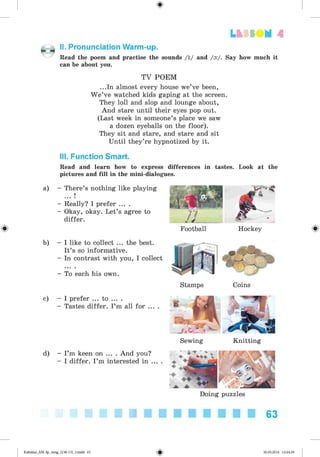
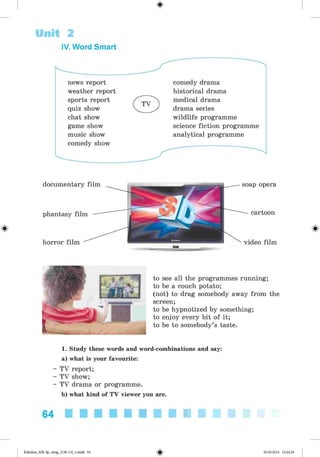
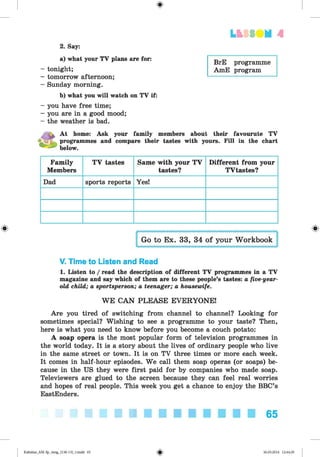
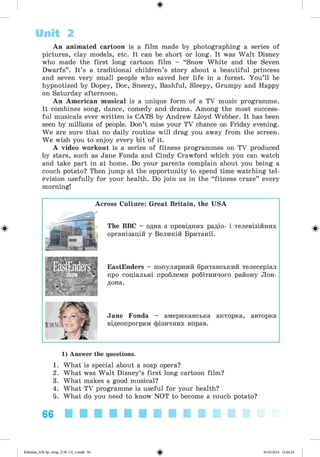
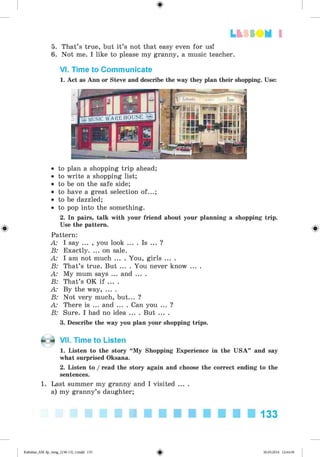
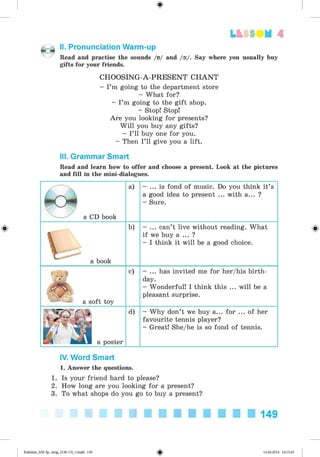
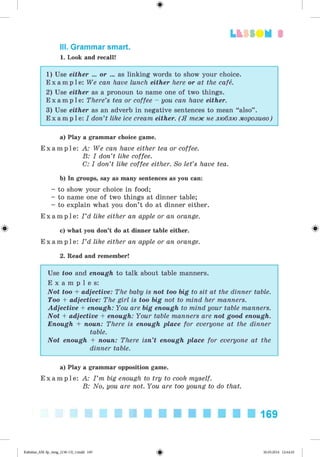
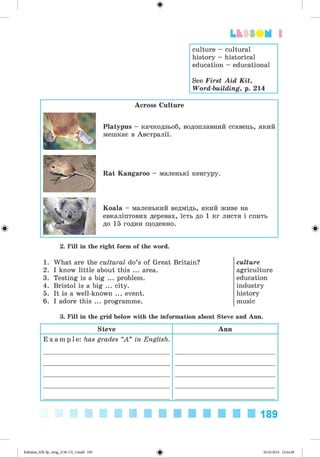
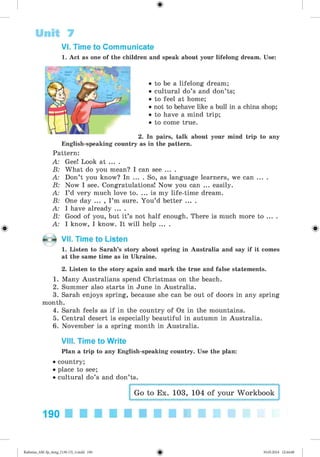
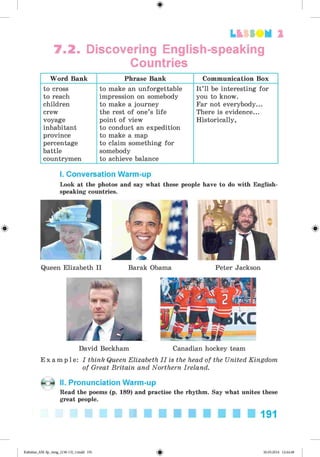
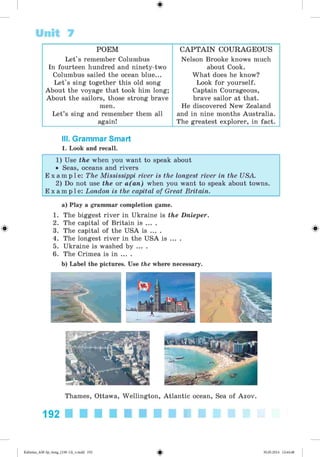
Л.В. Калініна, І.В. Самойлюкевич
Англійська
мова
для спеціалізованих шкіл
з поглибленим вивченням англійської мови
Підручник для 6 класу
загальноосвітніх навчальних закладів
Рекомендовано Міністерством освіти і науки України
# #
Київ «ГЕНЕЗА» 2014
#
Ка1іпіпа_АМ-5р_6еп^(138-13)_г.іпс1(1 1 30.05.2014 12:31:31
УД К 811.111(075.3)
ББК 81.2АНГЛ.922
К17
Рекомендовано Міністерством освіти і науки України
(Наказ МОН України від 07.02.2014 № 123)
Наукову експертизу проводив Центр наукових досліджень
та викладання іноземних мов НАН України.
Експерт О М . Ільченко, доктор філологічних наук, професор, заступник
директора з наукової роботи.
Психолого-педагогічну експертизу проводив Інститут педагогіки
НАПН України.
Експерт І.В. Алексеенко, молодший науковий співробітник лабораторії
навчання іноземних мов.
Н е з а л е ж н и й експерт:
Едвард Беррі Гропп, волонтер Корпусу Миру СІЛА в Україні
В і д по ві д ал ь ні за під гот овк у підручника:
Коваленко О.Я., головний спеціаліст департаменту загальної середньої
та дошкільної освіти МОН України;
Шопулко М.Н., методист вищої категорії відділу науково-методичного
забезпечення змісту освіти основної і старшої школи Інституту інноваційних
технологій і змісту освіти МОН України.
УМОВНІ ПОЗНАЧЕННЯ:
Вправи на аудіювання, фонетичне опрацювання мовленнєвого
матеріалу
Письмові вправи
Домашнє завдання
- О - —
Калініна Л.В.
К17 Англійська мова для спеціаліз. шк. з поглибл.
вивч. англ, мови : підруч. для 6 кл. загальноосвіт.
навч. закл. / Л.В. Калініна, І.В. Самойлюкевич. - К. :
Генеза, 2014. - 232 с. : іл.
ЕЗВЫ 978-966-11-0430-2.
УДК 811.111(075.3)
ББК 81.2АНГЛ.922
ISBN 978-966-11-0430-2
©Калініна Л.В.,
Самойлюкевич І.В., 2014
© Видавництво « Генеза»,
оригінал-макет, 2014
Ф
Kalinina_AM-Sp_6eng_(138-13)_r.indd 2 30.05.2014 12:31:31
ф
Любий друже!
Перед тобою підручник з англійської мови. Він склада­
ється із семи розділів - Units. Кожний розділ - це велика
тема, наприклад «Друзі» або «Шкільне життя». Для того,
щоб з книгою було зручніше працювати, розділи поділено
на п’ять частин, залежно від того, про що конкретно
йдеться.
Робота над темою (підтемою) розпочинається з активі­
зації раніше засвоєного лексико-граматичного матеріалу.
Це рубрика “Conversation Warm-up” , у якій для тебе наве­
дено приклад висловлювання.
Навчитися «розмовляти, як англієць» тобі допоможе
рубрика “Pronunciation Warm-up” . У ній ти знайдеш
багато веселих англійських віршів, наспівів, скоромовок,
що сприятимуть удосконаленню твоєї вимови й інтонації.
У тебе з’являться нові друзі з різних країн Великої
Британії, Канади, США, Австралії, з якими ти будеш
спілкуватися англійською, пізнавати їхню культуру та
порівнювати її з власною. Разом з ними ти мандруватимеш
їхніми країнами, побачиш видатні місця, ознайомишся
з різноманітними святковими традиціями. Це допоможе
Ф тобі не тільки поглибити знання з англійської мови, а й Ф
подивитися на світ широко відкритими очима, навчитися
розмовляти англійською як мовою міжнародного спілку­
вання.
Good luck!
Хай щастить!
3
ф
Kalinina_AM-Sp_6eng_(138-13)_v.indd 3 30.05.2014 12:44:19
My Summer Diary
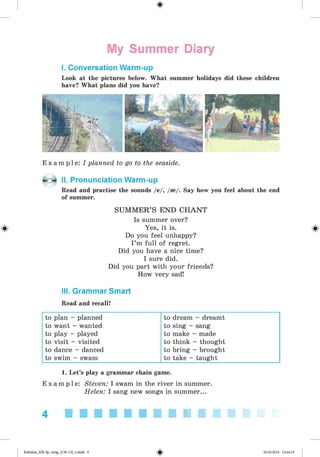
I. Conversation Warm-up
Look at the pictures below. What summer holidays did these children
have? What plans did you have?
E x a m p l e : I planned to go to the seaside.
II. Pronunciation Warm-up
Read and practise the sounds /e/, /*/. Say how you feel about the end
of summer.
SUM M ER’S END CHANT
Is summer over?
{g} Yes, it is. {g}
Do you feel unhappy?
I ’m full of regret.
Did you have a nice time?
I sure did.
Did you part with your friends?
How very sad!
III. Grammar Smart
Read and recall!
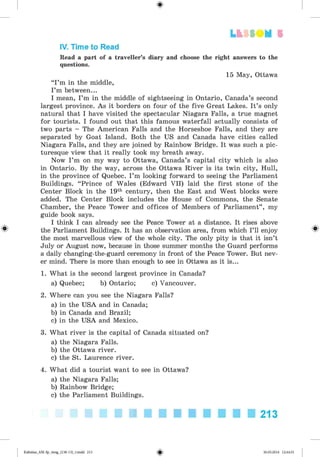
to plan - planned to dream - dreamt
to want - wanted to sing - sang
to play - played to make - made
to visit - visited to think - thought
to dance - danced to bring - brought
to swim - swam to take - taught
1. Let’s play a grammar chain game.
E x a m p l e : Steven: I swam in the river in summer.
Helen: I sang new songs in summer...
4
Kalinina_AM-Sp_6eng_(138-13)_v.indd 4 30.05.2014 12:44:19
<
§
>
2. Complete the sentences.
E x a m p l e : I made many new friends last summer. ^
We were playing in the yard all day long.
1. ... in June.
2. ... in July.
3. ... in August.
4. ... last summer.
5. ... all day long.
6. ... the whole summer.
IV. Time to Listen and Read
1. Listen to / read in pairs and say what the children planned to do in
summer.
#
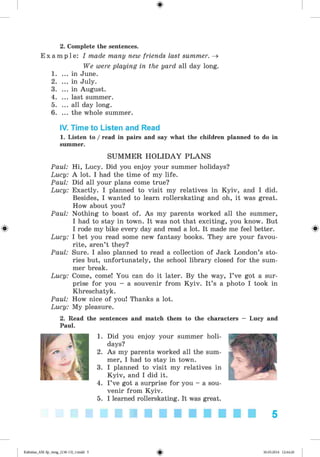
SUMMER H O LIDAY PLAN S
Paul: Hi, Lucy. Did you enjoy your summer holidays?
Lucy: A lot. I had the time of my life.
Paul: Did all your plans come true?
Lucy: Exactly. I planned to visit my relatives in Kyiv, and I did.
Besides, I wanted to learn rollerskating and oh, it was great.
How about you?
Paul: Nothing to boast of. As my parents worked all the summer,
I had to stay in town. It was not that exciting, you know. But
I rode my bike every day and read a lot. It made me feel better. ^
Lucy: I bet you read some new fantasy books. They are your favou­
rite, aren’t they?
Paul: Sure. I also planned to read a collection of Jack London’s sto­
ries but, unfortunately, the school library closed for the sum­
mer break.
Lucy: Come, come! You can do it later. By the way, I’ve got a sur­
prise for you - a souvenir from Kyiv. It’s a photo I took in
Khreschatyk.
Paul: How nice of you! Thanks a lot.
Lucy: My pleasure.
2. Read the sentences and match them to the characters - Lucy and
Paul.
1. Did you enjoy your summer holi­
days?
2. As my parents worked all the sum­
mer, I had to stay in town.
3. I planned to visit my relatives in
Kyiv, and I did it.
4. I ’ve got a surprise for you - a sou­
venir from Kyiv.
5. I learned rollerskating. It was great.
5
Kalinina_AM-Sp_6eng_(138-13)_v.indd 5 30.05.2014 12:44:20
#
3. In the text “Summer Holidays Plans” find the words for the follo­
wing areas and make up sentences with them.
summer
holidays
plan
#
E x a m p l e : Did you enjoy your summer holidays?
V. Time to Communicate
a) In pairs, talk about your summer holiday plans. Say which of them
came true. Follow the pattern.
Pattern:
A: Hi, Ann. Did you enjoy your summer holidays?
B: A lot. I had ... .
A: Did all your plans ... ?
B: Exactly. I planned to ... . Besides, ... . How about you?
A: Nothing to boast o f........
B: I bet ... .
A: Unfortunately ... and ... .
B: Come, come! You can ... . By the way ... .
A: How nice of you! ... .
B: My pleasure ... .
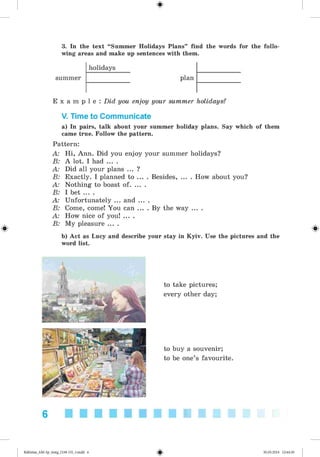
b) Act as Lucy and describe your stay in Kyiv. Use the pictures and the
word list.
to take pictures;
every other day;
to buy a souvenir;
to be one’s favourite.
6
#
Kalinina_AM-Sp_6eng_(138-13)_v.indd 6 30.05.2014 12:44:20
<
§
>
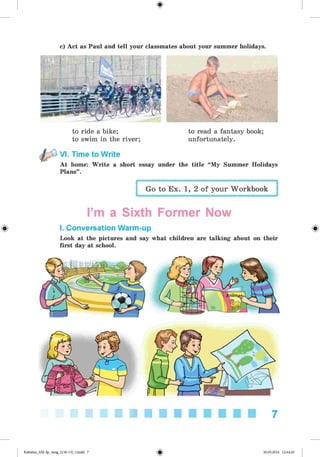
c) Act as Paul and tell your classmates about your summer holidays.
to ride a bike;
to swim in the river;
to read a fantasy book;
unfortunately.
VI. Time to Write
At home: Write a short essay under the title “My Summer Holidays
Plans”.
#
Go to Ex. 1, 2 of your Workbook
I’m a Sixth Former Now
I. Conversation Warm-up
Look at the pictures and say what children are talking about on their
first day at school.
7
Kalinina_AM-Sp_6eng_(138-13)_v.indd 7 30.05.2014 12:44:20
<
§
>
E x a m p l e : I think Boris and Artem are talking about sport, football,
to be exact.
II. Pronunciation Warm-up
Read and practise the rhythm. Say what you think about your studies
in the sixth form.
THE SIXTH FORMER’S R AP
The sixth form is great, really great
New hopes and friends, new subjects and trends.
The sixth form is great, really great
New song to sing
New games to play
Much new to learn
Fun every day!
III. Grammar Smart
Read and recall: there is/there are and modal verbs.
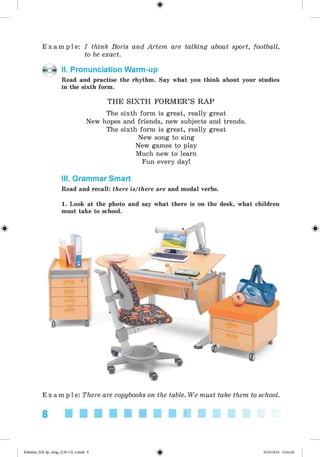
1. Look at the photo and say what there is on the desk, what children
must take to school.
E x a m p l e : There are copybooks on the table. We must take them to school.
8 ■■■■■■■■■■
*
Kalinina_AM-Sp_6eng_(138-13)_v.indd 8 30.05.2014 12:44:20
<
§
>
2. Play a grammar trio game.
study new subjects
meet new friends
can work hard
We may take sport in the sixth form
must go on excursions
join different clubs
learn many interesting things
E x a m p l e : We can meet new friends in the sixth form.
We must work hard.
We may take new sport.
3. In groups, say:
1. What clothes the sixth formers should/shouldn’t wear at school.
2. How the school children should/shouldn’t behave at school.
IV. Time to Listen and Read
1. Listen to / read what different children say about their studies in the
sixth form. Whose ideas do you share?
Ann: I like to be a sixth former. It means I will learn more about
different unknown things. There are new subjects in our new time table
and there are also new teachers. I like to learn new things!
Boris: Last year the sport team of our class was a school champi­
on. In summer my friends and I practised a lot in our school stadium.
I hope we’ll win all the football matches this year too.
Olha: During my summer holidays my granny taught me how to em­
broider. I’ve embroidered my blouse and a handkerchief. Now I want to
learn how to knit. I have a little brother and I want to knit socks for
him. Our teacher can teach me.
Helen: My friends say I ’m a very sociable person and make friends
easily. It’s true. I like to meet new people. As a rule there are a few new
pupils in our class every year. I think we’ll make friends.
Andrew: This year I’m going to join our English-speaking club.
I want to improve my English. I spent my summer in Artek and became
acquainted with John Brown from Britain. I had difficulties in commu­
nicating with him. I felt ashamed when I couldn’t understand him or
answer his questions I must learn English better!
Bohdan: As I’m interested in computing this year I’m going to devote
more time to it. I want to learn how to make my web-site, to search the
Internet at our computer technology lessons. It’s fun to find new e-pals
and to communicate with them.
9
Kalinina_AM-Sp_6eng_(138-13)_v.indd 9 30.05.2014 12:44:20
<
§
>
#
2. Answer the questions.
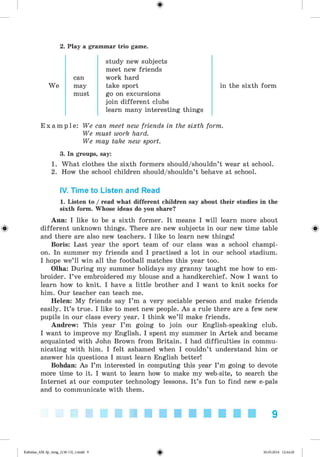
1. What does Ann want to do in the sixth form?
2. Who is going to learn to knit?
3. Why is Andrew going to join the English-speaking club?
4. Who is very sociable?
5. What does Bohdan want to learn at his computer technology
lessons?
6. What does Boris plan to do in the sixth form?
3. Look at the pictures and reproduce these episodes from the texts.
IV. Time to Communicate
1. In pairs, discuss with your friends your plans for the 6-th form as in
the pattern.
Pattern:
A: Hey ... , we are the sixth formers now. What ... ?
B: I’m glad to be a sixth former, because ... .
A: Besides, this year ... and ... and what ...?
B: As for me I’m going ... .
A: That’s great! I know you are interested in .... Are you going ... ?
B: Exactly. I think ... .
A: And I ... and ... .
B: I hope, we’ll ... .
10
Kalinina_AM-Sp_6eng_(138-13)_v.indd 10 30.05.2014 12:44:20
<
§
>
2. Act as one of the children and speak about your plans for the sixth
form. Use:
to become a sixth former;
to be going to do something;
to take part in something;
to join something;
to devote much time to something;
to enjoy something.
#
3. Speak about your future studies in the sixth form.
VI. Time to Write
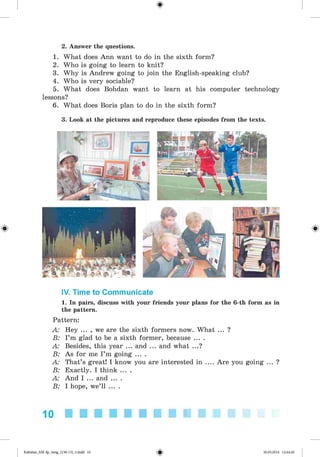
Write about a new activity you are going to take part in being a sixth
former.
Go to Ex. 3, 4 of your Workbook
11
Kalinina_AM-Sp_6eng_(138-13)_v.indd 11 30.05.2014 12:44:21
#
Unit 1
Unit One: Family Ties
1.1. Family Lifestyles
Word Bank Phrase Bank Communication Box
provider
adventurous
breathtaking
memorable
supportive
to be the heart of one’s family
to help somebody out
to have something in common
to be on the move
to be digital natives
to do the puzzles
to differ from somebody/some-
thing
To be exact...
Rather than...
Traditionally...
From time to time...
Luckily...
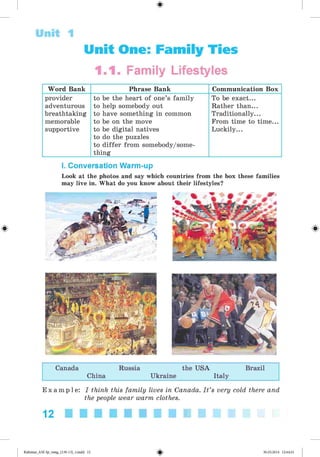
I. Conversation Warm-up
Look at the photos and say which countries from the box these families
may live in. What do you know about their lifestyles?
Canada Russia the USA Brazil
China Ukraine Italy
E x a m p l e : I think this family lives in Canada. I t ’s very cold there and
the people wear warm clothes.
12
Kalinina_AM-Sp_6eng_(138-13)_v.indd 12
# 30.05.2014 12:44:21
#
1
#
II. Pronunciation Warm-up
Read and practise the sounds /»/ and /k/. Answer the questions.
FA M ILY CHANT
What is a family?
Who is a family?
A pair like Kanga and Roo is a family.
A calf and a cow that go moo is a family.
A dog and its puppies, a cat and its kittens.
A ll kinds of people can make up a family.
A ll kinds of creatures make up a family.
III. Grammar Smart
1. Look and recall.
Use the Present Indefinite if you want to speak about every day,
repeated actions.
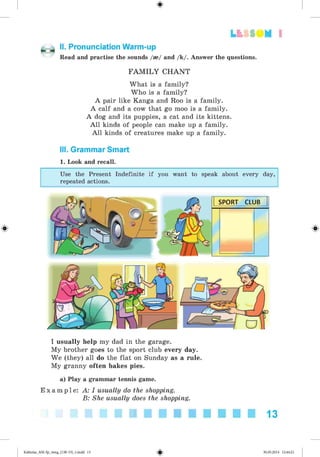
I usually help my dad in the garage.
My brother goes to the sport club every day.
We (they) all do the flat on Sunday as a rule.
My granny often bakes pies.
a) Play a grammar tennis game.
E x a m p l e : A: I usually do the shopping.
B: She usually does the shopping.
13
#
Kalinina_AM-Sp_6eng_(138-13)_v.indd 13 30.05.2014 12:44:21
<
§
>
Unit 1
b) Say the opposite using the words given.
E x a m p l e : A: My granny often cooks borsch.
B: My granny seldom cooks borsch.
1. We usually go picnicking on Sunday.
2. My brothers play chess every day.
3. My dad often watches TV in the evening.
4. Our grandparents always work in the garden.
5. My cousins visit us every summer.
6. Our relatives usually write us e-mails.
sometimes
never
seldom
from time to time
2. Read and remember!
Use tag questions if you want to keep a conversation going.
E x a m p l e : Canadians who live in the North do (+ ) fishing even in
winter, don’ t they (-)?
They are not (-) afraid of colds, are (+ ) they?
a) Play a grammar chain game.
E x a m p l e : A: You like computer games, don’t you?
B: Sure. You always play sport games, don’t you?
b) Ask your friend about his/her family’s activities as in the example.
E x a m p l e : to spend much time together ^
Your family members spend much time together, don’t they?
1. to go to the seaside every summer;
2. to have a family reunion;
3. to visit their relatives;
4. to take part in sport activities;
5. to keep their family traditions;
6. to help each other out.
IV. Word Smart
1. Study these words and word-combinations and speak about:
a) everyday lifestyle of your family.
• traditionally
• to be the heart of something
• to help somebody out
• to be digital natives
E x a m p l e : Traditionally, all members of my family get up early.
14
Kalinina_AM-Sp_6eng_(138-13)_v.indd 14 30.05.2014 12:44:21
<
§
>
LfcSS UM I
b) your family’s pastime at weekends.
• to be on the move
• to do the puzzles
• from time to time
• adventurous
• memorable
• breathtaking
E x a m p l e : On Sunday we have the most memorable time.
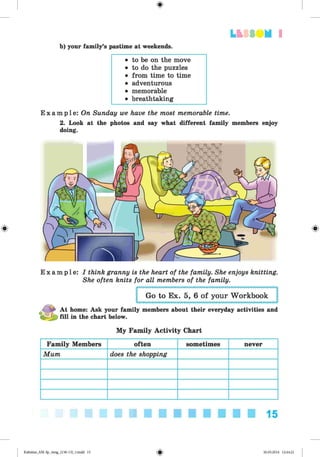
2. Look at the photos and say what different family members enjoy
doing.
E x a m p l e : I think granny is the heart of the family. She enjoys knitting.
She often knits for all members of the family.
Go to Ex. 5, 6 of your Workbook
At home: Ask your family members about their everyday activities and
15J} fill in the chart below.
My Family Activity Chart
Family Members often sometimes never
Mum does the shopping
15
Kalinina_AM-Sp_6eng_(138-13)_v.indd 15 30.05.2014 12:44:21
#
#
Unit 1
V. Time to Listen and Read
1. Listen to / read what children say about the lifestyles in their fami­
lies and say what they have in common.
PART I
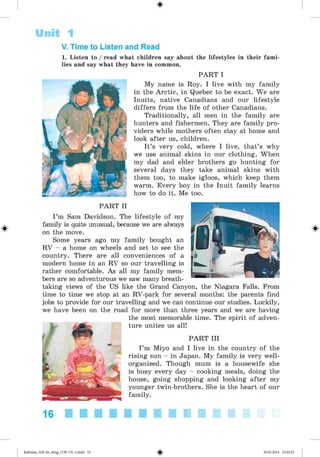
My name is Roy. I live with my family
in the Arctic, in Quebec to be exact. We are
Inuits, native Canadians and our lifestyle
differs from the life of other Canadians.
Traditionally, all men in the family are
hunters and fishermen. They are family pro­
viders while mothers often stay at home and
look after us, children.
It’s very cold, where I live, that’s why
we use animal skins in our clothing. When
my dad and elder brothers go hunting for
several days they take animal skins with
them too, to make igloos, which keep them
warm. Every boy in the Inuit family learns
how to do it. Me too.
PART II
I ’m Sam Davidson. The lifestyle of my
family is quite unusual, because we are always
on the move.
Some years ago my family bought an
RV - a home on wheels and set to see the
country. There are all conveniences of a
modern home in an RV so our travelling is
rather comfortable. As all my family mem­
bers are so adventurous we saw many breath­
taking views of the US like the Grand Canyon, the Niagara Falls. From
time to time we stop at an RV-park for several months: the parents find
jobs to provide for our travelling and we can continue our studies. Luckily,
we have been on the road for more than three years and we are having
the most memorable time. The spirit of adven­
ture unites us all!
PART III
I ’m Miyo and I live in the country of the
rising sun - in Japan. My family is very well-
organised. Though mum is a housewife she
is busy every day - cooking meals, doing the
house, going shopping and looking after my
younger twin-brothers. She is the heart of our
family.
#
16
#
Kalinina_AM-Sp_6eng_(138-13)_v.indd 16 30.05.2014 12:44:22
ф
ф
Lfcf SOM 1
I am also very busy. After my lessons like most Japanese children
I attend extra-classes on science and work much with my computer to
prepare for the national exams. All children in Japan are digital na­
tives. Rather than studies, my younger brothers prefer to play computer
games. When dad comes home in the evening he often brings magazines
with puzzles, which we try to do, including the twins. A very useful
pastime, isn’t it? Parents help us out, if we can’t do something.
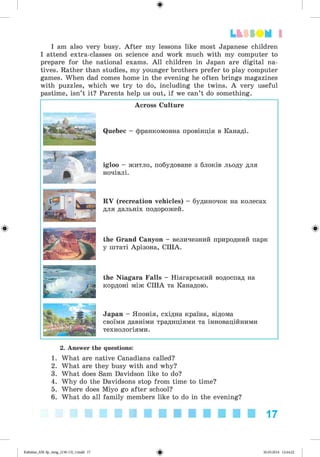
Across Culture
Quebec - франкомовна провінція в Канаді.
igloo - житло, побудоване з блоків льоду для
ночівлі.
RV (recreation vehicles) - будиночок на колесах
для дальніх подорожей.
the Grand Canyon - величезний природний парк
у штаті Арізона, США.
the Niagara Falls - Ніагарський водоспад на
кордоні між США та Канадою.
Japan - Японія, східна країна, відома
своїми давніми традиціями та інноваційними
технологіями.
Ф
2. Answer the questions:
1. What are native Canadians called?
2. What are they busy with and why?
3. What does Sam Davidson like to do?
4. Why do the Davidsons stop from time to time?
5. Where does Miyo go after school?
6. What do all family members like to do in the evening?
17
Ф
Kalinina_AM-Sp_6eng_(138-13)_v.indd 17 30.05.2014 12:44:22
#
3. Complete the sentences and add two more logically connected ones.
E x a m p l e : Roy lives in the North of Canada... ^ Roy lives in the North
of Canada, in Quebec, to be exact. I t ’s very cold there. They
use animal skins for clothing.
1. Traditionally all men in Inuits’ families are...
2. When the Inuit men go hunting or fishing...
3. Sam Davidson’s family...
4. A ll members of his family...
5. Miyo’s family is well-organised...
6. Many children in Japan...
Unit 1
VI. Time to Communicate
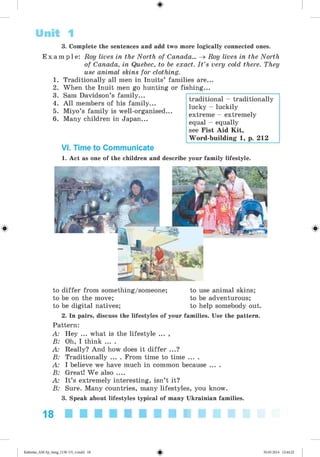
1. Act as one of the children and describe your family lifestyle.
to differ from something/someone; to use animal skins;
to be on the move; to be adventurous;
to be digital natives; to help somebody out.
2. In pairs, discuss the lifestyles of your families. Use the pattern.
Pattern:
A: Hey ... what is the lifestyle ... ,
B: Oh, I think ... .
A: Really? And how does it differ ...?
B: Traditionally ... . From time to time ... .
A: I believe we have much in common because ... .
B: Great! We also ....
A: It’s extremely interesting, isn’t it?
B: Sure. Many countries, many lifestyles, you know.
3. Speak about lifestyles typical of many Ukrainian families.
18 ■■■■■■■■■■
traditional - traditionally
lucky - luckily
extreme - extremely
equal - equally
see Fist Aid Kit,
Word-building 1, p. 212
%
#
Kalinina_AM-Sp_6eng_(138-13)_v.indd 18 30.05.2014 12:44:22
<
§
>
#
LtfSO M 2
VII. Time to Listen
1. Listen and say what story was the most memorable for Christine.
2. Listen to the story again and mark the true statements.
1. Christine lived in Sweden with her mum and dad.
2. Her father played the piano well.
3. The family moved to France after Christine’s mother’s death.
4. The Daae settled near the sea.
5. They liked to lie in the sun and build the sandcastles.
6. Mr Daae told his daughter many wonderful stories about differ­
ent countries.
7. Christine enjoyed listening to the story about Angel’s blessing.
8. Angel of music blessed all the people who liked to sing.
^ VIII. Time to Write
Write a short essay about your family lifestyle. Follow the question
plan.
1. How many members are there in your family?
2. How much time do your family members spend together?
3. What do your family members traditionally do on weekdays?
4. What do your family members like to do at weekends?
5. What is the favourite pastime of your family?
6. What do all members of your family have in common?
Go to Ex. 7, 8 of your Workbook
1.2. Your Real Self
Word Bank Phrase Bank Communication Box
creative
cute
intelligent
neat
stingy
patient
to have a quick temper
to be responsible for some­
thing
to take something seriously
to judge something by
something
to let somebody down
to rely on somebody
to be in one’s books
There is something in
what you say.
That’s it.
I can’t agree more.
It can’t be otherwise.
19
Kalinina_AM-Sp_6eng_(138-13)_v.indd 19 30.05.2014 12:44:22
#
Steve and Bob
Unit 1
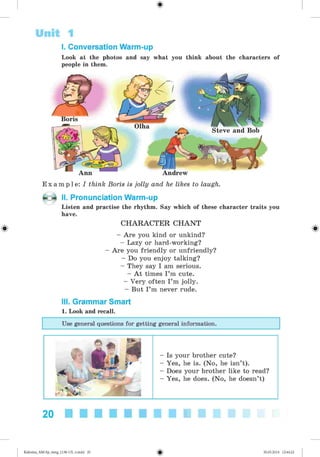
I. Conversation Warm-up
Look at the photos and say what you think about the characters of
people in them.
Boris
Olha
Andrew
E x a m p l e : I think Boris is jolly and he likes to laugh.
- o II. Pronunciation Warm-up
Listen and practise the rhythm. Say which of these character traits you
have.
CHARACTER CH ANT
- Are you kind or unkind?
- Lazy or hard-working?
- Are you friendly or unfriendly?
- Do you enjoy talking?
- They say I am serious.
- A t times I ’m cute.
- Very often I ’m jolly.
- But I’m never rude.
III. Grammar Smart
1. Look and recall.
Use general questions for getting general information.
Is your brother cute?
Yes, he is. (No, he isn’t).
Does your brother like to read?
Yes, he does. (No, he doesn’t)
20
Kalinina_AM-Sp_6eng_(138-13)_v.indd 20 30.05.2014 12:44:22
ф
Lfcf SOM 2
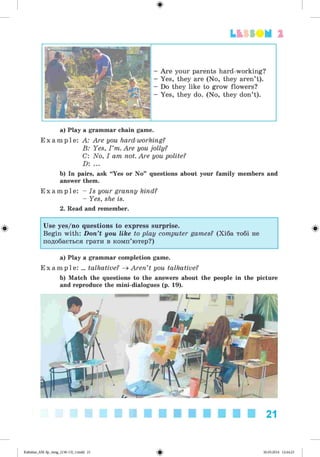
- Are your parents hard-working?
- Yes, they are (No, they aren’t).
- Do they like to grow flowers?
- Yes, they do. (No, they don’t).
a) Play a grammar chain game.
E x a m p l e : A: Are you hard-working?
B: Yes, I ’m. Are you jolly?
C: No, I am not. Are you polite?
D: ...
b) In pairs, ask “Yes or No” questions about your family members and
answer them.
E x a m p l e : - Is your granny kind?
- Yes, she is.
2. Read and remember.
Use yes/no questions to express surprise.
Begin with: Don’t you like to play computer games? (Хіба тобі не
подобається грати в комп’ютер?)
Ф
a) Play a grammar completion game.
E x a m p l e : ... talkative? ^ Aren’t you talkative?
b) Match the questions to the answers about the people in the picture
and reproduce the mini-dialogues (p. 19).
21
Ф
Kalinina_AM-Sp_6eng_(138-13)_v.indd 21 30.05.2014 12:44:23
<
§
>
Unit 1
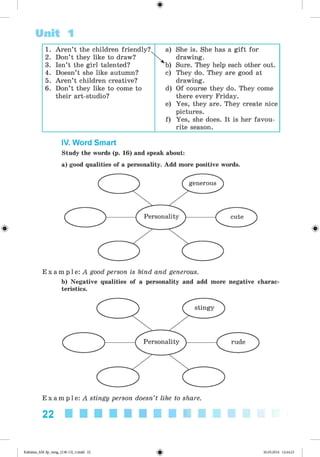
1. Aren’t the children friendly? a) She is. She has a gift for
2. Don’t they like to draw? drawing.
3. Isn’t the girl talented? b) Sure. They help each other out.
4. Doesn’t she like autumn? c) They do. They are good at
5. Aren’t children creative? drawing.
6. Don’t they like to come to d) Of course they do. They come
their art-studio? there every Friday.
e) Yes, they are. They create nice
pictures.
f) Yes, she does. It is her favou-
rite season.
IV. Word Smart
Study the words (p. 16) and speak about:
a) good qualities of a personality. Add more positive words.
#
E x a m p l e : A good person is kind and generous.
b) Negative qualities of a personality and add more negative charac­
teristics.
E x a m p l e : A stingy person doesn’t like to share.
22 ■ ■ ■ ■ ■ ■ ■ ■ ■ ■
*
Kalinina_AM-Sp_6eng_(138-13)_v.indd 22 30.05.2014 12:44:23
<
§
>
LESS UM 1
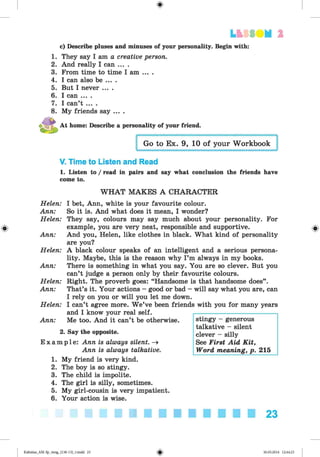
c) Describe pluses and minuses of your personality. Begin with:
1. They say I am a creative person.
2. And really I can ... .
3. From time to time I am ... .
4. I can also be ... .
5. But I never ....
6. I can ... .
7. I can’t ... .
8. My friends say ....
At home: Describe a personality of your friend.
V. Time to Listen and Read
1. Listen to / read in pairs and say what conclusion the friends have
come to.
#
W H A T M AKES A CHARACTER
Helen:
Ann:
Helen:
Ann:
Helen:
Ann:
Helen:
Ann:
Helen:
Ann:
2
E xa m
I bet, Ann, white is your favourite colour.
So it is. And what does it mean, I wonder?
They say, colours may say much about your personality. For
example, you are very neat, responsible and supportive.
And you, Helen, like clothes in black. What kind of personality
are you?
A black colour speaks of an intelligent and a serious persona­
lity. Maybe, this is the reason why I’m always in my books.
There is something in what you say. You are so clever. But you
can’t judge a person only by their favourite colours.
Right. The proverb goes: “Handsome is that handsome does”.
That’s it. Your actions - good or bad - will say what you are, can
I rely on you or will you let me down.
I can’t agree more. W e’ve been friends with you for many years
and I know your real self.
Me too. And it can’t be otherwise.
. Say the opposite.
pie: Ann is always silent. -»
Ann is always talkative.
stingy - generous
talkative - silent
clever - silly
See First Aid Kit,
Word meaning, p. 215
1. My friend is very kind.
2. The boy is so stingy.
3. The child is impolite.
4. The girl is silly, sometimes.
5. My girl-cousin is very impatient.
6. Your action is wise.
23
Kalinina_AM-Sp_6eng_(138-13)_v.indd 23 30.05.2014 12:44:23
#
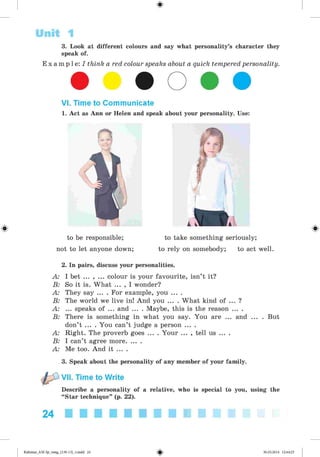
3. Look at different colours and say what personality’s character they
speak of.
E x a m p l e : / think a red colour speaks about a quick tempered personality.
Unit 1
VI. Time to Communicate
1. Act as Ann or Helen and speak about your personality. Use:
to be responsible; to take something seriously;
not to let anyone down; to rely on somebody; to act well.
2. In pairs, discuss your personalities.
A: I bet ... , ... colour is your favourite, isn’t it?
B: So it is. What ... , I wonder?
A: They say ... . For example, you ... .
B: The world we live in! And you ... . What kind of ... ?
A: ... speaks of ... and ... . Maybe, this is the reason ... .
B: There is something in what you say. You are ... and ... . But
don’t ... . You can’t judge a person ... .
A: Right. The proverb goes ... . Your ... , tell us ... .
B: I can’t agree more........
A: Me too. And it ... .
3. Speak about the personality of any member of your family.
VII. Time to Write
Describe a personality of a relative, who is special to you, using the
“Star technique” (p. 22).
#
24
#
Kalinina_AM-Sp_6eng_(138-13)_v.indd 24 30.05.2014 12:44:23
<
§
>
Lt f SOM 3
Who?
What minuses? What pluses?
#
Go to Ex. 11, 12 of your Workbook
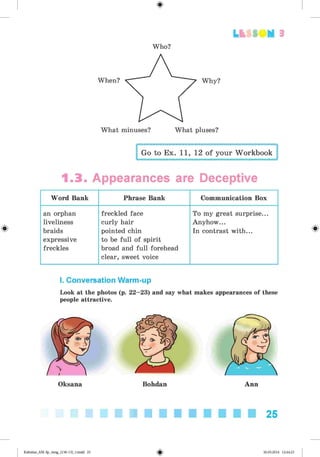
1.3. Appearances are Deceptive
Word Bank Phrase Bank Communication Box
an orphan
liveliness
braids
expressive
freckles
freckled face
curly hair
pointed chin
to be full of spirit
broad and full forehead
clear, sweet voice
To my great surprise...
Anyhow...
In contrast with... #
I. Conversation Warm-up
Look at the photos (p. 22-23) and say what makes appearances of these
people attractive.
Oksana Bohdan Ann
25
Kalinina_AM-Sp_6eng_(138-13)_v.indd 25 30.05.2014 12:44:23
<
§
>
#
Unit 1
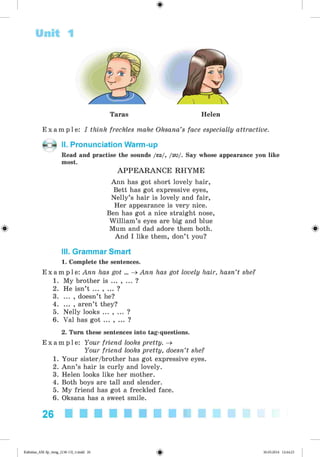
Taras Helen
E x a m p l e : I think freckles make Oksana’s face especially attractive.
II. Pronunciation Warm-up
Read and practise the sounds /ea/, /au/. Say whose appearance you like
most.
A PPE A R A N C E RHYM E
Ann has got short lovely hair,
Bett has got expressive eyes,
Nelly’s hair is lovely and fair,
Her appearance is very nice.
Ben has got a nice straight nose,
William’s eyes are big and blue
Mum and dad adore them both.
And I like them, don’t you?
III. Grammar Smart
1. Complete the sentences.
E x a m p l e : Ann has got ... ^ Ann has got lovely hair, hasn’t she?
1. My brother is ... , ... ?
2. He isn’t ... , ... ?
3. ... , doesn’t he?
4. ... , aren’t they?
5. Nelly looks ... , ... ?
6. Val has got ... , ... ?
2. Turn these sentences into tag-questions.
E x a m p l e : Your friend looks pretty. ^
Your friend looks pretty, doesn’t she?
1. Your sister/brother has got expressive eyes.
2. Ann’s hair is curly and lovely.
3. Helen looks like her mother.
4. Both boys are tall and slender.
5. My friend has got a freckled face.
6. Oksana has a sweet smile.
26
Kalinina_AM-Sp_6eng_(138-13)_v.indd 26 30.05.2014 12:44:23
#
#
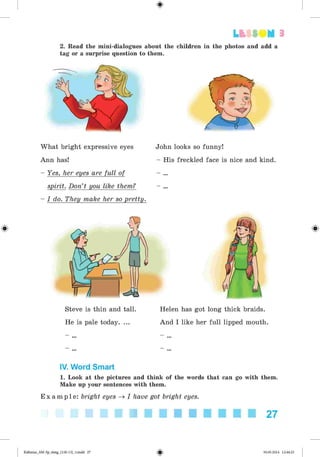
2. Read the mini-dialogues about the children in the photos and add a
tag or a surprise question to them.
Lt SSOM 3
What bright expressive eyes
Ann has!
- Yes, her eyes are full of
spirit. Don’t you like them?
- I do. They make her so pretty.
Steve is thin and tall.
He is pale today. ...
John looks so funny!
- His freckled face is nice and kind.
Helen has got long thick braids.
And I like her full lipped mouth.
%
IV. Word Smart
1. Look at the pictures and think of the words that can go with them.
Make up your sentences with them.
E x a m p l e : bright eyes ^ I have got bright eyes.
■■ ■ ■ ■ ■ ■ ■ ■ ■ 27
#
Kalinina_AM-Sp_6eng_(138-13)_v.indd 27 30.05.2014 12:44:23
<
§
>
Unit 1
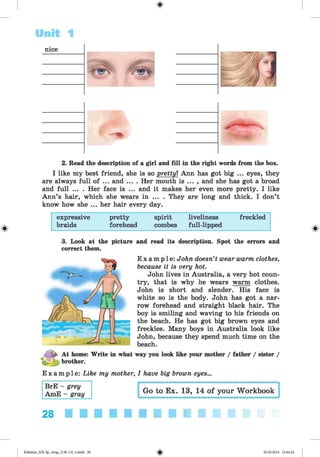
2. Read the description of a girl and fill in the right words from the box.
I like my best friend, she is so prettyl Ann has got big ... eyes, they
are always full of ... and .... Her mouth is ... , and she has got a broad
and full ... . Her face is ... and it makes her even more pretty. I like
Ann’s hair, which she wears in ... . They Eire long Eind thick. I don’t
know how she ... her hair every day.
expressive pretty spirit liveliness freckled
brsiids forehead combes full-lipped
3. Look at the picture and read its description. Spot the errors and
correct them.
E xam pl e: John doesn’t wear warm clothes,
because it is very hot.
John lives in Australia, a very hot coun­
try, that is why he wears warm clothes.
John is short and slender. His face is
white so is the body. John h£is got a nar­
row forehead Em
d straight black hair. The
boy is smiling and waving to his friends on
the beach. He has got big brown eyes and
freckles. Many boys in Australia look like
John, because they spend much time on the
beach.
^ At home: Write in what way you look like your mother / father / sister /
brother.
E xam ple : Like my mother, I have big brown eyes...
BrE - grey
AmE - gray o to Ex. 13, 14 of your Workbook
28
Kalinina_AM-Sp_6eng_(138-13)_v.indd 28 30.05.2014 12:44:24
з
V. Time to Listen and Read
1. Listen to / read the story and say why Matthew Cuthbert was
surprised.
SURPRISE
... Mr. Cuthbert and his sister Marilla lived on a small Canadian
farm. They needed a hand and decided to adopt an orphan boy, that’s
why Matthew Cuthbert arrived at the station to meet a child.
To his great surprise an orphan girl, a child of about eleven was
standing in front of him. She was in a very short, very tight, very ugly
dress of a yellowish-grey colour, a faded brown hat and beneath the hat,
extending down her back were two braids of very thick curly red hair.
Her face was small, white and thin, also much freckled; her mouth was
very large and so were her eyes, which looked green in some moods,
gray in others.
Her chin was very pointed and her big eyes were full of spirit, liveli­
ness; her mouth was expressive; her forehead was broad and full.
“I suppose you are Mr. Matthew Cuthbert of Green Gables?” She said
in a peculiarly clear, sweet voice. “I ’m very glad to see you. I was begin­
ning to be afraid you weren’t coming for me” . And she held out her thin
brownish hand to him. Matthew had taken her little hand awkwardly in
his; then and there he decided what to do. He couldn’t tell this child
with the bright eyes which made her especially lively that there had
been a mistake. He would take her home. She couldn’t be left at the sta- ^
tion, anyhow, no matter what mistake had been made.
Adapted from “Ann of Green Gables” by Lucy Mand Montgomery
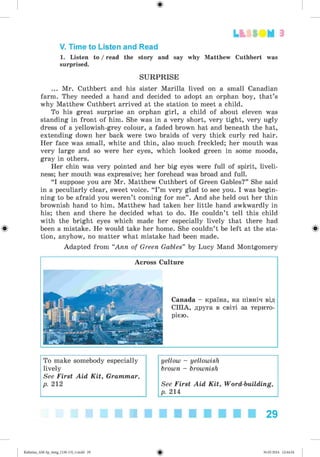
Across Culture
Canada - країна, на північ від
США, друга в світі за терито­
рією.
To make somebody especially yellow - yellowish
lively brown - brownish
See First Aid Kit, Grammar,
p. 212 See First Aid Kit, Word-building,
p. 214
29
Kalinina_AM-Sp_6eng_(138-13)_v.indd 29 30.05.2014 12:44:24
<
§
>
#
Unit 1
2. Match the definitions to the words or phrases and reproduce the
sentences with them from the story.
1. an orphan a) the thing that lost colour and
2. to adopt a child brightness;
3. a faded hat b) help with something;
4. a sweet voice c) a child who has no parents;
5. awkward d) to take somebody else’s child
6. need a hand into your home and legally
become his/her parent;
e) making you feel embarrassed
so that you are not sure what
to do or to say;
f) very pleasant.
E x a m p l e : Mr. Cuthbert and his sister Marilla decided to adopt an
orphan boy.
1. In the story find and reproduce the information about the girl’s clo­
thes (hair, face, eyes, mouth, voice). Say what impression she produced
on Mr. Cuthbert. Do you share it?
VI. Time to Communicate
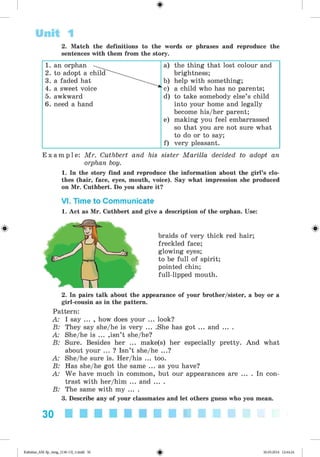
1. Act as Mr. Cuthbert and give a description of the orphan. Use:
#
braids of very thick red hair;
freckled face;
glowing eyes;
to be full of spirit;
pointed chin;
full-lipped mouth.
2. In pairs talk about the appearance of your brother/sister, a boy or a
girl-cousin as in the pattern.
Pattern:
A: I say ... , how does your ... look?
B: They say she/he is very ... .She has got ... and ... .
A: She/he is ... ,isn’t she/he?
B: Sure. Besides her ... make(s) her especially pretty. And what
about your ... ? Isn’t she/he ...?
A: She/he sure is. Her/his ... too.
B: Has she/he got the same ... as you have?
A: We have much in common, but our appearances are ... . In con­
trast with her/him ... and ... .
B: The same with my ... .
3. Describe any of your classmates and let others guess who you mean.
30 ■■■■■■■■■■
*
Kalinina_AM-Sp_6eng_(138-13)_v.indd 30 30.05.2014 12:44:24
<
§
>
VII. Time to Write
Bring a photo of your close friend or relative and describe his/her
appearance.
Lt f SOM 4
Go to Ex. 15, 16 of your Workbook
1.4. The Two of Us:
My Friend and I
Word Bank Phrase Bank Communication Box
storyteller
unite
well-read
hard-worker
devoted
to get along with somebody
to share interests
to see a lot of each other
to enjoy each other’s company
to sit around
to feel alone
to make friends with...
Thanks to somebody...
A t that...
It’s cool!
*
I. Conversation Warm-up
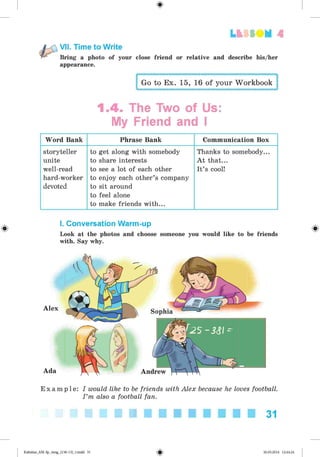
Look at the photos and choose someone you would like to be friends
with. Say why.
Alex
Ada
Sophia
Andrew
E x a m p l e : I would like to be friends with Alex because he loves football.
I ’m also a football fan.
31
Kalinina_AM-Sp_6eng_(138-13)_v.indd 31 30.05.2014 12:44:24
<
§
>
Unit 1
II. Pronunciation Warm-up
Read the chant and practise the rhythm. Say how much is true about
your friend.
M Y FRIEND CHANT
- Do you know Andrew?
- Andrew who?
- Andrew Voitenko.
- Of course, I do. He is an old friend of mine. And I like him a lot.
- Do you share his interests?
- Do you have much in common?
- Do you just sit around?
- We certainly do. We are old friends. We are old, good friends.
III. Function Smart
Read and learn how to express devotion to your friend. Look at the
pictures and fill in the mini-dialogues.
Harry Potter and his friends
- ... made new friends in the coun­
try of Oz.
- Wow! Isn’t it remarkable?
Tom Sawyer and Huckleberry
Finn
- Do you know ... ?
- Yes, of course, I do. They are de­
voted friends.
Dorothy
- What do you think of ... ?
- I believe they enjoy each other’s
company.
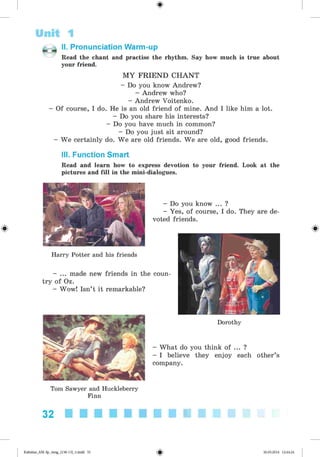
32
Kalinina_AM-Sp_6eng_(138-13)_v.indd 32 30.05.2014 12:44:24
<
§
>
LESS UM A
- What do children like to do when
they are together?
- They like ... . It’s so exciting!
#
IV. Word Smart
1. Look at the wordsearch puzzle and find six words characterizing a
good friend. Make up sentences with these words.
a b
<-------
s u p P o r t i V e )
c c c f g h i e j k 1 m
h a r d w o r k i n g m
o w V u t s r i q P o n
n X y z a V b n a b c d
e e f g h i j d k 1 m n
s r w e 1 1 r e a d o q
t h e 1 P f u 1 w X y z
E xam ple : My friend is very supportive.
2. What will you say if:
E x a m p l e : You have the same interests. -» We have much in common.
1. You often see your friend.
2. You like to be with your friend.
3. You got to know a new friend.
4. Your friend can tell interesting stories.
5. Your friend works hard.
6. You met a new friend and liked him at once.
3. Say the same using new words and phrases.
E xam ple : I like to spend time with my friend. -» I enjoy my friend’s
company.
1. We both like sports.
2. I often meet my friend.
3. I am in good relations with my friend.
4. My friend reads a lot and knows much.
5. My friend always supports me.
6. My friend helps me when I need it.
^ At home: Speak about your newest friend covering the following points
(p. 31).
33
Kalinina_AM-Sp_6eng_(138-13)_v.indd 33 30.05.2014 12:44:24
ф
ф
Unit 1
1. Who your newest friend is.
2. Where you met.
3. Why you think he (she) is a good friend.
4. How often you get together.
5. What you do when you are together.
6. What you like most in your newest friend.
Go to Ex. 17, 18 of your Workbook
V. Time to Listen and Read
1. Listen to / read in pairs and say why the friends get along.
GETTING ALO NG
Ann: Hi, Steve, where are you hurrying?
Steve: I’m going to meet an old friend of mine. It’s Alex Pavlenko
from the seventh grade. You know him, don’t you?
Ann: Of course, I do, he is a school chess champion and a top pupil in
his class.
Steve: Right. We met at the chess club two years ago and have seen a
lot of each other since then.
Ann: So, you share your interests, that’s why you are good friends.
Steve: Not only chess unites us. Alex is well-read and a good story­
teller. Thanks to him, I loved Tolkien and Dahl. We enjoy each
other’s company and can just sit around.
Ann: It’s remarkable! You can never feel alone with such a friend.
Steve: That’s true. We seem to have a lot in common: the things we
like to do and the way we spend our free time. We are both
hard workers and good mixers at that.
Ann: I can’t help admiring your friendship and how you get along.
A good friend is a joy forever, they say.
Steve: Can’t agree more.
to tell stories - a storyteller
to work hard - a hard worker
to mix - a good mixer
See First Aid Kit, Word
Meaning, p. 215
Across Culture
J. R.R. Tolkien - відомий англійський
письменник. Автор романів «Володар Перснів»,
«Хоббіт».
Ф
34
Ф
Kalinina_AM-Sp_6eng_(138-13)_v.indd 34 30.05.2014 12:44:25
ф
ф
Lt SSOM 4
Roald Dahl - відомий британський дитячий
письменник. Автор книг «Джеймс і Величезний
Персик», «Чарлі і Шоколадна фабрика»,
«Матільда» та ін.
2. Complete the sentences with the correct words from the box.
1. Dan likes to eat much. He is such a heavy eater.
2. Jane reads much and she is the best ... of my
class.
3. Martin has got many friends. He is such a ... .
4. My twin brother Andrew spends much time at his
lessons. He is a real ... .
5. Vera likes to sleep. She is often late for classes.
We call her a ... .
6. Mike is not ready for the lesson again. He is a ... .
storyteller
hard worker
lazybones
heavy eater
sleepy head
good mixer
VI. Time to Communicate
1. Act as Steve and describe your friend. Use:
to make friends with somebody;
to share interests;
to see a lot of each other;
to enjoy each other’s company
to be well-read
2. In pairs, talk about your friends as in the pattern.
Pattern:
A: Hi, ... , where are ... ?
B: I’m going to meet ... . He is ... . You ..., don’t you?
A: Of course I do. Your friend is ... .
B: Right. We met ... and since then ... . We really ... .
A: So you ... that’s why you are such good friends.
B: Not only that. Thanks to ... . We enjoy ... .
A: It’s remarkable! You can ... .
B: That’s true. We seem ... and ... .
A: I can’t help admiring ... . A good friend ... .
B: I can’t agree more.
3. In the dialogue “Getting Along” (p. 31) find the information for the
following chart.
Ф
35
Ф
Kalinina_AM-Sp_6eng_(138-13)_v.indd 35 30.05.2014 12:44:25
<
§
>
Unit 1
Common Interests Common Character
Traits
Favourite Leisure
Time
Say what facts from the chart are close to you.
VII. Time to Listen
1. Listen to three children talking about their friends and say why their
friends are important to them.
2. Listen again and write the answer for each of the children. Who do
you agree most: Taras, Jane or Andrew?
#
VIII. Time to Write
Read the list below and write which things you expect a good friend to
do for you and which things you do for a friend. Explain your ideas.
1. Phone you every day.
2. Listen to your problems.
3. Keep your secret.
4. Remember you birthday.
5. Give you advice.
6. Share the books (CDs).
7. Invite for the concert (movies, museums, walks).
8. To talk about things that worry.
Go to Ex. 19, 20 of your Workbook
1.5. My Progress in English
I. Grammar Smart
Match the beginnings to the endings of the tag questions.
Beginnings Endings
1. You get along with your friends,
2. Your family isn’t big,
3. Ann has got two thick braids,
4. You can rely on your parents,
5. Dan isn’t stingy,
6. The child takes my words seriously,
7. Your sister always helps you out,
8. Many Americans are on the move,
a) is it?
b) doesn’t she?
c) don’t you?
d) can’t you?
e) is he?
f) hasn’t he?
g) doesn’t he?
h) aren’t they?
36
Kalinina_AM-Sp_6eng_(138-13)_v.indd 36 30.05.2014 12:44:25
<
§
>
Lt f SOM 5
Check if you can:
keep a conversation going.
(Yes / No)
II. Word Smart
Insert the prepositions.
1. My friends and I have much ... common.
2. Many Americans are ... the move.
3. Don’t judge people ... their appearance.
4. I get along ... my friends.
5. My lifestyle differs ... yours.
6. I can always rely ... my family.
7. Thanks ... my mum, I became a top pupil.
8. In contrast ... you, I like computing.
Check if you can:
connect words in sentences correctly.
(Yes / No)
#
III. Function Smart
In the box find the expressions of devotion for the following situations.
1. Nelly has won a competition and now she is a school champion in
tennis.
2. My elder brother is so brave! He saved a child when his house was
in fire. He wasn’t afraid.
3. My friend Ann is a talented singer. She sings in concerts and is a
great success.
4. Our granny is good at baking. She is the best cook I know. Help
yourself to her pie.
5. Look at Helen’s new clothes. She looks nice in then.
a) Wow! It’s the tastiest pie I ’ve ever had.
b) It is so remarkable! He is the braviest person I know.
c) She is admirable! Just admirable!
d) I can’t help admiring her voice!
e) How nice! She is the best tennis player I know.
Check if you can:
express devotion.
(Yes / No)
37
Kalinina_AM-Sp_6eng_(138-13)_v.indd 37 30.05.2014 12:44:25
<
§
>
#
IV. Time to Read
Read the story and choose the right answers to the questions.
HOORAY! HOORAY! SEA!
One day when Ally came from school, she found her family in a state
of excitement. They were all laughing and shouting at once:
“Auntie Glad! Lottery! Holiday! Sea!”
“What?” Ally shouted back.
“Be quiet all of you” , cried Mum, her black eyes shining. “Auntie
Glad has won two hundred and fifty pounds with her lottery ticket and
she’s taking us all to the sea She has already booked a little summer
cottage for a fortnight when Dad has a holiday” . <...>
It wasn’t a very long journey, and the railway station was not far
from their cottage. While all the rest of the family were discussing the
cottage, Val did not waste time on packing. All he wanted was to get to
the sea. He quickly ran across the field, reached the sea and looked at it
with delight.
That was what he wanted - water, light, air and space. He stood
for a second breathing in the sea wind, then he threw off his shoes and
socks and ran on, feeling the wet sand under his feet. The sea was calm.
He went into it knee-deep, rolling up his trousers. He put his hand in
the water and then licked his fingers to taste the salt. He was in the sea
at last!
On his way back to the cottage, he met a smiling little man.
“Enjoyed the sea, son?” asked the man. He looked so good-natured
and friendly that Val stopped to answer.
“It’s smashing” , he said.
“It’s a nice place” , said the little man. <...>
Soon the family got to know the place very well. The weather was
fine and warm, and the children spent nearly all day in the sea. And in
a few days everybody became quite brown...
Adapted from “Magnolia Building” by Elizabeth Stuckley
1. Who is taking all this family to the sea?
a) Ally; b) Val; c) Auntie Glad.
2. How much money did the aunt win?
a) 250; b) 350; c) 520.
3. How did the family get to the sea?
a) by bus; b) by train; c) by car.
4. What did Val want to see most of all?
a) the cottage; b) the sea; c) the wood.
Unit 1
38
Kalinina_AM-Sp_6eng_(138-13)_v.indd 38 30.05.2014 12:44:25
<
§
>
5. Who did Val meet on the way to the cottage?
a) his mum; b) Auntie Glad; c) a stranger.
6. What was the weather like at that time?
a) sunny; b) wet; c) cold.
Check if you can:
read texts and understand the main idea.
(Yes / No)
Lt f SOM 5
V. Time to Listen
Listen to the story “Sam’s Sleepover Party” and correct the errors .
1. Sam’s birthday was on the fifth of December.
2. Sam’s guests saw a video film she had bought.
3. The film was a space tragedy.
4. Sam liked the film because her favourite actress was starring in it.
5. Matt Moon met an American lady scientist.
6. Matt went for a spacewalk in the moon.
Check if you can:
listen to a story and spot the errors.
0 (Yes / No) ^
VI. Time to Write
Design your page for the Family Ties Website. Write about your family
ties.
Check if you can:
express your ideas about your family ties.
(Yes / No)
39
Kalinina_AM-Sp_6eng_(138-13)_v.indd 39 30.05.2014 12:44:25
Unit Two: On Your
Hobby Horse
Unit 2
2.1. May Success Attend You!
Word Bank Phrase Bank Communication Box
to interview
somebody
to hit
thrilling
speed
to take off
to land
to take a walk in nature
to do a lot of squash
to keep fit
to make a model
to practise something at lei­
sure
to fly model aircraft
to take somebody away from
home
...that sort of thing.
It depends.
... at least
Actually, ...
May success attend you.
...in the long run
...by any chance.
The world we live in!
*
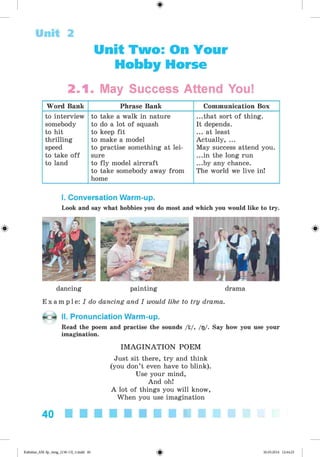
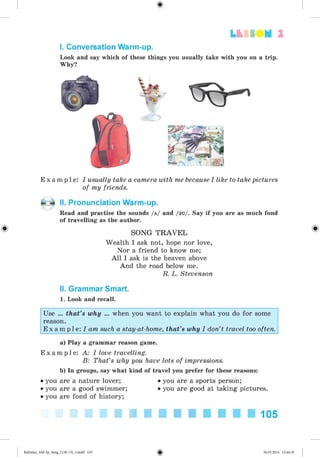
I. Conversation Warm-up.
Look and say what hobbies you do most and which you would like to try.
dancing painting drama
E x a m p l e : I do dancing and I would like to try drama.
II. Pronunciation Warm-up.
Read the poem and practise the sounds /i/, /g/. Say how you use your
imagination.
IM AG INATIO N POEM
Just sit there, try and think
(you don’t even have to blink).
Use your mind,
And oh!
A lot of things you will know,
When you use imagination
40
Kalinina_AM-Sp_6eng_(138-13)_v.indd 40 30.05.2014 12:44:25
<
§
>
Lt f SOM 1
You’ll enjoy each new creation,
Try it once, and you’ll agree
The world can offer much to see.
III. Grammar Smart.
1. Look and recall.
a) Use different adjectives if you want to describe your hobbies.
To sound positive, add:
wonder - wonderful
fame - famous
love - lovely
add -able/-ing/-ive to the verbs:
E x a m p l e : to enjoy - enjoyable
to relax - relaxing
to impress - impressive
b) To sound negative, add -less to the nouns:
E x a m p l e : use - useless
fruit - fruitless
#
a) Play a grammar word-formation game. Use the nouns from the box
below.
E x a m p l e : Ann: beauty
Steve: beautiful
beauty to enjoy love wonder
to excite cheer use to interest
colour to relax danger
b) Ask your friends:
1. What hobby is interesting to practise;
2. What she/he finds enjoyable;
3. What hobbies can be dangerous or useless;
4. Who has an impressive hobby.
2. Read and remember!
a) Use as + adjective + as if you want to say that two hobbies have
the same quality.
E x a m p l e : Dancing is as exciting as drama.
b) Use not as + adjective + as if you want to describe a difference.
E x a m p l e : Dancing isn’t as exciting as drama.
c) Use not nearly as + adjective + as if you want to stress a big dif­
ference.
41
Kalinina_AM-Sp_6eng_(138-13)_v.indd 41 30.05.2014 12:44:25
<
§
>
Unit 2
E x a m p l e : Dancing isn’t nearly as exciting as drama. (= Drama is
much more exciting.)
d) Use almost as + adjective + as if you want to stress a small dif­
ference.
E x a m p l e : Dancing is almost as exciting as drama.
#
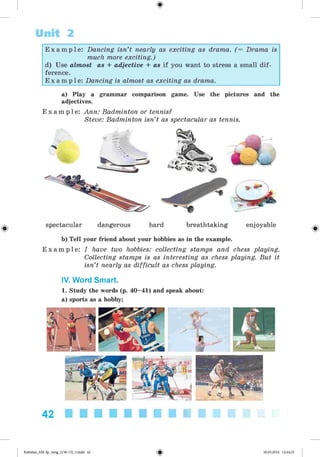
a) Play a grammar comparison game. Use the pictures and the
adjectives.
E x a m p l e : Ann: Badminton or tennis?
Steve: Badminton isn’t as spectacular as tennis.
spectacular dangerous hard breathtaking enjoyable
b) Tell your friend about your hobbies as in the example.
E x a m p l e : I have two hobbies: collecting stamps and chess playing.
Collecting stamps is as interesting as chess playing. But it
isn’t nearly as difficult as chess playing.
IV. Word Smart.
1. Study the words (p. 40-41) and speak about:
a) sports as a hobby;
42
Kalinina_AM-Sp_6eng_(138-13)_v.indd 42 30.05.2014 12:44:25
<
§
>
Lt f SOM 1
football cycling volleyball jogging basketball
swimming tennis skating badminton skiing
E x a m p l e : Many people do sports as a hobby. I like to play football
and go cycling.
b) crafts as a hobby;
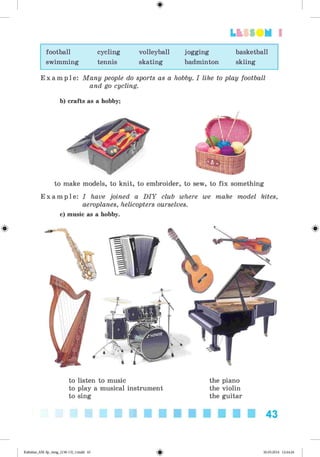
to make models, to knit, to embroider, to sew, to fix something
E x a m p l e : I have joined a D IY club where we make model kites,
aeroplanes, helicopters ourselves.
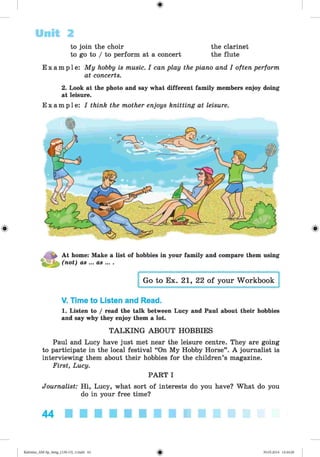
c) music as a hobby.
#
to listen to music
to play a musical instrument
to sing
the piano
the violin
the guitar
43
Kalinina_AM-Sp_6eng_(138-13)_v.indd 43 30.05.2014 12:44:26
the clarinet
the flute
to join the choir
to go to / to perform at a concert
E x a m p l e : My hobby is music. I can play the piano and I often perform
at concerts.
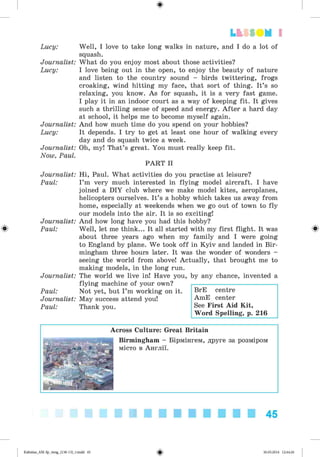
2. Look at the photo and say what different family members enjoy doing
at leisure.
Exam ple : I think the mother enjoys knitting at leisure.
Unit 2
At home: Make a list of hobbies in your family and compare them using
(not) as ... as ... .
Go to Ex. 21, 22 of your Workbook
V. Time to Listen and Read.
1. Listen to / read the talk between Lucy and Paul about their hobbies
and say why they enjoy them a lot.
TALKING ABOUT HOBBIES
Paul and Lucy have just met near the leisure centre. They are going
to participate in the local festival “On My Hobby Horse”. A journalist is
interviewing them about their hobbies for the children’s magazine.
First, Lucy.
PART I
Journalist: Hi, Lucy, what sort of interests do you have? What do you
do in your free time?
44
Kalinina_AM-Sp_6eng_(138-13)_v.indd 44 30.05.2014 12:44:26
ф
ф
Lucy:
Journalist:
Lucy:
Journalist:
Lucy:
Journalist:
Now, Paul.
Journalist:
Paul:
Journalist:
Paul:
Journalist:
Paul:
Journalist:
Paul:
Well, I love to take long walks in nature, and I do a lot of
squash.
What do you enjoy most about those activities?
I love being out in the open, to enjoy the beauty of nature
and listen to the country sound - birds twittering, frogs
croaking, wind hitting my face, that sort of thing. It’s so
relaxing, you know. As for squash, it is a very fast game.
I play it in an indoor court as a way of keeping fit. It gives
such a thrilling sense of speed and energy. A fter a hard day
at school, it helps me to become myself again.
And how much time do you spend on your hobbies?
It depends. I try to get at least one hour of walking every
day and do squash twice a week.
Oh, my! That’s great. You must really keep fit.
PART II
Hi, Paul. What activities do you practise at leisure?
I ’m very much interested in flying model aircraft. I have
joined a DIY club where we make model kites, aeroplanes,
helicopters ourselves. It’s a hobby which takes us away from
home, especially at weekends when we go out of town to fly
our models into the air. It is so exciting!
And how long have you had this hobby?
Well, let me think... It all started with my first flight. It was
about three years ago when my family and I were going
to England by plane. We took off in Kyiv and landed in Bir­
mingham three hours later. It was the wonder of wonders -
seeing the world from above! Actually, that brought me to
making models, in the long run.
The world we live in! Have you, by any chance, invented a
flying machine of your own?
Not yet, but I ’m working on it.
May success attend you!
Thank you.
Lt f SOM 1
BrE centre
AmE center
See First Aid Kit,
Word Spelling, p. 216
Ф
Across Culture: Great Britain
Birmingham - Бірмінгем, друге за розміром
місто в Англії.
45
Ф
Kalinina_AM-Sp_6eng_(138-13)_v.indd 45 30.05.2014 12:44:26
#
2. Answer the questions.
1. What do the children do in their free time?
2. Why do they enjoy their leisure activities?
3. How much time do they spend on their hobbies?
4. Who has a more exciting hobby?
5. Have you ever tried to practise any of the children’s hobbies?
3. Complete the sentences about the children’s hobbies and compare
them to yours.
E x a m p l e : Lucy loves ... . ^ Lucy loves being out in the open. Me too.
1. Lucy tries to get ... .
2. After a hard day at school, ... .
3. Paul is very much interested in ... .
4. It’s a hobby which ... .
5. Actually, ... .
VI. Time to Communicate.
a) In pairs, talk about your hobbies, using the pattern:
Pattern:
A: Hi, ... , what sort of interests do you have? What ... in your free time?
B: Well, I have to ...and I do ... .
A: What do you enjoy most about ...?
B: ... . It’s so ... , you know. It gives ... .
A: And how long do you spend on ... ?
B: It depends. I try ... , at least.
A: Oh my, that’s great! You must really ... .
B: Sure. I .. .
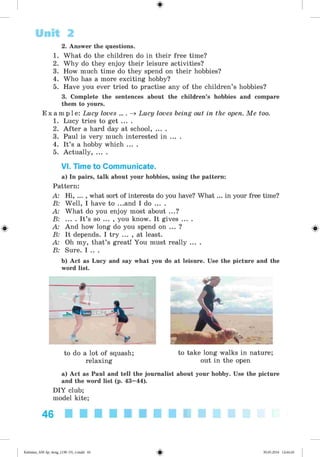
b) Act as Lucy and say what you do at leisure. Use the picture and the
word list.
Unit 2
to do a lot of squash;
relaxing
to take long walks in nature;
out in the open
a) Act as Paul and tell the journalist about your hobby. Use the picture
and the word list (p. 43—
44).
DIY club;
model kite;
46
#
Kalinina_AM-Sp_6eng_(138-13)_v.indd 46 30.05.2014 12:44:26
2
to fly;
to take somebody away from home.
VII. Time to Listen.
Listen to the story about Ally’s hobby and say what she disliked about
her new role and why.
VIII. Time to Write.
Write about your hobby. Begin with:
I have a head for...
I love ...
It is so ...
As for ..., it’s a hobby which ...
It all started with ...
I have joined ...
Actually, ...
It gives such a ...
It helps me ...
I try to ...
Go to Ex. 23, 24 of your Workbook
2.2. Necessity or Obsession?
Word Bank Phrase Bank Communication Box
stickers
packet
to trade
to exchange
creative
knitting
sewing
solution
regularly
to complete the set
to look through
to fit together
to be a part of one’s life
twice a week
to feel good
...hours on end.
I am proud to say...
...in a word.
I. Conversation Warm-up.
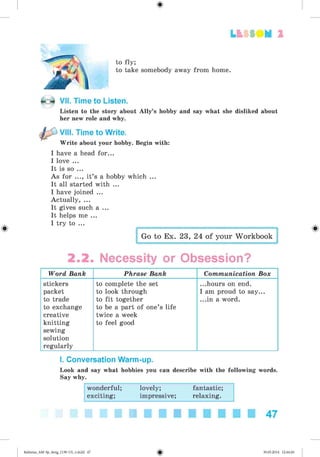
Look and say what hobbies you can describe with the following words.
Say why.
wonderful; lovely; fantastic;
exciting; impressive; relaxing.
47
Kalinina_AM-Sp_6eng_(138-13)_v.indd 47 30.05.2014 12:44:26
<
§
>
Unit 2
II. Pronunciation Warm-up.
1. Read the poem and practise the sounds /a/, /u/.
THE OPTIMISTIC POEM
When I was five,
I looked at the sky.
When I was seven,
I dreamt about heaven.
When I was nine,
I wanted to fly.
When I grow up soon,
I’ll design a spaceship
And fly to the moon.
2. Say if your hobbies are the same or different.
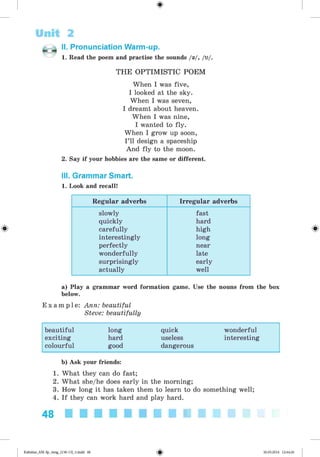
III. Grammar Smart.
1. Look and recall!
Regular adverbs Irregular adverbs
slowly fast
quickly hard
carefully high
interestingly long
perfectly near
wonderfully late
surprisingly early
actually well
a) Play a grammar word formation game. Use the nouns from the box
below.
E x a m p l e : Ann: beautiful
Steve: beautifully
beautiful long quick wonderful
exciting hard useless interesting
colourful good dangerous
b) Ask your friends:
1. What they can do fast;
2. What she/he does early in the morning;
3. How long it has taken them to learn to do something well;
4. If they can work hard and play hard.
48 ■ ■ ■ ■ ■ ■ ■ ■ ■ ■
*
Kalinina_AM-Sp_6eng_(138-13)_v.indd 48 30.05.2014 12:44:26
2. Read and remember!
2
1) Use more + adverb (+ than) to compare two actions.
E x a m p l e : I can ride a bike more skillfully than my friend.
2) Use (the) most + adverb to compare three or more actions.
E x a m p l e : Steve played best in today’s football match.
3) Do not use more / the most with irregular adverbs - just add
-er / - est:
early - earlier - (the) earliest
fast - faster - (the) fastest
hard - harder - (the) hardest
E x a m p l e : Ann ran the fastest in the race.
4) Use (no) as + adverb + as to compare two actions.
E x a m p l e : I can play the piano as fluently as my sister.
Don’t forget!
well - better - (the) best
badly - worst - (the) worst
far - farther / further - (the) farthest / furthest
a) Play a grammar tennis game.
E x a m p l e : A: Early.
B: Earlier.
A: (The) earliest.
B: Badly.
A ...
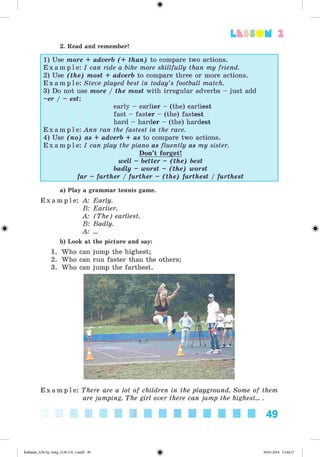
b) Look at the picture and say:
1. Who can jump the highest;
2. Who can run faster than the others;
3. Who can jump the farthest.
E x a m p l e : There are a lot of children in the playground. Some of them
are jumping. The girl over there can jump the highest... .
49
Kalinina_AM-Sp_6eng_(138-13)_v.indd 49 30.05.2014 12:44:27
Unit 2
IV. Word Smart.
c s c d
o t o o
l a i l
l m n l
e p s l
c s s
t
sti­
ckers
i s m
n p h o
g h e d
o l e
t l l
o s c
s a
r
s
crosswords
s p
p u
o z
r z
t l
s doing e
s
d d
a r
n a
c m
i a
n
g
aeroplanes m m
m k c u u
a i r s g s
k t e i a i
i e a c m c
n s t e a
g i s l
n
h g s i
m e
l
i
t n
o o s
d c r t
e o i r
l
p
t e u
s e s m
r e
s n
t
s
spaceships pictures playing
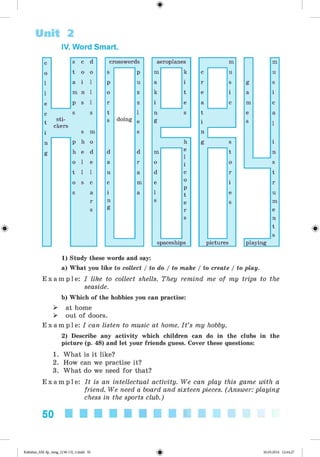
1) Study these words and say:
a) What you like to collect / to do / to make / to create / to play.
E x a m p l e : I like to collect shells. They remind me of my trips to the
seaside.
b) Which of the hobbies you can practise:
> at home
> out of doors.
E x a m p l e : I can listen to music at home. I t ’s my hobby.
2) Describe any activity which children can do in the clubs in the
picture (p. 48) and let your friends guess. Cover these questions:
1. What is it like?
2. How can we practise it?
3. What do we need for that?
E x a m p l e : It is an intellectual activity. We can play this game with a
friend. We need a board and sixteen pieces. (Answer: playing
chess in the sports club.)
50
Kalinina_AM-Sp_6eng_(138-13)_v.indd 50 30.05.2014 12:44:27
<
§
>
#
LESS UM 1
At home: Think and decide what interesting activities you can reco­
mmend your family members to take up. Fill in the chart below.
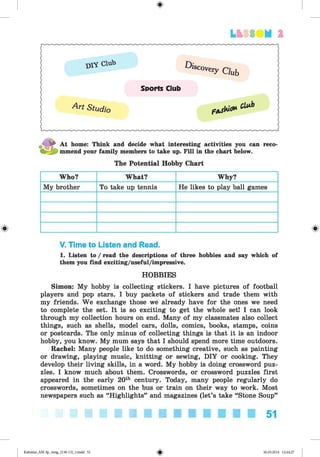
The Potential Hobby Chart
Who? What? Why?
My brother To take up tennis He likes to play ball games
V. Time to Listen and Read.
1. Listen to / read the descriptions of three hobbies and say which of
them you find exciting/useful/impressive.
HOBBIES
Simon: My hobby is collecting stickers. I have pictures of football
players and pop stars. I buy packets of stickers and trade them with
my friends. We exchange those we already have for the ones weneed
to complete the set. It is so exciting to get the whole set! I can look
through my collection hours on end. Many of my classmatesalso collect
things, such as shells, model cars, dolls, comics, books, stamps, coins
or postcards. The only minus of collecting things is that it is an indoor
hobby, you know. My mum says that I should spend more time outdoors.
Rachel: Many people like to do something creative, such as painting
or drawing, playing music, knitting or sewing, DIY or cooking. They
develop their living skills, in a word. My hobby is doing crossword puz­
zles. I know much about them. Crosswords, or crossword puzzles first
appeared in the early 20th century. Today, many people regularly do
crosswords, sometimes on the bus or train on their way to work. Most
newspapers such as “Highlights” and magazines (let’s take “Stone Soup”
■ ■ ■ ■ ■ ■ ■ ■ ■ ■ ■ 51
Kalinina_AM-Sp_6eng_(138-13)_v.indd 51 30.05.2014 12:44:27
ф
as an example”) have at least one crossword and there are often prizes
for people who send in the correct solutions. I am proud to say that
I have won such a prize from the children’s magazine.
Victoria: I have a lot of hobbies. I like to read, and I like to work
on computers. But I absolutely love sports. Many of my friends have a
sport as their hobby. They do football, basketball, volleyball and ten­
nis. I prefer badminton. It has been a part of my life since childhood.
I regularly go to a leisure centre. Twice a week we have practice for
about an hour and we have games every Sunday. After a game of bad­
minton I feel good. And I also have a lot of friends in the centre, so
I enjoy being with them. It is, you know, a great time with great memories.
Unit 2
Ф
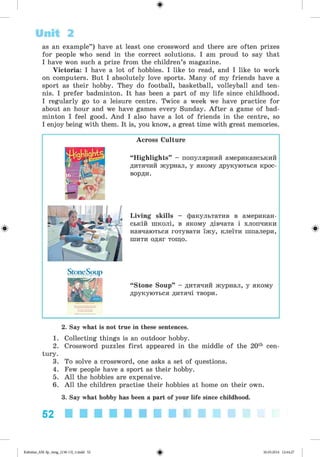
Across Culture
“Highlights” - популярний американський
дитячий журнал, у якому друкуються крос­
ворди.
Living skills - факультатив в американ­
ській школі, в якому дівчата і хлопчики
навчаються готувати їжу, клеїти шпалери,
шити одяг тощо.
“ Stone Soup” - дитячий журнал, у якому
друкуються дитячі твори.
ф
2. Say what is not true in these sentences.
1. Collecting things is an outdoor hobby.
2. Crossword puzzles first appeared in the middle of the 20th cen­
tury.
3. To solve a crossword, one asks a set of questions.
4. Few people have a sport as their hobby.
5. All the hobbies are expensive.
6. All the children practise their hobbies at home on their own.
3. Say what hobby has been a part of your life since childhood.
52 ■■■■■■■■■■
Ф
Kalinina_AM-Sp_6eng_(138-13)_v.indd 52 30.05.2014 12:44:27
2
VI. Time to communicate.
1. Act as Simon / Rachel / Victoria and describe some pluses and
minuses of your hobbies.
to collect stickers;
to trade something
with somebody;
to complete the set;
hours on end;
indoor hobby.
to have a sport as one’s
hobby;
to go to a leisure centre
to have practice;
to feel good;
to enjoy being with
friends.
to do something creative;
to do crossword puzzles;
to answer a set of clues;
across and down;
to find the right answer.
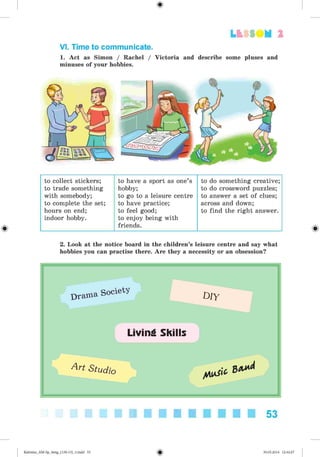
2. Look at the notice board in the children’s leisure centre and say what
hobbies you can practise there. Are they a necessity or an obsession?
53
Kalinina_AM-Sp_6eng_(138-13)_v.indd 53 30.05.2014 12:44:27
<
§
>
3. In pairs, talk about the hobbies which are a necessity or an obsession
with you, as in the pattern below.
Pattern:
A. What is your hobby horse?
B. I love drama.
A. Is it a necessity or an obsession with you?
B. ...
A. What do you find useful about it?
B. ...
A. How long do you spend on it?
B. ...
VII. Time to Write
Write a letter to the editor of the magazine “Stone Soup” about a hobby
which is a necessity/an obsession with you. Follow the format below.
Unit 2
#
Date:
To:
Subject:_____________
Dear Editor,
Many people like to...
I have a lot of ...
The only minus of ...
Yours sincerely,
54
Go to Ex. 27, 28 of your Workbook
Kalinina_AM-Sp_6eng_(138-13)_v.indd 54 30.05.2014 12:44:27
<
§
>
LtfSO M 3
2.3. In Season and Out of Season
Word Bank Phrase Bank Communication Box
to daydream
lovingly
a saddle
stubborn
to gallop
half-way
to outgrow some­
body
to ride a horse
to milk a cow
to grow into something
to be the right size
a love-hate relationship
to love somebody dearly
to make a (no) difference
However...
Other times.
#
I. Conversation Warm-up.
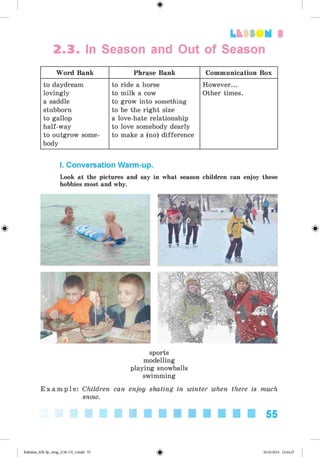
Look at the pictures and say in what season children can enjoy these
hobbies most and why.
sports
modelling
playing snowballs
swimming
E x a m p l e : Children can enjoy skating in winter when there is much
snow.
55
Kalinina_AM-Sp_6eng_(138-13)_v.indd 55 30.05.2014 12:44:27
<
§
>
Unit 2
II. Pronunciation Warm-up.
Read the poem and practise the sound /a/. Say what else can be a game
for everyone.
THE JUM PING ROPE POEM
Jumping rope is lots of fun;
It’s a game for everyone.
Take a rope and let’s begin:
You can turn and I run in.
Now I’ll turn and you can jump.
Never mind and spin or bump.
I can jump like this all day;
I can jump and I can play.
III. Grammar Smart.
1. Look and recall.
#
Use the linking words ... so ... , ... and ... , ... but ... to combine two
simple sentences into one complex sentence.
E x a m p l e : I am fond of volleyball so I often play it on the beach in
summer.
I am fond of volleyball and I play it with my friends.
I am fond of volleyball but I can’t play it in winter.
a) Play a grammar completion game. Use so / and / but.
E x a m p l e : Ann: I have a lot of hobbies.
Steve: Ann has a lot of hobbies and she practises them at the
leisure centre.
Oksana: Ann has a lot of hobbies but she absolutely loves
sports.
Peter: Ann has a lot of hobbies so she has a great time with
great memories.
b) In groups, say as many sentences as you can about your hobbies:
1) When and where can you practise them?
2) When and where can’t you practise them?
2. Read and remember!
56
Kalinina_AM-Sp_6eng_(138-13)_v.indd 56 30.05.2014 12:44:28
<
§
>
3
Use the Present Continuous:
am / is / are + doing
1) If you want to talk about actions that are happening while you are
speaking:
E x a m p l e : Look, Ann is riding a pony!
2) if you want to talk about actions happening around the time of
speaking:
E x a m p l e : I ’m learning to play the guitar this year.
3) if you want to talk about things that are changing:
E x a m p l e : More children are choosing computer games as a hobby
these days.
4) If you want to describe what is happening in the pictures and pho­
tos:
E x a m p l e : In this photo, the children are playing chess.
Use the Past Continuous:
was / were + doing
1) if you want to talk about actions happening at or around a time in
the past:
E x a m p l e : I was collecting stickers at that time so I needed to complete
the set.
2) if you want to talk about two actions happening at the same time:
E x a m p l e : While Nick was playing his basketball match, I was acting
as a cheerleader.
a) Play a grammar contrast game. Use the Present and Past Continuous.
E x a m p l e : Ann: I ’m learning to play tennis this year.
Steve: I was learning to play tennis from September to May
last year. Now I ’m learning to swim ...
b) Look around the classroom and say:
1. What some of your classmates are doing;
2. What they were doing a few minutes ago.
E x a m p l e : My deskmate is waving her hand. She was writing a few
minutes ago.
IV. Word Smart.
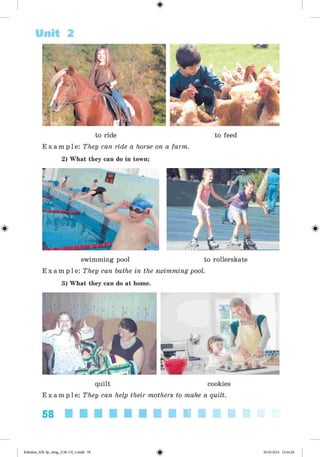
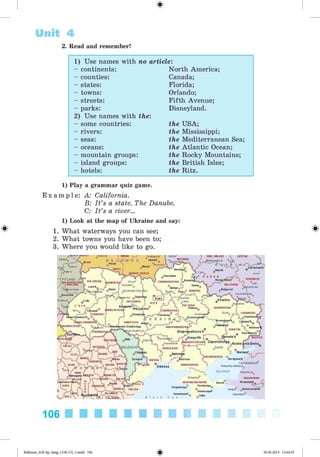
1. Miss Joy knows much about hobbies around the world. Now she
answers our questions about hobbies American children can practise in
different seasons and places.
Study the words (p. 55) and say:
1) What they can do on a farm;
57
Kalinina_AM-Sp_6eng_(138-13)_v.indd 57 30.05.2014 12:44:28
<
§
>
Unit 2
to ride to feed
E x a m p l e : They can ride a horse on a farm.
2) What they can do in town;
swimming pool to rollerskate
E x a m p l e : They can bathe in the swimming pool.
3) What they can do at home.
quilt cookies
E x a m p l e : They can help their mothers to make a quilt.
58
Kalinina_AM-Sp_6eng_(138-13)_v.indd 58 30.05.2014 12:44:28
<
§
>
#
LfcSSI
I
M 3
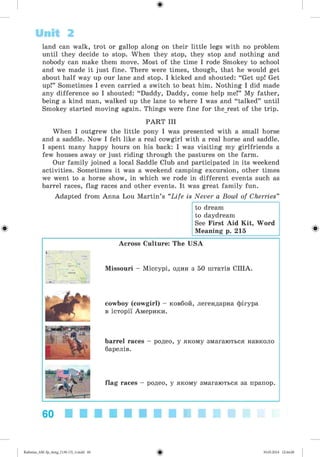
2. Complete Miss Joy’s story and retell it to the children:
American children who live ... enjoy ... in the open. Some like to ... ,
other prefer ... . In town kids can go ... or ... . They also have ... at
home. It’s a real ... to ... a quilt with ... or to help ... to bake .... They
... all the year round.
At home: Write what hobbies you can practise in different seasons and
places. Follow the plan below.
PLAN
In summer ...
In winter ...
...in town.
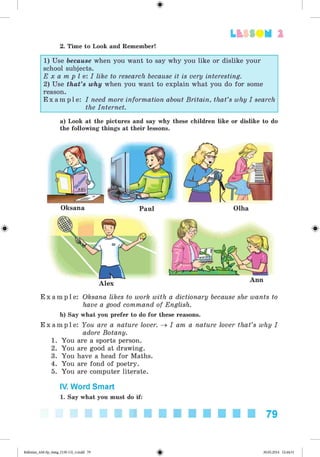
...at home.
... on a farm.
V. Time to Listen and Read.
1. Listen to / read the story about the hobby of an American girl and say:
1) why the girl wanted to go west;
2) what problems she had with Smokey;
3) what the great family fun was.
HORSES - MY HOBBY
PART I
... Some of my earliest childhood memories are connected with horses.
Growing up on a farm in North Central Missouri gave me the opportu­
nity to be around horses much of the time. Horses were my favourite
of all the farm animals. I daydreamed of leaving out west as a cowboy
where I could ride around all day on my horse.
As a very young child, almost as soon as I could sit up, my father
placed me on our old gentle grey horse and led her around the farm. As
I got older he let me ride her alone while he was milking the cows. For
me, it was just fun to ride any place she wanted to go.
I was so proud when a new foal was born and my father said that it
could be mine. I lovingly watched if grow into a beautiful young horse.
However, it was not a horse for riding. He was from working horse
stock, so he grew up to be too large an animal for a little girl to ride.
PART II
About a year later my parents bought me Smokey, a Shetland pony.
He was a beautiful little black pony with a white blaze down his face.
He was the right size for a seven-year-old girl.
I had a love-hate relationship with Smokey. Most of the time I loved
him dearly, but he was a Shetland pony and they are stubborn. A Shet-
59
Kalinina_AM-Sp_6eng_(138-13)_v.indd 59 30.05.2014 12:44:28
<
§
>
Unit 2
land can walk, trot or gallop along on their little legs with no problem
until they decide to stop. When they stop, they stop and nothing and
nobody can make them move. Most of the time I rode Smokey to school
and we made it just fine. There were times, though, that he would get
about half way up our lane and stop. I kicked and shouted: “Get up! Get
up!” Sometimes I even carried a switch to beat him. Nothing I did made
any difference so I shouted: “Daddy, Daddy, come help me!” My father,
being a kind man, walked up the lane to where I was and “talked” until
Smokey started moving again. Things were fine for therest of the trip.
PART III
When I outgrew the little pony I was presented with a small horse
and a saddle. Now I felt like a real cowgirl with a real horse and saddle.
I spent many happy hours on his back: I was visiting my girlfriends a
few houses away or just riding through the pastures on the farm.
Our family joined a local Saddle Club and participated in its weekend
activities. Sometimes it was a weekend camping excursion, other times
we went to a horse show, in which we rode in different events such as
barrel races, flag races and other events. It was great family fun.
Adapted from Anna Lou Martin’s “Life is Never a Bowl of Cherries”
to dream
to daydream
See First Aid Kit, Word
Meaning p. 215
Across Culture: The USA
Missouri - Міссурі, один з 50 штатів США.
cowboy (cowgirl) - ковбой, легендарна фігура
в історії Америки.
barrel races - родео, у якому змагаються навколо
барелів.
flag races - родео, у якому змагаються за прапор.
60
Kalinina_AM-Sp_6eng_(138-13)_v.indd 60 30.05.2014 12:44:28
1. Say if it is true or false.
1. The girl knows much about horses.
2. She learned to ride when she was a very young child.
3. Smokey wasn’t a horse for riding.
4. The Shetland pony always listened to the girl.
5. Anna felt like a real cowgirl when she was riding,
6. The girl took part in a horse show.
2. Say how the following characterizes the girl and her hobby.
E x a m p l e : The girl daydreamt of leaving out west as a cowgirl where
she could ride around all day on her horse.
to daydream of something; to have a love-hate relationship with some­
body;
to feel like a real cowgirl; to spend many happy hours.
VI. Time to Communicate.
1. Look and tell Anna’s story.
When I was seven I daydreamt of ... .
One summer my parents bought me ... .
It was ... .
I had a ... relationship.
Most of the time ... .
But my Shetland was ... .
There were time ... .
So I ... .
My father always ... .
2. In pairs, discuss the girl’s hobby as in the pattern.
Pattern:
A: What do you think of ... ?
B: It’s amazing! She was a very young child when ... .
A: She felt like ... . She spent many happy hours ... .
61
#
Kalinina_AM-Sp_6eng_(138-13)_v.indd 61 30.05.2014 12:44:29
<
§
>
B: No wonder she participated in ... .
A: I was moved to tears when I was reading about ... .
B: Me, too. I was especially impressed by ... .
A: Her father ... .
B: Right. It was great family fun.
3. Describe some of your earliest childhood memories connected with
your hobby.
VII. Time to Write.
Write about something you have ever daydreamt of.
Go to Ex. 31, 32 of your Workbook
Unit 2
2.4. Let’s Agree to Differ
Word Bank Phrase Bank Communication Box:
drama
science fiction
programme
chat show
fantasy film
soap opera
analytical pro­
gramme
to see all the programmes
running
to be a couch potato
(not) to drag smb away
from the screen
to be hypnotized by some­
thing
to enjoy every bit of it
There’s nothing like ...
for ... .
I like to ... the best.
In contrast to you, I ... .
I’m all f o r ......
I differ.
To each his own.
Let’s agree to differ.
Tastes differ.
I. Conversation Warm-up.
Read what people say about TV as a leisure activity. Guess who said
these words and why. Say who you agree with.
1. It’s a passive activity.---------------------- >
• Mum
2. It stops kids doing their homework. Dad
3. It has a great educational value. Friend
4. It enriches knowledge. Teacher
5. It ruins the eyes. Doctor
6. Not all programmes are good. TV presenter
E x a m p l e : My mum says it’s a passive activity. She advises me to spend
more time out in the open. But I like to watch children’s
programmes, especially cartoons.
62 ■■■■■■■■■■
*
Kalinina_AM-Sp_6eng_(138-13)_v.indd 62 30.05.2014 12:44:29
<
§
>
Lt f SOM 4
II. Pronunciation Warm-up.
Read the poem and practise the sounds /i:/ and /o:/. Say how much it
can be about you.
#
TV POEM
...In almost every house we’ve been,
W e’ve watched kids gaping at the screen.
They loll and slop and lounge about,
And stare until their eyes pop out.
(Last week in someone’s place we saw
a dozen eyeballs on the floor).
They sit and stare, and stare and sit
Until they’re hypnotized by it.
III. Function Smart.
Read and learn how to express differences in tastes. Look at the
pictures and fill in the mini-dialogues.
a) - There’s nothing like playing
... !
- Really? I prefer ... .
- Okay, okay. Let’s agree to
differ.
b) - I like to collect ... the best.
It’s so informative.
- In contrast with you, I collect
- To each his own.
c) - I prefer ... to ... .
- Tastes differ. I’m all for ... .
Football Hockey
Stamps Coins
d) - I’m keen on ... . And you?
- I differ. I ’m interested in ... .
Sewing Knitting
Doing puzzles
63
Kalinina_AM-Sp_6eng_(138-13)_v.indd 63 30.05.2014 12:44:29
<
§
>
Unit 2
IV. Word Smart
news report
weather report
sports report
quiz show
chat show
game show
music show
comedy show
comedy drama
historical drama
medical drama
drama series
wildlife programme
science fiction programme
analytical programme
#
documentary film
phantasy film
horror film
soap opera
cartoon
video film
to see all the programmes running;
to be a couch potato;
(not) to drag somebody away from the
screen;
to be hypnotized by something;
to enjoy every bit of it;
to be to somebody’s taste.
1. Study these words and word-combinations and say:
a) what is your favourite:
- TV report;
- TV show;
- TV drama or programme.
b) what kind of TV viewer you are.
64
Kalinina_AM-Sp_6eng_(138-13)_v.indd 64 30.05.2014 12:44:29
<
§
>
LESS UM A
BrE programme
AmE program
2. Say:
a) what your TV plans are for:
tonight;
tomorrow afternoon;
Sunday morning.
b) what you will watch on TV if:
you have free time;
you are in a good mood;
the weather is bad.
At home: Ask your family members about their favourute TV
programmes and compare their tastes with yours. Fill in the chart
below.
Family
Members
TV tastes Same with your TV
tastes?
Different from your
TVtastes?
Dad sports reports Yes!
V. Time to Listen and Read
1. Listen to / read the description of different TV programmes in a TV
magazine and say which of them are to these people’s tastes: a five-year-
old child; a sportsperson; a teenager; a housewife.
WE CAN PLEASE EVERYONE!
Are you tired of switching from channel to channel? Looking for
sometimes special? Wishing to see a programme to your taste? Then,
here is what you need to know before you become a couch potato:
A soap opera is the most popular form of television programmes in
the world today. It is a story about the lives of ordinary people who live
in the same street or town. It is on TV three times or more each week.
It comes in half-hour episodes. We call them soap operas (or soaps) be­
cause in the US they were first paid for by companies who made soap.
Televiewers are glued to the screen because they can feel real worries
and hopes of real people. This week you get a chance to enjoy the BBC’s
EastEnders.
■ ■ ■ ■ ■ ■ ■ ■ ■ ■ ■ 65
Kalinina_AM-Sp_6eng_(138-13)_v.indd 65 30.05.2014 12:44:29
ф
An animated cartoon is a film made by photographing a series of
pictures, clay models, etc. It can be short or long. It was W alt Disney
who made the first long cartoon film - “Snow White and the Seven
Dwarfs” . It’s a traditional children’s story about a beautiful princess
and seven very small people who saved her life in a forest. You’ll be
hypnotized by Dopey, Doc, Sneezy, Bashful, Sleepy, Grumpy and Happy
on Saturday afternoon.
An American musical is a unique form of a TV music programme.
It combines song, dance, comedy and drama. Among the most success­
ful musicals ever written is CATS by Andrew Lloyd Webber. It has been
seen by millions of people. Don’t miss your TV chance on Friday evening.
We are sure that no daily routine will drag you away from the screen.
We wish you to enjoy every bit of it.
A video workout is a series of fitness programmes on TV produced
by stars, such as Jane Fonda and Cindy Crawford which you can watch
and take part in at home. Do your parents complain about you being a
couch potato? Then jump at the opportunity to spend time watching tel­
evision usefully for your health. Do join us in the “fitness craze” every
morning!
Unit 2
Ф
Across Culture: Great Britain, the USA
The BBC - одна з провідних радіо- і телевізійних
організацій у Великій Британії.
EastEnders - популярний британський телесеріал
про соціальні проблеми робітничого району Лон­
дона.
Jane Fonda - американська акторка, авторка
відеопрограм фізичних вправ.
Ф
1) Answer the questions.
1. What is special about a soap opera?
2. What was Walt Disney’s first long cartoon film?
3. What makes a good musical?
4. What TV programme is useful for your health?
5. What do you need to know NOT to become a couch potato?
66 ■■■■■■■■■■
<
s
>
Kalinina_AM-Sp_6eng_(138-13)_v.indd 66 30.05.2014 12:44:29
0
Lt f SOM 4
2) Say what TV programme could make you think these thoughts.
I can watch it
hours on end!
It’s just hyp
notizing!
No daily routine
will drag me away
from the screen.
Vl.Time to Communicate
a) Look at the pictures and describe the TV programmes in them.
b) In pairs, talk about your tastes in televiewing as in the pattern
below.
Pattern:
A. Are you a regular televiewer? ^
B. In fact, I am.
A. Are you a couch potato?
B. ...
A. What TV programmes are to your taste?
B. ...
A. What do you think of ...?
B. ...
c) In small groups, talk about your hobbies and express differences in
tastes. Use the structures:
1. There’s nothing like ... for me.
2. I like to ... the best.
3. I prefer ... to ... .
4. I’m also keen on ... .
5. In contrast to ... , I’m all for ... .
Vll.Time to Listen
Listen to the joke about passionate TV viewers and say what the
humour of the situation is.
67
0
Kalinina_AM-Sp_6eng_(138-13)_v.indd 67 30.05.2014 12:44:29
<
§
>
#
Unit 2
Comment on the proverb “One person’s meat is another person’s
poison” . Illustrate it with differences in tastes as to your friends’
hobbies. Begin with:
VIII. Time to Write
They say ...
To me it means that ...
I agree / disagree with ... because ... .
Let’s take ... as an example.
So, as you see, ... .
Go to Ex. 35, 36 of your Workbook
2.5. My Progress in English
I. Grammar Smart
Complete the story. Use am/is/are/was/were.
THE TALK OF TW O BROTHERS
- What ... (1) you doing, Jack?
- I ’ ... (2) watching the news.
- And what ... (3) you watching half an hour ago?
- I ... (4) watching a TV quiz show. And maybe you want to know
what I ... (5) going to do in another half-hour, Tom?
- Yes, Jack, what ... (6) you going to do?
- I ... (7) going to beat you if you don’t stop asking me silly ques­
tions.
Check if you can:
use tense forms correctly.
(Yes / No)
II. Word Smart
Fill in the right word.
1. Badminton isn’t as spectacular ... tennis.
2. Many people do sports as a ... .
3. I like to ... stamps.
4. I am learning to ... the guitar this year.
5. My friend is a real couch ... .
6. I hate ... operas.
Check if you can:
complete the sentences correctly.
(Yes / No)
68
Kalinina_AM-Sp_6eng_(138-13)_v.indd 68 30.05.2014 12:44:30
<
§
>
Lt f SOM 5
III. Function Smart
Match the lines about hobbies to the lines expressing differences in
tastes.
1. There’s nothing like playing
football.
2. I like to collect coins the best.
3. I prefer indoor hobbies to out­
door activities.
4. Is your brother keen on music?
5. Why don’t you take up tennis?
I love it!
6. What?! You mean collecting
things is useless?
a) I prefer to collect stamps.
b) Tastes differ.
c) Basketball is as exciting as
football.
d) Okay, okay, let’s agree to dif­
fer.
e) But I love playing outdoors.
f) I don’t think so. He is more
interested in films.
Check if you can:
express the differences correctly.
(Yes / No)
IV. Time to Read
Read a letter from the English boy Phil. Choose the right answers to the
questions.
Hooray! Summer has come. It means that my family and I will do
travelling again. Travelling is a hobby with all of us in the family. My
dad says that summer is no time for sitting in the rocking chair and do­
ing nothing for days on end.
Last year my parents bought a new 24-foot travel trailer. It’s our
home on wheels. It has all the conveniences of a modern home. There’s a
bathroom, a bedroom, a small kitchen complete with oven, refrigerator,
sink and cabinets, and a dining room. It’s big enough to live in comfort­
ably when on holiday.
It has been my cherished dream for a long time to be out in the
wilderness for several weeks, away from civilization. With our motor
home, we’ll get to Sherwood Forest, famous in old stories as the place
where Robin Hood’s Merry Men lived and fought against the Sheriff of
Nottingham. It used to be a very large forest, but only a small part of
it still remains. It is preserved as a country park near Nottingham. I’m
sure to feel like Robin Hood and have the time of my life.
1. What is Phil’s hobby?
a) driving; b) travelling; c) dreaming.
2. What did his parents buy last year?
a) a new house; b) a rocking chair; c) a new trailer.
69
Kalinina_AM-Sp_6eng_(138-13)_v.indd 69 30.05.2014 12:44:30
<
§
>
3. What do they NOT have in their home on wheels?
a) a bathroom; b) a garage; c) a kitchen.
4. What did the boy dream about?
a) to go away from civilization on holiday;
b) to stay at home on holiday;
c) to stay in a comfortable hotel on holiday.
5. What is NOT true about Robin Hood?
a) He lived in Sherwood Forest;
b) He was alone in the forest;
c) He fought against the Sheriff of Nottingham.
6. What is Sherwood Forest like these days?
a) a park;
b) a very large forest;
c) a residential area.
Check if you can:
read and understand simple texts
(Yes / No)
Unit 2
#
V. Time to Listen
Listen to Martha’s story about her hobby and mark the true statements.
1. Martha’s hobby is basketball.
2. She is tall enough to do well at basketball.
3. She is going to basketball camp.
4. She often supports her school team.
5. She wants to become a cheerleader.
6. The team spirit means a lot to Martha.
Check if you can:
listen to a piece of information and understand the de­
tails.
(Yes / No)
VI. Time to Write
Write a letter to Martha / Phil about your hobby.
Check if you can:
express your ideas about hobbies in writing.
(Yes / No)
70
Kalinina_AM-Sp_6eng_(138-13)_v.indd 70 30.05.2014 12:44:30
LU tt M 1
Unit Three: School Life
3.1. School Routine
Word Bank Phrase Bank Communication Box
punctual
well-planned
to manage
absent-minded
routine
assembly hall
to crib
to work hard on something
to waste time
to do everything in time
to plan ahead
to do something in the last
minute
to make a mess of something
to be late for something
to sign up for something
Normally...
Typical! Just typical...
That won’t do!
Don’t give up!
I. Conversation Warm-up
Look at the pictures and say what these places have to do with school
routine.
#
computer class language lab assembly hall canteen gym
E x a m p l e : School children can have lessons on different subjects at the
computer lab.
II. Pronunciation Warm-up
Read and practise the sounds /w/ and /3 :/. Say what you think about
the pupil’s time management.
71
Kalinina_AM-Sp_6eng_(138-13)_v.indd 71 30.05.2014 12:44:30
<
§
>
Unit 3
#
TIM E M A N A G E M E N T R H YM E
I work hard on Geography,
I work hard on Algebra,
I work hard on History
What a hard-working person I am.
Dan wastes time at the lesson,
Dan wastes time after school,
Dan wastes time in the evening.
What a lazy bones he is.
III. Grammar Smart
1. Look and recall.
1) to ask for permission use may;
May I come
in?
May I take
your pen?
2) to ask about necessity use must;
Must I write
this exersice
again?
Must I
run?
3) to ask about possibility use can.
Can you
write it in
English?
Can you
help me?
a) Play a grammar chain game and ask your friend for the permission.
E x a m p l e : A: May I take your book?
B: Yes, you may. May I close the book?
C: Yes, you may. May I ... ?
b) Complete the questions.
E x a m p l e : Must ... ^ Must I stay after classes?
1. Can you ...? 4. Must you ...?
2. Must I ...? 5. May we ...?
3. May I ...? 6. Can Dan ...?
72
Kalinina_AM-Sp_6eng_(138-13)_v.indd 72 30.05.2014 12:44:30
<
§
>
Lt f SOM 1
2. Look and remember!
1) To prohibit in a short answer use “ No, you mustn’t” .
E x a m p l e: - May I go out?
- No, you mustn’t.
2) To stress unnecessity of something in a short answer use “ No, you
needn’t” .
E x a m p l e: - Must I translate the text?
- No, you needn’t.
#
a) Answer the questions.
1. May you leave the classroom during the lesson?
2. Must you go to school on Sunday?
3. Must your little sister/brother play all days?
4. May you be late for classes?
5. May you sing during the lesson?
6. Must your neighbour at the desk talk during the lesson?
b) Put the questions to the answers given.
E x a m p l e : - Must I translate the word?
- No, you needn’t.
1. No, you mustn’t.
2. No, you needn’t.
3. No, they can’t.
4. No, he needn’t.
5. No, she mustn’t.
6. No, I mustn’t.
IV. Word Smart
1. Study these words and phrases and speak about:
a) well-planned school routine:
to work hard on something; to do everything in time;
well-planned; punctual;
to plan ahead; to manage;
to sign up for.
E x a m p l e : I work hard on all the subjects.
b) a badly-planned school routine:
to waste time; to do something in the last minute;
to make a mess of something; to be late for something;
absent-minded.
2. Paraphrase the sentences.
E x a m p l e : - I study in the sixth form. ^ I am a sixth former.
73
Kalinina_AM-Sp_6eng_(138-13)_v.indd 73 30.05.2014 12:44:30
<
§
>
#
Unit 3
1. Nick comes to school in time.
2. Ann plans her time beforehand.
3. Val joined a new sport society.
4. As a rule, we do a lot of things at school.
5. Children work much at the lessons.
6. My brother often forgets things.
At home: Describe your school routine and decide if it is well-planned.
Give your reasons.
Go to Ex. 37, 38 of your Workbook
V. Time to Listen and Read
1. Listen to / read in pairs and say what piece of advice Ann gave to
Steve and why.
TALKING ABOUT SCHOOL ROUTINE
Steve: Hey, Ann! How are you doing? I bet, you’ve done all the les­
sons. May I take your copybook?
Ann: No, you mustn’t. You can’t crib all the time. I was working
hard on all the subjects the whole evening yesterday. I managed
to do all my lessons orally and in writing.
Steve: How clever of you! You’ve always been a model girl, Ann.
Ann: Do you mean to say that you didn’t do any lessons? They are
not too difficult.
Steve: Frankly speaking, I did something in the last minute, but not
half enough.
Ann: Typical, just typical! You always waste your time. What a lazy
bones you are! Do everything in time.
Steve: It’s easier said than done. My friend gave me a CD with a new
film about Harry Potter. I couldn’t help admiring it! And then I
was watching the Simpsons on TV.
Ann: That won’t do! We had only four lessons yesterday and you had
enough time to get ready for the next school day. You are too
lazy, Steve. You don’t want to make a mess of your life, do
you?
Steven: Of course not. I ’ll be punctual and plan my day ahead next time.
Ann: That’s better! Try a little harder.
Steven: I ’ll try. I ’ll try. • half enough
• enough time
• too difficult
• too lazy
see First Aid K it:
Grammar, p. 212
74
Kalinina_AM-Sp_6eng_(138-13)_v.indd 74 30.05.2014 12:44:30
ф
Lfcf SOM 1
Across Culture
Harry Potter - головний герой роману
англійської письменниці J. Rowling, за яким
знято вісім фільмів.
The Simpsons - американська гумористична
телевізійна програма про родину Сімпсонів.
Ф
2. Complete the sentences with enough, too and words from the list.
E x a m p l e : I ’m too busy today.
1. The book isn’t ... for me.
2. Hurry up! You a r e ....... slowly.
3. Steve hasn’t ....... to finish his test.
4. We h a ve....... at every lesson.
5. Turn off the music, please. It i s .......
6. My sister is a top pupil. She i s .......
3. Read the sentences and say who said them and why. Reproduce the
situations from the text.
busy
time
loud
interesting
clever
going
work
E x a m p l e : “Try a little harder”. ^ Ann says it to Steve, because he is
too lazy.
1. It’s easier said than done.
2. You can’t crib all the time!
3. Typical, just typical!
4. I did something in the last minute, but not half enough.
5. I can’t help admiring it!
6. That won’t do.
VI. Time to Communicate
1. Act as Ann or Steve and describe
your school routine. Use:
to work hard on something; to crib;
to do the lessons orally and in writing
to do something at the last minute;
to get ready for the lessons;
to make a mess of one’s life.
Ф
75
Ф
Kalinina_AM-Sp_6eng_(138-13)_v.indd 75 30.05.2014 12:44:30
<
§
>
2. In pairs, discuss your school routine using the pattern below.
Pattern:
A: Hey, ... . I bet, ... . May I ... ?
B: No, you mustn’t. You can’t ... . I managed ... and ... .
A: How clever of you. You’ve been ... .
B: Do you mean ... ? They are not too ... .
A: Frankly speaking ... , but ... .
B: Typical, just typical. You always ... . Do ... ?
A: It’s easier said ... .
B: That won’t do! We ... . They ... .
A: I’ll try. And ... .
3. Look at the pictures and choose those suitable for the description of
your school routine. Say what exactly they represent.
Unit 3
VII. Time to Listen
1. Listen to the story and say how a method of logical decision helped
Sam.
2. Listen to the story again and mark true statements.
1. There was a night dance class on Monday.
2. All the children wanted to take part in a dance class.
3. Sam was afraid to step on the boy’s feet.
4. Sam asked her dad for help.
5. Her mother never danced when she was younger.
6. Sam’s mother started to teach Sam to dance.
76
Kalinina_AM-Sp_6eng_(138-13)_v.indd 76 30.05.2014 12:44:31
<
§
>
Lt f SOM 2
VIII. Time to Write
Write a letter to your international friend about your school routine
and answer his/her questions.
1.
2.
3.
4.
5.
When does your school start?
How many lessons do you have a day?
How do you do your lessons?
Have you got any problems with your lessons?
Who helps you to do your lessons if you don’t know something?
Go to Ex. 39, 40 of your Workbook
3.2. I Have a Head for...
Word Bank Phrase Bank Communication Box
native speakers
manuscript
stimulate
research
to download
report
good-naturedly
to have a good head for...
to have a good command of
something
to use something to advantage
to be computer literate
to broaden one’s horizons
to make magic
to search the Internet
Somehow or other... .
Vice versa.
I. Conversation Warm-up
Look at the photos and guess what these children’s favourite subjects
may be.
Andrew Helen
E x a m p l e : I think Boris likes PT lessons. You can often see him in the
gym.
77
Kalinina_AM-Sp_6eng_(138-13)_v.indd 77 30.05.2014 12:44:31
ф
Unit 3
II. Pronunciation Warm-up
Read and practise the sounds /g / and /a/. Say how much it is about
you.
Ф
THE NOTHING-DOINGS POEM
Meet the lazy Nothing-Doings,
All they do is stand around,
When it’s time for doing nothing,
Nothing-Doings can be found.
When it’s time for doing something,
You won’t find a single one,
For the Nothing-Doings vanish
When there’s work that must be done.
II. Grammar Smart
1. Look and recall!
Use the linking words so, and, but to combine two simple sentences into
one.
E x a m p l e : I like literature so I often read books.
I like literature and I often read books.
I like literature but I don’t like history.
a) Play a grammar competition game using linking words.
E x a m p l e : I have a head for computers and can design a website.
1. Ann wants to talk to native speakers ... .
2. Val is computer literate ... .
3. A rt classes broaden my artistic horizons ... .
4. Many pupils like Maths ... .
5. My elder brother is fond of sports ... .
6. Helen takes part in research.
b) Combine two simple sentences into one.
E x a m p l e : I adore Geography. I joined a geography club. ^
I adore Geography and I joined a geography club.
1. Paul is a member of our English-speaking club. I have a chance to
talk to native speakers.
2. I like my PT lessons. I take part in sport competitions.
3. Ann likes history. I like Biology.
4. Bill has a head for computers. He knows much about them.
5. I spend much time at the computer lab. I use it to advantage.
6. Our history teacher asked me to write a report. I searched the In­
ternet.
78
Ф
Kalinina_AM-Sp_6eng_(138-13)_v.indd 78 30.05.2014 12:44:31
Lt f SOM 2
2. Time to Look and Remember!
1) Use because when you want to say why you like or dislike your
school subjects.
E x a m p l e: I like to research because it is very interesting.
2) Use that's why when you want to explain what you do for some
reason.
E x a m p l e : I need more information about Britain, that's why I search
the Internet.
a) Look at the pictures and say why these children like or dislike to do
the following things at their lessons.
Oksana Paul Olha
Ann
E x a m p l e : Oksana likes to work with a dictionary because she wants to
have a good command of English.
b) Say what you prefer to do for these reasons.
E x a m p l e : You are a nature lover. ^ I am a nature lover that's why I
adore Botany.
1. You are a sports person.
2. You are good at drawing.
3. You have a head for Maths.
4. You are fond of poetry.
5. You are computer literate.
IV. Word Smart
1. Say what you must do if:
79
Kalinina_AM-Sp_6eng_(138-13)_v.indd 79 30.05.2014 12:44:31
<
§
>
E x a m p l e : You don’t understand ancient manuscripts. -»
I f I don’t understand ancient manuscripts, I must decipher
them.
1. You want to have more information about something.
2. You found the information in the Internet and want to have it.
3. You feel uneasy about your English.
4. You are an elementary computer user.
5. You know little about something.
6. You have a good head for Maths.
2. Match the verbs to the nouns and make up your own sentences with
them.
Unit 3
#
1. to research ■
— -
____ a) a club
2. to download — * b) a problem
3. to decipher c) the Internet
4. to join d) the information
5. to search e) a horizon
6. to broaden f) a manuscript
7. to type g) a message
E x a m p l e : I like to research the problems at my history lessons.
3. Answer the questions.
1. What do you have a good head for?
2. About what do you feel uneasy?
3. What do you use to advantage?
4. What broadens your language horizons?
5. What club do you want to join?
6. When do you search the Internet?
At home: Write what you like or dislike to do at different lessons.
V. Time to Listen and Read
1. Listen to / read what sixth formers of different countries say about
their favourite subjects and say who are you with.
My name is Sarah. It is the end of January in
Australia and I am back to Sydney school. The term
has just begun and I’m proud that I’m in the sixth
grade.
In my timetable there are so many subjects:
Australian history, Geography, Biology, ICT and
two foreign languages. I adore foreign languages
and I learn Spanish and French. I work hard on
them both. I want to have a good command of both
80
Kalinina_AM-Sp_6eng_(138-13)_v.indd 80 30.05.2014 12:44:31
ф
languages, especially French, because my grandmother lives in France.
I visited her last summer and had a chance to practise my French. Most of
all I liked how my new French friends taught me to speak good French:
they taught me what native speakers say in this or that situation, cor­
rected my mistakes good naturedly. It was a really fantastic experience!
I am Phil and I’m also in the sixth grade. I study
in Boston High School. Of all the school subjects
I like ICT the best. I am not an elementary computer
user. Vice versa, I’m computer literate and I know
how to design a web page, to make computer pro­
grammes and to send e-mails.
Our ICT teacher taught us how to search the In­
ternet and I found free websites where members can
communicate with several people in a chat room by
typing messages. Thus I became acquainted with
many children from different countries: we exchange information, dis­
cuss problems and even help each other.
All of us use the social network to our advantage. For example, my new
pal Jeremy is a Canadian. He is very good at Geography and he helped me
to write a report about his country. I downloaded my task and he sent me
the newest information. It’s cool to learn from each other.
I’m Boghdan and as many Ukrainian school chil­
dren I like to learn more about the history of my
country. They say I have a head for it. Somehow or
other, history is my favourite subject. Our teacher
makes magic at our lessons: we work with histori­
cal maps and even decipher ancient manuscripts, see
documentary films. All this broadens my historical
horizons and stimulates me for independent research.
I am trying to research the roots of our Cossackdom.
In summer our history club plans to go to Zaporizhzhya. Maybe I’ll find
support for my research. Who knows?
Across Culture
Sydney - найбільше місто в Австралії,
важливий культурний і фінансовий центр
країни.
Lt SSOM 2
Boston High School - середня школа в Бостоні,
США.
81
Ф
Kalinina_AM-Sp_6eng_(138-13)_v.indd 81 30.05.2014 12:44:31
<
§
>
Unit 3
2. Complete the sentences.
E x a m p l e : He lives in Britain, he is British.
1. Sarah is from Australia, she is ... .
2. My friend lives in Canada, he is ... .
3. Bob and Roy came from America, they
are ... .
4. I live in Kyiv, I’m ... .
5. Lora’s motherland is France, she is ... .
6. Miss Smith works in England, she is
3. Look at the pictures and say for what
children these things are important and why.
Australia - Australian
France - French
Canada - Canadian
America - American
Ukraine - Ukrainian
England - English
See First Aid Kit:
Grammar, p. 212
E x a m p l e : I think Phil likes to work on computer. ICT lessons are his
favourite.
VI. Time to Communicate
1. Act as one of the children and speak about your favourite subject.
Use:
to have a head for something; to learn from each other;
to use something to advantage; to broaden somebody’s horizon;
to make magic at a lesson; to stimulate for something.
2. In pairs, speak about your favourite subjects. Use the pattern.
Pattern:
A: I say ... . What ... ?
B: As for me ... . It ... .
A: I see. And what do you usually ... ?
B: Our teacher ... . We often ... . Sometimes ... .
A: It broadens ... and stimulates ... , doesn’t it?
B: Sure. I like ... most of all. And what about you?
A: They say I have a head for ... . I really adore ... .
B: What helps you ... ?
A: I ... and ... .
B: Great!
3. Look at the list of subjects (p. 80) and choose your favourite one.
Speak about it.
82
Kalinina_AM-Sp_6eng_(138-13)_v.indd 82 30.05.2014 12:44:32
<
§
>
3
Maths History ICT Biology PE
Foreign language Arts Literature Ukrainian
VII. Time to Write
Write about your most important/interesting/difficult subjects and
explain why it is so.
Go to Ex. 43, 44 of your Workbook
3.3. A Creative Mind
Word Bank Phrase Bank Communication Box
mother-tongue
fluently
imitate
transcribe
gifted
culture
to master a language
to improve pronunciation
to develop speaking skills
to role-play a dialogue
to be excited about something
to enlarge one’s vocabulary
English-speaking countries
Firstly, ...
Secondly, ...
# #
I. Conversation Warm-up
Look at the photos and say what the mother-tongue of the children is.
Which foreign language do you want to learn and why?
83
Kalinina_AM-Sp_6eng_(138-13)_v.indd 83 30.05.2014 12:44:32
<
§
>
E x a m p l e : In Spain people speak Spanish. I also want to learn Spanish
because I want to go to Spain to see the bull fight.
Spain - Spanish (the Spanish language)
France - French (the French language)
China - Chinese (the Chinese language)
See First Aid K it, Grammar, p. 212
Unit 3
II. Pronunciation Warm-up
Read and practise the sounds /w/ and /9/. Say what foreign languages
you learn at school.
LA N G U A G E C H A N T
- What is your mother tongue, Roy?
- It’s English.
- What is your mother tongue, Hans?
- It’s German.
- What foreign languages do you learn at school?
- French and Spanish, Chinese and Japanese.
- Oh, it’s really very cool!
& III. Grammar Smart &
1. Complete the mini-dialogues, giving negative answers.
E x a m p l e : A: May I take your dictionary?
B: No, you mustn’t. I need it myself.
A: May I work on the computer?
B: ... . We have other thing s to do.
A: Must I translate the sentence?
B: ... . Ann has already done it.
A: May I answer the question?
B: ... . Read it first.
A: Must I listen to the tape recorder?
B: ... . We did it yesterday.
A: May I switch on my computer?
B: ... . Work with your neighbour.
A: Must I water the flowers?
B: ... . Ann has already done it.
2. Match the beginnings and the endings using a correct linking word
(p. 82). Translate the sentences into Ukrainian.
84
Kalinina_AM-Sp_6eng_(138-13)_v.indd 84 30.05.2014 12:44:32
ф
3
ф
1. I adore English... a) ...I love animals.
2. Nick has a head for mathTTT -b) ...I joined our English-speak-
3. I look after hamsters at our ing club.
school zoo... c) ...she often goes to the Botanic
4. Val is a school champion... Gardens.
5. Nancy is a great nature lov- d) ...it is his mother-tongue.
er... e) ...he won the competition.
6. Jeremy speaks English well... f) ...he is the best at this subject.
E x a m p l e : I adore English, that’s why I joined our English-speaking
club. - Я обожнюю англійську мову, тому я приєдна-
лася(вся) до клубу англійської мови.
3. Read the story and fill in and, but, so, because, that’s why.
M Y ENG LISH LESSON
I have been learning English for five years and I like it a lot. It’s not
that easy ... but I work hard. I want to improve my pronunciation ...
I listen to different English texts every day. I speak English fluently
... I communicate with my friends at the lessons. We role-play the dia­
logues ... helps us to develop our speaking skills. Recently I’ve joined
our English-speaking club ... . I hope to learn more our about the Eng­
lish-speaking countries and their culture. Many pupils of our class
joined it ... Mr. Black came from the USA and teaches English. I learn
how to be creative.
IV. Word Smart
1. Find the explanation of the following words and phrases and make
up your own sentences with them.
1. Mother-tongue ч a) to have an ability to do something ex-
2. Gifted tremely well.
3. Culture b) an ability to do something well because
4. Skill  you have learned and practised it.
5. Pronunciation * c) the first and the main language that
6. Vocabulary you learnt when you were a child.
d) the way of life, art, customs and tradi-
tions that are accepted by people in a
particular country.
e) the way in which a particular word is
pronounced.
d) all the words that someone knows and
uses.
2. Look at the pictures and say what the children do at their English
lessons.
85
Ф
Kalinina_AM-Sp_6eng_(138-13)_v.indd 85 30.05.2014 12:44:32
<
§
>
Unit 3
computer lab language lab English Study
to listen to native to type texts; to role-play dialogues;
speakers; to enlarge vocabu- to develop speaking skills;
to imitate lary; to learn about the culture
to improve pronun- to do tests. of English-speaking coun-
ciation. tries.
#
3. Say what you must do:
1. to master the English language;
2. to improve pronunciation;
3. to develop speaking skills;
4. to enlarge your vocabulary;
5. to learn more about the culture of English-speaking countries.
At home: Write what you like/dislike about your English lessons.
Go to Ex. 45, 46 of your Workbook
V. Time to Read
1. Read the story “Discovery Class” and answer the following questions.
1. What was in the letter?
2. What was special about the teacher?
3. What did the children discover in Discovery Class?
DISCOVERY CLASS
The letter came the week after Sam’s birthday. It was from the
school and addressed to her parents.
“Very interesting,” said Sam’s mother as she read it.
“What’s very interesting?” asked Sam.
“It seems they have chosen you to take part in the new gifted pro­
gram” .
“Me?” said Sam.
She read the letter. It said that after careful testing, a small group
of children had been selected to participate in a program for the gifted
86
Kalinina_AM-Sp_6eng_(138-13)_v.indd 86 30.05.2014 12:44:32
<
§
>
3
called “Discover” . These children would meet twice a week with a spe­
cially trained teacher Sarah Hoople.
Miss Hoople was a small, smiling person. She wore large round glass­
es. But what Sam noticed most was that she was excited about things.
As she talked, her eyes sparkled and her hands moved.
“We only have an hour,” she told them, “so let’s get started.”
They started with a puzzle called “ Can You Find the Treasure?”
which had to do with an old man hiding a diamond ring in a half-ruined
house. They should use logic to find it. Everyone called out ideas.
After they found the treasure, they went on to a word game. Miss
Hoople called it “Reinventing Language” .
“Pretend you are a cave person,” she said. “And you are tired of
pointing to things. You want to communicate with people. So you step
out of your cave and look around. Up in the sky is a large bright object.
What would you call it?”
“Oog,” said Marshall right away.
“Good,” said Miss Hoople, writing it on the blackboard.
“Glee,” said Katy.
“Excellent,” said Miss Hoople. “Any more?” ...
“That was fun,” said Katy. “Can we do it again?” I like to be crea­
tive.
“Sure,” said Miss Hoople. “Maybe next time we’ll compile a cave dic-
0 tionary.” 0
That, thought Sam, would really be something.
Adapted from “Dear Mom, You’re Ruining My Life”
by Jean Van Leenwen
to choose - choice
to discover - discovery
to excite - excitement
to puzzle - puzzle
to communicate - communication
to select - selection
See First Aid K it: Word-building, p. 214
2. Fill in the right form of the word.
1. It was a really great discovery. to discover
2. I like to do this ... . to puzzle
3. I like ... with my friends in English. to communicate
4. All the children read the story with ... ! to excite
5. The teachers ... Sam for the new programme. to select
6. Sam’s parents were proud of the teachers’ ... . to choose
87
Kalinina_AM-Sp_6eng_(138-13)_v.indd 87 30.05.2014 12:44:32
<
§
>
VI. Time to Communicate
1. Imagine you are Sam. Tell your friends/parents about your Discovery
Class. Begin with:
1. Miss Hoople is ... .
2. She wears ... .
3. She is so excited ... .
4. We started with ... .
5. Everyone called ... .
6. After that ... .
7. We invited ... .
8. It was fun to ... .
9. We call out ideas and ... .
10. Maybe next time ... .
2. In pairs, speak about your English lessons. Use the pattern.
Pattern:
A: I say ... , English is ... , isn’t it?
B: Right. I like English, because ... .
A: What do you do ... ?
B: Firstly, ... ,secondly, ... .And what about you? ... ?
A: English is not ... ,but ... .
B: What do you ... most of all?
^ A: As for me, ... . It helps me ... . ^
B: Agreed. And I advise you ... .
A: Thank you for advice. I ... . I ... .
3. Describe the English lesson you liked most.
VIII. Time to Write
Write what you think of the statement “The more foreign languages
you know, the easier it is for you to study”. Begin with:
1. In my opinion ... .
2. I believe ... .
3. It seems to me ... .
4. It’s absolutely right ... .
5. It’s clear ... .
6. To my mind ... .
Go to Ex. 47, 48 of your Workbook
Unit 3
88
Kalinina_AM-Sp_6eng_(138-13)_v.indd 88 30.05.2014 12:44:32
<
§
>
3.4. To Each his Own
Lt f SOM 4
Word Bank Phrase Bank Communication Box
sewing
knitting
embroidery
choir
aerobics
to relax
at break time
after-school activities
to be all for something
to devote time to something
to play computer games online
to enjoy oneself to one’s
heart’s content
To each his own.
I prefer ... to ...
I am keen on ...
I’m interested in ...
I adore ...
I. Conversation Warm-up
Read the notices and choose an after-school activity for yourself. Say
why.
Who? —Birdwatchers Hello, computer fans!
When? —Tuesday, 2 pm
Where? —Schootgarden
The computer club is on Friday
at lunchtim e. Room 21.
# What? —BirdctuB
Lucy Voitenko
Guitar and piano lessons!
Please come to the music
room for dates and times.
E x a m p l e : I will choose guitar lessons because I ’m keen on music.
II. Pronunciation Warm-up
Read and practise the sounds /au/, /ai/. Say what your favourite after­
school activity is.
M Y LEISURE A C T IV IT Y
I want to paint a picture now,
Watch our teacher show us how.
First the paper big and white,
Then the colours very bright.
Now take the brush and water, too,
89
Kalinina_AM-Sp_6eng_(138-13)_v.indd 89 30.05.2014 12:44:32
<
§
>
Unit 3
#
This is what I like to do.
Take my picture home with me
To let my dad and mummy see.
III. Function Smart
Read and learn how to express likes and dislikes. Look at the pictures
and fill in the mini-dialogues.
1) - There’s nothing like playing
- Really? I prefer ... to ... .
- OK, OK. Let’s agree to differ.
2) - I am keen on ... and you?
- I differ. I ’m interested in ... .
I’ve embroidered a shirt for my
mum.
3) - I like to ... after classes.
- In contrast with you I adore
- To each his own.
4) - I’m so fond of ... .
- Tastes differ. I’m all for ... .
It develops my body and broad­
ens my musical horizon.
IV. Word Smart
1. Look and say what after-school activities in the pictures (p. 88) the
children prefer and why.
90
Kalinina_AM-Sp_6eng_(138-13)_v.indd 90 30.05.2014 12:44:32
<
§
>
LESS UM A
Jane and Alice Andrew and Bohdan Helen
sewing; swimming; drama;
travelling; cooking; sport
E x a m p l e : I think Paul and Mary like drama. They are talented children
and have a head for it.
2. Read what Oksana’s English teacher Miss Joy says about after-school
activities of English children and complete it with words and phrases
from the box.
English schoolchildren have a lot of fun at break time. Sometimes
they play ... or ... . A ll of them like their .... The boys go to the sports-
ground and play ... . Girls prefer ... or ... . Some schoolchildren spend
their afternoons in the ... . They watch ... . It makes their life after
school more ... .
tennis at break time to play hide-and-seek after-school activities
sit around interesting swimming wood rugby birds
3. Answer the questions.
1. What after-school activities do you prefer?
2. How much time do you devote to your after-school activities?
3. Who of your friends share your interests?
4. How does your after-school activity differ from your friends’?
5. What after-school activities do most of Ukrainian children like?
^ At home: Describe your favourite after-school activity.
I Go to Ex. 49, 50 of your Workbook :
■ ■ ■ ■ ■ ■ ■ ■ ■ ■ ■ 91
Kalinina_AM-Sp_6eng_(138-13)_v.indd 91 30.05.2014 12:44:33
ф
V. Time to Listen and Read
1. Listen to / read in pairs and say what after-school activities Lucy and
Paul prefer.
TASTES DIFFER
Lucy: We are free at last! Classes are over. Now it’s time to relax.
Paul: Agreed. We can enjoy ourselves to our hearts’ content. What
are your plans?
Lucy: Firstly, I ’ll do my lessons. Business before pleasure, you know.
Paul: That’s right. And then, what about going to the swimming pool
for a swim or playing an adventure game online?
Lucy: Not me. A new quiz show starts at 5 p.m. on Channel Four and
I am going to watch it.
Paul: What kind of quiz show is it?
Lucy: It’s a general knowledge quiz show “ Mastermind” . Every time
it deals with different areas, you know. It is going to be about
wonders of the world. I ’m interested in it, you know.
Paul: I’ll bet, you’ll be glued to the screen.
Lucy: Right. I never miss a chance of seeing it. Unfortunately,
I don’t have much time for watching TV in the evening, because
I have many other things to do like knitting or embroidering.
Paul: In contrast with you I prefer computers to TV. I’m keen on de­
signing my own programme and I devote all my free time to it.
Lucy: To each his own.
Unit 3
Ф
Across Culture
Mastermind - популярне британське теле­
візійне шоу, в якому четверо учасників зма­
гаються, відповідаючи на питання в галузі
загальних знань.
2. Look at the pictures (p. 89-90) and say whose after-school activities
they are connected with.
92
Ф
Kalinina_AM-Sp_6eng_(138-13)_v.indd 92 30.05.2014 12:44:33
<
§
>
Lt f SOM 4
E x a m p l e : Paul likes to play adventure computer games online after
classes.
3. Say if you share Lucy’s or Paul’s ways of spending after-school
activities. Give your reasons.
VI. Time to Communicate
1. Act as Lucy or Paul and describe your after-school activities.
to enjoy oneself to one’s heart’s content; to devote much time to
somebody
to be interested in something; not to miss a chance; to relax
2. In pairs, talk about your after-school activities. Use the pattern:
Pattern:
A: Classes are over. It’s time ... .
B: Agreed. We can ... .What ... ?
A: Firstly, ... .Business ... , you know.
B: That’s right. And what ... ?
A: Not me. I am going ... .
B: What kind of ... ?
A: It’s ... and it is going to be ... .
B: I’ll bet ... .
A: In contrast with you ... .
B: To each his own.
3. Describe your favourite after-school activity.
93
Kalinina_AM-Sp_6eng_(138-13)_v.indd 93 30.05.2014 12:44:33
<
§
>
@ VII. Time to Listen
1. Listen to four children talking about their after-school activities and
say if their after school-activities are the same or different.
2. Listen to them again and fill in the chart for each of them.
Unit 3
Charlie, Alice,
the USA Britain
Julia,
Italy
Rudg,
India
#
VIII. Time to Write
Look at the set of pictures and write your story about the children’s
after-school activities. Give your story a title or present it to the class.
Go to Ex. 51, 52 of your Workbook
94
Kalinina_AM-Sp_6eng_(138-13)_v.indd 94 30.05.2014 12:44:33
<
§
>
3.5. My Progress in English
I. Grammar Smart
Fill in the sentences with that’s why or because.
1. I have a good command of English, ... I work hard on it.
2. Nick wants to play basketball ... he has joined our school basket­
ball club.
3. I love animals ... I have many pets at home.
4. My friend is never late for classes ... he is punctual.
5. Ann has a nice voice ... she sings in our school choir.
6. We do everything in time ... we plan everything ahead.
Check if you can:
connect parts of the sentence.
(Yes / No)
Lt f SOM 5
#
II. Word Smart
Paraphrase the sentences.
1. Alex always forgets things.
2. Dan knows much about computers.
3. This is the place where we have our PE lessons in cold weather.
4. This is the place where we have our school meetings or concerts.
5. Helen is in the sixth form.
6. This is a big group of singing people.
Check if you can:
can express ideas in several ways.
(Yes / No)
III. Function Smart
Match the lines of the dialogues.
1. There’s nothing like singing a) In contrast with you I prefer
for me. computers to TV.
2. Are you also keen on his- b) As for me I prefer dancing to
tory? singing.
3. I like to watch TV after c) Knitting is not for me. I prefer ac-
classes. tive rest, like swimming or running.
4. I like English. d) To each his own.
5. I am interested in knitting. e) No, I’m not fond of history,
6. Julia likes Botany and I’m I like Geography.
keen on Math. f) And I like German. Tastes differ,
you know.
95
Kalinina_AM-Sp_6eng_(138-13)_v.indd 95 30.05.2014 12:44:34
Unit 3
Check if you can:
express likes and dislikes.
(Yes / No)
IV. Time to Read
Read the story and correct the statements.
THE FU N T H E Y H AD
...It was May 17, 2157, when Tommy found a real book. It was a
very old book. Margie’s grandfather said that when he was a little boy,
his grandfather told him that there was a time when the stories were
printed on paper. It was awfully funny to read words that stood still in­
stead of working on a screen.
“Gee” , said Tommy, “What a waste! When you finish the book, you
just throw it away, I guess. Our television screen must have had a mil­
lion books on it and it’s good for plenty more. I wouldn’t throw it away” .
“Same with me” , said Margie. She was eleven and hadn’t seen as
many telebooks as Tommy had. He was thirteen.
She asked “What is the book about?”
“School.”
Margie was scornful . “School?” “What’s there to write about school?
I hate school.” Margie always hated school, but now she hated it more
than ever. The mechanical teacher had been giving her test after test in
geography. She had been doing worse and worse until her mother called
for the County Inspector who took the teacher with him. Margie had
hoped that he wouldn’t know how to put the teacher together again.
They had once taken Tommy’s teacher for nearly a month because the
history sector was out of order. But the inspector knew all right, and,
after an hour or so, there it was again, large and black and ugly, with
a big screen on which all the lessons were shown and the questions
were asked. That wasn’t so bad. The part Margie hated most was the
slot where she had to put homework and test papers. She always had
to write them in a punch code, her parents made her when she was six
years old and the mechanical teacher calculated the mark in no time.
Adapted from “The Fun They Had” by I. Asimov
1. Tommy found a computer book in 2157.
2. Margie was thirteen.
3. Margie saw many telebooks.
4. Margie said she liked school.
5. Margie’s teacher was the county inspector.
6. Most of all she hated to write her homework in spelling.
96
Kalinina_AM-Sp_6eng_(138-13)_v.indd 96 30.05.2014 12:44:34
<
§
>
Lt SS OM 5
Check if you can:
read and understand simple texts.
(Yes / No)
V. Time to Listen
Listen to Bill’s story and mark the true statements.
1. Tom and Bill have little in common.
2. Both are fond of watching TV.
3. The boys’ friends call them couch potatoes.
4. Bill found the “ couch potato” in the phrase dictionary and learned
its meaning.
5. Televiewing is a favourite pastime of many American kids.
6. Finally, the brothers found themselves in cheerleading.
Check if you can:
listen to a story and understand its details.
(Yes / No)
#
VI. Time to Write
Write a letter to your international friend and describe your school life.
Check if you can:
express your ideas about your school life.
(Yes / No)
97
Kalinina_AM-Sp_6eng_(138-13)_v.indd 97 30.05.2014 12:44:34
Unit 4
Unit Four: Travelling
4 .1 . Choosing a Route
Word Bank Phrase Bank Communication Box
to search
stream
options
amusement
park
island
see-saw
destination
to do merry-go-round
to go on the roller-coaster
to put up a tent
to make a fire
to be a great “outdoors”
to be a big fan of nature
Isn’t it wonderful to ....!
Makes no difference to me.
As long as...
Nothing of the kind.
... and what not.
Let’s wait and see.
I. Conversation Warm-up.
Look and say what route you would like to choose for your weekend
trip. Why?
A weekend trip to Touring the Sofiyivka
the Carpathians park in Uman’
A walking trip
E x a m p l e : I would like to take a walking trip out of town, because I like
nature.
II. Pronunciation Warm-up.
Read and practise the sounds /r/ and /t/. Say what you can do to find
your dream.
ROUTE SONG
Climb every mountain,
Search every stream,
Follow every rainbow
Till you find your dream.
98
Kalinina_AM-Sp_6eng_(138-13)_v.indd 98 30.05.2014 12:44:34
Lt f SOM 1
<
§
>
III. Grammar Smart.
1) Look and recall!
1) Use the preposition by and no article to say how you can get to
your destination: to go by car / bus/ plane / air / sea , etc.
E x a m p l e : We can get there by car / bus / train / plane.
2) Use the preposition on and no article to say that you can get some­
where by walking: .... on foot.
E x a m p l e : - Can I get there on foot?
- Sure. I t ’s just a few minutes walking from here.
a) Play a grammar trio game.
Play in trios. Take turns naming a place in your town / village. Your
classmates will say how long it will take them to get there by transport
or on foot.
E x a m p l e : A: The railway station.
B: It will take me twenty minutes to get to the railway
station by bus.
C: It will take me an hour to get there on foot.
#
2) Read and remember!
I f you want to talk about travelling, use these common expressions
with no article after a preposition:
• to / from school
• from home
• to / in / from / out of town
• on holiday
E x a m p l e : Does your family usually go away on holiday or do you stay
in town?
b) Say where you normally go:
by car; by bus; by plane; by train; by bike; on foot.
a) Play a grammar contrast game.
E x a m p l e : A: I always go to school on foot.
B: I always get home from school by tram.
b) Look at the picture and say:
1. Where these people are going;
99
Kalinina_AM-Sp_6eng_(138-13)_v.indd 99 30.05.2014 12:44:34
<
§
>
2. What transport some of them are using;
3. How long it may take them to get to their destination.
Unit 4
E x a m p l e : The man over there is riding a bicycle.
^ VI. Word Smart.
to choose a route;
to pack a rucksack;
to make a fire;
to plan a trip;
to put up a tent;
to cook on fire.
100
Kalinina_AM-Sp_6eng_(138-13)_v.indd 100 30.05.2014 12:44:34
<
§
>
#
LfclSDN I
to swing in the park; to do merry-go-round;
to go on the roller-coaster; to amuse oneself.
1) Study the words (p. 97—
98) and say:
a) how you can amuse yourself in town;
E x a m p l e : I can swing in the park.
b) what route you can choose for your weekend trip out of town;
E x a mp l e : I can go to a valley.
c) what you can do out of town.
E x a mp l e : I can put up a tent near a river.
2) Describe any destination you like in the picture and let your friends
guess. Cover these questions:
1. What does it look like?
2. How can we get there?
3. What can we do in that place?
E x a m p l e : It is long and deep. We can get there by car. We can take a
boat trip there.
a At home: Think and decide on your route for a weekend trip. Write:
! - i} i) what your destination is;
101
Kalinina_AM-Sp_6eng_(138-13)_v.indd 101 30.05.2014 12:44:34
ф
ф
2) how you can get there;
3) what you can do there.
Go to Ex. 53, 54 of your Workbook
V. Time to Listen and Read.
1. Listen to / read the conversation of two classmates and say what
routes the children discussed.
CHOOSING A ROUTE
It’s autumn. The classmates want to take a nice weekend trip. Paul
and Lucy are planning a route for it.
Paul: Isn’t it wonderful that we are all going on a trip on Saturday!
Lucy: Terrific! W e’ll have the time of our lives! Where shall we go?
Paul: Makes no difference to me as long as we get together.
Lucy: Nothing of the kind. We need to plan our route ahead.
Paul: What are the options?
Lucy: I think there are two of them: to stay in town or to go out of
town.
Paul: Let’s stay in town and go to an amusement park. I haven’t been
there for ages. We can swing, do merry-go-round, go on the
roller-coaster or a Ferris wheel and what not.
Lucy: It’s a pity to stay in town in such wonderful weather. We can’t
lose the chance to enjoy one of the last days of Indian summer.
Why don’t we go to a pond or a stream, put up a tent there,
make a fire and cook fish soup on it? And besides, I am a great
“outdoors”!
Paul: I am not a big fan of nature, you know, but there is something
in what you say. These are the days to tempt anyone out. Let’s
talk to our classmates first, and then decide on the final route.
Lucy: Agreed. I bet they would like to go out of town.
Paul: Let’s wait and see.
Unit 4
Ф
Across Culture: the USA
Roller-coaster - американські гірки, популярний
атракціон у парках.
Ferris wheel - колесо огляду.
102
Ф
Kalinina_AM-Sp_6eng_(138-13)_v.indd 102 30.05.2014 12:44:34
<
§
>
Lt f SOM 1
#
2. Answer the questions.
1. What are the classmates going to do on Saturday?
2. What options are the children discussing?
3. What pluses of staying in town does one of the friends mention?
4. What does the other friend like to do out of town?
5. How are they going to make a decision?
3. Complete the sentences about a weekend trip and compare them to
your experience.
E x a m p l e : Isn’t it wonderful that ... ! ^ Isn’t it wonderful that we are
all going on a trip on Saturday! I love weekend trips, too.
1. We need to plan ... .
2. Let’s go to ... .
3. We can ... and what not.
4. Why don’t we go to ... ?
5. We can’t lose the chance to ... .
6. It’s a pity to ... .
VI. Time to Communicate.
a) Look at the pictures and describe the two options for choosing a
route as if you are Lucy/Steve.
to go out of town;
to tempt anyone out;
to put up a tent;
to make a fire;
to be a big fan of nature.
to stay in town;
to go to an amusement park;
to swing;
to go on the roller-coaster;
not to lose the chance.
b) In pairs, talk about choosing a route as in the pattern below.
Pattern:
A: Isn’t it wonderful to ... ?
B: Terrific! Where ... ?
103
Kalinina_AM-Sp_6eng_(138-13)_v.indd 103 30.05.2014 12:44:34
<
§
>
A: Makes no difference to me........
B: We need to plan ... .
A: What are the ... ?
B: I think ... .
A: Let’s ... .
B: Agreed.
c) Speak about the Ukrainian weekend traditions.
Unit 4
VII. Time to Listen.
Listen to six people talking about their weekend trip and say who was
happy with the chosen route.
VIII. Time to Write.
Draw the local map and describe the route of your latest weekend trip.
Follow the format below.
#
ROUTE DESCRIPTION
... is located in ... .
It is easy to reach by ... / on ... .
It is just a few minutes walking from ... .
You can find ... .
Continue on the road ... .
The route will be marked by ... .
Go to Ex. 55, 56 of your Workbook
4.2 . Ready, Set, Go!
Word Bank Phrase Bank Communication Box
wealth
heaven
cartoon
show
parade
shooting booth
wagon
funfair
lorry
to be popular with smb
to take part in something
at lunchtime
to get in the way
to criticize somebody
It’s never!
Tell you what!
104
Kalinina_AM-Sp_6eng_(138-13)_v.indd 104 30.05.2014 12:44:34
#
2
I. Conversation Warm-up.
Look and say which of these things you usually take with you on a trip.
Why?
E x a m p l e : I usually take a camera with me because I like to take pictures
of my friends.
II. Pronunciation Warm-up.
Read and practise the sounds /a/ and /su/. Say if you are as much fond
of travelling as the author.
SONG T R A V E L
Wealth I ask not, hope nor love,
Nor a friend to know me;
A ll I ask is the heaven above
And the road below me.
R. L. Stevenson
II. Grammar Smart.
1. Look and recall.
Use ... that’s why ... when you want to explain what you do for some
reason.
E x a m p l e : I am such a stay-at-home, that’s why I don’t travel too often.
a) Play a grammar reason game.
E x a m p l e : A: I love travelling.
B: That’s why you have lots of impressions.
b) In groups, say what kind of travel you prefer for these reasons:
• you are a nature lover; • you are a sports person;
• you are a good swimmer; • you are good at taking pictures.
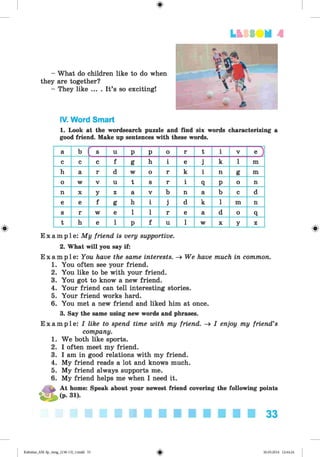
• you are fond of history;
105
Kalinina_AM-Sp_6eng_(138-13)_v.indd 105 30.05.2014 12:44:35
%
Unit 4
2. Read and remember!
1) Use names with no article:
- continents: North America;
- counties: Canada;
- states: Florida;
- towns: Orlando;
- streets: Fifth Avenue;
- parks: Disneyland.
2) Use names with the:
- some countries: the USA;
- rivers: the Mississippi;
- seas: the Mediterranean Sea;
- oceans: the Atlantic Ocean;
- mountain groups: the Rocky Mountains;
- island groups: the British Isles;
- hotels: the Ritz.
1) Play a grammar quiz game.
E x a m p l e : A: California.
B: Its a state. The Danube.
C: Its a river...
1) Look at the map of Ukraine and say:
1. What waterways you can see;
2. What towns you have been to;
3. Where you would like to go.
.ayuviuw jwuiastii byaroza > OREL OBLAST <
Uncha“ LIPETSK
Svetlogorsk
BRYANSK
B E L'-’-.A' ■
Pinsk
H
°™
r® >w S z
^ Rechytsa 
"*’**’' ' Shostka^l
Chernihiv
R - 'U - S !S' I -A'
^Voronezh
,Kursk a
) •
•
• o
'v Anna
Pulawy
fEL’SKAYA
VORONEZH
:■ "
is
k
i
|AI.|kseyevka
POLAND □
•WOJEWÖDZTV
/ ‘ ;LUBELSKIE
Stefewa Wola
Konotof
VOLYHS’KA ' Ovruch
Korosten'
JVNENS’K/
BELGOROD
Sumy
Hizhyn
Rivne Belgorod
Novohrad-Volyns’ kyy
r
W s
u
m
s
'k
a
■
“ "kuren'ka 
° nLubny
°POLTAVA
X . Poltava
Yevslrato'iskiy
Slayutä
jetovka K ie v
© iiiy u j
ZHYTOMYR
©
„
•
^
Bild.Ts.
K h a rk iv
Przemysl
/ansk
'CHERKAS’KA
.y © .J
« ^ /^ ^ C h e rk a s y
K R A I N »€,,
Izyum LUHAHS’KA
Lisichansl
Krasnoc
Vinnyts
Kremenc
kirovohrads-ka/-' a © {■
D n ip ro p e tro v s ’k
Tpervomays'k : ’ ( @KryvyyRih -■ a •Ro n '
.
. v o z S ^ k ^ nipropetrovsk,, Zaporizhzhyj
DONETSK
tOSTOV
B
O
T
O
V
A
«
SUCEAVA,. V ....
W
" 'VI
A
5
I HEAMT ■" v
V
Kotovs
..R ostoV-na-D onu
SÄLAJ
IOLD O VA’ Tokmak
Mariupol’.
CLUJ
CAPORIZHZHYA ©
J MURE§ Berdyans’k
Tiraspol' Cherson
ODESSA
-i;
. ALBA
HARGHITÄ
VASLuj KHERSOHS’KA
Primorsko-Akhtarsk
O dessa
Ses ofAzov Timashevsk
Dzhankoy
RESPUBLIKA KRYM
. © Feodosiya^
r.ya © V ©
Simferopol’
0P0'© Yalta
KRASNODAR
Krasnodar
jmnicu
GORJ
Kerch
raila °
TULCEA Novorossiysk
Anapa
Gelendzhik
^D0LJ
106
#
Kalinina_AM-Sp_6eng_(138-13)_v.indd 106 30.05.2014 12:44:35
ф
Lfcf SOM 2
II. Word Smart
Lucy’s teacher of English, Miss Joy, had a weekend trip in an amusement
park in the USA last month. Now she answers our questions about where
American children can go on holiday.
1. Study these words and describe:
a) Where they can go;
Ф Disneyland - великий парк з різними атракціонами поблизу міста
Лос-Анджелес у штаті Каліфорнія.
Ф
Disney World - великий парк поблизу міста Орландо у штаті
Флорида, подібний до Діснейленду.
107
Ф
Kalinina_AM-Sp_6eng_(138-13)_v.indd 107 30.05.2014 12:44:35
<
§
>
E x a m p l e : American children can go to Disneyland on holiday.
b) What they can see:
Unit 4
Welcome
to Mickey Mouse
Show
Let’s go for a
ride with Donald
Duck!
How about visiting Adventure
land and seeing the world
of Snow White and the Seven
Dwarfs?
E x a m p l e : They can see the Mickey Mouse Show.
c) What they can do:
see-saw Ferris wheel Mickey Mouse parade
#
McDonalds cartoons roller-coaster merry-go-round
E x a m p l e : They can go on a Ferris wheel.
2. Complete Miss Joy’s story:
American children often spend their weekends i n ......... are the most
popular with children. In ... they can see ... , ... . Besides, they can take
part in ... or ... . Many children prefer ... because ... . There are also ...
»that’s why ... . At lunch time parents and children......... all day long.
It’s fun to get together.
3. Work in groups and make a list of attractions in the pictures
(p. 106). Say which of them appeal to you most.
E x a m p l e : Museums are full of history. That’s why I often visit them.
At home: Ask 3-5 questions about what your friends can do on holiday.
Begin with:
What?
When?
Where?
How?
Why?
108 ■ ■ ■ ■ ■ ■ ■ ■ ■ ■ ■ ■
*
Kalinina_AM-Sp_6eng_(138-13)_v.indd 108 30.05.2014 12:44:35
<
§
>
Lt f SOM 2
Go to Ex. 57, 58 of your Workbook
V. Time to Listen and Read.
^ 1. Listen to / read the story about the funfair and answer the following
questions.
1. What happened in town one Saturday morning?
2. What attractions were there?
3. Where did Val’s friends go?
AT THE FUNFAIR
“It’s here!” cried George across the yard one fine Saturday morning.
“It’s never!” shouted Val back. “Well, George, let’s go over there at
once. When did it come?”
“Probably last night. There wasn’t anything yesterday.”
For days the boys were waiting for the funfair that came every year
to their town.
The great long wagons and the lorries that carried the roller-coaster,
roundabout, merry-go-rounds and other attractions stood in a circle on
the fair ground. All the boys from the nearest street were there. They
were watching, running about, criticizing everybody and everything and
getting in the way.
By the evening the whole place was full of noise and light. In every
corner you could hear loud music, children’s happy voices.
109
Kalinina_AM-Sp_6eng_(138-13)_v.indd 109 30.05.2014 12:44:36
ф
ф
The boys tried to choose the best way of spending their money. They
could buy delicious hot dogs or candies. But it cost a lot of money to
ride on the roundabout, and even more to shoot with a real gun at the
shooting booths.
Ally met Brian on Friday evening, and to her surprise he said, “Are
you going to the fair?”
“Is it here?” asked Ally.
“They’re putting it up.”
A lly’s brother, Val, went to the fair every evening. He loved the fair
and looked forward to it all the year round. He was full of excitement.
“Tell you what” , said Val to his friends. “Let’s all have a ride on the
horses and we could try to change places while they were going round,
see? That would be smashing.”
Everything on the roundabout sparkled and shone and the boys for­
got about everybody and everything...
Adapted from “Magnolia Building” by Elizabeth Stucley
BrE sweets
AmE candies
See First Aid Kit,
Word Meaning, p. 215
Unit 4
Across Culture: the USA
A hot dog - сендвіч із сосискою чи
ковбасою; зазвичай містить овочі та
соус (кетчуп або гірчиця).
2. Say what is not true in these sentences.
1. The circus came to town.
2. The children heard the news on Monday morning.
3. In the evening the place was quiet.
4. The children came there to buy hot dogs.
5. All the attractions were free of charge.
6. Val didn’t go to the fair.
3. Say to what exciting events you look forward all the year round.
110 ■ ■ ■ ■ ■ ■ ■ ■ ■ ■
<
s
>
Kalinina_AM-Sp_6eng_(138-13)_v.indd 110 30.05.2014 12:44:36
2
VI. Time to Communicate.
to look forward to something;
to be full of excitement;
to have a ride on something;
to change places;
to forget about everybody.
impressions of the funfair.
to be full of noise and light;
to buy something;
to cost a lot of money;
to hear children’s happy voices;
to choose the best way.
1. Act as Ally / Val and describe your
2. In pairs, talk about going somewhere together as in the pattern below.
Pattern:
A: Have you heard about ... .
B: It’s never! Are you going to
A I ’m full of ...
B: Me, too. I look forward to ..
A: Let’s ... .
B: We could ... .
A: That would be smashing. ...
B: Come on, then!
3. Look and say where the children in the pictures want to go together.
What do you prefer?
111
Kalinina_AM-Sp_6eng_(138-13)_v.indd 111 30.05.2014 12:44:36
<
§
>
Unit 4
Write about your impressions of going somewhere for fun in your diary.
Begin with:
VIII. Time to Write.
Dear Diary,
For days I was waiting for ...
When the time came, ...
The whole place was full of ...
In every corner you could hear ...
I tried to choose the best way of ...
Everything looked ...
And I forgot about ...
Go to Ex. 59, 60 of your Workbook
4 .3 . Welcome to Ukraine
Word-bank Phrase-bank Communication Box
to welcome somebody
hearty
display
knick-knack
woodwork
hospitable
handmade
at somebody’s invita­
tion
in the best tradition
to take care of some­
thing
to set something up
Do you mean ...?
First things first.
Such as?
I. Conversation Warm-up.
Hooray! Our international friends are going to take a trip to Ukraine.
Look at the pictures and say where you would like to take them.
Khreshchatyk, Kyiv Askania Nova
112
Kalinina_AM-Sp_6eng_(138-13)_v.indd 112 30.05.2014 12:44:36
<
§
>
3
Odessa Port Lviv, The Opera House
E x a m p l e : I would like to take my international guests to Kyiv. We’ll be
walking along Khreshchatyk the whole afternoon.
II. Pronunciation Warm-up.
Read and practise the sounds /i/, /i/ and /ai/. Say what kinds of
travelling it suggests.
W ELCOM E POEM
Let’s take a trip, just you and me,
Through the Carpathian Mountains and
The Black Sea.
I’ll give you a ride across Ukraine,
You’ll feel what it’s like if you go by train.
You’ll have a taste of Ukrainian dish
And stay with us as long as you wish.
III. Grammar Smart.
1. Look and recall.
Use articles with geographical names correctly when talking about
travelling in Ukraine.
Name No article the
Continent
Country
Cities
Rivers
Seas
Lakes
Mountains
Peninsula
Europe
Ukraine
Kyiv, Lviv
Lake Svytyaz
the Dnipro, the Danube
the Black Sea
the Carpathian mountains
the Crimea
a) Play a grammar hide-and-seek game.
113
Kalinina_AM-Sp_6eng_(138-13)_v.indd 113 30.05.2014 12:44:36
<
§
>
Unit 4
Lake Svytyaz Black Sea
Dnipro Sea of Azov
Eastern Europe Lviv
Kyiv Carpathians
Danube Kharkiv
Crimean Mountains Central Ukraine
In two teams, name as many places as you can with/without an article.
E x a m p l e : Team A (the): We’ll be coming round the Carpathian
Mountains.
Team B (no article): We’ll be coming to Kharkiv.
b) In groups, say as many sentences as you can about:
• travelling across Ukraine;
• visiting the capital city;
• sightseeing in your native place.
E x a m p l e : 7 ’m going to travel a lot in the Crimea this year.
2. Read and remember!
#
To talk about travelling, use these verbs correctly:
come / bring = movement towards the speaker or with the speaker;
E x a m p l e s : We’ll be coming round the mountains.
Dad is coming back from Moscow tomorrow. I know he is
bringing a lot of presents.
go / take = movement away from the speaker;
E x a m p l e s : I ’m going on a weekend trip. See you on Monday.
I ’m taking my dog with me.
live = be somewhere for long periods of time;
E x a m p l e : Nazar lived in Ukraine when he was a child. Then his
family moved to Canada.
stay = be somewhere for short periods of time;
E x a m p l e : Have you ever stayed in a hotel?
keep = continue;
E x a m p l e : The travellers were tired but kept on walking.
leave = go away from somewhere;
E x a m p l e : The train leaves at 12.40.
a) Play a grammar “coffeepot” game.
In pairs, ask questions about travelling using the word “coffeepot”
instead of the verbs above. Your partner will guess the verb and answer
your questions.
E x a m p l e : A: Where did you “coffeepot” when you went to Turkey?
B: Oh, you mean where I stayed? I stayed in a hotel.
b) Look at the pictures (p. 112) and say what travel experience these
children have.
114
Kalinina_AM-Sp_6eng_(138-13)_v.indd 114 30.05.2014 12:44:36
3
E x a m p l e : The boy and his mother are at the airport. Their flight leaves
at 10.30.
IV. Word Smart.
1. Study these word-combinations and describe:
a) how you invite your guests;
at somebody’s invitation;
to send / receive /accept / refuse an invitation;
to look forward to;
to plan carefully.
E x a m p l e : Our international friends visit us every summer at our
invitation.
b) how you welcome guests;
• to be / give a hearty welcome;
• to welcome somebody in the best Ukrainian
traditions;
• to greet smb with bread and salt;
• to put on national Ukrainian costumes;
• to be hospitable.
E x a m p l e : It should be a hearty welcome in the best Ukrainian traditions.
115
Kalinina_AM-Sp_6eng_(138-13)_v.indd 115 30.05.2014 12:44:36
<
§
>
Unit 4
c) how you entertain your guests.
• to have a welcome party
• to cook some local dishes
• to take care of a cultural programme
• to set up a display of Ukrainian art
• to make a poster
• to bring small gifts
2. Describe any Ukrainian art object in the picture you like and let your
friend guess. Cover these questions:
1. What does it look like?
2. What can we do with it?
3. Where do we keep it?
E x a m p l e : I t ’s small and painted in different colours. You can give it as
a present at Easter.
3. Work in groups and make a list of Ukrainian traditions of hospi­
tality.
At home: Describe an international party you have ever had at school or
> at home. Write what worked well at the party.
Go to Ex. 61, 62 of your Workbook
116
Kalinina_AM-Sp_6eng_(138-13)_v.indd 116 30.05.2014 12:44:37
3
Steve:
Ann:
Steve:
Ann:
Steve:
Ann:
Steve:
Ann:
Steve:
Ann:
Steve:
Ann:
1. Listen to / read the conversation “Welcoming International guests”.
Say what information from the text can help you to welcome your
international guests in Ukraine.
W ELCO M ING IN T E R N A T IO N A L GUESTS
Have you heard the news today?
Do you mean the news about Martha and Phil coming to Ukraine
at our invitation?
Exactly. We must plan carefully how to welcome them.
Sure. It should be a hearty welcome in the best Ukrainian tradi­
tions. How are we going to greet them?
With bread and salt, of course. We can put on national Ukrai­
nian costumes.
Good idea! Next, let’s have a welcome party. I’ll cook some local
dishes and you’ll take care of a cultural programme.
Such as?
Something like a short concert, with folk songs, folk dance and
music. And please, don’t forget to set up a display of Ukrainian
art.
No problem. My classmates and I have plenty of vyshyvankas,
vytynankas, pysankas and woodwork. Beside, we’ll make a post­
er about famous Ukrainians.
Splendid. What about bringing small gifts? We are hospitable,
aren’t we?
What do you think of handmade knick-knacks as presents?
They would do, I guess.
V. Time to Listen and Read.
BrE gift
AmE present
See First Aid Kit,
Word Meaning, p. 215
Across Culture: Ukraine
vyshyvanka - BnmnBaHKa.
vytynanka - BHTHHaHKa.
117
Kalinina_AM-Sp_6eng_(138-13)_v.indd 117 30.05.2014 12:44:37
<
§
>
Unit 4
pysanka - nncaHKa.
#
2. Say if it is true or false.
1. The children invited their international guests to come to Ukraine.
2. The children know much about Ukrainian traditions.
3. Ann is going to set up a display of Ukrainian art.
4. Steve likes the idea of organizing a cultural programme.
5. He is going to do everything by himself.
6. Ann remembers about presents.
3. Say how the following illustrates Ukrainian hospitality.
E x a m p l e : The children are going to give a hearty welcome, in the best
Ukrainian traditions of hospitality.
• to give a hearty welcome;
• to greet with bread and salt;
• to have a welcome party;
• to cook local dishes;
• to bring small gifts.
VI. Time to Communicate.
a) In pairs, talk about welcoming international guests as in the pattern.
Pattern:
A: Have you heard ... ?
B: Do you mean ... ?
A: Exactly. We must ... .
B: Sure. It should be ... . How are we going
A: With ... . We also can ... .
B: Good idea. Next ... .
A: Such as?
B: Something like ... .
A: No problem........
B: Splendid.
b) Act as Ann/Steve and describe her/his part
of the job for the welcome party.
• a hearty welcome
• in the best Ukrainian traditions
• national Ukrainian costume
• local dishes
c) Describe your most memorable experience
of welcoming guests at home / at school.
to ... .
118
Kalinina_AM-Sp_6eng_(138-13)_v.indd 118 30.05.2014 12:44:37
<
§
>
Lt f SOM 4
Make a list of things you can do to welcome international guests. Follow
the format below.
VII. Time to Write.
Things to do
• To plan ... • To set up ...
• To put on ... • To make ...
• To take care of ... • To choose ...
• To have ...
Go to Ex. 63, 64 of your Workbook
4 .4 . “Step out of your cave and
look around”
Word Bank Phrase Bank Communication Box:
how to express admiration
sea-dog
pile
jersey
seasick
to have something round
the corner
to get drowned
to wake from one’s sleep
round-the-world trip
to fall overboard
to do smth in time
What do you think of ... ?
Do you know ... ?
He is the most ... . I know.
Wow! Isn’t it remarkable!
I can’t help admiring ... .
How admirable!
I. Conversation Warm-up:
Read and say what characteristics of travellers you admire most of all.
courage curiosity persistence
friendliness strength intelligence
E x a m p l e : I admire courage most of all. Captain Cook was the most
courageous person I know.
II. Pronunciation Warm-up:
Read and practise the sound /w/. Say what great explorers you know.
DISCOVERY LIMERICK
Do you know Professor Twist?
He is a well-known scientist.
One day he went to explore the world
and discovered a place
which he admired and called,
“Wonderful, wonderful Wow-land!
119
Kalinina_AM-Sp_6eng_(138-13)_v.indd 119 30.05.2014 12:44:37
<
§
>
#
III. Function Smart.
Read and learn how to express admiration for great explorers. Look at
the pictures and fill in the mini-dialogues.
Unit 4
Captain Cook
a) - Do you know ... ?
- Yes, of course I do. He is the most
famous explorer I know.
b) - James Cook discovered ... .
- Wow! Isn’t it remarkable!
Australia
Christopher Columbus
c) - What do you think of ...?
- I can’t help admiring his great dis­
covery.
d) - Captain Cook made three journeys
by sea to ... .
- How admirable!
the Pacific Ocean
120
Kalinina_AM-Sp_6eng_(138-13)_v.indd 120 30.05.2014 12:44:37
<
§
>
Lt f SOM 4
#
IV. Word Smart
1. Miss Joy knows much about the round-the-world travel. In pairs, ask
and answer the questions. Use the pictures below.
a) Where was James Cook from?
the Union Jack
b) What can the seaman who has trav­
elled round-the-world wear?
an earring
c) What do people call an experienced
traveller?
sea-wolf
Rudyard Kipling
“Captains Courageous”
d) What English writer wrote about sea
travel?
121
Kalinina_AM-Sp_6eng_(138-13)_v.indd 121 30.05.2014 12:44:37
<
§
>
Unit 4
2. Complete Miss Joy’s Story and retell it to a friend.
MISS JOY’S STORY
We, the English, live on the islands and always have ... round the
corner. We have a lot of famous ... . One of them is ... . He was a real
... . In his crew there were several ... . who wore ... because ... . You
can read about ... in the book “Captains Courageous” by ... . This ... is
popular with English children.
At home: Describe your attitude to travellers.
Go to Ex. 65, 66 of your Workbook
V. Time to read.
1. Read the sea story and answer the following questions.
a) What happened to the boy at sea?
b) Who saved him?
c) What did the man look like?
THE SEA STORY
The sound of the waves woke Harvey from his sleep. Slowly he
opened his eyes and remembered that he was Harvey Cheyne who nearly
got drowned in the ocean. ^
The sea was still running round him, but now he lay on a pile of
fish, looking at the broad back of a seaman dressed in a blue jersey. The
boy tried to say something to him, and the man turned his head. In his
ears he had little gold earrings. Harvey understood that the sailor had
made several round-the-world trips.
“Aha! You feel better now”, he send. “It was lucky that I caught you.
How did you manage to fall overboard?”
“I was sick”, said Harvey, “seasick, and I was very weak”.
“I saw your ship just in time and then I saw you - you were falling
down into the sea. Happily, I caught you like a big fish. So you are safe
now.”
“Where am I?” asked Harvey.
“You are with me in my fishing boat, my name is Manuel, and I am
from the schooner “W e’re Here” of Gloucester, but we haven’t returned
to it yet.”
Adapted from “Captain Courageous” by R. Kipling
near - nearly
hard - hardly
See First Aid Kit,
Word-building, p. 214
122
Kalinina_AM-Sp_6eng_(138-13)_v.indd 122 30.05.2014 12:44:38
Lbf SOM 4
Across Culture: Great Britain
Gloucester - Глостер, місто на
південному заході Англії.
2. Fill in nearly or near.
1. Harvey ... got drowned in the ocean.
2. They live ... London.
3. It took ... two hours to get there.
4. She told the children not to go ... the canal.
5. Michelle is ... twelve.
3. Look at the pictures and say what did not happen at the sea.
VI. Time to Communicate.
1. Look and tell the boy’s story.
1. Once I was travelling ... .
2. Unfortunately, I felt ... .
3. I was standing ... .
4. The sea was ... .
5. Suddenly I fell ... .
123
#
Kalinina_AM-Sp_6eng_(138-13)_v.indd 123 30.05.2014 12:44:38
<
§
>
6. When I opened my eyes, ... .
7. The seaman had ... .
8. He explained to me that ... .
Unit 4
2. In pairs, discuss the boy’s travelling experience as in the pattern.
Pattern:
A: Do you know ... ?
B: Yes, of course I do........
A: Wow! Isn’t it remarkable!
B: What do you think of ?
A: I can’t help admiring his ... .
B: ... made a journey by sea with ... .
A: How admirable!
3. Describe your most remarkable travel.
#
VII. Time to Listen
Listen to the story “On a Boat Trip” and answer the following ques­
tions.
1. Where did the friends travel?
2. What did they decide to do?
3. Why was the boat trip unforgettable?
VIII. Time to Write
Plan a round-the-world trip of your choice.Use the format (p. 122).
124
Kalinina_AM-Sp_6eng_(138-13)_v.indd 124 30.05.2014 12:44:38
<
§
>
Lt f SOM 5
#
A ROUND-TH E-W ORLD TRIP
How to do it ? _______________________________________
How long you need?_________________________________
When to g o ? _________________________________________
Where to g o ? ________________________________________
Go to Ex. 67, 68 of your Workbook
4 .5 . My Progress in English
I. Grammar Smart
Complete the story. Use the or no article.
James Cook explored ... (1) seaways and coasts of ... (2)Canada, con­
ducted scientific expeditions from ... (3) Antarctic to ... (4) Arctic, and
travelled from ... (5) coasts of ... (6) North America to ... (7)Australia
and ... 8) New Zealand.
He made three journeys by ... (9) sea to ... (10) Pacific ocean and
became the first European to arrive at ... (11) east coast of ... (12) Aus­
tralia. His ship - the “Endeavour” - first found ... (13) New Zealand
and then crossed ... (14) Tasman sea to reach ... (15) smallest continent
in 1770.
Check if you can:
use tense forms correctly.
(Yes / No)
II. Word Smart
Fill in the right word.
1. Let’s go ... the roller-coaster.
2. We can put ... a tent near a river.
3. We are all going ... a trip on Saturday.
4. I prefer to stay ... town.
5. Martha and Phil coming to Ukraine ... our invitation.
6. We can put ... national Ukrainian costumes.
Check if you can:
complete the sentences correctly.
(Yes / No)
125
Kalinina_AM-Sp_6eng_(138-13)_v.indd 125 30.05.2014 12:44:38
<
§
>
Unit 4
Match the lines about travellers to the lines expressing attitudes to
them.
III. Function Smart
1. Do you know any great travel- a) Wow!
lers? b) How admirable!
2. What do you think of a round- c) Yes, of course, I do.
the-world trip? d) And he will. He is so coura-
3. James Cook discovered Austra- geous!
lia. e) I can’t help admiring his great
4. Christopher Columbus is the discovery.
most famous explorer I know. f) No wonder - he discovered
5. Captain Cook made three jour- America.
neys by sea to the Pacific.
6. Isn’t it remarkable that your
brother wants to become a sea-
man?
Check if you can:
express admiration for travellers.
(Yes / No)
# IV. Time to Read
Read a letter of the English boy Phil. Choose the right answers to the
questions.
I am especially proud of a national hero of Britain, Robert Scott, who
made risky journeys to Antarctica at the beginning of the 20th century.
His dream was to be the first person at the South Pole and he reached it
in 1910, but when he arrived there, he found a tent and the Norwegian
flag. It meant that he lost the race against Roald Amundsen, a Norwe­
gian explorer. They were competing on the way to the Pole. Amundsen
and Scott were very different from each other and made very different
plans. Amundsen took sleds and dog teams as the great Arctic explor­
ers did. Scott took ponies and a few dogs. He also had bad luck with
the weather - days of blizzards and strong winds. Robert kept a diary
in which he described his hard journey. The most tragic thing happened
on the return journey to his ship - he died of extreme cold and hunger.
But the name of Robert Scott as a great explorer of Antarctica lives
on in my heart. I can’t help admiring his courage and will power.
1. When did Robert Scott travel?
a) to the Arctic; b) to the Antarctic; c) to the Pacific.
126 ■ l l l l l l l l l
Kalinina_AM-Sp_6eng_(138-13)_v.indd 126 30.05.2014 12:44:38
<
§
>
2. What did he reach in 1910?
a) the equator; b) the North Pole;
3. What did he see when he got there?
a) the British flag; b) a tent;
4. What country was his competitor from?
a) Norway; b) Holland;
5. What is not true about Robert Scott?
a) He wasn’t the first person at the South Pole;
b) He won the race;
c) He lost the race.
6. What made his journey especially hard?
a) the weather; b) the dog teams; c) the equipment.
Check if you can:
read and understand simple texts.
(Yes / No)
Lt f SOM 5
c) the South Pole.
c) nothing.
c) Denmark.
V. Time to Listen
Listen to Martha’s story about a famous American explorer and mark
^ the true statements. ^
1. Jack London was an experienced sea traveller.
2. He travelled to the Antarctic.
3. He wrote stories about his adventures.
4. Some of his stories are about Alaska.
5. Jack London brought back a lot of gold.
6. Martha can’t help admiring him.
Check if you can:
listen to a piece of information and understand the de­
tails.
(Yes / No)
VI. Time to Write
Write a detailed response to the advice “Step out of your cave and look
around”.
Check if you can:
express your ideas about travelling in writing.
(Yes / No)
127
Kalinina_AM-Sp_6eng_(138-13)_v.indd 127 30.05.2014 12:44:38
Unit Five: Are you Good
at Shopping?
5.1. Planning a Shopping Trip
Unit 5
Word Bank Phrase Bank Communication Box
shopper
to please
florist’s
admirer
shopping centre
shopping trip
shopping bag
shopping list
shopping cart
on sale
to be much of a shopper
to be on the safe side
to have a great selection
to be dazzled
to have no idea
to pop into
By the way, ...
Thus, ...
You never know..
*
I. Conversation Warm-up
Look and say what friends are planning to buy. Guess why.
E x a m p l e : I think Ann plans to buy a new hand bag because she wants
to be stylish.
128
Kalinina_AM-Sp_6eng_(138-13)_v.indd 128 30.05.2014 12:44:38
LtttO H 1
II. Pronunciation Warm-up
Read a shopping trip chant and practise the sounds /w/ and /sv/. Say
who usually wishes you a nice shopping trip and if it is the same.
A SH O PPIN G T R IP C H A N T
- Have a nice shopping trip!
- Don’t worry, I will.
- Have a nice shopping trip!
- Don’t worry, I will.
- Don’t forget to buy some bread.
- Don’t worry, I won’t.
- Don’t buy grey, brown or white
- All right, all right.
III. Grammar Smart
1. Look and recall!
1) Use have to or must to express necessity.
E x a m p l e : There is no bread in the house, so we have to buy some. or
You really must talk to a shop assistant.
2) Use must to express strong orders.
E x a m p l e : You must eat more, you are so thin!
a) play a completion grammar game.
E x a m p l e : You really must stop buying sweets.
1. You must understand ... . 4. I have to buy ... .
2. Ann has to go shopping ... . 5. You will have to ... .
3. We must ... . 6. All school children must ... .
b) Look at the signs in the shop and say what you must (mustn’t), have
to (don’t have to) do. Use the verbs suggested.
E x a m p l e : You mustn’t take biscuits with hand. Use plastic gloves, please.
take pay leave park go
129
Kalinina_AM-Sp_6eng_(138-13)_v.indd 129 30.05.2014 12:44:39
<
§
>
Unit 5
2. Look and Remember!
Use should to say about something that is advisable.
E x a m p l e : You should buy a green hat to match your coat.
Use had better, you’d better for urgent advice when you believe that
something bad will happen, if the person doesn’t follow your advice.
E x a m p l e : You’d better buy it or someone else will do it.
Remember!
Use should in questions when you are wondering what to do.
E x a m p l e : Should I try this hat or that one?
#
a) Play a guessing game putting questions to people who don’t know
what to do.
E x a m p l e : What to buy at the market? ^ Should I buy apples at the
market?
1. Where to buy bread.
2. Where to pay for your products.
3. Whether to take a shopping bag.
4. What to buy at the fruit shop.
5. What gift to buy for your friend’s birthday.
6. Whether to go shopping alone or with your mum.
b) Fill in should or you’d better.
E x a m p l e : I think you’d better leave now or you’ll be late.
1. I don’t think you ... buy this dress, it’s too short for you.
2. In my opinion you ... buy a book instead of a CD.
3. Ann ... buy a blouse in green, it is so becoming her.
4. You ... tell a shop assistant that you are looking for a new pair of
shoes.
5. Steven ... talk to his mom before going to the shop.
6. We all think you ... try this suit on.
IV. Word Smart
1. Fill in the word rose for the following content area and make up your
sentences with them.
E x a m p l e : My mum does the shopping trip once a week.
130 ■ ■ ■ ■ ■ ■ ■ ■ ■ ■
*
Kalinina_AM-Sp_6eng_(138-13)_v.indd 130 30.05.2014 12:44:39
<
§
>
LfcSS UM I
2. Answer the questions
1. How often do you do the shopping?
2. Where do you like to do it?
3. Who is much of a shopper in your family?
4. Why do many people write a shopping list?
5. When are you dazzled at the shop?
6. What shop do you pop into more often and why?
3. Read what Lucy says about her shopping in England and fill in the
right words and phrases. Say if you have the same in Ukraine.
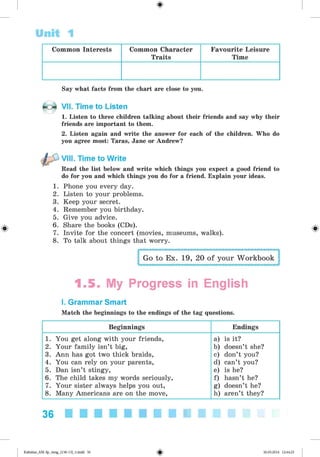
SHOPPING IN BRITAIN
I love shopping trips with my elder sister, because she teaches me
how and where I can buy the right things. In the centre of most towns
and villages in Britain there is a street with lots of different ... . This
street is usually called the ... and it is very convenient to do the shop­
ping there. My sister likes “Marks and Spencer chain-stories” which
sell ... . She says they have a reputation for good quality and besides
if you buy something you don’t like you can take it ... and get your ...
back. I dislike such shops, because there are crowds of ... and I get tired
very quickly. When my sister is busy, I ... at a small shop on a corner.
We call them corner shops. They are open until late in the evening and
sell freshly baked ... . They are so delicious.
# shops trips back High Street money
clothes and food shoppers do the shopping cakes
At home: Describe your shopping trip.
V. Time to Listen and Read
1. Listen to / read the dialogue and say what the children plan to buy.
A HELPING HAND
Helen: I say, Ann, you look smart in this dress. Is it new?
Ann: Exactly. Mum and I bought it on sale three days ago.
Steven: I haven’t done the shopping for ages. I’m not much of a shop­
per, you know. You, girls, are so fond of shopping!
Ann: That’s true. But it’s not that easy even for us.
Steve: Agreed. Mum says I should plan a shopping trip ahead and write
a shopping list, to be on the safe side.
Ann: That’s OK if you do the food shopping. You never know what
you can like at the department store.
Steve: By the way, Ann, are you very busy at the moment?
131
Kalinina_AM-Sp_6eng_(138-13)_v.indd 131 30.05.2014 12:44:39
ф
Ann: Not very much, but why?
Steve: There is a new music shop round the corner and it has a great
selection of CDs. I saw some musicals there and was so dazzled.
You know much about music. Can you give me a hand?
Ann: Sure. I had no idea that you are an admirer of musicals.
Steve: Not me. I’d like to please my granny, a music teacher. She is
interested in Lloyd Webber’s musical.
Ann: Great! And on the way to the music shop let’s pop into the flo­
rist’s. I’d like to buy a new flower pot for our Botanic class.
Steve: So, we’ve planned our shopping trip, haven’t we?
• to do the shopping - to go shopping
• to shop - a shopper
• to admire - an admirer
• to teach - a teacher
• to compose - a composer
See First Aid Kit, Word-building, p.213
Unit 5
Ф
Across Culture: Britain
Andrew Lloyd Webber - відомий англійський
композитор. Автор мюзиклів “The Cats” , “ The
Phantom of the Opera” та ін. Ф
2. Complete the sentences with the right form of the word.
E x a m p l e :
1. Dan is not much of a shopper.
2. Andrew Lloyd Webber is a great British ... .
3. Steve’s granny is a music ... .
4. Steve’s granny is a great ... of musicals.
5. Ann knows much about this ... .
6. The girls are good ... .
3. Say who said the following phrases. Explain why.
E x a m p l e : You look smart in this dress. ^
It is Steve. He wanted to compliment Ann, because he liked
her new dress.
1. I haven’t done shopping for ages!
2. Are you very busy at the moment?
3. Sure. I had no idea that you are an admirer of musicals.
4. Not very much, but why?
132
to shop
to compose
to teach
to admire
to write
to dance
Ф
Kalinina_AM-Sp_6eng_(138-13)_v.indd 132 30.05.2014 12:44:39
<
§
>
Lt f SOM 1
5. That’s true, but it’s not that easy even for us!
6. Not me. I like to please my granny, a music teacher.
VI. Time to Communicate
1. Act as Ann or Steve and describe the way they plan their shopping. Use:
• to plan a shopping trip ahead;
• to write a shopping list;
• to be on the safe side;
• to have a great selection of...;
• to be dazzled;
• to pop into the something.
2. In pairs, talk with your friend about your planning a shopping trip.
Use the pattern.
Pattern:
A: I say ... , you look ... . Is ... ?
B: Exactly. ... on sale.
A: I am not much ... . You, girls ... .
B: That’s true. But ... . You never know ... .
A: My mum says ... and ... .
B: That’s OK if ... .
A: By the way, ... .
B: Not very much, but... ?
A: There is ... and ... . Can you ... ?
B: Sure. I had no idea ... . But ... .
3. Describe the way you plan your shopping trips.
VII. Time to Listen
1. Listen to the story “My Shopping Experience in the USA” and say
what surprised Oksana.
2. Listen to /read the story again and choose the correct ending to the
sentences.
1. Last summer my granny and I visited ... .
a) my granny’s daughter;
133
Kalinina_AM-Sp_6eng_(138-13)_v.indd 133 30.05.2014 12:44:39
<
§
>
b) my granny’s brother;
c) my granny’s son.
2. I ’ve got the impression that everything in the USA is so ... .
a) small;
b) interesting;
c) big.
3. Uncle Paul does the shopping ... .
a) once a week;
b) once a month;
c) once per three weeks.
4. They went to the supermarket ... .
a) on foot;
b) by car;
c) by bus.
5. Americans usually buy products ... .
a) in small portions;
b) in big portions;
c) in bunches.
6. We ended up our shopping trip ... .
a) buying less than we had planned;
b) buying more than we had planned;
c) buying nothing of what we had planned.
VIII. Time to Write
In writing, compare American and English ways of shopping with those
in Ukraine.
Unit 5
Go to Ex. 71, 72 of your Workbook
5.2. Shopping for Food
Word Bank Phrase Bank Communication Box
grocer’s
green grocer’s
dairy
butcher’s
baker’s
confectionery
cashier
to tempt
to stand in a line
to be dispayed on
the counters (stands)
to pay at the cashdesk
to be low (high)-priced
to get lost
market place
It is common...
134
Kalinina_AM-Sp_6eng_(138-13)_v.indd 134 30.05.2014 12:44:39
<
§
>
Lt f SOM 2
I. Conversation Warm-up
Look and say what products your mother usually asks you to buy at the
supermarket.
E x a m p l e : My mum usually asks me to buy some milk.
II. Pronunciation Warm-up
Read and practise the sounds /a/, /x./. Say if food shopping is fun for
you.
SU PE R M A R K E T DIALOGUE
—What have you bought at the supermarket?
— I’ve bought tea at the grocer’s and meat at the butcher’s.
I’ve bought buns at the baker’s and grapes at the greengrocer’s.
I’m waiting for my mom. Food shopping is fun.
III. Grammar Smart
1. Look and Recall!
Use can/could/will/would to ask someone to do something for you.
E x a m p l e s : Can/will you buy a chocolate for me?
Can you give me a sweet?
W ill you buy biscuits for me?
Could you...?
a) Ask your friend questions for the following answers (p. 133). Play a
grammar chain game.
135
Kalinina_AM-Sp_6eng_(138-13)_v.indd 135 30.05.2014 12:44:39
E x a m p l e : —Could you go shopping with me, please?
—Yes, certainly.
1. Yes, I’d be glad to.
2. Of course, I will.
3. I’m sorry, but I can’t.
4. W ith pleasure.
5. Willingly.
6. Sure I will do that.
2. Look and remember!
Unit 5
1) Use Would you Uke....?/Shall I... to make an offer.
E x a m p l e : Would you like to shop with me?
Shall I carry your shopping bag?
2) Use a hundred and forty five (145), a thousand (1000) if you want
to speak about prices.
- How much do all these products cost?
- A hundred and fifty five hryvnias.
Remember!
Hundred, thousand and million have no -s after a number.
E x a m p l e : The shop is six hundred miles away from here.
a) Play a grammar tennis game.
E x a m p l e : A: 217
B: two hundred and seventeen
b) Look at the pictures and say what offers the children are making.
E x a m p l e : Would you like an apple?
#
136
#
Kalinina_AM-Sp_6eng_(138-13)_v.indd 136 30.05.2014 12:44:40
#
LbSSOM 2
IV. Word Smart
1. a) Read the words and say what you can buy at different departments.
E x a m p l e : At the grocer’s we can buy sugar, salt, tea, macaroni and
things like that.
to do the window shopping; to stand in a line;
to look at the counters; to pay at the cash desk.
at the greengrocer’s • a bunch of bananas/grapes;
• a head of cabbage.
at the dairy • a carton of milk/sour cream;
• a container of yoghurt/cottage cheese.
at the baker’s • a loaf of bread;
• a long loaf/rolls/buns.
at the confectionery • a bag of cookies;
• a box of sweets;
• a bar of chocolate.
at the butcher’s • a kilo of meat/poultry;
• a can of meat.
at the grocer’s • a package of sugar/tea/salt;
• a kilo of macaroni/rice/buckwheat;
• a bag of flour.
^ b) Look at the picture and say what the people are doing at the ^
supermarket.
E x a m p l e : The boy is reading a price tag.
2. Describe the product you like most and let your friend guess. Cover
such questions:
1. How does it taste?
2. When can we eat it?
137
#
Kalinina_AM-Sp_6eng_(138-13)_v.indd 137 30.05.2014 12:44:40
<
§
>
#
3. Where can we buy it?
E x a m p l e : It is sour. We have it with tea for dessert. We can buy it at
the greengrocer’s, (lemon)
3. Work in groups and make a list of products to buy if you want to cook:
1. Ukrainian borsch;
2. Meat salad;
3. Cabbage rolls;
4. Apple pie.
Say what departments you must go to.
Unit 5
At home: Make a shopping list for your mum’s next trip to the
supermarket. Use the format below.
Food:
Things To Buy
Department:
V. Time to Listen and Read!
1. Listen to / read about shopping in Canada and say where Canadians
do the shopping and why.
FOOD SHOPPING IN CANADA
People love to shop. There are two kinds of shopping in the Canadian
lifestyle: food shopping and non-food shopping. Canadians prefer non­
food shopping to food shopping but have to do both.
Most Canadians shop for food twice a month. These are large shop­
ping trips. It is common to buy a lot of products at a time: packages of
sugar, rice, cans of meat or fish, bags of cookies, boxes of sweets and
the like. They want to buy milk, butter, bread, fruits and vegetables
fresh. Canadians visit the grocer’s, the greengrocer’s, the dairy, the
baker’s once a week.
Children like to shop at the confectionery. They usually buy maple
syrup which they like to eat with pancakes or bread. Sometimes they
buy a butter tart or chocolates if they have enough pocket money.
Don’t get lost at the supermarket. Take a shopping cart, look around
and read the names of the departments. Then choose the products, put
them into the shopping cart and go to the cash-desk. Show your buys to
the cashier and pay for them.
For some Canadians many products are high priced that’s why they
do the shopping at the market place. They believe the quality of products
138 ■ ■ ■ ■ ■ ■ ■ ■ ■ ■ ■ ■
Kalinina_AM-Sp_6eng_(138-13)_v.indd 138 30.05.2014 12:44:40
#
is higher there and the prices are lower. Besides, you shouldn’t stand
in a line. There is a special market day in every town and village. The
products are displayed on the market stands and you can choose wha­
tever you like. Fruit vendors would you come up to everyone saying:
“Would you like the freshest apples in Canada? Shall I offer you the
sweetest pears?” It’s enough to tempt you, isn’t it?
Lb SSO M 2
Across Culture: Canada
Maple Syrup /'meipl 'sairap/ - кленовий сироп,
популярний у Канаді.
Butter tart /'bvta ta:t/ - особливий вид тістечка
канадського походження.
A fruit vendor /fru:t 'venda/ - продавець, який
торгує фруктами з візка або з корзини.
A market stand /'ma:kit strnnd/ - торговельний
прилавок.
#
at
<
the baker’s
the butcher’s
the grocer’s
See First Aid Kit, Grammar, p. 213
139
#
Kalinma_AM-Sp_6eng_(138-13)_v.mdd 139 30.05.2014 12:44:40
<
§
>
Unit 5
2. Look and say at what department you can buy these products.
E x a m p l e : We can buy sugar at the grocer’s.
3. Say how the following phrases can describe food shopping in Canada.
E x a m p l e : Many Canadians shop for food twice a month.
twice a month; at a time; once a week;
maple syrup; high-priced; market day; fruit vendor.
VII. Time to Communicate
1. Act as a Canadian and describe your shopping style. Use:
to be displayed on the counters (desks); to pay at the cashdesk;
to be high-priced; to stand in a line;
to get lost; to tempt
2. In pairs, talk about the way you do the food shopping. Use the pattern.
Pattern:
A: Hey, ... , how often ... ?
B: As for me ... .
A: Is it common ... ? What department ... ?
B: Sometimes ... at the baker’s and ... at the diary. And what about
you?
140 ■ ■ ■ ■ ■ ■ ■ ■ ■ ■
*
Kalinina_AM-Sp_6eng_(138-13)_v.indd 140 30.05.2014 12:44:40
<
§
>
3
A: As a rule, ... . The products are ... and ... .
B: Do you like ... ?
A: Not at all, but ... .
B: ... on a Market Day. All the products ... and ... .
A: To each his own.
3. Describe your supermarket and how you do the shopping there.
VIII. Time to Write.
Compare food shopping in Ukraine and in Canada. Use the Venn
Diagramm.
Go to Ex. 75, 76 of your Workbook
5.3. Non-food Shopping
Word Bank Phrase Bank Communication Box
stationer’s
ready-made clothes
footwear
perfumery
leather goods
detergents
casual clothes
household goods
to be aware of something
to lose count of some­
thing
to remove price tags
to run out of something
to get a discount
to carry somebody away
to be neither loose nor
tight on somebody
It’s a real bargain.
It’s just the thing!
141
Kalinina_AM-Sp_6eng_(138-13)_v.indd 141 30.05.2014 12:44:41
<
§
>
#
I. Conversation Warm-up
Look at the pictures and say which store you visit more often and why.
Unit 5
stationery ready-made clothes footwear
perfume shop leather goods florist’s
E x a m p l e : As for me, I go to the stationery very often, because I buy new
pens or pencils, copy-books or pads.
K X II. Pronunciation Warm-up
Read and practise the sounds /ae/, /n/. Answer the questions of the
dialogue.
SH O PPIN G DIALOGUE
- What have you got in your shopping bag?
- A pair of trainers,
A nice brown cap,
A T-shirt,
Sport trousers,
Two woolen socks,
A red-and-white football
In a wooden box.
- Have you been to the department store?
- No, I have to be at the match at four.
III. Grammar Smart
1. Play a grammar tennis game asking for request, offering or just
doubting.
E x a m p l e : A: Would you like new shoes?
B: Oh, I’d love to.
142
Kalinina_AM-Sp_6eng_(138-13)_v.indd 142 30.05.2014 12:44:41
<
§
>
3
2. Complete the dialogues under the pictures.
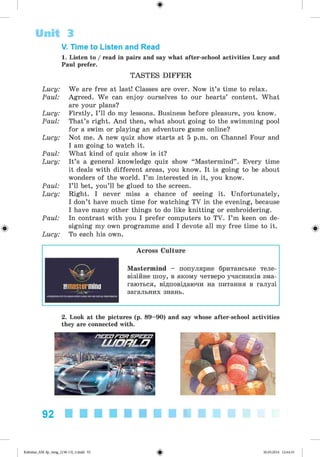
#
E x a m p l e :
- Should I buy a - Would you - Shall I ...? - You’d better...
green blouse or a like... ? - Sure. - Oh, thank you
red one? - Not really... . ... .
- I advise you to
buy this one. It is
just your style!
- Should I ... or ... ? - Would you like ... ?
- I think ... . - Exactly. I ... .
143
Kalinina_AM-Sp_6eng_(138-13)_v.indd 143 30.05.2014 12:44:41
Unit 5
3. Look at the pictures and say what you should/must or had better do.
E x a m p l e : You should buy clothes on sale. They are much cheaper.
IV. Word Smart
1. Match the definition to the names of the shops and make up your
sentences with them.
1. leather goods • a) a shop that sales ready-made clothes;
2. ready-made clothes'^k
b) a place where you can buy things made of
3. perfume shop leather;
4. stationer’s c) a shop that sells paper copybooks, pens etc;
5. footwear d) a shop where perfumes are sold;
6. household goods e) the shop which sells things for household
chores like: soap, washing powder, toilet
paper;
f) a shop where you can buy shoes, boots etc.
E x a m p l e : My mother buys detergents at the household goods.
2. Look at the pictures and say where you can buy the following things.
#
E x a m p l e : We can buy clothes at the ready-made clothes department.
144 ■ ■ ■ ■ ■ ■ ■ ■ ■ ■
Kalinina_AM-Sp_6eng_(138-13)_v.indd 144 30.05.2014 12:44:41
<
§
>
#
Lb SUM 3
3. Follow the chart and describe your non-food shopping. Add more
ideas to every step.
You’ve run out of
something and decided to
have a shopping trip.
3.
You’ve invited your
friend to join you.
5.
You are aware of
the sum of money you
have.
7.
You’ve bought
many things and are very
happy
2.
You’ve made a
shopping list.
4.
You’ve come to a
shopping centre and you
are dazzled.
6.
Your friend finds
stores with sales and dis­
counts.
8.
Your friend helps
you to carry your shopping
bag.
^ At home: Write what you like or dislike about non-food shopping.
■‘JT
- Consider the following points:
• Planning a shopping trip.
• Trying things on.
• Making choices.
• Sales.
• Discount.
• Spending much time.
• Spending much money.
Go to Ex. 77, 78 of your Workbook
145
Kalinina_AM-Sp_6eng_(138-13)_v.indd 145 30.05.2014 12:44:41
ф
V. Time to Listen and Read
1. Listen to / read a part of the story “Sweet Liar” and say if Samantha
was an experienced shopper.
SW EET L IA R
...Samantha lived in New York with her guardian Mike. Today they
were walking to Fifth Avenue - Mike was taking her shopping. They
hurried past store after store with beautiful clothes in the windows.
They were wonderful and stylish: blouses made of silk, sweaters and
jackets made of wool and leather, cotton skirts and trousers. She was
carried away by their beauty.
The more she saw them, the worse she felt: she was aware of her aw­
ful clothes. She was dazzled at what she saw.
Soon they met Mike’s cousin Vicky and he asked her to buy a lot of
clothes for Samantha as she knew much about clothes for girls.
About half an hour later Samantha was awfully tired. When she was
a child, she had often gone on shopping tours with her mum and they
had a lot of fun. However, even when she had been with her mother, she
didn’t have such a good time as she had on this day.
A t first she chose a few dresses and tried them on in the fitting
room. When she looked at herself in the mirror, she found she looked
boring. When Vicky offered her help, Samantha agreed willingly. She
put on a perfect-fitting suit offered by Vicky and she didn’t recognize
herself. It was just the thing! Neither lose nor tight on her. The more
she looked at herself the more she liked her new clothes.
Samantha bought many, many items. She lost count of all the shoes,
dresses and casual clothes.
“All this costs too much” , she said. But Vicky removed price tags...
Adapted from “Sweet Liar” by Jude Deveraun
Unit 5
The more ... the more
The more ... the worse
See First Aid K it, Grammar, p. 213
Across Culture
New York City - найбільше місто США, головний
бізнес-центр країни.
Fifth Avenue - вулиця в Нью-Йорку, відома
своїми дорогими магазинами.
146
Ф
Kalinina_AM-Sp_6eng_(138-13)_v.indd 146 30.05.2014 12:44:42
2. Read the sentences and say the same. Use the more...
E x a m p l e : Read much and then you know more. ^ The more you read
the more you know.
1. Have many sport activities, then you’ll feel better. ^
The more ... the better ... .
2. Eat many fruits and vegetables, then you’ll be healthy. ^
The more ... the healthier ... .
3. W rite more and then you’ll make few mistakes. ^
The more ... the fewer ... .
4. Read more every day and you can finish the book soon. ^
The more ... the sooner ... .
5. Play more and soon you’ll become a champion. ^
The more ... the sooner ... .
6. Listen to the native speakers more and then you’ll have a good
pronunciation. ^ The more ... the better ... .
3. Agree or disagree with what is said about Samantha’s feelings on her
shopping trip. Explain the reasons.
E x a m p l e : - Samantha was afraid to do the shopping.
- Agreed. The girl was in New York for the first time and
was afraid.
1. Samantha felt ashamed.
2. Samantha was shy.
3. Samantha was terrified.
4. Samantha was happy.
5. Samantha felt sorry.
VI. Time to Communicate
1. Act as Samantha and describe your shopping trip to the department
store. Use:
#
• to be aware of something;
• to be dazzled;
• to try something on;
• to offer help;
• to remove tags;
• to lose count of something.
2. In pairs, talk about your non-food shopping as in the pattern.
Pattern:
A: I say ... I ’ve run out of ... . What about ... ?
B: With pleasure. I ’m so fond ... .
A: Great! What store ... ?
B: Firstly, let’s go ... and ... . There is a sale and ... .
A: And where can we ... ?
147
#
Kalinina_AM-Sp_6eng_(138-13)_v.indd 147 30.05.2014 12:44:42
<
§
>
B: Is it at ... . There is always a big selection ... . I went there last
Sunday and ... .
A: Should I ... or ... ?
B: I think you’d better ... on the safe side.
A: Thank you ... , you know much about ... .
B: My pleasure.
3. Describe your most memorable non-food shopping trip.
VII. Time to Write
Write about your non-shopping before Christmas. Follow the plan.
P L A N
1. Do you plan your shopping trip ahead?
2. What shops do you usually go to?
3. With whom do you usually do the shopping?
4. How long does it take you to do the shopping?
5. What do you feel doing the shopping?
Go to Ex. 79, 80 of your Workbook
Unit 5
#
5.4. Choosing a Present
Word Bank Phrase Bank Communication Box
souvenir
gift
handmade
keepsake
to be hard to please
to present somebody with something
to be a good choice
to be a pleasant surprise
to look for something
to enjoy every minute of something
What if we buy...
Why don’t we buy...
Settled then.
I. Conversation Warm-up
Look at pictures and say which of these things you would like (or
wouldn’t like) to get as a present. Why?
E x a m p l e : As for me I would like to get a book because I ’m fond of
reading.
148
Kalinina_AM-Sp_6eng_(138-13)_v.indd 148 14.06.2014 14:15:26
<
§
>
Lt f SOM 4
#
II. Pronunciation Warm-up
Read and practise the sounds /0 / and /o:/. Say where you usually buy
gifts for your friends.
CHOOSING-A-PRESENT C H A N T
- I’m going to the department store
- What for?
- I’m going to the gift shop.
- Stop! Stop!
Are you looking for presents?
W ill you buy any gifts?
- I’ll buy one for you.
- Then I’ll give you a lift.
III. Grammar Smart
Read and learn how to offer and choose a present. Look at the pictures
and fill in the mini-dialogues.
a CD book
a) - ... is fond of music. Do you think it’s
a good idea to present ... with a... ?
- Sure.
a book
b) - ... can’t live without reading. What
if we buy a ... ?
- I think it will be a good choice.
a soft toy
c) - ... has invited me for her/his birth­
day.
- Wonderful! I think this ... will be a
pleasant surprise.
d) - Why don’t we buy a... for ... of her
favourite tennis player?
- Great! She/he is so fond of tennis.
IV. Word Smart
1. Answer the questions.
1. Is your friend hard to please?
2. How long are you looking for a present?
3. To what shops do you go to buy a present?
149
Kalinina_AM-Sp_6eng_(138-13)_v.indd 149 14.06.2014 14:15:45
<
§
>
4. What handmade presents can you present your friends with?
5. What present do you find original?
6. Do you give the same presents to boys and girls?
2. Read the list below and say what you think about when you choose a
present for a friend and why.
• My friend’s needs.
• My friend’s age.
• My friend’s likes/dislikes.
• The originality of the present.
• The price of the present.
• If it is a boy or a girl.
E x a m p l e : First of all I think about my friend’s likes, because I want to
please him/her.
^ At Home. Think and decide what birthday presents your family
>ij
l members would like to get. Fill in the chart below.
Unit 5
#
Who? What? How much? Can you afford it?
Sister flowers 10 hryvnyas Yes!
I Go to Ex. 81, 82 of your Workbook |
V. Time to Listen and Read
1. Listen to / read in pairs and say what choice the children have made.
UNFORGETTABLE PRESENTS
Ann: Hey, Steve, tomorrow is Helen’s birthday. Have you decided
what to present her with?
Steve: Not yet. I saw a new CD at a music shop. Do you think it’s a
good choice?
Ann: Oh, I am not sure she would like it. She is not a great admirer
of music. Let’s look for something else.
Steve: Why don’t we buy a poster or a photograph with her favourite
British actor Daniel Redcliffe?
Ann: Yes, but don’t forget she has already got at least five posters
with him in her room!
Steve: I see. What if we buy a box of chocolate? I know she has a
sweet tooth.
Ann: That would be great! But she is always on a diet.
150 ■ ■ ■ ■ ■ ■ ■ ■ ■ ■ ■ ■
*
Kalinina_AM-Sp_6eng_(138-13)_v.indd 150 30.05.2014 12:44:42
ф
Steve: That’s true. You are so hard to please and what about...?
Ann: Stop it, Steve. Look at this soft toy-dog. I think it will be a
pleasant surprise and a nice keepsake.
Steve: I hope so and I will also present her with flowers.
Ann: Settled then.
Lt f SOM 4
to present - a present
to photograph - a photograph
to answer - an answer
See First Aid K it, Grammar, p. 213
Across Culture
Daniel Redcliffe - британський актор, який зіграв
головну роль у фільмі «Гаррі Поттер».
2. Fill in the right form of the word.
E x a m p l e : Let’s choose a nice present (to present) for Ann.
1. I like your ... . to photograph
2. Our teacher liked my ... . to answer
3. The policemen gave an ... to stop. to order
4. Thank you for the ... you’ve made for me. to comfort
5. Why don’t we go for a ... ? to walk
6. She told me about her ... . to support
3. Look at the pictures and say which presents children didn’t choose
and why.
E x a m p l e : Children didn’t choose a box of chocolate, because Helen is
always on a diet.
151
Ф
Kalinina_AM-Sp_6eng_(138-13)_v.indd 151 30.05.2014 12:44:42
<
§
>
#
VI. Time to Communicate
1. Act as Ann or Steve and describe the way you were choosing a
present for your friend. Use:
• to present somebody with something;
• to be a good choice;
• to be interested in;
• to look for something else;
• to be a pleasant surprise.
Unit 5
2. In pairs, talk about the way you choose a present for your friend. Use
the pattern.
Pattern:
A: Hey ... . Tomorrow is ... . Have you decided ... ?
B: Not yet. I saw ... . Don’t you think ... ?
A: Oh, I’m not sure ... . She/he isn’t a great admirer ... . Let’s look
for... .
B: Why don’t we buy ... or ... ?
A: Yes, but don’t forget ... .
B: I see. What if we buy ... ? I know ... .
A: That would be great. But ... .
B: You are so hard ... .
A: Oh ... , look ... . It’ll be a pleasant surprise.
B: Settled then.
3. Describe the present that may be a pleasant surprise for your friend
and why.
VII. Time to Listen
1. Listen to Paul’s talk with a shop assistant and say what book he has
chosen for his friend.
2. Listen again and correct mistakes in the statements.
1. Paul is looking for a book.
2. The boy is interested in Geography.
3. He is looking for a present for his boy-friend.
4. Helen adores books about animals.
5. The friends have read all the books about Alice in Wonderful.
6. Paul has chosen a nice poster in the long run.
152
Kalinina_AM-Sp_6eng_(138-13)_v.indd 152 30.05.2014 12:44:43
Lt f SOM 5
VIII. Time to Write
Look at the pictures and write your story on them. Give your story a
title and present it to the class.
#
Go to Ex. 83, 84 of your Workbook
5.5. My Progress in English
I. Grammar Smart
Complete the conversation. Use should, have to, would you, should I,
you’d better.
- Excuse me, I need a new sweater for my brother. ... you show me
this one?
- Sure. But it is very small. How old is your brother?
- 15.
- Then you ... buy these ones: in green or in blue. ... have a look at
them?
- Oh, I’m dazzled. ... buy this one or that one? ... ask your brother
to try it on or it may be tight or loose on him.
- OK. ... we do it right now?
- Certainly. This is the fitting room.
Check if you can:
express offer, request or what is advisable.
(Yes / No)
■ ■ ■ ■ ■ ■ ■ ■ ■ ■ 1 5 3
Kalinina_AM-Sp_6eng_(138-13)_v.indd 153 30.05.2014 12:44:43
<
§
>
II. Word Smart
Fill in the right word.
1. You can buy flowers at the ... .
2. Paper, pencils and pens are sold at the ... .
3. Buy butter and milk at the ... .
4. I ’ve bought a nice pair of shoes at the ... .
5. There is a great selection of shirts and dresses at the... .
6. Buy meat at the ... .
Check if you can:
complete the sentences correctly.
(Yes / No)
Unit 5
III. Function Smart
Match the lines of offering to buy a present to the lines of agreement/
disagreement.
#
1. Ann adores tennis. Do you a) A new computer game will be
think it’s a good idea to pres- a good choice.
ent her with a new tennis ball. b) I think it will be a pleasant
2. Boris is interested in compu- surprise. Toys are always to
ting. many girls’ liking.
3. Why don’t we buy nice flowers c) I don’t think so. She has do-
for Alice? zens of balls at home.
4. I’d like to buy a teddy bear for d) What if we buy a CD with
Olha. New Orlean jazz?
5. Steve can’t live without jazz. e) I don’t think they will like
6. Let’s present the girls with them. Some girls don’t eat
lots of chocolate.
f)
sweets.
Agreed. All the girls like flo-
wers.
Check if you can:
offer a present to buy.
(Yes / No)
IV. Time to Read
Read and choose the right answers to the questions.
Dear Oksana,
Yesterday my sister and I celebrated our birthdays. You are sur­
prised, aren’t you? We are not twins but were born on the same day,
only Alice was 8 years earlier. It has become a good family tradition to
celebrate two birthdays at a time.
154 ■ l l l l l l l l l
Kalinina_AM-Sp_6eng_(138-13)_v.indd 154 30.05.2014 12:44:43
<
§
>
#
This year Alice was 21, and it is very important for her. Our granny
says it symbolizes becoming an adult. It’s an old British tradition and in
my family we try to keep them all.
I was also presented with many wonderful things, like an e-book and
Justin Bieber’s latest CD. Have you ever heard them? Oh, he is great!
I’ve seen his concert and liked his music a lot. His songs are really fan­
tastic!
But most of all I liked the embroidered blouse that you had sent me!
It’s amazing how you can embroider so well! I was wearing it at a party
and all my guests couldn’t help admiring the blouse and of course me in
it! I told them about Ukrainian traditions of embroidering. Some girls
felt even jealous!
I really enjoyed my birthday. Mum and Dad and my granny gave me
money, because I ’m saving it for my trip to Ukraine. Maybe you’ll teach
me how to embroider and I will make one for my sister?
I hope you are doing fine. Thanks again for your lovely present.
Lots of Love,
Nancy
1. How old is Nancy?
a) 21; b) 13; c) 8.
2. Why was her sister’s birthday very important?
a) because she became an adult;
b) because she entered the university;
c) because she got married.
3. What was Nancy presented with?
a) an e-book and a CD;
b) a music album and a book;
c) an album and an e-book.
4. What music did the girl enjoy?
a) rock music;
b) jazz music;
c) pop music.
5. What birthday present did her Ukrainian friend send her?
a) an embroidered towel;
b) a CD with Ukrainian music;
c) an embroidered blouse.
6. What for does Nancy save money?
a) for her trip to Ukraine;
b) for buying a blouse for her mom;
c) for a new music album.
Lt f SOM 5
155
Kalinina_AM-Sp_6eng_(138-13)_v.indd 155 30.05.2014 12:44:43
<
§
>
Unit 5
Check if you can:
read and understand simple texts.
(Yes / No)
V. Time to Listen
Listen to the story about American way of shopping and mark the true
statements.
1. Americans buy food every week.
2. They buy a lot of food at a time.
3. Most Americans like food with a long shelf life.
4. The supermarkets in the USA sell only food.
5. Americans spend much time in the shopping malls.
6. Children, especially teenagers, dislike shopping.
Check if you can:
listen to a piece of information and understand the de­
tails.
(Yes / No)
#
VI. Time to Write
Write a story under such a title “Once I went shopping ...”
Check if you can:
express your ideas about shopping in writing.
(Yes / No)
156
Kalinina_AM-Sp_6eng_(138-13)_v.indd 156 30.05.2014 12:44:43
LU tt M 1
Unit Six: Help Yourself to ...
6.1. What’s for Dinner?
Word Bank Phrase Bank Communication Box
to chew to be hungry as a Frankly, ...
steak hunter I bet, ...
to smell to taste like nothing For dessert, ...
cabbage rolls else on earth ... at last!
mixed salad to have a three-course It’s time for...
appetizers
rare
dinner
to be full of vitamins
to be low in calories
to have a sweet tooth
to be stuffed with
something
Alternatively, ...
I. Conversational Warm-up.
Look and say what dishes are popular in your country. When do you
have them?
pampushki lobster
E x a m p l e : Borsch is popular in Ukraine. I often have it for dinner.
II. Pronunciation Warm-up.
Read and practise the sounds /ai/ and /t/. Answer the questions of the
chant.
157
Kalinina_AM-Sp_6eng_(138-13)_v.indd 157 30.05.2014 12:44:43
ф
Unit 6
D IN N E R C H A N T
- What’s for dinner?
What’s for dinner?
What’s for dinner tonight?
- I’m making your favourite.
Do you want a bite?
- Thank you, I do.
- Does it taste all right?
- I’m chewing, and chewing,
And chewing, and chewing.
- Don’t you like your steak?
Don’t you love your grandma?
- I love you, grandma,
But the steak is rare.
III. Grammar Smart.
1. Look and recall!
Ф Ф
a) Let's play a grammar chain game.
E x a m p l e : Ann: Do you like pizza?
Steve: You like pizza, don’t you?
Helen: Don’t you like pizza?
b) Ask your friend if she / he likes:
• cheese • varenyky • steak
• sausage • hamburger • ice cream
• borsch • Coca-Cola
2. Read and remember!
Use yes/no questions to get a short answer. Begin with: Do you ...?
Are you ... ? etc.
E x a m p l e : - Do you like tea?
- Yes, I do. / No, I don’t.
Use yes/no questions to express surprise. Begin with: Don’t you ... ?
Aren’t you ... ? etc.
E x a m p l e : Don’t you like your steak? (Хіба тобі не подобається
біфштекс?)
Use a lot of with countable and uncountable nouns to talk about a
large amount of food in positive and negative sentences:
E x a m p l e : We haven’t got a lot of potatoes left. (countable)
W e’ve got a lot of orange juice. (uncountable)
Use a little with uncountable nouns to talk about a small amount of food:
E x a m p l e : Add a little butter to the porridge.
158 ■ I
Ф
Kalinina_AM-Sp_6eng_(138-13)_v.indd 158 30.05.2014 12:44:43
#
LLiSIIM I
a) Play a grammar chain game.
E x a m p l e : A: We haven’t got a lot of cheese.
B: True. We have got a little cheese.
b) Tell your friend about the amount of food you have got / haven’t got
at home as in the example.
E x a m p l e : We have got a lot of apples at home.
We haven’t got a lot of bread left.
We have got a little ice cream left.
VI. Word Smart.
1. Study these words and word-combinations and speak about:
a) the eating habits in your family.
to have a three-course dinner; to be good at something
to be full of something; to be low in something; for dessert.
E x a m p l e : Traditionally, we have a three-course dinner.
b) your mum’s cooking style.
varenyks; to be stuffed with something; meat dumplings;
cabbage rolls; mixed salad; appetizer.
E x a m p l e : My mum often cooks meat dumplings for dinner.
3. Look at the photos and say what different family members enjoy
having for dessert.
E x a m p l e : I think the mother enjoys a cup of coffee for dessert.
159
#
Kalinina_AM-Sp_6eng_(138-13)_v.indd 159 30.05.2014 12:44:43
ф
V. Time to Listen and Read
1. Listen to / read the description of the typical dinner menu in Lucy’s
home and say if it is different from yours. Use the text below.
D IN N E R W IT H L U C Y ’S F A M IL Y
Classes are over at last! It’s time for dinner. Frankly, I ’m hungry as
a hunter. I can smell mum’s tasty borsch even from a distance. Do you
happen to know that my mum is the world’s best cook?! She is especially
good at cooking Ukrainian dishes, such as: varenyks, halushkas, cabbage
rolls, pancakes and what not. Her mixed salad tastes like nothing else
on Earth.
I bet, we’ll have a three-course dinner today. As usual, it will start
with appetizers, like cucumber or cabbage salad, ham or sausage, cheese
or smoked fish. I’ll certainly choose vegetables - they are full of vi­
tamins and low in calories. For the first course it will be my mum’s
specialty - Ukrainian borsch with pampushky, naturally, mum serves
them with garlic. The main course often consists of chops and mashed
potatoes for garnish. Alternatively, we may have varenyki stuffed with
cottage cheese. For dessert, I prefer a piece of apple pie and a glass of
compote or just a cup of tea. As I have a sweet tooth, sometimes I have
my favourite chocolate ice cream, to finish with.
Here I am at home. What’s for dinner, mum?...
Ф Ф
Across Cultures: Ukraine
Cabbage rolls /ктЬіф 'raulz/ - голубці
Mixed salad /mikst srnlad/ - вінегрет
Specialty /spejialti/ - фірмова страва
Unit 6
2. Answer the questions.
1. What did Lucy’s mother cook for the first course?
2. Why does Lucy prefer vegetables, to begin with?
3. What do they usually have for the main course?
4. Who has a sweet tooth in Lucy’s family?
5. Lucy’s mother is good at cooking traditional Ukrainian dishes,
isn’t she?
3. Complete the sentences about Lucy’s family dinner and compare it to
yours.
E x a m p l e : Lucy has ... . ^ Lucy has a three-course dinner. Me too.
1. Lucy’s dinner starts with ... .
2. Lucy chooses ... .
160 ■ ■ ■ ■ ■ ■ ■ ■ ■ ■
<
s
>
Kalinina_AM-Sp_6eng_(138-13)_v.indd 160 30.05.2014 12:44:43
<
§
>
Lt f SO M 1
3. For the first course ... .
4. The main course often consists of ... .
5. Alternatively, ... .
6. For dessert, ... .
VI. Time to Communicate:
1. Act as Lucy and describe your dinner. Use the text “Dinner with
Lucy’s Family”.
• appetizers;
• to taste like something;
• to serve with garlic;
• for garnish;
• to finish with.
2. In pairs, discuss the dinner menu in your families.
A: It’s dinner time. Are you hungry?
B: ... .
A: You usually have a three-course dinner, don’t you?
B: ... .
A: I bet, you start with appetizers.
B: ... .
A: Don’t you have a sweet tooth?
B: ... .
3. Speak about a traditional Ukrainian dinner.
VII. Time to Listen.
Listen to the joke about a good cook and say why she refused the new
job.
VIII. Time to Write.
Write your favourite dinner menu. Follow the format below (p. 159).
161
Kalinina_AM-Sp_6eng_(138-13)_v.indd 161 30.05.2014 12:44:44
#
Unit 6
DINNER MENU
APPETIZERS
FIRST COURSE
M AIN COURSE
DESSERT
Go to Ex. 87, 88 of your Workbook
6.2. I’m a foodie, and you?
Word Bank Phrase Bank Communication Box
saucepan
frying pan
food processor
oven
to slice
to boil
to stew
to try
to mix
to sit down to table
to taste delicious
to be a real foodie (gour­
met)
to know much about
something
to take cooking lessons
from somebody
Help yourself to...
Poor guess!
It’s me who...
No doubt about it.
It’s all Greek to me.
Now that you mention
it, ...
aucepan
I. Conversational Warm-up.
Look and say what equipment you have in your kitchen. How can you
use it?
Food processor
Microwave Frying pan
E x a m p l e : We have a food processor in our kitchen. We can use it for
cutting vegetables.
162
Kalinina_AM-Sp_6eng_(138-13)_v.indd 162 30.05.2014 12:44:44
<
§
>
L t f SO M 2
II. Pronunciation Warm-up:
Read the Foodie’s Rap and practise the rhythm. Say in what way your
mother lays the table for you.
FOODIE’S R A P
A knife, a fork, a bottle and a cork,
A saucepan, a cup, a plate and a mug,
A spoon, a glass, a napkin and a vase -
That’s the way mum lays the table for us.
III. Grammar Smart
1. Look and recall!
The Present Perfect Tense
1) Use the adverb ever with the Present Perfect Tense to ask about
your friend’s cooking experience.
E x a m p l e : Have you ever made biscuits?
2) Use the adverbs sure/never with the Present Perfect Tense to talk
about your cooking experience.
E x a m p l e : I ’ve sure made biscuits. I have never cooked borshch.
a) Play a grammar question-and-answer game.
E x a m p l e : A: Have you ever fixed breakfast yourself?
B: I sure have. Have you ever fried meat?
C: No, I ’ve never fried meat but ...
b) In groups, say as many sentences as you can about your cooking
experience. Share what dishes you have ever cooked and what kitchen
tricks you have ever tried.
E x a m p l e : I have taken cooking lessons from my mum. I have tried to
cook cabbage soup.
2. Read and remember!
a) Use the Present Perfect Tense to talk about single or repeated
cooking experiences in the past when the date on the action isn’t im­
portant. Time expressions: before, ever, already, just and yet.
E x a m p l e : Kate has just baked biscuits.
b) Use the Past Simple to talk about single or repeated cooking ex­
periences that happened at a definite time in the past. Time expres­
sions: yesterday, last week, in 2012, etc.
E x a m p l e : I made a delicious salad yesterday.
c) Use the Past Simple to talk about the succession of kitchen tricks
in the past. Time expressions: first, then, after that.
E x a m p l e : First I chopped the butter and mixed it with the flour and
eggs, then I minced it in the food processor. After that I put
the biscuits into the oven.
163
Kalinina_AM-Sp_6eng_(138-13)_v.indd 163 30.05.2014 12:44:44
<
§
>
a) Play a grammar tennis game.
E x a m p l e : A: already.
B: I have already tried to cook pasta.
b) Look at the picture and say:
1. What the children have just cooked;
2. When they did it;
3. What kitchen tricks they did first, then and after that.
Unit 6
E x a m p l e : I t ’s Mother’s Day. The children have just cooked pancakes
for their mother...
IV. Word Smart.
1. Study these words and describe:
a) things you can do in the kitchen.
E x a m p l e : I can slice bread with a knife.
Kitchen nouns Kitchen verbs
a knife to cut
to chop
to slice
a saucepan to boil
to stew
a frying pan to fry
a food processor to mince
to grate
to mix
An oven / microwave to bake
to roast
to grill
164
Kalinina_AM-Sp_6eng_(138-13)_v.indd 164 30.05.2014 12:44:44
<
§
>
#
LESS UM 1
b) your cooking lessons:
take cooking lessons from somebody
know much about something
taste delicious
2. Describe any kitchen object in the picture you can use best and let
your friend guess. Cover these questions:
1. What does it look like?
2. What can we do with it?
3. Where do we keep it?
E x a m p l e : It is round. We can use it for frying meat. We can keep it in
the cupboard.
(A frying pan)
3. Work in groups and make a list of kitchen objects to have if you want
to make breakfast/ dinner/supper. Say what dishes you would like to cook.
At home: Describe your kitchen. Write:
• What kitchen utensils you have;
• What you can do with them;
• What cooking skills you can practise there.
Go to Ex. 89, 90 of your Workbook
V. Time to Listen and Read.
1. Listen to / read in pairs. Say who is a foodie.
TALKING IN THE KITCHEN
It’s a Saturday afternoon. Paul is at Kate’s. The children are in the
kitchen, they are going to have tea.
165
Kalinina_AM-Sp_6eng_(138-13)_v.indd 165 30.05.2014 12:44:44
ф
Kate: Tea is ready, Paul. Please sit down to table and help yourself to
my favourite biscuits.
Paul: Wow, they taste delicious. Your mum has baked them, hasn’t
she?
Kate: Poor guess! It’s me who baked them. It was my first try.
Paul: And a very successful one at that. Did you fry them in the frying
pan?
Kate: Of course, not. I made them in the oven. First I chopped the
butter and mixed it with the flour and eggs, then I minced it in
the food processor. A fter that I put the biscuits into the oven
and fifteen minutes later they were ready for us.
Paul: One day you’re going to be the world’s best cook, no doubt about
it. The biscuits look and smell nice, too. You’re a real foodie.
Kate: Thank you for the compliment. I’m glad you like the biscuits.
Can you cook?
Paul: I’ve never been interested in cooking or food. My mum knows
much about it. Her kitchen is very modern, too. There are all
kinds of kitchen equipment, such as a microwave, a coffee-ma­
ker, a food processor, a mixer and what not. She knows a lot
of kitchen tricks: chopping and slicing, stewing and frying, but
it’s all Greek to me.
Kate: I think you should take cooking lesson from her. It will do you
good.
Paul: Now that you mention it, I think I’ll try.
Unit 6
Ф
Across Cultures: Great Britain
A foodie - той, хто цікавиться приготуванням їжі.
2. Say if it is true or false.
1. Kate knows much about baking.
2. Kate can’t use the oven.
3. Paul compliments Kate about cooking.
4. Paul’s kitchen is well-equipped.
5. Cooking is all Greek to Paul’s mother.
6. Kate is going to take cooking lessons from Paul’s mother.
3. Say how the following characterizes food traditions in Kate’s and
Paul’s families.
E x a m p l e : Kate is very much interested in cooking. She has learnt how
to bake biscuits.
to be interested in cooking; to know a lot of kitchen tricks;
to be the world’s best cook; to have a modern kitchen.
166
Ф
Kalinina_AM-Sp_6eng_(138-13)_v.indd 166 30.05.2014 12:44:44
#
Lb SSO M 2
VI. Time to Communicate:
1) Act as Kate / Paul and describe your cooking experience.
to bake biscuits; first try; to be a real foodie;
to know much about something; to be all Greek to somebody;
to do somebody good.
2) In pairs, discuss your cooking experience as in the pattern.
Pattern:
A. ... is ready. Sit down to ... . Help yourself to ... .
B: Wow, ... taste(s) ... .
A: Poor guess! It’s ... who ... .
B: ... at that. Did you ... ?
A: Of course not. First ... then ... . A fter that ... !
B: One day you’re going to be ... . You’re a real ... .
A: Thank you for ... . I glad you ... .
B: I think I should ... . From you. It’ll do ... .
3) Describe your kitchen and the kitchen tricks you know.
VII. Time to Write.
Write a description of a dish you have ever helped your mother to cook.
Begin with:
Please, help yourself to ... .
I have helped my mum to ... .
My mum ... .
First I ... .
Then ... .
A fter that ... .
One day I am going to ... .
Go to Ex. 91, 92 of your Workbook
167
#
#
Kalinina_AM-Sp_6eng_(138-13)_v.indd 167 30.05.2014 12:44:44
#
Unit 6
6 .3 . Mind your Manners
Word Bank Phrase Bank Communication Box
napkin
pocket
to behave
serviette
table mat
table coaster
etiquette
to pay attention to some­
thing
to beg somebody’s pardon
to eat up
I ’m afraid, ...
I. Conversation Warm-up.
Look at the pictures and say what table manners the children have.
E x a m p l e : The children shouldn’t talk at dinner table.
II. Pronunciation warm-up.
Listen and practise the sounds /o
:/ and /ei/. Say what table manners
you have.
TAB LE M A N N E R S C H A N T
While eating, don’t talk,
Use correctly knife-and-fork.
Don’t fidget on your place.
Never let food stay on your face.
Try to learn how to behave,
And then at table you’ll be safe.
168
#
Kalinina_AM-Sp_6eng_(138-13)_v.indd 168 30.05.2014 12:44:45
ф
III. Grammar smart.
1. Look and recall!
Lt SSO M 3
1) Use either ... or ... as linking words to show your choice.
E x a m p l e : We can have lunch either here or at the cafe.
2) Use either as a pronoun to name one of two things.
E x a m p l e : There’s tea or coffee - you can have either.
3) Use either as an adverb in negative sentences to mean “also” .
E x a m p l e : I don’t like ice cream either. (Я теж не люблю морозиво)
a) Play a grammar choice game.
E x a m p l e : A: We can have either tea or coffee.
B: I don’t like coffee.
C: I don’t like coffee either. So let’s have tea.
b) In groups, say as many sentences as you can:
- to show your choice in food;
- to name one of two things at dinner table;
- to explain what you don’t do at dinner either.
E x a m p l e : I ’d like either an apple or an orange.
c) what you don’t do at dinner table either.
E x a m p l e : I ’d like either an apple or an orange.
2. Read and remember!
Use too and enough to talk about table manners.
E x a m p l e s:
Not too + adjective: The baby is not too big to sit at the dinner table.
Too + adjective: The girl is too big not to mind her manners.
Adjective + enough: You are big enough to mind your table manners.
Not + adjective + enough: Your table manners are not good enough.
Enough + noun: There is enough place for everyone at the dinner
table.
Not enough + noun: There isn’t enough place for everyone at the
dinner table.
a) Play a grammar opposition game.
E x a m p l e : A: I ’m big enough to try to cook myself.
B: No, you are not. You are too young to do that.
169
Ф
Kalinina_AM-Sp_6eng_(138-13)_v.indd 169 30.05.2014 12:44:45
<
§
>
b) Look at the pictures and say if everything is OK with these children’s
table manners.
Unit 6
#
E x a m p l e : The boy is too active to sit at the dinner table.
IV. Word Smart.
1) Miss Joy knows much about table manners around the world. Now
she answers our questions about how English children behave at dinner
table.
a) What do they eat with?
spoon, knife, fork
170
Kalinina_AM-Sp_6eng_(138-13)_v.indd 170 30.05.2014 12:44:45
<
§
>
LtSS DM 3
b) How do they protect a table top from food or drink?
A table coaster A table mat
c) How do they protect their clothes from food or drink?
2) Complete Miss Joy’s story and retell it to your friend.
MISS JOY’S STORY
We, the English, pay much attention to ... . We teach our children
how to ... at dinner table. There are special rules about eating ... . First
of all, we put ... and ... on the table for dinner to protect .... We place
...to right of a plate and ... to the its left. Of course, we use ... to pro­
tect our clothes. If you follow these ... nobody will say that your table
manners are ... .
3) Work in groups and make a list of do’s and don’ts at the dinner table.
Do’s Don’ts
Use a knife and a fork. Don’t talk while eating.
At home: Write what you like and / or dislike about table manners.
171
Kalinina_AM-Sp_6eng_(138-13)_v.indd 171 30.05.2014 12:44:45
<
§
>
#
V. Time to Read
1) Read and name three things that made the school dinner special.
A SCHOOL D IN N E R ON A S N O W Y D A Y
PART I
It snowed steadily through the night and I woke next morning to see
the white world outside. The school garden, the playground, the neigh­
bouring fields, and the distant downs were in deep snow. As ‘snow days’
were unheard of in those times, I had to struggle my way to school.
There were only eighteen children in school that day and because of that
there was a real family feeling in the air. When dinner time came, it turned
out that the snow was too deep to let the dinner van to arrive in time.
So the teacher broke the news to the children and said we were all
staying at school for dinner. She asked Mr. Willet, the janitor, to go to
the shop and get some bread, tins of stewed steak, apples and - toffees!
It seemed a good mixed diet, not exactly full of vitamins but nourishing
and quickly prepared... .
PART II
Dinner was a huge success. The children had brought one of the long
tables from the infants’ room and set it by the stove, while the teacher
opened tins of steak and cut bread over in the staff room. Little Jimmy
wanted to help, so he wandered round the staff room inspecting the
kitchen equipment.
“And what’s this, miss?”
“That’s for mashing potatoes.”
“My mum uses a fork. What’s this?”
“A tea-strainer.”
“What for?”
“To catch the tea leaves. Pass the salt, please. And the pepper, dear.”
“What do you want to catch tea leaves for?”
“Because I don’t like them in my teacup.”
“What do you do with them when you’ve caught them?”
“Throw them away.”
“Well, why catch them if you throw them out after?”
The teacher took the tea-strainer to the sink and showed Jimmy with
water and bits of bread crumbs how it worked. The demonstration was
successful, and when the teacher presented him with an old tea-strainer,
to keep the tea leaves out of his own cup at home, he was delighted.
We had dinner with great good-humour and without any table man­
ners...
Adapted from Miss Reed “Village School”
to wander
to wonder
See First Aid K it, Word Spelling, p. 216
Unit 6
172
Kalinina_AM-Sp_6eng_(138-13)_v.indd 172 30.05.2014 12:44:45
ф
3
Across Culture: The USA / Great Britain
Miss Read, or Dora Jessie Saint (17 April 1913 -
7 April 2012), - an English novelist, a schoolmist­
riss by profession.
Snow Day - день, коли відміняються уроки в
школі через сильні снігопади.
2) Answer the questions.
1. Why did the children have an improvised dinner at school?
2. What did they have for dinner?
3. Who fixed dinner for the children?
4. What kitchen objects were of help?
5. Were table manners easy enough to follow?
3) Say what characters of the story have these thought.
VI. Time to Communicate.
1) Act as Jimmy / the teacher and tell your parts of the story.
to assist; to inspect the kitchen equipment; a good mixed diet;
to be a huge success; no table manners.
173
Ф
Kalinina_AM-Sp_6eng_(138-13)_v.indd 173 30.05.2014 12:44:45
<
§
>
2) In pairs, talk about your table manners as in the pattern.
A: I think it is very important to ... .
B: Please tell me what I should ... .
A: Firstly, remember to ... and ... . Besides, ... .
B: And what about ... ?
A: You’ll be safe if ... . Never ... .
B: Should I ... or ... ?
A: I think you’d better ... on the safe side.
B: Thank you ... , you know how to ... .
A: Mind ... .
B: Don’t worry, I will.
3. Describe your most memorable school dinner.
Unit 6
VII. Time to Write
Write a list of table manners for your school canteen. Use the ideas
below.
#
No Peoching
Be Grateful
Sit Up
Straight
Hold V
Silverware
Correctly <
No Elbows
E x a m p l e : Please don’t play in the school canteen.
Go to Ex. 95, 96 of your Workbook
174
Kalinina_AM-Sp_6eng_(138-13)_v.indd 174 30.05.2014 12:44:45
<
§
>
6.4. Holiday Foods
Lt f SO M 4
Word Bank Phrase Bank Communication Box
sponge cake
custard
bland
bitter
sour
appetizing
to make a cake
to count on somebody
to do somebody a favour
What does ... taste?
What does ... smell?
Help yourself to ... .
May I treat you to ... ?
Yummy! It tastes deli­
cious. It smells good.
I. Conversation Warm-up.
Look at the pictures and say what holiday a Ukrainian family is going
to celebrate. Why?
E x a m p l e : They are going to celebrate Christmas because there are twelve
dishes on the table.
II. Pronunciation Warm-up.
Listen and practise the sound /ei/. Say how you mark birthdays in your
family.
B IR T H D A Y T A L K
- Do you have a sister?
- Her name is May. Today is her birthday.
- Are you making a cake?
- I’m making a big one with lots of fruits.
- It will be delicious. Isn’t it good?
III. Function Smart.
Read and learn how to talk about tastes and smells of food.
175
Kalinina_AM-Sp_6eng_(138-13)_v.indd 175 30.05.2014 12:44:46
<
§
>
Unit 6
a) - What does ... taste?
- Yummy! It tastes delicious and sweet.
Pudding
Fried chicken
b) - What does ... smell?
- It smells appetizing!
Pineapple
c) - Help yourself to ... . Do you like it?
- Oh, it smells good but it tastes bland.
" O f '
Grapes
d) - May I treat you to ... ?
- Thank you. How nice they smell!
IV. Word Smart
1) In groups, talk about what your favourite food smells and tastes.
Begin with:
If you ask me, I like ... .
... is my favourite dish.
It smells ... .
Besides, it tastes ... .
A t the sight of it I ......
176
Kalinina_AM-Sp_6eng_(138-13)_v.indd 176 30.05.2014 12:44:46
ф
LbSSIIМ А
Ф
2) In pairs, discuss your food choices as in the pattern.
- How do you like chips with ... and ... ? You can take either.
- They taste ... for me. I prefer ... .
- And I like Lucy’s apple pies. They smell ... and taste ....
- Agreed. Lucy is ... .
At home: Describe tastes in food in your family.
Go to Ex. 97, 98 of your Workbook
V. Time to Listen and Read
1) Listen to / read in pairs and say if Ann can count on her friend.
TALKING ABOUT A BIRTHDAY PARTY
Ann:
Steve:
Ann:
Steve:
Ann:
Steve:
Ann:
Steve:
Ann:
Steve:
Ann:
Steve:
Ann:
Hi, Steve, Ann is speaking. Tomorrow is Helen’s birthday. Has
she invited you to her birthday party?
As a matter of fact, she has. Why do you ask?
I ’m coming to her birthday party, too, and I need your help.
You can count on me. What can I do for you?
I ’m making a birthday cake for Helen. It’s her favourite sponge
cake, with custard and a lot of fruits.
Wow! I bet, it will taste absolutely delicious!
I hope so. A t least it smells appetizing.
I can’t wait to try it!
Wait, wait, Steve. I ’m calling to ask if you could do me a fa­
vour and come to my place tomorrow before the party and ...
Let me guess - and help you to carry the cake to Helen’s, right?
Exactly.
Don’t worry, I will.
Thanks a lot. See you soon.
favour - favourite
See First Aid Kit,
Word-building, p. 214
Across Culture: Great Britain
Custard - заварний крем, традиційний
англійський десерт.
Ф
2) Fill in favour or favourite.
1. Could you do me a ... ?
2. It’s Helen’s ... sponge cake.
3. Can I ask you a ... ?
4. Ca we have strawberries? They are my ... .
5. What’s your ... colour?
177
Ф
Kalinina_AM-Sp_6eng_(138-13)_v.indd 177 30.05.2014 12:44:46
ф
Unit 6
3) Look at the pictures and say what the children did not talk about.
VI. Time to Communicate.
1) Act as Ann or Steve and describe the preparations for your friend’s
birthday party.
Ф
• to invite to a party;
• to ask for help;
• to count on somebody;
• to do somebody a favour;
• to carry something to somebody’s
place.
Ф
2) In pairs, complete the dialogue between two friends at a birthday
party.
A: Help yourself to some lemon cake.
B: ...
A: What does it smell?
B: ...
A: What does it taste?
B: ...
A: Bon appetite!
3) In pairs, read the birthday party menu and discuss your tastes.
B IR T H D A Y P A R T Y M ENU
1. fruit salad
2. apple pies
3.pizza
4. chips with bacon
5. chocolates
6. Coca-Cola
178
Ф
Kalinina_AM-Sp_6eng_(138-13)_v.indd 178 30.05.2014 12:44:46
ф
Lb f SO M 5
VII. Time to Listen
1) Listen to the joke and say what the boy is suffering from.
2) Listen again and role-play the joke.
VIII. Time to Write
Look at the picture and write a thank-you note after your friend’s
birthday party. Use the format below.
Dear ... .
Thank you so much for ... . The party was ... ... tasted like ... .
Your mum is the world’s ... .
Yours,
Go to Ex. 99, 100 of your Workbook
6 .5 . My Progress in English
Ф I. Grammar Smart Ф
Complete the story. Use is, have sold, tastes, go, doesn’t smell, goes,
was
My favourite dish ... 1) the hamburger. To me, it ... 2) like noth­
ing else on earth. You will be surprised to know that it ... 3) of ham,
though. The truth is that there is no ham in the hamburger, there is
ham only in its name. The hamburger got its name from the German
town of Hamburg, which ... 4) famous for its steaks. German immi­
grants to the United States treated their new friends to the “ hamburger
steak” . The story ... 5) that in 1904 hamburger steaks were served on
buns for the first time. This became the usual way of eating hambur­
gers - they tasted so good!
Little by little, the hamburger became the most popular American
food. All fast-food restaurants, such as McDonald’s and Burger King, ...
6) millions of hamburgers this year.
My friends and I often ... 7) to birthday parties there. A good ham­
burger is a real treat.
Check if you can:
use tense forms correctly.
(Yes / No)
179
Ф
Kalinina_AM-Sp_6eng_(138-13)_v.indd 179 30.05.2014 12:44:46
<
§
>
II. Word Smart
Fill in the right word.
1. Fruit salad is full of ... .
2. W e’ll have a three-course ... today.
3. My mum knows a lot of kitchen ... .
4. The pudding tastes ... .
5. Mind your table ... .
6. You’re a real ... .
Check if you can:
complete the sentences correctly.
(Yes / No)
Unit 6
III. Function Smart
Match the lines of offering food to the lines about its taste / smell.
1. Help yourself to some biscuits. a) Wow! It tastes like nothing
2. This is my favourite sponge else on earth!
cake. b) With pleasure. I love peaches
3. How do you like this apple and apricots.
pie? c) They smell delicious!
4. May I treat you to some d) No, thanks. I ’m not a fruit
grapes? person.
5. Would you like some peaches? e) It smells good, but the apples
6. Let’s have a cabbage salad to taste a bit sour.
begin with. f) Agreed. Vegetables are full of
vitamins.
Check if you can:
express your tastes in food.
(Yes / No)
IV. Time to Read
Read a letter of the English boy Phil. Choose the right answers to the
questions.
It’s lunch time - time to have a sandwich, which is popular as a light
midday meal in England. Sandwiches are two or more slices of bread
and butter with meat, cheese, tomato or other products between. The
best thing about a sandwich to me is that I can eat it with my hands. It
means no knife, no fork, no table manners. Fantastic, isn’t it?
180
Kalinina_AM-Sp_6eng_(138-13)_v.indd 180 30.05.2014 12:44:46
<
§
>
I usually buy sandwiches from sandwich bars which sell a lot of dif­
ferent sandwiches - even those in American style. For example, dog­
wood sandwiches - very large ones filled with a variety of meat, cheese
and the like. You have noticed that I’m a sandwich person. Even more
so, because my granny was born in the town of Sandwich (it’s on the
south coast of Kent). She says that the first sandwich appeared right
there about 300 years ago. It was invented by the 4th Earl of Sandwich,
Henry Sandwich, as a quick and easy meal while card playing.
May I treat you to a sandwich, too?
1. When do English people have lunch?
a) in the morning;
b) early in the afternoon;
c) late in the afternoon.
2. What do many English people have for lunch?
a) porridge;
b) bacon and eggs;
c) a sandwich.
3. What is a sandwich?
a) a slice of buttered bread;
b) two slices of bread;
c) two or more slices of bread with some products between.
4. How should you eat a sandwich?
a) with your hands;
b) with a knife and a fork;
c) with table manners.
5. What is not true about dogwood sandwiches?
a) They are very large;
b) They are filled with meat or cheese;
c) They are in British style.
6. When did first sandwiches appear?
a) in the 20th century;
b) in the 19th century;
c) in the 17th-18th centuries.
Check if you can:
read and understand simple texts.
(Yes / No)
Lt f SO M 5
181
Kalinina_AM-Sp_6eng_(138-13)_v.indd 181 30.05.2014 12:44:46
<
§
>
V. Time to Listen
Listen to the story about an American boy’s tastes in food and mark the
true statements.
1. Brendon knows much about food.
2. Brendon has a sweet tooth.
3. The boy can cook international dishes.
4. Brendon takes his cousin out to eat.
5. The boy’s grandpa can cook very well.
6. Brendon’s hamburgers taste fantastic.
Check if you can:
listen to a piece of information and understand the de­
tails.
(Yes / No)
Unit 6
#
VI. Time to Write
Write a detailed answer to the question “I’m a foodie, and you?”
Check if you can:
express your ideas about cooking in writing.
(Yes / No)
182
Kalinina_AM-Sp_6eng_(138-13)_v.indd 182 30.05.2014 12:44:46
LU tt M 1
Unit Seven: Welcome to the
English-speaking World
7.1. So Many Countries So Many
Cultures
Word Bank Phrase Bank Communication Box
straight A ’s
beforehand
abroad
score
rare
observe
excursion
to be a lifelong dream
not (to behave) like
a bull in a China shop
to feel at home
cultural do’s and
dont’s
to have a mind trip
to...
to come true
Don’t you know?
Now I see.
I ’d very much love to!
Meanwhile,...
You’d better (do).
It’s not half enough.
*
I. Conversation Warm-up
Look at the flags and say which of the English-speaking countries you
would like to visit and why.
Great Britain Canada Australia
the USA
^SsJ ik
^ 1 1^^ ☆
☆
ik
New Zealand
E x a m p l e : I ’d like to visit Great Britain because I want to see Queen
Elizabeth the Second.
183
Kalinina_AM-Sp_6eng_(138-13)_v.indd 183 30.05.2014 12:44:46
<
§
>
Unit 7
II. Pronunciation Warm-up
Read and practise the sounds /ei/, /«/. Say in what countries you have
international friends.
W E A R E ONE W O R LD
Phil lives in England,
Martha lives in the USA,
But both like to go museums
And have huge sightseeing plans for May.
Barbara is from Poland,
Lucy is from Ukraine.
But both can create poems,
Do puzzles and play games.
Children live all over,
The world’s a giant ball.
But far and near, it’s very clear
W e’re one world after all.
III. Grammar Smart
1. Look and recall.
#
Use Wh-questions - what, where, when, why if you want to get more
information.
E x a m p l e : Where does Lucy live?
a) Play a grammar chain game. Ask and answer questions about
E x a m p l e : A: What is the capital of Great Britain?
B: It is London. What river is London
situated on (located on)?
C: It is situated on (located on) the Tha
mes.
Great Britain
Canada
Australia
New Zealand
the USA
b) Look at the pictures and put questions to the answers given (p. 182).
184
Kalinina_AM-Sp_6eng_(138-13)_v.indd 184 30.05.2014 12:44:47
<
§
>
Lt f SO M 1
E x a m p l e :
- Where do
Englishman buy
fresh baked
bread?
- At the corner
shops, I think.
- ... ?
- It is porridge.
- ... ?
- Kangaroo lives
in Australia.
- ... ?
- Teenagers of the
USA like to spend
time in the mall.
- Canadian boys enjoy
playing hockey.
- ... ?
- It’s McDonald’s. - It’s a favourite
sport in Britain.
2. Read and Remember!
#
1) Use So do I/So am I/So can I/ when you want to say the same
about yourself in reaction to your friend’s statement.
E x a m p l e : 1. - I want to see London.
- So do I.
2. - I am interested in London’s history.
- So am I.
3. - I can go sightseeing on foot.
- So can I.
2) Use Neither do I/Neither am I/Neither can I/ when you want
to say the same about yourself in reaction to your friend’s negative
statement.
E x a m p l e : 1. - I don’t have time to see everything in London.
- Neither do I.
2. - I am not ready for a boat trip along the Thames yet.
- Neither am I.
3. - I can’t take pictures in the British Museum.
- Neither can I.
a) Let’s play a grammar tennis game.
A: I know someting about Great Britain.
B: So do I. But I don’t know much about New Zealand.
A: Neither do I.
185
Kalinina_AM-Sp_6eng_(138-13)_v.indd 185 30.05.2014 12:44:47
#
Unit 7
b) In pairs, match the statements to the responses.
Statements Responses
1. I have learned about animal life in Australia. t
2. I don’t know much about Maori people. 
3. I can go to London in summer. 
4. Phil doesn’t play hockey as his Canadian
friend Jeremy.
5. I’m good at English traditions.
6. My English friend Lucy hasn’t visited the
USA yet.
a) Neither do I.
b) So am I.
c) Neither have I.
d) So have I.
f) So can I.
g) Neither do I.
IV. Word Smart
1. In groups, read the fact files about some English-speaking countries
and present them to the class.
Thurso
Stomowayr
Lerwick
Inverness
o
Loch Ness o Aberdeen
S c o tla n d
Dundee N o rth
Perth0 • St. Andrews
Glasgow» ^ E d in b u rg h S e a
• Ayr R.
im Dumfries o Newcastle
id 0
Carlisle
■Belfast Darlington0
° Middlesbrough
Great Britain Y
r
“ °^
Pro-Qtnn Leeds. oKingston-
Irish Sea J Manchosicr‘J
f
^l‘H
l
J
I
1
Holyhead LtaSpoo| ' Sheffield r
North
Atlantic
Ocean
Shannon',R.
Ireland Birmingham, ;LeiceJ
Coventry1
" «Northan
Wye R. '.Severn R. 0 arT
Gloucester Oxtoid
I Wales Newport L . 1
C ard iff." »Bristol ;
Bath
Southampton
Exeter • > ort;
Plymouth .T o^ O oroh gter^
©Truro
Waterford
St. George’s
Channel
C h a n n e l
Area: 229, 850 km2;
Population: 62,300,000;
4 parts: England, Scotland,
Wales, Northern Ireland;
Queen Elizabeth II;
Rivers: The Thames, the Severn;
The highest mountain peaks:
Snowdon, Ben Nevis;
Capital: London.
Area: 9, 631, 419 km2;
Population: 295,734,134;
50 states;
Rivers and Lakes: the
Mississippi, the Mis­
souri, the Great Lakes;
Mountains: the Rocky
Mountains;
Natives: Indians;
Capital: Washington.
186
Kalinina_AM-Sp_6eng_(138-13)_v.indd 186 30.05.2014 12:44:47
Lt f SO M 1
#
S O U T H P A C I F I C
O C E A N
T A S M A N S E A
jarei.
 G
'■•lanlu '
Auckland.
North Island 8
a
yol P
len
ty
Hamilton» »Tauranga
• Rotorua
Gisborne*
New Plymouth» LakeTaupo
NEW ZEALAND
South Island
> • Palmerston North
V-
WELLINGTON
• Kaikoura
■^••Christchurch
Milford Sound» »Timaru
.? Queenstown .Qamaru
o»TeAnau »Dunedin
° • Invercargill
S O U T H
P A C I F I C
O C E A N
Area: 9,984,679 km2;
Population: 29,500,000;
Queen Elizabeth II
Natives: Innuits, Indians;
Rivers and Lakes: the Niagara,
Great Lakes, StLaurence river;
Capital: Ottawa
A country and a continent;
Area: 7,700,000 km2;
Population: 20 mln;
Queen Elizabeth II;
Rivers: the Darling, the Murray;
Natives: Aborigines
Capital: Canberra.
2 islands: North island, South
island;
Area: 268,000 km2;
Population: 3,600,000;
Queen Elizabeth II;
Mountains: the Southern Alps;
Natives: Maori people;
Capital: Wellington.
2. Answer the questions:
1. What is your lifelong dream?
2. What must a traveller to English-speaking countries know not to
behave like a bull in a china shop?
3. What cultural do’s and don’ts do you know?
4. What excursions do you like to have in an English-speaking country?
5. What must a traveller know to feel at home in any English-spea­
king country?
6. How must you plan a trip abroad?
187
Kalinina_AM-Sp_6eng_(138-13)_v.indd 187 30.05.2014 12:44:47
<
§
>
Unit 7
#
At home: Write what countries you would like to visit and why.
Go to Ex. 101, 102 of your Workbook
V. Time to Listen and Read
1. Listen to / read in pairs. Say what information can help you to feel
at home in the English-speaking countries.
TO KNOW A LANGUAGE IS TO KNOW ITS CULTURE
PART I
Steve: Gee! Look at my English test scores - they’re straight A ’s.
Ann: What do you mean? I can see elevens and even a twelve in your
paper.
Steve: Don’t you know? In America they use letter grades. A stands
for an eleven or twelve and F means ‘fails’ . So, as language
learners, we can speak as American kids do.
Ann: I see. Congratulations. Now you can travel in the English-speak­
ing world easily.
Steve: I ’d very much love to. Touring London, Washington D.C., Otta­
wa, Canberra is my lifelong dream.
Ann: One day it will come true, I’m sure. Meanwhile, you shouldn’t waste
time. You’d better get ready for the trip beforehand. To know a
language is to know its culture, as our English teacher says.
PART II
Steve: I have already learnt a lot about great inventors and inventions,
music and TV culture, places to visit and popular hobbies in
some English-speaking countries.
Ann: Good of you, but it’s not half enough. There is much more to
learn about the English-speaking world: writers and books, ac­
tors and films, singers and songs, art and artists.
Steve: I know, I know. There are also important cultural do’s and don’ts
to understand, not to behave like a bull in a china shop abroad.
Ann: Exactly. What do you think of having a mind trip to the Eng­
lish-speaking world first?
Steve: That’s a good idea. It will help us to feel at home in an English­
speaking country when an opportunity presents itself. I have
already learnt something about popular meals and school life in
some English-speaking countries, the way they do the shopping
and spend their weekends.
Ann: As I ’m a great admirer of animals and rare plants, I ’d like to go
to Australia and look at the platypus and rat kangaroos.
Steve: It’ll be great!
188
Kalinina_AM-Sp_6eng_(138-13)_v.indd 188 30.05.2014 12:44:47
ф
Lt SSO M 1
culture - cultural
history - historical
education - educational
See First Aid Kit,
Word-building, p. 214
Ф
Across Culture
Platypus - качкодзьоб, водоплавний ссавець, який
мешкає в Австралії.
Rat Kangaroo - маленькі кенгуру.
Koala - маленький ведмідь, який живе на
евкаліптових деревах, їсть до 1 кг листя і спить
до 15 годин щоденно.
Ф
2. Fill in the right form of the word.
1. What are the cultural do’s of Great Britain?
2. I know little about this ... area.
3. Testing is a big ... problem.
4. Bristol is a big ... city.
5. It is a well-known ... event.
6. I adore this ... programme.
culture
agriculture
education
industry
history
music
3. Fill in the grid below with the information about Steve and Ann.
Steve Ann
E x a m p l e : has grades “A ” in English.
189
Ф
Kalinina_AM-Sp_6eng_(138-13)_v.indd 189 30.05.2014 12:44:48
VI. Time to Communicate
1. Act as one of the children and speak about your lifelong dream. Use:
Unit 7
• to be a lifelong dream;
• cultural do’s and don’ts;
• to feel at home;
• not to behave like a bull in a china shop;
• to have a mind trip;
• to come true.
2. In pairs, talk about your mind
English-speaking country as in the pattern.
Pattern:
A: Gee! Look at ... .
B: What do you mean? I can see ... .
A: Don’t you know? In ... . So, as language learners, we can ... .
B: Now I see. Congratulations! Now you can ... easily.
A: I’d very much love to. ... is my life-time dream.
B: One day ... , I ’m sure. You’d better ... .
A: I have already ... .
B: Good of you, but it’s not half enough. There is much more to ... .
A: I know, I know. It will help ... .
VII. Time to Listen
1. Listen to Sarah’s story about spring in Australia and say if it comes
at the same time as in Ukraine.
2. Listen to the story again and mark the true and false statements.
1. Many Australians spend Christmas on the beach.
2. Summer also starts in June in Australia.
3. Sarah enjoys spring, because she can be out of doors in any spring
month.
4. Sarah feels as if in the country of Oz in the mountains.
5. Central desert is especially beautiful in autumn in Australia.
6. November is a spring month in Australia.
VIII. Time to Write
Plan a trip to any English-speaking country. Use the plan:
• country;
• place to see;
• cultural do’s and don’ts.
Go to Ex. 103, 104 of your Workbook
190
Kalinina_AM-Sp_6eng_(138-13)_v.indd 190 30.05.2014 12:44:48
<
§
>
7.2. Discovering English-speaking
Countries
L t f SO M 2
Word Bank Phrase Bank Communication Box
to cross
to reach
children
crew
voyage
inhabitant
province
percentage
battle
countrymen
to make an unforgettable
impression on somebody
to make a journey
the rest of one’s life
point of view
to conduct an expedition
to make a map
to claim something for
somebody
to achieve balance
It’ll be interesting for
you to know.
Far not everybody...
There is evidence...
Historically,
#
I. Conversation Warm-up
Look at the photos and say what these people have to do with English­
speaking countries.
Queen Elizabeth II Barak Obama Peter Jackson
David Beckham Canadian hockey team
E x a m p l e : I think Queen Elizabeth I I is the head of the United Kingdom
of Great Britain and Northern Ireland.
II. Pronunciation Warm-up
Read the poems (p. 189) and practise the rhythm. Say what unites these
great people.
191
Kalinina_AM-Sp_6eng_(138-13)_v.indd 191 30.05.2014 12:44:48
0
Unit 7
POEM C A P T A IN COURAGEOUS
Let's remember Columbus
In fourteen hundred and ninety-two
Columbus sailed the ocean blue...
Let's sing together this old song
About the voyage that took him long;
About the sailors, those strong brave
men.
Let’s sing and remember them all
again!
Nelson Brooke knows much
about Cook.
What does he know?
Look for yourself.
Captain Courageous,
brave sailor at that.
He discovered New Zealand
and in nine months Australia.
The greatest explorer, in fact.
III. Grammar Smart
1. Look and recall.
1) Use the when you want to speak about
• Seas, oceans and rivers
E x a m p l e : The Mississippi river is the longest river in the USA.
2) Do not use the or a(an) when you want to speak about towns.
E x a m p l e : London is the capital of Great Britain.
0
a) Play a grammar completion game.
1. The biggest river in Ukraine is the Dnieper.
2. The capital of Britain is ... .
3. The capital of the USA is ... .
4. The longest river in the USA is ... .
5. Ukraine is washed by ... .
6. The Crimea is in ... .
b) Label the pictures. Use the where necessary.
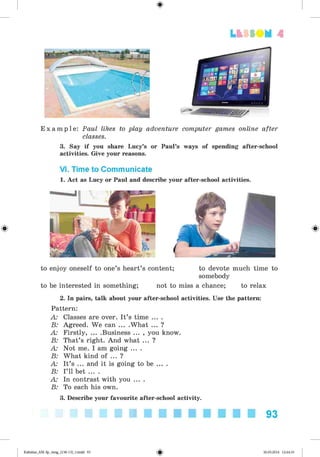
0
Thames, Ottawa, Wellington, Atlantic ocean, Sea of Azov.
192 ■ ■ ■ ■ ■ ■ ■ ■ ■ ■
<
§
•
Kalinina_AM-Sp_6eng_(138-13)_v.indd 192 30.05.2014 12:44:48
<
§
>
L t f SO M 2
2. Look and remember!
1) Use the when you want to speak about:
• the parts of the world - the South, the North, the West, the East
E x a m p l e : Ukraine is in the West.
• the names of the ships
E x a m p l e : James Cook had his sea voyage on board the Endeavour.
2) Do not use a/an, the when you want to speak about:
• continents
E x a m p l e : Columbus swam to Asia.
• proper names
E x a m p l e : James Cook is a great explorer.
• the names of the countries
E x a m p l e : Canada is the north of America.
• names of the seasons
E x a m p l e : Spring is a wonderful season.
a) Play a funny questions game. Use the words from the box below.
E x a m p l e : A: Does the crocodile live in the North?
B: No, he doesn’t. He lives in the South.
white bear koala bear Indians kangaroo
aborigines Canadians crocodile Inuits
b) Say where your town is:
• part of the world
• continent
• country
• river/sea
IV. Word Smart
a) Match the verbs to the nouns and make up sentences with them.
1. to cross a) the land
2. to reach b) the way
3. to explore c) the sea
4. to discover d) the country
5. to make e) a trip
6. to find f) the coast
7. to conduct g) the expedition
E x a m p l e : Ch. Columbus crossed the sea three times.
b) Read words and word combinations from the box (p. 191) and say:
1. who takes part in discoveries;
2. what explorers do on a sea voyage.
193
Kalinina_AM-Sp_6eng_(138-13)_v.indd 193 30.05.2014 12:44:48
<
§
>
Unit 7
to find the way to captain
to sail (sailor) explorer
to conduct an expedition a sea voyage
to claim something for somebody seamen
to draw maps crew
to explore unknown lands
#
E x a m p l e : I believe courageous seamen take part in discoveries. They
conduct sea expeditions.
c) Look at the pictures and select information about each great explorer
from the sentences below.
Konald Amundsen
Norway
Robert Scott,
Great Britain
Information Box
He is a national hero.
Information Box
He is a great Arctic explorer.
• He is a national hero of Britain.
• He is a great Arctic explorer from Norway.
• He made a risky journey to Antarctica.
• He took sleds and dog teams.
• He took ponies and a few dogs only.
• He kept a diary in which he described his hard journey.
• He wanted to be the first person at the South Pole.
194
*
Kalinina_AM-Sp_6eng_(138-13)_v.indd 194 30.05.2014 12:44:48
L t SI N 1
He put up a tent and a flag near it and claimed it for Norway.
He lost the race against another great explorer.
He died of extreme cold and hunger on the way in the ship.
People admire his bravery and will power.
He beat another great explorer in the race to the South Pole.
His countrymen can’t help admiring his wisdom and courage.
At home: Find the information about an explorer who discovered any
country.
Go to Ex. 105, 106 of your Workbook
V. Time to Listen and Read
1. Listen to / read what children from different English-speaking
countries say about the discoveries of their countries and say how the
countrymen honour them.
Today is October 12, an American public holiday.
On this day we honour Christopher Columbus, the
Italian sailor and explorer who was the first European
to discover America in 1492.
It’ll be interesting for you to know that this great
man didn’t know that he discovered America. He was
trying to find a new way to Asia, so he sailed to the
west from Spain. Even when he crossed the Atlantic,
he thought it was the coast of Asia. He continued to believe that for the
rest of his life Columbus made three more journeys to America. But
some scientists believe that the first discovery of our country by Euro­
peans was about 500 years earlier. So many scientists, so many points of
view!
Do you know that one great man discovered two
countries - New Zealand and Australia? It is the pride
of the British nation - James Cook. He discovered
New Zealand and in nine months Australia. He made
three journeys by sea to the Pacific ocean and became
the first European to arrive at the east coast of Aus­
tralia. His ship - the “Endeavour” first found New
Zealand and then crossed the Tasman sea to reach the
smallest continent in 1770.
The beauty of its nature and childlike natives - aborigines - made
an unforgettable impression on him. He called that land “Botany Bay”.
It took his crew more than six months to do a very difficult job - to
draw maps of the coasts of Australia and New Zealand. That peacefully
changed the map of the world.
195
Kalinina_AM-Sp_6eng_(138-13)_v.indd 195 30.05.2014 12:44:48
ф
Unit 7
Jacques
Cartier
Arthur
Mackenzie
Canadians admire their nation’s history. We know about original in­
habitants of the country - Indians and Inuits, but I’d like to say a few
words about European exploration. Far not everybody knows that the
first European visitors to Canada were the Vikings from Iceland and
Greenland. There is evidence that they settled in Canada around AD
1000 but nobody knows how long they stayed and what happened to
them. The French explorer Jacques Cartier came to Canada in 1534 and
claimed it for France. There were about 60 000 French settlers and it
formed a good percentage of today’s French Canadians. But the British
army also struggled for power in Canada and after many battles the
balance was achieved. Sir Arthur Mackenzie founded British Columbia
while Quebec and its territories remained French. As you see, the two
languages - French and English - appeared historically.
Ф
Across Culture
Aborigines /{ba'ri^ainz/ - корінні мешканці
Австралії.
New Zealand /,nju:'ztbnd/ - Нова Зеландія -
країна, розташована на островах поблизу
Австралії.
Anno Domini (AD) - до нашої ери (певна кіль­
кість років до народження Ісуса Христа).
Iceland - Ісландія, острівна країна в Атлан­
тичному океані, відома своїми вулканами і
гейзерами.
Ф
196
Ф
Kalinina_AM-Sp_6eng_(138-13)_v.indd 196 14.06.2014 14:34:00
2
Greenland — великий острів в Атлантичному
океані.
2. Fill in the right form of the word.
1. Ronald Amundsen is the pride of Norway.
2. Robert Scott died of cold and ... .
3. Captain Cook is a ... sailor.
4. I can’t help admiring the great men’s ... .
5. Americans are very ... of Columbus.
proud
hungry
bravery
wise
pride
3. Look at the pictures and reproduce the episodes where their explora­
tions are described.
VI. Time to Communicate
1. Act as one of your international friends and speak about the disco­
very of your country. Use:
Jeremy (Canada) Phil (USA) Sarah (Britain)
• to make a journey;
• to conduct an expedition;
197
Kalinina_AM-Sp_6eng_(138-13)_v.indd 197 14.06.2014 14:18:46
<
§
>
• to make a map;
• to claim something for somebody;
• to explore unknown lands;
• to be the national pride of the country.
2. In pairs, discuss the discovery of English-speaking countries. Use the
pattern.
Pattern:
A: I say ... , what holiday do Americans celebrate on ... ?
B: As far as I know, it is ... you know. Columbus ... .
A: That’s true, but there is evidence that ... .
B: Exactly. Every country is proud of its ... . Take Captain Cook
who ... and ... .
A: Far not everybody knows, that ... .
B: But unfortunately... .
A: You are right. But his countrymen ... and ... .
B: All ... are national heroes.
3. Imagine you are a historian. Speak about the discovery of any English­
speaking country.
Unit 7
#
VIII. Time to Write
Write a list of questions for more information you’d like to ask your
international friends about the history of their countries.
Go to Ex. 107, 108 of your Workbook
7.3. Seasons and Weather of the
English-speaking Countries
Word Bank Phrase Bank Communication Box
desert
blossom
splendid
spot
wreath
brook
well
a bouquet of flowers
maple tree
to be thrilling
to make a real sensation
to be sorry for somebody
to miss somebody/some-
thing
to stare at something
It occurred to me...
A t last...
198
Kalinina_AM-Sp_6eng_(138-13)_v.indd 198 30.05.2014 12:44:49
<
§
>
3
I. Conversation Warm-up
1. Look at the photos and guess in what country you can find these
wonders of nature.
Niagara Falls desert tundra
Mount Cook in the The Great Lakes The Great Barrier
Southern Alps Reef
E x a m p l e : We can see the Niagara Falls in the USA and in Canada.
II. Pronunciation Warm-up
Read the rhymes and practise the sentence stress. Say what message
these rhymes convey.
Autumn Weather Rhyme Route Song
It was windy when they started,
It was quiet when they walked,
It was sunny when they settled.
It was raining when they left.
Climb every mountain,
Search every stream,
Follow every rainbow
Till you find your dream.
III. Grammar Smart
1. Read the sentence and ask three wh-questions.
E x a m p l e : I can see a blossoming orchard. ^
1. What can you see?
2. Where can you see blossoming orchard?
3. Who can see a blossoming orchard?
1. Taras has taken many pictures in Canada.
2. We visited our International friends.
199
Kalinina_AM-Sp_6eng_(138-13)_v.indd 199 30.05.2014 12:44:49
<
§
>
3. I enjoy travelling.
4. Olgha made a tour of Britain last summer.
5. Boghdan is in New Zealand now.
6. My family will go to the USA next year.
2. In pairs, make up a mini-dialogue round its middle part.
E x a m p l e : - I know for sure that there is much snow in Canada.
- So do I.
- Then Jeremy can go sledging very often.
Unit 7
1. - ... 4. ...
- Neither can I. - So have I.
2. - ... 5. ...
- So can I. - Neither have I.
3. - ... 6. - ...
- Neither do I. - So am I.
... - ...
3. Look at the pictures and fill in the, a, if necessary, and add two
logically connected sentences.
#
E x a m p l e :
It isn’t warm in winter. You can ...
But there is much snow. Chernomorets in
Boys like to play hockey Black Sea.
and ski in Canada.
It is very hot
in ... summer in ...
Australia.
... London is situated
on ... Thames.
... New Zealand and ...
Australia were discovered
by ... James Cook.
200
Kalinina_AM-Sp_6eng_(138-13)_v.indd 200 30.05.2014 12:44:49
3
IV. Word Smart
1. Match the adjectives to the nouns and make up sentences with them.
1. changeable a) spot
2. splendid b) weather
3. beautiful c) bouquets
4. picturesque d) brook
5. lively e) place
6. romantic f) time
E x a m p l e : The weather is so changeable in spring.
2. Read the description of seasons and guess what country it is about.
Fill in correct names of months and seasons.
Seasons in this country are different from seasons in Ukraine. ...
months are September, October and November. Winter months are De­
cember, January and February. ...comes in March and lasts till May ...
months are June, July and August. Children in this country have their
summer holidays in ... . They celebrate Christmas on 25 December, but,
surprisingly, it is the middle of ... . They celebrate another great holi­
day - New Year in this season, too.
Many people come to this country on its winter months to have their
rest from ... .
autumn spring winter summer December summer
3. Look at the pictures and say what season is especially thrilling in
Canada, Australia, Britain, New Zealand. Say why you think so (p. 199):
Canada Australia
The USA New Zealand
201
Kalinina_AM-Sp_6eng_(138-13)_v.indd 201 30.05.2014 12:44:50
<
§
>
Unit 7
E x a mp l e : / think winter in Canada is especially thrilling. The Canadian
hockey team, is one of the best in the world. They can make
a real sensation.
At home: Write a description of any season in Australia and say why
 you’ve chosen it.
Go to Ex. 109, 110 of your Workbook
V. Time to Read
Read the story about the Canadian orphan girl, Anne Shirley, who
comes to live with the Cuthberts, Marilla and Mathew, on their farm.
She helps them with the farm work at Green Gables and goes to school.
Name three symbols of Canadian spring.
CANADIAN SPRING
PART I
Spring had come once more to Green Gables - the beautiful, change­
able Canadian spring, with sweet, fresh, chilly days and with pink sun­
sets. The maple leaves were about to appear. The Mayflowers were blos­
soming, pink and white stars of sweetness under their brown leaves. All
the school girls and boys were gathering them one afternoon.
# “I’m so sorry for people who live in lands where there are no May- ^
flowers” said Anne. “Diana says perhaps they have something better,
but there couldn’t be anything better than Mayflowers, could there, Ma­
rilla? And Diana says if they don’t know what they are like they don’t
miss them. But I think that is the saddest thing of all. I think it would
be tragic, Marilla, not to know what Mayflowers are like and not to
miss them. Do you know what I think Mayflowers are, Marilla? I think
they must be the souls of the flowers that died last summer. But we
had a splendid time, Marilla. We had our lunch by an old well - such a
romantic spot. Mr. Philip gave us the Mayflowers he found. We made
wreaths of his Mayflowers and put them on our hats; and when the time
came to go home, we marched with our beautiful bouquets and wreaths,
singing “My Home on the Hill”. Oh, it was so thrilling, Marilla. Every­
body we met on the road stopped and stared after us. We made a real
sensation”.
PART II
...After the Mayflowers came the violets and the fields were full of
them. Anne walked through them on her way to school with admiring
eyes as if she stepped on the ground. She was trying to think of a name
for a new island Diana and she had discovered up the brook. “It’s the
most picturesque place, Marilla. There are two maple trees on it and the
202 ■ ■ ■ ■ ■ ■ ■ ■ ■ ■ ■ ■ ■
*
Kalinina_AM-Sp_6eng_(138-13)_v.indd 202 30.05.2014 12:44:50
ф
brook flows right around it. A t last it occurred to me that it would be
splendid to call it Victoria Island because we found it on the Queen’s
birthday” .
Adapted from Lucy Maud Montgomery’s “Anne of Green Gables”
Lt f SO M 3
Across Culture
mayflowers - перші весняні квіти.
Queen Victoria - британська королева, яка
правила країною довше за всіх королів і
королев, 64 роки (1819-1901), і зробила
Британію сильною і квітучою.
Ф
2. Read out of the text the sentences which characterize:
- spring days;
- mayflowers;
- old well;
- the brook.
Say how they help to describe the girl’s feelings.
3. Look at the picture and say why the girl couldn’t help admiring this
place and how she decided to call it. Why? Use:
• a field with violets;
• to look at something with admiring
eyes;
• to step on the ground;
• to be the most picturesque place;
• a lively spring brook.
Ф
203
Ф
Kalinina_AM-Sp_6eng_(138-13)_v.indd 203 30.05.2014 12:44:50
<
§
>
VI. Time to Communicate
1. Act as Anne and give a description of Canadian spring. Begin with:
Unit 7
• Spring has come and ... .
• One day all the schoolgirls and boys ... .
• I couldn’t help admiring ... .
• I think mayflowers are ... .
• We had our lunch ... .
• Then we made ... .
• It was so thrilling ... .
• We made a real sensation ... .
2. In pairs, discuss the beauty of spring in Canada and Ukraine. Use the
pattern.
Pattern:
A: I say ... , spring has come and ... .
B: True, true. It is ... and ... .
A: I think there can’t be anything better than ... .
B: Agreed. And I can’t help admiring ... .
A: Do you think spring in Ukraine ... ?
B: Sure. It is so thrilling and besides ... makes a real sensation.
A: As for me I miss ... . And I’m so sorry ... .
B: Me, too. What about ... ? We can ... and ... .
A: Splendid! I’ sure we’ll ... and ... .
VII. Time to Write
Take a photo (picture) of your favourite season and describe its beauty
the way you feel it.
Go to Ex. 111, 112 of your Workbook
204
Kalinina_AM-Sp_6eng_(138-13)_v.indd 204 14.06.2014 14:20:16
ф
7.4. Get on Track
Lfcf SO M 4
Word Bank Phrase Bank Communication
Box
televiewers
to examine
oriental
marble
genious
unique
not to lose one’s chance
to be dead sure about some­
thing
to leave somebody indifferent
to be closely connected
to have the time of one’s life
to be popular with somebody
Oh, my!
As far as I can
judge...
I. Conversation Warm-up
Read and say what the capital cities of the following countries are:
Country Capital City
1. Spain
2. Germany
3. Great Britain
4. Ukraine
5. the USA
6. Australia
7. Canada
8. France
a) Paris
b) Madrid
c) London
d) Washington, DC
e) Canberra
f) Berlin
g) Ottawa
h) Kyiv
E x a m p l e : Madrid is the capital city of Spain.
II. Pronunciation Warm-up
Read the poem and practise: the sounds /{/ and /o:/. Say what capital
city you are going to explore.
G ET-O N-TRACK POEM
Summer’s here,
Let’s get on track
And take heavy rucktracks on our backs.
There’s lot of time to set and explore
And learn about countries more and more.
W e’ll visit the capitals, cities and towns.
And take lots of pictures of the Queen and the crown.
There’s time for every kind of surprise.
Are you ready for summer travel, guys?1
1 неформальне звернення до друзів обох статей
205
Ф
Kalinina_AM-Sp_6eng_(138-13)_v.indd 205 30.05.2014 12:44:50
1. Read and learn how to share information. Look at the pictures and
fill in the mini-dialogues.
Unit 7
III. Function Smart
Do you happen to know about ... ?
Oh, that’s pretty interesting.
the White House
- They say ... can take your breath
away.
- So I have heard.
the London Eye
- It’s an open secret that ... is the
greatest attraction in Canberra.
- There is every reason for that.
Lake Griffin
- It’s a well-known fact that a ... in
Ottawa is amazing!
- Really?
Tulip parade
206
Kalinina_AM-Sp_6eng_(138-13)_v.indd 206 30.05.2014 12:44:50
<
§
>
Lt f SO M 4
IV. Word Smart
1. Read what guides tell tourists during their excursions in the capital
cities and match them to the photos (p. 204-205). Say which of them
you want to see and why.
Let’s stop at this picturesque place. It’s Griffin lake - a favou­
rite place of those who live in Canberra. It’s good for canoeing and
boating. You can also cruise round Lake Griffin on any weekday. The
lake is extremely popular with kids. They have the time of their lives,
swimming and sunbathing. Can such a rest leave anybody indifferent?
You are lucky to come to Canada in winter. I guess you adore sports
and I’m dead sure skiing is your favourite one. So we won’t lose a chance
and visit the Canadian ski museum. It’s a unique museum and it is worth
seeing. I’m sure you’ll learn much interesting there. Let’s go then!
Ladies and gentlemen! Do you see that high, pencil-like obelisk of
white marble over there? It is the Washington Monument, one of the
tallest structures in the world, 555-feet tall, to be exact. You can get
to the observation platform on its top by an elevator in 70 seconds, or
by a stairway of 898 steps. Visitors can see the entire District of Co­
lumbia from its windows. If you happen to come there in spring you’ll
see a picturesque cherry-tree festival. It’s really fantastic.
This ancient building is the genious unique creation of sir Chris­
topher Wren. It is St. Paul’s Cathedral. You can climb up inside
St. Paul’s dome and look down or visit the famous gallery that goes
all the way round the inside of the dome. Don’t be surprised if people
close the wall on the other side of the gallery - 32 meters away - can
hear you talk. No wonder, it is called the Whispering Gallery, as even
the quietest whisper can be heard dearly by everyone - no secrets here.
Lake Griffin the Washington St. Paul’s Cathedral
monument
207
Kalinina_AM-Sp_6eng_(138-13)_v.indd 207 30.05.2014 12:44:51
Unit 7
E x a m p l e : As for me, I ’d like to see
the Canadian ski museum, because I ’m
fond of skiing.
2. Think of the words that can go with
the words unique and picturesque. Make
up your own sentences will them.
E x a m p l e : A picturesque place -»
Lake Griffin is a picturesque place
1. ... can’t leave anybody indifferent.
2. As far as I can judge ... .
3. Many places of interest are closely connected with ... .
4. We can have the time of our lives if ... .
5. ... is a popular place in ... .
6. I ’m dead sure ....
the Canadian ski museum
3. Complete the sentences.
At home: Find the information about the capital city you’d like to visit.
• ® J
f Explain your choice.
# V. Time to Read.
Read in pairs. Say what the children know or don’t know about London.
LONDON QUIZ
PART I
Paul: I say, Lucy, have you heard the news about “London Quiz” ?
Lucy: No. What about “London Quiz” ?
Paul: Haven’t you heard? Everyone knows about it!
Lucy: Not me. Nobody tells me anything.
Paul: Then listen to me. London Quiz is a new quiz show on our local
television. Televiewers have to answer twenty questions about
London. The winner will get a chance to travel to London this
summer.
Lucy: Oh, my! You shouldn’t lose your chance. You are Mr. Know-It-All
about London, as far as I can judge.
Paul: Do you really think so?
Lucy: Of course I do. I mean it, I really mean it. Let me examine you.
Paul: Go ahead.
208
Kalinina_AM-Sp_6eng_(138-13)_v.indd 208 30.05.2014 12:44:51
#
4
PART II
Lucy: My first question is about Big Ben: what is it?
Paul: Big Ben is the name of the clock bell, which rings every hour.
It is in the clock tower, in St. Stephen’s Tower, to be exact. I’m
dead sure about it.
Lucy: So am I. So you have won the first score. Now, where can you
find the statue of Peter Pan playing his pipe to the fairies?
Paul: In Kensington Gardens, of course. He’s also playing to the
squirrels, birds and mice around him. I have just read a book by
J.M. Barrie about Peter Pan who lives in a magic place called
“Never Never Land” .
Lucy: So have I. He is the one who never grows up, isn’t he?
Paul: That’s right, that’s him. When I ’m in London, I ’ll certainly vis­
it Kensington Gardens which is on the left bank of the river
Thames, and then I ’ll go to the right bank to have the view of
a lifetime over London and the surrounding countryside. Guess
where from.
Lucy: No idea. What do you mean?
Paul: It’s the London Eye, the largest observation wheel in the world.
From the top, you can see 36 Thames bridges!
Lucy: Unfortunately, I don’t know that much about London.
Paul: Frankly speaking, neither do I. Let’s do some Internet search
together.
Lucy: Agreed. Ф
Across Culture: Great Britain
Big Ben /big ben/ - величезний дзвін, розта­
шований в одній з веж Вестмінстерського
палацу (The Houses of Parliament).
Kensington Gardens /'kenziptmn 'ga:dnz/ - парк
Кензінгтон, розташований на південному
заході Лондона неподалік від Гайд-парку.
the Thames /temz/ - одна з найбільших річок
у Великій Британії, яка тече через центр
Лондона. Її береги з’єднують, зокрема, такі
мости, як London Bridge, Tower Bridge and
Westminster Bridge.
209
#
Kalinina_AM-Sp_6eng_(138-13)_v.indd 209 30.05.2014 12:44:51
ф
Unit 7
J.M. Barrie - шотландський письменник, автор
казки «Пітер Пен».
1. Answer the questions.
1. What is “ London Quiz” ?
2. Who wants to take part in a “London Quiz” and why?
3. Who is Mr. Know-It-All about London?
4. When did Paul get the first score in Lucy’s examination?
5. Who lives in “Neverland” ?
6. How many Thames bridges are there in London?
2. Read and fill on the web-diagram and say what Paul knows about
London.
VI. Time to Communicate
1. Act as Lucy and say how you examined Paul in London Quiz? Use:
•to know much about something;
•to be Mr. Know-It-All;
•to get a chance to do something;
•to win the first score;
•to have the view of a lifetime;
•to do the Internet search.
210
Ф
Kalinina_AM-Sp_6eng_(138-13)_v.indd 210 30.05.2014 12:44:51
<
§
>
2. In pairs, talk with your friend about what you know or don’t know
about London as in the pattern.
Pattern:
A: As far as I can judge, you are ... .
B: Do you really ... ?
A: I mean it ... . Let me ... .
B: Go ahead.
A: My first question is ... .
B: ... . I’m dead sure about it.
A: So am I. Now, ... ?
B: I have just read ... .
A: So have I ........
B: Let’s do ... .
3. Be a guide of the capital city London and tell the tourists about it.
Lt f SO M 5
#
VII. Time to Listen
1. Listen to the talk about the capital city of the USA and say how its
sights are connected with American history.
2. Listen again and correct the mistakes in the statements below.
1. There are many apple trees near the Jefferson Memorial.
2. There are 56 columns in the Lincoln memorial.
3. All American presidents except Lincoln, lived in the White House.
4. The White House consists of 321 rooms.
5. The White House is situated in Fifth Avenue.
6. There is a famous Cherry Blossom Festival in Washington in sum­
mer.
VIII. Time to Write
Plan a tour for your international friend around the capital cities.
Go to Ex. 115, 116 of your Workbook
7.5. My Progress in English
I. Grammar Smart
Fill in the article a/an, the or no article in the sentences below.
1. We live in ... Europe, in ... Ukraine, to be exact.
2. We have some relatives in ... Canada and ... USA.
3. ... James Cook is a national hero of ... Britain.
4. In ... spring, the fruit trees break into blossom in ...Washington,
DC.
211
Kalinina_AM-Sp_6eng_(138-13)_v.indd 211 30.05.2014 12:44:51
<
§
>
5. There is a monument to ... Lincoln in Washington, DC.
6. ... Canberra is the capital city of ... Australia.
Check if you can:
write the sentences correctly.
(Yes / No)
Unit 7
II. Word Smart
Insert the prepositions
1. Tourists were staring ... a marble stone structure.
2. Canberra produced an unforgettable impression ... me.
3. James Cook claimed a new land ... Britain.
4. I felt ... home in Hyde Park.
5. W e’d like to have a mind trip ... New Zealand.
6. Travelling in Australia we had the time ... our lives.
Check if you can:
connect words in sentences correctly.
(Yes / No)
#
III. Function Smart
Match the lines of the dialogues.
1. Do you happen to know about
the unique ski museum?
2. It’s an open secret that many
sights in Washington are con­
nected with the life of the
presidents.
3. It’s a well-known fact that you
can enjoy the whole panorama
of town from its top.
4. They say New Zealand’s flora
can take your breath away.
5. Australians celebrate Christ­
mas on the beach when it is
very hot.
a) So I have heard. I ’ve read
about the Lincoln monument,
and want to know more about
the White House.
b) Agreed. I can’t help admiring
tulip-trees and magnolia trees.
c) I do. This museum is in Cana­
da. It’s pretty interesting.
d) There’s every reason for it,
because the London Eye is the
largest Ferris wheel in the
world.
e) You don’t say so! Christmas on
the beach? Never heard of it!
Check if you can:
share information.
(Yes / No)
212
Kalinina_AM-Sp_6eng_(138-13)_v.indd 212 30.05.2014 12:44:51
<
§
>
Lt f SO M 5
#
IV. Time to Read
Read a part of a traveller’s diary and choose the right answers to the
questions.
15 May, Ottawa
“I ’m in the middle,
I’m between...
I mean, I’m in the middle of sightseeing in Ontario, Canada’s second
largest province. As it borders on four of the five Great Lakes. It’s only
natural that I have visited the spectacular Niagara Falls, a true magnet
for tourists. I found out that this famous waterfall actually consists of
two parts - The American Falls and the Horseshoe Falls, and they are
separated by Goat Island. Both the US and Canada have cities called
Niagara Falls, and they are joined by Rainbow Bridge. It was such a pic­
turesque view that it really took my breath away.
Now I ’m on my way to Ottawa, Canada’s capital city which is also
in Ontario. By the way, across the Ottawa River is its twin city, Hull,
in the province of Quebec. I ’m looking forward to seeing the Parliament
Buildings. “ Prince of Wales (Edward VII) laid the first stone of the
Center Block in the 19th century, then the East and West blocks were
added. The Center Block includes the House of Commons, the Senate
Chamber, the Peace Tower and offices of Members of Parliament” , my
guide book says.
I think I can already see the Peace Tower at a distance. It rises above
the Parliament Buildings. It has an observation area, from which I’ll enjoy
the most marvellous view of the whole city. The only pity is that it isn’t
July or August now, because in those summer months the Guard performs
a daily changing-the-guard ceremony in front of the Peace Tower. But nev­
er mind. There is more than enough to see in Ottawa as it is...
1. What is the second largest province in Canada?
a) Quebec; b) Ontario; c) Vancouver.
2. Where can you see the Niagara Falls?
a) in the USA and in Canada;
b) in Canada and Brazil;
c) in the USA and Mexico.
3. What river is the capital of Canada situated on?
a) the Niagara Falls.
b) the Ottawa river.
c) the St. Laurence river.
4. What did a tourist want to see in Ottawa?
a) the Niagara Falls;
b) Rainbow Bridge;
c) the Parliament Buildings.
213
Kalinina_AM-Sp_6eng_(138-13)_v.indd 213 30.05.2014 12:44:51
<
§
>
5. Where from can tourists see the whole city - Ottawa?
a) the Peace Tower;
b) the Senate Chamber;
c) the House of Commons.
6. When can the tourists see the guard ceremony near the Peace Tower?
a) in winter;
b) in spring;
c) in summer.
Check if you can:
read texts and understand the main idea.
(Yes / No)
#
V. Time to Listen
Listen to Martha’s story about her trip to Australia and mark the true
statements.
1. Canberra was Martha’s first destination in Australia.
2. She is interested in architecture.
3. The girl is not planning to visit any parks there.
4. She knows much about Australian animals.
5. Martha will take a lot of photos in Australia.
6. She will share her impressions with her friends.
Check if you can:
listen to a piece of information and understand the de­
tails.
(Yes / No)
VI. Time to Write
Plan a trip round the English-speaking world and write what country
(countries) you would like to visit in spring / summer / autumn /
winter. Give your reasons.
Check if you can:
express your impressions of the English-speaking world.
(Yes / No)
214
Kalinina_AM-Sp_6eng_(138-13)_v.indd 214 30.05.2014 12:44:51
ф
FIRST A ID K IT
G R A M M A R
U N IT ONE
1. Утворення прислівників.
Щоб сказати, як ти можеш щось зробити, уживай прислівник,
який утворюється додаванням суфікса -ly до прикметника.
quick - quickly
traditional - traditionally
extreme - extremely
equal - equally
2. Граматичні конструкції з дієсловом to make.
• Щоб сказати, що хтось примушує когось робити щось, уживай
граматичну конструкцію to make somebody do something.
E x a m p l e : Mum made me do the room. (Мама примусила мене
прибирати кімнату.)
• Щоб сказати, що допомагає виглядати особливо, уживай грама­
тичну конструкцію to make somebody especially lively.
E x a m p l e : Her glowing eyes made her especially lively. (Завдяки своїм
сяючим очам вона виглядала надзвичайно жвавою.)
Ф U N IT TH REE Ф
3. Слово enough (достатнє за кількістю), як правило, ставиться перед/
після прикметникового прислівника або іменника.
E x a m p l e : Not half enough.
Enough time.
Слово too у значенні «забагато» зазвичай ставиться перед прикмет­
никами, після яких немає іменника або прислівника.
E x a m p l e : You are too lazy.
They are not too different.
4. Щоб сказати, хто ця людина за національністю, використовуй при­
кметники, утворені від назви країни. Більшість прислівників утворюється
від назви країни.
Canada - Canadian
America - American
Ukraine - Ukrainian
Пам’ятай назви інших національностей:
France - French
England - English
Germany - German
215
Ф
Kalinina_AM-Sp_6eng_(138-13)_v.indd 215 30.05.2014 12:44:52
ф
5. Щоб сказати, якою мовою хтось розмовляє, утворюй прислівник від
назви країни.
China - Chinese
France - French
Italy - Italian
Poland - Polish
Пам’ятай!
Якщо ти додаєш до назви іноземної мови слово language, не забудь
додати артикль the перед назвою іноземної мови.
the English language
the Spanish language
U N IT FIVE
6. Щоб сказати, що ти робиш, можна використовувати два вирази.
Пам’ятай!
to go shopping - вживається без артикля
to do the shopping - використовується артикль the
E x a m p l e : I go shopping.
I do the shopping.
7. Щоб сказати, у якому відділі ти купуєш продукти в супермаркеті,
уживай прийменник at та артикль the перед назвою відділу.
E x a m p l : At the confectionary.
At the dairy.
Пам’ятай!
Деякі назви відділів мають апостроф.
A t the butcher’s
A t the baker’s
8. Щоб дати пораду, використовуй вирази:
the more ... the more
the more ... the better
the more . he sooner etc
E x a m p l e : The more you practise your English, the better you speak.
9. Деякі іменники мають однакову форму з дієсловом, від якого вони
утворені.
to photograph - a photograph
to answer - an answer
to order - an order
Пам’ятай!
to present /pri'zent/, але /'prez(o)nt/
216
Ф
Kalinina_AM-Sp_6eng_(138-13)_v.indd 216 30.05.2014 12:44:52
ф
W O RD -B U ILD IN G
U N IT ONE
• Якщо ти хочеш акцентувати увагу на відтінках кольорів, додавай
до прикметників суфікс -ish.
E x a m p l e :
yellow - yellowish
brown - brownish
U N IT THREE
• Пам’ятай, що деякі іменники утворюються від дієслів.
to discover - discovery
to puzzle - puzzle
to select - selection
U N IT FOUR
Пам’ятай!
Від деяких прикметників можна утворити два прислівники, але з
різним значенням.
hard (adj.) - hard (adv.) важко, hardly (adv.) майже ні
near (adj.) - near (adv.) поблизу, nearly (adv.) майже
U N IT FIVE
• Пам’ятай, що деякі іменники утворюються від дієслів додаванням
суфікса -er.
to teach - a teacher
to shop - a shopper
to admire - an admirer
to compose - a composer
U N IT SIX
• Пам’ятай, що деякі прикметники утворюють іменники додаванням
суфікса -ite.
favour - favourite
Ф
U N IT SEVEN
• Пам’ятай, що деякі прикметники утворюють іменники додаванням
суфікса -al.
culture - cultural
education - educational
history - historical
industry - industrial
agriculture - agricultural
217
Ф
Kalinina_AM-Sp_6eng_(138-13)_v.indd 217 30.05.2014 12:44:52
ф
• Пам’ятай, що деякі іменники дуже відрізняються від прикмет­
ників.
proud - pride
wise - wisdom
brave - bravery
hungry - hunger
W O RD M E A N IN G
U N IT ONE
• Пам’ятай, що деякі іменники утворюються від словосполучень
або дієслів.
to tell - a storyteller
to work hard - a hard worker
to mix - a mixer
• Якщо ти хочеш назвати протилежні риси характеру, вживай
прикметник з протилежним значенням (антонім).
talkative - silent
stingy - general
clever - silly
U N IT TW O
• Пам’ятай, що схожі за формою слова мають схожі або різні
Ф значення. Ф
to dream - бачити сни; мріяти
to daydream - мріяти
U N IT FOUR
• Пам’ятай, що деякі значення передаються різними словами в
британському і американському варіантах англійської мови.
Цукерки = BrE sweets = AmE candies
• Пам’ятай, що деякі слова мають майже однакові значення, тому
вони є синонімами.
gift - подарунок; талант
present - подарунок
218
Ф
Kalinina_AM-Sp_6eng_(138-13)_v.indd 218 30.05.2014 12:44:52
ф
W O RD SPE LLIN G
U N IT TW O
• Пам’ятай, що деякі слова пишуться дещо по-різному в британ­
ському і американському варіантах англійської мови.
BrE AmE
centre center
U N IT SIX
• Пам’ятай, що деякі слова можуть мати схожу графічну форму,
але різне значення.
to wonder - дивуватись
to wander - блукати
Ф Ф
219
Ф
Kalinina_AM-Sp_6eng_(138-13)_v.indd 219 30.05.2014 12:44:52
ф
Vocabulary
A
abroad adv /a'bro:d/ за кордоном
absentminded adj /{bs(a)nt
'maindid/ розсіяний
achieve v /з'Щ
іу/ досягати
across adv /a'kros/ через
action n /'{kj(a)n/ дія
add v /{d/ додавати
admire v /ad'maia/ захоплюватися
adopt v /a'dupt/ всиновлювати
adore v /з'do:/ обожнювати
adult adj /'{dlt/ дорослий
advantage n /@dVa:nti^/ перевага
adventurous adj /@dVentf(a)r@s/
той, хто любить пригоди
advice n /ad'vais/ порада
again adv /@'gein/ знову
agree v /a'gri/ погоджуватися
agriculture n /'{дпклі^з/ сільське
господарство
air n /ea/ повітря
aircraft model n /'e@kra:ft m@udl/
модель літака
amuse v /@'mju:z/ розважатися
analytical adj /,{n(a)'litik(a)l/
аналітичний
ancient adj /'ein(t)J(a)nt/ давній
angel n /'ein^(a)l/ янгол
appearance n /a'pi@r(@)n(t)s/ зов­
нішність
appetizers n /'{pitaiza/ холодні
закуски
apricot n /'eiprik@t/ абрикос
area n /'e@ria/ сфера, область
arrive v /a'raiv/ приїжджати
art n /at/ мистецтво
artistic adj /a'tistik/ артистичний,
художній
assembly hall n /a'sembli ha:l/ ак­
това зала
assist v /a'sist/ допомагати
astronaut n /'{strana:t/ астронавт
attend v /a'tend/ відвідувати
attractive adj /a'tr{ktiv/ приваб­
ливий
author n /'а:9@/ автор
awful adj /'a:f(@)l/ жахливий
awkward adj /'a:kw@d/ незграбний
B
bake v /beik/ пекти
baker’s n /'beikaz/ булочна
bar of chocolate n /ba: @
v 'foklit/
плитка шоколаду
barrel n /'b{ral/ бочка
battle n /'b{tl/ битва
be dazzled v /bi'd{zlt/ бути заво­
роженим
be on the safe side про всяк ви­
падок
beach n /br^/ пляж
become acquainted v /bi'^m
@'kweintid/ познайомитися
beforehand adv /bi'fa:h{nd/ зазда­
легідь
bet v /bet/ битися об заклад
birthday n /'b3:9dei/ день наро­
дження
bitter adj /'bit@/ гіркий
blessing n /'blesip/ благословення
blossom v /'blusam/ квітнути
boil v /boil/ кипіти
book n, v /bu:k/ книжка; замов­
ляти
booth n /bu:9/ кабіна
Botany n /'but@ni/ ботаніка
bouquet of flowers /bau'kei @
v
'flauaz/ букет квітів
braids n /breidz/ коси
brave adj /breiv/ хоробрий
breathe v /brrS/ дихати
breathtaking adj /'bre9,teikip/ за­
хоплюючий
broad adj /bro:d/ широкий
220
Kalinina_AM-Sp_6eng_(138-13)_v.indd 220 30.05.2014 12:44:52
ф
broaden v /'bra:dn/ розширювати
bull n /bul/ бик
bullfight n /'bulfait/ бій биків
bun n /Ьлп/ булочка
bunch n /Ьлп^У гілка
bus n /Ьлз/ автобус
butcher’s n /'buflaz/ м’ясний від­
діл
C
cabbage n /'k{bi^/ капуста
cabbage rolls n /'k{bi^ raulz/ го­
лубці
calculate v /'k{lkjuleit/ підрахову­
вати
calm adj /kam/ спокійний
camera n /'k{m(a)ra/ фотоапарат
can n /k{n/ металева баночка
candy n /'kendi/ цукерка-льодя-
ник
cart n /ka:t/ візок
carton n /'katn/ пакет
cartoon n /ka'tu:n/ мультик
cashdesk n /k{J desk/ каса
casual clothes /'k {3ual klauz/ про­
стий одяг
catching adj /'k{flip/ захоплюю­
чий
cave n /keiv/ печера
certainly adv /'s3:tnli/ звичайно
chance n /fl{ns/ шанс
by chance adv випадково
change v /flein^/ змінювати
changeable adj /'flein^ab(a)l/ мін­
ливий
channel n /'fl{nl/ канал
character traits /'k{rikta 'treits/
риси характеру
characteristics n /'k{rikta'ristiks/
характеристика
cheap adj /flip/ дешевий
cheer v /flia/ підбадьорювати
cheese n /fliz/ сир
chess n /fles/ шахи
chew v /flu:/ жувати
childhood n /'flaildhud/ дитинство
chin n /flin/ підборіддя
chocolate n /'floklit/ шоколад
choir n /'kwaia/ хор
chop v, n /flip/ рубати, відбивати;
відбивна
circle n /^зЖ(@)1/коло
clarinet n /kl{ri'net/ кларнет
clay n /klei/ глина
climb v /klaim/ забиратися
clue n /klu:/ ключ, нитка
coach v, n /kaufl/ тренувати; тре­
нер
coast n /kaust/ узбережжя
coat of arms n /kaut av amz/ герб
coin n /koin/ монета
collect v /ka'lekt/ збирати
comb v, n /kaum/ розчісуватися;
гребінець
compete v /kam'pit/ закінчити
compile v /kam'pail/ складати
computer literate adj комп’ютер­
но грамотний
confectionery n /kan'fekjan(a)ri/
кондитерський відділ
confuse v /kan'fju:z/ бентежити
congratulation n /kangr{tju'leij(a)n/
вітання
content n /'kuntent/ зміст
conveniences n /kanViniansiz/
зручності
corner n /'ka:na/ куток
correct v /ka'rekt/ виправляти
cost v /kust/ коштувати
cottage n /'kuti^/ літній будино­
чок
counter n /'kaunta/ прилавок
countryman n /kлntпman/ співвіт­
чизник
courage n /'^ri^/ відвага, сміли­
вість
cover v /'^va/ вкривати
cow n /kau/ корова
creative adj /kri'eitiv/ креативний
creature n /'krifla/ істота
crew n /kru:/ суднова команда
221
Ф
Kalinina_AM-Sp_6eng_(138-13)_v.indd 221 30.05.2014 12:44:52
ф
crib v, n /knb/ списувати; шпар­
галка
croak v, n /krauk/ каркати, ква­
кати; каркання, квакання
crowd n /kraud/ натовп
crown n /kraun/ корона
cucumber n /'kju:kAmba/ огірок
culture n /'kAltfa/ культура
cupboard n /'kApbad/ сервант
curiosity n /kju(a)riasiti/ допитли­
вість
curly adj /'ks:li/ кучерявий
custard n /'kAstad/ підлива
custom n /'kAstam/ звичай
cute adj /kju:t/ милий
cycling n /'saiklip/ їзда на велоси­
педі
come to a conclusion дійти ви­
сновку
D
daily routine /'deili ru:'tin/ режим
дня
dairy adj /'deari/ молочний
dangerous adj /'dein^aras/ небез­
печний
daughter n /'da:ta/ донька
daydream v /'deidrim/ мріяти
deceptive adj /di'septiv/ оманливий
decipher v /di'saifa/ розшифрову­
вати
deep v /dip/ глибокий
delicious adj /di'lifas/ смачний
delight n /di'lait/ насолода
department n /di'pa:tmant/ відділ
depend v /di'pend/ залежати
desert n /'dezat/ пустеля
deskmate n /desk 'meit/ сусід по
парті
dessert n /di'z3:t/ десерт
destination n /desti'ne'J(a)n/ місце
призначення
detergents n /di't3:^(a)nts/ миючі
засоби
devote v /diVaut/ присвячувати
diamond n /'daiamand/ діамант
diary n /'daiari/ щоденник
dictionary n /'dikj(a)n(a)ri/ слов­
ник
difficult adj /'difik(a)lt/ складний
discount n /'diskaunt/ знижка
discover v /'dis'kAva/ винайти
dish n /dif/ страва
documentary adj /dokju'ment(a)ri
документальний
dome n /daum/ купол
download v /'daun,laud/ скачати
dream v, n /drim/ мріяти; мрія
dwarf n /dwa:f/ гном
E
each adj /Щ/ кожен
earring n /'iarip/ сережка
earth n /з:9/ земля
editor n /'edita/ редактор газети,
журналу
education n /edju'keif(a)n/ освіта
educational adj /edju'keif(a)nal/
освітній
elevator n /'eliveita/ ліфт
embroider v /im'broida/ вишивати
end v, n /end/ закінчувати; кінець
endless adj /'endlis/ нескінченний
energy n /'ena^i/ енергія
enjoy v /in'^ai/ насолоджуватися
enlarge v /in'la:^/ збільшувати
enough adv /i'nAf/ досить
enrich v /ш'пф/ збагачувати
equal adj /'ikwal/ рівний
equipment n /i'kwipmant/ облад­
нання
especially adv /i'spej(a)li/ особливо
essay n /'esei/ есе
etiquette n /'etikat/ етикет
eucalyptus n /jbka'liptas/ евкаліпт
even adv /'iv(a)n/ навіть
event n /i'vent/ подія
evidence n /'evid(a)ns/ вірогідність
exact adj /ig'z{kt/ точний
excellent adj /'eks(a)lant/ відмін­
ний
222
Ф
Kalinina_AM-Sp_6eng_(138-13)_v.indd 222 30.05.2014 12:44:52
ф
ф
expedition я /ekspi'dij(a)n/ експе­
диція
experience п /ik'spi(a)rians/ досвід
explain v /ik'splein/ пояснювати
explorer п /ik'spla:ra/ дослідник
expressive adj /ik'spresiv/ вираз­
ний
extra classes п /'ekstra kla:siz/ по-
заурочні заняття
extremely adv /ik'strimli/ надзви­
чайно
F
faded adj /'feidid/ зів’ялий
fair adj /fea/ русявий (про волос­
ся)
fair adj /fea/ справедливий
family ties /'f{m (a)li taiz/ сімейні
зв’язки
fan п /f{n/ фан, вболівальник
fashion п /f{f(a)n/ мода
fast adj /fast/ швидкий
favourite adj /'feiv(a)rit/ улюбле­
ний
feed v /fid/ годувати
feel lonely /fil 'launli/ почуватися
самотнім
feel ashamed /fil ajeimd/ стида-
тися
fiction film /'fikj(a)n film/ худож­
ній фільм
fidget v /'fi^it/ соватися на
стільці
field п /fild/ поле
finger п /'fipga/ палець
fire п /'faia/ вогонь
fitting room /'fitip ru:m/ примі­
рочна
flight п /flait/ політ
flour п /'flaua/ борошно
fluent adj /fluant/ швидкий
flute п /flut/ флейта
foal п /faul/ жеребець
fog п /fog/ густий туман
folk adj /fauk/ народний
food processor п /'fud 'prausesa/
кухонний комбайн
forehead п /'forid, 'fa:hed/ чоло
fork п /fa:k/ виделка
fortnight п /'fa:tnait/ два тижні
(14 днів)
freckles п /'frek(a)l/ веснянки
friendly adj /'frendli/ дружній
fry v /frai/ смажити
frying pen п /fraip pen/ сковорідка
funfair п /'fXnfea/ ярмарок
funny adj /'fXni/ смішний
G
gallop v /'g{lap/ галопувати
game п /geim/ гра
garlic п /'galik/ часник
garnish п /'ganij/ гарнір
general adj /'^en(a)ral/ загальний
generous adj /'^en(a)ras/ щедрий
gentle adj /'^entl/ м’який, доб­
рий, лагідний
geography п /'^i'Hgrafi/ географія
get along with /get alop wiS/
уживатися з кимось
get drowned v /get/draund/ втопи­
тися
gift п /gift/ дарунок
gifted adj /'giftid/ обдарований
glowing adj /glauip/ сяючий
glue п /glu/ клей
gold п /gauld/ золото
Good Fairy /gud 'fe(a)ri/ Добра
Фея
good-natured adj /gud 'neitfad/
добродушний
grade п /greid/ клас
grapes п /greips/ виноград
grate v /greit/ терти на тертці
green grocer’s п /'grin 'grausaz/
овочевий магазин
greet v /grit/ вітати
grocer’s п /'grausez/ бакалія
guardian п /'gadian/ опікун
guess v, п /ges/ здогадуватися;
здогадка
Ф
223
Ф
Kalinina_AM-Sp_6eng_(138-13)_v.indd 223 30.05.2014 12:44:52
ф
guest n /gest/ гість
guitar n /gi'ta:/ гітара
gun n /для/ пістолет
gym n /фіш/ спортивний зал
H
habit n /'h{bit/ звичка
halfway /'hafwei/ на половині
шляху
hamster n /'h{msta/ хом’як
handmade adj /,h{n(d)meid/ руч­
ної роботи
handsome adj /'h{ns(a)m/ приваб­
ливий
hard working adj /'had 'w3:kip/
працьовитий
hate v /heit/ ненавидіти
have in common /h{v in 'knman/
мати спільне
health n /hel9/ здоров’я
hearty adj /'hati/ сердечний
heaven n /'hev(a)n/ рай
hectic adj /'hektik/ напружений,
бурхливий
helicopter n /'heliknpta/ гелікоптер
hide v /haid/ ховатися
hide-and-seek n /,haid(a)n(d)'srk/
схованки (гра)
high adj /hai/ високий
hit v, n /hit/ вдаряти, бити; удар
honour v /'nna/ поважати
hope v, n /haup/ сподіватися; спо­
дівання
horizon n /ha'raiz(a)n/ горизонт
horror n /'hnra/ жах
hospital n /'hnspit(a)l/ лікарня
hospitality n /,hnspi't{lati/ гостин­
ність
hotel n /(h)a(u)'tel/ готель
household goods /'haushauld gu:dz/
господарські товари
housewife n /'hauswaif/ домогоспо­
дарка
however /hau'eva/ однак
huge n adj /hju:^/ величезний
hunger /'hApga/ голод
hunter n /Wnta/ мисливець
hurry v /'йли/ поспішати
I
ice cream n /.ais'krim/ морозиво
imagine v Д'ш {ф т/ уявляти
imitate v /'imiteit/ імітувати
immediately adv /i'mrdiatli/ не­
гайно
important adj /im'pa:t(a)nt/ важ­
ливий
impression n /im'prej(a)n/ вражен­
ня
improve v /im'prurv/ покращувати
include v /in'klud/ включати,
складати
indoor court /in'da: ka:t/ критий
корт
industry n /'indastri/ промисло­
вість
inhabitant n /in'h{bit(a)nt/ жи­
тель
insects n /'insekts/ комахи
instead /in'sted/ замість
intelligent adj /in'teli^(a)nt/ ро­
зумний
interview n, v /'intavju/ інтерв’ю;
брати інтерв’ю
invent v /in'vest/ винаходити
invite v /in'vait/ запрошувати
island n /'ailand/ острів
J
jersey n /'^3:zi/ морська куртка
jogging n /'^ngip/ біг підтюпцем
join v /фат/ приєднуватися
joke n /<^auk/ жарт
jolly adj /'фей/ веселий
journalist n /^3:n(a)list/ журна­
ліст
journey n /'фз:ш/ подорож
joy n /Фоі/ радість
judge v, n /'флф/ судити; суддя
jump v, n /флmp/ стрибати;
стрибок
224
Ф
Kalinina_AM-Sp_6eng_(138-13)_v.indd 224 30.05.2014 12:44:52
ф
K
keep fit /'kip 'fit/ бути у формі
keepsake n /'krpseik/ сувенір на
згадку
kick v /kik/ бити, вдаряти
kiss v, n /kis/ цілувати; поцілунок
kite n /kait/ повітряний змій
knee deep /'knr dip/ по коліно
knick knack n /'nikn{k/ дрібничка
knife n /naif/ ніж
knit v /nit/ в’язати
knowledge n /'тИф/знання
L
land v, n /l{nd/ приземлятися;
земля
landmark n /'l{ndma:k/ віха
laugh v /laf/ сміятися
lazy ad/ /'leizi/ лінивий
lazybones n /leizib@unz/ ледар
leather n, ad/ /'leSa/ шкіра; шкі­
ряний
leisure n /'1
єз@
/ вільний час, до­
звілля
let somebody down /let 'sAmb@di
daun/ підводити когось
lick v /lik/ лизати
lifelong dream /'laifbp 'drim/ мрія
всього життя
lifestyle n /'laifstail/ стиль життя
light n /lait/ світло
line n /lain/ черга
lips n /lips/ вуста
listen v /'lis(a)n/ слухати
literate adj /'lit(@)rit/ грамотний
loaf n /lauf/ булка
local adj /'l@uk(@)l/ місцевий
logical adj /'ta^ik(@)l/ логічний
look through /luk9ru:/ переглядати
loose adj /lu:z/ широкий
lorry n /lori/ вантажівка
loud adj /laud/ гучний
love dearly /Iav 'di@li/ ніжно ко­
хати
luckily adv /'lAkili/ на щастя
M
magazine n /,m{g@'zm/ журнал
magic adj /'m{^ik/ магічний
make a mess of sth /meik a mes av
'sAmGip/ провалити щось
manage v /'m {ni^/ прихитрятися
manuscript n /'m{njuskript/ ману­
скрипт, рукопис
maple syrup /'meipl 'sir@p/ клено­
вий сироп
marble adj, n /'mabl/ мармуровий;
мармур
mashed potatoes /'m {ft p@'teit@uz/
картопляне пюре
master v /'mast@/ оволодіти
meadow n /'med@u/ луг
mean v /mm/ мати на увазі
meat n /mit/ м’ясо
memorable adj /'mem(@)r@b(@)l/
пам’ятний
memory n /'mem(@)ri/ пам’ять
merry-go-round n /'meri gau
,raund/ карусель
message n /'mesi^/ повідомлення
microwave oven /'maikraweiv 'Av(@)n/
мікрохвильова піч
mince v /mins/ молоти
mirror n /'mira/ дзеркало
miss v /mis/ пропускати, скучити
mix v /miks/ перемішувати, зби­
вати
moon n /mu:n/ місяць
mother tongue /'imSartAg/ рідна
мова
mouth n /mau9/ рот
movement n /'muvm@nt/ рух
movie n /'muvi/ кіно, фільм
music band /'mju:zik/b{nd/ музич­
ний гурт
N
napkin n /'rrnpkin/ серветка
narrow adj /'n{r@u/ вузький
native adj /'neitrv/ рідний
native speakers /'neitiv 'spik@z/
носії мови
225
Ф
Kalinina_AM-Sp_6eng_(138-13)_v.indd 225 30.05.2014 12:44:52
ф
ф
nature я /'nertfa/ природа
nearly adv /'nidi/ майже
neat adj /nit/ охайний
necessity n /na'sesiti/ необхідність
need v, n /nid/ потребувати; по­
треба
negative adj /'negativ/ негативний
neighbour n /'neiba/ сусід
network n /'netw3:k/ сітка
news n /'nju:z/ новини
newspaper n /'njuspeipa/ газета
noise n /'naiz/ шум
nourishing adj /'плпіщ/ поживний
number v, n /'mmba/ нумерувати;
номер
nut n /mt/ горіх
O
object n /'nb^akt/ предмет
observe v /@b'z3:v/ спостерігати
obsession n /ab'sej(a)n/ настирлива
ідея
ocean n /'auf(a)n/ океан
offer v />fa/ пропонувати
only /'aunli/ лише
opinion n /a'pinjan/ думка
opportunity n /bpa'tjuniti/ можли­
вість
opposite adj /bpazit/ протилежний
option n A>pJ(a)n/ вибір, альтерна­
тива
orally adv /'airali/ усно
orchestra n /'akstra/ оркестр
ordinary adj /'a:d(a)nri/ звичайний
oriental adj /'a:nantal/ східний
orphan n /'a:f(a)n/ сирота
ostrich n /bstntf/ страус
otherwise adv /Wdawaiz/ в іншому
випадку
out in the open /'aut in da 'aupan/
на свіжому повітрі
out of order /'aut av a:da/ несправ­
ний
outgrow v /aut'grau/ перерости,
вирости з
oven n /Wvan/духовка
226
p
pack v /p{k/ пакувати речі
pale adj /peil/ блідий
pancakes n /'p^nkeiks/ млинці
pantomime n /'p^ntamaim/ панто­
міма
participate v /pa:'tisipeit/ брати
участь
pastime n /'pastaim/ проведення
часу
patient adj /'peif(a)nt/ терплячий
peach n /'pitf/ персик
peculiar adj /'pi'kjulia/ особливий,
своєрідний
percentage n /'pasenti^/ відсоток
perfumery adj /'pa'fju:m(a)n/ пар­
фумерний відділ
persistence n /'pa'sisst(a)n(t)s/ напо­
легливість
personality n /'p3:sa'n{liti/ особис­
тість
phone v, n /faun/ телефонувати;
телефон
picturesque adj /,piktf(a)'resk/
мальовничий
pie n /pai/ пиріг
pile n /pail/ купа, велика кіль­
кість
pink adj /pink/ рожевий
pity v /'piti/ жаліти
pizza n /pilsa/ піца
platypus n /'pfetipas/ качконіс
playground n /'pleigraund/ дитячий
майданчик
pocket n /'pakrt/ кишеня
poetry n /'pauitri/ поезія
polite adj /pa'lait/ ввічливий
pond n /pond/ ставок
popular adj /'pnpjula/ популярний
postcards n /'paustka:dz/ поштові
листівки
poster n /'pausta/ плакат
poultry n /'paultri/ м’ясо птиці
prefer v /'pri'f3:/ надавати перевагу
prepare v /pripea/ готувати
Ф
Ф
Kalinina_AM-Sp_6eng_(138-13)_v.indd 226 30.05.2014 12:44:52
ф
pretty adj /'priti/ гарненький
price n /prais/ ціна
price tag /prais t{g/ цінник
principal part /'prmsip(a)l pa:t/ го­
ловна роль
printed adj /'prmtid/ друкований
pronunciation n /pr3,nensi'eif(3)n/
вимова
proverb n /'prov3:b/ приказка
provider n /'praVaida/ постачальник
province n /'provm(t)s/ область
punch code /'pAntfkaud/ пароль
punctual adj /'pAcktfual/пунктуаль­
ний
puppy n /'pApi/ цуценя
purse n /p3:s/ гаманець
Q
quality n /'kwoliti/ якість
question n /'kwestf(a)n/ питання
quick-tempered adj /kwik 'tempad/
запальний, дратівливий
quiet adj /'kwaiat/ спокійний
Ф quilt n /kwilt/ клаптикова ковдра
quiz show /kwiz Jau/ ігрова про­
грама, вікторина
R
race n /reis/ гонка, змагання
railway adj /'reilwei/ залізничний
rainbow n /'rembau/ райдуга
rare adj /rea/ рідкий
raw adj /ra:/ сирий
reach v /гі#/ досягати
reason n /'riz(a)n/ причина
recently adv /'ris(a)ntli/ нещодавно
refuse v /ri'fjbz/ відмовлятися
regularly adv /'regjulali/ регулярно
relax v /ri'l{ks/ відпочивати
rely on /ri'lai on/ спиратися на... ,
розраховувати
remarkable adj /ri'ma:kabl/ ви­
значний
remember v /ri'membar/ пам’ятати
remove v /rimuv/ убирати
rent v /rent/ брати напрокат
report n /ripa:t/ доповідь
request n /ri'kwest/ прохання
research v, n /изз:^/ досліджу­
вати; дослідження
responsible adj /n'spr>nsab(a)l/ від­
повідальний
rhythm n /'riSm/ ритм
rice n /rais/ рис
ring n /пр/ обручка
road n /raud/ дорога
rocking chair /'rakip tfea/ крісло-
гойдалка
roleplay v /'raulplei/ розігрувати
roll n /raul/ бублик
root n /ru:t/ корінь
rope n /raup/ мотузка
round adj /raund/ круглий
route n /ru:t/ маршрут
rude adj /ru:d/ грубий
ruin v /'m:in/ руйнувати
rule n /ru:l/ правило
S ф
saddle n /'{dl/ сідло
sailor n /'seila/ моряк
sale n /seil/ розпродаж
salt n /salt/ сіль
sand n /s{nd/ пісок
sand castle n /'syndkasl/ пісочний
замок
saucepan n /'sa:sp{n/ блюдце
sausage n /'sosi^/ ковбаса
schedule n /'edjbl/ розклад
schooner n /'sku:na/ шхуна
science n /'saians/ наука
scissors n /'sizaz/ ножиці
scornful adj /'ska:nf(a)l/ презирли­
вий, зневажливий
screen n /sk'rm/ екран
search v /s3:tf/ шукати
seasick n /'si,sik/ морська хвороба
seesaw n /'srsa:/ гойдалка
seldom adv /'seldam/ рідко
serious adj /'si(a)rias/ серйозний
227
Ф
Kalinina_AM-Sp_6eng_(138-13)_v.indd 227 30.05.2014 12:44:52
ф
serviette n /s3:vi'et/ серветка
several /'sev(a)ral/ декілька
sew v /sau/ шити
share v /Jea/ ділитися
shell n /Jel/ мушля
shine v /Jain/ сяяти
shoot v /Ju:t/ стріляти
shop assistant n /Jbp a'sist(a)nt/
продавець
shoulder n /'aulda/ плече
shout v /Jaut/ кричати
shy adj /Jai/ сором’язливий
sigh v, n /sai/ зітхати; подих
sights n /saits/ визначні місця
sign v /sain/ підписувати
silk n /silk/ шовк
silly adj /'sili/ дурний
silver n, adj /'silva/ срібло; сріб­
ний
size n /saiz/ розмір
skill n /skil/ вміння
skin n /skin/ шкіра
sledge n /sle^/ санки
slender adj /'slenda/ стрункий
slice v /slais/ різати скибочками
slow adj /slau/ повільний
smell v, n /smel/ пахнути; запах
soap n /saup/ мило
soap opera /saup 'np(a)ra/ мильна
опера
socks n /soks/ шкарпетки
solution n /sa'lu:J(a)n/ рішення
solve problems /snlv p'roblams/ ви­
рішувати проблеми
sound n /saund/ звук
sour adj /'saua/ кислий
souvenir n /'suvania/ сувенір
space n /speis/ простір, космос
speed n /sptd/ швидкість
spirit n /'spirit/ душа
sponge cake /'spnn^ keik/ бісквіт
spoon n /spun/ ложка
sportground n /s'pa:tgraund/ спор­
тивний майданчик
spot n /spot/ містечко
squash n /skwnj/ сквош, ракетбол
staff room /stufrum/ учительська
stage n /stei^/ сцена
stamp n /stamp/ марка
star n /stu/ зірка
stare v /stea/ пильно дивитися
statement n /'steitmant/ ствер­
дження
station n /steij(a)n/ станція, вок­
зал
stationer’s /'steif(a)naz/ канцеляр­
ські товари
steak n /steik/ біфштекс
stew v /stju/ тушкувати
stickers n /'stikaz/ наклейки
stingy adj /'stin^i/ скупий
storyteller n /'stnri'tela/ розповідач
stove n /stauv/ кухонна плита
straight adj /streit/ прямий
stranger n /'strein^a/ незнайомець
strawberries n /'stra:b(a)riz/ полу­
ниця
stream n /sttm/ струмочок
strength n /strepG/ сила
stubborn adj /'stAban/ впертий
stupid adj /'stjupid/ дурний, не­
розумний
stylish adj /'stailij/ стильний
subject n /'sAb^ikt/ предмет
success n /sak'ses/ успіх
suddenly adv /'sAd(a)nli/ неочіку-
вано
suitable adj /'s(j)utab(a)l/ підходя­
щий
supportive adj /sa'pa:trv/ підтри­
муючий
sweet adj /swkt/ солодкий
swimming pool /swimippul/ басейн
switch on/off /switf nn/nf/ вмика-
ти/вимикати
score n /ska:/ рахунок
T
take off /teik of/ злітати
talkative adj /'ta:katrv/ балакучий,
говіркий
228
Ф
Kalinina_AM-Sp_6eng_(138-13)_v.indd 228 30.05.2014 12:44:52
ф
tall adj /ta:l/ високий
taperecorder n /'teipr^kaida/ магні­
тофон
taste v, n /teist/ смакувати; смак
team n /tom/ команда
temp out /temp out/ виманювати
temperate adj /'temp(a)rat/ помір­
ний
tent n /tent/ палатка
term n /'t3:m/ семестр
thick adj /9ik/ товстий
thin adj /Tin/ тонкий
thrilling adj /'Trilip/ захоплюючий
tight adj /tait/ вузький
top pupil /top 'pju:p(a)l/ кращий
учень
trade v, n /treid/ торгувати; тор­
гівля
traditionally adv /'tra'dia^nali/
традиційно
train n /trein/ поїзд
trainers n /'treinaz/ кросівки
transcribe v /'tr^n'skraib/ транс­
крибувати
treasure n Дгезз/ клад
trip n /trip/ поїздка
trousers n /'trauzaz/ штани
true adj /tru:/ правдивий
try v, n /trai/ намагатися; спроба
trot v /trot/ вигулювати коня
twice /twais/ двічі
twins n /twinz/ близнюки
twitter v, n /twite/ щебетати;
щебетання
U
ugly adj Agli/ жахливий
umbrella n /4mbrela/ парасолька
understand v /4nda'st{nd/ розу­
міти
unforgettable adj Anfa'getabl,/ не­
забутній
unfortunately adv /Wfa^anatli/
на жаль
unique adj /ju:'nrk/ унікальний
unite v /junait/ об’єднувати
useful adj /'u:sf(a)l/ корисний
user n /'u:za/ користувач
V
valley n /V{li/ долина
value n /V{lju:/ цінність
van n /v{n/ фургончик
vase n /veiz/ ваза
verb n /v3:b/ дієслово
view n /vju:/ вид
village n /Vili^/ село
violets n /Vaialats/ фіалки
violin n /vaia'lin/ скрипка
vocabulary n /va'k{bjalari/ слов­
ник
voice n /vois/ голос
volume n /Voljum/ звук
voyage n /Vaii^/ подорож
W
wait v /weit/ чекати
walk v, n /wa:k/ прогулюватися;
прогулянка
wand n /wond/ чарівна паличка
washing powder /yoJip 'pauda/
пральний порошок
waste v /weist/ витрачати
waterfall n /wa:tafa:l/ водоспад
waterway /wa:tawei/ водний шлях
wave n /weiv/ хвиля
wealth n /wel9/ багатство
wear v /wea/ носити
webpage /webpei^/ веб-сторінка
week n /wok/ тиждень
weightlessness n /weitlisms/ нева­
гомість
welcome v /welkam/ вітати
well /wel/ криниця
well-planned /wel'pl{nd/ добре
спланований
well-read adj /wel'red/ начитаний
west n /west/ захід
wet adj /wet/ вологий
wheel n /wrl/ колесо
229
Ф
Kalinina_AM-Sp_6eng_(138-13)_v.indd 229 30.05.2014 12:44:52
ф
which pron /ш$/ котрий
whisper v, n /wispa/ шепотіти;
шепіт
will n /wil/ воля
willingly adv /Wilipli/ добровільно
win v /win/ вигравати
wind n /wind/ вітер
wise adj /waiz/ мудрий
wish v, n /wj/ бажати; бажання
wonderful adj /wendaf(3)l/ прекрас­
ний, чудовий
wood n /wu:d/ ліс
wooden adj /wudn/ дерев’яний
woodwork /wudw3:k/ робота по
дереву
woolen adj /wul(a)n/ вовняний
word n /w3:d/ слово
world n /w3:ld/ світ
worry v /wait/ хвилюватися
wreath n /гг9/ вінок
Y
year n /ji@(r)/ рік
yesterday /jestadei/ вчора
Z
zenith n /'zeni9/ зеніт
zone n /'zaun/ зона
Ф Ф
230
Ф
Kalinina_AM-Sp_6eng_(138-13)_v.indd 230 30.05.2014 12:44:52
CONTENTS
My Summer Diary ............................................................................. 2
I ’m a Sixth Former Now ................................................................... 6
Unit One: Family Ties
Family lifestyles .................................................................................11
Your Real Self .................................................................................. 18
Appearances are Deceptive .............................................................. 24
The Two of Us: My Friend and I ..................................................... 30
My Progress in English .................................................................... 35
Unit Two: On Your Hobby Horse
2.1. May success attend you! ........................................................... 39
2.2. Necessity or Obsession? ........................................................... 46
2.3. In Season and Out of Season .................................................... 54
2.4. Let’s Agree to Differ ................................................................ 61
2.5. My Progress in English ........................................................... 67
Unit Three: School Life
3.1. School Routine .......................................................................... 70
3.2. I Have a Head for....................................................................... 76
3.3. A Creative Mind ........................................................................ 82
3.4. To Each his Own ........................................................................ 88
3.5. My Progress in English ........................................................... 94
Unit Four: Travelling
4.1. Choosing a Route ...................................................................... 97
4.2. Ready, set, go! ........................................................................ 103
4.3. Welcome to Ukraine ............................................................... I l l
4.4. “Step out of your cave and look around” ............................ 118
4.5. My Progress in English ......................................................... 124
Unit Five: Are you Good at Shopping?
5.1. Planning a Shopping Trip ..................................................... 127
5.2. Shopping for Food .................................................................. 133
5.3. Non-food Shopping ................................................................ 140
5.4. Choosing a Present ................................................................ 147
5.5. My Progress in English ......................................................... 152
Unite Six: Help Yourself to...
What’s for Dinner? ........................................................................ 156
Kalinina_AM-Sp_6eng_(138-13)_r.indd 231 30.05.2014 12:31:31
I ’m a foodie, and you? ................................................................... 161
Mind your Manners ........................................................................ 167
Holiday Foods ................................................................................. 174
My Progress in English ................................................................. 178
Unit Seven: Welcome to the English-speaking W orld
7.1. So Many Countries So Many Cultures .................................. 182
7.2. Discovering English-speaking Countries .............................. 190
7.3. English-speaking Countries ................................................... 197
7.4. Get on Track ........................................................................... 204
7.5. My Progress in English ......................................................... 210
First Aid K it .................................................................................. 214
Vocabulary ..................................................................................... 219
Навчальне видання
К АЛІН ІН А Лариса Вадимівна
САМОЙЛЮКЕВИЧ Інна Володимирівна
АНГЛІЙСЬКА МОВА
для спеціалізованих шкіл
з поглибленим вивченням англійської мови
Підручник для 6 класу
загальноосвітніх навчальних закладів
Рекомендовано Міністерством освіти і науки України
Головний редактор Н. Заблоцька. Редактор І. Лук’янчук.
Обкладинка Т. Кущ. Художній редактор О. Мамаева.
Технічний редактор Ц. Федосіхіна.
Комп’ютерна верстка Ю. Лебедева.
Формат 70х100/іб.
Ум. друк. арк. 18,792. Обл.-вид. арк. 17,87.
Тираж 1023 пр. Вид. № 1468.
Зам. №
Видавництво «Генеза», вул. Тимошенка, 2-л, м. Київ, 04212.
Свідоцтво суб’єкта видавничої справи серія ДК № 3966 від 01.02.2011.
Віддруковано з готових позитивів у
ТОВ «П Е Т», вул. Ольмінського, 17, м. Харків, 61024.
Свідоцтво суб’єкта видавничої справи серія ДК № 4526 від 18.04.2013.
Ф
Kalinina_AM-Sp_6eng_(138-13)_r.indd 232 30.05.2014 12:31:31

angl 6

  • 2.
    Л.В. Калініна, І.В.Самойлюкевич Англійська мова для спеціалізованих шкіл з поглибленим вивченням англійської мови Підручник для 6 класу загальноосвітніх навчальних закладів Рекомендовано Міністерством освіти і науки України # # Київ «ГЕНЕЗА» 2014 # Ка1іпіпа_АМ-5р_6еп^(138-13)_г.іпс1(1 1 30.05.2014 12:31:31
  • 3.
    УД К 811.111(075.3) ББК81.2АНГЛ.922 К17 Рекомендовано Міністерством освіти і науки України (Наказ МОН України від 07.02.2014 № 123) Наукову експертизу проводив Центр наукових досліджень та викладання іноземних мов НАН України. Експерт О М . Ільченко, доктор філологічних наук, професор, заступник директора з наукової роботи. Психолого-педагогічну експертизу проводив Інститут педагогіки НАПН України. Експерт І.В. Алексеенко, молодший науковий співробітник лабораторії навчання іноземних мов. Н е з а л е ж н и й експерт: Едвард Беррі Гропп, волонтер Корпусу Миру СІЛА в Україні В і д по ві д ал ь ні за під гот овк у підручника: Коваленко О.Я., головний спеціаліст департаменту загальної середньої та дошкільної освіти МОН України; Шопулко М.Н., методист вищої категорії відділу науково-методичного забезпечення змісту освіти основної і старшої школи Інституту інноваційних технологій і змісту освіти МОН України. УМОВНІ ПОЗНАЧЕННЯ: Вправи на аудіювання, фонетичне опрацювання мовленнєвого матеріалу Письмові вправи Домашнє завдання - О - — Калініна Л.В. К17 Англійська мова для спеціаліз. шк. з поглибл. вивч. англ, мови : підруч. для 6 кл. загальноосвіт. навч. закл. / Л.В. Калініна, І.В. Самойлюкевич. - К. : Генеза, 2014. - 232 с. : іл. ЕЗВЫ 978-966-11-0430-2. УДК 811.111(075.3) ББК 81.2АНГЛ.922 ISBN 978-966-11-0430-2 ©Калініна Л.В., Самойлюкевич І.В., 2014 © Видавництво « Генеза», оригінал-макет, 2014 Ф Kalinina_AM-Sp_6eng_(138-13)_r.indd 2 30.05.2014 12:31:31
  • 4.
    ф Любий друже! Перед тобоюпідручник з англійської мови. Він склада­ ється із семи розділів - Units. Кожний розділ - це велика тема, наприклад «Друзі» або «Шкільне життя». Для того, щоб з книгою було зручніше працювати, розділи поділено на п’ять частин, залежно від того, про що конкретно йдеться. Робота над темою (підтемою) розпочинається з активі­ зації раніше засвоєного лексико-граматичного матеріалу. Це рубрика “Conversation Warm-up” , у якій для тебе наве­ дено приклад висловлювання. Навчитися «розмовляти, як англієць» тобі допоможе рубрика “Pronunciation Warm-up” . У ній ти знайдеш багато веселих англійських віршів, наспівів, скоромовок, що сприятимуть удосконаленню твоєї вимови й інтонації. У тебе з’являться нові друзі з різних країн Великої Британії, Канади, США, Австралії, з якими ти будеш спілкуватися англійською, пізнавати їхню культуру та порівнювати її з власною. Разом з ними ти мандруватимеш їхніми країнами, побачиш видатні місця, ознайомишся з різноманітними святковими традиціями. Це допоможе Ф тобі не тільки поглибити знання з англійської мови, а й Ф подивитися на світ широко відкритими очима, навчитися розмовляти англійською як мовою міжнародного спілку­ вання. Good luck! Хай щастить! 3 ф Kalinina_AM-Sp_6eng_(138-13)_v.indd 3 30.05.2014 12:44:19
  • 5.
    My Summer Diary I.Conversation Warm-up Look at the pictures below. What summer holidays did these children have? What plans did you have? E x a m p l e : I planned to go to the seaside. II. Pronunciation Warm-up Read and practise the sounds /e/, /*/. Say how you feel about the end of summer. SUM M ER’S END CHANT Is summer over? {g} Yes, it is. {g} Do you feel unhappy? I ’m full of regret. Did you have a nice time? I sure did. Did you part with your friends? How very sad! III. Grammar Smart Read and recall! to plan - planned to dream - dreamt to want - wanted to sing - sang to play - played to make - made to visit - visited to think - thought to dance - danced to bring - brought to swim - swam to take - taught 1. Let’s play a grammar chain game. E x a m p l e : Steven: I swam in the river in summer. Helen: I sang new songs in summer... 4 Kalinina_AM-Sp_6eng_(138-13)_v.indd 4 30.05.2014 12:44:19
  • 6.
    < § > 2. Complete thesentences. E x a m p l e : I made many new friends last summer. ^ We were playing in the yard all day long. 1. ... in June. 2. ... in July. 3. ... in August. 4. ... last summer. 5. ... all day long. 6. ... the whole summer. IV. Time to Listen and Read 1. Listen to / read in pairs and say what the children planned to do in summer. # SUMMER H O LIDAY PLAN S Paul: Hi, Lucy. Did you enjoy your summer holidays? Lucy: A lot. I had the time of my life. Paul: Did all your plans come true? Lucy: Exactly. I planned to visit my relatives in Kyiv, and I did. Besides, I wanted to learn rollerskating and oh, it was great. How about you? Paul: Nothing to boast of. As my parents worked all the summer, I had to stay in town. It was not that exciting, you know. But I rode my bike every day and read a lot. It made me feel better. ^ Lucy: I bet you read some new fantasy books. They are your favou­ rite, aren’t they? Paul: Sure. I also planned to read a collection of Jack London’s sto­ ries but, unfortunately, the school library closed for the sum­ mer break. Lucy: Come, come! You can do it later. By the way, I’ve got a sur­ prise for you - a souvenir from Kyiv. It’s a photo I took in Khreschatyk. Paul: How nice of you! Thanks a lot. Lucy: My pleasure. 2. Read the sentences and match them to the characters - Lucy and Paul. 1. Did you enjoy your summer holi­ days? 2. As my parents worked all the sum­ mer, I had to stay in town. 3. I planned to visit my relatives in Kyiv, and I did it. 4. I ’ve got a surprise for you - a sou­ venir from Kyiv. 5. I learned rollerskating. It was great. 5 Kalinina_AM-Sp_6eng_(138-13)_v.indd 5 30.05.2014 12:44:20
  • 7.
    # 3. In thetext “Summer Holidays Plans” find the words for the follo­ wing areas and make up sentences with them. summer holidays plan # E x a m p l e : Did you enjoy your summer holidays? V. Time to Communicate a) In pairs, talk about your summer holiday plans. Say which of them came true. Follow the pattern. Pattern: A: Hi, Ann. Did you enjoy your summer holidays? B: A lot. I had ... . A: Did all your plans ... ? B: Exactly. I planned to ... . Besides, ... . How about you? A: Nothing to boast o f........ B: I bet ... . A: Unfortunately ... and ... . B: Come, come! You can ... . By the way ... . A: How nice of you! ... . B: My pleasure ... . b) Act as Lucy and describe your stay in Kyiv. Use the pictures and the word list. to take pictures; every other day; to buy a souvenir; to be one’s favourite. 6 # Kalinina_AM-Sp_6eng_(138-13)_v.indd 6 30.05.2014 12:44:20
  • 8.
    < § > c) Act asPaul and tell your classmates about your summer holidays. to ride a bike; to swim in the river; to read a fantasy book; unfortunately. VI. Time to Write At home: Write a short essay under the title “My Summer Holidays Plans”. # Go to Ex. 1, 2 of your Workbook I’m a Sixth Former Now I. Conversation Warm-up Look at the pictures and say what children are talking about on their first day at school. 7 Kalinina_AM-Sp_6eng_(138-13)_v.indd 7 30.05.2014 12:44:20
  • 9.
    < § > E x am p l e : I think Boris and Artem are talking about sport, football, to be exact. II. Pronunciation Warm-up Read and practise the rhythm. Say what you think about your studies in the sixth form. THE SIXTH FORMER’S R AP The sixth form is great, really great New hopes and friends, new subjects and trends. The sixth form is great, really great New song to sing New games to play Much new to learn Fun every day! III. Grammar Smart Read and recall: there is/there are and modal verbs. 1. Look at the photo and say what there is on the desk, what children must take to school. E x a m p l e : There are copybooks on the table. We must take them to school. 8 ■■■■■■■■■■ * Kalinina_AM-Sp_6eng_(138-13)_v.indd 8 30.05.2014 12:44:20
  • 10.
    < § > 2. Play agrammar trio game. study new subjects meet new friends can work hard We may take sport in the sixth form must go on excursions join different clubs learn many interesting things E x a m p l e : We can meet new friends in the sixth form. We must work hard. We may take new sport. 3. In groups, say: 1. What clothes the sixth formers should/shouldn’t wear at school. 2. How the school children should/shouldn’t behave at school. IV. Time to Listen and Read 1. Listen to / read what different children say about their studies in the sixth form. Whose ideas do you share? Ann: I like to be a sixth former. It means I will learn more about different unknown things. There are new subjects in our new time table and there are also new teachers. I like to learn new things! Boris: Last year the sport team of our class was a school champi­ on. In summer my friends and I practised a lot in our school stadium. I hope we’ll win all the football matches this year too. Olha: During my summer holidays my granny taught me how to em­ broider. I’ve embroidered my blouse and a handkerchief. Now I want to learn how to knit. I have a little brother and I want to knit socks for him. Our teacher can teach me. Helen: My friends say I ’m a very sociable person and make friends easily. It’s true. I like to meet new people. As a rule there are a few new pupils in our class every year. I think we’ll make friends. Andrew: This year I’m going to join our English-speaking club. I want to improve my English. I spent my summer in Artek and became acquainted with John Brown from Britain. I had difficulties in commu­ nicating with him. I felt ashamed when I couldn’t understand him or answer his questions I must learn English better! Bohdan: As I’m interested in computing this year I’m going to devote more time to it. I want to learn how to make my web-site, to search the Internet at our computer technology lessons. It’s fun to find new e-pals and to communicate with them. 9 Kalinina_AM-Sp_6eng_(138-13)_v.indd 9 30.05.2014 12:44:20
  • 11.
    < § > # 2. Answer thequestions. 1. What does Ann want to do in the sixth form? 2. Who is going to learn to knit? 3. Why is Andrew going to join the English-speaking club? 4. Who is very sociable? 5. What does Bohdan want to learn at his computer technology lessons? 6. What does Boris plan to do in the sixth form? 3. Look at the pictures and reproduce these episodes from the texts. IV. Time to Communicate 1. In pairs, discuss with your friends your plans for the 6-th form as in the pattern. Pattern: A: Hey ... , we are the sixth formers now. What ... ? B: I’m glad to be a sixth former, because ... . A: Besides, this year ... and ... and what ...? B: As for me I’m going ... . A: That’s great! I know you are interested in .... Are you going ... ? B: Exactly. I think ... . A: And I ... and ... . B: I hope, we’ll ... . 10 Kalinina_AM-Sp_6eng_(138-13)_v.indd 10 30.05.2014 12:44:20
  • 12.
    < § > 2. Act asone of the children and speak about your plans for the sixth form. Use: to become a sixth former; to be going to do something; to take part in something; to join something; to devote much time to something; to enjoy something. # 3. Speak about your future studies in the sixth form. VI. Time to Write Write about a new activity you are going to take part in being a sixth former. Go to Ex. 3, 4 of your Workbook 11 Kalinina_AM-Sp_6eng_(138-13)_v.indd 11 30.05.2014 12:44:21
  • 13.
    # Unit 1 Unit One:Family Ties 1.1. Family Lifestyles Word Bank Phrase Bank Communication Box provider adventurous breathtaking memorable supportive to be the heart of one’s family to help somebody out to have something in common to be on the move to be digital natives to do the puzzles to differ from somebody/some- thing To be exact... Rather than... Traditionally... From time to time... Luckily... I. Conversation Warm-up Look at the photos and say which countries from the box these families may live in. What do you know about their lifestyles? Canada Russia the USA Brazil China Ukraine Italy E x a m p l e : I think this family lives in Canada. I t ’s very cold there and the people wear warm clothes. 12 Kalinina_AM-Sp_6eng_(138-13)_v.indd 12 # 30.05.2014 12:44:21
  • 14.
    # 1 # II. Pronunciation Warm-up Readand practise the sounds /»/ and /k/. Answer the questions. FA M ILY CHANT What is a family? Who is a family? A pair like Kanga and Roo is a family. A calf and a cow that go moo is a family. A dog and its puppies, a cat and its kittens. A ll kinds of people can make up a family. A ll kinds of creatures make up a family. III. Grammar Smart 1. Look and recall. Use the Present Indefinite if you want to speak about every day, repeated actions. I usually help my dad in the garage. My brother goes to the sport club every day. We (they) all do the flat on Sunday as a rule. My granny often bakes pies. a) Play a grammar tennis game. E x a m p l e : A: I usually do the shopping. B: She usually does the shopping. 13 # Kalinina_AM-Sp_6eng_(138-13)_v.indd 13 30.05.2014 12:44:21
  • 15.
    < § > Unit 1 b) Saythe opposite using the words given. E x a m p l e : A: My granny often cooks borsch. B: My granny seldom cooks borsch. 1. We usually go picnicking on Sunday. 2. My brothers play chess every day. 3. My dad often watches TV in the evening. 4. Our grandparents always work in the garden. 5. My cousins visit us every summer. 6. Our relatives usually write us e-mails. sometimes never seldom from time to time 2. Read and remember! Use tag questions if you want to keep a conversation going. E x a m p l e : Canadians who live in the North do (+ ) fishing even in winter, don’ t they (-)? They are not (-) afraid of colds, are (+ ) they? a) Play a grammar chain game. E x a m p l e : A: You like computer games, don’t you? B: Sure. You always play sport games, don’t you? b) Ask your friend about his/her family’s activities as in the example. E x a m p l e : to spend much time together ^ Your family members spend much time together, don’t they? 1. to go to the seaside every summer; 2. to have a family reunion; 3. to visit their relatives; 4. to take part in sport activities; 5. to keep their family traditions; 6. to help each other out. IV. Word Smart 1. Study these words and word-combinations and speak about: a) everyday lifestyle of your family. • traditionally • to be the heart of something • to help somebody out • to be digital natives E x a m p l e : Traditionally, all members of my family get up early. 14 Kalinina_AM-Sp_6eng_(138-13)_v.indd 14 30.05.2014 12:44:21
  • 16.
    < § > LfcSS UM I b)your family’s pastime at weekends. • to be on the move • to do the puzzles • from time to time • adventurous • memorable • breathtaking E x a m p l e : On Sunday we have the most memorable time. 2. Look at the photos and say what different family members enjoy doing. E x a m p l e : I think granny is the heart of the family. She enjoys knitting. She often knits for all members of the family. Go to Ex. 5, 6 of your Workbook At home: Ask your family members about their everyday activities and 15J} fill in the chart below. My Family Activity Chart Family Members often sometimes never Mum does the shopping 15 Kalinina_AM-Sp_6eng_(138-13)_v.indd 15 30.05.2014 12:44:21
  • 17.
    # # Unit 1 V. Timeto Listen and Read 1. Listen to / read what children say about the lifestyles in their fami­ lies and say what they have in common. PART I My name is Roy. I live with my family in the Arctic, in Quebec to be exact. We are Inuits, native Canadians and our lifestyle differs from the life of other Canadians. Traditionally, all men in the family are hunters and fishermen. They are family pro­ viders while mothers often stay at home and look after us, children. It’s very cold, where I live, that’s why we use animal skins in our clothing. When my dad and elder brothers go hunting for several days they take animal skins with them too, to make igloos, which keep them warm. Every boy in the Inuit family learns how to do it. Me too. PART II I ’m Sam Davidson. The lifestyle of my family is quite unusual, because we are always on the move. Some years ago my family bought an RV - a home on wheels and set to see the country. There are all conveniences of a modern home in an RV so our travelling is rather comfortable. As all my family mem­ bers are so adventurous we saw many breath­ taking views of the US like the Grand Canyon, the Niagara Falls. From time to time we stop at an RV-park for several months: the parents find jobs to provide for our travelling and we can continue our studies. Luckily, we have been on the road for more than three years and we are having the most memorable time. The spirit of adven­ ture unites us all! PART III I ’m Miyo and I live in the country of the rising sun - in Japan. My family is very well- organised. Though mum is a housewife she is busy every day - cooking meals, doing the house, going shopping and looking after my younger twin-brothers. She is the heart of our family. # 16 # Kalinina_AM-Sp_6eng_(138-13)_v.indd 16 30.05.2014 12:44:22
  • 18.
    ф ф Lfcf SOM 1 Iam also very busy. After my lessons like most Japanese children I attend extra-classes on science and work much with my computer to prepare for the national exams. All children in Japan are digital na­ tives. Rather than studies, my younger brothers prefer to play computer games. When dad comes home in the evening he often brings magazines with puzzles, which we try to do, including the twins. A very useful pastime, isn’t it? Parents help us out, if we can’t do something. Across Culture Quebec - франкомовна провінція в Канаді. igloo - житло, побудоване з блоків льоду для ночівлі. RV (recreation vehicles) - будиночок на колесах для дальніх подорожей. the Grand Canyon - величезний природний парк у штаті Арізона, США. the Niagara Falls - Ніагарський водоспад на кордоні між США та Канадою. Japan - Японія, східна країна, відома своїми давніми традиціями та інноваційними технологіями. Ф 2. Answer the questions: 1. What are native Canadians called? 2. What are they busy with and why? 3. What does Sam Davidson like to do? 4. Why do the Davidsons stop from time to time? 5. Where does Miyo go after school? 6. What do all family members like to do in the evening? 17 Ф Kalinina_AM-Sp_6eng_(138-13)_v.indd 17 30.05.2014 12:44:22
  • 19.
    # 3. Complete thesentences and add two more logically connected ones. E x a m p l e : Roy lives in the North of Canada... ^ Roy lives in the North of Canada, in Quebec, to be exact. I t ’s very cold there. They use animal skins for clothing. 1. Traditionally all men in Inuits’ families are... 2. When the Inuit men go hunting or fishing... 3. Sam Davidson’s family... 4. A ll members of his family... 5. Miyo’s family is well-organised... 6. Many children in Japan... Unit 1 VI. Time to Communicate 1. Act as one of the children and describe your family lifestyle. to differ from something/someone; to use animal skins; to be on the move; to be adventurous; to be digital natives; to help somebody out. 2. In pairs, discuss the lifestyles of your families. Use the pattern. Pattern: A: Hey ... what is the lifestyle ... , B: Oh, I think ... . A: Really? And how does it differ ...? B: Traditionally ... . From time to time ... . A: I believe we have much in common because ... . B: Great! We also .... A: It’s extremely interesting, isn’t it? B: Sure. Many countries, many lifestyles, you know. 3. Speak about lifestyles typical of many Ukrainian families. 18 ■■■■■■■■■■ traditional - traditionally lucky - luckily extreme - extremely equal - equally see Fist Aid Kit, Word-building 1, p. 212 % # Kalinina_AM-Sp_6eng_(138-13)_v.indd 18 30.05.2014 12:44:22
  • 20.
    < § > # LtfSO M 2 VII.Time to Listen 1. Listen and say what story was the most memorable for Christine. 2. Listen to the story again and mark the true statements. 1. Christine lived in Sweden with her mum and dad. 2. Her father played the piano well. 3. The family moved to France after Christine’s mother’s death. 4. The Daae settled near the sea. 5. They liked to lie in the sun and build the sandcastles. 6. Mr Daae told his daughter many wonderful stories about differ­ ent countries. 7. Christine enjoyed listening to the story about Angel’s blessing. 8. Angel of music blessed all the people who liked to sing. ^ VIII. Time to Write Write a short essay about your family lifestyle. Follow the question plan. 1. How many members are there in your family? 2. How much time do your family members spend together? 3. What do your family members traditionally do on weekdays? 4. What do your family members like to do at weekends? 5. What is the favourite pastime of your family? 6. What do all members of your family have in common? Go to Ex. 7, 8 of your Workbook 1.2. Your Real Self Word Bank Phrase Bank Communication Box creative cute intelligent neat stingy patient to have a quick temper to be responsible for some­ thing to take something seriously to judge something by something to let somebody down to rely on somebody to be in one’s books There is something in what you say. That’s it. I can’t agree more. It can’t be otherwise. 19 Kalinina_AM-Sp_6eng_(138-13)_v.indd 19 30.05.2014 12:44:22
  • 21.
    # Steve and Bob Unit1 I. Conversation Warm-up Look at the photos and say what you think about the characters of people in them. Boris Olha Andrew E x a m p l e : I think Boris is jolly and he likes to laugh. - o II. Pronunciation Warm-up Listen and practise the rhythm. Say which of these character traits you have. CHARACTER CH ANT - Are you kind or unkind? - Lazy or hard-working? - Are you friendly or unfriendly? - Do you enjoy talking? - They say I am serious. - A t times I ’m cute. - Very often I ’m jolly. - But I’m never rude. III. Grammar Smart 1. Look and recall. Use general questions for getting general information. Is your brother cute? Yes, he is. (No, he isn’t). Does your brother like to read? Yes, he does. (No, he doesn’t) 20 Kalinina_AM-Sp_6eng_(138-13)_v.indd 20 30.05.2014 12:44:22
  • 22.
    ф Lfcf SOM 2 -Are your parents hard-working? - Yes, they are (No, they aren’t). - Do they like to grow flowers? - Yes, they do. (No, they don’t). a) Play a grammar chain game. E x a m p l e : A: Are you hard-working? B: Yes, I ’m. Are you jolly? C: No, I am not. Are you polite? D: ... b) In pairs, ask “Yes or No” questions about your family members and answer them. E x a m p l e : - Is your granny kind? - Yes, she is. 2. Read and remember. Use yes/no questions to express surprise. Begin with: Don’t you like to play computer games? (Хіба тобі не подобається грати в комп’ютер?) Ф a) Play a grammar completion game. E x a m p l e : ... talkative? ^ Aren’t you talkative? b) Match the questions to the answers about the people in the picture and reproduce the mini-dialogues (p. 19). 21 Ф Kalinina_AM-Sp_6eng_(138-13)_v.indd 21 30.05.2014 12:44:23
  • 23.
    < § > Unit 1 1. Aren’tthe children friendly? a) She is. She has a gift for 2. Don’t they like to draw? drawing. 3. Isn’t the girl talented? b) Sure. They help each other out. 4. Doesn’t she like autumn? c) They do. They are good at 5. Aren’t children creative? drawing. 6. Don’t they like to come to d) Of course they do. They come their art-studio? there every Friday. e) Yes, they are. They create nice pictures. f) Yes, she does. It is her favou- rite season. IV. Word Smart Study the words (p. 16) and speak about: a) good qualities of a personality. Add more positive words. # E x a m p l e : A good person is kind and generous. b) Negative qualities of a personality and add more negative charac­ teristics. E x a m p l e : A stingy person doesn’t like to share. 22 ■ ■ ■ ■ ■ ■ ■ ■ ■ ■ * Kalinina_AM-Sp_6eng_(138-13)_v.indd 22 30.05.2014 12:44:23
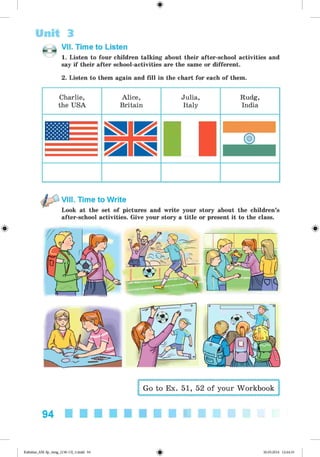
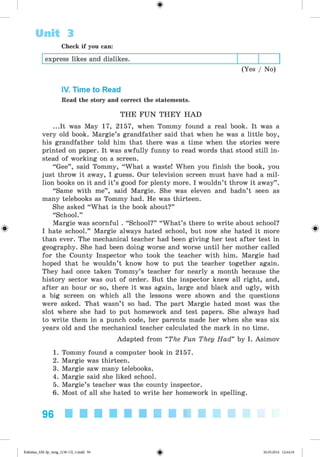
  • 24.
    < § > LESS UM 1 c)Describe pluses and minuses of your personality. Begin with: 1. They say I am a creative person. 2. And really I can ... . 3. From time to time I am ... . 4. I can also be ... . 5. But I never .... 6. I can ... . 7. I can’t ... . 8. My friends say .... At home: Describe a personality of your friend. V. Time to Listen and Read 1. Listen to / read in pairs and say what conclusion the friends have come to. # W H A T M AKES A CHARACTER Helen: Ann: Helen: Ann: Helen: Ann: Helen: Ann: Helen: Ann: 2 E xa m I bet, Ann, white is your favourite colour. So it is. And what does it mean, I wonder? They say, colours may say much about your personality. For example, you are very neat, responsible and supportive. And you, Helen, like clothes in black. What kind of personality are you? A black colour speaks of an intelligent and a serious persona­ lity. Maybe, this is the reason why I’m always in my books. There is something in what you say. You are so clever. But you can’t judge a person only by their favourite colours. Right. The proverb goes: “Handsome is that handsome does”. That’s it. Your actions - good or bad - will say what you are, can I rely on you or will you let me down. I can’t agree more. W e’ve been friends with you for many years and I know your real self. Me too. And it can’t be otherwise. . Say the opposite. pie: Ann is always silent. -» Ann is always talkative. stingy - generous talkative - silent clever - silly See First Aid Kit, Word meaning, p. 215 1. My friend is very kind. 2. The boy is so stingy. 3. The child is impolite. 4. The girl is silly, sometimes. 5. My girl-cousin is very impatient. 6. Your action is wise. 23 Kalinina_AM-Sp_6eng_(138-13)_v.indd 23 30.05.2014 12:44:23
  • 25.
    # 3. Look atdifferent colours and say what personality’s character they speak of. E x a m p l e : / think a red colour speaks about a quick tempered personality. Unit 1 VI. Time to Communicate 1. Act as Ann or Helen and speak about your personality. Use: to be responsible; to take something seriously; not to let anyone down; to rely on somebody; to act well. 2. In pairs, discuss your personalities. A: I bet ... , ... colour is your favourite, isn’t it? B: So it is. What ... , I wonder? A: They say ... . For example, you ... . B: The world we live in! And you ... . What kind of ... ? A: ... speaks of ... and ... . Maybe, this is the reason ... . B: There is something in what you say. You are ... and ... . But don’t ... . You can’t judge a person ... . A: Right. The proverb goes ... . Your ... , tell us ... . B: I can’t agree more........ A: Me too. And it ... . 3. Speak about the personality of any member of your family. VII. Time to Write Describe a personality of a relative, who is special to you, using the “Star technique” (p. 22). # 24 # Kalinina_AM-Sp_6eng_(138-13)_v.indd 24 30.05.2014 12:44:23
  • 26.
    < § > Lt f SOM3 Who? What minuses? What pluses? # Go to Ex. 11, 12 of your Workbook 1.3. Appearances are Deceptive Word Bank Phrase Bank Communication Box an orphan liveliness braids expressive freckles freckled face curly hair pointed chin to be full of spirit broad and full forehead clear, sweet voice To my great surprise... Anyhow... In contrast with... # I. Conversation Warm-up Look at the photos (p. 22-23) and say what makes appearances of these people attractive. Oksana Bohdan Ann 25 Kalinina_AM-Sp_6eng_(138-13)_v.indd 25 30.05.2014 12:44:23
  • 27.
    < § > # Unit 1 Taras Helen Ex a m p l e : I think freckles make Oksana’s face especially attractive. II. Pronunciation Warm-up Read and practise the sounds /ea/, /au/. Say whose appearance you like most. A PPE A R A N C E RHYM E Ann has got short lovely hair, Bett has got expressive eyes, Nelly’s hair is lovely and fair, Her appearance is very nice. Ben has got a nice straight nose, William’s eyes are big and blue Mum and dad adore them both. And I like them, don’t you? III. Grammar Smart 1. Complete the sentences. E x a m p l e : Ann has got ... ^ Ann has got lovely hair, hasn’t she? 1. My brother is ... , ... ? 2. He isn’t ... , ... ? 3. ... , doesn’t he? 4. ... , aren’t they? 5. Nelly looks ... , ... ? 6. Val has got ... , ... ? 2. Turn these sentences into tag-questions. E x a m p l e : Your friend looks pretty. ^ Your friend looks pretty, doesn’t she? 1. Your sister/brother has got expressive eyes. 2. Ann’s hair is curly and lovely. 3. Helen looks like her mother. 4. Both boys are tall and slender. 5. My friend has got a freckled face. 6. Oksana has a sweet smile. 26 Kalinina_AM-Sp_6eng_(138-13)_v.indd 26 30.05.2014 12:44:23
  • 28.
    # # 2. Read themini-dialogues about the children in the photos and add a tag or a surprise question to them. Lt SSOM 3 What bright expressive eyes Ann has! - Yes, her eyes are full of spirit. Don’t you like them? - I do. They make her so pretty. Steve is thin and tall. He is pale today. ... John looks so funny! - His freckled face is nice and kind. Helen has got long thick braids. And I like her full lipped mouth. % IV. Word Smart 1. Look at the pictures and think of the words that can go with them. Make up your sentences with them. E x a m p l e : bright eyes ^ I have got bright eyes. ■■ ■ ■ ■ ■ ■ ■ ■ ■ 27 # Kalinina_AM-Sp_6eng_(138-13)_v.indd 27 30.05.2014 12:44:23
  • 29.
    < § > Unit 1 2. Readthe description of a girl and fill in the right words from the box. I like my best friend, she is so prettyl Ann has got big ... eyes, they are always full of ... and .... Her mouth is ... , and she has got a broad and full ... . Her face is ... and it makes her even more pretty. I like Ann’s hair, which she wears in ... . They Eire long Eind thick. I don’t know how she ... her hair every day. expressive pretty spirit liveliness freckled brsiids forehead combes full-lipped 3. Look at the picture and read its description. Spot the errors and correct them. E xam pl e: John doesn’t wear warm clothes, because it is very hot. John lives in Australia, a very hot coun­ try, that is why he wears warm clothes. John is short and slender. His face is white so is the body. John h£is got a nar­ row forehead Em d straight black hair. The boy is smiling and waving to his friends on the beach. He has got big brown eyes and freckles. Many boys in Australia look like John, because they spend much time on the beach. ^ At home: Write in what way you look like your mother / father / sister / brother. E xam ple : Like my mother, I have big brown eyes... BrE - grey AmE - gray o to Ex. 13, 14 of your Workbook 28 Kalinina_AM-Sp_6eng_(138-13)_v.indd 28 30.05.2014 12:44:24
  • 30.
    з V. Time toListen and Read 1. Listen to / read the story and say why Matthew Cuthbert was surprised. SURPRISE ... Mr. Cuthbert and his sister Marilla lived on a small Canadian farm. They needed a hand and decided to adopt an orphan boy, that’s why Matthew Cuthbert arrived at the station to meet a child. To his great surprise an orphan girl, a child of about eleven was standing in front of him. She was in a very short, very tight, very ugly dress of a yellowish-grey colour, a faded brown hat and beneath the hat, extending down her back were two braids of very thick curly red hair. Her face was small, white and thin, also much freckled; her mouth was very large and so were her eyes, which looked green in some moods, gray in others. Her chin was very pointed and her big eyes were full of spirit, liveli­ ness; her mouth was expressive; her forehead was broad and full. “I suppose you are Mr. Matthew Cuthbert of Green Gables?” She said in a peculiarly clear, sweet voice. “I ’m very glad to see you. I was begin­ ning to be afraid you weren’t coming for me” . And she held out her thin brownish hand to him. Matthew had taken her little hand awkwardly in his; then and there he decided what to do. He couldn’t tell this child with the bright eyes which made her especially lively that there had been a mistake. He would take her home. She couldn’t be left at the sta- ^ tion, anyhow, no matter what mistake had been made. Adapted from “Ann of Green Gables” by Lucy Mand Montgomery Across Culture Canada - країна, на північ від США, друга в світі за терито­ рією. To make somebody especially yellow - yellowish lively brown - brownish See First Aid Kit, Grammar, p. 212 See First Aid Kit, Word-building, p. 214 29 Kalinina_AM-Sp_6eng_(138-13)_v.indd 29 30.05.2014 12:44:24
  • 31.
    < § > # Unit 1 2. Matchthe definitions to the words or phrases and reproduce the sentences with them from the story. 1. an orphan a) the thing that lost colour and 2. to adopt a child brightness; 3. a faded hat b) help with something; 4. a sweet voice c) a child who has no parents; 5. awkward d) to take somebody else’s child 6. need a hand into your home and legally become his/her parent; e) making you feel embarrassed so that you are not sure what to do or to say; f) very pleasant. E x a m p l e : Mr. Cuthbert and his sister Marilla decided to adopt an orphan boy. 1. In the story find and reproduce the information about the girl’s clo­ thes (hair, face, eyes, mouth, voice). Say what impression she produced on Mr. Cuthbert. Do you share it? VI. Time to Communicate 1. Act as Mr. Cuthbert and give a description of the orphan. Use: # braids of very thick red hair; freckled face; glowing eyes; to be full of spirit; pointed chin; full-lipped mouth. 2. In pairs talk about the appearance of your brother/sister, a boy or a girl-cousin as in the pattern. Pattern: A: I say ... , how does your ... look? B: They say she/he is very ... .She has got ... and ... . A: She/he is ... ,isn’t she/he? B: Sure. Besides her ... make(s) her especially pretty. And what about your ... ? Isn’t she/he ...? A: She/he sure is. Her/his ... too. B: Has she/he got the same ... as you have? A: We have much in common, but our appearances are ... . In con­ trast with her/him ... and ... . B: The same with my ... . 3. Describe any of your classmates and let others guess who you mean. 30 ■■■■■■■■■■ * Kalinina_AM-Sp_6eng_(138-13)_v.indd 30 30.05.2014 12:44:24
  • 32.
    < § > VII. Time toWrite Bring a photo of your close friend or relative and describe his/her appearance. Lt f SOM 4 Go to Ex. 15, 16 of your Workbook 1.4. The Two of Us: My Friend and I Word Bank Phrase Bank Communication Box storyteller unite well-read hard-worker devoted to get along with somebody to share interests to see a lot of each other to enjoy each other’s company to sit around to feel alone to make friends with... Thanks to somebody... A t that... It’s cool! * I. Conversation Warm-up Look at the photos and choose someone you would like to be friends with. Say why. Alex Ada Sophia Andrew E x a m p l e : I would like to be friends with Alex because he loves football. I ’m also a football fan. 31 Kalinina_AM-Sp_6eng_(138-13)_v.indd 31 30.05.2014 12:44:24
  • 33.
    < § > Unit 1 II. PronunciationWarm-up Read the chant and practise the rhythm. Say how much is true about your friend. M Y FRIEND CHANT - Do you know Andrew? - Andrew who? - Andrew Voitenko. - Of course, I do. He is an old friend of mine. And I like him a lot. - Do you share his interests? - Do you have much in common? - Do you just sit around? - We certainly do. We are old friends. We are old, good friends. III. Function Smart Read and learn how to express devotion to your friend. Look at the pictures and fill in the mini-dialogues. Harry Potter and his friends - ... made new friends in the coun­ try of Oz. - Wow! Isn’t it remarkable? Tom Sawyer and Huckleberry Finn - Do you know ... ? - Yes, of course, I do. They are de­ voted friends. Dorothy - What do you think of ... ? - I believe they enjoy each other’s company. 32 Kalinina_AM-Sp_6eng_(138-13)_v.indd 32 30.05.2014 12:44:24
  • 34.
    < § > LESS UM A -What do children like to do when they are together? - They like ... . It’s so exciting! # IV. Word Smart 1. Look at the wordsearch puzzle and find six words characterizing a good friend. Make up sentences with these words. a b <------- s u p P o r t i V e ) c c c f g h i e j k 1 m h a r d w o r k i n g m o w V u t s r i q P o n n X y z a V b n a b c d e e f g h i j d k 1 m n s r w e 1 1 r e a d o q t h e 1 P f u 1 w X y z E xam ple : My friend is very supportive. 2. What will you say if: E x a m p l e : You have the same interests. -» We have much in common. 1. You often see your friend. 2. You like to be with your friend. 3. You got to know a new friend. 4. Your friend can tell interesting stories. 5. Your friend works hard. 6. You met a new friend and liked him at once. 3. Say the same using new words and phrases. E xam ple : I like to spend time with my friend. -» I enjoy my friend’s company. 1. We both like sports. 2. I often meet my friend. 3. I am in good relations with my friend. 4. My friend reads a lot and knows much. 5. My friend always supports me. 6. My friend helps me when I need it. ^ At home: Speak about your newest friend covering the following points (p. 31). 33 Kalinina_AM-Sp_6eng_(138-13)_v.indd 33 30.05.2014 12:44:24
  • 35.
    ф ф Unit 1 1. Whoyour newest friend is. 2. Where you met. 3. Why you think he (she) is a good friend. 4. How often you get together. 5. What you do when you are together. 6. What you like most in your newest friend. Go to Ex. 17, 18 of your Workbook V. Time to Listen and Read 1. Listen to / read in pairs and say why the friends get along. GETTING ALO NG Ann: Hi, Steve, where are you hurrying? Steve: I’m going to meet an old friend of mine. It’s Alex Pavlenko from the seventh grade. You know him, don’t you? Ann: Of course, I do, he is a school chess champion and a top pupil in his class. Steve: Right. We met at the chess club two years ago and have seen a lot of each other since then. Ann: So, you share your interests, that’s why you are good friends. Steve: Not only chess unites us. Alex is well-read and a good story­ teller. Thanks to him, I loved Tolkien and Dahl. We enjoy each other’s company and can just sit around. Ann: It’s remarkable! You can never feel alone with such a friend. Steve: That’s true. We seem to have a lot in common: the things we like to do and the way we spend our free time. We are both hard workers and good mixers at that. Ann: I can’t help admiring your friendship and how you get along. A good friend is a joy forever, they say. Steve: Can’t agree more. to tell stories - a storyteller to work hard - a hard worker to mix - a good mixer See First Aid Kit, Word Meaning, p. 215 Across Culture J. R.R. Tolkien - відомий англійський письменник. Автор романів «Володар Перснів», «Хоббіт». Ф 34 Ф Kalinina_AM-Sp_6eng_(138-13)_v.indd 34 30.05.2014 12:44:25
  • 36.
    ф ф Lt SSOM 4 RoaldDahl - відомий британський дитячий письменник. Автор книг «Джеймс і Величезний Персик», «Чарлі і Шоколадна фабрика», «Матільда» та ін. 2. Complete the sentences with the correct words from the box. 1. Dan likes to eat much. He is such a heavy eater. 2. Jane reads much and she is the best ... of my class. 3. Martin has got many friends. He is such a ... . 4. My twin brother Andrew spends much time at his lessons. He is a real ... . 5. Vera likes to sleep. She is often late for classes. We call her a ... . 6. Mike is not ready for the lesson again. He is a ... . storyteller hard worker lazybones heavy eater sleepy head good mixer VI. Time to Communicate 1. Act as Steve and describe your friend. Use: to make friends with somebody; to share interests; to see a lot of each other; to enjoy each other’s company to be well-read 2. In pairs, talk about your friends as in the pattern. Pattern: A: Hi, ... , where are ... ? B: I’m going to meet ... . He is ... . You ..., don’t you? A: Of course I do. Your friend is ... . B: Right. We met ... and since then ... . We really ... . A: So you ... that’s why you are such good friends. B: Not only that. Thanks to ... . We enjoy ... . A: It’s remarkable! You can ... . B: That’s true. We seem ... and ... . A: I can’t help admiring ... . A good friend ... . B: I can’t agree more. 3. In the dialogue “Getting Along” (p. 31) find the information for the following chart. Ф 35 Ф Kalinina_AM-Sp_6eng_(138-13)_v.indd 35 30.05.2014 12:44:25
  • 37.
    < § > Unit 1 Common InterestsCommon Character Traits Favourite Leisure Time Say what facts from the chart are close to you. VII. Time to Listen 1. Listen to three children talking about their friends and say why their friends are important to them. 2. Listen again and write the answer for each of the children. Who do you agree most: Taras, Jane or Andrew? # VIII. Time to Write Read the list below and write which things you expect a good friend to do for you and which things you do for a friend. Explain your ideas. 1. Phone you every day. 2. Listen to your problems. 3. Keep your secret. 4. Remember you birthday. 5. Give you advice. 6. Share the books (CDs). 7. Invite for the concert (movies, museums, walks). 8. To talk about things that worry. Go to Ex. 19, 20 of your Workbook 1.5. My Progress in English I. Grammar Smart Match the beginnings to the endings of the tag questions. Beginnings Endings 1. You get along with your friends, 2. Your family isn’t big, 3. Ann has got two thick braids, 4. You can rely on your parents, 5. Dan isn’t stingy, 6. The child takes my words seriously, 7. Your sister always helps you out, 8. Many Americans are on the move, a) is it? b) doesn’t she? c) don’t you? d) can’t you? e) is he? f) hasn’t he? g) doesn’t he? h) aren’t they? 36 Kalinina_AM-Sp_6eng_(138-13)_v.indd 36 30.05.2014 12:44:25
  • 38.
    < § > Lt f SOM5 Check if you can: keep a conversation going. (Yes / No) II. Word Smart Insert the prepositions. 1. My friends and I have much ... common. 2. Many Americans are ... the move. 3. Don’t judge people ... their appearance. 4. I get along ... my friends. 5. My lifestyle differs ... yours. 6. I can always rely ... my family. 7. Thanks ... my mum, I became a top pupil. 8. In contrast ... you, I like computing. Check if you can: connect words in sentences correctly. (Yes / No) # III. Function Smart In the box find the expressions of devotion for the following situations. 1. Nelly has won a competition and now she is a school champion in tennis. 2. My elder brother is so brave! He saved a child when his house was in fire. He wasn’t afraid. 3. My friend Ann is a talented singer. She sings in concerts and is a great success. 4. Our granny is good at baking. She is the best cook I know. Help yourself to her pie. 5. Look at Helen’s new clothes. She looks nice in then. a) Wow! It’s the tastiest pie I ’ve ever had. b) It is so remarkable! He is the braviest person I know. c) She is admirable! Just admirable! d) I can’t help admiring her voice! e) How nice! She is the best tennis player I know. Check if you can: express devotion. (Yes / No) 37 Kalinina_AM-Sp_6eng_(138-13)_v.indd 37 30.05.2014 12:44:25
  • 39.
    < § > # IV. Time toRead Read the story and choose the right answers to the questions. HOORAY! HOORAY! SEA! One day when Ally came from school, she found her family in a state of excitement. They were all laughing and shouting at once: “Auntie Glad! Lottery! Holiday! Sea!” “What?” Ally shouted back. “Be quiet all of you” , cried Mum, her black eyes shining. “Auntie Glad has won two hundred and fifty pounds with her lottery ticket and she’s taking us all to the sea She has already booked a little summer cottage for a fortnight when Dad has a holiday” . <...> It wasn’t a very long journey, and the railway station was not far from their cottage. While all the rest of the family were discussing the cottage, Val did not waste time on packing. All he wanted was to get to the sea. He quickly ran across the field, reached the sea and looked at it with delight. That was what he wanted - water, light, air and space. He stood for a second breathing in the sea wind, then he threw off his shoes and socks and ran on, feeling the wet sand under his feet. The sea was calm. He went into it knee-deep, rolling up his trousers. He put his hand in the water and then licked his fingers to taste the salt. He was in the sea at last! On his way back to the cottage, he met a smiling little man. “Enjoyed the sea, son?” asked the man. He looked so good-natured and friendly that Val stopped to answer. “It’s smashing” , he said. “It’s a nice place” , said the little man. <...> Soon the family got to know the place very well. The weather was fine and warm, and the children spent nearly all day in the sea. And in a few days everybody became quite brown... Adapted from “Magnolia Building” by Elizabeth Stuckley 1. Who is taking all this family to the sea? a) Ally; b) Val; c) Auntie Glad. 2. How much money did the aunt win? a) 250; b) 350; c) 520. 3. How did the family get to the sea? a) by bus; b) by train; c) by car. 4. What did Val want to see most of all? a) the cottage; b) the sea; c) the wood. Unit 1 38 Kalinina_AM-Sp_6eng_(138-13)_v.indd 38 30.05.2014 12:44:25
  • 40.
    < § > 5. Who didVal meet on the way to the cottage? a) his mum; b) Auntie Glad; c) a stranger. 6. What was the weather like at that time? a) sunny; b) wet; c) cold. Check if you can: read texts and understand the main idea. (Yes / No) Lt f SOM 5 V. Time to Listen Listen to the story “Sam’s Sleepover Party” and correct the errors . 1. Sam’s birthday was on the fifth of December. 2. Sam’s guests saw a video film she had bought. 3. The film was a space tragedy. 4. Sam liked the film because her favourite actress was starring in it. 5. Matt Moon met an American lady scientist. 6. Matt went for a spacewalk in the moon. Check if you can: listen to a story and spot the errors. 0 (Yes / No) ^ VI. Time to Write Design your page for the Family Ties Website. Write about your family ties. Check if you can: express your ideas about your family ties. (Yes / No) 39 Kalinina_AM-Sp_6eng_(138-13)_v.indd 39 30.05.2014 12:44:25
  • 41.
    Unit Two: OnYour Hobby Horse Unit 2 2.1. May Success Attend You! Word Bank Phrase Bank Communication Box to interview somebody to hit thrilling speed to take off to land to take a walk in nature to do a lot of squash to keep fit to make a model to practise something at lei­ sure to fly model aircraft to take somebody away from home ...that sort of thing. It depends. ... at least Actually, ... May success attend you. ...in the long run ...by any chance. The world we live in! * I. Conversation Warm-up. Look and say what hobbies you do most and which you would like to try. dancing painting drama E x a m p l e : I do dancing and I would like to try drama. II. Pronunciation Warm-up. Read the poem and practise the sounds /i/, /g/. Say how you use your imagination. IM AG INATIO N POEM Just sit there, try and think (you don’t even have to blink). Use your mind, And oh! A lot of things you will know, When you use imagination 40 Kalinina_AM-Sp_6eng_(138-13)_v.indd 40 30.05.2014 12:44:25
  • 42.
    < § > Lt f SOM1 You’ll enjoy each new creation, Try it once, and you’ll agree The world can offer much to see. III. Grammar Smart. 1. Look and recall. a) Use different adjectives if you want to describe your hobbies. To sound positive, add: wonder - wonderful fame - famous love - lovely add -able/-ing/-ive to the verbs: E x a m p l e : to enjoy - enjoyable to relax - relaxing to impress - impressive b) To sound negative, add -less to the nouns: E x a m p l e : use - useless fruit - fruitless # a) Play a grammar word-formation game. Use the nouns from the box below. E x a m p l e : Ann: beauty Steve: beautiful beauty to enjoy love wonder to excite cheer use to interest colour to relax danger b) Ask your friends: 1. What hobby is interesting to practise; 2. What she/he finds enjoyable; 3. What hobbies can be dangerous or useless; 4. Who has an impressive hobby. 2. Read and remember! a) Use as + adjective + as if you want to say that two hobbies have the same quality. E x a m p l e : Dancing is as exciting as drama. b) Use not as + adjective + as if you want to describe a difference. E x a m p l e : Dancing isn’t as exciting as drama. c) Use not nearly as + adjective + as if you want to stress a big dif­ ference. 41 Kalinina_AM-Sp_6eng_(138-13)_v.indd 41 30.05.2014 12:44:25
  • 43.
    < § > Unit 2 E xa m p l e : Dancing isn’t nearly as exciting as drama. (= Drama is much more exciting.) d) Use almost as + adjective + as if you want to stress a small dif­ ference. E x a m p l e : Dancing is almost as exciting as drama. # a) Play a grammar comparison game. Use the pictures and the adjectives. E x a m p l e : Ann: Badminton or tennis? Steve: Badminton isn’t as spectacular as tennis. spectacular dangerous hard breathtaking enjoyable b) Tell your friend about your hobbies as in the example. E x a m p l e : I have two hobbies: collecting stamps and chess playing. Collecting stamps is as interesting as chess playing. But it isn’t nearly as difficult as chess playing. IV. Word Smart. 1. Study the words (p. 40-41) and speak about: a) sports as a hobby; 42 Kalinina_AM-Sp_6eng_(138-13)_v.indd 42 30.05.2014 12:44:25
  • 44.
    < § > Lt f SOM1 football cycling volleyball jogging basketball swimming tennis skating badminton skiing E x a m p l e : Many people do sports as a hobby. I like to play football and go cycling. b) crafts as a hobby; to make models, to knit, to embroider, to sew, to fix something E x a m p l e : I have joined a D IY club where we make model kites, aeroplanes, helicopters ourselves. c) music as a hobby. # to listen to music to play a musical instrument to sing the piano the violin the guitar 43 Kalinina_AM-Sp_6eng_(138-13)_v.indd 43 30.05.2014 12:44:26
  • 45.
    the clarinet the flute tojoin the choir to go to / to perform at a concert E x a m p l e : My hobby is music. I can play the piano and I often perform at concerts. 2. Look at the photo and say what different family members enjoy doing at leisure. Exam ple : I think the mother enjoys knitting at leisure. Unit 2 At home: Make a list of hobbies in your family and compare them using (not) as ... as ... . Go to Ex. 21, 22 of your Workbook V. Time to Listen and Read. 1. Listen to / read the talk between Lucy and Paul about their hobbies and say why they enjoy them a lot. TALKING ABOUT HOBBIES Paul and Lucy have just met near the leisure centre. They are going to participate in the local festival “On My Hobby Horse”. A journalist is interviewing them about their hobbies for the children’s magazine. First, Lucy. PART I Journalist: Hi, Lucy, what sort of interests do you have? What do you do in your free time? 44 Kalinina_AM-Sp_6eng_(138-13)_v.indd 44 30.05.2014 12:44:26
  • 46.
    ф ф Lucy: Journalist: Lucy: Journalist: Lucy: Journalist: Now, Paul. Journalist: Paul: Journalist: Paul: Journalist: Paul: Journalist: Paul: Well, Ilove to take long walks in nature, and I do a lot of squash. What do you enjoy most about those activities? I love being out in the open, to enjoy the beauty of nature and listen to the country sound - birds twittering, frogs croaking, wind hitting my face, that sort of thing. It’s so relaxing, you know. As for squash, it is a very fast game. I play it in an indoor court as a way of keeping fit. It gives such a thrilling sense of speed and energy. A fter a hard day at school, it helps me to become myself again. And how much time do you spend on your hobbies? It depends. I try to get at least one hour of walking every day and do squash twice a week. Oh, my! That’s great. You must really keep fit. PART II Hi, Paul. What activities do you practise at leisure? I ’m very much interested in flying model aircraft. I have joined a DIY club where we make model kites, aeroplanes, helicopters ourselves. It’s a hobby which takes us away from home, especially at weekends when we go out of town to fly our models into the air. It is so exciting! And how long have you had this hobby? Well, let me think... It all started with my first flight. It was about three years ago when my family and I were going to England by plane. We took off in Kyiv and landed in Bir­ mingham three hours later. It was the wonder of wonders - seeing the world from above! Actually, that brought me to making models, in the long run. The world we live in! Have you, by any chance, invented a flying machine of your own? Not yet, but I ’m working on it. May success attend you! Thank you. Lt f SOM 1 BrE centre AmE center See First Aid Kit, Word Spelling, p. 216 Ф Across Culture: Great Britain Birmingham - Бірмінгем, друге за розміром місто в Англії. 45 Ф Kalinina_AM-Sp_6eng_(138-13)_v.indd 45 30.05.2014 12:44:26
  • 47.
    # 2. Answer thequestions. 1. What do the children do in their free time? 2. Why do they enjoy their leisure activities? 3. How much time do they spend on their hobbies? 4. Who has a more exciting hobby? 5. Have you ever tried to practise any of the children’s hobbies? 3. Complete the sentences about the children’s hobbies and compare them to yours. E x a m p l e : Lucy loves ... . ^ Lucy loves being out in the open. Me too. 1. Lucy tries to get ... . 2. After a hard day at school, ... . 3. Paul is very much interested in ... . 4. It’s a hobby which ... . 5. Actually, ... . VI. Time to Communicate. a) In pairs, talk about your hobbies, using the pattern: Pattern: A: Hi, ... , what sort of interests do you have? What ... in your free time? B: Well, I have to ...and I do ... . A: What do you enjoy most about ...? B: ... . It’s so ... , you know. It gives ... . A: And how long do you spend on ... ? B: It depends. I try ... , at least. A: Oh my, that’s great! You must really ... . B: Sure. I .. . b) Act as Lucy and say what you do at leisure. Use the picture and the word list. Unit 2 to do a lot of squash; relaxing to take long walks in nature; out in the open a) Act as Paul and tell the journalist about your hobby. Use the picture and the word list (p. 43— 44). DIY club; model kite; 46 # Kalinina_AM-Sp_6eng_(138-13)_v.indd 46 30.05.2014 12:44:26
  • 48.
    2 to fly; to takesomebody away from home. VII. Time to Listen. Listen to the story about Ally’s hobby and say what she disliked about her new role and why. VIII. Time to Write. Write about your hobby. Begin with: I have a head for... I love ... It is so ... As for ..., it’s a hobby which ... It all started with ... I have joined ... Actually, ... It gives such a ... It helps me ... I try to ... Go to Ex. 23, 24 of your Workbook 2.2. Necessity or Obsession? Word Bank Phrase Bank Communication Box stickers packet to trade to exchange creative knitting sewing solution regularly to complete the set to look through to fit together to be a part of one’s life twice a week to feel good ...hours on end. I am proud to say... ...in a word. I. Conversation Warm-up. Look and say what hobbies you can describe with the following words. Say why. wonderful; lovely; fantastic; exciting; impressive; relaxing. 47 Kalinina_AM-Sp_6eng_(138-13)_v.indd 47 30.05.2014 12:44:26
  • 49.
    < § > Unit 2 II. PronunciationWarm-up. 1. Read the poem and practise the sounds /a/, /u/. THE OPTIMISTIC POEM When I was five, I looked at the sky. When I was seven, I dreamt about heaven. When I was nine, I wanted to fly. When I grow up soon, I’ll design a spaceship And fly to the moon. 2. Say if your hobbies are the same or different. III. Grammar Smart. 1. Look and recall! Regular adverbs Irregular adverbs slowly fast quickly hard carefully high interestingly long perfectly near wonderfully late surprisingly early actually well a) Play a grammar word formation game. Use the nouns from the box below. E x a m p l e : Ann: beautiful Steve: beautifully beautiful long quick wonderful exciting hard useless interesting colourful good dangerous b) Ask your friends: 1. What they can do fast; 2. What she/he does early in the morning; 3. How long it has taken them to learn to do something well; 4. If they can work hard and play hard. 48 ■ ■ ■ ■ ■ ■ ■ ■ ■ ■ * Kalinina_AM-Sp_6eng_(138-13)_v.indd 48 30.05.2014 12:44:26
  • 50.
    2. Read andremember! 2 1) Use more + adverb (+ than) to compare two actions. E x a m p l e : I can ride a bike more skillfully than my friend. 2) Use (the) most + adverb to compare three or more actions. E x a m p l e : Steve played best in today’s football match. 3) Do not use more / the most with irregular adverbs - just add -er / - est: early - earlier - (the) earliest fast - faster - (the) fastest hard - harder - (the) hardest E x a m p l e : Ann ran the fastest in the race. 4) Use (no) as + adverb + as to compare two actions. E x a m p l e : I can play the piano as fluently as my sister. Don’t forget! well - better - (the) best badly - worst - (the) worst far - farther / further - (the) farthest / furthest a) Play a grammar tennis game. E x a m p l e : A: Early. B: Earlier. A: (The) earliest. B: Badly. A ... b) Look at the picture and say: 1. Who can jump the highest; 2. Who can run faster than the others; 3. Who can jump the farthest. E x a m p l e : There are a lot of children in the playground. Some of them are jumping. The girl over there can jump the highest... . 49 Kalinina_AM-Sp_6eng_(138-13)_v.indd 49 30.05.2014 12:44:27
  • 51.
    Unit 2 IV. WordSmart. c s c d o t o o l a i l l m n l e p s l c s s t sti­ ckers i s m n p h o g h e d o l e t l l o s c s a r s crosswords s p p u o z r z t l s doing e s d d a r n a c m i a n g aeroplanes m m m k c u u a i r s g s k t e i a i i e a c m c n s t e a g i s l n h g s i m e l i t n o o s d c r t e o i r l p t e u s e s m r e s n t s spaceships pictures playing 1) Study these words and say: a) What you like to collect / to do / to make / to create / to play. E x a m p l e : I like to collect shells. They remind me of my trips to the seaside. b) Which of the hobbies you can practise: > at home > out of doors. E x a m p l e : I can listen to music at home. I t ’s my hobby. 2) Describe any activity which children can do in the clubs in the picture (p. 48) and let your friends guess. Cover these questions: 1. What is it like? 2. How can we practise it? 3. What do we need for that? E x a m p l e : It is an intellectual activity. We can play this game with a friend. We need a board and sixteen pieces. (Answer: playing chess in the sports club.) 50 Kalinina_AM-Sp_6eng_(138-13)_v.indd 50 30.05.2014 12:44:27
  • 52.
    < § > # LESS UM 1 Athome: Think and decide what interesting activities you can reco­ mmend your family members to take up. Fill in the chart below. The Potential Hobby Chart Who? What? Why? My brother To take up tennis He likes to play ball games V. Time to Listen and Read. 1. Listen to / read the descriptions of three hobbies and say which of them you find exciting/useful/impressive. HOBBIES Simon: My hobby is collecting stickers. I have pictures of football players and pop stars. I buy packets of stickers and trade them with my friends. We exchange those we already have for the ones weneed to complete the set. It is so exciting to get the whole set! I can look through my collection hours on end. Many of my classmatesalso collect things, such as shells, model cars, dolls, comics, books, stamps, coins or postcards. The only minus of collecting things is that it is an indoor hobby, you know. My mum says that I should spend more time outdoors. Rachel: Many people like to do something creative, such as painting or drawing, playing music, knitting or sewing, DIY or cooking. They develop their living skills, in a word. My hobby is doing crossword puz­ zles. I know much about them. Crosswords, or crossword puzzles first appeared in the early 20th century. Today, many people regularly do crosswords, sometimes on the bus or train on their way to work. Most newspapers such as “Highlights” and magazines (let’s take “Stone Soup” ■ ■ ■ ■ ■ ■ ■ ■ ■ ■ ■ 51 Kalinina_AM-Sp_6eng_(138-13)_v.indd 51 30.05.2014 12:44:27
  • 53.
    ф as an example”)have at least one crossword and there are often prizes for people who send in the correct solutions. I am proud to say that I have won such a prize from the children’s magazine. Victoria: I have a lot of hobbies. I like to read, and I like to work on computers. But I absolutely love sports. Many of my friends have a sport as their hobby. They do football, basketball, volleyball and ten­ nis. I prefer badminton. It has been a part of my life since childhood. I regularly go to a leisure centre. Twice a week we have practice for about an hour and we have games every Sunday. After a game of bad­ minton I feel good. And I also have a lot of friends in the centre, so I enjoy being with them. It is, you know, a great time with great memories. Unit 2 Ф Across Culture “Highlights” - популярний американський дитячий журнал, у якому друкуються крос­ ворди. Living skills - факультатив в американ­ ській школі, в якому дівчата і хлопчики навчаються готувати їжу, клеїти шпалери, шити одяг тощо. “ Stone Soup” - дитячий журнал, у якому друкуються дитячі твори. ф 2. Say what is not true in these sentences. 1. Collecting things is an outdoor hobby. 2. Crossword puzzles first appeared in the middle of the 20th cen­ tury. 3. To solve a crossword, one asks a set of questions. 4. Few people have a sport as their hobby. 5. All the hobbies are expensive. 6. All the children practise their hobbies at home on their own. 3. Say what hobby has been a part of your life since childhood. 52 ■■■■■■■■■■ Ф Kalinina_AM-Sp_6eng_(138-13)_v.indd 52 30.05.2014 12:44:27
  • 54.
    2 VI. Time tocommunicate. 1. Act as Simon / Rachel / Victoria and describe some pluses and minuses of your hobbies. to collect stickers; to trade something with somebody; to complete the set; hours on end; indoor hobby. to have a sport as one’s hobby; to go to a leisure centre to have practice; to feel good; to enjoy being with friends. to do something creative; to do crossword puzzles; to answer a set of clues; across and down; to find the right answer. 2. Look at the notice board in the children’s leisure centre and say what hobbies you can practise there. Are they a necessity or an obsession? 53 Kalinina_AM-Sp_6eng_(138-13)_v.indd 53 30.05.2014 12:44:27
  • 55.
    < § > 3. In pairs,talk about the hobbies which are a necessity or an obsession with you, as in the pattern below. Pattern: A. What is your hobby horse? B. I love drama. A. Is it a necessity or an obsession with you? B. ... A. What do you find useful about it? B. ... A. How long do you spend on it? B. ... VII. Time to Write Write a letter to the editor of the magazine “Stone Soup” about a hobby which is a necessity/an obsession with you. Follow the format below. Unit 2 # Date: To: Subject:_____________ Dear Editor, Many people like to... I have a lot of ... The only minus of ... Yours sincerely, 54 Go to Ex. 27, 28 of your Workbook Kalinina_AM-Sp_6eng_(138-13)_v.indd 54 30.05.2014 12:44:27
  • 56.
    < § > LtfSO M 3 2.3.In Season and Out of Season Word Bank Phrase Bank Communication Box to daydream lovingly a saddle stubborn to gallop half-way to outgrow some­ body to ride a horse to milk a cow to grow into something to be the right size a love-hate relationship to love somebody dearly to make a (no) difference However... Other times. # I. Conversation Warm-up. Look at the pictures and say in what season children can enjoy these hobbies most and why. sports modelling playing snowballs swimming E x a m p l e : Children can enjoy skating in winter when there is much snow. 55 Kalinina_AM-Sp_6eng_(138-13)_v.indd 55 30.05.2014 12:44:27
  • 57.
    < § > Unit 2 II. PronunciationWarm-up. Read the poem and practise the sound /a/. Say what else can be a game for everyone. THE JUM PING ROPE POEM Jumping rope is lots of fun; It’s a game for everyone. Take a rope and let’s begin: You can turn and I run in. Now I’ll turn and you can jump. Never mind and spin or bump. I can jump like this all day; I can jump and I can play. III. Grammar Smart. 1. Look and recall. # Use the linking words ... so ... , ... and ... , ... but ... to combine two simple sentences into one complex sentence. E x a m p l e : I am fond of volleyball so I often play it on the beach in summer. I am fond of volleyball and I play it with my friends. I am fond of volleyball but I can’t play it in winter. a) Play a grammar completion game. Use so / and / but. E x a m p l e : Ann: I have a lot of hobbies. Steve: Ann has a lot of hobbies and she practises them at the leisure centre. Oksana: Ann has a lot of hobbies but she absolutely loves sports. Peter: Ann has a lot of hobbies so she has a great time with great memories. b) In groups, say as many sentences as you can about your hobbies: 1) When and where can you practise them? 2) When and where can’t you practise them? 2. Read and remember! 56 Kalinina_AM-Sp_6eng_(138-13)_v.indd 56 30.05.2014 12:44:28
  • 58.
    < § > 3 Use the PresentContinuous: am / is / are + doing 1) If you want to talk about actions that are happening while you are speaking: E x a m p l e : Look, Ann is riding a pony! 2) if you want to talk about actions happening around the time of speaking: E x a m p l e : I ’m learning to play the guitar this year. 3) if you want to talk about things that are changing: E x a m p l e : More children are choosing computer games as a hobby these days. 4) If you want to describe what is happening in the pictures and pho­ tos: E x a m p l e : In this photo, the children are playing chess. Use the Past Continuous: was / were + doing 1) if you want to talk about actions happening at or around a time in the past: E x a m p l e : I was collecting stickers at that time so I needed to complete the set. 2) if you want to talk about two actions happening at the same time: E x a m p l e : While Nick was playing his basketball match, I was acting as a cheerleader. a) Play a grammar contrast game. Use the Present and Past Continuous. E x a m p l e : Ann: I ’m learning to play tennis this year. Steve: I was learning to play tennis from September to May last year. Now I ’m learning to swim ... b) Look around the classroom and say: 1. What some of your classmates are doing; 2. What they were doing a few minutes ago. E x a m p l e : My deskmate is waving her hand. She was writing a few minutes ago. IV. Word Smart. 1. Miss Joy knows much about hobbies around the world. Now she answers our questions about hobbies American children can practise in different seasons and places. Study the words (p. 55) and say: 1) What they can do on a farm; 57 Kalinina_AM-Sp_6eng_(138-13)_v.indd 57 30.05.2014 12:44:28
  • 59.
    < § > Unit 2 to rideto feed E x a m p l e : They can ride a horse on a farm. 2) What they can do in town; swimming pool to rollerskate E x a m p l e : They can bathe in the swimming pool. 3) What they can do at home. quilt cookies E x a m p l e : They can help their mothers to make a quilt. 58 Kalinina_AM-Sp_6eng_(138-13)_v.indd 58 30.05.2014 12:44:28
  • 60.
    < § > # LfcSSI I M 3 2. CompleteMiss Joy’s story and retell it to the children: American children who live ... enjoy ... in the open. Some like to ... , other prefer ... . In town kids can go ... or ... . They also have ... at home. It’s a real ... to ... a quilt with ... or to help ... to bake .... They ... all the year round. At home: Write what hobbies you can practise in different seasons and places. Follow the plan below. PLAN In summer ... In winter ... ...in town. ...at home. ... on a farm. V. Time to Listen and Read. 1. Listen to / read the story about the hobby of an American girl and say: 1) why the girl wanted to go west; 2) what problems she had with Smokey; 3) what the great family fun was. HORSES - MY HOBBY PART I ... Some of my earliest childhood memories are connected with horses. Growing up on a farm in North Central Missouri gave me the opportu­ nity to be around horses much of the time. Horses were my favourite of all the farm animals. I daydreamed of leaving out west as a cowboy where I could ride around all day on my horse. As a very young child, almost as soon as I could sit up, my father placed me on our old gentle grey horse and led her around the farm. As I got older he let me ride her alone while he was milking the cows. For me, it was just fun to ride any place she wanted to go. I was so proud when a new foal was born and my father said that it could be mine. I lovingly watched if grow into a beautiful young horse. However, it was not a horse for riding. He was from working horse stock, so he grew up to be too large an animal for a little girl to ride. PART II About a year later my parents bought me Smokey, a Shetland pony. He was a beautiful little black pony with a white blaze down his face. He was the right size for a seven-year-old girl. I had a love-hate relationship with Smokey. Most of the time I loved him dearly, but he was a Shetland pony and they are stubborn. A Shet- 59 Kalinina_AM-Sp_6eng_(138-13)_v.indd 59 30.05.2014 12:44:28
  • 61.
    < § > Unit 2 land canwalk, trot or gallop along on their little legs with no problem until they decide to stop. When they stop, they stop and nothing and nobody can make them move. Most of the time I rode Smokey to school and we made it just fine. There were times, though, that he would get about half way up our lane and stop. I kicked and shouted: “Get up! Get up!” Sometimes I even carried a switch to beat him. Nothing I did made any difference so I shouted: “Daddy, Daddy, come help me!” My father, being a kind man, walked up the lane to where I was and “talked” until Smokey started moving again. Things were fine for therest of the trip. PART III When I outgrew the little pony I was presented with a small horse and a saddle. Now I felt like a real cowgirl with a real horse and saddle. I spent many happy hours on his back: I was visiting my girlfriends a few houses away or just riding through the pastures on the farm. Our family joined a local Saddle Club and participated in its weekend activities. Sometimes it was a weekend camping excursion, other times we went to a horse show, in which we rode in different events such as barrel races, flag races and other events. It was great family fun. Adapted from Anna Lou Martin’s “Life is Never a Bowl of Cherries” to dream to daydream See First Aid Kit, Word Meaning p. 215 Across Culture: The USA Missouri - Міссурі, один з 50 штатів США. cowboy (cowgirl) - ковбой, легендарна фігура в історії Америки. barrel races - родео, у якому змагаються навколо барелів. flag races - родео, у якому змагаються за прапор. 60 Kalinina_AM-Sp_6eng_(138-13)_v.indd 60 30.05.2014 12:44:28
  • 62.
    1. Say ifit is true or false. 1. The girl knows much about horses. 2. She learned to ride when she was a very young child. 3. Smokey wasn’t a horse for riding. 4. The Shetland pony always listened to the girl. 5. Anna felt like a real cowgirl when she was riding, 6. The girl took part in a horse show. 2. Say how the following characterizes the girl and her hobby. E x a m p l e : The girl daydreamt of leaving out west as a cowgirl where she could ride around all day on her horse. to daydream of something; to have a love-hate relationship with some­ body; to feel like a real cowgirl; to spend many happy hours. VI. Time to Communicate. 1. Look and tell Anna’s story. When I was seven I daydreamt of ... . One summer my parents bought me ... . It was ... . I had a ... relationship. Most of the time ... . But my Shetland was ... . There were time ... . So I ... . My father always ... . 2. In pairs, discuss the girl’s hobby as in the pattern. Pattern: A: What do you think of ... ? B: It’s amazing! She was a very young child when ... . A: She felt like ... . She spent many happy hours ... . 61 # Kalinina_AM-Sp_6eng_(138-13)_v.indd 61 30.05.2014 12:44:29
  • 63.
    < § > B: No wondershe participated in ... . A: I was moved to tears when I was reading about ... . B: Me, too. I was especially impressed by ... . A: Her father ... . B: Right. It was great family fun. 3. Describe some of your earliest childhood memories connected with your hobby. VII. Time to Write. Write about something you have ever daydreamt of. Go to Ex. 31, 32 of your Workbook Unit 2 2.4. Let’s Agree to Differ Word Bank Phrase Bank Communication Box: drama science fiction programme chat show fantasy film soap opera analytical pro­ gramme to see all the programmes running to be a couch potato (not) to drag smb away from the screen to be hypnotized by some­ thing to enjoy every bit of it There’s nothing like ... for ... . I like to ... the best. In contrast to you, I ... . I’m all f o r ...... I differ. To each his own. Let’s agree to differ. Tastes differ. I. Conversation Warm-up. Read what people say about TV as a leisure activity. Guess who said these words and why. Say who you agree with. 1. It’s a passive activity.---------------------- > • Mum 2. It stops kids doing their homework. Dad 3. It has a great educational value. Friend 4. It enriches knowledge. Teacher 5. It ruins the eyes. Doctor 6. Not all programmes are good. TV presenter E x a m p l e : My mum says it’s a passive activity. She advises me to spend more time out in the open. But I like to watch children’s programmes, especially cartoons. 62 ■■■■■■■■■■ * Kalinina_AM-Sp_6eng_(138-13)_v.indd 62 30.05.2014 12:44:29
  • 64.
    < § > Lt f SOM4 II. Pronunciation Warm-up. Read the poem and practise the sounds /i:/ and /o:/. Say how much it can be about you. # TV POEM ...In almost every house we’ve been, W e’ve watched kids gaping at the screen. They loll and slop and lounge about, And stare until their eyes pop out. (Last week in someone’s place we saw a dozen eyeballs on the floor). They sit and stare, and stare and sit Until they’re hypnotized by it. III. Function Smart. Read and learn how to express differences in tastes. Look at the pictures and fill in the mini-dialogues. a) - There’s nothing like playing ... ! - Really? I prefer ... . - Okay, okay. Let’s agree to differ. b) - I like to collect ... the best. It’s so informative. - In contrast with you, I collect - To each his own. c) - I prefer ... to ... . - Tastes differ. I’m all for ... . Football Hockey Stamps Coins d) - I’m keen on ... . And you? - I differ. I ’m interested in ... . Sewing Knitting Doing puzzles 63 Kalinina_AM-Sp_6eng_(138-13)_v.indd 63 30.05.2014 12:44:29
  • 65.
    < § > Unit 2 IV. WordSmart news report weather report sports report quiz show chat show game show music show comedy show comedy drama historical drama medical drama drama series wildlife programme science fiction programme analytical programme # documentary film phantasy film horror film soap opera cartoon video film to see all the programmes running; to be a couch potato; (not) to drag somebody away from the screen; to be hypnotized by something; to enjoy every bit of it; to be to somebody’s taste. 1. Study these words and word-combinations and say: a) what is your favourite: - TV report; - TV show; - TV drama or programme. b) what kind of TV viewer you are. 64 Kalinina_AM-Sp_6eng_(138-13)_v.indd 64 30.05.2014 12:44:29
  • 66.
    < § > LESS UM A BrEprogramme AmE program 2. Say: a) what your TV plans are for: tonight; tomorrow afternoon; Sunday morning. b) what you will watch on TV if: you have free time; you are in a good mood; the weather is bad. At home: Ask your family members about their favourute TV programmes and compare their tastes with yours. Fill in the chart below. Family Members TV tastes Same with your TV tastes? Different from your TVtastes? Dad sports reports Yes! V. Time to Listen and Read 1. Listen to / read the description of different TV programmes in a TV magazine and say which of them are to these people’s tastes: a five-year- old child; a sportsperson; a teenager; a housewife. WE CAN PLEASE EVERYONE! Are you tired of switching from channel to channel? Looking for sometimes special? Wishing to see a programme to your taste? Then, here is what you need to know before you become a couch potato: A soap opera is the most popular form of television programmes in the world today. It is a story about the lives of ordinary people who live in the same street or town. It is on TV three times or more each week. It comes in half-hour episodes. We call them soap operas (or soaps) be­ cause in the US they were first paid for by companies who made soap. Televiewers are glued to the screen because they can feel real worries and hopes of real people. This week you get a chance to enjoy the BBC’s EastEnders. ■ ■ ■ ■ ■ ■ ■ ■ ■ ■ ■ 65 Kalinina_AM-Sp_6eng_(138-13)_v.indd 65 30.05.2014 12:44:29
  • 67.
    ф An animated cartoonis a film made by photographing a series of pictures, clay models, etc. It can be short or long. It was W alt Disney who made the first long cartoon film - “Snow White and the Seven Dwarfs” . It’s a traditional children’s story about a beautiful princess and seven very small people who saved her life in a forest. You’ll be hypnotized by Dopey, Doc, Sneezy, Bashful, Sleepy, Grumpy and Happy on Saturday afternoon. An American musical is a unique form of a TV music programme. It combines song, dance, comedy and drama. Among the most success­ ful musicals ever written is CATS by Andrew Lloyd Webber. It has been seen by millions of people. Don’t miss your TV chance on Friday evening. We are sure that no daily routine will drag you away from the screen. We wish you to enjoy every bit of it. A video workout is a series of fitness programmes on TV produced by stars, such as Jane Fonda and Cindy Crawford which you can watch and take part in at home. Do your parents complain about you being a couch potato? Then jump at the opportunity to spend time watching tel­ evision usefully for your health. Do join us in the “fitness craze” every morning! Unit 2 Ф Across Culture: Great Britain, the USA The BBC - одна з провідних радіо- і телевізійних організацій у Великій Британії. EastEnders - популярний британський телесеріал про соціальні проблеми робітничого району Лон­ дона. Jane Fonda - американська акторка, авторка відеопрограм фізичних вправ. Ф 1) Answer the questions. 1. What is special about a soap opera? 2. What was Walt Disney’s first long cartoon film? 3. What makes a good musical? 4. What TV programme is useful for your health? 5. What do you need to know NOT to become a couch potato? 66 ■■■■■■■■■■ < s > Kalinina_AM-Sp_6eng_(138-13)_v.indd 66 30.05.2014 12:44:29
  • 68.
    0 Lt f SOM4 2) Say what TV programme could make you think these thoughts. I can watch it hours on end! It’s just hyp notizing! No daily routine will drag me away from the screen. Vl.Time to Communicate a) Look at the pictures and describe the TV programmes in them. b) In pairs, talk about your tastes in televiewing as in the pattern below. Pattern: A. Are you a regular televiewer? ^ B. In fact, I am. A. Are you a couch potato? B. ... A. What TV programmes are to your taste? B. ... A. What do you think of ...? B. ... c) In small groups, talk about your hobbies and express differences in tastes. Use the structures: 1. There’s nothing like ... for me. 2. I like to ... the best. 3. I prefer ... to ... . 4. I’m also keen on ... . 5. In contrast to ... , I’m all for ... . Vll.Time to Listen Listen to the joke about passionate TV viewers and say what the humour of the situation is. 67 0 Kalinina_AM-Sp_6eng_(138-13)_v.indd 67 30.05.2014 12:44:29
  • 69.
    < § > # Unit 2 Comment onthe proverb “One person’s meat is another person’s poison” . Illustrate it with differences in tastes as to your friends’ hobbies. Begin with: VIII. Time to Write They say ... To me it means that ... I agree / disagree with ... because ... . Let’s take ... as an example. So, as you see, ... . Go to Ex. 35, 36 of your Workbook 2.5. My Progress in English I. Grammar Smart Complete the story. Use am/is/are/was/were. THE TALK OF TW O BROTHERS - What ... (1) you doing, Jack? - I ’ ... (2) watching the news. - And what ... (3) you watching half an hour ago? - I ... (4) watching a TV quiz show. And maybe you want to know what I ... (5) going to do in another half-hour, Tom? - Yes, Jack, what ... (6) you going to do? - I ... (7) going to beat you if you don’t stop asking me silly ques­ tions. Check if you can: use tense forms correctly. (Yes / No) II. Word Smart Fill in the right word. 1. Badminton isn’t as spectacular ... tennis. 2. Many people do sports as a ... . 3. I like to ... stamps. 4. I am learning to ... the guitar this year. 5. My friend is a real couch ... . 6. I hate ... operas. Check if you can: complete the sentences correctly. (Yes / No) 68 Kalinina_AM-Sp_6eng_(138-13)_v.indd 68 30.05.2014 12:44:30
  • 70.
    < § > Lt f SOM5 III. Function Smart Match the lines about hobbies to the lines expressing differences in tastes. 1. There’s nothing like playing football. 2. I like to collect coins the best. 3. I prefer indoor hobbies to out­ door activities. 4. Is your brother keen on music? 5. Why don’t you take up tennis? I love it! 6. What?! You mean collecting things is useless? a) I prefer to collect stamps. b) Tastes differ. c) Basketball is as exciting as football. d) Okay, okay, let’s agree to dif­ fer. e) But I love playing outdoors. f) I don’t think so. He is more interested in films. Check if you can: express the differences correctly. (Yes / No) IV. Time to Read Read a letter from the English boy Phil. Choose the right answers to the questions. Hooray! Summer has come. It means that my family and I will do travelling again. Travelling is a hobby with all of us in the family. My dad says that summer is no time for sitting in the rocking chair and do­ ing nothing for days on end. Last year my parents bought a new 24-foot travel trailer. It’s our home on wheels. It has all the conveniences of a modern home. There’s a bathroom, a bedroom, a small kitchen complete with oven, refrigerator, sink and cabinets, and a dining room. It’s big enough to live in comfort­ ably when on holiday. It has been my cherished dream for a long time to be out in the wilderness for several weeks, away from civilization. With our motor home, we’ll get to Sherwood Forest, famous in old stories as the place where Robin Hood’s Merry Men lived and fought against the Sheriff of Nottingham. It used to be a very large forest, but only a small part of it still remains. It is preserved as a country park near Nottingham. I’m sure to feel like Robin Hood and have the time of my life. 1. What is Phil’s hobby? a) driving; b) travelling; c) dreaming. 2. What did his parents buy last year? a) a new house; b) a rocking chair; c) a new trailer. 69 Kalinina_AM-Sp_6eng_(138-13)_v.indd 69 30.05.2014 12:44:30
  • 71.
    < § > 3. What dothey NOT have in their home on wheels? a) a bathroom; b) a garage; c) a kitchen. 4. What did the boy dream about? a) to go away from civilization on holiday; b) to stay at home on holiday; c) to stay in a comfortable hotel on holiday. 5. What is NOT true about Robin Hood? a) He lived in Sherwood Forest; b) He was alone in the forest; c) He fought against the Sheriff of Nottingham. 6. What is Sherwood Forest like these days? a) a park; b) a very large forest; c) a residential area. Check if you can: read and understand simple texts (Yes / No) Unit 2 # V. Time to Listen Listen to Martha’s story about her hobby and mark the true statements. 1. Martha’s hobby is basketball. 2. She is tall enough to do well at basketball. 3. She is going to basketball camp. 4. She often supports her school team. 5. She wants to become a cheerleader. 6. The team spirit means a lot to Martha. Check if you can: listen to a piece of information and understand the de­ tails. (Yes / No) VI. Time to Write Write a letter to Martha / Phil about your hobby. Check if you can: express your ideas about hobbies in writing. (Yes / No) 70 Kalinina_AM-Sp_6eng_(138-13)_v.indd 70 30.05.2014 12:44:30
  • 72.
    LU tt M1 Unit Three: School Life 3.1. School Routine Word Bank Phrase Bank Communication Box punctual well-planned to manage absent-minded routine assembly hall to crib to work hard on something to waste time to do everything in time to plan ahead to do something in the last minute to make a mess of something to be late for something to sign up for something Normally... Typical! Just typical... That won’t do! Don’t give up! I. Conversation Warm-up Look at the pictures and say what these places have to do with school routine. # computer class language lab assembly hall canteen gym E x a m p l e : School children can have lessons on different subjects at the computer lab. II. Pronunciation Warm-up Read and practise the sounds /w/ and /3 :/. Say what you think about the pupil’s time management. 71 Kalinina_AM-Sp_6eng_(138-13)_v.indd 71 30.05.2014 12:44:30
  • 73.
    < § > Unit 3 # TIM EM A N A G E M E N T R H YM E I work hard on Geography, I work hard on Algebra, I work hard on History What a hard-working person I am. Dan wastes time at the lesson, Dan wastes time after school, Dan wastes time in the evening. What a lazy bones he is. III. Grammar Smart 1. Look and recall. 1) to ask for permission use may; May I come in? May I take your pen? 2) to ask about necessity use must; Must I write this exersice again? Must I run? 3) to ask about possibility use can. Can you write it in English? Can you help me? a) Play a grammar chain game and ask your friend for the permission. E x a m p l e : A: May I take your book? B: Yes, you may. May I close the book? C: Yes, you may. May I ... ? b) Complete the questions. E x a m p l e : Must ... ^ Must I stay after classes? 1. Can you ...? 4. Must you ...? 2. Must I ...? 5. May we ...? 3. May I ...? 6. Can Dan ...? 72 Kalinina_AM-Sp_6eng_(138-13)_v.indd 72 30.05.2014 12:44:30
  • 74.
    < § > Lt f SOM1 2. Look and remember! 1) To prohibit in a short answer use “ No, you mustn’t” . E x a m p l e: - May I go out? - No, you mustn’t. 2) To stress unnecessity of something in a short answer use “ No, you needn’t” . E x a m p l e: - Must I translate the text? - No, you needn’t. # a) Answer the questions. 1. May you leave the classroom during the lesson? 2. Must you go to school on Sunday? 3. Must your little sister/brother play all days? 4. May you be late for classes? 5. May you sing during the lesson? 6. Must your neighbour at the desk talk during the lesson? b) Put the questions to the answers given. E x a m p l e : - Must I translate the word? - No, you needn’t. 1. No, you mustn’t. 2. No, you needn’t. 3. No, they can’t. 4. No, he needn’t. 5. No, she mustn’t. 6. No, I mustn’t. IV. Word Smart 1. Study these words and phrases and speak about: a) well-planned school routine: to work hard on something; to do everything in time; well-planned; punctual; to plan ahead; to manage; to sign up for. E x a m p l e : I work hard on all the subjects. b) a badly-planned school routine: to waste time; to do something in the last minute; to make a mess of something; to be late for something; absent-minded. 2. Paraphrase the sentences. E x a m p l e : - I study in the sixth form. ^ I am a sixth former. 73 Kalinina_AM-Sp_6eng_(138-13)_v.indd 73 30.05.2014 12:44:30
  • 75.
    < § > # Unit 3 1. Nickcomes to school in time. 2. Ann plans her time beforehand. 3. Val joined a new sport society. 4. As a rule, we do a lot of things at school. 5. Children work much at the lessons. 6. My brother often forgets things. At home: Describe your school routine and decide if it is well-planned. Give your reasons. Go to Ex. 37, 38 of your Workbook V. Time to Listen and Read 1. Listen to / read in pairs and say what piece of advice Ann gave to Steve and why. TALKING ABOUT SCHOOL ROUTINE Steve: Hey, Ann! How are you doing? I bet, you’ve done all the les­ sons. May I take your copybook? Ann: No, you mustn’t. You can’t crib all the time. I was working hard on all the subjects the whole evening yesterday. I managed to do all my lessons orally and in writing. Steve: How clever of you! You’ve always been a model girl, Ann. Ann: Do you mean to say that you didn’t do any lessons? They are not too difficult. Steve: Frankly speaking, I did something in the last minute, but not half enough. Ann: Typical, just typical! You always waste your time. What a lazy bones you are! Do everything in time. Steve: It’s easier said than done. My friend gave me a CD with a new film about Harry Potter. I couldn’t help admiring it! And then I was watching the Simpsons on TV. Ann: That won’t do! We had only four lessons yesterday and you had enough time to get ready for the next school day. You are too lazy, Steve. You don’t want to make a mess of your life, do you? Steven: Of course not. I ’ll be punctual and plan my day ahead next time. Ann: That’s better! Try a little harder. Steven: I ’ll try. I ’ll try. • half enough • enough time • too difficult • too lazy see First Aid K it: Grammar, p. 212 74 Kalinina_AM-Sp_6eng_(138-13)_v.indd 74 30.05.2014 12:44:30
  • 76.
    ф Lfcf SOM 1 AcrossCulture Harry Potter - головний герой роману англійської письменниці J. Rowling, за яким знято вісім фільмів. The Simpsons - американська гумористична телевізійна програма про родину Сімпсонів. Ф 2. Complete the sentences with enough, too and words from the list. E x a m p l e : I ’m too busy today. 1. The book isn’t ... for me. 2. Hurry up! You a r e ....... slowly. 3. Steve hasn’t ....... to finish his test. 4. We h a ve....... at every lesson. 5. Turn off the music, please. It i s ....... 6. My sister is a top pupil. She i s ....... 3. Read the sentences and say who said them and why. Reproduce the situations from the text. busy time loud interesting clever going work E x a m p l e : “Try a little harder”. ^ Ann says it to Steve, because he is too lazy. 1. It’s easier said than done. 2. You can’t crib all the time! 3. Typical, just typical! 4. I did something in the last minute, but not half enough. 5. I can’t help admiring it! 6. That won’t do. VI. Time to Communicate 1. Act as Ann or Steve and describe your school routine. Use: to work hard on something; to crib; to do the lessons orally and in writing to do something at the last minute; to get ready for the lessons; to make a mess of one’s life. Ф 75 Ф Kalinina_AM-Sp_6eng_(138-13)_v.indd 75 30.05.2014 12:44:30
  • 77.
    < § > 2. In pairs,discuss your school routine using the pattern below. Pattern: A: Hey, ... . I bet, ... . May I ... ? B: No, you mustn’t. You can’t ... . I managed ... and ... . A: How clever of you. You’ve been ... . B: Do you mean ... ? They are not too ... . A: Frankly speaking ... , but ... . B: Typical, just typical. You always ... . Do ... ? A: It’s easier said ... . B: That won’t do! We ... . They ... . A: I’ll try. And ... . 3. Look at the pictures and choose those suitable for the description of your school routine. Say what exactly they represent. Unit 3 VII. Time to Listen 1. Listen to the story and say how a method of logical decision helped Sam. 2. Listen to the story again and mark true statements. 1. There was a night dance class on Monday. 2. All the children wanted to take part in a dance class. 3. Sam was afraid to step on the boy’s feet. 4. Sam asked her dad for help. 5. Her mother never danced when she was younger. 6. Sam’s mother started to teach Sam to dance. 76 Kalinina_AM-Sp_6eng_(138-13)_v.indd 76 30.05.2014 12:44:31
  • 78.
    < § > Lt f SOM2 VIII. Time to Write Write a letter to your international friend about your school routine and answer his/her questions. 1. 2. 3. 4. 5. When does your school start? How many lessons do you have a day? How do you do your lessons? Have you got any problems with your lessons? Who helps you to do your lessons if you don’t know something? Go to Ex. 39, 40 of your Workbook 3.2. I Have a Head for... Word Bank Phrase Bank Communication Box native speakers manuscript stimulate research to download report good-naturedly to have a good head for... to have a good command of something to use something to advantage to be computer literate to broaden one’s horizons to make magic to search the Internet Somehow or other... . Vice versa. I. Conversation Warm-up Look at the photos and guess what these children’s favourite subjects may be. Andrew Helen E x a m p l e : I think Boris likes PT lessons. You can often see him in the gym. 77 Kalinina_AM-Sp_6eng_(138-13)_v.indd 77 30.05.2014 12:44:31
  • 79.
    ф Unit 3 II. PronunciationWarm-up Read and practise the sounds /g / and /a/. Say how much it is about you. Ф THE NOTHING-DOINGS POEM Meet the lazy Nothing-Doings, All they do is stand around, When it’s time for doing nothing, Nothing-Doings can be found. When it’s time for doing something, You won’t find a single one, For the Nothing-Doings vanish When there’s work that must be done. II. Grammar Smart 1. Look and recall! Use the linking words so, and, but to combine two simple sentences into one. E x a m p l e : I like literature so I often read books. I like literature and I often read books. I like literature but I don’t like history. a) Play a grammar competition game using linking words. E x a m p l e : I have a head for computers and can design a website. 1. Ann wants to talk to native speakers ... . 2. Val is computer literate ... . 3. A rt classes broaden my artistic horizons ... . 4. Many pupils like Maths ... . 5. My elder brother is fond of sports ... . 6. Helen takes part in research. b) Combine two simple sentences into one. E x a m p l e : I adore Geography. I joined a geography club. ^ I adore Geography and I joined a geography club. 1. Paul is a member of our English-speaking club. I have a chance to talk to native speakers. 2. I like my PT lessons. I take part in sport competitions. 3. Ann likes history. I like Biology. 4. Bill has a head for computers. He knows much about them. 5. I spend much time at the computer lab. I use it to advantage. 6. Our history teacher asked me to write a report. I searched the In­ ternet. 78 Ф Kalinina_AM-Sp_6eng_(138-13)_v.indd 78 30.05.2014 12:44:31
  • 80.
    Lt f SOM2 2. Time to Look and Remember! 1) Use because when you want to say why you like or dislike your school subjects. E x a m p l e: I like to research because it is very interesting. 2) Use that's why when you want to explain what you do for some reason. E x a m p l e : I need more information about Britain, that's why I search the Internet. a) Look at the pictures and say why these children like or dislike to do the following things at their lessons. Oksana Paul Olha Ann E x a m p l e : Oksana likes to work with a dictionary because she wants to have a good command of English. b) Say what you prefer to do for these reasons. E x a m p l e : You are a nature lover. ^ I am a nature lover that's why I adore Botany. 1. You are a sports person. 2. You are good at drawing. 3. You have a head for Maths. 4. You are fond of poetry. 5. You are computer literate. IV. Word Smart 1. Say what you must do if: 79 Kalinina_AM-Sp_6eng_(138-13)_v.indd 79 30.05.2014 12:44:31
  • 81.
    < § > E x am p l e : You don’t understand ancient manuscripts. -» I f I don’t understand ancient manuscripts, I must decipher them. 1. You want to have more information about something. 2. You found the information in the Internet and want to have it. 3. You feel uneasy about your English. 4. You are an elementary computer user. 5. You know little about something. 6. You have a good head for Maths. 2. Match the verbs to the nouns and make up your own sentences with them. Unit 3 # 1. to research ■ — - ____ a) a club 2. to download — * b) a problem 3. to decipher c) the Internet 4. to join d) the information 5. to search e) a horizon 6. to broaden f) a manuscript 7. to type g) a message E x a m p l e : I like to research the problems at my history lessons. 3. Answer the questions. 1. What do you have a good head for? 2. About what do you feel uneasy? 3. What do you use to advantage? 4. What broadens your language horizons? 5. What club do you want to join? 6. When do you search the Internet? At home: Write what you like or dislike to do at different lessons. V. Time to Listen and Read 1. Listen to / read what sixth formers of different countries say about their favourite subjects and say who are you with. My name is Sarah. It is the end of January in Australia and I am back to Sydney school. The term has just begun and I’m proud that I’m in the sixth grade. In my timetable there are so many subjects: Australian history, Geography, Biology, ICT and two foreign languages. I adore foreign languages and I learn Spanish and French. I work hard on them both. I want to have a good command of both 80 Kalinina_AM-Sp_6eng_(138-13)_v.indd 80 30.05.2014 12:44:31
  • 82.
    ф languages, especially French,because my grandmother lives in France. I visited her last summer and had a chance to practise my French. Most of all I liked how my new French friends taught me to speak good French: they taught me what native speakers say in this or that situation, cor­ rected my mistakes good naturedly. It was a really fantastic experience! I am Phil and I’m also in the sixth grade. I study in Boston High School. Of all the school subjects I like ICT the best. I am not an elementary computer user. Vice versa, I’m computer literate and I know how to design a web page, to make computer pro­ grammes and to send e-mails. Our ICT teacher taught us how to search the In­ ternet and I found free websites where members can communicate with several people in a chat room by typing messages. Thus I became acquainted with many children from different countries: we exchange information, dis­ cuss problems and even help each other. All of us use the social network to our advantage. For example, my new pal Jeremy is a Canadian. He is very good at Geography and he helped me to write a report about his country. I downloaded my task and he sent me the newest information. It’s cool to learn from each other. I’m Boghdan and as many Ukrainian school chil­ dren I like to learn more about the history of my country. They say I have a head for it. Somehow or other, history is my favourite subject. Our teacher makes magic at our lessons: we work with histori­ cal maps and even decipher ancient manuscripts, see documentary films. All this broadens my historical horizons and stimulates me for independent research. I am trying to research the roots of our Cossackdom. In summer our history club plans to go to Zaporizhzhya. Maybe I’ll find support for my research. Who knows? Across Culture Sydney - найбільше місто в Австралії, важливий культурний і фінансовий центр країни. Lt SSOM 2 Boston High School - середня школа в Бостоні, США. 81 Ф Kalinina_AM-Sp_6eng_(138-13)_v.indd 81 30.05.2014 12:44:31
  • 83.
    < § > Unit 3 2. Completethe sentences. E x a m p l e : He lives in Britain, he is British. 1. Sarah is from Australia, she is ... . 2. My friend lives in Canada, he is ... . 3. Bob and Roy came from America, they are ... . 4. I live in Kyiv, I’m ... . 5. Lora’s motherland is France, she is ... . 6. Miss Smith works in England, she is 3. Look at the pictures and say for what children these things are important and why. Australia - Australian France - French Canada - Canadian America - American Ukraine - Ukrainian England - English See First Aid Kit: Grammar, p. 212 E x a m p l e : I think Phil likes to work on computer. ICT lessons are his favourite. VI. Time to Communicate 1. Act as one of the children and speak about your favourite subject. Use: to have a head for something; to learn from each other; to use something to advantage; to broaden somebody’s horizon; to make magic at a lesson; to stimulate for something. 2. In pairs, speak about your favourite subjects. Use the pattern. Pattern: A: I say ... . What ... ? B: As for me ... . It ... . A: I see. And what do you usually ... ? B: Our teacher ... . We often ... . Sometimes ... . A: It broadens ... and stimulates ... , doesn’t it? B: Sure. I like ... most of all. And what about you? A: They say I have a head for ... . I really adore ... . B: What helps you ... ? A: I ... and ... . B: Great! 3. Look at the list of subjects (p. 80) and choose your favourite one. Speak about it. 82 Kalinina_AM-Sp_6eng_(138-13)_v.indd 82 30.05.2014 12:44:32
  • 84.
    < § > 3 Maths History ICTBiology PE Foreign language Arts Literature Ukrainian VII. Time to Write Write about your most important/interesting/difficult subjects and explain why it is so. Go to Ex. 43, 44 of your Workbook 3.3. A Creative Mind Word Bank Phrase Bank Communication Box mother-tongue fluently imitate transcribe gifted culture to master a language to improve pronunciation to develop speaking skills to role-play a dialogue to be excited about something to enlarge one’s vocabulary English-speaking countries Firstly, ... Secondly, ... # # I. Conversation Warm-up Look at the photos and say what the mother-tongue of the children is. Which foreign language do you want to learn and why? 83 Kalinina_AM-Sp_6eng_(138-13)_v.indd 83 30.05.2014 12:44:32
  • 85.
    < § > E x am p l e : In Spain people speak Spanish. I also want to learn Spanish because I want to go to Spain to see the bull fight. Spain - Spanish (the Spanish language) France - French (the French language) China - Chinese (the Chinese language) See First Aid K it, Grammar, p. 212 Unit 3 II. Pronunciation Warm-up Read and practise the sounds /w/ and /9/. Say what foreign languages you learn at school. LA N G U A G E C H A N T - What is your mother tongue, Roy? - It’s English. - What is your mother tongue, Hans? - It’s German. - What foreign languages do you learn at school? - French and Spanish, Chinese and Japanese. - Oh, it’s really very cool! & III. Grammar Smart & 1. Complete the mini-dialogues, giving negative answers. E x a m p l e : A: May I take your dictionary? B: No, you mustn’t. I need it myself. A: May I work on the computer? B: ... . We have other thing s to do. A: Must I translate the sentence? B: ... . Ann has already done it. A: May I answer the question? B: ... . Read it first. A: Must I listen to the tape recorder? B: ... . We did it yesterday. A: May I switch on my computer? B: ... . Work with your neighbour. A: Must I water the flowers? B: ... . Ann has already done it. 2. Match the beginnings and the endings using a correct linking word (p. 82). Translate the sentences into Ukrainian. 84 Kalinina_AM-Sp_6eng_(138-13)_v.indd 84 30.05.2014 12:44:32
  • 86.
    ф 3 ф 1. I adoreEnglish... a) ...I love animals. 2. Nick has a head for mathTTT -b) ...I joined our English-speak- 3. I look after hamsters at our ing club. school zoo... c) ...she often goes to the Botanic 4. Val is a school champion... Gardens. 5. Nancy is a great nature lov- d) ...it is his mother-tongue. er... e) ...he won the competition. 6. Jeremy speaks English well... f) ...he is the best at this subject. E x a m p l e : I adore English, that’s why I joined our English-speaking club. - Я обожнюю англійську мову, тому я приєдна- лася(вся) до клубу англійської мови. 3. Read the story and fill in and, but, so, because, that’s why. M Y ENG LISH LESSON I have been learning English for five years and I like it a lot. It’s not that easy ... but I work hard. I want to improve my pronunciation ... I listen to different English texts every day. I speak English fluently ... I communicate with my friends at the lessons. We role-play the dia­ logues ... helps us to develop our speaking skills. Recently I’ve joined our English-speaking club ... . I hope to learn more our about the Eng­ lish-speaking countries and their culture. Many pupils of our class joined it ... Mr. Black came from the USA and teaches English. I learn how to be creative. IV. Word Smart 1. Find the explanation of the following words and phrases and make up your own sentences with them. 1. Mother-tongue ч a) to have an ability to do something ex- 2. Gifted tremely well. 3. Culture b) an ability to do something well because 4. Skill you have learned and practised it. 5. Pronunciation * c) the first and the main language that 6. Vocabulary you learnt when you were a child. d) the way of life, art, customs and tradi- tions that are accepted by people in a particular country. e) the way in which a particular word is pronounced. d) all the words that someone knows and uses. 2. Look at the pictures and say what the children do at their English lessons. 85 Ф Kalinina_AM-Sp_6eng_(138-13)_v.indd 85 30.05.2014 12:44:32
  • 87.
    < § > Unit 3 computer lablanguage lab English Study to listen to native to type texts; to role-play dialogues; speakers; to enlarge vocabu- to develop speaking skills; to imitate lary; to learn about the culture to improve pronun- to do tests. of English-speaking coun- ciation. tries. # 3. Say what you must do: 1. to master the English language; 2. to improve pronunciation; 3. to develop speaking skills; 4. to enlarge your vocabulary; 5. to learn more about the culture of English-speaking countries. At home: Write what you like/dislike about your English lessons. Go to Ex. 45, 46 of your Workbook V. Time to Read 1. Read the story “Discovery Class” and answer the following questions. 1. What was in the letter? 2. What was special about the teacher? 3. What did the children discover in Discovery Class? DISCOVERY CLASS The letter came the week after Sam’s birthday. It was from the school and addressed to her parents. “Very interesting,” said Sam’s mother as she read it. “What’s very interesting?” asked Sam. “It seems they have chosen you to take part in the new gifted pro­ gram” . “Me?” said Sam. She read the letter. It said that after careful testing, a small group of children had been selected to participate in a program for the gifted 86 Kalinina_AM-Sp_6eng_(138-13)_v.indd 86 30.05.2014 12:44:32
  • 88.
    < § > 3 called “Discover” .These children would meet twice a week with a spe­ cially trained teacher Sarah Hoople. Miss Hoople was a small, smiling person. She wore large round glass­ es. But what Sam noticed most was that she was excited about things. As she talked, her eyes sparkled and her hands moved. “We only have an hour,” she told them, “so let’s get started.” They started with a puzzle called “ Can You Find the Treasure?” which had to do with an old man hiding a diamond ring in a half-ruined house. They should use logic to find it. Everyone called out ideas. After they found the treasure, they went on to a word game. Miss Hoople called it “Reinventing Language” . “Pretend you are a cave person,” she said. “And you are tired of pointing to things. You want to communicate with people. So you step out of your cave and look around. Up in the sky is a large bright object. What would you call it?” “Oog,” said Marshall right away. “Good,” said Miss Hoople, writing it on the blackboard. “Glee,” said Katy. “Excellent,” said Miss Hoople. “Any more?” ... “That was fun,” said Katy. “Can we do it again?” I like to be crea­ tive. “Sure,” said Miss Hoople. “Maybe next time we’ll compile a cave dic- 0 tionary.” 0 That, thought Sam, would really be something. Adapted from “Dear Mom, You’re Ruining My Life” by Jean Van Leenwen to choose - choice to discover - discovery to excite - excitement to puzzle - puzzle to communicate - communication to select - selection See First Aid K it: Word-building, p. 214 2. Fill in the right form of the word. 1. It was a really great discovery. to discover 2. I like to do this ... . to puzzle 3. I like ... with my friends in English. to communicate 4. All the children read the story with ... ! to excite 5. The teachers ... Sam for the new programme. to select 6. Sam’s parents were proud of the teachers’ ... . to choose 87 Kalinina_AM-Sp_6eng_(138-13)_v.indd 87 30.05.2014 12:44:32
  • 89.
    < § > VI. Time toCommunicate 1. Imagine you are Sam. Tell your friends/parents about your Discovery Class. Begin with: 1. Miss Hoople is ... . 2. She wears ... . 3. She is so excited ... . 4. We started with ... . 5. Everyone called ... . 6. After that ... . 7. We invited ... . 8. It was fun to ... . 9. We call out ideas and ... . 10. Maybe next time ... . 2. In pairs, speak about your English lessons. Use the pattern. Pattern: A: I say ... , English is ... , isn’t it? B: Right. I like English, because ... . A: What do you do ... ? B: Firstly, ... ,secondly, ... .And what about you? ... ? A: English is not ... ,but ... . B: What do you ... most of all? ^ A: As for me, ... . It helps me ... . ^ B: Agreed. And I advise you ... . A: Thank you for advice. I ... . I ... . 3. Describe the English lesson you liked most. VIII. Time to Write Write what you think of the statement “The more foreign languages you know, the easier it is for you to study”. Begin with: 1. In my opinion ... . 2. I believe ... . 3. It seems to me ... . 4. It’s absolutely right ... . 5. It’s clear ... . 6. To my mind ... . Go to Ex. 47, 48 of your Workbook Unit 3 88 Kalinina_AM-Sp_6eng_(138-13)_v.indd 88 30.05.2014 12:44:32
  • 90.
    < § > 3.4. To Eachhis Own Lt f SOM 4 Word Bank Phrase Bank Communication Box sewing knitting embroidery choir aerobics to relax at break time after-school activities to be all for something to devote time to something to play computer games online to enjoy oneself to one’s heart’s content To each his own. I prefer ... to ... I am keen on ... I’m interested in ... I adore ... I. Conversation Warm-up Read the notices and choose an after-school activity for yourself. Say why. Who? —Birdwatchers Hello, computer fans! When? —Tuesday, 2 pm Where? —Schootgarden The computer club is on Friday at lunchtim e. Room 21. # What? —BirdctuB Lucy Voitenko Guitar and piano lessons! Please come to the music room for dates and times. E x a m p l e : I will choose guitar lessons because I ’m keen on music. II. Pronunciation Warm-up Read and practise the sounds /au/, /ai/. Say what your favourite after­ school activity is. M Y LEISURE A C T IV IT Y I want to paint a picture now, Watch our teacher show us how. First the paper big and white, Then the colours very bright. Now take the brush and water, too, 89 Kalinina_AM-Sp_6eng_(138-13)_v.indd 89 30.05.2014 12:44:32
  • 91.
    < § > Unit 3 # This iswhat I like to do. Take my picture home with me To let my dad and mummy see. III. Function Smart Read and learn how to express likes and dislikes. Look at the pictures and fill in the mini-dialogues. 1) - There’s nothing like playing - Really? I prefer ... to ... . - OK, OK. Let’s agree to differ. 2) - I am keen on ... and you? - I differ. I ’m interested in ... . I’ve embroidered a shirt for my mum. 3) - I like to ... after classes. - In contrast with you I adore - To each his own. 4) - I’m so fond of ... . - Tastes differ. I’m all for ... . It develops my body and broad­ ens my musical horizon. IV. Word Smart 1. Look and say what after-school activities in the pictures (p. 88) the children prefer and why. 90 Kalinina_AM-Sp_6eng_(138-13)_v.indd 90 30.05.2014 12:44:32
  • 92.
    < § > LESS UM A Janeand Alice Andrew and Bohdan Helen sewing; swimming; drama; travelling; cooking; sport E x a m p l e : I think Paul and Mary like drama. They are talented children and have a head for it. 2. Read what Oksana’s English teacher Miss Joy says about after-school activities of English children and complete it with words and phrases from the box. English schoolchildren have a lot of fun at break time. Sometimes they play ... or ... . A ll of them like their .... The boys go to the sports- ground and play ... . Girls prefer ... or ... . Some schoolchildren spend their afternoons in the ... . They watch ... . It makes their life after school more ... . tennis at break time to play hide-and-seek after-school activities sit around interesting swimming wood rugby birds 3. Answer the questions. 1. What after-school activities do you prefer? 2. How much time do you devote to your after-school activities? 3. Who of your friends share your interests? 4. How does your after-school activity differ from your friends’? 5. What after-school activities do most of Ukrainian children like? ^ At home: Describe your favourite after-school activity. I Go to Ex. 49, 50 of your Workbook : ■ ■ ■ ■ ■ ■ ■ ■ ■ ■ ■ 91 Kalinina_AM-Sp_6eng_(138-13)_v.indd 91 30.05.2014 12:44:33
  • 93.
    ф V. Time toListen and Read 1. Listen to / read in pairs and say what after-school activities Lucy and Paul prefer. TASTES DIFFER Lucy: We are free at last! Classes are over. Now it’s time to relax. Paul: Agreed. We can enjoy ourselves to our hearts’ content. What are your plans? Lucy: Firstly, I ’ll do my lessons. Business before pleasure, you know. Paul: That’s right. And then, what about going to the swimming pool for a swim or playing an adventure game online? Lucy: Not me. A new quiz show starts at 5 p.m. on Channel Four and I am going to watch it. Paul: What kind of quiz show is it? Lucy: It’s a general knowledge quiz show “ Mastermind” . Every time it deals with different areas, you know. It is going to be about wonders of the world. I ’m interested in it, you know. Paul: I’ll bet, you’ll be glued to the screen. Lucy: Right. I never miss a chance of seeing it. Unfortunately, I don’t have much time for watching TV in the evening, because I have many other things to do like knitting or embroidering. Paul: In contrast with you I prefer computers to TV. I’m keen on de­ signing my own programme and I devote all my free time to it. Lucy: To each his own. Unit 3 Ф Across Culture Mastermind - популярне британське теле­ візійне шоу, в якому четверо учасників зма­ гаються, відповідаючи на питання в галузі загальних знань. 2. Look at the pictures (p. 89-90) and say whose after-school activities they are connected with. 92 Ф Kalinina_AM-Sp_6eng_(138-13)_v.indd 92 30.05.2014 12:44:33
  • 94.
    < § > Lt f SOM4 E x a m p l e : Paul likes to play adventure computer games online after classes. 3. Say if you share Lucy’s or Paul’s ways of spending after-school activities. Give your reasons. VI. Time to Communicate 1. Act as Lucy or Paul and describe your after-school activities. to enjoy oneself to one’s heart’s content; to devote much time to somebody to be interested in something; not to miss a chance; to relax 2. In pairs, talk about your after-school activities. Use the pattern: Pattern: A: Classes are over. It’s time ... . B: Agreed. We can ... .What ... ? A: Firstly, ... .Business ... , you know. B: That’s right. And what ... ? A: Not me. I am going ... . B: What kind of ... ? A: It’s ... and it is going to be ... . B: I’ll bet ... . A: In contrast with you ... . B: To each his own. 3. Describe your favourite after-school activity. 93 Kalinina_AM-Sp_6eng_(138-13)_v.indd 93 30.05.2014 12:44:33
  • 95.
    < § > @ VII. Timeto Listen 1. Listen to four children talking about their after-school activities and say if their after school-activities are the same or different. 2. Listen to them again and fill in the chart for each of them. Unit 3 Charlie, Alice, the USA Britain Julia, Italy Rudg, India # VIII. Time to Write Look at the set of pictures and write your story about the children’s after-school activities. Give your story a title or present it to the class. Go to Ex. 51, 52 of your Workbook 94 Kalinina_AM-Sp_6eng_(138-13)_v.indd 94 30.05.2014 12:44:33
  • 96.
    < § > 3.5. My Progressin English I. Grammar Smart Fill in the sentences with that’s why or because. 1. I have a good command of English, ... I work hard on it. 2. Nick wants to play basketball ... he has joined our school basket­ ball club. 3. I love animals ... I have many pets at home. 4. My friend is never late for classes ... he is punctual. 5. Ann has a nice voice ... she sings in our school choir. 6. We do everything in time ... we plan everything ahead. Check if you can: connect parts of the sentence. (Yes / No) Lt f SOM 5 # II. Word Smart Paraphrase the sentences. 1. Alex always forgets things. 2. Dan knows much about computers. 3. This is the place where we have our PE lessons in cold weather. 4. This is the place where we have our school meetings or concerts. 5. Helen is in the sixth form. 6. This is a big group of singing people. Check if you can: can express ideas in several ways. (Yes / No) III. Function Smart Match the lines of the dialogues. 1. There’s nothing like singing a) In contrast with you I prefer for me. computers to TV. 2. Are you also keen on his- b) As for me I prefer dancing to tory? singing. 3. I like to watch TV after c) Knitting is not for me. I prefer ac- classes. tive rest, like swimming or running. 4. I like English. d) To each his own. 5. I am interested in knitting. e) No, I’m not fond of history, 6. Julia likes Botany and I’m I like Geography. keen on Math. f) And I like German. Tastes differ, you know. 95 Kalinina_AM-Sp_6eng_(138-13)_v.indd 95 30.05.2014 12:44:34
  • 97.
    Unit 3 Check ifyou can: express likes and dislikes. (Yes / No) IV. Time to Read Read the story and correct the statements. THE FU N T H E Y H AD ...It was May 17, 2157, when Tommy found a real book. It was a very old book. Margie’s grandfather said that when he was a little boy, his grandfather told him that there was a time when the stories were printed on paper. It was awfully funny to read words that stood still in­ stead of working on a screen. “Gee” , said Tommy, “What a waste! When you finish the book, you just throw it away, I guess. Our television screen must have had a mil­ lion books on it and it’s good for plenty more. I wouldn’t throw it away” . “Same with me” , said Margie. She was eleven and hadn’t seen as many telebooks as Tommy had. He was thirteen. She asked “What is the book about?” “School.” Margie was scornful . “School?” “What’s there to write about school? I hate school.” Margie always hated school, but now she hated it more than ever. The mechanical teacher had been giving her test after test in geography. She had been doing worse and worse until her mother called for the County Inspector who took the teacher with him. Margie had hoped that he wouldn’t know how to put the teacher together again. They had once taken Tommy’s teacher for nearly a month because the history sector was out of order. But the inspector knew all right, and, after an hour or so, there it was again, large and black and ugly, with a big screen on which all the lessons were shown and the questions were asked. That wasn’t so bad. The part Margie hated most was the slot where she had to put homework and test papers. She always had to write them in a punch code, her parents made her when she was six years old and the mechanical teacher calculated the mark in no time. Adapted from “The Fun They Had” by I. Asimov 1. Tommy found a computer book in 2157. 2. Margie was thirteen. 3. Margie saw many telebooks. 4. Margie said she liked school. 5. Margie’s teacher was the county inspector. 6. Most of all she hated to write her homework in spelling. 96 Kalinina_AM-Sp_6eng_(138-13)_v.indd 96 30.05.2014 12:44:34
  • 98.
    < § > Lt SS OM5 Check if you can: read and understand simple texts. (Yes / No) V. Time to Listen Listen to Bill’s story and mark the true statements. 1. Tom and Bill have little in common. 2. Both are fond of watching TV. 3. The boys’ friends call them couch potatoes. 4. Bill found the “ couch potato” in the phrase dictionary and learned its meaning. 5. Televiewing is a favourite pastime of many American kids. 6. Finally, the brothers found themselves in cheerleading. Check if you can: listen to a story and understand its details. (Yes / No) # VI. Time to Write Write a letter to your international friend and describe your school life. Check if you can: express your ideas about your school life. (Yes / No) 97 Kalinina_AM-Sp_6eng_(138-13)_v.indd 97 30.05.2014 12:44:34
  • 99.
    Unit 4 Unit Four:Travelling 4 .1 . Choosing a Route Word Bank Phrase Bank Communication Box to search stream options amusement park island see-saw destination to do merry-go-round to go on the roller-coaster to put up a tent to make a fire to be a great “outdoors” to be a big fan of nature Isn’t it wonderful to ....! Makes no difference to me. As long as... Nothing of the kind. ... and what not. Let’s wait and see. I. Conversation Warm-up. Look and say what route you would like to choose for your weekend trip. Why? A weekend trip to Touring the Sofiyivka the Carpathians park in Uman’ A walking trip E x a m p l e : I would like to take a walking trip out of town, because I like nature. II. Pronunciation Warm-up. Read and practise the sounds /r/ and /t/. Say what you can do to find your dream. ROUTE SONG Climb every mountain, Search every stream, Follow every rainbow Till you find your dream. 98 Kalinina_AM-Sp_6eng_(138-13)_v.indd 98 30.05.2014 12:44:34
  • 100.
    Lt f SOM1 < § > III. Grammar Smart. 1) Look and recall! 1) Use the preposition by and no article to say how you can get to your destination: to go by car / bus/ plane / air / sea , etc. E x a m p l e : We can get there by car / bus / train / plane. 2) Use the preposition on and no article to say that you can get some­ where by walking: .... on foot. E x a m p l e : - Can I get there on foot? - Sure. I t ’s just a few minutes walking from here. a) Play a grammar trio game. Play in trios. Take turns naming a place in your town / village. Your classmates will say how long it will take them to get there by transport or on foot. E x a m p l e : A: The railway station. B: It will take me twenty minutes to get to the railway station by bus. C: It will take me an hour to get there on foot. # 2) Read and remember! I f you want to talk about travelling, use these common expressions with no article after a preposition: • to / from school • from home • to / in / from / out of town • on holiday E x a m p l e : Does your family usually go away on holiday or do you stay in town? b) Say where you normally go: by car; by bus; by plane; by train; by bike; on foot. a) Play a grammar contrast game. E x a m p l e : A: I always go to school on foot. B: I always get home from school by tram. b) Look at the picture and say: 1. Where these people are going; 99 Kalinina_AM-Sp_6eng_(138-13)_v.indd 99 30.05.2014 12:44:34
  • 101.
    < § > 2. What transportsome of them are using; 3. How long it may take them to get to their destination. Unit 4 E x a m p l e : The man over there is riding a bicycle. ^ VI. Word Smart. to choose a route; to pack a rucksack; to make a fire; to plan a trip; to put up a tent; to cook on fire. 100 Kalinina_AM-Sp_6eng_(138-13)_v.indd 100 30.05.2014 12:44:34
  • 102.
    < § > # LfclSDN I to swingin the park; to do merry-go-round; to go on the roller-coaster; to amuse oneself. 1) Study the words (p. 97— 98) and say: a) how you can amuse yourself in town; E x a m p l e : I can swing in the park. b) what route you can choose for your weekend trip out of town; E x a mp l e : I can go to a valley. c) what you can do out of town. E x a mp l e : I can put up a tent near a river. 2) Describe any destination you like in the picture and let your friends guess. Cover these questions: 1. What does it look like? 2. How can we get there? 3. What can we do in that place? E x a m p l e : It is long and deep. We can get there by car. We can take a boat trip there. a At home: Think and decide on your route for a weekend trip. Write: ! - i} i) what your destination is; 101 Kalinina_AM-Sp_6eng_(138-13)_v.indd 101 30.05.2014 12:44:34
  • 103.
    ф ф 2) how youcan get there; 3) what you can do there. Go to Ex. 53, 54 of your Workbook V. Time to Listen and Read. 1. Listen to / read the conversation of two classmates and say what routes the children discussed. CHOOSING A ROUTE It’s autumn. The classmates want to take a nice weekend trip. Paul and Lucy are planning a route for it. Paul: Isn’t it wonderful that we are all going on a trip on Saturday! Lucy: Terrific! W e’ll have the time of our lives! Where shall we go? Paul: Makes no difference to me as long as we get together. Lucy: Nothing of the kind. We need to plan our route ahead. Paul: What are the options? Lucy: I think there are two of them: to stay in town or to go out of town. Paul: Let’s stay in town and go to an amusement park. I haven’t been there for ages. We can swing, do merry-go-round, go on the roller-coaster or a Ferris wheel and what not. Lucy: It’s a pity to stay in town in such wonderful weather. We can’t lose the chance to enjoy one of the last days of Indian summer. Why don’t we go to a pond or a stream, put up a tent there, make a fire and cook fish soup on it? And besides, I am a great “outdoors”! Paul: I am not a big fan of nature, you know, but there is something in what you say. These are the days to tempt anyone out. Let’s talk to our classmates first, and then decide on the final route. Lucy: Agreed. I bet they would like to go out of town. Paul: Let’s wait and see. Unit 4 Ф Across Culture: the USA Roller-coaster - американські гірки, популярний атракціон у парках. Ferris wheel - колесо огляду. 102 Ф Kalinina_AM-Sp_6eng_(138-13)_v.indd 102 30.05.2014 12:44:34
  • 104.
    < § > Lt f SOM1 # 2. Answer the questions. 1. What are the classmates going to do on Saturday? 2. What options are the children discussing? 3. What pluses of staying in town does one of the friends mention? 4. What does the other friend like to do out of town? 5. How are they going to make a decision? 3. Complete the sentences about a weekend trip and compare them to your experience. E x a m p l e : Isn’t it wonderful that ... ! ^ Isn’t it wonderful that we are all going on a trip on Saturday! I love weekend trips, too. 1. We need to plan ... . 2. Let’s go to ... . 3. We can ... and what not. 4. Why don’t we go to ... ? 5. We can’t lose the chance to ... . 6. It’s a pity to ... . VI. Time to Communicate. a) Look at the pictures and describe the two options for choosing a route as if you are Lucy/Steve. to go out of town; to tempt anyone out; to put up a tent; to make a fire; to be a big fan of nature. to stay in town; to go to an amusement park; to swing; to go on the roller-coaster; not to lose the chance. b) In pairs, talk about choosing a route as in the pattern below. Pattern: A: Isn’t it wonderful to ... ? B: Terrific! Where ... ? 103 Kalinina_AM-Sp_6eng_(138-13)_v.indd 103 30.05.2014 12:44:34
  • 105.
    < § > A: Makes nodifference to me........ B: We need to plan ... . A: What are the ... ? B: I think ... . A: Let’s ... . B: Agreed. c) Speak about the Ukrainian weekend traditions. Unit 4 VII. Time to Listen. Listen to six people talking about their weekend trip and say who was happy with the chosen route. VIII. Time to Write. Draw the local map and describe the route of your latest weekend trip. Follow the format below. # ROUTE DESCRIPTION ... is located in ... . It is easy to reach by ... / on ... . It is just a few minutes walking from ... . You can find ... . Continue on the road ... . The route will be marked by ... . Go to Ex. 55, 56 of your Workbook 4.2 . Ready, Set, Go! Word Bank Phrase Bank Communication Box wealth heaven cartoon show parade shooting booth wagon funfair lorry to be popular with smb to take part in something at lunchtime to get in the way to criticize somebody It’s never! Tell you what! 104 Kalinina_AM-Sp_6eng_(138-13)_v.indd 104 30.05.2014 12:44:34
  • 106.
    # 2 I. Conversation Warm-up. Lookand say which of these things you usually take with you on a trip. Why? E x a m p l e : I usually take a camera with me because I like to take pictures of my friends. II. Pronunciation Warm-up. Read and practise the sounds /a/ and /su/. Say if you are as much fond of travelling as the author. SONG T R A V E L Wealth I ask not, hope nor love, Nor a friend to know me; A ll I ask is the heaven above And the road below me. R. L. Stevenson II. Grammar Smart. 1. Look and recall. Use ... that’s why ... when you want to explain what you do for some reason. E x a m p l e : I am such a stay-at-home, that’s why I don’t travel too often. a) Play a grammar reason game. E x a m p l e : A: I love travelling. B: That’s why you have lots of impressions. b) In groups, say what kind of travel you prefer for these reasons: • you are a nature lover; • you are a sports person; • you are a good swimmer; • you are good at taking pictures. • you are fond of history; 105 Kalinina_AM-Sp_6eng_(138-13)_v.indd 105 30.05.2014 12:44:35
  • 107.
    % Unit 4 2. Readand remember! 1) Use names with no article: - continents: North America; - counties: Canada; - states: Florida; - towns: Orlando; - streets: Fifth Avenue; - parks: Disneyland. 2) Use names with the: - some countries: the USA; - rivers: the Mississippi; - seas: the Mediterranean Sea; - oceans: the Atlantic Ocean; - mountain groups: the Rocky Mountains; - island groups: the British Isles; - hotels: the Ritz. 1) Play a grammar quiz game. E x a m p l e : A: California. B: Its a state. The Danube. C: Its a river... 1) Look at the map of Ukraine and say: 1. What waterways you can see; 2. What towns you have been to; 3. Where you would like to go. .ayuviuw jwuiastii byaroza > OREL OBLAST < Uncha“ LIPETSK Svetlogorsk BRYANSK B E L'-’-.A' ■ Pinsk H °™ r® >w S z ^ Rechytsa "*’**’' ' Shostka^l Chernihiv R - 'U - S !S' I -A' ^Voronezh ,Kursk a ) • • • o 'v Anna Pulawy fEL’SKAYA VORONEZH :■ " is k i |AI.|kseyevka POLAND □ •WOJEWÖDZTV / ‘ ;LUBELSKIE Stefewa Wola Konotof VOLYHS’KA ' Ovruch Korosten' JVNENS’K/ BELGOROD Sumy Hizhyn Rivne Belgorod Novohrad-Volyns’ kyy r W s u m s 'k a ■ “ "kuren'ka ° nLubny °POLTAVA X . Poltava Yevslrato'iskiy Slayutä jetovka K ie v © iiiy u j ZHYTOMYR © „ • ^ Bild.Ts. K h a rk iv Przemysl /ansk 'CHERKAS’KA .y © .J « ^ /^ ^ C h e rk a s y K R A I N »€,, Izyum LUHAHS’KA Lisichansl Krasnoc Vinnyts Kremenc kirovohrads-ka/-' a © {■ D n ip ro p e tro v s ’k Tpervomays'k : ’ ( @KryvyyRih -■ a •Ro n ' . . v o z S ^ k ^ nipropetrovsk,, Zaporizhzhyj DONETSK tOSTOV B O T O V A « SUCEAVA,. V .... W " 'VI A 5 I HEAMT ■" v V Kotovs ..R ostoV-na-D onu SÄLAJ IOLD O VA’ Tokmak Mariupol’. CLUJ CAPORIZHZHYA © J MURE§ Berdyans’k Tiraspol' Cherson ODESSA -i; . ALBA HARGHITÄ VASLuj KHERSOHS’KA Primorsko-Akhtarsk O dessa Ses ofAzov Timashevsk Dzhankoy RESPUBLIKA KRYM . © Feodosiya^ r.ya © V © Simferopol’ 0P0'© Yalta KRASNODAR Krasnodar jmnicu GORJ Kerch raila ° TULCEA Novorossiysk Anapa Gelendzhik ^D0LJ 106 # Kalinina_AM-Sp_6eng_(138-13)_v.indd 106 30.05.2014 12:44:35
  • 108.
    ф Lfcf SOM 2 II.Word Smart Lucy’s teacher of English, Miss Joy, had a weekend trip in an amusement park in the USA last month. Now she answers our questions about where American children can go on holiday. 1. Study these words and describe: a) Where they can go; Ф Disneyland - великий парк з різними атракціонами поблизу міста Лос-Анджелес у штаті Каліфорнія. Ф Disney World - великий парк поблизу міста Орландо у штаті Флорида, подібний до Діснейленду. 107 Ф Kalinina_AM-Sp_6eng_(138-13)_v.indd 107 30.05.2014 12:44:35
  • 109.
    < § > E x am p l e : American children can go to Disneyland on holiday. b) What they can see: Unit 4 Welcome to Mickey Mouse Show Let’s go for a ride with Donald Duck! How about visiting Adventure land and seeing the world of Snow White and the Seven Dwarfs? E x a m p l e : They can see the Mickey Mouse Show. c) What they can do: see-saw Ferris wheel Mickey Mouse parade # McDonalds cartoons roller-coaster merry-go-round E x a m p l e : They can go on a Ferris wheel. 2. Complete Miss Joy’s story: American children often spend their weekends i n ......... are the most popular with children. In ... they can see ... , ... . Besides, they can take part in ... or ... . Many children prefer ... because ... . There are also ... »that’s why ... . At lunch time parents and children......... all day long. It’s fun to get together. 3. Work in groups and make a list of attractions in the pictures (p. 106). Say which of them appeal to you most. E x a m p l e : Museums are full of history. That’s why I often visit them. At home: Ask 3-5 questions about what your friends can do on holiday. Begin with: What? When? Where? How? Why? 108 ■ ■ ■ ■ ■ ■ ■ ■ ■ ■ ■ ■ * Kalinina_AM-Sp_6eng_(138-13)_v.indd 108 30.05.2014 12:44:35
  • 110.
    < § > Lt f SOM2 Go to Ex. 57, 58 of your Workbook V. Time to Listen and Read. ^ 1. Listen to / read the story about the funfair and answer the following questions. 1. What happened in town one Saturday morning? 2. What attractions were there? 3. Where did Val’s friends go? AT THE FUNFAIR “It’s here!” cried George across the yard one fine Saturday morning. “It’s never!” shouted Val back. “Well, George, let’s go over there at once. When did it come?” “Probably last night. There wasn’t anything yesterday.” For days the boys were waiting for the funfair that came every year to their town. The great long wagons and the lorries that carried the roller-coaster, roundabout, merry-go-rounds and other attractions stood in a circle on the fair ground. All the boys from the nearest street were there. They were watching, running about, criticizing everybody and everything and getting in the way. By the evening the whole place was full of noise and light. In every corner you could hear loud music, children’s happy voices. 109 Kalinina_AM-Sp_6eng_(138-13)_v.indd 109 30.05.2014 12:44:36
  • 111.
    ф ф The boys triedto choose the best way of spending their money. They could buy delicious hot dogs or candies. But it cost a lot of money to ride on the roundabout, and even more to shoot with a real gun at the shooting booths. Ally met Brian on Friday evening, and to her surprise he said, “Are you going to the fair?” “Is it here?” asked Ally. “They’re putting it up.” A lly’s brother, Val, went to the fair every evening. He loved the fair and looked forward to it all the year round. He was full of excitement. “Tell you what” , said Val to his friends. “Let’s all have a ride on the horses and we could try to change places while they were going round, see? That would be smashing.” Everything on the roundabout sparkled and shone and the boys for­ got about everybody and everything... Adapted from “Magnolia Building” by Elizabeth Stucley BrE sweets AmE candies See First Aid Kit, Word Meaning, p. 215 Unit 4 Across Culture: the USA A hot dog - сендвіч із сосискою чи ковбасою; зазвичай містить овочі та соус (кетчуп або гірчиця). 2. Say what is not true in these sentences. 1. The circus came to town. 2. The children heard the news on Monday morning. 3. In the evening the place was quiet. 4. The children came there to buy hot dogs. 5. All the attractions were free of charge. 6. Val didn’t go to the fair. 3. Say to what exciting events you look forward all the year round. 110 ■ ■ ■ ■ ■ ■ ■ ■ ■ ■ < s > Kalinina_AM-Sp_6eng_(138-13)_v.indd 110 30.05.2014 12:44:36
  • 112.
    2 VI. Time toCommunicate. to look forward to something; to be full of excitement; to have a ride on something; to change places; to forget about everybody. impressions of the funfair. to be full of noise and light; to buy something; to cost a lot of money; to hear children’s happy voices; to choose the best way. 1. Act as Ally / Val and describe your 2. In pairs, talk about going somewhere together as in the pattern below. Pattern: A: Have you heard about ... . B: It’s never! Are you going to A I ’m full of ... B: Me, too. I look forward to .. A: Let’s ... . B: We could ... . A: That would be smashing. ... B: Come on, then! 3. Look and say where the children in the pictures want to go together. What do you prefer? 111 Kalinina_AM-Sp_6eng_(138-13)_v.indd 111 30.05.2014 12:44:36
  • 113.
    < § > Unit 4 Write aboutyour impressions of going somewhere for fun in your diary. Begin with: VIII. Time to Write. Dear Diary, For days I was waiting for ... When the time came, ... The whole place was full of ... In every corner you could hear ... I tried to choose the best way of ... Everything looked ... And I forgot about ... Go to Ex. 59, 60 of your Workbook 4 .3 . Welcome to Ukraine Word-bank Phrase-bank Communication Box to welcome somebody hearty display knick-knack woodwork hospitable handmade at somebody’s invita­ tion in the best tradition to take care of some­ thing to set something up Do you mean ...? First things first. Such as? I. Conversation Warm-up. Hooray! Our international friends are going to take a trip to Ukraine. Look at the pictures and say where you would like to take them. Khreshchatyk, Kyiv Askania Nova 112 Kalinina_AM-Sp_6eng_(138-13)_v.indd 112 30.05.2014 12:44:36
  • 114.
    < § > 3 Odessa Port Lviv,The Opera House E x a m p l e : I would like to take my international guests to Kyiv. We’ll be walking along Khreshchatyk the whole afternoon. II. Pronunciation Warm-up. Read and practise the sounds /i/, /i/ and /ai/. Say what kinds of travelling it suggests. W ELCOM E POEM Let’s take a trip, just you and me, Through the Carpathian Mountains and The Black Sea. I’ll give you a ride across Ukraine, You’ll feel what it’s like if you go by train. You’ll have a taste of Ukrainian dish And stay with us as long as you wish. III. Grammar Smart. 1. Look and recall. Use articles with geographical names correctly when talking about travelling in Ukraine. Name No article the Continent Country Cities Rivers Seas Lakes Mountains Peninsula Europe Ukraine Kyiv, Lviv Lake Svytyaz the Dnipro, the Danube the Black Sea the Carpathian mountains the Crimea a) Play a grammar hide-and-seek game. 113 Kalinina_AM-Sp_6eng_(138-13)_v.indd 113 30.05.2014 12:44:36
  • 115.
    < § > Unit 4 Lake SvytyazBlack Sea Dnipro Sea of Azov Eastern Europe Lviv Kyiv Carpathians Danube Kharkiv Crimean Mountains Central Ukraine In two teams, name as many places as you can with/without an article. E x a m p l e : Team A (the): We’ll be coming round the Carpathian Mountains. Team B (no article): We’ll be coming to Kharkiv. b) In groups, say as many sentences as you can about: • travelling across Ukraine; • visiting the capital city; • sightseeing in your native place. E x a m p l e : 7 ’m going to travel a lot in the Crimea this year. 2. Read and remember! # To talk about travelling, use these verbs correctly: come / bring = movement towards the speaker or with the speaker; E x a m p l e s : We’ll be coming round the mountains. Dad is coming back from Moscow tomorrow. I know he is bringing a lot of presents. go / take = movement away from the speaker; E x a m p l e s : I ’m going on a weekend trip. See you on Monday. I ’m taking my dog with me. live = be somewhere for long periods of time; E x a m p l e : Nazar lived in Ukraine when he was a child. Then his family moved to Canada. stay = be somewhere for short periods of time; E x a m p l e : Have you ever stayed in a hotel? keep = continue; E x a m p l e : The travellers were tired but kept on walking. leave = go away from somewhere; E x a m p l e : The train leaves at 12.40. a) Play a grammar “coffeepot” game. In pairs, ask questions about travelling using the word “coffeepot” instead of the verbs above. Your partner will guess the verb and answer your questions. E x a m p l e : A: Where did you “coffeepot” when you went to Turkey? B: Oh, you mean where I stayed? I stayed in a hotel. b) Look at the pictures (p. 112) and say what travel experience these children have. 114 Kalinina_AM-Sp_6eng_(138-13)_v.indd 114 30.05.2014 12:44:36
  • 116.
    3 E x am p l e : The boy and his mother are at the airport. Their flight leaves at 10.30. IV. Word Smart. 1. Study these word-combinations and describe: a) how you invite your guests; at somebody’s invitation; to send / receive /accept / refuse an invitation; to look forward to; to plan carefully. E x a m p l e : Our international friends visit us every summer at our invitation. b) how you welcome guests; • to be / give a hearty welcome; • to welcome somebody in the best Ukrainian traditions; • to greet smb with bread and salt; • to put on national Ukrainian costumes; • to be hospitable. E x a m p l e : It should be a hearty welcome in the best Ukrainian traditions. 115 Kalinina_AM-Sp_6eng_(138-13)_v.indd 115 30.05.2014 12:44:36
  • 117.
    < § > Unit 4 c) howyou entertain your guests. • to have a welcome party • to cook some local dishes • to take care of a cultural programme • to set up a display of Ukrainian art • to make a poster • to bring small gifts 2. Describe any Ukrainian art object in the picture you like and let your friend guess. Cover these questions: 1. What does it look like? 2. What can we do with it? 3. Where do we keep it? E x a m p l e : I t ’s small and painted in different colours. You can give it as a present at Easter. 3. Work in groups and make a list of Ukrainian traditions of hospi­ tality. At home: Describe an international party you have ever had at school or > at home. Write what worked well at the party. Go to Ex. 61, 62 of your Workbook 116 Kalinina_AM-Sp_6eng_(138-13)_v.indd 116 30.05.2014 12:44:37
  • 118.
    3 Steve: Ann: Steve: Ann: Steve: Ann: Steve: Ann: Steve: Ann: Steve: Ann: 1. Listen to/ read the conversation “Welcoming International guests”. Say what information from the text can help you to welcome your international guests in Ukraine. W ELCO M ING IN T E R N A T IO N A L GUESTS Have you heard the news today? Do you mean the news about Martha and Phil coming to Ukraine at our invitation? Exactly. We must plan carefully how to welcome them. Sure. It should be a hearty welcome in the best Ukrainian tradi­ tions. How are we going to greet them? With bread and salt, of course. We can put on national Ukrai­ nian costumes. Good idea! Next, let’s have a welcome party. I’ll cook some local dishes and you’ll take care of a cultural programme. Such as? Something like a short concert, with folk songs, folk dance and music. And please, don’t forget to set up a display of Ukrainian art. No problem. My classmates and I have plenty of vyshyvankas, vytynankas, pysankas and woodwork. Beside, we’ll make a post­ er about famous Ukrainians. Splendid. What about bringing small gifts? We are hospitable, aren’t we? What do you think of handmade knick-knacks as presents? They would do, I guess. V. Time to Listen and Read. BrE gift AmE present See First Aid Kit, Word Meaning, p. 215 Across Culture: Ukraine vyshyvanka - BnmnBaHKa. vytynanka - BHTHHaHKa. 117 Kalinina_AM-Sp_6eng_(138-13)_v.indd 117 30.05.2014 12:44:37
  • 119.
    < § > Unit 4 pysanka -nncaHKa. # 2. Say if it is true or false. 1. The children invited their international guests to come to Ukraine. 2. The children know much about Ukrainian traditions. 3. Ann is going to set up a display of Ukrainian art. 4. Steve likes the idea of organizing a cultural programme. 5. He is going to do everything by himself. 6. Ann remembers about presents. 3. Say how the following illustrates Ukrainian hospitality. E x a m p l e : The children are going to give a hearty welcome, in the best Ukrainian traditions of hospitality. • to give a hearty welcome; • to greet with bread and salt; • to have a welcome party; • to cook local dishes; • to bring small gifts. VI. Time to Communicate. a) In pairs, talk about welcoming international guests as in the pattern. Pattern: A: Have you heard ... ? B: Do you mean ... ? A: Exactly. We must ... . B: Sure. It should be ... . How are we going A: With ... . We also can ... . B: Good idea. Next ... . A: Such as? B: Something like ... . A: No problem........ B: Splendid. b) Act as Ann/Steve and describe her/his part of the job for the welcome party. • a hearty welcome • in the best Ukrainian traditions • national Ukrainian costume • local dishes c) Describe your most memorable experience of welcoming guests at home / at school. to ... . 118 Kalinina_AM-Sp_6eng_(138-13)_v.indd 118 30.05.2014 12:44:37
  • 120.
    < § > Lt f SOM4 Make a list of things you can do to welcome international guests. Follow the format below. VII. Time to Write. Things to do • To plan ... • To set up ... • To put on ... • To make ... • To take care of ... • To choose ... • To have ... Go to Ex. 63, 64 of your Workbook 4 .4 . “Step out of your cave and look around” Word Bank Phrase Bank Communication Box: how to express admiration sea-dog pile jersey seasick to have something round the corner to get drowned to wake from one’s sleep round-the-world trip to fall overboard to do smth in time What do you think of ... ? Do you know ... ? He is the most ... . I know. Wow! Isn’t it remarkable! I can’t help admiring ... . How admirable! I. Conversation Warm-up: Read and say what characteristics of travellers you admire most of all. courage curiosity persistence friendliness strength intelligence E x a m p l e : I admire courage most of all. Captain Cook was the most courageous person I know. II. Pronunciation Warm-up: Read and practise the sound /w/. Say what great explorers you know. DISCOVERY LIMERICK Do you know Professor Twist? He is a well-known scientist. One day he went to explore the world and discovered a place which he admired and called, “Wonderful, wonderful Wow-land! 119 Kalinina_AM-Sp_6eng_(138-13)_v.indd 119 30.05.2014 12:44:37
  • 121.
    < § > # III. Function Smart. Readand learn how to express admiration for great explorers. Look at the pictures and fill in the mini-dialogues. Unit 4 Captain Cook a) - Do you know ... ? - Yes, of course I do. He is the most famous explorer I know. b) - James Cook discovered ... . - Wow! Isn’t it remarkable! Australia Christopher Columbus c) - What do you think of ...? - I can’t help admiring his great dis­ covery. d) - Captain Cook made three journeys by sea to ... . - How admirable! the Pacific Ocean 120 Kalinina_AM-Sp_6eng_(138-13)_v.indd 120 30.05.2014 12:44:37
  • 122.
    < § > Lt f SOM4 # IV. Word Smart 1. Miss Joy knows much about the round-the-world travel. In pairs, ask and answer the questions. Use the pictures below. a) Where was James Cook from? the Union Jack b) What can the seaman who has trav­ elled round-the-world wear? an earring c) What do people call an experienced traveller? sea-wolf Rudyard Kipling “Captains Courageous” d) What English writer wrote about sea travel? 121 Kalinina_AM-Sp_6eng_(138-13)_v.indd 121 30.05.2014 12:44:37
  • 123.
    < § > Unit 4 2. CompleteMiss Joy’s Story and retell it to a friend. MISS JOY’S STORY We, the English, live on the islands and always have ... round the corner. We have a lot of famous ... . One of them is ... . He was a real ... . In his crew there were several ... . who wore ... because ... . You can read about ... in the book “Captains Courageous” by ... . This ... is popular with English children. At home: Describe your attitude to travellers. Go to Ex. 65, 66 of your Workbook V. Time to read. 1. Read the sea story and answer the following questions. a) What happened to the boy at sea? b) Who saved him? c) What did the man look like? THE SEA STORY The sound of the waves woke Harvey from his sleep. Slowly he opened his eyes and remembered that he was Harvey Cheyne who nearly got drowned in the ocean. ^ The sea was still running round him, but now he lay on a pile of fish, looking at the broad back of a seaman dressed in a blue jersey. The boy tried to say something to him, and the man turned his head. In his ears he had little gold earrings. Harvey understood that the sailor had made several round-the-world trips. “Aha! You feel better now”, he send. “It was lucky that I caught you. How did you manage to fall overboard?” “I was sick”, said Harvey, “seasick, and I was very weak”. “I saw your ship just in time and then I saw you - you were falling down into the sea. Happily, I caught you like a big fish. So you are safe now.” “Where am I?” asked Harvey. “You are with me in my fishing boat, my name is Manuel, and I am from the schooner “W e’re Here” of Gloucester, but we haven’t returned to it yet.” Adapted from “Captain Courageous” by R. Kipling near - nearly hard - hardly See First Aid Kit, Word-building, p. 214 122 Kalinina_AM-Sp_6eng_(138-13)_v.indd 122 30.05.2014 12:44:38
  • 124.
    Lbf SOM 4 AcrossCulture: Great Britain Gloucester - Глостер, місто на південному заході Англії. 2. Fill in nearly or near. 1. Harvey ... got drowned in the ocean. 2. They live ... London. 3. It took ... two hours to get there. 4. She told the children not to go ... the canal. 5. Michelle is ... twelve. 3. Look at the pictures and say what did not happen at the sea. VI. Time to Communicate. 1. Look and tell the boy’s story. 1. Once I was travelling ... . 2. Unfortunately, I felt ... . 3. I was standing ... . 4. The sea was ... . 5. Suddenly I fell ... . 123 # Kalinina_AM-Sp_6eng_(138-13)_v.indd 123 30.05.2014 12:44:38
  • 125.
    < § > 6. When Iopened my eyes, ... . 7. The seaman had ... . 8. He explained to me that ... . Unit 4 2. In pairs, discuss the boy’s travelling experience as in the pattern. Pattern: A: Do you know ... ? B: Yes, of course I do........ A: Wow! Isn’t it remarkable! B: What do you think of ? A: I can’t help admiring his ... . B: ... made a journey by sea with ... . A: How admirable! 3. Describe your most remarkable travel. # VII. Time to Listen Listen to the story “On a Boat Trip” and answer the following ques­ tions. 1. Where did the friends travel? 2. What did they decide to do? 3. Why was the boat trip unforgettable? VIII. Time to Write Plan a round-the-world trip of your choice.Use the format (p. 122). 124 Kalinina_AM-Sp_6eng_(138-13)_v.indd 124 30.05.2014 12:44:38
  • 126.
    < § > Lt f SOM5 # A ROUND-TH E-W ORLD TRIP How to do it ? _______________________________________ How long you need?_________________________________ When to g o ? _________________________________________ Where to g o ? ________________________________________ Go to Ex. 67, 68 of your Workbook 4 .5 . My Progress in English I. Grammar Smart Complete the story. Use the or no article. James Cook explored ... (1) seaways and coasts of ... (2)Canada, con­ ducted scientific expeditions from ... (3) Antarctic to ... (4) Arctic, and travelled from ... (5) coasts of ... (6) North America to ... (7)Australia and ... 8) New Zealand. He made three journeys by ... (9) sea to ... (10) Pacific ocean and became the first European to arrive at ... (11) east coast of ... (12) Aus­ tralia. His ship - the “Endeavour” - first found ... (13) New Zealand and then crossed ... (14) Tasman sea to reach ... (15) smallest continent in 1770. Check if you can: use tense forms correctly. (Yes / No) II. Word Smart Fill in the right word. 1. Let’s go ... the roller-coaster. 2. We can put ... a tent near a river. 3. We are all going ... a trip on Saturday. 4. I prefer to stay ... town. 5. Martha and Phil coming to Ukraine ... our invitation. 6. We can put ... national Ukrainian costumes. Check if you can: complete the sentences correctly. (Yes / No) 125 Kalinina_AM-Sp_6eng_(138-13)_v.indd 125 30.05.2014 12:44:38
  • 127.
    < § > Unit 4 Match thelines about travellers to the lines expressing attitudes to them. III. Function Smart 1. Do you know any great travel- a) Wow! lers? b) How admirable! 2. What do you think of a round- c) Yes, of course, I do. the-world trip? d) And he will. He is so coura- 3. James Cook discovered Austra- geous! lia. e) I can’t help admiring his great 4. Christopher Columbus is the discovery. most famous explorer I know. f) No wonder - he discovered 5. Captain Cook made three jour- America. neys by sea to the Pacific. 6. Isn’t it remarkable that your brother wants to become a sea- man? Check if you can: express admiration for travellers. (Yes / No) # IV. Time to Read Read a letter of the English boy Phil. Choose the right answers to the questions. I am especially proud of a national hero of Britain, Robert Scott, who made risky journeys to Antarctica at the beginning of the 20th century. His dream was to be the first person at the South Pole and he reached it in 1910, but when he arrived there, he found a tent and the Norwegian flag. It meant that he lost the race against Roald Amundsen, a Norwe­ gian explorer. They were competing on the way to the Pole. Amundsen and Scott were very different from each other and made very different plans. Amundsen took sleds and dog teams as the great Arctic explor­ ers did. Scott took ponies and a few dogs. He also had bad luck with the weather - days of blizzards and strong winds. Robert kept a diary in which he described his hard journey. The most tragic thing happened on the return journey to his ship - he died of extreme cold and hunger. But the name of Robert Scott as a great explorer of Antarctica lives on in my heart. I can’t help admiring his courage and will power. 1. When did Robert Scott travel? a) to the Arctic; b) to the Antarctic; c) to the Pacific. 126 ■ l l l l l l l l l Kalinina_AM-Sp_6eng_(138-13)_v.indd 126 30.05.2014 12:44:38
  • 128.
    < § > 2. What didhe reach in 1910? a) the equator; b) the North Pole; 3. What did he see when he got there? a) the British flag; b) a tent; 4. What country was his competitor from? a) Norway; b) Holland; 5. What is not true about Robert Scott? a) He wasn’t the first person at the South Pole; b) He won the race; c) He lost the race. 6. What made his journey especially hard? a) the weather; b) the dog teams; c) the equipment. Check if you can: read and understand simple texts. (Yes / No) Lt f SOM 5 c) the South Pole. c) nothing. c) Denmark. V. Time to Listen Listen to Martha’s story about a famous American explorer and mark ^ the true statements. ^ 1. Jack London was an experienced sea traveller. 2. He travelled to the Antarctic. 3. He wrote stories about his adventures. 4. Some of his stories are about Alaska. 5. Jack London brought back a lot of gold. 6. Martha can’t help admiring him. Check if you can: listen to a piece of information and understand the de­ tails. (Yes / No) VI. Time to Write Write a detailed response to the advice “Step out of your cave and look around”. Check if you can: express your ideas about travelling in writing. (Yes / No) 127 Kalinina_AM-Sp_6eng_(138-13)_v.indd 127 30.05.2014 12:44:38
  • 129.
    Unit Five: Areyou Good at Shopping? 5.1. Planning a Shopping Trip Unit 5 Word Bank Phrase Bank Communication Box shopper to please florist’s admirer shopping centre shopping trip shopping bag shopping list shopping cart on sale to be much of a shopper to be on the safe side to have a great selection to be dazzled to have no idea to pop into By the way, ... Thus, ... You never know.. * I. Conversation Warm-up Look and say what friends are planning to buy. Guess why. E x a m p l e : I think Ann plans to buy a new hand bag because she wants to be stylish. 128 Kalinina_AM-Sp_6eng_(138-13)_v.indd 128 30.05.2014 12:44:38
  • 130.
    LtttO H 1 II.Pronunciation Warm-up Read a shopping trip chant and practise the sounds /w/ and /sv/. Say who usually wishes you a nice shopping trip and if it is the same. A SH O PPIN G T R IP C H A N T - Have a nice shopping trip! - Don’t worry, I will. - Have a nice shopping trip! - Don’t worry, I will. - Don’t forget to buy some bread. - Don’t worry, I won’t. - Don’t buy grey, brown or white - All right, all right. III. Grammar Smart 1. Look and recall! 1) Use have to or must to express necessity. E x a m p l e : There is no bread in the house, so we have to buy some. or You really must talk to a shop assistant. 2) Use must to express strong orders. E x a m p l e : You must eat more, you are so thin! a) play a completion grammar game. E x a m p l e : You really must stop buying sweets. 1. You must understand ... . 4. I have to buy ... . 2. Ann has to go shopping ... . 5. You will have to ... . 3. We must ... . 6. All school children must ... . b) Look at the signs in the shop and say what you must (mustn’t), have to (don’t have to) do. Use the verbs suggested. E x a m p l e : You mustn’t take biscuits with hand. Use plastic gloves, please. take pay leave park go 129 Kalinina_AM-Sp_6eng_(138-13)_v.indd 129 30.05.2014 12:44:39
  • 131.
    < § > Unit 5 2. Lookand Remember! Use should to say about something that is advisable. E x a m p l e : You should buy a green hat to match your coat. Use had better, you’d better for urgent advice when you believe that something bad will happen, if the person doesn’t follow your advice. E x a m p l e : You’d better buy it or someone else will do it. Remember! Use should in questions when you are wondering what to do. E x a m p l e : Should I try this hat or that one? # a) Play a guessing game putting questions to people who don’t know what to do. E x a m p l e : What to buy at the market? ^ Should I buy apples at the market? 1. Where to buy bread. 2. Where to pay for your products. 3. Whether to take a shopping bag. 4. What to buy at the fruit shop. 5. What gift to buy for your friend’s birthday. 6. Whether to go shopping alone or with your mum. b) Fill in should or you’d better. E x a m p l e : I think you’d better leave now or you’ll be late. 1. I don’t think you ... buy this dress, it’s too short for you. 2. In my opinion you ... buy a book instead of a CD. 3. Ann ... buy a blouse in green, it is so becoming her. 4. You ... tell a shop assistant that you are looking for a new pair of shoes. 5. Steven ... talk to his mom before going to the shop. 6. We all think you ... try this suit on. IV. Word Smart 1. Fill in the word rose for the following content area and make up your sentences with them. E x a m p l e : My mum does the shopping trip once a week. 130 ■ ■ ■ ■ ■ ■ ■ ■ ■ ■ * Kalinina_AM-Sp_6eng_(138-13)_v.indd 130 30.05.2014 12:44:39
  • 132.
    < § > LfcSS UM I 2.Answer the questions 1. How often do you do the shopping? 2. Where do you like to do it? 3. Who is much of a shopper in your family? 4. Why do many people write a shopping list? 5. When are you dazzled at the shop? 6. What shop do you pop into more often and why? 3. Read what Lucy says about her shopping in England and fill in the right words and phrases. Say if you have the same in Ukraine. SHOPPING IN BRITAIN I love shopping trips with my elder sister, because she teaches me how and where I can buy the right things. In the centre of most towns and villages in Britain there is a street with lots of different ... . This street is usually called the ... and it is very convenient to do the shop­ ping there. My sister likes “Marks and Spencer chain-stories” which sell ... . She says they have a reputation for good quality and besides if you buy something you don’t like you can take it ... and get your ... back. I dislike such shops, because there are crowds of ... and I get tired very quickly. When my sister is busy, I ... at a small shop on a corner. We call them corner shops. They are open until late in the evening and sell freshly baked ... . They are so delicious. # shops trips back High Street money clothes and food shoppers do the shopping cakes At home: Describe your shopping trip. V. Time to Listen and Read 1. Listen to / read the dialogue and say what the children plan to buy. A HELPING HAND Helen: I say, Ann, you look smart in this dress. Is it new? Ann: Exactly. Mum and I bought it on sale three days ago. Steven: I haven’t done the shopping for ages. I’m not much of a shop­ per, you know. You, girls, are so fond of shopping! Ann: That’s true. But it’s not that easy even for us. Steve: Agreed. Mum says I should plan a shopping trip ahead and write a shopping list, to be on the safe side. Ann: That’s OK if you do the food shopping. You never know what you can like at the department store. Steve: By the way, Ann, are you very busy at the moment? 131 Kalinina_AM-Sp_6eng_(138-13)_v.indd 131 30.05.2014 12:44:39
  • 133.
    ф Ann: Not verymuch, but why? Steve: There is a new music shop round the corner and it has a great selection of CDs. I saw some musicals there and was so dazzled. You know much about music. Can you give me a hand? Ann: Sure. I had no idea that you are an admirer of musicals. Steve: Not me. I’d like to please my granny, a music teacher. She is interested in Lloyd Webber’s musical. Ann: Great! And on the way to the music shop let’s pop into the flo­ rist’s. I’d like to buy a new flower pot for our Botanic class. Steve: So, we’ve planned our shopping trip, haven’t we? • to do the shopping - to go shopping • to shop - a shopper • to admire - an admirer • to teach - a teacher • to compose - a composer See First Aid Kit, Word-building, p.213 Unit 5 Ф Across Culture: Britain Andrew Lloyd Webber - відомий англійський композитор. Автор мюзиклів “The Cats” , “ The Phantom of the Opera” та ін. Ф 2. Complete the sentences with the right form of the word. E x a m p l e : 1. Dan is not much of a shopper. 2. Andrew Lloyd Webber is a great British ... . 3. Steve’s granny is a music ... . 4. Steve’s granny is a great ... of musicals. 5. Ann knows much about this ... . 6. The girls are good ... . 3. Say who said the following phrases. Explain why. E x a m p l e : You look smart in this dress. ^ It is Steve. He wanted to compliment Ann, because he liked her new dress. 1. I haven’t done shopping for ages! 2. Are you very busy at the moment? 3. Sure. I had no idea that you are an admirer of musicals. 4. Not very much, but why? 132 to shop to compose to teach to admire to write to dance Ф Kalinina_AM-Sp_6eng_(138-13)_v.indd 132 30.05.2014 12:44:39
  • 134.
    < § > Lt f SOM1 5. That’s true, but it’s not that easy even for us! 6. Not me. I like to please my granny, a music teacher. VI. Time to Communicate 1. Act as Ann or Steve and describe the way they plan their shopping. Use: • to plan a shopping trip ahead; • to write a shopping list; • to be on the safe side; • to have a great selection of...; • to be dazzled; • to pop into the something. 2. In pairs, talk with your friend about your planning a shopping trip. Use the pattern. Pattern: A: I say ... , you look ... . Is ... ? B: Exactly. ... on sale. A: I am not much ... . You, girls ... . B: That’s true. But ... . You never know ... . A: My mum says ... and ... . B: That’s OK if ... . A: By the way, ... . B: Not very much, but... ? A: There is ... and ... . Can you ... ? B: Sure. I had no idea ... . But ... . 3. Describe the way you plan your shopping trips. VII. Time to Listen 1. Listen to the story “My Shopping Experience in the USA” and say what surprised Oksana. 2. Listen to /read the story again and choose the correct ending to the sentences. 1. Last summer my granny and I visited ... . a) my granny’s daughter; 133 Kalinina_AM-Sp_6eng_(138-13)_v.indd 133 30.05.2014 12:44:39
  • 135.
    < § > b) my granny’sbrother; c) my granny’s son. 2. I ’ve got the impression that everything in the USA is so ... . a) small; b) interesting; c) big. 3. Uncle Paul does the shopping ... . a) once a week; b) once a month; c) once per three weeks. 4. They went to the supermarket ... . a) on foot; b) by car; c) by bus. 5. Americans usually buy products ... . a) in small portions; b) in big portions; c) in bunches. 6. We ended up our shopping trip ... . a) buying less than we had planned; b) buying more than we had planned; c) buying nothing of what we had planned. VIII. Time to Write In writing, compare American and English ways of shopping with those in Ukraine. Unit 5 Go to Ex. 71, 72 of your Workbook 5.2. Shopping for Food Word Bank Phrase Bank Communication Box grocer’s green grocer’s dairy butcher’s baker’s confectionery cashier to tempt to stand in a line to be dispayed on the counters (stands) to pay at the cashdesk to be low (high)-priced to get lost market place It is common... 134 Kalinina_AM-Sp_6eng_(138-13)_v.indd 134 30.05.2014 12:44:39
  • 136.
    < § > Lt f SOM2 I. Conversation Warm-up Look and say what products your mother usually asks you to buy at the supermarket. E x a m p l e : My mum usually asks me to buy some milk. II. Pronunciation Warm-up Read and practise the sounds /a/, /x./. Say if food shopping is fun for you. SU PE R M A R K E T DIALOGUE —What have you bought at the supermarket? — I’ve bought tea at the grocer’s and meat at the butcher’s. I’ve bought buns at the baker’s and grapes at the greengrocer’s. I’m waiting for my mom. Food shopping is fun. III. Grammar Smart 1. Look and Recall! Use can/could/will/would to ask someone to do something for you. E x a m p l e s : Can/will you buy a chocolate for me? Can you give me a sweet? W ill you buy biscuits for me? Could you...? a) Ask your friend questions for the following answers (p. 133). Play a grammar chain game. 135 Kalinina_AM-Sp_6eng_(138-13)_v.indd 135 30.05.2014 12:44:39
  • 137.
    E x am p l e : —Could you go shopping with me, please? —Yes, certainly. 1. Yes, I’d be glad to. 2. Of course, I will. 3. I’m sorry, but I can’t. 4. W ith pleasure. 5. Willingly. 6. Sure I will do that. 2. Look and remember! Unit 5 1) Use Would you Uke....?/Shall I... to make an offer. E x a m p l e : Would you like to shop with me? Shall I carry your shopping bag? 2) Use a hundred and forty five (145), a thousand (1000) if you want to speak about prices. - How much do all these products cost? - A hundred and fifty five hryvnias. Remember! Hundred, thousand and million have no -s after a number. E x a m p l e : The shop is six hundred miles away from here. a) Play a grammar tennis game. E x a m p l e : A: 217 B: two hundred and seventeen b) Look at the pictures and say what offers the children are making. E x a m p l e : Would you like an apple? # 136 # Kalinina_AM-Sp_6eng_(138-13)_v.indd 136 30.05.2014 12:44:40
  • 138.
    # LbSSOM 2 IV. WordSmart 1. a) Read the words and say what you can buy at different departments. E x a m p l e : At the grocer’s we can buy sugar, salt, tea, macaroni and things like that. to do the window shopping; to stand in a line; to look at the counters; to pay at the cash desk. at the greengrocer’s • a bunch of bananas/grapes; • a head of cabbage. at the dairy • a carton of milk/sour cream; • a container of yoghurt/cottage cheese. at the baker’s • a loaf of bread; • a long loaf/rolls/buns. at the confectionery • a bag of cookies; • a box of sweets; • a bar of chocolate. at the butcher’s • a kilo of meat/poultry; • a can of meat. at the grocer’s • a package of sugar/tea/salt; • a kilo of macaroni/rice/buckwheat; • a bag of flour. ^ b) Look at the picture and say what the people are doing at the ^ supermarket. E x a m p l e : The boy is reading a price tag. 2. Describe the product you like most and let your friend guess. Cover such questions: 1. How does it taste? 2. When can we eat it? 137 # Kalinina_AM-Sp_6eng_(138-13)_v.indd 137 30.05.2014 12:44:40
  • 139.
    < § > # 3. Where canwe buy it? E x a m p l e : It is sour. We have it with tea for dessert. We can buy it at the greengrocer’s, (lemon) 3. Work in groups and make a list of products to buy if you want to cook: 1. Ukrainian borsch; 2. Meat salad; 3. Cabbage rolls; 4. Apple pie. Say what departments you must go to. Unit 5 At home: Make a shopping list for your mum’s next trip to the supermarket. Use the format below. Food: Things To Buy Department: V. Time to Listen and Read! 1. Listen to / read about shopping in Canada and say where Canadians do the shopping and why. FOOD SHOPPING IN CANADA People love to shop. There are two kinds of shopping in the Canadian lifestyle: food shopping and non-food shopping. Canadians prefer non­ food shopping to food shopping but have to do both. Most Canadians shop for food twice a month. These are large shop­ ping trips. It is common to buy a lot of products at a time: packages of sugar, rice, cans of meat or fish, bags of cookies, boxes of sweets and the like. They want to buy milk, butter, bread, fruits and vegetables fresh. Canadians visit the grocer’s, the greengrocer’s, the dairy, the baker’s once a week. Children like to shop at the confectionery. They usually buy maple syrup which they like to eat with pancakes or bread. Sometimes they buy a butter tart or chocolates if they have enough pocket money. Don’t get lost at the supermarket. Take a shopping cart, look around and read the names of the departments. Then choose the products, put them into the shopping cart and go to the cash-desk. Show your buys to the cashier and pay for them. For some Canadians many products are high priced that’s why they do the shopping at the market place. They believe the quality of products 138 ■ ■ ■ ■ ■ ■ ■ ■ ■ ■ ■ ■ Kalinina_AM-Sp_6eng_(138-13)_v.indd 138 30.05.2014 12:44:40
  • 140.
    # is higher thereand the prices are lower. Besides, you shouldn’t stand in a line. There is a special market day in every town and village. The products are displayed on the market stands and you can choose wha­ tever you like. Fruit vendors would you come up to everyone saying: “Would you like the freshest apples in Canada? Shall I offer you the sweetest pears?” It’s enough to tempt you, isn’t it? Lb SSO M 2 Across Culture: Canada Maple Syrup /'meipl 'sairap/ - кленовий сироп, популярний у Канаді. Butter tart /'bvta ta:t/ - особливий вид тістечка канадського походження. A fruit vendor /fru:t 'venda/ - продавець, який торгує фруктами з візка або з корзини. A market stand /'ma:kit strnnd/ - торговельний прилавок. # at < the baker’s the butcher’s the grocer’s See First Aid Kit, Grammar, p. 213 139 # Kalinma_AM-Sp_6eng_(138-13)_v.mdd 139 30.05.2014 12:44:40
  • 141.
    < § > Unit 5 2. Lookand say at what department you can buy these products. E x a m p l e : We can buy sugar at the grocer’s. 3. Say how the following phrases can describe food shopping in Canada. E x a m p l e : Many Canadians shop for food twice a month. twice a month; at a time; once a week; maple syrup; high-priced; market day; fruit vendor. VII. Time to Communicate 1. Act as a Canadian and describe your shopping style. Use: to be displayed on the counters (desks); to pay at the cashdesk; to be high-priced; to stand in a line; to get lost; to tempt 2. In pairs, talk about the way you do the food shopping. Use the pattern. Pattern: A: Hey, ... , how often ... ? B: As for me ... . A: Is it common ... ? What department ... ? B: Sometimes ... at the baker’s and ... at the diary. And what about you? 140 ■ ■ ■ ■ ■ ■ ■ ■ ■ ■ * Kalinina_AM-Sp_6eng_(138-13)_v.indd 140 30.05.2014 12:44:40
  • 142.
    < § > 3 A: As arule, ... . The products are ... and ... . B: Do you like ... ? A: Not at all, but ... . B: ... on a Market Day. All the products ... and ... . A: To each his own. 3. Describe your supermarket and how you do the shopping there. VIII. Time to Write. Compare food shopping in Ukraine and in Canada. Use the Venn Diagramm. Go to Ex. 75, 76 of your Workbook 5.3. Non-food Shopping Word Bank Phrase Bank Communication Box stationer’s ready-made clothes footwear perfumery leather goods detergents casual clothes household goods to be aware of something to lose count of some­ thing to remove price tags to run out of something to get a discount to carry somebody away to be neither loose nor tight on somebody It’s a real bargain. It’s just the thing! 141 Kalinina_AM-Sp_6eng_(138-13)_v.indd 141 30.05.2014 12:44:41
  • 143.
    < § > # I. Conversation Warm-up Lookat the pictures and say which store you visit more often and why. Unit 5 stationery ready-made clothes footwear perfume shop leather goods florist’s E x a m p l e : As for me, I go to the stationery very often, because I buy new pens or pencils, copy-books or pads. K X II. Pronunciation Warm-up Read and practise the sounds /ae/, /n/. Answer the questions of the dialogue. SH O PPIN G DIALOGUE - What have you got in your shopping bag? - A pair of trainers, A nice brown cap, A T-shirt, Sport trousers, Two woolen socks, A red-and-white football In a wooden box. - Have you been to the department store? - No, I have to be at the match at four. III. Grammar Smart 1. Play a grammar tennis game asking for request, offering or just doubting. E x a m p l e : A: Would you like new shoes? B: Oh, I’d love to. 142 Kalinina_AM-Sp_6eng_(138-13)_v.indd 142 30.05.2014 12:44:41
  • 144.
    < § > 3 2. Complete thedialogues under the pictures. # E x a m p l e : - Should I buy a - Would you - Shall I ...? - You’d better... green blouse or a like... ? - Sure. - Oh, thank you red one? - Not really... . ... . - I advise you to buy this one. It is just your style! - Should I ... or ... ? - Would you like ... ? - I think ... . - Exactly. I ... . 143 Kalinina_AM-Sp_6eng_(138-13)_v.indd 143 30.05.2014 12:44:41
  • 145.
    Unit 5 3. Lookat the pictures and say what you should/must or had better do. E x a m p l e : You should buy clothes on sale. They are much cheaper. IV. Word Smart 1. Match the definition to the names of the shops and make up your sentences with them. 1. leather goods • a) a shop that sales ready-made clothes; 2. ready-made clothes'^k b) a place where you can buy things made of 3. perfume shop leather; 4. stationer’s c) a shop that sells paper copybooks, pens etc; 5. footwear d) a shop where perfumes are sold; 6. household goods e) the shop which sells things for household chores like: soap, washing powder, toilet paper; f) a shop where you can buy shoes, boots etc. E x a m p l e : My mother buys detergents at the household goods. 2. Look at the pictures and say where you can buy the following things. # E x a m p l e : We can buy clothes at the ready-made clothes department. 144 ■ ■ ■ ■ ■ ■ ■ ■ ■ ■ Kalinina_AM-Sp_6eng_(138-13)_v.indd 144 30.05.2014 12:44:41
  • 146.
    < § > # Lb SUM 3 3.Follow the chart and describe your non-food shopping. Add more ideas to every step. You’ve run out of something and decided to have a shopping trip. 3. You’ve invited your friend to join you. 5. You are aware of the sum of money you have. 7. You’ve bought many things and are very happy 2. You’ve made a shopping list. 4. You’ve come to a shopping centre and you are dazzled. 6. Your friend finds stores with sales and dis­ counts. 8. Your friend helps you to carry your shopping bag. ^ At home: Write what you like or dislike about non-food shopping. ■‘JT - Consider the following points: • Planning a shopping trip. • Trying things on. • Making choices. • Sales. • Discount. • Spending much time. • Spending much money. Go to Ex. 77, 78 of your Workbook 145 Kalinina_AM-Sp_6eng_(138-13)_v.indd 145 30.05.2014 12:44:41
  • 147.
    ф V. Time toListen and Read 1. Listen to / read a part of the story “Sweet Liar” and say if Samantha was an experienced shopper. SW EET L IA R ...Samantha lived in New York with her guardian Mike. Today they were walking to Fifth Avenue - Mike was taking her shopping. They hurried past store after store with beautiful clothes in the windows. They were wonderful and stylish: blouses made of silk, sweaters and jackets made of wool and leather, cotton skirts and trousers. She was carried away by their beauty. The more she saw them, the worse she felt: she was aware of her aw­ ful clothes. She was dazzled at what she saw. Soon they met Mike’s cousin Vicky and he asked her to buy a lot of clothes for Samantha as she knew much about clothes for girls. About half an hour later Samantha was awfully tired. When she was a child, she had often gone on shopping tours with her mum and they had a lot of fun. However, even when she had been with her mother, she didn’t have such a good time as she had on this day. A t first she chose a few dresses and tried them on in the fitting room. When she looked at herself in the mirror, she found she looked boring. When Vicky offered her help, Samantha agreed willingly. She put on a perfect-fitting suit offered by Vicky and she didn’t recognize herself. It was just the thing! Neither lose nor tight on her. The more she looked at herself the more she liked her new clothes. Samantha bought many, many items. She lost count of all the shoes, dresses and casual clothes. “All this costs too much” , she said. But Vicky removed price tags... Adapted from “Sweet Liar” by Jude Deveraun Unit 5 The more ... the more The more ... the worse See First Aid K it, Grammar, p. 213 Across Culture New York City - найбільше місто США, головний бізнес-центр країни. Fifth Avenue - вулиця в Нью-Йорку, відома своїми дорогими магазинами. 146 Ф Kalinina_AM-Sp_6eng_(138-13)_v.indd 146 30.05.2014 12:44:42
  • 148.
    2. Read thesentences and say the same. Use the more... E x a m p l e : Read much and then you know more. ^ The more you read the more you know. 1. Have many sport activities, then you’ll feel better. ^ The more ... the better ... . 2. Eat many fruits and vegetables, then you’ll be healthy. ^ The more ... the healthier ... . 3. W rite more and then you’ll make few mistakes. ^ The more ... the fewer ... . 4. Read more every day and you can finish the book soon. ^ The more ... the sooner ... . 5. Play more and soon you’ll become a champion. ^ The more ... the sooner ... . 6. Listen to the native speakers more and then you’ll have a good pronunciation. ^ The more ... the better ... . 3. Agree or disagree with what is said about Samantha’s feelings on her shopping trip. Explain the reasons. E x a m p l e : - Samantha was afraid to do the shopping. - Agreed. The girl was in New York for the first time and was afraid. 1. Samantha felt ashamed. 2. Samantha was shy. 3. Samantha was terrified. 4. Samantha was happy. 5. Samantha felt sorry. VI. Time to Communicate 1. Act as Samantha and describe your shopping trip to the department store. Use: # • to be aware of something; • to be dazzled; • to try something on; • to offer help; • to remove tags; • to lose count of something. 2. In pairs, talk about your non-food shopping as in the pattern. Pattern: A: I say ... I ’ve run out of ... . What about ... ? B: With pleasure. I ’m so fond ... . A: Great! What store ... ? B: Firstly, let’s go ... and ... . There is a sale and ... . A: And where can we ... ? 147 # Kalinina_AM-Sp_6eng_(138-13)_v.indd 147 30.05.2014 12:44:42
  • 149.
    < § > B: Is itat ... . There is always a big selection ... . I went there last Sunday and ... . A: Should I ... or ... ? B: I think you’d better ... on the safe side. A: Thank you ... , you know much about ... . B: My pleasure. 3. Describe your most memorable non-food shopping trip. VII. Time to Write Write about your non-shopping before Christmas. Follow the plan. P L A N 1. Do you plan your shopping trip ahead? 2. What shops do you usually go to? 3. With whom do you usually do the shopping? 4. How long does it take you to do the shopping? 5. What do you feel doing the shopping? Go to Ex. 79, 80 of your Workbook Unit 5 # 5.4. Choosing a Present Word Bank Phrase Bank Communication Box souvenir gift handmade keepsake to be hard to please to present somebody with something to be a good choice to be a pleasant surprise to look for something to enjoy every minute of something What if we buy... Why don’t we buy... Settled then. I. Conversation Warm-up Look at pictures and say which of these things you would like (or wouldn’t like) to get as a present. Why? E x a m p l e : As for me I would like to get a book because I ’m fond of reading. 148 Kalinina_AM-Sp_6eng_(138-13)_v.indd 148 14.06.2014 14:15:26
  • 150.
    < § > Lt f SOM4 # II. Pronunciation Warm-up Read and practise the sounds /0 / and /o:/. Say where you usually buy gifts for your friends. CHOOSING-A-PRESENT C H A N T - I’m going to the department store - What for? - I’m going to the gift shop. - Stop! Stop! Are you looking for presents? W ill you buy any gifts? - I’ll buy one for you. - Then I’ll give you a lift. III. Grammar Smart Read and learn how to offer and choose a present. Look at the pictures and fill in the mini-dialogues. a CD book a) - ... is fond of music. Do you think it’s a good idea to present ... with a... ? - Sure. a book b) - ... can’t live without reading. What if we buy a ... ? - I think it will be a good choice. a soft toy c) - ... has invited me for her/his birth­ day. - Wonderful! I think this ... will be a pleasant surprise. d) - Why don’t we buy a... for ... of her favourite tennis player? - Great! She/he is so fond of tennis. IV. Word Smart 1. Answer the questions. 1. Is your friend hard to please? 2. How long are you looking for a present? 3. To what shops do you go to buy a present? 149 Kalinina_AM-Sp_6eng_(138-13)_v.indd 149 14.06.2014 14:15:45
  • 151.
    < § > 4. What handmadepresents can you present your friends with? 5. What present do you find original? 6. Do you give the same presents to boys and girls? 2. Read the list below and say what you think about when you choose a present for a friend and why. • My friend’s needs. • My friend’s age. • My friend’s likes/dislikes. • The originality of the present. • The price of the present. • If it is a boy or a girl. E x a m p l e : First of all I think about my friend’s likes, because I want to please him/her. ^ At Home. Think and decide what birthday presents your family >ij l members would like to get. Fill in the chart below. Unit 5 # Who? What? How much? Can you afford it? Sister flowers 10 hryvnyas Yes! I Go to Ex. 81, 82 of your Workbook | V. Time to Listen and Read 1. Listen to / read in pairs and say what choice the children have made. UNFORGETTABLE PRESENTS Ann: Hey, Steve, tomorrow is Helen’s birthday. Have you decided what to present her with? Steve: Not yet. I saw a new CD at a music shop. Do you think it’s a good choice? Ann: Oh, I am not sure she would like it. She is not a great admirer of music. Let’s look for something else. Steve: Why don’t we buy a poster or a photograph with her favourite British actor Daniel Redcliffe? Ann: Yes, but don’t forget she has already got at least five posters with him in her room! Steve: I see. What if we buy a box of chocolate? I know she has a sweet tooth. Ann: That would be great! But she is always on a diet. 150 ■ ■ ■ ■ ■ ■ ■ ■ ■ ■ ■ ■ * Kalinina_AM-Sp_6eng_(138-13)_v.indd 150 30.05.2014 12:44:42
  • 152.
    ф Steve: That’s true.You are so hard to please and what about...? Ann: Stop it, Steve. Look at this soft toy-dog. I think it will be a pleasant surprise and a nice keepsake. Steve: I hope so and I will also present her with flowers. Ann: Settled then. Lt f SOM 4 to present - a present to photograph - a photograph to answer - an answer See First Aid K it, Grammar, p. 213 Across Culture Daniel Redcliffe - британський актор, який зіграв головну роль у фільмі «Гаррі Поттер». 2. Fill in the right form of the word. E x a m p l e : Let’s choose a nice present (to present) for Ann. 1. I like your ... . to photograph 2. Our teacher liked my ... . to answer 3. The policemen gave an ... to stop. to order 4. Thank you for the ... you’ve made for me. to comfort 5. Why don’t we go for a ... ? to walk 6. She told me about her ... . to support 3. Look at the pictures and say which presents children didn’t choose and why. E x a m p l e : Children didn’t choose a box of chocolate, because Helen is always on a diet. 151 Ф Kalinina_AM-Sp_6eng_(138-13)_v.indd 151 30.05.2014 12:44:42
  • 153.
    < § > # VI. Time toCommunicate 1. Act as Ann or Steve and describe the way you were choosing a present for your friend. Use: • to present somebody with something; • to be a good choice; • to be interested in; • to look for something else; • to be a pleasant surprise. Unit 5 2. In pairs, talk about the way you choose a present for your friend. Use the pattern. Pattern: A: Hey ... . Tomorrow is ... . Have you decided ... ? B: Not yet. I saw ... . Don’t you think ... ? A: Oh, I’m not sure ... . She/he isn’t a great admirer ... . Let’s look for... . B: Why don’t we buy ... or ... ? A: Yes, but don’t forget ... . B: I see. What if we buy ... ? I know ... . A: That would be great. But ... . B: You are so hard ... . A: Oh ... , look ... . It’ll be a pleasant surprise. B: Settled then. 3. Describe the present that may be a pleasant surprise for your friend and why. VII. Time to Listen 1. Listen to Paul’s talk with a shop assistant and say what book he has chosen for his friend. 2. Listen again and correct mistakes in the statements. 1. Paul is looking for a book. 2. The boy is interested in Geography. 3. He is looking for a present for his boy-friend. 4. Helen adores books about animals. 5. The friends have read all the books about Alice in Wonderful. 6. Paul has chosen a nice poster in the long run. 152 Kalinina_AM-Sp_6eng_(138-13)_v.indd 152 30.05.2014 12:44:43
  • 154.
    Lt f SOM5 VIII. Time to Write Look at the pictures and write your story on them. Give your story a title and present it to the class. # Go to Ex. 83, 84 of your Workbook 5.5. My Progress in English I. Grammar Smart Complete the conversation. Use should, have to, would you, should I, you’d better. - Excuse me, I need a new sweater for my brother. ... you show me this one? - Sure. But it is very small. How old is your brother? - 15. - Then you ... buy these ones: in green or in blue. ... have a look at them? - Oh, I’m dazzled. ... buy this one or that one? ... ask your brother to try it on or it may be tight or loose on him. - OK. ... we do it right now? - Certainly. This is the fitting room. Check if you can: express offer, request or what is advisable. (Yes / No) ■ ■ ■ ■ ■ ■ ■ ■ ■ ■ 1 5 3 Kalinina_AM-Sp_6eng_(138-13)_v.indd 153 30.05.2014 12:44:43
  • 155.
    < § > II. Word Smart Fillin the right word. 1. You can buy flowers at the ... . 2. Paper, pencils and pens are sold at the ... . 3. Buy butter and milk at the ... . 4. I ’ve bought a nice pair of shoes at the ... . 5. There is a great selection of shirts and dresses at the... . 6. Buy meat at the ... . Check if you can: complete the sentences correctly. (Yes / No) Unit 5 III. Function Smart Match the lines of offering to buy a present to the lines of agreement/ disagreement. # 1. Ann adores tennis. Do you a) A new computer game will be think it’s a good idea to pres- a good choice. ent her with a new tennis ball. b) I think it will be a pleasant 2. Boris is interested in compu- surprise. Toys are always to ting. many girls’ liking. 3. Why don’t we buy nice flowers c) I don’t think so. She has do- for Alice? zens of balls at home. 4. I’d like to buy a teddy bear for d) What if we buy a CD with Olha. New Orlean jazz? 5. Steve can’t live without jazz. e) I don’t think they will like 6. Let’s present the girls with them. Some girls don’t eat lots of chocolate. f) sweets. Agreed. All the girls like flo- wers. Check if you can: offer a present to buy. (Yes / No) IV. Time to Read Read and choose the right answers to the questions. Dear Oksana, Yesterday my sister and I celebrated our birthdays. You are sur­ prised, aren’t you? We are not twins but were born on the same day, only Alice was 8 years earlier. It has become a good family tradition to celebrate two birthdays at a time. 154 ■ l l l l l l l l l Kalinina_AM-Sp_6eng_(138-13)_v.indd 154 30.05.2014 12:44:43
  • 156.
    < § > # This year Alicewas 21, and it is very important for her. Our granny says it symbolizes becoming an adult. It’s an old British tradition and in my family we try to keep them all. I was also presented with many wonderful things, like an e-book and Justin Bieber’s latest CD. Have you ever heard them? Oh, he is great! I’ve seen his concert and liked his music a lot. His songs are really fan­ tastic! But most of all I liked the embroidered blouse that you had sent me! It’s amazing how you can embroider so well! I was wearing it at a party and all my guests couldn’t help admiring the blouse and of course me in it! I told them about Ukrainian traditions of embroidering. Some girls felt even jealous! I really enjoyed my birthday. Mum and Dad and my granny gave me money, because I ’m saving it for my trip to Ukraine. Maybe you’ll teach me how to embroider and I will make one for my sister? I hope you are doing fine. Thanks again for your lovely present. Lots of Love, Nancy 1. How old is Nancy? a) 21; b) 13; c) 8. 2. Why was her sister’s birthday very important? a) because she became an adult; b) because she entered the university; c) because she got married. 3. What was Nancy presented with? a) an e-book and a CD; b) a music album and a book; c) an album and an e-book. 4. What music did the girl enjoy? a) rock music; b) jazz music; c) pop music. 5. What birthday present did her Ukrainian friend send her? a) an embroidered towel; b) a CD with Ukrainian music; c) an embroidered blouse. 6. What for does Nancy save money? a) for her trip to Ukraine; b) for buying a blouse for her mom; c) for a new music album. Lt f SOM 5 155 Kalinina_AM-Sp_6eng_(138-13)_v.indd 155 30.05.2014 12:44:43
  • 157.
    < § > Unit 5 Check ifyou can: read and understand simple texts. (Yes / No) V. Time to Listen Listen to the story about American way of shopping and mark the true statements. 1. Americans buy food every week. 2. They buy a lot of food at a time. 3. Most Americans like food with a long shelf life. 4. The supermarkets in the USA sell only food. 5. Americans spend much time in the shopping malls. 6. Children, especially teenagers, dislike shopping. Check if you can: listen to a piece of information and understand the de­ tails. (Yes / No) # VI. Time to Write Write a story under such a title “Once I went shopping ...” Check if you can: express your ideas about shopping in writing. (Yes / No) 156 Kalinina_AM-Sp_6eng_(138-13)_v.indd 156 30.05.2014 12:44:43
  • 158.
    LU tt M1 Unit Six: Help Yourself to ... 6.1. What’s for Dinner? Word Bank Phrase Bank Communication Box to chew to be hungry as a Frankly, ... steak hunter I bet, ... to smell to taste like nothing For dessert, ... cabbage rolls else on earth ... at last! mixed salad to have a three-course It’s time for... appetizers rare dinner to be full of vitamins to be low in calories to have a sweet tooth to be stuffed with something Alternatively, ... I. Conversational Warm-up. Look and say what dishes are popular in your country. When do you have them? pampushki lobster E x a m p l e : Borsch is popular in Ukraine. I often have it for dinner. II. Pronunciation Warm-up. Read and practise the sounds /ai/ and /t/. Answer the questions of the chant. 157 Kalinina_AM-Sp_6eng_(138-13)_v.indd 157 30.05.2014 12:44:43
  • 159.
    ф Unit 6 D INN E R C H A N T - What’s for dinner? What’s for dinner? What’s for dinner tonight? - I’m making your favourite. Do you want a bite? - Thank you, I do. - Does it taste all right? - I’m chewing, and chewing, And chewing, and chewing. - Don’t you like your steak? Don’t you love your grandma? - I love you, grandma, But the steak is rare. III. Grammar Smart. 1. Look and recall! Ф Ф a) Let's play a grammar chain game. E x a m p l e : Ann: Do you like pizza? Steve: You like pizza, don’t you? Helen: Don’t you like pizza? b) Ask your friend if she / he likes: • cheese • varenyky • steak • sausage • hamburger • ice cream • borsch • Coca-Cola 2. Read and remember! Use yes/no questions to get a short answer. Begin with: Do you ...? Are you ... ? etc. E x a m p l e : - Do you like tea? - Yes, I do. / No, I don’t. Use yes/no questions to express surprise. Begin with: Don’t you ... ? Aren’t you ... ? etc. E x a m p l e : Don’t you like your steak? (Хіба тобі не подобається біфштекс?) Use a lot of with countable and uncountable nouns to talk about a large amount of food in positive and negative sentences: E x a m p l e : We haven’t got a lot of potatoes left. (countable) W e’ve got a lot of orange juice. (uncountable) Use a little with uncountable nouns to talk about a small amount of food: E x a m p l e : Add a little butter to the porridge. 158 ■ I Ф Kalinina_AM-Sp_6eng_(138-13)_v.indd 158 30.05.2014 12:44:43
  • 160.
    # LLiSIIM I a) Playa grammar chain game. E x a m p l e : A: We haven’t got a lot of cheese. B: True. We have got a little cheese. b) Tell your friend about the amount of food you have got / haven’t got at home as in the example. E x a m p l e : We have got a lot of apples at home. We haven’t got a lot of bread left. We have got a little ice cream left. VI. Word Smart. 1. Study these words and word-combinations and speak about: a) the eating habits in your family. to have a three-course dinner; to be good at something to be full of something; to be low in something; for dessert. E x a m p l e : Traditionally, we have a three-course dinner. b) your mum’s cooking style. varenyks; to be stuffed with something; meat dumplings; cabbage rolls; mixed salad; appetizer. E x a m p l e : My mum often cooks meat dumplings for dinner. 3. Look at the photos and say what different family members enjoy having for dessert. E x a m p l e : I think the mother enjoys a cup of coffee for dessert. 159 # Kalinina_AM-Sp_6eng_(138-13)_v.indd 159 30.05.2014 12:44:43
  • 161.
    ф V. Time toListen and Read 1. Listen to / read the description of the typical dinner menu in Lucy’s home and say if it is different from yours. Use the text below. D IN N E R W IT H L U C Y ’S F A M IL Y Classes are over at last! It’s time for dinner. Frankly, I ’m hungry as a hunter. I can smell mum’s tasty borsch even from a distance. Do you happen to know that my mum is the world’s best cook?! She is especially good at cooking Ukrainian dishes, such as: varenyks, halushkas, cabbage rolls, pancakes and what not. Her mixed salad tastes like nothing else on Earth. I bet, we’ll have a three-course dinner today. As usual, it will start with appetizers, like cucumber or cabbage salad, ham or sausage, cheese or smoked fish. I’ll certainly choose vegetables - they are full of vi­ tamins and low in calories. For the first course it will be my mum’s specialty - Ukrainian borsch with pampushky, naturally, mum serves them with garlic. The main course often consists of chops and mashed potatoes for garnish. Alternatively, we may have varenyki stuffed with cottage cheese. For dessert, I prefer a piece of apple pie and a glass of compote or just a cup of tea. As I have a sweet tooth, sometimes I have my favourite chocolate ice cream, to finish with. Here I am at home. What’s for dinner, mum?... Ф Ф Across Cultures: Ukraine Cabbage rolls /ктЬіф 'raulz/ - голубці Mixed salad /mikst srnlad/ - вінегрет Specialty /spejialti/ - фірмова страва Unit 6 2. Answer the questions. 1. What did Lucy’s mother cook for the first course? 2. Why does Lucy prefer vegetables, to begin with? 3. What do they usually have for the main course? 4. Who has a sweet tooth in Lucy’s family? 5. Lucy’s mother is good at cooking traditional Ukrainian dishes, isn’t she? 3. Complete the sentences about Lucy’s family dinner and compare it to yours. E x a m p l e : Lucy has ... . ^ Lucy has a three-course dinner. Me too. 1. Lucy’s dinner starts with ... . 2. Lucy chooses ... . 160 ■ ■ ■ ■ ■ ■ ■ ■ ■ ■ < s > Kalinina_AM-Sp_6eng_(138-13)_v.indd 160 30.05.2014 12:44:43
  • 162.
    < § > Lt f SOM 1 3. For the first course ... . 4. The main course often consists of ... . 5. Alternatively, ... . 6. For dessert, ... . VI. Time to Communicate: 1. Act as Lucy and describe your dinner. Use the text “Dinner with Lucy’s Family”. • appetizers; • to taste like something; • to serve with garlic; • for garnish; • to finish with. 2. In pairs, discuss the dinner menu in your families. A: It’s dinner time. Are you hungry? B: ... . A: You usually have a three-course dinner, don’t you? B: ... . A: I bet, you start with appetizers. B: ... . A: Don’t you have a sweet tooth? B: ... . 3. Speak about a traditional Ukrainian dinner. VII. Time to Listen. Listen to the joke about a good cook and say why she refused the new job. VIII. Time to Write. Write your favourite dinner menu. Follow the format below (p. 159). 161 Kalinina_AM-Sp_6eng_(138-13)_v.indd 161 30.05.2014 12:44:44
  • 163.
    # Unit 6 DINNER MENU APPETIZERS FIRSTCOURSE M AIN COURSE DESSERT Go to Ex. 87, 88 of your Workbook 6.2. I’m a foodie, and you? Word Bank Phrase Bank Communication Box saucepan frying pan food processor oven to slice to boil to stew to try to mix to sit down to table to taste delicious to be a real foodie (gour­ met) to know much about something to take cooking lessons from somebody Help yourself to... Poor guess! It’s me who... No doubt about it. It’s all Greek to me. Now that you mention it, ... aucepan I. Conversational Warm-up. Look and say what equipment you have in your kitchen. How can you use it? Food processor Microwave Frying pan E x a m p l e : We have a food processor in our kitchen. We can use it for cutting vegetables. 162 Kalinina_AM-Sp_6eng_(138-13)_v.indd 162 30.05.2014 12:44:44
  • 164.
    < § > L t fSO M 2 II. Pronunciation Warm-up: Read the Foodie’s Rap and practise the rhythm. Say in what way your mother lays the table for you. FOODIE’S R A P A knife, a fork, a bottle and a cork, A saucepan, a cup, a plate and a mug, A spoon, a glass, a napkin and a vase - That’s the way mum lays the table for us. III. Grammar Smart 1. Look and recall! The Present Perfect Tense 1) Use the adverb ever with the Present Perfect Tense to ask about your friend’s cooking experience. E x a m p l e : Have you ever made biscuits? 2) Use the adverbs sure/never with the Present Perfect Tense to talk about your cooking experience. E x a m p l e : I ’ve sure made biscuits. I have never cooked borshch. a) Play a grammar question-and-answer game. E x a m p l e : A: Have you ever fixed breakfast yourself? B: I sure have. Have you ever fried meat? C: No, I ’ve never fried meat but ... b) In groups, say as many sentences as you can about your cooking experience. Share what dishes you have ever cooked and what kitchen tricks you have ever tried. E x a m p l e : I have taken cooking lessons from my mum. I have tried to cook cabbage soup. 2. Read and remember! a) Use the Present Perfect Tense to talk about single or repeated cooking experiences in the past when the date on the action isn’t im­ portant. Time expressions: before, ever, already, just and yet. E x a m p l e : Kate has just baked biscuits. b) Use the Past Simple to talk about single or repeated cooking ex­ periences that happened at a definite time in the past. Time expres­ sions: yesterday, last week, in 2012, etc. E x a m p l e : I made a delicious salad yesterday. c) Use the Past Simple to talk about the succession of kitchen tricks in the past. Time expressions: first, then, after that. E x a m p l e : First I chopped the butter and mixed it with the flour and eggs, then I minced it in the food processor. After that I put the biscuits into the oven. 163 Kalinina_AM-Sp_6eng_(138-13)_v.indd 163 30.05.2014 12:44:44
  • 165.
    < § > a) Play agrammar tennis game. E x a m p l e : A: already. B: I have already tried to cook pasta. b) Look at the picture and say: 1. What the children have just cooked; 2. When they did it; 3. What kitchen tricks they did first, then and after that. Unit 6 E x a m p l e : I t ’s Mother’s Day. The children have just cooked pancakes for their mother... IV. Word Smart. 1. Study these words and describe: a) things you can do in the kitchen. E x a m p l e : I can slice bread with a knife. Kitchen nouns Kitchen verbs a knife to cut to chop to slice a saucepan to boil to stew a frying pan to fry a food processor to mince to grate to mix An oven / microwave to bake to roast to grill 164 Kalinina_AM-Sp_6eng_(138-13)_v.indd 164 30.05.2014 12:44:44
  • 166.
    < § > # LESS UM 1 b)your cooking lessons: take cooking lessons from somebody know much about something taste delicious 2. Describe any kitchen object in the picture you can use best and let your friend guess. Cover these questions: 1. What does it look like? 2. What can we do with it? 3. Where do we keep it? E x a m p l e : It is round. We can use it for frying meat. We can keep it in the cupboard. (A frying pan) 3. Work in groups and make a list of kitchen objects to have if you want to make breakfast/ dinner/supper. Say what dishes you would like to cook. At home: Describe your kitchen. Write: • What kitchen utensils you have; • What you can do with them; • What cooking skills you can practise there. Go to Ex. 89, 90 of your Workbook V. Time to Listen and Read. 1. Listen to / read in pairs. Say who is a foodie. TALKING IN THE KITCHEN It’s a Saturday afternoon. Paul is at Kate’s. The children are in the kitchen, they are going to have tea. 165 Kalinina_AM-Sp_6eng_(138-13)_v.indd 165 30.05.2014 12:44:44
  • 167.
    ф Kate: Tea isready, Paul. Please sit down to table and help yourself to my favourite biscuits. Paul: Wow, they taste delicious. Your mum has baked them, hasn’t she? Kate: Poor guess! It’s me who baked them. It was my first try. Paul: And a very successful one at that. Did you fry them in the frying pan? Kate: Of course, not. I made them in the oven. First I chopped the butter and mixed it with the flour and eggs, then I minced it in the food processor. A fter that I put the biscuits into the oven and fifteen minutes later they were ready for us. Paul: One day you’re going to be the world’s best cook, no doubt about it. The biscuits look and smell nice, too. You’re a real foodie. Kate: Thank you for the compliment. I’m glad you like the biscuits. Can you cook? Paul: I’ve never been interested in cooking or food. My mum knows much about it. Her kitchen is very modern, too. There are all kinds of kitchen equipment, such as a microwave, a coffee-ma­ ker, a food processor, a mixer and what not. She knows a lot of kitchen tricks: chopping and slicing, stewing and frying, but it’s all Greek to me. Kate: I think you should take cooking lesson from her. It will do you good. Paul: Now that you mention it, I think I’ll try. Unit 6 Ф Across Cultures: Great Britain A foodie - той, хто цікавиться приготуванням їжі. 2. Say if it is true or false. 1. Kate knows much about baking. 2. Kate can’t use the oven. 3. Paul compliments Kate about cooking. 4. Paul’s kitchen is well-equipped. 5. Cooking is all Greek to Paul’s mother. 6. Kate is going to take cooking lessons from Paul’s mother. 3. Say how the following characterizes food traditions in Kate’s and Paul’s families. E x a m p l e : Kate is very much interested in cooking. She has learnt how to bake biscuits. to be interested in cooking; to know a lot of kitchen tricks; to be the world’s best cook; to have a modern kitchen. 166 Ф Kalinina_AM-Sp_6eng_(138-13)_v.indd 166 30.05.2014 12:44:44
  • 168.
    # Lb SSO M2 VI. Time to Communicate: 1) Act as Kate / Paul and describe your cooking experience. to bake biscuits; first try; to be a real foodie; to know much about something; to be all Greek to somebody; to do somebody good. 2) In pairs, discuss your cooking experience as in the pattern. Pattern: A. ... is ready. Sit down to ... . Help yourself to ... . B: Wow, ... taste(s) ... . A: Poor guess! It’s ... who ... . B: ... at that. Did you ... ? A: Of course not. First ... then ... . A fter that ... ! B: One day you’re going to be ... . You’re a real ... . A: Thank you for ... . I glad you ... . B: I think I should ... . From you. It’ll do ... . 3) Describe your kitchen and the kitchen tricks you know. VII. Time to Write. Write a description of a dish you have ever helped your mother to cook. Begin with: Please, help yourself to ... . I have helped my mum to ... . My mum ... . First I ... . Then ... . A fter that ... . One day I am going to ... . Go to Ex. 91, 92 of your Workbook 167 # # Kalinina_AM-Sp_6eng_(138-13)_v.indd 167 30.05.2014 12:44:44
  • 169.
    # Unit 6 6 .3. Mind your Manners Word Bank Phrase Bank Communication Box napkin pocket to behave serviette table mat table coaster etiquette to pay attention to some­ thing to beg somebody’s pardon to eat up I ’m afraid, ... I. Conversation Warm-up. Look at the pictures and say what table manners the children have. E x a m p l e : The children shouldn’t talk at dinner table. II. Pronunciation warm-up. Listen and practise the sounds /o :/ and /ei/. Say what table manners you have. TAB LE M A N N E R S C H A N T While eating, don’t talk, Use correctly knife-and-fork. Don’t fidget on your place. Never let food stay on your face. Try to learn how to behave, And then at table you’ll be safe. 168 # Kalinina_AM-Sp_6eng_(138-13)_v.indd 168 30.05.2014 12:44:45
  • 170.
    ф III. Grammar smart. 1.Look and recall! Lt SSO M 3 1) Use either ... or ... as linking words to show your choice. E x a m p l e : We can have lunch either here or at the cafe. 2) Use either as a pronoun to name one of two things. E x a m p l e : There’s tea or coffee - you can have either. 3) Use either as an adverb in negative sentences to mean “also” . E x a m p l e : I don’t like ice cream either. (Я теж не люблю морозиво) a) Play a grammar choice game. E x a m p l e : A: We can have either tea or coffee. B: I don’t like coffee. C: I don’t like coffee either. So let’s have tea. b) In groups, say as many sentences as you can: - to show your choice in food; - to name one of two things at dinner table; - to explain what you don’t do at dinner either. E x a m p l e : I ’d like either an apple or an orange. c) what you don’t do at dinner table either. E x a m p l e : I ’d like either an apple or an orange. 2. Read and remember! Use too and enough to talk about table manners. E x a m p l e s: Not too + adjective: The baby is not too big to sit at the dinner table. Too + adjective: The girl is too big not to mind her manners. Adjective + enough: You are big enough to mind your table manners. Not + adjective + enough: Your table manners are not good enough. Enough + noun: There is enough place for everyone at the dinner table. Not enough + noun: There isn’t enough place for everyone at the dinner table. a) Play a grammar opposition game. E x a m p l e : A: I ’m big enough to try to cook myself. B: No, you are not. You are too young to do that. 169 Ф Kalinina_AM-Sp_6eng_(138-13)_v.indd 169 30.05.2014 12:44:45
  • 171.
    < § > b) Look atthe pictures and say if everything is OK with these children’s table manners. Unit 6 # E x a m p l e : The boy is too active to sit at the dinner table. IV. Word Smart. 1) Miss Joy knows much about table manners around the world. Now she answers our questions about how English children behave at dinner table. a) What do they eat with? spoon, knife, fork 170 Kalinina_AM-Sp_6eng_(138-13)_v.indd 170 30.05.2014 12:44:45
  • 172.
    < § > LtSS DM 3 b)How do they protect a table top from food or drink? A table coaster A table mat c) How do they protect their clothes from food or drink? 2) Complete Miss Joy’s story and retell it to your friend. MISS JOY’S STORY We, the English, pay much attention to ... . We teach our children how to ... at dinner table. There are special rules about eating ... . First of all, we put ... and ... on the table for dinner to protect .... We place ...to right of a plate and ... to the its left. Of course, we use ... to pro­ tect our clothes. If you follow these ... nobody will say that your table manners are ... . 3) Work in groups and make a list of do’s and don’ts at the dinner table. Do’s Don’ts Use a knife and a fork. Don’t talk while eating. At home: Write what you like and / or dislike about table manners. 171 Kalinina_AM-Sp_6eng_(138-13)_v.indd 171 30.05.2014 12:44:45
  • 173.
    < § > # V. Time toRead 1) Read and name three things that made the school dinner special. A SCHOOL D IN N E R ON A S N O W Y D A Y PART I It snowed steadily through the night and I woke next morning to see the white world outside. The school garden, the playground, the neigh­ bouring fields, and the distant downs were in deep snow. As ‘snow days’ were unheard of in those times, I had to struggle my way to school. There were only eighteen children in school that day and because of that there was a real family feeling in the air. When dinner time came, it turned out that the snow was too deep to let the dinner van to arrive in time. So the teacher broke the news to the children and said we were all staying at school for dinner. She asked Mr. Willet, the janitor, to go to the shop and get some bread, tins of stewed steak, apples and - toffees! It seemed a good mixed diet, not exactly full of vitamins but nourishing and quickly prepared... . PART II Dinner was a huge success. The children had brought one of the long tables from the infants’ room and set it by the stove, while the teacher opened tins of steak and cut bread over in the staff room. Little Jimmy wanted to help, so he wandered round the staff room inspecting the kitchen equipment. “And what’s this, miss?” “That’s for mashing potatoes.” “My mum uses a fork. What’s this?” “A tea-strainer.” “What for?” “To catch the tea leaves. Pass the salt, please. And the pepper, dear.” “What do you want to catch tea leaves for?” “Because I don’t like them in my teacup.” “What do you do with them when you’ve caught them?” “Throw them away.” “Well, why catch them if you throw them out after?” The teacher took the tea-strainer to the sink and showed Jimmy with water and bits of bread crumbs how it worked. The demonstration was successful, and when the teacher presented him with an old tea-strainer, to keep the tea leaves out of his own cup at home, he was delighted. We had dinner with great good-humour and without any table man­ ners... Adapted from Miss Reed “Village School” to wander to wonder See First Aid K it, Word Spelling, p. 216 Unit 6 172 Kalinina_AM-Sp_6eng_(138-13)_v.indd 172 30.05.2014 12:44:45
  • 174.
    ф 3 Across Culture: TheUSA / Great Britain Miss Read, or Dora Jessie Saint (17 April 1913 - 7 April 2012), - an English novelist, a schoolmist­ riss by profession. Snow Day - день, коли відміняються уроки в школі через сильні снігопади. 2) Answer the questions. 1. Why did the children have an improvised dinner at school? 2. What did they have for dinner? 3. Who fixed dinner for the children? 4. What kitchen objects were of help? 5. Were table manners easy enough to follow? 3) Say what characters of the story have these thought. VI. Time to Communicate. 1) Act as Jimmy / the teacher and tell your parts of the story. to assist; to inspect the kitchen equipment; a good mixed diet; to be a huge success; no table manners. 173 Ф Kalinina_AM-Sp_6eng_(138-13)_v.indd 173 30.05.2014 12:44:45
  • 175.
    < § > 2) In pairs,talk about your table manners as in the pattern. A: I think it is very important to ... . B: Please tell me what I should ... . A: Firstly, remember to ... and ... . Besides, ... . B: And what about ... ? A: You’ll be safe if ... . Never ... . B: Should I ... or ... ? A: I think you’d better ... on the safe side. B: Thank you ... , you know how to ... . A: Mind ... . B: Don’t worry, I will. 3. Describe your most memorable school dinner. Unit 6 VII. Time to Write Write a list of table manners for your school canteen. Use the ideas below. # No Peoching Be Grateful Sit Up Straight Hold V Silverware Correctly < No Elbows E x a m p l e : Please don’t play in the school canteen. Go to Ex. 95, 96 of your Workbook 174 Kalinina_AM-Sp_6eng_(138-13)_v.indd 174 30.05.2014 12:44:45
  • 176.
    < § > 6.4. Holiday Foods Ltf SO M 4 Word Bank Phrase Bank Communication Box sponge cake custard bland bitter sour appetizing to make a cake to count on somebody to do somebody a favour What does ... taste? What does ... smell? Help yourself to ... . May I treat you to ... ? Yummy! It tastes deli­ cious. It smells good. I. Conversation Warm-up. Look at the pictures and say what holiday a Ukrainian family is going to celebrate. Why? E x a m p l e : They are going to celebrate Christmas because there are twelve dishes on the table. II. Pronunciation Warm-up. Listen and practise the sound /ei/. Say how you mark birthdays in your family. B IR T H D A Y T A L K - Do you have a sister? - Her name is May. Today is her birthday. - Are you making a cake? - I’m making a big one with lots of fruits. - It will be delicious. Isn’t it good? III. Function Smart. Read and learn how to talk about tastes and smells of food. 175 Kalinina_AM-Sp_6eng_(138-13)_v.indd 175 30.05.2014 12:44:46
  • 177.
    < § > Unit 6 a) -What does ... taste? - Yummy! It tastes delicious and sweet. Pudding Fried chicken b) - What does ... smell? - It smells appetizing! Pineapple c) - Help yourself to ... . Do you like it? - Oh, it smells good but it tastes bland. " O f ' Grapes d) - May I treat you to ... ? - Thank you. How nice they smell! IV. Word Smart 1) In groups, talk about what your favourite food smells and tastes. Begin with: If you ask me, I like ... . ... is my favourite dish. It smells ... . Besides, it tastes ... . A t the sight of it I ...... 176 Kalinina_AM-Sp_6eng_(138-13)_v.indd 176 30.05.2014 12:44:46
  • 178.
    ф LbSSIIМ А Ф 2) Inpairs, discuss your food choices as in the pattern. - How do you like chips with ... and ... ? You can take either. - They taste ... for me. I prefer ... . - And I like Lucy’s apple pies. They smell ... and taste .... - Agreed. Lucy is ... . At home: Describe tastes in food in your family. Go to Ex. 97, 98 of your Workbook V. Time to Listen and Read 1) Listen to / read in pairs and say if Ann can count on her friend. TALKING ABOUT A BIRTHDAY PARTY Ann: Steve: Ann: Steve: Ann: Steve: Ann: Steve: Ann: Steve: Ann: Steve: Ann: Hi, Steve, Ann is speaking. Tomorrow is Helen’s birthday. Has she invited you to her birthday party? As a matter of fact, she has. Why do you ask? I ’m coming to her birthday party, too, and I need your help. You can count on me. What can I do for you? I ’m making a birthday cake for Helen. It’s her favourite sponge cake, with custard and a lot of fruits. Wow! I bet, it will taste absolutely delicious! I hope so. A t least it smells appetizing. I can’t wait to try it! Wait, wait, Steve. I ’m calling to ask if you could do me a fa­ vour and come to my place tomorrow before the party and ... Let me guess - and help you to carry the cake to Helen’s, right? Exactly. Don’t worry, I will. Thanks a lot. See you soon. favour - favourite See First Aid Kit, Word-building, p. 214 Across Culture: Great Britain Custard - заварний крем, традиційний англійський десерт. Ф 2) Fill in favour or favourite. 1. Could you do me a ... ? 2. It’s Helen’s ... sponge cake. 3. Can I ask you a ... ? 4. Ca we have strawberries? They are my ... . 5. What’s your ... colour? 177 Ф Kalinina_AM-Sp_6eng_(138-13)_v.indd 177 30.05.2014 12:44:46
  • 179.
    ф Unit 6 3) Lookat the pictures and say what the children did not talk about. VI. Time to Communicate. 1) Act as Ann or Steve and describe the preparations for your friend’s birthday party. Ф • to invite to a party; • to ask for help; • to count on somebody; • to do somebody a favour; • to carry something to somebody’s place. Ф 2) In pairs, complete the dialogue between two friends at a birthday party. A: Help yourself to some lemon cake. B: ... A: What does it smell? B: ... A: What does it taste? B: ... A: Bon appetite! 3) In pairs, read the birthday party menu and discuss your tastes. B IR T H D A Y P A R T Y M ENU 1. fruit salad 2. apple pies 3.pizza 4. chips with bacon 5. chocolates 6. Coca-Cola 178 Ф Kalinina_AM-Sp_6eng_(138-13)_v.indd 178 30.05.2014 12:44:46
  • 180.
    ф Lb f SOM 5 VII. Time to Listen 1) Listen to the joke and say what the boy is suffering from. 2) Listen again and role-play the joke. VIII. Time to Write Look at the picture and write a thank-you note after your friend’s birthday party. Use the format below. Dear ... . Thank you so much for ... . The party was ... ... tasted like ... . Your mum is the world’s ... . Yours, Go to Ex. 99, 100 of your Workbook 6 .5 . My Progress in English Ф I. Grammar Smart Ф Complete the story. Use is, have sold, tastes, go, doesn’t smell, goes, was My favourite dish ... 1) the hamburger. To me, it ... 2) like noth­ ing else on earth. You will be surprised to know that it ... 3) of ham, though. The truth is that there is no ham in the hamburger, there is ham only in its name. The hamburger got its name from the German town of Hamburg, which ... 4) famous for its steaks. German immi­ grants to the United States treated their new friends to the “ hamburger steak” . The story ... 5) that in 1904 hamburger steaks were served on buns for the first time. This became the usual way of eating hambur­ gers - they tasted so good! Little by little, the hamburger became the most popular American food. All fast-food restaurants, such as McDonald’s and Burger King, ... 6) millions of hamburgers this year. My friends and I often ... 7) to birthday parties there. A good ham­ burger is a real treat. Check if you can: use tense forms correctly. (Yes / No) 179 Ф Kalinina_AM-Sp_6eng_(138-13)_v.indd 179 30.05.2014 12:44:46
  • 181.
    < § > II. Word Smart Fillin the right word. 1. Fruit salad is full of ... . 2. W e’ll have a three-course ... today. 3. My mum knows a lot of kitchen ... . 4. The pudding tastes ... . 5. Mind your table ... . 6. You’re a real ... . Check if you can: complete the sentences correctly. (Yes / No) Unit 6 III. Function Smart Match the lines of offering food to the lines about its taste / smell. 1. Help yourself to some biscuits. a) Wow! It tastes like nothing 2. This is my favourite sponge else on earth! cake. b) With pleasure. I love peaches 3. How do you like this apple and apricots. pie? c) They smell delicious! 4. May I treat you to some d) No, thanks. I ’m not a fruit grapes? person. 5. Would you like some peaches? e) It smells good, but the apples 6. Let’s have a cabbage salad to taste a bit sour. begin with. f) Agreed. Vegetables are full of vitamins. Check if you can: express your tastes in food. (Yes / No) IV. Time to Read Read a letter of the English boy Phil. Choose the right answers to the questions. It’s lunch time - time to have a sandwich, which is popular as a light midday meal in England. Sandwiches are two or more slices of bread and butter with meat, cheese, tomato or other products between. The best thing about a sandwich to me is that I can eat it with my hands. It means no knife, no fork, no table manners. Fantastic, isn’t it? 180 Kalinina_AM-Sp_6eng_(138-13)_v.indd 180 30.05.2014 12:44:46
  • 182.
    < § > I usually buysandwiches from sandwich bars which sell a lot of dif­ ferent sandwiches - even those in American style. For example, dog­ wood sandwiches - very large ones filled with a variety of meat, cheese and the like. You have noticed that I’m a sandwich person. Even more so, because my granny was born in the town of Sandwich (it’s on the south coast of Kent). She says that the first sandwich appeared right there about 300 years ago. It was invented by the 4th Earl of Sandwich, Henry Sandwich, as a quick and easy meal while card playing. May I treat you to a sandwich, too? 1. When do English people have lunch? a) in the morning; b) early in the afternoon; c) late in the afternoon. 2. What do many English people have for lunch? a) porridge; b) bacon and eggs; c) a sandwich. 3. What is a sandwich? a) a slice of buttered bread; b) two slices of bread; c) two or more slices of bread with some products between. 4. How should you eat a sandwich? a) with your hands; b) with a knife and a fork; c) with table manners. 5. What is not true about dogwood sandwiches? a) They are very large; b) They are filled with meat or cheese; c) They are in British style. 6. When did first sandwiches appear? a) in the 20th century; b) in the 19th century; c) in the 17th-18th centuries. Check if you can: read and understand simple texts. (Yes / No) Lt f SO M 5 181 Kalinina_AM-Sp_6eng_(138-13)_v.indd 181 30.05.2014 12:44:46
  • 183.
    < § > V. Time toListen Listen to the story about an American boy’s tastes in food and mark the true statements. 1. Brendon knows much about food. 2. Brendon has a sweet tooth. 3. The boy can cook international dishes. 4. Brendon takes his cousin out to eat. 5. The boy’s grandpa can cook very well. 6. Brendon’s hamburgers taste fantastic. Check if you can: listen to a piece of information and understand the de­ tails. (Yes / No) Unit 6 # VI. Time to Write Write a detailed answer to the question “I’m a foodie, and you?” Check if you can: express your ideas about cooking in writing. (Yes / No) 182 Kalinina_AM-Sp_6eng_(138-13)_v.indd 182 30.05.2014 12:44:46
  • 184.
    LU tt M1 Unit Seven: Welcome to the English-speaking World 7.1. So Many Countries So Many Cultures Word Bank Phrase Bank Communication Box straight A ’s beforehand abroad score rare observe excursion to be a lifelong dream not (to behave) like a bull in a China shop to feel at home cultural do’s and dont’s to have a mind trip to... to come true Don’t you know? Now I see. I ’d very much love to! Meanwhile,... You’d better (do). It’s not half enough. * I. Conversation Warm-up Look at the flags and say which of the English-speaking countries you would like to visit and why. Great Britain Canada Australia the USA ^SsJ ik ^ 1 1^^ ☆ ☆ ik New Zealand E x a m p l e : I ’d like to visit Great Britain because I want to see Queen Elizabeth the Second. 183 Kalinina_AM-Sp_6eng_(138-13)_v.indd 183 30.05.2014 12:44:46
  • 185.
    < § > Unit 7 II. PronunciationWarm-up Read and practise the sounds /ei/, /«/. Say in what countries you have international friends. W E A R E ONE W O R LD Phil lives in England, Martha lives in the USA, But both like to go museums And have huge sightseeing plans for May. Barbara is from Poland, Lucy is from Ukraine. But both can create poems, Do puzzles and play games. Children live all over, The world’s a giant ball. But far and near, it’s very clear W e’re one world after all. III. Grammar Smart 1. Look and recall. # Use Wh-questions - what, where, when, why if you want to get more information. E x a m p l e : Where does Lucy live? a) Play a grammar chain game. Ask and answer questions about E x a m p l e : A: What is the capital of Great Britain? B: It is London. What river is London situated on (located on)? C: It is situated on (located on) the Tha mes. Great Britain Canada Australia New Zealand the USA b) Look at the pictures and put questions to the answers given (p. 182). 184 Kalinina_AM-Sp_6eng_(138-13)_v.indd 184 30.05.2014 12:44:47
  • 186.
    < § > Lt f SOM 1 E x a m p l e : - Where do Englishman buy fresh baked bread? - At the corner shops, I think. - ... ? - It is porridge. - ... ? - Kangaroo lives in Australia. - ... ? - Teenagers of the USA like to spend time in the mall. - Canadian boys enjoy playing hockey. - ... ? - It’s McDonald’s. - It’s a favourite sport in Britain. 2. Read and Remember! # 1) Use So do I/So am I/So can I/ when you want to say the same about yourself in reaction to your friend’s statement. E x a m p l e : 1. - I want to see London. - So do I. 2. - I am interested in London’s history. - So am I. 3. - I can go sightseeing on foot. - So can I. 2) Use Neither do I/Neither am I/Neither can I/ when you want to say the same about yourself in reaction to your friend’s negative statement. E x a m p l e : 1. - I don’t have time to see everything in London. - Neither do I. 2. - I am not ready for a boat trip along the Thames yet. - Neither am I. 3. - I can’t take pictures in the British Museum. - Neither can I. a) Let’s play a grammar tennis game. A: I know someting about Great Britain. B: So do I. But I don’t know much about New Zealand. A: Neither do I. 185 Kalinina_AM-Sp_6eng_(138-13)_v.indd 185 30.05.2014 12:44:47
  • 187.
    # Unit 7 b) Inpairs, match the statements to the responses. Statements Responses 1. I have learned about animal life in Australia. t 2. I don’t know much about Maori people. 3. I can go to London in summer. 4. Phil doesn’t play hockey as his Canadian friend Jeremy. 5. I’m good at English traditions. 6. My English friend Lucy hasn’t visited the USA yet. a) Neither do I. b) So am I. c) Neither have I. d) So have I. f) So can I. g) Neither do I. IV. Word Smart 1. In groups, read the fact files about some English-speaking countries and present them to the class. Thurso Stomowayr Lerwick Inverness o Loch Ness o Aberdeen S c o tla n d Dundee N o rth Perth0 • St. Andrews Glasgow» ^ E d in b u rg h S e a • Ayr R. im Dumfries o Newcastle id 0 Carlisle ■Belfast Darlington0 ° Middlesbrough Great Britain Y r “ °^ Pro-Qtnn Leeds. oKingston- Irish Sea J Manchosicr‘J f ^l‘H l J I 1 Holyhead LtaSpoo| ' Sheffield r North Atlantic Ocean Shannon',R. Ireland Birmingham, ;LeiceJ Coventry1 " «Northan Wye R. '.Severn R. 0 arT Gloucester Oxtoid I Wales Newport L . 1 C ard iff." »Bristol ; Bath Southampton Exeter • > ort; Plymouth .T o^ O oroh gter^ ©Truro Waterford St. George’s Channel C h a n n e l Area: 229, 850 km2; Population: 62,300,000; 4 parts: England, Scotland, Wales, Northern Ireland; Queen Elizabeth II; Rivers: The Thames, the Severn; The highest mountain peaks: Snowdon, Ben Nevis; Capital: London. Area: 9, 631, 419 km2; Population: 295,734,134; 50 states; Rivers and Lakes: the Mississippi, the Mis­ souri, the Great Lakes; Mountains: the Rocky Mountains; Natives: Indians; Capital: Washington. 186 Kalinina_AM-Sp_6eng_(138-13)_v.indd 186 30.05.2014 12:44:47
  • 188.
    Lt f SOM 1 # S O U T H P A C I F I C O C E A N T A S M A N S E A jarei. G '■•lanlu ' Auckland. North Island 8 a yol P len ty Hamilton» »Tauranga • Rotorua Gisborne* New Plymouth» LakeTaupo NEW ZEALAND South Island > • Palmerston North V- WELLINGTON • Kaikoura ■^••Christchurch Milford Sound» »Timaru .? Queenstown .Qamaru o»TeAnau »Dunedin ° • Invercargill S O U T H P A C I F I C O C E A N Area: 9,984,679 km2; Population: 29,500,000; Queen Elizabeth II Natives: Innuits, Indians; Rivers and Lakes: the Niagara, Great Lakes, StLaurence river; Capital: Ottawa A country and a continent; Area: 7,700,000 km2; Population: 20 mln; Queen Elizabeth II; Rivers: the Darling, the Murray; Natives: Aborigines Capital: Canberra. 2 islands: North island, South island; Area: 268,000 km2; Population: 3,600,000; Queen Elizabeth II; Mountains: the Southern Alps; Natives: Maori people; Capital: Wellington. 2. Answer the questions: 1. What is your lifelong dream? 2. What must a traveller to English-speaking countries know not to behave like a bull in a china shop? 3. What cultural do’s and don’ts do you know? 4. What excursions do you like to have in an English-speaking country? 5. What must a traveller know to feel at home in any English-spea­ king country? 6. How must you plan a trip abroad? 187 Kalinina_AM-Sp_6eng_(138-13)_v.indd 187 30.05.2014 12:44:47
  • 189.
    < § > Unit 7 # At home:Write what countries you would like to visit and why. Go to Ex. 101, 102 of your Workbook V. Time to Listen and Read 1. Listen to / read in pairs. Say what information can help you to feel at home in the English-speaking countries. TO KNOW A LANGUAGE IS TO KNOW ITS CULTURE PART I Steve: Gee! Look at my English test scores - they’re straight A ’s. Ann: What do you mean? I can see elevens and even a twelve in your paper. Steve: Don’t you know? In America they use letter grades. A stands for an eleven or twelve and F means ‘fails’ . So, as language learners, we can speak as American kids do. Ann: I see. Congratulations. Now you can travel in the English-speak­ ing world easily. Steve: I ’d very much love to. Touring London, Washington D.C., Otta­ wa, Canberra is my lifelong dream. Ann: One day it will come true, I’m sure. Meanwhile, you shouldn’t waste time. You’d better get ready for the trip beforehand. To know a language is to know its culture, as our English teacher says. PART II Steve: I have already learnt a lot about great inventors and inventions, music and TV culture, places to visit and popular hobbies in some English-speaking countries. Ann: Good of you, but it’s not half enough. There is much more to learn about the English-speaking world: writers and books, ac­ tors and films, singers and songs, art and artists. Steve: I know, I know. There are also important cultural do’s and don’ts to understand, not to behave like a bull in a china shop abroad. Ann: Exactly. What do you think of having a mind trip to the Eng­ lish-speaking world first? Steve: That’s a good idea. It will help us to feel at home in an English­ speaking country when an opportunity presents itself. I have already learnt something about popular meals and school life in some English-speaking countries, the way they do the shopping and spend their weekends. Ann: As I ’m a great admirer of animals and rare plants, I ’d like to go to Australia and look at the platypus and rat kangaroos. Steve: It’ll be great! 188 Kalinina_AM-Sp_6eng_(138-13)_v.indd 188 30.05.2014 12:44:47
  • 190.
    ф Lt SSO M1 culture - cultural history - historical education - educational See First Aid Kit, Word-building, p. 214 Ф Across Culture Platypus - качкодзьоб, водоплавний ссавець, який мешкає в Австралії. Rat Kangaroo - маленькі кенгуру. Koala - маленький ведмідь, який живе на евкаліптових деревах, їсть до 1 кг листя і спить до 15 годин щоденно. Ф 2. Fill in the right form of the word. 1. What are the cultural do’s of Great Britain? 2. I know little about this ... area. 3. Testing is a big ... problem. 4. Bristol is a big ... city. 5. It is a well-known ... event. 6. I adore this ... programme. culture agriculture education industry history music 3. Fill in the grid below with the information about Steve and Ann. Steve Ann E x a m p l e : has grades “A ” in English. 189 Ф Kalinina_AM-Sp_6eng_(138-13)_v.indd 189 30.05.2014 12:44:48
  • 191.
    VI. Time toCommunicate 1. Act as one of the children and speak about your lifelong dream. Use: Unit 7 • to be a lifelong dream; • cultural do’s and don’ts; • to feel at home; • not to behave like a bull in a china shop; • to have a mind trip; • to come true. 2. In pairs, talk about your mind English-speaking country as in the pattern. Pattern: A: Gee! Look at ... . B: What do you mean? I can see ... . A: Don’t you know? In ... . So, as language learners, we can ... . B: Now I see. Congratulations! Now you can ... easily. A: I’d very much love to. ... is my life-time dream. B: One day ... , I ’m sure. You’d better ... . A: I have already ... . B: Good of you, but it’s not half enough. There is much more to ... . A: I know, I know. It will help ... . VII. Time to Listen 1. Listen to Sarah’s story about spring in Australia and say if it comes at the same time as in Ukraine. 2. Listen to the story again and mark the true and false statements. 1. Many Australians spend Christmas on the beach. 2. Summer also starts in June in Australia. 3. Sarah enjoys spring, because she can be out of doors in any spring month. 4. Sarah feels as if in the country of Oz in the mountains. 5. Central desert is especially beautiful in autumn in Australia. 6. November is a spring month in Australia. VIII. Time to Write Plan a trip to any English-speaking country. Use the plan: • country; • place to see; • cultural do’s and don’ts. Go to Ex. 103, 104 of your Workbook 190 Kalinina_AM-Sp_6eng_(138-13)_v.indd 190 30.05.2014 12:44:48
  • 192.
    < § > 7.2. Discovering English-speaking Countries Lt f SO M 2 Word Bank Phrase Bank Communication Box to cross to reach children crew voyage inhabitant province percentage battle countrymen to make an unforgettable impression on somebody to make a journey the rest of one’s life point of view to conduct an expedition to make a map to claim something for somebody to achieve balance It’ll be interesting for you to know. Far not everybody... There is evidence... Historically, # I. Conversation Warm-up Look at the photos and say what these people have to do with English­ speaking countries. Queen Elizabeth II Barak Obama Peter Jackson David Beckham Canadian hockey team E x a m p l e : I think Queen Elizabeth I I is the head of the United Kingdom of Great Britain and Northern Ireland. II. Pronunciation Warm-up Read the poems (p. 189) and practise the rhythm. Say what unites these great people. 191 Kalinina_AM-Sp_6eng_(138-13)_v.indd 191 30.05.2014 12:44:48
  • 193.
    0 Unit 7 POEM CA P T A IN COURAGEOUS Let's remember Columbus In fourteen hundred and ninety-two Columbus sailed the ocean blue... Let's sing together this old song About the voyage that took him long; About the sailors, those strong brave men. Let’s sing and remember them all again! Nelson Brooke knows much about Cook. What does he know? Look for yourself. Captain Courageous, brave sailor at that. He discovered New Zealand and in nine months Australia. The greatest explorer, in fact. III. Grammar Smart 1. Look and recall. 1) Use the when you want to speak about • Seas, oceans and rivers E x a m p l e : The Mississippi river is the longest river in the USA. 2) Do not use the or a(an) when you want to speak about towns. E x a m p l e : London is the capital of Great Britain. 0 a) Play a grammar completion game. 1. The biggest river in Ukraine is the Dnieper. 2. The capital of Britain is ... . 3. The capital of the USA is ... . 4. The longest river in the USA is ... . 5. Ukraine is washed by ... . 6. The Crimea is in ... . b) Label the pictures. Use the where necessary. 0 Thames, Ottawa, Wellington, Atlantic ocean, Sea of Azov. 192 ■ ■ ■ ■ ■ ■ ■ ■ ■ ■ < § • Kalinina_AM-Sp_6eng_(138-13)_v.indd 192 30.05.2014 12:44:48
  • 194.
    < § > L t fSO M 2 2. Look and remember! 1) Use the when you want to speak about: • the parts of the world - the South, the North, the West, the East E x a m p l e : Ukraine is in the West. • the names of the ships E x a m p l e : James Cook had his sea voyage on board the Endeavour. 2) Do not use a/an, the when you want to speak about: • continents E x a m p l e : Columbus swam to Asia. • proper names E x a m p l e : James Cook is a great explorer. • the names of the countries E x a m p l e : Canada is the north of America. • names of the seasons E x a m p l e : Spring is a wonderful season. a) Play a funny questions game. Use the words from the box below. E x a m p l e : A: Does the crocodile live in the North? B: No, he doesn’t. He lives in the South. white bear koala bear Indians kangaroo aborigines Canadians crocodile Inuits b) Say where your town is: • part of the world • continent • country • river/sea IV. Word Smart a) Match the verbs to the nouns and make up sentences with them. 1. to cross a) the land 2. to reach b) the way 3. to explore c) the sea 4. to discover d) the country 5. to make e) a trip 6. to find f) the coast 7. to conduct g) the expedition E x a m p l e : Ch. Columbus crossed the sea three times. b) Read words and word combinations from the box (p. 191) and say: 1. who takes part in discoveries; 2. what explorers do on a sea voyage. 193 Kalinina_AM-Sp_6eng_(138-13)_v.indd 193 30.05.2014 12:44:48
  • 195.
    < § > Unit 7 to findthe way to captain to sail (sailor) explorer to conduct an expedition a sea voyage to claim something for somebody seamen to draw maps crew to explore unknown lands # E x a m p l e : I believe courageous seamen take part in discoveries. They conduct sea expeditions. c) Look at the pictures and select information about each great explorer from the sentences below. Konald Amundsen Norway Robert Scott, Great Britain Information Box He is a national hero. Information Box He is a great Arctic explorer. • He is a national hero of Britain. • He is a great Arctic explorer from Norway. • He made a risky journey to Antarctica. • He took sleds and dog teams. • He took ponies and a few dogs only. • He kept a diary in which he described his hard journey. • He wanted to be the first person at the South Pole. 194 * Kalinina_AM-Sp_6eng_(138-13)_v.indd 194 30.05.2014 12:44:48
  • 196.
    L t SIN 1 He put up a tent and a flag near it and claimed it for Norway. He lost the race against another great explorer. He died of extreme cold and hunger on the way in the ship. People admire his bravery and will power. He beat another great explorer in the race to the South Pole. His countrymen can’t help admiring his wisdom and courage. At home: Find the information about an explorer who discovered any country. Go to Ex. 105, 106 of your Workbook V. Time to Listen and Read 1. Listen to / read what children from different English-speaking countries say about the discoveries of their countries and say how the countrymen honour them. Today is October 12, an American public holiday. On this day we honour Christopher Columbus, the Italian sailor and explorer who was the first European to discover America in 1492. It’ll be interesting for you to know that this great man didn’t know that he discovered America. He was trying to find a new way to Asia, so he sailed to the west from Spain. Even when he crossed the Atlantic, he thought it was the coast of Asia. He continued to believe that for the rest of his life Columbus made three more journeys to America. But some scientists believe that the first discovery of our country by Euro­ peans was about 500 years earlier. So many scientists, so many points of view! Do you know that one great man discovered two countries - New Zealand and Australia? It is the pride of the British nation - James Cook. He discovered New Zealand and in nine months Australia. He made three journeys by sea to the Pacific ocean and became the first European to arrive at the east coast of Aus­ tralia. His ship - the “Endeavour” first found New Zealand and then crossed the Tasman sea to reach the smallest continent in 1770. The beauty of its nature and childlike natives - aborigines - made an unforgettable impression on him. He called that land “Botany Bay”. It took his crew more than six months to do a very difficult job - to draw maps of the coasts of Australia and New Zealand. That peacefully changed the map of the world. 195 Kalinina_AM-Sp_6eng_(138-13)_v.indd 195 30.05.2014 12:44:48
  • 197.
    ф Unit 7 Jacques Cartier Arthur Mackenzie Canadians admiretheir nation’s history. We know about original in­ habitants of the country - Indians and Inuits, but I’d like to say a few words about European exploration. Far not everybody knows that the first European visitors to Canada were the Vikings from Iceland and Greenland. There is evidence that they settled in Canada around AD 1000 but nobody knows how long they stayed and what happened to them. The French explorer Jacques Cartier came to Canada in 1534 and claimed it for France. There were about 60 000 French settlers and it formed a good percentage of today’s French Canadians. But the British army also struggled for power in Canada and after many battles the balance was achieved. Sir Arthur Mackenzie founded British Columbia while Quebec and its territories remained French. As you see, the two languages - French and English - appeared historically. Ф Across Culture Aborigines /{ba'ri^ainz/ - корінні мешканці Австралії. New Zealand /,nju:'ztbnd/ - Нова Зеландія - країна, розташована на островах поблизу Австралії. Anno Domini (AD) - до нашої ери (певна кіль­ кість років до народження Ісуса Христа). Iceland - Ісландія, острівна країна в Атлан­ тичному океані, відома своїми вулканами і гейзерами. Ф 196 Ф Kalinina_AM-Sp_6eng_(138-13)_v.indd 196 14.06.2014 14:34:00
  • 198.
    2 Greenland — великийострів в Атлантичному океані. 2. Fill in the right form of the word. 1. Ronald Amundsen is the pride of Norway. 2. Robert Scott died of cold and ... . 3. Captain Cook is a ... sailor. 4. I can’t help admiring the great men’s ... . 5. Americans are very ... of Columbus. proud hungry bravery wise pride 3. Look at the pictures and reproduce the episodes where their explora­ tions are described. VI. Time to Communicate 1. Act as one of your international friends and speak about the disco­ very of your country. Use: Jeremy (Canada) Phil (USA) Sarah (Britain) • to make a journey; • to conduct an expedition; 197 Kalinina_AM-Sp_6eng_(138-13)_v.indd 197 14.06.2014 14:18:46
  • 199.
    < § > • to makea map; • to claim something for somebody; • to explore unknown lands; • to be the national pride of the country. 2. In pairs, discuss the discovery of English-speaking countries. Use the pattern. Pattern: A: I say ... , what holiday do Americans celebrate on ... ? B: As far as I know, it is ... you know. Columbus ... . A: That’s true, but there is evidence that ... . B: Exactly. Every country is proud of its ... . Take Captain Cook who ... and ... . A: Far not everybody knows, that ... . B: But unfortunately... . A: You are right. But his countrymen ... and ... . B: All ... are national heroes. 3. Imagine you are a historian. Speak about the discovery of any English­ speaking country. Unit 7 # VIII. Time to Write Write a list of questions for more information you’d like to ask your international friends about the history of their countries. Go to Ex. 107, 108 of your Workbook 7.3. Seasons and Weather of the English-speaking Countries Word Bank Phrase Bank Communication Box desert blossom splendid spot wreath brook well a bouquet of flowers maple tree to be thrilling to make a real sensation to be sorry for somebody to miss somebody/some- thing to stare at something It occurred to me... A t last... 198 Kalinina_AM-Sp_6eng_(138-13)_v.indd 198 30.05.2014 12:44:49
  • 200.
    < § > 3 I. Conversation Warm-up 1.Look at the photos and guess in what country you can find these wonders of nature. Niagara Falls desert tundra Mount Cook in the The Great Lakes The Great Barrier Southern Alps Reef E x a m p l e : We can see the Niagara Falls in the USA and in Canada. II. Pronunciation Warm-up Read the rhymes and practise the sentence stress. Say what message these rhymes convey. Autumn Weather Rhyme Route Song It was windy when they started, It was quiet when they walked, It was sunny when they settled. It was raining when they left. Climb every mountain, Search every stream, Follow every rainbow Till you find your dream. III. Grammar Smart 1. Read the sentence and ask three wh-questions. E x a m p l e : I can see a blossoming orchard. ^ 1. What can you see? 2. Where can you see blossoming orchard? 3. Who can see a blossoming orchard? 1. Taras has taken many pictures in Canada. 2. We visited our International friends. 199 Kalinina_AM-Sp_6eng_(138-13)_v.indd 199 30.05.2014 12:44:49
  • 201.
    < § > 3. I enjoytravelling. 4. Olgha made a tour of Britain last summer. 5. Boghdan is in New Zealand now. 6. My family will go to the USA next year. 2. In pairs, make up a mini-dialogue round its middle part. E x a m p l e : - I know for sure that there is much snow in Canada. - So do I. - Then Jeremy can go sledging very often. Unit 7 1. - ... 4. ... - Neither can I. - So have I. 2. - ... 5. ... - So can I. - Neither have I. 3. - ... 6. - ... - Neither do I. - So am I. ... - ... 3. Look at the pictures and fill in the, a, if necessary, and add two logically connected sentences. # E x a m p l e : It isn’t warm in winter. You can ... But there is much snow. Chernomorets in Boys like to play hockey Black Sea. and ski in Canada. It is very hot in ... summer in ... Australia. ... London is situated on ... Thames. ... New Zealand and ... Australia were discovered by ... James Cook. 200 Kalinina_AM-Sp_6eng_(138-13)_v.indd 200 30.05.2014 12:44:49
  • 202.
    3 IV. Word Smart 1.Match the adjectives to the nouns and make up sentences with them. 1. changeable a) spot 2. splendid b) weather 3. beautiful c) bouquets 4. picturesque d) brook 5. lively e) place 6. romantic f) time E x a m p l e : The weather is so changeable in spring. 2. Read the description of seasons and guess what country it is about. Fill in correct names of months and seasons. Seasons in this country are different from seasons in Ukraine. ... months are September, October and November. Winter months are De­ cember, January and February. ...comes in March and lasts till May ... months are June, July and August. Children in this country have their summer holidays in ... . They celebrate Christmas on 25 December, but, surprisingly, it is the middle of ... . They celebrate another great holi­ day - New Year in this season, too. Many people come to this country on its winter months to have their rest from ... . autumn spring winter summer December summer 3. Look at the pictures and say what season is especially thrilling in Canada, Australia, Britain, New Zealand. Say why you think so (p. 199): Canada Australia The USA New Zealand 201 Kalinina_AM-Sp_6eng_(138-13)_v.indd 201 30.05.2014 12:44:50
  • 203.
    < § > Unit 7 E xa mp l e : / think winter in Canada is especially thrilling. The Canadian hockey team, is one of the best in the world. They can make a real sensation. At home: Write a description of any season in Australia and say why you’ve chosen it. Go to Ex. 109, 110 of your Workbook V. Time to Read Read the story about the Canadian orphan girl, Anne Shirley, who comes to live with the Cuthberts, Marilla and Mathew, on their farm. She helps them with the farm work at Green Gables and goes to school. Name three symbols of Canadian spring. CANADIAN SPRING PART I Spring had come once more to Green Gables - the beautiful, change­ able Canadian spring, with sweet, fresh, chilly days and with pink sun­ sets. The maple leaves were about to appear. The Mayflowers were blos­ soming, pink and white stars of sweetness under their brown leaves. All the school girls and boys were gathering them one afternoon. # “I’m so sorry for people who live in lands where there are no May- ^ flowers” said Anne. “Diana says perhaps they have something better, but there couldn’t be anything better than Mayflowers, could there, Ma­ rilla? And Diana says if they don’t know what they are like they don’t miss them. But I think that is the saddest thing of all. I think it would be tragic, Marilla, not to know what Mayflowers are like and not to miss them. Do you know what I think Mayflowers are, Marilla? I think they must be the souls of the flowers that died last summer. But we had a splendid time, Marilla. We had our lunch by an old well - such a romantic spot. Mr. Philip gave us the Mayflowers he found. We made wreaths of his Mayflowers and put them on our hats; and when the time came to go home, we marched with our beautiful bouquets and wreaths, singing “My Home on the Hill”. Oh, it was so thrilling, Marilla. Every­ body we met on the road stopped and stared after us. We made a real sensation”. PART II ...After the Mayflowers came the violets and the fields were full of them. Anne walked through them on her way to school with admiring eyes as if she stepped on the ground. She was trying to think of a name for a new island Diana and she had discovered up the brook. “It’s the most picturesque place, Marilla. There are two maple trees on it and the 202 ■ ■ ■ ■ ■ ■ ■ ■ ■ ■ ■ ■ ■ * Kalinina_AM-Sp_6eng_(138-13)_v.indd 202 30.05.2014 12:44:50
  • 204.
    ф brook flows rightaround it. A t last it occurred to me that it would be splendid to call it Victoria Island because we found it on the Queen’s birthday” . Adapted from Lucy Maud Montgomery’s “Anne of Green Gables” Lt f SO M 3 Across Culture mayflowers - перші весняні квіти. Queen Victoria - британська королева, яка правила країною довше за всіх королів і королев, 64 роки (1819-1901), і зробила Британію сильною і квітучою. Ф 2. Read out of the text the sentences which characterize: - spring days; - mayflowers; - old well; - the brook. Say how they help to describe the girl’s feelings. 3. Look at the picture and say why the girl couldn’t help admiring this place and how she decided to call it. Why? Use: • a field with violets; • to look at something with admiring eyes; • to step on the ground; • to be the most picturesque place; • a lively spring brook. Ф 203 Ф Kalinina_AM-Sp_6eng_(138-13)_v.indd 203 30.05.2014 12:44:50
  • 205.
    < § > VI. Time toCommunicate 1. Act as Anne and give a description of Canadian spring. Begin with: Unit 7 • Spring has come and ... . • One day all the schoolgirls and boys ... . • I couldn’t help admiring ... . • I think mayflowers are ... . • We had our lunch ... . • Then we made ... . • It was so thrilling ... . • We made a real sensation ... . 2. In pairs, discuss the beauty of spring in Canada and Ukraine. Use the pattern. Pattern: A: I say ... , spring has come and ... . B: True, true. It is ... and ... . A: I think there can’t be anything better than ... . B: Agreed. And I can’t help admiring ... . A: Do you think spring in Ukraine ... ? B: Sure. It is so thrilling and besides ... makes a real sensation. A: As for me I miss ... . And I’m so sorry ... . B: Me, too. What about ... ? We can ... and ... . A: Splendid! I’ sure we’ll ... and ... . VII. Time to Write Take a photo (picture) of your favourite season and describe its beauty the way you feel it. Go to Ex. 111, 112 of your Workbook 204 Kalinina_AM-Sp_6eng_(138-13)_v.indd 204 14.06.2014 14:20:16
  • 206.
    ф 7.4. Get onTrack Lfcf SO M 4 Word Bank Phrase Bank Communication Box televiewers to examine oriental marble genious unique not to lose one’s chance to be dead sure about some­ thing to leave somebody indifferent to be closely connected to have the time of one’s life to be popular with somebody Oh, my! As far as I can judge... I. Conversation Warm-up Read and say what the capital cities of the following countries are: Country Capital City 1. Spain 2. Germany 3. Great Britain 4. Ukraine 5. the USA 6. Australia 7. Canada 8. France a) Paris b) Madrid c) London d) Washington, DC e) Canberra f) Berlin g) Ottawa h) Kyiv E x a m p l e : Madrid is the capital city of Spain. II. Pronunciation Warm-up Read the poem and practise: the sounds /{/ and /o:/. Say what capital city you are going to explore. G ET-O N-TRACK POEM Summer’s here, Let’s get on track And take heavy rucktracks on our backs. There’s lot of time to set and explore And learn about countries more and more. W e’ll visit the capitals, cities and towns. And take lots of pictures of the Queen and the crown. There’s time for every kind of surprise. Are you ready for summer travel, guys?1 1 неформальне звернення до друзів обох статей 205 Ф Kalinina_AM-Sp_6eng_(138-13)_v.indd 205 30.05.2014 12:44:50
  • 207.
    1. Read andlearn how to share information. Look at the pictures and fill in the mini-dialogues. Unit 7 III. Function Smart Do you happen to know about ... ? Oh, that’s pretty interesting. the White House - They say ... can take your breath away. - So I have heard. the London Eye - It’s an open secret that ... is the greatest attraction in Canberra. - There is every reason for that. Lake Griffin - It’s a well-known fact that a ... in Ottawa is amazing! - Really? Tulip parade 206 Kalinina_AM-Sp_6eng_(138-13)_v.indd 206 30.05.2014 12:44:50
  • 208.
    < § > Lt f SOM 4 IV. Word Smart 1. Read what guides tell tourists during their excursions in the capital cities and match them to the photos (p. 204-205). Say which of them you want to see and why. Let’s stop at this picturesque place. It’s Griffin lake - a favou­ rite place of those who live in Canberra. It’s good for canoeing and boating. You can also cruise round Lake Griffin on any weekday. The lake is extremely popular with kids. They have the time of their lives, swimming and sunbathing. Can such a rest leave anybody indifferent? You are lucky to come to Canada in winter. I guess you adore sports and I’m dead sure skiing is your favourite one. So we won’t lose a chance and visit the Canadian ski museum. It’s a unique museum and it is worth seeing. I’m sure you’ll learn much interesting there. Let’s go then! Ladies and gentlemen! Do you see that high, pencil-like obelisk of white marble over there? It is the Washington Monument, one of the tallest structures in the world, 555-feet tall, to be exact. You can get to the observation platform on its top by an elevator in 70 seconds, or by a stairway of 898 steps. Visitors can see the entire District of Co­ lumbia from its windows. If you happen to come there in spring you’ll see a picturesque cherry-tree festival. It’s really fantastic. This ancient building is the genious unique creation of sir Chris­ topher Wren. It is St. Paul’s Cathedral. You can climb up inside St. Paul’s dome and look down or visit the famous gallery that goes all the way round the inside of the dome. Don’t be surprised if people close the wall on the other side of the gallery - 32 meters away - can hear you talk. No wonder, it is called the Whispering Gallery, as even the quietest whisper can be heard dearly by everyone - no secrets here. Lake Griffin the Washington St. Paul’s Cathedral monument 207 Kalinina_AM-Sp_6eng_(138-13)_v.indd 207 30.05.2014 12:44:51
  • 209.
    Unit 7 E xa m p l e : As for me, I ’d like to see the Canadian ski museum, because I ’m fond of skiing. 2. Think of the words that can go with the words unique and picturesque. Make up your own sentences will them. E x a m p l e : A picturesque place -» Lake Griffin is a picturesque place 1. ... can’t leave anybody indifferent. 2. As far as I can judge ... . 3. Many places of interest are closely connected with ... . 4. We can have the time of our lives if ... . 5. ... is a popular place in ... . 6. I ’m dead sure .... the Canadian ski museum 3. Complete the sentences. At home: Find the information about the capital city you’d like to visit. • ® J f Explain your choice. # V. Time to Read. Read in pairs. Say what the children know or don’t know about London. LONDON QUIZ PART I Paul: I say, Lucy, have you heard the news about “London Quiz” ? Lucy: No. What about “London Quiz” ? Paul: Haven’t you heard? Everyone knows about it! Lucy: Not me. Nobody tells me anything. Paul: Then listen to me. London Quiz is a new quiz show on our local television. Televiewers have to answer twenty questions about London. The winner will get a chance to travel to London this summer. Lucy: Oh, my! You shouldn’t lose your chance. You are Mr. Know-It-All about London, as far as I can judge. Paul: Do you really think so? Lucy: Of course I do. I mean it, I really mean it. Let me examine you. Paul: Go ahead. 208 Kalinina_AM-Sp_6eng_(138-13)_v.indd 208 30.05.2014 12:44:51
  • 210.
    # 4 PART II Lucy: Myfirst question is about Big Ben: what is it? Paul: Big Ben is the name of the clock bell, which rings every hour. It is in the clock tower, in St. Stephen’s Tower, to be exact. I’m dead sure about it. Lucy: So am I. So you have won the first score. Now, where can you find the statue of Peter Pan playing his pipe to the fairies? Paul: In Kensington Gardens, of course. He’s also playing to the squirrels, birds and mice around him. I have just read a book by J.M. Barrie about Peter Pan who lives in a magic place called “Never Never Land” . Lucy: So have I. He is the one who never grows up, isn’t he? Paul: That’s right, that’s him. When I ’m in London, I ’ll certainly vis­ it Kensington Gardens which is on the left bank of the river Thames, and then I ’ll go to the right bank to have the view of a lifetime over London and the surrounding countryside. Guess where from. Lucy: No idea. What do you mean? Paul: It’s the London Eye, the largest observation wheel in the world. From the top, you can see 36 Thames bridges! Lucy: Unfortunately, I don’t know that much about London. Paul: Frankly speaking, neither do I. Let’s do some Internet search together. Lucy: Agreed. Ф Across Culture: Great Britain Big Ben /big ben/ - величезний дзвін, розта­ шований в одній з веж Вестмінстерського палацу (The Houses of Parliament). Kensington Gardens /'kenziptmn 'ga:dnz/ - парк Кензінгтон, розташований на південному заході Лондона неподалік від Гайд-парку. the Thames /temz/ - одна з найбільших річок у Великій Британії, яка тече через центр Лондона. Її береги з’єднують, зокрема, такі мости, як London Bridge, Tower Bridge and Westminster Bridge. 209 # Kalinina_AM-Sp_6eng_(138-13)_v.indd 209 30.05.2014 12:44:51
  • 211.
    ф Unit 7 J.M. Barrie- шотландський письменник, автор казки «Пітер Пен». 1. Answer the questions. 1. What is “ London Quiz” ? 2. Who wants to take part in a “London Quiz” and why? 3. Who is Mr. Know-It-All about London? 4. When did Paul get the first score in Lucy’s examination? 5. Who lives in “Neverland” ? 6. How many Thames bridges are there in London? 2. Read and fill on the web-diagram and say what Paul knows about London. VI. Time to Communicate 1. Act as Lucy and say how you examined Paul in London Quiz? Use: •to know much about something; •to be Mr. Know-It-All; •to get a chance to do something; •to win the first score; •to have the view of a lifetime; •to do the Internet search. 210 Ф Kalinina_AM-Sp_6eng_(138-13)_v.indd 210 30.05.2014 12:44:51
  • 212.
    < § > 2. In pairs,talk with your friend about what you know or don’t know about London as in the pattern. Pattern: A: As far as I can judge, you are ... . B: Do you really ... ? A: I mean it ... . Let me ... . B: Go ahead. A: My first question is ... . B: ... . I’m dead sure about it. A: So am I. Now, ... ? B: I have just read ... . A: So have I ........ B: Let’s do ... . 3. Be a guide of the capital city London and tell the tourists about it. Lt f SO M 5 # VII. Time to Listen 1. Listen to the talk about the capital city of the USA and say how its sights are connected with American history. 2. Listen again and correct the mistakes in the statements below. 1. There are many apple trees near the Jefferson Memorial. 2. There are 56 columns in the Lincoln memorial. 3. All American presidents except Lincoln, lived in the White House. 4. The White House consists of 321 rooms. 5. The White House is situated in Fifth Avenue. 6. There is a famous Cherry Blossom Festival in Washington in sum­ mer. VIII. Time to Write Plan a tour for your international friend around the capital cities. Go to Ex. 115, 116 of your Workbook 7.5. My Progress in English I. Grammar Smart Fill in the article a/an, the or no article in the sentences below. 1. We live in ... Europe, in ... Ukraine, to be exact. 2. We have some relatives in ... Canada and ... USA. 3. ... James Cook is a national hero of ... Britain. 4. In ... spring, the fruit trees break into blossom in ...Washington, DC. 211 Kalinina_AM-Sp_6eng_(138-13)_v.indd 211 30.05.2014 12:44:51
  • 213.
    < § > 5. There isa monument to ... Lincoln in Washington, DC. 6. ... Canberra is the capital city of ... Australia. Check if you can: write the sentences correctly. (Yes / No) Unit 7 II. Word Smart Insert the prepositions 1. Tourists were staring ... a marble stone structure. 2. Canberra produced an unforgettable impression ... me. 3. James Cook claimed a new land ... Britain. 4. I felt ... home in Hyde Park. 5. W e’d like to have a mind trip ... New Zealand. 6. Travelling in Australia we had the time ... our lives. Check if you can: connect words in sentences correctly. (Yes / No) # III. Function Smart Match the lines of the dialogues. 1. Do you happen to know about the unique ski museum? 2. It’s an open secret that many sights in Washington are con­ nected with the life of the presidents. 3. It’s a well-known fact that you can enjoy the whole panorama of town from its top. 4. They say New Zealand’s flora can take your breath away. 5. Australians celebrate Christ­ mas on the beach when it is very hot. a) So I have heard. I ’ve read about the Lincoln monument, and want to know more about the White House. b) Agreed. I can’t help admiring tulip-trees and magnolia trees. c) I do. This museum is in Cana­ da. It’s pretty interesting. d) There’s every reason for it, because the London Eye is the largest Ferris wheel in the world. e) You don’t say so! Christmas on the beach? Never heard of it! Check if you can: share information. (Yes / No) 212 Kalinina_AM-Sp_6eng_(138-13)_v.indd 212 30.05.2014 12:44:51
  • 214.
    < § > Lt f SOM 5 # IV. Time to Read Read a part of a traveller’s diary and choose the right answers to the questions. 15 May, Ottawa “I ’m in the middle, I’m between... I mean, I’m in the middle of sightseeing in Ontario, Canada’s second largest province. As it borders on four of the five Great Lakes. It’s only natural that I have visited the spectacular Niagara Falls, a true magnet for tourists. I found out that this famous waterfall actually consists of two parts - The American Falls and the Horseshoe Falls, and they are separated by Goat Island. Both the US and Canada have cities called Niagara Falls, and they are joined by Rainbow Bridge. It was such a pic­ turesque view that it really took my breath away. Now I ’m on my way to Ottawa, Canada’s capital city which is also in Ontario. By the way, across the Ottawa River is its twin city, Hull, in the province of Quebec. I ’m looking forward to seeing the Parliament Buildings. “ Prince of Wales (Edward VII) laid the first stone of the Center Block in the 19th century, then the East and West blocks were added. The Center Block includes the House of Commons, the Senate Chamber, the Peace Tower and offices of Members of Parliament” , my guide book says. I think I can already see the Peace Tower at a distance. It rises above the Parliament Buildings. It has an observation area, from which I’ll enjoy the most marvellous view of the whole city. The only pity is that it isn’t July or August now, because in those summer months the Guard performs a daily changing-the-guard ceremony in front of the Peace Tower. But nev­ er mind. There is more than enough to see in Ottawa as it is... 1. What is the second largest province in Canada? a) Quebec; b) Ontario; c) Vancouver. 2. Where can you see the Niagara Falls? a) in the USA and in Canada; b) in Canada and Brazil; c) in the USA and Mexico. 3. What river is the capital of Canada situated on? a) the Niagara Falls. b) the Ottawa river. c) the St. Laurence river. 4. What did a tourist want to see in Ottawa? a) the Niagara Falls; b) Rainbow Bridge; c) the Parliament Buildings. 213 Kalinina_AM-Sp_6eng_(138-13)_v.indd 213 30.05.2014 12:44:51
  • 215.
    < § > 5. Where fromcan tourists see the whole city - Ottawa? a) the Peace Tower; b) the Senate Chamber; c) the House of Commons. 6. When can the tourists see the guard ceremony near the Peace Tower? a) in winter; b) in spring; c) in summer. Check if you can: read texts and understand the main idea. (Yes / No) # V. Time to Listen Listen to Martha’s story about her trip to Australia and mark the true statements. 1. Canberra was Martha’s first destination in Australia. 2. She is interested in architecture. 3. The girl is not planning to visit any parks there. 4. She knows much about Australian animals. 5. Martha will take a lot of photos in Australia. 6. She will share her impressions with her friends. Check if you can: listen to a piece of information and understand the de­ tails. (Yes / No) VI. Time to Write Plan a trip round the English-speaking world and write what country (countries) you would like to visit in spring / summer / autumn / winter. Give your reasons. Check if you can: express your impressions of the English-speaking world. (Yes / No) 214 Kalinina_AM-Sp_6eng_(138-13)_v.indd 214 30.05.2014 12:44:51
  • 216.
    ф FIRST A IDK IT G R A M M A R U N IT ONE 1. Утворення прислівників. Щоб сказати, як ти можеш щось зробити, уживай прислівник, який утворюється додаванням суфікса -ly до прикметника. quick - quickly traditional - traditionally extreme - extremely equal - equally 2. Граматичні конструкції з дієсловом to make. • Щоб сказати, що хтось примушує когось робити щось, уживай граматичну конструкцію to make somebody do something. E x a m p l e : Mum made me do the room. (Мама примусила мене прибирати кімнату.) • Щоб сказати, що допомагає виглядати особливо, уживай грама­ тичну конструкцію to make somebody especially lively. E x a m p l e : Her glowing eyes made her especially lively. (Завдяки своїм сяючим очам вона виглядала надзвичайно жвавою.) Ф U N IT TH REE Ф 3. Слово enough (достатнє за кількістю), як правило, ставиться перед/ після прикметникового прислівника або іменника. E x a m p l e : Not half enough. Enough time. Слово too у значенні «забагато» зазвичай ставиться перед прикмет­ никами, після яких немає іменника або прислівника. E x a m p l e : You are too lazy. They are not too different. 4. Щоб сказати, хто ця людина за національністю, використовуй при­ кметники, утворені від назви країни. Більшість прислівників утворюється від назви країни. Canada - Canadian America - American Ukraine - Ukrainian Пам’ятай назви інших національностей: France - French England - English Germany - German 215 Ф Kalinina_AM-Sp_6eng_(138-13)_v.indd 215 30.05.2014 12:44:52
  • 217.
    ф 5. Щоб сказати,якою мовою хтось розмовляє, утворюй прислівник від назви країни. China - Chinese France - French Italy - Italian Poland - Polish Пам’ятай! Якщо ти додаєш до назви іноземної мови слово language, не забудь додати артикль the перед назвою іноземної мови. the English language the Spanish language U N IT FIVE 6. Щоб сказати, що ти робиш, можна використовувати два вирази. Пам’ятай! to go shopping - вживається без артикля to do the shopping - використовується артикль the E x a m p l e : I go shopping. I do the shopping. 7. Щоб сказати, у якому відділі ти купуєш продукти в супермаркеті, уживай прийменник at та артикль the перед назвою відділу. E x a m p l : At the confectionary. At the dairy. Пам’ятай! Деякі назви відділів мають апостроф. A t the butcher’s A t the baker’s 8. Щоб дати пораду, використовуй вирази: the more ... the more the more ... the better the more . he sooner etc E x a m p l e : The more you practise your English, the better you speak. 9. Деякі іменники мають однакову форму з дієсловом, від якого вони утворені. to photograph - a photograph to answer - an answer to order - an order Пам’ятай! to present /pri'zent/, але /'prez(o)nt/ 216 Ф Kalinina_AM-Sp_6eng_(138-13)_v.indd 216 30.05.2014 12:44:52
  • 218.
    ф W O RD-B U ILD IN G U N IT ONE • Якщо ти хочеш акцентувати увагу на відтінках кольорів, додавай до прикметників суфікс -ish. E x a m p l e : yellow - yellowish brown - brownish U N IT THREE • Пам’ятай, що деякі іменники утворюються від дієслів. to discover - discovery to puzzle - puzzle to select - selection U N IT FOUR Пам’ятай! Від деяких прикметників можна утворити два прислівники, але з різним значенням. hard (adj.) - hard (adv.) важко, hardly (adv.) майже ні near (adj.) - near (adv.) поблизу, nearly (adv.) майже U N IT FIVE • Пам’ятай, що деякі іменники утворюються від дієслів додаванням суфікса -er. to teach - a teacher to shop - a shopper to admire - an admirer to compose - a composer U N IT SIX • Пам’ятай, що деякі прикметники утворюють іменники додаванням суфікса -ite. favour - favourite Ф U N IT SEVEN • Пам’ятай, що деякі прикметники утворюють іменники додаванням суфікса -al. culture - cultural education - educational history - historical industry - industrial agriculture - agricultural 217 Ф Kalinina_AM-Sp_6eng_(138-13)_v.indd 217 30.05.2014 12:44:52
  • 219.
    ф • Пам’ятай, щодеякі іменники дуже відрізняються від прикмет­ ників. proud - pride wise - wisdom brave - bravery hungry - hunger W O RD M E A N IN G U N IT ONE • Пам’ятай, що деякі іменники утворюються від словосполучень або дієслів. to tell - a storyteller to work hard - a hard worker to mix - a mixer • Якщо ти хочеш назвати протилежні риси характеру, вживай прикметник з протилежним значенням (антонім). talkative - silent stingy - general clever - silly U N IT TW O • Пам’ятай, що схожі за формою слова мають схожі або різні Ф значення. Ф to dream - бачити сни; мріяти to daydream - мріяти U N IT FOUR • Пам’ятай, що деякі значення передаються різними словами в британському і американському варіантах англійської мови. Цукерки = BrE sweets = AmE candies • Пам’ятай, що деякі слова мають майже однакові значення, тому вони є синонімами. gift - подарунок; талант present - подарунок 218 Ф Kalinina_AM-Sp_6eng_(138-13)_v.indd 218 30.05.2014 12:44:52
  • 220.
    ф W O RDSPE LLIN G U N IT TW O • Пам’ятай, що деякі слова пишуться дещо по-різному в британ­ ському і американському варіантах англійської мови. BrE AmE centre center U N IT SIX • Пам’ятай, що деякі слова можуть мати схожу графічну форму, але різне значення. to wonder - дивуватись to wander - блукати Ф Ф 219 Ф Kalinina_AM-Sp_6eng_(138-13)_v.indd 219 30.05.2014 12:44:52
  • 221.
    ф Vocabulary A abroad adv /a'bro:d/за кордоном absentminded adj /{bs(a)nt 'maindid/ розсіяний achieve v /з'Щ іу/ досягати across adv /a'kros/ через action n /'{kj(a)n/ дія add v /{d/ додавати admire v /ad'maia/ захоплюватися adopt v /a'dupt/ всиновлювати adore v /з'do:/ обожнювати adult adj /'{dlt/ дорослий advantage n /@dVa:nti^/ перевага adventurous adj /@dVentf(a)r@s/ той, хто любить пригоди advice n /ad'vais/ порада again adv /@'gein/ знову agree v /a'gri/ погоджуватися agriculture n /'{дпклі^з/ сільське господарство air n /ea/ повітря aircraft model n /'e@kra:ft m@udl/ модель літака amuse v /@'mju:z/ розважатися analytical adj /,{n(a)'litik(a)l/ аналітичний ancient adj /'ein(t)J(a)nt/ давній angel n /'ein^(a)l/ янгол appearance n /a'pi@r(@)n(t)s/ зов­ нішність appetizers n /'{pitaiza/ холодні закуски apricot n /'eiprik@t/ абрикос area n /'e@ria/ сфера, область arrive v /a'raiv/ приїжджати art n /at/ мистецтво artistic adj /a'tistik/ артистичний, художній assembly hall n /a'sembli ha:l/ ак­ това зала assist v /a'sist/ допомагати astronaut n /'{strana:t/ астронавт attend v /a'tend/ відвідувати attractive adj /a'tr{ktiv/ приваб­ ливий author n /'а:9@/ автор awful adj /'a:f(@)l/ жахливий awkward adj /'a:kw@d/ незграбний B bake v /beik/ пекти baker’s n /'beikaz/ булочна bar of chocolate n /ba: @ v 'foklit/ плитка шоколаду barrel n /'b{ral/ бочка battle n /'b{tl/ битва be dazzled v /bi'd{zlt/ бути заво­ роженим be on the safe side про всяк ви­ падок beach n /br^/ пляж become acquainted v /bi'^m @'kweintid/ познайомитися beforehand adv /bi'fa:h{nd/ зазда­ легідь bet v /bet/ битися об заклад birthday n /'b3:9dei/ день наро­ дження bitter adj /'bit@/ гіркий blessing n /'blesip/ благословення blossom v /'blusam/ квітнути boil v /boil/ кипіти book n, v /bu:k/ книжка; замов­ ляти booth n /bu:9/ кабіна Botany n /'but@ni/ ботаніка bouquet of flowers /bau'kei @ v 'flauaz/ букет квітів braids n /breidz/ коси brave adj /breiv/ хоробрий breathe v /brrS/ дихати breathtaking adj /'bre9,teikip/ за­ хоплюючий broad adj /bro:d/ широкий 220 Kalinina_AM-Sp_6eng_(138-13)_v.indd 220 30.05.2014 12:44:52
  • 222.
    ф broaden v /'bra:dn/розширювати bull n /bul/ бик bullfight n /'bulfait/ бій биків bun n /Ьлп/ булочка bunch n /Ьлп^У гілка bus n /Ьлз/ автобус butcher’s n /'buflaz/ м’ясний від­ діл C cabbage n /'k{bi^/ капуста cabbage rolls n /'k{bi^ raulz/ го­ лубці calculate v /'k{lkjuleit/ підрахову­ вати calm adj /kam/ спокійний camera n /'k{m(a)ra/ фотоапарат can n /k{n/ металева баночка candy n /'kendi/ цукерка-льодя- ник cart n /ka:t/ візок carton n /'katn/ пакет cartoon n /ka'tu:n/ мультик cashdesk n /k{J desk/ каса casual clothes /'k {3ual klauz/ про­ стий одяг catching adj /'k{flip/ захоплюю­ чий cave n /keiv/ печера certainly adv /'s3:tnli/ звичайно chance n /fl{ns/ шанс by chance adv випадково change v /flein^/ змінювати changeable adj /'flein^ab(a)l/ мін­ ливий channel n /'fl{nl/ канал character traits /'k{rikta 'treits/ риси характеру characteristics n /'k{rikta'ristiks/ характеристика cheap adj /flip/ дешевий cheer v /flia/ підбадьорювати cheese n /fliz/ сир chess n /fles/ шахи chew v /flu:/ жувати childhood n /'flaildhud/ дитинство chin n /flin/ підборіддя chocolate n /'floklit/ шоколад choir n /'kwaia/ хор chop v, n /flip/ рубати, відбивати; відбивна circle n /^зЖ(@)1/коло clarinet n /kl{ri'net/ кларнет clay n /klei/ глина climb v /klaim/ забиратися clue n /klu:/ ключ, нитка coach v, n /kaufl/ тренувати; тре­ нер coast n /kaust/ узбережжя coat of arms n /kaut av amz/ герб coin n /koin/ монета collect v /ka'lekt/ збирати comb v, n /kaum/ розчісуватися; гребінець compete v /kam'pit/ закінчити compile v /kam'pail/ складати computer literate adj комп’ютер­ но грамотний confectionery n /kan'fekjan(a)ri/ кондитерський відділ confuse v /kan'fju:z/ бентежити congratulation n /kangr{tju'leij(a)n/ вітання content n /'kuntent/ зміст conveniences n /kanViniansiz/ зручності corner n /'ka:na/ куток correct v /ka'rekt/ виправляти cost v /kust/ коштувати cottage n /'kuti^/ літній будино­ чок counter n /'kaunta/ прилавок countryman n /kлntпman/ співвіт­ чизник courage n /'^ri^/ відвага, сміли­ вість cover v /'^va/ вкривати cow n /kau/ корова creative adj /kri'eitiv/ креативний creature n /'krifla/ істота crew n /kru:/ суднова команда 221 Ф Kalinina_AM-Sp_6eng_(138-13)_v.indd 221 30.05.2014 12:44:52
  • 223.
    ф crib v, n/knb/ списувати; шпар­ галка croak v, n /krauk/ каркати, ква­ кати; каркання, квакання crowd n /kraud/ натовп crown n /kraun/ корона cucumber n /'kju:kAmba/ огірок culture n /'kAltfa/ культура cupboard n /'kApbad/ сервант curiosity n /kju(a)riasiti/ допитли­ вість curly adj /'ks:li/ кучерявий custard n /'kAstad/ підлива custom n /'kAstam/ звичай cute adj /kju:t/ милий cycling n /'saiklip/ їзда на велоси­ педі come to a conclusion дійти ви­ сновку D daily routine /'deili ru:'tin/ режим дня dairy adj /'deari/ молочний dangerous adj /'dein^aras/ небез­ печний daughter n /'da:ta/ донька daydream v /'deidrim/ мріяти deceptive adj /di'septiv/ оманливий decipher v /di'saifa/ розшифрову­ вати deep v /dip/ глибокий delicious adj /di'lifas/ смачний delight n /di'lait/ насолода department n /di'pa:tmant/ відділ depend v /di'pend/ залежати desert n /'dezat/ пустеля deskmate n /desk 'meit/ сусід по парті dessert n /di'z3:t/ десерт destination n /desti'ne'J(a)n/ місце призначення detergents n /di't3:^(a)nts/ миючі засоби devote v /diVaut/ присвячувати diamond n /'daiamand/ діамант diary n /'daiari/ щоденник dictionary n /'dikj(a)n(a)ri/ слов­ ник difficult adj /'difik(a)lt/ складний discount n /'diskaunt/ знижка discover v /'dis'kAva/ винайти dish n /dif/ страва documentary adj /dokju'ment(a)ri документальний dome n /daum/ купол download v /'daun,laud/ скачати dream v, n /drim/ мріяти; мрія dwarf n /dwa:f/ гном E each adj /Щ/ кожен earring n /'iarip/ сережка earth n /з:9/ земля editor n /'edita/ редактор газети, журналу education n /edju'keif(a)n/ освіта educational adj /edju'keif(a)nal/ освітній elevator n /'eliveita/ ліфт embroider v /im'broida/ вишивати end v, n /end/ закінчувати; кінець endless adj /'endlis/ нескінченний energy n /'ena^i/ енергія enjoy v /in'^ai/ насолоджуватися enlarge v /in'la:^/ збільшувати enough adv /i'nAf/ досить enrich v /ш'пф/ збагачувати equal adj /'ikwal/ рівний equipment n /i'kwipmant/ облад­ нання especially adv /i'spej(a)li/ особливо essay n /'esei/ есе etiquette n /'etikat/ етикет eucalyptus n /jbka'liptas/ евкаліпт even adv /'iv(a)n/ навіть event n /i'vent/ подія evidence n /'evid(a)ns/ вірогідність exact adj /ig'z{kt/ точний excellent adj /'eks(a)lant/ відмін­ ний 222 Ф Kalinina_AM-Sp_6eng_(138-13)_v.indd 222 30.05.2014 12:44:52
  • 224.
    ф ф expedition я /ekspi'dij(a)n/експе­ диція experience п /ik'spi(a)rians/ досвід explain v /ik'splein/ пояснювати explorer п /ik'spla:ra/ дослідник expressive adj /ik'spresiv/ вираз­ ний extra classes п /'ekstra kla:siz/ по- заурочні заняття extremely adv /ik'strimli/ надзви­ чайно F faded adj /'feidid/ зів’ялий fair adj /fea/ русявий (про волос­ ся) fair adj /fea/ справедливий family ties /'f{m (a)li taiz/ сімейні зв’язки fan п /f{n/ фан, вболівальник fashion п /f{f(a)n/ мода fast adj /fast/ швидкий favourite adj /'feiv(a)rit/ улюбле­ ний feed v /fid/ годувати feel lonely /fil 'launli/ почуватися самотнім feel ashamed /fil ajeimd/ стида- тися fiction film /'fikj(a)n film/ худож­ ній фільм fidget v /'fi^it/ соватися на стільці field п /fild/ поле finger п /'fipga/ палець fire п /'faia/ вогонь fitting room /'fitip ru:m/ примі­ рочна flight п /flait/ політ flour п /'flaua/ борошно fluent adj /fluant/ швидкий flute п /flut/ флейта foal п /faul/ жеребець fog п /fog/ густий туман folk adj /fauk/ народний food processor п /'fud 'prausesa/ кухонний комбайн forehead п /'forid, 'fa:hed/ чоло fork п /fa:k/ виделка fortnight п /'fa:tnait/ два тижні (14 днів) freckles п /'frek(a)l/ веснянки friendly adj /'frendli/ дружній fry v /frai/ смажити frying pen п /fraip pen/ сковорідка funfair п /'fXnfea/ ярмарок funny adj /'fXni/ смішний G gallop v /'g{lap/ галопувати game п /geim/ гра garlic п /'galik/ часник garnish п /'ganij/ гарнір general adj /'^en(a)ral/ загальний generous adj /'^en(a)ras/ щедрий gentle adj /'^entl/ м’який, доб­ рий, лагідний geography п /'^i'Hgrafi/ географія get along with /get alop wiS/ уживатися з кимось get drowned v /get/draund/ втопи­ тися gift п /gift/ дарунок gifted adj /'giftid/ обдарований glowing adj /glauip/ сяючий glue п /glu/ клей gold п /gauld/ золото Good Fairy /gud 'fe(a)ri/ Добра Фея good-natured adj /gud 'neitfad/ добродушний grade п /greid/ клас grapes п /greips/ виноград grate v /greit/ терти на тертці green grocer’s п /'grin 'grausaz/ овочевий магазин greet v /grit/ вітати grocer’s п /'grausez/ бакалія guardian п /'gadian/ опікун guess v, п /ges/ здогадуватися; здогадка Ф 223 Ф Kalinina_AM-Sp_6eng_(138-13)_v.indd 223 30.05.2014 12:44:52
  • 225.
    ф guest n /gest/гість guitar n /gi'ta:/ гітара gun n /для/ пістолет gym n /фіш/ спортивний зал H habit n /'h{bit/ звичка halfway /'hafwei/ на половині шляху hamster n /'h{msta/ хом’як handmade adj /,h{n(d)meid/ руч­ ної роботи handsome adj /'h{ns(a)m/ приваб­ ливий hard working adj /'had 'w3:kip/ працьовитий hate v /heit/ ненавидіти have in common /h{v in 'knman/ мати спільне health n /hel9/ здоров’я hearty adj /'hati/ сердечний heaven n /'hev(a)n/ рай hectic adj /'hektik/ напружений, бурхливий helicopter n /'heliknpta/ гелікоптер hide v /haid/ ховатися hide-and-seek n /,haid(a)n(d)'srk/ схованки (гра) high adj /hai/ високий hit v, n /hit/ вдаряти, бити; удар honour v /'nna/ поважати hope v, n /haup/ сподіватися; спо­ дівання horizon n /ha'raiz(a)n/ горизонт horror n /'hnra/ жах hospital n /'hnspit(a)l/ лікарня hospitality n /,hnspi't{lati/ гостин­ ність hotel n /(h)a(u)'tel/ готель household goods /'haushauld gu:dz/ господарські товари housewife n /'hauswaif/ домогоспо­ дарка however /hau'eva/ однак huge n adj /hju:^/ величезний hunger /'hApga/ голод hunter n /Wnta/ мисливець hurry v /'йли/ поспішати I ice cream n /.ais'krim/ морозиво imagine v Д'ш {ф т/ уявляти imitate v /'imiteit/ імітувати immediately adv /i'mrdiatli/ не­ гайно important adj /im'pa:t(a)nt/ важ­ ливий impression n /im'prej(a)n/ вражен­ ня improve v /im'prurv/ покращувати include v /in'klud/ включати, складати indoor court /in'da: ka:t/ критий корт industry n /'indastri/ промисло­ вість inhabitant n /in'h{bit(a)nt/ жи­ тель insects n /'insekts/ комахи instead /in'sted/ замість intelligent adj /in'teli^(a)nt/ ро­ зумний interview n, v /'intavju/ інтерв’ю; брати інтерв’ю invent v /in'vest/ винаходити invite v /in'vait/ запрошувати island n /'ailand/ острів J jersey n /'^3:zi/ морська куртка jogging n /'^ngip/ біг підтюпцем join v /фат/ приєднуватися joke n /<^auk/ жарт jolly adj /'фей/ веселий journalist n /^3:n(a)list/ журна­ ліст journey n /'фз:ш/ подорож joy n /Фоі/ радість judge v, n /'флф/ судити; суддя jump v, n /флmp/ стрибати; стрибок 224 Ф Kalinina_AM-Sp_6eng_(138-13)_v.indd 224 30.05.2014 12:44:52
  • 226.
    ф K keep fit /'kip'fit/ бути у формі keepsake n /'krpseik/ сувенір на згадку kick v /kik/ бити, вдаряти kiss v, n /kis/ цілувати; поцілунок kite n /kait/ повітряний змій knee deep /'knr dip/ по коліно knick knack n /'nikn{k/ дрібничка knife n /naif/ ніж knit v /nit/ в’язати knowledge n /'тИф/знання L land v, n /l{nd/ приземлятися; земля landmark n /'l{ndma:k/ віха laugh v /laf/ сміятися lazy ad/ /'leizi/ лінивий lazybones n /leizib@unz/ ледар leather n, ad/ /'leSa/ шкіра; шкі­ ряний leisure n /'1 єз@ / вільний час, до­ звілля let somebody down /let 'sAmb@di daun/ підводити когось lick v /lik/ лизати lifelong dream /'laifbp 'drim/ мрія всього життя lifestyle n /'laifstail/ стиль життя light n /lait/ світло line n /lain/ черга lips n /lips/ вуста listen v /'lis(a)n/ слухати literate adj /'lit(@)rit/ грамотний loaf n /lauf/ булка local adj /'l@uk(@)l/ місцевий logical adj /'ta^ik(@)l/ логічний look through /luk9ru:/ переглядати loose adj /lu:z/ широкий lorry n /lori/ вантажівка loud adj /laud/ гучний love dearly /Iav 'di@li/ ніжно ко­ хати luckily adv /'lAkili/ на щастя M magazine n /,m{g@'zm/ журнал magic adj /'m{^ik/ магічний make a mess of sth /meik a mes av 'sAmGip/ провалити щось manage v /'m {ni^/ прихитрятися manuscript n /'m{njuskript/ ману­ скрипт, рукопис maple syrup /'meipl 'sir@p/ клено­ вий сироп marble adj, n /'mabl/ мармуровий; мармур mashed potatoes /'m {ft p@'teit@uz/ картопляне пюре master v /'mast@/ оволодіти meadow n /'med@u/ луг mean v /mm/ мати на увазі meat n /mit/ м’ясо memorable adj /'mem(@)r@b(@)l/ пам’ятний memory n /'mem(@)ri/ пам’ять merry-go-round n /'meri gau ,raund/ карусель message n /'mesi^/ повідомлення microwave oven /'maikraweiv 'Av(@)n/ мікрохвильова піч mince v /mins/ молоти mirror n /'mira/ дзеркало miss v /mis/ пропускати, скучити mix v /miks/ перемішувати, зби­ вати moon n /mu:n/ місяць mother tongue /'imSartAg/ рідна мова mouth n /mau9/ рот movement n /'muvm@nt/ рух movie n /'muvi/ кіно, фільм music band /'mju:zik/b{nd/ музич­ ний гурт N napkin n /'rrnpkin/ серветка narrow adj /'n{r@u/ вузький native adj /'neitrv/ рідний native speakers /'neitiv 'spik@z/ носії мови 225 Ф Kalinina_AM-Sp_6eng_(138-13)_v.indd 225 30.05.2014 12:44:52
  • 227.
    ф ф nature я /'nertfa/природа nearly adv /'nidi/ майже neat adj /nit/ охайний necessity n /na'sesiti/ необхідність need v, n /nid/ потребувати; по­ треба negative adj /'negativ/ негативний neighbour n /'neiba/ сусід network n /'netw3:k/ сітка news n /'nju:z/ новини newspaper n /'njuspeipa/ газета noise n /'naiz/ шум nourishing adj /'плпіщ/ поживний number v, n /'mmba/ нумерувати; номер nut n /mt/ горіх O object n /'nb^akt/ предмет observe v /@b'z3:v/ спостерігати obsession n /ab'sej(a)n/ настирлива ідея ocean n /'auf(a)n/ океан offer v />fa/ пропонувати only /'aunli/ лише opinion n /a'pinjan/ думка opportunity n /bpa'tjuniti/ можли­ вість opposite adj /bpazit/ протилежний option n A>pJ(a)n/ вибір, альтерна­ тива orally adv /'airali/ усно orchestra n /'akstra/ оркестр ordinary adj /'a:d(a)nri/ звичайний oriental adj /'a:nantal/ східний orphan n /'a:f(a)n/ сирота ostrich n /bstntf/ страус otherwise adv /Wdawaiz/ в іншому випадку out in the open /'aut in da 'aupan/ на свіжому повітрі out of order /'aut av a:da/ несправ­ ний outgrow v /aut'grau/ перерости, вирости з oven n /Wvan/духовка 226 p pack v /p{k/ пакувати речі pale adj /peil/ блідий pancakes n /'p^nkeiks/ млинці pantomime n /'p^ntamaim/ панто­ міма participate v /pa:'tisipeit/ брати участь pastime n /'pastaim/ проведення часу patient adj /'peif(a)nt/ терплячий peach n /'pitf/ персик peculiar adj /'pi'kjulia/ особливий, своєрідний percentage n /'pasenti^/ відсоток perfumery adj /'pa'fju:m(a)n/ пар­ фумерний відділ persistence n /'pa'sisst(a)n(t)s/ напо­ легливість personality n /'p3:sa'n{liti/ особис­ тість phone v, n /faun/ телефонувати; телефон picturesque adj /,piktf(a)'resk/ мальовничий pie n /pai/ пиріг pile n /pail/ купа, велика кіль­ кість pink adj /pink/ рожевий pity v /'piti/ жаліти pizza n /pilsa/ піца platypus n /'pfetipas/ качконіс playground n /'pleigraund/ дитячий майданчик pocket n /'pakrt/ кишеня poetry n /'pauitri/ поезія polite adj /pa'lait/ ввічливий pond n /pond/ ставок popular adj /'pnpjula/ популярний postcards n /'paustka:dz/ поштові листівки poster n /'pausta/ плакат poultry n /'paultri/ м’ясо птиці prefer v /'pri'f3:/ надавати перевагу prepare v /pripea/ готувати Ф Ф Kalinina_AM-Sp_6eng_(138-13)_v.indd 226 30.05.2014 12:44:52
  • 228.
    ф pretty adj /'priti/гарненький price n /prais/ ціна price tag /prais t{g/ цінник principal part /'prmsip(a)l pa:t/ го­ ловна роль printed adj /'prmtid/ друкований pronunciation n /pr3,nensi'eif(3)n/ вимова proverb n /'prov3:b/ приказка provider n /'praVaida/ постачальник province n /'provm(t)s/ область punch code /'pAntfkaud/ пароль punctual adj /'pAcktfual/пунктуаль­ ний puppy n /'pApi/ цуценя purse n /p3:s/ гаманець Q quality n /'kwoliti/ якість question n /'kwestf(a)n/ питання quick-tempered adj /kwik 'tempad/ запальний, дратівливий quiet adj /'kwaiat/ спокійний Ф quilt n /kwilt/ клаптикова ковдра quiz show /kwiz Jau/ ігрова про­ грама, вікторина R race n /reis/ гонка, змагання railway adj /'reilwei/ залізничний rainbow n /'rembau/ райдуга rare adj /rea/ рідкий raw adj /ra:/ сирий reach v /гі#/ досягати reason n /'riz(a)n/ причина recently adv /'ris(a)ntli/ нещодавно refuse v /ri'fjbz/ відмовлятися regularly adv /'regjulali/ регулярно relax v /ri'l{ks/ відпочивати rely on /ri'lai on/ спиратися на... , розраховувати remarkable adj /ri'ma:kabl/ ви­ значний remember v /ri'membar/ пам’ятати remove v /rimuv/ убирати rent v /rent/ брати напрокат report n /ripa:t/ доповідь request n /ri'kwest/ прохання research v, n /изз:^/ досліджу­ вати; дослідження responsible adj /n'spr>nsab(a)l/ від­ повідальний rhythm n /'riSm/ ритм rice n /rais/ рис ring n /пр/ обручка road n /raud/ дорога rocking chair /'rakip tfea/ крісло- гойдалка roleplay v /'raulplei/ розігрувати roll n /raul/ бублик root n /ru:t/ корінь rope n /raup/ мотузка round adj /raund/ круглий route n /ru:t/ маршрут rude adj /ru:d/ грубий ruin v /'m:in/ руйнувати rule n /ru:l/ правило S ф saddle n /'{dl/ сідло sailor n /'seila/ моряк sale n /seil/ розпродаж salt n /salt/ сіль sand n /s{nd/ пісок sand castle n /'syndkasl/ пісочний замок saucepan n /'sa:sp{n/ блюдце sausage n /'sosi^/ ковбаса schedule n /'edjbl/ розклад schooner n /'sku:na/ шхуна science n /'saians/ наука scissors n /'sizaz/ ножиці scornful adj /'ska:nf(a)l/ презирли­ вий, зневажливий screen n /sk'rm/ екран search v /s3:tf/ шукати seasick n /'si,sik/ морська хвороба seesaw n /'srsa:/ гойдалка seldom adv /'seldam/ рідко serious adj /'si(a)rias/ серйозний 227 Ф Kalinina_AM-Sp_6eng_(138-13)_v.indd 227 30.05.2014 12:44:52
  • 229.
    ф serviette n /s3:vi'et/серветка several /'sev(a)ral/ декілька sew v /sau/ шити share v /Jea/ ділитися shell n /Jel/ мушля shine v /Jain/ сяяти shoot v /Ju:t/ стріляти shop assistant n /Jbp a'sist(a)nt/ продавець shoulder n /'aulda/ плече shout v /Jaut/ кричати shy adj /Jai/ сором’язливий sigh v, n /sai/ зітхати; подих sights n /saits/ визначні місця sign v /sain/ підписувати silk n /silk/ шовк silly adj /'sili/ дурний silver n, adj /'silva/ срібло; сріб­ ний size n /saiz/ розмір skill n /skil/ вміння skin n /skin/ шкіра sledge n /sle^/ санки slender adj /'slenda/ стрункий slice v /slais/ різати скибочками slow adj /slau/ повільний smell v, n /smel/ пахнути; запах soap n /saup/ мило soap opera /saup 'np(a)ra/ мильна опера socks n /soks/ шкарпетки solution n /sa'lu:J(a)n/ рішення solve problems /snlv p'roblams/ ви­ рішувати проблеми sound n /saund/ звук sour adj /'saua/ кислий souvenir n /'suvania/ сувенір space n /speis/ простір, космос speed n /sptd/ швидкість spirit n /'spirit/ душа sponge cake /'spnn^ keik/ бісквіт spoon n /spun/ ложка sportground n /s'pa:tgraund/ спор­ тивний майданчик spot n /spot/ містечко squash n /skwnj/ сквош, ракетбол staff room /stufrum/ учительська stage n /stei^/ сцена stamp n /stamp/ марка star n /stu/ зірка stare v /stea/ пильно дивитися statement n /'steitmant/ ствер­ дження station n /steij(a)n/ станція, вок­ зал stationer’s /'steif(a)naz/ канцеляр­ ські товари steak n /steik/ біфштекс stew v /stju/ тушкувати stickers n /'stikaz/ наклейки stingy adj /'stin^i/ скупий storyteller n /'stnri'tela/ розповідач stove n /stauv/ кухонна плита straight adj /streit/ прямий stranger n /'strein^a/ незнайомець strawberries n /'stra:b(a)riz/ полу­ ниця stream n /sttm/ струмочок strength n /strepG/ сила stubborn adj /'stAban/ впертий stupid adj /'stjupid/ дурний, не­ розумний stylish adj /'stailij/ стильний subject n /'sAb^ikt/ предмет success n /sak'ses/ успіх suddenly adv /'sAd(a)nli/ неочіку- вано suitable adj /'s(j)utab(a)l/ підходя­ щий supportive adj /sa'pa:trv/ підтри­ муючий sweet adj /swkt/ солодкий swimming pool /swimippul/ басейн switch on/off /switf nn/nf/ вмика- ти/вимикати score n /ska:/ рахунок T take off /teik of/ злітати talkative adj /'ta:katrv/ балакучий, говіркий 228 Ф Kalinina_AM-Sp_6eng_(138-13)_v.indd 228 30.05.2014 12:44:52
  • 230.
    ф tall adj /ta:l/високий taperecorder n /'teipr^kaida/ магні­ тофон taste v, n /teist/ смакувати; смак team n /tom/ команда temp out /temp out/ виманювати temperate adj /'temp(a)rat/ помір­ ний tent n /tent/ палатка term n /'t3:m/ семестр thick adj /9ik/ товстий thin adj /Tin/ тонкий thrilling adj /'Trilip/ захоплюючий tight adj /tait/ вузький top pupil /top 'pju:p(a)l/ кращий учень trade v, n /treid/ торгувати; тор­ гівля traditionally adv /'tra'dia^nali/ традиційно train n /trein/ поїзд trainers n /'treinaz/ кросівки transcribe v /'tr^n'skraib/ транс­ крибувати treasure n Дгезз/ клад trip n /trip/ поїздка trousers n /'trauzaz/ штани true adj /tru:/ правдивий try v, n /trai/ намагатися; спроба trot v /trot/ вигулювати коня twice /twais/ двічі twins n /twinz/ близнюки twitter v, n /twite/ щебетати; щебетання U ugly adj Agli/ жахливий umbrella n /4mbrela/ парасолька understand v /4nda'st{nd/ розу­ міти unforgettable adj Anfa'getabl,/ не­ забутній unfortunately adv /Wfa^anatli/ на жаль unique adj /ju:'nrk/ унікальний unite v /junait/ об’єднувати useful adj /'u:sf(a)l/ корисний user n /'u:za/ користувач V valley n /V{li/ долина value n /V{lju:/ цінність van n /v{n/ фургончик vase n /veiz/ ваза verb n /v3:b/ дієслово view n /vju:/ вид village n /Vili^/ село violets n /Vaialats/ фіалки violin n /vaia'lin/ скрипка vocabulary n /va'k{bjalari/ слов­ ник voice n /vois/ голос volume n /Voljum/ звук voyage n /Vaii^/ подорож W wait v /weit/ чекати walk v, n /wa:k/ прогулюватися; прогулянка wand n /wond/ чарівна паличка washing powder /yoJip 'pauda/ пральний порошок waste v /weist/ витрачати waterfall n /wa:tafa:l/ водоспад waterway /wa:tawei/ водний шлях wave n /weiv/ хвиля wealth n /wel9/ багатство wear v /wea/ носити webpage /webpei^/ веб-сторінка week n /wok/ тиждень weightlessness n /weitlisms/ нева­ гомість welcome v /welkam/ вітати well /wel/ криниця well-planned /wel'pl{nd/ добре спланований well-read adj /wel'red/ начитаний west n /west/ захід wet adj /wet/ вологий wheel n /wrl/ колесо 229 Ф Kalinina_AM-Sp_6eng_(138-13)_v.indd 229 30.05.2014 12:44:52
  • 231.
    ф which pron /ш$/котрий whisper v, n /wispa/ шепотіти; шепіт will n /wil/ воля willingly adv /Wilipli/ добровільно win v /win/ вигравати wind n /wind/ вітер wise adj /waiz/ мудрий wish v, n /wj/ бажати; бажання wonderful adj /wendaf(3)l/ прекрас­ ний, чудовий wood n /wu:d/ ліс wooden adj /wudn/ дерев’яний woodwork /wudw3:k/ робота по дереву woolen adj /wul(a)n/ вовняний word n /w3:d/ слово world n /w3:ld/ світ worry v /wait/ хвилюватися wreath n /гг9/ вінок Y year n /ji@(r)/ рік yesterday /jestadei/ вчора Z zenith n /'zeni9/ зеніт zone n /'zaun/ зона Ф Ф 230 Ф Kalinina_AM-Sp_6eng_(138-13)_v.indd 230 30.05.2014 12:44:52
  • 232.
    CONTENTS My Summer Diary............................................................................. 2 I ’m a Sixth Former Now ................................................................... 6 Unit One: Family Ties Family lifestyles .................................................................................11 Your Real Self .................................................................................. 18 Appearances are Deceptive .............................................................. 24 The Two of Us: My Friend and I ..................................................... 30 My Progress in English .................................................................... 35 Unit Two: On Your Hobby Horse 2.1. May success attend you! ........................................................... 39 2.2. Necessity or Obsession? ........................................................... 46 2.3. In Season and Out of Season .................................................... 54 2.4. Let’s Agree to Differ ................................................................ 61 2.5. My Progress in English ........................................................... 67 Unit Three: School Life 3.1. School Routine .......................................................................... 70 3.2. I Have a Head for....................................................................... 76 3.3. A Creative Mind ........................................................................ 82 3.4. To Each his Own ........................................................................ 88 3.5. My Progress in English ........................................................... 94 Unit Four: Travelling 4.1. Choosing a Route ...................................................................... 97 4.2. Ready, set, go! ........................................................................ 103 4.3. Welcome to Ukraine ............................................................... I l l 4.4. “Step out of your cave and look around” ............................ 118 4.5. My Progress in English ......................................................... 124 Unit Five: Are you Good at Shopping? 5.1. Planning a Shopping Trip ..................................................... 127 5.2. Shopping for Food .................................................................. 133 5.3. Non-food Shopping ................................................................ 140 5.4. Choosing a Present ................................................................ 147 5.5. My Progress in English ......................................................... 152 Unite Six: Help Yourself to... What’s for Dinner? ........................................................................ 156 Kalinina_AM-Sp_6eng_(138-13)_r.indd 231 30.05.2014 12:31:31
  • 233.
    I ’m afoodie, and you? ................................................................... 161 Mind your Manners ........................................................................ 167 Holiday Foods ................................................................................. 174 My Progress in English ................................................................. 178 Unit Seven: Welcome to the English-speaking W orld 7.1. So Many Countries So Many Cultures .................................. 182 7.2. Discovering English-speaking Countries .............................. 190 7.3. English-speaking Countries ................................................... 197 7.4. Get on Track ........................................................................... 204 7.5. My Progress in English ......................................................... 210 First Aid K it .................................................................................. 214 Vocabulary ..................................................................................... 219 Навчальне видання К АЛІН ІН А Лариса Вадимівна САМОЙЛЮКЕВИЧ Інна Володимирівна АНГЛІЙСЬКА МОВА для спеціалізованих шкіл з поглибленим вивченням англійської мови Підручник для 6 класу загальноосвітніх навчальних закладів Рекомендовано Міністерством освіти і науки України Головний редактор Н. Заблоцька. Редактор І. Лук’янчук. Обкладинка Т. Кущ. Художній редактор О. Мамаева. Технічний редактор Ц. Федосіхіна. Комп’ютерна верстка Ю. Лебедева. Формат 70х100/іб. Ум. друк. арк. 18,792. Обл.-вид. арк. 17,87. Тираж 1023 пр. Вид. № 1468. Зам. № Видавництво «Генеза», вул. Тимошенка, 2-л, м. Київ, 04212. Свідоцтво суб’єкта видавничої справи серія ДК № 3966 від 01.02.2011. Віддруковано з готових позитивів у ТОВ «П Е Т», вул. Ольмінського, 17, м. Харків, 61024. Свідоцтво суб’єкта видавничої справи серія ДК № 4526 від 18.04.2013. Ф Kalinina_AM-Sp_6eng_(138-13)_r.indd 232 30.05.2014 12:31:31