RE-THINKING THE
AMERICAN COLLEGE
EXPERIENCE:
DIVERSITY AND
INCLUSION
David L. Frazier II
School of Education, Liberty University
EDUC-665
GOAL OF
PROFESSIO
NAL
DEVELOPME
NT COURSE
Illuminate the lack of diversity in higher
education with educators and learners and
engender insight
Unearth insight into learning environment and
the impact on underrepresented learners.

Present solutions with a biblical perspective to
address this disparity specifically within the
STEM disciplines.
Can not fix a problem if it is not
acknowledged/addressed
Learning Objectives
RELEVANCE AND
BENEFIT OF DIVERSITY
AND INCLUSION
ILLUMINATE TRUE
CAMPUS ECOLOGY
IDENTIFY STRATEGIES
TO ADAPT IN STEM
DISCIPLINES
ADDRESSING THE
UNCOMFORTABLE
TOPIC OF DIVERSITY
TEACHING
DIVERSITY
MORE THAN
ONE DAY AT
A TIME
https://www.ted.com/talks/grace_darrow_teac
hing_diversity_more_than_one_day_at_a_time
College is considered the Ultimate shared American yet many black
and brown leaners experience is quite different at PWI and within
STEM disciplines
How can educators eliminate the lonely collegiate journey often
experienced by learners from underrepresented groups?
The issue of “dealing with it” (Mullen & Jones 2020) describe as the
diversity issues in church and state and as believers we must
approach diversity with God as the center, finding mutual
relationships using Gods principles.
In tackling the issues of diversity and inclusion applying God’s way of
approaching people with love, kindness and an open heart is the
foundation set forth by the authors.
WILL EDUCATORS RISE TO THE
CHALLENGE?
Presently in America nearly 45% of higher education learners are from
underrepresented groups, yet only 24% of faculty falls in the same
demographic category according to the National Center for Education
Statistics, 2020
The professional development (PD) will focus on diversity and
inclusion to address the needs of an ever-growing diverse student
population and to equip educators with current trends in student
development theories of diversity and inclusion
Cause educators to view higher education from the lens of
underrepresented groups
IMPORTANCE OF
PROFESSIONAL
DEVELOPMENT
Systematic process that strengthens how
professionals obtain and retain knowledge,
skills, and attitudes
Consciously designed processes and
activities developed to improve
organizational practices
Systematic process: planning, designing,
marketing, delivering, evaluating, and
following up
Events, information and presentation
sessions, and technical assistance
PROFESSIONAL DEVELOPMENT
The purpose of this presentation is to illuminate, educate and empower
higher education educators in STEM disciplines with skills, tools, and
empathy to instill in course work and approach in the classroom.
Annual (PD) strengthens the education delivery synthesizing theory and
application of current trends
PD with diversity and inclusion focus will be required annually or every
semester similar to continuing education credits to have an active license to
work professionally at an institution for In the stem
The educators must not only attend PD yet provide specific examples of how
trainings are adapted and incorporated in coursework and lectures at the
conclusion of courses/trainings.
PROFESSIONAL DEVELOPMENT
Providing PD plans for STEM educators will engender minority student
success and satisfaction of the college experience.
This topic fits in the broad area of education because it addresses the
pervasive need to educate instructors campus-wide with the current
trends of exponential diversity growth of learners and how to provide
resources and services appropriately
“For just as the body is one and has many members,
and all the members of the body, though many, are one
body, so it is with Christ. For in one Spirit we were all
baptized into one body—Jews or Greeks, slaves or
free—and all were made to drink of one Spirit.” (1
Corinthians 12:12-13)
RELEVANCE OF
DIVERSITY AND
INCLUSION
America “Wont advance unless diverse
voices are at the table” (Abdul-Alim, 2017)
Providing tangible examples of successful
African American woman in STEM to
students of underrepresented groups is
invaluable
Providing society examples that educating
underrepresented groups will add positive
value to American society and workforce
Untold stories of minorities and their
positive impact on American history that
bolstered the nation as a leader global
standing today.
CURRENT TRENDS
“In fall 2017, about three-quarters of postsecondary faculty members
in the U.S. were white (76%), compared with 55% of undergraduates”
(Davis & Fry, 2019)
Notably there is a lack of diversity in faculty of STEM related
disciplines nationwide and the authors revealed “Other research has
found that minority students who have educators of the same race or
ethnicity are more likely to look to those teachers as role models and
to report greater effort in school and higher college goals” (Davis &
Fry, 2019).
CRITICAL
RACE
THEORY &
SATISFACTI
ON
Comeaux, E., et al, (2020) states “to engage
in a racial analysis of the access and choice
processes to better understand oppressive
structures encountered by college-bound
African American students”. Otherwise, the
college enrollment decision-making process
for students can appear fair and inclusive
across racial lines when this is not, in fact,
the case.”
Critical race theory “as an analytical lens to
understand how race and racism influence
African American students’ decisions about
college and to offer suggestions for policy
and practice” (Comeaux, E., et al, 2020).
CRITICAL
RACE
THEORY &
SATISFACTI
ON
Several recommendations for dismantling
discrimination in higher education.
Revisal of the admissions process,
expansion criteria for reserved slots
providing professional development on race
and racism are a few recommendations
presented that can become applicable in
STEM majors.
WHAT CAN BE DONE TO INCREASE
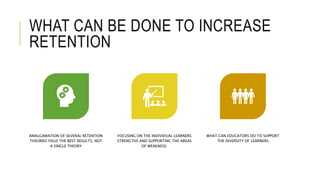
RETENTION
AMALGAMATION OF SEVERAL RETENTION
THEORIES YIELD THE BEST RESULTS, NOT
A SINGLE THEORY
FOCUSING ON THE INDIVIDUAL LEARNERS
STRENGTHS AND SUPPORTING THE AREAS
OF WEAKNESS.
WHAT CAN EDUCATORS DO TO SUPPORT
THE DIVERSITY OF LEARNERS
CAN YOU TEACH AN SEASONED
PROFESSOR A NEW TRICK/SKILL?
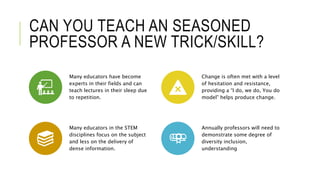
Many educators have become
experts in their fields and can
teach lectures in their sleep due
to repetition.
Change is often met with a level
of hesitation and resistance,
providing a “I do, we do, You do
model” helps produce change.
Many educators in the STEM
disciplines focus on the subject
and less on the delivery of
dense information.
Annually professors will need to
demonstrate some degree of
diversity inclusion,
understanding
EDUCATOR
S NEW
APPROACH
Christian identity can and should inform
professors' teaching in the contemporary
pluralistic university” (Alleman et al, 2019).
Educators' relationship between being
Christian and an educator and applying their
identity in the class.
Applying appropriate inclusive attitudes in
the STEM disciplines will foster a more
welcoming environment for learners.
EDUCATOR
S NEW
APPROACH
“The shift in demographics have signaled
that times have changed for predominately
white evangelical Christian colleges and
universities and that business as usual can
no longer be considered a viable strategy if
our institutions are to remain relevant and
flourishing in these changing
times”(Longman, 2017).
Demands for greater student, faculty,
curriculum, and campus diversity is
warranted by the majority of students and
society. If diversity and change is to occur
“There must be resolve to do so” (Longman,
2017).
WHAT CAN
BE DONE
TO
INCREASE
SATISFACTI
ON
The need for cultural competence and
sensitivity when planning curriculum and
presented lectures to an ever-growing
diverse student population.
Establishing a in depth understanding of the
ethnic/cultural demographics of the
students in the classroom, allows educators
to individualize lesson plans with insight of
cultural relevant examples and language
“proposes awareness-raising activities as a
way of promoting such understanding”
(Murray, 2016)
“After this I looked, and behold, a great multitude that
no one could number, from every nation, from all
tribes and peoples and languages, standing before the
throne and before the Lamb, clothed in white robes,
with palm branches in their hands, and crying out with
a loud voice, “Salvation belongs to our God who sits on
the throne, and to the Lamb!” (Revelation 7:9-10,)
DIVERSITY LAG
IN STEM DISCIPLINES
Who gets in and why based on the perfect “fit” between PhD student
and the professor with a similar research interest.
A Demographic Snapshot of Audiologists (2019) shows that
Audiologist are comprised of “92% White and 86% women”, not
diverse and not representative accurately for the diverse patients seen
African American Male in Audiology often experience heighten
stress/pressure and isolation during programs
Audiology illuminates a trend of diversity lags in educators and
student demographic in STEM disciplines
WHY
UNDERREPRESENTE
D STUDENTS DROP
OUT
Ultimately a lack of resources and support in and
outside the classroom
Unwelcoming environment
Unwelcoming line of communication with professors
and departments
High cost of higher education
“It is the institutions responsibility to help the student
integrate those attributes into their social and academic
systems to ensure persistence and success, and failure
of that integration leads to students dropping out of
the institution” (Mannan, 2007, p.147-148), based on
Tinto’s Model of Student Integration 1975
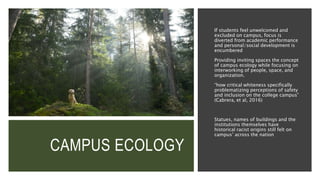
CAMPUS ECOLOGY
If students feel unwelcomed and
excluded on campus, focus is
diverted from academic performance
and personal/social development is
encumbered
Providing inviting spaces the concept
of campus ecology while focusing on
interworking of people, space, and
organization.
“how critical whiteness specifically
problematizing perceptions of safety
and inclusion on the college campus”
(Cabrera, et al, 2016)
Statues, names of buildings and the
institutions themselves have
historical racist origins still felt on
campus’ across the nation
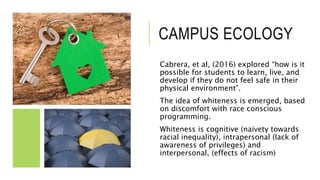
CAMPUS ECOLOGY
Cabrera, et al, (2016) explored “how is it
possible for students to learn, live, and
develop if they do not feel safe in their
physical environment”.
The idea of whiteness is emerged, based
on discomfort with race conscious
programming.
Whiteness is cognitive (naivety towards
racial inequality), intrapersonal (lack of
awareness of privileges) and
interpersonal, (effects of racism)
CAMPUS ECOLOGY
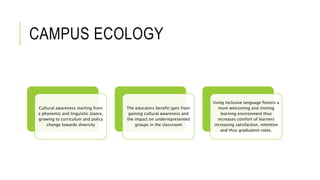
Cultural awareness starting from
a phonemic and linguistic stance,
growing to curriculum and policy
change towards diversity
The educators benefit/gain from
gaining cultural awareness and
the impact on underrepresented
groups in the classroom
Using inclusive language fosters a
more welcoming and inviting
learning environment thus
increases comfort of learners
increasing satisfaction, retention
and thus graduation rates.
FUNDING AND DISCRIMINATION
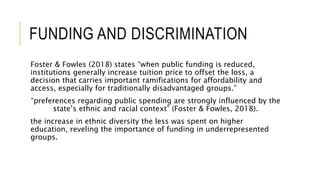
Foster & Fowles (2018) states “when public funding is reduced,
institutions generally increase tuition price to offset the loss, a
decision that carries important ramifications for affordability and
access, especially for traditionally disadvantaged groups.”
“preferences regarding public spending are strongly influenced by the
state’s ethnic and racial context” (Foster & Fowles, 2018).
the increase in ethnic diversity the less was spent on higher
education, reveling the importance of funding in underrepresented
groups.
DISMANTLI
NG
ROADBLOC
KS
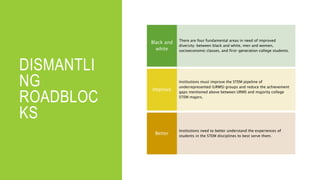
There are four fundamental areas in need of improved
diversity: between black and white, men and women,
socioeconomic classes, and first-generation college students.
Black and
white
Institutions must improve the STEM pipeline of
underrepresented (URMS) groups and reduce the achievement
gaps mentioned above between URMS and majority college
STEM majors.
Improve
Institutions need to better understand the experiences of
students in the STEM disciplines to best serve them.
Better
DIVERSITY
AND THE
ECONOMY/SO
CIETY
“Within the US context, diversity is often
hailed as a strength although research has
found a consistent decline in institutional
diversity for the last 40 years.” (Harris &
Ellis, 2020).
the diversity of institutions has decreased
which correlates with lack of changes and
issues regarding diversity within educational
systems
RETENTION THEORY TRENDS
ADDRESSING DIVERSITY IN
HIGHER EDUCATION
Sanford believed learners needs both
challenge and support from the
environment to succeed educationally and
“that students must be physically and
psychologically ready to complete the task”
(Sanford, 1966).
Spady’s research central theme was to
unearth the support that contribute to
social integration and the lack of which
can lead to dropout with academic
performance as a major factor
RETENTION
THEORY
TRENDS
ADDRESSIN
G
DIVERSITY
IN HIGHER
EDUCATION
Alexander Astin’s formal Involvement
Theory states “students learn more the more
they are involved in both the academic and
social aspects of the collegiate experience”
(Astin, 1984)
RETENTION
THEORY
TRENDS
ADDRESSIN
G
DIVERSITY
IN HIGHER
EDUCATION
“support from family, supportive staff and
faculty, institutional commitment, personal
commitment, and connections to homeland
and culture”. Minorities have higher dropout
rates than white students” (Larimore and
McClellan, 2005)
IDENTIFY
STRATEGIES TO
ADAPT IN STEM
DISCIPLINES
Revisal of the admissions process
Expansion criteria for reserved slots
Providing professional development on
race and racism for students (pre-
admission)
Peer-peer tutoring
Required weekly/monthly/quarterly
academic meetings for underrepresented
learners
Revisit curriculum and testing methods
TECHNOLOGY
Incorporation of appropriate technology is warranted to engender
change
Text, video conferencing, screen sharing all increase student assess
to educators and a direct line of communication
The Bible states the Father meets his believers where they are,
similarly, educators must use platforms, and communicative tools
that students use daily outside classrooms
Use social media platforms to recruit and retain underrepresented
learners.
Utilizing social media platforms Twitter, Tiktok, and Facebook to
create course groups for communication.
“The rich and the poor meet
together;
the LORD is the Maker of them all”
(Proverbs 22:2)
How can educators eliminate the lonely collegiate journey
often experienced by learners from underrepresented
groups?
By not only acknowledging diversity disparities in STEM
disciplines yet implementing change.
Be the change in the world that you wish to see
RESOURCES
Abdul-Alim, J. (2017). Michelle Obama: America needs diversity to advance. Diverse Issues in
Higher Education , 33(25),7.
Alleman, N., Glanzer, P., Marsden, G. (2019). The Outrageous Idea of Christian
Teaching. United States: Oxford University Press.
Astin, A. (1984). Student involvement: a developmental theory for
higher education. Journal of College Student Personnel, 25(4), 297–308
Cabrera, N. L., Watson, J. S., & Franklin, J. D. (2016). Racial Arrested Development: A Critical
Whiteness Analysis of the Campus Ecology. Journal of College Student Development, 57(2), 119-
134.
Comeaux, E., et al, (2020). The College Access and Choice Processes of High-Achieving
African American Students: A Critical Race Theory Analysis. American Educational Research
Journal, 57(1), 411–439.
RESOURCES
Davis, L & Fry, R (2019), College faculty have become more racially and ethnically
diverse, but remain far less so than students, Pew Research Center, 2019, July 31
Harris, M.S., Ellis, M.K., (2020). Measuring changes in institutional diversity: the US
context. Higher Education., 79(2), 345–360.
Foster, J. M., & Fowles, J. (2018). Ethnic heterogeneity, group affinity, and state higher
education spending. Research in Higher Education, 59(1), 1-28.
Jones, A., Williams, A., Whitaker, S., Yingling, S., Inkelas, K. & Gates, J. (2018) Call
to Action: Data, Diversity, and STEM Education, Change: The Magazine of Higher
Learning, 50:2, 40-47,
RESOURCES
Longman, K. A. (2017). Diversity Matters: Race, Ethnicity, and the Future of Christian Higher Education. United
Kingdom: Abilene Christian University Press.
Mannan A. (2007). Student attrition and academic and social integration: Application OF
Tinto’s model at the University of Papua New Guinea. Higher Education, 53(2), 147-165
Mullen, R., Jones, N. (2020) Diversity God's Way: Perceived Problems and Potential Solutions to Race Relations in the
Church : Creative Enterprises Studio.
Murray, N. (2016) Dealing with diversity in higher education: awareness-raising and a linguistic perspective on teachers’
intercultural competence, International Journal for Academic Development, 21:3, 166-177
RESOURCES
Sanford, N. (1966). Self and society: Social change and individual development.
New York: Atherton
U.S. Department of Education, National Center for Education Statistics.
(2020). The Condition of Education 2020 (NCES 2020-144)

696 capstone final powerpoint

  • 1.
    RE-THINKING THE AMERICAN COLLEGE EXPERIENCE: DIVERSITYAND INCLUSION David L. Frazier II School of Education, Liberty University EDUC-665
  • 2.
    GOAL OF PROFESSIO NAL DEVELOPME NT COURSE Illuminatethe lack of diversity in higher education with educators and learners and engender insight Unearth insight into learning environment and the impact on underrepresented learners. Present solutions with a biblical perspective to address this disparity specifically within the STEM disciplines. Can not fix a problem if it is not acknowledged/addressed
  • 3.
    Learning Objectives RELEVANCE AND BENEFITOF DIVERSITY AND INCLUSION ILLUMINATE TRUE CAMPUS ECOLOGY IDENTIFY STRATEGIES TO ADAPT IN STEM DISCIPLINES
  • 4.
  • 5.
    TEACHING DIVERSITY MORE THAN ONE DAYAT A TIME https://www.ted.com/talks/grace_darrow_teac hing_diversity_more_than_one_day_at_a_time
  • 6.
    College is consideredthe Ultimate shared American yet many black and brown leaners experience is quite different at PWI and within STEM disciplines How can educators eliminate the lonely collegiate journey often experienced by learners from underrepresented groups?
  • 7.
    The issue of“dealing with it” (Mullen & Jones 2020) describe as the diversity issues in church and state and as believers we must approach diversity with God as the center, finding mutual relationships using Gods principles. In tackling the issues of diversity and inclusion applying God’s way of approaching people with love, kindness and an open heart is the foundation set forth by the authors.
  • 8.
    WILL EDUCATORS RISETO THE CHALLENGE? Presently in America nearly 45% of higher education learners are from underrepresented groups, yet only 24% of faculty falls in the same demographic category according to the National Center for Education Statistics, 2020 The professional development (PD) will focus on diversity and inclusion to address the needs of an ever-growing diverse student population and to equip educators with current trends in student development theories of diversity and inclusion Cause educators to view higher education from the lens of underrepresented groups
  • 9.
    IMPORTANCE OF PROFESSIONAL DEVELOPMENT Systematic processthat strengthens how professionals obtain and retain knowledge, skills, and attitudes Consciously designed processes and activities developed to improve organizational practices Systematic process: planning, designing, marketing, delivering, evaluating, and following up Events, information and presentation sessions, and technical assistance
  • 10.
    PROFESSIONAL DEVELOPMENT The purposeof this presentation is to illuminate, educate and empower higher education educators in STEM disciplines with skills, tools, and empathy to instill in course work and approach in the classroom. Annual (PD) strengthens the education delivery synthesizing theory and application of current trends PD with diversity and inclusion focus will be required annually or every semester similar to continuing education credits to have an active license to work professionally at an institution for In the stem The educators must not only attend PD yet provide specific examples of how trainings are adapted and incorporated in coursework and lectures at the conclusion of courses/trainings.
  • 11.
    PROFESSIONAL DEVELOPMENT Providing PDplans for STEM educators will engender minority student success and satisfaction of the college experience. This topic fits in the broad area of education because it addresses the pervasive need to educate instructors campus-wide with the current trends of exponential diversity growth of learners and how to provide resources and services appropriately
  • 12.
    “For just asthe body is one and has many members, and all the members of the body, though many, are one body, so it is with Christ. For in one Spirit we were all baptized into one body—Jews or Greeks, slaves or free—and all were made to drink of one Spirit.” (1 Corinthians 12:12-13)
  • 13.
    RELEVANCE OF DIVERSITY AND INCLUSION America“Wont advance unless diverse voices are at the table” (Abdul-Alim, 2017) Providing tangible examples of successful African American woman in STEM to students of underrepresented groups is invaluable Providing society examples that educating underrepresented groups will add positive value to American society and workforce Untold stories of minorities and their positive impact on American history that bolstered the nation as a leader global standing today.
  • 14.
    CURRENT TRENDS “In fall2017, about three-quarters of postsecondary faculty members in the U.S. were white (76%), compared with 55% of undergraduates” (Davis & Fry, 2019) Notably there is a lack of diversity in faculty of STEM related disciplines nationwide and the authors revealed “Other research has found that minority students who have educators of the same race or ethnicity are more likely to look to those teachers as role models and to report greater effort in school and higher college goals” (Davis & Fry, 2019).
  • 15.
    CRITICAL RACE THEORY & SATISFACTI ON Comeaux, E.,et al, (2020) states “to engage in a racial analysis of the access and choice processes to better understand oppressive structures encountered by college-bound African American students”. Otherwise, the college enrollment decision-making process for students can appear fair and inclusive across racial lines when this is not, in fact, the case.” Critical race theory “as an analytical lens to understand how race and racism influence African American students’ decisions about college and to offer suggestions for policy and practice” (Comeaux, E., et al, 2020).
  • 16.
    CRITICAL RACE THEORY & SATISFACTI ON Several recommendationsfor dismantling discrimination in higher education. Revisal of the admissions process, expansion criteria for reserved slots providing professional development on race and racism are a few recommendations presented that can become applicable in STEM majors.
  • 17.
    WHAT CAN BEDONE TO INCREASE RETENTION AMALGAMATION OF SEVERAL RETENTION THEORIES YIELD THE BEST RESULTS, NOT A SINGLE THEORY FOCUSING ON THE INDIVIDUAL LEARNERS STRENGTHS AND SUPPORTING THE AREAS OF WEAKNESS. WHAT CAN EDUCATORS DO TO SUPPORT THE DIVERSITY OF LEARNERS
  • 18.
    CAN YOU TEACHAN SEASONED PROFESSOR A NEW TRICK/SKILL? Many educators have become experts in their fields and can teach lectures in their sleep due to repetition. Change is often met with a level of hesitation and resistance, providing a “I do, we do, You do model” helps produce change. Many educators in the STEM disciplines focus on the subject and less on the delivery of dense information. Annually professors will need to demonstrate some degree of diversity inclusion, understanding
  • 19.
    EDUCATOR S NEW APPROACH Christian identitycan and should inform professors' teaching in the contemporary pluralistic university” (Alleman et al, 2019). Educators' relationship between being Christian and an educator and applying their identity in the class. Applying appropriate inclusive attitudes in the STEM disciplines will foster a more welcoming environment for learners.
  • 20.
    EDUCATOR S NEW APPROACH “The shiftin demographics have signaled that times have changed for predominately white evangelical Christian colleges and universities and that business as usual can no longer be considered a viable strategy if our institutions are to remain relevant and flourishing in these changing times”(Longman, 2017). Demands for greater student, faculty, curriculum, and campus diversity is warranted by the majority of students and society. If diversity and change is to occur “There must be resolve to do so” (Longman, 2017).
  • 21.
    WHAT CAN BE DONE TO INCREASE SATISFACTI ON Theneed for cultural competence and sensitivity when planning curriculum and presented lectures to an ever-growing diverse student population. Establishing a in depth understanding of the ethnic/cultural demographics of the students in the classroom, allows educators to individualize lesson plans with insight of cultural relevant examples and language “proposes awareness-raising activities as a way of promoting such understanding” (Murray, 2016)
  • 22.
    “After this Ilooked, and behold, a great multitude that no one could number, from every nation, from all tribes and peoples and languages, standing before the throne and before the Lamb, clothed in white robes, with palm branches in their hands, and crying out with a loud voice, “Salvation belongs to our God who sits on the throne, and to the Lamb!” (Revelation 7:9-10,)
  • 23.
    DIVERSITY LAG IN STEMDISCIPLINES Who gets in and why based on the perfect “fit” between PhD student and the professor with a similar research interest. A Demographic Snapshot of Audiologists (2019) shows that Audiologist are comprised of “92% White and 86% women”, not diverse and not representative accurately for the diverse patients seen African American Male in Audiology often experience heighten stress/pressure and isolation during programs Audiology illuminates a trend of diversity lags in educators and student demographic in STEM disciplines
  • 24.
    WHY UNDERREPRESENTE D STUDENTS DROP OUT Ultimatelya lack of resources and support in and outside the classroom Unwelcoming environment Unwelcoming line of communication with professors and departments High cost of higher education “It is the institutions responsibility to help the student integrate those attributes into their social and academic systems to ensure persistence and success, and failure of that integration leads to students dropping out of the institution” (Mannan, 2007, p.147-148), based on Tinto’s Model of Student Integration 1975
  • 25.
    CAMPUS ECOLOGY If studentsfeel unwelcomed and excluded on campus, focus is diverted from academic performance and personal/social development is encumbered Providing inviting spaces the concept of campus ecology while focusing on interworking of people, space, and organization. “how critical whiteness specifically problematizing perceptions of safety and inclusion on the college campus” (Cabrera, et al, 2016) Statues, names of buildings and the institutions themselves have historical racist origins still felt on campus’ across the nation
  • 26.
    CAMPUS ECOLOGY Cabrera, etal, (2016) explored “how is it possible for students to learn, live, and develop if they do not feel safe in their physical environment”. The idea of whiteness is emerged, based on discomfort with race conscious programming. Whiteness is cognitive (naivety towards racial inequality), intrapersonal (lack of awareness of privileges) and interpersonal, (effects of racism)
  • 27.
    CAMPUS ECOLOGY Cultural awarenessstarting from a phonemic and linguistic stance, growing to curriculum and policy change towards diversity The educators benefit/gain from gaining cultural awareness and the impact on underrepresented groups in the classroom Using inclusive language fosters a more welcoming and inviting learning environment thus increases comfort of learners increasing satisfaction, retention and thus graduation rates.
  • 28.
    FUNDING AND DISCRIMINATION Foster& Fowles (2018) states “when public funding is reduced, institutions generally increase tuition price to offset the loss, a decision that carries important ramifications for affordability and access, especially for traditionally disadvantaged groups.” “preferences regarding public spending are strongly influenced by the state’s ethnic and racial context” (Foster & Fowles, 2018). the increase in ethnic diversity the less was spent on higher education, reveling the importance of funding in underrepresented groups.
  • 29.
    DISMANTLI NG ROADBLOC KS There are fourfundamental areas in need of improved diversity: between black and white, men and women, socioeconomic classes, and first-generation college students. Black and white Institutions must improve the STEM pipeline of underrepresented (URMS) groups and reduce the achievement gaps mentioned above between URMS and majority college STEM majors. Improve Institutions need to better understand the experiences of students in the STEM disciplines to best serve them. Better
  • 30.
    DIVERSITY AND THE ECONOMY/SO CIETY “Within theUS context, diversity is often hailed as a strength although research has found a consistent decline in institutional diversity for the last 40 years.” (Harris & Ellis, 2020). the diversity of institutions has decreased which correlates with lack of changes and issues regarding diversity within educational systems
  • 31.
    RETENTION THEORY TRENDS ADDRESSINGDIVERSITY IN HIGHER EDUCATION Sanford believed learners needs both challenge and support from the environment to succeed educationally and “that students must be physically and psychologically ready to complete the task” (Sanford, 1966). Spady’s research central theme was to unearth the support that contribute to social integration and the lack of which can lead to dropout with academic performance as a major factor
  • 32.
    RETENTION THEORY TRENDS ADDRESSIN G DIVERSITY IN HIGHER EDUCATION Alexander Astin’sformal Involvement Theory states “students learn more the more they are involved in both the academic and social aspects of the collegiate experience” (Astin, 1984)
  • 33.
    RETENTION THEORY TRENDS ADDRESSIN G DIVERSITY IN HIGHER EDUCATION “support fromfamily, supportive staff and faculty, institutional commitment, personal commitment, and connections to homeland and culture”. Minorities have higher dropout rates than white students” (Larimore and McClellan, 2005)
  • 34.
    IDENTIFY STRATEGIES TO ADAPT INSTEM DISCIPLINES Revisal of the admissions process Expansion criteria for reserved slots Providing professional development on race and racism for students (pre- admission) Peer-peer tutoring Required weekly/monthly/quarterly academic meetings for underrepresented learners Revisit curriculum and testing methods
  • 35.
    TECHNOLOGY Incorporation of appropriatetechnology is warranted to engender change Text, video conferencing, screen sharing all increase student assess to educators and a direct line of communication The Bible states the Father meets his believers where they are, similarly, educators must use platforms, and communicative tools that students use daily outside classrooms Use social media platforms to recruit and retain underrepresented learners. Utilizing social media platforms Twitter, Tiktok, and Facebook to create course groups for communication.
  • 36.
    “The rich andthe poor meet together; the LORD is the Maker of them all” (Proverbs 22:2)
  • 37.
    How can educatorseliminate the lonely collegiate journey often experienced by learners from underrepresented groups? By not only acknowledging diversity disparities in STEM disciplines yet implementing change. Be the change in the world that you wish to see
  • 38.
    RESOURCES Abdul-Alim, J. (2017).Michelle Obama: America needs diversity to advance. Diverse Issues in Higher Education , 33(25),7. Alleman, N., Glanzer, P., Marsden, G. (2019). The Outrageous Idea of Christian Teaching. United States: Oxford University Press. Astin, A. (1984). Student involvement: a developmental theory for higher education. Journal of College Student Personnel, 25(4), 297–308 Cabrera, N. L., Watson, J. S., & Franklin, J. D. (2016). Racial Arrested Development: A Critical Whiteness Analysis of the Campus Ecology. Journal of College Student Development, 57(2), 119- 134. Comeaux, E., et al, (2020). The College Access and Choice Processes of High-Achieving African American Students: A Critical Race Theory Analysis. American Educational Research Journal, 57(1), 411–439.
  • 39.
    RESOURCES Davis, L &Fry, R (2019), College faculty have become more racially and ethnically diverse, but remain far less so than students, Pew Research Center, 2019, July 31 Harris, M.S., Ellis, M.K., (2020). Measuring changes in institutional diversity: the US context. Higher Education., 79(2), 345–360. Foster, J. M., & Fowles, J. (2018). Ethnic heterogeneity, group affinity, and state higher education spending. Research in Higher Education, 59(1), 1-28. Jones, A., Williams, A., Whitaker, S., Yingling, S., Inkelas, K. & Gates, J. (2018) Call to Action: Data, Diversity, and STEM Education, Change: The Magazine of Higher Learning, 50:2, 40-47,
  • 40.
    RESOURCES Longman, K. A.(2017). Diversity Matters: Race, Ethnicity, and the Future of Christian Higher Education. United Kingdom: Abilene Christian University Press. Mannan A. (2007). Student attrition and academic and social integration: Application OF Tinto’s model at the University of Papua New Guinea. Higher Education, 53(2), 147-165 Mullen, R., Jones, N. (2020) Diversity God's Way: Perceived Problems and Potential Solutions to Race Relations in the Church : Creative Enterprises Studio. Murray, N. (2016) Dealing with diversity in higher education: awareness-raising and a linguistic perspective on teachers’ intercultural competence, International Journal for Academic Development, 21:3, 166-177
  • 41.
    RESOURCES Sanford, N. (1966).Self and society: Social change and individual development. New York: Atherton U.S. Department of Education, National Center for Education Statistics. (2020). The Condition of Education 2020 (NCES 2020-144)

Editor's Notes

  • #3 Welcome scholars and educators to this annual PD with Frazier University’s Health Sciences Department. The Goal of today is simple Illuminate lack of diversity in STEM disciplines and produce change.
  • #4 At the conclusion of this PD, Educators will be able to know the importance of PD, understand the relevance of diversity and inclusion in the classroom and why change is warranted now.
  • #5 Keeping the topic of diversity and inclusion at the table of discussion in academia is paramount! Having educators view teaching from the lens of underrepresented groups results in a shift of perspective and change in curriculum and lecture approach. As Christian Educators, Loving our neighbor as ourselves are the characteristics we embody and this needs to extend in the classroom.
  • #6 Lets listen to the words of a learner on the need for diversity discussion and change from a high school perspective There is an inverse relationship with diversity in the current scaffolding of the educational system. Resultant of the current structure of education, primary and secondary learners typically have educators with similar cultures and ethnicities
  • #7 Having conversations of issues opposed to ignoring them allows the issue to stay relevant in higher education, which is the mandate currently within American society, Inclusion!
  • #8 Racial diversity trends in the church offers suggestions for higher education This principle that all people are equal and have value is the foundation of Godly principles to adhere while tackling the uncomfortable conversation of racial issues in higher education.
  • #9 The numbers speak for themselves
  • #10 Is annual PD necessary?
  • #11 Bottom line, Yes PD annually is important for change
  • #12 PD is important component to keep the conversation of inclusion and the need for diversity at the center of conversations in higher education. PD serves a conduit to or catalyst for change in business sectors and in higher education.
  • #13 The Bible instructs us to seek him concerning all things. We are ONE member in Christ and in higher education and a community attitude an commonality is needed.
  • #14 Society mandates who and what we ought to be As depicted in the civil and racial unrest during the summer of 2020, Yes diversity and inclusion is the center of the conversation in academia.
  • #15 Addressing the issue of diversity and inclusion is needed for educators to engender the best possible learning environments and have educators that look like the students. Having educators that are diverse in higher education is needed to reflect the ever-growing diversity in the nation and all levels of the educational system
  • #16 Understanding how African American students make college choices, foreshows decision making with STEM majors.
  • #17 CRT’s application and correlation with increased underrepresented learner satisfaction and completion
  • #18 Ok, yes PD is important and yes we acknowledged a need for increased diversity, but what can be done?
  • #19 Differentiate between general and STEM faculty specifically sign documents committing to annual PD in diversity and inclusion and to demonstrate and prove efforts to increase learner diversity, success and completion. Educators would be rewarded and encouraged to share innovative curriculum and course changes towards inclusion. Extra PTO, Sick days, preferential parking, gift cards, awards etc.. Every year STEM departments must show through recruitment efforts, marketing, and coursework tangible goals of addressing diversity and inclusion. The role of facilitator for professional development course/training should rotate with educators to provide all the experience of facilitating. Department heads will openly acknowledge and share innovative ideas and strategies incorporated by educators for more tools to address diversity. Providing/securing funding to financially support learners with both high and low scholastic records. Requiring weekly, bi-weekly, monthly, quarterly, and annual STEM specific advisement appointments for underrepresented learners. Once learners are acclimated, adjusted, and succeeding with course work, the frequency of appointments should lessen.
  • #20 We must follow what the Bible instructions and apply them in the classroom
  • #21  We must have a Godly mindset and open heart to produce real change.
  • #22 Keeping the topic of diversity and inclusion relevant is achieved in many ways including awareness activities and PD’s.
  • #23 Diversity was discussed at end in the Bible Jews, Gentiles, Men, Women, those under the covenant, etc. Adhering these principles of acceptance and inclusion is warranted in the classroom in STEM disciplines.
  • #24 Yes great strides towards diversity and inclusion has been made institutional-wide, STEM fields least resemble the diversity in actual student demographics as other disciplines. Retention and success strategies must meet this unique category as a multi-complex system that it is and adapt  ”53 percent were White males, 27 percent were White females, 8 percent were Asian/Pacific Islander males, and 3 percent were Asian/Pacific Islander females. Black males, Black females, and Hispanic males each accounted for 2 percent of full-time professors” U.S. Department of Education, National Center for Education Statistics. (2020
  • #25 Lack of preparedness of underrepresented learners in primary and secondary systems resultant of funding leading to drop out rate.
  • #26 The environment of an institution and department speaks volumes to the vision and missions and priorities of inclusion.
  • #27 Maslows hierarchy described that basic needs of food shelter and safety is warranted before true self actualization can be achieved. Safe and inviting spaces on campus is a must to produce change and comfort to underrepresented learners
  • #28 The word choice is equally important to inclusion as the environment. Our words and actions must align to produce true Godly change.
  • #29 It is widely known that funding college education is heavily relied on state and federal assistance for lower socioeconomic and ethnic groups.
  • #30 Examining the dynamics of STEM disciplines and the workforce, what is being done to meet societal demands lagging in qualified applicants. importance of STEM jobs in defending and protecting the nation while securing a healthy economy. Resultant of the forecasted high job growth, STEM education is imperative in all levels of education starting with elementary culminating in higher education.
  • #31 Who and what we ought to be is mandated by society and the individual institutions have to opportunity to meet or fail at meeting demands set forth. America is a role model for diversity to the world and recently has fallen short of being a global leader
  • #32 What retention theories should be used?
  • #33 Involvement is important to freedom to express individuality and cognitive skills
  • #34 Support is an important component in increased diversity
  • #35 Some learners are can explain Orally yet are intimidated with scantron, standardized exams. Maybe change the duration from 16 weeks to 8 or maybe 4 weeks?
  • #36 Implementation of current technology options such as social media and virtual meeting platforms can both market to diverse learners geographically and socioeconomically
  • #37 Just as the father provides diversity of tongues, as educators we must embrace our differences and love one another as Christ loves the church.