Transportation Demand
     Management
An Analysis and Update for the
          Ordinance
   Byrne, Guardado, Wang
Overview
•   Introduction to TDM
•   Purpose
•   Background Issues
•   Variable Pricing
•   Shared Parking
•   Findings
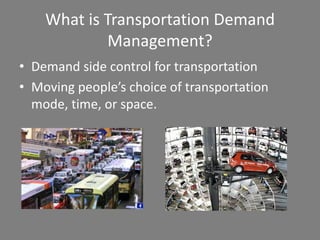
What is Transportation Demand
            Management?
• Demand side control for transportation
• Moving people’s choice of transportation
  mode, time, or space.
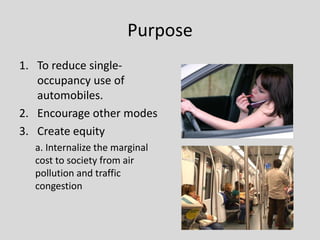
Purpose
1. To reduce single-
   occupancy use of
   automobiles.
2. Encourage other modes
3. Create equity
  a. Internalize the marginal
  cost to society from air
  pollution and traffic
  congestion
Background Issues
• 1993 Ordinance required
  for new buildings over
  25,000 square feet.
• Preferential parking for
  carpools and vanpools.
• Mandated educational
  boards that encourage use
  of public transit or
  carpooling.
• No evidence that these
  had any significant impact
Analysis
• 2 Strategies:
  1. Variable Pricing for On-street Parking
  2. Shared Parking
Variable Pricing, On-Street Parking
• Strategy: to price on-street parking meters
  according to demand
  – Based on 2 dimensions:
     • Location
     • Time
Variable Pricing, On-Street Parking
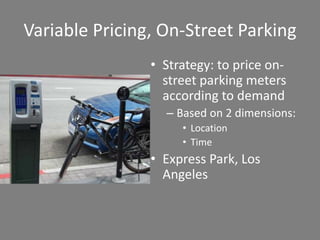
                • Strategy: to price on-
                  street parking meters
                  according to demand
                  – Based on 2 dimensions:
                     • Location
                     • Time
                • Express Park, Los
                  Angeles
Variable Pricing Best Practices
Variable Pricing, San Francisco, CA
• Similar to Express Park in Los Angeles
Variable Pricing, Ventura, CA
• Also sought 15% vacancy for
  parking
• “All moneys collected from
  parking pay stations, and meters
  in this city shall be placed in a
  special fund, which fund shall be
  devoted exclusively to purposes
  within the geographic
  boundaries of the parking
  district from which the revenue
  is collected. Such moneys shall
  be used for the purposes stated
  in the parking district
  establishment ordinance” (City
  of Ventura)
Variable Pricing, Glendale, CA
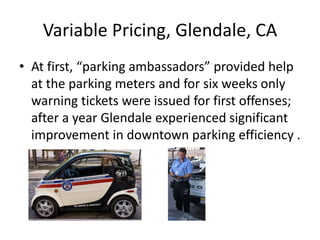
• At first, “parking ambassadors” provided help
  at the parking meters and for six weeks only
  warning tickets were issued for first offenses;
  after a year Glendale experienced significant
  improvement in downtown parking efficiency .
Shared Parking
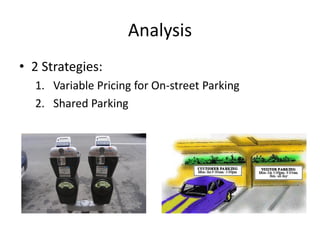
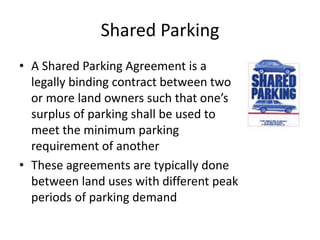
• A Shared Parking Agreement is a
  legally binding contract between two
  or more land owners such that one’s
  surplus of parking shall be used to
  meet the minimum parking
  requirement of another
• These agreements are typically done
  between land uses with different peak
  periods of parking demand
Shared Parking
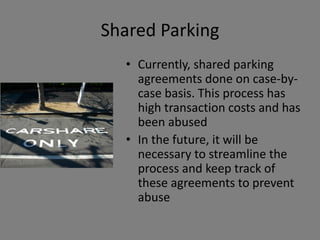
  • Currently, shared parking
    agreements done on case-by-
    case basis. This process has
    high transaction costs and has
    been abused
  • In the future, it will be
    necessary to streamline the
    process and keep track of
    these agreements to prevent
    abuse
Shared Parking Best Practices
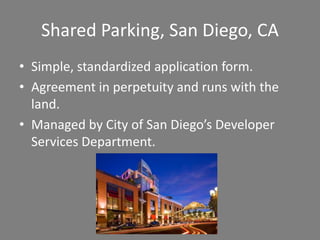
Shared Parking, San Diego, CA
• Simple, standardized application form.
• Agreement in perpetuity and runs with the
  land.
• Managed by City of San Diego’s Developer
  Services Department.
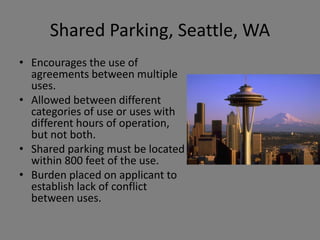
Shared Parking, Seattle, WA
• Encourages the use of
  agreements between multiple
  uses.
• Allowed between different
  categories of use or uses with
  different hours of operation,
  but not both.
• Shared parking must be located
  within 800 feet of the use.
• Burden placed on applicant to
  establish lack of conflict
  between uses.
Findings
General Plan Goals
• Goal A: “Adequate accessibility to work
  opportunities and essential services,
  and acceptable levels of mobility for all
  those who live, work, travel, or move
  goods in Los Angeles.”
• Objective 2: “Mitigate the impacts of
  traffic growth, reduce congestion, and
  improve air quality by implementing a
  comprehensive program of multimodal
  strategies that encompasses physical
  and operational improvements as well
  as demand management.”
• Policy 2.24: “Implement shared-
  parking, peripheral parking, and
  parking-pricing strategies in high-
  employment areas
General Plan Transportation Element,
  Chapter 7, Plans and Policies, P20
• “Develop and implement a Parking
  Awareness/Promotion program to
  increase acceptance of parking
  management by the general public.”
• “Implement shared parking,
  peripheral parking, and parking
  pricing programs in major
  employment areas and mixed-use
  districts”
• “Improve and expand enforcement
  of on-street parking restrictions (e.g.
  time limits, tow away/no stopping,
  loading zones), especially where
  such restrictions provide an
  additional peak hour travel lane/bus
  lane or additional loading areas in
  industrial districts.”
Questions?

619 tdm presentation 4 18 12

  • 1.
    Transportation Demand Management An Analysis and Update for the Ordinance Byrne, Guardado, Wang
  • 2.
    Overview • Introduction to TDM • Purpose • Background Issues • Variable Pricing • Shared Parking • Findings
  • 3.
    What is TransportationDemand Management? • Demand side control for transportation • Moving people’s choice of transportation mode, time, or space.
  • 4.
    Purpose 1. To reducesingle- occupancy use of automobiles. 2. Encourage other modes 3. Create equity a. Internalize the marginal cost to society from air pollution and traffic congestion
  • 5.
    Background Issues • 1993Ordinance required for new buildings over 25,000 square feet. • Preferential parking for carpools and vanpools. • Mandated educational boards that encourage use of public transit or carpooling. • No evidence that these had any significant impact
  • 6.
    Analysis • 2 Strategies: 1. Variable Pricing for On-street Parking 2. Shared Parking
  • 7.
    Variable Pricing, On-StreetParking • Strategy: to price on-street parking meters according to demand – Based on 2 dimensions: • Location • Time
  • 8.
    Variable Pricing, On-StreetParking • Strategy: to price on- street parking meters according to demand – Based on 2 dimensions: • Location • Time • Express Park, Los Angeles
  • 9.
  • 10.
    Variable Pricing, SanFrancisco, CA • Similar to Express Park in Los Angeles
  • 11.
    Variable Pricing, Ventura,CA • Also sought 15% vacancy for parking • “All moneys collected from parking pay stations, and meters in this city shall be placed in a special fund, which fund shall be devoted exclusively to purposes within the geographic boundaries of the parking district from which the revenue is collected. Such moneys shall be used for the purposes stated in the parking district establishment ordinance” (City of Ventura)
  • 12.
    Variable Pricing, Glendale,CA • At first, “parking ambassadors” provided help at the parking meters and for six weeks only warning tickets were issued for first offenses; after a year Glendale experienced significant improvement in downtown parking efficiency .
  • 13.
    Shared Parking • AShared Parking Agreement is a legally binding contract between two or more land owners such that one’s surplus of parking shall be used to meet the minimum parking requirement of another • These agreements are typically done between land uses with different peak periods of parking demand
  • 14.
    Shared Parking • Currently, shared parking agreements done on case-by- case basis. This process has high transaction costs and has been abused • In the future, it will be necessary to streamline the process and keep track of these agreements to prevent abuse
  • 15.
  • 16.
    Shared Parking, SanDiego, CA • Simple, standardized application form. • Agreement in perpetuity and runs with the land. • Managed by City of San Diego’s Developer Services Department.
  • 17.
    Shared Parking, Seattle,WA • Encourages the use of agreements between multiple uses. • Allowed between different categories of use or uses with different hours of operation, but not both. • Shared parking must be located within 800 feet of the use. • Burden placed on applicant to establish lack of conflict between uses.
  • 18.
  • 19.
    General Plan Goals •Goal A: “Adequate accessibility to work opportunities and essential services, and acceptable levels of mobility for all those who live, work, travel, or move goods in Los Angeles.” • Objective 2: “Mitigate the impacts of traffic growth, reduce congestion, and improve air quality by implementing a comprehensive program of multimodal strategies that encompasses physical and operational improvements as well as demand management.” • Policy 2.24: “Implement shared- parking, peripheral parking, and parking-pricing strategies in high- employment areas
  • 20.
    General Plan TransportationElement, Chapter 7, Plans and Policies, P20 • “Develop and implement a Parking Awareness/Promotion program to increase acceptance of parking management by the general public.” • “Implement shared parking, peripheral parking, and parking pricing programs in major employment areas and mixed-use districts” • “Improve and expand enforcement of on-street parking restrictions (e.g. time limits, tow away/no stopping, loading zones), especially where such restrictions provide an additional peak hour travel lane/bus lane or additional loading areas in industrial districts.”
  • 21.