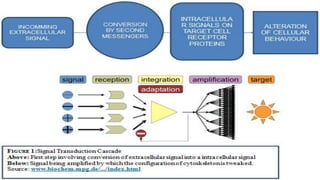
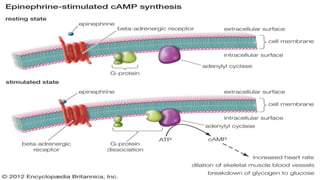
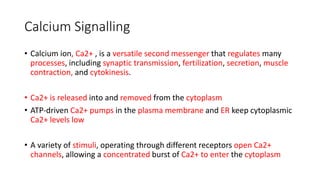
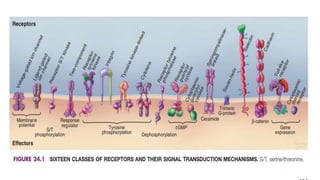
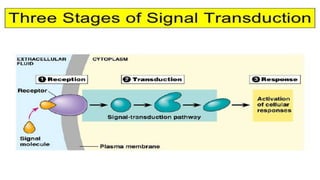
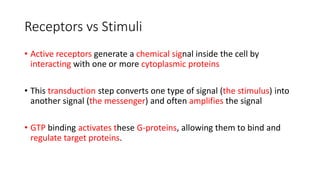
Cells use signalling mechanisms to respond to environmental changes. Receptors detect stimuli and transmit chemical signals inside the cell via second messengers like calcium ions and cyclic nucleotides. This allows cells to adapt behaviors through processes like gene expression, metabolism, motility and secretion. Receptors are proteins that interact with stimuli, converting the signal and amplifying it via G-proteins and second messengers. Second messengers then activate effector proteins to regulate various cellular functions. Calcium signalling in particular regulates many processes by calcium ions entering or leaving the cytoplasm through membrane pumps and channels opened by stimuli.




![Second Messengers
• These second messengers are chemically diverse, ranging from
hydrophobic lipids confined to membrane bilayers, to an inorganic ion
(Ca2+ ), to nucleotides ( [cAMP] and [cGMP]), to a gas (nitric oxide)
• They modify cellular behaviour by binding to and activating a wide
range of effector proteins, regulating membrane physiology, cellular
metabolism, motility, and gene expression.
• Effector systems include transcription factors](https://image.slidesharecdn.com/6-230720044646-1a4ca159/85/6-Signalling-Mechanisms-pptx-7-320.jpg)