MCA-III Math Vocabulary from DRAFT Test SpecificationsBy J. Scheumann and C. Sorenson 2011Source: MCA III DRAFT Test Specifications for Mathematics, Oct. 15, 2001, http://children.state.mn.us (Assessment and Testing/MCAs/Test Specs)
Data Analysis and Probability 6th grade Math Vocabulary MCA
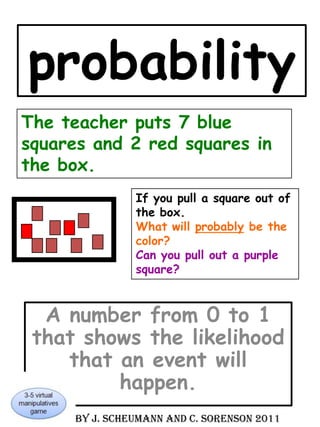
probabilityThe teacher puts 7 blue squares and 2 red squares in the box.If you pull a square out of the box. What will probably be the color?Can you pull out a purple square?A number from 0 to 1 that shows the likelihood that an event will happen.By J. Scheumann and C. Sorenson 2011
probabilityA number from 0 to 1 that indicated the likelihood that something (an event) will happen.By J. Scheumann and C. Sorenson 2011
ratio1:3 (for every one boy there are 3 girls)1/4 are boys and 3/4 are girls0.25 are boys (by dividing 1 by 4)25% are boys (0.25 as a percentage) A ratio shows the relative sizes of two or more values.By J. Scheumann and C. Sorenson 2011
outcomeHead and tails are two outcomes from flipping a coin.The result of something.By J. Scheumann and C. Sorenson 2011
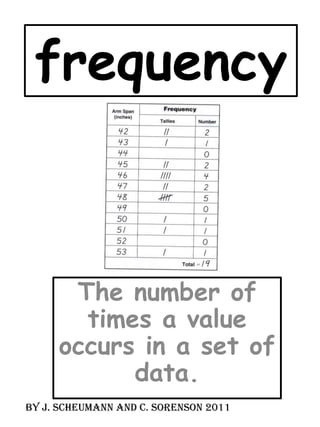
frequencyThe number of times a value occurs in a set of data.By J. Scheumann and C. Sorenson 2011
frequency graphA graph showing how often each value in a data set occurs.By J. Scheumann and C. Sorenson 2011
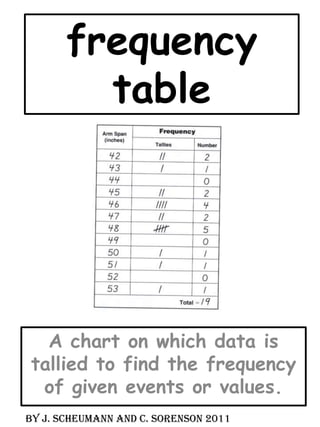
frequency tableA chart on which data is tallied to find the frequency of given events or values.By J. Scheumann and C. Sorenson 2011
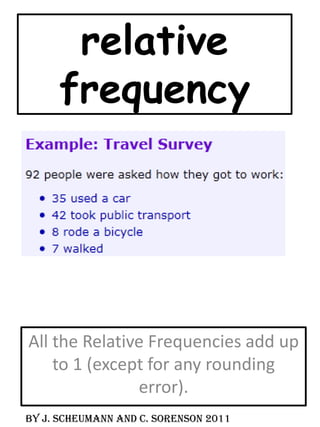
relative frequencyAll the Relative Frequencies add up to 1 (except for any rounding error).By J. Scheumann and C. Sorenson 2011
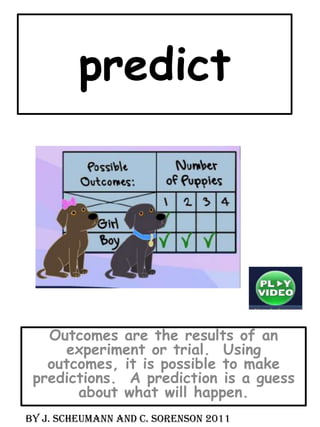
predictOutcomes are the results of an experiment or trial.  Using outcomes, it is possible to make predictions.  A prediction is a guess about what will happen.  By J. Scheumann and C. Sorenson 2011
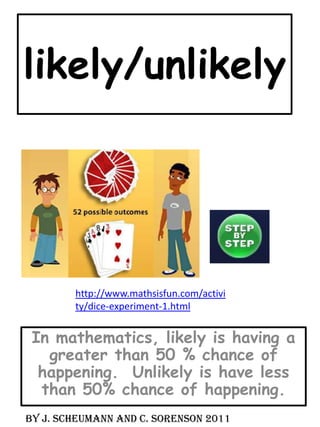
likely/unlikelyhttp://www.mathsisfun.com/activity/dice-experiment-1.htmlIn mathematics, likely is having a greater than 50 % chance of happening.  Unlikely is have less than 50% chance of happening.  By J. Scheumann and C. Sorenson 2011
certain/uncertaincertainIn mathematics, if an outcome is certain, the chances are 100%.By J. Scheumann and C. Sorenson 2011
tree diagramA chart that is used to show possible outcomes.By J. Scheumann and C. Sorenson 2011
eventA happening or occurrence.By J. Scheumann and C. Sorenson 2011
random samplingTaking a sampling from the population in a manner that allows all members the same chance of being included.By J. Scheumann and C. Sorenson 2011
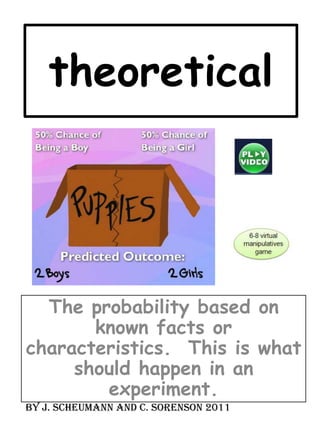
theoreticalThe probability based on known facts or characteristics.  This is what should happen in an experiment.  By J. Scheumann and C. Sorenson 2011
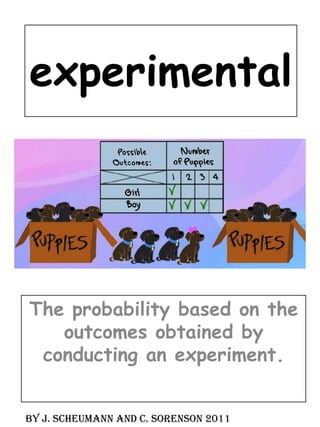
experimentalThe probability based on the outcomes obtained by conducting an experiment.  By J. Scheumann and C. Sorenson 2011
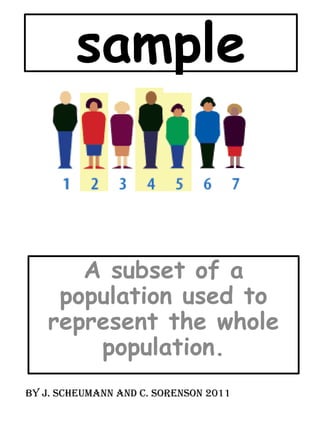
sampleA subset of a population used to represent the whole population.By J. Scheumann and C. Sorenson 2011
combinationsCombinations pop up in ordinary life all the time. When  you need to find out all the possible combinations of something, an organized list is the way to go.  By J. Scheumann and C. Sorenson 2011

6 data analysis and probability

  • 1.
    MCA-III Math Vocabularyfrom DRAFT Test SpecificationsBy J. Scheumann and C. Sorenson 2011Source: MCA III DRAFT Test Specifications for Mathematics, Oct. 15, 2001, http://children.state.mn.us (Assessment and Testing/MCAs/Test Specs)
  • 2.
    Data Analysis andProbability 6th grade Math Vocabulary MCA
  • 3.
    probabilityThe teacher puts7 blue squares and 2 red squares in the box.If you pull a square out of the box. What will probably be the color?Can you pull out a purple square?A number from 0 to 1 that shows the likelihood that an event will happen.By J. Scheumann and C. Sorenson 2011
  • 4.
    probabilityA number from0 to 1 that indicated the likelihood that something (an event) will happen.By J. Scheumann and C. Sorenson 2011
  • 5.
    ratio1:3 (for everyone boy there are 3 girls)1/4 are boys and 3/4 are girls0.25 are boys (by dividing 1 by 4)25% are boys (0.25 as a percentage) A ratio shows the relative sizes of two or more values.By J. Scheumann and C. Sorenson 2011
  • 6.
    outcomeHead and tailsare two outcomes from flipping a coin.The result of something.By J. Scheumann and C. Sorenson 2011
  • 7.
    frequencyThe number oftimes a value occurs in a set of data.By J. Scheumann and C. Sorenson 2011
  • 8.
    frequency graphA graphshowing how often each value in a data set occurs.By J. Scheumann and C. Sorenson 2011
  • 9.
    frequency tableA charton which data is tallied to find the frequency of given events or values.By J. Scheumann and C. Sorenson 2011
  • 10.
    relative frequencyAll theRelative Frequencies add up to 1 (except for any rounding error).By J. Scheumann and C. Sorenson 2011
  • 11.
    predictOutcomes are theresults of an experiment or trial. Using outcomes, it is possible to make predictions. A prediction is a guess about what will happen. By J. Scheumann and C. Sorenson 2011
  • 12.
    likely/unlikelyhttp://www.mathsisfun.com/activity/dice-experiment-1.htmlIn mathematics, likelyis having a greater than 50 % chance of happening. Unlikely is have less than 50% chance of happening. By J. Scheumann and C. Sorenson 2011
  • 13.
    certain/uncertaincertainIn mathematics, ifan outcome is certain, the chances are 100%.By J. Scheumann and C. Sorenson 2011
  • 14.
    tree diagramA chartthat is used to show possible outcomes.By J. Scheumann and C. Sorenson 2011
  • 15.
    eventA happening oroccurrence.By J. Scheumann and C. Sorenson 2011
  • 16.
    random samplingTaking asampling from the population in a manner that allows all members the same chance of being included.By J. Scheumann and C. Sorenson 2011
  • 17.
    theoreticalThe probability basedon known facts or characteristics. This is what should happen in an experiment. By J. Scheumann and C. Sorenson 2011
  • 18.
    experimentalThe probability basedon the outcomes obtained by conducting an experiment. By J. Scheumann and C. Sorenson 2011
  • 19.
    sampleA subset ofa population used to represent the whole population.By J. Scheumann and C. Sorenson 2011
  • 20.
    combinationsCombinations pop upin ordinary life all the time. When you need to find out all the possible combinations of something, an organized list is the way to go. By J. Scheumann and C. Sorenson 2011