electronic reprint
Acta Crystallographica Section E
Structure Reports
Online
ISSN 1600-5368
Editors: W. Clegg and D. G. Watson
5-Hydroxy-8-nitro-1,4-naphthoquinone
Daniel Teoh-Chuan Tan, Hasnah Osman, Azlina Harun Kamaruddin, Reza
Kia and Hoong-Kun Fun
Acta Cryst. (2008). E64, o1523–o1524
This open-access article is distributed under the terms of the Creative Commons Attribution Licence
http://creativecommons.org/licenses/by/2.0/uk/legalcode, which permits unrestricted use, distribution, and
reproduction in any medium, provided the original authors and source are cited.
Acta Crystallographica Section E
Structure Reports
Online
Editors: W. Clegg and D. G. Watson
journals.iucr.org
International Union of Crystallography * Chester
ISSN 1600-5368
Volume 61
Part 11
November 2005
Inorganic compounds
Metal-organic compounds
Organic compounds
Acta Crystallographica Section E: Structure Reports Online is the IUCr’s highly popu-
lar open-access structural journal. It provides a simple and easily accessible publication
mechanism for the growing number of inorganic, metal-organic and organic crystal struc-
ture determinations. The electronic submission, validation, refereeing and publication
facilities of the journal ensure very rapid and high-quality publication, whilst key indica-
tors and validation reports provide measures of structural reliability. In 2007, the journal
published over 5000 structures. The average publication time is less than one month.
Crystallography Journals Online is available from journals.iucr.org
Acta Cryst. (2008). E64, o1523–o1524 Tan et al. · C10H5NO5
5-Hydroxy-8-nitro-1,4-naphthoquinone
Daniel Teoh-Chuan Tan,a
Hasnah Osman,a
‡ Azlina Harun
Kamaruddin,b
Reza Kiac
and Hoong-Kun Func
*
a
School of Chemical Sciences, Universiti Sains Malaysia, 11800 USM, Penang,
Malaysia, b
School of Chemical Engineering, Universiti Sains Malaysia, Seri
Ampangan, 14300 Nibong Tebal, Penang, Malaysia, and c
X-ray Crystallography
Unit, School of Physics, Universiti Sains Malaysia, 11800 USM, Penang, Malaysia
Correspondence e-mail: hkfun@usm.my
Received 9 July 2008; accepted 11 July 2008
Key indicators: single-crystal X-ray study; T = 100 K; mean (C–C) = 0.001 A˚;
R factor = 0.041; wR factor = 0.120; data-to-parameter ratio = 18.4.
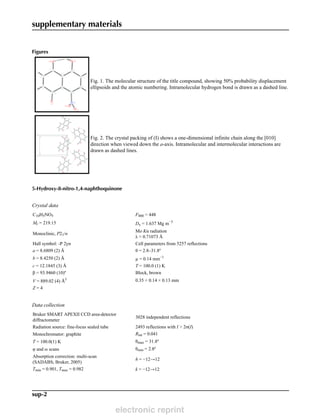
The title compound, C10H5NO5, features an intramolecular
O—HÁ Á ÁO hydrogen bond, forming a six-membered ring with
an S(6) ring motif. The nitro group makes a dihedral angle of
71.66 (5)
with the plane of the benzene ring to which it is
bound. The two rings are almost coplanar, with a dihedral
angle of 4.44 (5)
. Short intermolecular distances between the
centroids of the six-membered rings [3.7188 (6)–3.8299 (6) A˚ ]
indicate the existence of – interactions. The interesting
features of the crystal structure are the short intermolecular
OÁ Á ÁO and OÁ Á ÁN interactions. The crystal packing is
stabilized by intramolecular O—HÁ Á ÁO and intermolecular
C—HÁ Á ÁO (Â3) hydrogen bonds, and C—HÁ Á Á interactions.
Related literature
For related literature on hydrogen-bond motifs, see Bernstein
et al. (1995). For values of bond lengths, see Allen et al. (1987).
For related literature, see, for example: Guingant  Barreto
(1987); Larsen et al. (1996); Krohn et al. (2004); Krohn et al.
(2004); Cui et al. (2006); Anuradha et al. (2006).
Experimental
Crystal data
C10H5NO5
Mr = 219.15
Monoclinic, P21=n
a = 8.6809 (2) A˚
b = 8.4250 (2) A˚
c = 12.1845 (3) A˚
= 93.946 (1)
V = 889.02 (4) A˚ 3
Z = 4
Mo K radiation
 = 0.14 mmÀ1
T = 100.0 (1) K
0.35 Â 0.14 Â 0.13 mm
Data collection
Bruker SMART APEXII CCD
area-detector diffractometer
Absorption correction: multi-scan
(SADABS; Bruker, 2005)
Tmin = 0.900, Tmax = 0.982
22792 measured reflections
3028 independent reflections
2493 reflections with I  2(I)
Rint = 0.041
Refinement
R[F2
 2(F2
)] = 0.041
wR(F2
) = 0.119
S = 1.11
3028 reflections
165 parameters
H atoms treated by a mixture of
independent and constrained
refinement
Ámax = 0.50 e A˚ À3
Ámin = À0.23 e A˚ À3
Table 1
Selected interatomic and centroid–centroid distances (A˚ ).
Cg1 and Cg2 are the centroids of the C1–C5/C10 and C5–C10 rings,
respectively.
Cg1Á Á ÁCg2i
3.7188 (6)
Cg1Á Á ÁCg2i
3.8299 (6)
O2Á Á ÁO5i
2.9940 (11)
O5Á Á ÁO5ii
3.0367 (11)
O5Á Á ÁN1ii
3.0608 (11)
Symmetry codes: (i) Àx þ 2; Ày; Àz þ 1; (ii) Àx þ 2; Ày À 1; Àz þ 1.
Table 2
Hydrogen-bond geometry (A˚ , 
).
Cg1 is the centroid of the C1–C5/C10 ring.
D—HÁ Á ÁA D—H HÁ Á ÁA DÁ Á ÁA D—HÁ Á ÁA
O1—H1O1Á Á ÁO2 0.889 (18) 1.769 (19) 2.5695 (10) 148.5 (16)
C2—H2Á Á ÁO3iii
0.969 (15) 2.547 (16) 3.1853 (12) 123.4 (12)
C3—H3Á Á ÁO5ii
0.970 (15) 2.577 (15) 3.3827 (13) 140.6 (11)
C7—H7Á Á ÁO1iv
0.982 (16) 2.561 (16) 3.1851 (13) 121.4 (12)
C8—H8Á Á ÁCg1v
0.950 (15) 2.976 (14) 3.6548 (11) 129.5 (11)
Symmetry codes: (ii) Àx þ 2; Ày À 1; Àz þ 1; (iii) x À 1
2; Ày À 1
2; z À 1
2; (iv)
x þ 1
2; Ày þ 1
2; z þ 1
2; (v) Àx þ 3
2; y þ 1
2; Àz þ 3
2.
Data collection: APEX2 (Bruker, 2005); cell refinement: APEX2;
data reduction: SAINT (Bruker, 2005); program(s) used to solve
structure: SHELXTL (Sheldrick, 2008); program(s) used to refine
structure: SHELXTL; molecular graphics: SHELXTL; software used
to prepare material for publication: SHELXTL and PLATON (Spek,
2003).
HO thanks the Malaysian government for the FRGS fund
(grant No. 203/PKIMIA/671026). DTCT thanks Universiti
Sains Malaysia for financial support. HKF and RK thank the
Malaysian government and Universiti Sains Malaysia for the
Science Fund grant No. 305/PFIZIK/613312. RK thanks
Universiti Sains Malaysia for a post-doctoral research
fellowship.
Supplementary data and figures for this paper are available from the
IUCr electronic archives (Reference: AT2591).
organic compounds
Acta Cryst. (2008). E64, o1523–o1524 doi:10.1107/S1600536808021594 Tan et al. o1523
Acta Crystallographica Section E
Structure Reports
Online
ISSN 1600-5368
‡ Additional correspondence author, e-mail: ohasnah@usm.my.
electronic reprint
References
Allen, F. H., Kennard, O., Watson, D. G., Brammer, L., Orpen, A. G.  Taylor,
R. (1987). J. Chem. Soc. Perkin Trans. 2, pp. S1–S19.
Anuradha, V., Srinivas, P. V., Aparna, P.  Rao, J. M. (2006). Tetrahedron Lett.
47, 4933–4935.
Bernstein, J., Davis, R. E., Shimoni, L.  Chang, N.-L. (1995). Angew. Chem.
Int. Ed. Engl. 34, 1555–1573.
Bruker (2005). APEX2, SAINT and SADABS. Bruker AXS Inc., Madison,
Wisconsin, USA.
Cui, J. R., Jian, Y. J., Wu, Y. K.  Wang, S. M. (2006). Chin. J. Chem. 24, 1163–
1169.
Guingant, A.  Barreto, M. M. (1987). Tetrahedron Lett. 28, 3107–3110.
Krohn, K., Sohrab, M. H.  Flo¨rke, U. (2004). Tetrahedron Asymmetry 15,
713–718.
Larsen, D. S., O’Shea, M. D.  Brooker, S. (1996). Chem. Commun. pp. 203–
204.
Sheldrick, G. M. (2008). Acta Cryst. A64, 112–122.
Spek, A. L. (2003). J. Appl. Cryst. 36, 7–13.
organic compounds
o1524 Tan et al.  C10H5NO5 Acta Cryst. (2008). E64, o1523–o1524
electronic reprint
electronic reprint
electronic reprint
electronic reprint
electronic reprint
electronic reprint
electronic reprint
electronic reprint

5-Hydroxy-8-nitro-1,4-naphthoquinone

  • 1.
    electronic reprint Acta CrystallographicaSection E Structure Reports Online ISSN 1600-5368 Editors: W. Clegg and D. G. Watson 5-Hydroxy-8-nitro-1,4-naphthoquinone Daniel Teoh-Chuan Tan, Hasnah Osman, Azlina Harun Kamaruddin, Reza Kia and Hoong-Kun Fun Acta Cryst. (2008). E64, o1523–o1524 This open-access article is distributed under the terms of the Creative Commons Attribution Licence http://creativecommons.org/licenses/by/2.0/uk/legalcode, which permits unrestricted use, distribution, and reproduction in any medium, provided the original authors and source are cited. Acta Crystallographica Section E Structure Reports Online Editors: W. Clegg and D. G. Watson journals.iucr.org International Union of Crystallography * Chester ISSN 1600-5368 Volume 61 Part 11 November 2005 Inorganic compounds Metal-organic compounds Organic compounds Acta Crystallographica Section E: Structure Reports Online is the IUCr’s highly popu- lar open-access structural journal. It provides a simple and easily accessible publication mechanism for the growing number of inorganic, metal-organic and organic crystal struc- ture determinations. The electronic submission, validation, refereeing and publication facilities of the journal ensure very rapid and high-quality publication, whilst key indica- tors and validation reports provide measures of structural reliability. In 2007, the journal published over 5000 structures. The average publication time is less than one month. Crystallography Journals Online is available from journals.iucr.org Acta Cryst. (2008). E64, o1523–o1524 Tan et al. · C10H5NO5
  • 2.
    5-Hydroxy-8-nitro-1,4-naphthoquinone Daniel Teoh-Chuan Tan,a HasnahOsman,a ‡ Azlina Harun Kamaruddin,b Reza Kiac and Hoong-Kun Func * a School of Chemical Sciences, Universiti Sains Malaysia, 11800 USM, Penang, Malaysia, b School of Chemical Engineering, Universiti Sains Malaysia, Seri Ampangan, 14300 Nibong Tebal, Penang, Malaysia, and c X-ray Crystallography Unit, School of Physics, Universiti Sains Malaysia, 11800 USM, Penang, Malaysia Correspondence e-mail: hkfun@usm.my Received 9 July 2008; accepted 11 July 2008 Key indicators: single-crystal X-ray study; T = 100 K; mean (C–C) = 0.001 A˚; R factor = 0.041; wR factor = 0.120; data-to-parameter ratio = 18.4. The title compound, C10H5NO5, features an intramolecular O—HÁ Á ÁO hydrogen bond, forming a six-membered ring with an S(6) ring motif. The nitro group makes a dihedral angle of 71.66 (5) with the plane of the benzene ring to which it is bound. The two rings are almost coplanar, with a dihedral angle of 4.44 (5) . Short intermolecular distances between the centroids of the six-membered rings [3.7188 (6)–3.8299 (6) A˚ ] indicate the existence of – interactions. The interesting features of the crystal structure are the short intermolecular OÁ Á ÁO and OÁ Á ÁN interactions. The crystal packing is stabilized by intramolecular O—HÁ Á ÁO and intermolecular C—HÁ Á ÁO (Â3) hydrogen bonds, and C—HÁ Á Á interactions. Related literature For related literature on hydrogen-bond motifs, see Bernstein et al. (1995). For values of bond lengths, see Allen et al. (1987). For related literature, see, for example: Guingant Barreto (1987); Larsen et al. (1996); Krohn et al. (2004); Krohn et al. (2004); Cui et al. (2006); Anuradha et al. (2006). Experimental Crystal data C10H5NO5 Mr = 219.15 Monoclinic, P21=n a = 8.6809 (2) A˚ b = 8.4250 (2) A˚ c = 12.1845 (3) A˚
  • 3.
    = 93.946 (1) V= 889.02 (4) A˚ 3 Z = 4 Mo K radiation = 0.14 mmÀ1 T = 100.0 (1) K 0.35 Â 0.14 Â 0.13 mm Data collection Bruker SMART APEXII CCD area-detector diffractometer Absorption correction: multi-scan (SADABS; Bruker, 2005) Tmin = 0.900, Tmax = 0.982 22792 measured reflections 3028 independent reflections 2493 reflections with I 2(I) Rint = 0.041 Refinement R[F2 2(F2 )] = 0.041 wR(F2 ) = 0.119 S = 1.11 3028 reflections 165 parameters H atoms treated by a mixture of independent and constrained refinement Ámax = 0.50 e A˚ À3 Ámin = À0.23 e A˚ À3 Table 1 Selected interatomic and centroid–centroid distances (A˚ ). Cg1 and Cg2 are the centroids of the C1–C5/C10 and C5–C10 rings, respectively. Cg1Á Á ÁCg2i 3.7188 (6) Cg1Á Á ÁCg2i 3.8299 (6) O2Á Á ÁO5i 2.9940 (11) O5Á Á ÁO5ii 3.0367 (11) O5Á Á ÁN1ii 3.0608 (11) Symmetry codes: (i) Àx þ 2; Ày; Àz þ 1; (ii) Àx þ 2; Ày À 1; Àz þ 1. Table 2 Hydrogen-bond geometry (A˚ , ). Cg1 is the centroid of the C1–C5/C10 ring. D—HÁ Á ÁA D—H HÁ Á ÁA DÁ Á ÁA D—HÁ Á ÁA O1—H1O1Á Á ÁO2 0.889 (18) 1.769 (19) 2.5695 (10) 148.5 (16) C2—H2Á Á ÁO3iii 0.969 (15) 2.547 (16) 3.1853 (12) 123.4 (12) C3—H3Á Á ÁO5ii 0.970 (15) 2.577 (15) 3.3827 (13) 140.6 (11) C7—H7Á Á ÁO1iv 0.982 (16) 2.561 (16) 3.1851 (13) 121.4 (12) C8—H8Á Á ÁCg1v 0.950 (15) 2.976 (14) 3.6548 (11) 129.5 (11) Symmetry codes: (ii) Àx þ 2; Ày À 1; Àz þ 1; (iii) x À 1 2; Ày À 1 2; z À 1 2; (iv) x þ 1 2; Ày þ 1 2; z þ 1 2; (v) Àx þ 3 2; y þ 1 2; Àz þ 3 2. Data collection: APEX2 (Bruker, 2005); cell refinement: APEX2; data reduction: SAINT (Bruker, 2005); program(s) used to solve structure: SHELXTL (Sheldrick, 2008); program(s) used to refine structure: SHELXTL; molecular graphics: SHELXTL; software used to prepare material for publication: SHELXTL and PLATON (Spek, 2003). HO thanks the Malaysian government for the FRGS fund (grant No. 203/PKIMIA/671026). DTCT thanks Universiti Sains Malaysia for financial support. HKF and RK thank the Malaysian government and Universiti Sains Malaysia for the Science Fund grant No. 305/PFIZIK/613312. RK thanks Universiti Sains Malaysia for a post-doctoral research fellowship. Supplementary data and figures for this paper are available from the IUCr electronic archives (Reference: AT2591). organic compounds Acta Cryst. (2008). E64, o1523–o1524 doi:10.1107/S1600536808021594 Tan et al. o1523 Acta Crystallographica Section E Structure Reports Online ISSN 1600-5368 ‡ Additional correspondence author, e-mail: ohasnah@usm.my. electronic reprint
  • 4.
    References Allen, F. H.,Kennard, O., Watson, D. G., Brammer, L., Orpen, A. G. Taylor, R. (1987). J. Chem. Soc. Perkin Trans. 2, pp. S1–S19. Anuradha, V., Srinivas, P. V., Aparna, P. Rao, J. M. (2006). Tetrahedron Lett. 47, 4933–4935. Bernstein, J., Davis, R. E., Shimoni, L. Chang, N.-L. (1995). Angew. Chem. Int. Ed. Engl. 34, 1555–1573. Bruker (2005). APEX2, SAINT and SADABS. Bruker AXS Inc., Madison, Wisconsin, USA. Cui, J. R., Jian, Y. J., Wu, Y. K. Wang, S. M. (2006). Chin. J. Chem. 24, 1163– 1169. Guingant, A. Barreto, M. M. (1987). Tetrahedron Lett. 28, 3107–3110. Krohn, K., Sohrab, M. H. Flo¨rke, U. (2004). Tetrahedron Asymmetry 15, 713–718. Larsen, D. S., O’Shea, M. D. Brooker, S. (1996). Chem. Commun. pp. 203– 204. Sheldrick, G. M. (2008). Acta Cryst. A64, 112–122. Spek, A. L. (2003). J. Appl. Cryst. 36, 7–13. organic compounds o1524 Tan et al. C10H5NO5 Acta Cryst. (2008). E64, o1523–o1524 electronic reprint
  • 5.
  • 6.
  • 7.
  • 8.
  • 9.
  • 10.
  • 11.