Overview :-
1. Introduction
2.Evolution of 5G
3. Key features of 5G
4. Potential applications of 5G
5. 5G Challenges in India
6. Future issues in 5G network
7. Can 5G make you sick?
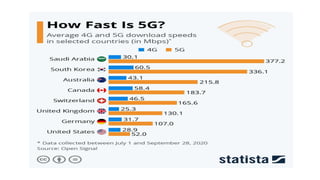
8. Top countries using 5G
9. Conclusion
4.
Introduction to 5GWireless Technology:
“ 5G Wireless Technology represents the next leap forward in mobile
communication, promising unprecedented speed, reliability and connectivity”.
Building upon its predecessors, 5G offers faster data rates, lower latency and
greater capacity.
Representing the fifth generation of mobile networks, 5G promises to
revolutionize the way we connect, communicate and interact with the world
around us.
5.
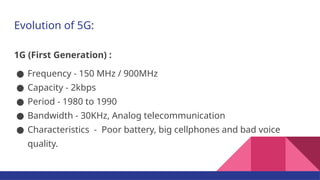
Evolution of 5G:
1G(First Generation) :
● Frequency - 150 MHz / 900MHz
● Capacity - 2kbps
● Period - 1980 to 1990
● Bandwidth - 30KHz, Analog telecommunication
● Characteristics - Poor battery, big cellphones and bad voice
quality.
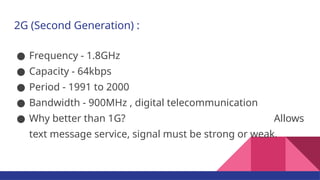
6.
2G (Second Generation):
● Frequency - 1.8GHz
● Capacity - 64kbps
● Period - 1991 to 2000
● Bandwidth - 900MHz , digital telecommunication
● Why better than 1G? Allows
text message service, signal must be strong or weak.
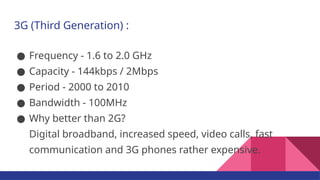
7.
3G (Third Generation):
● Frequency - 1.6 to 2.0 GHz
● Capacity - 144kbps / 2Mbps
● Period - 2000 to 2010
● Bandwidth - 100MHz
● Why better than 2G?
Digital broadband, increased speed, video calls, fast
communication and 3G phones rather expensive.
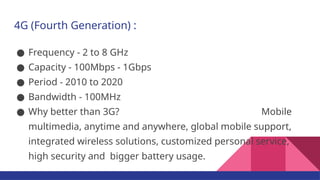
8.
4G (Fourth Generation):
● Frequency - 2 to 8 GHz
● Capacity - 100Mbps - 1Gbps
● Period - 2010 to 2020
● Bandwidth - 100MHz
● Why better than 3G? Mobile
multimedia, anytime and anywhere, global mobile support,
integrated wireless solutions, customized personal service,
high security and bigger battery usage.
9.
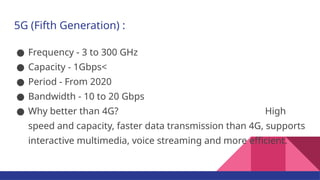
5G (Fifth Generation):
● Frequency - 3 to 300 GHz
● Capacity - 1Gbps<
● Period - From 2020
● Bandwidth - 10 to 20 Gbps
● Why better than 4G? High
speed and capacity, faster data transmission than 4G, supports
interactive multimedia, voice streaming and more efficient.
10.
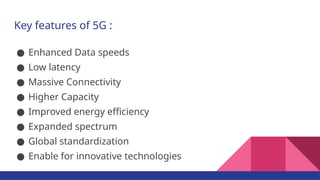
Key features of5G :
● Enhanced Data speeds
● Low latency
● Massive Connectivity
● Higher Capacity
● Improved energy efficiency
● Expanded spectrum
● Global standardization
● Enable for innovative technologies
11.
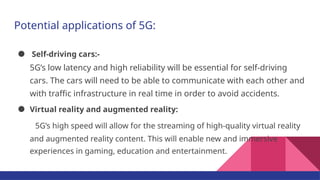
Potential applications of5G:
● Self-driving cars:-
5G’s low latency and high reliability will be essential for self-driving
cars. The cars will need to be able to communicate with each other and
with traffic infrastructure in real time in order to avoid accidents.
● Virtual reality and augmented reality:
5G’s high speed will allow for the streaming of high-quality virtual reality
and augmented reality content. This will enable new and immersive
experiences in gaming, education and entertainment.
12.
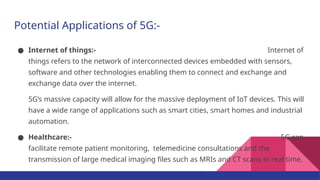
Potential Applications of5G:-
● Internet of things:- Internet of
things refers to the network of interconnected devices embedded with sensors,
software and other technologies enabling them to connect and exchange and
exchange data over the internet.
5G’s massive capacity will allow for the massive deployment of IoT devices. This will
have a wide range of applications such as smart cities, smart homes and industrial
automation.
● Healthcare:- 5G can
facilitate remote patient monitoring, telemedicine consultations and the
transmission of large medical imaging files such as MRIs and CT scans in real time.
13.
5G Challenges inIndia:
● Enabling critical infrastructure: The
new wireless technology, 5G needs to be augmented to enable infrastructure. It
will require a change to the core architecture of the communication system.
The reason is that, it can't carry data over longer distances.
● Financial liability on customers: 5G
gives you a ton of benefits, however, you may not find it as affordable as 4G.
Also, many existing mobile devices don't support the new technology, hence
many users will require to change their devices. It will result in a financial
burden on some users and thus will contribute to challenges in its roll out.
14.
5G Challenges inIndia:
● High spectrum pricing :
Another challenge is an unreasonably high spectrum pricing, setlll by the
Central Government. However, most probably, the telecom operators
overcome these challenges and bring out the best of technology.
● Battery drain on cellular devices:
5G networks offer faster speeds and lower latency, but these benefits
come at the cost of higher power consumption.This could lead to faster
battery drainage in 5G enabled devices, particularly when downloading
or streaming large amounts of data.
15.
Future issues in5G network:
● Network congestion:
While 5G networks are designed to handle a much larger volume of data
and devices than their predecessors, the rapid growth in the number of
connected devices could still lead toneywork congestion. This could
result in slower speeds and reduced performance, particularly in densely
populated urban areas.
● Technological obsolescence:
As technology continues to evolve at a rapid pace, there is a risk that 5G
networks could become obsolete before they are fully deployed. This
could result in wasted investments and a need for further upgrades.
16.
Future issues in5G network:
● Cybersecurity threats:-
As more devices become connected to 5G networks, the potential for
cybersecurity threats will increase. These could include data breaches,
identity theft and attacks on critical infrastructure. The industry will need to
stay ahead of this threats by investing in security measures and continually
updating and improving them.
● Regulatory Challenges:-
The deployment of 5G networks also presenta regulatory challenges. These
include issues related to spectrum allocation, data privacy, health and safety.
Regulators will need to balance the need for innovation and growth with the
need to protect consumers and maintain the integrity of the network.
17.
Role of 5Gin rural areas:
The rural area population was 64.61 percent in 2021and will grow more in the coming
years. Also, 70% of India is covered with villages, making this country, predominantly
dependent on agriculture as a source of income.
However, suppose the most recent technologies do not fully penetrate rural areas.In
that case, it can be detrimental to the country's economic growth in so many ways that
most people will not enjoy the modern facilities they truly deserve.
Therefore, the IT ministry is investing around 30 billion dollarsto ensure the last time
5G network is accessible to every village across the country and we can achieve the
dream of a “Rural Digital India”.
18.
Role of 5Gin rural areas:
When we introspect, we can clearly say that India’s farming sector has not managed
to keep up with emerging technologies in the global market. As per the UN
assessment, a 70% rise in food production can be achieved with the adoption of 5G
and IoT technology as a part of the rural empowerment strategy in the agricultural
sector across the globe by 2050, which can be sufficient to feed the ever-growing
population.
Deploing 5G enabled smart sensors in the farming field can help you gather
information in real-time, like soil status, temperature and humidity, that can be
utilized to keep the crops in good condition and increase the yield.
19.
Can 5G makeyou sick?
One of the most controversial topics surrounding 5G is it's potential impact on health. While
earlier claims that, 5G might weaken the immune system or even cause viruses have been
roundly debunked, some concerns persist about cancer risks posted by long-term radiation
exposure.
5G networks are non-ionising radiation, meaning they do not have enough energy to break
chemical bonds or cause damage to tissues like ionising radiation does. Infact, many things
we interact with everyday emit non-ionising radiation including microwaves from our
cellular phones and Wi-Fi routers. FM radio stations and visible light from light bulbs.
However, the FDA and WHO have stated that the levels of radio frequency radiation to
which people are exposed from 5G are below the limits set by international guidelines and
are not expected to have health effects.
20.
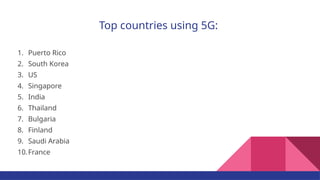
Top countries using5G:
1. Puerto Rico
2. South Korea
3. US
4. Singapore
5. India
6. Thailand
7. Bulgaria
8. Finland
9. Saudi Arabia
10.France
22.
Conclusion
In conclusion, 5Gwireless technology represents a significant advancement in
telecommunications offering faster speeds and greater connectivity. It is set to
redefine the way, we interact with the digital world, offering unprecedented
reliability. With its potential to revolutionalize industries, enhance IoT
applications and empower innovations like augmented reality and smart cities,
5G heralds a new era of connectivity and possibilities.
While challenges remain such as infrastructure development and spectrum
allocation, the potential benefits of 5G are vast, promising to reshape
economies, societies and everyday life in profound ways. Overall, 5G holds
promise for transforming how we communicate, work and live in the digital age.



![India_has_made_massive_growth_in_the_global[1][1].pptx](https://cdn.slidesharecdn.com/ss_thumbnails/indiahasmademassivegrowthintheglobal11-240207040207-dd1a6ac2-thumbnail.jpg?width=640&height=640&fit=bounds)


