Clusters, their initiatives and development
trends in Baltic Sea region countries
Prepared by Maija Kale
Nordic Council of Ministers’ Office in Latvia
Riga, 2017
Nordic Council of Ministers’ Office in
Latvia
About Nordic Council of Ministers’ Office in Latvia
• The Nordic Council of Ministers is an international organization
for governmental cooperation among the five Nordic countries:
Denmark, Iceland, Finland, Norway and Sweden
• The Nordic Council of Ministers’ Office in Latvia, founded in
1991, has a central role in facilitating and implementing Nordic
cooperation with Latvia. The office is collaborating with national
and regional institutions, NGOs and Nordic diplomatic
representations, carrying out projects in various fields, including
Nordic and EU projects and joint Nordic-Baltic projects
About Maija Kale
• Adviser on Sustainability, Innovation and Research since 2016
• Areas of work: energy, energy security, bioeconomy, circular
economy, innovation, cluster collaboration, SME
internationalization, smart cities
Norden’s Support for Clusters in Latvia
• BSR Stars Innovation Express
• Fostering Nordic-Baltic Innovation for Sustainability in the
Russian speaking market (Central Asia)
BSR Innovation Express
Goals:
• Increase SMEs involvement and information flow of
transnational collaboration in the Nordic-Baltic region;
• Increase SMEs and clusters organizations capacity;
• Promote international clusterization in the Nordic-Baltic
region;
• Increase number of prepared feasibility studies or piloting
prior to RDI projects (or in preparation for EU application).
BSR Innovation Express
Status:
• 2 projects supported
• ICT cluster
• Latvian IT Cluster (LITC) and Fiber Optic Valley (FOV) has cooperation
background in other projects and consortiums. In this project both clusters
unites their strengths and knowledges to help their member companies to enter
CIS markets and promote ICT technologies that help to insure sustainable
development of such industries as transport, smart cities, agriculture and others.
Astana EXPO2017 is considered as a platform for networking and promotion
events. This Expo objective is green energy that perfectly fits project scope.
• Food and packaging cluster (Vidzeme region)
• To develop and implement new projects and products (incl. new packaging
solutions) within the food sector and help SME’s to internationalize their
activities through cluster initiatives in Denmark and Latvia. Support business
partnerships in Baltic Sea Region and rest of EU.
Fostering Nordic-Baltic Innovation for
Sustainability in the Russian speaking market
(Central Asia)
• Needs for city sustainability in Central Asia
– Waste management, water treatment, energy efficiency, other
• Developing the concept of Nordic Built Cities
– Nordic Innovation - http://nordicbuiltcities.org/
• Trying to find Nordisk-Baltisk nytte
– Nordic scale of city solutions
– Baltic solutions + Russian language
Project Activities
2017
– 1 workshop in Riga & B2B meetings
• Increased awareness of Central Asia city sustainability issues
• Financial instrument identification for innovation project implementation in
partnership to Central Asia partners
• Nordic Baltic clusters & SMEs matchmaking
– 3 workshops in Central Asia
• Kazakhstan – 3-7 July, 2017
• Uzbekistan – Sep-Oct, 2017
• Kyrgyzstan - Sep-Oct, 2017
2018
– 1 conference in Riga
• Aiming to improve knowledge, demonstrate good experience, and increase
ideation level to CA participants: e.g. water management companies, waste
management companies, alternative energy companies, city councils etc.
Project Activities
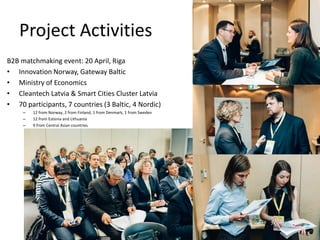
B2B matchmaking event: 20 April, Riga
• Innovation Norway, Gateway Baltic
• Ministry of Economics
• Cleantech Latvia & Smart Cities Cluster Latvia
• 70 participants, 7 countries (3 Baltic, 4 Nordic)
– 12 from Norway, 2 from Finland, 1 from Denmark, 1 from Sweden
– 12 from Estonia and Lithuania
– 9 from Central Asian countries
Clusters, their initiatives and development
trends in Nordic countries
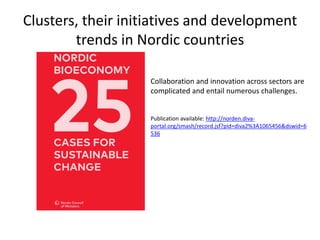
Collaboration and innovation across sectors are
complicated and entail numerous challenges.
Publication available: http://norden.diva-
portal.org/smash/record.jsf?pid=diva2%3A1065456&dswid=6
536
Clusters, their initiatives and development
trends in Nordic countries
• From technology park to biorefinery cluster
– SP Processum launched in 2003 as a technology park, but has
since evolved into a cluster host for development, upscaling,
and commercialization of biorefinery processes
– The cluster plays an important role in the development of
products in areas such as organic chemistry, biofuels, and other
biotechnologies. Products and projects also include textiles
produced from wood fibres, green chemicals, biofuels, animal
feed, enzymes, and gelling agents. SP Processum also hosts the
regional growth initiative and hub for forest biorefinery
development with the approach that anything made out of oil
can be also be made of wood
Clusters, their initiatives and development
trends in Nordic countries
• A cluster that connects the dots
– Paper Province represents the entire value chain and associated
services as member companies range from multinational corporations
to local suppliers. Paper Province is able to support participating
companies and inventors with knowledge and capital on their way
from concept through pilot testing to commercial deployment
– The region hosts more than 200 companies linked to the pulp and
paper industry that stand to benefit by exploiting each other’s waste
streams. Examples include mills delivering their waste heat to
surrounding neighbourhoods, a company producing soil improvement
products from mill waste, and an open test bed enabling companies to
develop and scale up technologies to refine lignin to climate-friendly
fuels, chemicals, and materials
Clusters, their initiatives and development
trends in Nordic countries
• Regional industrial symbiosis
– The Kemi-Tornio region in northern Finland has established an Arctic industry
and circular economy cluster to enhance industrial symbiosis and strengthen
the development of a holistic bioeconomy in the region. Via extensive
analysis of the by-products and residue streams from companies in the region,
value-added products are now being produced by combining and rethinking
several by-product and residue streams. Examples include silvicultural thinning
practices, bioenergy from forest residues with the possibility for future for
largescale biofuel production, as well as two plants that enable recovery of
metals from slags from the steel and ferrochrome production in the region
– The initiative focuses on creating new value chains and viable business cases
based on the 1.7 million tonnes of by-products and residues annually
Upcoming cluster related events
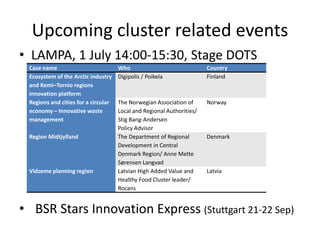
• LAMPA, 1 July 14:00-15:30, Stage DOTS
Case name Who Country
Ecosystem of the Arctic industry
and Kemi–Tornio regions
innovation platform
Digipolis / Poikela Finland
Regions and cities for a circular
economy – Innovative waste
management
The Norwegian Association of
Local and Regional Authorities/
Stig Bang-Andersen
Policy Advisor
Norway
Region Midtjylland The Department of Regional
Development in Central
Denmark Region/ Anne Mette
Sørensen Langvad
Denmark
Vidzeme planning region Latvian High Added Value and
Healthy Food Cluster leader/
Rocans
Latvia
• BSR Stars Innovation Express (Stuttgart 21-22 Sep)
Maija Kāle
Adviser
Nordic Council of Ministers’Office in latvia
Mob +371 26114496
maija@norden.lv
Marijas 13/3, Rīga, LV 1666, Latvija
www.norden.lv
1/19/2017

Clusters, their initiatives and development trends in Baltic Sea region countries

  • 1.
    Clusters, their initiativesand development trends in Baltic Sea region countries Prepared by Maija Kale Nordic Council of Ministers’ Office in Latvia Riga, 2017
  • 2.
    Nordic Council ofMinisters’ Office in Latvia About Nordic Council of Ministers’ Office in Latvia • The Nordic Council of Ministers is an international organization for governmental cooperation among the five Nordic countries: Denmark, Iceland, Finland, Norway and Sweden • The Nordic Council of Ministers’ Office in Latvia, founded in 1991, has a central role in facilitating and implementing Nordic cooperation with Latvia. The office is collaborating with national and regional institutions, NGOs and Nordic diplomatic representations, carrying out projects in various fields, including Nordic and EU projects and joint Nordic-Baltic projects About Maija Kale • Adviser on Sustainability, Innovation and Research since 2016 • Areas of work: energy, energy security, bioeconomy, circular economy, innovation, cluster collaboration, SME internationalization, smart cities
  • 3.
    Norden’s Support forClusters in Latvia • BSR Stars Innovation Express • Fostering Nordic-Baltic Innovation for Sustainability in the Russian speaking market (Central Asia)
  • 4.
    BSR Innovation Express Goals: •Increase SMEs involvement and information flow of transnational collaboration in the Nordic-Baltic region; • Increase SMEs and clusters organizations capacity; • Promote international clusterization in the Nordic-Baltic region; • Increase number of prepared feasibility studies or piloting prior to RDI projects (or in preparation for EU application).
  • 5.
    BSR Innovation Express Status: •2 projects supported • ICT cluster • Latvian IT Cluster (LITC) and Fiber Optic Valley (FOV) has cooperation background in other projects and consortiums. In this project both clusters unites their strengths and knowledges to help their member companies to enter CIS markets and promote ICT technologies that help to insure sustainable development of such industries as transport, smart cities, agriculture and others. Astana EXPO2017 is considered as a platform for networking and promotion events. This Expo objective is green energy that perfectly fits project scope. • Food and packaging cluster (Vidzeme region) • To develop and implement new projects and products (incl. new packaging solutions) within the food sector and help SME’s to internationalize their activities through cluster initiatives in Denmark and Latvia. Support business partnerships in Baltic Sea Region and rest of EU.
  • 6.
    Fostering Nordic-Baltic Innovationfor Sustainability in the Russian speaking market (Central Asia) • Needs for city sustainability in Central Asia – Waste management, water treatment, energy efficiency, other • Developing the concept of Nordic Built Cities – Nordic Innovation - http://nordicbuiltcities.org/ • Trying to find Nordisk-Baltisk nytte – Nordic scale of city solutions – Baltic solutions + Russian language
  • 7.
    Project Activities 2017 – 1workshop in Riga & B2B meetings • Increased awareness of Central Asia city sustainability issues • Financial instrument identification for innovation project implementation in partnership to Central Asia partners • Nordic Baltic clusters & SMEs matchmaking – 3 workshops in Central Asia • Kazakhstan – 3-7 July, 2017 • Uzbekistan – Sep-Oct, 2017 • Kyrgyzstan - Sep-Oct, 2017 2018 – 1 conference in Riga • Aiming to improve knowledge, demonstrate good experience, and increase ideation level to CA participants: e.g. water management companies, waste management companies, alternative energy companies, city councils etc.
  • 8.
    Project Activities B2B matchmakingevent: 20 April, Riga • Innovation Norway, Gateway Baltic • Ministry of Economics • Cleantech Latvia & Smart Cities Cluster Latvia • 70 participants, 7 countries (3 Baltic, 4 Nordic) – 12 from Norway, 2 from Finland, 1 from Denmark, 1 from Sweden – 12 from Estonia and Lithuania – 9 from Central Asian countries
  • 9.
    Clusters, their initiativesand development trends in Nordic countries Collaboration and innovation across sectors are complicated and entail numerous challenges. Publication available: http://norden.diva- portal.org/smash/record.jsf?pid=diva2%3A1065456&dswid=6 536
  • 10.
    Clusters, their initiativesand development trends in Nordic countries • From technology park to biorefinery cluster – SP Processum launched in 2003 as a technology park, but has since evolved into a cluster host for development, upscaling, and commercialization of biorefinery processes – The cluster plays an important role in the development of products in areas such as organic chemistry, biofuels, and other biotechnologies. Products and projects also include textiles produced from wood fibres, green chemicals, biofuels, animal feed, enzymes, and gelling agents. SP Processum also hosts the regional growth initiative and hub for forest biorefinery development with the approach that anything made out of oil can be also be made of wood
  • 11.
    Clusters, their initiativesand development trends in Nordic countries • A cluster that connects the dots – Paper Province represents the entire value chain and associated services as member companies range from multinational corporations to local suppliers. Paper Province is able to support participating companies and inventors with knowledge and capital on their way from concept through pilot testing to commercial deployment – The region hosts more than 200 companies linked to the pulp and paper industry that stand to benefit by exploiting each other’s waste streams. Examples include mills delivering their waste heat to surrounding neighbourhoods, a company producing soil improvement products from mill waste, and an open test bed enabling companies to develop and scale up technologies to refine lignin to climate-friendly fuels, chemicals, and materials
  • 12.
    Clusters, their initiativesand development trends in Nordic countries • Regional industrial symbiosis – The Kemi-Tornio region in northern Finland has established an Arctic industry and circular economy cluster to enhance industrial symbiosis and strengthen the development of a holistic bioeconomy in the region. Via extensive analysis of the by-products and residue streams from companies in the region, value-added products are now being produced by combining and rethinking several by-product and residue streams. Examples include silvicultural thinning practices, bioenergy from forest residues with the possibility for future for largescale biofuel production, as well as two plants that enable recovery of metals from slags from the steel and ferrochrome production in the region – The initiative focuses on creating new value chains and viable business cases based on the 1.7 million tonnes of by-products and residues annually
  • 13.
    Upcoming cluster relatedevents • LAMPA, 1 July 14:00-15:30, Stage DOTS Case name Who Country Ecosystem of the Arctic industry and Kemi–Tornio regions innovation platform Digipolis / Poikela Finland Regions and cities for a circular economy – Innovative waste management The Norwegian Association of Local and Regional Authorities/ Stig Bang-Andersen Policy Advisor Norway Region Midtjylland The Department of Regional Development in Central Denmark Region/ Anne Mette Sørensen Langvad Denmark Vidzeme planning region Latvian High Added Value and Healthy Food Cluster leader/ Rocans Latvia • BSR Stars Innovation Express (Stuttgart 21-22 Sep)
  • 14.
    Maija Kāle Adviser Nordic Councilof Ministers’Office in latvia Mob +371 26114496 maija@norden.lv Marijas 13/3, Rīga, LV 1666, Latvija www.norden.lv 1/19/2017