13-7 Spinal Reflexes
Muscle spindle structure (continued)
Dendrites of sensory neurons wind around central
region of intrafusal fibers.
Sensory neuron axonenters CNS in posterior root
Sensory neurons synapse in spinal cord directly with
motor neurons
.Gammaefferents complete reflex arc by synapsing
back atthe intrafusal fibers
Muscle contracts back to its resting length
5:20142:26
Solitary
cel Sensary root
Dorsal root ganglion
Posterior
horn
External besalcells
Descending
-Cornicospinal tract
Intermediate zone
Intemeurons
Antenor hom
LGarmma motor neurg ber
Antenior motor
neurons
Alpha motor neuron
1b ber
alpha motor Motor
endplate
neuron
Gamma motor
Motor roo
Skeletal
musce
neuron
Muscie spindle Goig tandon organ
Figure 55-1. Comections of perpheral sersory tibesand corb
COpna tibers with the nerneurons and anterior motor neuiors of
the spend cord
Figure 55-2. Penpheral sensory fibers
aed anterior motor neurons
innerating skeletal musce
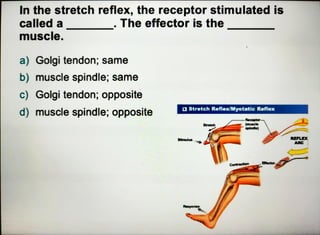
In the stretch reflex, the receptor stimulated is
called a
muscle.
The effector isthe
a) Golgi tendon; same
b) muscle spindle; same
c) Golgi tendon;opposite
Stretch Reflex/Myotatic Reflex
d) muscle spindle; opposite
Receptor-
Stretch (muscle
spinde)
REFLEX
ARC
Stimulus
fector
Contrecton
Response
Dorsal root ganglion-
Posteriorhom Efferent
Aipe molor
innervation of
Descending
Jibers
skeletal muscles:
intermediate zone-
Garma moor
neuron
Antenior
hom Extrafusal fibers
Gamma motor neuron 1atber
a motor neurons
Alpha motor neuron
1b fiber
Intrafusal fibers-y
Motor end piate
motor neurons
Exmua
musoetbe
Skeletal muscle
Mace spindie Golg tendon organ
sce
Figure 55-2. Perpheral sensory fibers and anterior motor neurons
innervating sieietal muscie
MUSCLE SENSORY RECEPTORS:
TYPES STIMULUs
1. MUSCLE SPINDLE Stretch; Rate of Stretch
2. GOLGI TENDON ORGAN Tension
Extratusal fibers
Muscle Flower spRy
sensory neurons Gamma
fferent
ersto
intratusal
hbers
Spindle
Aipha motor
neuron to
extrafusa
tbers
Annulospral
sensory neurons
Gamma
efterent
tibers to
ntratusai
bers
Nuciear chan
ber
intrausa
fibers
1) Stretch
Nucear bag
foer
2)Speed of Stretch
A weight lifter is straining to lift a 200-kg barbell.
Shortly after he lifts it to chest height, his
muscles appear to relax
and he drops thebarbell
Which reflex has occurred?
a) withdrawal reflex
b) stretch reflex
c) crossed extensor reflex
c)
d) tendon reflex
9:59142:26
X Application oftheGolgiTendon OrganJGTps)
Even if the biceps brachii
could somehow generate
enough forceto cul 2000 lbs,
the tendon is not strong
enough to support the
combined weighs,of the bone
and enormous barbel.
Muscles
Absurd
Type Ib afferent
Golgi tendon organ
Collagen
Bone
Tendon
Tear
10:4
04614226
Gamma
efferent
From
CNS
Extrafusal
fiber To
CNS
Sensory
region
From
CNS
Intrafusal
fiber
Muscle
spindle
Gamma
efferent
MUSCLE FIBERS:
Extrafusak contractilegart
1:43142:26
Motor Motor
Sensory
la
17um
MOTOR NERVES:
14 m 5um 8um5 um alpha-Extrafusalmusclefibers
Gamma-Intrafusal muscle fibers (endportions)
SENSORY NERVES: Central portionof intrafusal muscle
fibers
Extrafusal
fibers
Sheath
Aipha motor
ending
Primary
ending
Intrafusal
fibers
la- Primary ending
I1-Secondary ending
Gamma motor Fluid Secondary
ending
ending cavity
1 cm
Figure 55-3. Muscle spindie, showing its relationship to the large
extrafusal skeletal muscle fibers. Note also both motor and sensory
innervation of the muscle spindle
TYPES OF INTRAFUSAL
MUSCLE FIBERS
SENSORY NERVE
ENDING STIMULATED
Dynamic y fiber
(efferent)
Staticy tiber
(efterent)
Group la fiber
(primaryafferent)
Group il fibers
(secondary
afferent)
Piate
ending 1.Nuclearbag Primary nerve
ending
Nuclear bag fiber
(intrafusal muscle)
2. Nuclear chain Primary
ending
Secondary
ending
Nuclear chain fibaor
(intrafusal muscle)
nerve
Trail ending
Figure 55-4. Detals of nere connections from the nuckear bag and
nuciearchainmuscie spindie fibers. (Modifiedfrom Stein RB:Periph
eralcontrol ofmovement. Physiol Rev 54.225, 1974)
nerve
TYPES OF RESPONSES OF MUSCLE
SPINDLES
Static Response
Stretch; if the receptor of the muscle spindle is
stretched slowly
1
2. Dynamic Response
- Rate ofstretch
3:52142:26
13-7 Spinal Reflexes
Postural reflexes
Include both stretch reflexes
(monosynaptic)
and also
complex polysynaptic reflexes
Maintain normal upright posture
Often involve multiple muscle groups (e.g., back and
abdominal muscles)
Maintain firm muscle tone
Extremely sensitive receptors allow constantfine
adjustments to be made as needed
13-7 Spinal Reflexes
Polysynaptic reflexes
More complicated than monosynaptic reflexes
Interneuronscan control multiple muscle groups
Produce either EPSPsor IPSPs, stimulating some
muscles and inhibiting others.
Examples
Tendon reflex
Withdrawal reflexes
Crossed-extensor reflexes
13-7 Spinal Reflexes
The tendon reflex
Prevents skeletal muscles from:
Developing too much tension
Tearing orbreaking tendons
Sensory receptors are Golgi tendon organs
Stimulated when collagen fibers are overstretched
Stimulate inhibitory interneurons in spinal cord
More muscle tension leads to more muscle
inhibition
5:10142:26
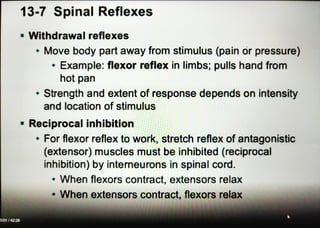
13-7 Spinal Reflexes
Withdrawal reflexes
Move body part awayfrom stimulus (pain or pressure)
Example: flexor reflex in limbs; pullshandfrom
hot pan
Strength and extent of response dependson intensity
and location of stimulus
Reciprocal inhibition
Forflexor reflex to work, stretch reflex of antagonistic
(extensor) muscles must be inhibited(reciprocalI
inhibition) by interneurons in spinal cord.
When flexors contract, extensors relax
When extensors contract, flexors relax
551 142:26
Withdrawal Reflex
Distribution within gray matter horns
to other
segments of thespinal cord
Painful
stimulus
Flexors
stimulated
Extensors
inhiblted
7:01/42:26
You've just touched a hot stove.What type of
reflex did you experience? In what way was your
brain involved in the reflex?
a) cranial;the somatosensory cortex
b) visceral; only tracts that respond to pain
b)
c) complex; all the sensory tracts
d) spinal; it was not involved
7:21/42:26
13-7 Spinal Reflexes
Reflex arcs
Ipsilateral reflex arcs
Occur on same side of body as stimulus
Stretch,tendon,andwithdrawalreflexes
Crossed extensor reflexes involve contralateral reflex
arcs
Occur on side opposite stimulus
13-7 Spinal Reflexes
Crossed extensorreflexes
.Coordinated with flexor reflex
Step on something sharp; before flexorreflex can lift
injured foot, crossed extensor reflex straightens
oppositelimb to receive body weight, then flexor reflex
can occur
.Maintained by reverberating circuits
8:43/42:26
During a withdrawal reflex, the limb on the side
opposite the stimulus
called a
.This response is
a) flexes; stretch reflex
b) adducts; tendon reflex
c) extends; crossed extensor reflex
d) abducts; tendon reflex
9:00/4226
aCrossed Extensor Reflex
To motorneurons in other
segments of the spinal cord
Extensors.
inhibited
Flexors
-
Extensors stimulated
stimulated
Flexors inhibited
KEY
Sensoryneuron ----Motor neuron
(stimulated) (inhiblted)
Excitatory
intermeuron
--Inhibltory
interneuron
Motor neuron
29142.26nuh
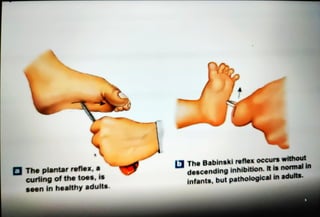
13-8 The Brain Can Alter Spinal Reflexes
Plantar reflex
Normal in adults
Stroke lateral sole, causes reflexive toe-curling
TheBabinski reflex
Normal ininfants
May indicate CNS damage in adults
0:17/42:26
After injuring her back, 18-year-old Tina exhibits
a positive Babinski reflex. What does this imply
about Tina's injury?
a) possible paraplegia
b) possible damageto sensory tracts to foot
b)
possible damage to ascending tracts in spinal cord
c)
d) possible damage to descending tracts in the spinal cord
0:44/ 42-26
After injuring her back, 18-year-old Tina exhibits
apositive Babinski reflex. What does this imply
about Tina's injury?
a) possible paraplegia
b) possible damage to sensory tracts to foot
b)
c) possible damage to ascending tracts in spinal cord
d) possible damage to descending tracts in the spinal
cord
1:00/ 42:26
aThe plantar reflex, a
curling of the toes, is
seen in healthy
adults.
bThe Babinski reflex occurs without
descending
inhibition. It is normal in
infants, but pathological
in adults.

55 part 2.pdf

  • 1.
    13-7 Spinal Reflexes Musclespindle structure (continued) Dendrites of sensory neurons wind around central region of intrafusal fibers. Sensory neuron axonenters CNS in posterior root Sensory neurons synapse in spinal cord directly with motor neurons .Gammaefferents complete reflex arc by synapsing back atthe intrafusal fibers Muscle contracts back to its resting length 5:20142:26
  • 2.
    Solitary cel Sensary root Dorsalroot ganglion Posterior horn External besalcells Descending -Cornicospinal tract Intermediate zone Intemeurons Antenor hom LGarmma motor neurg ber Antenior motor neurons Alpha motor neuron 1b ber alpha motor Motor endplate neuron Gamma motor Motor roo Skeletal musce neuron Muscie spindle Goig tandon organ Figure 55-1. Comections of perpheral sersory tibesand corb COpna tibers with the nerneurons and anterior motor neuiors of the spend cord Figure 55-2. Penpheral sensory fibers aed anterior motor neurons innerating skeletal musce
  • 3.
    In the stretchreflex, the receptor stimulated is called a muscle. The effector isthe a) Golgi tendon; same b) muscle spindle; same c) Golgi tendon;opposite Stretch Reflex/Myotatic Reflex d) muscle spindle; opposite Receptor- Stretch (muscle spinde) REFLEX ARC Stimulus fector Contrecton Response
  • 4.
    Dorsal root ganglion- PosteriorhomEfferent Aipe molor innervation of Descending Jibers skeletal muscles: intermediate zone- Garma moor neuron Antenior hom Extrafusal fibers Gamma motor neuron 1atber a motor neurons Alpha motor neuron 1b fiber Intrafusal fibers-y Motor end piate motor neurons Exmua musoetbe Skeletal muscle Mace spindie Golg tendon organ sce Figure 55-2. Perpheral sensory fibers and anterior motor neurons innervating sieietal muscie
  • 5.
    MUSCLE SENSORY RECEPTORS: TYPESSTIMULUs 1. MUSCLE SPINDLE Stretch; Rate of Stretch 2. GOLGI TENDON ORGAN Tension
  • 6.
    Extratusal fibers Muscle FlowerspRy sensory neurons Gamma fferent ersto intratusal hbers Spindle Aipha motor neuron to extrafusa tbers Annulospral sensory neurons Gamma efterent tibers to ntratusai bers Nuciear chan ber intrausa fibers 1) Stretch Nucear bag foer 2)Speed of Stretch
  • 7.
    A weight lifteris straining to lift a 200-kg barbell. Shortly after he lifts it to chest height, his muscles appear to relax and he drops thebarbell Which reflex has occurred? a) withdrawal reflex b) stretch reflex c) crossed extensor reflex c) d) tendon reflex 9:59142:26
  • 8.
    X Application oftheGolgiTendonOrganJGTps) Even if the biceps brachii could somehow generate enough forceto cul 2000 lbs, the tendon is not strong enough to support the combined weighs,of the bone and enormous barbel. Muscles Absurd Type Ib afferent Golgi tendon organ Collagen Bone Tendon Tear 10:4 04614226
  • 9.
  • 10.
    Motor Motor Sensory la 17um MOTOR NERVES: 14m 5um 8um5 um alpha-Extrafusalmusclefibers Gamma-Intrafusal muscle fibers (endportions) SENSORY NERVES: Central portionof intrafusal muscle fibers Extrafusal fibers Sheath Aipha motor ending Primary ending Intrafusal fibers la- Primary ending I1-Secondary ending Gamma motor Fluid Secondary ending ending cavity 1 cm Figure 55-3. Muscle spindie, showing its relationship to the large extrafusal skeletal muscle fibers. Note also both motor and sensory innervation of the muscle spindle
  • 11.
    TYPES OF INTRAFUSAL MUSCLEFIBERS SENSORY NERVE ENDING STIMULATED Dynamic y fiber (efferent) Staticy tiber (efterent) Group la fiber (primaryafferent) Group il fibers (secondary afferent) Piate ending 1.Nuclearbag Primary nerve ending Nuclear bag fiber (intrafusal muscle) 2. Nuclear chain Primary ending Secondary ending Nuclear chain fibaor (intrafusal muscle) nerve Trail ending Figure 55-4. Detals of nere connections from the nuckear bag and nuciearchainmuscie spindie fibers. (Modifiedfrom Stein RB:Periph eralcontrol ofmovement. Physiol Rev 54.225, 1974) nerve TYPES OF RESPONSES OF MUSCLE SPINDLES Static Response Stretch; if the receptor of the muscle spindle is stretched slowly 1 2. Dynamic Response - Rate ofstretch 3:52142:26
  • 12.
    13-7 Spinal Reflexes Posturalreflexes Include both stretch reflexes (monosynaptic) and also complex polysynaptic reflexes Maintain normal upright posture Often involve multiple muscle groups (e.g., back and abdominal muscles) Maintain firm muscle tone Extremely sensitive receptors allow constantfine adjustments to be made as needed
  • 13.
    13-7 Spinal Reflexes Polysynapticreflexes More complicated than monosynaptic reflexes Interneuronscan control multiple muscle groups Produce either EPSPsor IPSPs, stimulating some muscles and inhibiting others. Examples Tendon reflex Withdrawal reflexes Crossed-extensor reflexes
  • 14.
    13-7 Spinal Reflexes Thetendon reflex Prevents skeletal muscles from: Developing too much tension Tearing orbreaking tendons Sensory receptors are Golgi tendon organs Stimulated when collagen fibers are overstretched Stimulate inhibitory interneurons in spinal cord More muscle tension leads to more muscle inhibition 5:10142:26
  • 15.
    13-7 Spinal Reflexes Withdrawalreflexes Move body part awayfrom stimulus (pain or pressure) Example: flexor reflex in limbs; pullshandfrom hot pan Strength and extent of response dependson intensity and location of stimulus Reciprocal inhibition Forflexor reflex to work, stretch reflex of antagonistic (extensor) muscles must be inhibited(reciprocalI inhibition) by interneurons in spinal cord. When flexors contract, extensors relax When extensors contract, flexors relax 551 142:26
  • 16.
    Withdrawal Reflex Distribution withingray matter horns to other segments of thespinal cord Painful stimulus Flexors stimulated Extensors inhiblted 7:01/42:26
  • 17.
    You've just toucheda hot stove.What type of reflex did you experience? In what way was your brain involved in the reflex? a) cranial;the somatosensory cortex b) visceral; only tracts that respond to pain b) c) complex; all the sensory tracts d) spinal; it was not involved 7:21/42:26
  • 18.
    13-7 Spinal Reflexes Reflexarcs Ipsilateral reflex arcs Occur on same side of body as stimulus Stretch,tendon,andwithdrawalreflexes Crossed extensor reflexes involve contralateral reflex arcs Occur on side opposite stimulus
  • 19.
    13-7 Spinal Reflexes Crossedextensorreflexes .Coordinated with flexor reflex Step on something sharp; before flexorreflex can lift injured foot, crossed extensor reflex straightens oppositelimb to receive body weight, then flexor reflex can occur .Maintained by reverberating circuits 8:43/42:26
  • 20.
    During a withdrawalreflex, the limb on the side opposite the stimulus called a .This response is a) flexes; stretch reflex b) adducts; tendon reflex c) extends; crossed extensor reflex d) abducts; tendon reflex 9:00/4226
  • 21.
    aCrossed Extensor Reflex Tomotorneurons in other segments of the spinal cord Extensors. inhibited Flexors - Extensors stimulated stimulated Flexors inhibited KEY Sensoryneuron ----Motor neuron (stimulated) (inhiblted) Excitatory intermeuron --Inhibltory interneuron Motor neuron 29142.26nuh
  • 22.
    13-8 The BrainCan Alter Spinal Reflexes Plantar reflex Normal in adults Stroke lateral sole, causes reflexive toe-curling TheBabinski reflex Normal ininfants May indicate CNS damage in adults 0:17/42:26
  • 23.
    After injuring herback, 18-year-old Tina exhibits a positive Babinski reflex. What does this imply about Tina's injury? a) possible paraplegia b) possible damageto sensory tracts to foot b) possible damage to ascending tracts in spinal cord c) d) possible damage to descending tracts in the spinal cord 0:44/ 42-26
  • 24.
    After injuring herback, 18-year-old Tina exhibits apositive Babinski reflex. What does this imply about Tina's injury? a) possible paraplegia b) possible damage to sensory tracts to foot b) c) possible damage to ascending tracts in spinal cord d) possible damage to descending tracts in the spinal cord 1:00/ 42:26
  • 25.
    aThe plantar reflex,a curling of the toes, is seen in healthy adults. bThe Babinski reflex occurs without descending inhibition. It is normal in infants, but pathological in adults.