Vol. 7 – No. 1, year (2023), page 131-140
| ISSN 2548-8201 (Print) | 2580-0469) (Online) |
Copyright © 2023 Edumaspul - Jurnal Pendidikan (ISSN 2548-8201 (cetak); (ISSN 2580-0469 (online)
Population, Sample (Quantitative) and Selection of Participants/Key Informants
(Qualitative)
Sukmawati1
, Salmia2
, Sudarmin3
*
Universitas Muhammadiyah Makassar
* Corresponding Author. E-mail: almia99@gmail.com
Receive: 11/01/2023 Accepted: 21/02/2023 Published: 01/03/2023
Abstrak
Penelitian yang menggunakan populasi, sekiranya populasi ramai dan tidak mungkin
pengkaji mengkaji semua yang terdapat dalam populasi, disebabkan oleh dana, tenaga kerja
dan masa yang terhad, pengkaji boleh menggunakan sampel yang diambil daripada populasi
yang mewakili. Sampel kajian adalah sebagian dari populasi yang diambil sebagai sumber
data dan dapat mewakili seluruh populasi. Teknik Disproportonate Stratified Random
Sampling Persampelan Kelompok (Area Sampling) Teknik persampelan kawasan yang
digunakan untuk menentukan sampel apabila objek yang dikaji atau sumber data adalah
sangat besar. Untuk menentukan objek yang digunakan sebagai sumber data, persampelan
adalah berdasarkan kawasan populasi yang ditetapkan.Dalam kajian kualitatif, informan
dibahagikan kepada tiga iaitu: informan kunci, informan utama, dan informan pendukung.
Informan kunci ialah informan yang mempunyai maklumat yang komprehensif tentang isu
yang dibangkitkan oleh penyelidik. Pemilihan informan dalam kajian kualitatif ditentukan
sepenuhnya oleh pengkaji, justeru dinamakan persampelan bertujuan (purposive sampling)
iaitu memilih kes bermaklumat (information-rich cases) berdasarkan strategi dan objektif
yang ditetapkan oleh pengkaji yang bilangannya bergantung kepada objektif dan sumber
belajar.
Kata Kunci: populasi; sampel; informan
Abstract (English-Indonesia)
Research using a population, if the population is large and it is impossible for the reviewer to
examine everything in the population, due to limited funds, manpower and time, the
reviewer may use samples taken from a representative population. The study sample is part
of the population taken as a data source and can represent the entire population.
Disproportionate Stratified Random Sampling Technique Group Sampling (Area Sampling)
The area sampling technique is used to determine the sample when the object being studied
or the data source is very large. To determine the object used as a data source, sampling is
based on the specified population area. In a qualitative study, informants were divided into
three, namely: key informants, main informants, and supporting informants. Key informants
are informants who have comprehensive information about the issues raised by
investigators. The selection of informants in a qualitative study is determined entirely by the
Jurnal Edumaspul, 7 (1), Year 2023 - 132
(Sukmawati, Salmia, Sudarmin)
Copyright © 2023 Edumaspul - Jurnal Pendidikan (ISSN 2548-8201 (cetak); (ISSN 2580-0469 (online)
reviewer, which is why it is called purposive sampling, namely choosing information-rich
cases based on the strategy and objectives set by the reviewer whose numbers depend on
the objective and learning resources.
Keywords: population; sample; informant
Introduction (10%)
Every type of research has a starting
point. Without research problems it is
impossible. The point is that when you start
thinking about research, you need to think
about and formulate it clearly, concisely, and
carefully. Indeed, all other elements of
research are based on the formulation of the
problem.
Every investigation, both quantitative
and qualitative, is always rooted in a
problem. However, there is a fundamental
difference between "problems" in
quantitative investigations and "problems" in
qualitative investigations. Whereas in a
quantitative investigation, the "problem" that
the investigator wants to solve must be clear,
precise and considered fixed, in a qualitative
investigation, the "problem" raised by the
investigator is still vague, even blurred,
complex and dynamic. Therefore, the
"problem" in a qualitative investigation is
still temporary, an investigation and will
develop or change when the investigator
enters the field.
As previously mentioned, the
selection of informants as data sources
requires a method. The method or technique
for selecting informants that is commonly
used in qualitative research is based on the
principle of the subject mastering the
problem, having data, and being willing to
provide complete and accurate information.
Informants who act as sources of data and
information must meet the requirements.
Qualitative research does not question
the number of informants, but can depend on
whether or not the selection of key
informants is appropriate, and the complexity
of the variety of social phenomena studied.
Thus, informants were determined using the
snowball sampling technique, namely the
process of determining informants based on
previous informants without determining the
exact number by digging up information
related to the required research topic. The
search for informants will be stopped after
the research information is considered
sufficient.
Data collection techniques are
methods used by researchers to collect
research data from data sources (subjects and
research samples). Data collection techniques
are an obligation, because these data
collection techniques will later be used as the
basis for compiling research instruments. The
research instrument is a set of tools that will
be used by researchers to collect research
data (Kristanto, 2018). Data collection is a
very important stage in a research.
Correct data collection techniques will
produce data that has high credibility, and
vice versa. Therefore, this stage cannot be
wrong and must be carried out carefully
according to the procedures and
characteristics of qualitative research. This is
because errors or imperfections in the data
collection method will have fatal
consequences, namely in the form of data
that is not credible, so that the results of the
research cannot be accounted for. In
qualitative research, data collection is carried
out in natural settings (natural conditions),
primary data sources and data collection
techniques involve more participant
observation, in-depth interviews, and
documentation (Sugiyono, 2019).
Basically the use of data (after being
processed and analyzed) is as an objective
basis in the process of making
decisions/policies in order to solve problems
by decision makers (Situmorang, 2010). For
Jurnal Edumaspul, 7 (1), Year 2023 - 133
(Sukmawati, Salmia, Sudarmin)
Copyright © 2023 Edumaspul - Jurnal Pendidikan (ISSN 2548-8201 (cetak); (ISSN 2580-0469 (online)
example, if researchers want to obtain
information about teachers' perceptions of the
new curriculum, then the technique used is
interviews, not observation. Meanwhile, if
the researcher wants to know how the teacher
creates a lively classroom atmosphere, then
the technique used is observation. Likewise,
if you want to know about student
competence in certain subjects, the technique
used is a test, or it could be a document in the
form of exam results. Thus, the information
you want to obtain determines the type of
technique used (materials determine a means)
(Kristanto, 2018). However, researchers still
need the skills to use these techniques.
Because it could be that if they are
inexperienced or do not have adequate
knowledge, the researcher is unable to dig up
in-depth information, as is characteristic of
data in qualitative research, because they are
not competent in using the technique, even
though the technique chosen is appropriate.
The solution is to continue studying and
reading the results of similar previous studies
which will greatly help increase the skills of
researchers.
Method (15%)
This research is a type of library
research. What is called library research or
often also called library research, is a series
of activities related to how to collect library
data, read and record and process research
materials (Zed, 2008).
In this study, the authors apply the
library research method because there are at
least several underlying reasons. First, that
data sources cannot only be obtained from
the field. Sometimes data sources can only be
obtained from libraries or other documents in
written form, whether from journals, books
or other literature. Second, literature study is
needed as a way to understand new
phenomena that occur that cannot be
understood, then with this literature study
you will be able to understand these
symptoms. So that in dealing with a symptom
that occurs, the author can formulate a
concept to solve a problem that arises. The
third reason is that library data remains
reliable to answer research questions (Zed,
2008). However, information or empirical
data that has been collected by other people,
whether in the form of books, scientific
reports or research reports, can still be used
by library researchers. Even in certain cases
the field data is still not significant enough to
answer the research questions to be
conducted.
Tahapan-tahapan yang harus taken by
the author in library research are as follows:
a). Gather research materials. Because this
research is library research, the material
collected is in the form of information or
empirical data sourced from books, journals,
results of official and scientific research
reports and other literature that supports the
theme of this research. B). Reading for
research purposes is not a passive
occupation. Readers are asked to simply
absorb all the "scientific" information in the
reading material, but rather a "hunting"
activity that requires the active and critical
involvement of the reader in order to obtain
maximum results. In reading research
materials, readers must dig deeper into the
reading material that allows them to find new
ideas related to the research title. C). Make
research notes. The activity of recording
research materials is arguably the most
important stage and perhaps also the toughest
peak of the whole series of library research
(Zed, 2008). Because in the end all the
material that has been read must be
concluded in the form of a report. d). Process
research records. All material that has been
read is then processed or analyzed to obtain a
conclusion that is compiled in the form of a
research report.
Content analysis or content review is a
research methodology that utilizes a series of
procedures to draw valid conclusions from a
book or document. Meanwhile, Harold D.
Lasswell stated that content analysis is
research which is an in-depth discussion of
the content of written or printed information
in the mass media. From the explanation
above, it can be concluded that content
analysis is a research method with certain
Jurnal Edumaspul, 7 (1), Year 2023 - 134
(Sukmawati, Salmia, Sudarmin)
Copyright © 2023 Edumaspul - Jurnal Pendidikan (ISSN 2548-8201 (cetak); (ISSN 2580-0469 (online)
stages to explore the essence of an idea or
information and then draw a conclusion
(Lexy, 2008). The author uses data analysis
techniques in the form of content analysis
because this type of research is a type of
library research, where the data sources are in
the form of books and documents as well as
other forms of literature..
Results and Discussion (70%)
1) Kuantitatif
a. Populasi
The population is a general field
consisting of subjects/objects with certain
qualities and characteristics determined by
the reviewer to be studied and then
conclusions drawn (Sugiyono, 2019).
Therefore, the population is not all people,
but also objects and other objects. Population
is not only the number of objects or subjects,
but all the characteristics possessed by
objects or subjects.
The population is divided into two
parts (Sugiyono, 2019), namely:
1) The target population is the
population that has been identified based on
the research problem and conclusions will be
drawn from the research results of the
population.
2) The survey population is the
population included in this study. The
population consists of the elements that are
sampled, namely the elements that are
sampled. The sampling frame is a list of all
the sample elements in the sample
population. This sampling element is taken
using a sampling frame.
b. Sample
The sample is a small part of the
number and characteristics of the population.
If the population is large and the researcher
cannot study everything in the population due
to budget, human and time constraints, the
researcher can use a sample taken from a
representative population.
The sample is a small part of the
population taken according to certain
procedures to represent the population
(Somantri, 2006). Some members of the
population are called samples (Nazir, 2005).
Part of the members of a group (subject
group) as a basis for obtaining information
(or drawing conclusions) about the group
(group) (Pasaribu, 1975). (Sugiyono, 2019)
argued that "a sample is a small part of the
quantity and characteristics possessed by a
population". (Arikunto, 2002) states that the
sample is part of the population (part or
representative of the population studied).
The research sample is some of the
population taken as a data source that
represents the entire population. Therefore, it
can be concluded that the sample is part of
the data that is the subject of the population
being sampled.
How to determine a satisfactory
sample: an ideal sampling technique
(method) has the characteristics of being able
to provide an accurate picture of the
population, can be determined accurately, is
easy to apply, can contain extensive
information, is reliable, at a low cost.
Precision is the standard error, the population
size minus the sample mean.
c. Sampling Technique
The sampling technique is a sampling
technique for determining the sample to be
used in an investigation (Suharsaputra,
2012). The sampling technique is shown in
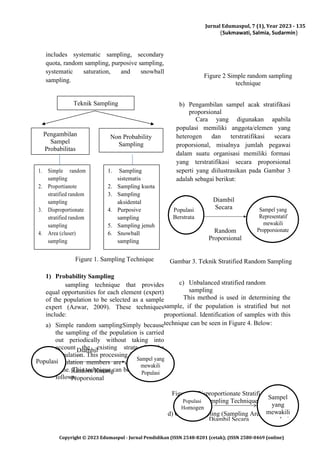
Figure 1. From the figure it can be seen that
basically the sampling techniques can be
grouped into two, namely probability
sampling and capacity non-deterministic
sampling.
Probability samples were taken from
simple random samples, stratified
proportional random sampling, stratified
unbalanced random sampling, and area
random sampling. Non-probability sampling
Jurnal Edumaspul, 7 (1), Year 2023 - 135
(Sukmawati, Salmia, Sudarmin)
Copyright © 2023 Edumaspul - Jurnal Pendidikan (ISSN 2548-8201 (cetak); (ISSN 2580-0469 (online)
includes systematic sampling, secondary
quota, random sampling, purposive sampling,
systematic saturation, and snowball
sampling.
Figure 1. Sampling Technique
1) Probability Sampling
sampling technique that provides
equal opportunities for each element (expert)
of the population to be selected as a sample
expert (Azwar, 2009). These techniques
include:
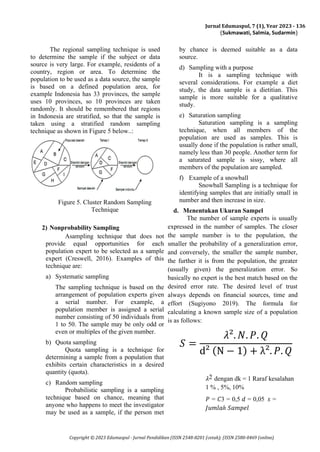
a) Simple random samplingSimply because
the sampling of the population is carried
out periodically without taking into
account the existing strata in the
population. This processing is done if the
population members are considered the
same. This technique can be explained as
follows:
Figure 2 Simple random sampling
technique
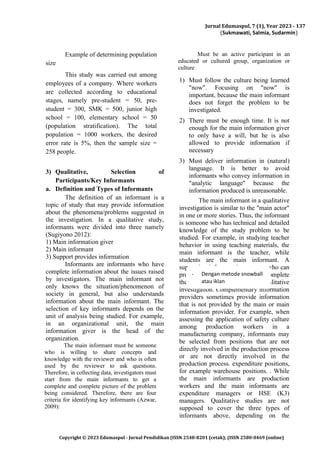
b) Pengambilan sampel acak stratifikasi
proporsional
Cara yang digunakan apabila
populasi memiliki anggota/elemen yang
heterogen dan terstratifikasi secara
proporsional, misalnya jumlah pegawai
dalam suatu organisasi memiliki formasi
yang terstratifikasi secara proporsional
seperti yang diilustrasikan pada Gambar 3
adalah sebagai berikut:
Gambar 3. Teknik Stratified Random Sampling
c) Unbalanced stratified random
sampling
This method is used in determining the
sample, if the population is stratified but not
proportional. Identification of samples with this
technique can be seen in Figure 4. Below:
Figure 4. Disproportionate Stratified Random
Sampling Technique
d) Cluster Sampling (Sampling Area)
Populasi
Homogen
Diambil Secara
Sampel
yang
mewakili
populasi
Diambil
Secara
Populasi
Random Kurang
Proporsional
Teknik Sampling
Pengambilan
Sampel
Probabilitas
Non Probability
Sampling
1. Simple random
sampling
2. Proportianote
stratified random
sampling
3. Disproportionate
stratified random
sampling
4. Area (cluser)
sampling
1. Sampling
sistematis
2. Sampling kuota
3. Sampling
aksidental
4. Purposive
sampling
5. Sampling jenuh
6. Snowball
sampling
Populasi
Berstrata
Diambil
Secara
Random
Proporsional
Jurnal Edumaspul, 7 (1), Year 2023 - 136
(Sukmawati, Salmia, Sudarmin)
Copyright © 2023 Edumaspul - Jurnal Pendidikan (ISSN 2548-8201 (cetak); (ISSN 2580-0469 (online)
The regional sampling technique is used
to determine the sample if the subject or data
source is very large. For example, residents of a
country, region or area. To determine the
population to be used as a data source, the sample
is based on a defined population area, for
example Indonesia has 33 provinces, the sample
uses 10 provinces, so 10 provinces are taken
randomly. It should be remembered that regions
in Indonesia are stratified, so that the sample is
taken using a stratified random sampling
technique as shown in Figure 5 below..:
Figure 5. Cluster Random Sampling
Technique
2) Nonprobability Sampling
Asampling technique that does not
provide equal opportunities for each
population expert to be selected as a sample
expert (Creswell, 2016). Examples of this
technique are:
a) Systematic sampling
The sampling technique is based on the
arrangement of population experts given
a serial number. For example, a
population member is assigned a serial
number consisting of 50 individuals from
1 to 50. The sample may be only odd or
even or multiples of the given number.
b) Quota sampling
Quota sampling is a technique for
determining a sample from a population that
exhibits certain characteristics in a desired
quantity (quota).
c) Random sampling
Probabilistic sampling is a sampling
technique based on chance, meaning that
anyone who happens to meet the investigator
may be used as a sample, if the person met
by chance is deemed suitable as a data
source.
d) Sampling with a purpose
It is a sampling technique with
several considerations. For example a diet
study, the data sample is a dietitian. This
sample is more suitable for a qualitative
study.
e) Saturation sampling
Saturation sampling is a sampling
technique, when all members of the
population are used as samples. This is
usually done if the population is rather small,
namely less than 30 people. Another term for
a saturated sample is sissy, where all
members of the population are sampled.
f) Example of a snowball
Snowball Sampling is a technique for
identifying samples that are initially small in
number and then increase in size.
d. Menentukan Ukuran Sampel
The number of sample experts is usually
expressed in the number of samples. The closer
the sample number is to the population, the
smaller the probability of a generalization error,
and conversely, the smaller the sample number,
the further it is from the population, the greater
(usually given) the generalization error. So
basically no expert is the best match based on the
desired error rate. The desired level of trust
always depends on financial sources, time and
effort (Sugiyono 2019). The formula for
calculating a known sample size of a population
is as follows:
𝑆 =
𝜆². 𝑁. 𝑃. 𝑄
d² (N − 1) + λ². 𝑃. 𝑄
𝜆2 dengan dk = 1 Raraf kesalahan
1 % , 5%, 10%
𝑃 = 𝐶3 = 0,5 𝑑 = 0,05 𝑠 =
𝐽𝑢𝑚𝑙𝑎ℎ 𝑆𝑎𝑚𝑝𝑒𝑙
Jurnal Edumaspul, 7 (1), Year 2023 - 137
(Sukmawati, Salmia, Sudarmin)
Copyright © 2023 Edumaspul - Jurnal Pendidikan (ISSN 2548-8201 (cetak); (ISSN 2580-0469 (online)
Example of determining population
size
This study was carried out among
employees of a company. Where workers
are collected according to educational
stages, namely pre-student = 50, pre-
student = 300, SMK = 500, junior high
school = 100, elementary school = 50
(population stratification). The total
population = 1000 workers, the desired
error rate is 5%, then the sample size =
258 people.
3) Qualitative, Selection of
Participants/Key Informants
a. Definition and Types of Informants
The definition of an informant is a
topic of study that may provide information
about the phenomena/problems suggested in
the investigation. In a qualitative study,
informants were divided into three namely
(Sugiyono 2012):
1) Main information giver
2) Main informant
3) Support provides information
Informants are informants who have
complete information about the issues raised
by investigators. The main informant not
only knows the situation/phenomenon of
society in general, but also understands
information about the main informant. The
selection of key informants depends on the
unit of analysis being studied. For example,
in an organizational unit, the main
information giver is the head of the
organization.
The main informant must be someone
who is willing to share concepts and
knowledge with the reviewer and who is often
used by the reviewer to ask questions.
Therefore, in collecting data, investigators must
start from the main informants to get a
complete and complete picture of the problem
being considered. Therefore, there are four
criteria for identifying key informants (Azwar,
2009):
Must be an active participant in an
educated or cultured group, organization or
culture
1) Must follow the culture being learned
"now". Focusing on "now" is
important, because the main informant
does not forget the problem to be
investigated.
2) There must be enough time. It is not
enough for the main information giver
to only have a will, but he is also
allowed to provide information if
necessary
3) Must deliver information in (natural)
language. It is better to avoid
informants who convey information in
"analytic language" because the
information produced is unreasonable.
The main informant in a qualitative
investigation is similar to the "main actor"
in one or more stories. Thus, the informant
is someone who has technical and detailed
knowledge of the study problem to be
studied. For example, in studying teacher
behavior in using teaching materials, the
main informant is the teacher, while
students are the main informant. A
supporting informant is someone who can
provide additional information to complete
the analysis and discussion in a qualitative
investigation. Complementary information
providers sometimes provide information
that is not provided by the main or main
information provider. For example, when
assessing the application of safety culture
among production workers in a
manufacturing company, informants may
be selected from positions that are not
directly involved in the production process
or are not directly involved in the
production process. expenditure positions,
for example warehouse positions. . While
the main informants are production
workers and the main informants are
expenditure managers or HSE (K3)
managers. Qualitative studies are not
supposed to cover the three types of
informants above, depending on the
- Dengan metode snowball
atau iklan
Jurnal Edumaspul, 7 (1), Year 2023 - 138
(Sukmawati, Salmia, Sudarmin)
Copyright © 2023 Edumaspul - Jurnal Pendidikan (ISSN 2548-8201 (cetak); (ISSN 2580-0469 (online)
context of the study problem. The use of
the three types of informants above is for
the purpose of cross-checking data
validation. The investigator must collect
information from these informants
sequentially starting from the main
informant, main informant, and supporting
informant (see Figure 3 below)..
In some qualitative studies, only a key
informant is needed if the real problem is
unique to that person. The determination of
the number of informants in a qualitative
study is explained in the following chapter
(Suyitno, 2006).
b. Number of informants
Qualitative investigations do not
acknowledge the existence of a minimum
sample size (sample size). In general,
qualitative investigations use small sample
sizes. Although in some cases only 1
informant was used. There are at least two
conditions that need to be met to determine
the number of informants, namely adequacy
and relevance (Martha, 2016).
What is the minimum and maximum
number of informants? Or what is the ideal
number of selected informants? As explained
above, to determine the number of
informants as a marker of the level using
information completeness requirements. The
need for perfection is met by determining the
number of informants who provide sufficient
information, so that the benchmark for
researchers is to determine the number of
informants not representative of the region
but the depth of information is sufficient or
not. So, in a qualitative investigation, there
are three conditions for determining the
number of informants.
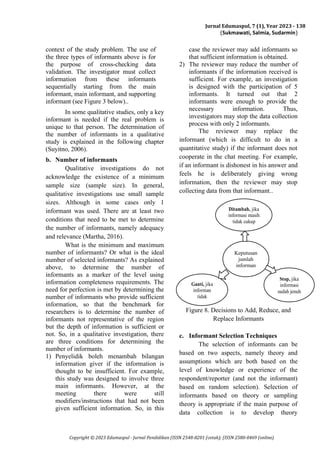
1) Penyelidik boleh menambah bilangan
information giver if the information is
thought to be insufficient. For example,
this study was designed to involve three
main informants. However, at the
meeting there were still
modifiers/instructions that had not been
given sufficient information. So, in this
case the reviewer may add informants so
that sufficient information is obtained.
2) The reviewer may reduce the number of
informants if the information received is
sufficient. For example, an investigation
is designed with the participation of 5
informants. It turned out that 2
informants were enough to provide the
necessary information. Thus,
investigators may stop the data collection
process with only 2 informants.
The reviewer may replace the
informant (which is difficult to do in a
quantitative study) if the informant does not
cooperate in the chat meeting. For example,
if an informant is dishonest in his answer and
feels he is deliberately giving wrong
information, then the reviewer may stop
collecting data from that informant..
Figure 8. Decisions to Add, Reduce, and
Replace Informants
c. Informant Selection Techniques
The selection of informants can be
based on two aspects, namely theory and
assumptions which are both based on the
level of knowledge or experience of the
respondent/reporter (and not the informant)
based on random selection). Selection of
informants based on theory or sampling
theory is appropriate if the main purpose of
data collection is to develop theory
Ditambah, jika
informasi masih
tidak cukup
Keputusan
jumlah
informan
Ganti, jika
informan
tidak
kooperatif &
tidak jujur
Stop, jika
informasi
sudah jenuh
Jurnal Edumaspul, 7 (1), Year 2023 - 139
(Sukmawati, Salmia, Sudarmin)
Copyright © 2023 Edumaspul - Jurnal Pendidikan (ISSN 2548-8201 (cetak); (ISSN 2580-0469 (online)
substantively. The technique of selecting
informants with assumptions (a priori
sampling) commonly used in public health
research is carried out by characterizing
informants based on the problem and
objective of the study. For example, if a
qualitative study wants to explore the health
and behavior of adolescents in a community,
the study's informants will be taken from that
community. (Robinson, 2014).
The selection of informants in a
qualitative study is completely determined by
the researcher, even (Patton, 1999) calls it
purposive sampling which is the selection of
cases with a lot of information (informative
cases) according to the strategies and
strategies that have been set. target. by
researchers, that's the sum. depending on the
purpose and source of the research. according
to (Patton, 1999), there are 16 types of
informant selection techniques with
purposive sampling techniques.
d. Recruiting Informants
A further problem in designing
informants for qualitative research is
recruiting informants or determining who is
willing to provide complete and relevant
information. Basically, recruitment involving
more than one research informant can follow
the recruitment model with the conditions set
by the researcher based on the objectives of
the study. The steps are as follows (Salam,
2008):
1) Analyze the role of the informant
The role of the informant here means
his position in collecting research data to
produce relevant information. This position
can act as a lead, lead or support informant.
The information expected from the informant
is information that is compatible with the
theoretical framework and concepts used by
the researcher. Therefore, the role of research
informant can be determined based on two
conditions, namely: theory-based and
problem-based research. Identification of
theory-based roles used in research to
strengthen or complement the theoretical
foundations. While the determination of the
informant's role according to the research
problem is to provide information that is
appropriate to the indicators of the problem
found by the researcher. Usually used in
qualitative studies to evaluate a program, find
out someone's opinion, understand/study
someone's behavior, etc.
2) Find information about the availability of
suitable informants
The next stage, the researcher
determines the "availability" of informants in
the field. To obtain this information, the
researcher can obtain information from
people who are considered elderly/elderly in
the social environment of the community
such as: community leaders, organization
leaders, traditional leaders, religious leaders
and so on. In some cases, parents in the
social order of the community can be used as
key informants if they meet the criteria and
are able to cooperate with the researcher.
3) Decision to accept/reject the information
provider
However, it is up to the researcher to
decide who is the right informant. This is to
avoid misinformation if identification is only
determined by a party outside the research
team. This situation often occurs in research
that aims to evaluate programs or
organizational activities. Often the
identification of informants is determined by
the management of the program/organization
to ensure that subjective decisions are based
on the wishes of management.
In the middle of the qualitative research
process, the researcher can make decisions to
add, reject, or exclude selected informants
from the study..
Conclusion (5%)
Basically, qualitative research does not
accept the term population sampling because
Jurnal Edumaspul, 7 (1), Year 2023 - 140
(Sukmawati, Salmia, Sudarmin)
Copyright © 2023 Edumaspul - Jurnal Pendidikan (ISSN 2548-8201 (cetak); (ISSN 2580-0469 (online)
this research does not aim to generalize the
population, but uses in-depth information for
the sample in qualitative research called
people. Giving information.
Before determining the number of
informants and selecting informants, the first
step the researcher must take is to determine
the research analysis unit that describes the
research location and includes six aspects:
people, structure, research perspective,
viewing time, geography and activity.
The number of informants in qualitative
research can be flexible depending on the
conditions of adequacy and relevance. In half
the cases, only one informant is required.
Researchers can add, delete or replace
informants during the research process
depending on the completeness and relevance
of the information. The "Sampling" method in
qualitative research is not random, so it must
be a non-probability method or determined by
the researcher (purposeful sampling). This
module explains that there are 16 types of
sampling techniques in qualitative research.
The recruitment of informants to participate
in the research is completely determined by
the researcher taking into account the
contributions of several parties related to the
research problem.
Bibliography
Arikunto, S. (2002). Prosedur Penelitian:
Suatu Pendeketan Praktis. PT. Bumi
Aksara.
Azwar, S. (2009). Metode Penelitian.
Pustaka Pelajar.
Creswell, J. W. (2016). Research Design :
Pendekatan Metode Kualitatif,.
Kuantitatif dan Campuran. Edisi
Keempat. Pustak Belajar.
Kristanto, A. (2018). erancangan Sistem
Informasi Dan Aplikasinya (Vol. 1, Ed).
Lexy, J. M. (2008). Metodologi Penelitian
Kualitatif. PT. Remaja Rosdakarya.
Mamik. (2015). Metodologi Kualitatif.
Zifatama Publisher.
Martha, K. &. (2016). Metodologi Penelitian
Kualitatif untuk Bidang. Kesehatan.
Rajagrafindo Persada.
Nazir, M. (2005). Metode Penelitian. Ghalia
Indonesia.
Pasaribu. (1975). Pengantar Statistik. Ghalia
Indonesia.
Patton, M. Q. (1999). Qualitative Research
and Evaluation Methods. Sage
Publicatin Inc.
Robinson, O. C. (2014). Sampling in
Interview-Based Qualitative Research:
A Theoretical and Practical Guide.
Qualitative Research in Psychology,
11(1).
Salam, S. (2008). Hand out Penelitian
Kualitatif. Program Pascasarjana S3
Universitas Negeri Makassar.
Situmorang. (2010). Data Penelitian;
Menggunakan Program SPSS. USU
Press.
Somantri, A. (2006). Aplikasi Statistika
dalam. Penelitian. Pustaka Setia.
Sugiyono. (2019). Metode Penelitian
Kuantitatif, Kualitatif, dan R&D.
Alfabeta.
Suharsaputra, U. (2012). Metode Penelitian
Kuantitatif, Kualitatif, dan Tindakan.
PT Refika Aditama.
Suyitno. (2006). Metodologi Penelitian
Kualitatif. Elkaf.
Zed, M. (2008). Metode Penelitian
Kepustakaan. Yayasan Obor Indonesia.

5259-Article Text-10110-1-10-20230316.pdf

  • 1.
    Vol. 7 –No. 1, year (2023), page 131-140 | ISSN 2548-8201 (Print) | 2580-0469) (Online) | Copyright © 2023 Edumaspul - Jurnal Pendidikan (ISSN 2548-8201 (cetak); (ISSN 2580-0469 (online) Population, Sample (Quantitative) and Selection of Participants/Key Informants (Qualitative) Sukmawati1 , Salmia2 , Sudarmin3 * Universitas Muhammadiyah Makassar * Corresponding Author. E-mail: almia99@gmail.com Receive: 11/01/2023 Accepted: 21/02/2023 Published: 01/03/2023 Abstrak Penelitian yang menggunakan populasi, sekiranya populasi ramai dan tidak mungkin pengkaji mengkaji semua yang terdapat dalam populasi, disebabkan oleh dana, tenaga kerja dan masa yang terhad, pengkaji boleh menggunakan sampel yang diambil daripada populasi yang mewakili. Sampel kajian adalah sebagian dari populasi yang diambil sebagai sumber data dan dapat mewakili seluruh populasi. Teknik Disproportonate Stratified Random Sampling Persampelan Kelompok (Area Sampling) Teknik persampelan kawasan yang digunakan untuk menentukan sampel apabila objek yang dikaji atau sumber data adalah sangat besar. Untuk menentukan objek yang digunakan sebagai sumber data, persampelan adalah berdasarkan kawasan populasi yang ditetapkan.Dalam kajian kualitatif, informan dibahagikan kepada tiga iaitu: informan kunci, informan utama, dan informan pendukung. Informan kunci ialah informan yang mempunyai maklumat yang komprehensif tentang isu yang dibangkitkan oleh penyelidik. Pemilihan informan dalam kajian kualitatif ditentukan sepenuhnya oleh pengkaji, justeru dinamakan persampelan bertujuan (purposive sampling) iaitu memilih kes bermaklumat (information-rich cases) berdasarkan strategi dan objektif yang ditetapkan oleh pengkaji yang bilangannya bergantung kepada objektif dan sumber belajar. Kata Kunci: populasi; sampel; informan Abstract (English-Indonesia) Research using a population, if the population is large and it is impossible for the reviewer to examine everything in the population, due to limited funds, manpower and time, the reviewer may use samples taken from a representative population. The study sample is part of the population taken as a data source and can represent the entire population. Disproportionate Stratified Random Sampling Technique Group Sampling (Area Sampling) The area sampling technique is used to determine the sample when the object being studied or the data source is very large. To determine the object used as a data source, sampling is based on the specified population area. In a qualitative study, informants were divided into three, namely: key informants, main informants, and supporting informants. Key informants are informants who have comprehensive information about the issues raised by investigators. The selection of informants in a qualitative study is determined entirely by the
  • 2.
    Jurnal Edumaspul, 7(1), Year 2023 - 132 (Sukmawati, Salmia, Sudarmin) Copyright © 2023 Edumaspul - Jurnal Pendidikan (ISSN 2548-8201 (cetak); (ISSN 2580-0469 (online) reviewer, which is why it is called purposive sampling, namely choosing information-rich cases based on the strategy and objectives set by the reviewer whose numbers depend on the objective and learning resources. Keywords: population; sample; informant Introduction (10%) Every type of research has a starting point. Without research problems it is impossible. The point is that when you start thinking about research, you need to think about and formulate it clearly, concisely, and carefully. Indeed, all other elements of research are based on the formulation of the problem. Every investigation, both quantitative and qualitative, is always rooted in a problem. However, there is a fundamental difference between "problems" in quantitative investigations and "problems" in qualitative investigations. Whereas in a quantitative investigation, the "problem" that the investigator wants to solve must be clear, precise and considered fixed, in a qualitative investigation, the "problem" raised by the investigator is still vague, even blurred, complex and dynamic. Therefore, the "problem" in a qualitative investigation is still temporary, an investigation and will develop or change when the investigator enters the field. As previously mentioned, the selection of informants as data sources requires a method. The method or technique for selecting informants that is commonly used in qualitative research is based on the principle of the subject mastering the problem, having data, and being willing to provide complete and accurate information. Informants who act as sources of data and information must meet the requirements. Qualitative research does not question the number of informants, but can depend on whether or not the selection of key informants is appropriate, and the complexity of the variety of social phenomena studied. Thus, informants were determined using the snowball sampling technique, namely the process of determining informants based on previous informants without determining the exact number by digging up information related to the required research topic. The search for informants will be stopped after the research information is considered sufficient. Data collection techniques are methods used by researchers to collect research data from data sources (subjects and research samples). Data collection techniques are an obligation, because these data collection techniques will later be used as the basis for compiling research instruments. The research instrument is a set of tools that will be used by researchers to collect research data (Kristanto, 2018). Data collection is a very important stage in a research. Correct data collection techniques will produce data that has high credibility, and vice versa. Therefore, this stage cannot be wrong and must be carried out carefully according to the procedures and characteristics of qualitative research. This is because errors or imperfections in the data collection method will have fatal consequences, namely in the form of data that is not credible, so that the results of the research cannot be accounted for. In qualitative research, data collection is carried out in natural settings (natural conditions), primary data sources and data collection techniques involve more participant observation, in-depth interviews, and documentation (Sugiyono, 2019). Basically the use of data (after being processed and analyzed) is as an objective basis in the process of making decisions/policies in order to solve problems by decision makers (Situmorang, 2010). For
  • 3.
    Jurnal Edumaspul, 7(1), Year 2023 - 133 (Sukmawati, Salmia, Sudarmin) Copyright © 2023 Edumaspul - Jurnal Pendidikan (ISSN 2548-8201 (cetak); (ISSN 2580-0469 (online) example, if researchers want to obtain information about teachers' perceptions of the new curriculum, then the technique used is interviews, not observation. Meanwhile, if the researcher wants to know how the teacher creates a lively classroom atmosphere, then the technique used is observation. Likewise, if you want to know about student competence in certain subjects, the technique used is a test, or it could be a document in the form of exam results. Thus, the information you want to obtain determines the type of technique used (materials determine a means) (Kristanto, 2018). However, researchers still need the skills to use these techniques. Because it could be that if they are inexperienced or do not have adequate knowledge, the researcher is unable to dig up in-depth information, as is characteristic of data in qualitative research, because they are not competent in using the technique, even though the technique chosen is appropriate. The solution is to continue studying and reading the results of similar previous studies which will greatly help increase the skills of researchers. Method (15%) This research is a type of library research. What is called library research or often also called library research, is a series of activities related to how to collect library data, read and record and process research materials (Zed, 2008). In this study, the authors apply the library research method because there are at least several underlying reasons. First, that data sources cannot only be obtained from the field. Sometimes data sources can only be obtained from libraries or other documents in written form, whether from journals, books or other literature. Second, literature study is needed as a way to understand new phenomena that occur that cannot be understood, then with this literature study you will be able to understand these symptoms. So that in dealing with a symptom that occurs, the author can formulate a concept to solve a problem that arises. The third reason is that library data remains reliable to answer research questions (Zed, 2008). However, information or empirical data that has been collected by other people, whether in the form of books, scientific reports or research reports, can still be used by library researchers. Even in certain cases the field data is still not significant enough to answer the research questions to be conducted. Tahapan-tahapan yang harus taken by the author in library research are as follows: a). Gather research materials. Because this research is library research, the material collected is in the form of information or empirical data sourced from books, journals, results of official and scientific research reports and other literature that supports the theme of this research. B). Reading for research purposes is not a passive occupation. Readers are asked to simply absorb all the "scientific" information in the reading material, but rather a "hunting" activity that requires the active and critical involvement of the reader in order to obtain maximum results. In reading research materials, readers must dig deeper into the reading material that allows them to find new ideas related to the research title. C). Make research notes. The activity of recording research materials is arguably the most important stage and perhaps also the toughest peak of the whole series of library research (Zed, 2008). Because in the end all the material that has been read must be concluded in the form of a report. d). Process research records. All material that has been read is then processed or analyzed to obtain a conclusion that is compiled in the form of a research report. Content analysis or content review is a research methodology that utilizes a series of procedures to draw valid conclusions from a book or document. Meanwhile, Harold D. Lasswell stated that content analysis is research which is an in-depth discussion of the content of written or printed information in the mass media. From the explanation above, it can be concluded that content analysis is a research method with certain
  • 4.
    Jurnal Edumaspul, 7(1), Year 2023 - 134 (Sukmawati, Salmia, Sudarmin) Copyright © 2023 Edumaspul - Jurnal Pendidikan (ISSN 2548-8201 (cetak); (ISSN 2580-0469 (online) stages to explore the essence of an idea or information and then draw a conclusion (Lexy, 2008). The author uses data analysis techniques in the form of content analysis because this type of research is a type of library research, where the data sources are in the form of books and documents as well as other forms of literature.. Results and Discussion (70%) 1) Kuantitatif a. Populasi The population is a general field consisting of subjects/objects with certain qualities and characteristics determined by the reviewer to be studied and then conclusions drawn (Sugiyono, 2019). Therefore, the population is not all people, but also objects and other objects. Population is not only the number of objects or subjects, but all the characteristics possessed by objects or subjects. The population is divided into two parts (Sugiyono, 2019), namely: 1) The target population is the population that has been identified based on the research problem and conclusions will be drawn from the research results of the population. 2) The survey population is the population included in this study. The population consists of the elements that are sampled, namely the elements that are sampled. The sampling frame is a list of all the sample elements in the sample population. This sampling element is taken using a sampling frame. b. Sample The sample is a small part of the number and characteristics of the population. If the population is large and the researcher cannot study everything in the population due to budget, human and time constraints, the researcher can use a sample taken from a representative population. The sample is a small part of the population taken according to certain procedures to represent the population (Somantri, 2006). Some members of the population are called samples (Nazir, 2005). Part of the members of a group (subject group) as a basis for obtaining information (or drawing conclusions) about the group (group) (Pasaribu, 1975). (Sugiyono, 2019) argued that "a sample is a small part of the quantity and characteristics possessed by a population". (Arikunto, 2002) states that the sample is part of the population (part or representative of the population studied). The research sample is some of the population taken as a data source that represents the entire population. Therefore, it can be concluded that the sample is part of the data that is the subject of the population being sampled. How to determine a satisfactory sample: an ideal sampling technique (method) has the characteristics of being able to provide an accurate picture of the population, can be determined accurately, is easy to apply, can contain extensive information, is reliable, at a low cost. Precision is the standard error, the population size minus the sample mean. c. Sampling Technique The sampling technique is a sampling technique for determining the sample to be used in an investigation (Suharsaputra, 2012). The sampling technique is shown in Figure 1. From the figure it can be seen that basically the sampling techniques can be grouped into two, namely probability sampling and capacity non-deterministic sampling. Probability samples were taken from simple random samples, stratified proportional random sampling, stratified unbalanced random sampling, and area random sampling. Non-probability sampling
  • 5.
    Jurnal Edumaspul, 7(1), Year 2023 - 135 (Sukmawati, Salmia, Sudarmin) Copyright © 2023 Edumaspul - Jurnal Pendidikan (ISSN 2548-8201 (cetak); (ISSN 2580-0469 (online) includes systematic sampling, secondary quota, random sampling, purposive sampling, systematic saturation, and snowball sampling. Figure 1. Sampling Technique 1) Probability Sampling sampling technique that provides equal opportunities for each element (expert) of the population to be selected as a sample expert (Azwar, 2009). These techniques include: a) Simple random samplingSimply because the sampling of the population is carried out periodically without taking into account the existing strata in the population. This processing is done if the population members are considered the same. This technique can be explained as follows: Figure 2 Simple random sampling technique b) Pengambilan sampel acak stratifikasi proporsional Cara yang digunakan apabila populasi memiliki anggota/elemen yang heterogen dan terstratifikasi secara proporsional, misalnya jumlah pegawai dalam suatu organisasi memiliki formasi yang terstratifikasi secara proporsional seperti yang diilustrasikan pada Gambar 3 adalah sebagai berikut: Gambar 3. Teknik Stratified Random Sampling c) Unbalanced stratified random sampling This method is used in determining the sample, if the population is stratified but not proportional. Identification of samples with this technique can be seen in Figure 4. Below: Figure 4. Disproportionate Stratified Random Sampling Technique d) Cluster Sampling (Sampling Area) Populasi Homogen Diambil Secara Sampel yang mewakili populasi Diambil Secara Populasi Random Kurang Proporsional Teknik Sampling Pengambilan Sampel Probabilitas Non Probability Sampling 1. Simple random sampling 2. Proportianote stratified random sampling 3. Disproportionate stratified random sampling 4. Area (cluser) sampling 1. Sampling sistematis 2. Sampling kuota 3. Sampling aksidental 4. Purposive sampling 5. Sampling jenuh 6. Snowball sampling Populasi Berstrata Diambil Secara Random Proporsional
  • 6.
    Jurnal Edumaspul, 7(1), Year 2023 - 136 (Sukmawati, Salmia, Sudarmin) Copyright © 2023 Edumaspul - Jurnal Pendidikan (ISSN 2548-8201 (cetak); (ISSN 2580-0469 (online) The regional sampling technique is used to determine the sample if the subject or data source is very large. For example, residents of a country, region or area. To determine the population to be used as a data source, the sample is based on a defined population area, for example Indonesia has 33 provinces, the sample uses 10 provinces, so 10 provinces are taken randomly. It should be remembered that regions in Indonesia are stratified, so that the sample is taken using a stratified random sampling technique as shown in Figure 5 below..: Figure 5. Cluster Random Sampling Technique 2) Nonprobability Sampling Asampling technique that does not provide equal opportunities for each population expert to be selected as a sample expert (Creswell, 2016). Examples of this technique are: a) Systematic sampling The sampling technique is based on the arrangement of population experts given a serial number. For example, a population member is assigned a serial number consisting of 50 individuals from 1 to 50. The sample may be only odd or even or multiples of the given number. b) Quota sampling Quota sampling is a technique for determining a sample from a population that exhibits certain characteristics in a desired quantity (quota). c) Random sampling Probabilistic sampling is a sampling technique based on chance, meaning that anyone who happens to meet the investigator may be used as a sample, if the person met by chance is deemed suitable as a data source. d) Sampling with a purpose It is a sampling technique with several considerations. For example a diet study, the data sample is a dietitian. This sample is more suitable for a qualitative study. e) Saturation sampling Saturation sampling is a sampling technique, when all members of the population are used as samples. This is usually done if the population is rather small, namely less than 30 people. Another term for a saturated sample is sissy, where all members of the population are sampled. f) Example of a snowball Snowball Sampling is a technique for identifying samples that are initially small in number and then increase in size. d. Menentukan Ukuran Sampel The number of sample experts is usually expressed in the number of samples. The closer the sample number is to the population, the smaller the probability of a generalization error, and conversely, the smaller the sample number, the further it is from the population, the greater (usually given) the generalization error. So basically no expert is the best match based on the desired error rate. The desired level of trust always depends on financial sources, time and effort (Sugiyono 2019). The formula for calculating a known sample size of a population is as follows: 𝑆 = 𝜆². 𝑁. 𝑃. 𝑄 d² (N − 1) + λ². 𝑃. 𝑄 𝜆2 dengan dk = 1 Raraf kesalahan 1 % , 5%, 10% 𝑃 = 𝐶3 = 0,5 𝑑 = 0,05 𝑠 = 𝐽𝑢𝑚𝑙𝑎ℎ 𝑆𝑎𝑚𝑝𝑒𝑙
  • 7.
    Jurnal Edumaspul, 7(1), Year 2023 - 137 (Sukmawati, Salmia, Sudarmin) Copyright © 2023 Edumaspul - Jurnal Pendidikan (ISSN 2548-8201 (cetak); (ISSN 2580-0469 (online) Example of determining population size This study was carried out among employees of a company. Where workers are collected according to educational stages, namely pre-student = 50, pre- student = 300, SMK = 500, junior high school = 100, elementary school = 50 (population stratification). The total population = 1000 workers, the desired error rate is 5%, then the sample size = 258 people. 3) Qualitative, Selection of Participants/Key Informants a. Definition and Types of Informants The definition of an informant is a topic of study that may provide information about the phenomena/problems suggested in the investigation. In a qualitative study, informants were divided into three namely (Sugiyono 2012): 1) Main information giver 2) Main informant 3) Support provides information Informants are informants who have complete information about the issues raised by investigators. The main informant not only knows the situation/phenomenon of society in general, but also understands information about the main informant. The selection of key informants depends on the unit of analysis being studied. For example, in an organizational unit, the main information giver is the head of the organization. The main informant must be someone who is willing to share concepts and knowledge with the reviewer and who is often used by the reviewer to ask questions. Therefore, in collecting data, investigators must start from the main informants to get a complete and complete picture of the problem being considered. Therefore, there are four criteria for identifying key informants (Azwar, 2009): Must be an active participant in an educated or cultured group, organization or culture 1) Must follow the culture being learned "now". Focusing on "now" is important, because the main informant does not forget the problem to be investigated. 2) There must be enough time. It is not enough for the main information giver to only have a will, but he is also allowed to provide information if necessary 3) Must deliver information in (natural) language. It is better to avoid informants who convey information in "analytic language" because the information produced is unreasonable. The main informant in a qualitative investigation is similar to the "main actor" in one or more stories. Thus, the informant is someone who has technical and detailed knowledge of the study problem to be studied. For example, in studying teacher behavior in using teaching materials, the main informant is the teacher, while students are the main informant. A supporting informant is someone who can provide additional information to complete the analysis and discussion in a qualitative investigation. Complementary information providers sometimes provide information that is not provided by the main or main information provider. For example, when assessing the application of safety culture among production workers in a manufacturing company, informants may be selected from positions that are not directly involved in the production process or are not directly involved in the production process. expenditure positions, for example warehouse positions. . While the main informants are production workers and the main informants are expenditure managers or HSE (K3) managers. Qualitative studies are not supposed to cover the three types of informants above, depending on the - Dengan metode snowball atau iklan
  • 8.
    Jurnal Edumaspul, 7(1), Year 2023 - 138 (Sukmawati, Salmia, Sudarmin) Copyright © 2023 Edumaspul - Jurnal Pendidikan (ISSN 2548-8201 (cetak); (ISSN 2580-0469 (online) context of the study problem. The use of the three types of informants above is for the purpose of cross-checking data validation. The investigator must collect information from these informants sequentially starting from the main informant, main informant, and supporting informant (see Figure 3 below).. In some qualitative studies, only a key informant is needed if the real problem is unique to that person. The determination of the number of informants in a qualitative study is explained in the following chapter (Suyitno, 2006). b. Number of informants Qualitative investigations do not acknowledge the existence of a minimum sample size (sample size). In general, qualitative investigations use small sample sizes. Although in some cases only 1 informant was used. There are at least two conditions that need to be met to determine the number of informants, namely adequacy and relevance (Martha, 2016). What is the minimum and maximum number of informants? Or what is the ideal number of selected informants? As explained above, to determine the number of informants as a marker of the level using information completeness requirements. The need for perfection is met by determining the number of informants who provide sufficient information, so that the benchmark for researchers is to determine the number of informants not representative of the region but the depth of information is sufficient or not. So, in a qualitative investigation, there are three conditions for determining the number of informants. 1) Penyelidik boleh menambah bilangan information giver if the information is thought to be insufficient. For example, this study was designed to involve three main informants. However, at the meeting there were still modifiers/instructions that had not been given sufficient information. So, in this case the reviewer may add informants so that sufficient information is obtained. 2) The reviewer may reduce the number of informants if the information received is sufficient. For example, an investigation is designed with the participation of 5 informants. It turned out that 2 informants were enough to provide the necessary information. Thus, investigators may stop the data collection process with only 2 informants. The reviewer may replace the informant (which is difficult to do in a quantitative study) if the informant does not cooperate in the chat meeting. For example, if an informant is dishonest in his answer and feels he is deliberately giving wrong information, then the reviewer may stop collecting data from that informant.. Figure 8. Decisions to Add, Reduce, and Replace Informants c. Informant Selection Techniques The selection of informants can be based on two aspects, namely theory and assumptions which are both based on the level of knowledge or experience of the respondent/reporter (and not the informant) based on random selection). Selection of informants based on theory or sampling theory is appropriate if the main purpose of data collection is to develop theory Ditambah, jika informasi masih tidak cukup Keputusan jumlah informan Ganti, jika informan tidak kooperatif & tidak jujur Stop, jika informasi sudah jenuh
  • 9.
    Jurnal Edumaspul, 7(1), Year 2023 - 139 (Sukmawati, Salmia, Sudarmin) Copyright © 2023 Edumaspul - Jurnal Pendidikan (ISSN 2548-8201 (cetak); (ISSN 2580-0469 (online) substantively. The technique of selecting informants with assumptions (a priori sampling) commonly used in public health research is carried out by characterizing informants based on the problem and objective of the study. For example, if a qualitative study wants to explore the health and behavior of adolescents in a community, the study's informants will be taken from that community. (Robinson, 2014). The selection of informants in a qualitative study is completely determined by the researcher, even (Patton, 1999) calls it purposive sampling which is the selection of cases with a lot of information (informative cases) according to the strategies and strategies that have been set. target. by researchers, that's the sum. depending on the purpose and source of the research. according to (Patton, 1999), there are 16 types of informant selection techniques with purposive sampling techniques. d. Recruiting Informants A further problem in designing informants for qualitative research is recruiting informants or determining who is willing to provide complete and relevant information. Basically, recruitment involving more than one research informant can follow the recruitment model with the conditions set by the researcher based on the objectives of the study. The steps are as follows (Salam, 2008): 1) Analyze the role of the informant The role of the informant here means his position in collecting research data to produce relevant information. This position can act as a lead, lead or support informant. The information expected from the informant is information that is compatible with the theoretical framework and concepts used by the researcher. Therefore, the role of research informant can be determined based on two conditions, namely: theory-based and problem-based research. Identification of theory-based roles used in research to strengthen or complement the theoretical foundations. While the determination of the informant's role according to the research problem is to provide information that is appropriate to the indicators of the problem found by the researcher. Usually used in qualitative studies to evaluate a program, find out someone's opinion, understand/study someone's behavior, etc. 2) Find information about the availability of suitable informants The next stage, the researcher determines the "availability" of informants in the field. To obtain this information, the researcher can obtain information from people who are considered elderly/elderly in the social environment of the community such as: community leaders, organization leaders, traditional leaders, religious leaders and so on. In some cases, parents in the social order of the community can be used as key informants if they meet the criteria and are able to cooperate with the researcher. 3) Decision to accept/reject the information provider However, it is up to the researcher to decide who is the right informant. This is to avoid misinformation if identification is only determined by a party outside the research team. This situation often occurs in research that aims to evaluate programs or organizational activities. Often the identification of informants is determined by the management of the program/organization to ensure that subjective decisions are based on the wishes of management. In the middle of the qualitative research process, the researcher can make decisions to add, reject, or exclude selected informants from the study.. Conclusion (5%) Basically, qualitative research does not accept the term population sampling because
  • 10.
    Jurnal Edumaspul, 7(1), Year 2023 - 140 (Sukmawati, Salmia, Sudarmin) Copyright © 2023 Edumaspul - Jurnal Pendidikan (ISSN 2548-8201 (cetak); (ISSN 2580-0469 (online) this research does not aim to generalize the population, but uses in-depth information for the sample in qualitative research called people. Giving information. Before determining the number of informants and selecting informants, the first step the researcher must take is to determine the research analysis unit that describes the research location and includes six aspects: people, structure, research perspective, viewing time, geography and activity. The number of informants in qualitative research can be flexible depending on the conditions of adequacy and relevance. In half the cases, only one informant is required. Researchers can add, delete or replace informants during the research process depending on the completeness and relevance of the information. The "Sampling" method in qualitative research is not random, so it must be a non-probability method or determined by the researcher (purposeful sampling). This module explains that there are 16 types of sampling techniques in qualitative research. The recruitment of informants to participate in the research is completely determined by the researcher taking into account the contributions of several parties related to the research problem. Bibliography Arikunto, S. (2002). Prosedur Penelitian: Suatu Pendeketan Praktis. PT. Bumi Aksara. Azwar, S. (2009). Metode Penelitian. Pustaka Pelajar. Creswell, J. W. (2016). Research Design : Pendekatan Metode Kualitatif,. Kuantitatif dan Campuran. Edisi Keempat. Pustak Belajar. Kristanto, A. (2018). erancangan Sistem Informasi Dan Aplikasinya (Vol. 1, Ed). Lexy, J. M. (2008). Metodologi Penelitian Kualitatif. PT. Remaja Rosdakarya. Mamik. (2015). Metodologi Kualitatif. Zifatama Publisher. Martha, K. &. (2016). Metodologi Penelitian Kualitatif untuk Bidang. Kesehatan. Rajagrafindo Persada. Nazir, M. (2005). Metode Penelitian. Ghalia Indonesia. Pasaribu. (1975). Pengantar Statistik. Ghalia Indonesia. Patton, M. Q. (1999). Qualitative Research and Evaluation Methods. Sage Publicatin Inc. Robinson, O. C. (2014). Sampling in Interview-Based Qualitative Research: A Theoretical and Practical Guide. Qualitative Research in Psychology, 11(1). Salam, S. (2008). Hand out Penelitian Kualitatif. Program Pascasarjana S3 Universitas Negeri Makassar. Situmorang. (2010). Data Penelitian; Menggunakan Program SPSS. USU Press. Somantri, A. (2006). Aplikasi Statistika dalam. Penelitian. Pustaka Setia. Sugiyono. (2019). Metode Penelitian Kuantitatif, Kualitatif, dan R&D. Alfabeta. Suharsaputra, U. (2012). Metode Penelitian Kuantitatif, Kualitatif, dan Tindakan. PT Refika Aditama. Suyitno. (2006). Metodologi Penelitian Kualitatif. Elkaf. Zed, M. (2008). Metode Penelitian Kepustakaan. Yayasan Obor Indonesia.