Mixed Methods Research
WORKSHOP
2nd July 2015
Deakin University, Melbourne
Dr Roslyn Cameron
Co-Convenor of Mixed Methods SIG - ANZAM
Research Fellow
Curtin Business
School
Roslyn Cameron Copyright 2014
Mixed Methods
Research
 Introduce and definitions
 Historical & philosophical roots of
MMR
 Authorities & publications in the
field
 Terminologies, notation system &
visuals
 Purposes
 Research designs &
typologies
Research Fellow at Curtin University, WA.
Ros is a Fellow of the Australian Human
Resources Institute (FAHRI) and Co-
Convenor of the Mixed Methods Research
Special Interest Group of ANZAM. She
utilizes mixed methods in many of her
funded research projects and publishes in
the use of mixed methods across business
and management disciplines. She has run
several workshops on mixed methods at
doctoral symposiums and academic
conferences. She has been granted $1.09
(AUD) million in research funding and has
over 90 publications.
Roslyn Cameron Copyright 2014
Definition Mixed
Methods
Roslyn Cameron Copyright 2014
In general, mixed methods research represents
research that involves collecting, analyzing, and
interpreting quantitative and qualitative data in a
single study or in a series of studies that investigate
the same underlying phenomenon.
Leech N, Onwuegbuzie A, (2008) A typology of mixed methods research
designs,
Quality and Quantity, 43(2), March, pp. 265-275.
Definition Mixed
Methods
Roslyn Cameron Copyright 2014
⚫Mixed methods research is a research design with
philosophical assumptions as well as methods of inquiry.
As a methodology, it involves philosophical assumptions
that guide the direction of the collection and analysis of
data and the mixture of qualitative and quantitative data
in a single study or series of studies. Its central premise is
that the use of quantitative and qualitative approaches
in combination provides a better understanding of
research problems that either approach alone.
⚫ Creswell and Plano Clark (2007: 5)
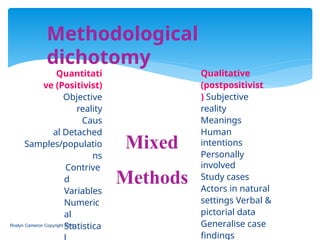
Methodological
dichotomy
Roslyn Cameron Copyright 2014
Quantitati
ve (Positivist)
Objective
reality
Caus
al Detached
Samples/populatio
ns
Contrive
d
Variables
Numeric
al
Statistica
Qualitative
(postpositivist
) Subjective
reality
Meanings
Human
intentions
Personally
involved
Study cases
Actors in natural
settings Verbal &
pictorial data
Generalise case
findings
Mixed
Methods
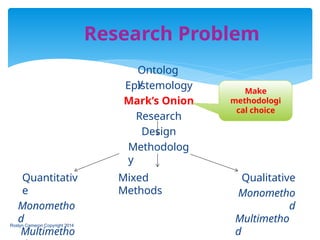
Ontolog
y
Epistemology
Mark’s Onion
Research
Design
Methodolog
y
Mixed
Methods
Quantitativ
e
Monometho
d
Multimetho
Qualitative
Monometho
d
Multimetho
d
Research Problem
Make
methodologi
cal choice
Roslyn Cameron Copyright 2014
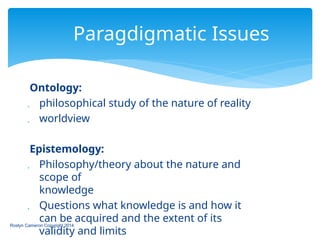
Ontology:
 philosophical study of the nature of reality
 worldview
Epistemology:
 Philosophy/theory about the nature and
scope of
knowledge
 Questions what knowledge is and how it
can be acquired and the extent of its
validity and limits
Roslyn Cameron Copyright 2014
Paragdigmatic Issues
Roslyn Cameron Copyright 2014
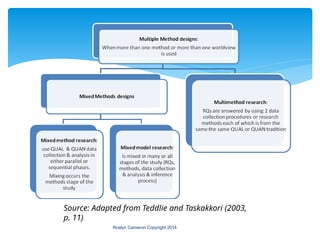
Source: Adapted from Teddlie and Taskakkori (2003,
p. 11)
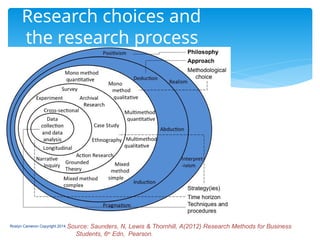
Research choices and
the research process
‘onion’
Roslyn Cameron Copyright 2014 Source: Saunders, N, Lewis & Thornhill, A(2012) Research Methods for Business
Students, 6th Edn, Pearson.
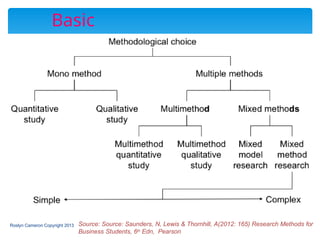
Basic
typology
Source: Source: Saunders, N, Lewis & Thornhill, A(2012: 165) Research Methods for
Business Students, 6th Edn, Pearson
Roslyn Cameron Copyright 2013
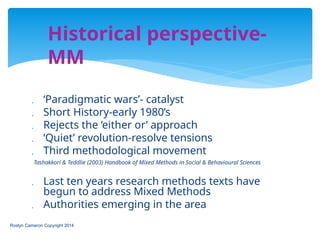
 ‘Paradigmatic wars’- catalyst
 Short History-early 1980’s
 Rejects the ‘either or’ approach
 ‘Quiet’ revolution-resolve tensions
 Third methodological movement
Tashakkori & Teddlie (2003) Handbook of Mixed Methods in Social & Behavioural Sciences
 Last ten years research methods texts have
begun to address Mixed Methods
 Authorities emerging in the area
Roslyn Cameron Copyright 2014
Historical perspective-
MM
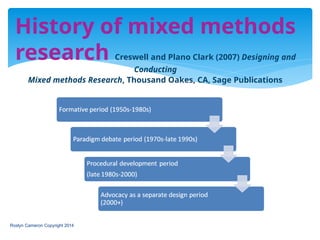
History of mixed methods
research Creswell and Plano Clark (2007) Designing and
Conducting
Mixed methods Research, Thousand Oakes, CA, Sage Publications
Roslyn Cameron Copyright 2014
Third Methodological
Movement
 Growing body of trans-disciplinary literature.
 Prominent research methodologists/authorities from
across discipline fields are emerging and guiding the
commentary and the movements’ momentum.
 …‘today, we see cross-cultural international
interest, interdisciplinary interest, publication
possibilities, and public and private funding
opportunities for mixed methods research’
(Creswell and Plano Clark 2007: 18) .
Roslyn Cameron Copyright 2014
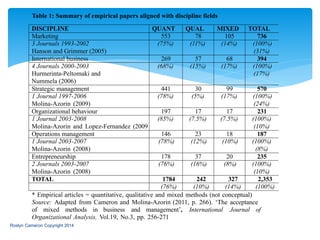
Table 1: Summary of empirical papers aligned with discipline fields
Roslyn Cameron Copyright 2014
DISCIPLINE QUANT QUAL MIXED TOTAL
Marketing 553 78 105 736
3 Journals 1993-2002 (75%) (11%) (14%) (100%)
Hanson and Grimmer (2005) (31%)
International business 269 57 68 394
4 Journals 2000-2003 (68%) (15%) (17%) (100%)
Hurmerinta-Peltomaki and (17%)
Nummela (2006)
Strategic management 441 30 99 570
1 Journal 1997-2006 (78%) (5%) (17%) (100%)
Molina-Azorin (2009) (24%)
Organizational behaviour 197 17 17 231
1 Journal 2003-2008 (85%) (7.5%) (7.5%) (100%)
Molina-Azorin and Lopez-Fernandez (2009 (10%)
Operations management 146 23 18 187
1 Journal 2003-2007 (78%) (12%) (10%) (100%)
Molina-Azorin (2008) (8%)
Entrepreneurship 178 37 20 235
2 Journals 2003-2007 (76%) (16%) (8%) (100%)
Molina-Azorin (2008) (10%)
TOTAL 1784 242 327 2,353
(76%) (10%) (14%) (100%)
* Empirical articles = quantitative, qualitative and mixed methods (not conceptual)
Source: Adapted from Cameron and Molina-Azorin (2011, p. 266). ‘The acceptance
of mixed methods in business and management’, International Journal of
Organizational Analysis, Vol.19, No.3, pp. 256-271
 Several authors propose pragmatism as the best paradigm for
justifying MMR:
 Pragmatism supports the use of both QUAL & QUAN in same
study &
rejects incompatibility stance
 Pragmatic researchers consider the RQ to be more
important than either the method or paradigm that
underlies it the method-
”dictatorship of the RQ”
 Pragmatists rejects forced choice between postpositivism &
constructionism with regards to logic, epistemology etc
 Methodological decisions depend on the RQ and stage of
the study
 Pragmatism is very practical and applied
 Teddlie & Tashakorri (2003:21) Handbook of Mixed Methods in Social & Behavioural
Sciences
 Thousand Oakes: CA, Sage Publications.
 Maxcy,S. (2003). Pragmatic threads in mixed methods research in the social
sciences:The search for multiplemodes of inquiry and the end of the philosophy
of formalism. In A. Tashakorri & C. Teddlie (Eds.), Handbook of mixed methods in
Roslyn Cameron Copyright 2014
Pragmatism and
MMR
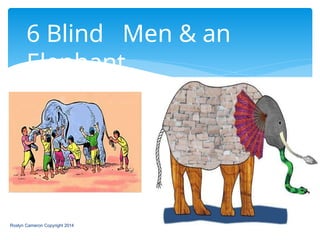
6 Blind Men & an
Elephant
Roslyn Cameron Copyright 2014
 The most interesting part about this story is
that since none of the men can experience
the elephant in its entirety on his own, the
only way to fully grasp the whole thing
would be to share and accept each others'
perceptions and then add them all
together. If each men were able to do this,
the entire picture of the elephant could be
realized. But, in their utter insistence on
being right, each man is doomed to never
see the entire picture.
Roslyn Cameron Copyright 2014
Mixed Methods
Research
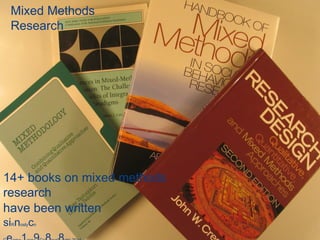
14+ books on mixed methods
research
have been written
siRnoslycn
Authorities/ recent
texts
 Starter Kit:
 Creswell JW and Plano Clark VL (2007; 2011)
 Tashakkori A and Teddlie C (Eds.) (2003; 2008;
2010)
 Greene and Caracelli (1989)
 Greene (2007)
 Bergman (2008)
 Andrews & Halcomb (2009)
 Morse & Neihaus (2009)
 Onwueugbuzie, A
 Johnson, B
 Mertens, D
Roslyn Cameron Copyright 2014
Gurus & their recent
words
Roslyn Cameron Copyright 2014
 Teddlie & Tashakkori (2009) Foundations
 Teddlie & Tashakkori (2003, 2010) SAGE handbook Eds
1 and 2
 Creswell and Plano Clark (2011) Design & Conduct
 Plano Clark & Creswell (2007) Reader
 Greene (2007) – Social inquiry
 Bergman (2008) – Theory & application in multiple fields
 Morse & Niehaus (2009) - Design
 Mertens (2005) – Education and Psychology
 Bazeley (2003) – CAQDAS - NVIVO
 Andrew & Halcomb (2009) – Nursing and Health
Sciences
 Hesse-Biber (2011) – Theory & practice
Roslyn Cameron Copyright 2014
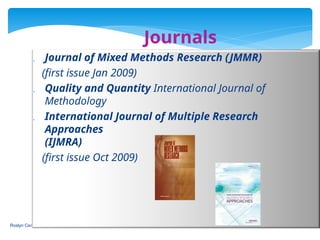
Journals
 Journal of Mixed Methods Research (JMMR)
(first issue Jan 2009)
 Quality and Quantity International Journal of
Methodology
 International Journal of Multiple Research
Approaches
(IJMRA)
(first issue Oct 2009)
Special issues- IJMRA
 International Journal of Multiple Research Approaches
(IJMRA)
 Special Issues:
 Special Issue ECRM 2013 Conference, (Vol.8, Issue 2)
 Mixed Methods Research: Philosophy, Policy and Practice in
Education (Vol. 7, Issue 1)
 Mixed Methods in Genders & Sexualities Research (Vol. 7,
Issue 2)
 Mixed Methods in Education 2012 Vol 6 (3)
 Mixed Methods in Business & Management 2011 Vol5 (3)
 Mixed Methods in Health Sciences 2011 Vol 5 (1)
 Mixed Methods for Novice Researchers: 2009 Vol 3 (1)
 Teaching Mixed Methods: 2008 Vol 4 (1)
 General Issue with Section: Computer Assisted Multiple and Blended
Roslyn Cameron Copyright 2014
Journals Special Issues on
MMR
International Journal of Educational Research
2008 Vol 47 (2)
 International Journal of Social Research Methodology Theory and
Practice
2005 Issue 3
 Organisational Research Methods 2015
 Feature Topic: Mixed Methods in the Organizational Sciences
Roslyn Cameron Copyright 2014
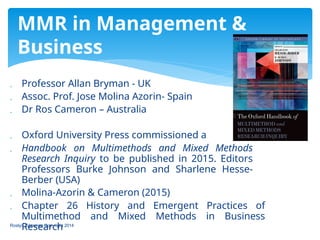
 Professor Allan Bryman - UK
 Assoc. Prof. Jose Molina Azorin- Spain
 Dr Ros Cameron – Australia
 Oxford University Press commissioned a
 Handbook on Multimethods and Mixed Methods
Research Inquiry to be published in 2015. Editors
Professors Burke Johnson and Sharlene Hesse-
Berber (USA)
 Molina-Azorin & Cameron (2015)
 Chapter 26 History and Emergent Practices of
Multimethod and Mixed Methods in Business
Research
MMR in Management &
Business
Roslyn Cameron Copyright 2014
ANZAM MMR
(SIG)
Roslyn Cameron Copyright 2014
 Australian and New Zealand Academy of
Management (ANZAM) launched its MMR
Special Interest Group (SIG) at its 2011
annual conference.
 In business and management fields the use of
MMR is growing and has been researched
through several studies (Bryman 2008, Bazeley
2008, Cameron
2010,
2011; Currall & Towler 2003; Molina-Azorin 2008,
2009; Molina-Azorin & Cameron 2010, Cameron
& Molina-
Terminology
Bridges Website
Adopted from Tashakkori and Teddlie's (2003)
Handbook of mixed methods in the social and
behavioral research) Glossary.
http://www.fiu.edu/~bridges/glossary.htm
Roslyn Cameron Copyright 2014
 Monomethod
 Mixed method
 Multimethod
 Inference: an umbrella term to refer to a final outcome of
a study. The outcome may consist of a conclusion about,
an understanding of, or an explanation for an event, [a]
behaviour, [b] relationship, or a case (Teddlie & Tashakkori,
2003, p. 35)
 Inference quality
 Inference transferablity
 Meta-inference
 Rules of integration
 Points of interface
Roslyn Cameron Copyright 2014
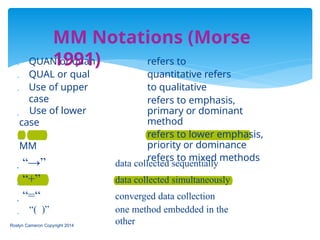
Basic MM terminology
 QUAN or quan
 QUAL or qual
 Use of upper
case
Roslyn Cameron Copyright 2014
 Use of lower
case
refers to
quantitative refers
to qualitative
refers to emphasis,
primary or dominant
method
refers to lower emphasis,
priority or dominance
refers to mixed methods

MM
 “→”
 “+”
 “=“
 “( )”
data collected sequentially
data collected simultaneously
converged data collection
one method embedded in the
other
MM Notations (Morse
1991)
Converged and
Embedded
Roslyn Cameron Copyright 2014
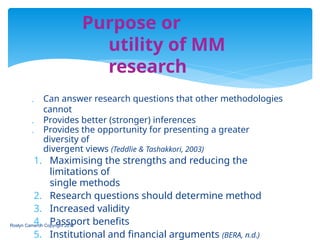
 Can answer research questions that other methodologies
cannot
 Provides better (stronger) inferences
 Provides the opportunity for presenting a greater
diversity of
divergent views (Teddlie & Tashakkori, 2003)
1. Maximising the strengths and reducing the
limitations of
single methods
2. Research questions should determine method
3. Increased validity
4. Passport benefits
5. Institutional and financial arguments (BERA, n.d.)
Roslyn Cameron Copyright 2014
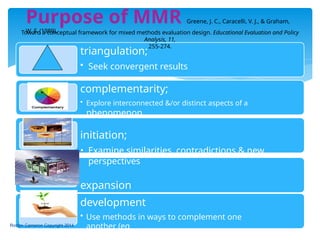
Purpose or
utility of MM
research
triangulation;
• Seek convergent results
complementarity;
• Explore interconnected &/or distinct aspects of a
phenomenon
initiation;
• Examine similarities, contradictions & new
perspectives
expansion
• Add breadth and scope to a project
development
• Use methods in ways to complement one
another (eg
interviews inform development of a survey)
Roslyn Cameron Copyright 2014
Purpose of MMR Greene, J. C., Caracelli, V. J., & Graham,
W. F. (1989).
Toward a conceptual framework for mixed methods evaluation design. Educational Evaluation and Policy
Analysis, 11,
255-274.
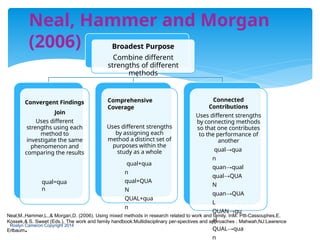
Broadest Purpose
Combine different
strengths of different
methods
Convergent Findings
Join
Uses different
strengths using each
method to
investigate the same
phenomenon and
comparing the results
qual=qua
n
Comprehensive
Coverage
Uses different strengths
by assigning each
method a distinct set of
purposes within the
study as a whole
qual+qua
n
qual+QUA
N
QUAL+qua
n
Connected
Contributions
Uses different strengths
by connecting methods
so that one contributes
to the performance of
another
qual→qua
n
quan→qual
qual→QUA
N
quan→QUA
L
QUAN→qu
al
QUAL→qua
n
Roslyn Cameron Copyright 2014
Neal, Hammer and Morgan
(2006)
Neal,M.,Hammer,L.,& Morgan,D. (2006). Using mixed methods in research related to work and family. InM. Pitt-Cassouphes,E.
Kossek,& S. Sweet (Eds.), The work and family handbook:Multidisciplinary per-spectives and approaches . Mahwah,NJ:Lawrence
Erlbaum.
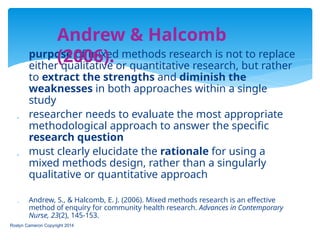
 purpose of mixed methods research is not to replace
either qualitative or quantitative research, but rather
to extract the strengths and diminish the
weaknesses in both approaches within a single
study
 researcher needs to evaluate the most appropriate
methodological approach to answer the specific
research question
 must clearly elucidate the rationale for using a
mixed methods design, rather than a singularly
qualitative or quantitative approach
 Andrew, S., & Halcomb, E. J. (2006). Mixed methods research is an effective
method of enquiry for community health research. Advances in Contemporary
Nurse, 23(2), 145-153.
Roslyn Cameron Copyright 2014
Andrew & Halcomb
(2006).
 A Rationale for Employing Mixed Methods
Design in Doctoral Research about Female
Students’ Academic Achievement in
Secondary Schools in Papua New Guinea
 Dinah R. Dovona-Ope (oped@usq.edu.au)
 Faculty of Education, University of Southern
Queensland, Australia
 International Journal of Pedagogies and Learning,
4(2),
pp. 59-67. February 2008
Roslyn Cameron Copyright 2014
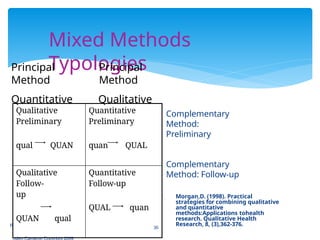
Example
Mixed Methods
Typologies
Complementary
Method:
Preliminary
Complementary
Method: Follow-up
 Morgan,D. (1998). Practical
strategies for combining qualitative
and quantitative
methods:Applications tohealth
research. Qualitative Health
Research, 8, (3),362-376.
Principal
Method
Quantitative
Principal
Method
Qualitative
R
Qualitative
Preliminary
qual QUAN
Quantitative
Preliminary
quan QUAL
Qualitative
Follow-
up
QUAN qual
oslyn Cameron Copyright 2009
Quantitative
Follow-up
QUAL quan
35
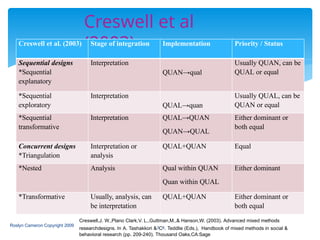
Creswell et al
(2003)
Creswell et al. (2003) Stage of integration Implementation Priority / Status
Sequential designs
*Sequential
explanatory
Interpretation
QUAN→qual
Usually QUAN, can be
QUAL or equal
*Sequential
exploratory
Interpretation
QUAL→quan
Usually QUAL, can be
QUAN or equal
*Sequential
transformative
Interpretation QUAL→QUAN
QUAN→QUAL
Either dominant or
both equal
Concurrent designs
*Triangulation
Interpretation or
analysis
QUAL+QUAN Equal
*Nested Analysis Qual within QUAN
Quan within QUAL
Either dominant
*Transformative Usually, analysis, can
be interpretation
QUAL+QUAN Either dominant or
both equal
Roslyn Cameron Copyright 2009
Creswell,J. W.,Plano Clark,V. L.,Guttman,M.,& Hanson,W. (2003). Advanced mixed methods
researchdesigns. In A. Tashakkori &3C6. Teddlie (Eds.), Handbook of mixed methods in social &
behavioral research (pp. 209-240). Thousand Oaks,CA:Sage
Roslyn Cameron Copyright 2014
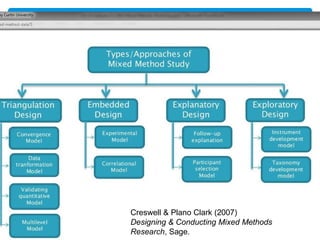
Creswell & Plano Clark (2007)
Designing & Conducting Mixed Methods
Research, Sage.
Roslyn Cameron Copyright 2009 38
Roslyn Cameron Copyright 2009 39
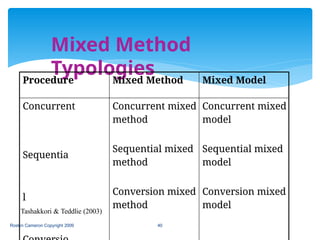
Mixed Method
Typologies
Roslyn Cameron Copyright 2009 40
Procedure Mixed Method Mixed Model
Concurrent
Sequentia
l
Concurrent mixed
method
Sequential mixed
method
Conversion mixed
method
Concurrent mixed
model
Sequential mixed
model
Conversion mixed
model
Tashakkori & Teddlie (2003)
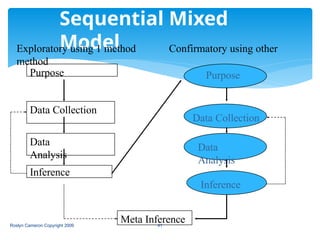
Sequential Mixed
Model
Purpose
Data Collection
Data
Analysis
Inference
Meta Inference
Purpose
Data Collection
Data
Analysis
Inference
Exploratory using 1 method Confirmatory using other
method
Roslyn Cameron Copyright 2009 41
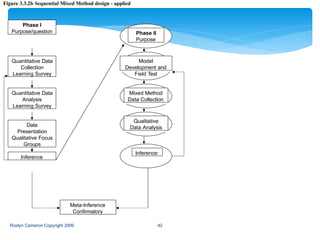
Figure 3.3.2b Sequential Mixed Method design - applied
Phase I
Purpose/question
Quantitative Data
Collection
Learning Survey
Quantitative Data
Analysis
Learning Survey
Meta-Inference
Confirmatory
Inference
Phase II
Purpose
Qualitative
Data Analysis
Inference:
Data
Presentation
Qualitative Focus
Groups
Model
Development and
Field Test
Mixed Method
Data Collection
Roslyn Cameron Copyright 2009 42
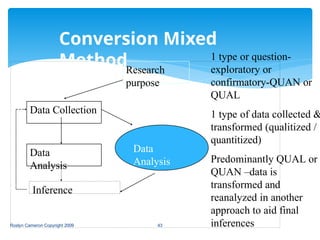
Conversion Mixed
MethodResearch
purpose
Inference
Data
Analysis
Data Collection
Data
Analysis
1 type or question-
exploratory or
confirmatory-QUAN or
QUAL
1 type of data collected &
transformed (qualitized /
quantitized)
Predominantly QUAL or
QUAN –data is
transformed and
reanalyzed in another
approach to aid final
inferences
43
Roslyn Cameron Copyright 2009
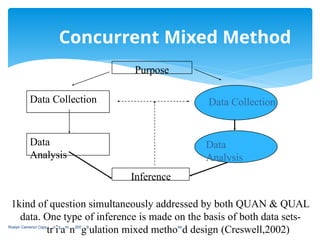
Concurrent Mixed Method
Purpose
Data Collection
Data
Analysis
Data Collection
Data
Analysis
Inference
1kind of question simultaneously addressed by both QUAN & QUAL
data. One type of inference is made on the basis of both data sets-
Roslyn Cameron Copy
trri
ig
aht
n200
g9
ulation mixed metho44
d design (Creswell,2002)
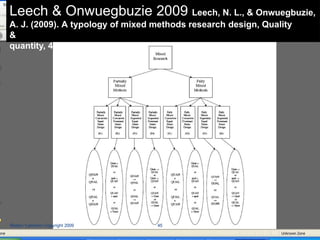
Leech & Onwuegbuzie 2009 Leech, N. L., & Onwuegbuzie,
Roslyn Cameron Copyright 2009 45
A. J. (2009). A typology of mixed methods research design, Quality
&
quantity, 43(2), 265-275.
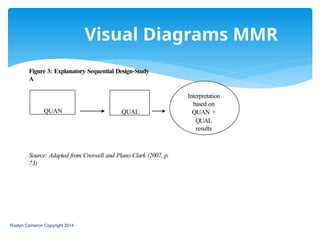
Visual Diagrams MMR
Figure 3: Explanatory Sequential Design-Study
A
Source: Adapted from Creswell and Plano Clark (2007, p.
73)
QUAN QUAL
Interpretation
based on
QUAN +
QUAL
results
Roslyn Cameron Copyright 2014
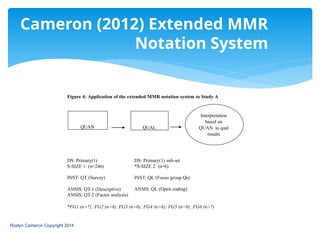
Figure 4: Application of the extended MMR notation system to Study A
DS: Primary(1)
S-SIZE 1: (n=246)
INST: QT (Survey)
ANSIS: QT-1 (Descriptive)
ANSIS: QT-2 (Factor analysis)
DS: Primary(1) sub-set
*S-SIZE 2: (n=6)
INST: QL (Focus group Qs)
ANSIS: QL (Open coding)
*FG1 (n=7); FG2 (n=8), FG3 (n=6); FG4 (n=8); FG5 (n=9); FG6 (n=7)
QUAN QUAL
Interpretation
based on
QUAN to qual
results
Roslyn Cameron Copyright 2014
Cameron (2012) Extended MMR
Notation System
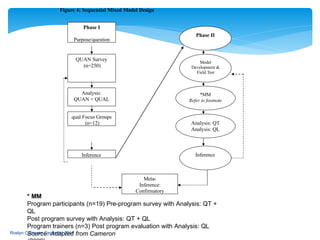
Figure 4: Sequential Mixed Model Design
Phase I
Purpose/question
QUAN Survey
(n=250)
Analysis:
QUAN + QUAL
Meta-
Inference:
Confirmatory
Inference
Phase II
Analysis: QT
Analysis: QL
Inference
qual Focus Groups
(n=12)
Model
Development &
Field Test
*MM
Refer to footnote
* MM
Source: Adapted from Cameron
Program participants (n=19) Pre-program survey with Analysis: QT +
QL
Post program survey with Analysis: QT + QL
Program trainers (n=3) Post program evaluation with Analysis: QL
Roslyn Cameron Copyright 2014
Opportunities
Traps/Risks
Roslyn Cameron Copyright 2014
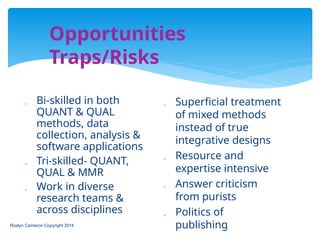
 Bi-skilled in both
QUANT & QUAL
methods, data
collection, analysis &
software applications
 Tri-skilled- QUANT,
QUAL & MMR
 Work in diverse
research teams &
across disciplines
 Superficial treatment
of mixed methods
instead of true
integrative designs
 Resource and
expertise intensive
 Answer criticism
from purists
 Politics of
publishing
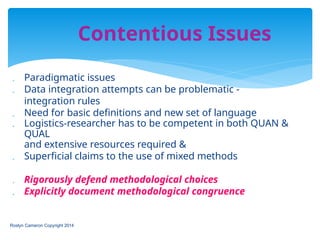
 Paradigmatic issues
 Data integration attempts can be problematic -
integration rules
 Need for basic definitions and new set of language
 Logistics-researcher has to be competent in both QUAN &
QUAL
and extensive resources required &
 Superficial claims to the use of mixed methods
 Rigorously defend methodological choices
 Explicitly document methodological congruence
Roslyn Cameron Copyright 2014
Contentious Issues
Reference
s
Roslyn Cameron Copyright 2014
Cameron, R (2011), ’Mixed Methods Research: the Five Ps Framework’, Electronic Journal
of Business Research Methods, Vol. 9, No. 2, September, pp. 96-108. ISSN: 1477-7029
http://www.ejbrm.com/issue/current.html
Cameron, R and Miller, P, (2011), ‘Mixed method research designs: a case study of their
adoption in a
doctor of business administration program’, International Journal of Multiple Research
Approaches, Vol.
5, No. 3, December, pp. 293-308. ISBN 978-1-921348-95-2.
Cameron, R, and Molina-Azorin, J, (2011), ‘The acceptance of mixed methods in business
and
management’, International Journal of Organizational Analysis, Vol.19, No.3, pp. 256-271.
ISSN:1934-8835
Molina-Azorin, J and Cameron, R, (2010) ‘The application of mixed methods in organizational
research: a literature review’, Electronic Journal of Business Research Methods, Vol. 8, No. 2,
pp. 95-105. ISSN: 1477- 7029
Cameron, R, (2010) ‘Is Mixed Methods Used in Australian Career Development Research?’,
Australian Journal of Career Development , Vol. 19, No.3, Spring, pp. 53-67 . ISSN: 1038-
4162
Cameron, R, (2010) ‘Mixed Methods in VET Research: Usage and quality’, International
Journal of Training
Research, Vol. 8, No. 1, April, pp. 25-39. ISSN: 1448-0220
Cameron, R, (2010) ‘Mixed methods in business and management: A call to the ‘first
generation’, Journal
of Management & Organisation, Vol. 17 , No. 2 , March, pp. 245-267. ISSN:
1833367213243209
 BOOK CHAPTERS

 Molina-Azorin, J and Cameron, R, (forthcoming 2015) ‘Emergent MMR in management
and marketing’, Oxford Handbook of Mixed and Multimethod Research (Eds) Sharlene
Hesse-Biber and Burke Johnson, Oxford University Press.

 Cameron, R and Sankaran, S (forthcoming 2015) 'Mixed methods research in project
management' in Methods, designs and practices for research into Project Management, (Eds)
Beverly Pasian and Kobus Smit , Gower Publishing (release in 2014). Chapter 22, pp. 273-
286. ISBN: 978-1-4094-4880-8

 Cameron. R (forthcoming 2015) ‘The emerging use of mixed methods in educational
research ‘, in Meanings for and in Educational Research, (Eds) Baguley, M, Jasman, A and
Findlay, Y. Chapter, pp. Routledge

 Cameron, R and Sankaran, S (2013) 'Mixed methods research design: well beyond the
notion of triangulation' in Novel Approaches to Organizational Project Management
Research: Translational and Transformational, (Eds) Natalie Drouin, Ralf Muller and Shankar
Sankaran, Copenhagen Business School Press. Chapter 14, pp. 383-401. ISBN 978-87-630-
0249-3.

 Cameron. R (2013) ‘Mixed Methods Research: A world of metaphors’, in Metaphors for,
in and of Education Research, (Eds) Midgley, W, Trimmer, K and Davies, A (2012). Chapter
4, pp. 51-65. Cambridge Scholars, Newcastle upon Tyne, UK. ISBN: 1-4438-4398-9.
Roslyn Cameron Copyright 2014
References
Dr Ros Cameron
ros.cameron@curtin.ed
u.au
JOIN
MMR SIG of
ANZAM

Dr-r-cameron_Mixed Methodology- Research.pptx

  • 1.
    Mixed Methods Research WORKSHOP 2ndJuly 2015 Deakin University, Melbourne Dr Roslyn Cameron Co-Convenor of Mixed Methods SIG - ANZAM Research Fellow Curtin Business School Roslyn Cameron Copyright 2014
  • 2.
    Mixed Methods Research  Introduceand definitions  Historical & philosophical roots of MMR  Authorities & publications in the field  Terminologies, notation system & visuals  Purposes  Research designs & typologies Research Fellow at Curtin University, WA. Ros is a Fellow of the Australian Human Resources Institute (FAHRI) and Co- Convenor of the Mixed Methods Research Special Interest Group of ANZAM. She utilizes mixed methods in many of her funded research projects and publishes in the use of mixed methods across business and management disciplines. She has run several workshops on mixed methods at doctoral symposiums and academic conferences. She has been granted $1.09 (AUD) million in research funding and has over 90 publications. Roslyn Cameron Copyright 2014
  • 3.
    Definition Mixed Methods Roslyn CameronCopyright 2014 In general, mixed methods research represents research that involves collecting, analyzing, and interpreting quantitative and qualitative data in a single study or in a series of studies that investigate the same underlying phenomenon. Leech N, Onwuegbuzie A, (2008) A typology of mixed methods research designs, Quality and Quantity, 43(2), March, pp. 265-275.
  • 4.
    Definition Mixed Methods Roslyn CameronCopyright 2014 ⚫Mixed methods research is a research design with philosophical assumptions as well as methods of inquiry. As a methodology, it involves philosophical assumptions that guide the direction of the collection and analysis of data and the mixture of qualitative and quantitative data in a single study or series of studies. Its central premise is that the use of quantitative and qualitative approaches in combination provides a better understanding of research problems that either approach alone. ⚫ Creswell and Plano Clark (2007: 5)
  • 5.
    Methodological dichotomy Roslyn Cameron Copyright2014 Quantitati ve (Positivist) Objective reality Caus al Detached Samples/populatio ns Contrive d Variables Numeric al Statistica Qualitative (postpositivist ) Subjective reality Meanings Human intentions Personally involved Study cases Actors in natural settings Verbal & pictorial data Generalise case findings Mixed Methods
  • 6.
  • 7.
    Ontology:  philosophical studyof the nature of reality  worldview Epistemology:  Philosophy/theory about the nature and scope of knowledge  Questions what knowledge is and how it can be acquired and the extent of its validity and limits Roslyn Cameron Copyright 2014 Paragdigmatic Issues
  • 8.
    Roslyn Cameron Copyright2014 Source: Adapted from Teddlie and Taskakkori (2003, p. 11)
  • 9.
    Research choices and theresearch process ‘onion’ Roslyn Cameron Copyright 2014 Source: Saunders, N, Lewis & Thornhill, A(2012) Research Methods for Business Students, 6th Edn, Pearson.
  • 10.
    Basic typology Source: Source: Saunders,N, Lewis & Thornhill, A(2012: 165) Research Methods for Business Students, 6th Edn, Pearson Roslyn Cameron Copyright 2013
  • 11.
     ‘Paradigmatic wars’-catalyst  Short History-early 1980’s  Rejects the ‘either or’ approach  ‘Quiet’ revolution-resolve tensions  Third methodological movement Tashakkori & Teddlie (2003) Handbook of Mixed Methods in Social & Behavioural Sciences  Last ten years research methods texts have begun to address Mixed Methods  Authorities emerging in the area Roslyn Cameron Copyright 2014 Historical perspective- MM
  • 12.
    History of mixedmethods research Creswell and Plano Clark (2007) Designing and Conducting Mixed methods Research, Thousand Oakes, CA, Sage Publications Roslyn Cameron Copyright 2014
  • 13.
    Third Methodological Movement  Growingbody of trans-disciplinary literature.  Prominent research methodologists/authorities from across discipline fields are emerging and guiding the commentary and the movements’ momentum.  …‘today, we see cross-cultural international interest, interdisciplinary interest, publication possibilities, and public and private funding opportunities for mixed methods research’ (Creswell and Plano Clark 2007: 18) . Roslyn Cameron Copyright 2014
  • 14.
    Table 1: Summaryof empirical papers aligned with discipline fields Roslyn Cameron Copyright 2014 DISCIPLINE QUANT QUAL MIXED TOTAL Marketing 553 78 105 736 3 Journals 1993-2002 (75%) (11%) (14%) (100%) Hanson and Grimmer (2005) (31%) International business 269 57 68 394 4 Journals 2000-2003 (68%) (15%) (17%) (100%) Hurmerinta-Peltomaki and (17%) Nummela (2006) Strategic management 441 30 99 570 1 Journal 1997-2006 (78%) (5%) (17%) (100%) Molina-Azorin (2009) (24%) Organizational behaviour 197 17 17 231 1 Journal 2003-2008 (85%) (7.5%) (7.5%) (100%) Molina-Azorin and Lopez-Fernandez (2009 (10%) Operations management 146 23 18 187 1 Journal 2003-2007 (78%) (12%) (10%) (100%) Molina-Azorin (2008) (8%) Entrepreneurship 178 37 20 235 2 Journals 2003-2007 (76%) (16%) (8%) (100%) Molina-Azorin (2008) (10%) TOTAL 1784 242 327 2,353 (76%) (10%) (14%) (100%) * Empirical articles = quantitative, qualitative and mixed methods (not conceptual) Source: Adapted from Cameron and Molina-Azorin (2011, p. 266). ‘The acceptance of mixed methods in business and management’, International Journal of Organizational Analysis, Vol.19, No.3, pp. 256-271
  • 15.
     Several authorspropose pragmatism as the best paradigm for justifying MMR:  Pragmatism supports the use of both QUAL & QUAN in same study & rejects incompatibility stance  Pragmatic researchers consider the RQ to be more important than either the method or paradigm that underlies it the method- ”dictatorship of the RQ”  Pragmatists rejects forced choice between postpositivism & constructionism with regards to logic, epistemology etc  Methodological decisions depend on the RQ and stage of the study  Pragmatism is very practical and applied  Teddlie & Tashakorri (2003:21) Handbook of Mixed Methods in Social & Behavioural Sciences  Thousand Oakes: CA, Sage Publications.  Maxcy,S. (2003). Pragmatic threads in mixed methods research in the social sciences:The search for multiplemodes of inquiry and the end of the philosophy of formalism. In A. Tashakorri & C. Teddlie (Eds.), Handbook of mixed methods in Roslyn Cameron Copyright 2014 Pragmatism and MMR
  • 16.
    6 Blind Men& an Elephant Roslyn Cameron Copyright 2014
  • 17.
     The mostinteresting part about this story is that since none of the men can experience the elephant in its entirety on his own, the only way to fully grasp the whole thing would be to share and accept each others' perceptions and then add them all together. If each men were able to do this, the entire picture of the elephant could be realized. But, in their utter insistence on being right, each man is doomed to never see the entire picture. Roslyn Cameron Copyright 2014
  • 18.
    Mixed Methods Research 14+ bookson mixed methods research have been written siRnoslycn
  • 19.
    Authorities/ recent texts  StarterKit:  Creswell JW and Plano Clark VL (2007; 2011)  Tashakkori A and Teddlie C (Eds.) (2003; 2008; 2010)  Greene and Caracelli (1989)  Greene (2007)  Bergman (2008)  Andrews & Halcomb (2009)  Morse & Neihaus (2009)  Onwueugbuzie, A  Johnson, B  Mertens, D Roslyn Cameron Copyright 2014
  • 20.
    Gurus & theirrecent words Roslyn Cameron Copyright 2014  Teddlie & Tashakkori (2009) Foundations  Teddlie & Tashakkori (2003, 2010) SAGE handbook Eds 1 and 2  Creswell and Plano Clark (2011) Design & Conduct  Plano Clark & Creswell (2007) Reader  Greene (2007) – Social inquiry  Bergman (2008) – Theory & application in multiple fields  Morse & Niehaus (2009) - Design  Mertens (2005) – Education and Psychology  Bazeley (2003) – CAQDAS - NVIVO  Andrew & Halcomb (2009) – Nursing and Health Sciences  Hesse-Biber (2011) – Theory & practice
  • 21.
    Roslyn Cameron Copyright2014 Journals  Journal of Mixed Methods Research (JMMR) (first issue Jan 2009)  Quality and Quantity International Journal of Methodology  International Journal of Multiple Research Approaches (IJMRA) (first issue Oct 2009)
  • 22.
    Special issues- IJMRA International Journal of Multiple Research Approaches (IJMRA)  Special Issues:  Special Issue ECRM 2013 Conference, (Vol.8, Issue 2)  Mixed Methods Research: Philosophy, Policy and Practice in Education (Vol. 7, Issue 1)  Mixed Methods in Genders & Sexualities Research (Vol. 7, Issue 2)  Mixed Methods in Education 2012 Vol 6 (3)  Mixed Methods in Business & Management 2011 Vol5 (3)  Mixed Methods in Health Sciences 2011 Vol 5 (1)  Mixed Methods for Novice Researchers: 2009 Vol 3 (1)  Teaching Mixed Methods: 2008 Vol 4 (1)  General Issue with Section: Computer Assisted Multiple and Blended Roslyn Cameron Copyright 2014
  • 23.
    Journals Special Issueson MMR International Journal of Educational Research 2008 Vol 47 (2)  International Journal of Social Research Methodology Theory and Practice 2005 Issue 3  Organisational Research Methods 2015  Feature Topic: Mixed Methods in the Organizational Sciences Roslyn Cameron Copyright 2014
  • 24.
     Professor AllanBryman - UK  Assoc. Prof. Jose Molina Azorin- Spain  Dr Ros Cameron – Australia  Oxford University Press commissioned a  Handbook on Multimethods and Mixed Methods Research Inquiry to be published in 2015. Editors Professors Burke Johnson and Sharlene Hesse- Berber (USA)  Molina-Azorin & Cameron (2015)  Chapter 26 History and Emergent Practices of Multimethod and Mixed Methods in Business Research MMR in Management & Business Roslyn Cameron Copyright 2014
  • 25.
    ANZAM MMR (SIG) Roslyn CameronCopyright 2014  Australian and New Zealand Academy of Management (ANZAM) launched its MMR Special Interest Group (SIG) at its 2011 annual conference.  In business and management fields the use of MMR is growing and has been researched through several studies (Bryman 2008, Bazeley 2008, Cameron 2010, 2011; Currall & Towler 2003; Molina-Azorin 2008, 2009; Molina-Azorin & Cameron 2010, Cameron & Molina-
  • 26.
    Terminology Bridges Website Adopted fromTashakkori and Teddlie's (2003) Handbook of mixed methods in the social and behavioral research) Glossary. http://www.fiu.edu/~bridges/glossary.htm Roslyn Cameron Copyright 2014
  • 27.
     Monomethod  Mixedmethod  Multimethod  Inference: an umbrella term to refer to a final outcome of a study. The outcome may consist of a conclusion about, an understanding of, or an explanation for an event, [a] behaviour, [b] relationship, or a case (Teddlie & Tashakkori, 2003, p. 35)  Inference quality  Inference transferablity  Meta-inference  Rules of integration  Points of interface Roslyn Cameron Copyright 2014 Basic MM terminology
  • 28.
     QUAN orquan  QUAL or qual  Use of upper case Roslyn Cameron Copyright 2014  Use of lower case refers to quantitative refers to qualitative refers to emphasis, primary or dominant method refers to lower emphasis, priority or dominance refers to mixed methods  MM  “→”  “+”  “=“  “( )” data collected sequentially data collected simultaneously converged data collection one method embedded in the other MM Notations (Morse 1991)
  • 29.
  • 30.
     Can answerresearch questions that other methodologies cannot  Provides better (stronger) inferences  Provides the opportunity for presenting a greater diversity of divergent views (Teddlie & Tashakkori, 2003) 1. Maximising the strengths and reducing the limitations of single methods 2. Research questions should determine method 3. Increased validity 4. Passport benefits 5. Institutional and financial arguments (BERA, n.d.) Roslyn Cameron Copyright 2014 Purpose or utility of MM research
  • 31.
    triangulation; • Seek convergentresults complementarity; • Explore interconnected &/or distinct aspects of a phenomenon initiation; • Examine similarities, contradictions & new perspectives expansion • Add breadth and scope to a project development • Use methods in ways to complement one another (eg interviews inform development of a survey) Roslyn Cameron Copyright 2014 Purpose of MMR Greene, J. C., Caracelli, V. J., & Graham, W. F. (1989). Toward a conceptual framework for mixed methods evaluation design. Educational Evaluation and Policy Analysis, 11, 255-274.
  • 32.
    Broadest Purpose Combine different strengthsof different methods Convergent Findings Join Uses different strengths using each method to investigate the same phenomenon and comparing the results qual=qua n Comprehensive Coverage Uses different strengths by assigning each method a distinct set of purposes within the study as a whole qual+qua n qual+QUA N QUAL+qua n Connected Contributions Uses different strengths by connecting methods so that one contributes to the performance of another qual→qua n quan→qual qual→QUA N quan→QUA L QUAN→qu al QUAL→qua n Roslyn Cameron Copyright 2014 Neal, Hammer and Morgan (2006) Neal,M.,Hammer,L.,& Morgan,D. (2006). Using mixed methods in research related to work and family. InM. Pitt-Cassouphes,E. Kossek,& S. Sweet (Eds.), The work and family handbook:Multidisciplinary per-spectives and approaches . Mahwah,NJ:Lawrence Erlbaum.
  • 33.
     purpose ofmixed methods research is not to replace either qualitative or quantitative research, but rather to extract the strengths and diminish the weaknesses in both approaches within a single study  researcher needs to evaluate the most appropriate methodological approach to answer the specific research question  must clearly elucidate the rationale for using a mixed methods design, rather than a singularly qualitative or quantitative approach  Andrew, S., & Halcomb, E. J. (2006). Mixed methods research is an effective method of enquiry for community health research. Advances in Contemporary Nurse, 23(2), 145-153. Roslyn Cameron Copyright 2014 Andrew & Halcomb (2006).
  • 34.
     A Rationalefor Employing Mixed Methods Design in Doctoral Research about Female Students’ Academic Achievement in Secondary Schools in Papua New Guinea  Dinah R. Dovona-Ope (oped@usq.edu.au)  Faculty of Education, University of Southern Queensland, Australia  International Journal of Pedagogies and Learning, 4(2), pp. 59-67. February 2008 Roslyn Cameron Copyright 2014 Example
  • 35.
    Mixed Methods Typologies Complementary Method: Preliminary Complementary Method: Follow-up Morgan,D. (1998). Practical strategies for combining qualitative and quantitative methods:Applications tohealth research. Qualitative Health Research, 8, (3),362-376. Principal Method Quantitative Principal Method Qualitative R Qualitative Preliminary qual QUAN Quantitative Preliminary quan QUAL Qualitative Follow- up QUAN qual oslyn Cameron Copyright 2009 Quantitative Follow-up QUAL quan 35
  • 36.
    Creswell et al (2003) Creswellet al. (2003) Stage of integration Implementation Priority / Status Sequential designs *Sequential explanatory Interpretation QUAN→qual Usually QUAN, can be QUAL or equal *Sequential exploratory Interpretation QUAL→quan Usually QUAL, can be QUAN or equal *Sequential transformative Interpretation QUAL→QUAN QUAN→QUAL Either dominant or both equal Concurrent designs *Triangulation Interpretation or analysis QUAL+QUAN Equal *Nested Analysis Qual within QUAN Quan within QUAL Either dominant *Transformative Usually, analysis, can be interpretation QUAL+QUAN Either dominant or both equal Roslyn Cameron Copyright 2009 Creswell,J. W.,Plano Clark,V. L.,Guttman,M.,& Hanson,W. (2003). Advanced mixed methods researchdesigns. In A. Tashakkori &3C6. Teddlie (Eds.), Handbook of mixed methods in social & behavioral research (pp. 209-240). Thousand Oaks,CA:Sage
  • 37.
    Roslyn Cameron Copyright2014 Creswell & Plano Clark (2007) Designing & Conducting Mixed Methods Research, Sage.
  • 38.
  • 39.
  • 40.
    Mixed Method Typologies Roslyn CameronCopyright 2009 40 Procedure Mixed Method Mixed Model Concurrent Sequentia l Concurrent mixed method Sequential mixed method Conversion mixed method Concurrent mixed model Sequential mixed model Conversion mixed model Tashakkori & Teddlie (2003)
  • 41.
    Sequential Mixed Model Purpose Data Collection Data Analysis Inference MetaInference Purpose Data Collection Data Analysis Inference Exploratory using 1 method Confirmatory using other method Roslyn Cameron Copyright 2009 41
  • 42.
    Figure 3.3.2b SequentialMixed Method design - applied Phase I Purpose/question Quantitative Data Collection Learning Survey Quantitative Data Analysis Learning Survey Meta-Inference Confirmatory Inference Phase II Purpose Qualitative Data Analysis Inference: Data Presentation Qualitative Focus Groups Model Development and Field Test Mixed Method Data Collection Roslyn Cameron Copyright 2009 42
  • 43.
    Conversion Mixed MethodResearch purpose Inference Data Analysis Data Collection Data Analysis 1type or question- exploratory or confirmatory-QUAN or QUAL 1 type of data collected & transformed (qualitized / quantitized) Predominantly QUAL or QUAN –data is transformed and reanalyzed in another approach to aid final inferences 43 Roslyn Cameron Copyright 2009
  • 44.
    Concurrent Mixed Method Purpose DataCollection Data Analysis Data Collection Data Analysis Inference 1kind of question simultaneously addressed by both QUAN & QUAL data. One type of inference is made on the basis of both data sets- Roslyn Cameron Copy trri ig aht n200 g9 ulation mixed metho44 d design (Creswell,2002)
  • 45.
    Leech & Onwuegbuzie2009 Leech, N. L., & Onwuegbuzie, Roslyn Cameron Copyright 2009 45 A. J. (2009). A typology of mixed methods research design, Quality & quantity, 43(2), 265-275.
  • 46.
    Visual Diagrams MMR Figure3: Explanatory Sequential Design-Study A Source: Adapted from Creswell and Plano Clark (2007, p. 73) QUAN QUAL Interpretation based on QUAN + QUAL results Roslyn Cameron Copyright 2014
  • 47.
    Figure 4: Applicationof the extended MMR notation system to Study A DS: Primary(1) S-SIZE 1: (n=246) INST: QT (Survey) ANSIS: QT-1 (Descriptive) ANSIS: QT-2 (Factor analysis) DS: Primary(1) sub-set *S-SIZE 2: (n=6) INST: QL (Focus group Qs) ANSIS: QL (Open coding) *FG1 (n=7); FG2 (n=8), FG3 (n=6); FG4 (n=8); FG5 (n=9); FG6 (n=7) QUAN QUAL Interpretation based on QUAN to qual results Roslyn Cameron Copyright 2014 Cameron (2012) Extended MMR Notation System
  • 48.
    Figure 4: SequentialMixed Model Design Phase I Purpose/question QUAN Survey (n=250) Analysis: QUAN + QUAL Meta- Inference: Confirmatory Inference Phase II Analysis: QT Analysis: QL Inference qual Focus Groups (n=12) Model Development & Field Test *MM Refer to footnote * MM Source: Adapted from Cameron Program participants (n=19) Pre-program survey with Analysis: QT + QL Post program survey with Analysis: QT + QL Program trainers (n=3) Post program evaluation with Analysis: QL Roslyn Cameron Copyright 2014
  • 49.
    Opportunities Traps/Risks Roslyn Cameron Copyright2014  Bi-skilled in both QUANT & QUAL methods, data collection, analysis & software applications  Tri-skilled- QUANT, QUAL & MMR  Work in diverse research teams & across disciplines  Superficial treatment of mixed methods instead of true integrative designs  Resource and expertise intensive  Answer criticism from purists  Politics of publishing
  • 50.
     Paradigmatic issues Data integration attempts can be problematic - integration rules  Need for basic definitions and new set of language  Logistics-researcher has to be competent in both QUAN & QUAL and extensive resources required &  Superficial claims to the use of mixed methods  Rigorously defend methodological choices  Explicitly document methodological congruence Roslyn Cameron Copyright 2014 Contentious Issues
  • 51.
    Reference s Roslyn Cameron Copyright2014 Cameron, R (2011), ’Mixed Methods Research: the Five Ps Framework’, Electronic Journal of Business Research Methods, Vol. 9, No. 2, September, pp. 96-108. ISSN: 1477-7029 http://www.ejbrm.com/issue/current.html Cameron, R and Miller, P, (2011), ‘Mixed method research designs: a case study of their adoption in a doctor of business administration program’, International Journal of Multiple Research Approaches, Vol. 5, No. 3, December, pp. 293-308. ISBN 978-1-921348-95-2. Cameron, R, and Molina-Azorin, J, (2011), ‘The acceptance of mixed methods in business and management’, International Journal of Organizational Analysis, Vol.19, No.3, pp. 256-271. ISSN:1934-8835 Molina-Azorin, J and Cameron, R, (2010) ‘The application of mixed methods in organizational research: a literature review’, Electronic Journal of Business Research Methods, Vol. 8, No. 2, pp. 95-105. ISSN: 1477- 7029 Cameron, R, (2010) ‘Is Mixed Methods Used in Australian Career Development Research?’, Australian Journal of Career Development , Vol. 19, No.3, Spring, pp. 53-67 . ISSN: 1038- 4162 Cameron, R, (2010) ‘Mixed Methods in VET Research: Usage and quality’, International Journal of Training Research, Vol. 8, No. 1, April, pp. 25-39. ISSN: 1448-0220 Cameron, R, (2010) ‘Mixed methods in business and management: A call to the ‘first generation’, Journal of Management & Organisation, Vol. 17 , No. 2 , March, pp. 245-267. ISSN: 1833367213243209
  • 52.
     BOOK CHAPTERS  Molina-Azorin, J and Cameron, R, (forthcoming 2015) ‘Emergent MMR in management and marketing’, Oxford Handbook of Mixed and Multimethod Research (Eds) Sharlene Hesse-Biber and Burke Johnson, Oxford University Press.   Cameron, R and Sankaran, S (forthcoming 2015) 'Mixed methods research in project management' in Methods, designs and practices for research into Project Management, (Eds) Beverly Pasian and Kobus Smit , Gower Publishing (release in 2014). Chapter 22, pp. 273- 286. ISBN: 978-1-4094-4880-8   Cameron. R (forthcoming 2015) ‘The emerging use of mixed methods in educational research ‘, in Meanings for and in Educational Research, (Eds) Baguley, M, Jasman, A and Findlay, Y. Chapter, pp. Routledge   Cameron, R and Sankaran, S (2013) 'Mixed methods research design: well beyond the notion of triangulation' in Novel Approaches to Organizational Project Management Research: Translational and Transformational, (Eds) Natalie Drouin, Ralf Muller and Shankar Sankaran, Copenhagen Business School Press. Chapter 14, pp. 383-401. ISBN 978-87-630- 0249-3.   Cameron. R (2013) ‘Mixed Methods Research: A world of metaphors’, in Metaphors for, in and of Education Research, (Eds) Midgley, W, Trimmer, K and Davies, A (2012). Chapter 4, pp. 51-65. Cambridge Scholars, Newcastle upon Tyne, UK. ISBN: 1-4438-4398-9. Roslyn Cameron Copyright 2014 References
  • 53.