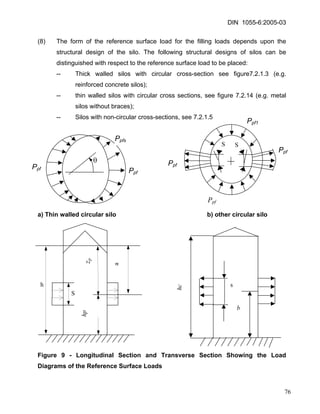
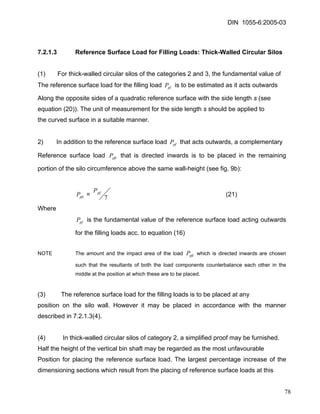
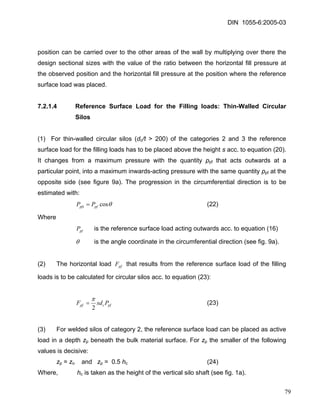
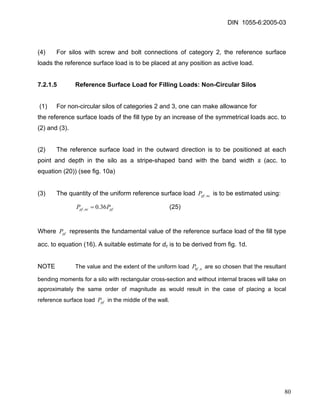
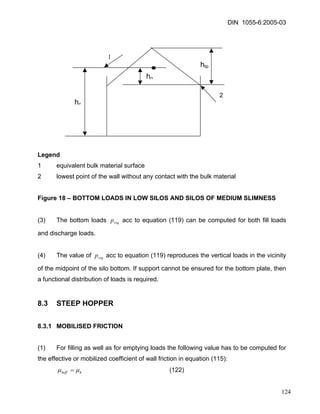
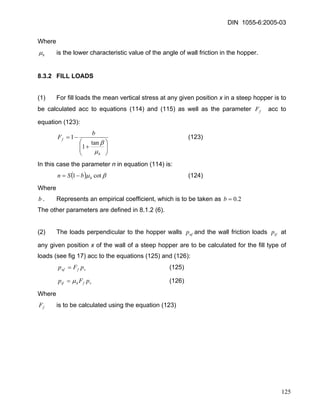
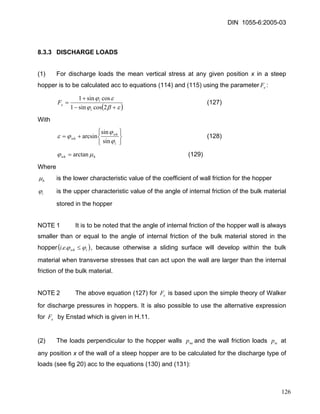
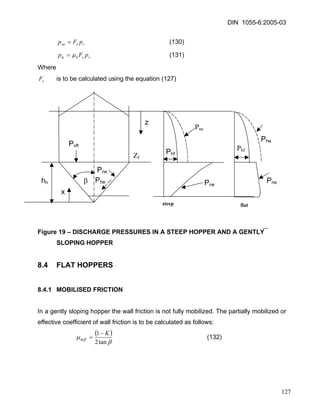
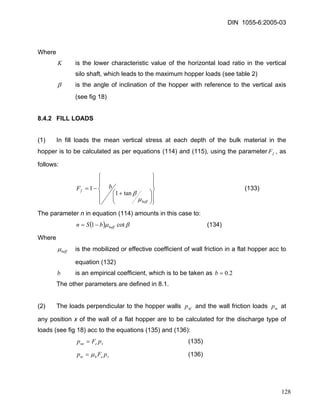
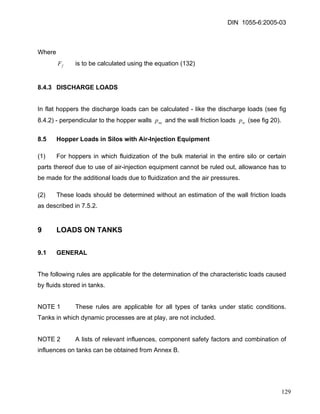
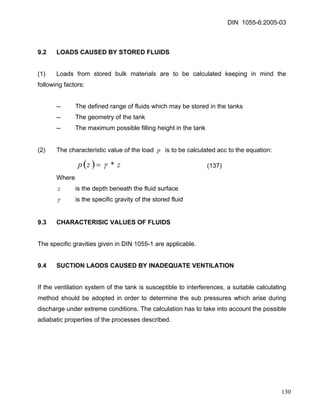
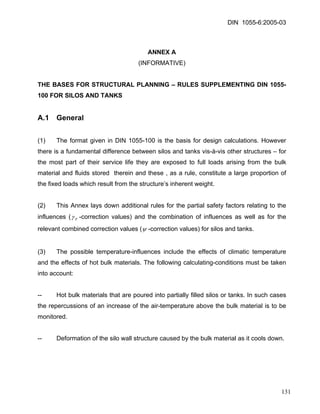
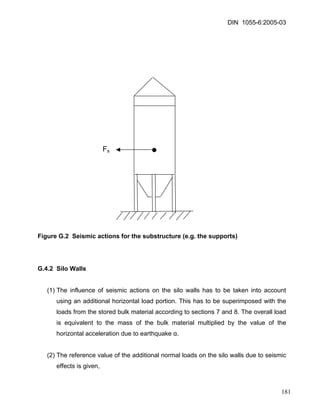
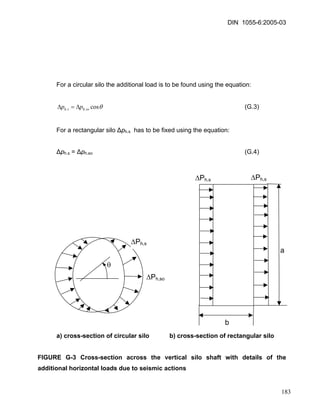
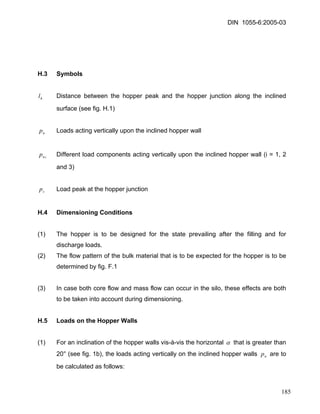
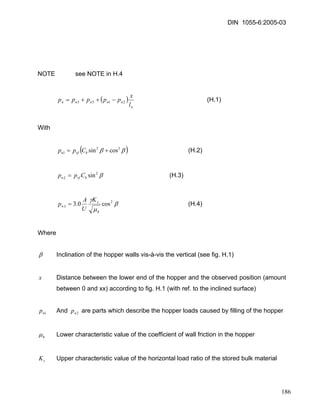
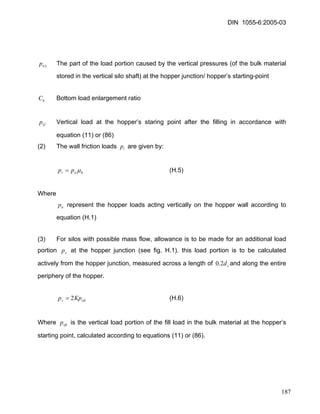
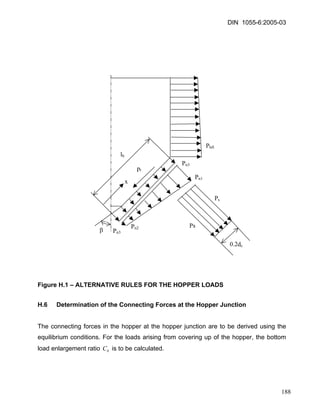
DIN 1055-6:2005-03 
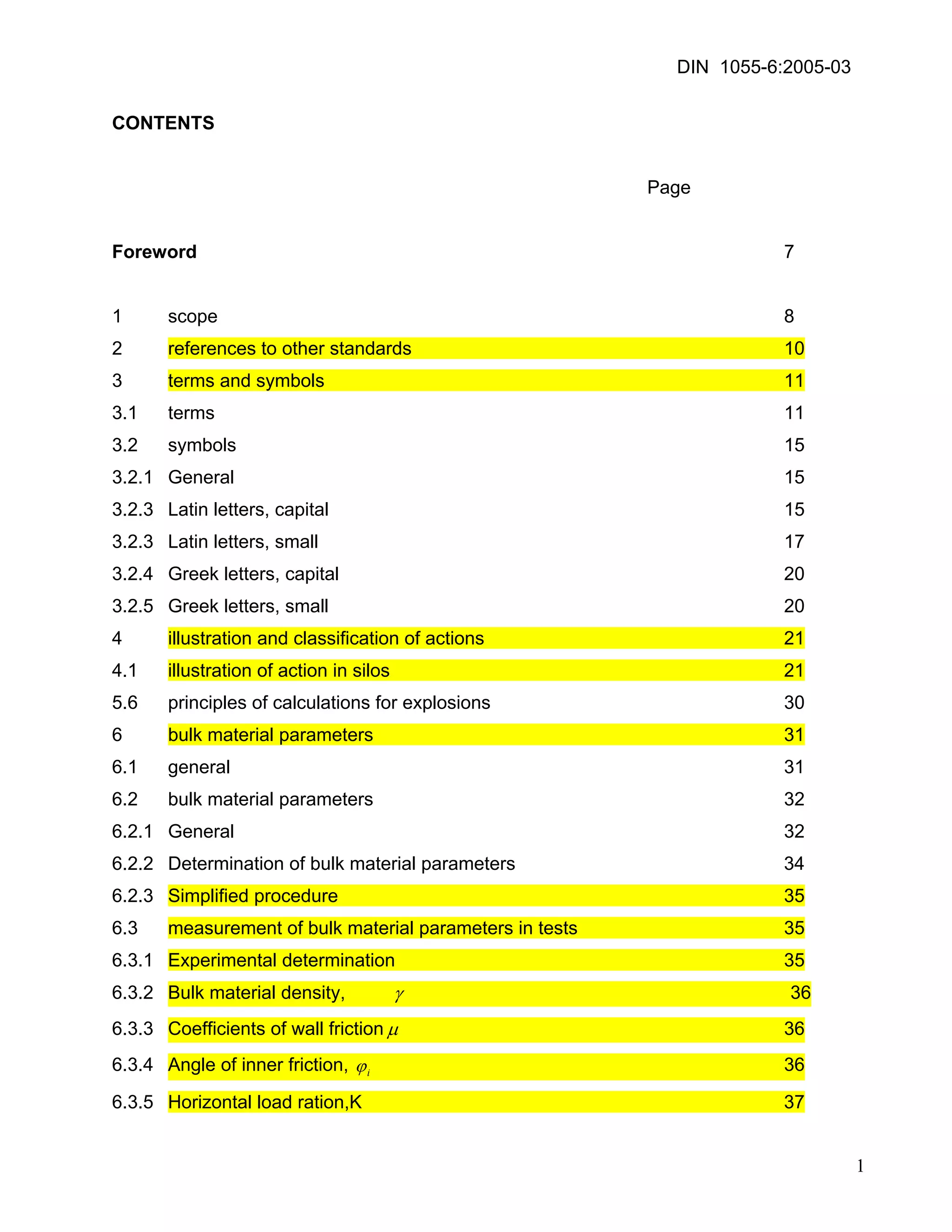
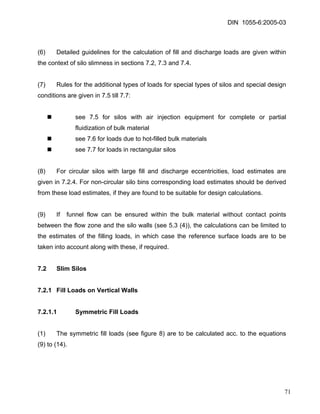
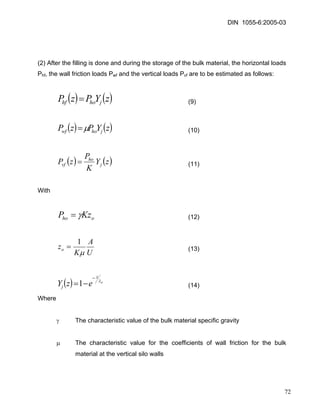
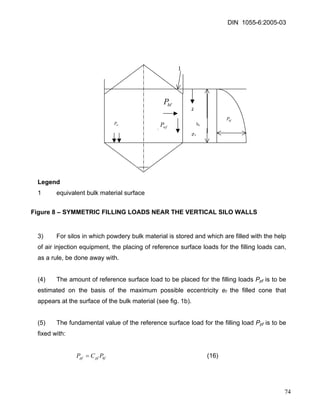
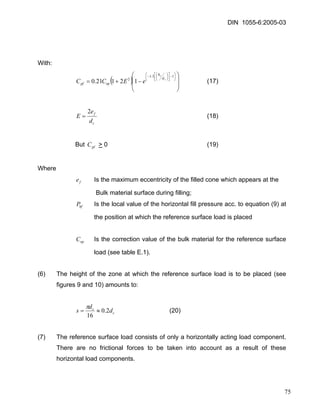
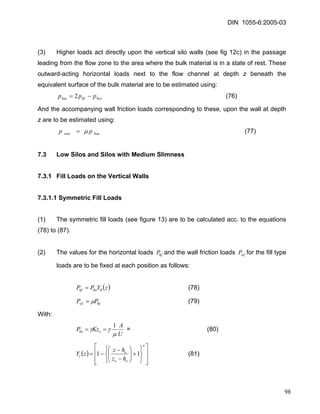
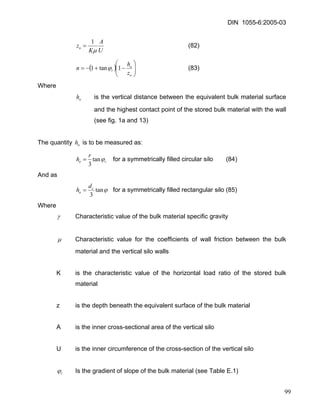
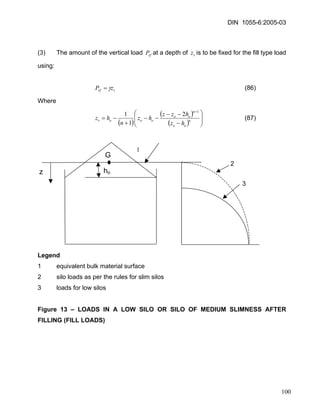
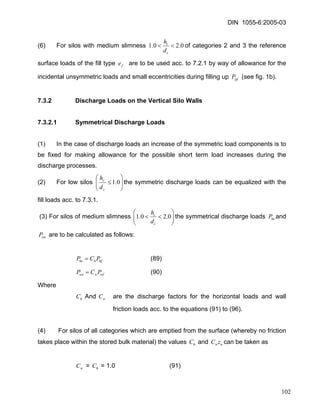
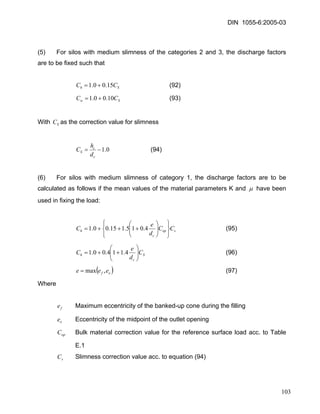
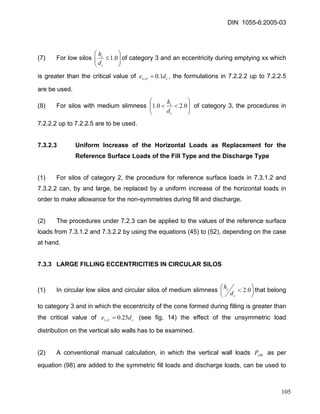
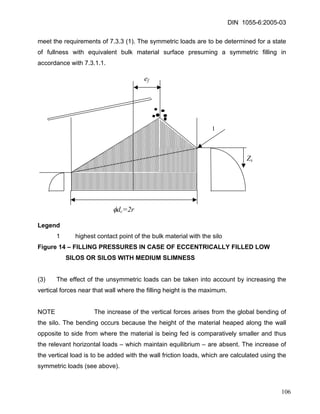
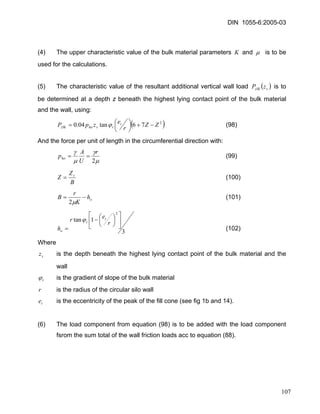
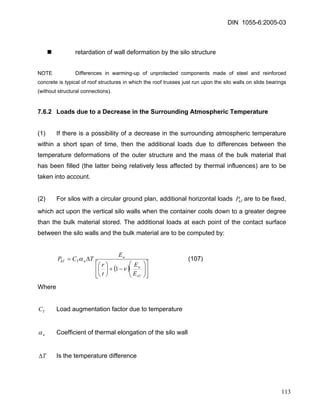
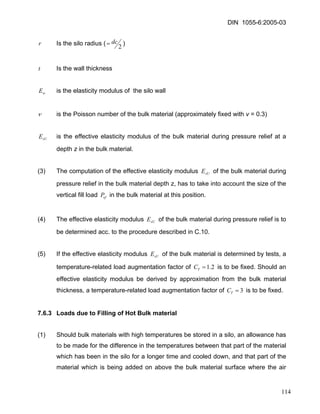
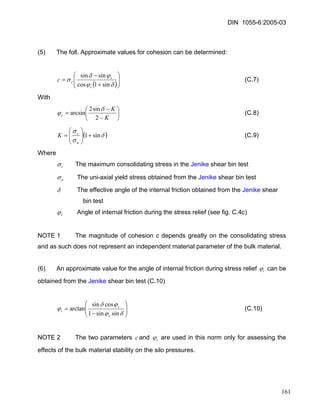
CONTENTS Page 
Foreword 7 
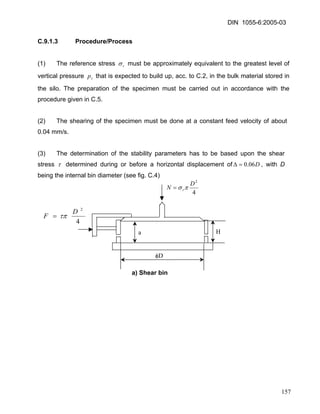
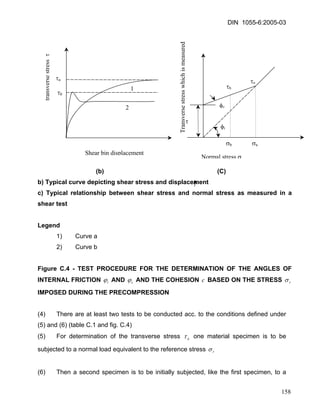
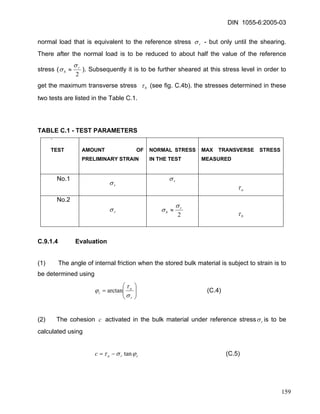
1 scope 8 
2 references to other standards 10 
3 terms and symbols 11 
3.1 terms 11 
3.2 symbols 15 
3.2.1 General 15 
3.2.3 Latin letters, capital 15 
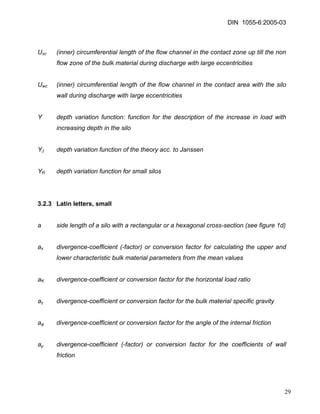
3.2.3 Latin letters, small 17 
3.2.4 Greek letters, capital 20 
3.2.5 Greek letters, small 20 
4 illustration and classification of actions 21 
4.1 illustration of action in silos 21 
5.6 principles of calculations for explosions 30 
6 bulk material parameters 31 
6.1 general 31 
6.2 bulk material parameters 32 
6.2.1 General 32 
6.2.2 Determination of bulk material parameters 34 
6.2.3 Simplified procedure 35 
6.3 measurement of bulk material parameters in tests 35 
6.3.1 Experimental determination 35 
6.3.2 Bulk material density, γ 36 
6.3.3 Coefficients of wall frictionμ 36 
6.3.4 Angle of inner friction, iϕ 36 
6.3.5 Horizontal load ration,K 37 
1
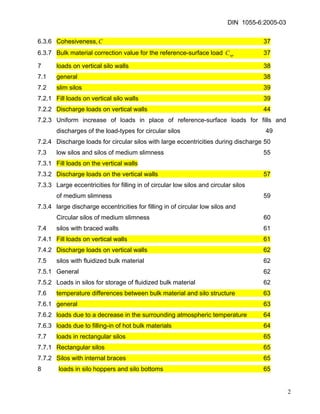
DIN 1055-6:2005-03 
6.3.6 Cohesiveness, 37 C 
6.3.7 Bulk material correction value for the reference-surface load 37 opC 
7 loads on vertical silo walls 38 
7.1 general 38 
7.2 slim silos 39 
7.2.1 Fill loads on vertical silo walls 39 
7.2.2 Discharge loads on vertical walls 44 
7.2.3 Uniform increase of loads in place of reference-surface loads for fills and discharges of the load-types for circular silos 49 
7.2.4 Discharge loads for circular silos with large eccentricities during discharge 50 
7.3 low silos and silos of medium slimness 55 
7.3.1 Fill loads on the vertical walls 
7.3.2 Discharge loads on the vertical walls 57 
7.3.3 Large eccentricities for filling in of circular low silos and circular silos 
of medium slimness 59 
7.3.4 large discharge eccentricities for filling in of circular low silos and 
Circular silos of medium slimness 60 
7.4 silos with braced walls 61 
7.4.1 Fill loads on vertical walls 61 
7.4.2 Discharge loads on vertical walls 62 
7.5 silos with fluidized bulk material 62 
7.5.1 General 62 
7.5.2 Loads in silos for storage of fluidized bulk material 62 
7.6 temperature differences between bulk material and silo structure 63 
7.6.1 general 63 
7.6.2 loads due to a decrease in the surrounding atmospheric temperature 64 
7.6.3 loads due to filling-in of hot bulk materials 64 
7.7 loads in rectangular silos 65 
7.7.1 Rectangular silos 65 
7.7.2 Silos with internal braces 65 
8 loads in silo hoppers and silo bottoms 65 
2
DIN 1055-6:2005-03 
8.1 general 65 
8.1.1 Physical parameters 65 
8.1.2 General rules 67 
8.2 horizontal silo bottoms 69 
8.2.1 Vertical loads on horizontal silo bottoms in slim silos 69 
8.2.2 Vertical loads on level silo bottoms in low silos and silos of 
Medium slimness 69 
8.3 steep hoppers 71 
8.3.1 Mobilized friction 71 
8.3.2 Fill loads 71 
8.3.3 Discharge loads 71 
8.4 flat hoppers 72 
8.4.1 Mobilized friction 72 
8.4.2 Fill loads 73 
8.4.3 Discharge loads 73 
8.5 hopper loads in silos with air-injection equipment 73 
9 loads on tanks 74 
9.1 general 74 
9.2 loads due to stored fluids 74 
9.3 parameters for fluids 74 
9.4 suction loads due to insufficient aeration 74 
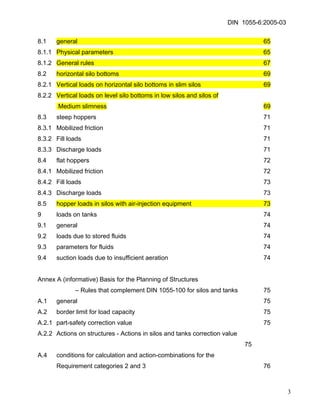
Annex A (informative) Basis for the Planning of Structures 
– Rules that complement DIN 1055-100 for silos and tanks 75 
A.1 general 75 
A.2 border limit for load capacity 75 
A.2.1 part-safety correction value 75 
A.2.2 Actions on structures - Actions in silos and tanks correction value 75 
A.4 conditions for calculation and action-combinations for the 
Requirement categories 2 and 3 76 
3
DIN 1055-6:2005-03 
A.5 action-combinations for the 
Requirement category 1 77 
Annex B (normative) Actions, Part-Safety Factors and Composite 
Correction Values for the actions on tanks 78 
B.1 general 78 
B.2 actions 78 
B.2.1 loads from stored fluids 78 
B.2.2 loads from internal pressures 78 
B.2.3 loads from temperature changes 78 
B.2.4 intrinsic loads 78 
B.2.5 loads from insulation 78 
B.2.6 distributed working loads 79 
B.2.7 concentric working loads 79 
B.2.8 snow 79 
B.2.9 wind 79 
B.2.10 low pressure due to insufficient aeration 81 
B.2.11 seismic loads 81 
B.2.12 loads due to connecting structures 81 
B.2.13 loads due to non-uniform settlement 81 
B.2.14 catastrophic loads 81 
B.3 part-safety correction values for actions 81 
B.4 combination of actions 81 
Annex C (normative) measurement of bulk material parameters for 
Determination of silo loads 82 
C.1 general 82 
C.2 application 82 
C.3 symbols 82 
C.4 terms 83 
C.5 taking of specimens and their preparation 83 
4
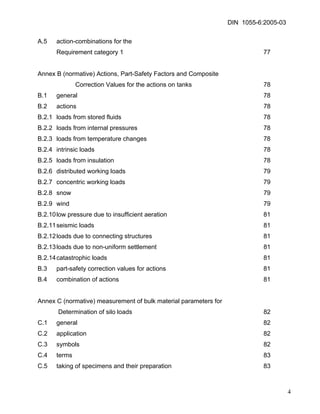
DIN 1055-6:2005-03 
C.6 determination of bulk material density γ 84 
C.6.1 short description 84 
C.6.2 test apparatus 84 
C.6.3 process / procedure 85 
C.7 wall friction 85 
C.7.1 general 85 
C.7.2 co-efficient of wall friction μm for the determination of loads 86 
C.7.3 angle of wall friction ϕwh for examining the flow behaviour 87 
C.8 horizontal load ratio K 88 
C.8.1 direct measurement 88 
C.8.2 indirect measurement 89 
C.9 stability parameters: cohesiveness c and angle of internal friction ϕi 89 
C.9.1 direct measurement 89 
C.9.2 indirect measurement 91 
C.10 effective elasticity module Es 93 
C.10.1 direct measurement 93 
C.10.2 indirect measurement 95 
C.11 determination of the upper and lower characteristic values for the bulk 
Material parameters and the determination of the conversion factor a 96 
C.11.1 testing principle 96 
C.11.2 assessment methods 97 
Annex D (normative) assessment of bulk material parameters for determination 
Of silo loads 99 
D.1 goal 99 
D.2 assessment of the wall friction co-efficient for a corrugated wall 99 
D.3 internal friction and wall friction of a coarse-grained bulk material 
Without fine particles 100 
Annex E (normative) details of bulk material parameters 101 
5
DIN 1055-6:2005-03 
Annex F (normative) determination of the flow profile, mass flow 
And core flow 102 
Annex G (normative) seismic actions 103 
G.1 general 103 
G.2 symbols 103 
G.3 conditions for calculation 103 
G.4 seismic actions 104 
G.4.1 silo bottom and foundations 104 
G.4.2 silo walls 104 
Annex H (normative) alternative rules for determination of hopper loads 106 
H.1 general 106 
H.2 terms 106 
H.3 symbols 106 
H.4 conditions for calculation 106 
H.5 loads on hopper walls 107 
H.6 determination of connecting forces at the hopper junction 108 
H.7 alternative equations for the hopper load correction values Fe for 
The load discharge 108 
Annex I (normative) action due to dust explosions 109 
I.1 general 109 
I.2 application 109 
I.3 additional standards, guidelines and rules 109 
I.4 dusts of explosive nature and their parameters 109 
I.5 ignition sources 110 
I.6 protective measures 110 
I.7 calculation of components 111 
I.8 calculation of explosive overpressure 111 
I.9 calculation of negative pressure 111 
6
DIN 1055-6:2005-03 
I.10 securing the closing element of the discharge opening 111 
I.11 recoil forces due to pressure release 111 
Diagrams 
Diagram 1 illustration of silo bins with nomenclature of geometric 
Parameters and loads 9 
Diagram 2 basic flow profile 26 
Diagram 3 flow profile with pipe flow 27 
Diagram 4 flow profile with mixed bulk material flows 28 
Diagram 5 effects of slimness (height to diameter ratio) on the mixed bulk 
material flows and the pipe flows 28 
Diagram 6 customized arrangements for fill and discharge 29 
Diagram 7 conditions under which pressures due to mass flow arise 32 
Diagram 8 symmetric discharge loads around the vertical silo walls 40 
Diagram 9 longitudinal and cross-sectional illustrations of the load diagrams of reference-surface loads 42 
Diagram 11 longitudinal and cross-sectional illustrations of the load 
diagrams of reference-surface loads during discharge 47 
Diagram 12 flow channels and pressure distribution during discharge 
with large eccentricities 52 
Diagram 13 loads in low silos or silos with medium slimness after the 
fill (fill loads) 56 
Diagram 14 fill pressures during eccentric filled low silos or silos with 59 
medium slimness 
Diagram 15 fill pressures in a braced-wall silo 62 
Diagram 16 boundaries between steep and flat hoppers 66 
Diagram 17 distribution of the fill pressures in a steep and flat hopper 67 
Diagram 18 bottom loads in low silos and in silos with medium slimness 70 
Diagram 19 discharge pressures in a hopper with a steep and a flat inclination 72 
Diagram B.1 coefficients of pressure for wind loads in circular cylindrical tanks 80 
7
DIN 1055-6:2005-03 
Diagram C.1 equipment for determination of γ 85 
Diagram C.2 test procedure for determination of the coefficients of wall friction 87 
Diagram C.3 test procedure for determination of Ko 88 
Diagram C.4 test procedure for determination of the angle of the internal 
Friction ϕi and ϕc and the cohesiveness based upon the tension 
Created by pre-compression 90 
Diagram C.5 test procedure for determination of the elasticity module during 
loading and unloading 94 
Diagram D.1 measurement of the profiling of the wall surface 100 
Diagram F.1 demarcation of mass and core flow conditions in conical and cuneiform hoppers 102 
Diagram G.1 possible rearrangements oat the bulk material surface due to 
Seismic actions 103 
Diagram G.2 seismic actions on the substructure (e.g. braces) 104 
Diagram G.3 cross-section through the vertical silo shaft with details of 
the additional horizontal loads due to seismic actions 105 
Diagram H.1 alternative rules for the hoppers 108 
Tables 
Table 1 classification of conditions for calculation 23 
Table 2 relevant parameters for different load estimates 25 
Table 3 categories of wall surfaces 34 
Table A.1 composite correction values 77 
Table C.1 test parameters 91 
Table C.2 typical values for the coefficients of variation for the bulk 
Material parameters 98 
Table E.1 bulk material parameters 101 
8
DIN 1055-6:2005-03 
Foreword 
This standard was compiled in the NABau-AA 00.20.00 “Actions on Buildings” (Spiegelausschuss zu CEN/TC/ 250/SC 1). 
This standard is part of the new series DIN 1055 Actions on Structures, which consists of the following parts: 
Part 1: 
Part 2: 
Part 3: 
Part 4: 
Part 5; 
Part 6; 
Part 7: 
Part 8: 
Part 9: 
Part 10: 
Part 100: 
9
DIN 1055-6:2005-03 
References to standards belonging to the series DIN 1055, contained in this standard, refer exclusively to the above-mentioned new series DIN 1055. 
This standard was developed by the Work Committee NABau 00.20.00 on the basis of DIN V ENV 1991-4 and conforms largely to the draft manuscript prEN 1991-4. 
Any deviations of this standard from the above-mentioned manuscript prEN 1991-4 conform by and large with possible commitments to the national safety standards so that, in the case of an eventual ratification of EN 1991-4, this standard can be compatible in the national context. 
Revisions 
Vis-à-vis DIN 1055-6:1987-05 the following revisions have been made: 
a) structural adaptation in line with the EN 1991-4 
b) terminology adaptation in line with the EN 1991-4 
c) adaptation of the calculation and safety concepts in line with the EN 1991-4 
d) incorporation of regulations for actions due to dust-explosions 
e) incorporation of regulations for actions due to earthquakes 
f) incorporation of regulations for actions due to bulk material properties 
Earlier Editions 
DIN 1055-6: 1964-11, 1987-05 
10
DIN 1055-6:2005-03 
1. Scope 
1) This standard contains general principles and information relating to the influences for the design and calculations of silos for storage of bulk materials and for tanks. It is to be applied in association with the other parts of the series DIN 1055. 
2) This standard also contains stipulations for actions on silos and tanks which extend beyond the direct action caused by the stored bulk material or fluids (e.g. effects of temperature differences). 
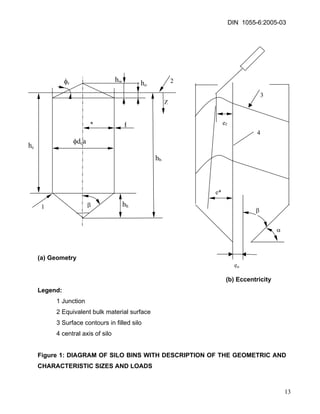
3) While applying the rules for calculations made for silo bins and silo structures the following geometric limitations should be kept in mind: 
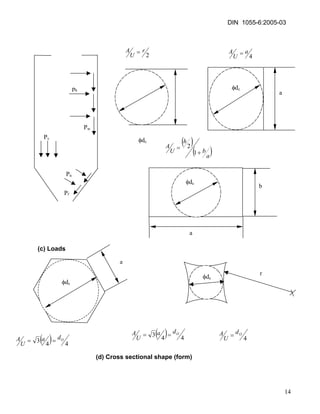
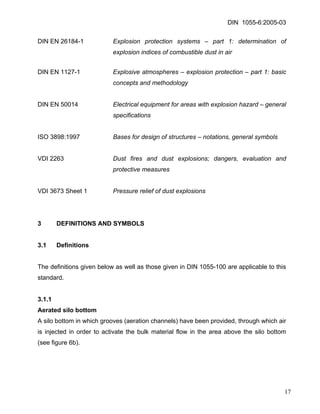
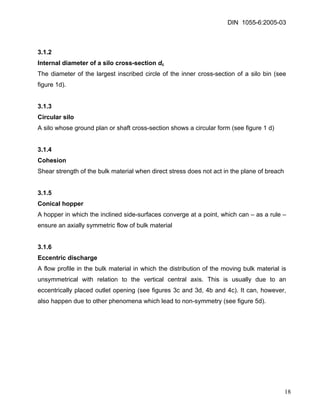
--- The cross-sections of the silo bins are limited to the instances shown in diagram 1d. 
Smaller deviations are allowed under the condition that the possible effects on the silo structures due to the pressure changes resulting from these deviations will be taken into account. 
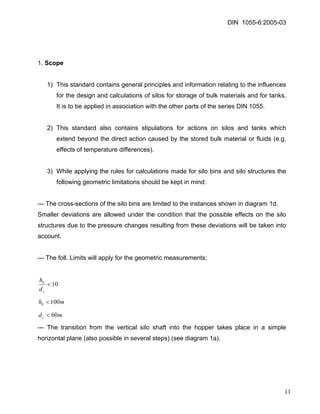
--- The foll. Limits will apply for the geometric measurements: 
10< cbdh 
mhb100< 
mdc60< 
--- The transition from the vertical silo shaft into the hopper takes place in a simple horizontal plane (also possible in several steps) (see diagram 1a). 
11
DIN 1055-6:2005-03 
--- The influences on the silo pressures due to inbuilt things or customized restrictions and inbuilt things such as discharge cones, discharge girders, consoles and spots, etc., are not covered (apart fro discharge hoppers). 
4) While applying the rules for calculations made for silo bins and silo structures the following limits should be kept in mind with regard to the stored bulk material: 
--- The calculation for a particular property of the bulk material has to be made for every single silo. 
--- The bulk material is free flowing or it can be ensured that in special cases it behaves as free flowing material (see 3.1.12 and Annex C). 
--- The maximum grain size of the bulk material is not more than (see diagram 1d). cd03.0 
NOTE If the bulk material particles are large in comparison with the thickness of the silo wall, the effects of the contact of individual large particles with the wall are to be regarded as a form of a deposit of individual loads. 
5) While applying the rules for calculations made for silo bins and silo structures the following limits should be kept in mind with regard to the operational conditions during filling and discharging: 
--- During filling the action of the forces of inertia and impact are very slight and may be ignored 
--- in case of use of discharge aids (e.g. transporting equipment (feeders) or central well with absorption opening), the bulk material flow is uniform, undisturbed and central. 
12
DIN 1055-6:2005-03 
(a) Geometry 
φr 
hc 
1 
hh 
2 
Z 
* 
φdca 
hb 
β 
hw 
ho 
f 
3 
4 
ef 
β 
e* 
α 
eo 
(b) Eccentricity 
Legend: 
1 Junction 
2 Equivalent bulk material surface 
3 Surface contours in filled silo 
4 central axis of silo 
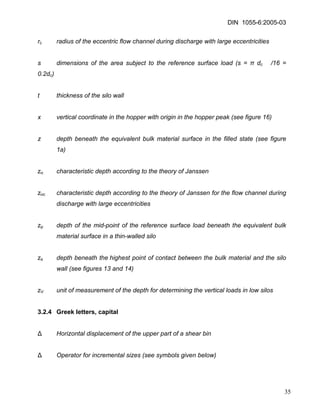
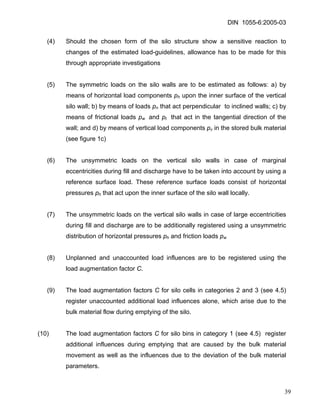
Figure 1: DIAGRAM OF SILO BINS WITH DESCRIPTION OF THE GEOMETRIC AND CHARACTERISTIC SIZES AND LOADS 
13
DIN 1055-6:2005-03 
2rUA= 4aUA= 
ph 
Pw 
Pv 
Pf 
Pn φdc 
2r 
( ) 
( ) a 
b 
h 
U 
A 
+ 
= 
1 
2 
φdc 
a φdc 
b a 
(c) Loads 
φdc 
a 
r 
φdc ()443OdaUA== 4OdUA= 
()443OdaUA== 
(d) Cross sectional shape (form) 
14
DIN 1055-6:2005-03 
6) The given load deposits on silo hoppers are applicable only for conical (generally axial symmetric shape or pyramid shape with quadratic or rectangular cross- sections) and cuneiform (generally with vertical walls at the front and the reverse sides) hoppers. Hoppers that deviate from this or hoppers with inbuilt things require specialized and greater attention. 
7) Silos with symmetric axes of the geometrical horizontal projection type which change along the vertical axis are not covered by this standard. For example, silos with a hopper which blends from a cylindrical shape into a cuneiform shape fall in this category. 
8) The rules for calculation for tanks apply only for fluids under normal atmospheric pressure. 
9) Loads on the roofs of silos and tanks are subject to the relevant standards DIN 1055-3, DIN 1055-4, E DIN 1055-5, DIN 1055-9 and DIN 1055-10. 
10) The calculations for silos with rotary operation are not within the scope of this standard. 
11) The calculations for silos against dynamic stresses, which can appear during discharge, such as silo tremors, jolts, hooting and silo knocking, are not within the scope of this standard. 
NOTE These phenomena remain unexplained to date. Thus, in terms of the applicability of this standard, one can neither rule out their occurrence nor ensure that the silo structure is sufficiently dimensioned for the stresses they cause. 
15
DIN 1055-6:2005-03 
2 REFERENCES TO OTHER STANDARDS 
The documents mentioned below are required for using this standard. In case of dated references, only the edition mentioned is applicable. In case of undated references the latest edition of the document mentioned is applicable (inclusive of all revisions). 
DIN 1045-1 Plain concrete, reinforced and prestressed concrete structures - Part 1: design and construction 
DIN 1055-1 Actions on structures – part 1: specific gravity and surface loads of building materials, building components and storage materials 
DIN 1055-3 Actions on structures – part 3: self loads and superimposed loads for high buildings 
DIN 1055-4 Actions on structures – part 4: wind loads 
DIN 1055-5 Actions on structures – part 5: snow and ice loads 
DIN 1055-7 Actions on structures – part 7: temperature actions 
DIN 1055-9 Actions on structures – part 9: unusual actions 
DIN 1055-10 Actions on structures – part 10: actions due to cranes and machines 
DIN 1055-100 Actions on structures – part 100: bases of structural planning: security concepts and rules for design calculations 
16
DIN 1055-6:2005-03 
DIN EN 26184-1 Explosion protection systems – part 1: determination of explosion indices of combustible dust in air 
DIN EN 1127-1 Explosive atmospheres – explosion protection – part 1: basic concepts and methodology 
DIN EN 50014 Electrical equipment for areas with explosion hazard – general specifications 
ISO 3898:1997 Bases for design of structures – notations, general symbols 
VDI 2263 Dust fires and dust explosions; dangers, evaluation and protective measures 
VDI 3673 Sheet 1 Pressure relief of dust explosions 
3 DEFINITIONS AND SYMBOLS 
3.1 Definitions 
The definitions given below as well as those given in DIN 1055-100 are applicable to this standard. 
3.1.1 
Aerated silo bottom 
A silo bottom in which grooves (aeration channels) have been provided, through which air is injected in order to activate the bulk material flow in the area above the silo bottom (see figure 6b). 
17
DIN 1055-6:2005-03 
3.1.2 
Internal diameter of a silo cross-section dc 
The diameter of the largest inscribed circle of the inner cross-section of a silo bin (see figure 1d). 
3.1.3 
Circular silo 
A silo whose ground plan or shaft cross-section shows a circular form (see figure 1 d) 
3.1.4 
Cohesion 
Shear strength of the bulk material when direct stress does not act in the plane of breach 
3.1.5 
Conical hopper 
A hopper in which the inclined side-surfaces converge at a point, which can – as a rule – ensure an axially symmetric flow of bulk material 
3.1.6 
Eccentric discharge 
A flow profile in the bulk material in which the distribution of the moving bulk material is unsymmetrical with relation to the vertical central axis. This is usually due to an eccentrically placed outlet opening (see figures 3c and 3d, 4b and 4c). It can, however, also happen due to other phenomena which lead to non-symmetry (see figure 5d). 
18
DIN 1055-6:2005-03 
3.1.7 
Eccentric filling 
A situation during or after the filling of the silo, in which the peak of the banked-up bulk material surface (peak of the banked-up cone) is no longer centered in the vertical central axis of the silo (see figure 1b). 
3.1.8 
Equivalent bulk material surface 
Height of the envisaged leveled (horizontal) bulk material surface, which is the result of the volume balance between the envisaged and the actual pattern of the surface shape (see figure 1a) 
3.1.9 
Hopper for “expanded flow” 
A hopper in which the side surfaces in the lower part of the hopper are steep enough to create a mass flow, while the side surfaces in the upper part of the hopper have a more gradual inclination so that a core flow can be expected there (see figure 6d). This arrangement reduces the height of the hopper and at the same time ensures a reliable discharge. 
3.1.10 
Horizontal (silo) bottom 
The inner bottom surface of the silo with an inclination that is less than 5o 
3.1.11 
Flow profile 
The geometric form of the bulk material that is flowing out, when the flow is fully developed (see figures 2 to 5). The silo is in this case is almost completely filled-up (state of maximum fill). 
19
DIN 1055-6:2005-03 
3.1.12 
Fluidized bulk material 
That state of a stored powdery bulk material in which it contains a large proportion of air pockets with a pressure gradient which acts against the weight of the particles and counterbalances the same. The air can either be drawn in by means of specific ventilation or be introduced through the filling process. A bulk material is designated as fluidized even if only a part of the weight of the bulk material is counterbalanced by the air pockets. 
3.1.13 
Free-flowing granular material 
Granular bulk material in which the flow pattern is not noticeably influenced by cohesion 
3.1.14 
Fully filled state 
A silo is in the fully filled state when the surface of the bulk material has achieved the highest position that it can possibly acquire within the service life of the structure while the silo is in operation. 
NOTE: This is taken as the ruling condition for design calculations of silos. 
3.1.15 
Core flow 
Flow profile, in which a flow channel develops in the bulk material above the outlet opening, while the bulk material remains undisturbed in the area between the flow channel and the silo wall (see figure 2) 
NOTE: The flow channel can, in such case, come into contact with the vertical silo wall – one would then term it “mixed flow” – or it can stretch right up to the surface without any point of contact whatsoever with the silo wall, in which case the term “ funnel flow” or “shaft flow” is used to describe it. 
20
DIN 1055-6:2005-03 
3.1.16 
Granular material 
Material which is composed of separate and individual grains of specific particles, with the particles having more or less equal dimensions and where the air between the individual grains plays only a marginal role in the determination of the loads and has only a marginal influence on the bulk material flow. 
3.1.17 
High fill speed 
That condition in a silo, in which the speed of the filling leads to an intake of air of such an order that it would affect the pressure ratios at the wall. 
3.1.18 
Homogenizing silos 
Silos in which the bulk material is homogenized with the help of fluidization, i.e. homogenized by means of mixing. 
3.1.19 
Hopper 
Silo bottom with inclined walls 
3.1.20 
Hopper load ratio value F 
A value which specifies the relationship between the normal load pn on the inclined hopper walls and the mean vertical load pv at this position in the bulk material. 
3.1.21 
Silo of medium slimness 
A silo whose ratio of height to diameter lies between 1.0 < hc / dc < 2.0 
NOTE: exceptions are defined in 5.3. 
3.1.22 
21
DIN 1055-6:2005-03 
Internal funnel flow 
Flow profile with funnel flow in which the flow channel limit stretches up to the surface of the bulk material without the flow area coming into contact with the silo wall in the process (see figures 2 and 3). 
3.1.23 
Horizontal load ratio K 
A value which specifies the relationship between the mean horizontal load pn acting on the vertical silo walls, and the mean vertical load pv at this position in the bulk material. 
3.1.24 
Marginal cohesion 
A bulk material sample shows a marginal cohesion when the cohesion c is smaller than 4% of the pre-consolidation stress σr 
NOTE a process for the determination of cohesion is given in C.9 
3.1.25 
Mass flow 
Flow profile in which all the bulk material particles in the silo are simultaneously in motion during discharge (see figure 2a) 
3.1.26 
Mixed flow 
Core flow profile in which the flow channel, which is still beneath the bulk material surface, comes into contact with the vertical silo walls (see figures 2c and 4) 
3.1.27 
Non-circular silo 
A silo, wherein the cross-section is not a circle (see figure 1) 
22
DIN 1055-6:2005-03 
3.1.28 
Bulk material 
A term used to describe a granular material ranging from a dust-like to a large-grained variety with and without cohesion, which contains pores in addition to and in-between the individual solid material particles that may be filled with air or moisture. 
3.1.29 
Reference surface load 
Local load perpendicular to the vertical silo wall to be placed at any chosen height in a specific portion of its surface. 
3.1.30 
Funnel flow 
Flow profile in which the bulk material is in motion above the outlet opening in a vertical or almost vertical flow channel, but is in a state of rest next to the flow channel (see figures 2 and 3). 
NOTE If the outlet opening is placed eccentrically (see figures 3c and d) or if due to certain factors the flow channel deviates from the vertical axis above the discharge (see figure 5), the flow of the bulk material can appear against the wall. 
3.1.31 
Level flow 
Flow profile in a silo with a rectangular or a quadratic cross-section and a slit-shaped outlet opening. The discharge slit runs parallel to two silo walls. Its length corresponds to the length of both these silo walls. 
3.1.32 
Powdery bulk material 
A bulk material whose mean particle size is smaller than 0.05 mm 
23
DIN 1055-6:2005-03 
3.1.33 
Silo with braced wall 
Silo with a horizontal bottom and and a height to diameter ratio of hc / dc < 0.4 
3.1.34 
Flat hopper 
A hopper in which the full amount of wall friction is not mobilized 
3.1.35 
Silo 
A structure for storage of bulk material 
3.1.36 
Slim silo 
A silo with a height-diameter ratio of hc / dc > 2.0, or one which fulfills the additional conditions given in 5.3 
3.1.37 
Slimness 
Ratio of the height to diameter hc / dc of the vertical portion of the silo 
3.1.38 
Low silo 
A silo with a height-diameter ratio of 0.4 < hc / dc < 1.0 or one in which the additional conditions as per 5.3 are fulfilled. 
NOTE In case of a height-diameter ratio of hc / dc < 0.4, and if the silo contains a hopper, the silo will fall into the category of a low silo. Otherwise – in case of a flat silo bottom – it falls into the braced-wall silo category. 
24
DIN 1055-6:2005-03 
3.1.39 
Steep hopper 
A hopper in which the full wall friction is mobilized after the filling 
3.1.40 
Stress in the bulk material 
Force per unit area within the stored bulk material 
3.1.41 
Tank 
A structure for storage of fluids 
3.1.42 
A thick-walled silo 
A silo with a diameter-to-wall thickness ratio which is less than dc /t = 200 
3.1.43 
A thin-walled silo 
A silo with a diameter-to-wall thickness ratio which is greater than dc /t = 200 
3.1.44 
Wall friction 
Force per unit area along the silo wall (vertical or inclined) on account of friction between the bulk material and the silo wall. 
3.1.45 
Hopper junction 
The section between the hopper and the vertical silo wall, i.e. the transition from the vertical part of the silo into the hopper 
25
DIN 1055-6:2005-03 
3.1.46 
Vertical Silo shaft 
The part of the silo which comprises of the vertical walls 
3.1.47 
Wedge-shaped hopper 
A hopper in which the surfaces converge at a slit for ensuring an even flow of the bulk material; the walls of each of the other two hoppers run vertically 
3.2 Symbols 
3.2.1 General 
A list of basic symbols (letter symbols) is given in DIN 1055-100. The additional letter symbols for this part of the standard are given below. The symbols used are based on the conventions of ISO 3898:1997. 
3.2.2 Latin letters, capital 
A cross-section of the vertical shaft 
Ac cross-section of the flow channel in case of eccentric discharge (large eccentricities) 
B depth parameter in case of eccentrically filled low silos 
C load augmentation factor 
Co discharge factor (load augmentation factor during discharge) for the bulk material 
Cop bulk material parameter for the reference surface load (load augmentation factor) 
26
DIN 1055-6:2005-03 
Cb load augmentation factor for the bottom loads 
Ch load augmentation factor for the horizontal discharge loads 
Cpe load augmentation factor for the reference surface loads during discharge 
Cpf load augmentation factor for the reference surface loads in case of fill loads 
CS correction value for slimness in a silo with medium slimness 
CT load augmentation factor for making allowance for temperature differences or changes 
Cw correction value for discharge for the wall friction loads (load augmentation factor) 
E ratio of eccentricity (during fill and discharge) to silo radius 
Es effective elasticity modulus of the stored bulk material at the relevant stress level 
Ew elasticity modulus of the silo wall 
F relationship between the vertical loads on the silo wall and the mean vertical load in the bulk material at this point 
Fe load ratio in the hopper during the discharge (relationship between loads perpendicular to the silo wall and mean vertical loads in the bulk material) 
Ff load ratio in the hopper after the filling (relationship between loads perpendicular to the silo wall and mean vertical loads in the bulk material) 
27
DIN 1055-6:2005-03 
Fpe integral of the horizontal reference surface load for thin walled circular silos in the case of discharge loads 
Fpf integral of the horizontal reference surface load for thin walled circular silos in the case of filling loads 
G ratio of the radius of the flow channel to the radius of the internal cross-section of a circular silo 
K characteristic value of the horizontal load ratio 
Km mean value of the horizontal load ratio 
Ko value of K when horizontal elongation as well as principal stresses that run or are aligned horizontally and vertically are ruled out 
Pwe characteristic value of the sum total of the wall friction loads for each running meter in the circumferential direction of the vertical silo wall in the case of discharge loads 
Pwf characteristic value of the sum total of the wall friction loads for each running meter in the circumferential direction of the vertical silo wall in the case of fill loads 
PzSk characteristic value of the wall loads for each running meter in the circumferential direction of the vertical silo wall for low silos and large filling eccentricities 
S geometry factors for the hopper loads (= 2 in the case of cone shaped hoppers, =1 in the case of wedge shaped hoppers) 
U inner circumference of the cross-section of the vertical silo shaft 
28
DIN 1055-6:2005-03 
Usc (inner) circumferential length of the flow channel in the contact zone up till the non flow zone of the bulk material during discharge with large eccentricities 
Uwc (inner) circumferential length of the flow channel in the contact area with the silo wall during discharge with large eccentricities 
Y depth variation function: function for the description of the increase in load with increasing depth in the silo 
YJ depth variation function of the theory acc. to Janssen 
YR depth variation function for small silos 
3.2.3 Latin letters, small 
a side length of a silo with a rectangular or a hexagonal cross-section (see figure 1d) 
ax divergence-coefficient (-factor) or conversion factor for calculating the upper and lower characteristic bulk material parameters from the mean values 
aK divergence-coefficient or conversion factor for the horizontal load ratio 
aγ divergence-coefficient or conversion factor for the bulk material specific gravity 
aφ divergence-coefficient or conversion factor for the angle of the internal friction 
aμ divergence-coefficient (-factor) or conversion factor for the coefficients of wall friction 
29
DIN 1055-6:2005-03 
b width of a rectangular silo (see figure 1d) 
b empirical coefficient for the hopper loads 
c cohesion of the bulk material 
dc characteristic dimensions for the inner cross-section of the silo (see diagram 1d) 
e the larger value of the eccentricities ef and eo 
ec eccentricities of the central axis of the flow channel during discharge with large eccentricities (see figure 11) 
ef largest eccentricity of the bulk cone at the bulk material surface during filling (see figure 1b) 
ef,cr largest fill eccentricity for which the simplified rules for the allowance for marginal eccentricities can be used (ef,cr = 0.25dc ) 
eo eccentricities of the centre point of the outlet opening (see figure 1b) 
eo,cr largest eccentricity of the outlet opening for which the simplified rules for the allowance for eccentricities can be used (eo,cr = 0.25dc ) 
et eccentricities of the peak of the fill-up cone at the bulk material surface when the silo is filled up (see figure 1b) 
et,,cr largest eccentricity of the fill-up cone at the bulk material surface for which the simplified rules for the allowance for eccentricities can be used (et,,cr = 0.25dc ) 
30
DIN 1055-6:2005-03 
hb overall height of a silo with hopper, measured from the envisaged hopper peak, up to the equivalent bulk material surface (see figure 1a) 
hc height of the vertical silo shaft, measured from the hopper junction up to the equivalent bulk material surface (see figure 1a) 
hh height of the hopper measured from the envisaged hopper top up to the hopper junction 
ho distance between the equivalent bulk material surface and the lowest point at the base of the bulk material cone (at the lowermost point of the silo wall which is not in contact with the stored bulk material when the latter has been filled to the specified extent)(see fig 1, 13 and 17) 
htp total height of the back-filled cone at the bulk material surface (vertical distance from the lowest point of the silo wall up to the tip of filled-up cone when the bulk material, which is filled to the specified extent, is not in contact with the silo wall)(see figures 1a and 17) 
n parameters in the conditional equations of the hopper loads 
p load as force per unit area 
ph horizontal load from the stored bulk material (see figure 1c) 
phae horizontal load in the area where the bulk material is at rest next to the flow channel, during a discharge with large eccentricities 
phce horizontal load in the flow channel during a discharge with large eccentricities 
31
DIN 1055-6:2005-03 
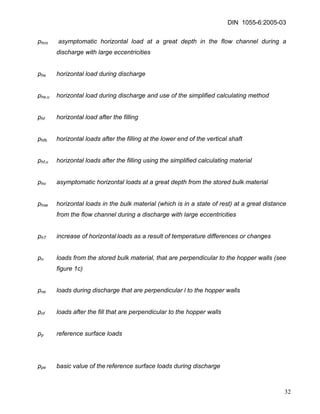
phco asymptomatic horizontal load at a great depth in the flow channel during a discharge with large eccentricities 
phe horizontal load during discharge 
phe,u horizontal load during discharge and use of the simplified calculating method 
phf horizontal load after the filling 
phfb horizontal loads after the filling at the lower end of the vertical shaft 
phf,u horizontal loads after the filling using the simplified calculating material 
pho asymptomatic horizontal loads at a great depth from the stored bulk material 
phse horizontal loads in the bulk material (which is in a state of rest) at a great distance from the flow channel during a discharge with large eccentricities 
phT increase of horizontal loads as a result of temperature differences or changes 
pn loads from the stored bulk material, that are perpendicular to the hopper walls (see figure 1c) 
pne loads during discharge that are perpendicular l to the hopper walls 
pnf loads after the fill that are perpendicular to the hopper walls 
pp reference surface loads 
ppe basic value of the reference surface loads during discharge 32
DIN 1055-6:2005-03 
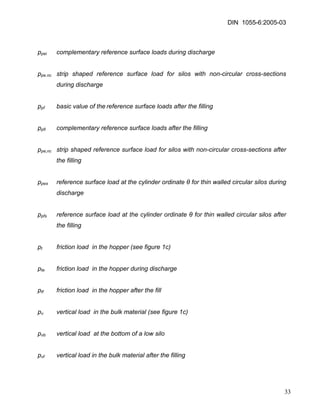
ppei complementary reference surface loads during discharge 
ppe.nc strip shaped reference surface load for silos with non-circular cross-sections during discharge 
ppf basic value of the reference surface loads after the filling 
ppfi complementary reference surface loads after the filling 
ppe,nc strip shaped reference surface load for silos with non-circular cross-sections after the filling 
ppes reference surface load at the cylinder ordinate θ for thin walled circular silos during discharge 
ppfs reference surface load at the cylinder ordinate θ for thin walled circular silos after the filling 
pt friction load in the hopper (see figure 1c) 
pte friction load in the hopper during discharge 
ptf friction load in the hopper after the fill 
pv vertical load in the bulk material (see figure 1c) 
pvb vertical load at the bottom of a low silo 
pvf vertical load in the bulk material after the filling 
33
DIN 1055-6:2005-03 
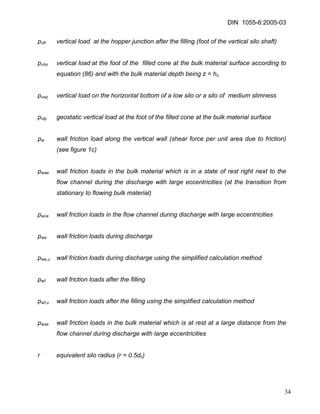
pvft vertical load at the hopper junction after the filling (foot of the vertical silo shaft) 
pvho vertical load at the foot of the filled cone at the bulk material surface according to equation (86) and with the bulk material depth being z = ho 
pvsq vertical load on the horizontal bottom of a low silo or a silo of medium slimness 
pvtp geostatic vertical load at the foot of the filled cone at the bulk material surface 
pw wall friction load along the vertical wall (shear force per unit area due to friction) (see figure 1c) 
pwae wall friction loads in the bulk material which is in a state of rest right next to the flow channel during the discharge with large eccentricities (at the transition from stationary to flowing bulk material) 
pwce wall friction loads in the flow channel during discharge with large eccentricities 
pwe wall friction loads during discharge 
pwe,u wall friction loads during discharge using the simplified calculation method 
pwf wall friction loads after the filling 
pwf,u wall friction loads after the filling using the simplified calculation method 
pwse wall friction loads in the bulk material which is at rest at a large distance from the flow channel during discharge with large eccentricities 
r equivalent silo radius (r = 0.5dc) 
34
DIN 1055-6:2005-03 
rc radius of the eccentric flow channel during discharge with large eccentricities 
s dimensions of the area subject to the reference surface load (s = π dc /16 = 0.2dc) 
t thickness of the silo wall 
x vertical coordinate in the hopper with origin in the hopper peak (see figure 16) 
z depth beneath the equivalent bulk material surface in the filled state (see figure 1a) 
zo characteristic depth according to the theory of Janssen 
zoc characteristic depth according to the theory of Janssen for the flow channel during discharge with large eccentricities 
zp depth of the mid-point of the reference surface load beneath the equivalent bulk material surface in a thin-walled silo 
zs depth beneath the highest point of contact between the bulk material and the silo wall (see figures 13 and 14) 
zV unit of measurement of the depth for determining the vertical loads in low silos 
3.2.4 Greek letters, capital 
Δ Horizontal displacement of the upper part of a shear bin 
Δ Operator for incremental sizes (see symbols given below) 
35
DIN 1055-6:2005-03 
ΔT Temperature differences between the stored bulk material and the silo walls 
Δv Incremental vertical displacements measured during the material examination 
Δσ Incremental stress placed upon a specimen during material examination 
3.2.5 Greek letters, small 
α Mean angle of inclination of the hopper walls with reference to the horizontal 
αw Coefficient of thermal elongation of the silo wall 
β Angle of inclination of the hopper wall with ref. to the vertical (see figures 1a and 1b) or the angle of the steepest hopper walls in a quadratic or rectangular hopper 
γ Characteristic value for the specific gravity of the stored fluid or the stored bulk material 
γl Specific gravity of the bulk material in fluidized state 
γu Upper characteristic values of the specific gravity of the stored fluid or the stored bulk material 
δ Standard deviation of a parameter 
θ Cylindrical coordinate: angle in direction of the circumference 
θc Angle at circumference of the flow channel during discharge with large eccentricities (see figure 11) with ref to the central axis of the silo shaft 
36
DIN 1055-6:2005-03 
ψ Wall contact angle of the eccentric flow channel with reference to the central axis of the flow channel 
μ Characteristic value of the wall friction angle at the vertical silo wall 
μheff Effective or mobilized wall friction coefficient in a flat hopper 
μh Wall friction coefficient in the hopper 
μm Mean value of the wall friction coefficients between bulk material and silo wall 
ν Poissons number for the bulk material 
φc Characteristic value of the angle of internal friction of a precompressed bulk material in case of relief (i.e. inclusive of the portion from cohesion) 
φi Characteristic value of the angle of internal friction of a bulk material in case of equivalent load (i.e. without the portion from cohesion) 
φim Mean value of the angle of internal friction 
φr Angle of slope of a bulk material (conical bulk heap) (see figure 1a) 
φw Wall friction angle (arc tan μ) between bulk material and hopper wall 
φwh Wall friction angle in the hopper (arc tan μh) between bulk material and hopper wall 
σr Reference stress for the tests for determination of the bulk material parameters 
37
DIN 1055-6:2005-03 
4 DESCRIPTION AND CLASSIFICATION OF SILOS 
4.1 Description of Actions in Silos 
(1) The actions on silos are to be estimated with regard to the silo structure, the properties of the stored bulk material and the flow profiles that arise during emptying of the silo. 
(2) Ambiguities related to the flow profiles, the influence of the fill and discharge eccentricities on the fill and discharge processes, the influence of the silo shape and size on the type of the flow profile and those that are related to the time-dependant discharge and fill pressures are all to be taken into consideration 
NOTE 1 The magnitude and the distribution of the rated loads depend upon the silo structure, the material parameters of the bulk materials and the flow profiles which build up during emptying. The inherent differences in the properties of the different bulk materials that are stored and the simplifications in the load models lead to variations between the silo loads that actually appear and the design loads (calculated loads) according to sections 6 and 7. Thus, to quote an example, the distribution of discharge pressures along the silo wall changes with time. An exact prediction of the prevailing mean pressure, its divergence and its temporal variability is not possible, given the present level of knowledge. 
(3) Allowance should be made for loads on the vertical walls of the silo when it is filled and while it is emptying, with fill- and discharge- eccentricities being marginal; this is to be done using a symmetric load component and an unsymmetric reference surface load. In case of large eccentricities the loads are to be described using a pressure distribution curve. 
38
DIN 1055-6:2005-03 
(4) Should the chosen form of the silo structure show a sensitive reaction to changes of the estimated load-guidelines, allowance has to be made for this through appropriate investigations 
(5) The symmetric loads on the silo walls are to be estimated as follows: a) by means of horizontal load components ph upon the inner surface of the vertical silo wall; b) by means of loads pn that act perpendicular to inclined walls; c) by means of frictional loads pw and pt that act in the tangential direction of the wall; and d) by means of vertical load components pv in the stored bulk material (see figure 1c) 
(6) The unsymmetric loads on the vertical silo walls in case of marginal eccentricities during fill and discharge have to be taken into account by using a reference surface load. These reference surface loads consist of horizontal pressures ph that act upon the inner surface of the silo wall locally. 
(7) The unsymmetric loads on the vertical silo walls in case of large eccentricities during fill and discharge are to be additionally registered using a unsymmetric distribution of horizontal pressures ph and friction loads pw 
(8) Unplanned and unaccounted load influences are to be registered using the load augmentation factor C. 
(9) The load augmentation factors C for silo cells in categories 2 and 3 (see 4.5) register unaccounted additional load influences alone, which arise due to the bulk material flow during emptying of the silo. 
(10) The load augmentation factors C for silo bins in category 1 (see 4.5) register additional influences during emptying that are caused by the bulk material movement as well as the influences due to the deviation of the bulk material parameters. 
39
DIN 1055-6:2005-03 
NOTE 2 The load augmentation factors C are intended to cover the ambiguities related to the flow profile, the influences of eccentricities during filling and emptying, the influence of the shape of the silo on the manner of the flow profile and proximity influences which arise when allowance is not made for the presence of fill and discharge pressures that are time dependant. For category 1 silos (see 4.5) the load augmentation factor also takes into account the deviation of the material properties of the bulk material. In silos of categories 2 and 3, allowance for the deviation of the material parameters influenced by the loads is not made by a load augmentation factor C but by the formulation of the appropriate characteristic calculation values for the bulk material parameters γ, μ, K and φi. 
(11) In silos of category 1 (see 4.5) the allowance for unsymmetric loads is made by means of an increase of the symmetric loads by applying a load augmentation factor for the discharge loads C. 
(12) In silos of categories 2 and 3 (see 4.5) allowance for the unsymmetric reference surface loads can be made alternatively by a substitute augmentation of the symmetric loads. 
4.2 Description of Action on Tanks 
(1) Allowance for loads on tanks as a consequence of filling them up is made by hydrostatic load formulations 
4.3 Classification of actions on silo bins 
(1) Loads due to bulk materials stored in the silo bins are to be classified as variable actions in accordance with DIN 1055-100. 
(2) Symmetric loads on silos are to be classified as variable stationary actions in accordance with DIN 1055-100. 
40
DIN 1055-6:2005-03 
(3) Reference surface loads for making allowances for the filling and discharge processes in silo bins are to be classified as variable free actions in accordance with DIN 1055-100. 
(4) Eccentric loads for making allowances for the eccentric filling and discharge processes in silo bins are to be classified as variable stationary actions. 
(5) Loads arising from air or gas pressures in connection with pneumatic conveyor systems are to be regarded as variable stationary actions. 
(6) Loads due to dust explosions are to be classified as extraordinary actions as defined by DIN 1055-100. 
4.4 CLASSIFICATION OF THE INFLUENCES ON TANKS 
Loads on tanks that arise due to the filling up of the tanks can be classified as variable stationary influences acc. to DIN 1055-100. 
4.5 STANDARDISED CATEGORIES 
(1) Based upon the design of the silo structure and its susceptibility to different types of malfunctions, various accuracy standards are used in the process of determining the influences on silo structures. 
(2) The silo influences should be determined in accordance with one of the following standardized categories specified in this standard (see Table 1). 
41
DIN 1055-6:2005-03 
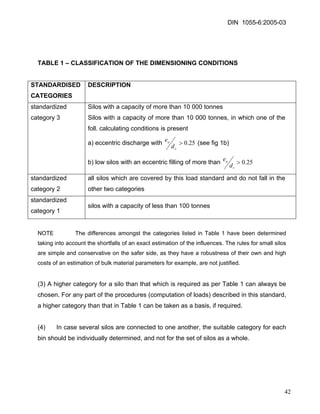
TABLE 1 – CLASSIFICATION OF THE DIMENSIONING CONDITIONS 
STANDARDISED CATEGORIES 
DESCRIPTION 
standardized category 3 
Silos with a capacity of more than 10 000 tonnes 
Silos with a capacity of more than 10 000 tonnes, in which one of the foll. calculating conditions is present 
a) eccentric discharge with 25.0> code (see fig 1b) 
b) low silos with an eccentric filling of more than 25.0> tode 
standardized category 2 
all silos which are covered by this load standard and do not fall in the other two categories 
standardized category 1 
silos with a capacity of less than 100 tonnes 
NOTE The differences amongst the categories listed in Table 1 have been determined taking into account the shortfalls of an exact estimation of the influences. The rules for small silos are simple and conservative on the safer side, as they have a robustness of their own and high costs of an estimation of bulk material parameters for example, are not justified. 
(3) A higher category for a silo than that which is required as per Table 1 can always be chosen. For any part of the procedures (computation of loads) described in this standard, a higher category than that in Table 1 can be taken as a basis, if required. 
(4) In case several silos are connected to one another, the suitable category for each bin should be individually determined, and not for the set of silos as a whole. 
42
DIN 1055-6:2005-03 
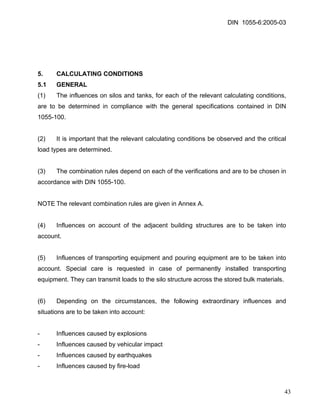
5. CALCULATING CONDITIONS 
5.1 GENERAL 
(1) The influences on silos and tanks, for each of the relevant calculating conditions, are to be determined in compliance with the general specifications contained in DIN 1055-100. 
(2) It is important that the relevant calculating conditions be observed and the critical load types are determined. 
(3) The combination rules depend on each of the verifications and are to be chosen in accordance with DIN 1055-100. 
NOTE The relevant combination rules are given in Annex A. 
(4) Influences on account of the adjacent building structures are to be taken into account. 
(5) Influences of transporting equipment and pouring equipment are to be taken into account. Special care is requested in case of permanently installed transporting equipment. They can transmit loads to the silo structure across the stored bulk materials. 
(6) Depending on the circumstances, the following extraordinary influences and situations are to be taken into account: 
- Influences caused by explosions 
- Influences caused by vehicular impact 
- Influences caused by earthquakes 
- Influences caused by fire-load 
43
DIN 1055-6:2005-03 
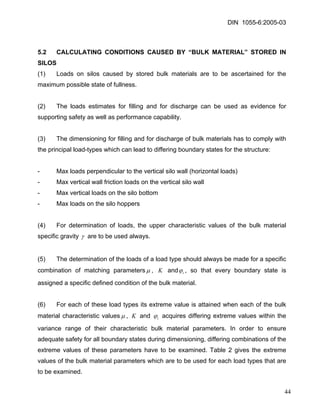
5.2 CALCULATING CONDITIONS CAUSED BY “BULK MATERIAL” STORED IN SILOS 
(1) Loads on silos caused by stored bulk materials are to be ascertained for the maximum possible state of fullness. 
(2) The loads estimates for filling and for discharge can be used as evidence for supporting safety as well as performance capability. 
(3) The dimensioning for filling and for discharge of bulk materials has to comply with the principal load-types which can lead to differing boundary states for the structure: 
- Max loads perpendicular to the vertical silo wall (horizontal loads) 
- Max vertical wall friction loads on the vertical silo wall 
- Max vertical loads on the silo bottom 
- Max loads on the silo hoppers 
(4) For determination of loads, the upper characteristic values of the bulk material specific gravity γ are to be used always. 
(5) The determination of the loads of a load type should always be made for a specific combination of matching parametersμ, K andiϕ , so that every boundary state is assigned a specific defined condition of the bulk material. 
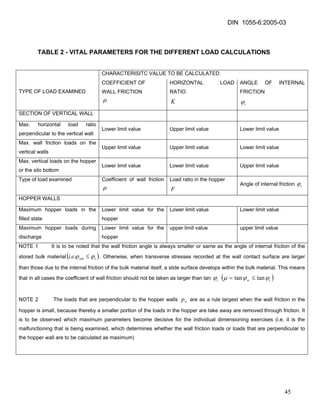
(6) For each of these load types its extreme value is attained when each of the bulk material characteristic valuesμ, K and iϕ acquires differing extreme values within the variance range of their characteristic bulk material parameters. In order to ensure adequate safety for all boundary states during dimensioning, differing combinations of the extreme values of these parameters have to be examined. Table 2 gives the extreme values of the bulk material parameters which are to be used for each load types that are to be examined. 
44
DIN 1055-6:2005-03 
TABLE 2 - VITAL PARAMETERS FOR THE DIFFERENT LOAD CALCULATIONS 
CHARACTERISITC VALUE TO BE CALCULATED 
TYPE OF LOAD EXAMINED 
COEFFICIENT OF 
WALL FRICTION 
μ 
HORIZONTAL LOAD RATIO 
K 
ANGLE OF INTERNAL FRICTION 
iϕ 
SECTION OF VERTICAL WALL 
Max. horizontal load ratio perpendicular to the vertical wall 
Lower limit value 
Upper limit value 
Lower limit value 
Max. wall friction loads on the vertical walls 
Upper limit value 
Upper limit value 
Lower limit value 
Max. vertical loads on the hopper or the silo bottom 
Lower limit value 
Lower limit value 
Upper limit value 
Type of load examined 
Coefficient of wall friction μ 
Load ratio in the hopper 
F 
Angle of internal friction iϕ 
HOPPER WALLS 
Maximum hopper loads in the filled state 
Lower limit value for the hopper 
Lower limit value 
Lower limit value 
Maximum hopper loads during discharge 
Lower limit value for the hopper 
upper limit value 
upper limit value 
NOTE 1 It is to be noted that the wall friction angle is always smaller or same as the angle of internal friction of the stored bulk material( ) iwheiϕϕ≤... Otherwise, when transverse stresses recorded at the wall contact surface are larger than those due to the internal friction of the bulk material itself, a slide surface develops within the bulk material. This means that in all cases the coefficient of wall friction should not be taken as larger than tan iϕ ()iwϕϕμtantan≤= 
NOTE 2 The loads that are perpendicular to the hopper walls are as a rule largest when the wall friction in the hopper is small, because thereby a smaller portion of the loads in the hopper are take away are removed through friction. It is to be observed which maximum parameters become decisive for the individual dimensioning exercises (i.e. it is the malfunctioning that is being examined, which determines whether the wall friction loads or loads that are perpendicular to the hopper wall are to be calculated as maximum) np 
45
DIN 1055-6:2005-03 
(7) The above table notwithstanding, silos of category 1 can be dimensioned using the mean values of the bulk material parameters, namely the mean value of the coefficient of wall frictionmμ, the mean value of the horizontal load ratio and the mean value of the angle of internal frictionmKimϕ. 
(8) The fundamental equations for calculating the silo loads are given in sections 7 and 8. These are to be taken as the basis for the calculation of the following characteristic loads: 
- Filling loads on vertical wall sections (see section 7) 
- Discharge loads on vertical wall sections (see section 7) 
- fill and discharge loads on horizontal bottoms (see section 8) 
- Fill loads on hoppers (see section 8) 
- Discharge loads on hoppers (see section 8) 
5.3 CALCULATING CONDITIONS CAUSED BY DIFFERING GEOMETRIC DESIGNS OF THE SILO GEOMETRY 
(1) Differences in slimness of silos (ratio of height to diameter), hopper geometries and arrangements of vents lead to differences in calculating conditions and these have to be observed. 
(2) In a silo that has been filled-up, the trajectory of the filling stream of the filled up bulk material may at times cause the build-up of an eccentric back-fill cone at the bulk material surface (see fig 1b) and when this happens different storage densities can arise in different parts of the silo which lead to un-symmetric loads. While calculating the size of these loads, the largest possible eccentricity of the filling stream is to be taken as a basis (see 7.2.1.2 and 7.3.1.2) 
46
DIN 1055-6:2005-03 
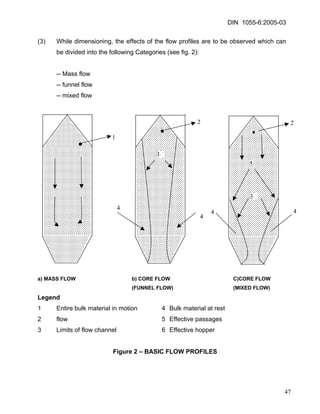
(3) While dimensioning, the effects of the flow profiles are to be observed which can be divided into the following Categories (see fig. 2): 
-- Mass flow 
-- funnel flow 
-- mixed flow 
1 
2 
3 
4 
4 
3 
5 
4 
4 
2 
a) MASS FLOW b) CORE FLOW C)CORE FLOW 
(FUNNEL FLOW) (MIXED FLOW) 
Legend 
1 Entire bulk material in motion 4 Bulk material at rest 
2 flow 5 Effective passages 
3 Limits of flow channel 6 Effective hopper 
Figure 2 – BASIC FLOW PROFILES 
47
DIN 1055-6:2005-03 
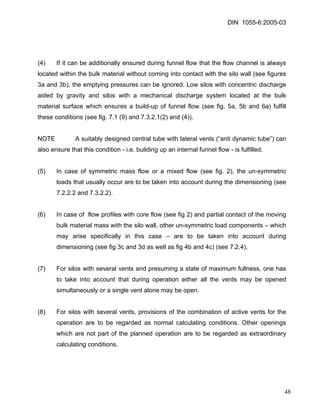
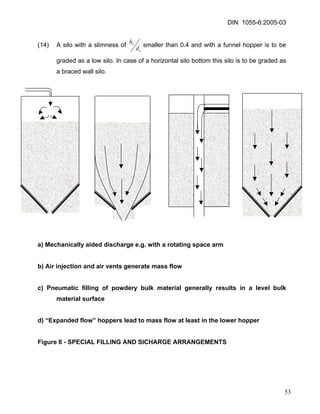
(4) If it can be additionally ensured during funnel flow that the flow channel is always located within the bulk material without coming into contact with the silo wall (see figures 3a and 3b), the emptying pressures can be ignored. Low silos with concentric discharge aided by gravity and silos with a mechanical discharge system located at the bulk material surface which ensures a build-up of funnel flow (see fig. 5a, 5b and 6a) fulfill these conditions (see fig. 7.1 (9) and 7.3.2.1(2) and (4)). 
NOTE A suitably designed central tube with lateral vents (“anti dynamic tube”) can also ensure that this condition - i.e. building up an internal funnel flow - is fulfilled. 
(5) In case of symmetric mass flow or a mixed flow (see fig. 2), the un-symmetric loads that usually occur are to be taken into account during the dimensioning (see 7.2.2.2 and 7.3.2.2). 
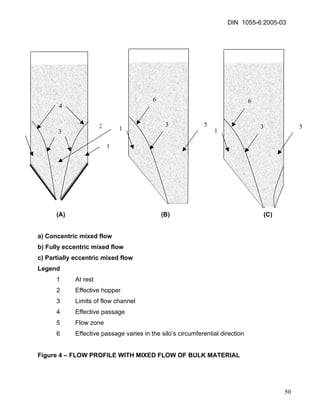
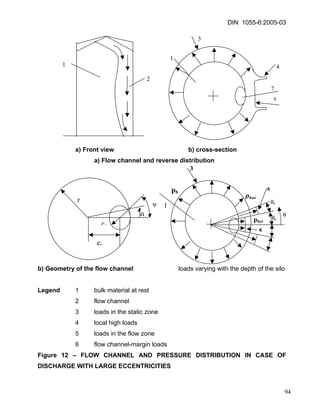
(6) In case of flow profiles with core flow (see fig 2) and partial contact of the moving bulk material mass with the silo wall, other un-symmetric load components – which may arise specifically in this case – are to be taken into account during dimensioning (see fig 3c and 3d as well as fig 4b and 4c) (see 7.2.4). 
(7) For silos with several vents and presuming a state of maximum fullness, one has to take into account that during operation either all the vents may be opened simultaneously or a single vent alone may be open. 
(8) For silos with several vents, provisions of the combination of active vents for the operation are to be regarded as normal calculating conditions. Other openings which are not part of the planned operation are to be regarded as extraordinary calculating conditions. 
48
DIN 1055-6:2005-03 
(9) In case of an eccentrically filled very slim silo⎟⎠⎞ ⎜⎝⎛ >4.. ccdhei, the effects of mixed flow in different areas could lead to either differing packing densities or cohesion of the bulk material. In such cases the asymmetric alignment of the bulk material particles can set off a un- symmetric core flow (see fig. 5d). This creates zones in the silo where the bulk material flows along the silo wall and thereby gives rise to un-symmetric loads. For such cases special load computations are to be used (see 7.2.4.1 (2)). 
1 
2 
3 
1 
2 
3 
2 
3 
4 
1 
4 
1 
2 
3 
INTERNAL CONVERGENT 
INTERNAL PARALLEL 
ECCENTRIC CONVERGENT 
ECCENTRIC PARALLEL 
Funnel flow funnel flow funnel flow funnel flow 
Legend 
1 flow 
2 flow channel limits 
3 flowing funnel 
4 bulk material at rest 
Figure 3 – FLOW PROFILES WITH FUNNEL FLOW 
49
DIN 1055-6:2005-03 
1 
3 
6 
3 
1 
6 
2 
1 
3 
4 
5 
5 
(A) (B) (C) 
a) Concentric mixed flow 
b) Fully eccentric mixed flow 
c) Partially eccentric mixed flow 
Legend 
1 At rest 
2 Effective hopper 
3 Limits of flow channel 
4 Effective passage 
5 Flow zone 
6 Effective passage varies in the silo’s circumferential direction 
Figure 4 – FLOW PROFILE WITH MIXED FLOW OF BULK MATERIAL 
50
DIN 1055-6:2005-03 
] 
2 
1 
2 
1 
5 
4 
5 
3 
1 
4 
5 
1 
2 
a) Braced wall silo b) Low silo c) Slim silo d) Very slim silo 
Legend 
1 Bulk material at rest 
2 Flow channel limits 
3 Effective hopper 
4 Effective passage 
5 Flow 
Figure 5 – EFFECTS OF THE SLIMNESS (RATIO OF HEIGHT TO DIAMETER) ON THE MIXED FLOW OF THE BULK MATERIAL AND THE FUNNEL FLOW 
51
DIN 1055-6:2005-03 
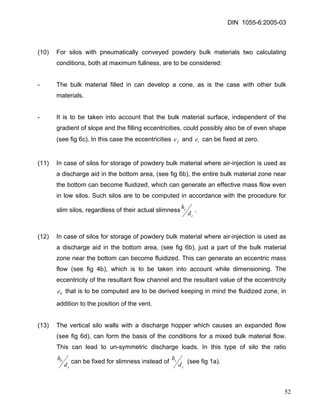
(10) For silos with pneumatically conveyed powdery bulk materials two calculating conditions, both at maximum fullness, are to be considered: 
- The bulk material filled in can develop a cone, as is the case with other bulk materials. 
- It is to be taken into account that the bulk material surface, independent of the gradient of slope and the filling eccentricities, could possibly also be of even shape (see fig 6c). In this case the eccentricities and can be fixed at zero. fete 
(11) In case of silos for storage of powdery bulk material where air-injection is used as a discharge aid in the bottom area, (see fig 6b), the entire bulk material zone near the bottom can become fluidized, which can generate an effective mass flow even in low silos. Such silos are to be computed in accordance with the procedure for slim silos, regardless of their actual slimnessccdh. 
(12) In case of silos for storage of powdery bulk material where air-injection is used as a discharge aid in the bottom area, (see fig 6b), just a part of the bulk material zone near the bottom can become fluidized. This can generate an eccentric mass flow (see fig 4b), which is to be taken into account while dimensioning. The eccentricity of the resultant flow channel and the resultant value of the eccentricity that is to be computed are to be derived keeping in mind the fluidized zone, in addition to the position of the vent. 0e 
(13) The vertical silo walls with a discharge hopper which causes an expanded flow (see fig 6d), can form the basis of the conditions for a mixed bulk material flow. This can lead to un-symmetric discharge loads. In this type of silo the ratio cbdhcan be fixed for slimness instead of ccdh (see fig 1a). 
52
DIN 1055-6:2005-03 
(14) A silo with a slimness of ccdhsmaller than 0.4 and with a funnel hopper is to be graded as a low silo. In case of a horizontal silo bottom this silo is to be graded as a braced wall silo. 
a) Mechanically aided discharge e.g. with a rotating space arm 
b) Air injection and air vents generate mass flow 
c) Pneumatic filling of powdery bulk material generally results in a level bulk material surface 
d) “Expanded flow” hoppers lead to mass flow at least in the lower hopper 
Figure 6 - SPECIAL FILLING AND SICHARGE ARRANGEMENTS 
53
DIN 1055-6:2005-03 
5.4 CALCULATING CONDITIONS CAUSED BY SPECIFIC STRUCTURAL SHAPES OF SILOS 
(1) In case of dimensioning of silos fro usability, the size of fissures is to be limited to suitable dimensions. The inspection of fissure size has to comply with the fissure size limitation specified in DIN 1045-1 subject to the exposition categories based on the ambient conditions of the silo. 
(2) For metal silos which mainly consist of nuts and bolts, the specifications for un- symmetric load values (reference surface loads) are to be complied with. 
(3) For metal silos with rectangular cross-sections that contain beam ties within the silo shaft for reducing the wall’s bending moment, the specifications in 7.7 are to be followed. 
(4) The effects of fatigue in silos and tanks are to be taken into account if they are exposed to a load cycle more than once a day on an average. A load cycle is equivalent to a complete filling and emptying cycle of a silo or, in the case of a air- injection silo, a complete process conclusion (rotation) of the sectors subjected to air-injection. Fatigue effects are also to be taken into consideration in silos which are exposed to the influence of vibrating machines/equipment components. 
(5) Prefabricated silos are to be dimensioned for the influences related to manufacture, transport and assembly. 
(6) In case of slip openings or observation holes in the silo or hopper walls, the loads on the stopper covers are to be taken into account using double the value of the maximum load-values upon the adjacent wall sections. These loads are to be computed only for the dimensioning of the stopper cover and its support or attachment structures. 
54
DIN 1055-6:2005-03 
(7) If the silo roof has to bear loads imposed by dust filtering equipment, cyclones or mechanical transporting equipment, then these loads are to be treated as live loads. 
(8) If pneumatic transport systems are used for filling and emptying of silos, then loads resulting from differences in air-pressure are to be taken into account. 
NOTE These loads normally amount to <10kPa as a rule, but higher sub pressures (generally 40kpa ≈ 0.4 bar) may also arise as a result of defective dimensioning of specific transporting equipment or in case of an operational fault. Silos must therefore be equipped with suitable pressure-relief devices for unforeseen occurrences, if the designing engineer cannot otherwise rule out the same. 
(9) If vibrating equipment, air guns or rotary extraction arms on the silo bottom have been used, the load changes caused by these have to be examined with respect to the boundary state of fatigue, vibrations due to pneumatic transporting equipment are likewise to be taken into consideration. 
(10) In case of reconditioning of existing silos by putting a lining on the silo walls, the effects of modified wall friction on silo dimensioning are to be considered, including the possible effects of a flow profile that may have undergone a change. 
5.5 DIMENSIONING CONDITIONS CAUSED BUY FLUIDS STORED IN TANKS 
Loads on tanks caused by the fluids stored therein are to be calculated for the state of maximum fullness. 
55
DIN 1055-6:2005-03 
5.6 PRINCIPLES OF DIMENSIONING FOR EXPLOSIONS 
(1) As the liquids or bulk material stored in tanks or silos respectively may have a tendency to explode, the potential damage could be limited or avoided by means of the following measures: 
-- Arrangement of adequate pressure relief areas 
-- Arrangement of adequate explosion suppression systems 
-- designing/dimensioning the structure for absorbing the explosive pressures 
(2) A few bulk materials which are prone to explosions are listed in Annex I. 
(3) The instructions given in Annex I for the explosion loads are to be followed. Further instructions including rules for dimensioning for dust explosions can be taken from DIN-Fachbericht 140. 
(4) The effects of silo structure dust explosions upon the surrounding structures or structural parts are to be taken into account. 
6 BULK MATERIAL PARAMETERS 
6.1 General 
(1) For the estimation of silo loads the following influences have to be taken into account: 
„ the divergences from the bulk material parameters 
„ the fluctuations of the wall friction at the silo wall 
„ the silo geometry 
„ the filling and emptying processes 
56
DIN 1055-6:2005-03 
(2) Influences which have a favourable impact upon the bulk material stiffness may not be taken into account while determining the loads and examining the stability of the wall. A positive impact of a wall deformation upon the pressures which develop in the bulk material may not be estimated, except if a reasonable and verified method of calculation can be proved. 
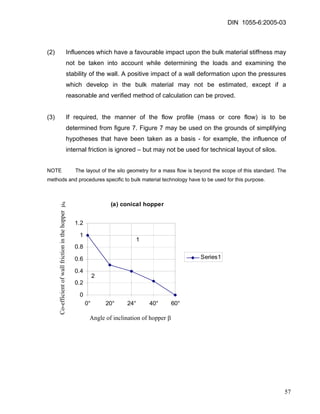
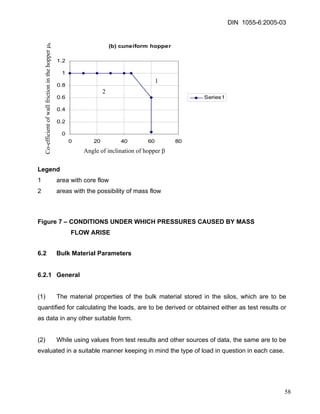
(3) If required, the manner of the flow profile (mass or core flow) is to be determined from figure 7. Figure 7 may be used on the grounds of simplifying hypotheses that have been taken as a basis - for example, the influence of internal friction is ignored – but may not be used for technical layout of silos. 
NOTE The layout of the silo geometry for a mass flow is beyond the scope of this standard. The methods and procedures specific to bulk material technology have to be used for this purpose. 
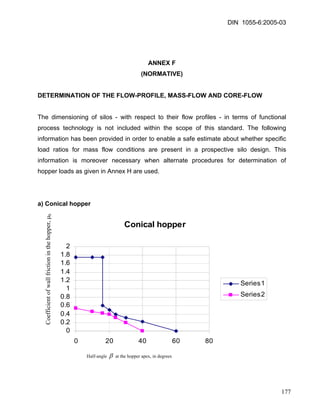
(a) conical hopper00.20.40.60.811.20°20°24°40°60° Series112 
Co-efficient of wall friction in the hopper μh 
Angle of inclination of hopper β 
57
DIN 1055-6:2005-03 
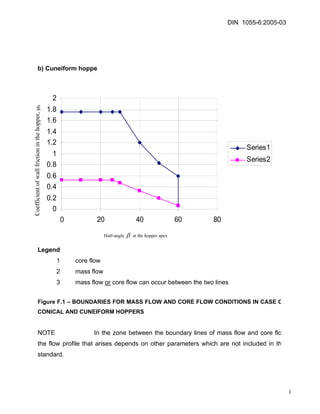
(b) cuneiform hopper00.20.40.60.811.202040608 
0Series1 
Co-efficient of wall friction in the hopper μh 
1 
2 
Angle of inclination of hopper β 
Legend 
1 area with core flow 
2 areas with the possibility of mass flow 
Figure 7 – CONDITIONS UNDER WHICH PRESSURES CAUSED BY MASS 
FLOW ARISE 
6.2 Bulk Material Parameters 
6.2.1 General 
(1) The material properties of the bulk material stored in the silos, which are to be quantified for calculating the loads, are to be derived or obtained either as test results or as data in any other suitable form. 
(2) While using values from test results and other sources of data, the same are to be evaluated in a suitable manner keeping in mind the type of load in question in each case. 
58
DIN 1055-6:2005-03 
(3) It should be kept in mind that there may be significant differences between the material parameters measured in tests and the parameters that are determined by the actual behaviour of the bulk material in the silo. 
(4) While evaluating the differences in bulk material parameters mentioned in (3), the following are some of the factors that must be kept in mind: 
„ a lot of parameters are not constant, and may be dependant upon the stress level and the background of load application 
„ Influences on account of particle shape, sizes and distribution of grain size can have a strong impact on the test and the silo in a variety of ways. 
„ temporal influences 
„ fluctuations of the moisture content 
„ influences of dynamic actions 
„ brittleness or ductility of the tested bulk material 
„ the manner of putting-in the bulk material in the silo and in the testing apparatus 
(5) While evaluating the differences in bulk material parameters mentioned in (3) with ref. to the coefficients of wall friction, the following factors must be kept in mind: 
„ corrosion and chemical reaction of the bulk material particles, dampness and the wall 
„ abrasion and wear which can roughen or smoothen the wall of the silo 
59
DIN 1055-6:2005-03 
„ polishing of the wall surface 
„ accumulation of fat deposits on the wall 
„ particles which get impressed in the wall surface (usually an influence which leads to the roughening of the wall surface) 
(6) While determining the values for the material parameters the following is to be kept in mind: 
„ the facts regarding the application of the relevant tests should be well- publicised and common knowledge 
„ a comparison of the values of the individual parameters which have been measured in the tests with the corresponding published parameters, taking into account the experimental values 
„ the deviation of the parameters relevant to the calculations 
„ the results obtained from the large scale measurements on silos of similar styles 
„ correlation of results from different types of tests 
„ perceptible changes in the material parameters during the period when the silo is in use 
(7) The choice of the characteristic material parameters has to be made on the basis of values the have been determined through laboratory tests, with due regard for know-how acquired through experience. 
60
DIN 1055-6:2005-03 
(8) The characteristic value of a material is to be chosen after a careful evaluation of the value which has influenced the occurrence of the load. 
CATEGORY 
DESCRIPTION OF WALL- SURFACE 
TYPES OF MATERIAL 
D1 
Polished 
Cold-rolled stainless steel 
Scarred stainless steel 
Polished stainless steel 
Galvanized carbon steel 
Aluminium 
Extruded high-density polyethylene 
D2 
Smooth 
Carbon steel with slight surface corrosion 
Coated carbon steel 
Cast high-density polyethylene 
Smooth ceramic plates 
Concrete surface manufactured with steel shell 
D3 
Rough 
Rough shell concrete 
Scarred carbon steel 
Steel silos with bolts on the inside surface of the wall 
Roughly polished ceramic plates 
D4 
Corrugated 
Horizontal corrugated wall 
Contoured sheet metal with horizontal notches 
Non-standardised walls with large deviations 
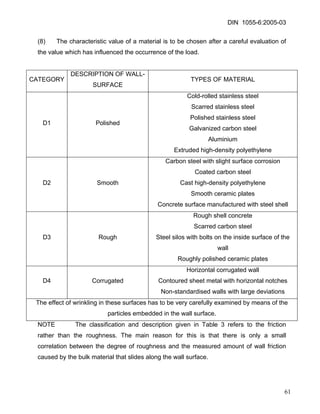
The effect of wrinkling in these surfaces has to be very carefully examined by means of the particles embedded in the wall surface. 
NOTE The classification and description given in Table 3 refers to the friction rather than the roughness. The main reason for this is that there is only a small correlation between the degree of roughness and the measured amount of wall friction caused by the bulk material that slides along the wall surface. 
61
DIN 1055-6:2005-03 
6.2.2 Determination of the Bulk Material Parameter 
(1) The material parameters to be used for the design calculation may have deviations due to the changes in the structure, the production procedure, the grain size distribution, moisture content, age and electrical charging during handling; these need to be taken into account. 
(2) The bulk material parameters are to be determined either according to the simplified procedure laid down in 6.2.3 or by means of test measurements in accordance with 6.3. 
(3) Bulk materials parameters which are not contained in Table E.1 are to be obtained by means of test measurements in accordance with 6.3. 
(4) The calculated correction values for the coefficient of wall friction μ of the bulk materials should take into account the roughness of the wall surface along which they glide. In Table 3 the different classes of wall surfaces are defined for use in this standard. 
(5) For silos with wall surfaces belonging to the class (category) D4 according to Table 3, the effective wall friction coefficients should be determined according to the procedure described in D.2. 
(6) The bulk material correction value Cop for the reference surface loads is to be taken from Table E.1 or calculated according to the equation (8). 
6.2.3 Simplified Procedure 
(1) The parameters of commonly known bulk materials are to be taken from the Table E.1. The values given there for the specific gravity γ correspond to the upper 
62
DIN 1055-6:2005-03 
characteristic value, while the parameters for the wall friction μm, for the horizontal load ratio Km and for the angle of the internal friction φim represent mean values of these characteristic quantities. 
(2) If individual bulk materials cannot be clearly classified under the bulk material categories listed in Table E.1, then their parameters are to be determined experimentally in accordance with the procedure described under 6.3 
(3) For determining the characteristic parameters of μ, K and φi, the listed values of μm, Km and φim are to be multiplied or divided by the so called conversion factor. The conversion factors ax are given in the table E.1 for the bulk materials listed therein. For calculating the maximum loads, the following combinations are to be used: 
Upper characteristic value of mkKaK= (1) 
Lower characteristic value of kmaKK= (2) 
Upper characteristic value of maμμμ= (3) 
Lower characteristic value of μμμam= (4) 
Upper characteristic value of imiaϕϕϕ= (5) 
Lower characteristic value of ϕϕϕaimi= (6) 
(4) For determining the effect of action on silos of the requirement category 1, the mean values μm, Km and φim may be used instead of the upper and lower characteristic values. 
63
DIN 1055-6:2005-03 
6.3 Measurement of Bulk Material Parameters in Tests 
6.3.1 Experimental Determination (Measuring System) 
(1) The experimental determination of the parameters is to be executed with representative bulk material specimens. For every bulk material property a mean value of the relevant parameter is to be determined keeping in mind the deviation of its relevant so-called secondary influence parameter such as bulk material structure, filtering curve, moisture content, temperature, age and the possibility of electrical charging during operation or manufacture. 
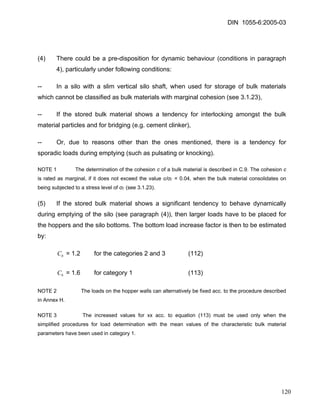
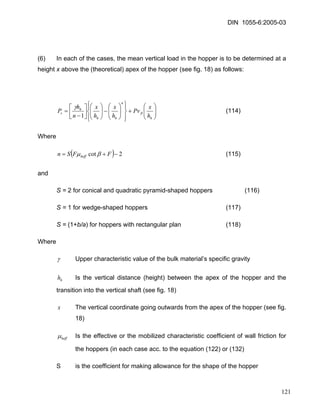
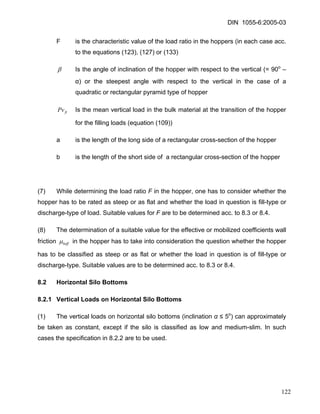
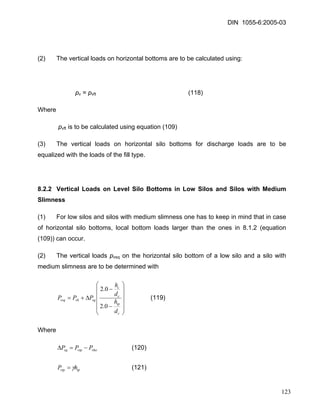
(2) The characteristic values are derived from the experimentally determined mean values with the aid of equations (1) to (6) and the corresponding conversion factors ax. 
(3) Each conversion factor ax is to be carefully determined. While determining the same one should take into account the fact that the bulk material parameters can undergo a change during the service life of the silo. Likewise, the possible consequences of the sedimentation phenomena in the silo and the inaccuracies during processing of the material specimens are to be taken into account. 
(4) If the test data is there, the conversion factors ax are to be ascertained acc. to C.11 in order to determine the standard deviation of the parameters. 
(5) The span between the mean value and the characteristic value of the bulk material parameter is expressed by the conversion factor ax. If a secondary influence parameter is by itself responsible for more than 75% of the conversion factor ax, it has to be raised by a factor of 1.10. 
NOTE The above-mentioned specifications serve to ensure that the values of xx adequately represent the probability of occurrence for the derived loads. 
64
DIN 1055-6:2005-03 
6.3.2 Specific Gravity γ of the Bulk Material 
(1) The specific gravity of the bulk material is to be determined for such a packing density of the bulk material particles and at such a pressure-level, which corresponds to the packing density or the pressure level that is present in the zone of maximum vertical fill-pressure bzw in the silo. The vertical pressure Pvft can be determined from the equations (11) or (86) for the depth of the bulk material at the lower end of the silo shaft. 
(2) For measuring the specific gravity γ the test procedures acc. to C.6 should be used. 
(3) The conversion factor for deriving the characteristic value from the measured value is to be determined in accordance with the procedure described in C.11. The conversion factor aγ may not be less than aγ = 1.10, except when a smaller value can be separately established through tests or a suitable estimation (see C.11). 
6.3.3 Coefficient of Wall Friction μ 
(1) The experimental determination of the coefficients of wall friction μ for the estimation of loads is to be determined for such a packing density of the bulk material particles and at such a pressure-level, which corresponds to the packing density or the pressure level that is present in the zone of maximum horizontal fill-pressure Phfb in the silo. The pressure level Phfb can be determined from the equations (9) or (78) for the depth of the bulk material at the lower end of the zone with vertical walls. 
(2) For measuring the coefficients of wall friction μ the test procedures acc. to C.7 should be used. 
(3) The mean value μm of the coefficients of wall friction and its standard deviation are to be determined and derived through tests. If only one mean value can be ascertained from the data material, the standard deviation is to be estimated in accordance with the method described in C.11. 
65
DIN 1055-6:2005-03 
(4) The conversion factor for deriving the characteristic value from the measured value is to be determined in accordance with the procedure described in C.11. The conversion factor may not be less than aμ = 1.10, except when a smaller value can be separately established through tests or a suitable estimation (see C.11). 
6.3.4 Angle of Internal Friction ϕi 
(1) The angle of internal friction ϕi for the calculation of loads is to be determined – as arc tangents from the ratio of the shear force to the normal force at the break under equivalent load - for such a packing density of the bulk material particles and at such a pressure-level, which corresponds to the packing density or the pressure level that is present in the zone of maximum vertical fill-pressure Pvf. The pressure level Pvf can be determined from the equations (11) or (86) for the depth of the bulk material at the lower end of the zone with vertical walls. 
(2) For measuring the angle of internal friction ϕi the test procedures acc. to C.9 should be used. 
(3) The mean value ϕim of the angle of internal friction and its standard deviation δ are to be determined and derived through tests. If only one mean value can be ascertained from the data material, the standard deviation is to be estimated in accordance with the method described in C.11. 
(4) The conversion factor for deriving the characteristic value from the measured value is to be determined in accordance with the procedure described in C.11. The conversion factor aϕ may not be less than aϕ = 1.10, except when a smaller value can be separately established through tests or a suitable estimation (see C.11). 
66
DIN 1055-6:2005-03 
6.3.5 Horizontal Load Ratio K 
(1) The horizontal load ratio K for the estimation of loads (the ratio of mean horizontal pressure to mean vertical pressure) is to be determined for such a packing density of the bulk material particles and at such a pressure-level, which corresponds to the packing density or the pressure level that is present in the zone of maximum vertical fill-pressure. The pressure level pvft can be determined from the equations (11) or (86) for the depth of the bulk material at the lower end of the zone with vertical walls. 
(2) For measuring the horizontal load ratio K the test procedures acc. to C.8 should be used. 
(3) The mean value Km of the horizontal load ratio and its standard deviation are to be determined and derived through tests. If only one mean value can be ascertained from the data material, the standard deviation is to be estimated in accordance with the method described in C.11. 
(4) An approximate value for Km can be alternatively calculated according to the foll. Equation (7) from the mean value of the angle of internal friction for first load application imϕ determined through tests (see 6.3.4) 
Km = 1.1 (1- sin ϕim) (7) 
NOTE The factor 1.1 in equation (7) is used in order to ensure an appropriate derivative unit of measure for making allowance for the difference between a value of K (= Ko ) that was measured under virtually absent wall-friction influences and a value of K that was measured in the presence of wall friction influences (see also 6.2.2 (5)). 
67
DIN 1055-6:2005-03 
(5) The conversion factor for deriving the characteristic value from the measured value is to be determined in accordance with the procedure described in C.11. The conversion factor aK may not be less than aK = 1.10, except when a smaller value can be separately established through tests or a suitable estimation (see C.11). 
6.3.6 Cohesion c 
(1) The cohesion of bulk material varies with the consolidation stress to which the specimen is subjected. It is to be determined for such a packing density of the bulk material particles and at such a pressure-level, which corresponds to the packing density or the pressure level that is present in the zone of maximum vertical fill-pressure Pvf. The pressure level Pvf can be determined from the equations (11) or (86) for the bulk material depth at the lower end of the zone with vertical walls. 
(2) For measuring the cohesion c the test procedures acc. to C.9 should be used. 
NOTE Alternatively the cohesion can be estimated by means of results of tests in the shear cells of Janike. A method for calculating the cohesion from test results is to be taken from C.9. 
6.3.7 Bulk material Correction Value for the Reference Surface Load Cop 
(1) The bulk material correction value for the reference surface load Cop is to be estimated on the basis of suitable test data. 
NOTE 1 The discharge factors C make allowances for a host of phenomena which arise during the emptying of silos. The symmetric increase of pressures is relatively independent of the stored bulk material, yet the unsymmetric components are greatly dependant upon the material. The material-dependency of the unsymmetric components is represented by the bulk material correction value Cop . This parameter is not easy to determine with the help of experimental test procedures. 
68
DIN 1055-6:2005-03 
NOTE 2 A suitable experimental test procedure for the parameter Cop has not so far been developed. This factor is therefore based on evaluations of tests on silos and on experimental values of silos with conventional filling and discharge systems, which were established within the usual structural tolerances. 
(2) Values for the bulk material correction values for the reference surface load Cop of commonly known bulk materials are to be taken from Table E.1. 
(3) For materials which are not listed in Table E.1, the bulk material correction value for the reference surface load can be estimated from the divergence factors for the horizontal load ratio aK and the wall friction correction value aμ acc. to equation (8): 
Cop = 3.5 aμ = 2.5 aK – 6.2 
Where 
aμ divergence factor for the coefficients of wall friction μ; 
aK divergence factor for the horizontal load ratio K of the bulk 
Material. 
(4) For special silos or special bulk materials (in the individual case) the suitable bulk material correction value for the reference surface load Cop can be estimated by means of large scale experimental investigations in silos with designs that are comparable. 
7 LOADS ON VERTICAL SILO WALLS 
7.1 General 
(1) For the filling and the emptying types of loads, the characteristic values of the loads described in this section have to be fixed. For this purpose the loads are differentiated as follows: 
69
DIN 1055-6:2005-03 
„ slim silos 
„ silos of medium slimness 
„ low silos 
„ braced walls silos (silos consisting of braced walls) 
„ silos for the storage of bulk materials air pockets between the bulk material particles (for example, due to pneumatic discharge aids and homogenizing silos) 
„ silo hoppers and silo bottoms 
(2) The loads on the vertical silo walls are to be determined in accordance with the following criteria pertaining to the slimness of the silos: 
„ slim silos, with 2.0 < hc / dc (with exceptions acc. to 5.3) 
„ silos with medium slimness, with 1.0 < hc / dc < 2.0 (with exceptions acc. to 5.3) 
„ low silos, with, 0.4 < hc / dc < 1.0 (with exceptions acc. to 5.3) 
„ braced wall silos (silos consisting of braced walls) with horizontal bottoms and hc / dc < 0.4 
„ silos for bulk materials with air pockets between the bulk material particles 
(3) A silo with an aerated bottom is to be handled – independent of its actual slimness hc/ dc -- like a slim silo. 
(4) The loads on the vertical walls are made up of a stationary load component, the symmetrical loads and a free load component, the reference surface loads. Both the components are to be assessed as acting simultaneously. 
(5) Special types of loads are to be taken into account for large fill and discharge eccentricities. These are not to be placed simultaneously with the symmetrical and reference surface loads; each represents a separate and clearly defined load category. 
70
DIN 1055-6:2005-03 
(6) Detailed guidelines for the calculation of fill and discharge loads are given within the context of silo slimness in sections 7.2, 7.3 and 7.4. 
(7) Rules for the additional types of loads for special types of silos and special design conditions are given in 7.5 till 7.7: 
„ see 7.5 for silos with air injection equipment for complete or partial fluidization of bulk material 
„ see 7.6 for loads due to hot-filled bulk materials 
„ see 7.7 for loads in rectangular silos 
(8) For circular silos with large fill and discharge eccentricities, load estimates are given in 7.2.4. For non-circular silo bins corresponding load estimates should be derived from these load estimates, if they are found to be suitable for design calculations. 
(9) If funnel flow can be ensured within the bulk material without contact points between the flow zone and the silo walls (see 5.3 (4)), the calculations can be limited to the estimates of the filling loads, in which case the reference surface loads are to be taken into account along with these, if required. 
7.2 Slim Silos 
7.2.1 Fill Loads on Vertical Walls 
7.2.1.1 Symmetric Fill Loads 
(1) The symmetric fill loads (see figure 8) are to be calculated acc. to the equations (9) to (14). 
71
DIN 1055-6:2005-03 
(2) After the filling is done and during the storage of the bulk material, the horizontal loads Phf, the wall friction loads Pwf and the vertical loads Pvf are to be estimated as follows: 
(9) ()()zYPzPjhohf= 
()()zYPzPjhowfμ= (10) 
()()zYKPzPjhovf= (11) 
With 
ohoKzPγ= (12) 
UAKzoμ 1= (13) 
()ozzjezY−−=1 (14) 
Where 
γ The characteristic value of the bulk material specific gravity 
μ The characteristic value for the coefficients of wall friction for the bulk material at the vertical silo walls 
72
DIN 1055-6:2005-03 
K The characteristic value of the horizontal load ratio 
z The depth of the silo material beneath the equivalent surface of the bulk material 
A The inner cross-sectional area of the silo 
U The circumference of the inner cross-sectional area of the silo 
(3) For the status after the filling is done, the resultant characteristic value of the wall friction loads Pwf that have been added-up up till depth z – with the force per unit of length in the direction of the circumference e.g. [kN/M] – is calculated using: 
(15) ()()[]zYzzPdzzPPjohozwfwf−==∫μ 0 
(4) For determining the characteristic values for the required bulk material parameters (specific gravity (γ), correction value for wall friction μ and horizontal load ratio K), the values given in 6.2 and 6.3 are to be used. 
7.2.1.2 Reference Surface Load for Filling Loads: General 
Requirements 
(1) For making an allowance for unplanned unsymmetrical loads due to eccentricities and imperfections during the filling of the silos, reference surface loads or other suitable load arrangements are to be placed. 
(2) For silos of category 1 the reference surface load can be ignored for the filling loads. 
73
DIN 1055-6:2005-03 
Legend 
1 equivalent bulk material surface 
1 
vfP 
wfPwfP 
z 
hc 
hfP 
z1 
hf P 
Figure 8 – SYMMETRIC FILLING LOADS NEAR THE VERTICAL SILO WALLS 
3) For silos in which powdery bulk material is stored and which are filled with the help of air injection equipment, the placing of reference surface loads for the filling loads can, as a rule, be done away with. 
(4) The amount of reference surface load to be placed for the filling loads Ppf is to be estimated on the basis of the maximum possible eccentricity ef the filled cone that appears at the surface of the bulk material (see fig. 1b). 
(5) The fundamental value of the reference surface load for the filling load Ppf is to be fixed with: 
hfpfpfPCP= (16) 
74
DIN 1055-6:2005-03 
With: 
()⎟⎟ ⎠ ⎞ ⎜⎜ ⎝ ⎛ −+= ⎟⎠ ⎞ ⎜⎝ ⎛−⎥⎦ ⎤ ⎢⎣ ⎡ ⎟⎠⎞ ⎜⎝⎛ −15.1212121.0ccdhoppfeECC (17) 
cfdeE2= (18) 
But pfC> 0 (19) 
Where 
fe Is the maximum eccentricity of the filled cone which appears at the 
Bulk material surface during filling; 
hfP Is the local value of the horizontal fill pressure acc. to equation (9) at the position at which the reference surface load is placed 
opC Is the correction value of the bulk material for the reference surface load (see table E.1). 
(6) The height of the zone at which the reference surface load is to be placed (see figures 9 and 10) amounts to: 
ccdds2.016≈= π (20) 
(7) The reference surface load consists of only a horizontally acting load component. There are no frictional forces to be taken into account as a result of these horizontal load components. 
75
DIN 1055-6:2005-03 
(8) The form of the reference surface load for the filling loads depends upon the structural design of the silo. The following structural designs of silos can be distinguished with respect to the reference surface load to be placed: 
-- Thick walled silos with circular cross-section see figure7.2.1.3 (e.g. reinforced concrete silos); 
-- thin walled silos with circular cross sections, see figure 7.2.14 (e.g. metal silos without braces); 
-- Silos with non-circular cross-sections, see 7.2.1.5 
a) Thin walled circular silo b) other circular silo 
S 
Ppf1 
Ppf 
Ppf 
Ppf 
S 
S 
S 
zp 
hp 
a 
hc 
b 
Ppfs 
Ppf 
θ 
s 
h 
Ppf 
Figure 9 - Longitudinal Section and Transverse Section Showing the Load Diagrams of the Reference Surface Loads 76
DIN 1055-6:2005-03 
Ppe,nc 
Ppf,nc 
Ppe,nc 
Ppf,nc 
Ppe,nc 
] 
ppf,nc 
S 
a 
hc 
S 
a 
hc 
Legend 
a smaller value of zo and hc/2 
b as per choice 
Figure 10 – LONGITUDNAL SECTION AND TRANSVERSE SECTION SHOWING THE LOAD DIAGRAMS OF THE REFERENCE SURFACE LOADS FOR NON-CIRCULAR SILOS 
77
DIN 1055-6:2005-03 
7.2.1.3 Reference Surface Load for Filling Loads: Thick-Walled Circular Silos 
(1) For thick-walled circular silos of the categories 2 and 3, the fundamental value of 
The reference surface load for the filling load is to be estimated as it acts outwards pfP 
Along the opposite sides of a quadratic reference surface with the side length s (see 
equation (20)). The unit of measurement for the side length s should be applied to 
the curved surface in a suitable manner. 
2) In addition to the reference surface load that acts outwards, a complementary pfP 
Reference surface load that is directed inwards is to be placed in the remaining portion of the silo circumference above the same wall-height (see fig. 9b): pfiP 
pfiP = 7pfP (21) 
Where 
pfP is the fundamental value of the reference surface load acting outwards for the filling loads acc. to equation (16) 
NOTE The amount and the impact area of the load which is directed inwards are chosen such that the resultants of both the load components counterbalance each other in the middle at the position at which these are to be placed. pfiP 
(3) The reference surface load for the filling loads is to be placed at any 
position on the silo wall. However it may be placed in accordance with the manner described in 7.2.1.3(4). 
(4) In thick-walled circular silos of category 2, a simplified proof may be furnished. 
Half the height of the vertical bin shaft may be regarded as the most unfavourable 
Position for placing the reference surface load. The largest percentage increase of the dimensioning sections which result from the placing of reference surface loads at this 
78
DIN 1055-6:2005-03 
position can be carried over to the other areas of the wall by multiplying over there the design sectional sizes with the value of the ratio between the horizontal fill pressure at the observed position and the horizontal fill pressure at the position where the reference surface load was placed. 
7.2.1.4 Reference Surface Load for the Filling loads: Thin-Walled Circular Silos 
(1) For thin-walled circular silos (dc/t > 200) of the categories 2 and 3 the reference surface load for the filling loads has to be placed above the height s acc. to equation (20). It changes from a maximum pressure with the quantity ppf that acts outwards at a particular point, into a maximum inwards-acting pressure with the same quantity ppf at the opposite side (see figure 9a). The progression in the circumferential direction is to be estimated with: 
θcospfpfsPP= (22) 
Where 
is the reference surface load acting outwards acc. to equation (16) pfP 
θ is the angle coordinate in the circumferential direction (see fig. 9a). 
(2) The horizontal load that results from the reference surface load of the filling loads is to be calculated for circular silos acc. to equation (23): pfF 
pfcpfPsdF2 π = (23) 
(3) For welded silos of category 2, the reference surface load can be placed as active load in a depth zp beneath the bulk material surface. For zp the smaller of the following values is decisive: 
zp = zo and zp = 0.5 hc (24) 
Where, hc is taken as the height of the vertical silo shaft (see fig. 1a). 
79
DIN 1055-6:2005-03 
(4) For silos with screw and bolt connections of category 2, the reference surface loads the reference surface load is to be placed at any position as active load. 
7.2.1.5 Reference Surface Load for Filling Loads: Non-Circular Silos 
(1) For non-circular silos of categories 2 and 3, one can make allowance for 
the reference surface loads of the fill type by an increase of the symmetrical loads acc. to (2) and (3). 
(2) The reference surface load in the outward direction is to be positioned at each point and depth in the silo as a stripe-shaped band with the band width s (acc. to equation (20)) (see fig. 10a) 
(3) The quantity of the uniform reference surface load is to be estimated using: ncpfP, 
(25) pfncpfPP36.0,= 
Where represents the fundamental value of the reference surface load of the fill type acc. to equation (16). A suitable estimate for dc is to be derived from fig. 1d. pfP 
NOTE The value and the extent of the uniform load are so chosen that the resultant bending moments for a silo with rectangular cross-section and without internal braces will take on approximately the same order of magnitude as would result in the case of placing a local reference surface load in the middle of the wall. nhfP, pfP 
80
DIN 1055-6:2005-03 
7.2.2 Discharge Loads on Vertical Walls 
7.2.2.1 Symmetric Discharge Loads 
(1) To make allowance for possible short-term load-increases during the discharge process, an increase of the symmetric load components in the discharge loads is to be made. 
(2) For silos of all categories the symmetric discharge loads xx and xx are to be determined from: 
(26) hfhhePCP= 
(27) wfwwePCP= 
Where 
is the discharge factor for horizontal loads; hC 
is the discharge factor for wall friction loads; wC 
The emptying factors and are to be estimated for each case present from the equations (28) up till (32). hCwC 
(3) For silos of all categories which are emptied at the surface of the bulk material (and therefore do not show any flow within the stored bulk material), the values from xx and xx can be taken as 
= = 1.0 (28) hCwC 
(4) For slim silos of categories 2 and 3, the discharge factors are to be estimated using: 
(29) 15.1=hC 
10.1=wC (30) 81
DIN 1055-6:2005-03 
(5) For slim silos of category 1, for which the mean values of the bulk material parameters Kand μare used for load determination, the following values are to be taken as discharge factors: 
opchCdeC⎟⎠⎞ ⎜⎝⎛ ++=4.015.115.1 (31) 
⎟⎠⎞ ⎜⎝⎛ += cwdeC4.014.1 (32) 
()ofeee,max= (33) 
Where 
fe is the maximum eccentricity of the filled cone which appears during filling at the bulk material surface (see fig 1b); 
oe is the eccentricity of the midpoint of the discharge outlet; 
opC is the bulk material correction value for the reference surface load (see Table E.1) 
(6) For the discharge type load the resultant characteristic value of the wall friction loads which have been added-up up to the depth z – with the force per unit length for the circumferential direction of the wall, e.g. [kN/m] – is derived from: weP 
(34) ()()[∫−== zjohowwewezYzzPCdzzpp0 μ ] 
82
DIN 1055-6:2005-03 
7.2.2.2 Reference Surface Load for Discharge Loads: General Requirements 
(1) Reference surface loads for the discharge loads are to be estimated in order to make allowances for the unplanned unsymmetric loads during emptying of the silo on the one hand and the eccentricities during filling and emptying on the other (see fig. 1b). 
(2) For silos of category 1, the reference surface load of the discharge type may be ignored. 
(3) For silos of categories 2 and 3 the procedures described in this section are to be used for estimating the discharge loads. 
(4) For silos of categories 2 and 3 the load estimates for slim silos (7.2.4) with large discharge eccentricities (see 7.1 (5)) are to be used as a separate load-type, in addition to the procedures described in this section, if the following conditions apply: 
„ the eccentricity of the discharge outlet is larger than the critical value (see fig. 4c); oeccrode25.0,= 
„ The maximum eccentricity during filling is larger than the critical value and the silo slimness is greater than the limit value feccrfde25.0,= lim⎟⎟⎠ ⎞ ⎜⎜⎝ ⎛ ccdh =4.0 (see fig. 5d). 
(5) The fundamental value of the outwardly-directed reference surface load for the discharge type load is to be fixed with: peP 
(35) hepepePCp= 
83
DIN 1055-6:2005-03 
With 
()⎟⎟ ⎠ ⎞ ⎜⎜ ⎝ ⎛ −+= ⎟⎠ ⎞ ⎜⎝ ⎛ ⎥⎦ ⎤ ⎢⎣ ⎡−⎟⎠⎞ ⎜⎝⎛ −15.1212142.0ccdhoppeeECC (36) 
cdeE2= (37) 
But 2.101272.0≤⎟⎟⎠ ⎞ ⎜⎜⎝ ⎛ ≥⎥⎦ ⎤ ⎢⎣ ⎡ +⎟⎟⎠ ⎞ ⎜⎜⎝ ⎛ −≥ ccccoppedhforEdhCC (38) 
()ofeee,max= (39) 
Where 
fe Is the maximum eccentricity of the filled cone which appears at the bulk material surface during filling (see fig 1b); 
oe Is the eccentricity of the midpoint of the outlet opening; 
heP Is the local value of the horizontal discharge pressure acc. to equation (26) at the position at which the reference surface load is placed 
opC is the correction value of the bulk material for the reference surface load (see Table E.1) 
(6) The reference surface load for the discharge type load consists of only one horizontally acting load component. Additional frictional forces due to this horizontal load are to be disregarded. 
(7) The form of the reference surface load for the discharge type load depends upon the structural style of the silo. This standard refers to the following structural styles of the silos with respect to the reference surface loads to be assessed: 
84
DIN 1055-6:2005-03 
„ Thick-walled silos with circular cross-sections see. 7.2.2.3 (reinforced concrete silos); 
„ thin-walled silos with circular cross-sections, see 7.2.2.4 (metal silos); 
„ Silos with non-circular cross-sections, see 7.2.2.5. 
7.2.2.3 Reference Surface Load for Discharge Loads: Thick-Walled Circular Silos 
(1) For thick-walled circular silos, the fundamental value of 
The reference surface load for the discharge type load (see equation (20)) is to be peP 
Assessed as it acts outwards along the opposing sides on a quadratic reference 
Surface with the side length s, in accordance with the illustration in fig. 11b 
(2) In addition to the reference surface load that acts outwards, a complementary peP 
Reference surface load that is directed inwards is to be placed in the remaining portion of the silo circumference above the same wall-height (see fig. 11b): peiP 
7pepeiPP= (40) 
Where 
peP is the fundamental value of the reference surface load acting outwards acc. to equation (35) 
NOTE The amount and the impact area of the load which is directed inwards are chosen such that the resultants of both the load components counterbalance each other in the middle at the position at which these are to be placed. peiP 
(3) The reference surface load for the discharge type load is to be placed at any position on the silo wall. However this is to be laid out in the manner described in 7.2.2.3(4). 
85
DIN 1055-6:2005-03 
(4) In thick-walled circular silos of category 2 a simplified proof may be furnished. 
Half the height of the vertical bin shaft may be regarded as the most unfavourable 
position for placing the reference surface load. The percentage increase of the dimensioning sectional sizes due to the placing of reference surface loads at this position can be carried over to the other areas of the wall by multiplying over there the sectional sizes with the value of the ratio between the horizontal fill pressure at the observed position and the horizontal fill pressure at the position where the reference surface load was placed. 
S 
S 
Ppe 
Ppe1 
Ppe 
Ppes 
Ppe 
θ 
Ppe 
Ppe 
a 
hp 
zp 
S 
h 
S 
b 
hc 
a) Thin walled circular silo b) other circular silo 
Legend 
a smaller value of Zp and ho /2 
b any 
Figure 11: Longitudinal Section and Transverse Section Showing the Load Diagrams of the Reference Surface Loads during Discharge 
86
DIN 1055-6:2005-03 
7.2.2.4 Reference Surface Load for Discharge Loads: Thin-Walled Circular Silos 
(1) For thin-walled circular silos (200> tdc) of the categories 2 and 3 the reference surface load for the filling loads has to be placed above the height s acc. to equation (20). It changes from a maximum pressure with the quantity that acts outwards at a particular point, into a maximum inwards-acting pressure with the same quantity at the opposite side (see figure 11a). The progression in the circumferential direction is to be estimated with: pePpeP 
θcospepesPP= (41) 
Where 
Is the reference surface load acting outwards acc. to equation (35) peP 
θ Is the angle co-ordinate in the circumferential direction (see fig. 11a). 
(2) The horizontal load that results from the reference surface load of the filling loads is to be calculated for circular silos acc. to equation (42): peF 
pecpePsdF2 π = (42) 
(3) For welded silos of category 2, the reference surface loads can be placed as active load in a depth beneath the bulk material surface. For the smaller of the following values is to be fixed: pZpZ 
opZZ= and cphZ5.0= (43) 
Where the height of the vertical silo shaft is to be put for (see fig. 1a) ch 
87
DIN 1055-6:2005-03 
(4) For silos with screw and bolt connections of category 2, the reference surface loads the reference surface load is to be placed at any position as active load. Alternatively, the procedure in 7.2.3 can be used. 
7.2.2.5 Reference Surface Load for Discharge Loads: Non-Circular Silos 
(1) For non-circular silos of categories 2 and 3, one can make allowance for 
The reference surface loads of the fill type by an increase of the symmetrical loads acc. to (2) and (3) 
(2) The reference surface load in the outward direction is to be positioned at each point and depth in the silo above a height s (acc. to equation (20)) (see fig. 10b) 
(3) The amount of the uniform reference surface load is to be assessed using: ncpeP, 
(44) pencpePP36.0,= 
Where represents the fundamental value of the reference surface load of the discharge type acc. to equation (35). A suitable estimate for is to be derived from fig. 1d. pePcd 
NOTE The value and the extent of the uniform load are so chosen that the resultant bending moments for a silo with rectangular cross-section and without beam ties will take on approximately the same order of magnitude as would result in the case of placing a local reference surface load in the middle of the wall. nheP, peP 
88
DIN 1055-6:2005-03 
7.2.3 UNIFORM INCREASE OF LOADS AS REPLACEMENT FOR THE REFERENCE SURFACE LOADS – FILL LOAD AND DISCHARGE LOADS – FOR CIRCULAR SILOS 
(1) In circular silos of category 2 the procedure, using reference surface loads given in 7.2.1 and 7.2.2, for taking into account the unsymmetries in case of filling and discharge can be approximately replaced by increasing the loads. 
(2) In circular silos the following processes can be used only if the vertical silos are designed such that they have adequate stiffness at their upper and lower ends to withstand horizontal deformations and an adequate lateral distribution is ensured. The upper end and the foot of the silo cylinder shell must be supported along its circumference against the roof or a ring brace with a structural joint. 
(3) For thick-walled circular silos the resulting horizontal loads in case of filling and in case of emptying are to be calculated using uhfp,uhep, 
()pfhfuhfCppς+=1, (45) 
()peheuheCppς+=1, (46) 
With 
(t dc01.05.0+= ) ς (47) 
And 
0.1≥ς (48) 
89
DIN 1055-6:2005-03 
Where 
hfp is the symmetrical horizontal load after filling acc to equation (9) 
is the symmetrical horizontal load during emptying acc to equation (26) hep 
is the correction value for the reference surface load in case of filling acc to pfC 
equation (17) 
peC is the correction value for the reference surface load in case of emptying acc to equation (36) 
(4) For thin -walled circular silos the resulting horizontal loads in case of filling and in case of emptying and the wall friction loads and which result from these loads are to be calculated using uhfp, uhep,uwfp,uwep, 
()pfhfuhfCpp5.01,+= (49) 
()pfwfuwfCpp5.01,+= (50) 
()pfheuheCpp5.01,+= (51) 
()pfweuweCpp5.01,+= (52) 
Where 
wfp is the symmetrical horizontal load in case of filling acc to equation (10) 
is the symmetrical horizontal load in case of emptying acc to equation (27) wep 
The parameters,, and are to be calculated using the procedure given in (3). hfpheppfCpeC 
90
DIN 1055-6:2005-03 
7.2.4. DISCHARGE LOADS FOR CIRCULAR SILOS WITH LARGE ECCENTRICITIES DURING DISCHARGE 
7.2.4.1 General 
(1) For silos of categories 2 and 3, if the eccentricity of the outflow opening is larger than the critical valueoeccrode25.0,=, then the following procedures are to be adopted for determination of the load distribution in order that allowance can be made for an eccentric discharge in the form of a funnel flow above the outflow opening (see fig 12a) 
(2) For silos of categories 2 and 3, if the maximum eccentricity during filling is larger than the critical valuefeccrfde25.0,=, and the silo slimness larger than0.4= ccdh, then the following procedures are to be adopted for determination of the distribution of pressure in the silo. This pressure distribution can arise as a consequence of the build-up of an external funnel flow (see figures 5d and 12 a). 
(3) In case it is necessary to use the procedure given in 7.2.4.2 and 7.4.2.3, these are to be treated as separate load-types in addition to the filling and discharge loads and the estimates of the reference surface loads in 7.2.2 and 7.2.3. 
(4) The estimation of these loads is to be made using the lower characteristic value of the wall friction μ and the upper characteristic value of the angle of internal frictioniϕ . 
(5) For silos of category 2 a simplified procedure is allowed acc to 7.2.4.2. For silos of category 3, the procedures in 7.2.4.3 are to be adopted. 
91
DIN 1055-6:2005-03 
7.2.4.2 Procedure for Silos of Category 2 
7.2.4.2.1 Geometry of the Flow Canal 
(1) For silos of category 2 the calculations must be made only for that volume of the flow canal which is in contact with the silo wall. The volume of the flow zone in such case is to be determined through the value of the angle 
(53) 035=Cθ 
7.2.4.2.2 Wall Pressures during Eccentric Discharge 
(1) In the flow zone the horizontal loads on the vertical wall (see fig 12c) are to be taken as 
(54) 0=hceP 
(2) In that area in which the bulk material is at rest, the horizontal loads on the vertical silo walls at depth z (see fig 12c) are to be estimated using 
(55) hfhsePP= 
(56) hfhaePP2= 
and the wall friction load at the wall at depth z: 
(57) wfwsePP= 
(58) wfwaePP2= 
Where 
hfP is the horizontal load ratio in case of filling acc to equation (9) 
wfP is the wall friction load in case of filling acc to equation (10) 
NOTE This simplified procedure corresponds to an ‘empty’ funnel and is very conservative. 
(3) Alternatively the procedures in 7.2.4.3.2 can also be used. 
92
DIN 1055-6:2005-03 
7.2.4.3 Procedure for Silos of Category 3 
7.2.4.3.1 Geometry of the Flow Canal 
(1) The geometry and the position of the flow channel are to be chosen such that adequate allowance is made for the geometry of the silo, the discharge-conditions and the bulk material properties. 
(2) If the conditions for discharge lead to the build-up of a flow channel with a clearly defined geometry and position, then the parameters which can be derived from this flow channel should be adopted for further use. 
(3) If the geometry of the flow channel cannot be directly derived from the arrangement of the outflow openings and the silo geometry, calculations must be made with at least three different flow channel radii, in order to make allowance for the any chance that the volume of the flow channel may change with the passage of time. The following three values should be considered: cr 
(59) rrc5.0= 
(60) rrc75.0= 
(61) rrc9.0= 
Where 
r is the radius 2cd=of the circular silo 
93
DIN 1055-6:2005-03 
4 
2 
1 
3 
5 
1 
2 
a) Front view b) cross-section 
a) Flow channel and reverse distribution 
1 
phae 
5 
phce 
θ 
θc 
θc 
6 
θc 
ec 
rc 
r 
ψ 
ph 
3 
b) Geometry of the flow channel loads varying with the depth of the silo 
Legend 1 bulk material at rest 
2 flow channel 
3 loads in the static zone 
4 local high loads 
5 loads in the flow zone 
6 flow channel-margin loads 
Figure 12 – FLOW CHANNEL AND PRESSURE DISTRIBUTION IN CASE OF DISCHARGE WITH LARGE ECCENTRICITIES 
94
DIN 1055-6:2005-03 
(4) The eccentricity of the flow channel can be worked out by: 
()(){}GGrec−−+−=111ηη (62) 
With rrGc= (63) 
And iϕ μηtan= (64) 
Where 
μ is the lower characteristic value of the coefficient of wall friction for the vertical silo wall 
iϕ is the upper characteristic value of the angle of internal friction of the stored bulk material 
cr is the dimensioning value of the flow channel radius acc to equations (59) to (61) 
NOTE 1 It must be emphasized that iwϕϕ≤is always given, because otherwise a sliding surface would build up within the bulk material. This means that in equation (64) 1≤ηalways. 
NOTE 2 As indicated in fig 5d the eccentricity of the flow channel can vary. It is not solely and exclusively dependant upon the eccentricity of the outflow opening. The given procedure intends to make allowance for all those situations which could lead to the most unfavourable ratios possible in each silo geometry and in each structural arrangement. The eccentricity of the flow channel can, in effect, therefore be smaller than the critical filling eccentricity and the critical discharge eccentricity. cecrcfe, crcoe, 
NOTE 3 This estimate of the position and volume of the flow channel is based upon the principle of minimizing the frictional resistance of the bulk material at the peripheral surface of the flow channel based on the simplistic assumption that the 
95
DIN 1055-6:2005-03 
circumference of the flow channel is a circular curve. Other suitable procedures for the determination of the circumference of the flow channel may also be used. 
(5) Apart from the flow channel geometries mentioned in (3), in case of a hopper for “expanded flow” (see fig 6d) one has to consider the additional possibility of a flow channel with a radius equivalent to the radius of the silo cross-section at the upper end of the hopper for “expanded flow”. 
(6) The limitation of the contact surface between the flow channel and the silo wall is defined in terms of the angle at circumferencecθ θ±=, where: 
() ccccrerer2cos222−+=θ (65) 
(7) The curve-length of the contact surface between the flow channel and the wall is: 
rUcwcθ2= (66) 
And the curve-length of the contact surface between the flow channel and the bulk material which is in a state of rest is: 
( ) ψπ−=cscrU2 (67) 
Where ccrrθψsinsin= (68) 
And the two angles cθ and ψ are to be put in radian measure. 
(8) The cross-section of the flow channel is to be calculated as follows: 
()()cccccrrrrAθψθψπ−−+−=sin22 (69) 
96
DIN 1055-6:2005-03 
7.2.4.3.2 Wall Loads during Discharge with Large Eccentricities 
(1) The horizontal loads on the vertical walls in the flow channel zone (see fig 12c) are dependant upon the depth z beneath the equivalent bulk material surface and can be calculated in acc with: 
⎟⎠ ⎞ ⎜⎝ ⎛−=− oczzhcohceepp1μ (70) 
The wall friction loads acting upon the walls at depth z can be determined by: 
⎟⎠ ⎞ ⎜⎝ ⎛−==− oczzhcohcewceeppp1μμ (71) 
With 
ochcoKzpγ= (72) 
⎟⎟⎠ ⎞ ⎜⎜⎝ ⎛ + = iscwccocUUAKz ϕμtan1 (73) 
Where 
μ is the coefficient of wall friction in the area of the vertical wall 
K is the horizontal ratio of the bulk material. 
(2) The horizontal loads on the silo walls at depth z in the area outside the flow zone where the bulk material is in a state of rest are to be calculated using 
(74) hfhsepp= 
And the wall friction loads upon at depth z: 
(75) wfwsepp= 
Where 
hfp is the horizontal loads in case of filling loads in acc with equation (9) 
wfp is the wall friction loads in case of filling loads in acc with equation (10) 
97
DIN 1055-6:2005-03 
(3) Higher loads act directly upon the vertical silo walls (see fig 12c) in the passage leading from the flow zone to the area where the bulk material is in a state of rest. These outward-acting horizontal loads next to the flow channel at depth z beneath the equivalent surface of the bulk material are to be estimated using: 
(76) hcehfhaeppp−=2 
And the accompanying wall friction loads corresponding to these, upon the wall at depth z are to be estimated using: 
haewaeppμ= (77) 
7.3 Low Silos and Silos with Medium Slimness 
7.3.1 Fill Loads on the Vertical Walls 
7.3.1.1 Symmetric Fill Loads 
(1) The symmetric fill loads (see figure 13) are to be calculated acc. to the equations (78) to (87). 
(2) The values for the horizontal loads and the wall friction loads for the fill type loads are to be fixed at each position as follows: hfPwfP 
(78) ()zYPPRhohf= 
hfwfPPμ= (79) 
With: 
UAKzPohoμγγ1== = (80) 
() ⎥⎥ ⎦ ⎤ ⎢⎢ ⎣ ⎡ ⎭⎬⎫ ⎩⎨⎧ +⎟⎟⎠ ⎞ ⎜⎜⎝ ⎛ − − −= nooorhzhzzY11 (81) 
98
DIN 1055-6:2005-03 
UAKzoμ 1= (82) 
()⎟⎟⎠ ⎞ ⎜⎜⎝ ⎛ −+−= oorzhn1tan1ϕ (83) 
Where 
oh is the vertical distance between the equivalent bulk material surface and the highest contact point of the stored bulk material with the wall (see fig. 1a and 13) 
The quantity is to be measured as: oh 
rorhϕtan3= for a symmetrically filled circular silo (84) 
And as ϕtan3codh= for a symmetrically filled rectangular silo (85) 
Where 
γ Characteristic value of the bulk material specific gravity 
μ Characteristic value for the coefficients of wall friction between the bulk material and the vertical silo walls 
K is the characteristic value of the horizontal load ratio of the stored bulk material 
z is the depth beneath the equivalent surface of the bulk material 
A is the inner cross-sectional area of the vertical silo 
U is the inner circumference of the cross-section of the vertical silo 
rϕ Is the gradient of slope of the bulk material (see Table E.1) 
99
DIN 1055-6:2005-03 
(3) The amount of the vertical load at a depth of is to be fixed for the fill type load using: vfPvz 
vvfzPγ= (86) 
Where 
() () ()⎟⎟⎠ ⎞ ⎜⎜⎝ ⎛ − −− −− + −= + noonooooovhzhzzhznhz1211 (87) 
3 
2 
ho 
G 
1 
z 
Legend 
1 equivalent bulk material surface 
2 silo loads as per the rules for slim silos 
3 loads for low silos 
Figure 13 – LOADS IN A LOW SILO OR SILO OF MEDIUM SLIMNESS AFTER FILLING (FILL LOADS) 
100
DIN 1055-6:2005-03 
(4) For the fill load the resultant characteristic value of the wall friction loads which have been added up to a bulk material depth z – with the force per unit length in the circumferential direction of the wall, e.g. [kN/m] – is calculated using: wfP 
()()vhozwfwfzzPdzzPP−==∫μ 0 (88) 
With acc. to equation (87) vz 
7.3.1.2 Reference Surface Load for Fill Loads 
(1) The fill type of reference surface loads are to be fixed at each point in the vertical projection of the silo as allowance for unplanned loads and small filling eccentricities (see figure 1b) pfP 
(2) Details for determining the form, the position and the amount of the reference surface load for fill loads are to be taken from the regulations in 7.2.1 
(3) The reference surface load consists of only one horizontally acting load component. There are no additional friction loads to be taken into account as a consequence of this horizontal component. 
(4) For low silos 0.1≤ ccdhof all categories, the fill type of reference surface loads need not be taken into account 0=pfC 
(5) For silos with medium slimness 0.20.1<< ccdhof category 1, the fill type of reference surface loads need not be taken into account 0=pfC 
101
DIN 1055-6:2005-03 
(6) For silos with medium slimness 0.20.1<< ccdhof categories 2 and 3 the reference surface loads of the fill type are to be used acc. to 7.2.1 by way of allowance for the incidental unsymmetric loads and small eccentricities during filling up (see fig. 1b). fepfP 
7.3.2 Discharge Loads on the Vertical Silo Walls 
7.3.2.1 Symmetrical Discharge Loads 
(1) In the case of discharge loads an increase of the symmetric load components is to be fixed for making allowance for the possible short term load increases during the discharge processes. 
(2) For low silos ⎟⎟⎠ ⎞ ⎜⎜⎝ ⎛ ≤0.1ccdhthe symmetric discharge loads can be equalized with the fill loads acc. to 7.3.1. 
(3) For silos of medium slimness ⎟⎟⎠ ⎞ ⎜⎜⎝ ⎛ <<0.20.1ccdhthe symmetrical discharge loads and are to be calculated as follows: hePweP 
(89) hfhhePCP= 
(90) wfwwePCP= 
Where 
hC And are the discharge factors for the horizontal loads and wall friction loads acc. to the equations (91) to (96). wC 
(4) For silos of all categories which are emptied from the surface (whereby no friction takes place within the stored bulk material) the values and can be taken as hCuwzC 
wC = = 1.0 (91) hC 
102
DIN 1055-6:2005-03 
(5) For silos with medium slimness of the categories 2 and 3, the discharge factors are to be fixed such that 
ShCC15.00.1+= (92) 
SwCC10.00.1+= (93) 
With as the correction value for slimness SC 
0.1−= ccSdhC (94) 
(6) For silos with medium slimness of category 1, the discharge factors are to be calculated as follows if the mean values of the material parameters K and μ have been used in fixing the load: 
sopchCCdeC⎭⎬⎫ ⎩⎨⎧ ⎟⎟⎠ ⎞ ⎜⎜⎝ ⎛ +++=4.015.115.00.1 (95) SchCdeC⎟⎟⎠ ⎞ ⎜⎜⎝ ⎛ ++=4.114.00.1 (96) 
()ofeee,max= (97) 
Where 
fe Maximum eccentricity of the banked-up cone during the filling 
Eccentricity of the midpoint of the outlet opening oe 
opC Bulk material correction value for the reference surface load acc. to Table E.1 
Slimness correction value acc. to equation (94) sC 
103
DIN 1055-6:2005-03 
(7) For discharge load the resultant characteristic value of the wall friction loads added up to depth z - with the force per unit length in the circumferential direction of the wall, e.g. [kN/m] to be derived from: weP 
(97a) ()()vhowzwewezzPCdzzPP−==∫μ 0 
With acc. to equation (87) vz 
7.3.2.2 Reference Surface Load for Discharge Loads 
(1) The reference surface loads in case of discharge are to be fixed taking into account unplanned loads and small filling eccentricities (see fig. 1b). peP 
(2) Details of the form, positioning and quantity of the discharge type reference surface load are to be taken from the regulations in 7.2.2. 
(3) For low silos ⎟⎟⎠ ⎞ ⎜⎜⎝ ⎛ ≤0.1ccdhof all categories, the formulation of a reference surface load of the discharge type can be ignored (i.e.0=peC) in case of an eccentricity during emptying which is smaller than the critical value of oeccrode1.0,= 
(4) For low silos and silos of medium slimness ⎟⎟⎠ ⎞ ⎜⎜⎝ ⎛ <0.2ccdh of category 1, the formulation of a reference surface load of the discharge type can be ignored (i.e0=peC). 
(5) For low silos ⎟⎟⎠ ⎞ ⎜⎜⎝ ⎛ ≤0.1ccdhof category 2 and an eccentricity during emptying which is greater than the critical value of oeccrode1.0,=, the formulations in 7.3.2.3 can be used. 
(6) For silos with medium slimness ⎟⎟⎠ ⎞ ⎜⎜⎝ ⎛ <<0.20.1ccdhof category 2, the formulations in 7.3.2.3 can be used. 
104
DIN 1055-6:2005-03 
(7) For low silos ⎟⎟⎠ ⎞ ⎜⎜⎝ ⎛ ≤0.1ccdhof category 3 and an eccentricity during emptying xx which is greater than the critical value of ccrode1.0,=, the formulations in 7.2.2.2 up to 7.2.2.5 are be used. 
(8) For silos with medium slimness ⎟⎟⎠ ⎞ ⎜⎜⎝ ⎛ <<0.20.1ccdh of category 3, the procedures in 7.2.2.2 up to 7.2.2.5 are to be used. 
7.3.2.3 Uniform Increase of the Horizontal Loads as Replacement for the Reference Surface Loads of the Fill Type and the Discharge Type 
(1) For silos of category 2, the procedure for reference surface loads in 7.3.1.2 and 7.3.2.2 can, by and large, be replaced by a uniform increase of the horizontal loads in order to make allowance for the non-symmetries during fill and discharge. 
(2) The procedures under 7.2.3 can be applied to the values of the reference surface loads from 7.3.1.2 and 7.3.2.2 by using the equations (45) to (52), depending on the case at hand. 
7.3.3 LARGE FILLING ECCENTRICITIES IN CIRCULAR SILOS 
(1) In circular low silos and circular silos of medium slimness ⎟⎠⎞ ⎜⎝⎛ <0.2ccdhthat belong to category 3 and in which the eccentricity of the cone formed during filling is greater than the critical value of (see fig. 14) the effect of the unsymmetric load distribution on the vertical silo walls has to be examined. ccrtde25.0,= 
(2) A conventional manual calculation, in which the vertical wall loads as per equation (98) are added to the symmetric fill loads and discharge loads, can be used to zSkP 
105
DIN 1055-6:2005-03 
meet the requirements of 7.3.3 (1). The symmetric loads are to be determined for a state of fullness with equivalent bulk material surface presuming a symmetric filling in accordance with 7.3.1.1. 
Zs 
ef 
1 
φdc=2r 
Legend 
1 highest contact point of the bulk material with the silo 
Figure 14 – FILLING PRESSURES IN CASE OF ECCENTRICALLY FILLED LOW 
SILOS OR SILOS WITH MEDIUM SLIMNESS 
(3) The effect of the unsymmetric loads can be taken into account by increasing the vertical forces near that wall where the filling height is the maximum. 
NOTE The increase of the vertical forces arises from the global bending of the silo. The bending occurs because the height of the material heaped along the wall opposite to side from where the material is being fed is comparatively smaller and thus the relevant horizontal loads – which maintain equilibrium – are absent. The increase of the vertical load is to be added with the wall friction loads, which are calculated using the symmetric loads (see above). 
106
DIN 1055-6:2005-03 
(4) The upper characteristic value of the bulk material parameters K and μ is to be used for the calculations. 
(5) The characteristic value of the resultant additional vertical wall load ()szSkzP is to be determined at a depth z beneath the highest lying contact point of the bulk material and the wall, using: 
()276tan04.0ZZrezpPtrshozSk−+⎟⎠⎞ ⎜⎝⎛ =ϕ (98) 
And the force per unit of length in the circumferential direction with: 
μγμγ 2rUApho== (99) 
BZZs= (100) 
ohKrB−= μ2 (101) 
31tan2⎥⎦ ⎤ ⎢⎣ ⎡ ⎟⎠⎞ ⎜⎝⎛ − = rerhtro ϕ (102) 
Where 
sz is the depth beneath the highest lying contact point of the bulk material and the wall 
rϕ is the gradient of slope of the bulk material 
r is the radius of the circular silo wall 
te is the eccentricity of the peak of the fill cone (see fig 1b and 14). 
(6) The load component from equation (98) is to be added with the load component fsrom the sum total of the wall friction loads acc to equation (88). 
107
DIN 1055-6:2005-03 
7.3.4 LARGE DISCHARGE ECCENTRICITIES IN CIRCULAR LOW SILOS AND CIRCULAR SILOS WITH MEDIUM SLIMNESS 
(1) For a discharge eccentricity, which is greater than the critical value oeccrode25.0,= the procedure as per 7.2.4 is to be used in case of low silos and silos with medium slimness ⎟⎠⎞ ⎜⎝⎛ <0.2ccdh of categories 2 and 3. The loads described therein are to be regarded as additional loads that have to be treated as a separate category different from the symmetric loads and the reference surface loads (given in 7.3.2). 
7.4 Braced Wall Silos 
7.4.1 Fill Loads on Vertical Walls 
(1) The effect of the geometry of the filling angle and – if required – the buckling of the braced wall is to be taken into account for the determination of the fill loads. 
(2) While determining the horizontal load ratio K, the resistance of the wall to radial elongation should be taken into account. In case mathematical calculations show a sizeable (elastic) deformation of the braced wall (e.g. a positive displacement of the limit value acc. to DIN 4085 or DIN V 4085-100) a lower horizontal load ratio K may be taken. 
(3) A characteristic value for the horizontal load upon the vertical walls (see fig. 16) is to be worked out. hP 
NOTE 1 The characteristic value of the horizontal load xx upon the vertical walls can be approximately determined in the following manner: 
(SrhzKP ) ϕγsin1+= (103) 
108
DIN 1055-6:2005-03 
Where 
Sz Is the depth beneath the highest contact point of the bulk material with the wall (see fig 16); 
γ Is the upper characteristic value of the bulk material’s specific gravity 
Κ Is the upper characteristic value of the horizontal load ratio of the bulk material 
rϕ is the slope gradient of the stored bulk material 
NOTE 2 Equation (103) provides recognized realistic load estimates for a straight vertical wall with fully developed wall friction contacts, subject to the condition that the angle of slope and the angle of internal friction are identical. 
(4) The characteristic value of the resultant additional vertical wall load (pressure) – the force per unit of length in the circumferential direction – at any depth beneath the highest contact point of the bulk material and the wall, is to be determined in accordance with the load estimate under (3) taking into account the wall friction angle ()SzskzPSzuzμ. 
NOTE 3 The characteristic value of the resultant additional vertical wall load (pressure) ()SzskzP can be approximately determined as follows: 
()SrzskzKP2sin12 ϕμγ+= (104) 
Where μ is the upper characteristic value of the coefficients of wall friction of the bulk material 
(5) The other regulations within this standard notwithstanding, the deviation of the bulk material parameters in case of braced wall silos has to be accepted by making adequate allowance for it using the upper characteristic value of the specific gravity γ and the horizontal correction value of the bulk materialK. 
109
DIN 1055-6:2005-03 
Zs 
φr 
1 
Legend 
1 load computation in a braced wall silo 
Figure 15 – FILL PRESSURES IN A BRACED WALL SILO 
7.4.2 Discharge Loads on Vertical Walls 
(1) It can be presumed that the discharge loads on the vertical walls here are smaller than the fill loads in 7.4.1. 
(2) With reference to 7.4.2 (1) it must be taken into account that uneven distribution of loads can occur as a result of an uneven intake of bulk material into the silo. 
7.5 SILOS WITH FLUIDISED BULK MATERIAL 
7.5.1 GENERAL 
(1) Additional loads arising from fluidization and from air pressures caused by the injection of air are to be taken into account while dimensioning. 
110
DIN 1055-6:2005-03 
(2) Homogenising silos with fluidized bulk material and silos into which bulk material is poured at high speed (see 3.1.16 and 3.1.17) are to be dimensioned for both the situations: 
-- fluidized bulk material 
-- Non-fluidized bulk material 
(3) In the situation where the bulk material is not fluidized, the loads are to be treated in accordance with the procedure in 7.2 or 7.3. 
7.5.2 LOADS IN SILOS FOR STORAGE OF FLUIDISED BULK MATERIAL 
(1) In silos for storage of powdery bulk material (see 3.1.31) it is to be presumed that the stored bulk material can become fluidized in case the speed of the increasing bulk material surface exceeds 10m/h. 
NOTE The conditions under which the bulk material can fluidise depend on several factors that are not easy to define. The above-mentioned criterion is a simple means of assessing whether this type of load can have a bearing on dimensioning. If doubts still persist about a possible fluidization of the bulk material, then a specialised opinion (e.g. bulk material mechanics) is called for. 
(2) In homogenizing silos for storage of powdery bulk material (see 3.1.16) which are in continual operation, one has to take into account the fact that the bulk material could fluidise. 
(3) The horizontal loads on the silo wallson account of the fluidized bulk material can be computed acc to equation (105): hp 
zph1γ= (105) 
Where 
1γ is the specific gravity of a bulk material (fluidized specific gravity) 
111
DIN 1055-6:2005-03 
(4) The specific gravity 1γ of a bulk material in the fluidized state can be estimated using the relationship 
γγ8.01= (106) 
Where γ is the specific gravity of the powdery bulk material acc to section 6 
7.6 Temperature Differences between Bulk Material and Silo Construction 
7.6.1 General 
(1) Design calculations for a silo structure should take into account the effects of temperature differences between the bulk material and the silo structure and/or between the surroundings and the silo structure. 
(2) In case of a possibility of temperature differences between the stored bulk material and parts of the silo wall or the entire silo wall, the silo is to be rated for the additional loads due to differing thermal elongations subject to acceptance of a stiff bulk material. 
(3) The temperature conditions are to be fixed acc. to the regulations in DIN 1055-7. 
(4) Differing temperature deformations of the silo and the components associated with the silo are to be taken into account. 
(5) The following situations are to be watched while making calculations: 
„ decrease of the surrounding temperature relative to the temperatures of the silo structure and the stored bulk material 
„ filling of the silo with bulk material which is hot 
„ differences in the heating-up and cooling-down speeds between the unprotected and uncovered components of steel and reinforced concrete 
112
DIN 1055-6:2005-03 
„ retardation of wall deformation by the silo structure 
NOTE Differences in warming-up of unprotected components made of steel and reinforced concrete is typical of roof structures in which the roof trusses just run upon the silo walls on slide bearings (without structural connections). 
7.6.2 Loads due to a Decrease in the Surrounding Atmospheric Temperature 
(1) If there is a possibility of a decrease in the surrounding atmospheric temperature within a short span of time, then the additional loads due to differences between the temperature deformations of the outer structure and the mass of the bulk material that has been filled (the latter being relatively less affected by thermal influences) are to be taken into account. 
(2) For silos with a circular ground plan, additional horizontal loads are to be fixed, which act upon the vertical silo walls when the container cools down to a greater degree than the bulk material stored. The additional loads at each point of the contact surface between the silo walls and the bulk material are to be computed by: hTP 
()⎥⎦⎤ ⎢⎣ ⎡ ⎟⎟⎠ ⎞ ⎜⎜⎝ ⎛ −+⎟⎠ ⎞ ⎜⎝ ⎛ Δ= sUwwwThTEEtrETCP να 1 (107) 
Where 
TC Load augmentation factor due to temperature 
wα Coefficient of thermal elongation of the silo wall 
TΔ Is the temperature difference 
113
DIN 1055-6:2005-03 
r Is the silo radius (2dc=) 
t Is the wall thickness 
wE is the elasticity modulus of the silo wall 
ν is the Poisson number of the bulk material (approximately fixed with v = 0.3) 
sUE is the effective elasticity modulus of the bulk material during pressure relief at a depth z in the bulk material. 
(3) The computation of the effective elasticity modulus of the bulk material during pressure relief in the bulk material depth z, has to take into account the size of the vertical fill load in the bulk material at this position. sUEvfP 
(4) The effective elasticity modulus of the bulk material during pressure relief is to be determined acc. to the procedure described in C.10. sUE 
(5) If the effective elasticity modulus of the bulk material is determined by tests, a temperature-related load augmentation factor of sUE2.1=TC is to be fixed. Should an effective elasticity modulus be derived by approximation from the bulk material thickness, a temperature-related load augmentation factor of is to be fixed. 3=TC 
7.6.3 Loads due to Filling of Hot Bulk material 
(1) Should bulk materials with high temperatures be stored in a silo, an allowance has to be made for the difference in the temperatures between that part of the material which has been in the silo for a longer time and cooled down, and that part of the material which is being added on above the bulk material surface where the air 114
DIN 1055-6:2005-03 
temperatures are higher. The effects of these temperature differences upon the expansion pattern of the silo wall has to be observed. 
(2) These effects do not need to be taken into account for silos of category 1. 
7.7 Loads in Rectangular Silos 
7.7.1 Rectangular Silos 
(1) The wall loads caused by the bulk materials stored in silos of rectangular cross section are to be fixed, depending upon the case, acc. to 7.2, 7.3 and 7.4. 
(2) The loads determined at a specific bulk material depth in accordance with 7.2 can be taken as mean values. The localized loads at this position can deviate from this mean value. 
(3) The general requirements of 6.1 (2) notwithstanding, for design calculations for silos of categories 1 and 2 the favourable effect of the interaction between the bulk material and the silo wall which takes the form of a transpositioning of the horizontal loads from the centre of the wall (decrease) to the corners (increase) can be taken into account if the silo wall is so designed that its stiffness is comparable with the stiffness of the stored bulk material. 
(4) In case the load transpositioning is being estimated in accordance with 7.7.1 (3), the relevant load estimates should be used. 
7.7.2 Silos with Internal Braces 
(1) In rectangular silo bins with beam ties running within the silo’s cross-section, the bulk material loads upon the walls are to be fixed acc. to the methods in 7.2, 7.3 or 7.4 depending on the case. 
115
DIN 1055-6:2005-03 
(2) The loads which are imposed by the braces upon the silo walls are to be determined taking after making allowances for the following influences: 
„ loads on the respective internal braces 
„ position and securing of braces 
„ slack of the braces 
„ Influence of the structure’s rigidity on the increase of the slack caused by the bulk material loads upon the beam tie. 
(3) For silos of category 1 and 2, the calculation methods given in DIN V ENV 1993-4- 1:2002-05 Section 9 are to be used for making allowances for the loads upon the silo structures caused by the internal beam ties. 
8 LOADS ON SILO HOPPERS AND SILO BOTTOMS 
8.1 General 
8.1.1 Physical Parameters 
(1) This section gives the applicable characteristic values of the fill and discharge 
Loads for silo bottoms with the following types of layout: 
„ flat bottoms 
„ steep hoppers 
„ flat inclined hoppers 
(2) The loads on the walls of the silo hoppers are to be determined as per the foll. Classification relating to the inclination of the hopper walls: 
116
DIN 1055-6:2005-03 
„ if the angle of inclination of the bottom vis-à-vis the horizontal α is less than 5o then the bottom is presumed to be level 
„ if the other two cases mentioned do not apply, then the hopper is presumed to have a gentle inclination 
„ A hopper is said to be steep if the foll. criteria are met (see figures 17 and 18): 
⎟⎟⎠ ⎞ ⎜⎜⎝ ⎛− < hK μβ 21tan (108) 
Where 
K Lower characteristic value of the ratio of horizontal load acting upon the vertical walls 
β Angle of inclination of the hopper measured with reference to 
The vertical axis (half of the vertical and opposite angle) 
hμ Lower characteristic value of the coefficients of wall friction in the hopper 
NOTE A hopper is said to be steep if the bulk material slides along the inclined walls subject to the condition that the silo is filled-up and the bulk material is in a thickened (consolidated) state caused by the bulk material stored in the silo. The resistance to friction on the hopper walls may then be defined in terms of the normal pressures on the hopper wall and the coefficients of wall friction. It may be referred to as “fully mobilized wall friction” in this case. A hopper is said to be gently inclined if the bulk material does not flow along the inclined walls of the hopper when the silo is full (the angle of inclination with reference to the horizontal is too small or the wall friction is too high). The wall friction then does not have a direct relationship with the normal pressures acting on the hopper walls and the coefficients of wall friction, but is somewhat lower and depends upon the hopper’s angle of inclination and the level of stress in the hopper (wall friction is not fully mobilized). Here the compressibility of the bulk material does play a role, yet it may be ignored. In case of a transition from a steep hopper to a flat hopper the pressure estimates of both types 
117
DIN 1055-6:2005-03 
of hoppers show an identical distribution pattern and identical values in both cases. The transition from a steep to a flat hopper therefore takes place in uniform manner (angle of inclination for which the wall friction is fully mobilized 00.10.20.30.40.50.60.70.80.911.10102030405060K=0.7K=0.6K=0.5K=0.4K=0.3 
Co-efficient of wall friction in the hopper μh 
Angle of inclination of hopper with ref. to the vertical β 
Figure 16 – BOUNDARIES BETWEEN STEEP AND FLAT HOPPER 
Phf 
steil 
flach 
Phf 
Phf 
Phf 
z 
hh 
Phf Phf 
β 
x 
Pvft 
Figure 17 – DISTRIBUTION OF FILLING PRESSURES IN A STEEP AND FLAT SILO 
118
DIN 1055-6:2005-03 
8.1.2 General Rules 
(1) The mean vertical loads at the hopper transition and on a horizontal bottom may be calculated with: 
vfbvftPCP= (109) 
Where 
vfP is the vertical fill load acc. to the relevant equations (11) or (86) depending upon the slimness of the silo. For coordinate z here, one has to take the height of the silo walls h (i.e. at the hopper transition shown in fig. 1a) and the bulk material parameters which lead to the maximum hopper loads given in Table 2; c 
bC is the bottom load augmentation factor to make allowance for the possibility that vertical loads larger than given in equations (11) and (86) may be imposed upon the hopper and the silo bottom, if the bulk material in the vertical shaft heaps-up over hopper. 
(2) For silos of categories 2 and 3 the bottom load augmentation factor is to be estimated in accordance with equation (110): 
bC = 1.0 except under the conditions described in paragraph (4) (110) 
(3) For silos of category 1, if the mean values and the material parameters Κ and 
μ are used for determination of the load, then the bottom load augmentation factor is to be fixed acc. To equation (111): 
bC = 1.3 except under the conditions described in paragraph (4) (111) 
119
DIN 1055-6:2005-03 
(4) There could be a pre-disposition for dynamic behaviour (conditions in paragraph 4), particularly under following conditions: 
-- In a silo with a slim vertical silo shaft, when used for storage of bulk materials which cannot be classified as bulk materials with marginal cohesion (see 3.1.23), 
-- If the stored bulk material shows a tendency for interlocking amongst the bulk material particles and for bridging (e.g. cement clinker), 
-- Or, due to reasons other than the ones mentioned, there is a tendency for sporadic loads during emptying (such as pulsating or knocking). 
NOTE 1 The determination of the cohesion c of a bulk material is described in C.9. The cohesion c is rated as marginal, if it does not exceed the value c/σΓ = 0.04, when the bulk material consolidates on being subjected to a stress level of σΓ (see 3.1.23). 
(5) If the stored bulk material shows a significant tendency to behave dynamically during emptying of the silo (see paragraph (4)), then larger loads have to be placed for the hoppers and the silo bottoms. The bottom load increase factor is then to be estimated by: 
= 1.2 for the categories 2 and 3 (112) bC 
= 1.6 for category 1 (113) bC 
NOTE 2 The loads on the hopper walls can alternatively be fixed acc. to the procedure described in Annex H. 
NOTE 3 The increased values for xx acc. to equation (113) must be used only when the simplified procedures for load determination with the mean values of the characteristic bulk material parameters have been used in category 1. 
120
DIN 1055-6:2005-03 
(6) In each of the cases, the mean vertical load in the hopper is to be determined at a height x above the (theoretical) apex of the hopper (see fig. 18) as follows: 
⎟⎟⎠ ⎞ ⎜⎜⎝ ⎛ + ⎪⎭ ⎪⎬⎫ ⎪⎩ ⎪⎨⎧ ⎟⎟⎠ ⎞ ⎜⎜⎝ ⎛ −⎟⎟⎠ ⎞ ⎜⎜⎝ ⎛ ⎥⎦ ⎤ ⎢⎣ ⎡ − = hftnhhhvhxPvhxhxnhP1 γ (114) 
Where 
()2cot−+=FFSnheffβμ (115) 
and 
S = 2 for conical and quadratic pyramid-shaped hoppers (116) 
S = 1 for wedge-shaped hoppers (117) 
S = (1+b/a) for hoppers with rectangular plan (118) 
Where 
γ Upper characteristic value of the bulk material’s specific gravity 
Is the vertical distance (height) between the apex of the hopper and the transition into the vertical shaft (see fig. 18) hh 
x The vertical coordinate going outwards from the apex of the hopper (see fig. 18) 
heffμ Is the effective or the mobilized characteristic coefficient of wall friction for the hoppers (in each case acc. to the equation (122) or (132) 
S is the coefficient for making allowance for the shape of the hopper 
121
DIN 1055-6:2005-03 
F is the characteristic value of the load ratio in the hoppers (in each case acc. to the equations (123), (127) or (133) 
β Is the angle of inclination of the hopper with respect to the vertical (= 90o – α) or the steepest angle with respect to the vertical in the case of a quadratic or rectangular pyramid type of hopper 
ftPv Is the mean vertical load in the bulk material at the transition of the hopper for the filling loads (equation (109)) 
a is the length of the long side of a rectangular cross-section of the hopper 
b is the length of the short side of a rectangular cross-section of the hopper 
(7) While determining the load ratio F in the hopper, one has to consider whether the hopper has to be rated as steep or as flat and whether the load in question is fill-type or discharge-type of load. Suitable values for F are to be determined acc. to 8.3 or 8.4. 
(8) The determination of a suitable value for the effective or mobilized coefficients wall friction heff μ in the hopper has to take into consideration the question whether the hopper has to be classified as steep or as flat or whether the load in question is of fill-type or discharge-type. Suitable values are to be determined acc. to 8.3 or 8.4. 
8.2 Horizontal Silo Bottoms 
8.2.1 Vertical Loads on Horizontal Silo Bottoms 
(1) The vertical loads on horizontal silo bottoms (inclination α ≤ 5o) can approximately be taken as constant, except if the silo is classified as low and medium-slim. In such cases the specification in 8.2.2 are to be used. 
122
DIN 1055-6:2005-03 
(2) The vertical loads on horizontal bottoms are to be calculated using: 
pv = pvft (118) 
Where 
pvft is to be calculated using equation (109) 
(3) The vertical loads on horizontal silo bottoms for discharge loads are to be equalized with the loads of the fill type. 
8.2.2 Vertical Loads on Level Silo Bottoms in Low Silos and Silos with Medium Slimness 
(1) For low silos and silos with medium slimness one has to keep in mind that in case of horizontal silo bottoms, local bottom loads larger than the ones in 8.1.2 (equation (109)) can occur. 
(2) The vertical loads pvsq on the horizontal silo bottom of a low silo and a silo with medium slimness are to be determined with ⎟⎟⎟⎟ ⎠ ⎞ ⎜⎜⎜⎜ ⎝ ⎛ − − Δ+= ctpccsqvbvsqdhdhPPP0.20.2 (119) 
Where 
(120) vhovtpsqPPP−=Δ 
tpvtphPγ= (121) 
123
DIN 1055-6:2005-03 
hc 
ho 
htp 
2 
1 
Legend 
1 equivalent bulk material surface 
2 lowest point of the wall without any contact with the bulk material 
Figure 18 – BOTTOM LOADS IN LOW SILOS AND SILOS OF MEDIUM SLIMNESS 
(3) The bottom loads acc to equation (119) can be computed for both fill loads and discharge loads. vsqp 
(4) The value of acc to equation (119) reproduces the vertical loads in the vicinity of the midpoint of the silo bottom. If support cannot be ensured for the bottom plate, then a functional distribution of loads is required. vsqp 
8.3 STEEP HOPPER 
8.3.1 MOBILISED FRICTION 
(1) For filling as well as for emptying loads the following value has to be computed for the effective or mobilized coefficient of wall friction in equation (115): 
hheffμμ= (122) 
124
DIN 1055-6:2005-03 
Where 
hμ is the lower characteristic value of the angle of wall friction in the hopper. 
8.3.2 FILL LOADS 
(1) For fill loads the mean vertical stress at any given position x in a steep hopper is to be calculated acc to equations (114) and (115) as well as the parameter acc to equation (123): fF 
⎟⎟⎠ ⎞ ⎜⎜⎝ ⎛ + −= hfbF μβtan11 (123) 
In this case the parameter n in equation (114) is: 
()βμcot1hbSn−= (124) 
Where 
b. Represents an empirical coefficient, which is to be taken as 2.0=b 
The other parameters are defined in 8.1.2 (6). 
(2) The loads perpendicular to the hopper walls and the wall friction loads at any given position x of the wall of a steep hopper are to be calculated for the fill type of loads (see fig 17) acc to the equations (125) and (126): nfptfp 
(125) vfnfpFp= 
vfhtfpFpμ= (126) 
Where 
fF is to be calculated using the equation (123) 
125
DIN 1055-6:2005-03 
8.3.3 DISCHARGE LOADS 
(1) For discharge loads the mean vertical stress at any given position x in a steep hopper is to be calculated acc to equations (114) and (115) using the parameter: eF 
( ) εβϕεϕ +− + = 2cossin1cossin1iieF (127) 
With 
⎭⎬⎫ ⎩⎨⎧ += iwhwhϕϕϕε sinsinarcsin (128) 
hwhμϕarctan= (129) 
Where 
hμ is the lower characteristic value of the coefficient of wall friction for the hopper 
iϕ is the upper characteristic value of the angle of internal friction of the bulk material stored in the hopper 
NOTE 1 It is to be noted that the angle of internal friction of the hopper wall is always smaller than or equal to the angle of internal friction of the bulk material stored in the hopper(iwhei ) ϕϕ≤.., because otherwise a sliding surface will develop within the bulk material when transverse stresses that can act upon the wall are larger than the internal friction of the bulk material. 
NOTE 2 The above equation (127) for is based upon the simple theory of Walker for discharge pressures in hoppers. It is also possible to use the alternative expression for by Enstad which is given in H.11. eFeF 
(2) The loads perpendicular to the hopper walls and the wall friction loads at any position x of the wall of a steep hopper are to be calculated for the discharge type of loads (see fig 20) acc to the equations (130) and (131): neptep 
126
DIN 1055-6:2005-03 
(130) venepFp= 
vehtepFpμ= (131) 
Where 
eF is to be calculated using the equation (127) 
Figure 19 – DISCHARGE PRESSURES IN A STEEP HOPPER AND A GENTLY 
Pne 
Phf 
Zf 
Phe 
Pne Phf 
Pne 
steep 
flat 
z 
hh 
Phe 
Pne 
β 
x 
Pvft 
SLOPING HOPPER 
8.4 FLAT HOPPERS 
8.4.1 MOBILISED FRICTION 
In a gently sloping hopper the wall friction is not fully mobilized. The partially mobilized or effective coefficient of wall friction is to be calculated as follows: 
() βμ tan21Kheff− = (132) 
127
DIN 1055-6:2005-03 
Where 
K is the lower characteristic value of the horizontal load ratio in the vertical silo shaft, which leads to the maximum hopper loads (see table 2) 
β is the angle of inclination of the hopper with reference to the vertical axis (see fig 18) 
8.4.2 FILL LOADS 
(1) In fill loads the mean vertical stress at each depth of the bulk material in the hopper is to be calculated as per equations (114) and (115), using the parameter, as follows: fF 
⎪⎪⎭ ⎪⎪⎬ ⎫ ⎪⎪⎩ ⎪⎪⎨ ⎧ ⎟⎠ ⎞ ⎜⎝ ⎛+ −= hefffbF μβtan11 (133) 
The parameter n in equation (114) amounts in this case to: 
()βμcot1heffbSn−= (134) 
Where 
heffμ is the mobilized or effective coefficient of wall friction in a flat hopper acc to equation (132) 
b is an empirical coefficient, which is to be taken as 2.0=b 
The other parameters are defined in 8.1. 
(2) The loads perpendicular to the hopper walls and the wall friction loads at any position x of the wall of a flat hopper are to be calculated for the discharge type of loads (see fig 18) acc to the equations (135) and (136): nfptep 
(135) venepFp= 
vehtepFpμ= (136) 
128
DIN 1055-6:2005-03 
Where 
fF is to be calculated using the equation (132) 
8.4.3 DISCHARGE LOADS 
In flat hoppers the discharge loads can be calculated - like the discharge loads (see fig 8.4.2) - perpendicular to the hopper walls and the wall friction loads (see fig 20). neptep 
8.5 Hopper Loads in Silos with Air-Injection Equipment 
(1) For hoppers in which fluidization of the bulk material in the entire silo or certain parts thereof due to use of air-injection equipment cannot be ruled out, allowance has to be made for the additional loads due to fluidization and the air pressures. 
(2) These loads should be determined without an estimation of the wall friction loads as described in 7.5.2. 
9 LOADS ON TANKS 
9.1 GENERAL 
The following rules are applicable for the determination of the characteristic loads caused by fluids stored in tanks. 
NOTE 1 These rules are applicable for all types of tanks under static conditions. Tanks in which dynamic processes are at play, are not included. 
NOTE 2 A lists of relevant influences, component safety factors and combination of influences on tanks can be obtained from Annex B. 
129
DIN 1055-6:2005-03 
9.2 LOADS CAUSED BY STORED FLUIDS 
(1) Loads from stored bulk materials are to be calculated keeping in mind the following factors: 
-- The defined range of fluids which may be stored in the tanks 
-- The geometry of the tank 
-- The maximum possible filling height in the tank 
(2) The characteristic value of the load is to be calculated acc to the equation: p 
()zzp*γ= (137) 
Where 
is the depth beneath the fluid surface z 
γ is the specific gravity of the stored fluid 
9.3 CHARACTERISIC VALUES OF FLUIDS 
The specific gravities given in DIN 1055-1 are applicable. 
9.4 SUCTION LAODS CAUSED BY INADEQUATE VENTILATION 
If the ventilation system of the tank is susceptible to interferences, a suitable calculating method should be adopted in order to determine the sub pressures which arise during discharge under extreme conditions. The calculation has to take into account the possible adiabatic properties of the processes described. 
130
DIN 1055-6:2005-03 
ANNEX A 
(INFORMATIVE) 
THE BASES FOR STRUCTURAL PLANNING – RULES SUPPLEMENTING DIN 1055- 100 FOR SILOS AND TANKS 
A.1 General 
(1) The format given in DIN 1055-100 is the basis for design calculations. However there is a fundamental difference between silos and tanks vis-à-vis other structures – for the most part of their service life they are exposed to full loads arising from the bulk material and fluids stored therein and these , as a rule, constitute a large proportion of the fixed loads which result from the structure’s inherent weight. 
(2) This Annex lays down additional rules for the partial safety factors relating to the influences (Fγ-correction values) and the combination of influences as well as for the relevant combined correction values (ψ-correction values) for silos and tanks. 
(3) The possible temperature-influences include the effects of climatic temperature and the effects of hot bulk materials. The following calculating-conditions must be taken into account: 
-- Hot bulk materials that are poured into partially filled silos or tanks. In such cases the repercussions of an increase of the air-temperature above the bulk material is to be monitored. 
-- Deformation of the silo wall structure caused by the bulk material as it cools down. 
131
DIN 1055-6:2005-03 
(4) For determining the consequences of differing subsidence’s in the silo groups or groupings of silo bins or tanks, the most unfavorable combination possible of filled and empty bins are to be used. 
A.2 Boundary State of the Loading Capacity 
A.2.1 Correction Value γ of the Partial Safety Factor 
(1) For the design calculations of silos and tanks, the values given in DIN 1055- 100:2001-03 Table 6 are used. 
(2) If the maximum filling height and the highest specific gravity to be computed in case of the fluids provided for storage is not exceeded, then the safety factor correction value Qγ may be reduced from 1.50 to 1.35. 
A.2.2 Combined Correction Value ψ 
The combined correction values ψ for silo loads and loads in tanks and the combined correction values for other influences are given in Table A.1 
A.3 Combination of Influences 
While furnishing proof of the loading capacity of a silo the following influences are to be considered: 
„ filling and storage of bulk materials 
„ emptying of bulk materials 
„ own loads and live loads (DIN 1055-3) 
„ snow loads and ice loads (DIN 1055-5) 
132
DIN 1055-6:2005-03 
„ wind actions, in filled as well as empty silos (DIN 1055-4) 
„ temperature influences (DIN 1055-7) 
„ forced deformations (impressed deformations): subsidence’s in the foundation zone 
„ earthquakes (DIN 4149) 
„ dust explosions (see DIN-special report on dust explosions1) 
A.4 Calculating-Conditions and Combined-Influences for Categories 2 and 3 
(1) The predominant (dominant) and permanent influences are to be computed at their full values whereas the secondary influences may be reduced using the correction values ψ , in order to take into account the remote possibility of a simultaneous occurrence in compliance with DIN 1055-100. The combinations in Table A.1 can be used as reference values. 
(2) In case the dominant influences in question are earthquakes or extraordinary influences of loads, the secondary influences for the bulk material loads can be calculated using the mean values of the coefficients of wall frictionmμ, of the horizontal load ratio, and of the hopper load ratio value, subject to the condition that the suitable procedures given in 7.1, 7.3 and 8.1 are used. mKmF 
------- 1) under preparation 
133
DIN 1055-6:2005-03 
TABLE A.1 – COMBINED CORRECTION VALUES XX 
Influence 
oψ 
1ψ 
2ψ 
filling / emptying of bulk-material 
1.0 
0.9 
0.8 
live loads, impressed deformations 
0.7 
0.5 
0.3 
snow loads and ice loads 
places up to NN + 1 000 m 
places over NN + 1 000 m 
0.5 0.7 
0.2 0.5 
0 0.2 
wind loads 
0.6 
0.5 
0 
temperature influences (not fire)* 
0.6 
0.5 
0 
building site subsidence’s 
1.0 
1.0 
1.0 
other influences ** 
0.8 
0.7 
0.5 
* see DIN 1055-7 
** correction-values ψ for fluid pressure are to be determined based on the location 
A.5 Combined Correction Values for category 1 
For silos of category 1 the following simplified calculating situations can be used: 
-- Filling 
-- Emptying 
-- Wind in case of empty silo 
-- Silo filled completely and wind 
-- Snow (for the roof) 
-- Dust explosion 
In case of wind loads the use of the simplified rules given in DIN 1055-4 are allowed. 
134
DIN 1055-6:2005-03 
ANNEX B 
(NORMATIVE) 
INFLUENCES, PARTIAL SAFETY FACTORS AND COMBINED CORRECTION VALUES FOR THE INFLUENCES ON TANKS 
B.1 General 
(1) The design calculations have to take into account the characteristic values of the influences listed in section B.2.1 up to B.2.14. 
(2) For these characteristic values the partial safety factors of the influences given in B.3 and the combination rules given in B.4 are to be used. 
B.2 Influences 
B.2.1 Loads from Stored Fluids 
(1) During operation, the inherent-weight loads of the products that are filled in are to be computed (beginning from the state of maximum fullness till the state of complete emptying out) as loads resulting from filling. 
(2) During a test filling, the inherent-weight loads of the test-filling substances that are filled in are to be computed (beginning from the state of maximum fullness till the state of complete emptying out) as loads resulting from filling. 
B.2.2 Loads from Internal Pressures 
(1) During operation, loads at the specified minimum and maximum values of the internal pressures are to be regarded as “loads resulting from internal pressure”. 
135
DIN 1055-6:2005-03 
(2) During a test filling, loads at the specified minimum and maximum values of the internal pressures during the test filling are to be regarded as “loads resulting from internal pressure”. 
B.2.3 Loads from Temperature (-Changes) 
Stresses due to forces caused by temperature expansions can be ignored if the number of load cycles of temperature expansions does not lead to a risk of a fatigue or a cyclic plastic failure. 
B.2.4 Inherent Loads 
(1) The resultant of the inherent weights of all individual components of the container and the components attached to the latter are to be computed as inherent load. 
B.2.5 Loads from Insulation 
(1) The inherent weights of the insulation are to be computed as loads arising due to insulation. 
(2) The computational values are to be taken from DIN 1055-1. 
B.2.6 Distributed Live Loads 
The distributed loads from usage (traffic/operation) that are to be computed should be taken from DIN 1053-3, unless they are specified by the customer. 
136
DIN 1055-6:2005-03 
B.2.7 Concentrated Live Loads 
Concentrated individual loads from usage (traffic/operation) that are to be computed should be taken from DIN 1053-3, unless they are specified by the customer. 
B.2.8 Snow Loads 
The snow loads are to be taken from DIN 1055-3. 
B.2.9 Wind 
(1) The wind loads are to be taken from DIN 1055-4. 
(2) Additionally one can take the following coefficients of pressure for circular cylindrical tanks (see fig. B.1): 
a) Internal pressure in case of top-open tanks and top-open collecting tanks: 6.0−=pc 
b) Internal pressure in case of aerated tanks with small openings: 4.0−=pc 
c) If there is a collecting tank then the pressure acting externally on the tank can be computed as it decreases with height in a linear direction from top to bottom. 
(3) In keeping with their temporary character, the wind loads – reduced during the building phase – can be computed in accordance with DIN 1055-4 and 
DIN 1055-8 
137
DIN 1055-6:2005-03 
a) TANK WITH COLLECTING TROUGH 
Cpa 
Cpb 
Cp a 
φDT 
φDc 
∇000m 
Cp=0.6 
Cpa 
Cpb 
φDT 
Cpa 
b) TANK WITHOUT COLLECTING TROUGH 
Legend 
a) acc. To DIN 1055-4 b) pc4.0−=pc in case of ventilation 
Figure B.1 – COEFFICIENTS OF PRESSURE FOR WIND LOADS IN CASE OF CIRCULAR CYLINDRICAL TANKS 
138
DIN 1055-6:2005-03 
B.2.10 Low Pressure through Inadequate Ventilation 
Loads which arise due to inadequate ventilation are to be computed acc. to 9.4. 
B.2.11 Seismic Loads 
Seismic loads are to be computed acc to DIN 4149. 
B.2.12 Loads from Connected Structures 
Loads from pipelines, shutters or other objects and loads which result from the subsidence of building foundations which are independent relative to the foundation of the tank are all to be taken into account. Piping equipment should be designed such that loads affecting the tanks are as small as possible. 
B.2.13 Loads from Irregular Subsidence 
Loads from subsidence are to be taken into account if the occurrence of irregular subsidences is to be expected during the designated service life. 
B.2.14 Loads from Catastrophies 
This includes blast wave, shock stress, fire damage, explosion, leakage inside the tank, spillage and overfilling of internal tank. 
B.3 Partial Safety Factors for the Influences 
(1) The safety factors given in DIN 1055-100 are to be used for influences listed under B.2.2 till B.2.14 
139
DIN 1055-6:2005-03 
(2) It is recommended that the safety factor for loads from fluids be computed for operation (B.2.1 (1)) with 20.1=Fγ 
(3) It is recommended that the safety factor for loads from fluids be computed during the test filling (B.2.1 (2)) with00.1=Fγ. 
(4) In case of calculating conditions for extraordinary influences it is recommended that the safety factor be computed using 00.1=Fγ for variable influences. 
B.4 Combinations of Influences 
(1) The general stipulations in DIN 1055-100:2001-03 9.4 are to be followed. 
(2) Live loads and snow loads must not be computed as simultaneous forces. 
(3) Seismic influences must not be taken into consideration during the test filling. 
(4) Catastrophic influences must not be taken into consideration during the test filling. The combination regulations for extraordinary loads in DIN 1055-100:2001-03 10.4 are however to be taken into consideration. 
140
DIN 1055-6:2005-03 
ANNEX C 
(Normative) 
Measurement of Bulk Material Parameters for the Determination of Silo Loads 
C.1 General 
(1) This annex describes test procedures which are introduced in this standard exclusively for the purpose of determining bulk material parameters which are used in the determination of the loads in silos. These procedures are not applicable for designing of silos in the context of ensuring a reliable bulk material flow. The level of pressure taken as the basis for the determination of the bulk material parameters is far higher in the case of the determination of bulk material loads than it would be in the case of a study of the bulk material mechanism in the context of bulk material flow -- the reason being that high pressures are required for the bulk material specimen being tested to satisfy the relevant conditions pertaining to bulk materials. The process of preparation of the specimens therefore differs in some respects from what is considered standard procedure in terms of bulk material mechanics. 
(2) Compactness of a high order is required while preparing the specimen in order to obtain a representative bulk material packing. All parameters which influence the silo loads are to be determined subject to this condition, because this condition of high compactness describes the reference status for the upper characteristic values of the actions on the silo structure. 
141
DIN 1055-6:2005-03 
C.2 Application 
(1) The test procedures described in this annex are to be used for the calculation of loads of silos in category 3 and for bulk materials which are not contained in Table E.1. They can also be used as an alternative to the values given in Table E.1 for the determination of the bulk material parameters. The reference stresses in the tests act either in the vertical or the horizontal direction. They have to reproduce stress levels, which are representative of those that exist in the stored bulk material e.g. in the hopper passage during the fill-load. 
(2) The test procedures could also be used for the measurement of generally applicable bulk material parameters for determining the loads of silos, but not for specific silo geometry. Tests which are supposed to provide generally applicable parameters for the designing of different silos can be conducted subject to the foll. Level of reference load: 
(a) for making allowance for vertical loads (C.6, C.8 and C.9): reference stress rσ = 100 kPa; 
(b) for making allowance for horizontal loads (C.7.2): reference stress rσ = 50 kPa; 
C.3 Symbols 
The foll. Symbols have been used in this annex: 
xa Conversion factor for the bulk material parameters for making allowance for deviation 
c Cohesion (see fig. C.4) 
D Internal diameter of the test bin 
142
DIN 1055-6:2005-03 
rF Residual shear-resistance (-force) at the end of the wall friction test (see fig. C.2b) 
moK Mean value of the horizontal load ratio for smooth walls 
Δ Displacement of the upper part of the shear bin during shear test 
iϕ Angle of internal friction while subjecting the specimen to stress (angle of the overall shear strength) 
cϕ Angle of internal friction during relief of the specimen (“effective internal angle of friction”) 
μ Coefficient of friction between the bulk material specimen and the wall specimen (coefficient of wall friction) 
rσ Reference stress 
aτ The residual shear strength measured in a shear test after increasing the normal pressure (see fig. C.4) (during relief) 
• The shear pressure measured in a shear test 
τb The maximum shear strength measured after reduction of the normal stress in a shear test (refer fig. C.4) (stress relief) 
C.4 Definitions 
The following definitions are applicable to this annex. 
C.4.1 
Secondary Parameters 
Each parameter which can influence the characteristic values of the stored bulk material, but is not listed amongst the main factors that lead to variance of the characteristic values. The composition, the grain grading (grain-size distribution), the moisture content, the temperature, the age, the electrical charging during operation and the production methods are a few examples of the secondary parameters. The variances in the reference stresses defined in C.2 may be regarded as secondary parameters. 
143
DIN 1055-6:2005-03 
C.4.2 
Specimen Selection 
Choosing specimen that represent the bulk material, that is provided for storage or the material of the silo wall, while taking into account that the properties of the material are subject to change with the passage of time. 
C.4.3 
Reference stress 
The state of stress that is prevalent at the time of measuring the characteristic values of the bulk material. The reference stress is generally chosen such that it corresponds to the level of stress prevalent in the bulk material after the filling of the silo. At times it may be necessary to define the reference stress in terms wider than just the principal stress. 
C.5 Selection and Preparation of Specimen 
(1) The tests are to be conducted with specimens that are representative of the bulk material that has been provided for storage in the silo. 
(2) The choice of the specimen has to be made keeping in mind that there may be possible changes in the bulk material parameters during the course of the silos usage, apart from the changes that occur on account of the changing environmental conditions, the effects of the silos operational processes and the effects of the sedimentation of the bulk material in the silo. 
(3) The mean value of each of the bulk material parameters has to be determined after making adequate allowance for variances of the relevant secondary parameters. 
144
DIN 1055-6:2005-03 
(4) For each test the reference stress rσ is to be determined as a function of the pressure prevailing in the stored bulk material. The value for the reference stress however should not to be very precisely defined. 
NOTE 1 A precise determination of the reference stress would imply that the test result was known before the test was conducted. The allowance for an approximate value for the reference stress is not critical to the interpretation of the test results. The tests however are to be conducted at a stress level which is appropriate for the serving the purpose of conducting the test. 
(5) For tests in accordance with C.6, C.7.2, C.8.1 and C.9 the procedure given below for specimen preparation has to be followed. 
(6) The specimen is to be introduced into the test bin without vibrations or other measures that may lead to its compression and is to be subjected to the reference stress. In order to consolidate the specimen, a cover plate is to be rotated (“twisted”) back and forth several times around its vertical axis, both in the clockwise and the anticlockwise directions, at an angle of 10°. 
NOTE 2 The number of rotations (“twists”) required depend on the bulk material being tested. 
(7) The mean values obtained from the tests are to be multiplied with a conversion factor in order to derive extreme values. The conversion factors are to be chosen such that allowance is made for the influence of secondary parameters, for the changes of the bulk material parameters in the course of use, and for inaccuracies while taking the specimens. 
145
DIN 1055-6:2005-03 
(8) The conversion factor must be suitably adjusted in case the variance of any of the secondary parameters amounts to more than 75% of the variance range that is covered by the conversion factor. 
C.6 Determination of Bulk Material Specific Gravity γ 
C.6.1 Short Description 
The bulk material density γ is to be determined using a consolidated (super critically compressed) specimen of the bulk material. 
NOTE The purpose/meaning of this test is to obtain a good estimate of the maximum bulk material density that arises in the silo. This aim is fulfilled by the determination of that density, which reaches its peak when the bulk material specimen is subjected to that level of pressure which is prevalent in the silo after filling has taken place. In order to achieve this it is necessary to pour the bulk material into the test bin in such a manner that a suitable density is developed in the bulk material packing before the specimen is subjected to a consolidating pressure. This can be achieved either by using the “rain filling procedure” to pour the bulk material into the shear bin or by means of preconditioning the specimen using the above-mentioned “twisting” of the cover plate. This will lead to such density of the bulk material which is representative for the conditions with respect to the determination of the silo loads. This procedure deviates substantially from the procedure specified in ASTM D6883-01 because that mainly deals with powdery bulk materials where the lowest possible density has to be achieved. 
C.6.2 Test Apparatus 
The shear bin shown in fig. C.1 has to be used for the determination of the weight and volume of a bulk material specimen. The bin diameter D must be at least 5 times the maximum diameter of the bulk material grain and may not 
146
DIN 1055-6:2005-03 
be lesser than 10 times the mean grain size. The height H of the compressed specimen must lie between 0.3D and 0.4 D. 
NOTE These restrictions relating to the grain size of the bulk material are chosen due to the following reasons: the restriction on the maximum grain size of the bulk material would ensure that the arrangement and orientation of the bulk material grains are not unduly disturbed due to the influence of the enclosing wall. Moreover it is known that this influence is greater in the situation where all the particles have the same size, than in the situation where the smaller particles can take up the space between the larger particles. It is due to this reason that in case of uniform size of the particles a restriction of 10 times the size of the particle and in case of a wider range of particle-sizes a restriction of 5 times the maximum particle diameter is prescribed. 43DNrπσ = 
1Dφ 
a 
b 
H 
Legend 
1 standardized rotation 
a smooth surface 
b rough surface 
Figure C.1 – ARRANGEMENT FOR DETERMINATION OF γ 
147
DIN 1055-6:2005-03 
C.6.3 Procedure/Process 
(1) The reference stress rσhas to correspond to the vertical pressure level of the bulk material that is stored in the silo. vp 
(2) The preparation of the specimen has to comply with the procedure given in C.5. The density of the specimen has to be determined using the quotient from the measured weight of the consolidated specimen and from the volume of the bulk material that has been taken. The height of the specimen H has to be in the form of the mean value of three measurements which are to be taken at the same radial distance from the midpoint of the bin and within three 120° sectoral sections which are to be chosen in the direction of the circumference. 
NOTE The densities determined acc. to the procedure given in ASTM D6683 can turn out to be lower. The deviation is generally low for powdery bulk material, but for coarse-grained bulk material it can assume significant proportions. 
C.7 Wall Friction 
C.7.1 General 
(1) The two parameters below are distinct from each other: 
-- Coefficient of the wall friction mμ for the determination of loads (wall friction 
Coefficient); 
-- Wall friction angle whϕfor the evaluation of the flow behaviour. 
(2) For bulk materials with a wide range of grain sizes, which tend to separate out during 
148
DIN 1055-6:2005-03 
The filling process, due allowance has to be made for possible mixing of materials while choosing the material specimens for determination of the coefficients of wall frictionmμ. 
(3) The tests relating to wall friction are to be conducted using units of wall specimens which are representative of the material used in the wall surfaces of the silo structure. 
NOTE 1 Although the test laboratories are equipped with a wide range of construction and surfacing materials, the individual units of wall specimens can show a transformation of the surface that makes it different from the surface condition at the time of the silo manufacture. Units of wall specimens with nominally identical designation can have angles of wall friction that vary from each other by several degrees. In such cases the wall specimens need to be procured from the prospective manufacturer of the construction material (e.g. the rolling mill or the tank manufacturer). Coated steel surfaces are to be coated with the same brand of coating. For large-scale projects it is recommended that the wall specimen units be retained for a subsequent comparison with the actual manufactured surface. It is presently not possible to characterize the wall surfaces in a manner such that the wall friction ratios can be reliably predicted. 
(4) If there is the possibility of subsequent exposure of the silo wall to corrosion or abrasion, then the wall friction tests should be conducted with wall specimens which make due allowance for the actual conditions that are present immediately after manufacture and those that arise after usage and wear and tear. 
NOTE 2 The constitution of the silo wall surface can change with time. Corrosion can lead to roughening of the surface; subjection to abrasion can cause roughening as well as smoothening of the surface. Surfaces of materials such as polyethylene can become hollow and coated surfaces can get scratched. Silo walls can however also become smooth when fine particles from the bulk material such as fat or fine grains accumulate in the pores of the wall surface. These changes can lead to changes in the flow pattern, sometimes to such an extent that, for example, a core flow may arise in a silo designed originally for mass flow or vice versa. The horizontal or vertical loads can 
149
DIN 1055-6:2005-03 
increase in silos with polished wall surfaces and the wall friction loads can increase in the case of silos with roughened surfaces. 
C.7.2 Coefficient of Wall Friction mμ for the Determination of Loads 
C.7.2.1 Short Description 
A bulk material specimen is sheared-off along an area that represents the wall surface - and in the case of a corrugated sheet silo along a corrugated specimen. While doing this the shearing force is measured along the area that is sheared-off. 
NOTE While interpreting the data from the shear tests, proper care should be exercised to see whether the load calculations and inspection of the flow behaviour have been duly executed. 
C.7.2.2 Test Apparatus 
The apparatus for the test is shown in fig. C.2. The diameter of the bin must be at least 20 times the value of the diameter of the largest grain of the bulk material and may not be less than 40 times the value of the mean particle size. The height H of the compressed specimen must lie between 0.15 D and 0.2 D. In the case of wall specimens with discontinuities, e.g. in the case of a corrugated wall, the bin size has to be adjusted accordingly. 
NOTE These restrictions relating to the grain size of the bulk material are chosen due to the following reasons: the restriction on the maximum grain size of the bulk material would ensure that the arrangement and orientation of the bulk material grains are not unduly disturbed due to the influence of the enclosing wall. Moreover it is known that this influence is greater in the situation where all the particles have the same size, than in the situation where the smaller particles can take up the space between the 
150
DIN 1055-6:2005-03 
larger particles. It is due to this reason that in case of uniform size of the particles a restriction of 40 times the size of the particle and in case of a wider range of particle-sizes a restriction of 20 times the maximum particle diameter is prescribed. 
C.7.2.3. Procedure/Process 
(1) The largest horizontal load that arises in the silo is to be taken as the basis for the reference stresshprσ. 
(2) The preparation of the specimen has to be in accordance with the procedure laid down in C.5. 
(3) The shearing of the specimen has to be executed in such a manner that a constant feed velocity of about 0.04 mm/s is ensured. 
(4) For the determination of the coefficients of wall friction the residual value of the frictional force is to be used in the case of large deformations (see Fig. C.2) rF 
(5) The coefficient of wall friction for determination of loads are to be determined from the tests in the form of 
NFr=μ (C.1) 
Where 
rF Is the end or residual value of the shear force (see fig C.2b); 
N Is the vertical load placed upon the cover of the shear bin. 
151
DIN 1055-6:2005-03 
C.7.3 Angle of Wall Friction whϕ for Analysis of Flow Behaviour 
(1) The angle of wall friction whϕ for the analysis of flow behaviour can be determined in accordance with the details given in fig. C.2. 
(2) The angle of wall friction for the analysis of flow behaviour of the bulk material is to be determined in case of low pressure levels. 
NFr=μ 
Fr 
Shear force F 
4 
D2 N r=σ π 
F 
1 
φD 
H 
a) Shear bin for measurement of wall friction b) typical shearing-force deformation relationships 
Legend 
1 wall sample 
Figure C.2 - TEST PROCEDURE FOR THE DETERMINATION OF COEFFICIENTS OF WALL FRICTION 
152
DIN 1055-6:2005-03 
C.8 Horizontal Load Ratio K 
C.8.1 Direct Measurement 
C.8.1.1 Test Principle 
Taking care to obstruct horizontal deformations, a vertical stress 1σ has to be imposed upon a specimen and the horizontal stress2σ resulting from this strain has to be measured. The secant value of the horizontal load ratio has to be determined from this. 0K 
NOTE 1 The size of the coefficient is dependant on the directions in which the principal stresses build up in the specimen. For evaluation of the tests the horizontal and vertical stresses are to be regarded as an approximation of principal stresses in the specimen. As a rule this does not happen in the silo. 0K 
NOTE 2 For specimens where horizontal deformations are obstructed, it must be understood that horizontal elongations within the bulk material are restricted to such an extent that their influence on the stresses in the bulk material specimen are negligible. These elongations are, nevertheless, large enough to assume measurable proportions in the thin wall of the shear bin or in specific portions of the wall which are to be measured for concentrated elongations. Generally this criterion of restricted elongation in the bulk material specimen and the simultaneous measurability of the deformations in the apparatus wall is fulfilled by an average peripheral elongation of magnitude 1/10 per mil. 
C.8.1.2 Apparatus 
The geometry of the test apparatus can be seen in fig. C.3. the horizontal stresses are to be derived from the elongations that are measured at the periphery of the vertical ring. 
153
DIN 1055-6:2005-03 
For this purpose the wall of the measuring bin must be thin enough and so designed that the stress level in the wall can be interpreted correctly and clearly. 
NOTE Generally, a base plate which is separated from the ring of the bin wall is required here so that both horizontal as well as vertical measurements are possible without any mutual interference. It is moreover necessary to position the points for measuring the elongations at adequate distance from the edges of the specimen. In addition, care should be taken to ensure that the elongations measured are linked with the internal horizontal stresses using a conversion factor, and that the bending of the walls of the test apparatus can be ignored in the relationship thus established. 
()1124 σσπ Δ+=DN 
a 
b 
HDφ 
1 
()22σσΔ+ 
σ2 
σ1 
Kmo 
a) Test equipment b) Typical progression of2σ with increasing 1σ 
Legend 
a smooth surface 
b rough surface 
Figure C.3 - TEST PROCEDURE FOR DETERMINATION OF KO 
154
DIN 1055-6:2005-03 
C.8.1.3 Procedure/Process 
(1) The reference stress rσ has to be equivalent to the greatest level of vertical pressure that is expected to build up in the bulk material stored in the silo. VP 
(2) The preparation of the specimen should comply with the procedure given in C.5 
(3) The horizontal stress 1σ in the specimen that arises due to the imposition of the vertical strain rσ - which corresponds to the reference stress 2σ - is to be observed. The value of KO is to be calculated from these stress components (see fig. C.3) in the form: 
12 σσ =OK (C.2) 
(4) The value of K is to be taken as: 
(C.3) OKK1.1= 
NOTE Using the factor 1.1 in equation (C.3), one should make allowance for the difference between the horizontal load ratio (=KO ) in the shear bin which is measured in the (almost total) absence of wall friction influences and the value K under the influence of wall friction in the silo. 
C.8.2 Indirect Measurement 
An approximate value of K can be derived from the angle of internal friction for the strain imposediϕ ; this can be determined either by the procedure laid down in C.9 or by a triaxial test. If the value K is being derived fromiϕ , the calculation in equation (7) is to be used. 
155
DIN 1055-6:2005-03 
C.9 Stability Parameters: Cohesion c and Angle of Internal Friction iϕ 
C.9.1 Direct Measurement 
C.9.1.1 Test Principle 
The stability of a bulk material specimen can be determined using shearing bin tests. The two parameters and ciϕ are to be used for describing the implications of the stability of the bulk material stored in the silo bins. 
C.9.1.2 Apparatus 
The equipment used for the test is a cylindrical shear bin in accordance with fig. C.4. The bin diameter must amount to at least 20 times the value of the largest grain diameter of the bulk material and must not be lesser than 40 times the value of the mean particle size. The height H of the compressed specimen must lie between 0.3D and 0.4D. 
NOTE These restrictions relating to the grain size of the bulk material are chosen due to the following reasons: the restriction on the maximum grain size of the bulk material would ensure that the arrangement and orientation of the bulk material grains are not unduly disturbed due to the influence of the enclosing wall. Moreover it is known that this influence is greater in the situation where all the particles have the same size, than in the situation where the smaller particles can take up the space between the larger particles. It is due to this reason that in case of uniform size of the particles a restriction of 40 times the size of the particle and in case of a wider range of particle- sizes a restriction of 20 times the maximum particle diameter is prescribed. 
156
DIN 1055-6:2005-03 
C.9.1.3 Procedure/Process 
(1) The reference stress rσ must be approximately equivalent to the greatest level of vertical pressure that is expected to build up, acc. to C.2, in the bulk material stored in the silo. The preparation of the specimen must be carried out in accordance with the procedure given in C.5. vp 
(2) The shearing of the specimen must be done at a constant feed velocity of about 0.04 mm/s. 
(3) The determination of the stability parameters has to be based upon the shear stress τ determined during or before a horizontal displacement of, with D being the internal bin diameter (see fig. C.4) D06.0=Δ 
a) Shear bin 42DNrπσ= 42DFτπ= 
a 
φD 
H 
157
DIN 1055-6:2005-03 
τa 
τb 
τ Transverse stress which is measured 
σb 
σa 
φi 
φc 
transverse stress τ 
τb 
τa 
2 
1 
Shear bin displacement 
Normalstressσ 
(b) (C) 
b) Typical curve depicting shear stress and displacement 
c) Typical relationship between shear stress and normal stress as measured in a shear test 
Legend 
1) Curve a 
2) Curve b 
Figure C.4 - TEST PROCEDURE FOR THE DETERMINATION OF THE ANGLES OF INTERNAL FRICTION iϕ AND cϕ AND THE COHESION c BASED ON THE STRESS rσ IMPOSED DURING THE PRECOMPRESSION 
(4) There are at least two tests to be conducted acc. to the conditions defined under (5) and (6) (table C.1 and fig. C.4) 
(5) For determination of the transverse stress aτ one material specimen is to be subjected to a normal load equivalent to the reference stress rσ 
(6) Then a second specimen is to be initially subjected, like the first specimen, to a 
158
DIN 1055-6:2005-03 
normal load that is equivalent to the reference stress rσ - but only until the shearing. There after the normal load is to be reduced to about half the value of the reference stress ( 2rb σσ≈). Subsequently it is to be further sheared at this stress level in order to get the maximum transverse stress bτ (see fig. C.4b). the stresses determined in these two tests are listed in the Table C.1. 
TABLE C.1 - TEST PARAMETERS 
` 
TEST 
AMOUNT OF PRELIMINARY STRAIN 
NORMAL STRESS IN THE TEST 
MAX TRANSVERSE STRESS MEASURED 
No.1 
rσ 
rσ 
aτ 
No.2 
rσ 2rb σσ≈ 
bτ 
C.9.1.4 Evaluation 
(1) The angle of internal friction when the stored bulk material is subject to strain is to be determined using 
⎟⎟⎠ ⎞ ⎜⎜⎝ ⎛ = raiστϕarctan (C.4) 
(2) The cohesion c activated in the bulk material under reference stressrσis to be calculated using 
cracϕστtan−= (C.5) 
159
DIN 1055-6:2005-03 
With 
⎟⎟⎠ ⎞ ⎜⎜⎝ ⎛ − − = brbacσσττϕarctan (C.6) 
Where 
cϕ The angle of internal friction in case of strain relief of a super critically consolidated specimen 
NOTE 1 The value of the cohesion c is largely dependant upon the consolidating stress rσ and as such it cannot be regarded as a full-fledged material parameter. 
(3) For a bulk material without cohesion (i.e. c = 0), the shear resistance should only be described in terms of the angle of internal friction iϕ - which then corresponds to cϕ . 
C.9.2 Indirect Measurement 
(1) The cohesion of a bulk material can also be determined approximately from the results of shear tests with a shear bin of Jenike. 
(2) The cohesion should be determined within the pressure ratios corresponding to the maximum vertical pressure vftσ n the silo after filling (see designs in C.2). 
(3) The maximum vertical pressure in the silo after the filling vftσ is to be fixed as the maximum consolidating stresscσ. 
(4) The uni-axial yield stress uσ which corresponds to this consolidating stress is to be determined from the flow function. In addition the angle of the effective internal friction δ under the corresponding conditions of stress is to be determined. 
160
DIN 1055-6:2005-03 
(5) The foll. Approximate values for cohesion can be determined: 
( )⎟⎟⎠ ⎞ ⎜⎜⎝ ⎛ + − = δϕϕδσ sin1cossinsincccc (C.7) 
With 
⎟⎠ ⎞ ⎜⎝ ⎛ − − = KKc2sin2arcsin δϕ (C.8) 
(δσσ sin1+⎟⎟⎠ ⎞ ⎜⎜⎝ ⎛ = ucK ) (C.9) 
Where 
cσ The maximum consolidating stress in the Jenike shear bin test 
uσ The uni-axial yield stress obtained from the Jenike shear bin test 
δ The effective angle of the internal friction obtained from the Jenike shear 
bin test 
cϕ Angle of internal friction during the stress relief (see fig. C.4c) 
NOTE 1 The magnitude of cohesion c depends greatly on the consolidating stress and as such does not represent an independent material parameter of the bulk material. 
(6) An approximate value for the angle of internal friction during stress relief iϕ can be obtained from the Jenike shear bin test (C.10) 
⎟⎟⎠ ⎞ ⎜⎜⎝ ⎛ − = δϕϕδϕ sinsin1cossinarctancci (C.10) 
NOTE 2 The two parameters and ciϕ are used in this norm only for assessing the effects of the bulk material stability on the silo pressures. 
161
DIN 1055-6:2005-03 
C.10 Effective Modulus of Elasticity ES 
C.10.1 Direct Measurement 
C.10.1.1 Test Principle 
A vertical load 1σ is imposed upon a specimen placed laterally. For each increment of the load 1σΔ (vertical) the resulting horizontal stress 2σΔ and the change in the vertical displacement are to be measured. The effective elasticity modulus for the imposed strain (modulus of strain) is to be derived from these measurements using the horizontal load ratio1VΔsLEK. The vertical load is to be thereafter reduced by the amount 1σΔ and the horizontal stress 2σΔ and vertical displacement 2VΔ to be measured. From these measurements the effective elasticity modulus for stress relief (relief modulus) is to be derived. 
NOTE 1 The magnitude of and depends upon the direction of the principal stresses in the specimen. The horizontal and the vertical stresses in the specimen are approximately equivalent to the principal stresses; as a rule this does not happen in a silo. sEsuE 
NOTE 2 For specimens where horizontal deformations are obstructed, it must be understood that horizontal elongations within the bulk material are restricted to such an extent that their influence on the stresses in the bulk material specimen are negligible. These elongations are, nevertheless, large enough to assume measurable proportions in the thin wall of the test apparatus. Generally an average peripheral elongation of magnitude 1/10 per mil fulfills this criterion. 
162
DIN 1055-6:2005-03 
C.10.1.2 Apparatus 
(1) The geometry of the test apparatus can be seen in fig. C.5. It is similar to the apparatus described in C.8 for measuring the horizontal load ratio K. 
(2)The horizontal stresses are to be derived from the elongations that are measured at the periphery of the vertical ring. For this purpose the wall of the measuring bin must be thin enough and so designed that the stress level in the wall can be interpreted correctly and clearly. 
NOTE Generally, a base plate that is separated from the bin walls is required here so that both horizontal as well as vertical measurements are possible without any mutual interference. It is moreover necessary that the elongations are measured at an adequate distance from the edges of the specimen. In addition, care should be taken to ensure that the elongations measured are proportional to the internal horizontal stresses and that the bending of the walls of the test apparatus can be ignored in this relationship. 
(2) It must also be ensured that vertical deformations of the specimen in suitably small amounts will occur. 
163
DIN 1055-6:2005-03 
()124 σπ Δ=DN Dφ 
a 
b 
H 
ΔV1 ()2σΔ 
Vertical displacement increment ΔV 
Δσ1 
ΔVu 
ΔVL 
Vertical stress increment Δσ 
a) Test equipment b) typical vertical displacement 
for vertical increments of stress1σΔ 
Legend 
a smooth surface 
b rough surface 
Figure C.5 – TEST PROCEDURE FOR THE DETERMINATION OF THE ELASTICITY MODULI DURING STRAIN IMPOSITION AND STRAIN RELIEF 
C.10.1.3 Procedure/Process 
(1) The highest level of vertical pressure that can be expected in the bulk material stored in the silo is to be taken as the reference stress Vprσ 
(2) The specimen is to be prepared in accordance with the procedure given in C.5. 
164
DIN 1055-6:2005-03 
(3) After the imposition of a vertical load1σwhich corresponds to the reference stressrσ, the readings for horizontal stresses and vertical deformations are to be taken. The height of the material specimen H is to be measured carefully (see C.6.3). 
(4) After a small increment of the vertical stress1σΔ, the horizontal stresses and the vertical deformations have to be measured again. The increment of the vertical stresses may be chosen as approximately 10% of the reference stress1σ. 
(5) The change in the horizontal stress 2σΔ as a consequence of the vertical load increments 1σΔ is to be determined and the changes in the vertical displacements VΔ (both negative) are to be measured. The incremental value of K under subjection to strain is then to be determined in the form of KL : 
⎟⎟⎠ ⎞ ⎜⎜⎝ ⎛ ΔΔ= 12 σσ LK (C.11) 
(6) The effective elasticity modulus under subjection to strain may then be derived as follows sLE 
⎟⎟ ⎠ ⎞ ⎜⎜ ⎝ ⎛ + − ΔΔ= lLsLKKvHE12121σ (C.12) 
(7) Subsequently a minor incremental reduction of the vertical strain 1σΔ has to be made (to be treated as a quantity with a negative sign) and the resultant changes in the horizontal stresses and the vertical deformations are to be measured. The increment of the vertical strain 1σΔ should amount to approx. 10% of the reference stress1σ. 
165
DIN 1055-6:2005-03 
(8) The change in the horizontal stress 2σΔ as a consequence of the vertical load increments 1σΔ is to be determined and the changes in the vertical displacements VΔ (both negative) are to be measured. The incremental value of K in case of strain relief is then to be determined in the form of KU : 
⎟⎟⎠ ⎞ ⎜⎜⎝ ⎛ ΔΔ= 12 σσ UK (C.13) 
(9) The effective elasticity modulus in case of strain relief may then be derived as follows sUE 
⎟⎟ ⎠ ⎞ ⎜⎜ ⎝ ⎛ + − ΔΔ= UUsUKKvHE12121σ (C.14) 
NOTE The effective elasticity modulus in case of strain relief is usually far greater than the elasticity modulus in case of subjection to strain. In a case where a greater elasticity modulus is harmful for the supporting framework (e.g. in case of temperature changes) the strain-relief elasticity modulus is to be used. Should the elasticity modulus of the bulk material be favourable for the structure (e.g. in case of thin-walled rectangular silos), the elasticity modulus for strain-imposition (strain-imposition modulus) is to be used. 
C.10.2 Indirect Measurement 
(1) For the purpose of assisting the specific inspection of the adjustment of the test, an approximate value EsU may be determined as follows: 
vftsUPEχ= (C.15) 
Where 
166
DIN 1055-6:2005-03 
vftP The vertical stress at the lower end of the vertical wall section (equation (11) or (86)); 
χ The contiguity coefficient 
NOTE The effective elasticity modulus for stress-relief and the vertical stress have the same unit in equation (C.15) sUEvftP 
(2) In case of missing experimental test data in accordance with the procedure in C.10.1 the contiguity coefficient χ can be calculated as follows: 
237γχ= (C.16) 
Where for γ the specific gravity of the bulk material expressed in kN/m3 is to be substituted. 
(3) Alternatively the value of χ can be fixed at 70 for dry agricultural cereal products, at 100 for small-sized mineral grains and at 150 for large-sized mineral grains. 
C.11 Determination of the Upper and Lower Characteristic Values of the Bulk Material Parameters and Calculation of the Conversion Factor a 
C.11.1 Test Principle 
(1) The silo is to be designed for the most unfavourable conditions of strain which it can be exposed to during its course of its use. This section deals with the assessment of variances in the bulk material parameters which can occur at the time of the design calculations. 
167
DIN 1055-6:2005-03 
NOTE 1 it is possible that the parameters of the stored bulk material can undergo changes during the service life. These changes that occur over a period of time cannot be easily assessed. 
(2) The extreme values of the calculated loads are described in terms of their characteristic values. These are values – normally 5% and 95% fractile values - which are not exceeded during the designated service life or the course of the assessment period given the recognized predicted probabilities. 
(3) The extreme values of the parameters which are necessary for the achievement of this extreme load level are the characteristic values of the bulk material parameters. 
(4) For the determination of the decisive load ratios both the upper as well as the lower characteristic values are to be used. 
(5) The simplified procedure described here is to be used while viewing the characteristic value on the basis of 1.28 times the standard deviation from the mean value. 
NOTE 2 The corresponding material parameters for a specific probability of exceeding the load level depends on the geometry, the absolute size of the tank, the type of load and whether the loads are to be viewed in the vertical silo shaft or the hopper. In addition these values are influenced by the moisture content, the temperature, and the tendency of sedimentation and the age of these values. 
NOTE 3 as shown in the above passage, there are several bulk material properties, each distinct from the other, which contribute to the characteristic loads. Therefore a 10 or 90 percentage value of each of the characteristic values is regarded as a suitable and reasonable estimate for the value which represents an adequate occurrence-possibility for the design load. 
168
DIN 1055-6:2005-03 
(6) For calculation of the relevant load conditions the upper as well as the lower characteristic values of the relevant parameters are to be used. 
(7) In case adequate experimental data is available, the characteristic values are to be calculated using statistical methods. 
NOTE 4 Although test data is helpful for the determination of characteristic values, it has its limitations such as limitations on account of specimen size, on account of the process of specimen preparation etc. This may lead to a situation where the data for all the properties relevant to the operation life may be unrepresentative. 
NOTE 5 the values in Table E.1 are worked backwards from the assessments which are based upon a combination of experience and actual data from experiments. 
(8) In case the designer or the customer has at his disposal data or experimental values for a specific design calculation, he can derive the characteristic bulk material parameters from this data if it represents the range of parameters of the bulk materials used during the service life. 
C.11.2 Methods for Assessment 
(1) For calculating the characteristic values of each parameter the following procedures can be used. The variable Χ represents the characteristic values observed in each case. 
(2) The mean value of the characteristic value Χ is to be calculated from the test data. 
169
DIN 1055-6:2005-03 
(3) Wherever possible, the coefficient of variation δ is to be determined from the available test data. 
(4) If the test data is not suitable for determining a coefficient of variation, a suitable value is to be estimated for the bulk material. Table C.2 can be used as a guide here. 
(5) The upper characteristic value of a parameter ()90,0XXU=is to be determined using 
(δ28.1190,0+=XX ) (C.17) 
(6) The lower characteristic value of a parameter ()90,0XXU= is to be determined using 
(δ28.1110,0−=XX ) (C.18) 
(7) The conversion factor of a parameter is to be determined using Xa 
228.1128.1128.11δδδδ ++≈ − + =Xa (C.19) 
(8) When estimating the value of the conversion factors, the coefficients of variation δ for the bulk material specific gravity have to be fixed at 0.10. In case of other bulk material parameters the values are to be estimated using the specifications for the bulk materials with similar properties listed in the Table C.2. 
170
DIN 1055-6:2005-03 
TABLE C.2 --- TYPICAL VALUES OF THE COEFFICIENTS OF VARIATION FOR THE BULK MATERIAL PARAMETERS 
COEFFICIENT OF VARAITION δ 
COEFFICIENT OF WALL FRICTION μ 
category of wall-roughness 
BULK 
MATERIAL 
HORI- 
ZONTAL 
LOAD 
RATIO 
K 
ANGLE OF 
INTERNAL 
FRICTION 
iϕ 
in degrees 
D1 
D2 
D3 
Gravel for Concrete 
0.11 
0.11 
0.09 
0.09 
0.09 
Aluminum 
0.14 
0.16 
0.05 
0.05 
0.05 
Fodder concentrate mix 
0.08 
0.06 
0.16 
0.19 
0.19 
Fodder concentrate pellets 
0.05 
0.05 
0.14 
0.14 
0.14 
Barley 
0.08 
0.10 
0.11 
0.11 
0.11 
Cement 
0.14 
0.16 
0.05 
0.05 
0.05 
Cement Clinker 
0.21 
0.14 
0.05 
0.05 
0.05 
Coal 
0.11 
0.11 
0.09 
0.09 
0.09 
Coal dust 
0.14 
0.18 
0.05 
0.05 
0.05 
Coke 
0.11 
0.11 
0.09 
0.09 
0.09 
Fly Ash 
0.14 
0.12 
0.05 
0.05 
0.05 
Flour 
0.08 
0.05 
0.11 
0.11 
0.11 
Iron Pellets 
0.11 
0.11 
0.09 
0.09 
0.09 
Calcium Hydrate 
0.14 
0.18 
0.05 
0.05 
0.05 
Limestone Powder 
0.14 
0.16 
0.05 
0.05 
0.05 
Maize 
0.10 
0.10 
0.17 
0.17 
0.17 
Phosphate 
0.11 
0.13 
0.09 
0.09 
0.09 
Potatoes 
0.08 
0.09 
0.11 
0.11 
0.11 
Sand 
0.08 
0.07 
0.11 
0.11 
0.11 
Slag Clinker 
0.08 
0.07 
0.11 
0.11 
0.11 
Soya Beans 
0.08 
0.12 
0.11 
0.11 
0.11 
Sugar 
0.14 
0.14 
0.05 
0.05 
0.05 
Sugar Beet Pellets 
0.11 
0.11 
0.09 
0.09 
0.09 
Wheat 
0.08 
0.09 
0.11 
0.11 
0.11 
171
DIN 1055-6:2005-03 
ANNEX D 
(NORMATIVE) 
ASSESSMENT OF THE BULK MATERIAL PARAMETERS FOR THE DETERMINATION OF SILO LOADS 
D.1 Aim 
This annex describes methods for the assessment of the characteristic values of bulk materials which are required in this standard for the purpose of calculating silo loads and cannot be determined experimentally by means of tests. 
D.2 Assessment of the coefficients of wall friction for a corrugated wall 
(1) The effective wall friction coefficient for D4 type of wall (corrugated or contoured- metal sheet or metal sheet with horizontal slits) is to be determined from 
()wwiweffaaμϕμ+−=tan1 (D.1) 
Where 
effμ Effective coefficient of wall friction 
iϕ Angle of internal friction 
wμ Coefficient of wall friction (against a level wall surface) 
Wall contact factor wa 
NOTE 1 The effective wall friction depends on the angle of internal friction of the bulk material, the coefficient of wall friction against the level wall and on the profile of the wall surface. 
172
DIN 1055-6:2005-03 
(2) The parameter in equation (D.1), which represents the portion of the sliding surface against the wall surface, is to be determined from the geometry of the profile of the wall surface, with allowance being made for a suitable estimate of the contact zones that have been activated between the bulk material and the wall surface (see fig. D.1) wa 
(3) For corresponding depths of the folds and the waves a simple estimate can be made with equation (D.2): 
iwwwbbba+ = 
NOTE 2 The interface between sliding surfaces and stationary zones is in contact partially with the wall and partially with the broken surface within the bulk material. The portion which slides along wall surface is expressed using the factor. This portion cannot be easily determined and its estimation depends on the profile of the wall surface. wa 
1 
3 
b 
bi 
1 
3 
bi 
b 
2 
2 
a) Trapezoidal folded profile b) Sinusoidal wavy profile 
173
DIN 1055-6:2005-03 
Legend 
1 bulk material 
2 bulk material flow 
3 sliding surface 
Figure D.1 – DIMENSIONS OF THE CONTOURING OF THE WALL SURFACE 
NOTE 3 For wall surface contouring which resemble the one in fig. D.1b, the factor can be taken as approximately 0.20. wa 
D.3 Internal Friction and the Wall Friction of a Coarse Bulk Material without Fines 
The coefficient of wall friction μ and the angle of the internal friction iϕ cannot be 
easily determined in case of coarse bulk materials without fines (e.g. lupin, peas, beans and potatoes). In such cases, in place of the angle of internal friction one has to take the gradient of slope rϕ of a bulk material heap (debris cone) which is loosely fed on to a level base plate. 
174
DIN 1055-6:2005-03 
ANNEX E 
(Normative) 
Details of Bulk Material Parameters 
This annex specifies parameters for a few bulk materials commonly stored in silos, which are to be used as characteristic values for design calculations. 
Table E.1 – Bulk Material Parametersa 
Coefficient of wall frictionb 
μ 
(wϕμtan=) 
(Mean value) 
Parameter for reference surface load 
opC 
Density 
γ 
kN/m3 
Angle of internal friction 
iϕ degree 
imϕ qa 
Horizontal load ratio 
K 
Type of bulk material 
Lower value 
γ1 
Upper value 
γ2 
Gradient of slope 
rϕ 
degree 
Mean value 
Conversion factor 
Mean value 
Km 
Conversion factor 
ka 
Wall type 
D1 
Wall type 
D2 
Wall type 
D3 
Conversion factor 
μa 
general bulk material 
6.0 
22.0 
40 
35 
1.3 
0.50 
1.5 
0.32 
0.39 
0.50 
1.40 
1.0 
Concrete gravel 
17 
18 
36 
31 
1.16 
0.52 
1.15 
0.39 
0.49 
0.59 
1.12 
0.4 
Aluminium 
10 
12 
36 
30 
1.22 
0.54 
1.2 
0.41 
0.46 
0.51 
1.07 
0.5 
Concentrated feed mixture 
5 
6 
39 
36 
1.08 
0.45 
1.1 
0.22 
0.30 
0.43 
1.28 
1 
Concentrated feed pellets 
6.5 
8 
37 
35 
1.06 
0.47 
1.07 
0.23 
0.28 
0.37 
1.20 
0.7 175
DIN 1055-6:2005-03 
Barley 
7 
8 
31 
28 
1.14 
0.59 
1.11 
0.24 
0.33 
0.48 
1.16 
0.5 
Cement 
13 
16 
36 
30 
1.22 
0.54 
1.2 
0.41 
0.46 
0.51 
1.07 
0.5 
Cement clinkerc 
15 
18 
47 
40 
1.20 
0.38 
1.31 
0.46 
0.56 
0.62 
1.07 
0.7 
Coal 
7 
10 
36 
31 
1.16 
0.52 
1.15 
0.44 
0.49 
0.59 
1.12 
0.6 
Coal dust 
6 
8 
34 
27 
1.26 
0.58 
1.2 
0.41 
0.51 
0.56 
1.07 
0.5 
Coke 
6.5 
8 
36 
31 
1.16 
0.52 
1.15 
0.49 
0.54 
0.59 
1.12 
0.6 
Fly ash 
8 
15 
41 
35 
1.16 
0.46 
1.20 
0.51 
0.62 
0.72 
1.07 
0.5 
Flour 
6.5 
7 
45 
42 
1.06 
0.36 
1.11 
0.24 
0.33 
0.48 
1.16 
0.6 
Iron pellets 
19 
22 
36 
31 
1.16 
0.52 
1.15 
0.49 
0.54 
0.59 
1.12 
0.5 
Lime hydrate 
6 
8 
34 
27 
1.26 
0.58 
1.20 
0.36 
0.41 
0.51 
1.07 
0.6 
Limestone powder 
11 
13 
36 
30 
1.22 
0.54 
1.20 
0.41 
0.51 
0.56 
1.07 
0.5 
Maize 
7 
8 
35 
31 
1.14 
0.53 
1.14 
0.22 
0.36 
0.53 
1.24 
0.9 
Phosphate 
16 
22 
34 
29 
1.18 
0.56 
1.15 
0.39 
0.49 
0.54 
1.12 
0.5 
Potatoes 
6 
8 
34 
30 
1.12 
0.54 
1.11 
0.33 
0.38 
0.48 
1.16 
0.5 
Sand 
14 
16 
39 
39 
1.09 
0.45 
1.11 
0.38 
0.48 
0.57 
1.16 
0.4 
Slag clinker 
10.5 
12 
39 
36 
1.09 
0.45 
1.11 
0.48 
0.57 
0.67 
1.16 
0.6 
Soya beans 
7 
8 
29 
25 
1.16 
0.63 
1.11 
0.24 
0.38 
0.48 
1.16 
0.5 
Sugar 
8 
9.5 
38 
32 
1.19 
0.50 
1.2 
0.46 
0.51 
0.56 
1.07 
0.4 
Sugar beet pellets 
6.5 
7 
36 
31 
1.16 
0.52 
1.15 
0.35 
0.44 
0.54 
1.12 
0.5 
Wheat 
7.5 
9.0 
34 
30 
1.12 
0.54 
1.11 
.24 
0.38 
0.57 
1.16 
0.5 NOTE The upper characteristic value xx of the bulk material density u γ is to be always used when determining the silo loads. The lower characteristic value θγ in table E.1 is meant to support calculations for storage capacities when, for example, a certain specified storage capacity has to be ensured. 
A When a bulk material that is not in the list has to be stored, then tests should to be conducted. 
If the expense incurred on the tests is not justified, esp. if an assessment of the expense shows that the wide spectrum of values used for calculations would have only marginal 
Effect on the overall effort, then the values given in the so-called ‘general bulk material’ category may be used. These values can be particularly appropriate for small silo loads. For 
Large silo loads, however, these values generally result in unviable calculations. As a rule, in such cases tests are preferable. 
b The effective wall friction coefficient for wall type D4 (corrugated wall) can be assessed according to D.2 
C The bulk material shows a tendency to mechanically interlock leading to arching or discharge disturbances. 
176
DIN 1055-6:2005-03 
ANNEX F 
(NORMATIVE) 
DETERMINATION OF THE FLOW-PROFILE, MASS-FLOW AND CORE-FLOW 
The dimensioning of silos - with respect to their flow profiles - in terms of functional process technology is not included within the scope of this standard. The following information has been provided in order to enable a safe estimate about whether specific load ratios for mass flow conditions are present in a prospective silo design. This information is moreover necessary when alternate procedures for determination of hopper loads as given in Annex H are used. 
a) Conical hopper Conical hopper00.20.40.60.81 1.21.41.61.82 020406080Series1Series2 
Coefficient of wall friction in the hopper, μh 
Half-angle β at the hopper apex, in degrees 
177
DIN 1055-6:2005-03 
b) Cuneiform hoppe 
00.20.40.60.811.21.41.61.82020406080Series1Series2 
Legend 
1 core flow 
2 mass flow 
3 mass flow or core flow can occur between the two lines 
Figure F.1 – BOUNDARIES FOR MASS FLOW AND CORE FLOW CONDITIONS IN CASE OF CONICAL AND CUNEIFORM HOPPERS 
NOTE In the zone between the boundary lines of mass flow and core flow the flow profile that arises depends on other parameters which are not included in this standard. 
178 
Half-angle β at the hopper apex 
Coefficient of wall friction in the hopper, μh
DIN 1055-6:2005-03 
ANNEX G 
(Normative) 
Seismic Actions 
G.1 General 
(1) This annex lays down general guidelines for calculations of silos under seismic actions. These rules for calculations complement the general rules in DIN 4149 for design calculations under seismic conditions. 
(2) The value for the acceleration due to earthquakes for the silo structure has to be fixed according to EN 1998. 
G.2 Symbols 
α horizontal acceleration due to earthquakes 
Δph.so additional horizontal loads due to seismic actions 
G.3 Conditions during Calculations 
--- Horizontal acceleration and the resultant horizontal and vertical loads on the silo structures (or the silo substructure) and the foundation (G.4.1); 
--- Additional loads on the silo walls (G.4.2); 
--- Rearrangement of bulk material at the material surface in the filled-up silo. The seismic actions can lead to a situation where a slide surface develops in the filled up bulk material cone in the vicinity of the bulk-material’s 179
DIN 1055-6:2005-03 
surface. This can pose a threat to the silo roof and the upper regions of the silo walls due to additional horizontal loads (see diagram G.1) 
1 
2 
`Legend 
1 slide surface during seismic actions 
2 bulk material surface after the seismic action 
Figure G.1 POSSIBLE REARRANGEMENT OF BULK MATERIAL SURFACE DUE TO SEISMIC ACTIONS 
G.4 Seismic Actions 
Directions for calculating the seismic actions are given in G.4.1 for the silo substructure and in G.4.2 for the silo walls. 
G.4.1 Silo Substructures and Foundations 
Seismic actions due to the accelerated mass of the silo structure and the stored bulk material can be regarded as individual loads, which place a strain at the centre of gravity of the mass of the silo structure and the stored bulk material (see diagram G.2). 
180
DIN 1055-6:2005-03 
Fs 
Figure G.2 Seismic actions for the substructure (e.g. the supports) 
G.4.2 Silo Walls 
(1) The influence of seismic actions on the silo walls has to be taken into account using an additional horizontal load portion. This has to be superimposed with the loads from the stored bulk material according to sections 7 and 8. The overall load is equivalent to the mass of the bulk material multiplied by the value of the horizontal acceleration due to earthquake α. 
(2) The reference value of the additional normal loads on the silo walls due to seismic effects is given, 
181
DIN 1055-6:2005-03 
For a silo with a circular cross-section and diameter dc, by the foll. equation: 
2. csohdgpαγ=Δ (G.1) 
And for a rectangular silo with the width b the equation is: 
2. bgpsoh αγ=Δ (G.2) 
Where 
γ is the bulk material density; 
α is the horizontal acceleration due to the earthquake; 
g is the acceleration of the fall. 
(3) The additional loads normal to the silo walls may be assumed to be evenly distributed across the height of the silo. At the upper end of the silo wall one has to add the resultant forces – acting from inside outwards -- of the bulk material loads due to filling and discharging, and the additional seismic horizontal loads – never smaller than zero (no negative values). 
(4) The assumed horizontal distribution of the additional loads Δph.s = Δph.s is shown in diagram G.3. 
182
DIN 1055-6:2005-03 
For a circular silo the additional load is to be found using the equation: 
θcos..sohshppΔ=Δ (G.3) 
For a rectangular silo Δph.s has to be fixed using the equation: 
Δph.s = Δph.so (G.4) 
a) cross-section of circular silo b) cross-section of rectangular silo 
ΔPh,s 
ΔPh,s 
b 
a 
ΔPh,s 
ΔPh,so 
θ 
FIGURE G-3 Cross-section across the vertical silo shaft with details of the additional horizontal loads due to seismic actions 
183
DIN 1055-6:2005-03 
ANNEX H 
(NORMATIVE) 
ALTERNATE RULES FOR THE DETERMINATION OF HOPPER LOADS 
H.1 General 
(1) This annex gives two alternate procedures for estimation of bulk material loads on hoppers. 
(2) H.5 can be used for the description of loads not only for fill loads but also for discharge loads. It must however be noted that the sum of these loads is not equivalent to the weight of the bulk material stored in the hopper. The given load formulation in the hopper is to be regarded as an envelope load profile which acts on the hopper walls during filling and during discharge. 
(3) For fill loads in the case of steep hoppers, the equations given in H.7 can be used as an alternative to the formulations given in 8.3. 
H.2 Definitions 
The following definitions are applicable to this Annex. 
H.2.1 Peak Load (Kick Load) 
Peak load which can occur at the hopper junction in case of a mass flow during the emptying of a silo 
184
DIN 1055-6:2005-03 
H.3 Symbols 
hl Distance between the hopper peak and the hopper junction along the inclined surface (see fig. H.1) 
np Loads acting vertically upon the inclined hopper wall 
inp Different load components acting vertically upon the inclined hopper wall (i = 1, 2 and 3) 
sp Load peak at the hopper junction 
H.4 Dimensioning Conditions 
(1) The hopper is to be designed for the state prevailing after the filling and for discharge loads. 
(2) The flow pattern of the bulk material that is to be expected for the hopper is to be determined by fig. F.1 
(3) In case both core flow and mass flow can occur in the silo, these effects are both to be taken into account during dimensioning. 
H.5 Loads on the Hopper Walls 
(1) For an inclination of the hopper walls vis-à-vis the horizontal α that is greater than 20° (see fig. 1b), the loads acting vertically on the inclined hopper walls are to be calculated as follows: np 
185
DIN 1055-6:2005-03 
NOTE see NOTE in H.4 
( ) 
nnnnnnlxppppp2133−++= (H.1) 
With 
()ββ221cossin+=bvfnCpp (H.2) 
(H.3) β22sinbvfnCpp= 
βμγ23cos0.3hsnKUAp= (H.4) 
Where 
β Inclination of the hopper walls vis-à-vis the vertical (see fig. H.1) 
x Distance between the lower end of the hopper and the observed position (amount between 0 and xx) according to fig. H.1 (with ref. to the inclined surface) 
1np And are parts which describe the hopper loads caused by filling of the hopper 2np 
hμ Lower characteristic value of the coefficient of wall friction in the hopper 
sK Upper characteristic value of the horizontal load ratio of the stored bulk material 
186
DIN 1055-6:2005-03 
3np The part of the load portion caused by the vertical pressures (of the bulk material stored in the vertical silo shaft) at the hopper junction/ hopper’s starting-point 
bC Bottom load enlargement ratio 
vfp Vertical load at the hopper’s staring point after the filling in accordance with equation (11) or (86) 
(2) The wall friction loads are given by: tp 
hntppμ= (H.5) 
Where 
np represent the hopper loads acting vertically on the hopper wall according to equation (H.1) 
(3) For silos with possible mass flow, allowance is to be made for an additional load portion at the hopper junction (see fig. H.1). this load portion is to be calculated actively from the hopper junction, measured across a length of and along the entire periphery of the hopper. spcd2.0 
(H.6) vftsKpp2= 
Where is the vertical load portion of the fill load in the bulk material at the hopper’s starting point, calculated according to equations (11) or (86). vftp 
187
DIN 1055-6:2005-03 
0.2dc 
β 
Pn3 
x 
pt 
Pn3 
Pn1 
Ps 
Ps 
Pn2 
lh 
Phft 
Figure H.1 – ALTERNATIVE RULES FOR THE HOPPER LOADS 
H.6 Determination of the Connecting Forces at the Hopper Junction 
The connecting forces in the hopper at the hopper junction are to be derived using the equilibrium conditions. For the loads arising from covering up of the hopper, the bottom load enlargement ratio is to be calculated. bC 
188
DIN 1055-6:2005-03 
H.7 Alternate Equations for the Hopper Load Correction Value xx for Discharge Loads 
In case of discharge loads in a hopper with steep walls, the mean vertical pressure at any position in the bulk material is to be calculated according to the equations (116) and (117) using the following parameter: eF 
() ⎪⎭ ⎪⎬⎫ ⎪⎩ ⎪⎨⎧ ⎥⎦ ⎤ ⎢⎣ ⎡ ⎟⎟⎠ ⎞ ⎜⎜⎝ ⎛− ⎟⎟⎠ ⎞ ⎜⎜⎝ ⎛ + ++⎟⎟⎠ ⎞ ⎜⎜⎝ ⎛ + = ββεεφφβμsinsincossin1sin121cot11iieF (H.7) 
In which 
⎟⎟ ⎠ ⎞ ⎜⎜ ⎝ ⎛ ⎭⎬⎫ ⎩⎨⎧ ++= iwhwhφφφβε sinsinarcsin21 (H.8) 
hwhμϕarctan= (H.9) 
Where 
hμ Lower characteristic value of the coefficient of wall friction in the hopper 
iϕ Angle of internal friction of the saved bulk material 
NOTE The equation (H.7) is to be used instead of the equation (128). The equation (H.7) for is founded on the somewhat complex Theory of Enstad for discharge press eF 
189
DIN 1055-6:2005-03 
ANNEX I 
(NORMATIVE) 
INFLUENCES DUE TO DUST EXPLOSIONS 
I.1 General 
This Annex contains instructions for making allowance for dust explosions in silo structures. 
I.2 Application 
(1) This section is applicable to all silo structures and other comparable structures where non-toxic combustible and explosive powders are processed or stored or accumulate in large quantities in the form of waste matter. 
(2) It does not apply to those structures in which explosions are ruled out by means of specific measures. 
(3) This annex can be used for the retrofitting of the existing structures. In such case the actual state of the structure is to be taken into account, not its planned state. In case of doubt an expert opinion has to be sought. 
190
DIN 1055-6:2005-03 
I.3 Additional Standards, Guidelines and Regulations 
Listed below are the additional standards, guidelines and regulations that are relevant to the planning and the operation of a silo structure. 
- DIN-Fachbericht 140, Silo Structures designed against Dust Explosions 
- DIN EN 26184-1, Explosion Protection Systems – Part 1: Determination of Explosive Characteristics of Combustible Dusts in the Atmosphere 
- DIN EN 1127-1, Explosive Atmospheres – Explosion Protection – Part 1: Basis and Methodology 
DIN EN 50014, Electrical Equipment for Explosion Hazard Areas – General Rules 
VDI 2263, Dust Fires and Dust Explosions; Risks, Evaluation, Protective Measures 
I.4 Explosive Dusts and their Characteristic Values 
(1) The dust from several bulk materials which are normally stored in the silo structures are explosive in nature. Explosions can occur when organic or inorganic dust having sufficiently small particle size reacts exothermically with acid and thereby causes a swiftly progressive reaction. 
(2) During an explosion of dust from bulk material normally stored in silos, overpressures ranging from 8 bars to 10 bars can occur in closed spaces without vents. 
(3) The characteristic values for the explosive behaviour of dust are: 
-- The dust characteristic value stK 
191
DIN 1055-6:2005-03 
-- The max. Explosive overpressure maxp 
(4) The dust parameter corresponds to the max. Speed stKdtdpof the rising pressure 
(5) Both values are determined in accordance with standardized procedures (see DIN-Fachbericht 140 and DIN 26184-1) 
(6) The principal explosive dust-types are: brown coal, cellulose, pea-flour, fly ash, fodder, feed-mix concentrate, barley, corn flour, rubber, resin, wood dust, coffee, potato flour, coke, maize flour, maize starch (dry), milk powder, paper, pigment, Soya meal, Soya flour, hard coal, wheat flour, washing agents and sugar. 
I.5 Sources of Ignition 
Small quantities of energy are generally adequate for igniting these dust particles. The following sources of ignition are of particular significance in silo bins and associated spaces e.g. silo cellars, connecting passages and stairwells 
- hot surfaces e.g. those which are caused by friction of defective structural components, or sparks such as those caused by foreign bodies in the hoisting devices, sparks during welding, grinding and cutting during repairs, smoulder spots which can also enter into the silo bin from outside along with the bulk material. 
- Unsuitable or defective electrical equipment (e.g. incandescent bulbs) 
- Heat generated due to drying 
- Self ignition due to electrostatic discharge 
192
DIN 1055-6:2005-03 
I.6 Protective Measures 
(1) The damage caused by a dust explosion can be minimized by containing the explosion as far as possible within the area in which the igniting occurs. For this purpose 
explosion zones have to be demarcated. The spreading of the explosion to another area is to be avoided. The explosive overpressures are to be minimized. 
(2) The consequences of an explosion can be minimized by providing for suitable precautionary measures during planning (e.g. the provision and demarcation of relevant explosion zones). 
(3) The individual building sections between the explosion barriers are to be dimensioned for one of the following two conditions: 
-- If no pressure relief has been provided, the zones must be dimensioned for the max. Explosive overpressure maxp 
-- If a suitable relief has been provided, the zones must be dimensioned with the largest reduced overpressure or. redpgesredp, 
(4) The amount of the reduced explosive overpressures or depend on the type of the dust, the size of the zone where pressure relief has to be effected and the vents, and the opening pressure and the inertia of the depressurizing system. redpgesredp, 
(5) The inflammable emission coming out of a vent should not have any adverse effect on the surroundings nor be allowed to transmit the explosion to any other explosion zone. 
193
DIN 1055-6:2005-03 
(6) There should be no danger to people on account of splinters from panes or other components. Vents should therefore lead out directly into the open – above roof tops in case of silo bins, and above high-lying window faces in case of other spaces such as silo cellars, connecting passages and stairwells. 
(7) The opening pressure of the depressurizing system should be as small as possible 
And its mass inertia should be low. Here it must be kept in mind that with an early actuation of the depressurizing system a substantially larger quantity of the combustible dust-air mixture is passed on than with systems which have a greater inertia. 
I.7 Dimensioning of the Components 
The dimensioning of the concerned components is to be executed in accordance with the rules for extraordinary loads (catastrophic loads). 
I.8 Dimensioning for Explosive Overpressure 
(1) All the load-bearing and space-enclosing components of an explosion zone are to designed for the dimensioning pressure. 
(2) The dimensioning pressures should be determined in accordance with the procedure given in the DIN-Fachbericht 140. 
I.9 Dimensioning for Sub pressure 
After a pressure relief has taken place, a sub pressure may arise in the explosion area caused by the forces of mass inertia in case of swift gas emission and subsequent cooling of the hot flue gases. This sub pressure is to be taken into account with the 
194
DIN 1055-6:2005-03 
dimensioning of enclosing components and the components which are situated in the cross-section of the current. 
I.10 Securing the Closing Elements of the Vents 
(1) All the closing elements are to be secured such that do not fly open as a result of the explosion’s pressure, e. g. shutters to be secured with joints, and covers with catches, ropes or other attachments. 
(2) The velocities of the closing elements that were moved for estimating the anchoring forces can be determined using the calculating methods laid down in DIN- Fachbericht 140. 
I.11 Recoil Forces through Pressure Relief 
(1) Recoil forces arise during pressure relief, for which allowance may - if required - need to made in case of stability verification. This is to be specially checked in case of lightweight structures with horizontal vents which are distributed across the cross-section. 
(2) The recoil forces can be calculated as per the specifications in DIN-Fachbericht 140. 
195

51989151 din-1055-6-2005 silos

  • 1.
    DIN 1055-6:2005-03 CONTENTSPage Foreword 7 1 scope 8 2 references to other standards 10 3 terms and symbols 11 3.1 terms 11 3.2 symbols 15 3.2.1 General 15 3.2.3 Latin letters, capital 15 3.2.3 Latin letters, small 17 3.2.4 Greek letters, capital 20 3.2.5 Greek letters, small 20 4 illustration and classification of actions 21 4.1 illustration of action in silos 21 5.6 principles of calculations for explosions 30 6 bulk material parameters 31 6.1 general 31 6.2 bulk material parameters 32 6.2.1 General 32 6.2.2 Determination of bulk material parameters 34 6.2.3 Simplified procedure 35 6.3 measurement of bulk material parameters in tests 35 6.3.1 Experimental determination 35 6.3.2 Bulk material density, γ 36 6.3.3 Coefficients of wall frictionμ 36 6.3.4 Angle of inner friction, iϕ 36 6.3.5 Horizontal load ration,K 37 1
  • 2.
    DIN 1055-6:2005-03 6.3.6Cohesiveness, 37 C 6.3.7 Bulk material correction value for the reference-surface load 37 opC 7 loads on vertical silo walls 38 7.1 general 38 7.2 slim silos 39 7.2.1 Fill loads on vertical silo walls 39 7.2.2 Discharge loads on vertical walls 44 7.2.3 Uniform increase of loads in place of reference-surface loads for fills and discharges of the load-types for circular silos 49 7.2.4 Discharge loads for circular silos with large eccentricities during discharge 50 7.3 low silos and silos of medium slimness 55 7.3.1 Fill loads on the vertical walls 7.3.2 Discharge loads on the vertical walls 57 7.3.3 Large eccentricities for filling in of circular low silos and circular silos of medium slimness 59 7.3.4 large discharge eccentricities for filling in of circular low silos and Circular silos of medium slimness 60 7.4 silos with braced walls 61 7.4.1 Fill loads on vertical walls 61 7.4.2 Discharge loads on vertical walls 62 7.5 silos with fluidized bulk material 62 7.5.1 General 62 7.5.2 Loads in silos for storage of fluidized bulk material 62 7.6 temperature differences between bulk material and silo structure 63 7.6.1 general 63 7.6.2 loads due to a decrease in the surrounding atmospheric temperature 64 7.6.3 loads due to filling-in of hot bulk materials 64 7.7 loads in rectangular silos 65 7.7.1 Rectangular silos 65 7.7.2 Silos with internal braces 65 8 loads in silo hoppers and silo bottoms 65 2
  • 3.
    DIN 1055-6:2005-03 8.1general 65 8.1.1 Physical parameters 65 8.1.2 General rules 67 8.2 horizontal silo bottoms 69 8.2.1 Vertical loads on horizontal silo bottoms in slim silos 69 8.2.2 Vertical loads on level silo bottoms in low silos and silos of Medium slimness 69 8.3 steep hoppers 71 8.3.1 Mobilized friction 71 8.3.2 Fill loads 71 8.3.3 Discharge loads 71 8.4 flat hoppers 72 8.4.1 Mobilized friction 72 8.4.2 Fill loads 73 8.4.3 Discharge loads 73 8.5 hopper loads in silos with air-injection equipment 73 9 loads on tanks 74 9.1 general 74 9.2 loads due to stored fluids 74 9.3 parameters for fluids 74 9.4 suction loads due to insufficient aeration 74 Annex A (informative) Basis for the Planning of Structures – Rules that complement DIN 1055-100 for silos and tanks 75 A.1 general 75 A.2 border limit for load capacity 75 A.2.1 part-safety correction value 75 A.2.2 Actions on structures - Actions in silos and tanks correction value 75 A.4 conditions for calculation and action-combinations for the Requirement categories 2 and 3 76 3
  • 4.
    DIN 1055-6:2005-03 A.5action-combinations for the Requirement category 1 77 Annex B (normative) Actions, Part-Safety Factors and Composite Correction Values for the actions on tanks 78 B.1 general 78 B.2 actions 78 B.2.1 loads from stored fluids 78 B.2.2 loads from internal pressures 78 B.2.3 loads from temperature changes 78 B.2.4 intrinsic loads 78 B.2.5 loads from insulation 78 B.2.6 distributed working loads 79 B.2.7 concentric working loads 79 B.2.8 snow 79 B.2.9 wind 79 B.2.10 low pressure due to insufficient aeration 81 B.2.11 seismic loads 81 B.2.12 loads due to connecting structures 81 B.2.13 loads due to non-uniform settlement 81 B.2.14 catastrophic loads 81 B.3 part-safety correction values for actions 81 B.4 combination of actions 81 Annex C (normative) measurement of bulk material parameters for Determination of silo loads 82 C.1 general 82 C.2 application 82 C.3 symbols 82 C.4 terms 83 C.5 taking of specimens and their preparation 83 4
  • 5.
    DIN 1055-6:2005-03 C.6determination of bulk material density γ 84 C.6.1 short description 84 C.6.2 test apparatus 84 C.6.3 process / procedure 85 C.7 wall friction 85 C.7.1 general 85 C.7.2 co-efficient of wall friction μm for the determination of loads 86 C.7.3 angle of wall friction ϕwh for examining the flow behaviour 87 C.8 horizontal load ratio K 88 C.8.1 direct measurement 88 C.8.2 indirect measurement 89 C.9 stability parameters: cohesiveness c and angle of internal friction ϕi 89 C.9.1 direct measurement 89 C.9.2 indirect measurement 91 C.10 effective elasticity module Es 93 C.10.1 direct measurement 93 C.10.2 indirect measurement 95 C.11 determination of the upper and lower characteristic values for the bulk Material parameters and the determination of the conversion factor a 96 C.11.1 testing principle 96 C.11.2 assessment methods 97 Annex D (normative) assessment of bulk material parameters for determination Of silo loads 99 D.1 goal 99 D.2 assessment of the wall friction co-efficient for a corrugated wall 99 D.3 internal friction and wall friction of a coarse-grained bulk material Without fine particles 100 Annex E (normative) details of bulk material parameters 101 5
  • 6.
    DIN 1055-6:2005-03 AnnexF (normative) determination of the flow profile, mass flow And core flow 102 Annex G (normative) seismic actions 103 G.1 general 103 G.2 symbols 103 G.3 conditions for calculation 103 G.4 seismic actions 104 G.4.1 silo bottom and foundations 104 G.4.2 silo walls 104 Annex H (normative) alternative rules for determination of hopper loads 106 H.1 general 106 H.2 terms 106 H.3 symbols 106 H.4 conditions for calculation 106 H.5 loads on hopper walls 107 H.6 determination of connecting forces at the hopper junction 108 H.7 alternative equations for the hopper load correction values Fe for The load discharge 108 Annex I (normative) action due to dust explosions 109 I.1 general 109 I.2 application 109 I.3 additional standards, guidelines and rules 109 I.4 dusts of explosive nature and their parameters 109 I.5 ignition sources 110 I.6 protective measures 110 I.7 calculation of components 111 I.8 calculation of explosive overpressure 111 I.9 calculation of negative pressure 111 6
  • 7.
    DIN 1055-6:2005-03 I.10securing the closing element of the discharge opening 111 I.11 recoil forces due to pressure release 111 Diagrams Diagram 1 illustration of silo bins with nomenclature of geometric Parameters and loads 9 Diagram 2 basic flow profile 26 Diagram 3 flow profile with pipe flow 27 Diagram 4 flow profile with mixed bulk material flows 28 Diagram 5 effects of slimness (height to diameter ratio) on the mixed bulk material flows and the pipe flows 28 Diagram 6 customized arrangements for fill and discharge 29 Diagram 7 conditions under which pressures due to mass flow arise 32 Diagram 8 symmetric discharge loads around the vertical silo walls 40 Diagram 9 longitudinal and cross-sectional illustrations of the load diagrams of reference-surface loads 42 Diagram 11 longitudinal and cross-sectional illustrations of the load diagrams of reference-surface loads during discharge 47 Diagram 12 flow channels and pressure distribution during discharge with large eccentricities 52 Diagram 13 loads in low silos or silos with medium slimness after the fill (fill loads) 56 Diagram 14 fill pressures during eccentric filled low silos or silos with 59 medium slimness Diagram 15 fill pressures in a braced-wall silo 62 Diagram 16 boundaries between steep and flat hoppers 66 Diagram 17 distribution of the fill pressures in a steep and flat hopper 67 Diagram 18 bottom loads in low silos and in silos with medium slimness 70 Diagram 19 discharge pressures in a hopper with a steep and a flat inclination 72 Diagram B.1 coefficients of pressure for wind loads in circular cylindrical tanks 80 7
  • 8.
    DIN 1055-6:2005-03 DiagramC.1 equipment for determination of γ 85 Diagram C.2 test procedure for determination of the coefficients of wall friction 87 Diagram C.3 test procedure for determination of Ko 88 Diagram C.4 test procedure for determination of the angle of the internal Friction ϕi and ϕc and the cohesiveness based upon the tension Created by pre-compression 90 Diagram C.5 test procedure for determination of the elasticity module during loading and unloading 94 Diagram D.1 measurement of the profiling of the wall surface 100 Diagram F.1 demarcation of mass and core flow conditions in conical and cuneiform hoppers 102 Diagram G.1 possible rearrangements oat the bulk material surface due to Seismic actions 103 Diagram G.2 seismic actions on the substructure (e.g. braces) 104 Diagram G.3 cross-section through the vertical silo shaft with details of the additional horizontal loads due to seismic actions 105 Diagram H.1 alternative rules for the hoppers 108 Tables Table 1 classification of conditions for calculation 23 Table 2 relevant parameters for different load estimates 25 Table 3 categories of wall surfaces 34 Table A.1 composite correction values 77 Table C.1 test parameters 91 Table C.2 typical values for the coefficients of variation for the bulk Material parameters 98 Table E.1 bulk material parameters 101 8
  • 9.
    DIN 1055-6:2005-03 Foreword This standard was compiled in the NABau-AA 00.20.00 “Actions on Buildings” (Spiegelausschuss zu CEN/TC/ 250/SC 1). This standard is part of the new series DIN 1055 Actions on Structures, which consists of the following parts: Part 1: Part 2: Part 3: Part 4: Part 5; Part 6; Part 7: Part 8: Part 9: Part 10: Part 100: 9
  • 10.
    DIN 1055-6:2005-03 Referencesto standards belonging to the series DIN 1055, contained in this standard, refer exclusively to the above-mentioned new series DIN 1055. This standard was developed by the Work Committee NABau 00.20.00 on the basis of DIN V ENV 1991-4 and conforms largely to the draft manuscript prEN 1991-4. Any deviations of this standard from the above-mentioned manuscript prEN 1991-4 conform by and large with possible commitments to the national safety standards so that, in the case of an eventual ratification of EN 1991-4, this standard can be compatible in the national context. Revisions Vis-à-vis DIN 1055-6:1987-05 the following revisions have been made: a) structural adaptation in line with the EN 1991-4 b) terminology adaptation in line with the EN 1991-4 c) adaptation of the calculation and safety concepts in line with the EN 1991-4 d) incorporation of regulations for actions due to dust-explosions e) incorporation of regulations for actions due to earthquakes f) incorporation of regulations for actions due to bulk material properties Earlier Editions DIN 1055-6: 1964-11, 1987-05 10
  • 11.
    DIN 1055-6:2005-03 1.Scope 1) This standard contains general principles and information relating to the influences for the design and calculations of silos for storage of bulk materials and for tanks. It is to be applied in association with the other parts of the series DIN 1055. 2) This standard also contains stipulations for actions on silos and tanks which extend beyond the direct action caused by the stored bulk material or fluids (e.g. effects of temperature differences). 3) While applying the rules for calculations made for silo bins and silo structures the following geometric limitations should be kept in mind: --- The cross-sections of the silo bins are limited to the instances shown in diagram 1d. Smaller deviations are allowed under the condition that the possible effects on the silo structures due to the pressure changes resulting from these deviations will be taken into account. --- The foll. Limits will apply for the geometric measurements: 10< cbdh mhb100< mdc60< --- The transition from the vertical silo shaft into the hopper takes place in a simple horizontal plane (also possible in several steps) (see diagram 1a). 11
  • 12.
    DIN 1055-6:2005-03 ---The influences on the silo pressures due to inbuilt things or customized restrictions and inbuilt things such as discharge cones, discharge girders, consoles and spots, etc., are not covered (apart fro discharge hoppers). 4) While applying the rules for calculations made for silo bins and silo structures the following limits should be kept in mind with regard to the stored bulk material: --- The calculation for a particular property of the bulk material has to be made for every single silo. --- The bulk material is free flowing or it can be ensured that in special cases it behaves as free flowing material (see 3.1.12 and Annex C). --- The maximum grain size of the bulk material is not more than (see diagram 1d). cd03.0 NOTE If the bulk material particles are large in comparison with the thickness of the silo wall, the effects of the contact of individual large particles with the wall are to be regarded as a form of a deposit of individual loads. 5) While applying the rules for calculations made for silo bins and silo structures the following limits should be kept in mind with regard to the operational conditions during filling and discharging: --- During filling the action of the forces of inertia and impact are very slight and may be ignored --- in case of use of discharge aids (e.g. transporting equipment (feeders) or central well with absorption opening), the bulk material flow is uniform, undisturbed and central. 12
  • 13.
    DIN 1055-6:2005-03 (a)Geometry φr hc 1 hh 2 Z * φdca hb β hw ho f 3 4 ef β e* α eo (b) Eccentricity Legend: 1 Junction 2 Equivalent bulk material surface 3 Surface contours in filled silo 4 central axis of silo Figure 1: DIAGRAM OF SILO BINS WITH DESCRIPTION OF THE GEOMETRIC AND CHARACTERISTIC SIZES AND LOADS 13
  • 14.
    DIN 1055-6:2005-03 2rUA=4aUA= ph Pw Pv Pf Pn φdc 2r ( ) ( ) a b h U A + = 1 2 φdc a φdc b a (c) Loads φdc a r φdc ()443OdaUA== 4OdUA= ()443OdaUA== (d) Cross sectional shape (form) 14
  • 15.
    DIN 1055-6:2005-03 6)The given load deposits on silo hoppers are applicable only for conical (generally axial symmetric shape or pyramid shape with quadratic or rectangular cross- sections) and cuneiform (generally with vertical walls at the front and the reverse sides) hoppers. Hoppers that deviate from this or hoppers with inbuilt things require specialized and greater attention. 7) Silos with symmetric axes of the geometrical horizontal projection type which change along the vertical axis are not covered by this standard. For example, silos with a hopper which blends from a cylindrical shape into a cuneiform shape fall in this category. 8) The rules for calculation for tanks apply only for fluids under normal atmospheric pressure. 9) Loads on the roofs of silos and tanks are subject to the relevant standards DIN 1055-3, DIN 1055-4, E DIN 1055-5, DIN 1055-9 and DIN 1055-10. 10) The calculations for silos with rotary operation are not within the scope of this standard. 11) The calculations for silos against dynamic stresses, which can appear during discharge, such as silo tremors, jolts, hooting and silo knocking, are not within the scope of this standard. NOTE These phenomena remain unexplained to date. Thus, in terms of the applicability of this standard, one can neither rule out their occurrence nor ensure that the silo structure is sufficiently dimensioned for the stresses they cause. 15
  • 16.
    DIN 1055-6:2005-03 2REFERENCES TO OTHER STANDARDS The documents mentioned below are required for using this standard. In case of dated references, only the edition mentioned is applicable. In case of undated references the latest edition of the document mentioned is applicable (inclusive of all revisions). DIN 1045-1 Plain concrete, reinforced and prestressed concrete structures - Part 1: design and construction DIN 1055-1 Actions on structures – part 1: specific gravity and surface loads of building materials, building components and storage materials DIN 1055-3 Actions on structures – part 3: self loads and superimposed loads for high buildings DIN 1055-4 Actions on structures – part 4: wind loads DIN 1055-5 Actions on structures – part 5: snow and ice loads DIN 1055-7 Actions on structures – part 7: temperature actions DIN 1055-9 Actions on structures – part 9: unusual actions DIN 1055-10 Actions on structures – part 10: actions due to cranes and machines DIN 1055-100 Actions on structures – part 100: bases of structural planning: security concepts and rules for design calculations 16
  • 17.
    DIN 1055-6:2005-03 DINEN 26184-1 Explosion protection systems – part 1: determination of explosion indices of combustible dust in air DIN EN 1127-1 Explosive atmospheres – explosion protection – part 1: basic concepts and methodology DIN EN 50014 Electrical equipment for areas with explosion hazard – general specifications ISO 3898:1997 Bases for design of structures – notations, general symbols VDI 2263 Dust fires and dust explosions; dangers, evaluation and protective measures VDI 3673 Sheet 1 Pressure relief of dust explosions 3 DEFINITIONS AND SYMBOLS 3.1 Definitions The definitions given below as well as those given in DIN 1055-100 are applicable to this standard. 3.1.1 Aerated silo bottom A silo bottom in which grooves (aeration channels) have been provided, through which air is injected in order to activate the bulk material flow in the area above the silo bottom (see figure 6b). 17
  • 18.
    DIN 1055-6:2005-03 3.1.2 Internal diameter of a silo cross-section dc The diameter of the largest inscribed circle of the inner cross-section of a silo bin (see figure 1d). 3.1.3 Circular silo A silo whose ground plan or shaft cross-section shows a circular form (see figure 1 d) 3.1.4 Cohesion Shear strength of the bulk material when direct stress does not act in the plane of breach 3.1.5 Conical hopper A hopper in which the inclined side-surfaces converge at a point, which can – as a rule – ensure an axially symmetric flow of bulk material 3.1.6 Eccentric discharge A flow profile in the bulk material in which the distribution of the moving bulk material is unsymmetrical with relation to the vertical central axis. This is usually due to an eccentrically placed outlet opening (see figures 3c and 3d, 4b and 4c). It can, however, also happen due to other phenomena which lead to non-symmetry (see figure 5d). 18
  • 19.
    DIN 1055-6:2005-03 3.1.7 Eccentric filling A situation during or after the filling of the silo, in which the peak of the banked-up bulk material surface (peak of the banked-up cone) is no longer centered in the vertical central axis of the silo (see figure 1b). 3.1.8 Equivalent bulk material surface Height of the envisaged leveled (horizontal) bulk material surface, which is the result of the volume balance between the envisaged and the actual pattern of the surface shape (see figure 1a) 3.1.9 Hopper for “expanded flow” A hopper in which the side surfaces in the lower part of the hopper are steep enough to create a mass flow, while the side surfaces in the upper part of the hopper have a more gradual inclination so that a core flow can be expected there (see figure 6d). This arrangement reduces the height of the hopper and at the same time ensures a reliable discharge. 3.1.10 Horizontal (silo) bottom The inner bottom surface of the silo with an inclination that is less than 5o 3.1.11 Flow profile The geometric form of the bulk material that is flowing out, when the flow is fully developed (see figures 2 to 5). The silo is in this case is almost completely filled-up (state of maximum fill). 19
  • 20.
    DIN 1055-6:2005-03 3.1.12 Fluidized bulk material That state of a stored powdery bulk material in which it contains a large proportion of air pockets with a pressure gradient which acts against the weight of the particles and counterbalances the same. The air can either be drawn in by means of specific ventilation or be introduced through the filling process. A bulk material is designated as fluidized even if only a part of the weight of the bulk material is counterbalanced by the air pockets. 3.1.13 Free-flowing granular material Granular bulk material in which the flow pattern is not noticeably influenced by cohesion 3.1.14 Fully filled state A silo is in the fully filled state when the surface of the bulk material has achieved the highest position that it can possibly acquire within the service life of the structure while the silo is in operation. NOTE: This is taken as the ruling condition for design calculations of silos. 3.1.15 Core flow Flow profile, in which a flow channel develops in the bulk material above the outlet opening, while the bulk material remains undisturbed in the area between the flow channel and the silo wall (see figure 2) NOTE: The flow channel can, in such case, come into contact with the vertical silo wall – one would then term it “mixed flow” – or it can stretch right up to the surface without any point of contact whatsoever with the silo wall, in which case the term “ funnel flow” or “shaft flow” is used to describe it. 20
  • 21.
    DIN 1055-6:2005-03 3.1.16 Granular material Material which is composed of separate and individual grains of specific particles, with the particles having more or less equal dimensions and where the air between the individual grains plays only a marginal role in the determination of the loads and has only a marginal influence on the bulk material flow. 3.1.17 High fill speed That condition in a silo, in which the speed of the filling leads to an intake of air of such an order that it would affect the pressure ratios at the wall. 3.1.18 Homogenizing silos Silos in which the bulk material is homogenized with the help of fluidization, i.e. homogenized by means of mixing. 3.1.19 Hopper Silo bottom with inclined walls 3.1.20 Hopper load ratio value F A value which specifies the relationship between the normal load pn on the inclined hopper walls and the mean vertical load pv at this position in the bulk material. 3.1.21 Silo of medium slimness A silo whose ratio of height to diameter lies between 1.0 < hc / dc < 2.0 NOTE: exceptions are defined in 5.3. 3.1.22 21
  • 22.
    DIN 1055-6:2005-03 Internalfunnel flow Flow profile with funnel flow in which the flow channel limit stretches up to the surface of the bulk material without the flow area coming into contact with the silo wall in the process (see figures 2 and 3). 3.1.23 Horizontal load ratio K A value which specifies the relationship between the mean horizontal load pn acting on the vertical silo walls, and the mean vertical load pv at this position in the bulk material. 3.1.24 Marginal cohesion A bulk material sample shows a marginal cohesion when the cohesion c is smaller than 4% of the pre-consolidation stress σr NOTE a process for the determination of cohesion is given in C.9 3.1.25 Mass flow Flow profile in which all the bulk material particles in the silo are simultaneously in motion during discharge (see figure 2a) 3.1.26 Mixed flow Core flow profile in which the flow channel, which is still beneath the bulk material surface, comes into contact with the vertical silo walls (see figures 2c and 4) 3.1.27 Non-circular silo A silo, wherein the cross-section is not a circle (see figure 1) 22
  • 23.
    DIN 1055-6:2005-03 3.1.28 Bulk material A term used to describe a granular material ranging from a dust-like to a large-grained variety with and without cohesion, which contains pores in addition to and in-between the individual solid material particles that may be filled with air or moisture. 3.1.29 Reference surface load Local load perpendicular to the vertical silo wall to be placed at any chosen height in a specific portion of its surface. 3.1.30 Funnel flow Flow profile in which the bulk material is in motion above the outlet opening in a vertical or almost vertical flow channel, but is in a state of rest next to the flow channel (see figures 2 and 3). NOTE If the outlet opening is placed eccentrically (see figures 3c and d) or if due to certain factors the flow channel deviates from the vertical axis above the discharge (see figure 5), the flow of the bulk material can appear against the wall. 3.1.31 Level flow Flow profile in a silo with a rectangular or a quadratic cross-section and a slit-shaped outlet opening. The discharge slit runs parallel to two silo walls. Its length corresponds to the length of both these silo walls. 3.1.32 Powdery bulk material A bulk material whose mean particle size is smaller than 0.05 mm 23
  • 24.
    DIN 1055-6:2005-03 3.1.33 Silo with braced wall Silo with a horizontal bottom and and a height to diameter ratio of hc / dc < 0.4 3.1.34 Flat hopper A hopper in which the full amount of wall friction is not mobilized 3.1.35 Silo A structure for storage of bulk material 3.1.36 Slim silo A silo with a height-diameter ratio of hc / dc > 2.0, or one which fulfills the additional conditions given in 5.3 3.1.37 Slimness Ratio of the height to diameter hc / dc of the vertical portion of the silo 3.1.38 Low silo A silo with a height-diameter ratio of 0.4 < hc / dc < 1.0 or one in which the additional conditions as per 5.3 are fulfilled. NOTE In case of a height-diameter ratio of hc / dc < 0.4, and if the silo contains a hopper, the silo will fall into the category of a low silo. Otherwise – in case of a flat silo bottom – it falls into the braced-wall silo category. 24
  • 25.
    DIN 1055-6:2005-03 3.1.39 Steep hopper A hopper in which the full wall friction is mobilized after the filling 3.1.40 Stress in the bulk material Force per unit area within the stored bulk material 3.1.41 Tank A structure for storage of fluids 3.1.42 A thick-walled silo A silo with a diameter-to-wall thickness ratio which is less than dc /t = 200 3.1.43 A thin-walled silo A silo with a diameter-to-wall thickness ratio which is greater than dc /t = 200 3.1.44 Wall friction Force per unit area along the silo wall (vertical or inclined) on account of friction between the bulk material and the silo wall. 3.1.45 Hopper junction The section between the hopper and the vertical silo wall, i.e. the transition from the vertical part of the silo into the hopper 25
  • 26.
    DIN 1055-6:2005-03 3.1.46 Vertical Silo shaft The part of the silo which comprises of the vertical walls 3.1.47 Wedge-shaped hopper A hopper in which the surfaces converge at a slit for ensuring an even flow of the bulk material; the walls of each of the other two hoppers run vertically 3.2 Symbols 3.2.1 General A list of basic symbols (letter symbols) is given in DIN 1055-100. The additional letter symbols for this part of the standard are given below. The symbols used are based on the conventions of ISO 3898:1997. 3.2.2 Latin letters, capital A cross-section of the vertical shaft Ac cross-section of the flow channel in case of eccentric discharge (large eccentricities) B depth parameter in case of eccentrically filled low silos C load augmentation factor Co discharge factor (load augmentation factor during discharge) for the bulk material Cop bulk material parameter for the reference surface load (load augmentation factor) 26
  • 27.
    DIN 1055-6:2005-03 Cbload augmentation factor for the bottom loads Ch load augmentation factor for the horizontal discharge loads Cpe load augmentation factor for the reference surface loads during discharge Cpf load augmentation factor for the reference surface loads in case of fill loads CS correction value for slimness in a silo with medium slimness CT load augmentation factor for making allowance for temperature differences or changes Cw correction value for discharge for the wall friction loads (load augmentation factor) E ratio of eccentricity (during fill and discharge) to silo radius Es effective elasticity modulus of the stored bulk material at the relevant stress level Ew elasticity modulus of the silo wall F relationship between the vertical loads on the silo wall and the mean vertical load in the bulk material at this point Fe load ratio in the hopper during the discharge (relationship between loads perpendicular to the silo wall and mean vertical loads in the bulk material) Ff load ratio in the hopper after the filling (relationship between loads perpendicular to the silo wall and mean vertical loads in the bulk material) 27
  • 28.
    DIN 1055-6:2005-03 Fpeintegral of the horizontal reference surface load for thin walled circular silos in the case of discharge loads Fpf integral of the horizontal reference surface load for thin walled circular silos in the case of filling loads G ratio of the radius of the flow channel to the radius of the internal cross-section of a circular silo K characteristic value of the horizontal load ratio Km mean value of the horizontal load ratio Ko value of K when horizontal elongation as well as principal stresses that run or are aligned horizontally and vertically are ruled out Pwe characteristic value of the sum total of the wall friction loads for each running meter in the circumferential direction of the vertical silo wall in the case of discharge loads Pwf characteristic value of the sum total of the wall friction loads for each running meter in the circumferential direction of the vertical silo wall in the case of fill loads PzSk characteristic value of the wall loads for each running meter in the circumferential direction of the vertical silo wall for low silos and large filling eccentricities S geometry factors for the hopper loads (= 2 in the case of cone shaped hoppers, =1 in the case of wedge shaped hoppers) U inner circumference of the cross-section of the vertical silo shaft 28
  • 29.
    DIN 1055-6:2005-03 Usc(inner) circumferential length of the flow channel in the contact zone up till the non flow zone of the bulk material during discharge with large eccentricities Uwc (inner) circumferential length of the flow channel in the contact area with the silo wall during discharge with large eccentricities Y depth variation function: function for the description of the increase in load with increasing depth in the silo YJ depth variation function of the theory acc. to Janssen YR depth variation function for small silos 3.2.3 Latin letters, small a side length of a silo with a rectangular or a hexagonal cross-section (see figure 1d) ax divergence-coefficient (-factor) or conversion factor for calculating the upper and lower characteristic bulk material parameters from the mean values aK divergence-coefficient or conversion factor for the horizontal load ratio aγ divergence-coefficient or conversion factor for the bulk material specific gravity aφ divergence-coefficient or conversion factor for the angle of the internal friction aμ divergence-coefficient (-factor) or conversion factor for the coefficients of wall friction 29
  • 30.
    DIN 1055-6:2005-03 bwidth of a rectangular silo (see figure 1d) b empirical coefficient for the hopper loads c cohesion of the bulk material dc characteristic dimensions for the inner cross-section of the silo (see diagram 1d) e the larger value of the eccentricities ef and eo ec eccentricities of the central axis of the flow channel during discharge with large eccentricities (see figure 11) ef largest eccentricity of the bulk cone at the bulk material surface during filling (see figure 1b) ef,cr largest fill eccentricity for which the simplified rules for the allowance for marginal eccentricities can be used (ef,cr = 0.25dc ) eo eccentricities of the centre point of the outlet opening (see figure 1b) eo,cr largest eccentricity of the outlet opening for which the simplified rules for the allowance for eccentricities can be used (eo,cr = 0.25dc ) et eccentricities of the peak of the fill-up cone at the bulk material surface when the silo is filled up (see figure 1b) et,,cr largest eccentricity of the fill-up cone at the bulk material surface for which the simplified rules for the allowance for eccentricities can be used (et,,cr = 0.25dc ) 30
  • 31.
    DIN 1055-6:2005-03 hboverall height of a silo with hopper, measured from the envisaged hopper peak, up to the equivalent bulk material surface (see figure 1a) hc height of the vertical silo shaft, measured from the hopper junction up to the equivalent bulk material surface (see figure 1a) hh height of the hopper measured from the envisaged hopper top up to the hopper junction ho distance between the equivalent bulk material surface and the lowest point at the base of the bulk material cone (at the lowermost point of the silo wall which is not in contact with the stored bulk material when the latter has been filled to the specified extent)(see fig 1, 13 and 17) htp total height of the back-filled cone at the bulk material surface (vertical distance from the lowest point of the silo wall up to the tip of filled-up cone when the bulk material, which is filled to the specified extent, is not in contact with the silo wall)(see figures 1a and 17) n parameters in the conditional equations of the hopper loads p load as force per unit area ph horizontal load from the stored bulk material (see figure 1c) phae horizontal load in the area where the bulk material is at rest next to the flow channel, during a discharge with large eccentricities phce horizontal load in the flow channel during a discharge with large eccentricities 31
  • 32.
    DIN 1055-6:2005-03 phcoasymptomatic horizontal load at a great depth in the flow channel during a discharge with large eccentricities phe horizontal load during discharge phe,u horizontal load during discharge and use of the simplified calculating method phf horizontal load after the filling phfb horizontal loads after the filling at the lower end of the vertical shaft phf,u horizontal loads after the filling using the simplified calculating material pho asymptomatic horizontal loads at a great depth from the stored bulk material phse horizontal loads in the bulk material (which is in a state of rest) at a great distance from the flow channel during a discharge with large eccentricities phT increase of horizontal loads as a result of temperature differences or changes pn loads from the stored bulk material, that are perpendicular to the hopper walls (see figure 1c) pne loads during discharge that are perpendicular l to the hopper walls pnf loads after the fill that are perpendicular to the hopper walls pp reference surface loads ppe basic value of the reference surface loads during discharge 32
  • 33.
    DIN 1055-6:2005-03 ppeicomplementary reference surface loads during discharge ppe.nc strip shaped reference surface load for silos with non-circular cross-sections during discharge ppf basic value of the reference surface loads after the filling ppfi complementary reference surface loads after the filling ppe,nc strip shaped reference surface load for silos with non-circular cross-sections after the filling ppes reference surface load at the cylinder ordinate θ for thin walled circular silos during discharge ppfs reference surface load at the cylinder ordinate θ for thin walled circular silos after the filling pt friction load in the hopper (see figure 1c) pte friction load in the hopper during discharge ptf friction load in the hopper after the fill pv vertical load in the bulk material (see figure 1c) pvb vertical load at the bottom of a low silo pvf vertical load in the bulk material after the filling 33
  • 34.
    DIN 1055-6:2005-03 pvftvertical load at the hopper junction after the filling (foot of the vertical silo shaft) pvho vertical load at the foot of the filled cone at the bulk material surface according to equation (86) and with the bulk material depth being z = ho pvsq vertical load on the horizontal bottom of a low silo or a silo of medium slimness pvtp geostatic vertical load at the foot of the filled cone at the bulk material surface pw wall friction load along the vertical wall (shear force per unit area due to friction) (see figure 1c) pwae wall friction loads in the bulk material which is in a state of rest right next to the flow channel during the discharge with large eccentricities (at the transition from stationary to flowing bulk material) pwce wall friction loads in the flow channel during discharge with large eccentricities pwe wall friction loads during discharge pwe,u wall friction loads during discharge using the simplified calculation method pwf wall friction loads after the filling pwf,u wall friction loads after the filling using the simplified calculation method pwse wall friction loads in the bulk material which is at rest at a large distance from the flow channel during discharge with large eccentricities r equivalent silo radius (r = 0.5dc) 34
  • 35.
    DIN 1055-6:2005-03 rcradius of the eccentric flow channel during discharge with large eccentricities s dimensions of the area subject to the reference surface load (s = π dc /16 = 0.2dc) t thickness of the silo wall x vertical coordinate in the hopper with origin in the hopper peak (see figure 16) z depth beneath the equivalent bulk material surface in the filled state (see figure 1a) zo characteristic depth according to the theory of Janssen zoc characteristic depth according to the theory of Janssen for the flow channel during discharge with large eccentricities zp depth of the mid-point of the reference surface load beneath the equivalent bulk material surface in a thin-walled silo zs depth beneath the highest point of contact between the bulk material and the silo wall (see figures 13 and 14) zV unit of measurement of the depth for determining the vertical loads in low silos 3.2.4 Greek letters, capital Δ Horizontal displacement of the upper part of a shear bin Δ Operator for incremental sizes (see symbols given below) 35
  • 36.
    DIN 1055-6:2005-03 ΔTTemperature differences between the stored bulk material and the silo walls Δv Incremental vertical displacements measured during the material examination Δσ Incremental stress placed upon a specimen during material examination 3.2.5 Greek letters, small α Mean angle of inclination of the hopper walls with reference to the horizontal αw Coefficient of thermal elongation of the silo wall β Angle of inclination of the hopper wall with ref. to the vertical (see figures 1a and 1b) or the angle of the steepest hopper walls in a quadratic or rectangular hopper γ Characteristic value for the specific gravity of the stored fluid or the stored bulk material γl Specific gravity of the bulk material in fluidized state γu Upper characteristic values of the specific gravity of the stored fluid or the stored bulk material δ Standard deviation of a parameter θ Cylindrical coordinate: angle in direction of the circumference θc Angle at circumference of the flow channel during discharge with large eccentricities (see figure 11) with ref to the central axis of the silo shaft 36
  • 37.
    DIN 1055-6:2005-03 ψWall contact angle of the eccentric flow channel with reference to the central axis of the flow channel μ Characteristic value of the wall friction angle at the vertical silo wall μheff Effective or mobilized wall friction coefficient in a flat hopper μh Wall friction coefficient in the hopper μm Mean value of the wall friction coefficients between bulk material and silo wall ν Poissons number for the bulk material φc Characteristic value of the angle of internal friction of a precompressed bulk material in case of relief (i.e. inclusive of the portion from cohesion) φi Characteristic value of the angle of internal friction of a bulk material in case of equivalent load (i.e. without the portion from cohesion) φim Mean value of the angle of internal friction φr Angle of slope of a bulk material (conical bulk heap) (see figure 1a) φw Wall friction angle (arc tan μ) between bulk material and hopper wall φwh Wall friction angle in the hopper (arc tan μh) between bulk material and hopper wall σr Reference stress for the tests for determination of the bulk material parameters 37
  • 38.
    DIN 1055-6:2005-03 4DESCRIPTION AND CLASSIFICATION OF SILOS 4.1 Description of Actions in Silos (1) The actions on silos are to be estimated with regard to the silo structure, the properties of the stored bulk material and the flow profiles that arise during emptying of the silo. (2) Ambiguities related to the flow profiles, the influence of the fill and discharge eccentricities on the fill and discharge processes, the influence of the silo shape and size on the type of the flow profile and those that are related to the time-dependant discharge and fill pressures are all to be taken into consideration NOTE 1 The magnitude and the distribution of the rated loads depend upon the silo structure, the material parameters of the bulk materials and the flow profiles which build up during emptying. The inherent differences in the properties of the different bulk materials that are stored and the simplifications in the load models lead to variations between the silo loads that actually appear and the design loads (calculated loads) according to sections 6 and 7. Thus, to quote an example, the distribution of discharge pressures along the silo wall changes with time. An exact prediction of the prevailing mean pressure, its divergence and its temporal variability is not possible, given the present level of knowledge. (3) Allowance should be made for loads on the vertical walls of the silo when it is filled and while it is emptying, with fill- and discharge- eccentricities being marginal; this is to be done using a symmetric load component and an unsymmetric reference surface load. In case of large eccentricities the loads are to be described using a pressure distribution curve. 38
  • 39.
    DIN 1055-6:2005-03 (4)Should the chosen form of the silo structure show a sensitive reaction to changes of the estimated load-guidelines, allowance has to be made for this through appropriate investigations (5) The symmetric loads on the silo walls are to be estimated as follows: a) by means of horizontal load components ph upon the inner surface of the vertical silo wall; b) by means of loads pn that act perpendicular to inclined walls; c) by means of frictional loads pw and pt that act in the tangential direction of the wall; and d) by means of vertical load components pv in the stored bulk material (see figure 1c) (6) The unsymmetric loads on the vertical silo walls in case of marginal eccentricities during fill and discharge have to be taken into account by using a reference surface load. These reference surface loads consist of horizontal pressures ph that act upon the inner surface of the silo wall locally. (7) The unsymmetric loads on the vertical silo walls in case of large eccentricities during fill and discharge are to be additionally registered using a unsymmetric distribution of horizontal pressures ph and friction loads pw (8) Unplanned and unaccounted load influences are to be registered using the load augmentation factor C. (9) The load augmentation factors C for silo cells in categories 2 and 3 (see 4.5) register unaccounted additional load influences alone, which arise due to the bulk material flow during emptying of the silo. (10) The load augmentation factors C for silo bins in category 1 (see 4.5) register additional influences during emptying that are caused by the bulk material movement as well as the influences due to the deviation of the bulk material parameters. 39
  • 40.
    DIN 1055-6:2005-03 NOTE2 The load augmentation factors C are intended to cover the ambiguities related to the flow profile, the influences of eccentricities during filling and emptying, the influence of the shape of the silo on the manner of the flow profile and proximity influences which arise when allowance is not made for the presence of fill and discharge pressures that are time dependant. For category 1 silos (see 4.5) the load augmentation factor also takes into account the deviation of the material properties of the bulk material. In silos of categories 2 and 3, allowance for the deviation of the material parameters influenced by the loads is not made by a load augmentation factor C but by the formulation of the appropriate characteristic calculation values for the bulk material parameters γ, μ, K and φi. (11) In silos of category 1 (see 4.5) the allowance for unsymmetric loads is made by means of an increase of the symmetric loads by applying a load augmentation factor for the discharge loads C. (12) In silos of categories 2 and 3 (see 4.5) allowance for the unsymmetric reference surface loads can be made alternatively by a substitute augmentation of the symmetric loads. 4.2 Description of Action on Tanks (1) Allowance for loads on tanks as a consequence of filling them up is made by hydrostatic load formulations 4.3 Classification of actions on silo bins (1) Loads due to bulk materials stored in the silo bins are to be classified as variable actions in accordance with DIN 1055-100. (2) Symmetric loads on silos are to be classified as variable stationary actions in accordance with DIN 1055-100. 40
  • 41.
    DIN 1055-6:2005-03 (3)Reference surface loads for making allowances for the filling and discharge processes in silo bins are to be classified as variable free actions in accordance with DIN 1055-100. (4) Eccentric loads for making allowances for the eccentric filling and discharge processes in silo bins are to be classified as variable stationary actions. (5) Loads arising from air or gas pressures in connection with pneumatic conveyor systems are to be regarded as variable stationary actions. (6) Loads due to dust explosions are to be classified as extraordinary actions as defined by DIN 1055-100. 4.4 CLASSIFICATION OF THE INFLUENCES ON TANKS Loads on tanks that arise due to the filling up of the tanks can be classified as variable stationary influences acc. to DIN 1055-100. 4.5 STANDARDISED CATEGORIES (1) Based upon the design of the silo structure and its susceptibility to different types of malfunctions, various accuracy standards are used in the process of determining the influences on silo structures. (2) The silo influences should be determined in accordance with one of the following standardized categories specified in this standard (see Table 1). 41
  • 42.
    DIN 1055-6:2005-03 TABLE1 – CLASSIFICATION OF THE DIMENSIONING CONDITIONS STANDARDISED CATEGORIES DESCRIPTION standardized category 3 Silos with a capacity of more than 10 000 tonnes Silos with a capacity of more than 10 000 tonnes, in which one of the foll. calculating conditions is present a) eccentric discharge with 25.0> code (see fig 1b) b) low silos with an eccentric filling of more than 25.0> tode standardized category 2 all silos which are covered by this load standard and do not fall in the other two categories standardized category 1 silos with a capacity of less than 100 tonnes NOTE The differences amongst the categories listed in Table 1 have been determined taking into account the shortfalls of an exact estimation of the influences. The rules for small silos are simple and conservative on the safer side, as they have a robustness of their own and high costs of an estimation of bulk material parameters for example, are not justified. (3) A higher category for a silo than that which is required as per Table 1 can always be chosen. For any part of the procedures (computation of loads) described in this standard, a higher category than that in Table 1 can be taken as a basis, if required. (4) In case several silos are connected to one another, the suitable category for each bin should be individually determined, and not for the set of silos as a whole. 42
  • 43.
    DIN 1055-6:2005-03 5.CALCULATING CONDITIONS 5.1 GENERAL (1) The influences on silos and tanks, for each of the relevant calculating conditions, are to be determined in compliance with the general specifications contained in DIN 1055-100. (2) It is important that the relevant calculating conditions be observed and the critical load types are determined. (3) The combination rules depend on each of the verifications and are to be chosen in accordance with DIN 1055-100. NOTE The relevant combination rules are given in Annex A. (4) Influences on account of the adjacent building structures are to be taken into account. (5) Influences of transporting equipment and pouring equipment are to be taken into account. Special care is requested in case of permanently installed transporting equipment. They can transmit loads to the silo structure across the stored bulk materials. (6) Depending on the circumstances, the following extraordinary influences and situations are to be taken into account: - Influences caused by explosions - Influences caused by vehicular impact - Influences caused by earthquakes - Influences caused by fire-load 43
  • 44.
    DIN 1055-6:2005-03 5.2CALCULATING CONDITIONS CAUSED BY “BULK MATERIAL” STORED IN SILOS (1) Loads on silos caused by stored bulk materials are to be ascertained for the maximum possible state of fullness. (2) The loads estimates for filling and for discharge can be used as evidence for supporting safety as well as performance capability. (3) The dimensioning for filling and for discharge of bulk materials has to comply with the principal load-types which can lead to differing boundary states for the structure: - Max loads perpendicular to the vertical silo wall (horizontal loads) - Max vertical wall friction loads on the vertical silo wall - Max vertical loads on the silo bottom - Max loads on the silo hoppers (4) For determination of loads, the upper characteristic values of the bulk material specific gravity γ are to be used always. (5) The determination of the loads of a load type should always be made for a specific combination of matching parametersμ, K andiϕ , so that every boundary state is assigned a specific defined condition of the bulk material. (6) For each of these load types its extreme value is attained when each of the bulk material characteristic valuesμ, K and iϕ acquires differing extreme values within the variance range of their characteristic bulk material parameters. In order to ensure adequate safety for all boundary states during dimensioning, differing combinations of the extreme values of these parameters have to be examined. Table 2 gives the extreme values of the bulk material parameters which are to be used for each load types that are to be examined. 44
  • 45.
    DIN 1055-6:2005-03 TABLE2 - VITAL PARAMETERS FOR THE DIFFERENT LOAD CALCULATIONS CHARACTERISITC VALUE TO BE CALCULATED TYPE OF LOAD EXAMINED COEFFICIENT OF WALL FRICTION μ HORIZONTAL LOAD RATIO K ANGLE OF INTERNAL FRICTION iϕ SECTION OF VERTICAL WALL Max. horizontal load ratio perpendicular to the vertical wall Lower limit value Upper limit value Lower limit value Max. wall friction loads on the vertical walls Upper limit value Upper limit value Lower limit value Max. vertical loads on the hopper or the silo bottom Lower limit value Lower limit value Upper limit value Type of load examined Coefficient of wall friction μ Load ratio in the hopper F Angle of internal friction iϕ HOPPER WALLS Maximum hopper loads in the filled state Lower limit value for the hopper Lower limit value Lower limit value Maximum hopper loads during discharge Lower limit value for the hopper upper limit value upper limit value NOTE 1 It is to be noted that the wall friction angle is always smaller or same as the angle of internal friction of the stored bulk material( ) iwheiϕϕ≤... Otherwise, when transverse stresses recorded at the wall contact surface are larger than those due to the internal friction of the bulk material itself, a slide surface develops within the bulk material. This means that in all cases the coefficient of wall friction should not be taken as larger than tan iϕ ()iwϕϕμtantan≤= NOTE 2 The loads that are perpendicular to the hopper walls are as a rule largest when the wall friction in the hopper is small, because thereby a smaller portion of the loads in the hopper are take away are removed through friction. It is to be observed which maximum parameters become decisive for the individual dimensioning exercises (i.e. it is the malfunctioning that is being examined, which determines whether the wall friction loads or loads that are perpendicular to the hopper wall are to be calculated as maximum) np 45
  • 46.
    DIN 1055-6:2005-03 (7)The above table notwithstanding, silos of category 1 can be dimensioned using the mean values of the bulk material parameters, namely the mean value of the coefficient of wall frictionmμ, the mean value of the horizontal load ratio and the mean value of the angle of internal frictionmKimϕ. (8) The fundamental equations for calculating the silo loads are given in sections 7 and 8. These are to be taken as the basis for the calculation of the following characteristic loads: - Filling loads on vertical wall sections (see section 7) - Discharge loads on vertical wall sections (see section 7) - fill and discharge loads on horizontal bottoms (see section 8) - Fill loads on hoppers (see section 8) - Discharge loads on hoppers (see section 8) 5.3 CALCULATING CONDITIONS CAUSED BY DIFFERING GEOMETRIC DESIGNS OF THE SILO GEOMETRY (1) Differences in slimness of silos (ratio of height to diameter), hopper geometries and arrangements of vents lead to differences in calculating conditions and these have to be observed. (2) In a silo that has been filled-up, the trajectory of the filling stream of the filled up bulk material may at times cause the build-up of an eccentric back-fill cone at the bulk material surface (see fig 1b) and when this happens different storage densities can arise in different parts of the silo which lead to un-symmetric loads. While calculating the size of these loads, the largest possible eccentricity of the filling stream is to be taken as a basis (see 7.2.1.2 and 7.3.1.2) 46
  • 47.
    DIN 1055-6:2005-03 (3)While dimensioning, the effects of the flow profiles are to be observed which can be divided into the following Categories (see fig. 2): -- Mass flow -- funnel flow -- mixed flow 1 2 3 4 4 3 5 4 4 2 a) MASS FLOW b) CORE FLOW C)CORE FLOW (FUNNEL FLOW) (MIXED FLOW) Legend 1 Entire bulk material in motion 4 Bulk material at rest 2 flow 5 Effective passages 3 Limits of flow channel 6 Effective hopper Figure 2 – BASIC FLOW PROFILES 47
  • 48.
    DIN 1055-6:2005-03 (4)If it can be additionally ensured during funnel flow that the flow channel is always located within the bulk material without coming into contact with the silo wall (see figures 3a and 3b), the emptying pressures can be ignored. Low silos with concentric discharge aided by gravity and silos with a mechanical discharge system located at the bulk material surface which ensures a build-up of funnel flow (see fig. 5a, 5b and 6a) fulfill these conditions (see fig. 7.1 (9) and 7.3.2.1(2) and (4)). NOTE A suitably designed central tube with lateral vents (“anti dynamic tube”) can also ensure that this condition - i.e. building up an internal funnel flow - is fulfilled. (5) In case of symmetric mass flow or a mixed flow (see fig. 2), the un-symmetric loads that usually occur are to be taken into account during the dimensioning (see 7.2.2.2 and 7.3.2.2). (6) In case of flow profiles with core flow (see fig 2) and partial contact of the moving bulk material mass with the silo wall, other un-symmetric load components – which may arise specifically in this case – are to be taken into account during dimensioning (see fig 3c and 3d as well as fig 4b and 4c) (see 7.2.4). (7) For silos with several vents and presuming a state of maximum fullness, one has to take into account that during operation either all the vents may be opened simultaneously or a single vent alone may be open. (8) For silos with several vents, provisions of the combination of active vents for the operation are to be regarded as normal calculating conditions. Other openings which are not part of the planned operation are to be regarded as extraordinary calculating conditions. 48
  • 49.
    DIN 1055-6:2005-03 (9)In case of an eccentrically filled very slim silo⎟⎠⎞ ⎜⎝⎛ >4.. ccdhei, the effects of mixed flow in different areas could lead to either differing packing densities or cohesion of the bulk material. In such cases the asymmetric alignment of the bulk material particles can set off a un- symmetric core flow (see fig. 5d). This creates zones in the silo where the bulk material flows along the silo wall and thereby gives rise to un-symmetric loads. For such cases special load computations are to be used (see 7.2.4.1 (2)). 1 2 3 1 2 3 2 3 4 1 4 1 2 3 INTERNAL CONVERGENT INTERNAL PARALLEL ECCENTRIC CONVERGENT ECCENTRIC PARALLEL Funnel flow funnel flow funnel flow funnel flow Legend 1 flow 2 flow channel limits 3 flowing funnel 4 bulk material at rest Figure 3 – FLOW PROFILES WITH FUNNEL FLOW 49
  • 50.
    DIN 1055-6:2005-03 1 3 6 3 1 6 2 1 3 4 5 5 (A) (B) (C) a) Concentric mixed flow b) Fully eccentric mixed flow c) Partially eccentric mixed flow Legend 1 At rest 2 Effective hopper 3 Limits of flow channel 4 Effective passage 5 Flow zone 6 Effective passage varies in the silo’s circumferential direction Figure 4 – FLOW PROFILE WITH MIXED FLOW OF BULK MATERIAL 50
  • 51.
    DIN 1055-6:2005-03 ] 2 1 2 1 5 4 5 3 1 4 5 1 2 a) Braced wall silo b) Low silo c) Slim silo d) Very slim silo Legend 1 Bulk material at rest 2 Flow channel limits 3 Effective hopper 4 Effective passage 5 Flow Figure 5 – EFFECTS OF THE SLIMNESS (RATIO OF HEIGHT TO DIAMETER) ON THE MIXED FLOW OF THE BULK MATERIAL AND THE FUNNEL FLOW 51
  • 52.
    DIN 1055-6:2005-03 (10)For silos with pneumatically conveyed powdery bulk materials two calculating conditions, both at maximum fullness, are to be considered: - The bulk material filled in can develop a cone, as is the case with other bulk materials. - It is to be taken into account that the bulk material surface, independent of the gradient of slope and the filling eccentricities, could possibly also be of even shape (see fig 6c). In this case the eccentricities and can be fixed at zero. fete (11) In case of silos for storage of powdery bulk material where air-injection is used as a discharge aid in the bottom area, (see fig 6b), the entire bulk material zone near the bottom can become fluidized, which can generate an effective mass flow even in low silos. Such silos are to be computed in accordance with the procedure for slim silos, regardless of their actual slimnessccdh. (12) In case of silos for storage of powdery bulk material where air-injection is used as a discharge aid in the bottom area, (see fig 6b), just a part of the bulk material zone near the bottom can become fluidized. This can generate an eccentric mass flow (see fig 4b), which is to be taken into account while dimensioning. The eccentricity of the resultant flow channel and the resultant value of the eccentricity that is to be computed are to be derived keeping in mind the fluidized zone, in addition to the position of the vent. 0e (13) The vertical silo walls with a discharge hopper which causes an expanded flow (see fig 6d), can form the basis of the conditions for a mixed bulk material flow. This can lead to un-symmetric discharge loads. In this type of silo the ratio cbdhcan be fixed for slimness instead of ccdh (see fig 1a). 52
  • 53.
    DIN 1055-6:2005-03 (14)A silo with a slimness of ccdhsmaller than 0.4 and with a funnel hopper is to be graded as a low silo. In case of a horizontal silo bottom this silo is to be graded as a braced wall silo. a) Mechanically aided discharge e.g. with a rotating space arm b) Air injection and air vents generate mass flow c) Pneumatic filling of powdery bulk material generally results in a level bulk material surface d) “Expanded flow” hoppers lead to mass flow at least in the lower hopper Figure 6 - SPECIAL FILLING AND SICHARGE ARRANGEMENTS 53
  • 54.
    DIN 1055-6:2005-03 5.4CALCULATING CONDITIONS CAUSED BY SPECIFIC STRUCTURAL SHAPES OF SILOS (1) In case of dimensioning of silos fro usability, the size of fissures is to be limited to suitable dimensions. The inspection of fissure size has to comply with the fissure size limitation specified in DIN 1045-1 subject to the exposition categories based on the ambient conditions of the silo. (2) For metal silos which mainly consist of nuts and bolts, the specifications for un- symmetric load values (reference surface loads) are to be complied with. (3) For metal silos with rectangular cross-sections that contain beam ties within the silo shaft for reducing the wall’s bending moment, the specifications in 7.7 are to be followed. (4) The effects of fatigue in silos and tanks are to be taken into account if they are exposed to a load cycle more than once a day on an average. A load cycle is equivalent to a complete filling and emptying cycle of a silo or, in the case of a air- injection silo, a complete process conclusion (rotation) of the sectors subjected to air-injection. Fatigue effects are also to be taken into consideration in silos which are exposed to the influence of vibrating machines/equipment components. (5) Prefabricated silos are to be dimensioned for the influences related to manufacture, transport and assembly. (6) In case of slip openings or observation holes in the silo or hopper walls, the loads on the stopper covers are to be taken into account using double the value of the maximum load-values upon the adjacent wall sections. These loads are to be computed only for the dimensioning of the stopper cover and its support or attachment structures. 54
  • 55.
    DIN 1055-6:2005-03 (7)If the silo roof has to bear loads imposed by dust filtering equipment, cyclones or mechanical transporting equipment, then these loads are to be treated as live loads. (8) If pneumatic transport systems are used for filling and emptying of silos, then loads resulting from differences in air-pressure are to be taken into account. NOTE These loads normally amount to <10kPa as a rule, but higher sub pressures (generally 40kpa ≈ 0.4 bar) may also arise as a result of defective dimensioning of specific transporting equipment or in case of an operational fault. Silos must therefore be equipped with suitable pressure-relief devices for unforeseen occurrences, if the designing engineer cannot otherwise rule out the same. (9) If vibrating equipment, air guns or rotary extraction arms on the silo bottom have been used, the load changes caused by these have to be examined with respect to the boundary state of fatigue, vibrations due to pneumatic transporting equipment are likewise to be taken into consideration. (10) In case of reconditioning of existing silos by putting a lining on the silo walls, the effects of modified wall friction on silo dimensioning are to be considered, including the possible effects of a flow profile that may have undergone a change. 5.5 DIMENSIONING CONDITIONS CAUSED BUY FLUIDS STORED IN TANKS Loads on tanks caused by the fluids stored therein are to be calculated for the state of maximum fullness. 55
  • 56.
    DIN 1055-6:2005-03 5.6PRINCIPLES OF DIMENSIONING FOR EXPLOSIONS (1) As the liquids or bulk material stored in tanks or silos respectively may have a tendency to explode, the potential damage could be limited or avoided by means of the following measures: -- Arrangement of adequate pressure relief areas -- Arrangement of adequate explosion suppression systems -- designing/dimensioning the structure for absorbing the explosive pressures (2) A few bulk materials which are prone to explosions are listed in Annex I. (3) The instructions given in Annex I for the explosion loads are to be followed. Further instructions including rules for dimensioning for dust explosions can be taken from DIN-Fachbericht 140. (4) The effects of silo structure dust explosions upon the surrounding structures or structural parts are to be taken into account. 6 BULK MATERIAL PARAMETERS 6.1 General (1) For the estimation of silo loads the following influences have to be taken into account: „ the divergences from the bulk material parameters „ the fluctuations of the wall friction at the silo wall „ the silo geometry „ the filling and emptying processes 56
  • 57.
    DIN 1055-6:2005-03 (2)Influences which have a favourable impact upon the bulk material stiffness may not be taken into account while determining the loads and examining the stability of the wall. A positive impact of a wall deformation upon the pressures which develop in the bulk material may not be estimated, except if a reasonable and verified method of calculation can be proved. (3) If required, the manner of the flow profile (mass or core flow) is to be determined from figure 7. Figure 7 may be used on the grounds of simplifying hypotheses that have been taken as a basis - for example, the influence of internal friction is ignored – but may not be used for technical layout of silos. NOTE The layout of the silo geometry for a mass flow is beyond the scope of this standard. The methods and procedures specific to bulk material technology have to be used for this purpose. (a) conical hopper00.20.40.60.811.20°20°24°40°60° Series112 Co-efficient of wall friction in the hopper μh Angle of inclination of hopper β 57
  • 58.
    DIN 1055-6:2005-03 (b)cuneiform hopper00.20.40.60.811.202040608 0Series1 Co-efficient of wall friction in the hopper μh 1 2 Angle of inclination of hopper β Legend 1 area with core flow 2 areas with the possibility of mass flow Figure 7 – CONDITIONS UNDER WHICH PRESSURES CAUSED BY MASS FLOW ARISE 6.2 Bulk Material Parameters 6.2.1 General (1) The material properties of the bulk material stored in the silos, which are to be quantified for calculating the loads, are to be derived or obtained either as test results or as data in any other suitable form. (2) While using values from test results and other sources of data, the same are to be evaluated in a suitable manner keeping in mind the type of load in question in each case. 58
  • 59.
    DIN 1055-6:2005-03 (3)It should be kept in mind that there may be significant differences between the material parameters measured in tests and the parameters that are determined by the actual behaviour of the bulk material in the silo. (4) While evaluating the differences in bulk material parameters mentioned in (3), the following are some of the factors that must be kept in mind: „ a lot of parameters are not constant, and may be dependant upon the stress level and the background of load application „ Influences on account of particle shape, sizes and distribution of grain size can have a strong impact on the test and the silo in a variety of ways. „ temporal influences „ fluctuations of the moisture content „ influences of dynamic actions „ brittleness or ductility of the tested bulk material „ the manner of putting-in the bulk material in the silo and in the testing apparatus (5) While evaluating the differences in bulk material parameters mentioned in (3) with ref. to the coefficients of wall friction, the following factors must be kept in mind: „ corrosion and chemical reaction of the bulk material particles, dampness and the wall „ abrasion and wear which can roughen or smoothen the wall of the silo 59
  • 60.
    DIN 1055-6:2005-03 „polishing of the wall surface „ accumulation of fat deposits on the wall „ particles which get impressed in the wall surface (usually an influence which leads to the roughening of the wall surface) (6) While determining the values for the material parameters the following is to be kept in mind: „ the facts regarding the application of the relevant tests should be well- publicised and common knowledge „ a comparison of the values of the individual parameters which have been measured in the tests with the corresponding published parameters, taking into account the experimental values „ the deviation of the parameters relevant to the calculations „ the results obtained from the large scale measurements on silos of similar styles „ correlation of results from different types of tests „ perceptible changes in the material parameters during the period when the silo is in use (7) The choice of the characteristic material parameters has to be made on the basis of values the have been determined through laboratory tests, with due regard for know-how acquired through experience. 60
  • 61.
    DIN 1055-6:2005-03 (8)The characteristic value of a material is to be chosen after a careful evaluation of the value which has influenced the occurrence of the load. CATEGORY DESCRIPTION OF WALL- SURFACE TYPES OF MATERIAL D1 Polished Cold-rolled stainless steel Scarred stainless steel Polished stainless steel Galvanized carbon steel Aluminium Extruded high-density polyethylene D2 Smooth Carbon steel with slight surface corrosion Coated carbon steel Cast high-density polyethylene Smooth ceramic plates Concrete surface manufactured with steel shell D3 Rough Rough shell concrete Scarred carbon steel Steel silos with bolts on the inside surface of the wall Roughly polished ceramic plates D4 Corrugated Horizontal corrugated wall Contoured sheet metal with horizontal notches Non-standardised walls with large deviations The effect of wrinkling in these surfaces has to be very carefully examined by means of the particles embedded in the wall surface. NOTE The classification and description given in Table 3 refers to the friction rather than the roughness. The main reason for this is that there is only a small correlation between the degree of roughness and the measured amount of wall friction caused by the bulk material that slides along the wall surface. 61
  • 62.
    DIN 1055-6:2005-03 6.2.2Determination of the Bulk Material Parameter (1) The material parameters to be used for the design calculation may have deviations due to the changes in the structure, the production procedure, the grain size distribution, moisture content, age and electrical charging during handling; these need to be taken into account. (2) The bulk material parameters are to be determined either according to the simplified procedure laid down in 6.2.3 or by means of test measurements in accordance with 6.3. (3) Bulk materials parameters which are not contained in Table E.1 are to be obtained by means of test measurements in accordance with 6.3. (4) The calculated correction values for the coefficient of wall friction μ of the bulk materials should take into account the roughness of the wall surface along which they glide. In Table 3 the different classes of wall surfaces are defined for use in this standard. (5) For silos with wall surfaces belonging to the class (category) D4 according to Table 3, the effective wall friction coefficients should be determined according to the procedure described in D.2. (6) The bulk material correction value Cop for the reference surface loads is to be taken from Table E.1 or calculated according to the equation (8). 6.2.3 Simplified Procedure (1) The parameters of commonly known bulk materials are to be taken from the Table E.1. The values given there for the specific gravity γ correspond to the upper 62
  • 63.
    DIN 1055-6:2005-03 characteristicvalue, while the parameters for the wall friction μm, for the horizontal load ratio Km and for the angle of the internal friction φim represent mean values of these characteristic quantities. (2) If individual bulk materials cannot be clearly classified under the bulk material categories listed in Table E.1, then their parameters are to be determined experimentally in accordance with the procedure described under 6.3 (3) For determining the characteristic parameters of μ, K and φi, the listed values of μm, Km and φim are to be multiplied or divided by the so called conversion factor. The conversion factors ax are given in the table E.1 for the bulk materials listed therein. For calculating the maximum loads, the following combinations are to be used: Upper characteristic value of mkKaK= (1) Lower characteristic value of kmaKK= (2) Upper characteristic value of maμμμ= (3) Lower characteristic value of μμμam= (4) Upper characteristic value of imiaϕϕϕ= (5) Lower characteristic value of ϕϕϕaimi= (6) (4) For determining the effect of action on silos of the requirement category 1, the mean values μm, Km and φim may be used instead of the upper and lower characteristic values. 63
  • 64.
    DIN 1055-6:2005-03 6.3Measurement of Bulk Material Parameters in Tests 6.3.1 Experimental Determination (Measuring System) (1) The experimental determination of the parameters is to be executed with representative bulk material specimens. For every bulk material property a mean value of the relevant parameter is to be determined keeping in mind the deviation of its relevant so-called secondary influence parameter such as bulk material structure, filtering curve, moisture content, temperature, age and the possibility of electrical charging during operation or manufacture. (2) The characteristic values are derived from the experimentally determined mean values with the aid of equations (1) to (6) and the corresponding conversion factors ax. (3) Each conversion factor ax is to be carefully determined. While determining the same one should take into account the fact that the bulk material parameters can undergo a change during the service life of the silo. Likewise, the possible consequences of the sedimentation phenomena in the silo and the inaccuracies during processing of the material specimens are to be taken into account. (4) If the test data is there, the conversion factors ax are to be ascertained acc. to C.11 in order to determine the standard deviation of the parameters. (5) The span between the mean value and the characteristic value of the bulk material parameter is expressed by the conversion factor ax. If a secondary influence parameter is by itself responsible for more than 75% of the conversion factor ax, it has to be raised by a factor of 1.10. NOTE The above-mentioned specifications serve to ensure that the values of xx adequately represent the probability of occurrence for the derived loads. 64
  • 65.
    DIN 1055-6:2005-03 6.3.2Specific Gravity γ of the Bulk Material (1) The specific gravity of the bulk material is to be determined for such a packing density of the bulk material particles and at such a pressure-level, which corresponds to the packing density or the pressure level that is present in the zone of maximum vertical fill-pressure bzw in the silo. The vertical pressure Pvft can be determined from the equations (11) or (86) for the depth of the bulk material at the lower end of the silo shaft. (2) For measuring the specific gravity γ the test procedures acc. to C.6 should be used. (3) The conversion factor for deriving the characteristic value from the measured value is to be determined in accordance with the procedure described in C.11. The conversion factor aγ may not be less than aγ = 1.10, except when a smaller value can be separately established through tests or a suitable estimation (see C.11). 6.3.3 Coefficient of Wall Friction μ (1) The experimental determination of the coefficients of wall friction μ for the estimation of loads is to be determined for such a packing density of the bulk material particles and at such a pressure-level, which corresponds to the packing density or the pressure level that is present in the zone of maximum horizontal fill-pressure Phfb in the silo. The pressure level Phfb can be determined from the equations (9) or (78) for the depth of the bulk material at the lower end of the zone with vertical walls. (2) For measuring the coefficients of wall friction μ the test procedures acc. to C.7 should be used. (3) The mean value μm of the coefficients of wall friction and its standard deviation are to be determined and derived through tests. If only one mean value can be ascertained from the data material, the standard deviation is to be estimated in accordance with the method described in C.11. 65
  • 66.
    DIN 1055-6:2005-03 (4)The conversion factor for deriving the characteristic value from the measured value is to be determined in accordance with the procedure described in C.11. The conversion factor may not be less than aμ = 1.10, except when a smaller value can be separately established through tests or a suitable estimation (see C.11). 6.3.4 Angle of Internal Friction ϕi (1) The angle of internal friction ϕi for the calculation of loads is to be determined – as arc tangents from the ratio of the shear force to the normal force at the break under equivalent load - for such a packing density of the bulk material particles and at such a pressure-level, which corresponds to the packing density or the pressure level that is present in the zone of maximum vertical fill-pressure Pvf. The pressure level Pvf can be determined from the equations (11) or (86) for the depth of the bulk material at the lower end of the zone with vertical walls. (2) For measuring the angle of internal friction ϕi the test procedures acc. to C.9 should be used. (3) The mean value ϕim of the angle of internal friction and its standard deviation δ are to be determined and derived through tests. If only one mean value can be ascertained from the data material, the standard deviation is to be estimated in accordance with the method described in C.11. (4) The conversion factor for deriving the characteristic value from the measured value is to be determined in accordance with the procedure described in C.11. The conversion factor aϕ may not be less than aϕ = 1.10, except when a smaller value can be separately established through tests or a suitable estimation (see C.11). 66
  • 67.
    DIN 1055-6:2005-03 6.3.5Horizontal Load Ratio K (1) The horizontal load ratio K for the estimation of loads (the ratio of mean horizontal pressure to mean vertical pressure) is to be determined for such a packing density of the bulk material particles and at such a pressure-level, which corresponds to the packing density or the pressure level that is present in the zone of maximum vertical fill-pressure. The pressure level pvft can be determined from the equations (11) or (86) for the depth of the bulk material at the lower end of the zone with vertical walls. (2) For measuring the horizontal load ratio K the test procedures acc. to C.8 should be used. (3) The mean value Km of the horizontal load ratio and its standard deviation are to be determined and derived through tests. If only one mean value can be ascertained from the data material, the standard deviation is to be estimated in accordance with the method described in C.11. (4) An approximate value for Km can be alternatively calculated according to the foll. Equation (7) from the mean value of the angle of internal friction for first load application imϕ determined through tests (see 6.3.4) Km = 1.1 (1- sin ϕim) (7) NOTE The factor 1.1 in equation (7) is used in order to ensure an appropriate derivative unit of measure for making allowance for the difference between a value of K (= Ko ) that was measured under virtually absent wall-friction influences and a value of K that was measured in the presence of wall friction influences (see also 6.2.2 (5)). 67
  • 68.
    DIN 1055-6:2005-03 (5)The conversion factor for deriving the characteristic value from the measured value is to be determined in accordance with the procedure described in C.11. The conversion factor aK may not be less than aK = 1.10, except when a smaller value can be separately established through tests or a suitable estimation (see C.11). 6.3.6 Cohesion c (1) The cohesion of bulk material varies with the consolidation stress to which the specimen is subjected. It is to be determined for such a packing density of the bulk material particles and at such a pressure-level, which corresponds to the packing density or the pressure level that is present in the zone of maximum vertical fill-pressure Pvf. The pressure level Pvf can be determined from the equations (11) or (86) for the bulk material depth at the lower end of the zone with vertical walls. (2) For measuring the cohesion c the test procedures acc. to C.9 should be used. NOTE Alternatively the cohesion can be estimated by means of results of tests in the shear cells of Janike. A method for calculating the cohesion from test results is to be taken from C.9. 6.3.7 Bulk material Correction Value for the Reference Surface Load Cop (1) The bulk material correction value for the reference surface load Cop is to be estimated on the basis of suitable test data. NOTE 1 The discharge factors C make allowances for a host of phenomena which arise during the emptying of silos. The symmetric increase of pressures is relatively independent of the stored bulk material, yet the unsymmetric components are greatly dependant upon the material. The material-dependency of the unsymmetric components is represented by the bulk material correction value Cop . This parameter is not easy to determine with the help of experimental test procedures. 68
  • 69.
    DIN 1055-6:2005-03 NOTE2 A suitable experimental test procedure for the parameter Cop has not so far been developed. This factor is therefore based on evaluations of tests on silos and on experimental values of silos with conventional filling and discharge systems, which were established within the usual structural tolerances. (2) Values for the bulk material correction values for the reference surface load Cop of commonly known bulk materials are to be taken from Table E.1. (3) For materials which are not listed in Table E.1, the bulk material correction value for the reference surface load can be estimated from the divergence factors for the horizontal load ratio aK and the wall friction correction value aμ acc. to equation (8): Cop = 3.5 aμ = 2.5 aK – 6.2 Where aμ divergence factor for the coefficients of wall friction μ; aK divergence factor for the horizontal load ratio K of the bulk Material. (4) For special silos or special bulk materials (in the individual case) the suitable bulk material correction value for the reference surface load Cop can be estimated by means of large scale experimental investigations in silos with designs that are comparable. 7 LOADS ON VERTICAL SILO WALLS 7.1 General (1) For the filling and the emptying types of loads, the characteristic values of the loads described in this section have to be fixed. For this purpose the loads are differentiated as follows: 69
  • 70.
    DIN 1055-6:2005-03 „slim silos „ silos of medium slimness „ low silos „ braced walls silos (silos consisting of braced walls) „ silos for the storage of bulk materials air pockets between the bulk material particles (for example, due to pneumatic discharge aids and homogenizing silos) „ silo hoppers and silo bottoms (2) The loads on the vertical silo walls are to be determined in accordance with the following criteria pertaining to the slimness of the silos: „ slim silos, with 2.0 < hc / dc (with exceptions acc. to 5.3) „ silos with medium slimness, with 1.0 < hc / dc < 2.0 (with exceptions acc. to 5.3) „ low silos, with, 0.4 < hc / dc < 1.0 (with exceptions acc. to 5.3) „ braced wall silos (silos consisting of braced walls) with horizontal bottoms and hc / dc < 0.4 „ silos for bulk materials with air pockets between the bulk material particles (3) A silo with an aerated bottom is to be handled – independent of its actual slimness hc/ dc -- like a slim silo. (4) The loads on the vertical walls are made up of a stationary load component, the symmetrical loads and a free load component, the reference surface loads. Both the components are to be assessed as acting simultaneously. (5) Special types of loads are to be taken into account for large fill and discharge eccentricities. These are not to be placed simultaneously with the symmetrical and reference surface loads; each represents a separate and clearly defined load category. 70
  • 71.
    DIN 1055-6:2005-03 (6)Detailed guidelines for the calculation of fill and discharge loads are given within the context of silo slimness in sections 7.2, 7.3 and 7.4. (7) Rules for the additional types of loads for special types of silos and special design conditions are given in 7.5 till 7.7: „ see 7.5 for silos with air injection equipment for complete or partial fluidization of bulk material „ see 7.6 for loads due to hot-filled bulk materials „ see 7.7 for loads in rectangular silos (8) For circular silos with large fill and discharge eccentricities, load estimates are given in 7.2.4. For non-circular silo bins corresponding load estimates should be derived from these load estimates, if they are found to be suitable for design calculations. (9) If funnel flow can be ensured within the bulk material without contact points between the flow zone and the silo walls (see 5.3 (4)), the calculations can be limited to the estimates of the filling loads, in which case the reference surface loads are to be taken into account along with these, if required. 7.2 Slim Silos 7.2.1 Fill Loads on Vertical Walls 7.2.1.1 Symmetric Fill Loads (1) The symmetric fill loads (see figure 8) are to be calculated acc. to the equations (9) to (14). 71
  • 72.
    DIN 1055-6:2005-03 (2)After the filling is done and during the storage of the bulk material, the horizontal loads Phf, the wall friction loads Pwf and the vertical loads Pvf are to be estimated as follows: (9) ()()zYPzPjhohf= ()()zYPzPjhowfμ= (10) ()()zYKPzPjhovf= (11) With ohoKzPγ= (12) UAKzoμ 1= (13) ()ozzjezY−−=1 (14) Where γ The characteristic value of the bulk material specific gravity μ The characteristic value for the coefficients of wall friction for the bulk material at the vertical silo walls 72
  • 73.
    DIN 1055-6:2005-03 KThe characteristic value of the horizontal load ratio z The depth of the silo material beneath the equivalent surface of the bulk material A The inner cross-sectional area of the silo U The circumference of the inner cross-sectional area of the silo (3) For the status after the filling is done, the resultant characteristic value of the wall friction loads Pwf that have been added-up up till depth z – with the force per unit of length in the direction of the circumference e.g. [kN/M] – is calculated using: (15) ()()[]zYzzPdzzPPjohozwfwf−==∫μ 0 (4) For determining the characteristic values for the required bulk material parameters (specific gravity (γ), correction value for wall friction μ and horizontal load ratio K), the values given in 6.2 and 6.3 are to be used. 7.2.1.2 Reference Surface Load for Filling Loads: General Requirements (1) For making an allowance for unplanned unsymmetrical loads due to eccentricities and imperfections during the filling of the silos, reference surface loads or other suitable load arrangements are to be placed. (2) For silos of category 1 the reference surface load can be ignored for the filling loads. 73
  • 74.
    DIN 1055-6:2005-03 Legend 1 equivalent bulk material surface 1 vfP wfPwfP z hc hfP z1 hf P Figure 8 – SYMMETRIC FILLING LOADS NEAR THE VERTICAL SILO WALLS 3) For silos in which powdery bulk material is stored and which are filled with the help of air injection equipment, the placing of reference surface loads for the filling loads can, as a rule, be done away with. (4) The amount of reference surface load to be placed for the filling loads Ppf is to be estimated on the basis of the maximum possible eccentricity ef the filled cone that appears at the surface of the bulk material (see fig. 1b). (5) The fundamental value of the reference surface load for the filling load Ppf is to be fixed with: hfpfpfPCP= (16) 74
  • 75.
    DIN 1055-6:2005-03 With: ()⎟⎟ ⎠ ⎞ ⎜⎜ ⎝ ⎛ −+= ⎟⎠ ⎞ ⎜⎝ ⎛−⎥⎦ ⎤ ⎢⎣ ⎡ ⎟⎠⎞ ⎜⎝⎛ −15.1212121.0ccdhoppfeECC (17) cfdeE2= (18) But pfC> 0 (19) Where fe Is the maximum eccentricity of the filled cone which appears at the Bulk material surface during filling; hfP Is the local value of the horizontal fill pressure acc. to equation (9) at the position at which the reference surface load is placed opC Is the correction value of the bulk material for the reference surface load (see table E.1). (6) The height of the zone at which the reference surface load is to be placed (see figures 9 and 10) amounts to: ccdds2.016≈= π (20) (7) The reference surface load consists of only a horizontally acting load component. There are no frictional forces to be taken into account as a result of these horizontal load components. 75
  • 76.
    DIN 1055-6:2005-03 (8)The form of the reference surface load for the filling loads depends upon the structural design of the silo. The following structural designs of silos can be distinguished with respect to the reference surface load to be placed: -- Thick walled silos with circular cross-section see figure7.2.1.3 (e.g. reinforced concrete silos); -- thin walled silos with circular cross sections, see figure 7.2.14 (e.g. metal silos without braces); -- Silos with non-circular cross-sections, see 7.2.1.5 a) Thin walled circular silo b) other circular silo S Ppf1 Ppf Ppf Ppf S S S zp hp a hc b Ppfs Ppf θ s h Ppf Figure 9 - Longitudinal Section and Transverse Section Showing the Load Diagrams of the Reference Surface Loads 76
  • 77.
    DIN 1055-6:2005-03 Ppe,nc Ppf,nc Ppe,nc Ppf,nc Ppe,nc ] ppf,nc S a hc S a hc Legend a smaller value of zo and hc/2 b as per choice Figure 10 – LONGITUDNAL SECTION AND TRANSVERSE SECTION SHOWING THE LOAD DIAGRAMS OF THE REFERENCE SURFACE LOADS FOR NON-CIRCULAR SILOS 77
  • 78.
    DIN 1055-6:2005-03 7.2.1.3Reference Surface Load for Filling Loads: Thick-Walled Circular Silos (1) For thick-walled circular silos of the categories 2 and 3, the fundamental value of The reference surface load for the filling load is to be estimated as it acts outwards pfP Along the opposite sides of a quadratic reference surface with the side length s (see equation (20)). The unit of measurement for the side length s should be applied to the curved surface in a suitable manner. 2) In addition to the reference surface load that acts outwards, a complementary pfP Reference surface load that is directed inwards is to be placed in the remaining portion of the silo circumference above the same wall-height (see fig. 9b): pfiP pfiP = 7pfP (21) Where pfP is the fundamental value of the reference surface load acting outwards for the filling loads acc. to equation (16) NOTE The amount and the impact area of the load which is directed inwards are chosen such that the resultants of both the load components counterbalance each other in the middle at the position at which these are to be placed. pfiP (3) The reference surface load for the filling loads is to be placed at any position on the silo wall. However it may be placed in accordance with the manner described in 7.2.1.3(4). (4) In thick-walled circular silos of category 2, a simplified proof may be furnished. Half the height of the vertical bin shaft may be regarded as the most unfavourable Position for placing the reference surface load. The largest percentage increase of the dimensioning sections which result from the placing of reference surface loads at this 78
  • 79.
    DIN 1055-6:2005-03 positioncan be carried over to the other areas of the wall by multiplying over there the design sectional sizes with the value of the ratio between the horizontal fill pressure at the observed position and the horizontal fill pressure at the position where the reference surface load was placed. 7.2.1.4 Reference Surface Load for the Filling loads: Thin-Walled Circular Silos (1) For thin-walled circular silos (dc/t > 200) of the categories 2 and 3 the reference surface load for the filling loads has to be placed above the height s acc. to equation (20). It changes from a maximum pressure with the quantity ppf that acts outwards at a particular point, into a maximum inwards-acting pressure with the same quantity ppf at the opposite side (see figure 9a). The progression in the circumferential direction is to be estimated with: θcospfpfsPP= (22) Where is the reference surface load acting outwards acc. to equation (16) pfP θ is the angle coordinate in the circumferential direction (see fig. 9a). (2) The horizontal load that results from the reference surface load of the filling loads is to be calculated for circular silos acc. to equation (23): pfF pfcpfPsdF2 π = (23) (3) For welded silos of category 2, the reference surface load can be placed as active load in a depth zp beneath the bulk material surface. For zp the smaller of the following values is decisive: zp = zo and zp = 0.5 hc (24) Where, hc is taken as the height of the vertical silo shaft (see fig. 1a). 79
  • 80.
    DIN 1055-6:2005-03 (4)For silos with screw and bolt connections of category 2, the reference surface loads the reference surface load is to be placed at any position as active load. 7.2.1.5 Reference Surface Load for Filling Loads: Non-Circular Silos (1) For non-circular silos of categories 2 and 3, one can make allowance for the reference surface loads of the fill type by an increase of the symmetrical loads acc. to (2) and (3). (2) The reference surface load in the outward direction is to be positioned at each point and depth in the silo as a stripe-shaped band with the band width s (acc. to equation (20)) (see fig. 10a) (3) The quantity of the uniform reference surface load is to be estimated using: ncpfP, (25) pfncpfPP36.0,= Where represents the fundamental value of the reference surface load of the fill type acc. to equation (16). A suitable estimate for dc is to be derived from fig. 1d. pfP NOTE The value and the extent of the uniform load are so chosen that the resultant bending moments for a silo with rectangular cross-section and without internal braces will take on approximately the same order of magnitude as would result in the case of placing a local reference surface load in the middle of the wall. nhfP, pfP 80
  • 81.
    DIN 1055-6:2005-03 7.2.2Discharge Loads on Vertical Walls 7.2.2.1 Symmetric Discharge Loads (1) To make allowance for possible short-term load-increases during the discharge process, an increase of the symmetric load components in the discharge loads is to be made. (2) For silos of all categories the symmetric discharge loads xx and xx are to be determined from: (26) hfhhePCP= (27) wfwwePCP= Where is the discharge factor for horizontal loads; hC is the discharge factor for wall friction loads; wC The emptying factors and are to be estimated for each case present from the equations (28) up till (32). hCwC (3) For silos of all categories which are emptied at the surface of the bulk material (and therefore do not show any flow within the stored bulk material), the values from xx and xx can be taken as = = 1.0 (28) hCwC (4) For slim silos of categories 2 and 3, the discharge factors are to be estimated using: (29) 15.1=hC 10.1=wC (30) 81
  • 82.
    DIN 1055-6:2005-03 (5)For slim silos of category 1, for which the mean values of the bulk material parameters Kand μare used for load determination, the following values are to be taken as discharge factors: opchCdeC⎟⎠⎞ ⎜⎝⎛ ++=4.015.115.1 (31) ⎟⎠⎞ ⎜⎝⎛ += cwdeC4.014.1 (32) ()ofeee,max= (33) Where fe is the maximum eccentricity of the filled cone which appears during filling at the bulk material surface (see fig 1b); oe is the eccentricity of the midpoint of the discharge outlet; opC is the bulk material correction value for the reference surface load (see Table E.1) (6) For the discharge type load the resultant characteristic value of the wall friction loads which have been added-up up to the depth z – with the force per unit length for the circumferential direction of the wall, e.g. [kN/m] – is derived from: weP (34) ()()[∫−== zjohowwewezYzzPCdzzpp0 μ ] 82
  • 83.
    DIN 1055-6:2005-03 7.2.2.2Reference Surface Load for Discharge Loads: General Requirements (1) Reference surface loads for the discharge loads are to be estimated in order to make allowances for the unplanned unsymmetric loads during emptying of the silo on the one hand and the eccentricities during filling and emptying on the other (see fig. 1b). (2) For silos of category 1, the reference surface load of the discharge type may be ignored. (3) For silos of categories 2 and 3 the procedures described in this section are to be used for estimating the discharge loads. (4) For silos of categories 2 and 3 the load estimates for slim silos (7.2.4) with large discharge eccentricities (see 7.1 (5)) are to be used as a separate load-type, in addition to the procedures described in this section, if the following conditions apply: „ the eccentricity of the discharge outlet is larger than the critical value (see fig. 4c); oeccrode25.0,= „ The maximum eccentricity during filling is larger than the critical value and the silo slimness is greater than the limit value feccrfde25.0,= lim⎟⎟⎠ ⎞ ⎜⎜⎝ ⎛ ccdh =4.0 (see fig. 5d). (5) The fundamental value of the outwardly-directed reference surface load for the discharge type load is to be fixed with: peP (35) hepepePCp= 83
  • 84.
    DIN 1055-6:2005-03 With ()⎟⎟ ⎠ ⎞ ⎜⎜ ⎝ ⎛ −+= ⎟⎠ ⎞ ⎜⎝ ⎛ ⎥⎦ ⎤ ⎢⎣ ⎡−⎟⎠⎞ ⎜⎝⎛ −15.1212142.0ccdhoppeeECC (36) cdeE2= (37) But 2.101272.0≤⎟⎟⎠ ⎞ ⎜⎜⎝ ⎛ ≥⎥⎦ ⎤ ⎢⎣ ⎡ +⎟⎟⎠ ⎞ ⎜⎜⎝ ⎛ −≥ ccccoppedhforEdhCC (38) ()ofeee,max= (39) Where fe Is the maximum eccentricity of the filled cone which appears at the bulk material surface during filling (see fig 1b); oe Is the eccentricity of the midpoint of the outlet opening; heP Is the local value of the horizontal discharge pressure acc. to equation (26) at the position at which the reference surface load is placed opC is the correction value of the bulk material for the reference surface load (see Table E.1) (6) The reference surface load for the discharge type load consists of only one horizontally acting load component. Additional frictional forces due to this horizontal load are to be disregarded. (7) The form of the reference surface load for the discharge type load depends upon the structural style of the silo. This standard refers to the following structural styles of the silos with respect to the reference surface loads to be assessed: 84
  • 85.
    DIN 1055-6:2005-03 „Thick-walled silos with circular cross-sections see. 7.2.2.3 (reinforced concrete silos); „ thin-walled silos with circular cross-sections, see 7.2.2.4 (metal silos); „ Silos with non-circular cross-sections, see 7.2.2.5. 7.2.2.3 Reference Surface Load for Discharge Loads: Thick-Walled Circular Silos (1) For thick-walled circular silos, the fundamental value of The reference surface load for the discharge type load (see equation (20)) is to be peP Assessed as it acts outwards along the opposing sides on a quadratic reference Surface with the side length s, in accordance with the illustration in fig. 11b (2) In addition to the reference surface load that acts outwards, a complementary peP Reference surface load that is directed inwards is to be placed in the remaining portion of the silo circumference above the same wall-height (see fig. 11b): peiP 7pepeiPP= (40) Where peP is the fundamental value of the reference surface load acting outwards acc. to equation (35) NOTE The amount and the impact area of the load which is directed inwards are chosen such that the resultants of both the load components counterbalance each other in the middle at the position at which these are to be placed. peiP (3) The reference surface load for the discharge type load is to be placed at any position on the silo wall. However this is to be laid out in the manner described in 7.2.2.3(4). 85
  • 86.
    DIN 1055-6:2005-03 (4)In thick-walled circular silos of category 2 a simplified proof may be furnished. Half the height of the vertical bin shaft may be regarded as the most unfavourable position for placing the reference surface load. The percentage increase of the dimensioning sectional sizes due to the placing of reference surface loads at this position can be carried over to the other areas of the wall by multiplying over there the sectional sizes with the value of the ratio between the horizontal fill pressure at the observed position and the horizontal fill pressure at the position where the reference surface load was placed. S S Ppe Ppe1 Ppe Ppes Ppe θ Ppe Ppe a hp zp S h S b hc a) Thin walled circular silo b) other circular silo Legend a smaller value of Zp and ho /2 b any Figure 11: Longitudinal Section and Transverse Section Showing the Load Diagrams of the Reference Surface Loads during Discharge 86
  • 87.
    DIN 1055-6:2005-03 7.2.2.4Reference Surface Load for Discharge Loads: Thin-Walled Circular Silos (1) For thin-walled circular silos (200> tdc) of the categories 2 and 3 the reference surface load for the filling loads has to be placed above the height s acc. to equation (20). It changes from a maximum pressure with the quantity that acts outwards at a particular point, into a maximum inwards-acting pressure with the same quantity at the opposite side (see figure 11a). The progression in the circumferential direction is to be estimated with: pePpeP θcospepesPP= (41) Where Is the reference surface load acting outwards acc. to equation (35) peP θ Is the angle co-ordinate in the circumferential direction (see fig. 11a). (2) The horizontal load that results from the reference surface load of the filling loads is to be calculated for circular silos acc. to equation (42): peF pecpePsdF2 π = (42) (3) For welded silos of category 2, the reference surface loads can be placed as active load in a depth beneath the bulk material surface. For the smaller of the following values is to be fixed: pZpZ opZZ= and cphZ5.0= (43) Where the height of the vertical silo shaft is to be put for (see fig. 1a) ch 87
  • 88.
    DIN 1055-6:2005-03 (4)For silos with screw and bolt connections of category 2, the reference surface loads the reference surface load is to be placed at any position as active load. Alternatively, the procedure in 7.2.3 can be used. 7.2.2.5 Reference Surface Load for Discharge Loads: Non-Circular Silos (1) For non-circular silos of categories 2 and 3, one can make allowance for The reference surface loads of the fill type by an increase of the symmetrical loads acc. to (2) and (3) (2) The reference surface load in the outward direction is to be positioned at each point and depth in the silo above a height s (acc. to equation (20)) (see fig. 10b) (3) The amount of the uniform reference surface load is to be assessed using: ncpeP, (44) pencpePP36.0,= Where represents the fundamental value of the reference surface load of the discharge type acc. to equation (35). A suitable estimate for is to be derived from fig. 1d. pePcd NOTE The value and the extent of the uniform load are so chosen that the resultant bending moments for a silo with rectangular cross-section and without beam ties will take on approximately the same order of magnitude as would result in the case of placing a local reference surface load in the middle of the wall. nheP, peP 88
  • 89.
    DIN 1055-6:2005-03 7.2.3UNIFORM INCREASE OF LOADS AS REPLACEMENT FOR THE REFERENCE SURFACE LOADS – FILL LOAD AND DISCHARGE LOADS – FOR CIRCULAR SILOS (1) In circular silos of category 2 the procedure, using reference surface loads given in 7.2.1 and 7.2.2, for taking into account the unsymmetries in case of filling and discharge can be approximately replaced by increasing the loads. (2) In circular silos the following processes can be used only if the vertical silos are designed such that they have adequate stiffness at their upper and lower ends to withstand horizontal deformations and an adequate lateral distribution is ensured. The upper end and the foot of the silo cylinder shell must be supported along its circumference against the roof or a ring brace with a structural joint. (3) For thick-walled circular silos the resulting horizontal loads in case of filling and in case of emptying are to be calculated using uhfp,uhep, ()pfhfuhfCppς+=1, (45) ()peheuheCppς+=1, (46) With (t dc01.05.0+= ) ς (47) And 0.1≥ς (48) 89
  • 90.
    DIN 1055-6:2005-03 Where hfp is the symmetrical horizontal load after filling acc to equation (9) is the symmetrical horizontal load during emptying acc to equation (26) hep is the correction value for the reference surface load in case of filling acc to pfC equation (17) peC is the correction value for the reference surface load in case of emptying acc to equation (36) (4) For thin -walled circular silos the resulting horizontal loads in case of filling and in case of emptying and the wall friction loads and which result from these loads are to be calculated using uhfp, uhep,uwfp,uwep, ()pfhfuhfCpp5.01,+= (49) ()pfwfuwfCpp5.01,+= (50) ()pfheuheCpp5.01,+= (51) ()pfweuweCpp5.01,+= (52) Where wfp is the symmetrical horizontal load in case of filling acc to equation (10) is the symmetrical horizontal load in case of emptying acc to equation (27) wep The parameters,, and are to be calculated using the procedure given in (3). hfpheppfCpeC 90
  • 91.
    DIN 1055-6:2005-03 7.2.4.DISCHARGE LOADS FOR CIRCULAR SILOS WITH LARGE ECCENTRICITIES DURING DISCHARGE 7.2.4.1 General (1) For silos of categories 2 and 3, if the eccentricity of the outflow opening is larger than the critical valueoeccrode25.0,=, then the following procedures are to be adopted for determination of the load distribution in order that allowance can be made for an eccentric discharge in the form of a funnel flow above the outflow opening (see fig 12a) (2) For silos of categories 2 and 3, if the maximum eccentricity during filling is larger than the critical valuefeccrfde25.0,=, and the silo slimness larger than0.4= ccdh, then the following procedures are to be adopted for determination of the distribution of pressure in the silo. This pressure distribution can arise as a consequence of the build-up of an external funnel flow (see figures 5d and 12 a). (3) In case it is necessary to use the procedure given in 7.2.4.2 and 7.4.2.3, these are to be treated as separate load-types in addition to the filling and discharge loads and the estimates of the reference surface loads in 7.2.2 and 7.2.3. (4) The estimation of these loads is to be made using the lower characteristic value of the wall friction μ and the upper characteristic value of the angle of internal frictioniϕ . (5) For silos of category 2 a simplified procedure is allowed acc to 7.2.4.2. For silos of category 3, the procedures in 7.2.4.3 are to be adopted. 91
  • 92.
    DIN 1055-6:2005-03 7.2.4.2Procedure for Silos of Category 2 7.2.4.2.1 Geometry of the Flow Canal (1) For silos of category 2 the calculations must be made only for that volume of the flow canal which is in contact with the silo wall. The volume of the flow zone in such case is to be determined through the value of the angle (53) 035=Cθ 7.2.4.2.2 Wall Pressures during Eccentric Discharge (1) In the flow zone the horizontal loads on the vertical wall (see fig 12c) are to be taken as (54) 0=hceP (2) In that area in which the bulk material is at rest, the horizontal loads on the vertical silo walls at depth z (see fig 12c) are to be estimated using (55) hfhsePP= (56) hfhaePP2= and the wall friction load at the wall at depth z: (57) wfwsePP= (58) wfwaePP2= Where hfP is the horizontal load ratio in case of filling acc to equation (9) wfP is the wall friction load in case of filling acc to equation (10) NOTE This simplified procedure corresponds to an ‘empty’ funnel and is very conservative. (3) Alternatively the procedures in 7.2.4.3.2 can also be used. 92
  • 93.
    DIN 1055-6:2005-03 7.2.4.3Procedure for Silos of Category 3 7.2.4.3.1 Geometry of the Flow Canal (1) The geometry and the position of the flow channel are to be chosen such that adequate allowance is made for the geometry of the silo, the discharge-conditions and the bulk material properties. (2) If the conditions for discharge lead to the build-up of a flow channel with a clearly defined geometry and position, then the parameters which can be derived from this flow channel should be adopted for further use. (3) If the geometry of the flow channel cannot be directly derived from the arrangement of the outflow openings and the silo geometry, calculations must be made with at least three different flow channel radii, in order to make allowance for the any chance that the volume of the flow channel may change with the passage of time. The following three values should be considered: cr (59) rrc5.0= (60) rrc75.0= (61) rrc9.0= Where r is the radius 2cd=of the circular silo 93
  • 94.
    DIN 1055-6:2005-03 4 2 1 3 5 1 2 a) Front view b) cross-section a) Flow channel and reverse distribution 1 phae 5 phce θ θc θc 6 θc ec rc r ψ ph 3 b) Geometry of the flow channel loads varying with the depth of the silo Legend 1 bulk material at rest 2 flow channel 3 loads in the static zone 4 local high loads 5 loads in the flow zone 6 flow channel-margin loads Figure 12 – FLOW CHANNEL AND PRESSURE DISTRIBUTION IN CASE OF DISCHARGE WITH LARGE ECCENTRICITIES 94
  • 95.
    DIN 1055-6:2005-03 (4)The eccentricity of the flow channel can be worked out by: ()(){}GGrec−−+−=111ηη (62) With rrGc= (63) And iϕ μηtan= (64) Where μ is the lower characteristic value of the coefficient of wall friction for the vertical silo wall iϕ is the upper characteristic value of the angle of internal friction of the stored bulk material cr is the dimensioning value of the flow channel radius acc to equations (59) to (61) NOTE 1 It must be emphasized that iwϕϕ≤is always given, because otherwise a sliding surface would build up within the bulk material. This means that in equation (64) 1≤ηalways. NOTE 2 As indicated in fig 5d the eccentricity of the flow channel can vary. It is not solely and exclusively dependant upon the eccentricity of the outflow opening. The given procedure intends to make allowance for all those situations which could lead to the most unfavourable ratios possible in each silo geometry and in each structural arrangement. The eccentricity of the flow channel can, in effect, therefore be smaller than the critical filling eccentricity and the critical discharge eccentricity. cecrcfe, crcoe, NOTE 3 This estimate of the position and volume of the flow channel is based upon the principle of minimizing the frictional resistance of the bulk material at the peripheral surface of the flow channel based on the simplistic assumption that the 95
  • 96.
    DIN 1055-6:2005-03 circumferenceof the flow channel is a circular curve. Other suitable procedures for the determination of the circumference of the flow channel may also be used. (5) Apart from the flow channel geometries mentioned in (3), in case of a hopper for “expanded flow” (see fig 6d) one has to consider the additional possibility of a flow channel with a radius equivalent to the radius of the silo cross-section at the upper end of the hopper for “expanded flow”. (6) The limitation of the contact surface between the flow channel and the silo wall is defined in terms of the angle at circumferencecθ θ±=, where: () ccccrerer2cos222−+=θ (65) (7) The curve-length of the contact surface between the flow channel and the wall is: rUcwcθ2= (66) And the curve-length of the contact surface between the flow channel and the bulk material which is in a state of rest is: ( ) ψπ−=cscrU2 (67) Where ccrrθψsinsin= (68) And the two angles cθ and ψ are to be put in radian measure. (8) The cross-section of the flow channel is to be calculated as follows: ()()cccccrrrrAθψθψπ−−+−=sin22 (69) 96
  • 97.
    DIN 1055-6:2005-03 7.2.4.3.2Wall Loads during Discharge with Large Eccentricities (1) The horizontal loads on the vertical walls in the flow channel zone (see fig 12c) are dependant upon the depth z beneath the equivalent bulk material surface and can be calculated in acc with: ⎟⎠ ⎞ ⎜⎝ ⎛−=− oczzhcohceepp1μ (70) The wall friction loads acting upon the walls at depth z can be determined by: ⎟⎠ ⎞ ⎜⎝ ⎛−==− oczzhcohcewceeppp1μμ (71) With ochcoKzpγ= (72) ⎟⎟⎠ ⎞ ⎜⎜⎝ ⎛ + = iscwccocUUAKz ϕμtan1 (73) Where μ is the coefficient of wall friction in the area of the vertical wall K is the horizontal ratio of the bulk material. (2) The horizontal loads on the silo walls at depth z in the area outside the flow zone where the bulk material is in a state of rest are to be calculated using (74) hfhsepp= And the wall friction loads upon at depth z: (75) wfwsepp= Where hfp is the horizontal loads in case of filling loads in acc with equation (9) wfp is the wall friction loads in case of filling loads in acc with equation (10) 97
  • 98.
    DIN 1055-6:2005-03 (3)Higher loads act directly upon the vertical silo walls (see fig 12c) in the passage leading from the flow zone to the area where the bulk material is in a state of rest. These outward-acting horizontal loads next to the flow channel at depth z beneath the equivalent surface of the bulk material are to be estimated using: (76) hcehfhaeppp−=2 And the accompanying wall friction loads corresponding to these, upon the wall at depth z are to be estimated using: haewaeppμ= (77) 7.3 Low Silos and Silos with Medium Slimness 7.3.1 Fill Loads on the Vertical Walls 7.3.1.1 Symmetric Fill Loads (1) The symmetric fill loads (see figure 13) are to be calculated acc. to the equations (78) to (87). (2) The values for the horizontal loads and the wall friction loads for the fill type loads are to be fixed at each position as follows: hfPwfP (78) ()zYPPRhohf= hfwfPPμ= (79) With: UAKzPohoμγγ1== = (80) () ⎥⎥ ⎦ ⎤ ⎢⎢ ⎣ ⎡ ⎭⎬⎫ ⎩⎨⎧ +⎟⎟⎠ ⎞ ⎜⎜⎝ ⎛ − − −= nooorhzhzzY11 (81) 98
  • 99.
    DIN 1055-6:2005-03 UAKzoμ1= (82) ()⎟⎟⎠ ⎞ ⎜⎜⎝ ⎛ −+−= oorzhn1tan1ϕ (83) Where oh is the vertical distance between the equivalent bulk material surface and the highest contact point of the stored bulk material with the wall (see fig. 1a and 13) The quantity is to be measured as: oh rorhϕtan3= for a symmetrically filled circular silo (84) And as ϕtan3codh= for a symmetrically filled rectangular silo (85) Where γ Characteristic value of the bulk material specific gravity μ Characteristic value for the coefficients of wall friction between the bulk material and the vertical silo walls K is the characteristic value of the horizontal load ratio of the stored bulk material z is the depth beneath the equivalent surface of the bulk material A is the inner cross-sectional area of the vertical silo U is the inner circumference of the cross-section of the vertical silo rϕ Is the gradient of slope of the bulk material (see Table E.1) 99
  • 100.
    DIN 1055-6:2005-03 (3)The amount of the vertical load at a depth of is to be fixed for the fill type load using: vfPvz vvfzPγ= (86) Where () () ()⎟⎟⎠ ⎞ ⎜⎜⎝ ⎛ − −− −− + −= + noonooooovhzhzzhznhz1211 (87) 3 2 ho G 1 z Legend 1 equivalent bulk material surface 2 silo loads as per the rules for slim silos 3 loads for low silos Figure 13 – LOADS IN A LOW SILO OR SILO OF MEDIUM SLIMNESS AFTER FILLING (FILL LOADS) 100
  • 101.
    DIN 1055-6:2005-03 (4)For the fill load the resultant characteristic value of the wall friction loads which have been added up to a bulk material depth z – with the force per unit length in the circumferential direction of the wall, e.g. [kN/m] – is calculated using: wfP ()()vhozwfwfzzPdzzPP−==∫μ 0 (88) With acc. to equation (87) vz 7.3.1.2 Reference Surface Load for Fill Loads (1) The fill type of reference surface loads are to be fixed at each point in the vertical projection of the silo as allowance for unplanned loads and small filling eccentricities (see figure 1b) pfP (2) Details for determining the form, the position and the amount of the reference surface load for fill loads are to be taken from the regulations in 7.2.1 (3) The reference surface load consists of only one horizontally acting load component. There are no additional friction loads to be taken into account as a consequence of this horizontal component. (4) For low silos 0.1≤ ccdhof all categories, the fill type of reference surface loads need not be taken into account 0=pfC (5) For silos with medium slimness 0.20.1<< ccdhof category 1, the fill type of reference surface loads need not be taken into account 0=pfC 101
  • 102.
    DIN 1055-6:2005-03 (6)For silos with medium slimness 0.20.1<< ccdhof categories 2 and 3 the reference surface loads of the fill type are to be used acc. to 7.2.1 by way of allowance for the incidental unsymmetric loads and small eccentricities during filling up (see fig. 1b). fepfP 7.3.2 Discharge Loads on the Vertical Silo Walls 7.3.2.1 Symmetrical Discharge Loads (1) In the case of discharge loads an increase of the symmetric load components is to be fixed for making allowance for the possible short term load increases during the discharge processes. (2) For low silos ⎟⎟⎠ ⎞ ⎜⎜⎝ ⎛ ≤0.1ccdhthe symmetric discharge loads can be equalized with the fill loads acc. to 7.3.1. (3) For silos of medium slimness ⎟⎟⎠ ⎞ ⎜⎜⎝ ⎛ <<0.20.1ccdhthe symmetrical discharge loads and are to be calculated as follows: hePweP (89) hfhhePCP= (90) wfwwePCP= Where hC And are the discharge factors for the horizontal loads and wall friction loads acc. to the equations (91) to (96). wC (4) For silos of all categories which are emptied from the surface (whereby no friction takes place within the stored bulk material) the values and can be taken as hCuwzC wC = = 1.0 (91) hC 102
  • 103.
    DIN 1055-6:2005-03 (5)For silos with medium slimness of the categories 2 and 3, the discharge factors are to be fixed such that ShCC15.00.1+= (92) SwCC10.00.1+= (93) With as the correction value for slimness SC 0.1−= ccSdhC (94) (6) For silos with medium slimness of category 1, the discharge factors are to be calculated as follows if the mean values of the material parameters K and μ have been used in fixing the load: sopchCCdeC⎭⎬⎫ ⎩⎨⎧ ⎟⎟⎠ ⎞ ⎜⎜⎝ ⎛ +++=4.015.115.00.1 (95) SchCdeC⎟⎟⎠ ⎞ ⎜⎜⎝ ⎛ ++=4.114.00.1 (96) ()ofeee,max= (97) Where fe Maximum eccentricity of the banked-up cone during the filling Eccentricity of the midpoint of the outlet opening oe opC Bulk material correction value for the reference surface load acc. to Table E.1 Slimness correction value acc. to equation (94) sC 103
  • 104.
    DIN 1055-6:2005-03 (7)For discharge load the resultant characteristic value of the wall friction loads added up to depth z - with the force per unit length in the circumferential direction of the wall, e.g. [kN/m] to be derived from: weP (97a) ()()vhowzwewezzPCdzzPP−==∫μ 0 With acc. to equation (87) vz 7.3.2.2 Reference Surface Load for Discharge Loads (1) The reference surface loads in case of discharge are to be fixed taking into account unplanned loads and small filling eccentricities (see fig. 1b). peP (2) Details of the form, positioning and quantity of the discharge type reference surface load are to be taken from the regulations in 7.2.2. (3) For low silos ⎟⎟⎠ ⎞ ⎜⎜⎝ ⎛ ≤0.1ccdhof all categories, the formulation of a reference surface load of the discharge type can be ignored (i.e.0=peC) in case of an eccentricity during emptying which is smaller than the critical value of oeccrode1.0,= (4) For low silos and silos of medium slimness ⎟⎟⎠ ⎞ ⎜⎜⎝ ⎛ <0.2ccdh of category 1, the formulation of a reference surface load of the discharge type can be ignored (i.e0=peC). (5) For low silos ⎟⎟⎠ ⎞ ⎜⎜⎝ ⎛ ≤0.1ccdhof category 2 and an eccentricity during emptying which is greater than the critical value of oeccrode1.0,=, the formulations in 7.3.2.3 can be used. (6) For silos with medium slimness ⎟⎟⎠ ⎞ ⎜⎜⎝ ⎛ <<0.20.1ccdhof category 2, the formulations in 7.3.2.3 can be used. 104
  • 105.
    DIN 1055-6:2005-03 (7)For low silos ⎟⎟⎠ ⎞ ⎜⎜⎝ ⎛ ≤0.1ccdhof category 3 and an eccentricity during emptying xx which is greater than the critical value of ccrode1.0,=, the formulations in 7.2.2.2 up to 7.2.2.5 are be used. (8) For silos with medium slimness ⎟⎟⎠ ⎞ ⎜⎜⎝ ⎛ <<0.20.1ccdh of category 3, the procedures in 7.2.2.2 up to 7.2.2.5 are to be used. 7.3.2.3 Uniform Increase of the Horizontal Loads as Replacement for the Reference Surface Loads of the Fill Type and the Discharge Type (1) For silos of category 2, the procedure for reference surface loads in 7.3.1.2 and 7.3.2.2 can, by and large, be replaced by a uniform increase of the horizontal loads in order to make allowance for the non-symmetries during fill and discharge. (2) The procedures under 7.2.3 can be applied to the values of the reference surface loads from 7.3.1.2 and 7.3.2.2 by using the equations (45) to (52), depending on the case at hand. 7.3.3 LARGE FILLING ECCENTRICITIES IN CIRCULAR SILOS (1) In circular low silos and circular silos of medium slimness ⎟⎠⎞ ⎜⎝⎛ <0.2ccdhthat belong to category 3 and in which the eccentricity of the cone formed during filling is greater than the critical value of (see fig. 14) the effect of the unsymmetric load distribution on the vertical silo walls has to be examined. ccrtde25.0,= (2) A conventional manual calculation, in which the vertical wall loads as per equation (98) are added to the symmetric fill loads and discharge loads, can be used to zSkP 105
  • 106.
    DIN 1055-6:2005-03 meetthe requirements of 7.3.3 (1). The symmetric loads are to be determined for a state of fullness with equivalent bulk material surface presuming a symmetric filling in accordance with 7.3.1.1. Zs ef 1 φdc=2r Legend 1 highest contact point of the bulk material with the silo Figure 14 – FILLING PRESSURES IN CASE OF ECCENTRICALLY FILLED LOW SILOS OR SILOS WITH MEDIUM SLIMNESS (3) The effect of the unsymmetric loads can be taken into account by increasing the vertical forces near that wall where the filling height is the maximum. NOTE The increase of the vertical forces arises from the global bending of the silo. The bending occurs because the height of the material heaped along the wall opposite to side from where the material is being fed is comparatively smaller and thus the relevant horizontal loads – which maintain equilibrium – are absent. The increase of the vertical load is to be added with the wall friction loads, which are calculated using the symmetric loads (see above). 106
  • 107.
    DIN 1055-6:2005-03 (4)The upper characteristic value of the bulk material parameters K and μ is to be used for the calculations. (5) The characteristic value of the resultant additional vertical wall load ()szSkzP is to be determined at a depth z beneath the highest lying contact point of the bulk material and the wall, using: ()276tan04.0ZZrezpPtrshozSk−+⎟⎠⎞ ⎜⎝⎛ =ϕ (98) And the force per unit of length in the circumferential direction with: μγμγ 2rUApho== (99) BZZs= (100) ohKrB−= μ2 (101) 31tan2⎥⎦ ⎤ ⎢⎣ ⎡ ⎟⎠⎞ ⎜⎝⎛ − = rerhtro ϕ (102) Where sz is the depth beneath the highest lying contact point of the bulk material and the wall rϕ is the gradient of slope of the bulk material r is the radius of the circular silo wall te is the eccentricity of the peak of the fill cone (see fig 1b and 14). (6) The load component from equation (98) is to be added with the load component fsrom the sum total of the wall friction loads acc to equation (88). 107
  • 108.
    DIN 1055-6:2005-03 7.3.4LARGE DISCHARGE ECCENTRICITIES IN CIRCULAR LOW SILOS AND CIRCULAR SILOS WITH MEDIUM SLIMNESS (1) For a discharge eccentricity, which is greater than the critical value oeccrode25.0,= the procedure as per 7.2.4 is to be used in case of low silos and silos with medium slimness ⎟⎠⎞ ⎜⎝⎛ <0.2ccdh of categories 2 and 3. The loads described therein are to be regarded as additional loads that have to be treated as a separate category different from the symmetric loads and the reference surface loads (given in 7.3.2). 7.4 Braced Wall Silos 7.4.1 Fill Loads on Vertical Walls (1) The effect of the geometry of the filling angle and – if required – the buckling of the braced wall is to be taken into account for the determination of the fill loads. (2) While determining the horizontal load ratio K, the resistance of the wall to radial elongation should be taken into account. In case mathematical calculations show a sizeable (elastic) deformation of the braced wall (e.g. a positive displacement of the limit value acc. to DIN 4085 or DIN V 4085-100) a lower horizontal load ratio K may be taken. (3) A characteristic value for the horizontal load upon the vertical walls (see fig. 16) is to be worked out. hP NOTE 1 The characteristic value of the horizontal load xx upon the vertical walls can be approximately determined in the following manner: (SrhzKP ) ϕγsin1+= (103) 108
  • 109.
    DIN 1055-6:2005-03 Where Sz Is the depth beneath the highest contact point of the bulk material with the wall (see fig 16); γ Is the upper characteristic value of the bulk material’s specific gravity Κ Is the upper characteristic value of the horizontal load ratio of the bulk material rϕ is the slope gradient of the stored bulk material NOTE 2 Equation (103) provides recognized realistic load estimates for a straight vertical wall with fully developed wall friction contacts, subject to the condition that the angle of slope and the angle of internal friction are identical. (4) The characteristic value of the resultant additional vertical wall load (pressure) – the force per unit of length in the circumferential direction – at any depth beneath the highest contact point of the bulk material and the wall, is to be determined in accordance with the load estimate under (3) taking into account the wall friction angle ()SzskzPSzuzμ. NOTE 3 The characteristic value of the resultant additional vertical wall load (pressure) ()SzskzP can be approximately determined as follows: ()SrzskzKP2sin12 ϕμγ+= (104) Where μ is the upper characteristic value of the coefficients of wall friction of the bulk material (5) The other regulations within this standard notwithstanding, the deviation of the bulk material parameters in case of braced wall silos has to be accepted by making adequate allowance for it using the upper characteristic value of the specific gravity γ and the horizontal correction value of the bulk materialK. 109
  • 110.
    DIN 1055-6:2005-03 Zs φr 1 Legend 1 load computation in a braced wall silo Figure 15 – FILL PRESSURES IN A BRACED WALL SILO 7.4.2 Discharge Loads on Vertical Walls (1) It can be presumed that the discharge loads on the vertical walls here are smaller than the fill loads in 7.4.1. (2) With reference to 7.4.2 (1) it must be taken into account that uneven distribution of loads can occur as a result of an uneven intake of bulk material into the silo. 7.5 SILOS WITH FLUIDISED BULK MATERIAL 7.5.1 GENERAL (1) Additional loads arising from fluidization and from air pressures caused by the injection of air are to be taken into account while dimensioning. 110
  • 111.
    DIN 1055-6:2005-03 (2)Homogenising silos with fluidized bulk material and silos into which bulk material is poured at high speed (see 3.1.16 and 3.1.17) are to be dimensioned for both the situations: -- fluidized bulk material -- Non-fluidized bulk material (3) In the situation where the bulk material is not fluidized, the loads are to be treated in accordance with the procedure in 7.2 or 7.3. 7.5.2 LOADS IN SILOS FOR STORAGE OF FLUIDISED BULK MATERIAL (1) In silos for storage of powdery bulk material (see 3.1.31) it is to be presumed that the stored bulk material can become fluidized in case the speed of the increasing bulk material surface exceeds 10m/h. NOTE The conditions under which the bulk material can fluidise depend on several factors that are not easy to define. The above-mentioned criterion is a simple means of assessing whether this type of load can have a bearing on dimensioning. If doubts still persist about a possible fluidization of the bulk material, then a specialised opinion (e.g. bulk material mechanics) is called for. (2) In homogenizing silos for storage of powdery bulk material (see 3.1.16) which are in continual operation, one has to take into account the fact that the bulk material could fluidise. (3) The horizontal loads on the silo wallson account of the fluidized bulk material can be computed acc to equation (105): hp zph1γ= (105) Where 1γ is the specific gravity of a bulk material (fluidized specific gravity) 111
  • 112.
    DIN 1055-6:2005-03 (4)The specific gravity 1γ of a bulk material in the fluidized state can be estimated using the relationship γγ8.01= (106) Where γ is the specific gravity of the powdery bulk material acc to section 6 7.6 Temperature Differences between Bulk Material and Silo Construction 7.6.1 General (1) Design calculations for a silo structure should take into account the effects of temperature differences between the bulk material and the silo structure and/or between the surroundings and the silo structure. (2) In case of a possibility of temperature differences between the stored bulk material and parts of the silo wall or the entire silo wall, the silo is to be rated for the additional loads due to differing thermal elongations subject to acceptance of a stiff bulk material. (3) The temperature conditions are to be fixed acc. to the regulations in DIN 1055-7. (4) Differing temperature deformations of the silo and the components associated with the silo are to be taken into account. (5) The following situations are to be watched while making calculations: „ decrease of the surrounding temperature relative to the temperatures of the silo structure and the stored bulk material „ filling of the silo with bulk material which is hot „ differences in the heating-up and cooling-down speeds between the unprotected and uncovered components of steel and reinforced concrete 112
  • 113.
    DIN 1055-6:2005-03 „retardation of wall deformation by the silo structure NOTE Differences in warming-up of unprotected components made of steel and reinforced concrete is typical of roof structures in which the roof trusses just run upon the silo walls on slide bearings (without structural connections). 7.6.2 Loads due to a Decrease in the Surrounding Atmospheric Temperature (1) If there is a possibility of a decrease in the surrounding atmospheric temperature within a short span of time, then the additional loads due to differences between the temperature deformations of the outer structure and the mass of the bulk material that has been filled (the latter being relatively less affected by thermal influences) are to be taken into account. (2) For silos with a circular ground plan, additional horizontal loads are to be fixed, which act upon the vertical silo walls when the container cools down to a greater degree than the bulk material stored. The additional loads at each point of the contact surface between the silo walls and the bulk material are to be computed by: hTP ()⎥⎦⎤ ⎢⎣ ⎡ ⎟⎟⎠ ⎞ ⎜⎜⎝ ⎛ −+⎟⎠ ⎞ ⎜⎝ ⎛ Δ= sUwwwThTEEtrETCP να 1 (107) Where TC Load augmentation factor due to temperature wα Coefficient of thermal elongation of the silo wall TΔ Is the temperature difference 113
  • 114.
    DIN 1055-6:2005-03 rIs the silo radius (2dc=) t Is the wall thickness wE is the elasticity modulus of the silo wall ν is the Poisson number of the bulk material (approximately fixed with v = 0.3) sUE is the effective elasticity modulus of the bulk material during pressure relief at a depth z in the bulk material. (3) The computation of the effective elasticity modulus of the bulk material during pressure relief in the bulk material depth z, has to take into account the size of the vertical fill load in the bulk material at this position. sUEvfP (4) The effective elasticity modulus of the bulk material during pressure relief is to be determined acc. to the procedure described in C.10. sUE (5) If the effective elasticity modulus of the bulk material is determined by tests, a temperature-related load augmentation factor of sUE2.1=TC is to be fixed. Should an effective elasticity modulus be derived by approximation from the bulk material thickness, a temperature-related load augmentation factor of is to be fixed. 3=TC 7.6.3 Loads due to Filling of Hot Bulk material (1) Should bulk materials with high temperatures be stored in a silo, an allowance has to be made for the difference in the temperatures between that part of the material which has been in the silo for a longer time and cooled down, and that part of the material which is being added on above the bulk material surface where the air 114
  • 115.
    DIN 1055-6:2005-03 temperaturesare higher. The effects of these temperature differences upon the expansion pattern of the silo wall has to be observed. (2) These effects do not need to be taken into account for silos of category 1. 7.7 Loads in Rectangular Silos 7.7.1 Rectangular Silos (1) The wall loads caused by the bulk materials stored in silos of rectangular cross section are to be fixed, depending upon the case, acc. to 7.2, 7.3 and 7.4. (2) The loads determined at a specific bulk material depth in accordance with 7.2 can be taken as mean values. The localized loads at this position can deviate from this mean value. (3) The general requirements of 6.1 (2) notwithstanding, for design calculations for silos of categories 1 and 2 the favourable effect of the interaction between the bulk material and the silo wall which takes the form of a transpositioning of the horizontal loads from the centre of the wall (decrease) to the corners (increase) can be taken into account if the silo wall is so designed that its stiffness is comparable with the stiffness of the stored bulk material. (4) In case the load transpositioning is being estimated in accordance with 7.7.1 (3), the relevant load estimates should be used. 7.7.2 Silos with Internal Braces (1) In rectangular silo bins with beam ties running within the silo’s cross-section, the bulk material loads upon the walls are to be fixed acc. to the methods in 7.2, 7.3 or 7.4 depending on the case. 115
  • 116.
    DIN 1055-6:2005-03 (2)The loads which are imposed by the braces upon the silo walls are to be determined taking after making allowances for the following influences: „ loads on the respective internal braces „ position and securing of braces „ slack of the braces „ Influence of the structure’s rigidity on the increase of the slack caused by the bulk material loads upon the beam tie. (3) For silos of category 1 and 2, the calculation methods given in DIN V ENV 1993-4- 1:2002-05 Section 9 are to be used for making allowances for the loads upon the silo structures caused by the internal beam ties. 8 LOADS ON SILO HOPPERS AND SILO BOTTOMS 8.1 General 8.1.1 Physical Parameters (1) This section gives the applicable characteristic values of the fill and discharge Loads for silo bottoms with the following types of layout: „ flat bottoms „ steep hoppers „ flat inclined hoppers (2) The loads on the walls of the silo hoppers are to be determined as per the foll. Classification relating to the inclination of the hopper walls: 116
  • 117.
    DIN 1055-6:2005-03 „if the angle of inclination of the bottom vis-à-vis the horizontal α is less than 5o then the bottom is presumed to be level „ if the other two cases mentioned do not apply, then the hopper is presumed to have a gentle inclination „ A hopper is said to be steep if the foll. criteria are met (see figures 17 and 18): ⎟⎟⎠ ⎞ ⎜⎜⎝ ⎛− < hK μβ 21tan (108) Where K Lower characteristic value of the ratio of horizontal load acting upon the vertical walls β Angle of inclination of the hopper measured with reference to The vertical axis (half of the vertical and opposite angle) hμ Lower characteristic value of the coefficients of wall friction in the hopper NOTE A hopper is said to be steep if the bulk material slides along the inclined walls subject to the condition that the silo is filled-up and the bulk material is in a thickened (consolidated) state caused by the bulk material stored in the silo. The resistance to friction on the hopper walls may then be defined in terms of the normal pressures on the hopper wall and the coefficients of wall friction. It may be referred to as “fully mobilized wall friction” in this case. A hopper is said to be gently inclined if the bulk material does not flow along the inclined walls of the hopper when the silo is full (the angle of inclination with reference to the horizontal is too small or the wall friction is too high). The wall friction then does not have a direct relationship with the normal pressures acting on the hopper walls and the coefficients of wall friction, but is somewhat lower and depends upon the hopper’s angle of inclination and the level of stress in the hopper (wall friction is not fully mobilized). Here the compressibility of the bulk material does play a role, yet it may be ignored. In case of a transition from a steep hopper to a flat hopper the pressure estimates of both types 117
  • 118.
    DIN 1055-6:2005-03 ofhoppers show an identical distribution pattern and identical values in both cases. The transition from a steep to a flat hopper therefore takes place in uniform manner (angle of inclination for which the wall friction is fully mobilized 00.10.20.30.40.50.60.70.80.911.10102030405060K=0.7K=0.6K=0.5K=0.4K=0.3 Co-efficient of wall friction in the hopper μh Angle of inclination of hopper with ref. to the vertical β Figure 16 – BOUNDARIES BETWEEN STEEP AND FLAT HOPPER Phf steil flach Phf Phf Phf z hh Phf Phf β x Pvft Figure 17 – DISTRIBUTION OF FILLING PRESSURES IN A STEEP AND FLAT SILO 118
  • 119.
    DIN 1055-6:2005-03 8.1.2General Rules (1) The mean vertical loads at the hopper transition and on a horizontal bottom may be calculated with: vfbvftPCP= (109) Where vfP is the vertical fill load acc. to the relevant equations (11) or (86) depending upon the slimness of the silo. For coordinate z here, one has to take the height of the silo walls h (i.e. at the hopper transition shown in fig. 1a) and the bulk material parameters which lead to the maximum hopper loads given in Table 2; c bC is the bottom load augmentation factor to make allowance for the possibility that vertical loads larger than given in equations (11) and (86) may be imposed upon the hopper and the silo bottom, if the bulk material in the vertical shaft heaps-up over hopper. (2) For silos of categories 2 and 3 the bottom load augmentation factor is to be estimated in accordance with equation (110): bC = 1.0 except under the conditions described in paragraph (4) (110) (3) For silos of category 1, if the mean values and the material parameters Κ and μ are used for determination of the load, then the bottom load augmentation factor is to be fixed acc. To equation (111): bC = 1.3 except under the conditions described in paragraph (4) (111) 119
  • 120.
    DIN 1055-6:2005-03 (4)There could be a pre-disposition for dynamic behaviour (conditions in paragraph 4), particularly under following conditions: -- In a silo with a slim vertical silo shaft, when used for storage of bulk materials which cannot be classified as bulk materials with marginal cohesion (see 3.1.23), -- If the stored bulk material shows a tendency for interlocking amongst the bulk material particles and for bridging (e.g. cement clinker), -- Or, due to reasons other than the ones mentioned, there is a tendency for sporadic loads during emptying (such as pulsating or knocking). NOTE 1 The determination of the cohesion c of a bulk material is described in C.9. The cohesion c is rated as marginal, if it does not exceed the value c/σΓ = 0.04, when the bulk material consolidates on being subjected to a stress level of σΓ (see 3.1.23). (5) If the stored bulk material shows a significant tendency to behave dynamically during emptying of the silo (see paragraph (4)), then larger loads have to be placed for the hoppers and the silo bottoms. The bottom load increase factor is then to be estimated by: = 1.2 for the categories 2 and 3 (112) bC = 1.6 for category 1 (113) bC NOTE 2 The loads on the hopper walls can alternatively be fixed acc. to the procedure described in Annex H. NOTE 3 The increased values for xx acc. to equation (113) must be used only when the simplified procedures for load determination with the mean values of the characteristic bulk material parameters have been used in category 1. 120
  • 121.
    DIN 1055-6:2005-03 (6)In each of the cases, the mean vertical load in the hopper is to be determined at a height x above the (theoretical) apex of the hopper (see fig. 18) as follows: ⎟⎟⎠ ⎞ ⎜⎜⎝ ⎛ + ⎪⎭ ⎪⎬⎫ ⎪⎩ ⎪⎨⎧ ⎟⎟⎠ ⎞ ⎜⎜⎝ ⎛ −⎟⎟⎠ ⎞ ⎜⎜⎝ ⎛ ⎥⎦ ⎤ ⎢⎣ ⎡ − = hftnhhhvhxPvhxhxnhP1 γ (114) Where ()2cot−+=FFSnheffβμ (115) and S = 2 for conical and quadratic pyramid-shaped hoppers (116) S = 1 for wedge-shaped hoppers (117) S = (1+b/a) for hoppers with rectangular plan (118) Where γ Upper characteristic value of the bulk material’s specific gravity Is the vertical distance (height) between the apex of the hopper and the transition into the vertical shaft (see fig. 18) hh x The vertical coordinate going outwards from the apex of the hopper (see fig. 18) heffμ Is the effective or the mobilized characteristic coefficient of wall friction for the hoppers (in each case acc. to the equation (122) or (132) S is the coefficient for making allowance for the shape of the hopper 121
  • 122.
    DIN 1055-6:2005-03 Fis the characteristic value of the load ratio in the hoppers (in each case acc. to the equations (123), (127) or (133) β Is the angle of inclination of the hopper with respect to the vertical (= 90o – α) or the steepest angle with respect to the vertical in the case of a quadratic or rectangular pyramid type of hopper ftPv Is the mean vertical load in the bulk material at the transition of the hopper for the filling loads (equation (109)) a is the length of the long side of a rectangular cross-section of the hopper b is the length of the short side of a rectangular cross-section of the hopper (7) While determining the load ratio F in the hopper, one has to consider whether the hopper has to be rated as steep or as flat and whether the load in question is fill-type or discharge-type of load. Suitable values for F are to be determined acc. to 8.3 or 8.4. (8) The determination of a suitable value for the effective or mobilized coefficients wall friction heff μ in the hopper has to take into consideration the question whether the hopper has to be classified as steep or as flat or whether the load in question is of fill-type or discharge-type. Suitable values are to be determined acc. to 8.3 or 8.4. 8.2 Horizontal Silo Bottoms 8.2.1 Vertical Loads on Horizontal Silo Bottoms (1) The vertical loads on horizontal silo bottoms (inclination α ≤ 5o) can approximately be taken as constant, except if the silo is classified as low and medium-slim. In such cases the specification in 8.2.2 are to be used. 122
  • 123.
    DIN 1055-6:2005-03 (2)The vertical loads on horizontal bottoms are to be calculated using: pv = pvft (118) Where pvft is to be calculated using equation (109) (3) The vertical loads on horizontal silo bottoms for discharge loads are to be equalized with the loads of the fill type. 8.2.2 Vertical Loads on Level Silo Bottoms in Low Silos and Silos with Medium Slimness (1) For low silos and silos with medium slimness one has to keep in mind that in case of horizontal silo bottoms, local bottom loads larger than the ones in 8.1.2 (equation (109)) can occur. (2) The vertical loads pvsq on the horizontal silo bottom of a low silo and a silo with medium slimness are to be determined with ⎟⎟⎟⎟ ⎠ ⎞ ⎜⎜⎜⎜ ⎝ ⎛ − − Δ+= ctpccsqvbvsqdhdhPPP0.20.2 (119) Where (120) vhovtpsqPPP−=Δ tpvtphPγ= (121) 123
  • 124.
    DIN 1055-6:2005-03 hc ho htp 2 1 Legend 1 equivalent bulk material surface 2 lowest point of the wall without any contact with the bulk material Figure 18 – BOTTOM LOADS IN LOW SILOS AND SILOS OF MEDIUM SLIMNESS (3) The bottom loads acc to equation (119) can be computed for both fill loads and discharge loads. vsqp (4) The value of acc to equation (119) reproduces the vertical loads in the vicinity of the midpoint of the silo bottom. If support cannot be ensured for the bottom plate, then a functional distribution of loads is required. vsqp 8.3 STEEP HOPPER 8.3.1 MOBILISED FRICTION (1) For filling as well as for emptying loads the following value has to be computed for the effective or mobilized coefficient of wall friction in equation (115): hheffμμ= (122) 124
  • 125.
    DIN 1055-6:2005-03 Where hμ is the lower characteristic value of the angle of wall friction in the hopper. 8.3.2 FILL LOADS (1) For fill loads the mean vertical stress at any given position x in a steep hopper is to be calculated acc to equations (114) and (115) as well as the parameter acc to equation (123): fF ⎟⎟⎠ ⎞ ⎜⎜⎝ ⎛ + −= hfbF μβtan11 (123) In this case the parameter n in equation (114) is: ()βμcot1hbSn−= (124) Where b. Represents an empirical coefficient, which is to be taken as 2.0=b The other parameters are defined in 8.1.2 (6). (2) The loads perpendicular to the hopper walls and the wall friction loads at any given position x of the wall of a steep hopper are to be calculated for the fill type of loads (see fig 17) acc to the equations (125) and (126): nfptfp (125) vfnfpFp= vfhtfpFpμ= (126) Where fF is to be calculated using the equation (123) 125
  • 126.
    DIN 1055-6:2005-03 8.3.3DISCHARGE LOADS (1) For discharge loads the mean vertical stress at any given position x in a steep hopper is to be calculated acc to equations (114) and (115) using the parameter: eF ( ) εβϕεϕ +− + = 2cossin1cossin1iieF (127) With ⎭⎬⎫ ⎩⎨⎧ += iwhwhϕϕϕε sinsinarcsin (128) hwhμϕarctan= (129) Where hμ is the lower characteristic value of the coefficient of wall friction for the hopper iϕ is the upper characteristic value of the angle of internal friction of the bulk material stored in the hopper NOTE 1 It is to be noted that the angle of internal friction of the hopper wall is always smaller than or equal to the angle of internal friction of the bulk material stored in the hopper(iwhei ) ϕϕ≤.., because otherwise a sliding surface will develop within the bulk material when transverse stresses that can act upon the wall are larger than the internal friction of the bulk material. NOTE 2 The above equation (127) for is based upon the simple theory of Walker for discharge pressures in hoppers. It is also possible to use the alternative expression for by Enstad which is given in H.11. eFeF (2) The loads perpendicular to the hopper walls and the wall friction loads at any position x of the wall of a steep hopper are to be calculated for the discharge type of loads (see fig 20) acc to the equations (130) and (131): neptep 126
  • 127.
    DIN 1055-6:2005-03 (130)venepFp= vehtepFpμ= (131) Where eF is to be calculated using the equation (127) Figure 19 – DISCHARGE PRESSURES IN A STEEP HOPPER AND A GENTLY Pne Phf Zf Phe Pne Phf Pne steep flat z hh Phe Pne β x Pvft SLOPING HOPPER 8.4 FLAT HOPPERS 8.4.1 MOBILISED FRICTION In a gently sloping hopper the wall friction is not fully mobilized. The partially mobilized or effective coefficient of wall friction is to be calculated as follows: () βμ tan21Kheff− = (132) 127
  • 128.
    DIN 1055-6:2005-03 Where K is the lower characteristic value of the horizontal load ratio in the vertical silo shaft, which leads to the maximum hopper loads (see table 2) β is the angle of inclination of the hopper with reference to the vertical axis (see fig 18) 8.4.2 FILL LOADS (1) In fill loads the mean vertical stress at each depth of the bulk material in the hopper is to be calculated as per equations (114) and (115), using the parameter, as follows: fF ⎪⎪⎭ ⎪⎪⎬ ⎫ ⎪⎪⎩ ⎪⎪⎨ ⎧ ⎟⎠ ⎞ ⎜⎝ ⎛+ −= hefffbF μβtan11 (133) The parameter n in equation (114) amounts in this case to: ()βμcot1heffbSn−= (134) Where heffμ is the mobilized or effective coefficient of wall friction in a flat hopper acc to equation (132) b is an empirical coefficient, which is to be taken as 2.0=b The other parameters are defined in 8.1. (2) The loads perpendicular to the hopper walls and the wall friction loads at any position x of the wall of a flat hopper are to be calculated for the discharge type of loads (see fig 18) acc to the equations (135) and (136): nfptep (135) venepFp= vehtepFpμ= (136) 128
  • 129.
    DIN 1055-6:2005-03 Where fF is to be calculated using the equation (132) 8.4.3 DISCHARGE LOADS In flat hoppers the discharge loads can be calculated - like the discharge loads (see fig 8.4.2) - perpendicular to the hopper walls and the wall friction loads (see fig 20). neptep 8.5 Hopper Loads in Silos with Air-Injection Equipment (1) For hoppers in which fluidization of the bulk material in the entire silo or certain parts thereof due to use of air-injection equipment cannot be ruled out, allowance has to be made for the additional loads due to fluidization and the air pressures. (2) These loads should be determined without an estimation of the wall friction loads as described in 7.5.2. 9 LOADS ON TANKS 9.1 GENERAL The following rules are applicable for the determination of the characteristic loads caused by fluids stored in tanks. NOTE 1 These rules are applicable for all types of tanks under static conditions. Tanks in which dynamic processes are at play, are not included. NOTE 2 A lists of relevant influences, component safety factors and combination of influences on tanks can be obtained from Annex B. 129
  • 130.
    DIN 1055-6:2005-03 9.2LOADS CAUSED BY STORED FLUIDS (1) Loads from stored bulk materials are to be calculated keeping in mind the following factors: -- The defined range of fluids which may be stored in the tanks -- The geometry of the tank -- The maximum possible filling height in the tank (2) The characteristic value of the load is to be calculated acc to the equation: p ()zzp*γ= (137) Where is the depth beneath the fluid surface z γ is the specific gravity of the stored fluid 9.3 CHARACTERISIC VALUES OF FLUIDS The specific gravities given in DIN 1055-1 are applicable. 9.4 SUCTION LAODS CAUSED BY INADEQUATE VENTILATION If the ventilation system of the tank is susceptible to interferences, a suitable calculating method should be adopted in order to determine the sub pressures which arise during discharge under extreme conditions. The calculation has to take into account the possible adiabatic properties of the processes described. 130
  • 131.
    DIN 1055-6:2005-03 ANNEXA (INFORMATIVE) THE BASES FOR STRUCTURAL PLANNING – RULES SUPPLEMENTING DIN 1055- 100 FOR SILOS AND TANKS A.1 General (1) The format given in DIN 1055-100 is the basis for design calculations. However there is a fundamental difference between silos and tanks vis-à-vis other structures – for the most part of their service life they are exposed to full loads arising from the bulk material and fluids stored therein and these , as a rule, constitute a large proportion of the fixed loads which result from the structure’s inherent weight. (2) This Annex lays down additional rules for the partial safety factors relating to the influences (Fγ-correction values) and the combination of influences as well as for the relevant combined correction values (ψ-correction values) for silos and tanks. (3) The possible temperature-influences include the effects of climatic temperature and the effects of hot bulk materials. The following calculating-conditions must be taken into account: -- Hot bulk materials that are poured into partially filled silos or tanks. In such cases the repercussions of an increase of the air-temperature above the bulk material is to be monitored. -- Deformation of the silo wall structure caused by the bulk material as it cools down. 131
  • 132.
    DIN 1055-6:2005-03 (4)For determining the consequences of differing subsidence’s in the silo groups or groupings of silo bins or tanks, the most unfavorable combination possible of filled and empty bins are to be used. A.2 Boundary State of the Loading Capacity A.2.1 Correction Value γ of the Partial Safety Factor (1) For the design calculations of silos and tanks, the values given in DIN 1055- 100:2001-03 Table 6 are used. (2) If the maximum filling height and the highest specific gravity to be computed in case of the fluids provided for storage is not exceeded, then the safety factor correction value Qγ may be reduced from 1.50 to 1.35. A.2.2 Combined Correction Value ψ The combined correction values ψ for silo loads and loads in tanks and the combined correction values for other influences are given in Table A.1 A.3 Combination of Influences While furnishing proof of the loading capacity of a silo the following influences are to be considered: „ filling and storage of bulk materials „ emptying of bulk materials „ own loads and live loads (DIN 1055-3) „ snow loads and ice loads (DIN 1055-5) 132
  • 133.
    DIN 1055-6:2005-03 „wind actions, in filled as well as empty silos (DIN 1055-4) „ temperature influences (DIN 1055-7) „ forced deformations (impressed deformations): subsidence’s in the foundation zone „ earthquakes (DIN 4149) „ dust explosions (see DIN-special report on dust explosions1) A.4 Calculating-Conditions and Combined-Influences for Categories 2 and 3 (1) The predominant (dominant) and permanent influences are to be computed at their full values whereas the secondary influences may be reduced using the correction values ψ , in order to take into account the remote possibility of a simultaneous occurrence in compliance with DIN 1055-100. The combinations in Table A.1 can be used as reference values. (2) In case the dominant influences in question are earthquakes or extraordinary influences of loads, the secondary influences for the bulk material loads can be calculated using the mean values of the coefficients of wall frictionmμ, of the horizontal load ratio, and of the hopper load ratio value, subject to the condition that the suitable procedures given in 7.1, 7.3 and 8.1 are used. mKmF ------- 1) under preparation 133
  • 134.
    DIN 1055-6:2005-03 TABLEA.1 – COMBINED CORRECTION VALUES XX Influence oψ 1ψ 2ψ filling / emptying of bulk-material 1.0 0.9 0.8 live loads, impressed deformations 0.7 0.5 0.3 snow loads and ice loads places up to NN + 1 000 m places over NN + 1 000 m 0.5 0.7 0.2 0.5 0 0.2 wind loads 0.6 0.5 0 temperature influences (not fire)* 0.6 0.5 0 building site subsidence’s 1.0 1.0 1.0 other influences ** 0.8 0.7 0.5 * see DIN 1055-7 ** correction-values ψ for fluid pressure are to be determined based on the location A.5 Combined Correction Values for category 1 For silos of category 1 the following simplified calculating situations can be used: -- Filling -- Emptying -- Wind in case of empty silo -- Silo filled completely and wind -- Snow (for the roof) -- Dust explosion In case of wind loads the use of the simplified rules given in DIN 1055-4 are allowed. 134
  • 135.
    DIN 1055-6:2005-03 ANNEXB (NORMATIVE) INFLUENCES, PARTIAL SAFETY FACTORS AND COMBINED CORRECTION VALUES FOR THE INFLUENCES ON TANKS B.1 General (1) The design calculations have to take into account the characteristic values of the influences listed in section B.2.1 up to B.2.14. (2) For these characteristic values the partial safety factors of the influences given in B.3 and the combination rules given in B.4 are to be used. B.2 Influences B.2.1 Loads from Stored Fluids (1) During operation, the inherent-weight loads of the products that are filled in are to be computed (beginning from the state of maximum fullness till the state of complete emptying out) as loads resulting from filling. (2) During a test filling, the inherent-weight loads of the test-filling substances that are filled in are to be computed (beginning from the state of maximum fullness till the state of complete emptying out) as loads resulting from filling. B.2.2 Loads from Internal Pressures (1) During operation, loads at the specified minimum and maximum values of the internal pressures are to be regarded as “loads resulting from internal pressure”. 135
  • 136.
    DIN 1055-6:2005-03 (2)During a test filling, loads at the specified minimum and maximum values of the internal pressures during the test filling are to be regarded as “loads resulting from internal pressure”. B.2.3 Loads from Temperature (-Changes) Stresses due to forces caused by temperature expansions can be ignored if the number of load cycles of temperature expansions does not lead to a risk of a fatigue or a cyclic plastic failure. B.2.4 Inherent Loads (1) The resultant of the inherent weights of all individual components of the container and the components attached to the latter are to be computed as inherent load. B.2.5 Loads from Insulation (1) The inherent weights of the insulation are to be computed as loads arising due to insulation. (2) The computational values are to be taken from DIN 1055-1. B.2.6 Distributed Live Loads The distributed loads from usage (traffic/operation) that are to be computed should be taken from DIN 1053-3, unless they are specified by the customer. 136
  • 137.
    DIN 1055-6:2005-03 B.2.7Concentrated Live Loads Concentrated individual loads from usage (traffic/operation) that are to be computed should be taken from DIN 1053-3, unless they are specified by the customer. B.2.8 Snow Loads The snow loads are to be taken from DIN 1055-3. B.2.9 Wind (1) The wind loads are to be taken from DIN 1055-4. (2) Additionally one can take the following coefficients of pressure for circular cylindrical tanks (see fig. B.1): a) Internal pressure in case of top-open tanks and top-open collecting tanks: 6.0−=pc b) Internal pressure in case of aerated tanks with small openings: 4.0−=pc c) If there is a collecting tank then the pressure acting externally on the tank can be computed as it decreases with height in a linear direction from top to bottom. (3) In keeping with their temporary character, the wind loads – reduced during the building phase – can be computed in accordance with DIN 1055-4 and DIN 1055-8 137
  • 138.
    DIN 1055-6:2005-03 a)TANK WITH COLLECTING TROUGH Cpa Cpb Cp a φDT φDc ∇000m Cp=0.6 Cpa Cpb φDT Cpa b) TANK WITHOUT COLLECTING TROUGH Legend a) acc. To DIN 1055-4 b) pc4.0−=pc in case of ventilation Figure B.1 – COEFFICIENTS OF PRESSURE FOR WIND LOADS IN CASE OF CIRCULAR CYLINDRICAL TANKS 138
  • 139.
    DIN 1055-6:2005-03 B.2.10Low Pressure through Inadequate Ventilation Loads which arise due to inadequate ventilation are to be computed acc. to 9.4. B.2.11 Seismic Loads Seismic loads are to be computed acc to DIN 4149. B.2.12 Loads from Connected Structures Loads from pipelines, shutters or other objects and loads which result from the subsidence of building foundations which are independent relative to the foundation of the tank are all to be taken into account. Piping equipment should be designed such that loads affecting the tanks are as small as possible. B.2.13 Loads from Irregular Subsidence Loads from subsidence are to be taken into account if the occurrence of irregular subsidences is to be expected during the designated service life. B.2.14 Loads from Catastrophies This includes blast wave, shock stress, fire damage, explosion, leakage inside the tank, spillage and overfilling of internal tank. B.3 Partial Safety Factors for the Influences (1) The safety factors given in DIN 1055-100 are to be used for influences listed under B.2.2 till B.2.14 139
  • 140.
    DIN 1055-6:2005-03 (2)It is recommended that the safety factor for loads from fluids be computed for operation (B.2.1 (1)) with 20.1=Fγ (3) It is recommended that the safety factor for loads from fluids be computed during the test filling (B.2.1 (2)) with00.1=Fγ. (4) In case of calculating conditions for extraordinary influences it is recommended that the safety factor be computed using 00.1=Fγ for variable influences. B.4 Combinations of Influences (1) The general stipulations in DIN 1055-100:2001-03 9.4 are to be followed. (2) Live loads and snow loads must not be computed as simultaneous forces. (3) Seismic influences must not be taken into consideration during the test filling. (4) Catastrophic influences must not be taken into consideration during the test filling. The combination regulations for extraordinary loads in DIN 1055-100:2001-03 10.4 are however to be taken into consideration. 140
  • 141.
    DIN 1055-6:2005-03 ANNEXC (Normative) Measurement of Bulk Material Parameters for the Determination of Silo Loads C.1 General (1) This annex describes test procedures which are introduced in this standard exclusively for the purpose of determining bulk material parameters which are used in the determination of the loads in silos. These procedures are not applicable for designing of silos in the context of ensuring a reliable bulk material flow. The level of pressure taken as the basis for the determination of the bulk material parameters is far higher in the case of the determination of bulk material loads than it would be in the case of a study of the bulk material mechanism in the context of bulk material flow -- the reason being that high pressures are required for the bulk material specimen being tested to satisfy the relevant conditions pertaining to bulk materials. The process of preparation of the specimens therefore differs in some respects from what is considered standard procedure in terms of bulk material mechanics. (2) Compactness of a high order is required while preparing the specimen in order to obtain a representative bulk material packing. All parameters which influence the silo loads are to be determined subject to this condition, because this condition of high compactness describes the reference status for the upper characteristic values of the actions on the silo structure. 141
  • 142.
    DIN 1055-6:2005-03 C.2Application (1) The test procedures described in this annex are to be used for the calculation of loads of silos in category 3 and for bulk materials which are not contained in Table E.1. They can also be used as an alternative to the values given in Table E.1 for the determination of the bulk material parameters. The reference stresses in the tests act either in the vertical or the horizontal direction. They have to reproduce stress levels, which are representative of those that exist in the stored bulk material e.g. in the hopper passage during the fill-load. (2) The test procedures could also be used for the measurement of generally applicable bulk material parameters for determining the loads of silos, but not for specific silo geometry. Tests which are supposed to provide generally applicable parameters for the designing of different silos can be conducted subject to the foll. Level of reference load: (a) for making allowance for vertical loads (C.6, C.8 and C.9): reference stress rσ = 100 kPa; (b) for making allowance for horizontal loads (C.7.2): reference stress rσ = 50 kPa; C.3 Symbols The foll. Symbols have been used in this annex: xa Conversion factor for the bulk material parameters for making allowance for deviation c Cohesion (see fig. C.4) D Internal diameter of the test bin 142
  • 143.
    DIN 1055-6:2005-03 rFResidual shear-resistance (-force) at the end of the wall friction test (see fig. C.2b) moK Mean value of the horizontal load ratio for smooth walls Δ Displacement of the upper part of the shear bin during shear test iϕ Angle of internal friction while subjecting the specimen to stress (angle of the overall shear strength) cϕ Angle of internal friction during relief of the specimen (“effective internal angle of friction”) μ Coefficient of friction between the bulk material specimen and the wall specimen (coefficient of wall friction) rσ Reference stress aτ The residual shear strength measured in a shear test after increasing the normal pressure (see fig. C.4) (during relief) • The shear pressure measured in a shear test τb The maximum shear strength measured after reduction of the normal stress in a shear test (refer fig. C.4) (stress relief) C.4 Definitions The following definitions are applicable to this annex. C.4.1 Secondary Parameters Each parameter which can influence the characteristic values of the stored bulk material, but is not listed amongst the main factors that lead to variance of the characteristic values. The composition, the grain grading (grain-size distribution), the moisture content, the temperature, the age, the electrical charging during operation and the production methods are a few examples of the secondary parameters. The variances in the reference stresses defined in C.2 may be regarded as secondary parameters. 143
  • 144.
    DIN 1055-6:2005-03 C.4.2 Specimen Selection Choosing specimen that represent the bulk material, that is provided for storage or the material of the silo wall, while taking into account that the properties of the material are subject to change with the passage of time. C.4.3 Reference stress The state of stress that is prevalent at the time of measuring the characteristic values of the bulk material. The reference stress is generally chosen such that it corresponds to the level of stress prevalent in the bulk material after the filling of the silo. At times it may be necessary to define the reference stress in terms wider than just the principal stress. C.5 Selection and Preparation of Specimen (1) The tests are to be conducted with specimens that are representative of the bulk material that has been provided for storage in the silo. (2) The choice of the specimen has to be made keeping in mind that there may be possible changes in the bulk material parameters during the course of the silos usage, apart from the changes that occur on account of the changing environmental conditions, the effects of the silos operational processes and the effects of the sedimentation of the bulk material in the silo. (3) The mean value of each of the bulk material parameters has to be determined after making adequate allowance for variances of the relevant secondary parameters. 144
  • 145.
    DIN 1055-6:2005-03 (4)For each test the reference stress rσ is to be determined as a function of the pressure prevailing in the stored bulk material. The value for the reference stress however should not to be very precisely defined. NOTE 1 A precise determination of the reference stress would imply that the test result was known before the test was conducted. The allowance for an approximate value for the reference stress is not critical to the interpretation of the test results. The tests however are to be conducted at a stress level which is appropriate for the serving the purpose of conducting the test. (5) For tests in accordance with C.6, C.7.2, C.8.1 and C.9 the procedure given below for specimen preparation has to be followed. (6) The specimen is to be introduced into the test bin without vibrations or other measures that may lead to its compression and is to be subjected to the reference stress. In order to consolidate the specimen, a cover plate is to be rotated (“twisted”) back and forth several times around its vertical axis, both in the clockwise and the anticlockwise directions, at an angle of 10°. NOTE 2 The number of rotations (“twists”) required depend on the bulk material being tested. (7) The mean values obtained from the tests are to be multiplied with a conversion factor in order to derive extreme values. The conversion factors are to be chosen such that allowance is made for the influence of secondary parameters, for the changes of the bulk material parameters in the course of use, and for inaccuracies while taking the specimens. 145
  • 146.
    DIN 1055-6:2005-03 (8)The conversion factor must be suitably adjusted in case the variance of any of the secondary parameters amounts to more than 75% of the variance range that is covered by the conversion factor. C.6 Determination of Bulk Material Specific Gravity γ C.6.1 Short Description The bulk material density γ is to be determined using a consolidated (super critically compressed) specimen of the bulk material. NOTE The purpose/meaning of this test is to obtain a good estimate of the maximum bulk material density that arises in the silo. This aim is fulfilled by the determination of that density, which reaches its peak when the bulk material specimen is subjected to that level of pressure which is prevalent in the silo after filling has taken place. In order to achieve this it is necessary to pour the bulk material into the test bin in such a manner that a suitable density is developed in the bulk material packing before the specimen is subjected to a consolidating pressure. This can be achieved either by using the “rain filling procedure” to pour the bulk material into the shear bin or by means of preconditioning the specimen using the above-mentioned “twisting” of the cover plate. This will lead to such density of the bulk material which is representative for the conditions with respect to the determination of the silo loads. This procedure deviates substantially from the procedure specified in ASTM D6883-01 because that mainly deals with powdery bulk materials where the lowest possible density has to be achieved. C.6.2 Test Apparatus The shear bin shown in fig. C.1 has to be used for the determination of the weight and volume of a bulk material specimen. The bin diameter D must be at least 5 times the maximum diameter of the bulk material grain and may not 146
  • 147.
    DIN 1055-6:2005-03 belesser than 10 times the mean grain size. The height H of the compressed specimen must lie between 0.3D and 0.4 D. NOTE These restrictions relating to the grain size of the bulk material are chosen due to the following reasons: the restriction on the maximum grain size of the bulk material would ensure that the arrangement and orientation of the bulk material grains are not unduly disturbed due to the influence of the enclosing wall. Moreover it is known that this influence is greater in the situation where all the particles have the same size, than in the situation where the smaller particles can take up the space between the larger particles. It is due to this reason that in case of uniform size of the particles a restriction of 10 times the size of the particle and in case of a wider range of particle-sizes a restriction of 5 times the maximum particle diameter is prescribed. 43DNrπσ = 1Dφ a b H Legend 1 standardized rotation a smooth surface b rough surface Figure C.1 – ARRANGEMENT FOR DETERMINATION OF γ 147
  • 148.
    DIN 1055-6:2005-03 C.6.3Procedure/Process (1) The reference stress rσhas to correspond to the vertical pressure level of the bulk material that is stored in the silo. vp (2) The preparation of the specimen has to comply with the procedure given in C.5. The density of the specimen has to be determined using the quotient from the measured weight of the consolidated specimen and from the volume of the bulk material that has been taken. The height of the specimen H has to be in the form of the mean value of three measurements which are to be taken at the same radial distance from the midpoint of the bin and within three 120° sectoral sections which are to be chosen in the direction of the circumference. NOTE The densities determined acc. to the procedure given in ASTM D6683 can turn out to be lower. The deviation is generally low for powdery bulk material, but for coarse-grained bulk material it can assume significant proportions. C.7 Wall Friction C.7.1 General (1) The two parameters below are distinct from each other: -- Coefficient of the wall friction mμ for the determination of loads (wall friction Coefficient); -- Wall friction angle whϕfor the evaluation of the flow behaviour. (2) For bulk materials with a wide range of grain sizes, which tend to separate out during 148
  • 149.
    DIN 1055-6:2005-03 Thefilling process, due allowance has to be made for possible mixing of materials while choosing the material specimens for determination of the coefficients of wall frictionmμ. (3) The tests relating to wall friction are to be conducted using units of wall specimens which are representative of the material used in the wall surfaces of the silo structure. NOTE 1 Although the test laboratories are equipped with a wide range of construction and surfacing materials, the individual units of wall specimens can show a transformation of the surface that makes it different from the surface condition at the time of the silo manufacture. Units of wall specimens with nominally identical designation can have angles of wall friction that vary from each other by several degrees. In such cases the wall specimens need to be procured from the prospective manufacturer of the construction material (e.g. the rolling mill or the tank manufacturer). Coated steel surfaces are to be coated with the same brand of coating. For large-scale projects it is recommended that the wall specimen units be retained for a subsequent comparison with the actual manufactured surface. It is presently not possible to characterize the wall surfaces in a manner such that the wall friction ratios can be reliably predicted. (4) If there is the possibility of subsequent exposure of the silo wall to corrosion or abrasion, then the wall friction tests should be conducted with wall specimens which make due allowance for the actual conditions that are present immediately after manufacture and those that arise after usage and wear and tear. NOTE 2 The constitution of the silo wall surface can change with time. Corrosion can lead to roughening of the surface; subjection to abrasion can cause roughening as well as smoothening of the surface. Surfaces of materials such as polyethylene can become hollow and coated surfaces can get scratched. Silo walls can however also become smooth when fine particles from the bulk material such as fat or fine grains accumulate in the pores of the wall surface. These changes can lead to changes in the flow pattern, sometimes to such an extent that, for example, a core flow may arise in a silo designed originally for mass flow or vice versa. The horizontal or vertical loads can 149
  • 150.
    DIN 1055-6:2005-03 increasein silos with polished wall surfaces and the wall friction loads can increase in the case of silos with roughened surfaces. C.7.2 Coefficient of Wall Friction mμ for the Determination of Loads C.7.2.1 Short Description A bulk material specimen is sheared-off along an area that represents the wall surface - and in the case of a corrugated sheet silo along a corrugated specimen. While doing this the shearing force is measured along the area that is sheared-off. NOTE While interpreting the data from the shear tests, proper care should be exercised to see whether the load calculations and inspection of the flow behaviour have been duly executed. C.7.2.2 Test Apparatus The apparatus for the test is shown in fig. C.2. The diameter of the bin must be at least 20 times the value of the diameter of the largest grain of the bulk material and may not be less than 40 times the value of the mean particle size. The height H of the compressed specimen must lie between 0.15 D and 0.2 D. In the case of wall specimens with discontinuities, e.g. in the case of a corrugated wall, the bin size has to be adjusted accordingly. NOTE These restrictions relating to the grain size of the bulk material are chosen due to the following reasons: the restriction on the maximum grain size of the bulk material would ensure that the arrangement and orientation of the bulk material grains are not unduly disturbed due to the influence of the enclosing wall. Moreover it is known that this influence is greater in the situation where all the particles have the same size, than in the situation where the smaller particles can take up the space between the 150
  • 151.
    DIN 1055-6:2005-03 largerparticles. It is due to this reason that in case of uniform size of the particles a restriction of 40 times the size of the particle and in case of a wider range of particle-sizes a restriction of 20 times the maximum particle diameter is prescribed. C.7.2.3. Procedure/Process (1) The largest horizontal load that arises in the silo is to be taken as the basis for the reference stresshprσ. (2) The preparation of the specimen has to be in accordance with the procedure laid down in C.5. (3) The shearing of the specimen has to be executed in such a manner that a constant feed velocity of about 0.04 mm/s is ensured. (4) For the determination of the coefficients of wall friction the residual value of the frictional force is to be used in the case of large deformations (see Fig. C.2) rF (5) The coefficient of wall friction for determination of loads are to be determined from the tests in the form of NFr=μ (C.1) Where rF Is the end or residual value of the shear force (see fig C.2b); N Is the vertical load placed upon the cover of the shear bin. 151
  • 152.
    DIN 1055-6:2005-03 C.7.3Angle of Wall Friction whϕ for Analysis of Flow Behaviour (1) The angle of wall friction whϕ for the analysis of flow behaviour can be determined in accordance with the details given in fig. C.2. (2) The angle of wall friction for the analysis of flow behaviour of the bulk material is to be determined in case of low pressure levels. NFr=μ Fr Shear force F 4 D2 N r=σ π F 1 φD H a) Shear bin for measurement of wall friction b) typical shearing-force deformation relationships Legend 1 wall sample Figure C.2 - TEST PROCEDURE FOR THE DETERMINATION OF COEFFICIENTS OF WALL FRICTION 152
  • 153.
    DIN 1055-6:2005-03 C.8Horizontal Load Ratio K C.8.1 Direct Measurement C.8.1.1 Test Principle Taking care to obstruct horizontal deformations, a vertical stress 1σ has to be imposed upon a specimen and the horizontal stress2σ resulting from this strain has to be measured. The secant value of the horizontal load ratio has to be determined from this. 0K NOTE 1 The size of the coefficient is dependant on the directions in which the principal stresses build up in the specimen. For evaluation of the tests the horizontal and vertical stresses are to be regarded as an approximation of principal stresses in the specimen. As a rule this does not happen in the silo. 0K NOTE 2 For specimens where horizontal deformations are obstructed, it must be understood that horizontal elongations within the bulk material are restricted to such an extent that their influence on the stresses in the bulk material specimen are negligible. These elongations are, nevertheless, large enough to assume measurable proportions in the thin wall of the shear bin or in specific portions of the wall which are to be measured for concentrated elongations. Generally this criterion of restricted elongation in the bulk material specimen and the simultaneous measurability of the deformations in the apparatus wall is fulfilled by an average peripheral elongation of magnitude 1/10 per mil. C.8.1.2 Apparatus The geometry of the test apparatus can be seen in fig. C.3. the horizontal stresses are to be derived from the elongations that are measured at the periphery of the vertical ring. 153
  • 154.
    DIN 1055-6:2005-03 Forthis purpose the wall of the measuring bin must be thin enough and so designed that the stress level in the wall can be interpreted correctly and clearly. NOTE Generally, a base plate which is separated from the ring of the bin wall is required here so that both horizontal as well as vertical measurements are possible without any mutual interference. It is moreover necessary to position the points for measuring the elongations at adequate distance from the edges of the specimen. In addition, care should be taken to ensure that the elongations measured are linked with the internal horizontal stresses using a conversion factor, and that the bending of the walls of the test apparatus can be ignored in the relationship thus established. ()1124 σσπ Δ+=DN a b HDφ 1 ()22σσΔ+ σ2 σ1 Kmo a) Test equipment b) Typical progression of2σ with increasing 1σ Legend a smooth surface b rough surface Figure C.3 - TEST PROCEDURE FOR DETERMINATION OF KO 154
  • 155.
    DIN 1055-6:2005-03 C.8.1.3Procedure/Process (1) The reference stress rσ has to be equivalent to the greatest level of vertical pressure that is expected to build up in the bulk material stored in the silo. VP (2) The preparation of the specimen should comply with the procedure given in C.5 (3) The horizontal stress 1σ in the specimen that arises due to the imposition of the vertical strain rσ - which corresponds to the reference stress 2σ - is to be observed. The value of KO is to be calculated from these stress components (see fig. C.3) in the form: 12 σσ =OK (C.2) (4) The value of K is to be taken as: (C.3) OKK1.1= NOTE Using the factor 1.1 in equation (C.3), one should make allowance for the difference between the horizontal load ratio (=KO ) in the shear bin which is measured in the (almost total) absence of wall friction influences and the value K under the influence of wall friction in the silo. C.8.2 Indirect Measurement An approximate value of K can be derived from the angle of internal friction for the strain imposediϕ ; this can be determined either by the procedure laid down in C.9 or by a triaxial test. If the value K is being derived fromiϕ , the calculation in equation (7) is to be used. 155
  • 156.
    DIN 1055-6:2005-03 C.9Stability Parameters: Cohesion c and Angle of Internal Friction iϕ C.9.1 Direct Measurement C.9.1.1 Test Principle The stability of a bulk material specimen can be determined using shearing bin tests. The two parameters and ciϕ are to be used for describing the implications of the stability of the bulk material stored in the silo bins. C.9.1.2 Apparatus The equipment used for the test is a cylindrical shear bin in accordance with fig. C.4. The bin diameter must amount to at least 20 times the value of the largest grain diameter of the bulk material and must not be lesser than 40 times the value of the mean particle size. The height H of the compressed specimen must lie between 0.3D and 0.4D. NOTE These restrictions relating to the grain size of the bulk material are chosen due to the following reasons: the restriction on the maximum grain size of the bulk material would ensure that the arrangement and orientation of the bulk material grains are not unduly disturbed due to the influence of the enclosing wall. Moreover it is known that this influence is greater in the situation where all the particles have the same size, than in the situation where the smaller particles can take up the space between the larger particles. It is due to this reason that in case of uniform size of the particles a restriction of 40 times the size of the particle and in case of a wider range of particle- sizes a restriction of 20 times the maximum particle diameter is prescribed. 156
  • 157.
    DIN 1055-6:2005-03 C.9.1.3Procedure/Process (1) The reference stress rσ must be approximately equivalent to the greatest level of vertical pressure that is expected to build up, acc. to C.2, in the bulk material stored in the silo. The preparation of the specimen must be carried out in accordance with the procedure given in C.5. vp (2) The shearing of the specimen must be done at a constant feed velocity of about 0.04 mm/s. (3) The determination of the stability parameters has to be based upon the shear stress τ determined during or before a horizontal displacement of, with D being the internal bin diameter (see fig. C.4) D06.0=Δ a) Shear bin 42DNrπσ= 42DFτπ= a φD H 157
  • 158.
    DIN 1055-6:2005-03 τa τb τ Transverse stress which is measured σb σa φi φc transverse stress τ τb τa 2 1 Shear bin displacement Normalstressσ (b) (C) b) Typical curve depicting shear stress and displacement c) Typical relationship between shear stress and normal stress as measured in a shear test Legend 1) Curve a 2) Curve b Figure C.4 - TEST PROCEDURE FOR THE DETERMINATION OF THE ANGLES OF INTERNAL FRICTION iϕ AND cϕ AND THE COHESION c BASED ON THE STRESS rσ IMPOSED DURING THE PRECOMPRESSION (4) There are at least two tests to be conducted acc. to the conditions defined under (5) and (6) (table C.1 and fig. C.4) (5) For determination of the transverse stress aτ one material specimen is to be subjected to a normal load equivalent to the reference stress rσ (6) Then a second specimen is to be initially subjected, like the first specimen, to a 158
  • 159.
    DIN 1055-6:2005-03 normalload that is equivalent to the reference stress rσ - but only until the shearing. There after the normal load is to be reduced to about half the value of the reference stress ( 2rb σσ≈). Subsequently it is to be further sheared at this stress level in order to get the maximum transverse stress bτ (see fig. C.4b). the stresses determined in these two tests are listed in the Table C.1. TABLE C.1 - TEST PARAMETERS ` TEST AMOUNT OF PRELIMINARY STRAIN NORMAL STRESS IN THE TEST MAX TRANSVERSE STRESS MEASURED No.1 rσ rσ aτ No.2 rσ 2rb σσ≈ bτ C.9.1.4 Evaluation (1) The angle of internal friction when the stored bulk material is subject to strain is to be determined using ⎟⎟⎠ ⎞ ⎜⎜⎝ ⎛ = raiστϕarctan (C.4) (2) The cohesion c activated in the bulk material under reference stressrσis to be calculated using cracϕστtan−= (C.5) 159
  • 160.
    DIN 1055-6:2005-03 With ⎟⎟⎠ ⎞ ⎜⎜⎝ ⎛ − − = brbacσσττϕarctan (C.6) Where cϕ The angle of internal friction in case of strain relief of a super critically consolidated specimen NOTE 1 The value of the cohesion c is largely dependant upon the consolidating stress rσ and as such it cannot be regarded as a full-fledged material parameter. (3) For a bulk material without cohesion (i.e. c = 0), the shear resistance should only be described in terms of the angle of internal friction iϕ - which then corresponds to cϕ . C.9.2 Indirect Measurement (1) The cohesion of a bulk material can also be determined approximately from the results of shear tests with a shear bin of Jenike. (2) The cohesion should be determined within the pressure ratios corresponding to the maximum vertical pressure vftσ n the silo after filling (see designs in C.2). (3) The maximum vertical pressure in the silo after the filling vftσ is to be fixed as the maximum consolidating stresscσ. (4) The uni-axial yield stress uσ which corresponds to this consolidating stress is to be determined from the flow function. In addition the angle of the effective internal friction δ under the corresponding conditions of stress is to be determined. 160
  • 161.
    DIN 1055-6:2005-03 (5)The foll. Approximate values for cohesion can be determined: ( )⎟⎟⎠ ⎞ ⎜⎜⎝ ⎛ + − = δϕϕδσ sin1cossinsincccc (C.7) With ⎟⎠ ⎞ ⎜⎝ ⎛ − − = KKc2sin2arcsin δϕ (C.8) (δσσ sin1+⎟⎟⎠ ⎞ ⎜⎜⎝ ⎛ = ucK ) (C.9) Where cσ The maximum consolidating stress in the Jenike shear bin test uσ The uni-axial yield stress obtained from the Jenike shear bin test δ The effective angle of the internal friction obtained from the Jenike shear bin test cϕ Angle of internal friction during the stress relief (see fig. C.4c) NOTE 1 The magnitude of cohesion c depends greatly on the consolidating stress and as such does not represent an independent material parameter of the bulk material. (6) An approximate value for the angle of internal friction during stress relief iϕ can be obtained from the Jenike shear bin test (C.10) ⎟⎟⎠ ⎞ ⎜⎜⎝ ⎛ − = δϕϕδϕ sinsin1cossinarctancci (C.10) NOTE 2 The two parameters and ciϕ are used in this norm only for assessing the effects of the bulk material stability on the silo pressures. 161
  • 162.
    DIN 1055-6:2005-03 C.10Effective Modulus of Elasticity ES C.10.1 Direct Measurement C.10.1.1 Test Principle A vertical load 1σ is imposed upon a specimen placed laterally. For each increment of the load 1σΔ (vertical) the resulting horizontal stress 2σΔ and the change in the vertical displacement are to be measured. The effective elasticity modulus for the imposed strain (modulus of strain) is to be derived from these measurements using the horizontal load ratio1VΔsLEK. The vertical load is to be thereafter reduced by the amount 1σΔ and the horizontal stress 2σΔ and vertical displacement 2VΔ to be measured. From these measurements the effective elasticity modulus for stress relief (relief modulus) is to be derived. NOTE 1 The magnitude of and depends upon the direction of the principal stresses in the specimen. The horizontal and the vertical stresses in the specimen are approximately equivalent to the principal stresses; as a rule this does not happen in a silo. sEsuE NOTE 2 For specimens where horizontal deformations are obstructed, it must be understood that horizontal elongations within the bulk material are restricted to such an extent that their influence on the stresses in the bulk material specimen are negligible. These elongations are, nevertheless, large enough to assume measurable proportions in the thin wall of the test apparatus. Generally an average peripheral elongation of magnitude 1/10 per mil fulfills this criterion. 162
  • 163.
    DIN 1055-6:2005-03 C.10.1.2Apparatus (1) The geometry of the test apparatus can be seen in fig. C.5. It is similar to the apparatus described in C.8 for measuring the horizontal load ratio K. (2)The horizontal stresses are to be derived from the elongations that are measured at the periphery of the vertical ring. For this purpose the wall of the measuring bin must be thin enough and so designed that the stress level in the wall can be interpreted correctly and clearly. NOTE Generally, a base plate that is separated from the bin walls is required here so that both horizontal as well as vertical measurements are possible without any mutual interference. It is moreover necessary that the elongations are measured at an adequate distance from the edges of the specimen. In addition, care should be taken to ensure that the elongations measured are proportional to the internal horizontal stresses and that the bending of the walls of the test apparatus can be ignored in this relationship. (2) It must also be ensured that vertical deformations of the specimen in suitably small amounts will occur. 163
  • 164.
    DIN 1055-6:2005-03 ()124σπ Δ=DN Dφ a b H ΔV1 ()2σΔ Vertical displacement increment ΔV Δσ1 ΔVu ΔVL Vertical stress increment Δσ a) Test equipment b) typical vertical displacement for vertical increments of stress1σΔ Legend a smooth surface b rough surface Figure C.5 – TEST PROCEDURE FOR THE DETERMINATION OF THE ELASTICITY MODULI DURING STRAIN IMPOSITION AND STRAIN RELIEF C.10.1.3 Procedure/Process (1) The highest level of vertical pressure that can be expected in the bulk material stored in the silo is to be taken as the reference stress Vprσ (2) The specimen is to be prepared in accordance with the procedure given in C.5. 164
  • 165.
    DIN 1055-6:2005-03 (3)After the imposition of a vertical load1σwhich corresponds to the reference stressrσ, the readings for horizontal stresses and vertical deformations are to be taken. The height of the material specimen H is to be measured carefully (see C.6.3). (4) After a small increment of the vertical stress1σΔ, the horizontal stresses and the vertical deformations have to be measured again. The increment of the vertical stresses may be chosen as approximately 10% of the reference stress1σ. (5) The change in the horizontal stress 2σΔ as a consequence of the vertical load increments 1σΔ is to be determined and the changes in the vertical displacements VΔ (both negative) are to be measured. The incremental value of K under subjection to strain is then to be determined in the form of KL : ⎟⎟⎠ ⎞ ⎜⎜⎝ ⎛ ΔΔ= 12 σσ LK (C.11) (6) The effective elasticity modulus under subjection to strain may then be derived as follows sLE ⎟⎟ ⎠ ⎞ ⎜⎜ ⎝ ⎛ + − ΔΔ= lLsLKKvHE12121σ (C.12) (7) Subsequently a minor incremental reduction of the vertical strain 1σΔ has to be made (to be treated as a quantity with a negative sign) and the resultant changes in the horizontal stresses and the vertical deformations are to be measured. The increment of the vertical strain 1σΔ should amount to approx. 10% of the reference stress1σ. 165
  • 166.
    DIN 1055-6:2005-03 (8)The change in the horizontal stress 2σΔ as a consequence of the vertical load increments 1σΔ is to be determined and the changes in the vertical displacements VΔ (both negative) are to be measured. The incremental value of K in case of strain relief is then to be determined in the form of KU : ⎟⎟⎠ ⎞ ⎜⎜⎝ ⎛ ΔΔ= 12 σσ UK (C.13) (9) The effective elasticity modulus in case of strain relief may then be derived as follows sUE ⎟⎟ ⎠ ⎞ ⎜⎜ ⎝ ⎛ + − ΔΔ= UUsUKKvHE12121σ (C.14) NOTE The effective elasticity modulus in case of strain relief is usually far greater than the elasticity modulus in case of subjection to strain. In a case where a greater elasticity modulus is harmful for the supporting framework (e.g. in case of temperature changes) the strain-relief elasticity modulus is to be used. Should the elasticity modulus of the bulk material be favourable for the structure (e.g. in case of thin-walled rectangular silos), the elasticity modulus for strain-imposition (strain-imposition modulus) is to be used. C.10.2 Indirect Measurement (1) For the purpose of assisting the specific inspection of the adjustment of the test, an approximate value EsU may be determined as follows: vftsUPEχ= (C.15) Where 166
  • 167.
    DIN 1055-6:2005-03 vftPThe vertical stress at the lower end of the vertical wall section (equation (11) or (86)); χ The contiguity coefficient NOTE The effective elasticity modulus for stress-relief and the vertical stress have the same unit in equation (C.15) sUEvftP (2) In case of missing experimental test data in accordance with the procedure in C.10.1 the contiguity coefficient χ can be calculated as follows: 237γχ= (C.16) Where for γ the specific gravity of the bulk material expressed in kN/m3 is to be substituted. (3) Alternatively the value of χ can be fixed at 70 for dry agricultural cereal products, at 100 for small-sized mineral grains and at 150 for large-sized mineral grains. C.11 Determination of the Upper and Lower Characteristic Values of the Bulk Material Parameters and Calculation of the Conversion Factor a C.11.1 Test Principle (1) The silo is to be designed for the most unfavourable conditions of strain which it can be exposed to during its course of its use. This section deals with the assessment of variances in the bulk material parameters which can occur at the time of the design calculations. 167
  • 168.
    DIN 1055-6:2005-03 NOTE1 it is possible that the parameters of the stored bulk material can undergo changes during the service life. These changes that occur over a period of time cannot be easily assessed. (2) The extreme values of the calculated loads are described in terms of their characteristic values. These are values – normally 5% and 95% fractile values - which are not exceeded during the designated service life or the course of the assessment period given the recognized predicted probabilities. (3) The extreme values of the parameters which are necessary for the achievement of this extreme load level are the characteristic values of the bulk material parameters. (4) For the determination of the decisive load ratios both the upper as well as the lower characteristic values are to be used. (5) The simplified procedure described here is to be used while viewing the characteristic value on the basis of 1.28 times the standard deviation from the mean value. NOTE 2 The corresponding material parameters for a specific probability of exceeding the load level depends on the geometry, the absolute size of the tank, the type of load and whether the loads are to be viewed in the vertical silo shaft or the hopper. In addition these values are influenced by the moisture content, the temperature, and the tendency of sedimentation and the age of these values. NOTE 3 as shown in the above passage, there are several bulk material properties, each distinct from the other, which contribute to the characteristic loads. Therefore a 10 or 90 percentage value of each of the characteristic values is regarded as a suitable and reasonable estimate for the value which represents an adequate occurrence-possibility for the design load. 168
  • 169.
    DIN 1055-6:2005-03 (6)For calculation of the relevant load conditions the upper as well as the lower characteristic values of the relevant parameters are to be used. (7) In case adequate experimental data is available, the characteristic values are to be calculated using statistical methods. NOTE 4 Although test data is helpful for the determination of characteristic values, it has its limitations such as limitations on account of specimen size, on account of the process of specimen preparation etc. This may lead to a situation where the data for all the properties relevant to the operation life may be unrepresentative. NOTE 5 the values in Table E.1 are worked backwards from the assessments which are based upon a combination of experience and actual data from experiments. (8) In case the designer or the customer has at his disposal data or experimental values for a specific design calculation, he can derive the characteristic bulk material parameters from this data if it represents the range of parameters of the bulk materials used during the service life. C.11.2 Methods for Assessment (1) For calculating the characteristic values of each parameter the following procedures can be used. The variable Χ represents the characteristic values observed in each case. (2) The mean value of the characteristic value Χ is to be calculated from the test data. 169
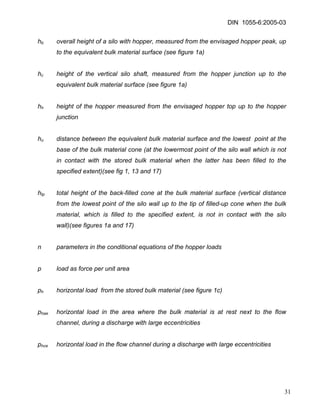
  • 170.
    DIN 1055-6:2005-03 (3)Wherever possible, the coefficient of variation δ is to be determined from the available test data. (4) If the test data is not suitable for determining a coefficient of variation, a suitable value is to be estimated for the bulk material. Table C.2 can be used as a guide here. (5) The upper characteristic value of a parameter ()90,0XXU=is to be determined using (δ28.1190,0+=XX ) (C.17) (6) The lower characteristic value of a parameter ()90,0XXU= is to be determined using (δ28.1110,0−=XX ) (C.18) (7) The conversion factor of a parameter is to be determined using Xa 228.1128.1128.11δδδδ ++≈ − + =Xa (C.19) (8) When estimating the value of the conversion factors, the coefficients of variation δ for the bulk material specific gravity have to be fixed at 0.10. In case of other bulk material parameters the values are to be estimated using the specifications for the bulk materials with similar properties listed in the Table C.2. 170
  • 171.
    DIN 1055-6:2005-03 TABLEC.2 --- TYPICAL VALUES OF THE COEFFICIENTS OF VARIATION FOR THE BULK MATERIAL PARAMETERS COEFFICIENT OF VARAITION δ COEFFICIENT OF WALL FRICTION μ category of wall-roughness BULK MATERIAL HORI- ZONTAL LOAD RATIO K ANGLE OF INTERNAL FRICTION iϕ in degrees D1 D2 D3 Gravel for Concrete 0.11 0.11 0.09 0.09 0.09 Aluminum 0.14 0.16 0.05 0.05 0.05 Fodder concentrate mix 0.08 0.06 0.16 0.19 0.19 Fodder concentrate pellets 0.05 0.05 0.14 0.14 0.14 Barley 0.08 0.10 0.11 0.11 0.11 Cement 0.14 0.16 0.05 0.05 0.05 Cement Clinker 0.21 0.14 0.05 0.05 0.05 Coal 0.11 0.11 0.09 0.09 0.09 Coal dust 0.14 0.18 0.05 0.05 0.05 Coke 0.11 0.11 0.09 0.09 0.09 Fly Ash 0.14 0.12 0.05 0.05 0.05 Flour 0.08 0.05 0.11 0.11 0.11 Iron Pellets 0.11 0.11 0.09 0.09 0.09 Calcium Hydrate 0.14 0.18 0.05 0.05 0.05 Limestone Powder 0.14 0.16 0.05 0.05 0.05 Maize 0.10 0.10 0.17 0.17 0.17 Phosphate 0.11 0.13 0.09 0.09 0.09 Potatoes 0.08 0.09 0.11 0.11 0.11 Sand 0.08 0.07 0.11 0.11 0.11 Slag Clinker 0.08 0.07 0.11 0.11 0.11 Soya Beans 0.08 0.12 0.11 0.11 0.11 Sugar 0.14 0.14 0.05 0.05 0.05 Sugar Beet Pellets 0.11 0.11 0.09 0.09 0.09 Wheat 0.08 0.09 0.11 0.11 0.11 171
  • 172.
    DIN 1055-6:2005-03 ANNEXD (NORMATIVE) ASSESSMENT OF THE BULK MATERIAL PARAMETERS FOR THE DETERMINATION OF SILO LOADS D.1 Aim This annex describes methods for the assessment of the characteristic values of bulk materials which are required in this standard for the purpose of calculating silo loads and cannot be determined experimentally by means of tests. D.2 Assessment of the coefficients of wall friction for a corrugated wall (1) The effective wall friction coefficient for D4 type of wall (corrugated or contoured- metal sheet or metal sheet with horizontal slits) is to be determined from ()wwiweffaaμϕμ+−=tan1 (D.1) Where effμ Effective coefficient of wall friction iϕ Angle of internal friction wμ Coefficient of wall friction (against a level wall surface) Wall contact factor wa NOTE 1 The effective wall friction depends on the angle of internal friction of the bulk material, the coefficient of wall friction against the level wall and on the profile of the wall surface. 172
  • 173.
    DIN 1055-6:2005-03 (2)The parameter in equation (D.1), which represents the portion of the sliding surface against the wall surface, is to be determined from the geometry of the profile of the wall surface, with allowance being made for a suitable estimate of the contact zones that have been activated between the bulk material and the wall surface (see fig. D.1) wa (3) For corresponding depths of the folds and the waves a simple estimate can be made with equation (D.2): iwwwbbba+ = NOTE 2 The interface between sliding surfaces and stationary zones is in contact partially with the wall and partially with the broken surface within the bulk material. The portion which slides along wall surface is expressed using the factor. This portion cannot be easily determined and its estimation depends on the profile of the wall surface. wa 1 3 b bi 1 3 bi b 2 2 a) Trapezoidal folded profile b) Sinusoidal wavy profile 173
  • 174.
    DIN 1055-6:2005-03 Legend 1 bulk material 2 bulk material flow 3 sliding surface Figure D.1 – DIMENSIONS OF THE CONTOURING OF THE WALL SURFACE NOTE 3 For wall surface contouring which resemble the one in fig. D.1b, the factor can be taken as approximately 0.20. wa D.3 Internal Friction and the Wall Friction of a Coarse Bulk Material without Fines The coefficient of wall friction μ and the angle of the internal friction iϕ cannot be easily determined in case of coarse bulk materials without fines (e.g. lupin, peas, beans and potatoes). In such cases, in place of the angle of internal friction one has to take the gradient of slope rϕ of a bulk material heap (debris cone) which is loosely fed on to a level base plate. 174
  • 175.
    DIN 1055-6:2005-03 ANNEXE (Normative) Details of Bulk Material Parameters This annex specifies parameters for a few bulk materials commonly stored in silos, which are to be used as characteristic values for design calculations. Table E.1 – Bulk Material Parametersa Coefficient of wall frictionb μ (wϕμtan=) (Mean value) Parameter for reference surface load opC Density γ kN/m3 Angle of internal friction iϕ degree imϕ qa Horizontal load ratio K Type of bulk material Lower value γ1 Upper value γ2 Gradient of slope rϕ degree Mean value Conversion factor Mean value Km Conversion factor ka Wall type D1 Wall type D2 Wall type D3 Conversion factor μa general bulk material 6.0 22.0 40 35 1.3 0.50 1.5 0.32 0.39 0.50 1.40 1.0 Concrete gravel 17 18 36 31 1.16 0.52 1.15 0.39 0.49 0.59 1.12 0.4 Aluminium 10 12 36 30 1.22 0.54 1.2 0.41 0.46 0.51 1.07 0.5 Concentrated feed mixture 5 6 39 36 1.08 0.45 1.1 0.22 0.30 0.43 1.28 1 Concentrated feed pellets 6.5 8 37 35 1.06 0.47 1.07 0.23 0.28 0.37 1.20 0.7 175
  • 176.
    DIN 1055-6:2005-03 Barley 7 8 31 28 1.14 0.59 1.11 0.24 0.33 0.48 1.16 0.5 Cement 13 16 36 30 1.22 0.54 1.2 0.41 0.46 0.51 1.07 0.5 Cement clinkerc 15 18 47 40 1.20 0.38 1.31 0.46 0.56 0.62 1.07 0.7 Coal 7 10 36 31 1.16 0.52 1.15 0.44 0.49 0.59 1.12 0.6 Coal dust 6 8 34 27 1.26 0.58 1.2 0.41 0.51 0.56 1.07 0.5 Coke 6.5 8 36 31 1.16 0.52 1.15 0.49 0.54 0.59 1.12 0.6 Fly ash 8 15 41 35 1.16 0.46 1.20 0.51 0.62 0.72 1.07 0.5 Flour 6.5 7 45 42 1.06 0.36 1.11 0.24 0.33 0.48 1.16 0.6 Iron pellets 19 22 36 31 1.16 0.52 1.15 0.49 0.54 0.59 1.12 0.5 Lime hydrate 6 8 34 27 1.26 0.58 1.20 0.36 0.41 0.51 1.07 0.6 Limestone powder 11 13 36 30 1.22 0.54 1.20 0.41 0.51 0.56 1.07 0.5 Maize 7 8 35 31 1.14 0.53 1.14 0.22 0.36 0.53 1.24 0.9 Phosphate 16 22 34 29 1.18 0.56 1.15 0.39 0.49 0.54 1.12 0.5 Potatoes 6 8 34 30 1.12 0.54 1.11 0.33 0.38 0.48 1.16 0.5 Sand 14 16 39 39 1.09 0.45 1.11 0.38 0.48 0.57 1.16 0.4 Slag clinker 10.5 12 39 36 1.09 0.45 1.11 0.48 0.57 0.67 1.16 0.6 Soya beans 7 8 29 25 1.16 0.63 1.11 0.24 0.38 0.48 1.16 0.5 Sugar 8 9.5 38 32 1.19 0.50 1.2 0.46 0.51 0.56 1.07 0.4 Sugar beet pellets 6.5 7 36 31 1.16 0.52 1.15 0.35 0.44 0.54 1.12 0.5 Wheat 7.5 9.0 34 30 1.12 0.54 1.11 .24 0.38 0.57 1.16 0.5 NOTE The upper characteristic value xx of the bulk material density u γ is to be always used when determining the silo loads. The lower characteristic value θγ in table E.1 is meant to support calculations for storage capacities when, for example, a certain specified storage capacity has to be ensured. A When a bulk material that is not in the list has to be stored, then tests should to be conducted. If the expense incurred on the tests is not justified, esp. if an assessment of the expense shows that the wide spectrum of values used for calculations would have only marginal Effect on the overall effort, then the values given in the so-called ‘general bulk material’ category may be used. These values can be particularly appropriate for small silo loads. For Large silo loads, however, these values generally result in unviable calculations. As a rule, in such cases tests are preferable. b The effective wall friction coefficient for wall type D4 (corrugated wall) can be assessed according to D.2 C The bulk material shows a tendency to mechanically interlock leading to arching or discharge disturbances. 176
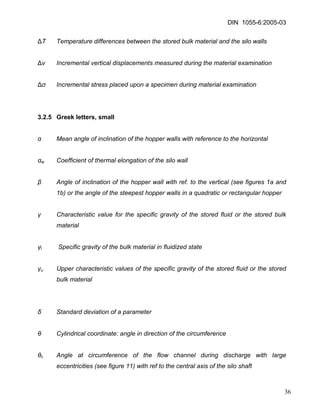
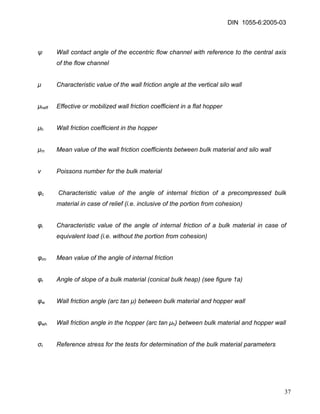
  • 177.
    DIN 1055-6:2005-03 ANNEXF (NORMATIVE) DETERMINATION OF THE FLOW-PROFILE, MASS-FLOW AND CORE-FLOW The dimensioning of silos - with respect to their flow profiles - in terms of functional process technology is not included within the scope of this standard. The following information has been provided in order to enable a safe estimate about whether specific load ratios for mass flow conditions are present in a prospective silo design. This information is moreover necessary when alternate procedures for determination of hopper loads as given in Annex H are used. a) Conical hopper Conical hopper00.20.40.60.81 1.21.41.61.82 020406080Series1Series2 Coefficient of wall friction in the hopper, μh Half-angle β at the hopper apex, in degrees 177
  • 178.
    DIN 1055-6:2005-03 b)Cuneiform hoppe 00.20.40.60.811.21.41.61.82020406080Series1Series2 Legend 1 core flow 2 mass flow 3 mass flow or core flow can occur between the two lines Figure F.1 – BOUNDARIES FOR MASS FLOW AND CORE FLOW CONDITIONS IN CASE OF CONICAL AND CUNEIFORM HOPPERS NOTE In the zone between the boundary lines of mass flow and core flow the flow profile that arises depends on other parameters which are not included in this standard. 178 Half-angle β at the hopper apex Coefficient of wall friction in the hopper, μh
  • 179.
    DIN 1055-6:2005-03 ANNEXG (Normative) Seismic Actions G.1 General (1) This annex lays down general guidelines for calculations of silos under seismic actions. These rules for calculations complement the general rules in DIN 4149 for design calculations under seismic conditions. (2) The value for the acceleration due to earthquakes for the silo structure has to be fixed according to EN 1998. G.2 Symbols α horizontal acceleration due to earthquakes Δph.so additional horizontal loads due to seismic actions G.3 Conditions during Calculations --- Horizontal acceleration and the resultant horizontal and vertical loads on the silo structures (or the silo substructure) and the foundation (G.4.1); --- Additional loads on the silo walls (G.4.2); --- Rearrangement of bulk material at the material surface in the filled-up silo. The seismic actions can lead to a situation where a slide surface develops in the filled up bulk material cone in the vicinity of the bulk-material’s 179
  • 180.
    DIN 1055-6:2005-03 surface.This can pose a threat to the silo roof and the upper regions of the silo walls due to additional horizontal loads (see diagram G.1) 1 2 `Legend 1 slide surface during seismic actions 2 bulk material surface after the seismic action Figure G.1 POSSIBLE REARRANGEMENT OF BULK MATERIAL SURFACE DUE TO SEISMIC ACTIONS G.4 Seismic Actions Directions for calculating the seismic actions are given in G.4.1 for the silo substructure and in G.4.2 for the silo walls. G.4.1 Silo Substructures and Foundations Seismic actions due to the accelerated mass of the silo structure and the stored bulk material can be regarded as individual loads, which place a strain at the centre of gravity of the mass of the silo structure and the stored bulk material (see diagram G.2). 180
  • 181.
    DIN 1055-6:2005-03 Fs Figure G.2 Seismic actions for the substructure (e.g. the supports) G.4.2 Silo Walls (1) The influence of seismic actions on the silo walls has to be taken into account using an additional horizontal load portion. This has to be superimposed with the loads from the stored bulk material according to sections 7 and 8. The overall load is equivalent to the mass of the bulk material multiplied by the value of the horizontal acceleration due to earthquake α. (2) The reference value of the additional normal loads on the silo walls due to seismic effects is given, 181
  • 182.
    DIN 1055-6:2005-03 Fora silo with a circular cross-section and diameter dc, by the foll. equation: 2. csohdgpαγ=Δ (G.1) And for a rectangular silo with the width b the equation is: 2. bgpsoh αγ=Δ (G.2) Where γ is the bulk material density; α is the horizontal acceleration due to the earthquake; g is the acceleration of the fall. (3) The additional loads normal to the silo walls may be assumed to be evenly distributed across the height of the silo. At the upper end of the silo wall one has to add the resultant forces – acting from inside outwards -- of the bulk material loads due to filling and discharging, and the additional seismic horizontal loads – never smaller than zero (no negative values). (4) The assumed horizontal distribution of the additional loads Δph.s = Δph.s is shown in diagram G.3. 182
  • 183.
    DIN 1055-6:2005-03 Fora circular silo the additional load is to be found using the equation: θcos..sohshppΔ=Δ (G.3) For a rectangular silo Δph.s has to be fixed using the equation: Δph.s = Δph.so (G.4) a) cross-section of circular silo b) cross-section of rectangular silo ΔPh,s ΔPh,s b a ΔPh,s ΔPh,so θ FIGURE G-3 Cross-section across the vertical silo shaft with details of the additional horizontal loads due to seismic actions 183
  • 184.
    DIN 1055-6:2005-03 ANNEXH (NORMATIVE) ALTERNATE RULES FOR THE DETERMINATION OF HOPPER LOADS H.1 General (1) This annex gives two alternate procedures for estimation of bulk material loads on hoppers. (2) H.5 can be used for the description of loads not only for fill loads but also for discharge loads. It must however be noted that the sum of these loads is not equivalent to the weight of the bulk material stored in the hopper. The given load formulation in the hopper is to be regarded as an envelope load profile which acts on the hopper walls during filling and during discharge. (3) For fill loads in the case of steep hoppers, the equations given in H.7 can be used as an alternative to the formulations given in 8.3. H.2 Definitions The following definitions are applicable to this Annex. H.2.1 Peak Load (Kick Load) Peak load which can occur at the hopper junction in case of a mass flow during the emptying of a silo 184
  • 185.
    DIN 1055-6:2005-03 H.3Symbols hl Distance between the hopper peak and the hopper junction along the inclined surface (see fig. H.1) np Loads acting vertically upon the inclined hopper wall inp Different load components acting vertically upon the inclined hopper wall (i = 1, 2 and 3) sp Load peak at the hopper junction H.4 Dimensioning Conditions (1) The hopper is to be designed for the state prevailing after the filling and for discharge loads. (2) The flow pattern of the bulk material that is to be expected for the hopper is to be determined by fig. F.1 (3) In case both core flow and mass flow can occur in the silo, these effects are both to be taken into account during dimensioning. H.5 Loads on the Hopper Walls (1) For an inclination of the hopper walls vis-à-vis the horizontal α that is greater than 20° (see fig. 1b), the loads acting vertically on the inclined hopper walls are to be calculated as follows: np 185
  • 186.
    DIN 1055-6:2005-03 NOTEsee NOTE in H.4 ( ) nnnnnnlxppppp2133−++= (H.1) With ()ββ221cossin+=bvfnCpp (H.2) (H.3) β22sinbvfnCpp= βμγ23cos0.3hsnKUAp= (H.4) Where β Inclination of the hopper walls vis-à-vis the vertical (see fig. H.1) x Distance between the lower end of the hopper and the observed position (amount between 0 and xx) according to fig. H.1 (with ref. to the inclined surface) 1np And are parts which describe the hopper loads caused by filling of the hopper 2np hμ Lower characteristic value of the coefficient of wall friction in the hopper sK Upper characteristic value of the horizontal load ratio of the stored bulk material 186
  • 187.
    DIN 1055-6:2005-03 3npThe part of the load portion caused by the vertical pressures (of the bulk material stored in the vertical silo shaft) at the hopper junction/ hopper’s starting-point bC Bottom load enlargement ratio vfp Vertical load at the hopper’s staring point after the filling in accordance with equation (11) or (86) (2) The wall friction loads are given by: tp hntppμ= (H.5) Where np represent the hopper loads acting vertically on the hopper wall according to equation (H.1) (3) For silos with possible mass flow, allowance is to be made for an additional load portion at the hopper junction (see fig. H.1). this load portion is to be calculated actively from the hopper junction, measured across a length of and along the entire periphery of the hopper. spcd2.0 (H.6) vftsKpp2= Where is the vertical load portion of the fill load in the bulk material at the hopper’s starting point, calculated according to equations (11) or (86). vftp 187
  • 188.
    DIN 1055-6:2005-03 0.2dc β Pn3 x pt Pn3 Pn1 Ps Ps Pn2 lh Phft Figure H.1 – ALTERNATIVE RULES FOR THE HOPPER LOADS H.6 Determination of the Connecting Forces at the Hopper Junction The connecting forces in the hopper at the hopper junction are to be derived using the equilibrium conditions. For the loads arising from covering up of the hopper, the bottom load enlargement ratio is to be calculated. bC 188
  • 189.
    DIN 1055-6:2005-03 H.7Alternate Equations for the Hopper Load Correction Value xx for Discharge Loads In case of discharge loads in a hopper with steep walls, the mean vertical pressure at any position in the bulk material is to be calculated according to the equations (116) and (117) using the following parameter: eF () ⎪⎭ ⎪⎬⎫ ⎪⎩ ⎪⎨⎧ ⎥⎦ ⎤ ⎢⎣ ⎡ ⎟⎟⎠ ⎞ ⎜⎜⎝ ⎛− ⎟⎟⎠ ⎞ ⎜⎜⎝ ⎛ + ++⎟⎟⎠ ⎞ ⎜⎜⎝ ⎛ + = ββεεφφβμsinsincossin1sin121cot11iieF (H.7) In which ⎟⎟ ⎠ ⎞ ⎜⎜ ⎝ ⎛ ⎭⎬⎫ ⎩⎨⎧ ++= iwhwhφφφβε sinsinarcsin21 (H.8) hwhμϕarctan= (H.9) Where hμ Lower characteristic value of the coefficient of wall friction in the hopper iϕ Angle of internal friction of the saved bulk material NOTE The equation (H.7) is to be used instead of the equation (128). The equation (H.7) for is founded on the somewhat complex Theory of Enstad for discharge press eF 189
  • 190.
    DIN 1055-6:2005-03 ANNEXI (NORMATIVE) INFLUENCES DUE TO DUST EXPLOSIONS I.1 General This Annex contains instructions for making allowance for dust explosions in silo structures. I.2 Application (1) This section is applicable to all silo structures and other comparable structures where non-toxic combustible and explosive powders are processed or stored or accumulate in large quantities in the form of waste matter. (2) It does not apply to those structures in which explosions are ruled out by means of specific measures. (3) This annex can be used for the retrofitting of the existing structures. In such case the actual state of the structure is to be taken into account, not its planned state. In case of doubt an expert opinion has to be sought. 190
  • 191.
    DIN 1055-6:2005-03 I.3Additional Standards, Guidelines and Regulations Listed below are the additional standards, guidelines and regulations that are relevant to the planning and the operation of a silo structure. - DIN-Fachbericht 140, Silo Structures designed against Dust Explosions - DIN EN 26184-1, Explosion Protection Systems – Part 1: Determination of Explosive Characteristics of Combustible Dusts in the Atmosphere - DIN EN 1127-1, Explosive Atmospheres – Explosion Protection – Part 1: Basis and Methodology DIN EN 50014, Electrical Equipment for Explosion Hazard Areas – General Rules VDI 2263, Dust Fires and Dust Explosions; Risks, Evaluation, Protective Measures I.4 Explosive Dusts and their Characteristic Values (1) The dust from several bulk materials which are normally stored in the silo structures are explosive in nature. Explosions can occur when organic or inorganic dust having sufficiently small particle size reacts exothermically with acid and thereby causes a swiftly progressive reaction. (2) During an explosion of dust from bulk material normally stored in silos, overpressures ranging from 8 bars to 10 bars can occur in closed spaces without vents. (3) The characteristic values for the explosive behaviour of dust are: -- The dust characteristic value stK 191
  • 192.
    DIN 1055-6:2005-03 --The max. Explosive overpressure maxp (4) The dust parameter corresponds to the max. Speed stKdtdpof the rising pressure (5) Both values are determined in accordance with standardized procedures (see DIN-Fachbericht 140 and DIN 26184-1) (6) The principal explosive dust-types are: brown coal, cellulose, pea-flour, fly ash, fodder, feed-mix concentrate, barley, corn flour, rubber, resin, wood dust, coffee, potato flour, coke, maize flour, maize starch (dry), milk powder, paper, pigment, Soya meal, Soya flour, hard coal, wheat flour, washing agents and sugar. I.5 Sources of Ignition Small quantities of energy are generally adequate for igniting these dust particles. The following sources of ignition are of particular significance in silo bins and associated spaces e.g. silo cellars, connecting passages and stairwells - hot surfaces e.g. those which are caused by friction of defective structural components, or sparks such as those caused by foreign bodies in the hoisting devices, sparks during welding, grinding and cutting during repairs, smoulder spots which can also enter into the silo bin from outside along with the bulk material. - Unsuitable or defective electrical equipment (e.g. incandescent bulbs) - Heat generated due to drying - Self ignition due to electrostatic discharge 192
  • 193.
    DIN 1055-6:2005-03 I.6Protective Measures (1) The damage caused by a dust explosion can be minimized by containing the explosion as far as possible within the area in which the igniting occurs. For this purpose explosion zones have to be demarcated. The spreading of the explosion to another area is to be avoided. The explosive overpressures are to be minimized. (2) The consequences of an explosion can be minimized by providing for suitable precautionary measures during planning (e.g. the provision and demarcation of relevant explosion zones). (3) The individual building sections between the explosion barriers are to be dimensioned for one of the following two conditions: -- If no pressure relief has been provided, the zones must be dimensioned for the max. Explosive overpressure maxp -- If a suitable relief has been provided, the zones must be dimensioned with the largest reduced overpressure or. redpgesredp, (4) The amount of the reduced explosive overpressures or depend on the type of the dust, the size of the zone where pressure relief has to be effected and the vents, and the opening pressure and the inertia of the depressurizing system. redpgesredp, (5) The inflammable emission coming out of a vent should not have any adverse effect on the surroundings nor be allowed to transmit the explosion to any other explosion zone. 193
  • 194.
    DIN 1055-6:2005-03 (6)There should be no danger to people on account of splinters from panes or other components. Vents should therefore lead out directly into the open – above roof tops in case of silo bins, and above high-lying window faces in case of other spaces such as silo cellars, connecting passages and stairwells. (7) The opening pressure of the depressurizing system should be as small as possible And its mass inertia should be low. Here it must be kept in mind that with an early actuation of the depressurizing system a substantially larger quantity of the combustible dust-air mixture is passed on than with systems which have a greater inertia. I.7 Dimensioning of the Components The dimensioning of the concerned components is to be executed in accordance with the rules for extraordinary loads (catastrophic loads). I.8 Dimensioning for Explosive Overpressure (1) All the load-bearing and space-enclosing components of an explosion zone are to designed for the dimensioning pressure. (2) The dimensioning pressures should be determined in accordance with the procedure given in the DIN-Fachbericht 140. I.9 Dimensioning for Sub pressure After a pressure relief has taken place, a sub pressure may arise in the explosion area caused by the forces of mass inertia in case of swift gas emission and subsequent cooling of the hot flue gases. This sub pressure is to be taken into account with the 194
  • 195.
    DIN 1055-6:2005-03 dimensioningof enclosing components and the components which are situated in the cross-section of the current. I.10 Securing the Closing Elements of the Vents (1) All the closing elements are to be secured such that do not fly open as a result of the explosion’s pressure, e. g. shutters to be secured with joints, and covers with catches, ropes or other attachments. (2) The velocities of the closing elements that were moved for estimating the anchoring forces can be determined using the calculating methods laid down in DIN- Fachbericht 140. I.11 Recoil Forces through Pressure Relief (1) Recoil forces arise during pressure relief, for which allowance may - if required - need to made in case of stability verification. This is to be specially checked in case of lightweight structures with horizontal vents which are distributed across the cross-section. (2) The recoil forces can be calculated as per the specifications in DIN-Fachbericht 140. 195