
10 Missiological Theories Developed
from the Book of Acts
Preparation: Read through the book of Acts
Responses: Fill in the Google Doc at
https://goo.gl/forms/eM17N7mzMPmbA0Bm2
as you go. Print off your responses at the end or
save them as an htm file and add them to your
forum post.
 What are the key turning points throughout
the book?
 When answered in the Google doc, click next for answers
(to be developed)
Next
 Come: Acts 1:8 Gathered Church:
Empowerment in Jerusalem
 Go: Acts 8:1 Scattered Church: Dispersed
Everywhere
 Tip: memorize key verses to master a book
 Go: Acts 8:1 Scattered Church: Dispersed
Everywhere
 Gospel to the Samaritans (Philip, Peter):1-17
 The Church throughout history repeats this
tension between pastoral gathering and
apostolic scattering.
 Go: Acts 8:1 Scattered Church: Dispersed
Everywhere
 Gospel to the Samaritans (Philip, Peter):1-17
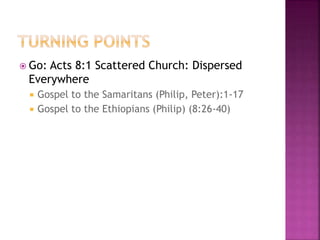
 Gospel to the Ethiopians (Philip) (8:26-40)
 Go: Acts 8:1 Scattered Church: Dispersed
Everywhere
 Gospel to the Samaritans (Philip, Peter):1-17
 Gospel to the Ethiopians (Philip) (8:26-40)
 Gospel to the Gentiles: Cornelius, the Centurion
of Ceasarea (ch 10, 11)
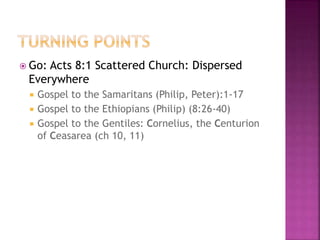
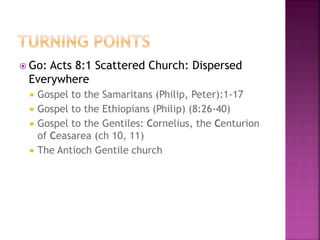
 Go: Acts 8:1 Scattered Church: Dispersed
Everywhere
 Gospel to the Samaritans (Philip, Peter):1-17
 Gospel to the Ethiopians (Philip) (8:26-40)
 Gospel to the Gentiles: Cornelius, the Centurion
of Ceasarea (ch 10, 11)
 The Antioch Gentile church
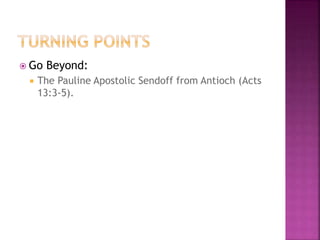
 Go Beyond:
 The Pauline Apostolic Sendoff from Antioch (Acts
13:3-5).
 Go Beyond:
 The Pauline Apostolic Sendoff from Antioch (Acts
13:3-5).
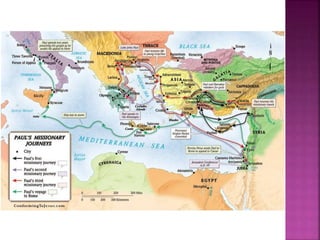
 First Missionary Journey (AD 46-48, Cyprus,
Turkey)
 Go Beyond:
 The Pauline Apostolic Sendoff from Antioch (Acts
13:3-5).
 First Missionary Journey (AD 46-48, Cyprus,
Turkey)
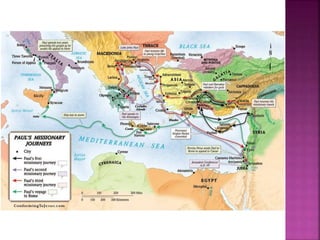
 Second Missionary Journey(15:39-18:22, AD49-52,
Through Turkey into Macedonia & Greece)
 Go Beyond:
 The Pauline Apostolic Sendoff from Antioch (Acts
13:3-5).
 First Missionary Journey (AD 46-48, Cyprus,
Turkey)
 Second Missionary Journey(15:39-18:22, AD49-52,
Through Turkey into Macedonia & Greece)
 Third Missionary Journey (18:23-21:17, AD53-57)
Follow up of second journey
 Go Beyond:
 The Pauline Apostolic Sendoff from Antioch (Acts
13:3-5).
 First Missionary Journey (AD 46-48, Cyprus,
Turkey)
 Second Missionary Journey(15:39-18:22, AD49-52,
Through Turkey into Macedonia & Greece)
 Third Missionary Journey (18:23-21:17, AD53-57)
Follow up of second journey
 Paul heads to Rome ( 27,28, AD59-60)
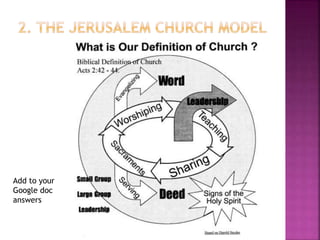
Add to your
Google doc
answers
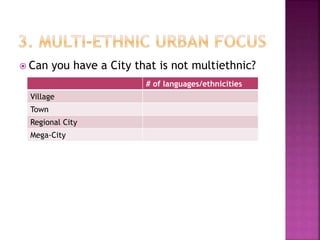
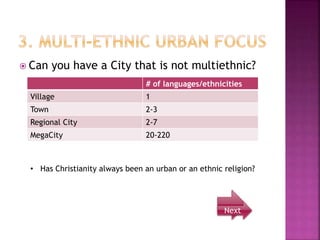
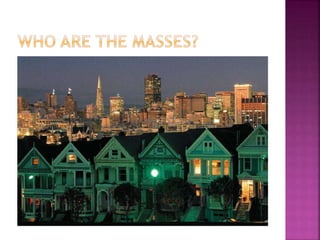
 Can you have a City that is not multiethnic?
# of languages/ethnicities
Village
Town
Regional City
Mega-City
 Can you have a City that is not multiethnic?
Next
# of languages/ethnicities
Village 1
Town 2-3
Regional City 2-7
MegaCity 20-220
• Has Christianity always been an urban or an ethnic religion?
 In what ways is the Acts story, a story of
Urban Mission?
 What are the two urban mega-churches in the
Acts story?
 What are the major cities in the Acts
progressions?
 Go to the google doc and answer. When
answered click next
Next
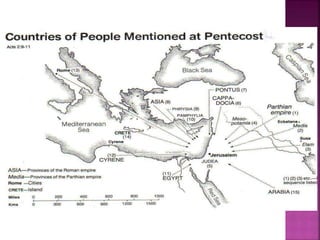
 What is the significance of 16 languages all
speaking one language?
 How does it relate back to Babel?
 What was the point of tension in Acts 6
between two groups of widows?
 From what people group were the first deacons?
 What was the color and ethnic background of
the apostles and prophets leading the
Antioch church?
 Is the Antioch or Jerusalem church a better
model of a city church?
 Review Pickett’s (McGavran’s) theories on
People Movements.
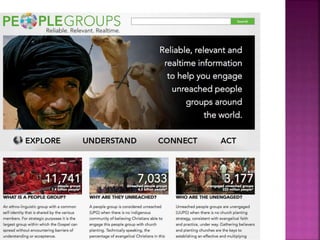
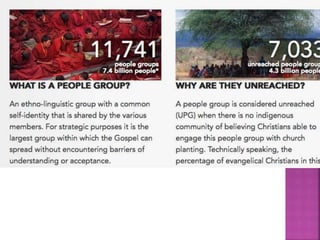
 Go here for a Definition and description
 What are the three main people movements
in Acts and which peoples do they involve?
 Answer on the google doc. When answered
click next
Next
 The Jewish Jerusalem Church
 The Diaconal Breakthroughs to the Gentiles
 Philip
 Stephen
 The Pauline Webs
Next
 Peter and Cornelius
 Philip and the Ethiopian Eunuch
 Barnabas and Antioch
 Listen to the Spirit, expect the visions,
follow the unusual voice of God
 Don’t miss the turning points
 What is McGavran’s theory of redemption and
lift? How fast does this occur? What are its
limits?
 Is this evident in Acts?
 If the Bible is sufficient for every good work,
why are some critical principles not
developed within it? Is there core truth
outside of the scriptures?
Next
Discuss on the Google doc, then go to the next slide
 Paul’s wandering apostolic band
 Vs the local church, the council of Jerusalem
 The same tensions occur throughout history.
 Bishops vs abbots
 Faith missions vs denominational structures
 Prophets, evangelists and apostles are mobile
 Pastor-teachers and pastors of pastors (bishops) are
local/stationary
 Orders and preaching friars vs Parish Priests
 To the ends of the earth vs solving the problems of
the people
 Apostolics are goal driven, mobile, high authority
 Pastorals are community driven, stationary, consensus
based authority
 Are there three structures?
 What are deacons? (Acts 6)
 Was Paul a deacon for two years gathering
finances for Jerusalem?
 Are international aid organizations made up
of people with diaconal giftings of
administration of finances Biblical or supra-
Biblical?
 Diaconates are mercy and administratively
driven, fund-focused
 But deacons were appointed to set the
apostles free to lead
 Why is there little emphasis on actions to
bring about change in injust structures in
Jesus? In Paul? In the early church?
 Does McGavran develop his emphasis on
people group movements in opposition to
engaging in doing justice as the Latin
American Fraternity claimed?
 Is McGavran right? What roles are
appropriate for missionaries?
 When answered, click next Next
 What is the role of the Holy Spirit in Acts?
 What is the relationship of the falling of the
Holy Spirit and speaking the good news?
 From Viv Grigg, “What is a revival
movement?”
 When answered click next
Next
 What are the fruit of revivals?
 From Grigg, review the expansion of the idea
of a revival movement into the idea of urban
transformative revival.
 Is transformative revival evident in Acts? Why
or why not?
 How long does transformation take? How do
you know if a society is transformed?
 When answered click next Next
 Track the idea of households as the centre of
evangelistic growth through the book of Acts.
 Define Thom Wolf’s concept of Oikos
Evangelism.
 Finalize your google doc responses and
review others.
 Glasser, A., Charles van Engen, et al. (2003). Announcing the
Kingdom. Grand Rapids, MI, Baker Academic.
 Grigg, V. (2009). The Spirit of Christ and the Postmodern City:
Transformative Revival Among Auckland's Evangelicals and
Pentecostals. Lexington, KY: Emeth Press and Auckland: Urban
Leadership Foundation.
 McGavran, D. A. (1970). The Masses, The Classes, and Church
Growth. Understanding Church Growth. 225 Jefferson Ave., S.E.,
Grand Rapids, Mich. 49503, Wm. B. Eerdmans Publishing Co.: 269-
294.
 Pickett, J. W. (1938). Christ's Way to India's Heart. London, The
United Society for Christian Literature.
 Tippett, A. (1971). People Movements in Southern Polynesia.
Chicago, Moody Bible Institute.
 --- (1987). Introduction to Missiology. Pasadena, William Carey
Library.
 Winters, R. (1974). "The Two Structures of God's Redemptive
Mission." Missiology II: No. 1, Jan. 1974.
 Wolf, T. (1980). Oikos Evangelism: Key to the Future. Future
Church. J. Ralph Neighbor. Nashville, Broadman Press.

500-12 Movement Dynamics in Acts

  • 1.
    10 Missiological TheoriesDeveloped from the Book of Acts Preparation: Read through the book of Acts Responses: Fill in the Google Doc at https://goo.gl/forms/eM17N7mzMPmbA0Bm2 as you go. Print off your responses at the end or save them as an htm file and add them to your forum post.
  • 2.
     What arethe key turning points throughout the book?  When answered in the Google doc, click next for answers (to be developed) Next
  • 3.
     Come: Acts1:8 Gathered Church: Empowerment in Jerusalem  Go: Acts 8:1 Scattered Church: Dispersed Everywhere  Tip: memorize key verses to master a book
  • 4.
     Go: Acts8:1 Scattered Church: Dispersed Everywhere  Gospel to the Samaritans (Philip, Peter):1-17  The Church throughout history repeats this tension between pastoral gathering and apostolic scattering.
  • 5.
     Go: Acts8:1 Scattered Church: Dispersed Everywhere  Gospel to the Samaritans (Philip, Peter):1-17  Gospel to the Ethiopians (Philip) (8:26-40)
  • 6.
     Go: Acts8:1 Scattered Church: Dispersed Everywhere  Gospel to the Samaritans (Philip, Peter):1-17  Gospel to the Ethiopians (Philip) (8:26-40)  Gospel to the Gentiles: Cornelius, the Centurion of Ceasarea (ch 10, 11)
  • 7.
     Go: Acts8:1 Scattered Church: Dispersed Everywhere  Gospel to the Samaritans (Philip, Peter):1-17  Gospel to the Ethiopians (Philip) (8:26-40)  Gospel to the Gentiles: Cornelius, the Centurion of Ceasarea (ch 10, 11)  The Antioch Gentile church
  • 8.
     Go Beyond: The Pauline Apostolic Sendoff from Antioch (Acts 13:3-5).
  • 9.
     Go Beyond: The Pauline Apostolic Sendoff from Antioch (Acts 13:3-5).  First Missionary Journey (AD 46-48, Cyprus, Turkey)
  • 11.
     Go Beyond: The Pauline Apostolic Sendoff from Antioch (Acts 13:3-5).  First Missionary Journey (AD 46-48, Cyprus, Turkey)  Second Missionary Journey(15:39-18:22, AD49-52, Through Turkey into Macedonia & Greece)
  • 13.
     Go Beyond: The Pauline Apostolic Sendoff from Antioch (Acts 13:3-5).  First Missionary Journey (AD 46-48, Cyprus, Turkey)  Second Missionary Journey(15:39-18:22, AD49-52, Through Turkey into Macedonia & Greece)  Third Missionary Journey (18:23-21:17, AD53-57) Follow up of second journey
  • 14.
     Go Beyond: The Pauline Apostolic Sendoff from Antioch (Acts 13:3-5).  First Missionary Journey (AD 46-48, Cyprus, Turkey)  Second Missionary Journey(15:39-18:22, AD49-52, Through Turkey into Macedonia & Greece)  Third Missionary Journey (18:23-21:17, AD53-57) Follow up of second journey  Paul heads to Rome ( 27,28, AD59-60)
  • 15.
    Add to your Googledoc answers
  • 16.
     Can youhave a City that is not multiethnic? # of languages/ethnicities Village Town Regional City Mega-City
  • 17.
     Can youhave a City that is not multiethnic? Next # of languages/ethnicities Village 1 Town 2-3 Regional City 2-7 MegaCity 20-220 • Has Christianity always been an urban or an ethnic religion?
  • 18.
     In whatways is the Acts story, a story of Urban Mission?  What are the two urban mega-churches in the Acts story?  What are the major cities in the Acts progressions?  Go to the google doc and answer. When answered click next Next
  • 19.
     What isthe significance of 16 languages all speaking one language?  How does it relate back to Babel?
  • 21.
     What wasthe point of tension in Acts 6 between two groups of widows?  From what people group were the first deacons?  What was the color and ethnic background of the apostles and prophets leading the Antioch church?  Is the Antioch or Jerusalem church a better model of a city church?
  • 22.
     Review Pickett’s(McGavran’s) theories on People Movements.  Go here for a Definition and description  What are the three main people movements in Acts and which peoples do they involve?  Answer on the google doc. When answered click next Next
  • 25.
     The JewishJerusalem Church  The Diaconal Breakthroughs to the Gentiles  Philip  Stephen  The Pauline Webs Next
  • 27.
     Peter andCornelius  Philip and the Ethiopian Eunuch  Barnabas and Antioch  Listen to the Spirit, expect the visions, follow the unusual voice of God  Don’t miss the turning points
  • 28.
     What isMcGavran’s theory of redemption and lift? How fast does this occur? What are its limits?  Is this evident in Acts?  If the Bible is sufficient for every good work, why are some critical principles not developed within it? Is there core truth outside of the scriptures? Next Discuss on the Google doc, then go to the next slide
  • 29.
     Paul’s wanderingapostolic band  Vs the local church, the council of Jerusalem  The same tensions occur throughout history.  Bishops vs abbots  Faith missions vs denominational structures  Prophets, evangelists and apostles are mobile  Pastor-teachers and pastors of pastors (bishops) are local/stationary  Orders and preaching friars vs Parish Priests  To the ends of the earth vs solving the problems of the people  Apostolics are goal driven, mobile, high authority  Pastorals are community driven, stationary, consensus based authority
  • 30.
     Are therethree structures?  What are deacons? (Acts 6)  Was Paul a deacon for two years gathering finances for Jerusalem?  Are international aid organizations made up of people with diaconal giftings of administration of finances Biblical or supra- Biblical?  Diaconates are mercy and administratively driven, fund-focused  But deacons were appointed to set the apostles free to lead
  • 31.
     Why isthere little emphasis on actions to bring about change in injust structures in Jesus? In Paul? In the early church?  Does McGavran develop his emphasis on people group movements in opposition to engaging in doing justice as the Latin American Fraternity claimed?  Is McGavran right? What roles are appropriate for missionaries?  When answered, click next Next
  • 32.
     What isthe role of the Holy Spirit in Acts?  What is the relationship of the falling of the Holy Spirit and speaking the good news?  From Viv Grigg, “What is a revival movement?”  When answered click next Next
  • 33.
     What arethe fruit of revivals?  From Grigg, review the expansion of the idea of a revival movement into the idea of urban transformative revival.  Is transformative revival evident in Acts? Why or why not?  How long does transformation take? How do you know if a society is transformed?  When answered click next Next
  • 34.
     Track theidea of households as the centre of evangelistic growth through the book of Acts.  Define Thom Wolf’s concept of Oikos Evangelism.
  • 35.
     Finalize yourgoogle doc responses and review others.
  • 36.
     Glasser, A.,Charles van Engen, et al. (2003). Announcing the Kingdom. Grand Rapids, MI, Baker Academic.  Grigg, V. (2009). The Spirit of Christ and the Postmodern City: Transformative Revival Among Auckland's Evangelicals and Pentecostals. Lexington, KY: Emeth Press and Auckland: Urban Leadership Foundation.  McGavran, D. A. (1970). The Masses, The Classes, and Church Growth. Understanding Church Growth. 225 Jefferson Ave., S.E., Grand Rapids, Mich. 49503, Wm. B. Eerdmans Publishing Co.: 269- 294.  Pickett, J. W. (1938). Christ's Way to India's Heart. London, The United Society for Christian Literature.  Tippett, A. (1971). People Movements in Southern Polynesia. Chicago, Moody Bible Institute.  --- (1987). Introduction to Missiology. Pasadena, William Carey Library.  Winters, R. (1974). "The Two Structures of God's Redemptive Mission." Missiology II: No. 1, Jan. 1974.  Wolf, T. (1980). Oikos Evangelism: Key to the Future. Future Church. J. Ralph Neighbor. Nashville, Broadman Press.