Teaching Acts: Beginning in Jerusalem (Series 1/4)
Slides that accompany presentation at the Lighthouse Church of All Nations
October 8, 2025
This presentation covers background information about the book Acts as an introduction to the series.
#Acts #bookofActs, #HolySpirit #NameofJesus #Jesus
Commonly attributed toLuke, even
though we never read his name in the
book.
Considered the author because he addressed both
letters to his patron Theophilus.
Authorship: Who wrote Acts?
Luke “Wrote Greek with a ‘biblical’ or ‘Jewish’ accent.”
4
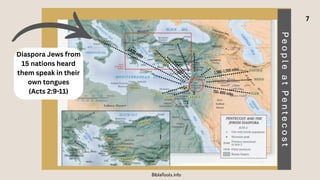
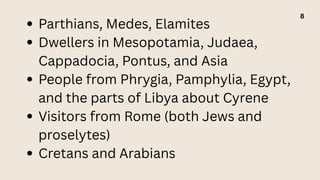
Parthians, Medes, Elamites
Dwellersin Mesopotamia, Judaea,
Cappadocia, Pontus, and Asia
People from Phrygia, Pamphylia, Egypt,
and the parts of Libya about Cyrene
Visitors from Rome (both Jews and
proselytes)
Cretans and Arabians
8
9.
Acts rearranges, bends,and even
breaks old cultural and religious
boundaries as it lays down new
ones.
The People’s Bible, 1537.
9
10.
The Church increasedfrom 25,000 people in 100
AD to 20 million by AD 310.
The explosive growth stands without the modern
conveniences of travel and communication.
Even persecution could not deter Christianity’s
spread.
10
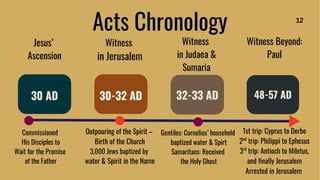
Acts Chronology
Jesus’
Ascension
30 AD30-32 AD 32-33 AD
Witness
in Jerusalem
Witness
in Judaea &
Sumaria
Witness Beyond:
Paul
48-57 AD
Outpouring of the Spirit –
Birth of the Church
3,000 Jews baptized by
water & Spirit in the Name
Commissioned
His Disciples to
Wait for the Promise
of the Father
Gentiles: Cornelius’ household
baptized water & Spirt
Samaritans: Received
the Holy Ghost
1st trip: Cyprus to Derbe
2 trip: Philippi to Ephesus
nd
3 trip: Antioch to Miletus,
and finally Jerusalem
rd
Arrested in Jerusalem
12
13.
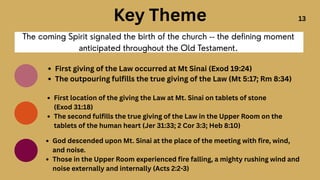
The coming Spiritsignaled the birth of the church -- the defining moment
anticipated throughout the Old Testament.
First giving of the Law occurred at Mt Sinai (Exod 19:24)
The outpouring fulfills the true giving of the Law (Mt 5:17; Rm 8:34)
First location of the giving the Law at Mt. Sinai on tablets of stone
(Exod 31:18)
The second fulfills the true giving of the Law in the Upper Room on the
tablets of the human heart (Jer 31:33; 2 Cor 3:3; Heb 8:10)
Key Theme
God descended upon Mt. Sinai at the place of the meeting with fire, wind,
and noise.
Those in the Upper Room experienced fire falling, a mighty rushing wind and
noise externally and internally (Acts 2:2-3)
13
14.
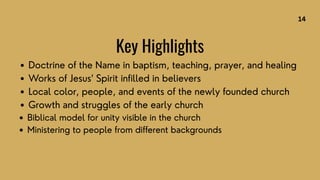
Doctrine of theName in baptism, teaching, prayer, and healing
Works of Jesus’ Spirit infilled in believers
Local color, people, and events of the newly founded church
Growth and struggles of the early church
Biblical model for unity visible in the church
Ministering to people from different backgrounds
Key Highlights
14
15.
Close
Stands as bothhistory and theology, a Spirit-inspired account connecting the
Gospels to the Epistles.
Grounds the church in the doctrine of the Name of Jesus
Portrays how the early church grew into a global movement across the Roman
Empire.
Luke preserved this early church's account with accuracy, showing the power of
the Holy Ghost to overcome Christianity's obstacles of opposition, cultural
barriers, and persecution.
The narrative not only sheds light on the past but also provides a model for unity,
mission, and faithfulness that continues to guide the church today.
15





![I thirst. [autosaved]](https://cdn.slidesharecdn.com/ss_thumbnails/ithirst-170809080121-thumbnail.jpg?width=640&height=640&fit=bounds)


![谷歌霸屏推广[ 𝙩𝙤𝙥 𝟮𝟯𝟯. 𝙘 𝙤𝙢 ]](https://cdn.slidesharecdn.com/ss_thumbnails/top233-260130171247-43791db0-thumbnail.jpg?width=640&height=640&fit=bounds)


