DIFFERENT TYPES OF USER
ACCEPTANCE TEST, ARE YOU
PERFORMING ALL?
• It is frequently noticed that while testing team emphasizes on
manual and automation testing, still several bugs are reported by
the end users. As it involves subject experts along with managers, it
is essential to perform User Acceptance Testing (UAT) along with
conventional QA process.
• The practice of User Acceptance Testing is somewhat very simple,
however, the execution in actual requires some detailed knowledge
on the types of UAT.
• To make your foray into UAT a little straight-forward, we have
explored the most common types of User Acceptance Testing you
often come across.
INTRODUCTION
• User Acceptance Testing is a phase of software development in
which the developed software is tested in the real environment
by the end users. The process is to verify the intended
functionality of the developed system on the end user’s
perspective emulating real-world scenarios.
• In short, User Acceptance Testing is the process of checking that
developed software works for intended users. This may be easy to
hear at first, but, practically it is not.
WHAT IS UAT?
 Now, let’s discuss the differences between User Acceptance Testing
from Functional Testing to bring in more clarity of thought.
 User acceptance testing or UAT contain certain steps to check that if
specific requirements are working for the user or not. Practically,
when the supplier and the customer approve the product then the
process of development is started, and legally too. Instead, in
functional testing, we test certain specifications and requirements of
the software. Yet, the user component is missing from it. From
functional tests, we can only verify that requirements and
specifications are satisfied by the software. Nevertheless, it does not
ensure if it is actually useful and acceptable from a user’s
perspective.
HOW USER ACCEPTANCE TESTING
(UAT) IS DIFFERENT FROM
FUNCTIONAL TESTING?
 Let me explain this with an example: consider an application that
has a search feature. The feature is working fine and giving desired
results but in the process is taking too much time to get the job done.
Thus, the application will pass the functionality tests but due to
extended loading time, it will fail in acceptance tests as end users
will not be satisfied with its performance.
 Failed acceptance is not limited only to performance related issues,
any redundant or outdated feature can also be the cause. As the
users will no longer interested in using a feature whether it is
working absolutely fine, its functional tests would pass, along with
the usability tests, but the user acceptance test would probably fail.
 Now, we can easily differentiate between functional testing and user
acceptance testing.
Following are the types of User Acceptance Testing:
I. Alpha & Beta Testing
II. Contract Acceptance Testing
III. Regulation Acceptance Testing/Compliance Acceptance Testing
IV. Operational Acceptance Testing
V. Black Box Testing
TYPES OF USER ACCEPTANCE
TESTING
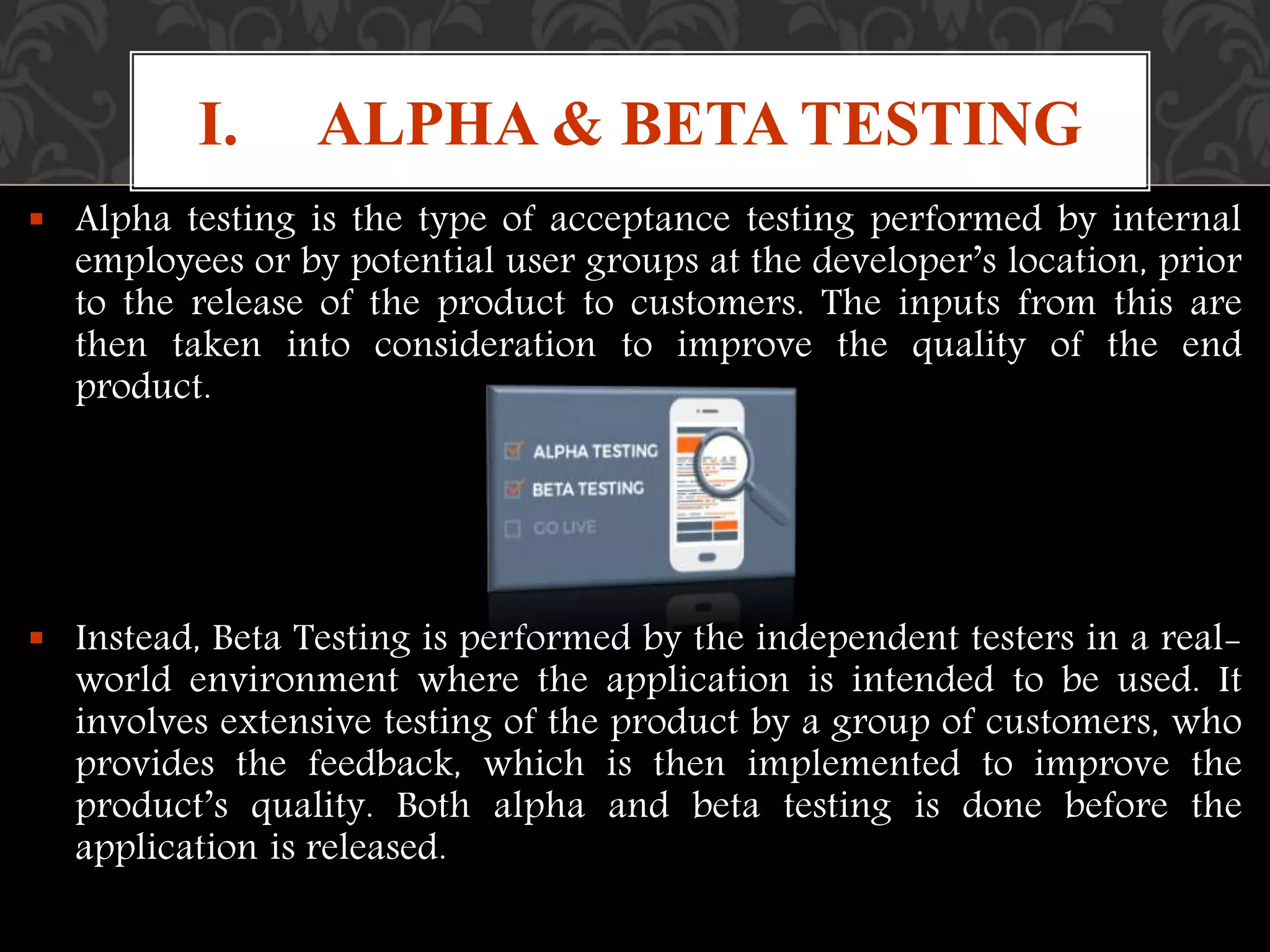
 Alpha testing is the type of acceptance testing performed by internal
employees or by potential user groups at the developer’s location, prior
to the release of the product to customers. The inputs from this are
then taken into consideration to improve the quality of the end
product.
 Instead, Beta Testing is performed by the independent testers in a real-
world environment where the application is intended to be used. It
involves extensive testing of the product by a group of customers, who
provides the feedback, which is then implemented to improve the
product’s quality. Both alpha and beta testing is done before the
application is released.
I. ALPHA & BETA TESTING
In Contract Acceptance Testing, the software developed is tested to
meet the specifications and criteria which have been pre-decided and
mutually agreed upon in the contract. When the project team agrees to
the contract, then only, the acceptance criteria and specifications are
defined.
II. CONTRACT ACCEPTANCE
TESTING
The Regulation Acceptance Testing tests the developed software
against certain rules and regulations. These are mainly
governmental rules and regulations and compliance with these
legal issues is absolutely necessary. It is also called Compliance
Acceptance Testing.
III. REGULATION ACCEPTANCE
TESTING/COMPLIANCE
ACCEPTANCE TESTING
Operational Acceptance Testing, also called Operational Readiness
or Production Acceptance Testing, ensures that there is a proper
workflow for the software that is being used. The workflow must
include backup plans, security checks, user training, and various
maintenance processes.
IV. OPERATIONALACCEPTANCE
TESTING
Black Box Testing is time and again classified as functional testing,
but to some degree of level, can be considered as a type of User
Acceptance Testing. It lets the tester to test the application for
certain functionalities without the understanding and working of
internal code structure. User Acceptance Testing and Black Box
Testing has somewhat similar principles, as the end user isn’t aware
of any code. What he is only aware of is the requirements of the
application that must be satisfied. Several testing teams use it for
their User Acceptance Testing quite often.
V. BLACK BOX TESTING
Still, there are many more types of User Acceptance Testing. By
providing you with the aforementioned types of UAT, I hope that
some light had been shed on the topic.
We, at BugRaptors, perform extensive User Acceptance Testing so
that the developed software is up to the need to the intended user.
We believe there is no shortcut to success, thus the software tested
and passed by us work correctly as per the business requirements as
well as end-user perspective.
Thank You

Different Types of User Acceptance Test, Are you performing all?

  • 1.
    DIFFERENT TYPES OFUSER ACCEPTANCE TEST, ARE YOU PERFORMING ALL?
  • 2.
    • It isfrequently noticed that while testing team emphasizes on manual and automation testing, still several bugs are reported by the end users. As it involves subject experts along with managers, it is essential to perform User Acceptance Testing (UAT) along with conventional QA process. • The practice of User Acceptance Testing is somewhat very simple, however, the execution in actual requires some detailed knowledge on the types of UAT. • To make your foray into UAT a little straight-forward, we have explored the most common types of User Acceptance Testing you often come across. INTRODUCTION
  • 3.
    • User AcceptanceTesting is a phase of software development in which the developed software is tested in the real environment by the end users. The process is to verify the intended functionality of the developed system on the end user’s perspective emulating real-world scenarios. • In short, User Acceptance Testing is the process of checking that developed software works for intended users. This may be easy to hear at first, but, practically it is not. WHAT IS UAT?
  • 4.
     Now, let’sdiscuss the differences between User Acceptance Testing from Functional Testing to bring in more clarity of thought.  User acceptance testing or UAT contain certain steps to check that if specific requirements are working for the user or not. Practically, when the supplier and the customer approve the product then the process of development is started, and legally too. Instead, in functional testing, we test certain specifications and requirements of the software. Yet, the user component is missing from it. From functional tests, we can only verify that requirements and specifications are satisfied by the software. Nevertheless, it does not ensure if it is actually useful and acceptable from a user’s perspective. HOW USER ACCEPTANCE TESTING (UAT) IS DIFFERENT FROM FUNCTIONAL TESTING?
  • 5.
     Let meexplain this with an example: consider an application that has a search feature. The feature is working fine and giving desired results but in the process is taking too much time to get the job done. Thus, the application will pass the functionality tests but due to extended loading time, it will fail in acceptance tests as end users will not be satisfied with its performance.  Failed acceptance is not limited only to performance related issues, any redundant or outdated feature can also be the cause. As the users will no longer interested in using a feature whether it is working absolutely fine, its functional tests would pass, along with the usability tests, but the user acceptance test would probably fail.  Now, we can easily differentiate between functional testing and user acceptance testing.
  • 6.
    Following are thetypes of User Acceptance Testing: I. Alpha & Beta Testing II. Contract Acceptance Testing III. Regulation Acceptance Testing/Compliance Acceptance Testing IV. Operational Acceptance Testing V. Black Box Testing TYPES OF USER ACCEPTANCE TESTING
  • 7.
     Alpha testingis the type of acceptance testing performed by internal employees or by potential user groups at the developer’s location, prior to the release of the product to customers. The inputs from this are then taken into consideration to improve the quality of the end product.  Instead, Beta Testing is performed by the independent testers in a real- world environment where the application is intended to be used. It involves extensive testing of the product by a group of customers, who provides the feedback, which is then implemented to improve the product’s quality. Both alpha and beta testing is done before the application is released. I. ALPHA & BETA TESTING
  • 8.
    In Contract AcceptanceTesting, the software developed is tested to meet the specifications and criteria which have been pre-decided and mutually agreed upon in the contract. When the project team agrees to the contract, then only, the acceptance criteria and specifications are defined. II. CONTRACT ACCEPTANCE TESTING
  • 9.
    The Regulation AcceptanceTesting tests the developed software against certain rules and regulations. These are mainly governmental rules and regulations and compliance with these legal issues is absolutely necessary. It is also called Compliance Acceptance Testing. III. REGULATION ACCEPTANCE TESTING/COMPLIANCE ACCEPTANCE TESTING
  • 10.
    Operational Acceptance Testing,also called Operational Readiness or Production Acceptance Testing, ensures that there is a proper workflow for the software that is being used. The workflow must include backup plans, security checks, user training, and various maintenance processes. IV. OPERATIONALACCEPTANCE TESTING
  • 11.
    Black Box Testingis time and again classified as functional testing, but to some degree of level, can be considered as a type of User Acceptance Testing. It lets the tester to test the application for certain functionalities without the understanding and working of internal code structure. User Acceptance Testing and Black Box Testing has somewhat similar principles, as the end user isn’t aware of any code. What he is only aware of is the requirements of the application that must be satisfied. Several testing teams use it for their User Acceptance Testing quite often. V. BLACK BOX TESTING
  • 12.
    Still, there aremany more types of User Acceptance Testing. By providing you with the aforementioned types of UAT, I hope that some light had been shed on the topic. We, at BugRaptors, perform extensive User Acceptance Testing so that the developed software is up to the need to the intended user. We believe there is no shortcut to success, thus the software tested and passed by us work correctly as per the business requirements as well as end-user perspective.
  • 13.