5 Thing You Need To
Know About Scala
Compilation
Iulian Dragos

Triplequote co-founder

ScalaSphere Krakow, 

2018-05-16
#1 Build time ≠
Compilation time
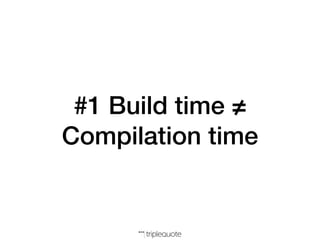
Build time ≠ Compilation
time
• Before starting compilation:

• Dependency resolution

• Source generators

• Formatter

• Settings evaluation
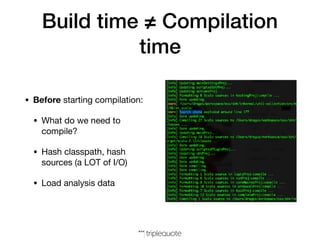
Build time ≠ Compilation
time
• Before starting compilation:

• What do we need to
compile?

• Hash classpath, hash
sources (a LOT of I/O)

• Load analysis data
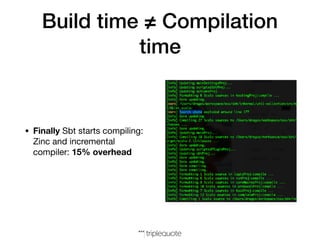
Build time ≠ Compilation
time
• Finally Sbt starts compiling:
Zinc and incremental
compiler: 15% overhead
Use an IDE to build!
#2 Type Classes +
Macro Derivation = 💣
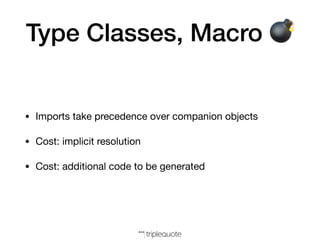
Type Classes, Macro 💣
• Imports take precedence over companion objects

• Cost: implicit resolution

• Cost: additional code to be generated
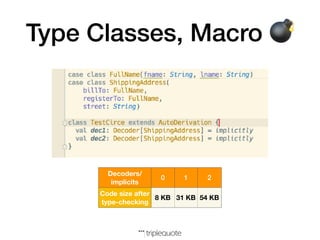
Type Classes, Macro 💣
Decoders/
implicits
0 1 2
Code size after
type-checking
8 KB 31 KB 54 KB
#3 Whitebox macros
are type-checked 3x!
What’s the different between whitebox and
blackbox macros?
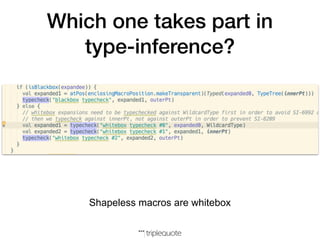
Which one takes part in
type-inference?
Shapeless macros are whitebox
#4 Type-checking
should be around 30%
#4 Type-checking should be
around 30%
• Type-checking Scala sources takes time

• but should not go above 30% of total compilation time!

• Use -verbose to see times for each phase (and a lot of
noise)
#4 Type-checking should be
around 30%
• If more, you can bet your money on one (or more) of:

• Macro expansion

• Implicit resolution

• Quasiquotes, type tags, string interpolation (macros in
disguise)
#5 The Typer
Multiplier
How does the size of the AST change through
phases?
#5 The Typer Multiplier
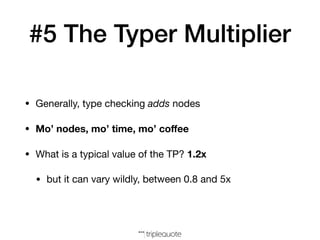
• Generally, type checking adds nodes

• Mo’ nodes, mo’ time, mo’ coffee
• What is a typical value of the TP? 1.2x 

• but it can vary wildly, between 0.8 and 5x
#6 Scala compiler is
single-threaded
#6 Scala compiler is single-
threaded
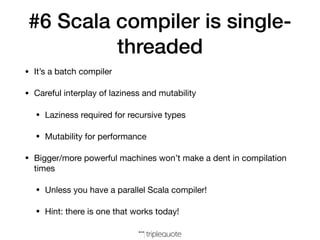
• It’s a batch compiler

• Careful interplay of laziness and mutability

• Laziness required for recursive types

• Mutability for performance

• Bigger/more powerful machines won’t make a dent in compilation
times

• Unless you have a parallel Scala compiler!

• Hint: there is one that works today!
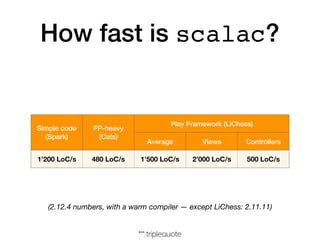
How fast is scalac?
Simple code
(Spark)
FP-heavy
(Cats)
Play Framework (LiChess)
Average Views Controllers
1’200 LoC/s 480 LoC/s 1’500 LoC/s 2’000 LoC/s 500 LoC/s
(2.12.4 numbers, with a warm compiler — except LiChess: 2.11.11)
Trusted by
https://triplequote.com/early-accessJoin the EAP

5 things you need to know about the Scala compiler

  • 1.
    5 Thing YouNeed To Know About Scala Compilation Iulian Dragos Triplequote co-founder ScalaSphere Krakow, 2018-05-16
  • 2.
    #1 Build time≠ Compilation time
  • 3.
    Build time ≠Compilation time • Before starting compilation: • Dependency resolution • Source generators • Formatter • Settings evaluation
  • 4.
    Build time ≠Compilation time • Before starting compilation: • What do we need to compile? • Hash classpath, hash sources (a LOT of I/O) • Load analysis data
  • 5.
    Build time ≠Compilation time • Finally Sbt starts compiling: Zinc and incremental compiler: 15% overhead
  • 6.
    Use an IDEto build!
  • 7.
    #2 Type Classes+ Macro Derivation = 💣
  • 8.
    Type Classes, Macro💣 • Imports take precedence over companion objects • Cost: implicit resolution • Cost: additional code to be generated
  • 9.
    Type Classes, Macro💣 Decoders/ implicits 0 1 2 Code size after type-checking 8 KB 31 KB 54 KB
  • 10.
    #3 Whitebox macros aretype-checked 3x!
  • 11.
    What’s the differentbetween whitebox and blackbox macros?
  • 12.
    Which one takespart in type-inference? Shapeless macros are whitebox
  • 13.
  • 14.
    #4 Type-checking shouldbe around 30% • Type-checking Scala sources takes time • but should not go above 30% of total compilation time! • Use -verbose to see times for each phase (and a lot of noise)
  • 15.
    #4 Type-checking shouldbe around 30% • If more, you can bet your money on one (or more) of: • Macro expansion • Implicit resolution • Quasiquotes, type tags, string interpolation (macros in disguise)
  • 16.
  • 17.
    How does thesize of the AST change through phases?
  • 18.
    #5 The TyperMultiplier • Generally, type checking adds nodes • Mo’ nodes, mo’ time, mo’ coffee • What is a typical value of the TP? 1.2x • but it can vary wildly, between 0.8 and 5x
  • 19.
    #6 Scala compileris single-threaded
  • 20.
    #6 Scala compileris single- threaded • It’s a batch compiler • Careful interplay of laziness and mutability • Laziness required for recursive types • Mutability for performance • Bigger/more powerful machines won’t make a dent in compilation times • Unless you have a parallel Scala compiler! • Hint: there is one that works today!
  • 21.
    How fast isscalac? Simple code (Spark) FP-heavy (Cats) Play Framework (LiChess) Average Views Controllers 1’200 LoC/s 480 LoC/s 1’500 LoC/s 2’000 LoC/s 500 LoC/s (2.12.4 numbers, with a warm compiler — except LiChess: 2.11.11)
  • 22.