Outline for Presentation
Outlinefor Presentation
What is Spina Bifida?
What is Spina Bifida?
Signs and Symptoms
Signs and Symptoms
Types
Types
When to seek medical attention?
When to seek medical attention?
Screening and Diagnosis
Screening and Diagnosis
Treatment
Treatment
Educational Assessment
Educational Assessment
Considerations
Considerations
Quiz
Quiz
3.
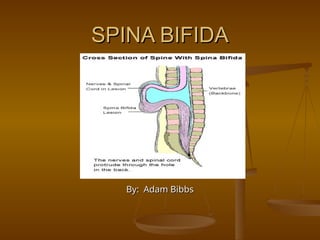
What is SpinaBifida?
What is Spina Bifida?
A condition that refers
A condition that refers
to a developmental
to a developmental
defect of the spinal
defect of the spinal
column in which the
column in which the
arches of one or more
arches of one or more
of the spinal vertebrae
of the spinal vertebrae
fail to fuse.
fail to fuse.
Failure of closure in the
Failure of closure in the
midline or lower end of
midline or lower end of
the neural tube. (Cleft
the neural tube. (Cleft
Spine)
Spine)
4.
Signs and Symptoms
Signsand Symptoms
Swelling
Swelling
Dimple in skin
Dimple in skin
Truft of hair
Truft of hair
Muscle weakness
Muscle weakness
Paralysis
Paralysis
Loss of a sensation
Loss of a sensation
Fluid build up (hydrocephalus)
Fluid build up (hydrocephalus)
Brain damage
Brain damage
Seizures
Seizures
Blindness
Blindness
Possibly none at all
Possibly none at all
Types of SpinaBifida
Types of Spina Bifida
3 in 1,000 births
3 in 1,000 births
1. Spina Bifida Occulta – an abnormality is
1. Spina Bifida Occulta – an abnormality is
confined to the vertebrae only and is due
confined to the vertebrae only and is due
to an unclosed posterior vertebral arch.
to an unclosed posterior vertebral arch.
2. Spina Bifida Cystica – A more severe type
2. Spina Bifida Cystica – A more severe type
of spina bifida that has two
of spina bifida that has two
classifications.
classifications.
7.
Occulta
Occulta
Approximately 40%of all Americans
Approximately 40% of all Americans
may have spina bifida occulta, but
may have spina bifida occulta, but
because they experience little or no
because they experience little or no
symptoms, very few of them ever know
symptoms, very few of them ever know
that they have it.
that they have it.
8.
Cystica
Cystica
Meningocele –Where the meninges
Meningocele – Where the meninges
protrude through the defect. (4%)
protrude through the defect. (4%)
Myelomeningocele – Elements of the
Myelomeningocele – Elements of the
cord also protrude through the defect,
cord also protrude through the defect,
resulting in severe neural deficits. (96%)
resulting in severe neural deficits. (96%)
1 out of 1,000 births
1 out of 1,000 births
9.
What is Hydrocephalus?
Whatis Hydrocephalus?
A common disease that occurs when
A common disease that occurs when
there is a build up of CNS fluid inside the
there is a build up of CNS fluid inside the
brain that occurs when normal circulation
brain that occurs when normal circulation
is obstructed because the open spine
is obstructed because the open spine
permits the lower portion of the brain to
permits the lower portion of the brain to
slip through the opening of the spinal
slip through the opening of the spinal
cord.
cord.
Skull is stretched
Skull is stretched
Damages brain cells
Damages brain cells
10.
Causes of SpinaBifida
Causes of Spina Bifida
Genetics and environmental factors.
Genetics and environmental factors.
Low folic acid consumption by the
Low folic acid consumption by the
mother during pregnancy.
mother during pregnancy.
11.
When to seekmedical attention?
When to seek medical attention?
Before Pregnancy
Before Pregnancy
During Pregnancy
During Pregnancy
Right after birth
Right after birth
When the doctor feels it is necessary
When the doctor feels it is necessary
12.
Screening and Diagnosis
Screeningand Diagnosis
Prenatal Tests
Prenatal Tests
AFP
AFP
Ultrasound
Ultrasound
Testing of Amniotic fluid
Testing of Amniotic fluid
Evaluation
Evaluation
Analysis of individual medial history
Analysis of individual medial history
Physical examination
Physical examination
Evaluation of critical body systems
Evaluation of critical body systems
Imaging Studies
Imaging Studies
X-rays
X-rays
Ultrasound
Ultrasound
CT scan
CT scan
MRI
MRI
Gait Analysis
Gait Analysis
13.
Prevention
Prevention
Recent studieshave shown that one factor that increases the
Recent studies have shown that one factor that increases the
risk of having an NTD baby is low folic acid status before
risk of having an NTD baby is low folic acid status before
conception and during the first few weeks of pregnancy. If all
conception and during the first few weeks of pregnancy. If all
women of childbearing age were to consume 0.4 mg of folic acid
women of childbearing age were to consume 0.4 mg of folic acid
prior to becoming pregnant and during the first trimester of
prior to becoming pregnant and during the first trimester of
pregnancy, the incidence of folic acid preventable spina bifida
pregnancy, the incidence of folic acid preventable spina bifida
and anencephaly could be reduced by up to 75%.
and anencephaly could be reduced by up to 75%.
Folic acid, a common water soluble B vitamin, is essential for the
Folic acid, a common water soluble B vitamin, is essential for the
functioning of the human body. During periods of rapid
functioning of the human body. During periods of rapid
growth, such as pregnancy and fetal development, the body’s
growth, such as pregnancy and fetal development, the body’s
requirement for this vitamin increases. Folic acid can be found
requirement for this vitamin increases. Folic acid can be found
in multivitamins, fortified breakfast cereals, dark green leafy
in multivitamins, fortified breakfast cereals, dark green leafy
vegetables such as broccoli and spinach, egg yolks, and some
vegetables such as broccoli and spinach, egg yolks, and some
fruits and fruit juices. However, the average American diet does
fruits and fruit juices. However, the average American diet does
not supply the recommended level of folic acid.
not supply the recommended level of folic acid.
With proper care, most children with SB live well into adulthood.
With proper care, most children with SB live well into adulthood.
14.
Treatment
Treatment
No cure
Nocure
Regular check ups with
Regular check ups with
physician
physician
Surgery (24 hours after
Surgery (24 hours after
birth)
birth)
Medication
Medication
Physiotherapy
Physiotherapy
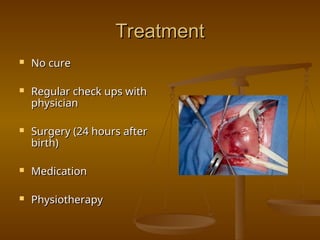
Surgery
Surgery
Usually performedwith in 24 hours
Usually performed with in 24 hours
after birth.
after birth.
They remove the infected area and
They remove the infected area and
replace it with muscle tissue and skin.
replace it with muscle tissue and skin.
Helps protect against hydrocephalus.
Helps protect against hydrocephalus.
17.
Educational Assessments
Educational Assessments
IEP (Individualized educational plan)
IEP (Individualized educational plan)
Children may have difficulty paying attention.
Children may have difficulty paying attention.
Early intervention with children who experience learning problems can
Early intervention with children who experience learning problems can
help considerably to prepare them for school.
help considerably to prepare them for school.
Successful integration of a child with spina bifida into a school
Successful integration of a child with spina bifida into a school
sometimes requires changes in school equipment or the curriculum.
sometimes requires changes in school equipment or the curriculum.
Architectural factors should be considered.
Architectural factors should be considered.
The child should be put in the least restrictive environment.
The child should be put in the least restrictive environment.
To promote personal growth, families and teachers should encourage
To promote personal growth, families and teachers should encourage
children, within the limits of safety and health, to be independent and
children, within the limits of safety and health, to be independent and
to participate in activities with their non-disabled classmates.
to participate in activities with their non-disabled classmates.
18.
Physical/Health Educator
Physical/Health Educator
Considerations
Considerations
Try to include students in all activities.
Try to include students in all activities.
Be aware of the students abilities and
Be aware of the students abilities and
limitations.
limitations.
Plan for their needs.
Plan for their needs.
Make sure activities are age
Make sure activities are age
appropriate.
appropriate.
Allow opportunities for self directed
Allow opportunities for self directed
learning and experimentation.
learning and experimentation.
19.
Special Considerations
Special Considerations
Be aware that there may be some times where the
Be aware that there may be some times where the
child can cause distractions and you will need an
child can cause distractions and you will need an
aid to help control the class.
aid to help control the class.
Be sensitive to bowel and bladder problems, these
Be sensitive to bowel and bladder problems, these
can cause embarrassing situations.
can cause embarrassing situations.
Make sure students are involved because it is
Make sure students are involved because it is
often that children with this condition become
often that children with this condition become
over weight.
over weight.
Focus on upper body activities because of the little
Focus on upper body activities because of the little
or no mobility in the legs.
or no mobility in the legs.
Development depends largely on environmental
Development depends largely on environmental
factors and setbacks that may disrupt functioning
factors and setbacks that may disrupt functioning
such as lengthy hospital stays, dependence, and
such as lengthy hospital stays, dependence, and
poor self esteem.
poor self esteem.
20.
Exercise
Exercise
A comprehensiveprogram of physical
A comprehensive program of physical
activity is needed to maintain a healthy
activity is needed to maintain a healthy
life
life
Intervention should occur as early as
Intervention should occur as early as
possible.
possible.
Home based programs are needed to
Home based programs are needed to
teach parents how to exercise their baby’s
teach parents how to exercise their baby’s
feet and legs so they can walk with
feet and legs so they can walk with
crutches, braces, and exercise is also
crutches, braces, and exercise is also
important for use of a wheel chair.
important for use of a wheel chair.
21.
Activities and Exercise
Activitiesand Exercise
Body Awareness
Body Awareness
Group Play
Group Play
Parachute activities
Parachute activities
Upper body activities
Upper body activities
Strength training
Strength training
Aquatics
Aquatics
Flexibility
Flexibility
Wheel chair activities
Wheel chair activities
22.
Goals of Intervention
Goalsof Intervention
Teaching gross motor and skills to facilitate
Teaching gross motor and skills to facilitate
coordination.
coordination.
Developing and maintaining fitness and flexibility to
Developing and maintaining fitness and flexibility to
emphasize self sufficiency.
emphasize self sufficiency.
Encouraging movement and fitness to overcome
Encouraging movement and fitness to overcome
susceptibility to obesity.
susceptibility to obesity.
Developing physical skills that generalize to activities
Developing physical skills that generalize to activities
of daily living and vocational skills.
of daily living and vocational skills.
Promoting social development in recreational and
Promoting social development in recreational and
group play activities, such as aquatics.
group play activities, such as aquatics.
Providing appropriate social outlets for enjoyment
Providing appropriate social outlets for enjoyment
and self satisfaction on an individual basis as well as
and self satisfaction on an individual basis as well as
with family or peers within the community.
with family or peers within the community.
23.
Research being performed
Researchbeing performed
The NINDS supports a broad range of research
The NINDS supports a broad range of research
on neural tube defects such as SB aimed at
on neural tube defects such as SB aimed at
finding way to treat, prevent, and, ultimately,
finding way to treat, prevent, and, ultimately,
cure these disorders. Recent studies have
cure these disorders. Recent studies have
shown that the addition of folic acid to the diet
shown that the addition of folic acid to the diet
of women of child bearing age may
of women of child bearing age may
significantly reduce the incidence of neural
significantly reduce the incidence of neural
tube defects. Therefore it is recommended
tube defects. Therefore it is recommended
that all women of child bearing age consume
that all women of child bearing age consume
0.4 mg of folic acid daily.
0.4 mg of folic acid daily.
24.
References
References
Horvat, M.,Eichstaedt, C., Kalakian, L., & Croce, R.
Horvat, M., Eichstaedt, C., Kalakian, L., & Croce, R.
(2003). Develpmental/Adapted Physical Education.
(2003). Develpmental/Adapted Physical Education.
Benjamin Cummings: San Francisco, CA.
Benjamin Cummings: San Francisco, CA.
Google images: www.goole.com
Google images: www.goole.com
www.waisman.wisc.edu/~rowley/sb-kids/orgs.html
www.waisman.wisc.edu/~rowley/sb-kids/orgs.html
www.nichcy.org/pubs/factshe/fs12txt.htm
www.nichcy.org/pubs/factshe/fs12txt.htm
www.emedicinehealth.com/articles/34669-4.asp
www.emedicinehealth.com/articles/34669-4.asp
www.fortuneciity.com/miillenium/plumpton/268/
www.fortuneciity.com/miillenium/plumpton/268/
sb.htm
sb.htm
www.niinds.nih.gov/disorders/spina_bifiida/
www.niinds.nih.gov/disorders/spina_bifiida/
spina_bifida.htm
spina_bifida.htm