Municipal Solid Waste Management at Source
with respect to New Solid Waste Management
Rules 2016
SWM Rules
Solid Waste Management
(Handling and Management) Rules
2000 and now amended SWM Rules
2016.
3’s Principles- Reduce, Reuse and
recycle
Statistics of Solid Waste generation in India
62 million tonnes/annum ---- Waste is generated in India
5.6 million tonnes/annum----Plastic waste,
0.17 million tonnes/annum -----Biomedical waste,
7.90 million tonnes/ annum -----Hazardous Waste
1.5 million tonnes/annum ---- e-waste.
(Union Minister of Environment, Forests and Climate Change, Mr.
Prakash Javedkar , 2016)
App. 75-80 per cent of the municipal waste gets collected and only
app. 22-28 per cent of this waste is processed and treated.
According to MSW Rules, 2016. Duties of waste generators are:-
1.Segregate and store waste in three containers-
Biodegradable- Green
Non- Biodegradable- White
Domestic Hazardous Waste- Black
Segregated waste to handover to authorise waste collector
2. Sanitary napkins should go wrapped properly and dispose with
non-biodegradable waste.
3. Demolishing waste should be stored separately and disposed
according to C&D WM Rules, 2016.
4. Store horticulture and garden waste separately.
5. No waste generator should throw and burn or bury the solid
waste in street, drains or water bodies.
6. All waste generator should pay user fee for solid
waste management as specified in bylaws.
7. No person shall organise an event or gathering of
more than one hundred persons at any unlicensed
place without intimating the local body, at least three
working days in advance and such person or the
organiser of such event shall ensure segregation of
waste at source and handing over of segregated waste
to waste collector.
8. Every street vendor shall keep suitable containers
for storage of waste generated during the course of
his activity such as food waste, disposable plates,
cups, cans, wrappers, coconut shells, leftover food,
vegetables, fruits, etc., and shall deposit such waste
at waste storage depot or container or vehicle.
9. All resident welfare and market associations shall in
partnership with the local body ensure segregation of waste at
source by the generators as prescribed in these rules,
---facilitate collection of segregated waste in separate
streams, handover recyclable material to either the authorised
waste pickers.
--- The bio-degradable waste shall be processed, treated
and disposed off through composting or bio-methanation within
the premises as far as possible.
10. All gated communities and institutions with more than 5,000
sqm area shall in partnership with the local body, ensure
segregation of waste at source by the generators as prescribed
in these rules, facilitate
--- collection of segregated waste in separate streams,
handover recyclable material to either the authorised waste
pickers.
--The bio-degradable waste shall be processed, treated
and disposed off through composting or bio-methanation within
the premises as far as possible. The residual waste shall be
given to the waste collectors or agency as directed by the local
body.
11. All hotels and restaurants shall in partnership with the local
body ensure segregation of waste at source as prescribed in
these rules, facilitate collection of segregated waste in separate
streams, handover recyclable material to either the authorised
waste pickers.
---The bio-degradable waste shall be processed, treated
and disposed as Composting or bio-methanation within the
premises as far as possible.
---The residual waste shall be given to the waste
collectors or agency as directed by the local body.
12. The rules also direct that non-recyclable waste having
calorific value of 1500 K/cal/kg or more shall be utilised for
generating energy either through RDF at solid waste energy
generating plant or at fuel in Thermal power plant.
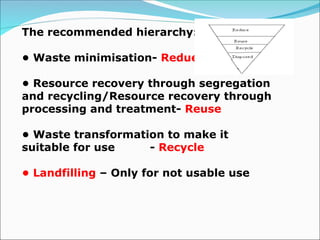
The recommended hierarchy:
• Waste minimisation- Redue
• Resource recovery through segregation
and recycling/Resource recovery through
processing and treatment- Reuse
• Waste transformation to make it
suitable for use - Recycle
• Landfilling – Only for not usable use
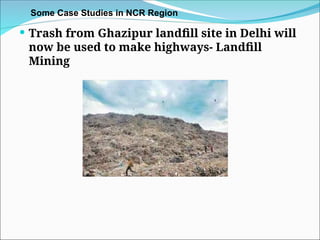
 Trash from Ghazipur landfill site in Delhi will
now be used to make highways- Landfill
Mining
Some Case Studies in NCR Region
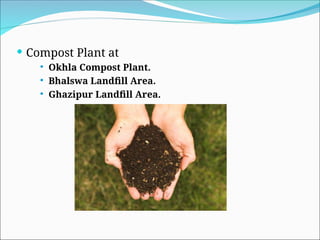
 Compost Plant at
 Okhla Compost Plant.
 Bhalswa Landfill Area.
 Ghazipur Landfill Area.
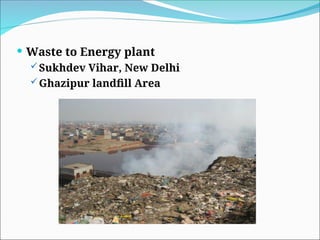
 Waste to Energy plant
Sukhdev Vihar, New Delhi
Ghazipur landfill Area
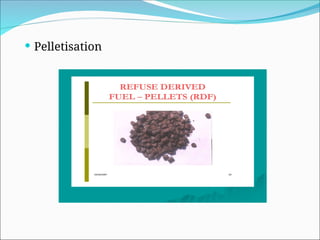
 Pelletisation
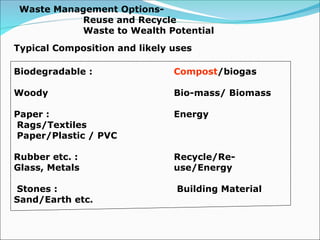
Typical Composition and likely uses
Biodegradable : Compost/biogas
Woody Bio-mass/ Biomass
Paper : Energy
Rags/Textiles
Paper/Plastic / PVC
Rubber etc. : Recycle/Re-
Glass, Metals use/Energy
Stones : Building Material
Sand/Earth etc.
Waste Management Options-
Reuse and Recycle
Waste to Wealth Potential
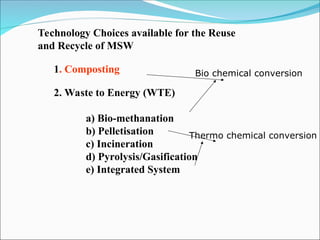
Technology Choices available for the Reuse
and Recycle of MSW
1. Composting
2. Waste to Energy (WTE)
a) Bio-methanation
b) Pelletisation
c) Incineration
d) Pyrolysis/Gasification
e) Integrated System
Bio chemical conversion
Thermo chemical conversion

5. SOLID WASTE management and it's requirement environmental control

  • 1.
    Municipal Solid WasteManagement at Source with respect to New Solid Waste Management Rules 2016
  • 2.
    SWM Rules Solid WasteManagement (Handling and Management) Rules 2000 and now amended SWM Rules 2016. 3’s Principles- Reduce, Reuse and recycle
  • 5.
    Statistics of SolidWaste generation in India 62 million tonnes/annum ---- Waste is generated in India 5.6 million tonnes/annum----Plastic waste, 0.17 million tonnes/annum -----Biomedical waste, 7.90 million tonnes/ annum -----Hazardous Waste 1.5 million tonnes/annum ---- e-waste. (Union Minister of Environment, Forests and Climate Change, Mr. Prakash Javedkar , 2016) App. 75-80 per cent of the municipal waste gets collected and only app. 22-28 per cent of this waste is processed and treated.
  • 6.
    According to MSWRules, 2016. Duties of waste generators are:- 1.Segregate and store waste in three containers- Biodegradable- Green Non- Biodegradable- White Domestic Hazardous Waste- Black Segregated waste to handover to authorise waste collector 2. Sanitary napkins should go wrapped properly and dispose with non-biodegradable waste. 3. Demolishing waste should be stored separately and disposed according to C&D WM Rules, 2016. 4. Store horticulture and garden waste separately. 5. No waste generator should throw and burn or bury the solid waste in street, drains or water bodies.
  • 7.
    6. All wastegenerator should pay user fee for solid waste management as specified in bylaws. 7. No person shall organise an event or gathering of more than one hundred persons at any unlicensed place without intimating the local body, at least three working days in advance and such person or the organiser of such event shall ensure segregation of waste at source and handing over of segregated waste to waste collector. 8. Every street vendor shall keep suitable containers for storage of waste generated during the course of his activity such as food waste, disposable plates, cups, cans, wrappers, coconut shells, leftover food, vegetables, fruits, etc., and shall deposit such waste at waste storage depot or container or vehicle.
  • 8.
    9. All residentwelfare and market associations shall in partnership with the local body ensure segregation of waste at source by the generators as prescribed in these rules, ---facilitate collection of segregated waste in separate streams, handover recyclable material to either the authorised waste pickers. --- The bio-degradable waste shall be processed, treated and disposed off through composting or bio-methanation within the premises as far as possible. 10. All gated communities and institutions with more than 5,000 sqm area shall in partnership with the local body, ensure segregation of waste at source by the generators as prescribed in these rules, facilitate --- collection of segregated waste in separate streams, handover recyclable material to either the authorised waste pickers. --The bio-degradable waste shall be processed, treated and disposed off through composting or bio-methanation within the premises as far as possible. The residual waste shall be given to the waste collectors or agency as directed by the local body.
  • 9.
    11. All hotelsand restaurants shall in partnership with the local body ensure segregation of waste at source as prescribed in these rules, facilitate collection of segregated waste in separate streams, handover recyclable material to either the authorised waste pickers. ---The bio-degradable waste shall be processed, treated and disposed as Composting or bio-methanation within the premises as far as possible. ---The residual waste shall be given to the waste collectors or agency as directed by the local body. 12. The rules also direct that non-recyclable waste having calorific value of 1500 K/cal/kg or more shall be utilised for generating energy either through RDF at solid waste energy generating plant or at fuel in Thermal power plant.
  • 10.
    The recommended hierarchy: •Waste minimisation- Redue • Resource recovery through segregation and recycling/Resource recovery through processing and treatment- Reuse • Waste transformation to make it suitable for use - Recycle • Landfilling – Only for not usable use
  • 11.
     Trash fromGhazipur landfill site in Delhi will now be used to make highways- Landfill Mining Some Case Studies in NCR Region
  • 12.
     Compost Plantat  Okhla Compost Plant.  Bhalswa Landfill Area.  Ghazipur Landfill Area.
  • 13.
     Waste toEnergy plant Sukhdev Vihar, New Delhi Ghazipur landfill Area
  • 14.
  • 15.
    Typical Composition andlikely uses Biodegradable : Compost/biogas Woody Bio-mass/ Biomass Paper : Energy Rags/Textiles Paper/Plastic / PVC Rubber etc. : Recycle/Re- Glass, Metals use/Energy Stones : Building Material Sand/Earth etc. Waste Management Options- Reuse and Recycle Waste to Wealth Potential
  • 16.
    Technology Choices availablefor the Reuse and Recycle of MSW 1. Composting 2. Waste to Energy (WTE) a) Bio-methanation b) Pelletisation c) Incineration d) Pyrolysis/Gasification e) Integrated System Bio chemical conversion Thermo chemical conversion