Lighting


Dr.V.Saravanan
Associate Professor – EEE dept.
TCE, Madurai
LIGHTING SYSTEM
Lighting  is an essential service in all
 the industries
Power consumption by the industrial
 lighting varies
 ◦ Between 2 to 10% of the total power
   depending on the type of industry.
Innovation
          & continuous
 improvement in the field of lighting
 ◦ Has given rise to tremendous energy
   saving opportunities
Contd.
Lighting is an area, which
 provides a major scope to achieve
 energy efficiency at the design
 stage By incorporation of
 ◦ Modern energy efficient lamps
 ◦ Luminaries and gears
 ◦ Good operational practices
Basic Terms in Lighting System and
Features
Incandescent   lamps:
Incandescent lamps produce light
 ◦ By means of a filament heated to
   incandescence
 ◦ By the flow of electric current through it.
Principal parts of an incandescent
 lamp, also known as GLS lamp
 ◦ Include the filament, the bulb, the fill gas
   and the cap.
Reflector lamps
Reflector lamps are basically
 incandescent
 ◦ Provided with a high quality internal
   mirror
 ◦ Which follows exactly the parabolic shape
   of the lamp.
The   reflector is resistant to corrosion
 ◦ Thus making the lamp maintenance free
   and output efficient.
Gas discharge lamps
Light   is produced by the excitation of gas
 ◦ Contained in either a tubular or elliptical outer
   bulb.
Commonly      used discharge lamps are
 ◦   Fluorescent tube lamps (FTL)
 ◦   Compact Fluorescent Lamps (CFL)
 ◦   Mercury Vapour Lamps
 ◦   Sodium Vapour Lamps
 ◦   Metal Halide Lamps
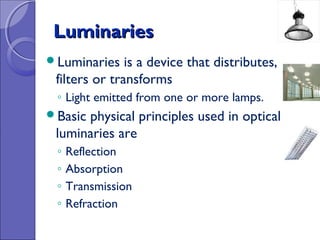
Luminaries
Luminaries    is a device that distributes,
 filters or transforms
 ◦ Light emitted from one or more lamps.
Basicphysical principles used in optical
 luminaries are
 ◦   Reflection
 ◦   Absorption
 ◦   Transmission
 ◦   Refraction
Control Gear
Ballast:
 ◦ A current limiting device, to counter negative
   resistance characteristics of any discharge
   lamps.
 ◦ In case of fluorescent lamps, it aids the initial
   voltage build-up, required for starting.
Ignitors:
 ◦ These are used for starting high intensity Metal
   Halide and Sodium vapour lamps.
Illuminance
Lighting  level produced by a lighting
 installation is usually qualified
 ◦ By the luminance produced on a specified
   plane.
In  most cases, this plane is the major plane
 of the tasks in the interior and is
 commonly called the working plane.
Illuminance provided by an installation
 affects
 ◦ Both the performance of the tasks and the
   appearance of the space.
Lux (lx)
Illuminance   produced
 ◦ By a luminous flux of one lumen, uniformly
   distributed over a surface area of one square
   metre.
One lux is equal to one lumen per square
 meter.
Luminous Efficacy (lm/W)
Ratio   of luminous flux emitted by a lamp
 to the power consumed by the lamp.
It is a reflection of efficiency of energy
 conversion from electricity to light form.
Colour Rendering Index (CRI)
Isa measure of the degree to which the
 colours of surfaces illuminated
 ◦ By a given light source confirm to those of the
   same surfaces under a reference illuminant
Suitable allowance having been made for
 the state of Chromatic adaptation
Light Source
Incandescent   Lamp
 ◦ GLS Lamp
 ◦ Halogen Lamp
 ◦ Blended Mercury Vapour Lamp
Candescent     Lamp
 ◦   LP Mercury Vapour Lamp
 ◦   HP Mercury Vapour Lamp
 ◦   Metal Halide lamp
 ◦   HP Sodium Vapour Lamp
 ◦   LP Sodium Vapour lamp
Filament Lamps
GLS     Lamps
 ◦   Wide operating voltage
 ◦   Most inefficient form of lighting
 ◦   More heat than light
 ◦   10-12 Lumens / watt
 ◦   Working temp. 1900°K
 ◦   100% Colour Rendering index
Blended Mercury Vapour Lamp
Filament  lamp filled with Mercury Gas
High Intensity Lamp
Luminous Intensity – 20Lumens/Watt
Colour rendering index – 75%
Suitable for limitation Jewelry Shop
Halogen lamp
100% Colour Rendering Index
Focus Lighting Applications
Low Voltage Halogen lamp
 ◦ Star Hotel conference hall lighting
 ◦ Display lighting system
Normal   Halogen Lighting
 ◦ Video graphic Applications – 2000Lux
 ◦ High Intensity Lamp
 ◦ Stadium Lighting
Compact Fluorescent Lamp
New   Generation High Efficacy Lamp
 ◦ 45-85 Lumens / Watt
Good   Color rendering Index – 85%
Compact Shape
More Life time – 8000 Hours
Good Alternative for filament lamp
Ideal for Star Hotels, Shops, Gardens &
 Walk Ways
CFL Lamps
High Efficiency Fluorescent Lamp
Conventional     Fluorescent lamp
 ◦ Efficacy – 54 Lumens / Watt
 ◦ CRI – 77%
High    Efficiency Fluorescent lamp
 ◦   Efficacy – 86 Lumens / Watt
 ◦   CRI – 86%
 ◦   Tri-phosphor coated
 ◦   Krypton – Increase life
40% Efficient than conventional tube light
Ideal choice for New Project(Design Stage)
Where existing lighting is poor
Metal halide Lamp
Latest Generation High Intensity lamp
Produce White light
Luminous Efficacy – 80 to 100
 Lumens/Watt
Colour rendering index – 85%
Factory, Stadium & Monument Lighting
 Applications
Green Park Stadium, Mumbai
High Pressure Sodium Vapour Lamp
Produce   Yellow Light
Luminous efficacy –110 –125 Lumen/Watt
Poor Colour Rendering Index – 35%
Ideal for Street & Road Side lighting
Airport Lighting
Santhacruz Airport, Mumbai
High Pressure Mercury Vapour lamp
Produce   White Light
Luminous Efficacy – 55-60Lumens/Watt
Colour Rendering Index – 55%
Olden Days factory inside lighting
 applications
Nowadays replaced with Metal Halide
 Lamp
Low Pressure Mercury Vapour lamp

Fluorescent    Lamp
 ◦ Tube Light
   Conventional Tube Light – 55 Lumens/Watt
   Energy Efficient Tube Light – 85
    Lumens/Watt
 ◦ Compact Fluorescent lamp
   Ideal replacement for GLS Lamp
   Luminous efficiency – 80Lumens / Watt
Efficient Lamps
Compact   Florescent Lamp
Colour – 80 Series Tube Lights
Metal Halide Lamps
High Pressure Sodium Vapour Lamp
 (HPSV Lamp)
LED Lamps
Fluorescent Lamp Gears - Chokes
Conventional   Choke used in Tube Light
 consumes – 9 to 14Watts as loss – because
 of low grade steel
Energy efficient Choke consumes – 4 to
 5Watts as loss – uses Cold rolled grain
 oriented silicon steel laminations
Electronic Choke consumes 1 to 2 Watts
Energy Efficient Copper Ballast
ConventionalBallast in Tube light
 consumes 10-14Watts as loss
 ◦ Use Low grade steel
 ◦ Less copper area – 550Grams
EnergyEfficient Choke consumes
 4-5Watts as loss
 ◦ CRGO Silicon Steel Laminations
 ◦ More Copper Areas – 940Grams
 ◦ Use Vacuum Impregnation Technique
LUMINOUS PERFORMANCE CHARACTERISTICS
OF COMMONLY USED LUMINARIES
Types of   Lumen CRI         Application               Life in
Lamp       /                                           Hours
           Watt
GLS Lamp   14    Excellent   Homes, restaurants,       1000
                             general lighting,
                             emergency lighting
Fluorescent 50   Good        Offices, shops, hospitals, 5000
Lamps                        homes
CFL        60    Very        Hotels, shops, homes,     8000
                 good        offices
HPMV       50    Fair        General lighting in       5000
Lamp                         factories, garages, car
                             parking, flood
                             lighting
LUMINOUS PERFORMANCE CHARACTERISTICS
OF COMMONLY USED LUMINARIES

Types of Lumen CRI        Application               Life in
Lamp     /                                          Hours
         Watt
Halogen 20     Excellent Display, flood lighting,   2000
lamps                    stadium
                         exhibition grounds,
                         construction areas
HPSV    90     Fair       General lighting, ware 12000
Lamp                      houses, street Lighting

LPSV    150    Poor       Roadways, tunnels,        12000
Lamp                      canals, street lighting
Energy Conservation Avenues
Maximize    sunlight use through use of
 ◦ Transparent roof sheets, north light roof,
   etc.
Replacements    of lamps by more
 energy efficient lamps, with due
 consideration to
 ◦ Luminaries, color rendering index, lux
   level as well as expected life comparison .
Contd.
Replace conventional magnetic ballasts by
 more energy efficient ballasts, with due
 consideration to
 ◦ Life and power factor apart from watt loss
Selectinterior colours for light reflection.
Modify layout for optimum lighting.
Contd.
Providing   individual / group controls
 for lighting for energy efficiency
 ◦ On / off, Group control switches / units
 ◦ Occupancy sensors
 ◦ Photocell controls
 ◦ Timer operated controls
 ◦ Computerized lighting control programs
Contd.
Installinput voltage regulators / controllers
 for energy efficiency as well as longer life
 expectancy for lamps
  ◦ Where higher voltages, fluctuations are
    expected.
Replace  energy efficient displays like LED's
 in place of
  ◦ Lamp type displays in control panels /
    instrumentation areas, etc.
Energy Efficient Replacement
  Options
Sector             Existing   Proposed   Watts    % of
                                         Saving   Savings

Domestic /         GLS 100W   CFL 25W    75W      75%
Commercial         GLS 60W    CFL 20W    40W      66%

Domestic/ Industry / TL 40W   TL36       4W       10%
Commercial
Industry /         HPMV       MH 150W    100W     40%
Commercial –       250W       MH 250W    150W     38%
Indoor App.        HPMV
                   400W
Industry /         HPMV       HPSV 150W 100W      40%
Commercial –       250W       HPSV 250W 150W      38%
Outdoor App.       HPMV
                   400W
Some Good Lighting Practices
Installationof energy efficient
 fluorescent lamps
 ◦ In place of "Conventional" fluorescent
   lamps
Installation   of CFL‘s
 ◦ In place of incandescent lamps.
Installation   of metal halide lamps
 ◦ In place of HPMV/HPSV lamps
Contd.
Installation   of HPSV lamps for
 applications
 ◦ where colour rendering is not critical
Installationof LED panel indicator
 lamps in place of filament lamps
Thank you

5 lighting

  • 1.
  • 2.
    LIGHTING SYSTEM Lighting is an essential service in all the industries Power consumption by the industrial lighting varies ◦ Between 2 to 10% of the total power depending on the type of industry. Innovation & continuous improvement in the field of lighting ◦ Has given rise to tremendous energy saving opportunities
  • 3.
    Contd. Lighting is anarea, which provides a major scope to achieve energy efficiency at the design stage By incorporation of ◦ Modern energy efficient lamps ◦ Luminaries and gears ◦ Good operational practices
  • 4.
    Basic Terms inLighting System and Features Incandescent lamps: Incandescent lamps produce light ◦ By means of a filament heated to incandescence ◦ By the flow of electric current through it. Principal parts of an incandescent lamp, also known as GLS lamp ◦ Include the filament, the bulb, the fill gas and the cap.
  • 5.
    Reflector lamps Reflector lampsare basically incandescent ◦ Provided with a high quality internal mirror ◦ Which follows exactly the parabolic shape of the lamp. The reflector is resistant to corrosion ◦ Thus making the lamp maintenance free and output efficient.
  • 6.
    Gas discharge lamps Light is produced by the excitation of gas ◦ Contained in either a tubular or elliptical outer bulb. Commonly used discharge lamps are ◦ Fluorescent tube lamps (FTL) ◦ Compact Fluorescent Lamps (CFL) ◦ Mercury Vapour Lamps ◦ Sodium Vapour Lamps ◦ Metal Halide Lamps
  • 7.
    Luminaries Luminaries is a device that distributes, filters or transforms ◦ Light emitted from one or more lamps. Basicphysical principles used in optical luminaries are ◦ Reflection ◦ Absorption ◦ Transmission ◦ Refraction
  • 8.
    Control Gear Ballast: ◦A current limiting device, to counter negative resistance characteristics of any discharge lamps. ◦ In case of fluorescent lamps, it aids the initial voltage build-up, required for starting. Ignitors: ◦ These are used for starting high intensity Metal Halide and Sodium vapour lamps.
  • 9.
    Illuminance Lighting levelproduced by a lighting installation is usually qualified ◦ By the luminance produced on a specified plane. In most cases, this plane is the major plane of the tasks in the interior and is commonly called the working plane. Illuminance provided by an installation affects ◦ Both the performance of the tasks and the appearance of the space.
  • 10.
    Lux (lx) Illuminance produced ◦ By a luminous flux of one lumen, uniformly distributed over a surface area of one square metre. One lux is equal to one lumen per square meter.
  • 11.
    Luminous Efficacy (lm/W) Ratio of luminous flux emitted by a lamp to the power consumed by the lamp. It is a reflection of efficiency of energy conversion from electricity to light form.
  • 12.
    Colour Rendering Index(CRI) Isa measure of the degree to which the colours of surfaces illuminated ◦ By a given light source confirm to those of the same surfaces under a reference illuminant Suitable allowance having been made for the state of Chromatic adaptation
  • 13.
    Light Source Incandescent Lamp ◦ GLS Lamp ◦ Halogen Lamp ◦ Blended Mercury Vapour Lamp Candescent Lamp ◦ LP Mercury Vapour Lamp ◦ HP Mercury Vapour Lamp ◦ Metal Halide lamp ◦ HP Sodium Vapour Lamp ◦ LP Sodium Vapour lamp
  • 14.
    Filament Lamps GLS Lamps ◦ Wide operating voltage ◦ Most inefficient form of lighting ◦ More heat than light ◦ 10-12 Lumens / watt ◦ Working temp. 1900°K ◦ 100% Colour Rendering index
  • 15.
    Blended Mercury VapourLamp Filament lamp filled with Mercury Gas High Intensity Lamp Luminous Intensity – 20Lumens/Watt Colour rendering index – 75% Suitable for limitation Jewelry Shop
  • 16.
    Halogen lamp 100% ColourRendering Index Focus Lighting Applications Low Voltage Halogen lamp ◦ Star Hotel conference hall lighting ◦ Display lighting system Normal Halogen Lighting ◦ Video graphic Applications – 2000Lux ◦ High Intensity Lamp ◦ Stadium Lighting
  • 17.
    Compact Fluorescent Lamp New Generation High Efficacy Lamp ◦ 45-85 Lumens / Watt Good Color rendering Index – 85% Compact Shape More Life time – 8000 Hours Good Alternative for filament lamp Ideal for Star Hotels, Shops, Gardens & Walk Ways
  • 18.
  • 19.
    High Efficiency FluorescentLamp Conventional Fluorescent lamp ◦ Efficacy – 54 Lumens / Watt ◦ CRI – 77% High Efficiency Fluorescent lamp ◦ Efficacy – 86 Lumens / Watt ◦ CRI – 86% ◦ Tri-phosphor coated ◦ Krypton – Increase life 40% Efficient than conventional tube light Ideal choice for New Project(Design Stage) Where existing lighting is poor
  • 20.
    Metal halide Lamp LatestGeneration High Intensity lamp Produce White light Luminous Efficacy – 80 to 100 Lumens/Watt Colour rendering index – 85% Factory, Stadium & Monument Lighting Applications
  • 21.
  • 22.
    High Pressure SodiumVapour Lamp Produce Yellow Light Luminous efficacy –110 –125 Lumen/Watt Poor Colour Rendering Index – 35% Ideal for Street & Road Side lighting Airport Lighting
  • 23.
  • 24.
    High Pressure MercuryVapour lamp Produce White Light Luminous Efficacy – 55-60Lumens/Watt Colour Rendering Index – 55% Olden Days factory inside lighting applications Nowadays replaced with Metal Halide Lamp
  • 25.
    Low Pressure MercuryVapour lamp Fluorescent Lamp ◦ Tube Light  Conventional Tube Light – 55 Lumens/Watt  Energy Efficient Tube Light – 85 Lumens/Watt ◦ Compact Fluorescent lamp  Ideal replacement for GLS Lamp  Luminous efficiency – 80Lumens / Watt
  • 26.
    Efficient Lamps Compact Florescent Lamp Colour – 80 Series Tube Lights Metal Halide Lamps High Pressure Sodium Vapour Lamp (HPSV Lamp) LED Lamps
  • 27.
    Fluorescent Lamp Gears- Chokes Conventional Choke used in Tube Light consumes – 9 to 14Watts as loss – because of low grade steel Energy efficient Choke consumes – 4 to 5Watts as loss – uses Cold rolled grain oriented silicon steel laminations Electronic Choke consumes 1 to 2 Watts
  • 28.
    Energy Efficient CopperBallast ConventionalBallast in Tube light consumes 10-14Watts as loss ◦ Use Low grade steel ◦ Less copper area – 550Grams EnergyEfficient Choke consumes 4-5Watts as loss ◦ CRGO Silicon Steel Laminations ◦ More Copper Areas – 940Grams ◦ Use Vacuum Impregnation Technique
  • 29.
    LUMINOUS PERFORMANCE CHARACTERISTICS OFCOMMONLY USED LUMINARIES Types of Lumen CRI Application Life in Lamp / Hours Watt GLS Lamp 14 Excellent Homes, restaurants, 1000 general lighting, emergency lighting Fluorescent 50 Good Offices, shops, hospitals, 5000 Lamps homes CFL 60 Very Hotels, shops, homes, 8000 good offices HPMV 50 Fair General lighting in 5000 Lamp factories, garages, car parking, flood lighting
  • 30.
    LUMINOUS PERFORMANCE CHARACTERISTICS OFCOMMONLY USED LUMINARIES Types of Lumen CRI Application Life in Lamp / Hours Watt Halogen 20 Excellent Display, flood lighting, 2000 lamps stadium exhibition grounds, construction areas HPSV 90 Fair General lighting, ware 12000 Lamp houses, street Lighting LPSV 150 Poor Roadways, tunnels, 12000 Lamp canals, street lighting
  • 31.
    Energy Conservation Avenues Maximize sunlight use through use of ◦ Transparent roof sheets, north light roof, etc. Replacements of lamps by more energy efficient lamps, with due consideration to ◦ Luminaries, color rendering index, lux level as well as expected life comparison .
  • 32.
    Contd. Replace conventional magneticballasts by more energy efficient ballasts, with due consideration to ◦ Life and power factor apart from watt loss Selectinterior colours for light reflection. Modify layout for optimum lighting.
  • 33.
    Contd. Providing individual / group controls for lighting for energy efficiency ◦ On / off, Group control switches / units ◦ Occupancy sensors ◦ Photocell controls ◦ Timer operated controls ◦ Computerized lighting control programs
  • 34.
    Contd. Installinput voltage regulators/ controllers for energy efficiency as well as longer life expectancy for lamps ◦ Where higher voltages, fluctuations are expected. Replace energy efficient displays like LED's in place of ◦ Lamp type displays in control panels / instrumentation areas, etc.
  • 35.
    Energy Efficient Replacement Options Sector Existing Proposed Watts % of Saving Savings Domestic / GLS 100W CFL 25W 75W 75% Commercial GLS 60W CFL 20W 40W 66% Domestic/ Industry / TL 40W TL36 4W 10% Commercial Industry / HPMV MH 150W 100W 40% Commercial – 250W MH 250W 150W 38% Indoor App. HPMV 400W Industry / HPMV HPSV 150W 100W 40% Commercial – 250W HPSV 250W 150W 38% Outdoor App. HPMV 400W
  • 37.
    Some Good LightingPractices Installationof energy efficient fluorescent lamps ◦ In place of "Conventional" fluorescent lamps Installation of CFL‘s ◦ In place of incandescent lamps. Installation of metal halide lamps ◦ In place of HPMV/HPSV lamps
  • 38.
    Contd. Installation of HPSV lamps for applications ◦ where colour rendering is not critical Installationof LED panel indicator lamps in place of filament lamps
  • 39.