Load RunnerLoad Runner
Mercury Performance TestMercury Performance Test
ToolTool
Topics to be CoveredTopics to be Covered
 Why Performance ?Why Performance ?
 Definitions: Performance TestingDefinitions: Performance Testing
 Benchmark DesignBenchmark Design
 Performance Testing ToolsPerformance Testing Tools
 LoadRunner ComponentsLoadRunner Components
 What is load testing process?What is load testing process?
 Getting Familiar with Mercury ToursGetting Familiar with Mercury Tours
 Application RequirementsApplication Requirements
Why Performance…?Why Performance…?
 Does the application respond quickly enough for the
intended users?
 Will the application handle the expected user load
and beyond?
 Will the application handle the number of
transactions required by the business?
 Is the application stable under expected and
unexpected user loads?
 Are you sure that users will have a positive
experience on go-live day?
Define Stress/Load/Performance TestingDefine Stress/Load/Performance Testing
 Stress TestingStress Testing: Stress Testing is done in order to check: Stress Testing is done in order to check
when the application fails by reducing the system resourceswhen the application fails by reducing the system resources
such as RAM, HDD etc. and keeping the number of users assuch as RAM, HDD etc. and keeping the number of users as
constant.constant.
 Load TestingLoad Testing: Load Testing is done in order to check when: Load Testing is done in order to check when
the application fails by increasing the number of users andthe application fails by increasing the number of users and
keeping the system resources as constant.keeping the system resources as constant.
 Performance TestingPerformance Testing: The term Performance can mean: The term Performance can mean
measuring response time, throughput, resource utilization, ormeasuring response time, throughput, resource utilization, or
some other system characteristic( or group of them), bysome other system characteristic( or group of them), by
varying the number of users.varying the number of users.
Benchmark DesignBenchmark Design
 The Benchmark is the representative workload used during theThe Benchmark is the representative workload used during the
performance test run. It should be representative of the likelyperformance test run. It should be representative of the likely
real-world operating conditions.real-world operating conditions.
 Benchmark is provided by the client.Benchmark is provided by the client.
 In Industry scenario the benchmark is as follows:In Industry scenario the benchmark is as follows:
 No. of transactions passed per second >= 8No. of transactions passed per second >= 8
 Response time <= 5 sec.Response time <= 5 sec.
Performance Testing ToolsPerformance Testing Tools
 Segue Silk PerformerSegue Silk Performer
 Rational Team TestRational Team Test
 Mercury Load RunnerMercury Load Runner
 Empirix e-Load/RSW)Empirix e-Load/RSW)
 Soft Light Site Tools LoaderSoft Light Site Tools Loader
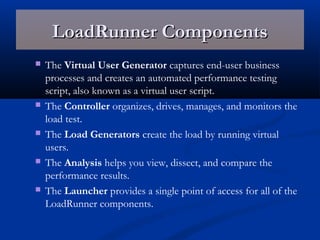
LoadRunner ComponentsLoadRunner Components
 The Virtual User Generator captures end-user business
processes and creates an automated performance testing
script, also known as a virtual user script.
 The Controller organizes, drives, manages, and monitors the
load test.

 The Load Generators create the load by running virtual
users.
 The Analysis helps you view, dissect, and compare the
performance results.
 The Launcher provides a single point of access for all of the
LoadRunner components.
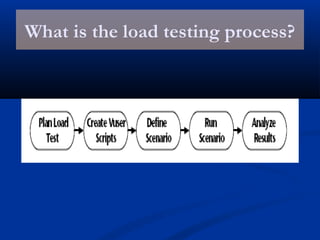
What is the load testing process?
Getting Familiar with Mercury Tours
Opening Mercury Tours
 Make sure that the sample Web server is
running.
 Open the Mercury Tours application.
 Log into Mercury Tours.
 Reserve a flight.
 End your Mercury Tours session.
Application Requirements
 Mercury Tours must successfully handle 10 concurrent
travel agents.
 Mercury Tours must be able to process 10 simultaneous
flight bookings with response time not exceeding 90
seconds.
 Mercury Tours must be able to handle 10 travel agents
running simultaneous itinerary checks with response
time not exceeding 120 seconds.
 Mercury Tours must be able to handle 10 agents signing
in and signing out of the system with response time not
exceeding 10 seconds.
Building Scripts
Topics to be CoveredTopics to be Covered
 Introducing the Virtual User Generator (VuGen)
 How do I start recording user activities?
 How do I record a business process to create a script?
 How do I view the script?
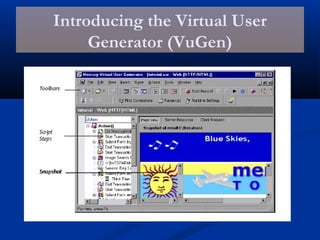
Introducing the Virtual User
Generator (VuGen)
How do I start recording user
activities?
1.1. Open Virtual User Generator.Open Virtual User Generator.
2.2. Create a single protocol Web script.Create a single protocol Web script.
How do I record a business process
to create a script?
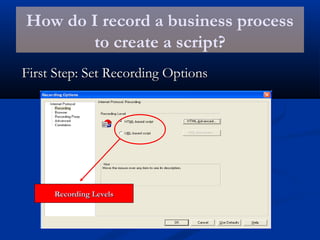
First Step: Set Recording OptionsFirst Step: Set Recording Options
Recording LevelsRecording Levels
How do I record a business process
to create a script? Contd …
1.1. Start recording on the Mercury Tours Web site.Start recording on the Mercury Tours Web site.
2.2. Login to the Mercury Tours Web site.Login to the Mercury Tours Web site.
3.3. Enter flight details.Enter flight details.
4.4. Select a flight.Select a flight.
5.5. Check the itinerary.Check the itinerary.
6.6. Click sign off in the left pane.Click sign off in the left pane.
7.7. Click Stop on the floating toolbar to stop the recordingClick Stop on the floating toolbar to stop the recording ..
8.8. Choose File > Save or click the Save button. TypeChoose File > Save or click the Save button. Type
basic_tutorial in the File name box and click Save.basic_tutorial in the File name box and click Save.
How do I view the script?
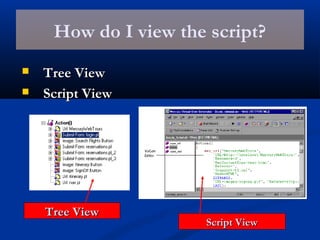
 Tree ViewTree View
 Script ViewScript View
Tree ViewTree View
Script ViewScript View
Playing Back Your
Script
Topics to be CoveredTopics to be Covered
 How do I set the run-time behavior?
 How do I watch my script running in real time?
 Where can I view a summary of the playback?
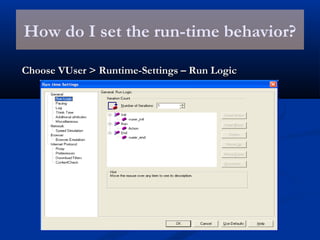
How do I set the run-time behavior?
Choose VUser > Runtime-Settings – Run LogicChoose VUser > Runtime-Settings – Run Logic
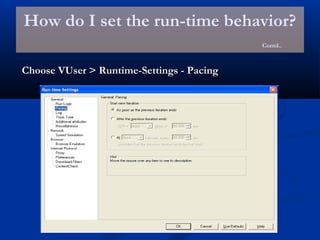
How do I set the run-time behavior?
Contd..
Choose VUser > Runtime-Settings - PacingChoose VUser > Runtime-Settings - Pacing
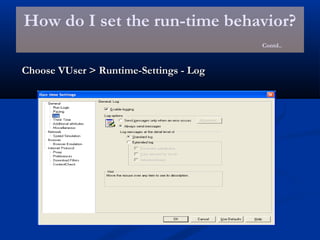
How do I set the run-time behavior?
Contd..
Choose VUser > Runtime-Settings - LogChoose VUser > Runtime-Settings - Log
How do I set the run-time behavior?
Contd..
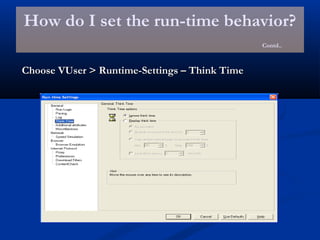
Choose VUser > Runtime-Settings – Think TimeChoose VUser > Runtime-Settings – Think Time
How do I set the run-time behavior?
Contd..
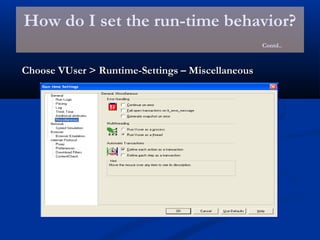
Choose VUser > Runtime-Settings – MiscellaneousChoose VUser > Runtime-Settings – Miscellaneous
How do I set the run-time behavior?
Contd..
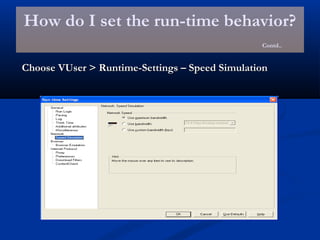
Choose VUser > Runtime-Settings – Speed SimulationChoose VUser > Runtime-Settings – Speed Simulation
How do I set the run-time behavior?
Contd..
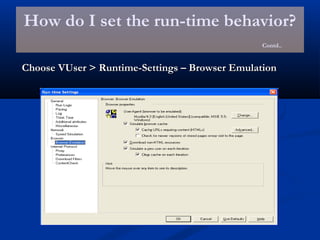
Choose VUser > Runtime-Settings – Browser EmulationChoose VUser > Runtime-Settings – Browser Emulation
How do I set the run-time behavior?
Contd..
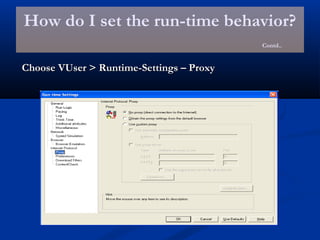
Choose VUser > Runtime-Settings – ProxyChoose VUser > Runtime-Settings – Proxy
How do I set the run-time behavior?
Contd..
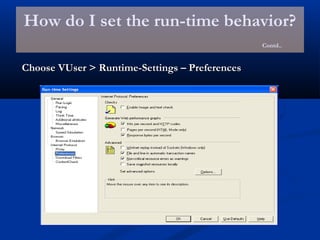
Choose VUser > Runtime-Settings – PreferencesChoose VUser > Runtime-Settings – Preferences
How do I set the run-time behavior?
Contd..
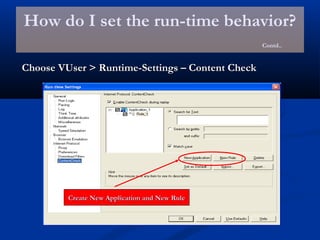
Choose VUser > Runtime-Settings – Content CheckChoose VUser > Runtime-Settings – Content Check
Create New Application and New RuleCreate New Application and New Rule
How do I watch my script running in
real time?
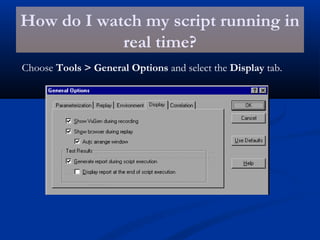
Choose Tools > General Options and select the Display tab.
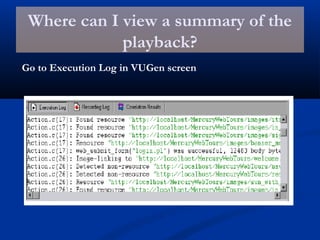
Where can I view a summary of the
playback?
Go to Execution Log in VUGen screen
Solving Common
Playback Problems
Topics to be CoveredTopics to be Covered
 What is Correlation?
 Preparing Mercury Tours for Playback Errors
 How do I work with unique server values?
What is Correlation?
Many applications use dynamic values that change each time
you use the application. For example, some servers assign a
unique session ID for every new session. When you try to
replay a recorded session, the application creates a new
session ID that differs from the recorded session ID.
LoadRunner addresses this issue through correlation.
Correlation saves the changing values, in our case the
session ID, to a parameter. When running the emulation,
the Vuser does not use the recorded value—instead, it uses
the new session ID, assigned to it by the server.
Preparing Mercury Tours for
Playback Errors
1. Open Mercury Tours.
Choose Start > Programs > Mercury LoadRunner > Samples > Web >
Mercury Web Tours Application.
1. Change the server options.
Click SERVER OPTIONS in the left pane. Select the Setting 3 option.
Scroll down to the bottom of the page and click the Reconfigure Server
Details button. Scroll down to the bottom of the page and click the Return
to the Mercury Tours Homepage link. This setting tells the server not to
allowduplicate session IDs.
(Note that if you have IIS installed on your machine, you will need to modify
the settings for this application. Search for the file xitami.cfg in the xitami
folder, and open it in a text editor. Locate the line portbase=1000, and
modify it to portbase=1001. Save and exit the file.)
3. Close the browser.
4. Record the script again to create a new script with dynamic values.
How do I work with unique server
values?
1. Record the script again.
2. Replay the script.
3. Scan the script for correlations.
4. View the correlations.
5. Correlate the Session ID.
6. Examine the syntax of the correlation statement.
7. Play the script again.
8. Fix the server configuration.
Choose Start > Programs > Mercury LoadRunner > Samples > Web >
Mercury Web Tours Application to open Mercury tours.
Click SERVER OPTIONS in the left pane. Clear all of the options. Scroll
down to the bottom of the page and click the Reconfigure Server Details
button.
Close the browser.
Preparing a Script for
Load Testing
Topics to be CoveredTopics to be Covered
 How do I measure business processes?
 How do I emulate multiple users?
 How do I verify Web page content?
 Did my test succeed?
How do I measure business processes?
Creating Transactions – Re-Record the script using
Transactions
The transactions would be created for the following pages:
1. URL Access
2. Login
3. Flight Button click
4. FindFlight_Continue_Button
5. SelectFlight_Continue_Button
6. Purchase Flight Button
7. Check Itinerary
8. Log Off
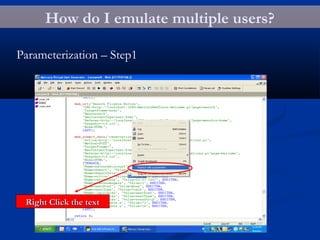
How do I emulate multiple users?
Parameterization – Step1
Right Click the textRight Click the text
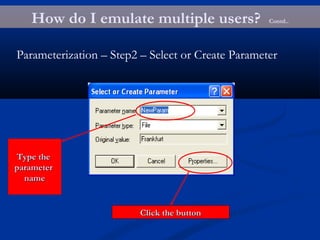
How do I emulate multiple users? Contd..
Parameterization – Step2 – Select or Create Parameter
Type theType the
parameterparameter
namename
Click the buttonClick the button
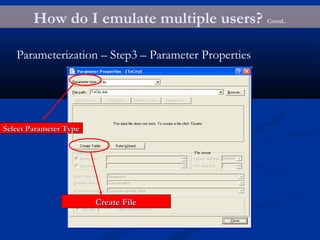
How do I emulate multiple users? Contd..
Parameterization – Step3 – Parameter Properties
Select Parameter TypeSelect Parameter Type
Create FileCreate File
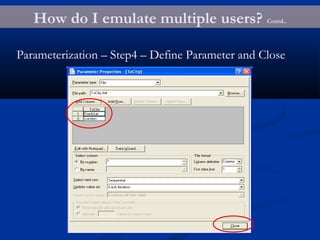
How do I emulate multiple users? Contd..
Parameterization – Step4 – Define Parameter and Close
How do I emulate multiple users? Contd..
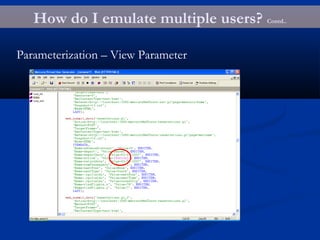
Parameterization – View Parameter
How do I verify Web page content?
Checkpoints – Two Types
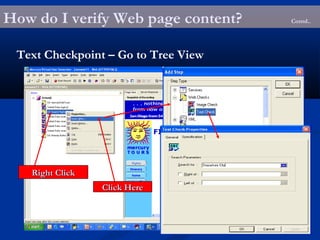
 Text Checkpoint - checks that a text string appears on a
Web page.
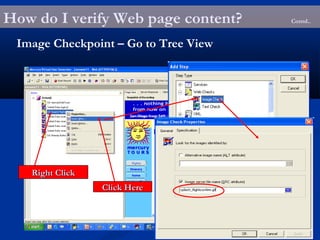
 Image Checkpoint - checks for an image on a Web
page.
How do I verify Web page content? Contd..
Text Checkpoint – Go to Tree View
Right ClickRight Click
Click HereClick Here
How do I verify Web page content? Contd..
Image Checkpoint – Go to Tree View
Right ClickRight Click
Click HereClick Here
Did my test succeed?
Playback the Script
1. Enable image checks.
2. Run the script.
3. Locate the text check.
4. Locate the image check.

loadrunner

  • 1.
    Load RunnerLoad Runner MercuryPerformance TestMercury Performance Test ToolTool
  • 2.
    Topics to beCoveredTopics to be Covered  Why Performance ?Why Performance ?  Definitions: Performance TestingDefinitions: Performance Testing  Benchmark DesignBenchmark Design  Performance Testing ToolsPerformance Testing Tools  LoadRunner ComponentsLoadRunner Components  What is load testing process?What is load testing process?  Getting Familiar with Mercury ToursGetting Familiar with Mercury Tours  Application RequirementsApplication Requirements
  • 3.
    Why Performance…?Why Performance…? Does the application respond quickly enough for the intended users?  Will the application handle the expected user load and beyond?  Will the application handle the number of transactions required by the business?  Is the application stable under expected and unexpected user loads?  Are you sure that users will have a positive experience on go-live day?
  • 4.
    Define Stress/Load/Performance TestingDefineStress/Load/Performance Testing  Stress TestingStress Testing: Stress Testing is done in order to check: Stress Testing is done in order to check when the application fails by reducing the system resourceswhen the application fails by reducing the system resources such as RAM, HDD etc. and keeping the number of users assuch as RAM, HDD etc. and keeping the number of users as constant.constant.  Load TestingLoad Testing: Load Testing is done in order to check when: Load Testing is done in order to check when the application fails by increasing the number of users andthe application fails by increasing the number of users and keeping the system resources as constant.keeping the system resources as constant.  Performance TestingPerformance Testing: The term Performance can mean: The term Performance can mean measuring response time, throughput, resource utilization, ormeasuring response time, throughput, resource utilization, or some other system characteristic( or group of them), bysome other system characteristic( or group of them), by varying the number of users.varying the number of users.
  • 5.
    Benchmark DesignBenchmark Design The Benchmark is the representative workload used during theThe Benchmark is the representative workload used during the performance test run. It should be representative of the likelyperformance test run. It should be representative of the likely real-world operating conditions.real-world operating conditions.  Benchmark is provided by the client.Benchmark is provided by the client.  In Industry scenario the benchmark is as follows:In Industry scenario the benchmark is as follows:  No. of transactions passed per second >= 8No. of transactions passed per second >= 8  Response time <= 5 sec.Response time <= 5 sec.
  • 6.
    Performance Testing ToolsPerformanceTesting Tools  Segue Silk PerformerSegue Silk Performer  Rational Team TestRational Team Test  Mercury Load RunnerMercury Load Runner  Empirix e-Load/RSW)Empirix e-Load/RSW)  Soft Light Site Tools LoaderSoft Light Site Tools Loader
  • 7.
    LoadRunner ComponentsLoadRunner Components The Virtual User Generator captures end-user business processes and creates an automated performance testing script, also known as a virtual user script.  The Controller organizes, drives, manages, and monitors the load test.  The Load Generators create the load by running virtual users.  The Analysis helps you view, dissect, and compare the performance results.  The Launcher provides a single point of access for all of the LoadRunner components.
  • 8.
    What is theload testing process?
  • 9.
    Getting Familiar withMercury Tours Opening Mercury Tours  Make sure that the sample Web server is running.  Open the Mercury Tours application.  Log into Mercury Tours.  Reserve a flight.  End your Mercury Tours session.


  • 10.
    Application Requirements  MercuryTours must successfully handle 10 concurrent travel agents.  Mercury Tours must be able to process 10 simultaneous flight bookings with response time not exceeding 90 seconds.  Mercury Tours must be able to handle 10 travel agents running simultaneous itinerary checks with response time not exceeding 120 seconds.  Mercury Tours must be able to handle 10 agents signing in and signing out of the system with response time not exceeding 10 seconds.
  • 11.
  • 12.
    Topics to beCoveredTopics to be Covered  Introducing the Virtual User Generator (VuGen)  How do I start recording user activities?  How do I record a business process to create a script?  How do I view the script?
  • 13.
    Introducing the VirtualUser Generator (VuGen)
  • 14.
    How do Istart recording user activities? 1.1. Open Virtual User Generator.Open Virtual User Generator. 2.2. Create a single protocol Web script.Create a single protocol Web script.
  • 15.
    How do Irecord a business process to create a script? First Step: Set Recording OptionsFirst Step: Set Recording Options Recording LevelsRecording Levels
  • 16.
    How do Irecord a business process to create a script? Contd … 1.1. Start recording on the Mercury Tours Web site.Start recording on the Mercury Tours Web site. 2.2. Login to the Mercury Tours Web site.Login to the Mercury Tours Web site. 3.3. Enter flight details.Enter flight details. 4.4. Select a flight.Select a flight. 5.5. Check the itinerary.Check the itinerary. 6.6. Click sign off in the left pane.Click sign off in the left pane. 7.7. Click Stop on the floating toolbar to stop the recordingClick Stop on the floating toolbar to stop the recording .. 8.8. Choose File > Save or click the Save button. TypeChoose File > Save or click the Save button. Type basic_tutorial in the File name box and click Save.basic_tutorial in the File name box and click Save.
  • 17.
    How do Iview the script?  Tree ViewTree View  Script ViewScript View Tree ViewTree View Script ViewScript View
  • 18.
  • 19.
    Topics to beCoveredTopics to be Covered  How do I set the run-time behavior?  How do I watch my script running in real time?  Where can I view a summary of the playback?
  • 20.
    How do Iset the run-time behavior? Choose VUser > Runtime-Settings – Run LogicChoose VUser > Runtime-Settings – Run Logic
  • 21.
    How do Iset the run-time behavior? Contd.. Choose VUser > Runtime-Settings - PacingChoose VUser > Runtime-Settings - Pacing
  • 22.
    How do Iset the run-time behavior? Contd.. Choose VUser > Runtime-Settings - LogChoose VUser > Runtime-Settings - Log
  • 23.
    How do Iset the run-time behavior? Contd.. Choose VUser > Runtime-Settings – Think TimeChoose VUser > Runtime-Settings – Think Time
  • 24.
    How do Iset the run-time behavior? Contd.. Choose VUser > Runtime-Settings – MiscellaneousChoose VUser > Runtime-Settings – Miscellaneous
  • 25.
    How do Iset the run-time behavior? Contd.. Choose VUser > Runtime-Settings – Speed SimulationChoose VUser > Runtime-Settings – Speed Simulation
  • 26.
    How do Iset the run-time behavior? Contd.. Choose VUser > Runtime-Settings – Browser EmulationChoose VUser > Runtime-Settings – Browser Emulation
  • 27.
    How do Iset the run-time behavior? Contd.. Choose VUser > Runtime-Settings – ProxyChoose VUser > Runtime-Settings – Proxy
  • 28.
    How do Iset the run-time behavior? Contd.. Choose VUser > Runtime-Settings – PreferencesChoose VUser > Runtime-Settings – Preferences
  • 29.
    How do Iset the run-time behavior? Contd.. Choose VUser > Runtime-Settings – Content CheckChoose VUser > Runtime-Settings – Content Check Create New Application and New RuleCreate New Application and New Rule
  • 30.
    How do Iwatch my script running in real time? Choose Tools > General Options and select the Display tab.
  • 31.
    Where can Iview a summary of the playback? Go to Execution Log in VUGen screen
  • 32.
  • 33.
    Topics to beCoveredTopics to be Covered  What is Correlation?  Preparing Mercury Tours for Playback Errors  How do I work with unique server values?
  • 34.
    What is Correlation? Manyapplications use dynamic values that change each time you use the application. For example, some servers assign a unique session ID for every new session. When you try to replay a recorded session, the application creates a new session ID that differs from the recorded session ID. LoadRunner addresses this issue through correlation. Correlation saves the changing values, in our case the session ID, to a parameter. When running the emulation, the Vuser does not use the recorded value—instead, it uses the new session ID, assigned to it by the server.
  • 35.
    Preparing Mercury Toursfor Playback Errors 1. Open Mercury Tours. Choose Start > Programs > Mercury LoadRunner > Samples > Web > Mercury Web Tours Application. 1. Change the server options. Click SERVER OPTIONS in the left pane. Select the Setting 3 option. Scroll down to the bottom of the page and click the Reconfigure Server Details button. Scroll down to the bottom of the page and click the Return to the Mercury Tours Homepage link. This setting tells the server not to allowduplicate session IDs. (Note that if you have IIS installed on your machine, you will need to modify the settings for this application. Search for the file xitami.cfg in the xitami folder, and open it in a text editor. Locate the line portbase=1000, and modify it to portbase=1001. Save and exit the file.) 3. Close the browser. 4. Record the script again to create a new script with dynamic values.
  • 36.
    How do Iwork with unique server values? 1. Record the script again. 2. Replay the script. 3. Scan the script for correlations. 4. View the correlations. 5. Correlate the Session ID. 6. Examine the syntax of the correlation statement. 7. Play the script again. 8. Fix the server configuration. Choose Start > Programs > Mercury LoadRunner > Samples > Web > Mercury Web Tours Application to open Mercury tours. Click SERVER OPTIONS in the left pane. Clear all of the options. Scroll down to the bottom of the page and click the Reconfigure Server Details button. Close the browser.
  • 37.
    Preparing a Scriptfor Load Testing
  • 38.
    Topics to beCoveredTopics to be Covered  How do I measure business processes?  How do I emulate multiple users?  How do I verify Web page content?  Did my test succeed?
  • 39.
    How do Imeasure business processes? Creating Transactions – Re-Record the script using Transactions The transactions would be created for the following pages: 1. URL Access 2. Login 3. Flight Button click 4. FindFlight_Continue_Button 5. SelectFlight_Continue_Button 6. Purchase Flight Button 7. Check Itinerary 8. Log Off
  • 40.
    How do Iemulate multiple users? Parameterization – Step1 Right Click the textRight Click the text
  • 41.
    How do Iemulate multiple users? Contd.. Parameterization – Step2 – Select or Create Parameter Type theType the parameterparameter namename Click the buttonClick the button
  • 42.
    How do Iemulate multiple users? Contd.. Parameterization – Step3 – Parameter Properties Select Parameter TypeSelect Parameter Type Create FileCreate File
  • 43.
    How do Iemulate multiple users? Contd.. Parameterization – Step4 – Define Parameter and Close
  • 44.
    How do Iemulate multiple users? Contd.. Parameterization – View Parameter
  • 45.
    How do Iverify Web page content? Checkpoints – Two Types  Text Checkpoint - checks that a text string appears on a Web page.  Image Checkpoint - checks for an image on a Web page.
  • 46.
    How do Iverify Web page content? Contd.. Text Checkpoint – Go to Tree View Right ClickRight Click Click HereClick Here
  • 47.
    How do Iverify Web page content? Contd.. Image Checkpoint – Go to Tree View Right ClickRight Click Click HereClick Here
  • 48.
    Did my testsucceed? Playback the Script 1. Enable image checks. 2. Run the script. 3. Locate the text check. 4. Locate the image check.

Editor's Notes

  • #3 Our recommended rule of thumb when selecting which test cases to automate: The more repetitive the execution, the better candidate the test is for automation.
  • #4 Our recommended rule of thumb when selecting which test cases to automate: The more repetitive the execution, the better candidate the test is for automation.
  • #5 Our recommended rule of thumb when selecting which test cases to automate: The more repetitive the execution, the better candidate the test is for automation.
  • #6 Our recommended rule of thumb when selecting which test cases to automate: The more repetitive the execution, the better candidate the test is for automation.
  • #7 Our recommended rule of thumb when selecting which test cases to automate: The more repetitive the execution, the better candidate the test is for automation.
  • #8 Our recommended rule of thumb when selecting which test cases to automate: The more repetitive the execution, the better candidate the test is for automation.
  • #9 Our recommended rule of thumb when selecting which test cases to automate: The more repetitive the execution, the better candidate the test is for automation.
  • #10 Our recommended rule of thumb when selecting which test cases to automate: The more repetitive the execution, the better candidate the test is for automation.
  • #11 Our recommended rule of thumb when selecting which test cases to automate: The more repetitive the execution, the better candidate the test is for automation.
  • #13 Our recommended rule of thumb when selecting which test cases to automate: The more repetitive the execution, the better candidate the test is for automation.
  • #14 Our recommended rule of thumb when selecting which test cases to automate: The more repetitive the execution, the better candidate the test is for automation.
  • #15 Our recommended rule of thumb when selecting which test cases to automate: The more repetitive the execution, the better candidate the test is for automation.
  • #16 Our recommended rule of thumb when selecting which test cases to automate: The more repetitive the execution, the better candidate the test is for automation.
  • #17 Our recommended rule of thumb when selecting which test cases to automate: The more repetitive the execution, the better candidate the test is for automation.
  • #18 Our recommended rule of thumb when selecting which test cases to automate: The more repetitive the execution, the better candidate the test is for automation.
  • #20 Our recommended rule of thumb when selecting which test cases to automate: The more repetitive the execution, the better candidate the test is for automation.
  • #21 Our recommended rule of thumb when selecting which test cases to automate: The more repetitive the execution, the better candidate the test is for automation.
  • #22 Our recommended rule of thumb when selecting which test cases to automate: The more repetitive the execution, the better candidate the test is for automation.
  • #23 Our recommended rule of thumb when selecting which test cases to automate: The more repetitive the execution, the better candidate the test is for automation.
  • #24 Our recommended rule of thumb when selecting which test cases to automate: The more repetitive the execution, the better candidate the test is for automation.
  • #25 Our recommended rule of thumb when selecting which test cases to automate: The more repetitive the execution, the better candidate the test is for automation.
  • #26 Our recommended rule of thumb when selecting which test cases to automate: The more repetitive the execution, the better candidate the test is for automation.
  • #27 Our recommended rule of thumb when selecting which test cases to automate: The more repetitive the execution, the better candidate the test is for automation.
  • #28 Our recommended rule of thumb when selecting which test cases to automate: The more repetitive the execution, the better candidate the test is for automation.
  • #29 Our recommended rule of thumb when selecting which test cases to automate: The more repetitive the execution, the better candidate the test is for automation.
  • #30 Our recommended rule of thumb when selecting which test cases to automate: The more repetitive the execution, the better candidate the test is for automation.
  • #31 Our recommended rule of thumb when selecting which test cases to automate: The more repetitive the execution, the better candidate the test is for automation.
  • #32 Our recommended rule of thumb when selecting which test cases to automate: The more repetitive the execution, the better candidate the test is for automation.
  • #34 Our recommended rule of thumb when selecting which test cases to automate: The more repetitive the execution, the better candidate the test is for automation.
  • #35 Our recommended rule of thumb when selecting which test cases to automate: The more repetitive the execution, the better candidate the test is for automation.
  • #36 Our recommended rule of thumb when selecting which test cases to automate: The more repetitive the execution, the better candidate the test is for automation.
  • #37 Our recommended rule of thumb when selecting which test cases to automate: The more repetitive the execution, the better candidate the test is for automation.
  • #39 Our recommended rule of thumb when selecting which test cases to automate: The more repetitive the execution, the better candidate the test is for automation.
  • #40 Our recommended rule of thumb when selecting which test cases to automate: The more repetitive the execution, the better candidate the test is for automation.
  • #41 Our recommended rule of thumb when selecting which test cases to automate: The more repetitive the execution, the better candidate the test is for automation.
  • #42 Our recommended rule of thumb when selecting which test cases to automate: The more repetitive the execution, the better candidate the test is for automation.
  • #43 Our recommended rule of thumb when selecting which test cases to automate: The more repetitive the execution, the better candidate the test is for automation.
  • #44 Our recommended rule of thumb when selecting which test cases to automate: The more repetitive the execution, the better candidate the test is for automation.
  • #45 Our recommended rule of thumb when selecting which test cases to automate: The more repetitive the execution, the better candidate the test is for automation.
  • #46 Our recommended rule of thumb when selecting which test cases to automate: The more repetitive the execution, the better candidate the test is for automation.
  • #47 Our recommended rule of thumb when selecting which test cases to automate: The more repetitive the execution, the better candidate the test is for automation.
  • #48 Our recommended rule of thumb when selecting which test cases to automate: The more repetitive the execution, the better candidate the test is for automation.
  • #49 Our recommended rule of thumb when selecting which test cases to automate: The more repetitive the execution, the better candidate the test is for automation.