4.5
METALLIC BONDING
ESSENTIAL IDEA
Metallic bonds involve a lattice of
cations with delocalized electrons.
NATURE OF SCIENCE (2.2)
Use theories to explain natural phenomena –
the properties of metals are different from
covalent and ionic substances and this is due
to the formation of non-directional bonds
with a “sea” of delocalized electrons.
UNDERSTANDING/KEY IDEA
4.5.A
A metallic bond is the electrostatic
attraction between a lattice of
positive ions and delocalized
electrons.
https://www.youtube.com/watch?v=_0gTPnYSpIg
METALLIC BONDING
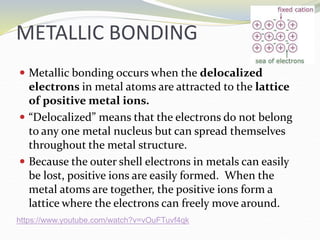
 Metallic bonding occurs when the delocalized
electrons in metal atoms are attracted to the lattice
of positive metal ions.
 “Delocalized” means that the electrons do not belong
to any one metal nucleus but can spread themselves
throughout the metal structure.
 Because the outer shell electrons in metals can easily
be lost, positive ions are easily formed. When the
metal atoms are together, the positive ions form a
lattice where the electrons can freely move around.
https://www.youtube.com/watch?v=vOuFTuvf4qk
UNDERSTANDING/KEY IDEA
4.5.B
The strength of a metallic bond
depends upon the charge of the ions
and the radius of the metal ion.
Metallic Bond Strength
 The strength of the metallic bond depends upon three
things:
 The number of delocalized electrons
 The size of the cation
 The charge of the cation
Strength of Metallic Bond
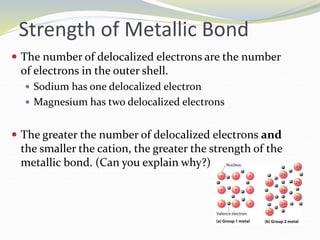
 The number of delocalized electrons are the number
of electrons in the outer shell.
 Sodium has one delocalized electron
 Magnesium has two delocalized electrons
 The greater the number of delocalized electrons and
the smaller the cation, the greater the strength of the
metallic bond. (Can you explain why?)
Strength of Metallic Bonds
 The higher the charge, the greater the metallic
strength.
 The strength of metallic bonding tends to decrease
down a group as cations increase in size.
 Transition metals have very strong metallic bonds due
to the large number of electrons that can become
delocalized from both the 3d and 4s sub-levels.
APPLICATION/SKILLS
Be able to explain electrical
conductivity and malleability in
metals.
PROPERTIES OF METALS
 Metals are good conductors of electricity and heat
(thermal conductivity) because the delocalized
electrons are highly mobile and move through the
metal structure.
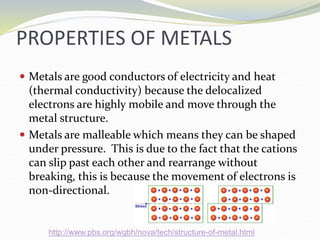
 Metals are malleable which means they can be shaped
under pressure. This is due to the fact that the cations
can slip past each other and rearrange without
breaking, this is because the movement of electrons is
non-directional.
http://www.pbs.org/wgbh/nova/tech/structure-of-metal.html
PROPERTIES OF METALS
 Metals can also be ductile which means to be drawn
into wires due to the ability of the cations to slip into
new shapes.
 Metals are shiny and lustrous because the delocalized
electrons in the metallic structure reflect light.
APPLICATION/SKILLS
Be able to explain trends in melting
points of metals.
MELTING POINTS
 Metals have high melting points due to the strong
bond. It requires a lot of energy to overcome the
electrostatic force between a large lattice structure of
cations and a sea of delocalized electrons.
 Melting points tend to decrease down a group due to
the reduced attraction of the delocalized electrons and
the positively charged cations. (ionic radius increases)
 The stronger the metallic bond (due to size of cation
and charge), the higher the melting point.
UNDERSTANDING/KEY IDEA
4.5.C
Alloys usually contain more than
one metal and have enhanced
properties.
ALLOYS
 Alloys are solid solutions.
 Remember that a solution is a homogeneous mixture of
a solute with a solvent.
 In alloys, the solute and the solvent are both solids.
 Two metals are mixed together in the molten state.
 When they solidify, ions of the different metals are
scattered throughout the lattice and are bounded by
the delocalized electrons.
APPLICATION/SKILLS
Be able to explain the properties of
alloys in terms of non-directional
bonding.
PROPERTIES OF ALLOYS
 Alloys are possible because of the non-directional
nature of the delocalized electrons and the fact that
the lattice can accommodate ions of different sizes.
 Alloys have properties that are distinct from their
component elements due to the different packing of
the cations in the lattice.
 The alloy is often more chemically stable, stronger,
resistant to corrosion, increased magnetic
properties, and greater ductility.
https://www.youtube.com/watch?v=EzFjZJEAt18&feature=youtu.be
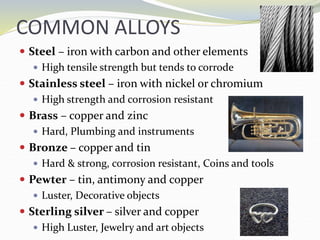
COMMON ALLOYS
 Steel – iron with carbon and other elements
 High tensile strength but tends to corrode
 Stainless steel – iron with nickel or chromium
 High strength and corrosion resistant
 Brass – copper and zinc
 Hard, Plumbing and instruments
 Bronze – copper and tin
 Hard & strong, corrosion resistant, Coins and tools
 Pewter – tin, antimony and copper
 Luster, Decorative objects
 Sterling silver – silver and copper
 High Luster, Jewelry and art objects
GUIDANCE
Trends are limited to “s” and “p” block
elements only.
Various alloys should be covered.

4.5_metallic_bonding.pptx

  • 1.
  • 2.
    ESSENTIAL IDEA Metallic bondsinvolve a lattice of cations with delocalized electrons. NATURE OF SCIENCE (2.2) Use theories to explain natural phenomena – the properties of metals are different from covalent and ionic substances and this is due to the formation of non-directional bonds with a “sea” of delocalized electrons.
  • 3.
    UNDERSTANDING/KEY IDEA 4.5.A A metallicbond is the electrostatic attraction between a lattice of positive ions and delocalized electrons. https://www.youtube.com/watch?v=_0gTPnYSpIg
  • 4.
    METALLIC BONDING  Metallicbonding occurs when the delocalized electrons in metal atoms are attracted to the lattice of positive metal ions.  “Delocalized” means that the electrons do not belong to any one metal nucleus but can spread themselves throughout the metal structure.  Because the outer shell electrons in metals can easily be lost, positive ions are easily formed. When the metal atoms are together, the positive ions form a lattice where the electrons can freely move around. https://www.youtube.com/watch?v=vOuFTuvf4qk
  • 5.
    UNDERSTANDING/KEY IDEA 4.5.B The strengthof a metallic bond depends upon the charge of the ions and the radius of the metal ion.
  • 6.
    Metallic Bond Strength The strength of the metallic bond depends upon three things:  The number of delocalized electrons  The size of the cation  The charge of the cation
  • 7.
    Strength of MetallicBond  The number of delocalized electrons are the number of electrons in the outer shell.  Sodium has one delocalized electron  Magnesium has two delocalized electrons  The greater the number of delocalized electrons and the smaller the cation, the greater the strength of the metallic bond. (Can you explain why?)
  • 8.
    Strength of MetallicBonds  The higher the charge, the greater the metallic strength.  The strength of metallic bonding tends to decrease down a group as cations increase in size.  Transition metals have very strong metallic bonds due to the large number of electrons that can become delocalized from both the 3d and 4s sub-levels.
  • 9.
    APPLICATION/SKILLS Be able toexplain electrical conductivity and malleability in metals.
  • 10.
    PROPERTIES OF METALS Metals are good conductors of electricity and heat (thermal conductivity) because the delocalized electrons are highly mobile and move through the metal structure.  Metals are malleable which means they can be shaped under pressure. This is due to the fact that the cations can slip past each other and rearrange without breaking, this is because the movement of electrons is non-directional. http://www.pbs.org/wgbh/nova/tech/structure-of-metal.html
  • 11.
    PROPERTIES OF METALS Metals can also be ductile which means to be drawn into wires due to the ability of the cations to slip into new shapes.  Metals are shiny and lustrous because the delocalized electrons in the metallic structure reflect light.
  • 12.
    APPLICATION/SKILLS Be able toexplain trends in melting points of metals.
  • 13.
    MELTING POINTS  Metalshave high melting points due to the strong bond. It requires a lot of energy to overcome the electrostatic force between a large lattice structure of cations and a sea of delocalized electrons.  Melting points tend to decrease down a group due to the reduced attraction of the delocalized electrons and the positively charged cations. (ionic radius increases)  The stronger the metallic bond (due to size of cation and charge), the higher the melting point.
  • 14.
    UNDERSTANDING/KEY IDEA 4.5.C Alloys usuallycontain more than one metal and have enhanced properties.
  • 15.
    ALLOYS  Alloys aresolid solutions.  Remember that a solution is a homogeneous mixture of a solute with a solvent.  In alloys, the solute and the solvent are both solids.  Two metals are mixed together in the molten state.  When they solidify, ions of the different metals are scattered throughout the lattice and are bounded by the delocalized electrons.
  • 16.
    APPLICATION/SKILLS Be able toexplain the properties of alloys in terms of non-directional bonding.
  • 17.
    PROPERTIES OF ALLOYS Alloys are possible because of the non-directional nature of the delocalized electrons and the fact that the lattice can accommodate ions of different sizes.  Alloys have properties that are distinct from their component elements due to the different packing of the cations in the lattice.  The alloy is often more chemically stable, stronger, resistant to corrosion, increased magnetic properties, and greater ductility. https://www.youtube.com/watch?v=EzFjZJEAt18&feature=youtu.be
  • 18.
    COMMON ALLOYS  Steel– iron with carbon and other elements  High tensile strength but tends to corrode  Stainless steel – iron with nickel or chromium  High strength and corrosion resistant  Brass – copper and zinc  Hard, Plumbing and instruments  Bronze – copper and tin  Hard & strong, corrosion resistant, Coins and tools  Pewter – tin, antimony and copper  Luster, Decorative objects  Sterling silver – silver and copper  High Luster, Jewelry and art objects
  • 19.
    GUIDANCE Trends are limitedto “s” and “p” block elements only. Various alloys should be covered.