Bacteriophage lambda (l)
Transcriptional switches can
regulate cellular decisions
Lysis or Lysogeny
• Lysis: Infection by phage produces many
progeny and breaks open (lyses) the host
bacterium
• Lysogeny: After infection, the phage DNA
integrates into the host genome and resides
there passively
– No progeny
– No lysis of the host
• Bacteriophage lambda can do either.
Infection by temperate phage leads to
lysis or lysogeny
Temperate and lytic phage have a different
plaque morphology
Lytic phage: clear plaques
Elements of lysogeny
• The phage genome integrated into the host
bacterial genome is a prophage.
• Bacterium carrying the prophage is a
lysogen.
• Lysogens are immune to further infection by
similar phage because the phage functions
are repressed in trans.
• Induction of the lysogen leads to excision
of the prophage, replication of the phage
DNA, and lysis of the host bacterium.
Induction and immunity of lysogens
l
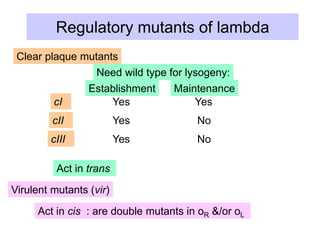
Regulatory mutants of lambda
Clear plaque mutants
Virulent mutants (vir)
Need wild type for lysogeny:
Establishment Maintenance
cI Yes Yes
cII Yes No
cIII Yes No
Act in trans
Act in cis : are double mutants in oR &/or oL
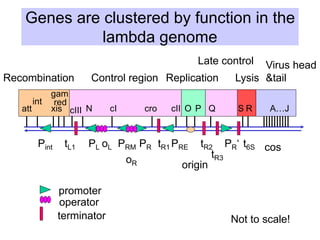
Genes are clustered by function in the
lambda genome
Recombination Control region Replication Lysis
Virus head
&tail
origin
oR
Pint oL
PL PRM PR PRE PR‘
tR3
tL1 tR1 tR2 t6S
att
int
xis
red
gam
cIII N cI cro cII O P Q S R A…J
promoter
operator
terminator
Late control
cos
Not to scale!
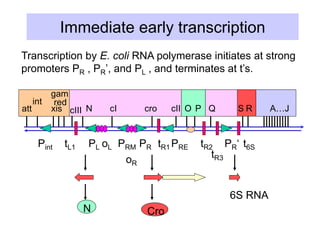
Immediate early transcription
Transcription by E. coli RNA polymerase initiates at strong
promoters PR , PR’, and PL , and terminates at t’s.
6S RNA
oR
Pint oL
PL PRM PR PRE PR‘
tR3
tL1 tR1 tR2 t6S
att
int
xis
red
gam
cIII N cI cro cII O P Q S R A…J
N Cro
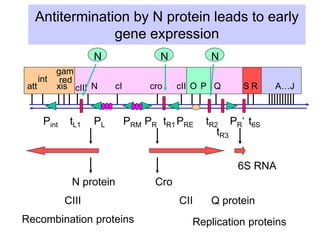
Antitermination by N protein leads to early
gene expression
Pint PL PRM PR PRE PR‘
tR3
tL1 tR1 tR2 t6S
att
int
xis
red
gam
cIII N cI cro cII O P Q S R A…J
N N N
N protein Cro
6S RNA
CIII
Recombination proteins
CII
Replication proteins
Q protein
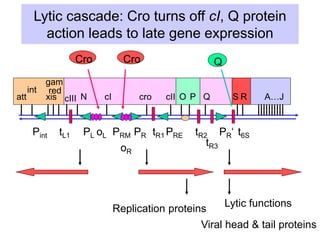
Lytic cascade: Cro turns off cI, Q protein
action leads to late gene expression
oR
Pint oL
PL PRM PR PRE PR‘
tR3
tL1 tR1 tR2 t6S
att
int
xis
red
gam
cIII N cI cro cII O P Q S R A…J
Cro Cro Q
Lytic functions
Replication proteins
Viral head & tail proteins
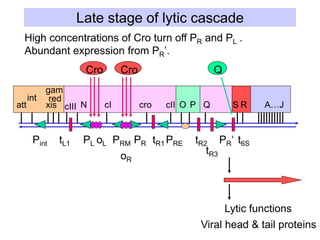
Late stage of lytic cascade
High concentrations of Cro turn off PR and PL .
Abundant expression from PR’.
oR
Pint oL
PL PRM PR PRE PR‘
tR3
tL1 tR1 tR2 t6S
att
int
xis
red
gam
cIII N cI cro cII O P Q S R A…J
Cro Cro Q
Lytic functions
Viral head & tail proteins
+
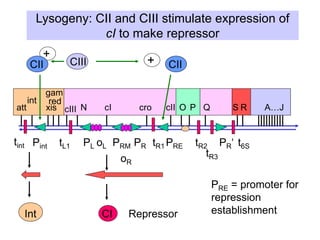
Lysogeny: CII and CIII stimulate expression of
cI to make repressor
oR
Pint oL
PL PRM PR PRE PR‘
tR3
tL1 tR1 tR2 t6S
att
int
xis
red
gam
cIII N cI cro cII O P Q S R A…J
CIII CII
CI
+
Repressor
PRE = promoter for
repression
establishment
Int
tint
CII
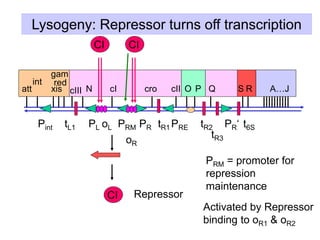
Lysogeny: Repressor turns off transcription
oR
Pint oL
PL PRM PR PRE PR‘
tR3
tL1 tR1 tR2 t6S
att
int
xis
red
gam
cIII N cI cro cII O P Q S R A…J
CI
Repressor
PRM = promoter for
repression
maintenance
CI
CI
Activated by Repressor
binding to oR1 & oR2
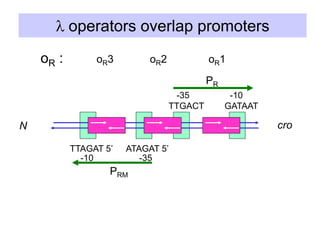
l operators overlap promoters
oR1
oR2
oR :
TTGACT GATAAT
-10
-35
ATAGAT 5’
TTAGAT 5’
-10 -35
oR3
cro
N
PR
PRM
Repressor structure
l repressor is a dimer; monomer has 236 amino acids.
l repressor can bind cooperatively
to operator sub-sites.
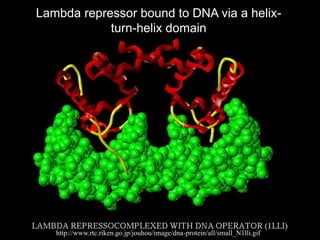
http://www.rtc.riken.go.jp/jouhou/image/dna-protein/all/small_N1lli.gif
Lambda repressor bound to DNA via a helix-
turn-helix domain
Cro structure
Cro is a dimer
Monomer has 66 amino acids
Has only one protein domain
Does NOT display cooperativity
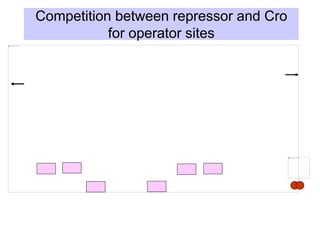
Competition between repressor and Cro
for operator sites
Use hybrid genes to dissect regulatory
schemes
• Place a convenient reporter gene under
control of the regulatory elements being
studied
• Use a known regulatory region to control the
trans-acting regulatory element
l/lac hybrid genes
lac p, o l cI l pR , OR lacZ
Place l cI gene under lac control. Use lacZ as a reporter.
E. coli with lac repressor,
no lacZ.
Control amount of l
repressor by [IPTG].
See effect of l repressor
by b-galactosidase activity
321
l repressor will turn off expression from PR & PL
lac p, o l cI l pR , OR lacZ
b-galactosidase
[IPTG]
l repressor
l repressor acts cooperatively.
Mutation of oR1 decreases affinity for l repressor
lac p, o l cI l pR , OR lacZ
b-galactosidase
[IPTG]
l repressor
LOF mutation
at oR1
Repressor will stimulate transcription from PRM
lac p, o l cI l pRM , OR lacZ
b-galactosidase
[IPTG]
l repressor
123
l repressor at oR1 and oR2 stimulates transcription from pRM.
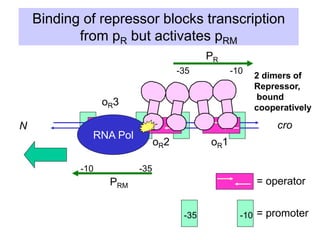
Binding of repressor blocks transcription
from pR but activates pRM
oR1
oR2
-10
-35
-10 -35
oR3
cro
N
PR
PRM
2 dimers of
Repressor,
bound
cooperatively
RNA Pol
= operator
-10
-35 = promoter
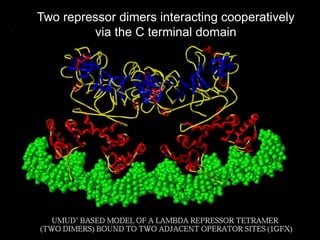
Two repressor dimers interacting cooperatively
via the C terminal domain
Bacteriophage l: Events leading to lysis
• lysis or lysogeny (cI or Cro?) ?
• Both lysis and lysogeny:
– PR, PL, PR’ active : synthesize N, Cro
– antitermination by N : synthesize cIII, cII, Q
• Lysis:
– Low [Cro] : binds OR3, shuts off PRM (cI)
– High [Cro] : shuts off PR and PL
– antitermination by Q + activation of PR’ by Cro
Bacteriophage l: Events leading to lysogeny
• lysis or lysogeny (cI or Cro?) ?
• Lysis and lysogeny :
– PR, PL, PR’ active : synthesize N, Cro
– antitermination by N : synthesize cIII, cII, Q
• Lysogeny:
– cII stimulate expression from PRE (cI repressor)
and PINT (integrase)
– cIII stabilizes cII
– cI repressor shuts off PR, PL, PR’ (no lytic
functions), stimulates PRM
Factors favoring lysogeny cause increased
concentrations of repressor vs. Cro
• High multiplicity of infection
– More templates produce more of the CII protein, which
stimulates PRE.
– Phage sense that it is too crowded.
• Poor nutrient conditions for host
– Low [glucose] leads to increase in [cAMP].
– Increased [cAMP] will repress the host gene hflA.
– Less HflA (a protease) leads to less degradation of the
CII protein.
Homework problems provide a
quantitative approach to the
competition between Cro and
repressor for the l operators.

4_4_lambda_decisions.ppt

  • 1.
    Bacteriophage lambda (l) Transcriptionalswitches can regulate cellular decisions
  • 2.
    Lysis or Lysogeny •Lysis: Infection by phage produces many progeny and breaks open (lyses) the host bacterium • Lysogeny: After infection, the phage DNA integrates into the host genome and resides there passively – No progeny – No lysis of the host • Bacteriophage lambda can do either.
  • 3.
    Infection by temperatephage leads to lysis or lysogeny
  • 4.
    Temperate and lyticphage have a different plaque morphology Lytic phage: clear plaques
  • 5.
    Elements of lysogeny •The phage genome integrated into the host bacterial genome is a prophage. • Bacterium carrying the prophage is a lysogen. • Lysogens are immune to further infection by similar phage because the phage functions are repressed in trans. • Induction of the lysogen leads to excision of the prophage, replication of the phage DNA, and lysis of the host bacterium.
  • 6.
  • 7.
    Regulatory mutants oflambda Clear plaque mutants Virulent mutants (vir) Need wild type for lysogeny: Establishment Maintenance cI Yes Yes cII Yes No cIII Yes No Act in trans Act in cis : are double mutants in oR &/or oL
  • 8.
    Genes are clusteredby function in the lambda genome Recombination Control region Replication Lysis Virus head &tail origin oR Pint oL PL PRM PR PRE PR‘ tR3 tL1 tR1 tR2 t6S att int xis red gam cIII N cI cro cII O P Q S R A…J promoter operator terminator Late control cos Not to scale!
  • 9.
    Immediate early transcription Transcriptionby E. coli RNA polymerase initiates at strong promoters PR , PR’, and PL , and terminates at t’s. 6S RNA oR Pint oL PL PRM PR PRE PR‘ tR3 tL1 tR1 tR2 t6S att int xis red gam cIII N cI cro cII O P Q S R A…J N Cro
  • 10.
    Antitermination by Nprotein leads to early gene expression Pint PL PRM PR PRE PR‘ tR3 tL1 tR1 tR2 t6S att int xis red gam cIII N cI cro cII O P Q S R A…J N N N N protein Cro 6S RNA CIII Recombination proteins CII Replication proteins Q protein
  • 11.
    Lytic cascade: Croturns off cI, Q protein action leads to late gene expression oR Pint oL PL PRM PR PRE PR‘ tR3 tL1 tR1 tR2 t6S att int xis red gam cIII N cI cro cII O P Q S R A…J Cro Cro Q Lytic functions Replication proteins Viral head & tail proteins
  • 12.
    Late stage oflytic cascade High concentrations of Cro turn off PR and PL . Abundant expression from PR’. oR Pint oL PL PRM PR PRE PR‘ tR3 tL1 tR1 tR2 t6S att int xis red gam cIII N cI cro cII O P Q S R A…J Cro Cro Q Lytic functions Viral head & tail proteins
  • 13.
    + Lysogeny: CII andCIII stimulate expression of cI to make repressor oR Pint oL PL PRM PR PRE PR‘ tR3 tL1 tR1 tR2 t6S att int xis red gam cIII N cI cro cII O P Q S R A…J CIII CII CI + Repressor PRE = promoter for repression establishment Int tint CII
  • 14.
    Lysogeny: Repressor turnsoff transcription oR Pint oL PL PRM PR PRE PR‘ tR3 tL1 tR1 tR2 t6S att int xis red gam cIII N cI cro cII O P Q S R A…J CI Repressor PRM = promoter for repression maintenance CI CI Activated by Repressor binding to oR1 & oR2
  • 15.
    l operators overlappromoters oR1 oR2 oR : TTGACT GATAAT -10 -35 ATAGAT 5’ TTAGAT 5’ -10 -35 oR3 cro N PR PRM
  • 16.
    Repressor structure l repressoris a dimer; monomer has 236 amino acids. l repressor can bind cooperatively to operator sub-sites.
  • 17.
  • 18.
    Cro structure Cro isa dimer Monomer has 66 amino acids Has only one protein domain Does NOT display cooperativity
  • 19.
    Competition between repressorand Cro for operator sites
  • 20.
    Use hybrid genesto dissect regulatory schemes • Place a convenient reporter gene under control of the regulatory elements being studied • Use a known regulatory region to control the trans-acting regulatory element
  • 21.
    l/lac hybrid genes lacp, o l cI l pR , OR lacZ Place l cI gene under lac control. Use lacZ as a reporter. E. coli with lac repressor, no lacZ. Control amount of l repressor by [IPTG]. See effect of l repressor by b-galactosidase activity 321
  • 22.
    l repressor willturn off expression from PR & PL lac p, o l cI l pR , OR lacZ b-galactosidase [IPTG] l repressor l repressor acts cooperatively.
  • 23.
    Mutation of oR1decreases affinity for l repressor lac p, o l cI l pR , OR lacZ b-galactosidase [IPTG] l repressor LOF mutation at oR1
  • 24.
    Repressor will stimulatetranscription from PRM lac p, o l cI l pRM , OR lacZ b-galactosidase [IPTG] l repressor 123 l repressor at oR1 and oR2 stimulates transcription from pRM.
  • 25.
    Binding of repressorblocks transcription from pR but activates pRM oR1 oR2 -10 -35 -10 -35 oR3 cro N PR PRM 2 dimers of Repressor, bound cooperatively RNA Pol = operator -10 -35 = promoter
  • 26.
    Two repressor dimersinteracting cooperatively via the C terminal domain
  • 27.
    Bacteriophage l: Eventsleading to lysis • lysis or lysogeny (cI or Cro?) ? • Both lysis and lysogeny: – PR, PL, PR’ active : synthesize N, Cro – antitermination by N : synthesize cIII, cII, Q • Lysis: – Low [Cro] : binds OR3, shuts off PRM (cI) – High [Cro] : shuts off PR and PL – antitermination by Q + activation of PR’ by Cro
  • 28.
    Bacteriophage l: Eventsleading to lysogeny • lysis or lysogeny (cI or Cro?) ? • Lysis and lysogeny : – PR, PL, PR’ active : synthesize N, Cro – antitermination by N : synthesize cIII, cII, Q • Lysogeny: – cII stimulate expression from PRE (cI repressor) and PINT (integrase) – cIII stabilizes cII – cI repressor shuts off PR, PL, PR’ (no lytic functions), stimulates PRM
  • 29.
    Factors favoring lysogenycause increased concentrations of repressor vs. Cro • High multiplicity of infection – More templates produce more of the CII protein, which stimulates PRE. – Phage sense that it is too crowded. • Poor nutrient conditions for host – Low [glucose] leads to increase in [cAMP]. – Increased [cAMP] will repress the host gene hflA. – Less HflA (a protease) leads to less degradation of the CII protein.
  • 30.
    Homework problems providea quantitative approach to the competition between Cro and repressor for the l operators.