402064
ENGINEERING ANALYSIS
CHAPTER 1: FUNDAMENTALS OF LINEAR
SYSTEMS
Hoang Thi Huong Giang, PhD
.
TON DUC THANG UNIVERSITY
FACULTY OF ELECTRICAL & ELECTRONICS ENGINEERING
DEPARTMENT OF ELECTRONICS & TELECOMMUNICATIONS
CHAPTER 1: FUNDAMENTALS OF
LINEAR SYSTEMS
 1.1 Introduction
 1.2 Linear algebra
 1.3 Transfer function and impulse response
 1.4 Representation of control systems
04/21/2025
402064-Chapter 1: Fundamentals of Linear
Systems 2
OBJECTIVES
 Understand the basic concepts and
disciplines of automatic control.
 Learn the different between classical and
modern modelling of control systems
 Review the representation of linear control
systems
04/21/2025
402064-Chapter 1: Fundamentals of Linear
Systems 3
CHAPTER 1: FUNDAMENTALS OF
LINEAR SYSTEMS
 1.1 Introduction
 1.2 Linear algebra
 1.3 Transfer function and impulse response
 1.4 Representation of control systems
04/21/2025
402064-Chapter 1: Fundamentals of Linear
Systems 4
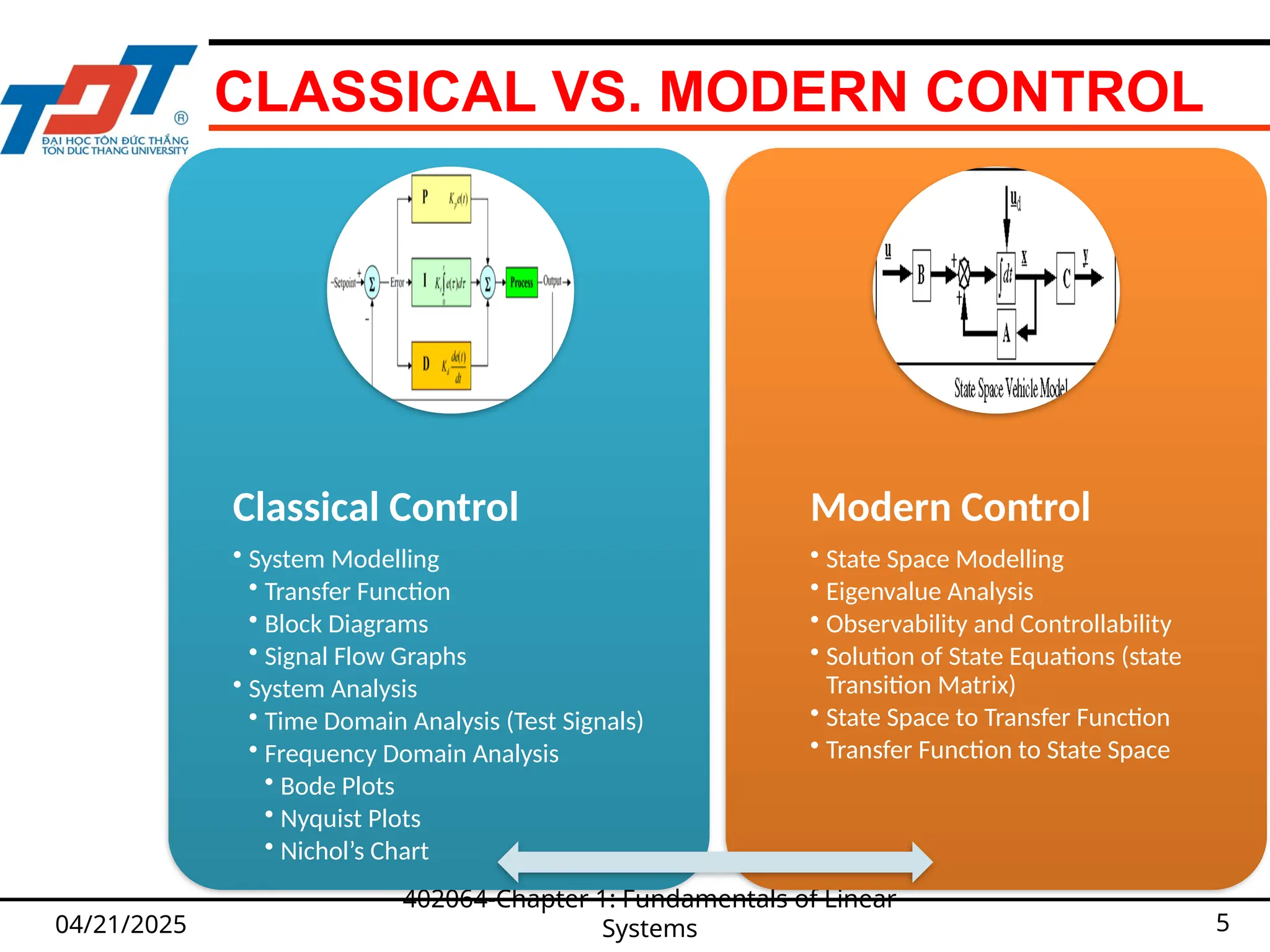
CLASSICAL VS. MODERN CONTROL
04/21/2025
402064-Chapter 1: Fundamentals of Linear
Systems 5
Classical Control
• System Modelling
• Transfer Function
• Block Diagrams
• Signal Flow Graphs
• System Analysis
• Time Domain Analysis (Test Signals)
• Frequency Domain Analysis
• Bode Plots
• Nyquist Plots
• Nichol’s Chart
Modern Control
• State Space Modelling
• Eigenvalue Analysis
• Observability and Controllability
• Solution of State Equations (state
Transition Matrix)
• State Space to Transfer Function
• Transfer Function to State Space
WHAT IS A CONTROL SYSTEM?
04/21/2025
402064-Chapter 1: Fundamentals of Linear
Systems 6
 Generally speaking, a control system is a
system that is used to realize a desired output
or objective.
 Control systems are everywhere:
 They appear in our homes, in cars, in industry, in
scientific labs, and in hospital…
 Principles of control have an impact on diverse fields
as engineering, aeronautics ,economics, biology and
medicine…
 Wide applicability of control has many advantages
(e.g., it is a good vehicle for technology transfer)
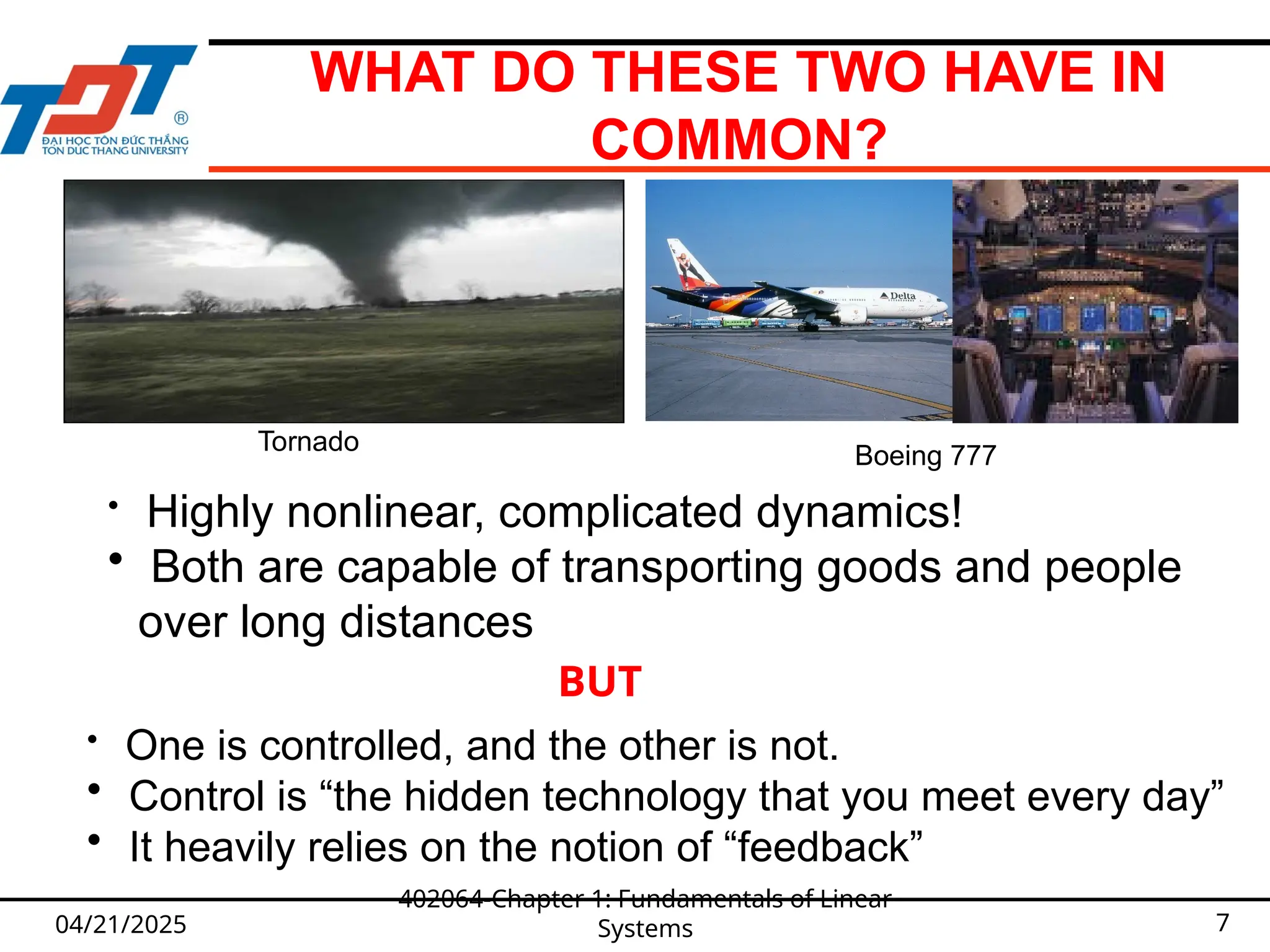
WHAT DO THESE TWO HAVE IN
COMMON?
04/21/2025
402064-Chapter 1: Fundamentals of Linear
Systems 7
Tornado
Boeing 777
• Highly nonlinear, complicated dynamics!
• Both are capable of transporting goods and people
over long distances
BUT
• One is controlled, and the other is not.
• Control is “the hidden technology that you meet every day”
• It heavily relies on the notion of “feedback”
DEFINITIONS
04/21/2025
402064-Chapter 1: Fundamentals of Linear
Systems 8
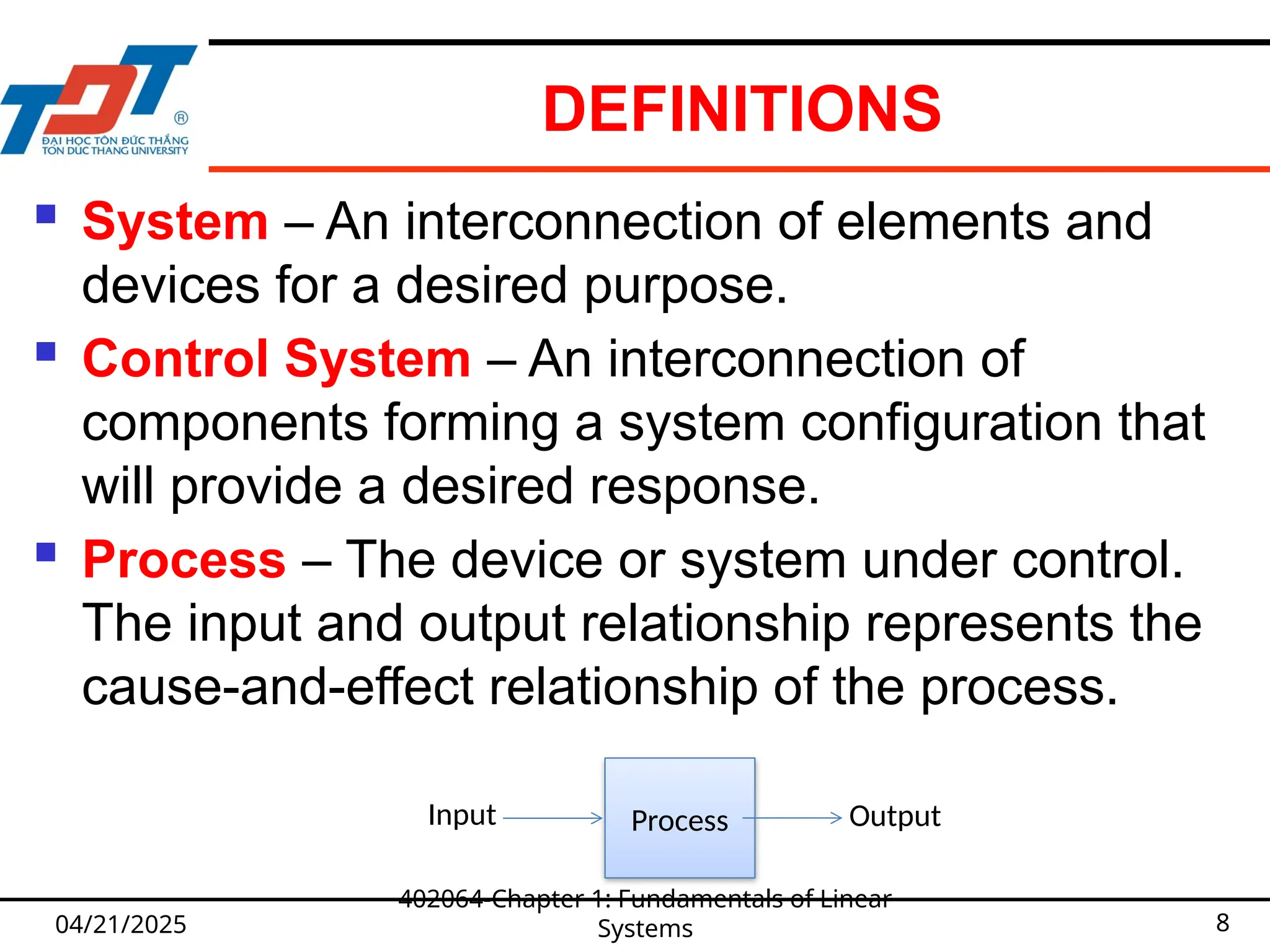
 System – An interconnection of elements and
devices for a desired purpose.
 Control System – An interconnection of
components forming a system configuration that
will provide a desired response.
 Process – The device or system under control.
The input and output relationship represents the
cause-and-effect relationship of the process.
Process Output
Input
DEFINITIONS
04/21/2025
402064-Chapter 1: Fundamentals of Linear
Systems 9
 Controlled Variable – It is the quantity or condition
that is measured and Controlled. Normally controlled
variable is the output of the control system.
 Manipulated Variable – It is the quantity of the
condition that is varied by the controller so as to
affect the value of controlled variable.
 Control – Control means monitoring controlled
variables and applying the manipulated variables to
the system to correct or limit the deviation of the
measured value from a desired value.
DEFINITIONS
04/21/2025
402064-Chapter 1: Fundamentals of Linear
Systems 10
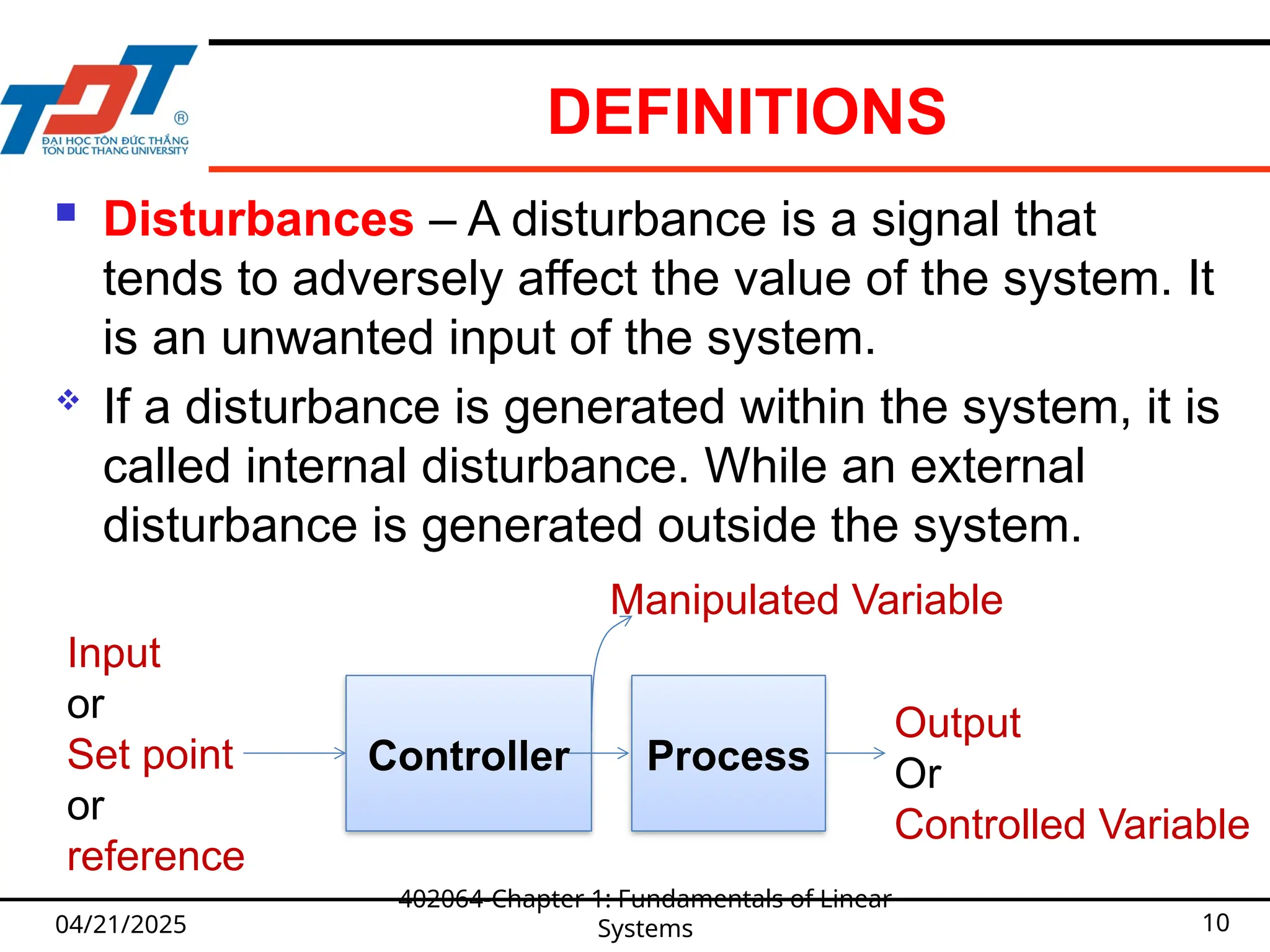
 Disturbances – A disturbance is a signal that
tends to adversely affect the value of the system. It
is an unwanted input of the system.
 If a disturbance is generated within the system, it is
called internal disturbance. While an external
disturbance is generated outside the system.
Controller
Output
Or
Controlled Variable
Input
or
Set point
or
reference
Process
Manipulated Variable
BRIEF HISTORY OF CONTROL
04/21/2025
402064-Chapter 1: Fundamentals of Linear
Systems 11
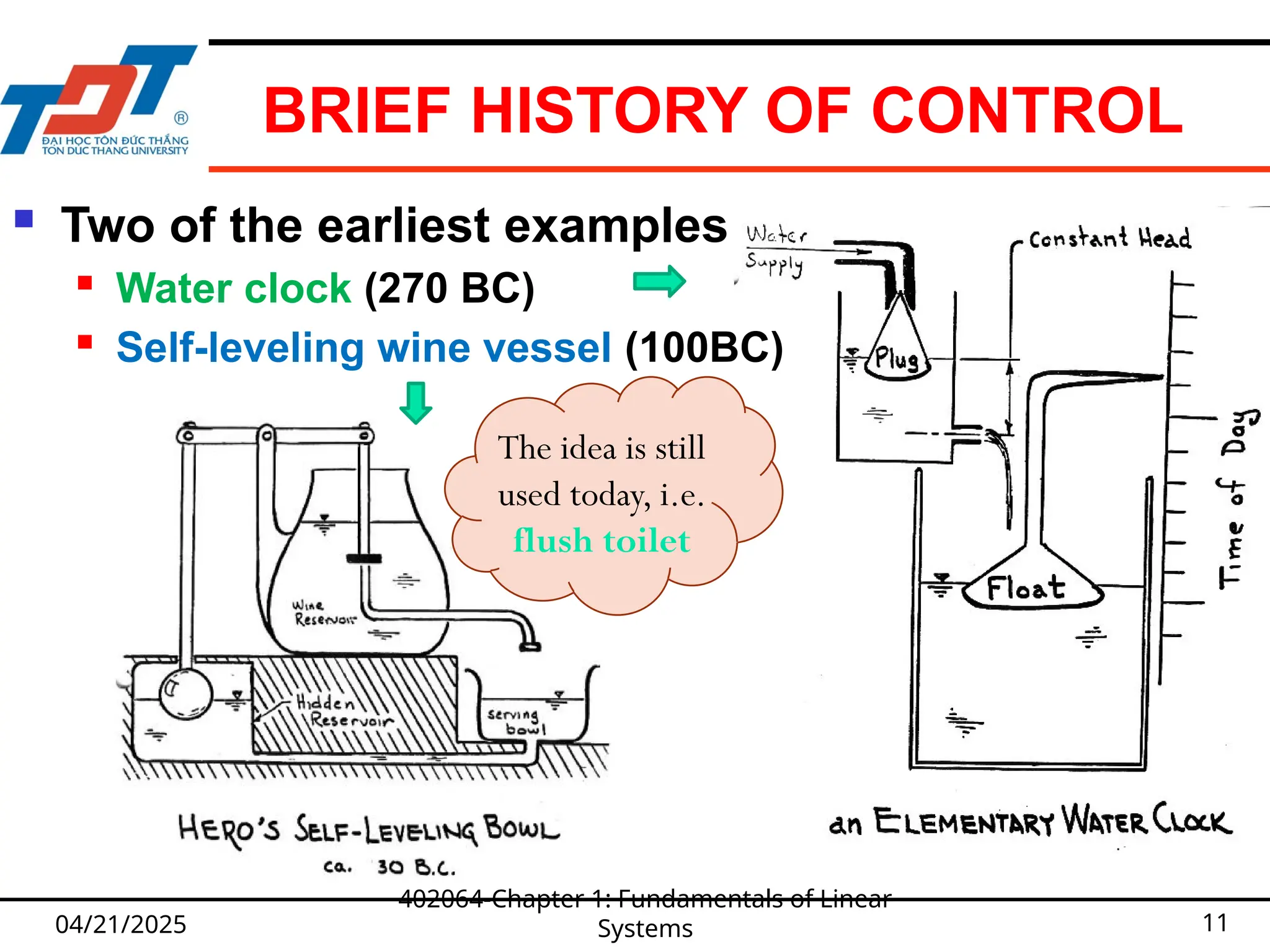
 Two of the earliest examples
 Water clock (270 BC)
 Self-leveling wine vessel (100BC)
The idea is still
used today, i.e.
flush toilet
BRIEF HISTORY OF CONTROL
04/21/2025
402064-Chapter 1: Fundamentals of Linear
Systems 12
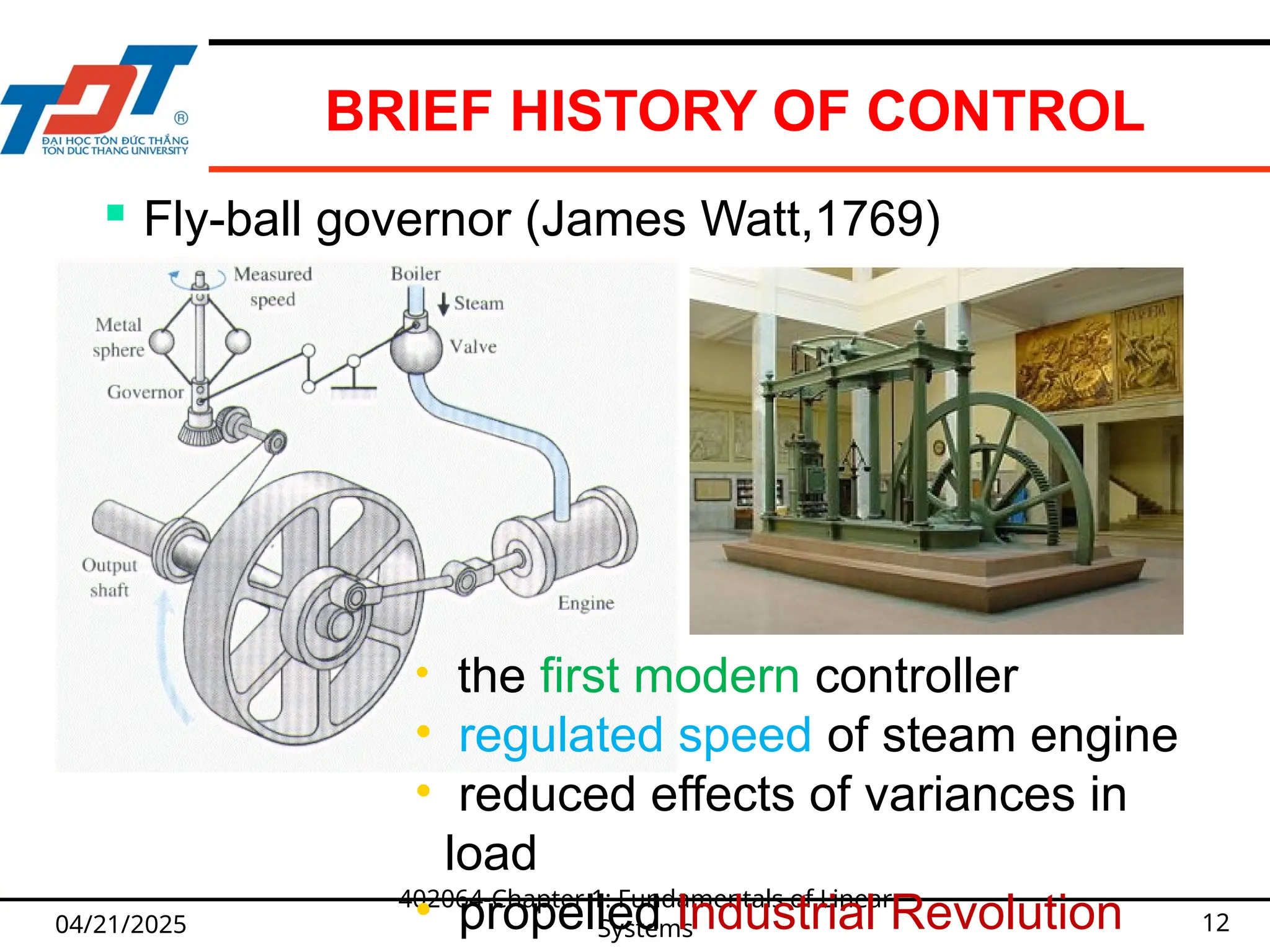
 Fly-ball governor (James Watt,1769)
• the first modern controller
• regulated speed of steam engine
• reduced effects of variances in
load
• propelled Industrial Revolution
CLASSIFICATION OF CONTROL
SYSTEMS
04/21/2025
402064-Chapter 1: Fundamentals of Linear
Systems 13
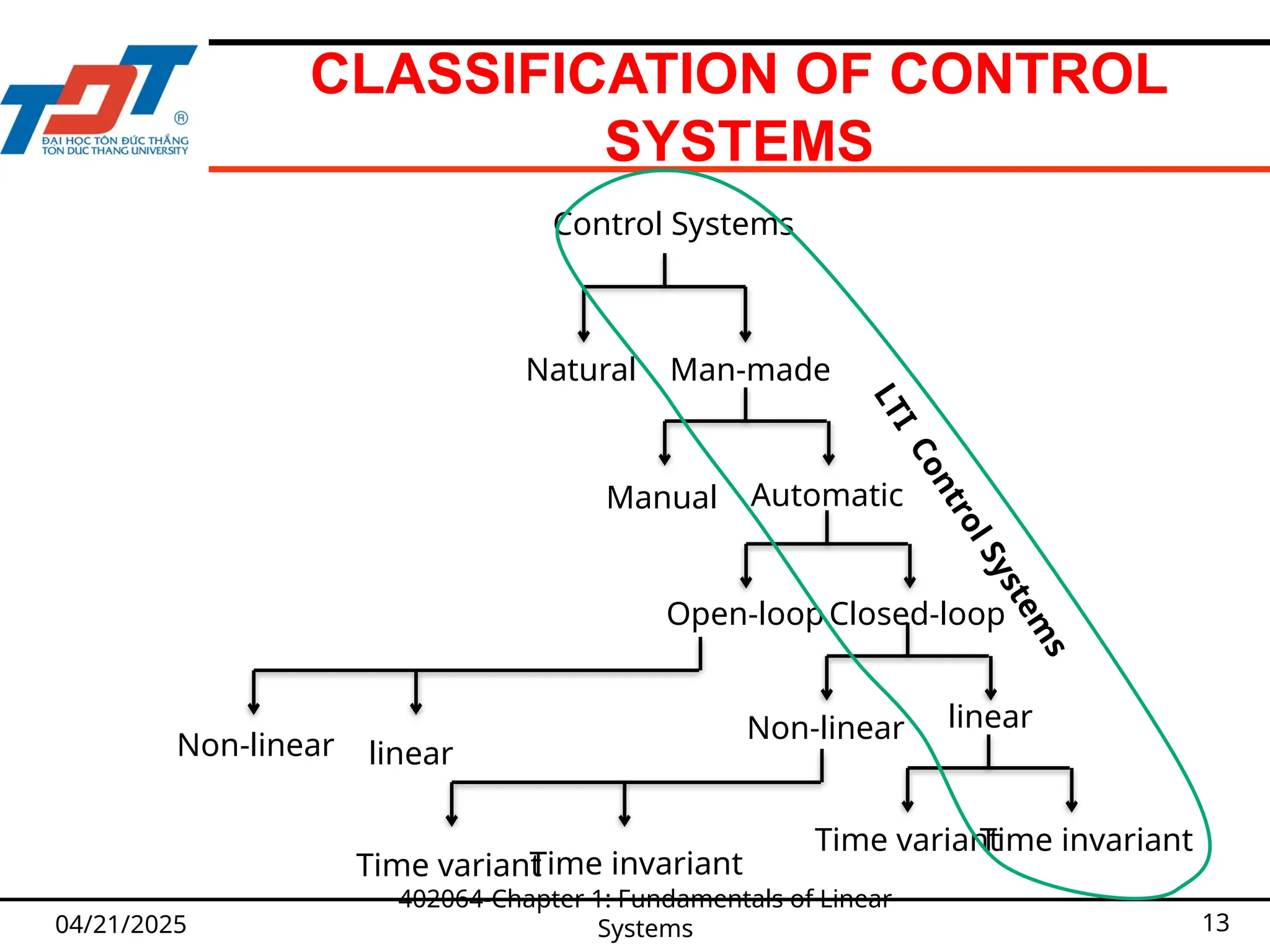
Control Systems
Natural Man-made
Manual Automatic
Open-loopClosed-loop
Non-linear linear
Time variant
Time invariant
Non-linear linear
Time variant
Time invariant L
T
I
C
o
n
t
r
o
l
S
y
s
t
e
m
s
TYPES OF CONTROL SYSTEMS
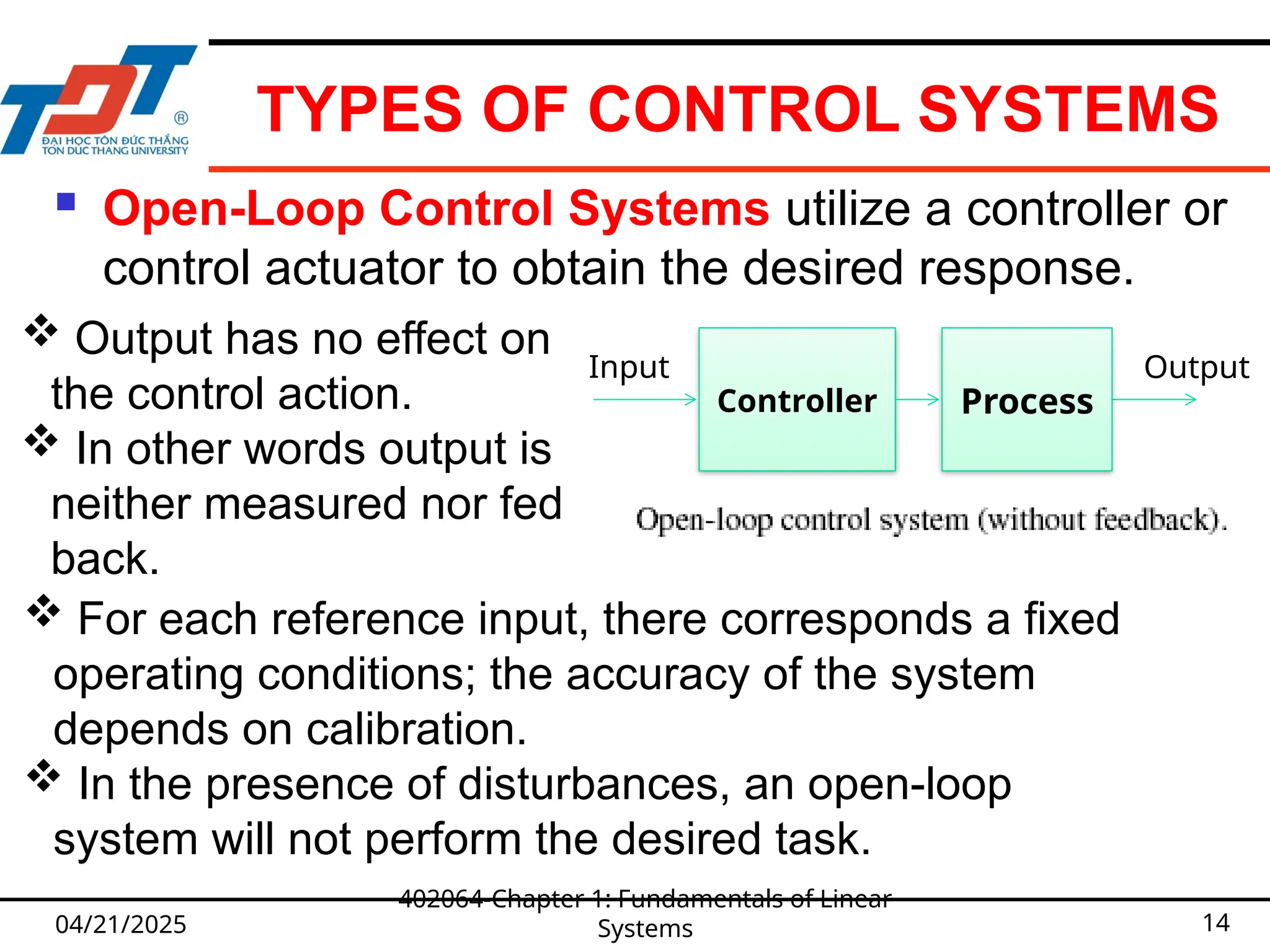
 Open-Loop Control Systems utilize a controller or
control actuator to obtain the desired response.
04/21/2025
402064-Chapter 1: Fundamentals of Linear
Systems 14
Controller
Output
Input
Process
 Output has no effect on
the control action.
 In other words output is
neither measured nor fed
back.
 For each reference input, there corresponds a fixed
operating conditions; the accuracy of the system
depends on calibration.
 In the presence of disturbances, an open-loop
system will not perform the desired task.
OPEN-LOOP CONTROL SYSTEMS
04/21/2025
402064-Chapter 1: Fundamentals of Linear
Systems 15
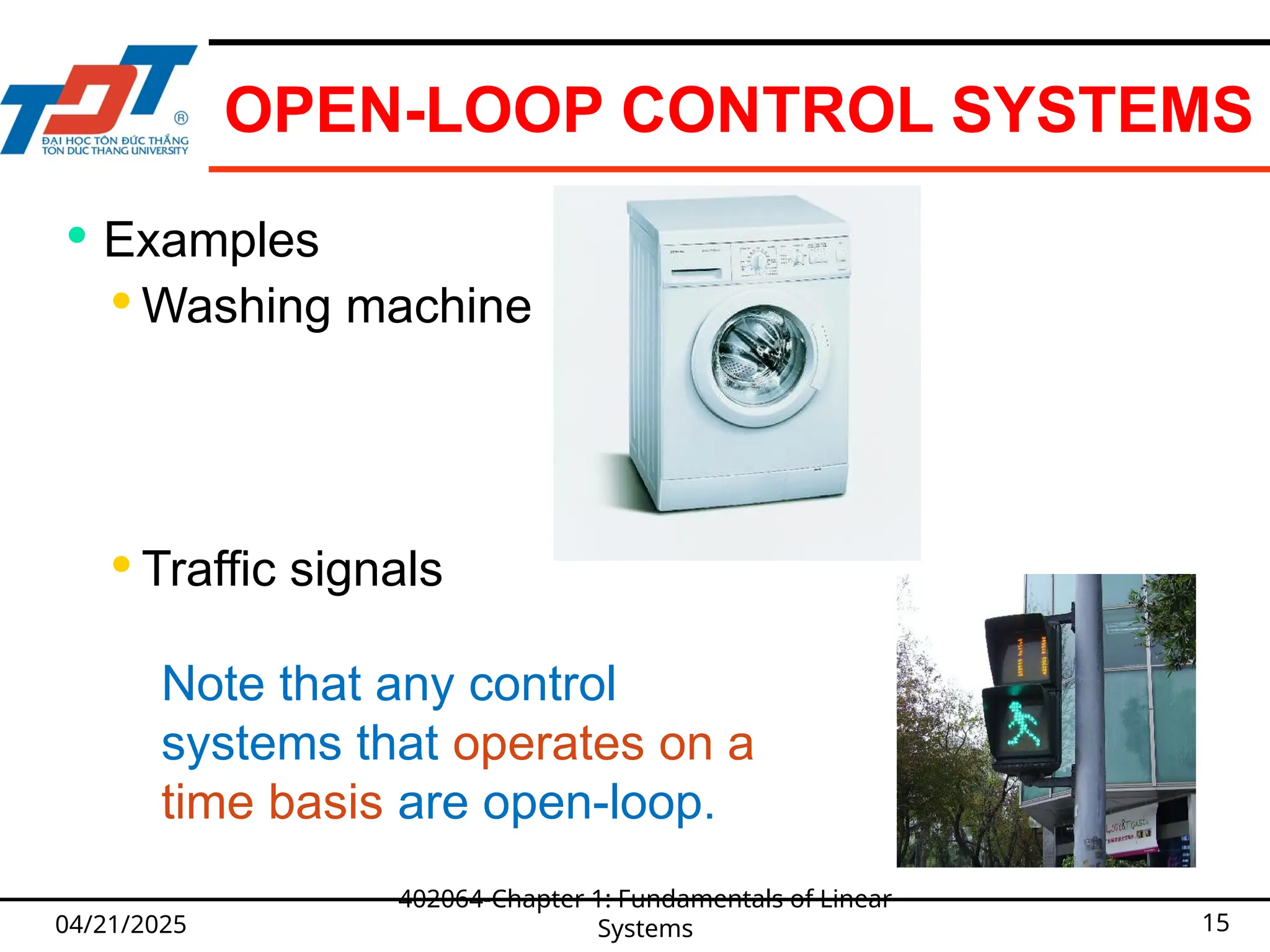
 Examples
 Washing machine
 Traffic signals
Note that any control
systems that operates on a
time basis are open-loop.
OPEN-LOOP CONTROL SYSTEMS
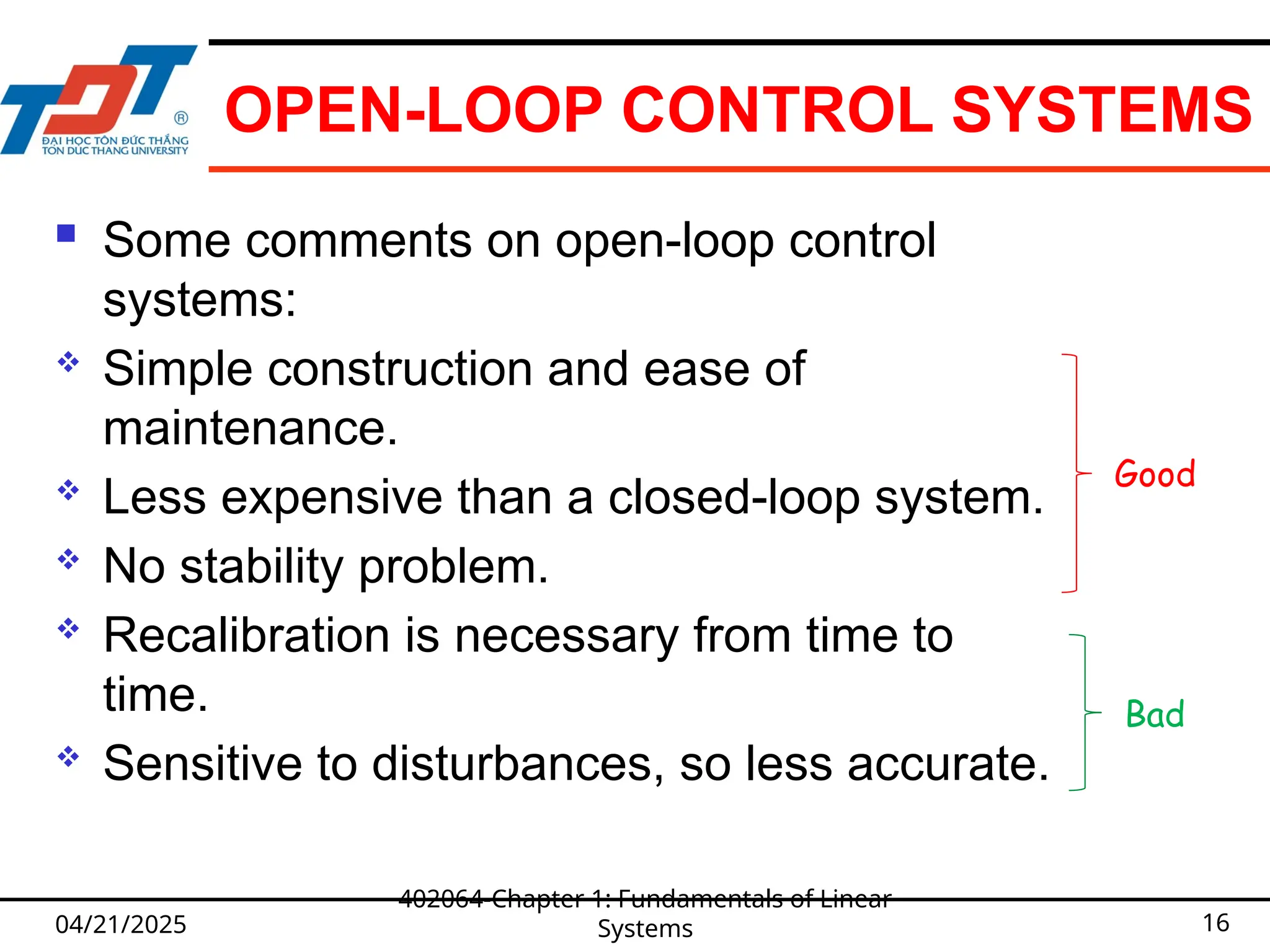
 Some comments on open-loop control
systems:
 Simple construction and ease of
maintenance.
 Less expensive than a closed-loop system.
 No stability problem.
 Recalibration is necessary from time to
time.
 Sensitive to disturbances, so less accurate.
04/21/2025
402064-Chapter 1: Fundamentals of Linear
Systems 16
Good
Bad
TYPES OF CONTROL SYSTEMS
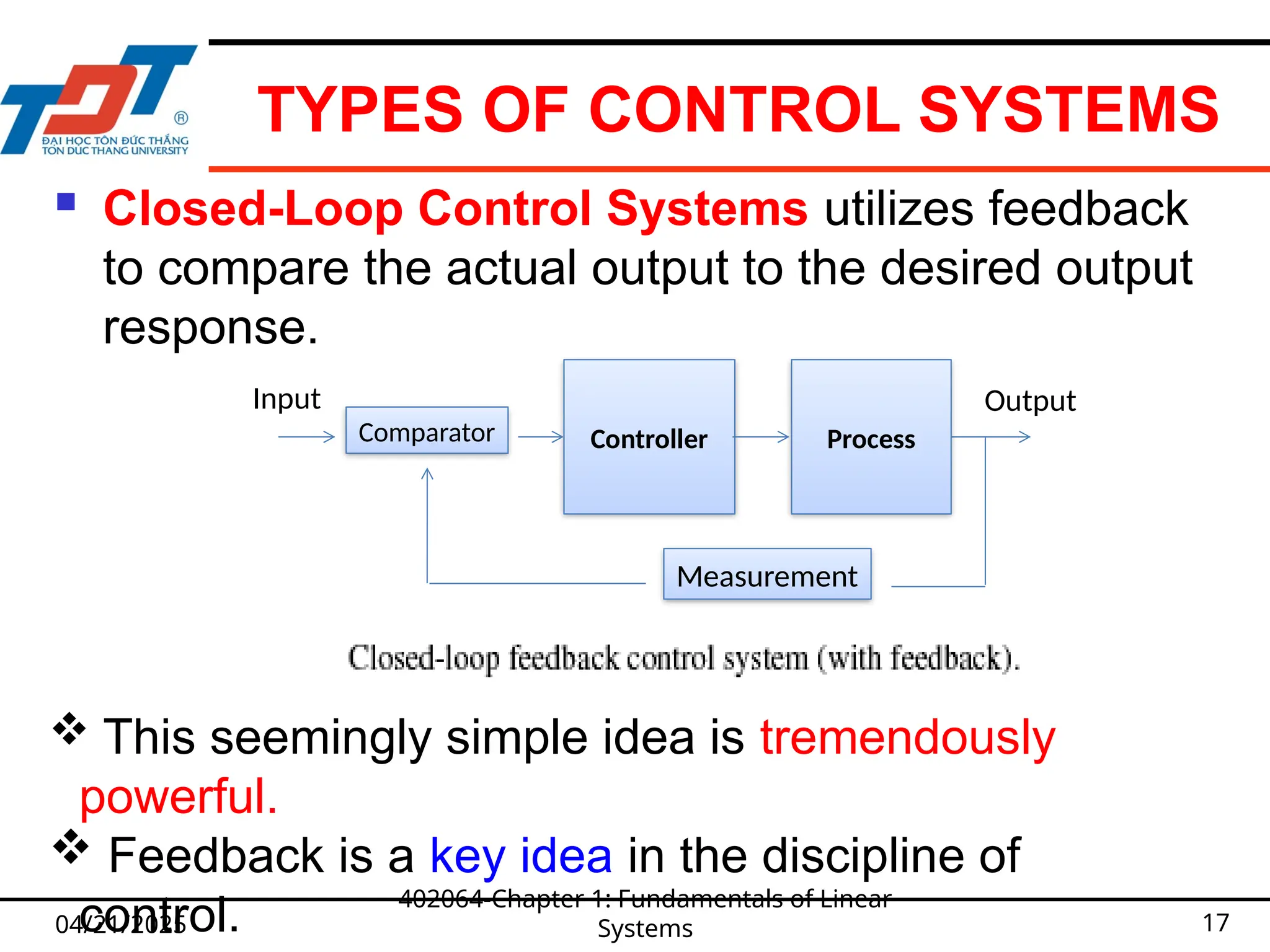
 Closed-Loop Control Systems utilizes feedback
to compare the actual output to the desired output
response.
04/21/2025
402064-Chapter 1: Fundamentals of Linear
Systems 17
 This seemingly simple idea is tremendously
powerful.
 Feedback is a key idea in the discipline of
control.
Controller
Output
Input
Process
Comparator
Measurement
CLOSED-LOOP CONTROL SYSTEMS
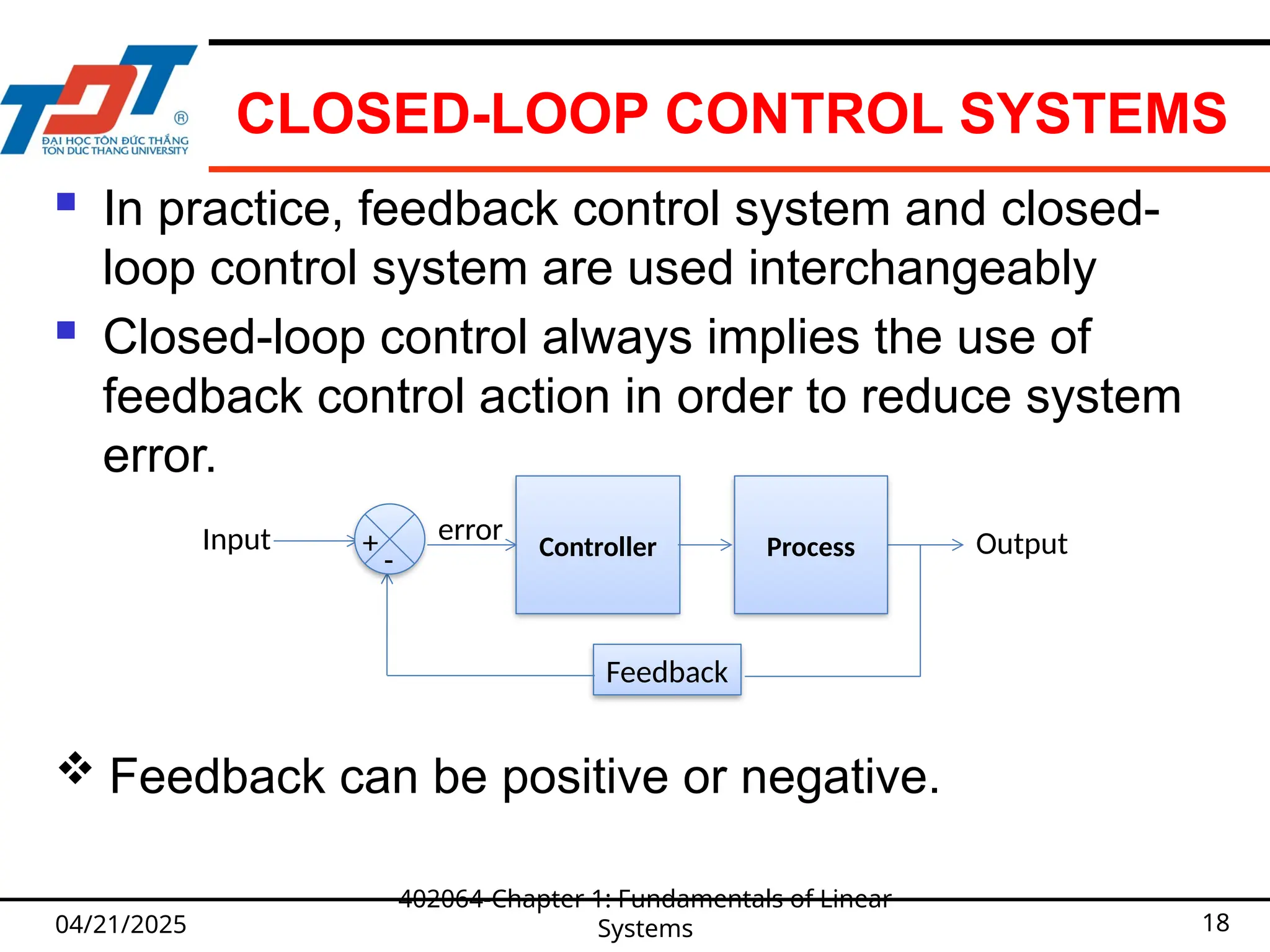
 In practice, feedback control system and closed-
loop control system are used interchangeably
 Closed-loop control always implies the use of
feedback control action in order to reduce system
error.
04/21/2025
402064-Chapter 1: Fundamentals of Linear
Systems 18
 Feedback can be positive or negative.
Controller Output
Input Process
Feedback
-
+ error
CLOSED-LOOP CONTROL SYSTEMS
04/21/2025
402064-Chapter 1: Fundamentals of Linear
Systems 19
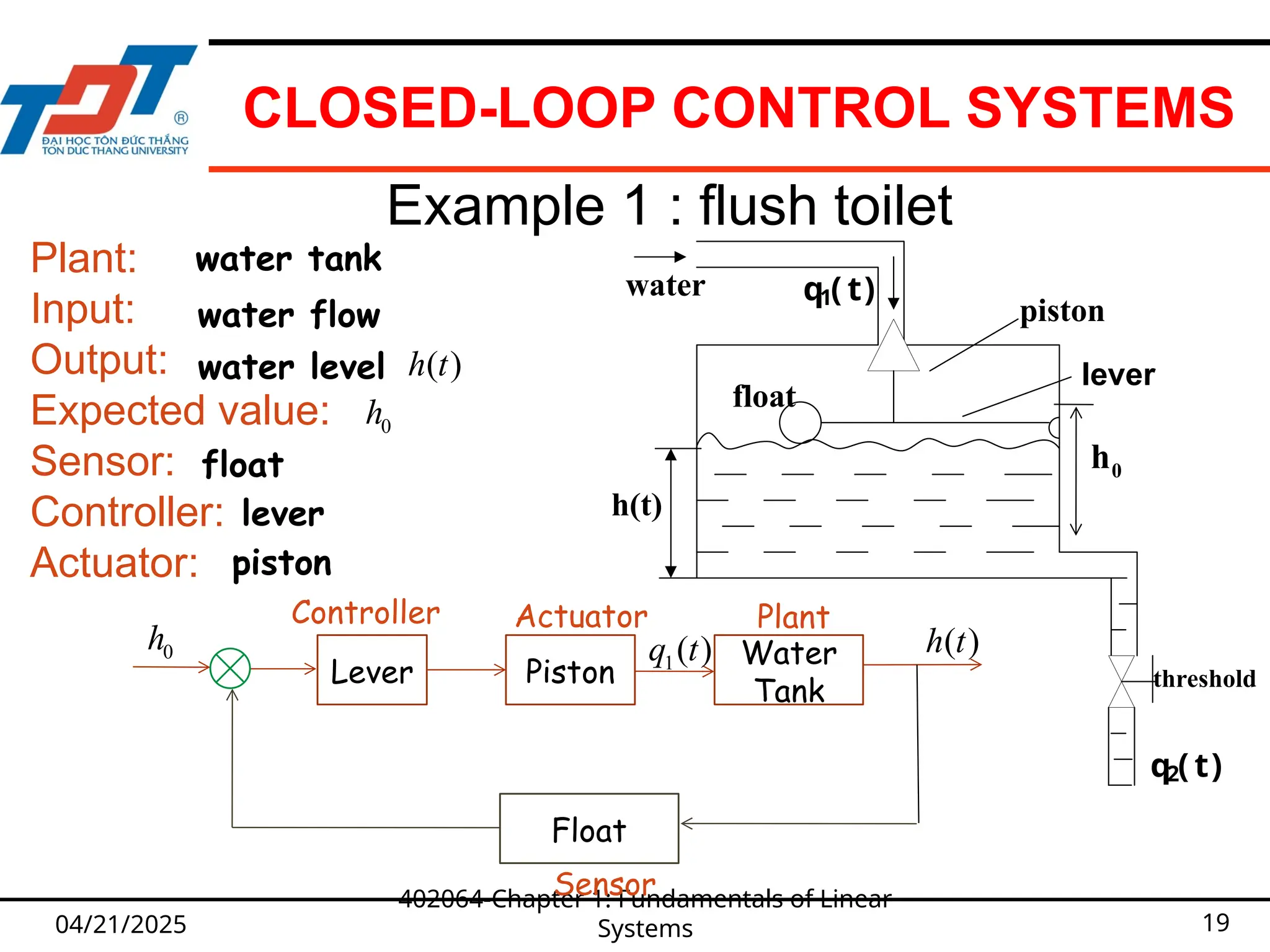
Example 1 : flush toilet
threshold
piston
float
water
h(t)
q1( t)
q2( t)
Lever
Water
Tank
Float
Piston
0
h ( )
h t
1( )
q t
lever
Plant:
Input:
Output:
Expected value:
Sensor:
Controller:
Actuator:
0
h
( )
h t
0
h
Plant
Controller Actuator
Sensor
water tank
water flow
water level
float
lever
piston
CLOSED-LOOP CONTROL SYSTEMS
04/21/2025
402064-Chapter 1: Fundamentals of Linear
Systems 20
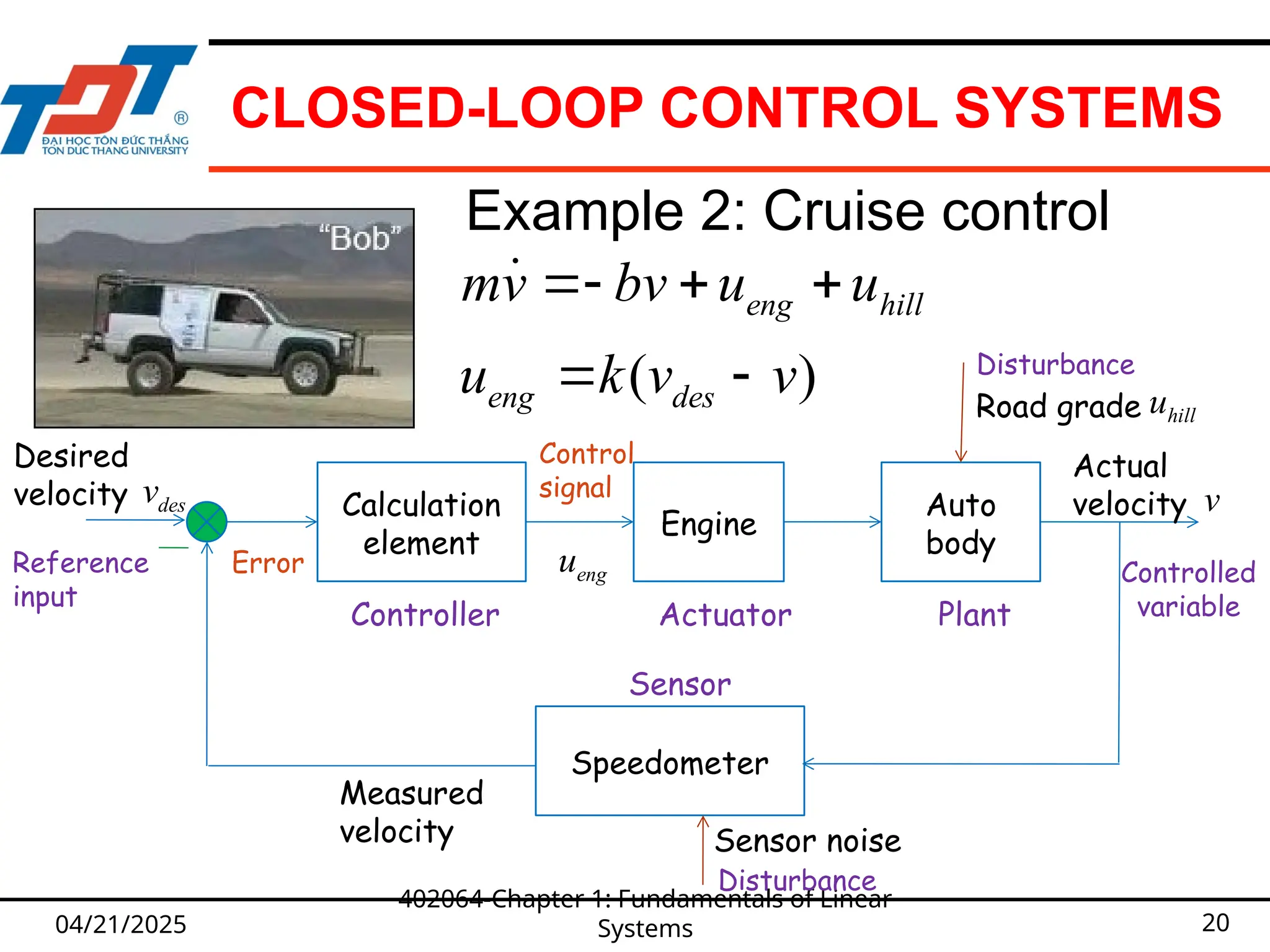
Example 2: Cruise control
Calculation
element
Engine
Auto
body
Speedometer
Desired
velocity
Measured
velocity
Actual
velocity
Road grade
Sensor noise
Actuator
Controller Plant
Sensor
Controlled
variable
Reference
input
Disturbance
Disturbance
( )
eng hill
eng des
mv bv u u
u k v v
  
 

eng
u
hill
u
des
v v
Control
signal
Error
CLOSED-LOOP CONTROL SYSTEMS
04/21/2025
402064-Chapter 1: Fundamentals of Linear
Systems 21
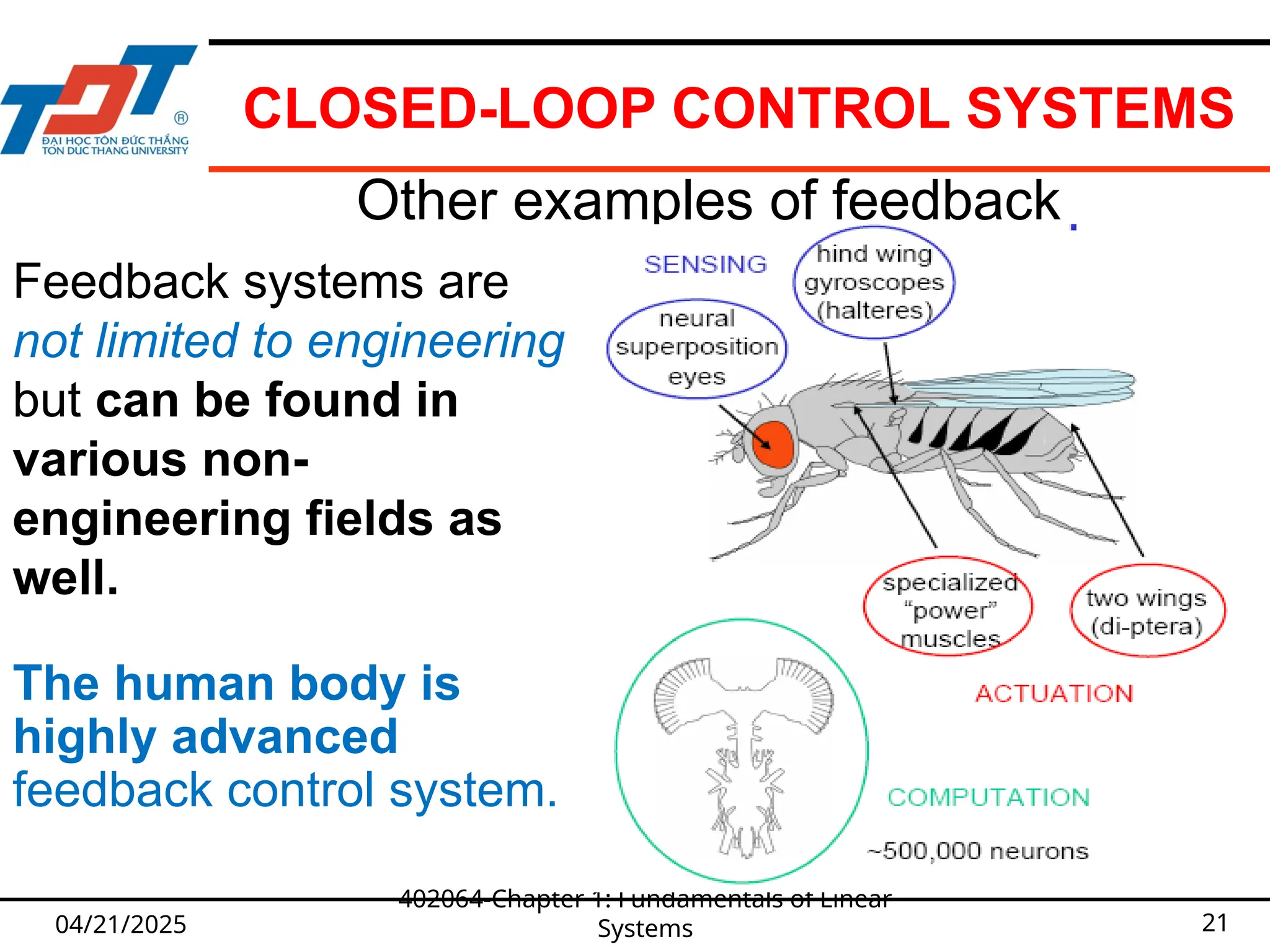
Other examples of feedback
Feedback systems are
not limited to engineering
but can be found in
various non-
engineering fields as
well.
The human body is
highly advanced
feedback control system.
CLOSED-LOOP CONTROL SYSTEMS
 Main advantages of feedback:
 Reduce disturbance effects, make system
insensitive to variations.
 Stabilize an unstable system.
 Create well-defined relationship between
output and reference.
04/21/2025
402064-Chapter 1: Fundamentals of Linear
Systems 22
CLOSED-LOOP CONTROL SYSTEMS
 Potential drawbacks of feedback:
 Cause instability if not used properly.
 Couple noise from sensors into the dynamics
of a system.
 Increase the overall complexity of a system.
04/21/2025
402064-Chapter 1: Fundamentals of Linear
Systems 23
OPEN LOOP VS. CLOSED-LOOP
04/21/2025
402064-Chapter 1: Fundamentals of Linear
Systems 24
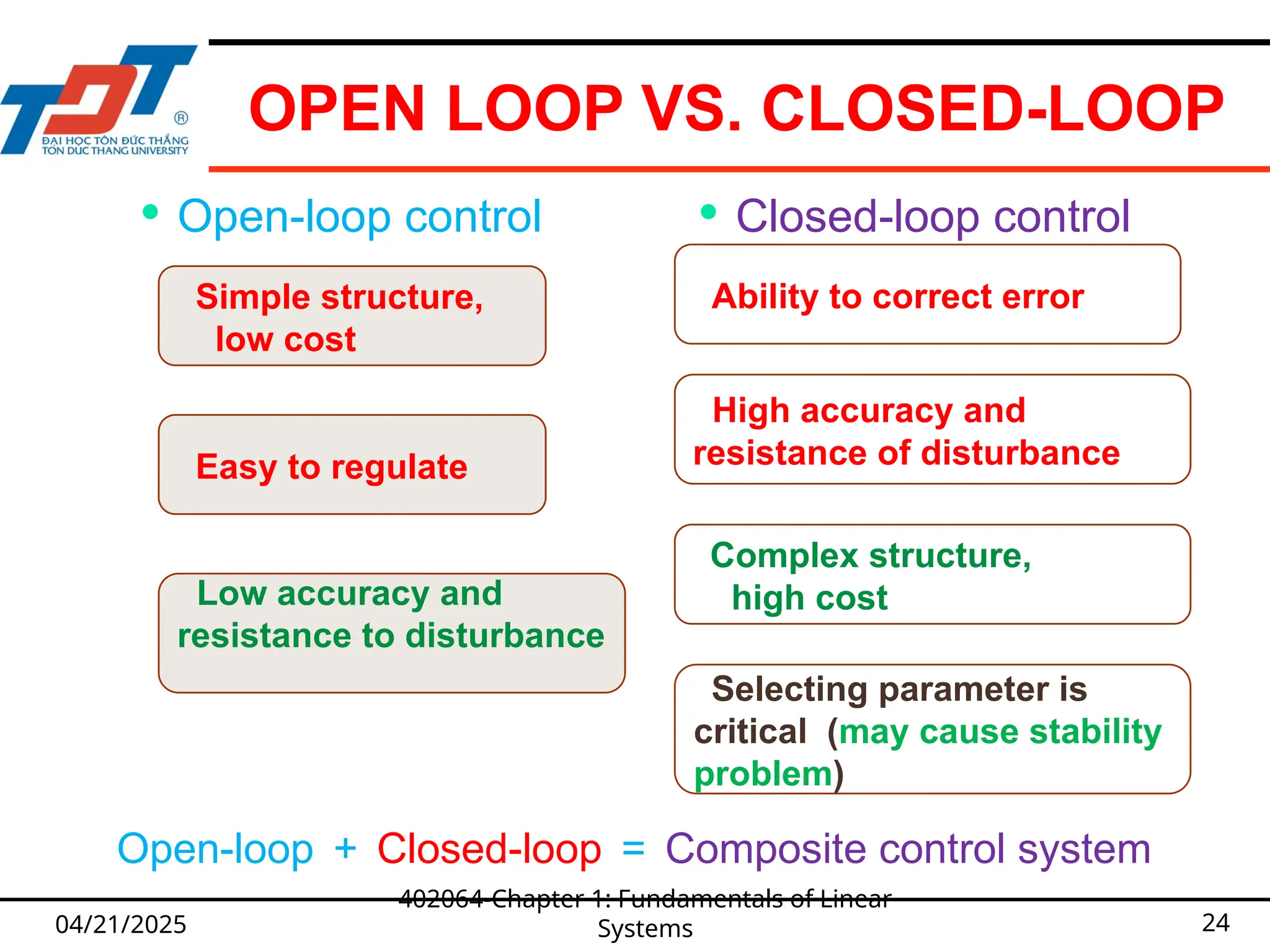
 Open-loop control  Closed-loop control
Simple structure,
low cost
Low accuracy and
resistance to disturbance
Easy to regulate
Ability to correct error
Complex structure,
high cost
High accuracy and
resistance of disturbance
Selecting parameter is
critical (may cause stability
problem)
Open-loop + Closed-loop = Composite control system
THINKING TIME …
04/21/2025
402064-Chapter 1: Fundamentals of Linear
Systems 25
Examples of open-loop
control and closed-loop
control systems ?
For each system, could
you identify the sensor,
actuator and controller?
TYPES OF CONTROL SYSTEMS
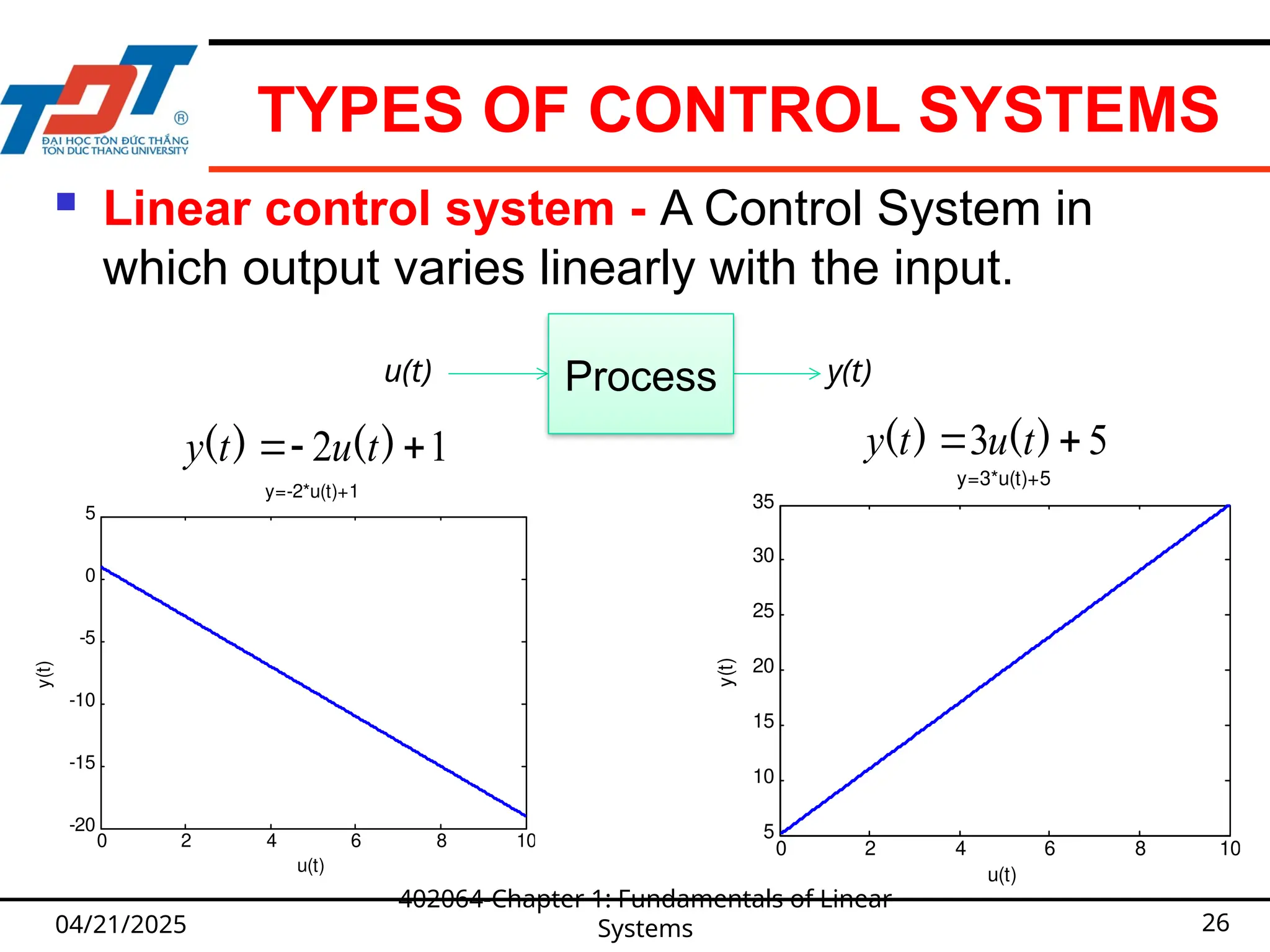
 Linear control system - A Control System in
which output varies linearly with the input.
04/21/2025
402064-Chapter 1: Fundamentals of Linear
Systems 26
5
3 
 )
(
)
( t
u
t
y
y(t)
u(t) Process
1
2 

 )
(
)
( t
u
t
y
0 2 4 6 8 10
5
10
15
20
25
30
35
y=3*u(t)+5
u(t)
y(t)
0 2 4 6 8 10
-20
-15
-10
-5
0
5
y(t)
u(t)
y=-2*u(t)+1
TYPES OF CONTROL SYSTEMS
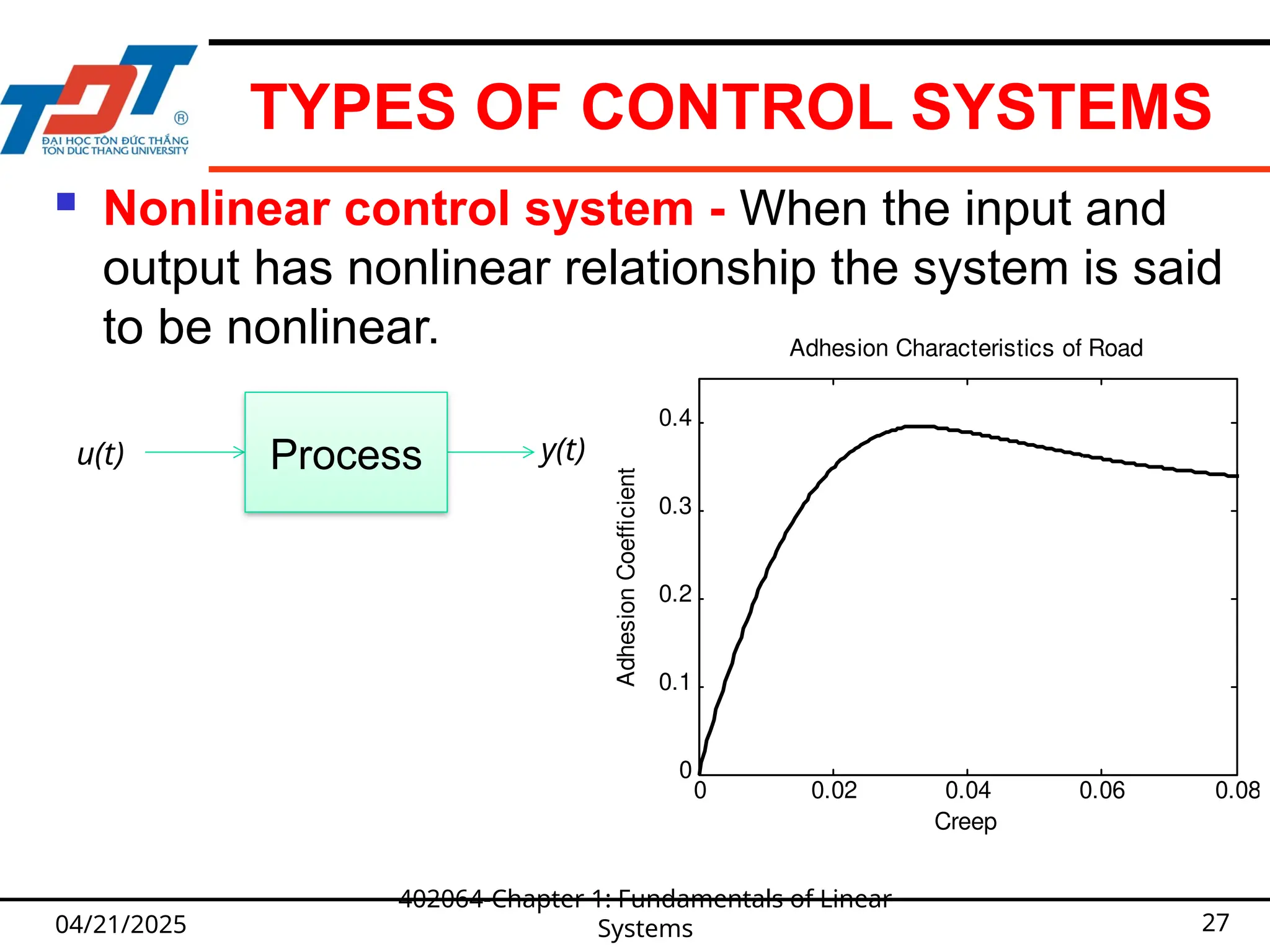
 Nonlinear control system - When the input and
output has nonlinear relationship the system is said
to be nonlinear.
04/21/2025
402064-Chapter 1: Fundamentals of Linear
Systems 27
y(t)
u(t) Process
0 0.02 0.04 0.06 0.08
0
0.1
0.2
0.3
0.4
Adhesion Characteristics of Road
Creep
Adhesion
Coefficient
TYPES OF CONTROL SYSTEMS
 Quite often, nonlinear characteristics are
intentionally introduced in a control system to
improve its performance or provide more effective
control.
 For instance, to achieve minimum-time control, an
on-off (bang-bang or relay) type controller is used in
many missile or spacecraft control systems.
 There are no general methods for solving a wide
class of nonlinear systems.
 Linear control systems are idealized models
fabricated by the analyst purely for the simplicity of
analysis and design.
04/21/2025
402064-Chapter 1: Fundamentals of Linear
Systems 28
TYPES OF CONTROL SYSTEMS
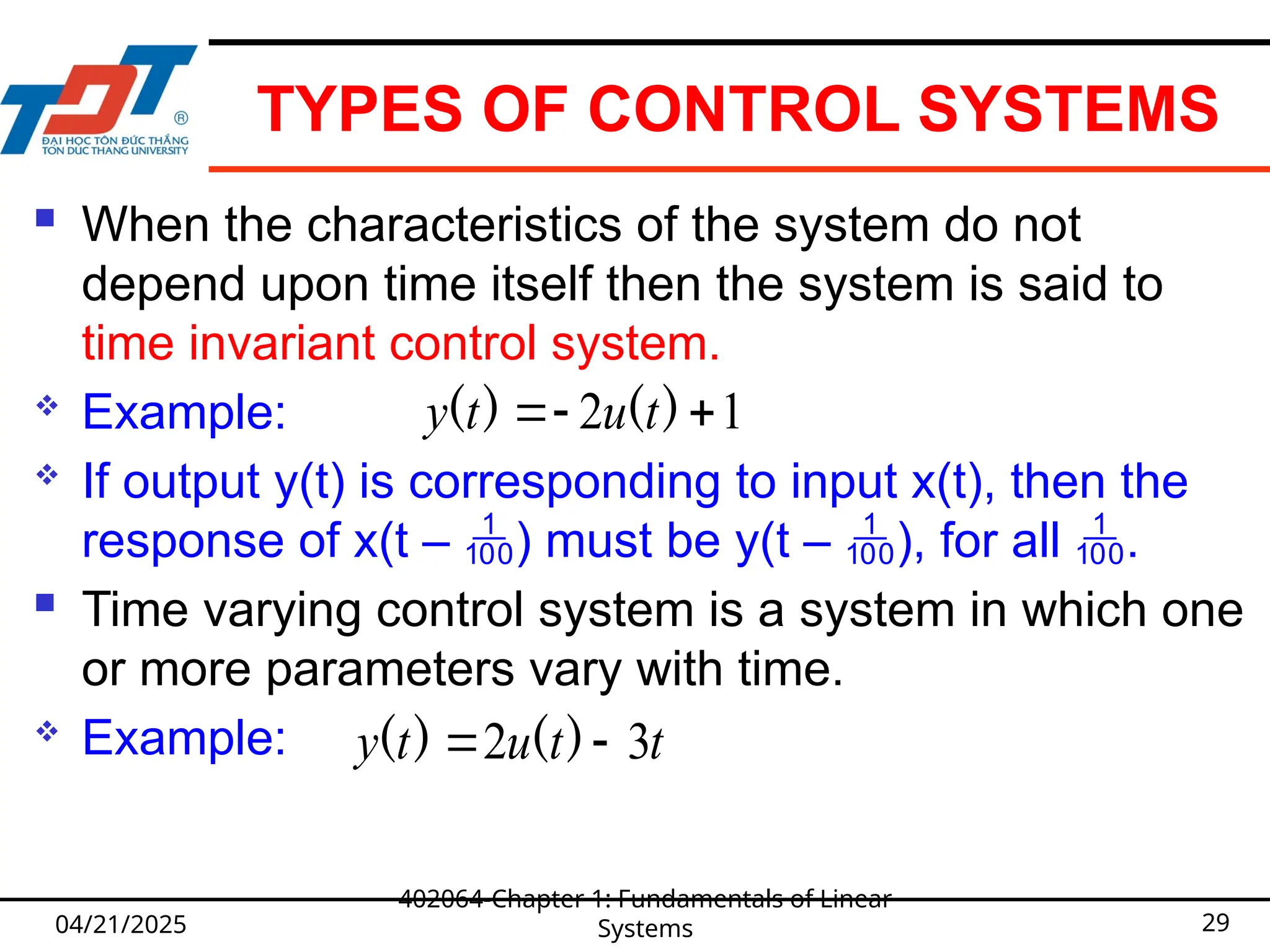
 When the characteristics of the system do not
depend upon time itself then the system is said to
time invariant control system.
 Example:
 If output y(t) is corresponding to input x(t), then the
response of x(t – ) must be y(t – ), for all .
 Time varying control system is a system in which one
or more parameters vary with time.
 Example:
04/21/2025
402064-Chapter 1: Fundamentals of Linear
Systems 29
1
2 

 )
(
)
( t
u
t
y
t
t
u
t
y 3
2 
 )
(
)
(
TYPES OF CONTROL SYSTEMS
 In continuous data control system all system
variables are function of a continuous time t.
 A discrete time control system involves one or more
variables that are known only at discrete time
intervals.
04/21/2025
402064-Chapter 1: Fundamentals of Linear
Systems 30
x(t)
t
X[n]
n
TYPES OF CONTROL SYSTEMS
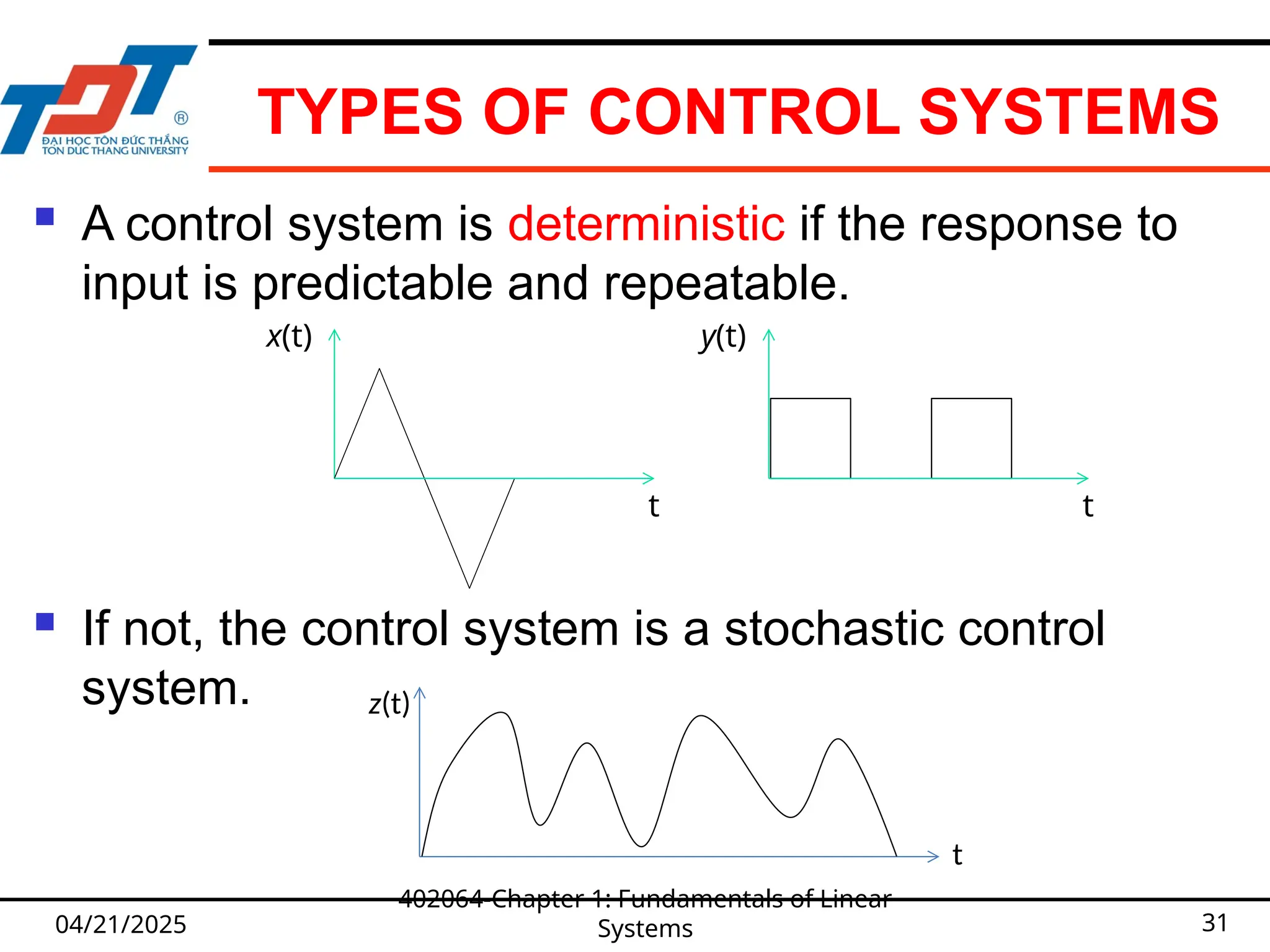
 A control system is deterministic if the response to
input is predictable and repeatable.
 If not, the control system is a stochastic control
system.
04/21/2025
402064-Chapter 1: Fundamentals of Linear
Systems 31
y(t)
t
x(t)
t
z(t)
t
MORE EXAMPLES
04/21/2025
402064-Chapter 1: Fundamentals of Linear
Systems 32
MORE EXAMPLES
04/21/2025
402064-Chapter 1: Fundamentals of Linear
Systems 33
MORE EXAMPLES
04/21/2025
402064-Chapter 1: Fundamentals of Linear
Systems 34
MORE EXAMPLES
04/21/2025
402064-Chapter 1: Fundamentals of Linear
Systems 35
MORE EXAMPLES
04/21/2025
402064-Chapter 1: Fundamentals of Linear
Systems 36
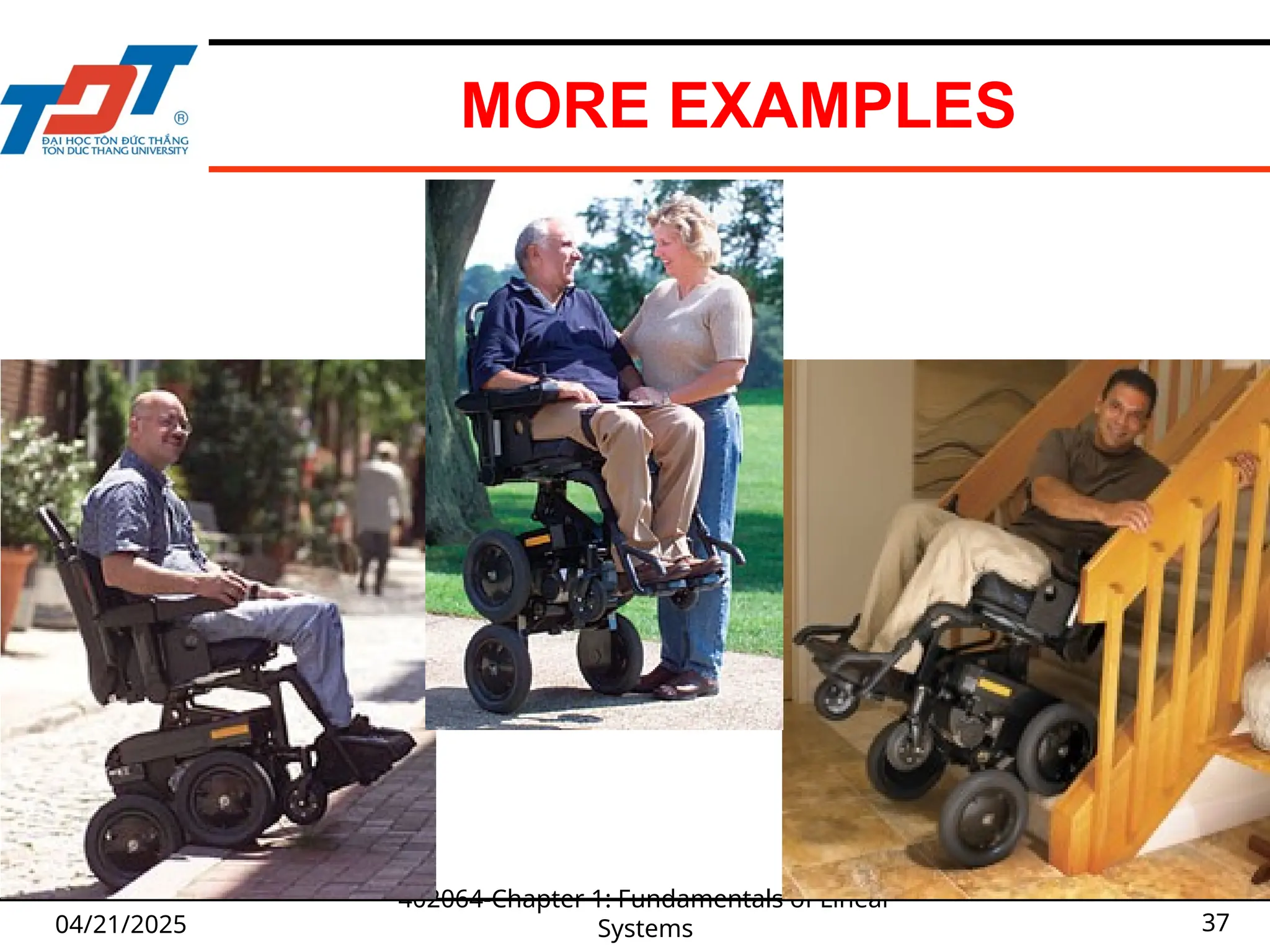
Segway:
The
human
transporter
MORE EXAMPLES
04/21/2025
402064-Chapter 1: Fundamentals of Linear
Systems 37
WHAT WE HAVE LEARNT SO FAR?
 So far we have learnt:
 Concept of control systems
 Classification of control systems
 Assignment:
 Read more examples in textbook.
 Exercises: find more example of control
systems in real life.
04/21/2025
402064-Chapter 1: Fundamentals of Linear
Systems 38
CHAPTER 1: FUNDAMENTALS OF
LINEAR SYSTEMS
 1.1 Introduction
 1.2 Linear algebra
 1.3 Transfer function and impulse response
 1.4 Representation of control systems
04/21/2025
402064-Chapter 1: Fundamentals of Linear
Systems 39
REVIEW OF LINEAR ALGEBRA
04/21/2025
402064-Chapter 1: Fundamentals of Linear
Systems 40
REVIEW OF LINEAR ALGEBRA
04/21/2025
402064-Chapter 1: Fundamentals of Linear
Systems 41
REVIEW OF LINEAR ALGEBRA
04/21/2025
402064-Chapter 1: Fundamentals of Linear
Systems 42
REVIEW OF LINEAR ALGEBRA
04/21/2025
402064-Chapter 1: Fundamentals of Linear
Systems 43
REVIEW OF LINEAR ALGEBRA
04/21/2025
402064-Chapter 1: Fundamentals of Linear
Systems 44
REVIEW OF LINEAR ALGEBRA
04/21/2025
402064-Chapter 1: Fundamentals of Linear
Systems 45
REVIEW OF LINEAR ALGEBRA
04/21/2025
402064-Chapter 1: Fundamentals of Linear
Systems 46
REVIEW OF LINEAR ALGEBRA
04/21/2025
402064-Chapter 1: Fundamentals of Linear
Systems 47
REVIEW OF LINEAR ALGEBRA
04/21/2025
402064-Chapter 1: Fundamentals of Linear
Systems 48
REVIEW OF LINEAR ALGEBRA
04/21/2025
402064-Chapter 1: Fundamentals of Linear
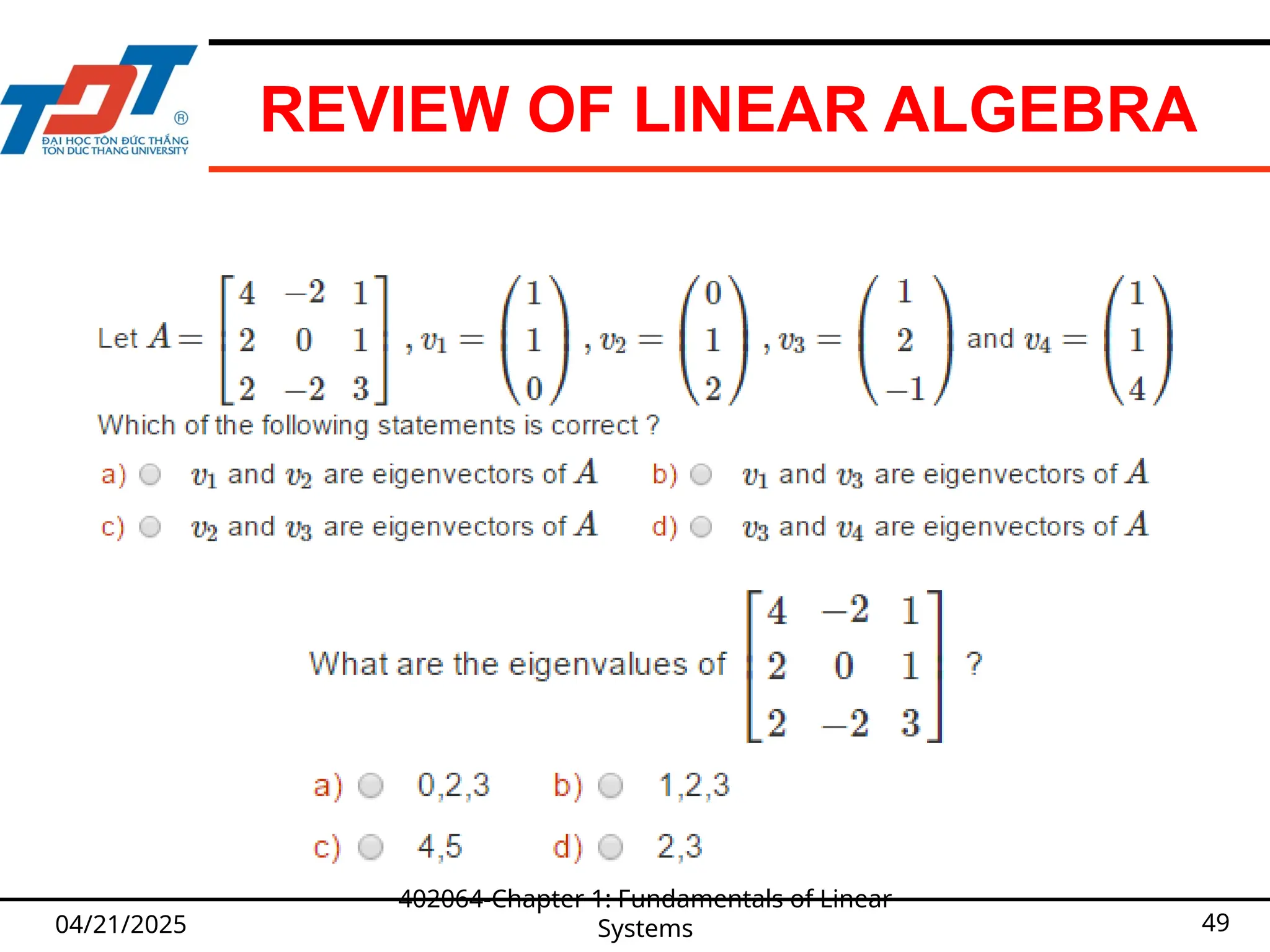
Systems 49
REVIEW OF LINEAR ALGEBRA
04/21/2025
402064-Chapter 1: Fundamentals of Linear
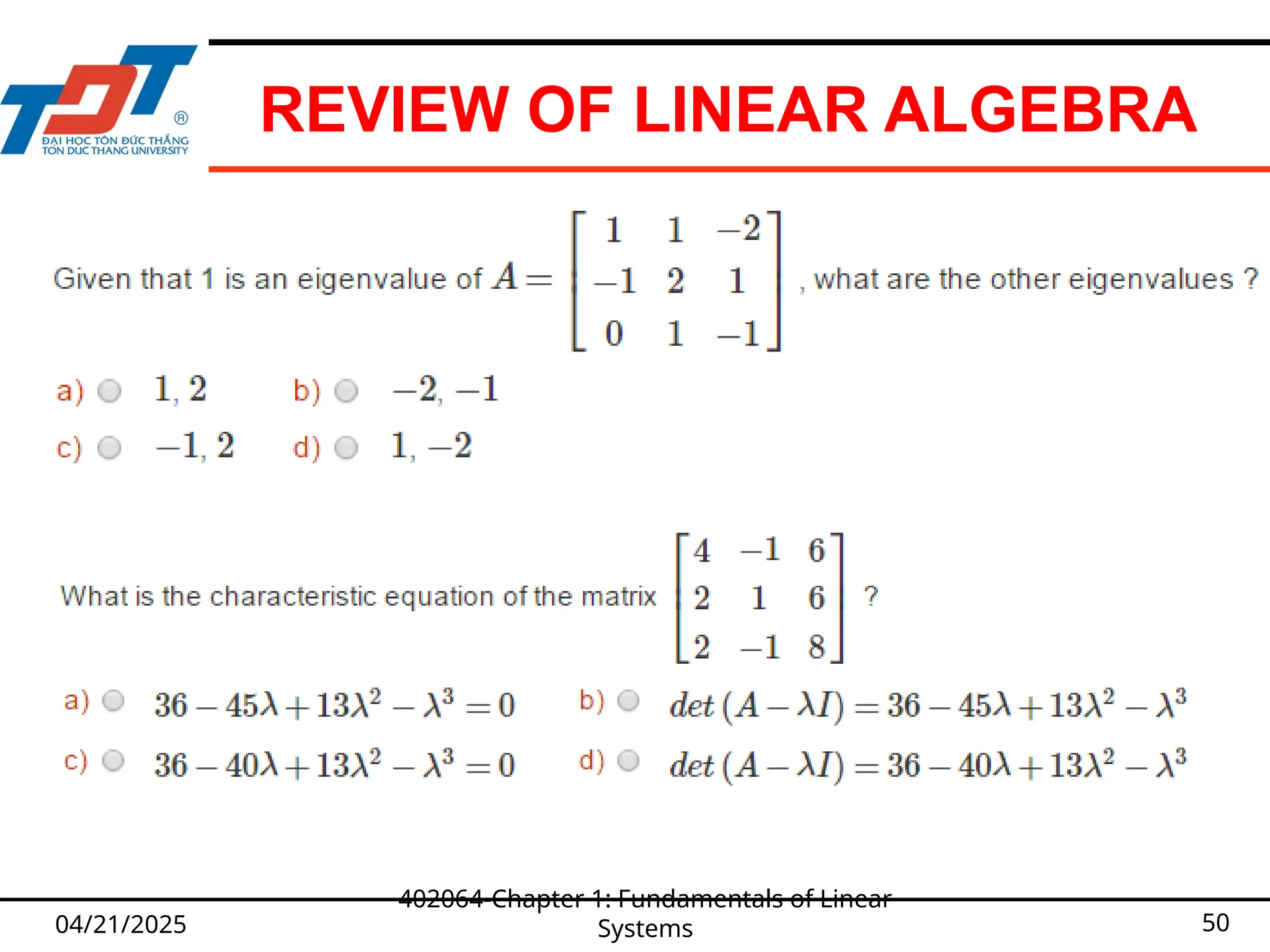
Systems 50
REVIEW OF LINEAR ALGEBRA
04/21/2025
402064-Chapter 1: Fundamentals of Linear
Systems 51
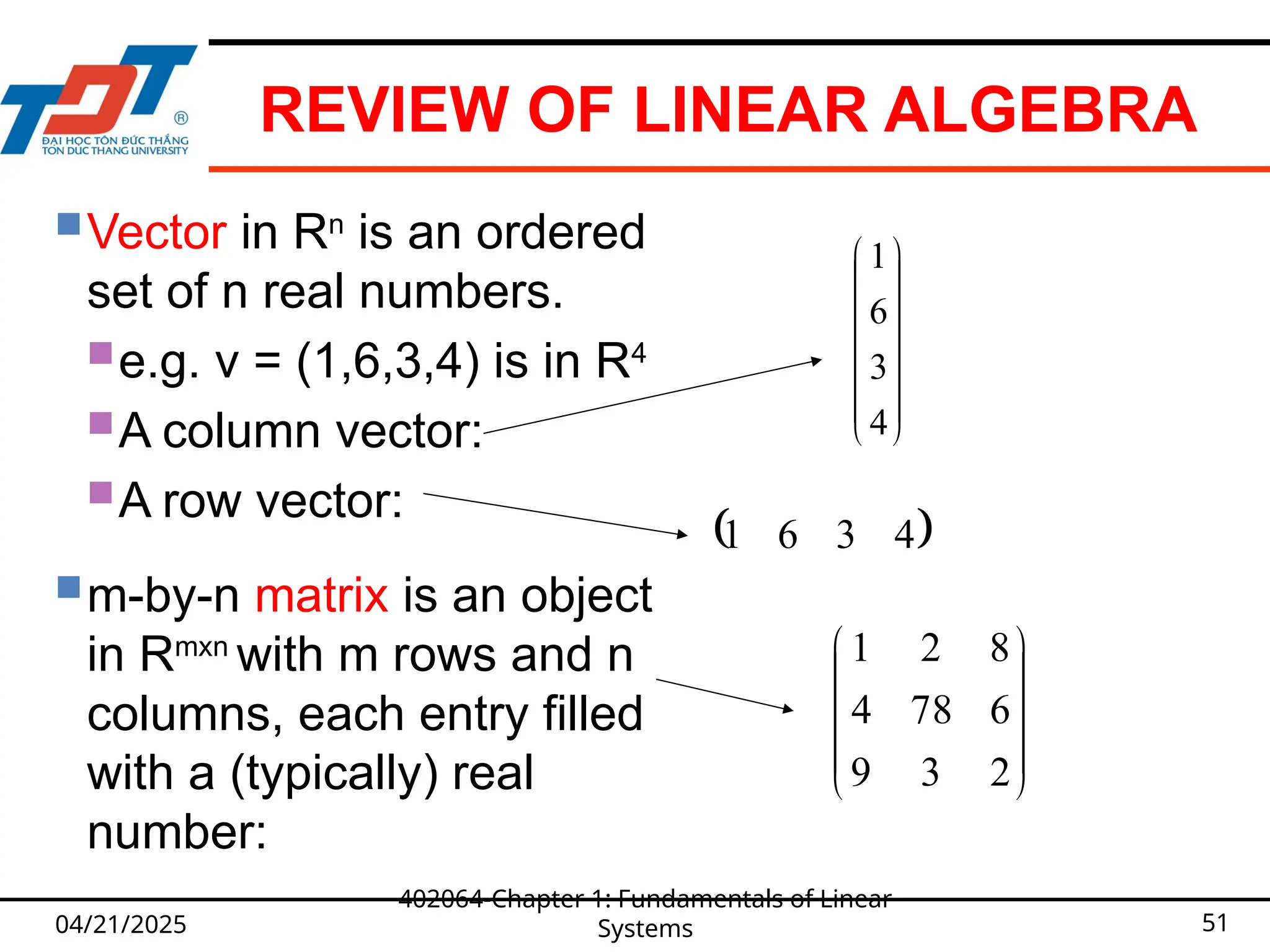
Vector in Rn
is an ordered
set of n real numbers.
e.g. v = (1,6,3,4) is in R4
A column vector:
A row vector:
m-by-n matrix is an object
in Rmxn
with m rows and n
columns, each entry filled
with a (typically) real
number:














4
3
6
1
 
4
3
6
1










2
3
9
6
78
4
8
2
1
MATRICES
04/21/2025
402064-Chapter 1: Fundamentals of Linear
Systems 52
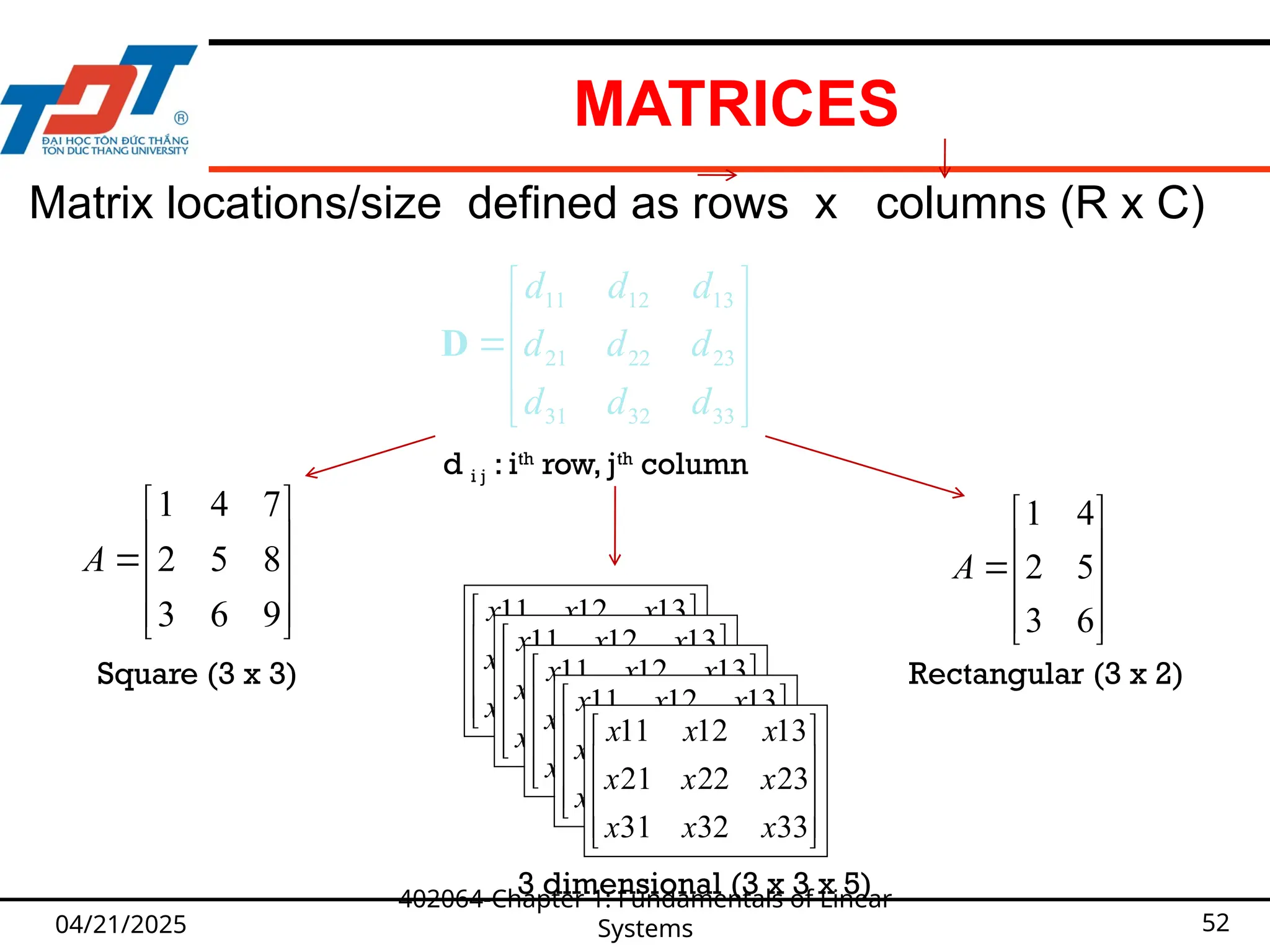
Square (3 x 3)











33
32
31
23
22
21
13
12
11
d
d
d
d
d
d
d
d
d
D
Matrix locations/size defined as rows x columns (R x C)
d i j : ith
row, jth
column










33
32
31
23
22
21
13
12
11
x
x
x
x
x
x
x
x
x
Rectangular (3 x 2)










33
32
31
23
22
21
13
12
11
x
x
x
x
x
x
x
x
x










33
32
31
23
22
21
13
12
11
x
x
x
x
x
x
x
x
x










33
32
31
23
22
21
13
12
11
x
x
x
x
x
x
x
x
x










33
32
31
23
22
21
13
12
11
x
x
x
x
x
x
x
x
x











9
6
3
8
5
2
7
4
1
A











6
5
4
3
2
1
A
3 dimensional (3 x 3 x 5)
MATRIX CALCULUS
04/21/2025
402064-Chapter 1: Fundamentals of Linear
Systems 53
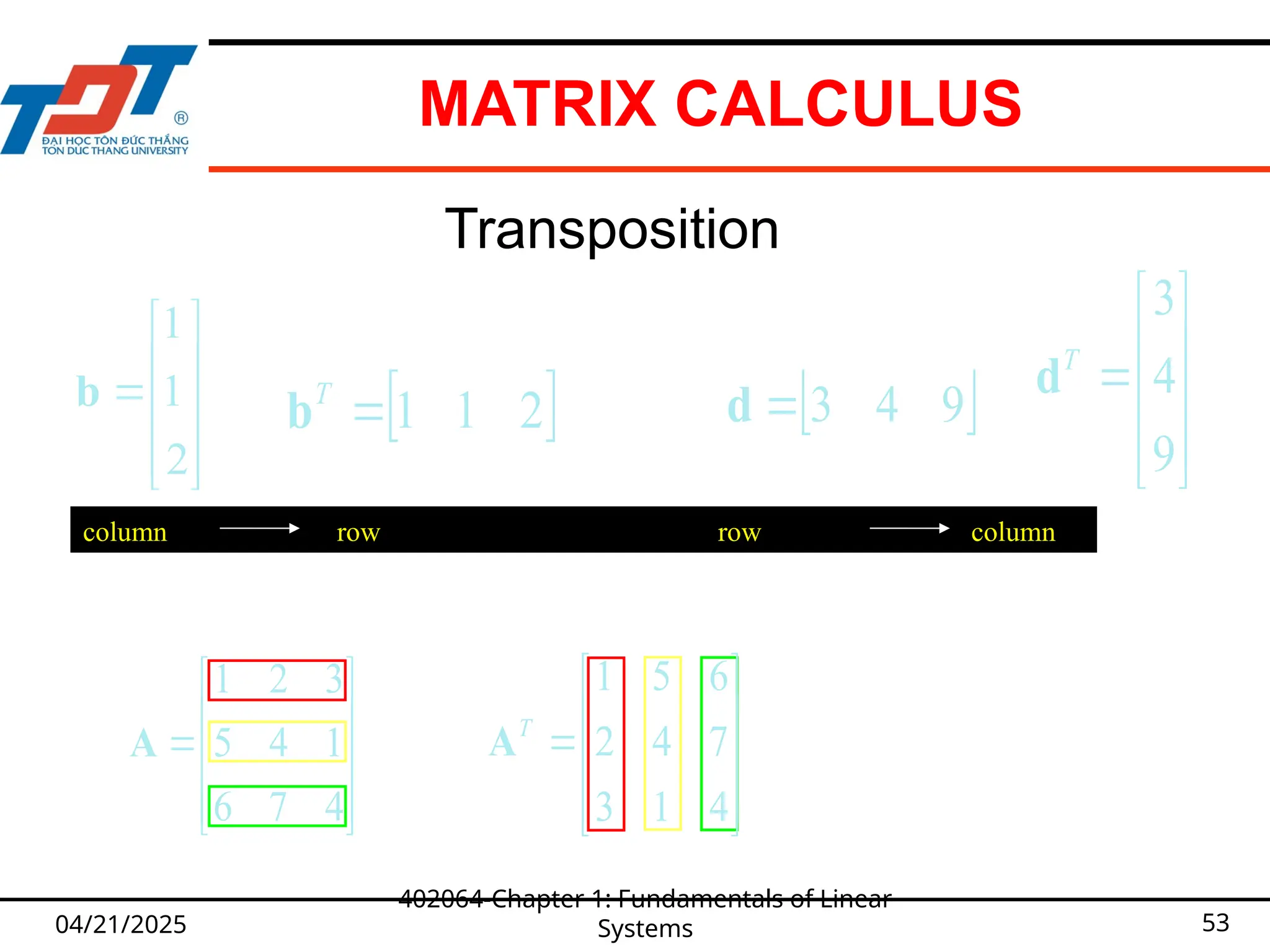
Transposition
column row row column











9
4
3
T
d











4
7
6
1
4
5
3
2
1
A











4
1
3
7
4
2
6
5
1
T
A











2
1
1
b  
2
1
1

T
b  
9
4
3

d
04/21/2025
402064-Chapter 1: Fundamentals of Linear
Systems 54
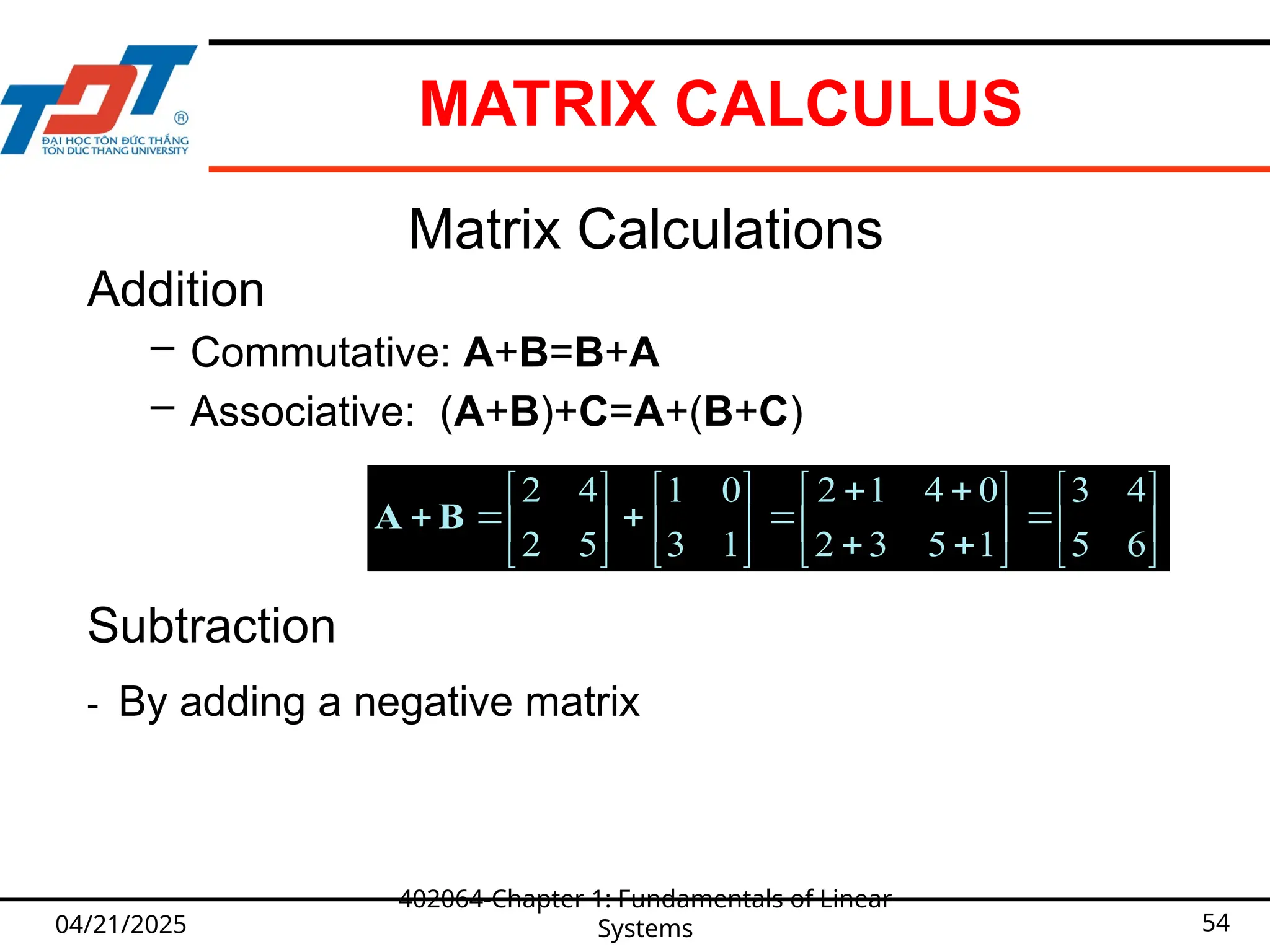
Matrix Calculations
Addition
– Commutative: A+B=B+A
– Associative: (A+B)+C=A+(B+C)








































1
1
1
1
1
1
1
1
2
2
2
2
1
1
1
1
2
2
2
2
B
A
Subtraction
- By adding a negative matrix

































6
5
4
3
1
5
3
2
0
4
1
2
1
3
0
1
5
2
4
2
B
A









































1
2
2
1
4
3
2
1
3
5
4
2
4
3
2
1
3
5
4
2
B
A
MATRIX CALCULUS
04/21/2025
402064-Chapter 1: Fundamentals of Linear
Systems 55
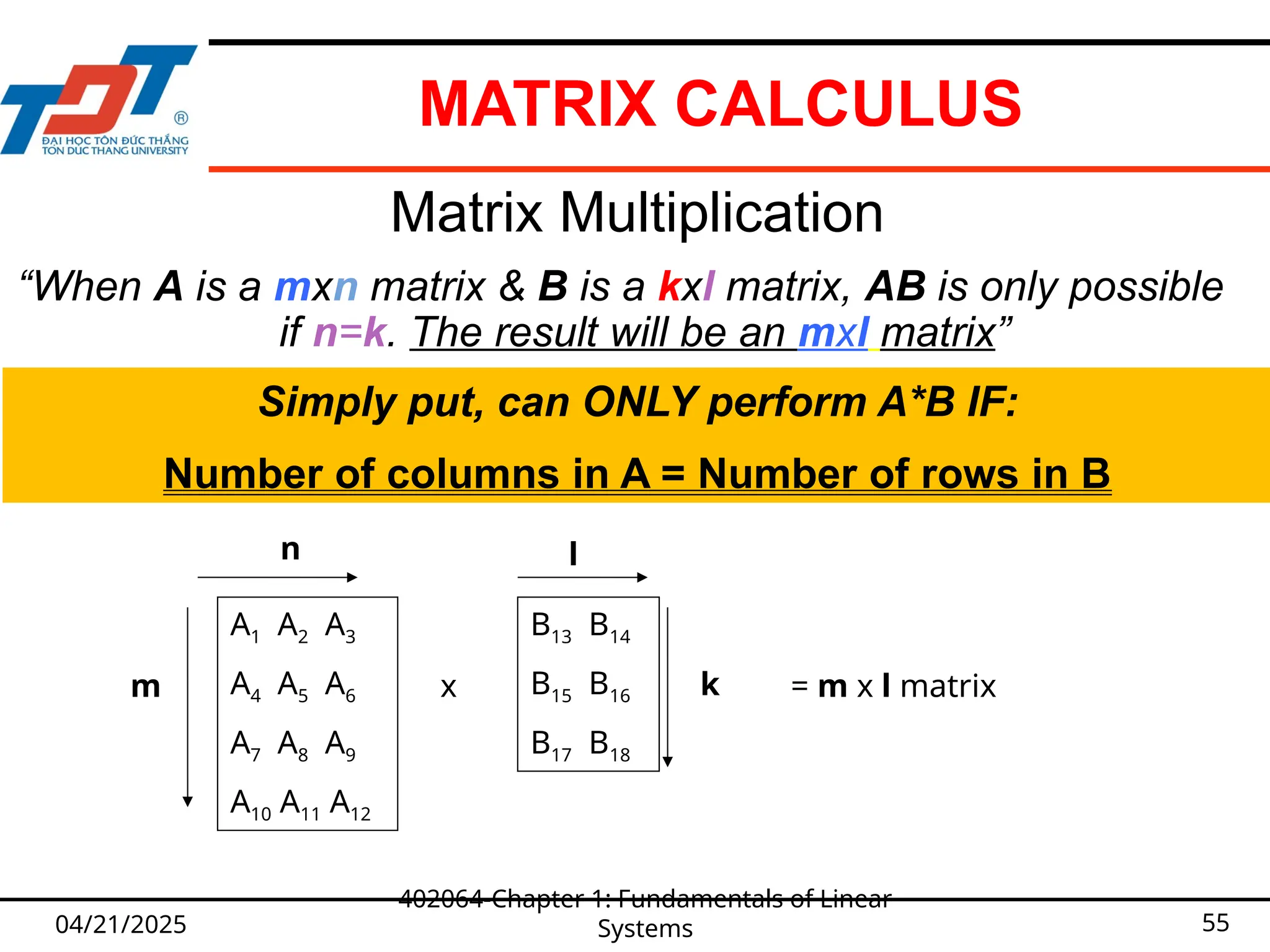
Matrix Multiplication
“When A is a mxn matrix & B is a kxl matrix, AB is only possible
if n=k. The result will be an mxl matrix”
A1 A2 A3
A4 A5 A6
A7 A8 A9
A10 A11 A12
m
n
x
B13 B14
B15 B16
B17 B18
l
k
Simply put, can ONLY perform A*B IF:
Number of columns in A = Number of rows in B
= m x l matrix
MATRIX CALCULUS
MATRIX CALCULUS
04/21/2025
402064-Chapter 1: Fundamentals of Linear
Systems 56
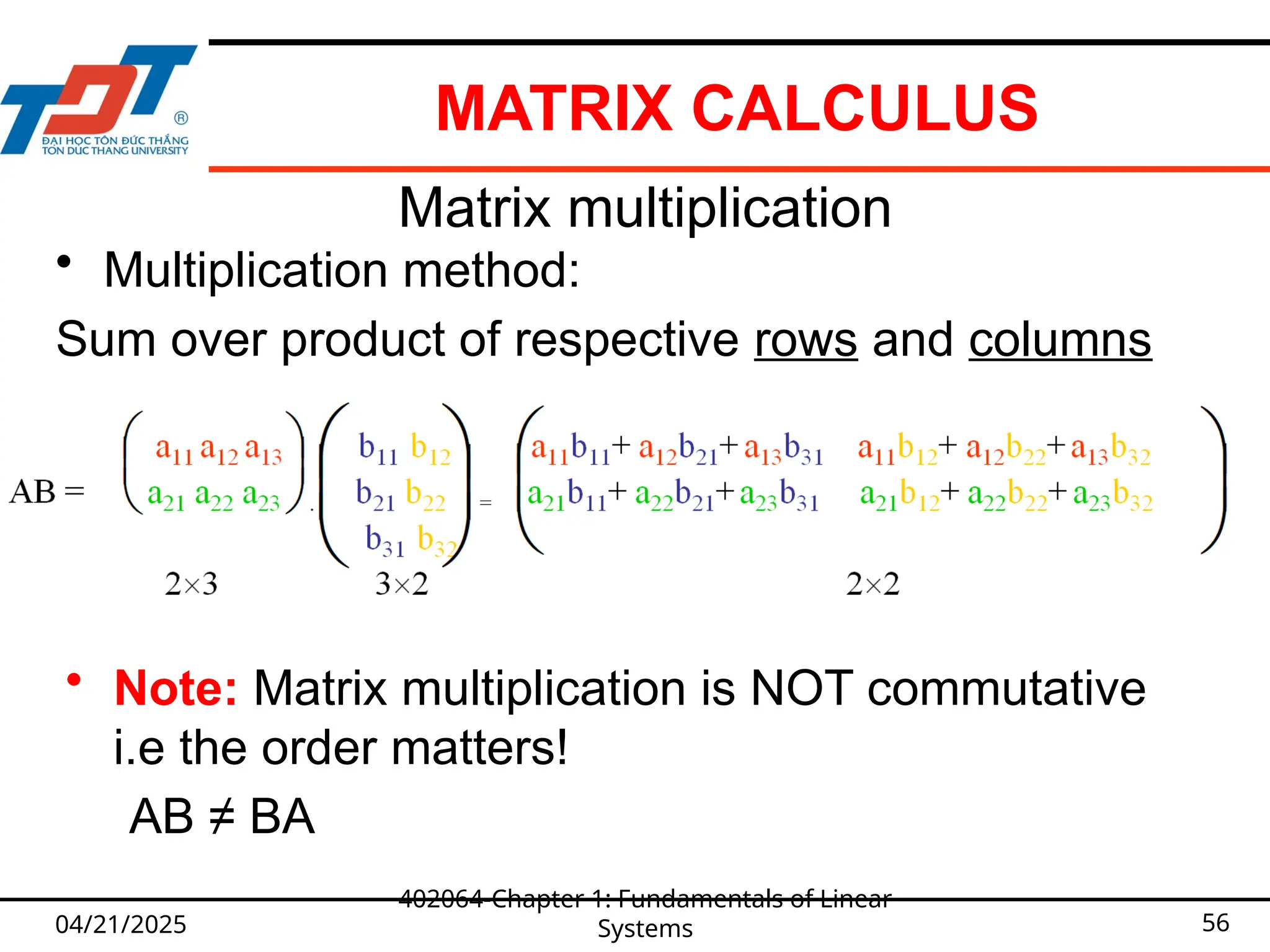
Matrix multiplication
• Multiplication method:
Sum over product of respective rows and columns
• Note: Matrix multiplication is NOT commutative
i.e the order matters!
AB ≠ BA
04/21/2025
402064-Chapter 1: Fundamentals of Linear
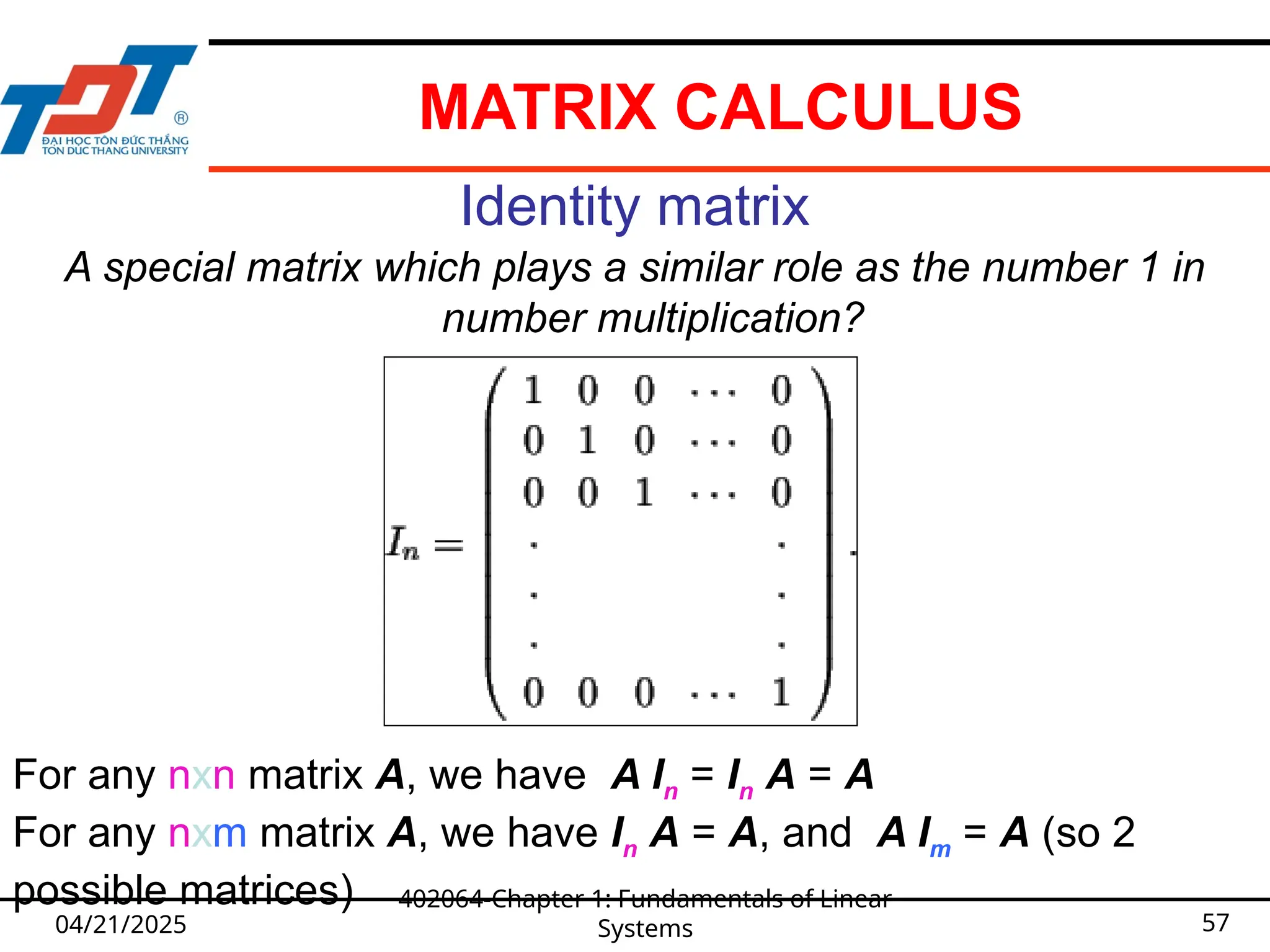
Systems 57
Identity matrix
A special matrix which plays a similar role as the number 1 in
number multiplication?
For any nxn matrix A, we have A In = In A = A
For any nxm matrix A, we have In A = A, and A Im = A (so 2
possible matrices)
MATRIX CALCULUS
VECTOR NORM AND DOT PRODUCT
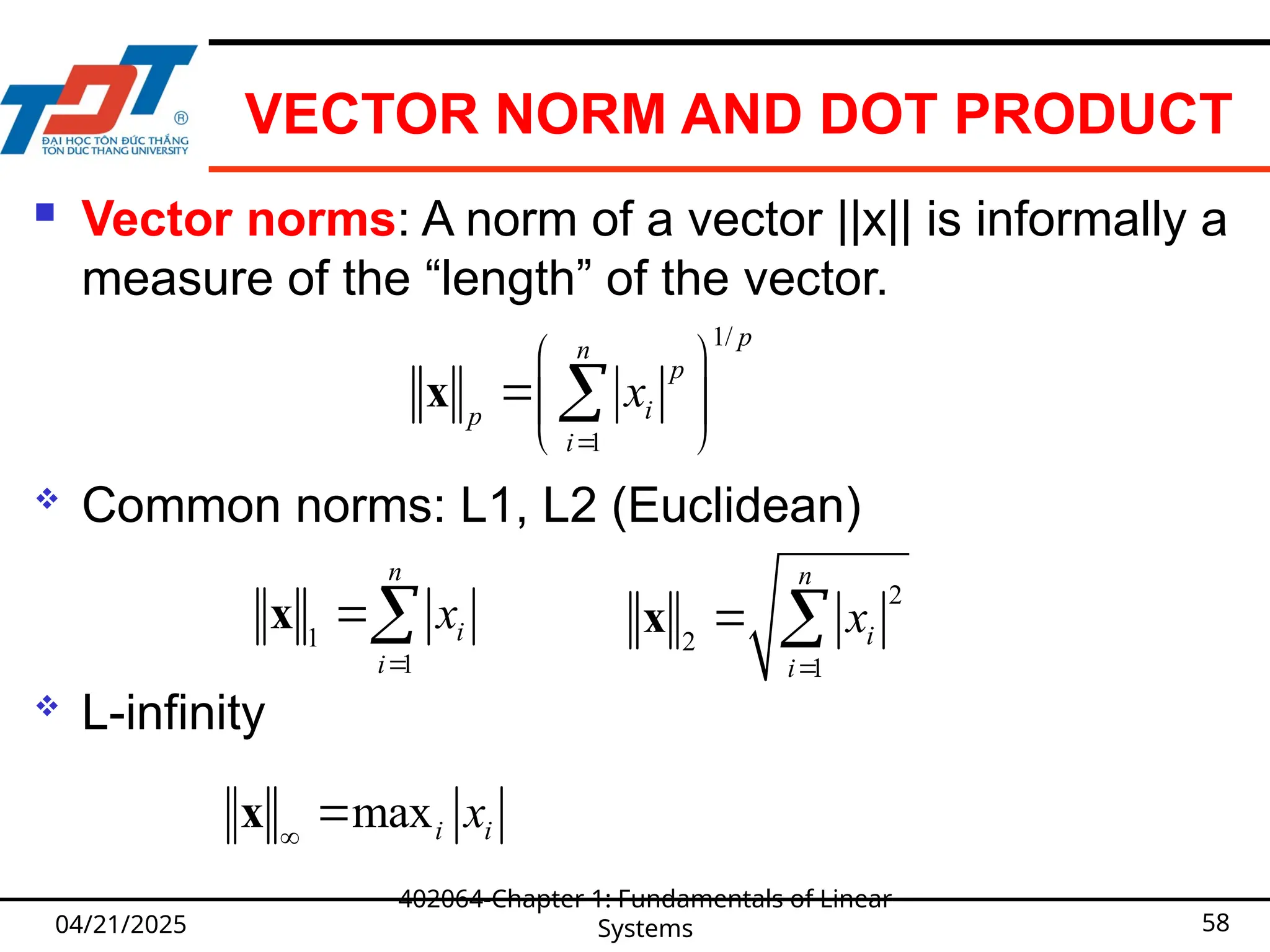
 Vector norms: A norm of a vector ||x|| is informally a
measure of the “length” of the vector.
 Common norms: L1, L2 (Euclidean)
 L-infinity
04/21/2025
402064-Chapter 1: Fundamentals of Linear
Systems 58
1/
1
p
n
p
i
p
i
x

 
 
 

x
1
1
n
i
i
x


x
2
2
1
n
i
i
x

 
x
maxi i
x


x
VECTOR NORM AND DOT PRODUCT
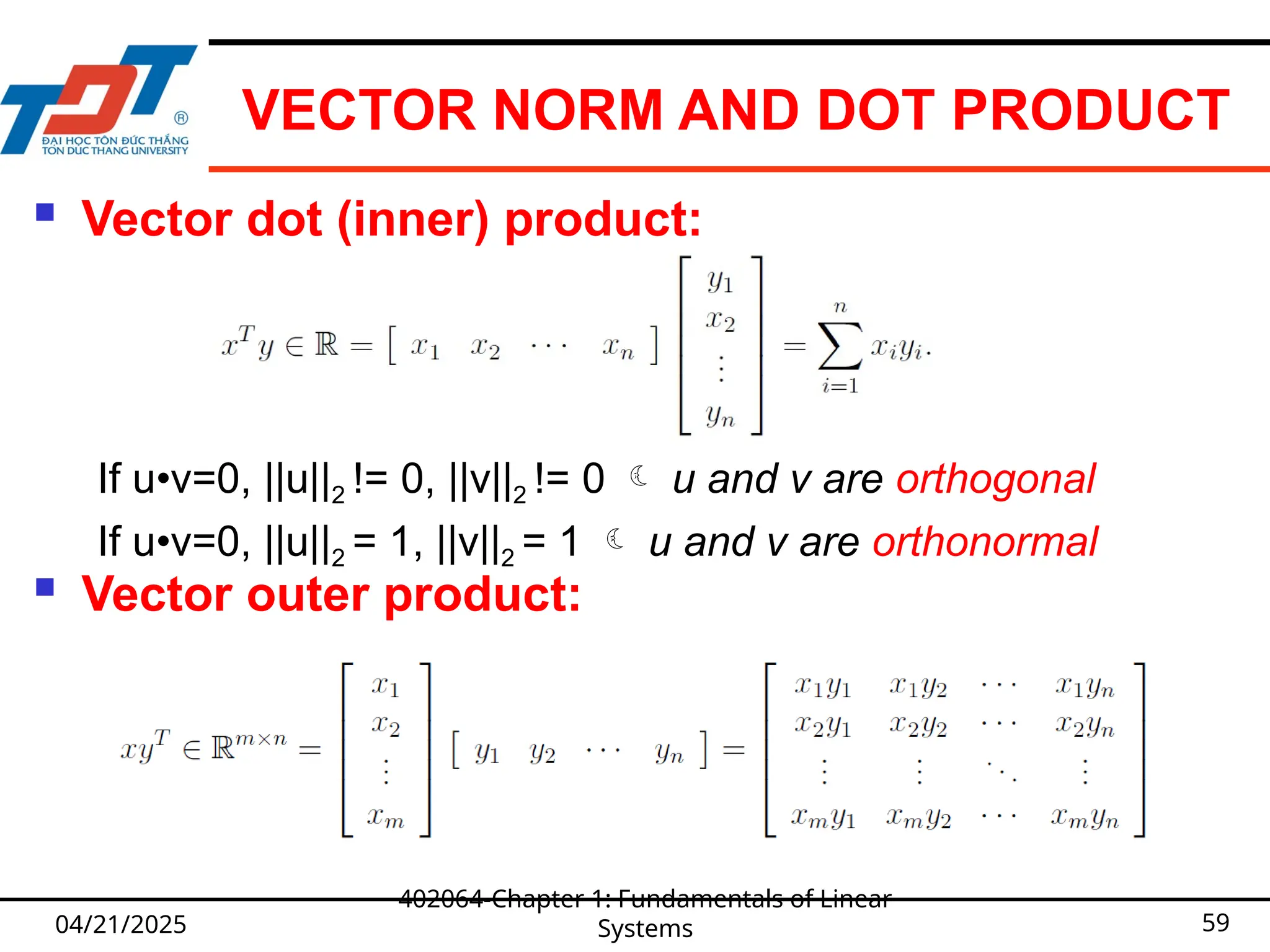
 Vector dot (inner) product:
 Vector outer product:
04/21/2025
402064-Chapter 1: Fundamentals of Linear
Systems 59
If u•v=0, ||u||2 != 0, ||v||2 != 0  u and v are orthogonal
If u•v=0, ||u||2 = 1, ||v||2 = 1  u and v are orthonormal
LINEAR COMBINATION & VECTOR
SPACE
 A linear combination of vectors is a vector that
can be obtained by multiplying these vectors by a
real number then adding them.
 The vector space defined by some vectors is a
space that contains all linear combinations of them.
 A matrix A (m x n) can itself be decomposed in as
many vectors as its number of columns (or rows).
 Each column of the matrix can be represented as a
vector. The ensemble of n vector-column defines a
vector space proper to matrix A.
04/21/2025
402064-Chapter 1: Fundamentals of Linear
Systems 60
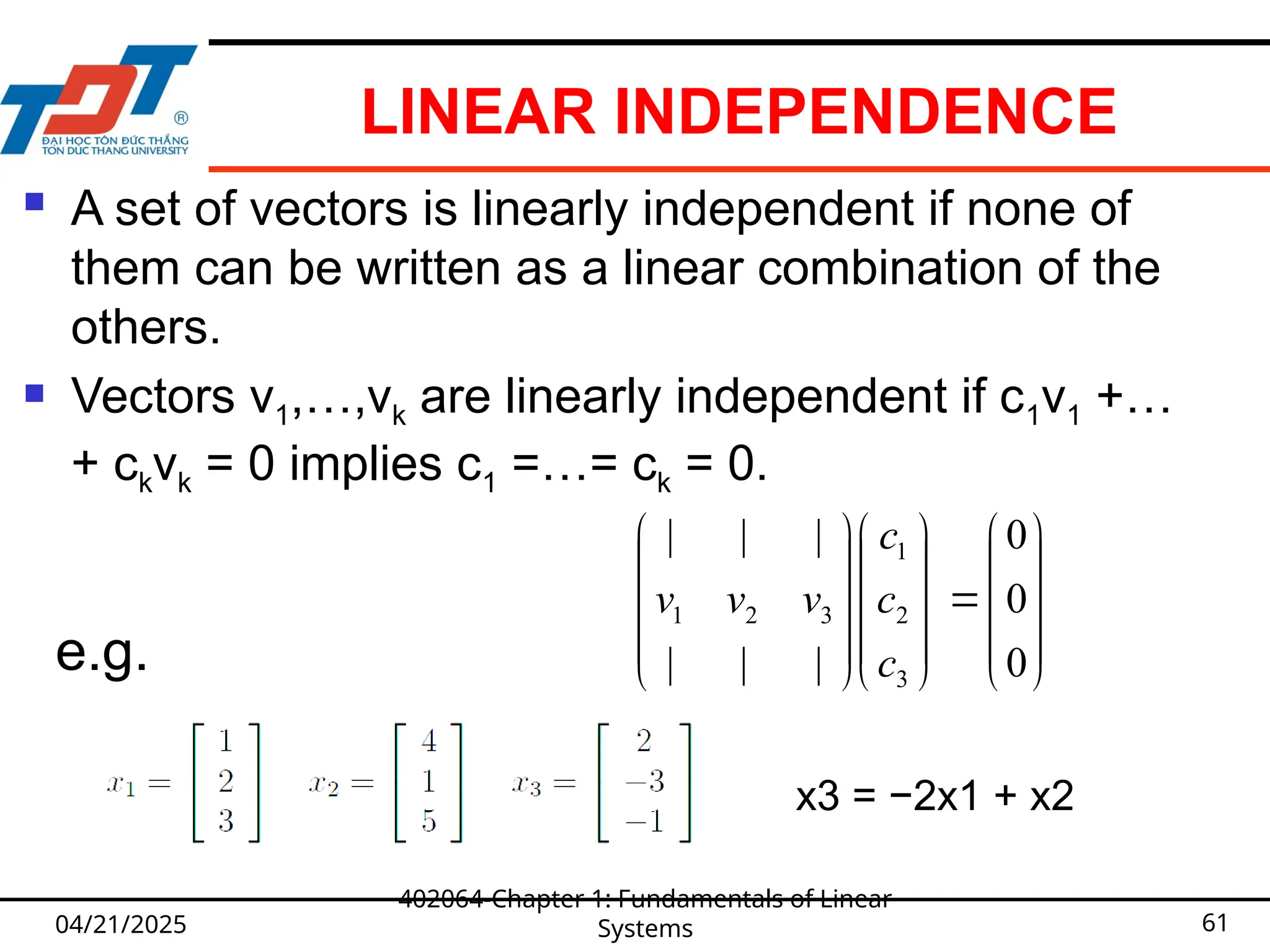
LINEAR INDEPENDENCE
 A set of vectors is linearly independent if none of
them can be written as a linear combination of the
others.
 Vectors v1,…,vk are linearly independent if c1v1 +…
+ ckvk = 0 implies c1 =…= ck = 0.
04/21/2025
402064-Chapter 1: Fundamentals of Linear
Systems 61































0
0
0
|
|
|
|
|
|
3
2
1
3
2
1
c
c
c
v
v
v
e.g.
x3 = −2x1 + x2
DIMENSION & BASIS OF A VECTOR
SPACE
 If all vectors in a vector space may be expressed
as linear combinations of a set of vectors v1,…,vk,
then v1,…,vk spans the space.
 A basis is a maximal set of linearly independent
vectors and a minimal set of spanning vectors of a
vector space.
 The cardinality of a basis is the dimension of the
vector space.
 A basis is a maximal set of linearly independent
vectors and a minimal set of spanning vectors of a
vector space.
04/21/2025
402064-Chapter 1: Fundamentals of Linear
Systems 62
DIMENSION & BASIS OF A VECTOR
SPACE
04/21/2025
402064-Chapter 1: Fundamentals of Linear
Systems 63











































1
0
0
2
0
1
0
2
0
0
1
2
2
2
2
(0,0,1)
(0,1,0)
(1,0,0)
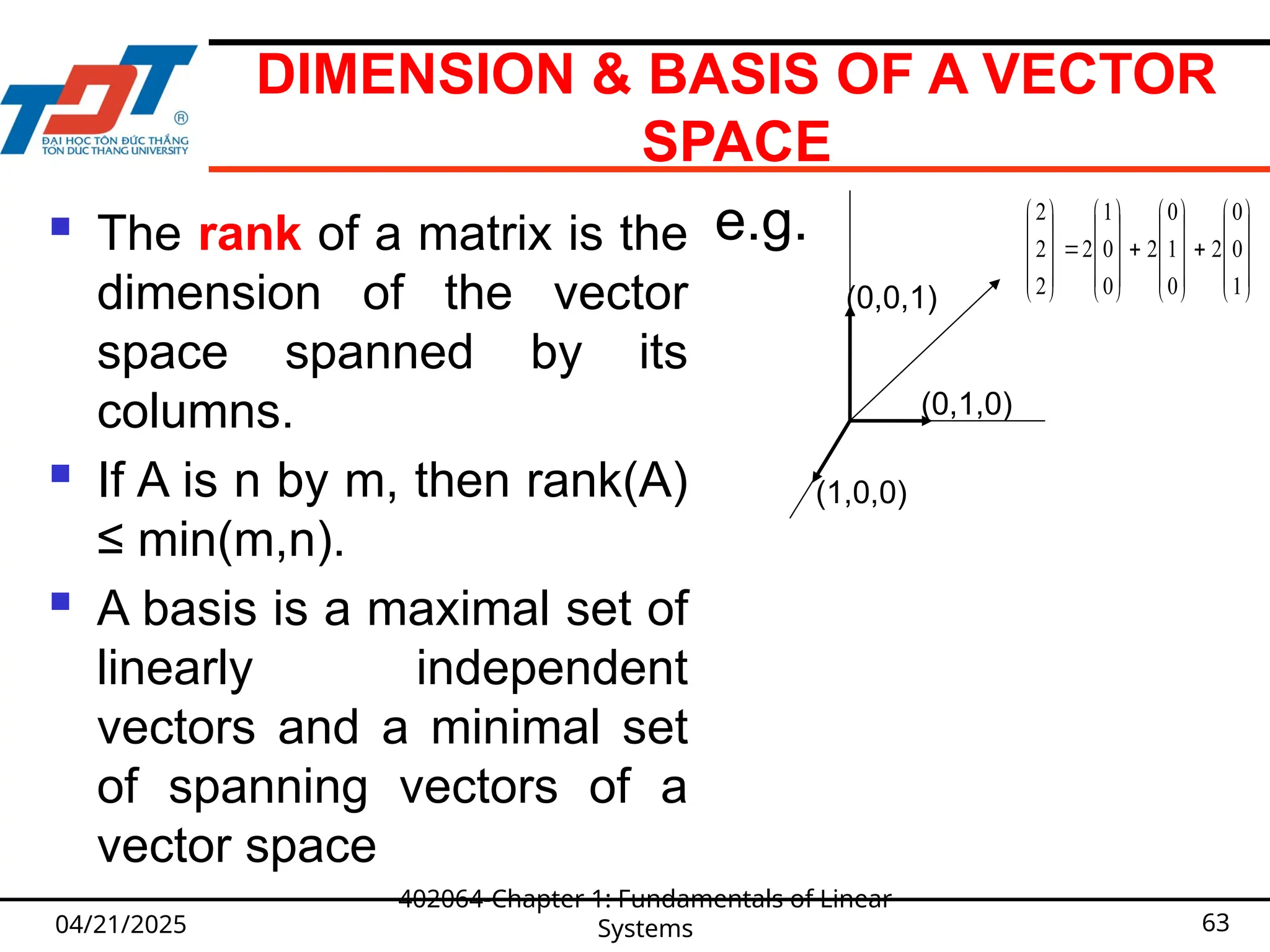
e.g.
 The rank of a matrix is the
dimension of the vector
space spanned by its
columns.
 If A is n by m, then rank(A)
≤ min(m,n).
 A basis is a maximal set of
linearly independent
vectors and a minimal set
of spanning vectors of a
vector space
DETERMINANTS
04/21/2025
402064-Chapter 1: Fundamentals of Linear
Systems 64
• Determinants can only be found for square matrices.
• For a 2x2 matrix A, det(A) = ad-bc. Lets have a
closer look at that:
The determinant gives an idea of the ’volume’ occupied by the
matrix in vector space.
A matrix A has an inverse matrix A-1
if and only if det(A)≠0.
a b
c d
det(A) = = ad - bc
[ ]
DETERMINANTS
04/21/2025
402064-Chapter 1: Fundamentals of Linear
Systems 65
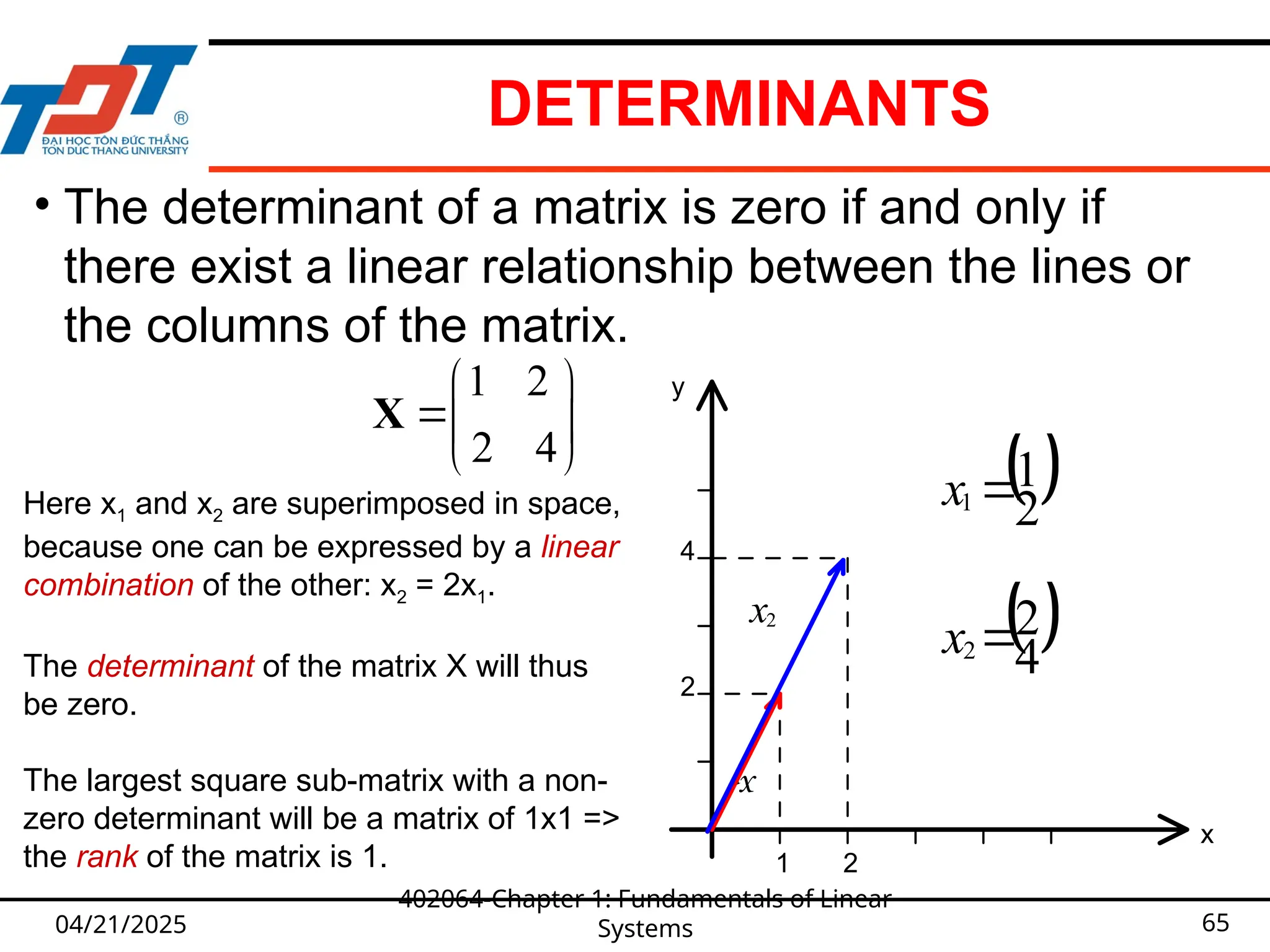
• The determinant of a matrix is zero if and only if
there exist a linear relationship between the lines or
the columns of the matrix.

2
1
1 
x

4
2
2
x
2
x

1
x

y
x
4
2
1
2
Here x1 and x2 are superimposed in space,
because one can be expressed by a linear
combination of the other: x2 = 2x1.
The determinant of the matrix X will thus
be zero.
The largest square sub-matrix with a non-
zero determinant will be a matrix of 1x1 =>
the rank of the matrix is 1.
1 2
2 4
 
 
 
X
MATRIX INVERSE
04/21/2025
402064-Chapter 1: Fundamentals of Linear
Systems 66
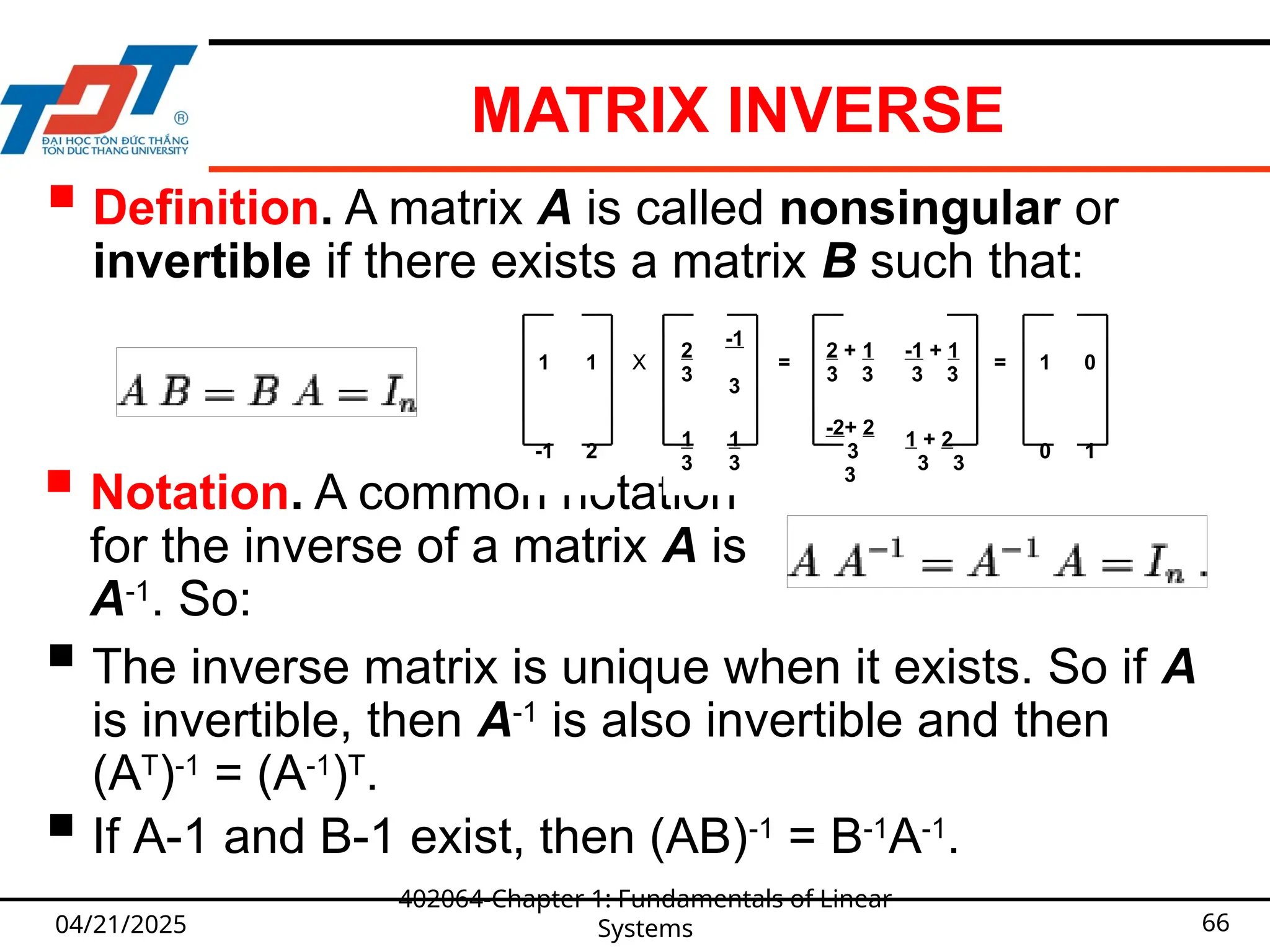
 Definition. A matrix A is called nonsingular or
invertible if there exists a matrix B such that:
 Notation. A common notation
for the inverse of a matrix A is
A-1
. So:
 The inverse matrix is unique when it exists. So if A
is invertible, then A-1
is also invertible and then
(AT
)-1
= (A-1
)T
.
 If A-1 and B-1 exist, then (AB)-1
= B-1
A-1
.
1 1 X
2
3
-1
3
=
2 + 1
3 3
-1 + 1
3 3
= 1 0
-1 2
1
3
1
3
-2+ 2
3
3
1 + 2
3 3
0 1
MATRIX INVERSE
04/21/2025
402064-Chapter 1: Fundamentals of Linear
Systems 67
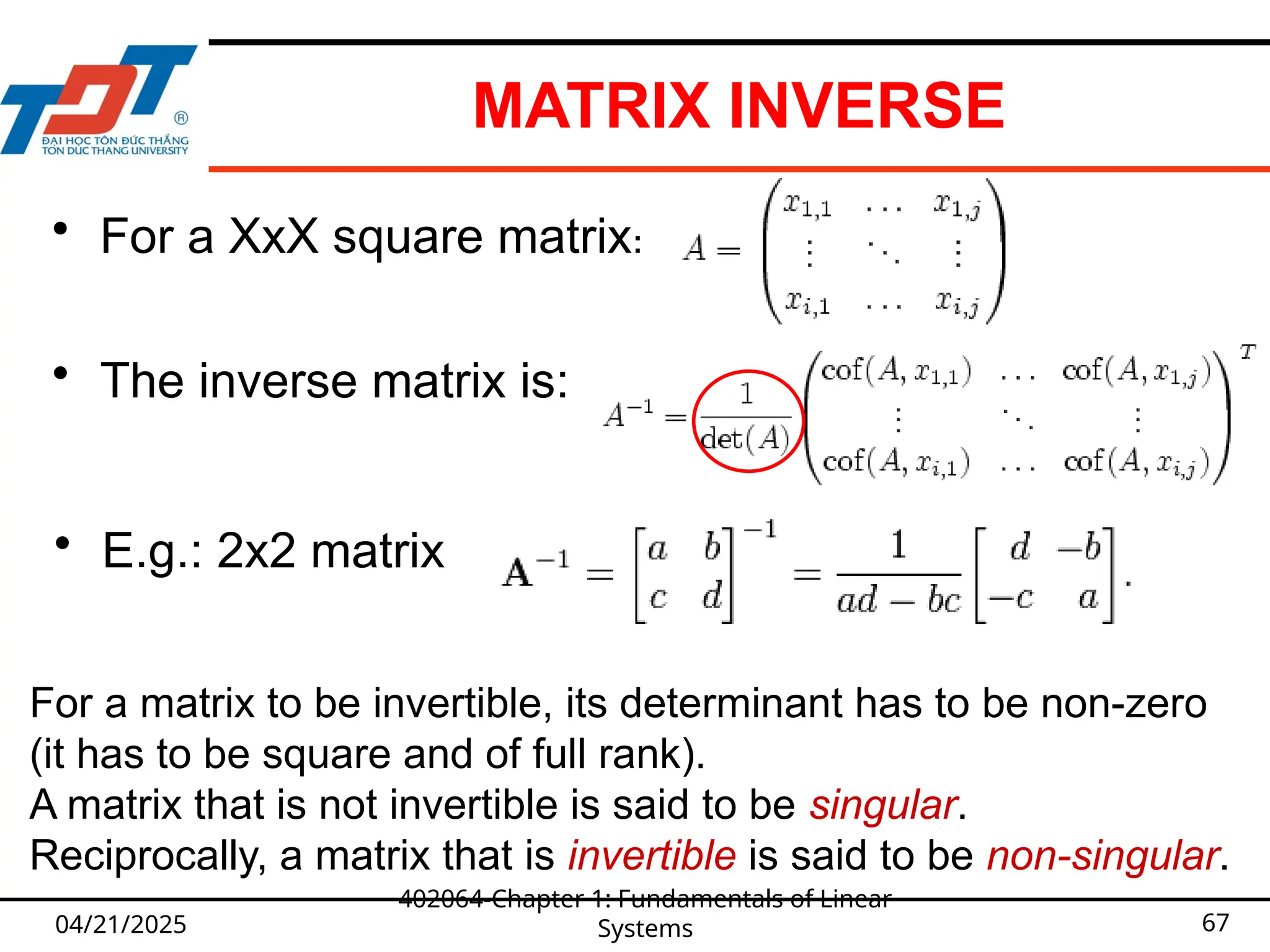
• For a XxX square matrix:
• The inverse matrix is:
• E.g.: 2x2 matrix
For a matrix to be invertible, its determinant has to be non-zero
(it has to be square and of full rank).
A matrix that is not invertible is said to be singular.
Reciprocally, a matrix that is invertible is said to be non-singular.
MATRIX DERIVATIVES
04/21/2025
402064-Chapter 1: Fundamentals of Linear
Systems 68
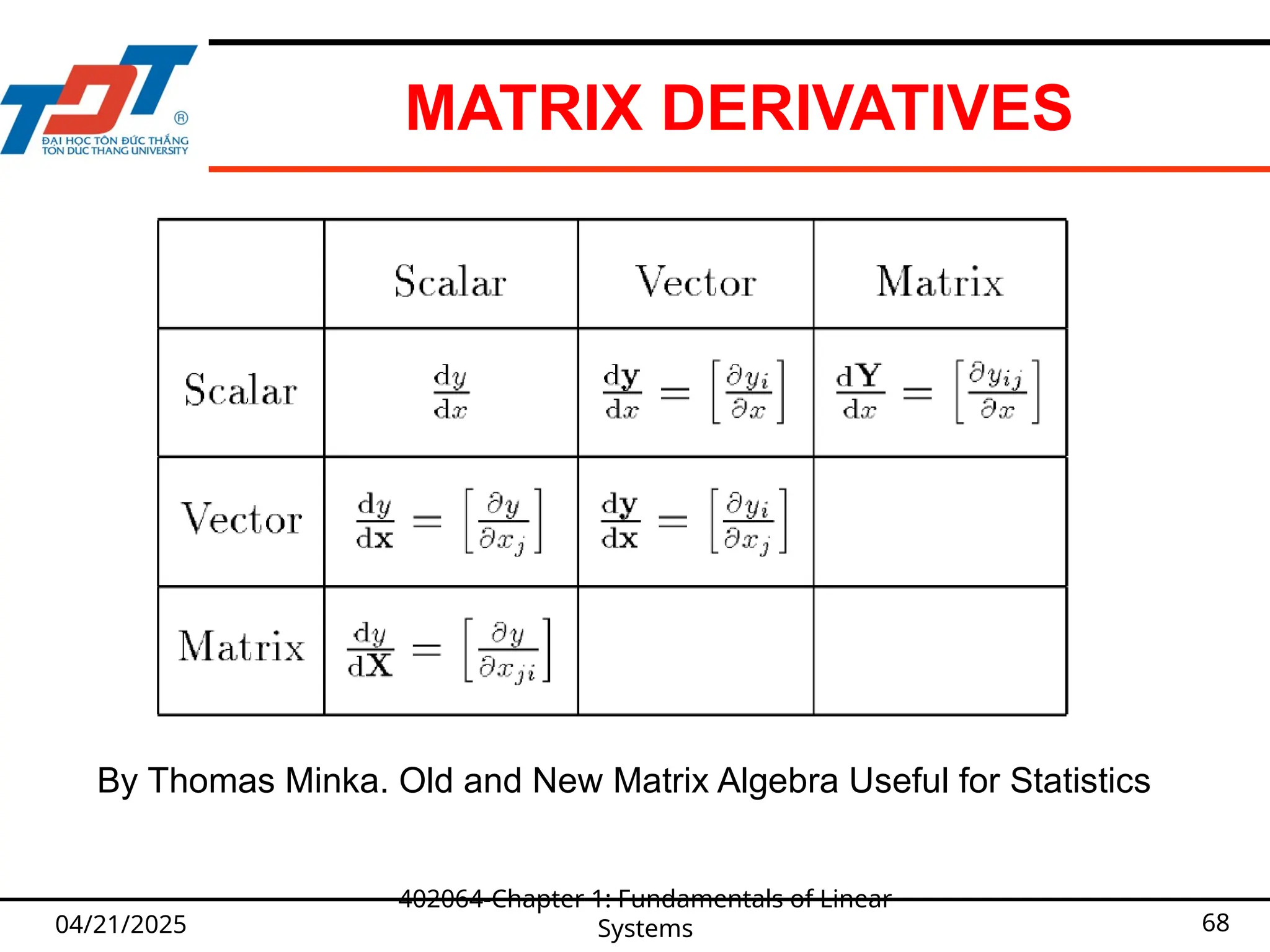
By Thomas Minka. Old and New Matrix Algebra Useful for Statistics
MATRIX DERIVATIVES - EXAMPLES
04/21/2025
402064-Chapter 1: Fundamentals of Linear
Systems 69
EIGENVALUES & EIGENVECTORS
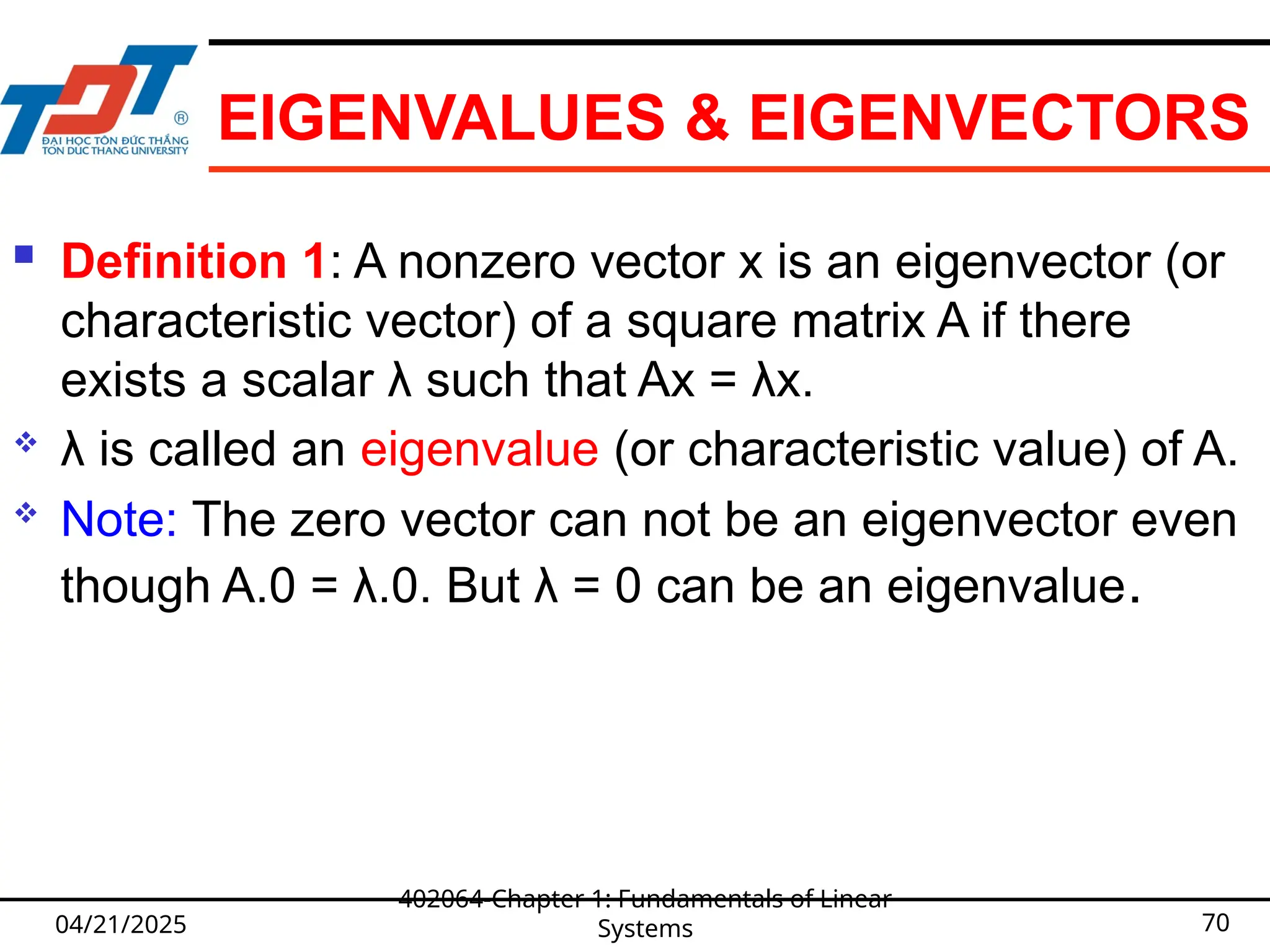
 Definition 1: A nonzero vector x is an eigenvector (or
characteristic vector) of a square matrix A if there
exists a scalar λ such that Ax = λx.
 λ is called an eigenvalue (or characteristic value) of A.
 Note: The zero vector can not be an eigenvector even
though A.0 = λ.0. But λ = 0 can be an eigenvalue.
04/21/2025
402064-Chapter 1: Fundamentals of Linear
Systems 70
GEOMETRIC INTERPRETATION
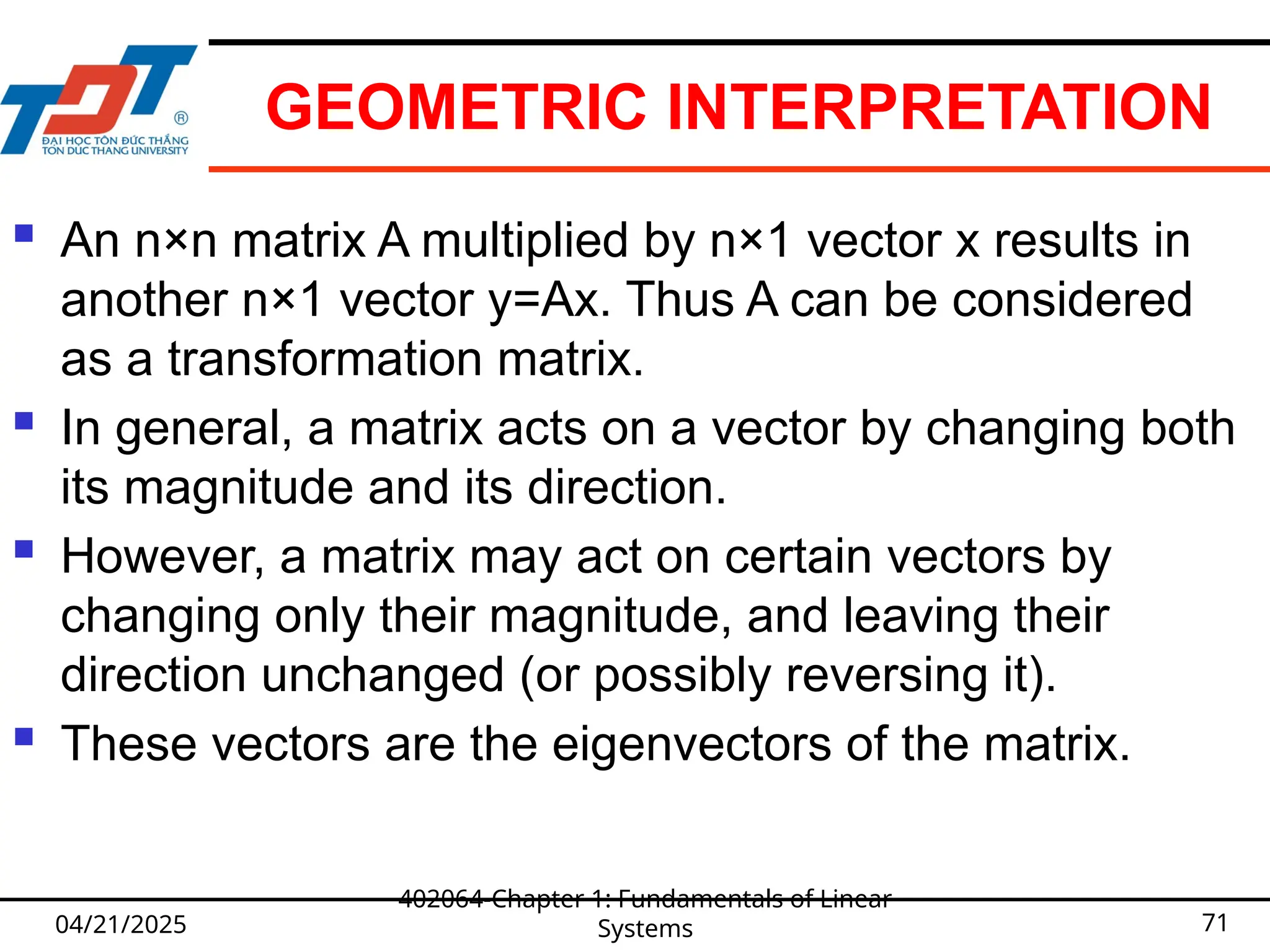
 An n×n matrix A multiplied by n×1 vector x results in
another n×1 vector y=Ax. Thus A can be considered
as a transformation matrix.
 In general, a matrix acts on a vector by changing both
its magnitude and its direction.
 However, a matrix may act on certain vectors by
changing only their magnitude, and leaving their
direction unchanged (or possibly reversing it).
 These vectors are the eigenvectors of the matrix.
04/21/2025
402064-Chapter 1: Fundamentals of Linear
Systems 71
EIGENVALUE CALCULATION
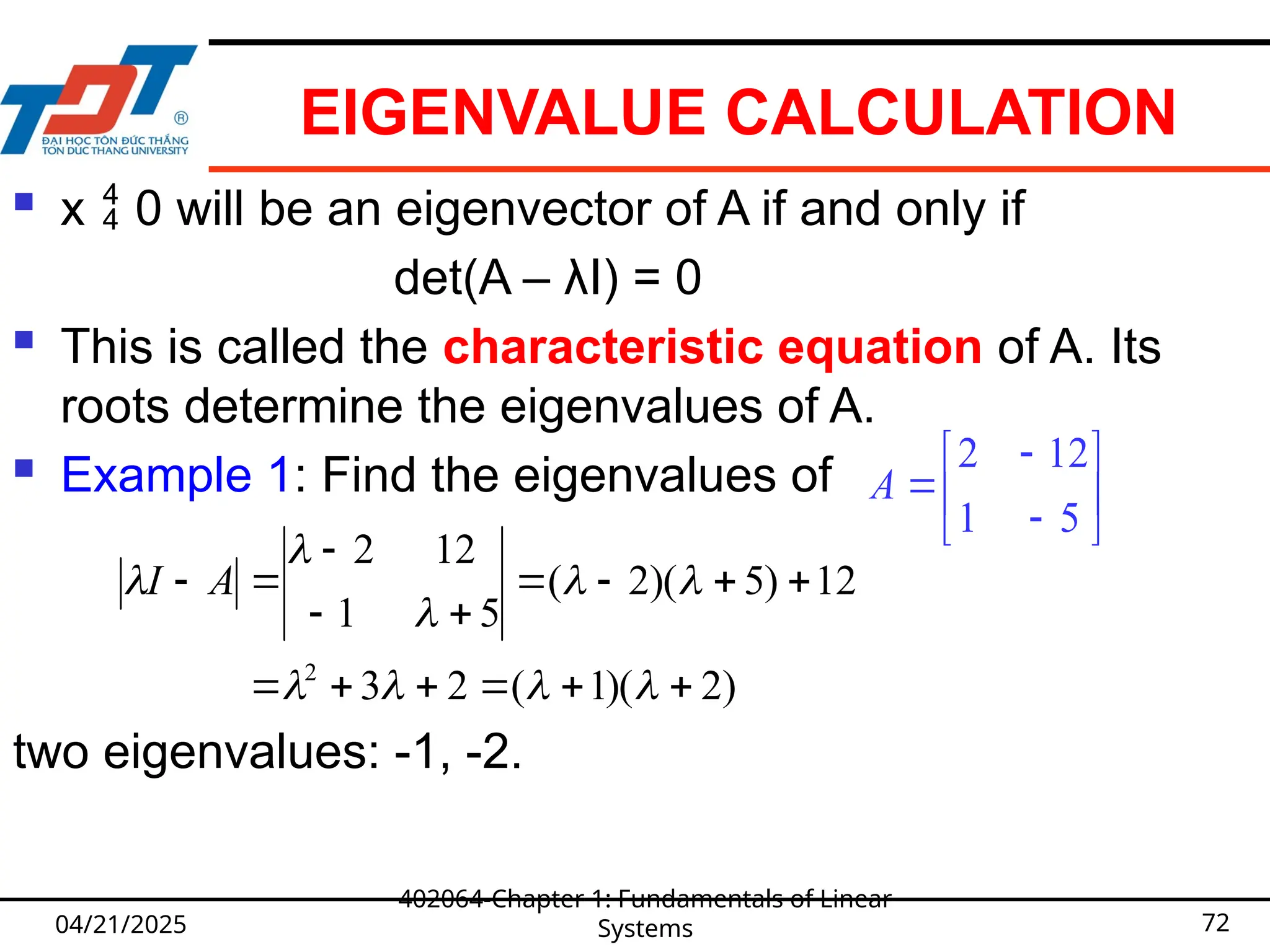
 x  0 will be an eigenvector of A if and only if
det(A – λI) = 0
 This is called the characteristic equation of A. Its
roots determine the eigenvalues of A.
 Example 1: Find the eigenvalues of
two eigenvalues: -1, -2.
04/21/2025
402064-Chapter 1: Fundamentals of Linear
Systems 72









5
1
12
2
A
)
2
)(
1
(
2
3
12
)
5
)(
2
(
5
1
12
2
2























 A
I
FINDING EIGENVECTORS
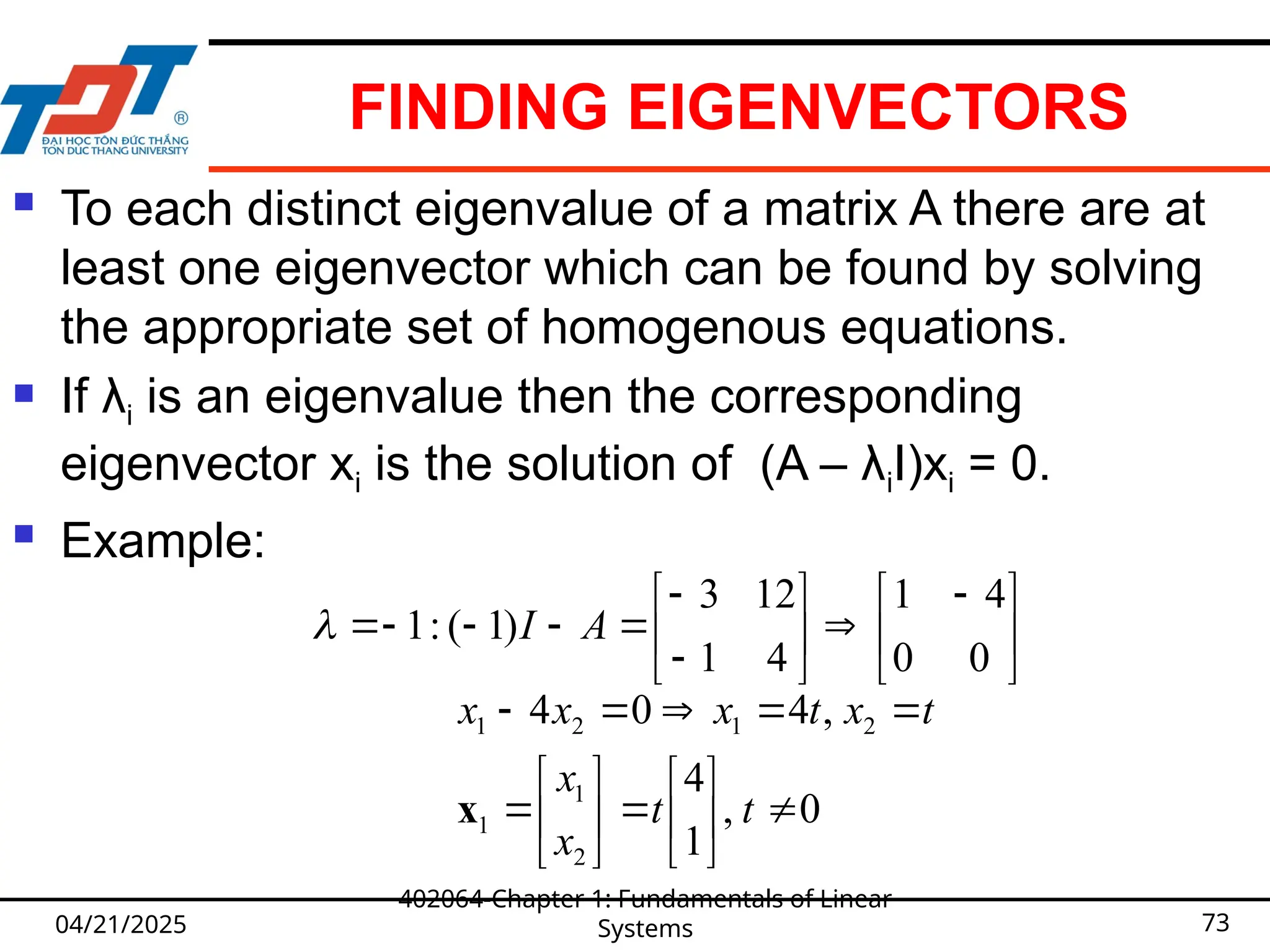
 To each distinct eigenvalue of a matrix A there are at
least one eigenvector which can be found by solving
the appropriate set of homogenous equations.
 If λi is an eigenvalue then the corresponding
eigenvector xi is the solution of (A – λiI)xi = 0.
 Example:
04/21/2025
402064-Chapter 1: Fundamentals of Linear
Systems 73





 














0
0
4
1
4
1
12
3
)
1
(
:
1 A
I

0
,
1
4
,
4
0
4
2
1
1
2
1
2
1




















t
t
x
x
t
x
t
x
x
x
x
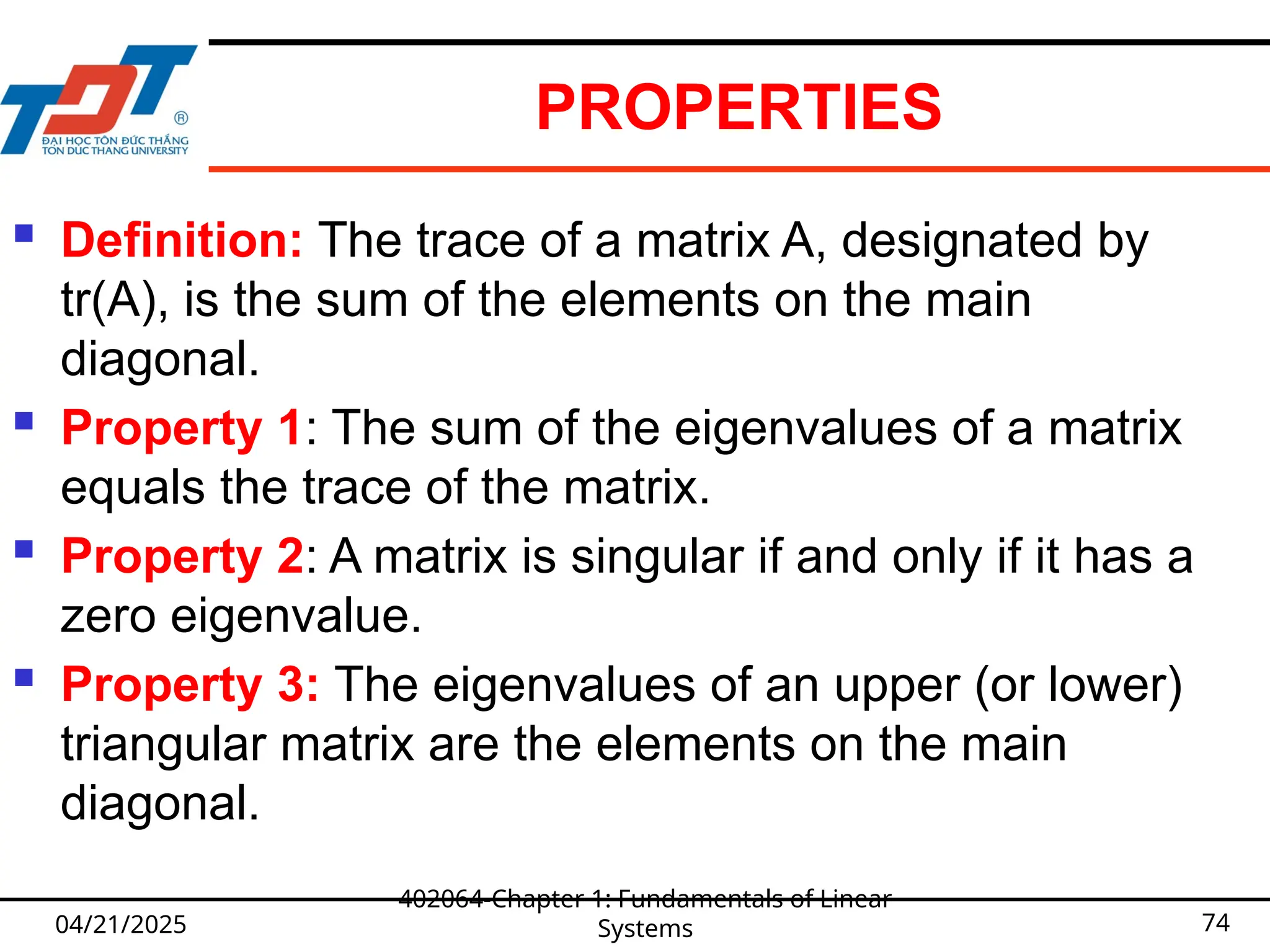
PROPERTIES
 Definition: The trace of a matrix A, designated by
tr(A), is the sum of the elements on the main
diagonal.
 Property 1: The sum of the eigenvalues of a matrix
equals the trace of the matrix.
 Property 2: A matrix is singular if and only if it has a
zero eigenvalue.
 Property 3: The eigenvalues of an upper (or lower)
triangular matrix are the elements on the main
diagonal.
04/21/2025
402064-Chapter 1: Fundamentals of Linear
Systems 74
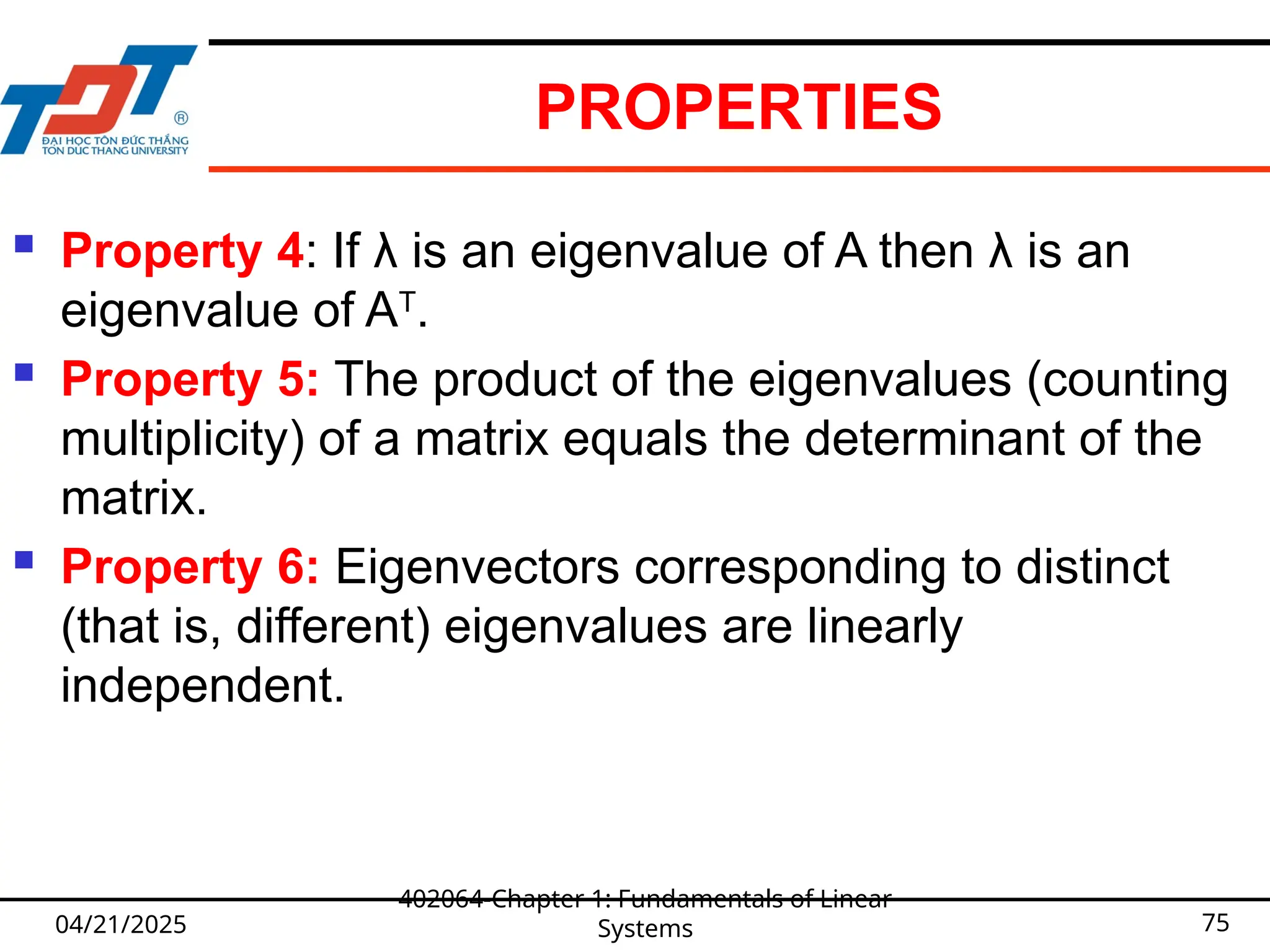
PROPERTIES
 Property 4: If λ is an eigenvalue of A then λ is an
eigenvalue of AT
.
 Property 5: The product of the eigenvalues (counting
multiplicity) of a matrix equals the determinant of the
matrix.
 Property 6: Eigenvectors corresponding to distinct
(that is, different) eigenvalues are linearly
independent.
04/21/2025
402064-Chapter 1: Fundamentals of Linear
Systems 75
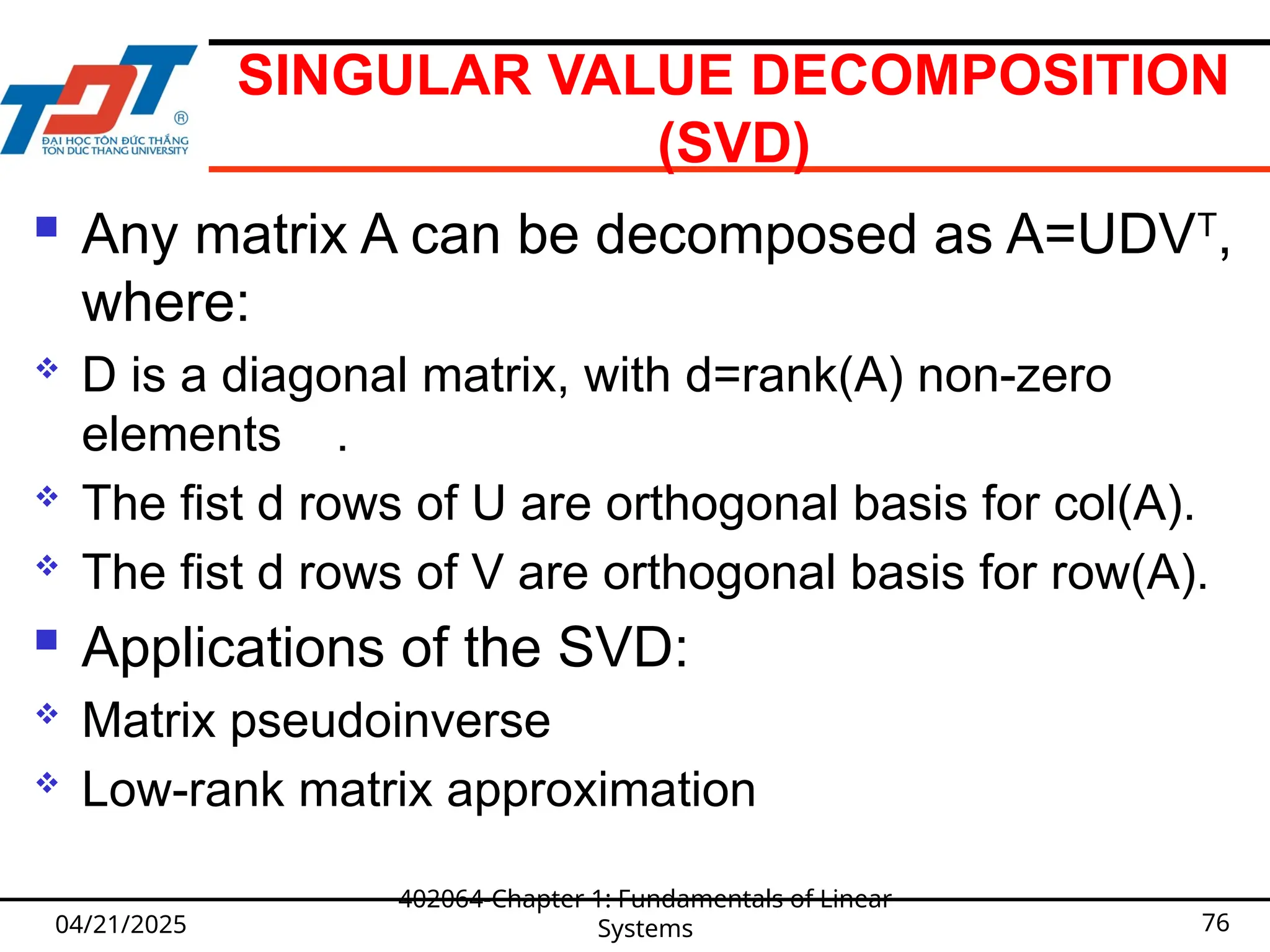
SINGULAR VALUE DECOMPOSITION
(SVD)
 Any matrix A can be decomposed as A=UDVT
,
where:
 D is a diagonal matrix, with d=rank(A) non-zero
elements .
 The fist d rows of U are orthogonal basis for col(A).
 The fist d rows of V are orthogonal basis for row(A).
 Applications of the SVD:
 Matrix pseudoinverse
 Low-rank matrix approximation
04/21/2025
402064-Chapter 1: Fundamentals of Linear
Systems 76
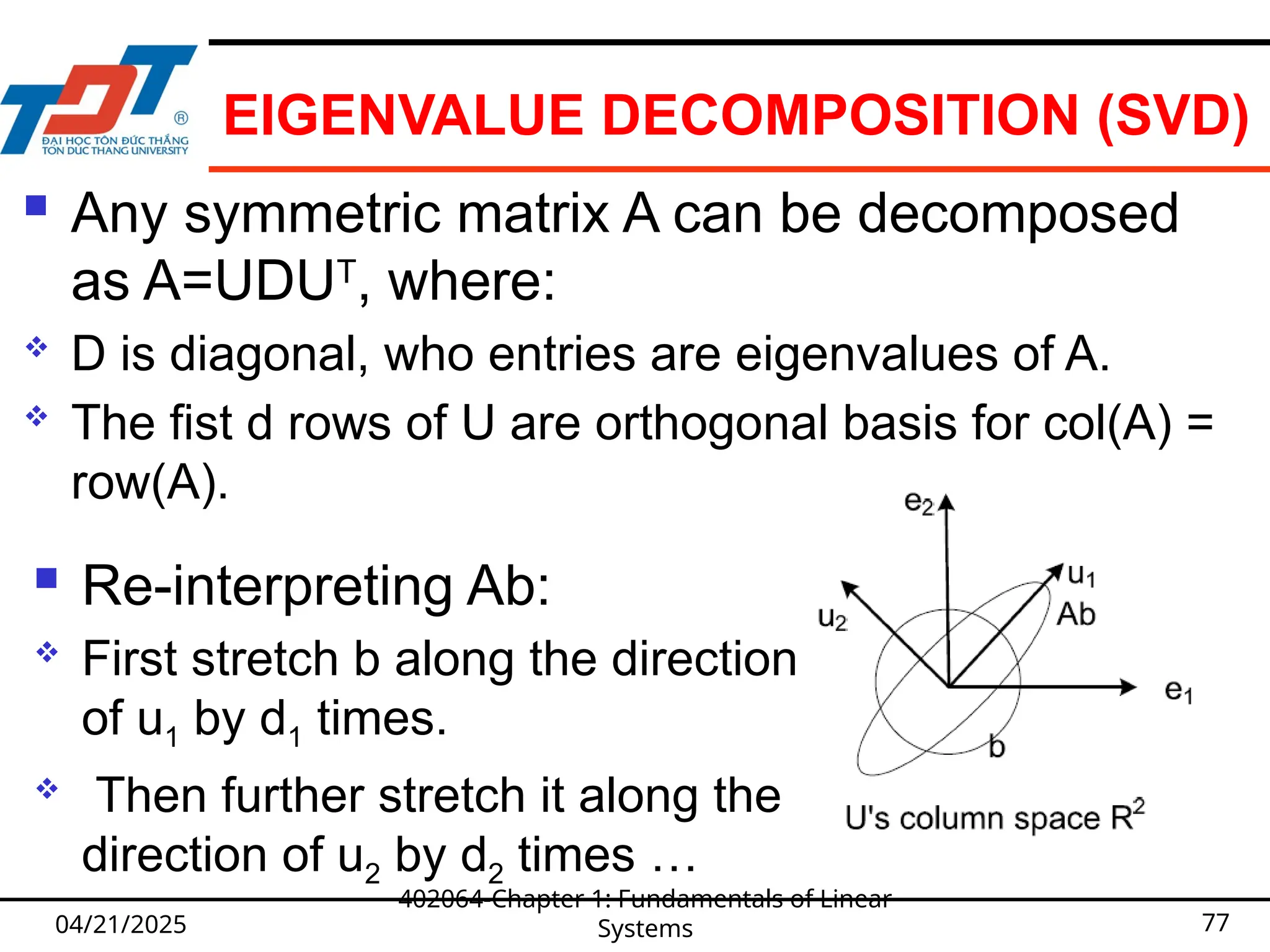
EIGENVALUE DECOMPOSITION (SVD)
 Any symmetric matrix A can be decomposed
as A=UDUT
, where:
 D is diagonal, who entries are eigenvalues of A.
 The fist d rows of U are orthogonal basis for col(A) =
row(A).
04/21/2025
402064-Chapter 1: Fundamentals of Linear
Systems 77
 Re-interpreting Ab:
 First stretch b along the direction
of u1 by d1 times.
 Then further stretch it along the
direction of u2 by d2 times …
PSEUDOINVERSE
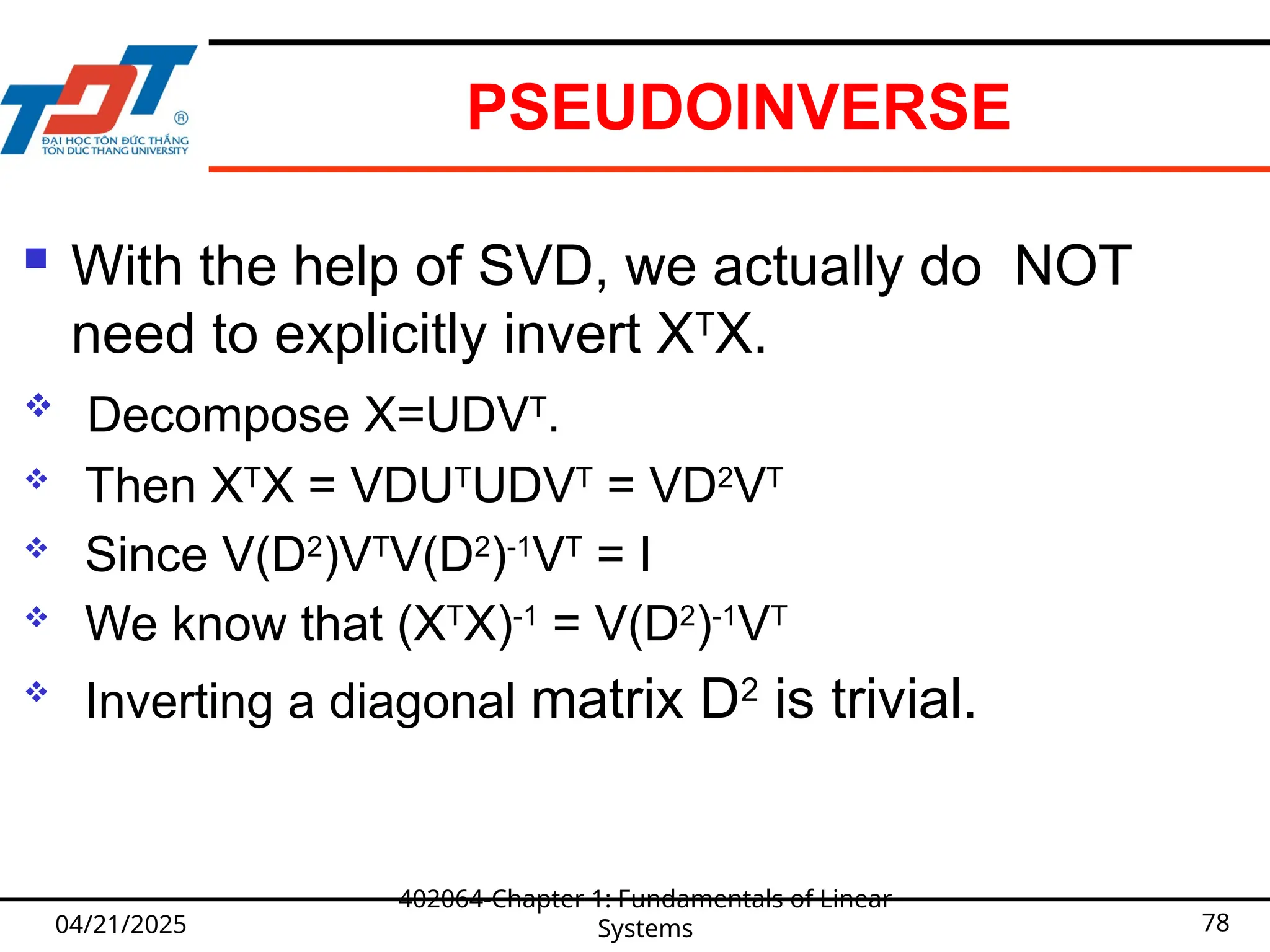
 With the help of SVD, we actually do NOT
need to explicitly invert XT
X.
 Decompose X=UDVT
.
 Then XT
X = VDUT
UDVT
= VD2
VT
 Since V(D2
)VT
V(D2
)-1
VT
= I
 We know that (XT
X)-1
= V(D2
)-1
VT

Inverting a diagonal matrix D2
is trivial.
04/21/2025
402064-Chapter 1: Fundamentals of Linear
Systems 78
WHAT WE HAVE LEARNT SO FAR?
 So far we have learnt:
 Concept of control systems
 Classification of control systems
 Assignment:
 Read more examples in textbook.
 Exercises: find more example of control
systems in real life.
04/21/2025
402064-Chapter 1: Fundamentals of Linear
Systems 79
CHAPTER 1: FUNDAMENTALS OF
LINEAR SYSTEMS
 1.1 Introduction
 1.2 Linear algebra
 1.3 Transfer function and impulse response
 1.4 Representation of control systems
04/21/2025
402064-Chapter 1: Fundamentals of Linear
Systems 80
SYSTEM MATHEMATICAL MODELS
04/21/2025
402064-Chapter 1: Fundamentals of Linear
Systems 81
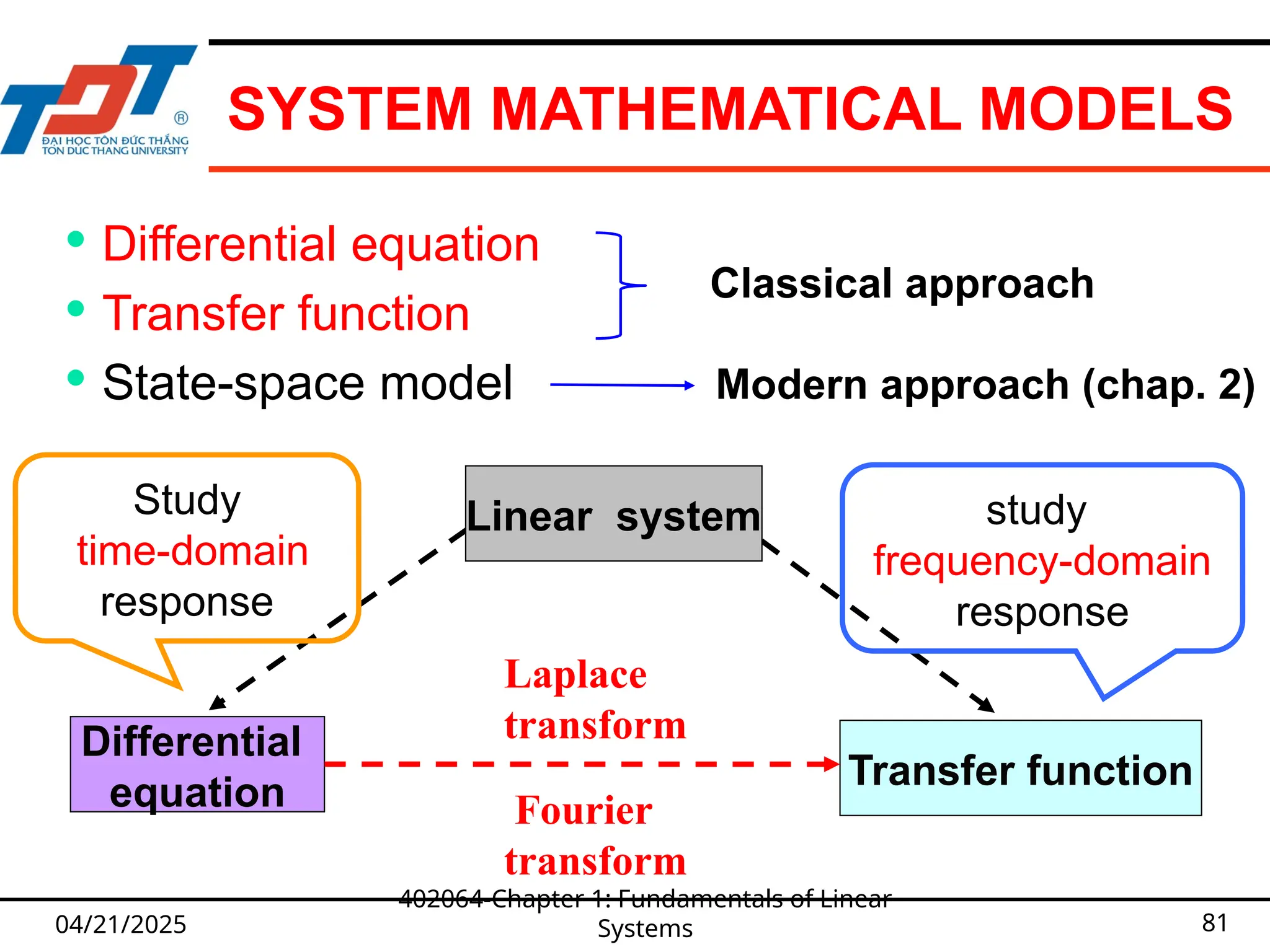
Laplace
transform
 Differential equation
 Transfer function
 State-space model
Differential
equation
Transfer function
Linear system
Study
time-domain
response
study
frequency-domain
response
Classical approach
Modern approach (chap. 2)
Fourier
transform
TRANSFER FUNCTION
04/21/2025
402064-Chapter 1: Fundamentals of Linear
Systems 82
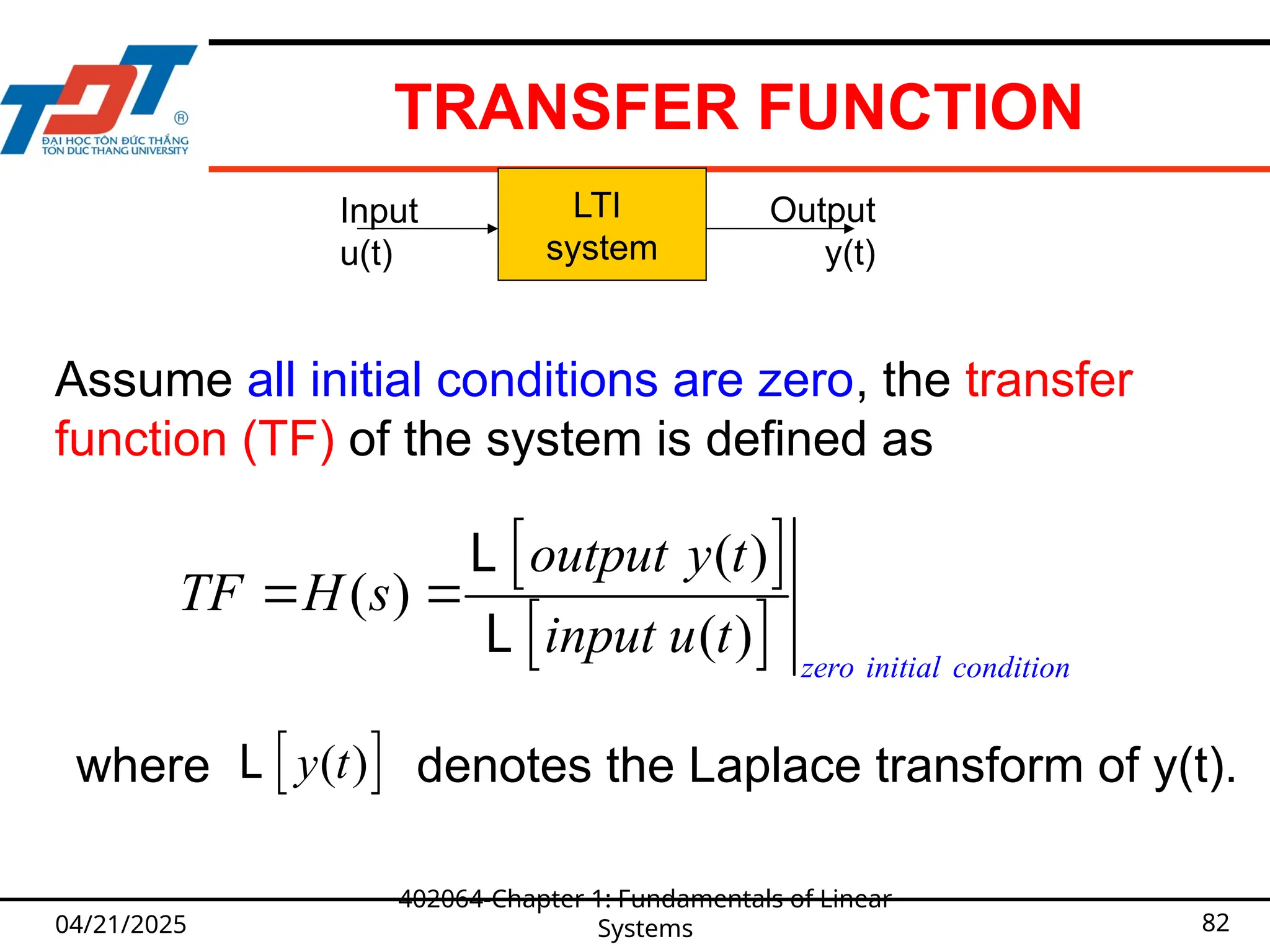
LTI
system
Input
u(t)
Output
y(t)
 
 
( )
( )
( ) zero initial condition
output y t
TF H s
input u t
 
L
L
Assume all initial conditions are zero, the transfer
function (TF) of the system is defined as
where denotes the Laplace transform of y(t).
 
( )
y t
L
EXAMPLE: RLC CIRCUIT
04/21/2025 83
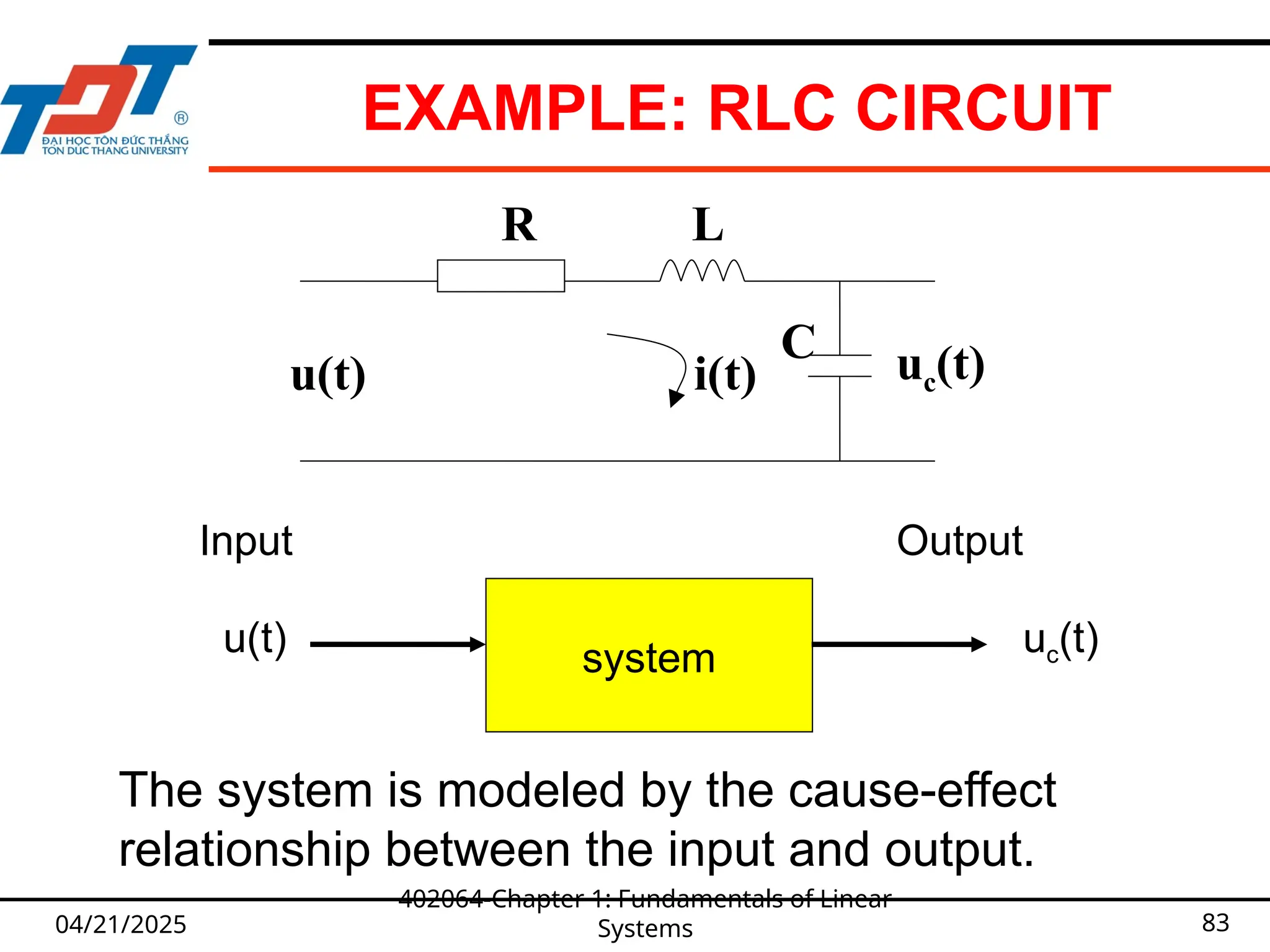
R L
C
u(t) uc(t)
i(t)
Input
u(t) system
Output
uc(t)
The system is modeled by the cause-effect
relationship between the input and output.
402064-Chapter 1: Fundamentals of Linear
Systems
EXAMPLE: RLC CIRCUIT
04/21/2025 84
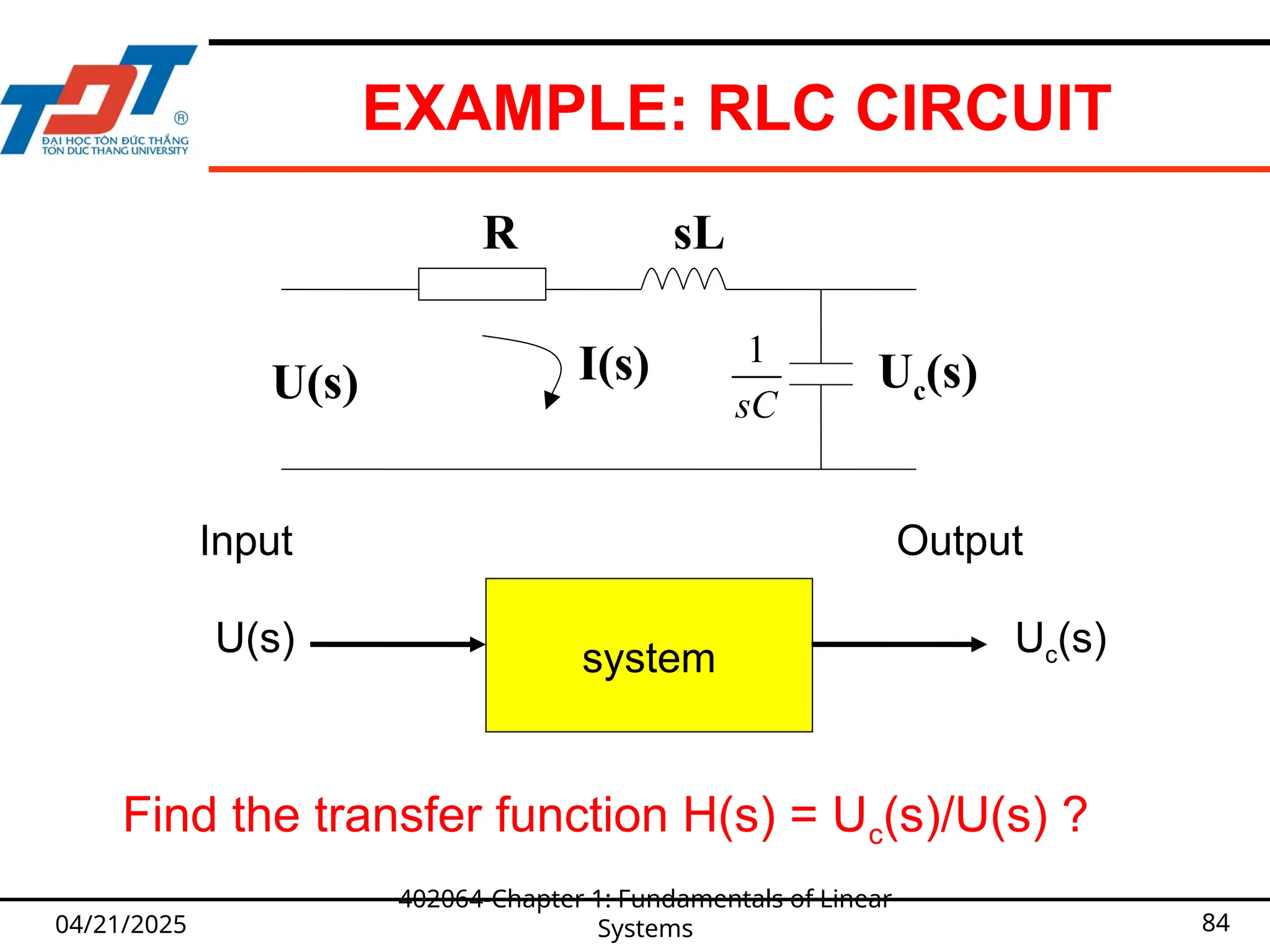
R sL
U(s) Uc(s)
I(s)
Input
U(s) system
Output
Uc(s)
Find the transfer function H(s) = Uc(s)/U(s) ?
402064-Chapter 1: Fundamentals of Linear
Systems
1
sC
EXAMPLE: RLC CIRCUIT
04/21/2025 85
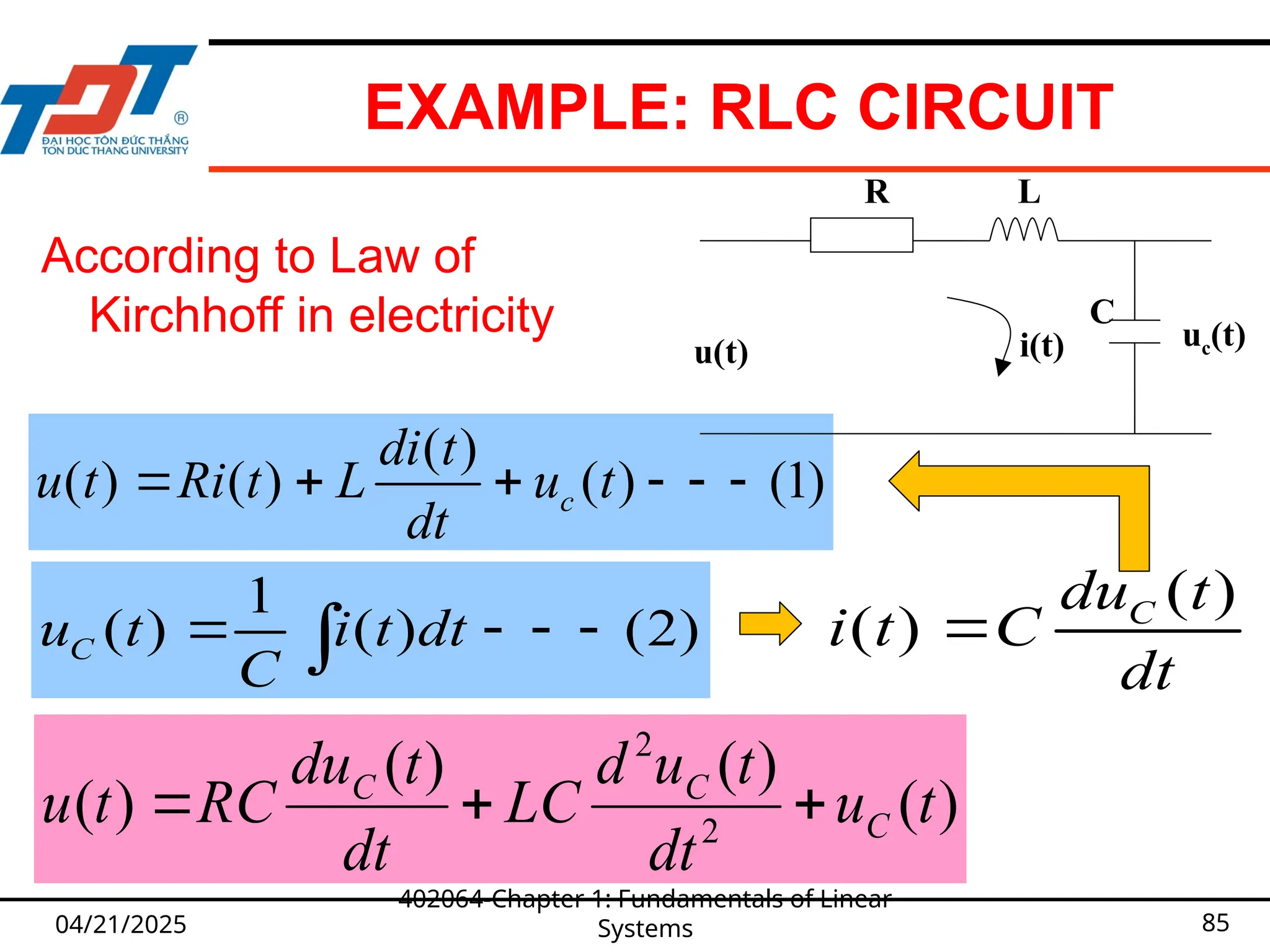
)
(
)
(
)
(
)
( 2
2
t
u
dt
t
u
d
LC
dt
t
du
RC
t
u C
C
C



According to Law of
Kirchhoff in electricity
( )
( ) ( ) ( ) (1)
c
di t
u t Ri t L u t
dt
     
1
( ) ( ) (2)
C
u t i t dt
C
   

( )
( ) C
du t
i t C
dt

R L
C
u(t) uc(t)
i(t)
402064-Chapter 1: Fundamentals of Linear
Systems
EXAMPLE – RLC CIRCUIT
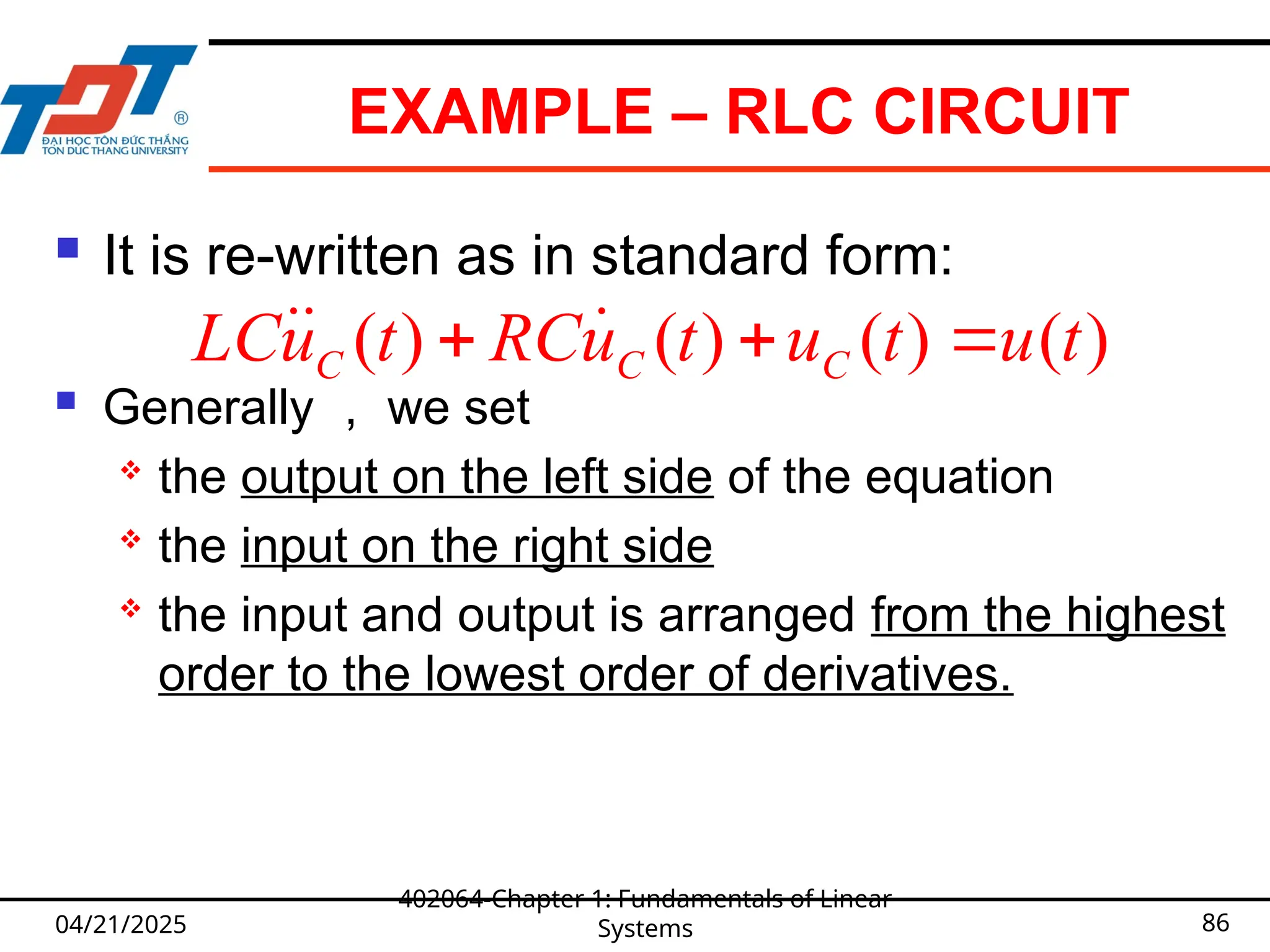
 It is re-written as in standard form:
 Generally , we set
 the output on the left side of the equation
 the input on the right side
 the input and output is arranged from the highest
order to the lowest order of derivatives.
04/21/2025
402064-Chapter 1: Fundamentals of Linear
Systems 86
( ) ( ) ( ) ( )
C C C
LCu t RCu t u t u t
  
 
LAPLACE TRANSFORM
04/21/2025
402064-Chapter 1: Fundamentals of Linear
Systems 87
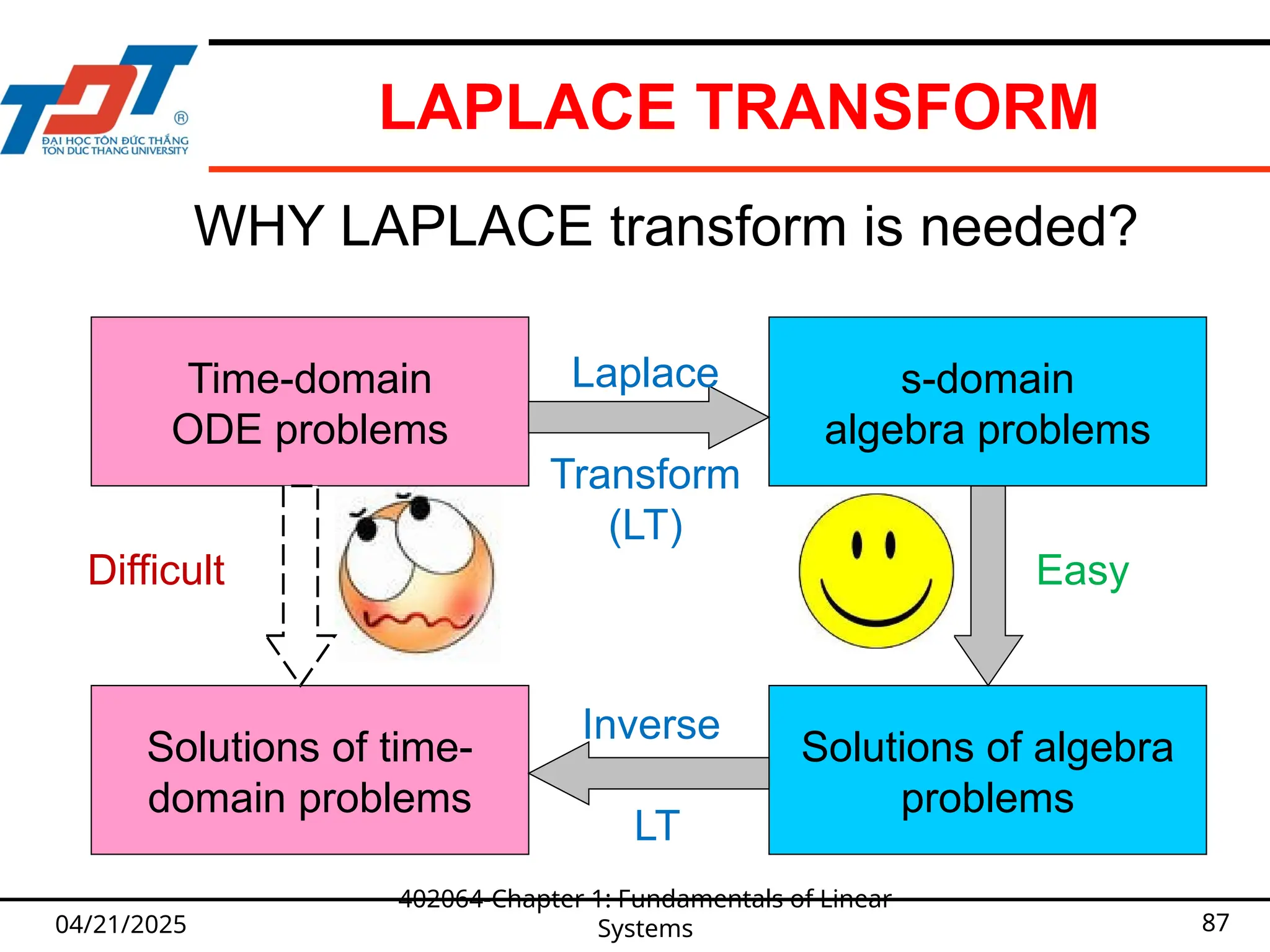
WHY LAPLACE transform is needed?
s-domain
algebra problems
Solutions of algebra
problems
Time-domain
ODE problems
Solutions of time-
domain problems
Laplace
Transform
(LT)
Inverse
LT
Difficult Easy
TF OF TYPICAL COMPONENTS
04/21/2025
402064-Chapter 1: Fundamentals of Linear
Systems 88
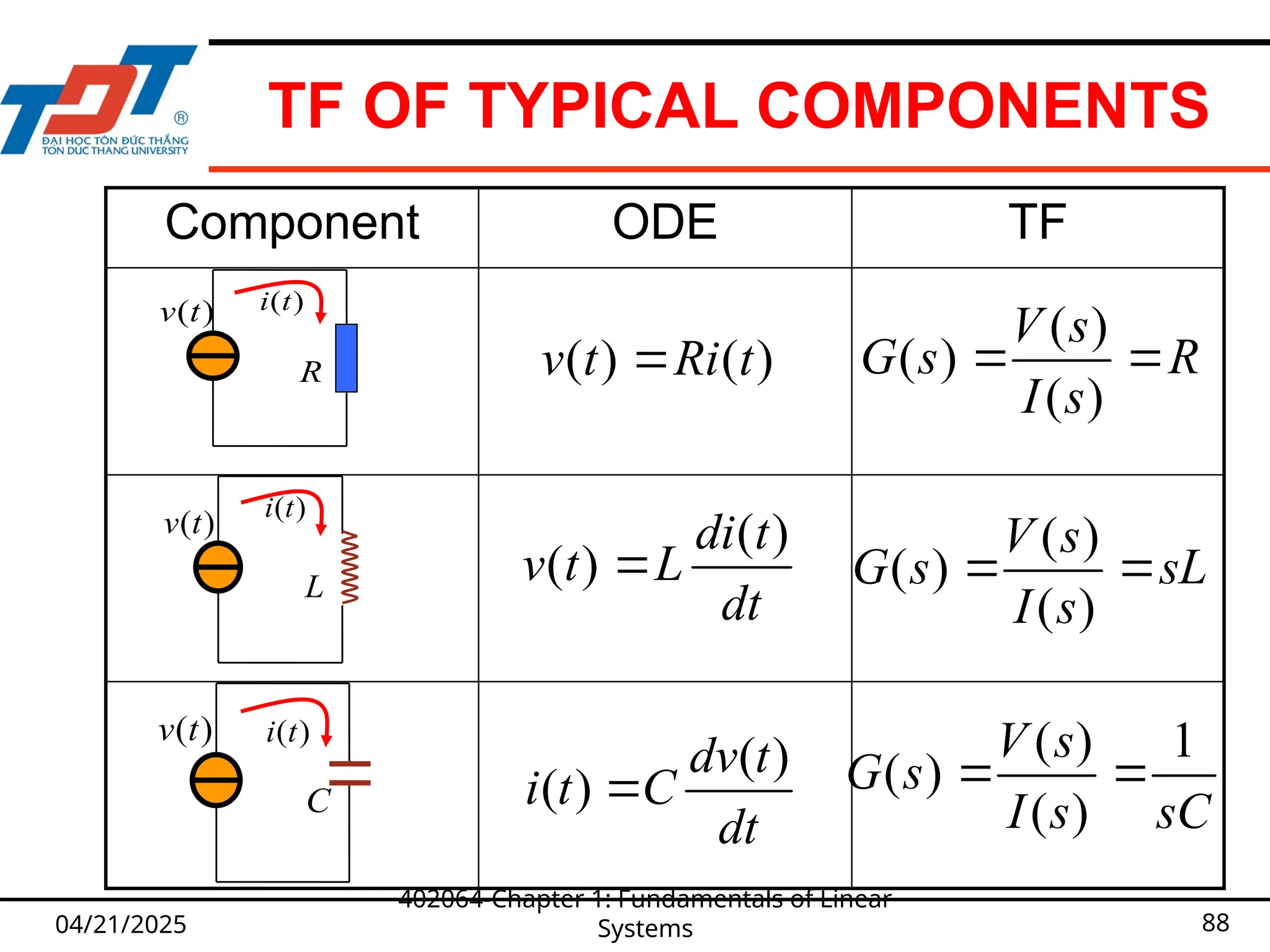
Component ODE TF
( )
v t ( )
i t
R ( ) ( )
v t Ri t

( )
( )
( )
V s
G s R
I s
 
( )
v t
( )
i t
L
( )
( )
di t
v t L
dt

( )
( )
( )
V s
G s sL
I s
 
( )
v t ( )
i t
C
( )
( )
dv t
i t C
dt

( ) 1
( )
( )
V s
G s
I s sC
 
EXERCISE
04/21/2025
402064-Chapter 1: Fundamentals of Linear
Systems 89
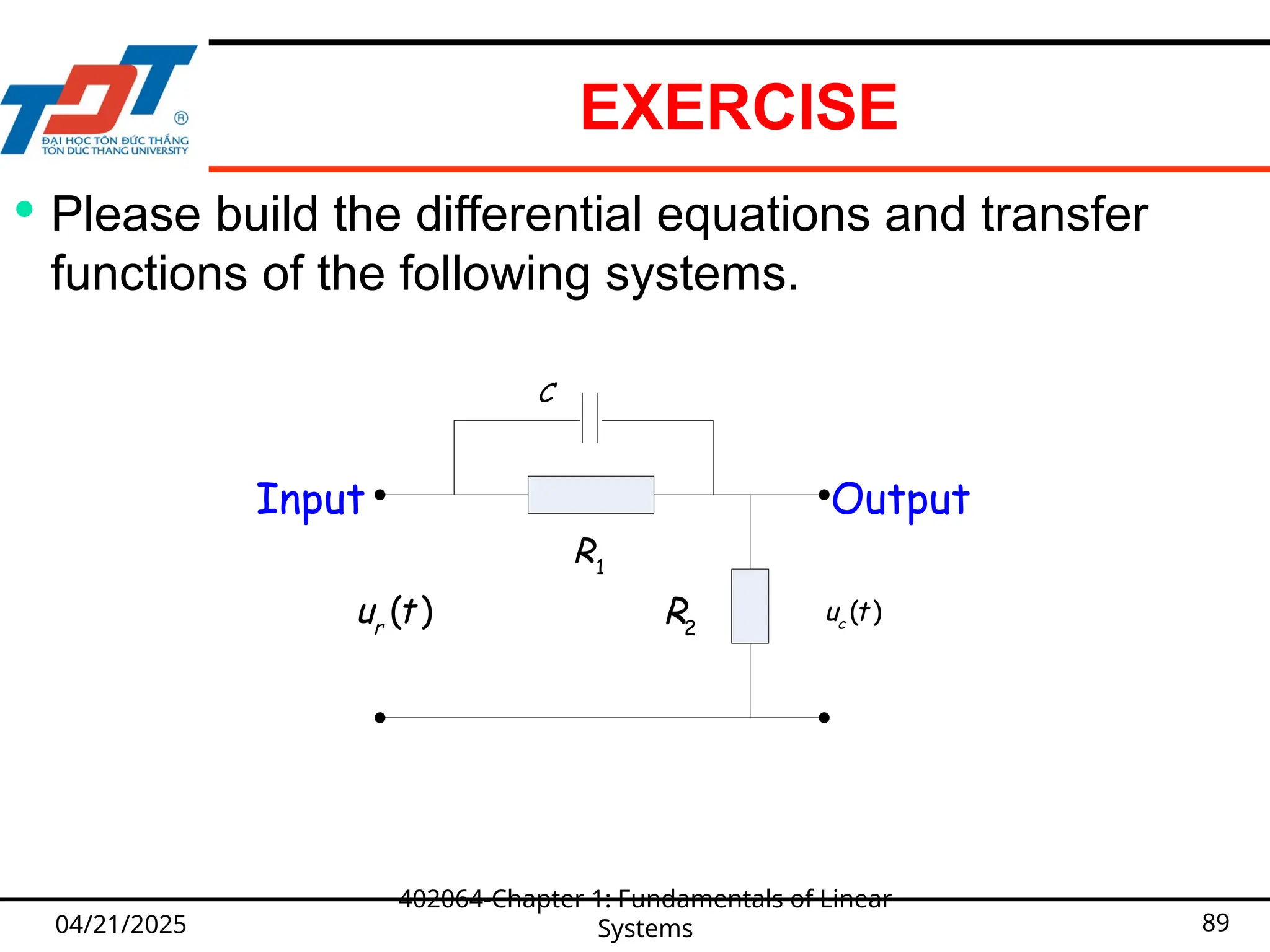
 Please build the differential equations and transfer
functions of the following systems.
Output
Input
1
R
2
R
C
( )
r
u t ( )
c
u t
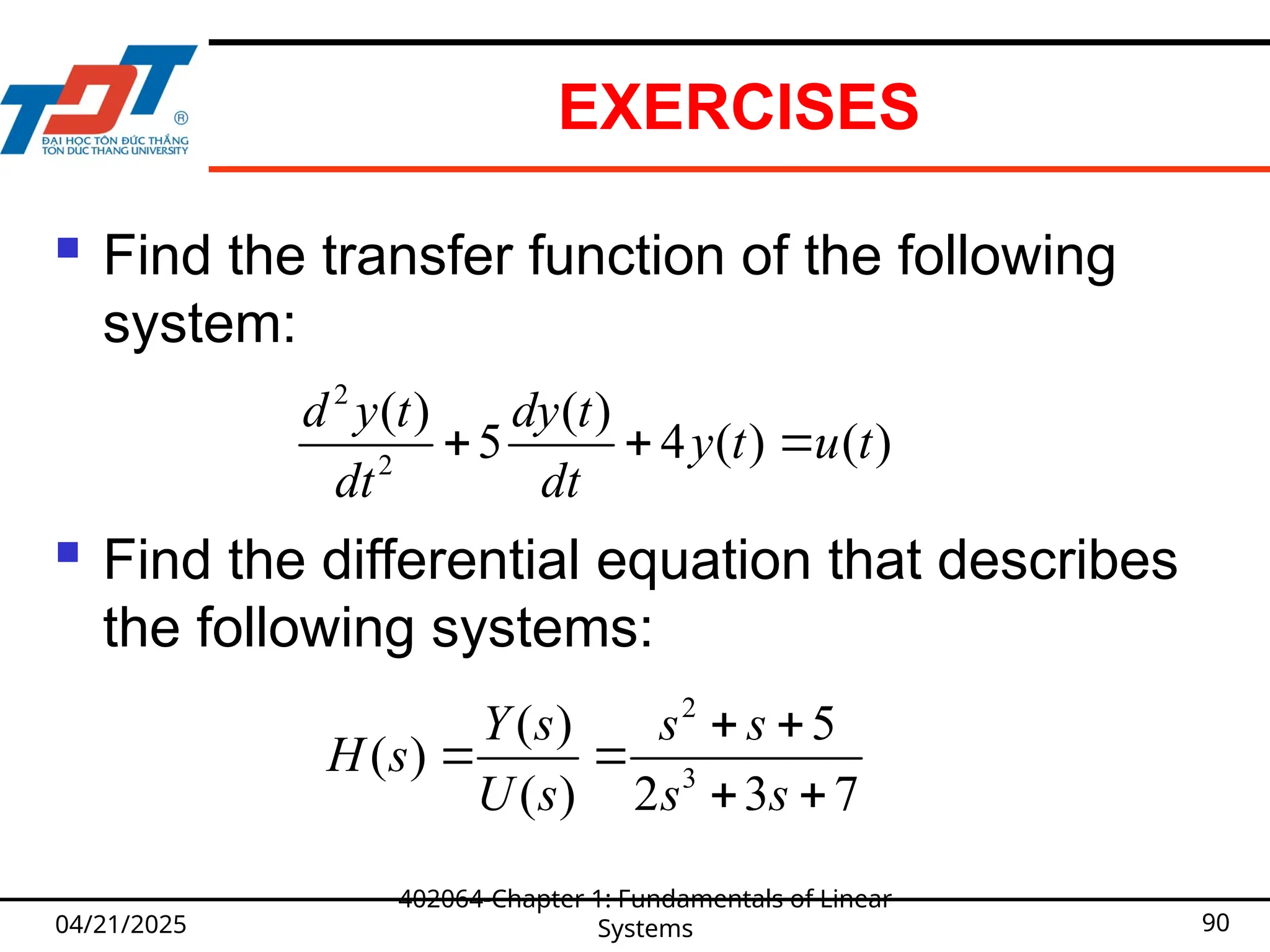
EXERCISES
 Find the transfer function of the following
system:
 Find the differential equation that describes
the following systems:
04/21/2025
402064-Chapter 1: Fundamentals of Linear
Systems 90
2
2
( ) ( )
5 4 ( ) ( )
d y t dy t
y t u t
dt dt
  
2
3
( ) 5
( )
( ) 2 3 7
Y s s s
H s
U s s s
 
 
 
PROPERTIES OF TRANSFER
FUNCTION
 The transfer function is defined only for a linear
time-invariant system, not for nonlinear system.
 All initial conditions of the system are set to zero.
 The transfer function is independent of the input of
the system.
 The transfer function G(s) is the Laplace transform
of the unit impulse response g(t).
04/21/2025
402064-Chapter 1: Fundamentals of Linear
Systems 91
IMPULSE RESPONSE
 Consider the output of a LTI system to a unit-
impulse input when the initial conditions are zero.
 The Laplace transform of the output of the system is
Y(s) = G(s).1 = G(s) (since the Laplace transform of
the unit-impulse function is unity)
 Definition: the inverse Laplace transform of G(s),
or , is called the impulse-response
function of the system.
04/21/2025
402064-Chapter 1: Fundamentals of Linear
Systems 92
1
[ ( )] g(t)
G s


L
REVIEW QUESTIONS AND
ASSIGNMENTS
 Review questions:
 What is the definition of “transfer function”?
 When defining the transfer function, what happens
to initial conditions of the system?
 Does a nonlinear system have a transfer function?
 How does a transfer function of a LTI system relate
to its impulse response?
 Assignments: B-2-9 and the exercises from
next slide.
04/21/2025
402064-Chapter 1: Fundamentals of Linear
Systems 93
CHAPTER 1: FUNDAMENTALS OF
LINEAR SYSTEMS
 1.1 Introduction
 1.2 Linear algebra
 1.3 Transfer function and impulse response
 1.4 Representation of control systems
04/21/2025
402064-Chapter 1: Fundamentals of Linear
Systems 94
BLOCK DIAGRAM OF LTI CONTROL
SYSTEMS
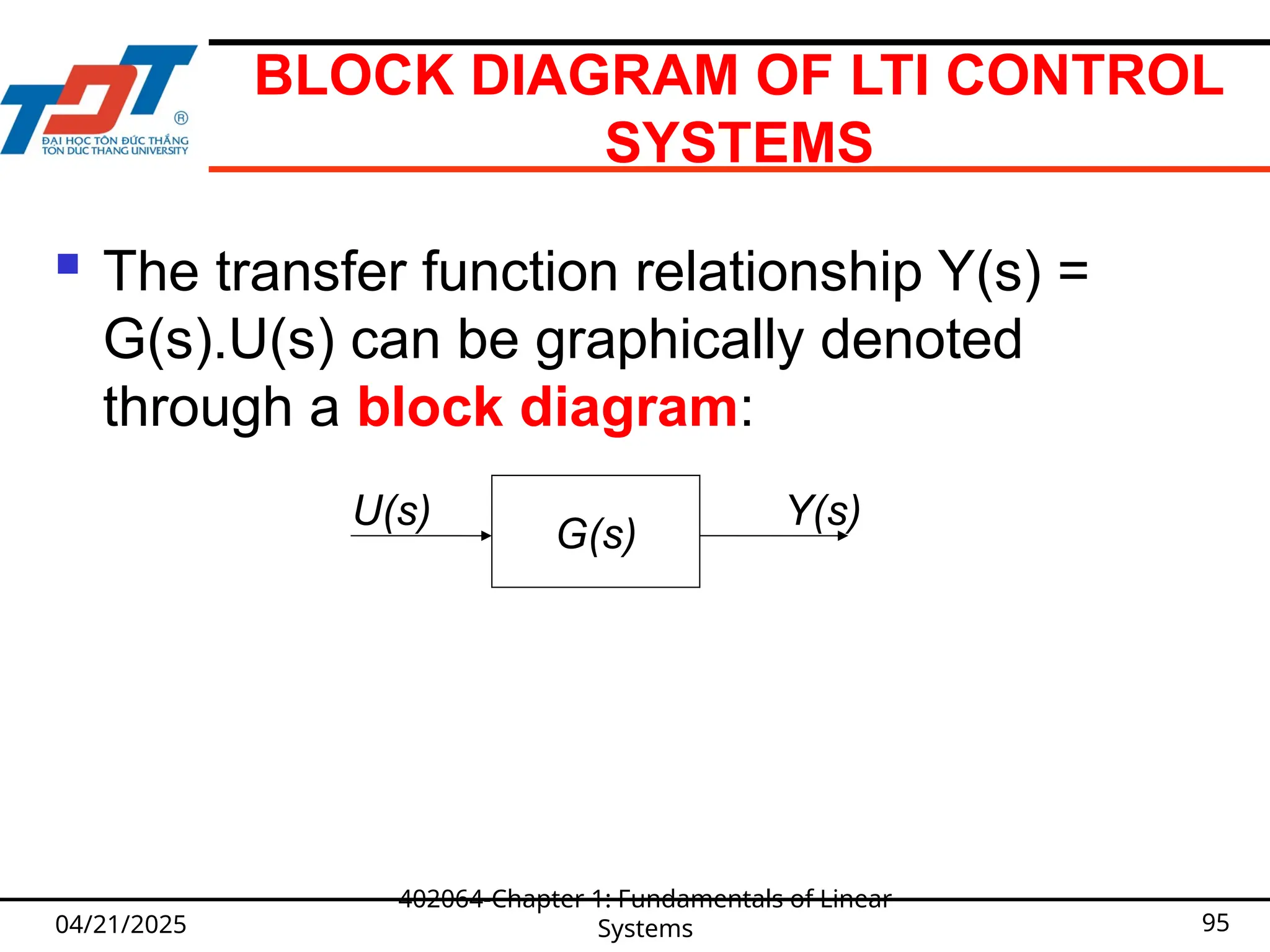
 The transfer function relationship Y(s) =
G(s).U(s) can be graphically denoted
through a block diagram:
04/21/2025
402064-Chapter 1: Fundamentals of Linear
Systems 95
G(s)
U(s) Y(s)
EQUIVALENT TRANSFORM OF
BLOCK DIAGRAM
04/21/2025
402064-Chapter 1: Fundamentals of Linear
Systems 96
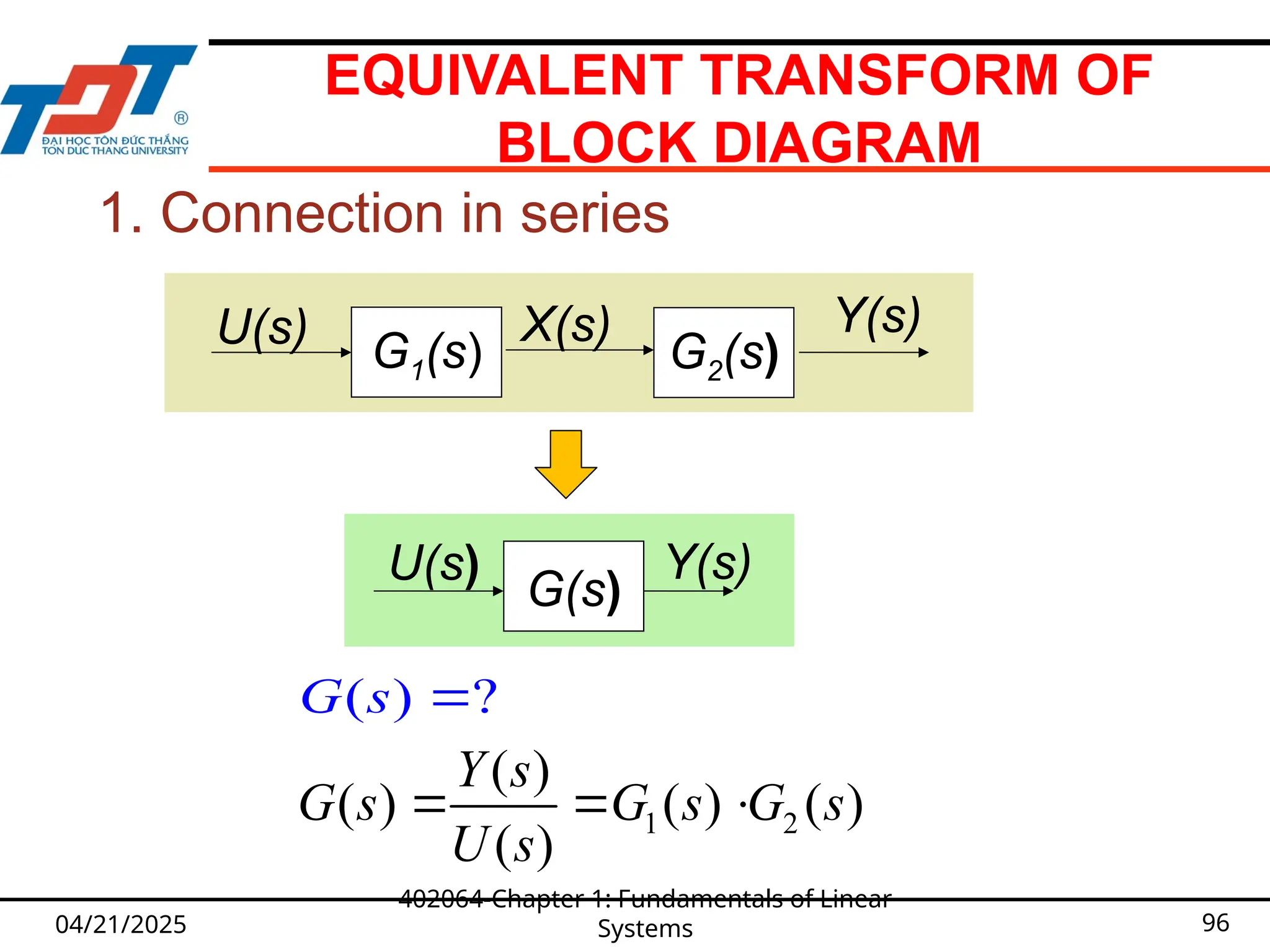
1. Connection in series
G(s)
U(s) Y(s)
( ) ?
G s 
X(s)
G1(s) G2(s)
U(s) Y(s)
1 2
( )
( ) ( ) ( )
( )
Y s
G s G s G s
U s
  
EQUIVALENT TRANSFORM OF
BLOCK DIAGRAM
04/21/2025
402064-Chapter 1: Fundamentals of Linear
Systems 97
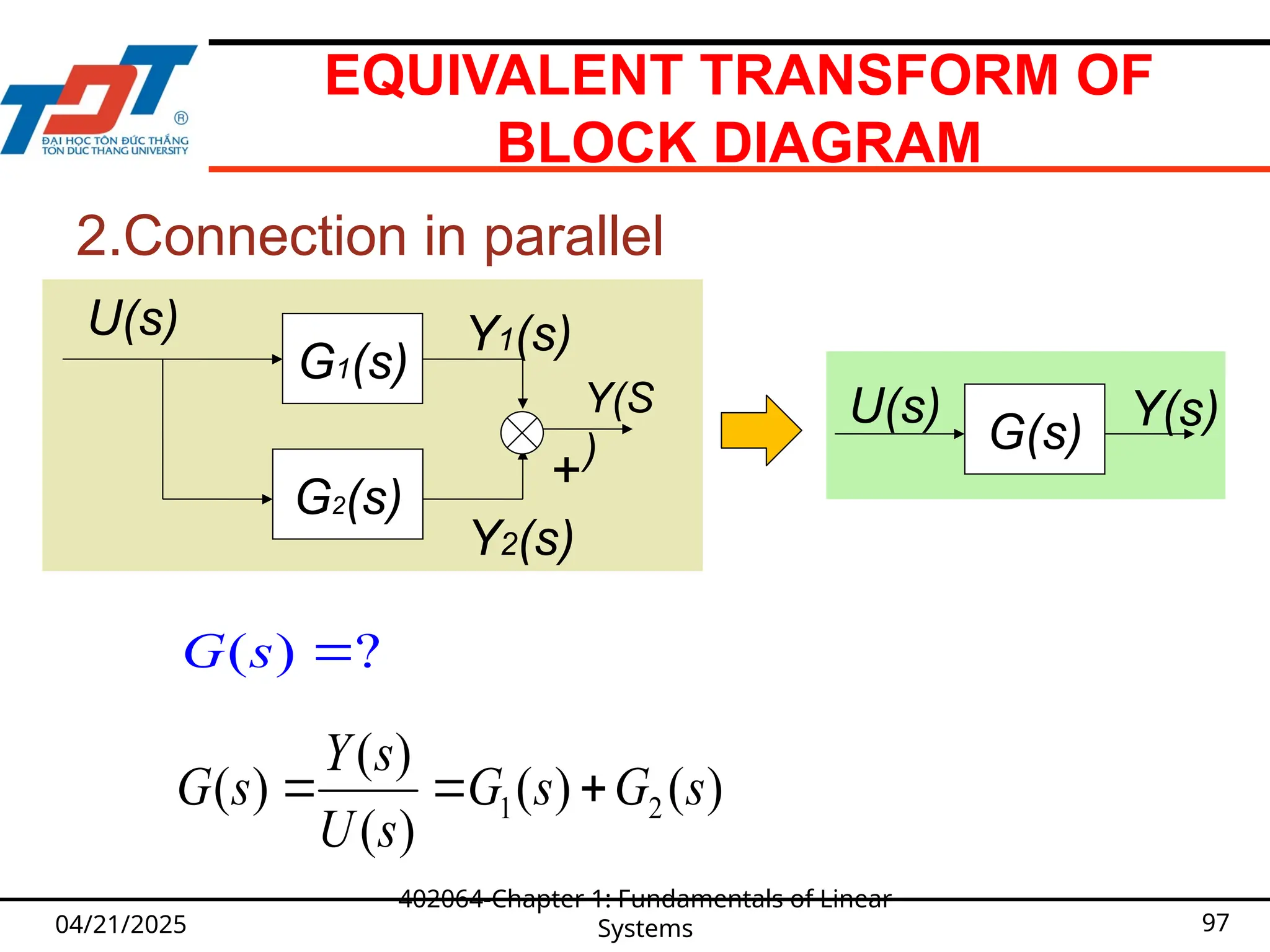
2.Connection in parallel
G(s)
U(s) Y(s)
1 2
( )
( ) ( ) ( )
( )
Y s
G s G s G s
U s
  
U(s)
G2(s)
G1(s)
Y1(s)
Y2(s)

Y(S
)
( ) ?
G s 
EQUIVALENT TRANSFORM OF
BLOCK DIAGRAM
04/21/2025
402064-Chapter 1: Fundamentals of Linear
Systems 98
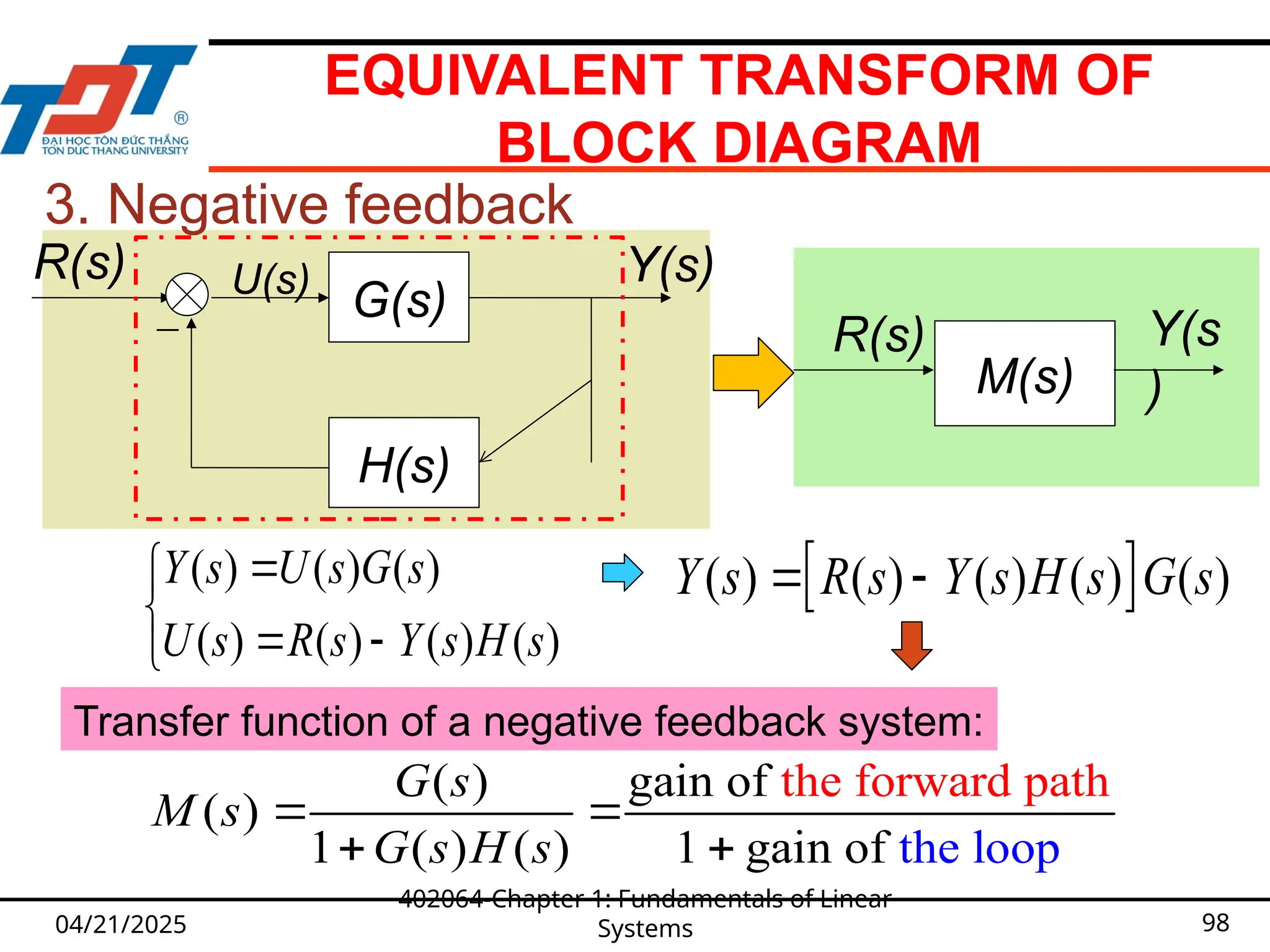
3. Negative feedback
M(s)
R(s) Y(s
)
( ) ( ) ( )
( ) ( ) ( ) ( )
Y s U s G s
U s R s Y s H s



 

the for
( w
) a
gain of
( )
1
rd path
( ) ( ) 1 gai the loop
n of
G s
M s
G s H s
 
 
 
( ) ( ) ( ) ( ) ( )
Y s R s Y s H s G s
 
Y(s)
G(s)
H(s)
U(s)
R(s)
_
Transfer function of a negative feedback system:
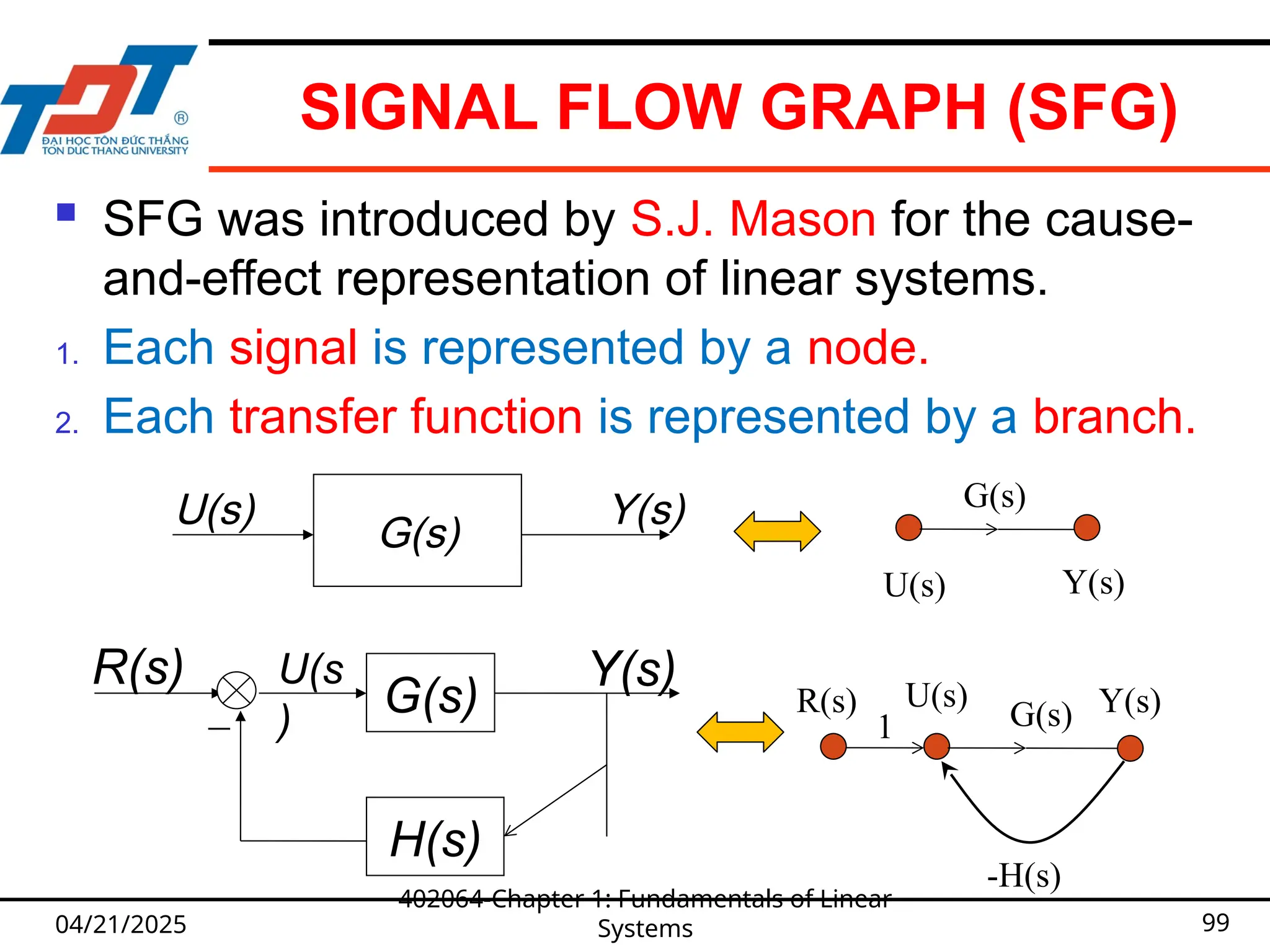
SIGNAL FLOW GRAPH (SFG)
 SFG was introduced by S.J. Mason for the cause-
and-effect representation of linear systems.
1. Each signal is represented by a node.
2. Each transfer function is represented by a branch.
04/21/2025
402064-Chapter 1: Fundamentals of Linear
Systems 99
G(s)
U(s) Y(s)
G(s)
H(s)
U(s
)
R(s)
_
Y(s)
G(s)
U(s) Y(s)
G(s)
U(s) Y(s)
R(s)
-H(s)
1
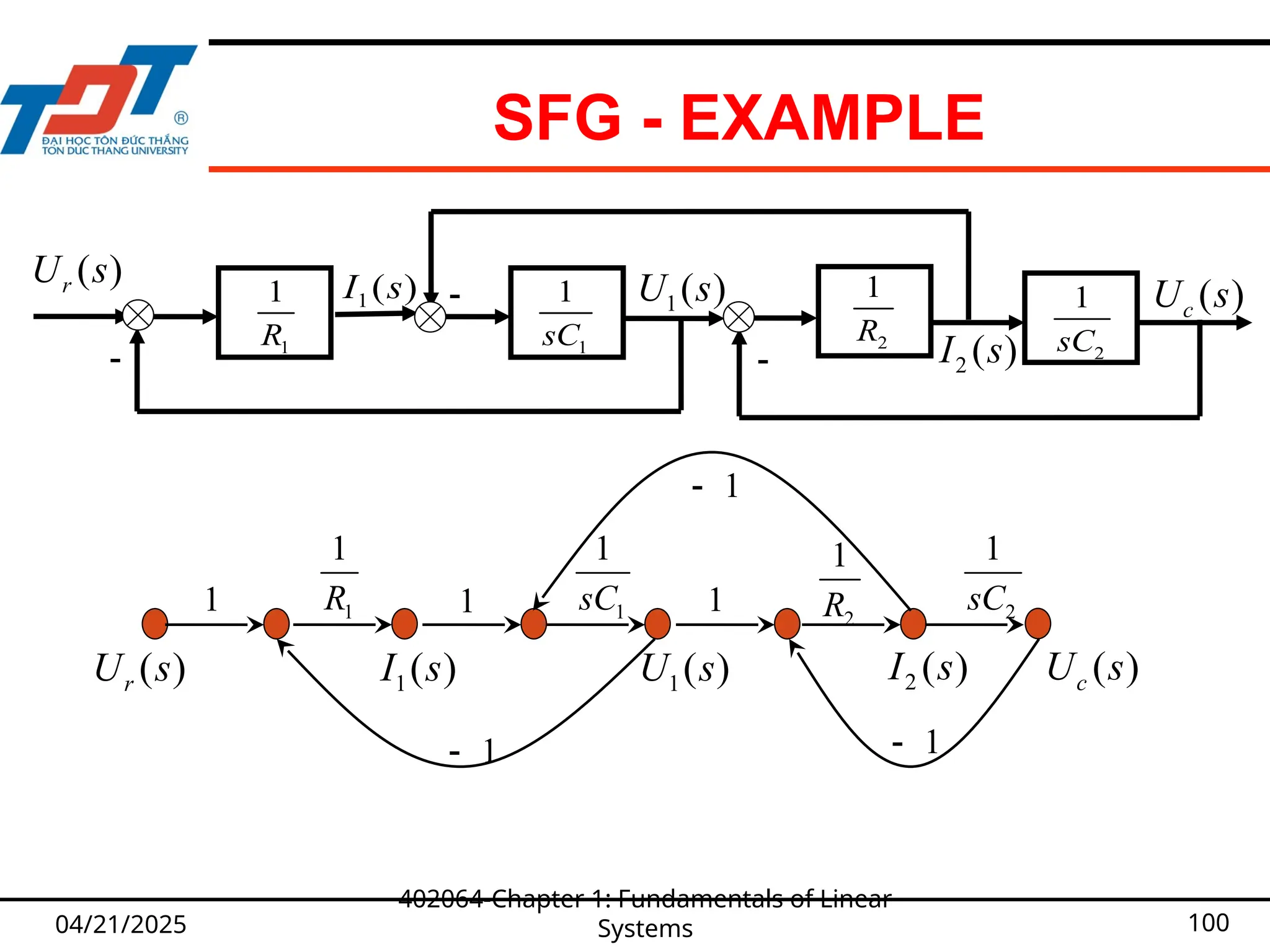
SFG - EXAMPLE
04/21/2025
402064-Chapter 1: Fundamentals of Linear
Systems 100
( )
r
U s
1 ( )
I s
2 ( )
I s
( )
c
U s
1( )
U s
- 1
1
R 1
1
sC
-
2
1
R
- 2
1
sC
( )
r
U s 1( )
I s 1( )
U s 2 ( )
I s ( )
c
U s
1
1
R 1
1
sC 2
1
R 2
1
sC
- 1 - 1
- 1
1 1 1
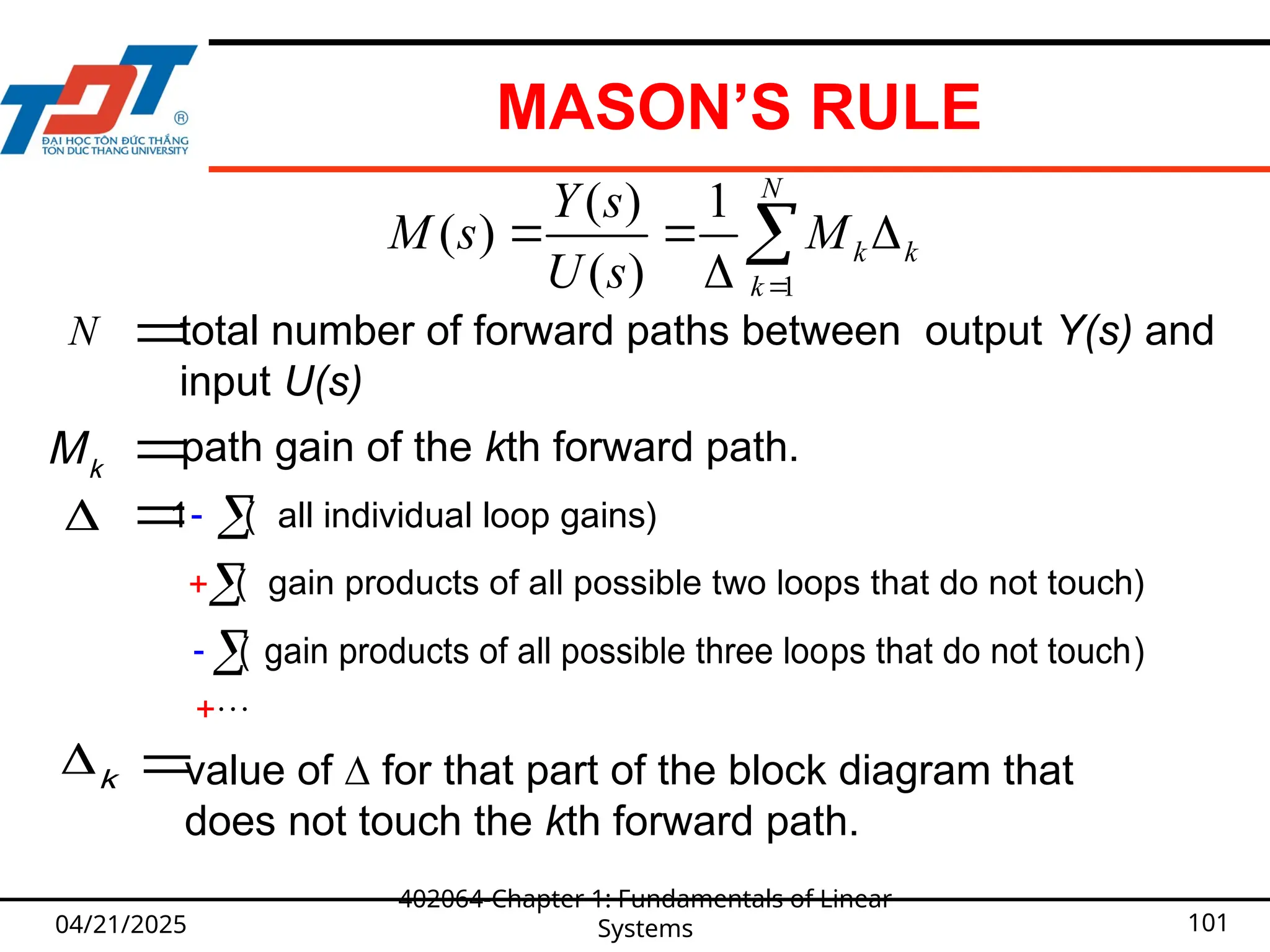
MASON’S RULE
04/21/2025
402064-Chapter 1: Fundamentals of Linear
Systems 101
1
( ) 1
( )
( )
N
k k
k
Y s
M s M
U s 
  


k
M path gain of the kth forward path.


 
1 ( all individual loop gains)
 ( gain products of all possible three loops that do not touch)
( gain products of all possible two loops that do not touch)

k 
value of ∆ for that part of the block diagram that
does not touch the kth forward path.

N 
total number of forward paths between output Y(s) and
input U(s)
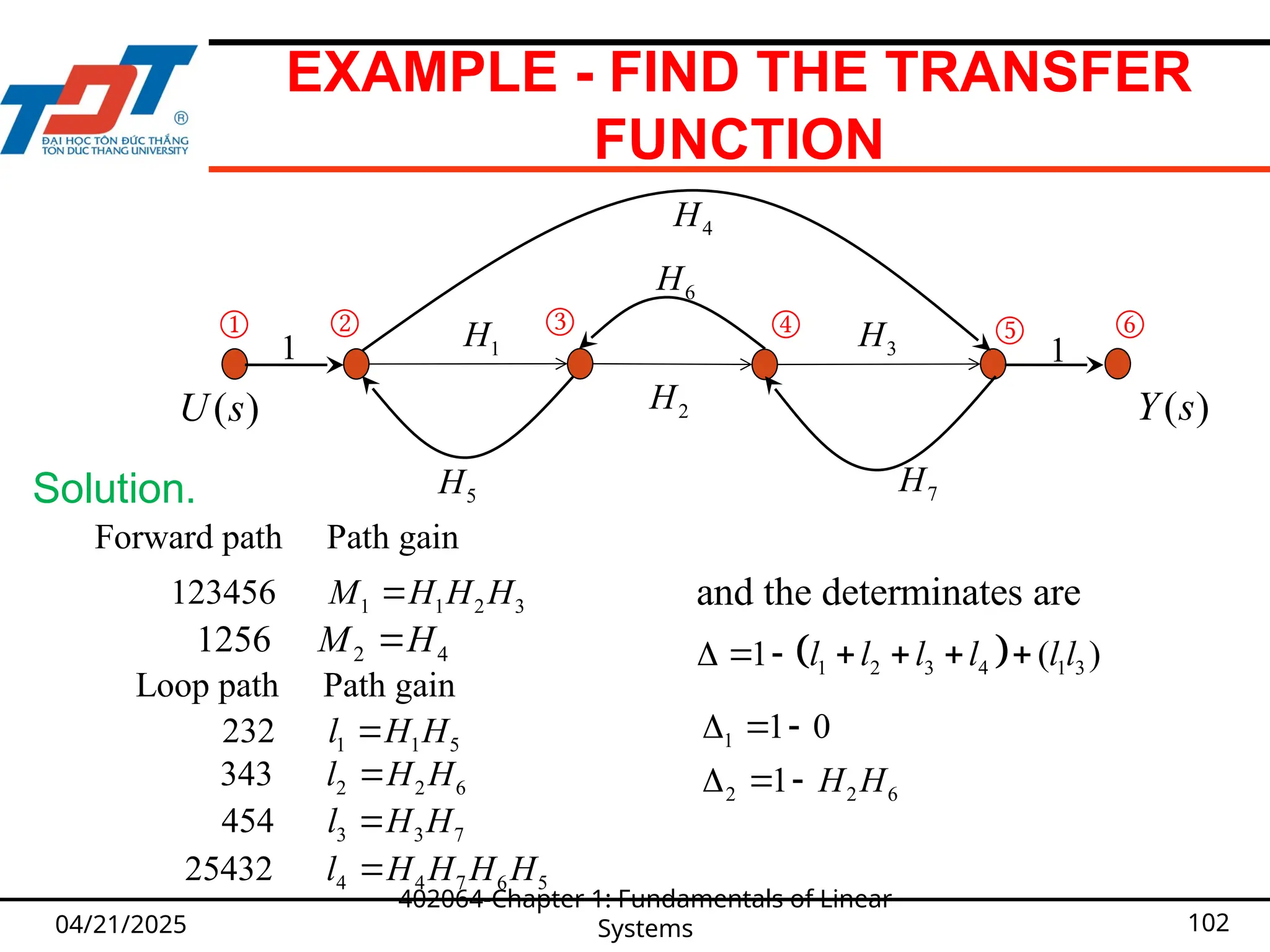
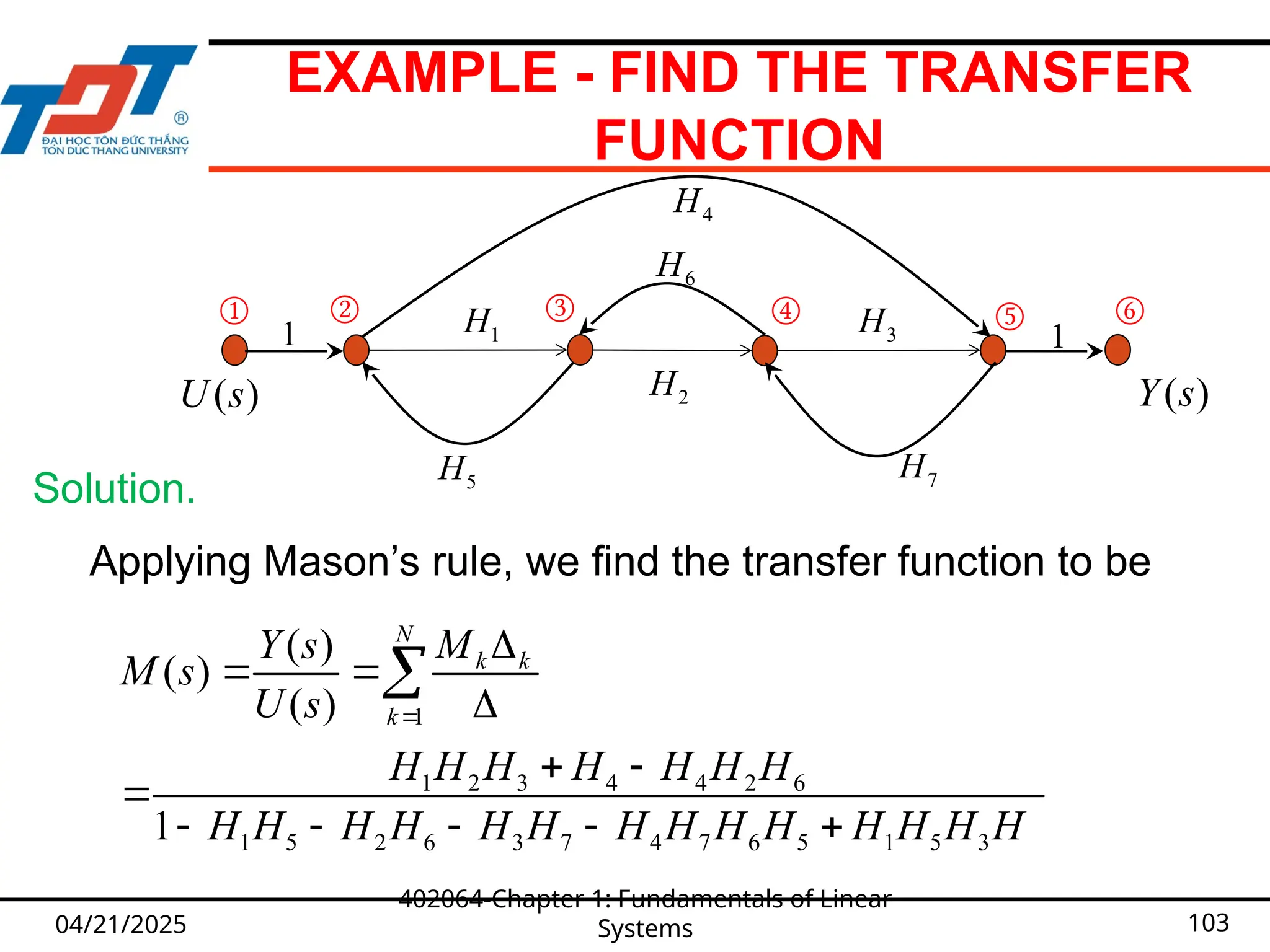
EXAMPLE - FIND THE TRANSFER
FUNCTION
04/21/2025
402064-Chapter 1: Fundamentals of Linear
Systems 102
Solution.
Forward path Path gain
and the determinates are
1 1 2 3
123456 M H H H

2 4
1256 M H

Loop path Path gain
1 1 5
232 l H H

2 2 6
343 l H H

3 3 7
454 l H H

4 4 7 6 5
25432 l H H H H

 
1 2 3 4 1 3
1 ( )
l l l l l l
      
1
2 2 6
1 0
1 H H
  
  
( )
U s ( )
Y s
5
H
1 1
H
4
H
6
H
7
H
2
H
3
H 1
① ② ③ ④ ⑤ ⑥
EXAMPLE - FIND THE TRANSFER
FUNCTION
04/21/2025
402064-Chapter 1: Fundamentals of Linear
Systems 103
Solution.
( )
U s ( )
Y s
5
H
1 1
H
4
H
6
H
7
H
2
H
3
H 1
① ② ③ ④ ⑤ ⑥
1
1 2 3 4 4 2 6
1 5 2 6 3 7 4 7 6 5 1 5 3
( )
( )
( )
1
N
k k
k
M
Y s
M s
U s
H H H H H H H
H H H H H H H H H H H H H H


 

 

    

Applying Mason’s rule, we find the transfer function to be
SUMMARY AND ASSIGNMENT
 In this chapter, we have learnt:
 Basic concept and classification of control
systems.
 Review of linear algebra
 Mathematical model of LTI systems
 Graphical representation of LTI systems.
 Assignments: B-2-5 to B-2-8.
 Reading assignment: Ogata - chapter 2 (pp.
29-39).
04/21/2025
402064-Chapter 1: Fundamentals of Linear
Systems 104
402064 - ENGINEERING ANALYSIS - CHAPTER 1.pptx

  • 1.
    402064 ENGINEERING ANALYSIS CHAPTER 1:FUNDAMENTALS OF LINEAR SYSTEMS Hoang Thi Huong Giang, PhD . TON DUC THANG UNIVERSITY FACULTY OF ELECTRICAL & ELECTRONICS ENGINEERING DEPARTMENT OF ELECTRONICS & TELECOMMUNICATIONS
  • 2.
    CHAPTER 1: FUNDAMENTALSOF LINEAR SYSTEMS  1.1 Introduction  1.2 Linear algebra  1.3 Transfer function and impulse response  1.4 Representation of control systems 04/21/2025 402064-Chapter 1: Fundamentals of Linear Systems 2
  • 3.
    OBJECTIVES  Understand thebasic concepts and disciplines of automatic control.  Learn the different between classical and modern modelling of control systems  Review the representation of linear control systems 04/21/2025 402064-Chapter 1: Fundamentals of Linear Systems 3
  • 4.
    CHAPTER 1: FUNDAMENTALSOF LINEAR SYSTEMS  1.1 Introduction  1.2 Linear algebra  1.3 Transfer function and impulse response  1.4 Representation of control systems 04/21/2025 402064-Chapter 1: Fundamentals of Linear Systems 4
  • 5.
    CLASSICAL VS. MODERNCONTROL 04/21/2025 402064-Chapter 1: Fundamentals of Linear Systems 5 Classical Control • System Modelling • Transfer Function • Block Diagrams • Signal Flow Graphs • System Analysis • Time Domain Analysis (Test Signals) • Frequency Domain Analysis • Bode Plots • Nyquist Plots • Nichol’s Chart Modern Control • State Space Modelling • Eigenvalue Analysis • Observability and Controllability • Solution of State Equations (state Transition Matrix) • State Space to Transfer Function • Transfer Function to State Space
  • 6.
    WHAT IS ACONTROL SYSTEM? 04/21/2025 402064-Chapter 1: Fundamentals of Linear Systems 6  Generally speaking, a control system is a system that is used to realize a desired output or objective.  Control systems are everywhere:  They appear in our homes, in cars, in industry, in scientific labs, and in hospital…  Principles of control have an impact on diverse fields as engineering, aeronautics ,economics, biology and medicine…  Wide applicability of control has many advantages (e.g., it is a good vehicle for technology transfer)
  • 7.
    WHAT DO THESETWO HAVE IN COMMON? 04/21/2025 402064-Chapter 1: Fundamentals of Linear Systems 7 Tornado Boeing 777 • Highly nonlinear, complicated dynamics! • Both are capable of transporting goods and people over long distances BUT • One is controlled, and the other is not. • Control is “the hidden technology that you meet every day” • It heavily relies on the notion of “feedback”
  • 8.
    DEFINITIONS 04/21/2025 402064-Chapter 1: Fundamentalsof Linear Systems 8  System – An interconnection of elements and devices for a desired purpose.  Control System – An interconnection of components forming a system configuration that will provide a desired response.  Process – The device or system under control. The input and output relationship represents the cause-and-effect relationship of the process. Process Output Input
  • 9.
    DEFINITIONS 04/21/2025 402064-Chapter 1: Fundamentalsof Linear Systems 9  Controlled Variable – It is the quantity or condition that is measured and Controlled. Normally controlled variable is the output of the control system.  Manipulated Variable – It is the quantity of the condition that is varied by the controller so as to affect the value of controlled variable.  Control – Control means monitoring controlled variables and applying the manipulated variables to the system to correct or limit the deviation of the measured value from a desired value.
  • 10.
    DEFINITIONS 04/21/2025 402064-Chapter 1: Fundamentalsof Linear Systems 10  Disturbances – A disturbance is a signal that tends to adversely affect the value of the system. It is an unwanted input of the system.  If a disturbance is generated within the system, it is called internal disturbance. While an external disturbance is generated outside the system. Controller Output Or Controlled Variable Input or Set point or reference Process Manipulated Variable
  • 11.
    BRIEF HISTORY OFCONTROL 04/21/2025 402064-Chapter 1: Fundamentals of Linear Systems 11  Two of the earliest examples  Water clock (270 BC)  Self-leveling wine vessel (100BC) The idea is still used today, i.e. flush toilet
  • 12.
    BRIEF HISTORY OFCONTROL 04/21/2025 402064-Chapter 1: Fundamentals of Linear Systems 12  Fly-ball governor (James Watt,1769) • the first modern controller • regulated speed of steam engine • reduced effects of variances in load • propelled Industrial Revolution
  • 13.
    CLASSIFICATION OF CONTROL SYSTEMS 04/21/2025 402064-Chapter1: Fundamentals of Linear Systems 13 Control Systems Natural Man-made Manual Automatic Open-loopClosed-loop Non-linear linear Time variant Time invariant Non-linear linear Time variant Time invariant L T I C o n t r o l S y s t e m s
  • 14.
    TYPES OF CONTROLSYSTEMS  Open-Loop Control Systems utilize a controller or control actuator to obtain the desired response. 04/21/2025 402064-Chapter 1: Fundamentals of Linear Systems 14 Controller Output Input Process  Output has no effect on the control action.  In other words output is neither measured nor fed back.  For each reference input, there corresponds a fixed operating conditions; the accuracy of the system depends on calibration.  In the presence of disturbances, an open-loop system will not perform the desired task.
  • 15.
    OPEN-LOOP CONTROL SYSTEMS 04/21/2025 402064-Chapter1: Fundamentals of Linear Systems 15  Examples  Washing machine  Traffic signals Note that any control systems that operates on a time basis are open-loop.
  • 16.
    OPEN-LOOP CONTROL SYSTEMS Some comments on open-loop control systems:  Simple construction and ease of maintenance.  Less expensive than a closed-loop system.  No stability problem.  Recalibration is necessary from time to time.  Sensitive to disturbances, so less accurate. 04/21/2025 402064-Chapter 1: Fundamentals of Linear Systems 16 Good Bad
  • 17.
    TYPES OF CONTROLSYSTEMS  Closed-Loop Control Systems utilizes feedback to compare the actual output to the desired output response. 04/21/2025 402064-Chapter 1: Fundamentals of Linear Systems 17  This seemingly simple idea is tremendously powerful.  Feedback is a key idea in the discipline of control. Controller Output Input Process Comparator Measurement
  • 18.
    CLOSED-LOOP CONTROL SYSTEMS In practice, feedback control system and closed- loop control system are used interchangeably  Closed-loop control always implies the use of feedback control action in order to reduce system error. 04/21/2025 402064-Chapter 1: Fundamentals of Linear Systems 18  Feedback can be positive or negative. Controller Output Input Process Feedback - + error
  • 19.
    CLOSED-LOOP CONTROL SYSTEMS 04/21/2025 402064-Chapter1: Fundamentals of Linear Systems 19 Example 1 : flush toilet threshold piston float water h(t) q1( t) q2( t) Lever Water Tank Float Piston 0 h ( ) h t 1( ) q t lever Plant: Input: Output: Expected value: Sensor: Controller: Actuator: 0 h ( ) h t 0 h Plant Controller Actuator Sensor water tank water flow water level float lever piston
  • 20.
    CLOSED-LOOP CONTROL SYSTEMS 04/21/2025 402064-Chapter1: Fundamentals of Linear Systems 20 Example 2: Cruise control Calculation element Engine Auto body Speedometer Desired velocity Measured velocity Actual velocity Road grade Sensor noise Actuator Controller Plant Sensor Controlled variable Reference input Disturbance Disturbance ( ) eng hill eng des mv bv u u u k v v       eng u hill u des v v Control signal Error
  • 21.
    CLOSED-LOOP CONTROL SYSTEMS 04/21/2025 402064-Chapter1: Fundamentals of Linear Systems 21 Other examples of feedback Feedback systems are not limited to engineering but can be found in various non- engineering fields as well. The human body is highly advanced feedback control system.
  • 22.
    CLOSED-LOOP CONTROL SYSTEMS Main advantages of feedback:  Reduce disturbance effects, make system insensitive to variations.  Stabilize an unstable system.  Create well-defined relationship between output and reference. 04/21/2025 402064-Chapter 1: Fundamentals of Linear Systems 22
  • 23.
    CLOSED-LOOP CONTROL SYSTEMS Potential drawbacks of feedback:  Cause instability if not used properly.  Couple noise from sensors into the dynamics of a system.  Increase the overall complexity of a system. 04/21/2025 402064-Chapter 1: Fundamentals of Linear Systems 23
  • 24.
    OPEN LOOP VS.CLOSED-LOOP 04/21/2025 402064-Chapter 1: Fundamentals of Linear Systems 24  Open-loop control  Closed-loop control Simple structure, low cost Low accuracy and resistance to disturbance Easy to regulate Ability to correct error Complex structure, high cost High accuracy and resistance of disturbance Selecting parameter is critical (may cause stability problem) Open-loop + Closed-loop = Composite control system
  • 25.
    THINKING TIME … 04/21/2025 402064-Chapter1: Fundamentals of Linear Systems 25 Examples of open-loop control and closed-loop control systems ? For each system, could you identify the sensor, actuator and controller?
  • 26.
    TYPES OF CONTROLSYSTEMS  Linear control system - A Control System in which output varies linearly with the input. 04/21/2025 402064-Chapter 1: Fundamentals of Linear Systems 26 5 3   ) ( ) ( t u t y y(t) u(t) Process 1 2    ) ( ) ( t u t y 0 2 4 6 8 10 5 10 15 20 25 30 35 y=3*u(t)+5 u(t) y(t) 0 2 4 6 8 10 -20 -15 -10 -5 0 5 y(t) u(t) y=-2*u(t)+1
  • 27.
    TYPES OF CONTROLSYSTEMS  Nonlinear control system - When the input and output has nonlinear relationship the system is said to be nonlinear. 04/21/2025 402064-Chapter 1: Fundamentals of Linear Systems 27 y(t) u(t) Process 0 0.02 0.04 0.06 0.08 0 0.1 0.2 0.3 0.4 Adhesion Characteristics of Road Creep Adhesion Coefficient
  • 28.
    TYPES OF CONTROLSYSTEMS  Quite often, nonlinear characteristics are intentionally introduced in a control system to improve its performance or provide more effective control.  For instance, to achieve minimum-time control, an on-off (bang-bang or relay) type controller is used in many missile or spacecraft control systems.  There are no general methods for solving a wide class of nonlinear systems.  Linear control systems are idealized models fabricated by the analyst purely for the simplicity of analysis and design. 04/21/2025 402064-Chapter 1: Fundamentals of Linear Systems 28
  • 29.
    TYPES OF CONTROLSYSTEMS  When the characteristics of the system do not depend upon time itself then the system is said to time invariant control system.  Example:  If output y(t) is corresponding to input x(t), then the response of x(t – ) must be y(t – ), for all .  Time varying control system is a system in which one or more parameters vary with time.  Example: 04/21/2025 402064-Chapter 1: Fundamentals of Linear Systems 29 1 2    ) ( ) ( t u t y t t u t y 3 2   ) ( ) (
  • 30.
    TYPES OF CONTROLSYSTEMS  In continuous data control system all system variables are function of a continuous time t.  A discrete time control system involves one or more variables that are known only at discrete time intervals. 04/21/2025 402064-Chapter 1: Fundamentals of Linear Systems 30 x(t) t X[n] n
  • 31.
    TYPES OF CONTROLSYSTEMS  A control system is deterministic if the response to input is predictable and repeatable.  If not, the control system is a stochastic control system. 04/21/2025 402064-Chapter 1: Fundamentals of Linear Systems 31 y(t) t x(t) t z(t) t
  • 32.
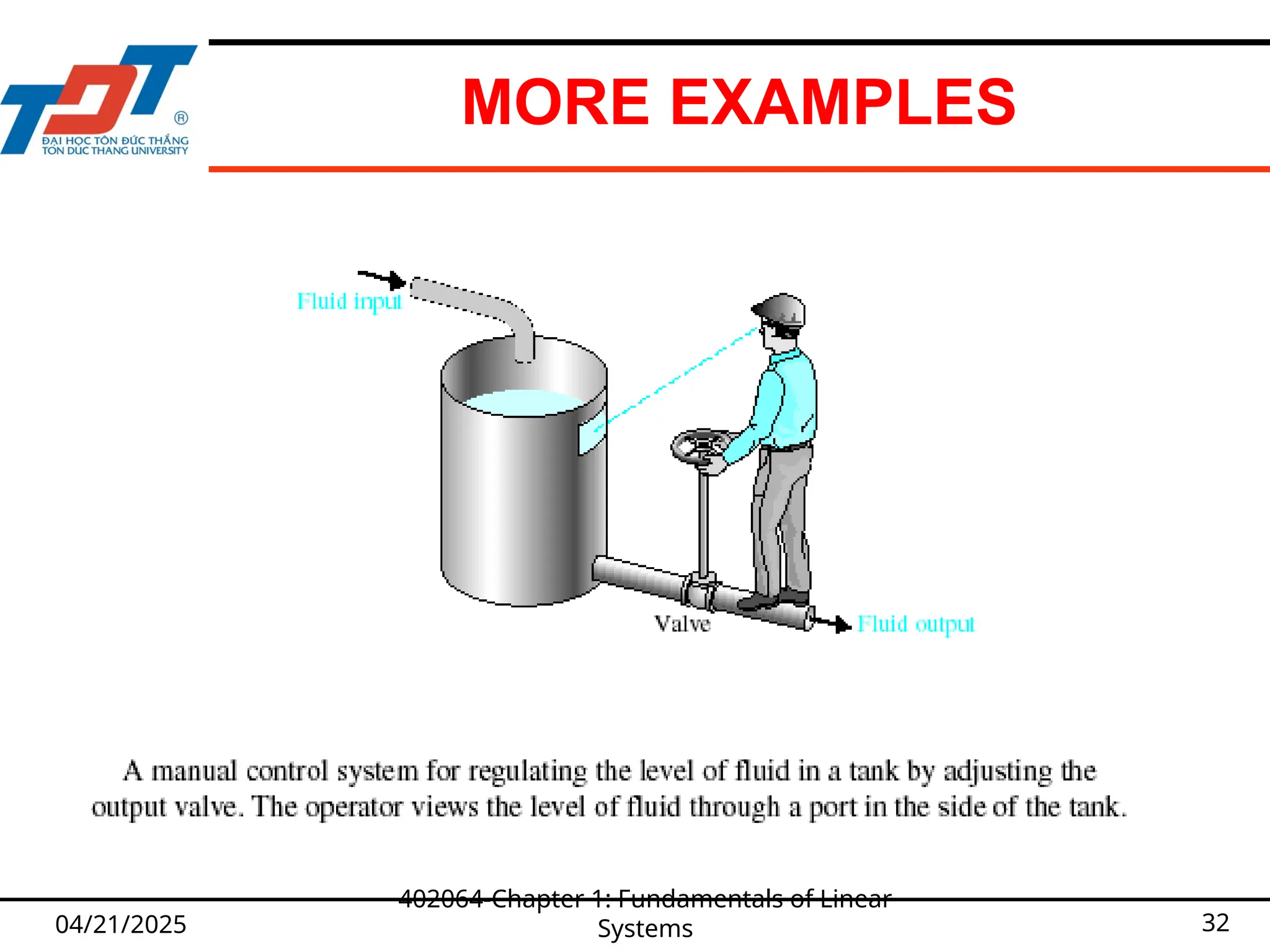
    MORE EXAMPLES 04/21/2025 402064-Chapter 1:Fundamentals of Linear Systems 32
  • 33.
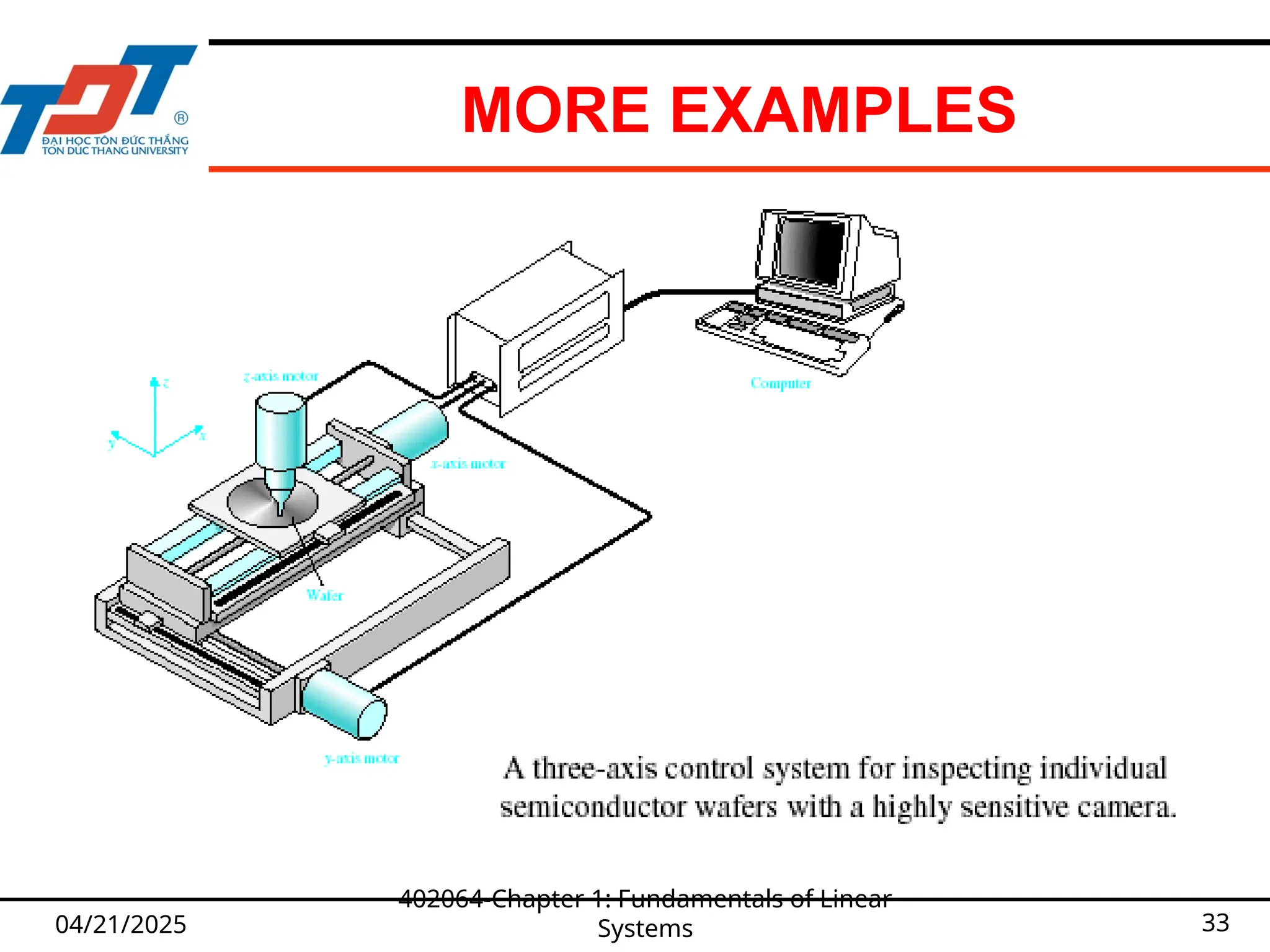
    MORE EXAMPLES 04/21/2025 402064-Chapter 1:Fundamentals of Linear Systems 33
  • 34.
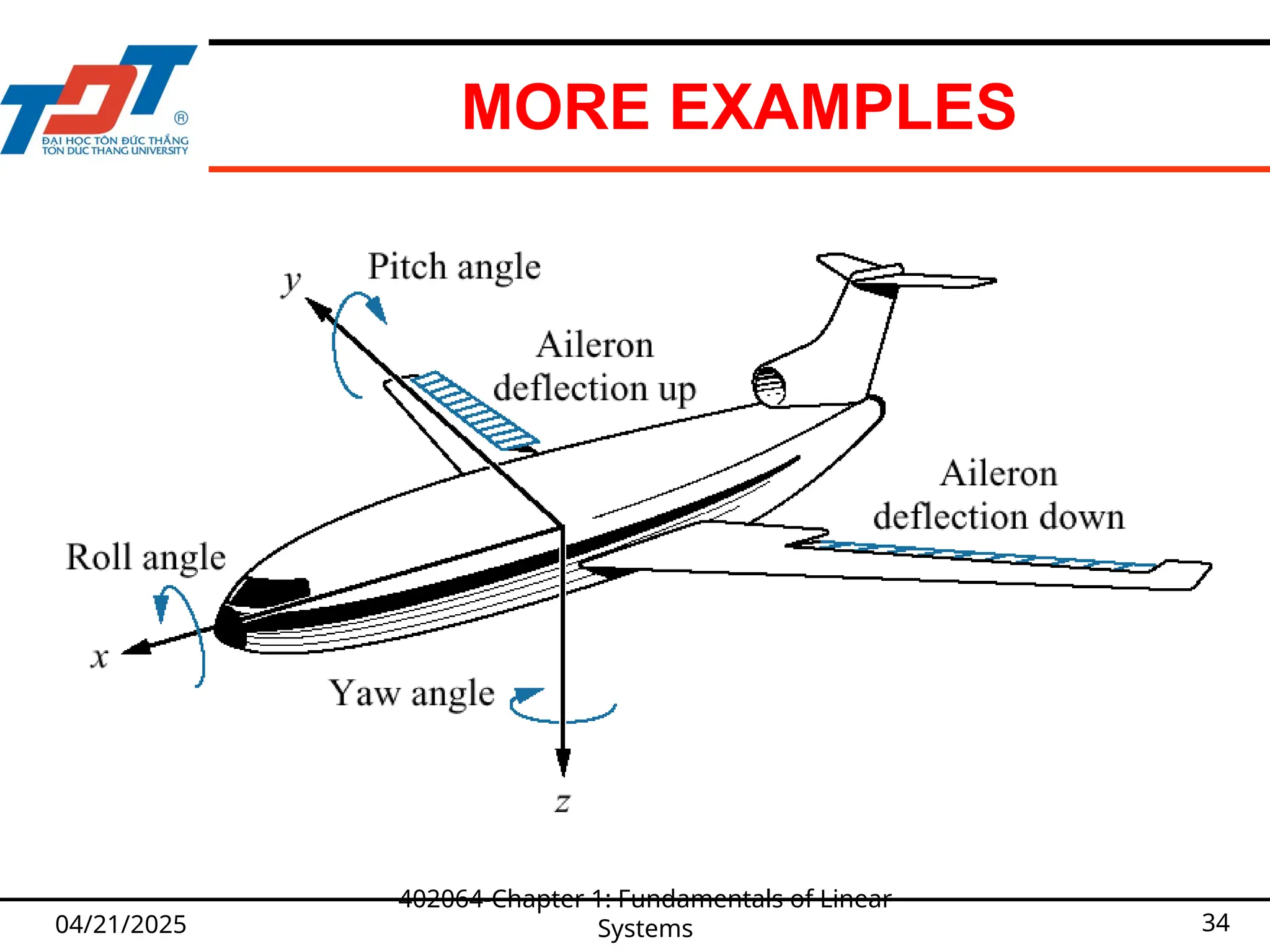
    MORE EXAMPLES 04/21/2025 402064-Chapter 1:Fundamentals of Linear Systems 34
  • 35.
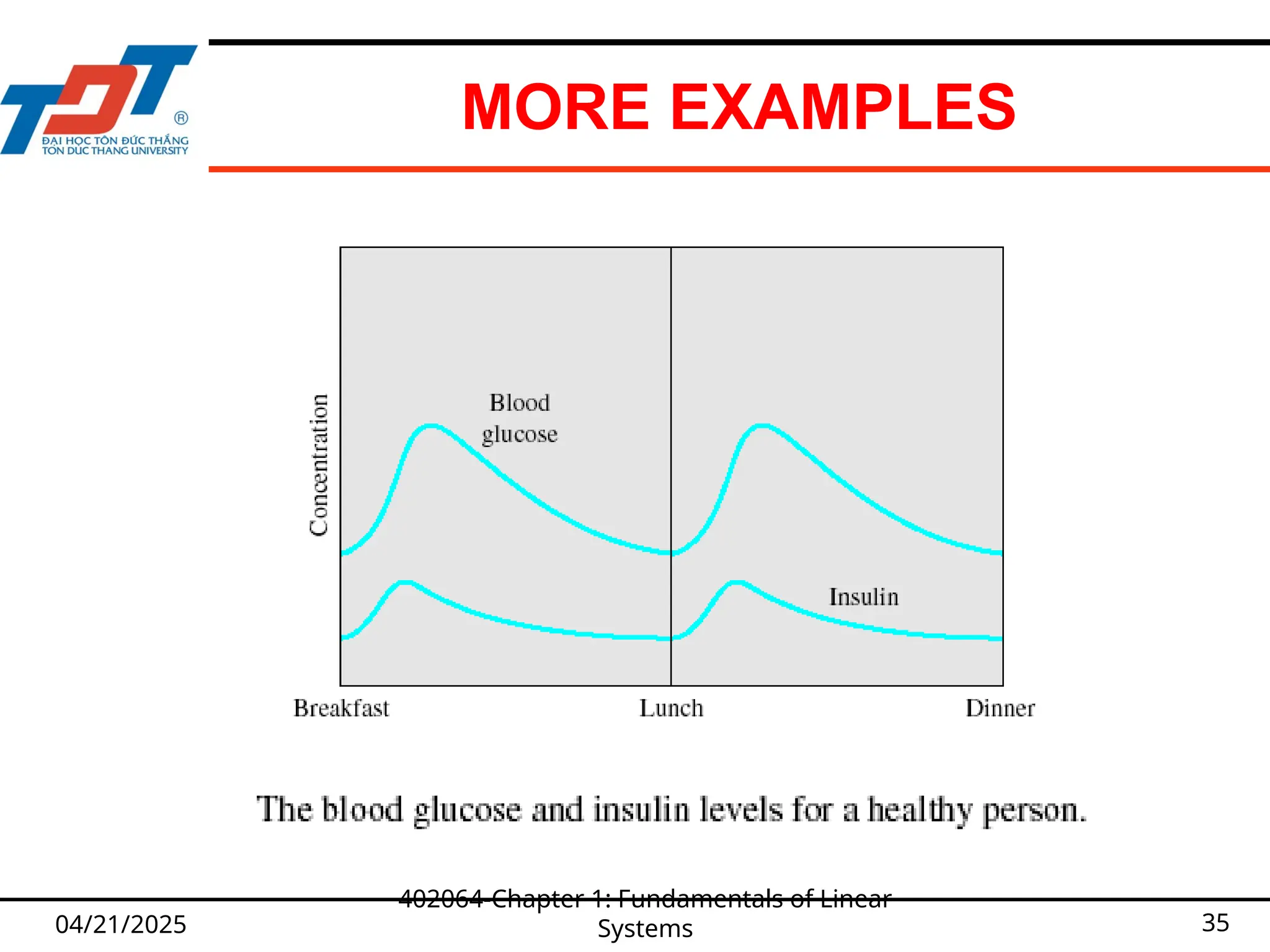
    MORE EXAMPLES 04/21/2025 402064-Chapter 1:Fundamentals of Linear Systems 35
  • 36.
    MORE EXAMPLES 04/21/2025 402064-Chapter 1:Fundamentals of Linear Systems 36 Segway: The human transporter
  • 37.
    MORE EXAMPLES 04/21/2025 402064-Chapter 1:Fundamentals of Linear Systems 37
  • 38.
    WHAT WE HAVELEARNT SO FAR?  So far we have learnt:  Concept of control systems  Classification of control systems  Assignment:  Read more examples in textbook.  Exercises: find more example of control systems in real life. 04/21/2025 402064-Chapter 1: Fundamentals of Linear Systems 38
  • 39.
    CHAPTER 1: FUNDAMENTALSOF LINEAR SYSTEMS  1.1 Introduction  1.2 Linear algebra  1.3 Transfer function and impulse response  1.4 Representation of control systems 04/21/2025 402064-Chapter 1: Fundamentals of Linear Systems 39
  • 40.
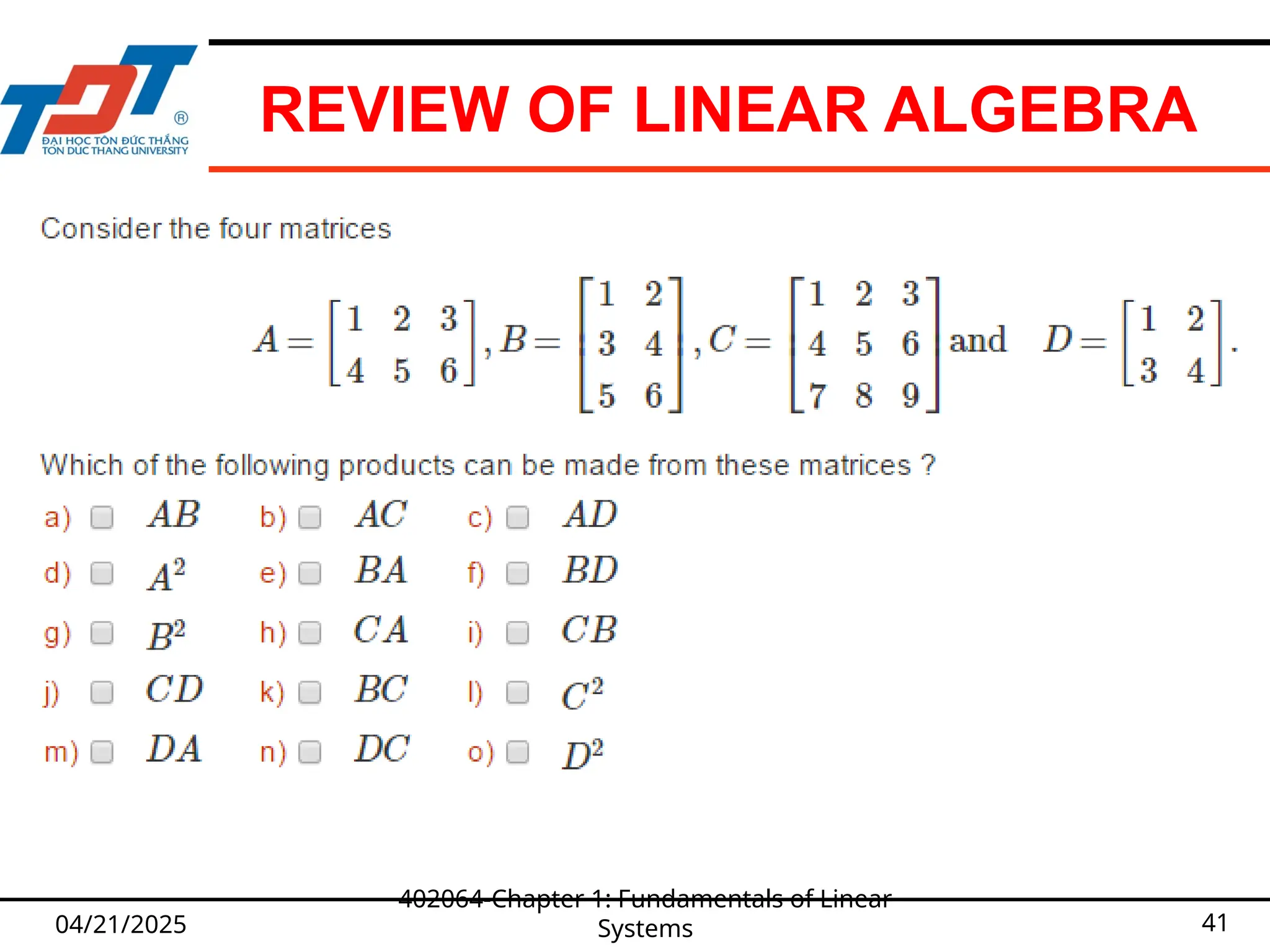
    REVIEW OF LINEARALGEBRA 04/21/2025 402064-Chapter 1: Fundamentals of Linear Systems 40
  • 41.
    REVIEW OF LINEARALGEBRA 04/21/2025 402064-Chapter 1: Fundamentals of Linear Systems 41
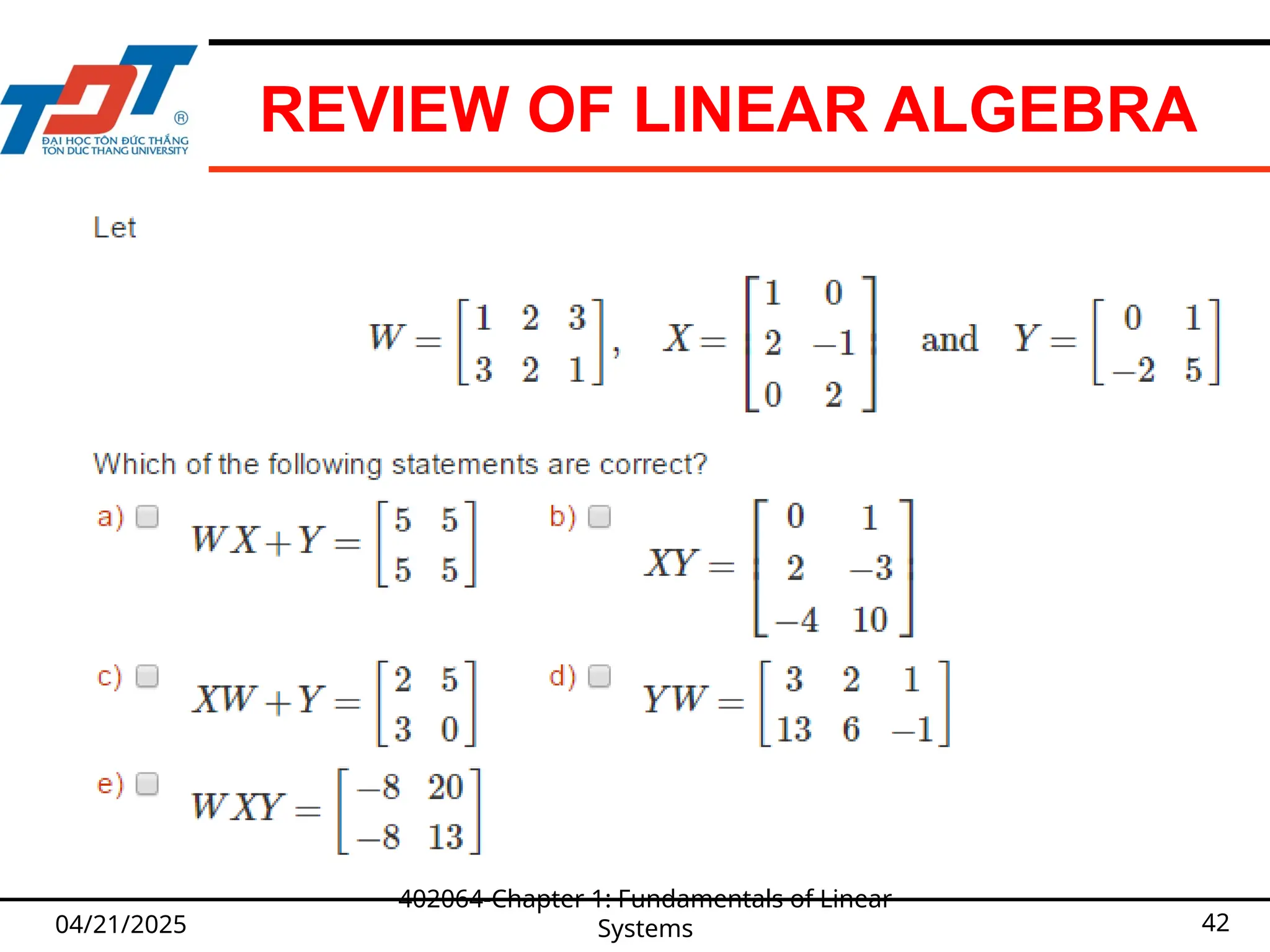
  • 42.
    REVIEW OF LINEARALGEBRA 04/21/2025 402064-Chapter 1: Fundamentals of Linear Systems 42
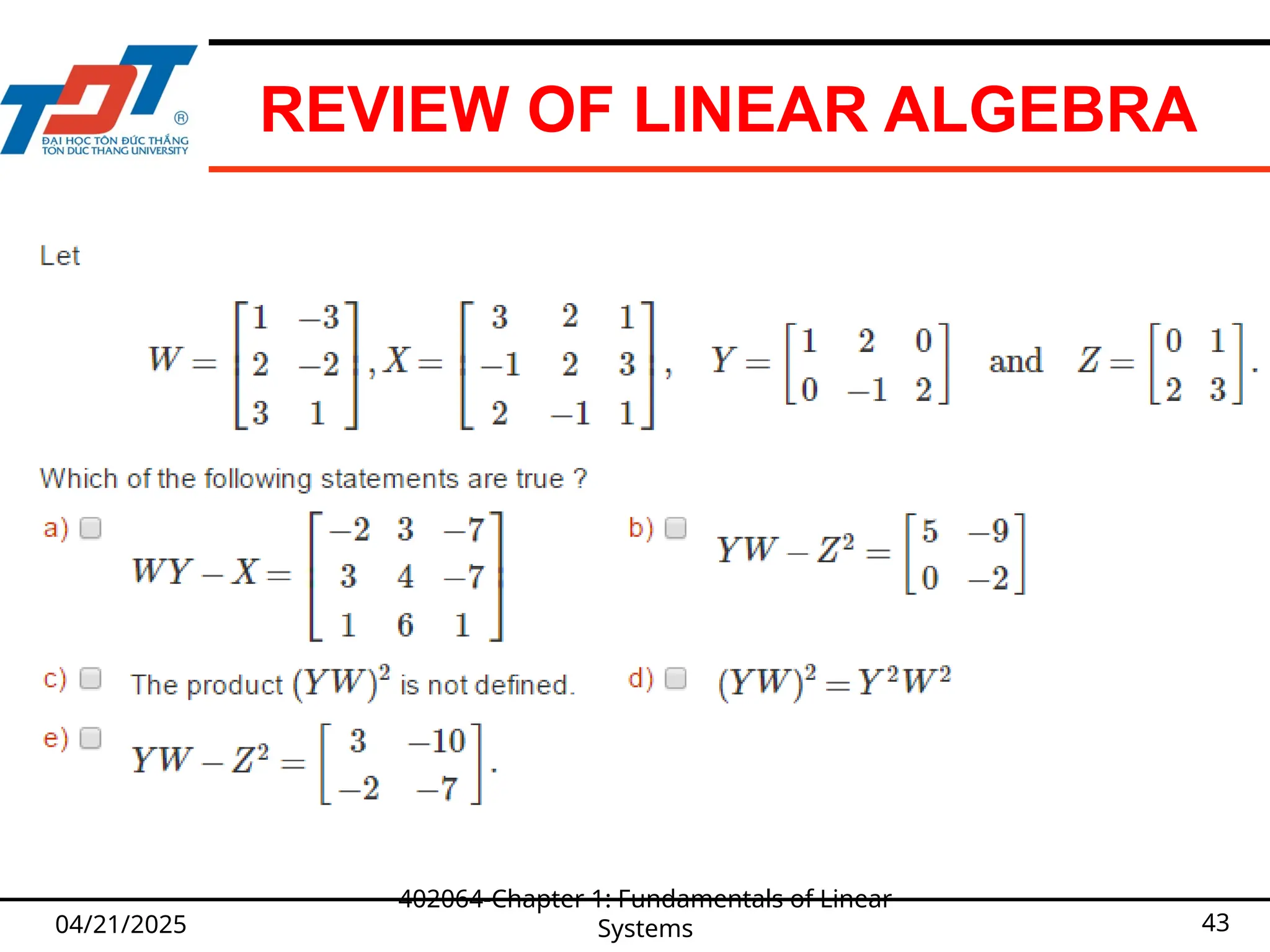
  • 43.
    REVIEW OF LINEARALGEBRA 04/21/2025 402064-Chapter 1: Fundamentals of Linear Systems 43
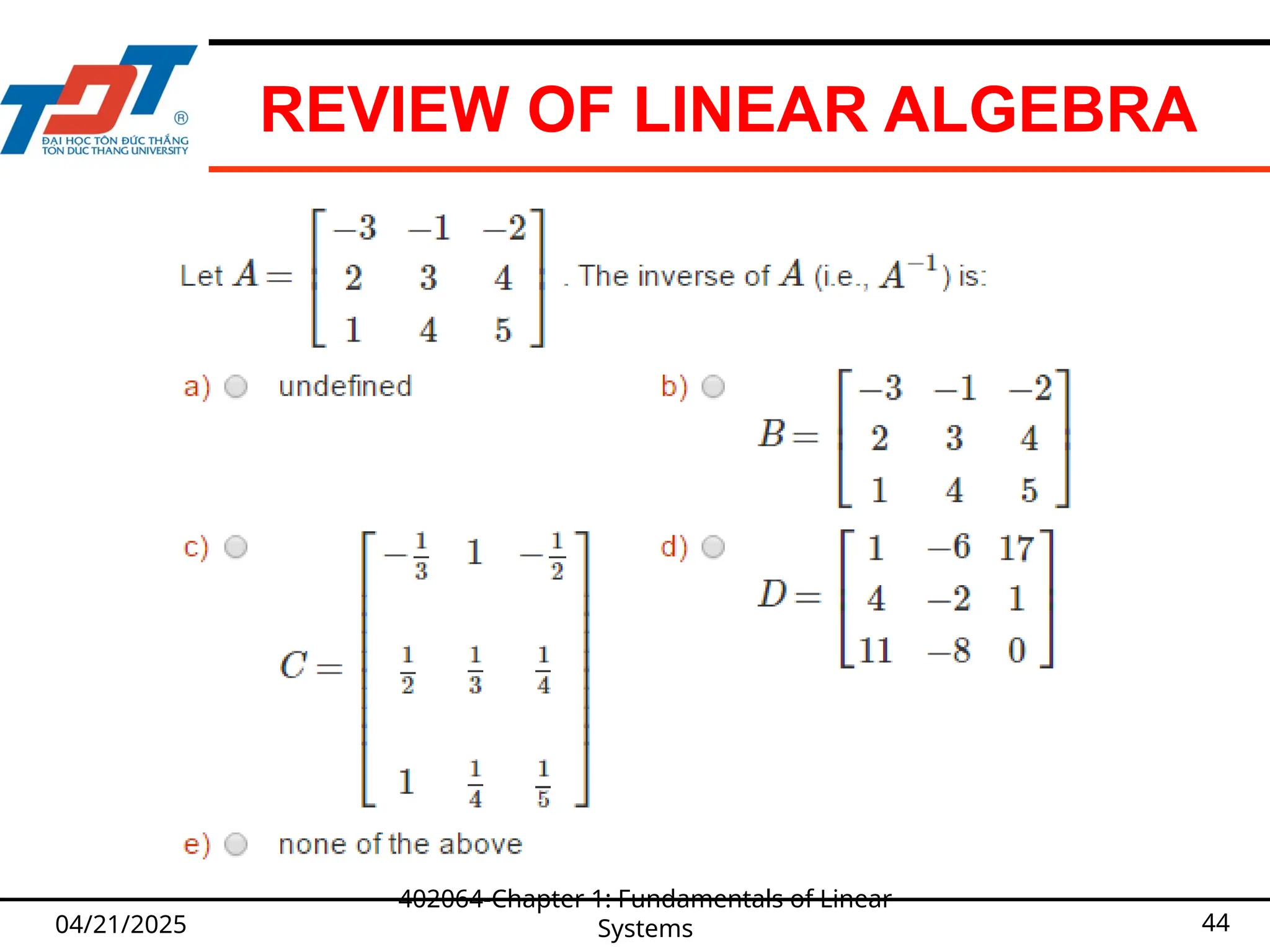
  • 44.
    REVIEW OF LINEARALGEBRA 04/21/2025 402064-Chapter 1: Fundamentals of Linear Systems 44
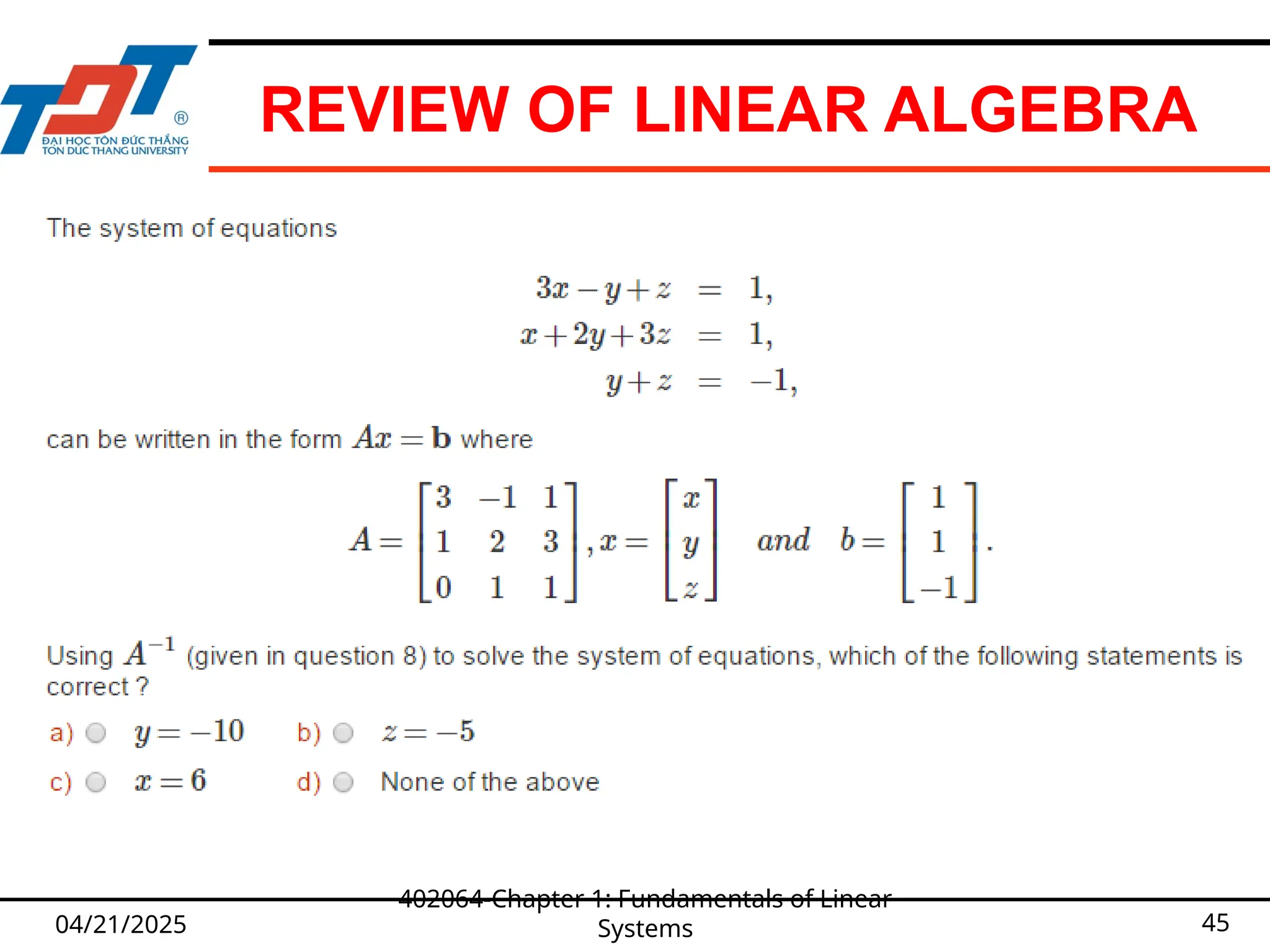
  • 45.
    REVIEW OF LINEARALGEBRA 04/21/2025 402064-Chapter 1: Fundamentals of Linear Systems 45
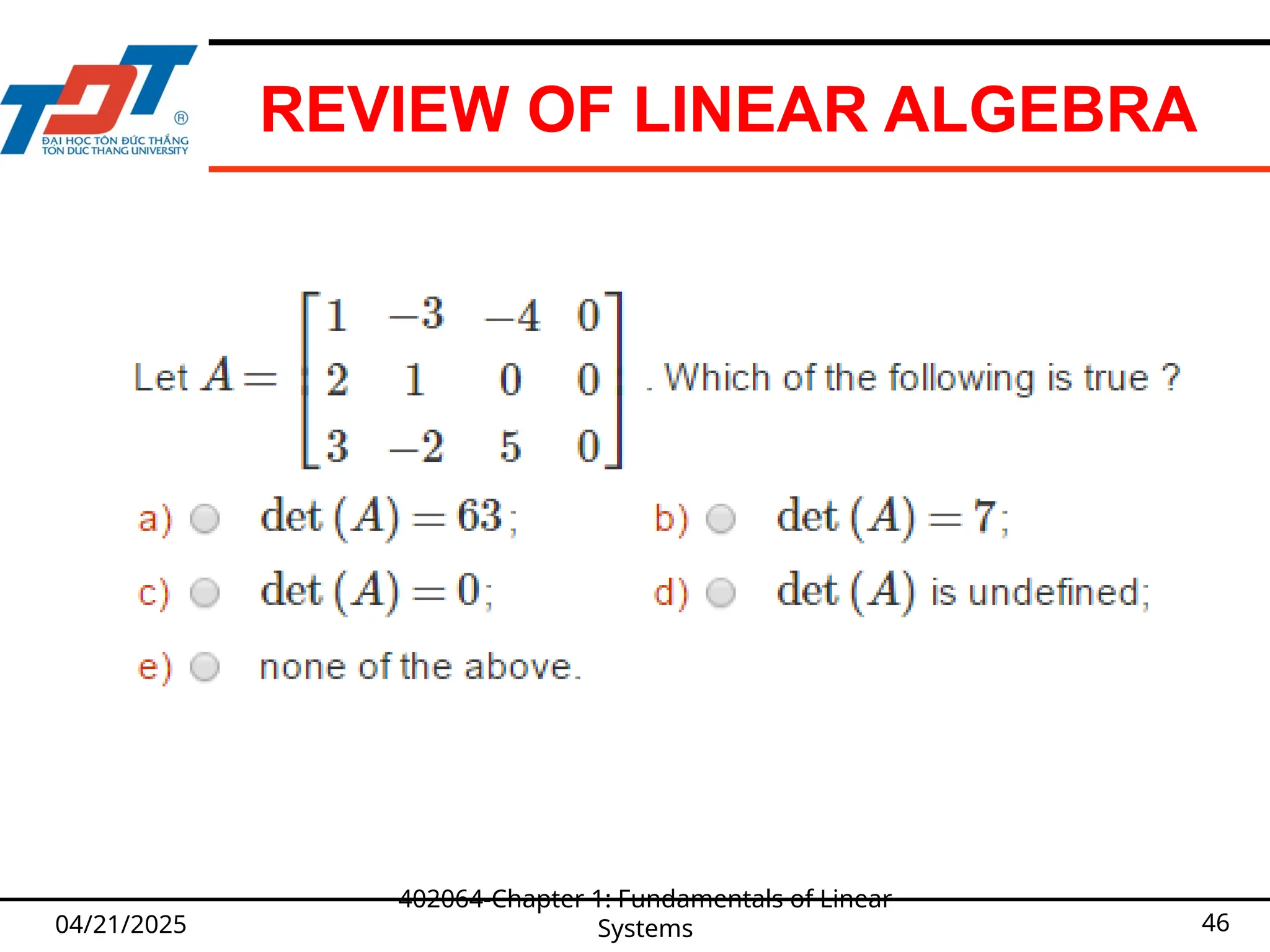
  • 46.
    REVIEW OF LINEARALGEBRA 04/21/2025 402064-Chapter 1: Fundamentals of Linear Systems 46
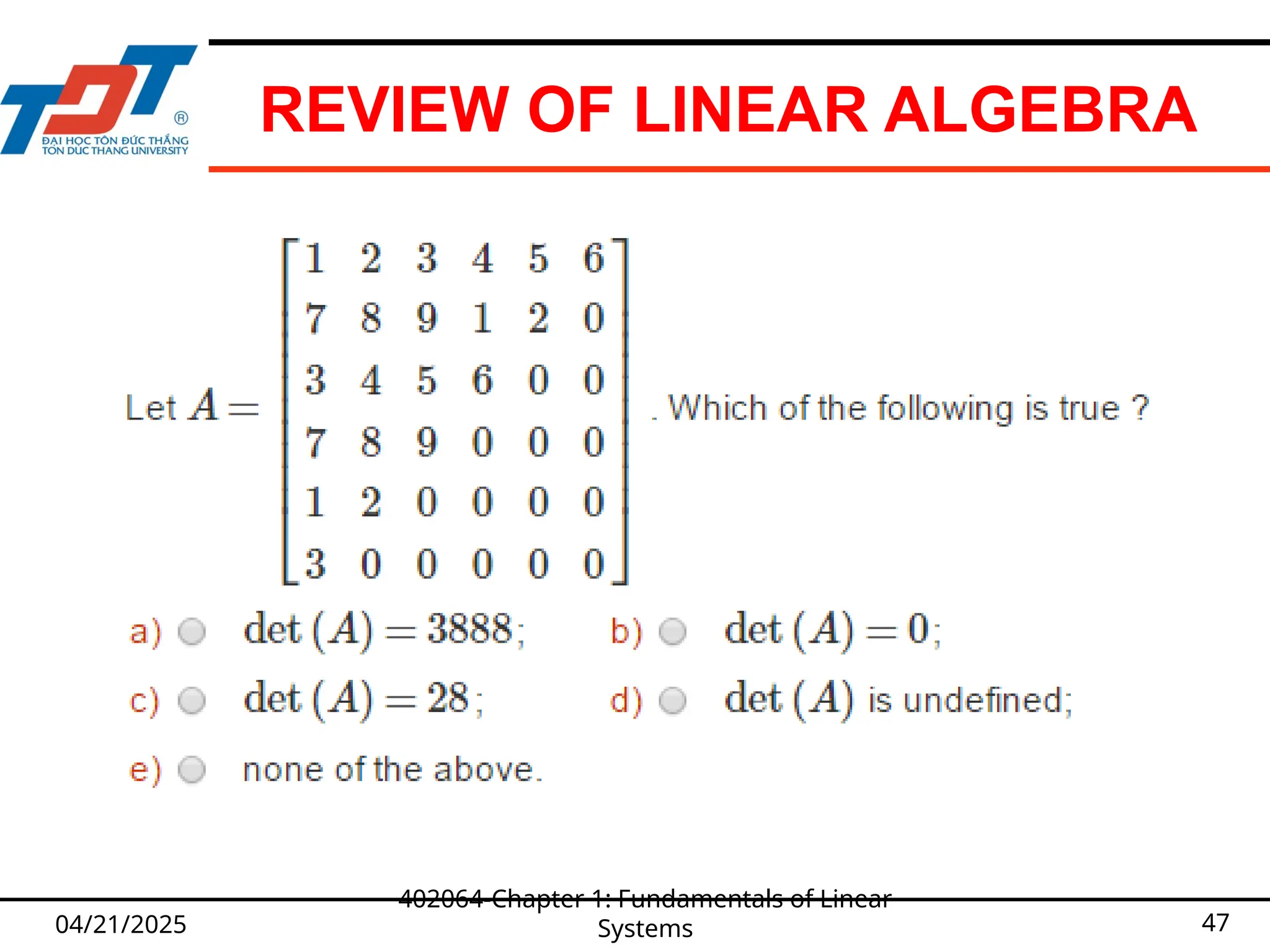
  • 47.
    REVIEW OF LINEARALGEBRA 04/21/2025 402064-Chapter 1: Fundamentals of Linear Systems 47
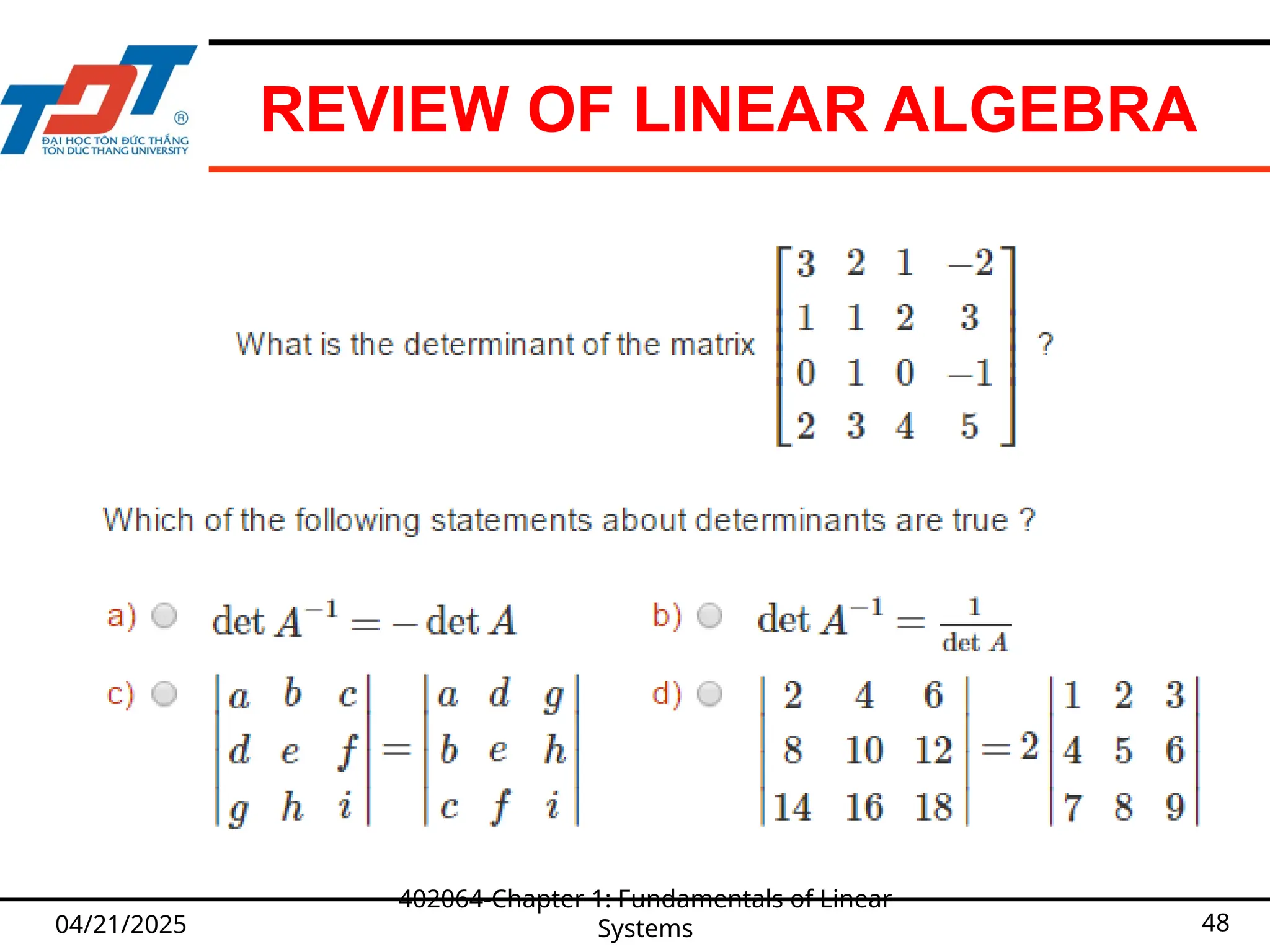
  • 48.
    REVIEW OF LINEARALGEBRA 04/21/2025 402064-Chapter 1: Fundamentals of Linear Systems 48
  • 49.
    REVIEW OF LINEARALGEBRA 04/21/2025 402064-Chapter 1: Fundamentals of Linear Systems 49
  • 50.
    REVIEW OF LINEARALGEBRA 04/21/2025 402064-Chapter 1: Fundamentals of Linear Systems 50
  • 51.
    REVIEW OF LINEARALGEBRA 04/21/2025 402064-Chapter 1: Fundamentals of Linear Systems 51 Vector in Rn is an ordered set of n real numbers. e.g. v = (1,6,3,4) is in R4 A column vector: A row vector: m-by-n matrix is an object in Rmxn with m rows and n columns, each entry filled with a (typically) real number:               4 3 6 1   4 3 6 1           2 3 9 6 78 4 8 2 1
  • 52.
    MATRICES 04/21/2025 402064-Chapter 1: Fundamentalsof Linear Systems 52 Square (3 x 3)            33 32 31 23 22 21 13 12 11 d d d d d d d d d D Matrix locations/size defined as rows x columns (R x C) d i j : ith row, jth column           33 32 31 23 22 21 13 12 11 x x x x x x x x x Rectangular (3 x 2)           33 32 31 23 22 21 13 12 11 x x x x x x x x x           33 32 31 23 22 21 13 12 11 x x x x x x x x x           33 32 31 23 22 21 13 12 11 x x x x x x x x x           33 32 31 23 22 21 13 12 11 x x x x x x x x x            9 6 3 8 5 2 7 4 1 A            6 5 4 3 2 1 A 3 dimensional (3 x 3 x 5)
  • 53.
    MATRIX CALCULUS 04/21/2025 402064-Chapter 1:Fundamentals of Linear Systems 53 Transposition column row row column            9 4 3 T d            4 7 6 1 4 5 3 2 1 A            4 1 3 7 4 2 6 5 1 T A            2 1 1 b   2 1 1  T b   9 4 3  d
  • 54.
    04/21/2025 402064-Chapter 1: Fundamentalsof Linear Systems 54 Matrix Calculations Addition – Commutative: A+B=B+A – Associative: (A+B)+C=A+(B+C)                                         1 1 1 1 1 1 1 1 2 2 2 2 1 1 1 1 2 2 2 2 B A Subtraction - By adding a negative matrix                                  6 5 4 3 1 5 3 2 0 4 1 2 1 3 0 1 5 2 4 2 B A                                          1 2 2 1 4 3 2 1 3 5 4 2 4 3 2 1 3 5 4 2 B A MATRIX CALCULUS
  • 55.
    04/21/2025 402064-Chapter 1: Fundamentalsof Linear Systems 55 Matrix Multiplication “When A is a mxn matrix & B is a kxl matrix, AB is only possible if n=k. The result will be an mxl matrix” A1 A2 A3 A4 A5 A6 A7 A8 A9 A10 A11 A12 m n x B13 B14 B15 B16 B17 B18 l k Simply put, can ONLY perform A*B IF: Number of columns in A = Number of rows in B = m x l matrix MATRIX CALCULUS
  • 56.
    MATRIX CALCULUS 04/21/2025 402064-Chapter 1:Fundamentals of Linear Systems 56 Matrix multiplication • Multiplication method: Sum over product of respective rows and columns • Note: Matrix multiplication is NOT commutative i.e the order matters! AB ≠ BA
  • 57.
    04/21/2025 402064-Chapter 1: Fundamentalsof Linear Systems 57 Identity matrix A special matrix which plays a similar role as the number 1 in number multiplication? For any nxn matrix A, we have A In = In A = A For any nxm matrix A, we have In A = A, and A Im = A (so 2 possible matrices) MATRIX CALCULUS
  • 58.
    VECTOR NORM ANDDOT PRODUCT  Vector norms: A norm of a vector ||x|| is informally a measure of the “length” of the vector.  Common norms: L1, L2 (Euclidean)  L-infinity 04/21/2025 402064-Chapter 1: Fundamentals of Linear Systems 58 1/ 1 p n p i p i x         x 1 1 n i i x   x 2 2 1 n i i x    x maxi i x   x
  • 59.
    VECTOR NORM ANDDOT PRODUCT  Vector dot (inner) product:  Vector outer product: 04/21/2025 402064-Chapter 1: Fundamentals of Linear Systems 59 If u•v=0, ||u||2 != 0, ||v||2 != 0  u and v are orthogonal If u•v=0, ||u||2 = 1, ||v||2 = 1  u and v are orthonormal
  • 60.
    LINEAR COMBINATION &VECTOR SPACE  A linear combination of vectors is a vector that can be obtained by multiplying these vectors by a real number then adding them.  The vector space defined by some vectors is a space that contains all linear combinations of them.  A matrix A (m x n) can itself be decomposed in as many vectors as its number of columns (or rows).  Each column of the matrix can be represented as a vector. The ensemble of n vector-column defines a vector space proper to matrix A. 04/21/2025 402064-Chapter 1: Fundamentals of Linear Systems 60
  • 61.
    LINEAR INDEPENDENCE  Aset of vectors is linearly independent if none of them can be written as a linear combination of the others.  Vectors v1,…,vk are linearly independent if c1v1 +… + ckvk = 0 implies c1 =…= ck = 0. 04/21/2025 402064-Chapter 1: Fundamentals of Linear Systems 61                                0 0 0 | | | | | | 3 2 1 3 2 1 c c c v v v e.g. x3 = −2x1 + x2
  • 62.
    DIMENSION & BASISOF A VECTOR SPACE  If all vectors in a vector space may be expressed as linear combinations of a set of vectors v1,…,vk, then v1,…,vk spans the space.  A basis is a maximal set of linearly independent vectors and a minimal set of spanning vectors of a vector space.  The cardinality of a basis is the dimension of the vector space.  A basis is a maximal set of linearly independent vectors and a minimal set of spanning vectors of a vector space. 04/21/2025 402064-Chapter 1: Fundamentals of Linear Systems 62
  • 63.
    DIMENSION & BASISOF A VECTOR SPACE 04/21/2025 402064-Chapter 1: Fundamentals of Linear Systems 63                                            1 0 0 2 0 1 0 2 0 0 1 2 2 2 2 (0,0,1) (0,1,0) (1,0,0) e.g.  The rank of a matrix is the dimension of the vector space spanned by its columns.  If A is n by m, then rank(A) ≤ min(m,n).  A basis is a maximal set of linearly independent vectors and a minimal set of spanning vectors of a vector space
  • 64.
    DETERMINANTS 04/21/2025 402064-Chapter 1: Fundamentalsof Linear Systems 64 • Determinants can only be found for square matrices. • For a 2x2 matrix A, det(A) = ad-bc. Lets have a closer look at that: The determinant gives an idea of the ’volume’ occupied by the matrix in vector space. A matrix A has an inverse matrix A-1 if and only if det(A)≠0. a b c d det(A) = = ad - bc [ ]
  • 65.
    DETERMINANTS 04/21/2025 402064-Chapter 1: Fundamentalsof Linear Systems 65 • The determinant of a matrix is zero if and only if there exist a linear relationship between the lines or the columns of the matrix.  2 1 1  x  4 2 2 x 2 x  1 x  y x 4 2 1 2 Here x1 and x2 are superimposed in space, because one can be expressed by a linear combination of the other: x2 = 2x1. The determinant of the matrix X will thus be zero. The largest square sub-matrix with a non- zero determinant will be a matrix of 1x1 => the rank of the matrix is 1. 1 2 2 4       X
  • 66.
    MATRIX INVERSE 04/21/2025 402064-Chapter 1:Fundamentals of Linear Systems 66  Definition. A matrix A is called nonsingular or invertible if there exists a matrix B such that:  Notation. A common notation for the inverse of a matrix A is A-1 . So:  The inverse matrix is unique when it exists. So if A is invertible, then A-1 is also invertible and then (AT )-1 = (A-1 )T .  If A-1 and B-1 exist, then (AB)-1 = B-1 A-1 . 1 1 X 2 3 -1 3 = 2 + 1 3 3 -1 + 1 3 3 = 1 0 -1 2 1 3 1 3 -2+ 2 3 3 1 + 2 3 3 0 1
  • 67.
    MATRIX INVERSE 04/21/2025 402064-Chapter 1:Fundamentals of Linear Systems 67 • For a XxX square matrix: • The inverse matrix is: • E.g.: 2x2 matrix For a matrix to be invertible, its determinant has to be non-zero (it has to be square and of full rank). A matrix that is not invertible is said to be singular. Reciprocally, a matrix that is invertible is said to be non-singular.
  • 68.
    MATRIX DERIVATIVES 04/21/2025 402064-Chapter 1:Fundamentals of Linear Systems 68 By Thomas Minka. Old and New Matrix Algebra Useful for Statistics
  • 69.
    MATRIX DERIVATIVES -EXAMPLES 04/21/2025 402064-Chapter 1: Fundamentals of Linear Systems 69
  • 70.
    EIGENVALUES & EIGENVECTORS Definition 1: A nonzero vector x is an eigenvector (or characteristic vector) of a square matrix A if there exists a scalar λ such that Ax = λx.  λ is called an eigenvalue (or characteristic value) of A.  Note: The zero vector can not be an eigenvector even though A.0 = λ.0. But λ = 0 can be an eigenvalue. 04/21/2025 402064-Chapter 1: Fundamentals of Linear Systems 70
  • 71.
    GEOMETRIC INTERPRETATION  Ann×n matrix A multiplied by n×1 vector x results in another n×1 vector y=Ax. Thus A can be considered as a transformation matrix.  In general, a matrix acts on a vector by changing both its magnitude and its direction.  However, a matrix may act on certain vectors by changing only their magnitude, and leaving their direction unchanged (or possibly reversing it).  These vectors are the eigenvectors of the matrix. 04/21/2025 402064-Chapter 1: Fundamentals of Linear Systems 71
  • 72.
    EIGENVALUE CALCULATION  x 0 will be an eigenvector of A if and only if det(A – λI) = 0  This is called the characteristic equation of A. Its roots determine the eigenvalues of A.  Example 1: Find the eigenvalues of two eigenvalues: -1, -2. 04/21/2025 402064-Chapter 1: Fundamentals of Linear Systems 72          5 1 12 2 A ) 2 )( 1 ( 2 3 12 ) 5 )( 2 ( 5 1 12 2 2                         A I
  • 73.
    FINDING EIGENVECTORS  Toeach distinct eigenvalue of a matrix A there are at least one eigenvector which can be found by solving the appropriate set of homogenous equations.  If λi is an eigenvalue then the corresponding eigenvector xi is the solution of (A – λiI)xi = 0.  Example: 04/21/2025 402064-Chapter 1: Fundamentals of Linear Systems 73                      0 0 4 1 4 1 12 3 ) 1 ( : 1 A I  0 , 1 4 , 4 0 4 2 1 1 2 1 2 1                     t t x x t x t x x x x
  • 74.
    PROPERTIES  Definition: Thetrace of a matrix A, designated by tr(A), is the sum of the elements on the main diagonal.  Property 1: The sum of the eigenvalues of a matrix equals the trace of the matrix.  Property 2: A matrix is singular if and only if it has a zero eigenvalue.  Property 3: The eigenvalues of an upper (or lower) triangular matrix are the elements on the main diagonal. 04/21/2025 402064-Chapter 1: Fundamentals of Linear Systems 74
  • 75.
    PROPERTIES  Property 4:If λ is an eigenvalue of A then λ is an eigenvalue of AT .  Property 5: The product of the eigenvalues (counting multiplicity) of a matrix equals the determinant of the matrix.  Property 6: Eigenvectors corresponding to distinct (that is, different) eigenvalues are linearly independent. 04/21/2025 402064-Chapter 1: Fundamentals of Linear Systems 75
  • 76.
    SINGULAR VALUE DECOMPOSITION (SVD) Any matrix A can be decomposed as A=UDVT , where:  D is a diagonal matrix, with d=rank(A) non-zero elements .  The fist d rows of U are orthogonal basis for col(A).  The fist d rows of V are orthogonal basis for row(A).  Applications of the SVD:  Matrix pseudoinverse  Low-rank matrix approximation 04/21/2025 402064-Chapter 1: Fundamentals of Linear Systems 76
  • 77.
    EIGENVALUE DECOMPOSITION (SVD) Any symmetric matrix A can be decomposed as A=UDUT , where:  D is diagonal, who entries are eigenvalues of A.  The fist d rows of U are orthogonal basis for col(A) = row(A). 04/21/2025 402064-Chapter 1: Fundamentals of Linear Systems 77  Re-interpreting Ab:  First stretch b along the direction of u1 by d1 times.  Then further stretch it along the direction of u2 by d2 times …
  • 78.
    PSEUDOINVERSE  With thehelp of SVD, we actually do NOT need to explicitly invert XT X.  Decompose X=UDVT .  Then XT X = VDUT UDVT = VD2 VT  Since V(D2 )VT V(D2 )-1 VT = I  We know that (XT X)-1 = V(D2 )-1 VT  Inverting a diagonal matrix D2 is trivial. 04/21/2025 402064-Chapter 1: Fundamentals of Linear Systems 78
  • 79.
    WHAT WE HAVELEARNT SO FAR?  So far we have learnt:  Concept of control systems  Classification of control systems  Assignment:  Read more examples in textbook.  Exercises: find more example of control systems in real life. 04/21/2025 402064-Chapter 1: Fundamentals of Linear Systems 79
  • 80.
    CHAPTER 1: FUNDAMENTALSOF LINEAR SYSTEMS  1.1 Introduction  1.2 Linear algebra  1.3 Transfer function and impulse response  1.4 Representation of control systems 04/21/2025 402064-Chapter 1: Fundamentals of Linear Systems 80
  • 81.
    SYSTEM MATHEMATICAL MODELS 04/21/2025 402064-Chapter1: Fundamentals of Linear Systems 81 Laplace transform  Differential equation  Transfer function  State-space model Differential equation Transfer function Linear system Study time-domain response study frequency-domain response Classical approach Modern approach (chap. 2) Fourier transform
  • 82.
    TRANSFER FUNCTION 04/21/2025 402064-Chapter 1:Fundamentals of Linear Systems 82 LTI system Input u(t) Output y(t)     ( ) ( ) ( ) zero initial condition output y t TF H s input u t   L L Assume all initial conditions are zero, the transfer function (TF) of the system is defined as where denotes the Laplace transform of y(t).   ( ) y t L
  • 83.
    EXAMPLE: RLC CIRCUIT 04/21/202583 R L C u(t) uc(t) i(t) Input u(t) system Output uc(t) The system is modeled by the cause-effect relationship between the input and output. 402064-Chapter 1: Fundamentals of Linear Systems
  • 84.
    EXAMPLE: RLC CIRCUIT 04/21/202584 R sL U(s) Uc(s) I(s) Input U(s) system Output Uc(s) Find the transfer function H(s) = Uc(s)/U(s) ? 402064-Chapter 1: Fundamentals of Linear Systems 1 sC
  • 85.
    EXAMPLE: RLC CIRCUIT 04/21/202585 ) ( ) ( ) ( ) ( 2 2 t u dt t u d LC dt t du RC t u C C C    According to Law of Kirchhoff in electricity ( ) ( ) ( ) ( ) (1) c di t u t Ri t L u t dt       1 ( ) ( ) (2) C u t i t dt C      ( ) ( ) C du t i t C dt  R L C u(t) uc(t) i(t) 402064-Chapter 1: Fundamentals of Linear Systems
  • 86.
    EXAMPLE – RLCCIRCUIT  It is re-written as in standard form:  Generally , we set  the output on the left side of the equation  the input on the right side  the input and output is arranged from the highest order to the lowest order of derivatives. 04/21/2025 402064-Chapter 1: Fundamentals of Linear Systems 86 ( ) ( ) ( ) ( ) C C C LCu t RCu t u t u t     
  • 87.
    LAPLACE TRANSFORM 04/21/2025 402064-Chapter 1:Fundamentals of Linear Systems 87 WHY LAPLACE transform is needed? s-domain algebra problems Solutions of algebra problems Time-domain ODE problems Solutions of time- domain problems Laplace Transform (LT) Inverse LT Difficult Easy
  • 88.
    TF OF TYPICALCOMPONENTS 04/21/2025 402064-Chapter 1: Fundamentals of Linear Systems 88 Component ODE TF ( ) v t ( ) i t R ( ) ( ) v t Ri t  ( ) ( ) ( ) V s G s R I s   ( ) v t ( ) i t L ( ) ( ) di t v t L dt  ( ) ( ) ( ) V s G s sL I s   ( ) v t ( ) i t C ( ) ( ) dv t i t C dt  ( ) 1 ( ) ( ) V s G s I s sC  
  • 89.
    EXERCISE 04/21/2025 402064-Chapter 1: Fundamentalsof Linear Systems 89  Please build the differential equations and transfer functions of the following systems. Output Input 1 R 2 R C ( ) r u t ( ) c u t
  • 90.
    EXERCISES  Find thetransfer function of the following system:  Find the differential equation that describes the following systems: 04/21/2025 402064-Chapter 1: Fundamentals of Linear Systems 90 2 2 ( ) ( ) 5 4 ( ) ( ) d y t dy t y t u t dt dt    2 3 ( ) 5 ( ) ( ) 2 3 7 Y s s s H s U s s s      
  • 91.
    PROPERTIES OF TRANSFER FUNCTION The transfer function is defined only for a linear time-invariant system, not for nonlinear system.  All initial conditions of the system are set to zero.  The transfer function is independent of the input of the system.  The transfer function G(s) is the Laplace transform of the unit impulse response g(t). 04/21/2025 402064-Chapter 1: Fundamentals of Linear Systems 91
  • 92.
    IMPULSE RESPONSE  Considerthe output of a LTI system to a unit- impulse input when the initial conditions are zero.  The Laplace transform of the output of the system is Y(s) = G(s).1 = G(s) (since the Laplace transform of the unit-impulse function is unity)  Definition: the inverse Laplace transform of G(s), or , is called the impulse-response function of the system. 04/21/2025 402064-Chapter 1: Fundamentals of Linear Systems 92 1 [ ( )] g(t) G s   L
  • 93.
    REVIEW QUESTIONS AND ASSIGNMENTS Review questions:  What is the definition of “transfer function”?  When defining the transfer function, what happens to initial conditions of the system?  Does a nonlinear system have a transfer function?  How does a transfer function of a LTI system relate to its impulse response?  Assignments: B-2-9 and the exercises from next slide. 04/21/2025 402064-Chapter 1: Fundamentals of Linear Systems 93
  • 94.
    CHAPTER 1: FUNDAMENTALSOF LINEAR SYSTEMS  1.1 Introduction  1.2 Linear algebra  1.3 Transfer function and impulse response  1.4 Representation of control systems 04/21/2025 402064-Chapter 1: Fundamentals of Linear Systems 94
  • 95.
    BLOCK DIAGRAM OFLTI CONTROL SYSTEMS  The transfer function relationship Y(s) = G(s).U(s) can be graphically denoted through a block diagram: 04/21/2025 402064-Chapter 1: Fundamentals of Linear Systems 95 G(s) U(s) Y(s)
  • 96.
    EQUIVALENT TRANSFORM OF BLOCKDIAGRAM 04/21/2025 402064-Chapter 1: Fundamentals of Linear Systems 96 1. Connection in series G(s) U(s) Y(s) ( ) ? G s  X(s) G1(s) G2(s) U(s) Y(s) 1 2 ( ) ( ) ( ) ( ) ( ) Y s G s G s G s U s   
  • 97.
    EQUIVALENT TRANSFORM OF BLOCKDIAGRAM 04/21/2025 402064-Chapter 1: Fundamentals of Linear Systems 97 2.Connection in parallel G(s) U(s) Y(s) 1 2 ( ) ( ) ( ) ( ) ( ) Y s G s G s G s U s    U(s) G2(s) G1(s) Y1(s) Y2(s)  Y(S ) ( ) ? G s 
  • 98.
    EQUIVALENT TRANSFORM OF BLOCKDIAGRAM 04/21/2025 402064-Chapter 1: Fundamentals of Linear Systems 98 3. Negative feedback M(s) R(s) Y(s ) ( ) ( ) ( ) ( ) ( ) ( ) ( ) Y s U s G s U s R s Y s H s       the for ( w ) a gain of ( ) 1 rd path ( ) ( ) 1 gai the loop n of G s M s G s H s       ( ) ( ) ( ) ( ) ( ) Y s R s Y s H s G s   Y(s) G(s) H(s) U(s) R(s) _ Transfer function of a negative feedback system:
  • 99.
    SIGNAL FLOW GRAPH(SFG)  SFG was introduced by S.J. Mason for the cause- and-effect representation of linear systems. 1. Each signal is represented by a node. 2. Each transfer function is represented by a branch. 04/21/2025 402064-Chapter 1: Fundamentals of Linear Systems 99 G(s) U(s) Y(s) G(s) H(s) U(s ) R(s) _ Y(s) G(s) U(s) Y(s) G(s) U(s) Y(s) R(s) -H(s) 1
  • 100.
    SFG - EXAMPLE 04/21/2025 402064-Chapter1: Fundamentals of Linear Systems 100 ( ) r U s 1 ( ) I s 2 ( ) I s ( ) c U s 1( ) U s - 1 1 R 1 1 sC - 2 1 R - 2 1 sC ( ) r U s 1( ) I s 1( ) U s 2 ( ) I s ( ) c U s 1 1 R 1 1 sC 2 1 R 2 1 sC - 1 - 1 - 1 1 1 1
  • 101.
    MASON’S RULE 04/21/2025 402064-Chapter 1:Fundamentals of Linear Systems 101 1 ( ) 1 ( ) ( ) N k k k Y s M s M U s       k M path gain of the kth forward path.     1 ( all individual loop gains)  ( gain products of all possible three loops that do not touch) ( gain products of all possible two loops that do not touch)  k  value of ∆ for that part of the block diagram that does not touch the kth forward path.  N  total number of forward paths between output Y(s) and input U(s)
  • 102.
    EXAMPLE - FINDTHE TRANSFER FUNCTION 04/21/2025 402064-Chapter 1: Fundamentals of Linear Systems 102 Solution. Forward path Path gain and the determinates are 1 1 2 3 123456 M H H H  2 4 1256 M H  Loop path Path gain 1 1 5 232 l H H  2 2 6 343 l H H  3 3 7 454 l H H  4 4 7 6 5 25432 l H H H H    1 2 3 4 1 3 1 ( ) l l l l l l        1 2 2 6 1 0 1 H H       ( ) U s ( ) Y s 5 H 1 1 H 4 H 6 H 7 H 2 H 3 H 1 ① ② ③ ④ ⑤ ⑥
  • 103.
    EXAMPLE - FINDTHE TRANSFER FUNCTION 04/21/2025 402064-Chapter 1: Fundamentals of Linear Systems 103 Solution. ( ) U s ( ) Y s 5 H 1 1 H 4 H 6 H 7 H 2 H 3 H 1 ① ② ③ ④ ⑤ ⑥ 1 1 2 3 4 4 2 6 1 5 2 6 3 7 4 7 6 5 1 5 3 ( ) ( ) ( ) 1 N k k k M Y s M s U s H H H H H H H H H H H H H H H H H H H H H               Applying Mason’s rule, we find the transfer function to be
  • 104.
    SUMMARY AND ASSIGNMENT In this chapter, we have learnt:  Basic concept and classification of control systems.  Review of linear algebra  Mathematical model of LTI systems  Graphical representation of LTI systems.  Assignments: B-2-5 to B-2-8.  Reading assignment: Ogata - chapter 2 (pp. 29-39). 04/21/2025 402064-Chapter 1: Fundamentals of Linear Systems 104