Audiology at Illinois
Information for Prospective Graduate Students
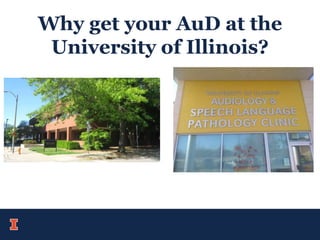
Why get your AuD at the
University of Illinois?
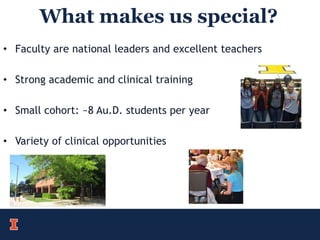
What makes us special?
• Faculty are national leaders and excellent teachers
• Strong academic and clinical training
• Small cohort: ~8 Au.D. students per year
• Variety of clinical opportunities
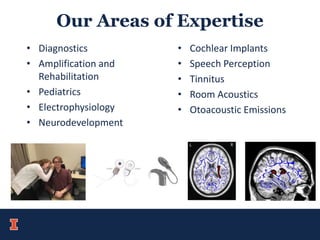
Our Areas of Expertise
• Diagnostics
• Amplification and
Rehabilitation
• Pediatrics
• Electrophysiology
• Neurodevelopment
• Cochlear Implants
• Speech Perception
• Tinnitus
• Room Acoustics
• Otoacoustic Emissions
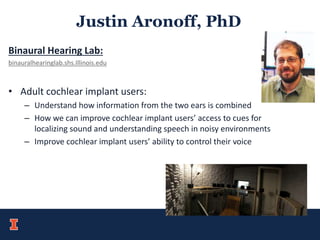
Justin Aronoff, PhD
Binaural Hearing Lab:
binauralhearinglab.shs.Illinois.edu
• Adult cochlear implant users:
– Understand how information from the two ears is combined
– How we can improve cochlear implant users’ access to cues for
localizing sound and understanding speech in noisy environments
– Improve cochlear implant users’ ability to control their voice
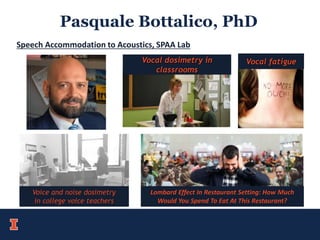
Pasquale Bottalico, PhD
Speech Accommodation to Acoustics, SPAA Lab
Vocal dosimetry in
classrooms
Voice and noise dosimetry
in college voice teachers
Lombard Effect In Restaurant Setting: How Much
Would You Spend To Eat At This Restaurant?
Vocal fatigue
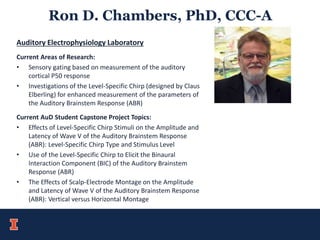
Ron D. Chambers, PhD, CCC-A
Auditory Electrophysiology Laboratory
Current Areas of Research:
• Sensory gating based on measurement of the auditory
cortical P50 response
• Investigations of the Level-Specific Chirp (designed by Claus
Elberling) for enhanced measurement of the parameters of
the Auditory Brainstem Response (ABR)
Current AuD Student Capstone Project Topics:
• Effects of Level-Specific Chirp Stimuli on the Amplitude and
Latency of Wave V of the Auditory Brainstem Response
(ABR): Level-Specific Chirp Type and Stimulus Level
• Use of the Level-Specific Chirp to Elicit the Binaural
Interaction Component (BIC) of the Auditory Brainstem
Response (ABR)
• The Effects of Scalp-Electrode Montage on the Amplitude
and Latency of Wave V of the Auditory Brainstem Response
(ABR): Vertical versus Horizontal Montage
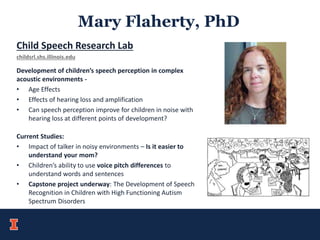
Mary Flaherty, PhD
Child Speech Research Lab
childsrl.shs.illinois.edu
Development of children’s speech perception in complex
acoustic environments -
• Age Effects
• Effects of hearing loss and amplification
• Can speech perception improve for children in noise with
hearing loss at different points of development?
Current Studies:
• Impact of talker in noisy environments – Is it easier to
understand your mom?
• Children’s ability to use voice pitch differences to
understand words and sentences
• Capstone project underway: The Development of Speech
Recognition in Children with High Functioning Autism
Spectrum Disorders
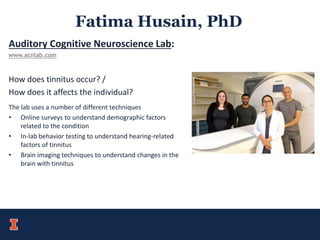
Fatima Husain, PhD
Auditory Cognitive Neuroscience Lab:
www.acnlab.com
How does tinnitus occur? /
How does it affects the individual?
The lab uses a number of different techniques
• Online surveys to understand demographic factors
related to the condition
• In-lab behavior testing to understand hearing-related
factors of tinnitus
• Brain imaging techniques to understand changes in the
brain with tinnitus
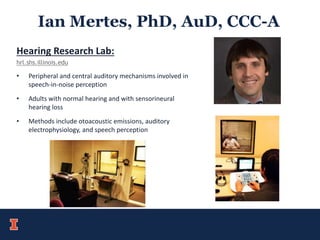
Ian Mertes, PhD, AuD, CCC-A
Hearing Research Lab:
hrl.shs.illinois.edu
• Peripheral and central auditory mechanisms involved in
speech-in-noise perception
• Adults with normal hearing and with sensorineural
hearing loss
• Methods include otoacoustic emissions, auditory
electrophysiology, and speech perception
Brian Monson, PhD
Auditory Neuro Experience Lab
anexlab.shs.illinois.edu
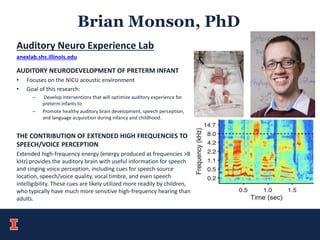
AUDITORY NEURODEVELOPMENT OF PRETERM INFANT
• Focuses on the NICU acoustic environment
• Goal of this research:
– Develop interventions that will optimize auditory experience for
preterm infants to
– Promote healthy auditory brain development, speech perception,
and language acquisition during infancy and childhood.
THE CONTRIBUTION OF EXTENDED HIGH FREQUENCIES TO
SPEECH/VOICE PERCEPTION
Extended high-frequency energy (energy produced at frequencies >8
kHz) provides the auditory brain with useful information for speech
and singing voice perception, including cues for speech source
location, speech/voice quality, vocal timbre, and even speech
intelligibility. These cues are likely utilized more readily by children,
who typically have much more sensitive high-frequency hearing than
adults.
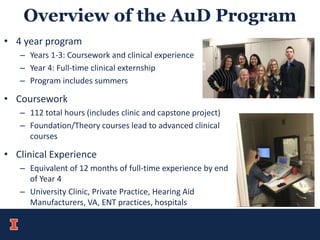
Overview of the AuD Program
• 4 year program
– Years 1-3: Coursework and clinical experience
– Year 4: Full-time clinical externship
– Program includes summers
• Coursework
– 112 total hours (includes clinic and capstone project)
– Foundation/Theory courses lead to advanced clinical
courses
• Clinical Experience
– Equivalent of 12 months of full-time experience by end
of Year 4
– University Clinic, Private Practice, Hearing Aid
Manufacturers, VA, ENT practices, hospitals
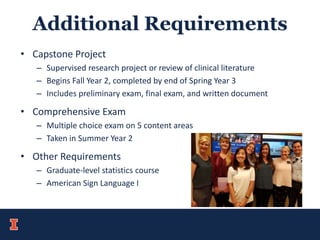
Additional Requirements
• Capstone Project
– Supervised research project or review of clinical literature
– Begins Fall Year 2, completed by end of Spring Year 3
– Includes preliminary exam, final exam, and written document
• Comprehensive Exam
– Multiple choice exam on 5 content areas
– Taken in Summer Year 2
• Other Requirements
– Graduate-level statistics course
– American Sign Language I
Unique Courses We Offer
• Tinnitus
• Auditory Processing Disorders
• Hearing Conservation
• Digital Signal Processing
• Business Practice
• Departmental Proseminar
AuD Year One• Fall 1
– Psychoacoustics
– Auditory Anatomy and Physiology
– Assessment of Audition and Auditory Disorders
– Audiological Assessment Lab
– Hearing Conservation
– Clinical Practicum (University Clinic)
– Proseminar in Speech and Hearing Science
• Spring 1
– Diagnosis of Hearing Impairment in Infants
and Young Children
– Hearing Aids and Amplification
– Amplification Lab
– Medical Audiology
– Clincal Practicum (University Clinic)
– Proseminar in Speech and Hearing Science
• Summer 1
– Professional Ethics and Legal Issues
– Clinical Practicum (University Clinic & External)
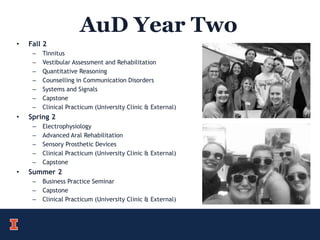
AuD Year Two
• Fall 2
– Tinnitus
– Vestibular Assessment and Rehabilitation
– Quantitative Reasoning
– Counselling in Communication Disorders
– Systems and Signals
– Capstone
– Clinical Practicum (University Clinic & External)
• Spring 2
– Electrophysiology
– Advanced Aral Rehabilitation
– Sensory Prosthetic Devices
– Clinical Practicum (University Clinic & External)
– Capstone
• Summer 2
– Business Practice Seminar
– Capstone
– Clinical Practicum (University Clinic & External)
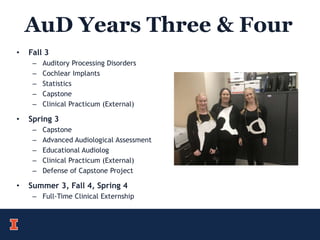
AuD Years Three & Four
• Fall 3
– Auditory Processing Disorders
– Cochlear Implants
– Statistics
– Capstone
– Clinical Practicum (External)
• Spring 3
– Capstone
– Advanced Audiological Assessment
– Educational Audiolog
– Clinical Practicum (External)
– Defense of Capstone Project
• Summer 3, Fall 4, Spring 4
– Full-Time Clinical Externship
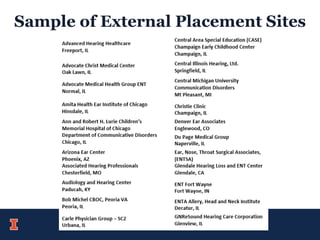
Sample of External Placement Sites
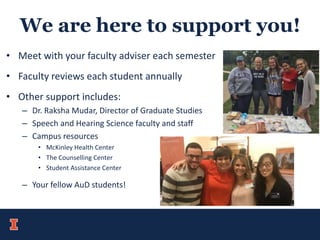
We are here to support you!
• Meet with your faculty adviser each semester
• Faculty reviews each student annually
• Other support includes:
– Dr. Raksha Mudar, Director of Graduate Studies
– Speech and Hearing Science faculty and staff
– Campus resources
• McKinley Health Center
• The Counselling Center
• Student Assistance Center
– Your fellow AuD students!
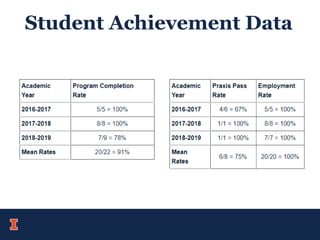
Student Achievement Data
Financial Matters
• Students can apply for departmental funding each semester:
– TAs for individual courses
– Hourly positions as graders
– Research assistants on faculty grants
– Time commitments are typically 10 hours per week
• Other sources of employment on campus:
– Disability Resources and Educational Services – academic coaches, transcribers
– McKinley Health Center
– Athletic Department – academic coaches, tutors
– We also connect you with the Campus Job Board
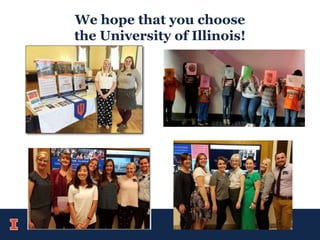
We hope that you choose
the University of Illinois!

4 prospective au d students july 2020

  • 1.
    Audiology at Illinois Informationfor Prospective Graduate Students
  • 2.
    Why get yourAuD at the University of Illinois?
  • 3.
    What makes usspecial? • Faculty are national leaders and excellent teachers • Strong academic and clinical training • Small cohort: ~8 Au.D. students per year • Variety of clinical opportunities
  • 4.
    Our Areas ofExpertise • Diagnostics • Amplification and Rehabilitation • Pediatrics • Electrophysiology • Neurodevelopment • Cochlear Implants • Speech Perception • Tinnitus • Room Acoustics • Otoacoustic Emissions
  • 5.
    Justin Aronoff, PhD BinauralHearing Lab: binauralhearinglab.shs.Illinois.edu • Adult cochlear implant users: – Understand how information from the two ears is combined – How we can improve cochlear implant users’ access to cues for localizing sound and understanding speech in noisy environments – Improve cochlear implant users’ ability to control their voice
  • 6.
    Pasquale Bottalico, PhD SpeechAccommodation to Acoustics, SPAA Lab Vocal dosimetry in classrooms Voice and noise dosimetry in college voice teachers Lombard Effect In Restaurant Setting: How Much Would You Spend To Eat At This Restaurant? Vocal fatigue
  • 7.
    Ron D. Chambers,PhD, CCC-A Auditory Electrophysiology Laboratory Current Areas of Research: • Sensory gating based on measurement of the auditory cortical P50 response • Investigations of the Level-Specific Chirp (designed by Claus Elberling) for enhanced measurement of the parameters of the Auditory Brainstem Response (ABR) Current AuD Student Capstone Project Topics: • Effects of Level-Specific Chirp Stimuli on the Amplitude and Latency of Wave V of the Auditory Brainstem Response (ABR): Level-Specific Chirp Type and Stimulus Level • Use of the Level-Specific Chirp to Elicit the Binaural Interaction Component (BIC) of the Auditory Brainstem Response (ABR) • The Effects of Scalp-Electrode Montage on the Amplitude and Latency of Wave V of the Auditory Brainstem Response (ABR): Vertical versus Horizontal Montage
  • 8.
    Mary Flaherty, PhD ChildSpeech Research Lab childsrl.shs.illinois.edu Development of children’s speech perception in complex acoustic environments - • Age Effects • Effects of hearing loss and amplification • Can speech perception improve for children in noise with hearing loss at different points of development? Current Studies: • Impact of talker in noisy environments – Is it easier to understand your mom? • Children’s ability to use voice pitch differences to understand words and sentences • Capstone project underway: The Development of Speech Recognition in Children with High Functioning Autism Spectrum Disorders
  • 9.
    Fatima Husain, PhD AuditoryCognitive Neuroscience Lab: www.acnlab.com How does tinnitus occur? / How does it affects the individual? The lab uses a number of different techniques • Online surveys to understand demographic factors related to the condition • In-lab behavior testing to understand hearing-related factors of tinnitus • Brain imaging techniques to understand changes in the brain with tinnitus
  • 10.
    Ian Mertes, PhD,AuD, CCC-A Hearing Research Lab: hrl.shs.illinois.edu • Peripheral and central auditory mechanisms involved in speech-in-noise perception • Adults with normal hearing and with sensorineural hearing loss • Methods include otoacoustic emissions, auditory electrophysiology, and speech perception
  • 11.
    Brian Monson, PhD AuditoryNeuro Experience Lab anexlab.shs.illinois.edu AUDITORY NEURODEVELOPMENT OF PRETERM INFANT • Focuses on the NICU acoustic environment • Goal of this research: – Develop interventions that will optimize auditory experience for preterm infants to – Promote healthy auditory brain development, speech perception, and language acquisition during infancy and childhood. THE CONTRIBUTION OF EXTENDED HIGH FREQUENCIES TO SPEECH/VOICE PERCEPTION Extended high-frequency energy (energy produced at frequencies >8 kHz) provides the auditory brain with useful information for speech and singing voice perception, including cues for speech source location, speech/voice quality, vocal timbre, and even speech intelligibility. These cues are likely utilized more readily by children, who typically have much more sensitive high-frequency hearing than adults.
  • 12.
    Overview of theAuD Program • 4 year program – Years 1-3: Coursework and clinical experience – Year 4: Full-time clinical externship – Program includes summers • Coursework – 112 total hours (includes clinic and capstone project) – Foundation/Theory courses lead to advanced clinical courses • Clinical Experience – Equivalent of 12 months of full-time experience by end of Year 4 – University Clinic, Private Practice, Hearing Aid Manufacturers, VA, ENT practices, hospitals
  • 13.
    Additional Requirements • CapstoneProject – Supervised research project or review of clinical literature – Begins Fall Year 2, completed by end of Spring Year 3 – Includes preliminary exam, final exam, and written document • Comprehensive Exam – Multiple choice exam on 5 content areas – Taken in Summer Year 2 • Other Requirements – Graduate-level statistics course – American Sign Language I
  • 14.
    Unique Courses WeOffer • Tinnitus • Auditory Processing Disorders • Hearing Conservation • Digital Signal Processing • Business Practice • Departmental Proseminar
  • 15.
    AuD Year One•Fall 1 – Psychoacoustics – Auditory Anatomy and Physiology – Assessment of Audition and Auditory Disorders – Audiological Assessment Lab – Hearing Conservation – Clinical Practicum (University Clinic) – Proseminar in Speech and Hearing Science • Spring 1 – Diagnosis of Hearing Impairment in Infants and Young Children – Hearing Aids and Amplification – Amplification Lab – Medical Audiology – Clincal Practicum (University Clinic) – Proseminar in Speech and Hearing Science • Summer 1 – Professional Ethics and Legal Issues – Clinical Practicum (University Clinic & External)
  • 16.
    AuD Year Two •Fall 2 – Tinnitus – Vestibular Assessment and Rehabilitation – Quantitative Reasoning – Counselling in Communication Disorders – Systems and Signals – Capstone – Clinical Practicum (University Clinic & External) • Spring 2 – Electrophysiology – Advanced Aral Rehabilitation – Sensory Prosthetic Devices – Clinical Practicum (University Clinic & External) – Capstone • Summer 2 – Business Practice Seminar – Capstone – Clinical Practicum (University Clinic & External)
  • 17.
    AuD Years Three& Four • Fall 3 – Auditory Processing Disorders – Cochlear Implants – Statistics – Capstone – Clinical Practicum (External) • Spring 3 – Capstone – Advanced Audiological Assessment – Educational Audiolog – Clinical Practicum (External) – Defense of Capstone Project • Summer 3, Fall 4, Spring 4 – Full-Time Clinical Externship
  • 18.
    Sample of ExternalPlacement Sites
  • 19.
    We are hereto support you! • Meet with your faculty adviser each semester • Faculty reviews each student annually • Other support includes: – Dr. Raksha Mudar, Director of Graduate Studies – Speech and Hearing Science faculty and staff – Campus resources • McKinley Health Center • The Counselling Center • Student Assistance Center – Your fellow AuD students!
  • 20.
  • 23.
    Financial Matters • Studentscan apply for departmental funding each semester: – TAs for individual courses – Hourly positions as graders – Research assistants on faculty grants – Time commitments are typically 10 hours per week • Other sources of employment on campus: – Disability Resources and Educational Services – academic coaches, transcribers – McKinley Health Center – Athletic Department – academic coaches, tutors – We also connect you with the Campus Job Board
  • 24.
    We hope thatyou choose the University of Illinois!

Editor's Notes

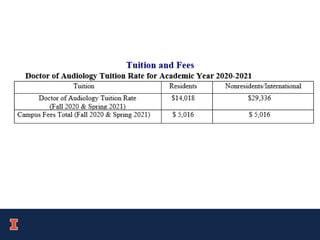
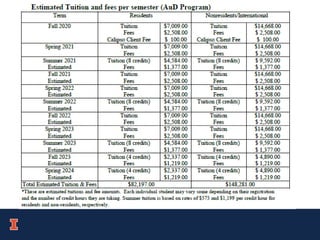
  • #22 Total Estimated Tuition & Fees   $45,123.00 (residents)   $83,027.00 (nonresidents)