SCIENCE 9
HEREDITY
OBJECTIVES
1
2
.Explain the different patterns of non-Mendelian
inheritance; incomplete dominance, codominance
and multiple alleles.
Explain how the gender of an organism is
determined.
OBJECTIVES
3 Solve genetic problems related
to incomplete dominance,
codominance and multiple
alleles.
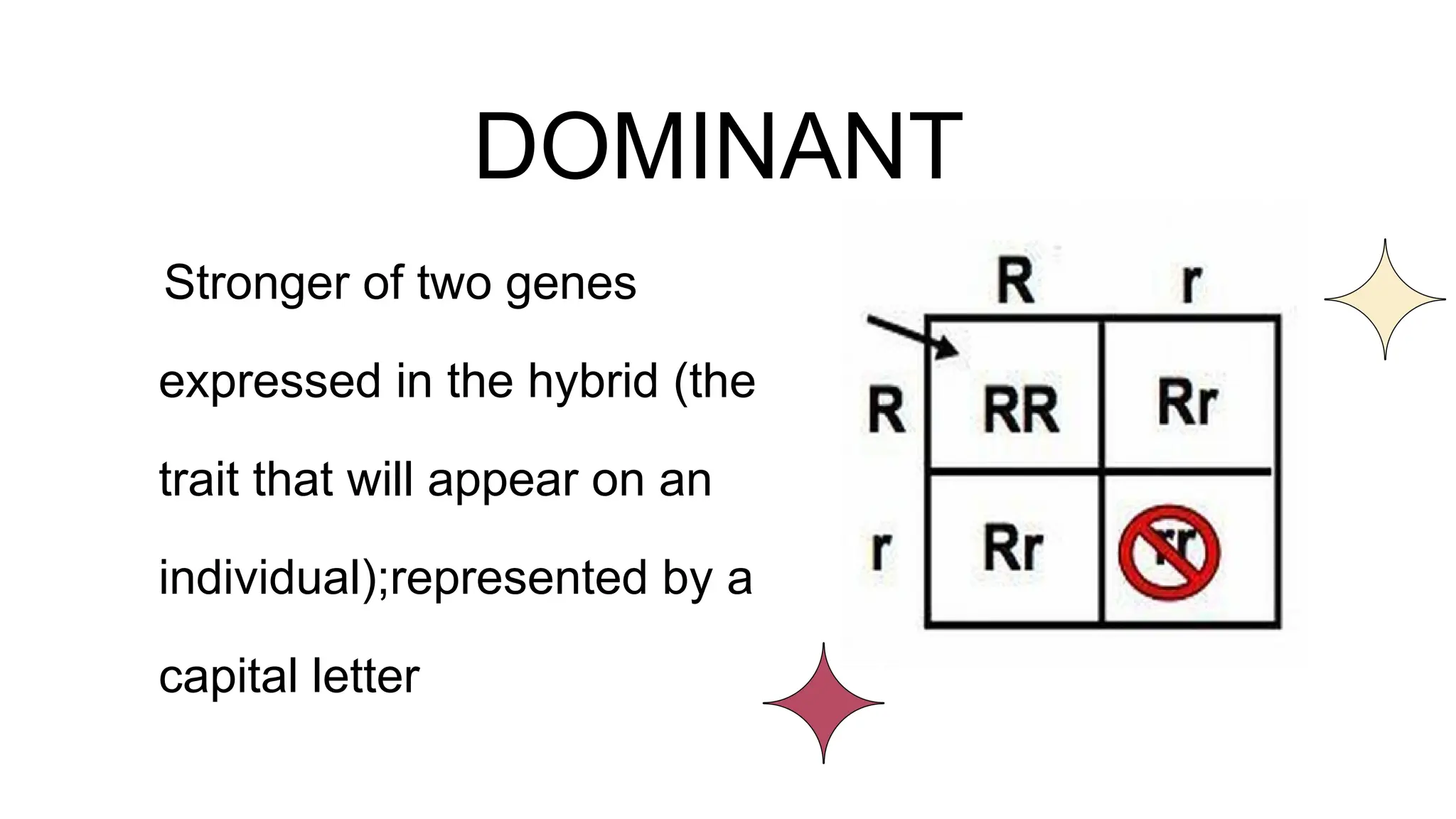
DOMINANT
Stronger of two genes
expressed in the hybrid (the
trait that will appear on an
individual);represented by a
capital letter
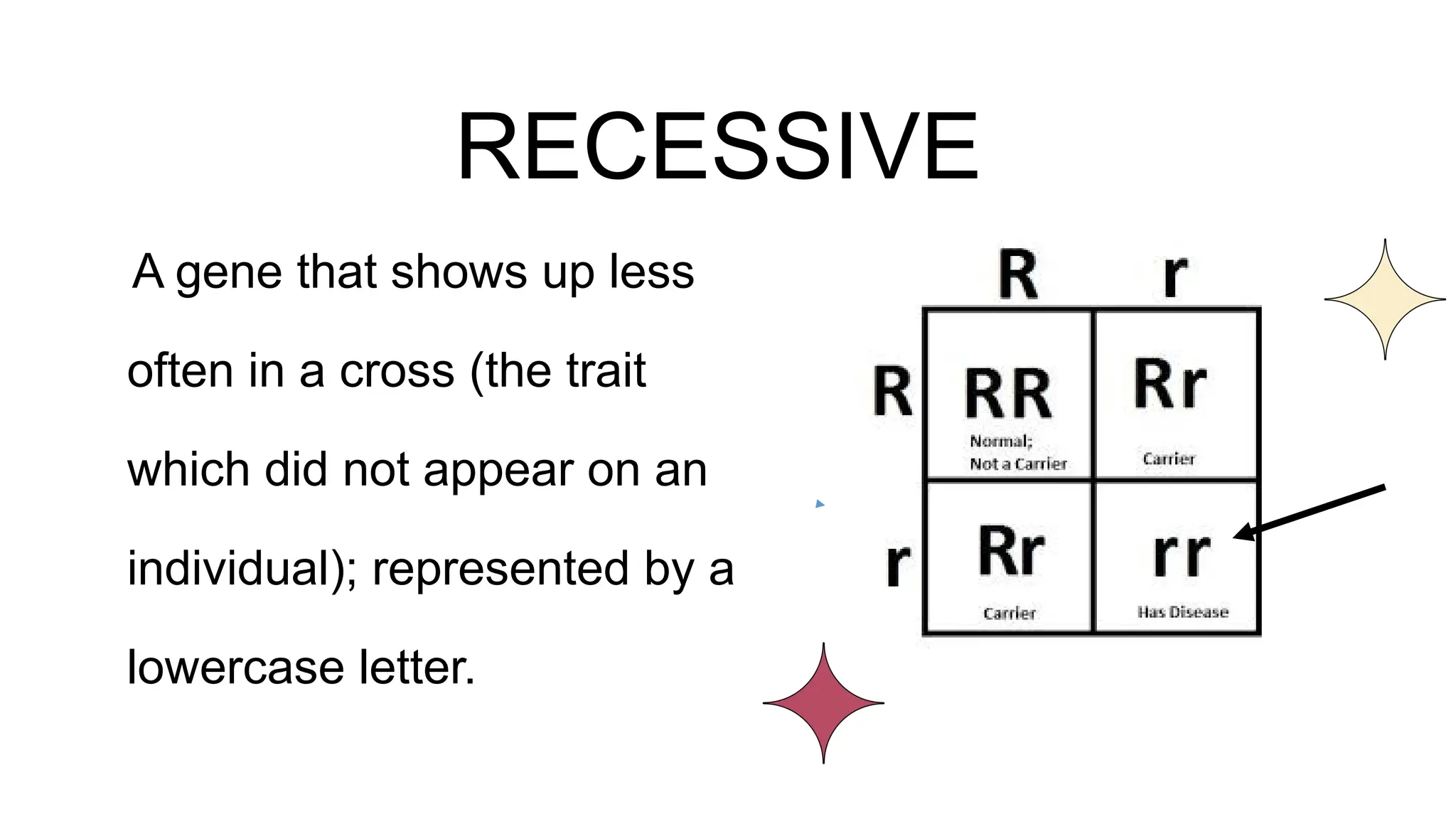
RECESSIVE
A gene that shows up less
often in a cross (the trait
which did not appear on an
individual); represented by a
lowercase letter.
HOMOZYGOUS
A gene combination
involving 2 dominant or 2
recessive genes (e.g. RR
or rr); also called pure.
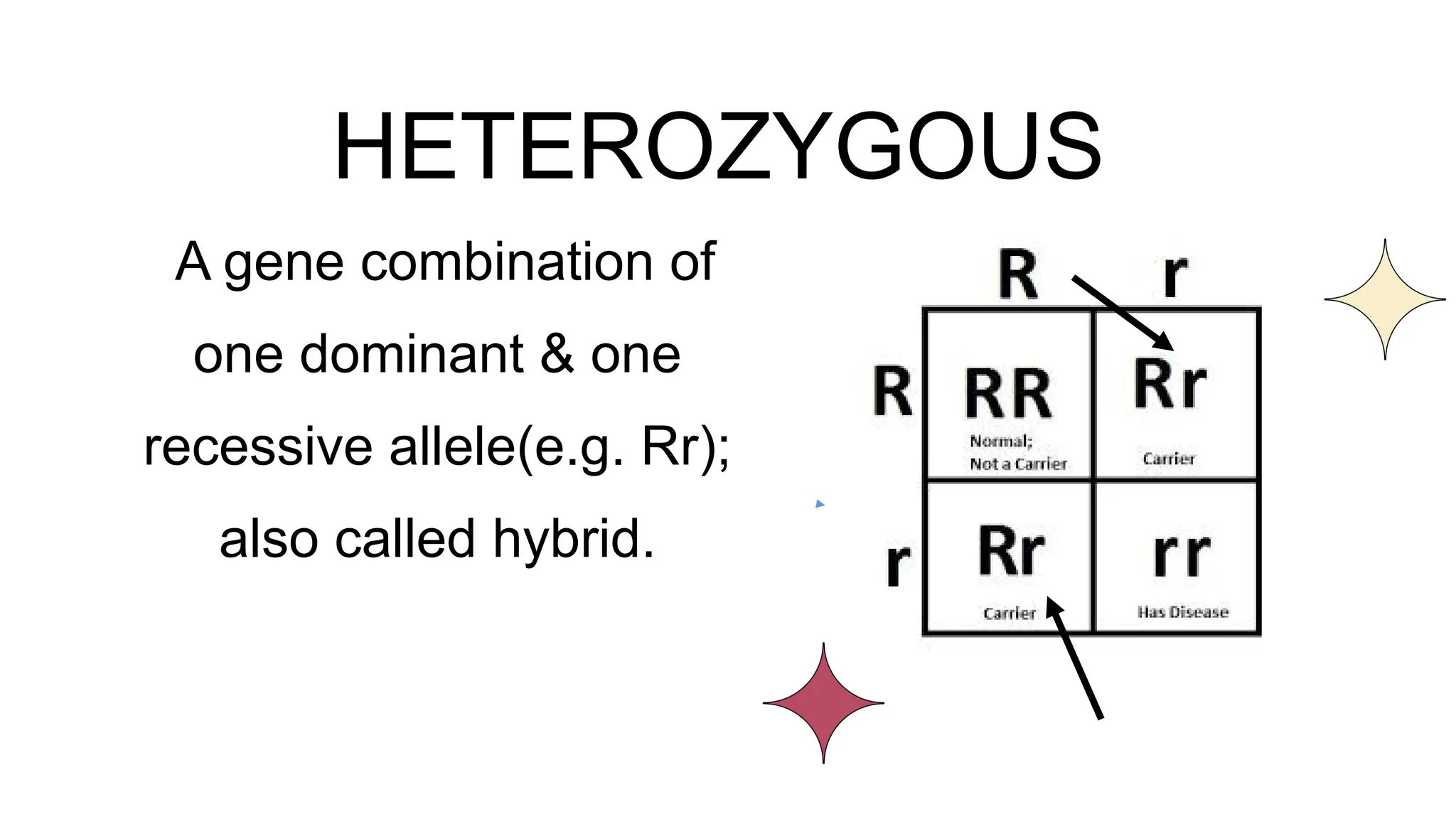
HETEROZYGOUS
A gene combination of
one dominant & one
recessive allele(e.g. Rr);
also called hybrid.
GENOTYPE
It is an organism that has different copies of a
gene for a particular trait.
GENOTYPE
BB
Homozygous dominant
Bb
Heterozygous
bb
Homozygous recessive
PHENOTYPE
PHENOTYPE
The appearance of an individual regardless of the genotype. refers to
the visible expression of an organism. (ex. color, height, shape)
GENOTYPE
BB
Homozygous dominant
Bb
Heterozygous
bb
Homozygous recessive
PHENOTYPE
TRAIT
It is any characteristic that can be passed from
parent to offspring.
ALLELE
It is a different form of
a gene that controls a
certain trait.
LEARN ABOUT IT!
GREGOR JOHANN MENDEL
HE is the father of genetics.
Gregor Mendel is considered one of these
giants owing to his discovery of the basic
principles of inheritance
CONDUCT A SURVEY AMONG YOUR FAMILY MEMBERS.
INDICATE THE APPROPRIATE CHARACTERISTICS/ TRAITS
THAT EACH POSSESSES
CHROMOSOMES
• The tightly packed in the nucleus of
eukaryotic cells are the chromosomes.
• Chromosomes carries of genes, the
determiners of hereditary characteristics.
• Each chromosomes winds around many
structural proteins called histones.
CHROMOSOMES
• Chromosome came from the Greek word
“chroma”, which means color and soma which
means body.
• Nucleoid-the circular DNA molecule found in an
area in the cytoplasm.
• Plasmids-the extra circular DNA in some species
of prokaryoters.
CHROMOSOMES
• The single linear strands of chromosomes
are tightly packed and condensed in the
nucleus into discrete structure called
chromatins.
• Double-stranded chromosomes called
sister chromatids.
Structure of the chromosomes
• Centromere-coiled x-
shaped structure joined
or attached at a certain
point.
• Pinched area in the pair
of chromatids that
divides the chromatids
into sections called arms.
Structure of the chromosomes
• P arm (p for petite) the short
arm.
• q arm-long arm.
• A telomere is a region of
repetitive DNA sequences at
the end of a chromosome.
• Telomeres protect the ends of
chromosomes from becoming
frayed or tangled
Structure of the chromosomes
• Metacentric – centromere is in middle, meaning p and q arms are of
comparable length
• Submetacentric – centromere off-centre, leading to shorter p arm relative
to q arm
• Acrocentric – centromere severely off-set from centre, leading to much
shorter p arm
• Telocentric – centromere found at end of chromosome, meaning no p arm
exists (chromosome not found in humans)
Deoxyribonucleic Acid (DNA)
• The deoxyribonucleic acid (or
DNA) is a very long chain of
connected nucleotides.
• Deoxyribonucleic acid is a
polymer composed of two
polynucleotide chains that coil
around each other to form a
double helix.
GENES
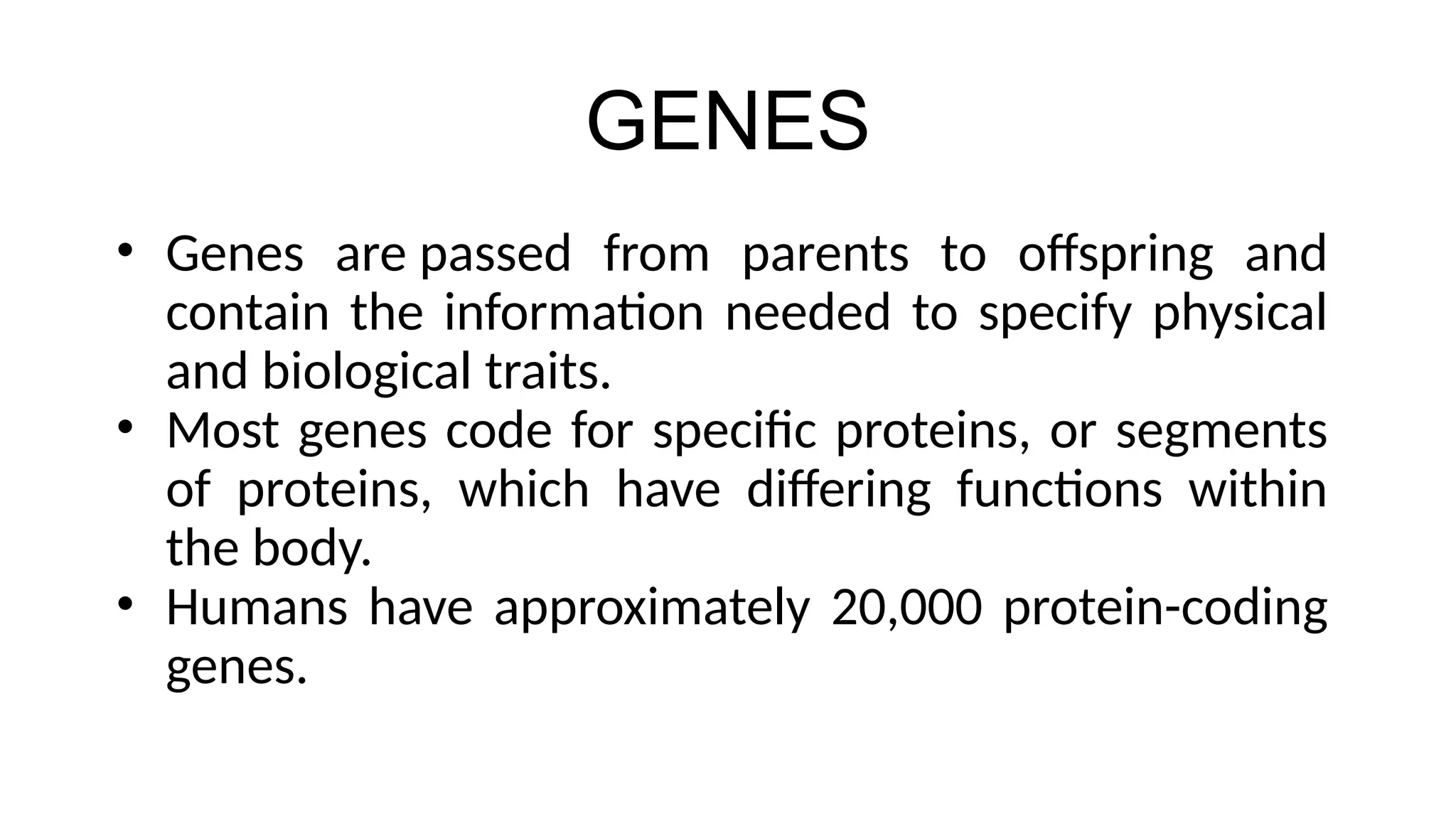
• Genes are passed from parents to offspring and
contain the information needed to specify physical
and biological traits.
• Most genes code for specific proteins, or segments
of proteins, which have differing functions within
the body.
• Humans have approximately 20,000 protein-coding
genes.
The method by which one can determine the
possible genotypes and phenotype when two
parents are crossed called punnet square.
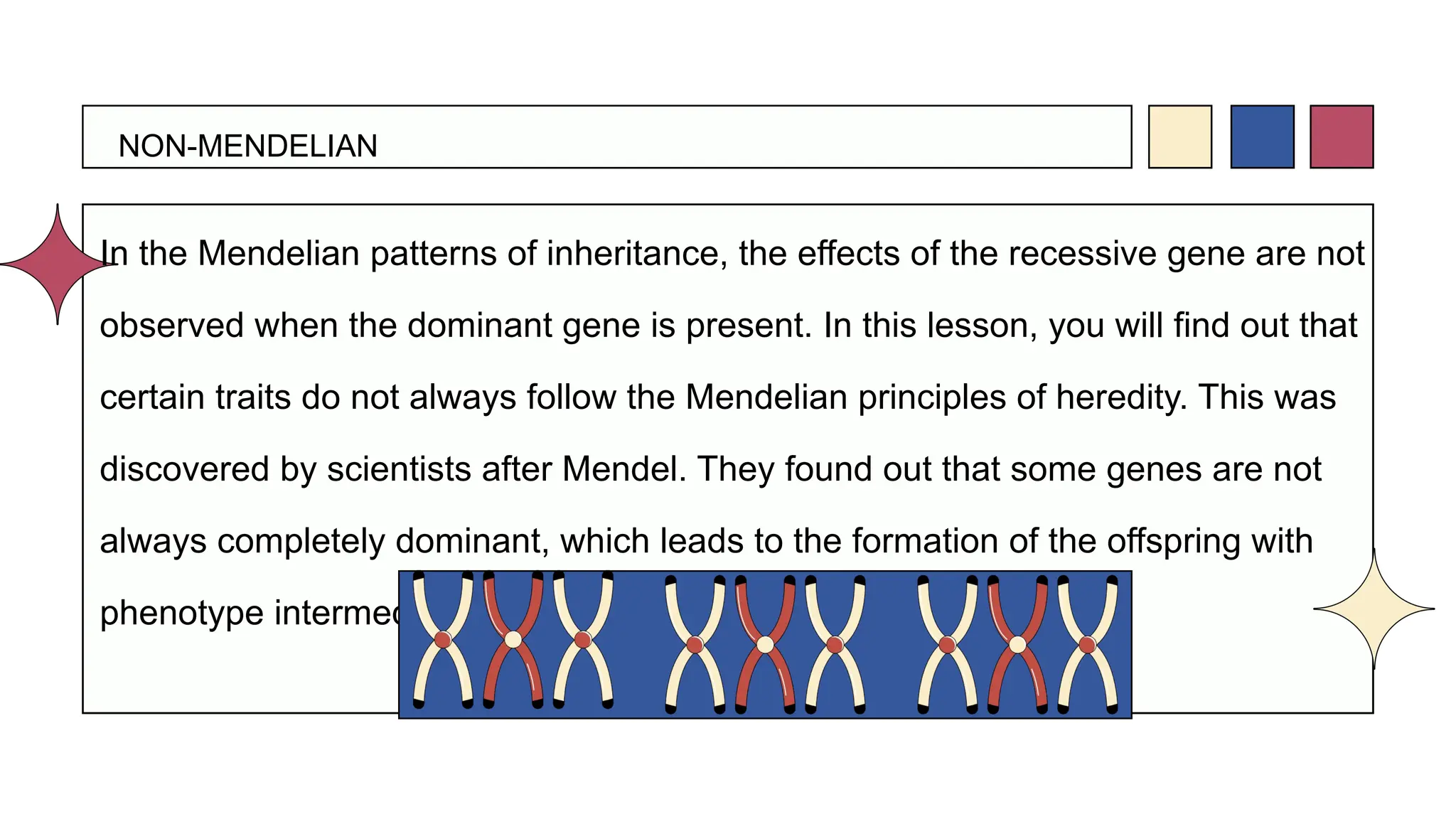
In the Mendelian patterns of inheritance, the effects of the recessive gene are not
observed when the dominant gene is present. In this lesson, you will find out that
certain traits do not always follow the Mendelian principles of heredity. This was
discovered by scientists after Mendel. They found out that some genes are not
always completely dominant, which leads to the formation of the offspring with
phenotype intermediate between parental phenotypes.
NON-MENDELIAN
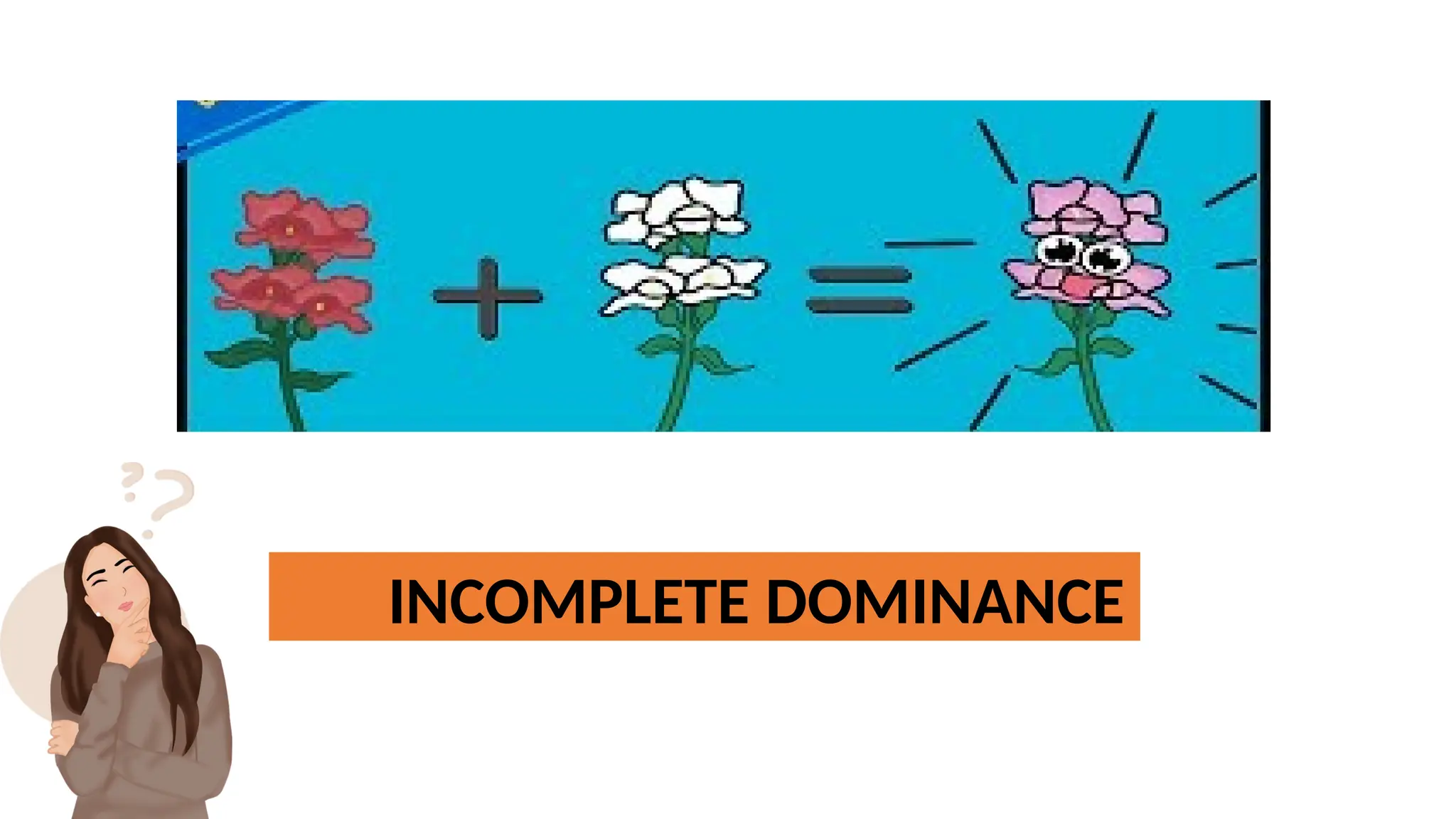
INCOMPLETE DOMINANCE
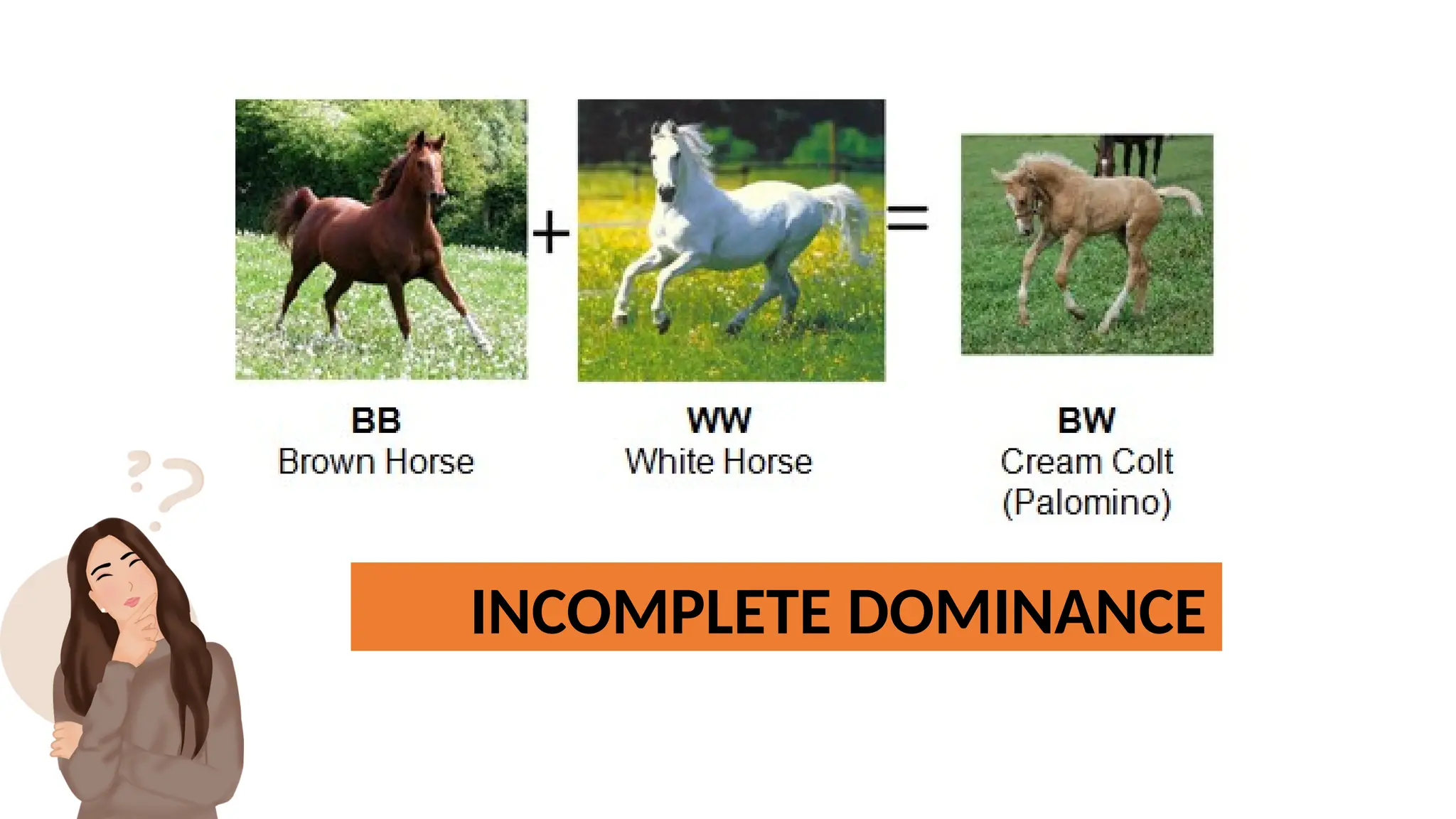
In incomplete dominance, a heterozygote shows a phenotype that is intermediate between the two
homozygous phenotypes. Neither allele is dominant over the other or one allele is partially
dominant over the other allele resulting to blending of characteristics,
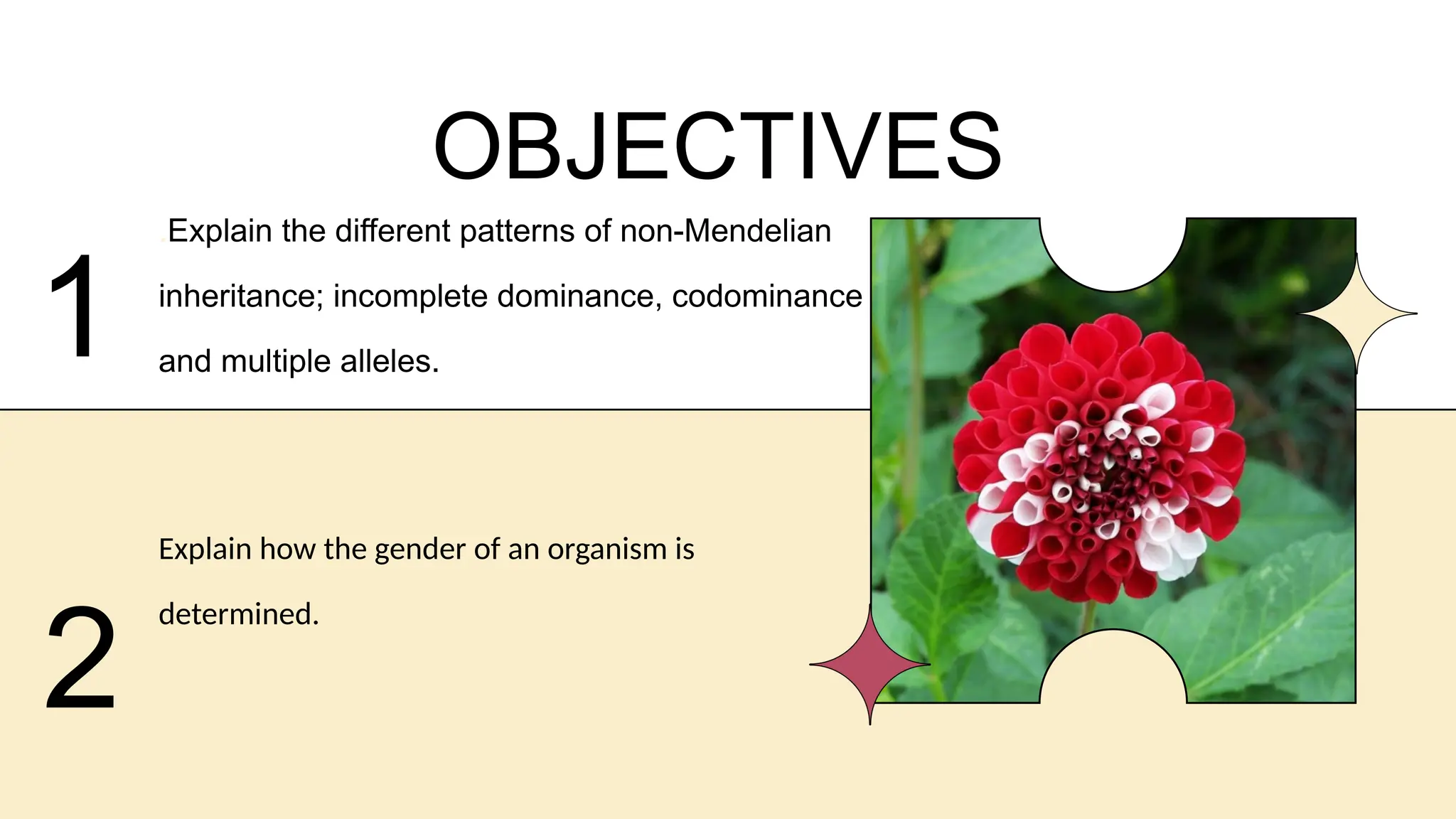
An example of
incomplete
dominance is
the flower
color shown in
this picture.
When a pure red-flower (R) is crossed with
a pure white- flower (r), the offspring will
produce neither red nor white flowers.
Instead, all flowers will be PINK.
EXAMPLE:
• Show the possible outcome of the cross between White (WW) and
Pink flower (RW). Write the genotypes and phenotypes.
CODOMINANCE
Another non mendelian pattern of inheritance is
codominance. This results when one allele is not
dominant over the other. The resulting heterozygotes
exhibit the traits of both parents. One example of
codominance is roan fur in cattle.
Consider this:
Red - (RR = all red hairs),
White - (WW = all white hairs),
Roan - (RW = red & white hairs together).
If you cross a red bull and a white cow, the offsprings produced are roan.
Roan refers to cows with red hair and white blotches.
Red White Roan
Genotypic ratio:
Phenotypic
ratio:
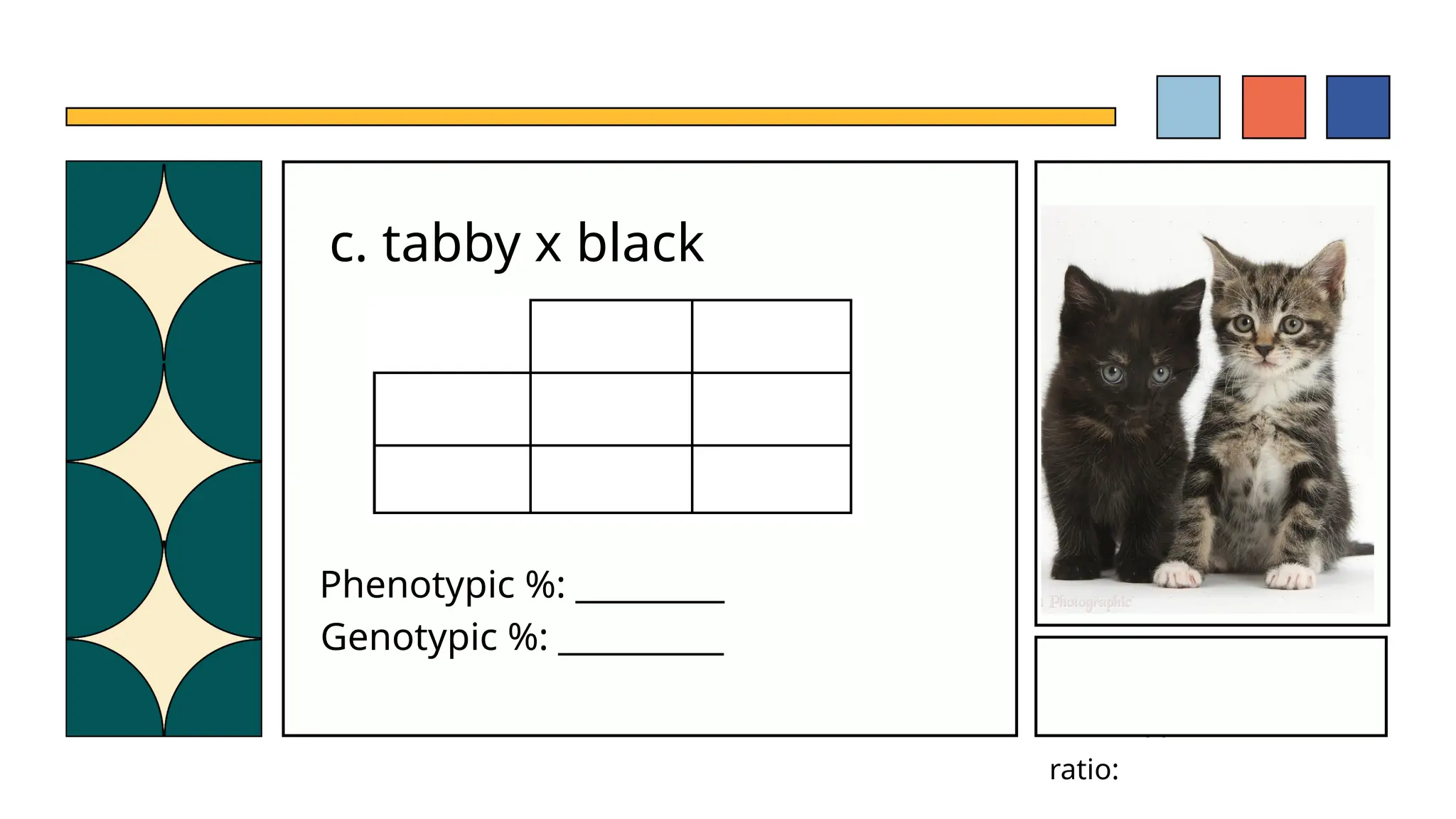
c. tabby x black
Phenotypic %: _________
Genotypic %: __________
Sometimes, even if only two alleles control a
trait, there may actually be more than two
types of alleles available. This will also lead to
more than two phenotypes expressed. Another
blood group system in humans, the ABO
system, is an example of a character governed
by multiple alleles. Three alleles are
responsible for this blood system: IA, IB, and i.
The ABO blood type is determined by the
presence or absence of two antigens, A and B.
MULTIPLE ALLELES
There are four possible blood types as shown below:
Sample
A woman with type A (Heterozygous) blood and a man with type B
(Heterozygous) blood want to know the probability of having a child with type
O blood.
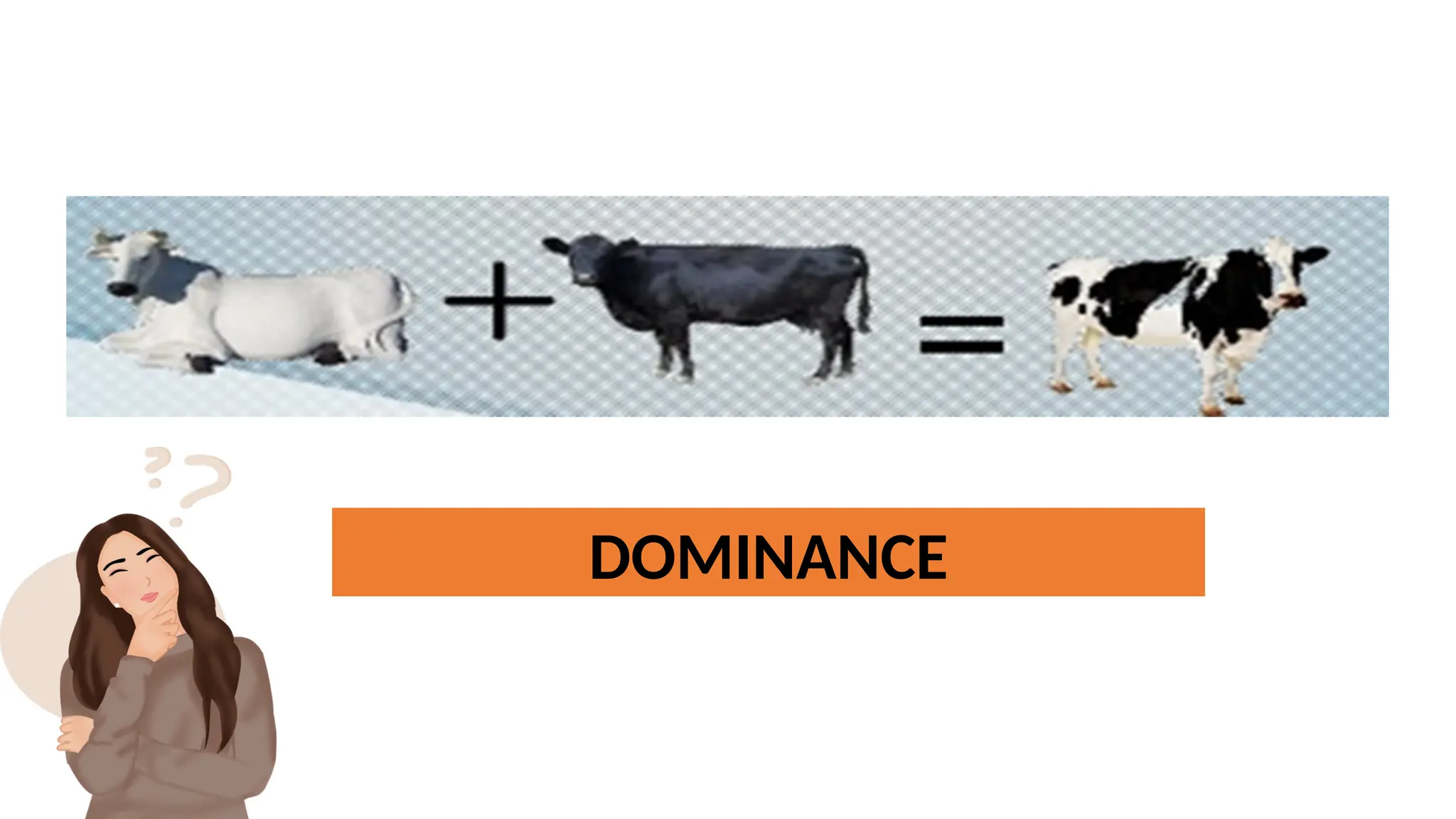
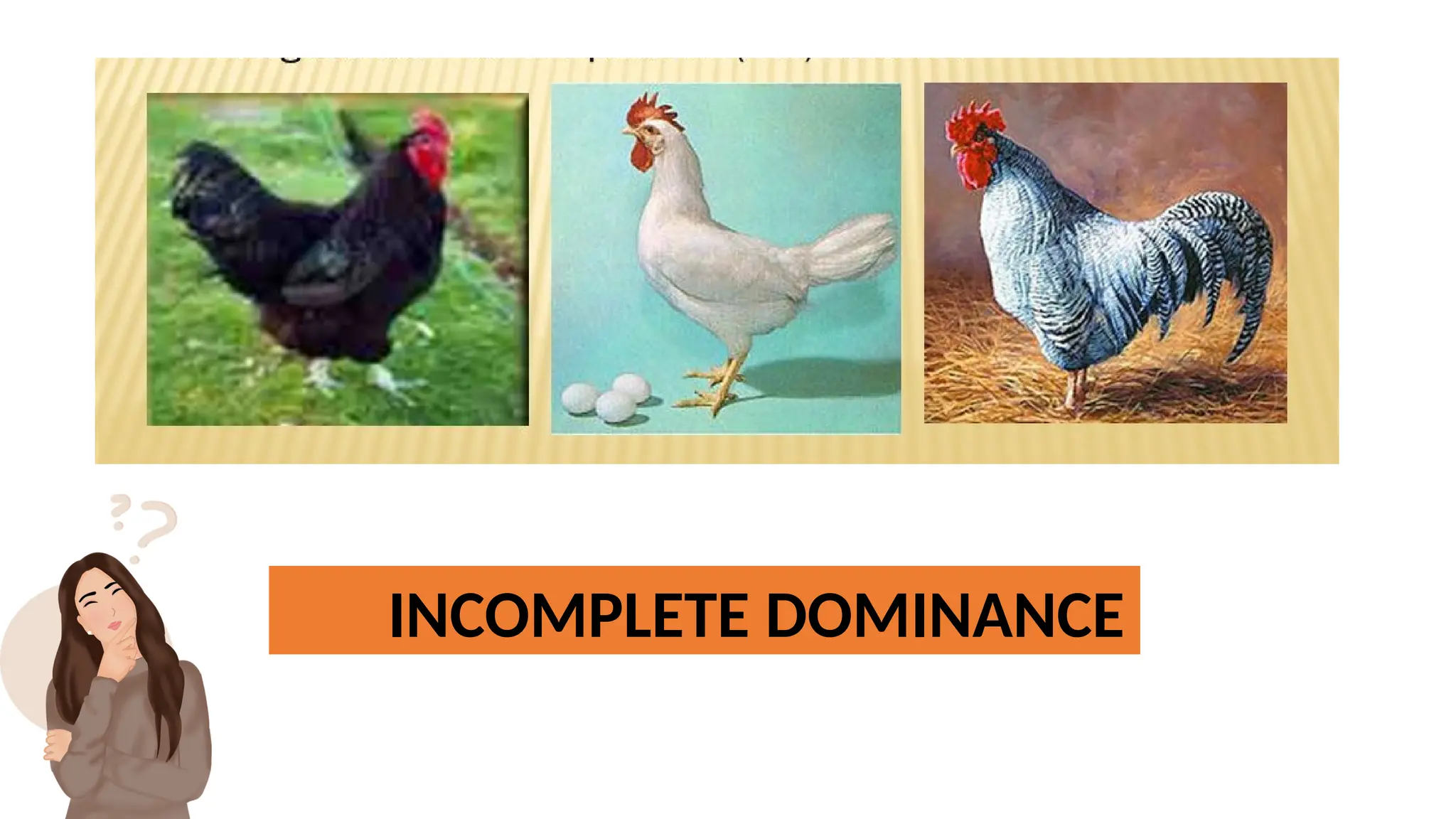
WHAT CAN YOU SAY
ABOUT THESE
PHOTOS?
INCOMPLETE DOMINANCE
DOMINANCE
INCOMPLETE DOMINANCE
DOMINANCE
DOMINANCE
ACTIVITY
Assuming that you as a unique organism, inherited both of your
parent’s characteristics/ traits. Using a graphic organizer, write your
name in the circle and identify some traits that you think you
inherited from your father and mother and write them in the
capsules on each side of the circle.
A woman sues a man for the support of her child. She has heterozygous type A
blood, her child has type O and the man has heterozygous type B. Could the man
be the father? Explain your answer.
QUESTION #2
ACTIVITY 1: WHAT’S YOUR BLOOD TYPE?
Given the blood types of the mother and the child, identify all the
possible blood type of the father.
THANK YOU
FOR LISTENING!

Heredity: Passing on Traits Offspring ue

  • 1.
  • 2.
    OBJECTIVES 1 2 .Explain the differentpatterns of non-Mendelian inheritance; incomplete dominance, codominance and multiple alleles. Explain how the gender of an organism is determined.
  • 3.
    OBJECTIVES 3 Solve geneticproblems related to incomplete dominance, codominance and multiple alleles.
  • 4.
    DOMINANT Stronger of twogenes expressed in the hybrid (the trait that will appear on an individual);represented by a capital letter
  • 5.
    RECESSIVE A gene thatshows up less often in a cross (the trait which did not appear on an individual); represented by a lowercase letter.
  • 6.
    HOMOZYGOUS A gene combination involving2 dominant or 2 recessive genes (e.g. RR or rr); also called pure.
  • 7.
    HETEROZYGOUS A gene combinationof one dominant & one recessive allele(e.g. Rr); also called hybrid.
  • 8.
    GENOTYPE It is anorganism that has different copies of a gene for a particular trait. GENOTYPE BB Homozygous dominant Bb Heterozygous bb Homozygous recessive PHENOTYPE
  • 9.
    PHENOTYPE The appearance ofan individual regardless of the genotype. refers to the visible expression of an organism. (ex. color, height, shape) GENOTYPE BB Homozygous dominant Bb Heterozygous bb Homozygous recessive PHENOTYPE
  • 10.
    TRAIT It is anycharacteristic that can be passed from parent to offspring.
  • 11.
    ALLELE It is adifferent form of a gene that controls a certain trait.
  • 12.
    LEARN ABOUT IT! GREGORJOHANN MENDEL HE is the father of genetics. Gregor Mendel is considered one of these giants owing to his discovery of the basic principles of inheritance
  • 13.
    CONDUCT A SURVEYAMONG YOUR FAMILY MEMBERS. INDICATE THE APPROPRIATE CHARACTERISTICS/ TRAITS THAT EACH POSSESSES
  • 14.
    CHROMOSOMES • The tightlypacked in the nucleus of eukaryotic cells are the chromosomes. • Chromosomes carries of genes, the determiners of hereditary characteristics. • Each chromosomes winds around many structural proteins called histones.
  • 15.
    CHROMOSOMES • Chromosome camefrom the Greek word “chroma”, which means color and soma which means body. • Nucleoid-the circular DNA molecule found in an area in the cytoplasm. • Plasmids-the extra circular DNA in some species of prokaryoters.
  • 16.
    CHROMOSOMES • The singlelinear strands of chromosomes are tightly packed and condensed in the nucleus into discrete structure called chromatins. • Double-stranded chromosomes called sister chromatids.
  • 17.
    Structure of thechromosomes • Centromere-coiled x- shaped structure joined or attached at a certain point. • Pinched area in the pair of chromatids that divides the chromatids into sections called arms.
  • 18.
    Structure of thechromosomes • P arm (p for petite) the short arm. • q arm-long arm. • A telomere is a region of repetitive DNA sequences at the end of a chromosome. • Telomeres protect the ends of chromosomes from becoming frayed or tangled
  • 19.
    Structure of thechromosomes • Metacentric – centromere is in middle, meaning p and q arms are of comparable length • Submetacentric – centromere off-centre, leading to shorter p arm relative to q arm • Acrocentric – centromere severely off-set from centre, leading to much shorter p arm • Telocentric – centromere found at end of chromosome, meaning no p arm exists (chromosome not found in humans)
  • 20.
    Deoxyribonucleic Acid (DNA) •The deoxyribonucleic acid (or DNA) is a very long chain of connected nucleotides. • Deoxyribonucleic acid is a polymer composed of two polynucleotide chains that coil around each other to form a double helix.
  • 21.
    GENES • Genes arepassed from parents to offspring and contain the information needed to specify physical and biological traits. • Most genes code for specific proteins, or segments of proteins, which have differing functions within the body. • Humans have approximately 20,000 protein-coding genes.
  • 22.
    The method bywhich one can determine the possible genotypes and phenotype when two parents are crossed called punnet square.
  • 23.
    In the Mendelianpatterns of inheritance, the effects of the recessive gene are not observed when the dominant gene is present. In this lesson, you will find out that certain traits do not always follow the Mendelian principles of heredity. This was discovered by scientists after Mendel. They found out that some genes are not always completely dominant, which leads to the formation of the offspring with phenotype intermediate between parental phenotypes. NON-MENDELIAN
  • 24.
  • 25.
    INCOMPLETE DOMINANCE In incompletedominance, a heterozygote shows a phenotype that is intermediate between the two homozygous phenotypes. Neither allele is dominant over the other or one allele is partially dominant over the other allele resulting to blending of characteristics, An example of incomplete dominance is the flower color shown in this picture. When a pure red-flower (R) is crossed with a pure white- flower (r), the offspring will produce neither red nor white flowers. Instead, all flowers will be PINK.
  • 26.
    EXAMPLE: • Show thepossible outcome of the cross between White (WW) and Pink flower (RW). Write the genotypes and phenotypes.
  • 27.
    CODOMINANCE Another non mendelianpattern of inheritance is codominance. This results when one allele is not dominant over the other. The resulting heterozygotes exhibit the traits of both parents. One example of codominance is roan fur in cattle.
  • 28.
    Consider this: Red -(RR = all red hairs), White - (WW = all white hairs), Roan - (RW = red & white hairs together). If you cross a red bull and a white cow, the offsprings produced are roan. Roan refers to cows with red hair and white blotches. Red White Roan
  • 29.
    Genotypic ratio: Phenotypic ratio: c. tabbyx black Phenotypic %: _________ Genotypic %: __________
  • 30.
    Sometimes, even ifonly two alleles control a trait, there may actually be more than two types of alleles available. This will also lead to more than two phenotypes expressed. Another blood group system in humans, the ABO system, is an example of a character governed by multiple alleles. Three alleles are responsible for this blood system: IA, IB, and i. The ABO blood type is determined by the presence or absence of two antigens, A and B. MULTIPLE ALLELES
  • 31.
    There are fourpossible blood types as shown below:
  • 32.
    Sample A woman withtype A (Heterozygous) blood and a man with type B (Heterozygous) blood want to know the probability of having a child with type O blood.
  • 33.
    WHAT CAN YOUSAY ABOUT THESE PHOTOS?
  • 34.
  • 35.
  • 36.
  • 37.
  • 38.
  • 39.
  • 40.
  • 41.
  • 42.
    ACTIVITY Assuming that youas a unique organism, inherited both of your parent’s characteristics/ traits. Using a graphic organizer, write your name in the circle and identify some traits that you think you inherited from your father and mother and write them in the capsules on each side of the circle.
  • 43.
    A woman suesa man for the support of her child. She has heterozygous type A blood, her child has type O and the man has heterozygous type B. Could the man be the father? Explain your answer. QUESTION #2
  • 44.
    ACTIVITY 1: WHAT’SYOUR BLOOD TYPE? Given the blood types of the mother and the child, identify all the possible blood type of the father.
  • 45.

Editor's Notes

  • #15 Chromosomes can stained or colored by specific dyes.
  • #16 Chromosomes can stained or colored by specific dyes.
  • #18 Chromosomes can be classified according to the location of the centromere. Metacentric Submetacentric Telocentric acrocentric
  • #19 Humans have 46 chromosomes, 23 homologous pair
  • #21 RESPONSIBLE for physical and heretable characteristics of organisms.
  • #25 GENOTYPE= SAMPLE IS 1 rr:2RR:1Rr PENOTYPE = 100% PINK FLOWER
  • #26 G=50% RW. 50% WW P=50% PINK FLOWER, 50 % WHITE FLOWER
  • #32 Offspring phenotypes: 25% type a, ab, b, o