LC: illustrates a probability distribution for a discrete
random variable and its properties. M11/12SP-IIIa-4
Random Variables and
Probability Distributions
Frequency Distribution
Frequency tells you how often something
happened. The frequency of an observation tells
you the number of times the observation occurs in
the data.
Probability
Probability as a general concept can be defined as the
chance of an event occurring
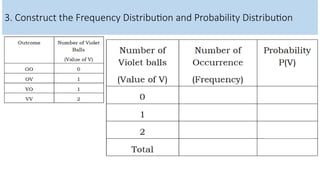
3. Construct the Frequency Distribution and Probability Distribution
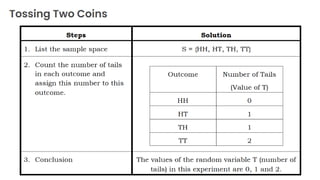
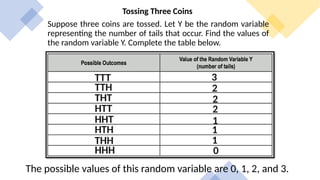
Tossing Three Coins
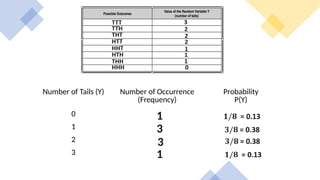
Suppose three coins are tossed. Let Y be the random variable
representing the number of tails that occur. Find the values of
the random variable Y. Complete the table below.
TTT
TTH
THT
HTT
HHT
HTH
THH
HHH
3
2
2
2
1
1
1
0
The possible values of this random variable are 0, 1, 2, and 3.
Number of Tails (Y) Number of Occurrence
(Frequency)
Probability
P(Y)
0
1
2
3
1
3
3
1
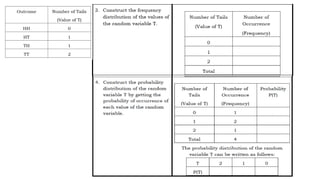
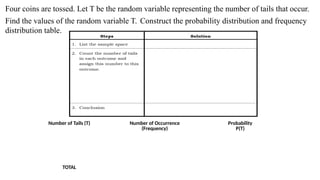
Four coins are tossed. Let T be the random variable representing the number of tails that occur.
Find the values of the random variable T. Construct the probability distribution and frequency
distribution table.
Number of Tails (T) Number of Occurrence
(Frequency)
Probability
P(T)
TOTAL

4.illustrates-a-probability-distribution-for-a-discrete-random-variable-and.pptx

  • 1.
    LC: illustrates aprobability distribution for a discrete random variable and its properties. M11/12SP-IIIa-4 Random Variables and Probability Distributions
  • 2.
    Frequency Distribution Frequency tellsyou how often something happened. The frequency of an observation tells you the number of times the observation occurs in the data.
  • 3.
    Probability Probability as ageneral concept can be defined as the chance of an event occurring
  • 7.
    3. Construct theFrequency Distribution and Probability Distribution
  • 8.
    Tossing Three Coins Supposethree coins are tossed. Let Y be the random variable representing the number of tails that occur. Find the values of the random variable Y. Complete the table below. TTT TTH THT HTT HHT HTH THH HHH 3 2 2 2 1 1 1 0 The possible values of this random variable are 0, 1, 2, and 3.
  • 9.
    Number of Tails(Y) Number of Occurrence (Frequency) Probability P(Y) 0 1 2 3 1 3 3 1
  • 10.
    Four coins aretossed. Let T be the random variable representing the number of tails that occur. Find the values of the random variable T. Construct the probability distribution and frequency distribution table. Number of Tails (T) Number of Occurrence (Frequency) Probability P(T) TOTAL