Beyond the Label
IoT considerations
Henri Barthel, GS1
Sierre, 27 January 2012
© 2012 GS1
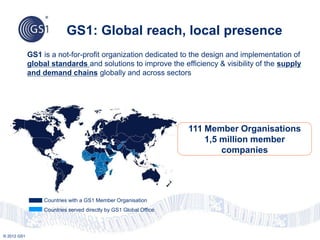
GS1: Global reach, local presence
GS1 is a not-for-profit organization dedicated to the design and implementation of
global standards and solutions to improve the efficiency & visibility of the supply
and demand chains globally and across sectors
Countries with a GS1 Member Organisation
Countries served directly by GS1 Global Office
111 Member Organisations
1,5 million member
companies
© 2012 GS1
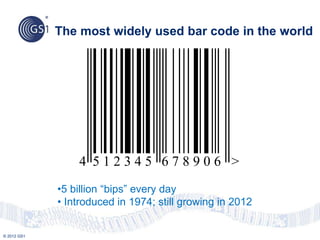
The most widely used bar code in the world
4 5 1 2 3 4 5 6 7 8 9 0 6 >
•5 billion “bips” every day
• Introduced in 1974; still growing in 2012
© 2012 GS1
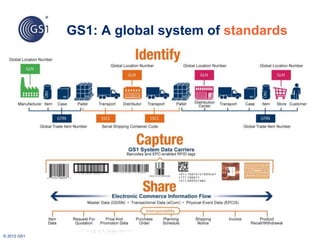
GS1: A global system of standards
Beyond the Label
Providing Digital
Information Consumers
Can Trust
© 2012 GS1
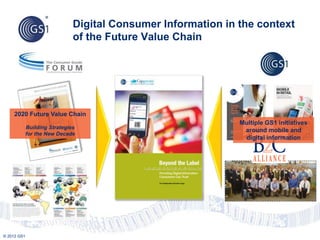
Digital Consumer Information in the context
of the Future Value Chain
2020 Future Value Chain
Building Strategies
for the New Decade
Multiple GS1 initiatives
around mobile and
digital information
© 2012 GS1
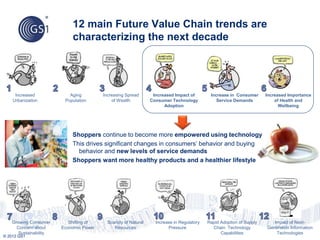
12 main Future Value Chain trends are
characterizing the next decade
Increased
Urbanization
Aging
Population
Increasing Spread
of Wealth
Increased Impact of
Consumer Technology
Adoption
Increase in Consumer
Service Demands
Increased Importance of
Health and Wellbeing
Growing Consumer
Concern about
Sustainability
Shifting of
Economic Power
Scarcity of Natural
Resources
Increase in Regulatory
Pressure
Rapid Adoption of Supply
Chain Technology
Capabilities
Impact of Next-
Generation Information
Technologies
Increased Impact of
Consumer Technology
Adoption
Increase in Consumer
Service Demands
Increased Importance
of Health and
Wellbeing
Shoppers continue to become more empowered using technology
This drives significant changes in consumers’ behavior and buying
behavior and new levels of service demands
Shoppers want more healthy products and a healthier lifestyle
© 2012 GS1
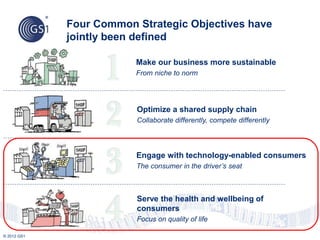
Four Common Strategic Objectives have
jointly been defined
Optimize a shared supply chain
Collaborate differently, compete differently
Engage with technology-enabled consumers
The consumer in the driver’s seat
Serve the health and wellbeing of
consumers
Focus on quality of life
Make our business more sustainable
From niche to norm
© 2012 GS1
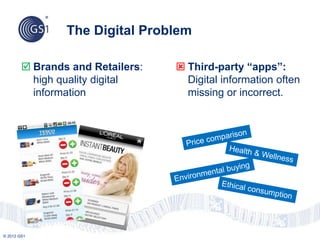
The Digital Problem
 Brands and Retailers:
high quality digital
information
 Third-party “apps”:
Digital information often
missing or incorrect.
© 2012 GS1
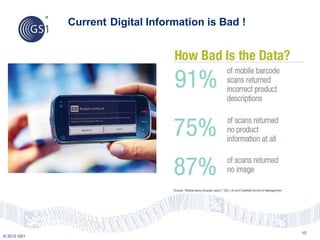
Current Digital Information is Bad !
10
© 2012 GS1
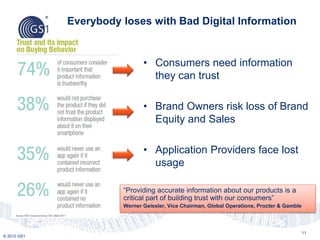
Everybody loses with Bad Digital Information
11
“Providing accurate information about our products is a
critical part of building trust with our consumers”
Werner Geissler, Vice Chairman, Global Operations, Procter & Gamble
• Consumers need information
they can trust
• Brand Owners risk loss of Brand
Equity and Sales
• Application Providers face lost
usage
© 2012 GS1
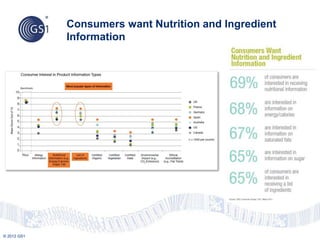
Consumers want Nutrition and Ingredient
Information
© 2012 GS1
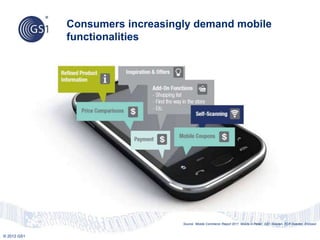
Consumers increasingly demand mobile
functionalities
Source: ‘Mobile Commerce Report 2011: Mobile in Retail’, GS1 Sweden, ECR Sweden, Ericsson
© 2012 GS1
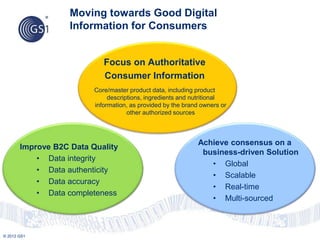
Moving towards Good Digital
Information for Consumers
Focus on Authoritative
Consumer Information
Core/master product data, including product
descriptions, ingredients and nutritional
information, as provided by the brand owners or
other authorized sources
Achieve consensus on a
business-driven Solution
• Global
• Scalable
• Real-time
• Multi-sourced
Improve B2C Data Quality
• Data integrity
• Data authenticity
• Data accuracy
• Data completeness
© 2012 GS1
GS1 – Trusted source of data
© 2012 GS1
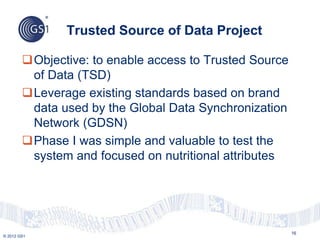
Objective: to enable access to Trusted Source
of Data (TSD)
Leverage existing standards based on brand
data used by the Global Data Synchronization
Network (GDSN)
Phase I was simple and valuable to test the
system and focused on nutritional attributes
Trusted Source of Data Project
16
© 2012 GS1
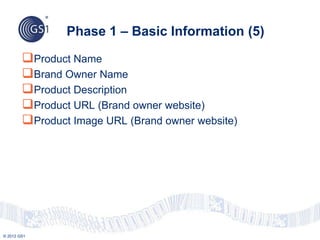
Product Name
Brand Owner Name
Product Description
Product URL (Brand owner website)
Product Image URL (Brand owner website)
Phase 1 – Basic Information (5)
© 2012 GS1
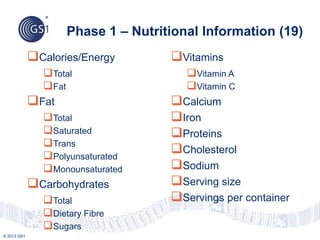
Phase 1 – Nutritional Information (19)
Calories/Energy
Total
Fat
Fat
Total
Saturated
Trans
Polyunsaturated
Monounsaturated
Carbohydrates
Total
Dietary Fibre
Sugars
Vitamins
Vitamin A
Vitamin C
Calcium
Iron
Proteins
Cholesterol
Sodium
Serving size
Servings per container
© 2012 GS1
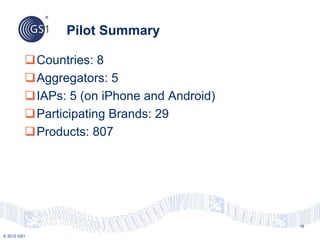
Pilot Summary
Countries: 8
Aggregators: 5
IAPs: 5 (on iPhone and Android)
Participating Brands: 29
Products: 807
19
© 2012 GS1
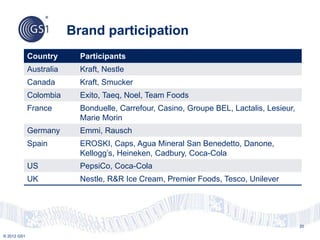
Brand participation
20
Country Participants
Australia Kraft, Nestle
Canada Kraft, Smucker
Colombia Exito, Taeq, Noel, Team Foods
France Bonduelle, Carrefour, Casino, Groupe BEL, Lactalis, Lesieur,
Marie Morin
Germany Emmi, Rausch
Spain EROSKI, Caps, Agua Mineral San Benedetto, Danone,
Kellogg’s, Heineken, Cadbury, Coca-Cola
US PepsiCo, Coca-Cola
UK Nestle, R&R Ice Cream, Premier Foods, Tesco, Unilever
© 2012 GS1
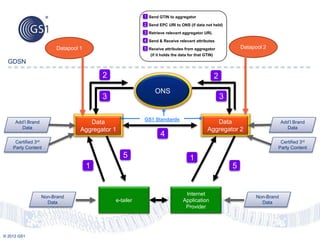
GS1 Standards
Datapool 1 Datapool 2
GDSN
Certified 3rd
Party Content
Data
Aggregator 1
Data
Aggregator 2
ONS
e-tailer
Internet
Application
Provider
1
15
5
Add’l Brand
Data
Certified 3rd
Party Content
Add’l Brand
Data
1 Send GTIN to aggregator
2 2
2 Send EPC URI to ONS (if data not held)
3 3
3 Retrieve relevant aggregator URL
4
4 Send & Receive relevant attributes
5 Receive attributes from aggregator
Non-Brand
Data
Non-Brand
Data
(if it holds the data for that GTIN)
© 2012 GS1
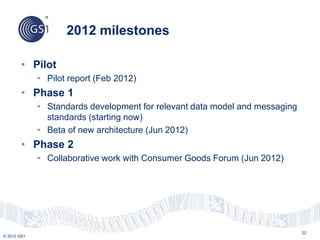
2012 milestones
22
• Pilot
• Pilot report (Feb 2012)
• Phase 1
• Standards development for relevant data model and messaging
standards (starting now)
• Beta of new architecture (Jun 2012)
• Phase 2
• Collaborative work with Consumer Goods Forum (Jun 2012)
© 2012 GS1
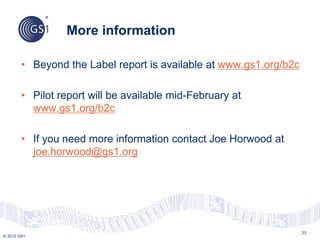
More information
23
• Beyond the Label report is available at www.gs1.org/b2c
• Pilot report will be available mid-February at
www.gs1.org/b2c
• If you need more information contact Joe Horwood at
joe.horwood@gs1.org
The Internet of Things
Some considerations
© 2012 GS1
The Internet of Things
• The expression was first created at the Massachusetts
Institute of Technology (MIT) in 1999
• There was a research project called Electronic
Product Code
• The idea was to identify objects with tiny electronic radio
chips and use the Internet to track them
• The Internet of Things is all about connecting objects,
people, machines, devices, ...
© 2012 GS1
GRIFS Project
• GRIFS = Global RFID Interoperability forum for Standards
• European Union funded support action
• Duration: January 2008 to December 2009 (2 years)
• Members: GS1 (Coordinator), ETSI, CEN
• Objectives:
- Document RFID standards activities globally
- Establish liaisons with on-going projects and Standard
bodies
- Establish a global forum for RFID Standards
© 2012 GS1
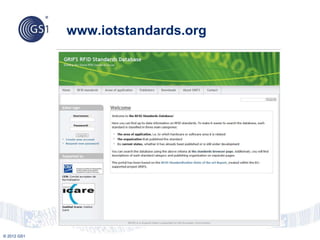
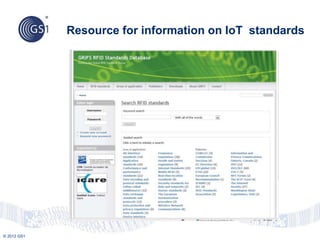
www.iotstandards.org
© 2012 GS1
Resource for information on IoT standards
Thank you for your attention!
Henri Barthel
Vice President GS1 System Integrity and
Global Partnerships
GS1 Global Office
+32 2 788 7823
henri.barthel@gs1.org

Henri Barthel (GS1)

  • 1.
    Beyond the Label IoTconsiderations Henri Barthel, GS1 Sierre, 27 January 2012
  • 2.
    © 2012 GS1 GS1:Global reach, local presence GS1 is a not-for-profit organization dedicated to the design and implementation of global standards and solutions to improve the efficiency & visibility of the supply and demand chains globally and across sectors Countries with a GS1 Member Organisation Countries served directly by GS1 Global Office 111 Member Organisations 1,5 million member companies
  • 3.
    © 2012 GS1 Themost widely used bar code in the world 4 5 1 2 3 4 5 6 7 8 9 0 6 > •5 billion “bips” every day • Introduced in 1974; still growing in 2012
  • 4.
    © 2012 GS1 GS1:A global system of standards
  • 5.
    Beyond the Label ProvidingDigital Information Consumers Can Trust
  • 6.
    © 2012 GS1 DigitalConsumer Information in the context of the Future Value Chain 2020 Future Value Chain Building Strategies for the New Decade Multiple GS1 initiatives around mobile and digital information
  • 7.
    © 2012 GS1 12main Future Value Chain trends are characterizing the next decade Increased Urbanization Aging Population Increasing Spread of Wealth Increased Impact of Consumer Technology Adoption Increase in Consumer Service Demands Increased Importance of Health and Wellbeing Growing Consumer Concern about Sustainability Shifting of Economic Power Scarcity of Natural Resources Increase in Regulatory Pressure Rapid Adoption of Supply Chain Technology Capabilities Impact of Next- Generation Information Technologies Increased Impact of Consumer Technology Adoption Increase in Consumer Service Demands Increased Importance of Health and Wellbeing Shoppers continue to become more empowered using technology This drives significant changes in consumers’ behavior and buying behavior and new levels of service demands Shoppers want more healthy products and a healthier lifestyle
  • 8.
    © 2012 GS1 FourCommon Strategic Objectives have jointly been defined Optimize a shared supply chain Collaborate differently, compete differently Engage with technology-enabled consumers The consumer in the driver’s seat Serve the health and wellbeing of consumers Focus on quality of life Make our business more sustainable From niche to norm
  • 9.
    © 2012 GS1 TheDigital Problem  Brands and Retailers: high quality digital information  Third-party “apps”: Digital information often missing or incorrect.
  • 10.
    © 2012 GS1 CurrentDigital Information is Bad ! 10
  • 11.
    © 2012 GS1 Everybodyloses with Bad Digital Information 11 “Providing accurate information about our products is a critical part of building trust with our consumers” Werner Geissler, Vice Chairman, Global Operations, Procter & Gamble • Consumers need information they can trust • Brand Owners risk loss of Brand Equity and Sales • Application Providers face lost usage
  • 12.
    © 2012 GS1 Consumerswant Nutrition and Ingredient Information
  • 13.
    © 2012 GS1 Consumersincreasingly demand mobile functionalities Source: ‘Mobile Commerce Report 2011: Mobile in Retail’, GS1 Sweden, ECR Sweden, Ericsson
  • 14.
    © 2012 GS1 Movingtowards Good Digital Information for Consumers Focus on Authoritative Consumer Information Core/master product data, including product descriptions, ingredients and nutritional information, as provided by the brand owners or other authorized sources Achieve consensus on a business-driven Solution • Global • Scalable • Real-time • Multi-sourced Improve B2C Data Quality • Data integrity • Data authenticity • Data accuracy • Data completeness
  • 15.
    © 2012 GS1 GS1– Trusted source of data
  • 16.
    © 2012 GS1 Objective:to enable access to Trusted Source of Data (TSD) Leverage existing standards based on brand data used by the Global Data Synchronization Network (GDSN) Phase I was simple and valuable to test the system and focused on nutritional attributes Trusted Source of Data Project 16
  • 17.
    © 2012 GS1 ProductName Brand Owner Name Product Description Product URL (Brand owner website) Product Image URL (Brand owner website) Phase 1 – Basic Information (5)
  • 18.
    © 2012 GS1 Phase1 – Nutritional Information (19) Calories/Energy Total Fat Fat Total Saturated Trans Polyunsaturated Monounsaturated Carbohydrates Total Dietary Fibre Sugars Vitamins Vitamin A Vitamin C Calcium Iron Proteins Cholesterol Sodium Serving size Servings per container
  • 19.
    © 2012 GS1 PilotSummary Countries: 8 Aggregators: 5 IAPs: 5 (on iPhone and Android) Participating Brands: 29 Products: 807 19
  • 20.
    © 2012 GS1 Brandparticipation 20 Country Participants Australia Kraft, Nestle Canada Kraft, Smucker Colombia Exito, Taeq, Noel, Team Foods France Bonduelle, Carrefour, Casino, Groupe BEL, Lactalis, Lesieur, Marie Morin Germany Emmi, Rausch Spain EROSKI, Caps, Agua Mineral San Benedetto, Danone, Kellogg’s, Heineken, Cadbury, Coca-Cola US PepsiCo, Coca-Cola UK Nestle, R&R Ice Cream, Premier Foods, Tesco, Unilever
  • 21.
    © 2012 GS1 GS1Standards Datapool 1 Datapool 2 GDSN Certified 3rd Party Content Data Aggregator 1 Data Aggregator 2 ONS e-tailer Internet Application Provider 1 15 5 Add’l Brand Data Certified 3rd Party Content Add’l Brand Data 1 Send GTIN to aggregator 2 2 2 Send EPC URI to ONS (if data not held) 3 3 3 Retrieve relevant aggregator URL 4 4 Send & Receive relevant attributes 5 Receive attributes from aggregator Non-Brand Data Non-Brand Data (if it holds the data for that GTIN)
  • 22.
    © 2012 GS1 2012milestones 22 • Pilot • Pilot report (Feb 2012) • Phase 1 • Standards development for relevant data model and messaging standards (starting now) • Beta of new architecture (Jun 2012) • Phase 2 • Collaborative work with Consumer Goods Forum (Jun 2012)
  • 23.
    © 2012 GS1 Moreinformation 23 • Beyond the Label report is available at www.gs1.org/b2c • Pilot report will be available mid-February at www.gs1.org/b2c • If you need more information contact Joe Horwood at joe.horwood@gs1.org
  • 24.
    The Internet ofThings Some considerations
  • 25.
    © 2012 GS1 TheInternet of Things • The expression was first created at the Massachusetts Institute of Technology (MIT) in 1999 • There was a research project called Electronic Product Code • The idea was to identify objects with tiny electronic radio chips and use the Internet to track them • The Internet of Things is all about connecting objects, people, machines, devices, ...
  • 26.
    © 2012 GS1 GRIFSProject • GRIFS = Global RFID Interoperability forum for Standards • European Union funded support action • Duration: January 2008 to December 2009 (2 years) • Members: GS1 (Coordinator), ETSI, CEN • Objectives: - Document RFID standards activities globally - Establish liaisons with on-going projects and Standard bodies - Establish a global forum for RFID Standards
  • 27.
  • 28.
    © 2012 GS1 Resourcefor information on IoT standards
  • 29.
    Thank you foryour attention! Henri Barthel Vice President GS1 System Integrity and Global Partnerships GS1 Global Office +32 2 788 7823 henri.barthel@gs1.org